Britons Denied Due Process

…along with everyone else being held at Guantanamo Bay.
What kind of precedent are we setting for the rest of the world? This is truly frightening.
Confess or die, US tells jailed Britons
Outrage over plight of Guantanamo detainees
By Martin Bright, Kamal Ahmed and Peter Beaumont for The Observer.

The two British terrorist suspects facing a secret US military tribunal in Guantanamo Bay will be given a choice: plead guilty and accept a 20-year prison sentence, or be executed if found guilty.
American legal sources close to the process said that the prisoners’ dilemma was intended to encourage maximum ‘co-operation’.
The news comes as Jack Straw, the Foreign Secretary, prepares to urge US Secretary of State Colin Powell to repatriate the two Britons. He will say that they should face a fair trial here under English law. Backed by Home Secretary David Blunkett, Straw will make it clear that the Government opposes the death penalty and wants to see both men tried ‘under normal judicial process’.
Lawyers acting for Moazzam Begg, 35, from Sparkbrook, Birmingham, and Feroz Abassi, 23, from Croydon, said that any confessions gathered while the men were kept without charge or access to lawyers in Bagram airbase in Afghanistan and Camp Delta in Cuba would have no status in international law and would be inadmissible in British courts.
Gareth Peirce, who acts for Moazzam Begg, said: ‘Anything that any human being says or admits under threat of brutality is regarded internationally and nationally as worthless. It makes the process an abuse. Moazzam Begg had a year in Bagram airbase and then six months in Guantanamo Bay. If this treatment happened for an hour in a British police station, no evidence gathered would be admissible,’ she said…
‘The trial system in Guantanamo Bay allows a whole series of serious breaches of defendant rights that would mean that they could never come to trial in the US.
‘First, it allows the wiretapping of attorney-client meetings, although those wiretaps cannot actually be used in evidence. Then there is the fact that the Pentagon “Appointing Authority” – probably US Defence Secretary Donald Rumsfeld – has the ability to remove a judge at any time without giving any reason.’
Among other concerns about the 50-page Final Rule, which was published by the Department of Defence last week for governing the trials, are:


321 Studios Moves Forward

Here’s an O’Reilly weblog I wrote a while back with some background on this situation.
New DVD ‘ripper’ pre-empts DMCA ruling
By Munir Kotadia for ZD Net.

DVD software developer Studio 321 is preparing to launch six new applications, including an enhanced version of DVD copying software that is the subject of a US court case brought under the controversial Digital Millennium Copyright Act (DMCA).
Studio 321 is awaiting a ruling over its DVD X Copy software, which includes a facility that allows users to rip backups of movie DVDs. If the ruling goes against Studio 321, the company says this new version of the copying software will ship without the “ripper” module, which decrypts movie DVDs and allows them to be copied…
Studio 321 landed in court after taking the unusual pre-emptive step of asking a court to declare DVD Copy Plus legal. Company executives decided to file the brief last April, after reading newspaper reports in which movie-studio representatives said they planned to sue DVD-copying software makers and which mentioned 321.
The case holds important consequences not only for software developers and for the motion picture industry, but also for consumers, who face increasingly complex rules governing the uses of entertainment products.
Semaan is adamant that his company’s software does not advocate piracy, saying that it helps users to protect their property. He argues that if it is legal to make back-up copies of tapes and CDs, then it should not be any different to copy DVDs. “The DMCA says that it is supposedly illegal to circumvent encryption, and while DVDs come encrypted, those other forms of media do not,” said Semaan…
In May, the judge in charge of this case said she would come back with a ruling “shortly”, but two months later, there is still no word. However, no news is good news for Semaan: “For us, the longer she takes the better.”

Continue reading

Conjoined Twins Die Soon After Separation Surgery

I was able to capture a “before” clip on NBC news and an “after” clip from the Jim Lehrer News Hour on PBS.
The clips show an interview with the girls and explain the nature of the surgery involved (and what went wrong).
I’ve edited them together into a single news reel:
NBC and PBS On The Conjoined Twins. (Small – 6 MB)


So they died from blood loss — most likely when the makeshift grafted brain arteries didn’t hold. Perhaps they should have waited another couple of years. (When we will be growing arteries whole 🙂

Interview With Amnesty International’s Matthew Van Saun About Guantanamo Bay

As I’ve mentioned in an earlier post, there appears to be a real problem going on at Guantanamo Bay right now with regard to the treatment of prisoners, the treatment of under age youths, and the recent floating of plans to convert the facility into a Death Camp.
I took the liberty of interviewing Amnesty International’s Matthew Van Saun about this issue a few weeks ago while attending the Friday 13, 2003 INS Mass Deportation Protest in San Francisco. Matthew emphasized that now is the time to be proactive in letting our representatives know that these people deserve trials and executing them without due process is unacceptable.
The wind was blowing really hard, so I’ve transcribed the entire interview, in case portions of it are too hard to hear over the wind.
Video: Matthew Van Saun On Guantanamo Bay (Small – 9 MB)
Van Saun: I’m out here today regarding the deportation of 13,000 Arab and Muslim men — giving a statement for Amnesty International.
Question: Can you confirm some of the reports that we’ve been hearing about the government sort of floating plans to turn Guantanamo Bay into a death camp?
Van Saun: Well, I can tell you that Amnesty International, if these reports turn out to be true, would be very opposed to that plan. Because, what they would be doing is basically executing people without a trial and without due process. Amnesty International has a very strong platform against the death penalty in the United States.
We would be very concerned if they were building a purported “camp” to actually put people to death in Guantanamo. It’s something that Amnesty International has sent out issue briefs on and press statements, and if it turns out to be true, I’m sure that Amnesty International would like to send a delegation down to Guantanamo to inspect this camp or this proposed idea of setting up some sort of death camp. If it’s legitimate.
Question: If it’s legitimate? There have been people from the Administration saying they’re thinking about it, basically?
Van Saun: Yes. Well, if we have information that says that they are actually going to follow through with their proposal of turning it into a quasi-death camp. If that’s what they’re planning on. Then we would be very much opposed to such a thing.
Question: But it’s hard to really oppose it until they’ve announced that they’re implementing something?
Van Saun: Well, we can still oppose it by pressuring members of Congress and the government. Especially the Justice Department and the Department of Defense. We can still shoot it down as well because we would really want to make sure that they know that it would not be acceptable, even for an idea, to put people to death at Guantanamo.
Question: Do you think these days that maybe Congress is a better bet than the Department of Justice as far as telling people that care what we think?
Van Saun: I think so. I think if we put a lot of pressure on our Congressman and our Senators, in San Francisco and all over the country, to make sure they’re aware of these issues. Some congressman sometimes aren’t even aware of what’s going on. And it’s best to be proactive in stopping the government before they act in such an instance, if they were going to do something.
Question: So maybe we’d write a letter to bring it to their attention, or something, before it even gets their desks?
Van Saun: Letters, phone calls, emails, faxes — whatever it takes to get people to realize that this is an unacceptable form of punishment.
Question: Does Amnesty International have a position you can talk about in terms of Guantanamo Bay and the conditions that the prisoners are being kept in? Did you guys have an inspection team there or anything?
Van Saun: I don’t think Amnesty actually ever had an inspection team allowed into Guantanamo Bay.
Question: So there hasn’t been one?
Van Saun: As far as I know, there has never been an inspection team from Amnesty International allowed into Guantanamo Bay.

Microsoft’s Trusted Computing PCs Trust Everyone But You

A Safer System for Home PC’s Feels Like Jail to Some Critics
By John Markoff for the NY Times.

In an effort to retain the original open PC environment, the Microsoft plan offers the computer user two separate computing partitions in a future version of Windows. Beyond changing the appearance and control of Windows, the system will also require a new generation of computer hardware, not only replacing the computer logic board but also peripherals like mice, keyboards and video cards…
“This will kill innovation,” said Ross Anderson, a computer security expert at Cambridge University, who is organizing opposition to the industry plans. “They’re doing this to increase customer lock-in. It will mean that fewer software businesses succeed and those who do succeed will be large companies.”
Critics complain that the mainstream computer hardware and software designers, under pressure from Hollywood, are turning the PC into something that would resemble video game players, cable TV and cellphones, with manufacturers or service providers in control of which applications run on their systems.
In the new encrypted computing world, even the most mundane word-processing document or e-mail message would be accompanied by a software security guard controlling who can view it, where it can be sent and even when it will be erased. Also, the secure PC is specifically intended to protect digital movies and music from online piracy.
But while beneficial to the entertainment industry and corporate operations, the new systems will not necessarily be immune to computer viruses or unwanted spam e-mail messages, the two most severe irritants to PC users.
“Microsoft’s use of the term `trusted computing’ is a great piece of doublespeak,” said Dan Sokol, a computer engineer based in San Jose, Calif., who was one of the original members of the Homebrew Computing Club, the pioneering PC group. “What they’re really saying is, `We don’t trust you, the user of this computer.’ ”

Continue reading

Lots Of Stuff In The Kitty…

Okay, lemme see here…looks like I’ve got quite the back log of goodies here, but I’m ready to tackle them.
I’ve got the rest of ILAW, the whole Spectrum conference from March, Spam Tech Cybersalon, more SXSW 2003, more Etech 2003, lots of great “Where the f&*^% are the WMD” clips from reputable-type news sources, more Bill Moyers, more of the Democratic Candidates, more Daily Show…
More, more, more!
And I just got a new hard drive! So that will speed things up a bit!

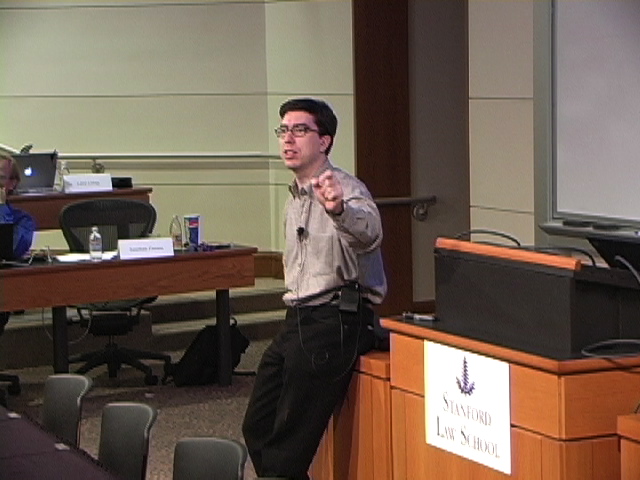
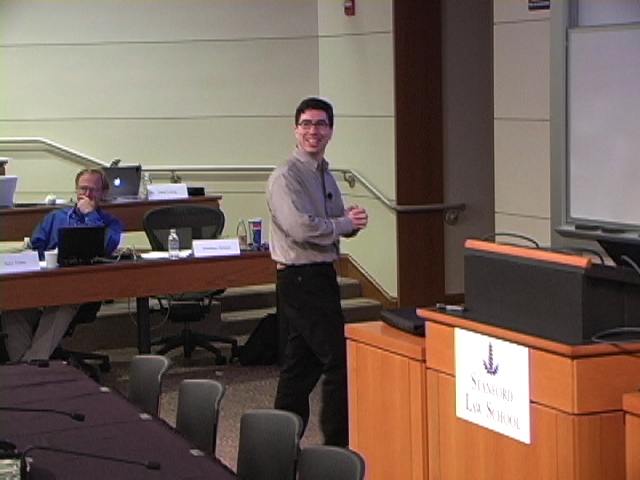
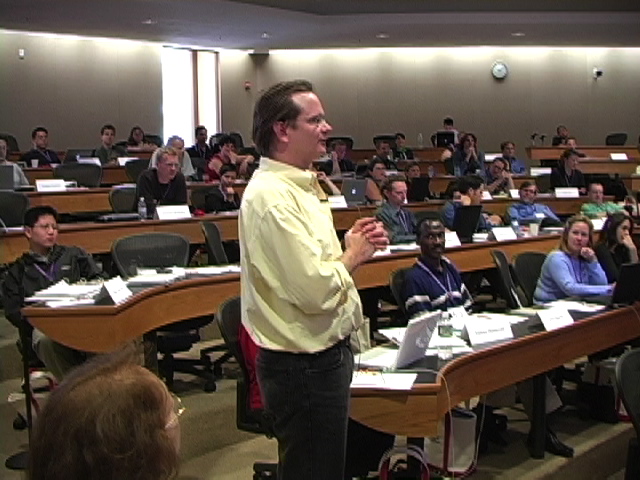
ILAW 2003 – Day 1 – June 30, 2003 – PM 1 of 2 – Lawrence Lessig and Jonathan Zittrain On Jurisdiction

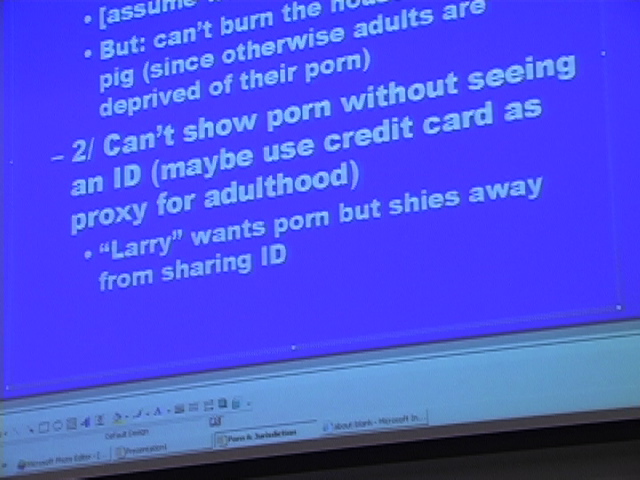
In this session, Larry and Jonathan tag team in order to play devil’s advocate across an array of Jurisdictional issues, using the situation of accessing porn over the internet and all of the case law surrounding it as the basis for discussion.
Ack! These links were bad this am – should be fixed now!
Lessig and Zittrain – Day 1 – Part 1 of 5 (Small – 53 MB)
Lessig and Zittrain – Day 1 – Part 2 of 5 (Small – 51 MB)
Lessig and Zittrain – Day 1 – Part 3 of 5 (Small – 51 MB)
Lessig and Zittrain – Day 1 – Part 4 of 5 (Small – 50 MB)
Lessig and Zittrain – Day 1 – Part 5 of 5 (Small – 53 MB)


Creative Commons License
This work is licensed under a
Creative Commons License.

Americans For Dean Makes A Splash In Wired News

You’ll see more from
Americans For Dean
‘s Zack Rosen, one of the subjects of this article, in the next ILAW session I post about Blogging and Democracy.
Netizens Rally for Dean Team
By Katie Dean for Wired News.

“It’s an autonomous, self-organizing, grass-roots campaign network,” said Zack Rosen, the University of Illinois at Urbana-Champaign computer science student who cooked up the idea. “We’re giving people a Web tool to organize the campaign network. We want to help get this man elected.”
Instead of taking directions from the top down, small groups of Dean supporters can organize their own “campaign node.” Each local node, like Milwaukee for Dean or Quilters for Dean, for example, will be able to host forums and post its own news, blogs and calendar using open-source tools assembled by the developers.
Those nodes then will plug into larger nodes, like statewide Dean groups, higher in the network’s hierarchy. The larger nodes will keep track of the local nodes and house a repository of Rich Summary Site feeds, enabling the groups to share relevant articles and news.
A collection of campaign-related pictures, videos and audio also will be hosted on the local nodes. All of the media will be licensed under the Creative Commons, and people are encouraged to sample and modify the media, like setting photos to music or creating snazzy new fliers to distribute.
“All the content that will be put up on these nodes will be contributed by users,” Rosen said.

Continue reading