This is from the November 2, 2003 program of Meet the Press.
Complete Video and Photos
Rumsfeld: No Way To Know How Many Troops It Will Take (“It Is Unknowable”) (Small – 5 MB)
Tim Russert:
“Time magazine reports this today, that this question was asked in the closed briefing with senators, “‘What troop levels do we expect to have in Iraq a year from now?,’ asked Senator Bill Frist, the Republican leader. And with that, the Pentagon chief began to tap dance.” Do you believe that you have an obligation to tell our leaders in Congress what your best estimate is for troop levels in Iraq a year from now?”
Donald Rumsfeld:
“You know, since — any war, when it starts, the questions are obvious. The questions are: How long is it going to last? How many casualties will there be? And, How many troops will it take?
Now, those questions can’t be answered. Every time someone has answered those questions, they’ve been wrong. They have been embarrassingly wrong. I’ll use another word: They have “misinformed.” By believing they knew the answers to those questions, they’ve misinformed and misled the American people.
I made a conscious decision at the outset of these conflicts to not pretend I knew something I didn’t know. And what I have said is just that. I have said it is not knowable.
Now, if you think about Bosnia, we were told by the administration back then that the American forces would be out by Christmas. That was six and a half years ago. They’re not out yet. That was — that — the effect of that was not consciously misleading — I’m sure they believed it. They were that wrong — six and a half years wrong. I don’t intend to be wrong six and a half years. I intend to have people understand the truth, and the truth is no one knows. But why is that question not answerable?
And Bill Frist knows this. He asked it because others were interested in that question. He’s been very supportive and very complimentary of what we’re doing, and it was not a critical question at all. It was a question that should have been raised. And I said was this: The security situation on the ground is going to determine the total number of security forces that are needed in Iraq.”
Rumsfeld On Meet The Press: On The Shrub Administration’s Refusal To Cooperate With Congress
This clip includes some harsh criticism from prominent Repubs such as Frank Wolf and Chuck Hagel.
This is from the November 2, 2003 program of Meet the Press.
Complete Video and Photos
Rumsfeld: On The Shrub Administration’s Refusal To Cooperate With Congress (Small – 5 MB)
Tim Russert:
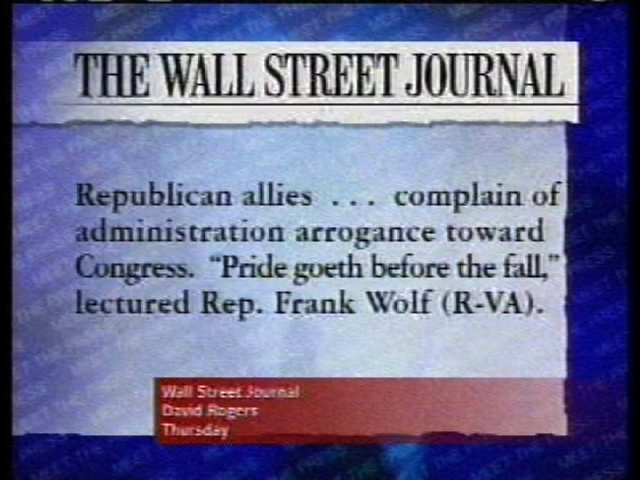
“Let me turn to some of the concerns expressed by Republicans in the Congress. This was Frank Wolf: Republican allies complain of administration arrogance towards Congress: ‘Pride goeth before the fall.’
And this, a prominent Republican Hill staffer: Rumsfeld and Secretary Wolfowitz, your top deputy, ‘just give off the sense that they know better than thou, and they don’t have to answer our questions.’
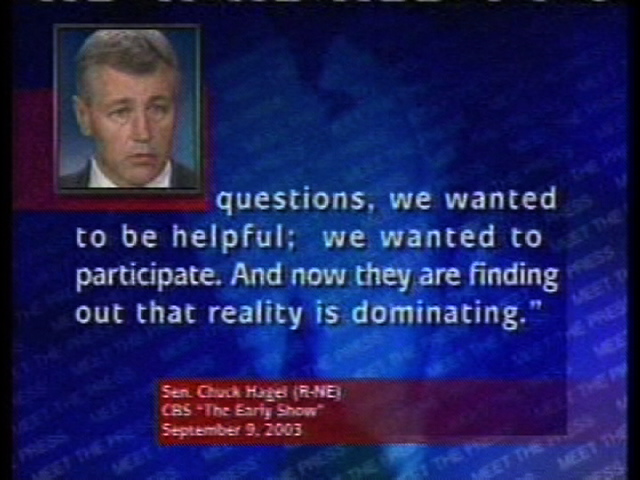
And this from Chuck Hagel on the Intelligence and Foreign Affairs Committees, Republican: ‘The Bush administration did miscalculate the difficulty of the war in Iraq. I think they did a miserable job of planning for a post-Saddam Iraq. They treated many in the Congress, most of the Congress, like a nuisance. When we asked questions, we wanted to be helpful, we wanted to participate. And now they are finding out that reality is dominating.’
‘Arrogance?’ ‘Nuisance?’ Not a full appreciation of your fellow Republicans in the Congress?”
Donald Rumsfeld:
“Well, you know, there’s 535 members of the House and Senate, and you are going to find every viewpoint across the spectrum. It’s always been so. You’ve served there — I served in Congress. And there’s always going to be someone who has a different view, and we accept that. We have spent enormous numbers of hours up there — I do. Secretary Powell does. Others in the administration, briefing Senators, briefing House members, briefing staff members. And overwhelmingly they’ve been appreciative of those briefings and felt that they were helpful. We’ve sent up intelligence briefing people on a regularly weekly basis. I think probably there’s been more information back and forth in this conflict during Iraq and Afghanistan than in any conflict in the history of the country.
Now, when people are having their constituents killed, and they see things happening that worry them, understandably they’re going to be worried and concerned about it, and I accept that. And these are tough issues. These are not easy issues. And the fact that there are a variety of views in Congress simply reflects the country. There are a variety of views in the country. And that’s understandable.”


Rumsfeld On Meet The Press: Did He Underestimate The Intensity Of The Resistance?
This is from the November 2, 2003 program of Meet the Press.
Complete Video and Photos
Rumsfeld: Did He Underestimate The Intensity Of The Resistance? (Small – 2 MB)
Tim Russert:
“Did you underestimate the intensity of the resistance?”
Donald Rumsfeld:
“I don’t know. You know, I don’t know that we — you don’t sit down and make a calibration that the resistance will lead to X numbers of Iraqis being killed per week, or that so many coalition people being wounded per week. That isn’t the kind of calibration you make. What you do is you say, here’s what you have to do to prevail. You have got to get the sovereignty transferred over to the Iraqi people, you have got to get the essential services going, and the economy on a path upward. And you’ve got to get the security responsibility transferred to the Iraqi people. That’s — because it’s their country. We’re not going to provide security in their country over a sustained period of time.
So we’ve gone from zero to 100,000 Iraqis providing security in that country, and our plan calls for us to go over 200,000 by next year.”
Rumsfeld On Meet The Press: Saddam No Longer A Threat?
The question mark’s there because Rummy actually yes “no” and then later “yes.”
This is from the November 2, 2003 program of Meet the Press.
Complete Video and Photos
Rumsfeld: Saddam No Longer A Threat? (Small – 4 MB)
Tim Russert:
“The New York Times reports that senior administration officials say that Saddam is playing a significant role in coordinating and directing attacks, and that he is the catalyst for what is going on now.”
Donald Rumsfeld:
“I don’t know what — how to take the word “catalyst.” I don’t doubt for a minute that his being alive gives encouragement to the Baathists and the regime murderers that you see in those tapes killing people.”
Tim Russert:
“He may be directing the resistance?”
Donald Rumsfeld:
“If he’s — I think he’s alive. I think he’s probably in Iraq. He’s probably in northern Iraq, and he undoubtedly has ways to communicate, imperfect ways, but probably by couriers, with some other people. Is he masterminding some major activity? Difficult to know, but unlikely. Is he involved? Possibly.”
Tim Russert:
“He’s still a threat?”
Donald Rumsfeld:
“Personally, no. No. I mean, is it a threat to have released 100,000 criminals in a country with 23 million people? You bet. Is it a threat to have foreign terrorists coming across the borders? You bet. Is it a threat to have the leftovers of the Feyadeen Saddam and the murderers of Saddam Hussein’s regime the Baathists who benefited from his regime? Sure, it’s a threat. And there’s a lot of them, and there’s a lot of weapons in that country. There are weapons caches all over the country. So is that a danger for people in Iraq? Yes.”
Rumsfeld On Meet The Press: “The Memo” and Winning The Hearts and Minds
This is from the November 2, 2003 program of Meet the Press.
Complete Video and Photos
Rumsfeld: What He Meant By His Memo (Small – 7 MB)


Tim Russert:
“Let me turn to your memo of October 16th, which has been leaked, and share it with our viewers and ask you to talk about it.”
(Russert reading from memo) ” ‘With respect to global terrorism, the record since September 11th seems to be: “We care having mixed results with Al Qaida…” Today we lack metrics to know if we are winning or losing the global war on terror. Are we capturing, killing or deterring and dissuading more terrorists every day than the madrassas’ the schools ‘and the radical clerics are recruiting, training and deploying against us?… It is pretty clear that the coalition can win in Afghanistan and Iraq in one way or another, but it will be a long, hard slog.’ ”
” ‘Don’t know if we are winning or losing’ ??”
Donald Rumsfeld:
“Let me explain that. It’s not that we don’t know if we’re winning or losing in Iraq or Afghanistan. We know what’s happening there. The point I was making is this. If there are 90 nations engaged in the global war on terrorism, and if they’re out arresting, capturing, killing terrorists. If they’re out there putting pressure on their bank accounts, making it harder for them to raise money, making it harder for them to transfer money, making it harder for terrorists to move across borders. All of which is true. Good progress is being made.
The question is, that I posed, and I don’t know the answer, is how many new terrorists are being made. How many of these schools are being led by radical clerics and are teaching people that the thing they should do with their lives is to go out and kill innocent men, women and children to stop progress, to torture people, to prevent women from being involved in their country’s activities. How many schools are doing that and how many people are being produced by that? And the question I posed was: you can’t know in this battle of ideas how it’s coming out unless you have some metric to judge that and there isn’t such a metric. It doesn’t exist. Therefore, my point was in the memo, that I think we need, the world needs, to think about other things we can do to reduce the number of schools that teach terrorism. Not just continue (stops) we certainly have to continue doing what we’re doing in going after terrorists wherever the are, and capturing them and killing them. But I think we also have to think about how we, the world, not just the United States — this is something well beyond our country or the Department of Defense — how we reduce the number of people who are becoming terrorists in the world.”
Tim Russert:
“Win the hearts and minds.”
Donald Rumsfeld: (Nods)
Rumsfeld On Meet The Press: Tim Russert asks “Do you ever say to yourself, or wonder ‘My god, the intelligence information was wrong and what have we gotten ourselves into?'”
Rummy’s answer: “You know, in my lifetime, I’ve said that many times…” (See complete answer below.)
Russert also asks Rummy about Saddam’s current role, if any, in the latest wave of attacks on the troops.
This is from the November 2, 2003 program of Meet the Press.
Complete Video and Photos
Russert to Rumsfeld: Do you ever say to yourself, or wonder ‘My god, the intelligence information was wrong and what have we gotten ourselves into?’ (Small – 6 MB)
Tim Russert:
“Do you ever say to yourself, or wonder ‘My god, the intelligence information was wrong and what have we gotten ourselves into?’ ”
Donald Rumsfeld:
“You know, in my lifetime, I’ve said that many times, because intelligence is never really ‘right’ or ‘wrong.’ What it is is a best effort by wonderful, hard working intelligence people, overtly and covertly trying to gather in the best information they can and then present it to policy makers. It’s never perfect. These countries are closed societies. They make a point of denying and deceiving so that you can’t know what they’re doing. So it’s a best effort, and it’s pretty good. Is it perfect? No. Has it ever been perfect? No. It will never be perfect, our intelligence information. But we’ve got wonderful people doing a fine job and it seems to me that it’s adequate for policy makers to then look at it and draw conclusions and make judgements.”
Tim Russert:
“Do you think that Saddam Hussein intentionally rolled over in March, and let the United States roar into Baghdad, planning that he would come back six months later with an armed resistance of the nature we’re seeing now?
Donald Rumsfeld:
“I don’t. I think they fought hard south. When the movement was so fast. And then, when some forces came in from north, a great many of his forces decided that they couldn’t handle it, and they disappeared. They disband themselves, if you will, left their weapons in some instances and unformed their formations, and went home. The idea that his plan was to do that I think is far fetched. What role he’s playing today, I don’t know. We don’t know. Very likely, Saddam Hussein is alive. Very likely, he’s in the country. His sons are killed. 42 of his top lieutenants, out of 55, have been captured or killed. So it’s a skinny-downed organization, what’s left. And, uh, is he interested in retaking his country? Sure. Is he going to? No. Not a chance.”
Rumsfeld On Meet The Press: Were We Safer Before The War?
Tim Russert asks a great question and Rummy manages to drop in a little disinformation about the non-existent connection between Al Queda and Iraq.
This is from the November 2, 2003 program of Meet the Press.
Complete Video and Photos
Rumsfeld On Whether We’re Less Safe Since The Shrub War Started
(Small – 8 MB)
Tim Russert:
“Go back prior to the war in march, where the argument was being made that there was no need to go to war with Saddam Hussein. He’s in a box. He’s confined. We have sanctions. We have inspections. And then the Administration decided to go to war and opened up that box. And that America is now less safe — less secure, than we were prior to the invasion.”
Donald Rumsfeld:
“I think that that’s not correct. I would say America is more safe today. If you believe the intelligence, which successive administrations of both political parties did, and other governments in the world, that he was progressing with these programs and that this is a country who’s used the weapons before. That’s used them on its neighbors — used them on his own people. I don’t know if you’ve seen any of the tapes more recently of what they do to their own people. Of cutting off people’s heads and cutting off their fingers and their hands, and pulling out their tongues and cutting them off — throwing them off three story buildings. This is a particularly vicious regime, Saddam’s regime.
It is true, we have terrific young men and women being killed and wounded today, as we did yesterday, and your heart goes out to their families and to their loved ones. But what they’re doing is important. What they’re doing is taking the battle to the terrorists. There are foreign terrorists coming in to Iraq. That’s true. We know that. We’ve captured two or three hundered of them from various countries.”
Tim Russert:
“Stop there. Would that have happened — would they have gone to Iraq but for the fact that we went in there?”
Donald Rumsfeld:
“Why sure. The Ansur al islam (sp) was already in Iraq. There were Al Quaeda already in Iraq. The Iraqis were engaged in terrorism themselves. They were giving $25,000 to suicide bombers’ families who would go in and kill innocent men, women and children. They are a part of that. And certainly, the work in Iraq is difficult. It’s tough. And it is gonna to take some time, but good progress is being made in many parts of the country…”
Rumsfeld On Meet The Press: What Did He Mean When He Said The Coalition Could Win The Shrub War “One Way Or The Other” In His Memo?
This is from the November 2, 2003 program of Meet the Press.
Complete Video and Photos
Rumsfeld: One Way Or The Other (Small – 3 MB)
Tim Russert:
“You also reference to ‘the coalition can win Afghanistan and Iraq in one way or the other.’ What did you mean by that?”
Donald Rumsfeld:
“Oh, that it is (stops) We’re on a track, and we hope the track works, and I believe it is working. You take Afghanistan, Mr. Karzai and Loya Jirga have produced a bonn plan — a way ahead. It’s underway. Uh, will it stay on track exactly? I don’t know. I hope so. I think they’re doing a good job and we’re doing everything we can to help them and so are a lot of other countries, including NATO now. Um, but, but however that sorts out one way or another, that country is not gonna go back and become a terrorist training ground for the Al Queda.”
Tim Russert:
“That appears to be a much more pessimistic assessment than you have made publicly.”
Donald Rumsfeld:
“Not at all. I believe we’re doing well in Afghanistan, and said so.”
Tim Russert:
“And Iraq?”
Donald Rumsfeld:
“Well, I was gonna come to Iraq. Iraq is what it is. It is a tough, difficult situation. When you’re having people killed in the coalition, and we are, and our Iraqi allies being killed that are providing security, and Iraqi people being killed by these terrorists, it isn’t a pretty picture. It’s a tough picture.”
Bill Moyers: Our Democracy is in Danger of Being Paralyzed
I just started reading this myself, but I’m about to go to dinner and I didn’t want to risk forgetting to get this up tonight. So here it is.
Update 10/14/03 – recordings of this speech are now available. I’ve also re-archived them here.
(Thanks, Mark!)
Bill Moyers’ Keynote Address to the National Conference on Media Reform
that the very concept of media is insulting to some of us within the press who find ourselves lumped in with so many disparate elements, as if everyone with a pen, a microphone, a camera, or just a loud voice were all one and the same.
Constitutionality of Secret 911 Cases Headed For The Supreme Court
Secret 9/11 Case Before High Court
By Warren Richey for The Christian Science Monitor.
It’s the case that doesn’t exist. Even though two different federal courts have conducted hearings and issued rulings, there has been no public record of any action. No documents are available. No files. No lawyer is allowed to speak about it. Period.
Yet this seemingly phantom case does exist – and is now headed to the US Supreme Court in what could produce a significant test of a question as old as the Star Chamber, abolished in 17th-century England: How far should a policy of total secrecy extend into a system of justice?
Secrecy has been a key Bush administration weapon in the war on terrorism. Attorney General John Ashcroft warns that mere tidbits of information that seem innocuous about the massive Sept. 11 investigation could help Al Qaeda carry out new attacks.
Yet this highly unusual petition to the high court arising from a Miami case brings into sharp focus the tension between America’s long tradition of open courts and the need for security in times of national peril. At issue is whether certain cases may be conducted entirely behind closed doors under a secret arrangement among prosecutors, judges, and docket clerks.
While secret trial tactics have reportedly been used by federal prosecutors to shield cooperating drug dealers, it’s unclear whether the high court has ever directly confronted the issue. But that may change if they take up MKB v. Warden (No. 03-6747).
This is among the first of the post-Sept. 11 terrorism cases to wend its way to the nation’s highest tribunal. There was no public record of its existence, however, until the appeal was filed with the clerk of the US Supreme Court.
A federal judge and a three-judge federal appeals-court panel have conducted hearings and issued rulings. Yet lawyers and court personnel have been ordered to remain silent.
“The entire dockets for this case and appeal, every entry on them, are maintained privately, under seal, unavailable to the public,” says a partially censored 27-page petition asking the high court to hear the case. “In the court of appeals, not just the filed documents and docket sheet are sealed from public view, but also hidden is the essential fact that a legal proceeding exists.”…
The case is significant because it could force a close examination of secret tactics that are apparently becoming increasingly common under Attorney General Ashcroft. In September 2001, he ordered that all deportation hearings with links to the Sept. 11 investigation be conducted secretly. In addition, the Justice Department has acknowledged that at least nine criminal cases related to the Sept. 11 investigation were being cloaked in total secrecy.
MKB v. Warden is the first indication that the Justice Department is extending its total secrecy policy to proceedings in federal courts dealing with habeas corpus – that is, an individual’s right to force the government to justify his or her detention.
The case offers the Supreme Court an opportunity for the first time to spell out whether such secret judicial proceedings violate constitutional protections. It may also offer the first insight into how much deference a majority of justices is willing to grant the government in areas where the war on terrorism may tread upon fundamental American freedoms…
Federal judges have the authority to order sensitive documents or even entire hearings sealed from public view when disclosure might harm national security. Such rulings are usually issued after the judge has explained the need for secrecy in a decision available to the public.
In addition, judges can order that an individual be identified in public court filings only by a pseudonym or by initials, as happened when the MKB case arrived at the US Supreme Court.
What is highly unusual in MKB v. Warden is that lower court judges ordered the entire case sealed from the start – preventing any mention of it to the public.
In her petition to the court, Miami federal public defender Kathleen Williams says the judges’ actions authorizing the secrecy without any public notice, public hearings, or public findings amount to “an abuse of discretion” that requires corrective action by the justices.
“This habeas corpus case has been heard, appealed, and decided in complete secrecy,” Ms. Williams says in her petition.
A government response to the petition is due Nov. 5. It will mark the first time the Justice Department has publicly acknowledged the existence of the habeas corpus action. The justices are set to consider the case during their Nov. 7 conference.
Justice Department officials have defended the blanket secrecy policy, saying that public hearings and public dockets would undermine efforts to recruit detainees as undercover operatives to infiltrate Al Qaeda cells in the US. According to press reports, similar secret trial tactics have been used by federal prosecutors to shield cooperating drug dealers from mention in public court documents that might blow their cover and end their use as operatives in ongoing undercover narcotics sting operations.