ILAW 2003 – Day 3 – July 2, 2003 – AM 1 of 2 – How Technology, Law and the Market Affect The Web’s Content Layer

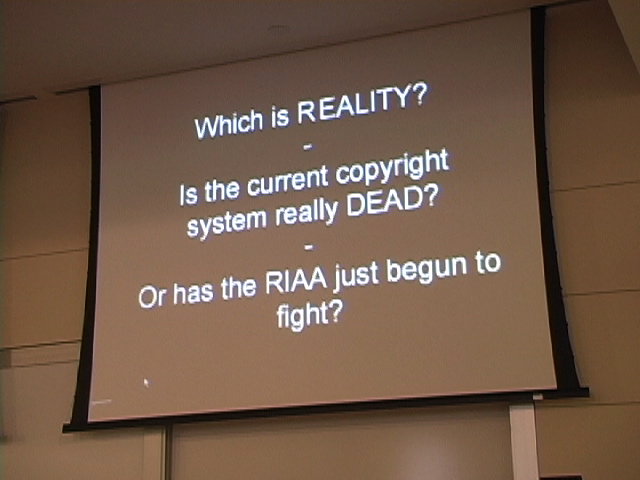
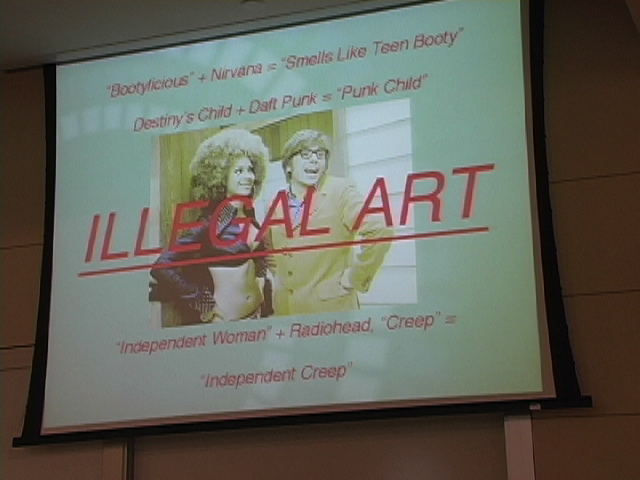
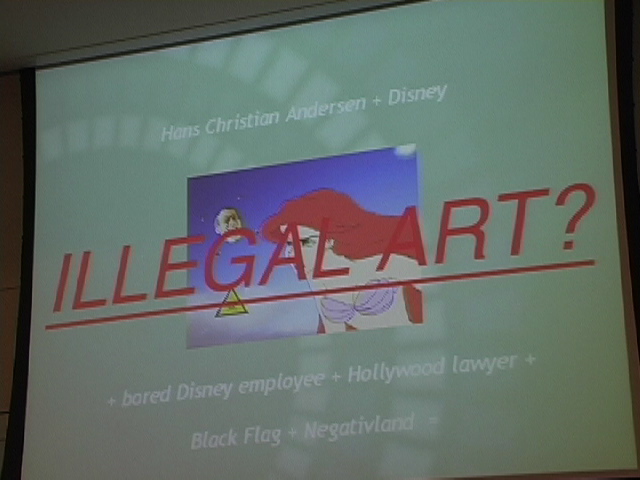
This panel also includes a lot of illegal art so I’ve included it in the appropriate category.
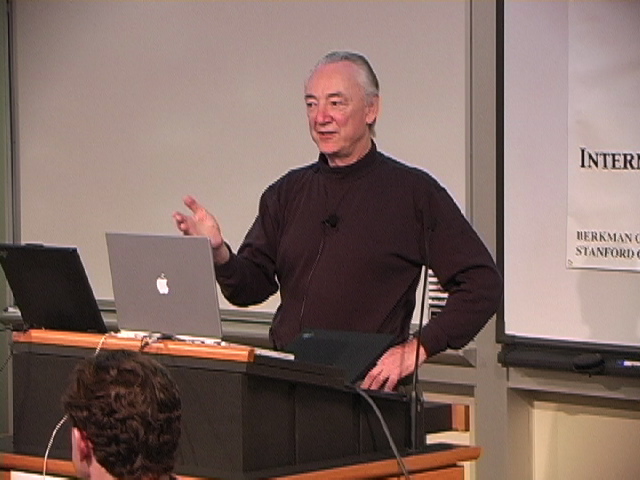
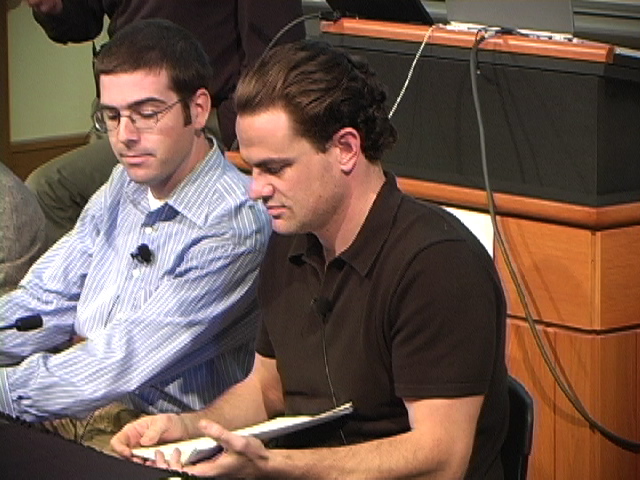
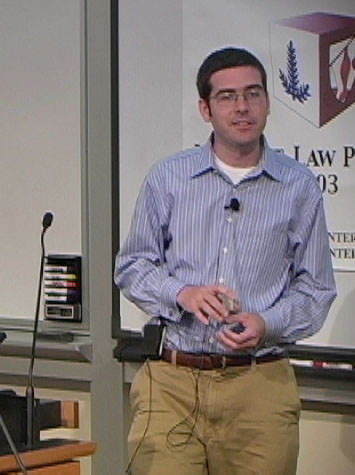
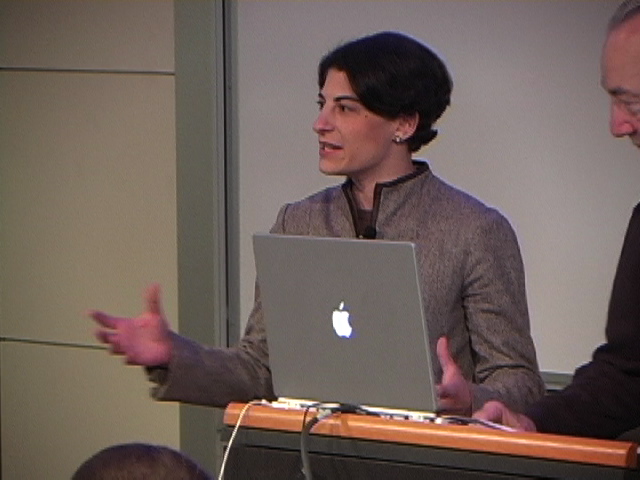
This is a panel featuring Google’s Alex Macgillivray, the Electronic Frontier Foundation‘s Wendy Seltzer and Glenn Otis Brown of the Creative Commons.
Introduction from Larry:

Yesterday, we focused on the physical layer and the logical layer.
Today, we focus on the content layer. The content layer has two radically different types of content built into it:
1) Content of MP3s and film
2) Content of programs and applications
Today we will walk through the scope of technology affecting *this* type of content and the law affecting on *this* type of content and the market on *this* type of content.

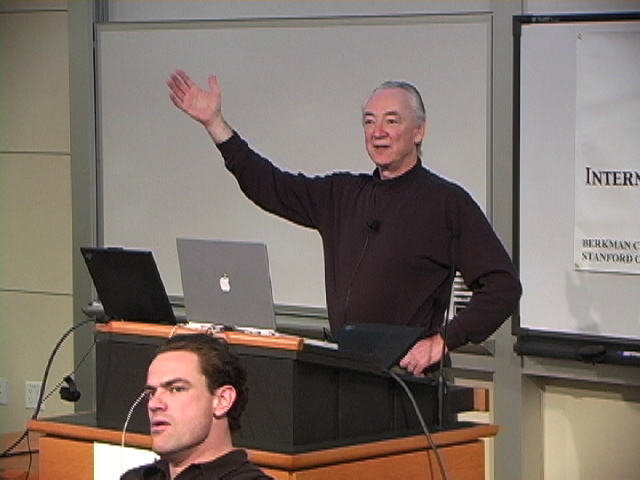
Charlie Nesson was the host for the panel.

Charlie’s Content Panel – Part 1 of 4
(Small – 43 MB)

Charlie’s Content Panel – Part 2 of 4
(Small – 39 MB)

Charlie’s Content Panel – Part 3 of 4
(Small – 44 MB)

Charlie’s Content Panel – Part 4 of 4
(Small – 36 MB)
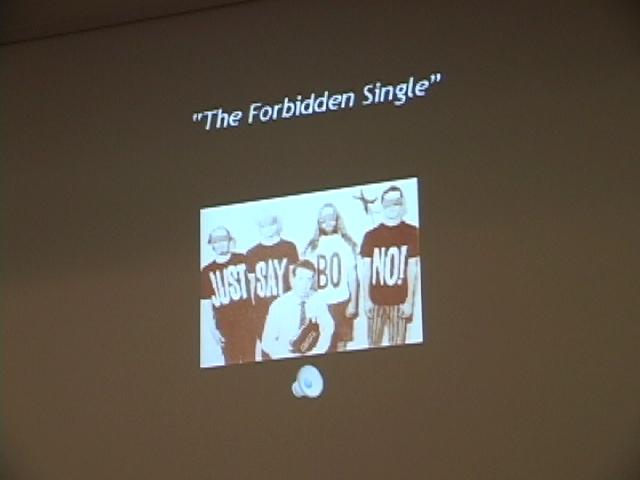
Just a few notes and lots of pictures for this one. This includes excerpts from the Illegal Art film festival and lots of great media clips from all three guests.
Day 3 Tape 1
8:49 – What is P2P with Alex
9:51 – “Democratization of the space”
11:00 – Napster
13:30 – Charlie Nesson as a supernode
20:14 – Fred
***
Day 3 Tape 2
Cut out part around 13:20 – tech diff
21:45 – Lynne Cheney
25:00 Mention of Howard Dean meetup


A Better Understanding Of The New “Farthest Planet” Discovery

A reader sent me this lovely response to my earlier question about the significance of this latest planet being decidedly “farther out” than any other.
Thanks Joseph!

The main reason for having Hubble in space is that it is really hard to see through the atmosphere at certain wavelengths. As well, the farther away something is, the dimmer it appears to our telescopes… that’s why we build bigger and bigger telescopes… to see farther and farther away.
How far away from Earth we place our telescopes will make little difference as to how far away our discoveries are… the space between stars is huge… not so with galaxies (relatively)… for example, if you could reduce our sun to the size of a basketball, the next closest star (also about the size of a basketball) would be in Hawaii (if the “Sun” is in the East Bay like me)… if you reduce our entire galaxy to the size of a basketball, the next closest galaxy would be in the next room! (this is also why galaxies seem to collide frequently (they’re not too far apart)… but when they collide their stars don’t hit each other… it’s like two swarms of bees colliding)

In Washington, The Recession Is Over

David Miller has piped up again over on his blog, and it’s pretty interesting:

In Washington, The Recession Is Over

DC is booming because this year the federal government is pumping 9% more money into the local economy than it did last year. Welcome to wartime. I suspect most of the money is in the form of consulting contracts for homeland defense and DOD (what exactly does the Department of Defense defend now that we have a separate homeland defense agency?). As a result of this money Washington-area housing prices are up by 20% in a year, making all the middle-aged types euphoric and rich; a townhouse in Arlington worth $200,000 at the beginning of the Bush administration is worth $350-$400,000 now. Traffic is reaching LA levels but the place is, considering how the rest of the country is doing, almost indecently prosperous.
The strange part is that no one in DC seems to know that the national economy is stagnant; they assume the recession is ending because it is over in DC. My professional economist friends assumed, until we checked the bls.gov website, that the U.S. and DC unemployment rates were roughly the same. The local paper, the Washington Post, has almost no coverage on the national economy that would change their minds; all the coverage is about local real estate, housing prices, and new defense contracts.
And that leads to a curious disconnect between the capitol and the hinterland. Everyone in DC assumes Bush will win the 2004 election in a walk because the economy is better.

Create a new category:
Our nation’s capitol is undergoing a boom while the rest of the economy languishes. That fills the city with a strangely distorted view of the nation’s economy, the nation’s mood, and the prospects for the next election (more).
I lived in the Washington area for 19 years and still visit often. Today I’m just back from a week there. Almost everyone in Washington, including two professional economists I know, thinks the economy is “picking up”, and that the unemployment rate in DC is roughly at the national average. That was true 18 months ago, but is emphatically not true now.
Today the Washington-area unemployment rate is 3.4 %, roughly full employment, while the rest of the country struggles by with a 6% unemployment rate which stubbornly refuses to fall. Of the more than 300 metropolitan areas in the U.S., DC has the 32nd lowest unemployment rate, and all the places doing better are small towns. The next best showing by a big city is Atlanta, which has an unemployment rate almost 50% higher than DC.
DC is booming because this year the federal government is pumping 9% more money into the local economy than it did last year. Welcome to wartime. I suspect most of the money is in the form of consulting contracts for homeland defense and DOD (what exactly does the Department of Defense defend now that we have a separate homeland defense agency?). As a result of this money Washington-area housing prices are up by 20% in a year, making all the middle-aged types euphoric and rich; a townhouse in Arlington worth $200,000 at the beginning of the Bush administration is worth $350-$400,000 now. Traffic is reaching LA levels but the place is, considering how the rest of the country is doing,almost indecently prosperous.
The strange part is that no one in DC seems to know that the national economy is stagnant; they assume the recession is ending because it is over in DC. My professional economist friends assumed, until we checked the bls.gov website, that the U.S. and DC unemployment rates were roughly the same. The local paper, the Washington Post, has almost no coverage on the national economy that would change their minds; all the coverage is about local real estate, housing prices, and new defense contracts.
And that leads to a curious disconnect between the capitol and the hinterland. Everyone in DC assumes Bush will win the 2004 election in a walk because the economy is better. The local Democrats are in a panic. Maybe that’s why Dean is doing so well; he lives in a place with no jobs and a recession.
Last week the government unveiled the national “do not call”list; just go to donotcall.gov, sign up, and most of those annoying dinner-time calls trying to sell you a condo will stop. More than 500,000 people tried to sign up the first day. Everyone in DC was shocked; this was more than four times what they had expected. The government hurriedly quadrupled the number of computers handling the requests. Why were they so surprised? Well, I have a hint for you. My friends in the rich inner suburbs of Washington don’t seem to get these calls. The cold-callers aren’t fools; annoy the rest of the country at dinner, but not the people who make the decisions. In Washington cold-calls at dinner simply weren’t much of a problem.
Come election time the press and the permanent, prosperous governing class in Washington might just be in for a big surprise if the economy doesn’t pick up in places where the voters live and begin to match the rosy world where the opinion-makers live.

Continue reading

Illegal Art Film Festival Today And Tomorrow At The Roxie

Here are all the details from my earlier post, for all of the film titles and such.
I’ll be there from 2pm on. There’s a new movie/collection of movies being shown every two hours, and they’re all cool. So just come down whenever you can make it.
Today’s guest speakers include:
Lawrence Lessig introducing “Willfull Infringement” at 6pm, and answering questions afterwards.
Rick Prelinger, Members of Paul Harvey Oswald, and Brian Boyce will be introducing a bunch of shorts at 2pm.
Craig Baldwin and Don Joyce will introduce “Gimmie the Mermaid” and “Sonic Outlaws” films at 4pm.
Price: $5 sliding scale. Whatever you can contribute is great — the money goes to the artists.
Directions and Important Parking Info:
The Roxie is at 3117 16th St., at the corner of Valencia St.
The 16th Street Bart Station is a block from the Theatre. (A very short block.)
All the meters are only an hour in that neighborhood, and in the evening parking’s next to impossible on the street, so you’ll want to just hit the parking lot inbetween Mission and Valencia and 16th and 17th Street, (in a little alley). It’s right next to the theatre, and not too overpriced.

Soldiers Punished For Candid Comments


Pentagon may punish GIs who spoke out on TV

By Robert Collier for SF Gate.

But going public isn’t always easy, as soldiers of the Army’s Second Brigade, Third Infantry Division found out after “Good Morning America” aired their complaints.
The brigade’s soldiers received word this week from the Pentagon that it was extending their stay, with a vague promise to send them home by September if the security situation allows. They’ve been away from home since September, and this week’s announcement was the third time their mission has been extended.
It was bad news for the division’s 12,000 homesick soldiers, who were at the forefront of the force that overthrew Saddam Hussein’s government and moved into Baghdad in early April.
On Wednesday morning, when the ABC news show reported from Fallujah, where the division is based, the troops gave the reporters an earful. One soldier said he felt like he’d been “kicked in the guts, slapped in the face.” Another demanded that Defense Secretary Donald Rumsfeld quit.
The retaliation from Washington was swift.
CAREERS OVER FOR SOME
“It was the end of the world,” said one officer Thursday. “It went all the way up to President Bush and back down again on top of us. At least six of us here will lose our careers.”…
“Our morale is not high or even low,” the letter said. “Our morale is nonexistent. We have been told twice that we were going home, and twice we have received a ‘stop’ movement to stay in Iraq.”…
Yet several U.S. officers said privately that troop morale is indeed low. “The problem is not the heat,” said one high-ranking officer. “Soldiers get used to that. The problem is getting orders to go home, so your wife gets all psyched about it, then getting them reversed, and then having the same process two more times.”
In Baghdad, average soldiers from other Army brigades are eager to spill similar complaints.
“I’m not sure people in Washington really know what it’s like here,” said Corp. Todd Burchard as he stood on a street corner, sweating profusely and looking bored. “We’ll keep doing our jobs as best as anyone can, but we shouldn’t have to still be here in the first place.”
Nearby, Pfc. Jason Ring stood next to his Humvee. “We liberated Iraq. Now the people here don’t want us here, and guess what? We don’t want to be here either,” he said. “So why are we still here? Why don’t they bring us home?”

Continue reading

A Quiet, Bearded Microbiologist With A Sterling International Reputation…

Blair Won’t Resign Over Adviser’s Suicide
By Beth Gardiner for the Associated Press.

After Kelly, a quiet, bearded microbiologist with a sterling international reputation, told his Ministry of Defense bosses he’d spoken to Gilligan, the ministry identified him as a possible source for the report.
Kelly was questioned by a parliamentary committee, and just days later, on Friday, police found his body in the woods near his Oxfordshire home. They said bled to death from a slashed left wrist.
“We can confirm that Dr. Kelly was the principal source” for Gilligan’s story, the BBC said in a statement Sunday. “The BBC believes we accurately interpreted and reported the factual information obtained by us during interviews with Dr. Kelly.”
The statement said Kelly had also been the source for a piece by reporter Susan Watts on its “Newsnight” analysis program…
“Over the past few weeks we have been at pains to protect Dr. Kelly being identified as the source of these reports,” the BBC statement said. “We clearly owed him a duty of confidentiality. Following his death, we now believe, in order to end the continuing speculation, it is important to release this information as swiftly as possible.”
The statement said the BBC had waited until Sunday to make the announcement at the Kelly family’s request.
The BBC, one of the world’s most respected news organizations, would not comment on its reason for making a rare exception to journalists’ normal practice of refusing to name anonymous sources.
The network’s statement said it would cooperate fully with the inquiry into Kelly’s suicide, providing details of its reporters’ contacts with the scientist including their notes.
“We continue to believe we were right to place Dr. Kelly’s views in the public domain,” the BBC statement said. “However, the BBC is profoundly sorry that his involvement as our source has ended so tragically.”

Continue reading

Shrub WMD Intelligence Sketchy At Best


In Sketchy Data, White House Sought Clues to Gauge Threat

By James Risen, David E. Sanger and Thom Shanker for the NY Times.
(William J. Broad and Don Van Natta Jr. also contributed to this article.)

“Once the inspectors were gone, it was like losing your G.P.S. guidance,” added a Pentagon official, invoking as a metaphor the initials of the military’s navigational satellites. “We were reduced to dead reckoning. We had to go back to our last fixed position, what we knew in ’98, and plot a course from there. With dead reckoning, you’re heading generally in the right direction, but you can swing way off to one side or the other.”
Condoleezza Rice, Mr. Bush’s national security adviser, said today that the question of new evidence versus old was beside the point. “The question of what is new after 1998 is not an interesting question,” she said. “There is a body of evidence since 1991. You have to look at that body of evidence and say what does this require the United States to do? Then you are compelled to act.
“To my mind, the most telling and eye-catching point in the judgment of five of the six intelligence agencies was that if left unchecked, Iraq would most likely have a nuclear weapon in this decade. The president of the United States could not afford to trust Saddam’s motives or give him the benefit of the doubt,” she said.
In a series of recent interviews, intelligence and other officials described the Central Intelligence Agency and the White House as essentially blinded after the United Nations inspectors were withdrawn from Iraq in 1998. They were left grasping for whatever slivers they could obtain, like unconfirmed reports of attempts to buy uranium, or fragmentary reports about the movements of suspected terrorists.

Continue reading

Insightful Washington Post Editorial By Madeleine Albright

Squandering Capital
By Madeleine K. Albright for the Washington Post.
(Madeleine K. Albright was secretary of state from 1997 to 2001.)

Three years ago, America had vast diplomatic capital based on the goodwill we enjoyed around the world, and vast financial capital based on our international economic leadership and a record budget surplus. Now our capital of all kinds has been dissipated and we are left with more intractable dilemmas than resources or friends.
As someone who has served in positions of responsibility, I know it is much harder to devise practical solutions from the inside than to offer theoretical solutions from the outside. The nature of today’s world, not the Bush administration, is responsible for the majority of problems we face. I would be less concerned, however, if I thought the administration was learning as it went along — learning how to attract broader international support for its policies, make better use of neglected diplomatic tools, share responsibility, be more careful with the truth, finish what it starts and devise economic policies consonant with America’s global role.
The quickest way to a more effective national security policy is to acknowledge the need for improvement; until that happens, we will continue to slide backward toward ever more dangerous ground.

Continue reading

On The Death Of David Kelly – Suicide? Or What?

U.K. Lawmakers Want Adviser Suicide Probe
By Michael McDonough for the Associated Press.

A judge investigating the suicide of a Defense Ministry weapons adviser should also examine the British government’s use of intelligence to justify war with Iraq, critics in Parliament said Monday.
Microbiologist David Kelly was the source for a disputed British Broadcasting Corp. report citing claims that Prime Minister Tony Blair’s office doctored an intelligence dossier on Iraqi weapons to bolster the case for war. On Friday, Kelly’s body was found near his home in central England. One of his wrists had been slashed.
Lord Hutton, one of the Law Lords who form Britain’s highest court of appeal, on Monday said his inquiry into the suicide would investigate the “circumstances surrounding the death of Dr. Kelly.”…
Kelly’s body was found three days after he testified to a parliamentary committee about his unauthorized encounter with BBC reporter Andrew Gilligan, who on May 29 quoted an anonymous source as saying officials had “sexed up” evidence about Iraqi weapons to justify war.

Continue reading

CBS Wrap-Up On Latest Shrub War Developments

CBS News has created a nice little round up of news information about the various horrible situations going on in Iraq and abroad.
Makes me wonder what CBS news has been like on TV lately. Looks like I’ll have to start checking out “Face The Nation.”

More Death In Baghdad

By the staff of CBS News.

Documents from Vice President Dick Cheney’s 2001 energy task force include a map of Iraq’s oilfields and a list of international oil companies labeled “foreign suitors for Iraqi oilfield contracts.” The panel also had similar maps and lists for other oil-producing states. Their purpose to the task force was unclear. The documents were obtained by Judicial Watch, a nonprofit group suing to force the release of task force documents.

Saddam is believed to be alive and probably hiding in Iraq, but is not orchestrating the daily attacks on American troops, says L. Paul Bremer, the top U.S. administrator in the occupied country.
Bremer said Americans should prepare for a long stay in Iraq.
“It’s clear that, given the size of the task, we’re going to be there for a while,” he said Sunday on NBC. “I don’t know how many years.”
A Pentagon advisory panel suggested last week that coalition troops will need to remain in Iraq for at least two to five years to back up fledgling, postwar Iraqi police and military organizations.

Continue reading