Anti-Activist Laws In The Making: Make Them Pay Extra For Civil Disobedience

This is going on in Minnesota right now, courtesy of Governer Tim Pawlenty (R).
Hey, I get it. This is great. If legislation like this becomes the norm, only rich people will be able to afford to assemble in public places and/or perform acts of civil disobedience.
Pawlenty wants antiwar protesters to pay arrest costs
By Patricia Lopez and Sarah T. Williams for the Star Tribune.

With protests against the war continuing and arrests of demonstrators mounting, Gov. Tim Pawlenty said Thursday that he wants those arrested to pay the law-enforcement costs they incur or face prosecution.
Press secretary Leslie Kupchella said that “effective immediately,” Pawlenty wants judges to begin ordering restitution for the costs of arrest. While he does not have the authority to require judges to do so, he is considering proposing legislation that would require such restitution.
Kupchella said Pawlenty recognizes that charges against protesters typically are dismissed. “He would like that dismissal contingent on restitution,” she said. “And he would like to see it happen effective immediately.”
Kupchella said the administration has not determined the extent to which protesters should be charged — whether, for instance, fees would cover the officer’s time and the cost of booking and possible prosecution. However, she said, Pawlenty would like to keep the costs “nominal,” perhaps $200.
“He thinks that is perfectly reasonable,” Kupchella said. “The governor recognizes the rights of people to protest lawfully and have their own opinions. But when they go beyond that and break the law, they should pay the cost.”
Kupchella said Pawlenty has found the diversion of law enforcers to protests “very frustrating.”
Some members of the legal community expressed skepticism about the proposal’s constitutionality, and one recent protester called it an infringement on free speech.
Karen Redleaf, a St. Paul war protester who was arrested twice this week at antiwar demonstrations, called Pawlenty’s proposal “really shocking and distressing.”
Redleaf, 39, a former stock analyst, said such a move would limit constitutionally protected free speech to those who could afford the price of arrest and prosecution.
“We do this to get news coverage for our views,” she said. “They’re not charging rapists for the costs of arresting and prosecuting them. We’re not hurting anyone. We’re just trying to make statements that need to be made.”
Retired Hennepin County District Judge J. Bruce Hartigan was dubious about the idea.
“Lots of luck,” he said. “It’s never going to stand the test of appeal. . . . You’re talking about the delicate balance between the First Amendment and governmental power. Chances are [such a fine] would be looked at as an improper infringement on the right to free speech and the right to assemble.”
Hartigan, who retired last year after 14 years on the bench and who said he has represented and sentenced dozens of protesters, said the plan also could backfire.
“Let’s say I’m a protester. I get together with a bunch of protesters and we go out and get arrested. We get in front of a judge. The judge orders restitution. We say no. We don’t pay it. We’ll all just go to jail and spend more of the governor’s money.”
Charles Samuelson, executive director of the Minnesota Civil Liberties Union, also had constitutional concerns.
Continue reading

More On How Californians Were Defrauded By Over 30 Different Companies

When this thing is over, the state better owe ZERO dollars and charges better be filed against the companies involved.
We can not allow this kind of behavior to just become business as usual. We need to set an example for the rest of the country. If Energy companies want to play these kinds of games, fine. Arguably, we can’t stop them.
We can, however, try to make sure that they will have to pay the consequences when they get caught. At the very least we shouldn’t have to pay for energy that we didn’t really need to buy in the first place.
Energy Market Manipulated, Regulators Say
By Jonathan Peterson and Ricardo Alonso-Zaldivar for the LA Times.

Taking a tough new stance, federal energy regulators said Wednesday that more than 30 private firms manipulated natural gas and electricity prices during the California energy crisis… the Federal Energy Regulatory Commission threatened to revoke the trading authority of eight subsidiaries of troubled Enron Corp. for allegedly gaming the natural gas market. The commission also said it’s prepared to strip the trading authority of Reliant Energy Services Inc., now known as Reliant Resources Inc., and BP Energy Co. for allegedly engaging in “coordinated efforts” to manipulate electricity prices at Palo Verde, a key Arizona trading hub. Both companies denied the charges…
The commission also stopped short of approving the state’s request to renegotiate $20 billion in long-term energy contracts that were signed during the period of feverish prices in 2001.
“Show me the money,” Gov. Gray Davis declared. “Where’s the $9 billion that we’ve been asking for, for two years? That is when I’ll finally feel vindicated, when we get the money back that these energy companies stole from this state.”
Davis said the state is prepared to keep pressing its case in court if California’s refund isn’t boosted when the matter goes back to a federal administrative law judge, the next step in the process.

Continue reading

Experts Explain The Trouble With Computer Voting: No Receipts, Nothing To Recount

It’s very important to keep our eye on the prize guys: a new democratically-elected President in 2004.
That may mean the end of computer voting in some areas — NOT its introduction into new jurisdictions.
Unless these machines are required to be open source, so that third parties could verify their numbers. I believe open source voting machines are the only way that computer voting can move forward towards producing any kind of reliable results. What do you guys think?
New Voting Systems Assailed — Computer Experts Cite Fraud Potential
By Dan Keating for the Washington Post.

Critics of such systems say that they are vulnerable to tampering, to human error and to computer malfunctions — and that they lack the most obvious protection, a separate, paper receipt that a voter can confirm after voting and that can be recounted if problems are suspected.
Officials who have worked with touch-screen systems say these concerns are unfounded and, in certain cases, somewhat paranoid.
David Dill, the Stanford University professor of computer science who launched the petition drive, said, “What people have learned repeatedly, the hard way, is that the prudent practice — if you want to escape with your data intact — is what other people would perceive as paranoia.”
Other computer scientists, including Rebecca Mercuri of Bryn Mawr College, say that problems are so likely that they are virtually guaranteed to occur — and already have.
Mercuri, who has studied voting security for more than a decade, points to a November 2000 election in South Brunswick, N.J., in which touch-screen equipment manufactured by Sequoia Voting Systems was used.
In a race in which voters could pick two candidates from a pair of Republicans and a pair of Democrats, one machine recorded a vote pattern that was out of sync with the pattern recorded elsewhere — no votes whatsoever for one Republican and one Democrat. Sequoia said at the time that no votes were lost — they were just never registered. Local officials said it didn’t matter whether the fault was the voters’ or the machine’s, the expected votes were gone.
In October, election officials in Raleigh, N.C., discovered that early voters had to try several times to record their votes on iVotronic touch screens from Election Systems and Software. Told of the problems, officials compared the number of voters to the number of votes counted and realized that 294 votes had apparently been lost.
When Georgia debuted 22,000 Diebold touch screens last fall, some people touched one candidate’s name on the screen and saw another candidate’s name appear as their choice. Voters who were paying attention had a chance to correct the error before finalizing their vote, but those who weren’t did not.
Chris Rigall, spokesman for the secretary of state’s office, said that the machines were quickly replaced, but that there was no way of knowing how many votes were incorrectly counted.
In September in Florida, Miami-Dade and Broward counties had a different kind of vote loss with ES&S touch-screen equipment: At the end of the day, precincts that reported hundreds of voters also listed virtually no votes counted. In that case, technicians were able to retrieve the votes from the machines.
“If the only way you know that it’s working incorrectly is when there’s four votes instead of 1,200 votes, then how do you know that if it’s 1,100 votes instead of 1,200 votes? You’ll never know,” said Mercuri.
Because humans are imperfect and computers are complicated, said Ben Bederson, a professor of computer science at the University of Maryland, mistakes will always be made. With no backup to test, the scientists say, mistakes will go undetected.
“I’m not concerned about elections that are a mess,” Dill said. “I’m concerned about elections that appear to go smoothly, and no one knows that it was all messed up inside the machine.”
…if customers want receipts, he said, his company will supply them. And Williams said receipts may have a place in the system. “The advantage of a hard piece of paper — one that a voter would hold in his hand and say, ‘That is who I voted for’ — that is psychological, and there certainly is value to that. We need public confidence in our elections,” he said.
Similarly, the official overseeing Maryland’s program would accept paper if it were available.
“I’ve been doing voting systems for 15 years,” Torre said. “I don’t care if they give voters a piece of paper or not. If they come out with a receipt, that’s fine. Maybe with the momentum out of California, we’ll have receipts before too long.”

Continue reading

Victims Of This War Stick Together (Our Soldiers and The Iraqi People)

Looks like the Shrub is trying to win this war on the cheap — to the point where soldiers aren’t even being rationed enough food to eat.
Luckily, the Iraqi citizens are taking pity on our troops, despite the fact that several hundred of them have already been accidently killed by them.
Iraqi civilians feed hungry US marines

Iraqi civilians fleeing heavy fighting have stunned and delighted hungry US marines in central Iraq (news – web sites) by giving them food, as guerrilla attacks continue to disrupt coalition supply lines to the rear.
Sergeant Kenneth Wilson said Arabic-speaking US troops made contact with two busloads of Iraqis fleeing south along Route Seven towards Rafit, one of the first friendly meetings with local people for the marines around here.
“They had slaughtered lambs and chickens and boiled eggs and potatoes for their journey out of the frontlines,” Wilson said.
…”They told me they wanted to go to America after the war. I said where. They said California. I said why? They said the song Hotel California and they left singing Hotel California.”

Continue reading

John Perry Barlow On Being Exiled To America

Barlow on Brazil, our police state, and Delta Airlines CAPS plan in action.

Shortly after I wrote the words above – somewhere over Cuba – I dozed
off. When I awoke, I was in America. It feels like waking from a
beautiful dream into a nightmare. The people at Customs were all
straight out of Brazil, the movie, not the country. Automatic rifles
are everywhere…
The process involved in my boarding this aircraft makes me seriously
question whether I will be able to remain in America.
Maybe I just have to do some readjustment. But I’ve been flying all
over Brazil, a free country, for the last five weeks and have only
rarely had to produce an ID. My bags were never opened. What metal
detectors existed were set to go off in the presence of pistols and
not trace elements in the bloodstream, and everyone at the airport
was friendly.
This is not how it was at Laguardia.
Despite the fact that I am a Delta million-miler, the counter girl
treated me as though I were armed and dangerous. Worse, as soon as I
hit security, I found that she had marked me for special treatment. I
spent the next 45 minutes watching three of God’s less favored
children go through my bags with meticulous literal-mindedness. They
weren’t very bright, but they certainly were hostile. And utterly
paranoid.
“What is this, Sir?”
“That’s a pen. Here. Let me show you.”
“And this?”
“That’s a battery for my laptop. Look, it has Apple’s logo on it.”
“What do you mean?”
“Well, I, uhhhhh….”
“Sir, could you tell me why you have three cigarette lighters in your bag?”
“I didn’t know I had any cigarette lighters at all.” I didn’t either.
And so on. I’m not kidding. Meanwhile, they went through nitrate
detection swabs like toilet paper in a cholera ward. They even
swabbed my boarding pass. I knew that neither levity nor irritation
would be my friend, so I struggled to maintain a perfectly blank
affect. I haven’t felt such a combination of boredom and terror since
an occasion, 35 years ago, when I was held for an hour by
machine-pistol-toting East German police while their commandant
removed all the politically inappropriate features from my maps with
a lovely little pair of silver scissors.
I’ll probably acclimate, but right now I don’t know that I can handle
contemporary American reality. Even overlooking frequent humiliations
by the TSA, I think it will be very hard to behold all these furtive
American faces, knowing that behind three of every four resides
support for our President’s criminal adventure in Iraq. Then there is
the New Grimness. I’ve become so accustomed to smiles. But I detected
not a single one at Laguardia. I kept feeling that all this
seriousness accompanied a willingness to regard it a necessary evil
that we’re using napalm – a weapon of mass destruction by my
standards – on groups the Iraqis. See
http://www.roadtosurfdom.com/surfdomarchives/000923.php.

Continue reading

One Group Of Soldier Mothers Tries To Cope

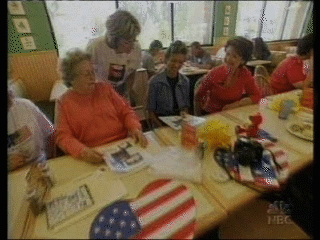
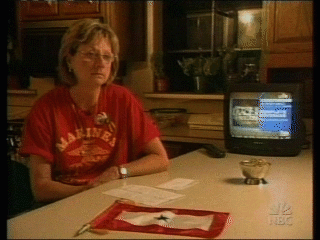
Here’s how one group of American mothers tries to cope with the reality that their boys may never come home from this conflict: they’ve started up a support group.
When they’re not together, they spend a lot of time with the TV.
You might want to wait until you get home to watch this if you’re somewhere you can’t cry. (Unless you’re not prone to such behavior and there’s no risk of that happening.) It’s a tear jerker.
This is from NBC Nightly News, March 26, 2003.
On The Homefront in Phoenix (Small – 6 MB)
On The Homefront in Phoenix (Hi-res – 66 MB)


The Use Of Depleted Uranium Hurts Our Boys Now And Counts As A War Crime Later

More on how our own troops are the ones placed in danger when depleted uranium is used in warfare. It isn’t safe to handle, etc. We know this now. But the Shrub Administration is letting our boys use it anyway.
US Forces’ Use of Depleted Uranium Weapons is ‘Illegal’
By Neil Mackay for the Sunday Herald.

Rokke said: ‘There is a moral point to be made here. This war was about Iraq possessing illegal weapons of mass destruction — yet we are using weapons of mass destruction ourselves.’ He added: ‘Such double-standards are repellent.’
The latest use of DU in the current conflict came on Friday when an American A10 tankbuster plane fired a DU shell, killing one British soldier and injuring three others in a ‘friendly fire’ incident.
According to a August 2002 report by the UN subcommission, laws which are breached by the use of DU shells include: the Universal Declaration of Human Rights; the Charter of the United Nations; the Genocide Convention; the Convention Against Torture; the four Geneva Conventions of 1949; the Conventional Weapons Convention of 1980; and the Hague Conventions of 1899 and 1907, which expressly forbid employing ‘poison or poisoned weapons’ and ‘arms, projectiles or materials calculated to cause unnecessary suffering’. All of these laws are designed to spare civilians from unwarranted suffering in armed conflicts…
The use of DU has also led to birth defects in the children of Allied veterans…
Rokke said that coalition troops were currently fighting in the Gulf without adequate respiratory protection against DU contamination.

Continue reading

Paul Boutin On Where Is Raed? (The Baghdad Blogger)

Is he real or just raed?
Paul Boutin takes a shot at finding out for sure.

Rather than guess, I emailed Salam and asked for proof of his location just before the first attack on Baghdad this morning. “how can i do that?” he emailed back. “you don’t expect me to run out in the street and take a picture near something you’ll recognize.” Actually, I pointed out, a +964 phone number where I could reach him would do. Dialing into Iraq from here is tough right now, but not impossible, and rerouting a phone number would be much tougher than posting a blog from outside the country. Salam hasn’t given me one, but that’s understandable.
Instead, I mixed what I learned as a Unix sysadmin in the 80s with what I learned as a daily reporter in the 90s. A barrage of late-night phone calls and emails to bloggers, Google, and network engineers produced the following evidence:
– Salam claims to connect to the Net via Uruklink, the state-run Iraqi ISP, using Web-based email from the British music magazine New Musical Express. Remember the Sex Pistols line, “I use the NME?” So does he.
IP addresses in his email headers aren’t sufficient to pinpoint his location, but they’re consistent with his story, being in the same range used by past Uruklink posters. I’m reluctant to publish his exact headers.
A whois and traceroute on Salam’s most recent originating address got as far as Transtrum, a unit of the Lebanon-based ISP TerraNet. Requests for further routing info from Transtrum went unanswered, but senior network engineers who looked at the headers for me in the US think they’re legitimately from Iraq.

Continue reading