
Author Archives: Lisa

More On The Implications Of The RIAA’s First Admitted Mistake (Although It Offers No Apology Or Guarantee That It Won’t Falsely Accuse Again)


She Says She’s No Music Pirate. No Snoop Fan, Either.

By John Schwartz for the NY Times.

Mrs. Ward, a 66-year-old sculptor and retired schoolteacher, received notice on Sept. 11 from the Recording Industry Association of America that she was being accused of engaging in millions of dollars worth of copyright infringement, downloading thousands of songs and sharing them with the world through a popular file-sharing program called KaZaA.
Mrs. Ward was deeply confused by the accusations, which have disrupted her gentle life in the suburbs of Boston. She does not trade music, she says, does not have any younger music-loving relatives living with her, and does not use her computer for much more than sending e-mail and checking the tides. Even then, her husband does the typing…
On Friday, the industry group dropped its suit against Mrs. Ward, but reserved the right to sue again. An industry spokeswoman denied that any mistake had been made…
But those opposed to the recording industry’s legal tactics say that the case suggests that the methods used to track down music pirates are flawed. They argue that Mrs. Ward is probably not the only mistaken case in the recording industry dragnet.
Cindy Cohn, the legal director of the Electronic Frontier Foundation, an advocacy group concerned with civil liberties in the digital age, said that her organization was talking with dozens of people who say they have been sued but do not trade files.
In a number of the 261 lawsuits the industry has filed so far, members of the household other than the named defendant might have had access to the machines, she said. But some of those being sued, she added, are contending that their cases are purely ones of mistaken identity.
That is exactly what Mrs. Ward says happened to her. Not only does nobody else use her computer in more than a passing way, the computer, an Apple Macintosh, is not even capable of running the KaZaA file-swapping program. And though the lawsuit against her said that she was heavily into the works of hip-hop artists like Snoop Dogg, Ms. Ward says her musical tastes run to Celtic and folk.
Continue reading

The First In What Will Most Likely Be Numerous Cases Of Mistaken Identity – Filesharing Suspect Fights Back Against The RIAA


Recording industry withdraws suit

Mistaken identity raises questions on legal strategy
By Chris Gaither for the Boston Globe. (Hiawatha Bray also contributed to this report.)
(Thanks, Mary.)

The recording industry has withdrawn a lawsuit against a Newbury woman because it falsely accused her of illegally sharing music — possibly the first case of mistaken identity in the battle against Internet file-traders.
Privacy advocates said the suit against Sarah Seabury Ward, a sculptor who said she has never downloaded or digitally shared a song, revealed flaws in the Recording Industry Association of America’s legal strategy. Ward was caught up in a flood of 261 lawsuits filed two weeks ago that targeted people who, through software programs like Kazaa, make copyrighted songs available for others to download over the Internet.
”When the RIAA announced they were going on this litigation crusade, we knew there was going to be someone like Sarah Ward,” said Cindy Cohn, legal director for the Electronic Frontier Foundation, an Internet privacy group in San Francisco that has advised Ward and others sued by the music industry. ”And we think were will be more.”
The lawsuit claimed that Ward had illegally shared more than 2,000 songs through Kazaa and threatened to hold her liable for up to $150,000 for each song. The plaintiffs were Sony Music, BMG, Virgin, Interscope, Atlantic, Warner Brothers, and Arista.
Among the songs she was accused of sharing: ”I’m a Thug,” by the rapper Trick Daddy.
But Ward, 66, is a ”computer neophyte” who never installed file-sharing software, let alone downloaded hard-core rap about baggy jeans and gold teeth, according to letters sent to the recording industry’s agents by her lawyer, Jeffrey Beeler.
Other defendants have blamed their children for using file-sharing software, but Ward has no children living with her, Beeler said.
Moreover, Ward uses a Macintosh computer at home. Kazaa runs only on Windows-based personal computers.
Beeler complained to the RIAA, demanding an apology and ”dismissal with prejudice” of the lawsuit, which would prohibit future lawsuits against her. Foley Hoag, the Boston firm representing the record labels, on Friday dropped the case, but without prejudice…
Evan Cox, a partner with Covington & Burling in San Francisco who is not involved with the case, said the error most likely happened in one of two ways: Either Comcast matched the wrong customer with the IP address, or the recording industry requested information about the wrong IP address, which is usually more than nine digits.
”If any of those [IP address] numbers are wrong or transposed, you’re going to get the wrong person,” Cohn said.
Whatever the source of the apparent error, it illustrates how difficult it can be to definitively match a person to an online screen name.
A Comcast spokeswoman, Sarah Eder, would not comment, citing customer privacy concerns. Comcast always notifies its customers after a subpoena compels the company to release information about them, she said.
Mistakes are likely, given the number of cases the recording industry has filed, Cox said. The industry’s reputation could hang on how many mistakes surface.
”If there turns out to be a lot of them, it will cast some doubt on [the industry’s] evidence-gathering,” he said. ”They’ll have to either strengthen their efforts or back off.”
The Electronic Frontier Foundation has counseled about 30 of the 261 people sued, Cohn said, adding that some have settled for fear of spending too much money fighting powerful corporations.
Jonathan Zittrain, an associate professor of Internet law at Harvard Law School, said the dismissal shows that the record companies may find it tough to prevail if their lawsuits go to court. Their legal strategy assumes that most defendants will settle rather than fight, and the lawsuits are so damaging to their public image that they cannot afford protracted legal battles with alleged file-swappers, he added.
”This is a very high-stakes strategy for the record companies,” he said. ”It’s either going to work in the short term, or they’re going to have to pull the plug on it.”

Continue reading

Shrub-Haters United! More On Dean’s Grassroots Campaign

Hey, “United we stand. Divided we fall” people.

Dean, Driven by the Grass Roots

Bottom-Up Strategy May Turn Politics Upside Down
By Lois Romano for the Washington Post.

“Did he simply unite the Bush haters or did he expand the base of the Democratic Party to something new and potentially potent? The jury is still out on that,” said Richard Bond, a former chairman of the Republican National Committee. “If these are independent swing voters, soccer moms, who ebb between the two parties and decide elections, then that’s a threatening development for Republicans.”
Dean campaign manager Joe Trippi said that anecdotal evidence suggests Dean’s supporters are a mixed bag of the party’s liberal base, reinvigorated Democrats who had either dropped out of the process or were never engaged and political independents who supported Ross Perot in 1992 and favored Sen. John McCain (R-Ariz.) in 2000. Trippi said he believes they will go to the polls for Dean.
Nine months ago, there were 427 supporters signed up for Dean online. Now about 413,000 people have signed up to join the Dean campaign — and 150,000 of them have contributed money. This month, there are more than 1,200 local Dean events posted on the campaign Web site, generated almost exclusively by volunteers on their own steam and their own dime.

Continue reading

Tell Your Reps That Cell Phone Number Portability Is Important To You

Number portability is supposed to kick in for consumers in November, but there’s a chance that cell phone service providers might find a way to get out of it if we don’t remind Congress how important number portability is to us. You can let your representatives know how you feel — and it takes less than one minute to do so — by going here.
(Thanks, Cory)

Lisa Sez: Tai Chi Is Genuine Medicine

I’m speaking purely from experience, since I’ve been using Tai Chi to treat various health problems I’ve been having. (I’ve had the health problems for about the last year, but the most effective cure so far has been Tai Chi! And it really makes a difference on the days I don’t do it. It’s incredible. I’ve only been doing it for about the last two months — but the improvement to my overall health is absolutely incredible.)
I just saw this article that actually studied this phenomenon among patients with a lot bigger problems than I have, and the results are pretty interesting.

Tai Chi Chih Boosts Shingles Immunity In Older Adults

From the Center For The Advancement Of Health
(via BoingBoing)

The report in the September issue of Psychosomatic Medicine is the first study to show that a behavioral intervention can influence the virus-specific immune response, say Michael R. Irwin, M.D., of the Cousins Center for Psychoneuroimmunology at the University of Los Angeles, California and colleagues.
On average, the 18 adults who participated in the tai chi chih program had an increase of nearly 50 percent in immune cell levels one week after completing the program, although individual responses to the exercises varied substantially in this group.
Tai chi chih participants were significantly more likely to increase their immunity than those who did not participate in the program, however.
Tai chi chih practice was also associated with improvements in physical functioning, especially among those who had the most problems with everyday tasks like walking and climbing stairs at the beginning of the study..

Continue reading

Shrub Plugs His Dirty ‘Clean Air’ Initiative


Bush Lauds Mich. Power Plant As Model of Clean Air Policy

But Opponents Say It’s a Polluter Excused by ‘Clear Skies’ Plan
By Dana Milbank for the Washington Post. (Eric Pianin also contributed to this report.)

Bush came to demonstrate how, under his policies, power plants could be expanded and upgraded without any increase in air pollution. He said Monroe is a “living example” of why the administration this summer eased clean-air rules for the nation’s oldest, coal-fired power plants — allowing the plant to modernize and “continue doing a good job of protecting the quality of the air.”
“You’re good stewards of the quality of the air,” the president told the Detroit Edison workers and executives.
Environmentalists and a number of Democratic lawmakers see Bush’s visit here as a symbol of something entirely different. They say the Monroe plant is one of the nation’s dirtiest polluters and, under Bush’s plan, would not have to reduce pollution for the next 17 years. According to projections by Bush’s Environmental Protection Agency, the plant is predicted to continue pouring its current annual level of 102,700 tons of sulfur dioxide into the air each year through 2020.
“It should come as no surprise to anyone that the Bush administration would hold an event to tout an initiative called ‘Clear Skies’ at a facility that will actually maintain its current levels of pollution over the next two decades,” said Sen. John F. Kerry (D-Mass.), who is vying to challenge Bush in next year’s election.
At issue are two major Bush policies regarding energy production and the environment. One is Bush’s “Clear Skies” initiative now awaiting congressional action. The plan aims to cut power plant emissions by 70 percent beginning in the year 2018, reducing the largest pollutant, sulfur dioxide, to 3 million tons that year from 11 million now. Heavy polluters could purchase pollution rights from clean plants. The second policy, Bush’s decision this summer to roll back “new source review” rules, means old power plants can make improvements and boost production without automatically adding expensive pollution-control equipment…
Environmental groups said Monroe is an example, but not a good one. They cited a 2000 study by Abt Associates, a group the EPA has used to gauge health effects of pollution, showing that the amount of pollution from the plant is responsible for 293 premature deaths, 5,740 asthma attacks and 50,298 lost workdays each year. They also cited an EPA model of Bush’s initiative that showed the plant was not forecast to cut its sulfur dioxide.
The plant also produces 45,900 tons of nitrogen oxide and 810 pounds of mercury, the other two pollutants covered under Bush’s initiative, and 17.6 million tons of carbon dioxide, which is not capped under Bush’s plan.
“I’m amazed that the president would choose this plant to highlight, given how dirty it is, and how much dirtier it could become because of the administration’s rollbacks of clean-air rules,” said Becky Stanfield, a lawyer with U.S. Public Interest Research Group…
Bush’s plan faces a difficult course in Congress. Sen. James M. Jeffords (I-Vt.), ranking minority member of the Senate Environment and Public Works Committee, said in a statement today that Bush “has chosen to push a divisive agenda that puts politics before public health.”

Continue reading

Coverage Of Yesterday’s Recall Hearings In The 9th Circuit Court Of Appeals

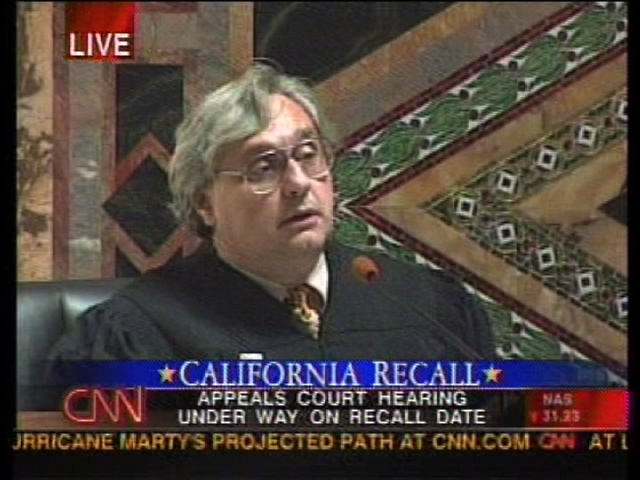
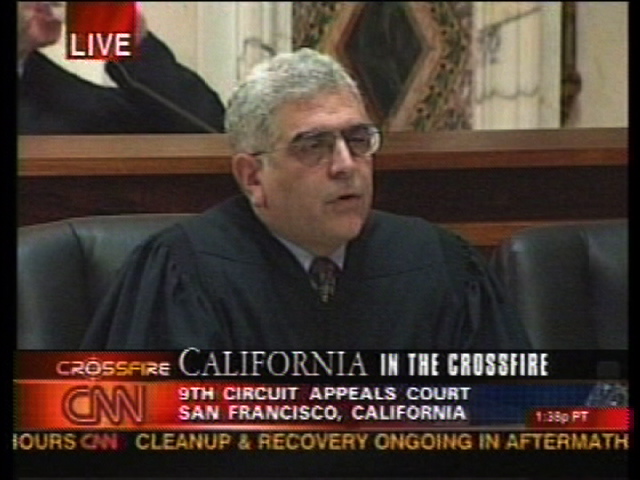
If you’re as much of a courtroom junkie as I am, you’ll dig these clips from yesterday of Judge Alex Kozinski and Andrew J. Kleinfeld.
(A friend filled me in on who Kleinfeld was. I only recognized Alex Kozinski because he was at the moot court at the Spectrum Policy Conference last March.)
Clip #1 is from CNN‘s “Inside Politics” and contains Kozinski as he questions one of the lawyers.
Clip #2 is also from CNN’s “Inside Politics” and contains analysis from a couple of the show’s stock pundits.
Clip #3 is from CNN’s “Crossfire” and includes footage of Kozinski and Andrew J. Kleinfeld as they question the lawyers.
These are all from September 23, 2003.
Clip #1: Justice Alex Kozinski on CNN’s Inside Politics.

Justice Kozinski On CNN
(Small – 10 MB)


Clip #2: Pundit analysis of the CA Recall from CNN’s Inside Politcs.

Inside Politics On The CA Recall
(Small – 14 MB)
Clip #3: Justices Kozinski and Kleinfeld questioning the lawyers.

9th Circuit Court Of Appeals On The CA Recall
(Small – 8 MB)