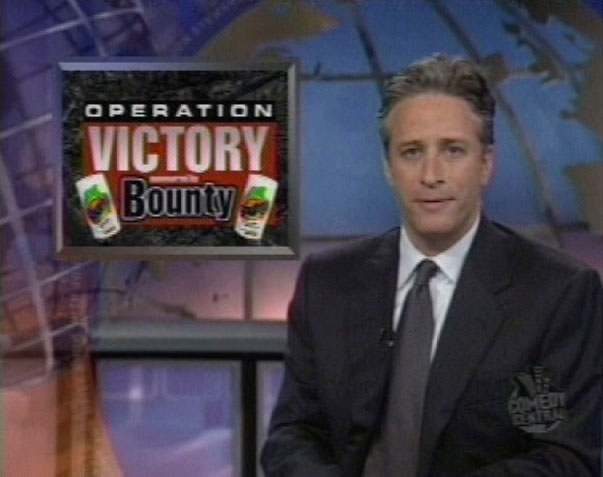
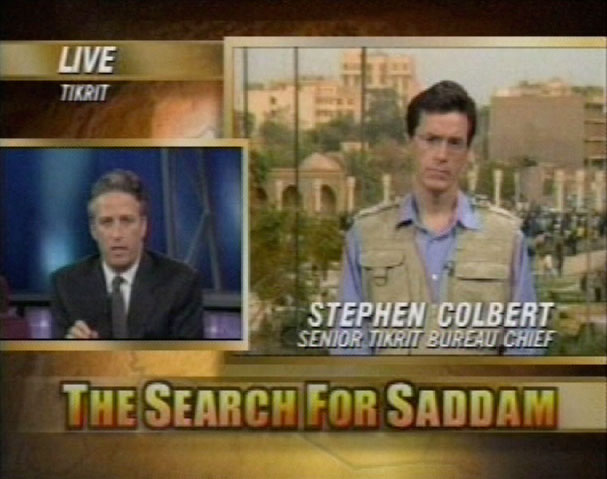
This is from the August 5, 2003 program.
Daily Show On The Search For Saddam (Small – 14 MB)
The Daily Show (The best news on television.)
Daily Show On The Search For Saddam
Leave a reply
This is from the August 5, 2003 program.
Daily Show On The Search For Saddam (Small – 14 MB)
The Daily Show (The best news on television.)
…with a little help from Florida’s 1998 Voter Reform Law.
Here’s an awesome video/animation from Eric Blumrich w/music from Grand Theft Auto:
Grand Theft America
Time’s ticking away guys, we’ve got to do something or they’re just going to do it again in 2004.
This animation was based on findings in Greg Palast‘s report:
Theft Of The Presidency.
There’s real video of it available too.
(Thanks, Jason)
This is from the July 31, 2003 program.
Cheney Reaction (Small – 9 MB)
The Daily Show (The best news on television.)
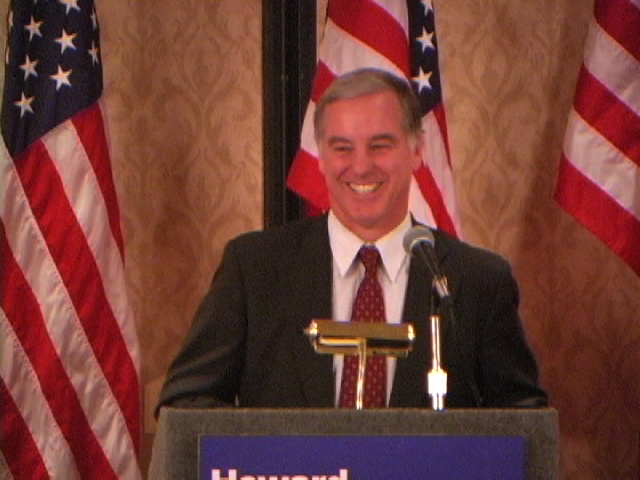
Howard Dean came to town last Thursday, and I was able to video two of his speaking events.
The first event in the afternoon was on the environment. Howard warned us that his speech might be a little stiff, and he wasn’t kidding. But he did make some good points, including one about the potential of wind power. (Small – 3 MB)
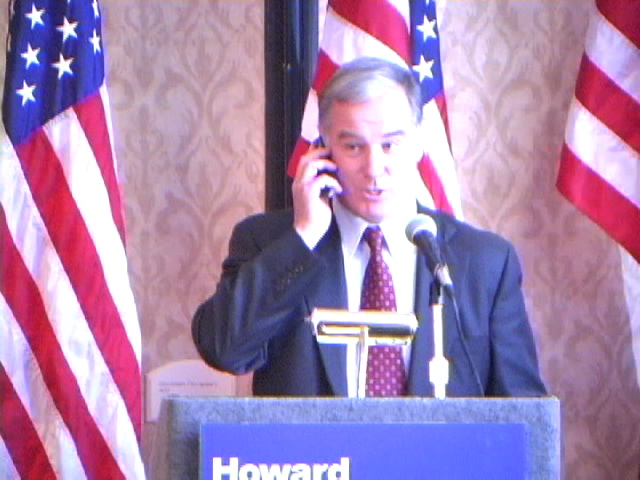
One highlight took place when a cell phone rang and Dean realized it was his own. (Small – 2 MB)
I didn’t get a chance to wait around to talk to Howard because I had a 1:45 appointment, but I wasn’t worried about it, because I was going to see him speak again at a fundraiser at the San Francisco Medical Society that same evening (which I knew would be a smaller gathering and a better place to say hello).
I’ll have the stuff from that up later today.
Here’s the complete speech from noon on July 31, 2003, in one part and in three parts:
Howard Dean On The Environment – Complete (Small – 75 MB)
Howard Dean On The Environment – Part 1 of 3 (Small – 23 MB)
Howard Dean On The Environment – Part 2 of 3 (Small – 28 MB)
Howard Dean On The Environment – Part 3 of 3 (Small – 28 MB)
Judge rejects subpoenas in music-use case
By Bipasha Ray for the Associated Press.
A federal judge rejected an attempt by the recording industry to uncover the names of Boston College and MIT students suspected of online music piracy.
U.S. District Judge Joseph L. Tauro said Friday that under federal rules, the subpoenas, which were issued in Washington, cannot be served in Massachusetts.
The two schools filed motions last month asking the judge to quash the subpoenas, which request names and other information for one Massachusetts Institute of Technology student and three BC students who allegedly obtained music using various screen names.
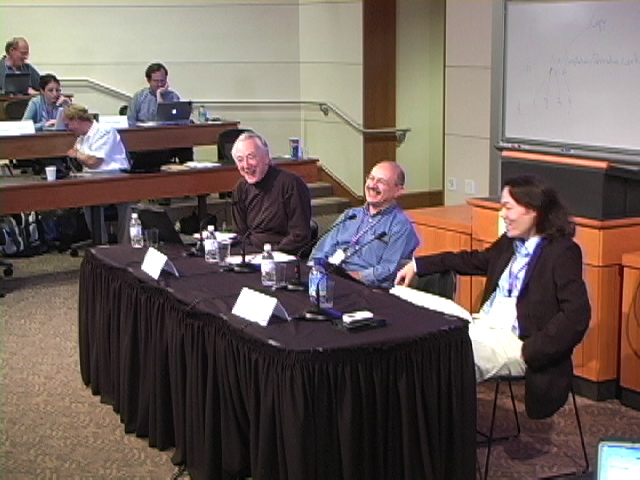
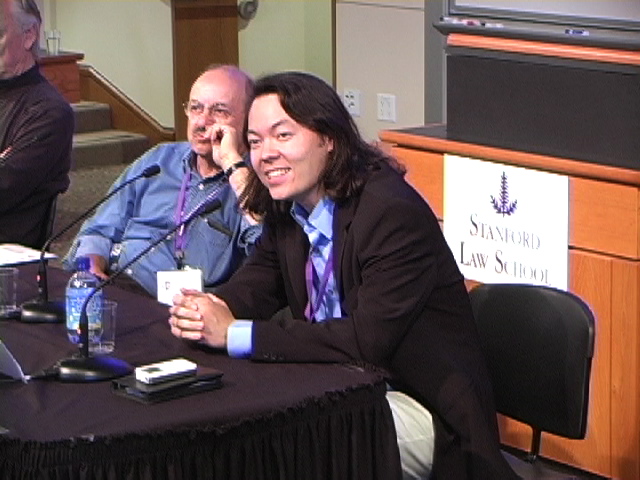
This panel had the EFF’s Fred von Lohmann, Charlie Nesson and Leslie L. Vadasz, Director Emeritus, Intel Corporation on it and was hosted by Jonathan Zittrain.
Music Law Panel – Part 1 of 5 (Small – 49 MB)
Music Law Panel – Part 2 of 5 (Small – 50 MB)
Music Law Panel – Part 3 of 5 (Small – 51 MB)
Music Law Panel – Part 4 of 5 (Small – 51 MB)
Music Law Panel – Part 5 of 5 (Small – 65 MB)
Below: Charlie Nesson (left), Leslie L. Vadasz (middle) and the EFF’s Fred von Lohmann (right)
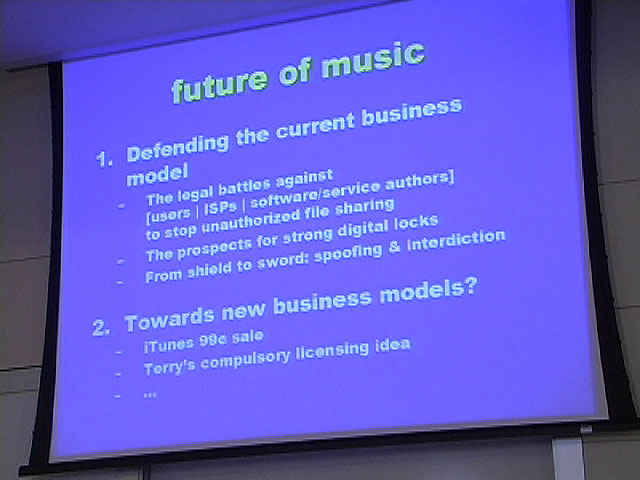
Below: Leslie L. Vadasz (left) and the EFF’s Fred von Lohmann (right)
Day 3 Tape 7
5:45 – Fred
9:20 CD singles never sold anyway
19:48 Fred – in the rush to save the pirates?
20:49 – Charlie
29:00 Trusted computing – my question
52:45 Report
53:48 Barton
****
Tape 8
8:19 – Interdiction (Charlie)
14:20 – illegal DDOS
Fred!
J.D. Lasica has written a lovely article for the Online Journalism Review.
(Thanks, J.D..)
Personal Broadcasting Opens Yet Another Front for Journalists
Video blogging takes root
Like Raven, Lisa Rein of San Francisco has become her own one-woman news crew — and she expects plenty of company in the years ahead.
During the peace demonstrations in February, Rein took to the streets of San Francisco and Oakland, camcorder in hand, and shot footage of the marchers and speakers, including Rep. Barbara Lee (D-Calif.), singer Harry Belafonte and antiwar activist Ron Kovic. She posted the video on her Weblog, complete with color commentary, providing much deeper (if more subjective) coverage of the events than a viewer would get by watching the local news.
“At one point, the press started covering the protests as an annoyance, a traffic jam problem,” Rein says. “Videotaping the early marches helped spread the word that there were a lot of people who had reservations about our intentions in Iraq.”
In recent months, Rein has covered three different conferences. At South by Southwest in Austin, Texas, she videotaped the keynote presentation by Lawrence Lessig. At the Internet Law Conference at Stanford, she interviewed one of the key speakers. Rein also taped highlights of a digital rights conference in Berkeley. She has posted countless hours of video on her Weblog, along with her analysis of events.
“There are just so many interesting things happening in our lives that would make great programming,” she says. “The networks aren’t interested unless it will attract millions of dollars in advertising revenues. Meanwhile, there are people and events all around us that are meaningful and that people would love to watch.”
Rein, 34, also borrows network news segments and public affairs programming for retransmission on her blog. She recently recorded Secretary of Defense Donald Rumsfeld’s appearance on “Meet the Press.” She has become so prolific that staffers for presidential candidate Howard Dean notify her when Dean appears on C-SPAN so that she can give the appearance wider currency. She now uploads video to her blog several times a day and says such borrowing is permitted under fair use.
“When NBC News said it would air a story on bloggers, I got e-mails from bloggers saying, ‘Hey, grab it and put it up.’ Not everyone can watch the news, and not everyone gets cable. My main goal is to capture news as its leaps along the airwaves from reputable sources and archive it on the Web for people to access as needed.”
A teacher at the University of California, Berkeley, and co-founder of the copyright-licensing center Creative Commons, Rein has a background in technology and freelance writing, laced with an avid interest in public affairs. But she says the tools have become so easy to master that anyone can do it with a little practice.
She captures footage on TiVO — this can also be accomplished with almost any VCR or other home-taping device — and transfers the footage first to her DV camcorder and then via firewire to her Mac computer.
“I’m trying to show other people how easy it is to create programming and set up your own TV station on the Web — without help from anyone in big media,” she says.
Others are also getting in on the action. Jeff Jarvis, a veteran journalist who is president of Advance.net, has published a series of video commentaries on his Weblog. At OregonLive.com, a college student created an online video report from the state cheerleading championships. Members of the Independent Media Center create Web video for their alternative news articles.
The Center for Digital Storytelling is turning out thousands of workshop graduates skilled in the art of personal filmmaking. And Steve Mann, a researcher at the Humanistic Intelligence Lab at the University of Toronto, has outfitted students with Webcams on the theory that being an eyewitness to live events qualifies as journalism.
Down the road, the programmers at the Gnu open-software project hope to transform millions of our personal computers into potential personal broadcast receivers and transmitters, using software to turn PCs into radios and digital televisions.
It all adds up to a personal video revolution coming into focus.
Rein sees the day when tens of thousands of Web users have their own Internet TV shows. But for now, she has a more modest goal. Two cable channels, in California and the Midwest, have offered her a slot on public access TV if she can finish three complete shows culled from her raw clips.
“To get your message out to the masses,” she says, “it still has to go out over the box and hit them in their living rooms.”
Show: KQED Forum
Title: The Great Download Debate
Time: 10 am
Date: July 30, 2003
Guests include the EFF‘s Jason Schultz, Mitch Glazier of the RIAA, Alex French, Minority Council on the House Judiciary Committee, and Joseph Menn of the LA Times and author of All The Rave.
I’ve made it available as a single file or in three parts.
I’ve made aiffs of everything available in the directory too.
KQED Forum On P2P – Complete (MP3 – 73 MB)
KQED Forum On P2P – Part 1 of 3 (MP3 – 26 MB)
KQED Forum On P2P – Part 2 of 3 (MP3 – 26 MB)
KQED Forum On P2P – Part 3 of 3 (MP3 – 23 MB)
Exact date unknown — July is all I know…
(sorry! things slip through the cracks!)
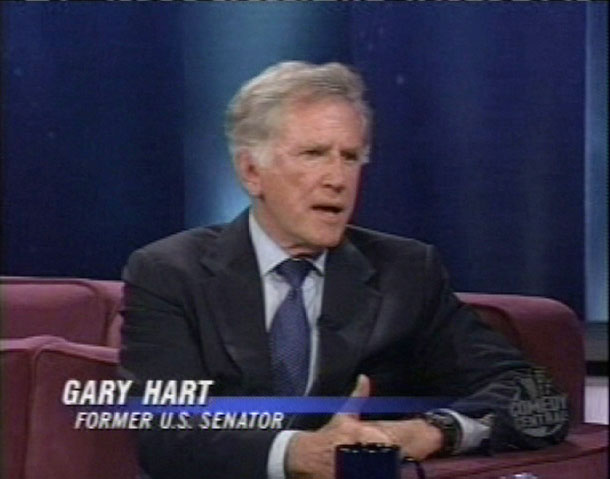
Gary Hart On The Daily Show (Small – 20 MB)
Gary was on a commission that all but predicted a 911-type disaster in its Sept 15, 1999 report. Lots of interesting stuff about security and the Shrub’s “inept” strategies to date.
The Daily Show (The best news on television.)
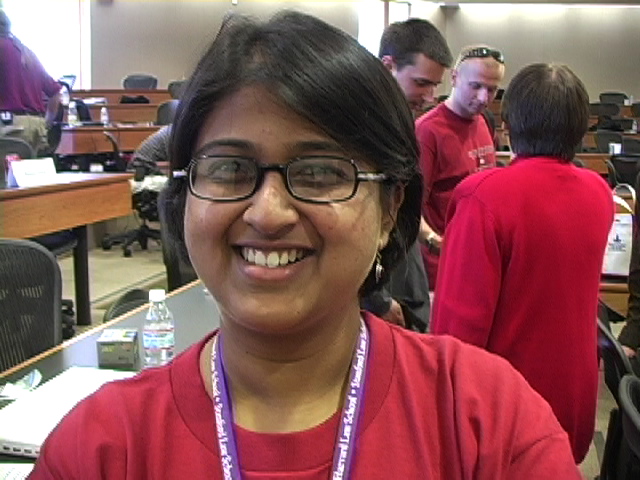
Here’s an interview with Reshmi Sarkar of IT for Change about the conference and what she learned there.
Reshmi Sarkar At ILAW 2003 (Small – 7 MB)