I just plum forgot about the September 28, 2003 protest this last weekend against the Shrub’s Occupation of Iraq. Luckily, KPIX was there with a camera crew. My man Tom Ammiano was there, too. (Hopefully the next Mayor of San Francisco!)
KPIX On Sunday’s Protest Against The Shrub’s Occupation Of Iraq (Small – 8 MB)


Author Archives: Lisa
New Song and Video! Slipping Away
I just posted my first music video!
I just started the camera rolling and performed a song with the other half of Park and Ride: Ron Taylor. There’s more where this came from.
I just found out that I’ll be playing at Noe Valley Ministry on December 13, 2003 — Saturday night! Here’s more information about the event.
Hope to see you there!
Slipping Away

I thought it was time for a little music video to introduce you guys to Ron, and give you a little taste of us live — so you might come see us play at Noe Valley Ministry in San Francisco when we play December 16, 2003.
This song was the last song we wrote together when we were in Seattle in 1999. It’s one of my favorites.
Ron had just re-learned the song when we taped this, so I had to cue him for the chord changes. That’s why I keep pointing at him — that’s “the signal” for the chord change.
Hope you like it!
Info On Microsoft’s Voucher Program (The Result Of The Anti-trust Settlement)
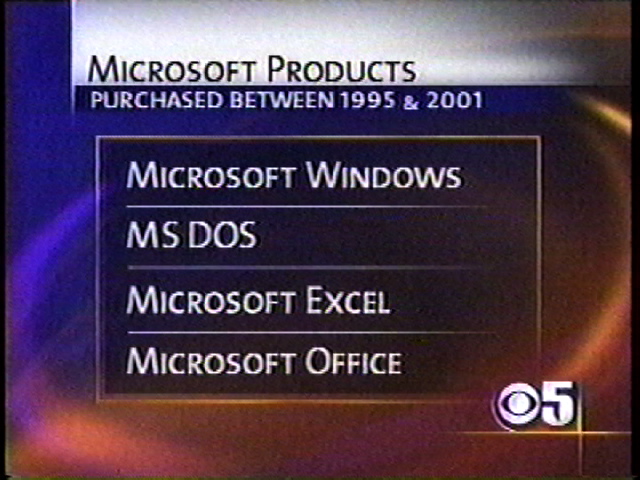
Here’s a clip from KPIX that explains how to claim whatever you might have coming to you as a result of Microsoft’s anti-trust practices. Of course it’s too little, too late. (What a silly question 🙂
Nevertheless, if you are a business that has invested in Microsoft software over the last 7+ years, you could be eligible for some real cash. The vouchers can be used to purchase equipment and software from any manufacturer, not just Microsoft.
Here are more of the details of the $1.1 Billion Microsoft Settlement.
Click here for a settlement form.
KPIX On Microsoft’s Voucher Program (Small – 8 MB)


Help My Students Test Out Their Senior Project
I’m assisting with the Senior Projects for USF’s Computer Science Department this semester as sort of a warm up before I teach my own XML class next semester. (Yippie!)
We’re creating a little application that creates a little “personal web space” from the bookmarks and documents on your hard drive, and we could sure use some help testing out our client application.
It’s Windows-only right now, and only works with Internet Explorer 6. (I know it’s lame that it only works on IE6 on Windows, but this is only the first rev. So bear with me.)
Email me directly at lisarein@finetuning.com if you’d like to participate in our beta program. We’ll be needing testers from now until the end of the semester.
Thanks!
Lawsuits Not Affecting Filesharing Traffic
Activity on Song – Swapping Networks Steady
By Reuters.
Activity on file-sharing networks has not missed a beat this week despite the record industry’s high-profile lawsuits against individual song-swappers, industry trackers and executives said on Thursday.
“There’s no mass exodus, that’s safe to say. Ironically, usage this week and this month is up,” said Eric Garland, a spokesman for BigChampagne, a research firm that tracks peer-to-peer networks that enable file-swapping between different computers.
“We’ve been looking at dramatic increases on the FastTrack Network. The number of people using these file sharing services in the first 10 days of September is up more than 20 percent from the August average,” he said…
Greg Bildson, chief technology officer for LimeWire, said traffic on the Gnutella network, the underlying network that LimeWire, BearShare, Morpheus tap into, has not been affected.
Peer-to-peer officials said people would likely improve ways to conceal their identities to avoid lawsuits.
“If you’re smart, and most file-sharers are, you can insulate yourself,” said Wayne Rosso, president of Grokster, which is involved in a suit of its own against the industry.
Rosso said the lawsuits only wasted money, alienated music fans and will have less of a shock value in the future.
“The next time, the suits won’t get this kind of media coverage. They’re a desperate and dying industry,” he said.
Moby Board Member Sued By RIAA For Filesharing
The RIAA is suing “liquidlevel,” one of Moby.com‘s board members!
Moby “can’t see any good in coming from punishing people for being music fans and making the effort to hear new music.” Right on dude!
He says he’s tempted to use Kazaa to download some of his own music, just to see if he got sued.
Of course, they probably wouldn’t, once they knew it was him. Because presumably, Moby is the copyright owner of his own music.
But this raises other questions about a musician’s right to use the internet to promote themselves — even if the record company says “no.” Why would a record label punish an artist for trying to promote themselves (to sell more records or concert tickets)? It just doesn’t make sense.
This all has a lot to do with the revolution that I have predicted (or instigated, depending on how you look at it 🙂
Moby Tour Diary Update – RIAA 9/29/2003 – New York City
so apparently the riaa are sueing one of our very own moby.com board members, liquidlevel, for file-sharing.
personally i just can’t see any good in coming from punishing people for being music fans and making the effort to hear new music.
i’m almost tempted to go onto kazaa and download some of my own music, just to see if the riaa would sue me for having mp3’s of my own songs on my hard-drive.
-moby
Do My Comments Work? Or Not?
So either you guys don’t have anything to comment on anymore (even though my readership has doubled over the past couple months) or my comments are broken.
Please send comments today and let me know what your experience is.
I really want to get to the bottom of this.
Thanks!
lisa
Librarians Stick Up For P2P Networks
Librarians to P2P critics: Shhh!
By Declan McCullagh for CNET.
In a hotly contested lawsuit before a federal appeals court, two peer-to-peer companies are about to gain a vast army of allies: America’s librarians.
The five major U.S. library associations are planning to file a legal brief Friday siding with Streamcast Networks and Grokster in the California suit, brought by the major record labels and Hollywood studios. The development could complicate the Recording Industry Association of America’s efforts to portray file-swapping services as rife with spam and illegal pornography.
According to an attorney who has seen the document, the brief argues that Streamcast–distributor of the Morpheus software–and Grokster should not be shut down. It asks the 9th Circuit Court of Appeals to uphold the April decision by a Los Angeles judge that dismissed much of the entertainment industry’s suit against the two peer-to-peer companies.
Among the groups signing the brief are the American Library Association (ALA), the Association of Research Libraries, the American Association of Law Libraries, the Medical Library Association and the Special Libraries Association. The American Civil Liberties Union, in one of the group’s first forays into copyright law, has drafted the brief opposing the Motion Picture Association of America (MPAA) and the Recording Industry Association of America (RIAA).
A central argument of the brief is that the district court got it right when applying a 1984 Supreme Court decision to the Internet. That decision, Sony v. Universal City, said Sony could continue to manufacture its Betamax VCR because a company “cannot be a contributory (copyright) infringer if, as is true in this case, it has had no direct involvement with any infringing activity.”
“The amicus brief will make the point that we are not supporting the wrongful sharing of copyrighted materials,” ALA Executive Director Keith Michael Fiels wrote in an internal e-mail seen by CNET News.com. An amicus brief is one filed by a third, uninvolved party that comments on a particular matter of law. “Instead, we believe the Supreme Court ruled correctly in the Sony/Betamax case. The court in that case created fair and practical rules which, if overturned, would as a practical matter give the entertainment industry a veto power over the development of innovative products and services.”…
The ACLU said Thursday that the brief argues that peer-to-peer networks are speech-promoting technologies that have many noninfringing uses. If the MPAA and the RIAA succeed in shutting down peer-to-peer networks or making them more centralized, the precedent could create undesirable choke points that could be used to monitor Internet users, the ACLU said.
Jesse Jackson’s September 16, 2003 Speech – No On The Recall, No On Prop 54
I had an interesting time at the Rally at Sproul Plaza in Berkeley on September 16, 2003.
I won’t say it was “fun” or anything, because it wasn’t, really. More on this below. My first problem was that I had left late from school and I missed the first part of the speech. The second problem was that I had been up till 2:00 am the night before posting Cheney on Meet The Press clips. So I only got the last third of the speech (see below).
I was quite excited when I got to interview Jesse Jackson for a minute, but otherwise, it was kind of a mean crowd. Or, should I say “immature” crowd, at best. They had no respect for my camera, for instance. And one jerk even thought it was funny to push it over on purpose, once he realized I was trying to protect it.
I guess I’ve been spoiled for the most part at these kinds of events in the past, where everyone has been really nice and ducked when they walked in front of the camera and helped me to reach better views and the like. This crowd just wanted to get autographs after Jesse’s speech and they were pushing and shoving really badly.
I decided to go stand on the stairs of Sproul Hall and try to get a better shot from up above. (I had given up on actually talking to Jesse). I guess the crowd’s attitude toward me could have been partly my own fault from trying to maneuver in the crowd with a tripod, so I ditched the tripod and was trying to figure out how to get close again when…the usual miracle happened (Yes, I do have incredible luck at these events!) and Jesse started walked over towards me on the stairs.
His security people were holding back the crowd a bit, so I waited until he was close enough for him to hear me and took a chance on asking him a question. He didn’t hear me the first time, so I asked him again. I saw a light go off when he heard the question, and he stopped signing for a minute and looked up and said “Huh?”
“Do you think the 9th Circuit Court of Appeals Decision about the recall will hold?” I asked again.
Then he paused and thought for a minute, and gave his answer.
Here’s an edited version of the speech. (Small – 5 MB)
Here’s a longer, edited version of the speech. (Small – 18 MB)
Here’s a near complete version of the speech. (Small – 31 MB)



ACLU Challenges RIAA Subpoenas
A.C.L.U. Challenges Music Industry in Court
By John Schwartz for the NY Times.
(Thanks, Jason.)
The civil liberties group argues that the constitutional rights of its client, referred to as Jane Doe, would be violated if her college, which is also her Internet service provider, were forced to reveal her name. The industry subpoena “seeks to strip Jane Doe of her fundamental right to anonymity,” according to the group’s court filings.
The industry subpoena is one of many recently filed under the Digital Millennium Copyright Act, a law that gives copyright holders broad powers to get the names of suspected infringers from Internet service providers.
But the civil liberties suit claims that the subpoenas, which can be issued with little judicial oversight or involvement, go beyond even what the law allows. The group also claims that the law itself is unconstitutional, because it does not provide for the judicial review of requests or notification of the target of the investigation.
“We’re not saying that they can’t ever get her identity,” said Christopher A. Hansen, a lawyer with the American Civil Liberties Union. “We’re only saying if the industry wants her identity, then they have to do it in a fair way.”…
Also today, a group that opposes the suits, Downhill Battle, is expected to announce the creation of a legal defense fund for those caught up in the file-trading suits. “If we make noise for all those who’ve been sued and give the people who want to fight in court the resources to do so, we can make these lawsuits fail,” the group said on its Web site, downhillbattle.org.