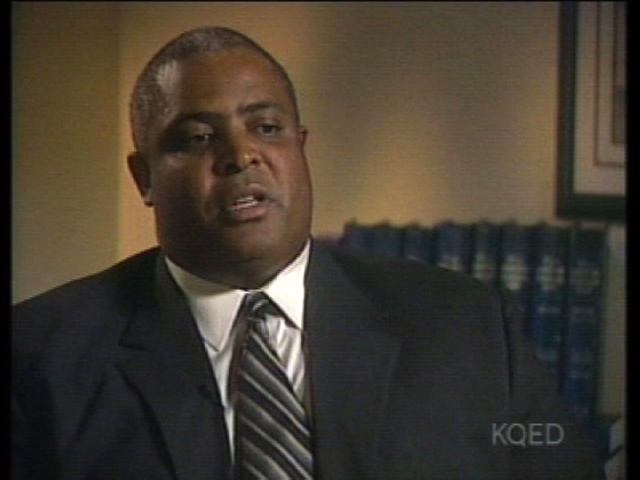
So I know nobody really cares right now, with the recall going on and all, but San Francisco’s about to vote in a new Mayor this November, and I think it’s a pretty important election worth paying attention to.
I’m voting for Tom Ammiano. He’s my local rep, and a damn good one at that.
He also doesn’t hate poor people, like Gavin Newsome apparently does (arguably, the front runner in the race). As demonstrated by his actions in last year’s “Care Not Cash” campaign, Gavin likes to blame the poor for being poor and to take their benefits away without explicitly defining what “services” they are going to get in return…but that’s another story. (One with a happy ending actually, because a judge threw out the whole “Care Not Cash” fiasco some months ago!)
Anyway, for this article, that’s all beside the point. This puppy’s just plain funny.
Update: I just confirmed w/the Ammanio folks that these are real interviews! They are not made up.
(Funny, I guess Ammiano was the only one that got the Bladerunner reference 🙂
More Human than Human
A field guide for testing if the San Francisco mayoral candidates are human or not.
By John Holden for The Wave.
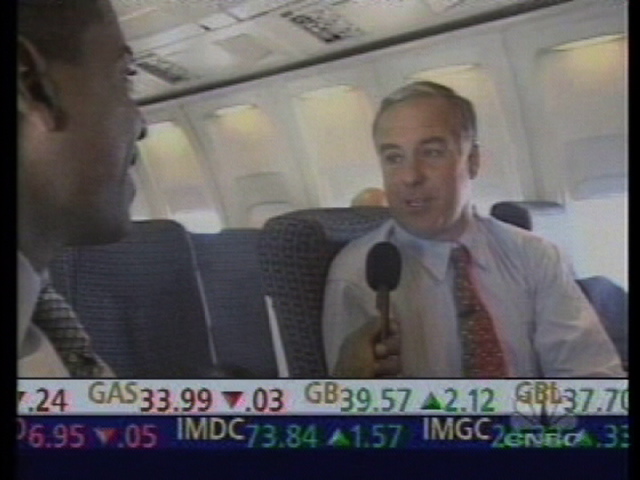
Howard Dean On CNBC’s The Edge
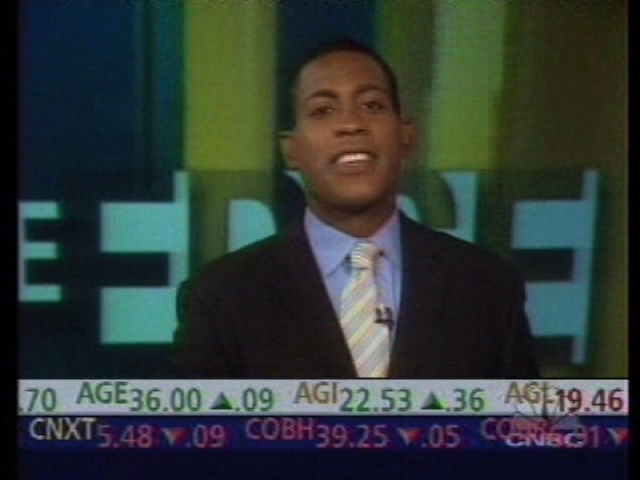
Here’s a great informal interview with Howard Dean by Carlos Watson for CNBC’s The Edge.
Howard talks about his policy, his son, you name it, and even plays some harmonica at the end.
This interview took place on an airplane in between campaign stops.
This program was aired on September 1, 2003.
Howard Dean On CNBC’s The Edge – Complete (Small – 23 MB)
Howard Dean On CNBC’s The Edge – Part 1 of 2 (Small – 11 MB)
Howard Dean On CNBC’s The Edge – Part 2 of 2 (Small – 13 MB)


Join MoveOn.org Against The California Recall
This just in from my pal
Bobby Lilly.
Dear Lisa,
I got a notice from http://MoveOn.org asking me to sign a petition opposing the California Recall. You and I both know it’s a power grab by the Republicans blaming a relatively unpopular governor for stuff HE didn’t do and inflaming the political process just because some of them couldn’t stand to LOSE the last election.
I signed to show my opposition to this misuse of the Recall process which I believe should be used against serious malfeasance by an elected official not just because someone had the money it took and thought they could get away with it.
I hope there are a lot more people out there besides the two of us willing to take the time to oppose this Recall which has become a media circus and just another reason for the rest of the country to dismiss Californians as kooks. People need to be educating themselves about the unreality of the charges against Davis and realize that changing leadership at this point is NOT going to make the economic woes of this state (which are very similar to the problems states all across the country are facing) any better and all of us who believe it is WRONG need to be sure we are registered and get to the polls and VOTE it down.
In the meantime, I’m writing to ask you to join me in signing a “Recall No! Democracy Yes!” pledge to defeat the California recall AND pass it on. Click here to sign:
This is the message Moveon sent to me:
If the recall succeeds, it will set a dangerous precedent for the whole country. A far-right businessman spent 1.7 million dollars to bring us the recall campaign, and has thrown California into chaos. GOP leaders who should have condemned the recall instead cheered it on, hoping they could gain from the unraveling of our democracy. We can’t stand by and let this happen. These attacks on democracy are not a California issue or a Texas issue or a Florida issue — we all must step forward together and make it clear that elections will be honored in this country. This pledge is a national effort to mobilize one million California voters in the recall election. Please sign the pledge no matter where you live and please ask friends and family in California to sign the pledge and to remember to vote October 7.
Thank you.
Lisa’s voting against the recall and for Cruz Bustamante.
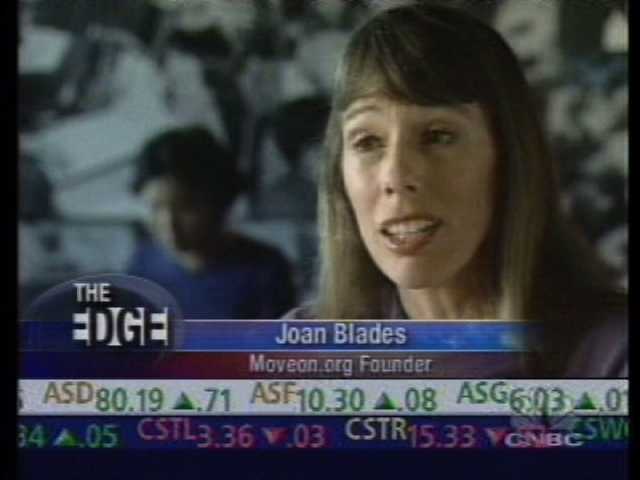
Interview With MoveOn Co-Founder Joan Blades
Here’s an interview by Carlos Watson with MoveOn.org co-founder Joan Blades.
This is from the September 1, 2003 program.
(I tried to find a website for CNBC’s The Edge, but I couldn’t find one.)
Interview With Joan Blades On CNBC’s The Edge – Complete
(Small – 13 MB)


Cory’s Sequel To Down and Out In The Magic Kingdom
Note: This is a short story, not a book, but I’m putting it in here anyway. It’s the sequel to the book. And if you haven’t read the book yet, you can read it for free, and then read the short story.
Cory Doctorow has written a lovely short story sequel to Down and Out In the Magic Kingdom.
Salon published it a few weeks ago. In case you need to print it out to read it (like I do), I’ve provided a complete version of the text.
God. God. The person was so old, saurian and slow, nearly 300, an original revolutionary from the dawn of the Bitchun Society. Just a kid, then, rushing the barricades, destroying the churches, putting on a homemade police uniform and forming the first ad-hoc police force. Boldly walking out of a shop with an armload of groceries, not paying a cent, shouting jauntily over his shoulder to “Charge it up to the ol’ Whuffie, all right?”
What a time! Society in hybrid, halfway Bitchun. The religious ones eschewing backup, dying without any hope of recovery, entrusting their souls to Heaven instead of a force-grown clone that would accept an upload of their backup when the time came. People actually dying, dying in such number that there were whole industries built around them: gravediggers and funeral directors in quiet suits! People refusing free energy, limitless food, immortality.
And the Bitchun Society outwaited them. They died one at a time, and the revolutionaries were glad to see them go, each one was one less dissenter, until all that remained was the reputation economy, the almighty Whuffie Point, and a surfeit of everything except space.
Adrian’s grin was rictus, the hard mirth of the revolutionaries when the last resister was planted in the ground, their corpses embalmed rather than recycled. Years and decades and centuries ticked past, lessons learned, forgotten, relearned. Lovers, strange worlds, inventions and symphonies and magnificent works of art, and ahead, oh ahead, the centuries unrolling, an eternity of rebirth and relearning, the consciousness living on forever.
And then it was over, and Adrian was sweating and still grinning, the triumphant hurrah of the revolutionary echoing in his mind, the world his oyster.
More Details From City of San Jose’s Counsel On The Comcast v. City of San Jose Suit
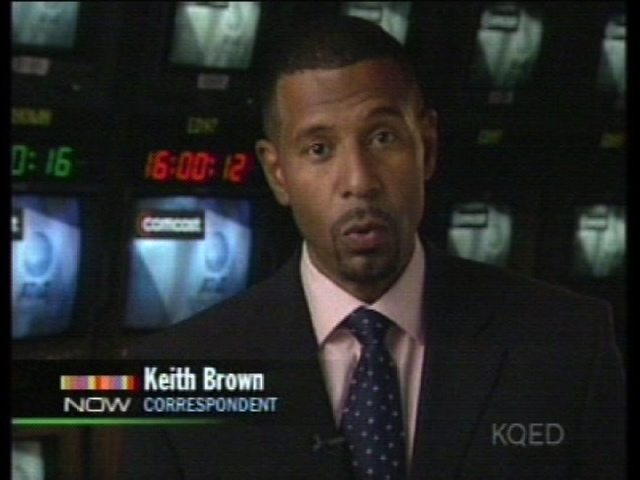
This is a follow up to this clip from Bill Moyers now where William Lowery is interviewed.
William Lowery was nice enough to provide me with some more information about the details of the case. Please spread the word about this. People need to know that their public access facilities and programming are at stake. However this case turns out will provide a model for the rest of the cable companies for what they can get away with (not living up to their community obligations).
Ok, Lisa — I’ll try to explain it with as little legaleese as possible.
Essentially, under the Communications Act, cable televisions are regulated at both the federal and local level. Local governments issue franchises to cable companies which allow the operators to construct and operate their systems in the public rights-of-way within the jurisdiction. The franchises are for a given number of years — usually for 10 -15 years. When those franchise expire, they must be renewed. The Cable Act provides two mechanisms for franchise renewal: informal negotiations, and a formal, administrative process.
In the formal process, a city, after conducting an assesment of its future cable-related needs and interests, may issue a Request for Renewal Proposals (RFRP) which sets forth those needs and interests and minimum requirements for a proposal that meet those needs and interests. The Cable Act authorizes a city to require, among other things, channels, facilities, and equipment for public, educational, and govermental (PEG) use. In addition, the Act permits a City to require capacity on an “institutional network” which the City can use for governmental and educational communications.
Once a city issues an RFRP, the operator must then submit a formal renewal proposal. The city the, after assessing the proposal, must either grant renewal or issue a “preliminary assessment of denial” and commence an administrative hearing to determine whether, among other things, the proposal is reasonable in light of the identified needs and interests, taking into account the costs of meeting those needs.
In San Jose, the cable franchisee was owned by TCI when the initial renewal period began. TCI was subsequently acquired by AT&T, and then AT&T was acquired by Comcast. The City spent almost 4 years trying to reach agreement on renewal terms through informal negotiations, but the negotiation were ultimately unsuccessful. The City then issued an RFRP, which AT&T responded to by submitting a formal proposal. Subsequently, Comcast took over. The City ultimately issued a preliminary assessment of denial, and commenced the formal administrative hearing. Comcast then brought suit, claiming that the many of the requirements of the City’s RFRP violate the Cable Act, and therefore Comcast’s First Amendment rights, because they exceed the City’s authority under the Act. Specifically, Comcast complains that the “institutional network” the City describes in the RFRP is beyond the scope of what the Act authorizes, and the PEG requirements exceed what is contemplated by the Act. Comcast also claims that the City’s administrative proceedure violates its due process rights. Comcast brought a motion for preliminary injunction seeking to halt the City’s process.
Daily Show Taking This Week (and last week) Off
Hey I’ve still got ya covered on Daily Show clips. They’ve just been taking a long vacation.
Some of you expressed worry about missing out so I just want to let you know: no worries.
I do have to send my camera out for servicing, so I might get a week behind — but I’ll be recording it all and will catch up soon.
Court Issues Stay On Media Ownership Rules!
Court Delays FCC Media Ownership Rules
Federal Appeals Court Delays Implementation of New FCC Media Ownership Rules
By the Associated Press.
A federal appeals court issued an emergency stay Wednesday delaying new Federal Communications Commission media ownership rules that would allow a single company to own newspapers and broadcast outlets in the same city.
The 3rd U.S. Circuit Court of Appeals said a coalition of media access groups called the Prometheus Radio Project would suffer irreparable harm if the new rules were allowed to go into effect as scheduled Thursday.
Comcast Not Living Up To Its Community Broadcasting Obligations?
This is from the August 22, 2003 program of
NOW With Bill Moyers.
Some time ago, Comcast bought out AT&Ts cable franchise. In San Jose, the Comcast buyout of AT&T Broadband meant that the Community Production Facilities budget would be cut from 39 million to 13 million (if that). The City of San Jose is suing** Comcast is suing the City of San Jose, and future of community broadcasting for the entire country could be at stake. Whatever Comcast can get away with in San Jose (or not) is likely to ripple across the country.
One of my fellow graduate students at SFSU, William Lowry, an attorney for the firm that is representing the City of San Jose, is interviewed in the piece.
**Update: Bill informed me today that it is actually Comcast suing the City of San Jose. I’m going to get some more details from him soon to explain more of the details about this case, which are quite complicated (but nevertheless, absolutely critical to the future of public broadcasting as we know it in this country).
Bill Moyers NOW On City of Comcast v. San Jose- Complete (Small – 31 MB)
Bill Moyers NOW On City of Comcast v. San Jose – Part 1 of 2 (Small – 15 MB)
Bill Moyers NOW On City of Comcast v. San Jose – Part 2 of 2 (Small – 17 MB)

William Lowry (below)

RIAA Subpoenas Raise New Privacy Concerns
Protecting privacy from the ‘new spam’
By Peter Swire for the Boston Globe.
Overlooked in the heated rhetoric has been a victim of the RIAA’s campaign – the privacy of all those who surf the Internet or send e-mail. On the RIAA view, your sensitive personal information on the Web would be available to anyone who can fill out a one-page form. Congress can and should step in to fix this problem immediately.
The problem began in late 2002, when the RIAA demanded that Verizon Online, an Internet service provider, identify one of its customers based on an accusation that the person may have violated copyright laws by swapping files.
Verizon declined, citing the threats to customer privacy, due process, and the First Amendment. Was Verizon overreacting? No.
The new process starts when any website operator, recipient of an e-mail, or participant in a P2P network learns the Internet Protocol address of the home user. These IP addresses are automatically communicated by the nature of the Net, but until now only the ISP could usually match an IP address with a user’s identity.
When a copyright holder fills out a one-page form, however, a federal court clerk must now immediately issue a subpoena. That subpoena orders the ISP to turn over the name, home address, and phone number that matches the IP address.
This procedure violates due process. There is no judicial oversight and only the flimsiest showing of cause. Furthermore, Internet service providers risk large penalties if they even question the validity of a subpoena.
Privacy is destroyed because it becomes so easy to reveal the identity of Internet users. The First Amendment is undermined because of the chilling effect if every e-mail and every post to a Web page can be quickly tracked back to a home address and phone number.
The early use of these subpoenas has shown startling mistakes by copyright holders. One recording industry subpoena this spring – based on a patently incorrect allegation – nearly closed down a college astronomy department’s Web server in the middle of exam week. A major studio has sought a subpoena based on the careless assertion that a tiny computer file was a copy of a Harry Potter movie. (It was a child’s book report instead.)
An even greater risk is putting this subpoena power in the hands of anyone willing to pretend to have a copyright claim. These fraudulent requests will be impossible to distinguish from legitimate ones.
This flood of legally sanctioned harassment will quickly become the ”new spam,” with the kinds of abuses as limitless as the Internet itself:
The most common use may be that of website operators who want to identify their visitors for marketing purposes or for more nefarious reasons, including identity theft, fraud, or stalking.