This is from the April 13, 2006 program.
Libby's latest court filings name Karl Rove and Ari Fleischer as people who were also involved in leaking the information about Valerie Plame to the press. In Ari Fleischer's grand jury testimony, he describes a day when Scooter Libby took him to lunch, which had never happened before, and Scooter told him that Joseph Wilson's wife was a CIA agent, and that it was not widely known. (wink wink) Ari said that he took that to mean that he should leak it to the press. But the important part here is, of course, that Scooter has named Karl Rove as being involved in the conspiracy.
 | Video - Rove Implicated by Libby (Quicktime 17 MB) Audio - Rove Implicated by Libby (MP3 9 MB) |
This is from the April 10, 2006 program of
Countdown with Keith Olbermann.
As always, Keith Olbermann is the only guy in the news media thoroughly covering this story.
Joseph Wilson clarifies the details and emphasizes seriousness of the situation.
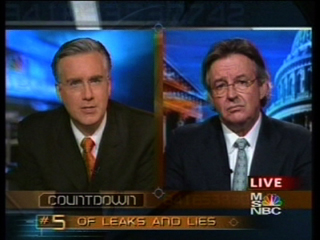
| In a nutshell, President Bush, Cheney and Karl Rove are traitors. Together, they conspired to out Valerie Plame as a CIA agent in retaliation for her husband's going to the media about how Saddam hadn't really purchased uranium from Niger, and therefore, how Iraq's WMDs didn't exist. |
Video - Joe Wilson on Olbermann - All (37 MB)
Video - Joe Wilson on Olbermann - Intro (9 MB)
Video - Joe Wilson on Olbermann - Wilson Interview (13 MB)
Video - Joe Wilson on Olbermann - Shuster Analysis (10 MB)
Audio - Joe Wilson on Olbermann - All (18 MB)
Audio - Joe Wilson on Olbermann - Intro (5 MB)
Audio - Joe Wilson on Olbermann - Wilson Interview (9 MB)
Audio - Joe Wilson on Olbermann - Shuster Analysis (6 MB)
I've created a student licensing guide for using content in mixed media production and licensing your own production when you're done.
The final guide is available
Here. (.doc) file
A longer winded version of the same information contained in the Guide (with historical references)
is available here:
Word File
Text version.
My pros and cons table comparing Creative Commons 6 main licenses (and the Public Domain) is here:
Pros and Cons of Creative Commons Licenses
(As an idealist and a skeptic.)
Here is the full text of the long winded report:
A Review of the Current State of Copyright Law
By Lisa Rein, lisa@lisrein.com
April 12, 2006
Traditional Copyright
To understand the current state of Copyright Law, it is helpful to first understand the Founding Fathers original intentions and the guidelines that were originally set forth in the Constitution. Article 1, Section 8 states that Congress has the power "To promote the Progress of Science and useful Arts, by securing for limited Times to Authors and Inventors the exclusive Right to their respective Writings and Discoveries." (U.S. Constitution 1788) The Copyright Act of 1790 specifies the Copyright term at 14 years, with the option to renew once for another 14 years, for a total of 28 years of protection. (Copyright 1790) After that, the work goes into the public domain, so others can use it and benefit from it. (After a work goes into the public domain, publishers are free to print it up and sell it without compensating the original creator.)
The Constitution is quite clear about who Copyright was ultimately supposed to benefit: the public. The very first Copyright act, the Copyright Act of 1790, described itself in its very first sentence as "An act for the encouragement of learning..." The government recognized that creators needed compensation in order to create, however the ultimate goal of creating new, better works was to benefit the public, not only provide private gain. The whole purpose of Copyright was for creators to have the exclusive right to make certain uses of their work for a limited time however, after that limited time, all uses could be enjoyed and reused freely by any member of the public. Traditional Copyright intended that neither the creator nor the public should be able to appropriate all of the benefits of a work. Creators need to gain some benefit or they wouldn’t create. The Public needs creations to build upon and enjoy. The promotion of learning and the arts is another key consideration that the Founding Fathers had in mind when they devised this system.
The economic perspective behind Copyright is something called "The Copyright Bargain. (Litman 2001) This "bargain" is the deal entered into between Copyright holders and the general public. The Copyright system is designed to give some market-based financial compensation to the people who created works and the people who distributed them (publishers). However, the other side of this “bargain” is that the long-term rights for the use and reuse of those works be reserved for the public and other authors of the future. (Rein 2003)
The Copyright Term
One of the most controversial Copyright issues today has been determining the length of this Copyright Term. The Constitution specifies that Congress is "securing for limited times to Authors and Inventors the exclusive Right to their respective Writings and Discoveries." (U.S. Constitution 1788) For years, corporate Copyright owners, such as the Disney Corporation, have been successfully lobbying Congress to continuously extend the term on the basis that Congress has the power to determine what "limited" is. As a result, the Copyright term has been extended 11 times in the last 40 years. The current term is 70 years after the death of the creator, and 95 years after first public distribution of "works for hire," or 120 years after the creation date, whichever comes first. (Copyright 2003) A "work for hire" refers to a work where the creator signs off on their rights as part of the deal. Theoretically, the artist does this in exchange for a greater sum of money, since he won't see any further financial benefits from the work after the initial payment. From a company's stand point, “works for hire” are easier to deal with because the corporation would otherwise have to clear usage with the artist every time it wanted to reuse the media in some way. Whether this is good or bad depends on which side of the deal you're on. If you are an artist, you always want to retain or share the Copyright, so you can stay in the licensing (and compensation) loop if the work is reused later. If you are a producer or part of a production company, however, you won't want to worry about having to find the artist later to get their permission for every little reuse. So a producer wants the artist to agree to create work as a “work for hire” whenever possible. These latest extensions only apply to works created after they take effect. This means that the term varies, depending on when a work was created. This adds another layer of complexity to the already confusing prospect of correctly determining whether a historical work has fallen into the Public Domain.
The Copyright Term has now been extended to be longer than most humans' life span, so creators rarely live long enough to see their works go into the public domain. Copyright holders are able to profit from their works throughout their lifetime and often their offspring or whomever inherited their estate after their death also profits.
Too Complicated for the Public To Understand
What started out as a simple document that fit on half a newspaper page has bloated into a document of over 290 pages. As a result, students and teachers aren't really sure what the law is, and often err on the side of conservatism. This has led to what is called a "chilling effect," where art, education and research are not allowed to blossom to their full potential for fear of legal repercussions. With artists and creators unsure of their legal standing, many choose to create other works that might be "safer" considering the unknowns surrounding the use of Copyrighted works. The scientific community has also felt the repercussions of this chilling effect, because they are afraid to borrow from the research of others to advance new scientific solutions.
Copyright Infringement and the DMCA
"Infringement" is violating a Copyright-owner's exclusive rights. The law does not require that the infringer be aware they are doing so. Harm does not need to be proven. (Litman 2001) As an artist deciding whether or not to include pieces from the works of others, you want to make sure you're not infringing on any one else's rights, so you don't get sued.
What happens when you put something up on the Internet without permission and the Copyright holder finds out? The Copyright holder can accuse you of violating something called the Digital Millennium Copyright Act and send your Internet Service Provider (where your files are hosted) a "takedown notice." (DMCA 1998) By law, according to the DMCA, your ISP has seven days to respond. Theoretically, a week is plenty of time to contact you, find out what's going on and, if you are infringing, ask you to take it down. In reality however, a week is not very much time. What if the “takedown” letter is sent on a Friday and not read until Monday? Whether that's one day or three days is unclear. The Copyright holder can demand that it be taken down pending investigation and, often, this is done before you have an opportunity to defend yourself. According to the DMCA, a Copyright holder need only have a "good faith belief" that his rights are being infringed to issue and "cease and desist" letter (a "c and d" or "takedown notice").
The reality is that ISPs rarely take the time to investigate or send a letter back saying that they have checked with the violator in question, who claims they own the material and is disputing their claim. The larger ISPs have lawyers and know their rights, but the smaller ISPs don't always know their options and don't want to pay a lawyer to find out what they are. So the easiest thing for them to do, often, is take the site down pending further investigation. The Digital Millennium Copyright Act is not very straightforward and is difficult to understand. Its provisions are still being debated, but it's the current law in effect. Even after you take the material down, you can still be charged anywhere from $5000 to $50,000 per violation. Defending yourself costs money, so having any sort of conflict becomes immediately expensive.
Fair Use
“Fair use” is a defense, used after the acknowledgement of infringement (unauthorized use) has actually taken place. The Copyright Act of 1976 specified in writing a collection of provisions for Fair Uses that, up to that point, had only been understood via "Common Law" precedents set by judges ruling on a case-by-case basis over the years. (Schultz 2006) Section 107, Title 17 of the Copyright Act of 1976 explains "Fair Use" in a fairly straightforward manner defining a number of specific acts that don't count as Copyright infringement. (Copyright 1976) These “acts” include reproducing "part or all of a work for the purposes of: criticism, comment, news reporting, teaching, scholarship or research." (Copyright 1976) Parts of the definition are purposely left up to interpretation. For instance, what exactly constitutes criticism, comments, news reporting, teaching, scholarship or research? This act also sets forth what has come to be known as the Fair Use Four Factors Test, which is used to determine whether a use qualifies as “fair.” In a nutshell, it depends on whether such a use is commercial or non-commercial, the "nature" of the work (whether it is factual or fictional) how much of the work is used and if such use has some effect on the potential market value of that work. Although the text of Section 107, Title 17 of the Copyright Act of 1976 states very clearly that "multiple copies for classroom use" is included as “fair use”, recently adopted policies across academic campuses nationwide have required teachers to cut back on the amount of copied material actually used in class, forcing them to ask themselves if they "really need" excerpts from one book or another to make their point in class. Such is another example of the "chilling effect", this time on the educational process.
Copyright is "Automatic"
The Copyright Act of 1976 also designates that newly created works are Copyrighted "automatically." The Copyright is attributed to the work without having to register it in the Copyright Office, as was previously the case. A work is copyrighted as soon as it is "fixed in a tangible medium." (Copyright 2003) Examples include taking a photograph or writing down a story on paper or recording a song on to a tape. This automatic protection has both benefits to creators and potential pitfalls for creators who may not wish for their works to be "locked up" after their death.
The loss of the Public Domain
Arguably, one of the greatest casualties of a perpetual Copyright Term is the eventual loss of a Public Domain. There are many who would say that the public doesn't lose anything from not having a public domain anymore, and that it's OK for people to pay to use creative works in perpetuity. They might also argue that the Founding Fathers just hadn't thought in terms of our modern concepts of intellectual property when they were first devising the concept of Copyright in the early acts.
Eldred vs. Ashcroft (2003)
The last Copyright extension, the Sonny Bono Copyright term-extension act, added the last 20 years to the term, effectively pushing the pubic domain work's release date so far out that now no creative work is scheduled to go into the public domain for 16 years. Given the current sentiment, Copyright term is probably going to be extended again, and the concept and existence of “public domain” may be lost forever. The "Copyright maxima lists" feel that there's nothing wrong with the loss of a public domain. However, most would agree that this viewpoint ignores the other half of the Copyright Bargain, where the public eventually benefits from the work.
Eric Eldred, a public-domain publisher who had been making HTML'd versions of public domain works available on the Web, cried foul, and launched a case against the government calling the constitutionality of the last 20-year extension into question. At the same time, on a parallel track, Eldred, with the help of many legal academics from universities around the country, set out to attempt to create a voluntary public domain. (Lessig 2002)
It is because of this dwindling Public Domain that Creative Commons was created. Creative Commons is a non-profit entity created to offer alternative licensing to that of traditional Copyright. Creative Commons licenses allow certain uses "up front," without requiring the explicit permission from the Copyright holder, while still preserving all other protections of existing Copyright Law. Creative Commons was started in 2002 in direct response to the Sonny Bono Copyright Term Extension Act of 1998 (Sonny Bono 1998), when this legislation extended the Copyright term to a length that stopped many works from going into Public Domain. This legislation deprived Public Domain publishers from being able to publish these works. (Eldred)
In Eldred vs. Ashcroft, the Supreme Court ruled that these endless Copyright term extensions were constitutional, based on Congress' right to determine what constituted a "limited time." (Eldred vs. Ashcroft 2003)
Creative Commons Licenses
All Creative Commons licenses require attribution. After that, you have two options: allowing/disallowing commercial usage and allowing/disallowing derivative works. Furthermore, if you do allow your work to be remixed to create another "derivative work," you may optionally require that such works are released under the same license as yours. This way, remixes of your work are also available to remix, rather than being "locked up" under another license.
This "share-alike" provision embodies the true spirit of Creative Commons: creating a voluntary Public Domain in response to the ongoing loss of the "real" Public Domain due to the perpetual length of the copyright term. However, many people don't want to place any restrictions on reuse, fearing that such restrictions may serve as a deterrent to usage. (See my attached "Pros and Cons of CC licenses" table.)
Creative Commons’ licenses work backwards from existing copyright to enable you to make exceptions to the normal copyright rule, and allow the uses you want without losing any of the "automatic" protections of "traditional copyright." Every license allows the work to be copied and distributed in any format, displayed or performed publicly, or webcast (a "digital public performance"). Every license applies world-wide and is irrevocable. If that "irrevocable" part sounds scary, fear not. Another feature of Creative Commons’ licenses is that they are non-exclusive. So putting your work out under a CC license can never interfere with anything else you choose to do with that work in the future.
These licenses take on different perspectives depending on whether you are using work licensed by others for your work, or licensing your work for others. When choosing content, a producer needs to first consider whether it is okay to use the source material as he would like in his own production. His second consideration is to confirm that the license for that source material will also allow for whatever license chosen for his own works’ redistribution.
The most restrictive license, and perhaps the "safest" to use until you understand the different options, is the "Attribution, Non-commercial, No-derivs" license. Like all Creative Commons’ licenses, it requires attribution and a link back to your site if the work is made available for download on a website. This license is sometimes called the "free advertising" license because it enables others to do your duplication and re-distribution for you. People can download it and share it, but they are not allowed to modify it in any way. So, for example, you can use songs licensed under this license as a soundtrack in your film, but you are not allowed to run that song through a filter to make it sound different in any way. You are also not allowed to sell the song when you’re done, without contacting that Copyright holder and obtaining their explicit permission. This license allows only for usage in non-commercial environments (schools, non-profits, students, and, potentially, a person's personal website), and requires that the work be included in its entirety. This doesn't mean that you have to use the whole song, but that any part you do use is “verbatim,” and not altered or remixed to create another "derivative" work.
Now, in the "real world," if a commercial filmmaker, found a Creative Commons’ licensed work under one of these licenses, the chances would be pretty good that you could contact the Copyright holder and pay them some money and get their permission for use. As an enticement to the original artist, the license holder might specify the use was for a full length commercial film and likely to get a lot of exposure. Big Hollywood studios have entire departments of people who are set up to handle this kind of negotiation, but the average "independent" filmmaker does not have these resources. He would have to forfeit this option if an opportunity later arose to make money from his creation. For this reason, independent filmmakers are more likely to choose music that gives permission to sell their new creations up front, so as not to create more complications later.
There are two or more sides to almost every aspect of these licenses. Each of the perceived "restrictions" has the potential to be perceived as having positive or negative consequences. For instance, allowing derivative works represents both a loss of control over how your work may be used, but it also puts you on the receiving end of more "free advertising." This is true because when others use your work, they will be promoting your work along with their own derivative creations by providing attribution and a link back to your own website (as required by all licenses that allow derivative works.) Allowing commercial works lets others profit from works containing your work within them, but it also makes using your work an option to a whole different professional class of people. Requiring that others "share alike" ensures that all derivative works will themselves be made available for others to reuse, but it may be a deal breaker for a professional filmmaker whose other contractual obligations do not allow them any flexibility.
In the same vein, there are definitely two sides to the argument for placing one's works directly in to the Public Domain. On the positive side, you can be sure that your work will live on after you do. People will make copies of your work in different formats for you to preserve the work, and you can list your works among numerous historical works in many of the public domain archives available. Your work will most likely have derivative works created from it because artists will often create from existing work simply because they know they can. But really, these days, placing your work in the Public Domain is more of a political statement, should you wish to make that point that the information your work contains is so important that you release all claims in order to just "get it out there." Or, sometimes, this action represents that your work is built upon works already in the Public Domain, and therefore you do not wish to lock up your derivative work based on that Public Domain work under the restrictions of traditional Copyright. (Disney's Snow White is a good example of a derivative work based on a Public Domain work that is now locked up under Disney's traditional Copyright for its film.) One might also place their work under the Public Domain as an act of support and dedication towards rebuilding our Public Domain.
Since Creative Commons licenses are now available, it's less common for one to give their rights away to make their point. A person can make their work available for uses of their choosing, while still retaining complete control over other uses.
The attached table summarizes the pros and cons for each of the six main Creative Commons licenses (and the Public Domain).
References
Copyright Act of 1976 (1976)
Copyright Act of 1976, Section 107, Title 17 (1976)
Copyright Act of 1790 entry, Wikipedia (n.d.). Retrieved
April 6, 2006, from
http://en.wikipedia.org/wiki/Copyright_Act_of_1790
Copyright Law of the United States of America (June 2003), circ 92.
Creative Commons: A Spectrum of Rights (n.d.). Retrieved
April 6, 2006, from
http://www.creativecommons.org/about/licenses/comics2
Creative Commons: Baseline rights and restrictions in all
licenses (n.d.). Retrieved on April 1, 2006 from
http://creativecommons.org/about/licenses/fullrights
Creative Commons: Creative Commons Licenses (n.d.).
Retrieved on April 1, 2006 from
http://creativecommons.org/about/licenses/meet-the-licenses
Creative Commons: Choosing a License (n.d.).
Retrieved on April 1, 2006 from
http://creativecommons.org/about/think
Creative Commons: Public Domain Dedication (n.d.).
Retrieved on April 11, 2006 from
http://creativecommons.org/licenses/publicdomain/
Creative Commons: Things to think about before you apply a
Creative Commons license to your work (n.d.).
Retrieved on April 1, 2006 from
http://creativecommons.org/about/licenses/index_html
The Digital Millennium Copyright Act (DMCA) (1998)
Eldred vs. Ashcroft, 537 U.S. (2003)
Lessig, L. (2002) Speech at the Creative Commons Launch. Retrieved April 1, 2006 from:
http://www.onlisareinsradar.com/archives/000782.php
Litman, J. (2001). Digital Copyright, Prometheus Books.
The Sonny Bono Copyright Term Extension Act (1998)
Rein, L. (2005) Copyright Basics for Web Designers (n.d.).
Retrieved April 1 from:
http://www.lisarein.com/seybold/
Rein, L. (2005) Songs From the Commons #4 (podcast)
Retrieved April 1, 2006:
http://www.mondoglobo.net/thecommons/?p=9
Schultz, J. (2006) Personal e-mail communication with Legal
Expert, April 8, 2006.
U.S. Constitution (year), Article I, Section 8 (1788)
This is from the October 30, 2005 program of 60 minutes
I've been clearing off my TIVO since I've been home so much lately, and what do I run across but a 60 Minutes piece from October 30, 2005 about Valerie Plame. Not about the scandal per se, but about Valerie: who she was, what she did, and the lives potentially at risk and irrepairable damage that has been done to our National Security as a result of her identity being revealed.
 | Valerie was an undercover Agent gathering intelligence about numerous countries' Nuclear Weapons programs. She dedicated her life to protecting the National Security of the United States. She recommended her husband, Joseph Wilson, to go on another patriotic mission to Nigeria to verify whether or not Saddam Hussein had purchased uranium from there. Wilson went on this mission, almost as a favor, for the Vice President himself. When Wilson came back with the truth - that the documents saying Saddam had purchased uranium were forged, the Vice President wanted Wilson to keep quiet about it. |
When he did not, and instead offered up to the press what he had uncovered, our Bush, Cheney and Rove conspired to reveal his wife's identity in retaliation.
Wow. You've really got to see this for yourself.
Video - 60 Minutes On The CIA Leak - All
Video - 60 Minutes On The CIA Leak - Part One
Video - 60 Minutes On The CIA Leak - Part Two
Audio - 60 Minutes On The CIA Leak - All
Audio - 60 Minutes On The CIA Leak - Part One
Audio - 60 Minutes On The CIA Leak - Part Two
Lacking Biolabs, Trailers Carried Case for War
By Joby Warrick for The Washington Post via t r u t h o u t
(Researcher Alice Crites contributed to this report.)
On May 29, 2003, 50 days after the fall of Baghdad, President Bush proclaimed a fresh victory for his administration in Iraq: Two small trailers captured by U.S. troops had turned out to be long-sought mobile "biological laboratories." He declared, "We have found the weapons of mass destruction."The claim, repeated by top administration officials for months afterward, was hailed at the time as a vindication of the decision to go to war. But even as Bush spoke, U.S. intelligence officials possessed powerful evidence that it was not true.
A secret fact-finding mission to Iraq - not made public until now - had already concluded that the trailers had nothing to do with biological weapons. Leaders of the Pentagon-sponsored mission transmitted their unanimous findings to Washington in a field report on May 27, 2003, two days before the president's statement.
The three-page field report and a 122-page final report three weeks later were stamped "secret" and shelved. Meanwhile, for nearly a year, administration and intelligence officials continued to publicly assert that the trailers were weapons factories.
The authors of the reports were nine U.S. and British civilian experts - scientists and engineers with extensive experience in all the technical fields involved in making bioweapons - who were dispatched to Baghdad by the Defense Intelligence Agency for an analysis of the trailers. Their actions and findings were described to a Washington Post reporter in interviews with six government officials and weapons experts who participated in the mission or had direct knowledge of it.
None would consent to being identified by name because of fear that their jobs would be jeopardized. Their accounts were verified by other current and former government officials knowledgeable about the mission. The contents of the final report, "Final Technical Engineering Exploitation Report on Iraqi Suspected Biological Weapons-Associated Trailers," remains classified. But interviews reveal that the technical team was unequivocal in its conclusion that the trailers were not intended to manufacture biological weapons. Those interviewed took care not to discuss the classified portions of their work.
"There was no connection to anything biological," said one expert who studied the trailers. Another recalled an epithet that came to be associated with the trailers: "the biggest sand toilets in the world."
Primary Piece of EvidenceThe story of the technical team and its reports adds a new dimension to the debate over the U.S. government's handling of intelligence related to banned Iraqi weapons programs. The trailers - along with aluminum tubes acquired by Iraq for what was believed to be a nuclear weapons program - were primary pieces of evidence offered by the Bush administration before the war to support its contention that Iraq was making weapons of mass destruction...
Even before the trailers were seized in spring 2003, the mobile labs had achieved mythic stature. As early as the mid-1990s, weapons inspectors from the United Nations chased ph?ntom mobile labs that were said to be mounted on trucks or rail cars, churning out tons of anthrax by night and moving to new locations each day. No such labs were found, but many officials believed the stories, thanks in large part to elaborate tales told by Iraqi defectors.
The CIA's star informant, an Iraqi with the code name Curveball, was a self-proclaimed chemical engineer who defected to Germany in 1999 and requested asylum. For four years, the Baghdad native passed secrets about alleged Iraqi banned weapons to the CIA indirectly, through Germany's intelligence service. Curveball provided descriptions of mobile labs and said he had supervised work in one of them. He even described a catastrophic 1998 accident in one lab that left 12 Iraqis dead.
Curveball's detailed descriptions - which were officially discredited in 2004 - helped CIA artists create color diagrams of the labs, which Powell later used to argue the case for military intervention in Iraq before the U.N. Security Council.
"We have firsthand descriptions of biological weapons factories on wheels and on rails," Powell said in the Feb. 5, 2003, speech. Thanks to those descriptions, he said, "We know what the fermenters look like. We know what the tanks, pumps, compressors and other parts look like."
The trailers discovered in the Iraqi desert resembled the drawings well enough, at least from a distance. One of them, a flat-bed trailer covered by tarps, was found in April by Kurdish fighters near the northern city of Irbil. The second was captured by U.S. forces near Mosul. Both were painted military green and outfitted with a suspicious array of gear: large metal tanks, motors, compressors, pipes and valves.
Photos of the trailers were quickly circulated, and many weapons experts were convinced that the long-sought mobile labs had been found...
The technical team was assembled in Kuwait and then flown to Baghdad to begin their work early on May 25, 2003. By that date, the two trailers had been moved to a military base on the grounds of one of deposed president Saddam Hussein's Baghdad palaces. When members of the technical team arrived, they found the trailers parked in an open lot, covered with camouflage netting.
The technical team went to work under a blistering sun in 110-degree temperatures. Using tools from home, they peered into vats, turned valves, tapped gauges and measured pipes. They reconstructed a flow-path through feed tanks and reactor vessels, past cooling chambers and drain valves, and into discharge tanks and exhaust pipes. They took hundreds of photographs.
By the end of their first day, team members still had differing views about what the trailers were. But they agreed about what the trailers were not.
"Within the first four hours," said one team member, who like the others spoke on the condition he not be named, "it was clear to everyone that these were not biological labs."
News of the team's early impressions leaped across the Atlantic well ahead of the technical report. Over the next two days, a stream of anxious e-mails and phone calls from Washington pressed for details and clarifications.
The reason for th? nervousness was soon obvious: In Washington, a CIA analyst had written a draft white paper on the trailers, an official assessment that would also reflect the views of the DIA. The white paper described the trailers as "the strongest evidence to date that Iraq was hiding a biological warfare program." It also explicitly rejected an explanation by Iraqi officials, described in a New York Times article a few days earlier, that the trailers might be mobile units for producing hydrogen.
But the technical team's preliminary report, written in a tent in Baghdad and approved by each team member, reached a conclusion opposite from that of the white paper.
Crucial Components LackingTeam members and other sources intimately familiar with the mission declined to discuss technical details of the team's findings because the report remains classified. But they cited the Iraqi Survey Group's nonclassified, final report to Congress in September 2004 as reflecting the same conclusions.
That report said the trailers were "impractical for biological agent production," lacking 11 components that would be crucial for making bioweapons. Instead, the trailers were "almost certainly designed and built for the generation of hydrogen," the survey group reported.
The group's report and members of the technical team also dismissed the notion that the trailers could be easily modified to produce weapons.
"It would be easier to start all over with just a bucket," said Rod Barton, an Australian biological weapons expert and former member of the survey group.
The technical team's preliminary report was transmitted in the early hours of May 27, just before its members began boarding planes to return home. Within 24 hours, the CIA published its white paper, "Iraqi Mobile Biological Warfare Agent Production Plants," on its Web site.
After team members returned to Washington, they began work on a final report. At several points, members were questioned about revising their conclusions, according to sources knowledgeable about the conversations. The questioners generally wanted to know the same thing: Could the report's conclusions be softened, to leave open a possibility that the trailers might have been intended for weapons?
In the end, the final report - 19 pages plus a 103-page appendix - remained unequivocal in declaring the trailers unsuitable for weapons production.
"It was very assertive," said one weapons expert familiar with the report's contents.
Then, their mission completed, the team members returned to their jobs and watched as their work appeared to vanish.
"I went home and fully expected that our findings would be publicly stated," one member recalled. "It never happened. And I just had to live with it."
Here is the full text of the article in case the link goes bad:
http://www.washingtonpost.com/wp-dyn/content/article/2006/04/11/AR2006041101888_pf.html
Lacking Biolabs, Trailers Carried Case for War
By Joby Warrick
The Washington Post
Wednesday 12 April 2006
Administration pushed notion of banned Iraqi weapons despite evidence to contrary.
On May 29, 2003, 50 days after the fall of Baghdad, President Bush proclaimed a fresh victory for his administration in Iraq: Two small trailers captured by U.S. troops had turned out to be long-sought mobile "biological laboratories." He declared, "We have found the weapons of mass destruction."
The claim, repeated by top administration officials for months afterward, was hailed at the time as a vindication of the decision to go to war. But even as Bush spoke, U.S. intelligence officials possessed powerful evidence that it was not true.
A secret fact-finding mission to Iraq - not made public until now - had already concluded that the trailers had nothing to do with biological weapons. Leaders of the Pentagon-sponsored mission transmitted their unanimous findings to Washington in a field report on May 27, 2003, two days before the president's statement.
The three-page field report and a 122-page final report three weeks later were stamped "secret" and shelved. Meanwhile, for nearly a year, administration and intelligence officials continued to publicly assert that the trailers were weapons factories.
The authors of the reports were nine U.S. and British civilian experts - scientists and engineers with extensive experience in all the technical fields involved in making bioweapons - who were dispatched to Baghdad by the Defense Intelligence Agency for an analysis of the trailers. Their actions and findings were described to a Washington Post reporter in interviews with six government officials and weapons experts who participated in the mission or had direct knowledge of it.
None would consent to being identified by name because of fear that their jobs would be jeopardized. Their accounts were verified by other current and former government officials knowledgeable about the mission. The contents of the final report, "Final Technical Engineering Exploitation Report on Iraqi Suspected Biological Weapons-Associated Trailers," remains classified. But interviews reveal that the technical team was unequivocal in its conclusion that the trailers were not intended to manufacture biological weapons. Those interviewed took care not to discuss the classified portions of their work.
"There was no connection to anything biological," said one expert who studied the trailers. Another recalled an epithet that came to be associated with the trailers: "the biggest sand toilets in the world."
Primary Piece of Evidence
The story of the technical team and its reports adds a new dimension to the debate over the U.S. government's handling of intelligence related to banned Iraqi weapons programs. The trailers - along with aluminum tubes acquired by Iraq for what was believed to be a nuclear weapons program - were primary pieces of evidence offered by the Bush administration before the war to support its contention that Iraq was making weapons of mass destruction.
Intelligence officials and the White House have repeatedly denied allegations that intelligence was hyped or manipulated in the run-up to the U.S.-led invasion of Iraq in March 2003. But officials familiar with the technical team's reports are questioning anew whether intelligence agencies played down or dismissed postwar evidence that contradicted the administration's public views about Iraq's weapons of mass destruction. Last year, a presidential commission on intelligence failures criticized U.S. spy agencies for discounting evidence that contradicted the official line about banned weapons in Iraq, both before and after the invasion.
Spokesmen for the CIA and the Defense Intelligence Agency both declined to comment on the specific findings of the technical report because it remains classified. A spokesman for the DIA asserted that the team's findings were neither ignored nor suppressed, but were incorporated in the work of the Iraqi Survey Group, which led the official search for Iraqi weapons of mass destruction. The survey group's final report in September 2004 - 15 months after the technical report was written - said the trailers were "impractical" for biological weapons production and were "almost certainly intended" for manufacturing hydrogen for weather balloons.
"Whether the information was offered to others in the political realm I cannot say," said the DIA official, who spoke on the condition that he not be identified.
Intelligence analysts involved in high-level discussions about the trailers noted that the technical team was among several groups that analyzed the suspected mobile labs throughout the spring and summer of 2003. Two teams of military experts who viewed the trailers soon after their discovery concluded that the facilities were weapons labs, a finding that strongly influenced views of intelligence officials in Washington, the analysts said. "It was hotly debated, and there were experts making arguments on both sides," said one former senior official who spoke on the condition that he not be identified.
The technical team's findings had no apparent impact on the intelligence agencies' public statements on the trailers. A day after the team's report was transmitted to Washington - May 28, 2003 - the CIA publicly released its first formal assessment of the trailers, reflecting the views of its Washington analysts. That white paper, which also bore the DIA seal, contended that U.S. officials were "confident" that the trailers were used for "mobile biological weapons production."
Throughout the summer and fall of 2003, the trailers became simply "mobile biological laboratories" in speeches and press statements by administration officials. In late June, Secretary of State Colin L. Powell declared that the "confidence level is increasing" that the trailers were intended for biowarfare. In September, Vice President Cheney pronounced the trailers to be "mobile biological facilities," and said they could have been used to produce anthrax or smallpox.
By autumn, leaders of the Iraqi Survey Group were publicly expressing doubts about the trailers in news reports. David Kay, the group's first leader, told Congress on Oct. 2 that he had found no banned weapons in Iraq and was unable to verify the claim that the disputed trailers were weapons labs. Still, as late as February 2004, then-CIA Director George J. Tenet continued to assert that the mobile-labs theory remained plausible. Although there was "no consensus" among intelligence officials, the trailers "could be made to work" as weapons labs, he said in a speech Feb. 5.
Tenet, now a faculty member at Georgetown's Edmund A. Walsh School of Foreign Service, declined to comment for this story.
Kay, in an interview, said senior CIA officials had advised him upon accepting the survey group's leadership in June 2003 that some experts in the DIA were "backsliding" on whether the trailers were weapons labs. But Kay said he was not apprised of the technical team's findings until late 2003, near the end of his time as the group's leader.
"If I had known that we had such a team in Iraq," Kay said, "I would certainly have given their findings more weight."
A Defector's Tales
Even before the trailers were seized in spring 2003, the mobile labs had achieved mythic stature. As early as the mid-1990s, weapons inspectors from the United Nations chased ph?ntom mobile labs that were said to be mounted on trucks or rail cars, churning out tons of anthrax by night and moving to new locations each day. No such labs were found, but many officials believed the stories, thanks in large part to elaborate tales told by Iraqi defectors.
The CIA's star informant, an Iraqi with the code name Curveball, was a self-proclaimed chemical engineer who defected to Germany in 1999 and requested asylum. For four years, the Baghdad native passed secrets about alleged Iraqi banned weapons to the CIA indirectly, through Germany's intelligence service. Curveball provided descriptions of mobile labs and said he had supervised work in one of them. He even described a catastrophic 1998 accident in one lab that left 12 Iraqis dead.
Curveball's detailed descriptions - which were officially discredited in 2004 - helped CIA artists create color diagrams of the labs, which Powell later used to argue the case for military intervention in Iraq before the U.N. Security Council.
"We have firsthand descriptions of biological weapons factories on wheels and on rails," Powell said in the Feb. 5, 2003, speech. Thanks to those descriptions, he said, "We know what the fermenters look like. We know what the tanks, pumps, compressors and other parts look like."
The trailers discovered in the Iraqi desert resembled the drawings well enough, at least from a distance. One of them, a flat-bed trailer covered by tarps, was found in April by Kurdish fighters near the northern city of Irbil. The second was captured by U.S. forces near Mosul. Both were painted military green and outfitted with a suspicious array of gear: large metal tanks, motors, compressors, pipes and valves.
Photos of the trailers were quickly circulated, and many weapons experts were convinced that the long-sought mobile labs had been found.
Yet reaction from Iraqi sources was troublingly inconsistent. Curveball, shown photos of the trailers, confirmed they were mobile labs and even pointed out key features. But other Iraqi informants in internal reports disputed Curveball's story and claimed the trailers had a benign purpose: producing hydrogen for weather balloons.
Back at the Pentagon, DIA officials attempted a quick resolution of the dispute. The task fell to the "Jefferson Project," a DIA-led initiative made up of government and civilian technical experts who specialize in analyzing and countering biological threats. Project leaders put together a team of volunteers, eight Americans and a Briton, each with at least a decade of experience in one of the essential technical skills needed for bioweapons production. All were nongovernment employees working for defense contractors or the Energy Department's national labs.
The technical team was assembled in Kuwait and then flown to Baghdad to begin their work early on May 25, 2003. By that date, the two trailers had been moved to a military base on the grounds of one of deposed president Saddam Hussein's Baghdad palaces. When members of the technical team arrived, they found the trailers parked in an open lot, covered with camouflage netting.
The technical team went to work under a blistering sun in 110-degree temperatures. Using tools from home, they peered into vats, turned valves, tapped gauges and measured pipes. They reconstructed a flow-path through feed tanks and reactor vessels, past cooling chambers and drain valves, and into discharge tanks and exhaust pipes. They took hundreds of photographs.
By the end of their first day, team members still had differing views about what the trailers were. But they agreed about what the trailers were not.
"Within the first four hours," said one team member, who like the others spoke on the condition he not be named, "it was clear to everyone that these were not biological labs."
News of the team's early impressions leaped across the Atlantic well ahead of the technical report. Over the next two days, a stream of anxious e-mails and phone calls from Washington pressed for details and clarifications.
The reason for th? nervousness was soon obvious: In Washington, a CIA analyst had written a draft white paper on the trailers, an official assessment that would also reflect the views of the DIA. The white paper described the trailers as "the strongest evidence to date that Iraq was hiding a biological warfare program." It also explicitly rejected an explanation by Iraqi officials, described in a New York Times article a few days earlier, that the trailers might be mobile units for producing hydrogen.
But the technical team's preliminary report, written in a tent in Baghdad and approved by each team member, reached a conclusion opposite from that of the white paper.
Crucial Components Lacking
Team members and other sources intimately familiar with the mission declined to discuss technical details of the team's findings because the report remains classified. But they cited the Iraqi Survey Group's nonclassified, final report to Congress in September 2004 as reflecting the same conclusions.
That report said the trailers were "impractical for biological agent production," lacking 11 components that would be crucial for making bioweapons. Instead, the trailers were "almost certainly designed and built for the generation of hydrogen," the survey group reported.
The group's report and members of the technical team also dismissed the notion that the trailers could be easily modified to produce weapons.
"It would be easier to start all over with just a bucket," said Rod Barton, an Australian biological weapons expert and former member of the survey group.
The technical team's preliminary report was transmitted in the early hours of May 27, just before its members began boarding planes to return home. Within 24 hours, the CIA published its white paper, "Iraqi Mobile Biological Warfare Agent Production Plants," on its Web site.
After team members returned to Washington, they began work on a final report. At several points, members were questioned about revising their conclusions, according to sources knowledgeable about the conversations. The questioners generally wanted to know the same thing: Could the report's conclusions be softened, to leave open a possibility that the trailers might have been intended for weapons?
In the end, the final report - 19 pages plus a 103-page appendix - remained unequivocal in declaring the trailers unsuitable for weapons production.
"It was very assertive," said one weapons expert familiar with the report's contents.
Then, their mission completed, the team members returned to their jobs and watched as their work appeared to vanish.
"I went home and fully expected that our findings would be publicly stated," one member recalled. "It never happened. And I just had to live with it."
--------
Researcher Alice Crites contributed to this report.
Update April 13, 2006 - The link below goes to the final version. As I mentioned earlier, I hope that this table will continue to be a work in progress. Please let me know about your pros and cons.
Okay -- I've got a draft up of my
Creative Commons Pros and Cons table.
As Both An Idealist and a Skeptic
I'm only covering the main 6 licenses. But I'd like to keep adding to it after this initial publication.
Please email me at lisa@lisarein.com with any comments/suggestions/criticisms.
I leave for school tomorrow to turn things in around 3pm PST, so please, if you can, send me your comments by noon, that would be great.
I very much appreciate whatever time you have to look this over.
Again, non-expert feedback is also very much appreciated! This is supposed to be a guide for students of broadcasting, not law :-) I'd like to think it could be useful for anyone.
thanks!
Update April 13, 2006: The final guide is available Here.
I'm in the process of completing my final project for SFSU's Broadcast Electronic Communications Arts department (BECA) -- My assignment is to write a student licensing guide to help students with licensing their school productions.
It's most of the way complete except for a Pros and Cons table that I won't have ready for a few more hours.
A word file with the tracking turned on is available here:
http://video.lisarein.com/sfsu/guide/guide-4-11DFC.doc
A text file:
http://video.lisarein.com/sfsu/guide/guide-4-11-draft.txt
I'm including a text file here and in the "more" section below.
Please make changes directly to the file, or send me an email with suggestions about specific sections - please quote the text so I know what you're referring to.
This isn't about proofreading! This thing's already in pretty good shape. I'm wondering if it makes sense to experts and non-experts alike.
You do not need to be a legal expert to be helpful to me. I'm wondering if this stuff makes sense to newbies too. That's the whole point of this guide.
Please email me a lisa@lisarein.com with your comments and/or edited word file.
thanks!
lisa
BECA Student Licensing Guide - April 2006
By Lisa Rein, lisa@lisarein.com -
This draft has been replaced by the final version located here:
http://video.lisarein.com/sfsu/guide/finalguide4-12.txt
BECA Student Licensing Guide - April 2006
By Lisa Rein, lisa@lisarein.com
Introduction - Some background on copyright basics
Step 1 - Protecting yourself from getting sued.
Step 2 - Choosing a Creative Commons License for your own work.
Summary
The purpose of this guide is two-fold. The first goal is to teach you how to display your own mixed-media BECA productions publicly without fear of legal ramifications. (This will be accomplished by clearing all your content, creating it yourself, or using Creative Commons’ licensed content). The second goal is to teach you how to choose a Creative Commons license for your own productions, so that you may encourage their reuse while still protecting yourself from unauthorized uses.
Introduction - Some background on copyright basics
We're going to be talking specifically about Copyright in this manual. (Patents and trademarks, two other kinds of "intellectual property", have different guidelines and legal precedents.) Copyright protects the creators of artistic works (music, books, video, photography, you name it) from unauthorized use. For students who use copyrighted material in their academic productions, and later decide they'd like to show the work in other forums, using copyrighted material can become a minefield. When a student is just creating “neat stuff” in the classroom, music and video sources are a clear-cut case of “fair use.” However, should one of your productions come out good enough that you'd like to show it, display it, or broadcast it, traditional copyright rules will prohibit you from doing so. This is because public airing of productions containing the copyrighted work of others at film festivals, on television, or even on the Internet requires the explicit permission to the copyright holder in order to avoid legal and financial pitfalls.
The rules seem stricter for broadcast media because anything but a public-access TV show will make you sign a document stating that you have permission from the Copyright holder of every clip used in your production. Without this document, the TV station won't broadcast the content. On the Internet, this barrier of immediate broadcast is removed, but the laws remain the same. "Putting stuff up on the web" is easy to do with little or no effort, however, all of the laws prohibiting the unauthorized use of a Copyright holder's work are still in effect. You are simply publishing and distributing via the Web. Just because the physical act of “distribution” can take place without anyone's permission doesn't mean you won't be held accountable for it afterwards.
Copyright does not apply to the ”ideas” used within a “work”, only to the “work” itself: the article, the book, the movie, etc. Factual elements are not covered. For instance, if I wrote a book on the history of the San Francisco Earthquake, the facts I reported within the book would be in the public domain. So an artist can copyright their version of a historical account, but not the facts contained within that historical account. Likewise, you can reference numerous facts sourcing the original published work without getting any kind of permission. Such is the nature of research.
In order to adequately discuss alternate licensing options effectively, we must first define what "traditional copyright" means. "Traditional Copyright" refers all of the protections and restrictions as set forth in Copyright Law, based on all the numerous Copyright Acts that have been voted in by Congress up to the present. The original length of the Copyright term, set forth in The Copyright Act of 1790 by the Founding Fathers, lasted 14 years and was renewable once for a maximum length of 28 years. After that, the work went into the public domain, so others could use it and benefit from it. This Act also described what has come to be known as "the copyright bargain," in which copyright holders are allowed the exclusive right to make money from their work for this "limited time" of 14 or 28 years, after which the work went into the Public Domain for everyone to benefit from.
Unfortunately, the language used in the Constitution has been interpreted by some as implying that Congress has the power to determine what "limited" means. As a result, during the last 50 years, “limited” has been interpreted -and upheld by the Supreme Court in Eldred vs. Ashcroft in 2003 - to mean that Congress has the power to extend the length of this term. As a result, the Copyright term has been extended by Congress 11 times in the past 40 years: now the term runs 70 years past the death of the work’s creator or 95 years past the date of publication for a “work for hire"(where the creator has relinquished their copyright as part of the deal.)
What kinds of uses are not permitted based on preserving the rights of the Copyright holder?
If your production contains material covered under copyright, and you have not received the explicit permission of the copyright holder, you are not allowed to redistribute your production in any way to the public. It really limits your options.
As far as "reuse" goes, here are some examples. An individual can't make a copy of someone else's book and sell it. An individual can't take a book and make a movie out of it without the explicit permission of the copyright holder. In that case, someone might want to license the film rights. (A more common practice these days is to purchase an option to license the film rights at a future date for another, much larger sum.) In the case of reusing a photo that a person found on someone else's website, the situation gets complicated quickly. Just because the photo was found on a website doesn't mean that the website had proper permission to use it. Contacting the webmaster of the site doesn't always help locate the source of the media or the proper Copyright holder.
What are the differences between making a production for school, in which you can use or show copyrighted material to a school audience, and putting it on the Internet?
Well, there are “fair-use” provisions that allow you to use what you want within an academic environment. You are, in fact, violating the copyright holders' rights by using it without permission, but since it's only for a finite group of people in your classroom and you are not using the work for financial gain, such uses generally fall under “fair-use.” However, if the “work” is put on the Internet, this constitutes “public distribution.” When you place something on the Web, you are in effect publishing it and redistributing it. To a publisher, it seems as if you had bought a book at B. Dalton, made a large number of copies and gave them away for free.
Fair Use is too complicated and “gray” an area to cover in great detail, but the educational provisions that are specified by law are pretty simple. If you are commenting on a “work” in a non-commercial fashion, “fair use” allows you to republish parts of another work in order to make a scholarly or editorial point. The educational provisions of Title 17, Section 107 of the Copyright Act of 1976 are pretty straight forward, allowing people to reproduce "part or all of a work for purposes, such as criticism, comment, news reporting, teaching (including multiple copies for classroom use), scholarship, or research..." This is why you can always use whatever source material you need to for your class assignments.
Copyright Infringement
"Infringement" is violating a copyright-owner's exclusive rights. The law does not require that the infringer be aware they are doing so. Harm does not need to be proven. As an artist deciding whether or not to include pieces from the works of others, you want to make sure you're not infringing on any one else's rights, so you don't get sued.
What happens when you put something up on the Internet without permission and the Copyright holder finds out?
They can sue you for a lot of money, and make you destroy any copies of your work that contains the clip. The Copyright holder can demand that it be taken down pending investigation and, often, this will be done before you can defend yourself. Defending your “use” will happen after the fact. According to the DMCA, a Copyright holder need only have a "good faith belief" that his rights are being infringed to issue and "cease and desist" letter (a "c and d" or "takedown notice"). Even after you take the material down, you can still be charged anywhere from $5000 to $50,000 per violation. Defending yourself costs money, so having any sort of Copyright conflict at all can be expensive.
Step 1 - Protecting yourself from getting sued
The hard routes: Generating all original content or only showing other’s content in the classroom.
The "safest", albeit impractical, path to take is to create all of the pieces used in your “work” yourself. For example, when creating a video production, you’ll need to allow much more time to complete your production if you're also going to create an original soundtrack for it. You also need to be musically inclined, own your own production equipment, or have a lot of time and money and rent it. This scenario becomes quickly unrealistic.
If you are absolutely sure the video project is just a class assignment, and that you have no desire to put it on the Internet, play it on a cable access show, or submit it to a film festival or contest then, by all means, use what you want from whatever source you like.
As an artist and a producer, you may need to examine your readiness to lock up your creation in a vault and forget about it after it's done. Artists often don’t know for sure what they’re going to do with works once they're completed. At the very least, they may want to store a copy of it on their web-based portfolio. (Soon, all producers of media will be expected to have one of these. Already, at the time of this writing, a producer is definitely taken less seriously if they do not have any sort of web presence.)
Clear All Copyrighted Content or Use Creative Commons’ Licensed Content
So the first harsh, but easy to remember, rule of Copyright is don't use anything you find on the Internet or anywhere else without the explicit permission of the Copyright holder. Now this is easier said than done. It's sometimes very hard to reach the Copyright holder (a person or a corporate entity like a publishing house) and get permission to use the piece of music, art, journalism, etc. which the artist wants for their project. It’s especially frustrating when the copyrighted material is precisely what the artist needs to create a particular point or convey a particular message.
This situation creates two extreme responses for an individual wanting to use copyrighted material. The first response is for the individual to ask all Copyright holders to use their work (which might take months or years). The second response is for the individual to use whatever Copyrighted material they need and hope no one will object. This behavior might get the individual anything from a nasty “cease and desist” letter to a full-fledged lawsuit.
There is now a type of user “license” which attempts to circumnavigate the negative options often involved with traditional Copyright. With Creative Commons licenses, artists can assert, prior to usage of their material that, while retaining their existing rights as a copyright holder, they are also making their media available for certain educational or non-commercial uses.
Finding Creative Commons Licensed Content To Use
Playing it safe used to mean having less content to choose from. But now there are libraries of Creative Commons content that provide lots of nice alternatives for everything from music to backgrounds to stock photos to collage photography. When you use works licensed using one of their six basic licenses, you aren't restricted about what you can do with it when you're done. For a Creative Commons search engine, links to Creative Commons search features on Google and Yahoo, and links to over 20 libraries of Creative Commons content, visit:
http://www.creativecommons.org/find/
Step 2 - Choosing a Creative Commons License for your own work
For the purposes of this guide, we are going to assume that you either created the “media” yourself, obtained explicit permission from any Copyright holders to use all the media involved, or created your presentation using Creative Commons Licensed material that is pre-authorized for reuse.
Traditional Copyright protects the artist from abuse to such an extent that other students and artists may we be "afraid" to use their work for their soundtrack. If an artist *wants* to be used in non-commercial productions, they would use a CC license that allows those kinds of works without obtaining additional written permission. Eliminating this step saves hours of labor in the new artist’s production process. The new artist doesn’t have to go hunting around to obtain permission for the CC licensed work used within their own “work”, and other artist’s need not contact them to use their work.
When you choose a Creative Commons license or decide to just keep your media under traditional Copyright, what you are in effect doing is specifying rules for reuse; for example using music in a soundtrack for another’s video work, or sampling it within another song, etc. Your work is still completely protected under all existing Copyright, you are only loosening the reins on the specific uses outlined within whatever license you choose.
Note: Performing "covers" of songs, which is regulated under a compulsory license, demands payment but cannot disallow use. Sampling a song, on the other hand, and creating another musical work from it becomes a derivative work, which requires explicit permission from the Copyright holder of the sample.
Creative Commons’ Licenses in a Nutshell: One Given and Three Options
Here are some questions you can ask yourself when choosing a license for your productions. When deciding on a license, you are basically answering the question: "After someone downloads my media from the Internet into their computer to play it, what else can they do with it?"
All Creative Commons Licenses can be summarized as basically one given (attribution) and three options, for which you must decide "yes" or "no" (commercial use, derivatives, share-alike).
Attribution is a minimum requirement of all Creative Commons Licenses. They have to give you Attribution for using the work. That means they have to include your name in the credits and, preferably, include a link back to the page about your work.
Three Options:
1) Commercial use. - Can they download your work and resell it?
2) Derivative works - Can they remix it, alter it, and republish it?
3) If they are allowed to make derivative works, must those derivative works be licensed under the same CC license as yours?
All Creative Commons licenses require attribution. After that, you have two options: allowing/disallowing commercial usage and allowing/disallowing derivative works. Furthermore, if you do allow your work to be remixed to create another "derivative work," you may optionally require that such works be released under the same license as yours. This way, remixes of your work are also available to remix, rather than being "locked up" under another license. This "share-alike" provision embodies the true spirit of Creative Commons: creating a voluntary Public Domain in response to the ongoing loss of the "real" Public Domain due to the perpetual length of the copyright term. However, many people don't want to place any restrictions on reuse, fearing that such restrictions may serve as a deterrent to usage. (See Pros and Cons of CC licenses table.)
Creative Commons’ licenses work backwards from existing copyright to enable you to make exceptions to the normal copyright rule, and allow the uses you want without losing any of the "automatic" protections of "traditional copyright." Every license allows the work to be copied and distributed in any format, displayed or performed publicly, or webcast (a "digital public performance"). Every license applies world-wide and is irrevocable. If that "irrevocable" part sounds scary, fear not. Another feature of Creative Commons’ licenses is that they are non-exclusive. So putting your work out under a CC license can never interfere with anything else you choose to do with that work in the future.
The most restrictive license, and perhaps the "safest" to use until you have more time to understand the different options, is the "Attribution, Non-commercial, No-derivs" license. This license requires attribution, as do all Creative Commons licenses, allows usage in only non-commercial environments (schools, non-profits, students, and, potentially, a person's personal website), and requires that the work be included in its entirety. This doesn't mean that you have to use the whole song, but that whatever part you use is used “verbatim”, and is not altered or remixed to create another "derivative" work.
You can also use a Creative Commons License to put your work straight into the Public Domain. In doing so, you relinquish your copyright, and no one is required to give you attribution or acknowledgement of any kind. Placing a work directly into the Public Domain is more of a “statement” than anything else. It makes people take notice and see that you are serious about trying to preserve culture, art, and history. I wouldn't recommend doing anything like that until you have a clear understanding of everything discussed in this guide. You are guaranteed that more people will use your work if you place it into the Public Domain. That much is certain. It will take more time to analyze the effects of going direct to Public Domain before we can expand on the pros and cons of doing so.
All Rights Reserved Traditional Copyright
Some Rights Reserved Creative Commons
No Rights Reserved Public Domain
See the attached pros and cons table for a quick breakdown of the six main Creative Commons licenses. A version of this table with a direct link to a page where you can grab the HTML code needed to implement each license is available here:
http://www.lisarein.com/sfsu/creativecommons/prosandcons.html
Feel free to email me with any questions you may have at lisa@lisarein.com.
Good luck!
I'm late for lunch and swamped finishing my masters (three more days!)....
But I just finished uploading Keith Olbermann's report on this situation from last Thursday, April 6, 2006, so I wanted to at least make it available to you raw style until I can blog it properly later.
The file is available as "all three parts together" and in three parts here w/pics.
1- Olbermann's overview
2-Shuster's take on it
3- John Dean's take on it.
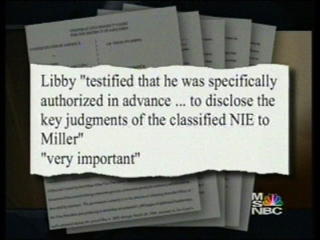
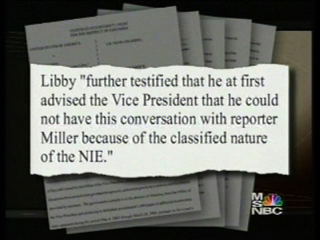
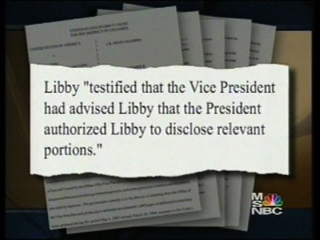
This is from Sunday, April 9, 2006:
A "Concerted Effort" to Discredit Bush Critic
Prosecutor describes Cheney, Libby as key voices pitching Iraq-Niger story.
By Barton Gellman and Dafna Linzer for The Washington Post
As he drew back the curtain this week on the evidence against Vice President Cheney's former top aide, Special Counsel Patrick J. Fitzgerald for the first time described a "concerted action" by "multiple people in the White House" - using classified information - to "discredit, punish or seek revenge against" a critic of President Bush's war in Iraq.Bluntly and repeatedly, Fitzgerald placed Cheney at the center of that campaign. Citing grand jury testimony from the vice president's former chief of staff, I. Lewis "Scooter" Libby, Fitzgerald fingered Cheney as the first to voice a line of attack that at least three White House officials would soon deploy against former ambassador Joseph C. Wilson IV.
Cheney, in a conversation with Libby in early July 2003, was said to describe Wilson's CIA-sponsored trip to Niger the previous year - in which the envoy found no support for charges that Iraq tried to buy uranium there - as "a junket set up by Mr. Wilson's wife," CIA case officer Valerie Plame.
Libby is charged with perjury and obstruction of justice for denying under oath that he disclosed Plame's CIA employment to journalists. There is no public evidence to suggest Libby made any such disclosure with Cheney's knowledge. But according to Libby's grand jury testimony, described for the first time in legal papers filed this week, Cheney "specifically directed" Libby in late June or early July 2003 to pass information to reporters from two classified CIA documents: an October 2002 National Intelligence Estimate and a March 2002 summary of Wilson's visit to Niger.
One striking feature of that decision – un-remarked until now, in part because Fitzgerald did not mention it - is that the evidence Cheney and Libby selected to share with reporters had been disproved months before.
United Nations inspectors had exposed the main evidence for the uranium charge as crude forgeries in March 2003, but the Bush administration and British Prime Minister Tony Blair maintained they had additional, secret evidence they could not disclose. In June, a British parliamentary inquiry concluded otherwise, delivering a scathing critique of Blair's role in promoting the story. With no ally left, the White House debated whether to abandon the uranium claim and became embroiled in bitter finger-pointing about whom to fault for the error. A legal brief filed for Libby last month said that "certain officials at the CIA, the White House, and the State Department each sought to avoid or assign blame for intelligence failures relating to Iraq's weapons of mass destruction."
It was at that moment that Libby, allegedly at Cheney's direction, sought out at least three reporters to bolster the discredited uranium allegation. Libby made careful selections of language from the 2002 estimate, quoting a passage that said Iraq was "vigorously trying to procure uranium" in Africa.
The first of those conversations, according to the evidence made known thus far, came when Libby met with Bob Woodward, an assistant managing editor of The Washington Post, on June 27, 2003. In sworn testimony for Fitzgerald, according to a statement Woodward released on Nov. 14, 2005, Woodward said Libby told him of the intelligence estimate's description of Iraqi efforts to obtain "yellowcake," a processed form of natural uranium ore, in Africa. In an interview Friday, Woodward said his notes showed that Libby described those efforts as "vigorous."
Libby's next known meeting with a reporter, according to Fitzgerald's legal filing, was with Judith Miller, then of the New York Times, on July 8, 2003. He spoke again to Miller, and to Time magazine's Matt Cooper, on July 12...
Fitzgerald wrote that Cheney and his aides saw Wilson as a threat to "the credibility of the Vice President (and the President) on a matter of signal importance: the rationale for the war in Iraq." They decided to respond by implying that Wilson got his CIA assignment by "nepotism."
They were not alone. Fitzgerald reported for the first time this week that "multiple officials in the White House" - not only Libby and White House Deputy Chief of Staff Karl Rove, who have previously been identified - discussed Plame's CIA employment with reporters before and after publication of her name on July 14, 2003, in a column by Robert D. Novak. Fitzgerald said the grand jury has collected so much testimony and so many documents that "it is hard to conceive of what evidence there could be that would disprove the existence of White House efforts to 'punish' Wilson."
Here is the full text of the article in case the link goes bad:
http://www.washingtonpost.com/wp-dyn/content/article/2006/04/08/AR2006040800916.html
A "Concerted Effort" to Discredit Bush Critic
By Barton Gellman and Dafna Linzer
The Washington Post
Sunday 09 April 2006
Prosecutor describes Cheney, Libby as key voices pitching Iraq-Niger story.
As he drew back the curtain this week on the evidence against Vice President Cheney's former top aide, Special Counsel Patrick J. Fitzgerald for the first time described a "concerted action" by "multiple people in the White House" - using classified information - to "discredit, punish or seek revenge against" a critic of President Bush's war in Iraq.
Bluntly and repeatedly, Fitzgerald placed Cheney at the center of that campaign. Citing grand jury testimony from the vice president's former chief of staff, I. Lewis "Scooter" Libby, Fitzgerald fingered Cheney as the first to voice a line of attack that at least three White House officials would soon deploy against former ambassador Joseph C. Wilson IV.
Cheney, in a conversation with Libby in early July 2003, was said to describe Wilson's CIA-sponsored trip to Niger the previous year - in which the envoy found no support for charges that Iraq tried to buy uranium there - as "a junket set up by Mr. Wilson's wife," CIA case officer Valerie Plame.
Libby is charged with perjury and obstruction of justice for denying under oath that he disclosed Plame's CIA employment to journalists. There is no public evidence to suggest Libby made any such disclosure with Cheney's knowledge. But according to Libby's grand jury testimony, described for the first time in legal papers filed this week, Cheney "specifically directed" Libby in late June or early July 2003 to pass information to reporters from two classified CIA documents: an October 2002 National Intelligence Estimate and a March 2002 summary of Wilson's visit to Niger.
One striking feature of that decision – un-remarked until now, in part because Fitzgerald did not mention it - is that the evidence Cheney and Libby selected to share with reporters had been disproved months before.
United Nations inspectors had exposed the main evidence for the uranium charge as crude forgeries in March 2003, but the Bush administration and British Prime Minister Tony Blair maintained they had additional, secret evidence they could not disclose. In June, a British parliamentary inquiry concluded otherwise, delivering a scathing critique of Blair's role in promoting the story. With no ally left, the White House debated whether to abandon the uranium claim and became embroiled in bitter finger-pointing about whom to fault for the error. A legal brief filed for Libby last month said that "certain officials at the CIA, the White House, and the State Department each sought to avoid or assign blame for intelligence failures relating to Iraq's weapons of mass destruction."
It was at that moment that Libby, allegedly at Cheney's direction, sought out at least three reporters to bolster the discredited uranium allegation. Libby made careful selections of language from the 2002 estimate, quoting a passage that said Iraq was "vigorously trying to procure uranium" in Africa.
The first of those conversations, according to the evidence made known thus far, came when Libby met with Bob Woodward, an assistant managing editor of The Washington Post, on June 27, 2003. In sworn testimony for Fitzgerald, according to a statement Woodward released on Nov. 14, 2005, Woodward said Libby told him of the intelligence estimate's description of Iraqi efforts to obtain "yellowcake," a processed form of natural uranium ore, in Africa. In an interview Friday, Woodward said his notes showed that Libby described those efforts as "vigorous."
Libby's next known meeting with a reporter, according to Fitzgerald's legal filing, was with Judith Miller, then of the New York Times, on July 8, 2003. He spoke again to Miller, and to Time magazine's Matt Cooper, on July 12.
At Cheney's instruction, Libby testified, he told Miller that the uranium story was a "key judgment" of the intelligence estimate, a term of art indicating there was consensus on a question of central importance.
In fact, the alleged effort to buy uranium was not among the estimate's key judgments, which were identified by a headline and bold type and set out in bullet form in the first five pages of the 96-page document.
Unknown to the reporters, the uranium claim lay deeper inside the estimate, where it said a fresh supply of uranium ore would "shorten the time Baghdad needs to produce nuclear weapons." But it also said US intelligence did not know the status of Iraq's procurement efforts, "cannot confirm" any success and had "inconclusive" evidence about Iraq's domestic uranium operations.
Iraq's alleged uranium shopping had been strongly disputed in the intelligence community from the start. In a closed Senate hearing in late September 2002, shortly before the October NIE was completed, then-director of central intelligence George J. Tenet and his top weapons analyst, Robert Walpole, expressed strong doubts about the uranium story, which had recently been unveiled publicly by the British government. The State Department's Bureau of Intelligence and Research, likewise, called the claim "highly dubious." For those reasons, the uranium story was relegated to a brief inside passage in the October estimate.
But the White House Iraq Group, formed in August 2002 to foster "public education" about Iraq's "grave and gathering danger" to the United States, repeatedly pitched the uranium story. The alleged procurement was a minor issue for most US analysts - the hard part for Iraq would be enriching uranium, not obtaining the ore, and Niger's controlled market made it an unlikely seller - but the Niger story proved irresistible to speechwriters. Most nuclear arguments were highly technical, but the public could easily grasp the link between uranium and a bomb.
Tenet interceded to keep the claim out of a speech Bush gave in Cincinnati on Oct. 7, 2002, but by Dec. 19 it reappeared in a State Department "fact sheet." After that, the Pentagon asked for an authoritative judgment from the National Intelligence Council, the senior coordinating body for the 15 agencies that then constituted the US intelligence community. Did Iraq and Niger discuss a uranium sale, or not? If they had, the Pentagon would need to reconsider its ties with Niger.
The council's reply, drafted in a January 2003 memo by the national intelligence officer for Africa, was unequivocal: The Niger story was baseless and should be laid to rest. Four US officials with firsthand knowledge said in interviews that the memo, which has not been reported before, arrived at the White House as Bush and his highest-ranking advisers made the uranium story a centerpiece of their case for the rapidly approaching war against Iraq.
Bush put his prestige behind the uranium story in his Jan. 28, 2003, State of the Union address. Less than two months later, the International Atomic Energy Agency exposed the principal US evidence as bogus. A Bush-appointed commission later concluded that the evidence, a set of contracts and correspondence sold by an Italian informant, was "transparently forged."
On the ground in Iraq, meanwhile, the hunt for weapons of mass destruction was producing no results, and as the bad news converged on the White House - weeks after a banner behind Bush declared "Mission Accomplished" on the deck of the USS Abraham Lincoln - Wilson emerged as a key critic. He focused his ire on Cheney, who had made the administration's earliest and strongest claims about Iraq's alleged nuclear program.
Fitzgerald wrote that Cheney and his aides saw Wilson as a threat to "the credibility of the Vice President (and the President) on a matter of signal importance: the rationale for the war in Iraq." They decided to respond by implying that Wilson got his CIA assignment by "nepotism."
They were not alone. Fitzgerald reported for the first time this week that "multiple officials in the White House" - not only Libby and White House Deputy Chief of Staff Karl Rove, who have previously been identified - discussed Plame's CIA employment with reporters before and after publication of her name on July 14, 2003, in a column by Robert D. Novak. Fitzgerald said the grand jury has collected so much testimony and so many documents that "it is hard to conceive of what evidence there could be that would disprove the existence of White House efforts to 'punish' Wilson."
At the same time, top officials such as then-deputy national security adviser Stephen J. Hadley were pressing the CIA to declassify more documents in hopes of defending the president's use of the uranium claim in his State of the Union speech. It was a losing battle. A "senior Bush administration official," speaking on the condition of anonymity as the president departed for Africa on July 7, 2003, told The Post that "the reference to Iraq's attempt to acquire uranium from Africa should not have been included in the State of the Union speech." The comment appeared on the front page of the July 8 paper, the same morning that Libby met Miller at the St. Regis hotel.
Libby was still defending the uranium claim as the administration's internal battle burst into the open. White House officials tried to blame Tenet for the debacle, but Tenet made public his intervention to keep uranium out of Bush's speech four months earlier. Hadley then acknowledged that he had known of Tenet's objections but forgot them as the State of the Union approached.
Hoping to lay the controversy to rest, Hadley claimed responsibility for the Niger remarks.
In a speech two days later, at the American Enterprise Institute, Cheney defended the war by saying that no responsible leader could ignore the evidence in the NIE. Before a roomful of conservative policymakers, Cheney listed four of the "key judgments" on Iraq's alleged weapons capabilities but made no mention of Niger or uranium.
On July 30, 2003, two senior intelligence officials said in an interview that Niger was never an important part of the CIA's analysis, and that the language of Iraq's vigorous pursuit of uranium came verbatim from a Defense Intelligence Agency report that had caught the vice president's attention. The same day, the CIA referred the Plame leak to the Justice Department for criminal prosecution, the fateful step that would eventually lead to Libby's indictment.
From the "Hey is anybody listening? The information we've been waiting for years to break has broken" department, Jason Leopold and like five other reporters are covering what has got to be the most exciting development in this dismal administration: not only did Cheney tell Libby to leak the information to the press about Joseph Wilson's wife, Valerie Plame, being a CIA agent, but , according to Libby himself, Bush told Cheney to tell him to do it.
I have some nice clips from Keith Olbermann going up next, but this story published this morning in the Times sums it up nicely too.
Bush and Cheney Discussed Plame Prior to Leak
by Jason Leopold for t r u t h o u t.
In early June 2003, Vice President Dick Cheney met with President Bush and told him that CIA officer Valerie Plame Wilson was the wife of Iraq war critic Joseph Wilson and that she was responsible for sending him on a fact-finding mission to Niger to check out reports about Iraq's attempt to purchase uranium from the African country, according to current and former White House officials and attorneys close to the investigation to determine who revealed Plame-Wilson's undercover status to the media.Other White House officials who also attended the meeting with Cheney and President Bush included former White House Chief of Staff Andrew Card, then-National Security Adviser Condoleezza Rice, her former deputy Stephen Hadley, and Deputy White House Chief of Staff Karl Rove.
This information was provided to this reporter by attorneys and US officials who have remained close to the case. Investigators working with Special Prosecutor Patrick Fitzgerald compiled the information after interviewing 36 Bush administration officials over the past two and a half years.
The revelation puts a new wrinkle into Special Prosecutor Patrick Fitzgerald's two-year-old criminal probe into the leak and suggests for the first time that President Bush knew from early on that the vice president and senior officials on his staff were involved in a coordinated effort to attack Wilson's credibility by leaking his wife's classified CIA status.
Now that President Bush's knowledge of the Plame Wilson affair has been exposed, there are thorny questions about whether the president has broken the law - specifically, whether he obstructed justice when he was interviewed about his knowledge of the Plame Wilson leak and the campaign to discredit her husband.
Details of President Bush's involvement in the Plame Wilson affair came in a 39-page court document filed by Fitzgerald late Wednesday evening in US District Court in Washington.
Fitzgerald's court filing was made in response to attorneys representing I. Lewis "Scooter" Libby, Vice President Dick Cheney's former chief of staff, who was indicted on five counts of perjury, obstruction of justice, and lying to investigators for not telling grand jury he spoke to reporters about Plame Wilson.
Libby's attorneys have in the past months have argued that the government has evidence that would prove Libby's innocence and that the special prosecutor refuses to turn it over to the defense. Fitzgerald said in court documents he has already turned over thousands of pages of evidence to Libby's attorneys and that further discovery requests have been overly broad.
Here is the full text of the entire article in case the link goes bad:
http://www.truthout.org/docs_2006/041006Z.shtml
Bush and Cheney Discussed Plame Prior to Leak
By Jason Leopold
t r u t h o u t | Report
Monday 10 April 2006
In early June 2003, Vice President Dick Cheney met with President Bush and told him that CIA officer Valerie Plame Wilson was the wife of Iraq war critic Joseph Wilson and that she was responsible for sending him on a fact-finding mission to Niger to check out reports about Iraq's attempt to purchase uranium from the African country, according to current and former White House officials and attorneys close to the investigation to determine who revealed Plame-Wilson's undercover status to the media.
Other White House officials who also attended the meeting with Cheney and President Bush included former White House Chief of Staff Andrew Card, then-National Security Adviser Condoleezza Rice, her former deputy Stephen Hadley, and Deputy White House Chief of Staff Karl Rove.
This information was provided to this reporter by attorneys and US officials who have remained close to the case. Investigators working with Special Prosecutor Patrick Fitzgerald compiled the information after interviewing 36 Bush administration officials over the past two and a half years.
The revelation puts a new wrinkle into Special Prosecutor Patrick Fitzgerald's two-year-old criminal probe into the leak and suggests for the first time that President Bush knew from early on that the vice president and senior officials on his staff were involved in a coordinated effort to attack Wilson's credibility by leaking his wife's classified CIA status.
Now that President Bush's knowledge of the Plame Wilson affair has been exposed, there are thorny questions about whether the president has broken the law - specifically, whether he obstructed justice when he was interviewed about his knowledge of the Plame Wilson leak and the campaign to discredit her husband.
Details of President Bush's involvement in the Plame Wilson affair came in a 39-page court document filed by Fitzgerald late Wednesday evening in US District Court in Washington.
Fitzgerald's court filing was made in response to attorneys representing I. Lewis "Scooter" Libby, Vice President Dick Cheney's former chief of staff, who was indicted on five counts of perjury, obstruction of justice, and lying to investigators for not telling grand jury he spoke to reporters about Plame Wilson.
Libby's attorneys have in the past months have argued that the government has evidence that would prove Libby's innocence and that the special prosecutor refuses to turn it over to the defense. Fitzgerald said in court documents he has already turned over thousands of pages of evidence to Libby's attorneys and that further discovery requests have been overly broad.
The attorneys and officials close to the case said over the weekend that the hastily arranged meeting was called by Cheney to "brief the president" on Wilson's increasing public criticism about the White House's use of the Niger intelligence and the negative impact it would eventually have on the administration's credibility if the public and Congress found out it was true, the sources said.
Bush said publicly in October 2003 that he had no idea who was responsible for unmasking Plame Wilson to columnist Robert Novak and other reporters. The president said that he welcomed a Justice Department investigation to find out who was responsible for it.
But neither Bush nor anyone in his inner circle let on that just four months earlier, they had agreed to launch a full-scale campaign to undercut Wilson's credibility by planting negative stories about his personal life with the media.
A more aggressive effort would come a week or so later when Cheney - who, sources said, was "consumed" with retaliating against Wilson because of his attacks on the administration's rationale for war - met with President Bush a second time and told the president that there was talk of "Wilson going public" and exposing the flawed Niger intelligence.
It was then that Cheney told Bush that a section of the classified National Intelligence Estimate that purported to show Iraq did seek uranium from Niger should be leaked to reporters as a way to counter anything report Wilson might seek to publish, these sources said.
Throughout the second half of June, Andrew Card, Karl Rove, and senior officials from Cheney's office kept Bush updated about the progress of the campaign to discredit Wilson via numerous emails and internal White House memos, these sources said, adding that some of these documents were only recently turned over to the special counsel.
One attorney close to the case said that Bush gave Cheney permission to declassify the NIE and that Cheney told Libby to leak it to Bob Woodward, the Washington Post's assistant managing editor, which Libby did on June 27, 2003.
But Woodward told Libby shortly after he received the information about the NIE that he would not be writing a story about it for the Post but that he would use the still classified information for the book he was writing at the time, Plan of Attack.
Woodward would not return calls for comment nor would Libby's attorneys Ted Wells and William Jeffress.
Libby told Cheney that he had a good relationship with New York Times reporter Judith Miller and that he intended to share the NIE with her. Libby met with Miller on July 8, 2003 and disclosed the portion of the NIE that dealt with Iraq and Niger to her.
According to four attorneys who last week read a transcript of President Bush's interview with investigators, Bush did not disclose to the special counsel that he was aware of any campaign to discredit Wilson. Bush also said he did not know who, if anyone, in the White House had retaliated against the former ambassador by leaking his wife's undercover identity to reporters.
Attorneys close to the case said that Fitzgerald does not appear to be overly concerned or interested in any alleged discrepancy in Bush's statements about the leak case to investigators.
But "if Mr. Libby continues to misrepresent the government's case against him ... President Bush and most certainly Vice President Cheney may be caught in an embarrassing position," one attorney close to the case said. "Mr. Fitzgerald will not hesitate to remind Mr. Libby of his testimony when he appeared before the grand jury."
Speaking to college students and faculty at California State University Northridge last week, Wilson said that after President Bush cited the uranium claims in his State of the Union address he tried unsuccessfully for five months to get the White House to correct the record.
"I had direct discussions with the State Department, Senate committees," Wilson said during a speech last Thursday. "I had numerous conversations to change what they were saying publicly. I had a civic duty to hold my government to account for what it had said and done."
Wilson said he was rebuffed at every instance and finally decided to write an op-ed in the New York Times and expose the administration for knowingly "twisting" the intelligence on the Iraqi nuclear threat to make a case for war. The op-ed appeared in the newspaper July 8, 2003. Wilson wrote that had he personally traveled to Niger to check out the Niger intelligence and had determined it was bogus.
"Nothing more, nothing less than challenging the government to come clean on this matter," Wilson said. "That's all I did."
In the interest of fairness, any person identified in this story who believes he has been portrayed unfairly or that the information about him is untrue will have the opportunity to respond in this space.
Jason Leopold spent two years covering California's electricity crisis as Los Angeles bureau chief of Dow Jones Newswires. Jason has spent the last year cultivating sources close to the CIA leak investigation, and is a regular contributor to t r u t h o u t.
 | Mc Jack In The Box put in some of my vocals from Acapella Hepepe and Me into a new cool remix called: Slamlord. |
I think I've said it before, but there's really something goin on worth checking out over at:
CC Mixter.
Daily Kos dude Markos Moulitsas Zuniga cruised through the Colbert Report last week. (April 6, 2006, I think)
Video-Markos Moulitsas Zuniga on the Colbert Report (12 MB)
Audio-Markos Moulitsas Zuniga on the Colbert Report (MP3 - 8 MB)

He's got new book out called
Crashing the Gate

 |
Heather Gold explains (in graphic detail) what Bush would have to do to actually be impeached. But first, she accurately expresses the feeling of disenfranchisement that many Americans feel these days at being powerless to stop or do anything to hold the Shrub responsible for his illegal actions. In this case, feeling helpless after finding out that the Shrub personally authorized Scooter Libby to conduct the treasonous act of leaking the identity CIA agent Valerie Plame's identity to the press, and realize no one's going to do a damn thing about it. But Heather, take heart, Patrick Fitzgerald may be on the case! |
Steve's daughter Genevieve is directing a play Saturday night at the Berkeley Rep. The Chronicle gave it a great review in last weeks pinkie.
Doors open at 7:30. Two one-act plays. Joey Buttafuoco is first, then the other one after a 10-minute intermission.
Teen Council's Target® One Acts Festival
Berkeley Rep School of Theatre, 2071 Addison St., Berkeley. $5-$10.
(510) 647-2972 www.berkeleyrep.org
Danah was on Oreilly Factor and Bill actually wasn't a complete dick. Go figure :-)
Wow. They call her a cultural anthropologist. Looks pretty cool on the screen. That's fer sure.
Nice job Danah.
(Hey I wanna be a cultural anthropologist! Maybe I can call myself that when I finish my masters...)
Update! Hey I'm not trying to be a smartass! I'm just jealous :-)
Sure, Danah looks like an ordinary anthropologist in this clip. But the few times I've met her, not long ago, she always had an extra sparkley dress or stripey pants or a huge floppy hat or something far from ordinary. It's like she's gone undercover.

Okay so it had been a long time since I'd been to a large concert. Like, I dunno, 5 years at least.
So I'm at the Paul McCartney concert at HP Pavillion last November 8, 2005. I always carry my Canon Exlim S3 in my pocket, and I had forgotten about it being in my pocket till we were 5 blocks away from the car and in line to get in.
"Well I just won't use it." I say to myself.
So then, right when Paul kicks in to "Drive My Car," I start feeling guilty that I didn't get a ticket for one of my favorite cousins, who recently played and sang the Beatles "I Will" in one of her recitals. I should take a little movie for her, I say to myself. Then the scientist in me kicked in. "I wonder what the sound would even be like on this thing? Would it just be distortion, or would its condensor microphone kick in and do its job?"
Then I started looking around. Wow. It seemed like everybody was using their phone or camera to take a little movie or picture. Oh. I get it. Things have sure changed, I thought to myself. I can't believe I was worried about having this thing in my pocket.
So I start taking a movie, and then my dad noticed what I was doing and bumped into me and kinda wrecked my shot. (You can see at the end of the clip.)
"Oh dad." I tell him. "It's not a hassle anymore."
"No, I don't think you're right." He said.
About 15 minutes later, a guy a few rows in front of us starts recording with his little photo/video camera. Sure enough, after a few minutes, an usher called him on it, and escorted the guy from his seat -- and confiscated his camera I think, because we saw him return to his seat later sans camera.
Ok. So things aren't so progressive.
Well, at least I got my little experiment file. (I'm a grad student experimenting with digital media and this movie constitutes research for my grad exam.)
I am continually amazed at the sound quality I am able to achieve with this fairly-reasonably priced tiny little camera. (casio exlim s3)
So anyway, here it is:
30 seconds of Drive My Car
I've been having a bit of eyestrain lately from staring at the computer 24-7 on three different machines.
(An unfortunate side effect of assuring in a timely manner that the web-based application I've been working on is cross-browser compatible. More on this very soon!)
I found this paper on eyestrain from Dr. Larry Bickford that had some helpful suggestions and information.
Thought you might be interested.
Nice one: google romance.
I gotta tell ya, for a minute, they got me :-)
Update: the tour actually has some ingenious ideas for selling stuff to online daters. For instance - sending emails where all they have to do is click to send flowers to their upcoming date, etc. Somebody's gonna do this for real someday.

