The FCC is in the process of rewriting cable law. Unfortunately, what's being "rewritten" is the writing off of PEG channels. PEG = Public, Education and Government Access Channels
As always, this comes to me at the last minute and there's nothing we can do directly besides hassle our Congresspeople to hassle the FCC to leave PEGs alone:
Take 30 seconds right nowto use this form to write them.
Then get the phone numbers it gives you and phone them all and tell them to tell the FCC to "save the Public, Education and Government Channels."
I sent my letters. Now I'll call in the AM.
Now...what is all this really about? Well I hopped over to the FCC website to see what I could see, and it would appear, yes, ladies and gentlemen, we have another Regulatory "Review of the Commission's Broadcast Ownership Rules and Other Rules Adopted Pursuant to Section 202 of the Telecommunications Act of 1996."
word doc PDF
There's a public meeting on Wednesday, December 20th where I guess the damage can
be done:
word doc PDF
I'm still reading through these docs now, trying to figure them out. This FCC stuff is such a drag...
Thanks for sending emails and making phonecalls Tuesday!
FCC Approves Murdoch Purchase of DirecTV
By Frank Ahrens for the Washington Post.
The Federal Communications Commission and Justice Department today approved News Corporation Inc.'s purchase of Hughes Electronics Corp.'s DirecTV home satellite system, giving Rupert Murdoch the crucial missing piece of his global satellite empire.
By a vote of 3-2, the FCC commissioners allowed the $6.5 billion cash-and-stock purchase to go ahead with a number of conditions meant to keep News Corp. from using DirecTV as a lever to raise programming prices to rival cable and satellite companies. The merger gives News Corp. a controlling 34 percent interest in Hughes.
News Corp. is the parent company of the Fox television network, Fox News Channel, FX and Fox Sports regional cable channels. Opponents of the merger feared that News Corp. would raise its programming prices to cable rivals, such as Comcast Corp., or threaten to pull Fox programming in order to drive customers away from cable and to DirecTV.
The FCC ruled that the merger would improve service to DirecTV customers -- News Corp. has a history of adding channels and features, such as interactivity, to its other satellite systems -- would create a more muscular competitor to the cable industry, which has monopolies in most markets, and promote the agency's goal of localism, by requiring News Corp. to add local channels to the DirecTV system.
FCC Chairman Michael K. Powell joined fellow Republican commissioners Kevin J. Martin and Kathleen Q. Abernathy in approving the deal.
Dissenting were Democratic FCC commissioners Michael J. Copps and Jonathan S. Adelstein. The commission has been split along party lines on media issues since the rancorous June vote adopting new media ownership rules.
Here is the full text of the article in case the link goes bad:
http://www.washingtonpost.com/wp-dyn/articles/A16148-2003Dec19.html
FCC Approves Murdoch Purchase of DirecTV
By Frank Ahrens
Washington Post Staff Writer
Friday, December 19, 2003; 9:11 PM
The Federal Communications Commission and Justice Department today approved News Corporation Inc.'s purchase of Hughes Electronics Corp.'s DirecTV home satellite system, giving Rupert Murdoch the crucial missing piece of his global satellite empire.
By a vote of 3-2, the FCC commissioners allowed the $6.5 billion cash-and-stock purchase to go ahead with a number of conditions meant to keep News Corp. from using DirecTV as a lever to raise programming prices to rival cable and satellite companies. The merger gives News Corp. a controlling 34 percent interest in Hughes.
News Corp. is the parent company of the Fox television network, Fox News Channel, FX and Fox Sports regional cable channels. Opponents of the merger feared that News Corp. would raise its programming prices to cable rivals, such as Comcast Corp., or threaten to pull Fox programming in order to drive customers away from cable and to DirecTV.
The FCC ruled that the merger would improve service to DirecTV customers -- News Corp. has a history of adding channels and features, such as interactivity, to its other satellite systems -- would create a more muscular competitor to the cable industry, which has monopolies in most markets, and promote the agency's goal of localism, by requiring News Corp. to add local channels to the DirecTV system.
FCC Chairman Michael K. Powell joined fellow Republican commissioners Kevin J. Martin and Kathleen Q. Abernathy in approving the deal.
Dissenting were Democratic FCC commissioners Michael J. Copps and Jonathan S. Adelstein. The commission has been split along party lines on media issues since the rancorous June vote adopting new media ownership rules.
As a condition of approving the merger, the FCC requires News Corp. to beam local channels into 130 of the nation's markets by the end of next year.
However, Adelstein said News Corp. is not required to provide local channels to all markets by satellite -- the company can do so by attaching an antenna to its satellite dish, which, in the nation's most rural areas, will not receive local channels, he said.
"One of biggest public interest benefits of this merger turned out to be a sham," Adelstein said in an interview yesterday.
News Corp., however, pointed out that it said as early as September in an FCC filing that it may not be able to provide local channels to all markets via satellite. If residents live in very rural areas outside the boundaries of the top 210 markets and are not able to get local channels over the air, they will not get them via satellite, either, News Corp. said, because the high cost required to do so would raise DirecTV bills to all its customers.
News Corp. pledged to provide local channels to the top 210 markets "by whatever means make the most sense," said a company spokesperson. "From a business perspective, a technology perspective and the consumers' perspective."
Another condition imposes a baseball-style arbitration system if News Corp. cannot agree on programming prices with its rivals. If, for instance, News Corp. and Comcast cannot agree on how much Comcast should pay for a Fox channel, a cooling-off period is engaged during which parties can continue to haggle. If no deal is reached, each party submits their final offer to an arbiter, who chooses one of the two. News Corp. can appeal the decision to the FCC.
The system is designed to prevent News Corp. from threatening to pull its popular Fox network and Fox Sports regional programming from rival cable systems to extract higher payments. FCC studies show that pulling local channels and regional sports channels from cable systems drives customers to satellite services faster than any other factor.
The FCC had considered imposing a "benchmark pricing" condition on News Corp., but found the contracts regarding regional sports programming too complex and feared that hard benchmarks could eventually be maneuvered around.
"We support arbitration to limit NewsCorp.'s excess power in these transactions, but that doesn't prevent sweetheart deals between DirecTV and cable, where the end result is higher prices to satellite and cable customers," said Gene Kimmelman, senior policy director for Consumers Union. "While the commission imposed some helpful conditions on this merger, it offered no more than a Silly Putty patch on the crumbling structural pillars that ensure open democratic debate in our society."
Murdoch owns pay-satellite television services that serve Europe, Asia and his home country of Australia. DirecTV, the top satellite service in the United States with 12 million customers, gives him North and South America, as the company has a Latin American arm, which has been a money-loser.
Hughes is owned by General Motors, which has been trying to offload the satellite company, including a failed attempt last year to sell it to EchoStar Communications Corp., parent of Dish Network, the industry's No. 2 service with 8 million subscribers. That merger attempt was killed by FCC and Justice Department regulators, which said it would harm the public interest and violate anti-trust laws.
GM had hoped to get the purchase approved by the end of the year in order to book the sale's $4 billion in cash to this year's balance sheets and apply it to auto giant's pension fund.
I'm writing a term paper for my Ethics class on whether Michael Powell followed all the correct procedures when he pushed through the New Media Ownership rules last June. I'm guessing that he followed everything to the letter of the law, but writing the paper will help me learn about what "the process" actually is and know for sure.
Please email me at lisarein@finetuning.com with any links or relevant articles you know of about this subject that you think would be useful to my research. I'll be publishing the finished product here when I'm done.
Thanks!
I just started reading this myself, but I'm about to go to dinner and I didn't want to risk forgetting to get this up tonight. So here it is.
Update 10/14/03 - recordings of this speech are now available. I've also re-archived them here.
(Thanks, Mark!)
Bill Moyers' Keynote Address to the National Conference on Media Reform
that the very concept of media is insulting to some of us within the press who find ourselves lumped in with so many disparate elements, as if everyone with a pen, a microphone, a camera, or just a loud voice were all one and the same. …David Broder is not Matt Drudge. “Meet the Press” is not “Temptation Island.” And I am not Jerry Springer. I do not speak for him. He does not speak for me. Yet ‘the media” speaks for us all.That’s how I felt when I saw Oliver North reporting on Fox from Iraq, pressing our embattled troops to respond to his repetitive and belittling question, “Does Fox Rock? Does Fox Rock?” Oliver North and I may be in the same “media” but we are not part of the same message. Nonetheless, I accept that I work and all of us live in “medialand,” and God knows we need some “media reform.” I’m sure you know those two words are really an incomplete description of the job ahead. Taken alone, they suggest that you’ve assembled a convention of efficiency experts, tightening the bolts and boosting the output of the machinery of public enlightenment, or else a conclave of high-minded do-gooders applauding each other’s sermons. But we need to be – and we will be – much more than that. Because what we’re talking about is nothing less than rescuing a democracy that is so polarized it is in danger of being paralyzed and pulverized.
Alarming words, I know. But the realities we face should trigger alarms. Free and responsible government by popular consent just can’t exist without an informed public...
We have to fight to keep the gates to the Internet open to all. The web has enabled many new voices in our democracy – and globally – to be heard: advocacy groups, artists, individuals, non-profit organizations. Just about anyone can speak online, and often with an impact greater than in the days when orators had to climb on soap box in a park. The media industry lobbyists point to the Internet and say it’s why concerns about media concentration are ill founded in an environment where anyone can speak and where there are literally hundreds of competing channels. What those lobbyists for big media don’t tell you is that the traffic patterns of the online world are beginning to resemble those of television and radio. In one study, for example, AOL Time Warner (as it was then known) accounted for nearly a third of all user time spent online. And two others companies – Yahoo and Microsoft – bring that figure to fully 50%. As for the growing number of channels available on today’s cable systems, most are owned by a small handful of companies. Of the ninety-one major networks that appear on most cable systems, 79 are part of such multiple network groups such as Time Warner, Viacom, Liberty Media, NBC, and Disney. In order to program a channel on cable today, you must either be owned by or affiliated with one of the giants. If we’re not vigilant the wide-open spaces of the Internet could be transformed into a system in which a handful of companies use their control over high-speed access to ensure they remain at the top of the digital heap in the broadband era at the expense of the democratic potential of this amazing technology. So we must fight to make sure the Internet remains open to all as the present-day analogue of that many-tongued world of small newspapers so admired by de Tocqueville.
Here is the entire text of the article in case the link goes bad:
http://www.truthout.org/docs_03/111403E.shtml
'Our Democracy is in Danger of Being Paralyzed'
Keynote Address to the National Conference on Media Reform
By Bill Moyers
t r u t h o u t | Address
Saturday 08 November 2003
Thank you for inviting me tonight. I’m flattered to be speaking to a gathering as high-powered as this one that’s come together with an objective as compelling as “media reform.” I must confess, however, to a certain discomfort, shared with other journalists, about the very term “media.” Ted Gup, who teaches journalism at Case Western Reserve, articulated my concerns better than I could when he wrote in The Chronicle of Higher Education (November 23, 2001)
that the very concept of media is insulting to some of us within the press who find ourselves lumped in with so many disparate elements, as if everyone with a pen, a microphone, a camera, or just a loud voice were all one and the same. …David Broder is not Matt Drudge. “Meet the Press” is not “Temptation Island.” And I am not Jerry Springer. I do not speak for him. He does not speak for me. Yet ‘the media” speaks for us all.
That’s how I felt when I saw Oliver North reporting on Fox from Iraq, pressing our embattled troops to respond to his repetitive and belittling question, “Does Fox Rock? Does Fox Rock?” Oliver North and I may be in the same “media” but we are not part of the same message. Nonetheless, I accept that I work and all of us live in “medialand,” and God knows we need some “media reform.” I’m sure you know those two words are really an incomplete description of the job ahead. Taken alone, they suggest that you’ve assembled a convention of efficiency experts, tightening the bolts and boosting the output of the machinery of public enlightenment, or else a conclave of high-minded do-gooders applauding each other’s sermons. But we need to be – and we will be – much more than that. Because what we’re talking about is nothing less than rescuing a democracy that is so polarized it is in danger of being paralyzed and pulverized.
Alarming words, I know. But the realities we face should trigger alarms. Free and responsible government by popular consent just can’t exist without an informed public. That’s a cliché, I know, but I agree with the presidential candidate who once said that truisms are true and clichés mean what they say (an observation that no doubt helped to lose him the election.) It’s a reality: democracy can’t exist without an informed public. Here’s an example: Only 13% of eligible young people cast ballots in the last presidential election. A recent National Youth Survey revealed that only half of the fifteen hundred young people polled believe that voting is important, and only 46% think they can make a difference in solving community problems. We’re talking here about one quarter of the electorate. The Carnegie Corporation conducted a youth challenge quiz of l5-24 year-olds and asked them, “Why don’t more young people vote or get involved?” Of the nearly two thousand respondents, the main answer was that they did not have enough information about issues and candidates. Let me rewind and say it again: democracy can’t exist without an informed public. So I say without qualification that it’s not simply the cause of journalism that’s at stake today, but the cause of American liberty itself. As Tom Paine put it, “The sun never shined on a cause of greater worth.” He was talking about the cause of a revolutionary America in 1776. But that revolution ran in good part on the energies of a rambunctious, though tiny press. Freedom and freedom of communications were birth-twins in the future United States. They grew up together, and neither has fared very well in the other’s absence. Boom times for the one have been boom times for the other.
Yet today, despite plenty of lip service on every ritual occasion to freedom of the press radio and TV, three powerful forces are undermining that very freedom, damming the streams of significant public interest news that irrigate and nourish the flowering of self-determination. The first of these is the centuries-old reluctance of governments – even elected governments – to operate in the sunshine of disclosure and criticism. The second is more subtle and more recent. It’s the tendency of media giants, operating on big-business principles, to exalt commercial values at the expense of democratic value. That is, to run what Edward R. Murrow forty-five years ago called broadcasting’s “money-making machine” at full throttle. In so doing they are squeezing out the journalism that tries to get as close as possible to the verifiable truth; they are isolating serious coverage of public affairs into ever-dwindling “news holes” or far from prime- time; and they are gobbling up small and independent publications competing for the attention of the American people.
It’s hardly a new or surprising story. But there are fresh and disturbing chapters.
In earlier times our governing bodies tried to squelch journalistic freedom with the blunt instruments of the law – padlocks for the presses and jail cells for outspoken editors and writers. Over time, with spectacular wartime exceptions, the courts and the Constitution struck those weapons out of their hands. But they’ve found new ones now, in the name of “national security.” The classifier’s Top Secret stamp, used indiscriminately, is as potent a silencer as a writ of arrest. And beyond what is officially labeled “secret” there hovers a culture of sealed official lips, opened only to favored media insiders: of government by leak and innuendo and spin, of misnamed “public information” offices that churn out blizzards of releases filled with self-justifying exaggerations and, occasionally, just plain damned lies. Censorship without officially appointed censors.
Add to that the censorship-by-omission of consolidated media empires digesting the bones of swallowed independents, and you’ve got a major shrinkage of the crucial information that thinking citizens can act upon. People saw that coming as long as a century ago when the rise of chain newspaper ownerships, and then of concentration in the young radio industry, became apparent. And so in the zesty progressivism of early New Deal days, the Federal Communications Act of 1934 was passed (more on this later.) The aim of that cornerstone of broadcast policy, mentioned over 100 times in its pages, was to promote the “public interest, convenience and necessity.” The clear intent was to prevent a monopoly of commercial values from overwhelming democratic values – to assure that the official view of reality – corporate or government – was not the only view of reality that reached the people. Regulators and regulated, media and government were to keep a wary eye on each other, preserving those checks and balances that is the bulwark of our Constitutional order.
What would happen, however, if the contending giants of big government and big publishing and broadcasting ever joined hands? Ever saw eye to eye in putting the public’s need for news second to free-market economics? That’s exactly what’s happening now under the ideological banner of “deregulation.” Giant megamedia conglomerates that our founders could not possibly have envisioned are finding common cause with an imperial state in a betrothal certain to produce not the sons and daughters of liberty but the very kind of bastards that issued from the old arranged marriage of church and state.
Consider where we are today.
Never has there been an administration so disciplined in secrecy, so precisely in lockstep in keeping information from the people at large and – in defiance of the Constitution – from their representatives in Congress. Never has the so powerful a media oligopoly – the word is Barry Diller’s, not mine – been so unabashed in reaching like Caesar for still more wealth and power. Never have hand and glove fitted together so comfortably to manipulate free political debate, sow contempt for the idea of government itself, and trivialize the people’s need to know. When the journalist-historian Richard Reeves was once asked by a college student to define “real news”, he answered: “The news you and I need to keep our freedoms.” When journalism throws in with power that’s the first news marched by censors to the guillotine. The greatest moments in the history of the press came not when journalists made common cause with the state but when they stood fearlessly independent of it.
Which brings me to the third powerful force – beyond governmental secrecy and megamedia conglomerates – that is shaping what Americans see, read, and hear. I am talking now about that quasi-official partisan press ideologically linked to an authoritarian administration that in turn is the ally and agent of the most powerful interests in the world. This convergence dominates the marketplace of political ideas today in a phenomenon unique in our history. You need not harbor the notion of a vast, right wing conspiracy to think this more collusion more than pure coincidence. Conspiracy is unnecessary when ideology hungers for power and its many adherents swarm of their own accord to the same pot of honey. Stretching from the editorial pages of the Wall Street Journal to the faux news of Rupert Murdoch’s empire to the nattering nabobs of no-nothing radio to a legion of think tanks paid for and bought by conglomerates – the religious, partisan and corporate right have raised a mighty megaphone for sectarian, economic, and political forces that aim to transform the egalitarian and democratic ideals embodied in our founding documents. Authoritarianism. With no strong opposition party to challenge such triumphalist hegemony, it is left to journalism to be democracy’s best friend. That is why so many journalists joined with you in questioning Michael Powell’s bid – blessed by the White House – to permit further concentration of media ownership. If free and independent journalism committed to telling the truth without fear or favor is suffocated, the oxygen goes out of democracy. And there is a surer way to intimidate and then silence mainstream journalism than to be the boss.
If you doubt me, read Jane Kramer’s chilling account in the current New Yorker of Silvio Berlusconi. The Prime Minister of Italy is its richest citizen. He is also its first media mogul. The list of media that he or his relatives or his proxies own, or directly or indirectly control, includes the state television networks and radio stations, three of Italy’s four commercial television networks, two big publishing houses, two national newspapers, fifty magazines, the country’s largest movie production-and-distribution company, and a chunk of its Internet services. Even now he is pressing upon parliament a law that would enable him to purchase more media properties, including the most influential paper in the country. Kramer quotes one critic who says that half the reporters in Italy work for Berlusconi, and the other half think they might have to. Small wonder he has managed to put the Italian State to work to guarantee his fortune – or that his name is commonly attached to such unpleasant things as contempt for the law, conflict of interest, bribery, and money laundering. Nonetheless, “his power over what other Italians see, read, buy, and, above all, think, is overwhelming.” The editor of The Economist, Bill Emmott, was asked recently why a British magazine was devoting so much space to an Italian Prime Minister. He replied that Berlusconi had betrayed the two things the magazine stood for: capitalism and democracy. Can it happen here? It can happen here. By the way, Berlusconi’s close friend is Rupert Murdoch. On July 3lst this year, writes Jane Kramer, programming on nearly all the satellite hookups in Italy was switched automatically to Murdoch’s Sky Italia
So the issues bringing us here tonight are bigger and far more critical than simply “media reform.” That’s why, before I go on, I want to ask you to look around you. I’m serious: Look to your left and now to your right. You are looking at your allies in one of the great ongoing struggles of the American experience – the struggle for the soul of democracy, for government “of, by, and for the people.”
It’s a battle we can win only if we work together. We’ve seen that this year. Just a few months ago the FCC, heavily influenced by lobbyists for the newspaper, broadcasting and cable interests, prepared a relaxation of the rules governing ownership of media outlets that would allow still more diversity-killing mergers among media giants. The proceedings were conducted in virtual secrecy, and generally ignored by all the major media, who were of course interested parties. In June Chairman Powell and his two Republican colleagues on the FCC announced the revised regulations as a done deal.
But they didn’t count on the voice of independent journalists and citizens like you. Because of coverage in independent outlets – including PBS, which was the only broadcasting system that encouraged its journalists to report what was really happening – and because citizens like you took quick action, this largely invisible issue burst out as a major political cause and ignited a crackling public debate. You exposed Powell’s failure to conduct an open discussion of the rule changes save for a single hearing in Richmond, Virginia. Your efforts led to a real participatory discussion, with open meetings in Chicago, Seattle, San Francisco, New York and Atlanta. Then the organizing that followed generated millions of letters and “filings”at the FCC opposing the change. Finally, the outcry mobilized unexpected support for bi-partisan legislation to reverse the new rules that cleared the Senate – although House Majority Leader Tom De Lay still holds it prisoner in the House. But who would have thought six months ago that the cause would win support from such allies as Senator Trent Lott or Kay Bailey Hutchinson, from my own Texas. You have moved “media reform” to center-stage, where it may even now become a catalyst for a new era of democratic renewal.
We working journalists have something special to bring to this work. This weekend at your conference there will be plenty of good talk about the mechanics of reform. What laws are needed? What advocacy programs and strategies? How can we protect and extend the reach of those tools that give us some countervailing power against media monopoly – instruments like the Internet, cable TV, community-based radio and public broadcasting systems, alternative journals of news and opinion.
But without passion, without a message that has a beating heart, these won’t be enough. There’s where journalism comes in. It isn’t the only agent of freedom, obviously; in fact, journalism is a deeply human and therefore deeply flawed craft – yours truly being a conspicuous example. But at times it has risen to great occasions, and at times it has made other freedoms possible. That’s what the draftsmen of the First Amendment knew and it’s what we can’t afford to forget. So to remind us of what our free press has been at its best and can be again, I will call on the help of unseen presences, men and women of journalism’s often checkered but sometimes courageous past.
Think with me for a moment on the reasons behind the establishment of press freedom. It wasn’t ordained to protect hucksters, and it didn’t drop like the gentle rain from heaven. It was fought and sacrificed for by unpretentious but feisty craftsmen who got their hands inky at their own hand presses and called themselves simply “printers.” The very first American newspaper was a little three-page affair put out in Boston in September of 1690. Its name was Publick Occurrences Both Foreign and Domestick and its editor was Benjamin Harris, who said he simply wanted “to give an account of such considerable things as have come to my attention.” The government shut it down after one issue – just one issue! – for the official reason that printer Ben Harris hadn’t applied for the required government license to publish. But I wonder if some Massachusetts pooh-bah didn’t take personally one of Harris’s proclaimed motives for starting the paper – “to cure the spirit of Lying much among us”?
No one seems to have objected when Harris and his paper disappeared – that was the way things were. But some forty-odd years later when printer John Peter Zenger was jailed in New York for criticizing its royal governor, things were different. The colony brought Zenger to trial on a charge of “seditious libel,” and since it didn’t matter whether the libel was true or not, the case seemed open and shut. But the jury ignored the judge’s charge and freed Zenger, not only because the governor was widely disliked, but because of the closing appeal of Zenger’s lawyer, Andrew Hamilton. Just hear him! His client’s case was:
Not the cause of the poor Printer, nor of New York alone, [but] the cause of Liberty, and. . . every Man who prefers Freedom to a Life of Slavery will bless and honour You, as Men who. . .by an impartial and uncorrupt Verdict, [will] have laid a Noble Foundation for securing to ourselves, our Posterity and our Neighbors, That, to which Nature and the Laws of our Country have given us a Right, -- the Liberty – both of exposing and opposing arbitrary Power…by speaking and writing – Truth.
Still a pretty good mission statement!
During the War for Independence itself most of the three dozen little weekly newspapers in the colonies took the Patriot side and mobilized resistance by giving space to anti-British letters, news of Parliament’s latest outrages, and calls to action. But the clarion journalistic voice of the Revolution was the onetime editor of the Pennsylvania Magazine, Tom Paine, a penniless recent immigrant from England where he left a trail of failure as a businessman and husband. In 1776 – just before enlisting in Washington’s army – he published Common Sense, a hard-hitting pamphlet that slashed through legalisms and doubts to make an uncompromising case for an independent and republican America. It’s been called the first best seller, with as many as 100,000 copies bought by a small literate population. Paine followed it up with another convincing collection of essays written in the field and given another punchy title, The Crisis. Passed from hand to hand and reprinted in other papers, they spread the gospel of freedom to thousands of doubters. And why I bring Paine up here is because he had something we need to restore – an unwavering concentration to reach ordinary people with the message that they mattered and could stand up for themselves. He couched his gospel of human rights and equality in a popular style that any working writer can envy. “As it is my design,” he said, “to make those that can scarcely read understand, I shall therefore avoid every literary ornament and put it in language as plain as the alphabet.”
That plain language spun off memorable one-liners that we’re still quoting. “These are the times that try men’s souls.” “Tyranny, like hell, is not easily conquered.” “What we obtain too cheap, we esteem too lightly.” “Virtue is not hereditary.” And this: “Of more worth is one honest man to society and in the sight of God than all the crowned ruffians that ever lived.” I don’t know what Paine would have thought of political debate by bumper sticker and sound bite but he could have held his own in any modern campaign.
There were also editors who felt responsible to audiences that would dive deep. In 1787 and ‘88 the little New-York Independent Advertiser ran all eighty-five numbers of The Federalist , those serious essays in favor of ratifying the Constitution. They still shine as clear arguments, but they are, and they were, unforgiving in their demand for concentrated attention. Nonetheless, The Advertiser felt that it owed the best to its readers, and the readers knew that the issues of self-government deserved their best attention. I pray your goal of “media reform” includes a press as conscientious as the New-York Advertiser, as pungent as Common Sense, and as public-spirited as both. Because it takes those qualities to fight against the relentless pressure of authority and avarice. Remember, back in l79l, when the First Amendment was ratified, the idea of a free press seemed safely sheltered in law. It wasn’t. Only seven years later, in the midst of a war scare with France, Congress passed and John Adams signed the infamous Sedition Act. The act made it a crime – just listen to how broad a brush the government could swing – to circulate opinions “tending to induce a belief” that lawmakers might have unconstitutional or repressive motives, or “directly or indirectly tending” to justify France or to “criminate,” whatever that meant, the President or other Federal officials. No wonder that opponents called it a scheme to “excite a fervor against foreign aggression only to establish tyranny at home.” John Ashcroft would have loved it.
But here’s what happened. At least a dozen editors refused to be frightened and went defiantly to prison, some under state prosecutions. One of them, Matthew Lyon, who also held a seat in the House of Representatives, languished for four months in an unheated cell during a Vermont winter. But such was the spirit of liberty abroad in the land that admirers chipped in to pay his thousand-dollar fine, and when he emerged his district re-elected him by a landslide. Luckily, the Sedition Act had a built-in expiration date of 1801, at which time President Jefferson – who hated it from the first – pardoned those remaining under indictment. So the story has an upbeat ending, and so can ours, but it will take the kind of courage that those early printers and their readers showed.
Courage is a timeless quality and surfaces when the government is tempted to hit the bottle of censorship again during national emergencies, real or manufactured. As so many of you will recall, in 1971, during the Vietnam War, the Nixon administration resurrected the doctrine of “prior restraint” from the crypt and tried to ban the publication of the Pentagon Papers by the New York Times and the Washington Post – even though the documents themselves were a classified history of events during four earlier Presidencies. Arthur Sulzberger, the publisher of the Times, and Katherine Graham of the Post were both warned by their lawyers that they and their top managers could face criminal prosecution under espionage laws if they printed the material that Daniel Ellsberg had leaked – and, by the way, offered without success to the three major television networks. Or at the least, punitive lawsuits or whatever political reprisals a furious Nixon team could devise. But after internal debates – and the threats of some of their best-known editors to resign rather than fold under pressure – both owners gave the green light – and were vindicated by the Supreme Court. Score a round for democracy.
Bi-partisan fairness requires me to note that the Carter administration, in 1979, tried to prevent the Progressive magazine, published right here in Madison, from running an article called “How to Make an H-Bomb.” The grounds were a supposed threat to “national security.” But Howard Morland had compiled the piece entirely from sources open to the public, mainly to show that much of the classification system was Wizard of Oz smoke and mirrors. The courts again rejected the government’s claim, but it’s noteworthy that the journalism of defiance by that time had retreated to a small left-wing publication like the Progressive.
In all three of those cases, confronted with a clear and present danger of punishment, none of the owners flinched. Can we think of a single executive of today’s big media conglomerates showing the kind of resistance that Sulzberger, Graham, and Erwin Knoll did? Certainly not Michael Eisner. He said he didn’t even want ABC News reporting on its parent company, Disney. Certainly not General Electric/NBC’s Robert Wright. He took Phil Donahue off MNBC because the network didn’t want to offend conservatives with a liberal sensibility during the invasion of Iraq. Instead, NBC brought to its cable channel one Michael Savage whose diatribes on radio had described non-white countries as “turd-world nations” and who characterized gay men and women as part of “the grand plan to cut down on the white race.” I am not sure what it says that the GE/NBC executives calculated that while Donahue was offensive to conservatives, Savage was not.
And then there’s Leslie Moonves, the chairman of CBS. In the very week that the once-Tiffany Network was celebrating its 75th anniversary – and taking kudos for its glory days when it was unafraid to broadcast “The Harvest of Shame” and “The Selling of the Pentagon” – the network’s famous eye blinked. Pressured by a vociferous and relentless right wing campaign and bullied by the Republican National Committee – and at a time when its parent company has billions resting on whether the White House, Congress, and the FCC will allow it to own even more stations than currently permissible – CBS caved in and pulled the miniseries about Ronald Reagan that conservatives thought insufficiently worshipful. The chief honcho at CBS, Les Moonves, says taste, not politics, dictated his decision. But earlier this year, explaining why CBS intended to air a series about Adolf Hitler, Moonves sang a different tune: “If you want to play it safe and put on milquetoast then you get criticized…There are times when as a broadcaster when you take chances.” This obviously wasn’t one of those times. Granted, made-for-television movies about living figures are about as vital as the wax figures at Madame Tussaud’s – and even less authentic – granted that the canonizers of Ronald Reagan hadn’t even seen the film before they set to howling; granted, on the surface it’s a silly tempest in a teapot; still, when a once-great network falls obsequiously to the ground at the feet of a partisan mob over a cheesy mini-series that practically no one would have taken seriously as history, you have to wonder if the slight tremor that just ran through the First Amendment could be the harbinger of greater earthquakes to come, when the stakes are really high. And you have to wonder what concessions the media tycoons-cum-supplicants are making when no one is looking.
So what must we devise to make the media safe for individuals stubborn about protecting freedom and serving the truth? And what do we all – educators, administrators, legislators and agitators – need to do to restore the disappearing diversity of media opinions? America had plenty of that in the early days when the republic and the press were growing up together. It took no great amount of capital and credit – just a few hundred dollars – to start a paper, especially with a little political sponsorship and help. There were well over a thousand of them by 1840, mostly small-town weeklies. And they weren’t objective by any stretch. Here’s William Cobbett, another Anglo-American hell-raiser like Paine, shouting his creed in the opening number of his 1790s paper, Porcupine’s Gazette. “Peter Porcupine,” Cobbett’s self-bestowed nickname, declared:
Professions of impartiality I shall make none. They are always useless, and are besides perfect nonsense, when used by a newsmonger; for, he that does not relate news as he finds it, is something worse than partial; and . . . he that does not exercise his own judgment, either in admitting or rejecting what is sent him, is a poor passive tool, and not an editor.
In Cobbett’s day you could flaunt your partisan banners as you cut and thrust, and not inflict serious damage on open public discussion because there were plenty of competitors. It didn’t matter if the local gazette presented the day’s events entirely through a Democratic lens. There was always an alternate Whig or Republican choice handy – there were, in other words, choices. As Alexis de Tocqueville noted, these many blooming journals kept even rural Americans amazingly well informed. They also made it possible for Americans to exercise one of their most democratic habits – that of forming associations to carry out civic enterprises. And they operated against the dreaded tyranny of the majority by letting lonely thinkers know that they had allies elsewhere. Here’s how de Tocqueville put it in his own words:
It often happens in democratic countries that many men who have the desire or directed toward that light, and those wandering spirits who had long sought each other the need to associate cannot do it, because all being very small and lost in the crowd, they do not see each other and do not know where to find each other. Up comes a newspaper that exposes to their view the sentiment or the idea that had been presented to each of them simultaneously but separately. All are immediately in the shadows finally meet each other and unite.
No wandering spirit could fail to find a voice in print. And so in that pre-Civil War explosion of humanitarian reform movements, it was a diverse press that put the yeast in freedom’s ferment. Of course there were plenty of papers that spoke for Indian-haters, immigrant-bashers, bigots, jingoes and land-grabbers proclaiming America’s Manifest Destiny to dominate North America. But one way or another, journalism mattered, and had purpose and direction.
Past and present are never as separate as we think. Horace Greeley, the reform-loving editor of the New York Tribune, not only kept his pages “ever open to the plaints of the wronged and suffering,” but said that whoever sat in an editor’s chair and didn’t work to promote human progress hadn’t tasted “the luxury” of journalism. I liken that to the words of a kindred spirit closer to our own time, I.F. Stone. In his four-page little I.F. Stone’s Weekly, “Izzy” loved to catch the government’s lies and contradictions in the government’s own official documents. And amid the thunder of battle with the reactionaries, he said: “I have so much fun I ought to be arrested.” Think about that. Two newsmen, a century apart, believing that being in a position to fight the good fight isn’t a burden but a lucky break. How can our work here bring that attitude back into the newsrooms?
That era of a wide-open and crowded newspaper playing field began to fade as the old hand-presses gave way to giant machines with press runs and readerships in the hundreds of thousands and costs in the millions. But that didn’t necessarily or immediately kill public spirited journalism. Not so long as the new owners were still strong-minded individuals with big professional egos to match their thick pocketbooks. When Joseph Pulitzer, a one-time immigrant reporter for a German-language paper in St. Louis, took over the New York World in 1883 he was already a millionaire in the making. But here’s his recommended short platform for politicians:
1.Tax luxuries
2. Tax Inheritances
3. Tax Large Incomes
4. Tax monopolies
5. Tax the Privileged Corporation
6. A Tariff for Revenue
7. Reform the Civil Service
8. Punish Corrupt Officers
9. Punish Vote Buying.
10. Punish Employers who Coerce their Employees in Elections
Also not a bad mission statement. Can you imagine one of today’s huge newspaper chains taking that on as an agenda?
Don’t get me wrong. The World certainly offered people plenty of the spice that they wanted – entertainment, sensation, earthy advice on living – but not at the expense of news that let them know who was on their side against the boodlers and bosses.
Nor did big-time, big-town, big bucks journalism extinguish the possibility of a reform-minded investigative journalism that took the name of muckraking during the Progressive Era. Those days of early last century saw a second great awakening of the democratic impulse. What brought it into being was a reaction against the Social Darwinism and unrestrained capitalistic exploitation that is back in full force today. Certain popular magazines made space for – and profited by – the work of such journalists – to name only a few – as Lincoln Steffens, Ida Tarbell, Upton Sinclair, Samuel Hopkins Adams and David Graham Phillips. They ripped the veils from – among other things – the shame of the cities, the crimes of the trusts, the treason of the Senate and the villainies of those who sold tainted meat and poisonous medicines. And why were they given those opportunities? Because, in the words of Samuel S. McClure, owner of McClure’s Magazine, when special interests defied the law and flouted the general welfare, there was a social debt incurred. And, as he put it: “We have to pay in the end, every one of us. And in the end, the sum total of the debt will be our liberty.”
Muckraking lingers on today, but alas, a good deal of it consists of raking personal and sexual scandal in high and celebrated places. Surely, if democracy is to be served, we have to get back to putting the rake where the important dirt lies, in the fleecing of the public and the abuse of its faith in good government.
When that landmark Communications Act of 1934 was under consideration a vigorous public movement of educators, labor officials, and religious and institutional leaders emerged to argue for a broadcast system that would serve the interests of citizens and communities. A movement like that is coming to life again and we now have to build on this momentum.
It won’t be easy, because the tide’s been flowing the other way for a long time. The deregulation pressure began during the Reagan era, when then-FCC chairman Mark Fowler, who said that TV didn’t need much regulation because it was just a “toaster with pictures,” eliminated many public-interest rules. That opened the door for networks to cut their news staffs, scuttle their documentary units (goodbye to “The Harvest of Shame” and “The Selling of the Pentagon”), and exile investigative producers and reporters to the under-funded hinterlands of independent production. It was like turning out searchlights on dark and dangerous corners. A crowning achievement of that drive was the Telecommunications Act of 1996, the largest corporate welfare program ever for the most powerful media and entertainment conglomerates in the world – passed, I must add, with support from both parties.
And the beat of “convergence” between once-distinct forms of media goes on at increased tempo, with the communications conglomerates and the advertisers calling the tune. As safeguards to competition fall, an octopus like GE-NBC-Vivendi-Universal will be able to secure cable channels that can deliver interactive multimedia content – text, sound and images – to digital TVs, home computers, personal video recorders and portable wireless devices like cell phones. The goal? To corner the market on new ways of selling more things to more people for more hours in the day. And in the long run, to fill the airwaves with customized pitches to you and your children. That will melt down the surviving boundaries between editorial and marketing divisions and create a hybrid known to the new-media hucksters as “branded entertainment.”
Let’s consider what’s happening to newspapers. A study by Mark Cooper of the Consumer Federation of America reports that two-thirds of today’s newspaper markets are monopolies. And now most of the country’s powerful newspaper chains are lobbying for co-ownership of newspaper and broadcast outlets in the same market, increasing their grip on community after community. And are they up-front about it? Hear this: Last December 3 such media giants as The New York Times, Gannett, Cox, and Tribune, along with the trade group representing almost all the country’s broadcasting stations, filed a petition to the FCC making the case for that cross ownership the owners so desperately seek. They actually told the FCC that lifting the regulation on cross ownership would strengthen local journalism. But did those same news organizations tell their readers what they were doing? Not all. None of them on that day believed they had an obligation to report in their own news pages what their parent companies were asking of the FCC. As these huge media conglomerates increase their control over what we see, read, and hear, they rarely report on how they are themselves are using their power to further their own interests and power as big business, including their influence over the political process.
Take a look at a new book called Leaving Readers Behind: The Age of Corporate Newspapering published as part of the Project on the State of the American Newspaper under the auspices of the Pew Charitable Trusts. The people who produced the book all love newspapers – Gene Roberts, former managing editor of The New York Times; Thomas Kunkel, dean of the Philip Merrill College of Journalism; Charles Layton, a veteran wire service reporter and news and feature editor at the Philadelphia Inquirer, as well as contributors such as Ken Auletta, Geneva Overholser, and Roy Reed. Their conclusion: the newspaper industry is in the middle of the most momentous change in its three hundred year history – a change that is diminishing the amount of real news available to the consumer. A generation of relentless corporatization is now culminating in a furious, unprecedented blitz of buying, selling and consolidating of newspapers, from the mightiest dailies to the humblest weeklies. It is a world where “small hometown dailies in particular are being bought and sold like hog futures. Where chains, once content to grow one property at a time, now devour other chains whole. Where they are effectively ceding whole regions of the country to one another, further minimizing competition. Where money is pouring into the business from interests with little knowledge and even less concern about the special obligations newspapers have to democracy.” They go on to describe the toll that the never-ending drive for profits is taking on the news. In Cumberland, Maryland, for example, the police reporter had so many duties piled upon him he no longer had time to go to the police station for the daily reports. But newspaper management had a cost-saving solution: put a fax machine in the police station and let the cops send over the news they thought the paper should have. In New Jersey, the Gannett chain bought the Asbury Park Press, then sent in a publisher who slashed fifty five people from the staff and cut the space for news, and was rewarded by being named Gannett’s Manager of the Year. In New Jersey, by the way, the Newhouse and Gannett chains between them now own thirteen of the state’s nineteen dailies, or seventy three percent of all the circulation of New Jersey-based papers. Then there is The Northwestern in Oshkosh, Wisconsin, with a circulation of 23,500. Here, the authors report, is a paper that prided itself on being in hometown hands since the Johnson administration – the Andrew Johnson administration. But in 1998 it was sold not once but twice, within the space of two months. Two years later it was sold again: four owners in less than three years.
You’d better get used to it, concluded Leaving Readers Behind, because the real momentum of consolidation is just beginning – it won’t be long now before America is reduced to half a dozen major print conglomerates.
You can see the results even now in the waning of robust journalism. In the dearth of in-depth reporting as news organizations try to do more with fewer resources. In the failure of the major news organizations to cover their own corporate deals and lobbying as well as other forms of “crime in the suites” such as Enron story. And in helping people understand what their government is up to. The report by the Roberts team includes a survey in l999 that showed a wholesale retreat in coverage of nineteen key departments and agencies in Washington. Regular reporting of the Supreme Court and State Department dropped off considerably through the decade. At the Social Security Administration, whose activities literally affect every American, only the New York Times was maintaining a full-time reporter and, incredibly, at the Interior Department, which controls five to six hundred million acres of public land and looks after everything from the National Park Service to the Bureau of Indian Affairs, there were no full-time reporters around.
That’s in Washington, our nation’s capital. Out across the country there is simultaneously a near blackout of local politics by broadcasters. The public interest group Alliance for Better Campaigns studied forty-five stations in six cities in one week in October. Out of 7,560 hours of programming analyzed, only 13 were devoted to local public affairs – less than one-half of 1% of local programming nationwide. Mayors, town councils, school boards, civic leaders get no time from broadcasters who have filled their coffers by looting the public airwaves over which they were placed as stewards. Last year, when a movement sprang up in the House of Representatives to require these broadcasters to obey the law that says they must sell campaign advertising to candidates for office at the lowest commercial rate, the powerful broadcast lobby brought the Congress to heel. So much for the “public interest, convenience, and necessity.”
So what do we do? What is our strategy for taking on what seems a hopeless fight for a media system that serves as effectively as it sells – one that holds all the institutions of society, itself included, accountable?
There’s plenty we can do. Here’s one journalist’s list of some of the overlapping and connected goals that a vital media reform movement might pursue.
First, we have to take Tom Paine’s example – and Danny Schecter’s advice – and reach out to regular citizens. We have to raise an even bigger tent than you have here. Those of us in this place speak a common language about the “media.” We must reach the audience that’s not here – carry the fight to radio talk shows, local television, and the letters columns of our newspapers. As Danny says, we must engage the mainstream, not retreat from it. We have to get our fellow citizens to understand that what they see, hear, and read is not only the taste of programmers and producers but also a set of policy decisions made by the people we vote for.
We have to fight to keep the gates to the Internet open to all. The web has enabled many new voices in our democracy – and globally – to be heard: advocacy groups, artists, individuals, non-profit organizations. Just about anyone can speak online, and often with an impact greater than in the days when orators had to climb on soap box in a park. The media industry lobbyists point to the Internet and say it’s why concerns about media concentration are ill founded in an environment where anyone can speak and where there are literally hundreds of competing channels. What those lobbyists for big media don’t tell you is that the traffic patterns of the online world are beginning to resemble those of television and radio. In one study, for example, AOL Time Warner (as it was then known) accounted for nearly a third of all user time spent online. And two others companies – Yahoo and Microsoft – bring that figure to fully 50%. As for the growing number of channels available on today’s cable systems, most are owned by a small handful of companies. Of the ninety-one major networks that appear on most cable systems, 79 are part of such multiple network groups such as Time Warner, Viacom, Liberty Media, NBC, and Disney. In order to program a channel on cable today, you must either be owned by or affiliated with one of the giants. If we’re not vigilant the wide-open spaces of the Internet could be transformed into a system in which a handful of companies use their control over high-speed access to ensure they remain at the top of the digital heap in the broadband era at the expense of the democratic potential of this amazing technology. So we must fight to make sure the Internet remains open to all as the present-day analogue of that many-tongued world of small newspapers so admired by de Tocqueville.
We must fight for a regulatory, market and public opinion environment that lets local and community-based content be heard rather than drowned out by nationwide commercial programming.
We must fight to limit conglomerate swallowing of media outlets by sensible limits on multiple and cross-ownership of TV and radio stations, newspapers, magazines, publishing companies and other information sources. Let the message go forth: No Berlusconis in America!
We must fight to expand a noncommercial media system – something made possible in part by new digital spectrum awarded to PBS stations – and fight off attempts to privatize what’s left of public broadcasting. Commercial speech must not be the only free speech in America!
We must fight to create new opportunities, through public policies and private agreements, to let historically marginalized media players into more ownership of channels and control of content.
Let us encourage traditional mainstream journalism to get tougher about keeping a critical eye on those in public and private power and keeping us all informed of what’s important – not necessarily simple or entertaining or good for the bottom line. Not all news is “Entertainment Tonight.” And news departments are trustees of the public, not the corporate media’s stockholders
In that last job, schools of journalism and professional news associations have their work cut out. We need journalism graduates who are not only better informed in a whole spectrum of special fields – and the schools do a competent job there – but who take from their training a strong sense of public service. And also graduates who are perhaps a little more hard-boiled and street-smart than the present crop, though that’s hard to teach. Thanks to the high cost of education, we get very few recruits from the ranks of those who do the world’s unglamorous and low-paid work. But as a onetime “cub” in a very different kind of setting, I cherish H.L. Mencken’s description of what being a young Baltimore reporter a hundred years ago meant to him. “I was at large,” he wrote,
in a wicked seaport of half a million people with a front seat at every public . . [B]y all orthodox cultural standards I probably reached my all-time low, for the heavy reading of my teens had been abandoned in favor of life itself. . .But it would be an exaggeration to say I was ignorant, for if I neglected the humanities I was meanwhile laying in all the worldly wisdom of a police lieutenant, a bartender, a shyster lawyer or a midwife.
We need some of that worldly wisdom in our newsrooms. Let’s figure out how to attract youngsters who have acquired it.
And as for those professional associations of editors they might remember that in union there is strength. One journalist alone can’t extract from an employer a commitment to let editors and not accountants choose the appropriate subject matter for coverage. But what if news councils blew the whistle on shoddy or cowardly managements? What if foundations gave magazines such as the Columbia Journalism Review sufficient resources to spread their stories of journalistic bias, failure or incompetence? What if entire editorial departments simply refused any longer to quote anonymous sources – or give Kobe Bryant’s trial more than the minimal space it rates by any reasonable standard – or to run stories planted by the Defense Department and impossible, for alleged security reasons, to verify? What if a professional association backed them to the hilt? Or required the same stance from all its members? It would take courage to confront powerful ownerships that way. But not as much courage as is asked of those brave journalists in some countries who face the dungeon, the executioner or the secret assassin for speaking out.
All this may be in the domain of fantasy. And then again, maybe not. What I know to be real is that we are in for the fight of our lives. I am not a romantic about democracy or journalism; the writer Andre Gide may have been right when he said that all things human, given time, go badly. But I know journalism and democracy are deeply linked in whatever chance we human beings have to redress our grievances, renew our politics, and reclaim our revolutionary ideals. Those are difficult tasks at any time, and they are even more difficult in a cynical age as this, when a deep and pervasive corruption has settled upon the republic. But too much is at stake for our spirits to flag. Earlier this week the Library of Congress gave the first Kluge Lifetime Award in the Humanities to the Polish philosopher Leslie Kolakowski. In an interview Kolakowski said: “There is one freedom on which all other liberties depend – and that is freedom of expression, freedom of speech, of print. If this is taken away, no other freedom can exist, or at least it would be soon suppressed.”
That’s the flame of truth your movement must carry forward. I am older than almost all of you and am not likely to be around for the duration; I have said for several years now that I will retire from active journalism when I turn 70 next year. But I take heart from the presence in this room, unseen, of Peter Zenger, Thomas Paine, the muckrakers, I.F. Stone and all those heroes and heroines, celebrated or forgotten, who faced odds no less than ours and did not flinch. I take heart in your presence here. It’s your fight now. Look around. You are not alone.
Senate Defies Bush, Overturns FCC Ruling
In Reuters.
The Republican-led U.S. Senate on Tuesday defied Bush administration opposition and voted to rescind new regulations allowing large media companies to grow even bigger.The Senate approved, 55-40, a resolution that would roll back the Federal Communications Commission rules allowing television networks to own more local stations and permitting conglomerates to own a newspaper, television stations and radio outlets in a single market.
The measure faces a tougher battle in the U.S. House of Representatives and a threat of a veto by President Bush if it reaches his desk.
The Republican-led FCC narrowly adopted the new rules in June, which would allow television networks to own local stations that collectively reach 45 percent of the national audience, up from 35 percent.
The new rules permit one company to own a newspaper, a television station and several radio stations in a single market, lifting a decades-old ban on cross-ownership. A company would also be permitted to own two local television stations in more local markets.
Here is the full text of the article in case the link goes bad:
http://abcnews.go.com/wire/US/reuters20030916_233.html
September 18, 2003
Senate Defies Bush, Overturns FCC Ruling
Sept. 16
— WASHINGTON (Reuters) - The Republican-led U.S. Senate on Tuesday defied Bush administration opposition and voted to rescind new regulations allowing large media companies to grow even bigger.
The Senate approved, 55-40, a resolution that would roll back the Federal Communications Commission rules allowing television networks to own more local stations and permitting conglomerates to own a newspaper, television stations and radio outlets in a single market.
The measure faces a tougher battle in the U.S. House of Representatives and a threat of a veto by President Bush if it reaches his desk.
The Republican-led FCC narrowly adopted the new rules in June, which would allow television networks to own local stations that collectively reach 45 percent of the national audience, up from 35 percent.
The new rules permit one company to own a newspaper, a television station and several radio stations in a single market, lifting a decades-old ban on cross-ownership. A company would also be permitted to own two local television stations in more local markets.
The regulations were drawn up under the leadership of FCC Chairman Michael Powell, who argued the relaxed limits were necessary to reflect the proliferation of cable, satellite television and the Internet offerings as well as preserve over-the-air broadcast television.
Television networks like Viacom Inc.'s
Critics, ranging from the National Rifle Association to Consumers Union as well as Democrats and Republicans in Congress, charged that the rules would narrow the choices of viewpoints and cut local news coverage.
photo credit and caption:
The Republican-led U.S. Senate on September 16, 2003 defied Bush administration opposition and voted to rescind new regulations allowing large media companies to grow even bigger. The Senate approved, 55-40, a resolution that would roll back the Federal Communications Commission rules allowing television networks to own more local stations and permitting conglomerates to own a newspaper, television stations and radio outlets in a single market. FCC Chairman Michael Powell (R) and FTC Chairman Timothy Muris join President Bush at a June 27 White House news conference.
Dear People,For a long time, I've wanted to find some way to spread the word about issues I care about and let people know that there are simple ways to get involved and make a difference. So, as long as Lisa is willing to let me be a guest blogger, I see my mission as, not only to alert you to issues I care about but to provided ways you can DO SOMETHING ABOUT IT.
So here's todays concern:
I'm on the Moveon.org mailing list http://Moveon.org. They just sent a letter letting me know that their campaign to roll back the FCC's recent rules changes needs everyone's help and I thought I'd pass on their concerns to those of you not already on their mailing list. They need to put more pressure on the Senate in the next few days to get them to vote to roll back the recent FCC's changes that would allow a few big companies to control our country's airways.
So far their campaign efforts have been able to make our legislators rethink an issue big media thought they had in their pocket. Even if you've signed something before, now is a critical time to stand up and oppose their attempts to grab the public airways for their own. So, if you care about the issue too, please join me and other Moveon members in letting Congress know now by signing their petition at:
http://www.moveon.org/stopthefcc/
The letter they asked me to send to all my friends reads as follows (with slight modification by me ;-):
Later this week or early next week, the Senate will likely take up its last major vote on media reform, and it'll be very close. After a grassroots groundswell tipped the balance toward rolling back the FCC rule change that would allow greater media concentration, lobbyists from big media conglomerates have been working around the clock to tip it back.
On Wednesday, MoveOn.org will be holding a crucial press conference with Senator Dorgan (D-ND) and Senator Snowe (R-ME) and groups across the political spectrum to highlight the broad opposition to the FCC rule change. MoveOn needs to show that over 100,000 people have voiced their demand that the Senate vote to roll back the rule change. Please help us reach 100,000 signers by this Wednesday -- you can join us in signing at:
http://www.moveon.org/stopthefcc/
Together, we can make sure that America's media is diverse, competitive, and balanced.
The final steps: Volunteer: We need your help. If you have some time to give, press here.
Donate: If you can't give time, can you make a financial contribution to support this campaign?
Thanks for the support,
Bobby Lilly
This is a follow up to this clip from Bill Moyers now where William Lowery is interviewed.
William Lowery was nice enough to provide me with some more information about the details of the case. Please spread the word about this. People need to know that their public access facilities and programming are at stake. However this case turns out will provide a model for the rest of the cable companies for what they can get away with (not living up to their community obligations).
Ok, Lisa -- I'll try to explain it with as little legaleese as possible.Essentially, under the Communications Act, cable televisions are regulated at both the federal and local level. Local governments issue franchises to cable companies which allow the operators to construct and operate their systems in the public rights-of-way within the jurisdiction. The franchises are for a given number of years -- usually for 10 -15 years. When those franchise expire, they must be renewed. The Cable Act provides two mechanisms for franchise renewal: informal negotiations, and a formal, administrative process.
In the formal process, a city, after conducting an assesment of its future cable-related needs and interests, may issue a Request for Renewal Proposals (RFRP) which sets forth those needs and interests and minimum requirements for a proposal that meet those needs and interests. The Cable Act authorizes a city to require, among other things, channels, facilities, and equipment for public, educational, and govermental (PEG) use. In addition, the Act permits a City to require capacity on an "institutional network" which the City can use for governmental and educational communications.
Once a city issues an RFRP, the operator must then submit a formal renewal proposal. The city the, after assessing the proposal, must either grant renewal or issue a "preliminary assessment of denial" and commence an administrative hearing to determine whether, among other things, the proposal is reasonable in light of the identified needs and interests, taking into account the costs of meeting those needs.
In San Jose, the cable franchisee was owned by TCI when the initial renewal period began. TCI was subsequently acquired by AT&T, and then AT&T was acquired by Comcast. The City spent almost 4 years trying to reach agreement on renewal terms through informal negotiations, but the negotiation were ultimately unsuccessful. The City then issued an RFRP, which AT&T responded to by submitting a formal proposal. Subsequently, Comcast took over. The City ultimately issued a preliminary assessment of denial, and commenced the formal administrative hearing. Comcast then brought suit, claiming that the many of the requirements of the City's RFRP violate the Cable Act, and therefore Comcast's First Amendment rights, because they exceed the City's authority under the Act. Specifically, Comcast complains that the "institutional network" the City describes in the RFRP is beyond the scope of what the Act authorizes, and the PEG requirements exceed what is contemplated by the Act. Comcast also claims that the City's administrative proceedure violates its due process rights. Comcast brought a motion for preliminary injunction seeking to halt the City's process.
Court Delays FCC Media Ownership Rules
Federal Appeals Court Delays Implementation of New FCC Media Ownership Rules
By the Associated Press.
A federal appeals court issued an emergency stay Wednesday delaying new Federal Communications Commission media ownership rules that would allow a single company to own newspapers and broadcast outlets in the same city.The 3rd U.S. Circuit Court of Appeals said a coalition of media access groups called the Prometheus Radio Project would suffer irreparable harm if the new rules were allowed to go into effect as scheduled Thursday.
Here is the full text of the article in case the link goes bad:
Court Delays FCC Media Ownership Rules
Federal Appeals Court Delays Implementation of New FCC Media Ownership Rules
The Associated Press
PHILADELPHIA Sept. 3 —
A federal appeals court issued an emergency stay Wednesday delaying new Federal Communications Commission media ownership rules that would allow a single company to own newspapers and broadcast outlets in the same city.
The 3rd U.S. Circuit Court of Appeals said a coalition of media access groups called the Prometheus Radio Project would suffer irreparable harm if the new rules were allowed to go into effect as scheduled Thursday.
The Best of ABC News
The new ownership rules, which the FCC approved in June on a party-line, 3-2 vote, would also allow a single company to own TV stations reaching 45 percent of the nation's viewers.
Smaller broadcasters and network affiliates are concerned the new limit will allow the networks to gobble up more stations and limit local control of programming.
An attorney for the Prometheus Project, Samuel L. Spear, praised the decision. He said his clients, who are mostly advocates of low-power community radio stations, believe their ability to broadcast will be hurt by the growth of media conglomerates.
"It just allows the big media companies to grow bigger and to monopolize the industry more," Spear said.
The ruling followed a two-hour hearing in which the attorneys for the FCC argued that the rules could go into effect as scheduled Thursday without any long-term damage to the groups fighting them.
An FCC spokesman said the agency was disappointed by the decision and would continue to defend the new rules in court.
In its brief opinion on the stay, a three-judge panel did not comment on the merits of the complaint.
"While it is difficult to predict the likelihood of success on the merits at this stage of the proceedings, these harms could outweigh the effect of a stay," the judges wrote. "Given the magnitude of this matter and the public's interest in reaching the proper resolution, a stay is warranted pending thorough and efficient judicial review."
The ownership rules face other challenges.
The National Association of Broadcasters said the changes don't go far enough. The influential industry group filed an appeal last month to block changes to how radio markets are defined and overturn rules that still prevent TV station mergers in some smaller markets.
The House, over the objections of the Bush administration, voted overwhelmingly in July to block the FCC. The Senate was to take up the issue in September.
Critics had asked the FCC to suspend the rules while it studied their impact on communities. FCC Chairman Michael Powell, one of the three Republicans who backed the new rules, had said that although the commission is examining ways to promote local programming, that issue should be addressed separately from the ownership rules.
New Rules, Old Rhetoric
By Michael K. Powell for The NY Times.
Some say the problem is media concentration, and point out that only five companies control 80 percent of what we see and hear. In reality, those five companies own only 25 percent of more than 300 broadcast, satellite and cable channels, but because of their popularity, 80 percent of the viewing audience chooses to watch them. Popularity is not synonymous with monopoly. A competitive media marketplace must be our fundamental goal, but do we really want government to regulate what is popular?
Here is the entire text of the article in case the link goes bad:
http://www.nytimes.com/2003/07/28/opinion/28POWE.html
July 28, 2003
New Rules, Old Rhetoric
By MICHAEL K. POWELL
WASHINGTON
As the debate about media ownership has moved to Congress during the last two months, the tone of the rhetoric has grown increasingly shrill. One member of Congress said the Federal Communications Commission's June 2 decision to modernize media ownership rules would produce "an orgy of mergers and acquisitions," while another said the new rules could create a new generation of Citizen Kanes.
A key portion of the F.C.C.'s decision would allow one company to own broadcast stations reaching up to 45 percent of the national market, an increase from the current cap of 35 percent. Last week the House approved a $37 billion measure to finance several federal agencies, which also included a provision to restore the 35 percent limit. Yet there is a distressing lack of consensus, and even some basic misunderstandings, over exactly what problem Congress is trying to solve.
There is no doubt that this debate about the role of the media in America is important. It involves not only the core values of the First Amendment, but also issues like how much we value diversity of viewpoints and to what extent the government should promote competition and encourage local control of television.
Whether changing the ownership cap will address these concerns is another question. If the problem is lack of diversity among the media, then the fact is that the United States has the most diverse media marketplace in the world. There are more media outlets, owners, variety and diversity now than at any point in our nation's history. Moreover, our nation's media landscape will not become significantly more concentrated as a result of changes to the F.C.C. rules.
Some say the problem is media concentration, and point out that only five companies control 80 percent of what we see and hear. In reality, those five companies own only 25 percent of more than 300 broadcast, satellite and cable channels, but because of their popularity, 80 percent of the viewing audience chooses to watch them. Popularity is not synonymous with monopoly. A competitive media marketplace must be our fundamental goal, but do we really want government to regulate what is popular?
Others claim that ownership limits are necessary because TV has too much sex or too much violence, is too bland or too provocative. Is television news coverage too liberal, as the National Rifle Association maintains, or too conservative, as critics of networks like Fox say?
The importance of this debate requires accurate facts about the marketplace and clarity from the government about what it is doing. Such an approach helps distinguish legitimate concerns about media concentration from more worrisome efforts to use the government hammer to shape future viewpoints or punish viewpoints expressed in the past.
Much of the pressure to restrict ownership, I fear, is motivated not by worries about concentration, but by a desire to affect content. And some proposals to reduce concentration risk having government promote or suppress particular viewpoints.
The solution proposed by some in Congress is to rescind the ownership cap and restore the status quo. These are the same ownership rules that governed during the time of widespread public discontent with television. It is hard to see how the status quo will produce the results some in Congress say they want.
Keeping the national ownership cap on television stations at 35 percent is also a rule previously struck down by the courts. Moreover, many cable channels - with whom broadcast stations compete for viewers - often reach more than 80 percent of the viewing audience.
Some argue that the cap is necessary to limit concentration. Yet not one of the four major networks (CBS, NBC, ABC or Fox) owns more than 3 percent of the nation's television stations. The national cap is not what is preventing greater concentration.
More critically, the national cap does not limit the number of stations one can own in a local market. Fortunately, the F.C.C. maintains strong local ownership restrictions that limit the number of stations one can own in a single market. It is important to consider the rules comprehensively, as the F.C.C. has done, and not piecemeal.
In any case, the national cap does not limit the number of stations one can own; it limits only the number of people one can reach. If a company owns a handful of stations in populous markets like New York or Los Angeles, it will bump into the cap quickly. But if the stations are in smaller markets, it can own many more.
This oddity is why so-called local affiliate groups own many more stations nationally than the networks. Fox Network, for example, is over the 35 percent cap with 35 stations, but Sinclair Broadcasting is well under the cap (at 14 percent) with 56 stations. One can see why many local broadcast groups support the national cap - it allows them to own more stations than the networks. It does not prevent a company with headquarters in Atlanta from owning stations in Muncie, Ind., no matter what numerical limit is drawn. Such has been the case for decades.
At the same time, the current debate has ignored a disturbing trend the new rules will do much to abate: the movement of high-quality content from free over-the-air broadcast television to cable and satellite.
It is difficult to see exactly how setting a lower cap will improve television. Already, most top sports programming has fled to cable and satellite. Quality prime-time viewing, long the strong suit of free television, has begun to erode, as demonstrated by HBO's 109 Emmy nominations this year. Indeed, for the first time ever, cable surpassed free TV in prime-time viewing share last year. If they can reach more of the market, broadcasters will be able to better compete with cable and satellite.
All of this demonstrates that media ownership is no easy issue. When striving to promote the public interest, we must also honor the values of the First Amendment. That's why, following the 1996 mandate of Congress, the F.C.C. armed itself with the facts and spent an exhaustive amount of time and resources to strike this constitutionally important balance. Let's have a national debate, but let's keep it in focus.
Michael K. Powell is chairman of the Federal Communications Commission.
This is the show that aired July 25, 2003 at 10:00 pm PST.
Bill Moyers NOW did a great story Friday night (July 25, 2003) about what's been going on over on Capitol Hill the last two weeks regarding the FCC's New Media Ownership Rules. Rep. Richard Burr (R-NC) and Rep. Frank Wolf (R-VA) and Rep Zack Wamp (R-TN) are three of the many Republicans that have decided to go against the wishes of the White House and voted 400 to 21 in favor of reversing the new rules. Rep. David Obey (D-WI) was the Congressman who created the Bill that was passed last week by the House.
Bill Moyers NOW - Changing Channels - ALL (Small - 25 MB)
Bill Moyers NOW - Changing Channels - Part 1 of 2 (Small - 13 MB)
Bill Moyers NOW - Changing Channels - Part 2 of 2 (Small - 13 MB)
Credits:
Senior Washington Correspondent: Roberta Baskin.
Producer: Katie Pitra
Editor: Alison Amron
I transcribed this from the video:
The forces in favor of big media were gathering. Just hours before the vote on Obey's Amendment, seventy General Managers from television stations owned by the four networks met for breakfast on Capitol Hill. They had been recruited by their parent companies to come to Washington and lobby congress to support the FCC. Curiously, with all these TV executives in one room, only our camera was there to record it.And down in the halls, the Republican Congressman were being pressured to support the new FCC rule change. Especially from their own leadership.
"I was heading for an elevator that Chairman Billy Tauzin was getting on. I sneaked around the corner and went down three flights of stairs to avoid the elevator ride with Chairman Tauzin, because he would've had me boxed in that elevator and I was able to stand my ground and vote my conscience without, face to face, having the kind of pressure that he would have exerted." -- Rep Zack Wamp (R-TN).
"I didn't get elected here so I can be a potted plant and I don't really care what the White House thinks about some of these issues. My conscience is what I will report to when I reach the end of my days. Not to anybody downtown." -- Frank Wolf.


Here's the official scoop on this episode:
NOW with Bill Moyers
PBS Airdate: Friday 25 July at 9 p.m./10 p.m. on PBS
(check local listings at www.PBS.org)NOW with Bill Moyers | Reversing The FCC
As you already know, on Monday, June 2, 2003 the FCC relaxed decades-old rules restricting media ownership, permitting companies to purchase more television stations and own a newspaper and a broadcast outlet in the same city. More than a year before the FCC decision, NOW with Bill Moyers reported on the dangerous results of media deregulation on the radio industry, and since then, armed with its journalistic mission to shed light on issues confronting our democracy, NOW has remained among the only voices on American television covering media deregulation. While the series may have helped to bring wider public attention to the issue, it was organizations like yours that organized a massive public response by mail, telephone, and e-mail to the FCC.
This week, NOW will once more focus attention on the FCC's decision and on the machinations on the Hill, which could result in a the reversal of the FCC's new rule that allows the nation's largest TV networks to grow even bigger. It's a stunning political development that has made strange bedfellows of some Democrats and Republicans. I hope that you will be able to alert your members to Friday's edition of NOW (see program alert below).
This week Congress is moving towards reversing the FCC's new rule that allows the nation's largest TV networks to grow even bigger. The FCC's June 2 decision to further deregulate big media has made strange bedfellows of some Democrats and Republicans who fear that loosening media restrictions threatens Democracy. "I think we ought to err on the side of looking out for the American people, and not necessarily for the corporations who have the most to gain," says Representative Richard Burr (R-NC). With growing criticism of media consolidation from both liberal and conservative groups, will Congress roll back the new media ownership rules adopted by the FCC? On Friday, July 25, 2003 at 9 p.m. on PBS (check local listings), NOW continues its ongoing coverage of media consolidation by taking viewers inside the debate on Capitol Hill.
The FCC Under Fire
By Viveca Novak (With reporting by Eric Roston) for Time.
Populist outrage is threatening to undo a controversial effort by the FCC to loosen restraints on media megaliths. In the Senate last week, seven Republicans joined 28 Democrats to schedule a rare "resolution of disapproval" to overturn new FCC rules that would let companies like News Corp. and Viacom expand their media holdings in local markets. Then in the House, defecting Republicans fueled a 40-to-25 committee vote to reverse part of the FCC's action. Now it appears that the chief architect of those rules, FCC chairman Michael Powell, may not stick around for the fight. According to industry sources, the son of Secretary of State Colin Powell has told confidants he'd like to leave by fall, and three of his four top staff members are putting out job feelers. (Powell has denied he's leaving soon.) His most likely replacement, sources say, is either Rebecca Klein, who is head of the Texas public-utility commission and was on the staff of Governor George W. Bush, or FCC commissioner Kevin Martin, who helped the Bush team count votes in Florida in 2000.Powell rammed through the new rules allowing a single company to own TV stations that reach up to 45% of the national market, an increase from the old 35% cap, and lifting the ban on a company's owning both a newspaper and a TV station in the same market on a party-line vote in June. But groups as disparate as the National Organization for Women and the National Rifle Association are decrying the move. In a new Pew Research poll, respondents most familiar with the FCC's action opposed it by roughly 10 to 1. Still, it has the support of key g.o.p. leaders, and President Bush has threatened to veto any bill overturning it.
Republicans who are breaking ranks on the issue face growing party pressure. On the morning of the vote, Congressman Zach Wamp, a Republican from Tennessee who voted to kill the FCC plan, spotted House Energy and Commerce Committee chairman Billy Tauzin, who backs it. "I kind of ducked to the left," he said, "went around a column and down three flights of stairs."
Here is the full text of the article in case the link goes bad:
http://www.time.com/time/magazine/printout/0,8816,465798,00.html
The FCC Under Fire
The commission's controversial loosening of media ownership rules meets steadily rising opposition
By VIVECA NOVAK
Populist outrage is threatening to undo a controversial effort by the FCC to loosen restraints on media megaliths. In the Senate last week, seven Republicans joined 28 Democrats to schedule a rare "resolution of disapproval" to overturn new FCC rules that would let companies like News Corp. and Viacom expand their media holdings in local markets. Then in the House, defecting Republicans fueled a 40-to-25 committee vote to reverse part of the FCC's action. Now it appears that the chief architect of those rules, FCC chairman Michael Powell, may not stick around for the fight. According to industry sources, the son of Secretary of State Colin Powell has told confidants he'd like to leave by fall, and three of his four top staff members are putting out job feelers. (Powell has denied he's leaving soon.) His most likely replacement, sources say, is either Rebecca Klein, who is head of the Texas public-utility commission and was on the staff of Governor George W. Bush, or FCC commissioner Kevin Martin, who helped the Bush team count votes in Florida in 2000.
Powell rammed through the new rules allowing a single company to own TV stations that reach up to 45% of the national market, an increase from the old 35% cap, and lifting the ban on a company's owning both a newspaper and a TV station in the same market on a party-line vote in June. But groups as disparate as the National Organization for Women and the National Rifle Association are decrying the move. In a new Pew Research poll, respondents most familiar with the FCC's action opposed it by roughly 10 to 1. Still, it has the support of key g.o.p. leaders, and President Bush has threatened to veto any bill overturning it.
Republicans who are breaking ranks on the issue face growing party pressure. On the morning of the vote, Congressman Zach Wamp, a Republican from Tennessee who voted to kill the FCC plan, spotted House Energy and Commerce Committee chairman Billy Tauzin, who backs it. "I kind of ducked to the left," he said, "went around a column and down three flights of stairs."
With reporting by Eric Roston
Just wanted to provide a cross-reference to my Democrats By Issue - Media Ownership category, which covers the speeches of Howard Dean, Al Sharpton, Carol Moseley Braun, Dennis Kucinich, John Kerry and Dick Gephard as they ALL explain how they would re-regulate the media industry.
(6/25/03 - Note that I'm still in the process of linking to all of these, but if you can't wait, you can look at them all -- named accordingly in this directory.)
To date, all of my footage on this issue is from "Democratic National Candidates Forum" organized by the Rainbow/PUSH Coalition that took place on June 22, 2003 at the Sheraton Chicago Hotel and Towers in Chicago, IL.
In the future, I may post clips of candidates discussing this topic from other sources.
Sorry I can't talk about this stuff more today (no time till the weekend), but I did want to make sure you saw this message from Move On about what happened Wednesday, June 4, 2003 between Congress and the FCC. Namely, that Congress basically told the FCC to not be so hasty. I'm still trying to understand completely how the power struggle will operate from here and I promise when I figure it out I'll let you know.
For know, here's the scoop on what you can do to take this to the next level:
Luckily, democracy's awful resilient. Congress has the power to
overturn these rule changes. More than 100 members of the House and
roughly 20 members of the Senate asked the FCC not to approve these
rule changes at this time. The members of Congress were right to be
concerned, and they have the authority to act on those concerns now by
introducing legislation that will undo these changes. Our friends at
Common Cause have made it easy to contact your Representatives and
Senators and let them know that you want the FCC's rules repealed.You can take action now at:
http://causenet.commoncause.org/afr/issues/alert/?alertid=2446521Thus far, we've had a truly remarkable campaign. Here are some of the
highlights:* The Stop Media Monopoly petition now has just under 200,000 signers
-- one of the largest public statements ever made on this issue.
Combined with comments from members of the NRA, Common Cause, the
Consumer Federation of America, and other groups, the FCC has
received over 700,000 comments on this issue. As of last count,
about 1 in 1,000 of these supported the rule change. So the FCC
clearly knows where the public stands.* So many MoveOn and Common Cause members called and emailed the FCC
on Friday that their voicemail system and web site went down. CNN
covered the story.* MoveOn members raised over $180,000 to pay for print and TV ads,
which we ran in partnership with Common Cause and Free Press. The
ads played an instrumental role in making newspapers and TV
stations cover the rule change: the day after they were launched,
the Washington Post discussed them in a front-page story. George
Stephanopoulos showed our TV ad to Michael Powell and Senator John
McCain on Sunday, and grilled them on the media issues. They also
attracted the attention of the New York Times, ABC World News
Tonight, CNN, MSNBC, Newshour with Jim Lehrer, and even The
Guardian in the UK -- and that's only a partial list. Common Cause
President Chellie Pingree and I were both invited on to cable news
shows to debate the issue.It's pretty clear where Americans stand on this issue: no one wants a
few big companies controlling their access to news and entertainment.
Thank you for being a part of the first stage of an incredible
campaign, and stay tuned for the next steps.Sincerely,
--Carrie, Eli, Joan, Peter, Wes, and Zack
Here's direct link to the Real video feed of the Congress hearing on the FCC changing its media ownership rules that took place on Wednesday, June 4, 2003.
Congress Hearing On FCC Media Ownership Rules
You may not have seen anything on television in the news this week about the FCC Media Ownership Vote, probably because the five media conglomerates that own the news didn't think it was important to tell you about it. (And that's what happens when there are only five different companies deciding what you see and don't see on television.)
Luckily, The Daily Show came through with a full report.
Daily Show On FCC Vote (Small - 10 MB)
Daily Show On FCC Vote (Hi-res - 91 MB)
The Daily Show (the best news on television).
The group Black Voices For Peace were protesting yesterday outside of the FCC Building in Washington D.C. during yesterday's meeting.
Here is an interview with its President, Damu Smith, that was broadcast yesterday on CSPAN yesterday after the re-broadcast of the meeting/vote/protest.
This is a really solid and concise three minute explanation about the greater situation and how groups such as Black Voices For Peace, and others, are starting to organize to help raise public awareness about Media Consolidation and other issues.
Damu Smith, President, Black Voices For Peace - Complete Interview
Damu Smith At FCC Vote Protest (Small - 14 MB)
Damu Smith At FCC Vote Protest (Hi-Res - 170 MB)
Audio - Damu Smith At FCC Vote Protest (MP3 - 5 MB)
Here's most of FCC Commissioner Jonathan Adelstein's speech from yesterday's FCC meeting. (I missed the very beginning of it.)
He gave his speech, received polite applause, and before the applause was even over, Michael Powell took a vote, democracy went down the drain, and the meeting was adjourned.
That's when the Code Pink ladies began singing their song and were escorted out of the room by the cops.
No Hi-res or highlight reels on this one guys. There's just no time.
If anyone ever really needs a high resolution version of this for something, just let me know and I'll generate one for you (even on short notice).
FCC Commissioner Jonathan Adelstein - Near Complete
Jonathan Adelstein At FCC Vote (Small - 33 MB)
Audio - Jonathan Adelstein At FCC Vote (MP3 - 19 MB)
Here's a little web movie of the very end of fcc commissioner Jonathan Adelstein's speech before the vote was taken and Medea Benjamin (Media Alliance, Code Pink) and Victoria Cunningham (Code Pink) and other Code Pinkers that you can't see off camera (including Rebecca Stone Gordon, Adjunct Professor, Computer Science, Audio Technology and Physics at American University) started singing "the mass deregulation of the mass communication is the end of democracy" and got taken away by police:
Code Pink Protests The FCC Deregulation Of Media Ownership Rules (Small - 4 MB)
Code Pink Protests The FCC Deregulation Of Media Ownership Rules (Hi-res - 44 MB)
Audio - Code Pink Protests The FCC Deregulation Of Media Ownership Rules (MP3 - 2 MB)
Audio - Code Pink Protests The FCC Deregulation Of Media Ownership Rules (AIFF - 8 MB)
Commissioner Jonathan Adelstein's speech will be in the same directory later today:
Directory Of Goodies From Today's FCC Vote
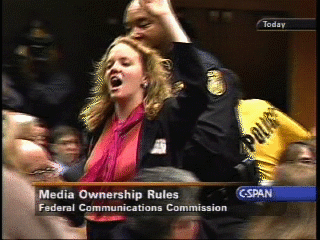
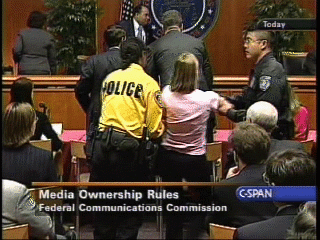
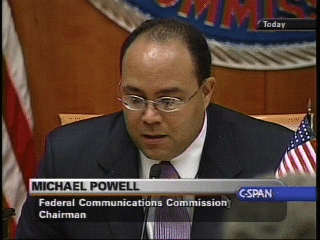

This work is dedicated to the
Public Domain. (Take it and run, baby!)
Wow I just recorded Medea Benjamin, Founding Director of Global Exchange and co-founder of Code Pink and Friends getting taken away by police immediately after the vote was taken on the media ownership rules in Washington DC today.
Maybe they woke up Jesse Jackson. (He was falling asleep in the audience :-)
From the CSPAN footage, it looks like they broke up the meeting over it.
I guess things were over with anyway at that point.
Commissioner Adelstein gave a nice speech at the end there, too.
I'll have this stuff up in an hour or so max. Capturing and generating movie files now...
Today's FCC meeting/vote is being rebroadcast on CSPAN right now.
Right now, Jonathan Adelstein, one of the "good guys" on this issue at the FCC is explaining just how bad these new rules will be for the American people and their diversity of source of information.
CC Vote In: We Lose 3 to 2 - Media Diversity Loses Straight Across The Board
Hey guys. We know that we all worked really hard on this, and at least we made our voices heard, even if it turns out that they just don't care what we think.
We should be used to that by now from this regime. Michael Powell is, of course, another arm of the Shrub Regime that believes that the wealth of our nation belongs in the hands of a few select individuals that "know best" for everyone else.
Well you can bet that this isn't over yet. It just means War. War on media conglomerates that don't care about their responsibilities to the public as broadcasters. If these companies are going to be in charge of everything we see and hear over television and radio, it's going to be up to us to keep watchful eye over them. And I don't mean a friendly, understanding watchful eye, I mean more like a watchful eye that they have to contend with on a regular basis in order to conduct business in a profitable manner.
To my knowledge, there are still some requirements that stations have to meet in order to fulfill their public interest requirements as broadcasters. Let's determine exactly what those requirements are and start organizing inspection teams that travel from station to station checking their public records and sending the inevitable violations to the FCC.
"Like weapons inspectors?" a friend said to me when I told him this idea.
"Yeah, very much like weapons inspections." I replied. "This is War, isn't it?"
Here's a link to the real video of today's meeting at the FCC.
Here's a story by Frank Ahrens for the Washing Post with more details:
FCC Votes to Ease Media Ownership Rules
An ideologically fractured Federal Communications Commission voted 3 to 2 along party lines today to relax or eliminate some key media ownership rules, allowing a newspaper to own a television station in the same city and broadcast networks to buy more stations at the national and local levels...The vote has engendered public opposition by lawmakers, consumer and advocacy groups and unaligned citizens who fear that further media consolidation will make it more difficult for those with minority viewpoints to get their message out. On Friday, the FCC's voice- and e-mail systems were temporarily shut down by a deluge of public comments. The agency has received more than 500,000 e-mails and postcards opposing the changes...
For better or worse, the proposed regulations are to be known as the "Powell Rules."
"I have had to make peace with myself, to know with every fiber of my being and intellect and faith with the law that this is the right answer, at least in the short term," Powell said. "Though it's not the popular answer."
Others think the answer is both unpopular and wrong.
"I'm glad they won't be remembered as the Copps rules," said Copps, who has opposed Powell's attempts to relax media ownership rules at nearly every turn. "They will take the media and the country into very perilous waters. I think we are damaging localism, diversity and competition, making it harder for alternative viewpoints and information to see the light of day."
Copps and Adelstein suggested several edits to the proposed rules changes, such as requiring merged media properties to spell out what public service programming they would produce and holding them accountable. Their modifications were rejected by the Republican majority, which said the suggestions came late in the process and were based on flimsy legal justification.
Here is the full text of the entire article in case the link goes bad:
http://www.washingtonpost.com/wp-dyn/articles/A3076-2003Jun2.html?nav=hptop_tb
FCC Votes to Ease Media Ownership Rules
By Frank Ahrens
Washington Post Staff Writer
Monday, June 2, 2003; 2:14 PM
An ideologically fractured Federal Communications Commission voted 3 to 2 along party lines today to relax or eliminate some key media ownership rules, allowing a newspaper to own a television station in the same city and broadcast networks to buy more stations at the national and local levels.
FCC Chairman Michael K. Powell joined fellow Republican commissioners Kathleen Q. Abernathy and Kevin J. Martin in approving the changes, while Democrats Jonathan S. Adelstein and Michael J. Copps voted against the changes.
The vote has engendered public opposition by lawmakers, consumer and advocacy groups and unaligned citizens who fear that further media consolidation will make it more difficult for those with minority viewpoints to get their message out. On Friday, the FCC's voice- and e-mail systems were temporarily shut down by a deluge of public comments. The agency has received more than 500,000 e-mails and postcards opposing the changes.
Powell, who has called the controversy "one of the toughest things I've ever faced," said earlier that the current rules fail to take into account the growing influence of Internet and paid television programming, and have been broadly questioned by the courts. Five of the agency's most recent media rules have been thrown out by the U.S. Court of Appeals in Washington.
Powell said in an interview yesterday: "If I did exactly what I am being urged to do," which is to let the current rules stand, "the result would be disastrous," meaning the rules would be tossed out by the court, leading to an unpoliced environment of unfettered consolidation.
Few issues are likely to define Powell's six-year tenure at the regulatory agency like the outcome of today's vote, FCC commissioners and industry members said.
For better or worse, the proposed regulations are to be known as the "Powell Rules."
"I have had to make peace with myself, to know with every fiber of my being and intellect and faith with the law that this is the right answer, at least in the short term," Powell said. "Though it's not the popular answer."
Others think the answer is both unpopular and wrong.
"I'm glad they won't be remembered as the Copps rules," said Copps, who has opposed Powell's attempts to relax media ownership rules at nearly every turn. "They will take the media and the country into very perilous waters. I think we are damaging localism, diversity and competition, making it harder for alternative viewpoints and information to see the light of day."
FCC staff members recommended lifting the 28-year-old ban prohibiting a newspaper from owning a television station or radio station in the same city, except in the smallest cities. The staff also favored relaxing older rules on television station ownership, allowing broadcast networks and other companies to buy more stations at the national and local levels. The staff members have recommended tightening radio ownership rules that led to widespread consolidation in recent years.
No issue has so deeply divided the commission along partisan lines in some time, say former FCC officials and industry lawyers.
Each side has accused the other of politicizing the process and being intransigent. "This thing has gotten very rough; unnecessarily rough," Powell said. "I would be naive and probably wrong to suggest that it's only business and tomorrow we'll go back to business. Some things [fellow commissioners] have said have crossed the line of civility and respectful discourse."
Copps and Adelstein suggested several edits to the proposed rules changes, such as requiring merged media properties to spell out what public service programming they would produce and holding them accountable. Their modifications were rejected by the Republican majority, which said the suggestions came late in the process and were based on flimsy legal justification.
Alan Korn spoke at Thursday's Clear Channel protest in San Francisco. Alan was Stephen Dunifer's counsel in the Free Radio Berkeley case (Decision, Amicus Brief) that went on from 1994-2000 here in California.
Alan's main point was that this fight will be far from over after Monday. Even if the vote takes place and we lose on its outcome, there are other actions we can take in the days and weeks and months to come to fight back against Clear Channel.
He also mentioned how contacting your representatives was still very important and that letters to Senator Barbara Boxer are particularly useful because she's on the Commerce Committee.
Alan likened this situation to the 1920's when people spoke out to protect the environment and brought the issue to the attention of the Federal Government. Cases where people had been arrested committing acts of civil disobedience had to work their way up through the courts before the First Amendment was actually recognized by the Supreme Court. (Can anyone help me find links on this?)
He also explained how citizens can file a "Petition to Deny" with the FCC against Clear Channel radio stations when their licenses are up for renewal. (KSJO in San Joses license is up this year, for example.)
Another thing that citizens can do at any Clear Channel station nationwide during 9-5 on any business day is to show up at their offices and demand to inspect their public files. Stations are supposed to keep certain records about meeting their public interest requirements. (More on this later!)
If stations are violating the rules by exceeding the number of stations allowed for a particular market, it's apparently up to us to collect the proper documentation and inform the FCC about it. Clear Channel, for instance, owns 9 radio stations in San Francisco (only 8 are allowed per market) and 10 radio stations in San Diego, because it keeps two of them across the border in Tijuana.
Alan Korn - Highlights (Small - 7 MB)
Alan Korn - Complete (Small - 13 MB)
No Hi-res yet, coming soon...email me if you need this NOW.
Audio - Alan Korn - Complete (MP3 - 5 MB)
This work is dedicated to the
Public Domain. (Take it and run, baby!)
Medea Benjamin, Founding Director of Global Exchange and co-founder of Code Pink, explained to the crowd how the United States probably have one of the most undemocratic media in the world right now.
Medea discussed how public support of the war in Iraq was largely caused by the steady stream of disinformation that was being broadcast over the popular media. How ironic, she said, that our troops are over on the other side of the world supposedly bringing democracy to another country while we are rapidly losing our own democratic freedoms here at home.
Benjamin goes on to explain that, according to an FCC commissioner that she heard on the radio program "Democracy Now" Thursday morning (May 29, 2003), the FCC has received over 428,000 (four hundred twenty-eight thousand) comments regarding this issue, and that 98% of those were against further relaxation of the FCC's media ownership rules.
Medea Benjamin - Highlights (Small - 6 MB)
Medea Benjamin - Near Complete (Small - 13 MB)
No Hi-res yet, coming soon...email me if you need this NOW.
Audio - Medea Benjamin - Near Complete (MP3 - 6 MB)

This work is dedicated to the
Public Domain. (Take it and run, baby!)
I've put together a montage of the different chants over the course of the evening.
Yeah, we're a bunch of hippies. A bunch of pissed off, angry hippies. (Wanna make something of it?)
But we also represent a lot of pissed off non-hippies all across the country. We're speaking out for "average citizens" across the U.S. everywhere.
Note that I've made an uncompressed AIFF file of this available for sampling purposes.
SF Chant Montage (Small - 5 MB)
SF Chant Montage (Hi-Res - 52 MB)
Audio - SF Chant Montage (MP3 - 2 MB)
Audio - SF Chant Montage (Uncompressed AIFF - 10 MB)
This work is dedicated to the
Public Domain. (Take it and run, baby!)
This is the first in a number of installments of the video and audio from yesterday's protest last night at 340 Townsend Street in front of the Clear Channel offices.
(Note: I've just added a montage of chants here.)
I'll be providing "highlight" versions of everything as well as complete versions of everything I post.
The one thing that stood out to me was the point people kept making that Clear Channel is already abusing existing regulations. Why on earth would the FCC ever relax them further when Clear Channel doesn't even respect them now?
So the problem is not only what could happen if these rules are further relaxed. The problem exists now, with the rules the way they are. Clear Channel owns nine stations in the SF Bay Area market, for example, while the legal limit is eight.
Note: As of 10 AM PST, the high resolution versions of this stuff were still uploading.
I'd give it another half hour or so at least.
Andrea Buffa, Global Exchange - Highlights Reel 1
Andrea Buffa - Highlights Reel 1 (Small - 8 MB)
Andrea Buffa - Highlights Reel 1 (Hi-Res - 64 MB)
Audio - Andrea Buffa - Highlights Reel 1 (MP3 - 2 MB)
Andrea Buffa, Global Exchange - Complete Part 1
Andrea Buffa - Part 1 (Small - 10 MB)
Andrea Buffa - Part 1 (Hi-Res - 125 MB)
Audio - Andrea Buffa - Part 1 (MP3 - 4 MB)


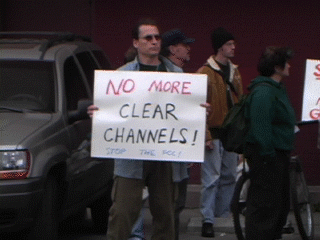
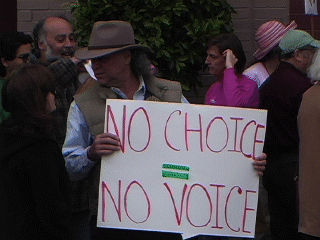
This work is dedicated to the
Public Domain. (Take it and run, baby!)
I'll be at 340 Townsend at 5pm sharp tonight for a rally against Clear Channel.
Look for one in your town. (Here's one going on in Washington D.C.
Remember to bring your video cameras! I can always store your footage in my library at the Internet Archive if you don't have the space or bandwidth to do so.
See you there!
SAN FRANCISCO, CA
WHAT: No More Clear Channels!
Stop the FCC Media Giveaway
WHEN: Thursday, May 29th 2003 5 PM -
(the Thursday before the FCC votes to
dramatically deregulate the media)
WHERE: 340 Townsend Street, San Francisco
The FCC is poised to approve the most dramatic
changes to media ownership regulations in
decades. Leading the charge is FCC Chairman
Michael Powell, Colin Powell's son, who
essentially declared war on diversity in
media at the same time that his father was
spearheading the war against Iraq.
The Thursday before the June 2 FCC vote,
media activists and concerned citizens will
protest at Clear Channel radio stations
throughout the United States with the
message: No More Clear Channels!
Stop the FCC Media Giveaway!
Clear Channel Communications is the
poster child of everything that's wrong with
media deregulation. After the media
deregulation of 1996, Clear Channel gobbled
up hundreds of radio stations throughout
the country and now owns more than 1200
stations nationwide, dominating the audience
share in 100 of 112 major markets. Not only
is the company the world's largest radio
broadcaster, it's also the world largest
concert promoter and billboard advertising
firm. Clear Channel promotes a cookie-cutter
style radio that has urban stations
throughout the country seemingly playing the
same seven songs. It shuts out independent
artists and eliminates local programming.
The company also uses its stations to promote
its right-wing political agenda, such as the
pro-war rallies that Clear Channel
has sponsored in numerous cities since
the start of the war against Iraq.
In San Francisco, Clear Channel station
KMEL fired popular public affairs director
Davey D after he invited anti-war
Congresswoman Barbara Lee to speak on
a KMEL public affairs show.
Let's send a message to the FCC and Congress before
the FCC vote on media deregulation:
PROTEST CLEAR CHANNEL RADIO AND THE MEDIA MONOPOLY!
Location:
Clear Channel/KMEL Office, 340 Townsend Street
San Francisco California
Sponsored By:
Sponsored by Media Alliance, Youth Media Council,
Global Exchange, and others. For more information,
415-255-7296 x263, andrea@globalexchange.org.
Update 12:43 pm: Hey guys, is there a transcript of this already available? Otherwise, I may have to transcribe this video...Let me know...
Okay so here's the official FCC video from yesterday's "Open Agenda" meeting at the FCC with Michael Powell.
More on what all of this means as soon as I can figure it out.
I just don't want to delay showing this to you since every minute counts at this point.
It looks like there are a number of hot items on the agenda...
So I'm watching it too...and I'll repost here with more specifics about where the non-boring parts are (when and if I get to them :-)
Thanks!
lisa
Estimated time: 3-7 minutes.
It took me about ten minutes, but I didn't already have the two things to say below written for me -- like you do -- and I also had to wait on hold for a couple minutes listening to classical music because the line was busy.
Please look up your Senators and then use my really simple talking points (below) or pehaps some of the more detailed talking points (with resources) that some folks were nice enough to put together.
I called up Barbara Boxer (I can't bring myself to contact Feinstein) and left a message that:
1) I am very concerned about the proposed changes in the FCCs media ownersip rules.
and
2) To please do everything in her power to demand another official public hearing regarding the details of the changes before any kind of final ruling can be made.
(Thanks to Michelle Wolf and Alison Brzencheck and anyone else I forget to mention that helped write and distribute the information below before it found its way to me.)
Hi All,
Moveon.org is facilitating a national call in campaign to coincide with the
FCC's meeting today. They are asking all Americans concerned about the
state of the mass media to phone there state legislators to express their
concern (see note below). I have attached a PDF of the numbers for the
senate and the House of Representatives.
For individuals that do not feel they have enough knowledge of the issues,
I have provided talking points at the bottom of this email for them to use
in the call.
Thanks,
Alison Brzenchek
Vice President of Media Reform
Action Coalition for Media Education Board of Directors
____________________________________________________________________
Hi all,
I'm really sorry for the late notice but it's been decided
that the call in day is tomorrow/today Thursday May 15th to
coincide with the FCC's meeting.
MoveOn will send out the call late tonight/early morning
to ask folks to call their Congresspeople asap. Please
forward on to your lists and let's make sure our elected
officials in DC hear us (and the NRA :)
Word is that MoveOn got over 150,000 people to sign their
petition last week, and all of those folks will be emailed
to make a call tomorrow.
We should discuss as a group whether we want to build for
another call-in day closer to the FCC's vote.
Let's burn up those phone lines and keep the momentum
building!
jeffp
____________________________________________________________________
Talking Points
1. I am aware of the letters you have received from legislators:
There was a letter sent from Senate Commerce Committee members Allard,
Snowe and Collins to Chairman Powell.
The letter urged Powell to publicly address how any changes in media
ownership rules "will promote diversity, competition, and localism" before
issuing a final ruling.
See more the letter at: http://www.acmecoalition.org/fcc1.html
2. I have been made aware of a poll done by the Project for Excellence in
Journalism and the Pew Research Center for the People and The Press that
asked:
"How much, if anything, have you heard about a Federal Communications
Commission proposal to reduce current limits on the number of news outlets
one company can own," the survey asked. "A lot, a little, or nothing at
all?"
72% of Americans have heard "nothing at all"
4% of Americans have heard "a lot."
Find out more at:
http://journalism.org/resources/research/reports/fccsurvey/default.asp
3. I am concerned that corporations are being prioritized over the public
welfare.
"Chairman Powell defines his job as promoting variety in the entertainment
market," said Mark Cooper, CFA's Director of Research, "but the First
Amendment is about ensuring vibrant civic discourse through diversity of
viewpoints and vigorous competition between institutions in the gathering
and dissemination of news and information."
4. I am familiar with the Supreme Courts 1945 decision on the First
Amendment. I believe that further elimination of media ownership
regulations is in conflict with this decision.
In 1945, the Supreme Court decided that "the widest possible dissemination
of information from diverse and antagonistic sources is essential to the
welfare of the public, that a free press is a condition of a free society."
See full case decision at:
http://www.usscplus.com/online/index.asp?case=3260001
5. I am aware of evidence that shows that eliminating media ownership
regulations will not support the diversity, localism and competition the
FCC is charged to protect.
A study by the Consumer Federation of America called, Democratic Discourse
in the Digital Information Age demonstrates that the FCC studies are asking
the wrong questions.
"They look at variety of entertainment when they should be looking at
diversity of information."
"They worry about number of outlets when strength of journalistic
institutions is what matters."
"They downplay the key role of concentration of ownership, and they ignore
the size and diversity of the population served by the media."
See the Executive Summary at:
http://www.consumerfed.org/demodiscoursesum.pdf
6. I am aware of differing opinions within the commission. Additionally, I
am concerned that the Chair of the Commission (Powell) has only held one
"offical" public hearing and has only participated in one "unofficial"
hearing spearheaded by Commissioner Copps.
There have been 4 unofficial hearings through out the US and Powell only
attend 1
There are four additional unofficial hearing scheduled between now and May
7th
"If you take this to its logical conclusion, you could end up with a
situation where one company owns the newspaper, the television station, the
radio station and the cable system. That may have some economic
efficiencies attached to it, but I daresay it also has some profound
democratic and social and political considerations that we ignore only at
our own tremendous peril."(Statement made by Commissioner Copps in an
interview with Bill Moyers on NOW, 2002)
7. I am extremely concerned because the majority of television, newspaper
and cable broadcasters are not covering this extremely important issue.
We do not hear about ownership issues in the mainstream media due to the
financial benefits that the owners stand to gain with further deregulation.
------ End of Forwarded Message
This isn't only unfortunate, I believe it's illegal. Unless all of the FCC safety precautions have been de-regulated along with everything else.
I would so love to publish more details about how 1) this was able to happen and
2) what steps Clear Channel has taken to see that it never happens again.
If Clear Channel isn't doing everything in its power to convince the FCC that it's revising whatever policy it needs to so that someone is always on-hand to answer the telephone, it seems to me that the company has clearly demonstrated reckless disregard for the safety of people living in the "markets" it owns.
Anyone in the Minot, North Dakota area that's interested in working with me on this?
Why Worry About Who Owns The Media?
It's like something out of a nightmare, but it really happened: At 1:30 on a cold January night, a train containing hundreds of thousands of gallons of toxic ammonia derails in Minot, North Dakota. Town officials try to sound the emergency alert system, but it isn't working. Desperate to warn townspeople about the poisonous white cloud bearing down on them, the officials call their local radio stations. But no one answers any of the phones for an hour and a half. According to the New York Times, three hundred people are hospitalized, some are partially blinded, and pets and livestock are killed.Where were Minot's DJs on January 18th, 2002? Where was the late night station crew? As it turns out, six of the seven local radio stations had recently been purchased by Clear Channel Communications, a radio giant with over 1,200 stations nationwide. Economies of scale dictated that most of the local staff be cut: Minot stations ran more or less on auto pilot, the programming largely dictated from further up the Clear Channel food chain. No one answered the phone because hardly anyone worked at the stations any more; the songs played in Minot were the same as those played on Clear Channel stations across the Midwest.
Here is the full text of the entire article at:
http://www.moveon.org/moveonbulletin/bulletin12.html#1
MoveOn.org: Democracy in action.
SHOWDOWN AT THE FCC
MoveOn Bulletin
Friday, May 2, 2003
Co-Editors: Don Hazen and Lakshmi Chaudry, AlterNet
Subscribe online at: http://www.moveon.org/moveonbulletin/
CONTENTS:
1. Eli Pariser: Why Worry About Who Owns the Media?
2. Jeff Chester: Showdown at the FCC
3. Neil Hickey: The Gathering Storm Over Media Ownership
4. Bill Moyers: Barry Diller Takes On Media Deregulation
5. Danny Schechter: The Media, the War, and Our Right to Know
6. Eric Boehlert: Clear Channel's Big Stinking Deregulation Mess
7. Paul Schmelzer: The Death of Local News
8. Caryl Rivers: Where Have All the Women Gone?
9. About the Bulletin
------------------------------
WHY WORRY ABOUT WHO OWNS THE MEDIA?
MoveOn Bulletin Op-Ed
by Eli Pariser
It's like something out of a nightmare, but it really happened: At 1:30 on a cold January night, a train containing hundreds of thousands of gallons of toxic ammonia derails in Minot, North Dakota. Town officials try to sound the emergency alert system, but it isn't working. Desperate to warn townspeople about the poisonous white cloud bearing down on them, the officials call their local radio stations. But no one answers any of the phones for an hour and a half. According to the New York Times, three hundred people are hospitalized, some are partially blinded, and pets and livestock are killed.
Where were Minot's DJs on January 18th, 2002? Where was the late night station crew? As it turns out, six of the seven local radio stations had recently been purchased by Clear Channel Communications, a radio giant with over 1,200 stations nationwide. Economies of scale dictated that most of the local staff be cut: Minot stations ran more or less on auto pilot, the programming largely dictated from further up the Clear Channel food chain. No one answered the phone because hardly anyone worked at the stations any more; the songs played in Minot were the same as those played on Clear Channel stations across the Midwest.
Companies like Clear Channel argue that economies of scale allow them to cut costs while continuing to provide quality programming. But they do so at the expense of local coverage. It's not just about emergency warnings: media mergers are decreasing coverage of local political races, local small businesses, and local events. There are only a third as many owners of newspapers and TV stations as there were in the 1970s (about 600 now; over 1,500 then). It's harder and harder for Americans to find out what's going on in their own back yards.
On June 2, the Federal Communications Commission (FCC) is considering relaxing or getting rid of rules to allow much more media concentration. While the actual rule changes are under wraps, they could allow enormous changes in the American media environment. For example, one company could be allowed to own ABC, CBS, and NBC. Almost certainly, media companies will be allowed to own newspapers and TV stations in the same town. We could be entering a new era of media megaliths.
Do you want one or two big companies acting as gatekeepers and controlling your access to news and entertainment? Most of us don't. And the airwaves explicitly belong to us -- the American people. We allow media companies to use them in exchange for their assurance that they're serving the public interest, and it's the FCC's job to make sure that's so. For the future of American journalism, and for the preservation of a diverse and local media, we have the hold the FCC to its mission. Otherwise, Minot's nightmare may become our national reality.
------------------------------
Interested in taking on the FCC and other media-related concerns? Join the MoveOn Media Corps, a group of over 29,000 committed Americans working for a fair and balanced media. You can sign up now at:
http://www.moveon.org/mediacorps/
------------------------------
SHOWDOWN AT THE FCC
Jeffrey Chester and Don Hazen, AlterNet
Despite wide protests and the Clear Channel debacle, the FCC is about to award the nation's biggest media conglomerates a new give-away that will further concentrate media ownership in fewer hands. The impact on the American media landscape could be disastrous. Recent TV coverage of the Iraq war already illustrates that US media companies aren't interested in providing a serious range of analysis and debate. This overview describes what's at stake and offers an introduction to the following articles.
http://www.alternet.org/story.html?StoryID=15796
------------------------------
THE GATHERING STORM OVER MEDIA OWNERSHIP
Neil Hickey, Columbia Journalism Review
CJR's editor-at-large explains just what is at stake in this fight over media ownership. He provides an in-depth look at the issues, and major players in a battle that is pitting journalists against their bosses, breaking up old alliances, and gathering momentum as the day of reckoning draws near. He traces the snowballing trend of media consolidation and its implications for the future, revealing just how the drive for profit is eroding diversity, local control, and more importantly giving a few mega-corporations a monopoly over the dissemination of news.
http://www.alternet.org/story.html?StoryID=15654
------------------------------
BARRY DILLER TAKES ON MEDIA DEREGULATION
Bill Moyers, Now with Bill Moyers
The founder of Fox Broadcasting and present CEO of USA Networks is an unlikely but passionate opponent of plans to loosen media ownership rules. In an interview with Bill Moyers, the media mogul explains how deregulation creates corporations with "such overwhelming power in the marketplace that everyone has to do essentially what they say." Diller argues that government regulation is essential to prevent media companies from controlling everything we see, read, and hear. As he puts it, "Who else is gonna do it for us?"
http://www.alternet.org/story.html?StoryID=15768
------------------------------
THE MEDIA, THE WAR, AND OUR RIGHT TO KNOW
Danny Schechter, MediaChannel.org
Why did the media do such a poor job of reporting on the Iraq war? The boosterism of news anchors, the suppression of antiwar views, and the sanitized images of war that defined television coverage are not a simple matter of bias or ineptitude, says media analyst Danny Schechter. He draws attention to the connection between the decisions made by journalists and the lobbying efforts of owners who will profit immensely from the upcoming FCC decision in June.
http://www.mediachannel.org/views/dissector/moveon.shtml
------------------------------
CLEAR CHANNEL'S BIG STINKING DEREGULATION MESS
Eric Boehlert, Salon
Clear Channel, the radio and concert conglomerate, has been the greatest beneficiary of the 1996 Telecommunications Act, which stripped all ownership limits in the radio industry. The rapacious company, led by Bush supporter Lowry Mays, has grown from 40 stations to 1,225 since then, and now uses its power to routinely bully advertisers and record companies, and more recently censor antiwar artists. However, as Eric Boehlert points out, its "success" may be the most powerful weapon in the arsenal of media activists. Clear Channel's stranglehold on the radio industry is the best and clearest example of the effects of rampant deregulation.
http://www.alternet.org/story.html?StoryID=15281
------------------------------
THE DEATH OF LOCAL NEWS
Paul Schmelzer, AlterNet
Meet the Sinclair Broadcast Group, the "Clear Channel of local news." Since 1991, the company has managed to acquire 62 television stations or 24 percent of the national TV audience. The company's modus operandi is the centralized production of homogenized, repackaged faux "local" news. Its success offers an alarming glimpse of the post-deregulation world in which all news may be produced in one giant newsroom and from a single viewpoint -- which in Sinclair's case is wholeheartedly conservative.
http://www.alternet.org/story.html?StoryID=15718.
------------------------------
WHERE HAVE ALL THE WOMEN GONE?
Caryl Rivers, Women's Enews
Once the war on Iraq took center-stage in the headlines of newspapers and magazines across the country, women writers became increasingly rare in the media. In their place are mostly white men who write on a narrow band of foreign policy issues, mostly recycling their views over and over again. From the all-male line-ups in the op-ed pages of the Washington Post and the New York Times to the dwindling female bylines in the New Yorker and Atlantic Monthly, women's voices have been caught in a "spiral of silence" that is unprecedented since the pre-women's movement days.
http://www.alternet.org/story.html?StoryID=15677
------------------------------
ABOUT THE MOVEON BULLETIN AND MOVEON.ORG
The MoveOn Bulletin is a free email bulletin providing information, resources, news, and action ideas on important political issues. The full text of the MoveOn Bulletin is online at http://www.moveon.org/moveonbulletin/; you can subscribe to it at that address. The MoveOn Bulletin is a project of MoveOn.org.
MoveOn.org is an issue-oriented, nonpartisan, nonprofit organization that gives people a voice in shaping the laws that affect their lives. MoveOn.org engages people in the civic process, using the Internet to democratically determine a non-partisan agenda, raising public awareness of pressing issues, and coordinating grassroots advocacy campaigns to encourage sound public policies. You can help decide the direction of MoveOn.org by participating in the discussion forum at:
http://www.actionforum.com/forum/index.html?forum_id=223
About MoveOn.org Make a Donation Media Coverage Press Room Become a Volunteer
MoveOn and MoveOn.org are trademarks of MoveOn.org
1. Government by a few, especially by a small faction of persons or families.
2. Those making up such a government.
2. A state governed by a few persons.
Channels of Influence
By Paul Krugman for the NY Times.
Or perhaps the quid pro quo is more narrowly focused. Experienced Bushologists let out a collective "Aha!" when Clear Channel was revealed to be behind the pro-war rallies, because the company's top management has a history with George W. Bush. The vice chairman of Clear Channel is Tom Hicks, whose name may be familiar to readers of this column. When Mr. Bush was governor of Texas, Mr. Hicks was chairman of the University of Texas Investment Management Company, called Utimco, and Clear Channel's chairman, Lowry Mays, was on its board. Under Mr. Hicks, Utimco placed much of the university's endowment under the management of companies with strong Republican Party or Bush family ties. In 1998 Mr. Hicks purchased the Texas Rangers in a deal that made Mr. Bush a multimillionaire.There's something happening here. What it is ain't exactly clear, but a good guess is that we're now seeing the next stage in the evolution of a new American oligarchy. As Jonathan Chait has written in The New Republic, in the Bush administration "government and business have melded into one big `us.' " On almost every aspect of domestic policy, business interests rule: "Scores of midlevel appointees . . . now oversee industries for which they once worked." We should have realized that this is a two-way street: if politicians are busy doing favors for businesses that support them, why shouldn't we expect businesses to reciprocate by doing favors for those politicians — by, for example, organizing "grass roots" rallies on their behalf?
Here is the entire text of the article in case the link goes bad:
http://www.nytimes.com/2003/03/25/opinion/25KRUG.html
The New York Times The New York Times Opinion March 25, 2003
OP-ED COLUMNIST
Channels of Influence
By PAUL KRUGMAN
By and large, recent pro-war rallies haven't drawn nearly as many people as antiwar rallies, but they have certainly been vehement. One of the most striking took place after Natalie Maines, lead singer for the Dixie Chicks, criticized President Bush: a crowd gathered in Louisiana to watch a 33,000-pound tractor smash a collection of Dixie Chicks CD's, tapes and other paraphernalia. To those familiar with 20th-century European history it seemed eerily reminiscent of. . . . But as Sinclair Lewis said, it can't happen here.
Who has been organizing those pro-war rallies? The answer, it turns out, is that they are being promoted by key players in the radio industry — with close links to the Bush administration.
The CD-smashing rally was organized by KRMD, part of Cumulus Media, a radio chain that has banned the Dixie Chicks from its playlists. Most of the pro-war demonstrations around the country have, however, been organized by stations owned by Clear Channel Communications, a behemoth based in San Antonio that controls more than 1,200 stations and increasingly dominates the airwaves.
The company claims that the demonstrations, which go under the name Rally for America, reflect the initiative of individual stations. But this is unlikely: according to Eric Boehlert, who has written revelatory articles about Clear Channel in Salon, the company is notorious — and widely hated — for its iron-fisted centralized control.
Until now, complaints about Clear Channel have focused on its business practices. Critics say it uses its power to squeeze recording companies and artists and contributes to the growing blandness of broadcast music. But now the company appears to be using its clout to help one side in a political dispute that deeply divides the nation.
Why would a media company insert itself into politics this way? It could, of course, simply be a matter of personal conviction on the part of management. But there are also good reasons for Clear Channel — which became a giant only in the last few years, after the Telecommunications Act of 1996 removed many restrictions on media ownership — to curry favor with the ruling party. On one side, Clear Channel is feeling some heat: it is being sued over allegations that it threatens to curtail the airplay of artists who don't tour with its concert division, and there are even some politicians who want to roll back the deregulation that made the company's growth possible. On the other side, the Federal Communications Commission is considering further deregulation that would allow Clear Channel to expand even further, particularly into television.
Or perhaps the quid pro quo is more narrowly focused. Experienced Bushologists let out a collective "Aha!" when Clear Channel was revealed to be behind the pro-war rallies, because the company's top management has a history with George W. Bush. The vice chairman of Clear Channel is Tom Hicks, whose name may be familiar to readers of this column. When Mr. Bush was governor of Texas, Mr. Hicks was chairman of the University of Texas Investment Management Company, called Utimco, and Clear Channel's chairman, Lowry Mays, was on its board. Under Mr. Hicks, Utimco placed much of the university's endowment under the management of companies with strong Republican Party or Bush family ties. In 1998 Mr. Hicks purchased the Texas Rangers in a deal that made Mr. Bush a multimillionaire.
There's something happening here. What it is ain't exactly clear, but a good guess is that we're now seeing the next stage in the evolution of a new American oligarchy. As Jonathan Chait has written in The New Republic, in the Bush administration "government and business have melded into one big `us.' " On almost every aspect of domestic policy, business interests rule: "Scores of midlevel appointees . . . now oversee industries for which they once worked." We should have realized that this is a two-way street: if politicians are busy doing favors for businesses that support them, why shouldn't we expect businesses to reciprocate by doing favors for those politicians — by, for example, organizing "grass roots" rallies on their behalf?
What makes it all possible, of course, is the absence of effective watchdogs. In the Clinton years the merest hint of impropriety quickly blew up into a huge scandal; these days, the scandalmongers are more likely to go after journalists who raise questions. Anyway, don't you know there's a war on?
This situation just goes to show that it was the Music Programming layer of the system, not the listener layer, that pulled the Dixie Chicks from station playlists over Natalie's statements.
That's the issue here: programmers took it upon themselves to censor the Chicks before listeners had a chance to say anything. That's where the McCarthyism parallel kicks in. The Chicks got blacklisted by a few key people within a Monopolized Media: not by infuriated listeners.
Many thanks to Dale Carter, programming director at KFKF/Kansas City for rethinking the situation and speaking out on this important issue!
Country Radio Still Weighing Chicks Controversy
One major market programmer removed the Chicks from his station's playlist but changed his mind after considering why Americans have fought previous wars. In a letter to listeners posted on the KFKF/Kansas City Web site, program director Dale Carter wrote, "Our soldiers, sailors, airmen and Marines are over there fighting for our rights -- and one of those is our Constitutional right to express an unpopular opinion. The longer this has gone on, the more I had visions of censorship and McCarthyism. Two wrongs don't make a right. I agree with the 80 percent of you who abhor what Natalie said in London. On the other hand, I believe in the Constitution."
Here is the full text of the article in case the link goes bad:
http://www.cmt.com/news/feat/dchicks.031403.jhtml
Dixie Chicks
Country Radio Still Weighing Chicks Controversy
Calvin Gilbert
03/14/2003
With heated debate continuing over Natalie Maines' comment about President George W. Bush, country radio listeners may be determining the Dixie Chicks' future -- at least for the short term.
Just like postings on Internet message boards, phone calls to radio stations have been hot and heavy in the aftermath of the Texas-based trio's Monday night (March 10) concert in London. During the concert, Maines told the crowd, "Just so you know, we're ashamed the president of the United States is from Texas." The band later posted an explanation on their official Web site outlining their views of a possible war with Iraq.
Some radio stations immediately dropped the Dixie Chicks from their playlist after news surfaced of Maines' remark. Rumors were circulating Friday afternoon (March 14) that one sizable chain of stations would be initiating a boycott of Chicks titles during the weekend. Most, however, appear to be taking a "wait and see" attitude as they seek input from their listeners. Several stations are running polls and asking for additional comments via their Web sites.
The Chicks' "Travelin' Soldier," is No. 1 on Billboard's latest country singles chart, but weekend boycotts at major market stations could easily prevent the track from remaining at the top when the next chart is compiled Monday (March 17).
"They're about where they were at this point last week, as far as spins," Billboard country charts editor Wade Jessen told CMT.com. "But with three more days left to go, depending on what happens, they could either stay at one or they'll get knocked out. At this point in the week, they're maintaining their airplay on 'Travelin' Soldier,' but we won't know until Monday morning what it looks like."
Noting that Americans were more unified in the early '90s during Operation Desert Storm, Jessen adds, "I think this is new territory, and it's very, very sensitive and very emotional. It's particularly sensitive in the country format because we're really where patriotism lives. Country is the format with the audience that expects patriotism. But at this time in the nation's history, there's a lot of confusion over just what patriotism is and what constitutes it."
In Bush's hometown of Midland, Texas, radio station KNFM's Web site offers a direct link to The Guardian, the London newspaper that first reported Maines' remark. The station has also stopped playing Dixie Chicks music as part of an on-air promotion billed as "Chicks Free -- Texas Pride Weekend." KNFM operations manager John Moesch said, "Natalie Maines certainly has the right to say whatever she wants, but it doesn't mean that the KNFM listener family here in George W. Bush's hometown have to listen."
Elsewhere in Texas, online polls are being conducted by KILT and KKBQ in Houston and at KSCS in Dallas. The KSCS poll has a bit of a disclaimer: "At 96.3 KSCS we disagree with her [Maines]. We're not only proud to be from Texas, but we're proud of President George W. Bush and the fact that he is from Texas."
One major market programmer removed the Chicks from his station's playlist but changed his mind after considering why Americans have fought previous wars. In a letter to listeners posted on the KFKF/Kansas City Web site, program director Dale Carter wrote, "Our soldiers, sailors, airmen and Marines are over there fighting for our rights -- and one of those is our Constitutional right to express an unpopular opinion. The longer this has gone on, the more I had visions of censorship and McCarthyism. Two wrongs don't make a right. I agree with the 80 percent of you who abhor what Natalie said in London. On the other hand, I believe in the Constitution."
Carter concluded, "In light of what our men and women are about to do, this whole controversy is very small. Let me close with the most important sentiments any of us can express: God bless our troops, pray for the people of Iraq and may God continue to bless the United States of America."
It was my understanding that radio stations were required by law to have someone at the station available at all times to help convert the station into an Emergency Broadcast Network, if required.
I remember being trained how to work this funny machine when I was a DJ at WIDR radio in Kalamazo, MI in 1986. Surely, these regulations have not been de-regulated!
The Trouble With Corporate Radio: The Day the Protest Music Died
By Brent Staples for the NY Times
Senator Byron Dorgan, Democrat of North Dakota, had a potential disaster in his district when a freight train carrying anhydrous ammonia derailed, releasing a deadly cloud over the city of Minot. When the emergency alert system failed, the police called the town radio stations, six of which are owned by the corporate giant Clear Channel. According to news accounts, no one answered the phone at the stations for more than an hour and a half. Three hundred people were hospitalized, some partially blinded by the ammonia. Pets and livestock were killed.
Here is the full text of the article in case the link goes bad:
http://www.nytimes.com/2003/02/20/opinion/20THU4.html
February 20, 2003
The Trouble With Corporate Radio: The Day the Protest Music Died
By BRENT STAPLES
Pop music played a crucial role in the national debate over the Vietnam War. By the late 1960's, radio stations across the country were crackling with blatantly political songs that became mainstream hits. After the National Guard killed four antiwar demonstrators at Kent State University in Ohio in the spring of 1970, Crosby, Stills, Nash and Young recorded a song, simply titled "Ohio," about the horror of the event, criticizing President Richard Nixon by name. The song was rushed onto the air while sentiment was still high, and became both an antiwar anthem and a huge moneymaker.
A comparable song about George W. Bush's rush to war in Iraq would have no chance at all today. There are plenty of angry people, many with prime music-buying demographics. But independent radio stations that once would have played edgy, political music have been gobbled up by corporations that control hundreds of stations and have no wish to rock the boat. Corporate ownership has changed what gets played — and who plays it. With a few exceptions, the disc jockeys who once existed to discover provocative new music have long since been put out to pasture. The new generation operates from play lists dictated by Corporate Central — lists that some D.J.'s describe as "wallpaper music."
Recording artists were seen as hysterics when they complained during the 1990's that radio was killing popular music by playing too little of it. But musicians have turned out to be the canaries in the coal mine — the first group to be affected by a 1996 federal law that allowed corporations to gobble up hundreds of stations, limiting expression over airwaves that are merely licensed to broadcasters but owned by the American public.
When a media giant swallows a station, it typically fires the staff and pipes in music along with something that resembles news via satellite. To make the local public think that things have remained the same, the voice track system sometimes includes references to local matters sprinkled into the broadcast.
What my rock 'n' roll colleague William Safire describes as the "ruination of independent radio" started with corporatizing in the 1980's but took off dramatically when the Telecommunications Act of 1996 increased the number of stations that one entity could own in a single market and permitted companies to buy up as many stations nationally as their deep pockets would allow.
The new rules were billed as an effort to increase radio diversity, but they appear to have had the opposite effect. Under the old rules, the top two owners had 115 stations between them. Today, the top two own more than 1,400 stations. In many major markets, a few corporations control 80 percent of the listenership or more.
Liberal Democrats are horrified by the legion of conservative talk show hosts who dominate the airwaves. But the problem stretches across party lines. National Journal reported last month that Representative Mark Foley, Republican of Florida, was finding it difficult to reach his constituents over the air since national radio companies moved into his district, reducing the number of local stations from five to one. Senator Byron Dorgan, Democrat of North Dakota, had a potential disaster in his district when a freight train carrying anhydrous ammonia derailed, releasing a deadly cloud over the city of Minot. When the emergency alert system failed, the police called the town radio stations, six of which are owned by the corporate giant Clear Channel. According to news accounts, no one answered the phone at the stations for more than an hour and a half. Three hundred people were hospitalized, some partially blinded by the ammonia. Pets and livestock were killed.
The perils of consolidation can be seen clearly in the music world. Different stations play formats labeled "adult contemporary," "active rock," "contemporary hit radio" and so on. But studies show that the formats are often different in name only — and that as many as 50 percent of the songs played in one format can be found in other formats as well. The point of these sterile play lists is to continually repeat songs that challenge nothing and no one, blending in large blocks of commercials.
Senator Russell Feingold of Wisconsin has introduced a bill that would require close scrutiny of mergers that could potentially put the majority of the country's radio stations in a single corporation's hands. Lawmakers who missed last month's Senate hearings on this issue should get hold of the testimony offered by the singer and songwriter Don Henley, best known as a member of the Eagles, the rock band.
Mr. Henley's Senate testimony recalled the Congressional payola hearings of 1959-60, which showed the public how disc jockeys were accepting bribes to spin records on the air. Now, Mr. Henley said, record companies must pay large sums to "independent promoters," who intercede with radio conglomerates to get songs on the air. Those fees, Mr. Henley said in a recent telephone interview, sometimes reach $400,000.
Which brings us back to the hypothetical pop song attacking George Bush. The odds against such a song reaching the air are steep from the outset, given a conservative corporate structure that controls thousands of stations. Record executives who know the lay of land take the path of least resistance when deciding where to spend their promotional money. This flight to sameness and superficiality is narrowing the range of what Americans hear on the radio — and killing popular music.
While Clear Channel Defends Itself To Washington (NY Times), the San Francisco Bay Guardian provides a first hand account of one of its radio station takeovers (KMEL, San Francisco):
Urban radio rage
When Clear Channel bought KMEL, it destroyed the so-called people's station. Now the people want it back.
By Jeff Chang.
If the changes that began in 1996 began to turn off some longtime KMEL listeners, the Oct. 1, 2001, firing of radio personality and hip-hop activist David "Davey D" Cook – shortly after his show Street Knowledge aired Rep. Barbara Lee's and the Coup's Boots Riley's objections to the war in Afghanistan – was the final straw. Cook's firing seemed to symbolize the end of an era in which community input, local music, and progressive politics had a place at KMEL, and it triggered thousands of e-mails, faxes, and letters; rowdy picket lines at the station; and the current round of accountability meetings...Clear Channel's vast media empire caught the public's attention during the aftermath of the attacks of Sept. 11, 2001, when executives allegedly circulated a list of so-called sensitive songs to be banned from the airwaves. By then corporate media critics were already describing Clear Channel as the Godzilla of the radio industry. Indeed, no other firm has benefited more from the Telecommunications Act. It has gone from owning 40 stations in 1996 to owning 1,240 today, commanding over a quarter of all radio revenues and listeners. (In the Bay Area it holds a similar market share.) Its closest competitor, Cumulus Media, owns just 248 stations. "Clear Channel is the monster that destroyed radio," veteran Bay Area radio-industry watcher and columnist Bill Mann said.
Here is the full text of the article in case the link goes bad:
http://sfbg.com/37/18/cover_kmel.html
January 22, 2003
Urban radio rage
When Clear Channel bought KMEL, it destroyed the so-called people's station. Now the people want it back.
By Jeff Chang
THERE AREN'T MANY visitors to Clear Channel Communications Inc.'s South of Market fortress these days, other than ad buyers, talent managers, and contest winners. The first floor looks like a tiny security bunker with silent music videos flickering on small wall-mounted TVs. So on Jan. 6, when a group of hip-hop activists showed up – a bunch of teens and twentysomethings, battle-hardened, some of them anyway, by campaigns against globalization and Proposition 21 – the gatekeeper alerted management before allowing them up to the fourth-floor waiting room.
They were there for a meeting with representatives of KMEL, 106.1 FM. In the skylighted penthouse conference room, Malkia Cyril, executive director of Youth Media Council, part of the listeners' group calling itself the Community Coalition for Media Accountability (CCMA), pressed their case. Since Clear Channel took over KMEL in 1999, she said, there has been no access to the airwaves for social justice organizations, an imbalance in programming and content, and no avenues for community accountability.
KMEL representatives listened, sometimes confused, often baffled. Pop radio executives aren't used to going face-to-face with angry, politicized listeners. But then again, KMEL has never been an ordinary radio station. In recent years such meetings – in which community leaders air grievances and radio execs scratch their heads – seem to have become a regular thing. Once known as "the people's station," KMEL has become a target for the people's anger.
For more than 15 years, KMEL has been a national radio powerhouse. It is the number-two music station in the fourth-largest radio market in the country, commanding the largest radio audience among the highly coveted 18-to-34 demographic. But perhaps more important, KMEL holds an almost mythical place in Bay Area hip-hop. During the '90s, KMEL helped launch rappers like Tupac Shakur, Hammer, and E-40. It produced on-air personalities, including Trace Dog and Franzen Wong (of the Up All Night Crew) and Renel Lewis, who seemed as around-the-way as hip-hop itself. Through its innovative community-affairs programming, it engaged the social issues of the hip-hop generation. The arrival in 1992 of a fierce competitor, KYLD-FM, also known as "Wild," which billed itself as "the party station," only reinforced KMEL's populist image.
But an unprecedented wave of consolidation swept the radio industry after Congress passed the 1996 Telecommunications Act, which removed station-ownership caps. Before the ink was dry, KMEL's then-parent company, Evergreen Media, ended the ratings war with KYLD by purchasing it – and the changes didn't stop there. A series of ever larger mergers culminated in 1999 with a whopping $24 billion deal in which KMEL and KYLD passed from AMFM Inc. into the hands of Clear Channel. That, critics say, is when everything that was once so right began to go so wrong.
An outcry for media justice
If the changes that began in 1996 began to turn off some longtime KMEL listeners, the Oct. 1, 2001, firing of radio personality and hip-hop activist David "Davey D" Cook – shortly after his show Street Knowledge aired Rep. Barbara Lee's and the Coup's Boots Riley's objections to the war in Afghanistan – was the final straw. Cook's firing seemed to symbolize the end of an era in which community input, local music, and progressive politics had a place at KMEL, and it triggered thousands of e-mails, faxes, and letters; rowdy picket lines at the station; and the current round of accountability meetings. Gang-peace organizer Rudy Corpuz of United Playaz said the message to KMEL remains clear: "Check your priorities. Without the community, your station would never have been made."
The KMEL protests are a big part of a swelling national backlash in urban communities against the shock jocks, autopilot programming, and mind-numbing hype of their radio stations. On Jan. 14, Cook joined with Afrika Bambaataa and the Universal Zulu Nation, rapper Chuck D, Bob Law of the National Leadership Alliance, and black activist organizations the December 12th Movement and the Code Foundation to denounce what they say is the lack of positive black music and community voices on stations like Emmis Communications-owned Hot 97 and Clear Channel-owned Power 105.1. Many have begun calling it a movement for media justice.
Cook, who hosts the Hard Knock Radio and Friday Night Vibe shows on KPFA, 94.1 FM, has now quietly – and somewhat reluctantly – become one of the movement's most prominent spokespeople. Speaking to the Bay Guardian from New York, he sketched out the issues. "The main complaint I've heard for three days," he explained, "is the lack of positive music, lack of access, and just the feeling that there's something foul about what I am listening to. People are really pissed from coast to coast."
Radio Godzilla
Clear Channel's vast media empire caught the public's attention during the aftermath of the attacks of Sept. 11, 2001, when executives allegedly circulated a list of so-called sensitive songs to be banned from the airwaves. By then corporate media critics were already describing Clear Channel as the Godzilla of the radio industry. Indeed, no other firm has benefited more from the Telecommunications Act. It has gone from owning 40 stations in 1996 to owning 1,240 today, commanding over a quarter of all radio revenues and listeners. (In the Bay Area it holds a similar market share.) Its closest competitor, Cumulus Media, owns just 248 stations. "Clear Channel is the monster that destroyed radio," veteran Bay Area radio-industry watcher and columnist Bill Mann said.
Critics say Clear Channel's KMEL has been distinguished by bland on-air personalities, reactionary politics, and the repetitive seven-song rotation that's found on every urban station. Bay Area political rapper Paris notes that in 1990, KMEL helped artists like him and Digital Underground blow up nationally. During the Gulf War the station even aired a remix of a Sway and Tech track called "Time for Peace" that featured all of them. "There was a lot more willingness to support local talent. Now that willingness is not there," he said. "Especially in this political climate, even in what many would argue is the cradle of liberalism, there's no room for anything that's progressive. Everything is rampant negativity."
Wong thinks the station is a shell of its former self. "They don't care about the streets anymore," he said.
Radio for everyone
The calls for change at KMEL are coming from a powerful source: angry youths of color from the station's target audience. Last fall a group of listeners began subjecting KMEL to some hard listening. The result was a scathing critique of the station issued by the Youth Media Council and the CCMA (www .media-alliance.org/action/KMEL.pdf). The CCMA's broad front includes the Mindzeye Artist Collective, hip-hop activist organization Let's Get Free, and global justice group Just Act.
They argue that since Cook was fired, progressives have lost their voice. They charge that the last remaining community-affairs program, Street Soldiers, excludes their views. They note that local artists – who make up one of the most vibrant and diverse rap music scenes in the country – are rarely heard on the station. The title of their report pointedly asks the question "Is KMEL the People's Station?"
"They say that they're the people's station," said Just Act program coordinator and CCMA spokesperson Saron Anglon, a 25-year-old who has listened to KMEL for 15 years. "They're not talking about social change or peace. They're focusing on things like crime and war. Our communities are listening to this quote-unquote people's station, and the people are not necessarily being represented."
A recent study by the Future of Music Coalition (www.futureofmusic.org), an artists' rights-public interest organization, provides a context for urban radio rage. Radio deregulation, the report argues, has left the public airwaves dominated by companies that have laid off hundreds, decimated community programming, and all but standardized playlists across the country. The report also found that an overwhelming majority of listeners want playlists with more variety and more local artists. It cites research pointing out that the time an average listener spends with the radio has dropped to a 27-year low.
On Jan. 6 the newest FCC commissioner, Jonathan Adelstein, spoke to attendees at a Future of Music Coalition conference in Washington, D.C. He echoed the concerns of media justice activists across the country, saying, "We must ask ourselves: At what point does consolidation come at the cost of the local expression that makes radio so unique and so special in this country? At what point does allowing consolidation undermine the public interest – and the quality of what we hear on the radio?"
For a growing number of alienated urban radio listeners, the answer is "Now."
Building the people's station
During the early '80s, Bay Area urban radio was stagnating, dominated by slick, disposable R&B. At the same time, college- and community-radio stations like KPOO-FM, KZSU-FM, KUSF-FM, and KALX-FM were championing hip-hop. Danyel Smith, the author of More like Wrestling and a former Vibe magazine editor in chief, was a columnist for the Bay Guardian during the years hip-hop broke.
"You had to know where Billy Jam was gonna be playing, where Davey D was gonna be playing," she said. "To the rest of the world, they were very little radio stations that came in staticky, and the show was on in the middle of the night, but you were in the know, and things were really exciting. And as much as I think we all liked being part of our little secret thing, we all thought, 'Wow this music needs to be heard by everyone. Someone needs to take it and blow it up, give it the respect that it deserves.' And for the Bay Area, that station was KMEL."
During the mid '80s, KMEL changed from a rock format to a "contemporary hits" format and became one of the first crossover pop stations in the nation to target young multiracial audiences with hip-hop, house, and reggae music. To make it work, KMEL desperately needed street credibility. College- and community-radio jocks, such as KALX's Cook, Sadiki Nia, and Tamu du Ewa, and local artists, including (now-MTV personality) Sway and King Tech, were recruited to the station. "They took what we were doing at community radio and brought it to the station," said KPOO personality KK Baby, who joined KMEL in 1991. "They would use us to attract the rest of the pop music audience."
Most of the jocks were never offered full-time positions, but they brought their audiences with them and became the central force in pushing KMEL to play cutting-edge music and offer community-oriented programming. Street Soldiers evolved from Hammer's idea to have a forum for young people to talk candidly about issues like gang violence. (The syndicated show is now hosted by Joe Marshall and Margaret Norris of the Omega Boys Club.) Davey D's hugely influential Street Knowledge program debuted in 1995 as a talk show for the hip-hop generation, dealing with topics spanning race, gender, and class. On his second show Davey D hosted a roundtable on the state of civil rights that featured Jesse Jackson, then-assembly speaker Willie Brown, Chuck D, Paris, and Belva Davis.
With a formula of underground-friendly playlists, activism-savvy programming, and street promotions, the station's ratings soared in the early '90s. KMEL's approach – progressive, edgy, multicultural, inclusive – fit the Bay Area well. Listeners embraced the people's station with open arms. KMEL's music shows and community-affairs programming, even its popular Summer Jam events, were soon imitated throughout the country.
The 1992 ratings war with KYLD brought out the best in most people. Michael Martin, who was then KYLD's program director and now serves as Clear Channel's regional vice president of programming, said, "We felt KMEL was a little lazy, so we came in with a vengeance." It was in this fierce competition that mainstays like Sway and Tech's Wake-Up Show, Street Soldiers, Street Knowledge, and KYLD's Doghouse stepped forward. At the same time, the dueling stations let the mix-show DJs experiment with local music, resulting in hits for artists like Tha Click, Conscious Daughters, Mac Mall, and the Luniz. The audience expanded to include listeners from San Jose to Pittsburg.
All around the world, the same song
Then the Telecommunications Act was passed. FCC chair Reed Hundt defended the legislation by arguing, "We are fostering innovation and competition in radio." But by all accounts, KMEL's innovative years were over. After a dustup between Too $hort and the Luniz at the 1995 Summer Jam, local artists were reportedly pushed off playlists. Mix-show DJs increasingly found their mixes subject to approval by higher-ups. Specialty shows were quietly eliminated. The battle for young urban ears ended with KMEL's purchase of KYLD. Three years later, Clear Channel swallowed them both.
To the listener, consolidation is probably most apparent in what the stations play. Just listen to KMEL's and KYLD's nightly countdowns of the seven "most requested" (their own words) songs. On any given night the stations may share as many as four of their seven "most requested" songs – the same 50 Cent, Ashanti and Ja Rule, LL Cool J, and P. Diddy tracks that are playing across the country. The exception, "Closer," by the Bay Area's Goapele, which was added to KMEL's rotation last month, stands out like a diamond for its rarity.
"Programming is more or less centralized," columnist Mann argued. "This is not guesswork. They've got too much money and too many shareholders at stake to leave much to chance." But Martin, who programs KMEL, KYLD, and K101-FM while overseeing the playlists of all of the other Clear Channel stations in northern California, denies this. "There is no centralization of programming at Clear Channel," he said. "There is no such thing as a national type of playlist."
Still, this is small consolation for local artists like E-A-Ski, who, despite producing records for Master P and Ice Cube that have sold millions of copies and holding a national fan base for his own rap records, still finds himself knocking from the outside. After Clear Channel took over, he and other local artists went to KMEL to protest their exclusion. As a result, Davey D got the green light to begin broadcasting the short-lived Local Flavas show. These days E-A-Ski is one of a tiny number of local artists heard on KMEL, but only because he is on a remix of Atlanta rapper Lil' Jon's "Who U Wit." "If you look at the South, they got all their DJs and their radio to support their records. The same system they have, we had," he said. "Everybody else is supporting their music, but KMEL isn't doing it."
Martin dismisses such complaints, saying, "No matter what market you go into, you hear the same complaint from the same people: you don't support local artists, you don't play this. Bottom line is, if they would put out hit records that are equal in hit quality to the other stuff we're playing on the air, there wouldn't be an issue."
He does concede that playlists have tightened over the years. "I will tell you that, around the country, the stations that play less have bigger ratings. Power 106 in L.A., who has huge ratings, their most-spun record in a day can go up to 16 times in a day. My most-played will hit 11, maybe 12, that's it," he said. "Because, at the end of the day, the hits are the hits. And the audience comes to you for a reason – to hear the hits.
"The listeners don't care who owns us, or whether or not [stations] are owned by the same company, or the same person is programming them," he added.
Who stole the soul?
Martin's canny management took KYLD from "worst to first," as he puts it. But as KYLD caught up to KMEL in ratings and revenue during the late '90s, the people's station suffered a slow death. "There were four different mergers. People were cut all along. People were just getting frustrated, and then when Clear Channel came in, that was the worst [part] of it all," onetime KMEL DJ Nia said.
Shortly before she was laid off, Nia's cohost, du Ewa, who also engineered the overnight shows, was shown her own obsolescence when she was trained on the programming system created by Clear Channel subsidiary Prophet Systems Innovation. "The [software] has the music, commercials, and in-house station-promotions elements. I could look on there and find Wild's and [KISS-FM's] programming as well," she said. "Their idea was to cut late-night shifts, cut as many people as they can, and have more voice-overs. The late shift I used to do from 2 a.m. to 6 a.m. on the weekends is now digitally preprogrammed."
For the listener, this process, known as "voice tracking," crushes the notion that all radio is local. Jocks may prerecord vocal drops and listener calls to send out to other Clear Channel stations throughout the region. Labor unions argue that Clear Channel utilizes voice tracking to violate labor contracts, according to Peter Fuster, vice president of the American Federation of Radio and Television Artists' New York chapter. Consumer groups say it undercuts radio's public mission to provide news, information, and color for local communities. The practice is so controversial that it has already provoked a National Labor Relations Board charge against KMEL's New York counterpart, Power 105, which imported former KMEL DJ Theo Mizuhara's voice for overnight programming.
Mann said, "For years I've been calling them Cheap Channel, because they consolidate and they lay people off." Other industry insiders speculate that Clear Channel is in a bind because it overpaid for its radio properties.
Many former KMEL employees say it was Martin who presided over Clear Channel's gutting of KMEL. During the summer of 2000, he replaced the station's fired program director, Joey Arbagey, and was handed programming responsibilities for both stations. "All these years you're competing with him, now he's your boss," du Ewa said. "He was on this personal vendetta to prove that he could make that place totally successful with his people. And eventually that's who he had in there, a whole new staff of his people."
Despite being among the highest-rated radio personalities in the Bay Area, the Up All Night Crew's Wong was dismissed. He had started at KMEL as a 14-year-old intern and worked his way up to become one of the station's key assets. He was cohost of a popular video show on the California Music Channel, one of the most visible Asian American radio DJs in the country, a big supporter of local artists, and a bona fide Bay Area street hero. "My contract was up January 1, 2001. I had the meeting with [Martin] on January 2, 2001, and that's when I got let go," Wong, now a radio personality in Las Vegas, said. "I told him, 'Thank you,' and I walked out. The thing that burned me the most is that I didn't get to say good-bye to my listeners." (Martin says Wong was fired "due to insubordination" and will not comment further.)
On Oct. 1, Davey D was fired. He recalls his last few weeks at the station as being surreal: "I remember after 9/11, I got a call, and they wondered where the candlelight vigil was for the night. I said, 'The candlelight vigil?' And it was like, 'Yeah, we need to send the street team there.' That's typical of radio these days."
'Why support them?'
Execs at Clear Channel note that its stations' ratings are higher than ever. In the just-concluded books for fall 2001, KMEL rose to a 4.3 share, which they say represents an audience of nearly 692,000 listeners, up from 562,000 when Davey D was fired. "When you start to see ratings slip, you need to make changes, and the changes that we have made have made KMEL a higher-ranked, higher-rated radio station," Martin said.
But Davey D argues that the numbers don't measure whether people are satisfied or simply have nowhere else to go. "You may have more listeners than you ever had before, but you also have more complaints than they ever had before. You have people dissatisfied in a way they never were before. You have people meeting, doing demonstrations, writing letters, doing monitoring and hearings and all this stuff that never happened before."
Thembisa Mshaka, former rap editor for the Gavin Report trade magazine and now a Columbia Records executive and Emixshow magazine columnist, argues that companies like Clear Channel no longer care about "stationality" – an industry term for how well a station distinguishes itself by its personality, as reflected in the styles of the DJs and the presentation of local music and news. With the growth of alternative radio outlets, via satellite and Internet, addressing community complaints may represent Clear Channel's last, best chance to keep Bay Area listeners interested. "There are still as many listeners out there to keep these stations going, but they've gotta be concerned about their future. They're kidding themselves if they're not," Mshaka said.
KMEL has allowed the past half decade of successful local R&B and hip-hop acts to pass it by, including important artists like Meshell Ndegeocello and the Coup. "They're excluding themselves from the musical renaissance happening in the Bay Area," KPOO's KK Baby said. And since Street Knowledge ended with Davey D's firing, no current programming reflects the brilliant voices of the burgeoning local hip-hop-activist movement, which has been instrumental in setting the national agenda for post-boomer progressives.
Recently, Clear Channel execs have made some concessions. Since the release of the CCMA's report in November, they have added a battle-of-the-rappers segment and a Friday-night local artist mix show hosted by Big Von and have brought back the Wake-Up Show. They've also agreed to open an ongoing dialogue with the CCMA. In fact, execs and activists left the Jan. 6 meeting optimistic that they could work together.
But others are skeptical. "Now people in the streets are talking," rapper E-A-Ski said. "I've had cats that just really want to say, 'If they ain't gon' support us, then why are we supporting them? Don't let them come out to the streets and the clubs.' "
Yet he continues to work with the station. "Big Von said to me yesterday we got a lot more work to do. So I take that as we're moving towards trying to make a new era in Bay Area rap, and I'ma hold cats to that. But when I don't see it, I'll be the first one to make a record letting them know."
But will it get played? He paused to consider the irony. "What am I supposed to do? Sit around here and just keep begging motherfuckers? I'm not gon' keep begging."
Jeff Chang is the author of Can't Stop Won't Stop: A History of the Hip-Hop Generation, out later this year on St. Martin's Press. Research assistance by David Moisl.
http://www.nytimes.com/2003/01/31/business/media/31RADI.html
January 31, 2003
Radio Giant Defends Its Size at Senate Panel Hearing
By JENNIFER 8. LEE
WASHINGTON, Jan. 30 ˜ The chief executive of the nation's
largest radio conglomerate faced pointed questions today about his
company's
business practices at a Senate committee hearing on the
consolidation of media owners.
L. Lowry Mays, the chairman and chief executive of Clear Channel
Communications Inc., said that deregulation and economies of scale had
allowed his
company to make investments to offer more choices to listeners. "The
industry is healthier and more robust than ever before," Mr. Mays said
at a hearing of the
Senate Commerce Committee.
But several Democrats and Republicans and other witnesses, including Don
Henley, a member of the Eagles who started the Recording Artists'
Coalition,
accused the company of using its size to intimidate competitors and
coerce artists into promotional deals that benefit the company.
They cited anecdotes they said illustrated advertising pricing policies
that undermine competing stations, payment deals that skirt laws
prohibiting payola,
purchases of stations across the Mexican border to bypass domestic
ownership caps and the strong-arming of artists to perform with Clear
Channel's concert
production arm.
Mr. Mays denied that his company had pay-for-play practices or in any
way coerced artists. He argued that his company was not anticompetitive.
"The Justice
Department has a lot of interaction with us, and they have approved
every one of our applications," he said.
Today's hearing was the first of several planned by Senator John McCain,
the Republican chairman of the committee, on the radio, newspaper and
television
industries.
Michael K. Powell, chairman of the Federal Communications Commission,
has indicated he wants to relax ˜ or completely drop ˜ several
media-ownership
regulations.
Critics have said that the radio industry is a harbinger. Radio
consolidation was spurred by the Telecommunications Act of 1996, which
significantly relaxed
ownership limits to help the struggling industry achieve economies of
scale.
Since then, Clear Channel Communications, based in San Antonio, has
grown to 1,240 stations from fewer than 40. The country's largest radio
conglomerate
and the largest concert promoter, it is one of the 250 largest publicly
traded companies in the country with $8 billion in revenue.
As a monolith in a formerly diffuse industry, the company has attracted
increasing scrutiny. Senator Russell Feingold, Democrat of Wisconsin,
has
reintroduced legislation that is a thinly veiled attack on what some
have called Clear Channel's practice of cross-leveraging its radio and
concert division.
Clear Channel has become acutely aware of its heightened profile in
Washington. In November, it opened a Washington office and hired Andrew
W. Levin, 40,
as its top lobbyist. Mr. Levin had been the telecommunications counsel
to Representative John D. Dingell, Democrat of Michigan, the ranking
minority member
of the House Commerce Committee.
Just how big Clear Channel has become, or how concentrated the radio
industry has become, was a subject of debate. Mr. Mays and Mr. Powell
have argued
that Clear Channel owns only about 10 percent of 11,000 stations
nationwide, hardly a monopoly figure, they say.
Clear Channel, however, takes in about 20 percent of the advertising
revenue and attracts about 25 percent of total listeners nationwide ˜
about a third of the
population.
Mr. Mays noted that radio was by far the least consolidated of any of
the media industries, with the 10 largest companies taking in a smaller
share of the
revenue compared with movie studios, cable, television stations,
newspapers or record studios.
But Mr. Henley argued that comparing radio with other industries was
misleading because airwaves are public domain. "The airwaves belong to
the public, just
like national forests belong to the public," he said.
When examined market by market, the industry begins to resemble an
oligopoly, said Jenny Toomey, executive director of the Future of Music
Coalition, who
also testified. In a recent report, the coalition said that four or
fewer companies control 70 percent or more of market share in nearly all
local markets. In New
York City, the top four companies control 80 percent of the market.
Media ownership has special resonance for all politicians because they
depend on access to local media outlets to reach constituents through
both advertising
and news coverage.
Two weeks ago at another Senate Commerce Committee hearing, Mr. Powell
appeared to sympathize with the senators, saying he was troubled and
concerned
about the radio industry's consolidation. But in a meeting with
reporters this week, Mr. Powell questioned the methods of measuring
consolidation.
He pointed out that the owner of the second-largest number of radio
stations, Cumulus Media, is much smaller than Clear Channel, with fewer
than 250
stations. In terms of revenue, Cumulus, which focuses on small and
midsize markets, has only 1.5 percent of industry revenue, making it the
ninth-largest radio
company by this measure.
U.S. Opens Criminal AOL Probe
-- Justice Dept. to Focus On Unusual Accounting
by Alec Klein and Dan Eggen.
Also of interest is the cooperation of the SEC and the Justice Department on these investigations.
The two federal agencies have worked concurrently in the past, in part because their investigatory powers are different. The SEC brings civil cases only, a process that can be quicker in bringing enforcement actions and punishments than a criminal case. The Justice Department can bring both civil and criminal cases, but the department's ability to prosecute criminally -- and use grand-jury subpoenas to compel testimony -- augments what the SEC does, lawyers say. The Justice Department also has access to vast investigative resources, including those of the FBI. The SEC also has subpoena power, but it requires the specific authorization of its commissioners.
Here is the complete text of the article in case the link goes bad:
http://www.washingtonpost.com/ac2/wp-dyn/A28756-2002Jul31
The U.S. Justice Department has opened a criminal investigation into the
accounting practices of AOL Time Warner Inc., focusing on the business deals
of its Dulles-based online division, officials familiar with the matter said.
The investigation coincides with a civil probe of the world's largest media
company by the Securities and Exchange Commission disclosed last week by the
company's chief executive, Richard D. Parsons.
The Bush administration, seeking to restore investor confidence after a
string of business scandals, recently formed a corporate fraud task force to
pursue criminal and civil cases against several high-profile companies and
their executives.
"In the current environment, when anyone raises a question about accounting,
it's not surprising that the relevant government agencies will want to look
into the facts," AOL Time Warner said yesterday in a prepared statement. "As
we said last week, we are cooperating 100 percent with the SEC, and we will
cooperate with the Department of Justice as well."
New York-based AOL Time Warner said its accounting conforms to generally
accepted accounting principles, which it confirmed with its outside auditor,
Ernst & Young LLP.
The company declined to comment beyond its written statement. The Justice
Department and SEC also declined comment.
It was not known which AOL executives might be subjects of the Justice
Department's investigation. Prosecutors have "not ruled out anybody,"
including top AOL executives, a source said.
Sources familiar with the investigation said the Justice Department is
focusing on transactions cited in a recent Washington Post report that
examined how America Online recorded revenue through a series of
unconventional transactions from 2000 to 2002.
The Justice Department investigation was first reported by USA Today.
The U.S. attorney's office for the Eastern District of Virginia in Alexandria
is handling the case, the sources said. The main Justice Department office in
Washington also is involved, and people in its New York division may assist
in gathering evidence, the sources said.
The U.S. attorney's office for the Southern District of New York issued a
subpoena to AOL initially but withdrew it when the case was transferred to
Virginia, where AOL is based, sources said. There is no current subpoena of
AOL.
U.S. Attorney Paul J. McNulty in Virginia did not return calls.
Paul T. Cappuccio, AOL Time Warner's general counsel, is spearheading AOL's
legal response to the Justice Department and SEC, sources said. Myer Berlow,
a former AOL advertising executive who now is a company consultant, has
retained counsel in connection with SEC investigations of companies that did
business with AOL, sources said. So has David M. Colburn, executive vice
president and president of business affairs and development for AOL Time
Warner's subscription services and advertising and commerce businesses, the
sources said. The company declined to make Berlow or Colburn available for
comment.
The deals examined by The Post included a transaction in which AOL inherited
an arbitration award from a British entertainment company and settled the
case by accepting an advertising deal instead.
In another deal, AOL served as an advertising agent for eBay Inc., the giant
online auctioneer. AOL sold ads for eBay, but AOL booked the revenue from the
sale of eBay's ad space as AOL's own revenue. AOL has said it accounted for
these transactions properly.
Sources said the Justice Department has notified AOL of its investigation and
requested documents, but it has not yet interviewed company officials. The
SEC also has requested information from AOL, including some the company
provided in response to questions related to articles published by The Post,
the sources said.
The two federal agencies have worked concurrently in the past, in part
because their investigatory powers are different. The SEC brings civil cases
only, a process that can be quicker in bringing enforcement actions and
punishments than a criminal case. The Justice Department can bring both civil
and criminal cases, but the department's ability to prosecute criminally --
and use grand-jury subpoenas to compel testimony -- augments what the SEC
does, lawyers say.
The Justice Department also has access to vast investigative resources,
including those of the FBI. The SEC also has subpoena power, but it requires
the specific authorization of its commissioners.
The Justice Department and SEC have cooperated on several inquiries recently.
The Justice Department is reviewing WorldCom Inc., and it has brought
criminal charges against former cable-television executives at Adelphia
Communications Corp., and the co-founder of biotech company ImClone Inc. The
SEC has filed civil cases against WorldCom and Adelphia.
The two agencies also cooperated in the investigation of Enron Corp.'s
collapse. The corporate-fraud task force recently created by the president
also is an illustration of interagency cooperation. It is headed by Deputy
Attorney General Larry D. Thompson, and SEC Chairman Harvey L. Pitt also can
be brought in to assist the task force. It is not clear what role if any the
task force might play in the AOL investigation.
The SEC staff complains that personnel shortages have hurt the agency's
ability to police securities markets.
Congress has authorized -- but not yet funded -- a $776 million SEC budget
for fiscal 2003, a 77 percent increase from the current year. Congress also
passed a supplemental budget that would give the SEC $30 million in emergency
funding immediately, including $5 million for technology and $25 million for
as many as 150 new hires.
"We are absolutely stretched, and I'm happy at the prospect of getting new
resources," said the SEC's chief of enforcement, Stephen M. Cutler.
In addition to the government investigations, AOL Time Warner must deal with
class-action lawsuits alleging that company executives misled investors about
America Online's financial condition.
The company's stock has been pummeled. AOL Time Warner stock fell 90 cents to
$11.50 in heavy trading on the New York Stock Exchange yesterday.
AOL Time Warner has moved to bolster investor confidence. Chief Operating
Officer Robert W. Pittman recently left and Colburn relinquished his
day-to-day responsibility for the online division's business affairs
division.
One of the leading candidates to take over the online unit is Jon Miller, a
former executive of USA Interactive, according to sources.
Meanwhile, AOL Time Warner overhauled its corporate structure, making the
online division part of a unit that also includes Time Inc., Time Warner
Cable and the AOL Time Warner Book Group.
The reorganization is a stunning turn of events for the Internet division,
which acquired Time Warner about a year and a half ago in what was then
considered a triumph of new media over old media.
Staff writer Kathleen Day and staff researcher Richard Drezen contributed to
this report.
By Paul Davidson for USA Today:
FCC to review media ownership caps later
The FCC is also reviewing prohibitions on ownership of a newspaper and TV station in the same market and limits on local radio concentration. Analysts expect the rules to be relaxed. Consumer advocates say that would fuel more media consolidation, elbow out local broadcasters and reduce diversity.
Here's the whole article in case the link goes bad in the future:
http://www.usatoday.com/usatonline/20020618/4201004s.htm
FCC to review media ownership caps later
By Paul Davidson
USA TODAY
The Federal Communications Commission said Monday that it will review most of its media ownership limits in one sweeping proceeding, delaying an expected relaxation of the caps for nearly a year.
The move rankled some broadcasters anxious to snap up TV stations and newspapers to achieve efficiencies and better compete against cable.
''It certainly leaves a tremendous cloud over our ability to pursue certain types of transactions,'' says Mark Hyman, vice president of Sinclair Broadcasting.
But Legg Mason analyst Blair Levin said many media companies would forge ahead with deals, expecting the FCC to suspend limits until it eases them.
Analysts and FCC officials said the agency was largely taking a cue from recent court rulings that chided it for not grounding its ownership limits in a more solid, consistent analysis.
''You can't look at the rules in isolation,'' said Kenneth Ferree, chief of the FCC's media bureau.
Changing one rule before another also could ''free up one industry segment first,'' giving it ''an arbitrage advantage over other potential buyers in the market.''
The FCC delay appeared to be a reaction to political forces, says George Reed-Dellinger of Washington Analysis. Democratic lawmakers recently asked the FCC to move more slowly. And by deferring the agency's initiatives until after the November elections, FCC Chairman Michael Powell also may be banking on a shift to a Republican Senate that would be unlikely to nullify FCC's actions, Reed-Dellinger says.
An appeals court this year ordered the FCC to justify caps that prevent a broadcaster from owning TV stations that reach more than 35% of U.S. households and from owning two TV stations in smaller cities.
The FCC is also reviewing prohibitions on ownership of a newspaper and TV station in the same market and limits on local radio concentration. Analysts expect the rules to be relaxed. Consumer advocates say that would fuel more media consolidation, elbow out local broadcasters and reduce diversity.
I found a gold mine of articles by Eric Boehlert for Salon about Clear Channel's Radio Monopoly:
Radio's big bully.
Highlights include: background on how Clear Channel and how it managed to quietly take over radio (the company owns nearly 1,200 radio stations and effectively controls the rock radio market and also owns SFX Entertainment, the nation's dominant concert-venue owner and touring promoter), the corporation's evolution under the aegis of Randy Michaels, the "new payola" (the complex arrangements under which the world's major record companies pay for virtually every rock song broadcast on commercial radio) and links to the Clear Channel Web site so you can locate the affiliates nearest you (there are probably a ton of them right in your town!).
Clear Channel is being accused of promoting an artist it was only supposed to be tracking in an effort to reward trial users of its new PD Perceptual Service.
This story makes it seem like the "little guy" got a break this time around for a change. Weird.
The title is especially ironic -- everyone knows that Clear Channel sells hit singles. The point is that they actually gave away some airplay without charging (allegedly in an attempt to promote another of their other services) -- and now the company is being interrogated for it.
Could it be possible that Clear Channel reps might have happened to mention that Eagle-eye Cherry was one of the few acts that was trying out its new PD Perceptual Service, and that, when it came time for the Music Director to pick a token no-name act to add to the playlist, Eagle-eye Cherry came to mind? Could Eagle-eye Cherry just be a nice guy that everyone likes to promote, perhaps? Or is Eagle-eye Cherry so bad that his getting so much airplay immediately calls the ethics of the entire Clear Channel organization into question?
See the Salon story by Eric Boehlert:
Is Clear Channel selling hit singles?.
Fast Company Contributing Editor Seth Godin has written a Memo to Media Monopolists that might actually help save them from themselves if they can pay attention long enough to follow its thoughtful and simple advice. He's just trying to help you out, man. Check out:
Memo to: Media Monopolists.
Why can't Nike charge $500 for sneakers? Because there are easy substitutes. In almost every industry, consumers have countless choices. And unless a product is truly unique, they can take their money elsewhere.
The media business has always been different. At its heart, the media business is actually about the prospect of being a monopolist -- and about getting paid a lot more than your products cost to make. A few years ago, if a couch potato ( God love 'em ) wanted to watch TV, there were only three channels he could choose from. If a moviegoer wanted to see Butch Cassidy and the Sundance Kid, there was only the William Goldman version, and she had to buy a ticket to see it.
The point is this: The media business was built on scarcity. Scarcity of spectrum. Scarcity of hits. Scarcity caused by copyright and limited shelf space. Consumers hate scarcity. But you and I know that monopolists love scarcity. When consumers have fewer choices, a monopoly thrives.
Scarcity made it easy to get fat and happy. But almost overnight, the scarcity on which you built your media monopolies started to disappear. All of a sudden, there are about a billion channels available on the Web. There's a movie theater in any home with a DVD player. Amazon.com has infinite shelf space, so retail market power is now a myth. It's hard to charge take-it-or-leave-it prices when the consumer can just leave it...
...Here's the problem: You monopolists appear to believe that you have a right to business as usual. You believe that if the rules of the marketplace change, it's not fair. You believe that you somehow deserve the private planes, the great parties, and the obscene profits. You also seem to think that if your monopoly were to go away, so would all of the good ideas.
The truth is, the supply is in terrific shape, thanks. In fact, there's never been more to choose from. The only thing that would go away would be your profits. Ouch...
...Senator Fritz Hollings, warrior on your behalf, feels your pain. He views the technology companies and their customers as not much more than thieves. Apple makes money from the iPod -- on the backs of the artists who aren't getting compensated every time we listen. Steve Jobs must be torn. On one hand, he makes iPods. On the other, he makes Monsters, Inc.
Think about that for a second. Steve Jobs has two jobs, and one of them could bankrupt the other ( if your rhetoric is to be believed ). He's not dumb. He gets it...
...One last thing: I'm not saying that I want the markets to be the way they are. I'm not saying that pirating is right. But I am saying that it exists and that it's going to become more widespread. So here are your basic choices: You can whine, lobby, sue, and then cripple your product so that it can't be copied. Or, maybe, just maybe, you can stop thinking like a monopolist long enough to find new business models, new markets, and new strategic plans.
You're not going out of business tomorrow. The structures that you have built and perfected are going to stick around for a long time. But it's not going to get better, more profitable, or more fun. It's only going to get worse.
Bill Gates has a backup plan, guys. What's yours?
I've been trying to find the words to express exactly why I feel that media consolidation is such a bad thing.
Then I found this elegant Businessweek Online commentary by Catherine Yang, Tom Lowry and Ronald Gover that explains it pretty well:
Commentary: Media Mergers: The Danger Remains
Despite 100 channels and the Web, softer ownership rules will put the major outlets in Big Media's hands .
Meanwhile, media consolidation is well under way, even without massive deregulation: In 2001, 311 deals valued at $113 billion were announced, the highest amount for any industry. Scale is the name of the game. Already, the big three networks are aligned with conglomerates led by Disney, Viacom, and General Electric.
The AOL Time Warner (AOL ) merger only raised the stakes for bigness. If the FCC's rules evaporate altogether, "we would be trading some greater profitability...in return for undercutting the very pillars of separate media ownership that our democracy is built on," says Gene Kimmelman, co-director of Consumers Union.
It's up to regulators to decide whether more consolidation will hurt the range of viewpoints available to the public. But they need to tread carefully. Once gone, an independent press and media won't be easily recreated.
The public at large would prefer to have a large number of diverse stations over huge conglomerates that play the same crap over and over again.
The survey, conducted by the Future of Music Coalition, is part of a larger research study on the effects of radio consolidation on musicians and the public that is being conducted in partnership with the Media Access Project and the Rockefeller Foundation.
Consolidation of radio station ownership is not popular. Eight of ten favor congressional action to protect or expand the number of independently owned local stations By a better than ten to one ratio - 76 percent to 7 percent - radio listeners believe that DJs should be given more air time for songs they think will be of interest to their audiences rather than be required to mostly play songs of artists backed by recording companies.
If it can be substantiated that radio stations are paid to give air time preference to the music artists supported by record companies, the public approves by a 68 to 24 percent ratio for Congress to consider passing laws to ensure that all artists have a more reasonable chance of having their songs heard.
Half of the respondents - 52 percent - say radio would be more appealing to them if it offered more new music, less repetition and more music of local bands and artists.
By a ratio of six to one, radio listeners prefer a long, rather than a short, playlist that provides them a greater variety of songs and less repetition during the week Seventy-five percent would like to see low power FM stations (LPFM) expanded in their communities, especially if they offer (a) the music of local bands and artists, (b) talk shows on issues of local interest, and on local issues and (c) health, science or fitness programming. Additionally, 74 percent favor legislation to expand the number of LPFM stations in the United States.
The public opinion research firm Behavior Research Center conducted the survey from May 13-20, 2002 via 500 in-depth telephone interviews on a random sample of adults throughout the United States.
The truth about Payola is rearing its ugly head yet again.
Is it me, or does it seem like this happens every couple of years?
Geez fellas, the whole music industry is being put under a microscope right now, but in the end it will probably be just another false alarm. This is no time to start squealing on your friends (or ex-friends).
See the L.A. Times article by Chuck Philips:
Congress Members Urge Investigation of Radio Payola.

