I just watched this nice Blueprint for Change re-edit outlining part of Obama's big plan for change.
Yay! Immigration reform! Yay Data Transparency! Go Team!
Ok so now that that's all out of the way, I'd like to talk seriously about putting pressure on the new congress coming in to
end the war immediately.
I was updating the words to my anti-Iraq war song, In the Spirit this morning...
It started out with "30,000 faces disappear" - I was referring to the Iraqi civilians that were killed in our first sweep of invasions in 2003.
Well, since that time, five years have passed, and a lot more people have been killed. And I make a point to say "killed" rather than "died," because I want it to be clear that none of these people died from anything that would have happened to them had their not been a war.
This was also the point of a report published by the Johns Hopkins Bloomberg School of Public Health, which stated:
As many as 654,965 more Iraqis may have died since hostilities began in Iraq in March 2003 than would have been expected under pre-war conditions, according to a survey conducted by researchers at the Johns Hopkins Bloomberg School of Public Health and Al Mustansiriya University in Baghdad. The deaths from all causes—violent and non-violent—are over and above the estimated 143,000 deaths per year that occurred from all causes prior to the March 2003 invasion.
(Washington Post Story - NY Times Story)
Let's put pressure on this new congress to pass a bill on its first day back in session.
The first act of this new congress should be to declare:
1) The war is over.
2) No more troops will be sent.
3) The troops start coming home now.
Whaddaya say people? Let's make the new Democratic congress show us what they're made of, right away.
Let's make this a priority now, or I fear we're going to find ourselves spending another year protesting this new government just to get them take action to stop the war.
Let's insist that congress deal with the war as its first order of business!
Just released a brand new song: Democracy.
This song comes with its own page to help explain the lyrics.
It's about what has become our sorry excuse for a democracy, and thinking about it for five minutes, in the context of the world at large.
I recorded the guitar and vocals for this on my mac laptop, using Audio Recorder. (I did mix it in protools, but I didn't do anything special that would have required protools.)
Hope you like it. I've made all the source files available for remix, and it's all under a Creative Commons Attribution license.
I decided to allow commercial use of the work. Let's see how far it can get!
Relatives of some troops killed in Iraq seek hearings on Downing Street memo
By Leo Shane III for Stars and Stripes.
Several parents of soldiers killed in Iraq visited Capitol Hill on Wednesday to ask for congressional hearings on the Downing Street memo, which one mother called President Bush’s “Watergate.”Critics say the document, which contains minutes from a meeting in July 2002 between British Prime Minister Tony Blair and top aides, shows that Bush was determined to go to war with Iraq and ignored evidence that showed the country had no weapons of mass destruction.
“Military action was now seen as inevitable,” the memo reads. “Bush wanted to remove Saddam, through military action, justified by the conjunction of terrorism and WMD. But the intelligence and facts were being fixed around the policy.”
The memo was first revealed by the Sunday Times of London in May. Earlier this month, both Bush and Blair dismissed the accusations, saying that the war in Iraq was justified because Saddam Hussein was ignoring international law.
But members of Military Families Speak Out, whose members are relatives of troops killed in Iraq, said Congress must investigate whether the president lied to the country to justify military action.
“This war was based on lies and deception,” said Celeste Zappala of Philadelphia, whose son was killed in April 2004 while providing security for investigators searching for WMD. “The only way we can understand how we’ve come to this disastrous position is to find out what the truth is.”...
“I envy the parents who support this war, because if I did I’d sleep better,” said Dianne Davis Santorello, a Pennsylvania resident whose son was killed in August 2004. “But I don’t sleep well. My son died for a lie.”
She said the Downing Street memo would “bring down the house of cards” if lawmakers choose to investigate it, and compared it to the Watergate scandal which eventually forced President Richard Nixon from office.
Here is the full text of the entire article in case the link goes bad:
http://www.estripes.com/article.asp?section=104&article=28991&archive=true
Relatives of some troops killed in Iraq seek hearings on Downing Street memo
By Leo Shane III, Stars and Stripes
Pacific edition, Friday, June 17, 2005
Leo Shane III / S&S
Rep. Walter Jones, R-N.C., left, speaks to members of Military Families Speak Out about his experience at a soldier’s funeral last month. With him are, from left, Dianne Davis Santorello, Celeste Zappala and Bill Mitchell. All three had a son killed serving in Iraq.
Leo Shane III / S&S
Rep. James McGovern, D-Mass., listens to members of Military Families Speak Out.
WASHINGTON — Several parents of soldiers killed in Iraq visited Capitol Hill on Wednesday to ask for congressional hearings on the Downing Street memo, which one mother called President Bush’s “Watergate.”
Critics say the document, which contains minutes from a meeting in July 2002 between British Prime Minister Tony Blair and top aides, shows that Bush was determined to go to war with Iraq and ignored evidence that showed the country had no weapons of mass destruction.
“Military action was now seen as inevitable,” the memo reads. “Bush wanted to remove Saddam, through military action, justified by the conjunction of terrorism and WMD. But the intelligence and facts were being fixed around the policy.”
The memo was first revealed by the Sunday Times of London in May. Earlier this month, both Bush and Blair dismissed the accusations, saying that the war in Iraq was justified because Saddam Hussein was ignoring international law.
But members of Military Families Speak Out, whose members are relatives of troops killed in Iraq, said Congress must investigate whether the president lied to the country to justify military action.
“This war was based on lies and deception,” said Celeste Zappala of Philadelphia, whose son was killed in April 2004 while providing security for investigators searching for WMD. “The only way we can understand how we’ve come to this disastrous position is to find out what the truth is.”
The group, which has frequently criticized the administration, met with congressmen and left flyers petitioning for a full investigation at the offices of Republican House leaders.
“I envy the parents who support this war, because if I did I’d sleep better,” said Dianne Davis Santorello, a Pennsylvania resident whose son was killed in August 2004. “But I don’t sleep well. My son died for a lie.”
She said the Downing Street memo would “bring down the house of cards” if lawmakers choose to investigate it, and compared it to the Watergate scandal which eventually forced President Richard Nixon from office.
Rep. James McGovern, D-Mass., said if true the allegations in the memo are “shameful” and told the parents, “Those who are responsible should be held accountable.”
“This clearly wasn’t a war of necessity; it was a war of choice,” he said.
The group also petitioned lawmakers to set a specific date for the full withdrawal of troops from Iraq. Rep. Walter Jones, R-N.C., and other Republicans who last month supported an unsuccessful measure to mandate an exit date were presented with a certificate of thanks from the group.
Jones, who plans to introduce similar legislation on Thursday, said he was “heartsick” at the families’ loss and pledged to help them in their efforts.
Also on Thursday, Democrats have planned a meeting concerning the memo, to be followed by a rally outside the White House.
Please do this today! Every second counts on this one guys-lr
Learn more via Video, Audio, Transcripts and Analysis of the Confirmation Hearings.
I just realized today that we've found our first bi-partisan issue of this administration: opposing Gonzales as US Attorney General.
Republican and Democrats should be able to join together in opposition to Gonzales for many reasons.
(In case you're not familiar with this situation, Gonzales is the legal counsel that wrote the "torture memo" that declared that the geneva convention was "quaint" in the context of the war on terror. And basically said that torture was OK.)
It's just bad politics to place a man who openly condones torture and provides a legal justification for it as head of our Federal Justice system.
As a Republican, one should be concerned about how an extremist such as Gonzales places the entire Republican party in a bad light. Surely not all Republican's condone torture, but if the Republican-appointed Attorney General condones it, it sure looks like that way.
We have enough bad faith across nations without the man who wrote the infamous "Torture Memo" as head of our Justice Department. Plus, it sends a skewered message to the rest of the world that could put our troops at risk, by suggesting that the Geneva convention is somehow outdated.
Now, more than ever, with our troops spreading out all over the world, we need the Geneva convention to help protect them from being mistreated as POWs in other countries. (Let's not get into whether they should be fighting there or not. The point is they're there, and we need to protect them by keeping the Geneva convention in full force.)
I think that most Democrats would agree with the above reasoning as well.
Basically, anyone against torture and in favor of the Geneva Convention should be in agreement with this objective.
That means, for once, we might be all be on the same page.
Let's take advantage of this opportunity to work together to send a strong message to Congress opposing Gonzales as Attorney General.
With Gonzales on hold, there are a few days to get the word out to our Senators.
Here's a little letter that you can cut and paste and modify for your own letter.
Write as many letters to as many Senators as you can. (Time count: 6 minutes to email/fill out forms for everyone below.)
I'll be posting clips from the confirmation hearings over the course of the day to try to clarify some of the more complex issues.
In the subject header, write "Please Oppose Gonzales And Protect Our Troops."
Dear Senator,I'm writing you to request that you vote against the confirmation of Alberto Gonzales as US Attorney General. I feel that placing a man with such questionable values as head of our Justice Department will send a very damaging message to the rest of the world and place our troops abroad in unnecessary danger.
We must protect the Geneva convention and our diplomatic credibility abroad by voting against Alberto Gonzales as US Attorney General.
Sincerely,
Lisa Rein
Here's a list of senators to start with. I'm trying to put together a list of particularly relevant senators, like the one's on the panel asking the questions.
Update 1/24/05 - send letters to these senators on the Judiciary committee.
I know that Dick Durbin and Patrick Leahy are on it, because I saw them during the hearings, so I'm putting them at the top of the list.
Senator Dick Durbin, (202) 224-2152,
http://durbin.senate.gov/sitepages/contact.htm
Senator Patrick Leahy, (202) 224-4242, senator_leahy@leahy.senate.gov
Senator Barbara Boxer, (202) 224-3553,
http://boxer.senate.gov/contact/webform.cfm
Senator Russ Feingold, (202) 224-5323, russ_feingold@feingold.senate.gov
Senator Edward Kennedy, 202/224-4543, senator@kennedy.senate.gov
Senator Tom Harkin, (202) 224-3254, tom_harkin@harkin.senate.gov
Senator Jim Jeffords, (202) 224-5141, Vermont@jeffords.senate.gov
Alright, back in a bit with some clips and discussion from the hearings...
This is from the November 21, 2004 program of 60 Minutes.
This story is about the Shrub Administrations efforts to hide thousands of American deaths and casualties of this war by simply not reporting them, claiming they are "non-combat injuries." The families of dead soldiers and shell shocked soldiers who have lost limbs/become paralyzed/will never be the same again are pretty upset about it.
Hel-lo? Is there anybody out there? Now our government is sending National Guard troops to old WWII Prisoner of War camps and treating them like prisoners themselves before shipping them off to Iraq to become inevitable casualties of War.
They are treated horribly, given poor combat training, and then sent off to perform extremely dangerous tasks for a government that doesn't care if they live or die.
Many of them are going AWOL. Who can blame them? They are running off to see their families one last time before being sent to their deaths. (Theoretically, many are coming back after Thanksgiving. To these people I say: "Save yourself! Keep going! Don't ever come back if you want to stay alive!")
Will somebody please do something to stop this madness? I feel so helpless hearing about this stuff. So powerless to do anything to stop these nut cases in charge of our country.
Guardsmen Say They're Facing Iraq Ill-Trained
Troops from California describe a prison-like, demoralized camp in New Mexico that's short on gear and setting them up for high casualties.
By Scott Gold for the LA Times.
Members of a California Army National Guard battalion preparing for deployment to Iraq said this week that they were under strict lockdown and being treated like prisoners rather than soldiers by Army commanders at the remote desert camp where they are training.More troubling, a number of the soldiers said, is that the training they have received is so poor and equipment shortages so prevalent that they fear their casualty rate will be needlessly high when they arrive in Iraq early next year. "We are going to pay for this in blood," one soldier said...
"I feel like an inmate with a weapon," said Cpl. Jajuane Smith, 31, a six-year Guard veteran from Fresno who works for an armored transport company when not on active duty.
Several soldiers have fled Doña Ana by vaulting over rolls of barbed wire that surround the small camp, the soldiers interviewed said. Others, they said, are contemplating going AWOL, at least temporarily, to reunite with their families for Thanksgiving.
Army commanders said the concerns were an inevitable result of the decision to shore up the strained military by turning "citizen soldiers" into fully integrated, front-line combat troops. About 40% of the troops in Iraq are either reservists or National Guard troops.
Lt. Col. Michael Hubbard of Ft. Bliss said the military must confine the soldiers largely to Doña Ana to ensure that their training is complete before they are sent to Iraq.
"A lot of these individuals are used to doing this two days a month and then going home," Hubbard said. "Now the job is 24/7. And they experience culture shock."
But many of the soldiers interviewed said the problems they cited went much deeper than culture shock...
At Doña Ana, soldiers have questioned their commanders about conditions at the camp, occasionally breaking the protocol of formation drills to do so. They said they had been told repeatedly that they could not be trusted because they were not active-duty soldiers — though many of them are former active-duty soldiers.
"I'm a cop. I've got a career, a house, a family, a college degree," said one sergeant, who lives in Southern California and spoke, like most of the soldiers, on condition of anonymity.
"I came back to the National Guard specifically to go to Baghdad, because I believed in it, believed in the mission. But I have regretted every day of it. This is demoralizing, demeaning, degrading. And we're supposed to be ambassadors to another country? We're supposed to go to war like this?"...
Hubbard, the officer at Ft. Bliss, also said conditions at Doña Ana were designed to mirror the harsh and often thankless assignments the soldiers would take on in Iraq. That was an initiative launched by Brig. Gen. Joseph Chavez, commander of the 29th Separate Infantry Brigade, which includes the 184th Regiment.
The program has resulted in everything from an alcohol ban to armed guards at the entrance to Doña Ana, Hubbard said.
"We are preparing you and training you for what you're going to encounter over there," Hubbard said. "And they just have to get used to it."...
They also said the bulk of their training had been basic, such as first aid and rifle work, and not "theater-specific" to Iraq. They are supposed to be able to use night-vision goggles, for instance, because many patrols in Iraq take place in darkness. But one group of 200 soldiers trained for just an hour with 30 pairs of goggles, which they had to pass around quickly, soldiers said.
The soldiers said they had received little or no training for operations that they expected to undertake in Iraq, from convoy protection to guarding against insurgents' roadside bombs. One said he has put together a diary of what he called "wasted days" of training. It lists 95 days, he said, during which the soldiers learned nothing that would prepare them for Iraq.
Hubbard had said he would make two field commanders available on Tuesday to answer specific questions from the Los Angeles Times about the training, but that did not happen...
The soldiers also said they were risking courts-martial or other punishment by speaking publicly about their situation. But Staff Sgt. Lorenzo Dominguez, 45, one of the soldiers who allowed his identity to be revealed, said he feared that if nothing changed, men in his platoon would be killed in Iraq.
Dominguez is a father of two — including a 13-month-old son named Reagan, after the former president — and an employee of a mortgage bank in Alta Loma, Calif. A senior squad leader of his platoon, Dominguez said he had been in the National Guard for 20 years.
"Some of us are going to die there, and some of us are going to die unnecessarily because of the lack of training," he said. "So I don't care. Let them court-martial me. I want the American public to know what is going on. My men are guilty of one thing: volunteering to serve their country. And we are at the end of our rope."
Here is the full text of the entire article in case the link goes bad:
http://www.latimes.com/news/nationworld/nation/la-na-guard25nov25,0,7278305.story?coll=la-home-headlines
Guardsmen Say They're Facing Iraq Ill-Trained
* Troops from California describe a prison-like, demoralized camp in New Mexico that's short on gear and setting them up for high casualties.
Times Headlines
Sizing Up Man Who Would Be Atty. Gen.
Breaking, Entering Your PC
A Rift Over Indian Portraits' Face Value
Got Robot? Dairy Farmer Sees 'Milking Parlor' as Tourist Stop
When New Drugs Go Wrong: Role of the FDA Debated
more >
Subscribe
IRAQ
ARMY U S
CALIFORNIA NATIONAL GUARD MILITARY DEPLOYMENT IRAQ
CALIFORNIA NATIONAL GUARD
PF IG
MILITARY DEPLOYMENT
By Scott Gold, Times Staff Writer
DOÑA ANA RANGE, N.M. — Members of a California Army National Guard battalion preparing for deployment to Iraq said this week that they were under strict lockdown and being treated like prisoners rather than soldiers by Army commanders at the remote desert camp where they are training.
More troubling, a number of the soldiers said, is that the training they have received is so poor and equipment shortages so prevalent that they fear their casualty rate will be needlessly high when they arrive in Iraq early next year. "We are going to pay for this in blood," one soldier said.
advertisement
Click Here
advertisement
They said they believed their treatment and training reflected an institutional bias against National Guard troops by commanders in the active-duty Army, an allegation that Army commanders denied.
The 680 soldiers of the 1st Battalion of the 184th Infantry Regiment were activated in August and are preparing for deployment at Doña Ana, a former World War II prisoner-of-war camp 20 miles west of its large parent base, Ft. Bliss, Texas.
Members of the battalion, headquartered in Modesto, said in two dozen interviews that they were allowed no visitors or travel passes, had scant contact with their families and that morale was terrible.
"I feel like an inmate with a weapon," said Cpl. Jajuane Smith, 31, a six-year Guard veteran from Fresno who works for an armored transport company when not on active duty.
Several soldiers have fled Doña Ana by vaulting over rolls of barbed wire that surround the small camp, the soldiers interviewed said. Others, they said, are contemplating going AWOL, at least temporarily, to reunite with their families for Thanksgiving.
Army commanders said the concerns were an inevitable result of the decision to shore up the strained military by turning "citizen soldiers" into fully integrated, front-line combat troops. About 40% of the troops in Iraq are either reservists or National Guard troops.
Lt. Col. Michael Hubbard of Ft. Bliss said the military must confine the soldiers largely to Doña Ana to ensure that their training is complete before they are sent to Iraq.
"A lot of these individuals are used to doing this two days a month and then going home," Hubbard said. "Now the job is 24/7. And they experience culture shock."
But many of the soldiers interviewed said the problems they cited went much deeper than culture shock.
And military analysts agree that tensions between active-duty Army soldiers and National Guard troops have been exacerbated as the war in Iraq has required dangerous and long-term deployments of both.
The concerns of the Guard troops at Doña Ana represent the latest in a series of incidents involving allegations that a two-tier system has shortchanged reservist and National Guard units compared with their active-duty counterparts.
In September, a National Guard battalion undergoing accelerated training at Ft. Dix, N.J., was confined to barracks for two weeks after 13 soldiers reportedly went AWOL to see family before shipping out for Iraq.
Last month, an Army National Guard platoon at Camp Shelby, Miss., refused its orders after voicing concerns about training conditions and poor leadership.
In the most highly publicized incident, in October, more than two dozen Army reservists in Iraq refused to drive a fuel convoy to a town north of Baghdad after arguing that the trucks they had been given were not armored for combat duty.
At Doña Ana, soldiers have questioned their commanders about conditions at the camp, occasionally breaking the protocol of formation drills to do so. They said they had been told repeatedly that they could not be trusted because they were not active-duty soldiers — though many of them are former active-duty soldiers.
"I'm a cop. I've got a career, a house, a family, a college degree," said one sergeant, who lives in Southern California and spoke, like most of the soldiers, on condition of anonymity.
"I came back to the National Guard specifically to go to Baghdad, because I believed in it, believed in the mission. But I have regretted every day of it. This is demoralizing, demeaning, degrading. And we're supposed to be ambassadors to another country? We're supposed to go to war like this?"
Pentagon and Army commanders rejected the allegation that National Guard or reserve troops were prepared for war differently than their active-duty counterparts.
"There is no difference," said Lt. Col. Chris Rodney, an Army spokesman in Washington. "We are, more than ever, one Army. Some have to come from a little farther back — they have a little less training. But the goal is to get everybody the same."
The Guard troops at Doña Ana were scheduled to train for six months before beginning a yearlong deployment. They recently learned, however, that the Army planned to send them overseas a month early — in January, most likely — as it speeds up troop movement to compensate for a shortage of full-time, active-duty troops.
Hubbard, the officer at Ft. Bliss, also said conditions at Doña Ana were designed to mirror the harsh and often thankless assignments the soldiers would take on in Iraq. That was an initiative launched by Brig. Gen. Joseph Chavez, commander of the 29th Separate Infantry Brigade, which includes the 184th Regiment.
The program has resulted in everything from an alcohol ban to armed guards at the entrance to Doña Ana, Hubbard said.
"We are preparing you and training you for what you're going to encounter over there," Hubbard said. "And they just have to get used to it."
Military analysts, however, questioned whether the soldiers' concerns could be attributed entirely to the military's attempt to mirror conditions in Iraq. For example, the soldiers say that an ammunition shortage has meant that they have often conducted operations firing blanks.
"The Bush administration had over a year of planning before going to war in Iraq," said Jonathan Turley, a George Washington University law professor who has acted as a defense lawyer in military courts. "An ammunition shortage is not an exercise in tough love."
Turley said that in every military since Alexander the Great's, there have been "gripes from grunts" but that "the complaints raised by these National Guardsmen raise some significant and troubling concerns."
The Guard troops in New Mexico said they wanted more sophisticated training and better equipment. They said they had been told, for example, that the vehicles they would drive in Iraq would not be armored, a common complaint among their counterparts already serving overseas.
They also said the bulk of their training had been basic, such as first aid and rifle work, and not "theater-specific" to Iraq. They are supposed to be able to use night-vision goggles, for instance, because many patrols in Iraq take place in darkness. But one group of 200 soldiers trained for just an hour with 30 pairs of goggles, which they had to pass around quickly, soldiers said.
The soldiers said they had received little or no training for operations that they expected to undertake in Iraq, from convoy protection to guarding against insurgents' roadside bombs. One said he has put together a diary of what he called "wasted days" of training. It lists 95 days, he said, during which the soldiers learned nothing that would prepare them for Iraq.
Hubbard had said he would make two field commanders available on Tuesday to answer specific questions from the Los Angeles Times about the training, but that did not happen.
The fact that the National Guardsmen have undergone largely basic training suggests that Army commanders do not trust their skills as soldiers, said David Segal, director of the Center for Research on Military Organization at the University of Maryland. That tension underscores a divide that has long existed between "citizen soldiers" and their active-duty counterparts, he said.
"These soldiers should be getting theater-specific training," Segal said. "This should not be an area where they are getting on-the-job training. The military is just making a bad situation worse."
The soldiers at Doña Ana emphasized their support for the war in Iraq. "In fact, a lot of us would rather go now rather than stay here," said one, a specialist and six-year National Guard veteran who works as a security guard in his civilian life in Southern California.
The soldiers also said they were risking courts-martial or other punishment by speaking publicly about their situation. But Staff Sgt. Lorenzo Dominguez, 45, one of the soldiers who allowed his identity to be revealed, said he feared that if nothing changed, men in his platoon would be killed in Iraq.
Dominguez is a father of two — including a 13-month-old son named Reagan, after the former president — and an employee of a mortgage bank in Alta Loma, Calif. A senior squad leader of his platoon, Dominguez said he had been in the National Guard for 20 years.
"Some of us are going to die there, and some of us are going to die unnecessarily because of the lack of training," he said. "So I don't care. Let them court-martial me. I want the American public to know what is going on. My men are guilty of one thing: volunteering to serve their country. And we are at the end of our rope."
The usual anti-depressant drugs aren't working for these guys. Remember that most of these Vets will have to get lawyers to get the medical benefits coming to them anyway -- so all of this is combining to form a big stinking mess -- that our boys/girls returning from this war are going to have to clean up for themselves.
These Unseen Wounds Cut Deep
A mental health crisis is emerging, with one in six returning soldiers afflicted, experts say.
By Esther Schrader for The LA Times.
A study by the Walter Reed Army Institute of Research found that 15.6% of Marines and 17.1% of soldiers surveyed after they returned from Iraq suffered major depression, generalized anxiety or post-traumatic stress disorder — a debilitating, sometimes lifelong change in the brain's chemistry that can include flashbacks, sleep disorders, panic attacks, violent outbursts, acute anxiety and emotional numbness.Army and Veterans Administration mental health experts say there is reason to believe the war's ultimate psychological fallout will worsen. The Army survey of 6,200 soldiers and Marines included only troops willing to report their problems. The study did not look at reservists, who tend to suffer a higher rate of psychological injury than career Marines and soldiers. And the soldiers in the study served in the early months of the war, when tours were shorter and before the Iraqi insurgency took shape.
"The bad news is that the study underestimated the prevalence of what we are going to see down the road," said Dr. Matthew J. Friedman, a professor of psychiatry and pharmacology at Dartmouth Medical School who is executive director of the VA's National Center for Post Traumatic Stress Disorder.
Since the study was completed, Friedman said: "The complexion of the war has changed into a grueling counterinsurgency. And that may be very important in terms of the potential toxicity of this combat experience."
Mental health professionals say they fear the system is not moving fast enough to treat the trauma. They say slowness to recognize what was happening to Vietnam veterans contributed to the psychological devastation from that war.
More than 30% of Vietnam veterans eventually suffered from the condition that more than a decade later was given the name post-traumatic stress disorder. But since their distress was not clinically understood until long after the war ended, most went for years without meaningful treatment.
"When we missed the boat with the Vietnam vets, we didn't get another chance," said Jerry Clark, director of the veterans clinic in Alexandria, Va. "When they left the service, they went away not for a month or two but for 10 years. And they came back addicted, incarcerated and all these things. We can't miss the boat again. It is imperative."...
Before the war, LaBranche was living in Saco, Maine, with his wife and children and had no history of mental illness.
He deployed to Iraq with a National Guard transportation company based in Bangor. He came home a different person.
Just three days after he was discharged from Walter Reed, he was arrested for threatening his former wife. When he goes to court Dec. 9, he could be looking at jail time.
He lies on a couch at his brother's house most days now, struggling with the image of the Iraqi woman who died in his arms after he shot her, and the children he says caught some of his bullets. His speech is pocked with obscenities.
On a recent outing with friends, he became so enraged when he saw a Muslim family that he had to take medication to calm down.
He is seeing a therapist, but only once every two weeks.
"I'm taking enough drugs to sedate an elephant, and I still wake up dreaming about it," LaBranche said. "I wish I had just freaking died over there."
Here is the full text of the entire article in case the link goes bad:
http://www.latimes.com/news/nationworld/nation/la-na-trauma14nov14,0,2230913.story?coll=la-home-headlines
These Unseen Wounds Cut Deep
* A mental health crisis is emerging, with one in six returning soldiers afflicted, experts say.
Times Headlines
These Unseen Wounds Cut Deep
By Esther Schrader, Times Staff Writer
WASHINGTON — Matt LaBranche got the tattoos at a seedy place down the street from the Army hospital here where he was a patient in the psychiatric ward.
The pain of the needle felt good to the 40-year-old former Army sergeant, whose memories of his nine months as a machine-gunner in Iraq had left him, he said, "feeling dead inside." LaBranche's back is now covered in images, the largest the dark outline of a sword. Drawn from his neck to the small of his back, it is emblazoned with the words LaBranche says encapsulate the war's effect on him: "I've come to bring you hell."
In soldiers like LaBranche — their bodies whole but their psyches deeply wounded — a crisis is unfolding, mental health experts say. One out of six soldiers returning from Iraq is suffering the effects of post-traumatic stress — and as more come home, that number is widely expected to grow.
The Pentagon, which did not anticipate the extent of the problem, is scrambling to find resources to address it.
A study by the Walter Reed Army Institute of Research found that 15.6% of Marines and 17.1% of soldiers surveyed after they returned from Iraq suffered major depression, generalized anxiety or post-traumatic stress disorder — a debilitating, sometimes lifelong change in the brain's chemistry that can include flashbacks, sleep disorders, panic attacks, violent outbursts, acute anxiety and emotional numbness.
Army and Veterans Administration mental health experts say there is reason to believe the war's ultimate psychological fallout will worsen. The Army survey of 6,200 soldiers and Marines included only troops willing to report their problems. The study did not look at reservists, who tend to suffer a higher rate of psychological injury than career Marines and soldiers. And the soldiers in the study served in the early months of the war, when tours were shorter and before the Iraqi insurgency took shape.
"The bad news is that the study underestimated the prevalence of what we are going to see down the road," said Dr. Matthew J. Friedman, a professor of psychiatry and pharmacology at Dartmouth Medical School who is executive director of the VA's National Center for Post Traumatic Stress Disorder.
Since the study was completed, Friedman said: "The complexion of the war has changed into a grueling counterinsurgency. And that may be very important in terms of the potential toxicity of this combat experience."
Mental health professionals say they fear the system is not moving fast enough to treat the trauma. They say slowness to recognize what was happening to Vietnam veterans contributed to the psychological devastation from that war.
More than 30% of Vietnam veterans eventually suffered from the condition that more than a decade later was given the name post-traumatic stress disorder. But since their distress was not clinically understood until long after the war ended, most went for years without meaningful treatment.
"When we missed the boat with the Vietnam vets, we didn't get another chance," said Jerry Clark, director of the veterans clinic in Alexandria, Va. "When they left the service, they went away not for a month or two but for 10 years. And they came back addicted, incarcerated and all these things. We can't miss the boat again. It is imperative."
Experts on post-traumatic stress disorder say it should come as no surprise that some of the soldiers in Iraq are fighting mental illness.
Combat stress disorders — named and renamed but strikingly alike — have ruined lives following every war in history. Homer's Achilles may have suffered from some form of it. Combat stress was documented in the late 19th century after the Franco-Prussian War. After the Civil War, doctors called the condition "nostalgia," or "soldiers heart." In World War I, soldiers were said to suffer shell shock; in World War II and Korea, combat fatigue or battle fatigue.
But it wasn't until 1985 that the American Psychiatric Assn. finally gave a name to the condition that had sent tens of thousands of Vietnam veterans into lives of homelessness, crime or despair.
A war like the one in Iraq — in which a child is as likely to die as a soldier and unseen enemies detonate bombs — presents ideal conditions for its rise.
Yet the Army initially sent far too few psychiatrists, psychologists and social workers to combat areas, an Army study released in the summer of 2003 found. Until this year, Congress had allocated no new funds to deal with the mental health effects of the war in Iraq. And when it did earmark money, the sum was minimal: $5 million in each of the next three years.
"We're gearing ourselves up now and preparing ourselves to meet whatever the need is, but clearly this is something that could not be planned for," said Dr. Alfonso Batres, a psychologist who heads the VA's national office of readjustment counseling services.
Last year, 1,100 troops who had fought in Iraq or Afghanistan came to VA clinics seeking help for symptoms of depression or post-traumatic stress; this year, the number grew tenfold. In all, 23% of Iraq veterans treated at VA facilities have been diagnosed with post-traumatic stress disorder.
"And this is first-year data," Batres said. "Our experience is that over time that will increase."
In the red brick buildings of Walter Reed Army Medical Center, the "psych patients," as they are known, mingle, sometimes uncomfortably, with those who have lost limbs and organs.
One soldier being treated at Walter Reed, who spoke on condition of anonymity, walks the hospital campus in the bloodied combat boots of a friend he watched bleed to death.
Another Iraq veteran in treatment at Walter Reed, Army 1st Lt. Jullian Philip Goodrum, drives most mornings to nearby Silver Spring, Md., seeking the solitude of movies and the solace of friends.
He leaves early to avoid traffic — the crush of cars makes him jumpy. On more than one occasion, he has imagined snipers with their sights on him in the streets. Diesel fumes cause flashbacks. He keeps a vial of medication in his pocket and pops a pill when he gets nervous.
"You question — outside of dealing with your psych injury, which will affect you from one degree or another throughout your life — you also question yourself," Goodrum said. "I trained. I was an excellent soldier, a strong character. How could my mind dysfunction?"
When it began to become clear that what the Pentagon initially believed would be a rapid, clear-cut war had transmuted into a drawn-out counterinsurgency, the Army began pushing to reach and treat distressed soldiers sooner.
The number of mental health professionals deployed near frontline positions in Iraq has been increased. Suicide prevention programs are given to soldiers in the field. According to the Pentagon, 31 U.S. troops have killed themselves in Iraq.
At more than 200 storefront clinics known as Vet Centers — created in 1979 to reach out to Vietnam veterans — the VA has increased the number of group therapy sessions and staff. Three months ago, the VA hired 50 Iraq war veterans to help serve as advocates at the clinics.
Officials acknowledge that is only a start. The Government Accountability Office found in a study released in September that the VA lacked the information it needed to determine whether it could meet an increased demand for services.
"Predicting which veterans will seek VA care and at which facilities is inherently uncertain," the report concluded, "particularly given that the symptoms of PTSD may not appear for years."
The Army and the VA are also trying to catalog and research the mental health effects of this war better than they have in the past. In addition to the Walter Reed study, several more are tracking soldiers from before their deployment to Iraq through their combat experiences and into the future.
If Iraq veterans can be helped sooner, they may fare better than those who fought in Vietnam, mental health experts say. And they note that the nation, although divided on the Iraq war, is more united in caring for the needs of returning soldiers than it was in the Vietnam era. And in the last decade, new techniques have proved effective in treating stress disorders, among them cognitive-behavioral therapy and drugs like Zoloft and Paxil.
Whether people like Matt LaBranche seek and receive treatment will determine how deep an effect the stress of the war in Iraq ultimately has on U.S. society.
Before the war, LaBranche was living in Saco, Maine, with his wife and children and had no history of mental illness.
He deployed to Iraq with a National Guard transportation company based in Bangor. He came home a different person.
Just three days after he was discharged from Walter Reed, he was arrested for threatening his former wife. When he goes to court Dec. 9, he could be looking at jail time.
He lies on a couch at his brother's house most days now, struggling with the image of the Iraqi woman who died in his arms after he shot her, and the children he says caught some of his bullets. His speech is pocked with obscenities.
On a recent outing with friends, he became so enraged when he saw a Muslim family that he had to take medication to calm down.
He is seeing a therapist, but only once every two weeks.
"I'm taking enough drugs to sedate an elephant, and I still wake up dreaming about it," LaBranche said. "I wish I had just freaking died over there."
Honorable Discharge in Iraq Deployment Case
By for The LA Times
This is great news. However, I'm also totally confused by this, because this post explains how soldiers can't sue the military because of a Supreme Court decision from the 1950s.
I am not confused about the results though. It would appear that this guy sued the Army and won (even if only because they "settled" by letting him resign like he wanted in the first place.)
If this guy was able to get an honorable discharge from at least attempting to sue the government, all of these soldiers who are having their tours extended against their will should maybe do the same. (Maybe a class action even.)
If it needs to go all the way up to the Supreme Court, let it go. The more cases the better..
From the article:
"The Army had not acted on his resignation request until he sued the government.Ferriola's suit had charged that the Army's deployment order, dated Oct. 8, violated his constitutional rights against "involuntary servitude " and breached his military contract..."
Capt. Jay Ferriola drops his lawsuit against the Army for assigning him to active duty after his contract had expired and he had resigned.
NEW YORK - The Army has agreed to honorably discharge a captain who challenged his assignment to Iraq in court, saying he had properly resigned...
Ferriola, a New Yorker who had served in South Korea and Bosnia, said he brought his lawsuit two weeks ago because he was assigned to Iraq even though he had told the Army in June that he was resigning because his eight-year term was finished.
Here is the full text of the article in case the link goes bad:
http://www.latimes.com/news/nationworld/nation/la-na-discharge6nov06,1,1918171.story?coll=la-headlines-nation
Here's the truthout link to it:
http://www.truthout.org/docs_04/110904X.shtml
Honorable Discharge in Iraq Deployment Case
The Los Angeles Times
Saturday 06 November 2004
Capt. Jay Ferriola drops his lawsuit against the Army for assigning him to active duty after his contract had expired and he had resigned.
NEW YORK - The Army has agreed to honorably discharge a captain who challenged his assignment to Iraq in court, saying he had properly resigned.
Jay Ferriola, 31, emerged smiling from U.S. District Court on Friday after his lawyer, Barry Slotnick, told a judge that Ferriola was withdrawing his legal challenge because the Army had formally and honorably discharged him.
"I'm very happy," Ferriola said.
Ferriola, a New Yorker who had served in South Korea and Bosnia, said he brought his lawsuit two weeks ago because he was assigned to Iraq even though he had told the Army in June that he was resigning because his eight-year term was finished.
The Army had not acted on his resignation request until he sued the government.
"It wasn't a fear of going over," Ferriola said. "I didn't want to lose 18 months of my life whether I was going to Iraq or Paris."
In a similar case in California, however, a federal judge on Friday declined to block the deployment to Iraq of an Army National Guardsman who said his duty time was wrongly extended under the military "stop-loss" policy.
The cases reflect a sensitive issue over how the United States maintains its level of armed forces in Iraq, where an intense insurgency has prompted Pentagon policy makers to seek ways to supply troops.
Ferriola's suit had charged that the Army's deployment order, dated Oct. 8, violated his constitutional rights against "involuntary servitude" and breached his military contract.
Ferriola, who had enlisted in the U.S. Army Reserve in exchange for a scholarship at Virginia Military Institute, completed his eight years of service with the Army in February, and resigned in June.
In the California case, a National Guardsman listed in court documents as John Doe had filed a lawsuit last month challenging the stop-loss policy.
The military has extended the man's service term and plans to send him to Iraq in two weeks. The federal judge in Sacramento on Friday denied Doe's request for a preliminary injunction to block the deployment.
The judge said Doe's challenge appeared premature because his original period of enlistment was not due to expire until April 30, 2005. Doe has been assigned to a 545-day Iraq tour that would extend his total time under arms by nearly a year.
Doe's attorney, Michael Sorgen, said he would appeal the judge's ruling because the soldier was expected to be shipped out soon. The judge is due to hear the merits of the suit later this month.
This is from the November 3, 2004 program of 60 Minutes II. This post goes with this one.
Here's the story on Sean Baker from the 60 Minutes II website.
This Administration doesn't give a damn about anybody.
Here's how the Administration treats the most patriotic of its soldiers.
(Sorry for the sound quality. My 60 minutes broadcasts are almost always distorted on my cable system now. Not sure what I can do about it...)
Interview with Sean Baker - Part 1 of 2 (17 MB)
Interview with Sean Baker - Part 2 of 2 (16 MB)
Baker makes the point that if a real detainee was trying to explain himself to the interrogators in a foreign language, he would undoubtedly have no chance at all:
"What does he think would have happened if he had been a real detainee? "I think they would have busted him up," says Baker. "I've seen detainees come outta there with blood on 'em. …If there wasn't someone to say, 'I'm a U.S. soldier,' if you were speaking Arabic or Pashto or Urdu or some other language in the camp, we may never know what would have happened to that individual."
Summary:
Sean Baker received brain damage because the Guantanamo officers didn't know he was a plant during the "drill." Video tapes are usually kept for such drills, but in this case, of course, there is no video tape to be found.
Baker was a model soldier during the Gulf war. Then, immediately following 911, he joined the National Guard because he felt his country needed him.
He volunteered to take part as a prisoner plant during Guantanamo Bay guard drills. They put him in an orange prisoner jumpsuit and told him to go lay down on the floor underneath a bunk bed in a prisoners cell. He was frightened, but his squad leader kept assuring him "you'll be fine."
He was then brutally attacked by two guards who continually smashed his forehead into the steel floor until he received severe brain damage.
This guy is so dedicated, that after he got out of the hospital, he requested to be sent back to Guantanamo to finish his tour with his unit. He hoped that no one would notice the 10-20 seizures he was having every day as a result of his injuries.
(He is on 9 different medications a day in an attempt to treat these seizures, but he still has them on a daily basis, despite the medications.)
He can't sue the government because of a Supreme Court Decision from the 1950's that prohibits members of the Military from suing the government.
There are no pictures of what happened in the prison camp at Guantanamo last year. But Correspondent Bob Simon has a shocking story -- and it's not about what Americans did to foreign detainees. It's about what Americans did to a fellow American soldier, Sean Baker. Sean Baker has seizures an average of four times a week. 60 Minutes Wednesday went to see him a few weeks ago in a New York hospital.Baker, a National Guardsman, was working last year as a military policeman in the Guantanamo Bay prison when other MPs injured him during a training drill. It was a drill during which Baker was only obeying orders.
"I was assaulted by these individuals," says Baker. "Pure and simple."...
In November 2002, Baker's unit was sent to Guantanamo Bay, home to what the Pentagon called the most vicious terrorists in the world. Spc. Baker’s job was to escort prisoners and walk the causeways of the prison block.
He was the new guy on the block, and he says he got special treatment from the detainees: "They wanna try the new guy. See how much they can push you. You know? How much water they can throw on you. How much urine they can throw on you. How much feces they can dump on you."
His unit was on duty at 2 a.m. on Jan. 24, 2003, when his squad leader got a message. "'Someone needs to go for training,'" says Baker. "And I looked around the room. I couldn’t believe that everyone had not stood up, and said, 'I'll go.' But I said, 'Right here, Sarg.'"
Baker was always the first to volunteer. This time, it was to go to the block where the most dangerous detainees were kept in isolated cells. There, Baker was met by Second Lt. Shaw Locke of the 303rd Military Police Company from Michigan. Locke, who was in charge of an IRF (Immediate Reaction Force) team, briefed Baker about the training drill he was planning.
"'We’re going to put you in a cell and extract you, have their IRF team come in and extract you. And what I’d like you to do is go ahead and strip your uniform off and put on this orange suit,'" says Baker, who was ordered to wear an orange jumpsuit, just like the ones worn by the detainees at Guantanamo.
"I’d never questioned an order before. But, at first I said, my only remark was, ‘Sir?' Just in the form of a question. And he said, ‘You’ll be fine,’" recalls Baker. "I said, ‘Well, you know what’s gonna happen when they come in there on me?’ And he said, ‘Trust me, Spc. Baker. You will be fine.’"
Drills to practice extracting uncooperative prisoners took place every day, with a U.S. soldier playing the role of a detainee, but not in an orange jumpsuit, and not at full force.
"You always train at 70 percent. Never 100 percent," says Michael Riley, who was Baker's platoon sergeant. "Seventy percent means you want to practice and be proficient, but not get anybody hurt."
Baker says his orders that night were to get under a bunk on a steel floor in a dark cell, and wait: "I said, 'Sir, you're going to tell that IRF team that I'm a U.S. soldier?' He said, 'Yes, you'll be fine, Spc. Baker. Trust me.'"
But in fact, Locke later acknowledged in a sworn statement that he did not indicate “whether the scenario was a drill or not a drill to the IRF team.” Locke did, however, tell the team the detainee had not responded to pepper spray.
"They wanted to make training a little more realistic," says Baker. "Put this orange suit on."
Locke gave Baker a code word – red - to shout out in case of trouble. From under the bunk, Baker heard the extraction team coming down the causeway. In sworn statements, however, four members of the team said they thought they were going after a real detainee.
"My face was down. And of course, they’re pushing it down against the steel floor, you know, my right temple, pushing it down against the floor," recalls Baker. "And someone’s holding me by the throat, using a pressure point on me and holding my throat. And I used the word, ‘red.’ At that point I, you know, I became afraid."
Apparently, no one heard the code word ‘red’ because Baker says he continued to be manhandled, especially by an MP named Scott Sinclair who was holding onto his head.
"And when I said the word ‘Red,’ he forced my head down against the steel floor and was sort of just grinding it into the floor. The individual then, when I picked up my head and said, ‘Red,’ slammed my head down against the floor," says Baker. "I was so afraid, I groaned out, ‘I’m a U.S. soldier.' And when I said that, he slammed my head again, one more time against the floor. And I groaned out one more time, I said, ‘I’m a U.S. soldier.’ And I heard them say, ‘Whoa, whoa, whoa,' you know, like he wanted to, he was telling the other guy to stop."
Bloodied and disoriented, Baker somehow made it back to his unit, and his first thought was to get hold of the videotape. "I said, 'Go get the tape,'" recalls Baker. "'They've got a tape. Go get the tape.' My squad leader went to get the tape."
Every extraction drill at Guantanamo was routinely videotaped, and the tape of this drill would show what happened. But Baker says his squad leader came back and said, "There is no tape."
"That was the only time that I heard that a tape had gone missing," says Riley, Baker's platoon sergeant.
"Of all the tapes, this was probably the most important one that we should have kept," adds England.
Baker started having a seizure that morning and was whisked to the Naval Hospital at Guantanamo. "[He looked like] he'd had the crap beat out of him. He had a concussion. I mean, it was textbook," says Riley. "[His face} was blank. You know, a dead stare, like he was seeing you, but really looking through you."
Baker was airlifted to the Portsmouth Naval Medical Center in Virginia, where doctors determined he had suffered an injury to the right side of his brain. He was released after four days, and Baker says he requested to go back to Cuba.
"I wanted to go back and perform my duties," says Baker. "I wanted to be back with my unit."
Baker got back to Guantanamo, and hoped no one would notice he was having seizures, but they got to the point where he says he couldn't hide them: "I was shaking and convulsing around people."
Some days, he says, he was having 10 to 12 seizures per day...
Baker was finally taken off Guantanamo and sent to the Walter Reed Army Medical Center, where he was put in a psychiatric ward. His diagnosis: traumatic brain injury. After 47 days, he was ordered to report to a medical hold unit at Fort Dix, N.J. But the seizures continued.
"He was shaking all over his whole body. It just looked like he was -- you ever seen 'The Exorcist?' That’s what it looked like. It was pretty freaky," says Spc. Sean Bateman, who saw Baker. "He had plenty [of seizures]. I can't count them all is pretty much what I'm saying. He had some so often, it was pretty much expected."
But back at Guantanamo, a promised investigation into what happened to Baker wasn’t getting anywhere.
"There was what was called a commander’s inquiry. It doesn’t really tell me anything," says England. "And after that it more or less seemed like, least said the best said. That was my opinion of it."
Riley says he and England approached Capt. Judith Brown, the commander of the Kentucky National Guard at Guantanamo, and asked her what was going on with that investigation. What did the captain say? "I'll paraphrase. It's something like, it's being looked into, but we really don't wanna get anybody in trouble," says Riley.
Nobody got into trouble because the Army didn’t conduct a serious investigation into what happened to Spc. Baker -- not for 17 months. Only then, and only after word of Baker’s beating got leaked to the media, did the Pentagon launch a criminal investigation into how he got so badly hurt that January morning in Guantanamo.
The criminal investigation is still going on. 60 Minutes Wednesday wanted to talk to someone at the Pentagon about the Baker case, but was told no one would talk about it.
Here is the full text of the article in case the link goes bad:
http://www.cbsnews.com/stories/2004/11/02/60II/main652953.shtml
G.I. Attacked During Training
Nov. 3, 2004
Spc. Sean Baker was brutally attacked by other soldiers during a training exercise in Guantanamo Bay. (Photo: CBS)
"When I said the word 'red,' he forced my head down against the steel floor and was sort of just grinding it into the floor."
Spc. Sean Baker
Baker, who was a military policeman in the Guantanamo Bay prison, now requires heavy doses of medication each day. (Photo: CBS)
There are no pictures of what happened in the prison camp at Guantanamo last year. But Correspondent Bob Simon has a shocking story -- and it's not about what Americans did to foreign detainees. It's about what Americans did to a fellow American soldier, Sean Baker. Sean Baker has seizures an average of four times a week. 60 Minutes Wednesday went to see him a few weeks ago in a New York hospital.
Baker, a National Guardsman, was working last year as a military policeman in the Guantanamo Bay prison when other MPs injured him during a training drill. It was a drill during which Baker was only obeying orders.
"I was assaulted by these individuals," says Baker. "Pure and simple."
It’s all the more bizarre because Baker was considered a model soldier and he had served as an MP in Saudi Arabia during the First Gulf War.
Then, minutes after the attack on the Pentagon on Sept. 11, Baker made a phone call from the auto repair shop in Lexington, Ky., where he was working. "I had to get back in the military right then," recalls Baker. "I had to go back then. I had to do something."
And he did. At 35, married and with a child, Baker volunteered to join the 438th Military Police Company in Murray, Ky., because it was about to be deployed overseas.
Ron England was Baker’s first sergeant. "He seemed to like being a soldier," says England. "He loved being a soldier. He was always more than willing to give his part and somebody else’s, or to pitch in for somebody else."
In November 2002, Baker's unit was sent to Guantanamo Bay, home to what the Pentagon called the most vicious terrorists in the world. Spc. Baker’s job was to escort prisoners and walk the causeways of the prison block.
He was the new guy on the block, and he says he got special treatment from the detainees: "They wanna try the new guy. See how much they can push you. You know? How much water they can throw on you. How much urine they can throw on you. How much feces they can dump on you."
His unit was on duty at 2 a.m. on Jan. 24, 2003, when his squad leader got a message. "'Someone needs to go for training,'" says Baker. "And I looked around the room. I couldn’t believe that everyone had not stood up, and said, 'I'll go.' But I said, 'Right here, Sarg.'"
Baker was always the first to volunteer. This time, it was to go to the block where the most dangerous detainees were kept in isolated cells. There, Baker was met by Second Lt. Shaw Locke of the 303rd Military Police Company from Michigan. Locke, who was in charge of an IRF (Immediate Reaction Force) team, briefed Baker about the training drill he was planning.
"'We’re going to put you in a cell and extract you, have their IRF team come in and extract you. And what I’d like you to do is go ahead and strip your uniform off and put on this orange suit,'" says Baker, who was ordered to wear an orange jumpsuit, just like the ones worn by the detainees at Guantanamo.
"I’d never questioned an order before. But, at first I said, my only remark was, ‘Sir?' Just in the form of a question. And he said, ‘You’ll be fine,’" recalls Baker. "I said, ‘Well, you know what’s gonna happen when they come in there on me?’ And he said, ‘Trust me, Spc. Baker. You will be fine.’"
Drills to practice extracting uncooperative prisoners took place every day, with a U.S. soldier playing the role of a detainee, but not in an orange jumpsuit, and not at full force.
"You always train at 70 percent. Never 100 percent," says Michael Riley, who was Baker's platoon sergeant. "Seventy percent means you want to practice and be proficient, but not get anybody hurt."
Baker says his orders that night were to get under a bunk on a steel floor in a dark cell, and wait: "I said, 'Sir, you're going to tell that IRF team that I'm a U.S. soldier?' He said, 'Yes, you'll be fine, Spc. Baker. Trust me.'"
But in fact, Locke later acknowledged in a sworn statement that he did not indicate “whether the scenario was a drill or not a drill to the IRF team.” Locke did, however, tell the team the detainee had not responded to pepper spray.
"They wanted to make training a little more realistic," says Baker. "Put this orange suit on."
Locke gave Baker a code word – red - to shout out in case of trouble. From under the bunk, Baker heard the extraction team coming down the causeway. In sworn statements, however, four members of the team said they thought they were going after a real detainee.
"My face was down. And of course, they’re pushing it down against the steel floor, you know, my right temple, pushing it down against the floor," recalls Baker. "And someone’s holding me by the throat, using a pressure point on me and holding my throat. And I used the word, ‘red.’ At that point I, you know, I became afraid."
Apparently, no one heard the code word ‘red’ because Baker says he continued to be manhandled, especially by an MP named Scott Sinclair who was holding onto his head.
"And when I said the word ‘Red,’ he forced my head down against the steel floor and was sort of just grinding it into the floor. The individual then, when I picked up my head and said, ‘Red,’ slammed my head down against the floor," says Baker. "I was so afraid, I groaned out, ‘I’m a U.S. soldier.' And when I said that, he slammed my head again, one more time against the floor. And I groaned out one more time, I said, ‘I’m a U.S. soldier.’ And I heard them say, ‘Whoa, whoa, whoa,' you know, like he wanted to, he was telling the other guy to stop."
Bloodied and disoriented, Baker somehow made it back to his unit, and his first thought was to get hold of the videotape. "I said, 'Go get the tape,'" recalls Baker. "'They've got a tape. Go get the tape.' My squad leader went to get the tape."
Every extraction drill at Guantanamo was routinely videotaped, and the tape of this drill would show what happened. But Baker says his squad leader came back and said, "There is no tape."
"That was the only time that I heard that a tape had gone missing," says Riley, Baker's platoon sergeant.
"Of all the tapes, this was probably the most important one that we should have kept," adds England.
Baker started having a seizure that morning and was whisked to the Naval Hospital at Guantanamo. "[He looked like] he'd had the crap beat out of him. He had a concussion. I mean, it was textbook," says Riley. "[His face} was blank. You know, a dead stare, like he was seeing you, but really looking through you."
Baker was airlifted to the Portsmouth Naval Medical Center in Virginia, where doctors determined he had suffered an injury to the right side of his brain. He was released after four days, and Baker says he requested to go back to Cuba.
"I wanted to go back and perform my duties," says Baker. "I wanted to be back with my unit."
Baker got back to Guantanamo, and hoped no one would notice he was having seizures, but they got to the point where he says he couldn't hide them: "I was shaking and convulsing around people."
Some days, he says, he was having 10 to 12 seizures per day.
What does he think would have happened if he had been a real detainee? "I think they would have busted him up," says Baker. "I've seen detainees come outta there with blood on 'em. …If there wasn't someone to say, 'I'm a U.S. soldier,' if you were speaking Arabic or Pashto or Urdu or some other language in the camp, we may never know what would have happened to that individual."
Baker was finally taken off Guantanamo and sent to the Walter Reed Army Medical Center, where he was put in a psychiatric ward. His diagnosis: traumatic brain injury. After 47 days, he was ordered to report to a medical hold unit at Fort Dix, N.J. But the seizures continued.
"He was shaking all over his whole body. It just looked like he was -- you ever seen 'The Exorcist?' That’s what it looked like. It was pretty freaky," says Spc. Sean Bateman, who saw Baker. "He had plenty [of seizures]. I can't count them all is pretty much what I'm saying. He had some so often, it was pretty much expected."
But back at Guantanamo, a promised investigation into what happened to Baker wasn’t getting anywhere.
"There was what was called a commander’s inquiry. It doesn’t really tell me anything," says England. "And after that it more or less seemed like, least said the best said. That was my opinion of it."
Riley says he and England approached Capt. Judith Brown, the commander of the Kentucky National Guard at Guantanamo, and asked her what was going on with that investigation. What did the captain say? "I'll paraphrase. It's something like, it's being looked into, but we really don't wanna get anybody in trouble," says Riley.
Nobody got into trouble because the Army didn’t conduct a serious investigation into what happened to Spc. Baker -- not for 17 months. Only then, and only after word of Baker’s beating got leaked to the media, did the Pentagon launch a criminal investigation into how he got so badly hurt that January morning in Guantanamo.
The criminal investigation is still going on. 60 Minutes Wednesday wanted to talk to someone at the Pentagon about the Baker case, but was told no one would talk about it.
Despite repeated calls, Capt. Judith Brown refused to speak to 60 Minutes Wednesday. Crews tried to interview Shaw Locke, the man in charge that night, and Scott Sinclair, the man Baker accused of bashing his head, but they wouldn’t meet with 60 Minutes Wednesday either. Sinclair did write in a sworn statement after the incident that Baker was resisting and that Sinclair merely placed his head back on the floor of the cell.
Meanwhile, Baker was stuck in bureaucratic limbo at Fort Dix for 10 months, long after Locke, Sinclair and the 303rd returned home to Michigan to a celebration in September 2003.
Baker was left to fight the Pentagon for a disability check, and he says it took four months to get his first check. Meantime, he says drew unemployment insurance, about half of what he was accustomed to making, to get by.
"These are our American veterans," says England. "Sean Baker was one that wasn’t taken care of. In my own personal opinion, Sean Baker wasn’t taken care of."
When Baker got home to Kentucky, he didn’t complain. But he needed help just to get his disability check. Attorney Bruce Simpson agreed to help Baker, pro bono. But Baker is unable to sue because of a 1950 Supreme Court ruling that bars members of the military from suing the government.
"He’ll not get a dime from what happened to him through the court system because the doors to the federal courthouse as to Sean Baker are closed," says Simpson, who adds that no one has paid a price for what happened to Baker that night. "He’s been destined to a life of walking in a minefield of unexploded seizures. He doesn’t know when they’re gonna come. And he doesn’t know when they are gonna bring him to his knees."
"It’s as if they just went on living their lives, as if they’ve done nothing. Nothing wrong," adds Baker, who now takes nine medications a day, can't get a job, has put on 50 pounds and has constant nightmares.
At the end of September, Baker went to Columbia University Medical Center in New York to consult with Dr. Carl Bazil, a seizure specialist, and one of the top neurologists in the country.
While undergoing testing, Baker suffered a seizure in front of Bazil, who believes Baker has intractable epilepsy – which means his seizures are difficult to control.
Is it an injury Baker could have received as a result of having his head repeatedly knocked against a steel floor? "Oh, absolutely. That is the kind of injury that would be severe enough to result in epilepsy," says Bazil, who believes that with better treatment, Baker's condition could improve. "If he doesn't get better treatment, that will probably continue indefinitely."
"So, if you got your health back, I take it, after your experience with the Army, you’d never serve again," Simon asks Baker.
"I’d be in," says Baker. "Till the day I die."
I'm taping the 60 Minutes Episode right now. I'll have it up tomorrow sometime.Here's the video.
Abuses found at military prison
By Carol Rosenberg, Free Press Foreign Correspondent for the Detroit Free Press.
CBS's "60 Minutes II" aired a report featuring Spec. Sean Baker, a Kentucky National Guardsman, who said he suffered brain damage while being manhandled by fellow Guantanamo guards during a rehearsal for the forced removal of prisoners from cells.Baker describes confusion in the drill, during which he acted as a prisoner and wore a jumpsuit, over whether he was a real prisoner and argues that he escaped worse injury by persuading guards that he was a fellow soldier.
Had it been a real prisoner, Baker said in the show, "I think they would have busted him up.
"I've seen detainees come outta there with blood on 'em. If there wasn't someone to say, 'I'm a U.S. soldier,' if you were speaking Arabic or Pashto or Urdu or some other language in the camp, we may never know what would have happened to that individual."
The two most curious cases outlined in the report involved interrogations in April 2003.
Officers discovered a prisoner had bruises on his knees after an interrogator used a so-called fear-up/harsh technique by directing military police to repeatedly bring the prisoner from a standing to a prone position and back, according to the report.
Pentagon officials disclosed the interrogation technique in the aftermath of the abuses in Iraq. They said it was briefly used at Guantanamo Bay.
Here is the full text of the entire article in case the link goes bad:
http://www.freep.com/news/nw/gitmo5e_20041105.htm
Abuses found at military prison
Pentagon study documents 8 cases; critics dispute report
November 5, 2004
BY CAROL ROSENBERG
FREE PRESS FOREIGN CORRESPONDENT
GUANTANAMO BAY NAVY BASE, Cuba -- How badly have guards behaved at this detention and interrogation center for terror suspects?
In answer to a weeks-old query, the Pentagon has released details of eight confirmed abuse cases. Among them were an instance where a woman soldier took off her uniform blouse during an interrogation, exposing her T-shirt, then climbed onto the lap of a prisoner and rustled his hair; and a case where a medical team found bruises on a prisoner's knees from a now-forbidden interrogation technique.
They stand in contrast to the abuses at Abu Ghraib prison in Iraq and allegations by four Britons who sued the U.S. government for $40 million last week, claiming gross abuses while they were held for two years in Guantanamo.
"In every respect, the standard of physical and medical care applied here is fully consistent with the Geneva Conventions. They've not been mistreated, they've not been tortured in any respect," Army Brig. Gen. Jay Hood, the prison commander, said in an interview Wednesday.
That night, CBS's "60 Minutes II" aired a report featuring Spec. Sean Baker, a Kentucky National Guardsman, who said he suffered brain damage while being manhandled by fellow Guantanamo guards during a rehearsal for the forced removal of prisoners from cells.
Baker describes confusion in the drill, during which he acted as a prisoner and wore a jumpsuit, over whether he was a real prisoner and argues that he escaped worse injury by persuading guards that he was a fellow soldier.
Had it been a real prisoner, Baker said in the show, "I think they would have busted him up.
"I've seen detainees come outta there with blood on 'em. If there wasn't someone to say, 'I'm a U.S. soldier,' if you were speaking Arabic or Pashto or Urdu or some other language in the camp, we may never know what would have happened to that individual."
The two most curious cases outlined in the report involved interrogations in April 2003.
Officers discovered a prisoner had bruises on his knees after an interrogator used a so-called fear-up/harsh technique by directing military police to repeatedly bring the prisoner from a standing to a prone position and back, according to the report.
Pentagon officials disclosed the interrogation technique in the aftermath of the abuses in Iraq. They said it was briefly used at Guantanamo Bay.
In the same month, six months before female soldiers were posing with prisoners for snapshots in Iraq, the military noted this episode in Guantanamo:
"During the approach phase of an interrogation, a female interrogator took off her uniform top," though her brown T-shirt was still worn, "ran her fingers through the detainee's hair and sat on his lap," the report said. "A supervisor monitoring the interrogation immediately terminated the session.
"The interrogator was given a written reprimand for her conduct and received additional training before being allowed to continue duties as an interrogator."
Separately, the prison commander said this week that U.S. forces at Guantanamo don't strip prisoners or abuse them physically. "These are not techniques which are beneficial or helpful in the course of interrogations of a strategic nature," Hood said.
Human rights monitors are not convinced.
"We're confident that there's more information out there that hasn't been released," said Jameel Jaffer of the American Civil Liberties Union, which has obtained nearly 6,000 documents about procedures at U.S.-run prisons.
Four British citizens who were held in Guantanamo until earlier this year filed suit last week against the U.S. government, saying they were abused there. The men include Shafiq Rasul, the lead plaintiff in the landmark U.S. Supreme Court ruling in June that granted judicial review to the prisoners.Their suit claims numerous beatings, being exposed to inhumane extremes of temperature, being tormented by unmuzzled dogs and being forced to strip.
The Associated Press contributed to this report.
Update 10/31/04 - I've decided to add the other links to this post in case I have trouble today creating other posts -- it's hard to blog right now with so much activity on the server. Links to my mirror of the Eminem video (you should download this to your computer and watch it full size if you can), his SNL performance of "Mosh", and the other song he performed on SNL are all available right here. (These aren't full size, like the .mov file of the video, but they'll play back better from your own computer. There's too much activity on the server, and they're not playing back very well right now. Bit torrent folks: please do your thing!
People have been telling me to check it out all week, but it wasn't until I heard that Eminem was going to be on Saturday Night Live tonight that I thought to record it and check out
the video for myself. (This link goes to GNN website.)
"Mosh" was directed by Guerilla News Network's Ian Inaba.
I'll be storing a mirror of it soon...and putting up the Saturday Night Live performance.
Eminem is with us guys! The video says it all.
The video is out getting the message across on the Web, while he gave the same message on live television just moments ago:
We have to vote Bush out of office.
We're going to do it this Tuesday.
We're going to turn out in such numbers, that our decision will be incontestable.
Here are the lyrics (courtesy of
Internet Veterans For Truth)


Lyrics to 'Mosh' (courtesy of
Internet Veterans For Truth)
Eminem - Mosh
Intro:
(Kids: I pledge allegiance to the flag of the United States of America..
(BOOM)
(Kids: And to the Republic..)
Eminem: People..
(Kids: For which it stands..)
Eminem: Hahaha..
(Kids: One nation under God.. Indivisible..)
Eminem: It feels so good to be back!
Verse 1:
I scrutinize every word, memorize every line
I spit it once, refuel, re-energize and rewind
I give sight to the blind, my insight's through the mind
I exercise my right to express when I feel it's time
It's just all in your mind - what you interpret it as
I say to fight, you take it as I'ma whip someone?s ass
If you don't understand, don't even bother to ask
A father who has grown up with a father-less past
Who has blown up now to rap phenomenon
That has, or at least shows, no difficulty multi-taskin' and juggling both
Perhaps mastered-his-craft slash entrepreneur
Who has helped launch a few more rap-bags
Who's had a few obstacles thrown his way
Through the last half of his career
Typical manure, moving past that
Mister kiss-his-ass-crack, he's a class-act
Rubber-band man, yeah, he just snaps back
Chorus:
Come along, follow me, as I lead through the darkness
As I provide just enough spark that we need to proceed
Carry on, give me hope, give me strength
Come with me, and I wont steer you wrong
Put your faith in your trust, as I guide us through the fog
To the light at the end of the tunnel we gon? fight
We gon' charge, we gon' stomp
We gon' march through the swamp
We gon' mosh through the marsh
Take us right through the doors
Come on..
Verse 2:
All the people up top, on the side and the middle
Come together, let's all form this swamp just a little
Just let it gradually build, from the front to the back
All you can see is a sea of people, some white and some black
No matter what color, all that matters we're gathered together
To celebrate for the same cause, no matter the weather
If it rains, let it rain
Yeah, the wetter the better
They ain't gon' stop us - they can't
We're stronger now, more then ever
They tell us "No", we say "Yeah"
They tell us "Stop", we say "Go"
Rebel with a rebel yell
Raise hell - we gon' let em know
Stomp, push, shove, mush..
Fuck Bush
Until they bring our troops home, c'mon, just..
Chorus:
Come along, follow me as I lead through the darkness
As I provide just enough spark that we need to proceed
Carry on, give me hope, give me strength
Come with me, and I wont steer you wrong
Put your faith in your trust, as I guide us through the fog
To the light at the end of the tunnel we gon' fight
We gon' charge, we gon' stomp
We gon' march through the swamp
We gon' mosh through the marsh
Take us right through the doors
Come on..
Verse 3:
Imagine it pourin', it's rainin' down on us
Moshpits outside the oval office
Someone's tryin to tell us something
Maybe this is God just sayin' we're responsible
For this monster - this coward that we have empowered
This is Bin Laden
Look at his head noddin'
How could we allow something like this without pumpin' our fists
Now, this is our final hour
Let me be the voice, and your strength and your choice
Let me simplify the rhyme just to amplify the noise
Try to amplify it, times it, and multiply it by sixteen million
People are equal at this high pitch
Maybe we can reach al CIAda through my speech
Let the president answer our high anarchy
Strap him with a AK-47, let him go fight his own war
Let him impress daddy that way
No more blood for oil, we got our own battles to fight on our own soil
No more psychological warfare to trick us to thinking that we ain?t loyal
If we don't serve our own country, we?re patronizing our hero
Look in his eyes, its all lies
The stars and stripes, have been swiped
Washed out and wiped and replaced with his own face
Mosh now or die
If I get sniped tonight, you?ll know why
'Cuz I told you to fight
Chorus:
Come along, follow me as I lead through the darkness
As I provide just enough spark that we need to proceed
Carry on, give me hope, give me strength
Come with me, and I wont steer you wrong
Put your faith in your trust, as I guide us through the fog
To the light at the end of the tunnel we gon' fight
We gon' charge, we gon' stomp
We gon' march through the swamp
We gon' mosh through the marsh
Take us right through the doors
Come on
Outro:
Eminem: And as we proceed to mosh through this desert storm.. in these closing statements, if they should argue, let us beg to differ.. as we set aside our differences, and assemble our own army to disarm this weapon of mass destruction that we call our president for the present.. and mosh for the future of our next generation.. to speak and be heard.. Mr President.. Mr Senator..
(Kids: Hear us, hear us?.. Hahaha)
This is from the October 19, 2004 program.
Daily Show Comedy Clips From October 19, 2004
Mirror of these clips
(Thanks to Internet Veterans For Truth)
Included in these (2) clips:
Lewis Black on how the Shrub Administration continually wastes our tax dollars on extravagant purchases in the name of Homeland Security and $500,000 parties for the TSA.
The opening bit from 10-19-04
Messopotamia
Iraqi tourism board
Soldiers who refused to go on "suicide mission"
Bush saying that we will "not have an all volunteer army" and then being corrected by someone in the crowd.
The Daily Show (The best news on television.)
Against the war, for the soldiers
By Derrick Z. Jackson for the Boston Globe.
On this eve of the Christian celebration of a baby, I celebrate you. In June, I wrote a column that said our soldiers must be dying for oil, since we found no weapons of mass destruction. I wrote, "Nearly another 50 soldiers have died in nebulous situations that range from justifiable self-defense to dubious overreactions more reminiscent of the shootings of American students and rioters by National Guardsmen in the 1960s."That column sparked a letter from the father of a 20-year-old soldier who died a month after President Bush declared major combat operations to be over. The father wrote: "The use of the word `nebulous' is insulting to all who do their duty every day and especially to those who lose their lives. My son died doing what he volunteered for, doing something he loved and was exceptional at.
"You insult his intelligence by intimating that he was some sort of dupe in this grand power play for the world's oil. If you have a point, then make it, but do not invoke the memory of my son to justify your political point of view. . . . My son willingly followed the orders of his commander in chief to accomplish a mission.
"During his time in Iraq, he grew to like and respect the people there. On missions (prior to his death) he earned the Bronze Star, the Army Commendation Medal, and the Meritorious Service Medal. All this from a 20-year-old Airborne infantryman. Do not dare to insult his memory by equating him with a barrel of oil."
I wrote the father back: "I am very sorry that your son was killed serving this country. . . . I certainly and sincerely understand how reading my column during this time could inflame your feelings.
"What I want you to know is that while you and I have strong, differing feelings about the political purpose of the war itself and the decisions and actions of world leaders that led to it, I have no doubt that at the individual level, young men and women went off genuinely believing they were furthering the cause of peace and democracy and helping to create a better world.
"If it is of any solace to you, despite the anger my column caused you, I salute your son as he died in the service of freedom, with one of those freedoms being freedom of speech and the freedom to dissent without fear of retribution."
Here is the full text of the article in case the link goes bad:
http://www.boston.com/news/globe/editorial_opinion/oped/articles/2003/12/24/against_the_war_for_the_soldiers/
Against the war, for the soldiers
By Derrick Z. Jackson, 12/24/2003
DEAR AMERICAN SOLDIERS:
I wish you a safe holiday. Congratulations on being named Time magazine's Person of the Year.
ADVERTISEMENT
You might find this strange coming from the journalistic equivalent of Scrooge. I was against the war. I wrote last week that despite the capture of Saddam Hussein, the war is still a lie. I believe history will be less kind than today's triumphant headlines. I believe that thousands of Iraqi babies, mothers, and fathers are dead because our political leaders created a panic over weapons of mass destruction that have not yet been found. I fear America will one day pay for our panic.
I also recognize and salute your personal courage. You are mothers and fathers, too. Many of you are also babies. Of the 460 American soldiers who have died in Iraq, 36 were 18 or 19 years old. My oldest son is 18. My best friend's son recently turned 21. My friend was also against the war. His son is in the military and may very well go to Iraq. My friend cried: "They're babies. Just babies."
On this eve of the Christian celebration of a baby, I celebrate you. In June, I wrote a column that said our soldiers must be dying for oil, since we found no weapons of mass destruction. I wrote, "Nearly another 50 soldiers have died in nebulous situations that range from justifiable self-defense to dubious overreactions more reminiscent of the shootings of American students and rioters by National Guardsmen in the 1960s."
That column sparked a letter from the father of a 20-year-old soldier who died a month after President Bush declared major combat operations to be over. The father wrote: "The use of the word `nebulous' is insulting to all who do their duty every day and especially to those who lose their lives. My son died doing what he volunteered for, doing something he loved and was exceptional at.
"You insult his intelligence by intimating that he was some sort of dupe in this grand power play for the world's oil. If you have a point, then make it, but do not invoke the memory of my son to justify your political point of view. . . . My son willingly followed the orders of his commander in chief to accomplish a mission.
"During his time in Iraq, he grew to like and respect the people there. On missions (prior to his death) he earned the Bronze Star, the Army Commendation Medal, and the Meritorious Service Medal. All this from a 20-year-old Airborne infantryman. Do not dare to insult his memory by equating him with a barrel of oil."
I wrote the father back: "I am very sorry that your son was killed serving this country. . . . I certainly and sincerely understand how reading my column during this time could inflame your feelings.
"What I want you to know is that while you and I have strong, differing feelings about the political purpose of the war itself and the decisions and actions of world leaders that led to it, I have no doubt that at the individual level, young men and women went off genuinely believing they were furthering the cause of peace and democracy and helping to create a better world.
"If it is of any solace to you, despite the anger my column caused you, I salute your son as he died in the service of freedom, with one of those freedoms being freedom of speech and the freedom to dissent without fear of retribution."
The father wrote back: "I have always believed the true fundamental strength of our country is the vast diversity of people and their thoughts. We will never have just one mind-set. . . . Thanks for responding and hope to keep in contact. On a lighter note, my slightly premature but inevitable condolences for another also-ran season for the beloved Red Sox -- born and raised in the Bronx."
Dear American soldiers, perhaps there will come a day where the true fundamental strength of our country will be measured more by our diversity than by our ability to wage war. I trust we share that common dream even as we disagree about how to get there. I believe that in your hearts, you are trying to make the world a safer place, where diversity of political thought becomes a global value.
If it is of any solace to you, despite my opposition to the war, I salute the fact that you are ready to give your lives for an ideal. Be careful as you patrol the streets. Defend yourselves if you must.
When you can, take a hard look at the Iraqi man, woman, or child your gun is pointed at. You are in Iraq under the orders of the commander in chief. I cannot do anything about that. What I can wish for is that even as many Christians prepare to sing "Peace on earth, goodwill to men," that you find a way, one soldier at a time, to bring it to Iraq. I pray that babies stop killing babies.
Derrick Z. Jackson's e-mail address is jackson@globe.com.
I'll be posting some stuff today...(even though technically I don't have time to.)
Some of this stuff is just too important...(Ugh...that's how I got behind in my school work to begin with!)
Letters the Troops Have Sent Me
As we approach the holidays, I've been thinking a lot about our kids who are in the armed forces serving in Iraq. I've received hundreds of letters from our troops in Iraq -- and they are telling me something very different from what we are seeing on the evening news.What they are saying to me, often eloquently and in heart-wrenching words, is that they were lied to -- and this war has nothing to do with the security of the United States of America.
I've written back and spoken on the phone to many of them and I've asked a few of them if it would be OK if I posted their letters on my website and they've said yes. They do so at great personal risk (as they may face disciplinary measures for exercising their right to free speech). I thank them for their bravery.
Lance Corporal George Batton of the United States Marine Corps, who returned from Iraq in September (after serving in MP company Alpha), writes the following:
"You'd be surprised at how many of the guys I talked to in my company and others believed that the president's scare about Saddam's WMD was a bunch of bullshit and that the real motivation for this war was only about money. There was also a lot of crap that many companies, not just marine companies, had to go through with not getting enough equipment to fulfill their missions when they crossed the border. It was a miracle that our company did what it did the two months it was staying in Iraq during the war…. We were promised to go home on June 8th, and found out that it was a lie and we got stuck doing missions for an extra three months. Even some of the most radical conservatives in our company including our company gunnery sergeant got a real bad taste in their mouth about the Marine corps, and maybe even president Bush."
Here is the full text of the article in case the link goes bad:
http://www.truthout.org/docs_03/122103A.shtml
Letters the Troops Have Sent Me
By Michael Moore
MichaelMoore.com
Friday 19 December 2003
Dear Friends,
As we approach the holidays, I've been thinking a lot about our kids who are in the armed forces serving in Iraq. I've received hundreds of letters from our troops in Iraq -- and they are telling me something very different from what we are seeing on the evening news.
What they are saying to me, often eloquently and in heart-wrenching words, is that they were lied to -- and this war has nothing to do with the security of the United States of America.
I've written back and spoken on the phone to many of them and I've asked a few of them if it would be OK if I posted their letters on my website and they've said yes. They do so at great personal risk (as they may face disciplinary measures for exercising their right to free speech). I thank them for their bravery.
Lance Corporal George Batton of the United States Marine Corps, who returned from Iraq in September (after serving in MP company Alpha), writes the following:
"You'd be surprised at how many of the guys I talked to in my company and others believed that the president's scare about Saddam's WMD was a bunch of bullshit and that the real motivation for this war was only about money. There was also a lot of crap that many companies, not just marine companies, had to go through with not getting enough equipment to fulfill their missions when they crossed the border. It was a miracle that our company did what it did the two months it was staying in Iraq during the war…. We were promised to go home on June 8th, and found out that it was a lie and we got stuck doing missions for an extra three months. Even some of the most radical conservatives in our company including our company gunnery sergeant got a real bad taste in their mouth about the Marine corps, and maybe even president Bush."
Here's what Specialist Mike Prysner of the U.S. Army wrote to me:
"Dear Mike -- I’m writing this without knowing if it’ll ever get to you... I’m writing it from the trenches of a war (that’s still going on,) not knowing why I’m here or when I’m leaving. I’ve toppled statues and vandalized portraits, while wearing an American flag on my sleeve, and struggling to learn how to understand... I joined the army as soon as I was eligible – turned down a writing scholarship to a state university, eager to serve my country, ready to die for the ideals I fell in love with. Two years later I found myself moments away from a landing onto a pitch black airstrip, ready to charge into a country I didn't believe I belonged in, with your words (from the Oscars) repeating in my head. My time in Iraq has always involved finding things to convince myself that I can be proud of my actions; that I was a part of something just. But no matter what pro-war argument I came up with, I pictured my smirking commander-in-chief, thinking he was fooling a nation..."
An Army private, still in Iraq and wishing to remain anonymous, writes:
"I would like to tell you how difficult it is to serve under a man who was never elected. Because he is the president and my boss, I have to be very careful as to who and what i say about him. This also concerns me a great deal... to limit the military's voice is to limit exactly what America stands for... and the greater percentage of us feel completely underpowered. He continually sets my friends, my family, and several others in a kind of danger that frightens me beyond belief. I know several other soldiers who feel the same way and discuss the situation with me on a regular basis."
Jerry Oliver of the U.S. Army, who has just returned from Baghdad, writes:
"I have just returned home from "Operation Iraqi Freedom". I spent 5 months in Baghdad, and a total of 3 years in the U.S. Army. I was recently discharged with Honorable valor and returned to the States only to be horrified by what I've seen my country turn into. I'm now 22 years old and have discovered America is such a complicated place to live, and moreover, Americans are almost oblivious to what's been happening to their country. America has become "1984." Homeland security is teaching us to spy on one another and forcing us to become anti-social. Americans are willingly sacrificing our freedoms in the name of security, the same Freedoms I was willing to put my life on the line for. The constitution is in jeopardy. As Gen. Tommy Franks said, (broken down of course) One more terrorist attack and the constitution will hold no meaning."
And a Specialist in the U.S. Army wrote to me this week about the capture of Saddam Hussein:
"Wow, 130,000 troops on the ground, nearly 500 deaths and over a billion dollars a day, but they caught a guy living in a hole. Am I supposed to be dazzled?"
There are lots more of these, straight from the soldiers who have been on the front lines and have seen first hand what this war is really about.
I have also heard from their friends and relatives, and from other veterans. A mother writing on behalf of her son (whose name we have withheld) wrote:
"My son said that this is the worst it's been since the "end" of the war. He said the troops have been given new rules of engagement, and that they are to "take out" any persons who aggress on the Americans, even if it results in "collateral" damage. Unfortunately, he did have to kill someone in self defense and was told by his commanding officer ‘Good kill.’
"My son replied ‘You just don't get it, do you?’
"Here we are...Vietnam all over again."
From a 56 year old Navy veteran, relating a conversation he had with a young man who was leaving for Iraq the next morning:
"What disturbed me most was when I asked him what weapons he carried as a truck driver. He told me the new M-16, model blah blah blah, stuff never made sense to me even when I was in. I asked him what kind of side arm they gave him and his fellow drivers. He explained, "Sir, Reservists are not issued side arms or flack vests as there was not enough money to outfit all the Reservists, only Active Personnel". I was appalled to say the least.
"Bush is a jerk agreed, but I can't believe he is this big an Asshole not providing protection and arms for our troops to fight HIS WAR!"
From a 40-year old veteran of the Marine Corps:
"Why is it that we are forever waving the flag of sovereignty, EXCEPT when it concerns our financial interests in other sovereign states? What gives us the right to tell anyone else how they should govern themselves, and live their lives? Why can't we just lead the world by example? I mean no wonder the world hates us, who do they get to see? Young assholes in uniforms with guns, and rich, old, white tourists! Christ, could we put up a worse first impression?"
(To read more from my Iraq mailbag -- and to read these above letters in full -- go to my website: http://www.michaelmoore.com/books-films/dudewheresmycountry/soldierletters/index.php)
Remember back in March, once the war had started, how risky it was to make any anti-war comments to people you knew at work or school or, um, at awards ceremonies? One thing was for sure -- if you said anything against the war, you had BETTER follow it up immediately with this line: "BUT I SUPPORT THE TROOPS!" Failing to do that meant that you were not only unpatriotic and un-American, your dissent meant that YOU were putting our kids in danger, that YOU might be the reason they lose their lives. Dissent was only marginally tolerated IF you pledged your "support" for our soldiers.
Of course, you needed to do no such thing. Why? Because people like you have ALWAYS supported "the troops." Who are these troops? They are our poor, our working class. Most of them enlisted because it was about the only place to get a job or receive the guarantee of a college education. You, my good friends, have ALWAYS, through your good works, your contributions, your activism, your votes, SUPPORTED these very kids who come from the other side of the tracks. You NEVER need to be defensive when it comes to your "support" for the "troops" -- you are the only ones who have ALWAYS been there for them.
It is Mr. Bush and his filthy rich cronies -- whose sons and daughters will NEVER see a day in a uniform -- they are the ones who do NOT support our troops. Our soldiers joined the military and, in doing so, offered to give THEIR LIVES for US if need be. What a tremendous gift that is -- to be willing to die so that you and I don't have to! To be willing to shed their blood so that we may be free. To serve in our place, so that WE don't have to serve. What a tremendous act of selflessness and generosity! Here they are, these 18, 19, and 20-year olds, most of whom have had to suffer under an unjust economic system that is set up NOT to benefit THEM -- these kids who have lived their first 18 years in the worst parts of town, going to the most miserable schools, living in danger and learning often to go without, watching their parents struggle to get by and then be humiliated by a system that is always looking to make life harder for them by cutting their benefits, their education, their libraries, their fire and police, their future.
And then, after this miserable treatment, these young men and women, instead of coming after US to demand a more just society, they go and join the army to DEFEND us and our way of life! It boggles the mind, doesn't it? They not only deserve our thanks, they deserve a big piece of the pie that we dine on, those of us who never have to worry about taking a bullet while we fret over which Palm Pilot to buy the nephew for Christmas.
In fact, all that these kids in the army ask for in return from us is our promise that we never send them into harm's way unless it is for the DEFENSE of our nation, to protect us from being killed by "the enemy."
And that promise, my friends, has been broken. It has been broken in the worst way imaginable. We have sent them into war NOT to defend us, not to protect us, not to spare the slaughter of innocents or allies. We have sent them to war so Bush and Company can control the second largest supply of oil in the world. We have sent them into war so that the Vice President's company can bilk the government for billions of dollars. We have sent them into war based on a lie of weapons of mass destruction and the lie that Saddam helped plan 9-11 with Osama bin Laden.
By doing all of this, Mr. Bush has proven that it is HE who does not support our troops. It is HE who has put their lives in danger, and it is HE who is responsible for the nearly 500 American kids who have now died for NO honest, decent reason whatsoever.
The letters I've received from the friends and relatives of our kids over there make it clear that they are sick of this war and they are scared to death that they may never see their loved ones again. It breaks my heart to read these letters. I wish there was something I could do. I wish there was something we all could do.
Maybe there is. As Christmas approaches (and Hanukkah begins tonight), I would like to suggest a few things each of us could do to make the holidays a bit brighter -- if not safer -- for our troops and their families back home.
1. Many families of soldiers are hurting financially, especially those families of reservists and National Guard who are gone from the full-time jobs ("just one weekend a month and we'll pay for your college education!"). You can help them by contacting the Armed Forces Emergency Relief Funds at http://www.afrtrust.org/ (ignore the rah-rah military stuff and remember that this is money that will help out these families who are living in near-poverty). Each branch has their own relief fund, and the money goes to help the soldiers and families with paying for food and rent, medical and dental expenses, personal needs when pay is delayed, and funeral expenses. You can find more ways to support the troops, from buying groceries for their families to donating your airline miles so they can get home for a visit, by going here.
2. Thousands of Iraqi civilians have been killed by our bombs and indiscriminate shooting. We must help protect them and their survivors. You can do so by supporting the Quakers' drive to provide infant care kits to Iraqi hospitals-find out more here: http://www.afsc.org/iraq/relief/default.shtm. You can also help the people of Iraq by supporting the Iraqi Red Crescent Society-here’s how to contact them: http://www.ifrc.org/address/iq.asp, or you can make an online donation through the International Federation of the Red Cross and Red Crescent Societies by going here: http://www.ifrc.org/HELPNOW/donate/donate_iraq.asp.
3. With 130,000 American men and women currently in Iraq, every community in this country has either sent someone to fight in this war or is home to family members of someone fighting in this war. Organize care packages through your local community groups, activist groups, and churches and send them to these young men and women. The military no longer accepts packages addressed to "Any Soldier," so you’ll have to get their names first. Figure out who you can help from your area, and send them books, CDs, games, footballs, gloves, blankets-anything that may make their extended (and extended and extended...) stay in Iraq a little brighter and more comfortable. You can also sponsor care packages to American troops through the USO: http://www.usocares.org/.
4. Want to send a soldier a free book or movie? I’ll start by making mine available for free to any soldier serving in Iraq. Just send me their name and address in Iraq (or, if they have already left Iraq, where they are now) and the first thousand emails I get at soldiers@michaelmoore.com will receive a free copy of "Dude..." or a free "Bowling..." DVD.
5. Finally, we all have to redouble our efforts to end this war and bring the troops home. That's the best gift we could give them -- get them out of harm's way ASAP and insist that the U.S. go back to the UN and have them take over the rebuilding of Iraq (with the US and Britain funding it, because, well, we have to pay for our mess). Get involved with your local peace group-you can find one near where you live by visiting United for Peace, at: http://www.unitedforpeace.org and the Vietnam Veterans Against War: http://www.vvaw.org/contact/. A large demonstration is being planned for March 20, check here for more details: http://www.unitedforpeace.org/article.php?id=2136. To get a "Bring Them Home Now" bumper sticker or a poster for your yard, go here: http://bringthemhomenow.org/yellowribbon_graphics/index.html. Also, back only anti-war candidates for Congress and President (Kucinich, Dean, Clark, Sharpton).
I know it feels hopeless. That's how they want us to feel. Don't give up. We owe it to these kids, the troops WE SUPPORT, to get them the hell outta there and back home so they can help organize the drive to remove the war profiteers from office next November.
To all who serve in our armed forces, to their parents and spouses and loved ones, we offer to you the regrets of millions and the promise that we will right this wrong and do whatever we can to thank you for offering to risk your lives for us. That your life was put at risk for Bush's greed is a disgrace and a travesty, the likes of which I have not seen in my lifetime.
Please be safe, come home soon, and know that our thoughts and prayers are with you during this season when many of us celebrate the birth of the prince of "peace."
Yours,
Michael Moore
mmflint@aol.com
www.michaelmoore.com
Grieving Mother's Advice To Bush: 'Bring Our Boys Home'
By Hazel Trice Edney for The Wilmington Journal.
“If I could talk to the president myself, right now, I would tell him, ‘Find a plan to bring our boys home,’” says Harriet Elaine Johnson of Cope, S. C., the mother of U. S. Army Specialist Darius T. Jennings. “They’re telling us, ‘We’re going to kill your American soldiers,’ and it doesn’t seem like the American leaders are listening…Let us not use our babies at the expense of the country to try to prove some kind of power struggle.”Jennings was one of 16 U. S. Army soldiers killed when the helicopter was shot down Nov. 2 by a missile near Fallujah. His death came less than two weeks before his 23rd birthday...
Not only has neither Bush nor many Congressional leaders not walked in Johnson’s shoes, they didn’t take the risk her deceased son took, either.
Rather than serve on active duty, Bush joined the Texas Air National Guard in 1968.
And he has denied widespread reports that he didn’t report for drill duty from May 1972 to April 1973 while he lived in Alabama and worked on the U.S. Senate campaign of of former postmaster general Winton M. Blount. Bush says he fulfilled his guard service locally on weekends.
Vice President Dick Cheney used student and marriage deferments to avoid military service. None of the top Republican elected leaders served in the military. Neither Senate Majority Leader Bill Frist, Senate Majority Whip Don Nickles, House Speaker Dennis Hastert, nor House Majority Whip Roy Blunt served in the Armed Forces.
Here is the full text of the article in case the link goes bad:
http://wilmingtonjournal.blackpressusa.com/news/Article/Article.asp?NewsID=35202&sID=33
Grieving Mother's Advice To Bush: 'Bring Our Boys Home'
By Hazel Trice Edney
The Wilmington Journal
Thursday 20 November 2003
WASHINGTON (NNPA) – The mother of an American soldier killed in a recent missile attack on a CH-47 Chinook helicopter in Iraq has a message that she says President Bush needs to hear.
“If I could talk to the president myself, right now, I would tell him, ‘Find a plan to bring our boys home,’” says Harriet Elaine Johnson of Cope, S. C., the mother of U. S. Army Specialist Darius T. Jennings. “They’re telling us, ‘We’re going to kill your American soldiers,’ and it doesn’t seem like the American leaders are listening…Let us not use our babies at the expense of the country to try to prove some kind of power struggle.”
Jennings was one of 16 U. S. Army soldiers killed when the helicopter was shot down Nov. 2 by a missile near Fallujah. His death came less than two weeks before his 23rd birthday.
Ironically, last Saturday, the day of Jennings’ funeral, two American Black Hawk helicopters collided in midair and crashed near Mosul, killing at least 17 American soldiers who were aboard.
“I feel quite sure if they had some kids over there, they would have already come up with a plan.” Johnson says. “From my understanding, I think all of [Bush’s] kids are living. So, he cannot feel what I’m feeling...He’ll never be able to feel my sympathy until he walks in my shoes.”
Pentagon Spokesman Maj. Steve Stover says the military understands the suffering of families of loved ones killed in the war.
“I know a lot of people ask us, ‘Well, what do you think about being there?’ Well, you know what? In those respects, we don’t,” he says. “We’re soldiers. We go where we’re told. If the president tells us to go, we go. We trust our elected leaders, not only the president, but our Congress, who makes those decisions. We don’t second-guess them.”
Not only has neither Bush nor many Congressional leaders not walked in Johnson’s shoes, they didn’t take the risk her deceased son took, either.
Rather than serve on active duty, Bush joined the Texas Air National Guard in 1968.
And he has denied widespread reports that he didn’t report for drill duty from May 1972 to April 1973 while he lived in Alabama and worked on the U.S. Senate campaign of of former postmaster general Winton M. Blount. Bush says he fulfilled his guard service locally on weekends.
Vice President Dick Cheney used student and marriage deferments to avoid military service. None of the top Republican elected leaders served in the military. Neither Senate Majority Leader Bill Frist, Senate Majority Whip Don Nickles, House Speaker Dennis Hastert, nor House Majority Whip Roy Blunt served in the Armed Forces.
On the Democratic side, Senate Democratic Leader Tom Daschle served three years as an intelligence officer in the U. S. Air Force Strategic Air Command, but neither House Democratic Leader Nancy Pelosi nor House Democratic Whip Steny Hoyer served in the military.
Of the nine Democratic presidential candidates, only retired Gen. Wesley Clark and Massachusetts Sen. John Kerry served on active duty. Clark rose from an infantry officer in the army to company commander in Vietnam to four-star general and supreme allied commander of NATO forces in Europe.
Kerry was the skipper of a Navy swift boat in the Mekong Delta of South Vietnam. Both Kerry and Clark received the Purple Heart after being wounded in combat and both were awarded the Silver Star for gallantry in action.
Spec. Jennings’ mother says she had spoken to him by phone only five days beforehis death. “My son was tired of being over there,” she says. “First of all, I didn’t raise my son in violence.
He joined the Army. He knew that maybe there would have been war, [but] my son, the things he was seeing over there, he was not accustomed to. And it was really getting to him and he asked me for guidance.
“I said, ‘Son, go to your chaplain.’ So, he went to the chaplain and he came back and said, ‘Well Mommy, I’m just ready to come home. And every time we spoke and when he e-mailed me, it was the same thing, ‘Mommy, I’m ready to come home. You don’t know what I’m going through over here. You don’t see the things I see Mommy.’”
Jennings and his wife, Ari, 20, an airman in the U. S. Air Force, observed their first wedding anniversary on Oct. 29. Now, there will not be a second. “She’s taking it day to day,” says her father, Howard Young of Colorado Springs. “You know, it’s a numbing experience.”
The couple met while Jennings was stationed near Colorado Springs at Fort Carson, assigned to the 2nd Squadron, 3rd Armored Cavalry Regiment.
“In the short time I’ve known him, he was a great individual, someone who was considerate as well as conscientious about servicing his country,” recalls Young. “He was a very energetic and very respectful young man. And I was proud to have him as a son-in-law.”
Jennings joined the Army three years after graduating from Orangeburg-Wilkinson High School. He had planned to enter college and become a photographer. Instead, he is among more than 400 Americans who have died in Iraq since the war began in March.
Johnson says she asked Sharpton to speak because of “personal reasons,” but did not elaborate. Sharpton, who says he started preaching when he was four and was ordained five years later, temporarily set partisan politics aside Saturday to eulogize Johnson in Cordova, S.C., near Orangeburg.
President Bush has sent letters to the families of those killed, but, unlike Sharpton, has yet to attend any funeral of U. S. service men and women killed in Iraq.
“It’s important that the president mourn every loss of life. And to do so, is to talk about all the loss of life, and not to specifically look at one over the other,” says White House Spokesman Dan Bartlett.
Incredible animation which presents some frightening, perhaps enlightening statistics about this senseless war:
Their Blood Is On Bush's Hands
My Husband Died in Vain
By Severin Carrell and Andrew Buncombe for the Independent UK.
President George Bush will be accused this week of lying about Iraq's weapons of mass destruction in a face-to-face meeting with the families of British soldiers killed in the war, The Independent on Sunday can reveal.Mr Bush announced last week he was prepared to meet a small group of families of the British war dead. The names have not been officially revealed but two of the invited families have come forward to talk exclusively to the IoS, saying they will challenge the US President to explain why he went to war without a United Nations mandate and why no chemical and biological weapons have been found.
Lianne Seymour, whose husband, Commando Ian Seymour, was killed in a helicopter crash at the outbreak of the war, welcomed the chance to meet Mr Bush. But she dismissed his claim that the 53 Britons killed so far in Iraq had died in a good cause. She said: "Bush has been suggesting that he's going to put our minds at rest. He suggests our husbands' lives weren't lost in vain. However, I'm going to challenge him on it.
"They misled the guys going out there. You can't just do something wrong and hope you find a good reason for it later. That's why we have all the UN guidelines in the first place."...
Quite how his meeting the families of British servicemen killed in Iraq will be perceived at home is unclear: the President has not attended the funerals of any of the American troops killed. Nor has he visited any of the thousands of injured troops who have returned to the US.
Here is the full text of the article in case the link goes bad:
http://news.independent.co.uk/uk/politics/story.jsp?story=464210
My Husband Died in Vain
By Severin Carrell and Andrew Buncombe
Independent UK
Sunday 16 November 2003
What one British widow will tell Mr Bush this week.
President George Bush will be accused this week of lying about Iraq's weapons of mass destruction in a face-to-face meeting with the families of British soldiers killed in the war, The Independent on Sunday can reveal.
Mr Bush announced last week he was prepared to meet a small group of families of the British war dead. The names have not been officially revealed but two of the invited families have come forward to talk exclusively to the IoS, saying they will challenge the US President to explain why he went to war without a United Nations mandate and why no chemical and biological weapons have been found.
Lianne Seymour, whose husband, Commando Ian Seymour, was killed in a helicopter crash at the outbreak of the war, welcomed the chance to meet Mr Bush. But she dismissed his claim that the 53 Britons killed so far in Iraq had died in a good cause. She said: "Bush has been suggesting that he's going to put our minds at rest. He suggests our husbands' lives weren't lost in vain. However, I'm going to challenge him on it.
"They misled the guys going out there. You can't just do something wrong and hope you find a good reason for it later. That's why we have all the UN guidelines in the first place."
Another relative, Tony Maddison, whose stepson Marine Christopher Maddison was killed, allegedly by friendly fire, during a battle near Basra, said: "I'm beginning to feel Mr Blair has been a puppet, so I'm looking forward to meeting Bush, to ask: 'What are you doing to our Prime Minister? Look what he's doing to our country.'"
Mr Maddison and his wife, Julie, suspect that the spectre of Iraq's weapons of mass destruction was raised to "frighten" the country into war, although they think it was right to topple Saddam. "We've gone to war for the wrong reasons," he said. "I'm still hoping that weapons of mass destruction will be discovered, but I'm beginning to think we were being lied to."
Details of Mr Bush's meeting with the families are being kept secret for security reasons, but it is expected to take place at the end of the week at an undisclosed location in London.
The three-day state visit this week will be met by an unprecedented security operation. About 5,000 police officers and 250 US secret service agents will guard the President and cover a series of protests being planned. The scale of the antipathy many Britons feel towards Mr Bush was revealed last night by a YouGov poll in which 60 per cent of those questioned branded him a threat to world peace.
In a significant about-turn, the police are expected to allow the largest march, on Thursday, to go past Downing Street and Parliament in a bid to avert violent clashes with hardline demonstrators.
Among the marchers will be the sister of Lieutenant Philip Green, a Royal Navy helicopter pilot killed in a crash in the Gulf. Juliet McGrory, whose father, Richard Green, has fiercely attacked the war, said: "Bush says my brother died for a 'noble cause', which, after the pain of recent months, I find an incredible statement. I don't understand how killing innocent civilians can possibly be described as a 'noble cause'. The trip is nothing more than a masquerade and a PR opportunity."
The state visit can hardly have come at a worse time for Mr Bush, with polls in the US showing that public confidence over his ability to deal with the problems in Iraq is falling. For the first time, more than 50 per cent have said they "disapprove" of the way he is handling the situation.
The trip threatens to be a PR disaster for the President and his officials have tried - apparently in vain - to ensure that is he kept as far away from demonstrators as possible.
Asked this week about the protesters he will encounter in the capital, Mr Bush said: "I don't expect everybody in the world to agree with the positions I've taken. I'm so pleased to be going to a country which says that people are allowed to express their minds. That's fantastic. Freedom is a beautiful thing."
Quite how his meeting the families of British servicemen killed in Iraq will be perceived at home is unclear: the President has not attended the funerals of any of the American troops killed. Nor has he visited any of the thousands of injured troops who have returned to the US.
This story aired on NOW With Bill Moyers on November 7, 2003.
This clip is exerpted from the complete feature, "Coming Home," which was Produced by Dan Klein, features correspondent David Brancaccio, and was Edited by Amanda Zindman.
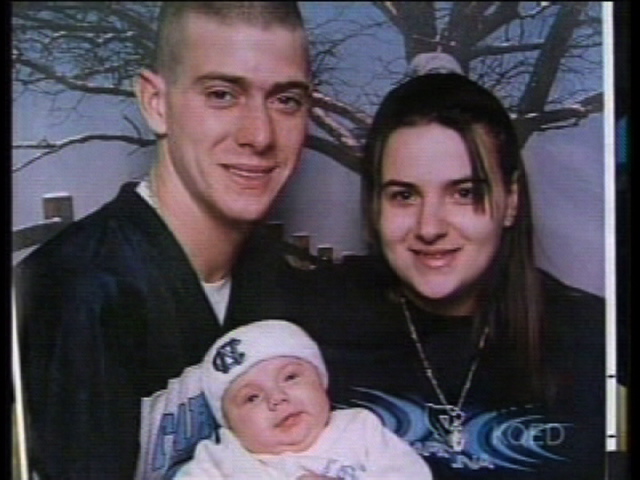
Jason Stiffler was manning a watch tower in Afghanistan when it fell out from under him. It's still unclear whether it was an engineering failure, an attack, or friendly fire. Whatever the cause, he fell 25 feet and suffered seizures at the scene and eventually went into a coma. He suffered serious spinal cord injuries and other injuries. He was quadraplegic for some time after the accident, eventually regained limited use of his legs after months of physical therapy, although it still causes him great pain to move.
A year ago October, he was released from the hospital and placed on the Army's temporary duty list, which meant he was now eligible for medical care and payments from the Department of Veterans Affairs. The Stifflers say they waited for promised phone call from the VA that never came. With his physical and mental condition deteriorating, Jason visited the regional VA hospital in Ft. Wayne, which had no record of him and was only able to offer limited assistance and care.
As David Brancaccio puts it: "Jason Stiffler, badly wounded veteran of America's War On Terror, was on his own."
Background on the complete video of the segment:
This story focuses on several families whose fathers put their lives on the line to go fight in Iraq, and were injured in combat. Upon returning home, they were given little or no medical or financial support whatsoever, and were told to seek handouts to get by.
Excerpt from David Brancaccio's introduction:
..another young vet from the 101st airborne came home to a different kind of reception, one that was to leave him and his family nearly destitute.Jason Stiffler followed a boyhood dream into the army at the age of 18. He was eager to defend his country. In return, he assumed it would take care of him.
"It was part of the agreement that we made on March 23, 01, when I signed up. I specifically remember that day because it was the first thing I asked. 'If anything happens to me, will I be taken care of?' Oh yeah, yeah, just sign right here."...
"There was a timeframe when I wasn't getting paid nothing." (Stiffler)
"How did you make ends meet during that time?" (Brancaccio)
"You know what they told us? 'Churches,' 'family,' 'friends,' 'welfare.'" (Stiffler)
Here's some technical information about getting quicktime going to watch these movies.
The Story Of The Stiffler Family (Small - 10 MB)
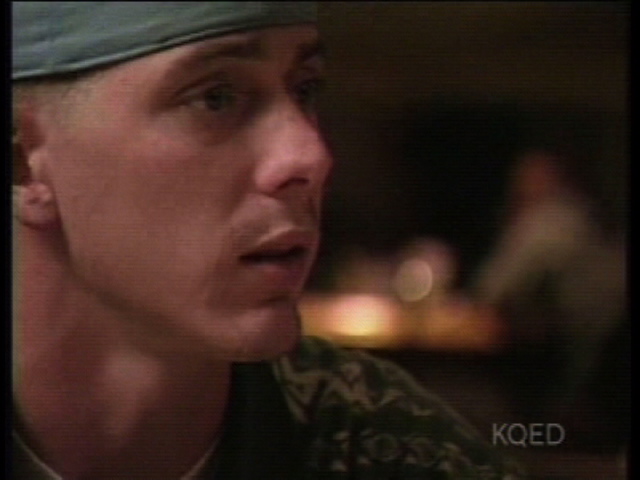
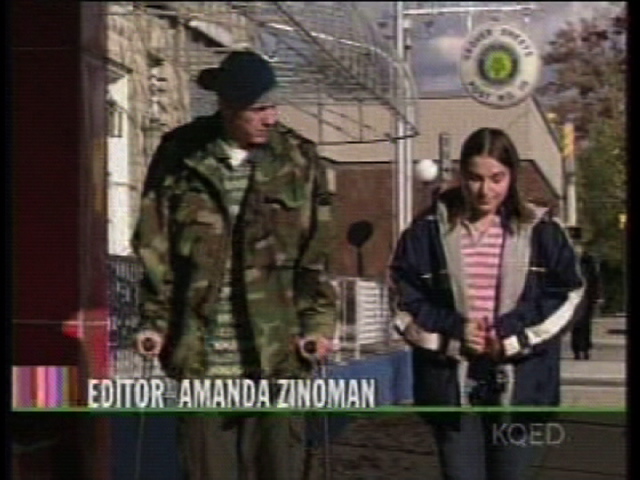
This story aired on NOW With Bill Moyers on November 7, 2003.
This story, "Coming Home," was Produced by Dan Klein and features correspondent David Brancaccio. It was Edited by Amanda Zindman.
This story focuses on several families whose fathers put their lives on the line to go fight in Iraq, and were injured in combat. Upon returning home, they were given little or no medical or financial support whatsoever, and were told to seek handouts to get by.
This is available in one big 38 MB clip and in three smaller clips for easier downloading off small connections. I've also transcribed portions and am including some info with the pictures.
I've also put up some clips of one of the families, the Stifflers, that was featured in this segment.
Here's some technical information about getting quicktime going to watch these movies.
Bill Moyers On Mistreated Vets - Complete (Small - 38 MB)
Bill Moyers On Mistreated Vets - Part 1 of 3 (Small - 12 MB)
Bill Moyers On Mistreated Vets - Part 2 of 3 (Small - 16 MB)
Bill Moyers On Mistreated Vets - Part 3 of 3 (Small - 11 MB)
Excerpt from Bill Moyers' introduction:
"In Iraq, for every soldier killed, 7 are wounded. 1,300 since May 1st. That's twice as many as were wounded during the war itself. The New Republic reports that nearly every night, under the cover of darkness, ambulences meet C-17 and C-141 transport planes flying into Andrews airforce base to ferry the wounded to military facilities. The government hasn't wanted us to see them, but that's beginning to change as the numbers mount and as journalists keep insisting on knowing who are these wounded and what's happening to them."
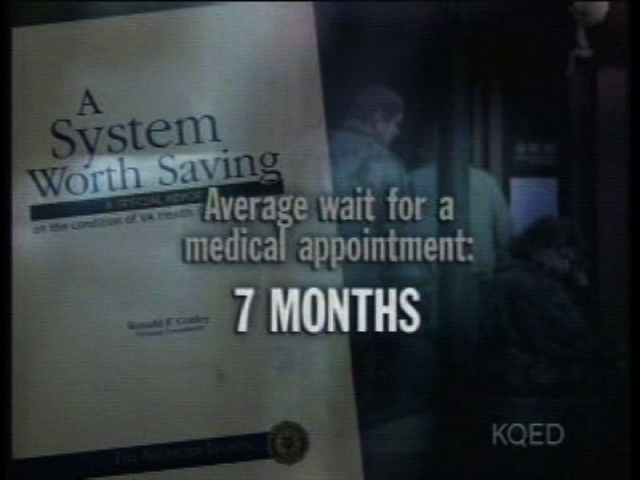
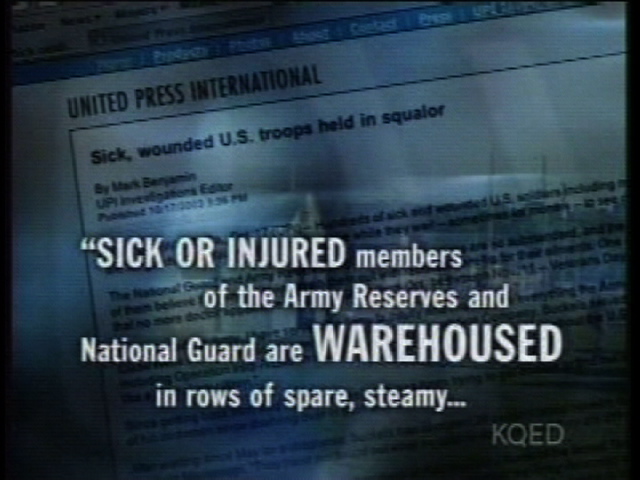
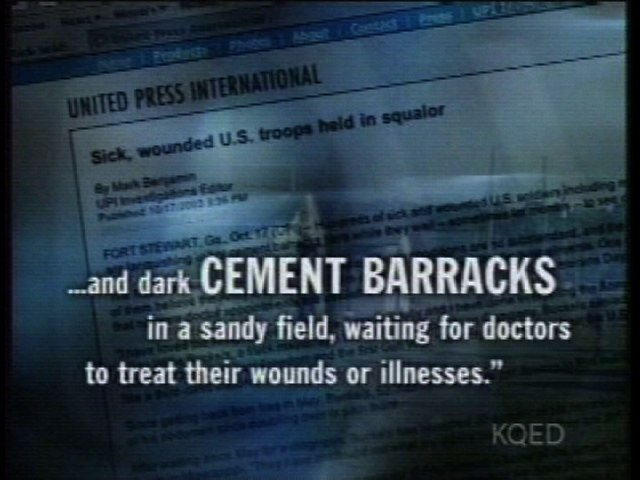
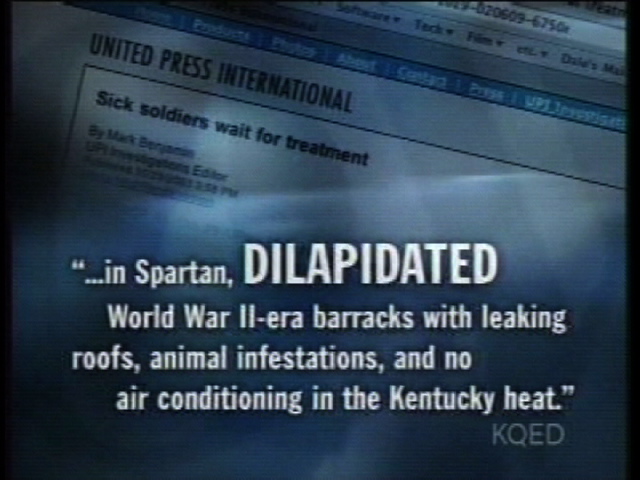
This is from the November 2, 2003 program of Meet the Press.
Rumsfeld: The Casualties Are Worth Winning This War (Small - 3 Mb)
Tim Russert:
"So far, we have lost 377 Americans in Iraq. 2,130 have been wounded or injured.
How would you explain to the American people this morning that it is worth that price for the war in Iraq."
Donald Rumsfeld:
"Tim, the uh, battle we're engaged in. The global war on terrorism. Is an important one. It is a different one than we've been in previously. Although terrorism's not new. But the nature of terrorism is that its purpose is to terrorize. Its purpose is to alter people's behavior. And to the extent free people end up behaving in a way that is different from the way free people behave, they've lost. And therefore, the only thing to do is do what the President has announced he's doing, and that is to take the battle, the war on terrorism to the terrorists. Where they are. And that's what we're doing. We can win this war. We will win this war. And the President has every intention of staying after the terrorists and the countries that harbor terrorists until we have won this war."
Just to clarify again -- These stories are not about our soldiers not getting proper medical treatment on the front lines. They are about Shrub War Veterans not getting propers medical treatment upon returning home.
But wait! It's worse than that. Upon re-reading the article, I see that many of these soldiers had existing health problems that should have prevented them from being deployed in the first place. I also see that many of them were forced to reside in substandard housing, and received injuries from incidents like the roof falling in on their own barracks, rather than in active combat.
I hope the citizens of our armed forces can remember this experience long enough to vote the Shrub out next year.
"I joined to serve my country," said Cpl. Waymond Boyd, 34. He served in Iraq with the National Guard's 1175 Transportation Company. He has been in medical hold since the end of July."It doesn't make any sense to go over there and risk your life and come back to this," Boyd said. "It ain't fair and it ain't right. I used to be patriotic." He has served the military for 15 years.
Boyd's knee and wrist injuries were severe enough that he was evacuated to Germany at the end of July and then sent to Fort Knox. His medical records show doctor appointments around four weeks apart. He said it took him almost two months to get a cast for his wrist, which is so weak he can't lift 5 pounds or play with his two children. He is taking painkilling drugs and walks with a cane with some difficulty.
Many soldiers at Fort Knox said their injuries and illnesses occurred in Iraq. Some said the rigors of war exacerbated health problems that probably should have prevented them from going in the first place.
Boyd's X-rays appear to show the damage to his wrist but also bone spurs in his feet that are noted in his medical record before being deployed, but the records say "no health problems noted" before he left...
Sgt. Buena Montgomery has breathing problems since serving in Operation Iraqi Freedom. She said she has been able to get to doctors but worries about many others who have not.
"The Army did not prepare for the proper medical care for the soldiers that they knew were going to come back from this war," Montgomery said. "Now the Army needs to step up to the plate and fix this problem."
In nearly two dozen interviews conducted over three days, soldiers also described substandard living conditions -- though they said conditions had improved recently.
A UPI photographer working on this story without first having cleared his presence with base public affairs officials was detained for several hours for questioning Tuesday and then released. He was told he would need an Army escort for any further visits to the base. He returned to the base accompanied by an Army escort on Wednesday.
This reporter also was admonished that he had to be accompanied by an Army public affairs escort when on base. The interviews had been conducted without the presence of an escort.
After returning from Iraq, some soldiers spent about eight weeks in Spartan, dilapidated World War II-era barracks with leaking roofs, animal infestations and no air conditioning in the Kentucky heat.
"I arrived here and was placed in the World War II barracks," one soldier wrote in an internal Fort Knox survey of the conditions. "On the 28th of August we moved out. On 30 Aug. the roof collapsed. Had we not moved, someone would be dead," that soldier wrote...
"They are treating us like second-class citizens," said Spc. Brian Smith, who served in Operation Iraqi Freedom until Aug. 16 and said he is having trouble seeing doctors at Fort Knox. The Army evacuated him through Germany for stomach problems, among other things. "My brother wants to get in (the military). I am now discouraging him from doing it," Smith said.
"I have never been so disrespected in my military career," said Lt. Jullian Goodrum, who has been in the Army Reserve for 16 years. His health problems do not appear to be severe -- injured wrists -- but he said the medical situation at Fort Knox is bad. He said he waited a month for therapy. "I have never been so treated like dirt."
Sick soldiers wait for treatment
By Mark Benjamin
UPI Investigations Editor
Published 10/29/2003 3:58 PM
View printer-friendly version
FORT KNOX, Ky., Oct. 29 (UPI) -- More than 400 sick and injured soldiers, including some who served in Operation Iraqi Freedom, are stuck at Fort Knox, waiting weeks and sometimes months for medical treatment, a score of soldiers said in interviews.
The delays appear to have demolished morale -- many said they had lost faith in the Army and would not serve again -- and could jeopardize some soldiers' health, the soldiers said.
The Army Reserve and National Guard soldiers are in what the Army calls "medical hold," like roughly 600 soldiers under similar circumstances waiting for doctors at Fort Stewart, Ga.
The apparent lack of care at both locations raises the specter that Reserve and Guard soldiers, including many who returned from Iraq, could be languishing at locations across the country, according to Senate investigators.
Representatives from the office of Sen. Kit Bond, R-Mo., were at Fort Knox Wednesday looking into conditions at the post.
Following reports from Fort Stewart, Senate investigators said that the medical system at that post was overwhelmed and they were looking into whether the situation was Army-wide.
Army officials at the Pentagon said they are investigating that possibility. "We are absolutely taking a look at this across the Army and not just at Fort Stewart," Army spokesman Joe Burlas said Wednesday.
"I joined to serve my country," said Cpl. Waymond Boyd, 34. He served in Iraq with the National Guard's 1175 Transportation Company. He has been in medical hold since the end of July.
"It doesn't make any sense to go over there and risk your life and come back to this," Boyd said. "It ain't fair and it ain't right. I used to be patriotic." He has served the military for 15 years.
Boyd's knee and wrist injuries were severe enough that he was evacuated to Germany at the end of July and then sent to Fort Knox. His medical records show doctor appointments around four weeks apart. He said it took him almost two months to get a cast for his wrist, which is so weak he can't lift 5 pounds or play with his two children. He is taking painkilling drugs and walks with a cane with some difficulty.
Many soldiers at Fort Knox said their injuries and illnesses occurred in Iraq. Some said the rigors of war exacerbated health problems that probably should have prevented them from going in the first place.
Boyd's X-rays appear to show the damage to his wrist but also bone spurs in his feet that are noted in his medical record before being deployed, but the records say "no health problems noted" before he left.
"I don't think I was medically fit to go. But they said 'go.' That is my job," Boyd said.
Fort Knox Public Affairs Officer Connie Shaffery said, "Taking care of patients is our priority." Soldiers see specialists within 28 days, Shaffery said and Fort Knox officials hope to cut that time lag.
"I think that we would like for all the soldiers to get care as soon as possible," Shaffery said.
Shaffery said of the 422 soldiers on medical hold at Fort Knox, 369 did not deploy to Operation Iraqi Freedom because of their illnesses. Around two-thirds of the soldiers at Fort Stewart did serve in Operation Iraqi Freedom.
Soldiers at Fort Knox describe strange clusters of heart problems and breathing problems, as did soldiers at Fort Stewart and other locations.
Command Sgt. Major Glen Talley, 57, is in the hospital at Fort Knox for heart problems, clotting blood and Graves' disease, a thyroid disorder. All of the problems became apparent after he went to war in April, he says. He is a reservist.
Talley said he was moved to Fort Knox on Oct. 16 and had not seen a doctor yet, only a physician's assistant. His next appointment with an endocrinologist was scheduled for Dec. 30.
"I don't mind serving my country," Talley said. "I just hate what they are doing to me now." Talley has served for 30 years. He was awarded two Purple Hearts in Vietnam.
Sgt. Buena Montgomery has breathing problems since serving in Operation Iraqi Freedom. She said she has been able to get to doctors but worries about many others who have not.
"The Army did not prepare for the proper medical care for the soldiers that they knew were going to come back from this war," Montgomery said. "Now the Army needs to step up to the plate and fix this problem."
In nearly two dozen interviews conducted over three days, soldiers also described substandard living conditions -- though they said conditions had improved recently.
A UPI photographer working on this story without first having cleared his presence with base public affairs officials was detained for several hours for questioning Tuesday and then released. He was told he would need an Army escort for any further visits to the base. He returned to the base accompanied by an Army escort on Wednesday.
This reporter also was admonished that he had to be accompanied by an Army public affairs escort when on base. The interviews had been conducted without the presence of an escort.
After returning from Iraq, some soldiers spent about eight weeks in Spartan, dilapidated World War II-era barracks with leaking roofs, animal infestations and no air conditioning in the Kentucky heat.
"I arrived here and was placed in the World War II barracks," one soldier wrote in an internal Fort Knox survey of the conditions. "On the 28th of August we moved out. On 30 Aug. the roof collapsed. Had we not moved, someone would be dead," that soldier wrote.
Shaffery said all of the soldiers have moved out of those barracks. "As soon as we were able to, we moved them out," Shaffery said. The barracks now stand empty and have been condemned.
Also like Fort Stewart, soldiers at Fort Knox claimed they are getting substandard treatment because they are in the National Guard or Army Reserve as opposed to regular Army. The Army has denied any discrepancies in treatment or housing.
"We have provided, are providing, and will continue to provide our soldiers -- active and Reserve component -- the best health care available," Army spokesman Maj. Steve Stover said Oct. 20. He said Army policy provides health care priority based on a "most critically ill" basis, without differentiation between active and our Reserve soldiers.
"Medical hold issues are not new and the Army has been working diligently to address them across the Army," Stover said.
"They are treating us like second-class citizens," said Spc. Brian Smith, who served in Operation Iraqi Freedom until Aug. 16 and said he is having trouble seeing doctors at Fort Knox. The Army evacuated him through Germany for stomach problems, among other things. "My brother wants to get in (the military). I am now discouraging him from doing it," Smith said.
"I have never been so disrespected in my military career," said Lt. Jullian Goodrum, who has been in the Army Reserve for 16 years. His health problems do not appear to be severe -- injured wrists -- but he said the medical situation at Fort Knox is bad. He said he waited a month for therapy. "I have never been so treated like dirt."
This disorganized operation continues to needlessly rip apart the lives of many a dedicated individual. This story really drives the point home.
The kicker for me was to learn that the troops themselves are expected to buy the supplies for the goose chase!
Mommy's Back From Iraq
By John E. Bugay Jr. for the Post Gazette.
My wife, Sgt. Bethany Airel, was a Reserve medic in the 203rd Military Intelligence Battalion, the Army's contribution to the Iraqi Survey Group, the lead entity in the ongoing search for weapons of mass destruction. For what it accomplished, the 203rd probably ought never to have gone. The Pentagon admitted as much in a "secret report" that, thankfully, was reported on by Rowan Scarborough of The Washington Times on Sept. 3: "Weapons of mass destruction elimination and exploitation planning efforts did not occur early enough in the process to allow Centcom to effectively execute the mission. . . . Insufficient U.S. government assets existed to accomplish the mission."We didn't know this in February, when she was activated, when President Bush and his administration were telling us that war with Iraq was imperative to stop Saddam Hussein from distributing his WMDs to terrorist groups that would bring them to America.
Based on reports of a potential "scorched earth" policy by Saddam, Beth spent the next several months training to don her MOPP (Mission Oriented Protective Posture) gear quickly. I never managed to get beyond a debilitating sense of despondency. Nevertheless, I got into a daily schedule of waking the kids for school, packing lunches, seeing them off and then sitting with my 4-year-old daughter while she cried, "I miss Mommy."
February was a "lockdown" month, but as the start of the war was delayed, the lockdowns gave way to something like weekends off for the soldiers, and so each weekend for several weeks the kids and I packed up the van to travel the 280 miles to Aberdeen, Md., where the 203rd was stationed. Each trip was potentially "the last time we might see Mommy for a while," and we treated those weekends with all due reverence. We also spent hundreds of dollars in hotel and travel costs over five such weekends.
Recently there have been reports that soldiers have had to purchase equipment and supplies with their own money, and our family has been no different. We "supported the troops" with the purchase of medical supplies she would need to do her job as a medic, and more mundane items she would need in Iraq, such as a foot locker, a laundry tub, mosquito netting and batteries for flashlights, which the Army didn't provide.
Finally, in mid-April, we did spend our last tearful weekend, and then Beth left for Kuwait and Iraq. The most striking thing about the next few months was the fact that virtually the whole battalion spent all of May and early June in Tallil, near Nasiriyah, "without vehicles, gear, tents, or computers and equipment," as she wrote to me. The people had been sent by plane, the equipment by boat. "I can't understand why we'd have everyone move to Iraq and not be able to do any work."
Beth and I each fell into a deep depression. I went into therapy; she tried to immerse herself in her work. It is often said that soldiers complain about everything and that you shouldn't make much of it. In a letter dated July 7, she wrote, "the country [Iraq] has a way of making you feel raped and lost." As a woman, she doesn't use the word "rape" lightly. The letter was so bad she didn't send it at the time, because she didn't want to worry me. I never received another letter from her, even though she had written once a week or so before that...
It is said that the mood of the soldier depends on the mood of the family at home, but the reverse is true as well. The thought of my wife in a country like Iraq was incredibly hard when I thought it was necessary to defend the country from mushroom clouds over New York.
But in the intervening months, I rarely heard from her, though I knew of her depression. It began to look as if the war was more of a bodybuilding flex designed to satisfy the imperial foreign policy cravings of the hawks in the administration, and, well, that gave the whole thing a different sensation.
Here is the full text of the article in case the link goes bad:
http://www.post-gazette.com/pg/03278/228302.stm
Mommy's Back From Iraq By John E. Bugay Jr Pittsburgh Post-Gazette
Sunday 05 October 2003
One family's story: John E. Bugay Jr. details the experience of staying home with five children while his wife helped in the search for weapons of mass destruction.
Just over two weeks ago, my wife returned to the United States after a six-month tour in Iraq. It wasn't the ecstatic, clamorous kind of homecoming that you may have seen in the news.
Only 15 soldiers returned to the unit that day, and fewer family members showed up, although I was there with our five kids. There was more bumbling around than anything, especially among the military, and it was typical of what I've grown accustomed to in my unhappy association with the U.S. Army. The Army does a lot of things well, but sometimes it does things badly. That can frighten you.
My wife, Sgt. Bethany Airel, was a Reserve medic in the 203rd Military Intelligence Battalion, the Army's contribution to the Iraqi Survey Group, the lead entity in the ongoing search for weapons of mass destruction. For what it accomplished, the 203rd probably ought never to have gone. The Pentagon admitted as much in a "secret report" that, thankfully, was reported on by Rowan Scarborough of The Washington Times on Sept. 3: "Weapons of mass destruction elimination and exploitation planning efforts did not occur early enough in the process to allow Centcom to effectively execute the mission. . . . Insufficient U.S. government assets existed to accomplish the mission."
We didn't know this in February, when she was activated, when President Bush and his administration were telling us that war with Iraq was imperative to stop Saddam Hussein from distributing his WMDs to terrorist groups that would bring them to America.
Based on reports of a potential "scorched earth" policy by Saddam, Beth spent the next several months training to don her MOPP (Mission Oriented Protective Posture) gear quickly. I never managed to get beyond a debilitating sense of despondency. Nevertheless, I got into a daily schedule of waking the kids for school, packing lunches, seeing them off and then sitting with my 4-year-old daughter while she cried, "I miss Mommy."
February was a "lockdown" month, but as the start of the war was delayed, the lockdowns gave way to something like weekends off for the soldiers, and so each weekend for several weeks the kids and I packed up the van to travel the 280 miles to Aberdeen, Md., where the 203rd was stationed. Each trip was potentially "the last time we might see Mommy for a while," and we treated those weekends with all due reverence. We also spent hundreds of dollars in hotel and travel costs over five such weekends.
Recently there have been reports that soldiers have had to purchase equipment and supplies with their own money, and our family has been no different. We "supported the troops" with the purchase of medical supplies she would need to do her job as a medic, and more mundane items she would need in Iraq, such as a foot locker, a laundry tub, mosquito netting and batteries for flashlights, which the Army didn't provide.
Finally, in mid-April, we did spend our last tearful weekend, and then Beth left for Kuwait and Iraq. The most striking thing about the next few months was the fact that virtually the whole battalion spent all of May and early June in Tallil, near Nasiriyah, "without vehicles, gear, tents, or computers and equipment," as she wrote to me. The people had been sent by plane, the equipment by boat. "I can't understand why we'd have everyone move to Iraq and not be able to do any work."
Beth and I each fell into a deep depression. I went into therapy; she tried to immerse herself in her work. It is often said that soldiers complain about everything and that you shouldn't make much of it. In a letter dated July 7, she wrote, "the country [Iraq] has a way of making you feel raped and lost." As a woman, she doesn't use the word "rape" lightly. The letter was so bad she didn't send it at the time, because she didn't want to worry me. I never received another letter from her, even though she had written once a week or so before that.
Chaplains and others I have talked with in the military frequently have said that the families have a more difficult time with deployments than do the soldiers in the field. I don't know if that's the case -- nobody took a shot at me in the whole six months she was over there -- though I did wonder who would cry harder during this deployment, my daughter, who often asked, "Is my Mommy dead?" or my younger sons, who cried when I read Mom's letters to them, or me.
We learned in August that the 203rd had done all it was going to do, after only a month and a half of going full bore, and they received orders to come home, just hours before a general order was given extending all tours to a year.
The next weeks were filled with anticipation and disappointment. Dates were bandied about among family members. August? September? October? Finally I spoke to a sergeant from the unit who told me that she would arrive Saturday, Sept. 20. So I packed the kids and made the trek from Pittsburgh to Aberdeen again. Sure enough, she landed that day, in South Carolina. She arrived in Aberdeen two days later, on Monday, making Saturday and Sunday two of the most maddening days of the whole deployment.
She was given two days off, and so we hurried to the hotel, with Beth still wearing her desert uniform. She had several bags to carry, and my 7-year-old son John, a showman and a gentleman, ran ahead to open the door for her. "Ladies first," he said with a smile.
"I'm not a lady, I'm a soldier," she said. I wondered how long it would be until she became a lady again and not a soldier, but only a few hours later, the kids and I were in a rugby-style scrum with her in the pool. All seven of us in a pack.
It is said that the mood of the soldier depends on the mood of the family at home, but the reverse is true as well. The thought of my wife in a country like Iraq was incredibly hard when I thought it was necessary to defend the country from mushroom clouds over New York.
But in the intervening months, I rarely heard from her, though I knew of her depression. It began to look as if the war was more of a bodybuilding flex designed to satisfy the imperial foreign policy cravings of the hawks in the administration, and, well, that gave the whole thing a different sensation.
Sen. Edward Kennedy has, I think, spoken correctly when he said of this effort in Iraq, "The tragedy is that our troops are paying with their lives because their commander in chief let them down." Someone has let them down, and the buck has got to stop somewhere.
In response, Republican House Majority Leader Tom DeLay suggested that Sen. Kennedy has accused the president of treason. Yet I wonder how Rep. DeLay would feel if his wife had been sent on a mission like this one.
I thank God that my wife made it home safely. But not everyone from that unit returned. A member of the security detachment was killed in a Humvee accident. I don't know how that man's wife feels. I can only imagine how I would feel if my wife had died on a mission that, from the start, was given "insufficient U.S. government assets."
After the outprocessing in Aberdeen, Bethany finally set foot in our home in West Mifflin on Thursday evening, a tired, proud and decorated war veteran, having received an Army Commendation Medal for the work she did in spite of all the adversity. She was ecstatic to arrive, amid the bumbling of the kids, back in the home she thought she was defending. It was a long journey.
Here it is -- straight from the soldiers. What's going on "over there."
I haven't even read it all yet, but it looks worthy of passing on.
I may write about this in more detail if I have time. But, for now, with everything else going on right now, I just didn't want to space on making this available to you in a timely fashion.
Scoop has released a five part interview (Part 1 - with an enlisted man that has over 20 years in the service, Part 2 with a sergeant first class, Part 3 with a very recently disillusioned sergeant, Part 4, Part 5 - no link for 5 yet) with soldiers over in Iraq.
Here's a quote from part one:
“That is one thing the American people still have not really caught on to is the fact that while they were screaming out ‘Support Our Troops’ the current regime makers were fu..ing the military and veterans out of almost every social program and non essential service that would make life easier.”“Bush really fu..ked us while we were gone. We found out about after being in the middle of heavy fighting for several weeks. It was one of the first things I read in Stars and Stripes, and I thought it was a joke because it was just to hard to believe Congress and our leaders would screw us that bad while we were fighting and dying.”
CFTM-- -“Glad you brought that up about counseling because I wasn’t even aware of it. Are you alright to talk about some of the civilian casualties you witnessed and some of the horrifying images you told me about when we first started talking?”
USA-- -“I want to talk about some of the children I saw killed for no reason, maybe it will wake someone up who doesn’t believe it was happening, or that it was very bad. I can tell you I will never forget the screams of the wounded or orphaned kids, or the wailing of the parents who lost their kids. The Iraqis and most Muslims have a very vocal way of mourning the dead by lamenting and wailing for the dead. There is no mistaking a mother or father crying out in pain for the loss of a child. They don’t cry like that unless there has been a death. Sometimes after a bombing raid or an artillery attack you could here hundreds of people wiling and weeping.”
“I have several grown children with grand kids about the age of most of the dead children I saw in Iraq. I also have several kids who are about half grown and I saw a lot of Iraqi children that age wandering around in charge of three or four little ones because their parents were dead.”
“Let me tell you about the cluster bomb raid we saw wipe out a whole bunch of little kids. It looked like they had already lost their parents and were trying to salvage food from a destroyed Iraqi convoy by the side of the road we were on. The kids were way off to the side about half a mile away by then when we got the word that the Iraqi column was going to be hit with cluster bombs and we had to clear the area. We got on the radio and tried to get the air strike stopped but we were told it was too late to get it stopped.”
“We could see the body parts flying up into the air after the bombs hit. It was terrible and we could not do a damn thing but watch it happen and scream into the radio at the dumb sh.t pilot that was dropping the bombs. After the strike was over we went to see if there were any survivors and all we found was bits and pieces of little kids and here and there an arm or leg you could still identify.”
CFTM-- -“Pretty rough stuff to have to see. Did that kind of thing happen a lot?”
USA-- -“More than you can imagine until you’ve seen it over and over again. Man I don’t want to talk about this sh.t anymore. It doesn’t help to talk about it because it just makes me think about it again. I can’t even get any counseling without having to pay for it.”
“Let all those people who support our troops in on that nice surprise that Bush gave us. That’s how much we really mean to Bush, the Department of Defense and all those other stupid assholes who keep saying how good we’re doing over there. Let those patriotic morons go and fight and die for our country. Let them leave their families behind for months and maybe come back home in a box. I’ll be the first one to salute them or honor them when they die.”
“It’s just like Nam was in the beginning. I was twelve when my dad got back and I’ll never forget the pain and agony he lived with the rest of his life. Its kind of what I feel now, I suppose. I never thought I would ever serve in some stuff that’s so much like Nam it isn’t funny. Now I really see what my pop went through, and if I could I would go back in the past a few months, I would go AWOL or turn conscientious objector on them, but it’s too late for that now.”
http://www.scoop.co.nz/mason/stories/HL0310/S00105.htm
Text of part 1
The following interview was with an enlisted man, but someone very high up in the enlisted ranks, with over 20 years of military service. I have promised not to reveal his identity for reasons that he has a family and has been told not to speak to journalists. He told me the Army had put a gag order on him while he was home, and told him they would give him twenty years in prison if he spoke out in any manner against the US or the government.
I took several weeks to finish this interview because of not being able to safely be seen with this individual out of his fears of being caught speaking out.
He asked me to call him USA in all the transcripts of these interviews. I have followed his wishes and tried to write what he said in the manner it was said so as not to lose any impact. At times the interview was very rough and the grammar is not perfect, but I tried to write this in his voice so that he can tell the world how bad it is in Iraq. I truly want you to feel what he has experienced in some way if possible.
CFTM-- “How are you today? Resting I hope?”
USA-- “Can’t sleep for sh..t and I have horrible nightmares when I do sleep. I might be lucky to catch an hour at a time before the nightmares wake me up. I slept easier in the combat then now that I’m away from there. Most awful place I’ve ever been or served duty and I didn’t want to leave my guys. That was the hardest part was leaving the guys I had been leading around and trying to keep out of trouble and alive.”
CFTM-- “Did you see a lot of your buddies get killed? How did it affect you?”
USA-- “How the hell do you think it affected me? I saw over 30 of the men I had to keep safe die, and over 100 get wounded and not come back. I still don’t know if some of the wounded men made it or not. I was never told before I came back home.”
CFTM-- “So it really was awful and as bad as some returning troops have claimed?”
USA-- “It was like a long trip to hell that you knew you might return from. Of course it is as bad as the soldiers say it is. Hell it’s even worse if the truth has to come out. It’s a constant fu..ing nightmare trying to figure out where the guerillas are going to hit, how to keep the civilians calm, and also getting enough water and food to eat. That is one thing the media never really told the Americans about, how bad it was when our convoys weren’t getting through. We had to go to some Iraqi people and trade socks and underwear for some food and a little water.”
CFTM-- “You really did get that desperate because I saw it in the foreign media that the Iraqi civilians had stepped in and fed a whole bunch of troops that had been days without food.”
USA-- -“Yeah, that ain’t no joke about getting help from the civilians right after the invasion. We had a pretty good laugh about that and how the army owed them some money for reimbursement. We would not have starved probably, but when we got the food from the people it made sure we could still operate as a functioning unit. It was a near thing that several guys almost died of dehydration because we ran out of clean water for a few days.”
CFTM-- “Just keep going, I want to hear more about the hardships the military and Bush made you go through. I want the American people to know what a nightmare this war has become and what it’s doing to our service men over there.”
USA-- “Okay, well I can bitch about the problems like food being short and water going bad, but I want to tell people about how bad the attacks on US and coalition forces have gotten in the last month. In the last two weeks I was there we were attacked at least 20 times a day if you count all the shots we heard from random sniper or opportunity attacks. We were losing at least five men a day to injuries and there was at least one of our unit killed every twenty four hours.”
CFTM-- -“So you were getting one a day killed and at least five injured? Did you know many of the guys killed?”
USA-- -“That’s a real dumb fu..ing question to ask me. You know what my rank is, of course I knew them, I was the head NCO for years in our unit. I knew most of the guys who died and I held a lot of hands as they were dying. You tell me that’s not gonna to give you nightmares!”
“I had one guy tell me all he wanted was to see his little daughter; she was born three days after the war started. He died in the sand holding my hand and crying because his daughter would never know him. Tell me that’s fu..ing right. Where was George Bush when this kid was gasping for air and spitting his blood on foreign soil?”
CFTM-- -“I talked to you about this the other day. Do you think George Bush is the wrong man to order troops into battle when he ducked it himself?”
USA-- -“That asshole went AWOL and never showed up for duty and then he has the nerve to take us into two different wars that will be going on for years. I do not believe he should be president of this country, he’s a complete idiot and he’s controlled by madmen with a drive for only profits and getting oil.”
CFTM-- -“I just have to get this straight for the public, you are well educated are you not? I mean you have had years of leadership training and schools right? You sound very well informed and aware of the current lies and manipulations, which I have not found in some other soldiers.”
USA-- -“I have a four year degree in the economics field and I am not a soldier all the time. I am Reservist who just keeps getting caught on long duty assignments. Believe it or not I read authors like Noam Chomsky, Gore Vidal, and Jim Hightower, and went through three copies of ‘Stupid White Men’ by Michael Moore while I was over there. I let people read parts of Mike’s book and they were irate that Bush had screwed us so hard. I had parts of ‘Best Democracy Money Can Buy’ mailed to me because I knew if I had the whole book it would get stolen in a heartbeat.”
CFTM-- -“So you might be quite a bit more aware and well informed about the real reasons for the war that others did not know. I don’t know of many line soldiers reading Greg Palast or Noam Chomsky.”
USA-- -“I guess you’re right and that might be why I am trying to speak out and let the Americans know that they are sending us to be slaughtered. If you don’t mind I am going to cut through all the niceties and get down to why I am going against every oath I took and giving you this interview. I am doing it for the guys still over there and for the ones who are going. If I’m not careful I’ll end up back there for another six months.”
CFTM-- -“Alright tell me what it was really like and don’t skip the gory details. I want people to be shocked and offended enough to realize why you spoke out and what it is doing to our military by sending them over there with blind flag waving and cheers of false victory”
USA-- -“Well the first thing I would like to thank Bush, Cheney, Rumsfeld, and Congress for is that nice huge cut they made to Veterans Benefits as soon as the war started. I am in the Reserves after years of active duty and now I cannot get PTSD counseling or many medical benefits I used to take for granted. I knew I would have the benefits because I was laying my life down for my country. Now my benefits are cut by around 2/3 and I have to go to either group therapy or pay for a private counselor out of my own pocket. What happens when someone like me has been through enormous battle stress and combat fatigue and then comes home to no counseling?”
“I’ll tell you what is going to happen, he will either kill himself or take a bunch of people with him. Some of the guys coming back are going to have gone through the worst time of their lives with their buddies dying and getting hurt, and then they’ll find out they got screwed out of any counseling. It is the greatest disservice America is committing against soldiers who fought for this country and may come back wounded or horribly scarred. Medical services, school aid to dependents, school aid for the vets, all slashed to the bare bones; mental health and drug and alcohol counseling are being eliminated or the waiting lists will be years long for whatever services manage to survive.”
“That is one thing the American people still have not really caught on to is the fact that while they were screaming out ‘Support Our Troops’ the current regime makers were fu..ing the military and veterans out of almost every social program and non essential service that would make life easier.”
“Bush really fu..ked us while we were gone. We found out about after being in the middle of heavy fighting for several weeks. It was one of the first things I read in Stars and Stripes, and I thought it was a joke because it was just to hard to believe Congress and our leaders would screw us that bad while we were fighting and dying.”
CFTM-- -“Glad you brought that up about counseling because I wasn’t even aware of it. Are you alright to talk about some of the civilian casualties you witnessed and some of the horrifying images you told me about when we first started talking?”
USA-- -“I want to talk about some of the children I saw killed for no reason, maybe it will wake someone up who doesn’t believe it was happening, or that it was very bad. I can tell you I will never forget the screams of the wounded or orphaned kids, or the wailing of the parents who lost their kids. The Iraqis and most Muslims have a very vocal way of mourning the dead by lamenting and wailing for the dead. There is no mistaking a mother or father crying out in pain for the loss of a child. They don’t cry like that unless there has been a death. Sometimes after a bombing raid or an artillery attack you could here hundreds of people wiling and weeping.”
“I have several grown children with grand kids about the age of most of the dead children I saw in Iraq. I also have several kids who are about half grown and I saw a lot of Iraqi children that age wandering around in charge of three or four little ones because their parents were dead.”
“Let me tell you about the cluster bomb raid we saw wipe out a whole bunch of little kids. It looked like they had already lost their parents and were trying to salvage food from a destroyed Iraqi convoy by the side of the road we were on. The kids were way off to the side about half a mile away by then when we got the word that the Iraqi column was going to be hit with cluster bombs and we had to clear the area. We got on the radio and tried to get the air strike stopped but we were told it was too late to get it stopped.”
“We could see the body parts flying up into the air after the bombs hit. It was terrible and we could not do a damn thing but watch it happen and scream into the radio at the dumb sh.t pilot that was dropping the bombs. After the strike was over we went to see if there were any survivors and all we found was bits and pieces of little kids and here and there an arm or leg you could still identify.”
CFTM-- -“Pretty rough stuff to have to see. Did that kind of thing happen a lot?”
USA-- -“More than you can imagine until you’ve seen it over and over again. Man I don’t want to talk about this sh.t anymore. It doesn’t help to talk about it because it just makes me think about it again. I can’t even get any counseling without having to pay for it.”
“Let all those people who support our troops in on that nice surprise that Bush gave us. That’s how much we really mean to Bush, the Department of Defense and all those other stupid assholes who keep saying how good we’re doing over there. Let those patriotic morons go and fight and die for our country. Let them leave their families behind for months and maybe come back home in a box. I’ll be the first one to salute them or honor them when they die.”
“It’s just like Nam was in the beginning. I was twelve when my dad got back and I’ll never forget the pain and agony he lived with the rest of his life. Its kind of what I feel now, I suppose. I never thought I would ever serve in some stuff that’s so much like Nam it isn’t funny. Now I really see what my pop went through, and if I could I would go back in the past a few months, I would go AWOL or turn conscientious objector on them, but it’s too late for that now.”
“I damn sure will not go back over there even if they throw me in Leavenworth. I never could understand how a guy could be a conscientious objector until what I just went through. I wish more guys would stand up and tell Bush and the Pentagon they will not fight their war for oil. We should not have to die for these rich bastards profits and enrichment.”
CFTM-- -“Thank you for taking the risk and talking to me. I know there will be other soldiers who can’t speak out who will thank you for having the courage.”
USA-- -“It isn’t about courage it’s a matter of what’s right. This war is killing the poor or middle class American men and women who went in the armed forces to have college or some kind of better future. You don’t see the rich kids joining up or any Senator’s kid dying in Iraq. It’s us little guys who are dying over there or getting disabled for life. Where are the leaders that are supposed to be looking out for the little man? They are elected to look after out interests not the interests of Cheney and Halliburton, or any of the rest of the fat cats piling up the profits while the blood of our soldiers flows over their hands.”
CFTM-- -“Anything else you want to say to America? Any final thoughts or words?”
USA-- -“Yeah! Wake up America! Your sons and daughters are dying for nothing! This war is not about freedom or stopping terrorism. Bring us home now! We are dying for oil and corporate greed!”
*********
- Jay Shaft: Editor, Coalition For Free Thought In Media. EMAIL: freethoughtinmedia2@yahoo.com WEB: http://groups.yahoo.com/group/coalitionforfreethoughtinmedia/
http://www.scoop.co.nz/mason/stories/HL0310/S00116.htm
text of part 2:
The following interview was with a Sergeant First Class in the United States Army. He has been deployed both in Afghanistan and most recently in Iraq in Falujah and in Kirkuk, which have been the heart of Iraqi resistance and attacks on US forces.
He tells an especially heartrending story of being ordered to fire on Iraqis who were demonstrating against US occupation and were throwing rocks out of anger and frustration. He also tells a story of watching his best fiend die under hostile fire and not being able to do anything about it.
This interview is written in his own words and I have tried to leave it as intact as possible so that his pain and anger can come through to you the reader. I will warn you that the language is very rough and the grammar is not always correct.
He has asked to be called Trooper 1 in all transcripts of these interviews. I have taken as much caution as possible to preserve his identity so that he is not punished, and so that his family will not feel any reprisals from the US government. His biggest fear is that his family and friends will consider him unpatriotic and not supportive of the US as a country.
I have changed some minor details in his story to futher ensure that the military does not try to find him.
He still believes in the dream this country used to stand for and is torn about saying anything bad about it and it’s leaders out of a beaten in loyalty to the military and a repeatedly reinforced sense of duty to this nation above all else.
CFTM-- “Hey how’s it going today? You feeling any better since I talked to you the last time?” (CFTM Editors note: The first time I tried to get this interview he broke down in tears and could not compose himself enough to talk about what he had gone through. It is a very humbling experience to have a grown man put his head on your shoulder and cry like a small child. I have had this happen almost every time I have started to have these soldiers talk about the horrors of Iraq and relieve some of the built up pain, hostility, and sense of loss. This fact alone should convince anyone with doubts about how bad the troops have it over there.)
Trooper 1-- “I think I can make it through this time. I really had it finally hit me the other day about how many of my friends I saw die, and all the other terrible sh*t I saw. I am starting to cry right now thinking about it all over again. You must think I’m a big fu**ing baby breaking down like this.”
CFTM-- “Man there is no shame in feeling pain and hurt. I don’t think any less of you for it. In fact you might need to cry it out and get rid of some of the hurt. No matter what you say or how much you cry, I will not think any less of you. This is what I want people to read about, the fact that a battle hardened soldier is so devastated by what he has gone through.”
Trooper 1-- “Thanks man, you don’t know how much it means that you don’t laugh at me or think I’m a pu..y. I had a fu..ing combat support REMF (rear echelon mother fu..er ) laugh at me when I was coming home. I was on a MAC (Military Airlift Command) flight and this asshole that had been in Doha, Qatar and not even seen any combat was making fun of me. I almost killed him, if it hadn’t been for the loadmaster I probably would have strangled him with my bare hands or stuck him with my knife. I was not in any mood to take some non-combat, skate duty piece of shits harassment or laughing. I put my life on the line and this fu..er was gaming on me.”
CFTM-- “So he actually had the nerve to make fun of you when you cried over all the buddies you lost? Wow that took a lot of guts on his part. Did that happen to you more than once?”
Trooper 1-- “No that was the only time, but it really pissed me off and I still am kinda ma at that jerk. But everyone else was real supportive and I was flying with a bunch of guys who had been in some serious firefights and been ambushed and attacked a whole bunch of times. That one guy almost got his ass kicked by about 30 hard ass, salty dogs. Hey let’s change the subject. You want me to talk about how bad it was there and I got to get it off my chest.”
CFTM-- “My first question is whether you are going to be able to get any counseling if you need it? I have been told by several guys that it has been cut off for all reservists. Have you been offered any therapy services or PTSD counseling?”
Trooper 1-- “Well I am in a real weird situation because I am still considered active duty even though I am home right now. I am only going to be here for a month or so and I think I will either be training guys about to go over, or else return to Iraq or Afghanistan myself. I have tons of combat experience and training and there is a shortage of cadre that can train the reservists that have just been reactivated. Some of those units haven’t been fully activated since Desert Storm.”
“I think I can be of better use to those guys than going back over to fight again. I had my share of that and I don’t know if I can handle it again. I lost it a couple times and if it hadn’t been for my bro who gave me some good tranquilizers I might have lost it completely. I want to make sure the new reserves are ready for the fight and know exactly what they are in for.”
CFTM-- “Not to put to much stress on it, but do you think you will need counseling or therapy? I think it is important for Americans to know just how bad it is mentally for the troops.”
Trooper 1-- “Yeah I think I will need some kind of PTSD support or seasons. I am having terrible nightmares and I have flashbacks when I hear loud noises, and if a car back fires or I hear a firecracker, I am down on the ground in combat cover ready to shoot a rifle I still think I am carrying. I was in combat situations for over two years without any break except for a two week R and R at Christmas. I am not ready to be back stateside, but here I am.”
“There are going to be a lot of guys coming back home who are used to being on high alert 24-7. It is hard to stand down after being shot at everyday for months on end. There really is no moment in Iraq where there is a relaxation time. It is impossible to get even an hours time to be stress free. You always have to be on alert or guard mount because the Iraqis will attack you when you least expect it.”
“Hell they caught us with our pants down a few times at first, but we got wise to that and never let our guard down after the first few ambushes and rocket attacks. Even on full alert they still killed a bunch of us and wounded a god awful number of our soldiers.”
CFTM-- “How many guys did you lose in Iraq and how many did you have wounded and evacuated? Also did you ever here about the wounded dying after they were airlifted to Germany or a hospital ship? The reason I ask is that an officer with a MASH unit said if the soldier died outside of Iraq they weren’t counting it as a combat death. I heard that is one way they are keeping the combat death count down and hiding some battle deaths after they are airlifted.”
Trooper 1-- “God man you really ask the painful questions don’t you. If I didn’t know you were doing this to expose the real truth and try to bring us home, I would have to kick your ass for making me feel the hurt all over again.”
“Man we lost so many I started losing track. I didn’t want to think about it after a while and I pushed it out of my mind when I didn’t have to make out reports or change our strength maintenance figures. We lost over 300 guys to death or severe injury when I was there, and that is only the ones I know about. There were times when I was out on some scout missions and we lost guys from the main battle group and the reports would be done by the time I got back to the unit.”
“I was there when my best friend got it though. I almost wish I had been out on a patrol or scout mission because I wouldn’t have had to hold his head up while he coughed up his own guts. He took three 7.62s(AK-47 rounds) to the abdomen and it took him a long time to die. It felt like hours, but it was probably only ten or fifteen minutes at the most. It just felt like an eternity while he fought for his life. We couldn’t get a dust off (evac chopper) vectored in in enough time, he died about a minute before the chopper landed. That almost blew my mind right out. It took me a week before I could stop shaking and freezing up.”
“I had been in the same unit as him from the beginning of my first permanent party assignment. I had served in different units for a while, but we ended up in the same brigade in Afghanistan. He was in another company as a platoon sergeant and we fought side by side across Afghanistan and Iraq. I can’t believe he caught it like that. I mean this war is really meaningless and all about oil. So my best friend bought it for some rich guy like Dick Cheney or George Shultz!”
(George Shultz is the former President of Bechtel Corp,. and still a serving board member, and former U.S. Secretary of State under Ronald Reagan. For some real dirt on Bechtel’s connections to the Pentagon and State Department check this out-- Bechtel's Friends in High Places http://www.corpwatch.org/issues/PID.jsp?articleid=6548 )
“I know it is supposed to be our duty to fight for this country and die if necessary, but this Iraq war is total bullshit. A bunch of Bush’s buddies, and even Bush himself are getting rich as hell off of us dying and getting hurt. I could see the reasons we are in Afghanistan and I did my duty there, but this is completely different. Iraq is not safer or any freer under our rule. The people hate us and want us to get the fu.k out of their country and leave them alone.”
“For every one of us that dies for no reason the whole country ought to get out and protest and riot. That is one thing I’ve seen the Iraqis do very well. When we kill some of their people they come out by the thousands and make it known that they are pissed and won’t tolerate it any more.”
“That is what all the American people need to do. Every time the Pentagon gets one of us killed they need to riot and protest in the streets. If they did that maybe Rumsfeld and those assholes like Wolfowitz and Perle would think twice about letting another one of our troops die in combat. Maybe they would bring us home. Until the American people stand up and say ‘NO MORE DEAD SOLDIERS!’ they will keep butchering us like sheep!”
CFTM-- “Okay, well I guess that answers any questions I was going to ask about how you feel about the current regime lining their pockets at the expense of our troops lives. One thing I was going to ask is how you feel about the fact that there is only one US Senator or Congressman that has a son or daughter serving in Iraq or Afghanistan?”
Trooper 1-- “I think every godda.. senator’s son or daughter that is serving military age ought to be forced to go over to Iraq and serve in a front-line unit. If the leaders of America are going to send us over to die for oil and a bunch of fat cats to profit from our deaths, then they should send their own fu..in sons and daughters. No one should be able to get their kid an exemption or enable their child to get out of doing what they say is our duty.”
“If it’s our duty to die in Iraq ,Afghanistan, or any where there is a battle against US forces, then their children have a duty to serve and die too. I don’t think it’s fair that none of the sliver spoon in mouth fu..in little spoiled brats are dying for this country. Everyone of the guys I was with came form either a poor or middle class working background. None of them had the colleges and trust funds given to them. I don’t think a lot of our guys would be serving right now except for the lack of any other future that looked brighter.”
“Most of them got sucked in when they were in high school and knew they couldn’t afford to pay for college or just didn’t want to go. Some guys knew they weren’t smart enough to go to college, but the Army can always find a place for you.”
CFTM-- “You had told me about an incident where you were told to fire on Iraqi protesters who were throwing rocks at your unit during a hug demonstration. Can you give me some details about that and who ordered you to fire into the crowd?”
Trooper 1-- “ I will talk about this a little bit, but I don’t really want to. There was more than one time we were told to fire into a crowd of protesters or during demonstrations. I will tell you about the one time I talked about already and you can make it out any way you want. I just watched a show about something like we went through, I think it was Frontline(it was Frontline) and really got the picture of how bad it must have been for the Iraqis that have been fired on during protests.”
“I don’t want to go into to much detail about this because it is still being investigated by the Army. The situation briefly was that there was a large crowd of demonstrators gathered to protest an incident from the day before when another unit had shot into a crowd of protesters. There had been about 20 killed the day before, but we never heard a total body count just some reasonably accurate sounding numbers.”
“We were on the ground on one side of a large square where the main body of the protesters had gathered. They were yelling and screaming at one of the appointed Iraqi council members and getting very out of control. They were mad at the fact the council had not denounced the Americans and told them to leave Iraq. It was getting very ugly and I was spit on and struck in the helmet and about the head and shoulders by a small group of women. Let me emphasize that again, we were being attacked by a group of women and maybe three or four men.”
“As far as I could see they had no firearms or bombs. They did have rocks and pieces of paving stones and asphalt. As the crowd got more and more outraged, more US troops started arriving , which seemed to anger the civilians even more. We were a real living symbol of all their hurts and injuries that had been inflicted on them by our bombs ,missiles, tanks, artillery, and guns. For the first time since the war started they had a target for all their hate and anger right there in front of them. I don’t know who started the rock throwing but after the first one was thrown the whole crowd started throwing their rocks and whatever scraps and trash they could find in the vicinity.”
“I got hit by several rocks in the face and head and then the rest of my body was hit a bunch of times. As far as I could tell the first gunshot was from an American M-16. I know the sound of our rifles very well and I can tell the sound even in a full scale firefight so the sound of one shot was very clear to me. I know it was not an AK-47 or 74. There is no way it could have been a 7.62mm round. They have a much lower sound and the Kalashnikov rifles make a distinctive clack as they are fired.”
“I have heard those rifles fired so many times I know the sound in my sleep. It was one of our guys that got nervous and cranked off a round. After the first shot we heard someone screaming on the radio to open fire. A few of our guys started firing and then most of the rest of us started shooting. At some point in the confusion I heard an AK open up and then another one. It didn’t sound close, but we couldn’t really tell.”
“That is all the details I really feel right giving you. I know one thing though. The commanders later claimed we were fired on from the crowd. That’s bullshit and a bunch of us know it. It started with a bunch of angry women and some men throwing rocks, and it ended with at least 15 dead and over 30 wounded. I saw a small girl laying on the ground with a hole in her head and some more wounds in her back and side. She did not have anything to do with the crowd, she was down the street trying to find food or something.”
“That’s all I’ll give you on that. I don’t want to get in any trouble or have anyone think I helped kill innocent people.”
CFTM-- “Well I think I got enough for this interview. I really want to thank you for doing this, I know how much they have tried to stop you from speaking out. I know about the threats and intimidations they have used to keep you guys quiet.”
“ Anything else you want to say as a final statement to America?”
Trooper 1-- “Yeah I really want to make sure they don’t think I am unpatriotic or a traitor. I did this because of how bad it is over there. We are getting slaughtered and wasted for nothing. If there was a real reason to be over there anymore I would go right back. There is no reason right now, they say we are rebuilding Iraq, but I didn’t see it.”
“Every time I hear Bush or Rumsfeld or anyone else like Paul Bremer talk about all the progress we have made I picture all the Iraqi kids going hungry. They would mob our convoys trying to get our M.R.E.s or the emergency relief food packs we carry for them. Iraq is going to hell and all the little kids are starving and dying from their injuries they got during the war.”
“There is not enough medicine or antibiotics to keep them form getting gangrene or stop the diarrhea they get from bad water. Most of the people are drinking sewage or water contaminated with shit or oil. Months later and they still haven’t fixed the water supply or helped them get parts to fix the pumps. I saw kids dying everyday because they had the shits so bad they wasted away to nothing.”
“My best friend is dead and so are a whole bunch of my friends and fellow soldiers. I just want to say one more thing to America.”
“Get us the fu.. out of Iraq! Don’t let another one of us die or get injured. How many disabled vets and dead fathers and mothers do you want on your conscience? How much more blood can you get on your hands George Bush??? How many more Iraqis do we have to kill and then live with their blood on our hands?”
“Bring us home now!!! Tell your Senators to stop giving Bush money for this carnage. If you demand that we come home they will have to listen. At least I hope they would, they are supposed to have our best interest at heart!”
“Fuck you George Bush, Dick Cheney, Donald Rumsfeld, Colin Powell, Paul Wolfowitz, Paul Bremer, and all then rest of you sorry assholes! Why don’t you come fight this war if you think it’s right?”
*********
- Jay Shaft: Editor—Coalition For Free Thought In Media. EMAIL: freethoughtinmedia2@yahoo.com WEB: http://groups.yahoo.com/group/coalitionforfreethoughtinmedia/
******
http://www.scoop.co.nz/mason/stories/HL0310/S00142.htm
text of part 3:
The following interview is with a sergeant in the U.S. Army who until recently has been completely dedicated to the cause of the US and 100% patriotic by his own definition. He said he has never had the reason or want to question the government or the validity of his mission in the Army.
This interview is written in his own words and I have tried to leave it as intact as possible so that his pain and anger can come through to you the reader. I will warn you that the language is very rough and the grammar is not always correct.
This interview is somewhat different than the last two, as he was very hostile towards me and not very cooperative in many respects. The last two interviews were with soldiers who had been completely disillusioned, but this sergeant has not given up hope that Iraq can be turned around, although he was not able to really say how.
He has asked to be simply called Sarge in all the transcripts of these interviews. He had one wish, and that was that no one would think that he had sold out to the left wing. He says he remains strongly Republican and as he said “A red blooded American soldier!”
**********
CFTM -- “I know you do not really want to do this and I will make it as quick as possible. I think that this interview can help convince those soldiers trying to maintain a sense of duty and loyalty to speak out without compromising their beliefs.”
Sarge -- “ Whatever man. I really don’t want to do this but I talked to my friend and he said you did him right when you showed him the written copy. I am telling you if you misquote me or add anything to this I will find you and kill you. I’m not kidding, I will put you in the ground if you lie about what I said.”
CFTM -- “I am doing this to bring out the truth about how bad it is in Iraq and what you guys are going through. I just want to give you guys a voice and outlet for all your pain and suffering. I am doing this to try to get America to ask Bush to bring you all home.”
Sarge -- “Whatever man. It better not come out wrong or I know a whole bunch of guys that will line up around the block to kick your ass to sleep. I am not going to threaten you anymore, just remember that when you write this down. You better not change one fu..ing word.”
“Now what do you want to ask me. You better not try to make me go against my oath of duty or give you stuff that is classified, or shit that’s not right to talk about.”
CFTM -- “Okay let’s get to it. I know that you were in some serious combat and I want to get an idea of how many times a day you were attacked or fired upon. You already refused to give the area you were in so we’ll keep this vague like you wanted.”
Sarge -- “Damn right we’re gonna keep it vague, I don’t want anyone in my unit or my parents knowing I talked to you. I am only doing this because I know there is a bunch of shit wrong with the way we are running Iraq and how we are being ordered to fight. I love my country and I am proud to be an American soldier. Don’t you even think about making it look like I am ashamed of what I did or what I am going back to do.”
“I always wanted to be in the military since I was a little kid. I would always dress up like a soldier and play war and at Halloween I was always a soldier. My dad was in the service for over 20 years and I grew up on bases around the world. My dad would drop dead right now if he knew I was talking to you.”
CFTM -- “Are you sure you want to do this? I can always get someone else to talk to me.”
Sarge -- “Don’t be an idiot, you stupid asshole! If you waste my time I will beat you down! I went out of my way to meet with you and talk about this, don’t you dare disrespect me now. All you are is a fu..ing peace loving hippie shithead, but my buddy says you are ok, so I am trusting him, not you.”
“I’ll talk to you up to a certain point and then when I want to stop this it’s over. You better ask some good questions and get it done with. I need to get this done and over, so I stop feeling guilty for speaking out.”
CFTM -- “The first thing I want to find out about is this gag order I have heard about. Did they really tell you not to speak to the press on penalty of up to twenty years in Leavenworth? I have had several guys tell me about being told not to say anything against the government or anything negative about Iraq. Is this really true or did someone just play with me?”
Sarge -- “I have not been directly ordered not to talk but it was sometimes a part of our general weekly briefing that we got. I know that the Army has been going after the guys that got on the computer and made big statements about dying for oil. I thought they were stupid assholes at first but I am slowly changing my mind after seeing all the guys die and hearing all the W.I.A(wounded in action) reports.”
“You know that for every one of us killed there are about eight or nine wounded? It’s not the combat casualties that are really sapping our strength, it’s losing all those men to injuries and illness. I think my unit had a very high death toll, but I don’t know how high. I know we lost at least fifteen since the start of the ground war.”
“So I can see why those guys are getting on the Internet and bitching about what is happening. I know a lot of guys were pissed that we didn’t have enough Kevlar body armor and we were really short on some stuff like chemical suits, water and food sometimes.
CFTM -- “Did you guys ever run out of food or water? How bad was it really?”
Sarge -- “Man we ran out of water a bunch of times and it’s hot as fu.k over there. It is like 130 in the direct sun with the sand reflecting the sunlight. It was getting so hot in our vehicles during the day that some guys had to be evaced for heatstroke and dehydration. It is like a furnace inside a Bradley or an Abrams tank. Fu.k, it got so hot sometimes inside them that water would almost boil. If you left the top off your canteen it would be empty in less than an hour from evaporation.”
“Food got real short a couple times and we did run out of food twice. If you live on M.R.E.s (meals ready to eat, the staple of the Army on the go) for months at a time, real food almost makes you sick, it’s so rich compared to that dried out shit in a plastic pouch. Those new meals are supposed to be so great, but they fu..ing suck after the first week or so. ”
“I had a big juicy steak for my first stateside meal and it made me sick. I still ate another one right away because it tasted so fu..ing good. I had some beer that night and got shit faced drunk and I forgot all about the war for a few hours. I have been drinking almost non-stop and I hope I don’t become a drunk.”
CFTM -- “Let’s get into the way Bush seems to want to get you guys killed. I know you heard the whole “Bring It On!” speech and the controversy surrounding it. Did you see any increased fighting after he made that speech?”
Sarge -- “Fu..ing Bush may as well have just come right out and said ‘Please kill our soldiers, we want you to attack them and send them home wounded or in a body bag’. When I heard that shit I started to lose my faith in him as my leader. It is hard for me to think that way, but that’s how I am thinking now. What the f...k was he thinking when he went and did that? he had to know that it would just piss off all the Iraqis and make them want to attack us even more.”
“Bring it on? Why the hell would any commander in chief ever say some shit like that??? Is he that stupid or is his staff the ones who are stupid? Right after he said that bullshit we started getting hit almost every time we were in a convoy. It was like he waved a red flag and they started really trying to kill us twice as much then. We were getting shot at and ambushed at least ten times a day if not more. I saw a few guys get hit and it fu..ed me up pretty bad, I knew a few and it sucked that they had no chance to fight back.”
“I really started thinking this war might not be completely right for the first time after a couple weeks of getting hit everyday and watching guys get hurt really bad. My biggest fear is that I will get shot or have a bomb blow us up, and I end up in a wheel chair or missing an arm or leg.”
(Here is a list of wounded on each day as reported by CentCom and it is not a complete list by any means. http://lunaville.org/warcasualties/WndByDate.aspx
Here is an index of dead and wounded also provided by CentCom which also is not complete by any means http://lunaville.org/warcasualties/Summary.aspx
and also this is a daily listing of deaths of both combat and non-combat deaths http://lunaville.org/warcasualties/Details.aspx )
“We’re going to have a whole new crop of disabled vets and families without fathers and mothers now. That is one of the reasons I am even talking to you.”
CFTM -- “So conditions were getting really bad before you left?”
Sarge -- “ Man conditions suck some major ass right now. Morale sucks, people are committing suicide, the Iraqis hate us and want us all dead, it’s hot as hell and the food sucks, it just is not fun or even near being nice. I have to go back and I am going to do it because it’s my duty and I wouldn’t want to do anything else. I want to be in the military and I am proud to be in Iraq. I just want it to really mean something more than what it does know.”
“I have not seen any rebuilding or anything like the US and Bush promised all the Iraqi people. That is one of the reason they are so pissed off and hate us like they do. We haven’t started to do shit to really help them, not like we the mission we were supposed to be there to do.”
“I am a Republican and proud of that to. I voted for Bush and I want him to lead this country against our enemies like he promised. I never thought a few months ago that I would be saying this to anyone. I wanted to go to Iraq and do what had to be done. I would have volunteered if I hadn’t had my unit ordered over. Now I wonder why I was so quick to get on the big bandwagon.”
“I am a red blooded American soldier and I am proud of my country. I just think Bush needs to change the way we are fighting this war. Give us more men to do the job or figure out how to keep the peace over here. I didn’t sign up to be a fu..ing cop or a peace keeper, I joined up to fight and to protect and defend my country. I never thought I would be acting like a cop in Iraq and not being able to figure out who was my enemy.”
CFTM -- “So you’re not mad at Bush or the rest of his cabinet, or anyone at the Pentagon? Some guys I talked to hate the whole regime and want to get a new commander in chief.”
Sarge -- “Hell no, I don’t hate them and I’m a little angry with them but it is over all the guys that have died in this war that we might have been able to keep alive. I have to live with whoever our leaders are, that is my duty as a soldier. I will say it again, I love America and think it’s the best country in the world. Anyone who says something else is gonna have to fight me.”
“You know I think you hate being an American, and you make me sick! You damn protester and commie scum. I’m done wasting my time talking to you, you are the most unpatriotic asshole I have ever met. Fu.k off and die!”
CFTM -- “Thanks for your time and courage in giving me this interview. I just want to see all you guys come home safe.”
Sarge -- “Well at least you have some kind of sense and maybe you aren’t all bad, I just think you should support the US. I am going home now, remember what I said about changing a single word I said to you. Not one mistake or I will find you! God Bless America, love it or leave it asshole!”
***********
- Jay Shaft: Editor—Coalition For Free Thought In Media. EMAIL: freethoughtinmedia2@yahoo.com WEB: http://groups.yahoo.com/group/coalitionforfreethoughtinmedia/
Part 4:
http://www.scoop.co.nz/mason/stories/HL0310/S00194.htm
Text of part 4:
The following interview is with another Sergeant who is not really happy about the fact that he feels it is necessary to have to question his commander in chief and chain of command. One of the only reasons he is speaking out is that he feels helpless when faced with the enormous task of trying to get the American public to see the plight of the average soldier serving in Iraq or other combat zones. He feels that there is no possible way to do this while complying with military protocols or by remaining within the chain of command structure.
He said his biggest fear is that some die hard patriotic American will find out who he is and harass his family while he is far away from home.
This interview is written in his own words and I have tried to leave it as intact as possible so that his pain and anger can come through to you the reader. I will warn you that the language is very rough and the grammar is not always correct. I have changed nothing that he said, and if any editing had to be done, it was with his knowledge and permission.
I will say that I have taken the liberty of changing some minor personal details and facts so as to better protect is identity and safeguard his family as well. He has gone through enough at the hands of the government to get harassed by anyone who does not like his words or statements.
He has asked to be called GI in the transcripts and copies of this interview.
One important thing to know about this hero, who is used to serving without question, is that his wife went to Bring Them Home rallies and peace demos by anti-war groups and military family support groups. During the first weeks of the war his wife was out on the front lines at many protests. She had a really horrifying experience with some supposedly "patriotic" Americans who spit on her and verbally and physically attacked both her and her young son.
All the while this soldier was putting his life on the line in Iraq, his wife was very vocal about the unjust nature of this war and fighting to get him and all the other troops returned home safely and without any death. Sadly many soldiers and innocent Iraqis have died despite the outcry of almost 100 million peace minded and anti-war activists.
To be able to talk to a man whose wife was a protester was a great opportunity to see how a military career man would respond to the fact that his family had sided with what the right wing was calling the enemy of all soldiers, and the anti-patriotic lunatic fringe. All of us who demonstrated our support for the soldiers in our own way, by wanting them to come back home uninjured and intact in mind and body, were presented to the troops as their most hated enemy and the scourge of America.
I saw the mental struggle he was going though and the battles he was fighting in his mind over what was really his duty, and how to express his confusions and fears for his life and those of all the other troops. The quandary he felt between what had been beaten into him by countless training and regimen was being washed away by the blood and chaos of a war that in his mind was the new Vietnam. To have the blood of innocents, especially children was eating him up inside, and the chain of command is offering no help to all the soldiers experiencing the internal struggle.
There has been many soldiers who have fought this battle and come out of it with the dedication to tell the truth and let the world know of the endless slaughters and senseless wasting of troops lives. They are like so many sacrificial lambs to the slaughter for the enrichment of private robber barons like the conglomerate owners who are reaping the no bid contract from the no-con regime of Bush.
Haliburton, Bechtel, SY Coleman Missile Technologies (the first interim transitional Iraqi leader Jay Garner was the company president before his selection to lead the redevelopment process in Iraq), General Electric (makers of bomb components, missile guidance technology, and the medical machines that were used to x-ray and scan the victims broken bodies after GE technology targets and drops bombs on them), Raytheon, Vinnell Corp, Kellogg Brown and Root, General Dynamics, Boeing, and all the rest of the corporate giants who are raking in the cash at the expense of our troops lives and those of the innocent civilians
The voices of those being most affected, our own demoralized troops, are finally being heard in many media outlets. I had to go with this series and publish it after seeing the fake form letters that were sent out to the newspapers. This is my effort to give the man in the crosshairs of Bush’s military industrialization expansion a voice that will echo around the world and tell the true story.
Here now is more truth and reality from the mouth of a man who has been there and is still fighting his own moral battles about his rethinking all his ideals and basic principles. It is painful and hard hitting as nothing I have ever had the experience of writing. I have detailed some hard and grim issues in my writing career, but this is my grimmest and most saddening issue I have done so far.
America these are your fighting soldiers, give them the respect of listening to how it really is. They are speaking out, are you listening??????
CFTM -- "How are you doing? Are you enjoying your break from the war?"
GI -- "Well I can’t complain about being home for a while. I am trying to enjoy the short time I have with my family and eating ice cream all the time with my little boy. You don’t realize how much the simple things mean till you go without them for a while. I have been dreaming about ice cream for months and in all that heat and sand, and it kept me going to think about eating a big bowl with my son. The first thing I did was go to the store and buy about ten gallons of it in every flavor I’ve been wishing for."
"It’s fu..ing weird how something so simple as ice cream can make you cry. I sat there with my son the first night and just cried and ate ice cream. He didn’t understand why his daddy was crying and laughing and hugging him. I never thought I would see him again, and my wife thought I was coming back in a bag. I have a little girl and she started walking and talking while I was gone."
"Fu..ing war made me miss the first words and her first steps, and everything I should have seen. I have a tape of it but that ain’t the fu..in same as being there. Nothing will ever be able to give me that back. You can’t ever get that fu..ing back. I want to be there for all the things she has been doing,, but I will be in Iraq for a long time from the way this sh.ts going."
"If I go back over and die who’s gonna raise my daughter. She needs a daddy now and it’s not fair to my wife that she has to do it all by herself. I almost hate her for being able to be there for all them special moments that I’m gonna miss. That another scary thin since I got here. I don’t know how to talk to my wife anymore, and my daughter don’t even know me. She calls my brother daddy and that almost started a fight with him the first night back. I wanted to kick his ass so bad because my little girl is calling him daddy. She don’t know any better and I’m afraid she’ll never get used to me."
"Man I don’t want to die over in that worthless sh..hole and leave my daughter and son behind. My daughter will never remember me if I die! Man, Fuck That! My son needs his daddy, not some fu..er who my wife finds to replace me! That’s why we are so afraid to talk to each other, we don’t want to think about how she is gonna raise the kids if I die."
CFTM -- "Wow man, I don’t know what to say about that. I had all these questions ready and now it kind of seems pointless. How about you just talk to me about some of the things that you’re doing on your leave and I’ll throw in some questions as they come up? That sound okay to you? I really don’t have a set way of doing this, I just try to get your voice down."
GI -- "Man no one wants to hear about how I’m spending my leave. I take long relaxed sh. ts if you really want to know. I haven’t had time to relax when I took a shit for weeks. I go in the shi..er with a magazine and take a long healthy sh.t. I did it with my wife a few times but it sucked, because she’s picturing me dead the whole time. Fu.k, I mean come on man you don’t want to hear sh.t like this. Ask me something important, I got bad vibes even talking to you and you want to ask me how often I shit or something. I got to talk even though it goes against everything I was ever told or taught about the military. I swore a goddamn oath to never question orders from a superior and always do my duty no matter what I felt about it."
"People are going to think I’m a whiny bitch, or that I’m scared to do my duty. I got to tell em what it’s really fu..in like in Iraq right now. Some guys got some major balls going on record but I ain’t gonna have some crazy fu..er who’s all patriotic about the war going after my family. My wife went to a few protests after the war started and she got spit on by some fu..head piece of shit. She had a sign saying that I was in Iraq but this fuck still spit on her and snatched the sign out of her hand. My son was holding a sign that said ‘Bring My Daddy Home Safe’ and one stupid bitch said she hoped I died in Iraq. What the fuck is wrong with these dumb morons now? Two other fu..s said his daddy was a chicken shit and snatched the sign out of his hand and ripped it up. That’s a little kid man, he didn’t understand what was going on. All he heard was some fat lazy fucks calling his daddy a chicken and a coward."
"He knows I’m fighting for the US and he knows I’m a hero because the TV says so. That’s how he knows that daddy might die because his mom lets him watch CNN all the time. He is too young to have to live with the idea of me fucking getting blown away whenever he sees Iraq on TV. Thank good they don’t tell how bad it really is over there. He knows too much about it right now without them even really telling Americans the truth. I’m almost glad they don’t tell the real story for all the kids who have parents in that cluster fu.k. I didn’t want my kid to ever have to see our country fall apart like this. He should never have to see his daddy be put in jeopardy because our asshole president is picking us apart like a piece of meat, with all the fucking vultures fighting for their piece of our asses."
" Man don’t get me started on that shit. I am just a normal average guy who is basically a hard working red-blooded American. I am working class all the way, my dad was a steel worker and a labor rep with a big union. I was raised not to question my government and my leaders. I was always told that the US was the greatest country in the world. And that was without a doubt the lessons all through my childhood, you worked and paid your dues and voted for the one who promised to help the working man."
"I never had a reason to get into any fucking politics or arguments about the country being wrong or at fault for anything. Now my mind won’t fu..ing stop working and thinking maybe I was wrong or else they have really switched sides on us. I don’t know how to really explain what is happening to my beliefs. Anything I ever thought was right and good about this fucked up country is on the line. I am not that smart like with school but I can damn sure read the fu..ing writing on the all this time. I have life experience and this is all feeling so fucking wrong and pointless."
CFTM -- "Let me break in here and say something that might help. I know you were told that your leaders were always right and to follow orders no matter how much you had doubts about them. When did you start to question the thing you were doing and the events you were involved in? What made you change your beliefs and start thinking some things were rotten? What I mean is did it take a while or was it real sudden?"
GI -- "Man you are asking me to really fucking think about that. It ain’t real easy to figure that one out and I really can’t say when it started. I came in the Army when Reagan was the big chief and then after a couple years it was Big Bush. I had no real thoughts back then because I was young and proud to be a soldier. I was really into the whole shoot the fuck out of em and Kill! Kill! Kill! It was natural for me to want to be the best soldier I could be. That’s a real sick fucking joke, Be All That You Can Be, Shit that sounds so dumb. What be the best killing machine you be and wipe everybody out? Right now it’s an excuse to kill everyone that pisses us off. "
"Man I done told you I can’t really have a debate like this with someone that is really aware and educated. You know all this shit about our leaders and we are fighting blind like a fuckin bunch of fucking stupid puppets. I just had it all wear me down to where I am at now, and I am confused as shit. I just wanted to serve my country and fu..ing keep it safe. I didn’t want to be in some shit like we got our dicks stuck in now. I will die for my country if they attack us, but I have seen the real life bloody deaths that just were really not necessary. I have seen the bodies of hundreds of dead Iraqis and a whole sh.t load were little kids. Man I got kids and it would kill me if someone dropped a bomb on them."
"I don’t know how the death of all those kids didn’t get any fu..ing people mad as hell. What the fuck is America thinking right now? If that had happened on our soil there would have been a fucking call to arms and we would have bombed the sh.t out of them fu..ers. Jesus there is some fucked up shit goin down and no one says sh.t about it. I know we lost our own guys and it hurt real bad, but I’ve seen the dead bodies of kids being removed form blown up building. I’ve seen kids with their faces and their arms or legs blown off."
"That was what got me to think really hard about stuff. I just ain’t smart enough to really think all of this through. I mean I have a little tech school and I’m great with my hands, but I feel it better than I can say it. I probably sound like some redneck hick the way I talk, but that’s me, take it or f..k off."
CFTM -- "Okay I really want to get to how you feel about you wife and family being out protesting against the war. I know there are a large amount of troops with their family members protesting the war and joining Bring Them Home, ANSWER- Vote No To War, Not In Our Name, Move On, Military Families Speak Out, Vets For Peace, and many other groups that are trying to get you guys out of there alive and well. Please if you would tell me how you feel about it."
GI -- "Damn man, you are really putting me out there on the spot. I could not believe my wife went out to those protests and joined all those radical people. Man I thought it would get me in deep sh.t with my commanders. I was so afraid the guys in my company would find out about it and kick my ass. She sent me a letter about it and sent some papers about why she was doing it. I about shit my pants when realized she had sent me a fu..ing assload of anti-war flyers. She sent me some stuff, I don’t remember from where on how they were all these military families and veterans protesting against the war. I burned all that sh.t in a quick minute and hoped the Army wasn’t going to come for me. I was afraid they would lock me up for fu..ing good.
"You gotta understand that the ground war was less than two weeks old and my wife is sending me some shit that I thought was just fu..ed up. I saw the peace fags on TV and was pissed of and wanted to see a bomb go off at one of your fu..ing rallies. I didn’t even have to think about that one, it was my own thought, but the military had rammed it in my skull too. We were all hatin’ y’all from the get go, no fu..in question you would have got fragged over here. Not a doubt in anyone’s mind bout that one. Y’all would a lasted about thirty seconds around on of us at the start of the war."
"There were some guys who had families that were on TV doing that shit. They got hell for it and some got smacked up pretty bad for few months. Then we started seeing more and more vets in the protests that we were sent pictures of. One of our Major’s sons was on TV talking about bringing his dad home and why the families were doing it. We got some letters from vets and the protestors telling us they loved us and wanted us home. Tell ya what, it made for good shit paper when we ran out. Guys would fight to see who could wipe their ass on the most letters. Not a lot of love for y’all and for the diehard, macho fucks there still ain’t no love for ya."
"Now it has really fu..in changed over for ya. More and more guys have families that have been protesting, and now it is being at least accepted, maybe not loved, but ya know they are dealing with it. A lot of guys hate being here but still don’t want their families protesting or doing sh.t like that. There is gonna be some serious fights and screamin matches when some guys go home."
" I am not really talking to my old lady because of how bad I treated her for a few months. Hell we almost got a divorce over it, and we are not getting along right now at all. F..k man she supports Palestine and the fu..ing terrorists that blow busses up. How the fuck can anyone support those fu..ers? I can see going out and wanting to protest to bring us home, but protesting for terrorists to be able to kill people? I don’t get it and she tried to explain it to me, but I don’t wanna hear it. F..k that shit man. I don’t care how much you try to explain it to me, it ain’t right to do that. Man I fight for the US and suppose we gotta go back up Israel, will she protest for the fuckers killing us when that happens?"
"That’s another thing that pisses me off about her, man. She just does this shit without even asking me or thinking about me being a soldier and having to deal with my chain of command and the guys in my unit. I see the point and now that I am thinking a little different I can kinda see it. Her protesting for me is all right and I know some guys in my unit who are behind their families doing it. I just have a hard time changing my thinking after so many years and I don’t think I’ll ever get some of this sh.t."
"I love my wife but this shi.t is tearing us apart like hell. Damn she changed while I was gone. Fuckin being around some of them fu..s made her think like she does now. I don’t know if my wife will stay with me and that fu..in sucks ass. It’s fu..ed up that this bullshit is going to cost me my wife, but she just ain’t the same and she treats me so fu..ing different. Man I hate this whole fu..ing war and Bush and all those co..suckers in Washington. I just want to go back to what is was before, no problems with my duty and I never questioned orders."
CFTM -- "To get on to something different, have you seen many guys get killed and wounded? How many were getting hurt and killed.?"
GI -- "Jesus man, they were really fu..ing our sh.t up over there. Everyday we get attacked a whole bunch of times. Every time we go out on patrol, or in convoy, those fu..ers shoot the shit out of us. It is way more than the damn TV is saying, f..in sure thing about that. They are completely full of sh.t on TV. I saw the news tonight an it mad me sick, what fu..ing bulls..t!"
"I only said some of this sh.t so you people would know what the f..k is really goin on, and it ain’t getting better any time soon. I have to go back to that fu.in mess and I am afraid I’m gonna die. I want to come home dammit, I don’t want to have to think shit like that. I know what my orders are and I am supposed to follow them."
"This is some hard sh.t for a lot of us over there to have to say anything. F..k man, we believe in the military and being American and then they get us killed or hurt, why man? What the f..k is is all about? I can’t work it out but our guys our getting f..ked up bad and this war is not gonna end soon. Put me on the line, but make it for sometin I can feel proud of, not a nightmare."
"Oh Christ, I can’t do this anymore. I had enough man, you got me to talk, that’s it for me, done, it’s over."
CFTM -- "It’s okay man, you don’t have to talk anymore. I just want to thank you for telling me what you did. You had a lot of courage to talk about it, and there are a lot of guys who will thank you for doing this."
( CFTM EDITORS NOTE: At this point he started crying and could not stop. I cried a little myself because I could feel his pain, and this whole interview was very painful and emotional. This man was not able to really express all his thoughts in flowing statements, but his emotions and feelings were so evident it hurt me to see it. These are the types of dedicated men and women that will come back from Iraq devastated emotionally destroyed and not knowing exactly why. If this is what we as a nation are willing to do to our troops then what have we become?)
GI -- "Man go away and leave me alone, I don’t want you to see me cry. I never cried since I was a little kid. Cryins for pu..ies and fags, real men don’t cry!"
CFTM -- "Hey it’s okay, hearing you talk about it is bringing tears o my
AWOL State of Mind: Calls From Soldiers Desperate To Leave Iraq Flood Hotline
By Leonard Greene for the NY Post.
Morale among some war-weary GIs in Iraq is so low that a growing number of soldiers - including some now home on R&R - are researching the consequences of going AWOL, according to a leading support group.The GI Rights Hotline, a national soldiers' support service, has logged a 75 percent increase in calls in the last 12 weeks, with more than 100 of those calls from soldiers, or people on their behalf, asking about the penalties associated with going AWOL - "absent without leave" - according to volunteers and staffers who man the service.
Many of the calls have come from soldiers who are among those now on the first wave of 15-day authorized leaves that began almost two weeks ago. Some hotline callers have indicated they may not return, staffers said.
"What would happen if I just don't go back" to Iraq, one soldier asked a worker at a GI support-line center...
So worried is military brass about the prospect of desertion that many soldiers say they have been encouraged to take their leaves in Germany - a stopover - to avoid temptation stateside.
"The military is aware of how low troop morale is," said Teresa Panepinto, program coordinator of The GI Rights Hotline, a service that dates back to the Korean War. "They're concerned these people are going to come home and not go back."...
Panepinto said monthly calls to the hotline have risen from 2,000 to 3,500 in the last three months.
She said many soldiers complained about the length of the Iraq campaign, the rough desert conditions and a U.S. death toll that has risen well above 300, including nearly 180 soldiers killed after President Bush's May 1 declaration that major combat operations in Iraq had ended.
Here is the full text of the article in case the link goes bad:
http://www.nypost.com/news/nationalnews/7316.htm
AWOL STATE OF MIND: CALLS FROM SOLDIERS DESPERATE TO LEAVE IRAQ FLOOD HOTLINE
By LEONARD GREENE
Aaron Garfield with mom Julie.
Email Archives
Print Reprint
October 5, 2003 -- EXCLUSIVE
Morale among some war-weary GIs in Iraq is so low that a growing number of soldiers - including some now home on R&R - are researching the consequences of going AWOL, according to a leading support group.
The GI Rights Hotline, a national soldiers' support service, has logged a 75 percent increase in calls in the last 12 weeks, with more than 100 of those calls from soldiers, or people on their behalf, asking about the penalties associated with going AWOL - "absent without leave" - according to volunteers and staffers who man the service.
Many of the calls have come from soldiers who are among those now on the first wave of 15-day authorized leaves that began almost two weeks ago. Some hotline callers have indicated they may not return, staffers said.
"What would happen if I just don't go back" to Iraq, one soldier asked a worker at a GI support-line center.
"I'm going to shoot myself in the foot," said another, referring to his solution for getting home.
Some soldiers are so desperate that they have called directly from the war zone, contacting the hotline when they can get satellite-phone access or after waiting in line for hours in the desert for a military phone.
So worried is military brass about the prospect of desertion that many soldiers say they have been encouraged to take their leaves in Germany - a stopover - to avoid temptation stateside.
"The military is aware of how low troop morale is," said Teresa Panepinto, program coordinator of The GI Rights Hotline, a service that dates back to the Korean War. "They're concerned these people are going to come home and not go back."
Volunteers throughout the country take live calls and respond to messages left by soldiers who want to know their rights. One call base is in a small office in a building on Lafayette Street in the East Village.
Panepinto said monthly calls to the hotline have risen from 2,000 to 3,500 in the last three months.
She said many soldiers complained about the length of the Iraq campaign, the rough desert conditions and a U.S. death toll that has risen well above 300, including nearly 180 soldiers killed after President Bush's May 1 declaration that major combat operations in Iraq had ended.
Pentagon officials said they had no up-to-date numbers on soldiers who have gone AWOL since the Iraq campaign, but an affidavit that surfaced at a recent court martial for a soldier charged with desertion put the number at more than 50.
Most of those charged were reservists who were activated and did not report, said Steve Collier, a lawyer representing a soldier charged with desertion.
Penalties for going AWOL range from a bad-conduct discharge to a court martial and jail time.
Military officials maintain that morale remains high among soldiers, who are paid more in combat zones, and that authorized leaves are being granted as "an investment in readiness."
Maj. Pete Mitchell, a U.S. Central Command spokesman, said the military code of justice is a significant deterrent to unauthorized absences.
"There is a possibility that somebody would make that decision," Mitchell said. "We're going to extend good faith that people are going to make the right decisions here."
Like the GI Rights Hotline staffers, Manhattan resident Julie Garfield said she would never encourage her nephew, Aaron Garfield, to desert his posting as a reservist in Iraq.
But if he did, she would probably cry tears of joy, she said. Aaron, who has never indicated that going AWOL is an option for him, has been in Baghdad six months.
"If he went AWOL I wouldn't blame him," said his aunt, who has been the significant adult in his life.
"They ripped him away from his life and education. He spent nine months in Bosnia. It's enough already."
In recent e-mails, Aaron says soldier morale is low because reservists are forced to stay while active-duty troops are being allowed to leave, if only for two weeks.
"There is no morale here," he wrote his aunt. "The leadership just doesn't care about us. I don't want anything to do with this mess anymore."
Lt. Gen. James Helmly, chief of the 205,000-mem- ber Army Reserve, warned recently that there could be an exodus of active and reserve forces if the United States fails to get other countries to join the Iraq campaign.
José Alvarez, an Army corporal now on duty in Iraq, has told his wife he will not re-enlist when his obligation ends next year.
He's angry that when his wife, Wendy, suffered a miscarriage recently, his unit refused to grant him an emergency leave.
"I'm definitely getting out," he wrote his wife. "To heck with the Army."
"He hates it and he's not re-enlisting," said Wendy from her home on a military base at Fort Hood, Texas. "He basically has given up."
This was one of the saddest stories I've had the displeasure to read in a long time.
Sick, wounded U.S. troops held in squalor
By Mark Benjamin for UPI
Hundreds of sick and wounded U.S. soldiers including many who served in the Iraq war are languishing in hot cement barracks here while they wait -- sometimes for months -- to see doctors.The National Guard and Army Reserve soldiers' living conditions are so substandard, and the medical care so poor, that many of them believe the Army is trying push them out with reduced benefits for their ailments. One document shown to UPI states that no more doctor appointments are available from Oct. 14 through Nov. 11 -- Veterans Day.
"I have loved the Army. I have served the Army faithfully and I have done everything the Army has asked me to do," said Sgt. 1st Class Willie Buckels, a truck master with the 296th Transportation Company. Buckels served in the Army Reserves for 27 years, including Operation Iraqi Freedom and the first Gulf War. "Now my whole idea about the U.S. Army has changed. I am treated like a third-class citizen."
Since getting back from Iraq in May, Buckels, 52, has been trying to get doctors to find out why he has intense pain in the side of his abdomen since doubling over in pain there.
After waiting since May for a diagnosis, Buckels has accepted 20 percent of his benefits for bad knees and is going home to his family in Mississippi. "They have not found out what my side is doing yet, but they are still trying," Buckels said.
One month after President Bush greeted soldiers at Fort Stewart -- home of the famed Third Infantry Division -- as heroes on their return from Iraq, approximately 600 sick or injured members of the Army Reserves and National Guard are warehoused in rows of spare, steamy and dark cement barracks in a sandy field, waiting for doctors to treat their wounds or illnesses.
The Reserve and National Guard soldiers are on what the Army calls "medical hold," while the Army decides how sick or disabled they are and what benefits -- if any -- they should get as a result.
Some of the soldiers said they have waited six hours a day for an appointment without seeing a doctor. Others described waiting weeks or months without getting a diagnosis or proper treatment...
Soldiers here estimate that nearly 40 percent of the personnel now in medical hold were deployed to Iraq. Of those who went, many described clusters of strange ailments, like heart and lung problems, among previously healthy troops. They said the Army has tried to refuse them benefits, claiming the injuries and illnesses were due to a "pre-existing condition," prior to military service.
Most soldiers in medical hold at Fort Stewart stay in rows of rectangular, gray, single-story cinder block barracks without bathrooms or air conditioning. They are dark and sweltering in the southern Georgia heat and humidity. Around 60 soldiers cram in the bunk beds in each barrack.
Soldiers make their way by walking or using crutches through the sandy dirt to a communal bathroom, where they have propped office partitions between otherwise open toilets for privacy. A row of leaky sinks sits on an opposite wall. The latrine smells of urine and is full of bugs, because many windows have no screens. Showering is in a communal, cinder block room. Soldiers say they have to buy their own toilet paper...
That soldier said that after being deployed in March he suffered a sudden onset of neurological symptoms in Baghdad that has gotten steadily worse. He shakes uncontrollably.
He said the Army has told him he has Parkinson's Disease and it was a pre-existing condition, but he thinks it was something in the anthrax shots the Army gave him.
"They say I have Parkinson's, but it is developing too rapidly," he said. "I did not have a problem until I got those shots."
First Sgt. Gerry Mosley crossed into Iraq from Kuwait on March 19 with the 296th Transportation Company, hauling fuel while under fire from the Iraqis as they traveled north alongside combat vehicles. Mosley said he was healthy before the war; he could run two miles in 17 minutes at 48 years old.
But he developed a series of symptoms: lung problems and shortness of breath; vertigo; migraines; and tinnitus. He also thinks the anthrax vaccine may have hurt him. Mosley also has a torn shoulder from an injury there.
Mosley says he has never been depressed before, but found himself looking at shotguns recently and thought about suicide.
Mosley is paying $300 a month to get better housing than the cinder block barracks. He has a notice from the base that appears to show that no more doctor appointments are available for reservists from Oct. 14 until Nov. 11. He said he has never been treated like this in his 30 years in the Army Reserves...
Another Army Reservist with the 149th Infantry Battalion said he has had real trouble seeing doctors about his crushed foot he suffered in Iraq. "There are not enough doctors. They are overcrowded and they can't perform the surgeries that have to be done," that soldier said. "Look at these mattresses. It hurts just to sit on them," he said, gesturing to the bunks. "There are people here who got back in April but did not get their surgeries until July. It is putting a lot on these families."
Here is the full text of the article in case the link goes bad:
http://www.upi.com/view.cfm?StoryID=20031017-024617-1418r
By Mark Benjamin
UPI Investigations Editor
Published 10/17/2003 3:36 PM
View printer-friendly version
FORT STEWART, Ga., Oct. 17 (UPI) -- Hundreds of sick and wounded U.S. soldiers including many who served in the Iraq war are languishing in hot cement barracks here while they wait -- sometimes for months -- to see doctors.
The National Guard and Army Reserve soldiers' living conditions are so substandard, and the medical care so poor, that many of them believe the Army is trying push them out with reduced benefits for their ailments. One document shown to UPI states that no more doctor appointments are available from Oct. 14 through Nov. 11 -- Veterans Day.
"I have loved the Army. I have served the Army faithfully and I have done everything the Army has asked me to do," said Sgt. 1st Class Willie Buckels, a truck master with the 296th Transportation Company. Buckels served in the Army Reserves for 27 years, including Operation Iraqi Freedom and the first Gulf War. "Now my whole idea about the U.S. Army has changed. I am treated like a third-class citizen."
Since getting back from Iraq in May, Buckels, 52, has been trying to get doctors to find out why he has intense pain in the side of his abdomen since doubling over in pain there.
After waiting since May for a diagnosis, Buckels has accepted 20 percent of his benefits for bad knees and is going home to his family in Mississippi. "They have not found out what my side is doing yet, but they are still trying," Buckels said.
One month after President Bush greeted soldiers at Fort Stewart -- home of the famed Third Infantry Division -- as heroes on their return from Iraq, approximately 600 sick or injured members of the Army Reserves and National Guard are warehoused in rows of spare, steamy and dark cement barracks in a sandy field, waiting for doctors to treat their wounds or illnesses.
The Reserve and National Guard soldiers are on what the Army calls "medical hold," while the Army decides how sick or disabled they are and what benefits -- if any -- they should get as a result.
Some of the soldiers said they have waited six hours a day for an appointment without seeing a doctor. Others described waiting weeks or months without getting a diagnosis or proper treatment.
The soldiers said professional active duty personnel are getting better treatment while troops who serve in the National Guard or Army Reserve are left to wallow in medical hold.
"It is not an Army of One. It is the Army of two -- Army and Reserves," said one soldier who served in Operation Iraqi Freedom, during which she developed a serious heart condition and strange skin ailment.
A half-dozen calls by UPI seeking comment from Fort Stewart public affairs officials and U.S. Forces Command in Atlanta were not returned.
Soldiers here estimate that nearly 40 percent of the personnel now in medical hold were deployed to Iraq. Of those who went, many described clusters of strange ailments, like heart and lung problems, among previously healthy troops. They said the Army has tried to refuse them benefits, claiming the injuries and illnesses were due to a "pre-existing condition," prior to military service.
Most soldiers in medical hold at Fort Stewart stay in rows of rectangular, gray, single-story cinder block barracks without bathrooms or air conditioning. They are dark and sweltering in the southern Georgia heat and humidity. Around 60 soldiers cram in the bunk beds in each barrack.
Soldiers make their way by walking or using crutches through the sandy dirt to a communal bathroom, where they have propped office partitions between otherwise open toilets for privacy. A row of leaky sinks sits on an opposite wall. The latrine smells of urine and is full of bugs, because many windows have no screens. Showering is in a communal, cinder block room. Soldiers say they have to buy their own toilet paper.
They said the conditions are fine for training, but not for sick people.
"I think it is disgusting," said one Army Reserve member who went to Iraq and asked that his name not be used.
That soldier said that after being deployed in March he suffered a sudden onset of neurological symptoms in Baghdad that has gotten steadily worse. He shakes uncontrollably.
He said the Army has told him he has Parkinson's Disease and it was a pre-existing condition, but he thinks it was something in the anthrax shots the Army gave him.
"They say I have Parkinson's, but it is developing too rapidly," he said. "I did not have a problem until I got those shots."
First Sgt. Gerry Mosley crossed into Iraq from Kuwait on March 19 with the 296th Transportation Company, hauling fuel while under fire from the Iraqis as they traveled north alongside combat vehicles. Mosley said he was healthy before the war; he could run two miles in 17 minutes at 48 years old.
But he developed a series of symptoms: lung problems and shortness of breath; vertigo; migraines; and tinnitus. He also thinks the anthrax vaccine may have hurt him. Mosley also has a torn shoulder from an injury there.
Mosley says he has never been depressed before, but found himself looking at shotguns recently and thought about suicide.
Mosley is paying $300 a month to get better housing than the cinder block barracks. He has a notice from the base that appears to show that no more doctor appointments are available for reservists from Oct. 14 until Nov. 11. He said he has never been treated like this in his 30 years in the Army Reserves.
"Now, I would not go back to war for the Army," Mosley said.
Many soldiers in the hot barracks said regular Army soldiers get to see doctors, while National Guard and Army Reserve troops wait.
"The active duty guys that are coming in, they get treated first and they put us on hold," said another soldier who returned from Iraq six weeks ago with a serious back injury. He has gotten to see a doctor only two times since he got back, he said.
Another Army Reservist with the 149th Infantry Battalion said he has had real trouble seeing doctors about his crushed foot he suffered in Iraq. "There are not enough doctors. They are overcrowded and they can't perform the surgeries that have to be done," that soldier said. "Look at these mattresses. It hurts just to sit on them," he said, gesturing to the bunks. "There are people here who got back in April but did not get their surgeries until July. It is putting a lot on these families."
The Pentagon is reportedly drawing up plans to call up more reserves.
In an Oct. 9 speech to National Guard and reserve troops in Portsmouth, New Hampshire, Bush said the soldiers had become part of the backbone of the military.
"Citizen-soldiers are serving in every front on the war on terror," Bush said. "And you're making your state and your country proud."
-0-
Mark Benjamin can be contacted at mbenjamin@upi.com
I'm about to post a bunch of interviews and articles about our mistreated soldiers -- both here at home (as Iraq war veterans start to come home) and our troops that are still over in Iraq.
I hope that you guys understand that I'm just trying to raise awareness about how badly are boys and girls are being mistreated by our own government. Some of this stuff is really shocking and painful to read, so don't read it if you've got to go be upbeat somewhere anytime soon, ok?
No seriously. Read it when you can be alone for a minute, because you're not going to be in a very good mood afterwards. And for a minute, life seems kinda pointless and stuff.
I'm not expressing myself very well right now, most likely, but I did want to preface this next round of articles with a few words:
I'm torn about what to do at this point about Iraq. I realize that "now we're committed" and all that and that "now we just can't pull out and leave the Iraqis hanging" and all that, but if these stories from the troops -- from our own side are true, I wonder if it wouldn't be better to just pull out than to let any more of our troops die for nothing. Or rather, than to let more of them die so that the few entities that are profiting from this war can continue to do so.
I just don't know guys, so I won't pretend to have any answers. But I did think it was important to bring you this next round of information -- for your own edification. You can draw your own conclusions. Maybe you can help me figure it out.
thanks!
This is from the September 14, 2003 program of
Meet The Press, hosted by Tim Russert.
(Link goes to a complete very incomplete transcript.)
Cheney On The Congressional Budget Office's Claims That Our Forces Are Already Overextended (Small - 7 MB)

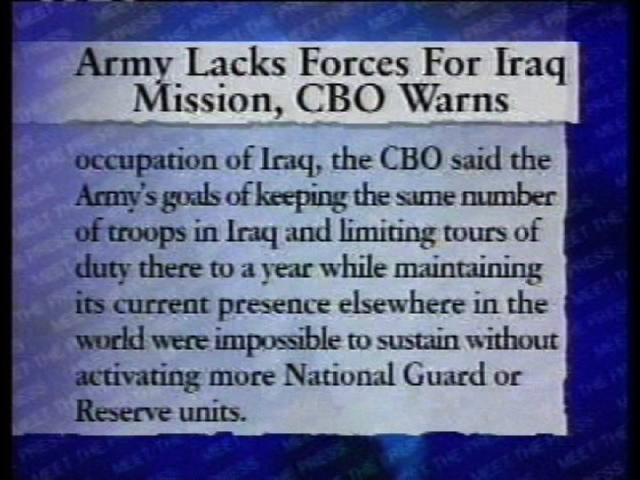
Pentagon may punish GIs who spoke out on TV
By Robert Collier for SF Gate.
But going public isn't always easy, as soldiers of the Army's Second Brigade, Third Infantry Division found out after "Good Morning America" aired their complaints.The brigade's soldiers received word this week from the Pentagon that it was extending their stay, with a vague promise to send them home by September if the security situation allows. They've been away from home since September, and this week's announcement was the third time their mission has been extended.
It was bad news for the division's 12,000 homesick soldiers, who were at the forefront of the force that overthrew Saddam Hussein's government and moved into Baghdad in early April.
On Wednesday morning, when the ABC news show reported from Fallujah, where the division is based, the troops gave the reporters an earful. One soldier said he felt like he'd been "kicked in the guts, slapped in the face." Another demanded that Defense Secretary Donald Rumsfeld quit.
The retaliation from Washington was swift.
CAREERS OVER FOR SOME
"It was the end of the world," said one officer Thursday. "It went all the way up to President Bush and back down again on top of us. At least six of us here will lose our careers."...
"Our morale is not high or even low," the letter said. "Our morale is nonexistent. We have been told twice that we were going home, and twice we have received a 'stop' movement to stay in Iraq."...
Yet several U.S. officers said privately that troop morale is indeed low. "The problem is not the heat," said one high-ranking officer. "Soldiers get used to that. The problem is getting orders to go home, so your wife gets all psyched about it, then getting them reversed, and then having the same process two more times."
In Baghdad, average soldiers from other Army brigades are eager to spill similar complaints.
"I'm not sure people in Washington really know what it's like here," said Corp. Todd Burchard as he stood on a street corner, sweating profusely and looking bored. "We'll keep doing our jobs as best as anyone can, but we shouldn't have to still be here in the first place."
Nearby, Pfc. Jason Ring stood next to his Humvee. "We liberated Iraq. Now the people here don't want us here, and guess what? We don't want to be here either," he said. "So why are we still here? Why don't they bring us home?"
Here is the full text of the article in case the link goes bad:
http://sfgate.com/cgi-bin/article.cgi?f=/c/a/2003/07/18/MN248299.DTL
Pentagon may punish GIs who spoke out on TV
Robert Collier, Chronicle Staff Writer Friday, July 18, 2003
Fallujah, Iraq -- Morale is dipping pretty low among U.S. soldiers as they stew in Iraq's broiling heat, get shot at by an increasingly hostile population and get repeated orders to extend their tours of duty.
Ask any grunt standing guard on a 115-degree day what he or she thinks of the open-ended Iraq occupation, and you'll get an earful of colorful complaints.
But going public isn't always easy, as soldiers of the Army's Second Brigade, Third Infantry Division found out after "Good Morning America" aired their complaints.
The brigade's soldiers received word this week from the Pentagon that it was extending their stay, with a vague promise to send them home by September if the security situation allows. They've been away from home since September, and this week's announcement was the third time their mission has been extended.
It was bad news for the division's 12,000 homesick soldiers, who were at the forefront of the force that overthrew Saddam Hussein's government and moved into Baghdad in early April.
On Wednesday morning, when the ABC news show reported from Fallujah, where the division is based, the troops gave the reporters an earful. One soldier said he felt like he'd been "kicked in the guts, slapped in the face." Another demanded that Defense Secretary Donald Rumsfeld quit.
The retaliation from Washington was swift.
CAREERS OVER FOR SOME
"It was the end of the world," said one officer Thursday. "It went all the way up to President Bush and back down again on top of us. At least six of us here will lose our careers."
First lesson for the troops, it seemed: Don't ever talk to the media "on the record" -- that is, with your name attached -- unless you're giving the sort of chin-forward, everything's-great message the Pentagon loves to hear.
Only two days before the ABC show, similarly bitter sentiments -- with no names attached -- were voiced in an anonymous e-mail circulating around the Internet, allegedly from "the soldiers of the Second Brigade, Third ID."
"Our morale is not high or even low," the letter said. "Our morale is nonexistent. We have been told twice that we were going home, and twice we have received a 'stop' movement to stay in Iraq."
The message, whose authenticity could not be confirmed, concluded: "Our men and women deserve to be treated like the heroes they are, not like farm animals. Our men and women deserve to see their loved ones again and deserve to come home."
After this one-two punch, it was perhaps natural that on Thursday, the same troops and officers who had been garrulous and outspoken in previous visits were quiet, and most declined to speak on the record. During a visit to Fallujah, a small city about 30 miles west of Baghdad, military officials expressed intense chagrin about the bad publicity. And they slammed the ABC reporters for focusing on the soldiers' criticism of Rumsfeld, Bush and other officials and implying that they are unwilling to carry out their mission.
COMPLAINTS CALLED ROUTINE
"Soldiers have bitched since the beginning of time," said Capt. James Brownlee, the public affairs officer for the Second Brigade. "That's part of being a soldier. They bitch. But what does 'bad morale' really mean? That they're not combat-ready or loyal? Nobody here fits that definition."
The nervousness of the brass has a venerable history. It has long been a practice in American democracy that the military do not criticize the nation's civilian leaders, as Gen. Douglas MacArthur found out in 1951, when he criticized President Harry Truman's Korean War strategy -- and was promptly fired.
Yet several U.S. officers said privately that troop morale is indeed low. "The problem is not the heat," said one high-ranking officer. "Soldiers get used to that. The problem is getting orders to go home, so your wife gets all psyched about it, then getting them reversed, and then having the same process two more times."
In Baghdad, average soldiers from other Army brigades are eager to spill similar complaints.
"I'm not sure people in Washington really know what it's like here," said Corp. Todd Burchard as he stood on a street corner, sweating profusely and looking bored. "We'll keep doing our jobs as best as anyone can, but we shouldn't have to still be here in the first place."
Nearby, Pfc. Jason Ring stood next to his Humvee. "We liberated Iraq. Now the people here don't want us here, and guess what? We don't want to be here either," he said. "So why are we still here? Why don't they bring us home?"
E-mail Robert Collier at rcollier@sfchronicle.com.
Political Veteran
By Peter Carlson for The Washington Post.
Last fall, Cleland voted for the resolution authorizing President Bush to attack Iraq, but now he feels he was bamboozled."I voted for it because I was told by the secretary of defense and by the CIA that there were weapons of mass destruction there," he says. "The president said it, Colin Powell said it, they all said it. And now they can't find them! Our general over there, who has no dog in this fight, he said he sent troops all over the place and they found two trailers and not much of anything else. So we went to war for two trailers?"
The war in Iraq is beginning to look awfully familiar to Max Cleland.
"Now wait a minute," he says. "Let me run this back: We have a war. A bunch of Americans die. After the war, we try to figure out why we were there. There's a commitment of 240,000 ground troops with no exit strategy. You know what that's called? Vietnam! Hey, I've been there, done that, got a few holes in my T-shirt."
Here is the full text of the article in case the link goes bad:
http://www.washingtonpost.com/wp-dyn/articles/A1464-2003Jul2.html
Political Veteran
By Peter Carlson
The Washington Post
Thursday 03 July 2003
Max Cleland Survived His Vietnam War Wounds. But He Has Yet to Recover From His Last Campaign Battle.
In his new job, Max Cleland is supposed to get young people all fired up with idealistic zeal for politics, but that won't be easy. These days, Cleland, a Georgia Democrat defeated in his bid for reelection to the Senate last fall, is angry, bitter and disgusted with politics.
"The state of American politics is sickening," he says.
Cleland has come full circle. In 1963, he arrived at American University's Washington Semester Program as a naive student and left dreaming of a career in the Senate. Now, after six years in the Senate, he's back at the Washington Semester Program, this time as a "distinguished adjunct professor.''
But he lost a few things along the way. In 1968, he lost his right arm and both legs in Vietnam. Last fall, he lost his Senate seat in a campaign that became a symbol of nasty politics.
Cleland, 60, is still livid over a now-infamous TV commercial that Republican challenger Saxby Chambliss ran against him. It opened with pictures of Osama bin Laden and Saddam Hussein, then attacked Cleland for voting against President Bush's Homeland Security bill. It didn't mention that Cleland supported a Democratic bill that wasn't radically different.
"That was the biggest lie in America -- to put me up there with Osama bin Laden and Saddam Hussein and say I voted against homeland security!" he says, his voice rising in anger.
"I volunteered 35 years ago to go to Vietnam and the guy I was running against got out of going to Vietnam with a trick knee! I was an author of the homeland security bill, for goodness' sake! But I wasn't a rubber stamp for the White House. That right there is the epitome of what's wrong with American politics today!"
He's sitting in a booth in the Ruby Tuesday restaurant near his office at American University, his wheelchair leaning against a wall nearby. A salad and a glass of water sit on the table but he ignores them as he continues to vent. He's mad about the campaign but he's even madder about the war in Iraq.
Last fall, Cleland voted for the resolution authorizing President Bush to attack Iraq, but now he feels he was bamboozled.
"I voted for it because I was told by the secretary of defense and by the CIA that there were weapons of mass destruction there," he says. "The president said it, Colin Powell said it, they all said it. And now they can't find them! Our general over there, who has no dog in this fight, he said he sent troops all over the place and they found two trailers and not much of anything else. So we went to war for two trailers?"
The war in Iraq is beginning to look awfully familiar to Max Cleland.
"Now wait a minute," he says. "Let me run this back: We have a war. A bunch of Americans die. After the war, we try to figure out why we were there. There's a commitment of 240,000 ground troops with no exit strategy. You know what that's called? Vietnam! Hey, I've been there, done that, got a few holes in my T-shirt."
Washington, 1963
When the subject changes to his days in the Washington Semester Program back in 1963, Cleland's voice softens and his eyes light up.
"I was tall, tan and tantalizing," he says, smiling. "I was 21 years old and the world was my oyster."
He was a kid from Livonia, Ga., a mediocre student at Stetson University in Florida, a tennis and basketball jock who'd changed majors twice -- going from physics to English to history. He was drifting through life, he says, until he was accepted into AU's Washington Semester Program, which promised an opportunity to see "government in action."
"I was more interested in action than in government," he says with a lascivious laugh.
He remembers the exact day he arrived -- Sept. 10, 1963. John F. Kennedy was president and Washington seemed like the most exciting place on the planet. Cleland stood on Pennsylvania Avenue to see JFK drive past with Ethiopia's Emperor Haile Selassie. He sat in the Senate gallery and watched debates on civil rights. He saw radical students arrested at a hearing of the House Un-American Activities Committee. And on Nov. 19, 1963, he and some other WSP students were permitted to visit the Oval Office when JFK wasn't around.
Three days later, the president was assassinated. When Cleland heard the news, he hustled to the White House and saw Lyndon Johnson arrive by helicopter. A few days later, he stood on a tombstone at Arlington National Cemetery to see Kennedy buried.
Moved, he decided he'd go into politics, to help continue Kennedy's work.
"I was deeply motivated, really feeling that the torch had been passed to a new generation of Americans," he says. "I was 21, full of vim and vigor and idealism, and I was ready to make my impact on the world."
He graduated from Stetson with a history degree, earned a master's in history at Emory University, then returned to Washington in 1965 as a congressional intern. By then, war was raging in Vietnam, and Cleland, still fired with idealism, joined the Army.
On April 8, 1968, during the siege of Khe Sanh, he stepped off a helicopter and saw a grenade at his feet. He thought he'd dropped it. He was wrong. When he reached down to pick it up, it exploded, ripping off both legs and his right hand. He was 25.
He spent eight months recuperating at Walter Reed Army Hospital. On one of his first trips out of the hospital, an old girlfriend pushed him around Washington in his wheelchair. Outside the White House, the chair hit a curb and Cleland pitched forward and fell out. He remembers flopping around helplessly in the dirt and cigarette butts in the gutter.
He returned home to Georgia in December 1969. "I had no job, no girlfriend, no car, no hope," he says. "I figured this is a good time to run for the state Senate. And politics became my therapy, forcing me to get out of the house and be seen."
In 1970, at 28, he became the youngest person ever elected to the Georgia Senate. In 1977 President Jimmy Carter appointed him to head the Veterans Administration. In 1982 he was elected as Georgia's secretary of state. In 1996 he was elected to the U.S. Senate, defeating businessman Guy Millner in a very close race.
In the Senate, he was a moderate -- liberal on social issues, conservative on fiscal matters. He was a reliable vote for increased military spending, but wary of committing U.S. troops overseas. He criticized President Bill Clinton's bombing of the former Yugoslavia in 1999, saying that was starting to "look like Vietnam." In 2001, he broke with Democrats to vote for Bush's tax cuts.
As the 2002 reelection campaign began, Cleland knew it would be a close race, but he had no idea how nasty it would get.
The Infamous Ad
The Senate was evenly split, with Democrats and Republicans fighting for control. Georgia was a close race, and both parties poured money into the campaign. Bush came to the state five times to campaign for Chambliss, a conservative congressman who'd been elected in the "Contract With America" class of 1994. Both sides ran attack ads, but none was as controversial as Chambliss's homeland security spot.
It opened with pictures of Osama bin Laden and Saddam Hussein. "As America faces terrorists and extremist dictators," said a narrator, "Max Cleland runs television ads claiming he has the courage to lead. He says he supports President Bush at every opportunity, but that's not the truth. Since July, Max Cleland voted against President Bush's vital homeland security efforts 11 times!"
Immediately the ad was denounced, not just by Democrats but also by two Republican senators -- John McCain and Chuck Hagel, both of them Vietnam veterans.
"I've never seen anything like that ad," says McCain. "Putting pictures of Saddam Hussein and Osama bin Laden next to a picture of a man who left three limbs on the battlefield -- it's worse than disgraceful, it's reprehensible."
Irate, Hagel told Republican officials that if they didn't pull the ad, he would make an ad denouncing them. After that, Chambliss's campaign removed the pictures of Hussein and bin Laden from the ad.
"Max Cleland has given as much to this country as any living human being," Hagel says. "To say he is in some way connected to people like Osama bin Laden and Saddam Hussein was beyond offensive to me. It made me recoil, quite honestly."
Asked recently for comment, Chambliss responded through a spokesman that he did not want to discuss the ad or Cleland.
On the eve of the election, polls showed Cleland leading. But they failed to predict a huge turnout by rural white males angered that Democratic Gov. Roy Barnes had removed the Confederate battle emblem from the state flag. Both Barnes and Cleland were trounced.
Surprised and angry, Cleland was devastated by his defeat.
"It was the second big grenade in my life,'' he says. "It blew me up. It happened very quickly and very intensely, and I was left with virtually nothing but my life."
To him, the campaign seemed to symbolize everything wrong with American politics. "When I came to the Senate, I wanted to do the best job I could, but now I found out it doesn't matter what kind of job you do," he says. "It's all about the goal of driving your opponent's negatives up. It's all about trashing the other side."
The day after the election, he flew to the Virgin Islands with his longtime girlfriend, Nancy Ross, and asked her to marry him.
Ross accepted. They have not yet set a date for the wedding. Cleland says he and Ross, a Postal Service executive, have agreed not to discuss their private lives in public. But he did announce the engagement in his farewell speech to the Senate last November.
"I will be married to my fiancee, Miss Nancy Ross, after I retire," he said as she sat in the balcony and blew him a kiss. "There is life after the Senate, and it will be a wonderful life."
That sounded upbeat, but Cleland's friends still worried about him. The usually ebullient Cleland was depressed. The man who'd inspired crowds as a motivational speaker remained morose and despondent for months.
"He was down, just down," says Steve Leeds, an Atlanta attorney and longtime Cleland fundraiser. "I knew how much he hurt and I was concerned for him."
"We could see that he was depressed," says Hagel, "and we tried to rally around him."
In December, Cleland and Ross went to a Washington restaurant for dinner and left Cleland's 1994 Cadillac -- equipped with controls for a handicapped driver -- with a parking attendant. Confused by the controls, the attendant smashed the car into a truck, three other cars and a telephone pole. The Cadillac was totaled.
"It was awful," Cleland says. "It just took me out."
Not long after that, Cleland's old friend T. Wayne Bailey, a Stetson professor, called David Brown, who heads AU's Washington Semester Program. Max is really down, Bailey said, but maybe he'd perk up if he got involved in the Semester Program.
Brown thought that was a great idea. He'd seen Cleland speak to WSP students and he was impressed. So he called Cleland in for a job interview.
Cleland "closed the door and said, 'I'd really like this to be a therapeutic session,' and we talked for an hour and half," Brown recalls. "He really was down. He'd had everything -- a car, a staff and people who took care of him. Now he didn't even have an office. He told me he was using an office in the basement of his apartment building and he said, 'They're gonna take that away to use for a Super Bowl party.' "
Brown offered him a teaching job and Cleland accepted. In the spring semester, he guest-lectured in other professors' classes. This summer, he got a class of his own -- 24 students from around the country who have come here to work as interns at congressional offices and political organizations.
As the first class approached, Cleland was nervous.
"I'm trying to put my life back together," he said, "and one of the ways I'm trying to do it is to get encouragement from young people who come here wanting to be lifted up. Hopefully, we'll lift each other up."
Max's Class
"Let me introduce myself," Cleland said after rolling into class in his wheelchair. "I'm Max."
He wore a white shirt, a blue tie and blue blazer whose right sleeve hung limp and empty. The students wore jeans, shorts, T-shirts. One young woman, working a wad of gum, blew a big pink bubble.
The new teacher explained his pedagogical style: "I don't do lectures," he said. "I just talk a lot."
He announced that he'd provide cookies and coffee for the class, which meets Wednesday afternoons, and recommended frequent snacking.
"Keep your energy up because this is an energy-draining town," he said. "Just being here is draining. Being a target is draining. So keep your energy up."
Things happen fast in Washington, he said, launching into a story about Sept. 11, 2001. He had been sitting in his Senate office with Richard Myers, chairman of the Joint Chiefs of Staff. They were, by pure coincidence, discussing terrorism when the planes hit the World Trade Center and the general was summoned back to the Pentagon, which had not been hit yet.
"You never know what will happen in Washington," he told the class. "In so many ways, it's combat. Sometimes it's low-level combat, sometimes it's high-level. Sometimes you're the target, sometimes you're targeting somebody else. It's a target-rich environment, as they say in the military."
He told stories about his days in the Semester Program in 1963. Some of the stories involved Congress or the White House. Others involved Maggie's, a bar near AU in those bygone days.
"When you said 'Meet me at Maggie's,' " he said, "It was 'Hello, baby! This might be the night!' "
The students cracked up.
Socializing is important, Cleland told them, and he promised the class a social event every week. He appointed Dustin Odham, a Southern Methodist student with a mischievous gleam in his eye, to lead a "recon squad" to find appropriate watering holes.
"You gotta make sure it's safe for the troops," he told Odham, "so you gotta go there first."
Cleland was rolling now. He told stories about Vietnam and the Clinton impeachment trial. He revealed the secret of what goes on in the Senate cloakroom: "They're watching the Braves game." And he offered sage advice for young interns in Washington:
"Make yourself known. Assert yourself a little bit. Everybody else in this town does."
"You'll have rejection. Everybody won't love you. Believe me, I know. It's nothing personal. It's just the way Washington works."
"To build your credibility, you come in early and you stay late. You do a good job and you volunteer for more work. What you want to do is become indispensable."
He'd been talking for well over an hour when he asked the students to answer the question "Why are you here?"
"I wanted to be in Washington," said one.
"I wanted to be where the action is," said another.
"I wanted to learn how interest groups influence government," said Jolana Mungengova, a PhD candidate from Boston University.
"Money," Cleland told her. "That's it. It's all about money, and it's out of control."
The next student was Kasey Jones from Reed College. "I'm sort of an idealist," she said. "I want to change the world and everything, and this is supposed to help me figure out how to do that."
Idealism -- it was the topic he'd been hoping for and dreading since he took this job. He'd thought about it constantly and he knew what he wanted to say. It was the same thing he'd been telling himself since Election Day.
"Let me give you a quote from President Kennedy," Cleland told Jones. "He said, 'I'm an idealist with no illusions.' You'll begin to lose your illusions about things, but that doesn't mean you'll lose your ideals. That's part of life, but it doesn't mean you have to lose your ideals."
The class was scheduled to last from 1 to 3, but at 3:20 Cleland was still going strong and nobody showed any sign of wanting to leave.
"This is gonna be fun," he said, smiling broadly. He'd stripped off his blazer and he sat in shirt sleeves, his eyes bright, his face flushed with enthusiasm. "It's really a joy to see a group of people like you. I need you. We're gonna have a real good time."
"Bring 'Em On?"
A Former Special Forces Soldier Responds to Bush's Invitation for Iraqis to Attack US Troops
By By Stan Goff for Counterpunch.
Yesterday, when I read that US Commander-in-Chief George W. Bush, in a moment of blustering arm-chair machismo, sent a message to the 'non-existent' Iraqi guerrillas to "bring 'em on," the first image in my mind was a 20-year-old soldier in an ever-more-fragile marriage, who'd been away from home for 8 months. He participated in the initial invasion, and was told he'd be home for the 4th of July. He has a newfound familiarity with corpses, and everything he thought he knew last year is now under revision. He is sent out into the streets of Fallujah (or some other city), where he has already been shot at once or twice with automatic weapons or an RPG, and his nerves are raw. He is wearing Kevlar and ceramic body armor, a Kevlar helmet, a load carrying harness with ammunition, grenades, flex-cuffs, first-aid gear, water, and assorted other paraphernalia. His weapon weighs seven pounds, ten with a double magazine. His boots are bloused, and his long-sleeve shirt is buttoned at the wrist. It is between 100-110 degrees Fahrenheit at midday. He's been eating MRE's three times a day, when he has an appetite in this heat, and even his urine is beginning to smell like preservatives. Mosquitoes and sand flies plague him in the evenings, and he probably pulls a guard shift every night, never sleeping straight through. He and his comrades are beginning to get on each others' nerves. The rumors of 'going-home, not-going-home' are keeping him on an emotional roller coaster. Directives from on high are contradictory, confusing, and often stupid. The whole population seems hostile to him and he is developing a deep animosity for Iraq and all its people--as well as for official narratives.
Here is the full text of the article in case the link goes bad:
http://www.counterpunch.org/goff07032003.html
"Bring 'Em On?"
By Stan Goff
Counterpunch
Thursday 03 July 2003
A Former Special Forces Soldier Responds to Bush's Invitation for Iraqis to Attack US Troops
In 1970, when I arrived at my unit, Company A, 4th Battalion/503rd Infantry, 173rd Airborne Brigade, in what was then the Republic of Vietnam, I was charged up for a fight. I believed that if we didn't stop the communists in Vietnam, we'd eventually be fighting this global conspiracy in the streets of Hot Springs, Arkansas. I'd been toughened by Basic Training, Infantry Training and Parachute Training, taught how to use my weapons and equipment, and I was confident in my ability to vanquish the skinny unter-menschen. So I was dismayed when one of my new colleagues--a veteran who'd been there ten months--told me, "We are losing this war."
Not only that, he said, if I wanted to survive for my one year there, I had to understand one very basic thing. All Vietnamese were the enemy, and for us, the grunts on the ground, this was a race war. Within one month, it was apparent that everything he told me was true, and that every reason that was being given to the American public for the war was not true.
We had a battalion commander whom I never saw. He would fly over in a Loach helicopter and give cavalier instructions to do things like "take your unit 13 kilometers to the north." In the Central Highlands, 13 kilometers is something we had to hack out with machetes, in 98-degree heat, carrying sometimes 90 pounds over our body weights, over steep, slippery terrain. The battalion commander never picked up a machete as far as we knew, and after these directives he'd fly back to an air-conditioned headquarters in LZ English near Bong-son. We often fantasized together about shooting his helicopter down as a way of relieving our deep resentment against this faceless, starched and spit-shined despot.
Yesterday, when I read that US Commander-in-Chief George W. Bush, in a moment of blustering arm-chair machismo, sent a message to the 'non-existent' Iraqi guerrillas to "bring 'em on," the first image in my mind was a 20-year-old soldier in an ever-more-fragile marriage, who'd been away from home for 8 months. He participated in the initial invasion, and was told he'd be home for the 4th of July. He has a newfound familiarity with corpses, and everything he thought he knew last year is now under revision. He is sent out into the streets of Fallujah (or some other city), where he has already been shot at once or twice with automatic weapons or an RPG, and his nerves are raw. He is wearing Kevlar and ceramic body armor, a Kevlar helmet, a load carrying harness with ammunition, grenades, flex-cuffs, first-aid gear, water, and assorted other paraphernalia. His weapon weighs seven pounds, ten with a double magazine. His boots are bloused, and his long-sleeve shirt is buttoned at the wrist. It is between 100-110 degrees Fahrenheit at midday. He's been eating MRE's three times a day, when he has an appetite in this heat, and even his urine is beginning to smell like preservatives. Mosquitoes and sand flies plague him in the evenings, and he probably pulls a guard shift every night, never sleeping straight through. He and his comrades are beginning to get on each others' nerves. The rumors of 'going-home, not-going-home' are keeping him on an emotional roller coaster. Directives from on high are contradictory, confusing, and often stupid. The whole population seems hostile to him and he is developing a deep animosity for Iraq and all its people--as well as for official narratives.
This is the lad who will hear from someone that George W. Bush, dressed in a suit with a belly full of rich food, just hurled a manly taunt from a 72-degree studio at the 'non-existent' Iraqi resistance.
This de facto president is finally seeing his poll numbers fall. Even chauvinist paranoia has a half-life, it seems. His legitimacy is being eroded as even the mainstream press has discovered now that the pretext for the war was a lie. It may have been control over the oil, after all. Anti-war forces are regrouping as an anti-occupation movement. Now, exercising his one true talent--blundering--George W. Bush has begun the improbable process of alienating the very troops upon whom he depends to carry out the neo-con ambition of restructuring the world by arms.
Somewhere in Balad, or Fallujah, or Baghdad, there is a soldier telling a new replacement, "We are losing this war."
-------
Stan Goff is the author of "Hideous Dream: A Soldier's Memoir of the US Invasion of Haiti" (Soft Skull Press, 2000) and of the upcoming book "Full Spectrum Disorder" (Soft Skull Press, 2003). He retired in 1996 from the US Army, from 3rd Special Forces. He lives in Raleigh. He can be reached at: stan@ncwarn.org.
Did the Shrub actually dare the Iraqi Militants "To Come And Get Our Troops?"
No, not quite. He only said "Bring them on."
But it's still pretty tasteless and inappropriate if you ask me. (Not that anyone did.)
It's bad enough that we rushed over there without properly training our troops in how do deal with post-battle civil matters in urban areas.
It's even worse that, two months after we tell them the hard part's over and promise to send them home to their families, it turns out that we're actually going to send even more of our boys and girls over there (and without telling us why it's necessary exactly - or who we're even fighting).
But that's not all folks! On top of everything else, our "President" and Commander in Chief has pridefully encouraged this latest nameless, faceless enemy to give us the best they got.
Is this the new Rambo movie? Nope. This is reality, folks. This is the United States of American in the year 2003.
Let's make this next year the last for the Shrub Regime. For GW, Jeb, or any other relatives of theirs we haven't heard about yet that they might be saving for future elections.
Bush Taking Heat for 'Bring Them On' Remark
By Steve Holland for Reuters.
President Bush has used colorful language before to great effect, but he is taking some heat for his "Bring them on" challenge to Iraqi militants attacking U.S. forces, who he said were tough enough to take it.Even some aides winced at Bush's words, which Democrats pounced on as an invitation to Iraqi militants to fire on U.S. troops already the subject of hit-and-run attacks by Saddam Hussein loyalists and others.
"These men and women are risking their lives every day, and the president who sent them on this mission showed tremendous insensitivity to the dangers they face," said Democratic presidential candidate Howard Dean.
Another Democratic presidential candidate, Massachusetts Sen. John Kerry, said condemned the comment, saying, "The deteriorating situation in Iraq requires less swagger and more thoughtfulness and statesmanship."
Here is the full text of the article in case the link goes bad (Hmmm. It already has.):
http://story.news.yahoo.com/news?tmpl=story&u=/nm/20030703/pl_nm/iraq_bush_dc
Bush Taking Heat for 'Bring Them On' Remark
By Steve Holland
Reuters
Thursday 03 July 2003
President Bush has used colorful language before to great effect, but he is taking some heat for his "Bring them on" challenge to Iraqi militants attacking U.S. forces, who he said were tough enough to take it.
Even some aides winced at Bush's words, which Democrats pounced on as an invitation to Iraqi militants to fire on U.S. troops already the subject of hit-and-run attacks by Saddam Hussein loyalists and others.
"These men and women are risking their lives every day, and the president who sent them on this mission showed tremendous insensitivity to the dangers they face," said Democratic presidential candidate Howard Dean.
Another Democratic presidential candidate, Massachusetts Sen. John Kerry, said condemned the comment, saying, "The deteriorating situation in Iraq requires less swagger and more thoughtfulness and statesmanship."
White House spokesman Ari Fleischer dismissed the criticism and said Bush viewed his comment as a way to express confidence in U.S. troops.
"I think the men and women of the military are appreciative of the fact that they know they have a president who supports them as strongly as he does, and who has as much faith in their ability to complete the mission, despite some of the second-guessing that this president has," Fleischer said.
Bush, a proud Texan with a penchant for plain talk, told reporters on Wednesday: "There are some who feel like that conditions are such that they can attack us there. My answer is: Bring them on. We have the force necessary to deal with the situation."
'Dead or Alive'
In the days after the Sept. 11, 2001, attacks he said the United States wanted al Qaeda leader Osama bin Laden "dead or alive" and vowed to "smoke" them out of their holes.
University of Texas political scientist Bruce Buchanan, a longtime Bush watcher, said Bush uses such language when under strain, and that he is likely feeling the heat of criticism about the lagging post-war effort in Iraq.
He called the remark an unfortunate choice of words because it sounded belligerent.
"I think that when he feels up against it, as he did at the time of the 9/11 attacks, or when he does when coming under criticism now, he has a tendency to strike back verbally, and I think that's what you're seeing there. He's not choosing his words diplomatically at those moments because he's not feeling particularly diplomatic," Buchanan said.
At least 25 U.S. and six British troops have been killed by hostile fire since Bush declared major combat in Iraq to be over on May 1.
Brookings Institution presidential scholar Stephen Hess said many Americans like what they hear from the president, calling his words reminiscent of his defiant stance against the Sept. 11, 2001 attacks when he stood in the rubble of the World Trade Center towers and vowed to fight back.
"My observation is he's saying exactly what the American people want him to say, and saying it even in a way that they would want him to say it," Hess said.
He added: "Obviously we're going into a presidential election era and one expects the opposition to oppose. That's their job. But the sort of response that somehow he was inviting the enemy to attack us I think is more than a stretch."
That's right! Not only is nobody going home, but were actually going to send more troops over there.
At least they're admitting now that these guys might be a formidable enemy after all, calling them "well-trained militants that have been killing and injuring US forces."
Unfortunately, that just means that more of our soldiers will die.
Bush foresees long, 'massive' role in Iraq
By Dana Milbank for The Boston Globe.
President Bush acknowledged yesterday that the United States faces a ''massive and long-term undertaking'' in Iraq but said US troops would prevail over what his administration described as well-trained militants that have been killing and injuring US forces.Bush delivered his statement of resolve, some of his most extensive remarks about Iraq in the two months since he declared heavy fighting was over, as Americans are expressing concern about the unrest in US-occupied Iraq and as some legislators are accusing the administration of understating the task ahead...
Bush cast the struggle in Iraq as part of the ongoing war against terrorism in Afghanistan, Saudi Arabia, and elsewhere. He said that some of those attacking US forces in Iraq were from the terrorist group Ansar al-Islam and that the US government suspects fighters tied to Abu Musab Zarqawi, whom Bush called an Al Qaeda ''associate,'' are preparing to attack. ''Less than two years ago, determined enemies of America entered our country, committed acts of murder against our people, and made clear their intentions to strike again'' he said. ''As long as terrorists and their allies plot to harm America, America is at war.''
As part of the justification for the war in Iraq, Bush and his lieutenants described ongoing ties between Iraq and Al Qaeda. But a still-classified national intelligence report from that time raised doubts about those ties, intelligence officials have said.
According to a poll released yesterday by the University of Maryland's Program on International Policy Attitudes, 71 percent said they believed the Bush administration implied that Hussein was involved in the terrorist attacks of Sept. 11, 2001, while 25 percent believed Iraq was directly involved in the attacks...
Of the 195 US military personnel killed in combat and accidents since the Iraq war started on March 20 (42 British soldiers have been killed), nearly a third have died after May 1, when Bush, aboard the USS Abraham Lincoln aircraft carrier, declared major combat operations were over.
The messiness of postwar Iraq had provoked criticism that the administration did not adequately prepare for the difficult task of rebuilding. Before the war, Bush spoke optimistically about a clean transformation of Iraq, saying US troops would not remain in the region ''for one day longer than is necessary.''
Senator Richard G. Lugar, Republican of Indiana and chairman of the Senate Foreign Relations Committee, said last week that the US presence in Iraq would be necessary for ''at least five years'' and criticized Bush's rhetoric. ''This idea that we will be in just as long as we need to and not a day more - we've got to get over that rhetoric,'' he said. ''It is rubbish. We're going to be there a long time. We must reorganize our military to be there a long time.''
The administration, which declines to forecast the duration of the US presence in Iraq, is due to decide later this month whether it needs more troops there. Bush's press secretary, Ari Fleischer, yesterday played down the attacks on US soldiers as ''pockets of violence,'' adding the media are ''ignoring the tremendous number of success stories'' in Iraq.
Here is the full text of the article in case the link goes bad:
http://www.globe.com/dailyglobe2/183/nation/Bush_forsees_long_massive_role_in_Iraq+.shtml
President Bush acknowledged yesterday that the United States faces a ''massive and long-term undertaking'' in Iraq but said US troops would prevail over what his administration described as well-trained militants that have been killing and injuring US forces.
Bush delivered his statement of resolve, some of his most extensive remarks about Iraq in the two months since he declared heavy fighting was over, as Americans are expressing concern about the unrest in US-occupied Iraq and as some legislators are accusing the administration of understating the task ahead.
At least 31 US and British military personnel have been killed and 178 wounded in fighting in Iraq in the nine weeks since Bush announced that major combat operations had ended. The US administrator in Iraq said yesterday that ''professional operations'' with ties to the government of former President Saddam Hussein are responsible for the regular attacks on US forces. At least six US soldiers were injured yesterday in two separate attacks.
Bush, in a Rose Garden speech marking the 30th anniversary of the end of the military draft, spoke of ''terrorists, extremists, and Saddam loyalists'' who have attacked US forces, intimidated Iraqis, and destroyed infrastructure. He warned of foreign fighters entering Iraq, Al Qaeda-linked groups waiting to strike, and former Iraqi officials ''who will stop at nothing'' to recover power.
''These groups believe they have found an opportunity to harm America, to shake our resolve in the war on terror, and to cause us to leave Iraq before freedom is fully established,'' Bush said. ''They are wrong and they will not succeed.''
Amid reports of lawlessness and anti-US violence in Iraq, Americans have begun to show ambivalence about the mission. In a Gallup poll done for USA Today and CNN, respondents were divided about the prospects for success in Iraq. Only slim majorities of 56 percent thought the postwar situation was going well and the war was worthwhile, while Americans were split on whether the United States would be able to kill or capture Hussein, find weapons of mass destruction, establish a stable democracy, and stop attacks on US soldiers.
L. Paul Bremer III, the US administrator of Iraq, said the attacks on troops were the work of Hussein's former military and intelligence agents. ''These are professional operations,'' Bremer said of the five- to- seven-man teams. ''These are not spontaneous attacks by angry laid-off workers.'' Bremer said there is no sign yet the attacks are centrally coordinated, but that they seemed to have been organized before Hussein's authority collapsed in early April.
Bush, like Bremer and other administration officials, expressed confidence the attacks would not succeed in weakening American resolve. ''There will be no return to tyranny in Iraq, and those who threaten the order and stability of that country will face ruin just as surely as the regime they once served,'' the president said.
Bush cast the struggle in Iraq as part of the ongoing war against terrorism in Afghanistan, Saudi Arabia, and elsewhere. He said that some of those attacking US forces in Iraq were from the terrorist group Ansar al-Islam and that the US government suspects fighters tied to Abu Musab Zarqawi, whom Bush called an Al Qaeda ''associate,'' are preparing to attack. ''Less than two years ago, determined enemies of America entered our country, committed acts of murder against our people, and made clear their intentions to strike again'' he said. ''As long as terrorists and their allies plot to harm America, America is at war.''
As part of the justification for the war in Iraq, Bush and his lieutenants described ongoing ties between Iraq and Al Qaeda. But a still-classified national intelligence report from that time raised doubts about those ties, intelligence officials have said.
According to a poll released yesterday by the University of Maryland's Program on International Policy Attitudes, 71 percent said they believed the Bush administration implied that Hussein was involved in the terrorist attacks of Sept. 11, 2001, while 25 percent believed Iraq was directly involved in the attacks.
Bush, while allowing no doubt that he believed Iraq will be swiftly converted to a stable democracy, spoke of the menace to the 230,000 US troops in and near Iraq. ''Our whole nation, especially their families, recognizes that our people in uniform face continuing danger,'' he said. ''As commander in chief, I assure them we will stay on the offensive against the enemy and all who attack our troops will be met with direct and decisive force.''
Of the 195 US military personnel killed in combat and accidents since the Iraq war started on March 20 (42 British soldiers have been killed), nearly a third have died after May 1, when Bush, aboard the USS Abraham Lincoln aircraft carrier, declared major combat operations were over.
The messiness of postwar Iraq had provoked criticism that the administration did not adequately prepare for the difficult task of rebuilding. Before the war, Bush spoke optimistically about a clean transformation of Iraq, saying US troops would not remain in the region ''for one day longer than is necessary.''
Senator Richard G. Lugar, Republican of Indiana and chairman of the Senate Foreign Relations Committee, said last week that the US presence in Iraq would be necessary for ''at least five years'' and criticized Bush's rhetoric. ''This idea that we will be in just as long as we need to and not a day more - we've got to get over that rhetoric,'' he said. ''It is rubbish. We're going to be there a long time. We must reorganize our military to be there a long time.''
The administration, which declines to forecast the duration of the US presence in Iraq, is due to decide later this month whether it needs more troops there. Bush's press secretary, Ari Fleischer, yesterday played down the attacks on US soldiers as ''pockets of violence,'' adding the media are ''ignoring the tremendous number of success stories'' in Iraq.
This story ran on page A1 of the Boston Globe on 7/2/2003.
On March 31, 2003, I wrote about Patrick O'Day and the tragedy of his needless death. (His tank plunged off a bridge above the Euphrates River near Nasiriyah, Iraq.)
I just found out that his family has been awarded $13,200 ($1,100 a month for a year) through Mark Cuban's Fallen Patriot Fund.
The fund seems like a good way for your dollar to go a long way. If I understand correctly (and I am confirming this with Cuban as we speak), donations will not only be matched by Mark Cuban himself (up to $1,000,000), but Bank of America will also match donations from $25 up to $5,000.
(Wow, never thought I'd have a reason to link to them :-)
O’Day will receive $13,200 (the equivalent of $1,100/month for a year) from the Foundation to assist with living expenses and the cost of raising her unborn child after her husband, Lance Corporal Patrick O’Day, 20, was killed when his tank plunged off a bridge above the Euphrates River near Nasiriyah, Iraq in March.Lance Corporal O’Day was assigned to Charlie Company 1st Tank Battalion 7th Regiment 1st Marine Division based in 29 Palms, Calif. The couple married just days before he was deployed, and Mrs. O’Day is pregnant with their first daughter.
“When I first found out that I had been accepted for the grant I was happy and excited, but most of all relieved,” said Mrs. Oday. “I was relieved because it will help out so much for myself and my daughter Kylee. I was in the mode of not having anything to worry about, but when Patrick died everything was lost, including my sense of security. But thanks to this grant I feel a lot more secure about raising my daughter under these circumstances. I'm extremely grateful for everything.”
Here is the full text of the article in case the link goes bad:
http://www.fallenpatriotfund.org/5_22_03.html
MARK CUBAN'S FALLEN PATRIOT FUND GIVES GRANT TO FAMILY IN CA
SHINGLE SPRINGS, CA – Shauna O’Day, 19, of Shingle Springs, CA, has been selected as a grant recipient of the Fallen Patriot Fund, established on April 16 by the Mark Cuban Foundation, to help families of U.S. military personnel who were killed or seriously injured during Operation Iraqi Freedom. O’Day will receive $13,200 (the equivalent of $1,100/month for a year) from the Foundation to assist with living expenses and the cost of raising her unborn child after her husband, Lance Corporal Patrick O’Day, 20, was killed when his tank plunged off a bridge above the Euphrates River near Nasiriyah, Iraq in March.
Lance Corporal O’Day was assigned to Charlie Company 1st Tank Battalion 7th Regiment 1st Marine Division based in 29 Palms, Calif. The couple married just days before he was deployed, and Mrs. O’Day is pregnant with their first daughter.
“When I first found out that I had been accepted for the grant I was happy and excited, but most of all relieved,” said Mrs. Oday. “I was relieved because it will help out so much for myself and my daughter Kylee. I was in the mode of not having anything to worry about, but when Patrick died everything was lost, including my sense of security. But thanks to this grant I feel a lot more secure about raising my daughter under these circumstances. I'm extremely grateful for everything.”
The Mark Cuban Foundation will match donations to the Fallen Patriot Fund dollar for dollar up to $1 million. Over the past few weeks, donations have been received from 48 states and Canada. In addition, the Bank of America Foundation will match associate donations dollar for dollar from gifts of $25 up to $5,000.
Donations to the Fallen Patriot Fund can be made at any Bank of America banking centers; through the Web site at www.fallenpatriotfund.org, or mailed to the Fallen Patriot Fund, c/o Bank of America Private Bank, TX1-492-19-09, P.O. Box 832409, Dallas, Texas, 75283-2409. Additional information and grant application may be obtained through the Web site.
Financial resources are vital to enhancing the sustainability of the family unit who has suffered a loss because its loved one sacrificed him/herself for freedom. Within that group, grant recipients will be selected in accordance with criteria established by The Mark Cuban Foundation.
All proceeds will be disbursed. The Mark Cuban Foundation is a tax exempt 501(C)(3) organization, contributions to which are tax deductible. Please contact a tax advisor for further details on charitable contributions.
FOR ADDITIONAL INFORMATION:
Gillian Breidenbach (Bank of America) 214.209.3122
Gillian.M.Breidenbach@bankofamerica.com
Dawn Holgate (Mark Cuban), 214.658.7170 (office)
214.878.2867 (mobile)
dawn.holgate@dallasmavs.com
Warning: The effect of this article is subtle and hard to explain, but I don't recommend reading this if you're at work or something and about to go into a meeting where it might be uncomfortable to be a tad emotional. Email yourself the link and read it at home later when you can get teary and it won't interfere with the productive flow of your day. (Or just take a deep breath before you read it so you can have your guard up...or, of course, you can decide to just go ahead and get emotional. It is healthy and good for the soul and all. I just wanted to warn you and give you the option -- Articles like this can really mess me up sometimes and screw up a group dynamic if they catch me off guard. -- ed.)
Kudos to the team of writers at USA Today that worked on this one.
Nice job guys.
Troops, families await war's real end
By Jack Kelley, Gary Strauss, Martin Kasindorf and Valerie Alvord for USA Today
(Kelley and Strauss reported from Fallujah and Baghdad; Kasindorf from Los Angeles; Valerie Alvord from San Diego).
For the 140,000 U.S. troops in Iraq, the war doesn't seem to end. Some feel angry that they're still here, guilty that they're not with their families and perplexed that their reward for capturing Baghdad has been extra duty in a country they have grown to dislike.Their families, who watched the liberation of Iraq on TV, expected a clean end to the a hard-fought war. Instead, they worry their loved ones could die keeping peace in a country where U.S. forces are widely regarded as occupiers, not liberators.
Iraq is still a dangerous place. During the 43-day war, 139 U.S. servicemembers died — an average of about three deaths a day. In the six weeks since, 44 have been killed — about one a day...
Large numbers of U.S. troops will probably be in Iraq for at least a year. As military units rotate home, others will take their place in the danger zone. And more families back home will worry about their soldier, Marine, sailor or airman who may be in harm's way.
"Do I think the war is over? No. I think it's an ongoing struggle that we will have to deal with for years," says Vivian LaMont of Eureka, Calif., who buried her son Saturday. Capt. Andrew LaMont, 31, was one of four Marines killed May 19 when their helicopter snagged power lines and crashed into a canal near Hillah. A fifth Marine drowned when he dived into the canal to try to rescue the crew.
The televised images of President Bush landing on the aircraft carrier Abraham Lincoln on May 1 struck a note of triumph. In a speech from the deck, Bush declared an end to major combat operations. Many military families had the impression of a conclusive end to the war, only to be shattered by the loss of a loved one in the unsettled aftermath in Iraq...
At Eglin Air Force Base in Florida, Michelle Griffin says she is proud of her husband but is angry about his death on May 13. Staff Sgt. Patrick Griffin Jr., 31, a data systems technician, was in a convoy carrying air-traffic-control equipment from Kuwait to Baghdad when he was killed by a sniper's bullet.
Griffin was sent to the Persian Gulf after Bush declared that combat essentially was over. That had comforted his wife and his father but not him. He had told his wife: "It's still going on. People don't like us over there, and (U.S. troops) are going to die."
"It didn't have to happen," Michelle Griffin says. "It shouldn't have happened. And it makes me angry that they're saying the war is over, because it's not. People are still dying."
On May 18, Army Lt. Col. Dominic Rocco Baragona, 42, was in a convoy heading for Kuwait City to load his battalion's gear on ships. Then the soldiers were to fly home to Fort Sill in Oklahoma.
Baragona found time to e-mail his father, Dominic, in St. George Island, Fla. "Dad, a couple of bullets whizzed by our heads, but we're now 60 miles south of Baghdad and we're home free," he wrote. Minutes later in a conversation by satellite phone, he confirmed to his father that he was USA-bound. "So I asked him, 'Rock, what's the worst thing that can happen now?' " his father says. "And he said, 'Dad, something stupid can happen.' "
The next day, near Safwan, a tractor-trailer in the convoy jackknifed and smashed Baragona's Humvee. He became the highest-ranking U.S. officer to die in Iraq.
"For me to fix blame, it wouldn't be fair," his father says. "The only thing I'd kind of like to say is that ... I hope all these things they're lookin' for, these weapons of mass destruction and other things, I hope they find them. ... Then I will feel in my heart that the ultimate sacrifice that he made has some kind of justification."
Here is the full text of the entire article in case the link goes bad:
http://www.usatoday.com/news/world/iraq/2003-06-11-cover-usat_x.htm
Troops, families await war's real end
By Jack Kelley, Gary Strauss and Martin Kasindorf, USA TODAY
FALLUJAH, Iraq — Army Spc. Casey Wilcox has experienced a lifetime of emotions in the past three months. He fought a war. He mourned the death of a fellow soldier. He celebrated the birth of his first child from thousands of miles away.
Ryan Griffin, brother of Army Spc. Kyle A. Griffin who was killed in an accident in Iraq on May 30, reaches for his brother's casket. Griffin's father looks on.
By Mike Derer, AP
Last week, just when he thought he was going home in victory to meet his son, Dawson, Wilcox struggled with a crushing disappointment. His brigade was redeployed to this city, where U.S. forces have met some of the worst violence since President Bush declared on May 1 that major combat was over.
"I don't think I've ever been so devastated as on the day they told us," says Wilcox, 20, of Hinesville, Ga. "I've cried several times since then." At home, his wife was equally dashed and says she cried all day. "I don't think it's fair," Michelle Wilcox says.
For the 140,000 U.S. troops in Iraq, the war doesn't seem to end. Some feel angry that they're still here, guilty that they're not with their families and perplexed that their reward for capturing Baghdad has been extra duty in a country they have grown to dislike.
Their families, who watched the liberation of Iraq on TV, expected a clean end to the a hard-fought war. Instead, they worry their loved ones could die keeping peace in a country where U.S. forces are widely regarded as occupiers, not liberators.
Iraq is still a dangerous place. During the 43-day war, 139 U.S. servicemembers died — an average of about three deaths a day. In the six weeks since, 44 have been killed — about one a day.
U.S. forces have recently faced stepped-up attacks, particularly in this central Iraq region where Saddam Hussein loyalists are still active. U.S. officers say the attacks are isolated and don't represent a widespread guerrilla movement. In the past three weeks, 10 U.S. troops have been killed by enemy ambushes or attacks.
In response, the Army has been patrolling more aggressively, attempting to draw out and crush pockets of resistance.
Accidents still account for 70% of the deaths since May 1, according to the Pentagon. Seven men died in two helicopter crashes. Eight servicemen died in munitions explosions. Twelve died in vehicle accidents. Two died when their rifles accidentally discharged. Two drowned in canals.
"Although much progress has been made to provide the Iraqi people with a safer and more secure environment, Iraq continues to present a dangerous environment for our troops," says Army Lt. Col. James Cassella, a Pentagon spokesman. "It's a transition that will take time, and we're making good progress on that." As for accidents, "despite our best efforts, accidents can and do happen."
Defense Secretary Donald Rumsfeld said accidents are a growing problem and wrote a memo May 19 demanding a 50% cut in "mishaps" worldwide within two years. "World-class organizations do not tolerate preventable accidents," he wrote.
Large numbers of U.S. troops will probably be in Iraq for at least a year. As military units rotate home, others will take their place in the danger zone. And more families back home will worry about their soldier, Marine, sailor or airman who may be in harm's way.
"Do I think the war is over? No. I think it's an ongoing struggle that we will have to deal with for years," says Vivian LaMont of Eureka, Calif., who buried her son Saturday. Capt. Andrew LaMont, 31, was one of four Marines killed May 19 when their helicopter snagged power lines and crashed into a canal near Hillah. A fifth Marine drowned when he dived into the canal to try to rescue the crew.
The televised images of President Bush landing on the aircraft carrier Abraham Lincoln on May 1 struck a note of triumph. In a speech from the deck, Bush declared an end to major combat operations. Many military families had the impression of a conclusive end to the war, only to be shattered by the loss of a loved one in the unsettled aftermath in Iraq.
"I thought the war was over," says Candice Benavides, 18, of San Diego, Texas. Her cousin, Army medic Amancio Perez III, 22, was killed in an ambush May 28. "I would never have expected casualties among U.S. soldiers."
Despite her family's loss, Benavides says "getting rid of these little pockets of hostility" is worth pursuing in Iraq. "There is a cost," she says. "But there is a job to be done, so let's do it."
'Didn't have to happen'
At Eglin Air Force Base in Florida, Michelle Griffin says she is proud of her husband but is angry about his death on May 13. Staff Sgt. Patrick Griffin Jr., 31, a data systems technician, was in a convoy carrying air-traffic-control equipment from Kuwait to Baghdad when he was killed by a sniper's bullet.
Griffin was sent to the Persian Gulf after Bush declared that combat essentially was over. That had comforted his wife and his father but not him. He had told his wife: "It's still going on. People don't like us over there, and (U.S. troops) are going to die."
"It didn't have to happen," Michelle Griffin says. "It shouldn't have happened. And it makes me angry that they're saying the war is over, because it's not. People are still dying."
On May 18, Army Lt. Col. Dominic Rocco Baragona, 42, was in a convoy heading for Kuwait City to load his battalion's gear on ships. Then the soldiers were to fly home to Fort Sill in Oklahoma.
Baragona found time to e-mail his father, Dominic, in St. George Island, Fla. "Dad, a couple of bullets whizzed by our heads, but we're now 60 miles south of Baghdad and we're home free," he wrote. Minutes later in a conversation by satellite phone, he confirmed to his father that he was USA-bound. "So I asked him, 'Rock, what's the worst thing that can happen now?' " his father says. "And he said, 'Dad, something stupid can happen.' "
The next day, near Safwan, a tractor-trailer in the convoy jackknifed and smashed Baragona's Humvee. He became the highest-ranking U.S. officer to die in Iraq.
"For me to fix blame, it wouldn't be fair," his father says. "The only thing I'd kind of like to say is that ... I hope all these things they're lookin' for, these weapons of mass destruction and other things, I hope they find them. ... Then I will feel in my heart that the ultimate sacrifice that he made has some kind of justification."
Many of the soldiers in Fallujah, 32 miles west of Baghdad, said their redeployment here was not how they wanted to end their time in Iraq. The city has been the scene of almost daily clashes between American troops and Saddam loyalists since U.S. forces killed at least 15 demonstrators and wounded 78 others in two confrontations in April.
"After the war, we thought we'd be going home," says Staff Sgt. Joseph Shell, 31, of Pascagoula, Miss. "It's hard to convert from war to peacekeeping. This is more dangerous even than Desert Storm. You don't know who the enemy is. They pop up everywhere."
"It's constant, endless, and you always have to watch your back," says Staff Sgt. Ian Murray, 28, of Torrance, Calif. "We're not going to hesitate to pull the trigger."
Last week in Baghdad, several soldiers of the Army's 3rd Infantry Division were saying they didn't fear their new assignment in Fallujah. The lawlessness here can't match the fierce fighting around Saddam's palaces in Baghdad. And some consider it an honor that their 2nd Brigade, with 4,000 soldiers, was chosen for the task.
"It makes you sad but proud, because you know you're the best, and that's why they're calling upon you," says Spc. Kevin Hohrn, 21, of Batesville, Miss.
Even so, the brigade already has been in the Persian Gulf region six months. Extending their stint at least two months in Fallujah is eating at the morale of many soldiers. "It's hell," Hohrn says. "You had your goal set — going home — and then you get slapped in the face and told to stay."
Hohrn's sister, Denetia Wells, 26, of Marks, Miss., says her brother called home recently. "He said he was mentally and emotionally drained." The family is apprehensive. "The worst is over, as they say, but you still have bullets flying, and you don't know where they're coming from," Wells says.
Plans put on hold
The brigade's long deployment has led to dozens of delayed engagements, missed births and broken marriages. "Guys who had a rocky marriage before, it's worse now," says Staff Sgt. Gordon Baker, 26, of Tannersville, Pa. That may be why many soldiers beg international aid workers and journalists to use their satellite phones. Some vent their frustrations to the folks at home. Others reassure relatives they'll be home soon.
Medic Luis Sanchez, 24, of Austin has been keeping his worries about Fallujah from his fiancée, Keri Nettle, 23. He says he frets that he may have to treat soldiers for possible heat exhaustion in the 100-degree temperatures. And he worries about complacency. "We went through the heavy stuff," he says. "Now we're going to a small town to man checkpoints, do security and house-to-house searches to weed out bad guys. If you're not on top of things, you can get hurt."
Nettle, back in Austin, says: "I don't know anything about this new town where they're going. He just told me that they're going there to help the guys who are already there get the job done." She says her spirits have soared and dipped with the changing conditions. "It was a relief when it was finally over, and it was just a peacekeeping mission, and the Iraqis were happy that we were there. But then that changed, and we got word they had another mission. And there are still casualties."
Perhaps soldiers with young children feel the pain of separation the most. Hohrn has a 6-month-old son, Mikkel. Baker says he was supposed to be home by now, watching Spongebob Squarepants on TV with daughter Lillith, 4. Maj. Mark Rasins, 39, of Dallas, had planned to be at Walt Disney World with his sons Rick, 9, and Ryan, 6.
The delayed reunion has been especially tough for 6-year-old Skylar Munds, the son of Sgt. Jeremy Munds, 30, of Anchorage. "My son was all gung-ho about the Army," the artillery gunner says. "But when I left he said, 'Dad, the Army sucks.' Now, every time he sees a uniform on TV, he cries because I'm not there anymore. So my wife doesn't watch the news anymore."
His wife, Tara Munds, 28, says she is almost as impatient as her son to have her husband home again. "It would be kind of selfish of me to say, 'Send my husband home, he's already fought in the war,' so that other wives can go through what I'm going through," she says.
Baker's wife, Deniece Baker, 27, says: "As military spouses, we know our husbands have responsibilities. They are professionals doing their jobs. They are not only protecting the nation but also their families."
Rasins says his brigade is still shaken by the death of Capt. Ed Korn, 31, of Savannah, Ga., in a friendly-fire incident April 4. Korn's death has helped put a lot of griping about Fallujah in perspective, he says. "I cringe at the thought of Ed Korn's mother hearing one of our wives complaining."
Susan Rasins, 36, of Richmond Hill, Ga., echoes her husband's don't-complain sentiment: "I wonder how it must sound to someone who's lost someone. Yes, we are nervous and a little on edge that things are not a little bit quieter over there. There's not a thing we can do to change it."
Contributing: Kelley and Strauss reported from Fallujah and Baghdad; Kasindorf from Los Angeles. Contributing: Valerie Alvord from San Diego.
It's a nice one, too. I've saved a copy of it in my archive, in case the link goes bad.
Thanks, John. You are a true patriot!
To Washington - John Cougar Mellencamp. (Lyrics)
I also just bought the
new John Cougar Mellencamp Album to show him my support!
Please do the same, if you can.
This one comes right on schedule, unfortunately. Soldiers are starting to notice symptoms of "vaccine overload." Such symptoms are similar to that of Gulf War Syndrome.
'War vaccines poisoned us'
By Rebecca Mowling for the Evening Standard.
Four British soldiers who received jabs for the Iraq conflict are to sue the Ministry of Defence claiming they are suffering from a new form of Gulf War Syndrome.The revelation comes as a veterans' support group predicted today that thousands of UK servicemen will come forward with mystery illnesses linked to "vaccine overload".
Tony Flint of the National Gulf Veterans and Families' Association, confirmed he now anticipates a fresh wave of health cases. "We are expecting at least 6,000 new cases as a result of the Iraq conflict - about 30 per cent of the 22,000 troops who had the anthrax vaccination."
Danger zone: Several troops claim vaccinations made them ill
The first four soldiers from the latest conflict who are set to sue - two reservists and two regulars - are blaming depression, breathing problems and eczema on injections they were given before being sent to the Middle East.
Professor Malcolm Hooper, chief scientific adviser to the veterans' association, said the MoD did not seem to have learned from "the mistakes of the 1991 conflict" in relation to multiple vaccinations. "These guys are clearly suffering from vaccine overload," he said.
The key concern centres on soldiers given anthrax vaccines on top of other more routine inoculations.
Professor Hooper added: "The problem was one which was there in 1991. Our studies have shown that these people have excessive symptoms - three to four-fold compared with people who have not been vaccinated in the same way."
...Lawyer Mark McGhee, who is acting for the four men, said: "The symptoms that these four individuals are experiencing are identical to those of the individuals I represent in relation to the first Gulf war." The High Court is due to rule within weeks on whether Gulf War Syndrome can be recognised in law.
Here is the full text of the article in case the link goes bad:
http://www.thisislondon.com/news/articles/5000823?source=Evening%20Standard
'War vaccines poisoned us'
By Rebecca Mowling, Evening Standard
27 May 2003
Four British soldiers who received jabs for the Iraq conflict are to sue the Ministry of Defence claiming they are suffering from a new form of Gulf War Syndrome.
The revelation comes as a veterans' support group predicted today that thousands of UK servicemen will come forward with mystery illnesses linked to "vaccine overload".
Tony Flint of the National Gulf Veterans and Families' Association, confirmed he now anticipates a fresh wave of health cases. "We are expecting at least 6,000 new cases as a result of the Iraq conflict - about 30 per cent of the 22,000 troops who had the anthrax vaccination."
Danger zone: Several troops claim vaccinations made them ill
The first four soldiers from the latest conflict who are set to sue - two reservists and two regulars - are blaming depression, breathing problems and eczema on injections they were given before being sent to the Middle East.
Professor Malcolm Hooper, chief scientific adviser to the veterans' association, said the MoD did not seem to have learned from "the mistakes of the 1991 conflict" in relation to multiple vaccinations. "These guys are clearly suffering from vaccine overload," he said.
The key concern centres on soldiers given anthrax vaccines on top of other more routine inoculations.
Professor Hooper added: "The problem was one which was there in 1991. Our studies have shown that these people have excessive symptoms - three to four-fold compared with people who have not been vaccinated in the same way."
Concern about the long-term side-effects led to almost half the 45,000 British servicemen and women in the recent conf lict refusing vaccinations against anthrax, fearing that they might be afflicted by the syndrome. However, all four men are understood to have been given the anthrax vaccination and had multiple jabs in one day before falling ill.
Royal Engineers reservist Stephen Cartwright was taken to hospital with a fever and blistered skin after being given a number of jabs, including the controversial anthrax vaccine. The 24-yearold spent four days in hospital and was so ill he did not make it to the Gulf.
The second reservist, Tony Barker, 45, was given five vaccinations - hepatitis, typhoid, polio, diphtheria and yellow fever on 17 February, days after he was called up. The father-of-one received an anthrax jab less than a week later. The Royal Logistics Corps driver fell ill in Kuwait after being given nerve agent pre-treatment and anti-malarial pills. He also had a second anthrax jab on 13 March.
Lawyer Mark McGhee, who is acting for the four men, said: "The symptoms that these four individuals are experiencing are identical to those of the individuals I represent in relation to the first Gulf war." The High Court is due to rule within weeks on whether Gulf War Syndrome can be recognised in law.
But the MoD has also accepted that some troops returning from the latest conflict may suffer long-term health problems as a result of the war and has begun a screening programme.
The Christian Science Monitor sent its own reporter with a radiation detector to verify whether or not the depleted uranium bullets used by U.S. forces in Iraq were leaving radiation behind.
The answer is a frighteningly loud and clear: yes! The whole place is contaminated and no one is warning or protecting the inhabitants.
Remains of toxic bullets litter Iraq
The Monitor finds high levels of radiation left by US armor-piercing shells.
By Scott Peterson for the Christian Science Monitor.
At a roadside produce stand on the outskirts of Baghdad, business is brisk for Latifa Khalaf Hamid. Iraqi drivers pull up and snap up fresh bunches of parsley, mint leaves, dill, and onion stalks.But Ms. Hamid's stand is just four paces away from a burnt-out Iraqi tank, destroyed by - and contaminated with - controversial American depleted-uranium (DU) bullets. Local children play "throughout the day" on the tank, Hamid says, and on another one across the road.
No one has warned the vendor in the faded, threadbare black gown to keep the toxic and radioactive dust off her produce. The children haven't been told not to play with the radioactive debris. They gather around as a Geiger counter carried by a visiting reporter starts singing when it nears a DU bullet fragment no bigger than a pencil eraser. It registers nearly 1,000 times normal background radiation levels on the digital readout.
The Monitor visited four sites in the city - including two randomly chosen destroyed Iraqi armored vehicles, a clutch of burned American ammunition trucks, and the downtown planning ministry - and found significant levels of radioactive contamination from the US battle for Baghdad.
In the first partial Pentagon disclosure of the amount of DU used in Iraq, a US Central Command spokesman told the Monitor that A-10 Warthog aircraft - the same planes that shot at the Iraqi planning ministry - fired 300,000 bullets. The normal combat mix for these 30-mm rounds is five DU bullets to 1 - a mix that would have left about 75 tons of DU in Iraq.
The Monitor saw only one site where US troops had put up handwritten warnings in Arabic for Iraqis to stay away. There, a 3-foot-long DU dart from a 120 mm tank shell, was found producing radiation at more than 1,300 times background levels. It made the instrument's staccato bursts turn into a steady whine...
During the latest Iraq conflict Abrams tanks, Bradley fighting vehicles and A-10 Warthog aircraft, among other military platforms, all fired the DU bullets from desert war zones to the heart of Baghdad. No other armor-piercing round is as effective against enemy tanks. While the Pentagon says there's no risk to Baghdad residents, US soldiers are taking their own precautions in Iraq, and in some cases have handed out warning leaflets and put up signs.
"After we shoot something with DU, we're not supposed to go around it, due to the fact that it could cause cancer," says a sergeant in Baghdad from New York, assigned to a Bradley, who asked not to be further identified.
"We don't know the effects of what it could do," says the sergeant. "If one of our vehicles burnt with a DU round inside, or an ammo truck, we wouldn't go near it, even if it had important documents inside. We play it safe."
Six American vehicles struck with DU "friendly fire" in 1991 were deemed to be too contaminated to take home, and were buried in Saudi Arabia. Of 16 more brought back to a purpose-built facility in South Carolina, six had to be buried in a low-level radioactive waste dump.
Television footage of the war last month showed Iraqi armored vehicles burning as US columns drove by, a common sign of a strike by DU, which burns through armor on impact, and often ignites the ammunition carried by the targeted vehicle.
"We were buttoned up when we drove by that - all our hatches were closed," the US sergeant says. "If we saw anything on fire, we wouldn't stop anywhere near it. We would just keep on driving."
Here is the full text of the article in case the link goes bad:
http://www.csmonitor.com/2003/0515/p01s02-woiq.html
Specials > Iraq in Transition
from the May 15, 2003 edition
(Photograph)
CONTAMINATED SITES: Monitor correspondent Scott Peterson uses a radiation detector to test contamination levels of an Iraqi tank destroyed by US depleted uranium bullets.
SCOTT PETERSON/
GETTY IMAGES
Remains of toxic bullets
litter Iraq
The Monitor finds high levels of radiation left by US armor-piercing shells.
By Scott Peterson | Staff writer of The Christian Science Monitor
Page 1 | 2
BAGHDAD – At a roadside produce stand on the outskirts of Baghdad, business is brisk for Latifa Khalaf Hamid. Iraqi drivers pull up and snap up fresh bunches of parsley, mint leaves, dill, and onion stalks.
But Ms. Hamid's stand is just four paces away from a burnt-out Iraqi tank, destroyed by - and contaminated with - controversial American depleted-uranium (DU) bullets. Local children play "throughout the day" on the tank, Hamid says, and on another one across the road.
No one has warned the vendor in the faded, threadbare black gown to keep the toxic and radioactive dust off her produce. The children haven't been told not to play with the radioactive debris. They gather around as a Geiger counter carried by a visiting reporter starts singing when it nears a DU bullet fragment no bigger than a pencil eraser. It registers nearly 1,000 times normal background radiation levels on the digital readout.
The Monitor visited four sites in the city - including two randomly chosen destroyed Iraqi armored vehicles, a clutch of burned American ammunition trucks, and the downtown planning ministry - and found significant levels of radioactive contamination from the US battle for Baghdad.
In the first partial Pentagon disclosure of the amount of DU used in Iraq, a US Central Command spokesman told the Monitor that A-10 Warthog aircraft - the same planes that shot at the Iraqi planning ministry - fired 300,000 bullets. The normal combat mix for these 30-mm rounds is five DU bullets to 1 - a mix that would have left about 75 tons of DU in Iraq.
The Monitor saw only one site where US troops had put up handwritten warnings in Arabic for Iraqis to stay away. There, a 3-foot-long DU dart from a 120 mm tank shell, was found producing radiation at more than 1,300 times background levels. It made the instrument's staccato bursts turn into a steady whine.
"If you have pieces or even whole [DU] penetrators around, this is not an acute health hazard, but it is for sure above radiation protection dose levels," says Werner Burkart, the German deputy director general for Nuclear Sciences and Applications at the UN's International Atomic Energy Agency (IAEA) in Vienna. "The important thing in any battlefield - especially in populated urban areas - is somebody has to clean up these sites."
Minimizing the risk
Fresh-from-the-factory DU tank shells are normally handled with gloves, to minimize the health risk, and shielded with a thin coating. The alpha particle radiation emitted by DU travels less than an inch and can be stopped by cloth or even tissue paper. But when the DUmaterial burns (usually on impact; or as a dust, it can spontaneously ignite) protective shields disappear, and dangerous radioactive oxides are created that can be inhaled or ingested.
"[The risk] depends so very much on how you handle it," says Jan Olof Snihs, of Sweden's Radiation Protection Authority in Stockholm. In most cases dangers are low, he says, unless children eat toxic and radioactive soil, or get DU oxides on their hands.
Radioactive particles are a "special risk associated with a war," Mr. Snihs says. "The authorities should be aware of this, and try to decontaminate places like this, just to avoid unnecessary risk."
Pentagon officials say that DU is relatively harmless and a necessary part of modern warfare. They say that pre-Gulf War studies that indicated a risk of cancer and of causing harm to local populations through permanent contamination have been superseded by newer reports.
"There is not really any danger, at least that we know about, for the people of Iraq," said Lt. Col. Michael Sigmon, deputy surgeon for the US Army's V Corps, told journalists in Baghdad last week. He asserted that children playing with expended tank shells would have to eat and then practically suffocate on DU residue to cause harm.
But there is a growing chorus of concern among United Nations and relief officials, along with some Western scientific experts, who are calling for sites contaminated with DU be marked off and made safe.
"The soil around the impact sites of [DU] penetrators may be heavily contaminated, and could be harmful if swallowed by children," says Brian Spratt, chair of the working group on DU at The Royal Society, Britain's premier scientific institution.
Heavy metal toys?
Fragments and penetrators should be removed, since "children find them fascinating objects, and can pocket them," says Professor Spratt. "The science says there is some danger - not perhaps a huge danger - of these objects. ... We certainly do not say that these things are safe; we say that cleanup is important."
The British Ministry of Defense says it will offer screening to soldiers suspected of DU exposure, and will publish details about locations and quantities of DU that British troops used in Iraq - a tiny fraction of that fired by US forces.
The Pentagon has traditionally been tight-lipped about DU: Official figures on the amount used were not released for years after the 1991 Gulf War and Bosnia conflicts, and nearly a year after the 1999 Kosovo campaign. No US official contacted could provide DU use estimates from the latest war in Iraq.
"The first thing we should ask [the US military] is to remove that immediately," says Carel de Rooy, head of the UN Children's Fund in Baghdad, adding that senior UN officials need urgent advice on avoiding exposure.
The UN Environment Program last month called for field tests. DU "is still an issue of great concern for the general public," said UNEP chief Klaus Töpfer. "An early study in Iraq could either lay these fears to rest or confirm that there are indeed potential risks."
US troops avoid wreckage
During the latest Iraq conflict Abrams tanks, Bradley fighting vehicles and A-10 Warthog aircraft, among other military platforms, all fired the DU bullets from desert war zones to the heart of Baghdad. No other armor-piercing round is as effective against enemy tanks. While the Pentagon says there's no risk to Baghdad residents, US soldiers are taking their own precautions in Iraq, and in some cases have handed out warning leaflets and put up signs.
"After we shoot something with DU, we're not supposed to go around it, due to the fact that it could cause cancer," says a sergeant in Baghdad from New York, assigned to a Bradley, who asked not to be further identified.
"We don't know the effects of what it could do," says the sergeant. "If one of our vehicles burnt with a DU round inside, or an ammo truck, we wouldn't go near it, even if it had important documents inside. We play it safe."
Six American vehicles struck with DU "friendly fire" in 1991 were deemed to be too contaminated to take home, and were buried in Saudi Arabia. Of 16 more brought back to a purpose-built facility in South Carolina, six had to be buried in a low-level radioactive waste dump.
Television footage of the war last month showed Iraqi armored vehicles burning as US columns drove by, a common sign of a strike by DU, which burns through armor on impact, and often ignites the ammunition carried by the targeted vehicle.
"We were buttoned up when we drove by that - all our hatches were closed," the US sergeant says. "If we saw anything on fire, we wouldn't stop anywhere near it. We would just keep on driving."
That's an option that produce seller Hamid doesn't have.
She says the US broke its promise not to bomb civilians. She has found US cluster bomblets in her garden; the DU is just another dangerous burden, in a war about which she remains skeptical.
"We were told it was going to be paradise [when Saddam Hussein was toppled], and now they are killing our children," she says voicing a common Iraqi perception about the risk of DU. "The Americans did not bother to warn us that this is a contaminated area."
There is a warning now at the Doura intersection on the southern outskirts of Baghdad. In the days before the capital fell, four US supply trucks clustered near an array of highway off-ramps caught fire, cooking off a number of DU tank rounds.
American troops wearing facemasks for protection arrived a few days later and bulldozed the topsoil around the site to limit the contamination.
The troops taped handwritten warning signs in Arabic to the burned vehicles, which read: "Danger - Get away from this area." These were the only warnings seen by this reporter among dozens of destroyed Iraqi armored vehicles littering the city.
"All of them were wearing masks," says Abbas Mohsin, a teenage cousin of a drink seller 50 yards away, said referring to the US military cleanup crew. "They told the people there were toxic materials ... and advised my cousin not to sell Pepsi and soft drinks in this area. They said they were concerned for our safety."
Despite the troops' bulldozing of contaminated earth away from the burnt vehicles, black piles of pure DU ash and particles are still present at the site. The toxic residue, if inhaled or ingested, is considered by scientists to be the most dangerous form of DU.
One pile of jet-black dust yielded a digital readout of 9,839 radioactive emissions in one minute, more than 300 times average background levels registered by the Geiger counter. Another pile of dust reached 11,585 emissions in a minute.
Western journalists who spent a night nearby on April 10, the day after Baghdad fell, were warned by US soldiers not to cross the road to this site, because bodies and unexploded ordnance remained, along with DU contamination. It was here that the Monitor found the "hot" DU tank round.
This burned dart pushed the radiation meter to the far edge of the "red zone" limit.
A similar DU tank round recovered in Saudi Arabia in 1991, that was found by a US Army radiological team to be emitting 260 to 270 millirads of radiation per hour. Their safety memo noted that the "current [US Nuclear Regulatory Commission] limit for non-radiation workers is 100 millirads per year."
The normal public dose limit in the US, and recognized around much of the world, is 100 millirems per year. Nuclear workers have guidelines 20 to 30 times as high as that.
The depleted-uranium bullets are made of low-level radioactive nuclear-waste material, left over from the making of nuclear fuel and weapons. It is 1.7 times as dense as lead, and burns its way easily through armor. But it is controversial because it leaves a trail of contamination that has half-life of 4.5 billion years - the age of our solar system.
Britian's Royal Society is very upset that the Shrub Administration misrepresented that it agreed with the assessment that DU wouldn't be dangerous to the inhabitants of the area.
Of course, this means that the dangers to our troops have also been misrepresented.
Scientists urge shell clear-up to protect civilians
Royal Society spells out dangers of depleted uranium
By Paul Brown for the Guardian UK.
Hundreds of tonnes of depleted uranium used by Britain and the United States in Iraq should be removed to protect the civilian population, the Royal Society said yesterday, contradicting Pentagon claims it was not necessary...The society, Britain's premier scientific institution, was incensed because the Pentagon had claimed it had the backing of the society in saying DU was not dangerous.
In fact, the society said, both soldiers and civilians were in short and long term danger. Children playing at contaminated sites were particularly at risk.
DU is left over after uranium is enriched for use in nuclear reactors and is also recovered after reprocessing spent nuclear fuel. There are thousands of tonnes of it in stores in the US and UK.
Because it is effectively free and 20% heavier than steel, the military experimented with it and discovered it could penetrate steel and concrete much more easily than convential weapons. It burns at 10,000C, incinerating everything as it turns to dust.
As it proved so effective, it was adopted as a standard weapon in the first Gulf war despite its slight radioactive content and toxic effects. It was used again in the Balkans and Afghanistan by the US.
DU has been suspected by many campaigners of causing the unexplained cancers among Iraqi civilians, particularly children, since the previ ous Gulf war. Chemicals released in the atmosphere during bombing could equally be to blame.
Among those against the use of DU is Professor Doug Rokke, a one time US army colonel who is also a former director of the Pentagon's depleted uranium project, and a former professor of environmental science at Jacksonville University. He has said a nation's military personnel cannot wilfully contaminate any other nation, cause harm to persons and the environment and then ignore the consequences of their actions. He has called on the US and UK to "recognise the immoral consequences of their actions and assume responsibility for medical care and thorough environmental remediation".
The UN Environment Programme has been tracking the use of DU in the Balkans and found it leaching into the water table. Seven years after the conflict it has recommended the decontamination of buildings where DU dust is present to protect the civilian population against cancer...
Professor Brian Spratt, chairman of the Royal Society working group on depleted uranium, said that a recent study by the society had found that the majority of soldiers were unlikely to be exposed to dangerous levels of depleted uranium during and after its use on the battlefield.
"However, a small number of soldiers might suffer kidney damage and an increased risk of lung cancer if substantial amounts of depleted uranium are breathed in, for instance inside an armoured vehicle hit by a depleted uranium penetrator."
Here is the full text of the article in case the link goes bad:
http://www.guardian.co.uk/international/story/0,3604,938336,00.html
Paul Brown, environment correspondent
Thursday April 17, 2003
The Guardian
Hundreds of tonnes of depleted uranium used by Britain and the United States in Iraq should be removed to protect the civilian population, the Royal Society said yesterday, contradicting Pentagon claims it was not necessary.
The society's statement fuels the controversy over the use of depleted uranium (DU), which is an effective tank destroyer and bunker buster but is believed by many scientists to cause cancers and other severe illnesses.
The society, Britain's premier scientific institution, was incensed because the Pentagon had claimed it had the backing of the society in saying DU was not dangerous.
In fact, the society said, both soldiers and civilians were in short and long term danger. Children playing at contaminated sites were particularly at risk.
DU is left over after uranium is enriched for use in nuclear reactors and is also recovered after reprocessing spent nuclear fuel. There are thousands of tonnes of it in stores in the US and UK.
Because it is effectively free and 20% heavier than steel, the military experimented with it and discovered it could penetrate steel and concrete much more easily than convential weapons. It burns at 10,000C, incinerating everything as it turns to dust.
As it proved so effective, it was adopted as a standard weapon in the first Gulf war despite its slight radioactive content and toxic effects. It was used again in the Balkans and Afghanistan by the US.
DU has been suspected by many campaigners of causing the unexplained cancers among Iraqi civilians, particularly children, since the previ ous Gulf war. Chemicals released in the atmosphere during bombing could equally be to blame.
Among those against the use of DU is Professor Doug Rokke, a one time US army colonel who is also a former director of the Pentagon's depleted uranium project, and a former professor of environmental science at Jacksonville University. He has said a nation's military personnel cannot wilfully contaminate any other nation, cause harm to persons and the environment and then ignore the consequences of their actions. He has called on the US and UK to "recognise the immoral consequences of their actions and assume responsibility for medical care and thorough environmental remediation".
The UN Environment Programme has been tracking the use of DU in the Balkans and found it leaching into the water table. Seven years after the conflict it has recommended the decontamination of buildings where DU dust is present to protect the civilian population against cancer.
Up to 2,000 tonnes of DU has been used in the Gulf, a large part of it in cities like Baghdad, far more than in the Balkans. Unep has offered to go to Iraq and check on the quantities of DU still present and the danger it poses to civilians.
Professor Brian Spratt, chairman of the Royal Society working group on depleted uranium, said that a recent study by the society had found that the majority of soldiers were unlikely to be exposed to dangerous levels of depleted uranium during and after its use on the battlefield.
"However, a small number of soldiers might suffer kidney damage and an increased risk of lung cancer if substantial amounts of depleted uranium are breathed in, for instance inside an armoured vehicle hit by a depleted uranium penetrator."
He said the study also concluded that the soil around the impact sites of depleted uranium penetrators may be heavily contaminated, and could be harmful if swallowed by children for example.
"In addition, large numbers of corroding depleted uranium penetrators embedded in the ground might pose a long-term threat if the uranium leaches into water supplies.
"We recommend that fragments of depleted uranium penetrators should be removed, and areas of contamination should be identified and, where necessary, made safe."
He added: "We also recommend long-term sampling, particularly of water and milk, to detect any increase in uranium levels in areas where depleted uranium has been used. This provides a cost-effective method of monitoring sensitive components in the environment, and of providing information about uranium levels to concerned local populations."
Here's Why:
Thin Ice.
By Patrick Farley.
(via BoingBoing)
Here is the full text of the article in case the link goes bad:
http://www.e-sheep.com/thinice.html
Thin Ice
Patrick Farley / April 3, 2003 / e-sheep.com
We're on the banks of a FROZEN RIVER on a cold, sunny day. Trees along the riverside drip with melting snow. Far off toward the horizon, almost out of sight, an emaciated OLD WOMAN lies on the ice, moaning feebly for help.
GEORGE W. BUSH stands before a WINNEBAGO and addresses the gathered CROWD.
BUSH: Hey everybody! You remember that old woman who's been stranded on the ice these past 6 months, who we've been ignoring up until now? Today, I'm sending this Winnebago fulla Boy Scouts out there to RESCUE HER!
THE CROWD roars and cheers: WOO!
LET'S GO!
WE'RE GONNA BE HEROES!
LET'S SAVE THAT OLD LADY!
One guy, a PROTESTER, speaks up:
PROTESTER: Umm.. Mr. President... It's the middle of April... You think it might be unwise to drive a Winnebago onto the ice?
THE CROWD snarls with disbelief:
WOULD YOU LISTEN TO THIS GUY?!
HE HATES THE BOY SCOUTS!
HE HATES WINNEBAGOS!
HE HATES GEORGE BUSH!
HE WANTS THAT OLD WOMAN TO FREEZE TO DEATH ON THE ICE!
PROTESTER: I'm just saying... uh... the ice might be thin.
WOLFOWITZ: Then again, it might not be.
CHENEY: We've looked all up and down the river with binoculars, and as far as we can tell, the ice is FIRM!
PERLE: I predict the ice will get even firmer as the Winnebago rolls over it.
RUMSFELD: And even if it doesn't -- this Winnebago has snowchains!
FRANKS: Darn tootin'... This is the most sophisticated Winnebago money can buy! It's got four wheel drive AND a DVD entertainment system, AND electric ass-warmers on the driver's seat!
PROTESTER: I don't see what that has to do with the ice.
POWELL: Listen -- I've driven Winnebagos before, and I tell you, we have no other choice if we want to save that poor woman. Time is running out for her!
PROTESTER: What about using a ladder?
THE CROWD gasps:
A LADDER???!!!!
WHEN WE'VE GOT A FULLY-LOADED WINNEBAGO??!!!
LADDERS ARE FOR FAGGOTS!
WINNEBAGO ALL THE WAY! WINNEBAGO ALL THE WAY!
POWELL: A ladder's already been tried. Last month a Swedish guy attempted to reach the woman with a plastic kitchen stepladder, and failed miserably.
PROTESTER: Of course he failed! It's completely the wrong kind of ladder!
THE CROWD snarls:
YOU HATE BOY SCOUTS!
YOU HATE WINNEBAGOS!
YOU HATE GEORGE BUSH!
YOU WANT THAT OLD WOMAN TO FREEZE TO DEATH!
Shh! The President's speaking!
BUSH: My fellow Americans... The rescue of the old lady on the ice is about to begin. Boy Scout Troop 242 will take the Winnebago. I am personally giving the keys to Eagle Scout Billy Joe Johnson, who just got his learner's permit last week.
BILLY JOE: Golly Mr. President.... You're lettin' ME drive the Winnebago? I won't let you down, sir!
They exchange salutes. BILLY JOE and the rest of the BOY SCOUTS file down into the WINNEBAGO.
BOY SCOUT 1: Dude! We're all gonna get Life Saving merit badges for this!
BOY SCOUT 2: And a full-page spread in Boy's Life!
As they march into the WINNEBAGO one by one, the entire BOY SCOUT TROOP sings:
Lord Baden Powell
Has many friends,
Many friends has Loooord Baden Powell!
You are one of them,
And so am I,
As weee go marching ON!!!
Door slams shut. Engine revs.
PROTESTER: Shit shit shit shit shit shit....
Vroom vroom... The WINNEBAGO half-rolls, half-slides onto the ice, fishtails for a moment, then charges confidently forward.
FOX NEWS COMMENTATOR: And THERE THEY GO, the HEROIC BOYS of SCOUT TROOP 242. They are truly AMERICA'S FINEST. Let's all wave to them and show our support!
CROWD cheers, waves American flags, and holds up teddy bears dressed in Boy Scout uniforms.
PROTESTER: For fuck's sake, what's wrong with you people??? WE'RE SENDING A WINNEBAGO FULL OF BOY SCOUTS ONTO A FROZEN RIVER IN THE SPRINGTIME!
FOX NEWS COMMENTATOR: Heh heh... Looks like we got ourselves a Bush-hating, anti-Boy Scout NUTCASE down there. He must really want that old woman to freeze to death! Hold it -- This just in: neighboring towns are refusing to send their own Boy Scouts or Winnebagos to assist in the rescue effort, but they have offered to stand by with ladders if need be.
A FLAG-WAVING GUY nearby shouts into the microphone: THOSE CHICKENSHITS! WHO NEEDS THEIR LADDERS?! WE CAN DO THIS OURSELVES!
Suddenly, from the river, comes a sickening CRACK...
CROWD: (murmurs fearfully) What was THAT?
PERLE: I'm outta here. (exits quietly)
RUMSFELD steps up to the podium.
CROWD: What's wrong?
RUMSFELD: Nothing's "wrong." Stop saying things are "wrong." The Winnebago's probing the soft spots in the ice. Its tires are designed for that.
FOX NEWS COMMENTATOR: This just in: One of the Boy Scouts has pitched headfirst into the dashboard and now has a bloody nose.
THE CROWD gasps.
FLAG-WAVING GUY points an accusing finger at the PROTESTER and snarls: Hey you! Mr. Naysayer! Ya hear that? A Boy Scout has a BLOODY NOSE. Maybe it's time you shut up now and show some GRATITUDE to those brave boys out there.
PROTESTER: I WANTED TO KEEP THOSE BOYS OFF THE ICE TO BEGIN WITH!!!
FLAG-WAVING GUY: Well it's too late to turn back now, so you better wave a flag and show those boys you're behind 'em ONE HUNNERD PER CENT!
PROTESTER: How is waving a fucking FLAG going to firm up the ICE?
DON'T YOU PEOPLE GET IT?
IT DOESN'T MATTER HOW BRAVE THEY ARE!
IT DOESN'T MATTER HOW GOOD OUR INTENTIONS ARE!
IT DOESN'T MATTER HOW SOPHISTICATED THE WINNEBAGO IS!
IT'S ALL ABOUT THE ICE!!!
Suddenly the FLAG-WAVING GUY lays a meaty hand on PROTESTER's shoulder.
FLAG-WAVING GUY: That's enough, buddy.
The way you keep talkin' bout the ice cracking is demoralizing our boys....
You must really WANT the ice to crack, don't you?
You must really WANT to see our boys drown in freezing water, don't you?
You'd LIKE that, wouldn't you, you SICK FUCK!
LET'S GET HIM BOYS!!!!
A dozen REDNECKS fall on the PROTESTER with fists and baseball bats, beating him to a bloody pulp, while THE CROWD whoops, cheers, and chants WINNEBAGO! WINNEBAGO! over and over.
In the foreground, DONALD RUMSFELD speaks with the FOX NEWS COMMENTATOR:
FOX NEWS COMMENTATOR: Mr. Secretary, would you comment on the progress of the rescue effort?
RUMSFELD: We're making excellent progress! As you can see, the Winnebago is halfway to the old woman, which means the ice must be getting firmer. The closer our boys get to her, the less likely the ice will be to --
The End?
Patrick Farley
April 3, 2003
www.e-sheep.com / webmaster@e-sheep.com
Chris Rock On The Daily Show (Small - 3 MB)
Chris Rock On The Daily Show (Hi-res - 36 MB)





I've been working for the last two weeks helping to set up a warblog for a very knowledgable guy I met at SXSW 2003.
Introducing: David Miller and what I think will be one of the most insightful warblogs in existence to date:
David is currently working on a book based on Letters written to President Johnson from the relatives of soldiers who had died in the Vietnam War.
Proof (as if we needed any more) that history tends to repeat itself.
Another needless fatality of war: Santa Rosa's Patrick O'Day. He and his wife had just married last year and were expecting their first child.
Patrick is believed to have been killed when his tank went off a bridge.
This was recorded on KTVU Channel 2 news on the morning of March 31, 2003, in San Francisco, CA.
Santa Rosa's Patrick O'Day (Small - 2 MB)
Santa Rosa's Patrick O'Day (Hi-res - 20 MB)


Looks like the Shrub is trying to win this war on the cheap -- to the point where soldiers aren't even being rationed enough food to eat.
Luckily, the Iraqi citizens are taking pity on our troops, despite the fact that several hundred of them have already been accidently killed by them.
Iraqi civilians feed hungry US marines
Iraqi civilians fleeing heavy fighting have stunned and delighted hungry US marines in central Iraq (news - web sites) by giving them food, as guerrilla attacks continue to disrupt coalition supply lines to the rear.Sergeant Kenneth Wilson said Arabic-speaking US troops made contact with two busloads of Iraqis fleeing south along Route Seven towards Rafit, one of the first friendly meetings with local people for the marines around here.
"They had slaughtered lambs and chickens and boiled eggs and potatoes for their journey out of the frontlines," Wilson said.
..."They told me they wanted to go to America after the war. I said where. They said California. I said why? They said the song Hotel California and they left singing Hotel California."
Here is the full text of the article in case the link goes bad:
http://story.news.yahoo.com/news?tmpl=story2&cid=1503&e=5&u=/afp/20030329/ts_afp/iraq_war_civilians
Top Stories - AFP
Iraqi civilians feed hungry US marines
Sat Mar 29, 4:16 PM ET
CENTRAL IRAQ (AFP) - Iraqi civilians fleeing heavy fighting have stunned and delighted hungry US marines in central Iraq (news - web sites) by giving them food, as guerrilla attacks continue to disrupt coalition supply lines to the rear.
Sergeant Kenneth Wilson said Arabic-speaking US troops made contact with two busloads of Iraqis fleeing south along Route Seven towards Rafit, one of the first friendly meetings with local people for the marines around here.
"They had slaughtered lambs and chickens and boiled eggs and potatoes for their journey out of the frontlines," Wilson said.
At one camp, the buses stopped and women passed out food to the troops, who have had to ration their army-issue packets of ready-to-eat meals due to disruptions to supply lines by fierce fighting further south.
Civilians have remained largely out of sight since the invasion began 10 days ago. Towns and villages are virtually deserted, prompting speculation that most had shifted to safer ground before the fighting began.
Corpsman Tony Garcia said the food donation was an act of appreciation for the American effort to topple the brutal regime of Iraqi leader Saddam Hussein (news - web sites).
"They gave us eggs and potatoes to feed our marines and corpsmen. I feel the local population are grateful and they want to see an end to Saddam Hussein," he said.
"It was a lovely, beautiful gesture."
Khairi Ilrekibi, 35, a passenger on one of the buses, which broke down near the marine position, said he could speak for the 20 others on board.
In broken English he told a correspondent travelling with the marines: "We like Americans," adding that no one liked Saddam Hussein because "he was not kind."
He said Iraqi civilians living near him were opposed to Saddam Hussein and that most were hiding in their homes and were extremely tired.
Lance Corporal David Polikowsky stood guard over 70 POWS near the broken down bus, saying how grateful he was for food cooked and donated by locals, which included oranges.
Looking on warily at the POWS he was guarding, who included two Jordanians, as well as an Iraqi colonel, captain, major and second lieutenant from special forces and the regular army, he said he had been moved by comments from local civilians.
He said they told him: "We welcome you. What is your name? We will pray for you."
He said another group of POWS, largely conscripts, had been moved south.
"They told me they wanted to go to America after the war. I said where. They said California. I said why? They said the song Hotel California and they left singing Hotel California."
Soldiers with this marine division -- on the east of a two-pronged thrust toward Baghdad -- have seen some of the fiercest fighting of the war so far.
They battled their way through heavy fire at Nasiriyah, Sharat and Rafit before pausing to resupply within 250 kilometres (180 miles) of Baghdad on Thursday.
Prisoners have been taken and pockets of displaced people carrying white flags have been seen along the way. Some have waved, others have asked the marines for cigarettes and water.
But US troops have been keeping a wary distance from civilians, mindful of reports that some Iraqi forces were mingling with civilians in order to drift through American lines and launch surprise attacks.
Ambushes and harassing fire along the massive communications lines to Kuwait in the south have caused casualties and disrupted supplies of water, food and fuel to the frontline troops.
Garcia and Wilson are attached to a Shock Trauma Platoon with the Marine Expeditionary Force and have treated about 20 civilians for war-related wounds in the past five days.
As troops munched on their feast, one medic warned the food could have been deliberately contaminated.
He was quickly disregarded as the hungry marines forged ahead to make a fondue out of a donated tin of Australian processed cheese, but the potatoes were eaten before the cheese could melt.
"Man I never thought a boiled egg could taste so damn good," one burly marine observed.
Here's how one group of American mothers tries to cope with the reality that their boys may never come home from this conflict: they've started up a support group.
When they're not together, they spend a lot of time with the TV.
You might want to wait until you get home to watch this if you're somewhere you can't cry. (Unless you're not prone to such behavior and there's no risk of that happening.) It's a tear jerker.
This is from NBC Nightly News, March 26, 2003.
On The Homefront in Phoenix (Small - 6 MB)
On The Homefront in Phoenix (Hi-res - 66 MB)

More on how our own troops are the ones placed in danger when depleted uranium is used in warfare. It isn't safe to handle, etc. We know this now. But the Shrub Administration is letting our boys use it anyway.
US Forces' Use of Depleted Uranium Weapons is 'Illegal'
By Neil Mackay for the Sunday Herald.
Rokke said: 'There is a moral point to be made here. This war was about Iraq possessing illegal weapons of mass destruction -- yet we are using weapons of mass destruction ourselves.' He added: 'Such double-standards are repellent.'The latest use of DU in the current conflict came on Friday when an American A10 tankbuster plane fired a DU shell, killing one British soldier and injuring three others in a 'friendly fire' incident.
According to a August 2002 report by the UN subcommission, laws which are breached by the use of DU shells include: the Universal Declaration of Human Rights; the Charter of the United Nations; the Genocide Convention; the Convention Against Torture; the four Geneva Conventions of 1949; the Conventional Weapons Convention of 1980; and the Hague Conventions of 1899 and 1907, which expressly forbid employing 'poison or poisoned weapons' and 'arms, projectiles or materials calculated to cause unnecessary suffering'. All of these laws are designed to spare civilians from unwarranted suffering in armed conflicts...
The use of DU has also led to birth defects in the children of Allied veterans...
Rokke said that coalition troops were currently fighting in the Gulf without adequate respiratory protection against DU contamination.
Here is the full text of the article in case the link goes bad:
http://www.commondreams.org/headlines03/0330-02.htm
Common Dreams NewsCenter
Support Common Dreams
Home | Newswire | About Us | Donate | Sign-Up | Archives
Sunday, March 30, 2003
Headlines
Published on Sunday, March 30, 2003 by The Sunday Herald (Scotland)
US Forces' Use of Depleted Uranium Weapons is 'Illegal'
by Neil Mackay
BRITISH and American coalition forces are using depleted uranium (DU) shells in the war against Iraq and deliberately flouting a United Nations resolution which classifies the munitions as illegal weapons of mass destruction.
Depleted Uranium Shell
Background on Depleted Uranium Ammunition
For much more check out:
Discounted Casualties - The Human Cost of Depleted Uranium provided by the Hiroshima, Japan newspaper - The Chugoku Shimbun.
Also the Federation of American Scientists has a Depleted Uranium Ammunition page. And the Military Toxics Project has a campaign against depleted uranium weapons.
(left) US Armor Piercing Incendiary [Depleted Uranium] 30mm Ammunition
Also See:
US Wins Defeat of Depleted Uranium Study
Reuters 11/30/2001
Iraqi Cancers, Birth Defects Blamed on U.S. Depleted Uranium
Seattle Post-Intelligencer 11/12/2002
Iraq Links Cancers to Uranium Weapons; U.S. Likely to Use Arms Again in War
San Francisco Chronicle 1/13/2003
DU contaminates land, causes ill-health and cancers among the soldiers using the weapons, the armies they target and civilians, leading to birth defects in children.
Professor Doug Rokke, ex-director of the Pentagon's depleted uranium project -- a former professor of environmental science at Jacksonville University and onetime US army colonel who was tasked by the US department of defense with the post-first Gulf war depleted uranium desert clean-up -- said use of DU was a 'war crime'.
Rokke said: 'There is a moral point to be made here. This war was about Iraq possessing illegal weapons of mass destruction -- yet we are using weapons of mass destruction ourselves.' He added: 'Such double-standards are repellent.'
The latest use of DU in the current conflict came on Friday when an American A10 tankbuster plane fired a DU shell, killing one British soldier and injuring three others in a 'friendly fire' incident.
According to a August 2002 report by the UN subcommission, laws which are breached by the use of DU shells include: the Universal Declaration of Human Rights; the Charter of the United Nations; the Genocide Convention; the Convention Against Torture; the four Geneva Conventions of 1949; the Conventional Weapons Convention of 1980; and the Hague Conventions of 1899 and 1907, which expressly forbid employing 'poison or poisoned weapons' and 'arms, projectiles or materials calculated to cause unnecessary suffering'. All of these laws are designed to spare civilians from unwarranted suffering in armed conflicts.
DU has been blamed for the effects of Gulf war syndrome -- typified by chronic muscle and joint pain, fatigue and memory loss -- among 200,000 US soldiers after the 1991 conflict.
It is also cited as the most likely cause of the 'increased number of birth deformities and cancer in Iraq' following the first Gulf war.
'Cancer appears to have increased between seven and 10 times and deformities between four and six times,' according to the UN subcommission.
The Pentagon has admitted that 320 metric tons of DU were left on the battlefield after the first Gulf war, although Russian military experts say 1000 metric tons is a more accurate figure.
In 1991, the Allies fired 944,000 DU rounds or some 2700 tons of DU tipped bombs. A UK Atomic Energy Authority report said that some 500,000 people would die before the end of this century, due to radioactive debris left in the desert.
The use of DU has also led to birth defects in the children of Allied veterans and is believed to be the cause of the 'worrying number of anophthalmos cases -- babies born without eyes' in Iraq. Only one in 50 million births should be anophthalmic, yet one Baghdad hospital had eight cases in just two years. Seven of the fathers had been exposed to American DU anti-tank rounds in 1991. There have also been cases of Iraqi babies born without the crowns of their skulls, a deformity also linked to DU shelling.
A study of Gulf war veterans showed that 67% had children with severe illnesses, missing eyes, blood infections, respiratory problems and fused fingers.
Rokke told the Sunday Herald: 'A nation's military personnel cannot wilfully contaminate any other nation, cause harm to persons and the environment and then ignore the consequences of their actions.
'To do so is a crime against humanity.
'We must do what is right for the citizens of the world -- ban DU.'
He called on the US and UK to 'recognize the immoral consequences of their actions and assume responsibility for medical care and thorough environmental remediation'.
He added: 'We can't just use munitions which leave a toxic wasteland behind them and kill indiscriminately.
'It is equivalent to a war crime.'
Rokke said that coalition troops were currently fighting in the Gulf without adequate respiratory protection against DU contamination.
The Sunday Herald has previously revealed how the Ministry of Defense had test-fired some 6350 DU rounds into the Solway Firth over more than a decade, from 1989 to 1999.
For many US vets, war is not the answer
Adding to veterans' anger and fuelling a growing sense of betrayal, last week the House of Representatives voted to approve a $25 billion cut in veterans' benefits - including disability benefits - over the next 10 years at the same time as Mr Bush seeks massive tax cuts for a wealthy few."The President's words about supporting the troops are quite empty, on two counts," Erik Gustafson, who fought in the 1991 Gulf War, said of Mr Bush's speech on Friday.
"One, there has been a series of miscalculations that put a lot of people in harm's way unnecessarily, and secondly supporting our troops doesn't mean turning our backs on our veterans, especially when we'll be having a whole new generation of Gulf War veterans," he said.
Mr Gustafson is executive director of the Education for Peace in Iraq Centre, which he set up in 1998 with an emphasis on improving living conditions for ordinary Iraqis.
Mr Pollack said the cuts to veterans' benefits are "an indication of the lengths to which this administration is willing to go to fund their priorities, which are obviously aggressive wars and tax cuts for the rich".
...Yet, these veterans say, the troops risk exposure to the depleted uranium used in anti-tank munitions, which the Pentagon insists has no adverse health effects but veterans' groups charge was part of the toxic cocktail that caused Gulf War syndrome.
To those who say Gulf War syndrome is all in the mind, as a new Australian study has concluded, they point to the fact that the Veterans Administration has classified 164,000 Gulf War veterans as disabled - more than one-quarter of the 585,000 eligible for benefits.
About 9,600 Gulf War veterans have died of a variety of causes since returning from the war, according to Veterans for Common Sense.
Here is the full text of the article in case the link goes bad:
http://www.abc.net.au/news/newsitems/s819514.htm
For many US vets, war is not the answer
US veterans were invited to the White House on Friday to applaud President George W Bush's Iraq campaign but others who fought for their country vehemently oppose the war.
"It looked to me like he was taking advantage of selected veterans who were predisposed to his position," said Seth Pollack of Veterans for Common Sense.
"I wouldn't expect anything better from Bush. It was shameful."
Mr Pollack's association sent a letter, signed by about 1,000 veterans including two retired vice-admirals and actor Kris Kristofferson, to the President on the eve of the war rejecting the case for the use of force against Iraq and seeking a meeting to discuss humanitarian concerns.
The appeal was ignored, fitting into a pattern of behaviour anti-war veterans say is typical of an administration run largely by people with no war experience - starting with Mr Bush himself, who served in the National Guard in Texas during the Vietnam War.
Veterans believe they "have a vital role to play," said Mr Pollack, "especially in an administration like this which is so under-represented (by veterans) and so willing to send other people's kids to die when they haven't served themselves".
"Frankly, it's a dangerous thing".
With the war into its second week and US casualties mounting, combined with televised images of fierce attacks on US supply lines and the surprised reaction of soldiers and officers alike to the heavy resistance they have encountered, anti-war veterans are not the only ones questioning military strategists.
Adding to veterans' anger and fuelling a growing sense of betrayal, last week the House of Representatives voted to approve a $25 billion cut in veterans' benefits - including disability benefits - over the next 10 years at the same time as Mr Bush seeks massive tax cuts for a wealthy few.
"The President's words about supporting the troops are quite empty, on two counts," Erik Gustafson, who fought in the 1991 Gulf War, said of Mr Bush's speech on Friday.
"One, there has been a series of miscalculations that put a lot of people in harm's way unnecessarily, and secondly supporting our troops doesn't mean turning our backs on our veterans, especially when we'll be having a whole new generation of Gulf War veterans," he said.
Mr Gustafson is executive director of the Education for Peace in Iraq Centre, which he set up in 1998 with an emphasis on improving living conditions for ordinary Iraqis.
Mr Pollack said the cuts to veterans' benefits are "an indication of the lengths to which this administration is willing to go to fund their priorities, which are obviously aggressive wars and tax cuts for the rich".
As the noose tightens around Baghdad, fears are mounting that Iraqi leader Saddam Hussein is saving his suspected arsenal of chemical weapons for a last desperate stand against inevitable victory by US forces.
Yet, these veterans say, the troops risk exposure to the depleted uranium used in anti-tank munitions, which the Pentagon insists has no adverse health effects but veterans' groups charge was part of the toxic cocktail that caused Gulf War syndrome.
To those who say Gulf War syndrome is all in the mind, as a new Australian study has concluded, they point to the fact that the Veterans Administration has classified 164,000 Gulf War veterans as disabled - more than one-quarter of the 585,000 eligible for benefits.
About 9,600 Gulf War veterans have died of a variety of causes since returning from the war, according to Veterans for Common Sense.
The soldiers are the ones who need our prayers -- not the man who single-handedly placed them all in danger. This is just plain weird.
US soldiers in Iraq asked to pray for Bush
US soldiers in Iraq asked to pray for BushThey may be the ones facing danger on the battlefield, but US soldiers in Iraq are being asked to pray for President George W Bush.
Thousands of marines have been given a pamphlet called "A Christian's Duty," a mini prayer book which includes a tear-out section to be mailed to the White House pledging the soldier who sends it in has been praying for Bush.
"I have committed to pray for you, your family, your staff and our troops during this time of uncertainty and tumult. May God's peace be your guide," says the pledge, according to a journalist embedded with coalition forces.
The pamphlet, produced by a group called In Touch Ministries, offers a daily prayer to be made for the US president, a born-again Christian who likes to invoke his God in speeches.
Sunday's is "Pray that the President and his advisers will seek God and his wisdom daily and not rely on their own understanding".
Monday's reads "Pray that the President and his advisers will be strong and courageous to do what is right regardless of critics".
Here is the full text of the article in case the link goes bad:
http://www.abc.net.au/news/newsitems/s819685.htm
US soldiers in Iraq asked to pray for Bush
They may be the ones facing danger on the battlefield, but US soldiers in Iraq are being asked to pray for President George W Bush.
Thousands of marines have been given a pamphlet called "A Christian's Duty," a mini prayer book which includes a tear-out section to be mailed to the White House pledging the soldier who sends it in has been praying for Bush.
"I have committed to pray for you, your family, your staff and our troops during this time of uncertainty and tumult. May God's peace be your guide," says the pledge, according to a journalist embedded with coalition forces.
The pamphlet, produced by a group called In Touch Ministries, offers a daily prayer to be made for the US president, a born-again Christian who likes to invoke his God in speeches.
Sunday's is "Pray that the President and his advisers will seek God and his wisdom daily and not rely on their own understanding".
Monday's reads "Pray that the President and his advisers will be strong and courageous to do what is right regardless of critics".
This issue is too important to sort of mention in passing so I did a quick google search on "veterans depleted uranium," and I was overwhelmed with data from a host of reliable sources on the horrors of using shells laced with this stuff -- FOR EVERYONE INVOLVED (US AND THEM).
This is similar to the recent discussions surrounding the use of nuclear weapons, as if using them was some kind of option -- without any harm to the rest of the planet -- something we figured out thirty years ago!
Well, here's a useful report prepared for the 1999 Hague Peace Conference that will provide an overview of the depleted uranium situation. (I hate to just bring something up without providing some kind of background on it.)
Gulf War Veterans and Depleted Uranium
Prepared for the Hague Peace Conference, May 1999
By Dr. Rosalie Bertell, Ph.D., G.N.S.H.
The US has not yet conformed to the 1990 international recommendations which were used for this calculation, and it is still permitting the general public to receive five times the above general public amount, and the worker to receive 2.5 times the above occupational amount. The US may have used its domestic "nuclear worker" limits during the Gulf War, if it used any protective regulations at all. The military manual discusses the hazards of depleted uranium as less than other hazardous conditions on an active battle field!...Uranium metal is autopyrophoric and can burn spontaneously at room temperature in the presence of air, oxygen and water. At temperatures of 200-400 degrees Centigrade, uranium powder may self-ignite in atmospheres of carbon dioxide and nitrogen... Depleted uranium was used extensively in place of tungsten for ordnance by the US and UK in the Gulf War.
There is no dispute of the fact that at least 320 tons of depleted uranium (DU) was "lost" in the Gulf war, and that much of that was converted at high temperature into an aerosol, that is, minute insoluble particles of uranium oxide, UO2 or UO3 , in a mist or fog. It would have been impossible for ground troops to identify this exposure if or when it occurred in war, as this would require specialized detection equipment. However, veterans can identify situations in which they were likely to have been exposed to DU. Civilians working at military bases where live ammunition exercises are conducted may also have been exposed...
Here is the full text of the article in case the link goes bad:
http://ccnr.org/du_hague.html
Gulf War Veterans and Depleted Uranium
Prepared for the
Hague Peace Conference, May 1999
By Dr. Rosalie Bertell, Ph.D., G.N.S.H.
Source of Exposure:
Uranium metal is autopyrophoric and can burn spontaneously at room temperature in the presence of air, oxygen and water. At temperatures of 200-400 degrees Centigrade, uranium powder may self-ignite in atmospheres of carbon dioxide and nitrogen. Oxidation of uranium under certain conditions may generate sufficient energy to cause an explosion (Gindler 1973). Friction caused by bullet or missile entry into a tank or armored car, for example, can cause the uranium to ignite, forming a concentrated ceramic aerosol capable of killing most personnel in the vehicle. Depleted uranium was used extensively in place of tungsten for ordnance by the US and UK in the Gulf War.
There is no dispute of the fact that at least 320 tons of depleted uranium (DU) was "lost" in the Gulf war, and that much of that was converted at high temperature into an aerosol, that is, minute insoluble particles of uranium oxide, UO2 or UO3 , in a mist or fog. It would have been impossible for ground troops to identify this exposure if or when it occurred in war, as this would require specialized detection equipment. However, veterans can identify situations in which they were likely to have been exposed to DU. Civilians working at military bases where live ammunition exercises are conducted may also have been exposed.
Uranium oxide and its aerosol form are insoluble in water. The aerosol resists gravity, and is able to travel tens of kilometres in air. Once on the ground, it can be resuspended when the sand is disturbed by motion or wind. Once breathed in, the very small particles of uranium oxide, those which are 2.5 microns [ one micron = one millionth of a meter ] or less in diameter, could reside in the lungs for years, slowly passing through the lung tissue into the blood. Uranium oxide dust has a biological half life in the lungs of about a year. According to British NRPB [ National Radiation Protection Board ] experiments with rats, the ceramic or aerosol form of uranium oxide takes "twice as long" or about a two year biological half life in the lungs, before passing into the blood stream. [Stradling et al 1988]
Because of coughing and other involuntary mechanisms by which the body keeps large particles out of the lungs, the larger particles are excreted through the gastro-intestinal tract in feces. The uranium compounds which enter the body either through the wall of the gastro-intestinal tract or the lungs, can be broken down in the body fluids, and tetravalent uranium is likely to oxidize to the hexavalent form, followed by the formation of uranyl ions. Uranium generally forms complexes with citrate, bicarbonates or protein in plasma, and it can be stored in bone, lymph, liver, kidney or other tissues. Eventually this uranium which is taken internally is excreted through urine. Presence of depleted uranium in urine seven or eight years after exposure is sufficient evidence to substantiate long term internal contamination and tissue storage of this radioactive substance.
Uranium is both a chemical toxic and radioactive hazard: Soluble uranium is regulated because of its chemical toxicity, measured by damage to the kidney and tubules. Uranium is a heavy metal, known to cause uranium nephritis. Insoluble uranium, such as was released in the Gulf War, is regulated by its radiological properties, and not its chemical properties. Because of its slow absorption through the lungs and long retention in body tissues, its primary damage will be due to its radiological damage to internal organs rather than chemical damage to the renal system. Obviously, both types of damage occur simultaneously, therefore it is a matter of judgment which severe damage, radiological or chemical, occurs at the lowest dose level. However, with the lengthening of the time during which the contaminant resides in the body and the low overall dose, the risk of cancer death becomes greater than the risk of significant damage to the renal system.
Uranium decays into other radioactive chemicals with statistical regularity. Therefore, in its natural and undisturbed state, it always occurs together with a variety of other radioactive chemicals, some of the best known being thorium, radium, polonium and lead.
Natural uranium in soil is about 1 to 3 parts per million, whereas in uranium ore it is about 1,000 times more concentrated, reaching about 0.05 to 0.2 percent of the total weight. Depleted uranium concentrate is almost 100 percent uranium. More than 99 percent of both natural and depleted uranium consists of the isotope U-238. One gram of pure U-238 has a specific activity of 12.4 kBq, which means there are 12,400 atomic transformations every second, each of which releases an energetic alpha particle. Uranium 238 has a half life of 4.51 E+9 (or 4.51 times 10 to the 9thpower, equivalent to 4,510,000,000 years).
Each atomic transformation produces another radioactive chemical: first, uranium 238 produces thorium 234, (which has a half life of 24.1 days), then the thorium 234 decays to protactinium 234 (which has a half life of 6.75 hours), and then protactinium decays to uranium 234 (which has a half life of 2.47E+5 or 247,000 years). The first two decay radioisotopes together with the U 238 count for almost all of the radioactivity in the depleted uranium. Even after an industrial process which separates out the uranium 238 has taken place, it will continue to produce these other radionuclides. Within 3 to 6 months they will all be present in equilibrium balance. Therefore one must consider the array of radionuclides, not just uranium 238, when trying to understand what happened when veterans inhaled depleted uranium in the Gulf War.
It should be noted that uranium 235, the more fissionable fraction which was partially removed in enrichment, makes up only 0.2 to 0.3 percent of the depleted uranium, whereas it was 0.7 percent of natural uranium. It is this deficit which enables one to use analytical methods to identify the uranium found in veteran's urine as depleted and not natural uranium. The U 235 was extracted for use in nuclear weapons and nuclear reactor fuel. Depleted uranium is considered nuclear waste, a by-product of uranium enrichment.
The difference in radioactivity between natural and depleted uranium is that given equal quantities, depleted uranium has about half the radioactivity of the natural mixture of uranium isotopes. However, because of the concentration of the uranium in the depleted uranium waste, depleted uranium is much more radioactive than uranium in its natural state.
Uranium and all of its decay products, with the exception of radon which is a gas, are heavy metals. Unlike some other heavy metals which are needed in trace quantities by the human body, there is no known benefit to having uranium in the body. It is always a contaminant. Ingesting and inhaling some uranium, usually from food, is inescapable however, in the normal Earth environment, and we humans basically take in, on average, 5 Bq per year of uranium 238 in equilibrium with its decay products. This gives an effective radiation dose equivalent to the whole body of 0.005 mSv. Using a quantitative measure, we normally ingest about 0.000436 g a year.[UNSCEAR 1988, 58-59] This is a mixture of soluble and insoluble compounds, absorbed mostly through the gut.
Regulatory limits recommended by the International Commission on Radiological Protection [ICRP] assume that the maximum permissible dose for members of the public will be the one which gives the individual 1 mSv dose per year. This is in addition to the natural exposure dose from uranium in the food web. Assuming that this dose comes entirely from an insoluble inhaled uranium oxide, and using the ICRP dose conversion factor for uranium 238 in equilibrium with its decay products, one can obtain a factor of 0.84 mSv per mg, or a limit of intake of 1.2 mg (0.0012 g) per year for the general public. This would give an added radiation dose of 1.0 mSv from uranium, and an increase of almost 2.75 times the natural uranium intake level. Nuclear workers would be allowed by the ICRP maximum permissible level, to reach an annual dose of 20 mSv, comparable to an intake of 24 mg of uranium, 55 times the normal yearly intake.
The US has not yet conformed to the 1990 international recommendations which were used for this calculation, and it is still permitting the general public to receive five times the above general public amount, and the worker to receive 2.5 times the above occupational amount. The US may have used its domestic "nuclear worker" limits during the Gulf War, if it used any protective regulations at all. The military manual discusses the hazards of depleted uranium as less than other hazardous conditions on an active battle field!
The maximum dose per year from anthropogenic sources can be converted to the maximum concentration permissible in air using the fact that the adult male breathes in about 23 cubic metres of air in a day [ICRP 1977]. The maximum permissible concentration in air for the general public would be: 0.14 microgram per cu metre, and for workers: 2.9 micrograms per cu m assuming the Gulf War situation of continuous occupancy rather than a 40 hour work week, and an 8 hour day. It is common in the US and Canada to refer to 2000 pounds as a "ton", whereas the British "ton" is 2240 pounds. Both are roughly 1000 kg. Just in order to understand the scale of the ceramic uranium released in Desert Storm, at least 300 million grams were "lost", and breathing in only 0.023 g would be equivalent to the maximum permissible inhalation dose for a nuclear worker to receive in a year under the 1990 recommendations of ICRP.
Medical Testing for
Depleted Uranium Contamination:
Potential testing includes:
* chemical analysis of uranium in urine, feces, blood and hair;
* tests of damage to kidneys, including analysis for protein, glucose and non-protein nitrogen in urine;
* radioactivity counting; or
* more invasive tests such as surgical biopsy of lung or bone marrow.
Experience with Gulf War veterans indicates that a 24 hour urine collection analysis shows the most promise of detecting depleted uranium contamination seven or eight years after exposure. However, since this test only measures the amount of depleted uranium which has been circulating in the blood or kidneys within one or two weeks prior to the testing time, rather than testing the true body burden, it cannot be directly used to reconstruct the veteran's dose received during the Gulf War. However, this seems to be the best diagnostic tool at this time, eight years after the exposure.
Feces tests for uranium are used for rapid detection of intake in an emergency situation, and in order to be useful for dose reconstruction, must be undertaken within hours or days of the exposure. Blood and fecal analysis are not advised except immediately after a known large intake of uranium.
Whole body counting for uranium, using the sodium iodide or hyper pure germanium detectors, is designed to detect the isotope uranium 235, the isotope of uranium partially removed from depleted uranium. For lung counting, again it is the uranium 235 which is detected, and the minimum detection limit is about 7.4 Bq or 200 pCi. Since normally humans take in only 5 Bq per year, this is not a very sensitive measure. Seven or eight years after the Gulf War exposure, this method of detection is most likely useless for veterans.
Routine blood counts shortly after exposure, or during a chelating process for decontamination of the body are useful. This is not a search for uranium in blood, but rather a complete blood count with differential. This is done to discover potentially abnormal blood counts, since the stem cells which produce the circulating lymphocytes and erythrocytes are in the bone marrow, near to where uranium is normally stored in the body. The monocyte stem cells in bone marrow are known to be among the most radiosensitive cells. Their depletion can lead to both iron deficient anemia, since they recycle heme from discarded red blood cells, and to depressed cellular immune system, since monocytes activate the lymphocyte immune system after they detect foreign bodies.
Hair tests need to be done very carefully since they tend to reflect the hair products used: shampoos, conditioners, hair coloring or permanent waves. Pubic hair would likely be the best material for analysis. I am not aware of good standards against which to test the Uranium content of hair, or how the analysis would differentiate between the various uranium isotopes.
Testing of lymph nodes or bone on autopsy would be helpful. However, invasive biopsies on live patients carry no benefit for the patient and are usually not recommended because of ethical considerations about experimentation on humans. If a veteran is recommended for bronchoscopy for medical reasons, it would be advisable to also take tissue samples for analysis for depleted uranium.
When chelation processes have been initiated the rate of excretion of uranium in urine will be increased and there is a risk of damage to kidney tubules. Therefore careful urine analysis for protein, glucose and non-protein nitrogen in important. Some researchers have also reported specifically finding B-2-microglobulinuria and aminoaciduria in urine due to uranium damage.
Relating Depleted Uranium Contamination
with Observed Health Effects in Veterans:
There are two ways of documenting the radiological health effects of a veteran's exposure to depleted uranium. The first, and the one usually attempted in a compensation argument, would be to reconstruct the original dose and then appeal to regulatory limits or dose-response estimates available in the scientific literature. This methodology is not recommended for the Gulf War veterans, because the uranium excretion rate seven or eight years after exposure cannot be used to estimate the original lung and body burden of depleted uranium. Moreover, no dose-response estimates for the chronic health effects of such exposure are available from the literature, as will be seen later in this paper. Recognized dose-response estimates for radioactive materials are unique to fatal cancers (and even these are disputed). It is not clear whether regulatory limits for exposure to ionizing radiation apply in a war situation, or, if they do, whether the veteran should be considered to have been "general public" or a "nuclear worker". Beyond this, the question of whether international or US standards should be used for a multinational situation needs to be addressed.
The second methodology would require ranking veterans on an ordinal scale for their original exposure, based on their current excretion rate of depleted uranium. This involves the reasonable assumption that the original contamination, although not precisely measurable, was proportional to the current excretion rate. The analysis of a 24 hour urine sample, for example, could be rated on a specific research scale as having "high", "medium" or "low" quantities of the contaminate. By collecting detailed health and exposure data on each veteran, one can use biostatistical methods to determine firstly, whether any medical problems show an increase with the ordinal scale increase in exposure, determined through urine analysis; and secondly, whether there is a correlation between the descriptive accounts of potential depleted uranium exposure and the assigned ordinal scale determined on the basis of the urine analysis.
Using Non-Parametric Statistics one could determine the statistical significance of various medical problems being depleted uranium exposure related. This would undoubtedly eliminate some medical problems from consideration and highlight others. It could point to future research questions. It could also provide a fair method of dealing with the current suffering of the veterans using the best scientific methodology available at this time. Risk estimates based on radiation related cancer death are obviously unable to provide a reasonable response to current veteran medical problems.
Known Occupational Health Problems
Related to Uranium Exposure:
In Volume 2 of the Encyclopaedia of Occupational Health, under uranium alloys and compounds, page 2238, it reads:
"Uranium poisoning is characterized by generalized health impairment. The element and its compounds produce changes in the kidneys, liver, lungs and cardiovascular, nervous and haemopoietic systems, and cause disorders of protein and carbohydrate metabolism.......
Chronic poisoning results from prolonged exposure to low concentrations of insoluble compounds and presents a clinical picture different from that of acute poisoning. The outstanding signs and symptoms are pulmonary fibrosis, pneumoconiosis, and blood changes with a fall in red blood count; haemoglobin, erythrocyte and reticulocyte levels in the peripheral blood are reduced. Leucopenia may be observed with leucocyte disorders (cytolysis, pyknosis, and hypersegmentosis).
There may be damage to the nervous system. Morphological changes in the lungs, liver, spleen, intestines and other organs and tissues may be found, and it is reported that uranium exposure inhibits reproductive activity and affects uterine and extra-uterine development in experimental animals. Insoluble compounds tend to be retained in tissues and organs for long periods."
Human and Animal Studies on Uranium Exposure:
In a study of uranium toxicity by the US Agency for Toxic Substances and Disease Registry [ATSDR 1998], released for public review and comments by 17 February 1998, exposure times were divided into three categories: acute, less than 15 days; intermediate, 15 to 365 days; and chronic more than a year. Most of the Gulf War Veterans would have had chronic duration exposure from the point of view of the length of time the material remained in the body. However, this ATSDR division was based of the duration of the presence of the external source of contamination, not its residence time in the body, therefore it would, in most cases be considered intermediate duration exposure. There is very little human research available to clarify the effects of intermediate duration exposure to humans.
It should not be assumed that lack of research implies lack of effect on that particular system. It should also be noted that although one or more papers may exist for acute and chronic duration exposures, these do not necessarily cover the questions which one might like to raise. No comments on the quality or extent of the research is implied by this table.
Health Effects which have been
associated with inhalation of uranium:
The more soluble compounds of uranium, namely, uranium hexafluoride, uranyl fluoride, uranium tetrachloride, uranyl nitrate hexahydrate, are likely to be absorbed into the blood from the alveolar pockets in the lungs within days of exposure. Although inhalation products also are transported through coughing and mucocilliary action to the gastro-intestinal tract only about 2 percent of this fraction is actually absorbed into the body fluids through the intestinal wall. Therefore all of the research papers on acute effects of uranium refer to these soluble uranium compounds via inhalation. The main acute effect of inhalation of soluble uranium compounds is damage to the renal system, and the main long term storage place of these compounds in the body is bone.
These research findings do not apply easily to the insoluble uranium compounds to which the Gulf Veterans were exposed when the depleted uranium ordnance was used in battle.
The uranium compound used for ordnance was uranium 238 and limited amounts of its decay products. Particles of these compounds smaller than 2.5 microns are usually deposited deep in the lungs and pulmonary lymph nodes where they can remain for years. According to research done in the UK by the NRPB, ceramic uranium is formed when uranium ignites through friction, as happened in the Gulf War. In this form, it is twice as slow to move from the lungs to the blood than would be the non-ceramic uranium. Of the portion of inhaled uranium which passes through the gastro-intestinal tract, only 0.2 percent is normally absorbed through the intestinal wall. This may be an even smaller portion for ceramic uranium. This fraction of the inhaled compound can, of course, do damage to the GI tract as it passes through because it emits damaging alpha particles with statistical regularity. The residence time of the insoluble uranium compounds in the GI tract (the biological half life) is estimated in years. [ibid.]
The chemical action of all isotopic mixtures of uranium (depleted, natural and enriched) is identical. Current evidence from animal studies suggests that the chemical toxicity is largely due to its chemical damage to kidney tubular cells, leading to nephritis.
The differences in toxicity based on the solubility of the Uranium compound (regardless of which uranium isotope is incorporated in the compound) are more striking: water soluble salts are primarily renal and systemic chemical toxicants; insoluble chemical compounds are primarily lung chemical toxicants and systemic radiological hazards. Once uranium dioxide enters the blood, hexavalent uranium is formed, which is also a systemic chemical toxicant.
It is important to note that there is no scientific evidence which supports the US Veteran Administration claim that the insoluble uranium to which the Gulf War Veterans were exposed will be primarily a renal chemical toxicant. Yet this is the criteria which the VA proposes for attributing any health problems of the Veteran to depleted uranium. Intermediate and chronic exposure duration to insoluble uranium is regulated in the US by its radiological property. The slow excretion rate of the uranium oxide allows for some kidney and tubule repair and regeneration. Moreover, because of the long biological half life, much of the uranium is still being stored in the body and has not yet passed through the kidneys. The direct damage to lungs and kidneys by uranium compounds is thought to be the result of the combined radiation and chemical properties, and it is difficult to attribute a portion of the damage to these separate factors which cannot be separated in life.
There is human research indicating that inhalation of insoluble uranium dioxide is associated with general damage to pulmonary structure, usually non-cancerous damage to alveolar epithelium. With acute duration exposure this can lead to emphysema or pulmonary fibrosis (Cooper et al, 1982; Dungworth, 1989; Saccomanno et al, 1982; Stokinger 1981; Wedeen 1992). Animal studies demonstrate uranium compounds can cause adverse hematological disturbances (Cross et al. 1981 b; Dygert 1949; Spiegel 1949; Stokinger et al 1953).
Important information from a chart developed by ATSDR [referenced earlier] is reproduced here, the reader will find all of this information and the references in the original document.
Availability of Human or Animal Data
for the Presence of a Particular Health Effect
after Exposure via Inhalation to Insoluble Uranium
Effect on body system studied: Effects of acute duration exposure (less than 15 days) Effects of intermediate duration exposure (15 days to 1 year) Effects of chronic duration exposure (more than 1 year)
Respiratory Human Studies:
rales, slight degeneration in lung epithelium; hemorrhagic lungs [1]
Animal Studies:
severe nasal congestion, hemorrhage; gasping in 100 percent [2]
Animal Studies:
slight degenerative changes in lung;[3] pulmonary edema; hemorrhage; emphysema; inflamation of the brochi; bronchial pneumonia; alveoli and alveolar interstices; edematous alveoli; hyperemia and atelectasis.; lung lesions; minimal pulmonary hyaline fibrosis and pulmonary fibrosis. [2] Animal Studies:
minimal pulmonary fibrosis [3] Lung cancer in dog [3]
Hepatic
Animal Studies:
moderate fatty livers in 5 of 8 animals that died; focal necrosis of liver.[3] Animal Studies:
increased bromo-sulfalein retention [2]
Hematological Animal Studies:
increased macrophage activity; increased plasma prothrombin and fibrinogen.[3] A (increased percentage myeloblasts and lymphoid cells in bone marrow; decreased RBC; increased plasma prothrombin and fibrinogen; increased neutrophils ; decreased lymphocytes) Animal Studies:
lengthened blood clotting time, decreased blood fibinogen [2]
Gastro-intestinal Human Studies:
anorexia, abdominal pain, diarrhea, tenesmus or ineffective straining, and pus and blood in stool [1] Animal Studies:
anorexia; vomited blood; ulceration of caecum.[1],[6]
Renal Human Studies:
proteinuria, elevated levels of NPN, aminoacid nitrogen/creatinine, abnormal phenol-sulfonphthalein excretion. Increased urinary catalase; diuresis.[1]
Animal Studies:
Proteinuria, glucosuria and polyuria; severe degeneration of renal cortical tubules 5-8 days post exposure. [2]
Animal Studies:
diuresis, mild degeneration in glomerulus and tubules. [3] proteinuria, increased NPN.[3] minimal microscopic lesions in tubular epithelium [1] Animal Studies:
slight azotemia [4] slight degenerative changes [3] minimal microscopic lesions [1], [5],[6] tubular necrosis and regeneration [6]
Cardiovascular
Musculo-skeletal Animal Studies:
severe muscle weakness; lassitude [3 with F].
Endocrine
Metabolic
Dermal
Ocular Animal Studies:
conjunctivitis [2] Animal Studies:
eye irritation [2]
Body Weight Animal Studies:
26 percent decrease inMetabolicght; 14 percent decrease at 22 mg / cu m air; [1], [3] 12 percent decrease at 2.1 mg/cu m air.[2] 2.9 to 27.9 percent decreased body weight guinea pig [6]
Other Systemic Animal Studies:
weakness and unsteady gate, [1] minimal lymph node fibrosis.[3] rhinitis [1] Animal Studies:
minimal lymph node fibrosis [3] lung cancer (dog) [3]
Mortality Animal Studies:
20 percent for dogs at 2 mg per cu. m air [2] Animal Studies:
10 percent rat and guinea pig [4] 17 percent dog [4] 60 percent rabbits [3] 67 percent rabbits [4] Animal Studies:
4.5 percent mortality dog [3]
1. Uranium tetrafluoride, UF4 , insoluble in water.
2. Uranium hexafluoride, UF6 , soluble in water, highly chemically toxic.
3. Uranium dioxide, UO2 , insoluble in water, highly toxic and spontaneously flammable, used in ordnance in place of lead in the Gulf War. (Also called uranium oxide.)
4. Uranium trioxide, UO3 , insoluble in water, poisonous, decomposes when heated. (Also called uranium oxide.)
5. Uranyl Chloride, UO2Cl2 , uranium oxide salt.
6. Uranium Nitrate, UO2(NO3)2.2H2O , soluble in water, toxic and explosive.
With respect to ORAL exposure, there is no human data but a great deal of animal data. This was not as likely a pathway in the Gulf War as was inhalation, but possible contamination of food and water can not be totally ignored.
DERMAL exposure was researched in humans only in the acute duration of exposure case. Animal studies on dermal exposure include acute, intermediate and chronic duration of exposure, and immunologic/lymphoreticular and neurologic effects.
Mortality Within 30 Days of Exposure:
The lowest acute duration lethal dose observed, with exposure to the soluble uranium hexafluoride, was 637 mg per cu metre of air. No acute dose deaths were found using insoluble compounds. Since there were acute deaths in the Iraqi tanks in persons not directly hit, one can assume concentrations of uranium aerosol were greater than this amount. It should also be noted that it was the radiation protection units of the military which designated these contaminated tanks off bounds. They were acting because of radiological (not chemical) properties of the aerosol.
The intermediate duration exposure, 15 to 365 days, dose level for mortality with insoluble uranium oxide, was 15.8 mg per cu metre of air. With soluble uranium hexachloride it was much lower, 2 mg per cu metre air.
The dose resulting in lung cancer in the dog study, with chronic duration inhalation of the insoluble uranium oxide, was 5.1 mg per cu metre air, for 1 to 5 years, 5 day a week and 5.4 hours a day.
Systemic Damage:
Damage to body organs occurred with intermediate or chronic exposure at doses as low as 0.05 mg per cu metre air. A generally sensitive indicator of exposure seems to be loss of body weight. However this finding is somtimes attributed to the unpleasant taste of the uranium laced food given to animals. There is also damage to the entrance portals: respiratory and gastro-intestinal systems; and the exit portals: intestinal and renal systems. Uranium oxide was associated with fibrosis and other degenerative changes in the lung. It was also associated with proteinuria, and increased NPN (non-protein nitrogen) and slight degenerative changes in the tubules. The more severe renal damage was associated with the soluble compounds uranium tetrafluoride and uranium hexafluoride (not thought to have been used in the Gulf War ordnance).
Focal necrosis of the liver was only associated with uranium oxide. This may be a clue to one of its storage places in body tissue. Uranium oxide is also associated with hematological changes, lymph node fibrosis, severe muscle weakness and lassitude at intermediate or chronic dose rates in 0.2 to 16 mg per cu metre air. None of the uranium research dealt with the synergistic, additive or antagonistic effects potentially present in the Gulf War mixture of iatrogenic, pathological, toxic chemical and electromagnetic exposures.
Potential US Government administration of
radio-protective substances to combat military:
It is obvious that the US had some expectation of the health effects related to using depleted uranium ordnance in the Gulf War. This is evident based on military research and manuals. They would also have had access to information on chemical and biological agents which could protect against some of the harmful side effects. These agents might also "confuse" the toxicology of this exposure. Some potential radio-protective agents are thiols (also called mercaptans, these are organosulfur compounds that are derivatives of hydrogen sulfide), nitroxides (used as a food aerosol and an anesthetic), cytokines (non-antibody proteins released by one cell population, e.g T-lymphocytes, generating an immune response), eicosanoids (biologically active substances derived from arachidonic acid, including the prostaglandins and leukotrienes), antioxidants and modifiers of apoptosis (fragmentation of a cell into small membrane bound particle which are then eliminates by phagocytes).
Just in case this is the reality and not merely a suspicion, it would be good to examine the after effects of exposure to ceramic depleted uranium in Iraqi veterans and in the survivors of the El Al crash at Shipol Airport, Amsterdam. It is unlikely that these two populations were given any protective agents.
Proposal for assisting the Gulf War veterans:
In keeping with the above findings, it is proposed to undertake an analysis of both questionnaire and clinical data for a sample of each of the following populations: US, Canadian and British Gulf War veterans or civilian base workers exposed to DU; US, Canadian and British military personnel not exposed to DU; Iraqi Veterans exposed to DU; Iraqi Veterans not exposed to DU; and firemen and civilians exposed to the El Al crash.
Sampling strategy and sample size to be determined:
Each participant should complete a questionnaire [See draft questionnaire in Appendix A] covering general background variables, exposure profile and medical problems and symptoms. Each participant will agree to collect a 24 hour urine sample for analysis, and to take 500 mg blue-green algae (Spirulina) 48 hours before beginning the collection. This is a mild chelating agent. Each participant will agree to the analysis of this data for the benefit of all exposed persons, and to the release of the results of the analysis without identifying characteristics for individuals.
All questionnaire data will be entered into computer using Epi Info Software (WHO) and transferred on disc to the Biostatistical Support Unit of the University of Toronto for analysis.
Research Hypotheses to be tested:
(to be written as a null hypothesis)
There will be a high correlation between the questionnaire exposure estimates and the level of depleted uranium found in urine. Medical problems related to damage of the blood and/or hepatic systems will show an association with exposure data and urine sample analysis for depleted uranium.
Preliminary work to be accomplished:
* Identification of principal investigators for each identified study group.
* Development of a Grant Proposal, including the null hypotheses and protocols.
* Development of a budget for each population study group.
* Agreement of the Research team to undertake the study.
* Raising of funds or assignment of costs for the study.
* Identification and training of data entry processors for each group.
Benefits for Participants:
In addition to the general benefits to be obtained by clarifying the health effects of exposure to this toxic material, especially in the ceramic form experienced in the Gulf War, each participant testing positive for DU in a urine analysis will be assisted to enter a chelating process to remove as much as possible of the contaminant from the body.
References:
ATSDR 1998: "Toxicological Profile for Uranium" Draft for Public Comment, US Department of Health and Human Services, Public Health Service, Agency for Toxic Substances and Disease Ragistry, September 1997.
Cooper JR, Stradling GN, Smith H, et al 1982. "The behaviour of uranium 233 oxide and uranyl 233 nitrate in rats. International Journal of Radiation Biology and Related Studies in Physics, Chemistry and Medicine. Vol 41(4): 421-433.
Cross FT, Palmer RF, Busch RH et al, 1981. "Development of lesions in Syrian golden hamsters following exposure to radon daughters and uranium dust". Health Physics Vol 41:1135-153.
Dungworth DL. 1989 "Non-carcinogenic responses of the respiratory tract to inhaled toxicants." In: Concepts in Inhalation Toxicology. Editors: McClellan RO, and Henderson RF. Hemisphere Publ. Corp. New York NY.
Dygert HP 1949. Pharmacology and Toxicology of Uranium Compounds. Pages: 647-652, 666-672, and 673-675. McGraw Hill Books Inc.
Encyclopaedia of Occupational Health and Safety, Third (Revised) Edition. Technical Editor: Dr. Luigi Parmeggiani, published by the International Labour Organization in 1983 (ISBN: 92-2--103289-2) Geneva, Switzerland.
Gindler JE, 1973. "Physical and Chemical Properties of Uranium." In: Uranium, Plutonium and Transplutonic Elements" Editors: Hodge et al. New York NY: Springer Verlag; 69-164.
ICRP 1991: Recommendations of the International Commission on Radiological Protection. Publication, accepted in 1990 and reported in Publication 60. Pergamon Press, UK.
Saccamanno G, Thun MJ, Baker DB, et al 1982. "The contribution of uranium miners to lung cancer histogenesis renal toxicity in uranium mill workers". Cancer Research Vol. 82 43-52.
Spiegel CJ, 1949. Pharmacology and Toxicology of Uranium Compounds. McGraw Hill Book Co.Inc.
Stokinger HE, Baxter RC, Dygent HP, et al 1953. In: Toxicity Following Inhalation for 1 and 2 Years. Editors: Voegtlin C and Hodge HC.
Stokinger HE, 1981. Uranium. In: Industrial Hygiene and Toxicology. Vol 2A, 3rd Edition. Editors:Clayton CD and Clayton FE. John Wiley and Sons, New York NY, 1995-2013.
Stradling GN, Stather JW, Gray SA, et al. "The metabolism of Ceramic Uranium and Non-ceramic Uranium Dioxide after Deposition in the Rat Lung." Human Toxicology 1988 Mar 7; Vol 7 (2): 133-139.
UNSCEAR: United Nations Scientific Committee on the Effects of Atomic Radiation reports to the UN General Assembly.
Wedeen RP, 1992. "Renal diseases of Occupational Origin". Occupational Medicine Vol 7 (3):449.
I can't believe the U.S. is doing this again. We know now that are undisputed connections between some of the 'Gulf War Syndromes' of our own veterans and the United States' use of depleted uranium during the first Gulf War.
This puts our troops that are over there in danger too!
USWAR/US-led troops used depleted uranium in Basra: report
US and American troops on Sunday used
depleted uranium during their shelling of Basra in southern Iraq,
news resources inside Iraq told IRNA.They used the weapons to destroy Russian-made T-72 tanks, they
said, adding heavy clashes were going on among ground forces of the
warring sides at 14:00 Tehran time (9:30 GMT).The Qatari TV broadcaster Al-Jazeera has said that at least 50
civilians had been killed in the bombardment of suburbs of Basra.
Here is the full text of the article in case the link goes bad:
http://www.irna.com/en/head/030323171714.ehe.shtml
Shalamcheh, March 23, IRNA -- US and American troops on Sunday used
depleted uranium during their shelling of Basra in southern Iraq,
news resources inside Iraq told IRNA.
They used the weapons to destroy Russian-made T-72 tanks, they
said, adding heavy clashes were going on among ground forces of the
warring sides at 14:00 Tehran time (9:30 GMT).
The Qatari TV broadcaster Al-Jazeera has said that at least 50
civilians had been killed in the bombardment of suburbs of Basra.
The US-led forces were reportedly bypassing Basra in their march
on Baghdad after they said they were tightening the noose around
the metropolis, Iraq's second city, in the south. The strategic port
city is strongly defended by Iraq's 51st mechanized division.
Head of the Doha-based US Central Command, General Tommy Franks,
has been quoted as saying that "our intent is not to move through and
create a military confrontation in that city."
There are also reports that US and British forces were trying to
negotiate the "peaceful" fall of the city and surrender of Iraqi
troops.
US and British warplanes intensively bombarded Basra and its
suburbs through the Saturday night.
The Supreme Assembly of the Islamic Revolution in Iraq (SAIRI)
said that US-led troops had gained the control of the oil refinery
in Basra.
SAIRI also said the forces had launched missiles on the Marine
Science Academy in Basra, inflicting heavy damage. The Iraqi
opposition group further said some 18 Iraqi security agents, including
four officers, had been killed in a US-British air attack on the city
Saturday.
BH/AR
End
GOP plan trims vets' benefits to fund tax cut
From Tusconcitizen.com
With hundreds of thousands of American troops poised for combat in Iraq, veterans groups are criticizing a budget plan expected on the House floor this week that would slash Veterans Affairs money by $15 billion in the next decade to help make room for President Bush's proposed tax cuts."Cutting already underfunded veterans' programs to offset the costs of tax cuts is indefensible and callous," said Edward R. Heath, national commander of the Disabled American Veterans. "It is unconscionable to cut benefits and services for disabled veterans at a time when we have thousands of our service members in harm's way."
The Republican plan, which the House Budget Committee adopted last week on a party-line vote, would chop $467 billion - 1 percent - from mandatory spending programs including the Veterans Affairs Department, Medicare and Medicaid in the next 10 years to offset $1.5 trillion in tax cuts the president proposes in the same period...
The VA cuts would take place in disability compensation, education benefits, pensions and health care, according to veterans advocacy groups...
Ray Sisk, commander in chief of Veterans of Foreign Wars, said cutting the VA budget even 1 percent would worsen many of the agency's problems such as a backlog of 200,000 veterans waiting more than six months to see a doctor.
"We cannot expect sick and disabled veterans to wait months for earned health care," he said. "Equally troubling is that further cuts in funding would cause VA to curb further enrollment or to remove certain veterans from the health-care system altogether."
Here is the full text of the article in case the link goes bad:
http://www.tucsoncitizen.com/national/3_18_03vets.html
March 18, 2003
WASHINGTON - With hundreds of thousands of American troops poised for combat in Iraq, veterans groups are criticizing a budget plan expected on the House floor this week that would slash Veterans Affairs money by $15 billion in the next decade to help make room for President Bush's proposed tax cuts.
"Cutting already underfunded veterans' programs to offset the costs of tax cuts is indefensible and callous," said Edward R. Heath, national commander of the Disabled American Veterans. "It is unconscionable to cut benefits and services for disabled veterans at a time when we have thousands of our service members in harm's way."
The Republican plan, which the House Budget Committee adopted last week on a party-line vote, would chop $467 billion - 1 percent - from mandatory spending programs including the Veterans Affairs Department, Medicare and Medicaid in the next 10 years to offset $1.5 trillion in tax cuts the president proposes in the same period. The proposal also contains major increases in spending for defense programs and homeland security while achieving a balanced federal budget by 2010.
The VA cuts would take place in disability compensation, education benefits, pensions and health care, according to veterans advocacy groups.
When the Budget Committee adopted the budget blueprint last week, committee Chairman Jim Nussle, R-Iowa, said priorities were focused on defense, homeland security and the president's economic growth plan.
"We are in a time of war, and the No. 1 task before us is protecting Americans," he said. "I am absolutely committed to providing our men and women in uniform with the resources they need to do their jobs effectively and safely as possible."
Ronald F. Conley, national commander of the American Legion, argued that veterans' pensions and disability compensation are part of the costs of using the U.S. military to carry out national policies. The House's proposed budget "defies common sense," he said.
"Our nation cannot, in good conscience, commit men and women to battle and reduce the meager, yet well-deserved, compensation for those who are wounded," Conley said.
A Senate budget plan, also adopted in committee last week, doesn't call for the cuts but produces a balanced budget in 2013 by using some unrealistic assumptions on spending levels.
Already in the House, leaders are scrambling to find votes for the budget plan after 11 moderate Republicans said they would not vote for it.
Ray Sisk, commander in chief of Veterans of Foreign Wars, said cutting the VA budget even 1 percent would worsen many of the agency's problems such as a backlog of 200,000 veterans waiting more than six months to see a doctor.
"We cannot expect sick and disabled veterans to wait months for earned health care," he said. "Equally troubling is that further cuts in funding would cause VA to curb further enrollment or to remove certain veterans from the health-care system altogether."
This tragic accident only emphasizes the dangerous situation our troops are up against over there.
It's too dangerous to even fly a helicopter safely during a sandstorm.
Here are more details from a KTVU News broadcast here in San Francisco.
If someone knows more information about the 8 British soldiers that were killed, please let me know so that I can post their information here.
These soldiers that are dying for oil aren't just numbers on a page. They are human beings with names and families. How many human beings must die for this war of "Iraqi Freedom"?
Entire Clip - About the 4 Americans Dead In Kuwait (9 MB)
Kendal Damon Waters-Bey's Father (2 MB)
Jay Thomas Aubin's Family (2 MB)
"President Bush, you took my only son away from me."
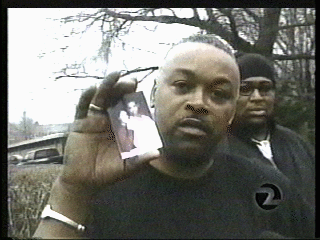
Entire Clip - About the 4 Americans Dead In Kuwait (9 MB)
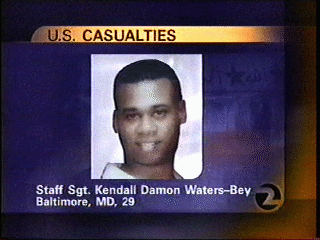
Kendal Damon Waters-Bey's Father (2 MB)
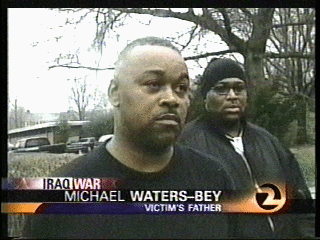

Jay Thomas Aubin's Family (2 MB)
How can the Shrub Administration proudly send our boys and girls off to war, while quietly cutting their benefits by billions at the same time?
VETERANS PROGRAMS SLASHED BY HOUSE REPUBLICANS
Budget Committee Blueprint Cuts Veterans Health Care and Other Benefits
by Nearly $25 Billion
Congressman Lane Evans (D-IL), the Ranking Democratic Member of the House Veterans Affairs Committee, today said the budget adopted by the House Budget Committee would mean drastic reductions in funding for veterans’ benefits and services. Evans called the budget “shameful” and pledged to fight to defeat the Republic budget blueprint. Referring to the more than a trillion dollars worth of tax cuts approved by the Budget Committee, Evans asked, “Who deserves to receive the benefits of the national treasury—America’s disabled veterans or America’s millionaires?”The Republican majority of the House Budget Committee approved a federal budget reducing funding for veterans health care and benefit programs by nearly $25 billion. The proposed budget cut $844 million from the President’s request for veterans’ health care next year. Over a ten-year period the GOP is proposing a cut of $9.7 billion in veterans’ health care—an average of more than $900 million less than the President has proposed per year. For other veterans’ benefits, including cash payments to veterans disabled by military service, the Republican budget calls for a $463 million cut during the next year and a $15 billion cut in spending from current levels during the next ten years. The House Budget Committee is chaired by Congressman Jim Nussle (R-IA)...
As our Nation stands on the verge of war, certain to result in disability and death for young Americans, the Budget Committee’s proposal requires the House Committee on Veterans Affairs to make permanent cuts in the benefits paid to those disabled by virtue of their service to our Nation. These cuts must be made, so that our government can afford to provide a tax cut which will benefit only the wealthiest Americans, many of whom have never served in the military.
Here is the full text of the article in case the link goes bad:
http://www.veterans.house.gov/democratic/press/108th/3-13-03budget.htm
dem1.JPG (6015 bytes)
NEWS FROM….
CONGRESSMAN LANE EVANS
RANKING DEMOCRATIC MEMBER
COMMITTEE ON VETERANS AFFAIRS
U.S. HOUSE OF REPRESENTATIVES
Room 333 Cannon HOB For More Information Contact:
Washington, DC 20515 Susan Edgerton or
Mary Ellen Mc Carthy @ 202-225-9756
FOR RELEASE: March 13, 2003
VETERANS PROGRAMS SLASHED BY HOUSE REPUBLICANS
Budget Committee Blueprint Cuts Veterans Health Care and Other Benefits
by Nearly $25 Billion
Congressman Lane Evans (D-IL), the Ranking Democratic Member of the House Veterans Affairs Committee, today said the budget adopted by the House Budget Committee would mean drastic reductions in funding for veterans’ benefits and services. Evans called the budget “shameful” and pledged to fight to defeat the Republic budget blueprint. Referring to the more than a trillion dollars worth of tax cuts approved by the Budget Committee, Evans asked, “Who deserves to receive the benefits of the national treasury—America’s disabled veterans or America’s millionaires?”
The Republican majority of the House Budget Committee approved a federal budget reducing funding for veterans health care and benefit programs by nearly $25 billion. The proposed budget cut $844 million from the President’s request for veterans’ health care next year. Over a ten-year period the GOP is proposing a cut of $9.7 billion in veterans’ health care—an average of more than $900 million less than the President has proposed per year. For other veterans’ benefits, including cash payments to veterans disabled by military service, the Republican budget calls for a $463 million cut during the next year and a $15 billion cut in spending from current levels during the next ten years. The House Budget Committee is chaired by Congressman Jim Nussle (R-IA).
By a nearly party-line vote of 22-19, Republicans defeated an amendment offered by Democratic Representatives Darlene Hooley, Tammy Baldwin, Dennis Moore, Chet Edwards, Bobby Scott, Lois Capps, and Artur Davis that would have restored the proposed $844 million for veterans health care and added a billion dollars to the VA’s budget for discretionary programs. These cuts are made to a budget that already relies upon $1.1 billion in vaguely defined management efficiencies and $1.4 billion in mostly unpalatable legislative and policy proposals already included in the President’s budget. The amendment would also have restored the Budget Committee’s proposed $463 million in cuts to veterans’ benefits. Only Republican Ginny Brown-Waite, a member of the Committee on Veterans Affairs, crossed party lines to vote for increased funding for veterans.
In sharp contrast to Nussle’s proposal, a bipartisan recommendation from Chairman Christopher Smith (R-NJ) and Democratic Ranking Member Lane Evans (D-IL) on behalf of the Committee on Veterans Affairs, would have added $3 billion next year for veteran discretionary programs including medical care and research, construction and programs that fund the administrative costs of other important benefits such as compensation, pension and education programs.
What would $1.844 billion mean to veterans health care?
· Congress would have to seriously consider the new copayments and enrollment fees proposed by the Bush Administration in order to keep the system operating in the next fiscal year. This means:
o New priority 8 veterans would remain ineligible for VA services indefinitely
o Priority 7 and 8 veterans would have an annual enrollment fee in addition to increased copayments for pharmaceutical drugs and primary care
o Only veterans with highly rated service connected disabilities (greater than 70%) would be eligible for placement in VA nursing homes. This would eliminate the need for 5000 nursing home beds from the system.
· In year one VA may have to disenroll at least 168,000 veterans.
· There would be no additional funds available to implement the Homeless Veterans Comprehensive Assistance Act to work toward the goal of eliminating chronic homelessness in a decade.
· The current Capital Assets Realignment for Enhanced Services (CARES) exercise that VA is undertaking to assess the best use of its physical infrastructure will become a “de facto” closure commission with no ability to respond to veterans’ needs for primary care, long-term care, and mental health projected by its own models.
· $1.844 billion =
o about 9,000 doctors or 19,000 nurses
o about 6.6 million outpatient visits
o 870,000 hospital bed days of care
o 2 million psychiatric bed days of care
o 9 million nursing home bed days of care
o all of VA’s top-twenty priorities major construction projects (totaling about $600 million) which include desperately needed seismic and modernization projects and projects to ensure patient and employee safety
What would $463 million cuts in mandatory spending mean to veterans benefits?
· Congress would have to seriously cut the benefits paid to men and women who are disabled as a result of military service. Cash benefits paid to veterans who have disabilities incurred or aggravated during military service comprise the vast majority of VA’s budget for mandatory programs. Ninety percent of the mandatory spending the Budget Committee proposes to cut is from cash payments to service disabled veterans, low-income wartime veterans and their survivors.
· Other programs funded with mandatory spending are the Montgomery G.I. Bill education benefits, vocational rehabilitation and independent living programs for service-disabled veterans, subsidies for VA home loans and insurance for service-disabled veterans and funds to provide headstones, markers and flags for deceased veterans.
· Even if all burial benefits, including flags and markers were eliminated to meet the Budget Committee resolution, funding for benefits for living veterans would need to be dramatically cut.
· Last year the cost-of living increase paid to service-disabled veterans was only 1.4%. In order to meet the Budget Committee criteria the House Committee on Veterans Affairs could propose a cost-of living decrease of 1.4% and no increase for FY 2004.
As our Nation stands on the verge of war, certain to result in disability and death for young Americans, the Budget Committee’s proposal requires the House Committee on Veterans Affairs to make permanent cuts in the benefits paid to those disabled by virtue of their service to our Nation. These cuts must be made, so that our government can afford to provide a tax cut which will benefit only the wealthiest Americans, many of whom have never served in the military.
In contrast, Democrats proposed to restore the “Nussle” cut for benefits and health care and add $1 billion to the VA health care budget to eliminate the need for increased copayments, assist VA in eliminating waiting times, restore VA’s nursing home care mission and provide a small boost to address the queue of VA major construction projects that include seismic projects and other projects that will assure patient and employee safety.
-30-
Back to Press Releases
As usual, our first casualties of war are friendly fire and accidents. It's such a waste of lives.
(Note 3/22/03 - damn! I had my VCR on the wrong setting and it didn't record ollie or the messages from the boys mentioned below :-(
I'll have this up soon from some footage I sampled on television. Oliver North "Fox News Correspondent" in Kuwait actually witnessed the accident.
I've also got some footage of "our boys" sending messages home to their families. I do however, have footage from the families of those that were killed coming soon here.
Be safe guys!
Military voices of dissent
By Steve Schifferes for the BBC News Online.
Nancy Lessin, one of founders of Military Families Speak Out has a stepson, Joe, in the marines. He is deployed in Kuwait as an Arab language specialist.She is a union activist from Jamaica Plain near Boston, Massachusetts who was previously active in opposing the Vietnam War.
Her voice breaking, Ms Lessin told News Online she hoped her stepson would not face combat, nor would he have to take part in killing others.
She said that opposition to an unjust war was patriotic...
"This war isn't worth the life of one American soldier," said Charlie Sheehan-Miles, a former tank crewman in the Gulf who is one of the founders of VFCS.
"This week thousands of US soldiers are deploying to Kuwait to fight a war on our behalf. They go because it is their job, and their mission to protect us. It is now our mission to protect them."
Here is the full text of the article in case the link goes bad:
http://www.ccmep.org/2003_articles/Iraq/011703_military_voices.htm
Military voices of dissent
By Steve Schifferes
BBC News Online Washington correspondent
January 17, 2003
Opposition to a possible war in Iraq has come from an unlikely source - the US military itself.
As anti-war forces are gathering for a major demonstration on Saturday in Washington, a group of parents of the soldiers currently being deployed in the Gulf have decided to speak out against the drive for war.
They have been joined by organisations representing Gulf War veterans, who are particularly concerned about the problem of chemical and biological warfare casualties among servicemen.
The anti-war former soldiers hope to replicate the success of the Vietnam Veterans Against the War in the l960s, who were a crucial part of the anti-war coalition that helped end US involvement in that war.
The organisations are new and small. But they could bring a new element to the anti-Iraq war movement. If they influence US troops in the field, that could be a worry for the Pentagon.
Activists on Vietnam
Nancy Lessin, one of founders of Military Families Speak Out has a stepson, Joe, in the marines. He is deployed in Kuwait as an Arab language specialist.
This war isn't worth the life of one American soldier
Charles Sheehan-Miles, former tank crewman, 24th Infantry, Gulf War
She is a union activist from Jamaica Plain near Boston, Massachusetts who was previously active in opposing the Vietnam War.
Her voice breaking, Ms Lessin told News Online she hoped her stepson would not face combat, nor would he have to take part in killing others.
She said that opposition to an unjust war was patriotic.
And she said that if Iraq's main export was olive oil, we wouldn't be facing the possibility of war.
The horrors of war
Briggs Seakins from Maine served as a dismount mechanised infantryman with the 3rd Armoured Division in the 1991 Gulf War.
He told the BBC that it was the experience of the war - and his concern that he was taking part in the slaughter of innocents - that has led him to take his anti-war stance.
He says that at the time, supporting his fellow soldiers took priority. But having seen the refugees and the frightened conscript soldiers from Iraq, he would not take part in war again.
So far there are no members of these organisations who are also active members of the military. But the organisers believe that there is considerable hidden support for their views.
Jeff McKenzie, another member of Military Families Speak Out, is an anti-war activist from New York state. His son, Jeremy, is an Army captain who flies medical evacuation helicopters and is currently being deployed to the Gulf.
He said he encountered sympathy with his views among some of the soldiers when he visited his son in Fort Benning, Georgia, especially those who were nearing the end of their tours of duty.
His own anti-war views were forged after the events of 11 September, and he took part in anti-nuclear marches.
He says the war in Iraq is about settling old scores and controlling oil, and it would not be in America's interest.
Gulf War veterans
Many of the military activists, former Gulf War veterans, are warning that any conflict will be more costly, in terms of casualties and disabilities, than anyone is prepared for.
And as the coalition seeks to represent the views of some 44 million veterans, the Veterans for Common Sense (VFCS) have taken a moderate stance on the war, calling for a halt to the war until diplomacy has been given a chance rather than opposing it outright.
They have also called for more evidence and broader support from the Allies before launching a "vindictive" strike.
"This war isn't worth the life of one American soldier," said Charlie Sheehan-Miles, a former tank crewman in the Gulf who is one of the founders of VFCS.
"This week thousands of US soldiers are deploying to Kuwait to fight a war on our behalf. They go because it is their job, and their mission to protect us. It is now our mission to protect them."
How can it be impossible to be against the war and still in support of our troops when there are soldiers themselves who are against this war?
It's not. That's how.
We'll make sure that these soldiers never get treated like the Vietnam Vets did. That was horrible -- nobody wants that.
But what we also need to make sure is that our government doesn't treat these vets like it treated the Gulf War veterans. That would be a shame.
By Louise Kiernan and Evan Osnos for the Chicago Tribune.
Rob knew his mother was somewhere among those crowds. He saw it differently."I know my mom is protesting the war," he says as he sits in the tent in Kuwait. "It doesn't bother me. She's doing it for the right reasons. She's doing it because she's worried about me and the other guys out here. So how can I object to what she's doing?"
His views of the possible war he prefers to keep to himself, he says, but in an e-mail from the ship, he wrote: "A few of us do not agree with what is going on, and that there are bigger fish to fry (i.e. Al Qaeda). But ... we have been ordered into this situation and no one is arguing that."
Here is the full text of the article in case the link goes bad:
http://www.chicagotribune.com/news/local/chi-0303160258mar16,1,3319001.story?coll=chi%2Dnewslocal%2Dhed
Loving a Soldier, Hating a War
By Louise Kiernan and Evan Osnos
Chicago Tribune
Sunday 16 March 2003
A Chicago mother feels it is her duty to oppose military action in Iraq. Somewhere in Kuwait, her son understands but is set to fight.
They have established their rituals as they wait for war, the Marine in the tent that heaves in the desert wind and his mother in her elegant condominium near Belmont Harbor.
He cleans his rifle. She fills a manila folder with items she wants to show him when he comes home.
In the folder, there are printouts of some of the e-mails they have exchanged since Christmas, when she last saw him. There is the issue of the New Yorker magazine that makes her eyes fill with tears when she looks at its cover of a soldier opening a Valentine's Day card. There are the fliers and messages from anti-war demonstrations she has attended.
The folder is a scrapbook of sorts, but it is more than that. It is a charm, a talisman. Because if you gather these items for your son and you tuck them into a folder and you label this folder "Rob-2003-Iraq" as if it contained nothing more than paperwork, then surely your son will see it. Then, surely, he will make it home from war.
The rifle is the soldier's charm. He breaks it down and puts it back together. He scrubs its black steel. He performs the tasks he has performed thousands of times since he learned them eight years ago in boot camp. Because if you keep your M-16 clean and ready, then surely it will do what it is supposed to do. Then surely, it will keep you safe.
Fran Johns is the mother of Robert Sarra, who is a sergeant in the Marine Corps. In January, he was deployed to the Persian Gulf from Camp Pendleton, Calif., along with other members of the 1st Battalion, 4th Marine Regiment, in anticipation of a war against Iraq.
Like so many other mothers of soldiers, Fran Johns stanches her dread and worry with packages and cards, swearing to herself that not a day's mail call will go by without her son hearing from her. But, unlike most, she is also demonstrating against the government that sent her son away, marching in opposition to possible military action in Iraq, a petite, animated woman with a stylish black coat and professionally printed protest sign.
This is not a situation she expected to find herself in. She is an advertising executive, a woman whose children grew up in Lincoln Park and went to private schools. A self-avowed lakefront liberal. When her son was born in 1972, friends sent her a card referring to him as a future supporter of presidential candidate Eugene McCarthy.
That this son grew up to become a Marine puzzles and sometimes pains her. Now it places her in the almost unbearable position of loving a soldier whom, it seems, will fight a war she hates.
Images of her son conflict
In Fran's collection of mementos from her son's life, there is a photograph of Rob at age 8 or 9. He crouches on a sidewalk, wearing a striped shirt, shorts and his grandfather's military cap, arranging his toy soldiers as his younger sister, Gianna, watches.
Rob's earliest memories are of digging forts for his soldiers in the front yard. He watched old war movies, wore camouflage and drew endless pictures of tanks and fighter jets.
Then, there is the photograph of the boy his mother wanted him to be.
In this picture, he is standing in his freshman dormitory at the College of Wooster in Ohio, a grinning teenager in baggy shorts and a T-shirt. "A preppy college kid," she says, smiling as she examines the snapshot. "This is the boy I had in mind."
For much of his life, it seemed, Rob seesawed between those two images. He failed his first semester at a boarding school in Michigan. But after he transferred to St. John's Military Academy in Wisconsin, he found the structure and discipline he needed, he says.
He graduated with one of the school's highest honors, the President's Medal in Honor of Douglas MacArthur, given to the best soldier in the corps. His family was surprised to see Rob win. When his name was announced, they had already turned off the video camera.
Rob dropped out of two colleges. He worked as a bartender and volunteer firefighter and an armored truck guard. He had a daughter with a girlfriend and moved to Cincinnati for a time to be near her.
After almost five years in the Marine reserves, Rob finally did what he thought would make him happy. At 28, he enlisted for active duty, in the infantry.
By then his mother had decided to stop trying to tug her son away from the military.
"There is something in Rob," she says. "He wants to be a hero."
A mom's moral outrage
Fran Johns attended her first demonstration on Oct. 26, shortly after her 58th birthday.
She had opposed the Vietnam War by wearing a button on her coat, not carrying a sign in her hands. In Chicago, where she and her first husband moved from New York before their son was born, she was politically active but she was also managing a career and raising her children, and after she divorced, working full-time to support her family.
She did not object to the 1991 Persian Gulf war. Saddam Hussein stepped over the line, both literally and figuratively, she says, by invading Kuwait. But the rhetoric for a second war so angered her that she sometimes felt she was trapped inside a Kafka novel.
"I just developed all this moral outrage," she says.
Like many people who oppose military action against Iraq, her reasons are simple and complicated. She can talk passionately and at length about UN Resolution 1441 and genocide in Rwanda and the speech Democratic Sen. Robert Byrd made on the Senate floor, but it basically comes down to this:
"I think war should not be entered into lightly," she says. "I have a certain image of the United States as being the good guys, of us helping people who are attacked and defending ourselves when we are attacked. And none of that is true in this case. We can't go all over the world fighting the bad guys who might do something."
The Saturday afternoon that she left her office downtown at DDB Chicago for her first protest, she thought her son was safe. Rob had been selected to train as a Marine Corps recruiter and was going to be posted in Chicago for three years.
By the time she went to her second march, on Jan. 11, Rob's orders had been changed. He was going to the Persian Gulf.
As a newcomer, she was inspired and frustrated by what she saw at the demonstrations. There was the sense of camaraderie, the energy, but also the motley assortment of fringe groups calling for everything from Puerto Rican independence to "U.S. out of Colombia."
As someone who plans advertising strategy, she knows about delivering a message. "You have to speak clearly with one voice," she says, "and pound it home."
For her second demonstration, she came up with her own campaign. She carried a sign reading "Marine Mom Against The War."
The weekend after Valentine's Day, when Rob turned 31, his mother and sister protested on opposite coasts. Gianna, who is 25 and lives in Boston, traveled to the United Nations in New York. Fran marched in San Francisco, where she had gone to visit family before a business trip to Los Angeles.
Before the demonstration, she went to a Kinko's in downtown San Francisco to get a sign made. The assistant manager who helped her has one brother who fought as a Marine in Vietnam and another who marched in protest of the war.
She did the work for free. When Fran left the copy store, the assistant manager called out to her:
"I hope your son comes home safe."
`This weapon is my life'
Hunched on an empty cardboard box that once contained the much-derided military MREs, or meals-ready-to-eat, Sgt. Rob Sarra begins to break down his M-16 service rifle.
He sits in the tent he shares with 41 other soldiers at a base camp northwest of Kuwait City, some 30 miles south of the Iraqi border. After two weeks in the desert, his lips are chapped and his green eyes bloodshot.
He cleans his rifle every morning and every night and buffs it whenever he has a spare moment.
It's a habit he developed in boot camp, when he learned how to take the rifle apart and put it back together blindfolded. Now, it's second nature, a reassuring ritual in the face of uncertainty. Ammo out. Bolt out. Break the weapon down. Upper receiver off the lower receiver. Break down the bolt.
Most of his platoon is off on a training exercise, learning how to cross the sand berms and ditches that form the border with Iraq. Rob stayed behind to hunt for gear. As platoon guide, it is his job to make sure the men have everything they need, from AA batteries to straps for their night-vision goggles.
Chores done, he cleans. He replaces the bolt in the weapon.
"For the first time in my Marine Corps career, this weapon is my life," he says. "So I want to make sure it's working."
Rob places faith in routine. Follow orders. Keep a daily journal. Clean the rifle. Do these things and do them right and, he thinks, he will make it through.
What he knows about war, he has learned mostly from the stories of a friend who served in Operation Desert Storm and from "Black Hawk Down," an account of a U.S. military raid in Somalia that went awry, which he has read seven times.
Even that, though, is enough to make him shake his head at the way the younger Marines envision the possible war, as if it were a movie full of heroes and firefights and ticker-tape parades. Rob is the oldest person in his 42-member platoon and he has read enough military history--enough Patton and Sun Tzu, even Schwarzkopf--to suspect otherwise.
"I felt I didn't want to miss the chance to go, and put to use what I have been trained for," he wrote in an e-mail for this article. "At the same time, I hoped I might miss out. Marines get killed and war is never a good thing."
When he was sailing toward the Persian Gulf aboard the USS Dubuque, Rob saw news coverage of the anti-war demonstrations. The soldiers around him hooted and yelled at the screen, swearing revenge on any "commie" who spat on them when they came home.
Rob knew his mother was somewhere among those crowds. He saw it differently.
"I know my mom is protesting the war," he says as he sits in the tent in Kuwait. "It doesn't bother me. She's doing it for the right reasons. She's doing it because she's worried about me and the other guys out here. So how can I object to what she's doing?"
His views of the possible war he prefers to keep to himself, he says, but in an e-mail from the ship, he wrote: "A few of us do not agree with what is going on, and that there are bigger fish to fry (i.e. Al Qaeda). But ... we have been ordered into this situation and no one is arguing that."
He is the one who can see the horizon that marks the boundary with Iraq, but he worries about her, waiting back in Chicago.
"Every letter I send her, I say, `Everything's good. Better than I thought.' That kind of stuff," he says. "I think my mom will go a little nuts once this thing starts. I know she'll be looking at every headline that says, `4 Marines injured' and wondering if it's me."
Around him, the tent fills with soldiers, loud with adrenaline and bravado. They toss their dusty gear onto the ground and peel off sweaty hats, shirts and harnesses. Someone starts reciting a rap song.
Rob sits in the middle of the chaos, head bent over his weapon.
What if he has to kill?
Fran Johns fears that there are worse fates than being killed in combat.
Her son could be captured. He could be gassed. He could be tortured.
It's not only what may be done to him, she thinks, it's what he may have to do to others. What if he has to kill someone? What if he sees his friends killed? What if he sees dead children?
The questions overwhelm her and she is powerless to answer them. She tries not to picture where her son is and what he is doing. She is frightened that the very qualities she loves in him may put him in danger.
"In trying to instill in him a sense of humanity, I wonder if I put him at risk in a war situation," she says. "In war, you have to dehumanize the enemy and I wonder if a humanist in uniform is kind of a dead man walking."
Before Rob left, they set up a series of code words that would allow him to tell his mother how he was doing. There was only one code word she cared about. When you are safe, she told him, use the word "Pentwater."
Pentwater is the name of the town in Michigan where she has a summer home. It is the place she considers the family's refuge.
From the USS Dubuque, Rob and his mother talked by e-mail and telephone whenever they could. The trip was basically a taxi ride, as Rob put it, but the days were long, beginning at 5:30 a.m. with physical training, and the conditions cramped and uncomfortable. Eight men slept across from each other on bunks stacked four high. Rob checked his e-mail three times a day.
When he wrote to his mother, he signed his messages, "Your son and Marine." She responded in kind, closing hers with "Marine Mom Against the War."
In the beginning, their messages were mostly practical or light-hearted. He teased his mother that he was going to get the "high and tight" haircut she hated. They talked about his daughter Parker's 5th birthday. He asked for diaper wipes, so he could clean his face in the heat, and a razor and sunscreen.
He told her he was concerned for the young men in his unit, most just a few months out of boot camp.
"I am pretty worried about my guys," he wrote his mother. "They are all great kids, but jeez ... so young."
"Hang in there, Rob," she answered. "Lots of people are still trying to keep this thing from happening. ... I think about you every day."
She sent him the transcript of U.S. Secretary of State Colin Powell's speech to the United Nations. For his Valentine's Day birthday, she mailed him a heart-shaped box of chocolates.
"Mom ... I received the package!!" he answered. "Thanks! ... Everything in it was useful, and the chocolate was melted, but it went fast ... (30 guys, 10 pieces ... haha) Anyway, hope all is well, I am doing fine and am safe right now. ...
"Love, your son and Marine ... Rob."
She missed Rob's last telephone call, before he landed ashore, because she was at a meeting. But when she went into her office two days later, an e-mail was waiting for her.
"We are leaving tomorrow morning," Rob wrote, in the message his mother received Feb. 23.
"I'll be safe and watch out for myself. ... Expect some mail and try not to worry too much, we are in good hands. ... Thanks for everything mom. ... I love you. ...
"Love, (your nervous son and Marine)
(I guess the brits are right -- the Shrub's Administration is only interested in bodies...)
I am growing increasingly concerned about our boys overseas (the 150,000 troops or so that are already there).
How well can the Shrub be planning on treating them if he's already planning mass graves for them (per a potential bioterrorist threat)?
Pentagon Eyes Mass Graves Option Would Fight Contamination After Bioterror Deaths
By Greg Seigle for The Denver Post.
The bodies of U.S. soldiers killed by chemical or biological weapons in Iraq or future wars may be bulldozed into mass graves and burned to save the lives of surviving troops, under an option being considered by the Pentagon.Since the Korean War, the U.S. military has taken great pride in bringing home its war dead, returning bodies to next of kin for flag-draped, taps-sounding funerals complete with 21-gun salutes.
But the 53-year-old tradition could come to an abrupt halt if large numbers of soldiers are killed by chemical or biological agents, according to a proposal quietly circulating through Pentagon corridors.
here is the full text of the article in case the link goes bad:
http://www.truthout.org/docs_02/012603A.mass.graves.htm
Print This Story E-mail This Story
(*Editors Note | As we stride towards an open war in Iraq, there is a quieter sort of battle being waged between the Pentagon and the White House. There are a great many Generals in the Defense Department who are deeply concerned about this coming war, as described in a truthout report from yesterday. In that report, Defense Secretary Rumsfeld is described as telling the Generals to get in line or find new jobs, and Mr. Bush is described as believing that any resistance to his plans is tantamount to treason. Today, the Washington Times carried a report detailing a bitterly critical memo written by Rumsfeld regarding the very Generals he told to get in line. Now comes this ghoulish story below, straight out of the Pentagon. Why? Perhaps it is an attempt to give the American people a glimpse of what may be coming, a glimpse of the dangers that arise when we charge off into unnecessary war. Perhaps it is a warning from those same Generals, a warning delivered both to Mr. Rumsfeld and to the citizenry. These soldiers cannot speak publicly about their concerns for fear of being labeled disloyal. Stories like this, however, show that someone is talking, and is deeply concerned. - wrp)
Go To Original
Pentagon Eyes Mass Graves Option Would Fight Contamination After Bioterror Deaths
By Greg Seigle
The Denver Post
January 24, 2003
The bodies of U.S. soldiers killed by chemical or biological weapons in Iraq or future wars may be bulldozed into mass graves and burned to save the lives of surviving troops, under an option being considered by the Pentagon.
Since the Korean War, the U.S. military has taken great pride in bringing home its war dead, returning bodies to next of kin for flag-draped, taps-sounding funerals complete with 21-gun salutes.
But the 53-year-old tradition could come to an abrupt halt if large numbers of soldiers are killed by chemical or biological agents, according to a proposal quietly circulating through Pentagon corridors.
Army spokesmen said the option to bury or even burn bodies contaminated by chemical or biological weapons is being considered, along with the possibility of placing contaminated corpses in airtight body bags and sending them home for closed-casket funerals.
"All due care is taken to honor the remains of our fallen comrades," said Maj. Chris Conway, an Army spokesman. "It's just too premature to speculate on any plan or policy."
Lt. Col. Ryan Yantis, an Army spokesman, said, "Military planners look at an operation in the full spectrum from the best-case scenario to the worst, and you have to make plans accordingly."
Yantis said that if a biological or chemical attack occurs, "we're going to treat the wounded with the best possible medical care. Those who are, unfortunately, deceased, we're going to treat with the utmost dignity and respect. ... We're going to have to take care of the mission and we're going to have to ensure the safety of the force."
Iraq admitted to United Nations inspectors in 1995 that it had produced large amounts of chemical and biological weapons during the 1980s and 1990s. American and British intelligence agencies say Iraqi President Saddam Hussein has continued to produce the deadly weapons covertly since then, despite Iraqi denials.
U.N. inspectors have found no proof Iraq is hiding weapons, but the U.S. insists they are there and is massing troops in the Persian Gulf for a possible war.
The U.S. had a plan for mass burials during the Gulf War in 1991, said Lt. Gen. William "Gus" Pagonis, the chief logistician for that conflict and the man who conceived the plan.
"The bulldozers were all lined up and ready to go," to deposit contaminated bodies in "mass graves," Pagonis said.
"You'll use whatever equipment is necessary to avoid contaminating more people," Pagonis said in a recent interview. "You don't want anybody else to die."
Pagonis said that before the Gulf War, he sent the plan simultaneously to commanding Gen. H. Norman Schwarzkopf and the Department of the Army and no one responded. "When you send a plan and no one gets back to you, you assume it's been approved," he said.
Army spokesman Capt. Ben Kuykendall said the Pagonis plan is similar to the option currently under consideration - except that bodies infected by biological agents might be both cremated and buried.
If soldiers are killed by "something like smallpox in which bodies cannot be decontaminated, we would have to cremate them right there," Kuykendall said. He said he recently discussed the option in detail with Brig. Gen. Steve Reeves, program executive officer for the Army's chemical and biological defense office. Reeves declined to comment.
"You would have to protect the living, so you'd have to get rid of the (contaminated) bodies as quickly as possible," Kuykendall said. "You don't want to contaminate any survivors who are not already contaminated."
It is possible to decontaminate bodies, but such efforts would be "very sensitive, expensive and time-consuming," particularly for corpses infected with contagious biological agents, Kuykendall said.
But even if a body was believed to be decontaminated, it could not be sent stateside for fear it might still contain lethal germs or viruses that could fester deep inside and seep out later, he said. "That just would not be worth the risk."
If bodies contaminated with biological agents such as smallpox or anthrax were flown home, they could pass potentially lethal contaminants to every vehicle, aircraft, building and person that came in contact with them, Kuykendall said.
Bodies infected with chemical agents such as VX and mustard gas, which are very persistent, could also contaminate others, said Jonathan Tucker, a Washington-based senior scholar at the Monterey Institute of International Studies who has written extensively about chemical and biological agents.
It is easier to decontaminate chemically contaminated bodies for shipment and traditional burials than those infected by biological agents, Tucker said.
But in the heat of battle, Pagonis said, a field commander doesn't have time to make the distinction. "You want to do away with this (biological threat) as quickly as possible," he said.
Military veterans said they hope those commanders will never have to make such a choice.
"I know this is a plan to protect people and to make sure that we don't bring back any biological agents, but we're more concerned with how the (living) soldiers are going to protect themselves on the battlefield," said Steve Robinson, a retired Army Ranger and executive director of the National Gulf War Resource Center.
"It makes sense" to bury or burn contaminated bodies, Robinson said, "but it's still going to be hard on the families. ... If you are told your son was killed in Iraq but buried in a mass grave, you are going to be forever speculative on how he died."
Mass burial is "a sensitive issue, and we don't want to think about it because our hopes and prayers are that it won't happen," said Tom Corey, president of the Vietnam Veterans of America who was wounded in Vietnam and now uses a wheelchair.
A top Army mortuary official said he is confident his nearly 700 soldiers could decontaminate any corpses and send them home for proper burial.
"They would process them as best they could and move them to the rear," said Douglas Howard, deputy director of the Army Mortuary Affairs Center in Fort Lee, Va., which is responsible for handling the bodies of soldiers.
"If we bury on the battlefield, it will only be as a last resort," Howard said.
But mortuary teams would have to be wary of charging into areas filled with noxious fumes or deadly germs.
"The primary difficulty is concern for the safety of the mortuary affairs soldiers," said Howard, who has been an Army mortician for 30 years. "We never launch forth into a contaminated area without the advice and consent of the chemical community."
Pentagon officials declined to reveal exactly how many people staff the decontamination teams. The Army mortuary affairs center has only one such group - the 246th Quartermaster Mortuary Affairs Company, a 220-soldier reserve unit based in Puerto Rico.
Kuykendall said the Army's limited decontamination assets would have to be concentrated on survivors. Pagonis and other defense experts agreed.
"The military's first concern would be its own people - if they're still alive they would be the top priority. Next would be civilian noncombatants. People who are already dead would not be at the top of the triage," Philip Coyle said.
Coyle served as an undersecretary of defense from 1997 to 2001 and oversaw the testing and evaluation of much of the military's new decontamination and protective gear but said he was never informed of the option for cremation or mass burial of casualties.
Decontamination teams use large, showerlike pressure washers to spray victims with special disinfectants, cleaning solutions or even water. The teams, which can operate together or in small subgroups, rely on the guidance of specialists in chemical-biological warfare and sometimes even transport from other units.
Soldiers contaminated by chemical weapons would need to leave the scene as quickly as possible to limit their exposure. Those contaminated by biological agents would need to stay put to avoid spreading germs or viruses to their colleagues or civilians, Tucker said.
Chemical weapons generally contaminate relatively small areas, while biological weapons such as smallpox, which is highly contagious and lethal, can spread for long distances if contaminated people, bodies, gear or equipment are moved around, Tucker said.
Every U.S. soldier deployed to a potential combat zone carries an advanced gas mask and at least one air-tight, charcoal-lined protective suit. But such gear is useless if ripped open by bullets or shrapnel, or if troops are caught without all their garb on. Experts worry that the troops might be tempted to remove some or all of the bulky, uncomfortable equipment, particularly in the searing heat of the gulf region.
U.S. troops also carry auto-injecting needles that can inject atropine and oxine to counteract the effects of chemical nerve agents. But those must be applied immediately after contamination to be effective, Tucker said.
Tucker said the Iraqis are believed to have large, hidden stockpiles of chemical weapons, including "very high quality" mustard gas, a blistering agent, and nerve agents such as sarin, cyclosarin and VX. The chemicals are liquids that can be administered in person, or by aircraft, missiles or artillery shells.
"A drop (of VX) on the skin can kill within 15 to 20 minutes unless antidotes are immediately administered," Tucker said. "In the case of smallpox it would be impossible to decontaminate the body ... or the linens or anything else the body comes in contact with."
Iraq also has produced "significant quantities" of highly lethal biological agents such as anthrax, botulinum toxin, aflotoxin, gas gangrene and ricin, Tucker said. The Iraqis are also believed to harbor lesser amounts of smallpox.
The possibility of U.S. troops having to bulldoze or burn comrades killed by chemical or biological weapons foreshadows the possibility that similar methods would have to be used on civilians caught in similar attacks, Pagonis said.
That could happen overseas during wartime or even in the United States in the event of a terrorist attack, he said.
Most Army officers deflected questions about the mass graves option to Pentagon superiors, who in turn deferred to the White House. White House officials also declined to comment, saying any such plan is a Pentagon issue.
"I'd have to refer you to the Defense Department," Sean McCormick, spokesman for the White House's National Security Council, repeated several times during a brief telephone conversation. "We don't comment on military plans, operations or procedures."
A final decision on the option would have to be made by President Bush or Defense Secretary Donald Rumsfeld, Kuykendall said.
"Not everybody's going to support whatever we do," he said.
Here's the original story in the Denver Post:
http://www.denverpost.com/Stories/0%2C1413%2C36%25257E6439%25257E1132683%2C00.html
Go to DPO front page
ABOUT US/HELP
ARCHIVES
BOOKS
BUSINESS
COLUMNISTS
COMMUNITY
CONTACT US
DISCUSSION
DPO BY E-MAIL
ENTERTAINMENT
FOOD/DINING
FRONT PAGE
LIFESTYLES
MARKETPLACE
NATION/WORLD
NEWS
NEWSPAPER ADS
OBITUARIES
OPINION
SEAS. TO SHARE
SPORTS
STOCK SHOW
TRAVEL
WAR ON TERROR
Inside the War
AP Updates
Overseas Reports
WEATHER
DPO HOME
SEARCH DPO:
Enter search term,
hit enter key
Click here for
advanced search
Pentagon eyes mass graves
Option would fight contamination after bioterror deaths
By Greg Seigle
Special to The Denver Post
Friday, January 24, 2003 - WASHINGTON - The bodies of U.S. soldiers killed by chemical or biological weapons in Iraq or future wars may be bulldozed into mass graves and burned to save the lives of surviving troops, under an option being considered by the Pentagon.
Since the Korean War, the U.S. military has taken great pride in bringing home its war dead, returning bodies to next of kin for flag-draped, taps-sounding funerals complete with 21-gun salutes.
But the 53-year-old tradition could come to an abrupt halt if large numbers of soldiers are killed by chemical or biological agents, according to a proposal quietly circulating through Pentagon corridors.
Army spokesmen said the option to bury or even burn bodies contaminated by chemical or biological weapons is being considered, along with the possibility of placing contaminated corpses in airtight body bags and sending them home for closed-casket funerals.
"All due care is taken to honor the remains of our fallen comrades," said Maj. Chris Conway, an Army spokesman. "It's just too premature to speculate on any plan or policy."
Lt. Col. Ryan Yantis, an Army spokesman, said, "Military planners look at an operation in the full spectrum from the best-case scenario to the worst, and you have to make plans accordingly."
Yantis said that if a biological or chemical attack occurs, "we're going to treat the wounded with the best possible medical care. Those who are, unfortunately, deceased, we're going to treat with the utmost dignity and respect. ... We're going to have to take care of the mission and we're going to have to ensure the safety of the force."
Iraq admitted to United Nations inspectors in 1995 that it had produced large amounts of chemical and biological weapons during the 1980s and 1990s. American and British intelligence agencies say Iraqi President Saddam Hussein has continued to produce the deadly weapons covertly since then, despite Iraqi denials.
U.N. inspectors have found no proof Iraq is hiding weapons, but the U.S. insists they are there and is massing troops in the Persian Gulf for a possible war.
The U.S. had a plan for mass burials during the Gulf War in 1991, said Lt. Gen. William "Gus" Pagonis, the chief logistician for that conflict and the man who conceived the plan.
"The bulldozers were all lined up and ready to go," to deposit contaminated bodies in "mass graves," Pagonis said.
"You'll use whatever equipment is necessary to avoid contaminating more people," Pagonis said in a recent interview. "You don't want anybody else to die."
Pagonis said that before the Gulf War, he sent the plan simultaneously to commanding Gen. H. Norman Schwarzkopf and the Department of the Army and no one responded. "When you send a plan and no one gets back to you, you assume it's been approved," he said.
Army spokesman Capt. Ben Kuykendall said the Pagonis plan is similar to the option currently under consideration - except that bodies infected by biological agents might be both cremated and buried.
If soldiers are killed by "something like smallpox in which bodies cannot be decontaminated, we would have to cremate them right there," Kuykendall said. He said he recently discussed the option in detail with Brig. Gen. Steve Reeves, program executive officer for the Army's chemical and biological defense office. Reeves declined to comment.
"You would have to protect the living, so you'd have to get rid of the (contaminated) bodies as quickly as possible," Kuykendall said. "You don't want to contaminate any survivors who are not already contaminated."
It is possible to decontaminate bodies, but such efforts would be "very sensitive, expensive and time-consuming," particularly for corpses infected with contagious biological agents, Kuykendall said.
But even if a body was believed to be decontaminated, it could not be sent stateside for fear it might still contain lethal germs or viruses that could fester deep inside and seep out later, he said. "That just would not be worth the risk."
If bodies contaminated with biological agents such as smallpox or anthrax were flown home, they could pass potentially lethal contaminants to every vehicle, aircraft, building and person that came in contact with them, Kuykendall said.
Bodies infected with chemical agents such as VX and mustard gas, which are very persistent, could also contaminate others, said Jonathan Tucker, a Washington-based senior scholar at the Monterey Institute of International Studies who has written extensively about chemical and biological agents.
It is easier to decontaminate chemically contaminated bodies for shipment and traditional burials than those infected by biological agents, Tucker said.
But in the heat of battle, Pagonis said, a field commander doesn't have time to make the distinction. "You want to do away with this (biological threat) as quickly as possible," he said.
Military veterans said they hope those commanders will never have to make such a choice.
"I know this is a plan to protect people and to make sure that we don't bring back any biological agents, but we're more concerned with how the (living) soldiers are going to protect themselves on the battlefield," said Steve Robinson, a retired Army Ranger and executive director of the National Gulf War Resource Center.
"It makes sense" to bury or burn contaminated bodies, Robinson said, "but it's still going to be hard on the families. ... If you are told your son was killed in Iraq but buried in a mass grave, you are going to be forever speculative on how he died."
Mass burial is "a sensitive issue, and we don't want to think about it because our hopes and prayers are that it won't happen," said Tom Corey, president of the Vietnam Veterans of America who was wounded in Vietnam and now uses a wheelchair.
A top Army mortuary official said he is confident his nearly 700 soldiers could decontaminate any corpses and send them home for proper burial.
"They would process them as best they could and move them to the rear," said Douglas Howard, deputy director of the Army Mortuary Affairs Center in Fort Lee, Va., which is responsible for handling the bodies of soldiers.
"If we bury on the battlefield, it will only be as a last resort," Howard said.
But mortuary teams would have to be wary of charging into areas filled with noxious fumes or deadly germs.
"The primary difficulty is concern for the safety of the mortuary affairs soldiers," said Howard, who has been an Army mortician for 30 years. "We never launch forth into a contaminated area without the advice and consent of the chemical community."
Pentagon officials declined to reveal exactly how many people staff the decontamination teams. The Army mortuary affairs center has only one such group - the 246th Quartermaster Mortuary Affairs Company, a 220-soldier reserve unit based in Puerto Rico.
Kuykendall said the Army's limited decontamination assets would have to be concentrated on survivors. Pagonis and other defense experts agreed.
"The military's first concern would be its own people - if they're still alive they would be the top priority. Next would be civilian noncombatants. People who are already dead would not be at the top of the triage," Philip Coyle said.
Coyle served as an undersecretary of defense from 1997 to 2001 and oversaw the testing and evaluation of much of the military's new decontamination and protective gear but said he was never informed of the option for cremation or mass burial of casualties.
Decontamination teams use large, showerlike pressure washers to spray victims with special disinfectants, cleaning solutions or even water. The teams, which can operate together or in small subgroups, rely on the guidance of specialists in chemical-biological warfare and sometimes even transport from other units.
Soldiers contaminated by chemical weapons would need to leave the scene as quickly as possible to limit their exposure. Those contaminated by biological agents would need to stay put to avoid spreading germs or viruses to their colleagues or civilians, Tucker said.
Chemical weapons generally contaminate relatively small areas, while biological weapons such as smallpox, which is highly contagious and lethal, can spread for long distances if contaminated people, bodies, gear or equipment are moved around, Tucker said.
Every U.S. soldier deployed to a potential combat zone carries an advanced gas mask and at least one air-tight, charcoal-lined protective suit. But such gear is useless if ripped open by bullets or shrapnel, or if troops are caught without all their garb on. Experts worry that the troops might be tempted to remove some or all of the bulky, uncomfortable equipment, particularly in the searing heat of the gulf region.
U.S. troops also carry auto-injecting needles that can inject atropine and oxine to counteract the effects of chemical nerve agents. But those must be applied immediately after contamination to be effective, Tucker said.
Tucker said the Iraqis are believed to have large, hidden stockpiles of chemical weapons, including "very high quality" mustard gas, a blistering agent, and nerve agents such as sarin, cyclosarin and VX. The chemicals are liquids that can be administered in person, or by aircraft, missiles or artillery shells.
"A drop (of VX) on the skin can kill within 15 to 20 minutes unless antidotes are immediately administered," Tucker said. "In the case of smallpox it would be impossible to decontaminate the body ... or the linens or anything else the body comes in contact with."
Iraq also has produced "significant quantities" of highly lethal biological agents such as anthrax, botulinum toxin, aflotoxin, gas gangrene and ricin, Tucker said. The Iraqis are also believed to harbor lesser amounts of smallpox.
The possibility of U.S. troops having to bulldoze or burn comrades killed by chemical or biological weapons foreshadows the possibility that similar methods would have to be used on civilians caught in similar attacks, Pagonis said.
That could happen overseas during wartime or even in the United States in the event of a terrorist attack, he said.
Most Army officers deflected questions about the mass graves option to Pentagon superiors, who in turn deferred to the White House. White House officials also declined to comment, saying any such plan is a Pentagon issue.
"I'd have to refer you to the Defense Department," Sean McCormick, spokesman for the White House's National Security Council, repeated several times during a brief telephone conversation. "We don't comment on military plans, operations or procedures."
A final decision on the option would have to be made by President Bush or Defense Secretary Donald Rumsfeld, Kuykendall said.
"Not everybody's going to support whatever we do," he said.

