Daily Kos dude Markos Moulitsas Zuniga cruised through the Colbert Report last week. (April 6, 2006, I think)
Video-Markos Moulitsas Zuniga on the Colbert Report (12 MB)
Audio-Markos Moulitsas Zuniga on the Colbert Report (MP3 - 8 MB)

He's got new book out called
Crashing the Gate

This is from the April 25, 2004 program of
Meet the Press.
Bob Woodward and Prince Bandar On Meet The Press.
Each interview is available in two parts. (About 35 MB each)
This ties in with the Bob Woodward On 60 Minutes footage from a few weeks ago.
Check out Bob Woodward's new book,
Plan of Attack.
This is from the May 2, 2004 program of
Meet the Press.
This directory contains the entire interview in one big file and three smaller files:
Joseph Wilson On Meet The Press.
Check out Joseph Wilson's new book:
The Politics of Truth: Inside the Lies that Led to War and Betrayed My Wife's CIA Identity: A Diplomat's Memoir.
One thing Joseph said that sticks out in my mind is that daddy Shrub said whoever leaked the information about Wilson's wife was an "insidious traitor."
Does anyone know where he said this or when? Update: Oh okay. He said it in 1999. But it still applies -- to Karl Rove and the Cheney gang in this case:
"I have nothing but contempt and anger for those who betray the trust by exposing the names of our [intelligence] sources. They are, in my view, the most insidious of traitors."
This is from the April 18, 2004 program of 60 Minutes.
This piece details, among other things, the Shrub's secret allocation of 700 million dollars to Tommy Franks for his "secret" war plans that were in place in early 2002.
Here's the whole thing in two big 25 MB ish chunks.
Smaller files and highlights on the way...
Check out Bob Woodward's new book,
Plan of Attack.
This is from the March 21, 2004 program of 60 Minutes.
Richard Clarke, former top advisor on Counterterrorism for the Shrub, Clinton Terrorism Czar, and an appointed expert for both Daddy Shrub and Reagan, has written a book Against All Enemies that exposes a number of different things going on over at the old White House during the days after 911.
I've made the files available in one and four parts.
911 Before and After
(Richard Clarke on 60 Minutes - March 21, 2004)
Walter Isaacson is a former chairman and CEO of CNN, the President of the Aspen Institute, and the author of A Benjamin Franklin Reader.
Franklin worshippers such as myself will get a lot of mileage out of this interview. There are some lovely descriptions of my man Ben hanging out and doing cool things up until the day he died.
It made me want to read the book.
This is from the October 22, 2003 program.
Interview with Walter Isaacson (Small - 15 MB)


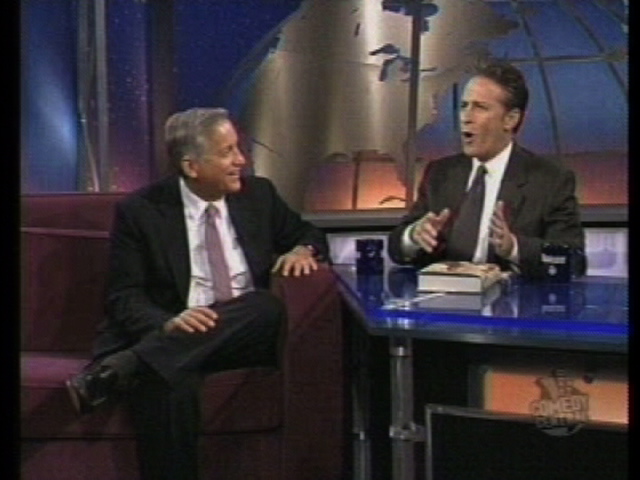
The Daily Show (The best news on television.)
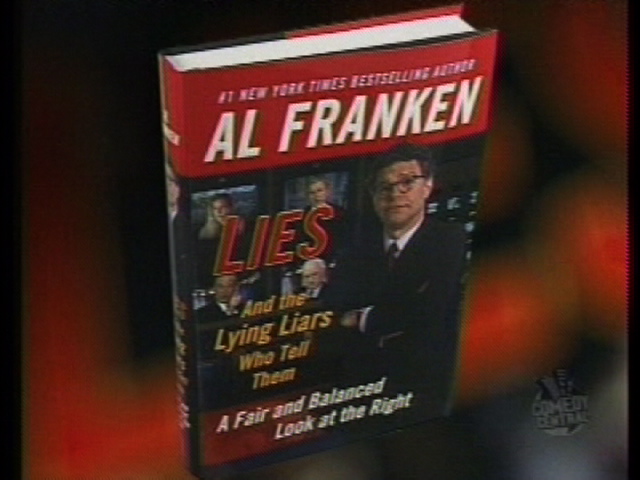
This book is awesome! I'm only about half way through it right now. It does a great job of nailing the right on their incessant distortion of the truth -- and backs it all up with footnoted facts!
You should just but it now!
Anyway, this was emailed to me sometime ago. Not sure where it came from, but I know it's been circulated pretty heavily through numerous channels at this point. I know that Salon has it in it's quagmire of a website somewhere, but they won't even let you read the front page anymore without suffering through an lengthy ad, so I didn't have time to try to find the link.
"Lies and the Lying Liars Who Tell Them"
An excerpt from Al Franken's new book.
- - - - - - - - - - - -
By Al Franken
Aug. 27, 2003 | God chose me to write this book.
God began our conversation by clearing something up. Some of George W. Bush's friends say that Bush believes God called him to be president during these times of trial. But God told me that He/She/It had actually chosen Al Gore by making sure that Gore won the popular vote and, God thought, the Electoral College. "THAT WORKED FOR EVERYONE ELSE," God said."What about Tilden?" I asked, referring to the 1876 debacle.
"QUIET!" God snapped. God was angry.
God said that after 9/11, George W. Bush squandered a unique moment of national unity. That instead of rallying the country around a program of mutual purpose and sacrifice, Bush cynically used the tragedy to solidify his political power and pursue an agenda that panders to his base and serves the interests of his corporate backers.
God told me that Bush squandered a $4.6 trillion surplus and is plunging us into deficits as far as God can see. And that Bush squandered another surplus. The surplus of goodwill from the rest of the world that he had inherited from Bill Clinton.
And this was pissing God off.
"Lies and the Lying Liars Who Tell Them"
An excerpt from Al Franken's new book.
- - - - - - - - - - - -
By Al Franken
Aug. 27, 2003 | God chose me to write this book.
Just the fact that you are reading this is proof not just of God's existence, but also of His/Her/Its beneficence. That's right. I am not certain of God's precise gender. But I am certain that He/She/It chose me to write this book.
This isn't hubris. I'm not saying this in an egotistical way. God didn't choose me because I'm the greatest writer who ever lived. That was William Shakespeare, whose work I have a passing familiarity with. No. I just happened to be the right vessel at the right time. If something in this book makes you laugh, it was God's joke. If something makes you think, it's because God had a good point to make.
The reason I know God chose me is because God spoke to me personally.
God began our conversation by clearing something up. Some of George W. Bush's friends say that Bush believes God called him to be president during these times of trial. But God told me that He/She/It had actually chosen Al Gore by making sure that Gore won the popular vote and, God thought, the Electoral College. "THAT WORKED FOR EVERYONE ELSE," God said.
"What about Tilden?" I asked, referring to the 1876 debacle.
"QUIET!" God snapped. God was angry.
God said that after 9/11, George W. Bush squandered a unique moment of national unity. That instead of rallying the country around a program of mutual purpose and sacrifice, Bush cynically used the tragedy to solidify his political power and pursue an agenda that panders to his base and serves the interests of his corporate backers.
God told me that Bush squandered a $4.6 trillion surplus and is plunging us into deficits as far as God can see. And that Bush squandered another surplus. The surplus of goodwill from the rest of the world that he had inherited from Bill Clinton.
And this was pissing God off.
He/She/It was right. But it sounded like a lot of work.
"Look, God, I'm flattered, but I think you got the wrong guy. The kind of book you're talking about would require months of research."
And God said, "LET THERE BE GOOGLE. AND LET THERE BE LEXISNEXIS."
"Very funny, God. I use Google all the time."
"YES, I KNOW," God said. "FOR HOT ASIAN TEENS."
"You must be thinking of my son, Joe."
"AL? I'M OMNISCIENT."
"Okay, okay." I changed the subject. "It's just that I can't do this book myself."
"LEAVE THAT TO ME," God boomed.
And that's when Harvard called.
- - - - - - - - - - - -
Harvard's Kennedy School of Government asked me to serve as a fellow at its Shorenstein Center on the Press, Politics, and Public Policy. After my varied and celebrated career in television, movies, publishing, and the lucrative world of corporate speaking, being a fellow at Harvard seemed, frankly, like a step down.
I couldn't think of anything less appealing than molding the minds of tomorrow's leaders, unless it was spending fireside evenings sipping sherry with great minds at the Faculty Club. Yawn.
To my surprise and delight, though, all Harvard wanted me to do was show up every once in a while and write something about something. That gave me an idea.
"Would it be okay if I wrote a scathingly partisan attack on the right-wing media and the Bush administration?"
"No problem," Harvard said absentmindedly.
"Count me in," I replied. "From now on call me 'Professor Franken.'"
"No," Harvard said, "you're not a professor. But you can run a study group on the topic of your choosing."
"Great," I said. "I've got the perfect topic: Write My Son's Harvard College Application Essay."
"No," they said. "Harvard students already know how to write successful Harvard applications, Al. We want you to teach them something new."
Harvard was right where I wanted it. "How about if the topic is: How to Research My Book?"
"Sure," Harvard said. "Most of our professors teach that course. Why, in the Biochemistry department, most of the graduate-level courses are--"
Harvard was boring me. "I gotta run, Harvard. Thanks."
- - - - - - - - - - - -
I had my Nexis, I had my Google, I had my Harvard fellowship, and I had my fourteen research assistants. I sat down to write. Nothing.
So I got on my knees and prayed for guidance. "How, God, can I best do Your work through this book? Who, dear Lord, is the audience for a book like this? And what's a good title?"
God answered, "YOU KNOW THOSE SHITTY BOOKS BY ANN COULTER AND BERNIE GOLDBERG?"
"The bestsellers that claim there's a liberal bias in the media?" I asked.
"TOTAL BULLSHIT," God said. "START BY ATTACKING THEM. HE'S CLEARLY A DISGRUNTLED FORMER EMPLOYEE, AND SHE JUST LIES. BY THE WAY, THERE'S SOMETHING SERIOUSLY WRONG WITH HER."
"That's pretty obvious."
"SO GO AFTER THEM, THE WHOLE LIBERAL BIAS MYTH, AND THEN GO AFTER THE RIGHT-WING MEDIA. ESPECIALLY FOX."
"Okay, God, I'm writing this down."
"THEN USE THEM AS A JUMPING-OFF POINT TO GO AFTER BUSH. YOU KNOW, BIG TAX CUTS FOR THE RICH, SURGING UNEMPLOYMENT, IGNORING EVERYONE BUT HIS CORPORATE BUDDIES, SCREWING THE ENVIRONMENT, PISSING OFF THE REST OF THE WORLD. THAT STUFF. AND THAT'S YOUR BOOK."
"Got it. One last thing. Title."
"HOW ABOUT BEARERS OF FALSE WITNESS AND THE FALSE WITNESS THAT THEY BEAR?"
"Hmm. I, uh, I'll work with that."
So I've been immediately sidetracked by the announcement of Amazon's Search Inside The Book Feature. I'd reprint the announcement, but it's a stupid image file so you'll have to go look for yourself. It does look neat though.
 | It's out -- finally! If you've read his novel, then you know that Cory Doctorow really knows how to tell a story. His new short story collection is finally available for purchase, and I promise it won't let you down. |
The Prince of Fair and Balanced was on the
The Daily Show last night.
Al took the liberty of pointing out the hypocrisy of the Shrub wearing a flight suit and performing in his little aircraft carrier escapade when, in reality, he not only let his daddy pull strings for him to get into the National Guard so he wouldn't have to go to Vietnam, but then, he didn't even show up for duty, and went AWOL for a year!
I might have to break this up into highlights. But here's the whole thing for now.
Be sure to buy Al's Book too. I'm just starting it, and I already love it. Everybody I've talked to couldn't put the thing down till they were done.
Enjoy!
Al Franken On The Daily Show - Complete (Small - 13 MB)
Al Franken On The Daily Show - Part 1 of 2 (Small - 8 MB)
Al Franken On The Daily Show - Part 2 of 2 (Small - 6 MB)

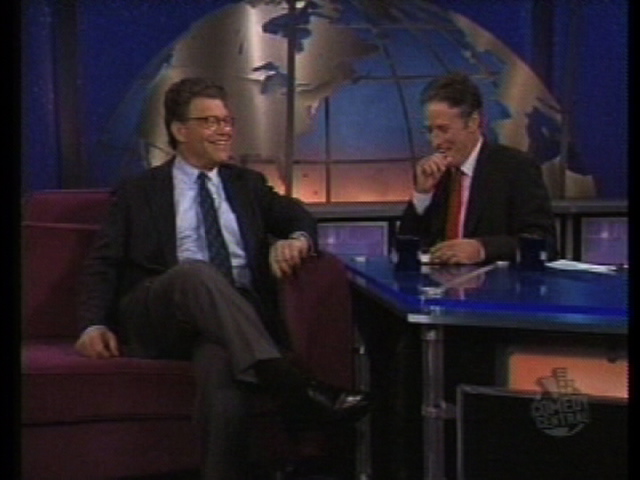
The Daily Show (The best news on television.)
Note: This is a short story, not a book, but I'm putting it in here anyway. It's the sequel to the book. And if you haven't read the book yet, you can read it for free, and then read the short story.
Cory Doctorow has written a lovely short story sequel to Down and Out In the Magic Kingdom.
Salon published it a few weeks ago. In case you need to print it out to read it (like I do), I've provided a complete version of the text.
God. God. The person was so old, saurian and slow, nearly 300, an original revolutionary from the dawn of the Bitchun Society. Just a kid, then, rushing the barricades, destroying the churches, putting on a homemade police uniform and forming the first ad-hoc police force. Boldly walking out of a shop with an armload of groceries, not paying a cent, shouting jauntily over his shoulder to "Charge it up to the ol' Whuffie, all right?"What a time! Society in hybrid, halfway Bitchun. The religious ones eschewing backup, dying without any hope of recovery, entrusting their souls to Heaven instead of a force-grown clone that would accept an upload of their backup when the time came. People actually dying, dying in such number that there were whole industries built around them: gravediggers and funeral directors in quiet suits! People refusing free energy, limitless food, immortality.
And the Bitchun Society outwaited them. They died one at a time, and the revolutionaries were glad to see them go, each one was one less dissenter, until all that remained was the reputation economy, the almighty Whuffie Point, and a surfeit of everything except space.
Adrian's grin was rictus, the hard mirth of the revolutionaries when the last resister was planted in the ground, their corpses embalmed rather than recycled. Years and decades and centuries ticked past, lessons learned, forgotten, relearned. Lovers, strange worlds, inventions and symphonies and magnificent works of art, and ahead, oh ahead, the centuries unrolling, an eternity of rebirth and relearning, the consciousness living on forever.
And then it was over, and Adrian was sweating and still grinning, the triumphant hurrah of the revolutionary echoing in his mind, the world his oyster.
Truncat
By Cory Doctorow
"Adrian, you have a million friends," his mother said. "That's an audited stat. I'm sorry if you feel isolated, but none of us are moving to Bangalore just so you can chum it up with this fellow."
Adrian fought to control his irritation. His mother was always cranky before breakfast, and a full-blown fight could extend that mood through the whole day. No one needed that. "Mom," he said, twisting his body in the narrow, three-person coffin he shared with his folks so that he could look her in the eye, "I'm not asking you to move to India. All I'm doing is explaining my paper."
His mother snorted. "_The Last Generation on Earth_, really! Adrian, if I were your instructor, I sure wouldn't graduate you on the strength of something like that. I don't really care if that boy in India has convinced the ITT people that his trendy little thesis holds water. The University of Toronto has higher standards than that."
It had been a mistake to even discuss it with his mother. At 180, she was hardly equipped to understand the pressures he and his miniscule generation faced. He should've just written it and stuck it in his advisor's public directory. Only just that he'd had the coolest idea in the night and he'd reflexively bounced it off of her: once his generation reached maturity, the whole planet would be post-human, and a new, new era would start. The Bitchun Society, Phase II.
"OK, Mom, OK. I'm going to get breakfast -- you want to come?"
"No," she said, rolling back over. "I'm going to wait for your father."
Past her, he saw the snoring bulk of his father, still zonked out even through their heated exchange. Adrian grasped the ceiling rails and inched himself out of the coffin and into the public corridor.
His gut was rumbling, but the queue for the canteen was still lengthy, packed with breakfasters from the warren where he made his home. Reluctantly, he decided to skip breakfast and go to his private spot. It was almost backup time, and he needed to do some purging.
Truth be told, Adrian's private spot was not all that private, and it was a humungous bitch to reach. His netpals liked to compare notes on their hidey-holes, and Adrian was certain that he had the shittiest, least practical of the lot.
First, Adrian got on the subway, opting to go deadhead for a faster load-time. He stepped into the sparkling cryochamber at the Downsview station, conjured a HUD against his field of vision, and granted permission to be frozen. The next thing he knew, he was thawing out on the Union station platform, pressed belly-to-butt with a couple thousand other commuters who'd opted for the same treatment. In India, where this kind of convenience-freezing was even more prevalent, Mohan had observed that the reason their generation was small for their age was that they spent so much of it in cold-sleep, conserving space in transit. Adrian might've been 18, but he figured that he'd spent at least one cumulative year frozen.
Adrian shuffled through the crowd and up the stairs to the steady-temp surface, peeling off the routing sticker that the cryo had stuck to his shoulder. His tummy was still rumbling, so he popped the sticker in his mouth and chewed until it had dissolved, savoring the steaky flavor and the burst of calories. The guy who'd figured out edible routing tags had Whuffie to spare: Adrian's mom knew someone who knew someone who knew him, and she said that he had an entire subaquatic palace to rattle around in.
A clamor of swallowing noises filled his ears, as the crowd subvocalized, carrying on conversations with distant friends. Adrian basked in the warm, simulated sunlight emanating from the dome overhead. He was going outside of the dome in a matter of minutes, and he had a sneaking suspicion that he was going to be plenty cold soon enough. He patted his little rucksack and made sure he had his cowl with him.
He inched his way through the crowd down Bay Street to the ferrydocks, absently paging through his public directory, looking at the stuff he'd accumulated in the night. It would all have to go, of course, but he wanted a chance to run some of it before then. Most of it was crap, of course. The average backup of the average citizen of the Bitchun Society was hardly interesting enough to warrant flash-baking, but there were gems, oh yes.
His private spot hung tantalizingly before him, just outside of the dome. The press of bodies parted and he lengthened his step to the docks, boarded the ferry with a nod to the operator in his booth, and hustled into one of the few seats on the prow, pulling on his cowl as the ferry pushed away and headed off toward the airlock at Toronto Island.
It was even colder than the last time. The telltale on his cowl showed -48 degrees C with the wind-chill. His nose and toes went instantly numb, and he tucked them under the cowl's warmth.
His private place was just a short slosh from the westernmost beach at Hanlon's Point on Toronto Island, a forgotten smartbuoy, bristling with self-repairing electronics, like a fractal porcupine. It had been a couple weeks since his last foray there, and in the interim, the buoy had grown more instrumentation, closing over the narrow entryway into its console-pod. Cursing under his breath, Adrian wrapped his cowl around his hands and broke off the antennae, tossing them into the choppy Lake Ontario froth. Then he climbed inside and held his breath.
Breakers crashing on Hanlon's Point. Distant hum of the airlock. A plane buzzing overhead. Silence, of a sort. A half-eaten sandwich mouldered near his right ham. Disgustedly, he pitched it out, silently cursing the maintenance crews that periodically made their way out to his buoy and tried to puzzle out the inexplicable damage he'd wrought on it.
But the silence, ah. His mother never understood the need for silence. She was comforted by the farting, breathing, shuffling swarm of humanity that bracketed her at all times. She'd spent a couple decades jaunting, tin-plated and iron-lunged in the vast emptiness of space, and she'd had her fill of quiet and then some. Adrian, though, with 18 (or 17) years of the teeming hordes of the post-want Bitchun Society, couldn't get enough of it.
His public directory was bursting with backups, the latest batch that his contemporaries around the world had passed to him. Highly illegal, the backups were out-of-date consciousness-memoirs created by various citizens of the Bitchun Society, a weekly hedge against irreparable physical harm.
Theoretically, when you made a new backup, the old one was discarded, the file copied to a nonexistent node on the distributed network formed by the combined processing power of the implanted computers carried by every member of the Bitchun Society. Theoretically.
Adrian paged through the directory. Carrying one of the bootlegs into a backup terminal would mean instant detection. Even xmitting it to someone else was risky, and prone to being sniffed. But Mohan, his netpal in Bangalore, had authored a sweet little tool that allowed for xmission over the handshaking and routing channel, a narrowband circuit that carried unreliable -- and hence untraceable -- information that would have been overheard in the main data-channels. The Million had quickly adopted the tool, and they used it to pass their contraband to each other, copying the bootlegs prior to erasing them when their own weekly backup sched rolled around.
Adrian had good Whuffie with the Million. Nothing like Mohan, of course, but still good -- he reliably stored bootlegs for the Million, even if it meant putting off his own backup until he could find safe storage for all those materials entrusted to him. He didn't mind: being a high-Whuffie storage repository meant that he got everyone's most precious bootlegs for safekeeping.
Like this one, the backup of a third-gen Bitchun, born at the end of the XXIst Century, female (though that hadn't lasted long). Seventy years later, her/his backup was a rich tapestry of memories, spectacular space battles, incredible sexual adventures, side-splitting jokes, exotic flavors and esoteric knowledge absorbed from brilliant teachers all over the planet. He'd held onto it for two weeks now, and flash-baked it nearly every day.
Time to do it again. Quickly, he executed the command, and shuddered as that consciousness was rolled up into a bullet of memories and insights and fired directly into his mind, unfolding overtop of his own thoughts and dreams so that for a moment, he _was_ that person, her/his self enveloping Adrian with an infinitude of bombarding sense impressions.
It ebbed away, the rush fading in a synaptic crackle, leaving him trembling and wrung-out. He slumped against the buoy's spiny interior and brought up a HUD and started an agent searching for another member of the Million with storage to spare for a copy of it.
#
Backup days were flash-baking days. In the buoy, Adrian flash-baked a dozen times, alternating between timeworn favorites and the tastiest morsels deposited by the rest of the Million. He gorged himself on the antique consciousnesses of the immortals of the Bitchun Society, past satiety and full to bursting, his head throbbing dangerously.
Each time, he carefully passed the file to the network, waiting while the churning, clunking handshaking channel completed the transfer. He didn't mind the wait: it gave him a moment for the synesthetic rushes to pass. Time grew short, and his gut growled protests, sending up keotic belches that filled the closed space with the smell of esters.
One more, one more, deposited for safekeeping by Mohan himself in the night. Mohan sat at the river's headwaters, the source of all the bootlegs. He was the theoretically nonexistent node to which the backup network flushed its expired files. When he identified a keeper, it had to be good. Adrian had saved it for last, and now he rolled it and jammed it into his brain.
God. God. The person was so _old_, saurian and slow, nearly 300, an original revolutionary from the dawn of the Bitchun Society. Just a kid, then, rushing the barricades, destroying the churches, putting on a homemade police uniform and forming the first ad-hoc police force. Boldly walking out of a shop with an armload of groceries, not paying a cent, shouting jauntily over his shoulder to "Charge it up to the ol' Whuffie, all right?"
What a time! Society in hybrid, halfway Bitchun. The religious ones eschewing backup, dying without any hope of recovery, entrusting their souls to Heaven instead of a force-grown clone that would accept an upload of their backup when the time came. People actually _dying_, dying in such number that there were whole industries built around them: gravediggers and funeral directors in quiet suits! People refusing free energy, limitless food, immortality.
And the Bitchun Society outwaited them. They died one at a time, and the revolutionaries were glad to see them go, each one was one less dissenter, until all that remained was the reputation economy, the almighty Whuffie Point, and a surfeit of everything except space.
Adrian's grin was rictus, the hard mirth of the revolutionaries when the last resister was planted in the ground, their corpses embalmed rather than recycled. Years and decades and centuries ticked past, lessons learned, forgotten, relearned. Lovers, strange worlds, inventions and symphonies and magnificent works of art, and ahead, oh ahead, the centuries unrolling, an eternity of rebirth and relearning, the consciousness living on forever.
And then it was over, and Adrian was sweating and still grinning, the triumphant hurrah of the revolutionary echoing in his mind, the world his oyster.
"Oh, Mohan," he breathed to himself. "Oh, that was terrific." He scouted the network on his HUD, looking for a reliable member of the Million, someone he could offload this to so that he could get it back after his own backup was done. There -- a girl in France, directory wide open. He started the transfer, then settled back to bask in the remembered exultation of his last flash-bake.
His cochlea chimed. The HUD said it was his mother. Damn.
"Hi, Mom," he said.
"Adrian!" she said. "Where are you?" She wasn't in a good mood, that much was clear.
"Uh," he said. "On the subway," he extemporized. "I'm gonna see if Mr. Bosco can see me." Bosco was the admissions advisor at the University of Toronto that he'd been sucking up to lately, trying to charm the old ad-hocrat into letting him into school for the fall semester. It wasn't easy: the undergrad program at the University was winding down in favor of exclusive, high-Whuffie one-on-one grad programs. Teaching the sparse undergrads of the Million was anything but a glamor gig.
"Bosco?" his mother said, mollified. "Well, that's. . .good. Listen, I don't want you talking about this admissions paper idea of yours -- nobody wants to hear about how you and your friends are the last generation of humans. Every generation thinks they're special -- it's just not so."
"Fine," he said. He wouldn't talk to Bosco anytime soon if he could help it, anyway.
"Your father worked with you on that good N-P Complete proof. Present that instead."
"Sure," he said. The revolutionary still echoed in his mind, like distant gunfire.
His mother talked on, and he kept his answers down to one syllable until she let him go. Back in the quiet of the buoy, he quickly purged all the bootlegs from his public directory, pulled his cowl tight and reluctantly climbed outside and back to the Island, there to await the ferry.
#
Adrian's backup was uneventful, a moment before a secure broadband terminal while his life flashed before his eyes, extracted and spread out to a redundant assortment of nodes on the fifteen billion person network that carpeted the earth.
This obeisance to the Bitchun Society completed, he took to the downtown streets, waiting for the files he'd farmed out and deleted to trickle back in. Waiting for the revolutionary's backup, for another taste of exultation and grandiose triumph. He walked all the way from Union Station to Bloor, a good hour in the glottal press of the lunchtime crowd, and still the revolutionary failed to reappear. Clucking his tongue in annoyance, he ducked into a doorway and checked for the French girl.
Her directory was purged! In the space of mere hours, she'd discarded all the third-party files deposited in her personal directory!
It was really inexcusable. The only possible mitigation would be if she'd passed the file on to someone else before deleting it. He spawned an agent and set it hunting for the file through the network of the Million, branching out in binary search from the nodes that were most commonly employed by the French girl.
His mother rang his cochlea again, and he passed her to voicemail, but the ringing stung him into worry. He had a week before the admissions committee deadline at the U of T, and he'd never hear the end of it if he didn't get in. He thought back to the revolutionary, to his participation in the grad-student takeover of the Soc Department in the mid-XXIst, the replacement of tenure with Whuffie.
Those were the days! Real battles, real principles, and the blissful, blessed elbow-room. That's what he needed. Or, failing that, another crack at flash-baking the bootleg. Damn that French bimbo, anyway.
His cochlea rang again, his mother. Resigned, he answered.
"Adrian, where are you?" She sounded like she was in a better mood, anyway.
"I'm at Yonge and Bloor, Mom. Having a walk, looking for somewhere to get some lunch."
"What did Mr. Bosco say?"
Damn, damn, damn. "He said he'd think about it -- he'll get back to me with comments tomorrow."
"Really?" his mother said, sounding genuinely interested. Bosco had never really given him the time of day.
"Yeah," he said. "I think he liked it, the N-P Complete thing, I mean. I didn't mention the other thing."
"Funny," she said, and her voice was all ice now. "He didn't mention your visit at all when I spoke to him just now."
The blood drained from Adrian's face. He wouldn't hear the end of this for some time. "Uh," he said.
"Just listen to me, kid, don't say anything else. You're in enough trouble as it is. I've got your father conferenced in, and I can tell you he isn't looking like he's very happy.
"Now, here's how it's going to be. I've set up an appointment with Bosco in one hour. I had to call in a lot of favors to do it, and you will be on time. Your father will be there, and you'll tell Bosco how excited you are by this opportunity. You won't mention this stupidity you've been chasing. You will show him how diligent you are in your studies, show him how much you can benefit the University, and you will be cheerful and smart. Do you understand?"
"Yes," Adrian said. Jesus, she was furious.
"One hour," she said, and rang off.
#
Adrian's agent found the bootleg again just as he reached the waiting room at Innis College. The French one _had_ passed it on before deleting it, to another girl in Kansas. Sighing with relief, he queued the download just as his father arrived.
Adrian's father was apparent 22, hardly older-seeming than Adrian himself, though his real age was closer to 122. All Adrian's life, his father had kept himself at an apparent age that was just a few years older than Adrian's own, following a bit of child-rearing wisdom that had been trendy fifty years before, just as the Bitchun Society started to mete out Whuffie-punishments for those people selfish enough to contribute to the overcrowding by reproducing. The logic ran that having a father of playmate-size would reduce the loneliness of the children of the diminished generation of the day.
At 22, Adrian's father was heavyset and acne-pocked, his meaty pelt bulging whenever it came into contact with the light cotton djellaba he wore around town.
He gave Adrian a curt nod when he arrived, his eyes fixed on a space in the middle-distance where his omnipresent HUD shone for him alone. He took a seat next to Adrian and rang his cochlea.
Adrian rolled his eyes and answered subvocally. Why his father couldn't have an unmediated conversation was beyond him. "Hi, Dad," he said.
"Hi there. Had a good morning?"
"Good enough," Adrian answered. "How's Mom?"
His father subvocalized a chuckle, the sound in Adrian's cochlea blending weirdly with the swallowing sounds from his father's throat. "She's pretty angry. Don't worry about it -- we'll do a dog-n-pony for Bosco and she'll forget all about it."
Bosco opened the office-door and greeted them. Adrian's father answered audibly, his voice rusty from disuse.
In Bosco's leatherbound academic cave of an office, the two adults chattered boringly and lengthily. Adrian knew the drill, knew that it could be a long time before anyone could have anything to say to him.
Sneaking a glance at his father and Bosco, he rolled up the revolutionary's backup and flash-baked it.
The life unrolled over his mind, the early days of the Bitchun Society, the physical battles and the ego-clashes; first adulthood lived as a nomad, trekking around the globe; a second and third adulthood, a fourth, moving towards that moment at which the backup was taken, when eternity unrolled, and
_snip_
it cut off.
Adrian's eyes popped open. _Damn_. Truncat! The file had been chopped short during transmission between the nodes. Half the revolutionary's life, vanished into a random scattering of bits and aether.
Bosco was looking expectantly at him, heavy-lidded, wavy hair and thick eyebrows and crinkles at the corners of his eyes from long hours of thinking. He had said something. Hurriedly, Adrian zipped through his short-term AV capture on a HUD, played back to Bosco saying, "Well, Adrian, this is a very well-prepared entrance paper. Can you tell me what it is about mathematics that interests you?"
Now Bosco and Adrian's father were both staring, and Adrian mimed concentration, as though he were genuinely considering his answer. In truth, he was paging through his files for the canned response his mother had provided him with, but there was no sense in admitting it.
"I've always loved math," he recited, struggling to remember the phrasing. "I just can't help seeing the mathematical relationships in everyday life. It just makes sense to me."
Bosco nodded, the ritual response satisfying him. Adrian's father gave him an appraising look and went back to wrangling with Bosco. It all came down to Whuffie, anyway -- did Adrian's parents have enough reputation capital that their gratitude to Bosco outweighed the upset the teaching staff would feel when they were saddled with a lowly undergrad?
#
The meeting was hardly over before his mother was conferencing Adrian and his father in. As it turned out, Adrian's father had been dumping a realtime video-stream to her all through the meeting, she'd seen it all. "Adrian," she said, sharply, "What's the matter with you? You were completely out of it during that whole thing."
"I was just thinking, Mom. I got distracted. I think it went well, anyway, right, Dad?"
"Sure, sure," his father subvocalized, patting him on the shoulder. "I think you're all set for next term."
But Adrian's mother was not to be mollified. "Adrian, I'm sick of all this flakiness. I know exactly what you were _thinking_ about --" Adrian's heart sank: how could she know about the bootleg? "All that adolescent hand-wringing about your generation is distracting you from your real priorities, and it's time you smartened up. Grant me private access, I want a look at what you've been up to."
Oh, shit. Hurriedly, Adrian flushed the bootlegs. His mother hadn't gone picking though his files in years, so it took him a moment to remember the mnemonic that erased the bootlegs and all records of their existence from his personal storage. In his cochlea, his mother made impatient noises, and that sure didn't help.
Once the data was flushed, he granted her access. He watched dismally as his system log scrolled by, every file in his storage piping through his mother's keyword filter.
"'The parents of the Million are understandably resentful of their offspring,'" she read, in a dangerous voice. It was the paper he and Mohan had been collaborating on, and he knew she wasn't going to like it. "'For whatever reason, they chose to bring a generation into being at a time when the world wanted nothing but. The sacrifices they've endured since are immense, Whuffie penalties that mount daily as their peers make their disapproval felt. Our parents are stuck in the closest thing the Bitchun Society has to poverty, and it's our fault.'"
She paused and drew breath. "All right, Mom, all right, that's enough," Adrian said. "I'll get rid of it."
She snorted. "You're damned right, you will. Just adolescent nonsense --"
"I know," Adrian said. "I'm sorry." Mohan had a copy, anyway -- he could recover it later.
"Don't switch off my access, either," she said, to Adrian's dismay. "I'll be checking in regularly from now on -- you've got to concentrate on your studies, not this, this --"
Words failed her.
#
Adrian thought his mother would be mollified when Bosco called her later that day to say that he was to be admitted for the summer term in the Department of Applied Mathematics at the University of Toronto. But she couldn't let go of her suspicion that he was up to no good.
Mohan's theory was that she was worked up over the possibility that she was nearly shut of the stigma of mothering one of the Million, and that she feared that he would do something that would rain down fresh shame on her.
So, the random audits of his files continued, daily at different times. Adrian hardly flash-baked at all in the next week, and he fell into a grimy, hyperreal mood, bereft of access to others' consciousnesses. It wasn't that the Bitchun Society had anything to complain about: food, shelter, entertainment, travel, communications -- all of it freely available. No disease that couldn't be cured with rejuve, or, failing that, refreshing from backup into a clone. But three months remained until his term started, three long months of not being able to swap polemics with Mohan, of not being able to roll up the lovely consciousnesses that he scored through Mohan and jam them into his brain.
After a week of it, he was positively buggy, ready to have himself frozen until classes started. During the scarce hours when he and Mohan were awake and online at the same moment, he was able to work remotely off of Mohan's systems, but the lag through the kludged-up channel made it so painful he could hardly bear it.
His salvation came ten days after the acceptance.
He was en route to his private spot when it happened. Thawing out on the kerb outside of Union Station, chewing thoughtfully at his routing tag, he was approached by a stranger. The woman was apparent 17, and a quick back-check of her public ID verified that she was actually 17, another member of the Million, a needle in the demographic haystack. She snuck up on him while he was ruefully paging through the public directories where he'd put his bootlegs the last time his mother had gone tiptoeing through his consciousness, salvaging what he could from the tatters of his beloved collection. She was wearing a cowl like his, and had odd, vaguely Asian features, round-faced and flat-nosed, but with a fair cast to her skin that was almost paper-white. She tapped his shoulder and spoke aloud, a clear, young voice ringing out in the mumbling white-noise of the subvocalizing crowd.
"Hi there!" she said. A few people turned to stare, their eyes flicking up to HUDs where they examined the pair's Whuffie and designation.
"Hello," Adrian said.
"My name's Tina," she said. Her speech had long, spacey vowels in it, the speech of a jaunter somewhere in the dark nothings of interstellar space, crackling through adventure dramas on the net.
"Adrian," he said, and put his hand out.
She chuckled. "Wow, you really do that, huh?"
"What?"
"Shake hands! I've seen it in historicals, but never in real life." She shook his hand, harder than was necessary. "I'm pleased to meet you, Adrian. What do you do?"
"What?" he said again.
"You know, what's your role? I used to help out with the hydroponics, before we came here. Now my folks say I've got to find something new to do. What do you do?"
"Uh," Adrian said. She was a jaunter, freshly back from space, probably landed at Aristide Interplanetary just north of the city. He didn't know much about jaunters, but he did know that their version of the Bitchun Society was a little nonstandard. "I'm a student," he said.
"Wow!" she said. "Full time? What do you study?"
"I'm doing applied maths at U of T. Will be, anyway," he corrected himself. "This summer."
Her face clouded for a moment as she chewed this over. "How long are you going to be doing that for?"
"It's a four-year degree."
"Four years?" she said, shocked.
"Yes."
"That's a long time! Who's going to take your job when you go?"
"What job?" Adrian asked. He wasn't sure how he'd been drawn into this conversation, but he was enjoying it, in a disorienting way.
"The job you do now," she said, as though explaining something to an idiot.
He fished for words, then watched as comprehension dawned on her. "You don't do anything now, do you?"
He grinned. "Not really, no."
She clapped her hands. "You people are really freaky, you know that? What do you _do_ all day, if you're not working?"
Adrian opened his mouth and she looked at him with such guilelessness that he made a rash and wonderful decision.
"I'll show you," he said, and struck off to the ferry-docks.
#
It was tough squeezing two people into the buoy, but they managed to clamber in, with much blushing and inadvertent placement of hands and elbows. Adrian's sexual experiences to date had been entirely teledildonic, and the reality of his close proximity to someone of the opposite sex had his ears glowing pink.
Tina took it all in stride, remarking that she'd been in much closer quarters aboard the ship she'd grown up on, bending time and space on a long voyage out to what turned out to be a hunk of dead, airless rock. "It's pretty cool for Earth, though," she allowed.
Adrian covered his embarrassment by furiously combing the network for some decent bootlegs. Though not officially one of the Million, Tina was a generational comrade, and entitled to try out flash-baking under the terms of the agreement that Mohan had insisted the Million subscribe to if they wanted access to his booty. Adrian's researches located a real plum, the revolutionary's backup, trunced to a mere nubbin of its former glory, but still a good choice for Tina's first experience. He downloaded it from a boy in Vancouver and pushed it into Tina's public directory. She cast her eyes up and they tracked over her HUD.
"What's this?" she asked.
"It's what I do," Adrian said, and sent her the flash-baking app. "We'll run it together."
Together, they executed the app, rolling the bootleg and baking it. Adrian suppressed a groan of disappointment. The file was so foreshortened that it barely registered for him, just a distant hurrah of triumph and then it was gone.
Tina, though, was taken completely aback, her breathing heavy, her jaw hanging limp. Slowly, her almond eyes fluttered open, and she rolled her head from side to side langorously.
"That was really fine," she said. "Really. How do you know Nestor?"
"Who?"
"The guy in the backup -- Nestor. He was on the ship with us."
Adrian's heart slammed in his chest. "You _know him_?"
"Yeah!" she said. "Of course! I grew up with him."
Adrian reeled. She knew the revolutionary! He could meet him, get another copy of the bootleg --
"Wait, you _don't_ know Nestor?" she said.
He shook his head, his mind racing. He would meet him, go with him to see Mohan, tell him their theories about the Million --
"How did you get this if you don't know Nestor?" she asked.
His thoughts screeched to a halt. "It's a bootleg," he said. "An illicit copy."
She gave him a hard look and he realized what was weird about her eyes, her skin. She'd been tin-plated, iron-lunged and steely-eyed all her life, until she made Earth. She'd only had naked eyes for a few days. Now, they looked steely, distant and considering.
"You're saying that you got this without Nestor's permission?" she asked.
So he explained about the bootlegs, about Mohan's discovery of a backdoor that let him designate his personal storage with the generic ID used for the system's discard bin, how Mohan had distributed the backups over the handshaking channel. He was warming up to a discussion of generational politics when she interrupted him.
"That's awful!" she said. "These are _private_ -- how can you just trade them around?"
He hadn't actually given it any thought in years. "It's not like we're spying on our friends," he said, hastily. "These people are strangers. We'll never know who they are -- but it's the only way we can learn about --"
"Nestor's not a stranger," she said, flatly. "He ran the engine-room on my ship. He won't like this very much, either."
"Wait!" Adrian said, alarmed. "You're not going to _tell_ him, are you? We could get into a lot of trouble."
"You mean _you_ could get into a lot of trouble," she said.
"Fine," he said, hotly. "Go ahead. That's what I get for making friends with a stranger."
That stopped her. "We're friends?" she said.
"Sure," he said. "You're the only person I've ever brought here. That's friendship, isn't it?"
"But you just met me!" she said. "How can you be my friend?" She seemed genuinely distressed.
"Well, I just liked you is all," he said. "You asked me good questions. I thought I could ask you some. I showed you this place, let you flash-bake one of my bootlegs --"
"And that makes us friends?" She shook her head. "On the ship, we treated everyone like that. Friends were really. . ." she dug for the word. "It wasn't so _casual_. Friends were a big deal."
"You see?" Adrian said, glad to be off the subject of the bootlegs. "That's just the kind of thing that makes us great friends -- you don't know your way around Earth and I don't know much about space, so we've got lots to talk about. What were friends like on the ship?"
And off they went, and at first, Adrian was just relieved, but she had wonderful stories, stories of bravery and devotion, of friends scattered to the stars, seas and Earth when the ship returned to Earth, of the hollow longing she felt for them now. Before he knew it, it was nightfall, and he'd located another bootleg, fresh from Mohan, and they flash-baked it and agreed that having the whole file was better than just some little stub of a truncat, but that being said, her friend Nestor had a much more interesting life than the 80 year old painter they'd just run.
When they parted for the night, Adrian took her hand and told her what a wonderful time he'd had with her. "Could you do me a favor, do you think?"
"Sure!" she said, brightly.
"Could you hold onto some files for me?"
If she'd hesitated, even for an instant, he would have taken it back, told her not to bother. He wasn't a _bastard_ -- she was really cool, the first person his age he'd been in company with in years, just wonderful to hang with. She didn't hesitate, not even for an instant.
"Sure," she said, and he moved all the bootlegs he'd picked up that afternoon to her storage.
#
Adrian wasn't really sure what physically proximate friends did for fun, but Tina had all sorts of ideas. They met up for breakfast the next morning at a public maker near Adrian's place, and the queue had never seemed shorter, as they gabbled in the near-silence of the thronged corridor.
They walked while they shovelled post-scarcity waffles and sausage into their mouths, Tina remarking constantly on the crowds, the sheer thronging humanity of it all. The parks were all too dense for fun, but they found ample elbow-room way out in the east end, where untalented sculptors operated public studios in the unpopular former scraplands.
The fight was Adrian's fault. "I want to meet him," Adrian said, as they watched a man with hammer and chisel crawl over a hideous marble lion.
"Him?" Tina said. "Why? He stinks."
Adrian smiled and shushed her. "Not so loud -- anyways, he's not as bad as some of the people around here. No, not him -- Nestor, the ship's engineer. You know --"
Her expression slammed shut. "No. God! No! Adrian, why --" She choked on whatever she was going to say next.
Adrian, taken aback, said carefully, "Why not? I really, you know, _admire_ him."
"But you've been inside his head!" she said, scandalized. "How could you look him in the eye after --" Again, words failed her.
"But that's _why_ I want to meet him! What I saw, what he knows, it just makes so much sense. I feel like he could really tell me what it's all about."
Her eyes took on the aspect of steel again, the million lightyear stare. "If you talk to Nestor, I'll never speak to you again. I'll -- I'll turn you in! I'll report you and all of your pals!"
"Jesus, Tina, what's _wrong_ with you? You're supposed to be my friend and now you're going to _turn me in_?" He was so angry, he could hardly speak. He wished he was talking to her over the network, so that he could just hang up and walk away. He did the next best thing, turning on his heel and walking away.
"Hey," Tina shouted, angry too.
He kept on walking.
#
She found him in his private place, holding a one-sided argument with his mother. "Mom, I'm old enough to get a place of my own, and you can't stop me," he shouted into the buoy's guts. In her cochlea, he heard his mother's grunt of anger, and his HUD was filled with the scrolling system log as she angrily deleted his files, being on a particularly nasty tear that day.
"Mom!" he shouted again. "Talk to me or I'll -- I'll lock you out!"
Tina watched this, half in, half out of the buoy, her bottom exposed to the frigid stinging rain, her face flushed with the captured body-heat in the buoy. Adrian had yet to notice her, too absorbed in his conversation.
"That's it," he said. "I'm locking you out now."
He opened his eyes and sighed back against the buoy's bulkhead. He saw Tina and let out a surprised "Yah!"
He recovered quickly, gave her a nasty look and said, "Get out! Jesus, just leave me alone!"
She'd been calling him, leaving messages on his voicemail for a week, but he had her blocked and the messages just kept getting returned, unheard. Defiantly, she crawled the rest of the way in and huddled as far from him as she could, which still meant that she was halfway in his lap.
"God, they must be stupid in space," Adrian ranted. "Can't you understand I don't want to talk to you? Go away!"
Tina gave him an appraising look. "One thing we learn in space," she said, "is how to out-wait a bad mood. I'm not leaving until we have a chance to talk, and if you don't like it, that's too bad. You're not getting rid of me unless you throw me into the lake."
Adrian fumed and closed his eyes. He searched fruitlessly for a decent bootleg, but his connections had dried up and dropped off in the two weeks since his mother's spotchecks had curtailed his trading. It could take days to build them up again.
"Fine," he said at length. "Say your piece and go, all right?"
"Turn on public access," Tina said. Adrian started to protest, but she fixed him with her stare. "Do it," she said, firmly.
Adrian sighed dramatically and closed his eyes, then watched as all the bootlegs he'd stored with her were passed back to his storage. Everything! "Thanks," he said, cautiously. "What's going on? Are you planting evidence before turning me in?"
She shook her head. "I deserve that, I suppose. There's one more," she said. And a filename appeared in his HUD.
"What is it?" he said.
"Just try it," she said.
He rolled it up and baked it, then grunted in shock. It was Nestor's backup, complete and whole, centuries of life, stretching up to the current day. There was Tina in the memories, her birth on ship, her growing up. There was the voyage, the long trip taken in vain and the long return home. The new memories were mirrorbright and cold as space, all the vigor and passion drained with nothing but a hard waiting in their place.
He opened his eye. "Where --" he began, but couldn't finish. He waved his hands at her.
Tina grinned wryly. "I took it from the ship," she said. "I still have access to its utility files. It's just past Pluto now, spacing out for another mission. That made it a little tricky to transfer, but I got it."
"Thanks," he said.
She tilted her head. "Don't thank me," she said.
It was sinking in now, that hardness, that waiting, the centuries ahead dull and indistinguishable from the ones behind, and no hope of it ever ending. The miserable, fatal knowledge that there was only more of this, more and more, forever, and no break in the monotony. It settled over him like lead weight, sapping everything, even the anger at his mother. Endless days of plenty. . .
"How did he get so, so --"
"We used to say he was 'arid,'" Tina said. "None of the parents on the ship would let the kids go near him, so of course we snuck over to see him whenever we could. He hasn't had a rejuve in, oh, forever, and he looks like a silver skeleton. We'd pester him with questions, and he'd just stare and stare, then finally say something so amazingly depressing."
"But how? He was so, so -- _passionate_. He made me feel like there was a chance, like I could make a difference." Adrian said. That first bootleg, it must have dated back to before the ship left, a relative century before, and it was flushed into Mohan's honey-pot when the ship returned and Nestor made a fresh backup.
Tina shrugged. "Space changes people," she said, simply. "Time, too. He's nearly 400 now, you know. My parents called him a post-person. You know, what comes after people. That's why we didn't ship out again -- they don't want that to happen to them. Nestor wasn't the only one."
Adrian shuddered. A ship full of people like that, years cooped up in quarters tighter than any he'd known on Earth. . .
"You see why I didn't want you to meet him," she said.
"Oh, I can take care of myself," he said. "You didn't have to worry about me."
She gave him another quizzical look. Her glance was more natural now, less spacey. Her skin, too, had taken on a tone that was more human. "I wasn't worried about _you_," she said. "I was worried about Nestor! He's okay most of the time, but when you get him talking about the old days, he just breaks down. You've never seen anyone so miserable. Poor old Nestor," she said, with feeling.
"Say, I've got one more for you, if you're interested," she said. "Brand new," she added.
"Sure," Adrian said and opened his directory. He took the file he found there, rolled it, baked it.
It was Tina, the short life of Tina, the claustrophobia and unimaginable distances of space, the tight and deep friendships in the tiny shipboard community, the loneliness in the crowds of Earth. Her spying him on the streets of this strange and overwhelming city, her relief when he didn't rebuff her. And him -- him, through her eyes, smart and savvy and frightening. Frightening? Yes, his anger and his rejection, his unfathomable values and ideas. It was short, her backup, a mere 17 years' worth of consciousness, and it took him a bare moment to bake it.
Tina was looking down at her feet.
"Hey," Adrian said. "Tina?"
Tina looked up. She was scared, those eyes wide and guileless.
"Yes?" she said.
"Switch on guest access, OK?" Adrian said. Then he pushed her a copy of his last backup.
#
He spent as long as he could bumming around downtown before catching a subway home. His mother hadn't called him since he'd locked her out of his personal storage and sent her a copy of his backup and the flash-baking app, and the thought of seeing her face-to-face made his stomach knot.
Leadenly, he took the stairs down to the subterranean level where his family slept, and hit the door code. It slid open, revealing his father, alone, staring up at the ceiling.
"Dad?" Adrian said. His cochlea rang. He answered.
"Hi, Adrian," his father said, in his ear. He sounded tired.
"Where's Mom?" Adrian asked, with a growing sense of foreboding.
"Oh, she went out," Adrian's father said, vaguely.
"Is she angry?"
Adrian expected a chuckle, but none came. "No," his father said, flatly. "Not angry."
"Are _you_ angry?"
His father shifted his bulk and drew Adrian into a long hug. "No, son, I'm not angry either," he whispered aloud in Adrian's ear.
It took Adrian a moment to register that his father had spoken aloud, and when he did, it hardly eased his nervousness.
"What's going on, Dad?" he asked, finally.
His father sat up, ducking his head for the low ceiling. "I owe you an apology," he said.
"For what?"
His father switched back to subvocal. "All this business with the University. You deserve to choose what you want to do. We had a long talk about it this afternoon, and we decided that it's not our place to tell you what to study. I'll take you to see Bosco in the morning, and we can show him the essay you worked up with your friend in India."
Adrian didn't know what to make of that, except that he felt vaguely guilty. "Why? What changed your mind?"
His father flopped onto his back and stared at the ceiling. "I read the paper," he said. "It's good. Interesting thesis, good execution. Thought-provoking. It's a good paper. You could really start something with it."
"Yeah?" Adrian said, blushing. His HUD flashed an alert. His father was pushing a file into his storage. Adrian examined it: a backup, his father's backup. Adrian understood, now. He knew that if he looked in his father's storage that he'd see a copy of his own backup there.
"Yes. You and your friends, you could have a real destiny. Post-people, the last generation on Earth -- that's smart stuff."
Adrian startled. _Post-person_. He thought of Nestor, saurian, purposeless, cold and hard. Of Tina, looking for a job, a thing to do every day.
A thought occurred to him. "What are you going to do when I start school, Dad?"
"Oh, I don't know. Maybe deadhead for a while, see what things are like in another century. I know that's what your mother wants to do."
They'd talked about deadheading before, but Adrian had never really believed they'd do it. Gone for a century -- frozen in cold sleep like millions of others, waiting to see what the future held.
"I'll miss you," he said.
"Oh, you'll get used to it," Adrian's father said. "I can't tell you how many people I know who're deadheading now. Almost everyone I ever knew, really. We'll see each other again before you know it."
When he woke in the morning, his mother was back, asleep between him and his father. Automatically, he checked his in-box. His mother had sent a copy of her backup, too. He got up quietly, careful not to disturb her, and snuck away.
#
Tina answered on the second ring, sounding groggy.
"'lo?"
"Tina?"
"Hi," she mumbled.
"Listen, do you want a job?" he said.
"Huh?" She was waking up now.
"A job -- do you still want a job?"
"Sure," she said.
"You're hired," he said.
"For what?"
Adrian rolled up and flashed Nestor's backup, feeling the hopeless, helpless weight of eternity. He flashed his mother's backup, his father's. He grinned. "Here, let me dump you the job-requirements," he said, and dumped the files on her.
"Start with these. Send them around, everyone you know. Don't ask for anything in return, but if they send you anything back, pass it around too." He swallowed, prepared a set to send to Mohan. "We're gonna be post-people, but we're gonna do it _right_," he said.
I've been re-reading Down and Out In The Magic Kingdom again, and it really is all that good. If you haven't read it yet, you might want to check out the HTML
version of it online.

Now that it has become apparent that people are ready to look to new ways of managing information, money and intangible assets (such as "knowlege"), it seems like a good time to start talking about what kind of system would be fair and ideal -- just to give us something to strive for as we reshape our future.
Besides being a great read and a lot of fun (which is, of course, always the first requirement of any book I recommend), I feel that this book is an important one, because it really provides lots of excellent tangible examples of how a Reputation Economy might work.
Reputation systems are something that I have been fascinated with and meaning to write about for some time, but there were so many people already writing about them that knew so much more than me, and I realized about this time two years ago that I had so much to learn, I'd better just shut up and learn from other people for a few years before trying to teach anyone else about them.
Basically, in a reputation economy, you are rewarded with points when you do good things for the overall population. These points can vary in value between discounts on merchandise (in certain instances) or simply earning you respect among your peers.
Here's a clip from the Book's Prologue that helps to explain the concept better. (I'm rummaging around for some good papers on this too.)
... Whuffie recaptured the true essence of money: in the old days, if you were broke but respected, you wouldn’t starve; contrariwise, if you were rich and hated, no sum could buy you security and peace. By measuring the thing that money really represented—your personal capital with your friends and neighbors—you more accurately gauged your success.
More on this soon. I just wanted to get the ball rolling...
The story I just blogged about the nano tech talks at the cryonics conference reminded me that Timothy Leary wrote about Alcor in the book I worked on with him (Surfing the Conscious Nets). (Contrary to popular belief, however, Tim did not freeze his remains.)
I went and dug up the reference to Alcor, just for fun. For those of you with a copy of Surfing the Conscious Nets around, it's on page 16. For the rest of you, I've created a scan here:

I'm sure this is OK with both Last Gasp publisher Ron Turner, who is a friend of mine, and would consider it promotion for the book, and Tim Leary himself, because he told me in 1995 that it was his dream to have all of his works freely available online. A dying wish, if you will.
(Yeah, we're talking everything. So I'm sure he wouldn't mind a few scans.)

On the bright side of the ledger, John Lilly, Jack Nicholson and Michelle Phillips have escaped with their "souls" intact. So far! Several of the lesser known Gabor sisters, rumor has it, had their pretty heads sliced and diced by Dr. Sidney Cohen's gang. Elvis Presley? Who knows? Walt Disney? Janis Joplin? Jim Morrison? Just who exactly still lives frozen in blessed hibernation in the re-animation vaults of the Alcor-CryoCare Cryonics Foundation, in Riverside, California, as Jimi Hendrix does? -- no thanks to Nick Rogue--all credit to Michael Hollingshead.Then Andy Warhol started phoning me day and night. Cryonics is all Andy thinks about these days. So he says.
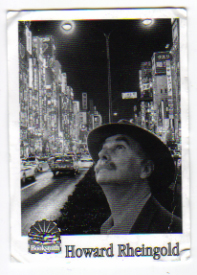 A Howard Rheingold Trading Card | I went to see Howard Rheingold speak at some bookstore on the Haight a few nights ago -- I've read excerpts from a friend of mine's copy of Smart Mobs: The Next Social Revolution, and I can already highly recommend it. |
This is not to say that smart mobs are wise mobs. Not all groups who use new technologies to organize collective action have socially beneficial ends in mind. Criminals, totalitarian governments, spammers, will all be able to take advantage of new capabilities -- just as the first to take advantage of tribes, nation-states, markets, networks included the malevolent as well as the cooperative.
Here is the full text of the interview in case the link goes bad:
http://engaged.well.com/engaged/engaged.cgi?c=inkwell.vue&f=0&t=166&q=0-
[Goto Topics List]
Conference Banner
Howard Rheingold, Smart Mobs
Topic #166, 83 responses, 0 new, Last post on Mon 25 Nov 2002 at 08:09 AM
inkwell.vue 166: Howard Rheingold, Smart Mobs
#0 of 82: Jon Lebkowsky (jonl) Thu 21 Nov 2002 (07:24 AM)
Howard Rheingold was an early Internet adopter who understood quickly how
computing and 'net-based communication could enhance human capabilities. This
fed into an interest in human potential that led Howard to create or
co-create such works as _Higher Creativity_ (1984), _The Cognitive
Connections_ (1986), and _Excursions to the Far Side of the Mind: A Book of
Memes_ (1988). Howard became involved in the WELL in 1985, and this led to
his authorship of _The Virtual Community_, a book about his life online and
the potential for community in cyberspace. Howard was editor of Whole Earth
Review for several years, and of the Millennium Whole Earth Catalog, which
was published in 1994. Howard was the first Executive Editor at HotWired,
but left to build Electric Minds, which was more of an online community/jam
session than a magazine. Howard continues to explore the human impact of new
technologies in _Smart Mobs: The Next Social Revolution_, which explores the
impact of increasingly ubiquitous wireless communications devices on social
networks, and the evolution of moblike adhocracies that can be either
positive or destructive.
Bruce Umbaugh leads the discussion with Howard. Bruce is a philosopher who
teaches at Webster University's main campus in St. Louis (MO, USA) and via
the Net. His interests include computer ethics, epistemology, philosophy of
science, cognitive science.
Please join me in welcoming Bruce and Howard to inkwell.vue!
inkwell.vue 166: Howard Rheingold, Smart Mobs
#1 of 82: virtual community or butter? (bumbaugh) Thu 21 Nov 2002 (07:44 AM)
Thanks, Jon.
Howard, I've really enjoyed your book. The ideas you're pursuing are as
interesting and engaging as anything I've come across in awhile. So, it's
exciting to have the chance to talk with you here about all this.
I think one of the first things likely to occur to anyone bumping into
*Smart Mobs* is that the title itself is a bit jarring. We usually think of
"mobs" as dumb (and in part for that reason dangerous). We often think of
only individuals as "smart." So a place to start is asking you what smart
mobs are.
inkwell.vue 166: Howard Rheingold, Smart Mobs
#2 of 82: Howard Rheingold (hlr) Thu 21 Nov 2002 (12:01 PM)
The briefest definition is that a smart mob is group of people who use
mobile communications, PCs, and the Internet to organize collective
action. That doesn't mean a whole lot without unpacking it. Maybe it will
help for me to briefly describe the clues that led me to suspect that we
are at the beginning of an important social-technological revolution.
In Tokyo, in early 2000, I couldn't help noticing that so many people were
looking at their telephones rather than listening to them -- and many were
using their thumbs to send text messages to one another. Interesting --
but there are many interesting sights in Tokyo. I recalled this unusual
sight (unusual for American eyes -- elsewhere in the world, around 100
billion text messages are transmitted every month) -- when I found myself
in Helsinki a few months after my Tokyo experience. I was sitting at an
outdoor cafe, drinking a cup of coffee, when three Finnish teenagers
encountered two older adults -- maybe the parents of one of them -- right
next to where I was sitting. I had no idea what they were saying -- they
were speaking Finnish -- but I noted that one of the teenagers glanced at
his mobile phone (all Finns carry their telephones in their hands and
glance at them from time to time) and smiled. Then he showed the telephone
display screen to the other two teenagers, who also smiled -- but he did
not show it to the other, older, adults. And all five of them continued
conversing as if this was normal.
I started asking around, and both my Japanese and Finnish friends told me
that many young adults "flocked" -- showed up at the same mall or
fast-food joint at the same time from eight different directions --
because they had coordinated and negotiated through flurries of text
messages.
Again, this was curious, but not world-shaking. I started doing some more
serious research when I read reports about the "People Power II"
demonstrations in Manila. The Estrada government was accused of
corruption, and everyone in the Philippines was glued to their TV set for
a time, like Americans during the Watergate hearings, as the Philippine
Congress investigated Estrada. When Senators linked to Estrada abruptly
shut down the hearings, tens of thousands of Philippine citizens started
gathering in EDSA -- the same square where the anti-Marcos demonstrations
had taken place. But they showed up within minutes -- almost all of them
wearing black. In hours, millions showed up. It was all summoned and
coordinated by text messages. Telephone trees are old organizing tactics,
but cumbersome compared to texting. Once you get a text message, y ou can
forward it to everyone in your address book.
I realized that the flocking teenagers and the demonstrating Filipinos
were taking advantage of a recently-lowered threshold for collective
action. And when I looked into collective action, I realized that much
more could be in store. It was when I understood that the mobile
telephones so many people carry are becoming miniature computers and
Internet terminals that I began to realize that we are on the verge of the
third great wave of change, following and building upon -- and going far
beyond -- the PC and Internet waves.
inkwell.vue 166: Howard Rheingold, Smart Mobs
#3 of 82: virtual community or butter? (bumbaugh) Thu 21 Nov 2002 (01:28 PM)
So these "mobs" depend on particular technolgies in order to exist as
mobs. (And to be "smart" as well? Or is the smart part human, rather
than technological?) And they differ from what preceded them relying on
the Internet and PCs in being mobile (and relatively ubiquitous).
Anything else that's distinctive about the tech?
And why is this revolutionary, rather than just more of the same?
inkwell.vue 166: Howard Rheingold, Smart Mobs
#4 of 82: Howard Rheingold (hlr) Thu 21 Nov 2002 (01:47 PM)
Let's talk about the big picture for the moment: communication
technologies, social contracts, and collective action.
For a LONG time, humans hunted small game and gathered roots and berries
in small family groups. At some point, not all that long ago in our
evolutionary history, those family groups began to cooperate with others
who weren't directly related to them, organizing big-game hunts -- a form
of collective action that brought in more meat than any one family could
eat before it spoiled, thus creating the first public goods. Whenever a
means of communication, a social contract that enables people to trust one
another on a new scale, and collective action produce new public goods,
human society becomes more complex: agriculture, alphabets, printing
presses, etc. The printing press broke out the secret code of the
alphabet, which had been invented by the accountants for the first great
empires and had been reserved for the ruling elite for millennia. Within a
couple centuries of the emergence of literate populations, the collective
enterprises of self-governance and science emerged.
The Internet enables people to connect with strangers in other parts of
the world, getting together around shared affinities -- the whole virtual
community story. Ebay adds a reputation system, and a new market emerges.
Peer to peer methodologies enabled 70 million people to share their hard
disk space via Napster, and 2 million people to amass 20 trillion floating
point operations per second of CPU power to search for messages from outer
space.
What will happen when billions of people carry devices that are thousands
of times more powerful than today's PCs, linked at speeds thousands of
times faster than today's broadband connections, perhaps with distributed
reputation systems that enable us to find people with whom we have some
common cause -- on the fly, in the real world? That's the essential
question of smart mobs. The flocking teenagers, the Philippine
demonstrators, the Napster and SETI@home and eBay crowds -- they are only
the first outbreaks. After all, the PC I used when I first joined the Well
in 1985 had 640K RAM and communicated at 1200 baud. Now, fifteen years
later, I can access the Well from a handheld device (I use a Treo 300)
that is a thousand times more powerful, and a fifth the price. And the
speed is probably a thousand times faster.
This is not to say that smart mobs are wise mobs. Not all groups who use
new technologies to organize collective action have socially beneficial
ends in mind. Criminals, totalitarian governments, spammers, will all be
able to take advantage of new capabilities -- just as the first to take
advantage of tribes, nation-states, markets, networks included the
malevolent as well as the cooperative.
inkwell.vue 166: Howard Rheingold, Smart Mobs
#5 of 82: virtual community or butter? (bumbaugh) Thu 21 Nov 2002 (02:33 PM)
One aspect of the historical arc you're describing, Howard, is the
diminishing importance of geography or physical proximity in organizing
human affairs (or collective action, at any rate). Once upon a time,
our mates were limited to our mates (and offspring and forebears).
Spoken language made coordination and a host of personal relationships
feasible with others near enough to speak with. As communications
technologies developed, larger groups could work together across
distances.
Two important constraints were (1) a time lag that limited the pace of
activity and (2) central control over the technology (early on a
matter of limiting literacy, later owning the press or antenna) that
could try to limit who communicated and what.
PCs and the Net have made a serious dent in the second (setting aside
digital divide issues for the moment, but knowing we'll get back to
them): everyone's a publisher now. (I remember you made the point
forcefully in *The Virtual Community* that it was important to preserve
the ability to communicate "upstream" on the Net for that value to
flourish.)
PCs and the Net have surely altered the first radically, as well,
checked to a degree by the need to be at a jack in the wall to be
online.
But the new technologies you're describing are faster and nimbler. And
they travel with us. So they allow coordination with arbitrary people
wherever they are (without even having to meet them). They allow
coordinating right past other people who are physically near (as in
your Finnish teens example).
That change of pace and transformation of geography (replaced, I
guess, by various network topographies and other relationships?) does
seem profound. It would be surprising if our existing social norms and
habits regarding privacy, trust, and so on, proved to be easily applied
right out of the gate for dealing with this new arena.
If these technologies stand to empower some people (or The People),
that must threaten some other people. That was obviously true about
literacy and printing, and almost everyone reading Inkwell will be
familiar with the last decade of political wars over the Internet.
Are we on the brink of the greatest power struggle since the discovery
of fire?
inkwell.vue 166: Howard Rheingold, Smart Mobs
#6 of 82: Howard Rheingold (hlr) Thu 21 Nov 2002 (02:35 PM)
One other element regarding my contention that we are at the beginning of
a revolutionary wave of change: Mobile telephones, which are quickly
morphing into portable Internet terminals with significant and growing
onboard computation power, are used by people who have not had access to
PCs and the Net, and are used in parts of our lives that computation on
online communication have not reached.
One in eight people in Botswana have mobile telephones.
Six weeks ago, in Sao Paolo, I saw barefoot people in the slums talking on
their mobile telephones.
Somali traders of the coast of Dubai make deals via telephoneIn rural
Bangladesh, the mobile telephone has been introduced via payshops run by
local women -- and the shops have become new social centers.
The PC (except for laptops) and the Internet have been confined to
desktops. Now we carry computation and online communication into the
streets, automobiles, trains -- places where computing and instant global
communications were not available before.
inkwell.vue 166: Howard Rheingold, Smart Mobs
#7 of 82: Howard Rheingold (hlr) Thu 21 Nov 2002 (02:45 PM)
(Bruce slipped while I was adding that last post)
Part of Smart Mobs examines the relationship between knowledge,
communication and power -- most famously pioneered by Foucault -- and the
power struggles that cut through the many technological and sociological
issues raised by smart mobs. Central power versus decentralized power is
an ongoing arms raised. The Internet is now the site of control struggles:
Cable companies are merging, resisting wireless rebroadcast of bandwidth,
petitioning for the right to discriminate against content from competing
providers. Control over the root domain servers could grant what had
previously been considered technically impossible -- control of the Net.
The Hollings bill, the DMCA, trusted computing initiatives purport to be
about intellectual property, but they are most centrally about control of
innovation -- will a 19 year old dropout be able to shape the new medium
and become the richest person in the world, will a Swiss physicist be able
to reconfigure the entire network because he gives away an idea, or will
the innovators of tomorrow have to be employees of Sony, Disney, or
AOL-Time-Warner? The anti-WTO protestors in Seattle won that battle in
part through the use of smart mob technologies; not too long after, the G8
summit was held in a remote part of Canada, and wireless communications
were blocked locally. Will top-down schemes like 3G bring wireless
broadband to the masses, or will it grow fromt he ground up via Wi-Fi
networks? Will the FCC continue to favor today's telcos and broadcasters
and regulate spectrum according to the technological regimes of the 1920s,
or will Wi-Fi, cognitive radio, ultra-wideband technologies force a
radical restructuring of the way spectrum is regulated? There are power
struggles between political power holders and the disenfranchised, between
existing business models and disruptive innovations, between content
aggregators are consumers. It wouldn't be wise to be too optimistic.
Unless citizens gain a great deal more knowledge, and wield a great deal
more influence than we wield today, it doesn't take a prophet to predict
that the powers that be will win these battles. I wrote this book not
because I believed that disseminating knowledge of these struggles will
guarantee a victory for liberty and for tomorrow's entrepreneurs and new
technologies, but because I am convinced that without widespread knowledge
of the stakes and the players, entrenched interests will certainly win.
inkwell.vue 166: Howard Rheingold, Smart Mobs
#8 of 82: Howard Rheingold (hlr) Thu 21 Nov 2002 (02:46 PM)
(I meant "arms race" instead of "arms raised" -- interesting Freudian
slip).
inkwell.vue 166: Howard Rheingold, Smart Mobs
#9 of 82: virtual community or butter? (bumbaugh) Thu 21 Nov 2002 (02:59 PM)
Well, that's a great image, anyway.
. .
\o/
|
/ \
Can you say a little more about one of the examples in there? Maybe
one of the more hopeful scenarios for now--cognitive radio or WiFi
networks? What are they, how do they stand to help the causes of
liberty and entrepreneurship?
inkwell.vue 166: Howard Rheingold, Smart Mobs
#10 of 82: Howard Rheingold (hlr) Thu 21 Nov 2002 (03:13 PM)
Our crusty old Wellite, Dave, is in the thick of the battle over spectrum
regulation.
Disclaimer: I think I do a pretty good job at perceiving broad patterns,
but I make no claim to technical expertise. Perhaps a less polite way of
describing me would be "ten miles wide and a quarter of an inch deep."
The FCC was set up to regulate the spectrum on behalf of its owners -- the
citizens. It happened in the wake of the Titanic disaster, where
"interference" was an issue. Radio waves don't physically interfere with
each other -- they pass through each other. But the radios of the 1920s
were "dumb" insofar as they lacked the ability to discriminate between
signals from nearby broadcasters on the same frequencies. So the regime we
now know emerged -- broadcasters are licensed to broadcast in a particular
geographic area in a particular frequency band. For the most part,
licenses to chunks of spectrum are auctioned, and the winner of the
auction "owns" that piece of spectrum. We have seen in recent years that
the owners of broadcast licenses have amassed considerable wealth, and
that those owners have consolidated ownership in a smaller and smaller
number of more and more wealthy entities. And of course, political power
goes along with that wealth. These aren't widget-manufacturing industries.
These are enterprises that influence what people perceive and believe to
be happening in the world.
Recently, different new radio technologies have emerged. Cognitive radios
are "smarter" in that they have the capability to discriminate among
competing broadcasters. Software-defined radio makes it possible for
devices to choose the frequency and modulation scheme that is most
efficient for the circumstances. Ultra-wideband radio doesn't use one
slice of spectrum, but sends out ultra-short pulses over all frequencies.
It is possible now to think of "intelligent" broadcast and reception
devices that use the spectrum in a way similar to the way routers use the
Internet: devices can listen, and if a chunk of spectrum isn't being used
by another device for an interval (millionths or billionths of seconds),
the device can broadcast on that frequency; reception devices are smart
enough to hop around and put the digital broadcasts together, roughly
similar to the way packets assemble themselves as they find their way
through the Internet. Again, let me caution that there are probably many
people who read this who can point out gross technical generalizations and
slight inaccuracies in this description. The point, however, is that
spectrum no longer has to be regulated the way it used to be. Politically,
however, those interests that benefitted from the traditional regime have
the ear and pocketbooks of rulemakers, whether they are regulators or
legislators. Yochai Benkler at Yale has proposed an "open spectrum"
regime, and Lawrence Lessig has discussed a mixed regime, in which parts
of the spectrum continue to be owned and sold the way they have been, but
other parts are opened to be treated as a commons.
Now the notion of a commons extends beyond spectrum. Indeed, part of Smart
Mobs is about the way biologists, sociologists, economists,
mathematicians, political scientists have begun to converge on issues of
collective action, problems of commons, the evolution and maintenance of
cooperation.
inkwell.vue 166: Howard Rheingold, Smart Mobs
#11 of 82: Howard Rheingold (hlr) Thu 21 Nov 2002 (03:37 PM)
As for Wi-Fi, as I note in the book, there are some problems with scaling
-- "interference" problems among them. But the interesting part is that
you can put a $100 box on your cable modem or DSL line and broadcast
broadband Internet access in a sphere of a couple hundred feet to a couple
hundred yards. If you use inexpensive directional antennae (most
notoriously constructed from Pringles cans), it is possible to extend that
range to several miles. Anyone with a $100 (and dropping) card in their
laptop can tap into that bandwidth. You can go to Bryant Park or
Washington Square Park or a dozen other locations in New York City and
similar "hotspots" in other cities around the world and tap into WiFi
access points that have been deliberately or inadvertently left open.
The community wireless movement combines the many to many publishing
capabilities of the web with Wi-Fi: put up an access point, send someone
an email, and it appears on a website map. Some parties, notably certain
cable providers, don't like that at all. To them, it is theft, and breach
of contract. NYC Wireless legallyprovides bandwidth in public places in
NYC because they can find upstream ISPs that are happy to give them a
contract that permits bandwidth sharing.
An economic case can be made that WiFi access could be provided
cost-effectively as a municipal utility. It's certainly useful, and
definitely orders of magnitude less expensive to provide than water or
power or sewage. Dave Hughes has been selling the Welsh parliament on a
scheme to blanket the entire country with WiFi access.
If you would like to attract young, entrepreneurial, culturally
interesting people to your part of a city, one way to do it would be to
put up WiFi hotspots, and they will begin congregating. This is a larger
issue -- cellphones and wireless Net access are changing the way people
use cities. I get into this at slightly greater length in the book.
Some will argue that there are flaws and inefficiencies to WiFi, and so
far, it operates in only a small slice of spectrum allowed for unlicensed
operation. But as Larry Lessig says, the 1200 baud modem wasn't an
efficient means of accessing the Internet, but it was a catalyst and a
bridge to applications and innovations that helped create the broadband
Web as we know it.
So far, for the most part, WiFi has been a grassroots phenomenon driven by
amateurs and enthusiasts. However, telcos in Japan and Korea are getting
into it in a big way, as a supplement to or substitute for more costly 3G
infrastructure. And here in the US, ATT and Intel are teaming up to
provide tens of thusands of hotspots. Interestingly, Larry Brilliant,
cofounder of the Well, is deeply involved in that.
All I can say is that my world changed when I could sit and write barefoot
in my backyard (as I have been doing since the first PowerBook) and not
have to trot into the house for Net access.
inkwell.vue 166: Howard Rheingold, Smart Mobs
#12 of 82: Howard Rheingold (hlr) Thu 21 Nov 2002 (04:09 PM)
Here's an interesting back-of-the-envelope speculation.
Some people think the PC took off in the marketplace when the price
dropped down to around the average monthly salary of the American middle
class consumer -- around $2000/month.
The average monthly income of the world is around $40.
Moore'slaw is going to drive the price of today's handheld PC -- itself
around 1000 times more powerful than the first PCs of 20 years ago -- to
around $40 in about 6-7 years. And that included broadband wireless
capabilities.
inkwell.vue 166: Howard Rheingold, Smart Mobs
#13 of 82: Dave Hughes (dave) Thu 21 Nov 2002 (10:27 PM)
bumbagh says in 3 "...why is this revolutionary, rather than just more
of the same.'
Forget the digital technology. Start with the human communicative
technology that has been with us for millions of years. The voice,
produced in the throat, is technology. Hearing, through ear-drums
is technolgy.
With those two only, humans could 'communicate' going from grunts
to words. But only within limited ranges - a few dozen feet, except
for shouts. So human 'groups' stood, sat, lay in close proximity
to each other, and organized themselves.
Sight is technology. And real time. And while one can 'see' far,
one must be pretty close to 'see' detail. And signalling came
out of that. From hand waving to semaphore flags or smoke signals.
All technology beyond what animals did except in the most primitive
forms.
Then drawings were made on cave walls. Pictures. Followed by symbols.
Fixed on walls or rocks.
So while groups of people moved (while hunting, for example) they
took, thanks to the technology of memory, images, sounds, ideas
to other groups.
But it wasn't until symbols - early languages - were put on either
practical pots, or carryable tablets - that ideas could move
between groups, independent of who was carrying them.
So cultures arose, limited and circumscribed by natural boundaries
of course, but kept alive and evolving because of human forms
of 'communications.'
Then came light paper, writing surfaces, making carrying easier. And
scribes painfully duplicating the important ones in small numbers.
Then of course, the printing press. Lots of copies, widely
distributed.
All 'technology.'
And then voice over a wire - a telephone. Two way, interactive, but
perishable. Then came teletype - printed words over wires. Opening
when coupled with mass printing, whose new ways people 'related'
to each other in local groups, neighborhoods, towns, cultures,
nations.
Then came radio and television. Essentially ONE WAY broadcast
'communications.' From the center out. The edges being passive
consumers of what communications brought.
Then came personal computers, permitting individuals to write
and locally publish. Followed by modems.
But THEN the erstwhile 'consumer' could become (1) a producer
(2) organize with others at a great distance, (3) become part
of 'other' than their primary, and/or local 'group.' Even
many groups. And with the speed, low cost and ease of being,
even only for a few minutes, part of a scattered 'group' which
does not recquire 'real time', but 'asynchronous' dialogue, with
this 166 is, individuals could become intimate parts of large
numbers of groups. Groups which cut across local physical lines,
town lines, state/regional lines, national lines - and someday
galactic lines.
BUT, almost ALL communciations by modem, PC, to/from others was
a commercial activity. Telephone and ISP 'services.'
Then came the kind of unlicensed, spread spectrum, secure,
digital, wireless, communications in which the only key
cost was the price of ones wireless device - radio - attached
to a pc, a laptop, a mobile pda.
i.e. between two points, which can be 1, 10, 50, 75 miles apart
from each other, the 'communications' AND in voice, sound,
written, image, or running video form, as cheaply as when
the first humans 'talked' to each other!
And linking these local 'last mile free' links capable of - soon
now - communicating what is in one mind to that of another
with bandwidth as wide as the human brain can function with
communciating with another, THAT I propose is Revolutionary.
Mind to Mind communications. Limited NOT by the speed, cost,
or bandwidth of the devices - wired, wireless, processor -
but by the natural limitations of the mind to concentrate
on the act of communications with another mind.
So THEN groups will begin to function very differently.
My goal, as Howard may recall, 23 years ago, was, and still is,
to connect up all 6 billion minds on this planet to each other.
We have the technology, can afford the scale.
Will that be good? How the hell would I know. It would be,
in human organizational terms, DIFFERENT, from all that went
before.
I think its an experiment worth trying.
inkwell.vue 166: Howard Rheingold, Smart Mobs
#14 of 82: Dave Hughes (dave) Thu 21 Nov 2002 (11:26 PM)
Howard, in #11 above, notes "Dave Hughes has been selling the Welsh
parliament on a scheme to blanket the entire county with WiFi access"
Not exactly. I started by showing Welsh people in local Pubs how
they could connect up themselves broadband to the Internet,
wirelessly, from every farmhouse. The word spread - from the bottom
up. Welsh BBC (SC4) came to film me in Colorado. The word spread
further. Always built on the boast I made in a tiny pub on New Years
Eve 1997 in a tiny pub, in a tiny village (Cymduad) one pub, one
chapel, one inn that 'I could connect up every farmhouse in Wales
to the Internet, broadband, bypassing hated British Telecom, cheaply,
by turning every Welsh pub into a wireless ISP.'
After the Welsh National Assembly (their parliament) heard British
Telecom tell the English Parliment, that unless the government
subsidized them with millions of pounds, there was no way theu
could bring broadband to rural England (including Wales, of course)
until 2022. So the Welsh National Assembly, in effect said "To hell
with that. Where is that crazy American"
So they paid for me to come over there, make 12 presentations in 5
days, with dinners, before government, geeks, university aundiences,
civic leaders, south to north. And do a 'model' valley wirelessly.
And the PEOPLE demanded that the Assembly get them wireless. I only
had to convince the 2d Minister one on one that I knew what I was
talking about - technologically, economically, regulatorily (British
and European Union Radiocomms) - AND CULTURALLY, before he popped
for 100 million pounds for Broadband for Wales, with a big component
of linked satellite-wireless, and a few bones thrown to BT for ADSL.
I guess I organized a smart mob. I intentionally worked from the
bottom up, not top down. And I drew on all my limited, but historical,
knowledge of Welsh culture, derived from my desultory survery of
its history through the 600 years I can trace my ancestory, (as much,
since 1996 via the soc.culture.wales newsgroup as any other way.
So I said 'You Welsh like your 'communities.' And you like to do things
by 'councils.' So what is the old Welsh word for 'community?' F-r-o
fro. And how many communities are there with a radius of no more than
3 miles (a nice wireless distance). 600, they calculated.
'Good, I said. We shall have e-Fro's. 600 e-fros, each one organized
into a non-profit e-fro Council, which shall own the server, the
base radio, and be legally responsible for the upstream link. And
the SERVER at the center of each community, shall reflect the unique
culture (in Welsh and English or whatever) of THAT one e-fro community.
And you can then relate to each other, wirelessly, across the community
go out to the Internet, and grow on your server what you want the
rest of the world to see and know a about you. And sell or give to
the world what you have, or are. Your music, your stories, your
bardic traditions, your writings, your history, your castles, your
sheep, your nurse's shawls, and slate wall hangings. And your
Welsh language.
Well, it appears to have hit a deep nerve midst the Welsh people.
For I started with their culture, their being, and only used wireless
and technology to express it, to make it valuable to others.
Although I must admit here, that even though I am 4th generation
American, from 13 generations of Welsh on my grandfathers side (Dafydd
ap Hugh, 1585), and about 17 generations on my grandmothers side
(Owen Tudor, 1485) I share with them the feeling of being oppressed
by the haughty English. So with malice aforthought am seeing whether
'Electronic Wales' can become independent of England. So smart
mobbery may turn out to be a bit more than that in the long run.
(You can see the e-fro formal program at www.e-fro.cd, text, stills,
and videos on a couple of my speeches.)
So, Howard, a slight course correction to my electronic activism in
Wales. I am only doing what the Welsh people say they want to do -
get connected, become prosperous, retain their culture.
inkwell.vue 166: Howard Rheingold, Smart Mobs
#15 of 82: virtual community or butter? (bumbaugh) Fri 22 Nov 2002 (08:09 AM)
Dave, thanks for joining us! Great recap of the history of technology.
Dewayne Hendricks gave a talk at Computers, Freedom, and Privacy,
called, "Are the Tools the Rules? The Future of the Digital Commons,"
on wireless spread spectrum and cognitive radios. We talked about it in
inkwell.vue topic 146, "On the Scene: CFP 2002"
http://engaged.well.com/engaged.cgi?c=inkwell.vue&f=0&t=146&q=101-113
One thing that's gone on, putting together Howard's post and Dave's
second one, is that governments have treated spectrum as a scarce
resource. But it doesn't have to be, right? Or not so scarce, at any
rate. Which means that the current situation of consolidation of power
over telecommunications in the hands of the few is historical artifact
rather than law of nature.
We're envisioning truly democratic -- even populist -- telecom policy
here.
But that threatens entrenched Powers That Be. And as a commons brings
with it a lot of problems about coordination and collective action. To
unbelievably mind-boggling extent if we're looking at this as a truly
global phenomenon by the end of the decade.
So, I find myself looking for examples that might show how we
coordinate activities using these means.
How, for example, are rules set for the Welsh e-Fro councils and how
are the councils coordinated? Do they translate cross-culturally?
How does a social network like eBay or Slashdot (or the Well)
facilitate cooperation and distributed collective action? What can
other networks learn from them?
inkwell.vue 166: Howard Rheingold, Smart Mobs
#16 of 82: Dave Hughes (dave) Fri 22 Nov 2002 (08:39 AM)
I have to be gone most of the day, so won't check back here until
evening.
I suppose, in sum, I have always tried to fit Technolgy to Cultures,
and not Cultures to Technology.
Knowing full well that the spread of technologies, such as grass roots,
powerful, but affordable wireless communications devices, will itself
'change' over time, cultures. Whether for good or ill remains to be
seen. One of my sons reminds me of the Tower of Babble. Another of
the Time Sinks. Another of the Coursening of Discourse, online -
the flaming, the vulgarity.
And sometimes I wonder whether I *really* want to know what's in
other's minds. Often a very ugly scene. That perhaps I, like lots
of people, would prefer the 'myths' of others 'communicated' by
their carefully groomed dress, speech, appearance, manners. The
historical way humans have evaluated each other.
And there is another, recent, phenomonon. Noted by Alvin Toffler
in Future Shock a good 30 years ago. Accelerating change. Which
technology merely speeds up. And creates even more seperation
even within age groupings from otherwise cohesive local communities.
Which permits individuals to 'live' physically, on one place, and
interrelate on a face to face basis with others locally, while
'living' in their minds, thanks to interactive telecom, with one
or more physically distant, and even totally scattered, 'groups.'
Mobs?
Is that an absolute good? Or does the human psyche 'need' the
reinforcing attributes of 'place?'
I have been online a long time. 22 years at least, every day to
one extent or another. I have read (give or take 10%) over
500 million words online. And written nearly 30 million words
online (a reporter having trouble understanding me, once helped
me work out the numbers). I've been in many 'virtual gatherings'
all over the world.
But I also spent 10 years bringing a run down old Victorian brick
neighborhood back from the dead, and my very high tech offices
with all my advanced wireless devices, is in a brick building
in my small-scale (3 blocks long) Old Colorado City neighborhood.
Which has fostered, as I thought it would, a 'high tech, high touch'
place, which balms my soul while my mind has to starwars itself
across cold space with ultra-modern design (ergonomically) tools.
And my small company, which is in one of those buildings, and has
been for 18 years - same leased space - is a virtual company.
Nobody is IN the office daily, even though I live only 2 short
blocks from it. Our staff is scattered from Dallas to Richmond.
So I am not one to embrace, willy nilly, the Great Promises
of ubiquitous, global, low cost or even free, wireless aided
connectivity. Without putting it all in the context of human
culture and psychic needs - which have not been erased by
technological tools. Evolutionarily, eventually? Maybe. But
802.11b - 11mbps to 802.11a - 56mbps took less time than it
took my fingernails to grow to where I needed to clip them.
And every smart mob may be light years from the next one,
in terms of personal, group, human, social, ethical, legal,
political, values.
Gotta stop now and walk to my office. A rare thing, as I work
best right here at T-1 speed TO and THROUGH my office,
wirelessly, 902-928mhz (not 802.11b, which wouldn't punch
through the trees and brick building between my home and my
office).
inkwell.vue 166: Howard Rheingold, Smart Mobs
#17 of 82: Howard Rheingold (hlr) Fri 22 Nov 2002 (09:40 AM)
Economists have told me that eBay is a market that shouldn't exist because
the buyers and sellers, separated by hundreds or thousands of miles, who
have never met and may never meet and might never engage in another
transaction, each take the risk that the first mover will get stiffed --
the person who sends the check won't get the merchandise (or it will prove
to be less valuable than the seller claimed, or in worse condition) or the
person who sends the goods won't get paid. A classic Prisoner's Dilemma,
and an example of a collective action dilemma (rational self interest can
lead to collective disaster). A very simple reputation system on eBay
enables a multibillion dollar market to exist where none had -- or could
-- exist before. There are ways to game eBay's reputation system, and ways
to guard against gaming -- another classic arms race.
Slashdot's moderation and metamoderation system is another reputation
system that attempts to solve a problem inherent in online discourse --
vandals, trolls, and idiots can drive down the signal to noise ratio,
discourage people who have something valuable to say, and diminish the
value of the forum. Without compromising the freedom of any moron with a
modem to spew, Slashdot makes it possible to filter out the noise. Again,
the system is far from perfect, and while it makes it possible to tune out
the noise, it doesn't necessarily raise the level of the discourse, it
does balance freedom of speech versus the limited attention of
discriminating readers.
Will reputation systems evolve? Can they be applied to mobile, peer to
peer communications and transaction systems? I devote a chapter to the
question.
BTW, there are a lot of resources at
posted the bibliography, searchable by keyword and by chapter, and blogged
references are archived by category. If you are interested in the state of
reputation systems, you can start with the references there.
Wellite Fen LaBalme has been working for years to develop open-source
reputation systems: Enchancing the Internet with Reputations, for example:
inkwell.vue 166: Howard Rheingold, Smart Mobs
#18 of 82: virtual community or butter? (bumbaugh) Fri 22 Nov 2002 (10:25 AM)
The focus on reputation systems is really important. One of the things that
Axelrod's work showed was that iterative games are significantly different
from one-off games. Various ugly strategies might be successful in single-
round games but fail terribly when the game is repeated.
eBay, /., and the Well take various approaches to making participants
identifiable from one encounter to the next, but most transactions at ebay,
say, don't depend on any ongoing relationship between the parties.
Reputation systems kind of consolidate series of transactions between
disparate parties into a metric that does the work of iteration in Axelrod's
games. So, even if I don't expect to do a deal with you again, I still have
to deal with the consequences of doing you wrong.
The eBay and Slashdot reputation systems are both top down -- they're
features of the code developed centrally. Are there bottom-up reputation
systems we should pay attention to? How are they different?
inkwell.vue 166: Howard Rheingold, Smart Mobs
#19 of 82: Christian Crumlish (xian) Fri 22 Nov 2002 (10:26 AM)
just an etymological aside: isn't the word mob itself derived from
"mobile" or its Latin cognate, denoting a moving crowd of people?
inkwell.vue 166: Howard Rheingold, Smart Mobs
#20 of 82: virtual community or butter? (bumbaugh) Fri 22 Nov 2002 (10:31 AM)
Howdy,
inkwell.vue 166: Howard Rheingold, Smart Mobs
#21 of 82: Christian Crumlish (xian) Fri 22 Nov 2002 (10:41 AM)
happy to be here! i think i have my own inkwell thingy starting today
but i don't see it yet, and this is as copasetic a place to hang out on
the Well right now as i can imagine.
inkwell.vue 166: Howard Rheingold, Smart Mobs
#22 of 82: Howard Rheingold (hlr) Fri 22 Nov 2002 (12:10 PM)
I didn't know that, Christian! I appreciate the opportunity to learn.
Thanks.
Some interesting preliminary work has been done on distributed reputation
systems by a group at the University of Oregon in Eugene: Disseminating
Trust Information in Wearable Communities
and there's more in the way of bibliographic citations at:
This whole issue is a critical uncertainty: Moore's Law, Metcalfe's Law,
and Reed's Law give me confidence that we will see very large numbers of
computationally powerful, mobile, wirelessly-linked devices over the next
ten years. It is less clear to me that reputation systems will evolve to
become a useful kind of "glue" that will enable the people who carry and
use these devices to assemble carpools, marketplaces, and other social
networks. Even though it's early, and the sources I've cited indicate that
economists and computer scientists are actively studying online reputation
systems, I see at least one problem: It's easier to get a bad rep --
fairly or unfairly -- than to redeem that bad reputation. Ask anyone whose
credit rating has been dinged through identity theft or error. And where
is the possibility of redemption -- a formerly bad actor reforms? Clearly,
these questions must involve both social and technical disciplines.
I've tried to make the book and blog a good resource for others in
different disciplines who are interested in pursuing these questions, and
who need to be aware of what others are doing. Smart mob theory, but its
nature, must be interdisciplinary.
inkwell.vue 166: Howard Rheingold, Smart Mobs
#23 of 82: Howard Rheingold (hlr) Fri 22 Nov 2002 (12:16 PM)
Another important aspect of reputation systems is that truly useful and
widescale systems are going to have to use some kind of implicit metric:
only geeks tweak preferences. However, as Marc Smith has shown with
Netscan
lot with implicit measures. As Smith says: "Don't watch what people say --
watch what they do."
For example, Boeing has close to 80,000 employees in the Seattle area.
They pay the city a lot of money (as does Microsoft) for the wear and tear
on transportation systems that this headcount represents: there is an
incentive for ridesharing. A simple reputation system might make it
possible with technology that exists today (mobile, location-aware
devices) to say to your telephone: "I am leaving my house right now and
driving to my office. Who along my exact route is looking for a ride right
now -- and has a reputation for being trustworthy and reasonably
interesting to ride with?" A simple example: People whose riders tend to
ride with them once and once only are probably less valuable than people
whose riders repeat; conversely, riders who are offered repeat rides by
one or more drivers are probably more valuable than those who tend to ride
once with one or more drivers. This is a simple example of a simple
application that might make a big difference.
inkwell.vue 166: Howard Rheingold, Smart Mobs
#24 of 82: virtual community or butter? (bumbaugh) Fri 22 Nov 2002 (12:22 PM)
You give a good example of a watch-what-people-do substitute for a
metric in
I enjoyed that one.
inkwell.vue 166: Howard Rheingold, Smart Mobs
#25 of 82: Howard Rheingold (hlr) Fri 22 Nov 2002 (12:35 PM)
Interviewing Cory, and subsequently becoming addicted to bOINGbOING, was
one of the high points of the research phase. Wellites
Cory is epigrammatic in a way that book authors love: His description of
Napster's solution to the collective action dilemma is classic: "Sheep
that shit grass." The architecture of Napster, he pointed out, makes it
easy for people to provision the same resource they consume: While you are
searching other people's MP3 directories for music to plunder, the music
you have plundered is, by default, exposed to all the other Napster users
who are looking for music to plunder. This situation has been called by
Dan Bricklin (co-inventor of VisiCalc, the first electronic spreadsheet),
"the cornucopia of the commons."
inkwell.vue 166: Howard Rheingold, Smart Mobs
#26 of 82: Life in the big (doctorow) Fri 22 Nov 2002 (12:37 PM)
inkwell.vue 166: Howard Rheingold, Smart Mobs
#27 of 82: Christian Crumlish (xian) Fri 22 Nov 2002 (12:51 PM)
cory for president! (jerod pore for veep?)
inkwell.vue 166: Howard Rheingold, Smart Mobs
#28 of 82: Jon Lebkowsky (jonl) Fri 22 Nov 2002 (01:12 PM)
If Cory was president, we wouldn't *need* veep. We'd have a prez who could be
in all places at once!
inkwell.vue 166: Howard Rheingold, Smart Mobs
#29 of 82: Martha Soukup (soukup) Fri 22 Nov 2002 (01:30 PM)
You're going to have to amend the Constitution to account for his age and
Canadianness.
inkwell.vue 166: Howard Rheingold, Smart Mobs
#30 of 82: "Et toi" is French, and so you're a crack muffin. (madman) Fri 22 Nov 2002 (02:32 PM)
No, we'd just need to assimilate Canada.
inkwell.vue 166: Howard Rheingold, Smart Mobs
#31 of 82: Howard Rheingold (hlr) Fri 22 Nov 2002 (02:53 PM)
The Well: Land O Drift
inkwell.vue 166: Howard Rheingold, Smart Mobs
#32 of 82: Gail Williams (gail) Fri 22 Nov 2002 (03:14 PM)
This mob is too smart for itself!
inkwell.vue 166: Howard Rheingold, Smart Mobs
#33 of 82: virtual community or butter? (bumbaugh) Fri 22 Nov 2002 (03:33 PM)
Howard (or Cory or Dave or Gail or any of the rest of you), what
brings about thos cornucopia architectures, as opposed to ones that let
The Big Guy dole things out under conditions of artificial scarcity?
Obviously, part of this is political and part is technical, but how do
we encourage political processes and technological developments that
favor the one rather than 'tother?
inkwell.vue 166: Howard Rheingold, Smart Mobs
#34 of 82: Howard Rheingold (hlr) Fri 22 Nov 2002 (03:51 PM)
That's a big question and maybe beyond me, but Phred recently turned me
onto a paper by Yochai Benkler, about the economics of open source, in
which he talked about situations in which peer-organized production
systems are more efficient than hierarchically-organized production
systems. Phred also gave me a book, "Ruling The Root," which I've just
started, which seems to get into the relative advantages of markets,
hierarchies, and networks. Perhaps it might be best to inquire about what
the right questions are before leaping at answers. I'll offer a couple,
and encourage others to offer others -- or provide answers, if you have
them:
1. What are the conditions necessary to provision a resource? For
example, copyright was originally intended to provide a temporary monopoly
on the profit from an invention or work of art -- as an incentive to
production.
2. What are the conditions necessary to prevent consumption from
depleting a resource?
3. What are the most effective conditions for producing a good?
There is a whole economy and ecology of public goods. I only dipped into
it. I'm continuing to read about these issues.
In regard to spectrum, it looks as if, in regard to question #3, that
treating more of the spectrum as a commons, and regulating broadcast
devices so they play nice with each other, could create efficiencies that
would lead to a multiplication of broadcasters. This seems an obvious
advantage. Why create an artificial scarcity of a resource that can lead
to innovation, education, and discourse?
inkwell.vue 166: Howard Rheingold, Smart Mobs
#35 of 82: excessively heterosexual (saiyuk) Fri 22 Nov 2002 (11:30 PM)
billy dee williams: land o calrissian.
inkwell.vue 166: Howard Rheingold, Smart Mobs
#36 of 82: William H. Dailey (whdailey) Fri 22 Nov 2002 (11:43 PM)
Mr. Rheingold might be interested in the technology presented at:
http://www.cheniere.org
It offers the possibility of instant communication for one thing. A
starship could communicate in real time.
inkwell.vue 166: Howard Rheingold, Smart Mobs
#37 of 82: Howard Rheingold (hlr) Sat 23 Nov 2002 (08:59 AM)
A smart mob is not necessarily a wise mob: The role of texting in the
Nigerian riots:
inkwell.vue 166: Howard Rheingold, Smart Mobs
#38 of 82: a man, a plan, and a parking ticket (clm) Sat 23 Nov 2002 (09:11 AM)
Yep. Timely example.
I'm interested in the trade-off between privacy and cooperation
that you mention in the book.
What is your current thinking about how the relationship between
these two might change as smart mob technologies evolve?
inkwell.vue 166: Howard Rheingold, Smart Mobs
#39 of 82: Howard Rheingold (hlr) Sat 23 Nov 2002 (09:48 AM)
Of course, many other forces -- like the zeal of US law enforcement and
intelligence agencies to prevent terrorism by tracking every breath of
every citizen -- are arrayed against privacy. And citizens who would like
legislators to offer minimal privacy protections -- for example, to
require financial institutions to offer opt-in instead of opt-out plans
for sharing intimate details of what we buy and when and where -- seem to
be outgunned by lobbyists. At least that has been the case in California.
Technological development on many fronts seems to be mounting an
unstoppable threat to what we now know as privacy. If you live in a major
urban center and get out much, your face is captured by 200 cameras on an
average day. Software for matching your face against databases of suspects
or dissidents is in its early stages, but who can doubt that it will
improve? The movie "Enemy of the State" seems already possible on both the
technical and political levels.
Maybe Scott Mcnealy was right: "Privacy? We have no privacy. Get over it."
I'm not optimistic about this aspect.
inkwell.vue 166: Howard Rheingold, Smart Mobs
#40 of 82: Howard Rheingold (hlr) Sat 23 Nov 2002 (09:50 AM)
There's encryption. Citizens do have a (still, for the time being) legal
technical means of protecting the privacy of communications. But
collective action is required. If a few individuals use encryption, we
identify ourselves as potential suspects. We need millions to use
encryption. Are these going to be the same people who can't figure out how
to change the clock display on our VCRs?
inkwell.vue 166: Howard Rheingold, Smart Mobs
#41 of 82: a man, a plan, and a parking ticket (clm) Sat 23 Nov 2002 (10:44 AM)
I was just at a conference where, during a session on privacy,
someone in the audience suggested that there were over 70,000
cases of identity theft in the US last year. That seems like a
big number. (So maybe it wasn't really Scott who said that!)
I wonder if a serious loss of privacy might eventually generate
a counter force that might cause the pendulum to swing back again.
inkwell.vue 166: Howard Rheingold, Smart Mobs
#42 of 82: Chris (cooljazz) Sat 23 Nov 2002 (10:48 AM)
Hi Howard. I'm looking forward to reading the book. At the risk of a
bit of drift, you mentioned economists "...economists,
mathematicians, political scientists have begun to converge on issues
of collective action, problems of commons, the evolution and
maintenance of cooperation...." and "...Economists have told me that
eBay is a market that shouldn't exist ..."
Since this topic started (and having at one time studied Economics)
the conversation here has inspired me to do a bit of my own research.
The recent Nobel Prize was awarded to an economist/psychologist pair
who are at the forefront of (imho) a "Scientific Revolution" more
commonly called Behavioral and Experimental Economics. I think much in
this field must be germane to your observations and study of Smart
Mobs.
The field involves the study of some of the most cherished
assumptions of economics "homo economicus" that rational selfish
creature presumed to be the decision maker throughout economics. One
of the award statements was "..for having integrated insights from
psychological research into economic science, especially concerning
human judgment and decision-making under uncertainty..."
In a sense Behavioral Economics studies how individuals are making
decisions, (based on emotions and whatever else governs and motivates
individual) especially when the decisions aren't "rational". (And
there are actual experiments as well).
Issues that you mention above "ride sharing" <#24> and "public goods"
have been studied and desribed with the seemingly tongue in cheek
title of "Anomalies". Anomalies - means only that there is a
phenomenon which can't be accounted for by the "assumptions of
rationality".
The experiments try to determine why people actually cooperate (when
the "rational behavior" would be to follow ones "self interest" or
"defect" from the public interest)
I assume its only a matter of time before the "natural experiment"
implied by the smart mobs use of commmunications devices is studied
more formally - if I find something sooon on that I'll let you know.
(I'm sure there's a dissertation on the topic waiting out there for
someone :) )
inkwell.vue 166: Howard Rheingold, Smart Mobs
#43 of 82: Life in the big (doctorow) Sat 23 Nov 2002 (12:05 PM)
166: "Privacy? We have no privacy. Get over it."
That's a tad techno-deterministic for me. If we live in a civil society, we
can make laws that govern how and where we may be surveilled.
inkwell.vue 166: Howard Rheingold, Smart Mobs
#44 of 82: Gail Williams (gail) Sat 23 Nov 2002 (12:41 PM)
That touches on a deeper question for me. The word "mob" implies something
other than civil society. Is it possible to create technology that could
make civil society impossible? Do we collectively want civil society,
expecially when we are able to act without planning and reality-checking?
Over in the WELL's town square, the
posted that he had heard a report on NPR that the Nigerian Miss World riots
were orchestrated by instant messages ordered by Islamic leaders.
I did a quick search on Google News and found a newer instance: The
newspaper that published the blasphemy is now threatened with a boycott
organized in part by text messages to mobile phones.
> Meanwhile, all attention is now focused on the outcome of today's Friday
> sermon by major Islamic scholars in Kano. Already, anti-ThisDay messages
> are being flashed through the GSM message network. Part of the messages
> sent by various unpublished numbers reads "boycott ThisDay. Don't buy,
> and don't advertise if you love Allah and Prophet Muhammad (PBUH)."
http://allafrica.com/stories/200211220171.html
This is not pure anarchic group think, but something which sounds more
like mob with a capital M, with powerful leadership.
I guess it's debatable whether it is an attempt to make society even more
civil, according to one set of values, but it is an eye-opener.
inkwell.vue 166: Howard Rheingold, Smart Mobs
#45 of 82: Howard Rheingold (hlr) Sat 23 Nov 2002 (01:10 PM)
Thanks, Chris. From what I understand of the Nobel-winning economist's
ideas, one key factor is that people tend to overestimate risk when making
decisions. In regard to cooperation, a couple of the factors that tend to
override cold rational decision-making are reputation (I cite some
interesting work on "costly signalling") and...well, actually, I think
reputation is the main one. In costly signalling, humans and other
creatures expend energy and take risks that are not rational if they can
signal that they are good candidates for trading partners or mates --
reputation.
Cory, the problem in California, which I somewhat cynically extrapolate,
is that most polls indicate that people would like a law that simply
requires our banks to ask us to opt in before they tell thousands of their
sister institutions how much liquor, cholesterol, condoms, and Prozac we
buy. However, as you probably know, the California legislature has failed
three times to pass such a law. Civil society is diffuse and not
well-funded; lobbyists are concentrated on their special issues, and have
lots of what legislators want -- money to buy TV ads. I don't know the
solution in terms of politics. It seems that technical solutions might be
better, but as I said, the problem is getting a sufficient number of
people to be aware of the solutions, and to use them. Do you encrypt all
your communications and pass out your public key? I don't, because I had
some problems getting PGP to work with Mac and Eudora a few years ago --
problems that are probably a result of my technical deficiency. And
compared to most citizens, I'm an arch-geek.
Gail, the Nigerian mob is the one I pointed to on the Smartmobs blog this
morning, and I think I posted a link above. In the opening pages of the
book, I made it clear that technologies of cooperation can help criminals
and terrorists as well as others. Wasn't that true of the printing press
and the telephone?
inkwell.vue 166: Howard Rheingold, Smart Mobs
#46 of 82: Jon Lebkowsky (jonl) Sat 23 Nov 2002 (01:47 PM)
Howard, is the Benkler essay you mentioned called "Coases Penguin, or, Linux
and the Nature of the Firm"? Just want to be sure I've got the right one.
http://www.benkler.org/CoasesPenguin.PDF
inkwell.vue 166: Howard Rheingold, Smart Mobs
#47 of 82: Marla Hammond (marlah) Sat 23 Nov 2002 (01:47 PM)
Hello all - catching up on the topic.
In some of these cases, I think we have to ask: Would this event have
happened even without the new technology that was involved?
The American Revolution was organized with Minute Men who relayed
messages as quickly as possible in the time they lived. "One if by land
. Two if by sea." was a powerful and fast low tech message delivery.
The social conditions of the times caused the people to find the most
effective way possible to communicate.
On the flip side, would the American Revolution have had a different
outcome if both sides could send instant text messages across the
ocean?
inkwell.vue 166: Howard Rheingold, Smart Mobs
#48 of 82: Gail Williams (gail) Sat 23 Nov 2002 (02:30 PM)
I missed that pointer in <37> above, Howard.
I'm asking something rather different than "can't bad guys use this," I
think. It may be unanswerable, but I'm wondering if some delay and latency
in forming mass consensus is an advantage to societies. I know there is no
clear answer, but I tend to be pro-async and some of the things I like about
not having to be simultaneous in a small group may be true about larger
groups too. Perhaps time will tell.
inkwell.vue 166: Howard Rheingold, Smart Mobs
#49 of 82: David Gans (tnf) Sat 23 Nov 2002 (02:37 PM)
Anyone reading this who isn't a WELL member can contribute a question or com-
ment by sending email to inkwell-hosts@well.com
inkwell.vue 166: Howard Rheingold, Smart Mobs
#50 of 82: a man, a plan, and a parking ticket (clm) Sat 23 Nov 2002 (03:04 PM)
> not having to be simultaneous in a small group
That reminds me of another interesting part of the book: how
texting may lead to a more flexible sense of time.
inkwell.vue 166: Howard Rheingold, Smart Mobs
#51 of 82: Howard Rheingold (hlr) Sat 23 Nov 2002 (03:17 PM)
Gail -- absolutely, when it comes to political decision-making, time for
deliberation makes for better decisions. That's why I think some proposals
for "instant electronic democracy" by enabling citizens to vote on issues
in real-time are recipes for disaster. We already see that instant polling
enables politicians to tailor their messages to the local audiences on a
day by day basis. And as we've seen from Nigeria, not all popular
demonstrations are non-violent or necessarily democratic.
However -- I keep stressing this -- I think we need to see collective
action in a broader and longer-term context than flash-crowds and mobs.
Science, money, democratic nation-states, stock markets, the web, eBay --
these are all examples of institutions that started grow only when certain
thresholds were lowered -- in terms of trust, breadth and speed of
communication, affordability of communication, and other factors.
Jon -- yes, that's the Benkler essay that Phred pointed out.
inkwell.vue 166: Howard Rheingold, Smart Mobs
#52 of 82: Dave Hughes (dave) Sat 23 Nov 2002 (06:38 PM)
Be careful of your terms, Howard. Electronic democracy is NOT, to be,
just the act of voting. From the git go, after I set up the Rogers Bar
BBS in Colorado Springs in 1980, in the place where democratic union
politics had always been discussed in the Republican town, I conceived
it to be a place where anyone could come on line and DISCUSS, and
DEBATE the issues, and then act as they would, individually - vote,
lobby, organize, whatever.
For to me the American political process consisted of at least three
phases - getting or distributing information, discussing and/or debating
the issues, then voting, individually.
What I felt had diminished greatly in America was the 'discussion/debate'
(outside the narrow circle of ones acquaintences) part where (1)
individuals by discussing, have to think, and by listening (reading)
what everyone else has to say, make up ones own mind (2) become even
more informed on the facts, as others bring in facts not disemminated
by media.
As one 'student' of mine (publisher of a newspaper) said "Its the
New England Town Hall over an Electronic Back Fence in Colorado"
For it (the BBS) obviously had several advantages over the 'traditional'
political processes. (1) it was convenient to the individual to come
into the discussion, just as all you do here, asynchrously, at YOUR
time schedule not the schedule of announced, face to face meetings or
debate (2) it is in the written, not oral, form - with operates at
a higher level of cognition than verbal jousting, speaking, listening
(and forgetting) (3) EVERYONE can have their say, which never can
happen in any but the smallest f-t-f meetings. AND since people can
read 10 times faster than other people can type, and at least 3 times
faster than other people can talk, there is more 'discussion' per hour
online than f-t-f. All there has to be is a light handed moderator
(the most overlooked requirement in every online discussion I have
ever been in - including on the Well - to keep order, keep the
discussion shaped to the general purpose of the online meeting, to
prevent one 'personality' from dominating everything, and even ask
questions or stimulate discussion on related topics. Freeform
discussions without moderation are usually failures, or do such
topic drift that nothing comes out of it. (4) THROUGH the discussion
it is easier for many individuals to make up their own minds. (5)
the obvious disadvantages of media - one way, often slanted, very
selective, and most recently dominated by those with the greatest
war chest, is finessed. Bypassed.
I could go on. There are many more aspects to this. The 'communications'
commons, wireless or wired, can support this kind of process. Which
can and will give rise
Cory Doctorow's short stories and novels grab you very early on, and you just kinda don't want to put them down until they're finished. He gives you just enough of a glimpse of his worlds to sear images of them into your brain forever -- leaving you ready and waiting for the next voyage to begin.
Here's an excerpt if you want to check it out first before purchasing the novel at 30% off:
Down and Out in the Magic Kingdom
So what do you say? You can save 30%, you won't be disappointed, and you can help Cory get a bigger contract for his next novel!
Here is the full text of the excerpt in case the link goes bad:
http://www.infinitematrix.net/stories/excerpts/down_and_out1.html
The Infinite Matrix
an excerpt from
down and out in
the magic kingdom
by Cory Doctorow
illustration
The Liberty Square ad-hocs were the staunchest conservatives in the Magic Kingdom, preserving the wheezing technology in the face of a Park that changed almost daily. The newcomer/old-timers were on-side with the rest of the Park, had their support, and looked like they might make a successful go of it.
It fell to my girlfriend Lil to make sure that there were no bugs in the meager attractions of Liberty Square: the Hall of the Presidents, the Liberty Belle riverboat, and the glorious Haunted Mansion, arguably the coolest attraction to come from the fevered minds of the old-time Disney Imagineers.
Lil was second-generation Disney World, her parents being among the original ad-hocracy that took over the management of Liberty Square and Tom Sawyer Island. She was, quite literally, raised in Walt Disney World and it showed. She was neat and efficient in her every little thing, from her shining red hair to her careful accounting of each gear and cog in the animatronics that are in her charge. Her folks were in canopic jars in Kissimmee, deadheading for a few centuries.
I caught her backstage at the Hall of the Presidents, tinkering with Lincoln II, the backup animatronic. Lil tried to keep two of everything running at speed, just in case. She could swap out a dead 'bot for a backup in five minutes flat, which is all that crowd-control would permit.
It had been two weeks since Dan's arrival, and though I'd barely seen him in that time, his presence was vivid in our lives. Our little ranch-house had a new smell, not unpleasant, of rejuve and hope and loss, something barely noticeable over the tropical flowers nodding in front of our porch. My phone rang three or four times a day, Dan checking in from his rounds of the Park, seeking out some way to accumulate personal capital. His excitement and dedication to the task were inspiring, pulling me into his over-the-top-and-damn-the-torpedoes mode of being.
"You just missed Dan," she said. She had her head in Lincoln's chest, working with an autosolder and a magnifier. Bent over, red hair tied back in a neat bun, sweat sheening her wiry freckled arms, smelling of girl-sweat and machine lubricant, she made me wish there were a mattress somewhere backstage. I settled for patting her behind affectionately, and she wriggled appreciatively. "He's looking better."
His rejuve had taken him back to apparent 25, the way I remembered him. He was rawboned and leathery, but still had the defeated stoop that had startled me when I saw him at the Adventurer's Club. "What did he want?"
"He's been hanging out with Debra — he wanted to make sure I knew what she's up to."
Debra was one of the old guard, a former comrade of Lil's parents. She'd spent a decade in Disneyland Beijing, coding sim-rides. If she had her way, we'd tear down every marvelous rube goldberg in the Park and replace them with pristine white sim boxes on giant, articulated servos.
The problem was that she was really good at coding sims. Her Great Movie Ride rehab at MGM was breathtaking — the Star Wars sequence had already inspired a hundred fan-sites that fielded millions of hits.
"So, what's she up to?"
Lil extracted herself from the Rail-Splitter's mechanical guts and made a comical moue of worry. "She's rehabbing the Pirates — and doing an incredible job. They're ahead of schedule, they've got good net-buzz, the focus groups are cumming themselves." The comedy went out of her expression, baring genuine worry.
She turned away and closed up Honest Abe, then fired her finger at him. Smoothly, he began to run through his spiel, silent but for the soft hum and whine of his servos. Lil mimed twiddling a knob and his audiotrack kicked in low: "All the armies of Europe, Asia, and Africa combined could not, by force, make a track on the Blue Ridge, nor take a drink from the Ohio. If destruction be our lot, then we ourselves must be its author — and its finisher." She mimed turning down the gain and he fell silent again.
"You said it, Mr. President," she said, and fired her finger at him again, powering him down. She bent and adjusted his hand-sewn period topcoat, then carefully wound and set the turnip-watch in his vest-pocket.
I put my arm around her shoulders. "You're doing all you can — and it's good work," I said. I'd fallen into the easy castmember mode of speaking, voicing bland affirmations. Hearing the words, I felt a flush of embarrassment. I pulled her into a long, hard hug and fumbled for better reassurance. Finding no words that would do, I gave her a final squeeze and let her go.
She looked at me sidelong and nodded her head. "It'll be fine, of course," she said. "I mean, the worst possible scenario is that Debra will do her job very, very well, and make things even better than they are now. That's not so bad."
This was a 180-degree reversal of her position on the subject the last time we'd talked, but you don't live more than a century without learning when to point out that sort of thing and when not to.
My cochlea struck twelve noon and a HUD appeared with my weekly backup reminder. Lil was maneuvering Ben Franklin II out of his niche. I waved good-bye at her back and walked away, to an uplink terminal. Once I was close enough for secure broadband communications, I got ready to back up. My cochlea chimed again and I answered it.
"Yes," I subvocalized, impatiently. I hated getting distracted from a backup — one of my enduring fears was that I'd forget the backup altogether and leave myself vulnerable for an entire week until the next reminder. I'd lost the knack of getting into habits in my adolescence, giving in completely to machine-generated reminders over conscious choice.
"It's Dan." I heard the sound of the Park in full swing behind him — children's laughter; bright, recorded animatronic spiels; the tromp of thousands of feet. "Can you meet me at the Tiki Room? It's pretty important."
"Can it wait for fifteen?" I asked.
"Sure — see you in fifteen."
I rung off and initiated the backup. A status-bar zipped across a HUD, dumping the parts of my memory that were purely digital; then it finished and started in on organic memory. My eyes rolled back in my head and my life flashed before my eyes.
After I was shot dead at the Tiki Room, I had the opportunity to appreciate the great leaps that restores had made in the intervening ten years since my last death. I woke in my own bed, instantly aware of the events that led up to my death as seen from various third-party POVs: security footage from the Adventureland cameras, synthesized memories extracted from Dan's own backup, and a computer-generated fly-through of the scene. I woke feeling preternaturally calm and cheerful, and knowing that I felt that way because of certain temporary neurotransmitter presets that had been put in place when I was restored.
Dan and Lil sat at my bedside. Lil's tired, smiling face was limned with hairs that had snuck loose of her pony-tail. She took my hand and kissed the smooth knuckles. I dug for words appropriate to the scene, decided to wing it, opened my mouth and said, to my surprise, "I have to pee."
Dan and Lil smiled at each other. I lurched out of the bed, naked, and thumped to the bathroom. My muscles were surprisingly limber, with a brand-new spring to them. After I flushed I leaned over and took hold of my ankles, then pulled my head right to the floor, feeling the marvelous flexibility of my back and legs and buttocks. A scar on my knee was missing, as were the many lines that had crisscrossed my fingers. When I looked in the mirror, I saw that my nose and earlobes were smaller and perkier. The familiar crows-feet and the frown-lines between my eyebrows were gone. I had a day's beard all over — head, face, pubis, arms, legs. I ran my hands over my body and chuckled at the ticklish newness of it all. I was briefly tempted to depilate all over, just to keep this feeling of newness forever, but the neurotransmitter presets were evaporating and a sense of urgency over my murder was creeping up on me.
I tied a towel around my waist and made my way back to the bedroom. The smells of tile-cleaner and flowers and rejuve were bright in my nose, effervescent as camphor. Dan and Lil stood when I came into the room and helped me to the bed. "Well, this sucks," I said. I ran the bare, soft soles of my new feet over the tile and considered the circumstances of my latest death.
After the backup uplink, I'd headed straight for Liberty Square through the utilidors. Three quick cuts of security cam footage told the story, one at the uplink, one in the corridor, and one at the exit in the underpass between Liberty Square and Adventureland. I seemed bemused and a little sad as I emerged from the door, and began to weave my way through the crowd, using a kind of sinuous, darting shuffle that I'd developed when I was doing field-work on my crowd-control thesis. I cut rapidly through the lunchtime crowd toward the long roof of the Tiki Room, thatched with strips of shimmering aluminum cut and painted to look like long grass.
Fuzzy shots now, from Dan's POV, of me moving closer to him, passing close to a group of teenaged girls with extra elbows and knees, wearing environmentally controlled cloaks and cowls covered with Epcot Center logos. One of them is wearing a pith helmet, from the Jungle Traders shop outside of the Jungle Cruise. Dan's gaze flicks away, to the Tiki Room's entrance, where there is a short queue of older men, then back, just as the girl with the pith helmet draws a stylish little organic pistol, like a penis with a tail that coils around her arm. Casually, grinning, she raises her arm and gestures with the pistol, exactly like Lil does with her finger when she's uploading, and the pistol lunges forward. Dan's gaze flicks back to me. I'm pitching over, my lungs bursting out of my chest and spreading before me like wings, spinal gristle and viscera showering the guests before me. A piece of my nametag, now shrapnel, strikes Dan in the forehead, causing him to blink. When he looks again, the group of girls is still there, but the girl with the pistol is gone.
The fly-through is far less confused. Everyone except me, Dan and the girl are grayed-out. We're limned in highlighter yellow, moving in slow-motion. I emerge from the underpass and the girl moves from the Swiss Family Robinson Treehouse to the group of her friends, Dan starts to move towards me. The girl raises, arms and fires her pistol. A self-guiding smart-slug, keyed to my body chemistry, flies low, near ground-level, weaving among the feet of the crowd, moving just below the speed of sound. When it reaches me, it screams upwards and into my spine, detonating once it's entered my chest-cavity.
The girl has already made a lot of ground, back toward the Adventureland/Main Street, USA gateway. The fly-through speeds up, following her as she merges with the crowds on the street, ducking and weaving between them, moving toward the breezeway at Sleeping Beauty Castle. She vanishes, then reappears, forty minutes later, in Tomorrowland, near the new Space Mountain complex, then disappears again.
"Has anyone ID'd the girl?" I asked, once I'd finished reliving the events. The anger was starting to boil within me now. My new fists clenched for the first time, soft palms and uncallused fingertips.
Dan shook his head. "None of the girls she was with had ever seen her before. The face was one of the Seven Sisters — Hope." The Seven Sisters were a trendy collection of designer faces. Every second teenage girl wore one of them.
"How about Jungle Traders?" I asked. "Did they have a record of the pith helmet purchase?"
Lil frowned. "We ran the Jungle Traders purchases back for six months: only three matched the girl's apparent age; all three have alibis. Chances are she stole it."
"Why?" I asked, finally. In my mind's eye, I saw my lungs bursting out of my chest, like wings, like jellyfish, vertebrae spraying like shrapnel. I saw the girl's smile, an almost sexual smirk as she pulled the trigger on me.
"It wasn't random," Lil said. "The slug was definitely keyed to you — that means that she'd gotten close enough to sample you at some point."
Right — which meant that she'd been to Disney World in the last ten years. That sure narrowed it down.
"What happened to her after Tomorrowland?" I said.
"We don't know," Lil said. "Something wrong with the cameras. We lost her and she never reappeared." She sounded hot and angry — she took equipment failures in the Magic Kingdom very personally.
"Who'd want to do this?" I asked, hating the self-pity in my voice. It was the first time I'd been murdered, but I didn't need to be a drama-queen about it.
Dan's eyes got a far-away look. "Sometimes, people do things for reasons that seem perfectly reasonable to them, that the rest of the world couldn't hope to understand. I've seen a few assassinations, and they never made sense afterwards." He stroked his chin. "Sometimes, it's better look for temperament, rather than motivation: who could do something like this?"
Right. All we needed to do was investigate all the psychopaths who'd visited the Magic Kingdom in ten years. That narrowed it down considerably. I pulled up a HUD and checked the time. It had been four days since my murder. I had a shift coming up, working the turnstiles at the Haunted Mansion. I liked to pull a couple of those shifts a month, just to keep myself grounded; it helped to take a reality-check while I was churning away in the rarified climate of my crowd-control simulations.
I stood and went to my closet, started to dress.
"What are you doing?" Lil asked, alarmed.
"I've got a shift. I'm running late."
"You're in no shape to work," Lil said, tugging at my elbow. I jerked free of her.
"I'm fine — good as new." I barked a humorless laugh. "I'm not going to let those bastards disrupt my life any more."
Those bastards? I thought — when had I decided that there was more than one? But I knew it was true. There was no way that this was all planned by one person: it had been executed too precisely, too thoroughly.
Dan moved to block the bedroom door. "Wait a second," he said. "You need rest."
I fixed him with a doleful glare. "I'll decide that," I said. He stepped aside.
"I'll tag along, then," he said. "Just in case."
I pinged my Whuffie. I was up a couple percentiles — sympathy Whuffie — but it was falling: Dan and Lil were radiating disapproval. Screw 'em.
I got into my runabout and Dan scrambled for the passenger door as I put it in gear and sped out.
[ Part 1 ] [ Part 2 ]
Cory Doctorow has been writing and selling science fiction for a dozen years or so, and after a blizzard of stories appeared, in 1998, 1999, and 2000, in Asimov’s Science Fiction, SF Age, Interzone, Amazing, On Spec, and other magazines, a grateful public awarded him the John W. Campbell Award for Best New Writer. He is the author, with Karl Schroeder, of The Complete Idiot’s Guide to Publishing Science Fiction, and his articles have appeared in Wired, Speculations, and other magazines. Cory blogs for boingboing, evangelizes for OpenCola, and generally keeps busy. You can find out more on his website, Craphound.com, if he ever gets around to updating it.
Down and Out in the Magic Kingdom will be published by Tor Books in Fall, 2002.
The Infinite Matrix
an excerpt from
down and out in
the magic kingdom
by Cory Doctorow
part 2
illustration
The Mansion's cast were sickeningly cheerful and solicitous. Each of them made a point of coming around and touching the stiff, starched shoulder of my butler's costume, letting me know that if there was anything they could do for me. . . I gave them all a fixed smile and tried to concentrate on the guests, how they waited, when they arrived, how they dispersed through the exit gate. Dan hovered nearby, occasionally taking the eight minute, twenty-two second ride-through, running interference for me with the other castmembers.
He was nearby when my break came up. I changed into civvies and we walked over the cobbled streets, past the Hall of the Presidents, noting as I rounded the corner that there was something different about the queue-area. Dan groaned. "They did it already," he said.
I looked closer. The turnstiles were blocked by a sandwich board: Mickey in a Ben Franklin wig and bifocals, holding a trowel. "Excuse our mess!" the sign declared. "We're renovating to serve you better!"
I spotted one of Debra's cronies standing behind the sign, a self-satisfied smile on his face. He'd started off life as a squat northern Chinese, but had had his bones lengthened and his cheekbones raised so that he looked almost elfin. I took one look at his smile and understood — Debra had established a toe-hold in Liberty Square.
"They filed plans for the new Hall with the steering committee an hour after you got shot" Dan explained. "The committee loved the plans; so did the net. They're promising not to touch the Mansion."
"You didn't mention this," I said, hotly.
"We thought you'd jump to conclusions. The timing was bad, but there's no indication that they arranged for the shooter. Everyone's got an alibi; furthermore, they've all offered to submit their backups for proof."
"Right," I said. "Right. So they just happened to have plans for a new Hall standing by. And they just happened to file them after I got shot, when all our ad-hocs were busy worrying about me. It's all a big coincidence."
Dan shook his head. "We're not stupid, Jules. No one thinks that it's a coincidence. Debra's the sort of person who keeps a lot of plans standing by, just in case. But that just makes her a well-prepared opportunist, not a murderer."
I felt nauseated and exhausted. I was enough of a castmember that I sought out a utilidor before I collapsed against a wall, head down. Defeat seeped through me, saturating me.
Dan crouched down beside me. I looked over at him. He was grinning wryly. "Posit," he said, "for the moment, that Debra really did do this thing, set you up so that she could take over."
I smiled, in spite of myself. This was his explaining act, the thing he would do whenever I fell into one of his rhetorical tricks back in the old days. "All right, I've posited it."
"Why would she: one, take out you instead of Lil or one of the real old-timers; two, go after the Hall of Presidents instead of Tom Sawyer Island or even the Mansion; and three, follow it up with such a blatant, suspicious move?"
"All right," I said, warming to the challenge. "One: I'm important enough to be disruptive but not so important as to rate a full investigation. Two: Tom Sawyer Island is too visible, you can't rehab it without people seeing the dust from shore. Three, Debra's coming off of a decade in Beijing, where subtlety isn't real important."
"Sure," Dan said, "sure." Then he launched an answering salvo, and while I was thinking up my answer, he helped me to my feet and walked me out to my runabout, arguing all the way, so that by the time I noticed we weren't at the Park anymore, I was home and in bed.
With all the Hall's animatronics mothballed for the duration, Lil had more time on her hands than she knew what to do with. She hung around the little bungalow, the two of us in the living room, staring blankly at the windows, breathing shallowly in the claustrophobic, superheated Florida air. I had my working notes on queue management for the Mansion, and I pecked at them aimlessly. Sometimes, Lil mirrored my HUD so she could watch me work, and made suggestions based on her long experience.
It was a delicate process, this business of increasing through-put without harming the guest experience. But for every second I could shave off of the queue-to-exit time, I could put another sixty guests through and lop thirty seconds off total wait-time. And the more guests who got to experience the Mansion, the more of a Whuffie-hit Debra's people would suffer if they made a move on it. So I dutifully pecked at my notes, and found three seconds I could shave off the graveyard sequence by swiveling the Doom Buggy carriages stage-left as they descended from the attic window: by expanding their fields-of-vision, I could expose the guests to all the scenes more quickly.
I ran the change in fly-through, then implemented it after closing and invited the other Liberty Square ad-hocs to come and test it out.
It was another muggy winter evening, prematurely dark. The ad-hocs had enough friends and family with them that we were able to simulate an off-peak queue-time, and we all stood and sweated in the pre-show area, waiting for the doors to swing open, listening to the wolf-cries and assorted boo-spookery from the hidden speakers.
The doors swung open, revealing Lil in a rotting maid's uniform, her eyes lined with black, her skin powdered to a deathly pallor. She gave us a cold, considering glare, then intoned, "Master Gracey requests more bodies."
As we crowded into the cool, musty gloom of the parlor, Lil contrived to give my ass an affectionate squeeze. I turned to return the favor, and saw Debra's elfin comrade looming over Lil's shoulder. My smile died on my lips.
The man locked eyes with me for a moment, and I saw something in there — some admixture of cruelty and worry that I didn't know what to make of. He looked away immediately. I'd known that Debra would have spies in the crowd, of course, but with elf-boy watching, I resolved to make this the best show I knew how.
It's subtle, this business of making the show better from within. Lil had already slid aside the paneled wall that led to stretch-room number two, the most-recently serviced one. Once the crowd had moved inside, I tried to lead their eyes by adjusting my body language to poses of subtle attention directed at the new spotlights. When the newly remastered soundtrack came from behind the sconce-bearing gargoyles at the corners of the octagonal room, I leaned my body slightly in the direction of the moving stereo-image. And an instant before the lights snapped out, I ostentatiously cast my eyes up into the scrim ceiling, noting that others had taken my cue, so they were watching when the UV-lit corpse dropped from the pitch-dark ceiling, jerking against the noose at its neck.
The crowd filed into the second queue area, where they boarded the Doom Buggies. There was a low buzz of marveling conversation as we made our way onto the moving sidewalk. I boarded my Doom Buggy and an instant later, someone slid in beside me. It was the elf.
He made a point of not making eye contact with me, but I sensed his sidelong glances as we rode through past the floating chandelier and into the corridor where the portraits' eyes tracked us. Two years before, I'd accelerated this sequence and added some random swivel to the Doom Buggies, shaving 25 seconds off the total, taking the hourly through-put cap from 2365 to 2600. It was the proof-of-concept that led to all the other seconds I'd shaved away since. The violent pitching of the Buggy brought me and the elf into inadvertent contact with one another, and when I brushed his hand as I reached for the safety bar, I felt that it was cold and sweaty.
He was nervous! He was nervous. What did he have to be nervous about? I was the one who'd been murdered — maybe he was nervous because he was supposed to finish the job. I cast my own sidelong looks at him, trying to see suspicious bulges in his tight clothes, but the Doom Buggy's pebbled black plastic interior was too dim. Dan was in the Buggy behind us, with one of the Mansion's regular castmembers. I rang his cochlea and subvocalized: "Get ready to jump out on my signal." Anyone leaving their Buggy would interrupt an infrared beam and stop the ride-system. I would keep a close watch on Debra's crony.
We went past the hallway of mirrors and into the hallway of doors, where monstrous hands peeked out around the sills, straining against the hinges, recorded groans mixed in with pounding. I thought about it — if I wanted to kill someone on the Mansion, what would be the best place to do it? The attic staircase — the next sequence — seemed like a good bet. A cold clarity washed over me. The elf would kill me in the gloom of the staircase, dump me out over the edge at the blind turn toward the graveyard, and that would be it. Would he be able to do it if I were staring straight at him? I swiveled in my seat and looked him straight in the eye.
He quirked half a smile at me and nodded a greeting. I kept on staring at him, my hands balled into fists, ready for anything. We rode down the staircase, facing up, listening to the clamor of voices from the cemetery and the squawk of the red-eyed raven. I caught sight of the quaking groundskeeper animatronic from the corner of my eye and startled. I let out a subvocal squeal and was pitched forward as the ride-system shuddered to a stop.
"Jules?" came Dan's voice in my cochlea. "You all right?"
He'd heard my involuntary note of surprise and had leapt clear of the Buggy, stopping the ride. The elf was looking at me with a mixture of surprise and pity.
"It's all right, it's all right. False alarm." I paged Lil and subvocalized to her, telling her to start up the ride ASAP, it was all right.
I rode the rest of the way with my hands on the safety-bar, my eyes fixed ahead of me, steadfastly ignoring the elf. I checked the timer I'd been running. The demo was a debacle — instead of shaving off three seconds, I'd added thirty.
I debarked from the Buggy and stalked quickly out of the exit queue, leaning heavily against the fence, staring blindly at the pet cemetery. My head swam: I was out of control, jumping at shadows. I was spooked.
I sensed someone at my elbow, and thinking it was Lil, come to ask me what had gone on, I turned with a sheepish grin and found myself facing the elf.
He stuck his hand out and spoke in the flat no-accent of someone running a language module. "Hi there. We haven't been introduced, but I wanted to tell you how much I enjoy your work. I'm Tim Fung."
I pumped his hand, which was still cold and particularly clammy in the close heat of the Florida night. "Julius," I said, startled at how much like a bark it sounded. Careful, I thought, no need to escalate the hostilities. "It's kind of you to say that. I like what you-all have done with the Pirates."
He smiled: a genuine, embarrassed smile. "Really? I think it's pretty good — the second time around you get a lot of chances to refine things, really clarify the vision. Beijing — well, it was exciting, but it was rushed, you know? I mean, we were really struggling. Every day, there was another pack of squatters who wanted to tear the Park down. Debra used to send me out to give the children piggyback rides, just to keep our Whuffie up while she was evicting the squatters. It was good to have the opportunity to refine the designs, revisit them without the floor show."
I knew about this, of course — Beijing had been a real struggle for the ad-hocs who built it. Lots of them had been killed, many times over. Debra herself had been killed every day for a week and restored to a series of prepared clones, beta-testing one of the ride systems. It was faster than revising the CAD simulations. Debra had a reputation for pursuing expedience.
"I'm starting to find out how it feels to work under pressure," I said, and nodded significantly at the Mansion. I was gratified to see him look embarrassed, then horrified.
"We would never touch the Mansion," he said. "It's perfect!"
Dan and Lil sauntered up as I was preparing a riposte.
Dan's gait was odd, stilted, like he was leaning on Lil for support. They looked like a couple. An irrational sear of jealousy jetted through me. I was an emotional wreck. Still, I took Lil's big, scarred hand in mine as soon as she was in reach, then cuddled her to me protectively. She had changed out of her maid's uniform into civvies: smart coveralls whose micropore fabric breathed in time with her own respiration.
"Lil, Dan, I want you to meet Tim Fung. He was just telling me war stories from the Pirates project in Beijing."
Lil waved and Dan gravely shook his hand. "That was some hard work," Dan said.
It occurred to me to turn on some Whuffie monitors. It was normally an instantaneous reaction to meeting someone, but I was still disoriented. I pinged the elf. He had a lot of left-handed Whuffie; respect garnered from people who shared very few of my opinions. I expected that. What I didn't expect was that his weighted Whuffie score, the one that lent extra credence to the rankings of people I respected, was also high — higher than my own. I regretted my nonlinear behavior even more. Respect from the elf — Tim, I had to remember to call him Tim — would carry a lot of weight in every camp that mattered.
"So, how're things going over at the Hall of the Presidents?" I asked Tim.
Tim gave us the same half-grin he'd greeted me with. On his smooth, pointed features, it looked almost irredeemably cute. "We're doing good stuff, I think. Debra's had her eye on the Hall for years, back in the old days, before she went to China. We're replacing the whole thing with broadband uplinks of gestalts from each of the Presidents' lives: newspaper headlines, speeches, distilled biographies, personal papers. It'll be like having each President inside you, core-dumped in a few seconds. Debra said we're going to flash-bake the Presidents on your mind!" His eyes glittered in the twilight.
"Wow," I said. "That sounds wild. What do you have in mind for physical plant?" The Hall as it stood had a quiet, patriotic dignity cribbed from a hundred official buildings of the dead USA. Messing with it would be like redesigning the stars-and-bars.
"That's not really my area," Tim said. "I'm a programmer. But I could have one of the designers squirt some plans at you, if you want."
"That would be fine," Lil said, taking my elbow. "I think we should be heading home, now, though." She began to tug me away. Dan took my other elbow.
"That's too bad," Tim said. "My ad-hoc is pulling an all-nighter on the new Hall. I'm sure they'd love to have you drop by."
The idea seized hold of me. I would go into the camp of the enemy, sit by their fire, learn their secrets. "That would be great!" I said, too loudly.
[ Part 1 ] [ Part 2 ]
Cory Doctorow has been writing and selling science fiction for a dozen years or so, and after a blizzard of stories appeared, in 1998, 1999, and 2000, in Asimov’s Science Fiction, SF Age, Interzone, Amazing, On Spec, and other magazines, a grateful public awarded him the John W. Campbell Award for Best New Writer. He is the author, with Karl Schroeder, of The Complete Idiot’s Guide to Publishing Science Fiction, and his articles have appeared in Wired, Speculations, and other magazines. Cory blogs for boingboing, evangelizes for OpenCola, and generally keeps busy. You can find out more on his website, Craphound.com, if he ever gets around to updating it.
Down and Out in the Magic Kingdom will be published by Tor Books in Fall, 2002.
 | I ran into Bloggess Rebecca Blood at the Mozilla party Wednesday night. I'm really looking forward to reading her new book: |
 |
Here's an excerpt from Michael Moore's Stupid White Men. |
Here's a NY Times book review (Just Like Ants, Computers Learn From the Bottom Up) of a new book (EMERGENCE The Connected Lives of Ants, Brains, Cities and Software, by Steven Johnson - Scribner, 2001).
I just bought the book so I'll let you know how it is after I read it.
I'm becoming increasingly facinated by emergence (in general). Here's a quote from the review that I I think does a pretty good job of explaining it:
"In his latest book, "Emergence," Mr. Johnson, who is the editor in chief of the online magazine Feed, focuses on a subject he touched on, in passing, in that earlier book — namely, the phenomenon of self-organization, represented by feedback systems and intelligent software that anticipates our needs. This phenomenon, known as emergence, is embodied by "bottom-up" systems that use "relatively simple components to build higher-level intelligence." Ants build complex colonies; city residents create distinct neighborhoods; simple pattern recognition software learns to recommend new books or music based on our previous choices. In each case, developments proceed not from some central authority dictating plans from above but from the cumulative actions of low-level agents below." -- Michiko Kakutani

