Does anyone care? Seems like it's just me.
Well I do care. I'm very upset. And I don't think Obama is doing enough to get us out of Iraq, and I also don't see how it's any different than what Bush did, if he sends more troops over to Afghanistan, like he's talking about.
Feels a little like in the months after 911, frankly. When everybody was all "yea us!" while Bush moved in on Iraq, and everyone assured me that we would do the right thing.
I'll say it again: Waiting a year to close Guantanamo is wrong.
Not even mentioning the sixth anniversary of the war - just plain wrong.
I know the economy is everyone's first priority, but stalling on taking action on Guantanamo and Iraq, when lives are at stake, can't be right.
That's what it feels like is going on right now.
I waited a day, as I often do, to see if I still felt this way, before sharing my feelings with you. But I just felt stronger about it this morning. So there it is :-)
thanks!
lisa
I just watched this nice Blueprint for Change re-edit outlining part of Obama's big plan for change.
Yay! Immigration reform! Yay Data Transparency! Go Team!
Ok so now that that's all out of the way, I'd like to talk seriously about putting pressure on the new congress coming in to
end the war immediately.
I was updating the words to my anti-Iraq war song, In the Spirit this morning...
It started out with "30,000 faces disappear" - I was referring to the Iraqi civilians that were killed in our first sweep of invasions in 2003.
Well, since that time, five years have passed, and a lot more people have been killed. And I make a point to say "killed" rather than "died," because I want it to be clear that none of these people died from anything that would have happened to them had their not been a war.
This was also the point of a report published by the Johns Hopkins Bloomberg School of Public Health, which stated:
As many as 654,965 more Iraqis may have died since hostilities began in Iraq in March 2003 than would have been expected under pre-war conditions, according to a survey conducted by researchers at the Johns Hopkins Bloomberg School of Public Health and Al Mustansiriya University in Baghdad. The deaths from all causes—violent and non-violent—are over and above the estimated 143,000 deaths per year that occurred from all causes prior to the March 2003 invasion.
(Washington Post Story - NY Times Story)
Let's put pressure on this new congress to pass a bill on its first day back in session.
The first act of this new congress should be to declare:
1) The war is over.
2) No more troops will be sent.
3) The troops start coming home now.
Whaddaya say people? Let's make the new Democratic congress show us what they're made of, right away.
Let's make this a priority now, or I fear we're going to find ourselves spending another year protesting this new government just to get them take action to stop the war.
Let's insist that congress deal with the war as its first order of business!
I know I do this every year or so, but I've been going through a lot of incredible changes and realizations in my life lately, and one of them was *yet another* realization of the piece of me that is missing when I'm not blogging on a regular basis.
I've been getting caught up in a lot of crap lately that ultimately, in the larger scheme of things, doesn't matter, and forgetting the important things in life, like getting the word out to people about important issues that affect their lives -- or, hey, are just plain cool to watch and talk about.
So with that...I bring you the latest episode of
Hometown Baghdad -- in incredible video blog coming out of Iraq that the creators have been nice enough to remind me about every so often.
Here's a brief description:
It shows the aftermath of the US troops killing the innocent uncle of one of our subjects. In the video you can see a cheery, largely US-friendly family turn fully against America and the troops. It is chilling. And perhaps the most moving entry into our series.
Love you all and thanks for waiting around for me to start paying attention again!
Every time I post, the response is so gratifying. You've all become a very important part of my life, and it feels like an old friend I've been neglecting or something...
Let's see if I can keep it going this time. So much going on. So much to learn and share!
Was it two men and a woman and her child? Or three women and three men?
Does it really matter?
This is how we show the insurgents that violence is wrong?
Zarqawi lived briefly after attack
By Kim Gamel and Robert Burnss, Associated Press Writers
(AP Military Writer Robert Burns also contributed to this story from Washington.)
At the news conference, the spokesman also provided a revised death toll from the attack.Gen. George Casey, the top U.S. commander in
Iraq, had said four people, including a woman and a child, were killed with al-Zarqawi and Abu Abdul-Rahman al-Iraqi, the terrorist's spiritual consultant.Caldwell said it now appears there was no child among those killed. He cautioned that some facts were still being sorted out but said that three women and three men, including al-Zarqawi, were killed.
Here is the full text of the article in case the link goes bad:
http://news.yahoo.com/s/ap/20060609/ap_on_re_mi_ea/iraq
Zarqawi lived briefly after attack
By KIM GAMEL and ROBERT BURNS, Associated Press Writers 1 hour, 5 minutes ago
BAGHDAD, Iraq - A mortally wounded Abu Musab al-Zarqawi was still alive and mumbling after American airstrikes on his hideout and tried to get off a stretcher when he became aware of U.S. troops at the scene, a top military official said Friday.
ADVERTISEMENT
Also, U.S. troops conducted 39 raids late Thursday and early Friday based on information gleaned from searches in the hours after the al-Qaida leader's death. Fearing that insurgents will seek revenge, Prime Minister Nouri al-Maliki imposed driving bans in Baghdad and restive Diyala province, where the terrorist was killed.
Al-Zarqawi could barely speak when Iraqi police arrived at the scene of Wednesday's attack.
"He mumbled something, but it was indistinguishable and it was very short," U.S. military spokesman Maj. Gen. William Caldwell said at a news conference.
U.S. and Polish forces arrived intending to provide unspecified medical treatment, and al-Zarqawi was put on a stretcher, Caldwell said. The terrorist "attempted to sort of turn away off the stretcher, everybody reached to insert him back. ... He died a short time later from the wounds suffered during the airstrike.
"We did in fact see him alive," he said. "There was some sort of movement he had on the stretcher, and he did die a short time later."
Caldwell said the U.S. military was still compiling details of the airstrike, including the exact amount of time Zarqawi was alive afterward. He said an initial analysis of Zarqawi's body was done but he was not certain it constituted a full autopsy.
In an interview earlier Friday with Fox News, Caldwell was more descriptive of Zarqawi's actions before he died.
"He was conscious initially, according to the U.S. forces that physically saw him," Caldwell told Fox. "He obviously had some kind of visual recognition of who they were because he attempted to roll off the stretcher, as I am told, and get away, realizing it was U.S. military."
At the news conference, the spokesman also provided a revised death toll from the attack.
Gen. George Casey, the top U.S. commander in
Iraq, had said four people, including a woman and a child, were killed with al-Zarqawi and Abu Abdul-Rahman al-Iraqi, the terrorist's spiritual consultant.
Caldwell said it now appears there was no child among those killed. He cautioned that some facts were still being sorted out but said that three women and three men, including al-Zarqawi, were killed.
Pentagon officials have refused to say whether U.S. special operations forces participated in the al-Zarqawi operation Wednesday, but a comment Friday by
President Bush suggested that some of the military's most secretive units may have been involved on the ground.
Speaking to reporters, Bush mentioned that among the senior officers he called to offer congratulations for killing Zarqawi was Army Lt. Gen. Stanley McChrystal, commander of Joint Special Operations Command, whose forces include the Army's clandestine counterterrorism unit, Delta Force.
Caldwell also said U.S. forces have conducted many raids over the past two days based on intelligence gathered from the scene of Zarqawi's killing.
A targeted individual was killed and at least 25 people were captured, he said. One raid discovered small arms, ammunition and other items hidden beneath the floor of a building in the Baghdad area.
Speaking to the British Broadcasting Corp., the spokesman said troops carried out 39 raids overnight in which troops "picked up things like memory sticks, some hard drives" that would allow American forces to begin dismantling al-Zarqawi's al-Qaida in Iraq.
Those raids were based on 17 simultaneous raids U.S. troops staged Wednesday near Baqouba, the capital of Diyala province. The region is in the heartland of the Sunni Arab-led insurgency and has seen a recent rise in sectarian violence. Baqouba is 35 miles northeast of Baghdad.
He said the latest information was helping U.S. forces unravel the source of al-Qaida's weapons and financing.
As Iraqi and U.S. leaders cautioned that al-Zarqawi's death was not likely to end the insurgency, Caldwell said another foreign-born militant was poised to take over the terror network's operations.
He said Egyptian-born Abu al-Masri would likely take the reins of al-Qaida in Iraq. He said al-Masri trained in
Afghanistan and arrived in Iraq in 2002 to establish an al-Qaida cell.
The U.S. military did not further identify al-Masri and his real identity could not immediately be determined. But the Central Command has listed an Abu Ayyub al-Masri as among its most wanted al-Zarqawi associates and placed a $50,000 bounty on his head.
Al-Masri, whose name is an obvious alias meaning "father of the Egyptian," is believed to be an expert at constructing roadside bombs, the leading cause of U.S. military casualties in Iraq.
The midday driving ban in Baghdad lasted four hours. All traffic was banned in Diyala from 8 p.m. to 6 a.m. for three days starting Friday.
The Baghdad ban fell when most Iraqis attend Friday prayers. Bombers have previously targeted Shiite mosques with suicide attackers and mortars hidden in vehicles.
The bans aim "to protect mosques and prayers from any possible terrorist attacks, especially car bombs, in the wake off yesterday's event," an Iraqi government official said, referring to al-Zarqawi's death. He spoke on condition of anonymity because he is not authorized to speak to media.
Al-Zarqawi, who had a $25 million bounty on his head, was killed at after an intense two-week hunt that U.S. officials said first led to his spiritual adviser and then to him.
The U.S. military had displayed images of the battered face of al-Zarqawi and reported that he was identified by fingerprints, tattoos and scars. But Caldwell said Friday that authorities made a visual identification of al-Zarqawi at the site of the airstrike.
Biological samples from his body were delivered to an
FBI crime laboratory in Virginia for DNA testing. Results were expected in three days.
Violence was unabated Thursday and Friday:
_Gunmen kidnapped Muthanna al-Badri, director general of state company for oil projects, or SCOP, while he drove Thursday in his predominantly Sunni Arab neighborhood of Baghdad, ministry spokesman Assem Jihad said Friday.
_A fire fight Friday west of Baqouba killed five civilians and wounded three, and demolished five houses, according to regional authorities.
_The torso of a man wearing a military uniform was found floating in a river Friday morning near Kut, 100 miles southeast of Baghdad, a morgue official said.
_Police found five unidentified bodies late Thursday of men who had been shot in the head in eastern Baghdad.
_Gunmen opened fire on Friday's funeral procession for the brother of the governor of the northern city of Mosul. Zuhair Kashmola was killed by gunmen on Thursday.
____
AP Military Writer Robert Burns contributed to this story from Washington.
This is from the October 2, 2005 program of
60 Minutes.
This contains the "Military-Industrial Complex Speech" by Dwight D. Eisenhower in 1961.
Andy Rooney's really a stand up guy! One of the few on television these days to have the courage to tell it like it is.
Video - Andy Rooney On The Military Industrial Complex Taking Over The U.S. (6 MB)
Audio - Andy Rooney On The Military Industrial Complex Taking Over The U.S. (MP3 4 MB)
Dwight D. Eisenhower:
"We must guard against the aquisition of unwarranted influence, whether sought or unsought, by the military-industrial complex. The potential for the disasterous rise of misplaced power exists, and will persist."
Andy: "Well, Ike was right. That's just what's happened."


Complete Transcription:
I'm not really clear about how much a billion dollars is. But the United States, our United States, is spending five billion, six hundred million dollars a month ($5,600,000,000.00) fighting this war in Iraq that we never should have gotten into. We still have 139,000 soldiers in Iraq today. Almost 2,000 Americans have died there. For what?Now, we have the hurricanes to pay for. One way that our government pays for a lot of things is by borrowing from countries like China. Another way the government is planning on paying for the war and the hurricane damage is by cutting spending for things like medicare perscriptions, highway construction, farm payments, Amtrak, national public radio, loans to graduate students. Do these sound like things you'd like to cut back on to pay for Iraq?
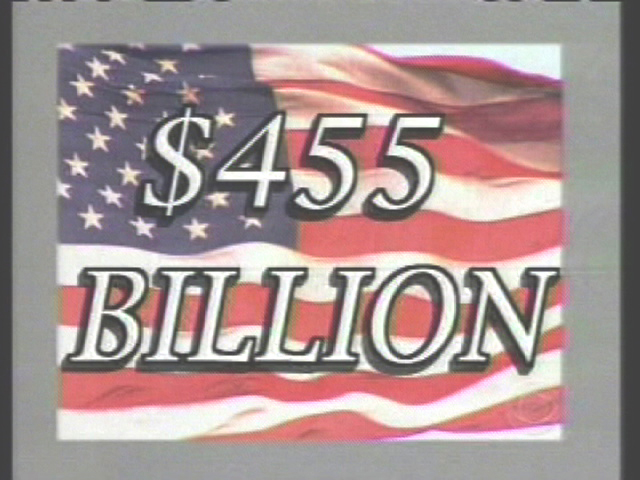
I'll tell you where we ought to start saving, on our bloated military establishment. We're paying for weapons we'll never use. No other country spends the kind of money we spend on our military. Last year, Japan spent $42 billion dollars, Italy spent $28 billion dollars, Russia spent only $19 billion. The United States spent $455 billion. We have 8,000 tanks, for example. One Abrams tank costs 150 times as much as a Ford stationwagon. We have more than 10,000 nuclear weapons. Enough to destroy all of mankind. We're spending $200 million dollars a year on bullets alone. That's a lot of target practice.
We have 1,155,000 enlisted men and women, and 225,000 officers. One officer to tell every five enlisted soldiers what to do. We have 40,000 Colen and 870 generals.
We had a great commander in WWII, Dwight Eisenhower. He became President, and on leaving the White House in 1961 he said this:
"We must guard against the aquisition of unwarranted influence, whether sought or unsought, by the military-industrial complex. The potential for the disasterous rise of misplaced power exists, and will persist."Well, Ike was right. That's just what's happened.
The U.S. Spends 455 billion dollars a year on the military.
This is from the February 6, 2005 program of Meet the Press.
Update 2/8/05: I've broken it down into 2 halfs, and made MP3s of it
I still have to break this down into smaller clips, but I wanted to make complete video and audio available for press folks and things that might need it asap.
Basically, Tim Russert is ruthless with the flinging of the fact.
Rummy loses it a couple time, although he quickly recovers. He admits that he may have "mis spoke" a couple times, and disregards those facts and figures that he wasn't prepared to respond to.
I will be putting up smaller clips and better analysis soon, promise.
For now, this stuff is here:
Video Of Rumsfeld On Meet The Press
This is from the November 21, 2004 program of 60 Minutes.
This story is about the Shrub Administrations efforts to hide thousands of American deaths and casualties of this war by simply not reporting them, claiming they are "non-combat injuries." The families of dead soldiers and shell shocked soldiers who have lost limbs/become paralyzed/will never be the same again are pretty upset about it.
'Unusual Weapons' Used in Fallujah
By Dahr Jamail for Common Dreams.
The U.S. military has used poison gas and other non-conventional weapons against civilians in Fallujah, eyewitnesses report..”Poisonous gases have been used in Fallujah,” 35-year-old trader from Fallujah Abu Hammad told IPS. ”They used everything -- tanks, artillery, infantry, poison gas. Fallujah has been bombed to the ground.”
Hammad is from the Julan district of Fallujah where some of the heaviest fighting occurred. Other residents of that area report the use of illegal weapons.
”They used these weird bombs that put up smoke like a mushroom cloud,” Abu Sabah, another Fallujah refugee from the Julan area told IPS. ”Then small pieces fall from the air with long tails of smoke behind them.”
He said pieces of these bombs exploded into large fires that burnt the skin even when water was thrown on the burns. Phosphorous weapons as well as napalm are known to cause such effects. ”People suffered so much from these,” he said.
Macabre accounts of killing of civilians are emerging through the cordon U.S. forces are still maintaining around Fallujah.
”Doctors in Fallujah are reporting to me that there are patients in the hospital there who were forced out by the Americans,” said Mehdi Abdulla, a 33-year-old ambulance driver at a hospital in Baghdad. ”Some doctors there told me they had a major operation going, but the soldiers took the doctors away and left the patient to die.”
Kassem Mohammed Ahmed who escaped from Fallujah a little over a week ago told IPS he witnessed many atrocities committed by U.S. soldiers in the city.
”I watched them roll over wounded people in the street with tanks,” he said. ”This happened so many times.”...
Here is the full text of the entire article in case the link goes bad:
http://www.commondreams.org/headlines04/1126-01.htm
Published on Friday, November 26, 2004 by the Inter Press Service
'Unusual Weapons' Used in Fallujah
by Dahr Jamail
BAGHDAD, Nov 26 (IPS) - The U.S. military has used poison gas and other non-conventional weapons against civilians in Fallujah, eyewitnesses report..
”Poisonous gases have been used in Fallujah,” 35-year-old trader from Fallujah Abu Hammad told IPS. ”They used everything -- tanks, artillery, infantry, poison gas. Fallujah has been bombed to the ground.”
Hammad is from the Julan district of Fallujah where some of the heaviest fighting occurred. Other residents of that area report the use of illegal weapons.
”They used these weird bombs that put up smoke like a mushroom cloud,” Abu Sabah, another Fallujah refugee from the Julan area told IPS. ”Then small pieces fall from the air with long tails of smoke behind them.”
He said pieces of these bombs exploded into large fires that burnt the skin even when water was thrown on the burns. Phosphorous weapons as well as napalm are known to cause such effects. ”People suffered so much from these,” he said.
Macabre accounts of killing of civilians are emerging through the cordon U.S. forces are still maintaining around Fallujah.
”Doctors in Fallujah are reporting to me that there are patients in the hospital there who were forced out by the Americans,” said Mehdi Abdulla, a 33-year-old ambulance driver at a hospital in Baghdad. ”Some doctors there told me they had a major operation going, but the soldiers took the doctors away and left the patient to die.”
Kassem Mohammed Ahmed who escaped from Fallujah a little over a week ago told IPS he witnessed many atrocities committed by U.S. soldiers in the city.
”I watched them roll over wounded people in the street with tanks,” he said. ”This happened so many times.”
Abdul Razaq Ismail who escaped from Fallujah two weeks back said soldiers had used tanks to pull bodies to the soccer stadium to be buried. ”I saw dead bodies on the ground and nobody could bury them because of the American snipers,” he said. ”The Americans were dropping some of the bodies into the Euphrates near Fallujah.”
Abu Hammad said he saw people attempt to swim across the Euphrates to escape the siege. ”The Americans shot them with rifles from the shore,” he said. ”Even if some of them were holding a white flag or white clothes over their heads to show they are not fighters, they were all shot..”
Hammad said he had seen elderly women carrying white flags shot by U.S. soldiers. ”Even the wounded people were killed. The Americans made announcements for people to come to one mosque if they wanted to leave Fallujah, and even the people who went there carrying white flags were killed.”
Another Fallujah resident Khalil (40) told IPS he saw civilians shot as they held up makeshift white flags. ”They shot women and old men in the streets,” he said. ”Then they shot anyone who tried to get their bodies...Fallujah is suffering too much, it is almost gone now.”
Refugees had moved to another kind of misery now, he said. ”It's a disaster living here at this camp,” Khalil said. ”We are living like dogs and the kids do not have enough clothes.”
Spokesman for the Iraqi Red Crescent in Baghdad Abdel Hamid Salim told IPS that none of their relief teams had been allowed into Fallujah, and that the military had said it would be at least two more weeks before any refugees would be allowed back into the city.
”There is still heavy fighting in Fallujah,” said Salim. ”And the Americans won't let us in so we can help people.”
In many camps around Fallujah and throughout Baghdad, refugees are living without enough food, clothing and shelter. Relief groups estimate there are at least 15,000 refugee families in temporary shelters outside Fallujah.
Hel-lo? Is there anybody out there? Now our government is sending National Guard troops to old WWII Prisoner of War camps and treating them like prisoners themselves before shipping them off to Iraq to become inevitable casualties of War.
They are treated horribly, given poor combat training, and then sent off to perform extremely dangerous tasks for a government that doesn't care if they live or die.
Many of them are going AWOL. Who can blame them? They are running off to see their families one last time before being sent to their deaths. (Theoretically, many are coming back after Thanksgiving. To these people I say: "Save yourself! Keep going! Don't ever come back if you want to stay alive!")
Will somebody please do something to stop this madness? I feel so helpless hearing about this stuff. So powerless to do anything to stop these nut cases in charge of our country.
Guardsmen Say They're Facing Iraq Ill-Trained
Troops from California describe a prison-like, demoralized camp in New Mexico that's short on gear and setting them up for high casualties.
By Scott Gold for the LA Times.
Members of a California Army National Guard battalion preparing for deployment to Iraq said this week that they were under strict lockdown and being treated like prisoners rather than soldiers by Army commanders at the remote desert camp where they are training.More troubling, a number of the soldiers said, is that the training they have received is so poor and equipment shortages so prevalent that they fear their casualty rate will be needlessly high when they arrive in Iraq early next year. "We are going to pay for this in blood," one soldier said...
"I feel like an inmate with a weapon," said Cpl. Jajuane Smith, 31, a six-year Guard veteran from Fresno who works for an armored transport company when not on active duty.
Several soldiers have fled Doña Ana by vaulting over rolls of barbed wire that surround the small camp, the soldiers interviewed said. Others, they said, are contemplating going AWOL, at least temporarily, to reunite with their families for Thanksgiving.
Army commanders said the concerns were an inevitable result of the decision to shore up the strained military by turning "citizen soldiers" into fully integrated, front-line combat troops. About 40% of the troops in Iraq are either reservists or National Guard troops.
Lt. Col. Michael Hubbard of Ft. Bliss said the military must confine the soldiers largely to Doña Ana to ensure that their training is complete before they are sent to Iraq.
"A lot of these individuals are used to doing this two days a month and then going home," Hubbard said. "Now the job is 24/7. And they experience culture shock."
But many of the soldiers interviewed said the problems they cited went much deeper than culture shock...
At Doña Ana, soldiers have questioned their commanders about conditions at the camp, occasionally breaking the protocol of formation drills to do so. They said they had been told repeatedly that they could not be trusted because they were not active-duty soldiers — though many of them are former active-duty soldiers.
"I'm a cop. I've got a career, a house, a family, a college degree," said one sergeant, who lives in Southern California and spoke, like most of the soldiers, on condition of anonymity.
"I came back to the National Guard specifically to go to Baghdad, because I believed in it, believed in the mission. But I have regretted every day of it. This is demoralizing, demeaning, degrading. And we're supposed to be ambassadors to another country? We're supposed to go to war like this?"...
Hubbard, the officer at Ft. Bliss, also said conditions at Doña Ana were designed to mirror the harsh and often thankless assignments the soldiers would take on in Iraq. That was an initiative launched by Brig. Gen. Joseph Chavez, commander of the 29th Separate Infantry Brigade, which includes the 184th Regiment.
The program has resulted in everything from an alcohol ban to armed guards at the entrance to Doña Ana, Hubbard said.
"We are preparing you and training you for what you're going to encounter over there," Hubbard said. "And they just have to get used to it."...
They also said the bulk of their training had been basic, such as first aid and rifle work, and not "theater-specific" to Iraq. They are supposed to be able to use night-vision goggles, for instance, because many patrols in Iraq take place in darkness. But one group of 200 soldiers trained for just an hour with 30 pairs of goggles, which they had to pass around quickly, soldiers said.
The soldiers said they had received little or no training for operations that they expected to undertake in Iraq, from convoy protection to guarding against insurgents' roadside bombs. One said he has put together a diary of what he called "wasted days" of training. It lists 95 days, he said, during which the soldiers learned nothing that would prepare them for Iraq.
Hubbard had said he would make two field commanders available on Tuesday to answer specific questions from the Los Angeles Times about the training, but that did not happen...
The soldiers also said they were risking courts-martial or other punishment by speaking publicly about their situation. But Staff Sgt. Lorenzo Dominguez, 45, one of the soldiers who allowed his identity to be revealed, said he feared that if nothing changed, men in his platoon would be killed in Iraq.
Dominguez is a father of two — including a 13-month-old son named Reagan, after the former president — and an employee of a mortgage bank in Alta Loma, Calif. A senior squad leader of his platoon, Dominguez said he had been in the National Guard for 20 years.
"Some of us are going to die there, and some of us are going to die unnecessarily because of the lack of training," he said. "So I don't care. Let them court-martial me. I want the American public to know what is going on. My men are guilty of one thing: volunteering to serve their country. And we are at the end of our rope."
Here is the full text of the entire article in case the link goes bad:
http://www.latimes.com/news/nationworld/nation/la-na-guard25nov25,0,7278305.story?coll=la-home-headlines
Guardsmen Say They're Facing Iraq Ill-Trained
* Troops from California describe a prison-like, demoralized camp in New Mexico that's short on gear and setting them up for high casualties.
Times Headlines
Sizing Up Man Who Would Be Atty. Gen.
Breaking, Entering Your PC
A Rift Over Indian Portraits' Face Value
Got Robot? Dairy Farmer Sees 'Milking Parlor' as Tourist Stop
When New Drugs Go Wrong: Role of the FDA Debated
more >
Subscribe
IRAQ
ARMY U S
CALIFORNIA NATIONAL GUARD MILITARY DEPLOYMENT IRAQ
CALIFORNIA NATIONAL GUARD
PF IG
MILITARY DEPLOYMENT
By Scott Gold, Times Staff Writer
DOÑA ANA RANGE, N.M. — Members of a California Army National Guard battalion preparing for deployment to Iraq said this week that they were under strict lockdown and being treated like prisoners rather than soldiers by Army commanders at the remote desert camp where they are training.
More troubling, a number of the soldiers said, is that the training they have received is so poor and equipment shortages so prevalent that they fear their casualty rate will be needlessly high when they arrive in Iraq early next year. "We are going to pay for this in blood," one soldier said.
advertisement
Click Here
advertisement
They said they believed their treatment and training reflected an institutional bias against National Guard troops by commanders in the active-duty Army, an allegation that Army commanders denied.
The 680 soldiers of the 1st Battalion of the 184th Infantry Regiment were activated in August and are preparing for deployment at Doña Ana, a former World War II prisoner-of-war camp 20 miles west of its large parent base, Ft. Bliss, Texas.
Members of the battalion, headquartered in Modesto, said in two dozen interviews that they were allowed no visitors or travel passes, had scant contact with their families and that morale was terrible.
"I feel like an inmate with a weapon," said Cpl. Jajuane Smith, 31, a six-year Guard veteran from Fresno who works for an armored transport company when not on active duty.
Several soldiers have fled Doña Ana by vaulting over rolls of barbed wire that surround the small camp, the soldiers interviewed said. Others, they said, are contemplating going AWOL, at least temporarily, to reunite with their families for Thanksgiving.
Army commanders said the concerns were an inevitable result of the decision to shore up the strained military by turning "citizen soldiers" into fully integrated, front-line combat troops. About 40% of the troops in Iraq are either reservists or National Guard troops.
Lt. Col. Michael Hubbard of Ft. Bliss said the military must confine the soldiers largely to Doña Ana to ensure that their training is complete before they are sent to Iraq.
"A lot of these individuals are used to doing this two days a month and then going home," Hubbard said. "Now the job is 24/7. And they experience culture shock."
But many of the soldiers interviewed said the problems they cited went much deeper than culture shock.
And military analysts agree that tensions between active-duty Army soldiers and National Guard troops have been exacerbated as the war in Iraq has required dangerous and long-term deployments of both.
The concerns of the Guard troops at Doña Ana represent the latest in a series of incidents involving allegations that a two-tier system has shortchanged reservist and National Guard units compared with their active-duty counterparts.
In September, a National Guard battalion undergoing accelerated training at Ft. Dix, N.J., was confined to barracks for two weeks after 13 soldiers reportedly went AWOL to see family before shipping out for Iraq.
Last month, an Army National Guard platoon at Camp Shelby, Miss., refused its orders after voicing concerns about training conditions and poor leadership.
In the most highly publicized incident, in October, more than two dozen Army reservists in Iraq refused to drive a fuel convoy to a town north of Baghdad after arguing that the trucks they had been given were not armored for combat duty.
At Doña Ana, soldiers have questioned their commanders about conditions at the camp, occasionally breaking the protocol of formation drills to do so. They said they had been told repeatedly that they could not be trusted because they were not active-duty soldiers — though many of them are former active-duty soldiers.
"I'm a cop. I've got a career, a house, a family, a college degree," said one sergeant, who lives in Southern California and spoke, like most of the soldiers, on condition of anonymity.
"I came back to the National Guard specifically to go to Baghdad, because I believed in it, believed in the mission. But I have regretted every day of it. This is demoralizing, demeaning, degrading. And we're supposed to be ambassadors to another country? We're supposed to go to war like this?"
Pentagon and Army commanders rejected the allegation that National Guard or reserve troops were prepared for war differently than their active-duty counterparts.
"There is no difference," said Lt. Col. Chris Rodney, an Army spokesman in Washington. "We are, more than ever, one Army. Some have to come from a little farther back — they have a little less training. But the goal is to get everybody the same."
The Guard troops at Doña Ana were scheduled to train for six months before beginning a yearlong deployment. They recently learned, however, that the Army planned to send them overseas a month early — in January, most likely — as it speeds up troop movement to compensate for a shortage of full-time, active-duty troops.
Hubbard, the officer at Ft. Bliss, also said conditions at Doña Ana were designed to mirror the harsh and often thankless assignments the soldiers would take on in Iraq. That was an initiative launched by Brig. Gen. Joseph Chavez, commander of the 29th Separate Infantry Brigade, which includes the 184th Regiment.
The program has resulted in everything from an alcohol ban to armed guards at the entrance to Doña Ana, Hubbard said.
"We are preparing you and training you for what you're going to encounter over there," Hubbard said. "And they just have to get used to it."
Military analysts, however, questioned whether the soldiers' concerns could be attributed entirely to the military's attempt to mirror conditions in Iraq. For example, the soldiers say that an ammunition shortage has meant that they have often conducted operations firing blanks.
"The Bush administration had over a year of planning before going to war in Iraq," said Jonathan Turley, a George Washington University law professor who has acted as a defense lawyer in military courts. "An ammunition shortage is not an exercise in tough love."
Turley said that in every military since Alexander the Great's, there have been "gripes from grunts" but that "the complaints raised by these National Guardsmen raise some significant and troubling concerns."
The Guard troops in New Mexico said they wanted more sophisticated training and better equipment. They said they had been told, for example, that the vehicles they would drive in Iraq would not be armored, a common complaint among their counterparts already serving overseas.
They also said the bulk of their training had been basic, such as first aid and rifle work, and not "theater-specific" to Iraq. They are supposed to be able to use night-vision goggles, for instance, because many patrols in Iraq take place in darkness. But one group of 200 soldiers trained for just an hour with 30 pairs of goggles, which they had to pass around quickly, soldiers said.
The soldiers said they had received little or no training for operations that they expected to undertake in Iraq, from convoy protection to guarding against insurgents' roadside bombs. One said he has put together a diary of what he called "wasted days" of training. It lists 95 days, he said, during which the soldiers learned nothing that would prepare them for Iraq.
Hubbard had said he would make two field commanders available on Tuesday to answer specific questions from the Los Angeles Times about the training, but that did not happen.
The fact that the National Guardsmen have undergone largely basic training suggests that Army commanders do not trust their skills as soldiers, said David Segal, director of the Center for Research on Military Organization at the University of Maryland. That tension underscores a divide that has long existed between "citizen soldiers" and their active-duty counterparts, he said.
"These soldiers should be getting theater-specific training," Segal said. "This should not be an area where they are getting on-the-job training. The military is just making a bad situation worse."
The soldiers at Doña Ana emphasized their support for the war in Iraq. "In fact, a lot of us would rather go now rather than stay here," said one, a specialist and six-year National Guard veteran who works as a security guard in his civilian life in Southern California.
The soldiers also said they were risking courts-martial or other punishment by speaking publicly about their situation. But Staff Sgt. Lorenzo Dominguez, 45, one of the soldiers who allowed his identity to be revealed, said he feared that if nothing changed, men in his platoon would be killed in Iraq.
Dominguez is a father of two — including a 13-month-old son named Reagan, after the former president — and an employee of a mortgage bank in Alta Loma, Calif. A senior squad leader of his platoon, Dominguez said he had been in the National Guard for 20 years.
"Some of us are going to die there, and some of us are going to die unnecessarily because of the lack of training," he said. "So I don't care. Let them court-martial me. I want the American public to know what is going on. My men are guilty of one thing: volunteering to serve their country. And we are at the end of our rope."
The usual anti-depressant drugs aren't working for these guys. Remember that most of these Vets will have to get lawyers to get the medical benefits coming to them anyway -- so all of this is combining to form a big stinking mess -- that our boys/girls returning from this war are going to have to clean up for themselves.
These Unseen Wounds Cut Deep
A mental health crisis is emerging, with one in six returning soldiers afflicted, experts say.
By Esther Schrader for The LA Times.
A study by the Walter Reed Army Institute of Research found that 15.6% of Marines and 17.1% of soldiers surveyed after they returned from Iraq suffered major depression, generalized anxiety or post-traumatic stress disorder — a debilitating, sometimes lifelong change in the brain's chemistry that can include flashbacks, sleep disorders, panic attacks, violent outbursts, acute anxiety and emotional numbness.Army and Veterans Administration mental health experts say there is reason to believe the war's ultimate psychological fallout will worsen. The Army survey of 6,200 soldiers and Marines included only troops willing to report their problems. The study did not look at reservists, who tend to suffer a higher rate of psychological injury than career Marines and soldiers. And the soldiers in the study served in the early months of the war, when tours were shorter and before the Iraqi insurgency took shape.
"The bad news is that the study underestimated the prevalence of what we are going to see down the road," said Dr. Matthew J. Friedman, a professor of psychiatry and pharmacology at Dartmouth Medical School who is executive director of the VA's National Center for Post Traumatic Stress Disorder.
Since the study was completed, Friedman said: "The complexion of the war has changed into a grueling counterinsurgency. And that may be very important in terms of the potential toxicity of this combat experience."
Mental health professionals say they fear the system is not moving fast enough to treat the trauma. They say slowness to recognize what was happening to Vietnam veterans contributed to the psychological devastation from that war.
More than 30% of Vietnam veterans eventually suffered from the condition that more than a decade later was given the name post-traumatic stress disorder. But since their distress was not clinically understood until long after the war ended, most went for years without meaningful treatment.
"When we missed the boat with the Vietnam vets, we didn't get another chance," said Jerry Clark, director of the veterans clinic in Alexandria, Va. "When they left the service, they went away not for a month or two but for 10 years. And they came back addicted, incarcerated and all these things. We can't miss the boat again. It is imperative."...
Before the war, LaBranche was living in Saco, Maine, with his wife and children and had no history of mental illness.
He deployed to Iraq with a National Guard transportation company based in Bangor. He came home a different person.
Just three days after he was discharged from Walter Reed, he was arrested for threatening his former wife. When he goes to court Dec. 9, he could be looking at jail time.
He lies on a couch at his brother's house most days now, struggling with the image of the Iraqi woman who died in his arms after he shot her, and the children he says caught some of his bullets. His speech is pocked with obscenities.
On a recent outing with friends, he became so enraged when he saw a Muslim family that he had to take medication to calm down.
He is seeing a therapist, but only once every two weeks.
"I'm taking enough drugs to sedate an elephant, and I still wake up dreaming about it," LaBranche said. "I wish I had just freaking died over there."
Here is the full text of the entire article in case the link goes bad:
http://www.latimes.com/news/nationworld/nation/la-na-trauma14nov14,0,2230913.story?coll=la-home-headlines
These Unseen Wounds Cut Deep
* A mental health crisis is emerging, with one in six returning soldiers afflicted, experts say.
Times Headlines
These Unseen Wounds Cut Deep
By Esther Schrader, Times Staff Writer
WASHINGTON — Matt LaBranche got the tattoos at a seedy place down the street from the Army hospital here where he was a patient in the psychiatric ward.
The pain of the needle felt good to the 40-year-old former Army sergeant, whose memories of his nine months as a machine-gunner in Iraq had left him, he said, "feeling dead inside." LaBranche's back is now covered in images, the largest the dark outline of a sword. Drawn from his neck to the small of his back, it is emblazoned with the words LaBranche says encapsulate the war's effect on him: "I've come to bring you hell."
In soldiers like LaBranche — their bodies whole but their psyches deeply wounded — a crisis is unfolding, mental health experts say. One out of six soldiers returning from Iraq is suffering the effects of post-traumatic stress — and as more come home, that number is widely expected to grow.
The Pentagon, which did not anticipate the extent of the problem, is scrambling to find resources to address it.
A study by the Walter Reed Army Institute of Research found that 15.6% of Marines and 17.1% of soldiers surveyed after they returned from Iraq suffered major depression, generalized anxiety or post-traumatic stress disorder — a debilitating, sometimes lifelong change in the brain's chemistry that can include flashbacks, sleep disorders, panic attacks, violent outbursts, acute anxiety and emotional numbness.
Army and Veterans Administration mental health experts say there is reason to believe the war's ultimate psychological fallout will worsen. The Army survey of 6,200 soldiers and Marines included only troops willing to report their problems. The study did not look at reservists, who tend to suffer a higher rate of psychological injury than career Marines and soldiers. And the soldiers in the study served in the early months of the war, when tours were shorter and before the Iraqi insurgency took shape.
"The bad news is that the study underestimated the prevalence of what we are going to see down the road," said Dr. Matthew J. Friedman, a professor of psychiatry and pharmacology at Dartmouth Medical School who is executive director of the VA's National Center for Post Traumatic Stress Disorder.
Since the study was completed, Friedman said: "The complexion of the war has changed into a grueling counterinsurgency. And that may be very important in terms of the potential toxicity of this combat experience."
Mental health professionals say they fear the system is not moving fast enough to treat the trauma. They say slowness to recognize what was happening to Vietnam veterans contributed to the psychological devastation from that war.
More than 30% of Vietnam veterans eventually suffered from the condition that more than a decade later was given the name post-traumatic stress disorder. But since their distress was not clinically understood until long after the war ended, most went for years without meaningful treatment.
"When we missed the boat with the Vietnam vets, we didn't get another chance," said Jerry Clark, director of the veterans clinic in Alexandria, Va. "When they left the service, they went away not for a month or two but for 10 years. And they came back addicted, incarcerated and all these things. We can't miss the boat again. It is imperative."
Experts on post-traumatic stress disorder say it should come as no surprise that some of the soldiers in Iraq are fighting mental illness.
Combat stress disorders — named and renamed but strikingly alike — have ruined lives following every war in history. Homer's Achilles may have suffered from some form of it. Combat stress was documented in the late 19th century after the Franco-Prussian War. After the Civil War, doctors called the condition "nostalgia," or "soldiers heart." In World War I, soldiers were said to suffer shell shock; in World War II and Korea, combat fatigue or battle fatigue.
But it wasn't until 1985 that the American Psychiatric Assn. finally gave a name to the condition that had sent tens of thousands of Vietnam veterans into lives of homelessness, crime or despair.
A war like the one in Iraq — in which a child is as likely to die as a soldier and unseen enemies detonate bombs — presents ideal conditions for its rise.
Yet the Army initially sent far too few psychiatrists, psychologists and social workers to combat areas, an Army study released in the summer of 2003 found. Until this year, Congress had allocated no new funds to deal with the mental health effects of the war in Iraq. And when it did earmark money, the sum was minimal: $5 million in each of the next three years.
"We're gearing ourselves up now and preparing ourselves to meet whatever the need is, but clearly this is something that could not be planned for," said Dr. Alfonso Batres, a psychologist who heads the VA's national office of readjustment counseling services.
Last year, 1,100 troops who had fought in Iraq or Afghanistan came to VA clinics seeking help for symptoms of depression or post-traumatic stress; this year, the number grew tenfold. In all, 23% of Iraq veterans treated at VA facilities have been diagnosed with post-traumatic stress disorder.
"And this is first-year data," Batres said. "Our experience is that over time that will increase."
In the red brick buildings of Walter Reed Army Medical Center, the "psych patients," as they are known, mingle, sometimes uncomfortably, with those who have lost limbs and organs.
One soldier being treated at Walter Reed, who spoke on condition of anonymity, walks the hospital campus in the bloodied combat boots of a friend he watched bleed to death.
Another Iraq veteran in treatment at Walter Reed, Army 1st Lt. Jullian Philip Goodrum, drives most mornings to nearby Silver Spring, Md., seeking the solitude of movies and the solace of friends.
He leaves early to avoid traffic — the crush of cars makes him jumpy. On more than one occasion, he has imagined snipers with their sights on him in the streets. Diesel fumes cause flashbacks. He keeps a vial of medication in his pocket and pops a pill when he gets nervous.
"You question — outside of dealing with your psych injury, which will affect you from one degree or another throughout your life — you also question yourself," Goodrum said. "I trained. I was an excellent soldier, a strong character. How could my mind dysfunction?"
When it began to become clear that what the Pentagon initially believed would be a rapid, clear-cut war had transmuted into a drawn-out counterinsurgency, the Army began pushing to reach and treat distressed soldiers sooner.
The number of mental health professionals deployed near frontline positions in Iraq has been increased. Suicide prevention programs are given to soldiers in the field. According to the Pentagon, 31 U.S. troops have killed themselves in Iraq.
At more than 200 storefront clinics known as Vet Centers — created in 1979 to reach out to Vietnam veterans — the VA has increased the number of group therapy sessions and staff. Three months ago, the VA hired 50 Iraq war veterans to help serve as advocates at the clinics.
Officials acknowledge that is only a start. The Government Accountability Office found in a study released in September that the VA lacked the information it needed to determine whether it could meet an increased demand for services.
"Predicting which veterans will seek VA care and at which facilities is inherently uncertain," the report concluded, "particularly given that the symptoms of PTSD may not appear for years."
The Army and the VA are also trying to catalog and research the mental health effects of this war better than they have in the past. In addition to the Walter Reed study, several more are tracking soldiers from before their deployment to Iraq through their combat experiences and into the future.
If Iraq veterans can be helped sooner, they may fare better than those who fought in Vietnam, mental health experts say. And they note that the nation, although divided on the Iraq war, is more united in caring for the needs of returning soldiers than it was in the Vietnam era. And in the last decade, new techniques have proved effective in treating stress disorders, among them cognitive-behavioral therapy and drugs like Zoloft and Paxil.
Whether people like Matt LaBranche seek and receive treatment will determine how deep an effect the stress of the war in Iraq ultimately has on U.S. society.
Before the war, LaBranche was living in Saco, Maine, with his wife and children and had no history of mental illness.
He deployed to Iraq with a National Guard transportation company based in Bangor. He came home a different person.
Just three days after he was discharged from Walter Reed, he was arrested for threatening his former wife. When he goes to court Dec. 9, he could be looking at jail time.
He lies on a couch at his brother's house most days now, struggling with the image of the Iraqi woman who died in his arms after he shot her, and the children he says caught some of his bullets. His speech is pocked with obscenities.
On a recent outing with friends, he became so enraged when he saw a Muslim family that he had to take medication to calm down.
He is seeing a therapist, but only once every two weeks.
"I'm taking enough drugs to sedate an elephant, and I still wake up dreaming about it," LaBranche said. "I wish I had just freaking died over there."
Wesley Clark has been chiming in a lot lately on the Shrub War situation. I think he's a smart guy with a lot of experience in this War stuff, so I've created a category for him.
I'm not trying to archive everything the guy does or anything, but once I've posted a couple things from the same person (as I am about to- I've got some good clips of him from Bill Maher's show a few weeks back), it will make it easier to find the stuff later if it has its own category.
The Real Battle
Winning in Fallujah Is Just the Beginning
By Wesley K. Clark for The Washington Post.
Air Force Gen. Richard B. Myers, chairman of the Joint Chiefs of Staff, assures us that U.S. and Iraqi government forces have moved steadily through the insurgent stronghold and that the assault has been "very, very successful." Last night, even as troops fought to secure the final section of the Sunni city, senior Iraqi officials declared it "liberated." But it's hardly surprising that the measure of success in Fallujah is elusive: There's no uniformed enemy force, no headquarters, no central command complex for the troops to occupy and win. At the end, there will be no surrender.After "winning": Tactical victory is one thing, strategic victory another. U.S. Marines regroup inside the Khulafah Rashid mosque in Fallujah after taking it Thursday. They left later after routed insurgents regrouped and fired on the mosque. (Luis Sinco -- Los Angeles Times Via AP)
Instead, the outcome of the battle must be judged by a less clear-cut standard: not by the seizure and occupation of ground, but by the impact it has on the political and diplomatic process in Iraq. Its chances for success in that area are highly uncertain. Will Fallujah, like the famous Vietnam village, be the place we destroyed in order to save it? Will the bulk of the insurgents simply scatter to other Iraqi cities? Will we win a tactical victory only to fail in our strategic goal of convincing Iraqis that we are making their country safe for democracy -- and specifically for the elections scheduled for the end of January?...
But in what sense is this "winning?"
To win means not just to occupy the city, but to do so in a way that knocks the local opponent permanently out of the fight, demoralizes broader resistance, and builds legitimacy for U.S. aims, methods and allies. Seen this way, the battle for Fallujah is not just a matter of shooting. It is part of a larger bargaining process that has included negotiations, threats and staged preparations to pressure insurgent groups into preemptive surrender, to deprive them of popular tolerance and support, and to demonstrate to the Iraqi people and to others that force was used only as a last resort in order to gain increased legitimacy for the interim Iraqi government.
Even the use of force required a further calculus. Had we relentlessly destroyed the city and killed large numbers of innocent civilians, or suffered crippling losses in the fighting, we most certainly would have been judged "losers." And if we can't hold on and prevent the insurgents from infiltrating back in -- as has now occurred in the recently "liberated" city of Samarra -- we also shall have lost...
This insurgency has continued to grow, despite U.S. military effectiveness on the ground. While Saddam Hussein's security forces may have always had a plan to resist the occupation, it was the failure of American policymakers to gain political legitimacy that enabled the insurgency to grow. And while the failure may have begun with the inability to impose order after Saddam's ouster, it was the lack of a political coterie and the tools of political development -- such as the Vietnam program of Civil Operations-Revolutionary Development Support (CORDS) -- that seems to have enabled the insurgency to take root amid the U.S. presence. These are the sorts of mistakes the United States must avoid in the future, otherwise the battle of Fallujah may end up being nothing more than the "taking down" of an insurgent stronghold -- a battlefield success on the road to strategic failure.
Troops are in Fallujah because of a political failure: Large numbers of Sunnis either wouldn't, or couldn't, participate in the political process and the coming elections. Greater security in Fallujah may move citizens (whenever they return) to take part in the voting; it's too early to say. But it's certain that you can't bomb people into the polling booths.
We should be under no illusions: This is not so much a war as it is an effort to birth a nation. It is past time for the administration to undertake diplomatic efforts in the region and political efforts inside Iraq that are worthy of the risks and burdens born by our men and women in uniform. No one knows better than they do: You cannot win in Iraq simply by killing the opponent. Much as we honor our troops and pray for their well-being, if diplomacy fails, their sacrifices and even their successes in Fallujah won't be enough.
Here is the full text of the entire article in case the link goes bad:
http://www.washingtonpost.com/wp-dyn/articles/A47034-2004Nov12.html
The Real Battle
Winning in Fallujah Is Just the Beginning
By Wesley K. Clark
Sunday, November 14, 2004; Page B01
Americans scouring news reports of the U.S.-led assault on the Iraqi city of Fallujah can be forgiven if they are experiencing a degree of confusion and uncertainty.
Air Force Gen. Richard B. Myers, chairman of the Joint Chiefs of Staff, assures us that U.S. and Iraqi government forces have moved steadily through the insurgent stronghold and that the assault has been "very, very successful." Last night, even as troops fought to secure the final section of the Sunni city, senior Iraqi officials declared it "liberated." But it's hardly surprising that the measure of success in Fallujah is elusive: There's no uniformed enemy force, no headquarters, no central command complex for the troops to occupy and win. At the end, there will be no surrender.
After "winning": Tactical victory is one thing, strategic victory another. U.S. Marines regroup inside the Khulafah Rashid mosque in Fallujah after taking it Thursday. They left later after routed insurgents regrouped and fired on the mosque. (Luis Sinco -- Los Angeles Times Via AP)
Instead, the outcome of the battle must be judged by a less clear-cut standard: not by the seizure and occupation of ground, but by the impact it has on the political and diplomatic process in Iraq. Its chances for success in that area are highly uncertain. Will Fallujah, like the famous Vietnam village, be the place we destroyed in order to save it? Will the bulk of the insurgents simply scatter to other Iraqi cities? Will we win a tactical victory only to fail in our strategic goal of convincing Iraqis that we are making their country safe for democracy -- and specifically for the elections scheduled for the end of January?
An attack on Fallujah has been inevitable for many months. If we are to succeed in the democratization of Iraq, the interim government and its U.S. and coalition allies must have a "monopoly" on the use of force within the country's borders. There can be no sanctuaries for insurgents and terrorists, no fiefdoms run by private armies. Fallujah could not continue to be a base for those waging war on the Iraqi government and a no-go place for those organizing elections.
Now that we have engaged, there cannot be any doubt about the outcome. It, too, is inevitable. U.S. forces don't "lose" on the battlefield these days. We haven't lost once in Iraq. Nor in Afghanistan. Not in the Balkans, or in the first Gulf War. Nor in Panama. We fight where we are told and win where we fight. We are well trained, disciplined and, when we prepare adequately, exceedingly well equipped. We will take the city, and with relatively few U.S. casualties. And we will have killed a lot of people who were armed and resisting us.
But in what sense is this "winning?"
To win means not just to occupy the city, but to do so in a way that knocks the local opponent permanently out of the fight, demoralizes broader resistance, and builds legitimacy for U.S. aims, methods and allies. Seen this way, the battle for Fallujah is not just a matter of shooting. It is part of a larger bargaining process that has included negotiations, threats and staged preparations to pressure insurgent groups into preemptive surrender, to deprive them of popular tolerance and support, and to demonstrate to the Iraqi people and to others that force was used only as a last resort in order to gain increased legitimacy for the interim Iraqi government.
Even the use of force required a further calculus. Had we relentlessly destroyed the city and killed large numbers of innocent civilians, or suffered crippling losses in the fighting, we most certainly would have been judged "losers." And if we can't hold on and prevent the insurgents from infiltrating back in -- as has now occurred in the recently "liberated" city of Samarra -- we also shall have lost.
The battle plan was tailored to prevent significant destruction. It called for a slow squeeze, starting with precision strikes against identified targets, and followed by a careful assault directed at taking out the opposition and reoccupying the city, while minimizing civilian and friendly casualties. We have superior mobility, with heavily armored vehicles; we have superior firepower, with the Bradley's 25mm cannon, M1A1 Abrams tanks, artillery and airstrikes; we have advantages in reconnaissance, with satellites, TV-equipped unmanned aerial vehicles and a whole array of electronic gear. But urban combat partially neutralizes these advantages. A weaker defender can inflict much punishment with only a meager force fighting from the rubble, provided they fight to the death. So this has not been a "cakewalk." This has been a tough battle, and the men and women fighting it deserve every Combat Infantryman's Badge, Bronze Star or Purple Heart they receive.
During the recent presidential campaign, there was a lot of talk about supporting our troops in wartime. And yet calling what's going on in Iraq "war" has distracted us from marshaling the diplomatic and political support our troops need to win.
To a considerable extent, the insurgency in Iraq has been supported by external efforts: Syria's facilitating of passage by jihadists, Iran's eager efforts to reintegrate Shiism and assure the emergence of an Iraqi regime to Tehran's liking, efforts by some Saudis to reinforce Sunni dominance in Iraq. (On the eve of the battle in Fallujah, one group of 26 Saudi religious scholars urged Iraqis to support the insurgents.)
The success of our military efforts in Iraq is thus directly connected to the skill of U.S. diplomacy in the region. Certainly neither Syria nor Iran could welcome American success in Iraq if they believe it means they'll be next on a list of regimes to be "reformed" by the United States -- and yet that's precisely the goal of American policy. Bringing about change in those countries should be a matter of offering inducements as well as making threats, but not if it adds to the danger for our men and women in uniform. We need to choose: continue to project a grand vision, or focus on success in Iraq. Not only the safety of our troops, but the success of our mission depends on a degree of Syrian and Iranian accommodation for an American-supported, peaceful, stable, democratizing Iraq. And we won't get that support if they think they're next on the hit list.
It is equally important to seek a resolution of the conflict between Israel and the Palestinians, which has fueled the recruiting efforts and determination of the jihadists we're fighting in Iraq.
And then there's the matter of the political struggle inside Iraq. If, despite a high level of chaos, the elections do take place, the Bush administration must be prepared to accept and empower an Iraqi government and a nascent political process with sufficient independence to win support from the populace and undercut anger at the American troops. For most of a year, the effort at political transformation was been submerged beneath the rubric of "reconstruction" and hindered by the attitude that "security must come first." Security and domestic Iraqi politics go hand in hand.
Which brings us back to some of the factors that made last week's battle of Fallujah inevitable: a series of circumstances and errors in 2003 -- an initial coalition occupying force too small to achieve dominance over a historically restive population, the lack of a skilled political corps to reorganize the local inhabitants, the proscription of Baathist participation in the early postwar recovery and the disbanding of the Iraqi military. Then there was the aborted April 2004 effort to subdue the city, in which an under-strength Marine assault was called off by the White House. A silly plan of turning the city back over to a thrown-together Iraqi force left the enemy in control of the battlefield and turned Fallujah into even more of an insurgent stronghold.
This insurgency has continued to grow, despite U.S. military effectiveness on the ground. While Saddam Hussein's security forces may have always had a plan to resist the occupation, it was the failure of American policymakers to gain political legitimacy that enabled the insurgency to grow. And while the failure may have begun with the inability to impose order after Saddam's ouster, it was the lack of a political coterie and the tools of political development -- such as the Vietnam program of Civil Operations-Revolutionary Development Support (CORDS) -- that seems to have enabled the insurgency to take root amid the U.S. presence. These are the sorts of mistakes the United States must avoid in the future, otherwise the battle of Fallujah may end up being nothing more than the "taking down" of an insurgent stronghold -- a battlefield success on the road to strategic failure.
Troops are in Fallujah because of a political failure: Large numbers of Sunnis either wouldn't, or couldn't, participate in the political process and the coming elections. Greater security in Fallujah may move citizens (whenever they return) to take part in the voting; it's too early to say. But it's certain that you can't bomb people into the polling booths.
We should be under no illusions: This is not so much a war as it is an effort to birth a nation. It is past time for the administration to undertake diplomatic efforts in the region and political efforts inside Iraq that are worthy of the risks and burdens born by our men and women in uniform. No one knows better than they do: You cannot win in Iraq simply by killing the opponent. Much as we honor our troops and pray for their well-being, if diplomacy fails, their sacrifices and even their successes in Fallujah won't be enough.
Retired Army Gen. Wesley Clark served as commander in chief, U.S. Southern Command and later as supreme allied commander in Europe during the war in Kosovo. He was a candidate for the 2004 Democratic presidential nomination.
This is from November 5, 2004.
Military hospital preparing for Fallujah battle
Marines say the toll is expected to rival those seen in Vietnam War
By Tom Lasseter for Knight Ridder Tribune News.
The number of dead and wounded from the expected battle to retake insurgent-controlled Fallujah probably will reach levels not seen since Vietnam, a senior surgeon at the Marine camp outside Fallujah said Thursday.Navy Cmdr. Lach Noyes said the camp's hospital is preparing to handle 25 severely injured soldiers a day, not counting walking wounded and the dead.
The hospital has added two operating rooms, doubled its supplies, added a mortuary and stocked up on blood reserves. Doctors have set up a system of ambulance vehicles that will rush to the camp's gate to receive the dead and wounded so units can return to battle quickly...
More than 1,120 U.S. soldiers and Marines have died in Iraq since the war began.
The deadliest month was April, when fierce fighting killed 126 U.S. troops, largely at Fallujah and Ramadi, before a cease-fire virtually turned Fallujah over to the insurgents.
Even then, the death toll was far below the worst month of Vietnam, April 1969, when the U.S. death toll was 543 at the height of American involvement there.
The toll in human suffering has already been grave.
Here is the full text of the entire article in case the link goes bad:
http://www.chron.com/cs/CDA/ssistory.mpl/world/2885271
Military hospital preparing for Fallujah battle
Marines say the toll is expected to rival those seen in Vietnam War
By TOM LASSETER
Knight Ridder Tribune News
WITH U.S. FORCES NEAR FALLUJAH, IRAQ - The number of dead and wounded from the expected battle to retake insurgent-controlled Fallujah probably will reach levels not seen since Vietnam, a senior surgeon at the Marine camp outside Fallujah said Thursday.
Navy Cmdr. Lach Noyes said the camp's hospital is preparing to handle 25 severely injured soldiers a day, not counting walking wounded and the dead.
The hospital has added two operating rooms, doubled its supplies, added a mortuary and stocked up on blood reserves. Doctors have set up a system of ambulance vehicles that will rush to the camp's gate to receive the dead and wounded so units can return to battle quickly.
The plans underscore the ferocity of the fight the U.S. military expects in Fallujah, a Sunni Muslim city about 35 miles west of Baghdad, which has been under insurgent control since April.
On Thursday, U.S. troops pounded Fallujah with airstrikes and artillery fire, softening up militants ahead of the expected assault.
Loudspeakers at Fallujah mosques blared out Quranic verses and shouts of "Allahu akbar," or "God is great," during the assault, residents said.
American aircraft blasted militant positions in northeastern and southeastern parts of the city, the military said. U.S. batteries later fired two to three dozen heavy artillery shells at insurgent positions, the military said.
U.S. forces have been building up outside Fallujah for weeks in preparation for taking the city back.
Military officials say they expect U.S. troops to encounter not just fighters wielding AK-47 assault rifles and rocket-propelled grenades, but also heavy concentrations of mines, roadside bombs and possibly car bombs.
"We'll probably just see those in a lot better concentration in the city," said Maj. Jim West, an intelligence officer with 1st Marine Expeditionary Force.
West said he thinks there are some 4,000 to 5,000 fighters between Fallujah and nearby Ramadi, and they may try to draw troops into cramped urban areas in Fallujah that have been booby-trapped.
More than 1,120 U.S. soldiers and Marines have died in Iraq since the war began.
The deadliest month was April, when fierce fighting killed 126 U.S. troops, largely at Fallujah and Ramadi, before a cease-fire virtually turned Fallujah over to the insurgents.
Even then, the death toll was far below the worst month of Vietnam, April 1969, when the U.S. death toll was 543 at the height of American involvement there.
The toll in human suffering has already been grave.
Staff Sgt. Jason Benedict was on a convoy heading to the Fallujah camp Saturday when a suicide bomber rammed a vehicle into the truck Benedict and his platoon mates were traveling in.
A few minutes later, mortars and rifle fire rained down on the survivors.
As he rolled toward the safety of a ditch, Benedict saw one of his friends crawling on all fours, with blood pouring from his face.
"You've got to expect casualties," said Benedict, 28. The fight for Fallujah, he said, "is overdue."
I was interviewed by BBC's Maggie Shiels in April 2003 about being a peace blogger, amidst all of the "War Bloggers." She had no way of telling me at the time when the piece was going to air, but she did give me a clip that I could play for my parents -- but I couldn't publish it on my blog or anything.
Well, now that so much time has passed, I wrote to see if it was OK, and she said it was.
Here it is. (Real File)
(Here's a link to its directory if you need that for some reason.)
Also interviewed are UC Berkeley School of Journalism Professor Paul Grabowitz and blogger Chris Perillo. (Will somebody let them know about this for me? I don't have their emails.)
That's me reading from Salam Pax's weblog too.
The story is about bloggers taking over as reliable sources of news.
Hey Colin! You've got one more day to save face and come clean with us. Just say you're sorry, and that you were just hanging out to try to keep things from getting crazy and out of control, but they just got crazy and out of control anyway, and now your just real sorry and you're not going to cover for this guy anymore.
Say it before the election, and we just might forgive you.
(Though, it'll still be tough.)
Anyway, here's the latest story where "Colin privately tells "X" how he really feels." It's only a couple paragraphs long:
Colin Powell believes U.S. is losing Iraq warSecretary of State Colin Powell has privately confided to friends in recent weeks that the Iraqi insurgents are winning the war, according to Newsweek. The insurgents have succeeded in infiltrating Iraqi forces "from top to bottom," a senior Iraqi official tells Newsweek in tomorrow�s issue of the magazine, "from decision making to the lower levels."
This is a particularly troubling development for the U.S. military, as it prepares to launch an all-out assault on the insurgent strongholds of Fallujah and Ramadi, since U.S. Marines were counting on the newly trained Iraqi forces to assist in the assault. Newsweek reports that "American military trainers have been frantically trying to assemble sufficient Iraqi troops" to fight alongside them and that they are "praying that the soldiers perform better than last April, when two battalions of poorly trained Iraqi Army soldiers refused to fight."
If the Fallujah offensive fails, Newsweek grimly predicts, "then the American president will find himself in a deepening quagmire on Inauguration Day."
-- David Talbot, Salon.
This is from the October 19, 2004 program.
Daily Show Comedy Clips From October 19, 2004
Mirror of these clips
(Thanks to Internet Veterans For Truth)
Included in these (2) clips:
Lewis Black on how the Shrub Administration continually wastes our tax dollars on extravagant purchases in the name of Homeland Security and $500,000 parties for the TSA.
The opening bit from 10-19-04
Messopotamia
Iraqi tourism board
Soldiers who refused to go on "suicide mission"
Bush saying that we will "not have an all volunteer army" and then being corrected by someone in the crowd.
The Daily Show (The best news on television.)
Just put video of
Richard Clarke On The Daily Show back up.
Sorry for the hold up!
Okay, so I'm having trouble posting because of all the traffic on the server -- which is GOOD, I suppose, except that it's making it hard for me to post.
(Don't worry! The video should play back fine, we bought a larger pipe this week just for the occasion.)
So I'm just going to fight to get this post up for a while, with links to the directories of everything. And then I'll try to get the posts up one by one later today.
Frontline: Rumsfeld's War
(How Rumsfeld used the poor tactics that screwed up the military in Vietnam to screw up the military in Iraq. Really, except for, of course, the innocent people of Iraq who were killed/tortured by some of our troops, the rest of our troops are in the process of being screwed over worse than anybody right now.)
Frontline: The Choice 2004
(This chronicles the lives of Kerry and the Shrub from Yale on.)
Patrick Miller On 60 Minutes
The real hero of the Jessica Lynch story, and how the Shrub Administration actually covered up his heroism in order to peddle their false story about Jessica Lynch's rescue.
This is from the June 21, 2004 program.
Stewart: "Mr. Vice President, I have to inform you: You're pants are on fire."
Cheney said he never stated that it was "pretty well confirmed" that meetings had taken place between Saddam's Officials and Al Queda members. The Daily Show dug up the Meet the Press coverage from December 9, 2001 that proves otherwise.
As a blogger and "traditional" journalist, I always hesitate to throw the word "lie" around unless I can validate my statement. How wonderful that we live in an age where I can present my case and back it up with evidence all on one interactive medium (for those that have quicktime, anyway...)
I also had the luxury of having the Daily Show With Jon Stewart to do my homework for me.
Here's the Complete Video Clip of the contradicting statements as presented within this larger daily show clip. (The larger clip also contains footage of the Shrub and Rummy making excuses for their past inaccurate statements.)
Here'sa tiny clip of Cheney denying he ever said the meeting was "pretty well confirmed.
(Source: CNBC)
CNBC: "You have said in the past that it was quote "pretty well confirmed."
Cheney: "No, I never said that. Never said that. Absolutely not."
Here's a little clip of the Meet the Press footage
where he clearly did say just that such a meeting was "pretty well confirmed."
(Source: Meet The Press, December 9, 2001)
Cheney: "It's been pretty well confirmed, that he didn't go to Prague and he did meet with a Senior Official of the Iraqi Intelligence service."
The Daily Show (The best news on television.)
This is from the June 21, 2004 program.
These should be up by 1pm CA time today. (Uploading now.) I've got to run.
Here's the interview with Stephen F. Hayes, the guy who wrote The Connection, the new book claiming that there's a connection between 911 and Saddam.
Turns out that his book is based on a single report by none other than Douglas Feith -- the Shrub's Undersecretary of defense, and one of the most notorious members within the Administration known for helping companies he used to work for to cash in on the Iraqi Gold Rush. (See the Bill Moyers Story all about it.
Bill Moyers On The Insider Business Deals Between Shrub Administration Officials And Iraqi Reconstruction CompaniesSpecifically, between Douglas Feith, the Undersecretary of Defense and several companies (many related to his "former" business associate Marc Zell), including: Zell, Goldberg and Company, Diligence, New Bridge Strategies, Barber, Griffith and Rogers, SAIC (courtesy of current Shrub Administration Official and former SAIC Senior Vice President Ryan Henry), and The Iraqi International Law Group.
Anyway,
Here's the interview in two parts.
The Daily Show (The best news on television.)
Michael Isikoff discovered
this Shrub Administration memo which outlines a policy of rejecting the Geneva Convention for War On Terror prisoners.
Here's the Newsweek story that got this all started:
Double Standard?.
This is a big deal guys, and Bill Moyers and Brian Brancaccio do their usual great job of explaining exactly why -- and within a historical context. Then Brian interviews Columbia Law School Professor Scott Horton about the frighting implications of this policy.
This is from the May 21, 2004 program of Bill Moyers Now.
Want to mirror these clips?? Let me know! (
Mirror 1 of the complete version.)
This first clip provides details of the memo and some historical context:
Moyers On The Shrub's Geneva-Rejection Policy - Part 1 of 3 (Small - 10 MB)
These next two clips contain an interview with Scott Horton where he analyses the Shrub's justifaction for a Geneva Convention "double standard":
Moyers On The Shrub's Geneva-Rejection Policy - Part 2 of 3
(Small - 14 MB)
Moyers On The Shrub's Geneva-Rejection Policy - Part 3 of 3
(Small - 14 MB)
Here's the whole thing in a huge 37 MB file
David Brancaccio talks to Scott Horton, President of the International League for Human Rights. Horton will discuss the legal basis for the global war on terror and the U.S. government classified memo that puts forth what NEWSWEEK described as "a legal framework to justify a secret system of detention and interrogation that sidesteps the historical safeguards of the Geneva Convention." Mr. Horton also recently spearheaded a Bar Association of New York report: "
Human rights standards applicable to the United States' interrogation of detainees."
More about Scott from his website:
Mr. Horton has been a lifelong activist in the human rights area, having served as counsel to Andrei Sakharov, Elena Bonner, Sergei Kovalev and other leaders of the Russian human rights and democracy movements for over twenty years and having worked with the Lawyers Committee for Human Rights and the International League for Human Rights, among other organizations. He is currently president of the International League and a director of the Moscow-based Andrei Sakharov Foundation. Mr. Horton is also an advisor of the Open Society Institute's Central Eurasia Project, and a director of the International Center for Not-for-Profit Law, the Council on Foreign Relations's Center for Preventive Action and numerous other NGO organizations.Mr. Horton is an adjunct professor at the Columbia University School of Law and the author of over 200 articles and monographs on legal developments in nations in transition.
This post goes with this footage from Bill Moyers Now
Double Standards?
A Justice Department memo proposes that the United States hold others accountable for international laws on detainees—but that Washington did not have to follow them itself
By
Michael Isikoff for Newsweek.
In a crucial memo written four months after the September 11, 2001, terror attacks, Justice Department lawyers advised that President George W. Bush and the U.S. military did not have to comply with any international laws in the handling of detainees in the war on terrorism. It was that conclusion, say some critics, that laid the groundwork for aggressive interrogation techniques that led to the abuses at the Abu Ghraib prison in Iraq.The draft memo, which drew sharp protest from the State Department, argued that the Geneva Conventions on the treatment of prisoners of war did not apply to any Taliban or Al Qaeda fighters being flown to the detention center at Guantanamo Bay, Cuba, because Afghanistan was a “failed state” whose militia did not have any status under international treaties.
But the Jan. 9, 2002 memo, written by Justice lawyers John Yoo and Robert J. Delahunty, went far beyond that conclusion, explicitly arguing that no international laws—including the normally observed laws of war—applied to the United States at all because they did not have any status under federal law.
Here is the complete article in case the link goes bad:
http://www.msnbc.msn.com/id/5032094/site/newsweek/
WEB EXCLUSIVE
By Michael Isikoff
Investigative Correspondent
Newsweek
Updated: 1:42 p.m. ET May 22, 2004
May 21 - In a crucial memo written four months after the September 11, 2001, terror attacks, Justice Department lawyers advised that President George W. Bush and the U.S. military did not have to comply with any international laws in the handling of detainees in the war on terrorism. It was that conclusion, say some critics, that laid the groundwork for aggressive interrogation techniques that led to the abuses at the Abu Ghraib prison in Iraq.
The draft memo, which drew sharp protest from the State Department, argued that the Geneva Conventions on the treatment of prisoners of war did not apply to any Taliban or Al Qaeda fighters being flown to the detention center at Guantanamo Bay, Cuba, because Afghanistan was a “failed state” whose militia did not have any status under international treaties.
But the Jan. 9, 2002 memo, written by Justice lawyers John Yoo and Robert J. Delahunty, went far beyond that conclusion, explicitly arguing that no international laws—including the normally observed laws of war—applied to the United States at all because they did not have any status under federal law.
“As a result, any customary international law of armed conflict in no way binds, as a legal matter, the President or the U.S. Armed Forces concerning the detention or trial of members of Al Qaeda and the Taliban,” according to a copy of the memo obtained by NEWSWEEK. A copy of the memo is being posted today on NEWSWEEK’s Web site.
More War Crimes Memos
• Read the complete Yoo-Delahunty memo:
Part 1
Part 2
Part 3
Part 4
• Read the memo on habeas jurisdiction
At the same time, and even more striking, according to critics, the memo explicitly proposed a de facto double standard in the war on terror in which the United States would hold others accountable for international laws it said it was not itself obligated to follow.
After concluding that the laws of war did not apply to the conduct of the U.S. military, the memo argued that President Bush could still put Al Qaeda and Taliban fighters on trial as war criminals for violating those same laws. While acknowledging that this may seem “at first glance, counter-intuitive,” the memo states this is a product of the president’s constitutional authority “to prosecute the war effectively.”
The two lawyers who drafted the memo, entitled “Application of Treaties and Laws to Al Qaeda and Taliban Detainees,” were key members of the Justice Department’s Office of Legal Counsel, a unit that provides legal advice to the White House and other executive-branch agencies. The lead author, John Yoo, a conservative law professor and expert on international law who was at the time deputy assistant attorney general in the office, also crafted a series of related memos—including one putting a highly restrictive interpretation on an international torture convention—that became the legal framework for many of the Bush administration’s post-9/11 policies. Yoo also coauthored another OLC memo entitled “Possible Habeas Jurisdiction Over Aliens Held in Guantanamo Bay, Cuba,” that concluded that U.S. courts could not review the treatment of prisoners at the base.
Critics say the memos’ disregard for the United States’ treaty obligations and international law paved the way for the Pentagon to use increasingly aggressive interrogation techniques at Guantanamo Bay—including sleep deprivation, use of forced stress positions and environmental manipulation—that eventually were applied to detainees at the Abu Ghraib prison in Iraq. The customary laws of war, as articulated in multiple international treaties and conventions dating back centuries, also prohibit a wide range of conduct such as attacks on civilians or the murder of captured prisoners.
Kenneth Roth, the executive director of Human Rights Watch, who has examined the memo, described it as a “maliciously ideological or deceptive” document that simply ignored U.S. obligations under multiple international agreements. “You can’t pick or choose what laws you’re going to follow,” said Roth. “These political lawyers set the nation on a course that permitted the abusive interrogation techniques” that have been recently disclosed.
When you read the memo, “the first thing that comes to mind is that this is not a lofty statement of policy on behalf of the United States,” said Scott Horton, president of the International League for Human Rights, in an interview scheduled to be aired tonight on PBS’s “Now with Bill Moyers” show. “You get the impression very quickly that it is some very clever criminal defense lawyers trying to figure out how to weave and bob around the law and avoid its applications.”
More From Michael Isikoff
• Memos Reveal War Crimes Warnings
• Prison Scandal: Brooklyn's Version of Abu Ghraib?
At the time it was written, the memo also prompted a strong rebuttal from the State Department’s Legal Advisor’s office headed by William Howard Taft IV. In its own Jan. 11, 2002, response to the Justice draft, Taft’s office warned that any presidential actions that violated international law would “constitute a breach of an international legal obligation of the United States” and “subject the United States to adverse international consequences in political and legal fora and potentially in the domestic courts of foreign countries.”
“The United States has long accepted that customary international law imposes binding obligations as a matter of international law,” reads the State Department memo, which was also obtained by NEWSWEEK. “In domestic as well as international fora, we often invoke customary international law in articulating the rights and obligations of States, including the United States. We frequently appeal to customary international law.” The memo then cites numerous examples, ranging from the U.S. Army Field Manual on the Law of Land Warfare (“The unwritten or customary law of war is binding upon all nations,” it reads) to U.S. positions in international issues such as the Law of the Sea.
But the memo also singled out the potential problems the Justice Department position would have for the military tribunals that President Bush had recently authorized to try Al Qaeda members and suspected terrorists. Noting that White House counsel Alberto Gonzales had publicly declared that the persons tried in such commissions would be charged with “offenses against the international laws of war,” the State Department argued that the Justice position would undercut the basis for the trials.
“We are concerned that arguments by the United States to the effect that customary international law is not binding will be used by defendants before military commissions (or in proceedings in federal court) to argue that the commissions cannot properly try them for crimes under international law,” the State memo reads. “Although we can imagine distinctions that might be offered, our attempts to gain convictions before military commissions may be undermined by arguments which call into question the very corpus of law under which offenses are prosecuted.”
The Yoo-Delahunty memo was addressed to William J. Hanes, then general counsel to the Defense Department. But administration officials say it was the primary basis for a Jan. 25, 2002, memo by White House counsel Gonzales—which has also been posted on NEWSWEEK’s Web site—that urged the president to stick to his decision not to apply prisoner-of-war status under the Geneva Conventions to captured Al Qaeda or Taliban fighters. The president’s decision not to apply such status to the detainees was announced the following month, but the White House never publicly referred to the Justice conclusion that no international laws—including the usual laws of war—applied to the conflict.
FREE VIDEO
Launch
• Inside Abu Ghraib Prison
This video, provided by The Washington Post, shows U.S. soldiers with Abu Ghraib prisoners. The undated footage was said to have been shot last fall.
NEWSWEEK
One international legal scholar, Peter Spiro of Hofstra University, said that the conclusions in the memo related to international law “may be defensible” because most international laws are not binding in U.S. courts. But Spiro said that “technical” and “legalistic” argument does not change the effect that the United States still has obligations in international courts and under international treaties. “The United States is still bound by customary international law,” he said.
One former official involved in formulating Bush administration policy on the detainees acknowledged that there was a double standard built into the Justice Department position, which the official said was embraced, if not publicly endorsed, by the White House counsel’s office. The essence of the argument was, the official said, “it applies to them, but it doesn’t apply to us.”
But the official said this was an eminently defensible position because there were many categories of international law, some of which clearly could not be interpreted to be binding on the president. In any case, the general administration position of not applying any international standards to the treatment of detainees was driven by the paramount needs of preventing another terrorist attack. “The Department of Justice, the Department of Defense and the CIA were all in alignment that we had to have the flexibility to handle the detainees—and yes, interrogate them—in ways that would be effective,” the official said.
The Roots of Torture
The road to Abu Ghraib began after 9/11, when Washington wrote new rules to fight a new kind of war.
By John Barry, Michael Hirsh and Michael Isikoff for Newsweek International.
Indeed, the single most iconic image to come out of the abuse scandal - that of a hooded man standing naked on a box, arms outspread, with wires dangling from his fingers, toes and penis - may do a lot to undercut the administration's case that this was the work of a few criminal MPs. That's because the practice shown in that photo is an arcane torture method known only to veterans of the interrogation trade. "Was that something that [an MP] dreamed up by herself? Think again," says Darius Rejali, an expert on the use of torture by democracies. "That's a standard torture. It's called 'the Vietnam.' But it's not common knowledge. Ordinary American soldiers did this, but someone taught them."Who might have taught them? Almost certainly it was their superiors up the line. Some of the images from Abu Ghraib, like those of naked prisoners terrified by attack dogs or humiliated before grinning female guards, actually portray "stress and duress" techniques officially approved at the highest levels of the government for use against terrorist suspects. It is unlikely that President George W. Bush or senior officials ever knew of these specific techniques, and late last - week Defense spokesman Larry DiRita said that "no responsible official of the Department of Defense approved any program that could conceivably have been intended to result in such abuses." But a NEWSWEEK investigation shows that, as a means of pre-empting a repeat of 9/11, Bush, along with Defense Secretary Rumsfeld and Attorney General John Ashcroft, signed off on a secret system of detention and interrogation that opened the door to such methods. It was an approach that they adopted to sidestep the historical safeguards of the Geneva Conventions, which protect the rights of detainees and prisoners of war. In doing so, they overrode the objections of Secretary of State Colin Powell and America's top military lawyers - and they left underlings to sweat the details of what actually happened to prisoners in these lawless places. While no one deliberately authorized outright torture, these techniques entailed a systematic softening up of prisoners through isolation, privations, insults, threats and humiliation - methods that the Red Cross concluded were "tantamount to torture."
The Bush administration created a bold legal framework to justify this system of interrogation, according to internal government memos obtained by NEWSWEEK. What started as a carefully thought-out, if aggressive, policy of interrogation in a covert war - designed mainly for use by a handful of CIA professionals - evolved into ever-more ungoverned tactics that ended up in the hands of untrained MPs in a big, hot war. Originally, Geneva Conventions protections were stripped only from Qaeda and Taliban prisoners. But later Rumsfeld himself, impressed by the success of techniques used against Qaeda suspects at Guantanamo Bay, seemingly set in motion a process that led to their use in Iraq, even though that war was supposed to have been governed by the Geneva Conventions. Ultimately, reservist MPs, like those at Abu Ghraib, were drawn into a system in which fear and humiliation were used to break prisoners' resistance to interrogation.
Here is the full text of the article in case the link goes bad:
http://msnbc.msn.com/id/4989481/
also at truthout:
http://www.truthout.org/docs_04/051804C.shtml
The Roots of Torture
By John Barry, Michael Hirsh and Michael Isikoff
Newsweek International
May 24 Issue
The road to Abu Ghraib began after 9/11, when Washington wrote new rules to fight a new kind of war.
May 24 - It's not easy to get a member of Congress to stop talking. Much less a room full of them. But as a small group of legislators watched the images flash by in a small, darkened hearing room in the Rayburn Building last week, a sickened silence descended. There were 1,800 slides and several videos, and the show went on for three hours. The nightmarish images showed American soldiers at Abu Ghraib Prison forcing Iraqis to masturbate. American soldiers sexually assaulting Iraqis with chemical light sticks. American soldiers laughing over dead Iraqis whose bodies had been abused and mutilated. There was simply nothing to say. "It was a very subdued walk back to the House floor," said Rep. Jane Harman, the ranking Democrat on the House Intelligence Committee. "People were ashen."
The White House put up three soldiers for court-martial, saying the pictures were all the work of a few bad-apple MPs who were poorly supervised. But evidence was mounting that the furor was only going to grow and probably sink some prominent careers in the process. Senate Armed Services Committee chairman John Warner declared the pictures were the worst "military misconduct" he'd seen in 60 years, and he planned more hearings. Republicans on Capitol Hill were notably reluctant to back Defense Secretary Donald Rumsfeld. And NEWSWEEK has learned that U.S. soldiers and CIA operatives could be accused of war crimes. Among the possible charges: homicide involving deaths during interrogations. "The photos clearly demonstrate to me the level of prisoner abuse and mistreatment went far beyond what I expected, and certainly involved more than six or seven MPs," said GOP Sen. Lindsey Graham, a former military prosecutor. He added: "It seems to have been planned."
Indeed, the single most iconic image to come out of the abuse scandal - that of a hooded man standing naked on a box, arms outspread, with wires dangling from his fingers, toes and penis - may do a lot to undercut the administration's case that this was the work of a few criminal MPs. That's because the practice shown in that photo is an arcane torture method known only to veterans of the interrogation trade. "Was that something that [an MP] dreamed up by herself? Think again," says Darius Rejali, an expert on the use of torture by democracies. "That's a standard torture. It's called 'the Vietnam.' But it's not common knowledge. Ordinary American soldiers did this, but someone taught them."
Who might have taught them? Almost certainly it was their superiors up the line. Some of the images from Abu Ghraib, like those of naked prisoners terrified by attack dogs or humiliated before grinning female guards, actually portray "stress and duress" techniques officially approved at the highest levels of the government for use against terrorist suspects. It is unlikely that President George W. Bush or senior officials ever knew of these specific techniques, and late last - week Defense spokesman Larry DiRita said that "no responsible official of the Department of Defense approved any program that could conceivably have been intended to result in such abuses." But a NEWSWEEK investigation shows that, as a means of pre-empting a repeat of 9/11, Bush, along with Defense Secretary Rumsfeld and Attorney General John Ashcroft, signed off on a secret system of detention and interrogation that opened the door to such methods. It was an approach that they adopted to sidestep the historical safeguards of the Geneva Conventions, which protect the rights of detainees and prisoners of war. In doing so, they overrode the objections of Secretary of State Colin Powell and America's top military lawyers - and they left underlings to sweat the details of what actually happened to prisoners in these lawless places. While no one deliberately authorized outright torture, these techniques entailed a systematic softening up of prisoners through isolation, privations, insults, threats and humiliation - methods that the Red Cross concluded were "tantamount to torture."
The Bush administration created a bold legal framework to justify this system of interrogation, according to internal government memos obtained by NEWSWEEK. What started as a carefully thought-out, if aggressive, policy of interrogation in a covert war - designed mainly for use by a handful of CIA professionals - evolved into ever-more ungoverned tactics that ended up in the hands of untrained MPs in a big, hot war. Originally, Geneva Conventions protections were stripped only from Qaeda and Taliban prisoners. But later Rumsfeld himself, impressed by the success of techniques used against Qaeda suspects at Guantanamo Bay, seemingly set in motion a process that led to their use in Iraq, even though that war was supposed to have been governed by the Geneva Conventions. Ultimately, reservist MPs, like those at Abu Ghraib, were drawn into a system in which fear and humiliation were used to break prisoners' resistance to interrogation.
"There was a before-9/11 and an after-9/11," as Cofer Black, the onetime director of the CIA's counterterrorist unit, put it in testimony to Congress in early 2002. "After 9/11 the gloves came off." Many Americans thrilled to the martial rhetoric at the time, and agreed that Al Qaeda could not be fought according to traditional rules. But it is only now that we are learning what, precisely, it meant to take the gloves off.
The story begins in the months after September 11, when a small band of conservative lawyers within the Bush administration staked out a forward-leaning legal position. The attacks by Al Qaeda on the World Trade Center and the Pentagon, these lawyers said, had plunged the country into a new kind of war. It was a conflict against a vast, outlaw, international enemy in which the rules of war, international treaties and even the Geneva Conventions did not apply. These positions were laid out in secret legal opinions drafted by lawyers from the Justice Department's Office of Legal Counsel, and then endorsed by the Department of Defense and ultimately by White House counsel Alberto Gonzales, according to copies of the opinions and other internal legal memos obtained by NEWSWEEK.
The Bush administration's emerging approach was that America's enemies in this war were "unlawful" combatants without rights. One Justice Department memo, written for the CIA late in the fall of 2001, put an extremely narrow interpretation on the international anti-torture convention, allowing the agency to use a whole range of techniques - including sleep deprivation, the use of phobias and the deployment of "stress factors" - in interrogating Qaeda suspects. The only clear prohibition was "causing severe physical or mental pain" - a subjective judgment that allowed for "a whole range of things in between," said one former administration official familiar with the opinion. On Dec. 28, 2001, the Justice Department Office of Legal Counsel weighed in with another opinion, arguing that U.S. courts had no jurisdiction to review the treatment of foreign prisoners at Guantanamo Bay. The appeal of Gitmo from the start was that, in the view of administration lawyers, the base existed in a legal twilight zone - or "the legal equivalent of outer space," as one former administration lawyer described it. And on Jan. 9, 2002, John Yoo of Justice's Office of Legal Counsel coauthored a sweeping 42-page memo concluding that neither the Geneva Conventions nor any of the laws of war applied to the conflict in Afghanistan.
Cut out of the process, as usual, was Colin Powell's State Department. So were military lawyers for the uniformed services. When State Department lawyers first saw the Yoo memo, "we were horrified," said one. As State saw it, the Justice position would place the United States outside the orbit of international treaties it had championed for years. Two days after the Yoo memo circulated, the State Department's chief legal adviser, William Howard Taft IV, fired a memo to Yoo calling his analysis "seriously flawed." State's most immediate concern was the unilateral conclusion that all captured Taliban were not covered by the Geneva Conventions. "In previous conflicts, the United States has dealt with tens of thousands of detainees without repudiating its obligations under the Conventions," Taft wrote. "I have no doubt we can do so here, where a relative handful of persons is involved."
The White House was undeterred. By Jan. 25, 2002, according to a memo obtained by NEWSWEEK, it was clear that Bush had already decided that the Geneva Conventions did not apply at all, either to the Taliban or Al Qaeda. In the memo, which was written to Bush by Gonzales, the White House legal counsel told the president that Powell had "requested that you reconsider that decision." Gonzales then laid out startlingly broad arguments that anticipated any objections to the conduct of U.S. soldiers or CIA interrogators in the future. "As you have said, the war against terrorism is a new kind of war," Gonzales wrote to Bush. "The nature of the new war places a - high premium on other factors, such as the ability to quickly obtain information from captured terrorists and their sponsors in order to avoid further atrocities against American civilians." Gonzales concluded in stark terms: "In my judgment, this new paradigm renders obsolete Geneva's strict limitations on questioning of enemy prisoners and renders quaint some of its provisions."
Gonzales also argued that dropping Geneva would allow the president to "preserve his flexibility" in the war on terror. His reasoning? That U.S. officials might otherwise be subject to war-crimes prosecutions under the Geneva Conventions. Gonzales said he feared "prosecutors and independent counsels who may in the future decide to pursue unwarranted charges" based on a 1996 U.S. law that bars "war crimes," which were defined to include "any grave breach" of the Geneva Conventions. As to arguments that U.S. soldiers might suffer abuses themselves if Washington did not observe the conventions, Gonzales argued wishfully to Bush that "your policy of providing humane treatment to enemy detainees gives us the credibility to insist on like treatment for our soldiers."
When Powell read the Gonzales memo, he "hit the roof," says a State source. Desperately seeking to change Bush's mind, Powell fired off his own blistering response the next day, Jan. 26, and sought an immediate meeting with the president. The proposed anti-Geneva Convention declaration, he warned, "will reverse over a century of U.S. policy and practice" and have "a high cost in terms of negative international reaction." Powell won a partial victory: On Feb. 7, 2002, the White House announced that the United States would indeed apply the Geneva Conventions to the Afghan war - but that Taliban and Qaeda detainees would still not be afforded prisoner-of-war status. The White House's halfway retreat was, in the eyes of State Department lawyers, a "hollow" victory for Powell that did not fundamentally change the administration's position. It also set the stage for the new interrogation procedures ungoverned by international law.
What Bush seemed to have in mind was applying his broad doctrine of pre-emption to interrogations: to get information that could help stop terrorist acts before they could be carried out. This was justified by what is known in counter terror circles as the "ticking time bomb" theory - the idea that when faced with an imminent threat by a terrorist, almost any method is justified, even torture.
With the legal groundwork laid, Bush began to act. First, he signed a secret order granting new powers to the CIA. According to knowledgeable sources, the president's directive authorized the CIA to set up a series of secret detention facilities outside the United States, and to question those held in them with unprecedented harshness. Washington then negotiated novel "status of forces agreements" with foreign governments for the secret sites. These agreements gave immunity not merely to U.S. government personnel but also to private contractors. (Asked about the directive last week, a senior administration official said, "We cannot comment on purported intelligence activities.")
The administration also began "rendering" - or delivering terror suspects to foreign governments for interrogation. Why? At a classified briefing for senators not long after 9/11, CIA Director George Tenet was asked whether Washington was going to get governments known for their brutality to turn over Qaeda suspects to the United States. Congressional sources told NEWSWEEK that Tenet suggested it might be better sometimes for such suspects to remain in the hands of foreign authorities, who might be able to use more aggressive interrogation methods. By 2004, the United States was running a covert charter airline moving CIA prisoners from one secret facility to another, sources say. The reason? It was judged impolitic (and too traceable) to use the U.S. Air Force.
At first - in the autumn of 2001 - the Pentagon was less inclined than the CIA to jump into the business of handling terror suspects. Rumsfeld himself was initially opposed to having detainees sent into DOD custody at Guantanamo, according to a DOD source intimately involved in the Gitmo issue. "I don't want to be jailer to the goddammed world," said Rumsfeld. But he was finally persuaded. Those sent to Gitmo would be hard-core Qaeda or other terrorists who might be liable for war-crimes prosecutions, and who would likely, if freed, "go back and hit us again," as the source put it.
In mid-January 2002 the first plane-load of prisoners landed at Gitmo's Camp X-Ray. Still, not everyone was getting the message that this was a new kind of war. The first commander of the MPs at Gitmo was a one-star from the Rhode Island National Guard, Brig. Gen. Rick Baccus, who, a Defense source recalled, mainly "wanted to keep the prisoners happy." Baccus began giving copies of the Qur'an to detainees, and he organized a special meal schedule for Ramadan. "He was even handing out printed 'rights cards'," the Defense source recalled. The upshot was that the prisoners were soon telling the interrogators, "Go f - - - yourself, I know my rights." Baccus was relieved in October 2002, and Rumsfeld gave military intelligence control of all aspects of the Gitmo camp, including the MPs.
Pentagon officials now insist that they flatly ruled out using some of the harsher interrogation techniques authorized for the CIA. That included one practice - reported last week by The New York Times - whereby a suspect is pushed underwater and made to think he will be drowned. While the CIA could do pretty much what it liked in its own secret centers, the Pentagon was bound by the Uniform Code of Military Justice. Military officers were routinely trained to observe the Geneva Conventions. According to one source, both military and civilian officials at the Pentagon ultimately determined that such CIA techniques were "not something we believed the military should be involved in."
But in practical terms those distinctions began to matter less. The Pentagon's resistance to rougher techniques eroded month by month. In part this was because CIA interrogators were increasingly in the same room as their military-intelligence counterparts. But there was also a deliberate effort by top Pentagon officials to loosen the rules binding the military.
Toward the end of 2002, orders came down the political chain at DOD that the Geneva Conventions were to be reinterpreted to allow tougher methods of interrogation. "There was almost a revolt" by the service judge advocates general, or JAGs, the top military lawyers who had originally allied with Powell against the new rules, says a knowledgeable source. The JAGs, including the lawyers in the office of the chairman of the Joint Chiefs, Gen. Richard Myers, fought their civilian bosses for months - but finally lost. In April 2003, new and tougher interrogation techniques were approved. Covertly, though, the JAGs made a final effort. They went to see Scott Horton, a specialist in international human-rights law and a major player in the New York City Bar Association's human-rights work. The JAGs told Horton they could only talk obliquely about practices that were classified. But they said the U.S. military's 50-year history of observing the demands of the Geneva Conventions was now being overturned. "There is a calculated effort to create an atmosphere of legal ambiguity" about how the conventions should be interpreted and applied, they told Horton. And the prime movers in this effort, they told him, were DOD Under Secretary for Policy Douglas Feith and DOD general counsel William Haynes. There was, they warned, "a real risk of a disaster" for U.S. interests.
The approach at Gitmo soon reflected these changes. Under the leadership of an aggressive, self-assured major general named Geoffrey Miller, a new set of interrogation rules became doctrine. Ultimately what was developed at Gitmo was a "72-point matrix for stress and duress," which laid out types of coercion and the escalating levels at which they could be applied. These included the use of harsh heat or cold; - withholding food; hooding for days at a time; naked isolation in cold, dark cells for more than 30 days, and threatening (but not biting) by dogs. It also permitted limited use of "stress positions" designed to subject detainees to rising levels of pain.
While the interrogators at Gitmo were refining their techniques, by the summer of 2003 the "postwar" insurgency in Iraq was raging. And Rumsfeld was getting impatient about the poor quality of the intelligence coming out of there. He wanted to know: Where was Saddam? Where were the WMD? Most immediately: Why weren't U.S. troops catching or forestalling the gangs planting improvised explosive devices by the roads? Rumsfeld pointed out that Gitmo was producing good intel. So he directed Steve Cambone, his under secretary for intelligence, to send Gitmo commandant Miller to Iraq to improve what they were doing out there. Cambone in turn dispatched his deputy, Lt. Gen. William (Jerry) Boykin - later to gain notoriety for his harsh comments about Islam - down to Gitmo to talk with Miller and organize the trip. In Baghdad in September 2003, Miller delivered a blunt message to Brig. Gen. Janis Karpinski, who was then in charge of the 800th Military Police Brigade running Iraqi detentions. According to Karpinski, Miller told her that the prison would thenceforth be dedicated to gathering intel. (Miller says he simply recommended that detention and intelligence commands be integrated.) On Nov. 19, Abu Ghraib was formally handed over to tactical control of military-intelligence units.
By the time Gitmo's techniques were exported to Abu Ghraib, the CIA was already fully involved. On a daily basis at Abu Ghraib, says Paul Wayne Bergrin, a lawyer for MP defendant Sgt. Javal Davis, the CIA and other intel officials "would interrogate, interview prisoners exhaustively, use the approved measures of food and sleep deprivation, solitary confinement with no light coming into cell 24 hours a day. Consequently, they set a poor example for young soldiers but it went even further than that."
Today there is no telling where the scandal will bottom out. But it is growing harder for top Pentagon officials, including Rumsfeld himself, to absolve themselves of all responsibility. Evidence is growing that the Pentagon has not been forthright on exactly when it was first warned of the alleged abuses at Abu Ghraib. U.S. officials continued to say they didn't know until mid-January. But Red Cross officials had alerted the U.S. military command in Baghdad at the start of November. The Red Cross warned explicitly of MPs' conducting "acts of humiliation such as [detainees'] being made to stand naked... with women's underwear over the head, while being laughed at by guards, including female guards, and sometimes photographed in this position." Karpinski recounts that the military-intel officials there regarded this criticism as funny. She says: "The MI officers said, 'We warned the [commanding officer] about giving those detainees the Victoria's Secret catalog, but he wouldn't listen'." The Coalition commander in Iraq, Lt. Gen. Ricardo Sanchez, and his Iraq command didn't begin an investigation until two months later, when it was clear the pictures were about to leak.
Now more charges are coming. Intelligence officials have confirmed that the CIA inspector general is conducting an investigation into the death of at least one person at Abu Ghraib who had been subject to questioning by CIA interrogators. The Justice Department is likely to open full-scale criminal investigations into this CIA-related death and two other CIA interrogation-related fatalities.
As his other reasons for war have fallen away, President Bush has justified his ouster of Saddam Hussein by saying he's a "torturer and murderer." Now the American forces arrayed against the terrorists are being tarred with the same epithet. That's unfair: what Saddam did at Abu Ghraib during his regime was more horrible, and on a much vaster scale, than anything seen in those images on Capitol Hill. But if America is going to live up to its promise to bring justice and democracy to Iraq, it needs to get to the bottom of what happened at Abu Ghraib.
The Gray Zone
How a secret Pentagon program came to Abu Ghraib
By Sy Hersh for the New Yorker.
The roots of the Abu Ghraib prison scandal lie not in the criminal inclinations of a few Army reservists but in a decision, approved last year by Secretary of Defense Donald Rumsfeld, to expand a highly secret operation, which had been focussed on the hunt for Al Qaeda, to the interrogation of prisoners in Iraq. Rumsfeld's decision embittered the American intelligence community, damaged the effectiveness of élite combat units, and hurt America's prospects in the war on terror.According to interviews with several past and present American intelligence officials, the Pentagon's operation, known inside the intelligence community by several code words, including Copper Green, encouraged physical coercion and sexual humiliation of Iraqi prisoners in an effort to generate more intelligence about the growing insurgency in Iraq. A senior C.I.A. official, in confirming the details of this account last week, said that the operation stemmed from Rumsfeld's long-standing desire to wrest control of America's clandestine and paramilitary operations from the C.I.A...
Rumsfeld reacted in his usual direct fashion: he authorized the establishment of a highly secret program that was given blanket advance approval to kill or capture and, if possible, interrogate "high value" targets in the Bush Administration's war on terror. A special-access program, or sap-subject to the Defense Department's most stringent level of security-was set up, with an office in a secure area of the Pentagon. The program would recruit operatives and acquire the necessary equipment, including aircraft, and would keep its activities under wraps. America's most successful intelligence operations during the Cold War had been saps, including the Navy's submarine penetration of underwater cables used by the Soviet high command and construction of the Air Force's stealth bomber. All the so-called "black" programs had one element in common: the Secretary of Defense, or his deputy, had to conclude that the normal military classification restraints did not provide enough security...
In 2003, Rumsfeld's apparent disregard for the requirements of the Geneva Conventions while carrying out the war on terror had led a group of senior military legal officers from the Judge Advocate General's (jag) Corps to pay two surprise visits within five months to Scott Horton, who was then chairman of the New York City Bar Association's Committee on International Human Rights. "They wanted us to challenge the Bush Administration about its standards for detentions and interrogation," Horton told me. "They were urging us to get involved and speak in a very loud voice. It came pretty much out of the blue. The message was that conditions are ripe for abuse, and it's going to occur." The military officials were most alarmed about the growing use of civilian contractors in the interrogation process, Horton recalled. "They said there was an atmosphere of legal ambiguity being created as a result of a policy decision at the highest levels in the Pentagon. The jag officers were being cut out of the policy formulation process." They told him that, with the war on terror, a fifty-year history of exemplary application of the Geneva Conventions had come to an end.
Here is the full text of the entire article at:
http://www.newyorker.com/fact/content/?040524fa_fact
The Gray Zone
By Seymour M. Hersh
The New Yorker
Saturday 15 May 2004
How a secret Pentagon program came to Abu Ghraib.
The roots of the Abu Ghraib prison scandal lie not in the criminal inclinations of a few Army reservists but in a decision, approved last year by Secretary of Defense Donald Rumsfeld, to expand a highly secret operation, which had been focussed on the hunt for Al Qaeda, to the interrogation of prisoners in Iraq. Rumsfeld's decision embittered the American intelligence community, damaged the effectiveness of élite combat units, and hurt America's prospects in the war on terror.
According to interviews with several past and present American intelligence officials, the Pentagon's operation, known inside the intelligence community by several code words, including Copper Green, encouraged physical coercion and sexual humiliation of Iraqi prisoners in an effort to generate more intelligence about the growing insurgency in Iraq. A senior C.I.A. official, in confirming the details of this account last week, said that the operation stemmed from Rumsfeld's long-standing desire to wrest control of America's clandestine and paramilitary operations from the C.I.A.
Rumsfeld, during appearances last week before Congress to testify about Abu Ghraib, was precluded by law from explicitly mentioning highly secret matters in an unclassified session. But he conveyed the message that he was telling the public all that he knew about the story. He said, "Any suggestion that there is not a full, deep awareness of what has happened, and the damage it has done, I think, would be a misunderstanding." The senior C.I.A. official, asked about Rumsfeld's testimony and that of Stephen Cambone, his Under-Secretary for Intelligence, said, "Some people think you can bullshit anyone."
The Abu Ghraib story began, in a sense, just weeks after the September 11, 2001, attacks, with the American bombing of Afghanistan. Almost from the start, the Administration's search for Al Qaeda members in the war zone, and its worldwide search for terrorists, came up against major command-and-control problems. For example, combat forces that had Al Qaeda targets in sight had to obtain legal clearance before firing on them. On October 7th, the night the bombing began, an unmanned Predator aircraft tracked an automobile convoy that, American intelligence believed, contained Mullah Muhammad Omar, the Taliban leader. A lawyer on duty at the United States Central Command headquarters, in Tampa, Florida, refused to authorize a strike. By the time an attack was approved, the target was out of reach. Rumsfeld was apoplectic over what he saw as a self-defeating hesitation to attack that was due to political correctness. One officer described him to me that fall as "kicking a lot of glass and breaking doors." In November, the Washington Post reported that, as many as ten times since early October, Air Force pilots believed they'd had senior Al Qaeda and Taliban members in their sights but had been unable to act in time because of legalistic hurdles. There were similar problems throughout the world, as American Special Forces units seeking to move quickly against suspected terrorist cells were compelled to get prior approval from local American ambassadors and brief their superiors in the chain of command.
Rumsfeld reacted in his usual direct fashion: he authorized the establishment of a highly secret program that was given blanket advance approval to kill or capture and, if possible, interrogate "high value" targets in the Bush Administration's war on terror. A special-access program, or sap-subject to the Defense Department's most stringent level of security-was set up, with an office in a secure area of the Pentagon. The program would recruit operatives and acquire the necessary equipment, including aircraft, and would keep its activities under wraps. America's most successful intelligence operations during the Cold War had been saps, including the Navy's submarine penetration of underwater cables used by the Soviet high command and construction of the Air Force's stealth bomber. All the so-called "black" programs had one element in common: the Secretary of Defense, or his deputy, had to conclude that the normal military classification restraints did not provide enough security.
"Rumsfeld's goal was to get a capability in place to take on a high-value target-a standup group to hit quickly," a former high-level intelligence official told me. "He got all the agencies together-the C.I.A. and the N.S.A.-to get pre-approval in place. Just say the code word and go." The operation had across-the-board approval from Rumsfeld and from Condoleezza Rice, the national-security adviser. President Bush was informed of the existence of the program, the former intelligence official said.
The people assigned to the program worked by the book, the former intelligence official told me. They created code words, and recruited, after careful screening, highly trained commandos and operatives from America's élite forces-Navy seals, the Army's Delta Force, and the C.I.A.'s paramilitary experts. They also asked some basic questions: "Do the people working the problem have to use aliases? Yes. Do we need dead drops for the mail? Yes. No traceability and no budget. And some special-access programs are never fully briefed to Congress."
In theory, the operation enabled the Bush Administration to respond immediately to time-sensitive intelligence: commandos crossed borders without visas and could interrogate terrorism suspects deemed too important for transfer to the military's facilities at Guantánamo, Cuba. They carried out instant interrogations-using force if necessary-at secret C.I.A. detention centers scattered around the world. The intelligence would be relayed to the sap command center in the Pentagon in real time, and sifted for those pieces of information critical to the "white," or overt, world.
Fewer than two hundred operatives and officials, including Rumsfeld and General Richard Myers, chairman of the Joint Chiefs of Staff, were "completely read into the program," the former intelligence official said. The goal was to keep the operation protected. "We're not going to read more people than necessary into our heart of darkness," he said. "The rules are 'Grab whom you must. Do what you want.'"
One Pentagon official who was deeply involved in the program was Stephen Cambone, who was named Under-Secretary of Defense for Intelligence in March, 2003. The office was new; it was created as part of Rumsfeld's reorganization of the Pentagon. Cambone was unpopular among military and civilian intelligence bureaucrats in the Pentagon, essentially because he had little experience in running intelligence programs, though in 1998 he had served as staff director for a committee, headed by Rumsfeld, that warned of an emerging ballistic-missile threat to the United States. He was known instead for his closeness to Rumsfeld. "Remember Henry II-'Who will rid me of this meddlesome priest?'" the senior C.I.A. official said to me, with a laugh, last week. "Whatever Rumsfeld whimsically says, Cambone will do ten times that much."
Cambone was a strong advocate for war against Iraq. He shared Rumsfeld's disdain for the analysis and assessments proffered by the C.I.A., viewing them as too cautious, and chafed, as did Rumsfeld, at the C.I.A.'s inability, before the Iraq war, to state conclusively that Saddam Hussein harbored weapons of mass destruction. Cambone's military assistant, Army Lieutenant General William G. (Jerry) Boykin, was also controversial. Last fall, he generated unwanted headlines after it was reported that, in a speech at an Oregon church, he equated the Muslim world with Satan.
Early in his tenure, Cambone provoked a bureaucratic battle within the Pentagon by insisting that he be given control of all special-access programs that were relevant to the war on terror. Those programs, which had been viewed by many in the Pentagon as sacrosanct, were monitored by Kenneth deGraffenreid, who had experience in counter-intelligence programs. Cambone got control, and deGraffenreid subsequently left the Pentagon. Asked for comment on this story, a Pentagon spokesman said, "I will not discuss any covert programs; however, Dr. Cambone did not assume his position as the Under-Secretary of Defense for Intelligence until March 7, 2003, and had no involvement in the decision-making process regarding interrogation procedures in Iraq or anywhere else."
In mid-2003, the special-access program was regarded in the Pentagon as one of the success stories of the war on terror. "It was an active program," the former intelligence official told me. "It's been the most important capability we have for dealing with an imminent threat. If we discover where Osama bin Laden is, we can get him. And we can remove an existing threat with a real capability to hit the United States-and do so without visibility." Some of its methods were troubling and could not bear close scrutiny, however.
By then, the war in Iraq had begun. The sap was involved in some assignments in Iraq, the former official said. C.I.A. and other American Special Forces operatives secretly teamed up to hunt for Saddam Hussein and-without success-for Iraqi weapons of mass destruction. But they weren't able to stop the evolving insurgency.
In the first months after the fall of Baghdad, Rumsfeld and his aides still had a limited view of the insurgency, seeing it as little more than the work of Baathist "dead-enders," criminal gangs, and foreign terrorists who were Al Qaeda followers. The Administration measured its success in the war by how many of those on its list of the fifty-five most wanted members of the old regime-reproduced on playing cards-had been captured. Then, in August, 2003, terror bombings in Baghdad hit the Jordanian Embassy, killing nineteen people, and the United Nations headquarters, killing twenty-three people, including Sergio Vieira de Mello, the head of the U.N. mission. On August 25th, less than a week after the U.N. bombing, Rumsfeld acknowledged, in a talk before the Veterans of Foreign Wars, that "the dead-enders are still with us." He went on, "There are some today who are surprised that there are still pockets of resistance in Iraq, and they suggest that this represents some sort of failure on the part of the Coalition. But this is not the case." Rumsfeld compared the insurgents with those true believers who "fought on during and after the defeat of the Nazi regime in Germany." A few weeks later-and five months after the fall of Baghdad-the Defense Secretary declared,"It is, in my view, better to be dealing with terrorists in Iraq than in the United States."
Inside the Pentagon, there was a growing realization that the war was going badly. The increasingly beleaguered and baffled Army leadership was telling reporters that the insurgents consisted of five thousand Baathists loyal to Saddam Hussein. "When you understand that they're organized in a cellular structure," General John Abizaid, the head of the Central Command, declared, "that . . . they have access to a lot of money and a lot of ammunition, you'll understand how dangerous they are."
The American military and intelligence communities were having little success in penetrating the insurgency. One internal report prepared for the U.S. military, made available to me, concluded that the insurgents'"strategic and operational intelligence has proven to be quite good." According to the study:
"Their ability to attack convoys, other vulnerable targets and particular individuals has been the result of painstaking surveillance and reconnaissance. Inside information has been passed on to insurgent cells about convoy/troop movements and daily habits of Iraqis working with coalition from within the Iraqi security services, primarily the Iraqi Police force which is rife with sympathy for the insurgents, Iraqi ministries and from within pro-insurgent individuals working with the CPA's so-called Green Zone."
The study concluded, "Politically, the U.S. has failed to date. Insurgencies can be fixed or ameliorated by dealing with what caused them in the first place. The disaster that is the reconstruction of Iraq has been the key cause of the insurgency. There is no legitimate government, and it behooves the Coalition Provisional Authority to absorb the sad but unvarnished fact that most Iraqis do not see the Governing Council"-the Iraqi body appointed by the C.P.A.-"as the legitimate authority. Indeed, they know that the true power is the CPA."
By the fall, a military analyst told me, the extent of the Pentagon's political and military misjudgments was clear. Donald Rumsfeld's "dead-enders" now included not only Baathists but many marginal figures as well-thugs and criminals who were among the tens of thousands of prisoners freed the previous fall by Saddam as part of a prewar general amnesty. Their desperation was not driving the insurgency; it simply made them easy recruits for those who were. The analyst said, "We'd killed and captured guys who had been given two or three hundred dollars to 'pray and spray'"-that is, shoot randomly and hope for the best. "They weren't really insurgents but down-and-outers who were paid by wealthy individuals sympathetic to the insurgency." In many cases, the paymasters were Sunnis who had been members of the Baath Party. The analyst said that the insurgents "spent three or four months figuring out how we operated and developing their own countermeasures. If that meant putting up a hapless guy to go and attack a convoy and see how the American troops responded, they'd do it." Then, the analyst said, "the clever ones began to get in on the action."
By contrast, according to the military report, the American and Coalition forces knew little about the insurgency: "Human intelligence is poor or lacking . . . due to the dearth of competence and expertise. . . . The intelligence effort is not coördinated since either too many groups are involved in gathering intelligence or the final product does not get to the troops in the field in a timely manner." The success of the war was at risk; something had to be done to change the dynamic.
The solution, endorsed by Rumsfeld and carried out by Stephen Cambone, was to get tough with those Iraqis in the Army prison system who were suspected of being insurgents. A key player was Major General Geoffrey Miller, the commander of the detention and interrogation center at Guantánamo, who had been summoned to Baghdad in late August to review prison interrogation procedures. The internal Army report on the abuse charges, written by Major General Antonio Taguba in February, revealed that Miller urged that the commanders in Baghdad change policy and place military intelligence in charge of the prison. The report quoted Miller as recommending that "detention operations must act as an enabler for interrogation."
Miller's concept, as it emerged in recent Senate hearings, was to "Gitmoize" the prison system in Iraq-to make it more focussed on interrogation. He also briefed military commanders in Iraq on the interrogation methods used in Cuba-methods that could, with special approval, include sleep deprivation, exposure to extremes of cold and heat, and placing prisoners in "stress positions" for agonizing lengths of time. (The Bush Administration had unilaterally declared Al Qaeda and other captured members of international terrorist networks to be illegal combatants, and not eligible for the protection of the Geneva Conventions.)
Rumsfeld and Cambone went a step further, however: they expanded the scope of the sap, bringing its unconventional methods to Abu Ghraib. The commandos were to operate in Iraq as they had in Afghanistan. The male prisoners could be treated roughly, and exposed to sexual humiliation.
"They weren't getting anything substantive from the detainees in Iraq," the former intelligence official told me. "No names. Nothing that they could hang their hat on. Cambone says, I've got to crack this thing and I'm tired of working through the normal chain of command. I've got this apparatus set up-the black special-access program-and I'm going in hot. So he pulls the switch, and the electricity begins flowing last summer. And it's working. We're getting a picture of the insurgency in Iraq and the intelligence is flowing into the white world. We're getting good stuff. But we've got more targets"-prisoners in Iraqi jails-"than people who can handle them."
Cambone then made another crucial decision, the former intelligence official told me: not only would he bring the sap's rules into the prisons; he would bring some of the Army military-intelligence officers working inside the Iraqi prisons under the sap'sauspices. "So here are fundamentally good soldiers-military-intelligence guys-being told that no rules apply," the former official, who has extensive knowledge of the special-access programs, added. "And, as far as they're concerned, this is a covert operation, and it's to be kept within Defense Department channels."
The military-police prison guards, the former official said, included "recycled hillbillies from Cumberland, Maryland." He was referring to members of the 372nd Military Police Company. Seven members of the company are now facing charges for their role in the abuse at Abu Ghraib. "How are these guys from Cumberland going to know anything? The Army Reserve doesn't know what it's doing."
Who was in charge of Abu Ghraib-whether military police or military intelligence-was no longer the only question that mattered. Hard-core special operatives, some of them with aliases, were working in the prison. The military police assigned to guard the prisoners wore uniforms, but many others-military intelligence officers, contract interpreters, C.I.A. officers, and the men from the special-access program-wore civilian clothes. It was not clear who was who, even to Brigadier General Janis Karpinski, then the commander of the 800th Military Police Brigade, and the officer ostensibly in charge. "I thought most of the civilians there were interpreters, but there were some civilians that I didn't know," Karpinski told me. "I called them the disappearing ghosts. I'd seen them once in a while at Abu Ghraib and then I'd see them months later. They were nice-they'd always call out to me and say, 'Hey, remember me? How are you doing?'" The mysterious civilians, she said, were "always bringing in somebody for interrogation or waiting to collect somebody going out." Karpinski added that she had no idea who was operating in her prison system. (General Taguba found that Karpinski's leadership failures contributed to the abuses.)
By fall, according to the former intelligence official, the senior leadership of the C.I.A. had had enough. "They said, 'No way. We signed up for the core program in Afghanistan-pre-approved for operations against high-value terrorist targets-and now you want to use it for cabdrivers, brothers-in-law, and people pulled off the streets'"-the sort of prisoners who populate the Iraqi jails. "The C.I.A.'s legal people objected," and the agency ended its sap involvement in Abu Ghraib, the former official said.
The C.I.A.'s complaints were echoed throughout the intelligence community. There was fear that the situation at Abu Ghraib would lead to the exposure of the secret sap, and thereby bring an end to what had been, before Iraq, a valuable cover operation. "This was stupidity," a government consultant told me. "You're taking a program that was operating in the chaos of Afghanistan against Al Qaeda, a stateless terror group, and bringing it into a structured, traditional war zone. Sooner or later, the commandos would bump into the legal and moral procedures of a conventional war with an Army of a hundred and thirty-five thousand soldiers."
The former senior intelligence official blamed hubris for the Abu Ghraib disaster. "There's nothing more exhilarating for a pissant Pentagon civilian than dealing with an important national security issue without dealing with military planners, who are always worried about risk," he told me. "What could be more boring than needing the coöperation of logistical planners?" The only difficulty, the former official added, is that, "as soon as you enlarge the secret program beyond the oversight capability of experienced people, you lose control. We've never had a case where a special-access program went sour-and this goes back to the Cold War."
In a separate interview, a Pentagon consultant, who spent much of his career directly involved with special-access programs, spread the blame. "The White House subcontracted this to the Pentagon, and the Pentagon subcontracted it to Cambone," he said. "This is Cambone's deal, but Rumsfeld and Myers approved the program." When it came to the interrogation operation at Abu Ghraib, he said, Rumsfeld left the details to Cambone. Rumsfeld may not be personally culpable, the consultant added, "but he's responsible for the checks and balances. The issue is that, since 9/11, we've changed the rules on how we deal with terrorism, and created conditions where the ends justify the means."
Last week, statements made by one of the seven accused M.P.s, Specialist Jeremy Sivits, who is expected to plead guilty, were released. In them, he claimed that senior commanders in his unit would have stopped the abuse had they witnessed it. One of the questions that will be explored at any trial, however, is why a group of Army Reserve military policemen, most of them from small towns, tormented their prisoners as they did, in a manner that was especially humiliating for Iraqi men.
The notion that Arabs are particularly vulnerable to sexual humiliation became a talking point among pro-war Washington conservatives in the months before the March, 2003, invasion of Iraq. One book that was frequently cited was "The Arab Mind," a study of Arab culture and psychology, first published in 1973, by Raphael Patai, a cultural anthropologist who taught at, among other universities, Columbia and Princeton, and who died in 1996. The book includes a twenty-five-page chapter on Arabs and sex, depicting sex as a taboo vested with shame and repression. "The segregation of the sexes, the veiling of the women . . . and all the other minute rules that govern and restrict contact between men and women, have the effect of making sex a prime mental preoccupation in the Arab world," Patai wrote. Homosexual activity, "or any indication of homosexual leanings, as with all other expressions of sexuality, is never given any publicity. These are private affairs and remain in private." The Patai book, an academic told me, was "the bible of the neocons on Arab behavior." In their discussions, he said, two themes emerged-"one, that Arabs only understand force and, two, that the biggest weakness of Arabs is shame and humiliation."
The government consultant said that there may have been a serious goal, in the beginning, behind the sexual humiliation and the posed photographs. It was thought that some prisoners would do anything-including spying on their associates-to avoid dissemination of the shameful photos to family and friends. The government consultant said, "I was told that the purpose of the photographs was to create an army of informants, people you could insert back in the population." The idea was that they would be motivated by fear of exposure, and gather information about pending insurgency action, the consultant said. If so, it wasn't effective; the insurgency continued to grow.
"This shit has been brewing for months," the Pentagon consultant who has dealt with saps told me. "You don't keep prisoners naked in their cell and then let them get bitten by dogs. This is sick." The consultant explained that he and his colleagues, all of whom had served for years on active duty in the military, had been appalled by the misuse of Army guard dogs inside Abu Ghraib. "We don't raise kids to do things like that. When you go after Mullah Omar, that's one thing. But when you give the authority to kids who don't know the rules, that's another."
In 2003, Rumsfeld's apparent disregard for the requirements of the Geneva Conventions while carrying out the war on terror had led a group of senior military legal officers from the Judge Advocate General's (jag) Corps to pay two surprise visits within five months to Scott Horton, who was then chairman of the New York City Bar Association's Committee on International Human Rights. "They wanted us to challenge the Bush Administration about its standards for detentions and interrogation," Horton told me. "They were urging us to get involved and speak in a very loud voice. It came pretty much out of the blue. The message was that conditions are ripe for abuse, and it's going to occur." The military officials were most alarmed about the growing use of civilian contractors in the interrogation process, Horton recalled. "They said there was an atmosphere of legal ambiguity being created as a result of a policy decision at the highest levels in the Pentagon. The jag officers were being cut out of the policy formulation process." They told him that, with the war on terror, a fifty-year history of exemplary application of the Geneva Conventions had come to an end.
The abuses at Abu Ghraib were exposed on January 13th, when Joseph Darby, a young military policeman assigned to Abu Ghraib, reported the wrongdoing to the Army's Criminal Investigations Division. He also turned over a CD full of photographs. Within three days, a report made its way to Donald Rumsfeld, who informed President Bush.
The inquiry presented a dilemma for the Pentagon. The C.I.D. had to be allowed to continue, the former intelligence official said. "You can't cover it up. You have to prosecute these guys for being off the reservation. But how do you prosecute them when they were covered by the special-access program? So you hope that maybe it'll go away." The Pentagon's attitude last January, he said, was "Somebody got caught with some photos. What's the big deal? Take care of it." Rumsfeld's explanation to the White House, the official added, was reassuring: "'We've got a glitch in the program. We'll prosecute it.' The cover story was that some kids got out of control."
In their testimony before Congress last week, Rumsfeld and Cambone struggled to convince the legislators that Miller's visit to Baghdad in late August had nothing to do with the subsequent abuse. Cambone sought to assure the Senate Armed Services Committee that the interplay between Miller and Lieutenant General Ricardo Sanchez, the top U.S. commander in Iraq, had only a casual connection to his office. Miller's recommendations, Cambone said, were made to Sanchez. His own role, he said, was mainly to insure that the "flow of intelligence back to the commands" was "efficient and effective." He added that Miller's goal was "to provide a safe, secure and humane environment that supports the expeditious collection of intelligence."
It was a hard sell. Senator Hillary Clinton, Democrat of New York, posed the essential question facing the senators:
"If, indeed, General Miller was sent from Guantánamo to Iraq for the purpose of acquiring more actionable intelligence from detainees, then it is fair to conclude that the actions that are at point here in your report [on abuses at Abu Ghraib] are in some way connected to General Miller's arrival and his specific orders, however they were interpreted, by those MPs and the military intelligence that were involved.... Therefore, I for one don't believe I yet have adequate information from Mr. Cambone and the Defense Department as to exactly what General Miller's orders were . . . how he carried out those orders, and the connection between his arrival in the fall of '03 and the intensity of the abuses that occurred afterward."
Sometime before the Abu Ghraib abuses became public, the former intelligence official told me, Miller was "read in"-that is, briefed-on the special-access operation. In April, Miller returned to Baghdad to assume control of the Iraqi prisons; once the scandal hit, with its glaring headlines, General Sanchez presented him to the American and international media as the general who would clean up the Iraqi prison system and instill respect for the Geneva Conventions. "His job is to save what he can," the former official said. "He's there to protect the program while limiting any loss of core capability." As for Antonio Taguba, the former intelligence official added, "He goes into it not knowing shit. And then: 'Holy cow! What's going on?'"
If General Miller had been summoned by Congress to testify, he, like Rumsfeld and Cambone, would not have been able to mention the special-access program. "If you give away the fact that a special-access program exists,"the former intelligence official told me, "you blow the whole quick-reaction program."
One puzzling aspect of Rumsfeld's account of his initial reaction to news of the Abu Ghraib investigation was his lack of alarm and lack of curiosity. One factor may have been recent history: there had been many previous complaints of prisoner abuse from organization like Human Rights Watch and the International Red Cross, and the Pentagon had weathered them with ease. Rumsfeld told the Senate Armed Services Committee that he had not been provided with details of alleged abuses until late March, when he read the specific charges. "You read it, as I say, it's one thing. You see these photographs and it's just unbelievable. . . . It wasn't three-dimensional. It wasn't video. It wasn't color. It was quite a different thing." The former intelligence official said that, in his view, Rumsfeld and other senior Pentagon officials had not studied the photographs because "they thought what was in there was permitted under the rules of engagement," as applied to the sap. "The photos," he added, "turned out to be the result of the program run amok."
The former intelligence official made it clear that he was not alleging that Rumsfeld or General Myers knew that atrocities were committed. But, he said, "it was their permission granted to do the sap, generically, and there was enough ambiguity, which permitted the abuses."
This official went on, "The black guys"-those in the Pentagon's secret program-"say we've got to accept the prosecution. They're vaccinated from the reality." The sap is still active, and "the United States is picking up guys for interrogation. The question is, how do they protect the quick-reaction force without blowing its cover?" The program was protected by the fact that no one on the outside was allowed to know of its existence. "If you even give a hint that you're aware of a black program that you're not read into, you lose your clearances," the former official said. "Nobody will talk. So the only people left to prosecute are those who are undefended-the poor kids at the end of the food chain."
The most vulnerable senior official is Cambone. "The Pentagon is trying now to protect Cambone, and doesn't know how to do it," the former intelligence official said.
Last week, the government consultant, who has close ties to many conservatives, defended the Administration's continued secrecy about the special-access program in Abu Ghraib. "Why keep it black?" the consultant asked. "Because the process is unpleasant. It's like making sausage-you like the result but you don't want to know how it was made. Also, you don't want the Iraqi public, and the Arab world, to know. Remember, we went to Iraq to democratize the Middle East. The last thing you want to do is let the Arab world know how you treat Arab males in prison."
The former intelligence official told me he feared that one of the disastrous effects of the prison-abuse scandal would be the undermining of legitimate operations in the war on terror, which had already suffered from the draining of resources into Iraq. He portrayed Abu Ghraib as "a tumor" on the war on terror. He said, "As long as it's benign and contained, the Pentagon can deal with the photo crisis without jeopardizing the secret program. As soon as it begins to grow, with nobody to diagnose it-it becomes a malignant tumor."
The Pentagon consultant made a similar point. Cambone and his superiors, the consultant said, "created the conditions that allowed transgressions to take place. And now we're going to end up with another Church Commission"-the 1975 Senate committee on intelligence, headed by Senator Frank Church, of Idaho, which investigated C.I.A. abuses during the previous two decades. Abu Ghraib had sent the message that the Pentagon leadership was unable to handle its discretionary power. "When the shit hits the fan, as it did on 9/11, how do you push the pedal?" the consultant asked. "You do it selectively and with intelligence."
"Congress is going to get to the bottom of this," the Pentagon consultant said. "You have to demonstrate that there are checks and balances in the system." He added, "When you live in a world of gray zones, you have to have very clear red lines."
Senator John McCain, of Arizona, said, "If this is true, it certainly increases the dimension of this issue and deserves significant scrutiny. I will do all possible to get to the bottom of this, and all other allegations."
"In an odd way," Kenneth Roth, the executive director of Human Rights Watch, said, "the sexual abuses at Abu Ghraib have become a diversion for the prisoner abuse and the violation of the Geneva Conventions that is authorized." Since September 11th, Roth added, the military has systematically used third-degree techniques around the world on detainees. "Some jags hate this and are horrified that the tolerance of mistreatment will come back and haunt us in the next war," Roth told me. "We're giving the world a ready-made excuse to ignore the Geneva Conventions. Rumsfeld has lowered the bar."
This is from the May 10, 2004 program.
McCain On The Daily Show - Complete (Small - 19 MB)
McCain On The Daily Show - Part 1 of 2 (Small - 12 MB)
McCain On The Daily Show - Part 2 of 2 (Small - 7 MB)
The Daily Show (The best news on television.)
This is from the May 10, 2004 program.
Highlights include Rummy forgetting to bring the chart of the chain of command with him to the hearings:
Mc Cain: "Mr. Secretary, I'd like to know...I'd like you to give the committee the chain of command from the guards to you. All the way up the chain of command.
Rummy: "I think General Myers brought an indication of it..."
General Myers: "We did not bring it."
Rummy: "Oh my. It was all prepared."
Myers: "It was!"
Jon Stewart: "Let me get this straight: The two guys in charge of proving that the military has its shit together forgot to bring the chart proving it had its shit together?"
Daily Show On Rummy's Tortured Testimony (Small - 12 MB)
The Daily Show (The best news on television.)
This is from the May 6, 2004 program.
Update 05/11/04: new links that work!
Jon clarifies for us, among other things, that this isn't "abuse" as Rummy and CNN like to call it:
"This is fucking torture."
(Can you say "electrofied genitals?" I knew you could.)
He also clarifies that, despite all the headlines last week saying "President Bush Apologizes," he actually did no such thing. He let his press flak do it for him.
Daily Show - Giant Messopotamia (Small - 10 MB)
Rob Courddry also gives us follow up commentary:
Rob Courddry On The US Torture Of Iraqi Prisoners
(Small - 5 MB)



The Daily Show (The best news on television.)
It's been a long time coming on this one. I sure never thought he'd go out with *such* a bang.
But here it is -- something I've been saying for a long time now :-)
Donald Rumsfeld Should Go
(a ny times editorial)
The world is waiting now for a sign that President Bush understands the seriousness of what has happened. It needs to be more than his repeated statements that he is sorry the rest of the world does not "understand the true nature and heart of America." Mr. Bush should start showing the state of his own heart by demanding the resignation of his secretary of defense.This is far from a case of a fine cabinet official undone by the actions of a few obscure bad apples in the military police. Donald Rumsfeld has morphed, over the last two years, from a man of supreme confidence to arrogance, then to almost willful blindness. With the approval of the president, he sent American troops into a place whose nature and dangers he had apparently never bothered to examine.
We now know that no one with any power in the Defense Department had a clue about what the administration was getting the coalition forces into. Mr. Rumsfeld's blithe confidence that he could run his war on the cheap has also seriously harmed the Army and the National Guard.
Here's the complete text of the article in case the link goes bad:
http://www.nytimes.com/2004/05/07/opinion/07FRI1.html
THE NEW IRAQ CRISIS
Donald Rumsfeld Should Go
Published: May 7, 2004
ARTICLE TOOLS
Email This Article E-Mail This Article
Printer Friendly Format Printer-Friendly Format
Most E-mailed Articles Most E-Mailed Articles
READERS' OPINIONS
. Forum: Join a Discussion on Today's Editorials
TIMES NEWS TRACKER
Topics
Alerts
Rumsfeld, Donald H
United States Armament and Defense
Freedom and Human Rights
There was a moment about a year ago, in the days of "Mission Accomplished," when Donald Rumsfeld looked like a brilliant tactician. American troops — the lean, mean fighting machine Mr. Rumsfeld assembled — swept into Baghdad with a speed that surprised even the most optimistic hawks. It was crystal clear that the Defense Department, not State and certainly not the United Nations, would control the start of nation-building. Mr. Rumsfeld, with his steely grin and tell-it-like-it-is press conferences, was the closest thing to a rock star the Bush cabinet would ever see.
That was then.
It is time now for Mr. Rumsfeld to go, and not only because he bears personal responsibility for the scandal of Abu Ghraib. That would certainly have been enough. The United States has been humiliated to a point where government officials could not release this year's international human rights report this week for fear of being scoffed at by the rest of the world. The reputation of its brave soldiers has been tarred, and the job of its diplomats made immeasurably harder because members of the American military tortured and humiliated Arab prisoners in ways guaranteed to inflame Muslim hearts everywhere. And this abuse was not an isolated event, as we know now and as Mr. Rumsfeld should have known, given the flood of complaints and reports directed to his office over the last year.
The world is waiting now for a sign that President Bush understands the seriousness of what has happened. It needs to be more than his repeated statements that he is sorry the rest of the world does not "understand the true nature and heart of America." Mr. Bush should start showing the state of his own heart by demanding the resignation of his secretary of defense.
This is far from a case of a fine cabinet official undone by the actions of a few obscure bad apples in the military police. Donald Rumsfeld has morphed, over the last two years, from a man of supreme confidence to arrogance, then to almost willful blindness. With the approval of the president, he sent American troops into a place whose nature and dangers he had apparently never bothered to examine.
We now know that no one with any power in the Defense Department had a clue about what the administration was getting the coalition forces into. Mr. Rumsfeld's blithe confidence that he could run his war on the cheap has also seriously harmed the Army and the National Guard.
This page has argued that the United States, having toppled Saddam Hussein, has an obligation to do everything it can to usher in a stable Iraqi government. But the country is not obliged to continue struggling through this quagmire with the secretary of defense who took us into the swamp. Mr. Rumsfeld's second in command, Paul Wolfowitz, is certainly not an acceptable replacement because he was one of the prime architects of the invasion strategy. It is long past time for a new team and new thinking at the Department of Defense.
This is from the April 25, 2004 program of
Meet the Press.
Bob Woodward and Prince Bandar On Meet The Press.
Each interview is available in two parts. (About 35 MB each)
This ties in with the Bob Woodward On 60 Minutes footage from a few weeks ago.
Check out Bob Woodward's new book,
Plan of Attack.
This is from the April 18, 2004 program of 60 Minutes.
This piece details, among other things, the Shrub's secret allocation of 700 million dollars to Tommy Franks for his "secret" war plans that were in place in early 2002.
Here's the whole thing in two big 25 MB ish chunks.
Smaller files and highlights on the way...
Check out Bob Woodward's new book,
Plan of Attack.
This is from the April 6, 2004 program.
Jon brings up the brilliant point that the Shrub hasn't seemed to figure out yet who the country will be handed over to. But "the date remains firm" that it's being handed over to somebody.
Daily Show On The Shrub's Iraq Transition Strategy (Small - 13 MB)




The Daily Show (The best news on television.)
This is from the March 30, 2004 program.
Richard Clarke On The Daily Show - Part 1 of 2 (Small - 15 MB)
Richard Clarke On The Daily Show - Part 2 of 2 (Small - 9 MB)
The Daily Show (The best news on television.)
This is from the March 4, 2004 program.
Mesopotamia Update (Small - 4 MB)
The Daily Show (The best news on television.)
This is from the February 8, 2004 program of
Meet the Press.
Okay, I've got this split up into two parts and 4 parts -- in quicktime movies and MP3s.
The Parts 1 and 2s go together (The movies and audio). The 4 parters are split up more at random.
Okay this stuff should be uploaded now. Sorry for being a bonehead last night ;-)
Quicktimes In Two Parts:
Shrub On Meet The Press - Part 1 of 2 (Small - 69 MB)
Shrub On Meet The Press - Part 2 of 2 (Small - 35 MB)
MP3s in Two Parts:
Shrub On Meet The Press - Part 1 of 2 (MP3 - 44 MB)
Shrub On Meet The Press - Part 2 of 2 (MP3 - 23 MB)
Quicktimes In Four Parts:
Shrub On Meet The Press - Part 1 of 4 (Small - 25 MB)
Shrub On Meet The Press - Part 2 of 4 (Small - 32 MB)
Shrub On Meet The Press - Part 3 of 4 (Small - 25 MB)
Shrub On Meet The Press - Part 4 of 4 (Small - 24 MB)
MP3s in Four Parts:
Shrub On Meet The Press - Part 1 of 4 (MP3 - 20 MB)
Shrub On Meet The Press - Part 2 of 4 (MP3 - 32 MB)
Shrub On Meet The Press - Part 3 of 4 (MP3 - 25 MB)
Shrub On Meet The Press - Part 4 of 4 (MP3 - 17 MB)
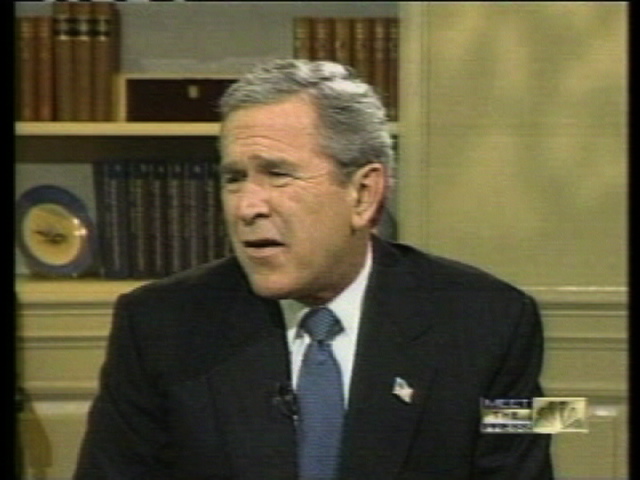


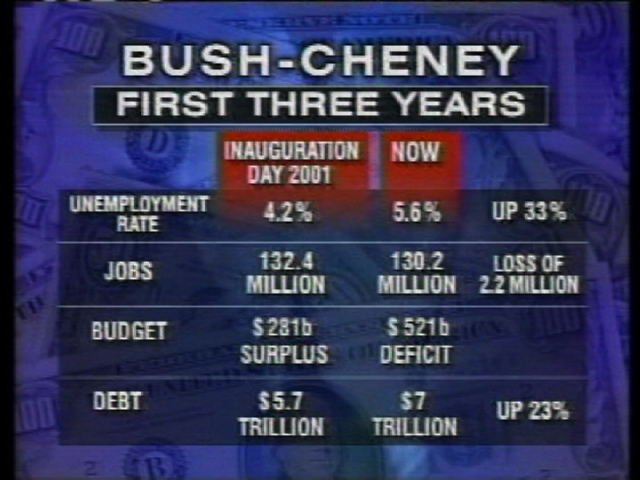


Rumsfeld backed Saddam even after chemical attacks
By Andrew Buncombe for the Independent U.K.
The formerly secret documents reveal the Defence Secretary travelled to Baghdad 20 years ago to assure Iraq that America's condemnation of its use of chemical weapons was made "strictly" in principle.The criticism in no way changed Washington's wish to support Iraq in its war against Iran and "to improve bi-lateral relations ... at a pace of Iraq's choosing".
Earlier this year, Mr Rumsfeld and other members of the Bush administration regularly cited Saddam's willingness to use chemical weapons against his own people as evidence of the threat presented to the rest of the world.
Senior officials presented the attacks against the Kurds - particularly the notorious attack in Halabja in 1988 - as a justification for the invasion and the ousting of Saddam.
But the newly declassified documents reveal that 20 years ago America's position was different and that the administration of President Ronald Reagan was concerned about maintaining good relations with Iraq despite evidence of Saddam's "almost daily" use of chemical weapons against Iranian troops and Kurdish rebels.
In March 1984, under international pressure, America condemned Iraq's use of such chemical weapons. But realising that Baghdad had been upset, Secretary of State George Schultz asked Mr Rumsfeld to travel to Iraq as a special envoy to meet Saddam's Foreign Minister, Tariq Aziz, and smooth matters over.
In a briefing memo to Mr Rumsfeld, Mr Shultz wrote that he had met Iraqi officials in Washington to stress that America's interests remained "in (1) preventing an Iranian victory and (2) continuing to improve bilateral relations with Iraq".
The memo adds: "This message bears reinforcing during your discussions."
Exactly what Mr Rumsfeld, who at the time did not hold government office, told Mr Aziz on 26 March 1984, remains unclear and minutes from the meeting remain classified. No one from Mr Rumsfeld's office was available to comment yesterday.
Here is the full text of the article in case the link goes bad:
http://news.independent.co.uk/world/americas/story.jsp?story=475931
Rumsfeld backed Saddam even after chemical attacks
By Andrew Buncombe in Washington
24 December 2003
Fresh controversy about Donald Rumsfeld's personal dealings with Saddam Hussein was provoked yesterday by new documents that reveal he went to Iraq to show America's support for the regime despite its use of chemical weapons.
The formerly secret documents reveal the Defence Secretary travelled to Baghdad 20 years ago to assure Iraq that America's condemnation of its use of chemical weapons was made "strictly" in principle.
The criticism in no way changed Washington's wish to support Iraq in its war against Iran and "to improve bi-lateral relations ... at a pace of Iraq's choosing".
Earlier this year, Mr Rumsfeld and other members of the Bush administration regularly cited Saddam's willingness to use chemical weapons against his own people as evidence of the threat presented to the rest of the world.
Senior officials presented the attacks against the Kurds - particularly the notorious attack in Halabja in 1988 - as a justification for the invasion and the ousting of Saddam.
But the newly declassified documents reveal that 20 years ago America's position was different and that the administration of President Ronald Reagan was concerned about maintaining good relations with Iraq despite evidence of Saddam's "almost daily" use of chemical weapons against Iranian troops and Kurdish rebels.
In March 1984, under international pressure, America condemned Iraq's use of such chemical weapons. But realising that Baghdad had been upset, Secretary of State George Schultz asked Mr Rumsfeld to travel to Iraq as a special envoy to meet Saddam's Foreign Minister, Tariq Aziz, and smooth matters over.
In a briefing memo to Mr Rumsfeld, Mr Shultz wrote that he had met Iraqi officials in Washington to stress that America's interests remained "in (1) preventing an Iranian victory and (2) continuing to improve bilateral relations with Iraq".
The memo adds: "This message bears reinforcing during your discussions."
Exactly what Mr Rumsfeld, who at the time did not hold government office, told Mr Aziz on 26 March 1984, remains unclear and minutes from the meeting remain classified. No one from Mr Rumsfeld's office was available to comment yesterday.
It was not Mr Rumsfeld's first visit to Iraq. Four months earlier, in December 1983, he had visited Saddam and was photographed shaking hands with the dictator. When news of this visit was revealed last year, Mr Rumsfeld claimed he had "cautioned" Saddam to stop using chemical weapons.
When documents about the meeting disclosed he had said no such thing, a spokesman for Mr Rumsfeld said he had raised the issue with Mr Aziz.
America's relationship with Iraq at a time when Saddam was using chemical weapons is well-documented but rarely reported.
During the war with Iran, America provided combat assistance to Iraq that included intelligence on Iranian deployments and bomb-damage assessments. In 1987-88 American warships destroyed Iranian oil platforms in the Gulf and broke the blockade of Iraqi shipping lanes.
Tom Blanton, the director of the National Security Archive, a non-profit group that obtained the documents, told The New York Times: "Saddam had chemical weapons in the 1980s and it didn't make any difference to US policy. The embrace of Saddam and what it emboldened him to do should caution us as Americans that we have to look closely at all our murky alliances."
Last night, Danny Muller, a spokesman for the anti-war group Voices in the Wilderness, said the documents revealed America's "blatant hypocrisy". He added: "This is not an isolated event. Continuing administrations have said 'we will do business'. I am surprised that Donald Rumsfeld does not resign right now."
Against the war, for the soldiers
By Derrick Z. Jackson for the Boston Globe.
On this eve of the Christian celebration of a baby, I celebrate you. In June, I wrote a column that said our soldiers must be dying for oil, since we found no weapons of mass destruction. I wrote, "Nearly another 50 soldiers have died in nebulous situations that range from justifiable self-defense to dubious overreactions more reminiscent of the shootings of American students and rioters by National Guardsmen in the 1960s."That column sparked a letter from the father of a 20-year-old soldier who died a month after President Bush declared major combat operations to be over. The father wrote: "The use of the word `nebulous' is insulting to all who do their duty every day and especially to those who lose their lives. My son died doing what he volunteered for, doing something he loved and was exceptional at.
"You insult his intelligence by intimating that he was some sort of dupe in this grand power play for the world's oil. If you have a point, then make it, but do not invoke the memory of my son to justify your political point of view. . . . My son willingly followed the orders of his commander in chief to accomplish a mission.
"During his time in Iraq, he grew to like and respect the people there. On missions (prior to his death) he earned the Bronze Star, the Army Commendation Medal, and the Meritorious Service Medal. All this from a 20-year-old Airborne infantryman. Do not dare to insult his memory by equating him with a barrel of oil."
I wrote the father back: "I am very sorry that your son was killed serving this country. . . . I certainly and sincerely understand how reading my column during this time could inflame your feelings.
"What I want you to know is that while you and I have strong, differing feelings about the political purpose of the war itself and the decisions and actions of world leaders that led to it, I have no doubt that at the individual level, young men and women went off genuinely believing they were furthering the cause of peace and democracy and helping to create a better world.
"If it is of any solace to you, despite the anger my column caused you, I salute your son as he died in the service of freedom, with one of those freedoms being freedom of speech and the freedom to dissent without fear of retribution."
Here is the full text of the article in case the link goes bad:
http://www.boston.com/news/globe/editorial_opinion/oped/articles/2003/12/24/against_the_war_for_the_soldiers/
Against the war, for the soldiers
By Derrick Z. Jackson, 12/24/2003
DEAR AMERICAN SOLDIERS:
I wish you a safe holiday. Congratulations on being named Time magazine's Person of the Year.
ADVERTISEMENT
You might find this strange coming from the journalistic equivalent of Scrooge. I was against the war. I wrote last week that despite the capture of Saddam Hussein, the war is still a lie. I believe history will be less kind than today's triumphant headlines. I believe that thousands of Iraqi babies, mothers, and fathers are dead because our political leaders created a panic over weapons of mass destruction that have not yet been found. I fear America will one day pay for our panic.
I also recognize and salute your personal courage. You are mothers and fathers, too. Many of you are also babies. Of the 460 American soldiers who have died in Iraq, 36 were 18 or 19 years old. My oldest son is 18. My best friend's son recently turned 21. My friend was also against the war. His son is in the military and may very well go to Iraq. My friend cried: "They're babies. Just babies."
On this eve of the Christian celebration of a baby, I celebrate you. In June, I wrote a column that said our soldiers must be dying for oil, since we found no weapons of mass destruction. I wrote, "Nearly another 50 soldiers have died in nebulous situations that range from justifiable self-defense to dubious overreactions more reminiscent of the shootings of American students and rioters by National Guardsmen in the 1960s."
That column sparked a letter from the father of a 20-year-old soldier who died a month after President Bush declared major combat operations to be over. The father wrote: "The use of the word `nebulous' is insulting to all who do their duty every day and especially to those who lose their lives. My son died doing what he volunteered for, doing something he loved and was exceptional at.
"You insult his intelligence by intimating that he was some sort of dupe in this grand power play for the world's oil. If you have a point, then make it, but do not invoke the memory of my son to justify your political point of view. . . . My son willingly followed the orders of his commander in chief to accomplish a mission.
"During his time in Iraq, he grew to like and respect the people there. On missions (prior to his death) he earned the Bronze Star, the Army Commendation Medal, and the Meritorious Service Medal. All this from a 20-year-old Airborne infantryman. Do not dare to insult his memory by equating him with a barrel of oil."
I wrote the father back: "I am very sorry that your son was killed serving this country. . . . I certainly and sincerely understand how reading my column during this time could inflame your feelings.
"What I want you to know is that while you and I have strong, differing feelings about the political purpose of the war itself and the decisions and actions of world leaders that led to it, I have no doubt that at the individual level, young men and women went off genuinely believing they were furthering the cause of peace and democracy and helping to create a better world.
"If it is of any solace to you, despite the anger my column caused you, I salute your son as he died in the service of freedom, with one of those freedoms being freedom of speech and the freedom to dissent without fear of retribution."
The father wrote back: "I have always believed the true fundamental strength of our country is the vast diversity of people and their thoughts. We will never have just one mind-set. . . . Thanks for responding and hope to keep in contact. On a lighter note, my slightly premature but inevitable condolences for another also-ran season for the beloved Red Sox -- born and raised in the Bronx."
Dear American soldiers, perhaps there will come a day where the true fundamental strength of our country will be measured more by our diversity than by our ability to wage war. I trust we share that common dream even as we disagree about how to get there. I believe that in your hearts, you are trying to make the world a safer place, where diversity of political thought becomes a global value.
If it is of any solace to you, despite my opposition to the war, I salute the fact that you are ready to give your lives for an ideal. Be careful as you patrol the streets. Defend yourselves if you must.
When you can, take a hard look at the Iraqi man, woman, or child your gun is pointed at. You are in Iraq under the orders of the commander in chief. I cannot do anything about that. What I can wish for is that even as many Christians prepare to sing "Peace on earth, goodwill to men," that you find a way, one soldier at a time, to bring it to Iraq. I pray that babies stop killing babies.
Derrick Z. Jackson's e-mail address is jackson@globe.com.
I'm in a hurry so I'll just have to give you the links:
Saddam was captured by Kurds, not US
We got him: Kurds say they caught Saddam
US Saddam claims being challenged
They've got a good reason for not telling the truth (right on schedule!) -- they feared an Arab-Kurd conflict...
There are also more details about his ex-wife turning him in, and how he was captured (his cook spiked his food).
Enjoy!
Happy Holidays everyone!
http://sify.com/news/fullstory.php?id=13341763
Saddam was captured by Kurds, not US
Sunday, 21 December , 2003, 19:23
Saddam: Caught Napping
. Rebuilding Iraq: Full Coverage
. Capture of Saddam: In Pics
. Timeline: Saddam's Iraq
. Discuss: New beginning?
In Pictures:
. The lost world
. In various disguises
. His daughters
. Saddam: A life
London: Ousted Iraqi dictator Saddam Hussein was captured by Kurdish forces, then drugged and handed over to the American forces as a revenge against the rape of a tribal chief's daughter by the tyrant's psychopathic eldest son Uday, a media report said today.
The full story of the fallen dictator's capture last Saturday in a "spider hole" near his birthplace of Tikrit exposes the version peddled by Americans as incomplete.
According to the report in The Sunday Express, Saddam had already been handed over to Kurdish forces, who then brokered a deal with US commanders.
He was drugged and abandoned, ready for the American troops to recover him.
Saddam was betrayed to the Kurds by a member of the al-Jabour tribe whose daughter was "defiled" by Uday, the report quoting a senior British military intelligence officer said.
The tribe threatened to take revenge. As soon as he heard the news, Saddam visited the family of the dead man and paid them 7 million pounds in blood money with the chilling warning: "If you try to take revenge you will force me to wipe out the al-Jabour tribe."
The news that Saddam was a prisoner and not in hiding would explain his dishevelled state when he was found by Kurdish special forces from the patriotic front and US soldiers.
He was unable to climb out of the hole on his own because the lid that covered it was also sealed down with a carpet and some rubble. A former Iraqi intelligence officer now living in Qatar said he believed Saddam was betrayed shortly after his last audio message was released to the world via Arab television on November 16.
"He was dumped in that hole in Ad Dawr after being handed over to the patriotic front by his own tribesmen and held prisoner until Jalal Talabani made his own negotiations," said the Iraqi.
Talabani is a leader of the Patriotic Front, one of two main Kurdish parties in northern Iraq who fought alongside US forces during the war.
One report said Saddam's cook spiked his food before he was delivered to the front.
According to the report, a western intelligence source stationed in the Middle East said: "Saddam was not captured as a result of any American or British intelligence. We knew that someone would eventually take their revenge, it was just a matter of time."
"There was no question of the tribe claiming the 16 million pounds reward from the US. Apparently it was a question of honour."
"The Kurdish Patriotic Front held him while they thrashed out their own deal. It didn't just involve the reward but it involved gaining some sort of political advantage in the region."
There had been bad blood between the dictator and the al-Jabour tribe since the raped woman's husband tried to take revenge and was shot by Uday's bodyguard.
"The net really began to close when his family fled to Jordan and Uday and Qusay were killed in Mosul. A 20-million pounds reward went to the informant who gave information on their hiding place. However, I doubt if the reward for Saddam will be paid to those directly responsible for his capture."
"They will consider the family honour has been avenged... in Iraqi tribal society it would be frowned upon to accept money."
Immediately after the raid in which Saddam was captured, jubilant Kurdish officials leaked the news to an Iranian news agency hours before the US had a chance to make an official announcement to the assembled media in Baghdad.1
The report also said secret talks are under way to fix a deal in which Saddam will be detained for life in a Qatari prison after his showcase trial.
Intense behind-the-scene negotiations, brokered by Britain, will see the former dictator jailed in the tiny Gulf state, which is host to several US military bases, if the Iraqi court does not push for his execution.
*****
http://www.smh.com.au/articles/2003/12/21/1071941612613.html
We got him: Kurds say they caught Saddam
By Paul McGeough, Herald Correspondent in Baghdad
December 22, 2003
Print this article
Email to a friend
Washington's claims that brilliant US intelligence work led to the capture of Saddam Hussein are being challenged by reports sourced in Iraq's Kurdish media claiming that its militia set the circumstances in which the US merely had to go to a farm identified by the Kurds to bag the fugitive former president.
The first media account of the December 13 arrest was aired by a Tehran-based news agency.
American forces took Saddam into custody around 8.30pm local time, but sat on the news until 3pm the next day.
However, in the early hours of Sunday, a Kurdish language wire service reported explicitly: "Saddam Hussein was captured by the Patriotic Union of Kurdistan. A special intelligence unit led by Qusrat Rasul Ali, a high-ranking member of the PUK, found Saddam Hussein in the city of Tikrit, his birthplace.
"Qusrat's team was accompanied by a group of US soldiers. Further details of the capture will emerge during the day; but the global Kurdish party is about to begin!"
The head of the PUK, Jalal Talabani, was in the Iranian capital en route to Europe.
The Western media in Baghdad were electrified by the Iranian agency's revelation, but as reports of the arrest built, they relied almost exclusively on accounts from US military and intelligence organisations, starting with the words of the US-appointed administrator of Iraq, Paul Bremer: "Ladies and gentlemen: we got 'im".
US officials said that they had extracted the vital piece of information on Saddam's whereabouts from one of the 20 suspects around 5.30pm on December 13 and had immediately assembled a 600-strong force to surround the farm on which he was captured at al-Dwar, south of Tikrit.
Little attention was paid to a line in Pentagon briefings that some of the Kurdish militia might have been in on what was described as a "joint operation"; or to a statement by Ahmed Chalabi, head of the Iraq National Congress, which said that Qusrat and his PUK forces had provided vital information and more.
A Scottish newspaper, the Sunday Herald, quoted from an interview aired on the PUK's al-Hurriyah radio station last Wednesday, in which Adil Murad, a member of the PUK's political bureau,
said that the day before Saddam's capture he was tipped off by a PUK general - Thamir al-Sultan - that Saddam would be arrested within the next 72 hours.
An unnamed Western intelligence source in the Middle East was quoted in the British Sunday Express yesterday: "Saddam was not captured as a result of any American or British intelligence. We knew that someone would eventually take their revenge, it was just a matter of time."
There has been no American response to the Kurdish claims.
An intriguing question is why Kurdish forces were allowed to join what the US desperately needed to present as an American intelligence success - unless the Kurds had something vital to contribute to the operation so far south of their usual area of activity.
A report from the PUK's northern stronghold, Suliymaniah, early last week claimed a vital intelligence breakthrough after a telephone conversation between Qusrat and Saddam's second wife, Samirah.
***
http://www.theage.com.au/articles/2003/12/21/1071941609659.html
US Saddam claims being challenged
By Paul McGeough
Baghdad
December 22, 2003
Print this article
Email to a friend
Claims that US troops captured Saddam Hussein have been challenged by reports that he was discovered only after Kurdish forces had taken him prisoner.
The deposed president was drugged and abandoned ready for the American soldiers to recover him, a British tabloid newspaper reported yesterday.
Saddam came into the hands of the Patriotic Union of Kurdistan (PUK) after being betrayed by a member of the al-Jabour tribe, whose daughter had been raped by Saddam's son Uday, leading to a blood feud, reported the Sunday Express, quoting an unnamed senior British military intelligence officer.
Washington's claims that brilliant US intelligence work led to the capture of Saddam are also being challenged by reports sourced in Iraq's Kurdish language media that say its militia set up the circumstances in which the US merely had to go to a farm identified by the Kurds to bag the fugitive former president.
American forces took Saddam into custody about 8.30pm local time on the Saturday, but sat on the dramatic news until 3pm the next day. But early on Sunday, a Kurdish language wire service reported explicitly: "Saddam Hussein was captured by the Patriotic Union of Kurdistan. A special intelligence unit led by Qusrat Rasul Ali, a high-ranking member of the PUK, found Saddam Hussein in the city of Tikrit, his birthplace. Qusrat's team was accompanied by a group of US soldiers. Details of the capture will emerge but the global Kurdish party is about to begin."
The Western media in Baghdad were electrified by the revelation, but as reports of the arrest built, they relied almost exclusively on accounts from within US military and intelligence organisations, starting with the words of the US-appointed administrator of Iraq, Paul Bremer: "Ladies and gentlemen, we got 'im."
A report from the PUK's northern stronghold, Suliymaniah, last week claimed a vital intelligence breakthrough after a telephone conversation between Qusrat Rasul Ali and Saddam's second wife, Samira, which had prompted the Kurds to move units of their Peshmerga fighters to where Saddam was hiding.
The report, from the MENA agency, as monitored by the BBC, said the Americans had insisted that it be an American arrest because they worried that such a coup for the Kurds might provoke an Arab-Kurd civil war.
A Kurdish member of the Iraq Governing Council, Mahmud Othman, also suggested a critical role for Kurds in the arrest when he said on the Sunday: "Before 4am (more than 12 hours ahead of the US announcement) today, Qusrat Rasul Ali called me to inform me that his men, with the Americans, had managed to capture Saddam Hussein."
US intelligence officers have concluded that Saddam was directing the postwar insurgency inside Iraq, playing a far more active role than thought.
Despite his bewildered appearance when he was hauled from his hiding hole last weekend, he is believed to have been issuing regular instructions on targets and tactics through five trusted lieutenants.
Documents found in Saddam's briefcase indicated that he had been kept informed of the progress of the insurgency, but did not suggest he had overall control of operations by former Baath Party loyalists. But since the arrest and interrogation of guerilla leaders named in the paperwork, US investigators now believe Saddam headed an elaborate network of rebel cells.
The investigators have put together a picture of Saddam's support structure, enabling him to issue commands without using satellite phones, which monitoring devices can hear.
- with agencies
Knitwitology has just posted a great page with all the information on it I was just about to take the time to create links for:
Thanks, Morgan for letting me off the hook!
Remember to not let any of this stuff get you down people! Things just keep getting stranger and stranger. But we're all in this together, and we're gonna get out of it together!
Happy Holidays and Remember to Be Careful About Driving Tired, Wasted or in Bad Weather. When in doubt - chill out and wait till later.
Peace and Love Ya'll!
(I'm probably out for the next few days...connectivity uncertain.)
An intelligence website has reported that former Iraqi president, Saddam Hussein, might have been a prisoner at the time of his arrest.According to Debkafiles there is a possibility that Saddam was held for up to three weeks in the underground pit by a Kurdish splinter group while they negotiated a handover to the Americans in return for the US$25m reward.
The website, edited by former Israeli intelligence agents reports that this is the only answer to questions on why Saddam looked dishevelled and disorientated when captured.
The website reported that it was clear Saddam had not shaved for weeks nor had he washed his hair. He was also starved and looked neglected.
The opening of the underground pit was camouflaged with rocks and mud and it was accessible for above ground only. As a result it was impossible for Saddam to leave his underground cell.
No information has been released on the two men captured at the site except for the fact that they tried to escape during the American operation.
The other question asked is where did the US$750 000 found at the scene come from. It is possible that the new notes were a down payment of a ransom.
The possibility that Saddam was drugged has also emerged. This could have been why he appeared so disorientated, read the report. This would also explain why Saddam did not use the firearm found in the pit.
SADDAM Hussein was found by US troops only after he had been taken prisoner by Kurdish forces, drugged and abandoned ready for American soldiers to recover him, a British newspaper reported yesterday.Saddam came into the hands of the Kurdish Patriotic Front after being betrayed to the group by a member of the al-Jabour tribe, whose daughter had been raped by Saddam's son Uday, leading to a blood feud, reported the Sunday Express, which quoted an unnamed senior British military intelligence officer.
The newspaper said the full story of events leading up to the ousted Iraqi president's capture on December 13 near his hometown of Tikrit in northern Iraq, "exposes the version peddled by American spin doctors as incomplete".
A former Iraqi intelligence officer, whom the Express did not name, told the paper that Saddam was held prisoner by a leader of the Kurdish Patriotic Front, which fought alongside US forces during the Iraq war, until the leader negotiated a deal.
The deal apparently involved the group gaining political advantage in the region.
An unnamed Western intelligence source in the Middle East told the Express: "Saddam was not captured as a result of any American or British intelligence".
Here is the full text of the entire article in case the link goes bad:
http://www.news24.com/News24/World/Iraq/0,,2-10-1460_1460345,00.html
Saddam 'captured weeks ago'
17/12/2003 07:19 - (SA)
Erika Gibson
Pretoria - An intelligence website has reported that former Iraqi president, Saddam Hussein, might have been a prisoner at the time of his arrest.
According to Debkafiles there is a possibility that Saddam was held for up to three weeks in the underground pit by a Kurdish splinter group while they negotiated a handover to the Americans in return for the US$25m reward.
The website, edited by former Israeli intelligence agents reports that this is the only answer to questions on why Saddam looked dishevelled and disorientated when captured.
The website reported that it was clear Saddam had not shaved for weeks nor had he washed his hair. He was also starved and looked neglected.
The opening of the underground pit was camouflaged with rocks and mud and it was accessible for above ground only. As a result it was impossible for Saddam to leave his underground cell.
No information has been released on the two men captured at the site except for the fact that they tried to escape during the American operation.
The other question asked is where did the US$750 000 found at the scene come from. It is possible that the new notes were a down payment of a ransom.
The possibility that Saddam was drugged has also emerged. This could have been why he appeared so disorientated, read the report. This would also explain why Saddam did not use the firearm found in the pit.
Here is the full text of the entire story in case the link goes bad:
http://www.news.com.au/common/story_page/0,4057,8233746%255E2,00.html
Kurds claim Saddam capture
December 22, 2003
SADDAM Hussein was found by US troops only after he had been taken prisoner by Kurdish forces, drugged and abandoned ready for American soldiers to recover him, a British newspaper reported yesterday.
Saddam came into the hands of the Kurdish Patriotic Front after being betrayed to the group by a member of the al-Jabour tribe, whose daughter had been raped by Saddam's son Uday, leading to a blood feud, reported the Sunday Express, which quoted an unnamed senior British military intelligence officer.
The newspaper said the full story of events leading up to the ousted Iraqi president's capture on December 13 near his hometown of Tikrit in northern Iraq, "exposes the version peddled by American spin doctors as incomplete".
A former Iraqi intelligence officer, whom the Express did not name, told the paper that Saddam was held prisoner by a leader of the Kurdish Patriotic Front, which fought alongside US forces during the Iraq war, until the leader negotiated a deal.
The deal apparently involved the group gaining political advantage in the region.
An unnamed Western intelligence source in the Middle East told the Express: "Saddam was not captured as a result of any American or British intelligence".
"We knew that someone would eventually take their revenge, it was just a matter of time."
However US military intelligence said in Baghdad yesterday the man who led US troops to Saddam was one of his top aides.
"He was someone I would call his right arm," said Major Stan Murphy, head of intelligence for the 4th Infantry Division's First Brigade in Tikrit.
Meanwhile, Spanish Prime Minister Jose Maria Aznar yesterday paid an unannounced visit to Iraq.
Aznar flew by helicopter from Kuwait and spent about five hours at a base in Diwaniya, south of the capital, where he had lunch with the mostly Spanish troops stationed there.
"The visit had to be a surprise for security reasons. Very few people knew about it," said Major Carlos Herradon, spokesman for the Spanish troops based in Iraq.
Mr Aznar said he wanted to support the Spanish soldiers and their allies in "their struggle for a just cause, one of liberty, democracy and respect for international law".
Later, a senior US officer said four Iraqis died and an unspecified number of US troops were wounded during a Baghdad demonstration in support of Saddam five days ago. Three more Iraqi policemen were gunned down by mistake by American soldiers about 90km south of Kirkuk in northern Iraq, local police said, adding that they were mistaken for rebels.
The Courier-Mail
Can't the Shrub Administration tell the truth about anything?
Would it have really been so bad to just tell the truth on this one? We still have him in custody and all. The Kurds could have gotten their proper credit -- we could have bonded with a persecuted people, and then we all could have held hands and hated Saddam together. (These are the Kurds, remember? The ones that were gassed ten years ago that the Administration likes to bring up all the time as justification for the Shrub War's unfound WMD!)
But no.
Instead we have to find out a week later that we were lied to yet again.
I hope this is getting as old for you as it is for me. I want a President that can tell the truth at least part of the time. How about once. I'd like to go a day or two, or maybe a week even, without hearing a lie from my President. I don't think it's too much to ask.
Well, at least now we know what the new terror alert level is all about. It's all about diversion: "Pay no attention to the information coming in from the rest of the world. Just be afraid and keep watching the box for further instructions."
Saddam was held by Kurdish forces, drugged and left for US troops
Saddam Hussein (news - web sites) was captured by US troops only after he had been taken prisoner by Kurdish forces, drugged and abandoned ready for American soldiers to recover him, a British Sunday newspaper said.Saddam came into the hands of the Kurdish Patriotic Front after being betrayed to the group by a member of the al-Jabour tribe, whose daughter had been raped by Saddam's son Uday, leading to a blood feud, reported the Sunday Express, which quoted an unnamed senior British military intelligence officer.
The newspaper said the full story of events leading up to the ousted Iraqi president's capture on December 13 near his hometown of Tikrit in northern Iraq (news - web sites), "exposes the version peddled by American spin doctors as incomplete".
A former Iraqi intelligence officer, whom the Express did not name, told the paper that Saddam was held prisoner by a leader of the Kurdish Patriotic Front, which fought alongside US forces during the Iraq war, until he negotiated a deal.
The deal apparently involved the group gaining political advantage in the region.
An unnamed Western intelligence source in the Middle East told the Express: "Saddam was not captured as a result of any American or British intelligence. We knew that someone would eventually take their revenge, it was just a matter of time."
Here is the full text of the article in case the link goes bad:
http://story.news.yahoo.com/news?tmpl=story&u=/afp/20031221/wl_mideast_afp/iraq_saddam_britain&cid=1514&ncid=1480
Saddam was held by Kurdish forces, drugged and left for US troops
Sat Dec 20,11:00 PM ET
LONDON, (AFP) - Saddam Hussein (news - web sites) was captured by US troops only after he had been taken prisoner by Kurdish forces, drugged and abandoned ready for American soldiers to recover him, a British Sunday newspaper said.
Saddam came into the hands of the Kurdish Patriotic Front after being betrayed to the group by a member of the al-Jabour tribe, whose daughter had been raped by Saddam's son Uday, leading to a blood feud, reported the Sunday Express, which quoted an unnamed senior British military intelligence officer.
The newspaper said the full story of events leading up to the ousted Iraqi president's capture on December 13 near his hometown of Tikrit in northern Iraq (news - web sites), "exposes the version peddled by American spin doctors as incomplete".
A former Iraqi intelligence officer, whom the Express did not name, told the paper that Saddam was held prisoner by a leader of the Kurdish Patriotic Front, which fought alongside US forces during the Iraq war, until he negotiated a deal.
The deal apparently involved the group gaining political advantage in the region.
An unnamed Western intelligence source in the Middle East told the Express: "Saddam was not captured as a result of any American or British intelligence. We knew that someone would eventually take their revenge, it was just a matter of time."
I'll be posting some stuff today...(even though technically I don't have time to.)
Some of this stuff is just too important...(Ugh...that's how I got behind in my school work to begin with!)
Letters the Troops Have Sent Me
As we approach the holidays, I've been thinking a lot about our kids who are in the armed forces serving in Iraq. I've received hundreds of letters from our troops in Iraq -- and they are telling me something very different from what we are seeing on the evening news.What they are saying to me, often eloquently and in heart-wrenching words, is that they were lied to -- and this war has nothing to do with the security of the United States of America.
I've written back and spoken on the phone to many of them and I've asked a few of them if it would be OK if I posted their letters on my website and they've said yes. They do so at great personal risk (as they may face disciplinary measures for exercising their right to free speech). I thank them for their bravery.
Lance Corporal George Batton of the United States Marine Corps, who returned from Iraq in September (after serving in MP company Alpha), writes the following:
"You'd be surprised at how many of the guys I talked to in my company and others believed that the president's scare about Saddam's WMD was a bunch of bullshit and that the real motivation for this war was only about money. There was also a lot of crap that many companies, not just marine companies, had to go through with not getting enough equipment to fulfill their missions when they crossed the border. It was a miracle that our company did what it did the two months it was staying in Iraq during the war…. We were promised to go home on June 8th, and found out that it was a lie and we got stuck doing missions for an extra three months. Even some of the most radical conservatives in our company including our company gunnery sergeant got a real bad taste in their mouth about the Marine corps, and maybe even president Bush."
Here is the full text of the article in case the link goes bad:
http://www.truthout.org/docs_03/122103A.shtml
Letters the Troops Have Sent Me
By Michael Moore
MichaelMoore.com
Friday 19 December 2003
Dear Friends,
As we approach the holidays, I've been thinking a lot about our kids who are in the armed forces serving in Iraq. I've received hundreds of letters from our troops in Iraq -- and they are telling me something very different from what we are seeing on the evening news.
What they are saying to me, often eloquently and in heart-wrenching words, is that they were lied to -- and this war has nothing to do with the security of the United States of America.
I've written back and spoken on the phone to many of them and I've asked a few of them if it would be OK if I posted their letters on my website and they've said yes. They do so at great personal risk (as they may face disciplinary measures for exercising their right to free speech). I thank them for their bravery.
Lance Corporal George Batton of the United States Marine Corps, who returned from Iraq in September (after serving in MP company Alpha), writes the following:
"You'd be surprised at how many of the guys I talked to in my company and others believed that the president's scare about Saddam's WMD was a bunch of bullshit and that the real motivation for this war was only about money. There was also a lot of crap that many companies, not just marine companies, had to go through with not getting enough equipment to fulfill their missions when they crossed the border. It was a miracle that our company did what it did the two months it was staying in Iraq during the war…. We were promised to go home on June 8th, and found out that it was a lie and we got stuck doing missions for an extra three months. Even some of the most radical conservatives in our company including our company gunnery sergeant got a real bad taste in their mouth about the Marine corps, and maybe even president Bush."
Here's what Specialist Mike Prysner of the U.S. Army wrote to me:
"Dear Mike -- I’m writing this without knowing if it’ll ever get to you... I’m writing it from the trenches of a war (that’s still going on,) not knowing why I’m here or when I’m leaving. I’ve toppled statues and vandalized portraits, while wearing an American flag on my sleeve, and struggling to learn how to understand... I joined the army as soon as I was eligible – turned down a writing scholarship to a state university, eager to serve my country, ready to die for the ideals I fell in love with. Two years later I found myself moments away from a landing onto a pitch black airstrip, ready to charge into a country I didn't believe I belonged in, with your words (from the Oscars) repeating in my head. My time in Iraq has always involved finding things to convince myself that I can be proud of my actions; that I was a part of something just. But no matter what pro-war argument I came up with, I pictured my smirking commander-in-chief, thinking he was fooling a nation..."
An Army private, still in Iraq and wishing to remain anonymous, writes:
"I would like to tell you how difficult it is to serve under a man who was never elected. Because he is the president and my boss, I have to be very careful as to who and what i say about him. This also concerns me a great deal... to limit the military's voice is to limit exactly what America stands for... and the greater percentage of us feel completely underpowered. He continually sets my friends, my family, and several others in a kind of danger that frightens me beyond belief. I know several other soldiers who feel the same way and discuss the situation with me on a regular basis."
Jerry Oliver of the U.S. Army, who has just returned from Baghdad, writes:
"I have just returned home from "Operation Iraqi Freedom". I spent 5 months in Baghdad, and a total of 3 years in the U.S. Army. I was recently discharged with Honorable valor and returned to the States only to be horrified by what I've seen my country turn into. I'm now 22 years old and have discovered America is such a complicated place to live, and moreover, Americans are almost oblivious to what's been happening to their country. America has become "1984." Homeland security is teaching us to spy on one another and forcing us to become anti-social. Americans are willingly sacrificing our freedoms in the name of security, the same Freedoms I was willing to put my life on the line for. The constitution is in jeopardy. As Gen. Tommy Franks said, (broken down of course) One more terrorist attack and the constitution will hold no meaning."
And a Specialist in the U.S. Army wrote to me this week about the capture of Saddam Hussein:
"Wow, 130,000 troops on the ground, nearly 500 deaths and over a billion dollars a day, but they caught a guy living in a hole. Am I supposed to be dazzled?"
There are lots more of these, straight from the soldiers who have been on the front lines and have seen first hand what this war is really about.
I have also heard from their friends and relatives, and from other veterans. A mother writing on behalf of her son (whose name we have withheld) wrote:
"My son said that this is the worst it's been since the "end" of the war. He said the troops have been given new rules of engagement, and that they are to "take out" any persons who aggress on the Americans, even if it results in "collateral" damage. Unfortunately, he did have to kill someone in self defense and was told by his commanding officer ‘Good kill.’
"My son replied ‘You just don't get it, do you?’
"Here we are...Vietnam all over again."
From a 56 year old Navy veteran, relating a conversation he had with a young man who was leaving for Iraq the next morning:
"What disturbed me most was when I asked him what weapons he carried as a truck driver. He told me the new M-16, model blah blah blah, stuff never made sense to me even when I was in. I asked him what kind of side arm they gave him and his fellow drivers. He explained, "Sir, Reservists are not issued side arms or flack vests as there was not enough money to outfit all the Reservists, only Active Personnel". I was appalled to say the least.
"Bush is a jerk agreed, but I can't believe he is this big an Asshole not providing protection and arms for our troops to fight HIS WAR!"
From a 40-year old veteran of the Marine Corps:
"Why is it that we are forever waving the flag of sovereignty, EXCEPT when it concerns our financial interests in other sovereign states? What gives us the right to tell anyone else how they should govern themselves, and live their lives? Why can't we just lead the world by example? I mean no wonder the world hates us, who do they get to see? Young assholes in uniforms with guns, and rich, old, white tourists! Christ, could we put up a worse first impression?"
(To read more from my Iraq mailbag -- and to read these above letters in full -- go to my website: http://www.michaelmoore.com/books-films/dudewheresmycountry/soldierletters/index.php)
Remember back in March, once the war had started, how risky it was to make any anti-war comments to people you knew at work or school or, um, at awards ceremonies? One thing was for sure -- if you said anything against the war, you had BETTER follow it up immediately with this line: "BUT I SUPPORT THE TROOPS!" Failing to do that meant that you were not only unpatriotic and un-American, your dissent meant that YOU were putting our kids in danger, that YOU might be the reason they lose their lives. Dissent was only marginally tolerated IF you pledged your "support" for our soldiers.
Of course, you needed to do no such thing. Why? Because people like you have ALWAYS supported "the troops." Who are these troops? They are our poor, our working class. Most of them enlisted because it was about the only place to get a job or receive the guarantee of a college education. You, my good friends, have ALWAYS, through your good works, your contributions, your activism, your votes, SUPPORTED these very kids who come from the other side of the tracks. You NEVER need to be defensive when it comes to your "support" for the "troops" -- you are the only ones who have ALWAYS been there for them.
It is Mr. Bush and his filthy rich cronies -- whose sons and daughters will NEVER see a day in a uniform -- they are the ones who do NOT support our troops. Our soldiers joined the military and, in doing so, offered to give THEIR LIVES for US if need be. What a tremendous gift that is -- to be willing to die so that you and I don't have to! To be willing to shed their blood so that we may be free. To serve in our place, so that WE don't have to serve. What a tremendous act of selflessness and generosity! Here they are, these 18, 19, and 20-year olds, most of whom have had to suffer under an unjust economic system that is set up NOT to benefit THEM -- these kids who have lived their first 18 years in the worst parts of town, going to the most miserable schools, living in danger and learning often to go without, watching their parents struggle to get by and then be humiliated by a system that is always looking to make life harder for them by cutting their benefits, their education, their libraries, their fire and police, their future.
And then, after this miserable treatment, these young men and women, instead of coming after US to demand a more just society, they go and join the army to DEFEND us and our way of life! It boggles the mind, doesn't it? They not only deserve our thanks, they deserve a big piece of the pie that we dine on, those of us who never have to worry about taking a bullet while we fret over which Palm Pilot to buy the nephew for Christmas.
In fact, all that these kids in the army ask for in return from us is our promise that we never send them into harm's way unless it is for the DEFENSE of our nation, to protect us from being killed by "the enemy."
And that promise, my friends, has been broken. It has been broken in the worst way imaginable. We have sent them into war NOT to defend us, not to protect us, not to spare the slaughter of innocents or allies. We have sent them to war so Bush and Company can control the second largest supply of oil in the world. We have sent them into war so that the Vice President's company can bilk the government for billions of dollars. We have sent them into war based on a lie of weapons of mass destruction and the lie that Saddam helped plan 9-11 with Osama bin Laden.
By doing all of this, Mr. Bush has proven that it is HE who does not support our troops. It is HE who has put their lives in danger, and it is HE who is responsible for the nearly 500 American kids who have now died for NO honest, decent reason whatsoever.
The letters I've received from the friends and relatives of our kids over there make it clear that they are sick of this war and they are scared to death that they may never see their loved ones again. It breaks my heart to read these letters. I wish there was something I could do. I wish there was something we all could do.
Maybe there is. As Christmas approaches (and Hanukkah begins tonight), I would like to suggest a few things each of us could do to make the holidays a bit brighter -- if not safer -- for our troops and their families back home.
1. Many families of soldiers are hurting financially, especially those families of reservists and National Guard who are gone from the full-time jobs ("just one weekend a month and we'll pay for your college education!"). You can help them by contacting the Armed Forces Emergency Relief Funds at http://www.afrtrust.org/ (ignore the rah-rah military stuff and remember that this is money that will help out these families who are living in near-poverty). Each branch has their own relief fund, and the money goes to help the soldiers and families with paying for food and rent, medical and dental expenses, personal needs when pay is delayed, and funeral expenses. You can find more ways to support the troops, from buying groceries for their families to donating your airline miles so they can get home for a visit, by going here.
2. Thousands of Iraqi civilians have been killed by our bombs and indiscriminate shooting. We must help protect them and their survivors. You can do so by supporting the Quakers' drive to provide infant care kits to Iraqi hospitals-find out more here: http://www.afsc.org/iraq/relief/default.shtm. You can also help the people of Iraq by supporting the Iraqi Red Crescent Society-here’s how to contact them: http://www.ifrc.org/address/iq.asp, or you can make an online donation through the International Federation of the Red Cross and Red Crescent Societies by going here: http://www.ifrc.org/HELPNOW/donate/donate_iraq.asp.
3. With 130,000 American men and women currently in Iraq, every community in this country has either sent someone to fight in this war or is home to family members of someone fighting in this war. Organize care packages through your local community groups, activist groups, and churches and send them to these young men and women. The military no longer accepts packages addressed to "Any Soldier," so you’ll have to get their names first. Figure out who you can help from your area, and send them books, CDs, games, footballs, gloves, blankets-anything that may make their extended (and extended and extended...) stay in Iraq a little brighter and more comfortable. You can also sponsor care packages to American troops through the USO: http://www.usocares.org/.
4. Want to send a soldier a free book or movie? I’ll start by making mine available for free to any soldier serving in Iraq. Just send me their name and address in Iraq (or, if they have already left Iraq, where they are now) and the first thousand emails I get at soldiers@michaelmoore.com will receive a free copy of "Dude..." or a free "Bowling..." DVD.
5. Finally, we all have to redouble our efforts to end this war and bring the troops home. That's the best gift we could give them -- get them out of harm's way ASAP and insist that the U.S. go back to the UN and have them take over the rebuilding of Iraq (with the US and Britain funding it, because, well, we have to pay for our mess). Get involved with your local peace group-you can find one near where you live by visiting United for Peace, at: http://www.unitedforpeace.org and the Vietnam Veterans Against War: http://www.vvaw.org/contact/. A large demonstration is being planned for March 20, check here for more details: http://www.unitedforpeace.org/article.php?id=2136. To get a "Bring Them Home Now" bumper sticker or a poster for your yard, go here: http://bringthemhomenow.org/yellowribbon_graphics/index.html. Also, back only anti-war candidates for Congress and President (Kucinich, Dean, Clark, Sharpton).
I know it feels hopeless. That's how they want us to feel. Don't give up. We owe it to these kids, the troops WE SUPPORT, to get them the hell outta there and back home so they can help organize the drive to remove the war profiteers from office next November.
To all who serve in our armed forces, to their parents and spouses and loved ones, we offer to you the regrets of millions and the promise that we will right this wrong and do whatever we can to thank you for offering to risk your lives for us. That your life was put at risk for Bush's greed is a disgrace and a travesty, the likes of which I have not seen in my lifetime.
Please be safe, come home soon, and know that our thoughts and prayers are with you during this season when many of us celebrate the birth of the prince of "peace."
Yours,
Michael Moore
mmflint@aol.com
www.michaelmoore.com
Is illegal. Not was illegal. The damn thing isn't over yet!
War Critics Astonished as U.S. Hawk Admits Invasion Was Illegal
By Oliver Burkeman and Julian Borger for The Guardian UK.
International lawyers and anti-war campaigners reacted with astonishment yesterday after the influential Pentagon hawk Richard Perle conceded that the invasion of Iraq had been illegal.In a startling break with the official White House and Downing Street lines, Mr Perle told an audience in London: "I think in this case international law stood in the way of doing the right thing."
President George Bush has consistently argued that the war was legal either because of existing UN security council resolutions on Iraq - also the British government's publicly stated view - or as an act of self-defence permitted by international law.
But Mr Perle, a key member of the defence policy board, which advises the US defence secretary, Donald Rumsfeld, said that "international law ... would have required us to leave Saddam Hussein alone", and this would have been morally unacceptable...
The Pentagon adviser's views, he added, underlined "a divergence of view between the British government and some senior voices in American public life [who] have expressed the view that, well, if it's the case that international law doesn't permit unilateral pre-emptive action without the authority of the UN, then the defect is in international law".
Mr Perle's view is not the official one put forward by the White House. Its main argument has been that the invasion was justified under the UN charter, which guarantees the right of each state to self-defence, including pre-emptive self-defence. On the night bombing began, in March, Mr Bush reiterated America's "sovereign authority to use force" to defeat the threat from Baghdad...
"I think Perle's statement has the virtue of honesty," said Michael Dorf, a law professor at Columbia University who opposed the war, arguing that it was illegal.
"And, interestingly, I suspect a majority of the American public would have supported the invasion almost exactly to the same degree that they in fact did, had the administration said that all along."
The controversy-prone Mr Perle resigned his chairmanship of the defence policy board earlier this year but remained a member of the advisory board.
Meanwhile, there was a hint that the US was trying to find a way to release the Britons held at Guantanamo Bay.
The US secretary of state, Colin Powell, said Mr Bush was "very sensitive" to British sentiment. "We also expect to be resolving this in the near future," he told the BBC.
That provides no comfort for Jennings’ parents. “My inner strength is gone,” says Harriet Johnson. “I’m getting strength from the Lord now. Just His strength is carrying me because mine was gone when I heard about my son’s death.”
Here is the text of the entire article in case the link goes bad:
http://www.guardian.co.uk/Iraq/Story/0,2763,1089158,00.html
War Critics Astonished as U.S. Hawk Admits Invasion Was Illegal
By Oliver Burkeman and Julian Borger
The Guardian UK
Thursday 20 November 2003
International lawyers and anti-war campaigners reacted with astonishment yesterday after the influential Pentagon hawk Richard Perle conceded that the invasion of Iraq had been illegal.
In a startling break with the official White House and Downing Street lines, Mr Perle told an audience in London: "I think in this case international law stood in the way of doing the right thing."
President George Bush has consistently argued that the war was legal either because of existing UN security council resolutions on Iraq - also the British government's publicly stated view - or as an act of self-defence permitted by international law.
But Mr Perle, a key member of the defence policy board, which advises the US defence secretary, Donald Rumsfeld, said that "international law ... would have required us to leave Saddam Hussein alone", and this would have been morally unacceptable.
French intransigence, he added, meant there had been "no practical mechanism consistent with the rules of the UN for dealing with Saddam Hussein".
Mr Perle, who was speaking at an event organised by the Institute of Contemporary Arts in London, had argued loudly for the toppling of the Iraqi dictator since the end of the 1991 Gulf war.
"They're just not interested in international law, are they?" said Linda Hugl, a spokeswoman for the Campaign for Nuclear Disarmament, which launched a high court challenge to the war's legality last year. "It's only when the law suits them that they want to use it."
Mr Perle's remarks bear little resemblance to official justifications for war, according to Rabinder Singh QC, who represented CND and also participated in Tuesday's event.
Certainly the British government, he said, "has never advanced the suggestion that it is entitled to act, or right to act, contrary to international law in relation to Iraq".
The Pentagon adviser's views, he added, underlined "a divergence of view between the British government and some senior voices in American public life [who] have expressed the view that, well, if it's the case that international law doesn't permit unilateral pre-emptive action without the authority of the UN, then the defect is in international law".
Mr Perle's view is not the official one put forward by the White House. Its main argument has been that the invasion was justified under the UN charter, which guarantees the right of each state to self-defence, including pre-emptive self-defence. On the night bombing began, in March, Mr Bush reiterated America's "sovereign authority to use force" to defeat the threat from Baghdad.
The UN secretary general, Kofi Annan, has questioned that justification, arguing that the security council would have to rule on whether the US and its allies were under imminent threat.
Coalition officials countered that the security council had already approved the use of force in resolution 1441, passed a year ago, warning of "serious consequences" if Iraq failed to give a complete ac counting of its weapons programmes.
Other council members disagreed, but American and British lawyers argued that the threat of force had been implicit since the first Gulf war, which was ended only by a ceasefire.
"I think Perle's statement has the virtue of honesty," said Michael Dorf, a law professor at Columbia University who opposed the war, arguing that it was illegal.
"And, interestingly, I suspect a majority of the American public would have supported the invasion almost exactly to the same degree that they in fact did, had the administration said that all along."
The controversy-prone Mr Perle resigned his chairmanship of the defence policy board earlier this year but remained a member of the advisory board.
Meanwhile, there was a hint that the US was trying to find a way to release the Britons held at Guantanamo Bay.
The US secretary of state, Colin Powell, said Mr Bush was "very sensitive" to British sentiment. "We also expect to be resolving this in the near future," he told the BBC.
That provides no comfort for Jennings’ parents. “My inner strength is gone,” says Harriet Johnson. “I’m getting strength from the Lord now. Just His strength is carrying me because mine was gone when I heard about my son’s death.”
Grieving Mother's Advice To Bush: 'Bring Our Boys Home'
By Hazel Trice Edney for The Wilmington Journal.
“If I could talk to the president myself, right now, I would tell him, ‘Find a plan to bring our boys home,’” says Harriet Elaine Johnson of Cope, S. C., the mother of U. S. Army Specialist Darius T. Jennings. “They’re telling us, ‘We’re going to kill your American soldiers,’ and it doesn’t seem like the American leaders are listening…Let us not use our babies at the expense of the country to try to prove some kind of power struggle.”Jennings was one of 16 U. S. Army soldiers killed when the helicopter was shot down Nov. 2 by a missile near Fallujah. His death came less than two weeks before his 23rd birthday...
Not only has neither Bush nor many Congressional leaders not walked in Johnson’s shoes, they didn’t take the risk her deceased son took, either.
Rather than serve on active duty, Bush joined the Texas Air National Guard in 1968.
And he has denied widespread reports that he didn’t report for drill duty from May 1972 to April 1973 while he lived in Alabama and worked on the U.S. Senate campaign of of former postmaster general Winton M. Blount. Bush says he fulfilled his guard service locally on weekends.
Vice President Dick Cheney used student and marriage deferments to avoid military service. None of the top Republican elected leaders served in the military. Neither Senate Majority Leader Bill Frist, Senate Majority Whip Don Nickles, House Speaker Dennis Hastert, nor House Majority Whip Roy Blunt served in the Armed Forces.
Here is the full text of the article in case the link goes bad:
http://wilmingtonjournal.blackpressusa.com/news/Article/Article.asp?NewsID=35202&sID=33
Grieving Mother's Advice To Bush: 'Bring Our Boys Home'
By Hazel Trice Edney
The Wilmington Journal
Thursday 20 November 2003
WASHINGTON (NNPA) – The mother of an American soldier killed in a recent missile attack on a CH-47 Chinook helicopter in Iraq has a message that she says President Bush needs to hear.
“If I could talk to the president myself, right now, I would tell him, ‘Find a plan to bring our boys home,’” says Harriet Elaine Johnson of Cope, S. C., the mother of U. S. Army Specialist Darius T. Jennings. “They’re telling us, ‘We’re going to kill your American soldiers,’ and it doesn’t seem like the American leaders are listening…Let us not use our babies at the expense of the country to try to prove some kind of power struggle.”
Jennings was one of 16 U. S. Army soldiers killed when the helicopter was shot down Nov. 2 by a missile near Fallujah. His death came less than two weeks before his 23rd birthday.
Ironically, last Saturday, the day of Jennings’ funeral, two American Black Hawk helicopters collided in midair and crashed near Mosul, killing at least 17 American soldiers who were aboard.
“I feel quite sure if they had some kids over there, they would have already come up with a plan.” Johnson says. “From my understanding, I think all of [Bush’s] kids are living. So, he cannot feel what I’m feeling...He’ll never be able to feel my sympathy until he walks in my shoes.”
Pentagon Spokesman Maj. Steve Stover says the military understands the suffering of families of loved ones killed in the war.
“I know a lot of people ask us, ‘Well, what do you think about being there?’ Well, you know what? In those respects, we don’t,” he says. “We’re soldiers. We go where we’re told. If the president tells us to go, we go. We trust our elected leaders, not only the president, but our Congress, who makes those decisions. We don’t second-guess them.”
Not only has neither Bush nor many Congressional leaders not walked in Johnson’s shoes, they didn’t take the risk her deceased son took, either.
Rather than serve on active duty, Bush joined the Texas Air National Guard in 1968.
And he has denied widespread reports that he didn’t report for drill duty from May 1972 to April 1973 while he lived in Alabama and worked on the U.S. Senate campaign of of former postmaster general Winton M. Blount. Bush says he fulfilled his guard service locally on weekends.
Vice President Dick Cheney used student and marriage deferments to avoid military service. None of the top Republican elected leaders served in the military. Neither Senate Majority Leader Bill Frist, Senate Majority Whip Don Nickles, House Speaker Dennis Hastert, nor House Majority Whip Roy Blunt served in the Armed Forces.
On the Democratic side, Senate Democratic Leader Tom Daschle served three years as an intelligence officer in the U. S. Air Force Strategic Air Command, but neither House Democratic Leader Nancy Pelosi nor House Democratic Whip Steny Hoyer served in the military.
Of the nine Democratic presidential candidates, only retired Gen. Wesley Clark and Massachusetts Sen. John Kerry served on active duty. Clark rose from an infantry officer in the army to company commander in Vietnam to four-star general and supreme allied commander of NATO forces in Europe.
Kerry was the skipper of a Navy swift boat in the Mekong Delta of South Vietnam. Both Kerry and Clark received the Purple Heart after being wounded in combat and both were awarded the Silver Star for gallantry in action.
Spec. Jennings’ mother says she had spoken to him by phone only five days beforehis death. “My son was tired of being over there,” she says. “First of all, I didn’t raise my son in violence.
He joined the Army. He knew that maybe there would have been war, [but] my son, the things he was seeing over there, he was not accustomed to. And it was really getting to him and he asked me for guidance.
“I said, ‘Son, go to your chaplain.’ So, he went to the chaplain and he came back and said, ‘Well Mommy, I’m just ready to come home. And every time we spoke and when he e-mailed me, it was the same thing, ‘Mommy, I’m ready to come home. You don’t know what I’m going through over here. You don’t see the things I see Mommy.’”
Jennings and his wife, Ari, 20, an airman in the U. S. Air Force, observed their first wedding anniversary on Oct. 29. Now, there will not be a second. “She’s taking it day to day,” says her father, Howard Young of Colorado Springs. “You know, it’s a numbing experience.”
The couple met while Jennings was stationed near Colorado Springs at Fort Carson, assigned to the 2nd Squadron, 3rd Armored Cavalry Regiment.
“In the short time I’ve known him, he was a great individual, someone who was considerate as well as conscientious about servicing his country,” recalls Young. “He was a very energetic and very respectful young man. And I was proud to have him as a son-in-law.”
Jennings joined the Army three years after graduating from Orangeburg-Wilkinson High School. He had planned to enter college and become a photographer. Instead, he is among more than 400 Americans who have died in Iraq since the war began in March.
Johnson says she asked Sharpton to speak because of “personal reasons,” but did not elaborate. Sharpton, who says he started preaching when he was four and was ordained five years later, temporarily set partisan politics aside Saturday to eulogize Johnson in Cordova, S.C., near Orangeburg.
President Bush has sent letters to the families of those killed, but, unlike Sharpton, has yet to attend any funeral of U. S. service men and women killed in Iraq.
“It’s important that the president mourn every loss of life. And to do so, is to talk about all the loss of life, and not to specifically look at one over the other,” says White House Spokesman Dan Bartlett.
From the "what the hell are you talking about?" file, this news is just in from the Shrub Administration: Bin Laden's No Longer Enemy #1.
That means that this "War On Terror" now officially has nothing to do with 911 (as if it ever was).
All you have to do is "take yourself out of the picture," and our Army will stop chasing you!
What a great deal!
U.S. General Says Bin Laden 'Out of the Picture'
By Yousuf Azimy for Reuters.
A senior U.S. general said on Friday that al Qaeda mastermind Osama bin Laden (news - web sites) had "taken himself out of the picture" and that his capture was not essential to winning the "war on terror."General Peter Pace, vice chairman of the U.S. Joint Chiefs of Staff, said at U.S. military headquarters just north of Kabul that the 11,500-strong U.S.-led force hunting al Qaeda and Taliban militants was not focusing on individuals.
"He (bin Laden) has taken himself out of the picture," Pace told reporters after visiting U.S. troops serving in Afghanistan (news - web sites).
"It is not an individual that is as important as is the ongoing campaign of the coalition against terrorists," he said.
America's new ambassador to Kabul Zalmay Khalilzad said earlier this week that the U.S. military would "redouble" its efforts to find bin Laden and other al Qaeda and Taliban leaders.
While appearing to contradict this, Pace, added: "That is not to say that we would not be glad to capture Osama bin Laden today or tomorrow."
Here is the full text of the entire article in case the link goes bad:
http://news.yahoo.com/news?tmpl=story2&cid=564&u=/nm/20031121/ts_nm/afghan_laden_dc_1&printer=1
U.S. General Says Bin Laden 'Out of the Picture'
By Yousuf Azimy
BAGRAM, Afghanistan (Reuters) - A senior U.S. general said on Friday that al Qaeda mastermind Osama bin Laden (news - web sites) had "taken himself out of the picture" and that his capture was not essential to winning the "war on terror."
General Peter Pace, vice chairman of the U.S. Joint Chiefs of Staff, said at U.S. military headquarters just north of Kabul that the 11,500-strong U.S.-led force hunting al Qaeda and Taliban militants was not focusing on individuals.
"He (bin Laden) has taken himself out of the picture," Pace told reporters after visiting U.S. troops serving in Afghanistan (news - web sites).
"It is not an individual that is as important as is the ongoing campaign of the coalition against terrorists," he said.
America's new ambassador to Kabul Zalmay Khalilzad said earlier this week that the U.S. military would "redouble" its efforts to find bin Laden and other al Qaeda and Taliban leaders.
While appearing to contradict this, Pace, added: "That is not to say that we would not be glad to capture Osama bin Laden today or tomorrow."
He said U.S.-led forces were winning their war against "terrorists" in Afghanistan, despite nearly 400 people being killed in just over three months in the bloodiest period since the Taliban's ouster two years ago.
"The fact that the enemy is not pooling up in waves that can be attacked in large numbers to me means that in fact the coalition is being effective," Pace said.
There have been very few major clashes between U.S. forces and Islamic militants in the past two years.
In the most recent case, hundreds of Taliban were hunted down by U.S. forces and Afghan troops in the troubled provinces of Uruzgan and Zabul in August and early September, leading to the death of over a hundred rebels.
But generally U.S. operations, including the latest launched in the northeast earlier this month, kill few militants due to their apparent ability to blend into local populations or flee into the hills, often crossing into neighboring Pakistan.
"We will continue to pursue them to make sure that they don't re-establish any kind of a stronghold," said Pace.
He added that civilian-military teams already in some cities were the ideal way for the international community to contribute to Afghan stability, and that Pakistan and Afghanistan should work together to fight militants active on their common frontier.
Afghanistan suspects Pakistan is turning a blind eye to Taliban and al Qaeda remnants, but Islamabad says it is doing all it can to support the U.S. "war on terror."
Also believed to be at large in Afghanistan or Pakistan are Taliban supreme leader Mullah Mohammad Omar and bin Laden's deputy Ayman al-Zawahri.
Incredible animation which presents some frightening, perhaps enlightening statistics about this senseless war:
Their Blood Is On Bush's Hands
Specifically, between Douglas Feith, the Undersecretary of Defense and several companies (many related to his "former" business associate Marc Zell), including: Zell, Goldberg and Company, Diligence, New Bridge Strategies, Barber, Griffith and Rogers, SAIC (courtesy of current Shrub Administration Official and former SAIC Senior Vice President Ryan Henry), and The Iraqi International Law Group.
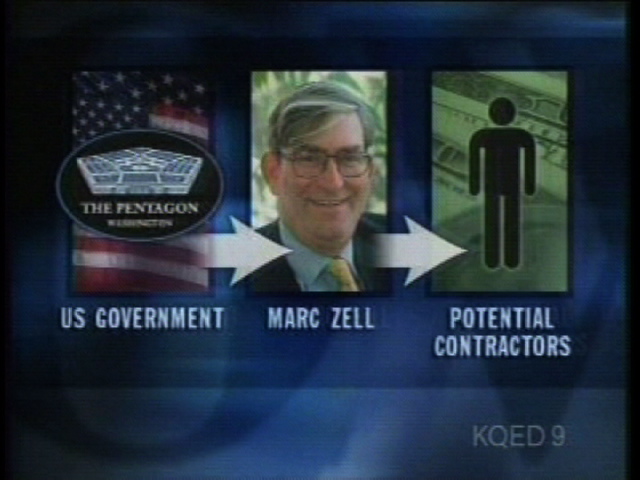
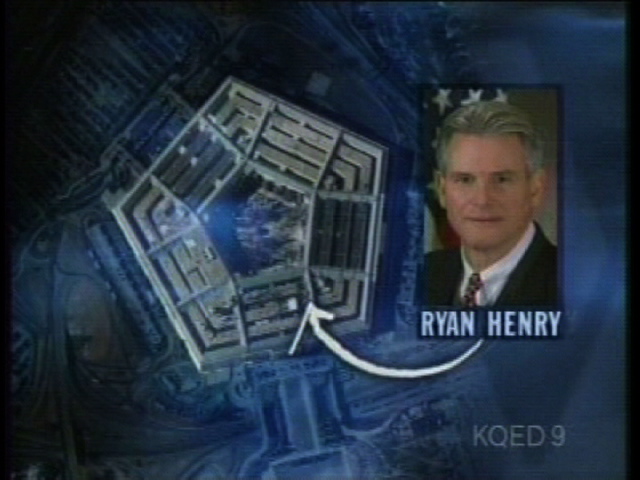
This story aired on NOW With Bill Moyers on November 14, 2003.
This story, "Cash and Carry," was Produced by Katie Pitra, features correspondent Roberta Baskin, and was Edited by Alison Amron.
This incredible segment documents the direct connections between the Shrub Administration and the main two or three companies that are profiting directly from the Iraqi reconstruction.
Join them as they connect the dots and talk to several of these people first hand. (Many would not return their phone calls, but others were very up front and matter-of-fact about it.)
I've taken screen grabs of many of the diagrams and things and transcribed information straight from the program for your convenience.
Here's some technical information about getting quicktime going to watch these movies.
Bill Moyers - Cash and Carry - Complete (Small - 36 MB)
Bill Moyers - Cash and Carry - Part 1 of 3 (Small - 12 MB)
Bill Moyers - Cash and Carry - Part 2 of 3 (Small - 14 MB)
Bill Moyers - Cash and Carry - Part 3 of 3 (Small - 11 MB)
Below: Roberta Baskin
Here's Bill Moyers' Introduction:
"Welcome to NOW. The news from Iraq just keeps coming. A secret CIA report this week warns that 'more and more Iraqis believe the U.S. could actually lose the war.' American troops have started using Vietnam-like tactics, hitting back at suspected enclaves without proof that they're harboring insurgents. And American authorities are now limiting press access to both troops and independent contractors in Iraq...As you know, there's a big debate over those billion dollar contracts being handed out to rebuild Iraq. Some Democratic Presidential candidates say the government is playing favorites. Defenders of the process, however, say "nonsense."...
..it's not easy to sort out the facts because the whole process in shrouded in buracracy and secrecy. One thing is certain, a lot of people in Washington and Baghdad look upon what's happening as a modern equivalent of a gold rush. They're not shy about promoting their political connections to get to the front of the line."
Here's Roberta Baskin's opening:
"Here beneath Iraq's landscape lies a vast ocean of oil. The second largest oil reserve in the world with over 100 billion barrels of crude ready to be tapped. When America invaded Iraq last March, troops raced first to secure the rich fields of Kier Cook (sp). So with vast reserves just waiting, why is the U.S. Government paying the Halliburton Corporation $2.65 per gallon to ship gasoline into Iraq from Kuwait, when one investigation discovered it could be done for less than a dollar a gallon.The price difference alone is costing tax payers as much as a 100 million dollars. When we asked Halliburton about this discrepancy, they wouldn't tell us. And even a United States Congressman (Henry Waxman D-CA) can't find out why.
'Why are we paying $1.65 a gallon more? Is it because Halliburton is gouging the public? Is it because the Kuwaitis are overcharging Halliburton? Is it because there's a culture where they don't care what they pay because the tax payers are going to pay the bill so there's no reason for them to want to hold down the costs?' (Waxman) ...
'If the evidence of what Halliburton has been charging for gasoline to be brought into Iraq is emblematic of anything, it's emblematic of no oversight, no transparency, and fleecing of the tax payers.' (Waxman)...
Just as the war started, Halliburton was awarded a no bid 7 billion dollar contract to repair Iraq's oil industry...Halliburton proved itself after the first Gulf war, putting out the fires in the oil fields. The Pentagon has said it didn't want to waste time finding someone new if Saddam burned the oil fields again, but Waxman says it's a prime example of what's wrong with the secrecy surrounding the government's contracts, because in the initial 87 billion dollar Iraq aid package there was another 2 billion dollars for Halliburton. And when Waxman started asking, he says neither the goverment nor the company seemed to know whay the 2 billion dollars was there or what it was for.
'We've got billions here, billions there. As one senator once said "A billion here, a billion there, it starts adding up into real money." ' (Waxman)...
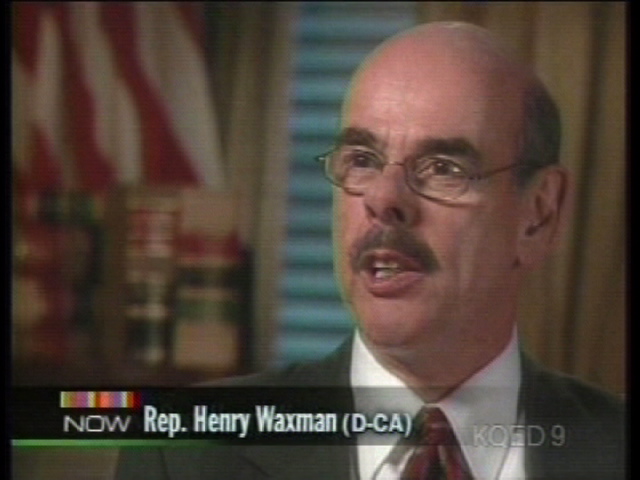
Who is Mark Zell?
Mark Zell is the principal of "Zell, Goldberg and Company," which assists American companies in connection with Iraqi reconstruction projects.
From Roberta Baskin:
"And just who at the firm can connect you to the American Government? None other than Marc Zell. A former law partner of Douglas Feith. Who's Douglas Feith? Undersecretary of Defense. One of the handful of advisors who, long before September 11, championed the campaign to get rid of Saddam Hussein. Now Douglas Feith is the man in charge of the Pentagon's reconstruction of Iraq.To sum up, Marc Zell is one well connected middleman standing right between the people to give the contracts and the people who want them. We asked to interview him about all this, but our calls were not returned."
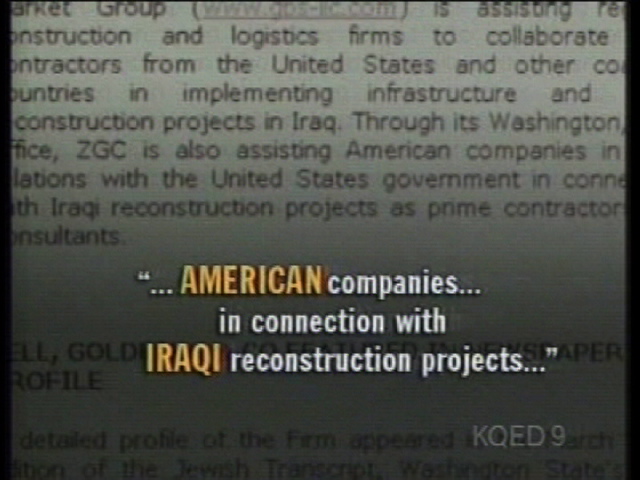
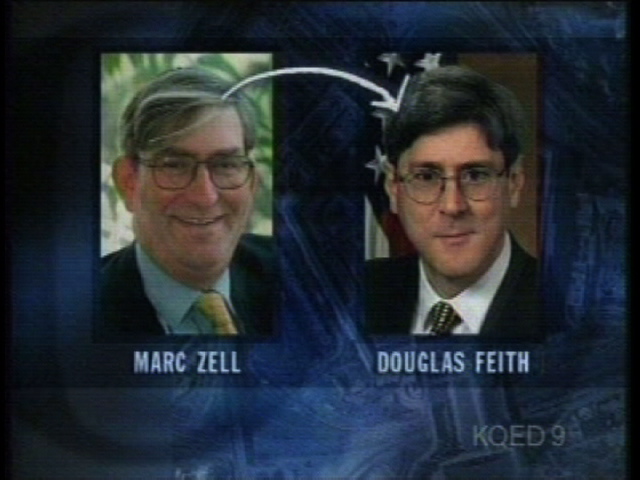
More from Roberta Baskin:
"But even at the war's front lines, middlemen are busy making their deals. Marc Zell also works with a different firm called "The Iraqi International Law Group," which very much wants to be "your professional gateway to the new Iraq." Who's in charge of that gateway? A man named Salem Chalabi.He has a famous uncle, Ahmed Chalabi. You see him there in Iraq, but before the war, this exile was hand picked by the planners in the Pentagon to shape the new government. When the war started, they air lifted Chalabi into the country with his own 700 man militia. At the center of all that planning, Undersecretary of Defense Douglas Feith. Whose old law partner, Marc Zell, now works with Ahmed Chalabi's nephew, providing that gateway to the new Iraq."
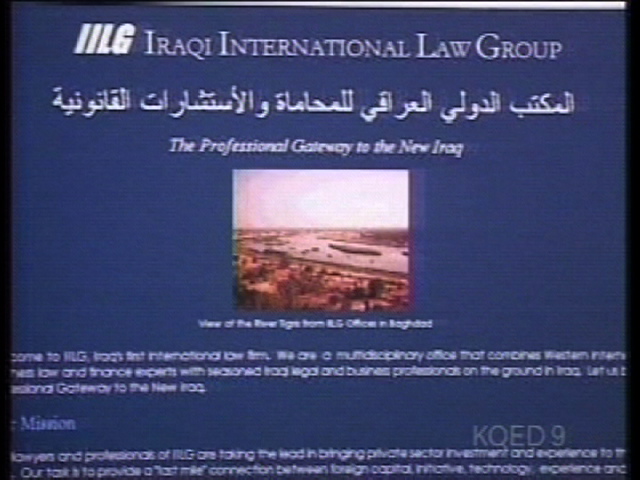
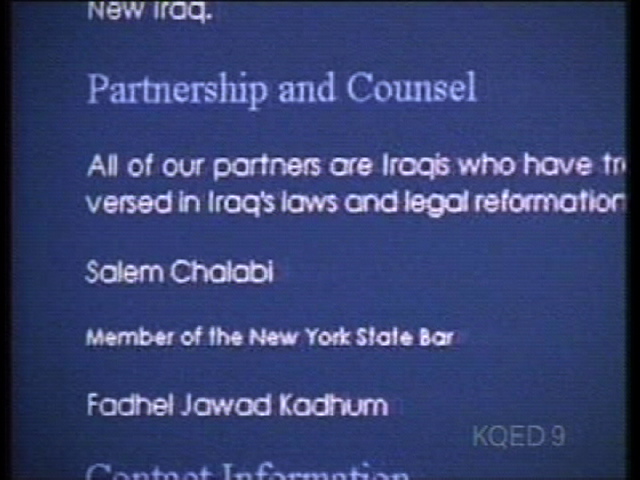
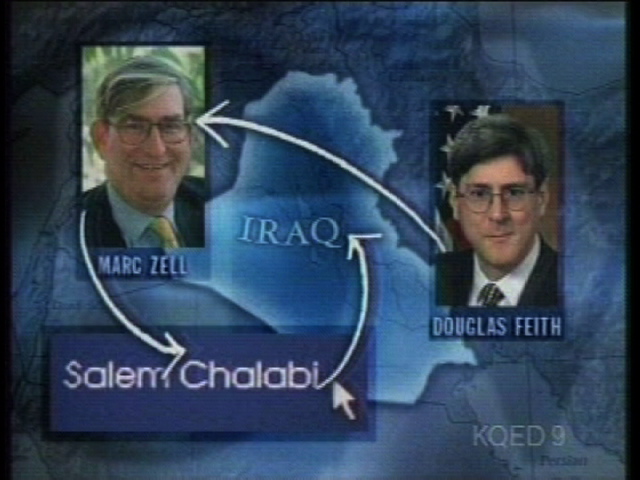
More from Roberta Baskin:
"And Chalabi isn't the only member of the Iraqi leadership with close relatives lining up for those rebuilding contracts. The son of one Chalabi aid runs a phone company that is part of the group that won the contract to provide cell service to southern Iraq. Chalabi's aid told the Los Angeles Times that he doesn't understand what all the fuss over his son's inside connections. Comparing his son to the Americans, he said "It didn't stop Cheney from becoming the Vice President."
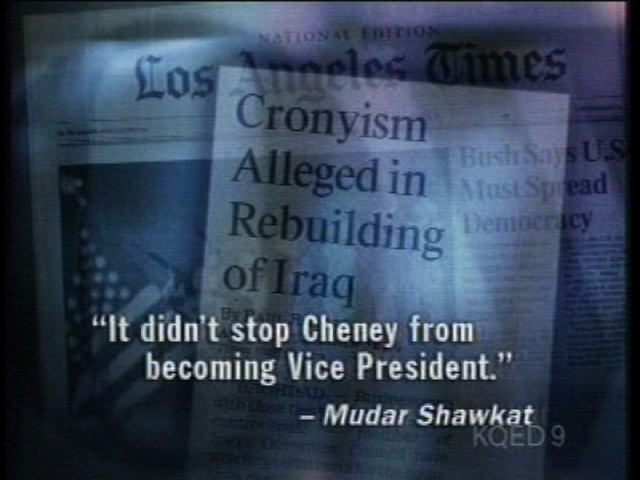
More from Roberta Baskin:
"But these aren't the only friends of government promoting their inside influence in what's being called The Iraq Gold Rush. One firm was established just for that purpose: New Bridge Strategies...If you can't find your way around Baghdad, Mike Baker will lend you a hand. He's a former CIA officer and part of the management team [its CEO] for New Bridge Strategies Strategies and its sister company Diligence, a security firm. Both are staffed by old Washington hands and both are headquartered in the offices of Barber, Griffith and Rogers. The "Barber" in that title is Haley Barber, a former chairman of the Republican party and one of the highest paid lobbyists in Washington. He's now the Governer-elect of Missippi."'Newbridge Strategies is staffed by people that have a great deal of experience in Washington. Everyone from Joe Albot to Ed Rogers. They understand how the administration thinks.' (Mark Baker)
"They should understand how the administration thinks. They used to be in it. Joe Albot ran George W. Bush's campaign for President, and was then put in charge of the Federal Emergency Management Agency (FEMA). Mike Baker's other collegue is this man, Ed Rogers. He served as a deputy assistant to the first President Bush. Here he is in Iraq with Mike Baker, posing in front of a tank outfitted in flak jackets and sporting a semi-automatic rifle."
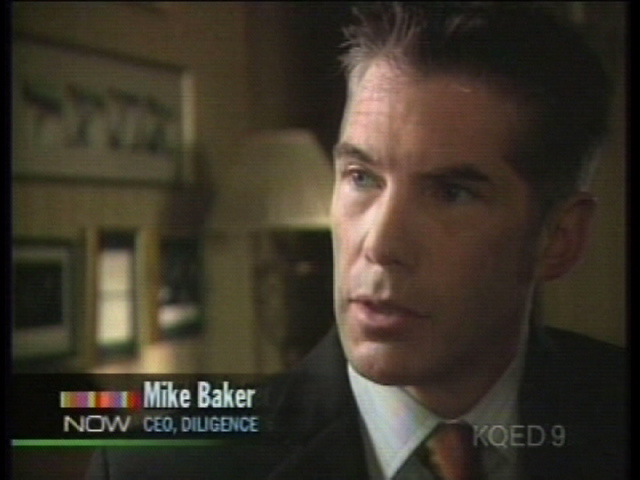
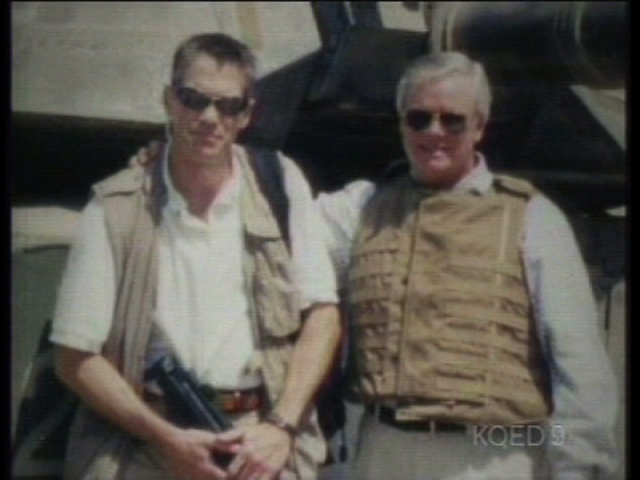
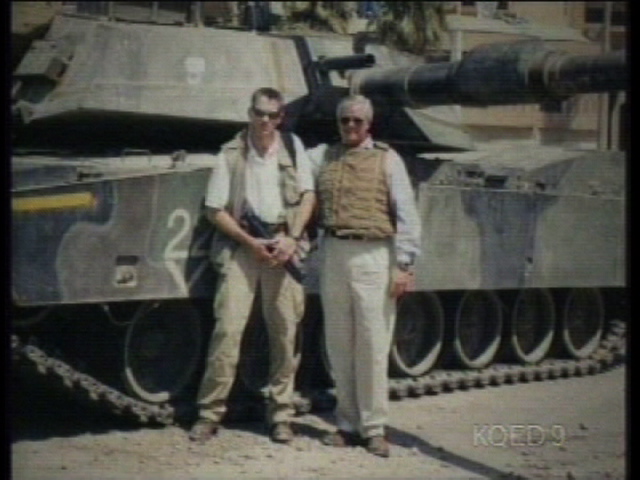
The Center For The Public Integrity has been trying to find out information about the nature of the work specified in some of these contracts, and is getting a lot of resistance.
More from Roberta Baskin:
"No one has tried harder to get at those details [of the deals] than the watchdog group the Center For The Public Integrity. In a six month investigation, the Center found that cozy insider relationships have become an accepted way of doing business in the fight against terrorism."...But skeptics might be more easily persuaded if the government didn't shroud all this in so much secrecy. That secrecy makes it practically impossible to find out if those close to the administration are profiting off their inside information. And it makes it equally hard to find out if tax payers are getting their money's worth...
For example, in the name of secrecy, the Pentagon redacted almost every page of this contract. They have made it impossible to answer questions about fees being charged, or the work being done, or even the total cost of the job. Just look at the blacked out sections of this deal with the defense contractor SAIC...
All we know for certain about the contractor SAIC is that the top people of this privately held Fortune 500 company are wired into the Pentagon. On the board are a retired general and a former Assistant Secretary of Defense. And then there's Ryan Henry, he was SAIC's Senior Vice President. Until, that is, he went through that revolving door into the Pentagon. Into the very office that now supervises his former company's contract."
Below: The blacked out numbers of the SAIC contract.
Below: Some Members Of Congress Are Trying To Get To The Bottom Of This
Below: Some Iraqi Native Businessmen Are Complaining They Can't Compete With American Companies
This story aired on NOW With Bill Moyers on November 7, 2003.
This clip is exerpted from the complete feature, "Coming Home," which was Produced by Dan Klein, features correspondent David Brancaccio, and was Edited by Amanda Zindman.
Jason Stiffler was manning a watch tower in Afghanistan when it fell out from under him. It's still unclear whether it was an engineering failure, an attack, or friendly fire. Whatever the cause, he fell 25 feet and suffered seizures at the scene and eventually went into a coma. He suffered serious spinal cord injuries and other injuries. He was quadraplegic for some time after the accident, eventually regained limited use of his legs after months of physical therapy, although it still causes him great pain to move.
A year ago October, he was released from the hospital and placed on the Army's temporary duty list, which meant he was now eligible for medical care and payments from the Department of Veterans Affairs. The Stifflers say they waited for promised phone call from the VA that never came. With his physical and mental condition deteriorating, Jason visited the regional VA hospital in Ft. Wayne, which had no record of him and was only able to offer limited assistance and care.
As David Brancaccio puts it: "Jason Stiffler, badly wounded veteran of America's War On Terror, was on his own."
Background on the complete video of the segment:
This story focuses on several families whose fathers put their lives on the line to go fight in Iraq, and were injured in combat. Upon returning home, they were given little or no medical or financial support whatsoever, and were told to seek handouts to get by.
Excerpt from David Brancaccio's introduction:
..another young vet from the 101st airborne came home to a different kind of reception, one that was to leave him and his family nearly destitute.Jason Stiffler followed a boyhood dream into the army at the age of 18. He was eager to defend his country. In return, he assumed it would take care of him.
"It was part of the agreement that we made on March 23, 01, when I signed up. I specifically remember that day because it was the first thing I asked. 'If anything happens to me, will I be taken care of?' Oh yeah, yeah, just sign right here."...
"There was a timeframe when I wasn't getting paid nothing." (Stiffler)
"How did you make ends meet during that time?" (Brancaccio)
"You know what they told us? 'Churches,' 'family,' 'friends,' 'welfare.'" (Stiffler)
Here's some technical information about getting quicktime going to watch these movies.
The Story Of The Stiffler Family (Small - 10 MB)
This story aired on NOW With Bill Moyers on November 7, 2003.
This story, "Coming Home," was Produced by Dan Klein and features correspondent David Brancaccio. It was Edited by Amanda Zindman.
This story focuses on several families whose fathers put their lives on the line to go fight in Iraq, and were injured in combat. Upon returning home, they were given little or no medical or financial support whatsoever, and were told to seek handouts to get by.
This is available in one big 38 MB clip and in three smaller clips for easier downloading off small connections. I've also transcribed portions and am including some info with the pictures.
I've also put up some clips of one of the families, the Stifflers, that was featured in this segment.
Here's some technical information about getting quicktime going to watch these movies.
Bill Moyers On Mistreated Vets - Complete (Small - 38 MB)
Bill Moyers On Mistreated Vets - Part 1 of 3 (Small - 12 MB)
Bill Moyers On Mistreated Vets - Part 2 of 3 (Small - 16 MB)
Bill Moyers On Mistreated Vets - Part 3 of 3 (Small - 11 MB)
Excerpt from Bill Moyers' introduction:
"In Iraq, for every soldier killed, 7 are wounded. 1,300 since May 1st. That's twice as many as were wounded during the war itself. The New Republic reports that nearly every night, under the cover of darkness, ambulences meet C-17 and C-141 transport planes flying into Andrews airforce base to ferry the wounded to military facilities. The government hasn't wanted us to see them, but that's beginning to change as the numbers mount and as journalists keep insisting on knowing who are these wounded and what's happening to them."
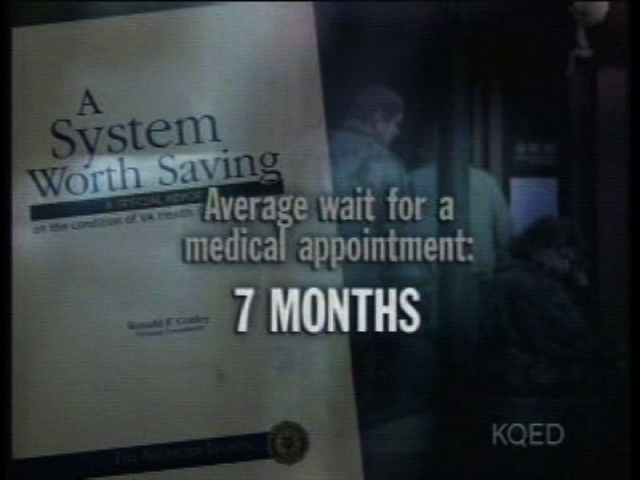
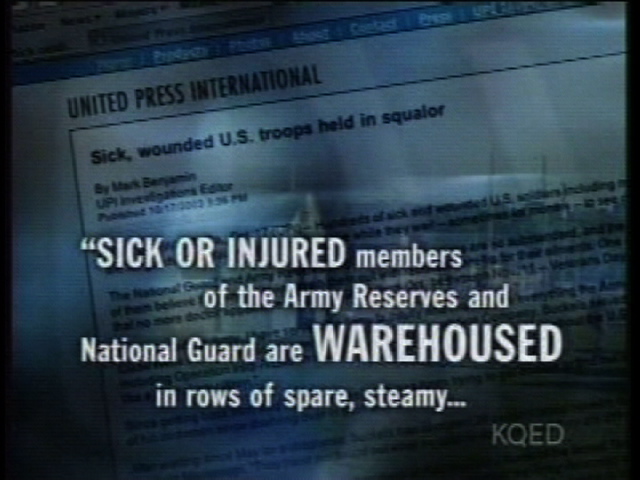
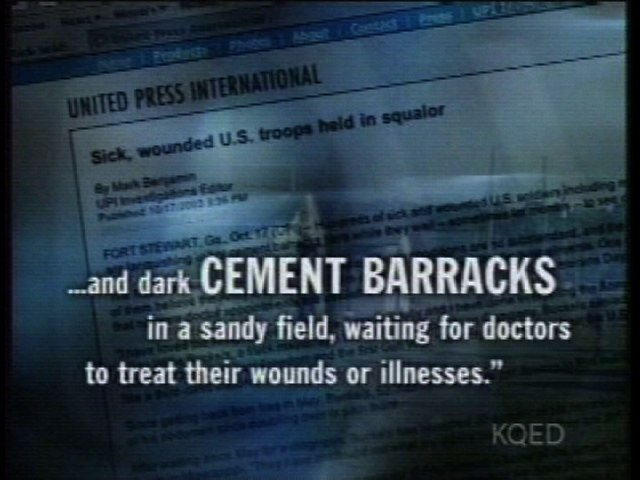
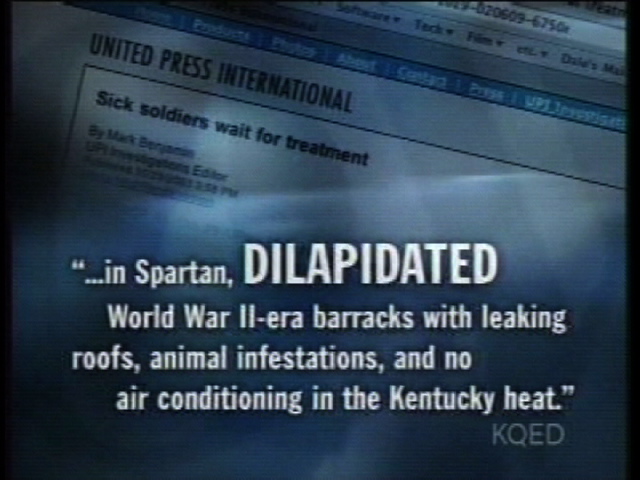
This is from the November 2, 2003 program of Meet the Press.
Complete Video and Photos
Rumsfeld: No Way To Know How Many Troops It Will Take ("It Is Unknowable") (Small - 5 MB)
Tim Russert:
"Time magazine reports this today, that this question was asked in the closed briefing with senators, "'What troop levels do we expect to have in Iraq a year from now?,' asked Senator Bill Frist, the Republican leader. And with that, the Pentagon chief began to tap dance." Do you believe that you have an obligation to tell our leaders in Congress what your best estimate is for troop levels in Iraq a year from now?"
Donald Rumsfeld:
"You know, since -- any war, when it starts, the questions are obvious. The questions are: How long is it going to last? How many casualties will there be? And, How many troops will it take?
Now, those questions can't be answered. Every time someone has answered those questions, they've been wrong. They have been embarrassingly wrong. I'll use another word: They have "misinformed." By believing they knew the answers to those questions, they've misinformed and misled the American people.
I made a conscious decision at the outset of these conflicts to not pretend I knew something I didn't know. And what I have said is just that. I have said it is not knowable.
Now, if you think about Bosnia, we were told by the administration back then that the American forces would be out by Christmas. That was six and a half years ago. They're not out yet. That was -- that -- the effect of that was not consciously misleading -- I'm sure they believed it. They were that wrong -- six and a half years wrong. I don't intend to be wrong six and a half years. I intend to have people understand the truth, and the truth is no one knows. But why is that question not answerable?
And Bill Frist knows this. He asked it because others were interested in that question. He's been very supportive and very complimentary of what we're doing, and it was not a critical question at all. It was a question that should have been raised. And I said was this: The security situation on the ground is going to determine the total number of security forces that are needed in Iraq."
This clip includes some harsh criticism from prominent Repubs such as Frank Wolf and Chuck Hagel.
This is from the November 2, 2003 program of Meet the Press.
Complete Video and Photos
Rumsfeld: On The Shrub Administration's Refusal To Cooperate With Congress (Small - 5 MB)
Tim Russert:
"Let me turn to some of the concerns expressed by Republicans in the Congress. This was Frank Wolf: Republican allies complain of administration arrogance towards Congress: 'Pride goeth before the fall.'
And this, a prominent Republican Hill staffer: Rumsfeld and Secretary Wolfowitz, your top deputy, 'just give off the sense that they know better than thou, and they don't have to answer our questions.'
And this from Chuck Hagel on the Intelligence and Foreign Affairs Committees, Republican: 'The Bush administration did miscalculate the difficulty of the war in Iraq. I think they did a miserable job of planning for a post-Saddam Iraq. They treated many in the Congress, most of the Congress, like a nuisance. When we asked questions, we wanted to be helpful, we wanted to participate. And now they are finding out that reality is dominating.'
'Arrogance?' 'Nuisance?' Not a full appreciation of your fellow Republicans in the Congress?"
Donald Rumsfeld:
"Well, you know, there's 535 members of the House and Senate, and you are going to find every viewpoint across the spectrum. It's always been so. You've served there -- I served in Congress. And there's always going to be someone who has a different view, and we accept that. We have spent enormous numbers of hours up there -- I do. Secretary Powell does. Others in the administration, briefing Senators, briefing House members, briefing staff members. And overwhelmingly they've been appreciative of those briefings and felt that they were helpful. We've sent up intelligence briefing people on a regularly weekly basis. I think probably there's been more information back and forth in this conflict during Iraq and Afghanistan than in any conflict in the history of the country.
Now, when people are having their constituents killed, and they see things happening that worry them, understandably they're going to be worried and concerned about it, and I accept that. And these are tough issues. These are not easy issues. And the fact that there are a variety of views in Congress simply reflects the country. There are a variety of views in the country. And that's understandable."
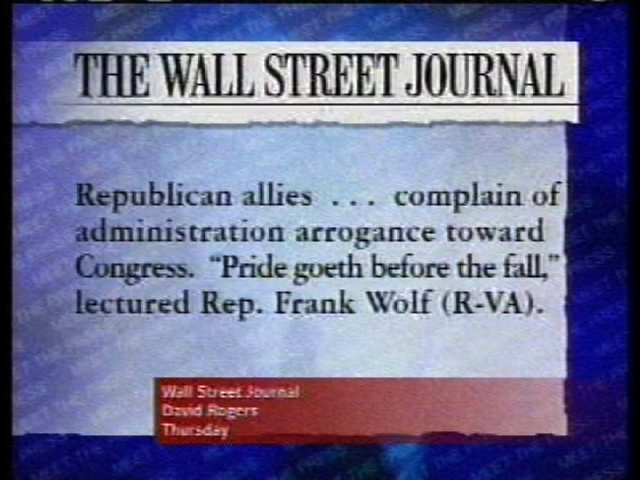


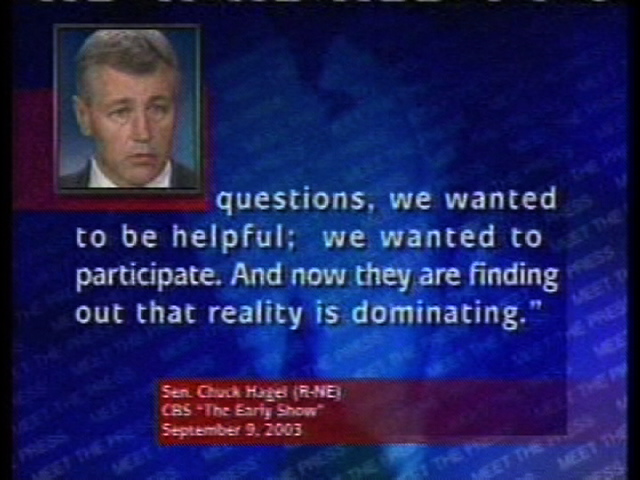
This is from the November 2, 2003 program of Meet the Press.
Complete Video and Photos
Rumsfeld: Did He Underestimate The Intensity Of The Resistance? (Small - 2 MB)
Tim Russert:
"Did you underestimate the intensity of the resistance?"
Donald Rumsfeld:
"I don't know. You know, I don't know that we -- you don't sit down and make a calibration that the resistance will lead to X numbers of Iraqis being killed per week, or that so many coalition people being wounded per week. That isn't the kind of calibration you make. What you do is you say, here's what you have to do to prevail. You have got to get the sovereignty transferred over to the Iraqi people, you have got to get the essential services going, and the economy on a path upward. And you've got to get the security responsibility transferred to the Iraqi people. That's -- because it's their country. We're not going to provide security in their country over a sustained period of time.
So we've gone from zero to 100,000 Iraqis providing security in that country, and our plan calls for us to go over 200,000 by next year."
The question mark's there because Rummy actually yes "no" and then later "yes."
This is from the November 2, 2003 program of Meet the Press.
Complete Video and Photos
Rumsfeld: Saddam No Longer A Threat? (Small - 4 MB)
Tim Russert:
"The New York Times reports that senior administration officials say that Saddam is playing a significant role in coordinating and directing attacks, and that he is the catalyst for what is going on now."
Donald Rumsfeld:
"I don't know what -- how to take the word "catalyst." I don't doubt for a minute that his being alive gives encouragement to the Baathists and the regime murderers that you see in those tapes killing people."
Tim Russert:
"He may be directing the resistance?"
Donald Rumsfeld:
"If he's -- I think he's alive. I think he's probably in Iraq. He's probably in northern Iraq, and he undoubtedly has ways to communicate, imperfect ways, but probably by couriers, with some other people. Is he masterminding some major activity? Difficult to know, but unlikely. Is he involved? Possibly."
Tim Russert:
"He's still a threat?"
Donald Rumsfeld:
"Personally, no. No. I mean, is it a threat to have released 100,000 criminals in a country with 23 million people? You bet. Is it a threat to have foreign terrorists coming across the borders? You bet. Is it a threat to have the leftovers of the Feyadeen Saddam and the murderers of Saddam Hussein's regime the Baathists who benefited from his regime? Sure, it's a threat. And there's a lot of them, and there's a lot of weapons in that country. There are weapons caches all over the country. So is that a danger for people in Iraq? Yes."
This is from the November 2, 2003 program of Meet the Press.
Complete Video and Photos
Rumsfeld: What He Meant By His Memo (Small - 7 MB)


Tim Russert:
"Let me turn to your memo of October 16th, which has been leaked, and share it with our viewers and ask you to talk about it."
(Russert reading from memo) " 'With respect to global terrorism, the record since September 11th seems to be: "We care having mixed results with Al Qaida..." Today we lack metrics to know if we are winning or losing the global war on terror. Are we capturing, killing or deterring and dissuading more terrorists every day than the madrassas' the schools 'and the radical clerics are recruiting, training and deploying against us?... It is pretty clear that the coalition can win in Afghanistan and Iraq in one way or another, but it will be a long, hard slog.' "
" 'Don't know if we are winning or losing' ??"
Donald Rumsfeld:
"Let me explain that. It's not that we don't know if we're winning or losing in Iraq or Afghanistan. We know what's happening there. The point I was making is this. If there are 90 nations engaged in the global war on terrorism, and if they're out arresting, capturing, killing terrorists. If they're out there putting pressure on their bank accounts, making it harder for them to raise money, making it harder for them to transfer money, making it harder for terrorists to move across borders. All of which is true. Good progress is being made.
The question is, that I posed, and I don't know the answer, is how many new terrorists are being made. How many of these schools are being led by radical clerics and are teaching people that the thing they should do with their lives is to go out and kill innocent men, women and children to stop progress, to torture people, to prevent women from being involved in their country's activities. How many schools are doing that and how many people are being produced by that? And the question I posed was: you can't know in this battle of ideas how it's coming out unless you have some metric to judge that and there isn't such a metric. It doesn't exist. Therefore, my point was in the memo, that I think we need, the world needs, to think about other things we can do to reduce the number of schools that teach terrorism. Not just continue (stops) we certainly have to continue doing what we're doing in going after terrorists wherever the are, and capturing them and killing them. But I think we also have to think about how we, the world, not just the United States -- this is something well beyond our country or the Department of Defense -- how we reduce the number of people who are becoming terrorists in the world."
Tim Russert:
"Win the hearts and minds."
Donald Rumsfeld: (Nods)
Rummy's answer: "You know, in my lifetime, I've said that many times..." (See complete answer below.)
Russert also asks Rummy about Saddam's current role, if any, in the latest wave of attacks on the troops.
This is from the November 2, 2003 program of Meet the Press.
Complete Video and Photos
Tim Russert:
"Do you ever say to yourself, or wonder 'My god, the intelligence information was wrong and what have we gotten ourselves into?' "
Donald Rumsfeld:
"You know, in my lifetime, I've said that many times, because intelligence is never really 'right' or 'wrong.' What it is is a best effort by wonderful, hard working intelligence people, overtly and covertly trying to gather in the best information they can and then present it to policy makers. It's never perfect. These countries are closed societies. They make a point of denying and deceiving so that you can't know what they're doing. So it's a best effort, and it's pretty good. Is it perfect? No. Has it ever been perfect? No. It will never be perfect, our intelligence information. But we've got wonderful people doing a fine job and it seems to me that it's adequate for policy makers to then look at it and draw conclusions and make judgements."
Tim Russert:
"Do you think that Saddam Hussein intentionally rolled over in March, and let the United States roar into Baghdad, planning that he would come back six months later with an armed resistance of the nature we're seeing now?
Donald Rumsfeld:
"I don't. I think they fought hard south. When the movement was so fast. And then, when some forces came in from north, a great many of his forces decided that they couldn't handle it, and they disappeared. They disband themselves, if you will, left their weapons in some instances and unformed their formations, and went home. The idea that his plan was to do that I think is far fetched. What role he's playing today, I don't know. We don't know. Very likely, Saddam Hussein is alive. Very likely, he's in the country. His sons are killed. 42 of his top lieutenants, out of 55, have been captured or killed. So it's a skinny-downed organization, what's left. And, uh, is he interested in retaking his country? Sure. Is he going to? No. Not a chance."
Tim Russert asks a great question and Rummy manages to drop in a little disinformation about the non-existent connection between Al Queda and Iraq.
This is from the November 2, 2003 program of Meet the Press.
Complete Video and Photos
Rumsfeld On Whether We're Less Safe Since The Shrub War Started
(Small - 8 MB)
Tim Russert:
"Go back prior to the war in march, where the argument was being made that there was no need to go to war with Saddam Hussein. He's in a box. He's confined. We have sanctions. We have inspections. And then the Administration decided to go to war and opened up that box. And that America is now less safe -- less secure, than we were prior to the invasion."
Donald Rumsfeld:
"I think that that's not correct. I would say America is more safe today. If you believe the intelligence, which successive administrations of both political parties did, and other governments in the world, that he was progressing with these programs and that this is a country who's used the weapons before. That's used them on its neighbors -- used them on his own people. I don't know if you've seen any of the tapes more recently of what they do to their own people. Of cutting off people's heads and cutting off their fingers and their hands, and pulling out their tongues and cutting them off -- throwing them off three story buildings. This is a particularly vicious regime, Saddam's regime.
It is true, we have terrific young men and women being killed and wounded today, as we did yesterday, and your heart goes out to their families and to their loved ones. But what they're doing is important. What they're doing is taking the battle to the terrorists. There are foreign terrorists coming in to Iraq. That's true. We know that. We've captured two or three hundered of them from various countries."
Tim Russert:
"Stop there. Would that have happened -- would they have gone to Iraq but for the fact that we went in there?"
Donald Rumsfeld:
"Why sure. The Ansur al islam (sp) was already in Iraq. There were Al Quaeda already in Iraq. The Iraqis were engaged in terrorism themselves. They were giving $25,000 to suicide bombers' families who would go in and kill innocent men, women and children. They are a part of that. And certainly, the work in Iraq is difficult. It's tough. And it is gonna to take some time, but good progress is being made in many parts of the country..."
This is from the November 2, 2003 program of Meet the Press.
Complete Video and Photos
Rumsfeld: One Way Or The Other (Small - 3 MB)
Tim Russert:
"You also reference to 'the coalition can win Afghanistan and Iraq in one way or the other.' What did you mean by that?"
Donald Rumsfeld:
"Oh, that it is (stops) We're on a track, and we hope the track works, and I believe it is working. You take Afghanistan, Mr. Karzai and Loya Jirga have produced a bonn plan -- a way ahead. It's underway. Uh, will it stay on track exactly? I don't know. I hope so. I think they're doing a good job and we're doing everything we can to help them and so are a lot of other countries, including NATO now. Um, but, but however that sorts out one way or another, that country is not gonna go back and become a terrorist training ground for the Al Queda."
Tim Russert:
"That appears to be a much more pessimistic assessment than you have made publicly."
Donald Rumsfeld:
"Not at all. I believe we're doing well in Afghanistan, and said so."
Tim Russert:
"And Iraq?"
Donald Rumsfeld:
"Well, I was gonna come to Iraq. Iraq is what it is. It is a tough, difficult situation. When you're having people killed in the coalition, and we are, and our Iraqi allies being killed that are providing security, and Iraqi people being killed by these terrorists, it isn't a pretty picture. It's a tough picture."
U.S. Soldiers Seal Saddam's Home Village
By Slobodan Lekic for the Associated Press.
American soldiers on Friday sealed off the village where Saddam Hussein was born and ordered adults to register for identity cards, while insurgents mounted a series of harassing attacks on U.S. military and Iraqi government targets in the northern city of Mosul.Starting around midnight Thursday, U.S. soldiers, Iraqi police and civil defense forces moved into Uja, a small dusty village about 10 miles southeast of Tikrit.
Soldiers stretched concertina wire around the perimeter of the village and established checkpoints. Residents over the age of 18 will be required to have registration cards to move in and out of the village, U.S. officers said.
Here is the full text of the article in case the link goes bad:
http://www.guardian.co.uk/worldlatest/story/0,1280,-3331773,00.html
U.S. Soldiers Seal Saddam's Home Village
By SLOBODAN LEKIC
The Associated Press
Friday 31 October 2003
BAGHDAD, Iraq (AP) - American soldiers on Friday sealed off the village where Saddam Hussein was born and ordered adults to register for identity cards, while insurgents mounted a series of harassing attacks on U.S. military and Iraqi government targets in the northern city of Mosul.
Starting around midnight Thursday, U.S. soldiers, Iraqi police and civil defense forces moved into Uja, a small dusty village about 10 miles southeast of Tikrit.
Soldiers stretched concertina wire around the perimeter of the village and established checkpoints. Residents over the age of 18 will be required to have registration cards to move in and out of the village, U.S. officers said.
The New York Times reported Friday that senior U.S. officials believe the former Iraqi leader, who is believed to have been on the run since U.S. forces took over Baghdad in April, is playing a major role in coordinating and directing attacks against American troops.
``This is an effort to protect the majority of the population, the people who want to get on with their lives,'' said Lt. Col. Steve Russell, commander of the 1st Battalion, 22nd Infantry Regiment of the 4th Infantry Division.
Russell said he did not know whether Saddam was directing parts of the insurgency, but the village is the family home of many former Baathist regime members.
``There are ties leading to this village, to the funding and planning of attacks against U.S. soldiers,'' Russell said.
The U.S.-led coalition has been fighting a guerilla-style insurgency for months. So far, 117 soldiers have been killed by hostile fire since May 1, when President Bush declared major combat was over.
A total of 114 soldiers were killed in the active combat phase that began March 20.
Meanwhile, a roadside bomb exploded near a U.S. foot patrol on the outskirts of the northern city of Mosul and unidentified gunmen sprayed the city hall with automatic fire, officers said Friday. Nobody was injured in the attacks.
The violence in the north came after a bomb late Thursday rocked a row of shops in Baghdad's Old City, killing two people, and another exploded near a military police convoy north of the capital, slightly wounding two Americans.
In Baghdad's neighborhood of Salhiya, Iraqi police and U.S. troops on Thursday blocked a major street after residents informed authorities about a car parked under a pedestrian bridge fearing it is booby trapped. Bomb experts checked a white Mitsubishi parked a few hundred yards from the U.S. occupation authorities headquarters in Baghdad.
``At dawn, some people from the area came and told us there is a car that had been left in the street. We called the Americans and until now we don't know if it is booby trapped or not,'' police Sgt. Mohammed Tariq said.
In Washington, the House of Representatives approved a massive aid package requested by the Bush administration for nearly $65 billion for military personnel and operations in Iraq and Afghanistan, and an additional $18.6 billion for reconstruction efforts in Iraq.
The Senate was expected to follow suit quickly.
The U.S. administration has been less successful in persuading international organizations - including the United Nations and the international Red Cross - to remain in Iraq. Prompted by Monday's attacks on three police stations and Baghdad office of the International Committee of the Red Cross, the organizations announced they would reduce staff and review their presence in Iraq.
Separately, the U.S.-installed Iraqi Governing Council said it was moving forward with setting up a war crimes tribunal to prosecute those accused of atrocities during Saddam Hussein's regime.
The decision to form the court was taken several weeks ago, council member Mouwafak al-Rabii said ``but now we are taking practical steps to implement this decision and to create those war-crimes tribunal.'' He did not elaborate.
Human rights groups estimate several hundred thousand people were killed during Saddam's three decades in power. Multiple mass graves have been found throughout the country since the U.S.-led coalition deposed the dictator in April.
The U.S. administration repeatedly has stated that it wants past abuses to be prosecuted under an Iraqi-led legal system instead of an international tribunal akin to those for Rwanda and former Yugoslavia.
The United States currently has in custody dozens of high-ranking officials from their list of most-wanted Iraqi figures - many of them being held at the high security prison at the Baghdad International Airport.
This is from the November 2, 2003 program of Meet the Press.
Complete Video and Photos
Rumsfeld: The War On Iraq And The War On Terror Are The Same (Small - 3 MB)
Tim Russert:
"How do you respond to those who suggest that the War On Terror should have been focused on Al Queda and that the resources that are now applied to Iraq are misapplied. That Saddam was not the threat that he was presented as by the Administration, and that the war should have focused on Osama Bin Laden and Al Queda."
Donald Rumsfeld:
"Tim, we said from the outset that there are several terrorist networks that have global reach and that there were several countries that were harboring terrorists that have global reach. We weren't going into Iraq when we were hit on September 11th, and the question is 'well, what do you do about that?' If you know there are terrorists and you know there's terrorist states. Iraq's been a terrorist state for decades. And you know there are countries harboring terrorists. We believe, correctly I think, that the only way to deal with it is (stops) You can't just hunker down and hope they won't hit you again. You simply have to take the battle to them. And we have been consistently working on the Al Queda network. We've captured a large number of those folks. Captured or killed. Just like we've now captured or killed a large number of the top 55 Saddam Hussein loyalists."
Private Jessica says President is misusing her 'heroism'
By Edward Helmore for the Guardian Unlimited.
Beneath the gloss of the US media and the machinations of an administration eager to show a 'good news' angle of the Iraq conflict against the reality of a rising body count, Lynch has become a metaphor not for the heroism of pretty young Americans captured by a devilish foreign enemy, but for the confusion that has marked Bush's Operation Iraqi Freedom from the start.Misgivings characterising Lynch's story are coming to a head: last week she accused the administration of manipulating her story for propaganda, saying she was not a heroine at all; accusations that she'd been raped were disputed by appalled Iraqi doctors who first treated her, and the army was accused of insensitivity and racism for awarding Lynch a full disability pension while others from her ambushed maintenance company, including Shoshana Johnson, the black cook wounded and captured by Iraqis, will receive barely a third of Lynch's discharge package.
While Johnson is living on $500 a month, Lynch stands to make millions from her book, I Am a Soldier, Too. She has been romanced as the media target of the moment, photographed by Annie Liebowitz for Vanity Fair, and stands to make millions more from a movie deal.
'There is a double standard,' said Johnson's father, Claude. 'I don't know for sure that it was the Pentagon. All I know for sure is the media paid a lot of attention to Jessica.'...
Lynch says the circumstances of her rescue was dramatised and manipulated by the Pentagon. She was not rescued in a 'blaze of gunfire' as reported by Defence Department officials last April, but picked up from compliant Iraq doctors who had saved her life.
She was not raped, as the department said, and the Iraqi, Mohammed Odeh Al-Rehaief, who was given US citizenship for his efforts, has written a book about how he risked his own life to win her freedom. Now he is described by his wife as overly influenced by John Wayne movies.
'Lynch is basically saying the whole thing was made up, a fraud,' said media critic Michael Wolff. 'At the same time, the media is going on with this elaborate production effort to make her into a hero. It's as if the size of the attention itself makes her a hero. Everyone is committed to making her the face of the war whereas the other story that this all a kind of scandal.'...
Lynch now questions why her rescue was filmed: 'They used me to symbolise all this stuff. It's wrong. I don't know why they filmed it, or why they say these things.'
Here is the full text of the article in case the link goes bad:
http://www.guardian.co.uk/Iraq/Story/0,2763,1081207,00.html
, New York
Sunday November 9, 2003
The Observer
When American Private Jessica Lynch was rescued from an Iraqi hospital last April, President George Bush's administration and much of the US media was gripped by a dramatic tale of blonde, all-American heroism.
The story reaches fever pitch this week with the publication of Lynch's autobiography, a dramatised TV documentary, interviews and a Vanity Fair cover story.
Beneath the gloss of the US media and the machinations of an administration eager to show a 'good news' angle of the Iraq conflict against the reality of a rising body count, Lynch has become a metaphor not for the heroism of pretty young Americans captured by a devilish foreign enemy, but for the confusion that has marked Bush's Operation Iraqi Freedom from the start.
Misgivings characterising Lynch's story are coming to a head: last week she accused the administration of manipulating her story for propaganda, saying she was not a heroine at all; accusations that she'd been raped were disputed by appalled Iraqi doctors who first treated her, and the army was accused of insensitivity and racism for awarding Lynch a full disability pension while others from her ambushed maintenance company, including Shoshana Johnson, the black cook wounded and captured by Iraqis, will receive barely a third of Lynch's discharge package.
While Johnson is living on $500 a month, Lynch stands to make millions from her book, I Am a Soldier, Too. She has been romanced as the media target of the moment, photographed by Annie Liebowitz for Vanity Fair, and stands to make millions more from a movie deal.
'There is a double standard,' said Johnson's father, Claude. 'I don't know for sure that it was the Pentagon. All I know for sure is the media paid a lot of attention to Jessica.'
And America is deter mined that Lynch will be a heroine, despite the fact that she never fired a shot, and instead got down on her knees to pray as her unit was surrounded by enemy forces. As she pointed out herself, it was her dead colleague Lori Piestewa, a Native American mother of two, who went down fighting.
Lynch says the circumstances of her rescue was dramatised and manipulated by the Pentagon. She was not rescued in a 'blaze of gunfire' as reported by Defence Department officials last April, but picked up from compliant Iraq doctors who had saved her life.
She was not raped, as the department said, and the Iraqi, Mohammed Odeh Al-Rehaief, who was given US citizenship for his efforts, has written a book about how he risked his own life to win her freedom. Now he is described by his wife as overly influenced by John Wayne movies.
'Lynch is basically saying the whole thing was made up, a fraud,' said media critic Michael Wolff. 'At the same time, the media is going on with this elaborate production effort to make her into a hero. It's as if the size of the attention itself makes her a hero. Everyone is committed to making her the face of the war whereas the other story that this all a kind of scandal.'
But the story may be too far along to reverse. 'She can't take back being a star. The fact that she says it's all made up doesn't make a difference. It's been decided she's a star, and that's the only indisputable fact,' said Wolff.
The New York Times has pointed out how Lynch has become the Mona Lisa of Operation Iraqi Freedom. Americans have been able to read into her unrevealing snapshot whatever story they chose. Her story becoming 'a Rorschach test for homefront mood swings'.
Now, with the US forces having lost 32 soldiers in the last week alone, the mood may be turning and she stands to be come symbolic of US confusion and press credulity. The inconsistencies have not been missed by veterans' groups who don't wish to besmirch her individual valour but are uneasy over the administration's efforts to present 'good news' while ignoring the reality.
'The White House sent a message that they were going to tell the good news stories so now we have a situation where we are not allowed to witness the coffins coming home and there are no images of young soldiers coming home missing arms and legs,' said Steve Robinson of the National Gulf War Resource Centre.
'We're just seeing one side of the story, and you've got to tell the other side, the one about the wounded, maimed and the dead.' There is growing doubt Lynch's uplifting story will help to sweeten the nation's mood about the dim prospect that the US will be able extricate itself from Iraq before hundreds, and possibly thousands, more servicemen died.
Lynch, who joined the army hoping to see the world after failing to land a job at a supermarket, is preparing to go on a media tour that will include appearances with TV anchors such as David Letterman. Yet she is unable to fulfil the role of the patriot.
The administration's game plan, enabled by a supplicant media, is showing signs of distress. The singer Cher recently visited the hospital where Lynch recovered from her ordeal and talked on TV of meeting a teenage soldier who had lost both his arms.
She wanted to know why Bush and his team weren't there having their photographs taken with the injured troops. 'I don't understand why these guys [the wounded] are so hidden and there aren't pictures of them,' Cher said.
Lynch now questions why her rescue was filmed: 'They used me to symbolise all this stuff. It's wrong. I don't know why they filmed it, or why they say these things.'
This is from the November 2, 2003 program of Meet the Press.
Rumsfeld: The Casualties Are Worth Winning This War (Small - 3 Mb)
Tim Russert:
"So far, we have lost 377 Americans in Iraq. 2,130 have been wounded or injured.
How would you explain to the American people this morning that it is worth that price for the war in Iraq."
Donald Rumsfeld:
"Tim, the uh, battle we're engaged in. The global war on terrorism. Is an important one. It is a different one than we've been in previously. Although terrorism's not new. But the nature of terrorism is that its purpose is to terrorize. Its purpose is to alter people's behavior. And to the extent free people end up behaving in a way that is different from the way free people behave, they've lost. And therefore, the only thing to do is do what the President has announced he's doing, and that is to take the battle, the war on terrorism to the terrorists. Where they are. And that's what we're doing. We can win this war. We will win this war. And the President has every intention of staying after the terrorists and the countries that harbor terrorists until we have won this war."
This is from the November 2, 2003 program of Meet the Press.
Highlights separated by subject on the way.
Somehow I had managed to forget to start a "Bye Bye Rummy" category. I'll still have to go back and recategorize things properly for it.
Rummy On Meet The Press - Part 1 of 3 (Small - 23 MB)
Rummy On Meet The Press - Part 2 of 3 (Small - 23 MB)
Rummy On Meet The Press - Part 3 of 3 (Small - 23 MB)
Rummy On Meet The Press - Complete (Small - 68 MB)


This is from the October 20, 2003 program.
This is about the U.N. Security Council resolution that was passed unanimously a few weeks ago.
(I won't try to pretend to know what the resolution actually accomplished. If somebody has a link to the damn thing, please email it to me, and I'll post it here. The U.N. Security Council website is a little behind schedule apparently, and I can get its documents to manifest themselves in my browser anyway. Thanks.)
Daily Show On The U.N. Security Council Resolution (Small - 6 MB)
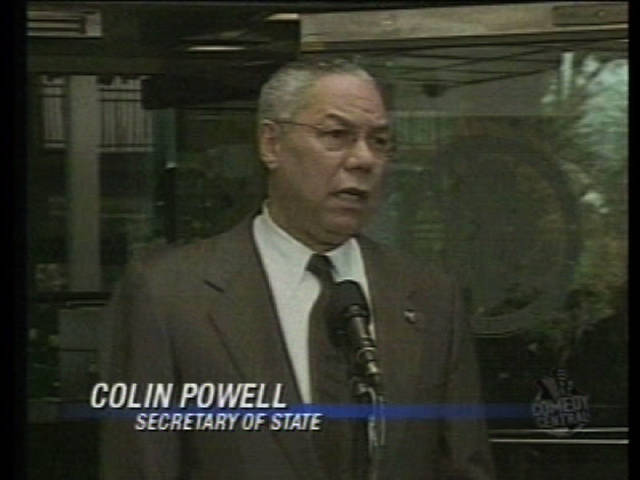
The Daily Show (The best news on television.)
From Jon:
"This week, a harsh report of America's policy has surfaced, accusing our defense department of failing to adapt fast enough to emerging threats and questioning if America's armed forces are even up to the task. In response, an angry Defense Secretary Donald Rumsfeld responded by saying, 'I wrote what?!' "
This is from the October 23, 2003 program.
Daily Show On Rummy's Memo (Small - 5 MB)
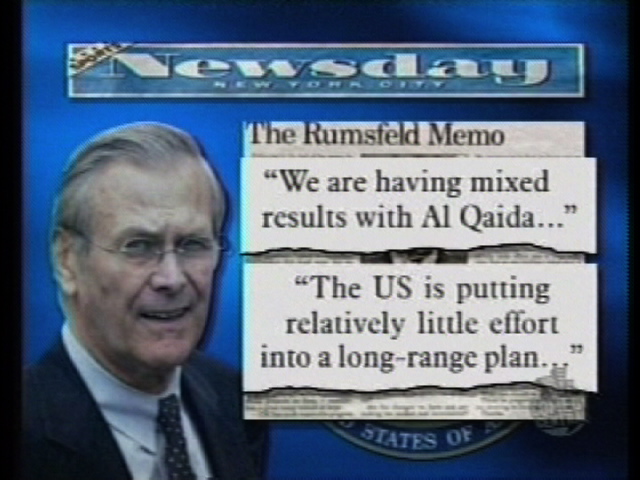
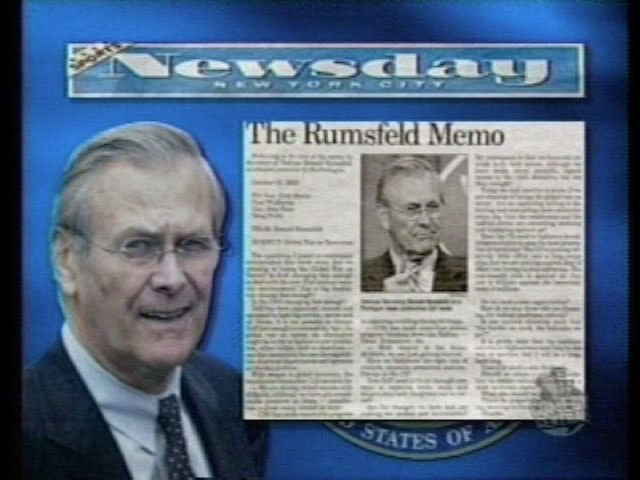
The Daily Show (The best news on television.)
This is from the Monday, October 27, 2003 program and details the bombings on Paul Wolfowitz' hotel, and, oh, the irony of it all.
Mess-o-potamia Update - October 27, 2003 (Small - 8 MB)

The Daily Show (The best news on television.)
This clip was shown after this clip on October 29, 2003.

In this clip, Rob Courddry probes further into the familiar pattern of the Shrub's blaming his mistakes on other agencies he, theoretically, has complete control over as Commander In Chief.
For example, it was the CIA's fault about the faulty WMD intelligence that was included in his State Of The Union Address. Now it's the Navy's fault for following orders and hanging up the "Mission Accomplished" sign at his May 1 press conference.
Rob Courddry On "The Sign" (Small - 6 MB)

(Below: What the sign said.)

(Below: What they meant for the sign to say.)

The Daily Show (The best news on television.)
This clip from the October 29, 2003 show has the Shrub answering questions at his latest press conference (Oct 28-29, 2003 or so), where he talks rather vaguely about "terrorists" who are responsible for the latest round of suicide bombings in Iraq.
(This clip goes with this clip.)
What the Shrub says, and what his press secretary clarifies later, is that it's the Navy's fault for misrepresenting that the war was over with the "Mission Accomplished" sign. (Despite the fact that all the Navy did was put up the sign that the White House printed up and brought to the event.)
Jon Stewart:
"The White House is basically saying they can't be held responsible for what the Navy does with a sign that they made and brought to the ship."
Here's the little clip about "the sign":
The Shrub Blaming the Navy for "The Sign" (Small - 4 MB)
Here's the complete clip of this bit:
Jon Stewart On The President's Latest Press Conference (Small - 11 MB)


The Daily Show (The best news on television.)
As if the "Mission Accomplished" banner was the only thing that implied "Mission Accomplished," during the Shrub's memorable flight suit May 1 extravaganza.
Oh you thought I meant the mission was accomplished. I just meant a mission was accomplished: The mission of the USS Abraham Lincoln, of course... Sorry to give the wrong impression.
Gee, you don't think anyone got that wrong impression because the White House sent out a press release that said President Bush Announces Combat Operations in Iraq Have Ended or anything, do you?
Bush Disavows 'Mission Accomplished' Link
In The Guardian UK.
When it was brought up again Tuesday at a news conference, Bush said, "The 'Mission Accomplished' sign, of course, was put up by the members of the USS Abraham Lincoln, saying that their mission was accomplished.""I know it was attributed somehow to some ingenious advance man from my staff - they weren't that ingenious, by the way."
That explanation hadn't surfaced during months of questions to White House officials about proclaiming the mission in Iraq successful while violence continued.
After the news conference, a White House spokeswoman said the Lincoln's crew asked the White House to have the sign made. The White House asked a private vendor to produce the sign, and the crew put it up, said the spokeswoman. She said she did not know who paid for the sign.
Later, a Pentagon spokesman called The Associated Press to reiterate that the banner was the crew's idea.
Full text of press release below.
Here is the full text of the article in case the link goes bad:
http://www.guardian.co.uk/uslatest/story/0,1282,-3321684,00.html
Bush Disavows 'Mission Accomplished' Link
The Guardian UK
Wednesday 29 October 2003
WASHINGTON (AP) - Six months after he spoke on an aircraft carrier deck under a banner proclaiming "Mission Accomplished," President Bush disavowed any connection with the war message. Later, the White House changed its story and said there was a link.
The "Mission Accomplished" boast has been mocked many times since Bush's carrier speech as criticism has mounted over the failed search for weapons of mass destruction and the continuing violence in Iraq.
When it was brought up again Tuesday at a news conference, Bush said, "The 'Mission Accomplished' sign, of course, was put up by the members of the USS Abraham Lincoln, saying that their mission was accomplished."
"I know it was attributed somehow to some ingenious advance man from my staff - they weren't that ingenious, by the way."
That explanation hadn't surfaced during months of questions to White House officials about proclaiming the mission in Iraq successful while violence continued.
After the news conference, a White House spokeswoman said the Lincoln's crew asked the White House to have the sign made. The White House asked a private vendor to produce the sign, and the crew put it up, said the spokeswoman. She said she did not know who paid for the sign.
Later, a Pentagon spokesman called The Associated Press to reiterate that the banner was the crew's idea.
"It truly did signify a mission accomplished for the crew," Navy Cmdr. Conrad Chun said, adding the president's visit marked the end of the ship's 10-month international deployment.
The president's appearance on the Abraham Lincoln, which was returning home after service in the Persian Gulf, included his dramatic and much-publicized landing on the ship's deck.
Bush's disavowal Tuesday brought new criticism from at least three of the Democrats seeking their party's nomination to run against the president - John Kerry, Wesley Clark and Joe Lieberman.
"Today was another banner day in George Bushs quest to bring honor and integrity to the White House," Lieberman said. "If he wanted to prove he has trouble leveling with the American people, mission accomplished."
Here is the full text of the press release in case the link goes bad:
http://www.whitehouse.gov/news/releases/2003/05/20030501-6.html
For Immediate Release
Office of the Press Secretary
May 1, 2003
President Bush Announces Combat Operations in Iraq Have Ended
Event Backgrounder
The President Visits the USS Abraham Lincoln
BACKGROUND
USS Abraham Lincoln set the record for the longest naval deployment by a nuclear powered aircraft carrier in history, deploying for almost 10 months, and steaming over 100,000 miles. For a Carrier Strike Group, this is the longest deployment in the last 30 years. The USS Lincoln Strike Group was involved in combat in support of three major operations: Operation Southern Watch, Operation Enduring Freedom, and Operation Iraqi Freedom.
Click here for a USS Abraham Lincoln photo essay.
The Air Wing will depart the USS Lincoln while off the coast of San Diego on May 1. The ship will then pull into Naval Air Station North Island (San Diego) on May 2 to off load the rest of the Air Wing equipment. The Lincoln will return to her homeport of Everett, Washington on May 6.
The Lincoln supported one of the largest media embed operations on any ship in naval history by embarking 31 media organizations that included CNN, MSNBC, the BBC, Los Angeles Times, and the New York Times.
Just to clarify again -- These stories are not about our soldiers not getting proper medical treatment on the front lines. They are about Shrub War Veterans not getting propers medical treatment upon returning home.
But wait! It's worse than that. Upon re-reading the article, I see that many of these soldiers had existing health problems that should have prevented them from being deployed in the first place. I also see that many of them were forced to reside in substandard housing, and received injuries from incidents like the roof falling in on their own barracks, rather than in active combat.
I hope the citizens of our armed forces can remember this experience long enough to vote the Shrub out next year.
"I joined to serve my country," said Cpl. Waymond Boyd, 34. He served in Iraq with the National Guard's 1175 Transportation Company. He has been in medical hold since the end of July."It doesn't make any sense to go over there and risk your life and come back to this," Boyd said. "It ain't fair and it ain't right. I used to be patriotic." He has served the military for 15 years.
Boyd's knee and wrist injuries were severe enough that he was evacuated to Germany at the end of July and then sent to Fort Knox. His medical records show doctor appointments around four weeks apart. He said it took him almost two months to get a cast for his wrist, which is so weak he can't lift 5 pounds or play with his two children. He is taking painkilling drugs and walks with a cane with some difficulty.
Many soldiers at Fort Knox said their injuries and illnesses occurred in Iraq. Some said the rigors of war exacerbated health problems that probably should have prevented them from going in the first place.
Boyd's X-rays appear to show the damage to his wrist but also bone spurs in his feet that are noted in his medical record before being deployed, but the records say "no health problems noted" before he left...
Sgt. Buena Montgomery has breathing problems since serving in Operation Iraqi Freedom. She said she has been able to get to doctors but worries about many others who have not.
"The Army did not prepare for the proper medical care for the soldiers that they knew were going to come back from this war," Montgomery said. "Now the Army needs to step up to the plate and fix this problem."
In nearly two dozen interviews conducted over three days, soldiers also described substandard living conditions -- though they said conditions had improved recently.
A UPI photographer working on this story without first having cleared his presence with base public affairs officials was detained for several hours for questioning Tuesday and then released. He was told he would need an Army escort for any further visits to the base. He returned to the base accompanied by an Army escort on Wednesday.
This reporter also was admonished that he had to be accompanied by an Army public affairs escort when on base. The interviews had been conducted without the presence of an escort.
After returning from Iraq, some soldiers spent about eight weeks in Spartan, dilapidated World War II-era barracks with leaking roofs, animal infestations and no air conditioning in the Kentucky heat.
"I arrived here and was placed in the World War II barracks," one soldier wrote in an internal Fort Knox survey of the conditions. "On the 28th of August we moved out. On 30 Aug. the roof collapsed. Had we not moved, someone would be dead," that soldier wrote...
"They are treating us like second-class citizens," said Spc. Brian Smith, who served in Operation Iraqi Freedom until Aug. 16 and said he is having trouble seeing doctors at Fort Knox. The Army evacuated him through Germany for stomach problems, among other things. "My brother wants to get in (the military). I am now discouraging him from doing it," Smith said.
"I have never been so disrespected in my military career," said Lt. Jullian Goodrum, who has been in the Army Reserve for 16 years. His health problems do not appear to be severe -- injured wrists -- but he said the medical situation at Fort Knox is bad. He said he waited a month for therapy. "I have never been so treated like dirt."
Sick soldiers wait for treatment
By Mark Benjamin
UPI Investigations Editor
Published 10/29/2003 3:58 PM
View printer-friendly version
FORT KNOX, Ky., Oct. 29 (UPI) -- More than 400 sick and injured soldiers, including some who served in Operation Iraqi Freedom, are stuck at Fort Knox, waiting weeks and sometimes months for medical treatment, a score of soldiers said in interviews.
The delays appear to have demolished morale -- many said they had lost faith in the Army and would not serve again -- and could jeopardize some soldiers' health, the soldiers said.
The Army Reserve and National Guard soldiers are in what the Army calls "medical hold," like roughly 600 soldiers under similar circumstances waiting for doctors at Fort Stewart, Ga.
The apparent lack of care at both locations raises the specter that Reserve and Guard soldiers, including many who returned from Iraq, could be languishing at locations across the country, according to Senate investigators.
Representatives from the office of Sen. Kit Bond, R-Mo., were at Fort Knox Wednesday looking into conditions at the post.
Following reports from Fort Stewart, Senate investigators said that the medical system at that post was overwhelmed and they were looking into whether the situation was Army-wide.
Army officials at the Pentagon said they are investigating that possibility. "We are absolutely taking a look at this across the Army and not just at Fort Stewart," Army spokesman Joe Burlas said Wednesday.
"I joined to serve my country," said Cpl. Waymond Boyd, 34. He served in Iraq with the National Guard's 1175 Transportation Company. He has been in medical hold since the end of July.
"It doesn't make any sense to go over there and risk your life and come back to this," Boyd said. "It ain't fair and it ain't right. I used to be patriotic." He has served the military for 15 years.
Boyd's knee and wrist injuries were severe enough that he was evacuated to Germany at the end of July and then sent to Fort Knox. His medical records show doctor appointments around four weeks apart. He said it took him almost two months to get a cast for his wrist, which is so weak he can't lift 5 pounds or play with his two children. He is taking painkilling drugs and walks with a cane with some difficulty.
Many soldiers at Fort Knox said their injuries and illnesses occurred in Iraq. Some said the rigors of war exacerbated health problems that probably should have prevented them from going in the first place.
Boyd's X-rays appear to show the damage to his wrist but also bone spurs in his feet that are noted in his medical record before being deployed, but the records say "no health problems noted" before he left.
"I don't think I was medically fit to go. But they said 'go.' That is my job," Boyd said.
Fort Knox Public Affairs Officer Connie Shaffery said, "Taking care of patients is our priority." Soldiers see specialists within 28 days, Shaffery said and Fort Knox officials hope to cut that time lag.
"I think that we would like for all the soldiers to get care as soon as possible," Shaffery said.
Shaffery said of the 422 soldiers on medical hold at Fort Knox, 369 did not deploy to Operation Iraqi Freedom because of their illnesses. Around two-thirds of the soldiers at Fort Stewart did serve in Operation Iraqi Freedom.
Soldiers at Fort Knox describe strange clusters of heart problems and breathing problems, as did soldiers at Fort Stewart and other locations.
Command Sgt. Major Glen Talley, 57, is in the hospital at Fort Knox for heart problems, clotting blood and Graves' disease, a thyroid disorder. All of the problems became apparent after he went to war in April, he says. He is a reservist.
Talley said he was moved to Fort Knox on Oct. 16 and had not seen a doctor yet, only a physician's assistant. His next appointment with an endocrinologist was scheduled for Dec. 30.
"I don't mind serving my country," Talley said. "I just hate what they are doing to me now." Talley has served for 30 years. He was awarded two Purple Hearts in Vietnam.
Sgt. Buena Montgomery has breathing problems since serving in Operation Iraqi Freedom. She said she has been able to get to doctors but worries about many others who have not.
"The Army did not prepare for the proper medical care for the soldiers that they knew were going to come back from this war," Montgomery said. "Now the Army needs to step up to the plate and fix this problem."
In nearly two dozen interviews conducted over three days, soldiers also described substandard living conditions -- though they said conditions had improved recently.
A UPI photographer working on this story without first having cleared his presence with base public affairs officials was detained for several hours for questioning Tuesday and then released. He was told he would need an Army escort for any further visits to the base. He returned to the base accompanied by an Army escort on Wednesday.
This reporter also was admonished that he had to be accompanied by an Army public affairs escort when on base. The interviews had been conducted without the presence of an escort.
After returning from Iraq, some soldiers spent about eight weeks in Spartan, dilapidated World War II-era barracks with leaking roofs, animal infestations and no air conditioning in the Kentucky heat.
"I arrived here and was placed in the World War II barracks," one soldier wrote in an internal Fort Knox survey of the conditions. "On the 28th of August we moved out. On 30 Aug. the roof collapsed. Had we not moved, someone would be dead," that soldier wrote.
Shaffery said all of the soldiers have moved out of those barracks. "As soon as we were able to, we moved them out," Shaffery said. The barracks now stand empty and have been condemned.
Also like Fort Stewart, soldiers at Fort Knox claimed they are getting substandard treatment because they are in the National Guard or Army Reserve as opposed to regular Army. The Army has denied any discrepancies in treatment or housing.
"We have provided, are providing, and will continue to provide our soldiers -- active and Reserve component -- the best health care available," Army spokesman Maj. Steve Stover said Oct. 20. He said Army policy provides health care priority based on a "most critically ill" basis, without differentiation between active and our Reserve soldiers.
"Medical hold issues are not new and the Army has been working diligently to address them across the Army," Stover said.
"They are treating us like second-class citizens," said Spc. Brian Smith, who served in Operation Iraqi Freedom until Aug. 16 and said he is having trouble seeing doctors at Fort Knox. The Army evacuated him through Germany for stomach problems, among other things. "My brother wants to get in (the military). I am now discouraging him from doing it," Smith said.
"I have never been so disrespected in my military career," said Lt. Jullian Goodrum, who has been in the Army Reserve for 16 years. His health problems do not appear to be severe -- injured wrists -- but he said the medical situation at Fort Knox is bad. He said he waited a month for therapy. "I have never been so treated like dirt."
Iraq Rebuilding Cash 'Goes Missing'
By Bill Jacobs for The Scotsman.
A new Iraq scandal erupted today as a report claimed billions of dollars earmarked for rebuilding the country have vanished after being handed to the United States-controlled governing body in Baghdad.At least $5 billion (£3bn) has been passed to the ruling Coalition Provisional Authority (CPA), a leading UK aid agency has calculated.
But only a fifth of those development funds have been accounted for, figures unearthed by Christian Aid show.
And that missing four billion dollar "black hole" will double by the end of the year unless the CPA’s accounts are made public.
The allegations emerged as British aid agencies claimed millions of pounds of government aid cash will have to be diverted from poor countries in South America, Eastern and Central Asia to rebuilding Iraq...
Prime Minister Tony Blair was today challenged by the charities to account for the missing $5bn, mainly from oil revenue, as donors conference involving 60 countries got under way in Madrid.
A spokesman for the CPA denied that the money had been lost or misused and promised that all the cash would be fully accounted for.
The Mr Blair and US President George Bush last week won a new UN resolution calling for international contributions of money and troops.The donations will go into a new fund overseen by the UN and the World Bank.
But failure to show where the existing cash has gone will fuel suspicion among Iraqis that large amounts are being creamed off by US firms given contracts to rebuild the country, Christian Aid said.
One senior European diplomat told the charity: "We have absolutely no idea how the money has been spent.
"I wish I knew, but we just don’t know. We have absolutely no idea."
Roger Riddell, Christian Aid’s international director, called the situation "little short of scandalous". He said: "The British Government must use its position of second in command of the CPA to demand full disclosure of this money and its proper allocation in the future.
"This is Iraqi money. The people of Iraq must know where it is going and it should be used for the benefit of all the country’s people - particularly the poorest."
The UN transferred $1 billion from its old Oil for Food Programme to the new Development Fund For Iraq earlier this year.
Here is the full text of the article in case the link goes bad:
http://www.news.scotsman.com/international.cfm?id=1169292003
Iraq Rebuilding Cash 'Goes Missing'
By Bill Jacobs for The Scotsman
Thursday 23 October 2003
A new Iraq scandal erupted today as a report claimed billions of dollars earmarked for rebuilding the country have vanished after being handed to the United States-controlled governing body in Baghdad.
At least $5 billion (£3bn) has been passed to the ruling Coalition Provisional Authority (CPA), a leading UK aid agency has calculated.
But only a fifth of those development funds have been accounted for, figures unearthed by Christian Aid show.
And that missing four billion dollar "black hole" will double by the end of the year unless the CPA’s accounts are made public.
The allegations emerged as British aid agencies claimed millions of pounds of government aid cash will have to be diverted from poor countries in South America, Eastern and Central Asia to rebuilding Iraq.
And they threaten to undermine a conference in Spain, where the United Nations and World Bank hopes to raise £20 billion to pay for the reconstruction of the country following the toppling of Saddam Hussein.
Prime Minister Tony Blair was today challenged by the charities to account for the missing $5bn, mainly from oil revenue, as donors conference involving 60 countries got under way in Madrid.
A spokesman for the CPA denied that the money had been lost or misused and promised that all the cash would be fully accounted for.
The Mr Blair and US President George Bush last week won a new UN resolution calling for international contributions of money and troops.The donations will go into a new fund overseen by the UN and the World Bank.
But failure to show where the existing cash has gone will fuel suspicion among Iraqis that large amounts are being creamed off by US firms given contracts to rebuild the country, Christian Aid said.
One senior European diplomat told the charity: "We have absolutely no idea how the money has been spent.
"I wish I knew, but we just don’t know. We have absolutely no idea."
Roger Riddell, Christian Aid’s international director, called the situation "little short of scandalous". He said: "The British Government must use its position of second in command of the CPA to demand full disclosure of this money and its proper allocation in the future.
"This is Iraqi money. The people of Iraq must know where it is going and it should be used for the benefit of all the country’s people - particularly the poorest."
The UN transferred $1 billion from its old Oil for Food Programme to the new Development Fund For Iraq earlier this year.
The same UN resolution was supposed to set up an International Advisory and Monitoring Board to oversee the accounts.
It has not materialised and the only funds accounted for so far are one billion dollars spent by the Programme Review Board.
However, the CPA has received $2.5bn in assets seized from Saddam Hussein’s regime in Iraq and abroad, Christian Aid reveals.
And it calculates oil revenue has contributed at least another $1.5bn since the war.
Officials in Madrid admit that the latest allegations will make it even more difficult to raise the £20bn needed to rebuild Iraq and fuel potential donor countries’ suspicions that the main beneficiaries of the reconstruction programme are big US firms.
They expect little more that £3 billion to be raised.
And further concerns have been voiced over the news that the UK is reducing overseas aid to South American, Eastern European and central Asian countries because of the cost of rebuilding Iraq.
A group of UK overseas aid charities said at least £100 million would have to be diverted to help pay for Britain’s commitment to provide £267 million over the next two years to deal with the aftermath of the Gulf War.
International Development Secretary Hillary Benn admitted the shift in resources today but said that Iraq now qualified as a low income country.
Wealthy Donors Asked to Dig Deep for Iraq Rebuild
By Alexander Smith for Reuters.
Hours earlier, a leading British aid agency accused Iraq's U.S. and British administrators of failing to account for at least $4 billion meant to go toward rebuilding the country...AID GROUP SAYS $4 BILLION MISSING
Britain's Christian Aid said the U.S.-led Coalition Provisional Authority (CPA) had not publicly detailed cash flows since ousting Saddam Hussein in April.
All but $1 billion of more than $5 billion of Iraqi funds had disappeared into a "financial black hole." It said the figures were a conservative estimate of oil revenues collected by the CPA since the war, prewar oil revenues from the U.N. "oil-for-food" account and seized assets of Saddam's government.
The U.S.-led CPA has denied it has failed to account for the money.
Christian Aid said failure to account for the money would fuel suspicion that funds were going to U.S. firms given contracts to rebuild the country.
Here is the full text of the article in case the link goes bad:
http://story.news.yahoo.com/news?tmpl=story&u=/nm/20031023/ts_nm/iraq_donors_dc_9
Wealthy Donors Asked to Dig Deep for Iraq Rebuild
By Alexander Smith
Reuters
Thursday 23 October 2003
MADRID - The United Nations and Iraq's governing council appealed to wealthy nations on Thursday to dig deeper in their pockets to raise the $55 billion needed to rebuild a country torn by years of war, sanctions and neglect.
U.N. Secretary-General Kofi Annan opened a two-day donors' meeting with a call for more cash and a warning that wrangling between the United States and its critics over a timetable for handing sovereignty back to Iraqis could lead to more suffering.
Hours earlier, a leading British aid agency accused Iraq's U.S. and British administrators of failing to account for at least $4 billion meant to go toward rebuilding the country.
"I appeal to donors to give and to give generously and for those contributions to be provided in addition to existing commitments," Annan told the Madrid meeting.
"We all look forward to the earliest possible establishment of a sovereign Iraqi government but a start on reconstruction cannot be deferred until that day," he added.
Conference sponsors have been careful not to set a target, but behind the scenes delegates spoke of arm-twisting of countries reluctant to stump up the billions Iraq needs.
So far $2-3 billion has been pledged in addition to the $20 billion the United States plans to contribute over 18 months.
Some countries that opposed the U.S.-led invasion of Iraq are reluctant to pay with France, Germany and Russia promising no money beyond what they already have pledged.
"There have been last-minute attempts to ramp up the money and all the pressure has been on the European Union," said a senior official accompanying the Iraqi delegation.
British Prime Minister Tony Blair, one of the main backers of the Iraq war, added his voice to the calls for funds.
But a German official at the meeting said more money would not be forthcoming until Berlin could be sure its aid would be properly accounted for.
AID GROUP SAYS $4 BILLION MISSING
Britain's Christian Aid said the U.S.-led Coalition Provisional Authority (CPA) had not publicly detailed cash flows since ousting Saddam Hussein in April.
All but $1 billion of more than $5 billion of Iraqi funds had disappeared into a "financial black hole." It said the figures were a conservative estimate of oil revenues collected by the CPA since the war, prewar oil revenues from the U.N. "oil-for-food" account and seized assets of Saddam's government.
The U.S.-led CPA has denied it has failed to account for the money.
Christian Aid said failure to account for the money would fuel suspicion that funds were going to U.S. firms given contracts to rebuild the country.
Iraqis did their best to persuade more than 300 companies and business groups gathered alongside the politicians that Iraq could be prosperous once again, if given help.
"I don't want to depict a gloomy picture. But we need a kickstart, we need to be given a helping hand," said Mowaffak al-Rubaie, a representative of the Iraqi Governing Council.
Thousands of Iraq's 26 million people lack everything from access to clean water to basic security, he said.
Help would allow a country with the world's second largest oil reserves to restructure into a lucrative market for entrepreneurs, Iraqi Trade Minister Ali Allawi said, adding Iraq could be self-sustaining in five to eight years.
The World Bank and United Nations studied 14 sectors of Iraq's economy and estimated they need $36 billion over four years. A report by the CPA found an additional $19.4 billion is needed to rebuild sectors not covered in the World Bank report.
For the EU External Relations Commissioner, the conference was an opportunity to bring Iraq back into the developed world.
"In the early 80s Iraq had a GDP per head the same as Australia's. Two decades of Saddam Hussein then reduced it to the same sort of figure as the Congo. So it just indicates the potential resources of Iraq...," Chris Patten said.
-------
Additional reporting by John Chalmers, Daniel Trotta, Mona Megalli, Emma Ross-Thomas and David Chance in Madrid.
Here it is -- straight from the soldiers. What's going on "over there."
I haven't even read it all yet, but it looks worthy of passing on.
I may write about this in more detail if I have time. But, for now, with everything else going on right now, I just didn't want to space on making this available to you in a timely fashion.
Scoop has released a five part interview (Part 1 - with an enlisted man that has over 20 years in the service, Part 2 with a sergeant first class, Part 3 with a very recently disillusioned sergeant, Part 4, Part 5 - no link for 5 yet) with soldiers over in Iraq.
Here's a quote from part one:
“That is one thing the American people still have not really caught on to is the fact that while they were screaming out ‘Support Our Troops’ the current regime makers were fu..ing the military and veterans out of almost every social program and non essential service that would make life easier.”“Bush really fu..ked us while we were gone. We found out about after being in the middle of heavy fighting for several weeks. It was one of the first things I read in Stars and Stripes, and I thought it was a joke because it was just to hard to believe Congress and our leaders would screw us that bad while we were fighting and dying.”
CFTM-- -“Glad you brought that up about counseling because I wasn’t even aware of it. Are you alright to talk about some of the civilian casualties you witnessed and some of the horrifying images you told me about when we first started talking?”
USA-- -“I want to talk about some of the children I saw killed for no reason, maybe it will wake someone up who doesn’t believe it was happening, or that it was very bad. I can tell you I will never forget the screams of the wounded or orphaned kids, or the wailing of the parents who lost their kids. The Iraqis and most Muslims have a very vocal way of mourning the dead by lamenting and wailing for the dead. There is no mistaking a mother or father crying out in pain for the loss of a child. They don’t cry like that unless there has been a death. Sometimes after a bombing raid or an artillery attack you could here hundreds of people wiling and weeping.”
“I have several grown children with grand kids about the age of most of the dead children I saw in Iraq. I also have several kids who are about half grown and I saw a lot of Iraqi children that age wandering around in charge of three or four little ones because their parents were dead.”
“Let me tell you about the cluster bomb raid we saw wipe out a whole bunch of little kids. It looked like they had already lost their parents and were trying to salvage food from a destroyed Iraqi convoy by the side of the road we were on. The kids were way off to the side about half a mile away by then when we got the word that the Iraqi column was going to be hit with cluster bombs and we had to clear the area. We got on the radio and tried to get the air strike stopped but we were told it was too late to get it stopped.”
“We could see the body parts flying up into the air after the bombs hit. It was terrible and we could not do a damn thing but watch it happen and scream into the radio at the dumb sh.t pilot that was dropping the bombs. After the strike was over we went to see if there were any survivors and all we found was bits and pieces of little kids and here and there an arm or leg you could still identify.”
CFTM-- -“Pretty rough stuff to have to see. Did that kind of thing happen a lot?”
USA-- -“More than you can imagine until you’ve seen it over and over again. Man I don’t want to talk about this sh.t anymore. It doesn’t help to talk about it because it just makes me think about it again. I can’t even get any counseling without having to pay for it.”
“Let all those people who support our troops in on that nice surprise that Bush gave us. That’s how much we really mean to Bush, the Department of Defense and all those other stupid assholes who keep saying how good we’re doing over there. Let those patriotic morons go and fight and die for our country. Let them leave their families behind for months and maybe come back home in a box. I’ll be the first one to salute them or honor them when they die.”
“It’s just like Nam was in the beginning. I was twelve when my dad got back and I’ll never forget the pain and agony he lived with the rest of his life. Its kind of what I feel now, I suppose. I never thought I would ever serve in some stuff that’s so much like Nam it isn’t funny. Now I really see what my pop went through, and if I could I would go back in the past a few months, I would go AWOL or turn conscientious objector on them, but it’s too late for that now.”
http://www.scoop.co.nz/mason/stories/HL0310/S00105.htm
Text of part 1
The following interview was with an enlisted man, but someone very high up in the enlisted ranks, with over 20 years of military service. I have promised not to reveal his identity for reasons that he has a family and has been told not to speak to journalists. He told me the Army had put a gag order on him while he was home, and told him they would give him twenty years in prison if he spoke out in any manner against the US or the government.
I took several weeks to finish this interview because of not being able to safely be seen with this individual out of his fears of being caught speaking out.
He asked me to call him USA in all the transcripts of these interviews. I have followed his wishes and tried to write what he said in the manner it was said so as not to lose any impact. At times the interview was very rough and the grammar is not perfect, but I tried to write this in his voice so that he can tell the world how bad it is in Iraq. I truly want you to feel what he has experienced in some way if possible.
CFTM-- “How are you today? Resting I hope?”
USA-- “Can’t sleep for sh..t and I have horrible nightmares when I do sleep. I might be lucky to catch an hour at a time before the nightmares wake me up. I slept easier in the combat then now that I’m away from there. Most awful place I’ve ever been or served duty and I didn’t want to leave my guys. That was the hardest part was leaving the guys I had been leading around and trying to keep out of trouble and alive.”
CFTM-- “Did you see a lot of your buddies get killed? How did it affect you?”
USA-- “How the hell do you think it affected me? I saw over 30 of the men I had to keep safe die, and over 100 get wounded and not come back. I still don’t know if some of the wounded men made it or not. I was never told before I came back home.”
CFTM-- “So it really was awful and as bad as some returning troops have claimed?”
USA-- “It was like a long trip to hell that you knew you might return from. Of course it is as bad as the soldiers say it is. Hell it’s even worse if the truth has to come out. It’s a constant fu..ing nightmare trying to figure out where the guerillas are going to hit, how to keep the civilians calm, and also getting enough water and food to eat. That is one thing the media never really told the Americans about, how bad it was when our convoys weren’t getting through. We had to go to some Iraqi people and trade socks and underwear for some food and a little water.”
CFTM-- “You really did get that desperate because I saw it in the foreign media that the Iraqi civilians had stepped in and fed a whole bunch of troops that had been days without food.”
USA-- -“Yeah, that ain’t no joke about getting help from the civilians right after the invasion. We had a pretty good laugh about that and how the army owed them some money for reimbursement. We would not have starved probably, but when we got the food from the people it made sure we could still operate as a functioning unit. It was a near thing that several guys almost died of dehydration because we ran out of clean water for a few days.”
CFTM-- “Just keep going, I want to hear more about the hardships the military and Bush made you go through. I want the American people to know what a nightmare this war has become and what it’s doing to our service men over there.”
USA-- “Okay, well I can bitch about the problems like food being short and water going bad, but I want to tell people about how bad the attacks on US and coalition forces have gotten in the last month. In the last two weeks I was there we were attacked at least 20 times a day if you count all the shots we heard from random sniper or opportunity attacks. We were losing at least five men a day to injuries and there was at least one of our unit killed every twenty four hours.”
CFTM-- -“So you were getting one a day killed and at least five injured? Did you know many of the guys killed?”
USA-- -“That’s a real dumb fu..ing question to ask me. You know what my rank is, of course I knew them, I was the head NCO for years in our unit. I knew most of the guys who died and I held a lot of hands as they were dying. You tell me that’s not gonna to give you nightmares!”
“I had one guy tell me all he wanted was to see his little daughter; she was born three days after the war started. He died in the sand holding my hand and crying because his daughter would never know him. Tell me that’s fu..ing right. Where was George Bush when this kid was gasping for air and spitting his blood on foreign soil?”
CFTM-- -“I talked to you about this the other day. Do you think George Bush is the wrong man to order troops into battle when he ducked it himself?”
USA-- -“That asshole went AWOL and never showed up for duty and then he has the nerve to take us into two different wars that will be going on for years. I do not believe he should be president of this country, he’s a complete idiot and he’s controlled by madmen with a drive for only profits and getting oil.”
CFTM-- -“I just have to get this straight for the public, you are well educated are you not? I mean you have had years of leadership training and schools right? You sound very well informed and aware of the current lies and manipulations, which I have not found in some other soldiers.”
USA-- -“I have a four year degree in the economics field and I am not a soldier all the time. I am Reservist who just keeps getting caught on long duty assignments. Believe it or not I read authors like Noam Chomsky, Gore Vidal, and Jim Hightower, and went through three copies of ‘Stupid White Men’ by Michael Moore while I was over there. I let people read parts of Mike’s book and they were irate that Bush had screwed us so hard. I had parts of ‘Best Democracy Money Can Buy’ mailed to me because I knew if I had the whole book it would get stolen in a heartbeat.”
CFTM-- -“So you might be quite a bit more aware and well informed about the real reasons for the war that others did not know. I don’t know of many line soldiers reading Greg Palast or Noam Chomsky.”
USA-- -“I guess you’re right and that might be why I am trying to speak out and let the Americans know that they are sending us to be slaughtered. If you don’t mind I am going to cut through all the niceties and get down to why I am going against every oath I took and giving you this interview. I am doing it for the guys still over there and for the ones who are going. If I’m not careful I’ll end up back there for another six months.”
CFTM-- -“Alright tell me what it was really like and don’t skip the gory details. I want people to be shocked and offended enough to realize why you spoke out and what it is doing to our military by sending them over there with blind flag waving and cheers of false victory”
USA-- -“Well the first thing I would like to thank Bush, Cheney, Rumsfeld, and Congress for is that nice huge cut they made to Veterans Benefits as soon as the war started. I am in the Reserves after years of active duty and now I cannot get PTSD counseling or many medical benefits I used to take for granted. I knew I would have the benefits because I was laying my life down for my country. Now my benefits are cut by around 2/3 and I have to go to either group therapy or pay for a private counselor out of my own pocket. What happens when someone like me has been through enormous battle stress and combat fatigue and then comes home to no counseling?”
“I’ll tell you what is going to happen, he will either kill himself or take a bunch of people with him. Some of the guys coming back are going to have gone through the worst time of their lives with their buddies dying and getting hurt, and then they’ll find out they got screwed out of any counseling. It is the greatest disservice America is committing against soldiers who fought for this country and may come back wounded or horribly scarred. Medical services, school aid to dependents, school aid for the vets, all slashed to the bare bones; mental health and drug and alcohol counseling are being eliminated or the waiting lists will be years long for whatever services manage to survive.”
“That is one thing the American people still have not really caught on to is the fact that while they were screaming out ‘Support Our Troops’ the current regime makers were fu..ing the military and veterans out of almost every social program and non essential service that would make life easier.”
“Bush really fu..ked us while we were gone. We found out about after being in the middle of heavy fighting for several weeks. It was one of the first things I read in Stars and Stripes, and I thought it was a joke because it was just to hard to believe Congress and our leaders would screw us that bad while we were fighting and dying.”
CFTM-- -“Glad you brought that up about counseling because I wasn’t even aware of it. Are you alright to talk about some of the civilian casualties you witnessed and some of the horrifying images you told me about when we first started talking?”
USA-- -“I want to talk about some of the children I saw killed for no reason, maybe it will wake someone up who doesn’t believe it was happening, or that it was very bad. I can tell you I will never forget the screams of the wounded or orphaned kids, or the wailing of the parents who lost their kids. The Iraqis and most Muslims have a very vocal way of mourning the dead by lamenting and wailing for the dead. There is no mistaking a mother or father crying out in pain for the loss of a child. They don’t cry like that unless there has been a death. Sometimes after a bombing raid or an artillery attack you could here hundreds of people wiling and weeping.”
“I have several grown children with grand kids about the age of most of the dead children I saw in Iraq. I also have several kids who are about half grown and I saw a lot of Iraqi children that age wandering around in charge of three or four little ones because their parents were dead.”
“Let me tell you about the cluster bomb raid we saw wipe out a whole bunch of little kids. It looked like they had already lost their parents and were trying to salvage food from a destroyed Iraqi convoy by the side of the road we were on. The kids were way off to the side about half a mile away by then when we got the word that the Iraqi column was going to be hit with cluster bombs and we had to clear the area. We got on the radio and tried to get the air strike stopped but we were told it was too late to get it stopped.”
“We could see the body parts flying up into the air after the bombs hit. It was terrible and we could not do a damn thing but watch it happen and scream into the radio at the dumb sh.t pilot that was dropping the bombs. After the strike was over we went to see if there were any survivors and all we found was bits and pieces of little kids and here and there an arm or leg you could still identify.”
CFTM-- -“Pretty rough stuff to have to see. Did that kind of thing happen a lot?”
USA-- -“More than you can imagine until you’ve seen it over and over again. Man I don’t want to talk about this sh.t anymore. It doesn’t help to talk about it because it just makes me think about it again. I can’t even get any counseling without having to pay for it.”
“Let all those people who support our troops in on that nice surprise that Bush gave us. That’s how much we really mean to Bush, the Department of Defense and all those other stupid assholes who keep saying how good we’re doing over there. Let those patriotic morons go and fight and die for our country. Let them leave their families behind for months and maybe come back home in a box. I’ll be the first one to salute them or honor them when they die.”
“It’s just like Nam was in the beginning. I was twelve when my dad got back and I’ll never forget the pain and agony he lived with the rest of his life. Its kind of what I feel now, I suppose. I never thought I would ever serve in some stuff that’s so much like Nam it isn’t funny. Now I really see what my pop went through, and if I could I would go back in the past a few months, I would go AWOL or turn conscientious objector on them, but it’s too late for that now.”
“I damn sure will not go back over there even if they throw me in Leavenworth. I never could understand how a guy could be a conscientious objector until what I just went through. I wish more guys would stand up and tell Bush and the Pentagon they will not fight their war for oil. We should not have to die for these rich bastards profits and enrichment.”
CFTM-- -“Thank you for taking the risk and talking to me. I know there will be other soldiers who can’t speak out who will thank you for having the courage.”
USA-- -“It isn’t about courage it’s a matter of what’s right. This war is killing the poor or middle class American men and women who went in the armed forces to have college or some kind of better future. You don’t see the rich kids joining up or any Senator’s kid dying in Iraq. It’s us little guys who are dying over there or getting disabled for life. Where are the leaders that are supposed to be looking out for the little man? They are elected to look after out interests not the interests of Cheney and Halliburton, or any of the rest of the fat cats piling up the profits while the blood of our soldiers flows over their hands.”
CFTM-- -“Anything else you want to say to America? Any final thoughts or words?”
USA-- -“Yeah! Wake up America! Your sons and daughters are dying for nothing! This war is not about freedom or stopping terrorism. Bring us home now! We are dying for oil and corporate greed!”
*********
- Jay Shaft: Editor, Coalition For Free Thought In Media. EMAIL: freethoughtinmedia2@yahoo.com WEB: http://groups.yahoo.com/group/coalitionforfreethoughtinmedia/
http://www.scoop.co.nz/mason/stories/HL0310/S00116.htm
text of part 2:
The following interview was with a Sergeant First Class in the United States Army. He has been deployed both in Afghanistan and most recently in Iraq in Falujah and in Kirkuk, which have been the heart of Iraqi resistance and attacks on US forces.
He tells an especially heartrending story of being ordered to fire on Iraqis who were demonstrating against US occupation and were throwing rocks out of anger and frustration. He also tells a story of watching his best fiend die under hostile fire and not being able to do anything about it.
This interview is written in his own words and I have tried to leave it as intact as possible so that his pain and anger can come through to you the reader. I will warn you that the language is very rough and the grammar is not always correct.
He has asked to be called Trooper 1 in all transcripts of these interviews. I have taken as much caution as possible to preserve his identity so that he is not punished, and so that his family will not feel any reprisals from the US government. His biggest fear is that his family and friends will consider him unpatriotic and not supportive of the US as a country.
I have changed some minor details in his story to futher ensure that the military does not try to find him.
He still believes in the dream this country used to stand for and is torn about saying anything bad about it and it’s leaders out of a beaten in loyalty to the military and a repeatedly reinforced sense of duty to this nation above all else.
CFTM-- “Hey how’s it going today? You feeling any better since I talked to you the last time?” (CFTM Editors note: The first time I tried to get this interview he broke down in tears and could not compose himself enough to talk about what he had gone through. It is a very humbling experience to have a grown man put his head on your shoulder and cry like a small child. I have had this happen almost every time I have started to have these soldiers talk about the horrors of Iraq and relieve some of the built up pain, hostility, and sense of loss. This fact alone should convince anyone with doubts about how bad the troops have it over there.)
Trooper 1-- “I think I can make it through this time. I really had it finally hit me the other day about how many of my friends I saw die, and all the other terrible sh*t I saw. I am starting to cry right now thinking about it all over again. You must think I’m a big fu**ing baby breaking down like this.”
CFTM-- “Man there is no shame in feeling pain and hurt. I don’t think any less of you for it. In fact you might need to cry it out and get rid of some of the hurt. No matter what you say or how much you cry, I will not think any less of you. This is what I want people to read about, the fact that a battle hardened soldier is so devastated by what he has gone through.”
Trooper 1-- “Thanks man, you don’t know how much it means that you don’t laugh at me or think I’m a pu..y. I had a fu..ing combat support REMF (rear echelon mother fu..er ) laugh at me when I was coming home. I was on a MAC (Military Airlift Command) flight and this asshole that had been in Doha, Qatar and not even seen any combat was making fun of me. I almost killed him, if it hadn’t been for the loadmaster I probably would have strangled him with my bare hands or stuck him with my knife. I was not in any mood to take some non-combat, skate duty piece of shits harassment or laughing. I put my life on the line and this fu..er was gaming on me.”
CFTM-- “So he actually had the nerve to make fun of you when you cried over all the buddies you lost? Wow that took a lot of guts on his part. Did that happen to you more than once?”
Trooper 1-- “No that was the only time, but it really pissed me off and I still am kinda ma at that jerk. But everyone else was real supportive and I was flying with a bunch of guys who had been in some serious firefights and been ambushed and attacked a whole bunch of times. That one guy almost got his ass kicked by about 30 hard ass, salty dogs. Hey let’s change the subject. You want me to talk about how bad it was there and I got to get it off my chest.”
CFTM-- “My first question is whether you are going to be able to get any counseling if you need it? I have been told by several guys that it has been cut off for all reservists. Have you been offered any therapy services or PTSD counseling?”
Trooper 1-- “Well I am in a real weird situation because I am still considered active duty even though I am home right now. I am only going to be here for a month or so and I think I will either be training guys about to go over, or else return to Iraq or Afghanistan myself. I have tons of combat experience and training and there is a shortage of cadre that can train the reservists that have just been reactivated. Some of those units haven’t been fully activated since Desert Storm.”
“I think I can be of better use to those guys than going back over to fight again. I had my share of that and I don’t know if I can handle it again. I lost it a couple times and if it hadn’t been for my bro who gave me some good tranquilizers I might have lost it completely. I want to make sure the new reserves are ready for the fight and know exactly what they are in for.”
CFTM-- “Not to put to much stress on it, but do you think you will need counseling or therapy? I think it is important for Americans to know just how bad it is mentally for the troops.”
Trooper 1-- “Yeah I think I will need some kind of PTSD support or seasons. I am having terrible nightmares and I have flashbacks when I hear loud noises, and if a car back fires or I hear a firecracker, I am down on the ground in combat cover ready to shoot a rifle I still think I am carrying. I was in combat situations for over two years without any break except for a two week R and R at Christmas. I am not ready to be back stateside, but here I am.”
“There are going to be a lot of guys coming back home who are used to being on high alert 24-7. It is hard to stand down after being shot at everyday for months on end. There really is no moment in Iraq where there is a relaxation time. It is impossible to get even an hours time to be stress free. You always have to be on alert or guard mount because the Iraqis will attack you when you least expect it.”
“Hell they caught us with our pants down a few times at first, but we got wise to that and never let our guard down after the first few ambushes and rocket attacks. Even on full alert they still killed a bunch of us and wounded a god awful number of our soldiers.”
CFTM-- “How many guys did you lose in Iraq and how many did you have wounded and evacuated? Also did you ever here about the wounded dying after they were airlifted to Germany or a hospital ship? The reason I ask is that an officer with a MASH unit said if the soldier died outside of Iraq they weren’t counting it as a combat death. I heard that is one way they are keeping the combat death count down and hiding some battle deaths after they are airlifted.”
Trooper 1-- “God man you really ask the painful questions don’t you. If I didn’t know you were doing this to expose the real truth and try to bring us home, I would have to kick your ass for making me feel the hurt all over again.”
“Man we lost so many I started losing track. I didn’t want to think about it after a while and I pushed it out of my mind when I didn’t have to make out reports or change our strength maintenance figures. We lost over 300 guys to death or severe injury when I was there, and that is only the ones I know about. There were times when I was out on some scout missions and we lost guys from the main battle group and the reports would be done by the time I got back to the unit.”
“I was there when my best friend got it though. I almost wish I had been out on a patrol or scout mission because I wouldn’t have had to hold his head up while he coughed up his own guts. He took three 7.62s(AK-47 rounds) to the abdomen and it took him a long time to die. It felt like hours, but it was probably only ten or fifteen minutes at the most. It just felt like an eternity while he fought for his life. We couldn’t get a dust off (evac chopper) vectored in in enough time, he died about a minute before the chopper landed. That almost blew my mind right out. It took me a week before I could stop shaking and freezing up.”
“I had been in the same unit as him from the beginning of my first permanent party assignment. I had served in different units for a while, but we ended up in the same brigade in Afghanistan. He was in another company as a platoon sergeant and we fought side by side across Afghanistan and Iraq. I can’t believe he caught it like that. I mean this war is really meaningless and all about oil. So my best friend bought it for some rich guy like Dick Cheney or George Shultz!”
(George Shultz is the former President of Bechtel Corp,. and still a serving board member, and former U.S. Secretary of State under Ronald Reagan. For some real dirt on Bechtel’s connections to the Pentagon and State Department check this out-- Bechtel's Friends in High Places http://www.corpwatch.org/issues/PID.jsp?articleid=6548 )
“I know it is supposed to be our duty to fight for this country and die if necessary, but this Iraq war is total bullshit. A bunch of Bush’s buddies, and even Bush himself are getting rich as hell off of us dying and getting hurt. I could see the reasons we are in Afghanistan and I did my duty there, but this is completely different. Iraq is not safer or any freer under our rule. The people hate us and want us to get the fu.k out of their country and leave them alone.”
“For every one of us that dies for no reason the whole country ought to get out and protest and riot. That is one thing I’ve seen the Iraqis do very well. When we kill some of their people they come out by the thousands and make it known that they are pissed and won’t tolerate it any more.”
“That is what all the American people need to do. Every time the Pentagon gets one of us killed they need to riot and protest in the streets. If they did that maybe Rumsfeld and those assholes like Wolfowitz and Perle would think twice about letting another one of our troops die in combat. Maybe they would bring us home. Until the American people stand up and say ‘NO MORE DEAD SOLDIERS!’ they will keep butchering us like sheep!”
CFTM-- “Okay, well I guess that answers any questions I was going to ask about how you feel about the current regime lining their pockets at the expense of our troops lives. One thing I was going to ask is how you feel about the fact that there is only one US Senator or Congressman that has a son or daughter serving in Iraq or Afghanistan?”
Trooper 1-- “I think every godda.. senator’s son or daughter that is serving military age ought to be forced to go over to Iraq and serve in a front-line unit. If the leaders of America are going to send us over to die for oil and a bunch of fat cats to profit from our deaths, then they should send their own fu..in sons and daughters. No one should be able to get their kid an exemption or enable their child to get out of doing what they say is our duty.”
“If it’s our duty to die in Iraq ,Afghanistan, or any where there is a battle against US forces, then their children have a duty to serve and die too. I don’t think it’s fair that none of the sliver spoon in mouth fu..in little spoiled brats are dying for this country. Everyone of the guys I was with came form either a poor or middle class working background. None of them had the colleges and trust funds given to them. I don’t think a lot of our guys would be serving right now except for the lack of any other future that looked brighter.”
“Most of them got sucked in when they were in high school and knew they couldn’t afford to pay for college or just didn’t want to go. Some guys knew they weren’t smart enough to go to college, but the Army can always find a place for you.”
CFTM-- “You had told me about an incident where you were told to fire on Iraqi protesters who were throwing rocks at your unit during a hug demonstration. Can you give me some details about that and who ordered you to fire into the crowd?”
Trooper 1-- “ I will talk about this a little bit, but I don’t really want to. There was more than one time we were told to fire into a crowd of protesters or during demonstrations. I will tell you about the one time I talked about already and you can make it out any way you want. I just watched a show about something like we went through, I think it was Frontline(it was Frontline) and really got the picture of how bad it must have been for the Iraqis that have been fired on during protests.”
“I don’t want to go into to much detail about this because it is still being investigated by the Army. The situation briefly was that there was a large crowd of demonstrators gathered to protest an incident from the day before when another unit had shot into a crowd of protesters. There had been about 20 killed the day before, but we never heard a total body count just some reasonably accurate sounding numbers.”
“We were on the ground on one side of a large square where the main body of the protesters had gathered. They were yelling and screaming at one of the appointed Iraqi council members and getting very out of control. They were mad at the fact the council had not denounced the Americans and told them to leave Iraq. It was getting very ugly and I was spit on and struck in the helmet and about the head and shoulders by a small group of women. Let me emphasize that again, we were being attacked by a group of women and maybe three or four men.”
“As far as I could see they had no firearms or bombs. They did have rocks and pieces of paving stones and asphalt. As the crowd got more and more outraged, more US troops started arriving , which seemed to anger the civilians even more. We were a real living symbol of all their hurts and injuries that had been inflicted on them by our bombs ,missiles, tanks, artillery, and guns. For the first time since the war started they had a target for all their hate and anger right there in front of them. I don’t know who started the rock throwing but after the first one was thrown the whole crowd started throwing their rocks and whatever scraps and trash they could find in the vicinity.”
“I got hit by several rocks in the face and head and then the rest of my body was hit a bunch of times. As far as I could tell the first gunshot was from an American M-16. I know the sound of our rifles very well and I can tell the sound even in a full scale firefight so the sound of one shot was very clear to me. I know it was not an AK-47 or 74. There is no way it could have been a 7.62mm round. They have a much lower sound and the Kalashnikov rifles make a distinctive clack as they are fired.”
“I have heard those rifles fired so many times I know the sound in my sleep. It was one of our guys that got nervous and cranked off a round. After the first shot we heard someone screaming on the radio to open fire. A few of our guys started firing and then most of the rest of us started shooting. At some point in the confusion I heard an AK open up and then another one. It didn’t sound close, but we couldn’t really tell.”
“That is all the details I really feel right giving you. I know one thing though. The commanders later claimed we were fired on from the crowd. That’s bullshit and a bunch of us know it. It started with a bunch of angry women and some men throwing rocks, and it ended with at least 15 dead and over 30 wounded. I saw a small girl laying on the ground with a hole in her head and some more wounds in her back and side. She did not have anything to do with the crowd, she was down the street trying to find food or something.”
“That’s all I’ll give you on that. I don’t want to get in any trouble or have anyone think I helped kill innocent people.”
CFTM-- “Well I think I got enough for this interview. I really want to thank you for doing this, I know how much they have tried to stop you from speaking out. I know about the threats and intimidations they have used to keep you guys quiet.”
“ Anything else you want to say as a final statement to America?”
Trooper 1-- “Yeah I really want to make sure they don’t think I am unpatriotic or a traitor. I did this because of how bad it is over there. We are getting slaughtered and wasted for nothing. If there was a real reason to be over there anymore I would go right back. There is no reason right now, they say we are rebuilding Iraq, but I didn’t see it.”
“Every time I hear Bush or Rumsfeld or anyone else like Paul Bremer talk about all the progress we have made I picture all the Iraqi kids going hungry. They would mob our convoys trying to get our M.R.E.s or the emergency relief food packs we carry for them. Iraq is going to hell and all the little kids are starving and dying from their injuries they got during the war.”
“There is not enough medicine or antibiotics to keep them form getting gangrene or stop the diarrhea they get from bad water. Most of the people are drinking sewage or water contaminated with shit or oil. Months later and they still haven’t fixed the water supply or helped them get parts to fix the pumps. I saw kids dying everyday because they had the shits so bad they wasted away to nothing.”
“My best friend is dead and so are a whole bunch of my friends and fellow soldiers. I just want to say one more thing to America.”
“Get us the fu.. out of Iraq! Don’t let another one of us die or get injured. How many disabled vets and dead fathers and mothers do you want on your conscience? How much more blood can you get on your hands George Bush??? How many more Iraqis do we have to kill and then live with their blood on our hands?”
“Bring us home now!!! Tell your Senators to stop giving Bush money for this carnage. If you demand that we come home they will have to listen. At least I hope they would, they are supposed to have our best interest at heart!”
“Fuck you George Bush, Dick Cheney, Donald Rumsfeld, Colin Powell, Paul Wolfowitz, Paul Bremer, and all then rest of you sorry assholes! Why don’t you come fight this war if you think it’s right?”
*********
- Jay Shaft: Editor—Coalition For Free Thought In Media. EMAIL: freethoughtinmedia2@yahoo.com WEB: http://groups.yahoo.com/group/coalitionforfreethoughtinmedia/
******
http://www.scoop.co.nz/mason/stories/HL0310/S00142.htm
text of part 3:
The following interview is with a sergeant in the U.S. Army who until recently has been completely dedicated to the cause of the US and 100% patriotic by his own definition. He said he has never had the reason or want to question the government or the validity of his mission in the Army.
This interview is written in his own words and I have tried to leave it as intact as possible so that his pain and anger can come through to you the reader. I will warn you that the language is very rough and the grammar is not always correct.
This interview is somewhat different than the last two, as he was very hostile towards me and not very cooperative in many respects. The last two interviews were with soldiers who had been completely disillusioned, but this sergeant has not given up hope that Iraq can be turned around, although he was not able to really say how.
He has asked to be simply called Sarge in all the transcripts of these interviews. He had one wish, and that was that no one would think that he had sold out to the left wing. He says he remains strongly Republican and as he said “A red blooded American soldier!”
**********
CFTM -- “I know you do not really want to do this and I will make it as quick as possible. I think that this interview can help convince those soldiers trying to maintain a sense of duty and loyalty to speak out without compromising their beliefs.”
Sarge -- “ Whatever man. I really don’t want to do this but I talked to my friend and he said you did him right when you showed him the written copy. I am telling you if you misquote me or add anything to this I will find you and kill you. I’m not kidding, I will put you in the ground if you lie about what I said.”
CFTM -- “I am doing this to bring out the truth about how bad it is in Iraq and what you guys are going through. I just want to give you guys a voice and outlet for all your pain and suffering. I am doing this to try to get America to ask Bush to bring you all home.”
Sarge -- “Whatever man. It better not come out wrong or I know a whole bunch of guys that will line up around the block to kick your ass to sleep. I am not going to threaten you anymore, just remember that when you write this down. You better not change one fu..ing word.”
“Now what do you want to ask me. You better not try to make me go against my oath of duty or give you stuff that is classified, or shit that’s not right to talk about.”
CFTM -- “Okay let’s get to it. I know that you were in some serious combat and I want to get an idea of how many times a day you were attacked or fired upon. You already refused to give the area you were in so we’ll keep this vague like you wanted.”
Sarge -- “Damn right we’re gonna keep it vague, I don’t want anyone in my unit or my parents knowing I talked to you. I am only doing this because I know there is a bunch of shit wrong with the way we are running Iraq and how we are being ordered to fight. I love my country and I am proud to be an American soldier. Don’t you even think about making it look like I am ashamed of what I did or what I am going back to do.”
“I always wanted to be in the military since I was a little kid. I would always dress up like a soldier and play war and at Halloween I was always a soldier. My dad was in the service for over 20 years and I grew up on bases around the world. My dad would drop dead right now if he knew I was talking to you.”
CFTM -- “Are you sure you want to do this? I can always get someone else to talk to me.”
Sarge -- “Don’t be an idiot, you stupid asshole! If you waste my time I will beat you down! I went out of my way to meet with you and talk about this, don’t you dare disrespect me now. All you are is a fu..ing peace loving hippie shithead, but my buddy says you are ok, so I am trusting him, not you.”
“I’ll talk to you up to a certain point and then when I want to stop this it’s over. You better ask some good questions and get it done with. I need to get this done and over, so I stop feeling guilty for speaking out.”
CFTM -- “The first thing I want to find out about is this gag order I have heard about. Did they really tell you not to speak to the press on penalty of up to twenty years in Leavenworth? I have had several guys tell me about being told not to say anything against the government or anything negative about Iraq. Is this really true or did someone just play with me?”
Sarge -- “I have not been directly ordered not to talk but it was sometimes a part of our general weekly briefing that we got. I know that the Army has been going after the guys that got on the computer and made big statements about dying for oil. I thought they were stupid assholes at first but I am slowly changing my mind after seeing all the guys die and hearing all the W.I.A(wounded in action) reports.”
“You know that for every one of us killed there are about eight or nine wounded? It’s not the combat casualties that are really sapping our strength, it’s losing all those men to injuries and illness. I think my unit had a very high death toll, but I don’t know how high. I know we lost at least fifteen since the start of the ground war.”
“So I can see why those guys are getting on the Internet and bitching about what is happening. I know a lot of guys were pissed that we didn’t have enough Kevlar body armor and we were really short on some stuff like chemical suits, water and food sometimes.
CFTM -- “Did you guys ever run out of food or water? How bad was it really?”
Sarge -- “Man we ran out of water a bunch of times and it’s hot as fu.k over there. It is like 130 in the direct sun with the sand reflecting the sunlight. It was getting so hot in our vehicles during the day that some guys had to be evaced for heatstroke and dehydration. It is like a furnace inside a Bradley or an Abrams tank. Fu.k, it got so hot sometimes inside them that water would almost boil. If you left the top off your canteen it would be empty in less than an hour from evaporation.”
“Food got real short a couple times and we did run out of food twice. If you live on M.R.E.s (meals ready to eat, the staple of the Army on the go) for months at a time, real food almost makes you sick, it’s so rich compared to that dried out shit in a plastic pouch. Those new meals are supposed to be so great, but they fu..ing suck after the first week or so. ”
“I had a big juicy steak for my first stateside meal and it made me sick. I still ate another one right away because it tasted so fu..ing good. I had some beer that night and got shit faced drunk and I forgot all about the war for a few hours. I have been drinking almost non-stop and I hope I don’t become a drunk.”
CFTM -- “Let’s get into the way Bush seems to want to get you guys killed. I know you heard the whole “Bring It On!” speech and the controversy surrounding it. Did you see any increased fighting after he made that speech?”
Sarge -- “Fu..ing Bush may as well have just come right out and said ‘Please kill our soldiers, we want you to attack them and send them home wounded or in a body bag’. When I heard that shit I started to lose my faith in him as my leader. It is hard for me to think that way, but that’s how I am thinking now. What the f...k was he thinking when he went and did that? he had to know that it would just piss off all the Iraqis and make them want to attack us even more.”
“Bring it on? Why the hell would any commander in chief ever say some shit like that??? Is he that stupid or is his staff the ones who are stupid? Right after he said that bullshit we started getting hit almost every time we were in a convoy. It was like he waved a red flag and they started really trying to kill us twice as much then. We were getting shot at and ambushed at least ten times a day if not more. I saw a few guys get hit and it fu..ed me up pretty bad, I knew a few and it sucked that they had no chance to fight back.”
“I really started thinking this war might not be completely right for the first time after a couple weeks of getting hit everyday and watching guys get hurt really bad. My biggest fear is that I will get shot or have a bomb blow us up, and I end up in a wheel chair or missing an arm or leg.”
(Here is a list of wounded on each day as reported by CentCom and it is not a complete list by any means. http://lunaville.org/warcasualties/WndByDate.aspx
Here is an index of dead and wounded also provided by CentCom which also is not complete by any means http://lunaville.org/warcasualties/Summary.aspx
and also this is a daily listing of deaths of both combat and non-combat deaths http://lunaville.org/warcasualties/Details.aspx )
“We’re going to have a whole new crop of disabled vets and families without fathers and mothers now. That is one of the reasons I am even talking to you.”
CFTM -- “So conditions were getting really bad before you left?”
Sarge -- “ Man conditions suck some major ass right now. Morale sucks, people are committing suicide, the Iraqis hate us and want us all dead, it’s hot as hell and the food sucks, it just is not fun or even near being nice. I have to go back and I am going to do it because it’s my duty and I wouldn’t want to do anything else. I want to be in the military and I am proud to be in Iraq. I just want it to really mean something more than what it does know.”
“I have not seen any rebuilding or anything like the US and Bush promised all the Iraqi people. That is one of the reason they are so pissed off and hate us like they do. We haven’t started to do shit to really help them, not like we the mission we were supposed to be there to do.”
“I am a Republican and proud of that to. I voted for Bush and I want him to lead this country against our enemies like he promised. I never thought a few months ago that I would be saying this to anyone. I wanted to go to Iraq and do what had to be done. I would have volunteered if I hadn’t had my unit ordered over. Now I wonder why I was so quick to get on the big bandwagon.”
“I am a red blooded American soldier and I am proud of my country. I just think Bush needs to change the way we are fighting this war. Give us more men to do the job or figure out how to keep the peace over here. I didn’t sign up to be a fu..ing cop or a peace keeper, I joined up to fight and to protect and defend my country. I never thought I would be acting like a cop in Iraq and not being able to figure out who was my enemy.”
CFTM -- “So you’re not mad at Bush or the rest of his cabinet, or anyone at the Pentagon? Some guys I talked to hate the whole regime and want to get a new commander in chief.”
Sarge -- “Hell no, I don’t hate them and I’m a little angry with them but it is over all the guys that have died in this war that we might have been able to keep alive. I have to live with whoever our leaders are, that is my duty as a soldier. I will say it again, I love America and think it’s the best country in the world. Anyone who says something else is gonna have to fight me.”
“You know I think you hate being an American, and you make me sick! You damn protester and commie scum. I’m done wasting my time talking to you, you are the most unpatriotic asshole I have ever met. Fu.k off and die!”
CFTM -- “Thanks for your time and courage in giving me this interview. I just want to see all you guys come home safe.”
Sarge -- “Well at least you have some kind of sense and maybe you aren’t all bad, I just think you should support the US. I am going home now, remember what I said about changing a single word I said to you. Not one mistake or I will find you! God Bless America, love it or leave it asshole!”
***********
- Jay Shaft: Editor—Coalition For Free Thought In Media. EMAIL: freethoughtinmedia2@yahoo.com WEB: http://groups.yahoo.com/group/coalitionforfreethoughtinmedia/
Part 4:
http://www.scoop.co.nz/mason/stories/HL0310/S00194.htm
Text of part 4:
The following interview is with another Sergeant who is not really happy about the fact that he feels it is necessary to have to question his commander in chief and chain of command. One of the only reasons he is speaking out is that he feels helpless when faced with the enormous task of trying to get the American public to see the plight of the average soldier serving in Iraq or other combat zones. He feels that there is no possible way to do this while complying with military protocols or by remaining within the chain of command structure.
He said his biggest fear is that some die hard patriotic American will find out who he is and harass his family while he is far away from home.
This interview is written in his own words and I have tried to leave it as intact as possible so that his pain and anger can come through to you the reader. I will warn you that the language is very rough and the grammar is not always correct. I have changed nothing that he said, and if any editing had to be done, it was with his knowledge and permission.
I will say that I have taken the liberty of changing some minor personal details and facts so as to better protect is identity and safeguard his family as well. He has gone through enough at the hands of the government to get harassed by anyone who does not like his words or statements.
He has asked to be called GI in the transcripts and copies of this interview.
One important thing to know about this hero, who is used to serving without question, is that his wife went to Bring Them Home rallies and peace demos by anti-war groups and military family support groups. During the first weeks of the war his wife was out on the front lines at many protests. She had a really horrifying experience with some supposedly "patriotic" Americans who spit on her and verbally and physically attacked both her and her young son.
All the while this soldier was putting his life on the line in Iraq, his wife was very vocal about the unjust nature of this war and fighting to get him and all the other troops returned home safely and without any death. Sadly many soldiers and innocent Iraqis have died despite the outcry of almost 100 million peace minded and anti-war activists.
To be able to talk to a man whose wife was a protester was a great opportunity to see how a military career man would respond to the fact that his family had sided with what the right wing was calling the enemy of all soldiers, and the anti-patriotic lunatic fringe. All of us who demonstrated our support for the soldiers in our own way, by wanting them to come back home uninjured and intact in mind and body, were presented to the troops as their most hated enemy and the scourge of America.
I saw the mental struggle he was going though and the battles he was fighting in his mind over what was really his duty, and how to express his confusions and fears for his life and those of all the other troops. The quandary he felt between what had been beaten into him by countless training and regimen was being washed away by the blood and chaos of a war that in his mind was the new Vietnam. To have the blood of innocents, especially children was eating him up inside, and the chain of command is offering no help to all the soldiers experiencing the internal struggle.
There has been many soldiers who have fought this battle and come out of it with the dedication to tell the truth and let the world know of the endless slaughters and senseless wasting of troops lives. They are like so many sacrificial lambs to the slaughter for the enrichment of private robber barons like the conglomerate owners who are reaping the no bid contract from the no-con regime of Bush.
Haliburton, Bechtel, SY Coleman Missile Technologies (the first interim transitional Iraqi leader Jay Garner was the company president before his selection to lead the redevelopment process in Iraq), General Electric (makers of bomb components, missile guidance technology, and the medical machines that were used to x-ray and scan the victims broken bodies after GE technology targets and drops bombs on them), Raytheon, Vinnell Corp, Kellogg Brown and Root, General Dynamics, Boeing, and all the rest of the corporate giants who are raking in the cash at the expense of our troops lives and those of the innocent civilians
The voices of those being most affected, our own demoralized troops, are finally being heard in many media outlets. I had to go with this series and publish it after seeing the fake form letters that were sent out to the newspapers. This is my effort to give the man in the crosshairs of Bush’s military industrialization expansion a voice that will echo around the world and tell the true story.
Here now is more truth and reality from the mouth of a man who has been there and is still fighting his own moral battles about his rethinking all his ideals and basic principles. It is painful and hard hitting as nothing I have ever had the experience of writing. I have detailed some hard and grim issues in my writing career, but this is my grimmest and most saddening issue I have done so far.
America these are your fighting soldiers, give them the respect of listening to how it really is. They are speaking out, are you listening??????
CFTM -- "How are you doing? Are you enjoying your break from the war?"
GI -- "Well I can’t complain about being home for a while. I am trying to enjoy the short time I have with my family and eating ice cream all the time with my little boy. You don’t realize how much the simple things mean till you go without them for a while. I have been dreaming about ice cream for months and in all that heat and sand, and it kept me going to think about eating a big bowl with my son. The first thing I did was go to the store and buy about ten gallons of it in every flavor I’ve been wishing for."
"It’s fu..ing weird how something so simple as ice cream can make you cry. I sat there with my son the first night and just cried and ate ice cream. He didn’t understand why his daddy was crying and laughing and hugging him. I never thought I would see him again, and my wife thought I was coming back in a bag. I have a little girl and she started walking and talking while I was gone."
"Fu..ing war made me miss the first words and her first steps, and everything I should have seen. I have a tape of it but that ain’t the fu..in same as being there. Nothing will ever be able to give me that back. You can’t ever get that fu..ing back. I want to be there for all the things she has been doing,, but I will be in Iraq for a long time from the way this sh.ts going."
"If I go back over and die who’s gonna raise my daughter. She needs a daddy now and it’s not fair to my wife that she has to do it all by herself. I almost hate her for being able to be there for all them special moments that I’m gonna miss. That another scary thin since I got here. I don’t know how to talk to my wife anymore, and my daughter don’t even know me. She calls my brother daddy and that almost started a fight with him the first night back. I wanted to kick his ass so bad because my little girl is calling him daddy. She don’t know any better and I’m afraid she’ll never get used to me."
"Man I don’t want to die over in that worthless sh..hole and leave my daughter and son behind. My daughter will never remember me if I die! Man, Fuck That! My son needs his daddy, not some fu..er who my wife finds to replace me! That’s why we are so afraid to talk to each other, we don’t want to think about how she is gonna raise the kids if I die."
CFTM -- "Wow man, I don’t know what to say about that. I had all these questions ready and now it kind of seems pointless. How about you just talk to me about some of the things that you’re doing on your leave and I’ll throw in some questions as they come up? That sound okay to you? I really don’t have a set way of doing this, I just try to get your voice down."
GI -- "Man no one wants to hear about how I’m spending my leave. I take long relaxed sh. ts if you really want to know. I haven’t had time to relax when I took a shit for weeks. I go in the shi..er with a magazine and take a long healthy sh.t. I did it with my wife a few times but it sucked, because she’s picturing me dead the whole time. Fu.k, I mean come on man you don’t want to hear sh.t like this. Ask me something important, I got bad vibes even talking to you and you want to ask me how often I shit or something. I got to talk even though it goes against everything I was ever told or taught about the military. I swore a goddamn oath to never question orders from a superior and always do my duty no matter what I felt about it."
"People are going to think I’m a whiny bitch, or that I’m scared to do my duty. I got to tell em what it’s really fu..in like in Iraq right now. Some guys got some major balls going on record but I ain’t gonna have some crazy fu..er who’s all patriotic about the war going after my family. My wife went to a few protests after the war started and she got spit on by some fu..head piece of shit. She had a sign saying that I was in Iraq but this fuck still spit on her and snatched the sign out of her hand. My son was holding a sign that said ‘Bring My Daddy Home Safe’ and one stupid bitch said she hoped I died in Iraq. What the fuck is wrong with these dumb morons now? Two other fu..s said his daddy was a chicken shit and snatched the sign out of his hand and ripped it up. That’s a little kid man, he didn’t understand what was going on. All he heard was some fat lazy fucks calling his daddy a chicken and a coward."
"He knows I’m fighting for the US and he knows I’m a hero because the TV says so. That’s how he knows that daddy might die because his mom lets him watch CNN all the time. He is too young to have to live with the idea of me fucking getting blown away whenever he sees Iraq on TV. Thank good they don’t tell how bad it really is over there. He knows too much about it right now without them even really telling Americans the truth. I’m almost glad they don’t tell the real story for all the kids who have parents in that cluster fu.k. I didn’t want my kid to ever have to see our country fall apart like this. He should never have to see his daddy be put in jeopardy because our asshole president is picking us apart like a piece of meat, with all the fucking vultures fighting for their piece of our asses."
" Man don’t get me started on that shit. I am just a normal average guy who is basically a hard working red-blooded American. I am working class all the way, my dad was a steel worker and a labor rep with a big union. I was raised not to question my government and my leaders. I was always told that the US was the greatest country in the world. And that was without a doubt the lessons all through my childhood, you worked and paid your dues and voted for the one who promised to help the working man."
"I never had a reason to get into any fucking politics or arguments about the country being wrong or at fault for anything. Now my mind won’t fu..ing stop working and thinking maybe I was wrong or else they have really switched sides on us. I don’t know how to really explain what is happening to my beliefs. Anything I ever thought was right and good about this fucked up country is on the line. I am not that smart like with school but I can damn sure read the fu..ing writing on the all this time. I have life experience and this is all feeling so fucking wrong and pointless."
CFTM -- "Let me break in here and say something that might help. I know you were told that your leaders were always right and to follow orders no matter how much you had doubts about them. When did you start to question the thing you were doing and the events you were involved in? What made you change your beliefs and start thinking some things were rotten? What I mean is did it take a while or was it real sudden?"
GI -- "Man you are asking me to really fucking think about that. It ain’t real easy to figure that one out and I really can’t say when it started. I came in the Army when Reagan was the big chief and then after a couple years it was Big Bush. I had no real thoughts back then because I was young and proud to be a soldier. I was really into the whole shoot the fuck out of em and Kill! Kill! Kill! It was natural for me to want to be the best soldier I could be. That’s a real sick fucking joke, Be All That You Can Be, Shit that sounds so dumb. What be the best killing machine you be and wipe everybody out? Right now it’s an excuse to kill everyone that pisses us off. "
"Man I done told you I can’t really have a debate like this with someone that is really aware and educated. You know all this shit about our leaders and we are fighting blind like a fuckin bunch of fucking stupid puppets. I just had it all wear me down to where I am at now, and I am confused as shit. I just wanted to serve my country and fu..ing keep it safe. I didn’t want to be in some shit like we got our dicks stuck in now. I will die for my country if they attack us, but I have seen the real life bloody deaths that just were really not necessary. I have seen the bodies of hundreds of dead Iraqis and a whole sh.t load were little kids. Man I got kids and it would kill me if someone dropped a bomb on them."
"I don’t know how the death of all those kids didn’t get any fu..ing people mad as hell. What the fuck is America thinking right now? If that had happened on our soil there would have been a fucking call to arms and we would have bombed the sh.t out of them fu..ers. Jesus there is some fucked up shit goin down and no one says sh.t about it. I know we lost our own guys and it hurt real bad, but I’ve seen the dead bodies of kids being removed form blown up building. I’ve seen kids with their faces and their arms or legs blown off."
"That was what got me to think really hard about stuff. I just ain’t smart enough to really think all of this through. I mean I have a little tech school and I’m great with my hands, but I feel it better than I can say it. I probably sound like some redneck hick the way I talk, but that’s me, take it or f..k off."
CFTM -- "Okay I really want to get to how you feel about you wife and family being out protesting against the war. I know there are a large amount of troops with their family members protesting the war and joining Bring Them Home, ANSWER- Vote No To War, Not In Our Name, Move On, Military Families Speak Out, Vets For Peace, and many other groups that are trying to get you guys out of there alive and well. Please if you would tell me how you feel about it."
GI -- "Damn man, you are really putting me out there on the spot. I could not believe my wife went out to those protests and joined all those radical people. Man I thought it would get me in deep sh.t with my commanders. I was so afraid the guys in my company would find out about it and kick my ass. She sent me a letter about it and sent some papers about why she was doing it. I about shit my pants when realized she had sent me a fu..ing assload of anti-war flyers. She sent me some stuff, I don’t remember from where on how they were all these military families and veterans protesting against the war. I burned all that sh.t in a quick minute and hoped the Army wasn’t going to come for me. I was afraid they would lock me up for fu..ing good.
"You gotta understand that the ground war was less than two weeks old and my wife is sending me some shit that I thought was just fu..ed up. I saw the peace fags on TV and was pissed of and wanted to see a bomb go off at one of your fu..ing rallies. I didn’t even have to think about that one, it was my own thought, but the military had rammed it in my skull too. We were all hatin’ y’all from the get go, no fu..in question you would have got fragged over here. Not a doubt in anyone’s mind bout that one. Y’all would a lasted about thirty seconds around on of us at the start of the war."
"There were some guys who had families that were on TV doing that shit. They got hell for it and some got smacked up pretty bad for few months. Then we started seeing more and more vets in the protests that we were sent pictures of. One of our Major’s sons was on TV talking about bringing his dad home and why the families were doing it. We got some letters from vets and the protestors telling us they loved us and wanted us home. Tell ya what, it made for good shit paper when we ran out. Guys would fight to see who could wipe their ass on the most letters. Not a lot of love for y’all and for the diehard, macho fucks there still ain’t no love for ya."
"Now it has really fu..in changed over for ya. More and more guys have families that have been protesting, and now it is being at least accepted, maybe not loved, but ya know they are dealing with it. A lot of guys hate being here but still don’t want their families protesting or doing sh.t like that. There is gonna be some serious fights and screamin matches when some guys go home."
" I am not really talking to my old lady because of how bad I treated her for a few months. Hell we almost got a divorce over it, and we are not getting along right now at all. F..k man she supports Palestine and the fu..ing terrorists that blow busses up. How the fuck can anyone support those fu..ers? I can see going out and wanting to protest to bring us home, but protesting for terrorists to be able to kill people? I don’t get it and she tried to explain it to me, but I don’t wanna hear it. F..k that shit man. I don’t care how much you try to explain it to me, it ain’t right to do that. Man I fight for the US and suppose we gotta go back up Israel, will she protest for the fuckers killing us when that happens?"
"That’s another thing that pisses me off about her, man. She just does this shit without even asking me or thinking about me being a soldier and having to deal with my chain of command and the guys in my unit. I see the point and now that I am thinking a little different I can kinda see it. Her protesting for me is all right and I know some guys in my unit who are behind their families doing it. I just have a hard time changing my thinking after so many years and I don’t think I’ll ever get some of this sh.t."
"I love my wife but this shi.t is tearing us apart like hell. Damn she changed while I was gone. Fuckin being around some of them fu..s made her think like she does now. I don’t know if my wife will stay with me and that fu..in sucks ass. It’s fu..ed up that this bullshit is going to cost me my wife, but she just ain’t the same and she treats me so fu..ing different. Man I hate this whole fu..ing war and Bush and all those co..suckers in Washington. I just want to go back to what is was before, no problems with my duty and I never questioned orders."
CFTM -- "To get on to something different, have you seen many guys get killed and wounded? How many were getting hurt and killed.?"
GI -- "Jesus man, they were really fu..ing our sh.t up over there. Everyday we get attacked a whole bunch of times. Every time we go out on patrol, or in convoy, those fu..ers shoot the shit out of us. It is way more than the damn TV is saying, f..in sure thing about that. They are completely full of sh.t on TV. I saw the news tonight an it mad me sick, what fu..ing bulls..t!"
"I only said some of this sh.t so you people would know what the f..k is really goin on, and it ain’t getting better any time soon. I have to go back to that fu.in mess and I am afraid I’m gonna die. I want to come home dammit, I don’t want to have to think shit like that. I know what my orders are and I am supposed to follow them."
"This is some hard sh.t for a lot of us over there to have to say anything. F..k man, we believe in the military and being American and then they get us killed or hurt, why man? What the f..k is is all about? I can’t work it out but our guys our getting f..ked up bad and this war is not gonna end soon. Put me on the line, but make it for sometin I can feel proud of, not a nightmare."
"Oh Christ, I can’t do this anymore. I had enough man, you got me to talk, that’s it for me, done, it’s over."
CFTM -- "It’s okay man, you don’t have to talk anymore. I just want to thank you for telling me what you did. You had a lot of courage to talk about it, and there are a lot of guys who will thank you for doing this."
( CFTM EDITORS NOTE: At this point he started crying and could not stop. I cried a little myself because I could feel his pain, and this whole interview was very painful and emotional. This man was not able to really express all his thoughts in flowing statements, but his emotions and feelings were so evident it hurt me to see it. These are the types of dedicated men and women that will come back from Iraq devastated emotionally destroyed and not knowing exactly why. If this is what we as a nation are willing to do to our troops then what have we become?)
GI -- "Man go away and leave me alone, I don’t want you to see me cry. I never cried since I was a little kid. Cryins for pu..ies and fags, real men don’t cry!"
CFTM -- "Hey it’s okay, hearing you talk about it is bringing tears o my
Decoding Rumsfeld's Memo
In the NY Times.
Defense Secretary Donald Rumsfeld is a master of relentlessly upbeat progress reports on the Pentagon's military gains against terrorism. So it was startling to see his real assessment in a memo circulated last week to top military officials, and then publicly released this week. Mr. Rumsfeld questioned whether America was "winning or losing the global war on terror" and asked whether an institution as big as the Pentagon was capable of changing itself fast enough to win. The results so far in shutting down Al Qaeda, he concluded, have only been "mixed." Progress in hunting down top Taliban leaders, he noted, has also been relatively slow...Mr. Rumsfeld's big problem is that he seems to want to run almost every aspect of the war on terror but prefers to share the blame when things do not work out. Now he muses about forming a new institution that "seamlessly focuses the capabilities of several departments and agencies" on the problem of terrorism. He helpfully suggested that this new institution might be located within the Defense Department — or maybe elsewhere...
America spends nearly $400 billion a year on defense, as much in real terms as when the main threat came from the Soviet military. Mr. Rumsfeld has rightly sought funds for 21st-century weapons systems adapted to fighting terrorism. But he has failed to make corresponding cuts in weapons systems that are no longer justified. And while he deserves credit for pushing toward leaner, more mobile military strategies, he has damaged other vital elements of the war on terrorism by gratuitously insulting important allies and pressuring intelligence agencies to come up with conclusions that support his views.
President Bush should ponder his defense secretary's latest musings about the war on terrorism, but firmly resist any further expansion of Mr. Rumsfeld's budget or bureaucratic empire.
Here is the full text of the article in case the link goes bad:
http://www.nytimes.com/2003/10/24/opinion/24FRI1.html
Decoding Rumsfeld's Memo
New York Times
Friday 24 October 2003
Defense Secretary Donald Rumsfeld is a master of relentlessly upbeat progress reports on the Pentagon's military gains against terrorism. So it was startling to see his real assessment in a memo circulated last week to top military officials, and then publicly released this week. Mr. Rumsfeld questioned whether America was "winning or losing the global war on terror" and asked whether an institution as big as the Pentagon was capable of changing itself fast enough to win. The results so far in shutting down Al Qaeda, he concluded, have only been "mixed." Progress in hunting down top Taliban leaders, he noted, has also been relatively slow.
This page has long argued that the war on terrorism must consist of more than a series of triumphal military offensives, especially when some of these, like the war in Iraq, bear no clear relation to the terrorist threat. We have also challenged the wisdom of giving the Pentagon a leading role in matters it knows little about, like nation-building and setting foreign policy. It was Mr. Rumsfeld who aggressively seized much of that turf and who brushed aside doubts about rushing into a war of choice with Iraq when so much remained to be done on Al Qaeda and the Taliban. Now he appears to be acknowledging some of the same concerns. Better late than never.
Mr. Rumsfeld is a canny player who knows exactly what he is doing when he drafts internal memos and makes them public. Recently, he has been getting much of the public blame for things that have gone wrong in Iraq, from prewar intelligence to postwar administration. He came out on the losing end of a turf battle with the White House national security adviser, Condoleezza Rice. For months he has waged a low-intensity war with the director of central intelligence, George Tenet. So it is not surprising to see him trying to reshape the larger debate.
Mr. Rumsfeld's big problem is that he seems to want to run almost every aspect of the war on terror but prefers to share the blame when things do not work out. Now he muses about forming a new institution that "seamlessly focuses the capabilities of several departments and agencies" on the problem of terrorism. He helpfully suggested that this new institution might be located within the Defense Department — or maybe elsewhere.
Talking about such a change seems logical. But Mr. Rumsfeld is astute enough to realize that an administration that has just created the Department of Homeland Security is not likely to start all over again any time soon. Perhaps he is really making a case for another huge increase in the Pentagon's already swollen budget.
America spends nearly $400 billion a year on defense, as much in real terms as when the main threat came from the Soviet military. Mr. Rumsfeld has rightly sought funds for 21st-century weapons systems adapted to fighting terrorism. But he has failed to make corresponding cuts in weapons systems that are no longer justified. And while he deserves credit for pushing toward leaner, more mobile military strategies, he has damaged other vital elements of the war on terrorism by gratuitously insulting important allies and pressuring intelligence agencies to come up with conclusions that support his views.
President Bush should ponder his defense secretary's latest musings about the war on terrorism, but firmly resist any further expansion of Mr. Rumsfeld's budget or bureaucratic empire.
AWOL State of Mind: Calls From Soldiers Desperate To Leave Iraq Flood Hotline
By Leonard Greene for the NY Post.
Morale among some war-weary GIs in Iraq is so low that a growing number of soldiers - including some now home on R&R - are researching the consequences of going AWOL, according to a leading support group.The GI Rights Hotline, a national soldiers' support service, has logged a 75 percent increase in calls in the last 12 weeks, with more than 100 of those calls from soldiers, or people on their behalf, asking about the penalties associated with going AWOL - "absent without leave" - according to volunteers and staffers who man the service.
Many of the calls have come from soldiers who are among those now on the first wave of 15-day authorized leaves that began almost two weeks ago. Some hotline callers have indicated they may not return, staffers said.
"What would happen if I just don't go back" to Iraq, one soldier asked a worker at a GI support-line center...
So worried is military brass about the prospect of desertion that many soldiers say they have been encouraged to take their leaves in Germany - a stopover - to avoid temptation stateside.
"The military is aware of how low troop morale is," said Teresa Panepinto, program coordinator of The GI Rights Hotline, a service that dates back to the Korean War. "They're concerned these people are going to come home and not go back."...
Panepinto said monthly calls to the hotline have risen from 2,000 to 3,500 in the last three months.
She said many soldiers complained about the length of the Iraq campaign, the rough desert conditions and a U.S. death toll that has risen well above 300, including nearly 180 soldiers killed after President Bush's May 1 declaration that major combat operations in Iraq had ended.
Here is the full text of the article in case the link goes bad:
http://www.nypost.com/news/nationalnews/7316.htm
AWOL STATE OF MIND: CALLS FROM SOLDIERS DESPERATE TO LEAVE IRAQ FLOOD HOTLINE
By LEONARD GREENE
Aaron Garfield with mom Julie.
Email Archives
Print Reprint
October 5, 2003 -- EXCLUSIVE
Morale among some war-weary GIs in Iraq is so low that a growing number of soldiers - including some now home on R&R - are researching the consequences of going AWOL, according to a leading support group.
The GI Rights Hotline, a national soldiers' support service, has logged a 75 percent increase in calls in the last 12 weeks, with more than 100 of those calls from soldiers, or people on their behalf, asking about the penalties associated with going AWOL - "absent without leave" - according to volunteers and staffers who man the service.
Many of the calls have come from soldiers who are among those now on the first wave of 15-day authorized leaves that began almost two weeks ago. Some hotline callers have indicated they may not return, staffers said.
"What would happen if I just don't go back" to Iraq, one soldier asked a worker at a GI support-line center.
"I'm going to shoot myself in the foot," said another, referring to his solution for getting home.
Some soldiers are so desperate that they have called directly from the war zone, contacting the hotline when they can get satellite-phone access or after waiting in line for hours in the desert for a military phone.
So worried is military brass about the prospect of desertion that many soldiers say they have been encouraged to take their leaves in Germany - a stopover - to avoid temptation stateside.
"The military is aware of how low troop morale is," said Teresa Panepinto, program coordinator of The GI Rights Hotline, a service that dates back to the Korean War. "They're concerned these people are going to come home and not go back."
Volunteers throughout the country take live calls and respond to messages left by soldiers who want to know their rights. One call base is in a small office in a building on Lafayette Street in the East Village.
Panepinto said monthly calls to the hotline have risen from 2,000 to 3,500 in the last three months.
She said many soldiers complained about the length of the Iraq campaign, the rough desert conditions and a U.S. death toll that has risen well above 300, including nearly 180 soldiers killed after President Bush's May 1 declaration that major combat operations in Iraq had ended.
Pentagon officials said they had no up-to-date numbers on soldiers who have gone AWOL since the Iraq campaign, but an affidavit that surfaced at a recent court martial for a soldier charged with desertion put the number at more than 50.
Most of those charged were reservists who were activated and did not report, said Steve Collier, a lawyer representing a soldier charged with desertion.
Penalties for going AWOL range from a bad-conduct discharge to a court martial and jail time.
Military officials maintain that morale remains high among soldiers, who are paid more in combat zones, and that authorized leaves are being granted as "an investment in readiness."
Maj. Pete Mitchell, a U.S. Central Command spokesman, said the military code of justice is a significant deterrent to unauthorized absences.
"There is a possibility that somebody would make that decision," Mitchell said. "We're going to extend good faith that people are going to make the right decisions here."
Like the GI Rights Hotline staffers, Manhattan resident Julie Garfield said she would never encourage her nephew, Aaron Garfield, to desert his posting as a reservist in Iraq.
But if he did, she would probably cry tears of joy, she said. Aaron, who has never indicated that going AWOL is an option for him, has been in Baghdad six months.
"If he went AWOL I wouldn't blame him," said his aunt, who has been the significant adult in his life.
"They ripped him away from his life and education. He spent nine months in Bosnia. It's enough already."
In recent e-mails, Aaron says soldier morale is low because reservists are forced to stay while active-duty troops are being allowed to leave, if only for two weeks.
"There is no morale here," he wrote his aunt. "The leadership just doesn't care about us. I don't want anything to do with this mess anymore."
Lt. Gen. James Helmly, chief of the 205,000-mem- ber Army Reserve, warned recently that there could be an exodus of active and reserve forces if the United States fails to get other countries to join the Iraq campaign.
José Alvarez, an Army corporal now on duty in Iraq, has told his wife he will not re-enlist when his obligation ends next year.
He's angry that when his wife, Wendy, suffered a miscarriage recently, his unit refused to grant him an emergency leave.
"I'm definitely getting out," he wrote his wife. "To heck with the Army."
"He hates it and he's not re-enlisting," said Wendy from her home on a military base at Fort Hood, Texas. "He basically has given up."
This was one of the saddest stories I've had the displeasure to read in a long time.
Sick, wounded U.S. troops held in squalor
By Mark Benjamin for UPI
Hundreds of sick and wounded U.S. soldiers including many who served in the Iraq war are languishing in hot cement barracks here while they wait -- sometimes for months -- to see doctors.The National Guard and Army Reserve soldiers' living conditions are so substandard, and the medical care so poor, that many of them believe the Army is trying push them out with reduced benefits for their ailments. One document shown to UPI states that no more doctor appointments are available from Oct. 14 through Nov. 11 -- Veterans Day.
"I have loved the Army. I have served the Army faithfully and I have done everything the Army has asked me to do," said Sgt. 1st Class Willie Buckels, a truck master with the 296th Transportation Company. Buckels served in the Army Reserves for 27 years, including Operation Iraqi Freedom and the first Gulf War. "Now my whole idea about the U.S. Army has changed. I am treated like a third-class citizen."
Since getting back from Iraq in May, Buckels, 52, has been trying to get doctors to find out why he has intense pain in the side of his abdomen since doubling over in pain there.
After waiting since May for a diagnosis, Buckels has accepted 20 percent of his benefits for bad knees and is going home to his family in Mississippi. "They have not found out what my side is doing yet, but they are still trying," Buckels said.
One month after President Bush greeted soldiers at Fort Stewart -- home of the famed Third Infantry Division -- as heroes on their return from Iraq, approximately 600 sick or injured members of the Army Reserves and National Guard are warehoused in rows of spare, steamy and dark cement barracks in a sandy field, waiting for doctors to treat their wounds or illnesses.
The Reserve and National Guard soldiers are on what the Army calls "medical hold," while the Army decides how sick or disabled they are and what benefits -- if any -- they should get as a result.
Some of the soldiers said they have waited six hours a day for an appointment without seeing a doctor. Others described waiting weeks or months without getting a diagnosis or proper treatment...
Soldiers here estimate that nearly 40 percent of the personnel now in medical hold were deployed to Iraq. Of those who went, many described clusters of strange ailments, like heart and lung problems, among previously healthy troops. They said the Army has tried to refuse them benefits, claiming the injuries and illnesses were due to a "pre-existing condition," prior to military service.
Most soldiers in medical hold at Fort Stewart stay in rows of rectangular, gray, single-story cinder block barracks without bathrooms or air conditioning. They are dark and sweltering in the southern Georgia heat and humidity. Around 60 soldiers cram in the bunk beds in each barrack.
Soldiers make their way by walking or using crutches through the sandy dirt to a communal bathroom, where they have propped office partitions between otherwise open toilets for privacy. A row of leaky sinks sits on an opposite wall. The latrine smells of urine and is full of bugs, because many windows have no screens. Showering is in a communal, cinder block room. Soldiers say they have to buy their own toilet paper...
That soldier said that after being deployed in March he suffered a sudden onset of neurological symptoms in Baghdad that has gotten steadily worse. He shakes uncontrollably.
He said the Army has told him he has Parkinson's Disease and it was a pre-existing condition, but he thinks it was something in the anthrax shots the Army gave him.
"They say I have Parkinson's, but it is developing too rapidly," he said. "I did not have a problem until I got those shots."
First Sgt. Gerry Mosley crossed into Iraq from Kuwait on March 19 with the 296th Transportation Company, hauling fuel while under fire from the Iraqis as they traveled north alongside combat vehicles. Mosley said he was healthy before the war; he could run two miles in 17 minutes at 48 years old.
But he developed a series of symptoms: lung problems and shortness of breath; vertigo; migraines; and tinnitus. He also thinks the anthrax vaccine may have hurt him. Mosley also has a torn shoulder from an injury there.
Mosley says he has never been depressed before, but found himself looking at shotguns recently and thought about suicide.
Mosley is paying $300 a month to get better housing than the cinder block barracks. He has a notice from the base that appears to show that no more doctor appointments are available for reservists from Oct. 14 until Nov. 11. He said he has never been treated like this in his 30 years in the Army Reserves...
Another Army Reservist with the 149th Infantry Battalion said he has had real trouble seeing doctors about his crushed foot he suffered in Iraq. "There are not enough doctors. They are overcrowded and they can't perform the surgeries that have to be done," that soldier said. "Look at these mattresses. It hurts just to sit on them," he said, gesturing to the bunks. "There are people here who got back in April but did not get their surgeries until July. It is putting a lot on these families."
Here is the full text of the article in case the link goes bad:
http://www.upi.com/view.cfm?StoryID=20031017-024617-1418r
By Mark Benjamin
UPI Investigations Editor
Published 10/17/2003 3:36 PM
View printer-friendly version
FORT STEWART, Ga., Oct. 17 (UPI) -- Hundreds of sick and wounded U.S. soldiers including many who served in the Iraq war are languishing in hot cement barracks here while they wait -- sometimes for months -- to see doctors.
The National Guard and Army Reserve soldiers' living conditions are so substandard, and the medical care so poor, that many of them believe the Army is trying push them out with reduced benefits for their ailments. One document shown to UPI states that no more doctor appointments are available from Oct. 14 through Nov. 11 -- Veterans Day.
"I have loved the Army. I have served the Army faithfully and I have done everything the Army has asked me to do," said Sgt. 1st Class Willie Buckels, a truck master with the 296th Transportation Company. Buckels served in the Army Reserves for 27 years, including Operation Iraqi Freedom and the first Gulf War. "Now my whole idea about the U.S. Army has changed. I am treated like a third-class citizen."
Since getting back from Iraq in May, Buckels, 52, has been trying to get doctors to find out why he has intense pain in the side of his abdomen since doubling over in pain there.
After waiting since May for a diagnosis, Buckels has accepted 20 percent of his benefits for bad knees and is going home to his family in Mississippi. "They have not found out what my side is doing yet, but they are still trying," Buckels said.
One month after President Bush greeted soldiers at Fort Stewart -- home of the famed Third Infantry Division -- as heroes on their return from Iraq, approximately 600 sick or injured members of the Army Reserves and National Guard are warehoused in rows of spare, steamy and dark cement barracks in a sandy field, waiting for doctors to treat their wounds or illnesses.
The Reserve and National Guard soldiers are on what the Army calls "medical hold," while the Army decides how sick or disabled they are and what benefits -- if any -- they should get as a result.
Some of the soldiers said they have waited six hours a day for an appointment without seeing a doctor. Others described waiting weeks or months without getting a diagnosis or proper treatment.
The soldiers said professional active duty personnel are getting better treatment while troops who serve in the National Guard or Army Reserve are left to wallow in medical hold.
"It is not an Army of One. It is the Army of two -- Army and Reserves," said one soldier who served in Operation Iraqi Freedom, during which she developed a serious heart condition and strange skin ailment.
A half-dozen calls by UPI seeking comment from Fort Stewart public affairs officials and U.S. Forces Command in Atlanta were not returned.
Soldiers here estimate that nearly 40 percent of the personnel now in medical hold were deployed to Iraq. Of those who went, many described clusters of strange ailments, like heart and lung problems, among previously healthy troops. They said the Army has tried to refuse them benefits, claiming the injuries and illnesses were due to a "pre-existing condition," prior to military service.
Most soldiers in medical hold at Fort Stewart stay in rows of rectangular, gray, single-story cinder block barracks without bathrooms or air conditioning. They are dark and sweltering in the southern Georgia heat and humidity. Around 60 soldiers cram in the bunk beds in each barrack.
Soldiers make their way by walking or using crutches through the sandy dirt to a communal bathroom, where they have propped office partitions between otherwise open toilets for privacy. A row of leaky sinks sits on an opposite wall. The latrine smells of urine and is full of bugs, because many windows have no screens. Showering is in a communal, cinder block room. Soldiers say they have to buy their own toilet paper.
They said the conditions are fine for training, but not for sick people.
"I think it is disgusting," said one Army Reserve member who went to Iraq and asked that his name not be used.
That soldier said that after being deployed in March he suffered a sudden onset of neurological symptoms in Baghdad that has gotten steadily worse. He shakes uncontrollably.
He said the Army has told him he has Parkinson's Disease and it was a pre-existing condition, but he thinks it was something in the anthrax shots the Army gave him.
"They say I have Parkinson's, but it is developing too rapidly," he said. "I did not have a problem until I got those shots."
First Sgt. Gerry Mosley crossed into Iraq from Kuwait on March 19 with the 296th Transportation Company, hauling fuel while under fire from the Iraqis as they traveled north alongside combat vehicles. Mosley said he was healthy before the war; he could run two miles in 17 minutes at 48 years old.
But he developed a series of symptoms: lung problems and shortness of breath; vertigo; migraines; and tinnitus. He also thinks the anthrax vaccine may have hurt him. Mosley also has a torn shoulder from an injury there.
Mosley says he has never been depressed before, but found himself looking at shotguns recently and thought about suicide.
Mosley is paying $300 a month to get better housing than the cinder block barracks. He has a notice from the base that appears to show that no more doctor appointments are available for reservists from Oct. 14 until Nov. 11. He said he has never been treated like this in his 30 years in the Army Reserves.
"Now, I would not go back to war for the Army," Mosley said.
Many soldiers in the hot barracks said regular Army soldiers get to see doctors, while National Guard and Army Reserve troops wait.
"The active duty guys that are coming in, they get treated first and they put us on hold," said another soldier who returned from Iraq six weeks ago with a serious back injury. He has gotten to see a doctor only two times since he got back, he said.
Another Army Reservist with the 149th Infantry Battalion said he has had real trouble seeing doctors about his crushed foot he suffered in Iraq. "There are not enough doctors. They are overcrowded and they can't perform the surgeries that have to be done," that soldier said. "Look at these mattresses. It hurts just to sit on them," he said, gesturing to the bunks. "There are people here who got back in April but did not get their surgeries until July. It is putting a lot on these families."
The Pentagon is reportedly drawing up plans to call up more reserves.
In an Oct. 9 speech to National Guard and reserve troops in Portsmouth, New Hampshire, Bush said the soldiers had become part of the backbone of the military.
"Citizen-soldiers are serving in every front on the war on terror," Bush said. "And you're making your state and your country proud."
-0-
Mark Benjamin can be contacted at mbenjamin@upi.com
I'm about to post a bunch of interviews and articles about our mistreated soldiers -- both here at home (as Iraq war veterans start to come home) and our troops that are still over in Iraq.
I hope that you guys understand that I'm just trying to raise awareness about how badly are boys and girls are being mistreated by our own government. Some of this stuff is really shocking and painful to read, so don't read it if you've got to go be upbeat somewhere anytime soon, ok?
No seriously. Read it when you can be alone for a minute, because you're not going to be in a very good mood afterwards. And for a minute, life seems kinda pointless and stuff.
I'm not expressing myself very well right now, most likely, but I did want to preface this next round of articles with a few words:
I'm torn about what to do at this point about Iraq. I realize that "now we're committed" and all that and that "now we just can't pull out and leave the Iraqis hanging" and all that, but if these stories from the troops -- from our own side are true, I wonder if it wouldn't be better to just pull out than to let any more of our troops die for nothing. Or rather, than to let more of them die so that the few entities that are profiting from this war can continue to do so.
I just don't know guys, so I won't pretend to have any answers. But I did think it was important to bring you this next round of information -- for your own edification. You can draw your own conclusions. Maybe you can help me figure it out.
thanks!
This is from the September 23, 2003 program.
This is more information than I saw on the "traditional" news channels last week about the Shrub's plea to the U.N. for more money for his Shrub War.
Jon Stewart sums it up nicely: "We were right. You were wrong. Give us Money."
I mean it's only fair, right? Why should only Americans die in this senseless occupation?
There are also some bizarre references to "sex tourism" that I don't fully understand, and some interesting information about the Iraqi police force that isn't forming as quickly as hoped. They're trying to build a police force of 40,000, and so far they've got 800!
Daily Show On Shrub Plea To U.N. For Soldiers and Money (Small - 10 MB)
The Daily Show. (The best news on television.)
I just plum forgot about the September 28, 2003 protest this last weekend against the Shrub's Occupation of Iraq. Luckily, KPIX was there with a camera crew. My man Tom Ammiano was there, too. (Hopefully the next Mayor of San Francisco!)
KPIX On Sunday's Protest Against The Shrub's Occupation Of Iraq (Small - 8 MB)
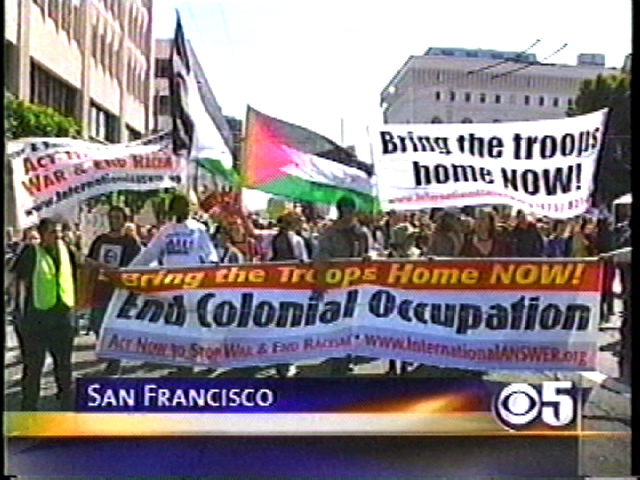
Pride and Prejudices
By Christopher Dickey for Newsweek.
But the real problem with such “real” explanations is that they were not the ones cited by President George W. Bush and British Prime Minister Tony Blair as the compelling reasons to rush to war last March. Then, they talked about weapons of mass destruction, and the fight against terrorists.Which brings us to the grandest illusion of all: the link between Saddam Hussein and September 11. A Washington Post poll published earlier this month concluded that 69 percent of Americans thought it “at least likely” that the former Iraqi leader was personally involved in the attacks on the World Trade Center and the Pentagon. There’s nothing to back this up. So puzzled political scientist and pollsters, with evident disdain for the public, suggested the connection is just the result of fuzzy thinking: Al Qaeda is evil, Saddam is evil, the attacks on 9/11 were evil and folks just draw dumb conclusions. Other analysts pointed the finger at the administration, which spins harder and faster than Hurricane Isabel to convince us the war in Iraq is part of the war on terror begun on September 11, without quite explaining where it fits in.
Yet just this week President Bush himself (and Donald Rumsfeld, too!) admitted that information to substantiate this popular fantasy just doesn’t exist. “We’ve had no evidence that Saddam Hussein was involved with September 11,” Bush said flatly, almost matter-of-factly, on Wednesday.
http://www.msnbc.com/news/969219.asp
Pride and Prejudices
Newsweek
Saturday 20 September 2003
How Americans have fooled themselves about the war in Iraq, and why they’ve had to
Sept. 19 — A sturdy-looking American matron in the audience at the American University of Paris grew redder by the second. She was listening to a panel talking about the Iraq war and its effect on U.S.-French relations, and she kept nodding her head like a pump building emotional pressure.
FINALLY SHE exploded: “Surely these can’t be the only reasons we invaded Iraq!” the woman thundered, half scolding, but also half pleading. “Surely not!”
What first upset her was my suggestion that, looking back, the French were right. They tried to stop the United States and Britain from rushing headlong into this mess. Don’t we wish they’d succeeded? (Readers, please address hate mail to shadowland@newsweek.com)
Then she listened as another panelist and I went through the now-familiar recitation of Washington’s claims before the war, and the too-familiar realities since: the failure to find weapons of mass destruction and the inevitable conclusion that Saddam Hussein was not the threat he was cracked up to be, the fantasy that this war could be waged on the cheap rather than the $1 billion per week American taxpayers are now spending, the claim that occupation—called “liberation”—would be short and sweet, when in fact American men and women continue to be shot and blown up every day with no end in sight.
As we went down the list, I could see the Nodding Woman’s problem was not that she didn’t believe us, it was that she did. She just desperately wanted other reasons, better reasons, some she could consider valid reasons for the price that Americans are paying in blood and treasure.
It’s not the first time I’ve come across this reaction. I just spent a month in the States and met a lot of angry people. A few claim the press is not reporting “the good things in Iraq,” although it’s very hard to see what’s good for Americans there. Many more say, “Why didn’t the press warn us?”
We did, of course. Many of us who cover the region—along with the CIA and the State Department and the uniformed military—have been warning for at least a year that occupying Iraq would be a dirty, costly, long and dangerous job.
The problem is not really that the public was misinformed by the press before the war, or somehow denied the truth afterward. The problem is that Americans just can’t believe their eyes. They cannot fathom the combination of cynicism, naiveté, arrogance and ignorance that dragged us into this quagmire, and they’re in a deep state of denial about it.
Again and again, you hear people offering their own “real” reasons for invading Iraq—conspiracy theories spun not to condemn, but to condone the administration’s actions. Thus the “real” reason for taking out Saddam Hussein, some say, was to eliminate this man who rewarded the families of suicide bombers and posed as an implacable enemy of Israel. (Yet the bombings go on there, and surely the chaos in Iraq does nothing for the long-term security of the Jewish state.) Or the “real” reason for invading Iraq was to intimidate Syria and Iran. Yet Tehran, if anything, has grown more aggressive, and may actually have stepped up its nuclear weapons program to deter the United States. (After all, that strategy worked for North Korea.) Or the “real” reason was to secure America’s long-term supply of oil, but the destabilization of the region, again, may make that more tenuous, not less.
But the real problem with such “real” explanations is that they were not the ones cited by President George W. Bush and British Prime Minister Tony Blair as the compelling reasons to rush to war last March. Then, they talked about weapons of mass destruction, and the fight against terrorists.
Which brings us to the grandest illusion of all: the link between Saddam Hussein and September 11. A Washington Post poll published earlier this month concluded that 69 percent of Americans thought it “at least likely” that the former Iraqi leader was personally involved in the attacks on the World Trade Center and the Pentagon. There’s nothing to back this up. So puzzled political scientist and pollsters, with evident disdain for the public, suggested the connection is just the result of fuzzy thinking: Al Qaeda is evil, Saddam is evil, the attacks on 9/11 were evil and folks just draw dumb conclusions. Other analysts pointed the finger at the administration, which spins harder and faster than Hurricane Isabel to convince us the war in Iraq is part of the war on terror begun on September 11, without quite explaining where it fits in.
Yet just this week President Bush himself (and Donald Rumsfeld, too!) admitted that information to substantiate this popular fantasy just doesn’t exist. “We’ve had no evidence that Saddam Hussein was involved with September 11,” Bush said flatly, almost matter-of-factly, on Wednesday.
Is the president taking a chance here? Will the public recoil in horror, claiming he’s somehow lied to them? I don’t think so.
Bush knows what a lot of his critics have forgotten: the Iraq war is not just about blood and treasure, or even about democracy or WMD or terror. It’s about American pride. And people—perfectly intelligent people—have always been willing to sacrifice sweet reason in order to save face, to protect pride. As George Orwell pointed out, they will refuse to see what’s right in front of their noses. He called this condition a kind of political schizophrenia, and society can live quite comfortably with it, he said, until “a false belief bumps up against solid reality, usually on a battlefield.”
Well, that’s what’s happening right now. It’s not only American money and lives that are being lost, it’s pride. But people in the United States will try to deny that for as long as they possibly can.
Unfortunately for those of us who live abroad, that’s much harder to do—and that’s why the woman at the American University in Paris the other evening was really so angry. When I stopped her in the hall afterward she said she was terribly upset because even though she’s lived in France for years, and is married to a Frenchman, the behavior of people here in the last few months has made her bitter.
I know just how she feels. The media talk about anti-Americanism, but what’s really noxious right now is an insufferable smugness, a pervasive air of schadenfreude, and I fear it’s a symptom of still worse to come from this Iraq adventure. Because the bitterest contradiction of all may be that this war was waged—first and foremost—to save face after the humiliation and suffering of September 11. It was meant to inspire awe in the Arab and Muslim world, as former CIA operative Marc Reuel Gerecht and others insisted it should be. And in that it truly has failed. Every day we look weaker. And the worst news of all it that it’s not because of what was done to us by our enemies but because of what we’ve done to ourselves.
This is from the September 11, 2003 program.
This clip follows this one. (Watch it first. It will make the clip below a lot funnier.)
Stephen Colbert took the liberty of editing together numerous Shrub speeches in order to create a clip of him actually speaking the words that Rummy and Colin claim he's been saying all along.
Stephen Colbert On The Shrub's Consistent Iraq War-U.N. Policy (Small - 8 MB)
The Daily Show (The best news on television.)
This is from the September 11, 2003 program.
These should have been edited into two different clips, but I blew it, so there it is.
The first part is a nice introspective piece from Stewart about 9-11.
Next, a great Shrub War update follows. Highlights include Rummy's new calm and sedated demeanor -- compared to his wartime royal smugness (a.k.a. "Rummy Then and Now"), Colin Powell trying to make peace in the U.N., and both Rummy and Colin saying that the Shrub has always sought U.N. involvement.
If you think this is revisionist history. Just wait till you see the Stephen Colbert clip that follows!
Partial Transcript:
Jon Stewart:
Now while the President's decision to seek a resolution giving the U.N. a greater role in Iraq seems like...uh...I don't know... a 180? Administration Officials say this has been the plan all along.Donald Rumsfield put it this way: "This isn't anything new. There's no big news story here."
Colin Powell says: "The President has said this from the very beginning."
They've been saying these things the whole time? I can't believe I didn't realize that. I must be reading the wrong papers. Watching the wrong tv new shows. Listening to the wrong radio stations. Living on the wrong planet.
9-11 Intro and The Shrub's 180 Degree Turnaround On U.N. Involvement In Iraq (Small - 11 MB)
The Daily Show (The best news on television.)
Cheney link of Iraq, 9/11 challenged
By Anne E. Kornblut and Bryan Bender for the Boston Globe.
Vice President Dick Cheney, anxious to defend the White House foreign policy amid ongoing violence in Iraq, stunned intelligence analysts and even members of his own administration this week by failing to dismiss a widely discredited claim: that Saddam Hussein might have played a role in the Sept. 11 attacks.Evidence of a connection, if any exists, has never been made public. Details that Cheney cited to make the case that the Iraqi dictator had ties to Al Qaeda have been dismissed by the CIA as having no basis, according to analysts and officials. Even before the war in Iraq, most Bush officials did not explicitly state that Iraq had a part in the attack on the United States two years ago.
But Cheney left that possibility wide open in a nationally televised interview two days ago, claiming that the administration is learning "more and more" about connections between Al Qaeda and Iraq before the Sept. 11 attacks. The statement surprised some analysts and officials who have reviewed intelligence reports from Iraq...
Vincent Cannistraro, a former CIA counterterrorism specialist, said that Cheney's "willingness to use speculation and conjecture as facts in public presentations is appalling. It's astounding."
In particular, current intelligence officials reiterated yesterday that a reported Prague visit in April 2001 between Sept. 11 hijacker Mohamed Atta and an Iraqi agent had been discounted by the CIA, which sent former agency Director James R. Woolsey to investigate the claim. Woolsey did not find any evidence to confirm the report, officials said, and President Bush did not include it in the case for war in his State of the Union address last January.
But Cheney, on NBC's "Meet the Press," cited the report of the meeting as possible evidence of an Iraq-Al Qaeda link and said it was neither confirmed nor discredited, saying: "We've never been able to develop any more of that yet, either in terms of confirming it or discrediting it. We just don't know."...
But there is no evidence proving the Iraqi regime knew about or took part in the Sept. 11 attacks, the Bush officials said.
Former senator Max Cleland, who is a member of the national commission investigating the attacks, said yesterday that classified documents he has reviewed on the subject weaken, rather than strengthen, administration assertions that Hussein's regime may have been allied with Al Qaeda.
"The vice president trying to justify some connection is ludicrous," he said.
Nonetheless, Cheney, in the "Meet the Press" interview Sunday, insisted that the United States is learning more about the links between Al Qaeda and Hussein.
"We learn more and more that there was a relationship between Iraq and Al Qaeda that stretched back through most of the decade of the '90s," Cheney said, "that it involved training, for example, on [biological and chemical weapons], that Al Qaeda sent personnel to Baghdad to get trained on the systems."...
But intelligence specialists told the Globe last August that they have never confirmed that the training took place, or identified where it could have taken place. "The general public just doesn't have any independent way of weighing what is said," Cannistraro, the former CIA counterterrorism specialist, said. "If you repeat it enough times . . . then people become convinced it's the truth."
Here is the full text of the article in case the link goes bad:
http://www.boston.com/news/nation/articles/2003/09/16/cheney_link_of_iraq_911_challenged/
Cheney link of Iraq, 9/11 challenged
By Anne E. Kornblut and Bryan Bender, Globe Staff and Globe Correspondent, 9/16/2003
WASHINGTON -- Vice President Dick Cheney, anxious to defend the White House foreign policy amid ongoing violence in Iraq, stunned intelligence analysts and even members of his own administration this week by failing to dismiss a widely discredited claim: that Saddam Hussein might have played a role in the Sept. 11 attacks.
Evidence of a connection, if any exists, has never been made public. Details that Cheney cited to make the case that the Iraqi dictator had ties to Al Qaeda have been dismissed by the CIA as having no basis, according to analysts and officials. Even before the war in Iraq, most Bush officials did not explicitly state that Iraq had a part in the attack on the United States two years ago.
But Cheney left that possibility wide open in a nationally televised interview two days ago, claiming that the administration is learning "more and more" about connections between Al Qaeda and Iraq before the Sept. 11 attacks. The statement surprised some analysts and officials who have reviewed intelligence reports from Iraq.
Democrats sharply attacked him for exaggerating the threat Iraq posed before the war.
"There is no credible evidence that Saddam Hussein had anything to do with 9/11," Senator Bob Graham, a Democrat running for president, said in an interview last night. "There was no such relationship."
A senior foreign policy adviser to Howard Dean, the Democratic front-runner, said it is "totally inappropriate for the vice president to continue making these allegations without bringing forward" any proof.
Cheney and his representatives declined to comment on the vice president's statements. But the comments also surprised some in the intelligence community who are already simmering over the way the administration utilized intelligence reports to strengthen the case for the war last winter.
Vincent Cannistraro, a former CIA counterterrorism specialist, said that Cheney's "willingness to use speculation and conjecture as facts in public presentations is appalling. It's astounding."
In particular, current intelligence officials reiterated yesterday that a reported Prague visit in April 2001 between Sept. 11 hijacker Mohamed Atta and an Iraqi agent had been discounted by the CIA, which sent former agency Director James R. Woolsey to investigate the claim. Woolsey did not find any evidence to confirm the report, officials said, and President Bush did not include it in the case for war in his State of the Union address last January.
But Cheney, on NBC's "Meet the Press," cited the report of the meeting as possible evidence of an Iraq-Al Qaeda link and said it was neither confirmed nor discredited, saying: "We've never been able to develop any more of that yet, either in terms of confirming it or discrediting it. We just don't know."
Multiple intelligence officials said that the Prague meeting, purported to be between Atta and senior Iraqi intelligence officer Ahmed Khalil Ibrahim Samir al-Ani, was dismissed almost immediately after it was reported by Czech officials in the aftermath of Sept. 11 and has since been discredited further.
The CIA reported to Congress last year that it could not substantiate the claim, while American records indicate Atta was in Virginia Beach, Va., at the time, the officials said yesterday. Indeed, two intelligence officials said yesterday that Ani himself, now in US custody, has also refuted the report. The Czech government has also distanced itself from its original claim.
A senior defense official with access to high-level intelligence reports expressed confusion yesterday over the vice president's decision to reair charges that have been dropped by almost everyone else. "There isn't any new intelligence that would precipitate anything like this," the official said, speaking on condition he not be named.
Nonetheless, 69 percent of Americans believe that Hussein probably had a part in attacking the United States, according to a recent Washington Post poll. And Democratic senators have charged that the White House is fanning the misperception by mentioning Hussein and the Sept. 11 attacks in ways that suggest a link.
Bush administration officials insisted yesterday that they are learning more about various Iraqi connections with Al Qaeda. They said there is evidence suggesting a meeting took place between the head of Iraqi intelligence and Osama bin Laden in Sudan in the mid-1990s; another purported meeting was said to take place in Afghanistan, and during it Iraqi officials offered to provide chemical and biological weapons training, according to officials who have read transcripts of interrogations with Al Qaeda detainees.
But there is no evidence proving the Iraqi regime knew about or took part in the Sept. 11 attacks, the Bush officials said.
Former senator Max Cleland, who is a member of the national commission investigating the attacks, said yesterday that classified documents he has reviewed on the subject weaken, rather than strengthen, administration assertions that Hussein's regime may have been allied with Al Qaeda.
"The vice president trying to justify some connection is ludicrous," he said.
Nonetheless, Cheney, in the "Meet the Press" interview Sunday, insisted that the United States is learning more about the links between Al Qaeda and Hussein.
"We learn more and more that there was a relationship between Iraq and Al Qaeda that stretched back through most of the decade of the '90s," Cheney said, "that it involved training, for example, on [biological and chemical weapons], that Al Qaeda sent personnel to Baghdad to get trained on the systems."
The claims are based on a prewar allegation by a "senior terrorist operative," who said he overheard an Al Qaeda agent speak of a mission to seek biological or chemical weapons training in Iraq, according to Secretary of State Colin Powell's statement to the United Nations in February.
But intelligence specialists told the Globe last August that they have never confirmed that the training took place, or identified where it could have taken place. "The general public just doesn't have any independent way of weighing what is said," Cannistraro, the former CIA counterterrorism specialist, said. "If you repeat it enough times . . . then people become convinced it's the truth."
Monday night, I posted a clip from Meet the Press where Dick Cheney stated that he no longer has any financial ties to Halliburton. Guess I wasn't the only one who noticed that wasn't exactly true.
Now Senators Daschle and Lautenberg are demanding hearings investigating the no-bid contracts. They also did me the favor of producing the exact numbers I asked for.
Oil services firm paid Cheney as VP
In Reuters.
"The vice president needs to explain how he reconciles the claim that he has 'no financial interest in Halliburton of any kind' with the hundreds of thousands of dollars in deferred salary payments he receives from Halliburton," Daschle said in a statement.On NBC's "Meet the Press" Sunday, Cheney, who was Halliburton's CEO from 1995 to 2000, said he had severed all ties with the Houston-based company.
"I have no financial interest in Halliburton of any kind and haven't had now for over three years," he said.
Cathie Martin, a Cheney spokeswoman, confirmed that the vice president has been receiving the deferred compensation payments from Halliburton, but she disputed that his statements on "Meet the Press" had been misleading.
Cheney had already earned the salary that was now being paid, Martin said, adding that once he became a nominee for vice president, he purchased an insurance policy to guarantee that the deferred salary would be paid to him whether or not Halliburton survived as a company.
"So he has no financial interest in the company," she said.
But Lautenberg said Cheney's financial disclosure filings with the Office of Government Ethics listed $205,298 in deferred salary payments made to him by Halliburton in 2001, and another $162,393 in 2002. The filings indicated that he was scheduled to receive more payments this year and in 2004 and 2005.
"In 2001 and 2002, Vice President Cheney was paid almost as much in salary from Halliburton as he made as vice president," Lautenberg said.
The vice president's salary is $198,600 annually.
Here is the full text of the article in case the link goes bad:
http://www.azstarnet.com/star/wed/30917Ncheney.html
Oil services firm paid Cheney as VP
REUTERS
Dick Cheney
WASHINGTON - Vice President Dick
Cheney, a former CEO of Halliburton Co., has received hundreds of thousands of dollars from the company since taking office while asserting he has no financial interest in the company, Senate Democrats said Tuesday.
The Democrats demanded to know why Cheney claimed to have cut ties with the oil services company, involved in a large no-bid contract for oil reconstruction work in Iraq, when he was still receiving large deferred salary payments.
Senate Democratic Leader Tom Daschle of South Dakota and Sen. Frank Lautenberg, D-N.J., said the revelations reinforced the need for hearings about the no-bid contracts Halliburton received from the Bush administration.
"The vice president needs to explain how he reconciles the claim that he has 'no financial interest in Halliburton of any kind' with the hundreds of thousands of dollars in deferred salary payments he receives from Halliburton," Daschle said in a statement.
On NBC's "Meet the Press" Sunday, Cheney, who was Halliburton's CEO from 1995 to 2000, said he had severed all ties with the Houston-based company.
"I have no financial interest in Halliburton of any kind and haven't had now for over three years," he said.
Cathie Martin, a Cheney spokeswoman, confirmed that the vice president has been receiving the deferred compensation payments from Halliburton, but she disputed that his statements on "Meet the Press" had been misleading.
Cheney had already earned the salary that was now being paid, Martin said, adding that once he became a nominee for vice president, he purchased an insurance policy to guarantee that the deferred salary would be paid to him whether or not Halliburton survived as a company.
"So he has no financial interest in the company," she said.
But Lautenberg said Cheney's financial disclosure filings with the Office of Government Ethics listed $205,298 in deferred salary payments made to him by Halliburton in 2001, and another $162,393 in 2002. The filings indicated that he was scheduled to receive more payments this year and in 2004 and 2005.
"In 2001 and 2002, Vice President Cheney was paid almost as much in salary from Halliburton as he made as vice president," Lautenberg said.
The vice president's salary is $198,600 annually.
This clip is a Dick Cheney classic.
According to Cheney, he doesn't know anything about anything. He doesn't know who Ambassador Joseph Wilson is. He doesn't know who the CIA is. He must not know what a newspaper is either.
This is from the September 14, 2003 program of
Meet The Press, hosted by Tim Russert.
(Link goes to a complete very incomplete transcript.)
Russert: "Were you briefed on his (Joseph Wilson's) findings of February-March of 2002?"
Cheney: "No. I don't know Joe Wilson. I've never met Joe Wilson...Joe Wilson? I don't know who sent Joe Wilson. He never submitted a report that I ever saw when he came back...I don't know Mr. Wilson. I probably shouldn't judge him...I have no idea who hired him."
Tim Russert: "The CIA did."
Cheney: "Yeah but who are 'the CIA?' I don't know."
Cheney On The Forged Nigerian WMD Evidence (Small - 8 MB)

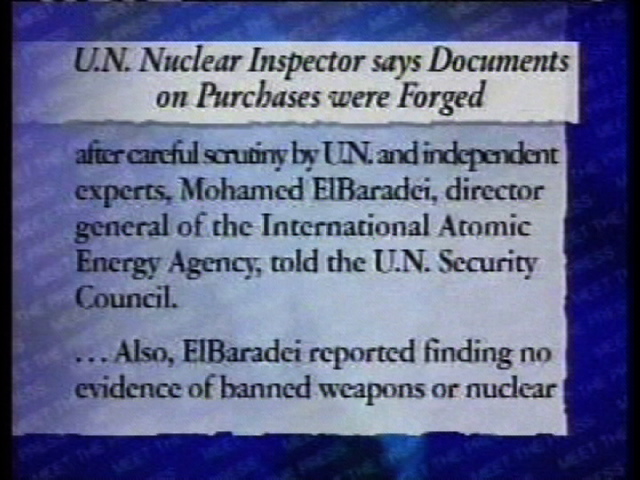


This is from the September 14, 2003 program of
Meet The Press, hosted by Tim Russert.
(Link goes to a complete very incomplete transcript.)
Cheney On The Missing WMD (Small - 10 MB)


This is from the September 14, 2003 program of
Meet The Press, hosted by Tim Russert.
(Link goes to a complete very incomplete transcript.)
Cheney: "I don't know any of the details of the contract because I deliberately stay away from any of that information."
Cheney also said that he has "no idea" why there was no bidding process, and to "go ask the Core of Engineers." He also said that he "has no financial interest of any kind" with the company and hasn't "for over three years."
(Can someone please find me a link to the fact that he still receives deferred income from Halliburton every year? I know I've seen that several times in different publications. It's bound to be somewhere else besides in a Daily Show clip. -- Thanks! UPDATE! 9/16/03 -- Well, that didn't take long (see snippet below from Chris Floyd in Counterpunch.)
Update: 9/17/03 - New story in Reuters with all the details.
Cheney On The Halliburton Contracts (Small - 6 MB)
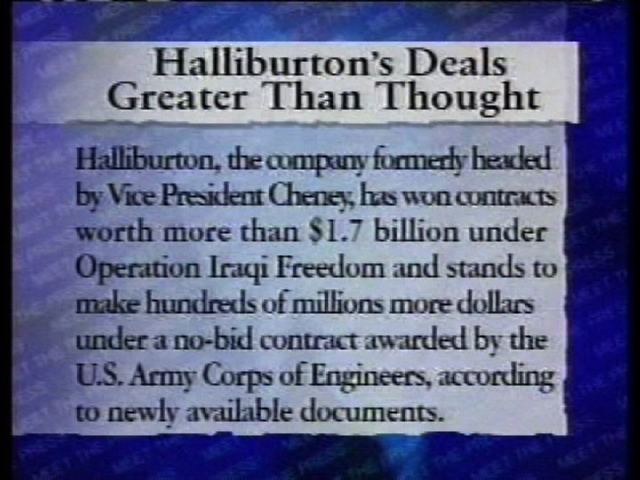

From Counterpunch, March 2003:
Old news, you say? Irrelevant to the current crisis? Surely, now that Cheney has been translated to glory as the nation's second-highest public servant, he is beyond any taint of grubby material concerns? Au contraire, as those ever-dastardly French like to say. At this very moment, while the smoke is still rising from the rubble of Baghdad, while the bodies of the unburied dead are still rotting in the desert wastes, Dick Cheney is receiving one million dollars a year in so-called "deferred compensation" from Halliburton. That's a million smackers from a private company that profits directly from the mass slaughter in Iraq, going into the pockets of the "public servant" who is, as the sycophantic media never tires of telling us, the power behind George W.'s throne - and a prime architect of the war.
(Thanks, Jim.)
Here is the full text of the Counterpunch article that seems to complement this video clip so nicely. (In case the link goes bad.):
http://www.counterpunch.org/floyd03292003.html
March 29, 2003
Bushist Party Feeds on Fear and War
Blood on the Tracks
By CHRIS FLOYD
Before the first cruise missile crushed the first skull of the first child killed in the first installment of George W. Bush's crusade for world dominion, the unelected plutocrats occupying the White House were already plying their corporate cronies with fat contracts to "repair" the murderous devastation they were about to unleash on Iraq. There was, of course, no open bidding allowed in the process; just a few "selected" companies--selected for their preponderance of campaign bribes to the Bushist Party, that is - "invited" to submit their wish lists to the War Profiteer-in-Chief.
It should come as no surprise that one of the leading beneficiaries of this hugger-mugger largess is our old friend, Halliburton Corporation, the military-energy servicing conglomerate. Halliburton, headed by Vice Profiteer Dick Cheney until the Bushist coup d'etat in 2000, is already reaping billions from the Bush wars--which Cheney himself tells us "might not end in our lifetime."
Cheney is an old hand at this kind of death merchanting, of course. In the first Bush-Iraq War, Cheney, playing the role now filled by Don Rumsfeld--a squinting, smirking, lying Secretary of Defense - directed the massacre of some 100,00 Iraqis, many of whom were buried alive, or machine-gunned while retreating along the "Highway of Death," or annihilated in sneak attacks launched after a ceasefire had been called. When George I and his triumphant conquerors were unceremoniously booted out of office less than two years later by that radical fringe group so hated by the Bushists--the American people--Cheney made a soft landing at Halliburton.
There he grew rich on government contracts and taxpayer-supported credits doled out by his old pals in the military-industrial complex. He also hooked up with attractive foreign partners - like Saddam Hussein, the "worse-than-Hitler" dictator who paid Cheney $73 million to rebuild the oil fields that had been destroyed by, er, Dick Cheney. And while the Halliburton honcho became a multimillionaire many times over, some of his employees were not so lucky - Cheney ashcanned more than 10,000 workers during his boardroom reign. (At least he didn't bury them alive.)
Old news, you say? Irrelevant to the current crisis? Surely, now that Cheney has been translated to glory as the nation's second-highest public servant, he is beyond any taint of grubby material concerns? Au contraire, as those ever-dastardly French like to say. At this very moment, while the smoke is still rising from the rubble of Baghdad, while the bodies of the unburied dead are still rotting in the desert wastes, Dick Cheney is receiving one million dollars a year in so-called "deferred compensation" from Halliburton. That's a million smackers from a private company that profits directly from the mass slaughter in Iraq, going into the pockets of the "public servant" who is, as the sycophantic media never tires of telling us, the power behind George W.'s throne - and a prime architect of the war.
This is money that Cheney wouldn't get if Halliburton went down the tubes--a prospect it faced in the early days of the Regime, due to a boneheaded merger engineered by its former CEO, a guy named, er, Dick Cheney. In a deal apparently sealed during a golf game with an old crony, Cheney acquired a subsidiary, Dresser Industries--a firm associated with the Bush family for more than 70 years--which was facing billions of dollars in liability claims for its unsafe use of asbestos. Dresser's bigwigs doubtless made out like bandits from the deal, and Cheney left the mess behind when the grateful Bushes put him on the presidential ticket, but there was serious concern that Halliburton itself would be forced into bankruptcy - unless it found massive new sources of secure funding to offset the financial "shock and awe" of the asbestos lawsuits.
Then lo and behold, after September 11, Halliburton received a multibillion-dollar, open-ended, no-bid contract to build and service U.S. military bases and operations all over the world. It also won several shorter-term contracts, such as expanding the concentration camp in Guantanamo Bay, where the Regime is holding unnamed, uncharged suspected terrorists in violation of the Geneva Convention. With this fountain of federal money pouring into its coffers - and Bushist operatives in Congress pushing legislation to restrict asbestos lawsuits--Halliburton was able to hammer out a surprisingly favorable settlement deal with the asbestos victims. The company--and Cheney's million-dollar paychecks--were saved. Praise Allah!
Halliburton is just the tip of the slagheap, of course. Daddy Bush's popsicle stand, the Carlyle Group - which controls a vast network of defense firms and "security" operations around the world - is also panning gold from the streams of blood pouring down the ancient tracks of Babylon. Junior Bush - who like a kept woman made his own influence-peddling fortune through services rendered to a series of sugar daddies--has conveniently gutted the national inheritance tax, swelling his own eventual bottom line when his father joins the legions of Panamanian, Iranian, Afghan, Iraqi--and American--dead he and his son have sent down to Sheol.
Never in American history has a group of government leaders profited so directly from war--never. Like their brothers-in-arms, Saddam's Baathists, the Bushists treat their own country like a sacked town, looting the treasury for their family retainers and turning public policy to private gain. Like Saddam, they feed on fear and glorify aggression. Like Saddam, they have dishonored their nation and betrayed its people.
But the money sure is good, eh, Dick?
Chris Floyd is a columnist for the Moscow Times and is a regular contributor to CounterPunch.
This is from the September 14, 2003 program of
Meet The Press, hosted by Tim Russert.
(Link goes to a complete very incomplete transcript.)
Cheney On The Misleading, Inaccurate Estimates For How Much The War Will Cost (Small - 8 MB)



This is from the September 14, 2003 program of
Meet The Press, hosted by Tim Russert.
(Link goes to a complete very incomplete transcript.)
Cheney On The Congressional Budget Office's Claims That Our Forces Are Already Overextended (Small - 7 MB)

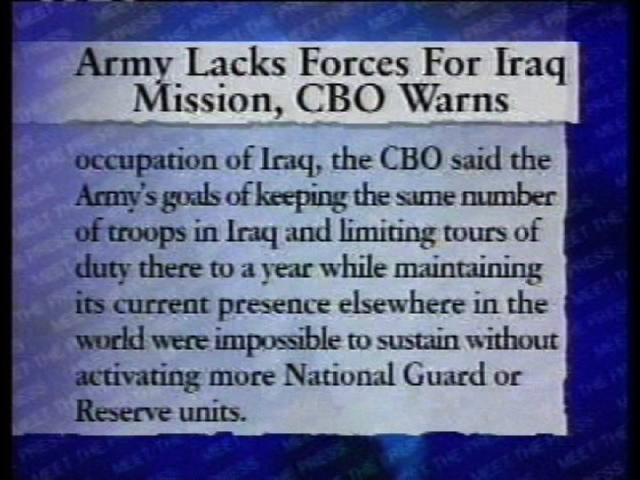
This is from the September 14, 2003 program of
Meet The Press, hosted by Tim Russert.
(Link goes to a complete very incomplete transcript.)
Cheney On Misjudgements By The Shrub Administration and Its Primary Concern Over In Iraq (Oil) (Small - 5 MB)
This is from the September 14, 2003 program of
Meet The Press, hosted by Tim Russert.
(Link goes to a complete very incomplete transcript.)
Cheney On The Plan For Iraq (Or Lack Of One) (Small - 7 MB)
Tim Russert: "What is our plan for Iraq? How long with the 140,000 American Soldiers be there? How many international troops will join them? And how much is this gonna cost?"
Cheney: "Well, some of those questions are unknowable at present. They will depend on developments -- depend on how fast it takes us to achieve our objectives."

This is from the September 14, 2003 program of
Meet The Press, hosted by Tim Russert.
(Link goes to a complete very incomplete transcript.)
Cheney On The War That Was Supposedly Over May 1, 2003 -- And The Soldiers Who Are Still Dying (Small - 5 MB)
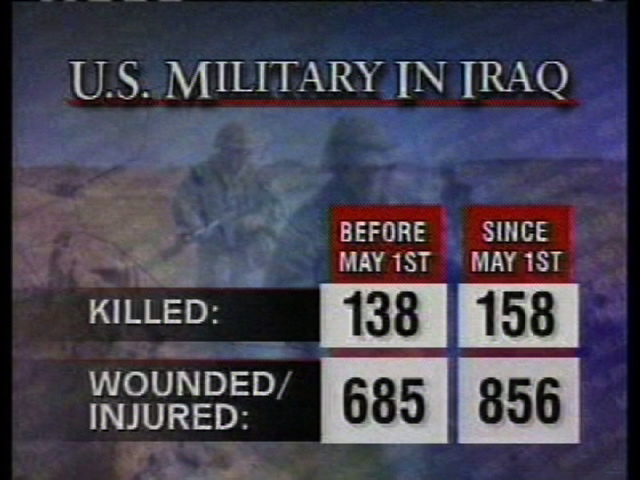
This is from the September 14, 2003 program of
Meet The Press, hosted by Tim Russert.
(Link goes to a complete very incomplete transcript.)
Subject: The Confused American Public That Thinks Iraq Was Responsible For 9-11, Saudi Involvement In 9-11, And the "Classified" Pages of the 9-11 Commission Report
Note: There is no mention whatsoever of this segment in the transcript. (Except for the part in the end about Cheney thinking another attack is imminent.)
Cheney On Iraq and 9-11 (Small - 7 MB)
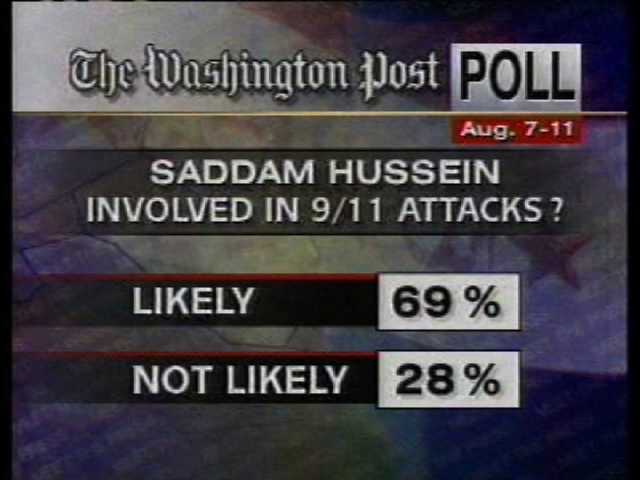
This is from the September 14, 2003 program of
Meet The Press, hosted by Tim Russert.
(Link goes to a complete very incomplete transcript.)
I also have this footage edited into smaller clips, organized by subject, that I'm in the process of uploading right now.
Cheney On Meet The Press - 1 of 2 (Small - 55 MB)
Cheney On Meet The Press - 2 of 2 (Small - 49 MB)


Here is the full text of the article in case the link goes bad:
http://www.msnbc.com/news/966470.asp
Transcript for Sept. 14
Sunday, September 14, 2003
GUEST: Dick Cheney, vice president
Tim Russert, moderator
This is a rush transcript provided for the information and convenience of the press. Accuracy is not guaranteed.
(Note from Lisa -- boy, that's the understatement of the year! This transcript is very abridged.)
MR. TIM RUSSERT: Our issues this Sunday: America remembers September 11, 2001. In Iraq, six months ago, the war began with shock and awe. Vice President Dick Cheney appeared on MEET THE PRESS:
(Videotape, March 16):
VICE PRES. DICK CHENEY: My belief is we will, in fact, be greeted as liberators.
(End videotape)
MR. RUSSERT: Did the Bush administration misjudge the level of organized resistance, the number of American troops needed, the cost of securing Iraq, and the existence of weapons of mass destruction? Those questions and more for the vice president of the United States, Dick Cheney. Our exclusive guest for the full hour.
Mr. Vice President, welcome back to MEET THE PRESS.
VICE PRES. CHENEY: Good morning, Tim. It’s good to be back.
MR. RUSSERT: Two years ago, September 11, 2001, you went to New York City, just the other day, attacks on the World Trade Center, the Pentagon, the crash in Shanksville, Pennsylvania. Has this nation recovered from September 11, 2001?
VICE PRES. CHENEY: Well, I think in many respects, recovered, yes. On the other hand, there are some things that’ll never be the same. I look back on that, and I think about what we’ve been engaged in since.
And in a sense, sort of the theme that comes through repeatedly for me is that 9/11 changed everything. It changed the way we think about threats to the United States. It changed about our recognition of our vulnerabilities. It changed in terms of the kind of national security strategy we need to pursue, in terms of guaranteeing the safety and security of the American people.
And I’m not sure everybody has made that transition yet. I think there are a number of people out there who hope we can go back to pre-9/11 days and that somehow 9/11 was an aberration. It happened one time; it’ll never happen again. But the president and I don’t have that luxury. You know, we begin every day reading the intelligence reports from the CIA and the FBI on the nature of the threat that’s out there, on the plotting by al-Qaeda members and related groups to launch attacks against the United States and contemplating the possibility of an attack against the U.S. with far deadlier weapons than anything we’ve seen to date. So on the one hand, I’m sure everybody wants to get back to normal, and we have in many respects. But on the other hand, we all have to recognize as a nation that 9/11 changed a great deal in our lives.
MR. RUSSERT: You fully expect that there will be another attack on the United States.
VICE PRES. CHENEY: I have to assume that. The president has to assume that. It would be nice to be able to say that that can’t happen. But if we’ve learned anything, if we look back now, it seems to me that we’ve learned that there was a campaign of terror mounted against us. Before 9/11, we tended to think in terms of a terrorist act as a criminal enterprise. And the appropriate response was a law enforcement response.
You go find the bad guy, put him in jail, case closed. What we’ve learned since is that that’s not the case at all; but, in fact, a lot of the terrorist attacks we’ve suffered in the 1990s were al-Qaeda directed. That’s certainly true in the World Trade Center in ’93, in the East Africa Embassy bombings in ’98, and the USS Cole in 2000 and obviously on 9/11.
It’s very important we make that transition in understanding that we’re at war, that the war continues, that this is a global enemy that struck in not only New York and Washington but in Bali and in Djakarta, in Mombasa, in Casablanca, Riyadh since 9/11, that this is an enterprise that is global in scope and one we’ve had major success against it. And the fact of the matter is there were thousands of people that went through those training camps in Afghanistan. We know they are seeking deadlier weapons—chemical, biological and nuclear weapons if they can get it. And if anything, those basic notions that developed in the early days after 9/11 have been reinforced by what we’ve learned since.
MR. RUSSERT: There’s grave concern about surface-to-air missiles shooting down American commercial aircraft. Should we not outfit all U.S. commercial airliners with equipment to detect and avoid that?
VICE PRES. CHENEY: Well, there are technologies available. They are extremely expensive if you’re going to put them on every airliner. You’ve got to make choices here about, you know, when you’re dealing with a risk, there may be certain aircraft flying into certain locales that are especially vulnerable that you may want to deal with. But I wouldn’t automatically go to the assumption that we need to put the most sophisticated system on every single airplane.
MR. RUSSERT: The Washington Post asked the American people about Saddam Hussein, and this is what they said: 69 percent said he was involved in the September 11 attacks. Are you surprised by that?
VICE PRES. CHENEY: No. I think it’s not surprising that people make that connection.
MR. RUSSERT: But is there a connection?
VICE PRES. CHENEY: We don’t know. You and I talked about this two years ago. I can remember you asking me this question just a few days after the original attack. At the time I said no, we didn’t have any evidence of that. Subsequent to that, we’ve learned a couple of things. We learned more and more that there was a relationship between Iraq and al-Qaeda that stretched back through most of the decade of the ’90s, that it involved training, for example, on BW and CW, that al-Qaeda sent personnel to Baghdad to get trained on the systems that are involved. The Iraqis providing bomb-making expertise and advice to the al-Qaeda organization.
We know, for example, in connection with the original World Trade Center bombing in ’93 that one of the bombers was Iraqi, returned to Iraq after the attack of ’93. And we’ve learned subsequent to that, since we went into Baghdad and got into the intelligence files, that this individual probably also received financing from the Iraqi government as well as safe haven.
Now, is there a connection between the Iraqi government and the original World Trade Center bombing in ’93? We know, as I say, that one of the perpetrators of that act did, in fact, receive support from the Iraqi government after the fact. With respect to 9/11, of course, we’ve had the story that’s been public out there. The Czechs alleged that Mohamed Atta, the lead attacker, met in Prague with a senior Iraqi intelligence official five months before the attack, but we’ve never been able to develop anymore of that yet either in terms of confirming it or discrediting it. We just don’t know.
MR. RUSSERT: We could establish a direct link between the hijackers of September 11 and Saudi Arabia.
VICE PRES. CHENEY: We know that many of the attackers were Saudi. There was also an Egyptian in the bunch. It doesn’t mean those governments had anything to do with that attack. That’s a different proposition than saying the Iraqi government and the Iraqi intelligent service has a relationship with al-Qaeda that developed throughout the decade of the ’90s. That was clearly official policy.
MR. RUSSERT: There are reports that the investigation Congress did does show a link between the Saudi government and the hijackers but that it will not be released to the public.
VICE PRES. CHENEY: I don’t know want to speculate on that, Tim, partly because I was involved in reviewing those pages. It was the judgment of our senior intelligence officials, both CIA and FBI that that material needed to remain classified. At some point, we may be able to declassify it, but there are ongoing investigations that might be affected by that release, and for that reason, we kept it classified. The committee knows what’s in there. They helped to prepare it. So it hasn’t been kept secret from the Congress, but from the standpoint of our ongoing investigations, we needed to do that.
One of the things this points out that’s important for us to understand—so there’s this great temptation to look at these events as discreet events. We got hit on 9/11. So we can go and investigate it. It’s over with now.
It’s done. It’s history and put it behind us.
From our perspective, trying to deal with this continuing campaign of terror, if you will, the war on terror that we’re engaged in, this is a continuing enterprise. The people that were involved in some of those activities before 9/11 are still out there. We learn more and more as we capture people, detain people, get access to records and so forth that this is a continuing enterprise and, therefore, we do need to be careful when we look at things like 9/11, the commission report from 9/11, not to jeopardize our capacity to deal with this threat going forward in the interest of putting that information that’s interesting that relates to the period of time before that. These are continuing requirements on our part, and we have to be sensitive to that.
MR. RUSSERT: Vanity Fair magazine reports that about 140 Saudis were allowed to leave the United States the day after the 11th, allowed to leave our airspace and were never investigated by the FBI and that departure was approved by high-level administration figures. Do you know anything about that?
VICE PRES. CHENEY: I don’t, but a lot of folks from that part of the world left in the aftermath of 9/11 because they were worried about public reaction here in the United States or that somehow they might be discriminated against. So we have had, especially since the attacks of Riyadh in May of this year from the Saudi government, great support and cooperation in going after terrorists, especially al-Qaeda. I think the Saudis came to realize as a result of the attacks of last May that they were as much of a target as we are, that al-Qaeda did have a foothold inside Saudi Arabia—a number of the members of the organization are from there—that there have been private individuals in Saudi Arabia who provided significant financial support and assistant, that there are facilitators and operators working inside Saudi Arabia to support the al-Qaeda network. And the Saudis have been, as I say in the last several months, very good partners in helping us go after the people in the al-Qaeda organization.
MR. RUSSERT: Let me turn to the situation in Iraq. We all remember this picture from May 1. The president on the USS Lincoln on May 1; mission accomplished. Since that time, these are the rather haunting figures coming out of Iraq. We had lost 138 soldiers before May 1, and 685 wounded, injured. Since that time, since the president came on the carrier and said major combat was over, we’ve lost 158, and 856 wounded and injured. Those numbers are pretty troubling.
VICE PRES. CHENEY: Well, it’s significant, Tim. Any loss of life or injuries suffered by American military personnel is significant. Everyone wishes that that weren’t necessary. But from the standpoint of the activity we’re engaged in over there and what we’ve been able to accomplish over the last two years, I think it’s important to keep all of this in perspective. I looked at some numbers yesterday. I had them run the numbers, for example, in terms of our casualties since we launched into Afghanistan, began the war on terror a little over two years ago now. And the number killed in combat, both in Afghanistan and Iraq, as of yesterday, was about 213. When you add in those from non-hostile causes—the plane crashes, helicopter goes down without hostile fire—we’ve got a total of 372 fatalities since we started the war.
Remember, we lost 3,000 people here on 9/11. And what we’ve been able to accomplish—although I must say we regret any casualties. You’d like to be able do everything casualty-free. When you think about what we’ve accomplished in terms of taking Afghanistan—we had a total of 30 killed in action in Afghanistan—taking down the Taliban and destroying the capacity of al-Qaeda to use Afghanistan as a base to attack the United States, launching an attack into Iraq, destroying the Iraqi armed forces, taking down the government of Iraq, getting rid of Saddam Hussein, capturing 42 out of the 55 top leaders, and beginning what I think has been
fairly significant success in terms of putting Iraq back together again, the price that we’ve had to pay is not out of line, and certainly wouldn’t lead me to suggest or think that the strategy is flawed or needs to be changed.
MR. RUSSERT: Do you believe that Saddam Hussein had a deliberate strategy, a deliberate calculated plan, not to have the big battle of Baghdad but rather to dissolve away into the mainstream population and then mount this guerrilla war?
VICE PRES. CHENEY: I don’t. I think that, in effect, he lost control at the outset. If you look at what transpired during the course of the campaign, the campaign that Tommy Franks mounted, the speed with which they moved, the element of surprise that was involved here, the fact that we were basically able to sever communications between the head, Saddam Hussein, and his forces, now, I don’t think he had any choice ultimately but to flee Baghdad as he did. The level of resistance continues out there, obviously, but I think we’re making major progress against it, and I think it’s important not to let anecdotal reporting on individual resistance conflicts somehow color or lead us to make misjudgments about the total scope of the effort.
The fact is that most of Iraq today is relatively stable and quiet. There are still ongoing incidents, attacks on coalition forces or on others, on the Jordanian Embassy, on the U.N. delegation, on the Shia clerics in Najaf, from ones of—two sources, I believe: either from the remnants of the old regime, the Ba’athists, the Fedayeen Saddam, or terrorists, al-Qaeda types, many of whom were in Iraq before the war, some of whom have arrived since the war. Those are the main two sources that we’ve got to deal with. We are dealing with them. The actual number of incidents, according to General Abizaid, this month is significantly below what it was last month on a daily basis. So we just have to keep working the problem, and we’re doing that.
MR. RUSSERT: Joe Lieberman, the senator from Connecticut, running for president, had this to say: “...what President Bush gave the American people on Sunday night was a price tag”—$87 billion—”not a plan. And we in Congress must demand a plan.”
What is our plan for Iraq? How long will the 140,000 American soldiers be there? How many international troops will join them? And how much is this going to cost?
VICE PRES. CHENEY: Well, some of those questions are unknowable at present, Tim. It’ll depend on developments. It’ll depend on how fast it takes us to achieve our objectives. Remember when we went there, that we went there specifically to take down the Saddam Hussein regime, to wrap up all WMD capability he had possessed or developed, to deal with the threat that his regime represented to the region, and the United States. Very significant challenge. But we have, in fact, I think, been very successful at achieving that.
In terms of where we’re going now, we’re moving aggressively to deal with the security situation. We’re continuing those efforts. We’ve got some first-rate troops undertaking those efforts, and, needless to say, we’ve had major success, major progress when you think about the number of Iraqi bad guys that we’ve eliminated or captured. We’ve—working very aggressively, Bremer is, to stand up a new government. We’ve now got a 25-man governing council in place made up of Iraqis, a broad representative group of Iraqi officials.
We’ve got Iraqis now in charge of each ministry in the government. We’ve got 90 percent—over 90 percent of the cities and towns and villages of Iraq are now governed by democratically elected or appointed local councils. We’ve got all the schools open; we’ve got all the hospitals up and functioning. We’re making major progress in restoring the electricity to pre-war levels. We’re rebuilding the oil system and infrastructure in the country. So all of that’s happening. And it’s a very important part of our total strategy. We’re also working to stand up an Iraqi security force. And in four months we’ve put together a force now of some 55,000 Iraqis serving in the police force, serving in the border security force and so forth at the local level. But that will continue to grow. The second largest security contingent in Iraq today behind the U.S. is Iraqi. We’ve been successful to some extent in getting international support. We’ve got a Polish division. We stood up a Polish-led division a few weeks ago that has troops in it from 17 countries.
With respect to the financing, the $87 billion we’ve asked for is—about 3/4 of that is to support our military and security operations. About 1/4 of it will go specifically to helping make the investments Bremer believes we need to make in order to get the Iraqis back and functioning on their own capability.
So how long will it take? I don’t know. I can’t say. I don’t think anybody can say with absolute certainty at this point. We’ve achieved already, when you consider that we’ve only been there about four months, a great deal, and we are well on our way, I think, to achieving our objective. But the key here for us is to stay committed to get the job done, to get the guys on the ground the resources they need, both from a military as well as a civilian standpoint, and that’s exactly what the president is doing.
MR. RUSSERT: Let’s go through some of those things because there have been suggestions of misjudgments by the administration. When you were on the program in March, I asked you about troop levels. Let’s watch:
(Videotape, March 16, 2003):
MR. RUSSERT: The army’s top general said that we would have to have several hundred thousand troops there for several years in order to maintain stability.
VICE PRES. CHENEY: I disagree. To suggest that we need several hundred thousand troops there after military operations cease, after the
conflict ends, I don’t think is accurate. I think that’s an overstatement.
(End videotape)
MR. RUSSERT: We, in fact, have about 140,000 troops, 20,000 international troops, as well. Did you misjudge the number of troops necessary to secure Iraq after major combat operations?
VICE PRES. CHENEY: Well, you’re going to get into a debate here about—talking about several years, several hundred thousand troops for several years. I think that’s a non-starter. I don’t think we have any plan to do that, Tim. I don’t think it’s necessary to do that. There’s no question but what we’ve encountered resistance. But I don’t think anybody expected the time we were there to be absolutely trouble-free. We knew there were holdover elements from the regime that would fight us and struggle. And we also knew al-Qaeda was there, and Ansar al-Islam, up in northeastern Iraq, which we’ll come back to, talk about in a minute.
So I don’t think there was a serious misjudgment here. We couldn’t know precisely what would happen. There were a lot of contingencies we got ready for that never did happen. You know, for example, one of the things we spent time worried about was that Saddam would destroy his own oil industry, that he’d do in Iraq what he did in Kuwait 12 years ago. The consequence of that, if he’d gone in and blown up those wells, as they contemplated doing, in fact wired some of them for destruction, would have been that the oil industry would have been shut down to zero production, probably for several years, while we tried to restore it. We were able to defeat that. That didn’t occur. We had plans for it that we didn’t have to execute or implement. So it’s like any other process. A plan is only as good until you start to execute, then you have got to make adjustments and so forth. But I don’t think there has been a major shift in terms of U.S. troop levels. And I still remain convinced that the judgment that we’ll need “several hundred thousand for several years” is not valid.
MR. RUSSERT: The Congressional Budget Office said that: “That the Army lacks sufficient active-duty forces to maintain its current level of nearly 150,000 troops in Iraq beyond next spring. In a report that underscores the stress being place on the military by the occupation of Iraq, the CBO said the Army’s goals of keeping the same number of troops in Iraq and limiting tours of duty there to a year while maintaining its current presence elsewhere in the world were impossible to sustain without activating more National Guard or Reserve units.”
Can we keep 150,000 troops beyond next spring without, in effect, breaking the Army?
VICE PRES. CHENEY: Tim, we can do what we have to do to prevail in this conflict. Failure’s not an option. And go back again and think about what’s involved here. This is not just about Iraq or just about the difficulties we might encounter in any one part of the country in terms of restoring security and stability. This is about a continuing operation on the war on terror. And it’s very, very important we get it right. If we’re successful in Iraq, if we can stand up a good representative government in Iraq, that secures the region so that it never again becomes a threat to its neighbors or to the United States, so it’s not pursuing weapons of mass destruction, so that it’s not a safe haven for terrorists, now we will have struck a major blow right at the heart of the base, if you will, the geographic base of the terrorists who have had us under assault now for many years, but most especially on 9/11. They understand what’s at stake here. That’s one of the reasons they’re putting up as much of a struggle as they have, is because they know if we succeed here, that that’s going to strike a major blow at their capabilities.
MR. RUSSERT: So the resistance in Iraq is coming from those who were responsible for 9/11?
VICE PRES. CHENEY: No, I was careful not to say that. With respect to 9/11, 9/11, as I said at the beginning of the show, changed everything. And one of the things it changed is we recognized that time was not on our side, that in this part of the world, in particular, given the problems we’ve encountered in Afghanistan, which forced us to go in and take action there, as well as in Iraq, that we, in fact, had to move on it. The relevance for 9/11 is that what 9/11 marked was the beginning of a struggle in which the terrorists come at us and strike us here on our home territory. And it’s a global operation. It doesn’t know national boundaries or national borders. And the commitment of the United States going into Afghanistan and take down the Taliban and stand up a new government, to go into Iraq and take down the Saddam Hussein regime and stand up a new government is a vital part of our long-term strategy to win the war on terror. America’s going to be safer and more secure in the years ahead when we complete the task in Iraq successfully, and we will complete it successfully. And whatever the cost is, in terms of casualties or financial resources, it’s a whale of a lot less than trying to recover from the next attack in the United States. So what we do on the ground in Iraq, our capabilities here are being tested in no small measure, but this is the place where we want to take on the terrorists. This is the place where we want to take on those elements that have come against the United States, and it’s far more appropriate for us to do it there and far better for us to do it there than it is here at home.
We talk about $87 billion. Yeah, that’s a significant expense. No question about it. But it’s going to be much more expensive down the road if we wait. And it’ll be uch more expensive—it’s less money, frankly, than the events of 9/11 imposed on us here in the United States.
MR. RUSSERT: In terms of costs, Mr. Vice President, there are suggestions again—it was a misjudgment by the administration or even misleading. “Lawrence Lindsey, head of the White House’s National Economic Council, projected the ‘upper bound’ of war costs at $100 billion to $200 billion.”
We’ve already spent $160 billion after this $87 billion is spent. The Pentagon predicted $50 billion: “The administration’s top budget official [Mitch Daniels] estimated that the cost of a war with Iraq could be in the range of $50 billion to $60 billion...he said...that earlier estimates of $100 billion to $200 billion in Iraq war costs by Lawrence Lindsey, Mr. Bush’s former chief economic adviser, were too high.”
And Paul Wolfowitz, the deputy secretary of Defense, went before Congress and said this: “We’re dealing with a country that can really finance its own econstruction, and relatively soon. The oil revenues of that country could bring between $50 and $100 billion over the course of the next two or three years.” It looked like the administrations truly misjudged the cost of this operation.
VICE PRES. CHENEY: No, I didn’t see a one-point estimate there that you could say that this is the administration’s estimate. We didn’t know. And if you ask Secretary Rumsfeld, for example—I can remember from his briefings, he said repeatedly he didn’t know. And when you and I talked about it, I couldn’t put a dollar figure on it.
MR. RUSSERT: But Daniels did say $50 billion.
VICE PRES. CHENEY: Well, that might have been, but I don’t know what is basis was for making that judgment. We do know that we are prepared and need to be prepared to do whatever it takes to make it work. But this is not a situation where, you know, it’s only a matter of us writing a check to solve the problem. Iraq sits on top of 10 percent of the world’s oil reserves, very significant reserves, second only to Saudi Arabia.
The fact is there are significant resources here to work with, and the notion that we’re going to bear the burden all by ourselves from a financial standpoint I don’t think is valid. We’ve got a donor’s conference scheduled coming up next month, where the international community will come together and pledge funds to cooperate and supported with the Iraqi operation. The U.N. resolution now that Colin Powell’s been working on this weekend involves, as well, authorization for the international financial institutions to come support that. There’s money at the U.N. left over in the oil-for-food program that’s going to be available.
There are funds frozen, Iraqi assets in various places in...
MR. RUSSERT: How much is all that?
VICE PRES. CHENEY: I don’t have a final dollar figure. We don’t know who will...
MR. RUSSERT: Is the ei...
VICE PRES. CHENEY: ...pony up for that. The $87 billion, again, remember, about 3/4 of that is to support the U.S. military operations or about 1/4 of it actually goes to Iraq operations, and a portion clearly will be used in Afghanistan and for the war on terror.
MR. RUSSERT: Is the $87 billion the end of it? Will the American people be asked for any more money?
VICE PRES. CHENEY: I can’t say that. It’s all that we think we’ll need for the foreseeable future for this year. I guess people shouldn’t be surprised that the request is coming now either. What we’ve done consistently since we started this enterprise, working with the Congress, is we did not want to incorporate the Iraq cost within the baseline DOD budget. So we’ve always dealt with it on the side as a separate appropriation. That’s what we’re doing here. The reason we’re going now is because we’ve had the work done in Iraq. Bremer’s been there long enough to put together a good budget looking over the next year. He’s got a pretty good idea of what it’s going to cost him. We’ve got more information now than we’ve had before about what our continuing needs and requirements are going to be. So now we’re making the request.
We have not tried to hide it under a bush. The president has been very direct. We’re working closely with the Congress in putting a request together, but I come back again to the proposition of what’s the cost if we don’t act, what’s the cost if we do nothing, what’s the cost if we don’t succeed with respect to our current interest operation in Iraq? And I think that’s far higher than getting the job done right here.
MR. RUSSERT: Democrats have written you letters and are suggesting profiteering by your former company Halliburton and this is how it was reported: “Halliburton, the company formerly headed by Vice President Cheney, has won contrast worth more than $1.7 billion under Operation Iraqi Freedom and stands to make hundreds of millions more dollars under a no-bid contract awarded by the U.S. Army Corps of Engineers, according to newly available documents. The size and scope of the government contracts awarded to Halliburton in connection with the war in Iraq are significantly greater than was previously disclosed and demonstrate the U.S. military’s increasing reliance on for-profit corporations to run its logistical operations.” Were you involved in any way in the awarding of those contracts?
VICE PRES. CHENEY: Of course not, Tim. Tim, when I was secretary of Defense, I was not involved in awarding contracts. That’s done at a far lower level. Secondly, when I ran Halliburton for five years and they were doing work for the Defense Department, which frankly they’ve been doing for 60 or 70 years, I never went near the Defense Department. I never lobbied the Defense Department on behalf of Halliburton. The only time I went back to the department during those eight years was to have my portrait hung which is a traditional service rendered for former secretaries of Defense. And since I left Halliburton to become George Bush’s vice president, I’ve severed all my ties with the company, gotten rid of all my financial interests. I have no financial interest in Halliburton of any kind and haven’t had now for over three years. And as vice president, I have absolutely no influence of, involvement of, knowledge of in any way, shape or form of contracts led by the Corps of Engineers or anybody else in the federal government, so...
MR. RUSSERT: Why is there no bidding?
VICE PRES. CHENEY: I have no idea. Go ask the Corps of Engineers. One of the things to keep in mind is that Halliburton is a unique kind of company. There are very few companies out there that have the combination of the very large engineering construction capability and significant oil field services, the first- or second-largest oil field service company in the world, and they’ve traditionally done a lot of work for the U.S. government and the U.S. military. That expertise has stood the military in good stead over the years, but it’s a great company. There are fine people working for it.
I also have a lot of confidence in the people in the Department of Defense. Nobody has produced one single shred of evidence that there’s anything wrong or inappropriate here, nothing but innuendo, and—basically they’re political cheap shots is the way I would describe it. I don’t know any of the details of the contract because I deliberately stayed away from any information on that, but Halliburton is a fine company. And as I say—and I have no reason to believe that anybody’s done anything wrong or inappropriate here.
MR. RUSSERT: Let me turn to one of the most quoted passages from MEET THE PRESS when you were on in March, and that was trying to anticipate the reaction we would receive from the Iraqi people. Let’s watch:
(Videotape, March 16, 2003):
VICE PRES. CHENEY: I think things have gotten so bad inside Iraq from the standpoint of the Iraqi people, my belief is we will, in fact, be greeted as liberators.
MR. RUSSERT: If your analysis is not correct and we’re not treated as liberators but as conquerors and the Iraqis begin to resist particularly in Baghdad, do you think the American people are prepared for a long, costly and bloody battle with significant American casualties?
VICE PRES. CHENEY: Well, I don’t think it’s unlikely to unfold that way, Tim, because I really do believe we will be greeted as liberators. I’ve talked with a lot of Iraqis in the last several months myself, had them to the White House. The president and I have met with various groups and individuals, people who’ve devoted their lives from the outside to try and change things inside of Iraq.
The read we get on the people of Iraq is there’s no question but what they want to get rid of Saddam Hussein and they will welcome as liberators the United States when we come to do that.
(End videotape)
MR. RUSSERT: We have not been greeted as liberated.
VICE PRES. CHENEY: Well, I think we have by most Iraqis. I think the majority of Iraqis are thankful for the fact that the United States is there, that we came and we took down the Saddam Hussein government. And I think if you go in vast areas of the country, the Shia in the south, which are about 60 percent of the population, 20-plus percent in the north, in the Kurdish areas, and in some of the Sunni areas, you’ll find that, for the most part, a majority of Iraqis support what we did.
MR. RUSSERT: People like Ahmed Chalabi, former Iraqis who came in and briefed—you talked about—did they sell us a bill of goods? Did they tell us this would be easier, that we’d be welcomed with flowers, and not the kind of armed resistance we’re being met with?
VICE PRES. CHENEY: No. I think they felt—certainly, they were advocates of the U.S. action because they wanted to liberate Iraq from, you know, what has been one of the worst dictatorships of the 20th century, the Saddam Hussein regime. And I see and receive evidence on a fairly regular basis. I mean, if you go out and
look at what’s happening on the ground, you’ll find that there is widespread support.
There was a poll done, just random in the last week, first one I’ve seen carefully done; admittedly, it’s a difficult area to poll in. Zogby International did it with American Enterprise magazine. But that’s got very positive news in it in terms of the numbers it shows with respect to the attitudes to what Americans have done.
One of the questions it asked is: “If you could have any model for the kind of government you’d like to have”—and they were given five choices—”which would it be?” The U.S. wins hands down. If you want to ask them do they want an Islamic government established, by 2:1 margins they say no, including the Shia population. If you ask how long they want Americans to stay, over 60 percent of the people polled said they want the U.S. to stay for at least another year. So admittedly there are problems, especially in that area where Saddam Hussein was from, where people have benefited most from his regime and who’ve got the most to lose if we’re successful in our enterprise, and continuing attacks from terror. But to suggest somehow that that’s representative of the country at large or the Iraqi people are opposed to what we’ve done in Iraq or are actively and aggressively trying to undermine it, I just think that’s not true.
MR. RUSSERT: You also told me, Mr. Vice President, in March that you thought Saddam would be captured or killed, turned in by his own people. Why hasn’t that happened if they view us as liberators?
VICE PRES. CHENEY: Well, we’re working on it, and we’ll continue to work on it. His sons were turned in by the Iraqi people. A great many of the folks that we’ve captured of those top 55, the 42 we’ve got, a great many of them were turned in as a result of tips from the Iraqis. And as we’re there longer and get an Iraqi government stood up, get more and more Iraqis involved in the security service and the security force, the intelligence, I think, will improve and people will be willing to come forward and offer even more information than they have in the past that’ll help us wrap up these bad guys, and that includes get Saddam Hussein.
MR. RUSSERT: You have no doubt you’ll find him.
VICE PRES. CHENEY: No doubt.
MR. RUSSERT: Let me turn to weapons of mass destruction. I asked you back in March what you thought was the most important rationale for going to war with Iraq. There’s the question, and here is your answer:
“...the combination of [Saddam’s] development and use of chemical weapons, his development of biological weapons, his pursuit of nuclear weapons.”
VICE PRES. CHENEY: And the tie to terror.
MR. RUSSERT: Where are they?
VICE PRES. CHENEY: Well, I think that the jury is still out in terms of trying to get everything pulled together with respect to what we know. But we’ve got a very good man now in charge of the operation, David Kay. He used to run UNSCOM, a highly qualified, technically qualified and able individual. He’s in charge of the operation now. And I also think, Tim, that if you go back and look at what we found to date, that we—there’s no doubt in my mind but what Saddam Hussein had these capabilities. This wasn’t an idea cooked up overnight by a handful of people, either in the administration or out of the CIA. The reporting that led to the National Intelligence Estimate, upon which I based my statements to you, that was produced a year ago now, the essence of which has since been declassified, that was the product of hundreds of people working over probably 20 years, back at least to the Osirak reactor in 1981. The conclusions in that NIE, I think, are very valid. And I think we will find that in fact they are valid. What we’re dealing with here is a regime that had to learn after we hit them in ’91 that anything above ground was likely to be destroyed in an air campaign. They’d gone through many years of inspections. They knew they had to hide and bury their capabilities in this region inside their civilian structure. And I think that’s what they did. And if you look—we’ll talk about the nuclear program. The judgment in the NIE was that if Saddam could acquire fissile material, weapons-grade material, that he would have a nuclear weapon within a few months to a year. That was the judgment of the intelligence community of the United States, and they had a high degree of confidence in it.
What do we know ahead? Well, we know he had worked on the program for 20 years. We know he had technicians who knew how do this stuff because they had been working on it over that period of time. We believed, the community believed, that he had a workable design for a bomb. And we know he had 500 tons of uranium. It is there today at Tuwaitha, under seal of the International Atomic Energy Agency. All those are facts that are basically not in dispute. And since we got in there, we found—we had a gentleman come forward, for example, with full designs for a process centrifuge system to enrich uranium and the key parts that you’d need to build such a system. And we know Saddam had worked on that kind of system before. That’s physical evidence that we’ve got in hand today.
So to suggest that there is no evidence there that he had aspirations to acquire nuclear weapon, I don’t think is valid, and I think David Kay will find more evidence as he goes forward, interviews people, as we get to folks willing to come forward now as they become more and more convinced that it’s safe to do so, that, in fact, he had a robust plan, had previously worked on it and would work on it again.
Same on biological weapons—we believe he’d developed the capacity to go mobile with his BW production capability because, again, in reaction to what we had done to him in ’91. We had intelligence reporting before the war that there were at least seven of these mobile labs that he had gone out and acquired. We’ve, since the war, found two of them. They’re in our possession today, mobile biological facilities that can be used to produce anthrax or smallpox or whatever else you wanted to use during the course of developing the capacity for an attack.
So on CW and chemical weapons, my guess is it’s buried inside his civilian infrastructure. That’s not an unusual place to put it. And, again, David Kay’s task is to look for the people that were involved in the program, to find documentary evidence to back it up, to find physical evidence when he can find that. It’s a hard task, but I have got great confidence that he can do this. And again, the whole notion that somehow there’s nothing to the notion that Saddam Hussein had WMD or had developed WMD, it just strikes me as fallacious. It’s not valid now. Nobody drove into Baghdad and had somebody say, “Hey, there’s the building over there where all of our WMDs stored.” But that’s not the way the system worked.
MR. RUSSERT: There’s real debate about those labs. But I want to talk about something very specific. And that was the president’s State of the Union message when he said that the British had learned that Saddam was acquiring uranium from Africa. That was in January. In March the head of the International Energy Atomic Agency, ElBaradei, issued this statement: “A key piece of evidence linking Iraq to a nuclear weapons program appears to have been fabricated, the United Nations’ chief nuclear inspector said in a report...Documents that purportedly showed Iraqi officials shopping for uranium in Africa two years ago were deemed ‘not authentic’ after carefully scrutiny by U.N. and independent experts, Mohamed ElBaradei, director general of the International Atomic Energy Agency, told the U.N. Security Council. Also, ElBaradei reported finding no evidence of banned weapons or nuclear material in an extensive sweep of Iraq using advanced radiation detectors. ‘There is no indication of resumed nuclear activities,’ ElBaradei said.”
Eight days after that, you were on MEET THE PRESS, and we...
VICE PRES. CHENEY: Right.
MR. RUSSERT: ...talked about that specifically. Let’s watch:
(Videotape, March 16, 2003):
MR. RUSSERT: And even though the International Atomic Energy Agency said he does not have a nuclear program, we disagree.
VICE PRES. CHENEY: I disagree, yes. And you’ll find the CIA, for example, and other key parts of our intelligence community, disagree.
And we believe he has, in fact, reconstituted nuclear weapons. I think Mr. ElBaradei, frankly, is wrong. And I think if you look at the track record of the International Atomic Energy Agency and this kind of issue, especially where Iraq is concerned, they have consistently underestimated or missed what it was Saddam Hussein was doing. I don’t have any reason to believe they’re any more valid this time than they’ve been in the past.
(End videotape)
MR. RUSSERT: Reconstituted nuclear weapons. You misspoke.
VICE PRES. CHENEY: Yeah. I did misspeak. I said repeatedly during the show weapons capability. We never had any evidence that he had acquired a nuclear weapon.
MR. RUSSERT: Now, Ambassador Joe Wilson, a year before that, was sent over by the CIA because you raised the question about uranium from Africa. He says he came back from Niger and said that, in fact, he could not find any documentation that, in fact, Niger had sent uranium to Iraq or engaged in that activity and reported it back to the proper channels. Were you briefed on his findings in February, March of 2002?
VICE PRES. CHENEY: No. I don’t know Joe Wilson. I’ve never met Joe Wilson. A question had arisen. I’d heard a report that the Iraqis had been trying to acquire uranium in Africa, Niger in particular. I get a daily brief on my own each day before I meet with the president to go through the intel. And I ask lots of question. One of the questions I asked at that particular time about this, I said, “What do we know about this?” They take the question. He came back within a day or two and said, “This is all we know. There’s a lot we don’t know,” end of statement. And Joe Wilson—I don’t who sent Joe Wilson. He never submitted a report that I ever saw when he came back.
I guess the intriguing thing, Tim, on the whole thing, this question of whether or not the Iraqis were trying to acquire uranium in Africa. In the British report, this week, the Committee of the British Parliament, which just spent 90 days investigating all of this, revalidated their British claim that Saddam was, in fact, trying to acquire uranium in Africa. What was in the State of the Union speech and what was in the original British White papers. So there may be difference of opinion there. I don’t know what the truth is on the ground with respect to that, but I guess—like I say, I don’t know Mr. Wilson. I probably shouldn’t judge him. I have no idea who hired him and it never came...
MR. RUSSERT: The CIA did.
VICE PRES. CHENEY: Who in the CIA, I don’t know.
MR. RUSSERT: This is what concerns people, that the administration hyped the intelligence, misled the American people. This article from The Washington Post about pressuring from Cheney visits: “Vice President Cheney and his most senior aide made multiple trips to the CIA over the past year to question analysts studying Iraq’s weapons programs and alleged links to al Qaeda, creating an environment in which some analyst felt they were being pressured to make their assessments fit wth the Bush administration’s policy objectives, according to senior intelligence officials. With Cheney taking the lead in the administration last August in advocating military action against Iraq by claiming it had weapons of mass destruction, the visits by the vice president and his chief of staff ‘sent signals, intended or otherwise, that a certain output was desired from here,’ one senior agency official said.”
VICE PRES. CHENEY: In terms of asking questions, I plead guilty. I ask a hell of a lot of questions. That’s my job. I’ve had an interest in the intelligence area since I worked for Gerry Ford 30 years ago, served on the Intel Committee in the House for years in the ’80s, ran a big part of the intelligence community when I was secretary of Defense in the early ’90s. This is a very important area. It’s one the president’s asked me to work on, and I ask questions all the time. I think if you’re going to provide the intelligence and advice to the president of the United States to make life and death decisions, you need to be able to defend your conclusions, go into an arena where you can make the arguments about why you believe what you do based on the intelligence we’re got.
MR. RUSSERT: No pressure?
VICE PRES. CHENEY: Shouldn’t be any pressure. I can’t think of a single instance. Maybe somebody can produce one. I’m unaware of any where the community changed a judgment that they made because I asked questions.
MR. RUSSERT: If they were wrong, Mr. Vice President, shouldn’t we have a wholesale investigation into the intelligence failure that they predicted...
VICE PRES. CHENEY: What failure?
MR. RUSSERT: That Saddam had biological, chemical and is developing a nuclear program.
VICE PRES. CHENEY: My guess is in the end, they’ll be proven right, Tim. On the intelligence business, first of all, it’s intelligence. There are judgments involved in all of this. But we’ve got, I think, some very able people in the intelligence business that review the material here. This was a crucial subject. It was extensively covered for years. We’re very good at it. As I say, the British just revalidated their claim. So I’m not sure what the argument is about here. I think in the final analysis, we will find that the Iraqis did have a robust program.
How do you explain why Saddam Hussein, if he had no program, wouldn’t come clean and say, “I haven’t got a program. Come look”? Then he would have sanctions lifted. He’d earned $100 billion more in oil revenue over the last several years. He’d still be in power. The reason he didn’t was because obviously he couldn’t comply and wouldn’t comply with the U.N. resolutions demanding that he give up his WMD. The Security Council by a 15-to-nothing vote a year ago found him still in violation of those U.N. Security Council resolutions. A lot of the reporting isn’t U.S. reporting. It’s U.N. reporting on the supplies and stocks of VX and nerve agent and anthrax and so forth that he’s never accounted for.
So I say I’m not willing at all at this point to buy the proposition that somehow Saddam Hussein was innocent and he had no WMD and some guy out at the CIA, because I called him, cooked up a report saying he did.
That’s crazy. That makes no sense. It bears no resemblance to reality whatsoever. And in terms of asking questions, you bet I do. I’ve seen in times past when there’s been faulty intelligence, because they don’t always get it right; I think, for example, of having missed the downfall of the Soviet Union. And so I ask a lot of questions based on my years of experience in this business, but that’s what I get paid to do.
MR. RUSSERT: We have to take a quick break, be right back with more of our conversation with Vice President Dick Cheney and talk about the economy right after this.
(Announcements)
MR. RUSSERT: More with the vice president after this quick station break.
(Announcements)
MR. RUSSERT: And we are back.
Mr. Vice President, the economy and the Bush-Cheney record. The day you took office, Inauguration Day, as compared to now. Dow Jones is down 11 percent. Unemployment rate is up 49 percent. A $281 billion surplus is now a $500 billion plus deficit. Jobs, net loss of 2.6 million. The debt is up 20 percent and still growing. How can you run for re-election on that record?
VICE PRES. CHENEY: Well, Tim, right there we were starting into a recession and we certainly didn’t bear responsibility for creating the circumstances that led to the recession. The combination of the recession, the economic slowdown, the terrorist attacks of 9/11, the war on terror have obviously created economic problems for the country, but we’re making significant progress. The president’s policies in terms of—especially the tax-cut package that we’ve passed now three times does offer very bright prospects for the future. The forecast by nearly everybody I’ve talked with for the last half of this year is we’re looking at 4 percent to 5 percent real growth, a significant boost over where we’ve been. Going into next year, we anticipate most forecasters’ growth on the order of 4 percent or better in GDP. So I think we’ve turned the corner and we’re making significant progress. And that’s part of the normal business cycle as well as the added unusual factors of a national emergency.
MR. RUSSERT: If you froze the tax cut for the top 1 percent of Americans, it would generate enough money to pay for the $87 billion for the war, if you did it for just one year. Would you consider that?
VICE PRES. CHENEY: I think it’d be a mistake, because you can’t look at that without considering what its impact would be on the economy. An awful lot of the returns in that top bracket are small businesses, and they provide an awful lot of the job growth in this economy. If you’re going to go increase taxes on small businesses, you’re going to slow down the extent to which we’re able to reduce unemployment. So I think it’s a serious mistake; the wrong time to raise taxes.
MR. RUSSERT: The president said in 2002 the tax cut would generate 800,000 jobs; in 2003, he said—be another million jobs. None of that has happened. What has happened is the deficit is skyrocketing, over $500 billion. You used to be a real deficit hawk. We went back when you were a leader in Congress. This is what you said about Ronald Reagan’s deficit. You said that “‘The continued failure of the administration to deal with the deficit puts at risk everything Ronald Reagan believes in,’ said Rep. Richard Cheney of Wyoming. ‘...The deficit “potentially” is Mr. Reagan’s Vietnam,’ he told reporters.”
And then this: “‘Some of us frustrated by the failure of the administration to do anything about deficits,’ said House Republican Policy Committee Chairman Dick Cheney. Asked how the president looked after his cancer surgery, Cheney said, ‘He looks good; he’s just a little soft on deficits.’”
That’s when the deficit was below $200 billion. What happened to Dick Cheney, deficit hawk.
VICE PRES. CHENEY: I was just looking at the picture you got there, Tim. I hadn’t seen it in a long time. I am a deficit hawk. So is the president. The fact of the matter is, we’ve always made exceptions for recession, national emergency, time of war. The deficit that we’re running today, after we get the approval of the $87 billion, will still be less as a percentage of our total capacity to pay for it, our total economic activity in this country, than it was back in the ’80s or the deficits we ran in the ’90s. We’re still about 4.7 percent of our total GDP. So the notion that the United States can’t afford this or that we shouldn’t do it is, I think, seriously flawed. One of the reasons the deficit got as big as it did, frankly, was because of the economic slowdown, the fall-off in deficits, the terrorist attacks. A significant chunk was taken out of the economy by what happened after the attacks of 9/11.
MR. RUSSERT: And tax cuts.
VICE PRES. CHENEY: Tax cuts accounted for only about 25 percent of the deficit.
MR. RUSSERT: But we see deficits for the next 10 years, big ones. How do you deal with that, when you have Social Security, Medicare, coming up?
VICE PRES. CHENEY: We anticipate even with the added spending that we’ve asked for now we’ll cut the deficit roughly in half from where it’ll be next year over the next five years. So we’ll be moving in the right direction. We’ve got to have—without question, we’ve got to make choices, we’ve got to have fiscal discipline on the rest of the budget. But the idea that we can’t defend America or that we can’t go do what needs to be done in the Middle East with respect to Iraq and Afghanistan, support the troops, rebuild those countries so they never again become safe havens for terrorists to threaten our safety and our security, is silly. The cost of one attack on 9/11 was far greater than what we’re spending in Iraq.
MR. RUSSERT: What do you think of the Democratic field?
VICE PRES. CHENEY: Haven’t really, frankly, paid a hell of a lot of attention to it, Tim. I’m awful busy with my normal day job. And I just haven’t—really haven’t looked at it. I know some of them; Joe Lieberman, Dick Gephardt are people I’ve known for some time. Others, like Howard Dean, I frankly don’t have any relationship with. And I’ll watch with interest. Whoever they nominate, we’re ready to take them on.
MR. RUSSERT: Do you think the president is betting his presidency on the war in Iraq?
VICE PRES. CHENEY: This president is betting his presidency on the importance of fighting the war on terror, of recognizing that 9/11 changed everything, of adopting a strategy that’s going to make this nation safer and more secure for our kids and grandkids. And it takes a president willing to take a risk, willing to use the power of the United States, to make that happen. And this president’s done it.
MR. RUSSERT: Mr. Vice President, we thank you for joining us and sharing your views.
VICE PRES. CHENEY: Thank you, sir.
MR. RUSSERT: And we’ll be right back.
(Announcements)
MR. RUSSERT: If it’s Sunday, it’s MEET THE PRESS.
Here's Howard Dean on the Sept 8, 2003 program of ABC's Good Morning America. (No website available.)
Howard took the opportunity to clarify several inaccuracies in the Shrub's September 7, 2003 speech regarding Iraq, where he states that Iraq has always had links to Al Qaeda. We know that, in fact, links between Iraq and Al Qaeda before the war have never been substantiated.
(In fact, there is evidence to the contrary.)
Howard Dean On Good Morning America (Small - 9 MB)
This is from the September 8, 2003 program.
Good Morning America On The Shrub's Sept 7, 2003 Speech
(Small - 5 MB)
This is from September 8, 2003.
This has footage of Cheney, the Shrub and other Shrubians.
CBS Shrub War Update (Small - 5 MB)
This is from the August 22, 2003 program of
NOW With Bill Moyers.
I've provided a "complete" version and a version in two smaller parts (in case you're on a slow connection).
Caroline Hawley From Iraq - Complete (Small - 20 MB)
Caroline Hawley From Iraq - Part 1 of 2 (Small - 10 MB)
Caroline Hawley From Iraq - Part 2 of 2 (Small - 10 MB)
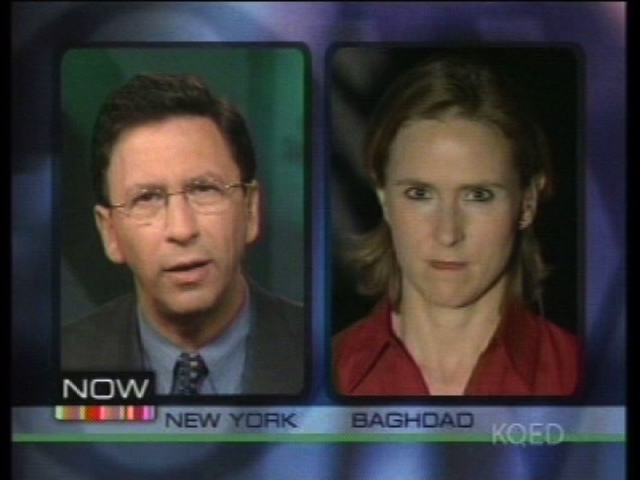
Daily Show - Messopotamia Part 2 (Small - 3 MB)

The Daily Show (The best news on television.)
This is from the August 19, 2003 program.
Daily Show - Messopotamia Part 1 (Small - 7 MB)
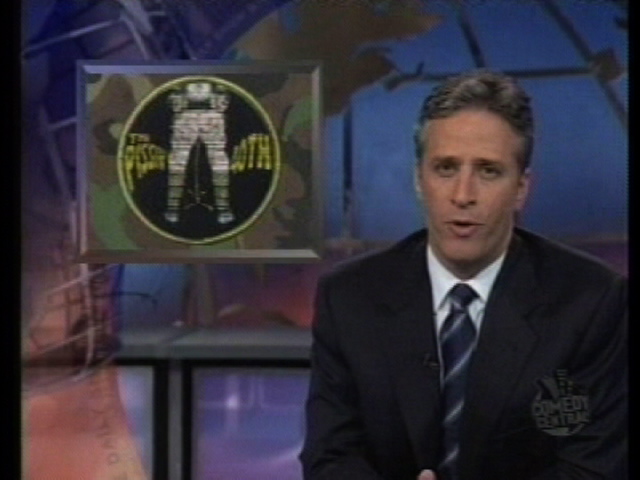
The Daily Show (The best news on television.)
This is from the August 7, 2003 program on KTVU Channel 2 News in San Francisco.
Jessica Lynch Update (Small - 3 MB)
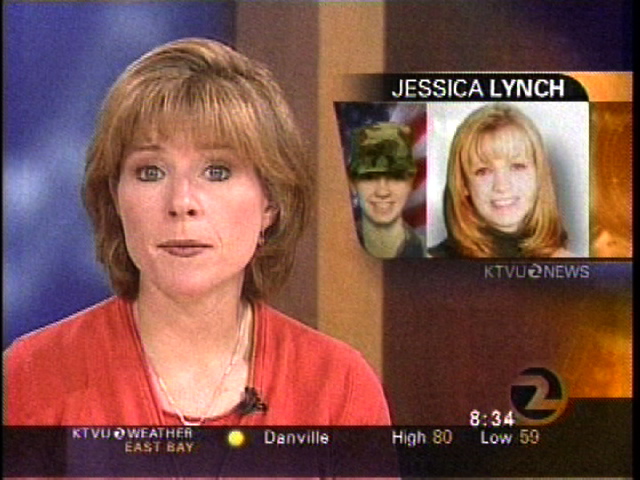
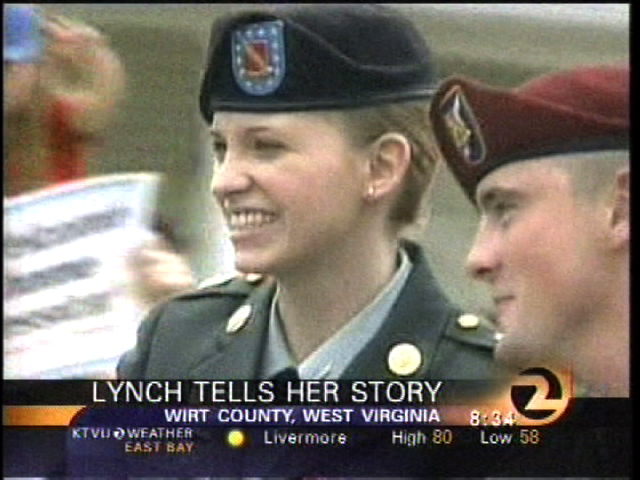
This is from the August 5, 2003 program.
Daily Show On The Search For Saddam (Small - 14 MB)
The Daily Show (The best news on television.)
This is from the July 30, 2003 program.
Saudi Royal Family Demands Missing Pages Be Made Public (Small - 4 MB)
The Daily Show (The best news on television.)
This is from the July 29, 2003 program.
Daily Show Mess O' Potamia Update (Small - 5 MB)
Of interest was the "Organization of Women's Freedom In Iraq," banner (below).
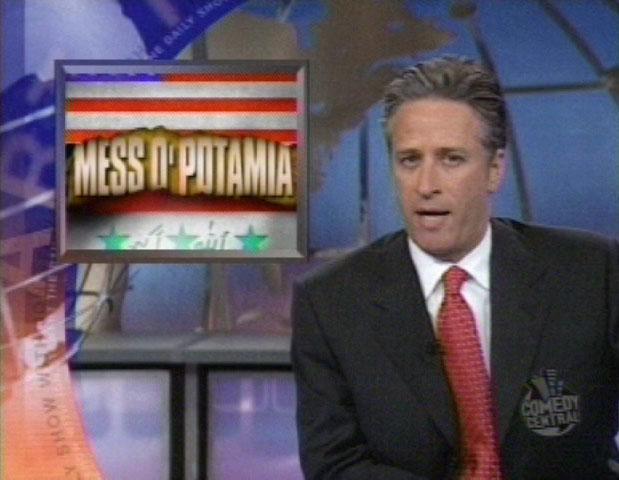
The Daily Show (The best news on television.)
Today is a sad day. It's the day I felt compelled to start a "Revisionist History" category to keep track of articles in major news publications whose words have ben modified from their original printing to alter the meaning substantially -- and without any word about the alterations.
The first time I took note of this was when MSNBC changed their story several times over a five day period regarding the attack on protesters at the West Oakland Docks in April.
Today's posting is from the Washington Post. I'm totally bummed out about this one, because I like the Post and would like to be able to consider it a noteworthy "newspaper of record," as they say. I do respect this newspaper, and I hope that someone over there will step up to the plate to explain to us how this could have happened, and hopefully assure us that it will not happen again.
Here's the "before" story: White House Wants Baker to Head Iraq Reconstruction.
Here's the completely overhauled "after" story: Bush Considers New Overhaul of Postwar Iraq Administration.
Notice that "Staff writer Vernon Loeb contributed to this report" in the original, yet "Staff writers Vernon Loeb and Rajiv Chandrasekaran contributed to this report" of the current version. Perhaps Chandrasekaran did the rewrite?
Here's where the two versions have been compared side by side. (There's a lot of other goodies on that page too.)
So there you have it. I've got a ton of other stuff going up today I've been working on all weekend...but this seemed pretty important.
(Thanks, Kevin)
Here is the full text of the original article (as republished by Truthout Friday morning:
http://www.truthout.org/docs_03/072603E.shtml
White House Wants Baker to Head Iraq Reconstruction
Unresolved Whether Baker or Bremer Would Have Final Word
By Mike Allen and Glenn Kessler
Washington Post
Friday 25 July 2003
The White House hopes to persuade former secretary of state James A. Baker III to take charge of the physical and economic reconstruction of Iraq as part of a broad restructuring of post-war efforts, administration sources said today.
Under the plan, L. Paul Bremer, the chief U.S. administrator in Iraq, would focus on rebuilding the country's political system. The new structure is still in the discussion stages, and a source close to Baker said he has not accepted the job.
The sources said one hurdle is determining whether Baker or Bremer would have the final word, and they said that question is unresolved. The James A. Baker III Institute for Public Policy at Rice University referred questions to Baker's law firm, Baker Botts LLP in Houston. Baker did not immediately return a telephone message seeking comment.
The negotiations reflect a growing realization within the administration that the post-war plan was inadequate and that simple patience, the White House's initial prescription, will not do. Bremer said on NBC's "Meet the Press" on Sunday that progress has been made in restoring services and creating a government, but he said the effort could last for years.
The assignment also would be the latest of a series of high-profile missions that Baker, 73, has undertaken for President Bush and his father. Baker headed Bush's Florida recount effort after the disputed election of 2000. Against his wishes, he agreed to manage President George H.W. Bush's reelection campaign in 1992. Baker was secretary of state in the first Bush administration, and treasury secretary and White House chief of staff under President Ronald Reagan.
Baker is well-known in the Middle East from his travels as secretary of state. Administration officials said he would add stability to a process that has been much more chaotic than the administration had hoped, with U.S. troops continuing to suffer casualties from guerrilla attacks. Baker's stature with foreign governments also could help the administration enlist more help in paying for the reconstruction.
Bremer was part of an earlier overhaul that dismayed some native Iraqi leaders. Bremer, who appeared with Bush on Wednesday as part of a Washington visit, arrived in Baghdad on May 12 to take over for retired Lt. Gen. Jay Garner.
In another augmentation of the post-war structure, the administration plans to name Reuben Jeffrey III as Washington-based coordinator for the Iraq reconstruction effort.
Jeffrey, a former Goldman Sachs investment banker who now is coordinating the federal aid aimed to help reconstruct lower Manhattan, would become the administration's public face for Bremer's operation in Baghdad, including dealing with lawmakers and managing the interagency process. Officials said the White House concluded that, given the distance between Baghdad and Washington, Bremer needed someone senior in Washington who could navigate the bureaucracy and deal with Capitol Hill.
Bush named Jeffrey special adviser for lower Manhattan development in March 2002. Jeffery had worked at Goldman for 18 years, living and working in Paris, London and New York and specializing in the financial services sector. He previously practiced corporate law at Davis Polk & Wardwell in New York.
Here is the new and improved article, not living at the same URL where the above story lived until around 7pm eastern time on friday:
http://www.washingtonpost.com/wp-dyn/articles/A45589-2003Jul25.html/
Bush Considers New Overhaul of Postwar Iraq Administration
White House Aims to Address Concerns as Cost, Casualties Mount
Subscribe to The Post
By Mike Allen and Glenn Kessler
Washington Post Staff Writers
Friday, July 25, 2003; 7:05 PM
President Bush is contemplating the second overhaul in three months of his post-war administration of Iraq, as the White House faces up to the enormity of the task and the need to demonstrate progress to maintain political support for the effort, administration officials said today.
A series of polls has show U.S. voters becoming increasingly impatient at the prospects of large number of troops remaining in Iraq indefinitely, as the cost rises and guerrilla attacks continue inflicting military casualties long past the fall of Saddam Hussein's government.
"We're confident of long-term success," a Bush aide said. "We need to show short-term success."
L. Paul Bremer, the chief U.S. administrator in Iraq, lobbied the Pentagon and Congress for more funds and personnel during a visit to Washington this week, officials said.
As part of an effort to beef up the reconstruction, the White House is considering asking several major figures, including former secretary of state James A. Baker III, to help with specific tasks like seeking funds from other countries or helping restructure Iraq's debt.
"A lot of different things are being discussed," a senior administration official said. "Nothing has happened yet."
A senior official said Bush was very pleased with Bremer and that changes in the post-war administration, known as the coalition provisional authority, would be made only with his support. "This is a Bremer-driven process," the official said.
An aide said Baker is on vacation, and he did not immediately return messages left at his law firm, Baker Botts LLP in Houston. Several administration officials predicted that Baker would not become involved, but said the White House might still seek "a Baker-like figure" to share duties with Bremer.
The discussions reflect a growing realization within the administration that the post-war plan was inadequate and that simple patience, the White House's initial prescription, is not the answer. Bremer, who was saluted by Bush in the Rose Garden on Wednesday, said on NBC's "Meet the Press" on Sunday that progress has been made in restoring services and creating a government. But he said the effort could last for years.
Bremer said privately during his meetings in Washington that the administration might need to appoint a high-level official to focus solely on restructuring Iraq's debt, a senior official said.
In another augmentation of the post-war structure, the administration plans to name Reuben Jeffrey III, a former Goldman Sachs investment banker who is now coordinating the federal aid aimed to help reconstruct lower Manhattan, as Washington-based coordinator for the Iraq reconstruction effort.
One administration official said a division of duties for the administration of Iraq had been contemplated as far back as the contingency planning phases of the war. "We knew it would be difficult, but ground truth has given us a lot more to think about," the official said.
If Bush called on Baker, 73, the assignment also would be the latest of a series of high-profile missions he has undertaken for the Bush family. Baker headed the Republican team during the Florida recount litigation after the disputed election of 2000. Against Baker's wishes, he agreed to manage President George H.W. Bush's reelection campaign in 1992. Baker was secretary of state in the first Bush administration, and treasury secretary and White House chief of staff under President Ronald Reagan.
Baker is well-known in the Middle East from his travels as secretary of state. Administration officials said he would add stability to a process that has been much more chaotic than the administration had hoped. Baker's stature with foreign governments also could help the administration enlist more help in paying for the reconstruction.
Bremer, although he was a career diplomat before becoming a private business consultant, lacks experience in the Arab world. Some administration officials said another figure might be better suited to selling neighboring countries on the U.S. approach to rebuilding Iraq.
Bremer took charge as part of an abrupt overhaul in May that dismayed some native Iraqi leaders. Just a month after U.S. troops ended three decades of Baath Party rule, Bremer was sent to Baghdad to take over for Jay M. Garner, a retired Army lieutenant general who has been in charge of the reconstruction effort.
Jeffrey, who is to become the Washington-based coordinator of the reconstruction effort, will become the administration's public face for the operation in Baghdad, including dealing with lawmakers and managing dealings with other party of the government. Officials said the White House concluded that, given the distance between Baghdad and Washington, Bremer needed someone senior in Washington who could navigate the bureaucracy and deal with Capitol Hill.
Bush named Jeffrey special adviser for lower Manhattan development in March 2002. Jeffery had worked at Goldman for 18 years, living and working in Paris, London and New York and specializing in the financial services sector. He previously practiced corporate law at Davis Polk & Wardwell in New York.
Staff writers Vernon Loeb and Rajiv Chandrasekaran contributed to this report.
Group: Cheney Task Force Eyed on Iraq Oil
By H. Josef Hebert for the Associated Press.
Vice President Dick Cheney's energy task force appeared to have some interest in early 2001 in Iraq's oil industry, including which foreign companies were pursuing business there, according to documents released Friday by a private watchdog group.Judicial Watch, a conservative legal group, obtained a batch of task force-related Commerce Department papers that included a detailed map of Iraq's oil fields, terminals and pipelines as well as a list entitled "Foreign Suitors of Iraqi Oilfield Contracts."
The papers also included a detailed map of oil fields and pipelines in Saudi Arabia and in the United Arab Emirates and a list of oil and gas development projects in those two countries.
The papers were dated early March 2001, about two months before the Cheney energy task force completed and announced its report on the administration's energy needs and future energy agenda.
Judicial Watch obtained the papers as part of a lawsuit by it and the Sierra Club to open to the public information used by the task force in developing President Bush's energy plan.
Here is the full text of the article in case the link goes bad:
http://www.sun-sentinel.com/news/nationworld/politics/wire/sns-ap-iraq-cheney-energy,0,7562329.story
WASHINGTON -- Vice President Dick Cheney's energy task force appeared to have some interest in early 2001 in Iraq's oil industry, including which foreign companies were pursuing business there, according to documents released Friday by a private watchdog group.
Judicial Watch, a conservative legal group, obtained a batch of task force-related Commerce Department papers that included a detailed map of Iraq's oil fields, terminals and pipelines as well as a list entitled "Foreign Suitors of Iraqi Oilfield Contracts."
The papers also included a detailed map of oil fields and pipelines in Saudi Arabia and in the United Arab Emirates and a list of oil and gas development projects in those two countries.
The papers were dated early March 2001, about two months before the Cheney energy task force completed and announced its report on the administration's energy needs and future energy agenda.
Judicial Watch obtained the papers as part of a lawsuit by it and the Sierra Club to open to the public information used by the task force in developing President Bush's energy plan.
Tom Fitton, the group's president, said he had no way to guess what interest the task force had in the information, but "it shows why it is important that we learn what was going on in the task force."
"Opponents of the war are going to point to the documents as evidence that oil was on the minds of the Bush administration in the run-up to the war in Iraq," said Fitton. "Supporters will say they were only evaluating oil reserves in the Mideast, and the likelihood of future oil production."
The task force report was released in May 2001. In it, a chapter titled "Strengthening Global Alliances" calls the Middle East "central to world oil security" and urges support for initiatives by the region's oil producers to open their energy sectors to foreign investment. The chapter does not mention Iraq, which has the world's second largest oil reserves after Saudi Arabia.
Commerce Department spokesman Trevor Francis said: "It is the responsibility of the Commerce Department to serve as a commercial liaison for U.S. companies doing business around the world, including those that develop and utilize energy resources. The Energy Task Force evaluated regions of the world that are vital to global energy supply. The final report, released in May of 2001, contains maps of key energy-producing regions in the world, including Russia, North America, the Middle East and the Caspian region."
A spokeswoman for the vice president did not immediately return a phone call seeking comment Friday.
A two-page document obtained with the map and released by Judicial Watch lists, as of March 2001, companies in 30 countries that had an interest in contracts to help then-President Saddam Hussein develop Iraq's oil wealth.
The involvement of Russia and France has been documented. Also on the list were companies from Canada, Australia, China, Germany, Indonesia, Ireland, India and Mexico. Even Vietnam had interest in a service contract and, according to the paper, was close to signing an agreement in October 1999.
So far nearly 40,000 pages of internal documents from various departments and agencies have been made public related to the Cheney task force's work under the Judicial Watch-Sierra Club lawsuit. The task force itself has refused to turn over any of its own papers.
David Miller has piped up again over on his blog, and it's pretty interesting:
In Washington, The Recession Is Over
DC is booming because this year the federal government is pumping 9% more money into the local economy than it did last year. Welcome to wartime. I suspect most of the money is in the form of consulting contracts for homeland defense and DOD (what exactly does the Department of Defense defend now that we have a separate homeland defense agency?). As a result of this money Washington-area housing prices are up by 20% in a year, making all the middle-aged types euphoric and rich; a townhouse in Arlington worth $200,000 at the beginning of the Bush administration is worth $350-$400,000 now. Traffic is reaching LA levels but the place is, considering how the rest of the country is doing, almost indecently prosperous.The strange part is that no one in DC seems to know that the national economy is stagnant; they assume the recession is ending because it is over in DC. My professional economist friends assumed, until we checked the bls.gov website, that the U.S. and DC unemployment rates were roughly the same. The local paper, the Washington Post, has almost no coverage on the national economy that would change their minds; all the coverage is about local real estate, housing prices, and new defense contracts.
And that leads to a curious disconnect between the capitol and the hinterland. Everyone in DC assumes Bush will win the 2004 election in a walk because the economy is better.
Create a new category:
TITLE: In Washington, The Recession Is Over
CATEGORY: (U.S. domestic?)
Our nation's capitol is undergoing a boom while the rest of the economy languishes. That fills the city with a strangely distorted view of the nation's economy, the nation's mood, and the prospects for the next election (more).
I lived in the Washington area for 19 years and still visit often. Today I'm just back from a week there. Almost everyone in Washington, including two professional economists I know, thinks the economy is "picking up", and that the unemployment rate in DC is roughly at the national average. That was true 18 months ago, but is emphatically not true now.
Today the Washington-area unemployment rate is 3.4 %, roughly full employment, while the rest of the country struggles by with a 6% unemployment rate which stubbornly refuses to fall. Of the more than 300 metropolitan areas in the U.S., DC has the 32nd lowest unemployment rate, and all the places doing better are small towns. The next best showing by a big city is Atlanta, which has an unemployment rate almost 50% higher than DC.
DC is booming because this year the federal government is pumping 9% more money into the local economy than it did last year. Welcome to wartime. I suspect most of the money is in the form of consulting contracts for homeland defense and DOD (what exactly does the Department of Defense defend now that we have a separate homeland defense agency?). As a result of this money Washington-area housing prices are up by 20% in a year, making all the middle-aged types euphoric and rich; a townhouse in Arlington worth $200,000 at the beginning of the Bush administration is worth $350-$400,000 now. Traffic is reaching LA levels but the place is, considering how the rest of the country is doing,almost indecently prosperous.
The strange part is that no one in DC seems to know that the national economy is stagnant; they assume the recession is ending because it is over in DC. My professional economist friends assumed, until we checked the bls.gov website, that the U.S. and DC unemployment rates were roughly the same. The local paper, the Washington Post, has almost no coverage on the national economy that would change their minds; all the coverage is about local real estate, housing prices, and new defense contracts.
And that leads to a curious disconnect between the capitol and the hinterland. Everyone in DC assumes Bush will win the 2004 election in a walk because the economy is better. The local Democrats are in a panic. Maybe that's why Dean is doing so well; he lives in a place with no jobs and a recession.
Last week the government unveiled the national "do not call"list; just go to donotcall.gov, sign up, and most of those annoying dinner-time calls trying to sell you a condo will stop. More than 500,000 people tried to sign up the first day. Everyone in DC was shocked; this was more than four times what they had expected. The government hurriedly quadrupled the number of computers handling the requests. Why were they so surprised? Well, I have a hint for you. My friends in the rich inner suburbs of Washington don't seem to get these calls. The cold-callers aren't fools; annoy the rest of the country at dinner, but not the people who make the decisions. In Washington cold-calls at dinner simply weren't much of a problem.
Come election time the press and the permanent, prosperous governing class in Washington might just be in for a big surprise if the economy doesn't pick up in places where the voters live and begin to match the rosy world where the opinion-makers live.
Here is the full text of the entire article in case the link goes bad:
http://www.inourworld.com/archives/001552.html
Our nation's capitol is undergoing a boom while the rest of the economy languishes. That fills the city with a strangely distorted view of the nation's economy, the nation's mood, and the prospects for the next election.
I lived in the Washington area for 19 years and still visit often. Today I'm just back from a week there. Almost everyone in Washington, including two professional economists I know, thinks the economy is "picking up", and that the unemployment rate in DC is roughly at the national average. That was true 18 months ago, but is emphatically not true now.
Today the Washington-area unemployment rate is 3.4 %, roughly full employment, while the rest of the country struggles by with a 6% unemployment rate which stubbornly refuses to fall. Of the more than 300 metropolitan areas in the U.S., DC has the 32nd lowest unemployment rate, and all the places doing better are small towns. The next best showing by a big city is Atlanta, which has an unemployment rate almost 50% higher than DC.
DC is booming because this year the federal government is pumping 9% more money into the local economy than it did last year. Welcome to wartime. I suspect most of the money is in the form of consulting contracts for homeland defense and DOD (what exactly does the Department of Defense defend now that we have a separate homeland defense agency?). As a result of this money Washington-area housing prices are up by 20% in a year, making all the middle-aged types euphoric and rich; a townhouse in Arlington worth $200,000 at the beginning of the Bush administration is worth $350-$400,000 now. Traffic is reaching LA levels but the place is, considering how the rest of the country is doing, almost indecently prosperous.
The strange part is that no one in DC seems to know that the national economy is stagnant; they assume the recession is ending because it is over in DC. My professional economist friends assumed, until we checked the bls.gov website, that the U.S. and DC unemployment rates were roughly the same. The local paper, the Washington Post, has almost no coverage on the national economy that would change their minds; all the coverage is about local real estate, housing prices, and new defense contracts.
And that leads to a curious disconnect between the capitol and the hinterland. Everyone in DC assumes Bush will win the 2004 election in a walk because the economy is better. The local Democrats are in a panic. Maybe that's why Dean is doing so well; he lives in a place with no jobs and a recession.
Last week the government unveiled the national "do not call"list; just go to donotcall.gov, sign up, and most of those annoying dinner-time calls trying to sell you a condo will stop. More than 500,000 people tried to sign up the first day. Everyone in DC was shocked; this was more than four times what they had expected. The government hurriedly quadrupled the number of computers handling the requests. Why were they so surprised? Well, I have a hint for you. My friends in the rich inner suburbs of Washington don't seem to get these calls. The cold-callers aren't fools; annoy the rest of the country at dinner, but not the people who make the decisions. In Washington cold-calls at dinner simply weren't much of a problem.
Come election time the press and the permanent, prosperous governing class in Washington might just be in for a big surprise if the economy doesn't pick up in places where the voters live and begin to match the rosy world where the opinion-makers live.
Pentagon may punish GIs who spoke out on TV
By Robert Collier for SF Gate.
But going public isn't always easy, as soldiers of the Army's Second Brigade, Third Infantry Division found out after "Good Morning America" aired their complaints.The brigade's soldiers received word this week from the Pentagon that it was extending their stay, with a vague promise to send them home by September if the security situation allows. They've been away from home since September, and this week's announcement was the third time their mission has been extended.
It was bad news for the division's 12,000 homesick soldiers, who were at the forefront of the force that overthrew Saddam Hussein's government and moved into Baghdad in early April.
On Wednesday morning, when the ABC news show reported from Fallujah, where the division is based, the troops gave the reporters an earful. One soldier said he felt like he'd been "kicked in the guts, slapped in the face." Another demanded that Defense Secretary Donald Rumsfeld quit.
The retaliation from Washington was swift.
CAREERS OVER FOR SOME
"It was the end of the world," said one officer Thursday. "It went all the way up to President Bush and back down again on top of us. At least six of us here will lose our careers."...
"Our morale is not high or even low," the letter said. "Our morale is nonexistent. We have been told twice that we were going home, and twice we have received a 'stop' movement to stay in Iraq."...
Yet several U.S. officers said privately that troop morale is indeed low. "The problem is not the heat," said one high-ranking officer. "Soldiers get used to that. The problem is getting orders to go home, so your wife gets all psyched about it, then getting them reversed, and then having the same process two more times."
In Baghdad, average soldiers from other Army brigades are eager to spill similar complaints.
"I'm not sure people in Washington really know what it's like here," said Corp. Todd Burchard as he stood on a street corner, sweating profusely and looking bored. "We'll keep doing our jobs as best as anyone can, but we shouldn't have to still be here in the first place."
Nearby, Pfc. Jason Ring stood next to his Humvee. "We liberated Iraq. Now the people here don't want us here, and guess what? We don't want to be here either," he said. "So why are we still here? Why don't they bring us home?"
Here is the full text of the article in case the link goes bad:
http://sfgate.com/cgi-bin/article.cgi?f=/c/a/2003/07/18/MN248299.DTL
Pentagon may punish GIs who spoke out on TV
Robert Collier, Chronicle Staff Writer Friday, July 18, 2003
Fallujah, Iraq -- Morale is dipping pretty low among U.S. soldiers as they stew in Iraq's broiling heat, get shot at by an increasingly hostile population and get repeated orders to extend their tours of duty.
Ask any grunt standing guard on a 115-degree day what he or she thinks of the open-ended Iraq occupation, and you'll get an earful of colorful complaints.
But going public isn't always easy, as soldiers of the Army's Second Brigade, Third Infantry Division found out after "Good Morning America" aired their complaints.
The brigade's soldiers received word this week from the Pentagon that it was extending their stay, with a vague promise to send them home by September if the security situation allows. They've been away from home since September, and this week's announcement was the third time their mission has been extended.
It was bad news for the division's 12,000 homesick soldiers, who were at the forefront of the force that overthrew Saddam Hussein's government and moved into Baghdad in early April.
On Wednesday morning, when the ABC news show reported from Fallujah, where the division is based, the troops gave the reporters an earful. One soldier said he felt like he'd been "kicked in the guts, slapped in the face." Another demanded that Defense Secretary Donald Rumsfeld quit.
The retaliation from Washington was swift.
CAREERS OVER FOR SOME
"It was the end of the world," said one officer Thursday. "It went all the way up to President Bush and back down again on top of us. At least six of us here will lose our careers."
First lesson for the troops, it seemed: Don't ever talk to the media "on the record" -- that is, with your name attached -- unless you're giving the sort of chin-forward, everything's-great message the Pentagon loves to hear.
Only two days before the ABC show, similarly bitter sentiments -- with no names attached -- were voiced in an anonymous e-mail circulating around the Internet, allegedly from "the soldiers of the Second Brigade, Third ID."
"Our morale is not high or even low," the letter said. "Our morale is nonexistent. We have been told twice that we were going home, and twice we have received a 'stop' movement to stay in Iraq."
The message, whose authenticity could not be confirmed, concluded: "Our men and women deserve to be treated like the heroes they are, not like farm animals. Our men and women deserve to see their loved ones again and deserve to come home."
After this one-two punch, it was perhaps natural that on Thursday, the same troops and officers who had been garrulous and outspoken in previous visits were quiet, and most declined to speak on the record. During a visit to Fallujah, a small city about 30 miles west of Baghdad, military officials expressed intense chagrin about the bad publicity. And they slammed the ABC reporters for focusing on the soldiers' criticism of Rumsfeld, Bush and other officials and implying that they are unwilling to carry out their mission.
COMPLAINTS CALLED ROUTINE
"Soldiers have bitched since the beginning of time," said Capt. James Brownlee, the public affairs officer for the Second Brigade. "That's part of being a soldier. They bitch. But what does 'bad morale' really mean? That they're not combat-ready or loyal? Nobody here fits that definition."
The nervousness of the brass has a venerable history. It has long been a practice in American democracy that the military do not criticize the nation's civilian leaders, as Gen. Douglas MacArthur found out in 1951, when he criticized President Harry Truman's Korean War strategy -- and was promptly fired.
Yet several U.S. officers said privately that troop morale is indeed low. "The problem is not the heat," said one high-ranking officer. "Soldiers get used to that. The problem is getting orders to go home, so your wife gets all psyched about it, then getting them reversed, and then having the same process two more times."
In Baghdad, average soldiers from other Army brigades are eager to spill similar complaints.
"I'm not sure people in Washington really know what it's like here," said Corp. Todd Burchard as he stood on a street corner, sweating profusely and looking bored. "We'll keep doing our jobs as best as anyone can, but we shouldn't have to still be here in the first place."
Nearby, Pfc. Jason Ring stood next to his Humvee. "We liberated Iraq. Now the people here don't want us here, and guess what? We don't want to be here either," he said. "So why are we still here? Why don't they bring us home?"
E-mail Robert Collier at rcollier@sfchronicle.com.
Squandering Capital
By Madeleine K. Albright for the Washington Post.
(Madeleine K. Albright was secretary of state from 1997 to 2001.)
Three years ago, America had vast diplomatic capital based on the goodwill we enjoyed around the world, and vast financial capital based on our international economic leadership and a record budget surplus. Now our capital of all kinds has been dissipated and we are left with more intractable dilemmas than resources or friends.As someone who has served in positions of responsibility, I know it is much harder to devise practical solutions from the inside than to offer theoretical solutions from the outside. The nature of today's world, not the Bush administration, is responsible for the majority of problems we face. I would be less concerned, however, if I thought the administration was learning as it went along -- learning how to attract broader international support for its policies, make better use of neglected diplomatic tools, share responsibility, be more careful with the truth, finish what it starts and devise economic policies consonant with America's global role.
The quickest way to a more effective national security policy is to acknowledge the need for improvement; until that happens, we will continue to slide backward toward ever more dangerous ground.
Here is the full text of the article in case the link goes bad:
http://www.washingtonpost.com/wp-dyn/articles/A14021-2003Jul18.html
Squandering Capital
By Madeleine K. Albright
Sunday, July 20, 2003; Page B07
Now would not be a bad time to start worrying. Tens of thousands of American troops will be in Iraq, perhaps for years, surrounded by Iraqis with guns. Defense Secretary Donald Rumsfeld says this is not a quagmire; I pray he is right. But the practical problems faced by the talented American administrator, L. Paul Bremer, and by U.S. soldiers trying to maintain order without a clear way of separating enemies from friends are daunting.
It would help greatly if we had more assistance from the international community, but in fairness, the war was an Anglo-American production; it's unlikely we will get substantial help without yielding significant authority, something the administration is loath to do. Meanwhile, U.S. credibility has been undermined by the failure to find weapons of mass destruction and by the inclusion of dubious information in the president's State of the Union address.
Among other things, the war in Iraq was supposed to reduce the dangers posed by al Qaeda terrorists and prompt resumed progress toward peace in the Middle East.
Time will tell whether the former was achieved, but reports of a rush of new al Qaeda recruits are not encouraging. As for the latter, Palestinian Prime Minister Mahmoud Abbas has indeed made progress in negotiations -- with Chairman Yasser Arafat. Despite a welcome cooling in rhetoric and upcoming visits to Washington by Israeli and Palestinian leaders, the Middle East road map has yet to be unfolded.
In the Far East, the North Koreans may be building nuclear weapons or may not; we don't know. They could have a half-dozen by the end of the year. If the administration has a strategy for responding, it is not telling, but it seems to be relying on China to pressure North Korea effectively. Relying simply on China? As I say, it is a worrisome time.
Overall, the outlook for preventing the spread of potentially destabilizing weapons systems is bleak. The administration, openly allergic to treaties and arms control, has made no effort to promote restraint in developing arms as a normative ethic to which all nations have an interest in adhering. Instead, it has decided to fight proliferation primarily through military means and threats. Is this adequate?
Adm. Lowell Jacoby, director of the Defense Intelligence Agency, testified recently that "new alliances" are pooling resources "to deter or offset U.S. military superiority." Globalization has made the technology and resources necessary to develop sophisticated weapons more widely available. "Some 25 countries," Jacoby warns, "possess or are actively pursuing WMD or missile programs. The threat to U.S. and allied interests will grow during the next decade."
While in Africa this month, the president raised expectations that the United States will help stabilize Liberia, a noble mission that would help repair the administration's thoroughly battered image overseas. At the same time, there is a risk that the Pentagon -- already stretched thin -- will try to get by in Liberia on the cheap, investing American prestige but insufficient clout. We have seen this movie before -- in Somalia. If we do go into Liberia, we must be prepared to do the job right.
I am an optimist with immense faith in the ability of U.S. leadership to mobilize world opinion on behalf of democracy, justice and peace.
Leadership is not possible, however, without resources. It takes money to secure borders, defeat terrorists, safeguard nuclear materials, build democratic institutions, create educational systems in which tolerance is valued, and help nations recover from conflict. So when I see that the combined federal budget deficit this year and next will approach $1 trillion, I have to wonder. The president has made a lot of promises about "draining the swamp" in which terrorists thrive, combating AIDS, promoting development and meeting commitments to nations such as Afghanistan, Iraq and Liberia. Will the White House and Congress be able to meet those commitments when police, firefighters and schoolteachers must be laid off at home on account of budget cutbacks? If we do renege on the president's promises, what further damage to U.S. credibility will result?
Three years ago, America had vast diplomatic capital based on the goodwill we enjoyed around the world, and vast financial capital based on our international economic leadership and a record budget surplus. Now our capital of all kinds has been dissipated and we are left with more intractable dilemmas than resources or friends.
As someone who has served in positions of responsibility, I know it is much harder to devise practical solutions from the inside than to offer theoretical solutions from the outside. The nature of today's world, not the Bush administration, is responsible for the majority of problems we face. I would be less concerned, however, if I thought the administration was learning as it went along -- learning how to attract broader international support for its policies, make better use of neglected diplomatic tools, share responsibility, be more careful with the truth, finish what it starts and devise economic policies consonant with America's global role.
The quickest way to a more effective national security policy is to acknowledge the need for improvement; until that happens, we will continue to slide backward toward ever more dangerous ground.
The writer was secretary of state from 1997 to 2001.
CBS News has created a nice little round up of news information about the various horrible situations going on in Iraq and abroad.
Makes me wonder what CBS news has been like on TV lately. Looks like I'll have to start checking out "Face The Nation."
More Death In Baghdad
By the staff of CBS News.
Documents from Vice President Dick Cheney's 2001 energy task force include a map of Iraq's oilfields and a list of international oil companies labeled "foreign suitors for Iraqi oilfield contracts." The panel also had similar maps and lists for other oil-producing states. Their purpose to the task force was unclear. The documents were obtained by Judicial Watch, a nonprofit group suing to force the release of task force documents.
Saddam is believed to be alive and probably hiding in Iraq, but is not orchestrating the daily attacks on American troops, says L. Paul Bremer, the top U.S. administrator in the occupied country.Bremer said Americans should prepare for a long stay in Iraq.
"It's clear that, given the size of the task, we're going to be there for a while," he said Sunday on NBC. "I don't know how many years."
A Pentagon advisory panel suggested last week that coalition troops will need to remain in Iraq for at least two to five years to back up fledgling, postwar Iraqi police and military organizations.
Here is the full text of the article in case the link goes bad:
http://www.cbsnews.com/stories/2003/02/24/iraq/main541815.shtml
More Death In Baghdad
BAGHDAD, Iraq, July 21, 2003
Sgt. Luis R. Pinto, left, breaks down at a memorial service for Spc. Joel Bertoldie, at the U.S. Army base in Habbaniya, Iraq. On the right is Spc. Jeremy Brannon. (Photo: AP)
"The sooner we can either kill him or capture him, the better … "
L. Paul Bremer, U.S. civil administrator, on Saddam Hussein
U.S. Marines of the 1st Brigade, 7th Regiment, block protesters Sunday, July 20, 2003, marching on the U.S. headquarters in the Muslim holy city of Najaf, 100 miles south of Baghdad, Iraq. (Photo: AP)
(CBS/AP) Violence claimed new victims in Iraq Monday as further questions surfaced about what prewar intelligence said about the threat posed by Saddam Hussein.
A U.S. soldier and his Iraqi interpreter were killed in a grenade and gun attack in north Baghdad, bringing to 152 the number of U.S. troops killed in action since the March 20 start of war — five more than during the 1991 Gulf War.
Two American soldiers and an Iraqi employee of a U.N.-affiliated relief agency were killed Sunday. The soldiers died in an ambush by attackers using rocket-propelled grenades and small arms near Tal Afar, a town west of the northern city of Mosul.
Meanwhile, the new chief of American and allied forces in Iraq, Gen. John Abizaid, announced plans to create a nearly 7,000-strong force of Iraqis to work with U.S. soldiers. Trained by U.S. forces, they are expected to be ready to begin operating within 45 days, he said.
In other developments:
# Portions of an October intelligence report released by the White House on Friday suggests analysts felt that Saddam would consider an alliance with al Qaeda or terrorist attacks on the United States only if his power were threatened.
# The British weapons adviser who killed himself last week was the source for a report claiming Prime minister Tony Blair's office had overhyped intelligence on Iraq, says the BBC. Now the news network faces question over the accuracy of its story, as Blair faces blame for his government "outing" the dead man.
# Forensic teams are en route to a new mass grave, discovered by the
The 101st Airborne near the village of Al Hatra last week that may contain 4,000-5,000 bodies. Many are women and children who appear to have been shot in their heads.
# Documents from Vice President Dick Cheney's 2001 energy task force include a map of Iraq's oilfields and a list of international oil companies labeled "foreign suitors for Iraqi oilfield contracts." The panel also had similar maps and lists for other oil-producing states. Their purpose to the task force was unclear. The documents were obtained by Judicial Watch, a nonprofit group suing to force the release of task force documents.
# Military officials say if international forces are ready to take over their areas of responsibility as expected, all 18,000 Marines in Iraq could be out of the country by September 1st.
# Saddam is believed to be alive and probably hiding in Iraq, but is not orchestrating the daily attacks on American troops, says L. Paul Bremer, the top U.S. administrator in the occupied country.
Bremer said Americans should prepare for a long stay in Iraq.
"It's clear that, given the size of the task, we're going to be there for a while," he said Sunday on NBC. "I don't know how many years."
A Pentagon advisory panel suggested last week that coalition troops will need to remain in Iraq for at least two to five years to back up fledgling, postwar Iraqi police and military organizations.
While acknowledging an ongoing security problem, Bremer told CBS News Face the Nation it is limited to a small part of Iraq. "Most of the country is quiet," he said.
Bremer said there's no evidence of any central control in the hit-and-run attacks. Instead, the former diplomat blamed a small group of well-trained killers, "who are basically trying to hold back the tide of history in Iraq."
Still, he said, running Saddam into the ground would ease the situation.
"The sooner we can either kill him or capture him, the better, because the fact that his fate is unknown certainly gives his supporters the chance to go around and try to rally support for him," said Bremer.
But a top Democratic lawmaker said Saddam's reach may be much wider than U.S. officials have indicated.
"He's still alive and he controls that country," Sen. Jay Rockefeller of West Virginia, vice chairman of the Senate Intelligence Committee, said on Fox.
"Not through popularity, but through fear of retribution. I mean, I just came back from the place and people won't talk to you.…He's a big factor there," said Rockefeller.
The area of Sunday's convoy attack near Tal Afar, 240 miles northwest of Baghdad, had been relatively peaceful in recent weeks, and the ambush was a worrying development for American forces trying to bring stability to Iraq.
Most recent violence has occurred in an area north and west of Baghdad called the Sunni triangle, where some support for Saddam remains. Tal Afar lies outside that region.
In other violence Sunday, a two-car convoy carrying members of the International Organization for Migration was ambushed near the southern city of Hilla when a pickup truck drove alongside one car and opened fire. The car collided with a bus, and an Iraqi driver died.
To the south, in the holy city of Najaf, thousands of followers of Shiite Muslim cleric Muqtada al-Sadr marched six miles from the Imam Ali shrine to U.S. headquarters in the region, shouting slogans against the Governing Council and the Americans.
"Long live al-Sadr. America and the Council are infidels," chanted the crowds.
U.S. troops prevented the demonstrators from entering the headquarters and soldiers barricaded the building with Humvees. The crowd, some throwing rocks, dispersed after clerics read out an appeal by al-Sadr to go home.
Earlier, al-Sadr said in a statement read inside the shrine that he wanted coalition forces to leave Najaf. In his Friday sermon, the cleric said he was recruiting a private army but fell short of calling for armed struggle against the U.S. occupation.
This is why I keep archives guys.
Here's the original link: "Rescued POW put up fierce fight" -- as blogged previously.
Jessica Lynch, rescued Tuesday from an Iraqi hospital, fought fiercely and shot several enemy soldiers after Iraqi forces ambushed the Army’s 507th Ordnance Maintenance Company, firing her weapon until she ran out of ammunition, U.S. officials said yesterday.LYNCH, A 19-YEAR-OLD supply clerk, continued firing at the Iraqis even after she sustained multiple gunshot wounds and watched several other soldiers in her unit die around her in fighting March 23, one official said.
"Bring 'Em On?"
A Former Special Forces Soldier Responds to Bush's Invitation for Iraqis to Attack US Troops
By By Stan Goff for Counterpunch.
Yesterday, when I read that US Commander-in-Chief George W. Bush, in a moment of blustering arm-chair machismo, sent a message to the 'non-existent' Iraqi guerrillas to "bring 'em on," the first image in my mind was a 20-year-old soldier in an ever-more-fragile marriage, who'd been away from home for 8 months. He participated in the initial invasion, and was told he'd be home for the 4th of July. He has a newfound familiarity with corpses, and everything he thought he knew last year is now under revision. He is sent out into the streets of Fallujah (or some other city), where he has already been shot at once or twice with automatic weapons or an RPG, and his nerves are raw. He is wearing Kevlar and ceramic body armor, a Kevlar helmet, a load carrying harness with ammunition, grenades, flex-cuffs, first-aid gear, water, and assorted other paraphernalia. His weapon weighs seven pounds, ten with a double magazine. His boots are bloused, and his long-sleeve shirt is buttoned at the wrist. It is between 100-110 degrees Fahrenheit at midday. He's been eating MRE's three times a day, when he has an appetite in this heat, and even his urine is beginning to smell like preservatives. Mosquitoes and sand flies plague him in the evenings, and he probably pulls a guard shift every night, never sleeping straight through. He and his comrades are beginning to get on each others' nerves. The rumors of 'going-home, not-going-home' are keeping him on an emotional roller coaster. Directives from on high are contradictory, confusing, and often stupid. The whole population seems hostile to him and he is developing a deep animosity for Iraq and all its people--as well as for official narratives.
Here is the full text of the article in case the link goes bad:
http://www.counterpunch.org/goff07032003.html
"Bring 'Em On?"
By Stan Goff
Counterpunch
Thursday 03 July 2003
A Former Special Forces Soldier Responds to Bush's Invitation for Iraqis to Attack US Troops
In 1970, when I arrived at my unit, Company A, 4th Battalion/503rd Infantry, 173rd Airborne Brigade, in what was then the Republic of Vietnam, I was charged up for a fight. I believed that if we didn't stop the communists in Vietnam, we'd eventually be fighting this global conspiracy in the streets of Hot Springs, Arkansas. I'd been toughened by Basic Training, Infantry Training and Parachute Training, taught how to use my weapons and equipment, and I was confident in my ability to vanquish the skinny unter-menschen. So I was dismayed when one of my new colleagues--a veteran who'd been there ten months--told me, "We are losing this war."
Not only that, he said, if I wanted to survive for my one year there, I had to understand one very basic thing. All Vietnamese were the enemy, and for us, the grunts on the ground, this was a race war. Within one month, it was apparent that everything he told me was true, and that every reason that was being given to the American public for the war was not true.
We had a battalion commander whom I never saw. He would fly over in a Loach helicopter and give cavalier instructions to do things like "take your unit 13 kilometers to the north." In the Central Highlands, 13 kilometers is something we had to hack out with machetes, in 98-degree heat, carrying sometimes 90 pounds over our body weights, over steep, slippery terrain. The battalion commander never picked up a machete as far as we knew, and after these directives he'd fly back to an air-conditioned headquarters in LZ English near Bong-son. We often fantasized together about shooting his helicopter down as a way of relieving our deep resentment against this faceless, starched and spit-shined despot.
Yesterday, when I read that US Commander-in-Chief George W. Bush, in a moment of blustering arm-chair machismo, sent a message to the 'non-existent' Iraqi guerrillas to "bring 'em on," the first image in my mind was a 20-year-old soldier in an ever-more-fragile marriage, who'd been away from home for 8 months. He participated in the initial invasion, and was told he'd be home for the 4th of July. He has a newfound familiarity with corpses, and everything he thought he knew last year is now under revision. He is sent out into the streets of Fallujah (or some other city), where he has already been shot at once or twice with automatic weapons or an RPG, and his nerves are raw. He is wearing Kevlar and ceramic body armor, a Kevlar helmet, a load carrying harness with ammunition, grenades, flex-cuffs, first-aid gear, water, and assorted other paraphernalia. His weapon weighs seven pounds, ten with a double magazine. His boots are bloused, and his long-sleeve shirt is buttoned at the wrist. It is between 100-110 degrees Fahrenheit at midday. He's been eating MRE's three times a day, when he has an appetite in this heat, and even his urine is beginning to smell like preservatives. Mosquitoes and sand flies plague him in the evenings, and he probably pulls a guard shift every night, never sleeping straight through. He and his comrades are beginning to get on each others' nerves. The rumors of 'going-home, not-going-home' are keeping him on an emotional roller coaster. Directives from on high are contradictory, confusing, and often stupid. The whole population seems hostile to him and he is developing a deep animosity for Iraq and all its people--as well as for official narratives.
This is the lad who will hear from someone that George W. Bush, dressed in a suit with a belly full of rich food, just hurled a manly taunt from a 72-degree studio at the 'non-existent' Iraqi resistance.
This de facto president is finally seeing his poll numbers fall. Even chauvinist paranoia has a half-life, it seems. His legitimacy is being eroded as even the mainstream press has discovered now that the pretext for the war was a lie. It may have been control over the oil, after all. Anti-war forces are regrouping as an anti-occupation movement. Now, exercising his one true talent--blundering--George W. Bush has begun the improbable process of alienating the very troops upon whom he depends to carry out the neo-con ambition of restructuring the world by arms.
Somewhere in Balad, or Fallujah, or Baghdad, there is a soldier telling a new replacement, "We are losing this war."
-------
Stan Goff is the author of "Hideous Dream: A Soldier's Memoir of the US Invasion of Haiti" (Soft Skull Press, 2000) and of the upcoming book "Full Spectrum Disorder" (Soft Skull Press, 2003). He retired in 1996 from the US Army, from 3rd Special Forces. He lives in Raleigh. He can be reached at: stan@ncwarn.org.
Did the Shrub actually dare the Iraqi Militants "To Come And Get Our Troops?"
No, not quite. He only said "Bring them on."
But it's still pretty tasteless and inappropriate if you ask me. (Not that anyone did.)
It's bad enough that we rushed over there without properly training our troops in how do deal with post-battle civil matters in urban areas.
It's even worse that, two months after we tell them the hard part's over and promise to send them home to their families, it turns out that we're actually going to send even more of our boys and girls over there (and without telling us why it's necessary exactly - or who we're even fighting).
But that's not all folks! On top of everything else, our "President" and Commander in Chief has pridefully encouraged this latest nameless, faceless enemy to give us the best they got.
Is this the new Rambo movie? Nope. This is reality, folks. This is the United States of American in the year 2003.
Let's make this next year the last for the Shrub Regime. For GW, Jeb, or any other relatives of theirs we haven't heard about yet that they might be saving for future elections.
Bush Taking Heat for 'Bring Them On' Remark
By Steve Holland for Reuters.
President Bush has used colorful language before to great effect, but he is taking some heat for his "Bring them on" challenge to Iraqi militants attacking U.S. forces, who he said were tough enough to take it.Even some aides winced at Bush's words, which Democrats pounced on as an invitation to Iraqi militants to fire on U.S. troops already the subject of hit-and-run attacks by Saddam Hussein loyalists and others.
"These men and women are risking their lives every day, and the president who sent them on this mission showed tremendous insensitivity to the dangers they face," said Democratic presidential candidate Howard Dean.
Another Democratic presidential candidate, Massachusetts Sen. John Kerry, said condemned the comment, saying, "The deteriorating situation in Iraq requires less swagger and more thoughtfulness and statesmanship."
Here is the full text of the article in case the link goes bad (Hmmm. It already has.):
http://story.news.yahoo.com/news?tmpl=story&u=/nm/20030703/pl_nm/iraq_bush_dc
Bush Taking Heat for 'Bring Them On' Remark
By Steve Holland
Reuters
Thursday 03 July 2003
President Bush has used colorful language before to great effect, but he is taking some heat for his "Bring them on" challenge to Iraqi militants attacking U.S. forces, who he said were tough enough to take it.
Even some aides winced at Bush's words, which Democrats pounced on as an invitation to Iraqi militants to fire on U.S. troops already the subject of hit-and-run attacks by Saddam Hussein loyalists and others.
"These men and women are risking their lives every day, and the president who sent them on this mission showed tremendous insensitivity to the dangers they face," said Democratic presidential candidate Howard Dean.
Another Democratic presidential candidate, Massachusetts Sen. John Kerry, said condemned the comment, saying, "The deteriorating situation in Iraq requires less swagger and more thoughtfulness and statesmanship."
White House spokesman Ari Fleischer dismissed the criticism and said Bush viewed his comment as a way to express confidence in U.S. troops.
"I think the men and women of the military are appreciative of the fact that they know they have a president who supports them as strongly as he does, and who has as much faith in their ability to complete the mission, despite some of the second-guessing that this president has," Fleischer said.
Bush, a proud Texan with a penchant for plain talk, told reporters on Wednesday: "There are some who feel like that conditions are such that they can attack us there. My answer is: Bring them on. We have the force necessary to deal with the situation."
'Dead or Alive'
In the days after the Sept. 11, 2001, attacks he said the United States wanted al Qaeda leader Osama bin Laden "dead or alive" and vowed to "smoke" them out of their holes.
University of Texas political scientist Bruce Buchanan, a longtime Bush watcher, said Bush uses such language when under strain, and that he is likely feeling the heat of criticism about the lagging post-war effort in Iraq.
He called the remark an unfortunate choice of words because it sounded belligerent.
"I think that when he feels up against it, as he did at the time of the 9/11 attacks, or when he does when coming under criticism now, he has a tendency to strike back verbally, and I think that's what you're seeing there. He's not choosing his words diplomatically at those moments because he's not feeling particularly diplomatic," Buchanan said.
At least 25 U.S. and six British troops have been killed by hostile fire since Bush declared major combat in Iraq to be over on May 1.
Brookings Institution presidential scholar Stephen Hess said many Americans like what they hear from the president, calling his words reminiscent of his defiant stance against the Sept. 11, 2001 attacks when he stood in the rubble of the World Trade Center towers and vowed to fight back.
"My observation is he's saying exactly what the American people want him to say, and saying it even in a way that they would want him to say it," Hess said.
He added: "Obviously we're going into a presidential election era and one expects the opposition to oppose. That's their job. But the sort of response that somehow he was inviting the enemy to attack us I think is more than a stretch."
That's right! Not only is nobody going home, but were actually going to send more troops over there.
At least they're admitting now that these guys might be a formidable enemy after all, calling them "well-trained militants that have been killing and injuring US forces."
Unfortunately, that just means that more of our soldiers will die.
Bush foresees long, 'massive' role in Iraq
By Dana Milbank for The Boston Globe.
President Bush acknowledged yesterday that the United States faces a ''massive and long-term undertaking'' in Iraq but said US troops would prevail over what his administration described as well-trained militants that have been killing and injuring US forces.Bush delivered his statement of resolve, some of his most extensive remarks about Iraq in the two months since he declared heavy fighting was over, as Americans are expressing concern about the unrest in US-occupied Iraq and as some legislators are accusing the administration of understating the task ahead...
Bush cast the struggle in Iraq as part of the ongoing war against terrorism in Afghanistan, Saudi Arabia, and elsewhere. He said that some of those attacking US forces in Iraq were from the terrorist group Ansar al-Islam and that the US government suspects fighters tied to Abu Musab Zarqawi, whom Bush called an Al Qaeda ''associate,'' are preparing to attack. ''Less than two years ago, determined enemies of America entered our country, committed acts of murder against our people, and made clear their intentions to strike again'' he said. ''As long as terrorists and their allies plot to harm America, America is at war.''
As part of the justification for the war in Iraq, Bush and his lieutenants described ongoing ties between Iraq and Al Qaeda. But a still-classified national intelligence report from that time raised doubts about those ties, intelligence officials have said.
According to a poll released yesterday by the University of Maryland's Program on International Policy Attitudes, 71 percent said they believed the Bush administration implied that Hussein was involved in the terrorist attacks of Sept. 11, 2001, while 25 percent believed Iraq was directly involved in the attacks...
Of the 195 US military personnel killed in combat and accidents since the Iraq war started on March 20 (42 British soldiers have been killed), nearly a third have died after May 1, when Bush, aboard the USS Abraham Lincoln aircraft carrier, declared major combat operations were over.
The messiness of postwar Iraq had provoked criticism that the administration did not adequately prepare for the difficult task of rebuilding. Before the war, Bush spoke optimistically about a clean transformation of Iraq, saying US troops would not remain in the region ''for one day longer than is necessary.''
Senator Richard G. Lugar, Republican of Indiana and chairman of the Senate Foreign Relations Committee, said last week that the US presence in Iraq would be necessary for ''at least five years'' and criticized Bush's rhetoric. ''This idea that we will be in just as long as we need to and not a day more - we've got to get over that rhetoric,'' he said. ''It is rubbish. We're going to be there a long time. We must reorganize our military to be there a long time.''
The administration, which declines to forecast the duration of the US presence in Iraq, is due to decide later this month whether it needs more troops there. Bush's press secretary, Ari Fleischer, yesterday played down the attacks on US soldiers as ''pockets of violence,'' adding the media are ''ignoring the tremendous number of success stories'' in Iraq.
Here is the full text of the article in case the link goes bad:
http://www.globe.com/dailyglobe2/183/nation/Bush_forsees_long_massive_role_in_Iraq+.shtml
President Bush acknowledged yesterday that the United States faces a ''massive and long-term undertaking'' in Iraq but said US troops would prevail over what his administration described as well-trained militants that have been killing and injuring US forces.
Bush delivered his statement of resolve, some of his most extensive remarks about Iraq in the two months since he declared heavy fighting was over, as Americans are expressing concern about the unrest in US-occupied Iraq and as some legislators are accusing the administration of understating the task ahead.
At least 31 US and British military personnel have been killed and 178 wounded in fighting in Iraq in the nine weeks since Bush announced that major combat operations had ended. The US administrator in Iraq said yesterday that ''professional operations'' with ties to the government of former President Saddam Hussein are responsible for the regular attacks on US forces. At least six US soldiers were injured yesterday in two separate attacks.
Bush, in a Rose Garden speech marking the 30th anniversary of the end of the military draft, spoke of ''terrorists, extremists, and Saddam loyalists'' who have attacked US forces, intimidated Iraqis, and destroyed infrastructure. He warned of foreign fighters entering Iraq, Al Qaeda-linked groups waiting to strike, and former Iraqi officials ''who will stop at nothing'' to recover power.
''These groups believe they have found an opportunity to harm America, to shake our resolve in the war on terror, and to cause us to leave Iraq before freedom is fully established,'' Bush said. ''They are wrong and they will not succeed.''
Amid reports of lawlessness and anti-US violence in Iraq, Americans have begun to show ambivalence about the mission. In a Gallup poll done for USA Today and CNN, respondents were divided about the prospects for success in Iraq. Only slim majorities of 56 percent thought the postwar situation was going well and the war was worthwhile, while Americans were split on whether the United States would be able to kill or capture Hussein, find weapons of mass destruction, establish a stable democracy, and stop attacks on US soldiers.
L. Paul Bremer III, the US administrator of Iraq, said the attacks on troops were the work of Hussein's former military and intelligence agents. ''These are professional operations,'' Bremer said of the five- to- seven-man teams. ''These are not spontaneous attacks by angry laid-off workers.'' Bremer said there is no sign yet the attacks are centrally coordinated, but that they seemed to have been organized before Hussein's authority collapsed in early April.
Bush, like Bremer and other administration officials, expressed confidence the attacks would not succeed in weakening American resolve. ''There will be no return to tyranny in Iraq, and those who threaten the order and stability of that country will face ruin just as surely as the regime they once served,'' the president said.
Bush cast the struggle in Iraq as part of the ongoing war against terrorism in Afghanistan, Saudi Arabia, and elsewhere. He said that some of those attacking US forces in Iraq were from the terrorist group Ansar al-Islam and that the US government suspects fighters tied to Abu Musab Zarqawi, whom Bush called an Al Qaeda ''associate,'' are preparing to attack. ''Less than two years ago, determined enemies of America entered our country, committed acts of murder against our people, and made clear their intentions to strike again'' he said. ''As long as terrorists and their allies plot to harm America, America is at war.''
As part of the justification for the war in Iraq, Bush and his lieutenants described ongoing ties between Iraq and Al Qaeda. But a still-classified national intelligence report from that time raised doubts about those ties, intelligence officials have said.
According to a poll released yesterday by the University of Maryland's Program on International Policy Attitudes, 71 percent said they believed the Bush administration implied that Hussein was involved in the terrorist attacks of Sept. 11, 2001, while 25 percent believed Iraq was directly involved in the attacks.
Bush, while allowing no doubt that he believed Iraq will be swiftly converted to a stable democracy, spoke of the menace to the 230,000 US troops in and near Iraq. ''Our whole nation, especially their families, recognizes that our people in uniform face continuing danger,'' he said. ''As commander in chief, I assure them we will stay on the offensive against the enemy and all who attack our troops will be met with direct and decisive force.''
Of the 195 US military personnel killed in combat and accidents since the Iraq war started on March 20 (42 British soldiers have been killed), nearly a third have died after May 1, when Bush, aboard the USS Abraham Lincoln aircraft carrier, declared major combat operations were over.
The messiness of postwar Iraq had provoked criticism that the administration did not adequately prepare for the difficult task of rebuilding. Before the war, Bush spoke optimistically about a clean transformation of Iraq, saying US troops would not remain in the region ''for one day longer than is necessary.''
Senator Richard G. Lugar, Republican of Indiana and chairman of the Senate Foreign Relations Committee, said last week that the US presence in Iraq would be necessary for ''at least five years'' and criticized Bush's rhetoric. ''This idea that we will be in just as long as we need to and not a day more - we've got to get over that rhetoric,'' he said. ''It is rubbish. We're going to be there a long time. We must reorganize our military to be there a long time.''
The administration, which declines to forecast the duration of the US presence in Iraq, is due to decide later this month whether it needs more troops there. Bush's press secretary, Ari Fleischer, yesterday played down the attacks on US soldiers as ''pockets of violence,'' adding the media are ''ignoring the tremendous number of success stories'' in Iraq.
This story ran on page A1 of the Boston Globe on 7/2/2003.
Here are two clips from the June 16, 2003 episode:
Mess O' Potamia - Part 1 of 2 (Small - 5 MB)
Mess O' Potamia - Part 2 of 2 (Small - 4 MB)
The Daily Show (The best news on television.)
Warning: The effect of this article is subtle and hard to explain, but I don't recommend reading this if you're at work or something and about to go into a meeting where it might be uncomfortable to be a tad emotional. Email yourself the link and read it at home later when you can get teary and it won't interfere with the productive flow of your day. (Or just take a deep breath before you read it so you can have your guard up...or, of course, you can decide to just go ahead and get emotional. It is healthy and good for the soul and all. I just wanted to warn you and give you the option -- Articles like this can really mess me up sometimes and screw up a group dynamic if they catch me off guard. -- ed.)
Kudos to the team of writers at USA Today that worked on this one.
Nice job guys.
Troops, families await war's real end
By Jack Kelley, Gary Strauss, Martin Kasindorf and Valerie Alvord for USA Today
(Kelley and Strauss reported from Fallujah and Baghdad; Kasindorf from Los Angeles; Valerie Alvord from San Diego).
For the 140,000 U.S. troops in Iraq, the war doesn't seem to end. Some feel angry that they're still here, guilty that they're not with their families and perplexed that their reward for capturing Baghdad has been extra duty in a country they have grown to dislike.Their families, who watched the liberation of Iraq on TV, expected a clean end to the a hard-fought war. Instead, they worry their loved ones could die keeping peace in a country where U.S. forces are widely regarded as occupiers, not liberators.
Iraq is still a dangerous place. During the 43-day war, 139 U.S. servicemembers died — an average of about three deaths a day. In the six weeks since, 44 have been killed — about one a day...
Large numbers of U.S. troops will probably be in Iraq for at least a year. As military units rotate home, others will take their place in the danger zone. And more families back home will worry about their soldier, Marine, sailor or airman who may be in harm's way.
"Do I think the war is over? No. I think it's an ongoing struggle that we will have to deal with for years," says Vivian LaMont of Eureka, Calif., who buried her son Saturday. Capt. Andrew LaMont, 31, was one of four Marines killed May 19 when their helicopter snagged power lines and crashed into a canal near Hillah. A fifth Marine drowned when he dived into the canal to try to rescue the crew.
The televised images of President Bush landing on the aircraft carrier Abraham Lincoln on May 1 struck a note of triumph. In a speech from the deck, Bush declared an end to major combat operations. Many military families had the impression of a conclusive end to the war, only to be shattered by the loss of a loved one in the unsettled aftermath in Iraq...
At Eglin Air Force Base in Florida, Michelle Griffin says she is proud of her husband but is angry about his death on May 13. Staff Sgt. Patrick Griffin Jr., 31, a data systems technician, was in a convoy carrying air-traffic-control equipment from Kuwait to Baghdad when he was killed by a sniper's bullet.
Griffin was sent to the Persian Gulf after Bush declared that combat essentially was over. That had comforted his wife and his father but not him. He had told his wife: "It's still going on. People don't like us over there, and (U.S. troops) are going to die."
"It didn't have to happen," Michelle Griffin says. "It shouldn't have happened. And it makes me angry that they're saying the war is over, because it's not. People are still dying."
On May 18, Army Lt. Col. Dominic Rocco Baragona, 42, was in a convoy heading for Kuwait City to load his battalion's gear on ships. Then the soldiers were to fly home to Fort Sill in Oklahoma.
Baragona found time to e-mail his father, Dominic, in St. George Island, Fla. "Dad, a couple of bullets whizzed by our heads, but we're now 60 miles south of Baghdad and we're home free," he wrote. Minutes later in a conversation by satellite phone, he confirmed to his father that he was USA-bound. "So I asked him, 'Rock, what's the worst thing that can happen now?' " his father says. "And he said, 'Dad, something stupid can happen.' "
The next day, near Safwan, a tractor-trailer in the convoy jackknifed and smashed Baragona's Humvee. He became the highest-ranking U.S. officer to die in Iraq.
"For me to fix blame, it wouldn't be fair," his father says. "The only thing I'd kind of like to say is that ... I hope all these things they're lookin' for, these weapons of mass destruction and other things, I hope they find them. ... Then I will feel in my heart that the ultimate sacrifice that he made has some kind of justification."
Here is the full text of the entire article in case the link goes bad:
http://www.usatoday.com/news/world/iraq/2003-06-11-cover-usat_x.htm
Troops, families await war's real end
By Jack Kelley, Gary Strauss and Martin Kasindorf, USA TODAY
FALLUJAH, Iraq — Army Spc. Casey Wilcox has experienced a lifetime of emotions in the past three months. He fought a war. He mourned the death of a fellow soldier. He celebrated the birth of his first child from thousands of miles away.
Ryan Griffin, brother of Army Spc. Kyle A. Griffin who was killed in an accident in Iraq on May 30, reaches for his brother's casket. Griffin's father looks on.
By Mike Derer, AP
Last week, just when he thought he was going home in victory to meet his son, Dawson, Wilcox struggled with a crushing disappointment. His brigade was redeployed to this city, where U.S. forces have met some of the worst violence since President Bush declared on May 1 that major combat was over.
"I don't think I've ever been so devastated as on the day they told us," says Wilcox, 20, of Hinesville, Ga. "I've cried several times since then." At home, his wife was equally dashed and says she cried all day. "I don't think it's fair," Michelle Wilcox says.
For the 140,000 U.S. troops in Iraq, the war doesn't seem to end. Some feel angry that they're still here, guilty that they're not with their families and perplexed that their reward for capturing Baghdad has been extra duty in a country they have grown to dislike.
Their families, who watched the liberation of Iraq on TV, expected a clean end to the a hard-fought war. Instead, they worry their loved ones could die keeping peace in a country where U.S. forces are widely regarded as occupiers, not liberators.
Iraq is still a dangerous place. During the 43-day war, 139 U.S. servicemembers died — an average of about three deaths a day. In the six weeks since, 44 have been killed — about one a day.
U.S. forces have recently faced stepped-up attacks, particularly in this central Iraq region where Saddam Hussein loyalists are still active. U.S. officers say the attacks are isolated and don't represent a widespread guerrilla movement. In the past three weeks, 10 U.S. troops have been killed by enemy ambushes or attacks.
In response, the Army has been patrolling more aggressively, attempting to draw out and crush pockets of resistance.
Accidents still account for 70% of the deaths since May 1, according to the Pentagon. Seven men died in two helicopter crashes. Eight servicemen died in munitions explosions. Twelve died in vehicle accidents. Two died when their rifles accidentally discharged. Two drowned in canals.
"Although much progress has been made to provide the Iraqi people with a safer and more secure environment, Iraq continues to present a dangerous environment for our troops," says Army Lt. Col. James Cassella, a Pentagon spokesman. "It's a transition that will take time, and we're making good progress on that." As for accidents, "despite our best efforts, accidents can and do happen."
Defense Secretary Donald Rumsfeld said accidents are a growing problem and wrote a memo May 19 demanding a 50% cut in "mishaps" worldwide within two years. "World-class organizations do not tolerate preventable accidents," he wrote.
Large numbers of U.S. troops will probably be in Iraq for at least a year. As military units rotate home, others will take their place in the danger zone. And more families back home will worry about their soldier, Marine, sailor or airman who may be in harm's way.
"Do I think the war is over? No. I think it's an ongoing struggle that we will have to deal with for years," says Vivian LaMont of Eureka, Calif., who buried her son Saturday. Capt. Andrew LaMont, 31, was one of four Marines killed May 19 when their helicopter snagged power lines and crashed into a canal near Hillah. A fifth Marine drowned when he dived into the canal to try to rescue the crew.
The televised images of President Bush landing on the aircraft carrier Abraham Lincoln on May 1 struck a note of triumph. In a speech from the deck, Bush declared an end to major combat operations. Many military families had the impression of a conclusive end to the war, only to be shattered by the loss of a loved one in the unsettled aftermath in Iraq.
"I thought the war was over," says Candice Benavides, 18, of San Diego, Texas. Her cousin, Army medic Amancio Perez III, 22, was killed in an ambush May 28. "I would never have expected casualties among U.S. soldiers."
Despite her family's loss, Benavides says "getting rid of these little pockets of hostility" is worth pursuing in Iraq. "There is a cost," she says. "But there is a job to be done, so let's do it."
'Didn't have to happen'
At Eglin Air Force Base in Florida, Michelle Griffin says she is proud of her husband but is angry about his death on May 13. Staff Sgt. Patrick Griffin Jr., 31, a data systems technician, was in a convoy carrying air-traffic-control equipment from Kuwait to Baghdad when he was killed by a sniper's bullet.
Griffin was sent to the Persian Gulf after Bush declared that combat essentially was over. That had comforted his wife and his father but not him. He had told his wife: "It's still going on. People don't like us over there, and (U.S. troops) are going to die."
"It didn't have to happen," Michelle Griffin says. "It shouldn't have happened. And it makes me angry that they're saying the war is over, because it's not. People are still dying."
On May 18, Army Lt. Col. Dominic Rocco Baragona, 42, was in a convoy heading for Kuwait City to load his battalion's gear on ships. Then the soldiers were to fly home to Fort Sill in Oklahoma.
Baragona found time to e-mail his father, Dominic, in St. George Island, Fla. "Dad, a couple of bullets whizzed by our heads, but we're now 60 miles south of Baghdad and we're home free," he wrote. Minutes later in a conversation by satellite phone, he confirmed to his father that he was USA-bound. "So I asked him, 'Rock, what's the worst thing that can happen now?' " his father says. "And he said, 'Dad, something stupid can happen.' "
The next day, near Safwan, a tractor-trailer in the convoy jackknifed and smashed Baragona's Humvee. He became the highest-ranking U.S. officer to die in Iraq.
"For me to fix blame, it wouldn't be fair," his father says. "The only thing I'd kind of like to say is that ... I hope all these things they're lookin' for, these weapons of mass destruction and other things, I hope they find them. ... Then I will feel in my heart that the ultimate sacrifice that he made has some kind of justification."
Many of the soldiers in Fallujah, 32 miles west of Baghdad, said their redeployment here was not how they wanted to end their time in Iraq. The city has been the scene of almost daily clashes between American troops and Saddam loyalists since U.S. forces killed at least 15 demonstrators and wounded 78 others in two confrontations in April.
"After the war, we thought we'd be going home," says Staff Sgt. Joseph Shell, 31, of Pascagoula, Miss. "It's hard to convert from war to peacekeeping. This is more dangerous even than Desert Storm. You don't know who the enemy is. They pop up everywhere."
"It's constant, endless, and you always have to watch your back," says Staff Sgt. Ian Murray, 28, of Torrance, Calif. "We're not going to hesitate to pull the trigger."
Last week in Baghdad, several soldiers of the Army's 3rd Infantry Division were saying they didn't fear their new assignment in Fallujah. The lawlessness here can't match the fierce fighting around Saddam's palaces in Baghdad. And some consider it an honor that their 2nd Brigade, with 4,000 soldiers, was chosen for the task.
"It makes you sad but proud, because you know you're the best, and that's why they're calling upon you," says Spc. Kevin Hohrn, 21, of Batesville, Miss.
Even so, the brigade already has been in the Persian Gulf region six months. Extending their stint at least two months in Fallujah is eating at the morale of many soldiers. "It's hell," Hohrn says. "You had your goal set — going home — and then you get slapped in the face and told to stay."
Hohrn's sister, Denetia Wells, 26, of Marks, Miss., says her brother called home recently. "He said he was mentally and emotionally drained." The family is apprehensive. "The worst is over, as they say, but you still have bullets flying, and you don't know where they're coming from," Wells says.
Plans put on hold
The brigade's long deployment has led to dozens of delayed engagements, missed births and broken marriages. "Guys who had a rocky marriage before, it's worse now," says Staff Sgt. Gordon Baker, 26, of Tannersville, Pa. That may be why many soldiers beg international aid workers and journalists to use their satellite phones. Some vent their frustrations to the folks at home. Others reassure relatives they'll be home soon.
Medic Luis Sanchez, 24, of Austin has been keeping his worries about Fallujah from his fiancée, Keri Nettle, 23. He says he frets that he may have to treat soldiers for possible heat exhaustion in the 100-degree temperatures. And he worries about complacency. "We went through the heavy stuff," he says. "Now we're going to a small town to man checkpoints, do security and house-to-house searches to weed out bad guys. If you're not on top of things, you can get hurt."
Nettle, back in Austin, says: "I don't know anything about this new town where they're going. He just told me that they're going there to help the guys who are already there get the job done." She says her spirits have soared and dipped with the changing conditions. "It was a relief when it was finally over, and it was just a peacekeeping mission, and the Iraqis were happy that we were there. But then that changed, and we got word they had another mission. And there are still casualties."
Perhaps soldiers with young children feel the pain of separation the most. Hohrn has a 6-month-old son, Mikkel. Baker says he was supposed to be home by now, watching Spongebob Squarepants on TV with daughter Lillith, 4. Maj. Mark Rasins, 39, of Dallas, had planned to be at Walt Disney World with his sons Rick, 9, and Ryan, 6.
The delayed reunion has been especially tough for 6-year-old Skylar Munds, the son of Sgt. Jeremy Munds, 30, of Anchorage. "My son was all gung-ho about the Army," the artillery gunner says. "But when I left he said, 'Dad, the Army sucks.' Now, every time he sees a uniform on TV, he cries because I'm not there anymore. So my wife doesn't watch the news anymore."
His wife, Tara Munds, 28, says she is almost as impatient as her son to have her husband home again. "It would be kind of selfish of me to say, 'Send my husband home, he's already fought in the war,' so that other wives can go through what I'm going through," she says.
Baker's wife, Deniece Baker, 27, says: "As military spouses, we know our husbands have responsibilities. They are professionals doing their jobs. They are not only protecting the nation but also their families."
Rasins says his brigade is still shaken by the death of Capt. Ed Korn, 31, of Savannah, Ga., in a friendly-fire incident April 4. Korn's death has helped put a lot of griping about Fallujah in perspective, he says. "I cringe at the thought of Ed Korn's mother hearing one of our wives complaining."
Susan Rasins, 36, of Richmond Hill, Ga., echoes her husband's don't-complain sentiment: "I wonder how it must sound to someone who's lost someone. Yes, we are nervous and a little on edge that things are not a little bit quieter over there. There's not a thing we can do to change it."
Contributing: Kelley and Strauss reported from Fallujah and Baghdad; Kasindorf from Los Angeles. Contributing: Valerie Alvord from San Diego.
So there's no connection between Al Qaeda and the Iraqi government the U.S. just overthrew and the Shrub Administration has known this since last year?
So much for the "we had to invade Iraq because of 911" rationalization.
Daily Show: Osama and Sadaam Weren't Buddies (Small - 4 MB)
This Daily Show clip is based on this story by the NY Times:
C.I.A.; Captives Deny Qaeda Worked With Baghdad
Two of highest-ranking leaders of Al Qaeda in American custody reportedly tell CIA in separate interrogations that Al Qaeda did not work jointly with Iraqi government of Saddam Hussein; Abu Zubaydah, Qaeda planner and recruiter until his capture in Mar 2002, is said to tell questioners that Osama bin Laden vetoed idea of working with Hussein's government because he did not want to be beholden to Hussein; separately, Khalid Sheikh Mohammed, Qaeda chief of operations until his capture this Mar, tells interrogators that group did not work with Hussein; spokesmen at White House, State Dept and Pentagon decline to comment on why Zubaydah's debriefing report was not publicly disclosed by Bush administration last year
Here is the full text of the partial excerpt of the article that is still available online at the time of this writing:
http://query.nytimes.com/gst/abstract.html?res=F20715F73E5D0C7A8CDDAF0894DB404482
Foreign Desk | June 9, 2003, Monday
THREATS AND RESPONSES: C.I.A.; Captives Deny Qaeda Worked With Baghdad
By JAMES RISEN (NYT) 781 words
Late Edition - Final , Section A , Page 1 , Column 1
ABSTRACT - Two of highest-ranking leaders of Al Qaeda in American custody reportedly tell CIA in separate interrogations that Al Qaeda did not work jointly with Iraqi government of Saddam Hussein; Abu Zubaydah, Qaeda planner and recruiter until his capture in Mar 2002, is said to tell questioners that Osama bin Laden vetoed idea of working with Hussein's government because he did not want to be beholden to Hussein; separately, Khalid Sheikh Mohammed, Qaeda chief of operations until his capture this Mar, tells interrogators that group did not work with Hussein; spokesmen at White House, State Dept and Pentagon decline to comment on why Zubaydah's debriefing report was not publicly disclosed by Bush administration last year; senior intelligence official plays down significance of both debriefings, saying everything Qaeda detainees say must be regarded with great skepticism; other intelligence and military officials say evidence of possible links between Hussein's government and Al Qaeda were discovered both before war and since, but no conclusive evidence of joint terrorist operations has been found (M) Two of the highest-ranking leaders of Al Qaeda in American custody have told the C.I.A. in separate interrogations that the terrorist organization did not work jointly with the Iraqi government of Saddam Hussein, according to several intelligence officials.
Abu Zubaydah, a Qaeda planner and recruiter until his capture in March 2002, told his questioners last year that the idea of working with Mr. Hussein's government had been discussed among Qaeda leaders, but that Osama bin Laden had rejected such proposals, according to an official who has read the Central Intelligence Agency's classified report on the interrogation.
Resistance to occupation is growing
US and British troops are being sucked into an Iraqi quagmire
by Richard Norton-Taylor and Rory McCarthy for the Guardian U.K.
A sudden upsurge in violence in the past couple of weeks has killed at least 10 American soldiers and wounded more than 25 in a series of attacks against checkpoints and military convoys. Iraqi fighters yesterday brought down an Apache helicopter in the west of the country.Far more more numerous than these incidents is the unpublicised number of attacks on American positions that do not injure or kill soldiers. Attacks occur daily - more than a dozen every day in the past week, according to some accounts. Troops patrolling even the calmest neighbourhoods in Baghdad still wear bullet-proof jackets and Kevlar helmets and raise their rifles, finger on the trigger, whenever approached. Attack helicopters are flying low over Baghdad day and night without lights.
The most experienced combat units from the 3rd Infantry, deployed away from home since September, have now been sent in to deal with Falluja, a town at the centre of a steadily growing resistance in the Sunni Muslim heartland just west of Baghdad.
Hostile residents are not shy of threatening more attacks, insisting they are not Saddam loyalists but angry at the US military occupation. Aggressive house searches and the killing by US troops of 18 protesters in a demonstration last month have provoked fury. Soldiers on the ground say the attacks they are facing, mostly from rocket-propelled grenades and mortars, are disciplined and skilled, not the random shootings of angry civilians. American generals admit that though the attacks may be locally organised there is no evidence yet of a reformed Ba'ath party centrally coordinating the assaults.
Here is the full text of the article in case the link goes bad:
http://www.guardian.co.uk/comment/story/0,3604,976486,00.html
Resistance to occupation is growing
US and British troops are being sucked into an Iraqi quagmire
Richard Norton-Taylor and Rory McCarthy in Baghdad
Friday June 13, 2003
The Guardian
While attention has focused on the failure to find weapons of mass destruction in Iraq, growing evidence that the war is far from over has been overlooked. Fighting with real weapons is on the increase.
A sudden upsurge in violence in the past couple of weeks has killed at least 10 American soldiers and wounded more than 25 in a series of attacks against checkpoints and military convoys. Iraqi fighters yesterday brought down an Apache helicopter in the west of the country.
Far more more numerous than these incidents is the unpublicised number of attacks on American positions that do not injure or kill soldiers. Attacks occur daily - more than a dozen every day in the past week, according to some accounts. Troops patrolling even the calmest neighbourhoods in Baghdad still wear bullet-proof jackets and Kevlar helmets and raise their rifles, finger on the trigger, whenever approached. Attack helicopters are flying low over Baghdad day and night without lights.
The most experienced combat units from the 3rd Infantry, deployed away from home since September, have now been sent in to deal with Falluja, a town at the centre of a steadily growing resistance in the Sunni Muslim heartland just west of Baghdad.
Hostile residents are not shy of threatening more attacks, insisting they are not Saddam loyalists but angry at the US military occupation. Aggressive house searches and the killing by US troops of 18 protesters in a demonstration last month have provoked fury. Soldiers on the ground say the attacks they are facing, mostly from rocket-propelled grenades and mortars, are disciplined and skilled, not the random shootings of angry civilians. American generals admit that though the attacks may be locally organised there is no evidence yet of a reformed Ba'ath party centrally coordinating the assaults.
Their response has been to saturate problem areas with large numbers of combat troops. Even senior officers admit now that security in Iraq, more than two months after the fall of the regime, will get worse before it gets better.
America's generals, happy to boast about the rapid defeat of Saddam's regime, now admit the war is far from over. In Baghdad yesterday Lieutenant General David McKiernan, commander of US ground forces in Iraq, said his troops would be needed for a long time to come, that Baghdad and a large swathe of northern and western Iraq is only a "semi-permissive" environment, and that "subversive forces" are still active. Should all this be so surprising?
The US and Britain said they came to liberate Iraq and protect its people. The failure to understand how Iraqis would respond may be rooted in arrogance. It is also a colossal failure in intelligence which may prove to be at least as important as the inability to find any of Iraq's banned weapons. The commander of British forces in the war, Air Marshal Brian Burridge, admitted as much in remarkably frank evidence to MPs this week. Asked about the problems of "policing" Iraq, and the number of forces needed to do the job, he replied: "I'm not sure we understand yet."
Burridge confirmed that British military commanders were expecting - on the basis of intelligence - that the Iraqi army would offer to help US and UK troops maintain law and order after the invasion. This hopelessly naive advice came from the CIA. Judging by what Britain's commanders say, MI6 appeared to have done nothing to disabuse them. Iraqi distrust of the foreign invaders seems to have come as a complete surprise.
British forces, charged with securing Basra and the southern oilfields, had an easier task than US forces in the rest of the country. Yet this did not prevent British commanders from contrasting their approach with that of the Americans. The new chief of defence staff, General Sir Michael Walker, reminded the Commons defence committee that British forces have been conducting operations "around the world since world war two".
However, such prowess did not encourage British commanders to volunteer to send troops from southern Iraq to help the Americans elsewhere. They are seriously concerned about overstretch and, as important, about getting bogged down deeper in the quagmire.
The US admits it had to revise drastically the number of troops it needed within weeks of the fall of Baghdad, as looting, armed robberies, rapes, kidnapping, and carjackings multiplied. The arrival of the US army's 1st Armoured Division was brought forward, the departure of the 3rd Infantry Division, which led the invasion from Kuwait, delayed. US troops are now being sucked into Iraq much deeper than they imagined, or were told.
r.norton-taylor@guardian.co.uk
U.S. Brings Monarchy Back To Iraq? (Small - 7 MB)
The Daily Show (The best news on television.)
This one comes right on schedule, unfortunately. Soldiers are starting to notice symptoms of "vaccine overload." Such symptoms are similar to that of Gulf War Syndrome.
'War vaccines poisoned us'
By Rebecca Mowling for the Evening Standard.
Four British soldiers who received jabs for the Iraq conflict are to sue the Ministry of Defence claiming they are suffering from a new form of Gulf War Syndrome.The revelation comes as a veterans' support group predicted today that thousands of UK servicemen will come forward with mystery illnesses linked to "vaccine overload".
Tony Flint of the National Gulf Veterans and Families' Association, confirmed he now anticipates a fresh wave of health cases. "We are expecting at least 6,000 new cases as a result of the Iraq conflict - about 30 per cent of the 22,000 troops who had the anthrax vaccination."
Danger zone: Several troops claim vaccinations made them ill
The first four soldiers from the latest conflict who are set to sue - two reservists and two regulars - are blaming depression, breathing problems and eczema on injections they were given before being sent to the Middle East.
Professor Malcolm Hooper, chief scientific adviser to the veterans' association, said the MoD did not seem to have learned from "the mistakes of the 1991 conflict" in relation to multiple vaccinations. "These guys are clearly suffering from vaccine overload," he said.
The key concern centres on soldiers given anthrax vaccines on top of other more routine inoculations.
Professor Hooper added: "The problem was one which was there in 1991. Our studies have shown that these people have excessive symptoms - three to four-fold compared with people who have not been vaccinated in the same way."
...Lawyer Mark McGhee, who is acting for the four men, said: "The symptoms that these four individuals are experiencing are identical to those of the individuals I represent in relation to the first Gulf war." The High Court is due to rule within weeks on whether Gulf War Syndrome can be recognised in law.
Here is the full text of the article in case the link goes bad:
http://www.thisislondon.com/news/articles/5000823?source=Evening%20Standard
'War vaccines poisoned us'
By Rebecca Mowling, Evening Standard
27 May 2003
Four British soldiers who received jabs for the Iraq conflict are to sue the Ministry of Defence claiming they are suffering from a new form of Gulf War Syndrome.
The revelation comes as a veterans' support group predicted today that thousands of UK servicemen will come forward with mystery illnesses linked to "vaccine overload".
Tony Flint of the National Gulf Veterans and Families' Association, confirmed he now anticipates a fresh wave of health cases. "We are expecting at least 6,000 new cases as a result of the Iraq conflict - about 30 per cent of the 22,000 troops who had the anthrax vaccination."
Danger zone: Several troops claim vaccinations made them ill
The first four soldiers from the latest conflict who are set to sue - two reservists and two regulars - are blaming depression, breathing problems and eczema on injections they were given before being sent to the Middle East.
Professor Malcolm Hooper, chief scientific adviser to the veterans' association, said the MoD did not seem to have learned from "the mistakes of the 1991 conflict" in relation to multiple vaccinations. "These guys are clearly suffering from vaccine overload," he said.
The key concern centres on soldiers given anthrax vaccines on top of other more routine inoculations.
Professor Hooper added: "The problem was one which was there in 1991. Our studies have shown that these people have excessive symptoms - three to four-fold compared with people who have not been vaccinated in the same way."
Concern about the long-term side-effects led to almost half the 45,000 British servicemen and women in the recent conf lict refusing vaccinations against anthrax, fearing that they might be afflicted by the syndrome. However, all four men are understood to have been given the anthrax vaccination and had multiple jabs in one day before falling ill.
Royal Engineers reservist Stephen Cartwright was taken to hospital with a fever and blistered skin after being given a number of jabs, including the controversial anthrax vaccine. The 24-yearold spent four days in hospital and was so ill he did not make it to the Gulf.
The second reservist, Tony Barker, 45, was given five vaccinations - hepatitis, typhoid, polio, diphtheria and yellow fever on 17 February, days after he was called up. The father-of-one received an anthrax jab less than a week later. The Royal Logistics Corps driver fell ill in Kuwait after being given nerve agent pre-treatment and anti-malarial pills. He also had a second anthrax jab on 13 March.
Lawyer Mark McGhee, who is acting for the four men, said: "The symptoms that these four individuals are experiencing are identical to those of the individuals I represent in relation to the first Gulf war." The High Court is due to rule within weeks on whether Gulf War Syndrome can be recognised in law.
But the MoD has also accepted that some troops returning from the latest conflict may suffer long-term health problems as a result of the war and has begun a screening programme.
Let us not forget the extent of the fabrications about the Jessica Lynch rescue story. We are not talking about the fine points surrounding whether or not the hospital was occupied enough (or not) by enemy Iraq troops to warrant the Hollywood-type SWAT team recovery. Or how a rescue wouldn't have been necessary if troops hadn't opened fire on an ambulence trying to deliver Lynch.
I'm more upset about reports from "U.S. Officials", such as this MSNBC story which embellishes about how Lynch shot several enemy soldiers before running out of ammunition after an ambush. How she "did not want to be taken alive."
In fact, there was no ambush. No battle. Only a car accident.
No bullets. No stab wounds.
This from April 3, 2003:
Rescued POW put up fierce fight
Details emerge of W.Va. soldier’s capture and rescue
By Susan Schmidt and Vernon Loeb for the Washington Post
Jessica Lynch, rescued Tuesday from an Iraqi hospital, fought fiercely and shot several enemy soldiers after Iraqi forces ambushed the Army’s 507th Ordnance Maintenance Company, firing her weapon until she ran out of ammunition, U.S. officials said yesterday.LYNCH, A 19-YEAR-OLD supply clerk, continued firing at the Iraqis even after she sustained multiple gunshot wounds and watched several other soldiers in her unit die around her in fighting March 23, one official said. The ambush took place after a 507th convoy, supporting the advancing 3rd Infantry Division, took a wrong turn near the southern city of Nasiriyah.
‘FIGHTING TO THE DEATH’
“She was fighting to the death,” the official said. “She did not want to be taken alive.”
Here is the full text of the article in case the link goes bad:
http://stacks.msnbc.com/news/894669.asp
Image: Lynch
U.S. Army Pfc. Jessica Lynch is carried off a C-17 military plane at the U.S. air base in Ramstein, Germany, early Thursday.
Rescued POW
put up fierce fight
Details emerge of W.Va. soldier’s capture and rescue
By Susan Schmidt and Vernon Loeb
THE WASHINGTON POST
April 3 — Pfc. Jessica Lynch, rescued Tuesday from an Iraqi hospital, fought fiercely and shot several enemy soldiers after Iraqi forces ambushed the Army’s 507th Ordnance Maintenance Company, firing her weapon until she ran out of ammunition, U.S. officials said yesterday.
LYNCH, A 19-YEAR-OLD supply clerk, continued firing at the Iraqis even after she sustained multiple gunshot wounds and watched several other soldiers in her unit die around her in fighting March 23, one official said. The ambush took place after a 507th convoy, supporting the advancing 3rd Infantry Division, took a wrong turn near the southern city of Nasiriyah.
‘FIGHTING TO THE DEATH’
“She was fighting to the death,” the official said. “She did not want to be taken alive.”
• Family overwhelmed with pride, relief
• Iraqis plan for climactic defense of the capital
• Maps of Iraq
• War in Iraq special report
Lynch was also stabbed when Iraqi forces closed in on her position, the official said, noting that initial intelligence reports indicated that she had been stabbed to death. No official gave any indication yesterday, however, that Lynch’s wounds had been life-threatening.
Several officials cautioned that the precise sequence of events is still being determined, and that further information will emerge as Lynch is debriefed. Reports thus far are based on battlefield intelligence, they say, which comes from monitored communications and from Iraqi sources in Nasiriyah whose reliability has yet to be assessed. Pentagon officials said they had heard “rumors” of Lynch’s heroics but had no confirmation.
There was no immediate indication whether Lynch’s fellow soldiers killed in the ambush were among 11 bodies found by Special Operations forces who rescued Lynch at Saddam Hussein Hospital in Nasiriyah. U.S. officials said that at least some of the bodies are believed to be those of U.S. servicemen. Two of the bodies were found in the hospital’s morgue, and nine were found in shallow graves on the grounds outside.
Seven soldiers from the 507th are still listed as missing in action following the ambush. Five others, four men and a woman, were taken captive after the attack. Video footage of the five has been shown on Iraqi television, along with grisly pictures of at least four soldiers killed in the battle.
AdvertisementClick Here!
Add local news and weather to the MSNBC home page.
Lynch, of Palestine, W.Va., arrived yesterday at a U.S. military hospital in Germany. She was in “stable” condition, with broken arms and a broken leg in addition to the gunshot and stab wounds, sources said. Other sources said both legs were broken, and one arm. Victoria Clarke, a Pentagon spokeswoman, gave no specifics of Lynch’s condition, telling reporters only that she is “in good spirits and being treated for injuries.”
But one military officer briefed on her condition said that while Lynch was conscious and able to communicate with the U.S. commandos who rescued her, “she was pretty messed up.” Last night Lynch spoke by telephone with her parents, who said she was in good spirits, but hungry and in pain.
‘TALK ABOUT SPUNK!’
“Talk about spunk!” said Sen. Pat Roberts (R-Kan.), whom military officials had briefed on the rescue. “She just persevered. It takes that and a tremendous faith that your country is going to come and get you.”
One Army official said that it could be some time before Lynch is reunited with her family, since experience with those taken prisoner since the Vietnam War indicates that soldiers held in captivity need time to “decompress” and reflect on their ordeal with the help of medical professionals.
“It’s real important to have decompression time before they get back with their families to assure them that they served their country honorably,” the official said. “She’ll meet with Survival, Escape, Resistance and Evasion psychologists. These are medical experts in dealing with this type of things.”
At Central Command headquarters in Qatar, Brig. Gen. Vincent Brooks showed a brief night-vision video clip of commandos rushing Lynch, on a stretcher, to a Black Hawk helicopter. Later, television networks showed footage of her arriving in Germany.
One intriguing account of Lynch’s captivity came from an unidentified Iraqi pharmacist at Saddam Hussein Hospital who told Sky News, a British network, that he had cared for her and heard her crying about wanting to be reunited with her family.
“She said every time, about wanting to go home,” said the pharmacist, who was filmed at the hospital wearing a white medical coat over a black T-shirt. “She knew that the American Army and the British were on the other side of the [Euphrates] river in Nasiriyah city. ... She said, ‘Maybe this minute the American Army [will] come and get me.’ ” The only injuries the pharmacist said he was aware of were to Lynch’s leg, but there was no way to evaluate his statement.
CLASSIC SPECIAL OPS
Lynch’s rescue at midnight local time Tuesday was a classic Special Operations raid, with U.S. commandos in Black Hawk helicopters engaging Iraqi forces on their way in and out of the medical compound, defense officials said.
• Complete MSNBC coverage
• Judging the occupation
• Kurd diaspora eyes return
• Hizballah's deep roots
• What's the Iraq bodycount?
• Who will win the oil bonanza?
• Saving the cancer children
• What role for the U.N.?
• Occupation without precedent
• Dispatches from the field
• Slideshow of postwar Iraq
• Encarta: Detailed Iraq map
• WashPost: Special coverage
LATEST FROM NEWSWEEK
• Special war section
Acting on information from CIA operatives, they said, a Special Operations force of Navy SEALs, Army Rangers and Air Force combat controllers touched down in blacked-out conditions. An AC-130 gunship, able to fire 1,800 rounds a minute from its 25mm cannon, circled overhead, as did a reconnaissance aircraft providing video imagery of the operation as it unfolded.
“There was shooting going in, there was some shooting going out,” said one military officer briefed on the operation. “It was not intensive. There was no shooting in the building, but it was hairy, because no one knew what to expect. When they got inside, I don’t think there was any resistance. It was fairly abandoned.”
Meanwhile, U.S. Marines advanced in Nasiriyah to divert whatever Iraqi forces might still have been in the area.
The officer said that Special Operations forces found what looked like a “prototype” Iraqi torture chamber in the hospital’s basement, with batteries and metal prods.
Briefing reporters at Central Command headquarters, Brooks said the hospital apparently was being used as a military command post. Commandos whisked Lynch to the Black Hawk helicopter that had landed inside the hospital compound, he said, while others remained behind to clear the hospital.
The announcement of the raid was delayed for more than an hour yesterday because some U.S. troops had remained on the ground longer than anticipated, Brooks said. “We wanted to preserve the safety of the forces,” he said.
Correspondent Alan Sipress in Qatar and staff writer Dana Priest contributed to this report.
The Christian Science Monitor sent its own reporter with a radiation detector to verify whether or not the depleted uranium bullets used by U.S. forces in Iraq were leaving radiation behind.
The answer is a frighteningly loud and clear: yes! The whole place is contaminated and no one is warning or protecting the inhabitants.
Remains of toxic bullets litter Iraq
The Monitor finds high levels of radiation left by US armor-piercing shells.
By Scott Peterson for the Christian Science Monitor.
At a roadside produce stand on the outskirts of Baghdad, business is brisk for Latifa Khalaf Hamid. Iraqi drivers pull up and snap up fresh bunches of parsley, mint leaves, dill, and onion stalks.But Ms. Hamid's stand is just four paces away from a burnt-out Iraqi tank, destroyed by - and contaminated with - controversial American depleted-uranium (DU) bullets. Local children play "throughout the day" on the tank, Hamid says, and on another one across the road.
No one has warned the vendor in the faded, threadbare black gown to keep the toxic and radioactive dust off her produce. The children haven't been told not to play with the radioactive debris. They gather around as a Geiger counter carried by a visiting reporter starts singing when it nears a DU bullet fragment no bigger than a pencil eraser. It registers nearly 1,000 times normal background radiation levels on the digital readout.
The Monitor visited four sites in the city - including two randomly chosen destroyed Iraqi armored vehicles, a clutch of burned American ammunition trucks, and the downtown planning ministry - and found significant levels of radioactive contamination from the US battle for Baghdad.
In the first partial Pentagon disclosure of the amount of DU used in Iraq, a US Central Command spokesman told the Monitor that A-10 Warthog aircraft - the same planes that shot at the Iraqi planning ministry - fired 300,000 bullets. The normal combat mix for these 30-mm rounds is five DU bullets to 1 - a mix that would have left about 75 tons of DU in Iraq.
The Monitor saw only one site where US troops had put up handwritten warnings in Arabic for Iraqis to stay away. There, a 3-foot-long DU dart from a 120 mm tank shell, was found producing radiation at more than 1,300 times background levels. It made the instrument's staccato bursts turn into a steady whine...
During the latest Iraq conflict Abrams tanks, Bradley fighting vehicles and A-10 Warthog aircraft, among other military platforms, all fired the DU bullets from desert war zones to the heart of Baghdad. No other armor-piercing round is as effective against enemy tanks. While the Pentagon says there's no risk to Baghdad residents, US soldiers are taking their own precautions in Iraq, and in some cases have handed out warning leaflets and put up signs.
"After we shoot something with DU, we're not supposed to go around it, due to the fact that it could cause cancer," says a sergeant in Baghdad from New York, assigned to a Bradley, who asked not to be further identified.
"We don't know the effects of what it could do," says the sergeant. "If one of our vehicles burnt with a DU round inside, or an ammo truck, we wouldn't go near it, even if it had important documents inside. We play it safe."
Six American vehicles struck with DU "friendly fire" in 1991 were deemed to be too contaminated to take home, and were buried in Saudi Arabia. Of 16 more brought back to a purpose-built facility in South Carolina, six had to be buried in a low-level radioactive waste dump.
Television footage of the war last month showed Iraqi armored vehicles burning as US columns drove by, a common sign of a strike by DU, which burns through armor on impact, and often ignites the ammunition carried by the targeted vehicle.
"We were buttoned up when we drove by that - all our hatches were closed," the US sergeant says. "If we saw anything on fire, we wouldn't stop anywhere near it. We would just keep on driving."
Here is the full text of the article in case the link goes bad:
http://www.csmonitor.com/2003/0515/p01s02-woiq.html
Specials > Iraq in Transition
from the May 15, 2003 edition
(Photograph)
CONTAMINATED SITES: Monitor correspondent Scott Peterson uses a radiation detector to test contamination levels of an Iraqi tank destroyed by US depleted uranium bullets.
SCOTT PETERSON/
GETTY IMAGES
Remains of toxic bullets
litter Iraq
The Monitor finds high levels of radiation left by US armor-piercing shells.
By Scott Peterson | Staff writer of The Christian Science Monitor
Page 1 | 2
BAGHDAD – At a roadside produce stand on the outskirts of Baghdad, business is brisk for Latifa Khalaf Hamid. Iraqi drivers pull up and snap up fresh bunches of parsley, mint leaves, dill, and onion stalks.
But Ms. Hamid's stand is just four paces away from a burnt-out Iraqi tank, destroyed by - and contaminated with - controversial American depleted-uranium (DU) bullets. Local children play "throughout the day" on the tank, Hamid says, and on another one across the road.
No one has warned the vendor in the faded, threadbare black gown to keep the toxic and radioactive dust off her produce. The children haven't been told not to play with the radioactive debris. They gather around as a Geiger counter carried by a visiting reporter starts singing when it nears a DU bullet fragment no bigger than a pencil eraser. It registers nearly 1,000 times normal background radiation levels on the digital readout.
The Monitor visited four sites in the city - including two randomly chosen destroyed Iraqi armored vehicles, a clutch of burned American ammunition trucks, and the downtown planning ministry - and found significant levels of radioactive contamination from the US battle for Baghdad.
In the first partial Pentagon disclosure of the amount of DU used in Iraq, a US Central Command spokesman told the Monitor that A-10 Warthog aircraft - the same planes that shot at the Iraqi planning ministry - fired 300,000 bullets. The normal combat mix for these 30-mm rounds is five DU bullets to 1 - a mix that would have left about 75 tons of DU in Iraq.
The Monitor saw only one site where US troops had put up handwritten warnings in Arabic for Iraqis to stay away. There, a 3-foot-long DU dart from a 120 mm tank shell, was found producing radiation at more than 1,300 times background levels. It made the instrument's staccato bursts turn into a steady whine.
"If you have pieces or even whole [DU] penetrators around, this is not an acute health hazard, but it is for sure above radiation protection dose levels," says Werner Burkart, the German deputy director general for Nuclear Sciences and Applications at the UN's International Atomic Energy Agency (IAEA) in Vienna. "The important thing in any battlefield - especially in populated urban areas - is somebody has to clean up these sites."
Minimizing the risk
Fresh-from-the-factory DU tank shells are normally handled with gloves, to minimize the health risk, and shielded with a thin coating. The alpha particle radiation emitted by DU travels less than an inch and can be stopped by cloth or even tissue paper. But when the DUmaterial burns (usually on impact; or as a dust, it can spontaneously ignite) protective shields disappear, and dangerous radioactive oxides are created that can be inhaled or ingested.
"[The risk] depends so very much on how you handle it," says Jan Olof Snihs, of Sweden's Radiation Protection Authority in Stockholm. In most cases dangers are low, he says, unless children eat toxic and radioactive soil, or get DU oxides on their hands.
Radioactive particles are a "special risk associated with a war," Mr. Snihs says. "The authorities should be aware of this, and try to decontaminate places like this, just to avoid unnecessary risk."
Pentagon officials say that DU is relatively harmless and a necessary part of modern warfare. They say that pre-Gulf War studies that indicated a risk of cancer and of causing harm to local populations through permanent contamination have been superseded by newer reports.
"There is not really any danger, at least that we know about, for the people of Iraq," said Lt. Col. Michael Sigmon, deputy surgeon for the US Army's V Corps, told journalists in Baghdad last week. He asserted that children playing with expended tank shells would have to eat and then practically suffocate on DU residue to cause harm.
But there is a growing chorus of concern among United Nations and relief officials, along with some Western scientific experts, who are calling for sites contaminated with DU be marked off and made safe.
"The soil around the impact sites of [DU] penetrators may be heavily contaminated, and could be harmful if swallowed by children," says Brian Spratt, chair of the working group on DU at The Royal Society, Britain's premier scientific institution.
Heavy metal toys?
Fragments and penetrators should be removed, since "children find them fascinating objects, and can pocket them," says Professor Spratt. "The science says there is some danger - not perhaps a huge danger - of these objects. ... We certainly do not say that these things are safe; we say that cleanup is important."
The British Ministry of Defense says it will offer screening to soldiers suspected of DU exposure, and will publish details about locations and quantities of DU that British troops used in Iraq - a tiny fraction of that fired by US forces.
The Pentagon has traditionally been tight-lipped about DU: Official figures on the amount used were not released for years after the 1991 Gulf War and Bosnia conflicts, and nearly a year after the 1999 Kosovo campaign. No US official contacted could provide DU use estimates from the latest war in Iraq.
"The first thing we should ask [the US military] is to remove that immediately," says Carel de Rooy, head of the UN Children's Fund in Baghdad, adding that senior UN officials need urgent advice on avoiding exposure.
The UN Environment Program last month called for field tests. DU "is still an issue of great concern for the general public," said UNEP chief Klaus Töpfer. "An early study in Iraq could either lay these fears to rest or confirm that there are indeed potential risks."
US troops avoid wreckage
During the latest Iraq conflict Abrams tanks, Bradley fighting vehicles and A-10 Warthog aircraft, among other military platforms, all fired the DU bullets from desert war zones to the heart of Baghdad. No other armor-piercing round is as effective against enemy tanks. While the Pentagon says there's no risk to Baghdad residents, US soldiers are taking their own precautions in Iraq, and in some cases have handed out warning leaflets and put up signs.
"After we shoot something with DU, we're not supposed to go around it, due to the fact that it could cause cancer," says a sergeant in Baghdad from New York, assigned to a Bradley, who asked not to be further identified.
"We don't know the effects of what it could do," says the sergeant. "If one of our vehicles burnt with a DU round inside, or an ammo truck, we wouldn't go near it, even if it had important documents inside. We play it safe."
Six American vehicles struck with DU "friendly fire" in 1991 were deemed to be too contaminated to take home, and were buried in Saudi Arabia. Of 16 more brought back to a purpose-built facility in South Carolina, six had to be buried in a low-level radioactive waste dump.
Television footage of the war last month showed Iraqi armored vehicles burning as US columns drove by, a common sign of a strike by DU, which burns through armor on impact, and often ignites the ammunition carried by the targeted vehicle.
"We were buttoned up when we drove by that - all our hatches were closed," the US sergeant says. "If we saw anything on fire, we wouldn't stop anywhere near it. We would just keep on driving."
That's an option that produce seller Hamid doesn't have.
She says the US broke its promise not to bomb civilians. She has found US cluster bomblets in her garden; the DU is just another dangerous burden, in a war about which she remains skeptical.
"We were told it was going to be paradise [when Saddam Hussein was toppled], and now they are killing our children," she says voicing a common Iraqi perception about the risk of DU. "The Americans did not bother to warn us that this is a contaminated area."
There is a warning now at the Doura intersection on the southern outskirts of Baghdad. In the days before the capital fell, four US supply trucks clustered near an array of highway off-ramps caught fire, cooking off a number of DU tank rounds.
American troops wearing facemasks for protection arrived a few days later and bulldozed the topsoil around the site to limit the contamination.
The troops taped handwritten warning signs in Arabic to the burned vehicles, which read: "Danger - Get away from this area." These were the only warnings seen by this reporter among dozens of destroyed Iraqi armored vehicles littering the city.
"All of them were wearing masks," says Abbas Mohsin, a teenage cousin of a drink seller 50 yards away, said referring to the US military cleanup crew. "They told the people there were toxic materials ... and advised my cousin not to sell Pepsi and soft drinks in this area. They said they were concerned for our safety."
Despite the troops' bulldozing of contaminated earth away from the burnt vehicles, black piles of pure DU ash and particles are still present at the site. The toxic residue, if inhaled or ingested, is considered by scientists to be the most dangerous form of DU.
One pile of jet-black dust yielded a digital readout of 9,839 radioactive emissions in one minute, more than 300 times average background levels registered by the Geiger counter. Another pile of dust reached 11,585 emissions in a minute.
Western journalists who spent a night nearby on April 10, the day after Baghdad fell, were warned by US soldiers not to cross the road to this site, because bodies and unexploded ordnance remained, along with DU contamination. It was here that the Monitor found the "hot" DU tank round.
This burned dart pushed the radiation meter to the far edge of the "red zone" limit.
A similar DU tank round recovered in Saudi Arabia in 1991, that was found by a US Army radiological team to be emitting 260 to 270 millirads of radiation per hour. Their safety memo noted that the "current [US Nuclear Regulatory Commission] limit for non-radiation workers is 100 millirads per year."
The normal public dose limit in the US, and recognized around much of the world, is 100 millirems per year. Nuclear workers have guidelines 20 to 30 times as high as that.
The depleted-uranium bullets are made of low-level radioactive nuclear-waste material, left over from the making of nuclear fuel and weapons. It is 1.7 times as dense as lead, and burns its way easily through armor. But it is controversial because it leaves a trail of contamination that has half-life of 4.5 billion years - the age of our solar system.
Bush Officials Change Tune on Iraqi Weapons
By Alan Elsner for Reuters.
The change in rhetoric, apparently designed in part to dampen public expectations, has unfolded gradually in the past month as special U.S. military teams have found little to justify the administration's claim that Iraq was concealing vast stocks of chemical and biological agents and was actively working on a covert nuclear weapons program."The administration seems to be hoping that inconvenient facts will disappear from the public discourse. It's happening to a large degree," said Phyllis Bennis of the Institute for Policy Studies, a liberal think-tank which opposed the war...
President Bush's national security adviser, Condoleezza Rice, told Reuters on Monday that Washington was sending a new team to Iraq to scour for evidence.
The new team will be "more expert" at following the paper trail and other intelligence. She said Iraq appeared to have had a virtually "inspections proof" system of concealing chemical and biological weapons by developing chemicals and agents that could be used for more than one purpose, but that could be put together as weapons at the last minute.
She said U.S. officials never expected that "we were going to open garages and find" weapons of mass destruction.
Here is the full text of the article in case the link goes bad:
http://story.news.yahoo.com/news?tmpl=story&cid=584&ncid=584&e=5&u=/nm/20030514/pl_nm/iraq_usa_weapons_dc
Bush Officials Change Tune on Iraqi Weapons
By Alan Elsner
Reuters
Wednesday 14 May 2003
WASHINGTON - The Bush administration has changed its tune on Iraqi weapons of mass destruction, the reason it went to war there. Instead of looking for vast stocks of banned materials, it is now pinning its hopes on finding documentary evidence.
The change in rhetoric, apparently designed in part to dampen public expectations, has unfolded gradually in the past month as special U.S. military teams have found little to justify the administration's claim that Iraq was concealing vast stocks of chemical and biological agents and was actively working on a covert nuclear weapons program.
"The administration seems to be hoping that inconvenient facts will disappear from the public discourse. It's happening to a large degree," said Phyllis Bennis of the Institute for Policy Studies, a liberal think-tank which opposed the war.
Few politicians have raised the issue, not wishing to question a popular military victory. However, California Rep. Jane Harman, ranking Democrat on the House of Representatives Intelligence Committee, said last week she was concerned.
"Though I was convinced of the case made prior to the war, I am increasingly concerned about the lack of progress in uncovering the Iraqi weapons. We need a thorough accounting of what intelligence was available to Congress and war planners before and during the conflict," she said.
In a New York Times/CBS poll released on Tuesday, 49 percent said the administration overestimated the amount of banned weapons in Iraq, while 29 percent said its estimates were accurate and 12 percent said they were low.
Still, 56 percent said the war would still have been worthwhile even if weapons of mass destruction were never found, while 38 percent said it would not have been worth it.
President Bush's national security adviser, Condoleezza Rice, told Reuters on Monday that Washington was sending a new team to Iraq to scour for evidence.
The new team will be "more expert" at following the paper trail and other intelligence. She said Iraq appeared to have had a virtually "inspections proof" system of concealing chemical and biological weapons by developing chemicals and agents that could be used for more than one purpose, but that could be put together as weapons at the last minute.
She said U.S. officials never expected that "we were going to open garages and find" weapons of mass destruction.
CHANGE IN RHETORIC
That statement represents a dramatic change from rhetoric from Bush and other top officials before the war, backed up by a steady stream of documents, all of which are still accessible on the White House web site.
In his March 17 speech giving Iraqi President Saddam Hussein 48 hours to leave the country, Bush said: "Intelligence gathered by this and other governments leaves no doubt that the Iraq regime continues to possess and conceal some of the most lethal weapons ever devised."
Earlier, in a speech last Oct. 7, Bush said: "The Iraqi regime ... possesses and produces chemical and biological weapons. It is seeking nuclear weapons.
"We know that the regime has produced thousands of tons of chemical agents, including mustard gas, sarin nerve gas, VX nerve gas ... And surveillance photos reveal that the regime is rebuilding facilities that it had used to produce chemical and biological weapons."
In his State of the Union address last January, Bush accused Iraq of having enough material "to produce over 25,000 liters of anthrax -- enough doses to kill several million people ... more than 38,000 liters of botulinum toxin -- enough to subject millions of people to death by respiratory failure ... as much as 500 tons of sarin, mustard and VX nerve agent."
In his presentation to the U.N. Security Council on Feb. 6, Secretary of State Colin Powell said Washington "knew" that Baghdad had dispersed rocket launchers and warheads containing biological warfare agents to locations in western Iraq.
"We also have satellite photos that indicate that banned materials have recently been moved from a number of Iraqi weapons of mass destruction facilities," Powell said. "There can be no doubt that Saddam Hussein has biological weapons and the capability to rapidly produce more, many more."
In Congressional testimony in April, Powell said weapons "will be found." He said of his U.N speech, "everything we had there had backup and double sourcing and triple sourcing."
According to the Iraqi doctors who first examined her, Jessica Lynch had no shot or stab wounds.
Her life was saved by the brave medical staff of an Iraqi hospital -- whose members even donated their own blood when there was none on hand.
The military staged the whole "rescue" to give the cameras something to look at.
As far as the Shrub Administration is concerned, if all goes well, this rescue of Jessica Lynch was just the first of many "episodes" of these kinds of wars -- coming soon to a TV channel near you.
Ripping yarns: how they 'saved' Private Lynch
Jessica Lynch became an icon of the war in Iraq. The story of her capture by the Iraqis and her rescue by US Special Forces became one of the great patriotic moments of the conflict. It couldn't have happened at a more crucial moment, when the talk was of coalition forces bogged down, of a victory too slow in coming.Her rescue, however, will go down as one of the most stunning pieces of news management conceived. It provides a remarkable insight into the real influence of Hollywood producers on the Pentagon's media managers, and has produced a template from which America hopes to present its future wars.
But the American media tactics, culminating in the Lynch episode, infuriated the British, who were supposed to be working alongside them in Doha, Qatar. Tonight in Britain, the BBC's Correspondent program reveals the inside story of the rescue that may not have been as heroic as portrayed, and of divisions at the heart of the allies' media operation...
One story, two versions. The doctors in Nassiriya say they provided the best treatment they could for Lynch in the midst of war. She was assigned the only specialist bed in the hospital, and one of only two nurses on the floor. "I was like a mother to her and she was like a daughter,"says Khalida Shinah.
"We gave her three bottles of blood, two of them from the medical staff because there was no blood at this time,"said Dr Harith al-Houssona, who looked after her throughout her ordeal. "I examined her, I saw she had a broken arm, a broken thigh and a dislocated ankle. Then I did another examination. There was no [sign of] shooting, no bullet inside her body, no stab wound - only RTA, road traffic accident," he recalled. "They want to distort the picture. I don't know why they think there is some benefit in saying she has a bullet injury."
The doctors said that the day before the special forces swooped on the hospital the Iraqi military had fled. Hassam Hamoud, a waiter at a local restaurant, said he saw the American advance party land in the town. He said the team's Arabic interpreter asked him where the hospital was. "He asked: 'Are there any fedayeen over there?' and I said, 'No."' All the same, the next day "America's finest warriors" descended on the building.
"We heard the noise of helicopters," says Dr Anmar Uday. He says that they must have known there would be no resistance. "We were surprised. Why do
this? There was no military, there were no soldiers in the hospital."It was like a Hollywood film. They cried, 'Go, go, go', with guns and blanks and the sound of explosions. They made a show - an action movie like Sylvester Stallone or Jackie Chan, with jumping and shouting, breaking down doors." All the time with the camera rolling. The Americans took no chances, restraining doctors and a patient who was handcuffed to a bed frame.
There was one more twist. Two days before the snatch squad arrived, Al-Houssona had arranged to deliver Jessica (pictured left) to the Americans in an ambulance. "I told her I will try and help you escape to the American army but I will do this very secretly because I could lose my life." He put her in an ambulance and instructed the driver to go to the American checkpoint. When he was approaching it, the Americans opened fire.
They fled just in time back to the hospital. The Americans had almost killed their prize catch...
None of the details that the doctors provided Correspondent with made it to the video or to any subsequent explanations or clarifications by US authorities. A Pentagon spokesman in Washington, Bryan Whitman, declined to release the full tape of the rescue, rather than its edited version. He would not talk about what kind of Iraqi resistance the American forces faced. Nor would he comment on the injuries Lynch actually sustained. "I understand there is some conflicting information out there and in due time the full story will be told, I'm sure," he said...
He acknowledged that the events surrounding the Lynch "rescue" had become a matter of "conjecture". But "either way, it was not the main news of the day. This was just one soldier, this was an add-on: human interest stuff".-"
The American strategy was to concentrate on the visuals and to get a broad message out. The key was to ensure the right television footage. The embedded reporters could do some of that. On other missions, the military used their own cameras, editing the film themselves and presenting it to broadcasters as ready-to-go packages. The Pentagon had been influenced by Hollywood producers of reality TV and action movies, notably Black Hawk Down.
In 2001, the man behind Black Hawk Down, Jerry Bruckheimer, had visited the
Pentagon to pitch an idea. Bruckheimer and fellow producer Bertram van Munster, who masterminded the reality show Cops, suggested Profiles from the Front Line, a primetime television series following US forces in Afghanistan. They were after human stories told through the eyes of the soldiers. Van Munster's aim was to get close and personal.It was perfect reality TV, made with the co-operation of Donald Rumsfeld and aired just before the Iraqi war. The Pentagon liked what it saw. "What Profiles does is give another, in-depth, look at what forces are doing from the ground," says Whitman. That approach was developed in Iraq.
The Pentagon has none of the British misgivings about its media operation. It is convinced that what worked with Jessica Lynch and with other episodes of this war will work even better in the future.
Here is the full text of the article in case the link goes bad:
http://www.smh.com.au/articles/2003/05/18/1053196461618.html
Ripping yarns: how they 'saved' Private Lynch
May 17 2003
Jessica Lynch became an icon of the war in Iraq. The story of her capture
by the Iraqis and her rescue by US Special Forces became one of the great
patriotic moments of the conflict. It couldn't have happened at a more
crucial moment, when the talk was of coalition forces bogged down, of a
victory too slow in coming.
Her rescue, however, will go down as one of the most stunning pieces of
news management conceived. It provides a remarkable insight into the real
influence of Hollywood producers on the Pentagon's media managers, and has
produced a template from which America hopes to present its future wars.
But the American media tactics, culminating in the Lynch episode,
infuriated the British, who were supposed to be working alongside them in
Doha, Qatar. Tonight in Britain, the BBC's Correspondent program reveals
the inside story of the rescue that may not have been as heroic as
portrayed, and of divisions at the heart of the allies' media operation.
"In reality we had two different styles of news media management," says
Group Captain Al Lockwood, the British army spokesman at central command.
"I feel fortunate to have been part of the UK one."
In the early hours of April 2, correspondents in Doha were summoned to
Centcom, the military and media nerve centre for the war. Jim Wilkinson,
from the White House, had stayed up all night. "We had a situation where
there was a lot of hot news," he recalls. "The President had been briefed,
as had the Secretary of Defence."
The journalists rushed in, thinking Saddam Hussein had been captured. The
story they were told instead has entered American folklore. Private Lynch,
a 19-year-old clerk from Palestine, West Virginia, was a member of the US
Army's 507th Ordnance Maintenance Company that took a wrong turning near
Nassiriya and was ambushed.
Nine of her comrades were killed. Iraqi soldiers took Lynch to a hospital,
which was swarming with fedayeen, where she was held for eight days. That
much is uncontested.
Releasing its five-minute film to the networks, the Pentagon claimed that
Lynch had stab and bullet wounds, and that she had been slapped about on
her hospital bed and interrogated. It was only thanks to a courageous Iraqi
lawyer, Mohammed Odeh al-Rehaief, that she was saved. According to the
Pentagon, al-Rehaief risked his life to alert the Americans that Lynch was
being held.
Just after midnight, Army Rangers and Navy Seals stormed the Nassiriya
hospital. Their "daring" assault on enemy territory was captured by the
military's night-vision camera. They were said to have come under fire, but
they made it to Lynch and whisked her away by helicopter. That was the
message beamed back to viewers within hours of the rescue.
Al-Rehaief was granted asylum barely two weeks after arriving in the US. He
is now the toast of Washington, with a $500,000 book deal. Rescue in
Nassiriya will be published in October. As for Lynch, her status as cult
hero is stronger than ever. Internet auction sites have listed at least 10
Jessica Lynch items, ranging from an oil painting with an opening bid of
$200 to a $5 "America Loves Jessica Lynch" fridge magnet. Trouble is that
doctors now say she has no recollection of the episode and probably never
will. Her memory loss means that "researchers" have been called in to fill
in the gaps.
One story, two versions. The doctors in Nassiriya say they provided the
best treatment they could for Lynch in the midst of war. She was assigned
the only specialist bed in the hospital, and one of only two nurses on the
floor. "I was like a mother to her and she was like a daughter,"says
Khalida Shinah.
"We gave her three bottles of blood, two of them from the medical staff
because there was no blood at this time,"said Dr Harith al-Houssona, who
looked after her throughout her ordeal. "I examined her, I saw she had a
broken arm, a broken thigh and a dislocated ankle. Then I did another
examination. There was no [sign of] shooting, no bullet inside her body, no
stab wound - only RTA, road traffic accident," he recalled. "They want to
distort the picture. I don't know why they think there is some benefit in
saying she has a bullet injury."
The doctors said that the day before the special forces swooped on the
hospital the Iraqi military had fled. Hassam Hamoud, a waiter at a local
restaurant, said he saw the American advance party land in the town. He
said the team's Arabic interpreter asked him where the hospital was. "He
asked: 'Are there any fedayeen over there?' and I said, 'No."' All the
same, the next day "America's finest warriors" descended on the building.
"We heard the noise of helicopters," says Dr Anmar Uday. He says that they
must have known there would be no resistance. "We were surprised. Why do
this? There was no military, there were no soldiers in the hospital.
"It was like a Hollywood film. They cried, 'Go, go, go', with guns and
blanks and the sound of explosions. They made a show - an action movie like
Sylvester Stallone or Jackie Chan, with jumping and shouting, breaking down
doors." All the time with the camera rolling. The Americans took no
chances, restraining doctors and a patient who was handcuffed to a bed frame.
There was one more twist. Two days before the snatch squad arrived,
Al-Houssona had arranged to deliver Jessica (pictured left) to the
Americans in an ambulance. "I told her I will try and help you escape to
the American army but I will do this very secretly because I could lose my
life." He put her in an ambulance and instructed the driver to go to the
American checkpoint. When he was approaching it, the Americans opened fire.
They fled just in time back to the hospital. The Americans had almost
killed their prize catch.
A military cameraman had shot footage of the rescue. It was a race against
time for the video to be edited. The video presentation was ready a few
hours after the first brief announcement. When it was shown, General
Vincent Brooks, the US spokesman in Doha, declared: "Some brave souls put
their lives on the line to make this happen, loyal to a creed that they
know that they'll never leave a fallen comrade."
None of the details that the doctors provided Correspondent with made it to
the video or to any subsequent explanations or clarifications by US
authorities. A Pentagon spokesman in Washington, Bryan Whitman, declined to
release the full tape of the rescue, rather than its edited version. He
would not talk about what kind of Iraqi resistance the American forces
faced. Nor would he comment on the injuries Lynch actually sustained. "I
understand there is some conflicting information out there and in due time
the full story will be told, I'm sure," he said.
That American approach - to skim over the details - focusing instead on the
broad message, led to tension behind the scenes with the British. Downing
Street's man in Doha, Simon Wren, was furious that on the first few days of
the war the Americans refused to give any information at Centcom. The
British were put in the difficult position of having to fill in the gaps,
off the record.
Towards the end of the conflict, Wren wrote to Tony Blair's adviser
Alastair Campbell complaining that the American briefers weren't up to the
job. He described the Lynch presentation as embarrassing.
Wren last week described the Lynch incident as "hugely overblown" and
symptomatic of a bigger problem. "The Americans never got out there and
explained what was going on in the war," he said. "All they needed to be
was open and honest. They were too vague, too scared of engaging with the
media." He said US journalists "did not put them under pressure".
Wren, who had been seconded to the British Ministry of Defence, said he
tried on several occasions to persuade Wilkinson and Brooks to change tack.
In London, Campbell did the same with the White House, to no avail. "The
American media didn't put them under pressure so they were allowed to get
away with it," Wren said. "They didn't feel they needed to change."
He acknowledged that the events surrounding the Lynch "rescue" had become a
matter of "conjecture". But "either way, it was not the main news of the
day. This was just one soldier, this was an add-on: human interest stuff".-"
The American strategy was to concentrate on the visuals and to get a broad
message out. The key was to ensure the right television footage. The
embedded reporters could do some of that. On other missions, the military
used their own cameras, editing the film themselves and presenting it to
broadcasters as ready-to-go packages. The Pentagon had been influenced by
Hollywood producers of reality TV and action movies, notably Black Hawk Down.
In 2001, the man behind Black Hawk Down, Jerry Bruckheimer, had visited the
Pentagon to pitch an idea. Bruckheimer and fellow producer Bertram van
Munster, who masterminded the reality show Cops, suggested Profiles from
the Front Line, a primetime television series following US forces in
Afghanistan. They were after human stories told through the eyes of the
soldiers. Van Munster's aim was to get close and personal.
It was perfect reality TV, made with the co-operation of Donald Rumsfeld
and aired just before the Iraqi war. The Pentagon liked what it saw. "What
Profiles does is give another, in-depth, look at what forces are doing from
the ground," says Whitman. That approach was developed in Iraq.
The Pentagon has none of the British misgivings about its media operation.
It is convinced that what worked with Jessica Lynch and with other episodes
of this war will work even better in the future.
The Guardian
Here is complete audio and video footage of the Warblogging panel at Etech 2003.
This panel was hosted by Boing Boing's Xeni Jardin and included: Doc Searls, Dan Gillmor, Technorati's David Sifry and BBC News Producer and warblogger Stuart Hughes calling in from England
There's web-sized video in two parts and three parts, and MP3s of the audio in three parts.
This was easily one of the week's most riveting panels.
In Two Parts (larger file sizes):
Warblogging Panel At Etech 2003 - Part 1 of 2 (Small - 54 MB)
Warblogging Panel At Etech 2003 - Part 2 of 2 (Small - 60 MB)
In Three Parts:
Warblogging Panel At Etech 2003 - Part 1 of 3 (Small - 32 MB)
Warblogging Panel At Etech 2003 - Part 2 of 3 (Small - 43 MB)
Warblogging Panel At Etech 2003 - Part 3 of 3 (Small - 39 MB)
Audio - Warblogging Panel At Etech 2003 - Part 1 of 3 (MP3 - 21 MB)
Audio - Warblogging Panel At Etech 2003 - Part 2 of 3 (MP3 - 26 MB)
Audio - Warblogging Panel At Etech 2003 - Part 3 of 3 (MP3 - 23 MB)
Descriptions go with the photo directly below them.
Xeni Jardin
Stuart Hughes (from England via Telephone)
Crowd Shot (Jesse, Steve Jensen - middle, Kevin Burton - far right)

Stuart Hughes (from England via Telephone)
Doc Searls (left), Dan Gillmor
Doc Searls
Crowd shot. (Robert Kaye and Joey deVilla in the middle there.)

Pensive Xeni

Happy Xeni
David Sifry

This work is dedicated to the
Public Domain. (Take it and run, baby!)
Two Killed In New Iraq Demo Shooting
By Chris Hughes In Al-Fallujah with Pictures by Julian Andrews for The Mirror.
I watched in horror as American troops opened fire on a crowd of 1,000 unarmed people here yesterday.Many, including children, were cut down by a 20-second burst of automatic gunfire during a demonstration against the killing of 13 protesters at the Al-Kaahd school on Monday...
A machine gun post at one of the corners swivelled round, taking aim at the crowd which pulled to a halt.
We heard no warning to disperse and saw no guns or knives among the Iraqis whose religious and tribal leaders kept shouting through loud hailers to remain peaceful. In the baking heat and with the deafening noise of helicopters the tension reached breaking point.
Julian and I ran towards the compound to get away from the crowd as dozens of troops started taking aim at them, others peering at them through binoculars.
Tribal leaders struggled to contain the mob which was reaching a frenzy.
A dozen ran through the cordon of elders, several hurling what appeared to be rocks at troops.
Some of the stones just reached the compound walls. Many threw sandals - a popular Iraqi insult.
A convoy of Bradley military jeeps passed by, the Iraqis hurling insults at them, slapping the sides of the vehicles with their sandals, tribal leaders begging them to retreat.
The main body of demonstrators jeered the passing US troops pointing their thumbs down to mock them.
Then came the gunfire - and the death and the agony.
After the shootings the American soldiers looked at the appalling scene through their binoculars and set up new positions, still training their guns at us.
An angry mob battered an Arab TV crew van, pulling out recording equipment and hurling it at the compound. Those left standing - now apparently insane with anger - ran at the fortress battering its walls with their fists. Many had tears pouring down their faces.
Still no shots from the Iraqis and still no sign of the man with the AK47 who the US later claimed had let off a shot at the convoy.
http://www.mirror.co.uk/news/allnews/page.cfm?objectid=12908278&method=full&siteid=50143&headline=TWO%20KILLED%20IN%20NEW%20IRAQ%20DEMO%20SHOOTING
TWO KILLED IN NEW IRAQ DEMO SHOOTING
May 1 2003
From Chris Hughes In Al-Fallujah. Pictures by Julian Andrews
IT started when a young boy hurled a sandal at a US jeep - it ended with two Iraqis dead and 16 seriously injured.
I watched in horror as American troops opened fire on a crowd of 1,000 unarmed people here yesterday.
Many, including children, were cut down by a 20-second burst of automatic gunfire during a demonstration against the killing of 13 protesters at the Al-Kaahd school on Monday.
FIRST SHOTS: Soldier opens fire on crowd yesterday
They had been whipped into a frenzy by religious leaders. The crowd were facing down a military compound of tanks and machine-gun posts.
The youngster had apparently lobbed his shoe at the jeep - with a M2 heavy machine gun post on the back - as it drove past in a convoy of other vehicles.
A soldier operating the weapon suddenly ducked, raised it on its pivot then pressed his thumb on the trigger.
Mirror photographer Julian Andrews and I were standing about six feet from the vehicle when the first shots rang out, without warning.
We dived for cover under the compound wall as troops within the crowd opened fire. The convoy accelerated away from the scene.
Iraqis in the line of fire dived for cover, hugging the dust to escape being hit.
We could hear the bullets screaming over our heads. Explosions of sand erupted from the ground - if the rounds failed to hit a demonstrator first. Seconds later the shooting stopped and the screaming and wailing began.
One of the dead, a young man, lay face up, half his head missing, first black blood, then red spilling into the dirt.
MAYHEM: Iarqis run for cover and others dive to the ground to escape bullets
His friends screamed at us in anger, then looked at the grim sight in disbelief.
A boy of 11 lay shouting in agony before being carted off in a car to a hospital already jam-packed with Iraqis hurt in Monday's incident.
Cars pulled up like taxis to take the dead and injured to hospital, as if they had been waiting for this to happen.
A man dressed like a sheik took off his headcloth to wave and direct traffic around the injured. The sickening scenes of death and pain were the culmination of a day of tension in Al-Fallujah sparked by Monday's killings.
The baying crowd had marched 500 yards from the school to a local Ba'ath party HQ. We joined them, asking questions and taking pictures, as Apache helicopters circled above.
The crowd waved their fists at the gunships angrily and shouted: "Go home America, go home America."
We rounded a corner and saw edgy-looking soldiers lined up along the street in between a dozen armoured vehicles. All of them had automatic weapons pointing in the firing position.
As the crowd - 10 deep and about 100 yards long - marched towards the US positions, chanting "Allah is great, go home Americans", the troops reversed into the compound.
On the roof of the two-storey fortress, ringed by a seven-foot high brick wall, razor wire and with several tanks inside, around 20 soldiers ran to the edge and took up positions.
TRAGEDY: Shot man lies dead in the street as blood pours from his head wound
A machine gun post at one of the corners swivelled round, taking aim at the crowd which pulled to a halt.
We heard no warning to disperse and saw no guns or knives among the Iraqis whose religious and tribal leaders kept shouting through loud hailers to remain peaceful. In the baking heat and with the deafening noise of helicopters the tension reached breaking point.
Julian and I ran towards the compound to get away from the crowd as dozens of troops started taking aim at them, others peering at them through binoculars.
Tribal leaders struggled to contain the mob which was reaching a frenzy.
A dozen ran through the cordon of elders, several hurling what appeared to be rocks at troops.
Some of the stones just reached the compound walls. Many threw sandals - a popular Iraqi insult.
A convoy of Bradley military jeeps passed by, the Iraqis hurling insults at them, slapping the sides of the vehicles with their sandals, tribal leaders begging them to retreat.
The main body of demonstrators jeered the passing US troops pointing their thumbs down to mock them.
Then came the gunfire - and the death and the agony.
After the shootings the American soldiers looked at the appalling scene through their binoculars and set up new positions, still training their guns at us.
An angry mob battered an Arab TV crew van, pulling out recording equipment and hurling it at the compound. Those left standing - now apparently insane with anger - ran at the fortress battering its walls with their fists. Many had tears pouring down their faces.
Still no shots from the Iraqis and still no sign of the man with the AK47 who the US later claimed had let off a shot at the convoy.
I counted at least four or five soldiers with binoculars staring at the crowd for weapons but we saw no guns amongst the injured or dropped on the ground.
A local told us the crowd would turn on foreigners so we left and went to the hospital.
There, half an hour later, another chanting mob was carrying an open coffin of one of the dead, chanting "Islam, Islam, Islam, death to the Americans".
We left when we were spat at by a wailing woman dressed in black robes.
US troops had been accused of a bloody massacre over the killings of the 13 Iraqis outside the school on Monday. Three of the dead were said to be boys under 11.
At least 75 locals were injured in a 30-minute gun battle after soldiers claimed they were shot at by protesters.
Demonstrators claimed they were trying to reclaim the school from the Americans who had occupied it as a military HQ.
The crowd had defied a night-time curfew to carry out the protest.
This goes nicely with the article I just posted, where the Shrub Administration admits that a threat of WMDs wasn't ever really there.
U.S., U.K. Waged War on Iraq Because of Oil, Blair Adviser Says
By James Kirkup for Bloomberg.
The U.S. and U.K. went to war against Iraq because of the Middle East country's oil reserves, an adviser to British Prime Minister Tony Blair said.Sir Jonathan Porritt, head of the Sustainable Development Commission, which advises Blair's government on ecological issues, said the prospect of winning access to Iraqi oil was ``a very large factor'' in the allies' decision to attack Iraq in March.
``I don't think the war would have happened if Iraq didn't have the second-largest oil reserves in the world,'' Porritt said in a Sky News television interview.
Opponents of the war, including some members of Blair's Labour Party, have said that the conflict was aimed at securing Iraqi reserves to benefit Western economies and oil companies. U.S. and U.K. leaders have repeatedly rejected that, saying the war began because Iraq held illegal weapons and threatened other countries.
Here is the full text of the entire article in case the link goes bad:
http://quote.bloomberg.com/apps/news?pid=email&refer=top_world_news&sid=ahJS35XsmXGg
U.S., U.K. Waged War on Iraq Because of Oil, Blair Adviser Says
By James Kirkup
London, May 1 (Bloomberg) -- The U.S. and U.K. went to war against Iraq because of the Middle East country's oil reserves, an adviser to British Prime Minister Tony Blair said.
Sir Jonathan Porritt, head of the Sustainable Development Commission, which advises Blair's government on ecological issues, said the prospect of winning access to Iraqi oil was ``a very large factor'' in the allies' decision to attack Iraq in March.
``I don't think the war would have happened if Iraq didn't have the second-largest oil reserves in the world,'' Porritt said in a Sky News television interview.
Opponents of the war, including some members of Blair's Labour Party, have said that the conflict was aimed at securing Iraqi reserves to benefit Western economies and oil companies. U.S. and U.K. leaders have repeatedly rejected that, saying the war began because Iraq held illegal weapons and threatened other countries.
Blair has said he wants Iraqi oil revenues to be held in a United Nations-run trust fund and spent on rebuilding Iraq. Secretary of State Colin Powell said yesterday the U.S. may encourage Iraq to set up an oil revenue-sharing system that would distribute some proceeds from what he called the ``marvelous treasure'' to Iraqi citizens.
Oil production in Iraq was halted before the U.S.-led attack that toppled President Saddam Hussein. According to UN data, the nation is losing about $55 million a day in oil revenue as the U.S., the European Union and the Iraqi people debate postwar reconstruction plans.
Porritt's commission was set up in 2000 to advise the U.K. government on making economic and business activity compatible with environmental-protection policies. The body reports directly to Blair.
This isn't the first time Porritt has criticized the U.K. government. In October 2000, he said Blair and his ministers had failed to fulfill election promises on ecological issues.
Well this takes the cake: the Shrub Administration has admitted that there Saddam had no WMDs.
They must be feeling pretty confident about the outcome of the war to just come right out and say this.
Good news for Syria? If there are no WMDs in Iraq, then we can't follow them over the border into Syria. Right?
I'm looking for other articles with more details, but here's one from Neil McKay of the Sunday Herald to start you off with:
US: 'Saddam had no weapons of mass destruction'
Senior officials in the Bush administration have admitted that they would be 'amazed' if weapons of mass destruction (WMD) were found in Iraq.According to administration sources, Saddam shut down and destroyed large parts of his WMD programmes before the invasion of Iraq.
Ironically, the claims came as US President George Bush yesterday repeatedly justified the war as necessary to remove Iraq's chemical and biological arms which posed a direct threat to America.
Bush claimed: 'Saddam Hussein had weapons of mass destruction. We will find them.'
The comments from within the administration will add further weight to attacks on the Blair government by Labour backbenchers that there is no 'smoking gun' and that the war against Iraq -- which centred on claims that Saddam was a risk to Britain, America and the Middle East because of unconventional weapons -- was unjustified.
Here is the full text of the article in case the link goes bad:
http://www.sundayherald.com/33628
US: 'Saddam had no weapons of mass destruction'
By Neil Mackay
The Bush administration has admitted that Saddam Hussein probably had no weapons of mass destruction.
Senior officials in the Bush administration have admitted that they would be 'amazed' if weapons of mass destruction (WMD) were found in Iraq.
According to administration sources, Saddam shut down and destroyed large parts of his WMD programmes before the invasion of Iraq.
Ironically, the claims came as US President George Bush yesterday repeatedly justified the war as necessary to remove Iraq's chemical and biological arms which posed a direct threat to America.
Bush claimed: 'Saddam Hussein had weapons of mass destruction. We will find them.'
The comments from within the administration will add further weight to attacks on the Blair government by Labour backbenchers that there is no 'smoking gun' and that the war against Iraq -- which centred on claims that Saddam was a risk to Britain, America and the Middle East because of unconventional weapons -- was unjustified.
The senior US official added that America never expected to find a huge arsenal, arguing that the administration was more concerned about the ability of Saddam's scientists -- which he labelled the 'nuclear mujahidin' -- to develop WMDs when the crisis passed.
This represents a clearly dramatic shift in the definition of the Bush doctrine's central tenet -- the pre-emptive strike. Previously, according to Washington, a pre-emptive war could be waged against a hostile country with WMDs in order to protect American security.
Now, however, according to the US official, pre-emptive action is justified against a nation which simply has the ability to develop unconventional weapons.
So CNN is having a Larry King Weekend.
I guess that means the war is over.
Bush's top cultural adviser steps down over looting of Iraqi museum
"The reports in recent days about the looting of Iraq (news - web sites)'s National Museum of Antiquities and the destruction of countless artifacts that document the cradle of Western civilization have troubled me deeply, a feeling that is shared by many other Americans," he wrote.Calling the looting a "tragedy," Sullivan said that it was not prevented "due to our nation's inaction.
Here is the full text of the entire article in case the link goes bad:
http://story.news.yahoo.com/news?tmpl=story&u=/afp/20030417/pl_afp/iraq_war_us_culture&cid=1521&ncid=1480
WASHINGTON (AFP) - Martin Sullivan, the head of President George W. Bush (news - web sites)'s cultural advisory committee, stepped down this week in protest over the United States failing to stop the looting of Baghdad's museum.
In a letter to Bush dated Monday, Sullivan said he was resigning as chairman of the President's Advisory Committee on Cultural Property, a position he had held since 1995.
"The reports in recent days about the looting of Iraq (news - web sites)'s National Museum of Antiquities and the destruction of countless artifacts that document the cradle of Western civilization have troubled me deeply, a feeling that is shared by many other Americans," he wrote.
Calling the looting a "tragedy," Sullivan said that it was not prevented "due to our nation's inaction.
The 11-member committee is made up of experts and professionals in the art world who are appointed to three-year terms.
Two are museum representatives, two are experts in archaeology and ethnology, three are specialists in worldwide art trade and four others are designated based on their areas of expertise.
A source close to the committee told AFP on condition of anonymity that another committee member, Gary Vikan, was also stepping down.
Sullivan serves as executive director of the Historic Saint Mary's City Commission, dedicated to one of the first British colonies, in the state of Maryland. Vikan is director of the Walters Art Gallery in Baltimore, Maryland.
Baghdad's museum, which housed one of the world's great collections of artifacts from early Mesopotamian civilizations, was ransacked by looters on Friday in the upheaval following US troops' entry into the city.
Defense Secretary Donald Rumsfeld said Tuesday that the United States was offering rewards for the return of items from the museum, or assistance in their recovery.
But critics have faulted US forces for failing to intervene in the extensive pillaging of the capital and other Iraqi cities after President Saddam Hussein (news - web sites)'s regime collapsed.
Likening the looting to a post-football game riot, Rumsfeld said Tuesday: "No one likes it. No one allows it. It happens and it is unfortunate, and to the extent it can be stopped, it should be stopped."
"To the extent it happens in a war zone, it's difficult to stop," he added.
Oh yeah, and be sure to not leave your homes during unauthorized time periods or you may be shot on sight. Proceed with caution.
And have a nice day.
Robert Fisk: For the people on the streets, this is not liberation but a new colonial oppression
America's war of 'liberation' may be over. But Iraq's war of liberation from the Americans is just about to begin
It's going wrong, faster than anyone could have imagined. The army of "liberation" has already turned into the army of occupation. The Shias are threatening to fight the Americans, to create their own war of "liberation".At night on every one of the Shia Muslim barricades in Sadr City, there are 14 men with automatic rifles. Even the US Marines in Baghdad are talking of the insults being flung at them. "Go away! Get out of my face!" an American soldier screamed at an Iraqi trying to push towards the wire surrounding an infantry unit in the capital yesterday. I watched the man's face suffuse with rage. "God is Great! God is Great!" the Iraqi retorted.
"Fuck you!"
The Americans have now issued a "Message to the Citizens of Baghdad", a document as colonial in spirit as it is insensitive in tone. "Please avoid leaving your homes during the night hours after evening prayers and before the call to morning prayers," it tells the people of the city. "During this time, terrorist forces associated with the former regime of Saddam Hussein, as well as various criminal elements, are known to move through the area ... please do not leave your homes during this time. During all hours, please approach Coalition military positions with extreme caution ..."
So now – with neither electricity nor running water – the millions of Iraqis here are ordered to stay in their homes from dusk to dawn. Lockdown. It's a form of imprisonment. In their own country. Written by the command of the 1st US Marine Division, it's a curfew in all but name.
Here is the full text of the article in case the link goes bad:
http://argument.independent.co.uk/commentators/story.jsp?story=397925
Special analysis continued: After 27 days of war, little else is resolved
Robert Fisk: For the people on the streets, this is not liberation but a new colonial oppression
America's war of 'liberation' may be over. But Iraq's war of liberation from the Americans is just about to begin
17 April 2003
It's going wrong, faster than anyone could have imagined. The army of "liberation" has already turned into the army of occupation. The Shias are threatening to fight the Americans, to create their own war of "liberation".
At night on every one of the Shia Muslim barricades in Sadr City, there are 14 men with automatic rifles. Even the US Marines in Baghdad are talking of the insults being flung at them. "Go away! Get out of my face!" an American soldier screamed at an Iraqi trying to push towards the wire surrounding an infantry unit in the capital yesterday. I watched the man's face suffuse with rage. "God is Great! God is Great!" the Iraqi retorted.
"Fuck you!"
The Americans have now issued a "Message to the Citizens of Baghdad", a document as colonial in spirit as it is insensitive in tone. "Please avoid leaving your homes during the night hours after evening prayers and before the call to morning prayers," it tells the people of the city. "During this time, terrorist forces associated with the former regime of Saddam Hussein, as well as various criminal elements, are known to move through the area ... please do not leave your homes during this time. During all hours, please approach Coalition military positions with extreme caution ..."
So now – with neither electricity nor running water – the millions of Iraqis here are ordered to stay in their homes from dusk to dawn. Lockdown. It's a form of imprisonment. In their own country. Written by the command of the 1st US Marine Division, it's a curfew in all but name.
"If I was an Iraqi and I read that," an Arab woman shouted at me, "I would become a suicide bomber." And all across Baghdad you hear the same thing, from Shia Muslim clerics to Sunni businessmen, that the Americans have come only for oil, and that soon – very soon – a guerrilla resistance must start. No doubt the Americans will claim that these attacks are "remnants" of Saddam's regime or "criminal elements". But that will not be the case.
Marine officers in Baghdad were holding talks yesterday with a Shia militant cleric from Najaf to avert an outbreak of fighting around the holy city. I met the prelate before the negotiations began and he told me that "history is being repeated". He was talking of the British invasion of Iraq in 1917, which ended in disaster for the British.
Everywhere are the signs of collapse. And everywhere the signs that America's promises of "freedom" and "democracy" are not to be honoured.
Why, Iraqis are asking, did the United States allow the entire Iraqi cabinet to escape? And they're right. Not just the Beast of Baghdad and his two sons, Qusay and Uday, but the Vice-President, Taha Yassin Ramadan, the Deputy Prime Minister, Tariq Aziz, Saddam's personal adviser, Dr A K Hashimi, the ministers of defence, health, the economy, trade, even Mohammed Saeed al-Sahaf, the Minister of Information who, long ago, in the days before journalists cosied up to him, was the official who read out the list of executed "brothers" in the purge that followed Saddam's revolution – relatives of prisoners would dose themselves on valium before each Sahaf appearance.
Here's what Baghdadis are noticing – and what Iraqis are noticing in all the main cities of the country. Take the vast security apparatus with which Saddam surrounded himself, the torture chambers and the huge bureaucracy that was its foundation. President Bush promised that America was campaigning for human rights in Iraq, that the guilty, the war criminals, would be brought to trial. The 60 secret police headquarters in Baghdad are empty, even the three-square-mile compound headquarters of the Iraqi Intelligence Service.
I have been to many of them. But there is no evidence even that a single British or US forensic officer has visited the sites to sift the wealth of documents lying there or talk to the ex-prisoners returning to their former places of torment. Is this idleness. Or is this wilful?
Take the Qasimiyeh security station beside the river Tigris. It's a pleasant villa – once owned by an Iranian-born Iraqi who was deported to Iran in the 1980s. There's a little lawn and a shrubbery and at first you don't notice the three big hooks in the ceiling of each room or the fact that big sheets of red paper, decorated with footballers, have been pasted over the windows to conceal the rooms from outsiders. But across the floors, in the garden, on the roof, are the files of this place of suffering. They show, for example, that the head of the torture centre was Hashem al-Tikrit, that his deputy was called Rashid al-Nababy.
Mohammed Aish Jassem, an ex-prisoner, showed me how he was suspended from the ceiling by Captain Amar al-Isawi, who believed Jassem was a member of the religious Dawa party. "They put my hands behind my back like this and tied them and then pulled me into the air by my tied wrists," he told me. "They used a little generator to lift me up, right up to the ceiling, then they'd release the rope in the hope of breaking my shoulder when I fell."
The hooks in the ceiling are just in front of Captain Isawi's desk. I understood what this meant. There wasn't a separate torture chamber and office for documentation. The torture chamber was the office. While the man or woman shrieked in agony above him, Captain Isawi would sign papers, take telephone calls and – given the contents of his bin – smoke many cigarettes while he waited for the information he sought from his prisoners.
Were they monsters, these men? Yes. Are they sought by the Americans? No. Are they now working for the Americans? Yes, quite possibly – indeed some of them may well be in the long line of ex-security thugs who queue every morning outside the Palestine Hotel in the hope of being re-hired by the US Marines' Civil Affairs Unit.
The names of the guards at the Qasimiyeh torture centre in Baghdad are in papers lying on the floor. They were Ahmed Hassan Alawi, Akil Shaheed, Noaman Abbas and Moham-med Fayad. But the Americans haven't bothered to find this out. So Messrs Alawi, Shaheed, Abbas and Fayad are welcome to apply to work for them.
There are prisoner identification papers on the desks and in the cupboards. What happened to Wahid Mohamed, Majid Taha, Saddam Ali or Lazim Hmoud?A lady in a black chador approached the old torture centre. Four of her brothers had been taken there and, later, when she went to ask what happened, she was told all four had been executed. She was ordered to leave. She never saw or buried their bodies. Ex-prisoners told me that there is a mass grave in the Khedeer desert, but no one – least of all Baghdad's new occupiers – are interested in finding it.
And the men who suffered under Saddam? What did they have to say? "We committed no sin," one of them said to me, a 40-year-old whose prison duties had included the cleaning of the hangman's trap of blood and faeces after each execution. "We are not guilty of anything. Why did they do this to us?
"America, yes, it got rid of Saddam. But Iraq belongs to us. Our oil belongs to us. We will keep our nationality. It will stay Iraq. The Americans must go."
If the Americans and the British want to understand the nature of the religious opposition here, they have only to consult the files of Saddam's secret service archives. I found one, Report No 7481, dated 24 February this year on the conflict between Sheikh Mohammed al-Yacoubi and Mukhtada Sadr, the 22-year-old grandson of Mohammed Sadr, who was executed on Saddam's orders more than two decades ago.
The dispute showed the passion and the determination with which the Shia religious leaders fight even each other. But of course, no one has bothered to read this material or even look for it.
At the end of the Second World War, German-speaking British and US intelligence officers hoovered up every document in the thousands of Gestapo and Abwehr bureaux across western Germany. The Russians did the same in their zone. In Iraq, however, the British and Americans have simply ignored the evidence.
There's an even more terrible place for the Americans to visit in Baghdad – the headquarters of the whole intelligence apparatus, a massive grey-painted block that was bombed by the US and a series of villas and office buildings that are stashed with files, papers and card indexes. It was here that Saddam's special political prisoners were brought for vicious interrogation – electricity being an essential part of this – and it was here that Farzad Bazoft, the Observer correspondent, was brought for questioning before his dispatch to the hangman.
It's also graced with delicately shaded laneways, a creche – for the families of the torturers – and a school in which one pupil had written an essay in English on (suitably perhaps) Beckett's Waiting for Godot. There's also a miniature hospital and a road named "Freedom Street" and flowerbeds and bougainvillea. It's the creepiest place in all of Iraq.
I met – extraordinarily – an Iraqi nuclear scientist walking around the compound, a colleague of the former head of Iraqi nuclear physics, Dr Sharistani. "This is the last place I ever wanted to see and I will never return to it," he said to me. "This was the place of greatest evil in all the world."
The top security men in Saddam's regime were busy in the last hours, shredding millions of documents. I found a great pile of black plastic rubbish bags at the back of one villa, each stuffed with the shreds of thousands of papers. Shouldn't they be taken to Washington or London and reconstituted to learn their secrets?
Even the unshredded files contain a wealth of information. But again, the Americans have not bothered – or do not want – to search through these papers. If they did, they would find the names of dozens of senior intelligence men, many of them identified in congratulatory letters they insisted on sending each other every time they were promoted. Where now, for example, is Colonel Abdulaziz Saadi, Captain Abdulsalam Salawi, Captain Saad Ahmed al-Ayash, Colonel Saad Mohammed, Captain Majid Ahmed and scores of others? We may never know. Or perhaps we are not supposed to know.
Iraqis are right to ask why the Americans don't search for this information, just as they are right to demand to know why the entire Saddam cabinet – every man jack of them – got away. The capture by the Americans of Saddam's half-brother and the ageing Palestinian gunman Abu Abbas, whose last violent act was 18 years ago, is pathetic compensation for this.
Now here's another question the Iraqis are asking – and to which I cannot provide an answer. On 8 April, three weeks into the invasion, the Americans dropped four 2,000lb bombs on the Baghdad residential area of Mansur. They claimed they thought Saddam was hiding there. They knew they would kill civilians because it was not, as one Centcom mandarin said, a "risk free venture" (sic). So they dropped their bombs and killed 14 civilians in Mansur, most of them members of a Christian family.
The Americans said they couldn't be sure they had killed Saddam until they could carry out forensic tests at the site. But this turns out to have been a lie. I went there two days ago. Not a single US or British official had bothered to visit the bomb craters. Indeed, when I arrived, there was a putrefying smell and families pulled the remains of a baby from the rubble.
No American officers have apologised for this appalling killing. And I can promise them that the baby I saw being placed under a sheet of black plastic was very definitely not Saddam Hussein. Had they bothered to look at this place – as they claimed they would – they would at least have found the baby. Now the craters are a place of pilgrimage for the people of Baghdad.
Then there's the fires that have consumed every one of the city's ministries – save, of course, for the Ministry of Interior and the Ministry of Oil – as well as UN offices, embassies and shopping malls. I have counted a total of 35 ministries now gutted by fire and the number goes on rising.
Yesterday I found myself at the Ministry of Oil, assiduously guarded by US troops, some of whom were holding clothes over their mouths because of the clouds of smoke swirling down on them from the neighbouring Ministry of Agricultural Irrigation. Hard to believe, isn't it, that they were unaware that someone was setting fire to the next building?
Then I spotted another fire, three kilometres away. I drove to the scene to find flames curling out of all the windows of the Ministry of Higher Education's Department of Computer Science. And right next to it, perched on a wall, was a US Marine, who said he was guarding a neighbouring hospital and didn't know who had lit the next door fire because "you can't look everywhere at once".
Now I'm sure the marine was not being facetious or dishonest – should the Americans not believe this story, he was Corporal Ted Nyholm of the 3rd Regiment, 4th Marines and, yes, I called his fiancée, Jessica, in the States for him to pass on his love – but something is terribly wrong when US soldiers are ordered simply to watch vast ministries being burnt by mobs and do nothing about it.
Because there is also something dangerous – and deeply disturbing – about the crowds setting light to the buildings of Baghdad, including the great libraries and state archives. For they are not looters. The looters come first. The arsonists turn up later, often in blue-and-white buses. I followed one after its passengers had set the Ministry of Trade on fire and it sped out of town.
The official US line on all this is that the looting is revenge – an explanation that is growing very thin – and that the fires are started by "remnants of Saddam's regime", the same "criminal elements", no doubt, who feature in the marines' curfew orders. But people in Baghdad don't believe Saddam's former supporters are starting these fires. And neither do I.
The looters make money from their rampages but the arsonists have to be paid. The passengers in those buses are clearly being directed to their targets. If Saddam had pre-paid them, they wouldn't start the fires. The moment he disappeared, they would have pocketed the money and forgotten the whole project.
So who are they, this army of arsonists? I recognised one the other day, a middle-aged, unshaven man in a red T-shirt, and the second time he saw me he pointed a Kalashnikov at me. What was he frightened of? Who was he working for? In whose interest is it to destroy the entire physical infrastructure of the state, with its cultural heritage? Why didn't the Americans stop this?
As I said, something is going terribly wrong in Baghdad and something is going on which demands that serious questions be asked of the United States government. Why, for example, did Donald Rumsfeld, Secretary of Defence, claim last week that there was no widespread looting or destruction in Baghdad? His statement was a lie. But why did he make it?
The Americans say they don't have enough troops to control the fires. This is also untrue. If they don't, what are the hundreds of soldiers deployed in the gardens of the old Iran-Iraq war memorial doing all day? Or the hundreds camped in the rose gardens of the President Palace?
So the people of Baghdad are asking who is behind the destruction of their cultural heritage: the looting of the archaeological treasures from the national museum; the burning of the entire Ottoman, Royal and State archives; the Koranic library; and the vast infrastructure of the nation we claim we are going to create for them.
Why, they ask, do they still have no electricity and no water? In whose interest is it for Iraq to be deconstructed, divided, burnt, de-historied, destroyed? Why are they issued with orders for a curfew by their so-called liberators?
And it's not just the people of Baghdad, but the Shias of the city of Najaf and of Nasiriyah – where 20,000 protested at America's first attempt to put together a puppet government on Wednesday – who are asking these questions. Now there is looting in Mosul where thousands reportedly set fire to the pro-American governor's car after he promised US help in restoring electricity.
It's easy for a reporter to predict doom, especially after a brutal war that lacked all international legitimacy. But catastrophe usually waits for optimists in the Middle East, especially for false optimists who invade oil-rich nations with ideological excuses and high-flown moral claims and accusations, such as weapons of mass destruction, which are still unproved. So I'll make an awful prediction. That America's war of "liberation" is over. Iraq's war of liberation from the Americans is about to begin. In other words, the real and frightening story starts now.
Britian's Royal Society is very upset that the Shrub Administration misrepresented that it agreed with the assessment that DU wouldn't be dangerous to the inhabitants of the area.
Of course, this means that the dangers to our troops have also been misrepresented.
Scientists urge shell clear-up to protect civilians
Royal Society spells out dangers of depleted uranium
By Paul Brown for the Guardian UK.
Hundreds of tonnes of depleted uranium used by Britain and the United States in Iraq should be removed to protect the civilian population, the Royal Society said yesterday, contradicting Pentagon claims it was not necessary...The society, Britain's premier scientific institution, was incensed because the Pentagon had claimed it had the backing of the society in saying DU was not dangerous.
In fact, the society said, both soldiers and civilians were in short and long term danger. Children playing at contaminated sites were particularly at risk.
DU is left over after uranium is enriched for use in nuclear reactors and is also recovered after reprocessing spent nuclear fuel. There are thousands of tonnes of it in stores in the US and UK.
Because it is effectively free and 20% heavier than steel, the military experimented with it and discovered it could penetrate steel and concrete much more easily than convential weapons. It burns at 10,000C, incinerating everything as it turns to dust.
As it proved so effective, it was adopted as a standard weapon in the first Gulf war despite its slight radioactive content and toxic effects. It was used again in the Balkans and Afghanistan by the US.
DU has been suspected by many campaigners of causing the unexplained cancers among Iraqi civilians, particularly children, since the previ ous Gulf war. Chemicals released in the atmosphere during bombing could equally be to blame.
Among those against the use of DU is Professor Doug Rokke, a one time US army colonel who is also a former director of the Pentagon's depleted uranium project, and a former professor of environmental science at Jacksonville University. He has said a nation's military personnel cannot wilfully contaminate any other nation, cause harm to persons and the environment and then ignore the consequences of their actions. He has called on the US and UK to "recognise the immoral consequences of their actions and assume responsibility for medical care and thorough environmental remediation".
The UN Environment Programme has been tracking the use of DU in the Balkans and found it leaching into the water table. Seven years after the conflict it has recommended the decontamination of buildings where DU dust is present to protect the civilian population against cancer...
Professor Brian Spratt, chairman of the Royal Society working group on depleted uranium, said that a recent study by the society had found that the majority of soldiers were unlikely to be exposed to dangerous levels of depleted uranium during and after its use on the battlefield.
"However, a small number of soldiers might suffer kidney damage and an increased risk of lung cancer if substantial amounts of depleted uranium are breathed in, for instance inside an armoured vehicle hit by a depleted uranium penetrator."
Here is the full text of the article in case the link goes bad:
http://www.guardian.co.uk/international/story/0,3604,938336,00.html
Paul Brown, environment correspondent
Thursday April 17, 2003
The Guardian
Hundreds of tonnes of depleted uranium used by Britain and the United States in Iraq should be removed to protect the civilian population, the Royal Society said yesterday, contradicting Pentagon claims it was not necessary.
The society's statement fuels the controversy over the use of depleted uranium (DU), which is an effective tank destroyer and bunker buster but is believed by many scientists to cause cancers and other severe illnesses.
The society, Britain's premier scientific institution, was incensed because the Pentagon had claimed it had the backing of the society in saying DU was not dangerous.
In fact, the society said, both soldiers and civilians were in short and long term danger. Children playing at contaminated sites were particularly at risk.
DU is left over after uranium is enriched for use in nuclear reactors and is also recovered after reprocessing spent nuclear fuel. There are thousands of tonnes of it in stores in the US and UK.
Because it is effectively free and 20% heavier than steel, the military experimented with it and discovered it could penetrate steel and concrete much more easily than convential weapons. It burns at 10,000C, incinerating everything as it turns to dust.
As it proved so effective, it was adopted as a standard weapon in the first Gulf war despite its slight radioactive content and toxic effects. It was used again in the Balkans and Afghanistan by the US.
DU has been suspected by many campaigners of causing the unexplained cancers among Iraqi civilians, particularly children, since the previ ous Gulf war. Chemicals released in the atmosphere during bombing could equally be to blame.
Among those against the use of DU is Professor Doug Rokke, a one time US army colonel who is also a former director of the Pentagon's depleted uranium project, and a former professor of environmental science at Jacksonville University. He has said a nation's military personnel cannot wilfully contaminate any other nation, cause harm to persons and the environment and then ignore the consequences of their actions. He has called on the US and UK to "recognise the immoral consequences of their actions and assume responsibility for medical care and thorough environmental remediation".
The UN Environment Programme has been tracking the use of DU in the Balkans and found it leaching into the water table. Seven years after the conflict it has recommended the decontamination of buildings where DU dust is present to protect the civilian population against cancer.
Up to 2,000 tonnes of DU has been used in the Gulf, a large part of it in cities like Baghdad, far more than in the Balkans. Unep has offered to go to Iraq and check on the quantities of DU still present and the danger it poses to civilians.
Professor Brian Spratt, chairman of the Royal Society working group on depleted uranium, said that a recent study by the society had found that the majority of soldiers were unlikely to be exposed to dangerous levels of depleted uranium during and after its use on the battlefield.
"However, a small number of soldiers might suffer kidney damage and an increased risk of lung cancer if substantial amounts of depleted uranium are breathed in, for instance inside an armoured vehicle hit by a depleted uranium penetrator."
He said the study also concluded that the soil around the impact sites of depleted uranium penetrators may be heavily contaminated, and could be harmful if swallowed by children for example.
"In addition, large numbers of corroding depleted uranium penetrators embedded in the ground might pose a long-term threat if the uranium leaches into water supplies.
"We recommend that fragments of depleted uranium penetrators should be removed, and areas of contamination should be identified and, where necessary, made safe."
He added: "We also recommend long-term sampling, particularly of water and milk, to detect any increase in uranium levels in areas where depleted uranium has been used. This provides a cost-effective method of monitoring sensitive components in the environment, and of providing information about uranium levels to concerned local populations."
The Christian Science Monitor reports that Faith-based relief agencies in Iraq will be serving Christianity up with their meals.
When Bagdad was liberated last week, Iraqi Shiites who had been repressed under Sadam's regime were chanting "At last! We can be a Muslim country!"
I doubt that trading religious oppression under Sadam for mandatory Christianity under faith-based relief organizations is what the Iraqi's had in mind.
This is, of course, the problem with faith-based aid to begin with. If Faith-based organizations want to provide Aid, it should be a requirement of any organization doing work on behalf of our government -- on behalf of the people of the United States -- to leave the religious rhetoric at home. Especially when it known already to conflict with the beliefs of the people we are purportedly trying to help.
A crusade after all?
By Jane Lampman for the Christian Science Monitor.
Yet to many Muslims and Christians alike, proselytizing at this highly volatile moment in the newly liberated country, with Muslims worldwide questioning US motives, could only spur outrage and undermine US policy in the region as well as in Iraq."Coming in the wake of a military conquest of an Arab country, and of openly hostile statements by [the Rev. Franklin] Graham and others, it's going to backfire in the worst way for US plans to be seen as a liberator," says Seyyed Hossein Nasr, professor of Islamic studies at George Washington University...
Iraq is particularly volatile, because it has just emerged from a dictatorship and is under military occupation. And those planning to proselytize are known in the region: the former leader of the Southern Baptist Convention has called the prophet Muhammad a "demon-possessed pedophile," and Mr. Graham, head of Samaritan's Purse, has termed Islam "an evil religion."
Their remarks flew across the Muslim world with such effect that a group of Baptist missionaries working in 10 predominantly Muslim countries sent a letter home calling for restraint and saying such comments "heighten animosity toward Christians," affecting their work and personal safety.
Graham's close ties to the administration - he gave the prayer at Mr. Bush's inauguration and is invited to give the Good Friday prayer at the Pentagon - give Muslims the impression, some say, that evangelization efforts are part of US plans to shape Iraqi society in a Western image...
Such efforts reawaken colonialist images of missionaries following British and French troops into the Middle East in the 19th and 20th centuries. And that, critics add, plays directly into the hands of Osama bin Laden, whose missives have predicted a Christian crusade.
Here is the full text of the article in case the link goes bad:
http://www.csmonitor.com/2003/0417/p14s01-lire.html
from the April 17, 2003 edition
A crusade after all?
Plans of some Christians to evangelize as they offer aid pose dilemma for Iraqi reconstruction.
By Jane Lampman | Staff writer of The Christian Science Monitor
When President Bush called his war on terrorism a "crusade," he backtracked quickly in the face of intense reaction at home and abroad. Now many people are worried that, in the case of Iraq, that inopportune choice of words may turn out to hold more than a modicum of truth.
As Christian relief agencies prepare to enter Iraq, some have announced their intent to combine aid with evangelization. They include groups whose leaders have proclaimed harshly negative views of Islam. They are also friends of the president. The White House has shrugged its shoulders, saying it can't tell private groups what to do, though legal experts disagree.
(Photograph)
Yet to many Muslims and Christians alike, proselytizing at this highly volatile moment in the newly liberated country, with Muslims worldwide questioning US motives, could only spur outrage and undermine US policy in the region as well as in Iraq.
"Coming in the wake of a military conquest of an Arab country, and of openly hostile statements by [the Rev. Franklin] Graham and others, it's going to backfire in the worst way for US plans to be seen as a liberator," says Seyyed Hossein Nasr, professor of Islamic studies at George Washington University.
The distress over these plans reflects the increasing contention that surrounds proselytizing around the globe, as the world shrinks and faiths rub elbows and jockey for adherents. Islam and Christianity both make universal claims, and believers have the obligation to spread the message. Converts represent some 30 percent of US Muslims, for example. And within Islam, sects such as the Wahhabis have pressed their particular strain by sponsoring imams, schools, and teaching materials in many nations. Evangelical Christians mounted a global missionary effort in 2000 to reach Muslims, Hindus, and Buddhists in targeted regions, including the Middle East.
While religious rights have been set out in the Universal Declaration of Human Rights, issues of proper and improper proselytism have not been resolved. And neither Islamic states nor evangelical Christians fully accept the international role.
Iraq is particularly volatile, because it has just emerged from a dictatorship and is under military occupation. And those planning to proselytize are known in the region: the former leader of the Southern Baptist Convention has called the prophet Muhammad a "demon-possessed pedophile," and Mr. Graham, head of Samaritan's Purse, has termed Islam "an evil religion."
Their remarks flew across the Muslim world with such effect that a group of Baptist missionaries working in 10 predominantly Muslim countries sent a letter home calling for restraint and saying such comments "heighten animosity toward Christians," affecting their work and personal safety.
Graham's close ties to the administration - he gave the prayer at Mr. Bush's inauguration and is invited to give the Good Friday prayer at the Pentagon - give Muslims the impression, some say, that evangelization efforts are part of US plans to shape Iraqi society in a Western image.
History's long reach
Such efforts reawaken colonialist images of missionaries following British and French troops into the Middle East in the 19th and 20th centuries. And that, critics add, plays directly into the hands of Osama bin Laden, whose missives have predicted a Christian crusade.
Aggressive proselytizing has created a tension between rights - the religious-freedom right to proselytize on the one hand, and a liberty-of-conscience right to be free from intrusion on the other, says John Witte, head of the law and religion program at Emory University Law School in Atlanta. This tension is heightened when a territory is newly open and vulnerable because of past oppression. With the collapse of communism, for example, Western religious groups rushed into Russia to provide aid and to proselytize, and eventually met with a backlash from indigenous spiritual and political leaders.
In recent years, evangelicals have targeted as their priority a swath of the world dubbed "the 10/40 window" (North Africa, the Middle East, and Asia between 10 degrees and 40 degrees north latitude). Restrictions in Muslim countries on proselytizing vary from Pakistan, where visas are given to missionaries, to Saudi Arabia, where no activity is allowed, says J. Dudley Woodberry, professor of Islam at Fuller Theological Seminary in Pasadena, Calif., who has spent years in Pakistan and Afghanistan.
Mr. Woodberry has experienced two very different responses in the region. "Opposition has intensified as the Israel-Palestine situation has not been resolved and the Iraq war has been building," he says. "But there's also greater receptivity to the gospel as a result of people's disillusionment with various attempts to institute Islamic law."
Christians have been present in the Middle East since the first century, living harmoniously with Muslims for long periods. Some claim the problems are with a more assertive Western Christianity that uses its wealth in manipulative ways.
"There are very sincere missionaries whom Muslims like," says Dr. Nasr. "But what makes them angry is that US proselytizing is combined with worldly advantages: Poor people are wooed with medicine for their children, syringes for their cows, and then are expected to attend services."
There are also charges of deception. Last June, Mother Jones magazine detailed missionary training at a school in South Carolina that prepared workers to go into countries where evangelism is illegal, win people's trust and then evangelize. A teacher tells, for example, of setting up a quiltmaking business to employ and then proselytize Muslims.
Yet missionary agencies provide schools, hospitals, and disaster relief that would otherwise not be available. The challenge, critics say, lies in the ethics of proselytization - deciding how it is done and when.
What might be the implications of Western evangelization in Iraq? Russia's "soul wars" provide some clues, says Dr. Witte, who headed a three-year study of clashes between indigenous and foreign missionizing faiths in several regions of the world. "Iraq is another episode in an ongoing problem of Western religious groups seeing a new field for a marketplace of religious ideas, and the local groups not being ready to receive them," he adds.
'Spiritual bribery'
In Russia, 10 years of ambitious Western evangelizing brought many benefits in charitable facilities and conversions from atheism, he says. But it also introduced "forms of spiritual bribery" and a Western-style notion of religion as easily changeable. This conflicts with Russian Orthodox and Russian Muslim traditions, "where one is born and grows in a religion as part of one's experience in blood, soil, people, and connection," he says. It has bred great resentment among Russians, who feel the West, "having won the cold war, is now engaging in a form of religious pillaging."
"That view prevails amply in Russia, and I can see it perhaps prevailing in Iraq if [evangelism] develops," Witte says. Russia has reacted with new legislation that curtails many religious rights in favor of state-sanctioned groups.
The situation could be compounded in Iraq, he suggests, because the country is under military law, and internal religious and political differences between Sunni and Shiite Muslims need to be worked out. "Time has to be given for that kind of exercise independent of a phalanx of Christian groups providing additional points of conflict," he says. "This is the last place where Christians should be rushing in."
Woodberry, too, is cautious. "Although Christians are called to witness in both word and deed, timing is very important," he says. "Now there is great mistrust of Americans and Christians." Whatever is done, he adds, should be in cooperation with both Iraqi Christians and Arab Christian organizations.
Some say the White House should simply restrain the president's friends to demonstrate that US forces are not in Iraq to open the door for evangelism. Witte says there's a legal basis for doing so: "The notion that these groups have an unencumbered right to march in and evangelize is simply not so in law - in a military law context, severe restrictions are permissible."
Yet it could likely be done by persuasion. During the first Gulf war, Franklin Graham sent thousands of Arabic-language New Testaments to US troops in Saudi Arabia to pass along to local people. This violated Saudi law and an agreement between the two governments that there would be no proselytizing. When Gen. Norman Swarzkopf had a chaplain call Graham to complain, Graham said he was under higher orders. He later told Newsday, however, that had he been explicitly asked, he would have desisted.
A greater concern of some people is that the administration may in fact support the effort, given the president's beliefs and the import of conservative Christians as a political constituency.
Bush has after all moved ahead with his domestic faith-based initiative, although Congress has not passed the authorizing legislation. Meanwhile, the former deputy director of the White House office for faith-based programs has a new job: building nongovernmental institutions in Iraq.
This would almost be funny at this point if our Administration wasn't in the process of following these imaginary WMDs over into Syria.
Now they're saying it could take up to a year to find them. Or not.
Hmmm. I remember three months being too long to let the inspectors do their job. Now we're supposed to wait a year or more for them to tell us if the U.S.'s official reasons for invading Iraq even exist?
Pressure to find weapons mounts
By Bryan Bender for the Boston Globe.
A month after the outbreak of war, arms control specialists and former United Nations weapons inspectors are increasingly critical of the Bush administration for its failure to substantiate prewar claims of a hidden weapons arsenal, the principal argument for going to war against Saddam Hussein...Several thousand soldiers in Iraq are now dedicated to the US search, being run by the Defense Department. But so far the mission has been plagued by numerous false readings of suspected chemical and biological materials.
Washington's credibility is being eroded further, according to arms specialists, by the continued refusal to include international participation in the search.
Some analysts say the Bush administration could build support for a lengthy, exhaustive search by immediately bringing in either the United Nations weapons inspectors who left Iraq before the war or other international specialists. The UN Security Council next week will discuss the possible resumption of its inspections in Iraq...
''They are not demonstrating much capability,'' said David Albright, a former UN weapons inspector who is now president of the Institute for Science and International Security in Washington. ''It has been run somewhat incompetently. They have to bring the professionals in. They said the UN inspectors were bumbling idiots and can't find anything. Now these guys are looking like bumbling idiots that can't find anything.''
However, the United States has not indicated any willingness to accept UN help in the search. Joint Chiefs of Staff chairman Richard B. Myers said Tuesday that ''right now our searches are done under military control, and it's not appropriate to add anyone to that equation.''
Other analysts say the failure to find weapons so far suggests there may be few to find.
''There will be less than we have been led to believe,'' predicted Robert Einhorn, who was the assistant secretary of state for nonproliferation in the Clinton administration. ''There is a good chance that Iraq disposed of some weapons. There was no real security need to keep some of the junk they had stored up.''
If US military forces are unable to locate a ''smoking gun,'' the specialists say, it will raise new questions about whether the UN weapons inspectors could have successfully contained the threat posed by the Hussein regime, without the need for an invasion. The inspectors returned to Iraq in November after a four-year absence, but left again in early March after the United States and Britain said Iraq had failed to meet its obligation to disarm.
''The case was made that there were a lot of weapons,'' said Albright, the former inspector. ''To make its case, the Bush administration has to find a lot - not 20 chemical shells here, or a couple of drums there. If Iraq destroyed any incriminating evidence, people will say that the inspectors could have contained Iraq.''
Administration officials maintain that the search is still in its early stages and point out that at least a dozen suspected weapons sites have been identified and that most are still being investigated.
But some analysts say the slow progress of the search suggests that the US intelligence community widely misjudged the Iraqi weapons program.
''The fact that we haven't found any yet seems to indicate that there were fewer weapons than the administration feared,'' said Joseph Cirincione, a weapons specialist at the Carnegie Endowment for International Peace. ''It would be very difficult to hide a large, ongoing biological or chemical weapons production program [making] hundreds of tons of agents. Janitors who worked in these plants should be able to give us information.''
...Pentagon spokeswoman Victoria Clarke has sought repeatedly to ''manage expectations,'' in her words, saying that the search process could take up to a year to complete.
Here is the full text of the article in case the link goes bad:
http://www.boston.com/dailyglobe2/107/nation/Pressure_to_find_weapons_mountsP.shtml
Boston Globe Online: Print it! Alt Text
THIS STORY HAS BEEN FORMATTED FOR EASY PRINTING
Pressure to find weapons mounts
By Bryan Bender, Globe Correspondent, 4/17/2003
WASHINGTON - A month after the outbreak of war, arms control specialists and former United Nations weapons inspectors are increasingly critical of the Bush administration for its failure to substantiate prewar claims of a hidden weapons arsenal, the principal argument for going to war against Saddam Hussein.
President Bush and other top US officials repeatedly asserted that a significant stockpile of Iraqi chemical and biological weapons remained unaccounted for, including hundreds of tons of chemical agent production materials, 15,000 artillery rockets that could deliver nerve agents, and 30,000 liters of the biological agent anthrax.
Several thousand soldiers in Iraq are now dedicated to the US search, being run by the Defense Department. But so far the mission has been plagued by numerous false readings of suspected chemical and biological materials.
Washington's credibility is being eroded further, according to arms specialists, by the continued refusal to include international participation in the search.
Some analysts say the Bush administration could build support for a lengthy, exhaustive search by immediately bringing in either the United Nations weapons inspectors who left Iraq before the war or other international specialists. The UN Security Council next week will discuss the possible resumption of its inspections in Iraq.
''It's important to be as transparent as possible,'' said Lee Feinstein, a senior fellow at the Council on Foreign Relations. ''I believe they will find weapons of mass destruction, and I think it's going to be important to get the international community involved.''
Adding international expertise could also address criticism that the US military's weapons hunt has appeared cumbersome.
''They are not demonstrating much capability,'' said David Albright, a former UN weapons inspector who is now president of the Institute for Science and International Security in Washington. ''It has been run somewhat incompetently. They have to bring the professionals in. They said the UN inspectors were bumbling idiots and can't find anything. Now these guys are looking like bumbling idiots that can't find anything.''
However, the United States has not indicated any willingness to accept UN help in the search. Joint Chiefs of Staff chairman Richard B. Myers said Tuesday that ''right now our searches are done under military control, and it's not appropriate to add anyone to that equation.''
Other analysts say the failure to find weapons so far suggests there may be few to find.
''There will be less than we have been led to believe,'' predicted Robert Einhorn, who was the assistant secretary of state for nonproliferation in the Clinton administration. ''There is a good chance that Iraq disposed of some weapons. There was no real security need to keep some of the junk they had stored up.''
If US military forces are unable to locate a ''smoking gun,'' the specialists say, it will raise new questions about whether the UN weapons inspectors could have successfully contained the threat posed by the Hussein regime, without the need for an invasion. The inspectors returned to Iraq in November after a four-year absence, but left again in early March after the United States and Britain said Iraq had failed to meet its obligation to disarm.
''The case was made that there were a lot of weapons,'' said Albright, the former inspector. ''To make its case, the Bush administration has to find a lot - not 20 chemical shells here, or a couple of drums there. If Iraq destroyed any incriminating evidence, people will say that the inspectors could have contained Iraq.''
Administration officials maintain that the search is still in its early stages and point out that at least a dozen suspected weapons sites have been identified and that most are still being investigated.
But some analysts say the slow progress of the search suggests that the US intelligence community widely misjudged the Iraqi weapons program.
''The fact that we haven't found any yet seems to indicate that there were fewer weapons than the administration feared,'' said Joseph Cirincione, a weapons specialist at the Carnegie Endowment for International Peace. ''It would be very difficult to hide a large, ongoing biological or chemical weapons production program [making] hundreds of tons of agents. Janitors who worked in these plants should be able to give us information.''
Defending its approach, the Pentagon says it remains convinced that it will find outlawed weapons in Iraq, but it has lowered expectations on what might be found and how soon.
US officials hope the recent capture of two top Iraqi scientists - Jaffar Dhia Jaffar, described as the father of Iraq's nuclear weapons program, and Lieutenant General Amer al-Saadi, Hussein's top science adviser - will provide key insights into the Iraqi weapons program. A raid yesterday on the Baghdad home of Rihab Taha, known as ''Dr. Germ'' for her role in Iraq's biological weapons program, could provide more leads in the search.
''I have every confidence we're going to find them, but I don't think it's unusual that we haven't found them yet,'' said Myers, the Joint Chiefs chairman. He said Iraq had many years to learn to hide evidence of its weapons of mass destruction program. ''It really hasn't been the top priority up until now.''
Moving away from previous assertions that a large arsenal exists in the country, senior officials are now emphasizing the need to find a paper trail and testimony that points to the Hussein regime's capability and intent to develop chemical, biological, or nuclear weapons, as opposed to a readily usable stockpile of weapons.
''We have seen chemical protection-related things in a number of areas, chemical defense-related items. We certainly have encountered a number of delivery systems that have been captured or destroyed,'' said Brigadier General Vincent Brooks, Central Command's deputy operations chief. ''The real heavy-duty work of being able to get into sites and getting detailed access to people who have knowledge... that's ongoing. And we're really just in the earliest stages of that.''
Pentagon spokeswoman Victoria Clarke has sought repeatedly to ''manage expectations,'' in her words, saying that the search process could take up to a year to complete.
Daily Show On Fox News (Small - 7 MB)
Daily Show On Fox News (Hi-res 86 MB)
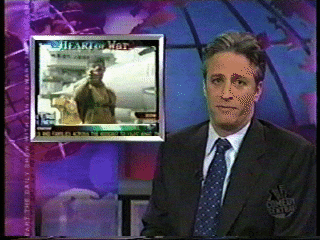
The Daily Show -- the best news on television.
Daily Show - Shrub's Message To The Iraqis (Small - 3 MB)
Daily Show - Shrub's Message To The Iraqis (Hi-res 43 MB)
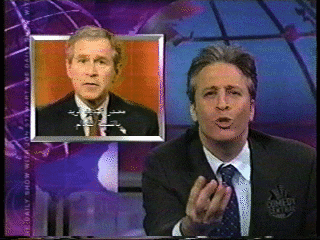
The Daily Show -- the best news on television.
I haven't investigated this enough to make a determination one way or the other.
But the evidence looked credible enough that I decided to pass it on to you.
Staged "toppling" of the Iraqi regime was propaganda stunt
April 6th: Iraqi National Congress founder, Ahmed Chalabi is flown into the southern Iraqi city of Nasiriyah by the Pentagon. Chalabi, along with 700 fighters of his "Free Iraqi Forces" are airlifted aboard four massive C17 military transport planes. Chalabi and the INC are Washington favorites to head the new Iraqi government. A photograph is taken of Chalabi and members of his Free Iraqi Forces militia as they arrive in Nasiriyah.April 9th: One of the "most memorable images of the war" is created when U.S. troops pull down the statue of Saddam Hussein in Fardus Square. Oddly enough... a photograph is taken of a man who bears an uncanny resemblance to one of Chalabi's militia members... he is near Fardus Square to greet the Marines. How many members of the pro-American Free Iraqi Forces were in and around Fardus Square as the statue of Saddam came tumbling down?
Here is the full text of the article in case the link goes bad:
http://www.uk.indymedia.org/front.php3?article_id=62813&group=webcast
IMC technlogy by cat@lyst
and IMC Geeks Get involved with the indymedia revolution at indymedia-process
email this story | download as PDF | print article
Staged "toppling" of the Iraqi regime was propaganda stunt
by Mutley 10:55am Thu Apr 10 '03 (Modified on 3:57pm Sat Apr 12 '03)
Staged propaganda stunt
This is a annotated version of a previous image, but one that is essential to understand what happened yesterday.
April 6th: Iraqi National Congress founder, Ahmed Chalabi is flown into the southern Iraqi city of Nasiriyah by the Pentagon. Chalabi, along with 700 fighters of his "Free Iraqi Forces" are airlifted aboard four massive C17 military transport planes. Chalabi and the INC are Washington favorites to head the new Iraqi government. A photograph is taken of Chalabi and members of his Free Iraqi Forces militia as they arrive in Nasiriyah.
April 9th: One of the "most memorable images of the war" is created when U.S. troops pull down the statue of Saddam Hussein in Fardus Square. Oddly enough... a photograph is taken of a man who bears an uncanny resemblance to one of Chalabi's militia members... he is near Fardus Square to greet the Marines. How many members of the pro-American Free Iraqi Forces were in and around Fardus Square as the statue of Saddam came tumbling down?
The up close action video of the statue being destroyed is broadcast around the world as proof of a massive uprising. Still photos grabbed off of Reuters show a long-shot view of Fardus Square... it's empty save for the U.S. Marines, the International Press, and a small handful of Iraqis. There are no more than 200 people in the square at best. The Marines have the square sealed off and guarded by tanks. A U.S. mechanized vehicle is used to pull the statue of Saddam from it's base. The entire event is being hailed as an equivalent of the Berlin Wall falling... but even a quick glance of the long-shot photo shows something more akin to a carefully constructed media event tailored for the television cameras.
More info on the propaganda ploy:
http://www.democraticunderground.com/duforum/DCForumID66/17554.html#1
add your own comments
Propaganda
by anyone 11:55am Thu Apr 10 '03
PROPAGANDA
I watch this whole thing unfold on TV, it amazing 200 people (mainly US forcses and jornalists) pulled down this statue in the middle of these diserted streets and they compare it to Berlin wall coming. Crap!
US MARINE WA*KERS GO HOME
Just before reaching the stetue sky newses roving reporter film these 2 iraqi's with banner reading Go Home US Marine Wankers. Reminded me of the mixed, if not completly negative response from Iraqi's all over Iraq.
F15
If 200 people can implement regine change, think whatwe can do with " million.
Sharpened photo posted elsewhere in Newswire
by Mutley 12:49pm Thu Apr 10 '03
I have posted a clearet copy of the blurred long shot of the square where Saddam's statue was toppled yesterday. I ran it through Photoshop to sharpen and uses auto-levels to make the contarts and brightness levels better.
Sharper photo of Fardus Square
by Mutley 12:55pm Thu Apr 10 '03
Here is a sharpened image of the long shot of Fardus Square:
http://uk.indymedia.org/front.php3?article_id=62845&group=webcast
I ran this Reauters photo through Photoshop to sharpen it and correct the brightness and contrast in order to make it clearer.
I saw it live on a webcam
by sqoo 1:43pm Thu Apr 10 '03
I had a BBC webcam open all day yesterday this is what I saw:
In the morning, the area looked like a fairly normal roundabout with cars going round and people walking round in a leisurely way.
Early afternoon; all of a sudden there is a crowd running through the square apparently away feom something which soon turns out to be US troops in tanks who surround the square. I cant quite make out if there was some shooting at this point, it looked like it, non was reported, but of course that means nothing.
For a while noone enters the square tho there is a number of civilians in the surrounding streets. Suddenly there seem to be a few civilians in the square and they start attacking the statue, it is not long before two are up on the statue hanging a noose round its neck. This continues for quite some time getting nowhere, similarly a sledgehammer fails to do much. By this point there looks to be 50-100 people (i wish i had recorded to footage). The US vehicle finally drives up to the statue, it is slowly attached to the rope and a few more people join the crowd, maybe another hundred or so, ceartainly no huge crowd, they occupied a small section of the roundabout, which in its entirety could probably hold several thousand.
They placed an American flag on it, I didn't see too much jubilation at this particular, insensitive move, and I have noticed a huge gap between arab and western press on reporting this moment. The jubilation I did see was for the old Iraqi flag that was then produced and the statues distruction.
It is interesting that this all occured outside the Palestine Hotel, but rather that a conspiracy, I think this was prolly lazy journalism.
Oh for fucks sake
by dave 1:45pm Thu Apr 10 '03
If you lived under Saddam Hussein you would be celebrating this too, weather you wanted the US there or not. Anything must be better than what was. Stop being so damn cynical, the joy and relief on those people was real. Something good happened in the news yesterday, the only good thing that has happened in 3 weeks. And yes, I do realise some people weren't so happy, but the Shia's certainly were, this remains to be seen in the coming months though.
No I didn't and still don't support this war, but the sooner we accept the toppling of Saddam was a good thing the better. Deal with it.
(sigh)
by kurious oranj 2:23pm Thu Apr 10 '03
I simply don't believe all of the cheering crowds were faked. I'm pleased to see the back of the Ba'ath regime and I suspect many or most Iraqis are too.
Still I think the invasion was wrong, and I worry for the future of Iraq and the world. I suspect many or most Iraqis would agree with that too.
Dave misses the point
by Mutley 2:55pm Thu Apr 10 '03
Dave completely misses the point which is the question of Iraqi self determination. Replacing the brutal Saddam regime with an American colonial stooge is hardly 'something good' is it? Come on--get real.
Is Bosnia a democracy today? Hardly. It is run by a Western-appointed, unelected, governor--a failed British politician and former Special Forces thug--Paddy Ashdown (remember him?). He couldn't get elected to office here, but he is now running Bosnia like a tin-pot despot.
Afghanistam is run by a US puppet in Kabul and warlords everywhere else. Women are still subjected to religious bigotry and oppression. There is no sign of any democracy on the horizon.
Both of these nations are now effectively colonies of the US and Western Europe. The same will now happen in Iraq--followed possibly by Syria and Iran. That is not 'something good'. It is a disaster for the Iraqis and the Middle East. Why do you think that Arabs all over the Middle East were reported yesterday to be turning off the TV because they couldn't bear to watch the so-called 'toppling' of the regime by the US? See today's Guardian and Independent. It was because they knew it was the US that was doing it not the Iraqis. They saw it as a defeat--which it isn't yet--the resistance continues.
Iraqis removing Saddam THEMSELVES to replace him with a Iraqi regime that is democratic and accountable would be one thing--that WOULD be a "good thing". But imperialism and its local hangers-on removing him to replace him with a US colonial stooge is nothing of the sort--and it is completely ridiculous to say so.
The task of overthrowing Saddam is for the Iraqi people themselves with the solidarity and support of the global anti-war movement NOT the hypocritical US and UK warmongers. The only thing the US and UK can usefully do is to get out of Iraq, cancel the debt, and pay reparations. But with Bush and Blair in office there is no chance of that happening.
Conclusion: build a massive, credible political opposition to New Labour and the US Republicans/Democrats. This can only be done by maximising the co-operation of the whole of the left, the anti-racist movement, the women's movement, lesbian and gay movement and the anti-war movement. The World Social Forum might be means of doing this, but it needs to be build locally.
US and UK troops out of Iraq now!
Reparations for Iraq!
Establish branches of the World Social Forum in every region and city NOW!
which "wankers" should go home?
by quizzical 5:14pm Thu Apr 10 '03
"Anyone" mentions Sky roving reporter footage of two iraqis with a banner saying "US marine wankers go home". On British TV news I saw two Iraqis walking around with a banner which said "Human Shields go home now, U.S. wankers", at least that is what I could make out. Is this the same or a different sighting? Can "anyone" or anyone else who see either footage help clarify this?
mutley misses the point
by Brian 8:23pm Thu Apr 10 '03
whatnow@ameritech.net
Mutleys propaganda would make stalin proud.
Let's dismantle your points one by one shall we?
First of all, afghanistan and bosnia are not colonies. Colonies in the past were stripped of their natural resources and slave labour of their people, neither of which is true in either country. If anything we've poured billions of dollars and lives into those hell holes while trying to find small groups of people who like to blow themselves up. Bosnia? roughly the same story. It's being baby sat like afganistan because civil society had broken down and brutal local police forces and paramilitaries ran things. Maybe you're crying for the fall of the taliban and milosivic but not me. And I'd bet not the people they crushed under those brands of ideology.
But here's the funniest part of your post-
"The task of overthrowing Saddam is for the Iraqi people themselves with the solidarity and support of the global anti-war movement NOT the hypocritical .."
The global anti war movement did NOTHING to help the Iraqi people overthrow an autocratic dictator. Not a fucking thing. If anything the "global" anti-war students prolonged Saddams rule by their actions. How many sign did I see at anti war rallies that said hands off Iraq? Tons. I have yet to see anything, ANYTHING from the global anti whatever about doing anything to start a positive change in any autocratic regime. And if you're looking to start, look no further than the purge of human rights workers in cuba. Although I'm not holding my breath.
look
by Dave 10:07pm Thu Apr 10 '03
Brian, the anti-war movement wanted Saddam to go, but with peaceful means, the lifting of sanctions to give the Iraqi people more strength and loosen Saddam's grip, and other creative ways you can get rid of a dictator. If you want to overthrow a tyrant from within (which is possible, see Romania, 1989, as one example) you don't aide them by placing sanctions, then dropping bombs, on the people you are supposed to be helping.
Mutley, my point was the Baath regime going is a good thing, I can't imagine any regime being much worse. Surely you can't disagree with this? The main reason I am against this war is because innocent people died for other people's business interests with the weapons of mass destruction as a smokescreen. I don't think there will be true 'democracy' in Iraq, but whatever it is I doubt it will be on a par with the Baath regime in terms of the terrible ways it operated. So it's ok to bomb a country to give them a government that's a slight improvement on the last one? Of course not, that's not what I'm saying. The thing is, we don't know what is going to happen yet, so we have to keep our cynical eyes open to try and make sure the Iraqi's get what was promised to them. There was relief and joy in Baghdad yesterday, the toppling of Saddam is something that should hearten all of us, while remembering the dead and injured, with thoughts on the future.
Freedom of thought - and illusion at best.
by Captain Joey Lo 1:07am Fri Apr 11 '03
address: MELBOURNE
Let us open our eyes, and really see what there is to see.
With the coming down of the Berlin Wall; or at Tianamen Square; or even at the Oaklahoma Bombing scenario we were all witness to photographs depicting the current state of social unrest and/or change. The photo's had 'action' in them that literally lept off the front pages of the tabloids and cracked your skull, so to speak.
This is definately not the case in Iraq, peoples !
Look at the carefully assembled onlookers, as the statue of an evil dictator is torn from it's tyrannical pearch.
They are neither eleated, nor grieved. This photo lacks just that particular 'spark' in peoples stance and interaction with eachother that was oh so obvious during the events abovementioned.
Are we seriously going to let another Pentagon orchestrated thought manipulation tactic to yet again shape what we all think?
This is bullshit !
The war is bullshit !
Aldous Huxley was right : "...oh, poor brave new world..."
Give them the benefit of the Doubt ?
by Ali 1:41pm Fri Apr 11 '03
This War is unjust. Saddam is unjust. The Baath regime is an elitist club.You will have 500k US troops in Iraq next week. Solution ? I am willing to give Bush/Blair the benefit of the doubt and hope that they go give Iraq and the Middle East democracy. Why ? Because if you " Liberate " and make the Middle East a safe place AND find a solution to the Palestinian problem then indirectly you will margenalize Israel. The Neo-Cons have dropped a bomb on to themselves. They will get more than they bargained for. Welcome to the 21st century. Dave, I agree with your thoughts. Well done.
the Bigger Picture
by Tom 2:55pm Fri Apr 11 '03
Saddam has gone. That is undeniably positive. Whilst I have always opposed this war, those Iraqis who welcome US troops are more qualified than I to credit or discredit their actions.
Yet the felling of Saddam's statue is but one tiny snap-shot from a whirlwind of chaos. We must not forget that the US and UK governments have acted with shameful irresponsibility by waging war on Iraq with no solid humanitarian contingency. Water supplies have been disrupted and food reserves are limited. Telephone systems have been destroyed. Hospitals are overflowing with thousands of severely injured civilians - and US forces have broken the third Geneva convention by failing to protect those hospitals and their patients.
Then there are the delayed, long-term effects of the unexploded cluster-bomb bomblets which now lie dormant in the Iraqi landscape - 4000 civilians have been killed or maimed by such ordnance since the last Gulf War. And worse still is the insidious residue of Depleted Uranium which can increase cancer levels nine-fold.
The destruction of civilian infrastructure and the use of legally questionable weaponry is as much a violation of personal freedom as dictatorship. Neo-conservatives will undoubtedly say that to 'make an omelette you have to break a few eggs.' But what if one of those eggs happens to be you or someone you love?
We should all consider these facts before becoming carried away by highly selective and partially orchestrated scenes of 100 people dancing around a fallen statue.
Tom
every one uses the media to their advantage ,
by Haydee 2:20pm Sat Apr 12 '03
haydeesolana@cox.net
If you think that the US is doing the media circus alone, just take a look back at the Iraqi TV showing almost exclusively pictures of the wounded, in hospitals, and them carrying out dead and wounded people from the bombed buildings. They never show any of the atrocities that they performed on theircitizens and on whoever would be against their political views. It is always the color of the lense we have in front of our eyes that tints the way we see the world, and makes us think we own the truth.
Slice it any which way you want...
by Guest In A Vest 3:57pm Sat Apr 12 '03
Let's get this straight and this is to any US citizens that get their hackles raised when we out here seemingly oppose what is going on here and put forward a few possible agendas...
As I understand it, no right minded person is saying that the Iraqi regime didn't need doing something about. BUT, and this is a BIG but, there are ways of doing things. It is seemingly 'okay' for Saddam Hussein to be personally targeted with a bomb being dropped on his head or sticking a rocket launched grenade up his ass during this conflict (or after) BUT stretch this any which way you want, this is assasination and that is NOT the way the west likes things to be done if it was to happen the other way around.
Capture him, send him to a war tribunial, whatever. That is the way we supposedly tell the rest of the worlkd we like these things dealt with so if you can't see why this is seen as VERY dubious and hipocritical to people outside your 'regime' then I'd pour a coffee and have a good sit down and think about it because it just plain is.
War tribunials may be a joke, the UN may be a joke, etc, etc but these are the frameworks that were set up AND AGREED UPON to deal with such matters and to just decide that the way YOU want things dealt with and bollocks to what the rest of the world thinks is beyond arrogance, trust me it really is and there is no question.
You make rules and you either abide by them or don't be surprised when people point a few fingers when you just up and bend them to suit.
The fall oif this regime will ultimately be a good thing for the Iraqi people and they will hopefully gain from this horrendous conflict, and the horror that goes with it, but others will gain as well and when they do it by saying "screw you, we're doing it our way whatever anyone else wants" it doesn't sit easy with the idea of an alternative regime that spouts the words "democracy", "freedom" and "justice" with the proviso of "we decide what any one of those words mean at any one time and you can stick all other world views up your asses 'cos we are the boss and can ignore any treaties/unions/coallitions we signed up to in the past".
Wow. So there it is.
One month of war = 10,000 years of history down the drain.
Hmmm. I wrote about this on March 18, 2003. You would think that our government and military would have been informed of this threat way before the information trickled down to little old me.
Ancient archive lost in Baghdad library blaze
By Oliver Burkeman for The Guardian
As flames engulfed Baghdad's National Library yesterday, destroying manuscripts many centuries old, the Pentagon admitted that it had been caught unprepared by the widespread looting of antiquities, despite months of warnings from American archaeologists.But defence department officials denied accusations by British archaeologists that the US government was succumbing to pressure from private collectors in America to allow plundered Iraqi treasures to be traded on the open market.
Almost nothing remains of the library's archive of tens of thousands of manuscripts, books, and Iraqi newspapers, according to reports from the scene.
It joins a list that already includes the capital's National Museum, one of the world's most important troves of artefacts from the ancient Sumerian, Babylonian and Assyrian civilisations...
In Washington Colin Powell, the secretary of state, said the US "will be working with a number of individuals and organisations to not only secure the facility, but to recover that which has been taken, and also to participate in restoring that which has been broken _ the United States understands its obligations and will be taking a leading role with respect to antiquities in general, but [the museum] in particular".
A Pentagon official, speaking on condition of anonymity, said no plans had been made to protect antiquities from looters, as opposed to ensuring that historical sites were not caught up in the fighting itself.
Here is the full text of the entire article in case the link goes bad:
http://www.guardian.co.uk/Iraq/Story/0,2763,937094,00.html
Ancient archive lost in Baghdad library blaze
Oliver Burkeman in Washington
Tuesday April 15, 2003
The Guardian
As flames engulfed Baghdad's National Library yesterday, destroying manuscripts many centuries old, the Pentagon admitted that it had been caught unprepared by the widespread looting of antiquities, despite months of warnings from American archaeologists.
But defence department officials denied accusations by British archaeologists that the US government was succumbing to pressure from private collectors in America to allow plundered Iraqi treasures to be traded on the open market.
Almost nothing remains of the library's archive of tens of thousands of manuscripts, books, and Iraqi newspapers, according to reports from the scene.
It joins a list that already includes the capital's National Museum, one of the world's most important troves of artefacts from the ancient Sumerian, Babylonian and Assyrian civilisations.
Calling the looting of historical artefacts "a catastrophe for the cultural heritage of Iraq", Mounir Bouchenaki, the deputy director-general of the UN cultural body Unesco, announced an emergency summit of archaeologists in Paris on Thursday.
In Washington Colin Powell, the secretary of state, said the US "will be working with a number of individuals and organisations to not only secure the facility, but to recover that which has been taken, and also to participate in restoring that which has been broken _ the United States understands its obligations and will be taking a leading role with respect to antiquities in general, but [the museum] in particular".
A Pentagon official, speaking on condition of anonymity, said no plans had been made to protect antiquities from looters, as opposed to ensuring that historical sites were not caught up in the fighting itself.
But the official rejected charges in a letter from nine British archaeologists, published in the Guardian yesterday, that private collectors were "persuading the Pentagon to relax legislation that protects Iraq's heritage by prevention of sales abroad".
The American Council for Cultural Policy, a New York-based coalition of about 60 collectors, dealers and others, had received "no special treatment," the official insisted, despite reports that members of the group met with Bush administration representatives in January to argue that a post-Saddam Iraq should have relaxed antiquities laws.
Last night the group denied that it was lobbying for plundered Iraqi treasures to be traded. "The ACCP will seek _ to find ways to shut off the import of objects that may have been taken from Iraq, and to close the domestic market in such material," Ashton Hawkins, the organisation's president, said.
John Henry Merryman, a law professor at Stanford University and a member of the ACCP, said allowing a private trade in the artefacts would better protect them until they could be returned to Iraq at a later date.
On of the oldest libraries in the world burned to the ground yesterday.
There's nothing left.
"Coalition" troops were five minutes away and did nothing to put out the blaze.
Islamic Library Burned to the Ground
By Robert Fisk for The Independent.
It was the final chapter in the sack of Baghdad. The National Library and Archives — a priceless treasure of Ottoman historical documents including the old royal archives of Iraq — were turned to ashes in 3,000 degrees of heat. Then the Islamic Library of Qur’ans at the Ministry of Religious Endowment was set ablaze. I saw the looters...And the Americans did nothing. All over the filthy yard they blew, letters of recommendation to the courts of Arabia, demands for ammunition for Ottoman troops, reports on the theft of camels and attacks on pilgrims, all of them in delicate hand-written Arabic script. I was holding in my hands the last Baghdad vestiges of Iraq’s written history. But for Iraq, this is Year Zero; with the destruction of the antiquities in the Museum of Archaeology on Saturday and the burning of the National Archives and then the Qur’anic library of the ministry, the cultural identity of Iraq is being erased.
Why? Who set these fires? For what insane purpose is this heritage being destroyed? When I caught sight of the Qur’anic library burning — there were flames 100 feet high bursting from the windows — I raced to the offices of the occupying power, the US Marines’ civil affairs bureau, to report what I had seen. An officer shouted to a colleague that “this guy says some Biblical (sic) library is on fire.” I gave the map location, the precise name — in Arabic and English — of the fire, I said that the smoke could be seen from three miles away and it would take only five minutes to drive there. Half an hour later, there wasn’t an American at the scene — and the flames were now shooting 200 feet into the air.
Here is the full text of the article in case the link goes bad:
http://www.arabnews.com/Article.asp?ID=25219
Islamic Library Burned to the Ground
Robert Fisk, The Independent
BAGHDAD, 15 April 2003 — So yesterday was the burning of books. First came the looters, then came the arsonists. It was the final chapter in the sack of Baghdad. The National Library and Archives — a priceless treasure of Ottoman historical documents including the old royal archives of Iraq — were turned to ashes in 3,000 degrees of heat. Then the Islamic Library of Qur’ans at the Ministry of Religious Endowment was set ablaze. I saw the looters.
One of them cursed me when I tried to reclaim a book of Islamic law from a boy who could have been no more than 10 years old. Amid the ashes of hundreds of years of Iraqi history, I found just one file blowing in the wind outside: Pages and pages of handwritten letters between the court of Sherif Hussein of Makkah — who started the Arab revolt against the Turks for Lawrence of Arabia — and the Ottoman rulers of Baghdad.
And the Americans did nothing. All over the filthy yard they blew, letters of recommendation to the courts of Arabia, demands for ammunition for Ottoman troops, reports on the theft of camels and attacks on pilgrims, all of them in delicate hand-written Arabic script. I was holding in my hands the last Baghdad vestiges of Iraq’s written history. But for Iraq, this is Year Zero; with the destruction of the antiquities in the Museum of Archaeology on Saturday and the burning of the National Archives and then the Qur’anic library of the ministry, the cultural identity of Iraq is being erased.
Why? Who set these fires? For what insane purpose is this heritage being destroyed? When I caught sight of the Qur’anic library burning — there were flames 100 feet high bursting from the windows — I raced to the offices of the occupying power, the US Marines’ civil affairs bureau, to report what I had seen. An officer shouted to a colleague that “this guy says some Biblical (sic) library is on fire.” I gave the map location, the precise name — in Arabic and English — of the fire, I said that the smoke could be seen from three miles away and it would take only five minutes to drive there. Half an hour later, there wasn’t an American at the scene — and the flames were now shooting 200 feet into the air.
There was a time when the Arabs said that their books were written in Cairo, printed in Beirut and read in Baghdad. Now they burn libraries in Baghdad. In the National Archives were not just the Ottoman records of the caliphate, but even the dark years of the country’s modern history, hand-written accounts of the 1980-88 Iran-Iraq war, an entire library of Western newspapers — bound volumes of the Financial Times were lying on the pavement — and microfiche copies of Arabic newspapers going back to the early 1900s.
U.S. Govt Accused of War Crimes Against Journalists
By Julio Godoy for the Inter Press Service.
International journalists' organizations are accusing the U.S. government of committing war crimes in Iraq by intentionally firing at war correspondents.The Paris-based journalists' organization 'Reporters without Borders' (RSF, after its French name), called on the International Humanitarian Fact-Finding Commission to investigate whether by attacking journalists in Iraq the U.S.-British coalition forces were not violating international humanitarian law.
TV footage shot by France 3 (a French television channel) showing a US Abrams tank firing towards the Palestine hotel in Baghdad killing two journalists(AFP/FRANCE 3)
"A media outlet cannot be a military target under international law and its equipment and installations are civilian property protected as such under the Geneva Conventions," said Reporters without Border secretary-general Robert Ménard."Only an objective and impartial enquiry can determine whether or not the Conventions have been violated," Ménard claimed.
It is the first time since its existence that the International Humanitarian Fact-Finding Commission is being petitioned. Set up in 1991 under the First Additional Protocol of the Geneva Conventions, the Commission's task is investigating any alleged serious violation of international humanitarian law.
Similarly, the Brussels-based International Federation of Journalists(IFJ) called for an independent inquiry on the U.S. attacks against the Palestine Hotel and the bureaus of Al-Jazeera and Abu Dhabi television channels.
The New-York based Committee to Protect Journalists (CPJ) also called the U.S. attacks against journalists in Iraq "a violation of the Geneva Convention."
In a letter to U.S. defense secretary Donald Rumsfeld, CPJ director Joel Simon wrote on Tuesday: "The Committee is gravely concerned by a series of U.S. military strikes against known media locations in Baghdad today that have left three journalists dead and several wounded."
"We believe these attacks violate the Geneva Conventions," Simon pointed out.
On Tuesday, U.S. troops attacked the Baghdad bureau of the Qatar-based Al Jazeera, killing one war correspondent, and wounding another. In another attack, a U.S. tank fired a shell at the Palestine Hotel in Baghdad, killing two other reporters and wounding three.
The hotel is well known as the unofficial Baghdadi center of international press. A large number of foreign correspondents covering the war stay there.
Ménard, RSF's secretary-general, said that all independent evidence on the U.S. attacks against the hotel shows that the firing was deliberate.
"Film shot by the French television station France 3, and descriptions by journalists, prove that the neighborhood around the hotel was very quiet at the hour of the attack, and that the U.S. tank crew took their time, waiting for a couple of minutes and adjusting its gun before opening fire," Ménard said.
"This evidence does not match the U.S. version of an attack in self-defense and we can only conclude that the U.S. Army deliberately and without warning targeted journalists," Ménard added...
The Qatar-based television network recalled that prior to the conflict, it had provided the U.S. military authorities with the specific coordinates of its Baghdad offices. This information was confirmed by the Committee to Protect Journalists in the letter to Donald Rumsfeld...
Since the beginning of the Iraqi war on March 20, ten journalists have been killed by the conflicting parties, and two other died in war related accidents. At least eight other correspondents have been wounded. Two other reporters' whereabouts remain unknown.
Here is the full text of the article in case the link goes bad:
http://www.commondreams.org/headlines03/0410-04.htm
Saturday, April 12, 2003
Published on Thursday, April 10, 2003 by the Inter Press Service
U.S. Govt Accused of War Crimes Against Journalists
by Julio Godoy
PARIS - International journalists' organizations are accusing the U.S. government of committing war crimes in Iraq by intentionally firing at war correspondents.
The Paris-based journalists' organization 'Reporters without Borders' (RSF, after its French name), called on the International Humanitarian Fact-Finding Commission to investigate whether by attacking journalists in Iraq the U.S.-British coalition forces were not violating international humanitarian law.
TV footage shot by France 3 (a French television channel) showing a US Abrams tank firing towards the Palestine hotel in Baghdad killing two journalists(AFP/FRANCE 3)
"A media outlet cannot be a military target under international law and its equipment and installations are civilian property protected as such under the Geneva Conventions," said Reporters without Border secretary-general Robert Ménard.
"Only an objective and impartial enquiry can determine whether or not the Conventions have been violated," Ménard claimed.
It is the first time since its existence that the International Humanitarian Fact-Finding Commission is being petitioned. Set up in 1991 under the First Additional Protocol of the Geneva Conventions, the Commission's task is investigating any alleged serious violation of international humanitarian law.
Similarly, the Brussels-based International Federation of Journalists(IFJ) called for an independent inquiry on the U.S. attacks against the Palestine Hotel and the bureaus of Al-Jazeera and Abu Dhabi television channels.
The New-York based Committee to Protect Journalists (CPJ) also called the U.S. attacks against journalists in Iraq "a violation of the Geneva Convention."
In a letter to U.S. defense secretary Donald Rumsfeld, CPJ director Joel Simon wrote on Tuesday: "The Committee is gravely concerned by a series of U.S. military strikes against known media locations in Baghdad today that have left three journalists dead and several wounded."
"We believe these attacks violate the Geneva Conventions," Simon pointed out.
On Tuesday, U.S. troops attacked the Baghdad bureau of the Qatar-based Al Jazeera, killing one war correspondent, and wounding another. In another attack, a U.S. tank fired a shell at the Palestine Hotel in Baghdad, killing two other reporters and wounding three.
The hotel is well known as the unofficial Baghdadi center of international press. A large number of foreign correspondents covering the war stay there.
Ménard, RSF's secretary-general, said that all independent evidence on the U.S. attacks against the hotel shows that the firing was deliberate.
"Film shot by the French television station France 3, and descriptions by journalists, prove that the neighborhood around the hotel was very quiet at the hour of the attack, and that the U.S. tank crew took their time, waiting for a couple of minutes and adjusting its gun before opening fire," Ménard said.
"This evidence does not match the U.S. version of an attack in self-defense and we can only conclude that the U.S. Army deliberately and without warning targeted journalists," Ménard added.
Caroline Sines, a French television correspondent covering the war in Baghdad, confirmed Ménard's accusations against the U.S. troops.
"I was at the Palestine Hotel at the moment of the attack, around one pm, Baghdad time, and my crew filmed everything," Sines said. "Our films shows that the U.S. tank took its time at targeting the 14th floor of the hotel, where many journalists are hosted, at a moment of complete calm," Sines said.
Menard urged the "U.S. forces to prove that the incident was not a deliberate attack to dissuade or prevent journalists from continuing to report on what is happening in Baghdad."
"We are appalled at what happened because it was known that journalists were working both at the Palestine Hotel as well at the Al-Jazeera bureau," Ménard pointed out.
One Al-Jazeera camera operator was also killed on Tuesday by an apparently intentional U.S. bombing of the pan-Arab TV station's offices elsewhere in Baghdad. The nearby premises of Abu Dhabi TV were also damaged by the bombing.
The Qatar-based television network recalled that prior to the conflict, it had provided the U.S. military authorities with the specific coordinates of its Baghdad offices. This information was confirmed by the Committee to Protect Journalists in the letter to Donald Rumsfeld.
"CPJ has seen a copy of Al-Jazeera's February letter to Pentagon spokeswoman Victoria Clarke outlining these coordinates," Joel Simon wrote to Rumsfeld.
Simon called Rumsfeld "to launch an immediate and thorough investigation into these incidents and to make the findings public." The CPJ also recalled to the U.S. military authorities that more than 100 independent journalists continue to operate in Baghdad from both the Palestine and the nearby Sheraton hotels.
"The U.S. military has a clear obligation to avoid harming the correspondents while carrying out (war) operations," Simon said in his letter to Rumsfeld.
Aidan White, General Secretary of the International Federation of Journalists, said, "There is no doubt at all that these attacks could be targeting journalists. If so, they are grave and serious violations of international law."
"The bombing of hotels where journalists are staying and targeting of Arab media is particularly shocking events in a war which is being fought in the name of democracy," White said. "Those who are responsible must be brought to justice".
"The United Nations system and the international media community must be fully engaged in finding out what happened in these cases and action must be taken to ensure it never happens again," White said. "We can expect denials of intent from the military, but what we really want is the truth."
The IFJ says that the global media community, including journalists, media organizations and press freedom campaigners, should join hands under the banner of the newly-formed International News Safety Institute to hold a complete and in depth inquiry.
The INSI is a coalition of more than 100 organizations campaigning for a global news safety program.
The IFJ also condemned "what appears to be Iraqi tactics of using civilians and journalists as a 'human shield' against attack." "The Baghdad authorities are just as culpable as the U.S. with their reckless disregard for civilian lives," White said.
Both the IFJ and RSF recalled that Al Jazeera has become a frequent target of U.S. and British attacks in Iraq and in Afghanistan.
Earlier in the war in Iraq, four members of the pan-Arab television crew in the southern city of Basra came under gunfire from British tanks on March 29 as they were filming distribution of food by Iraqi government officials.
One of the station's cameramen went missing and was later found to have been held for 12 hours by U.S. troops. Al-Jazeera reporters were the only journalists in Basra at the time.
The Al-Jazeera offices in Kabul, Afghanistan, were also bombed by U.S. forces during the war against the Taliban regime in Afghanistan in November 2001.
To have jurisdiction in a war, the International Humanitarian Fact-Finding Commission has to be petitioned by one of the parties in the conflict or by one of the countries that have recognized its jurisdiction.
To conduct an investigation, all the belligerents must accept its authority. Among the countries involved in the Iraq war, only Australia and the United Kingdom have formally recognized it, allowing an investigation to go ahead as far as they are concerned.
Neither the United States nor Iraq have yet accepted the principle of such an enquiry.
Since the beginning of the Iraqi war on March 20, ten journalists have been killed by the conflicting parties, and two other died in war related accidents. At least eight other correspondents have been wounded. Two other reporters' whereabouts remain unknown.
Looters Swarm Into New Areas as Key Bridges Are Opened
By Hamza Hendawi for the Associated Press
Iraqis expressed increasing frustration over the lawlessness that has gripped the capital since the arrival of U.S. troops and the fall of Saddam Hussein. Looters ransacked government buildings, hospitals and schools, and trashed the National Museum, taking or destroying many of the country's archaeological treasures...The National Museum held artifacts from thousands of years of history in the Tigris-Euphrates basin, widely held to be the site of the world's earliest civilizations. Before the war, the museum closed its doors and secretly placed the most precious artifacts in storage, but the metal storeroom doors were smashed and everything was taken.
"This is the property of this nation and is the treasure of 7,000 years of civilization," said museum employee Ali Mahmoud. "What does this country think it is doing?"
On Baghdad's chaotic streets, it appeared American troops were doing nothing to curb the feverish looting. Troops could be seen waving looters through checkpoints and standing idly in front of buildings while they were being pillaged...
"The Americans have disappointed us all. This country will never be operational for at least a year or two," said Abbas Reta, 51, an engineer and father of five.
"I've seen nothing new since Saddam's fall," he said. "All that we have seen is looting. The Americans are responsible. One round from their guns and all the looting would have stopped."...
The State Department said Friday it was sending 26 police and judicial officers to Iraq, the first component of a team that will eventually number about 1,200. The officers will be part of a group led by Jay Garner, the retired general chosen by the Bush administration to run the initial Iraqi civil administration under American occupation.
Here is the full text of the article in case the link goes bad:
http://ap.tbo.com/ap/breaking/MGAMJ9GIFED.html
Looters Swarm Into New Areas as Key Bridges Are Opened
By Hamza Hendawi
Associated Press
Saturday 12 April 2003
Iraqis Disappointed With U.S. Response
BAGHDAD - U.S. forces reopened two strategic bridges Saturday in the heart of Baghdad and crowds of looters surged across - taking advantage of access to new territory that had not already been plundered. U.S. forces did nothing to stop them.
Iraqis expressed increasing frustration over the lawlessness that has gripped the capital since the arrival of U.S. troops and the fall of Saddam Hussein. Looters ransacked government buildings, hospitals and schools, and trashed the National Museum, taking or destroying many of the country's archaeological treasures.
A museum employee arrived Saturday to find the administrative offices trashed by looters. The only thing she could salvage was a telephone book-sized volume. She refused to give her name. With tears, she said, "It is all the fault of the Americans. This is Iraq's civilization. And it's all gone now."
An elderly museum guard said hundreds of looters attacked Thursday and carried away artifacts on pushcarts and wheelbarrows. The two-story museum's marble staircase was chipped, suggesting looters might have dragged heavier items down on pushcarts or slabs of wood. Glass display cases were shattered and broken pieces of ancient pottery and statues were scattered everywhere.
The National Museum held artifacts from thousands of years of history in the Tigris-Euphrates basin, widely held to be the site of the world's earliest civilizations. Before the war, the museum closed its doors and secretly placed the most precious artifacts in storage, but the metal storeroom doors were smashed and everything was taken.
"This is the property of this nation and is the treasure of 7,000 years of civilization," said museum employee Ali Mahmoud. "What does this country think it is doing?"
On Baghdad's chaotic streets, it appeared American troops were doing nothing to curb the feverish looting. Troops could be seen waving looters through checkpoints and standing idly in front of buildings while they were being pillaged.
Looters swarmed over the Al-Rasheed and the Al-Jumhuriya bridges across the Tigris River, which divides the city. They pushed into several government buildings, including the Planning Ministry, which sits on the edge of the old palace presidential compound on the river's west bank.
Looters were also seen coming out of the Foreign Ministry carrying office furniture, TV sets and air conditioners. Children wheeled out office chairs and rolled them down the street.
U.S. soldiers stood by at the presidential compound as looters some 400 yards away hauled bookshelves, computers and sofas from the Planning Ministry. Bands of men with tools plundered cars nearby for wheels or other parts.
"The Americans have disappointed us all. This country will never be operational for at least a year or two," said Abbas Reta, 51, an engineer and father of five.
"I've seen nothing new since Saddam's fall," he said. "All that we have seen is looting. The Americans are responsible. One round from their guns and all the looting would have stopped."
U.S. Army troops and armor blocked access to the main palace grounds. The Oil Ministry also seemed intact with a heavy U.S. military presence inside. Also intact were some of the power installations, power stations and power grids.
Al-Jazeera's correspondent in Baghdad, Maher Abdallah, described the situation as "tragic," and suggested it could have been prevented.
"They have ousted the regime and the authority, and in such an urban area where there is no tribal authority or rule, chaos should have been expected to break in such a way," Abdallah said.
U.S. officials insist the restoration of law and order will become a higher priority.
The State Department said Friday it was sending 26 police and judicial officers to Iraq, the first component of a team that will eventually number about 1,200. The officers will be part of a group led by Jay Garner, the retired general chosen by the Bush administration to run the initial Iraqi civil administration under American occupation.
Pillagers Strip Iraqi Museum of Its Treasure
By John F. Burns for the New York Times.
The National Museum of Iraq recorded a history of civilizations that began to flourish in the fertile plains of Mesopotamia more than 7,000 years ago. But once American troops entered Baghdad in sufficient force to topple Saddam Hussein's government this week, it took only 48 hours for the museum to be destroyed, with at least 50,000 artifacts carried away by looters...As fires in a dozen government ministries and agencies began to burn out, and as some looters tired of pillaging in the 90-degree heat of the Iraqi spring, museum officials reached the hotels where foreign journalists were staying along the eastern bank of the Tigris River. They brought word of what is likely to be reckoned as one of the greatest cultural disasters in recent Middle Eastern history...
What was beyond contest today was that the 28 galleries of the museum and vaults with huge steel doors guarding storage chambers that descend floor after floor into darkness had been completely ransacked...
As examples of what was gone, the officials cited a solid gold harp from the Sumerian era, which began about 3360 B.C. and started to crumble about 2000 B.C. Another item on their list of looted antiquities was a sculptured head of a woman from Uruk, one of the great Sumerian cities, dating to about the same era, and a collection of gold necklaces, bracelets and earrings, also from the Sumerian dynasties and also at least 4,000 years old...
Mr. Muhammad, the archaeologist, directed much of his anger at President Bush. "A country's identity, its value and civilization resides in its history," he said. "If a country's civilization is looted, as ours has been here, its history ends. Please tell this to President Bush. Please remind him that he promised to liberate the Iraqi people, but that this is not a liberation, this is a humiliation."
Here is the full text of the article in case the link goes bad:
http://www.nytimes.com/2003/04/12/international/worldspecial/12CND-BAGH.html
Pillagers Strip Iraqi Museum of Its Treasure
By John F. Burns
New York Times
Saturday 12 April 2003
BAGHDAD, Iraq, April 12 - The National Museum of Iraq recorded a history of civilizations that began to flourish in the fertile plains of Mesopotamia more than 7,000 years ago. But once American troops entered Baghdad in sufficient force to topple Saddam Hussein's government this week, it took only 48 hours for the museum to be destroyed, with at least 50,000 artifacts carried away by looters.
The full extent of the disaster that befell the museum only came to light today, after three days of frenzied looting that swept much of the capital.
As fires in a dozen government ministries and agencies began to burn out, and as some looters tired of pillaging in the 90-degree heat of the Iraqi spring, museum officials reached the hotels where foreign journalists were staying along the eastern bank of the Tigris River. They brought word of what is likely to be reckoned as one of the greatest cultural disasters in recent Middle Eastern history.
A full accounting of what has been lost may take weeks or months. The museum had been closed during much of the 1990's, and like many Iraqi institutions, its operations were cloaked in secrecy under Mr. Hussein.
So what officials told journalists today may have to be adjusted as a fuller picture comes to light. It remains unclear whether some of the museum's priceless gold, silver and copper antiquities, some of its ancient stone and ceramics, and perhaps some of its fabled bronzes and gold-overlaid ivory, had been locked away for safekeeping elsewhere before the looting, or seized for
private display in one of Mr. Hussein's ubiquitous palaces.
What was beyond contest today was that the 28 galleries of the museum and vaults with huge steel doors guarding storage chambers that descend floor after floor into darkness had been completely ransacked.
Officials with crumpled spirits fought back tears and anger at American troops, as they ran down an inventory of the most storied items that they said had been carried away by the thousands of looters who poured into the museum after daybreak on Thursday and remained until dusk on Friday, with only one intervention by American troops, lasting about half an hour, at lunchtime on Thursday.
Nothing remained, museum officials said, at least nothing of real value, from a museum that had been regarded by archaeologists and other specialists as perhaps the richest of all such institutions in the Middle East.
As examples of what was gone, the officials cited a solid gold harp from the Sumerian era, which began about 3360 B.C. and started to crumble about 2000 B.C. Another item on their list of looted antiquities was a sculptured head of a woman from Uruk, one of the great Sumerian cities, dating to about the same era, and a collection of gold necklaces, bracelets and earrings, also from the Sumerian dynasties and also at least 4,000 years old.
But an item-by-item inventory of the most valued pieces carried away by the looters hardly seemed to capture the magnitude of what had occurred. More powerful, in its way, was the action of one museum official in hurrying away through the piles of smashed ceramics and torn books and burned-out torches of rags soaked in gasoline that littered the museum's corridors to find the glossy catalog of an exhibition of "silk road civilization" that was held in Japan's ancient capital of Nara in 1988.
Turning to 50 pages of items lent by the Iraqi museum for the exhibition, he said that none of the antiquities pictured remained after the looting. They included ancient stone carvings of bulls and kings and princesses; copper shoes and cuneiform tablets; tapestry fragments and ivory figurines of goddesses and women and Nubian porters; friezes of soldiers and ancient seals and tablets on geometry; and ceramic jars and urns and bowls, all dating back at least 2,000 years, some more than 5,000 years.
"All gone, all gone," he said. "All gone in two days."
An Iraqi archaeologist who has participated in the excavation of some of the country's 10,000 sites, Raid Abdul Ridhar Muhammad, said he had gone into the street of the Karkh district, a short distance from the eastern bank of the Tigris, at about 1 p.m. on Thursday to find American troops to quell the looting. By that time, he and other museum officials said, the several acres of museum grounds were overrun by thousands of men, women and children, many of them armed with rifles, pistols, axes, knives and clubs, as well as pieces of metal torn from the suspensions of wrecked cars. The crowd was storming out of
the complex carrying antiquities on hand carts, bicycles and in boxes. Looters stuffed their pockets with smaller items.
Mr. Muhammad said he found an American Abrams tank in Museum Square, about 300 yards away, and that five marines had followed him back into the museum and opened fire above the looters' heads. This drove several thousand of the marauders out of the museum complex in minutes, he said, but when the tank crewmen left about 30 minutes later, the looters returned.
"I asked them to bring their tank inside the museum grounds," he said. "But they refused and left. About half an hour later, the looters were back, and they threatened to kill me, or to tell the Americans that I am a spy for Saddam Hussein's intelligence, so that the Americans would kill me. So I was frightened, and I went home."
He spoke with deep bitterness against the Americans, as have many Iraqis who have watched looting that began with attacks on government agencies and the palaces and villas of Mr. Hussein, his family and his inner circle broaden into a tidal wave of looting that targeted just about every government institution, even ministries dealing with issues like higher education, trade and
agriculture, and hospitals.
American troops have intervened only sporadically, as they did on Friday to halt a crowd of men and boys who were raiding an armory at the edge of the Republican Palace presidential compound and taking brand-new Kalashnikov rifles,
rocket-propelled grenades and other weapons.
American commanders have said they lack the troops to curb the looting while their focus remains on the battles across Baghdad that are necessary to mop up pockets of resistance from paramilitary troops loyal to Mr. Hussein.
Mr. Muhammad, the archaeologist, directed much of his anger at President Bush. "A country's identity, its value and civilization resides in its history," he said. "If a country's civilization is looted, as ours has been here, its history ends. Please tell this to President Bush. Please remind him that he promised to liberate the Iraqi people, but that this is not a liberation, this is a
humiliation."
Vanishing Liberties -- Where's the Press?
By Nat Hentoff for the Village Voice.
"If Americans win a war (not just against Saddam Hussein but the longer-term struggle) and lose the Constitution, they will have lost everything." –Lance Morrow, Time, March 17
On March 18, the Associated Press reported that at John Carroll University, in a Cleveland suburb, Justice Antonin Scalia said that "most of the rights you enjoy go way beyond what the Constitution requires" because "the Constitution just sets minimums." Accordingly, in wartime, Scalia emphasized, "the protections will be ratcheted down to the constitutional minimum."
I checked with the Supreme Court for a text of this ominous speech and was told Scalia didn't use a text that night, but the quotation appeared to be accurate. I said, would Justice Scalia let me know? My question was relayed, but I've heard nothing since.
Most of the radical revisions of the Constitution that I and others have been writing about will ultimately be ruled on by the Supreme Court. Scalia indicates he will come down on the side of Bush and Ashcroft. A few days after the terrorist attacks on the World Trade Center and the Pentagon, Justice Sandra Day O'Connor said that as a result, we would have to give up some of our liberties. That's two of nine justices we are not likely to be able to depend on...
Meanwhile, in an invaluable new report by the Lawyers Committee for Human Rights, "Imbalance of Powers: How Changes to U.S. Law and Policy Since 9/11 Erode Human Rights and Civil Liberties" (available by calling 212-845-5200), a section begins: "A mantle of secrecy continues to envelop the executive branch, largely with the acquiescence of Congress and the courts. [This] makes effective oversight impossible, upsetting the constitutional system of checks and balances."
So where is the oversight going to come from? If at all, first from the people pressuring Congress-provided enough of us know what is happening to our rights and liberties. And that requires, as James Madison said, a vigorous press, because the press has been, he noted, "the beneficent source to which the United States owes much of the light which conducted [us] to the ranks of a free and independent nation."
But the media, with few exceptions, are failing to report consistently, and in depth, precisely how Bush and Ashcroft are undermining our fundamental individual liberties...
How many Americans know that if the bill is passed (and Bush certainly won't veto it), they can be stripped of their citizenship if charged with giving "material support" to a group designated by the government as "terrorist"? Sending a check for the outfit's lawful activities-without knowing why it landed on Ashcroft's list-could make you a person without a country and put you behind bars here indefinitely. As Chief Justice Earl Warren said, "you lose the right to have rights" when you lose your citizenship.
Here is the full text of the article in case the link goes bad:
http://villagevoice.com/issues/0316/hentoff.php
Vanishing Liberties -- Where's the Press?
By Nat Hentoff
Village Voice
Friday 11 April 2003
"If Americans win a war (not just against Saddam Hussein but the longer-term struggle) and lose the Constitution, they will have lost everything." –Lance Morrow, Time, March 17
On March 18, the Associated Press reported that at John Carroll University, in a Cleveland suburb, Justice Antonin Scalia said that "most of the rights you enjoy go way beyond what the Constitution requires" because "the Constitution just sets minimums." Accordingly, in wartime, Scalia emphasized, "the protections will be ratcheted down to the constitutional minimum."
I checked with the Supreme Court for a text of this ominous speech and was told Scalia didn't use a text that night, but the quotation appeared to be accurate. I said, would Justice Scalia let me know? My question was relayed, but I've heard nothing since.
Most of the radical revisions of the Constitution that I and others have been writing about will ultimately be ruled on by the Supreme Court. Scalia indicates he will come down on the side of Bush and Ashcroft. A few days after the terrorist attacks on the World Trade Center and the Pentagon, Justice Sandra Day O'Connor said that as a result, we would have to give up some of our liberties. That's two of nine justices we are not likely to be able to depend on.
And in his 1998 book, All the Laws but One: Civil Liberties in Wartime (Knopf/Vintage), the chief justice of the United States, William Rehnquist, admiringly quoted Francis Biddle, Franklin D. Roosevelt's attorney general: "The Constitution has not greatly bothered any wartime president." And Rehnquist himself, who will be presiding over the constitutionality of the Bush-Ashcroft assaults on the Constitution, wrote in the same book:
"In time of war, presidents may act in ways that push their legal authority to its outer limits, if not beyond." And writing of Lincoln's suspending habeas corpus during the Civil War, Rehnquist said, "It is difficult to quarrel with this decision."
Reacting to Rehnquist's deference to the executive branch in previous wars, Adam Cohen, legal affairs writer for The New York Times, wrote: "The people whose liberties are taken away are virtually invisible" in the pages of Rehnquist's book.
Meanwhile, in an invaluable new report by the Lawyers Committee for Human Rights, "Imbalance of Powers: How Changes to U.S. Law and Policy Since 9/11 Erode Human Rights and Civil Liberties" (available by calling 212-845-5200), a section begins: "A mantle of secrecy continues to envelop the executive branch, largely with the acquiescence of Congress and the courts. [This] makes effective oversight impossible, upsetting the constitutional system of checks and balances."
So where is the oversight going to come from? If at all, first from the people pressuring Congress-provided enough of us know what is happening to our rights and liberties. And that requires, as James Madison said, a vigorous press, because the press has been, he noted, "the beneficent source to which the United States owes much of the light which conducted [us] to the ranks of a free and independent nation."
But the media, with few exceptions, are failing to report consistently, and in depth, precisely how Bush and Ashcroft are undermining our fundamental individual liberties.
For example, in writing here about the Justice Department's proposed sequel to the Patriot Act (titled inoffensively the Domestic Security Enhancement Act), I noted that it had been kept secret from Congress. A week before it was leaked by
an understandably anonymous member of Ashcroft's staff, a representative of the Justice Department even lied to the Senate Judiciary Committee about its very existence.
A few sections in that chilling 86-page draft were briefly covered in some of the media. But as I predicted after providing more details here ("Ashcroft Out of Control" and "Red Alert for the Bill of Rights"), these invasions of the Constitution were only a one- or two-day story in nearly all of the media.
How many Americans know that if the bill is passed (and Bush certainly won't veto it), they can be stripped of their citizenship if charged with giving "material support" to a group designated by the government as "terrorist"? Sending a check for the outfit's lawful activities-without knowing why it landed on Ashcroft's list-could make you a person without a country and put you behind bars here indefinitely. As Chief Justice Earl Warren said, "you lose the right to have rights" when you lose your citizenship.
How many Americans know that the FBI can get a warrant from the secret Foreign Intelligence Surveillance Court and go to a library or bookstore to find out what books you read or borrow if you are somehow, according to the FBI, connected to "terrorism"?
In the First Amendment Center's "Legal Watch" newsletter (March 11-17), Charles Haynes writes that "a warning sign greets patrons entering all 10 of the county libraries in Santa Cruz, California." It says: "Beware, a record of the books you borrow may end up in the hands of the FBI. And if the FBI requests your records, librarians are prohibited by law from telling you about it." The message to the readers ends: "Questions about this policy should be directed to Attorney General John Ashcroft, Department of Justice, Washington, D.C. 20530."
Librarians-and bookstore owners-are also forbidden by this section of the law from telling the press of these visits by the FBI to inform John Ashcroft of what people on the list of suspects are reading.
I've checked with the American Library Association and am told that very few other libraries are warning their patrons to be cautious about which books they ask for. Shouldn't the press spread the news of this risk more widely?
And I've seen little in the media about a bill, "The Freedom to Read Protection Act of 2003," introduced in the House by Bernie Sanders (Independent, Vermont) that prevents the government from "searching for, or seizing from, a bookseller
or library . . . materials that contain personally identifiable information concerning a patron of a bookseller or library." Under the bill, a higher standard than mere FBI suspicion will be required.
How many of you know the answer Assistant Attorney General Daniel J. Bryant sent Democratic senator Patrick Leahy of Vermont about our expectation of privacy in bookstores and libraries?
"Any [such] right of privacy," says the Justice Department, "is necessarily and inherently limited since . . . the patron is reposing that information in the library or bookstore and assumes the risk that the entity may disclose it to another."
Have you ever assumed that the librarian or bookstore owner has a right to bypass your First Amendment right to read what you choose by telling "another" (the FBI) whether you read, for example, the Voice? Senator Leahy's office made that Justice Department letter available to the press. Have you seen it before now?
War and Peace: Anarchy in the Streets
In the NY Times
Defense Secretary Donald Rumsfeld was understandably defensive but stunningly off message yesterday when he claimed: "Freedom's untidy. And free people are free to commit mistakes, and to commit crimes." That was not the vision of freedom the Bush administration was selling when it began this enterprise, and it is not necessarily one the Iraqi people would welcome...But there is no alternative for the American military other than to restore order. It must police the streets, and above all make Iraq safe enough for humanitarian aid workers to bring in food, water and medical supplies, and it must work to restore electrical and water utilities. The military, which has performed so brilliantly during the war, is going to have to take up this second, and perhaps harder, challenge. This is not only its obligation under international conventions, but also a necessary step in the dismantling of Mr. Hussein's reign of terror.
Here is the full text of the article in case the link goes bad:
http://www.nytimes.com/2003/04/12/opinion/12SAT1.html
War and Peace: Anarchy in the Streets New York Times
Saturday 12 April 2003
The images of smiling children and cheering crowds in Iraq have been overtaken by a new, much more disturbing portrait of anarchy and fear. Looters, who began by going after the offices and homes of Saddam Hussein's henchmen, have moved on to stores, warehouses and even hospitals. At one site, thugs dragged away heart monitors and baby incubators. A prominent cleric returned from exile only to be murdered in one of Shiite Islam's holiest shrines. Frightened citizens have barricaded themselves in their homes in some places, or have begun shooting suspected robbers.
Defense Secretary Donald Rumsfeld was understandably defensive but stunningly off message yesterday when he claimed: "Freedom's untidy. And free people are free to commit mistakes, and to commit crimes." That was not the vision of freedom the Bush administration was selling when it began this enterprise, and it is not necessarily one the Iraqi people would welcome.
Military officials have reason to be reluctant about performing police duties. Their troops are trained to fight a war, not to arrest bank robbers or stop muggings. They are unfamiliar with Iraqi culture and do not speak Arabic. There are bound to be threatening and unpleasant incidents, and the Arab world is likely to see American street patrols as the first step in a new American dictatorship.
But there is no alternative for the American military other than to restore order. It must police the streets, and above all make Iraq safe enough for humanitarian aid workers to bring in food, water and medical supplies, and it must work to restore electrical and water utilities. The military, which has performed so brilliantly during the war, is going to have to take up this second, and perhaps harder, challenge. This is not only its obligation under international conventions, but also a necessary step in the dismantling of Mr. Hussein's reign of terror.
The most worrisome part of the current crisis is that it seemed to take the American troops somewhat by surprise. Washington apparently presumed that it would be possible to remove Mr. Hussein and his associates while leaving civic structures intact. So far, that has not happened, and the bureaucratic and law enforcement services in Iraqi cities have melted away. From the beginning, the chief concern about the Iraqi invasion has not been the Pentagon's ability to prevail on the battlefield, but the Bush administration's ability to plan for the day after victory. So far, nothing has happened to alleviate that concern.
David Miller provides a nice collection of eleven articles detailing the events of yesterday's attack on hotels that the U.S. knew contained members of the independent press (read: "non-embedded").
This goes very nicely with his earlier posting: The Embedded Press vs. Freelance Press.
Here is the full text of the articles posted at:
http://www.inourworld.com/archives/001225.html
In Our World
"Our duty toward the people living in barbarism is to see that they are freed from their chains, and we can free them only by destroying barbarism itself." -- Teddy Roosevelt
« Korea Goes Nuclear -- Permanently | Main
April 09, 2003
Kill the messenger
From General Brooks, the American spokesman in Doha... When asked why the US tank shell fired in retaliation (for a sniper shots supposedly fired from the first floor) had landed on the hotel's 14th floor. He said he may have "misspoken" about where the shots had come from and would investigate the incident further. Brig-Gen Brooks said that the Iraqi regime had been using "places like the Palestine Hotel for regime purposes."
He said: "This coalition does not target journalists." He added that the US was aware the hotel was the media's base in Baghdad. "But we have always said the area of combat operations is very dangerous indeed."
Yesterday the U.S. made three seperate attacks on journalists in Baghdad. At least two of them appear to have been intentional. They are part of a pattern of recent U.S. attempts to silence the press in wartime by attacking them. Here are all of the British newspaper reports about the attacks in their entirety.
These photos below go with this article from the Mirror UK (Number 10 in the crop of articles below):
U.S KILLS NEWS MEN IN ATTACK ON HOTEL Apr 9 2003
THE TANK SHELL STRUCK AS THEY FILMED BATTLE
"MERCY DASH: Journalists carry injured collegue from the
Palestine Hotel"
"KILLED: JOSE COUSO"
"CAMERAMAN: Taras Protsyuk"
"BLASTED: Shell damage to the Palestine hotel"
Two of the attacks were against the two Arab satellite networks that were showing what the siege was like in bloody detail. They are now both off the air; there will be no more embarrassing videos from Baghdad. El Jazerra was broadcasting live when their well known reporter was killed by the Americans- on the air. The third attack was on a tall isolated hotel that housed all the foreign reporters. That attack might possibly be the work of either a trigger-happy or angry tank commander, and not be part of a plan to silence the media. Here is a roundup of how the mainstream British press has reported what appears to be the intentional killing of reporters by the U.S. government for policy reasons. You might want to read my previous press blog for previous examples of the U.S. military attacking the press to silence it and stop the pictures and reports the U.S. might not want to be made public. This is a very ugly story.
There are 11 article below, one American and 10 British. Here is a synopsis of each article so you can search for the pieces you would like to read.
Article 1 The AP wire story from Yahoo.com, dated 4/8
Article 2 Is from the renounwed military historian John Keegan writing for the Guardian on 4/8. Keegan is generally in favor of the war and very knowledgable observer. His article is about war coverage in general, but he is deeply disturbed by what he charecterizes in the piece as the intentional killing of journalists.
Article 3 The Guardian report on hotel attacks, dated Iraq 4/9
Article 4 A more detailed Guardian report
Article 5 The Independent report, dated 4/9 by Robert Fisk, who has filed many reports on civilian casualties. He was returning to the hotel when it was attacked. Incidentally, his previous reports from Baghdad are worth reading. Dated 4/9.
Article 6 The London Times- the most old-guard paper in London, writes a scathing article. Dated 4/9.
Article 7 The London Times- writing on Arab reaction to having a reporter killed, live, on the air. Dated 4/9.
Article 8 The Daily Telegraph- a middle of the road paper, dated 4/9
Article 9 From the Financial Times of London; they are the Wall Street Journal of Britain. Dated 4/9. They rarely express annoyance but they do here.
Article 10 From the Mirror dated 4/9. The four pictures at the top of this post are from the Mirror article.
Article 11 From the Guardian 4/3 and 4/4. This last piece is about the ezpulsions of non-embedded journalists by the Americans. The U.S. really doesn't want uncooperative journalists around.
...................................
Article 1
To: 4/8 Press attacks Subject: 4/8 Press attacks
The 9 pm CST Yahoo news story 4/8
http://story.news.yahoo.com/news?tmpl=story&u=/ap/20030409/ap_on_re_mi_ea/wa r_journalists&cid=540&ncid=716
Middle East - AP
Three Journalists Die in Baghdad Attacks 46 minutes ago
By HAMZA HENDAWI, Associated Press Writer
BAGHDAD, Iraq - U.S.-led military strikes in the Iraqi capital Tuesday hit the hotel housing hundreds of journalists and an Arab television network, killing three journalists and injuring three others.
Two Arabic-language television networks said their offices were intentionally targeted by American-led forces — claims military officials denied.
"This coalition does not target journalists," Brig. Gen. Vincent Brooks said in Qatar.
An American tank fired on the Palestine Hotel early Tuesday, where foreign journalists have been covering the war from balconies and the roof.
Less than a mile away, a reporter for Al-Jazeera television was killed when U.S.-led forces bombed his office. Nearby, coalition artillery battered the Baghdad office of Abu Dhabi television, trapping more than 25 reporters who phoned for help from the basement.
"I'm astonished and shocked," said Art Bourbon, news director of Abu Dhabi, speaking from the network's headquarters in the United Arab Emirates. "We've been in this office for more than 2 1/2 years. Anyone going into military operations would have known our location."
Early Wednesday, the network announced that it had been unable to broadcast live video from Baghdad overnight, saying American tanks were posted outside its offices. Its live shots are often used by television networks, including those in the United States. Al-Jazeera, whose offices are alongside Abu Dhabi television, also did not broadcast live scenes of Baghdad overnight.
On Tuesday, Al-Jazeera chief editor Ibrahim Hilal said the U.S. military has long known the map coordinates and street number of his network's office. Witnesses "saw the plane fly over twice before dropping the bombs. Our office is in a residential area, and even the Pentagon (news - web sites) knows its location," Hilal said in Qatar.
Military officials offered different explanations for the attacks.
Brooks initially said the hotel was targeted after soldiers were fired on from the lobby. Later, he told reporters, "I may have misspoken."
U.S. Army Col. David Perkins, commander of the 3rd Infantry Division's 2nd Brigade, which deployed the tank, said Iraqis in front of the hotel fired rocket-propelled grenades across the Tigris River. Soldiers fired back with a tank round aimed at the Palestine Hotel after seeing enemy "binoculars," Perkins said.
More than 50 news cameras were set up on hotel balconies when the tank fired, according to Associated Press photographer Jerome Delay. "How can they spot someone with binoculars and not (see) cameras?" he asked.
Journalists said they heard no gunfire coming from the hotel or its immediate environs. They had been watching two U.S. tanks shooting across the al-Jumhuriya bridge, more than a half-mile away, when one of the tanks rotated its turret toward the hotel and fired.
The round pierced the 14th and 15th floors of the 17-story hotel, spraying glass and shrapnel across a corner suite serving as Reuters' Baghdad bureau.
Killed were Taras Protsyuk of Ukraine, a television cameraman for the Reuters news agency, and Jose Couso, a cameraman for Spain's Telecinco television. Spain asked its journalists to leave Baghdad following Couso's death.
Tareq Ayyoub of Jordan died at al-Jazeera's office, located in a residential neighborhood fronting the Tigris. In all, 10 journalists have been killed since war began March 20.
The wounded, all Reuters employees, were identified by the company as TV technician Paul Pasquale of Britain, Gulf Bureau Chief Samia Nakhoul of Lebanon and photographer Faleh Kheiber of Iraq (news - web sites).
Pasquale underwent surgery Tuesday at a Baghdad hospital for serious leg injuries, according to colleagues. Nakhoul suffered shrapnel wounds and may require surgery.
Further details weren't immediately available.
"Clearly the war, and all its confusion, has come to the heart of Baghdad," said Reuters Editor in Chief Geert Linnebank. "But the incident nonetheless raises questions about the judgment of the advancing U.S. troops who have known all along that this hotel is the main base for almost all foreign journalists in Baghdad."
In a letter to Secretary of Defense Donald H. Rumsfeld, the New York-based Committee to Protect Journalists said it believed the attacks violated the Geneva Conventions concerning likely harm to civilians.
In Belgium, the International Federation of Journalists said it appeared Tuesday's attacks may have deliberately targeted journalists. "If so, they are grave and serious violations of international law," said Secretary-General Aidan White. He also said Iraq, accused of using civilians as human shields during U.S.-led bombing attacks, may also be guilty of war crimes.
In Baghdad, an Abu Dhabi television correspondent asked for help from the Red Cross.
Reporter Shaker Hamed, in a live report, asked aide workers for vehicles "to evacuate us from this area which is being battered beyond belief and is expected to witness major operations tonight," he said. "We are the only civilians in this territory, a heavy battle ground."
At the Pentagon, Rumsfeld spokeswoman Victoria Clarke said she had cautioned news organizations since before the outbreak of war that Baghdad would be dangerous.
"We've had conversations over the last couple of days, news organizations eager to get their people unilaterally into Baghdad," she said. "We are saying it is not a safe place; you should not be there."
............................................. Article 2
http://www.guardian.co.uk/Iraq/Story/0,2763,931733,00.html
Keegan attacks 'abysmal' war media
Ciar Byrne Tuesday April 8, 2003
The Daily Telegraph's veteran defence editor John Keegan today said he supports "100%" the accusation by the commander of the British forces in the Gulf that the UK media are "losing the plot" over the war in Iraq. Air Marshal Brian Burridge launched a scathing attack on news programmes and newspapers in yesterday's Telegraph, accusing the media of turning the conflict into "reality TV" - high on conjecture and low on analysis.
While Keegan praised reporters on the front line in Iraq, he expressed scorn for those sitting in studios trying to make sense of events as they unfold, and singled out Channel 4 News presenter Jon Snow as the worst culprit.
"I agree [with Air Marshal Burridge] 100%," Keegan said. "There has been some very, very good reporting from the front, but the level of analysis is abysmal."
"I don't know what people are doing, I think they think with their kneecaps. Military analysis is a perfectly simple business. Newspapers employ City analysts who are expected to know how the City works, why can't they do the same with the military?"
Keegan blamed the lack of analysis on the age and education of today's media commentators. "Because they all did sociology degrees in the 1960s and 70s they have no capacity for analysis," he said.
"It's a generational thing. They're all a product of the touchy-feely world of the 60s and 70s. Jon Snow is the worst. I'd sack him," Keegan added. However, he described Sky News's Francis Tusa as "all right".
The future of military analysis lies in the current generation of reporters who are risking their lives in the field, Keegan predicted.
"We're now getting a new generation who've been out in the field and have been shot at, and they will be the future generation," he said.
According to Keegan, the news that two more journalists have been killed in the conflict, bringing the toll of people working for media organisations to seven, is part of an "unpleasant new development" in the way the press are viewed in conflicts.
"This is a very unpleasant new development which began in the Balkans in the 90s. It's partly that they take risks, but there's also the very unpleasant development of journalists being deliberately killed. It's the first time it's happened," Keegan said.
He described the system of "embedding" journalists with US and British troops as "a good idea", but said that "unilateralism" - journalists working independently of the military - is also understandable.
Newspaper and broadcast news editors - including Sky News' Nick Pollard, Daily Mirror editor Piers Morgan and Times foreign editor Bronwen Maddox - rounded on Air Marshal Burridge over his comments, saying the British media was doing the best job it can in difficult and dangerous circumstances.
...................................... Article 3
http://www.guardian.co.uk/Iraq/Story/0,2763,932707,00.html Pandemonium at the hotel reporters called home
Suzanne Goldenberg in Baghdad Wednesday April 9, 2003 The Guardian
Al-Jazeera correspondent Tareq Ayoub was broadcasting live to the satellite station's 7am news bulletin yesterday when US aircraft fired two missiles at the bureau building, killing him and injuring a colleague. Two Iraqi staff are missing. Taras Protsyuk was filming from Reuters' suite on the 15th floor of the Palestine Hotel, where foreign journalists are based, when it was hit by a round from a US tank, killing him and Jose Couso, a Spanish cameraman. Four other journalists were injured.
Within the space of five hours, seven journalists were killed and wounded from US army fire in Baghdad yesterday. American forces also opened fire on the offices of Abu Dhabi television, whose identity is spelled out in large blue letters on the roof.
All the journalists were killed and injured in daylight at sites known to the Pentagon as media sites.
The tank shell that hit the Palestine Hotel slammed into the 18-storey building at noon, shaking the tower and spewing rubble and dirt into hotel rooms at least six floors below.
Samia Nakhoul, the Gulf bureau chief of Reuters, was also injured, along with a British technician, Paul Pasquale, and an Iraqi photographer, Faleh Kheiber.
The attack brought pandemonium. Colleagues spattered with blood bundled the wounded into blankets, and took the lifts down. Others hung white sheets out of their windows.
The hotel lies on the east side of the Tigris, across from the official buildings and palaces of Saddam Hussein which have been the main target of the US ground invasions.
It was adopted by journalists a few days before the start of the war, after advice from the Pentagon to evacuate from the western side of the river.
....................... Article 4
http://www.guardian.co.uk/Iraq/Story/0,2763,932745,00.html 4/9 Guardian report
Three die in attacks on media bases
Journalists 'target' as hotel and Al-Jazeera bombed
Rory McCarthy in Doha, Jonathan Steele in Amman and Brian Whitaker Wednesday April 9, 2003 The Guardian
US forces were accused of targeting the news media last night after three journalists died in two separate attacks in Baghdad. Central command in Qatar said its troops had been responding in self-defence to enemy fire but witnesses on the spot dismissed the American claim as false.
Reuters cameraman Taras Protsyuk, 35, was killed when a US tank fired a shell at the Palestine hotel, where many journalists are staying.
Jose Couso, 37, a cameraman for the Spanish television channel Tele 5, was wounded in the same attack and later died in hospital. Three members of the Reuters team in Baghdad were also hurt.
Earlier yesterday, al-Jazeera cameraman Tarek Ayoub, a 35-year-old resident of Jordan, was killed when two bombs dropped during a US air raid hit the satellite television station's office in the Iraqi capital.
In the hotel attack, according to a Centcom statement, "commanders on the ground reported that coalition forces received significant enemy fire from the Palestine hotel and consistent with the inherent right of self-defence coalition forces returned fire.
"Sadly a Reuters and Tele 5 (Spain) journalist were killed in this exchange. These tragic incidents appear to be the latest example of the Iraqi regime's continued strategy of using civilian facilities for regime military purposes."
But journalists in the hotel, which is well known to the Americans as the main media centre in Baghdad, insisted there had been no Iraqi fire.
Sky's correspondent David Chater said he was on a balcony at the hotel immediately before the shell exploded.
"I never heard a single shot coming from any of the area around here, certainly not from the hotel," he said.
BBC correspondent Rageh Omaar added that none of the other journalists in the hotel had heard any sniper fire.
Chater said he saw a US tank pointing its gun muzzle directly at the hotel and turned away just before the blast.
"I noticed one of the tanks had its barrel pointed up at the building. We went inside and there was an almighty crash. That tank shell, if it was indeed an American tank shell, was aimed directly at this hotel and directly at journalists. This wasn't an accident, it seems to be a very accurate shot."
Geert Linnebank, Reuters editor-in-chief, said the incident "raises questions about the judgment of the advancing US troops who have known all along that this hotel is the main base for almost all foreign journalists in Baghdad".
Centcom also attempted to justify the al-Jazeera attack on the grounds that there had been "significant enemy fire" from the building used by the TV station.
Ibrahim Hilal, al-Jazeera's chief editor at its headquarters in Qatar, said a US warplane was seen above the building before the attack. "Witnesses in the area saw the plane fly over twice before dropping the bombs. Our office is in a residential area and even the Pentagon knows its location," he said.
Maher Abdullah, an al-Jazeera correspondent, said: "One missile hit the pavement in front of us, ripping out windows and doors and then one hit the generator."
One of the station's cameramen was also injured in the attack, along with two staff from Abu Dhabi television nearby.
Al-Jazeera's coverage of the war has set the tone for the Arab world. The channel has frequently been critical of US and British forces and has highlighted the number of Iraqi civilians killed.
The station wrote to the Pentagon in February giving the precise geographical coordinates of its Baghdad office.
Brigadier-General Vince Brooks, deputy director of operations, said: "We certainly know that we don't target journalists. That is not something we do." However, he appeared to imply that the hotel was a legitimate target when he said it was being used "for other regime purposes".
........................................ Article 5 http://argument.independent.co.uk/commentators/story.jsp?story=395416
Robert Fisk: The dogs were yelping. They knew bombs were on the way 09 April 2003
Day 20 of America's war for the "liberation" of Iraq was another day of fire, pain and death. It started with an attack by two A-10 jets that danced in the air like acrobats, tipping on one wing, sliding down the sky to turn on another, and spraying burning phosphorus to mislead heat-seeking missiles before turning their cannons on a government ministry and plastering it with depleted uranium shells. The day ended in blood-streaked hospital corridors and with three foreign correspondents dead and five wounded.
The A-10s passed my bedroom window, so close I could see the cockpit Perspex, with their trail of stars dripping from their wingtips, a magical, dangerous performance fit for any air show, however infernal its intent. But when they turned their DU shells – intended for use against heavy armour – against the already wrecked Iraqi Ministry for Planning, the effect was awesome. The A-10's cannon-fire sounds like heavy wooden furniture being moved in an empty room, a kind of final groan, before the rounds hit their target.
When they did, the red-painted ministry – a gaunt and sinister building beside the Jumhuriya Bridge over the Tigris that I have always suspected to be an intelligence headquarters – lit up with a thousand red and orange pin-points of light.
From the building came a great and dense cloud of white smoke, much of which must have contained the aerosol DU spray that so many doctors and military veterans fear causes cancers.
At about this time I noticed the tanks on the Jumhuriya Bridge. Two low-slung M1A1 Abrams, one in the centre of the bridge, the other parking itself over the first stanchion. Just another little probing raid, the Americans announced, but it looked much more than that.
I reached the eastern end of the Jumhuriya Bridge – a wide and deserted four-lane highway that soared out across the river, obscuring the American tanks on the other side – an hour and a half later. It looked grimly like that scene in A Bridge Too Far, Richard Attenborough's epic on the Arnhem disaster, in which a British officer walks slowly up the great span with an umbrella in his hand to see if he can detect the Germans on the other side. But I knew the Americans were on the other side of this bridge and drove past it at great speed.
Which provided a remarkable revelation. While American fighter-bombers criss-crossed the sky, while the ground shook to the sound of exploding ordnance, while the American tanks now stood above the Tigris, vast areas of Baghdad – astonishing when you consider the American claim to be "in the heart" of the city – remain under Saddam Hussein's control. I drove all the way to Mansur, where relatives of the 11 Iraqi civilians killed in Monday's massacre of civilians – the Americans used four 2,000lb bombs to dismember the mainly Christian families in the vain hope of killing President Saddam – still waited to retrieve the last of their dead.
On my way back past the Ahrar Bridge, I found a crowd of spectators standing on the parapet, watching the American tanks with a mixture of amusement and fear. Did they not know what was happening in their city, or – an idea that has possessed me in recent days – are the poor of Baghdad kept in such ignorance of events that they simply do not realise that the Americans are about to occupy their city? Could it be that the cigarette sellers and the bakery queues and the bus drivers just don't know what lies down on the banks of the Tigris?
As I arrived back at the Palestine Hotel, I saw the smoke of the shell that the Americans had just fired into the Reuters office. It was to take two lives, in addition to the reporter from the Arab al-Jazeera satellite channel killed a few hours earlier by an American air attack on his office. Despite two separate assurances from the American government that al-Jazeera's base of operations would not be targeted, it was destroyed.
Just an hour later, one of the tanks on the Jumhuriya Bridge fired a shell into the wreckage. Eighteen civilians – 15 of them women – were reported to be still hiding in the basement last night with no immediate hope of rescue.
The International Red Cross had tried to arrange a convoy out of Baghdad; inexplicably, it was reported that the Americans had refused it passage from the city.
At one point, Red Cross workers hoped to take a severely wounded Spanish television reporter with them – his leg had been amputated after the tank shell exploded below his office in the hotel – but he died during the afternoon. The American infantry divisional commander issued a statement that suggested the Reuters cameramen were sniping at the US tank, a remark so extraordinary – and so untrue – that it brought worldwide protests from journalists.
I don't know what it is about the street dogs of Baghdad, but they always know when the bombers are returning. Is there some change in air pressure, some high technological decibel that we humans can't hear?
The dogs always get it right. Every time they start baying, you know that the bombers are coming back. And they yelped and barked as night fell last night. And within 15 minutes, even we humans could hear the rumble of explosions from southern Baghdad.
................................ Article 6
From the 4/9 Times of London http://www.timesonline.co.uk/article/0,,5944-639775,00.html
April 09, 2003
US aims deadly blow at Baghdad's ringside seat From Stephen Farrell in Baghdad
THE crew of the M1 Abrams tank had many enemies in Baghdad, but none was in suite 1501 of the Palestine Hotel. Shortly before noon, and several hours into a bloody firefight across the Tigris river, the American tank changed its aim and fired a high-velocity round directly at the one building in the Iraqi capital that was filled with Westerners.
Scores of journalists had spent the morning hanging over the hotel’s balconies, watching that tank, and a second one, roll on to the Jumuriya bridge to pound artillery and sniper positions in buildings on the opposite bank.
A French television crew captured the moment of the attack. The footage shows the Abrams barrel pointing directly at the 17-storey hotel. The muzzle flashes. There is a brief pause, then the camera rocks as the shell hurtles into the floor above, killing two journalists and injuring three others. Pandemonium erupted as it emerged that the round had smashed into the 15th-floor suite occupied by the Reuters news agency, and scattered shrapnel into adjoining rooms.
Colleagues who rushed to help found the agency’s two balconies a mess of blood, shattered glass and torn wiring with bodies lying half in and half outside the rooms. Two cameramen died from their wounds and three other journalists were injured.US Central Command last night expressed regret at the deaths, but insisted that the tank had fired in self-defence after receiving “significant enemy fire” from the hotel.
“A tank was receiving small arms fire and RPG (rocket-propelled grenade) fire from the hotel and engaged the target with one tank round,” said General Buford Blount, commander of the US 3rd Infantry Division in Baghdad.
But that explanation was dismissed with universal scorn by the hundreds of Westerners inside the building. They argued that even if a camera lens had been mistaken for a sniper’s sight, no sniper could pose any threat to a fully-armoured battle tank from 1,500 metres. Earlier, a correspondent for al-Jazeera, the Arabic satellite television station, was killed when an American missile hit its building elsewhere in Baghdad. Centcom again insisted its forces had come under “significant enemy fire”.
The battle for control of the city centre had escalated dramatically overnight with a blizzard of tracer fire lighting up the night sky as Iraqi forces engaged Americans who had seized the Republican Palace.
As hopelessly outgunned Iraqi ground forces sought to contain the coalition advance, American jets and tank crews maintained a constant barrage. By midday it appeared that Iraqi command and control in many areas had ceased to function, and there was no sign of the Republican Guard. In streets near the Jumhuriya bridge the only resistance to the tanks across the river were pockets of irregular Fedayin. Most were hostile to the approach of a Westerner but near the Babel Cinema on a deserted shopping street one cluster of irregulars conceded that they were operating virtually autonomously.
Swinging his Kalashnikov over his shoulder, Abbas Mohammed, 38, said: “Our orders are to hold our positions. On every street there is one person responsible with someone else responsible for the next street. We have no radio — my battery is dead — and we only know what is happening in our street. I have been fighting all yesterday and this morning with no sleep.”
........................... Article 7
http://www.timesonline.co.uk/article/0,,5944-639770,00.html
Iraq
April 09, 2003
Arab fury over al-Jazeera death From Elaine Monaghan in Washington, Nicholas Blanford in Beirut and David Charter at Central Command, Qatar
ARABS reacted with rage and bitterness to the killing yesterday of an al-Jazeera correspondent in an American airstrike, accusing Washington of deliberately attempting to silence the Qatar-based news channel. The death of Tariq Ayoub, a familiar face to millions of Arabs who watch al-Jazeera’s coverage of the war in Iraq, struck a raw nerve and added to the anger already felt across the Arab world at the US-led invasion of Iraq. His death brought the total of media personnel killed in the war to 12.
That attack, and the subsequent shelling by an American tank of a hotel housing journalists in which two people were killed and three others wounded, was condemned throughout the Arab world.
In the evening, al-Jazeera broadcast a moving and powerful interview with Mr Ayoub’s wife, Dima, in which she paid tribute to her husband. “Eventually everyone will forget him, but we will never forget him. He is with God now,” she said with tears streaming down her face.
“American forces, British forces are in a war that was claimed to be clean,” the journalist’s widow said via a satellite link to her home in Amman, Jordan. “I cannot see the cleanness in this war. What I see is blood, destruction and shattered hearts.
“The Americans said it was a war against terrorism. Who is doing the terrorism now? Didn’t their radars tell them this is a press office and these are civilian houses? My message to you is that hatred grows more hatred. The Americans are asking why are there suicide bombers, which we do not consider as such, we consider them as martyrs. Let them ask Bush and Blair who targeted their families and friends.
“We are going to fight back. Let Mr Bush know what he sows in Iraq, what he sows in Palestine, what he is going to see is the tip of the iceberg.”
Zeina Othman, 30, an anthropologist in Beirut, said that it was “a depressing day, topping off a whole depressing month”.
“It was the worst day of the war so far for most of us,” she said. “We haven ’t seen the truth since this war began anyway and now they are deliberately killing the journalists so we can’t see the truth afterwards.”
Sylvia Haddad, a school administrator in Beirut, said that she was “very angry, very disgusted and very disappointed”.
“I think al-Jazeera was targeted deliberately because they are not 100 per cent pro-American,” Mrs Haddad said. “Al-Jazeera are being objective and I don’t think Americans want objectivity.”
Al-Jazeera added that the exact co-ordinates of their Baghdad building had been handed to Washington in February to avoid a repeat of the attack by the US military on the station’s Kabul offices in November 2001.
US Central Command said that its forces had attacked the Baghdad building after coming under “significant fire”.
Later, as journalists huddled around a candlelight vigil in Baghdad, broadcast live to al-Jazeera’s 35 million viewers, it was as if the United States had suffered a self-inflicted wound in its battle for Arab hearts and minds.
“We were targeted because the Americans don’t want the world to see the crimes they are committing against the Iraqi people,” Majed Abdel Hadi, Baghdad correspondent for the station, said. “I will not be objective about this because we have been dragged into this conflict.” Al-Jazeera said that its fellow Arabic-language network, Abu Dhabi Television, housed nearby, was also hit. American bombs also wrecked the Qatar-based station’s office in Kabul in 2001. The US said that that attack was accidental, but many in the Arab world thought it suspicious because the network had drawn such strong criticism for its regular broadcasts of messages from Osama bin Laden.
“It is impossible not to detect a sinister pattern of targeting,” Aidan White, general secretary of the International Federation of Journalists, said.
Central Command insisted that its forces did not target journalists, who are protected civilians under international humanitarian law. “We regret the loss of life of correspondents and we extend our condolences to the family of your journalists and families of other journalists who have lost their lives,” Brigadier-General Vince Brooks said at a Central Command briefing in Qatar. .......................................... Article 8
http://www.telegraph.co.uk/news/main.jhtml?xml=/news/2003/04/09/wcam09.xml&s Sheet=/portal/2003/04/09/ixportaltop.html
Two cameramen killed as US shell hits hotel By Adrien Jaulmes in Baghdad (Filed: 09/04/2003)
An American tank fired a single round into the 15th floor of a hotel packed with foreign journalists yesterday, killing two cameramen.
Facing intense criticism, the Pentagon said snipers had been firing on troops from the Hotel Palestine. But journalists said they had not heard any gunshots.
Jose Couso [left] and Taras Protsyuk
Taras Protsyuk, 35, a Ukrainian based in Warsaw with Reuters, and Jose Couso, 37, who worked for Spain's Tele 5 channel, died in hospital. Both were married with children.
Journalists saw the tank point its turret gun at the hotel, where most of the international media in the Iraqi capital are staying. Seconds later, the single shell slammed with a deafening crash into a room used by Reuters.
The Hotel Palestine had been considered by journalists as perhaps the safest place in Baghdad, although in recent days it has also become a home for Ba'ath Party members and their families.
"We were filming from the balcony when there was a huge jolt and smoke," said a badly shaken cameraman who had escaped injury in the explosion. "My ears were ringing and my two colleagues were covered with blood."
The dying cameramen and three wounded Reuters journalists were carried out of the hotel in bed sheets and taken by car to hospital. Mr Protsyuk died of a haemorrhage. Mr Couso, who had lost a leg, survived for several hours.
David Chater, a correspondent for Sky television, said: "I never heard a single shot coming from any of the area around here, certainly not from the hotel."
Broadcasting from the hotel, Ulrich Tilgner, a Swiss television correspondent, said: "In the three weeks I have worked from this hotel I have not heard a single shot fired from here and I have not seen a single armed person enter the hotel."
As fighting raged all morning, windows trembled with the blast of explosions. Leading Iraqi civilians and the families of Saddam's top brass looked around nervously.
Other guests at the hotel include dozens of Islamic volunteers who have come from the Middle East and also from the Caucasus to fight for Saddam against the infidels. As well, Iraqis in uniform sometimes pass through the lobby. There was even a rumour recently that one of Saddam's sons was seen there one night.
In the hotel lobby yesterday, after the tank shell had hit, a photographer wept with anger while friends of the victims wandered around in a daze.
A few minutes later, the Iraqi information minister, Mohammed Said al-Sahaf, arrived on the scene. "This is war!" he said, barely hiding his smile. "The Americans have become hysterical. They are starting to shoot at journalists."
Despite American troops being no more than a few hundred feet from the hotel, he was still proclaiming victory.
"The Americans are surrounded in their tanks. They can do no more." He then disappeared without giving his daily press conference.
General Bufford Blount, commander of the Third Infantry Division now fighting in central Baghdad, said later: "A tank responded to small-arms fire and rockets coming from the hotel."
He conceded that his troops "were fighting an urban area which the Iraqi regime had decided to defend".
"There were shots coming from high up in the hotel. Perhaps the tank made a mistake".
Pentagon officials expressed their condolences to the wounded and relatives of the dead but were unrepentant. Gen Stanley McChrystal said: "When they [US soldiers] get into combat in the cities, which from the beginning we have specifically said would be dangerous and difficult, you put yourself in their position, they have the inherent right of self- defence.
"When they are fired at, they have not only the right to respond, they have the obligation to respond to protect the soldiers with them and to accomplish the mission at large."
Victoria Clark, a spokesman for Donald Rumsfeld, the US Defence Secretary, said: "We've had example after example reported by the media of the coalition forces going to extraordinary lengths to avoid civilian casualties. That is the practice; that is the policy.
"I'd also say, as we have said for a long time, even before we knew whether or not there would be military action in Iraq, a war zone is a dangerous place."
Iraqi radio and television finally ceased broadcasting yesterday after nearly three weeks of American attempts to destroy them.
Adrien Jaulmes is Le Figaro's correspondent in Baghdad ........................ Article 9
http://news.ft.com/servlet/ContentServer?pagename=FT.com/StoryFT/FullStory&c =StoryFT&cid=1048313572917&p=1012571727088
US forces kill three foreign journalists By Richard McGregor at Central Command in Qatar Published: April 8 2003 20:53 | Last Updated: April 8 2003 20:53
Three foreign journalists were killed and five injured in Baghdad on Tuesday after their offices came under fire from US military forces battling to take control of the city centre.
US armaments landed in succession on the buildings housing the office of the leading Arabic-language satellite channel al-Jazeera, the station from Abu Dhabi, and then the Palestine Hotel.
The hotel is where most of the 130 or so foreign journalists reporting the conflict from Baghdad are based.
Around the same time, the US forces also destroyed Iraqi communications facilities, taking local television off the air.
But US Central Command (Centcom) in Qatar denied last night there had been any co-ordinated attack to attempt to silence the media in Baghdad.
The statement said US forces had come under "significant enemy fire" from the buildings housing the TV station offices and the hotel and had fired back "consistent with the inherent right of self-defence".
The two cameramen who died in the attack on the hotel were José Couso, 37, of Tele 5, the Spanish channel, and Taras Protsyuk, a Ukranian based in Warsaw, who worked with Reuters.
A cameraman/producer from al-Jazeera died in a separate missile strike.
Brigadier-General Vincent Brooks, the US military spokesman at Centcom, said in his daily briefing US tanks had fired at the hotel after coalition forces were shot at from the foyer.
When asked why the US tank shell fired in retaliation had landed on the hotel's 14th floor, he said he may have "misspoken" about where the shots had come from and would investigate the incident further.
Brig-Gen Brooks said that the Iraqi regime had been using "places like the Palestine Hotel for regime purposes".
He said: "This coalition does not target journalists." He added that the US was aware the hotel was the media's base in Baghdad. "But we have always said the area of combat operations is very dangerous indeed."
Their deaths bring the number of journalists killed in the three-week conflict to 14, almost one for every day but the first in Baghdad itself. There were no deaths in the attack on the Abu Dhabi station's office.
.................................................................. Article 10
http://www.mirror.co.uk/news/allnews/page.cfm?objectid=12825222&method=full& siteid=50143
U.S KILLS NEWS MEN IN ATTACK ON HOTEL Apr 9 2003
THE TANK SHELL STRUCK AS THEY FILMED BATTLE
Anton Antonowicz In The Hotel Palestine, Baghdad
IT BURST upon us at exactly 11.55am. A crashing explosion which sent seismic tremors through my room. Then the sound of shattering glass and falling masonry.
I ran to my balcony. People were mobbing around the forecourt, nervously looking skywards. As I walked down to join them several "guides" ran past me, yelling: "Bomb, bomb, bomb!"
A shell fired by a US tank had hit a balcony at the end of the 15th floor, Room 1501 of the Hotel Palestine, where I and dozens of other journalists have been staying since the war began.
Anxious colleagues said the room housed the Reuters news agency office. A Spanish reporter was in tears, shaking helplessly.
More people poured out, screaming, yelling. Pushing through, I could see a man, his stomach a mass of blood and guts, being carried in a bedsheet. A second lay in a 4x4, his leg torn open.
Lara Logan, the former GMTV reporter who now works for CBS, reeled back in shock and wept.
I went to Room 1501. Officials were standing gawping. Cameras lay on the wooden desk, covered in dust. Windows were shattered.
There was a patch of blood on a white single bedsheet. And on the balcony a large pool of blood in which the broken glass sparkled like diamonds.
The entry hole was near the top of the concrete spider's web adorning each balcony.
There was another hole where it hit the ceiling, a third on the wall as it ricocheted into the men. John Stephenson, a New Zealand reporter, was watching from his room across the road at the Sheraton Hotel.
"I saw two guys filming from the balcony," he said. "Suddenly there was a shell or something coming straight at them."
Peter Wilson, of The Australian newspaper, was the first to give one man first aid. "I ran to my room for field dressings and tried to put his insides back into his stomach. His eyes were rolling back in his head."
As I walked back through the hotel I saw two men helping to carry a third into a room. His head was swathed in bandages, leaving only one eye with which to see.
Around his neck he wore an orange and blue Reuters ID tag.
The Reuters journalist killed was TV cameraman Taras Protsyuk, 35, a Ukrainian. Spanish TV cameraman Jose Couso, 37, who was on the floor below, died during surgery for his injuries.
The Reuters bureau chief and an Iraqi photographer were treated in hospital for face and head wounds and concussion. Briton Paul Pasquale, a TV satellite dish technician, had leg wounds.
As we came to terms with the chaos, Iraqi Information Minister Mohammed Saeed al-Sahaf was claiming all was well and that his regime would never surrender.
"Don't be afraid for us," he said. "The Americans will have to surrender or be burned in their tanks." As I have said before, his self-denial is absolute.
US Central Command in Qatar insisted their tank came under "significant enemy fire" with small arms and rocket propelled grenades and fired in self defence.
But Sky TV's David Chater said: "I never heard a single shot from any of the area around here, certainly not from the hotel."
Spain said it was told by US commanders that they had warned journalists 48 hours earlier that Iraqi military commanders were using the hotel for meetings.
Journalists said they knew of no such warning.
Swiss TV reporter Ulrich Tilgner said: "In three weeks I have not heard a single shot fired from the hotel and I have not seen a single armed person enter."
In Washington the Defence Department said it regretted the deaths but added: "War is a dangerous, dangerous business.
"We go out of our way to avoid civilians. We go out of our way to help and protect journalists."
But media organisations accused US forces of targeting journalists. Majed Abdel Hadi, of TV station Al Jazeera, said: "They don't want the world to see the crimes they are committing against the Iraqi people."
Khaled al-Maeena, editor of the Arab News, said: "They want to snuff out any media that does not toe their line."
What can I say on a day like this about the Americans? Perhaps the tank crew mistook a cameraman's tripod for a marksman's. Who knows the truth?
But this US arm of the alliance certainly has a strange way of proving its friendship, opening fire on a hotel full of the world's press.
I had been woken at 4.15am by gunfire and mortars. Shortly afterwards planes began bombing.
One target, described by the Pentagon as a "terrible mistake", was the Al Jazeera office. One journalist was killed and four people injured. Yet the station was categorically assured two months ago that its office would be safe.
The Abu Dhabi TV office was also bombed and several staff injured. Bosses last night called on US forces to let the 25 journalists leave the building, which it said was surrounded by tanks.
And so we continue to watch the Americans poke and prod the enemy. To listen to the Iraqi Information Minister denying what is in front of him.
To sit stunned when one more journalist is killed. To bend your head in front of another grieving family. To pray that none of this can go on much longer.
..................... Article 11
http://media.guardian.co.uk/iraqandthemedia/story/0,12823,928254,00.html
Special report: Iraq - the media war | Special report: TV news | Television 8.30am
Independents 'frozen out' by armed forces
Ciar Byrne Thursday April 3, 2003
Iraq: unilateral reporters 'prevented from coming anywhere near the news'
The British and US forces have created a "caste system" of journalists, giving preference to those that accompany troops and freezing out correspondents operating independently, the European Broadcasting Union has claimed. News organisations from countries that have decided not to side with the US and Britain in the Gulf conflict are being particularly disadvantaged, the EBU has claimed in a strongly-worded statement protesting at journalists' treatment in Iraq.
"We have independent information that broadcasters can work safely in many areas, so we do not understand why the military is putting so many obstacles in the path of journalists," said the EBU's head of news, Tony Naets.
"They have created a caste system with embedded journalists - usually from countries in the so-called coalition who can associate with the troops - and the truly unilateral broadcaster who is prevented from coming anywhere near the news."
Naets gave the example of French broadcaster France 2, which shot footage in southern Iraq and then asked the military field press information centre to feed the footage out of Iraq, a request that was denied.
"US central command policy is now actively restricting independent newsgathering from southern Iraq," said Jean Stock, the EBU secretary general.
"Reporters and camera crews who put their lives at risk have been detained by American and British troops and returned to Kuwait," he added.
While the EBU has welcomed the decision of US and British troops to allow journalists to "embed" with troops, the union said that this only enabled a small number of European journalists to report from Iraq, leaving others on the sidelines in locations such as Kuwait City.
Broadcasters who do not have "embeds" are therefore restricted to using third party news or sending "unilaterals" or roving reporters into Iraq, the EBU said.
These unilaterals are now being turned away by armed forces and being forcibly returned to Kuwait, Stock said.
Not only has Rumsfeld had it with the media -- The military has had it with him.
(Or so everyone says. Rummy says "Don't believe it!")
This from the April 3, 2003 show and discusses not only Donald Rumsfeld's frustration with the media, but also, the trouble with using sports analogies when discussing the war.
Rumsfeld's Media Frustration (Small - 6 MB)
Rumsfeld's Media Frustration (Hi-res - 78 MB)
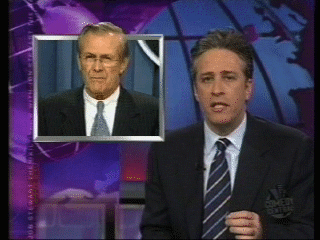
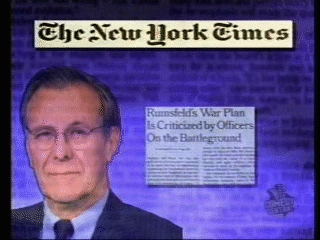
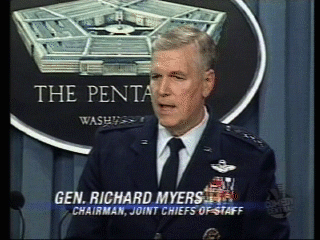
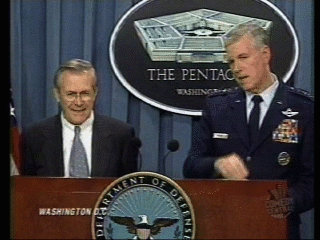
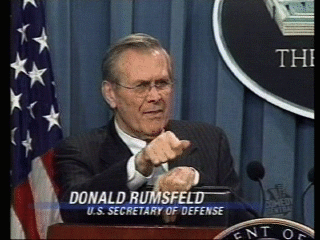
The Daily Show -- the best news on television.
WMD=Weapons of Mass Destruction
I may look silly putting that up there, but I don't like using acronyms without explaining them first...
Now that we all know what "WMD" means, this article, much like the article I posted earlier would suggest that there may not be any of them to be found in Iraq.
Iraqi Weapons Might Be Hard to Find
Suspicious Sites Provide No Proof Yet
By Barton Gellman for the Washington Post .
Here is the full text of the article in case the link goes bad:
http://www.washingtonpost.com/wp-dyn/articles/A31589-2003Apr4.html
Banned Iraqi Weapons Might Be Hard to Find
Suspicious Sites Provide No Proof Yet
By Barton Gellman
Washington Post Staff Writer
Saturday, April 5, 2003; Page A19
U.S. forces in Iraq yesterday found sites and substances they described as suspected components of a forbidden Iraqi weapons program. But the discoveries that U.S. troops displayed, and the manner in which they were described at a Central Command briefing, struck experts in and out of government as ambiguous at best.
Iraq has the most extensive petrochemical industry in the Middle East and a wealth of vaccine factories, single-cell protein research labs, medical and veterinary manufacturing centers and water treatment plants. Nearly all of them are dual-use facilities, capable of civilian or military employment, but most were devoted to legitimate activity even at the height of Iraq's secret weapons programs.
Moving warily through that industrial landscape, U.S. and allied ground forces will inevitably find, as U.N. inspectors have found since 1991, thousands of potential weapons sites but few, if any, that could be nothing else. Iraq's continued concealment of such weapons is the allegation at the core of the Bush administration's case for war. If the hunt for them relies on that sort of survey, experienced investigators said, it faces a long road to an uncertain result.
In the first of yesterday's discoveries, the 3rd Infantry Division entered the vast Qa Qaa chemical and explosives production plant and came across thousands of vials of white powder, packed three to a box. The engineers also found stocks of atropine and pralidoxime, also known as 2-PAM chloride, which can be used to treat exposure to nerve agents but is also used to treat poisoning by organic phosphorus pesticides. Alongside those materials were documents written in Arabic that, as interpreted at the scene, appeared to include discussions of chemical warfare.
This morning, however, investigators said initial tests indicated the white powder was not a component of a chemical weapon. "On first analysis it does not appear to be a chemical that could be used in a chemical weapons attack," Col. John Peabody, commander of the division's engineering brigade, told a Reuters reporter with his unit.
U.N. inspectors have surveyed Qa Qaa some two dozen times, most recently last month. But some 1,000 structures there, organized into 10 or more factory complexes, have mainly been devoted to such conventional military industries as explosives and missile fuels. Neither is forbidden under U.N. Security Council mandates. Qa Qaa was last linked to proscribed activity in 1995 -- and somewhat peripherally then.
"Based on [the powder and antidotes] you couldn't form any real judgment," said Terence Taylor of Britain, a former inspector with the U.N. Special Commission (UNSCOM). "It is a place where there would be a lot of chemicals, not necessarily related to chemical or biological weapons. More likely in that place it would relate to some form of rocket propellant."
"I'm afraid what we're in for," he said, is a "long-term task" pushed forward by "the political concern and pressure to find hard evidence of weapons of mass destruction that you can show."
Brig. Gen. Vincent K. Brooks, briefing reporters at Central Command headquarters in Qatar, said he had no details on the suspicious powder but said that "certainly it's an item of interest."
But Brooks volunteered another discovery in western Iraq. Special Operations troops raided a building there "that we think now was probably an NBC training school," he said, referring to nuclear, biological and chemical weapons.
Brooks said military commanders based that belief on a shelf of clear- and brown-glass bottles with yellow labels.
"Can we bring up the bottles?" he directed, calling for a photograph in his slide show.
"This is what we saw," he said. "One of them had been marked 'Tabun,' " a nerve agent developed during World War II. The bottle, he said, contained a few drops of liquid.
He did not say whether tests showed the liquid to be the deadly chemical.
Iraq was obliged under U.N. resolutions to declare any stocks of nerve agent in its possession. But a quantity measured in milliliters, U.S. government and U.N. experts said, probably would not constitute a material breach of that obligation.
"There will be more and more alarms like this," said an expert on nerve poisons with long experience in Iraq. "If you have a vial marked 'Tabun,' it could be simulant, it could be a sample used for training purpose or for evaluation of protection equipment. . . . The regular procedure is to put one drop on the surface of a material used in the production of a protection suit, and you analyze the penetration of this drop through the material."
Chemical protection gear is permitted under the U.N. restrictions.
A serious find, the expert said, would involve "Tabun in a munition, or in bulk storage, or traces of Tabun in a reaction vessel" of the sort used to manufacture the agent in quantity.
At part of the Qa Qaa facility, where the white powder appeared yesterday, UNSCOM ordered the destruction of reactors, heat exchangers and storage vessels suspected of chemical weapons production.
The weapons work had not taken place at that site, UNSCOM reported in the early 1990s, but Iraq had moved the dual-use equipment from the Muthana chemical weapons site, about 80 miles northwest of Baghdad, without declaring it. Under UNSCOM rules, the equipment was subject to destruction.
The International Atomic Energy Agency also reported, after a 10-day visit in September 1995, that Iraqi scientists acknowledged involvement of the Qa Qaa facility "in support of the development of the implosion package" intended to detonate a nuclear weapon if Iraq acquired highly enriched uranium.
U.S. officials overseeing the weapons hunt generally do not expect to make major finds at sites previously identified as suspicious, noting that Iraq's documented history of concealment relied on constant movement.
"There's lots we don't know about current whereabouts," Douglas J. Feith, undersecretary of defense for policy, said in an interview. "That's going to be true until we have full control of the country, and even a time thereafter."
He added: "If you have [custody of] the people who know everything, and they tell you everything they know, then you could learn the whereabouts of everything very quickly. But if those people aren't around, or they're dead, or they've organized things in such a way that nobody has too much knowledge, it's going to take you awhile."
Here's Why:
Thin Ice.
By Patrick Farley.
(via BoingBoing)
Here is the full text of the article in case the link goes bad:
http://www.e-sheep.com/thinice.html
Thin Ice
Patrick Farley / April 3, 2003 / e-sheep.com
We're on the banks of a FROZEN RIVER on a cold, sunny day. Trees along the riverside drip with melting snow. Far off toward the horizon, almost out of sight, an emaciated OLD WOMAN lies on the ice, moaning feebly for help.
GEORGE W. BUSH stands before a WINNEBAGO and addresses the gathered CROWD.
BUSH: Hey everybody! You remember that old woman who's been stranded on the ice these past 6 months, who we've been ignoring up until now? Today, I'm sending this Winnebago fulla Boy Scouts out there to RESCUE HER!
THE CROWD roars and cheers: WOO!
LET'S GO!
WE'RE GONNA BE HEROES!
LET'S SAVE THAT OLD LADY!
One guy, a PROTESTER, speaks up:
PROTESTER: Umm.. Mr. President... It's the middle of April... You think it might be unwise to drive a Winnebago onto the ice?
THE CROWD snarls with disbelief:
WOULD YOU LISTEN TO THIS GUY?!
HE HATES THE BOY SCOUTS!
HE HATES WINNEBAGOS!
HE HATES GEORGE BUSH!
HE WANTS THAT OLD WOMAN TO FREEZE TO DEATH ON THE ICE!
PROTESTER: I'm just saying... uh... the ice might be thin.
WOLFOWITZ: Then again, it might not be.
CHENEY: We've looked all up and down the river with binoculars, and as far as we can tell, the ice is FIRM!
PERLE: I predict the ice will get even firmer as the Winnebago rolls over it.
RUMSFELD: And even if it doesn't -- this Winnebago has snowchains!
FRANKS: Darn tootin'... This is the most sophisticated Winnebago money can buy! It's got four wheel drive AND a DVD entertainment system, AND electric ass-warmers on the driver's seat!
PROTESTER: I don't see what that has to do with the ice.
POWELL: Listen -- I've driven Winnebagos before, and I tell you, we have no other choice if we want to save that poor woman. Time is running out for her!
PROTESTER: What about using a ladder?
THE CROWD gasps:
A LADDER???!!!!
WHEN WE'VE GOT A FULLY-LOADED WINNEBAGO??!!!
LADDERS ARE FOR FAGGOTS!
WINNEBAGO ALL THE WAY! WINNEBAGO ALL THE WAY!
POWELL: A ladder's already been tried. Last month a Swedish guy attempted to reach the woman with a plastic kitchen stepladder, and failed miserably.
PROTESTER: Of course he failed! It's completely the wrong kind of ladder!
THE CROWD snarls:
YOU HATE BOY SCOUTS!
YOU HATE WINNEBAGOS!
YOU HATE GEORGE BUSH!
YOU WANT THAT OLD WOMAN TO FREEZE TO DEATH!
Shh! The President's speaking!
BUSH: My fellow Americans... The rescue of the old lady on the ice is about to begin. Boy Scout Troop 242 will take the Winnebago. I am personally giving the keys to Eagle Scout Billy Joe Johnson, who just got his learner's permit last week.
BILLY JOE: Golly Mr. President.... You're lettin' ME drive the Winnebago? I won't let you down, sir!
They exchange salutes. BILLY JOE and the rest of the BOY SCOUTS file down into the WINNEBAGO.
BOY SCOUT 1: Dude! We're all gonna get Life Saving merit badges for this!
BOY SCOUT 2: And a full-page spread in Boy's Life!
As they march into the WINNEBAGO one by one, the entire BOY SCOUT TROOP sings:
Lord Baden Powell
Has many friends,
Many friends has Loooord Baden Powell!
You are one of them,
And so am I,
As weee go marching ON!!!
Door slams shut. Engine revs.
PROTESTER: Shit shit shit shit shit shit....
Vroom vroom... The WINNEBAGO half-rolls, half-slides onto the ice, fishtails for a moment, then charges confidently forward.
FOX NEWS COMMENTATOR: And THERE THEY GO, the HEROIC BOYS of SCOUT TROOP 242. They are truly AMERICA'S FINEST. Let's all wave to them and show our support!
CROWD cheers, waves American flags, and holds up teddy bears dressed in Boy Scout uniforms.
PROTESTER: For fuck's sake, what's wrong with you people??? WE'RE SENDING A WINNEBAGO FULL OF BOY SCOUTS ONTO A FROZEN RIVER IN THE SPRINGTIME!
FOX NEWS COMMENTATOR: Heh heh... Looks like we got ourselves a Bush-hating, anti-Boy Scout NUTCASE down there. He must really want that old woman to freeze to death! Hold it -- This just in: neighboring towns are refusing to send their own Boy Scouts or Winnebagos to assist in the rescue effort, but they have offered to stand by with ladders if need be.
A FLAG-WAVING GUY nearby shouts into the microphone: THOSE CHICKENSHITS! WHO NEEDS THEIR LADDERS?! WE CAN DO THIS OURSELVES!
Suddenly, from the river, comes a sickening CRACK...
CROWD: (murmurs fearfully) What was THAT?
PERLE: I'm outta here. (exits quietly)
RUMSFELD steps up to the podium.
CROWD: What's wrong?
RUMSFELD: Nothing's "wrong." Stop saying things are "wrong." The Winnebago's probing the soft spots in the ice. Its tires are designed for that.
FOX NEWS COMMENTATOR: This just in: One of the Boy Scouts has pitched headfirst into the dashboard and now has a bloody nose.
THE CROWD gasps.
FLAG-WAVING GUY points an accusing finger at the PROTESTER and snarls: Hey you! Mr. Naysayer! Ya hear that? A Boy Scout has a BLOODY NOSE. Maybe it's time you shut up now and show some GRATITUDE to those brave boys out there.
PROTESTER: I WANTED TO KEEP THOSE BOYS OFF THE ICE TO BEGIN WITH!!!
FLAG-WAVING GUY: Well it's too late to turn back now, so you better wave a flag and show those boys you're behind 'em ONE HUNNERD PER CENT!
PROTESTER: How is waving a fucking FLAG going to firm up the ICE?
DON'T YOU PEOPLE GET IT?
IT DOESN'T MATTER HOW BRAVE THEY ARE!
IT DOESN'T MATTER HOW GOOD OUR INTENTIONS ARE!
IT DOESN'T MATTER HOW SOPHISTICATED THE WINNEBAGO IS!
IT'S ALL ABOUT THE ICE!!!
Suddenly the FLAG-WAVING GUY lays a meaty hand on PROTESTER's shoulder.
FLAG-WAVING GUY: That's enough, buddy.
The way you keep talkin' bout the ice cracking is demoralizing our boys....
You must really WANT the ice to crack, don't you?
You must really WANT to see our boys drown in freezing water, don't you?
You'd LIKE that, wouldn't you, you SICK FUCK!
LET'S GET HIM BOYS!!!!
A dozen REDNECKS fall on the PROTESTER with fists and baseball bats, beating him to a bloody pulp, while THE CROWD whoops, cheers, and chants WINNEBAGO! WINNEBAGO! over and over.
In the foreground, DONALD RUMSFELD speaks with the FOX NEWS COMMENTATOR:
FOX NEWS COMMENTATOR: Mr. Secretary, would you comment on the progress of the rescue effort?
RUMSFELD: We're making excellent progress! As you can see, the Winnebago is halfway to the old woman, which means the ice must be getting firmer. The closer our boys get to her, the less likely the ice will be to --
The End?
Patrick Farley
April 3, 2003
www.e-sheep.com / webmaster@e-sheep.com
Wow. This is classic stuff.
In the U.S., some of the best "real news" on TV comes with comedy afterwards.
Just to clarify: yes, he has been asked to leave (all official-like), and, no, he is not leaving.
Part 1 is the headlines report by Jon. Part 2 is a special report by Stephen Colbert on the subject where he does a take off on what got Geraldo fired.
Daily Show On Geraldo's Getting Booted Out of Iraq Part 1 of 2 (Small - 8 MB)
Daily Show On Geraldo's Getting Booted Out of Iraq Part 2 of 2 (Small - 7 MB)
Daily Show On Geraldo's Getting Booted Out of Iraq Part 1 of 2 (Hi-res 102 MB)
Daily Show On Geraldo's Getting Booted Out of Iraq Part 2 of 2 (Hi-res 95 MB)
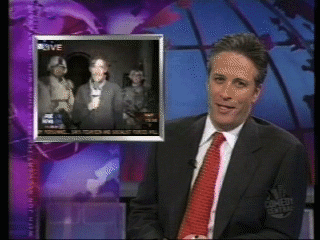
The Daily Show -- the best news on television.
Well at least this only took weeks and not months or years. Let's hope the U.S. will be making similar admissions soon...
Britain Admits There May Be No WMD's in Iraq
By Ruben Bannerjee for Al Jazeera.
Making the startling confession in a radio interview, British Home Secretary, David Blunkett, added in the same breath that he would in any case rejoice the "fall'' of Saddam Hussein and his regime -- regardless of whether any weapons of mass destruction were found in Iraq or not.The confession reconfirms the worst fears of opponents of the war that "weapons of mass destruction'' is only a ruse for the US and the British to go to war against Iraq.
At the very least the admission certainly deals a serious blow to the moral legitimacy that the US and the British have been seeking in prosecuting the war...
UN weapons inspectors, who scoured the country for several months until the US asked them to leave last month, had repeatedly certified that they had found no credible evidence of Iraq possessing any weapons of mass destruction.
Here is the full text of the article in case the link goes bad:
http://truthout.org/docs_03/040703C.shtml
Britain Admits There May Be No WMD's in Iraq
Ruben Bannerjee
Al Jazeera
Saturday 05 April 2003
Well into the war that was supposed to rid Iraq of its alleged stockpile of weapons of mass destruction, a senior British official admitted on Saturday that no chemical, biological or nuclear weapons of mass destruction may after all be found.
Making the startling confession in a radio interview, British Home Secretary, David Blunkett, added in the same breath that he would in any case rejoice the "fall'' of Saddam Hussein and his regime -- regardless of whether any weapons of mass destruction were found in Iraq or not.
The confession reconfirms the worst fears of opponents of the war that "weapons of mass destruction'' is only a ruse for the US and the British to go to war against Iraq.
At the very least the admission certainly deals a serious blow to the moral legitimacy that the US and the British have been seeking in prosecuting the war.
Critics of the war across the world have been accusing the US and the British of aiming for regime change in Baghdad under the guise of "unearthing and dismantling weapons of mass destruction in Iraq.''
There have been constant accusations that the US and the British are eyeing Iraq's huge oil wealth, promoting Israeli interests, and that its campaign against "weapons of mass destruction'' is only a convenient cover-up.
Even countries like Germany, Russia and France had been less than impressed with the US-led war against Iraq saying all along that the task of unearthing weapons of mass destruction, if any, is better left to UN weapons' inspectors.
In making the confession in an interview with BBC radio, the British Home Secretary however admitted that the non-discovery of any weapons of mass destruction would "lead to a very interesting debate'' about the war.
"We will obviously have a very interesting debate if there are no biological, chemical, radiological or nuclear weapons or facilities to produce them found anywhere in Iraq once Iraq is free,'' the home secretary added.
The US-led forces stand to face a huge global uproar if no weapons of mass destruction are found in Iraq.
US-led forces moving across the Iraqi deserts have been under pressure since the start of the war to find evidence of Iraq's weapons of mass destruction. But instead of solid evidence, the they have so far raised only false alarms.
From time to time, the US-forces have claimed to have unearthed "suspicious'' substances. And each time, the claim has turned out to be without substance.
Today Saturday 5 April, US Marines were reported to be digging up a suspected chemical weapons hiding place in the courtyard of a school in the southeast of Baghdad.
Western media reported that the US Marines were digging after being tipped off by an Iraqi informer. "We don't have a clue now but we are going to dig it up and check,'' said General James Mattis, the commander of the Marine division at the scene.
Iraq has always insisted that it does not possess any weapons of mass destruction.
UN weapons inspectors, who scoured the country for several months until the US asked them to leave last month, had repeatedly certified that they had found no credible evidence of Iraq possessing any weapons of mass destruction.
Red Cross horrified by number of dead civilians
From the Canadian Press.
Red Cross doctors who visited southern Iraq this week saw "incredible" levels of civilian casualties including a truckload of dismembered women and children, a spokesman said Thursday from Baghdad.Roland Huguenin, one of six International Red Cross workers in the Iraqi capital, said doctors were horrified by the casualties they found in the hospital in Hilla, about 160 kilometres south of Baghdad.
"There has been an incredible number of casualties with very, very serious wounds in the region of Hilla," Huguenin said in a interview by satellite telephone.
"We saw that a truck was delivering dozens of totally dismembered dead bodies of women and children. It was an awful sight. It was really very difficult to believe this was happening."
Huguenin said the dead and injured in Hilla came from the village of Nasiriyah, where there has been heavy fighting between American troops and Iraqi soldiers, and appeared to be the result of "bombs, projectiles."
"At this stage we cannot comment on the nature of what happened exactly at that place . . . but it was definitely a different pattern from what we had seen in Basra or Baghdad.
"There will be investigations I am sure."
Baghdad and Basra are coping relatively well with the flow of wounded, said Huguenin, estimating that Baghdad hospitals have been getting about 100 wounded a day.
Most of the wounded in the two large cities have suffered superficial shrapnel wounds, with only about 15 per cent requiring internal surgery, he said.
But the pattern in Hilla was completely different.
"In the case of Hilla, everybody had very serious wounds and many, many of them small kids and women. We had small toddlers of two or three years of age who had lost their legs, their arms. We have called this a horror."
At least 400 people were taken to the Hilla hospital over a period of two days, he said -- far beyond its capacity.
"Doctors worked around the clock to do as much as they could. They just had to manage, that was all."
The city is no longer accessible, he added...
The Red Cross expects the humanitarian crisis in Iraq to grow and is calling for donations to help cope. The Red Cross Web site is: www.redcross.ca
Here is the full text of the article in case the link goes bad:
http://www.ctv.ca/servlet/ArticleNews/story/CTVNews/1049413227648_10/?hub=SpecialEvent3
Canadian Press
OTTAWA — Red Cross doctors who visited southern Iraq this week saw "incredible" levels of civilian casualties including a truckload of dismembered women and children, a spokesman said Thursday from Baghdad.
Roland Huguenin, one of six International Red Cross workers in the Iraqi capital, said doctors were horrified by the casualties they found in the hospital in Hilla, about 160 kilometres south of Baghdad.
"There has been an incredible number of casualties with very, very serious wounds in the region of Hilla," Huguenin said in a interview by satellite telephone.
"We saw that a truck was delivering dozens of totally dismembered dead bodies of women and children. It was an awful sight. It was really very difficult to believe this was happening."
Huguenin said the dead and injured in Hilla came from the village of Nasiriyah, where there has been heavy fighting between American troops and Iraqi soldiers, and appeared to be the result of "bombs, projectiles."
"At this stage we cannot comment on the nature of what happened exactly at that place . . . but it was definitely a different pattern from what we had seen in Basra or Baghdad.
"There will be investigations I am sure."
Baghdad and Basra are coping relatively well with the flow of wounded, said Huguenin, estimating that Baghdad hospitals have been getting about 100 wounded a day.
Most of the wounded in the two large cities have suffered superficial shrapnel wounds, with only about 15 per cent requiring internal surgery, he said.
But the pattern in Hilla was completely different.
"In the case of Hilla, everybody had very serious wounds and many, many of them small kids and women. We had small toddlers of two or three years of age who had lost their legs, their arms. We have called this a horror."
At least 400 people were taken to the Hilla hospital over a period of two days, he said -- far beyond its capacity.
"Doctors worked around the clock to do as much as they could. They just had to manage, that was all."
The city is no longer accessible, he added.
Red Cross staff are also concerned about what may be happening in other smaller centres south of Baghdad.
"We do not know what is going on in Najaf and Kabala. It has become physically impossible for us to reach out to those cities because the major road has become a zone of combat."
The Red Cross was able to claim one significant success this week: it played a key role in re-establishing water supplies at Basra.
Power for a water-pumping station had been accidentally knocked out in the attack on the city, leaving about a million people without water. Iraqi technicians couldn't reach the station to repair it because it was under coalition control.
The Red Cross was able to negotiate safe passage for a group of Iraqi engineers who crossed the fire line and made repairs. Basra now has 90 per cent of its normal water supply, said Huguenin.
Huguenin, a Swiss, is one of six international Red Cross workers still in Baghdad. The team includes two Canadians, Vatche Arslanian of Oromocto, N.B., and Kassandra Vartell of Calgary.
The Red Cross expects the humanitarian crisis in Iraq to grow and is calling for donations to help cope. The Red Cross Web site is: www.redcross.ca
I've been working for the last two weeks helping to set up a warblog for a very knowledgable guy I met at SXSW 2003.
Introducing: David Miller and what I think will be one of the most insightful warblogs in existence to date:
David is currently working on a book based on Letters written to President Johnson from the relatives of soldiers who had died in the Vietnam War.
Proof (as if we needed any more) that history tends to repeat itself.
That'll teach em for thinking.
UK troops sent home for questioning war
The soldiers were returned to Britain on the eve of the war when they expressed concerns the offensive was in breach of the United Nations charter and it might be illegal for them to follow certain orders, their lawyer Gilbert Blades said."They expressed doubts about the legality of the war, about whether they should be called upon to shoot innocent civilians," Blades, a Lincolnshire-based military lawyer, told Reuters. "As soon as they expressed these views to other soldiers they were then removed."
Here is the full text of the article in case the link goes bad:
http://www.alertnet.org/thenews/newsdesk/L01605437.htm
01 Apr 2003 16:15:52 GMT
UK troops sent home for questioning war -lawyer
By Andrew Hay
LONDON, April 1 (Reuters) - Two British soldiers who questioned the legality of the U.S.-led war in Iraq have been sent home from the Gulf and may now face disciplinary action, their lawyer said on Tuesday.
The soldiers were returned to Britain on the eve of the war when they expressed concerns the offensive was in breach of the United Nations charter and it might be illegal for them to follow certain orders, their lawyer Gilbert Blades said.
"They expressed doubts about the legality of the war, about whether they should be called upon to shoot innocent civilians," Blades, a Lincolnshire-based military lawyer, told Reuters. "As soon as they expressed these views to other soldiers they were then removed."
The case could prove embarrassing to the government, which ordered the military into action in the face of heavy public opposition and without a clear mandate from the United Nations.
British authorities in Qatar on Sunday said two of their soldiers were sent home from Kuwait in February on "medical and/or compassionate grounds" but denied the two had refused to fight.
The Ministry of Defence in London said on Tuesday it was not aware of any British soldiers who had expressed concerns about the legality of the war and had been sent home as a result.
"I know the number of people who've been sent back and the reasons for it and that doesn't tie in with any of them," an MoD spokeswoman said.
Blades said the two soldiers had been returned to normal duties at Colchester garrison in southern England and were waiting to hear from the MoD whether they would be charged.
"I don't suppose for one moment when they joined the services they thought they might have to obey an order which might be illegal," Blades said. "The question is whether the order is illegal or not."
British Prime Minister Tony Blair waged a campaign to convince Britons it was legal to enter a U.S.-led war in Iraq without an express resolution from the U.N. Security Council.
Blades said the soldiers had not refused a specific order because they had been removed from the campaign before they were put in a position where they might have to take such an action.
"Naturally the MoD would want to nip in the bud any dissident voices within the service," Blades said.
British newspapers have identified the soldiers as a private and an air technician from 16 Air Assault Brigade -- a frontline unit that has been engaged in heavy fighting in southern Iraq. Blades declined to identify the soldiers.
An official at 16 Air Assault Brigade, which is garrisoned in Colchester, declined to comment on the case.
The Daily Show On Donald Rumsfeld (Small - 5 MB)
The Daily Show On Donald Rumsfeld (Hi-res - 57 MB)
"We're in the middle of a war -- He's starting another war."

The Daily Show -- the best news on television.
The Daily Show On Peter Arnett (Small - 7 MB)
The Daily Show On Peter Arnett (Hi-res - 98 MB)
The Daily Show -- the best news on television.
Update: 6:43 pm - Thanks, Sheila, for the heads up that I had "CNN" instead of "NBC". (More on the details of this soon.)
Here's a clip showing a bit of what he said and what happened as a result.
The Daily Show also just did a bit on this that I've made available.
Peter Arnett Fired From CNN - KTVU 2 (Small - 3 MB)
Peter Arnett Fired From CNN - KTVU 2 (Hi-res - 33 MB)
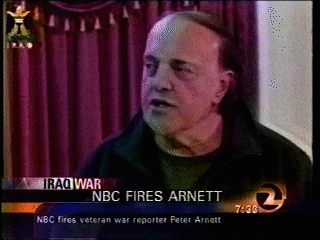
First Stop, Iraq
How did the U.S. end up taking on Saddam? The inside story of how Iraq jumped to the top of Bush's agenda—and why the outcome there may foreshadow a different world order
By Michael Elliott and James Carney for Time.
With reporting by Timothy J. Burger, Massimo Calabresi, John F. Dickerson, Mark Thompson, Eric Roston and Douglas Waller/Washington, Mitch Frank/New York and James Graff/Paris
"Fuck Saddam. We're taking him out."Those were the words of President George W. Bush, who had poked his head into the office of National Security Adviser Condoleezza Rice. It was March 2002, and Rice was meeting with three U.S. Senators, discussing how to deal with Iraq through the United Nations, or perhaps in a coalition with America's Middle East allies. Bush wasn't interested. He waved his hand dismissively, recalls a participant, and neatly summed up his Iraq policy in that short phrase...
A year later, Bush's outburst has been translated into action, as cruise missiles and smart bombs slam into Baghdad. But the apparent simplicity of his message belies the gravity at hand. Sure, the outcome is certain: America will win the war, and Saddam will be taken out. But what is unfolding in Iraq is far bigger than regime change or even the elimination of dangerous weapons. The U.S. has launched a war unlike any it has fought in the past. This one is being waged not to defend against an enemy that has attacked the U.S. or its interests but to pre-empt the possibility that one day it might do so. The war has turned much of the world against America. Even in countries that have joined the "coalition of the willing," big majorities view it as the impetuous action of a superpower led by a bully. This divide threatens to emasculate a United Nations that failed to channel a diplomatic settlement or brand the war as legitimate. The endgame will see the U.S. front and center, attempting to remake not merely Iraq but the entire region. The hope is that the Middle East, a cockpit of instability for decades, will eventually settle into habits of democracy, prosperity and peace. The risks are that Washington's rupture with some of its closest allies will deepen and that the war will become a cause for which a new generation of terrorists can be recruited.
Here is the full text of the article in case the link goes bad:
http://www.time.com/time/covers/1101030331/wroad.html
(pages 1-6)
First Stop, Iraq
How did the U.S. end up taking on Saddam? The inside story of how Iraq jumped to the top of Bush's agenda—and why the outcome there may foreshadow a different world order
By Michael Elliott and James Carney
Posted Sunday, March 23, 2003; 2:31 p.m. EST
"F___ Saddam. We're taking him out." Those were the words of President George W. Bush, who had poked his head into the office of National Security Adviser Condoleezza Rice. It was March 2002, and Rice was meeting with three U.S. Senators, discussing how to deal with Iraq through the United Nations, or perhaps in a coalition with America's Middle East allies. Bush wasn't interested. He waved his hand dismissively, recalls a participant, and neatly summed up his Iraq policy in that short phrase. The Senators laughed uncomfortably; Rice flashed a knowing smile. The President left the room.
A year later, Bush's outburst has been translated into action, as cruise missiles and smart bombs slam into Baghdad. But the apparent simplicity of his message belies the gravity at hand. Sure, the outcome is certain: America will win the war, and Saddam will be taken out. But what is unfolding in Iraq is far bigger than regime change or even the elimination of dangerous weapons. The U.S. has launched a war unlike any it has fought in the past. This one is being waged not to defend against an enemy that has attacked the U.S. or its interests but to pre-empt the possibility that one day it might do so. The war has turned much of the world against America. Even in countries that have joined the "coalition of the willing," big majorities view it as the impetuous action of a superpower led by a bully. This divide threatens to emasculate a United Nations that failed to channel a diplomatic settlement or brand the war as legitimate. The endgame will see the U.S. front and center, attempting to remake not merely Iraq but the entire region. The hope is that the Middle East, a cockpit of instability for decades, will eventually settle into habits of democracy, prosperity and peace. The risks are that Washington's rupture with some of its closest allies will deepen and that the war will become a cause for which a new generation of terrorists can be recruited.
How did we get here? In one sense, this war is easy to explain. Saddam Hussein is a brutal dictator who hates America and has shown a wicked fondness for acquiring and using weapons of mass destruction (WMDs). Since Sept. 11, 2001, the U.S. has been acutely aware of what can happen when powerful weapons fall into the hands of those with no compunction about their use and no sympathy for those they kill. Put those facts together, and you can argue that Saddam's days were numbered from the moment the attacks on New York City and Washington happened. But that suggests a fatalistic inevitability to the story and ignores the dramatic shifts in opinion and influence among Washington's key players. In truth, this war is just as much about an idea—that Iraq is but the first step in an American-led effort to make the world a safer place. For some in the Administration, the principles that have shaped policy on Iraq are generally applicable; they could be used with other nations, like Iran or North Korea, that have or threaten to acquire terrible weapons. The least understood story of the Iraq crisis is how the idea behind it took root and eventually brought America to the edge of Baghdad.
In this battle march of an idea, there are four central players: President Bush, Vice President Dick Cheney, Secretary of State Colin Powell and—least known to the general public—Deputy Secretary of Defense Paul Wolfowitz. One by one, these men signed on to the imperative of taking on Iraq and its weapons, and sending a message to the world. This story does not start where one might suppose, on the day last year when Bush identified Iraq—with Iran and North Korea—as part of the "axis of evil." Nor does it start with the horrors of Sept. 11. The confrontation with Iraq can be traced to 1991 and the end of what some Administration officials have since last fall called "the first Gulf War"—the one waged and won by the President's father.
SOUNDING THE ALARM
When senior advisers of the first President Bush—including Powell, then Chairman of the Joint Chiefs of Staff, and Cheney, then Secretary of Defense—gathered in the Oval Office on Wednesday afternoon, Feb. 27, 1991, they agreed that their military and political objectives in the Persian Gulf had been met. Saddam's forces, which had invaded Kuwait seven months before, had been routed. General Norman Schwarzkopf, commander in chief of Operation Desert Storm, concurred in the judgment. Bush had a clear goal for the war: it was not to topple Saddam, much less to march on Baghdad, but to drive the Iraqi army out of Kuwait. The President had assembled a grand coalition, including armies from many Arab states, behind that aim, and he was not inclined to deviate from it. "Bush was a firm believer in sticking with his word," says a former senior aide. "It was his word and his promises that got that coalition together. There was never any doubt in his mind that the war had to end and we couldn't go to Baghdad."
page two below
None of the four men—Bush, Powell, Cheney and Schwarzkopf—most closely identified with the decision to cease hostilities at midnight, Feb. 27, has ever publicly disowned it. Indeed, of the broader top echelon of decision makers at the end of Gulf War I, only one has cast doubt on how it was concluded—and at the time, nobody asked his opinion. But his misgivings about the cease-fire 12 years ago have arguably had more of an effect on global politics than the certainties of those who are sure they were right. That man was Paul Wolfowitz, then Under Secretary for policy in the Pentagon, the third-ranking civilian under Cheney. He was 47 at the time and already a fixture in the Washington policy village, one of those men who spend their life flitting among government positions, foreign embassies and academia. Wolfowitz has served every President since Gerald Ford except Bill Clinton. A man of great personal charm, he has friends of all political persuasions. Of his many distinctions, the most unusual, perhaps, is this: he is the only Washington bureaucrat who has been fictionalized in a Saul Bellow novel.
That odd fact sheds light on Wolfowitz's membership in a much smaller subset of Washington officials. In Bellow's novel Ravelstein, the Wolfowitz character is a brilliant former student of the book's eponymous hero, who is based on Bellow's old friend and fellow professor at the University of Chicago, the culture critic Allan Bloom. It was at Chicago, the home of Bloom and the conservative political philosopher Leo Strauss, that Wolfowitz was first exposed to the set of ideas that is now often called "neoconservative." In their belief system, neoconservatives—or neo-Reaganites, as some prefer to be called—are at once pessimists and optimists. The world, they believe, is a dangerous, threatening place. Civilization and democracy hang by a thread; great beasts prowl the forest, ready to prey on those not tough enough to meet them in equal combat. At the same time—this is the optimistic bit—the U.S. is endowed by Providence with the power to make the world better if it will only take the risks of leadership to do so; if, in the current jargon, it is sufficiently "forward leaning." At crucial times, they argue, the U.S. has been just that—notably when Ronald Reagan used American technological prowess and cash to challenge the Soviet Union to a contest it could not win.
The U.S., neoconservatives believe, is unique in its power and its principles. It cannot allow its mission to be tied down by international agreements that diminish its freedom of action. At the same time, neoconservatives insist that theirs is a generous and internationalist vision; other nations, other peoples, will willingly support U.S. policies—which, by definition, are good for them as well as Americans—if only those policies are clearly articulated and implemented with determination.
These beliefs are not the work of thoughtless gunslingers. Wolfowitz, like many of his colleagues, couldn't be less of a cowboy. (Not many cattle in Chevy Chase, Md.) These are men whose shoes are more likely to be penny loafers than hand-tooled boots, who speak foreign languages (even French!) and are at home in rarefied academic environments. They know what they think. In a recent interview Wolfowitz told TIME, "I believe this country is what it stands for, more than anything else. If we're not true to our principles, we're not serving our national interest." He bridles at the way some lampoon him, as if he believes that, with U.S. intervention, Jeffersonian democracy will pop up in the Middle East like mushrooms after a storm. But he explicitly links the growth of democracy to America's interests. "The tendency toward successful representative self-government," he told TIME, "works for the benefit of the United States and the world."
If we're not true to our principles, we're not serving our national interest.
— PAUL WOLFOWITZ
When Wolfowitz heard that Gulf War I was over, he didn't share the inner circle's view of a job well done. Although he didn't suggest that Schwarzkopf should march on Baghdad—and has not done so since—he was disappointed that the war did not continue long enough to ensure Saddam's downfall. He was horrified when the U.S. stood by as Saddam's helicopter gunships mowed down the Shi'ites in southern Iraq whom the U.S. had encouraged to rise in rebellion. To Wolfowitz, Saddam's survival represented an opportunity missed. In a 1998 congressional hearing, he said, "Some might say—and I think I would sympathize with this view—that perhaps if we had delayed the cease-fire by a few more days, we might have got rid of him."
Regimes like Iraq's, dictatorial and willing to acquire and use terrifying weapons, have long been a preoccupation of the neoconservatives. Since the collapse of the Soviet Union, they argue, it is these states that most threaten the U.S. and other democracies. They are today's beasts in the forest, and they need to be tamed. Shortly after Gulf War I ended in 1991, Wolfowitz got a chance to show how. Cheney asked him to overhaul the Pentagon's basic strategic-planning document, known as the Defense Planning Guidance. In March 1992, a draft was first leaked to the New York Times. Forward leaning wasn't the half of it; the document suggested that the U.S. should discourage other nations "from challenging our leadership." The U.S., the draft went on to say, "may be faced with the question of whether to take military steps to prevent the development or use of weapons of mass destruction." Those steps, Wolfowitz argued, might include pre-emptive action—and the Guidance made clear that both Iraq and North Korea were among those at whom the new policy would be aimed.
At a time when the Bush Administration was trying to coax a defeated Russia and a newly unified Germany into becoming full and respected partners in the international system, the draft's bellicose terms were tactless. Cheney and Wolfowitz were told to tone them down. But from his perch at the Johns Hopkins School of Advanced International Studies, where he waited out the Clinton years, Wolfowitz continued to talk and write about Iraq. Like a traveler struggling to keep his campfire burning amid chilly winds, he took every chance to stoke the fire, reminding all who would listen that there was unfinished business on the Tigris, that Saddam remained in power and still had his weapons. In 1997, as Clinton's policy on Iraq lurched from crisis to crisis—with U.N. weapons inspectors consistently thwarted by Iraq and support for a more aggressive approach to Saddam ebbing away under French and Russian pressure at the Security Council—Wolfowitz co-authored a Weekly Standard article in which he pondered whether Clinton's most important foreign-policy legacy would be "letting this tyrant get stronger." In January 1998, Wolfowitz joined other neoconservatives in signing a letter to Clinton arguing that "containment" of Saddam had failed and asserting that "removing Saddam Hussein and his regime from power ... needs to become the aim of American foreign policy." In a prescient note, the letter said, "American policy cannot continue to be crippled by a misguided insistence on unanimity in the U.N. Security Council."
Of the 18 signatories, eight now hold senior positions in the Bush Administration. But high office in itself was not enough. If they were to rid the world of Saddam and his weapons, they would have to bring on board one influential conservative whose name wasn't on the letter—who at the time was in thought and deed far removed from the Washington policy village. That person was Dick Cheney, who had good reasons to contest the view that the end of Gulf War I had been mishandled—because he was one of those who ended it.
page three below
THE RELUCTANT IMPERIALIST
Of all those responsible for the cease-fire in February 1991, none seemed more comfortable with the decision than Cheney. In many interviews Cheney explained why he opposed marching to Baghdad. If U.S. forces got there, he argued, it would not be clear what they were meant to do. Nor was it evident how a new government would handle divisions among Iraq's Sunnis, Shi'ites and Kurds, how long the U.S. would have to stay in Iraq, or what would happen when it left.
Two considerations informed Cheney's view. The first, according to Dave Gribbin, Cheney's closest aide at the Pentagon, was practical. Just a few days after the invasion of Kuwait, Bush had assigned Cheney to win support from Saddam's Arab neighbors. "He was out there early telling the Arab world that the U.S. would come in and do just a couple of things," says Gribbin. "Get Saddam out of Kuwait and dismantle his ability to harm his neighbors. Since he promised that, he stuck with that. To occupy Iraq wasn't in the deal."
The second reason—the more interesting one—turned on Cheney's political philosophy. Cheney is from Wyoming, and in 1991 he was pretty much a straight-up-and-down Western conservative, the kind of man who is skeptical of big, expansive government projects—except irrigation for cattle ranges. He was prepared to go to war in the gulf because it was in America's national interest to do so, not for any starry-eyed vision (few men have ever had fewer stars in their eyes) that the U.S., as a kindly imperial power, would bring an era of peace, order and good government to the Middle East. "He's not much for waxing rhapsodic," says Gribbin of his old boss. In fact, when Cheney left government, he gave the impression that he wasn't thinking much about Iraq or Saddam. In 1995 he moved to Texas to serve as CEO of Halliburton, the giant oil-services company. A colleague of Cheney's in both Bush administrations recalled how he would drop by Cheney's office when he visited Texas. "His interest in policy almost disappeared," says the colleague. "He was enjoying being out of it and in the business world."
By the fall of 2000, however, Cheney was back in it—big time. As the vice-presidential running mate of the son of his old boss, he was beginning to focus on problems the Clinton Administration had been unable to solve. High among them was Iraq's continued defiance of U.N. resolutions requiring it to disarm. And when he broached the topic on the campaign trail, Cheney sounded ever more hawkish. He had been outraged by Saddam's attempt in 1993 to assassinate former President Bush in Kuwait, and he thought the short bombing campaign after Iraq kicked out the U.N. inspectors in 1998 was a joke. "We have swept that problem under the rug for too long," he told a campaign aide in 2000, speaking of Iraq. "We have a festering problem there."
When Cheney was tapped to create the second Bush Administration, he seeded it with men who had once worked for him. Wolfowitz became Deputy Secretary of Defense under Cheney's old friend and mentor Donald Rumsfeld (another signatory of the 1998 letter). But as is often the case, the new responsibilities of office meant that officials had to postpone trying to implement their most cherished to-do list. In the State Department, Powell was working on a plan for "smart sanctions" on Iraq—tightening the porous U.N. embargo while allowing more humanitarian support for innocent Iraqis. The neoconservatives weren't impressed, but in those initial months they were able to do little to develop their own strategies for ousting Saddam.
Then Cheney, probably the most influential Vice President in U.S. history, began to pay attention. His interest grew out of the Bush Administration's obsession with building a system to defend the U.S. against missile attacks. For the neoconservatives, missile defense and Iraq's possession of WMDs were both examples of a common concern, "asymmetric threats," or the idea that nations with far less conventional military strength than the U.S. would use nuclear, chemical or biological weapons to redress the balance. Cheney had been charged with developing a policy on homeland security in response to asymmetric threats, which meant that Iraq's continued possession of WMDs was a problem that landed on his desk. In morning intelligence briefings, says a former Administration official, the Vice President began to raise questions about Saddam's regime. Cheney and others, says the official, would say things like, "Tell me about Iraq, tell me about Iraq, tell me about Iraq. What's the status of their WMDs? What's their support of terrorism?" When senior members of the intelligence community answered that they had little new information on Iraq—no smoking guns on WMDs or terrorism—the message would come back: "Try harder. Need to know more."
We have swept [Iraq] under the rug for too long. We have a festering problem there.
— DICK CHENEY
In an interview with the New Yorker in May 2001, Cheney in two sentences linked North Korea, Iran and Iraq—the three countries that were later immortalized as the "axis of evil"—as threats to American security. Cheney still didn't buy into the whole neoconservative analysis. His concern was the national security of the U.S., not some grand design for remaking the Middle East. But after Sept. 11, 2001, it was harder to keep those two thoughts in separate boxes. The attacks on New York City and Washington gave the neoconservatives an opportunity. The logic seemed airtight: Saddam had WMDs; terrorists had attacked America; if al-Qaeda ever got hold of Saddam's weapons, the future didn't bear thinking about. The afternoon after the attacks, Wolfowitz, in conference calls with other officials, started voicing suspicions that Iraq might somehow have been involved. Within hours, he was lobbying Cheney on the topic, arguing—a central plank of the neoconservative analysis—that Iraq was also somehow behind the first attack on the World Trade Center in 1993. Within days, James Woolsey, once Clinton's head of the CIA but who had joined the neoconservatives on Iraq, was dispatched by the Pentagon to find proof that Iraq was linked to al-Qaeda.
Cheney was skeptical of the claim. (U.S. intelligence has never been able to substantiate a link between Iraq and the 1993 World Trade Center attack—or the assault of 2001.) But Wolfowitz stayed on the case. On the weekend after Sept. 11, Bush convened his national-security team at Camp David. Wolfowitz argued that if military action was to be taken against the Taliban regime in Afghanistan, which was harboring the leadership of al-Qaeda, it should also be taken against Iraq. Saddam's regime had WMDs, had shown that it was willing to use them, and harbored a continuing hostility to the U.S. Powell was opposed to anything so ambitious, however, and Cheney didn't back up his old Pentagon colleague. Rice says the Vice President was a "proponent of doing one thing at a time—Afghanistan first."
But Cheney wasn't entirely in Powell's camp. In fact, in his taciturn, deliberate way, Cheney was starting to go through a shift in his intellectual bearings. "Dick Cheney," says Wolfowitz, "is someone whose view of the need to get rid of Saddam Hussein was transformed by Sept. 11—by the recognition of the danger posed by the connection between terrorists and WMDs and by the growing evidence of links between Iraq and al-Qaeda." After Sept. 11, Cheney began running a self-education seminar on Islam and the Middle East, meeting with experts, a Cheney aide says, "to discuss how might a postwar Iraq take shape and what are the prospects for democracy in the region." Cheney, friends say, has gradually abandoned his former skepticism about the potential for democracy in the Middle East. Among those who have influenced him: Bernard Lewis, a Princeton historian, and Fouad Ajami, a former colleague of Wolfowitz's at Johns Hopkins. Both men passionately believe that the lack of democracy and pluralism are central to the chronic instability of the Middle East and that any serious policy there must aspire to do more than leave existing autocracies in power.
page four below
Republican Congressman Porter Goss recalls a telling moment a few months after Sept. 11, when he was among the guests at a "sort of off-night dinner" at the Vice President's residence. Lewis was there too, and Cheney, when he arrived, promptly asked the professor to conduct a seminar on Islam, the Koran and Muslim attitudes toward Americans. Cheney expressed his views most forcefully in a major speech to the Veterans of Foreign Wars convention in Nashville in August 2002. "Regime change in Iraq would bring about a number of benefits to the region," he said, including "the chance to promote the values that can bring lasting peace." He quoted Ajami's conviction that after liberation, the streets of Baghdad and Basra would "erupt in joy in the same way as the throngs in Kabul greeted the Americans." By last summer, to the surprise of many old critics, Cheney's intellectual journey was complete. William Kristol, editor of the Weekly Standard, the Koran of neoconservative thought, was critical when Bush chose Cheney as a running mate precisely because of his defense of the way the Gulf War ended. Now, says Kristol, neoconservatives happily "consider him a fellow-traveler." But a couple of others still had to be persuaded to come along on the journey.
THE EUREKA MOMENT
At the time of Gulf War I, George W. Bush was spending a lot more time worrying about the Texas Rangers of the American League than about the Rangers in Army fatigues. During his father's presidency, Bush was an occasional and important political fixer, but he was never involved—never wanted to be involved, and was never invited to be involved—in foreign policy. When he ran for the presidency in 2000, his team of advisers spent little time on Iraq. To be sure, whenever he was asked about Saddam, Bush had the tough talk down. In an interview with TIME during the campaign, he was asked what he would do if Saddam tested him. "That would be good," said Bush. "I've learned one thing; I'd jump on him."
But despite the aggressive language, there was no sign that he had accepted the logic of a pre-emptive strike against Saddam. After Sept. 11, he initially resisted making Iraq an early target of American might. Wolfowitz, says a Republican lawmaker, "was like a parrot bringing [Iraq] up all the time. It was getting on the President's nerves." At one point in the Camp David meeting after Sept. 11, Wolfowitz tried to persuade Bush to back a scheme to lop off the southern part of Iraq, including Basra, its third largest city, and some important oil fields. That went nowhere. And no matter how hard the intelligence agencies looked, they couldn't come up with a link between Saddam and Sept. 11 that might persuade Bush of the virtues of an early strike.
Yet in January 2002, Bush identified Iraq as a member of an "axis of evil, arming to threaten the peace of the world." The President told Congress that he "would not wait on events while dangers gather"—a clear sign that he was contemplating pre-emptive strikes against those with WMDs. By April 2002, on Bush's instruction, Cheney toured the Middle East trying to make the case for action against Saddam.
Iraq is part of an axis of evil, arming to threaten the peace of the world.
— GEORGE W. BUSH
What had changed? What had brought Bush into the get-Iraq-now camp? The most important factor was also the simplest. By the fall of 2001, Bush and other senior policymakers in Washington were scared out of their wits. On Oct. 4 came the first anthrax attacks on New York City and Washington. Again, no evidence was found linking Saddam to the attacks. But Saddam had once admitted developing anthrax weapons to U.N. inspectors, and now anthrax was being used to kill Americans. Even if a link to Baghdad could not be proved, this was enough to stiffen the spines of those who thought Saddam's WMDs had been left alone too long.
Then, in November 2001, as alliance soldiers combed through al-Qaeda safe houses in Afghanistan, documents and computer records revealed that Osama bin Laden's network had been trying to acquire WMDs. Administration officials didn't have to work hard to identify a possible supplier. "Iraq," says a White House official, "was the easiest place they could get them from." Says a former senior Administration official: "The eureka moment was that realization by the President that were a WMD to fall into [terrorists'] hands, their willingness to use it would be unquestioned. So we must act pre-emptively to ensure that those who have that capability aren't allowed to proliferate it." Those seeking to convince Bush that Saddam should be a target now had important allies. Throughout the 1990s, the uniformed military had been unenthusiastic about intervention in Iraq. After Sept. 11, that changed. "It became clear that these terrorists would kill as many Americans as they could," says an Army general. "If they could get their hands on chemical, biological or nuclear weapons—from Saddam or from someone else—they would use them against us."
There was more. By 2002, say advisers to the President, Bush had become increasingly horrified by stories of Saddam's brutal regime—by the ways in which Iraq's security services raped and tortured his opponents, gassed Kurds rebelling against rule from Baghdad in 1988 and summarily executed those Saddam mistrusted. This fascination with Saddam's cruelty, says a source close to the White House, was neither ghoulish nor an expression of Bush's propensity to identify evil in the world. The point, says this adviser, is that Bush thinks Saddam is insane. "If there is one thing standing between those who want WMDs and those who have them," says this source, "it is this madman. Depending on the sanity of Saddam is not an option."
By this point, Bush was on board for action against Iraq. But in what form? It was easy to say Iraq should be disarmed and Saddam unseated from power if he would not abandon his WMDs. But by the spring of 2002, the Administration had no idea how to achieve such a goal. Would the U.S. do it alone? What would Washington tell its allies in the Middle East and Europe? In March, as he did 12 years earlier, Cheney set out on a trip to the Middle East to rally support for an aggressive American policy against Iraq. The trip didn't go well. Cheney's hosts wanted to talk about the rising tide of violence in Israel and the occupied territories, not about Iraq. If there was going to be an international effort to disarm Saddam or remove him from power, it would have to be led by the man who, up to now, had steadfastly resisted the neoconservative case—Colin Powell.
page 5 below
NO LONGER A DOVE
When Powell took over at State in 2001, he had no illusions that Clinton's policy on Iraq was a success, because he had to cope with its failures. Every day news would arrive of another violation of the U.N. sanctions—civilian planes from Arab nations making direct flights to Baghdad, brazen exports of oil and imports of prohibited goods. Powell didn't want to ditch the sanctions, as he thought they had some value, but he wanted to make them more effective. "Though [the Iraqis] may be pursuing weapons of mass destruction of all kinds," he said in February 2001, "it is not clear how successful they have been. We ought to declare this a success. We have kept him contained, kept him in his box."
That analysis, of course, was precisely the one the neoconservatives had long rejected, and it was inevitably subject to revision after Sept. 11. At the Camp David meeting, Powell argued against targeting Iraq, but he too knew the game had changed. There would be no more talk, says a State official, of Saddam being kept "in his box." By the spring of 2002, the Administration had a new problem. Beyond that nifty phrase "the axis of evil," it didn't have a forward-leaning policy on Iraq. It didn't have anything. Cheney's trip to the Middle East, designed to start building a coalition for action to disarm Iraq, had fallen well short of his hopes. One of his aides admitted that the team had underestimated Arab anger at Israel's crackdown on the occupied territories. "We thought [the Arab governments] were exaggerating 'the street' for their own purposes," says the official. "They weren't."
After Cheney's return, the Administration's incoherence on Iraq began to spill out. Officials started free-lancing. Exiled Iraqi opposition leaders, convinced that war was imminent, began lobbying for favors. Campaigning for congressional Republicans, Cheney started to test the waters for a pre-emptive strike to "remove serious threats to our country before they materialize." (He never mentioned Iraq by name, but everyone knew what he meant.) Republican congressional leaders, facing an election, fretted that the disarray would hurt them politically. At one point that spring, a senior White House official said in exasperation, "The dirty little secret of Iraq is that there is no plan." Rice, responding to a request by Democratic Senator Joe Biden for Administration officials to appear before his Foreign Relations Committee, was refreshingly blunt. "We're not ready yet," she told Biden, who held the hearings anyway. They were covered widely as a preparation for war, to the consternation of Republican congressional leaders. Trent Lott, then Senate leader of the G.O.P., called Cheney to tell him the media were making the Administration's Iraq policy for it. "We've got to get this thing on track," Lott said.
This is a test that, in my judgment, the Security Council did not meet.
— COLIN POWELL
Powell was trying to do just that. On Aug. 5, he and Rice had dinner with Bush in the White House. Powell argued that if Saddam was to be disarmed, it was best to do so with the backing of the international community. The Security Council, Powell said, was ready to force Saddam to accept weapons inspectors for the first time since 1998. Bush was hearing the same argument from old colleagues of his father's, like Brent Scowcroft, Rice's predecessor and mentor, and from British Prime Minister Tony Blair, who was due to visit Camp David at the end of the month. On Aug. 26, in Crawford, Texas, Bush held a meeting of the National Security Council over a secure videoconference system. Powell argued that taking the Iraq issue to the U.N. would maintain international support and close off no options. Reluctantly, Cheney and Rumsfeld agreed. Bush would make the case at the U.N. in September, challenging the Security Council to enforce its resolutions on Iraqi disarmament. But Cheney pushed back. Without informing Powell, he decided that his speech to the V.F.W. convention in Nashville would set out the hard-line case against Saddam—including Cheney's judgment that the return of inspectors would be a "false comfort" and provide "no assurance whatsoever" of Iraq's compliance with U.N. resolutions. He spoke openly of what the U.S. would do after a regime change in Iraq—implying that it was prepared to go to war to get Saddam out.
Cheney wasn't free-lancing. He and Bush had settled on the fine print of the speech together. For the two men, the position that the Administration now held had a certain logic. Multilateral support for action against Saddam in the U.N., they thought, would come only if the Security Council was convinced that the U.S. would go it alone if it had to; inspections would work only if they were backed up by a credible threat of force if Saddam did not come clean on his weapons. After Bush's speech, Powell and his team set about drafting a text—Security Council Resolution 1441—that would promise Saddam "serious consequences," meaning war, if he passed up a last chance to disarm. The negotiations were tough. The French were determined that if Iraq was found to be in breach, the Security Council should meet again before going to war. On Nov. 2, as he was waiting to escort his daughter down the aisle at her wedding, Powell received a call from Dominique de Villepin, the French Foreign Minister, and the two men settled on the outlines of a compromise. Six days later, the Security Council voted unanimously in favor of Resolution 1441. The mood at State was ebullient; the Security Council, said a senior official, had "found Iraq guilty and offered it a probation." Powell, say State Department sources, was convinced that if it came to the crunch and Saddam violated 1441, France and every other significant nation would back the U.S. in a vote for war.
It didn't turn out that way, and perhaps it never could. Resolution 1441, like so many other diplomatic texts, turned out to have enough ambiguities in it to mean all things to all men. The French insist that they understood the resolution allowed some time for inspections to work. "Maybe six months, maybe 12, maybe 18," says a top aide to French President Jacques Chirac. By December, Paris was starting to panic. The Americans, says the aide to Chirac, were saying, "We're putting Saddam to a test that he's certain to fail. In a few weeks, we'll have a green light for a military attack." Every time Saddam did something—accept the weapons inspectors back, provide a report on his WMD—the French saw it as proof that inspections were working. The Americans, by contrast, saw it as continued Iraqi obstruction. "Each time there was progress," says a French official, "instead of demanding more, Bush portrayed it as deception and trickery." The real problem, says this official, is that Saddam was canny enough not to make "one big mistake"—a stiffing of the inspectors so egregious that even those most opposed to war would be forced to concede that the time for diplomacy was over.
page six below
As late as January, the Administration was convinced that France would come around. "This is what the French do," said a senior U.S. official. "They resist, and then when the time comes, they move to the head of the parade." The Administration missed what was happening in Europe. In the summer, to save his skin in federal elections, German Chancellor Gerhard Schröder came out against military action in Iraq under any circumstances. He and Chirac had long had chilly relations, but last fall the French and German governments began to work toward a set of common positions on a variety of issues. For the French, this was vital. With Germany set to take a seat on the Security Council in January, Paris would no longer be facing the Americans alone. On Jan. 14, at a meeting to prepare for the 40th anniversary of a treaty of friendship between the two nations, Chirac said France's position on the need to continue with inspections was "identical" to Germany's.
Six days later, on Martin Luther King Day, Powell—at de Villepin's request—attended a Security Council session that was to debate terrorism. The meeting was relatively uneventful, though Joschka Fischer, Germany's Foreign Minister, said a military strike against Iraq would make fighting terrorism more difficult. But at the press conference afterward, de Villepin dropped his bomb. France, he said, thought that "nothing justifies envisaging military action." It was the plainest signal possible that so long as the inspectors were getting cooperation from Saddam, Paris would not support a war.
Though it was not clear at the time, the attempt to build a unified international position on Iraq died that day. Everything that followed—the gnomic reports by Hans Blix, the U.N.'s chief biochemical-weapons inspector; Powell's presentation of new intelligence on Saddam's WMD capabilities; increasingly frantic British efforts to forge a new resolution that might win a majority of the Council—was no more than flowers on the coffin of Resolution 1441. Powell was furious at the Martin Luther King Day ambush. "He had won an internal debate within the Administration to go to the U.N.," says a Republican Senator. "But the French ratted out on him. That lowered his stock." The next weekend Powell flew to the World Economic Forum in Davos, Switzerland, and friends found him despondent. "He was frustrated by the disinterest of the allies," says a Congressman who spoke to him at Davos. "He had laid out the facts about Iraq's transgressions. He truly believed we'd done all we could on the diplomatic front. We'd exhausted it." Resolution 1441, Powell said grimly on the eve of war, set the Security Council a test that it "did not meet."
The next attack [on America] could involve far deadlier weapons.
— DICK CHENEY
Once Powell had shifted his allegiance to the group determined to take out Saddam, the Iraqi dictator's fate was sealed. The extraordinary power of the American armed forces would see to that. Historians will long debate whether the road to war in Iraq could have been handled a different way—and ask if the U.N. could have formed a united front against Saddam, as it did in Gulf War I, and avoided the bitter breaches between old friends that have characterized the past few months. To be sure, mistakes—as politicians say—were made; American diplomacy was curiously lacking in the weeks after adoption of Resolution 1441, when it might have been possible to maintain the unity that was demonstrated when the resolution passed the Security Council.
But perhaps unity was an impossible dream. For the intellectual roots of the war with Iraq and the personal sensibilities of the four Americans who paved the road to battle took shape in a specific time and place. Everyone sensible—French, American, Russian, German—has known for years that Saddam is a dangerous tyrant who brutalizes his people, is prepared to threaten others and bears abiding grudges. But only one nation—the U.S.—has suffered the thousands of deaths that a few people with a deep hatred could inflict. "I do think 9/11 is a historic watershed," Cheney told NBC News last week. The U.S., he said, was worried that the next attack on its territory "could involve far deadlier weapons than the world has ever seen. The rest of the world hasn't had to come to grips with that yet."
That is true. It is also true that Iraq is not the only nation that either has such deadly weapons or would like to get them. North Korea, Iran, possibly Libya and Syria would all love to have the power that Saddam coveted. The unanswered question of the Iraq story is whether the ideas behind it will one day be used in other places too.
—With reporting by Timothy J. Burger, Massimo Calabresi, John F. Dickerson, Mark Thompson, Eric Roston and Douglas Waller/Washington, Mitch Frank/New York and James Graff/Paris
Nice piece Steven, except for the title. There's nothing delightful about our blogs becoming popular as a result of this senseless war.
Bloggers’ Delight Will the war become the breakthrough Webloggers have been waiting for?
Perhaps it was inevitable that this war would become the breakthrough for blogs. The bigmouths of the so-called Blogosphere have long contended that the form deserves to be seen as a significant component of 21st-century media. And in the months preceding the invasion, blogging about the impending conflict had been feisty and furious. But it wasn’t until the bombs hit Baghdad that Weblogs finally found their moment. The arrival of war, and the frustratingly variegated nature of this particular conflict, called for two things: an easy-to-parse overview for news junkies who wanted information from all sides, and a personal insight that bypassed the sanitizing Cuisinart of big-media news editing.
Here is the full text of the article in case the link goes bad:
http://www.msnbc.com/news/892398.asp?0cv=KB20
March 28 — When I tracked down Sean-Paul Kelley, he was taking on CNN, NBC, Fox and The New York Times with a Compaq laptop wirelessly connected to a cable modem in the single bedroom of the San Antonio, Texas, apartment he shares with his wife and a calico cat named Barsik.
“I’VE GOT 32 WINDOWS open on my browser, the TV is on, and I’ve got the BBC on my RealPlayer,” says the 32-year-old freelance financial consultant. “I woke up to 332 e-mails this morning.”
From this command post, Kelley single-handedly creates a Weblog called The Agonist, which tracks and comments on developments in the war with Iraq. (Weblogs, or blogs, in case you’re missing this grass-roots movement, are journal-like personal Web sites consisting of short items and links to other information on the Internet.) “I felt the media wasn’t doing a good enough job of covering the nuances of international relations,” he says. Apparently thousands of readers agree with him: The Agonist is among the most popular of a group of “warblogs” that have dug themselves deeply into the life-during-wartime media food chain.
Perhaps it was inevitable that this war would become the breakthrough for blogs. The bigmouths of the so-called Blogosphere have long contended that the form deserves to be seen as a significant component of 21st-century media. And in the months preceding the invasion, blogging about the impending conflict had been feisty and furious. But it wasn’t until the bombs hit Baghdad that Weblogs finally found their moment. The arrival of war, and the frustratingly variegated nature of this particular conflict, called for two things: an easy-to-parse overview for news junkies who wanted information from all sides, and a personal insight that bypassed the sanitizing Cuisinart of big-media news editing.
Blogs deliver on both counts. Kelley’s Agonist is only one of many warblogs that suck in reports from around the world and give a constantly updated log of the conflict’s arc. (Many are delivered with withering remarks on the stories, most often from a hawkish perspective, though sometimes from a lefty perspective. Kelley leans left, but since the war has started has vowed to stick to the center.)
FRONTLINES AND SIDELINES: SOME HOT WARBLOGS
• The Agonist
• The Command Post
• War Blogs: CC
• Where is Raed ?
• LIVE FROM KUWAIT.... A Civilian War Diary
• Lt. Smash - Live From the Sandbox.
• Back to Iraq 2.0
An even more comprehensive view can be obtained by going to “warblog collectives” that gather the information and links from multiple sites. If you go to a site like The Command Post, you can find updates every five or six minutes, each one a different story. Within a few minutes on Friday, there were reports from AP, Reuters, Iraqi News, the Greek newspaper Kathimerini, The Washington Post and the Samizdata and Outside the Beltway blogs. To some, it’s a lot easier than slogging through the dense newsprint of The New York Times’ special war section, and you get the news from a variety of viewpoints, along with some of the canny insight and reckless speculation that gives blogging its pungency—and its hit-and-run reliability.
The collectives “show the self-organizing, distributed nature of the Blogosphere,” says popular blogger Glenn Reynolds, whose own Instapundit uber-linking site has been pulling in 200,000 page views a day during the war.
Blogs, of course, are perfectly suited to deliver a direct first-person message, as if you were getting an e-mail from a friend. A blog called Where is Raed?, carrying the impressions of a gay Baghdad native who calls himself Salam Pax, is a perfect example. As the war loomed, news of his blog spread virally over the Net—if SARS spread as quickly as Internet word of mouth we’d all be dead by now—and in no time thousands of people were reading his chilling, matter-of-fact account. Today the Ba’ath party people started taking their places in the trenches and main squares and intersections, fully armed and freshly shaven. They looked too clean and well-groomed to defend anything. (At press time, Salam hadn’t posted for days, and no one was sure whether the silence was due to death or loss of Internet access.)
IMG: E-mail from the Homefront
Even some of the soldiers have been blogging. An American officer calling himself L.T. Smash presents sharp observations from his bivouac and some misty-eyed patriotism.
The role of professional reporters is another matter. One blogger, freelancer Chris Allbritton, used his site to solicit $10,000 from readers to fund a trip to blog from the northern front. (He’s just arrived in Turkey and will be in-country soon.) The BBC has a blog, and a Seattle Post-Intelligencer reporter has been using a blog to describe her stay on the USS Abraham Lincoln. But when CNN reporter Kevin Sites’s bosses found out he’d been blogging his experiences on an unaffiliated site, they told him to stop.
CNN’s response was seen in the Blogosphere as one more sign that the media dinosaurs are determined to stamp out this subversive new form of reporting. But judging from the television and print reports from journalists embedded in military units, there’s another way to look at things. Consider the reports from embedded journalists working for media institutions. They’re ad hoc, using quick-and-dirty high-tech tools to pinpoint the reality of a single moment. They are shaped by the personal experience of the creator rather than gathering news from after-the-fact interviewing and document collection. They are delivered in the first person, creating a connection with the viewer that sometimes bulldozes over the deeper realties of the events
In other words, they’re a hell of a lot like blogs. Not the heavily linked Weblogs like The Agonist or Instapundit but the personal accounts of Salam—or the thousands of bloggers who use the technology to keep a running diary of their activities for a small circle of friends—or anyone who cares to listen in.
Instead of documenting a trip to the video store and a random encounter with an old girlfriend, these “Embloggers” describe firefights at Umm Qasr and MRE cuisine.
So while the war in Iraq might only be beginning, the pundits of the Blogosphere can already register a victory. It’s a bloggers’ world. We only link to it.
Here's how one group of American mothers tries to cope with the reality that their boys may never come home from this conflict: they've started up a support group.
When they're not together, they spend a lot of time with the TV.
You might want to wait until you get home to watch this if you're somewhere you can't cry. (Unless you're not prone to such behavior and there's no risk of that happening.) It's a tear jerker.
This is from NBC Nightly News, March 26, 2003.
On The Homefront in Phoenix (Small - 6 MB)
On The Homefront in Phoenix (Hi-res - 66 MB)

Is he real or just raed?
Paul Boutin takes a shot at finding out for sure.
Rather than guess, I emailed Salam and asked for proof of his location just before the first attack on Baghdad this morning. "how can i do that?" he emailed back. "you don't expect me to run out in the street and take a picture near something you'll recognize." Actually, I pointed out, a +964 phone number where I could reach him would do. Dialing into Iraq from here is tough right now, but not impossible, and rerouting a phone number would be much tougher than posting a blog from outside the country. Salam hasn't given me one, but that's understandable.Instead, I mixed what I learned as a Unix sysadmin in the 80s with what I learned as a daily reporter in the 90s. A barrage of late-night phone calls and emails to bloggers, Google, and network engineers produced the following evidence:
- Salam claims to connect to the Net via Uruklink, the state-run Iraqi ISP, using Web-based email from the British music magazine New Musical Express. Remember the Sex Pistols line, "I use the NME?" So does he.
IP addresses in his email headers aren't sufficient to pinpoint his location, but they're consistent with his story, being in the same range used by past Uruklink posters. I'm reluctant to publish his exact headers.
A whois and traceroute on Salam's most recent originating address got as far as Transtrum, a unit of the Lebanon-based ISP TerraNet. Requests for further routing info from Transtrum went unanswered, but senior network engineers who looked at the headers for me in the US think they're legitimately from Iraq.
Here is the full text of the article in case the link goes bad:
http://paulboutin.weblogger.com/2003/03/20
Paul Boutin Technology writer for Slate, Wired, The New York Times, Salon, etc
Home | Portfolio | TV and Radio appearances | Bio | Résumé
Today's Entry:
Q: Is the Baghdad Blogger for real?
Permanent link to archive for 3/20/03. Thursday, March 20, 2003
A: Probably.
Speculation continues that Dear Raed, the weblog of a young man in Baghdad who posts under the name Salam Pax, is a hoax, perhaps even a disinformation campaign by the CIA or Mossad. A month after Computerworld published a story quoting a "terrorist" who turned out to be one of their former writers pranking them, it would be foolish not to wonder.
Rather than guess, I emailed Salam and asked for proof of his location just before the first attack on Baghdad this morning. "how can i do that?" he emailed back. "you don't expect me to run out in the street and take a picture near something you'll recognize." Actually, I pointed out, a +964 phone number where I could reach him would do. Dialing into Iraq from here is tough right now, but not impossible, and rerouting a phone number would be much tougher than posting a blog from outside the country. Salam hasn't given me one, but that's understandable.
Instead, I mixed what I learned as a Unix sysadmin in the 80s with what I learned as a daily reporter in the 90s. A barrage of late-night phone calls and emails to bloggers, Google, and network engineers produced the following evidence:
- Salam claims to connect to the Net via Uruklink, the state-run Iraqi ISP, using Web-based email from the British music magazine New Musical Express. Remember the Sex Pistols line, "I use the NME?" So does he.
IP addresses in his email headers aren't sufficient to pinpoint his location, but they're consistent with his story, being in the same range used by past Uruklink posters. I'm reluctant to publish his exact headers.
A whois and traceroute on Salam's most recent originating address got as far as Transtrum, a unit of the Lebanon-based ISP TerraNet. Requests for further routing info from Transtrum went unanswered, but senior network engineers who looked at the headers for me in the US think they're legitimately from Iraq.
Details on Iraq's network can be found in this Salon story by Brian McWilliams, the same hacker/journalist who duped Computerworld and cracked the "send email to Saddam" mailbox on Uruklink.
- Salam's blog is hosted in Santa Clara, California, at a high speed co-location facility along with the rest of blogspot.com. This seems obvious to Net veterans, but an MSNBC article's wording misled some readers into believing the site is served from Iraq. Salam posts his blog remotely using Blogger's editing software on a PC. That means blogspot.com (aka Pyra, now a division of Google) has IP records of his previous posts in their log files. No luck getting them yet.
- Yes, blogspot.com was one of the domains blocked by Iraqi network administrators in January, possibly in response to Slammer. But Salam and other Iraqis know how to use Web proxies and other tricks to get around the blocks.
- Salam Pax is a pseudonym composed of the Arabic and Latin words for peace. But he has signed what may be his real name in personal correspondence to another blogger.
- At least one American has received a package from Salam, apparently mailed from Jordan where the titular Raed (a friend for whom Salam says he originally created his weblog) lives.
- Salam posted this morning to say BBC reports that state radio had been taken over were false. He was right about that.
In the end, it's still a matter of faith. Yes, I think he's really in Baghdad. And so far, he's still alive and well.
Opinions Begin to Shift as Public Weighs War Costs
By Adam Nagourney and Janet Elder
While 82 percent of whites said the United States should take military action to oust Mr. Hussein, just 44 percent of blacks said they supported that approach. In addition, 71 percent of whites said they were proud of what the United States was doing in Iraq, compared with 33 percent of blacks.The findings reflected directly on Mr. Bush's standing among African-Americans. Thirty-four percent of blacks said they approved of the job he is doing, compared with 75 percent of whites.
The finding comes as a number of black political leaders have been at the forefront of the antiwar movement, arguing that young black men and women would be disproportionately represented on the front lines, and that the war would drain federal money that should be spent on domestic programs.
"I have a sick feeling about all the young lives that are going to be destroyed," said Geraldine Hunter, 75, a black Democrat in Cleveland. "I don't know why Bush was in such a hurry to go to war."
Latifa Palmer, 29, of Chino, Calif., who is also black, said: "If you don't mess with them, they won't mess with us. Bush telling Saddam to leave his country would be like Saddam telling Bush to leave his country."
Here is the full text of the entire article in case the link goes bad:
http://www.nytimes.com/2003/03/26/international/worldspecial
The New York Times A Nation at War March 26, 2003
Opinions Begin to Shift as Public Weighs War Costs
By ADAM NAGOURNEY and JANET ELDER
Americans say the war in Iraq will last longer and cost more than they had initially expected, according to the latest New York Times/CBS News poll. The shift comes as the public absorbs the first reports of allied setbacks on the battlefield.
The percentage of Americans who said they expected a quick and successful effort against Iraq dropped to 43 percent on Monday night from 62 percent on Saturday. And respondents who said the war was going "very well" dropped 12 points, to 32 percent, from Sunday night to Monday night, an erosion that followed an increase in allied casualties and the capture of several Americans.
The poll also found an increase in the respondents who fear an imminent retaliatory terrorist attack on American soil, now that images of the allied assault on Baghdad have been televised around the world, though two-thirds of respondents said the nation was adequately prepared to deal with another terrorist strike.
At the same time, President Bush's campaign to remove Saddam Hussein from power is producing sharp fissures at home.
The poll found that black Americans are far more likely than whites to oppose Mr. Bush's policy in Iraq. They are also much more likely to say that the cost of ousting Mr. Hussein was too high, as measured by the loss of life.
Over all, with the war not even a week old, the nation's opinion about the conflict appears to be in flux, driven by an intensity of coverage that has allowed television viewers seemingly to follow every move from their living rooms, and in an environment where many Americans say they remain unsure of Mr. Bush's rationale for the conflict.
Indeed, the Times/CBS News Poll found that the number of Americans who expected the war to be won quickly dropped 9 points from Saturday to Sunday, and 10 more points from Sunday to Monday. Those shifts coincided with television coverage of prisoners of war and battlefield casualties that seems to have caught at least some Americans — accustomed to the relatively bloodless victory in Afghanistan last year — by surprise.
"I think I was living in a pipe dream thinking no one would get killed," Shirley Johnson, 79, a registered Republican from Davenport, Iowa, said in a follow-up interview. "But all of a sudden people were getting killed, and I was horrified."
Pam Wallman, 60, who lives in Fort Lauderdale, Fla., said, "I think the American public was duped into believing that our troops could just go in there, clean everything up and come home in 10 days."
Nonetheless, support for both the war and for the president, who has kept a low profile after announcing the invasion last week, remains high; Mr. Bush's job approval rating is now 60 percent. Still, Americans said Mr. Bush had failed to give them enough information about how long the war might last, how much it might cost and how many Americans might die in the effort. They also said Mr. Bush had failed to detail how the administration would manage a postwar Iraq.
The nationwide poll of 2,383 adults was taken from Thursday through Monday. It was designed to take into account of daily changes in opinion. The margin of sampling error for the entire sample was plus or minus two percentage points. The margin of error is larger when measuring smaller groups, like blacks, or when chronicling one- or two-night shifts in opinion.
A Times/CBS News poll last week found evidence of divisions between Democrats and Republicans over the war. This latest poll found even sharper differences on the issue between two other groups: blacks and whites. Blacks Americans are far more likely to oppose the war than both white Americans and white Democrats, and are correspondingly unhappy with Mr. Bush's job performance.
While 82 percent of whites said the United States should take military action to oust Mr. Hussein, just 44 percent of blacks said they supported that approach. In addition, 71 percent of whites said they were proud of what the United States was doing in Iraq, compared with 33 percent of blacks.
The findings reflected directly on Mr. Bush's standing among African-Americans. Thirty-four percent of blacks said they approved of the job he is doing, compared with 75 percent of whites.
The finding comes as a number of black political leaders have been at the forefront of the antiwar movement, arguing that young black men and women would be disproportionately represented on the front lines, and that the war would drain federal money that should be spent on domestic programs.
"I have a sick feeling about all the young lives that are going to be destroyed," said Geraldine Hunter, 75, a black Democrat in Cleveland. "I don't know why Bush was in such a hurry to go to war."
Latifa Palmer, 29, of Chino, Calif., who is also black, said: "If you don't mess with them, they won't mess with us. Bush telling Saddam to leave his country would be like Saddam telling Bush to leave his country."
Support for Mr. Bush and the war remains high. By 70 percent to 24 percent, Americans believe that the United States did not make a mistake getting involved in Iraq. But there has been a measurable decline in the national confidence that was on display last week. On Saturday, 53 percent of respondents said the war would be over within weeks; by Monday, only 34 percent of respondents said it would end that soon.
The soldiers are the ones who need our prayers -- not the man who single-handedly placed them all in danger. This is just plain weird.
US soldiers in Iraq asked to pray for Bush
US soldiers in Iraq asked to pray for BushThey may be the ones facing danger on the battlefield, but US soldiers in Iraq are being asked to pray for President George W Bush.
Thousands of marines have been given a pamphlet called "A Christian's Duty," a mini prayer book which includes a tear-out section to be mailed to the White House pledging the soldier who sends it in has been praying for Bush.
"I have committed to pray for you, your family, your staff and our troops during this time of uncertainty and tumult. May God's peace be your guide," says the pledge, according to a journalist embedded with coalition forces.
The pamphlet, produced by a group called In Touch Ministries, offers a daily prayer to be made for the US president, a born-again Christian who likes to invoke his God in speeches.
Sunday's is "Pray that the President and his advisers will seek God and his wisdom daily and not rely on their own understanding".
Monday's reads "Pray that the President and his advisers will be strong and courageous to do what is right regardless of critics".
Here is the full text of the article in case the link goes bad:
http://www.abc.net.au/news/newsitems/s819685.htm
US soldiers in Iraq asked to pray for Bush
They may be the ones facing danger on the battlefield, but US soldiers in Iraq are being asked to pray for President George W Bush.
Thousands of marines have been given a pamphlet called "A Christian's Duty," a mini prayer book which includes a tear-out section to be mailed to the White House pledging the soldier who sends it in has been praying for Bush.
"I have committed to pray for you, your family, your staff and our troops during this time of uncertainty and tumult. May God's peace be your guide," says the pledge, according to a journalist embedded with coalition forces.
The pamphlet, produced by a group called In Touch Ministries, offers a daily prayer to be made for the US president, a born-again Christian who likes to invoke his God in speeches.
Sunday's is "Pray that the President and his advisers will seek God and his wisdom daily and not rely on their own understanding".
Monday's reads "Pray that the President and his advisers will be strong and courageous to do what is right regardless of critics".
I'm in a hurry and I realized that my plan for this morning consisted of republishing the links that t r u t h o u t had prepared for me this morning.
So I'm going to just shamelessly republish them here.
You can subscribe for yourselves if you want to get the same information I do every morning. I highly recommend it:
Air Raids Pound Baghdad, 50+ Civilians DeadOutspoken Army General Upsets White House
A 'Turkey Shoot,' but With Marines as TargetsRobert Fisk | Raw, Devastating Realities About Basra
News From Iraq Causes Americans to Think AgainAnalyst: 'Mass Destruction Weapons Need to be Found'
Bush Frustrated with Media Coverage of War
Missteps with Turkey Prove Costly
Jesse Jackson Jr. | From Gunboat Diplomacy To Gunpoint Democracy
Hey, it's cool guys. It's not like innocent people are dying over this or anything...
U.N. Official: Fake Iraq Nuke Papers Were Crude
By Louis Charbonneau for Reuters.
A few hours and a simple internet search was all it took for U.N. inspectors to realize documents backing U.S. and British claims that Iraq had revived its nuclear program were crude fakes, a U.N. official said.Speaking to Reuters on condition of anonymity, a senior official from the U.N. nuclear agency who saw the documents offered as evidence that Iraq tried to buy 500 tons of uranium from Niger, described one as so badly forged his "jaw dropped."
"When (U.N. experts) started to look at them, after a few hours of going at it with a critical eye things started to pop out," the official said, adding a more thorough investigation used up "resources, time and energy we could have devoted elsewhere."
The United States first made the allegation that Iraq had revived its nuclear program last fall when the CIA warned that Baghdad "could make a nuclear weapon within a year" if it acquired uranium. President Bush found the proof credible enough to add it to his State of the Union speech in January.
Here is the full text of the article in case the link goes bad:
http://asia.reuters.com/newsArticle.jhtml?type=topNews&storyID=2444571
VIENNA (Reuters) - A few hours and a simple internet search was all it took for U.N. inspectors to realize documents backing U.S. and British claims that Iraq had revived its nuclear program were crude fakes, a U.N. official said.
Speaking to Reuters on condition of anonymity, a senior official from the U.N. nuclear agency who saw the documents offered as evidence that Iraq tried to buy 500 tons of uranium from Niger, described one as so badly forged his "jaw dropped."
"When (U.N. experts) started to look at them, after a few hours of going at it with a critical eye things started to pop out," the official said, adding a more thorough investigation used up "resources, time and energy we could have devoted elsewhere."
The United States first made the allegation that Iraq had revived its nuclear program last fall when the CIA warned that Baghdad "could make a nuclear weapon within a year" if it acquired uranium. President Bush found the proof credible enough to add it to his State of the Union speech in January.
The International Atomic Energy Agency (IAEA) official said the charge Iraq sought the uranium was to be the "stake in the heart" of Baghdad and "would have been as close to a smoking gun as you could get" because Iraq could only want it for weapons.
OBVIOUS FAKES
Once the IAEA got the documents -- which took months -- French nuclear scientist Jacques Bautes, head of the U.N. Iraq Nuclear Verification office, quickly saw they were fakes.
Two documents were particularly bad. The first was a letter from the president of Niger which referred to his authority under the 1965 constitution. That constitution has been defunct for nearly four years, the official said.
There were other problems with the letter, including an unsuccessful forgery of the president's signature.
"It doesn't even look close to the signature of the president. I'm not a (handwriting) expert but when I looked at it my jaw dropped," the official said.
Another letter about uranium dated October 2000 purportedly came from Niger's foreign minister and was signed by a Mr. Alle Elhadj Habibou, who has not been foreign minister since 1989.
To make matters worse, the letterhead was out of date and referred to Niger's "Supreme Military Council" from the pre-1999 era -- which would be like calling Russia the Soviet Union.
After determining the documents were fakes, the IAEA had a group of international forensics experts -- including people from the U.S and Britain -- verify their findings. The panel unanimously agreed with the IAEA.
"We don't know who did it," the official said, adding that it would be easy to come up with a long list of groups and states which would like to malign the present Iraqi regime.
The IAEA asked the U.S. and Britain if they had any other evidence backing the claim that Iraq tried to buy uranium. The answer was no.
IAEA chief Mohamed ElBaradei informed the U.N. Security Council in early March that the Niger proof was fake and that three months with 218 inspections at 141 sites had produced "no evidence or plausible indication" Iraq had a nuclear program.
But last week Vice President Dick Cheney repeated the U.S. position and said that ElBaradei was wrong about Iraq.
"We know (Iraqi President Saddam Hussein) has been absolutely devoted to trying to acquire nuclear weapons, and we believe he has in fact reconstituted nuclear weapons," he said.
But Halliburton can still be a subcontractor, according to the Newsweek story below.
Note that a letter from Rep. Henry Waxman appears to have been instrumental in heating up the situation. (Along with this telling Daily Show Clip, perhaps?)
Halliburton Out of the Running
The construction firm once run by Dick Cheney won’t get a big Iraq contract
By Michael Hirsh for Newsweek.
Halliburton was one of five large U.S. companies that the Bush administration asked in mid-February to bid on the 21-month contract, which involves the reconstruction of Iraq’s critical infrastructure, including roads, bridges and hospitals, after the war. But the administration has come under increasingly strident criticism abroad and at the United Nations for offering postwar contracts only to U.S. companies. Many of the questions have been raised about Halliburton, which Cheney headed from 1995 until 2000. On Monday, the U.S. Army announced it had awarded a contract to extinguish oil fires and restore oil infrastructure in Iraq to Halliburton’s Kellogg, Brown & Root engineering and construction division. Rep. Henry Waxman, a California Democrat, later sent a letter to Lt. Gen. Robert Flowers, commander of the Army Corps of Engineers, questioning why other oil-service companies had not been allowed to bid....Allegations of a too-close-for-comfort relationship with corporate America have long dogged Cheney and other Bush administration officials, as well as insiders. On Thursday, leading hawk Richard Perle stepped down as chairman of the Defense Policy Board, a Pentagon panel of unpaid outside advisers, after congressional Democrats raised questions about his relationship with Global Crossing, a telecom firm that had sought his assistance in winning government approval for a deal with an Asian conglomerate. Cheney’s spokeswoman, Cathie Martin, said Friday she “hadn’t even heard” that Halliburton would not be awarded the reconstruction contract and added, “The vice president has nothing to do with these contracts.”
Here is the full text of the article in case the link goes bad:
http://www.msnbc.com/news/892259.asp?0cv=KB10&cp1=1
Vice President Dick Cheney arrives at the White House earlier this month
Halliburton Out of the Running
The construction firm once run by Dick Cheney won’t get a big Iraq contract
By Michael Hirsh
NEWSWEEK WEB EXCLUSIVE
March 28 — After taking some political heat, Halliburton is stepping out of the kitchen. The giant energy and construction firm once managed by Vice President Dick Cheney is no longer in the running for a $600 million rebuilding contract in postwar Iraq, NEWSWEEK has learned.
TIMOTHY BEANS, THE chief acquisition officer for the U.S. Agency for International Development, said in an interview that Halliburton is not one of the two finalists to be prime contractor for the reconstruction of Iraq, though the Houston-based firm could take part as a subcontractor. The contract is to be awarded next week.
Halliburton was one of five large U.S. companies that the Bush administration asked in mid-February to bid on the 21-month contract, which involves the reconstruction of Iraq’s critical infrastructure, including roads, bridges and hospitals, after the war. But the administration has come under increasingly strident criticism abroad and at the United Nations for offering postwar contracts only to U.S. companies. Many of the questions have been raised about Halliburton, which Cheney headed from 1995 until 2000. On Monday, the U.S. Army announced it had awarded a contract to extinguish oil fires and restore oil infrastructure in Iraq to Halliburton’s Kellogg, Brown & Root engineering and construction division. Rep. Henry Waxman, a California Democrat, later sent a letter to Lt. Gen. Robert Flowers, commander of the Army Corps of Engineers, questioning why other oil-service companies had not been allowed to bid.
Controversial Bush Aide Perle Resigns
Allegations of a too-close-for-comfort relationship with corporate America have long dogged Cheney and other Bush administration officials, as well as insiders. On Thursday, leading hawk Richard Perle stepped down as chairman of the Defense Policy Board, a Pentagon panel of unpaid outside advisers, after congressional Democrats raised questions about his relationship with Global Crossing, a telecom firm that had sought his assistance in winning government approval for a deal with an Asian conglomerate. Cheney’s spokeswoman, Cathie Martin, said Friday she “hadn’t even heard” that Halliburton would not be awarded the reconstruction contract and added, “The vice president has nothing to do with these contracts.”
What remains unclear is whether Halliburton took itself out of the running for the contract, was asked by the Bush administration to do so or whether its bid was simply not deemed competitive. USAID’s Beans would not elaborate on why Halliburton did not make it onto the finalists’ list, but he suggested that Halliburton chose to play a subcontracting role. And Beans said that Andrew Natsios, director of the aid agency—which is handing out most of the postwar contracts—is keen to counter any allegations of favoritism or political influence. “If I got a phone call from anybody putting any political pressure on me, I would report it immediately to Natsios, as I’ve been instructed to do,” said Beans. “He said if anybody calls you, if there’s any pressure whatsoever, you tell me immediately … No one has called me on this. This is going to be done completely openly, transparently and honestly.” USAID officials also emphasize that bidding is reviewed by two “independent” panels composed of engineers and career civil servants.
Wendy Hall, a Halliburton spokeswoman, referred all questions about the contract to USAID. But a U.N. official who follows the issue told NEWSWEEK that the Iraq reconstruction contract probably wasn’t worth the bad publicity for Halliburton, which depends on maintaining a favorable image both in Washington and the Arab world (where it gets much of its oil-related business, and where the war is increasingly unpopular). “This kind of political controversy was not in their corporate interests,” he said. Halliburton may prefer to quietly work as a subcontractor rather than be in the spotlight as prime contractor, the official suggested.
Beans said USAID had originally hoped to announce the reconstruction contract on Wednesday and has delayed the announcement until “realistically, early next week.” He said the contract, part of $2.4 billion allocated for relief and reconstruction in Bush’s supplemental budget request, has been delayed mainly because of last-minute complications raised by lawyers for the two final bidders, whom he would not identify. (Among the other U.S. companies asked to bid were Fluor Corp., Washington Group, Bechtel Group, Louis Berger Group and Parsons Corp.) The snag involves settling questions about liability issues if a contractor accidentally uncovers and releases—by digging or other means—poison gas or other weapons of mass destruction during reconstruction, he said.
IMG: E-mail from the Homefront
The controversy over the awarding of the first postwar contracts only to U.S. companies is part of a larger ongoing issue of whether Iraq’s transformation will be more U.S.-led or multilateral. On Thursday, Bush and his No. 1 ally, British Prime Minister Tony Blair, dickered at Camp David over how central a role the United Nations would play in postwar Iraq. Defense Secretary Donald Rumsfeld, who has taken the lead on postwar as well as wartime issues, is pushing a plan that relies on speed, efficiency and U.S. “unity of command” in contrast to United Nations-led nation-building efforts in places like Bosnia, Kosovo and East Timor. Blair, in part because he is under terrific political pressure at home to take a multilateral approach, has effectively become the spokesman for U.N. interests in Washington.
IMG: Psy-Ops Gallery
USAID officials say the practical demands of rebuilding Iraq quickly, and the legal obligation they are under to favor U.S. firms—Congress wrote such “aid-tying” preferences into the law—have drastically limited their choices. They point especially to the need for speed, which in turn requires security clearances; generally only U.S. companies have such clearances. Also, invoking a legal exception called “impairment of foreign assistance” allowed the administration to circumvent normal bidding procedures, which can take many months. “It’s where people cannot wait,” said Beans. “Remember, these were part of the front-end rush job to get support in. We couldn’t piddle around ... When we were still before the United Nations, we didn’t know how this was going to go. We were in contingency planning. A $600 million procurement is huge. Normally it would take us five to six months to get it done. They said you’ve got two months.” The stakes are bigger than that, actually: the prime contractor is likely to get a lot more than $600 million funneled its way in future extensions of the contract.
Even big British construction firms like Costain and Balfour Beatty have not been asked to bid as prime contractors, even though British troops are fighting alongside American soldiers and have secured the major port of Umm Qasr, which is to be part of the rebuilding project. Earlier this week, USAID awarded a nearly $5 million contract to a Seattle-based company, Stevedoring Services, to run Umm Qasr. British firms had expressed interest in the contract.
Natsios says that in an effort to broaden the participants he has invoked a special provision of the law opening up subcontracts to friendly countries. He and other aid officials note that up to about 50 percent of the work is going to be subcontracted, as is happening in Afghanistan. As of yet, however, no foreign firms have been awarded even a subcontracting role in Iraq, USAID officials said. Last week, British cabinet minister Clare Short traveled to Washington and complained to Natsios and other administration officials about the contracting process.
Beans said the war’s slower-than-expected progress has at least one silver lining for him. “I’ve been under incredible pressure to get these things done,” he said. “The fact that they’ve been slowed down a little bit has given me a little extra time.”
Too bad the Shrub doesn't like to "revisit decisions" (per Bob Woodward - see clip).
Leaders should be able to adjust their strategies to account for the realities of a situation once they become apparent.
Here are some quotes and clips (Small - 2 MB) of Shrub advisors and Dick Cheney from as recently as ten days ago. Could they have been any more wrong?
This is stuff I picked up from NBC on Wednesday night when I had my TiVO set to record the blogger piece (which got bumped to Thursday).
These clips aren't too grisly, but they get the point across: we're (accidently, inevitably) bombing innocent Iraqi civilians. Damn.
Keep in mind that this is an edited collection of clips made up from clips shown on the NBC Nightly News -- this is not an unaltered broadcast. All the clips are in order -- I haven't rearranged them or anything, but I have edited out a lot of yapping that came in-between what I felt were the interesting parts of the video footage.
NBC Nightly News - March 26, 2003 Excerpts (Small - 4 MB)
It is with great sadness that I've started a warblogging category of my own.
Appropriately or ironically, I will begin with a clip on Warbloggers themselves.
NBC Nightly News On Warbloggers - 3-27-03
In case you were wondering, "yes" the Shrub's Administration has thrown diplomacy completely out the window.
U.S. Says Will Not Cede Control of Iraq to U.N.
"We didn't take on this huge burden with our coalition partners not to be able to have a significant dominating control over how it unfolds in the future," Powell told a House of Representatives subcommittee."We would not support ... essentially handing everything over to the U.N. for someone designated by the U.N. to suddenly become in charge of this whole operation," he added.
"We have picked on a greater obligation -- to make sure there is a functioning Iraqi government that is supported by the coalition, the center of gravity remaining with the coalition, military and civilian," he said.
Powell said the United Nations should, however, have a role in a post-Saddam Iraq, if only because it makes it easier for other countries to contribute to reconstruction costs...
The coalition is the Bush administration's term for the United States, Britain and the other minor contributors to the invasion of Iraq they launched last week.
The question of the U.N. role has come to the fore in the last few days because of debates in New York on the terms for releasing Iraqi oil money to pay for humanitarian relief.
Here is the full text of the article in case the link goes bad:
http://story.news.yahoo.com/news?tmpl=story2&cid=584&ncid=584&e=4&u=/nm/20030326/pl_nm/iraq_usa_un_dc
U.S. Says Will Not Cede Control of Iraq to U.N.
WASHINGTON (Reuters) - The United States will not cede control of Iraq (news - web sites) to the United Nations (news - web sites) if and when it overthrows President Saddam Hussein (news - web sites), Secretary of State Colin Powell (news - web sites) said on Wednesday.
"We didn't take on this huge burden with our coalition partners not to be able to have a significant dominating control over how it unfolds in the future," Powell told a House of Representatives subcommittee.
"We would not support ... essentially handing everything over to the U.N. for someone designated by the U.N. to suddenly become in charge of this whole operation," he added.
"We have picked on a greater obligation -- to make sure there is a functioning Iraqi government that is supported by the coalition, the center of gravity remaining with the coalition, military and civilian," he said.
Powell said the United Nations should, however, have a role in a post-Saddam Iraq, if only because it makes it easier for other countries to contribute to reconstruction costs.
"If we ask these nations to go get funds from their parliaments, it makes it a lot easier for them to get those funds and contribute those funds to the reconstruction effort ... if it has an international standing," he said.
The coalition is the Bush administration's term for the United States, Britain and the other minor contributors to the invasion of Iraq they launched last week.
The question of the U.N. role has come to the fore in the last few days because of debates in New York on the terms for releasing Iraqi oil money to pay for humanitarian relief.
The problem is expected to loom even larger if the United States takes control in Baghdad and then starts managing the Iraqi oil industry or seeking funds for reconstruction.
Washington will argue that as the victor it has the right to manage the transition to an Iraqi civilian government. Its opponents will say that the invasion was illegal and that the United Nations cannot endorse it retroactively.
Powell was speaking to the Commerce, Justice, State and Judiciary subcommittee of the House Appropriations Committee.

