One issue that seems to arise every election is a shortage of poll workers. Lack of poll workers seems to translate into lack of ballots being distributed and/or counted properly and, ultimately, voter disenfranchisement is the result.
After the 2002 Election, I was determined to be more involved in this year's election by participating as a Poll Worker. I encourage you to do the same.
Also, if you speak another language besides English, you could be a big help as an interpreter.
I did a search on "poll workers san francisco" and found my local Department of Elections. The page gave me a phone number to call for more information. The recording at the number said that first-timers should come by City Hall in person in August. So that's what I'll do.
Civil rights group fears effect of e-voting company's threats
By Rachel Konrad for the Associated Press.
Cindy Cohn, legal director for the Electronic Frontier Foundation, argued in federal court Monday that North Canton, Ohio-based Diebold Inc. should be barred from sending cease-and-desist letters to activists, who are publishing links to leaked documents about alleged security blunders at one of the nation's biggest e-voting companies.Judge Jeremy Fogel is expected to issue a ruling as early as this week.
Free speech advocates at San Francisco-based EFF compare the case to the groundbreaking Pentagon Papers lawsuit. The secret government study of U.S. involvement in the Vietnam War was leaked to The New York Times, sparking a 1971 Supreme Court battle pitting the government against the media.
"I'm not making a judgment about which is more important, Vietnam policy or the future of voting in a democracy," Cohn said after the hearing in federal court in San Jose. "But this is important to the public debate ... and you can't squelch it."
Computer programmers, ISPs and students at least 20 universities, including the University of California, Berkeley, and the Massachusetts Institute of Technology, received cease-and-desist letters. Many removed links to Diebold documents, but some - including San Francisco-based ISP Online Policy Group - refused, and sued Diebold.
They say the leaked documents raise serious security questions about Diebold, which controls 50,000 touch-screen voting terminals nationwide. They argue they have a right to publish the data under the "fair use" exception of the Digital Millennium Copyright Act.
OPG, which hosts at least 1,000 Web sites of nonprofit groups and individuals on 120 computer servers, also argues that the volunteer organization cannot be responsible for every link of every client.
Here is the full text of the article in case the link goes bad:
http://www.miami.com/mld/miamiherald/business/7286033.htm
Civil rights group fears effect of e-voting company's threats
RACHEL KONRAD
Associated Press
SAN JOSE, Calif. - A civil rights group fears that legal threats from an electronic voting company are having a "chilling effect" among Internet service providers, students and voting rights advocates.
Cindy Cohn, legal director for the Electronic Frontier Foundation, argued in federal court Monday that North Canton, Ohio-based Diebold Inc. should be barred from sending cease-and-desist letters to activists, who are publishing links to leaked documents about alleged security blunders at one of the nation's biggest e-voting companies.
Judge Jeremy Fogel is expected to issue a ruling as early as this week.
Free speech advocates at San Francisco-based EFF compare the case to the groundbreaking Pentagon Papers lawsuit. The secret government study of U.S. involvement in the Vietnam War was leaked to The New York Times, sparking a 1971 Supreme Court battle pitting the government against the media.
"I'm not making a judgment about which is more important, Vietnam policy or the future of voting in a democracy," Cohn said after the hearing in federal court in San Jose. "But this is important to the public debate ... and you can't squelch it."
Computer programmers, ISPs and students at least 20 universities, including the University of California, Berkeley, and the Massachusetts Institute of Technology, received cease-and-desist letters. Many removed links to Diebold documents, but some - including San Francisco-based ISP Online Policy Group - refused, and sued Diebold.
They say the leaked documents raise serious security questions about Diebold, which controls 50,000 touch-screen voting terminals nationwide. They argue they have a right to publish the data under the "fair use" exception of the Digital Millennium Copyright Act.
OPG, which hosts at least 1,000 Web sites of nonprofit groups and individuals on 120 computer servers, also argues that the volunteer organization cannot be responsible for every link of every client.
Robert A. Mittelstaedt, who represents Diebold, said the company didn't intend to stymie free speech or place onerous burdens on ISPs. He emphasized that Diebold objected to the activists and student groups' "wholesale reproduction" of 13,000 pages of internal documents.
Mittelstaedt said the file - still available on dozens of Web sites, including several overseas - gives rivals an inside look at proprietary data. He suggested voting advocates were ideologically opposed to Diebold, which refuses to publish source code.
"The plaintiffs advocate an open-source code system for elections code," Mittelstaedt said. "These materials were intended to be secret and private and proprietary."
Diebold's battle began in March, when a hacker broke into the company's servers using an employee's ID number, and copied company announcements, software bulletins and internal e-mails dating back to January 1999.
The majority of the 1.8-gigabyte file contains banal employee e-mails, software manuals and old voter record files. But several items raise security concerns that Silicon Valley programmers and voting rights advocates have been trying to publicize for more than a year.
In one series of e-mails, a senior engineer dismisses concern from a lower-level programmer who questions why Diebold lacked certification for the operating system in touch-screen voting machines. The Federal Election Commission requires such software to be certified by independent researchers.
In another e-mail, an executive scolded programmers for leaving software files on an Internet site without password protection.
"This potentially gives the software away to whomever wants it," the manager wrote.
In August, the hacker e-mailed data to voting activists, who published information on their Web logs. Wired News published an online story. The documents have been widely circulated.
Ka-Ping Yee, 27, a computer science graduate student at Berkeley who attended the hearing, said the documents make him skeptical about the U.S. elections process.
"These documents get people talking about the legitimacy of voting in America," said Yee, whose personal sites link to the data. "If a company can silence speech about a topic of extremely great importance, it could have a huge effect on all of our futures."
ON THE NET
EFF:
Diebold:
Diebold Audit Released, BlackBoxVoting.Org Shut Down
"The State of Maryland requested an audit of the Diebold electronic voting system by SAIC, after a report released by Johns Hopkins University and Rice Researchers (disclaimer: I'm one of Dr Rubin's students) noted several security issues . A condensed, from 200 to 40 pages, and censored version of the report has been released online (PDF link). The report notes that 'SAIC has identified several high-risk vulnerabilities that, if exploited, could have significant impact upon the AccuVote-TS voting system operation.'" However, Diebold says Maryland are moving forward with installation with "new security features" included, and elsewhere, Badgerman points out "Diebold has shut down blackboxvoting.org , apparently with copyright claims made to their ISP. But you can still go to the blackboxvoting.com site..."
From Tristero: On Democracy Now Bev Harris of BlackBoxVoting fame, disclosed (near the end of the transcript) that in the compromised 1.8Gigs off Diebold's FTP site they uncovered "an actual election file containing actual votes on election day from San Luis Obispo County, California". Problem is, the date stamp was 3:31pm - during voting hours! The Diebold system uses a wireless network card. Worse: "So that means if they can pull the information in, they can also send information back into those machines.
(Thanks, Tristero.)
Voting machine controversy
By Julie Carr Smyth for the Plain Dealer Bureau.
The head of a company vying to sell voting machines in Ohio told Republicans in a recent fund-raising letter that he is "committed to helping Ohio deliver its electoral votes to the president next year."The Aug. 14 letter from Walden O'Dell, chief executive of Diebold Inc. - who has become active in the re-election effort of President Bush - prompted Democrats this week to question the propriety of allowing O'Dell's company to calculate votes in the 2004 presidential election.
O'Dell attended a strategy pow-wow with wealthy Bush benefactors - known as Rangers and Pioneers - at the president's Crawford, Texas, ranch earlier this month. The next week, he penned invitations to a $1,000-a-plate fund-raiser to benefit the Ohio Republican Party's federal campaign fund - partially benefiting Bush - at his mansion in the Columbus suburb of Upper Arlington.
The letter went out the day before Ohio Secretary of State Ken Blackwell, also a Republican, was set to qualify Diebold as one of three firms eligible to sell upgraded electronic voting machines to Ohio counties in time for the 2004 election.
Blackwell's announcement is still in limbo because of a court challenge over the fairness of the selection process by a disqualified bidder, Sequoia Voting Systems.
Here is the full text of the article in case the link goes bad:
http://www.cleveland.com/printer/printer.ssf?/base/news/106207171078040.xml
Voting machine controversy
08/28/03
Julie Carr Smyth
Plain Dealer Bureau
Columbus - The head of a company vying to sell voting machines in Ohio told Republicans in a recent fund-raising letter that he is "committed to helping Ohio deliver its electoral votes to the president next year."
The Aug. 14 letter from Walden O'Dell, chief executive of Diebold Inc. - who has become active in the re-election effort of President Bush - prompted Democrats this week to question the propriety of allowing O'Dell's company to calculate votes in the 2004 presidential election.
O'Dell attended a strategy pow-wow with wealthy Bush benefactors - known as Rangers and Pioneers - at the president's Crawford, Texas, ranch earlier this month. The next week, he penned invitations to a $1,000-a-plate fund-raiser to benefit the Ohio Republican Party's federal campaign fund - partially benefiting Bush - at his mansion in the Columbus suburb of Upper Arlington.
The letter went out the day before Ohio Secretary of State Ken Blackwell, also a Republican, was set to qualify Diebold as one of three firms eligible to sell upgraded electronic voting machines to Ohio counties in time for the 2004 election.
Blackwell's announcement is still in limbo because of a court challenge over the fairness of the selection process by a disqualified bidder, Sequoia Voting Systems.
In his invitation letter, O'Dell asked guests to consider donating or raising up to $10,000 each for the federal account that the state GOP will use to help Bush and other federal candidates - money that legislative Democratic leaders charged could come back to benefit Blackwell.
They urged Blackwell to remove Diebold from the field of voting-machine companies eligible to sell to Ohio counties.
This is the second such request in as many months. State Sen. Jeff Jacobson, a Dayton-area Republican, asked Blackwell in July to disqualify Diebold after security concerns arose over its equipment.
"Ordinary Ohioans may infer that Blackwell's office is looking past Diebold's security issues because its CEO is seeking $10,000 donations for Blackwell's party - donations that could be made with statewide elected officials right there in the same room," said Senate Democratic Leader Greg DiDonato.
Diebold spokeswoman Michelle Griggy said O'Dell - who was unavailable to comment personally - has held fund-raisers in his home for many causes, including the Columbus Zoo, Op era Columbus, Catholic Social Services and Ohio State University.
Ohio GOP spokesman Jason Mauk said the party approached O'Dell about hosting the event at his home, the historic Cotswold Manor, and not the other way around. Mauk said that under federal campaign finance rules, the party cannot use any money from its federal account for state- level candidates.
"To think that Diebold is somehow tainted because they have a couple folks on their board who support the president is just unfair," Mauk said.
Griggy said in an e-mail statement that Diebold could not comment on the political contributions of individual company employees.
Blackwell said Diebold is not the only company with political connections - noting that lobbyists for voting-machine makers read like a who's who of Columbus' powerful and politically connected.
"Let me put it to you this way: If there was one person uniquely involved in the political process, that might be troubling," he said. "But there's no one that hasn't used every legitimate avenue and bit of leverage that they could legally use to get their product looked at. Believe me, if there is a political lever to be pulled, all of them have pulled it."
Blackwell said he stands by the process used for selecting voting machine vendors as fair, thorough and impartial.
As of yesterday, however, that determination lay with Ohio Court of Claims Judge Fred Shoemaker.
He heard closing arguments yesterday over whether Sequoia was unfairly eliminated by Blackwell midway through the final phase of negotiations.
Shoemaker extended a temporary restraining order in the case for 14 days, but said he hopes to issue his opinion sooner than that.
To reach this Plain Dealer reporter:
jsmyth@plaind.com, 1-800-228-8272
...with a little help from Florida's 1998 Voter Reform Law.
Here's an awesome video/animation from Eric Blumrich w/music from Grand Theft Auto:
Time's ticking away guys, we've got to do something or they're just going to do it again in 2004.
This animation was based on findings in Greg Palast's report:
Theft Of The Presidency.
There's real video of it available too.
(Thanks, Jason)
It's very important to keep our eye on the prize guys: a new democratically-elected President in 2004.
That may mean the end of computer voting in some areas -- NOT its introduction into new jurisdictions.
Unless these machines are required to be open source, so that third parties could verify their numbers. I believe open source voting machines are the only way that computer voting can move forward towards producing any kind of reliable results. What do you guys think?
New Voting Systems Assailed -- Computer Experts Cite Fraud Potential
By Dan Keating for the Washington Post.
Critics of such systems say that they are vulnerable to tampering, to human error and to computer malfunctions -- and that they lack the most obvious protection, a separate, paper receipt that a voter can confirm after voting and that can be recounted if problems are suspected.Officials who have worked with touch-screen systems say these concerns are unfounded and, in certain cases, somewhat paranoid.
David Dill, the Stanford University professor of computer science who launched the petition drive, said, "What people have learned repeatedly, the hard way, is that the prudent practice -- if you want to escape with your data intact -- is what other people would perceive as paranoia."
Other computer scientists, including Rebecca Mercuri of Bryn Mawr College, say that problems are so likely that they are virtually guaranteed to occur -- and already have.
Mercuri, who has studied voting security for more than a decade, points to a November 2000 election in South Brunswick, N.J., in which touch-screen equipment manufactured by Sequoia Voting Systems was used.
In a race in which voters could pick two candidates from a pair of Republicans and a pair of Democrats, one machine recorded a vote pattern that was out of sync with the pattern recorded elsewhere -- no votes whatsoever for one Republican and one Democrat. Sequoia said at the time that no votes were lost -- they were just never registered. Local officials said it didn't matter whether the fault was the voters' or the machine's, the expected votes were gone.
In October, election officials in Raleigh, N.C., discovered that early voters had to try several times to record their votes on iVotronic touch screens from Election Systems and Software. Told of the problems, officials compared the number of voters to the number of votes counted and realized that 294 votes had apparently been lost.
When Georgia debuted 22,000 Diebold touch screens last fall, some people touched one candidate's name on the screen and saw another candidate's name appear as their choice. Voters who were paying attention had a chance to correct the error before finalizing their vote, but those who weren't did not.
Chris Rigall, spokesman for the secretary of state's office, said that the machines were quickly replaced, but that there was no way of knowing how many votes were incorrectly counted.
In September in Florida, Miami-Dade and Broward counties had a different kind of vote loss with ES&S touch-screen equipment: At the end of the day, precincts that reported hundreds of voters also listed virtually no votes counted. In that case, technicians were able to retrieve the votes from the machines.
"If the only way you know that it's working incorrectly is when there's four votes instead of 1,200 votes, then how do you know that if it's 1,100 votes instead of 1,200 votes? You'll never know," said Mercuri.
Because humans are imperfect and computers are complicated, said Ben Bederson, a professor of computer science at the University of Maryland, mistakes will always be made. With no backup to test, the scientists say, mistakes will go undetected.
"I'm not concerned about elections that are a mess," Dill said. "I'm concerned about elections that appear to go smoothly, and no one knows that it was all messed up inside the machine."
...if customers want receipts, he said, his company will supply them. And Williams said receipts may have a place in the system. "The advantage of a hard piece of paper -- one that a voter would hold in his hand and say, 'That is who I voted for' -- that is psychological, and there certainly is value to that. We need public confidence in our elections," he said.
Similarly, the official overseeing Maryland's program would accept paper if it were available.
"I've been doing voting systems for 15 years," Torre said. "I don't care if they give voters a piece of paper or not. If they come out with a receipt, that's fine. Maybe with the momentum out of California, we'll have receipts before too long."
Here is the full text of the article in case the link goes bad:
http://www.washingtonpost.com/wp-dyn/articles/A39241-2003Mar27.html
New Voting Systems Assailed
Computer Experts Cite Fraud Potential
As election officials rush to spend billions to update the country's voting machines with electronic systems, computer scientists are mounting a challenge to the new devices, saying they are less reliable and less secure from fraud than the equipment they are replacing.
Prompted by the demands of state and federal election reforms, officials in Maryland, Georgia, Florida and Texas installed the high-tech voting systems last fall. Officials in those states, and other proponents of electronic voting, said the computer scientists' concerns are far-fetched.
"These systems, because of the level of testing they go through, are the most reliable systems available," said Michael Barnes, who oversaw Georgia's statewide upgrade. "People were happy with how they operated."
In Maryland, "the system performed flawlessly in the two statewide elections last year," said Joseph Torre, the official overseeing the purchase of the state's new systems. "The public has a lot of confidence in it, and they love it."
But the scientists' campaign, which began in California's Silicon Valley in January, has gathered signatures from more than 300 experts, and the pressure has induced the industry to begin changing course.
Electronic terminals eliminate hanging chads, pencil erasure marks and the chance that a voter might accidentally select too many candidates. Under the new systems, voters touch the screen or turn a dial to make their choices and see a confirmation of those choices before casting their votes, which are tallied right in the terminal. Recounts are just a matter of retrieving the data from the computer again. The only record of the vote is what is stored there.
Critics of such systems say that they are vulnerable to tampering, to human error and to computer malfunctions -- and that they lack the most obvious protection, a separate, paper receipt that a voter can confirm after voting and that can be recounted if problems are suspected.
Officials who have worked with touch-screen systems say these concerns are unfounded and, in certain cases, somewhat paranoid.
David Dill, the Stanford University professor of computer science who launched the petition drive, said, "What people have learned repeatedly, the hard way, is that the prudent practice -- if you want to escape with your data intact -- is what other people would perceive as paranoia."
Other computer scientists, including Rebecca Mercuri of Bryn Mawr College, say that problems are so likely that they are virtually guaranteed to occur -- and already have.
Lost and Found
Mercuri, who has studied voting security for more than a decade, points to a November 2000 election in South Brunswick, N.J., in which touch-screen equipment manufactured by Sequoia Voting Systems was used.
In a race in which voters could pick two candidates from a pair of Republicans and a pair of Democrats, one machine recorded a vote pattern that was out of sync with the pattern recorded elsewhere -- no votes whatsoever for one Republican and one Democrat. Sequoia said at the time that no votes were lost -- they were just never registered. Local officials said it didn't matter whether the fault was the voters' or the machine's, the expected votes were gone.
In October, election officials in Raleigh, N.C., discovered that early voters had to try several times to record their votes on iVotronic touch screens from Election Systems and Software. Told of the problems, officials compared the number of voters to the number of votes counted and realized that 294 votes had apparently been lost.
When Georgia debuted 22,000 Diebold touch screens last fall, some people touched one candidate's name on the screen and saw another candidate's name appear as their choice. Voters who were paying attention had a chance to correct the error before finalizing their vote, but those who weren't did not.
Chris Rigall, spokesman for the secretary of state's office, said that the machines were quickly replaced, but that there was no way of knowing how many votes were incorrectly counted.
In September in Florida, Miami-Dade and Broward counties had a different kind of vote loss with ES&S touch-screen equipment: At the end of the day, precincts that reported hundreds of voters also listed virtually no votes counted. In that case, technicians were able to retrieve the votes from the machines.
"If the only way you know that it's working incorrectly is when there's four votes instead of 1,200 votes, then how do you know that if it's 1,100 votes instead of 1,200 votes? You'll never know," said Mercuri.
Because humans are imperfect and computers are complicated, said Ben Bederson, a professor of computer science at the University of Maryland, mistakes will always be made. With no backup to test, the scientists say, mistakes will go undetected.
"I'm not concerned about elections that are a mess," Dill said. "I'm concerned about elections that appear to go smoothly, and no one knows that it was all messed up inside the machine."
"We're not paranoid," said Mercuri. "They're avoiding computational realities. That's the computer science part of it. We can't avoid it any more than physical scientists can avoid gravity."
The Miami-Dade and Georgia terminals were reprogrammed right up until the eve of the fall elections. The last-minute patches don't go through sufficient review, Mercuri said, and any computer that can be reprogrammed simply by inserting an update cartridge cannot be considered secure or reliable.
Dill said hackers constantly defeat sophisticated protections for electronic transactions, bank records, credit reports and software. "Someone sufficiently unscrupulous, with an investment of $50,000, could put together a team of people who could very easily subvert all of the security mechanisms that we've heard about on these [voting] machines," he said.
People who have sold or administered electronic voting systems, however, say the scenarios of fraud or widespread, election-changing error were not of the real world.
'We'd Detect It'
Howard Cramer, vice president for sales at Sequoia, one of the nation's largest suppliers of electronic voting systems, noted that his company has been supplying the systems for a decade and a half. "Our existing approach is verifiably accurate, 100 percent," he said. "Some of the things they're saying are flat-out wrong. Some are conceivable, but outside the likelihood of possibility."
The designer of Georgia's security system, for example, said nobody could insert a secret program to steal an election when the machines are created, because no one even knows at that time who the candidates will be, and the only people with access to the machines at the last minute are local officials.
"They're talking about what they could do if they had access to the [computer program] code, if we had no procedures in place and no physical security in place," said Brit Williams, a computer scientist at Kennesaw State University. "I'm not arguing with that. But they're not going to get access to that code. Even if they did, we'd detect it."
He also said that Georgia's patch was checked before it was installed and did not affect the tallying of votes. And no one, he said, could reprogram Georgia's terminals by inserting a cartridge.
"On our machine, the port is in a locked compartment. The only person in the precinct who has a key to that locked compartment is the precinct manager. [Critics are] looking at it from a purely computer science point of view, saying the system is vulnerable, and it would be vulnerable if we let anyone walk up and stick a card into it, but that doesn't happen."
After Dill launched his campaign, officials in the Silicon Valley county of Santa Clara delayed a purchase of 5,000 touch-screen voting machines. Despite insisting that their systems are reliable and secure, the nation's leading vendors all immediately agreed to provide paper receipts, and the California secretary of state announced a task force to review the security concerns. A month ago, Santa Clara went ahead with its $20 million purchase, insisting that receipts be provided once the state approves the new equipment.
Georgia and Maryland officials said that providing paper receipts may create more problems than it solves -- that paper would have to be transported and monitored with security, and printers could jam. Cramer of Sequoia said paper is unnecessary, costly and may pose a problem for blind voters.
But if customers want receipts, he said, his company will supply them. And Williams said receipts may have a place in the system. "The advantage of a hard piece of paper -- one that a voter would hold in his hand and say, 'That is who I voted for' -- that is psychological, and there certainly is value to that. We need public confidence in our elections," he said.
Similarly, the official overseeing Maryland's program would accept paper if it were available.
"I've been doing voting systems for 15 years," Torre said. "I don't care if they give voters a piece of paper or not. If they come out with a receipt, that's fine. Maybe with the momentum out of California, we'll have receipts before too long."
Let's follow the trail:
-->Senator Hagel -->McCarthy Group -->ES & S Voting Machines
or perhaps
-->Senator Hagel's $$$ and influence
-->McCarthy Group
-->ES & S Voting Machines
(That were then used to elect Senator Hagle.)
There's a pretty clear cut conflict of interest here.
Does anyone care? What can we even do? (Dammit!)
Here is the full text of the article in case the link goes bad:
http://www.talion.com/election-machines.html#Nebraska
ES&S is owned by the McCarthy Group; Michael McCarthy runs the McCarthy Group; Michael McCarthy is the Campaign Treasurer for Republican Senator Chuck Hagel; The FEC designates Michael McCarthy as a Primary Campaign Committee for Candidate Chuck Hagel; and Chuck Hagel's financials list the McCarthy Group as an Asset, with his investment valued at $1-$5 million.
Four documents are shown below, with links so you can authenticate them yourself:
P. 1-2 Corporate registration papers for ES&S, as submitted to Arizona Secretary of State in 2001:
Full Size
Page 1
[Click to Authenticate]
(Scroll to "Scanned Annual Reports," click "2001")
Full Size
Page 2
[Click to Authenticate]
(Scroll to "Scanned Annual Reports," click "2001")
McCarthy is designated Primary Campaign Committee for a Candidate
Full Size
[Click to Authenticate]
Full Size
[Click to Authenticate]
* 5. The Nebraska Problem: Republican Senator Hagel was Chairman and CEO of American Information Systems (now called ES&S); And, Hagel was CEO and a partner in McCarthy & Company.(6)
According to his financial filings, Hagel's investments with the McCarthy Group are still between $1 million and $5 million. Hagel's largest single investment appears to be in the McCarthy Group, who owns a large chunk of ES&S, the firm responsible for counting Hagel's own votes.
Hagel investment in McCarthy Group
Full size
[Click to Authenticate]
(Enter Hagel in search box, view section IIIB on financials)
Hagel came to Omaha from Washington D.C., where he worked with the first George Bush Administration. In news articles by the Omaha World-Herald, Hagel said he was coming to Omaha to become president and partner in the McCarthy Group and Chairman of American Information Systems.
In his congressional bio he is said to have come to Omaha "to prepare for running for office." The first thing he did was run American Information Systems, a vote-counting company. Hagel was the first Republican in 24 years to win a Nebraska senatorial campaign. He continues to disclose an investment of $1—5 million in the McCarthy Group, but he does not identify the underlying assets (ES&S). His disclosure documents omit any mention of American Information Systems at all.
* 6. John Gottschalk has been reported as a director for both the World-Herald Company Inc. (concentrating on the non-newspaper subsidiaries) and ES&S. He was also involved with Senator Hagel in the World USO, has relationships with James Baker; he is listed as a USO pal of George W. Bush.
* 7. The World-Herald Company, Inc. has a newspaper and, among all their other operations, a nationwide communications network with databases containing personal information on almost everyone in the USA, large direct mailing firms, phone message broadcasting, fax blasting, mass e-mailing, publicity, advertising, Internet services, printing, as well as elections services — and voter registration services(7). The World Companies have operations in Texas, Illinois, Georgia, Nebraska, California, Iowa and Arizona — and almost all of the companies listed above have nothing to do with newspapers. The concern here relates to access to these operations, which are sometimes used for political marketing, in combination with ES&S, which does voter registration services. It would be a conflict of interest for a voter registration program to have access these database and marketing capabilities IF political vested interests were involved. Because we don't have full disclosure — we don't know what percentage of stock the major World-Herald stockholders have, or which ones they are, and because we don't know if these companies are wholly owned subsidiaries or partnerships, it is hard to judge conflict of interest on this.
U.S. vote fraud and some solutions
By Evan Ravitz, founder, Vote.org.
When I directed Boulder, Colorado's Voting by Phone ballot initiative campaign in 1993 I learned many unnerving things about existing voting procedures. The problems revealed in Florida are just the beginning:1. The Voter News Service (formerly News Election Service) -which supplies ALL election-eve numbers on national and Congressional races- is a private business of the TV networks, The New York Times, the Washington Post and the Associated Press. If you ask them how they count votes and predict outcomes they say that's proprietary information! They have no web site or other public profile.
2. Most votes in America are counted by computer programs which are also proprietary secrets. Not even election officials are allowed to inspect these programs (the "source code") to verify their accuracy. Election officials can test the programs (using "test decks") but any clever programmer can write a program which passes tests but falsifies the election.
3. In most jurisdictions, identification for voting is on the honor system. Signatures, if taken, are not compared to your signature on file in most places unless you are "challenged" by election judges or poll watchers, a rare event. When this system started hundreds of years ago, the election judges or poll watchers knew most everyone in their precincts. In modern America, this is rarely true.
4. Mail or absentee ballots are often delivered to old addresses, and the USPS is not supposed to forward them. Whoever gets one could fill it out in the rightful voter's name. This is discussed in the document "Florida Voter Fraud Issues" from the Florida Department Of Law Enforcement. In student and other high-turnover areas, this problem is rife.
5. In states with "early" voting, there is no system to prevent people from voting early at an elections office and then also voting at their precinct.
Here is the full text of the article in case the link goes bad:
http://www.vote.org/fraud.htm
U.S. vote fraud and some solutions
by Evan Ravitz, founder, Vote.org
Published 11/25/2000 in the Boulder Daily Camera
When I directed Boulder, Colorado's Voting by Phone ballot initiative campaign in 1993 I learned many unnerving things about existing voting procedures. The problems revealed in Florida are just the beginning:
1. The Voter News Service (formerly News Election Service) -which supplies ALL election-eve numbers on national and Congressional races- is a private business of the TV networks, The New York Times, the Washington Post and the Associated Press. If you ask them how they count votes and predict outcomes they say that's proprietary information! They have no web site or other public profile.
2. Most votes in America are counted by computer programs which are also proprietary secrets. Not even election officials are allowed to inspect these programs (the "source code") to verify their accuracy. Election officials can test the programs (using "test decks") but any clever programmer can write a program which passes tests but falsifies the election.
3. In most jurisdictions, identification for voting is on the honor system. Signatures, if taken, are not compared to your signature on file in most places unless you are "challenged" by election judges or poll watchers, a rare event. When this system started hundreds of years ago, the election judges or poll watchers knew most everyone in their precincts. In modern America, this is rarely true.
4. Mail or absentee ballots are often delivered to old addresses, and the USPS is not supposed to forward them. Whoever gets one could fill it out in the rightful voter's name. This is discussed in the document "Florida Voter Fraud Issues" from the Florida Department Of Law Enforcement. In student and other high-turnover areas, this problem is rife.
5. In states with "early" voting, there is no system to prevent people from voting early at an elections office and then also voting at their precinct.
You can verify all these points by calling your County elections office. These and other problems leave our voting system wide open to various frauds. The 1992 book Votescam: The Stealing of America, gives ample evidence of widespread voting fraud for decades. See Votescam.com.
Voting by Phone, used successfully in the National Science Foundation's 1974-5 Televote project, is a good solution to these problems, using PIN numbers which have protected our bank accounts for decades. This would also make voting much easier for single parents and those who work several jobs, and much cheaper and less wasteful of paper, gasoline, etc. Please see our paper on Security and Privacy. Now, web voting can be integrated with phone voting to make it easy for everyone on both sides of the "digital divide." The Arizona Democratic Party had great success with web voting last March. Turnout increased 622%!
Even better is what else this technology can be used for. Please see our web site at Vote.org. Vote.org is now an affiliate of Philadelphia II, a national organization led by former US Senator Mike Gravel. Our site is used in a Houghton-Mifflin college textbook and a Duke University course -see the site bottom.
.....................................
Back to Vote.org
Republicans Conspire to Steal More Elections in 2002
By
Jackson Thoreau
Here is the full text of the article in case the link goes bad:
http://www.americaheldhostile.com/ed110102.shtml
Dec. 12, 2000
Sept. 11, 2001
spacer image
AmericaHeldHostile.com logo image
Presidency held hostile:
699 Days left.
DAY
763
Congress held hostile:
685 Days left.
Friday February 21st 2003
Image announcing Sites Worth Seeing Link to MikeMalloy.com
image pointing to the AmericaHeldHostile.com Forums image pointing to a continuing record of hostilities image pointing to a list of Reflublican hypocrisy image pointing to our editorials page image pointing to the stolen election image pointing to a list of great sites contact: webmaster@americaheldhostile.com image Return to AmericaHeldHostile.com image spacer image
Editorials Archive
Republicans Conspire to Steal
More Elections in 2002
by Jackson Thoreau November 1, 2002
So much political treachery by Republicans, so little time to cover and expose it all.
This column is my attempt to cover just SOME of the many instances in which Republicans are conspiring to steal more elections come Nov. 5, 2002. Here goes:
Republicans conspire with Libertarians against Democratic Sen. Cleland in Georgia
In a recent letter that sounds like it was written by a Republican, Libertarian Party National Political Director Ron Crickenberger charged that "liberals tried to steal the 2000 presidential election with their 'Sore Loserman' campaign in Florida. They stole control of the U.S. Senate when GOP turncoat Sen. Jeffords jumped ship, leaving Tom Daschle in charge. Now they're fighting to keep that control... and they're doing it 'by any means necessary.' Well, it's time to fight back... using our own political tricks."
Crickenberger, who did not say how "liberals" are fighting to keep control "by any means necessary," bragged about the Libertarian Party helping to defeat Democratic incumbent Sen. Wyche Fowler in 1992, when Republican Paul Coverdell won in a runoff, after the Libertarians endorsed him. Crickenberger then outlined an "under the radar" scam this year to steal the votes of African-Americans who would normally vote for Democratic Sen. Max Cleland of Georgia.
"We're going to get a sizeable percentage of black Democrats - the ones most likely to vote - to vote AGAINST the Democrat incumbent, and FOR the Libertarian candidate," Crickenberger wrote. "These are voters who are passionate about one issue that Democrats are on the wrong side of: education choice, like vouchers and tuition tax credits….This is an 'under the radar' campaign - a 'sneak attack,' if you will….Cleland is the Libertarian Party's most targeted Democrat in this year's elections. We plan to attack him using other means as well, to pull black Democrats away from his vote total."
So did Republicans put the Libertarians up to conduct such a negative, targeted campaign against a Democrat? Some sources I talked to said it sure sounded like it. This letter has been circulated by Republican sites like Newsmax, so at the very least, Republicans are helping Libertarians raise money for this campaign.
I'm ashamed to admit that I voted for the Libertarian presidential candidate in 1980, when I was a confused college student who liked that party's message of individual liberties. It was a wasted vote, one that would have been better spent on Democrat Jimmy Carter. There are some aspects I like about the Libertarian Party, but right now, it's hard to think of any.
Republicans try to bribe Greens in New Mexico
In New Mexico, state Republican Party Chairman John Dendahl admitted that he promised "at least $100,000" to the state Green Party in exchange for the Greens fielding candidates in two of New Mexico's three congressional districts. His aim was to siphon votes from the Democrats, he said. Dendahl claimed he was acting as a "messenger" on behalf of an unnamed donor from the Washington, D.C., area.
The Greens, to their credit, refused Dendahl's offer, which the Greens said was as much as $250,000, and did not field candidates for the congressional seats. The New Mexico attorney general said the bribe attempt demonstrated "an attempt to manipulate the election process," but the offer was not illegal under state law. Idle question: Since when is bribery legal? For more information, go to: http://www.richardsonforgovernor.com/news/br_abqjournal_7112002.htm.
I have received other reports of Republicans contributing to Green campaigns and even voting for Greens to bolster their chances at spoiling Democrats' hopes. I have not been able to verify most of them. Green Party leaders say that, unlike the Libertarians, they have not had a national strategy to intentionally spoil elections, and they are not conspiring with Republicans.
Additional note: As a progressive, liberal Democrat who sometimes votes for Greens when there is not a Democrat in the race, I don't see the value of ostracizing Greens just because they support their parties' candidates. Sure, I argue sometimes with Greens that they helped get Bush in office. But then, so did the Socialists, who also amassed more votes in Florida than Bush's margin of "victory" there. For years, Republicans have complained how Libertarians have siphoned votes from them, even blaming them for losing the U.S. Senate seats in 1996 in Georgia held by Cleland and in 2000 in Washington state held by Democrat Maria Cantwell. If that does happen, it is balanced out by Libertarians helping to elect Republicans, such as the late Sen. Coverdell from Georgia in 1992, and Greens helping to elect Republicans in states like New Mexico.
I am slowly coming around to see that Democrats have to find ways to form alliances with Greens that will benefit both parties. One way is to support a concept Greens and others like the Center for Voting and Democracy are pushing called Instant Runoff Voting. Basically, voters rank two choices for an office. If one candidate fails to get 50 percent of the vote, the voters' second choices come into play. Under this system, Gore would have easily taken the presidency he won in 2000 without the hanging chads and despite the Republican fraud. And third parties like the Greens would have a better idea of their support - many progressive Democrats like me would give them my second-choice vote - and not be accused of spoiling elections.
The concept has been tested in other countries - Australia uses it for parliamentary elections, as does the Republic of Ireland for presidential contests. San Francisco recently adopted IRV for major offices beginning in November 2003. The New Mexico state senate passed the measure in 2001, but it died in the house. For more information, visit http://www.fairvote.org/irv/index.html.
I also support proportional representation, a more complicated system where parties obtain the proportion of positions according to the proportion of votes they receive. This system is at least partially used in 39 out of 41 major democratic countries, withthe U.S. and Canada the only exceptions. For instance, if the Democrats gained 49 percent of the national vote, they would receive 49 percent of the congressional seats. If Greens get 3 percent of the vote, they actually would gain some representation in Congress. More info on this can be viewed at http://www.fairvote.org/pr/index.html. Of the two, I think IRV is more likely to be supported by the major parties than proportional representation.
That said, I still hope Green voters at least consider voting for Democrats, especially in Congressional races [Greens are fielding 42 candidates for the House and six for the Senate]. We need to kick these Republicans out of office before they control every single segment of our government.
Republicans recruit phony candidates to run as Democrats in Michigan
Republicans in Michigan recruited "stealth" candidates to run as phony Democrats for nine state Senate seats, all Democratic-controlled districts. Local newspapers - see, there are some good journalists out there - exposed the scam after an 18-year-old was recruited to run, violating a law in which state Senate candidates must be at least 21.
Michigan Republican State Senator Ken Sikkema acknowledged Republican involvement in the scheme, attributing it to "overzealous staffers."
Republicans manipulate voting machines in Texas
In Dallas, Texas, a bastion of Republican strength where both Bush and Cheney have lived for several years, machines used for early voting are marking votes made for Democratic Sen. Candidate Ron Kirk in the column of Republican John Cornyn. Dallas County Democrats have sued to suspend early voting. Election officials blame mistakes on the calibration of the machines in the key Senate battle.
I have lived in Dallas County for decades, and it has a long history of such electoral manipulation. I don't trust election officials here at all.
Republicans intimidate African-American voters in Arkansas
In Arkansas, Republican Sen. Tim Hutchinson and Democratic attorney general Mark Pryor are locked in another tight, key Senate race. Democrats have charged that two Hutchinson campaign workers tried to harass African-Americans at a county courthouse by asking for identification - in addition to their voters registration cards - before they could vote.
A Democratic Party official said it was a "calculated effort to intimidate African-American voters." Judging by what went on in 2000, especially in southern states like Arkansas, it sounds like Republicans are continuing their racist tactics.
Missouri Republican election official accused of confusing issue
In Missouri, Democrats have filed a lawsuit to block rules issued by Republican Secretary of State Matt Blunt concerning a law allowing a voter whose eligibility is questioned to cast a provisional ballot counted only if eligibility is later verified. The law was passed after Republicans complained of alleged voter fraud in strong Democratic precincts in St. Louis in 2000. Democrats say Blunt's new rules confuse the issue.
South Dakota Republicans try to keep Native Americans from voting
Republicans are trying to keep absentee votes made by Native Americans in South Dakota from being counted in the hard-fought Senate race between Democratic Sen. Tim Johnson and Republican Rep. John Thune. Republicans have asked for federal election monitors on American Indian reservations, which some say will intimidate new voters.
Republicans' use of private planes from Enron and Air Force One
Bush, Cheney, and other Republicans have spent thousands of taxpayers' money to campaign for Republican senators using Air Force One in recent months. Clinton and other Democrats did this, but not to the extent that Bush & Co. are doing so this year.
Besides outspending Democrats by about five-to-one in the 2000 battle for Florida, Republicans used private planes from Enron Corp. and Halliburton Co., the firm headed by Dick Cheney that also practiced phony accounting fraud, to crisscross the state and block the counting of Florida votes.
White House influence on Ventura administration in Minnesota
Chief White House dirty trickster Karl Rove himself reportedly called Minnesota Gov. Jesse Ventura and the Secretary of State's office to get them to agree to throw out absentee votes for the late Sen. Paul Wellstone, but retain those for Rep. Senate candidate Norm Coleman. A ruling issued by that office read like one of Rove's memos, not like previous rulings by the office. The Minnesota state Democratic Party has taken the issue to court.
Bush himself called up Coleman to tell him to run for the Senate instead of governor, as Coleman originally planned to do.
More dirty tricks in Florida
The Sept. 10 primary in Florida was marred by widespread confusion, mostly in Florida's two biggest Democratic-strong counties, Miami-Dade and Broward. Numerous glitches were reported concerning the touch-screen voting machines, causing long lines and delayed results. Rep. Gov. Jeb Bush tried to blame Democratic election officials in those counties for the problems, despite the fact that the Republican-controlled elections department ultimately calls the shots. In the Democratic primary, Bill McBride barely won over Janet Reno, the former U.S. attorney general who was strongly opposed by Bush.
Also in Florida, misleading fliers are being circulated again, saying that some people should vote on a day after Nov. 5. Similar fliers were circulated in Florida before the 2000 election, which some say confused some voters there.
Republicans try to turn the tables by accusing Democrats of dirty tricks
The Republican National Committee has issued a hotline [1-866-NOT-TRUE] and Web site [http://democratattacks.com] to report supposed Democratic attacks and dirty tricks. It's a case of the thieves trying to point the finger at others so no one will finger them.
Here are some examples of "outrageous" Democratic "dirty tricks" reported to the RNC:
* "Lois Capps is doing her usual thing, speaking about how Republicans are hurting the elderly." [The nerve! Imagine that, a Democrat telling the truth about Republicans! What a dirty attack!]
* "There are television ads running in the greater Boise area attacking the president's plan." [Call the National Guard! A TV ad attacking the president's policies, oh no!]
* "In Allentown, there was reported repeatedly on the news a bus trip to Canada for drugs, saying in the report that the people on the bus won't be voting for our Republican candidate because of his stance, then interviewed the head of the trip who endorsed O'Brien, the democratic congressional candidate. I didn't know (if) it was out of the game book, it wasn't presented that way, it was a local news story." [More Democrats controlling the news media, telling a newscaster what to say, no doubt!]
I reported an attack to the RNC myself, though it was one done by Republicans. I haven't seen it listed on the RNC site yet. Should I hold my breath?
I'm sure you have heard of more dirty tricks by Republicans this year. It's amazing that we let them get away with it.
Finally, thanks to all who sent emails, information, and links to other stories raising questions about Sen. Wellstone's suspicious plane crash. I will continue to pursue those, believing that "accident" was the ultimate dirty trick played on that great American.
Vote Democratic on Nov. 5.
Jackson Thoreau is co-author of We Will Not Get Over It: Restoring a Legitimate White House. The 110,000-word electronic book can be downloaded at http://www.geocities.com/jacksonthor or at http://www.legitgov.org/we_will_not_get_over_it.html.
Thoreau can be emailed at jacksonthor@justice.com.
This was actually posted before the last election.
Why Your Vote Won't Matter
By John Kaminski for Rense.com.
Your vote does not matter. It might not even be counted, assuming you're allowed to vote to begin with. In fact, if you're black, and the first four letters of your last name match the first four letters on that famously fabricated list of Florida felons, you definitely won't be voting at all, because the state of Florida hasn't bothered to fix its mistakes from the last election " the same problems that allowed George W. Bush to slither into the White House like the rapine reptilian he is are still in force...Did you know that Republicans used private planes from Enron Corp. and Halliburton Co., the firm headed by Dick Cheney that also practiced phony accounting fraud, to crisscross the state and block the counting of Florida votes? This time around in the Florida primary, misleading fliers were circulated again, saying that some people should vote on a day after Nov. 5. Similar fliers were circulated in Florida before the 2000 election, which some say confused some voters there. I bet they'd like to hire Arthur Andersen to audit Florida's elections system...
Like the voting machines. Who provides them, and who operates them?
Most recently, a former Florida secretary of state profited by being a lobbyist for both the state's counties and the company that sold some of them touch-screen voting machines used in last month's botched primary election. Sandra Mortham, who served as the state's top elections official from 1995 to 1999, is a lobbyist for both Election Systems & Software and the Florida Association of Counties, which exclusively endorsed the company's touchscreen machines in return for a commission... Mortham received a commission from ES&S for every county that bought its touch-screen machines. The exact terms have not been disclosed... Mortham is of course a Republican who before a scandal brought her down was going to be Jeb Bush's running mate in Florida.
And of course, there is the current problem in Nebraska. Look at the documents, see the loop: ES&S, according to the Nebraska Elections Division, is the ONLY vote-counting company certified to sell machines in Nebraska. ES&S counts 80 percent of the votes; the remaining 20 percent are hand counts.
ES&S is owned by the McCarthy Group; Michael McCarthy runs the McCarthy Group; Michael McCarthy is the Campaign Treasurer for Republican Senator Chuck Hagel; The FEC designates Michael McCarthy as a Primary Campaign Committee for Candidate Chuck Hagel; and Chuck Hagel's financials list the McCarthy Group as an Asset, with his investment valued at $1-$5 million.
Hagel came to Omaha from Washington, where he worked with the first George Bush Administration. In news articles by the Omaha World-Herald, Hagel said he was coming to Omaha to become president and partner in the McCarthy Group and Chairman of American Information Systems.
In his congressional bio he is said to have come to Omaha "to prepare for running for office." The first thing he did was run American Information Systems, a vote-counting company. Hagel was the first Republican in 24 years to win a Nebraska senatorial campaign. He continues to disclose an investment of $1-5 million in the McCarthy Group, but he does not identify the underlying assets (ES&S). His disclosure documents omit any mention of American Information Systems at all. John Gottschalk has been reported as a director for both the World-Herald Company Inc. (concentrating on the non-newspaper subsidiaries) and ES&S. He was also involved with Senator Hagel in the World USO, has relationships with James Baker; he is listed as a USO pal of George W. Bush. Hmm, there's that certain odor again.
Here is the full text of the article in case the link goes bad:
http://www.rense.com/general31/vote.htm
Rense.com
Why Your Vote Won't Matter
By John Kaminski
skylax@comcast.net
11-3-2
So, you're going to cast your vote to prove that you live in a democracy, are you? Guess again, Chuck.
Your vote does not matter. It might not even be counted, assuming you're allowed to vote to begin with. In fact, if you're black, and the first four letters of your last name match the first four letters on that famously fabricated list of Florida felons, you definitely won't be voting at all, because the state of Florida hasn't bothered to fix its mistakes from the last election " the same problems that allowed George W. Bush to slither into the White House like the rapine reptilian he is are still in force.
Plus, the thoughtful Republicans in Florida, led by the president's porcine brother Jeb Bush, have added some new obstacles to counting the votes accurately, the best of which is the new touchscreen voting system, which eliminates the paper trail that would expose ballot manipulation and also would be used for legitimate recounts in the case of very close elections. No more recounts " isn't that efficient?
Angry columnist Jackson Thoreau recently penned a comprehensive roundup of Republican shenanigans going on around the country to reduce the Democratic vote. Read the whole story at http://www.americaheldhostile.com/ed110102.shtml or let me give you this brief synopsis.
You have to hand it to the Republicans for evil inventiveness. In New Mexico, the GOP tried to bribe the Green Party to run candidates in three Congressional races to siphon votes away from popular Democrats. Of course, the principled Greens refused. In Michigan, Republicans recruited nine "stealth" candidates to run as Democrats, thereby discouraging legitimate opposition. In early voting in Dallas, Texas, voting machines were recording Democratic votes as Republican; the GOP, when caught, blamed it on "miscalibration." In Arkansas, many African American voters were asked to produce their voter ID cards in a blatant effort at intimidation. Officials in South Dakota want new restrictions on Native American voters.
Did you know that Republicans used private planes from Enron Corp. and Halliburton Co., the firm headed by Dick Cheney that also practiced phony accounting fraud, to crisscross the state and block the counting of Florida votes? This time around in the Florida primary, misleading fliers were circulated again, saying that some people should vote on a day after Nov. 5. Similar fliers were circulated in Florida before the 2000 election, which some say confused some voters there. I bet they'd like to hire Arthur Andersen to audit Florida's elections system.
But these are trivial gestures - distracting parlor games, really - and not the real issue that proves your own vote will not matter.
President Bush supposedly signed new Election Reform Legislation into law earlier this month. Kay J. Maxwell, president of the League of Women Voters of the United States, stated: "Because of the hard work of many ? elected officials, advocacy groups, and grassroots organizations such as ours, America,s voters can look forward to real changes at their polling places over the next few years." Right, the next few years. But not this year. Nothing, especially in Florida, has really changed at all.
Where we begin to get a little closer to the truth is not in the debate about who can vote, although that certainly is important, but in the mechanics of the voting. Call it the hanging chad tangent, if you like.
Like the voting machines. Who provides them, and who operates them?
Most recently, a former Florida secretary of state profited by being a lobbyist for both the state's counties and the company that sold some of them touch-screen voting machines used in last month's botched primary election. Sandra Mortham, who served as the state's top elections official from 1995 to 1999, is a lobbyist for both Election Systems & Software and the Florida Association of Counties, which exclusively endorsed the company's touchscreen machines in return for a commission... Mortham received a commission from ES&S for every county that bought its touch-screen machines. The exact terms have not been disclosed... Mortham is of course a Republican who before a scandal brought her down was going to be Jeb Bush's running mate in Florida.
And of course, there is the current problem in Nebraska. Look at the documents, see the loop: ES&S, according to the Nebraska Elections Division, is the ONLY vote-counting company certified to sell machines in Nebraska. ES&S counts 80 percent of the votes; the remaining 20 percent are hand counts.
ES&S is owned by the McCarthy Group; Michael McCarthy runs the McCarthy Group; Michael McCarthy is the Campaign Treasurer for Republican Senator Chuck Hagel; The FEC designates Michael McCarthy as a Primary Campaign Committee for Candidate Chuck Hagel; and Chuck Hagel's financials list the McCarthy Group as an Asset, with his investment valued at $1-$5 million.
Hagel came to Omaha from Washington, where he worked with the first George Bush Administration. In news articles by the Omaha World-Herald, Hagel said he was coming to Omaha to become president and partner in the McCarthy Group and Chairman of American Information Systems.
In his congressional bio he is said to have come to Omaha "to prepare for running for office." The first thing he did was run American Information Systems, a vote-counting company. Hagel was the first Republican in 24 years to win a Nebraska senatorial campaign. He continues to disclose an investment of $1-5 million in the McCarthy Group, but he does not identify the underlying assets (ES&S). His disclosure documents omit any mention of American Information Systems at all. John Gottschalk has been reported as a director for both the World-Herald Company Inc. (concentrating on the non-newspaper subsidiaries) and ES&S. He was also involved with Senator Hagel in the World USO, has relationships with James Baker; he is listed as a USO pal of George W. Bush. Hmm, there's that certain odor again.
(The unabridged information on this can be accessed at http://www.talion.com/election-machines.html#Nebraska)
This is just the tip of the iceberg when it comes to voting machines, by the way, as you could read in the aforemented reference. Perhaps the greatest vote-fixing story of the computer age occurred in the1988 Republican primary in New Hampshire, where it is likely that a notoriously riggable collection of "Shouptronic" computers "preordained" voting results to give George Bush his "Hail Mary" victory in New Hampshire. Nobody save a small group of computer engineers, like John Sununu, the state's Republican governor, would be the wiser.
"People who mistrust the voting process cannot, in the traditional American way, accept the defeat of their candidates gracefully and work loyally with the winners. Instead, more and more American voters are feeling "had," "scammed," "hoodwinked" by the voting system. Trust has almost departed. There is the nagging, unproven, yet pervasive feeling that the "experts," the "spin doctors," the "covert operators" and the "private interests" have put their technicians and consultants in absolute control of the national vote count, and that in any selected situation these computer wizards can and will program the vote as their masters wish." So wrote James M. Collier in his 1992 classic, "Votescam: The Stealing of America."
This New Hampshire primary was perhaps the most polled primary election in American history, and in the end, the Republican voters in the state confounded the predictions of nearly every published survey of voter opinion, Collier wrote. Gallup's glaring error and the miscalls of other polling organizations once again raised questions about the accuracy of polls.What nobody seriously wrote about was that the polls were usually right and that the computers were eminently "fixable." Read the whole sorry tale at http://Votescam.com/chap1.html. When you do you'll realize that not just the second Bush was an illegitimately elected president.
What really determines elections is who counts the votes, and who counts the votes is somebody you probably didn't know, and if you did know them, you surely wouldn't trust them to count the votes. No government agency counts the votes. And the people who count the votes, who tell you who your next president is, have no government oversight, no audit, no official you have elected watching over them.
The people who really count the votes are the media, more specifically a politically influenced cabal of minions bought and paid for by corporate tycoons who own the nation's major media outlets. These are the same people who don't think peace demonstrations are worthy of coverage, and who in the year 2000 got together and reviewed the data from Florida and then really wouldn't tell us what they found out. They'd only say ... Bush won, just like the Supreme Court. The highest court of the United States wouldn't let Florida recount its ballots, and the highest media of the United States wouldn't tell us what they found when they did. In case you were wondering, there is no honest official vote total from the last election, only the one "certified" by Katherine Harris.
Evan Ravitz, founder of the website vote.org, has itemized the major problems with America's manipulable election system. (http://www.vote.org/fraud.htm)
"When I directed Boulder, Colorado's Voting by Phone ballot initiative campaign in 1993 I learned many unnerving things about existing voting procedures. The problems revealed in Florida are just the beginning," Ravitz wrote. Here's his list:
1. The Voter News Service (formerly News Election Service) " which supplies ALL election-eve numbers on national and Congressional races " is a private business of the TV networks, The New York Times, the Washington Post and the Associated Press. If you ask them how they count votes and predict outcomes they say that's proprietary information! They have no web site or other public profile. And they won't tell you a thing about how they do what they do.
2. Most votes in America are counted by computer programs which are also proprietary secrets. Not even election officials are allowed to inspect these programs (the "source code") to verify their accuracy. Election officials can test the programs (using "test decks") but any clever programmer can write a program which passes tests but falsifies the election.
3. In most jurisdictions, identification for voting is on the honor system. Signatures, if taken, are not compared to your signature on file in most places unless you are "challenged" by election judges or poll watchers, a rare event. When this system started hundreds of years ago, the election judges or poll watchers knew most everyone in their precincts. In modern America, this is rarely true.
4. Mail or absentee ballots are often delivered to old addresses, and the USPS is not supposed to forward them. Whoever gets one could fill it out in the rightful voter's name. This is discussed in the document "Florida Voter Fraud Issues" from the Florida Department Of Law Enforcement. In student and other high-turnover areas, this problem is rife.
5. In states with "early" voting, there is no system to prevent people from voting early at an elections office and then also voting at their precinct. This is going on right now as we speak. (See the Dallas anecdote above.)
So, here's the deal: the people who count the votes are the same people who both predict (via the use of polls) the winners and also report on the outcomes of these elections. Do you think they have any interest in promoting their credibility by seeing their predictions verified? After all, these are private businesses.
Also, the actual members of the Voter News Service are super-rich media barons, with intimate ties to the power structure of America, which chooses all of the major candidates for president in every election. Do you think they might be in agreement who will win before the election ever transpires?
As Collier wrote of the 1988 fiasco in New Hampshire, "there was no rechecking of the computerized voting machines, no inquiry into the path of the vote from the voting machines to the central tallying place, no public scrutiny of the mechanisms of the mighty peculiar vote that saved George Bush's career and leapfrogged the relatively obscure Sununu into the White House."
The media giants who reported on " and recounted " Florida's votes in the 2000 election failed to report one simple fact: that by law, ballots rejected by counting machines have to be hand-counted. This did not occur, and this was not widely reported.
If either had occurred, you know who would not be in the White House at this moment trying to make war on the entire world. If either had occurred, our Constitutional Bill of Rights would still be in force, which now, as a result of this convenient media oversight, it is not.
The same wealthy patricians who undercount the number of people who attend antiwar demonstrations, who pretend there are no political opinions in the United States except Republican and Democratic, who deride "liberals" and blithely report that Paul Wellstone's political assassination was just a mysterious accident " and that 9/11 was an attack by disenchanted Muslim terrorists ... these are the same people who are predicting and reporting on your elections, as well as the very ones who actually count the votes and give you the totals.
Which is why your vote in Tuesday's election will most definitely not really matter.
John Kaminski is a writer living on the coast of Florida who will not be voting for Katherine Harris (who should be indicted for 22,000 counts of civil rights violations) in Tuesday's election.
Email This Article
MainPage
http://www.rense.com
This Site Served by TheHostPros
The morning after the November 5, 2002 election, I wrote this post.
In many ways, I regret making that post before all of the facts were in -- even if I was correct in my assumptions. (It's just a bad practice in general for reasons I'm sure I don't need to explain here.)
However, now that the facts are in, it would appear that the situation is actually even worse than I feared.
We need to work together to not only get to the bottom of this stuff (purge lists, lack of exit polls or conflicting exit poll results, computer voting manipulation, conflict of interests/politicians owning stock in voting machine companies) -- but keep focusing on the big picture: a fair election in 2004.
That means it will be more important to make sure everybody knows who these people are -- and work with the good guy democrats and republicans to reform our system -- and fast -- and, in many ways, leave it at that.
If we're not careful, we'll get caught up in some "make the skapegoats pay" bullshit session while the real people responsible for what's is happening quietly steal another election.
Attention Geeks, Newbies, and Those of You Who May Not Have Ever Voted Before In An Election: Your country needs you. It's time for us all to get hands-on in a big way with our country's elections.
This post was actually inspired by Douglas Rushkoff's threatening to not write about politics anymore. On the countrary Doug. After this beautiful post, it is my hope that you will be writing about politics more than ever!
After Democracy
As is becoming increasingly clear, the system through which we are supposed to elect our government has been subverted. I'm not just talking about black people in Florida being taken off the voting rolls, or poor people in Maryland being handed flyers that tell them the wrong day to vote or that they'll have to pay traffic tickets before voting. True enough, machines at which black people were likely to register their votes were set differently than in white, Republican districts. (In white areas, ballots with errors were re-read; in black areas, they were destroyed.) But that's not the kind of subversion of democracy I'm concerned about right now.As is now being reported widely in the 'alternative' press, in the last midterm election, the computers responsible for exit polling - an unofficial but telling check on the official vote count - were suspended without adequate explanation. Shortly later, the exit polling company went out of business. Meanwhile, an increasing number of districts came under the control of a private vote-counting company owned and, sometimes, operated - surprise - by Republican Chuck Hagel. His polling machines may or may not be responsible for his and other recent Republican electoral victories that confounded pollsters and analysts in the United States and abroad. (Republicans won by landslides in largely black districts that had never voted Republican, before. And then there is the question of memos with the subject line "how we stole the election".) But they sure don't inspire confidence. (For more, see the links at SeetheForest)
The Democrats might best use their remaining time in elected positions to safeguard what is left of the electoral system, or begin supporting Republican candidates who might have the resolve and patriotism necessary to dismantle the corrupted aparatus and voluntarily submit themselves to fair elections.
Here is the full text of the article in case the link goes bad:
http://www.rushkoff.com/2003_02_01_archive.php#90295243
Monday, February 10, 2003
After Democracy
Okay, this will be my last "political" post for a while. (I can hear your applause.) In the near future, I'll be sticking closer to my own areas of expertise, and posting links to news and analysis by others that I think deserves attention. You'll still see some current events here, but mostly in the context of media, values, cultural mythology and reality hacking.
My farewell is also a sad farewell to democracy - at least in America. Why write about politics if I don't believe in it, anymore?
As is becoming increasingly clear, the system through which we are supposed to elect our government has been subverted. I'm not just talking about black people in Florida being taken off the voting rolls, or poor people in Maryland being handed flyers that tell them the wrong day to vote or that they'll have to pay traffic tickets before voting. True enough, machines at which black people were likely to register their votes were set differently than in white, Republican districts. (In white areas, ballots with errors were re-read; in black areas, they were destroyed.) But that's not the kind of subversion of democracy I'm concerned about right now.
As is now being reported widely in the 'alternative' press, in the last midterm election, the computers responsible for exit polling - an unofficial but telling check on the official vote count - were suspended without adequate explanation. Shortly later, the exit polling company went out of business. Meanwhile, an increasing number of districts came under the control of a private vote-counting company owned and, sometimes, operated - surprise - by Republican Chuck Hagel. His polling machines may or may not be responsible for his and other recent Republican electoral victories that confounded pollsters and analysts in the United States and abroad. (Republicans won by landslides in largely black districts that had never voted Republican, before. And then there is the question of memos with the subject line "how we stole the election".) But they sure don't inspire confidence. (For more, see the links at SeetheForest)
The Democrats might best use their remaining time in elected positions to safeguard what is left of the electoral system, or begin supporting Republican candidates who might have the resolve and patriotism necessary to dismantle the corrupted aparatus and voluntarily submit themselves to fair elections. ('TO BE SURE' DISCLOSURE: In this post, I'm not saying Republicans are bad people, or that the Republican party's positions are necessarily inferior to the Democrats' policies. Neither am I suggesting they are better, or that they are equal. I'm not even suggesting that certain Democrats, with access to the computers that register votes, would be more or less corrupted by this power.)
As I see it, the Gore victory was just too close a call for those who mean to preserve business as usual in Washington DC. (And those of you think Gore is just another candidate of the same pro-business sort, well, that just proves how truly conservative the tyrannical forces that mean to control government are.) And now, it may be a very long time indeed until we see democratic process revived.
Yes, I'll keep voting. But, like I said, I'm not going to talk about politics for a good long time. At least not until I have more faith that representative democracy is more than just another distraction.
6:00 PM | link | 5 comments
On October, 10, 2002 Bev Harris, author of the upcoming "Black Box Voting: Ballot-Tampering" in the 21st Century, revealed that Republican Senator Chuck Hagel has ties to the largest voting machine company, Election Systems & Software (ES&S). She reported that he was an owner, Chairman and CEO of Election Systems & Software (called American Information Systems until name change filed in 1997). ES&S was the ONLY company whose machines counted Hagel's votes when he ran for election in 1996 and 2002. The Hill, a Washington D.C. newspaper that covers the U.S. national political scene, confirmed her findings today and uncovered more details.Hagel's campaign finance director, Michael McCarthy, now admits that Senator Hagel still owns a beneficial interest in the ES&S parent company, the McCarthy Group. ES&S counts approximately 60 percent of all votes cast in the United States. According to the Omaha World-Herald which is also a beneficial owner of ES&S, Hagel was CEO of American Information Systems, now called ES&S, from November 1993 through June 2, 1994. He was Chairman from July 1992 until March 15 1995. He was required to disclose these positions on his FEC Personal Disclosure statements, but he did not.
Hagel still owns up to $5 million in the ES&S parent company, McCarthy Group. But Hagel's office, when interviewed by Channel 8 News in Lincoln, Nebraska for the evening news on October 22, 2002, said he had sold his shares before he was elected. His office issued a fact sheet claiming that he had made full disclosure.
Last week, Hagel's campaign finance director, Michael McCarthy (currently an owner and a director of ES&S) admitted to Alexander Bolton of The Hill that Hagel is still an owner of ES&S parent company, the McCarthy Group, and said that Hagel also had owned shares in AIS Investors Inc., a group of investors in ES&S itself. Yet Hagel did not disclose owning or selling shares in AIS Investors Inc. on his FEC documents, a required disclosure, nor did he disclose that ES&S is an underlying asset of McCarthy Group, in which he lists an investment of up to $5 million in 1996, 1997, 1998, 1999, 2000, and 2001.
Here is the full text of the article in case the link goes bad:
http://www.whoseflorida.com/voting_machines.htm#U.S.%20CHUCK%20HAGEL%20NOW%20ADMITS%20OWNERSHIP
Voting Machines: Vote Tampering in the 21st Century
BREAKING NEWS:
U.S. Senator Chuck Hagel Now Admits Ownership In Voting Machine Company-- Senate Ethics Committee Director Resigns 1/30/03
On October, 10, 2002 Bev Harris, author of the upcoming "Black Box Voting: Ballot-Tampering" in the 21st Century, revealed that Republican Senator Chuck Hagel has ties to the largest voting machine company, Election Systems & Software (ES&S). She reported that he was an owner, Chairman and CEO of Election Systems & Software (called American Information Systems until name change filed in 1997). ES&S was the ONLY company whose machines counted Hagel's votes when he ran for election in 1996 and 2002. The Hill, a Washington D.C. newspaper that covers the U.S. national political scene, confirmed her findings today and uncovered more details. (more...)
Why do you allow machines with no paper trail? These machines can be rigged. They were in 2002 by Bush and his cronies.
E,S & S is owned by the far right McCarthy Group and is connected to far right Republican Senator Hagel.
Voting Machines - A High Tech Ambush
Scoop: US Election Vote Fixing Reports Hit The Mainstream
Voting machine companies: Ownership disclosure, "private" vote-counting codes,
A Repository for Voter Complaints
ELECTION FRAUD 2002
...kgl, 11/19/02
Who Makes the Voting Machines? 10/9/02
Ex-secretary of state profits from counties' touchscreen buys 10/8/02
News Clips updated 01/30/03
Pinellas Delays decision on voting machine 10/31/01
Election firm has ties to Pinellas
Reno's Election complaint 9/15/02
Touchscreens: Manipulating totals would be too easy 8/21/01
Ballot Printout 8/01
Carter-Ford Election Reform Plan 8/4/01
An Idea to bring back confidence to our Elections!
No more messy recounts 6/21/01
See also:
Electoral Reform 2001
Electoral Reform 2002
"Unprecedented" an award winning documentary on the 2000 election 9/29/0202
U.S. CHUCK HAGEL NOW ADMITS OWNERSHIP IN VOTING MACHINE COMPANY
SENATE ETHICS COMMITTEE DIRECTOR RESIGNS
CONTACTS:
Bev Harris, "Black Box Voting," 425-228-7131 http://www.blackboxvoting.com
Dan Spillane, Senior Test Engineer for voting machines: 206-860-2858
Chuck Hagel: 202-224-4224 -- Senate Ethics Committee: 202-224-2981
Charlie Matulka, ran for office against Chuck Hagel: 402-228-1009
Rebecca Mercuri, expert on computerized voting machines 215/327-7105
The Hill Article: http://www.thehill.com
U.S. CHUCK HAGEL NOW ADMITS OWNERSHIP IN VOTING MACHINE COMPANY
SENATE ETHICS COMMITTEE DIRECTOR RESIGNS
"Hagel's ethics filings pose disclosure issue" -- "The Hill" 1/29/2003
On October, 10, 2002 Bev Harris, author of the upcoming "Black Box Voting: Ballot-Tampering" in the 21st Century, revealed that Republican Senator Chuck Hagel has ties to the largest voting machine company, Election Systems & Software (ES&S). She reported that he was an owner, Chairman and CEO of Election Systems & Software (called American Information Systems until name change filed in 1997). ES&S was the ONLY company whose machines counted Hagel's votes when he ran for election in 1996 and 2002. The Hill, a Washington D.C. newspaper that covers the U.S. national political scene, confirmed her findings today and uncovered more details.
Hagel's campaign finance director, Michael McCarthy, now admits that Senator Hagel still owns a beneficial interest in the ES&S parent company, the McCarthy Group. ES&S counts approximately 60 percent of all votes cast in the United States. According to the Omaha World-Herald which is also a beneficial owner of ES&S, Hagel was CEO of American Information Systems, now called ES&S, from November 1993 through June 2, 1994. He was Chairman from July 1992 until March 15 1995. He was required to disclose these positions on his FEC Personal Disclosure statements, but he did not.
Hagel still owns up to $5 million in the ES&S parent company, McCarthy Group. But Hagel's office, when interviewed by Channel 8 News in Lincoln, Nebraska for the evening news on October 22, 2002, said he had sold his shares before he was elected. His office issued a fact sheet claiming that he had made full disclosure.
Last week, Hagel's campaign finance director, Michael McCarthy (currently an owner and a director of ES&S) admitted to Alexander Bolton of The Hill that Hagel is still an owner of ES&S parent company, the McCarthy Group, and said that Hagel also had owned shares in AIS Investors Inc., a group of investors in ES&S itself. Yet Hagel did not disclose owning or selling shares in AIS Investors Inc. on his FEC documents, a required disclosure, nor did he disclose that ES&S is an underlying asset of McCarthy Group, in which he lists an investment of up to $5 million in 1996, 1997, 1998, 1999, 2000, and 2001.
SENATE ETHICS COMMITTEE CHIEF COUNSEL / DIRECTOR RESIGNS
Harris spoke with Victor Baird of the Senate Ethics Committee office January 9, and asked him who is responsible for ensuring that FEC disclosures are complete. She asked whether anyone had followed up to see why Senator Hagel did not list his positions with the voting machine company, and she asked about his characterization of the McCarthy Group as an "excepted investment fund" and his failure to disclose that it owned ES&S. Baird was silent, and then said "If you want to look into this, you'll need to come in and get hold of the documents."
Unfortunately, according to Alexander Bolton, a reporter at The Hill, when he went to the Senate Public Documents Room to retrieve originals of Hagel's 1995 and 1996 documents he was told they were destroyed. "They said anything over five years old is destroyed by law, and they pulled out the law," says Bolton. However, when he spoke with Hagel's staff, they said had obtained the documents from Senate Ethics Committee files. Copies of the documents are available at www.OpenSecrets.org/pfds -- a repository for FEC disclosures.
In 1997, Baird asked Hagel to clarify the nature of his investment in McCarthy Group on his 1996 FEC statement. Hagel had written "none" next to "type of investment" for McCarthy Group. In response to Baird's letter, Hagel filed an amendment characterizing the McCarthy Group as an "Excepted Investment Fund," a designation for widely held, publicly available mutual funds. He never disclosed his indirect ownership of ES&S at all, but apparently no one questioned this omission, nor his curious characterization of the McCarthy Group, a privately held company that is not listed on any public brokerage.
Baird told Bolton that the McCarthy Group did not seem to qualify as an "excepted investment fund." He reportedly met with Hagel's staff on Friday, January 25 and Monday, January 27, 2002. Then, also on Monday, he stepped down. On Monday afternoon Baird's replacement, Robert Walker, provided a new, looser interpretation of "publicly available" (though experts disagree, saying that a privately held company like the McCarthy Group cannot be called "publicly available" in order to avoid disclosing underlying assets.)
Hagel's challenger in the Nebraska Senate race, Charlie Matulka, wrote to Baird in October 2002 to request an investigation into Hagel's ownership in and nondisclosure of ES&S. Baird replied, "Your complaint lacks merit and no further action is appropriate with respect to the matter, which is hereby dismissed," in a letter dated November 18, 2002.
SENATE CANDIDATE QUESTIONS HAGEL'S CONFLICT OF INTEREST
Charlie Matulka, the candidate who ran against Chuck Hagel in Nebraska's U.S. Senate race in November 2002, also wrote to the Nebraska Secretary of State and to state elections officials in October 2002. He pointed out that his opponent had ties to ES&S, and asked them to look into the conflict of interest, but received no answer.
Several Nebraska ES&S machines malfunctioned on Election Day, and Matulka filed a request for a hand count on December 10, 2002. It was denied, because Nebraska has a new law that prohibits election workers from looking at the paper ballots, even in a recount. The only machines permitted to count votes in Nebraska are ES&S.
CAN VOTING MACHINES BE TAMPERED WITH THROUGH ACCESS TO PROGRAMMERS?
The Washington Post characterized Hagel's election in 1996 as the biggest upset of the election season. At the time, voters did not know that he owned and had held key positions with the company that counted his votes. But is it improper for a candidate to have ties with voting machine companies?
Harris examines the issue of tampering security in the upcoming "Black Box Voting" book. One of her sources, Dan Spillane, a former Senior Test Engineer for a voting machine company, believes that the computerized voting machine industry is riddled with system integrity flaws.
"The problems are systemic," Spillane says, and he contends that the certification process itself cannot be trusted. Despite industry characterizations that the code is checked line by line, this does not appear to be the case. Spillane points to frequent, critical errors that occur in actual elections and identifies omissions in the testing procedures themselves. His own experience as a voting machine test engineer led him to address his concerns about integrity flaws with the owner of the voting machine company, who then suggested that he resign. He did not, but shortly before a General Accounting Office audit, Spillane was fired, and so was his supervisor, who had also expressed concerns about system integrity.
Election Technology Labs quit certifying voting machines in 1992. Its founder, Arnold B. Urken, says that the manufacturers, specifically ES&S (then AIS), refused to allow the detailed examination of code needed to ensure system integrity. Wyle Labs refused to test voting machine software after 1996; testing then went to Nichols Research, and then passed to PSINet, and then to Metamor, and most recently to Ciber.
But even if certification becomes adequate, nothing guarantees that machines used in actual elections use the same programming code that was certified. Machines with adjusted code can be loaded onto delivery trucks with inside involvement of only ONE person. To make matters worse, "program patches" and substitutions are made in vote-counting programs without examination of the new codes, and manufacturers often e-mail technicians uncertified program "updates" which they install on machines immediately before and on Election Day.
Both Sequoia touch screen machines and Diebold Accuvote machines appear to have "back door" mechanisms which may allow reprogramming after votes have been cast. Diebold's Accuvote machines were developed by a company founded by Bob Urosevich, a CEO of Diebold Election Systems and Global Election Systems, which Diebold acquired. Together with his brother Todd, he also founded ES&S, where Todd Urosevich still works. ES&S and Sequoia use identical software and hardware in their optical scan machines. All three companies' machines have miscounted recent elections, sometimes electing the wrong candidates in races that were not particularly close.
For more information, call 425-228-7131.
.....taliion, 1/30/03
top
Who Makes the Voting Machines?
Appearance of Impropriety — New Questions About the Integrity and Security of USA Elections
The story is not about allegations of fraud — it's about an appearance of impropriety that is stunning in its magnitude.
Unfettered by any disclosure regulations about ownership or political affiliations, just a few companies create and control almost all the voting machines in the U.S. Do the people who own them have conflicts of interest? We don't know, they won't tell us. Do they employ anyone with a criminal record? We don't know, they say it's private. Can we have someone check the vote-counting code to make sure no one tampered with it? Nope, they say its proprietary.
Election Systems & Software, the firm whose machines were involved in the 2002 flubbed Florida primary election — and the company that now makes the voting machines for most of America — is a private company that does not like to tell the public who owns it. But at least one major shareholder is Michael R. McCarthy, who runs the McCarthy Group. The McCarthy Group has been a primary owner of Election Systems & Software, including its predecessor, American Information Systems for more than a decade. Michael R. McCarthy is the current campaign Treasurer for Republican senator Chuck Hagel. [See Hagel and McCarthy Documents] Prior to his election, Republican Senator Hagel was president of McCarthy & Company. In fact, he decided to run for office while his own company was making the vote-counting machines!
Who cares? Poll workers count the votes, not election machines, right?
Wrong. The machines count the votes, and if you have any doubt about how critical it is for owners to disclose their information (as they must if they run lottery companies) read this: article by Ronnie Dugger, who will show you how easy it is for a single insider to fudge the vote-counting on these machines, in ways that can never be detected.
Why isn't tampering detectable?
Well, for one thing because the voting machine-makers fought in court to make their computerized vote-counting code "proprietary." Only their own programmers, it seems, are allowed to look at the innards of the code. Independent computer consultants almost unanimously cite the voting machine's impenetrable code as a security flaw. Difficult to detect tampering, yet relatively simple to implant an undetectable Trojan Horse to change counting algorithms.
And many of the new machines don't have paper trails
In Florida when votes were lost, election workers had to retrieve the hard drive as a back- up, because there were no paper ballots. But, if there was mischief in the computerized counting code, there would be absolutely no way to prove it. In California, thousands of votes just disappeared due to a computer glitch. What's up with this? Even the tax guys insist on a paper trail. (Just try telling an IRS auditor that your computer ate it.)
The other owner: Databases, personal information, mass communications, voter registration and vote-counting machines
The World-Herald Company, who owns the largest part of Election Systems & Software, likes to offer up a warm, fuzzy, "family and employee-owned" newspaper company as the owner. The company is actually something quite different. The newspaper is a small part of the overall business — the real business of The World Companies is controlling a vast nationwide communications network: elections services, including all forms of voting machines (punch card, optical scanning and touch-screen); databases containing personal information on almost everyone in the USA, huge direct mailing firms, phone message broadcasting, fax blasting, mass e-mailing, publicity, advertising, Internet services and printing, and affiliations with cellular communication systems. The World Companies have operations in Texas, Illinois, Georgia, Nebraska, California, Iowa and Arizona — and most have nothing to do with newspapers.
Wouldn't it be prudent to obtain names, political activities and corporate affiliations of major shareholders, directors and executives of the privately held companies who make our vote-counting machines? And could it be a bit reckless for Democracy to hand voter registration assignments over to a firm with active ties to political campaigns, which also has access to databases containing the race and political preferences of almost everyone in the USA?
Seventy percent of Election Systems & Software is owned by a partnership of the World Companies and the McCarthy Group. But who owns the McCarthy Group (besides Republican operative Michael R. McCarthy)? World Investments, a wholly- owned subsidiary of the Omaha World-Herald Co. (the conglomerate, not the newspaper), is a primary investor in the McCarthy Group. Round and round we go.
But speaking of newspapers, thank goodness a thoroughly objective organization like the Omaha World-Herald is involved with Election Systems & Software. "The delays [in the fall 2002 Florida primary voting] were the result of start-up errors by poll workers, not malfunctions by the company's election equipment," the Omaha World-Herald reports.
Who are these people, anyway?
We could go on for a week on this, and probably will. We've collected over 58 pages of information and there's more to come. Let's get started:
Election Systems & Software was formed by a merger of American Information Systems (AIS), a huge election company featuring several Republican owners, and Business Records Corp., part of Cronus Industries, in turn partially owned by a member of the Hunt oil family of Texas.
World Companies, Inc.: This is a wholly owned subsidiary of the Omaha World- Herald. It is a holding company with substantial ownership in Election Systems & Software, and it also controls World Marketing Inc., which operates gigantic databases and mammoth direct marketing companies. Election Systems & Software is also involved in voter registration services, and no one has questioned whether there is a conflict of interest with voter registration activity and access to the nation's largest databases containing race, political affiliations and other demographics.
Let me amend that: Investigative reporter Greg Palast can fill you in on exactly how to embezzle an election using tainted voter registration procedures. Jump to the bottom of this article for a list of "Six Ways to Fix Pesky Votes" uncovered by Palast. And by all means read Chapter 1 of his new book, The Best Democracy Money Can Buy, very carefully.
Questionable associations and relationships abound in the conglomerate that owns Election Systems & Software. One person with shares in the World Companies Inc. is Harold W. Andersen, who is on the board of directors for The Williams Companies — yes, that Williams Energy, recently exposed by CBS for creating a sham energy crisis in California. CBS cites tapes, now sealed by the government, that prove Williams Energy turned off the juice, faking an energy shortage.
M. Gene Aldridge, the president and CEO of Omaha World-Herald subsidiary World Marketing, Inc. (the one that runs all those databases — he knows if you've been black or white, he knows if you are poor...) is part of a conservative think tank, the New Mexico Independence Research Institute, and when he's not busy running the jumbo- sized database and direct marketing company, he is writing letters to Congress advocating that we take the huge future tax cuts and give them to the rich RIGHT NOW.
Here's more information on how Election Systems & Software came about, and who owns it:
From a 1996 article in The Omaha World-Herald:
"An Omaha company would become the nation's No. 1 ballot counter in a planned $59.3 million combination with a Dallas-based competitor...
"BRC is headed by a former Omahan, P.E. "Bill" Esping, who was a founder of First Data Resources.
"Under the agreement, American Information Systems would acquire the election division of Business Records. Both companies sell election counting and voter registration equipment and services based on optical scanners and paper ballots marked with pencils.
"Of the purchase price, $35 million would be in cash, $17.5 million in a note and the rest in stock of American Information, giving BRC about 20 percent ownership of the Omaha company. Stock owned by American Information employees would account for an additional 10 percent [OUR NOTE: This would include William L. Welsh II] with the remaining 70 percent owned by a partnership of the Omaha World-Herald Co. and the McCarthy Group, an Omaha investment banking company. American Information's share of the U.S. election automation market would increase to more than 50 percent..."
Let's have happy thoughts:
Before the 2002 Election, let's get disclosure from the handful of companies who make the voting machines that count our votes. These companies have nothing to hide (right?) so they should do this voluntarily. Then, Senator Hagel will lead the charge (won't he?) and he'll protect us from a situation that is, frankly, dangerous to Democracy, by getting some regulations in place:
(1) Require that any company who makes voting machines publicly disclose identities and political activities. And while we're at it, maybe criminal background checks are a nice idea, because if Republicans can control the big corporations that make the voting machines, just think what would happen if some crooks got into it. But I repeat myself.
(2) Require that all voting machines produce tamper-proof audit trails — and that means retaining a paper trail — using transparent computer code so that independent experts can investigate allegations of election tampering whenever needed.
More info:
Before Repiglicans start the squealing ("How DARE you bring this up so close the the
election, you know we have no time to rebut this") — well, you can verify the facts yourself, in most cases using their own documents, if you go to google and run the following search terms:
"Election Systems & Software"
"McCarthy Group"
"Michael R. McCarthy"
"Charles T. Hagel"
"World Marketing Inc."
"World Investments Inc."
— You'll find enough traceable leads to keep you busy for a week, if you run searches on the names and other related companies. * * * * *
Six Ways to Fix Pesky Votes
1. Scrub the lists too clean: if Andersen commits a felony, Anderson loses his vote.
2. Hire a firm to check voter eligibility, pay them 27 cents a name instead of the going rate (2.7 cents a name). When they contract to verify accuracy for people they remove, write them a friendly note: "DON'T NEED."
3. "Reform" the flawed voting system by purchasing millions of dollars in new, automated voting machines. Order them from a private company in Omaha that refuses to divulge who its owners are, or reveal their political connections.
4. Don't do any big stuff (switching 5,000 Dem votes to Republican). Do little things. Lots of them. Diversify.
5. Choose methods that will be boring or hard to understand.
6. Make sure people have to use math or statistics to see what you did. (Raise your hands: Who loves math?)
And if you want specifics of what happened in Florida, where over 50,000 votes disappeared in election 2000, start running google searches on Greg Palast's articles, aired on BBC and printed in the Guardian, and belatedly, picked up by major media outlets in the USA like the Washington Post.
To be continued. Next: How Election Systems & Software and the second biggest voting machine maker, Sequoia Pacific Systems, are actually related.
About the Author
The author of this report, Bev Harris, is the owner of Talion.com, a publicity company.
Here's how it came to be that a publicist wrote an investigative piece on election machines: While checking out an author as a potential guest for Talion's "Featured Guest" page, Harris did a media search and, by accident, realized that no one had disclosed who the owners are for the USA's main voting machine companies. The potential for conflicts of interest, and abuse disturbed her. Under her pen name, BJ Dudley, Bev had previously written a special report called "How to Unbezzle a Fortune" in which she details how to unravel and recover embezzled funds. Using some of the same techniques she used to unravel accounting frauds, she began to investigate voting machine ownership. All of the information in this article is readily available on the Internet, if you know where to search and what names to enter. This is a huge story, with thousands of leads to follow, and much of the information is findable.
...posted by KTR, 10/9/02
Top
Ex-secretary of state profits from counties' touchscreen buys-- MIAMI — A former Florida secretary of state profited by being a lobbyist for both the state's counties and the company that sold some of them touchscreen voting machines used in last month's botched primary election.-
Sandra Mortham, who served as the state's top elections official from 1995 to 1999, is a lobbyist for both Election Systems & Software and the Florida Association of Counties, which exclusively endorsed the company's touchscreen machines in return for a commission.-
Mortham received a commission from ES&S for every county that bought its touchscreen machines. The exact terms have not been disclosed. 10/8/02
Voting Machines' Maker Blamed
TALLAHASSEE - With Election Systems and Software's voting machines at the center of confusion in South Florida last week, critics are again scrutinizing the company's use of well- connected lobbyists and an unusual ``kickback'' deal to woo counties to buy its touch- ... Few lobbyists were as well- positioned to help ES&S as Sandra Mortham. A former Pinellas County legislator and Bush's original choice as running mate in 1998, Mortham also oversaw the Division of Elections as Florida secretary of state six years ago. ... Mortham was also a lobbyist for the Florida Association of Counties last year when an unusual ``rebate'' arrangement drew criticism from election officials. -
The deal gave the Florida Association of Counties a cut of ES&S sales. Critics said the plan gave county commissioners with little knowledge of voting machines a reason to choose ES&S without fully considering their quality. 9/17/02
Cheaper touch-screen equals system failure- It was common knowledge among Florida election officials that the million- dollar voting machines produced by elections giant Election Systems & Software were ill-suited for large, urban counties.--
That didn't stop price-conscious Miami-Dade and Broward counties from buying the ES&S system and putting it to its biggest public test yet in Tuesday's statewide primary.... 9/15/02
And...
Something sent to me from last year that may provide some insight on the current fiasco....Galloway, 9/17/02 :
Pinellas delays decision on new voting machines
St. Petersburg Times; St. Petersburg, Fla.; Oct 31, 2001; LISA GREENE; DEBORAH O'NEIL;
Pinellas delays decision on new voting machines Abstract: Stung by an 11th-hour revelation about its top bidder, the Pinellas County Commission on Tuesday delayed voting on a $15.5- million voting machine system and demanded further investigation of the two companies vying for the multimillion-dollar contract. For some contracts, that may change. Gay Lancaster, interim county administrator, said she isn't satisfied with the county's purchasing checks. "I think we'll be making changes in that area," she said. Last summer, the county decided that the companies' proposals would be publicly reviewed by a citizens committee. That decision followed the revelation that the husband of Pinellas Supervisor of Elections Deborah Clark had worked for ES&S. In Baltimore, Sequoia accepted blame and apologized for computer failures that delayed November 1999 election results. ES&S has had similar failures. In Hawaii, the state said faulty ES&S machines forced a vote recount in 1998. Last year, counties in Virginia and West Virginia said ES&S optical scan ballots were defective. Full Text: Copyright Times Publishing Co. Oct 31, 2001
Stung by an 11th-hour revelation about its top bidder, the Pinellas County Commission on Tuesday delayed voting on a $15.5- million voting machine system and demanded further investigation of the two companies vying for the multimillion-dollar contract. Chief among their concerns: Several county staffers with some knowledge ofthe problem failed to ask more questions or report what they knew to the commission. "I don't want any more surprises," Commissioner John Morroni said at Tuesday's meeting. The county learned from St. Petersburg Times reporters Monday that a key employee for Sequoia Voting Systems, the company likely to get the contract for a new Pinellas voting system, was indicted in January on conspiracy charges in a Louisiana election kickbacks scandal. That employee, Phil Foster, is awaiting trial and came to the Pinellas meeting Tuesday to proclaim his innocence.
"I decided to hold my head high and be there and available" for commissioners' questions, Foster said afterward. But commissioners didn't ask him anything. Commissioners seemed more concerned Tuesday with what else the county doesn't know about Sequoia and the other finalist, Election Systems & Software. They are worried about whether there is time to make the right choice and still try out the new voting machines in a city election in March. Staff members asked for a week to investigate, but Morroni said he's ready to wait longer, even if it means missing the March vote. elections. Pinellas staff members said Tuesday that they routinely do legal and financial checks against companies but haven't checked employees' criminal records. For some contracts, that may change. Gay Lancaster, interim county administrator, said she isn't satisfied with the county's purchasing checks. "I think we'll be making changes in that area," she said. Last summer, the county decided that the companies' proposals would be publicly reviewed by a citizens committee. That decision followed the revelation that the husband of Pinellas Supervisor of Elections Deborah Clark had worked for ES&S.
Also Tuesday, Clark said the Times incorrectly reported that she knew about Foster's legal problems. She said she knew about a voting scandal in Louisiana but didn't hear about the charges against Foster until he told her Monday. But she did not mention that when she talked about him Monday. Asked then why she didn't pass along what she knew, Clark said: "I didn't think it had anything to do with voting systems. "Other troubling information about both companies has been reported in newspapers. In Baltimore, Sequoia accepted blame and apologized for computer failures that delayed November 1999 election results. ES&S has had similar failures. In Hawaii, the state said faulty ES&S machines forced a vote recount in 1998. Last year, counties in Virginia and West Virginia said ES&S optical scan ballots were defective.- Times staff writer Thomas C. Tobin and researchers Caryn Baird, Kitty Bennett and Cathy Wos contributed to this report, which also includes information from the Baltimore Sun and Associated Press. Pinellas delays decision on new voting machines t. Petersburg Times; St. Petersburg, Fla.; Oct 31, 2001; LISA GREENE; DEBORAH O'NEIL;
Abstract:
Research Information Related to Sequoia and Phil Foster kickback allegations:
Factual basis, plea agreement in Fowler case
UNITED STATES DISTRICT COURT
MIDDLE DISTRICT OF LOUISIANA
UNITED STATES OF AMERICA versus JERRY M. FOWLER
FACTUAL BASIS
From about 1991 through 1999, JERRY M. FOWLER used his position as Commissioner of Elections for the Louisiana Department of Elections and Registration to obtain illegal kickbacks from vendors who wanted to do business with the Louisiana Department of Elections and Registration. FOWLER conspired with Pasquale "Pat" Ricci and others to cause the state of Louisiana to pay inflated prices for the purchase of AVM voting machines, AVM voting machine counters, and the installation of the AVM voting machine counters. The vendors used the receipts from the inflated invoices to pay kickbacks to FOWLER. The illegal kickbacks were paid through various means including direct cash payments to FOWLER and payments on FOWLER'S behalf. FOWLER knowingly and willfully filed materially false income tax returns for the years 1996, 1997, and 1998, by not reporting any of the kickbacks as income.
FOWLER'S 1996, 1997, 1998 U.S. Individual Income Tax Returns, Forms 1040, and 1997 Amended U.S. Individual Income Return, Form 1040X, and were signed and mailed from the Middle District of Louisiana.
FOWLER'S 1996, 1997, and 1998 U.S. Individual Income Tax Returns, Forms 1040, reflect adjusted gross income of $157,949.54; $185,938.00 and $165,272.00, respectively. FOWLER'S corrected adjusted gross income including kickback income is $482,053.54; $487,891.29; and $419,312.00 in 1996, 1997, and 1998, respectively.
AVM Voting Machines
The AVM voting machine is a mechanical voting machine used by the Louisiana Department of Elections and Registration. The machines were manufactured by Automatic Voting Machines, a corporation that ceased operations during the early 1980's. In 1998, Louisiana had approximately 4,200 AVMs in use.
FOWLER and Pasquale Ricci devised a plan by which FOWLER circumvented state bid laws in the purchase of voting machine products and services. FOWLER requested that Ricci find an exclusive agent that FOWLER could declare as the sole source for buying AVM voting machines. With only a sole AVM source, FOWLER was not required to request bids and he and his co-conspirators controlled and inflated the price paid by the state for voting machines. David Philpot, owner of Birmingham, Alabama, based Election Services, Inc., agreed to the scheme proposed by FOWLER and Ricci and was declared the exclusive agent for Sequoia Pacific Voting Equipment, Inc., for AVM machines in the state of Louisiana. FOWLER declared Philpot the sole source of AVM machines even though FOWLER was aware that there were other sources from which to buy AVM machines. From 1991 through 1999, all AVM purchases by Louisiana were from Philpot's Election Services, Inc., at inflated prices.
Machine Counters
One of FOWLER'S duties as Commissioner of Elections was the purchase of voting machine counters for voting machines. Ricci, through his New Jersey based company, Independent Voting Machine Services Company, Inc., was FOWLER'S source for many voting machine parts. FOWLER wanted to make some money on these deals. FOWLER and Ricci conspired to have the state buy a large amount of counters through Ricci at inflated prices so a kickback could be made to FOWLER even though they both knew the large number of counters were not needed by the state.
To facilitate the machine counter scheme, Ricci contacted Glen Boord and Ralph Escudero, the owners of Fort Lauderdale, Florida, based, Uni-Lect, Inc., and Harold Webb, the owner of Mount Holly, New Jersey, based Garden State Elections. Ricci conspired with them and got them to participate in the inflated price scheme by charging him an inflated price for the counters so he could sell them to the state of Louisiana at inflated prices. Phil Foster facilitated the same counter scheme through David Philpot and Election Services, Inc. At all times FOWLER, Ricci, Escudero, Boord, Webb, Foster, and Philpot knew that they were using their companies to inflate prices to facilitate the payment of illegal kickbacks to FOWLER.
Installation of Counters
One of FOWLER'S duties as Commissioner of Elections was the maintenance of voting machines including the installation of parts and counters when necessary. Both FOWLER and Ricci knew state employees were skilled in installing counters and did in fact install counters. However, during the years of 1993 through 1998, FOWLER and Ricci conspired to let Ricci's company install the counters. FOWLER and Ricci always changed all counters in machines. The machines varied in size from either a 40 counter machine to a 50 counter machine. The price paid by the state for the service was greatly inflated.
FOWLER and Ricci knew that there was no legitimate reason to always change all of the counters in a machine. The counters were replaced in machines that had never exhibited any counter problems. FOWLER described the practice as a preventative maintenance program even though the true reason for the counter replacement was to generate kickbacks for FOWLER.
FOWLER'S admissions about the amount of kickbacks he received were corroborated through several means.
1. All known bank accounts of FOWLER were subpoenaed and the cash deposits to those accounts were analyzed. The annual cash deposits to FOWLER'S accounts are consistent with the $400,000 in kickbacks that FOWLER estimated that he received each year.
2. Most of FOWLER'S co-conspirators have already pled guilty in state court to paying kickbacks to FOWLER. The co-conspirators' factual bases were evaluated and the amount of kickbacks they admitted paying to FOWLER are consistent with the amount of kickbacks that FOWLER admitted receiving. Additionally these amounts are consistent with the cash deposits to FOWLER'S bank accounts.
3. In addition to the cash deposits to FOWLER'S bank accounts, FOWLER worked out a deal with Ricci to receive substantial amounts of cash that were not always deposited to his bank accounts. FOWLER introduced Ricci to bankers in North Louisiana. FOWLER, Ricci, and two bankers, at two banks, worked out a plan for Ricci to borrow money from the banks and give the money to FOWLER. At each bank Ricci borrowed $25,000.00 for a six-month term. The $25,000.00 was given to Ricci in the form of five cashier's checks payable to Ricci in the amount of $5,000.00 each. Ricci gave the five cashier's checks to FOWLER who placed them in a safety deposit box controlled by him at a financial services business in the Middle District of Louisiana. The owners of the financial services business are personal friends of FOWLER. The financial services business is a finance company whose offices are located in a former bank building. When FOWLER needed cash, he would go to the financial services business and place one of the cashier's checks in another safety deposit box which was accessible by him and the owners of the business. The owners retrieved the cashier's check from the box, converted the cashier's check to cash, and placed the cash in the safety deposit box. After one or two days, FOWLER would return to the financial services business and retrieve his $5,000 in cash. FOWLER got the cashier's checks in $5,000 increments thinking that the money would last longer rather than getting $25,000.00 all at once. Ricci borrowed $25,000.00 from each of the two banks every six months for approximately a ten-year period. FOWLER received approximately $100,000.00 per year from this single source.
FOWLER willfully and intentionally did not report the illegal kickback income on his 1996, 1997, and 1998, U.S. Individual Income Tax Returns, Forms 1040. FOWLER willfully and intentionally did not disclose his kickback income to the preparers of his 1996, 1997, and 1998, U.S. Individual Income Tax Returns, Forms 1040, because he did not want to alert them to his criminal actions. Each of the above described tax returns which FOWLER signed contained a written declaration that it was being made under penalties of perjury.
FOWLER has admitted that he knew that the kickbacks he received while he was the Commissioner of Elections should have been reported as income on his personal federal income tax returns. FOWLER further admitted that he did not report the kickback income because he did not want to report his criminal activity to the Internal Revenue Service.
This investigation disclosed that FOWLER made and subscribed to his 1996, 1997, and 1998, U.S. Individual Income Tax Returns, Forms 1040, which he knew were false as to material matters. FOWLER did not report any of the illegal kickback income in the amounts of $324,104.00; $301,953.29; and $254,040.00, for 1996, 1997, and 1998, respectively.
UNITED STATES DISTRICT COURT
MIDDLE DISTRICT OF LOUISIANA
UNITED STATES OF AMERICA versus JERRY M. FOWLER
PLEA AGREEMENT
1.
The Office of the United States Attorney for the Middle District of Louisiana, through undersigned counsel, and the above-named defendant agree that the defendant will waive indictment and enter pleas of guilty to a Bill of Information, charging three (3) counts of willfully making and subscribing false tax returns, in violation of Title 26, United States Code, Section 7206 (1).
2.
The United States Attorney and the defendant agree that, if the Court accepts the guilty pleas, no additional criminal charges related to the violations contained therein will be brought against the defendant in this district.
3.
The defendant agrees to provide complete and truthful information to any law enforcement agent or attorney of the United States, and at any grand jury proceeding or trial. The defendant waives the Fifth Amendment privilege against self-incrimination. The defendant will also cooperate with the Internal Revenue Service in a good faith effort to resolve his tax liabilities. This Plea Agreement, however, is not conditioned upon any obligation of the United States to receive, or act upon, information which the defendant may now or in the future provide or stand ready to provide.
4.
The United States Attorney agrees to inform the Court of defendant's actions pursuant to this Plea Agreement. The United States, however, is not obliged, as a condition of this Plea Agreement, to file any motion with the Court either for a downward departure under Section 5K1.1 of the United States Sentencing Commission Sentencing Guidelines, or to reduce the defendant's sentence under Rule 35 of the Federal Rules of Criminal Procedure. If a motion is filed, the Court, in it's discretion, may or may not reduce the sentence below the guidelines' range otherwise applicable.
5.
Except for use in this case, and as otherwise provided herein, no truthful testimony or other information provided by the defendant, or any information derived therefrom will be used against the defendant in any criminal trial.
6.
If the defendant refuses to provide truthful information or testimony, or provides false or misleading information or testimony, he may, after a judicial finding of such, be prosecuted for any offense covered by this agreement, and all statements and information provided by the defendant may be used against him. The defendant's pleas of guilty may not be withdrawn.
7.
The defendant hereby expressly waives the right to appeal his sentence, including, but not limited to, any appeal right conferred by Title 18, United States Code, Section 3742. The defendant, however, reserves the right to appeal any punishment imposed in excess of the statutory maximum.
8.
The defendant agrees to fully and truthfully complete the Financial Statement provided to him by the Office of the United States Attorney and to return the financial statement to the undersigned Assistant United States Attorney within 10 days of this agreement being filed with the Court. Further, upon request, he agrees to provide the Office of the United States Attorney with any information or documentation in his possession regarding his financial affairs and agrees to submit to a debtor's examination when requested. The defendant agrees to provide this information whenever requested until such time any judgment or claim against him, including principal, interest, and penalties is discharged or satisfied in full. This information will be utilized to evaluate his capacity to pay the government's claim or judgment against him, whatever that claim or judgment may be. If the defendant refuses to comply with this paragraph or provides false or misleading information, he may, after a judicial finding of such, be prosecuted for any offense covered by the agreement, and all statements and information provided by the defendant may be used against him. The defendant's pleas of guilty may not be withdrawn.
9.
The defendant agrees to enter the pleas of guilty to the Bill of Information herein, and the United States Attorney agrees to these pleas pursuant to Rule 11 (e) (1) (C), Federal Rules of Criminal Procedure, with the provision that the Court will sentence the defendant to a term of thirty-six (36) months imprisonment on Count 1, a term of thirty-six (36) months imprisonment on Count 2, to run concurrent with Count 1, and a term of twenty-four (24) months imprisonment on Count 3, to run consecutive to the terms imposed on Counts 1 and 2. It is further agreed by the parties that the defendant will enter his pleas of guilty to the Bill of Information and the Court will sentence the defendant prior to December 19, 2000. In addition, the Court will not impose a fine nor the costs of prosecution in this case. The Court must impose a special assessment of $100, per count, which defendant agrees to pay at the time of sentencing. The Court may also order restitution in accordance with law. The defendant understands that he must receive a term of supervised released after imprisonment of not more than one (1) year.
10.
Pursuant to Rule 11 (e) (2), Federal Rules of Criminal Procedure, the Court may accept or reject this Plea Agreement. If the Court rejects the Plea Agreement, the Court, on the record, will so inform the defendant and advise the defendant that the Court is not bound by the Plea Agreement. The Court will advise the defendant that, if he chooses to continue in the guilty pleas, the disposition of the case may be less favorable to the defendant that contemplated by the Plea Agreement, and afford the defendant the opportunity to withdraw the pleas of guilty.
11.
The defendant acknowledges that the terms herein constitute the entire agreement and that no other promises or inducements have been made. The defendant acknowledges he has not been threatened, intimidated or coerced in any manner.
12.
The defendant acknowledges that this Plea Agreement has been entered into knowingly, voluntarily and with the advice of counsel and that he fully understands the agreement. The defendant has no objection to the legal representation he has received.
This Plea Agreement is entered into this ------ day of ------------, 2000, at Baton Rouge, Louisiana.
UNITED STATES OF AMERICA, by
---------------------- ----------------------
JERRY M. FOWLER L.J. HYMEL
DEFENDANT UNITED STATES ATTORNEY
---------------------- ----------------------
RICHARD CRANE BRIAN A. JACKSON
ATTORNEY FOR DEFENDANT FIRST ASSISTANT U.S.
2200 Hillsboro Road, Suite 310 ATTORNEY
Nashville, TN 37212
Telephone: (615) 298-3719
----------------------
JAMES STANLEY LEMELLE
ASSISTANT U.S. ATTORNEY
CHIEF, CRIMINAL DIVISION
777 Florida Street, Suite 208
Baton Rouge, LA 70801
Telephone: (225) 389-0443
----- Original Message ----- From: Chris Hood To: Fred@miamidade.gov Sent: Thursday, October 25, 2001 10:41 AM Subject: Question about Vendor presentations
To: Fred Simmons Procurenent Officer
From: Chris Hood Compliance Research Group Inc.
Fred Please advise as to the vendor who may have failed to meet your mlti-langue requirement. Also do you require a local office to (if awarded) service the contract. Is any one vendor favored at this point, based on the objective requirements of Miami Dade County.
Thank You, Christopher Hood President Complianse Research Group Technology Consultant to: Miriam Oliphant Broward County Supervisor of Elections
South Florida's voting machine trouble ... (Reno's complaint)
...According to the draft document, headlined ''Suspected Problems with Florida's Electronic Touch-Screen Voting Machines,'' the campaign has consulted with an expert who has studied the machines in use.Among the allegations: Touch-screen machines suffer from a buildup of smudges that create inaccuracies as more people vote; some voters saw the wrong candidate's name light up when they touched the screen; many machines may not have properly calculated votes; and some machines had more than the typical percentage of ballots without a vote in the gubernatorial primary.Election Systems and Software, the company that manufactures the iVotronic machines used in Miami-Dade and Broward counties, could not be reached late Saturday. Last week, ES&S said in a statement that its machines ``accurately captured 100 percent of the votes which were cast. No votes were lost or not counted.'' 9/15/02
Elections firm has ties to Pinellas
- The county elections supervisor's husband worked for and consults for ES&S, a maker of voting equipment that the county may buy.
While Deborah Clark worked as a top official in the Pinellas Supervisor of Elections Office, her husband's employer was awarded more than $400,000 in business with the office.
Now, Clark heads the office, and that company, Elections Systems & Software, is a leading contender to land a lucrative contract -- worth as much as $15-million -- to sell new voting machines to Pinellas County, records show.
Touchscreens: Manipulating totals would be too easy
How wonderful that "foolproof" touchscreen voting has been approved by Secretary of State Katherine Harris.
It is also verification proof, with no pesky ballots to recount if the election of Gov. Bush is disputed.
As a system programmer, I know all too well how easy it will be to alter, manipulate or replace the final electronic count of the election results. Even if you hold a receipt of how you voted, what is there to recount?
Republicans will not have to bother to even vote to win this election!
BRYAN MORRIS,Maitland,8/21/01 (letter in Tal Dem)
top
Ballot printout
Imagine if someone suggested that checking accounts or wills or court records or birth certificates or school records would no longer exist in a hard copy format, nor would it be possible to make one. They could only exist in cyberspace. Not a chance.
Yet, the cyberspace touch-screen voting system that is being proposed is precisely that.
A system that allows for two different ways to count an election (computer results vs. hard copy) will cause disputes in a close election. But eliminating the ability to dispute the election results is far worse.
Optical scanners that only accept a correct mark by the voter are cheaper, equally or more accurate and offer manual recount protection.
Supporters of touch screens are vouching for the absolute competence and integrity of cyberspace and the government. What planet are they from?
Who of us would take $10 from an ATM that refused a written receipt? Why would we want a voting system that would offer just as many doubts?
Samuel F., PLANTATION, letter to Sun Sentinel
(Top)
Carter-Ford Election Reform Plan -
The Carter-Ford election reform plan sets forth 13 important policy recommendations, including uniform registration, provisional ballots, holiday voting, restoring felons' voting rights, 2% error rate limits, voting machine standards, valid vote standards, and delays in TV network projections. We support all of these recommendations. Congress needs to get to work immediately to fix the system in time for the 2002 elections, which will soon be upon us. (demdailynews 8/4/01)
http://www.reformelection.org/data/reports/99_full_report.php
(Top)
An Idea to bring back confidence to our Elections!
Please Push this Suggestion! his will bring confidence back to our Voters!
IT SHOULD BE IMPERATIVE THAT A RECEIPT BE GIVEN TO EACH VOTER! This receipt should have a data base number on it so that the voter can check by computer his or her vote. This would reassure anyone who voted that they were counted!
If you believe this to be a good idea please push this on
to important people and into the media. I know this will
bring back some confidence to our elections.
... Cookie.Haviland@worldnet.att.net 7/12/01
(Top)
No more messy recounts
Florida is getting ready to purchase computer voting systems that have no paper trail. We won't have to worry about recounts ever again. We won't have to worry whether our vote has been counted or not - because we'll never be able to find out. Another grand idea from Bush Inc. -- I saw the following emails and had to send them in. Please post these on your Tampa Page.
...Brad R, Tampa 6/20/01
Please read below and contact Pam Iorio and tell her this is not acceptable. Then contact your Tampa friends and tell them to call her too. I have tested software for 15 years and what Bill is saying is absolutely correct:
LETTER TO THE EDITORS AND OTHERS:
I just got back from a demo of the systems Supervisor of Elections Pam Iorio of Hillsborough County is looking at to replace the Punch Card systems. Before I go into what I saw, I need to give a quick background on myself. I have been the computer software business for thirty years. In that time I have worked on embedded processors like the one used in the Touch Screen systems. I just got off contract with a company what has a scanner that scans luggage for explosives at airports. A couple years ago I worked on a two-story high satellite named Terra that went up in Dec. 1999. So I know the current technology in the embedded processors used today.
I have no problem with the optical scan systems with scanners at a Precinct level. They have a paper trail. Not only do they quickly report back the results and reject double votes, but they also have the original ballots that on a spot check basis can validate the reported votes versus the paper originals.
The problem I have is with the Touch Screen Systems Ms. Ioria is pushing. There is no paper trail with the THREE systems she demonstrated June 14, 2001. I talked for about five minutes to Ms. Ioria about the lack of a paper trail and voter fraud. The three systems she showed are the ones the State of Florida is about to certify.
The Touch Screen systems load the information for a vote and program updates from a central point. IT WOULD BE EASY to rig an election without a paper trail. I pointed out to Ms. Ioria that ALL acceptable accounting systems have checks and balances. It is funny that the Touch Screen Systems Florida is looking at do not have any checks and balances. If Ms. Ioria had a private business would she find acceptable that the Accounts Payable person could write checks with out any checks and balances at all?
I pointed out to Ms. Ioria the problem with the Felon purge in this last election. The party in power picked a company that was very supportive of the party in power and they worked together to purge as many voters of the other party as they could. Now that same party in power is picking the NEW equipment and companies for the next election.
The people programming and the local people feeding the parameters for the Touch Screen both have the ability to commit voter fraud. For example, a low level technician who believes in party A could set the parameters for half the Touch Screens in a heavy party B precinct so all votes for candidate B get recorded for candidate A or small candidate C. Consider Duval counties three precincts with over 10,000 double punch votes. All it would have taken is two people to destroy 10,000 valid punch cards in less than a hour.
In my talk with Ms. Ioria, she said nobody had shown her a Touch Screen system with a paper trail. In less than 10 minutes on the Net I found one, Gladstone & Smith Company out of New Mexico. Also I found from a Missouri newspaper a quote from their law. "Missouri law should allow for the use of electronic "touch-screen" voting systems in Missouri, if certified for use by the Missouri Secretary of State. Such system should provide for a paper trail for each ballot cast."
From an article from the San Francisco Chronicleon Monday, December 4, 2000 titled The Risks of Touch-Screen Balloting
"Much more serious objections came from Dr. Peter G. Neumann, and he's certainly not someone to argue with lightly: He's principal scientist at the Computer Science Lab at SRI International in Menlo Park, chairman of the Association for Computing Machinery (ACM) Committee on Computers and Public Policy and author of a book called "Computer-Related Risks," among many other distinctions. Among his areas of expertise is the problem of election security.
In essence, he argues that the challenge of ensuring the integrity of elections conducted on electronic equipment is much greater than my column suggested. In fact, he describes touch-screen systems as "disasters waiting to happen -- with enormous opportunities for fraud and accidents that are very difficult to detect and almost impossible to rectify."
Through Neumann I also heard from Rebecca Mercuri, a computer scientist who recently completed a Ph.D. dissertation on "Electronic Vote Tabulation Checks & Balances." In laying out a perspective similar to Neumann's, she focused in particular on the absence of an audit trail with electronic systems:
"It is essential to elections that there be an alternative method for independently verifying that the votes cast correspond to the totals reported. Since I (as well as many 12-year-olds) can write programs that accept one input value, record a different one and report yet another, computer systems can be no more trusted to provide their own verification than can a fox guarding the hen house.""
I found tons of articles on the net about Touch Screen systems that lack paper output and the security risk they present.
Contact Pam Iorio County Center - 16th Floor · 601 E. Kennedy Blvd. · Tampa, FL 33602 (813) 272-5850 · fax(813) 272-7043 · Email:info@votehillsborough.org
Thank you, William Sterner carsch44@excite.com
I hope all this doesn't just get swept under the carpet.
Hagel’s ethics filings pose disclosure issue
By Alexander Bolton for The Hill.
One underlying issue is whether Hagel properly disclosed his financial ties to Election Systems & Software (ES&S), a company that makes nearly half the voting machines used in the United States, including all those used in his native Nebraska.ES&S is a subsidiary of McCarthy Group Inc., which is jointly held by the holding firm and the Omaha World-Herald Co., which publishes the state’s largest newspaper. The voting machine company makes sophisticated optical scan and touch-screen vote-counting devices that many states have begun buying in recent years.
An official at Nebraska’s Election Administration estimated that ES&S machines tallied 85 percent of the votes cast in Hagel’s 2002 and 1996 election races.
In 1996, ES&S operated as American Information Systems Inc. (AIS). The company became ES&S after merging with Business Records Corp. in 1997.
In a disclosure form filed in 1996, covering the previous year, Hagel, then a Senate candidate, did not report that he was still chairman of AIS for the first 10 weeks of the year, as he was required to do.
Here is the full text of the article in case the link goes bad:
http://www.thehill.com/news/012903/hagel.aspx
JANUARY 29, 2003
Hagel’s ethics filings pose disclosure issue
By Alexander Bolton
On May 23, 1997, Victor Baird, who resigned Monday as director of the Senate Ethics Committee, sent a letter to Sen. Charles Hagel requesting “additional, clarifying information” for the personal financial disclosure report that all lawmakers are required to file annually.
Among other matters, Baird asked the Nebraska Republican to identify and estimate the value of the assets of the McCarthy Group Inc., a private merchant banking company based in Omaha, with which Hagel had a special relationship.
Hagel had reported a financial stake worth $1 million to $5 million in the privately held firm. But he did not report the company’s underlying assets, choosing instead to cite his holdings as an “excepted investment fund,” and therefore exempt from detailed disclosure rules.
THOMAS BUTLER
Sen. Charles Hagel (R-Neb.)
Questioned by The Hill, several disclosure law experts said financial institutions set up in the same fashion as the McCarthy Group Inc. do not appear to meet the definition of an “excepted investment fund,” — at least as the committee had defined the category until Monday.
Hagel has not been accused of any legal or ethical violation and his staff denies that there has been any wrongdoing.
William Canfield, a former Senate Ethics Committee staffer, said the committee originally intended an “excepted investment fund,” an exemption to cover mutual funds that buy or sell thousands of different holdings over the course of a year.
Hagel, who was reelected last November by a lopsided majority, declined to comment on the ethics filing matter.
The McCarthy Group Inc. owns fewer than 20 assets.
Hagel’s filing underscores the currently murky world of Senate disclosures rules in which definitions are subject to change and interpretations can be accepted without further question.
However, that definition has apparently changed under the panel’s new staff director, Robert Walker. who met with Hagel’s staff after The Hill began its inquiries.
Under either the old or new definition, Lou Ann Linehan, Hagel’s chief of staff, denied that Hagel had failed to meet the Senate Ethics Committee’s reporting requirements in his annual financial disclosure forms.
Linehan emphasized that Hagel’s financial forms had been reviewed and approved by the Ethics Committee.
“We did it according to what the Ethics Committee told us to do,” she said: “I have box loads of paper from all the times we went down there and had them sign off on it. We went down and talked to them. If there is a mistake, we haven’t made a mistake. The ethics people made a mistake.”
One underlying issue is whether Hagel properly disclosed his financial ties to Election Systems & Software (ES&S), a company that makes nearly half the voting machines used in the United States, including all those used in his native Nebraska.
ES&S is a subsidiary of McCarthy Group Inc., which is jointly held by the holding firm and the Omaha World-Herald Co., which publishes the state’s largest newspaper. The voting machine company makes sophisticated optical scan and touch-screen vote-counting devices that many states have begun buying in recent years.
An official at Nebraska’s Election Administration estimated that ES&S machines tallied 85 percent of the votes cast in Hagel’s 2002 and 1996 election races.
In 1996, ES&S operated as American Information Systems Inc. (AIS). The company became ES&S after merging with Business Records Corp. in 1997.
In a disclosure form filed in 1996, covering the previous year, Hagel, then a Senate candidate, did not report that he was still chairman of AIS for the first 10 weeks of the year, as he was required to do.
Under the ethics panel’s regulations, an “excepted investment fund” is one that is: “publicly traded (or available) or widely diversified.”
Hagel’s compliance with prior Senate regulations hinges on whether the holding company is indeed publicly available and therefore may be properly listed as an excepted investment fund.
As recently as last Thursday, the committee defined a “publicly available” stock or investment as one that can be bought on a public market or for which information is publicly available.
For a stock or investment to be regarded as publicly available — under the panel’s previous definition — the committee should be able to find publicly available information on the company’s activities.
That definition comported with one provided by Stanley Brand, a prominent ethics lawyer who has advised many lawmakers on how to fill out their personal financial disclosure reports.
Brand said an investment is publicly available: “If it is purchasable. If there is a market for it.”
“It could be a regional exchange. It could be a commodities market,” he said.
Brand said it would be hard to show an investment is excepted if “it’s so closely held that it doesn’t have a readily ascertainable value and there’s not a way to trade it on a market, even a regional market or in an electronic way.”
That kind of information would be found in such standard reference outlets as Moody’s Financial Services Information, Standard & Poor’s register, or Barron’s The Dow Jones and Financial Weekly.
A search’s of all three revealed no references to the McCarthy Group Inc.
Furthermore, a comprehensive report ordered by The Hill from Dun & Bradstreet, a leading financial information firm serving creditors and investors, indicated that McCarthy Group Inc.’s financial information is not publicly available.
The report, dated last March, states that McCarthy Group Inc. controller Barb Mcqueen declined to provide any information of the kind that an outside investor would normally need in weighing the company’s prospects.
To back up her argument that McCarthy Group Inc. need not be listed with a financial reference and yet still qualify as publicly available, Linehan noted the instructions that come with the Senate disclosure form.
They state: “If you are unable to ascertain through publicly available reference material or an investment advisor or broker whether an asset is publicly available, you may wish to report it, along with the additional information.”
The instructional language suggests that a lawmaker report the underlying assets of an investment if it is difficult to determine whether it is “publicly available.”
But Linehan claimed that she was sure at least one investment advisor and broker confirmed that McCarthy Group Inc. was publicly available. She was unable,however, to offer the name of any investment broker or advisor who consulted with Hagel or his staff on the matter.
Linehan was unable to provide any examples of outside trades in the firm’s securities.
Instead she cited a revised standard implemented by the committee only this week, after The Hill began its inquiry.
On Monday, the committee changed its definition of “excepted investment fund” after Walker met with Linehan. Baird served as the panel’s director for nearly 16 years.
The committee abandoned the more stringent definition of the term, which under the panel’s rules, Hagel apparently failed to meet.
Under Walker’s revised definition, the committee will decide, based on the specific facts of each case, whether an investment has been made in a publicly available firm, a circumstance that would allow it to be listed as an “excepted investment fund.” But the panel will neither discuss any individual case nor offer any concrete standard under which a case may be judged.
Both definitions, while arcane, are at the core of the matter because they determine whether the two-term senator is obliged to disclose his underlying investment in ES&S, rather than merely cite McCarthy Group Inc., the holding company.
The newly weakened definition makes it virtually impossible to determine whether Hagel — or any other lawmaker — must report investments in non-traded private companies.
Several securities law experts, including Michael Perino, a professor teaching at Columbia University Law School, said “publicly available” is a term coined by the ethics panel that only it can define.
The evolving standard, which the Ethics Committee has yet to put down on paper or codify, reveals the murkiness of some ethics rules and how difficult it can be to determine if a lawmaker transgressed, even though a violation may seem unquestionable at first look.
Michael R. McCarthy, chairman of the McCarthy Group Inc. and Hagel’s campaign treasurer, acknowledged that the holding company is not publicly traded or widely diversified (under the committee’s definition), but claimed that it is publicly available.
“Our company is a privately held company where the shares are available to the public,” said McCarthy. “Our shares trade each year. It’s not SEC registered but it’s available to the public by private exchange or private treaty.”
McCarthy said Hagel’s $1-5 million investment made him a “minor shareholder.”
Hagel’s ties to ES&S go beyond his financial stake. He served as its chairman when it was named AIS from the early ‘90s until March of 1995. He also was an investor in AIS Investors Inc. until the beginning of 1995, McCarthy said.
Hagel also served as president of McCarthy & Co, the financial advisory group, from July of 1992 until the beginning of 1996.
Campaign finance reports show that McCarthy has served as treasurer for Hagel for Nebraska and later Hagel for Senate from 1999 until as recently as December of 2002.
McCarthy’s son, Kevin, works in Hagel’s press shop.
Hagel’s unrecorded stake in the voting systems company poses an apparent conflict of interest on election reform issues.
Three companies, including ES&S, stand to make a large profits from election reform legislation enacted last year by Congress.
Many precincts around the country are expected to upgrade to optical scan and touch-screen voting machines as a result of recently enacted election reform.
“There’s the potential for a real gold rush for federal voting equipment manufacturers,” said Doug Chapin, director of Electionline.org, a clearinghouse of news on election reform sponsored by the Pew Charitable Trusts.
ES&S is one of three companies, along with Diebold Election Systems and Sequoia Voting Systems, that will benefit from the trend.
Linehan called absurd the notion that Hagel attempted to hide his involvement in ES&S.
“There’s no secret here,” said Linehan. “The other big investor in ES&S is the Omaha World-Herald. It’s not a secret. They are the owners in McCarthy Group and ES&S.”
Linehan also noted that the Omaha World-Herald had previously reported Hagel’s ties to ES&S and that McCarthy Group Inc. reveals on its website that ES&S is a subsidiary.
However, Linehan acknowledged that McCarthy Group Inc. has provided that information on the web only since 2000. By then, Hagel had already filed five personal financial disclosure reports listing McCarthy Group Inc. as an “excepted investment fund.”
"If You Want To Win An Election, Just Control The Voting Machines"
by Thom Hartmann for CommonDreams,
You'd think in an open democracy that the government - answerable to all its citizens rather than a handful of corporate officers and stockholders - would program, repair, and control the voting machines. You'd think the computers that handle our cherished ballots would be open and their software and programming available for public scrutiny. You'd think there would be a paper trail of the vote, which could be followed and audited if a there was evidence of voting fraud or if exit polls disagreed with computerized vote counts.You'd be wrong.
The respected Washington, DC publication The Hill (www.thehill.com/news/012903/hagel.aspx) has confirmed that former conservative radio talk-show host and now Republican U.S. Senator Chuck Hagel was the head of, and continues to own part interest in, the company that owns the company that installed, programmed, and largely ran the voting machines that were used by most of the citizens of Nebraska.
Here is the full text of the article in case the link goes bad:
http://www.commondreams.org/views03/0131-01.htm
Common Dreams NewsCenter
Support Common Dreams
Home | Newswire | About Us | Donate | Sign-Up | Archives
Sunday, February 02, 2003
Featured Views
Published on Friday, January 31, 2003 by CommonDreams.org
"If You Want To Win An Election, Just Control The Voting Machines"
by Thom Hartmann
Maybe Nebraska Republican Chuck Hagel honestly won two US Senate elections. Maybe it's true that the citizens of Georgia simply decided that incumbent Democratic Senator Max Cleland, a wildly popular war veteran who lost three limbs in Vietnam, was, as his successful Republican challenger suggested in his campaign ads, too unpatriotic to remain in the Senate. Maybe George W. Bush, Alabama's new Republican governor Bob Riley, and a small but congressionally decisive handful of other long-shot Republican candidates really did win those states where conventional wisdom and straw polls showed them losing in the last few election cycles.
Perhaps, after a half-century of fine-tuning exit polling to such a science that it's now sometimes used to verify how clean elections are in Third World countries, it really did suddenly become inaccurate in the United States in the past six years and just won't work here anymore. Perhaps it's just a coincidence that the sudden rise of inaccurate exit polls happened around the same time corporate-programmed, computer-controlled, modem-capable voting machines began recording and tabulating ballots.
But if any of this is true, there's not much of a paper trail from the voters' hand to prove it.
You'd think in an open democracy that the government - answerable to all its citizens rather than a handful of corporate officers and stockholders - would program, repair, and control the voting machines. You'd think the computers that handle our cherished ballots would be open and their software and programming available for public scrutiny. You'd think there would be a paper trail of the vote, which could be followed and audited if a there was evidence of voting fraud or if exit polls disagreed with computerized vote counts.
You'd be wrong.
The respected Washington, DC publication The Hill (www.thehill.com/news/012903/hagel.aspx) has confirmed that former conservative radio talk-show host and now Republican U.S. Senator Chuck Hagel was the head of, and continues to own part interest in, the company that owns the company that installed, programmed, and largely ran the voting machines that were used by most of the citizens of Nebraska.
Back when Hagel first ran there for the U.S. Senate in 1996, his company's computer-controlled voting machines showed he'd won stunning upsets in both the primaries and the general election. The Washington Post (1/13/1997) said Hagel's "Senate victory against an incumbent Democratic governor was the major Republican upset in the November election." According to Bev Harris of www.blackboxvoting.com, Hagel won virtually every demographic group, including many largely Black communities that had never before voted Republican. Hagel was the first Republican in 24 years to win a Senate seat in Nebraska.
Six years later Hagel ran again, this time against Democrat Charlie Matulka in 2002, and won in a landslide. As his hagel.senate.gov website says, Hagel "was re-elected to his second term in the United States Senate on November 5, 2002 with 83% of the vote. That represents the biggest political victory in the history of Nebraska."
What Hagel's website fails to disclose is that about 80 percent of those votes were counted by computer-controlled voting machines put in place by the company affiliated with Hagel. Built by that company. Programmed by that company.
"This is a big story, bigger than Watergate ever was," said Hagel's Democratic opponent in the 2002 Senate race, Charlie Matulka (www.lancastercountydemocrats.org/matulka.htm). "They say Hagel shocked the world, but he didn't shock me."
Is Matulka the sore loser the Hagel campaign paints him as, or is he democracy's proverbial canary in the mineshaft?
In Georgia, Democratic incumbent and war-hero Max Cleland was defeated by Saxby Chambliss, who'd avoided service in Vietnam with a "medical deferment" but ran his campaign on the theme that he was more patriotic than Cleland. While many in Georgia expected a big win by Cleland, the computerized voting machines said that Chambliss had won.
The BBC summed up Georgia voters' reaction in a 6 November 2002 headline: "GEORGIA UPSET STUNS DEMOCRATS." The BBC echoed the confusion of many Georgia voters when they wrote, "Mr. Cleland - an army veteran who lost three limbs in a grenade explosion during the Vietnam War - had long been considered 'untouchable' on questions of defense and national security."
Between them, Hagel and Chambliss' victories sealed Republican control of the Senate. Odds are both won fair and square, the American way, using huge piles of corporate money to carpet-bomb voters with television advertising. But either the appearance or the possibility of impropriety in an election casts a shadow over American democracy.
"The right of voting for representatives is the primary right by which all other rights are protected," wrote Thomas Paine over 200 years ago. "To take away this right is to reduce a man to slavery.."
That slavery, according to Hagel's last opponent Charlie Matulka, is at our doorstep.
"They can take over our country without firing a shot," Matulka said, "just by taking over our election systems."
Taking over our election systems? Is that really possible in the USA?
Bev Harris of www.talion.com and www.blackboxvoting.com has looked into the situation in depth and thinks Matulka may be on to something. The company tied to Hagel even threatened her with legal action when she went public about his company having built the machines that counted his landslide votes. (Her response was to put the law firm's threat letter on her website and send a press release to 4000 editors, inviting them to check it out. www.blackboxvoting.com/election-systems-software.html)
"I suspect they're getting ready to do this all across all the states," Matulka said in a January 30, 2003 interview. "God help us if Bush gets his touch screens all across the country," he added, "because they leave no paper trail. These corporations are taking over America, and they just about have control of our voting machines."
In the meantime, exit-polling organizations have quietly gone out of business, and the news arms of the huge multinational corporations that own our networks are suggesting the days of exit polls are over. Virtually none were reported in 2002, creating an odd and unsettling silence that caused unease for the many American voters who had come to view exit polls as proof of the integrity of their election systems.
As all this comes to light, many citizens and even a few politicians are wondering if it's a good idea for corporations to be so involved in the guts of our voting systems. The whole idea of a democratic republic was to create a common institution (the government itself) owned by its citizens, answerable to its citizens, and authorized to exist and continue existing solely "by the consent of the governed."
Prior to 1886 - when, law schools incorrectly tell law students, the U.S. Supreme Court ruled that corporations are "persons" with equal protection and other "human rights" - it was illegal in most states for corporations to involve themselves in politics at all, much less to service the core mechanism of politics. And during the era of Teddy Roosevelt, who said, "There can be no effective control of corporations while their political activity remains," numerous additional laws were passed to restrain corporations from involvement in politics.
Wisconsin, for example, had a law that explicitly stated:
"No corporation doing business in this state shall pay or contribute, or offer consent or agree to pay or contribute, directly or indirectly, any money, property, free service of its officers or employees or thing of value to any political party, organization, committee or individual for any political purpose whatsoever, or for the purpose of influencing legislation of any kind, or to promote or defeat the candidacy of any person for nomination, appointment or election to any political office."
The penalty for violating that law was dissolution of the corporation, and "any officer, employee, agent or attorney or other representative of any corporation, acting for and in behalf of such corporation" would be subject to "imprisonment in the state prison for a period of not less than one nor more than five years" and a substantial fine.
However, the recent political trend has moved us in the opposite direction, with governments answerable to "We, The People" turning over administration of our commons to corporations answerable only to CEOs, boards, and stockholders. The result is the enrichment of corporations and the appearance that democracy in America has started to resemble its parody in banana republics.
But if America still is a democratic republic, then We, The People still own our government. And the way our ownership and management of our common government (and its assets) is asserted is through the vote.
On most levels, privatization is only a "small sin" against democracy. Turning a nation's or community's water, septic, roadway, prisons, airwaves, or health care commons over to private corporations has so far demonstrably degraded the quality of life for average citizens and enriched a few of the most powerful campaign contributors. But it hasn't been the end of democracy (although some wonder about what the FCC is preparing to do - but that's a separate story).
Many citizens believe, however, that turning the programming and maintenance of voting over to private, for-profit corporations, answerable only to their owners, officers, and stockholders, puts democracy itself at peril.
And, argues Charlie Matulka, for a former officer of one of those corporations to then place himself into an election without disclosing such an apparent conflict of interest is to create a parody of democracy.
Perhaps Matulka's been reading too many conspiracy theory tracts. Or maybe he's on to something. We won't know until a truly independent government agency looks into the matter.
When Bev Harris and The Hill's Alexander Bolton pressed the Chief Counsel and Director of the Senate Ethics Committee, the man responsible for ensuring that FEC disclosures are complete, asking him why he'd not questioned Hagel's 1995, 1996, and 2001 failures to disclose the details of his ownership in the company that owned the voting machine company when he ran for the Senate, the Director reportedly met with Hagel's office on Friday, January 25, 2003 and Monday, January 27, 2003. After the second meeting, on the afternoon of January 27th, the Director of the Senate Ethics Committee resigned his job.
Meanwhile, back in Nebraska, Charlie Matulka had requested a hand count of the vote in the election he lost to Hagel. He just learned his request was denied because, he said, Nebraska has a just-passed law that prohibits government-employee election workers from looking at the ballots, even in a recount. The only machines permitted to count votes in Nebraska, he said, are those made and programmed by the corporation formerly run by Hagel.
Matulka shared his news with me, then sighed loud and long on the phone, as if he were watching his children's future evaporate.
"If you want to win the election," he finally said, "just control the machines."
Thom Hartmann is the author of "Unequal Protection: The Rise of Corporate Dominance and the Theft of Human Rights." www.unequalprotection.com This article is copyright by Thom Hartmann, but permission is granted for reprint in print, email, or web media so long as this credit is attached.
Notes I forgot to upload from November 6, 2002:
I had no idea until this afternoon that an aquaintance of mine was a poll volunteer for every election. I, of course, wish that I had known that before yesterday's election, so I could have asked him about the process ahead of time. (Or, for that matter, I wished I'd have asked the volunteers at my polling precinct more questions about everything, in retrospect.)
He said that everything went pretty smoothly at his station yesterday. They didn't run out of ballots or anything like that . He did, however, "have to keep telling the other volunteers to stop sending people away."
He said that it was his understanding that, even if your name is not on the list, that they are supposed to give you a "provisional" ballot and let you vote and include an explanation of the circumstances. When the people that count the votes get the ballot, they can look you up in the database, and if they can verify that you are currently registered in the database, your vote will count.
The number one question I am asked on a regular basis from people is what to do if they move and didn't re-register at their new address. Just yesterday I told a lady in a coffee shop that I didn't know what to do in that situation and that she "might be out of luck." It seems like this is believed to be the case by most of the General Public -- although I am going to need to find out for sure.
Well my poll volunteer acquaintance (who asked that his name be witheld because he was worried about getting into trouble if he was wrong about any of this) believes that this is not the case. That you can vote with a provisional ballot and they can look you up in the database, if you were registered previously, and just changed addresses, you should still be registered.
RE: ID -- It was his understanding that they are NOT supposed to require ID for anyone whose name is on the list. ID was requested as a means of providing a current address for the people who hadn't re-registered under the new address. If the people didn't have ID, they could provide two pieces of mail to show they had received mail at the address they claimed to reside at.
Even if the person cannot provide any of these things, it was his's understanding that you have to let people vote. You can't turn anyone away.
This all just reminds me that I need to register to be a poll worker, so I can understand more about how everything works.
A bunch of Poll volunteers were either fired or forced to resigned because of problems they were having with the new machines. The corporate answer: recruit a whole crop of new volunteers (your employees), give them a bunch of training at the last minute, and give them the day off of work (I hope with pay) to go give it their best shot at helping the other hapless victims, I mean voters, to figure out what they themselves just learned.
I wonder what was wrong with the other batch of volunteers?
I need to volunteer as a poll worker so I can learn about this stuff first hand.
Volunteers help cover poll worker gaps
After the September primary dozens of poll workers at various polling locations either resigned or were fired because of the problems relating to operating the new machines. Two months later after the primary and dozens of volunteers helped close the gap left by those poll workers no longer associated with the 2002 election. The new poll workers, who were trained by the state, sacrificed work on Tuesday to make sure that the polls and election ran smoothly...Two hundred-eighty seven volunteers from thirty-one corporate teams were involved in the program including tams from companies such as Stein Mart, Convergys, and Wachovia.
Here is the full text of the article in case the link goes bad:
http://www.firstcoastnews.com/news/2002-11-05/local_volunteers.asp
Volunteers help cover poll worker gaps
By First Coast News Staff
First Coast News streaming video 56k | High-Speed
(You will need Windows Media Player to view)
JACKSONVILLE, FL - Dozens of businesses in Duval County lent their workers to watch the polls and help people with questions during Tuesday's election. In addition the NAACP were also at the polls logging any complaints while the Partners in Democracy kept a close eye on the races.
After the September primary dozens of poll workers at various polling locations either resigned or were fired because of the problems relating to operating the new machines. Two months later after the primary and dozens of volunteers helped close the gap left by those poll workers no longer associated with the 2002 election. The new poll workers, who were trained by the state, sacrificed work on Tuesday to make sure that the polls and election ran smoothly.
Most voters didn't seem to mind the extra help although some thought getting rid of the other workers was unusual. Voter Elizabeth Cobb, for example, believed that, "it's a good thing that they are kind enough to do this but I don't think the other workers were given a fair chance because they were not trained well enough."
Each of the corporate volunteers took a four-hour training class to qualify as a poll volunteer. Two hundred-eighty seven volunteers from thirty-one corporate teams were involved in the program including tams from companies such as Stein Mart, Convergys, and Wachovia.
Updated:
Broward officials misplace 103,222 votes, but outcomes are unchanged
By Scott Wyman for the Sun-Sentinel.
Between 1 a.m. and 5 p.m. Wednesday, the elections office found it had left 103,222 votes out of the total ballots cast, including 34,136 votes for the governor's race -- even though the total announced at 1 a.m. was given as a 100 percent count...... Some remained skeptical about what happened and raised the possibility that the county was double-counting votes. "It's another screw-up, and I'm not satisfied this is correct," Broward Republican leader George Lemieux said.
Here is the full text of the article in case the link goes bad:
http://www.sun-sentinel.com/news/local/southflorida/sfl-cvote07nov07,0,1451394.story?coll=sfla%2Dhome%2Dheadlines
Broward officials misplace 103,222 votes, but outcomes are unchanged
By Scott Wyman
Staff writer
Posted November 7 2002
The polls opened on time and the new voting machines worked properly, but Broward County election officials couldn't get the results right in Tuesday's election.
Between 1 a.m. and 5 p.m. Wednesday, the elections office found it had left 103,222 votes out of the total ballots cast, including 34,136 votes for the governor's race -- even though the total announced at 1 a.m. was given as a 100 percent count.
advertisement
advertisement
The additional votes didn't change the outcome of any race, although state Rep. Nan Rich, D-Weston, widened her lead in a tough re-election bid. Election officials miscalculated the turnout data and said they also botched the numbers by not including ballots cast by English-speaking early voters in the tallies.
The most significant impact of the missing votes was on the size of Broward's turnout. Initial results showed an extraordinarily low turnout of 34 percent, with 337,976 casting votes, but the revised numbers boosted turnout to 45 percent with 441,198 voting.
The erroneous numbers were sent to the state, given to the news media and posted on the elections office's Web site. County Judge Jay Spechler, chairman of the election canvassing board, said officials should be more cautious in the future in releasing unofficial results before they can be verified.
"I think there are some things that need to be audited before they're disseminated to the public," Spechler said.
Some remained skeptical about what happened and raised the possibility that the county was double-counting votes. "It's another screw-up, and I'm not satisfied this is correct," Broward Republican leader George Lemieux said.
Even with the change, the turnout was Broward's lowest for a gubernatorial election in at least three decades, and one of the worst in the state. Only DeSoto, Dixie and Levy counties, each rural counties with fewer than 20,000 registered voters, posted poorer turnouts.
Overall, Florida had one of the best turnouts in the nation because of the closely watched race between Gov. Jeb Bush and Tampa lawyer Bill McBride, with 53 percent of state voters casting ballots.
A range of reasons
Since 1970, Broward turnout for a gubernatorial election had dropped below 50 percent only twice. Turnout was 46 percent in 1998 and 49 percent in 1990.
Election observers differed on the reasons why so many of Broward's 978,000 voters stayed home.
Some argued McBride never fired up the Democratic strongholds in Broward. Others said people stayed away out of disgust with the county's election problems and its latest incarnation -- hours-long waits at early voting sites.
But all said only the county's hard-core voters participated in the election, people who would vote regardless of the strength of candidates, the weather or the long lines.
Jim Kane, editor of the Florida Voter newsletter, and Lance deHaven-Smith, a political science professor at Florida State University, said voter confidence in Broward's election process declined enough that news reports about long lines dissuaded many.
"This may be a case of fool me once, shame on you, fool me twice, shame on me," deHaven-Smith said. "There was concern after the 2000 election that people may be turned off by the political process and that they would be convinced their vote wouldn't count. Then there was a strong turnout in the September primary, but more problems."
But news reports weren't the only reason people didn't vote. There were problems with voter registration information, confusion about polling places and mistakes from the early voting process.
No-show ballots
Gerald and Marie-Helene Loftus, who work at the U.S. Embassy in Luxembourg, asked for absentee ballots but never received them. It was the first time in 32 years Gerald Loftus hadn't voted.
Sailboat Bend residents Ronald and Sally Gonsalves searched for their polling place on Tuesday, but gave up when one had to go to work. They received two different registration cards in the mail directing them to different places and were repeatedly rerouted when they tried to vote.
Lauderhill residents Max and Evelyn Berkowitz couldn't vote because they tried to cast early ballots at the West Regional Courthouse in Plantation on Monday. They waited in line for three hours, signed in at the registration desk and left when they saw a second long line for the voting machines.
"They told us if we left we couldn't vote on Tuesday because we had already registered," said Max Berkowitz, 87. "Now we've lost our right to vote."
While changing no outcomes, Wednesday's additional votes altered results across the board.
Among the changes, McBride netted an extra 13,815 votes against Bush, Attorney General Bob Butterworth netted an extra 473 against state Rep. Jeff Atwater in a state Senate race and U.S. Rep. Clay Shaw netted an extra 935 against challenger Carol Roberts. McBride and Butterworth still lost, and Shaw widened his winning margin.
Mike Lindsey, an observer for the state Division of Elections, said the numbers that weren't reported in the initial total were never in danger of being lost.
He said that the election software system stores data in different areas and that the summary reports distributed Tuesday night and Wednesday morning were formatted incorrectly, omitting some of the figures.
The canvassing board will meet today to certify the results and submit them to the state.
Staff Writers Jeff Shields and Buddy Nevins contributed to this report.
Scott Wyman can be reached at swyman@sun-sentinel.com or 954-356-4511.
The Civil Rights Project at Harvard University published a report on Oct 22, 2002 that better explains the problem of disenfranchised voters.
(Note: It is correct to use either disfranchised and disenfranchised, in case you're curious.)
Democracy Spoiled: National, State, and Local Disparities in Disfranchisement Through Uncounted Ballots
# Spoilage Rates Are Most Prevalent In Counties With High Concentrations Of Minority Voters. Of the 100 counties with the highest spoilage rates, 67 have black populations above 12%. Of the top 100 counties with the lowest spoilage rates, the reverse is true - only 10 had sizeable black populations, while the population of 70 of the counties was over 75% white. There is also a strong correlation between uncounted ballots and black population; specifically, as the black population in a county increases, the uncounted ballot rate correspondingly increases.# Various Factors Cause the Substantial Disparities in Ballot Spoilage Rates And Mere Technological Improvements Will Not Sufficiently Address These Problems. Evidence from various studies note that while improved voting technology reduces the percentage of discarded ballots across the board, these improvements still do not fully address the disparities between voting precincts, particularly between high-minority and low-minority districts. Indeed, despite popular belief, punch card machines had low ballot spoilage rates in many jurisdictions in 2000, refuting the notion that machine engineering is the critical issue.
A particularly inspired Florida poll worker hams it up for the camera
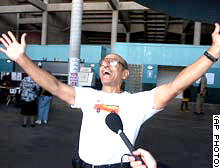
The picture suggests that all went well yesterday -- but this is actually the picture that goes with the previously blogged story below, which details some of the various situations in which things did not go smoothly at the polls.
I've been watching this on TV all morning -- news coverage saying there was no voting troubles, with headlines running across the bottom at the same time regarding all of the voting trouble that actually took place.
Polling USA: A glitch here, a gremlin there
No widespread problems reported as polls begin closing
No author given.
Power outages, ballot shortages and minor computer glitches were thebumps in an otherwise smooth electionTuesday.
Other jurisdictions reported some minor problems:•In Pulaski County, Arkansas, home to Little Rock, the capital, Democrats were granted an injunction late Tuesday to keep the polls open until 10 p.m. ET, instead of 8:30 p.m. ET, because several polling places ran out of ballots. But the state's high court later voided that order and it was not clear what that might mean for the votes cast during that time span.
•A heavier-than-expected voter turnout in St. Louis, Missouri, caused a shortage of punch cards. More were being delivered to polling stations but the snafu was not expected to affect voting.
•In one district in Maryland, the lights went out around 6:30 p.m. ET. Voters and election workers used flashlights and candles to see the voting machines -- which still worked -- until the polls closed at 8 p.m.
•A computer glitch will delay vote counting in Tarrant County, Texas, home to Fort Worth. Gayle Hamilton, the assistant elections administrator for the county, said some 17,000 mail-in ballots from early voting and 250,000 Election Day ballots may be affected.
•A judge late Tuesday denied an injunction request by Democrats in New Mexico's Dona Ana County. They made the request after the party got calls beginning early in the morning from voters complaining that polls weren't open and judges weren't at the polling stations.
•In Georgia, the first state to implement computerized touch-screen voting in every precinct, voters reported few problems. "I am not techno, and this went along just very smooth," a voter named Shirley told CNN. "I made a mistake, had to go back, and I was very proud of myself."
•A judge in New Jersey ruled that mechanical problems in 74 machines in Camden County polling stations were not severe enough to warrant an extension of polling hours. Voters were forced to use to use paper ballots for a while. The judge's order ruled that all voting machines and provisional and emergency ballots be impounded in Cherry Hill until further notice.
•Mishaps weren't limited to the new, technologically advanced polling sites. Rep. Julia Carson, D-Indiana, was unable to cast a vote for herself because of a problem with the machine she was using. "The lever came down for my friends but it didn't come down for me," Carson said. Poll workers fixed the problem after Carson left. They tracked her down and had her come back to vote again.
•In Bloomington, Minnesota, a high turnout of voters used up all the available paper ballots for the hotly contested U.S. Senate race between Republican Norm Coleman and Democrat Walter Mondale, but officials said no voters were turned away.
Here is the full text of the article in case the link goes bad:
http://www.cnn.com/2002/ALLPOLITICS/11/05/elec02.voting.irregularities/index.html
Polling USA: A glitch here, a gremlin there
No widespread problems reported as polls begin closing
Wednesday, November 6, 2002 Posted: 12:36 AM EST (0536 GMT)
A Florida poll worker praises today's voting process at his Miami precinct.
A Florida poll worker praises today's voting process at his Miami precinct.
Story Tools
Save a link to this article and return to it at www.savethis.comSave a link to this article and return to it at www.savethis.com Email a link to this articleEmail a link to this article
Printer-friendly version of this articlePrinter-friendly version of this article View a list of the most popular articles on our siteView a list of the most popular articles on our site
(CNN) -- Power outages, ballot shortages and minor computer glitches were the bumps in an otherwise smooth election Tuesday.
Elections officials, some of whom had feared widespread equipment trouble, expressed relief, especially in Florida. The specter of the 2000 election -- marked by a protracted and unprecedented, post-election battle in the Sunshine State -- hung over this year's midterm races.
David Host, a spokesman for the Florida secretary of state, called the elections "an unqualified success."
Host said minor problems erupted with optical scanners at one precinct in Osceola County, one in Brevard, two in Orange and two in Duval, "but they were quickly remedied."
In Miami-Dade County, "a handful of voters" were forced to cast paper ballots for about three hours when all five machines at one polling place failed. A total of 80 paper ballots were cast.
Chad-free
No hanging, dimpled or pregnant chads marred the vote counting this year in Florida, but the state did experience new problems in the primary elections weeks ago, even after having spent $32 million on new voting equipment.
One 92-year-old woman in Miami even voted in her car, using a laptop computer that workers at the precinct brought out to her
Other jurisdictions reported some minor problems:
•In Pulaski County, Arkansas, home to Little Rock, the capital, Democrats were granted an injunction late Tuesday to keep the polls open until 10 p.m. ET, instead of 8:30 p.m. ET, because several polling places ran out of ballots. But the state's high court later voided that order and it was not clear what that might mean for the votes cast during that time span.
•A heavier-than-expected voter turnout in St. Louis, Missouri, caused a shortage of punch cards. More were being delivered to polling stations but the snafu was not expected to affect voting.
•In one district in Maryland, the lights went out around 6:30 p.m. ET. Voters and election workers used flashlights and candles to see the voting machines -- which still worked -- until the polls closed at 8 p.m.
•A computer glitch will delay vote counting in Tarrant County, Texas, home to Fort Worth. Gayle Hamilton, the assistant elections administrator for the county, said some 17,000 mail-in ballots from early voting and 250,000 Election Day ballots may be affected.
•A judge late Tuesday denied an injunction request by Democrats in New Mexico's Dona Ana County. They made the request after the party got calls beginning early in the morning from voters complaining that polls weren't open and judges weren't at the polling stations.
•In Georgia, the first state to implement computerized touch-screen voting in every precinct, voters reported few problems. "I am not techno, and this went along just very smooth," a voter named Shirley told CNN. "I made a mistake, had to go back, and I was very proud of myself."
•A judge in New Jersey ruled that mechanical problems in 74 machines in Camden County polling stations were not severe enough to warrant an extension of polling hours. Voters were forced to use to use paper ballots for a while. The judge's order ruled that all voting machines and provisional and emergency ballots be impounded in Cherry Hill until further notice.
•Mishaps weren't limited to the new, technologically advanced polling sites. Rep. Julia Carson, D-Indiana, was unable to cast a vote for herself because of a problem with the machine she was using. "The lever came down for my friends but it didn't come down for me," Carson said. Poll workers fixed the problem after Carson left. They tracked her down and had her come back to vote again.
•In Bloomington, Minnesota, a high turnout of voters used up all the available paper ballots for the hotly contested U.S. Senate race between Republican Norm Coleman and Democrat Walter Mondale, but officials said no voters were turned away.
Electronic elections: What about security?
Voters put touch screens to the test
By Jeordan Legon for CNN.
People have jumped on the electronic voting bandwagon, thinking that will solve the problems," said Avi Rubin, a technology security expert and researcher at AT&T Labs in New Jersey. "But these systems are largely untested."The problem, say critics, is that the software which runs the machines is proprietary, and therefore not open to public scrutiny. Without scientists being able to freely analyze the systems, election officials may be leaving themselves open to the possibility of hacking, vote tampering or incorrect calculations.
Here is the full text of the article:
http://www.cnn.com/2002/TECH/ptech/11/05/touch.screen/index.html
Electronic elections: What about security?
Voters put touch screens to the test
By Jeordan Legon
CNN
Tuesday, November 5, 2002 Posted: 10:02 AM EST (1502 GMT)
Los Angeles County Supervisor Yvonne Brathwaite Burke casts her early ballot at a new touch-screen terminal.
(CNN) -- As Americans go to the polls today, a record number of counties -- almost one fifth by some estimates -- will be tallying the votes on electronic voting machines. But some experts worry that despite rigorous testing, the machines may not be as secure as their makers promise.
"People have jumped on the electronic voting bandwagon, thinking that will solve the problems," said Avi Rubin, a technology security expert and researcher at AT&T Labs in New Jersey. "But these systems are largely untested."
The problem, say critics, is that the software which runs the machines is proprietary, and therefore not open to public scrutiny. Without scientists being able to freely analyze the systems, election officials may be leaving themselves open to the possibility of hacking, vote tampering or incorrect calculations.
The companies that make the machines say they've built safeguards to protect against such problems. Engineers say they've encrypted and protected the data with digital signatures, the information is backed up at least twice as a safeguard against mechanical failures and any changes to votes are logged and tracked.
In addition, the voting software and hardware has to pass strict security standards imposed by the Federal Election Commission and the National Association of State Election Directors. Voters touch a screen to cast a ballot in many systems; others involve pushing buttons, much like automatic teller machines.
"Show me somebody who has gotten into our software," said Mark Beckstrand, a vice president at Sequoia Voting Systems, builder of voting machines used in Florida, Ohio, New Jersey and other states. "We haven't lost or misplaced or ever been accused of not having 100 percent accuracy."
'Going through our learning curves'
But the machines are relatively new technology. The touch screens became more popular in more precincts in 1996, when improved technology made them smaller and more dependable, said Doug Lewis, Executive Director of The Election Center in Houston, Texas.
The center, which represents the country's elections officials, oversees testing of the touch screens. In the 2000 election, about 10 percent of the county's voters used them, according to the center. This year, almost 18 percent will use them, Lewis said.
A different estimate by Election Data Services says 510 of the nation's counties (16 percent) will use electronic voting systems Tuesday.
Lewis said he's confident the new technology is more secure than paper voting, but that doesn't mean there won't be problems.
"The new machines are so new to us that we're going to do through our learning curves to see what the strengths and weaknesses are," he said.
"There is no such thing as a perfect system. If a human being can create it, then human beings can mark it or change it."
Avoiding the problems in Florida
Elections officials hope to avoid a repeat of the touch-screen machine malfunctions and lack of trained poll workers that forced some polling places in Florida to turn voters away during September's primaries.
Florida's experience with the machines prompted Santa Clara County, in the heart of California's Silicon Valley, to delay a pilot program that would have put the touch screens in 15 percent of the precincts.
But many other counties are pushing ahead with the touch screens. Much on the spending for machines is fueled by $3.9 billion Congress set aside for states to overhaul their voting systems in the next three years. But the need for the machines also is prompted by a federal law mandating that by 2006, at least one machine serve disabled voters in every precinct. The touch-screen machines are easier to adapt for blind voters because they can be outfitted with audio units.
Rubin believes some of that money would be well-spent on new, more robust systems that could be developed if the 20 or so electronic voting vendors are mandated to share data. By adopting "open source" standards, the software could be fortified against hackers and malfunctions, Rubin said.
"The philosophy of open source is that it's more likely to expose whatever problems there are," he said. "If you keep it closed, an attacker may find a vulnerability and you won't have the opportunity to detect it."
But manufacturers disagree, saying that making their code public will make their systems more prone to hacking. And the development of voting systems and meeting the rigorous government testing required is expensive. They argue patents help them recoup their cost.
The future of voting seems to be electronic
The stakes are high: billions of dollars in machine sales and restoring public confidence in the elections process. Lewis expects about 75 percent of voters to cast ballots electronically by 2010.
Although Britain and Switzerland are testing Web voting systems, security concerns of running an Internet election make the electronic voting machines the next viable alternative to hanging chads and hard-to-tabulate paper ballots.
"We're having to go through a tough transition," Lewis said. "For whole lot of people, there is a comfort level in having paper to go back to. It's difficult for someone to track this electronically, rather than on paper."
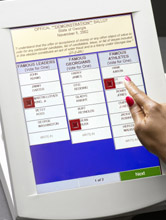 (Via BoingBoing) | Georgia's Electronic Voting, from a UI perspective |
That having been said, it was a pleasure to use this system. I had no problems with the acutal use of the system: touch screen is a *great* choice, especially for handicapped & elderly users. Blind users pretty much can't use it... but I think that as time goes on, having a "audio" version of the ballot (with headphones) would be an excellent alternative. The choices were clearly marked, and I had no problem with the system. It included a review page, and the opportunity to go back and fix problems.Everything was clearly marked: incumbents were clearly marked, as was party affiliation. Names were also clearly placed at a reasonable type-size. Font face was a standard Arial-Helvetica type, which was annoying but understandable. Choices were also clearly marked: the touch area for each button was fairly large, making it easy to hit. (Ever try and use those stupid punch card pages? The punch card tools are about as unwieldy as a needle and thread. Using a finger instead is wonderful).
Here is the entire article in case the link goes bad at:
http://www.plasticnoodle.com/archives/000061.html#000061
PlasticNoodle
The shiny version of my brain!
November 05, 2002
Georgia's Electronic Voting, from a UI perspective
CNN.com - Electronic elections: What about security? - Nov. 5, 2002
Let me go through a quick summary of the user experience for voting with the new Georgia touch-screen panels. This will ignore everything that you can think of in the way of security, just because that's a hot debate that I don't want to get into.
First, let me state: not everyone in Georgia is using these. Some places did opt to use the pull-lever voting machines for now. It's just most of the state.
When I went in to vote, my name, address, and voting information was still being taken by hand. I went through 5 poll workers to get everything I needed, including the usual drivers' license stuff. The major difference is that the retiree at the end of the line gave me a smart card, not a ballot.
I will say this: two years ago when I last voted, I accidentally messed up my ballot. Major pain; the poll worker had to cancel my ballot, re-issue me a ballot, and was very annoyed with me. So I was looking for resolutions to this problem, as well as a much better looking and easier to use experience.
The "ballot box", for lack of a better term, is an approximatly 8 inch by 10 inch LCD screen, placed the long way, and leaning at about a 45 degree angle. Beneath the box and to the right is a "card holder", which was at best a bad place. I'm 5'10", and I didn't see it until I stepped back for a second to find where the card went. On first impression I was expecting a swipe-card situation. But it's a smart card, with a chip inside of it: it writes your choices to the card, so it's got to hold onto it. Not the worst, but mentionable.
On finding the location for the card, I stuck it in... and got nothing for a few seconds. A sticker on the top read to stick it in until the green light goes on. The green light is beneath the card's slot - so you can't see it until it goes in. Icky. Place it on top so people can see it.
I read of reports where people were slipping it beneath the slot, in the space between the slot and the box. I didn't experience the problem... but the elderly woman next to me did have problems placing the card into the box. Couldn't lean over and watch to find out what the problem was, though: that's polling places for you.
The screen was a Windows-based GUI. Touch the box next to your choice, and a big X appeared next to it. Definitely easier to read than a ballot. Changing the choice was also easy: touch the choice or another choice, and it switched. I dislike the Windows-traditional GUI in this setup -- it's black text on gray background. It definitely needs to be white on black. I'd rather it had more pleasing buttons than the traditional Windows buttons, but it didn't affect the usability, just my sense of good taste.
The buttons were a traditional 3-column ballot list. I still think the traditional 3-column ballot list is a horrid format. Each column is seperated with a thick border, while each column is seperated by thick borders seperating contents, and thin lines seperating individual choices. Between contests there is also a space, so it's thick line, space, thick line between contests.
This, at best, is a poor explanation of the traditional ballot: suffice it to say, it's a poor design. As you can see in the (linked) image, it's three columns. What it doesn't show is the gray on gray (the images shows a blue background) and the fact that each group for voting is placed right below one another, about 6 contests per page. Emulating the 3-column ballot was probably not the best choice. It works -- but there's better ways to do it. A 2-column list might have been interesting, and a little less confusing. A Full-page setup, with choices either going down or across 3 at a time might have been a better choice. Multiple pages works, although it definitley isn't using the medium to it's advantage. I wish they had tried letting the page scroll, it might have worked a little better.
That having been said, it was a pleasure to use this system. I had no problems with the acutal use of the system: touch screen is a *great* choice, especially for handicapped & elderly users. Blind users pretty much can't use it... but I think that as time goes on, having a "audio" version of the ballot (with headphones) would be an excellent alternative. The choices were clearly marked, and I had no problem with the system. It included a review page, and the opportunity to go back and fix problems.
Everything was clearly marked: incumbents were clearly marked, as was party affiliation. Names were also clearly placed at a reasonable type-size. Font face was a standard Arial-Helvetica type, which was annoying but understandable. Choices were also clearly marked: the touch area for each button was fairly large, making it easy to hit. (Ever try and use those stupid punch card pages? The punch card tools are about as unwieldy as a needle and thread. Using a finger instead is wonderful).
Entering a write-in candidate is easy too - touch screen keyboard to allow you to type it in. Much easier than writing it, and it helps that the screen is at an angle; you can see it without having to put your wrists into a permanent arch. Standard QWERTY keyboard on a seperate screen, you just click on the write-in choice, and it moves you to that seperate screen.
One thing I did find poor about the interface was the final selection screen: it had problems with it's scrolling. it took me about 3 minutes to go from the top of the list to the bottom... which would be on a desktop PC a one-click move, as it's not a long page. That needs to be improved.
Another suggestion I would like to make goes toward improving the voting process overall: educating the people as to their choices. If you look at VoteSmart's web site, you'll find that many candidates refused to state their positions. That's right: a non-biased, non-party affiliated group couldn't get most candidate's positions. Your average person has little or no chance to hear the facts and form an opinion on a candidate. But, in linking information to the candidate's position -- all candidates, equally -- you might get a better educated electorate. Granted, it's probably not currently allowed in most or all states, but it's a thought. And it would help one of the most problematic issues with voting, voter education.
So, to sum up, it's a pretty neat system with some room for improvement -- but a definite good thing. Check it out at the Georgia Counts web site. They've got a demo to get a feel for it, and a ton of videos, which I haven't looked at.
Posted by doones at November 05, 2002 07:08 PM
Comments
whine whine whine...
Posted by: on November 6, 2002 10:22 AM
Cool - I posted a rant at 6:30 am, and I'm declared insane in less than 30 minutes.
Beautiful.
Someone's listening!
Success.
Anyone else out there?
According to this first election count (oh yeah, there will be recounts baby), Republicans have taken over the House and the Senate -- mostly by narrow margins.
This election should also be remembered for its thousands of disenfranchised voters -- in all states. As per usual.
We have a serious crisis going on in this country with our elections. I can't even believe this is happening in the United States of America.
Please everybody, insist on the recounts. The news keeps talking about "sweeping victories for the GOP", but when they show the percentages, some of them say "50% - 50%" with the Republican checked as the victor (often with no more than a 100 vote margin).
Remember that this is the same media that decided not to cover the 100,000+ people that marched on Oct 26 on both coasts.
It looks to me that none of these close victories can be taken at face value yet. There's too much at stake here. Let's investigate every one of them. If there's something fishy going on, it's going to take all of us paying very close attention, adding up the numbers, comparing the good notes we've all distributed to each other and coordinating together across all 50 states!
Let's get to the bottom of this guys, while the trail is still hot!
Please send any articles and information you have to me at lisarein@finetuning.com about this and I will post it here.

