Last October, I camped out in front of the Supreme Court in order to witness the Eldred Argument.
We lost, and now, if copyright law stays the way it is right now, nothing is going to go into the public domain for at least 18 years. (Maybe longer, if the copyright term is extended again.)
However, as of yesterday, there is hope. "Phase Two" if you will, of the Eldred strategy to rebuild the public domain: The Public Domain Enhancement Act.
The Public Domain Enhancement Act is the same thing as the "Eldred Act" that many of you have been asking me about over the last few months. At the time, I couldn't explain it to anyone. But it turns out it's pretty simple.
The law would place works in the public domain after 50 years unless a copyright holder sent in a dollar to secure the later 80+ years of protection. That's it.
You can help out right now by signing this petition.
We'll figure out how to rebuild the public domain yet!
Better late than never!
As promised, here are MP3s, "small" and high resolution videos of Lessig's Sunday, March 9, 2003 presentation at SXSW 2003.
Please see the notes below each clip regarding its contents.
(Parts 1-3 of the MP3 don't match the Parts 1-3 of the "smalls," for instance.)
The notes will help you figure it out.
The Q and A clips that are available on their own have the questions edited out to save on file sizes. (And since my camera wasn't able to pick up the questions anyway.)
Lessig's answers make it pretty clear what the questions were.
I have dedicated this work to the Public Domain.
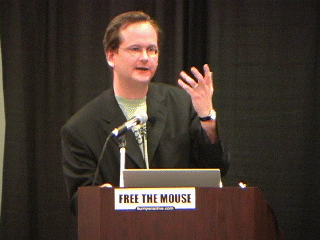 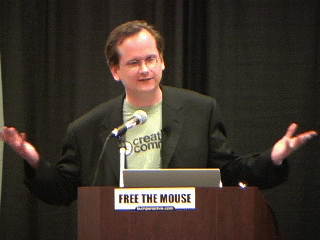 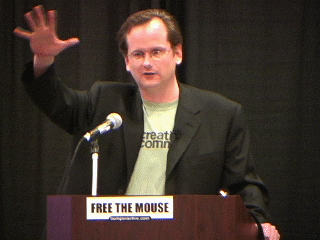 | The Presentation and part of the Q and A in "Small" web video files in 3 Parts, plus a separate file of the Q and A: Lessig At SXSW 2003 - Part 1 of 3 (Small - 11 MB) Lessig At SXSW 2003 - Part 2 of 3 (Small - 14 MB) Lessig At SXSW 2003 - Part 3 of 3 (Small - 4 MB) Lessig At SXSW 2003 - Complete Q and A (Small - 22 MB)
Audio - Lessig At SXSW 2003 Part 1 of 3 (MP3 - 28 MB) Audio - Lessig At SXSW 2003 Part 2 of 3 (MP3 - 28 MB) Audio - Lessig At SXSW 2003 Part 3 of 3 (MP3 - 18 MB) Audio - Lessig At SXSW 2003 Q and A (MP3 - 15 MB) |
Hi-resolution Files of Presentation (Parts 1-6) and Q and A Answers Afterwards:
Lessig At SXSW 2003 Part 1 of 6 (Hi-Res - 150 MB)
(Includes Part 1 of Lessig's presentation.)
Lessig At SXSW 2003 Part 2 of 6 (Hi-Res - 153 MB)
(Includes Part 2 of Lessig's presentation.)
Lessig At SXSW 2003 Part 3 of 6 (Hi-Res - 167 MB)
(Includes Part 3 of Lessig's presentation.)
Lessig At SXSW 2003 Part 4 of 6 (Hi-Res - 160 MB)
(Includes Part 4 of Lessig's presentation.)
Lessig At SXSW 2003 Part 5 of 6 (Hi-Res - 144 MB)
(Includes Part 5 of Lessig's presentation.)
Lessig At SXSW 2003 Part 6 of 6 (Hi-Res - 60 MB)
(Includes Part 6 of Lessig's presentation.)
Lessig At SXSW 2003 - Q and A (Hi-Res - 268 MB)
(Includes Complete Answers during Q and A with Lessig after his presentation.)

This work is dedicated to the
Public Domain. (Take it and run, baby!)
As usual, Dan doesn't mince words:
Supreme Court Endorses Copyright
Swipe a CD from a record store and you'll get arrested. But when Congress authorizes the entertainment industry to steal from you -- well, that's the American way.We learned as much on Wednesday when the U.S. Supreme Court ruled that Congress can repeatedly extend copyright terms, as it did most recently in 1998 when it added 20 years to the terms for new and existing works.
The law, a brazen heist, was called the Copyright Term Extension Act. It was better known as the Sonny Bono act, so named after its chief sponsor even though Disney and other giant media corporations were the money and muscle behind it.
Who got robbed? You did. I did.
Who won? Endlessly greedy media barons will now collect billions from works that should have long since entered the public domain.
Web-friendly Eldred Ruling and Dissenting Opinions
We lost Eldred. We being "the people."
So the Public loses again. Par for the course these days.
This blog will wear black today in mourning of this decision.
Supreme Court Rules in Eldred v. Ashcroft, Upholding Copyright Term Extension (http://www.copyright.gov/pr/eldred.html)
I will, of course, have web-friendly formats of the PDF files up later today.
SUPREME COURT UPHOLDS COPYRIGHT TERM EXTENSION
The Supreme Court ruled today in Eldred v. Ashcroft, a
constitutional challenge to the 20-year extension of copyright
term in the Sonny Bono Copyright Term Extension Act. In an
opinion by Justice Ruth Bader Ginsburg, the Court concluded that
Congress's extension of the terms of existing copyrights did not
exceed Congress's power under the Copyright Clause and did not
violate the First Amendment. Justices Stevens and Breyer
dissented.
U.S. Copyright Office
NewsNet
January 15, 2003
Issue 184
**********************************************************
For additional information, visit the Copyright Office
homepage at
Copyright Website
**********************************************************
CONTENTS
* News *
Copyright Office
Supreme Court Upholds Copyright Term Extension
* Calendar *
* To Subscribe/Unsubscribe to NewsNet *
**********************************************************
* NEWS *
-----------Copyright Office------------------
SUPREME COURT UPHOLDS COPYRIGHT TERM EXTENSION
The Supreme Court ruled today in Eldred v. Ashcroft, a
constitutional challenge to the 20-year extension of copyright
term in the Sonny Bono Copyright Term Extension Act. In an
opinion by Justice Ruth Bader Ginsburg, the Court concluded that
Congress's extension of the terms of existing copyrights did not
exceed Congress's power under the Copyright Clause and did not
violate the First Amendment. Justices Stevens and Breyer
dissented.
To see the opinion, go to Supreme Court Decision
**********************************************************
* CALENDAR *
February 3: Due date for comments on the proposed
regulation governing termination of post-1977 transfers and
licenses under 17 U.S.C. section 203. (67 FR 77951)
February 19: Deadline for the second round of comments
in the Copyright Office triennial rulemaking proceeding on
exemptions from the prohibition on circumvention of
technological measures that control access to copyrighted
works. Those who oppose or support any exemptions proposed
in the initial comments will have the opportunity to respond
to the proposals made in the initial comments and to provide
factual information and legal argument addressing whether a
proposed exemption should be adopted. (67 FR 63578)
February 28, at 5 p.m. E.S.T.: Deadline for filing
2002 DART royalty claims by fax (67 FR 71477)
February 28, at 11:59 p.m. E.S.T.: Deadline for
receipt on the Copyright Office server of 2002 DART royalty
claims submitted online (67 FR 71477)
March 5: Due date for reply comments on the proposed
regulation governing termination of post-1977 transfers and
licenses under 17 U.S.C. section 203 (67 FR 77951)
**********************************************************
* TO SUBSCRIBE/UNSUBSCRIBE TO NEWSNET *
To subscribe or unsubscribe, fill in the Web form at
Subscription Change
or
To subscribe,
send an email message to: LISTSERV@loc.gov
In the body of the message say: Subscribe USCopyright
To unsubscribe, send an email message to: LISTSERV@loc.gov
In the body of the message say: Unsubscribe USCopyright
NewsNet editors request that suggestions or ideas about
content or other items be submitted through our Contact Us page
I've made the Eldred Oral Argument Transcript available in my usual web-friendly formats.
Aaron has made a transcript of the Eldred argument available:
http://www.aaronsw.com/2002/eldredTranscript
I'm late for a meeting just now, but I wanted to get this out there!
http://www.aaronsw.com/2002/eldredTranscript
ERIC ELDRED, ET AL., Petitioners
v.
JOHN D. ASHCROFT, ATTORNEY GENERAL
No. 01-618
SUPREME COURT OF THE UNITED STATES
2002 U.S. TRANS LEXIS 47
October 9, 2002, Wednesday, Washington, D.C.
NOTICE: [*1] Transcribed by Alderson Reporting Company, Inc., 1111 14th Street, N.W., Suite 400, Washington D.C. 20005-5603, Telephone Number: 202-289-2260
The above-entitled matter came on for oral argument before the Supreme Court of the United States at 10:03 a.m.
APPEARANCES: LAWRENCE LESSIG, ESQ., Stanford, California; on behalf of the Petitioners.
THEODORE B. OLSON, ESQ., Solicitor General, Department of Justice, Washington, D.C.; on behalf of the Respondent.
OPINION: PROCEEDINGS
(10:03 a.m.)
CHIEF JUSTICE REHNQUIST: We'll hear argument now in Number 01-618, Eric Eldred v. John D. Ashcroft.
Mr. Lessig.
ORAL ARGUMENT OF LAWRENCE LESSIG
ON BEHALF OF THE PETITIONERS
MR. LESSIG: Mr. Chief Justice, may it please the Court:
Petitioners are before you this morning challenging Congress's 1998 Sonny Bono Copyright Term Extension Act, which extended the term of subsisting and future copyrights by 20 years. Petitioners submit such a blanket extension of existing terms exceeds Congress's power under the Copyright Clause and it violates the First Amendment.
Now, the Government has responded to petitioners' argument in a way that betrays a simple but fundamental confusion. The Government [*2] has argued as if petitioners had advanced a general theory of the Copyright Clause, or a general constraint under which Congress must operate. That is a mistake. This case is about limits to an enumerated power. It's not about general power of Congress to exercise its copyright authority. Petitioners have advanced a particular interpretation of the only express limits in the Copyright Clause designed to give those limits meaning.
JUSTICE O'CONNOR: Mr. Lessig, I'll tell you what bothers me about your position, and that is that Congress has extended the term so often through the years, and if you are right, don't we run the risk of upsetting previous extensions of time? I mean, this seems to be a practice that began with the very first act.
MR. LESSIG: Justice, we do not believe that the very first act extended terms at all. Speaking technically, which for a lawyer means speaking accurately, the 1790 act did not extend a Federal term. The 1790 act granted a term for works that already existed in precisely the pattern that the English parliament had done in the Statute of Anne in 1710, and that the English parliament did with monopolies, general monopolies in the statute of --
JUSTICE O'CONNOR: But [*3] there have been a number of extensions since.
MR. LESSIG: That's right.
JUSTICE O'CONNOR: Even if you can get over the first hurdle.
MR. LESSIG: That's right. That's the important hurdle, and we'd like to jump that first, but the other ones, Justice, you're right, in 1831 and in 1909 Congress extended terms in a way that is inconsistent with the strongest form of the test that we have advanced. Those extensions, however, were never challenged in any court and certainly not considered by this Court.
CHIEF JUSTICE REHNQUIST: Well, doesn't that itself mean something, Mr. Lessig? The fact that they were never challenged, perhaps most people, and perhaps everybody felt there was no basis for challenging them.
MR. LESSIG: Well, Mr. Chief Justice, it's absolutely true that this case is here because of a fundamentally important changed circumstance that makes the Framers' limitations on the Copyright Clause much more significant. This is the first time I can remember where this Court has been pointed to changed circumstances as a reason to reaffirm the Framers' values, because for most of this period, Mr. Chief Justice, the only people who were regulated by copyright law under the Copyright Act would have been [*4] commercial publishers, primarily, and now for the first time the scope of this exclusive right has expanded because of the changed technology of the Internet to reach an extraordinarily broad range of creativity that never would have been imagined before.
Now, it's not the case that the earlier extensions were not questioned on constitutional grounds. In fact, Melville Nimmer, in the consideration of the 1976 act, suggested they were plainly under --
CHIEF JUSTICE REHNQUIST: Well, I'm talking about court challenges, not academic challenges.
MR. LESSIG: That's right, there is no court challenge.
JUSTICE SOUTER: Mr. Lessig, your theory, as I understand it, regardless of changed circumstances or not, your basic theory, which on your argument would have been appropriate at any time historically, is that there has at least got to be the possibility of a kind of a causal connection between the extension and the promotion or inducement for the creation of some subsequent work, but why is that any more plausible a reading of the Promotion Clause than simply a reading that says the Promotion Clause requires that there be a general scheme in place, which overall tends to promote or induce, and part of one aspect [*5] of that scheme can be that the -- that at the discretion of Congress the period of protection is extended from time to time?
Why do you require -- why do you say the clause has got to be read by this kind of specific causation theory as opposed to a kind of systemic theory of promotion?
MR. LESSIG: Justice Souter, the reason is exactly related to the point I began with, that this is a case about limits and not about discretion. If it's not the case that this Court --
JUSTICE SOUTER: No, but that's -- I mean, that's the issue in the alternative reading.
MR. LESSIG: That's right.
JUSTICE SOUTER: And why is it a limit case, rather than a discretion within a general scheme kind --
MR. LESSIG: That's right.
JUSTICE SOUTER: -- of clause?
MR. LESSIG: Because if this Court does not adopt a reading of the form we've offered, then there is no limit to the ability of Congress to extend subsisting terms.
JUSTICE GINSBURG: Do you say the same thing for scope? This case is about duration, but Congress from time to time -- in fact, you mentioned --
MR. LESSIG: Yes.
JUSTICE GINSBURG: -- the expanded applications of copyright, and Congress itself extends the scope from time to time.
MR. LESSIG: That's right.
JUSTICE GINSBURG: [*6] Would you make, as far as, say, translation rights that didn't exist before, the same argument?
MR. LESSIG: I --
JUSTICE GINSBURG: Why -- or -- and if you wouldn't, why not?
MR. LESSIG: I -- no, Justice Ginsburg, we would not, and the reason is again related to the method we have adopted to interpret "limited Times." We have not said that "promote the progress of science" is a general and independent constraint on the Copyright Clause authority. We've said it must be looked to to interpret the scope of "limited Times," and unless retrospective extensions are forbidden, it will eviscerate the meaning of "limited Times." That does not occur in the context of the scope of exclusive right, nor in the context of the power to secure. If that's --
JUSTICE BREYER: Could we then go back to Justice O'Connor's question? To make that very specific, if we agree with you, does that mean that we would, in principle, have to hold the 1976 extension unconstitutional? I mean, in 1976, Congress extended the term from 28 years. renewable once, to life of the author plus 50 years. Now they're extending it life of the author plus 70. If the latter is unconstitutional on your theory, how could the former not be? And [*7] if the former is, the chaos that would ensue would be horrendous.
MR. LESSIG: Justice Breyer, under our theory as we've advanced it, you're right; the 1976 act would be unconstitutional. Whether this Court would apply such a holding in this case to that act is a question that would have to be resolved under the retrospective --
JUSTICE BREYER: Maybe we ought to find another theory, then. Is there any --
(Laughter.)
MR. LESSIG: Justice, the theory, which would advance the aim of limiting times in a way that is enforceable, is only applicable in the case that we brought before you here to the '98 act, and would not necessarily be applicable under the '76 act for the reasons the Government has offered. We would not advance this argument, but the Government has offered an argument in a parallel case that suggests a distinction between the '76 act and this case. That's not been briefed here. It's been grounded in their claim that the treaty power creates some special power. We wouldn't advance that claim, but the point is there are a number of issues that the '76 act --
JUSTICE BREYER(?): In essence, you think it's at least arguable that the '76 act had various positive aspects to it in terms of [*8] the purpose of the Copyright Clause that this act lacks?
MR. LESSIG: That's certainly true, and we also believe that, for the reasons averted to by amicus AOL in this case and the reasons you've just suggested, the disruption in that context under the retrospectivity cases Ryder and Reynoldsville Casket Company would be sufficient to fit it within the, quote, "severe disruption exception" to the retrospectivity.
JUSTICE KENNEDY: Well, I suppose implicit in the argument that the '76 act, too, should have been declared void, and that we might leave it alone because of the disruption, is that for all these years the act has impeded progress in science and the useful arts. I just don't see any empirical evidence for that.
MR. LESSIG: Justice, we are not making an empirical claim at all. Nothing in our Copyright Clause claim hangs upon the empirical assertion about impeding progress. Our only argument is, this is a structural limit necessary to assure that what would be an effectively perpetual term not be permitted under the copyright laws.
JUSTICE KENNEDY: Well, perhaps I misunderstood. I thought the whole thrust of your argument was that there is a great First Amendment force here that's being [*9] silenced, that's being thwarted.
MR. LESSIG: Well, the thrust certainly --
JUSTICE KENNEDY: I thought that's the whole underpinning of your case.
MR. LESSIG: It's certainly the case that we are asserting, in light of the changed circumstances, that the opportunity to build upon works within the public domain is a fundamental First Amendment interest, and that the First Amendment values, the vital speech interest at stake of this case, is that the public domain be permitted as a source for cultivating work about our culture without unnecessary legal restriction.
CHIEF JUSTICE REHNQUIST: Well, but you want more than that. You want the right to copy verbatim other people's books, don't you?
MR. LESSIG: We want the right to copy verbatim works that should be in the public domain and would be in the public domain but for a statute that cannot be justified under ordinary First Amendment analysis or under a proper reading of the limits built into the Copyright Clause.
JUSTICE GINSBURG: Mr. Lessig, on your First Amendment argument I don't see where the retroactivity-prospectivity comes in, because -- I follow your argument under the Copyright Clause, but if you're saying that the time is too long, the public domain [*10] should get this stuff sooner rather than later, would you explain to me how your prospectivity-retrospective line fits into your First Amendment claim?
MR. LESSIG: Justice, we've argued that it would be inappropriate in this case for the Court to consider the prospective line until they decide whether the case, whether the prospective and retrospective is severable, and we submit it's an easy case to show that it's not.
JUSTICE GINSBURG: On the First Amendment --
MR. LESSIG: Yes.
JUSTICE GINSBURG: -- argument you're making that as, I take it, an argument independent of, it doesn't hang on your Copyright Clause argument.
MR. LESSIG: That's right. I --
JUSTICE GINSBURG: And so let's just take -- let's say that was your only argument in this case. How does that tie into a retrospective-prospective distinction?
MR. LESSIG: Well, the strongest First Amendment argument is about the retrospective extension, because of a fundamental change that occurs when Congress extends subsisting copyrights, rather than when Congress legislates prospectively.
When Congress legislates prospectively, it has no way to know who's going to benefit from its extension. It is simply evaluating what the term should be prospectively [*11] in a way that we presume this Court should presume is legitimate under the First Amendment. When it legislates retrospectively, it is, in effect, looking at particular authors and estates of authors who are before Congress asking for this extension, and it's choosing between these particular authors and the public at large.
Now, it may be that in exercising that choice in this case, Congress made an objective valuation of who would be in the best position to advance the interests of promoting the progress of science, or any --
JUSTICE GINSBURG: But you -- under your intermediate scrutiny test we would not be hypothesizing what might have been in Congress's mind. Your First Amendment test is a stringent one. You have to have an important purpose, and the means that you use is necessarily tied to that purpose. If you take that position, I don't see how you make the retroactive-prospective line work.
MR. LESSIG: Well, the line comes from deciding what the First Amendment interest is, and if this Court heed the First Amendment interest off of this difference between selecting who gets the benefit of 20 years of extension and just simply legislating in a general way prospectively, then this [*12] Court could hold, with respect to the prospective, that it's not even necessary to raise the intermediate scrutiny in that context, but again, for Ashwander reasons we don't think that this Court should address the prospective aspect of the CTEA even under the First Amendment.
JUSTICE GINSBURG: Even though Congress's pattern has been to treat all authors equally? I mean, the reason that it's been prospective and retrospective is that people should be, people who hold copyrights should be subject to the same regime and not have some people who got their copyrights the week before the law passed treated differently than people who got it the week after.
MR. LESSIG: Well, Justice, that certainly is the reason the Government offers for this pattern. It, of course, doesn't explain actually what Congress has done and, even in this case, when a work has passed into the public domain, then there is precisely the same week before/week after problem that you advert to, that extension does not extend to all subsisting works, it only extends to all subsisting copyrights. So that line is already drawn in the practice that Congress has adopted, but our point is, the only way to assure --
JUSTICE GINSBURG: But [*13] Congress has -- or, you're not disputing that Congress has always made these extensions, both retroactive and prospective?
MR. LESSIG: Well, in 1831 it did not. In 1831 it granted the benefit of its extension to a subset of all subsisting copyright holders.
JUSTICE GINSBURG: Let's stick with 1976.
MR. LESSIG: In 1976 --
JUSTICE GINSBURG: Because that was what you said -- that's -- the pattern under the CTEA is identical to the one in the '76 act.
MR. LESSIG: That's absolutely right, yes. So they have extended it to both. But our argument is, unless this Court draws a line about this extension, then for the reasons Judge Sentelle suggested below, there will be no limit to Congress's ability to --
QUESTION: Judge Sentelle did not deal with the First Amendment, as far as I --
MR. LESSIG: That's right.
QUESTION: -- recall.
MR. LESSIG: That's right.
QUESTION: And so I'm asking you -- perhaps I'm missing it. I haven't seen where you get the prospective-retrospective in connection with your First Amendment. It seems that you're just saying there that 70 years is an unreasonable -- is not necessary.
MR. LESSIG: Yes.
QUESTION: And it doesn't serve an important purpose.
MR. LESSIG: Yes. Precisely [*14] -- actually, we're not saying anything
about the 70 years in this case even under the First Amendment, because we believe it's unseverable, but --
QUESTION: But I thought you were saying that if you accept the Copyright Clause argument, then you have a way, in effect, of devaluing the Government's claim of its important interest and important objective when you get to the First Amendment intermediate scrutiny analysis. Whereas if you don't accept the Copyright Clause claim, then, in order to make the First Amendment analysis we've simply got to say, well, gee, is the promotion of useful art and so on more important than the public domain, and can we say that that allows a distinction between 50 years and 70 years?
We're pretty much at sea, so I thought your Copyright Clause argument was necessary to give us some handle with which to deal with the First Amendment.
MR. LESSIG: Our Copyright Clause argument is certainly a way of framing why extensions of subsisting terms cannot be seen to promote the First Amendment interest of speech at all.
QUESTION: Okay. Let's assume we don't -- for the sake of argument here, let's assume we don't accept the Copyright Clause argument. Do you have [*15] an independent First Amendment argument in your brief?
MR. LESSIG: Yes, of course we do.
QUESTION: Okay, and it is -- tell me in a sentence or two what it is. I mean, at that point I'm where Justice Ginsburg is.
MR. LESSIG: Yes. The First Amendment argument we've argued in our brief is with respect to the retrospective extension, and the First Amendment argument is, that needs to --
QUESTION: No, but that's the Copyright Clause argument, and it seems to me you're saying, okay, we then apply that in First Amendment analysis, which allows us to make a coherent intermediate scrutiny argument.
If we don't accept the Copyright Clause retrospectivity argument --
MR. LESSIG: Yes.
QUESTION: -- then what is your First Amendment argument?
MR. LESSIG: That's right, I'm sorry, Justice. What I'm saying is not that it' s the retrospectivity that makes the First Amendment argument troubling -- I mean, that drives our First Amendment argument. All I'm saying is, we have addressed the retrospective portion of CTEA, and so I'm saying in the retrospective portion of CTEA you would apply ordinary, intermediate First Amendment review, and we would ask --
JUSTICE O'CONNOR: Well, this Court really has not [*16] -- if you say that the Copyright Clause is not violated, I don't think there are examples where this Court has then resorted to First Amendment analysis to invalidate the same act.
MR. LESSIG: Well --
JUSTICE O'CONNOR: I mean, this would be quite a new proposition.
MR. LESSIG: Well, Justice O'Connor, the First Amendment is always an independent limitation on what otherwise would be legitimate exercises of congressional authority, so this --
QUESTION: Yes, but the Framers seem to have adopted these two things at the same time --
MR. LESSIG: That's right.
QUESTION: -- in effect.
MR. LESSIG: That's right, and if --
JUSTICE O'CONNOR: And I think there are not examples that I can think of where we have said, well, we'll analyze it under the Copyright Clause, but if that fails we'll turn to the First Amendment.
MR. LESSIG: Justice, that's right. If only we had the Framers' copyright before us, because of course, again remember,the exclusive right the Framers spoke of was the right to print and publish. It didn't include the derivative rights, it didn't include the display rights, and it certainly --
JUSTICE O'CONNOR: Right. It has expanded very much, and they also envisioned a very short term, and I can [*17] find a lot of fault with what Congress did here --
MR. LESSIG: That's right.
JUSTICE O'CONNOR: -- because it does take a lot of things out of the public domain that one would think that someone in Congress would want to think hard about.
MR. LESSIG: That's right.
JUSTICE O'CONNOR: But having done that, it's very difficult to find the basis in the Constitution for saying it isn't a limited term. It's longer than one might think desirable --
MR. LESSIG: Right.
JUSTICE O'CONNOR: -- but is it not limited?
MR. LESSIG: Well, if it is limited, then there is no limit to the ability of Congress to extend subsisting terms, and that fundamentally destroys the objective that the --
JUSTICE O'CONNOR: Rule against perpetuities might jump in there at some point.
(Laughter.)
MR. LESSIG: Right, and we submit the Framers had something very different in mind than the rule against perpetuities. The point is, if this is permitted, then there is no limit to the ability to extend terms, and that is precisely contrary to what the Framers had in mind when they worried about this problem originally.
What was the problem they were solving? It was, as this Court stated in Graham --
JUSTICE O'CONNOR: Well, I could agree with you, in terms [*18] of policy, that this flies directly in the face of what the Framers had in mind, absolutely. But does it violate the Constitution?
MR. LESSIG: Well, if it flies in the face of what the Framers had in mind, then the question is, is there a way of interpreting their words that gives effect to what they had in mind, and the answer is yes.
CHIEF JUSTICE REHNQUIST: Well, you know, certainly what is happening in the country today in the way of congressional -- under the Commerce Clause is totally different than what the Framers had in mind, but we've never felt that that was the criterion. What the Framers thought of, there weren't steamboats, there weren't railroads.
MR. LESSIG: That's right.
CHIEF JUSTICE REHNQUIST: We've said there was a general grant, and that Congress was free to run with it in many respects.
MR. LESSIG: In many respects, Mr. Chief Justice, but, as this Court has also said, there are limits to what Congress can do under the Commerce Clause.
QUESTION: But isn't --
JUSTICE STEVENS: Can I ask you about one of the limits, just focusing on the Copyright Clause and the progress of science and useful arts? In your view, does that -- is that limited to encouraging creativity by authors and inventors, or [*19] does it also include the distribution of materials that might not otherwise be distributed, like old films and so forth?
MR. LESSIG: We're happy to adopt a broader interpretation of what promote the progress is about, within the general framework that the Framers established in light of the English practice, which was a quid pro quo. The ability to facilitate distribution --
JUSTICE STEVENS: So that if the quid pro quo is that we can facilitate distribution of some old film by an additional monopoly grant, you'd think that's permissible?
MR. LESSIG: So long as the grant is conditioned upon the distribution. So long as the grant --
JUSTICE BREYER: In other words you could have -- right now, if Congress decides to have a law, and this law is going to give copyrights in 1) the Bible, 2) Shakespeare, 3) Ben Jonson, and the reason they do it is that they think that that would lead publishers to produce those and distribute them, and they're right, they will, okay? In your view, that's perfectly constitutional?
MR. LESSIG: No, that's the view of the Government's, Justice Breyer. My view is --
JUSTICE BREYER: Well, I thought that was the question you were getting, and I thought you were saying -- I must [*20] have misunderstood. I thought you were saying that was constitutional.
MR. LESSIG: No. What we were saying is, if Congress wants to permit restoration of films, for example, an issue that's been well briefed here, Congress can say, if you restore the film, then the restoration gets a copyright so long as it satisfies originality as outlined in Feist, and it gets a copyright for a period of time. But this Court's opinion in Graham and in Feist made clear that it could not extend copyrights to works in the public domain. The Government doesn't concede that, but we stand on that as a way of understanding why this Court --
JUSTICE BREYER: So your answer to Justice Stevens is no, they cannot give a copyright purely for purposes of dissemination to publishers, is that right?
MR. LESSIG: No.
QUESTION: Oh, all right.
MR. LESSIG: They cannot give a copyright purely for purposes of distribution to publishers.
(Laughter.)
MR. LESSIG: They would need to satisfy all of the implied limitations that this Court has expressed in the context of this, the most carefully limited clause in Article I, section 8. It is one of the --
JUSTICE GINSBURG: Mr. Lessig, the clause says, Congress shall, and suppose Congress [*21] decides in this expanded world of ours that it's going to make certain changes and demand other changes from our treaty partners. Suppose it says, well, the Germans led the fight for 70 years in the European Union, we'll go with that, but we're going to insist that they have a more expansive notion of, say, a fair use. Now, why couldn't that fit within the promotion of knowledge?
MR. LESSIG: Justice Ginsburg, we have no quarrel with the objective of harmonization fitting within the "promote the progress of science" understanding, subject to constitutional limitations.
If France adopted a rule that said you couldn't grant copyrights to hate speech, we could not harmonize with that rule consistent with our First Amendment and similarly, as Mary Beth Peters testified before Congress, ours is the only Constitution that has an express limitation on terms. That's got to mean something, and if it means that we are limited in our ability to agree with the Europeans as they continually expand the term in light of their own vision of what copyright is about, then that's the meaning of a constitutional restriction.
This Court's interpretation of "limited Times" could, of course, eviscerate [*22] that term of any meaning, but under the principle of enumeration as this Court has articulated it, this Court should interpret that clause in a way that gives its terms effect in a simple way. Just as a limited addition print is not a limited -- is not limited if each time a customer comes in a new print is printed, so, too, a limited term is not limited if each time copyright holders come to Congress they can extend the term.
JUSTICE SOUTER: Well, but the difference -- the reason that analogy doesn't cut it for me is that the limited edition print depends basically on an implied understanding between the person who makes the print and the person who buys it, and the understanding is, you won't go beyond 100, or whatever number you write.
We're not engaged in a contractual analysis under the Copyright Clause between the writer and the -- and somebody representing the public domain.
MR. LESSIG: That's right.
JUSTICE SOUTER: The analogy doesn't seem to work.
MR. LESSIG: That's right. All that I'm suggesting is, here is a plain meaning of the term that gives effect to the constitutional limit in a way that assures that, in fact, the limit is respected, contrary to the Government's argument, [*23] which, in effect, permits Congress the power perpetually to extend terms.
If I may reserve the remainder of my time.
CHIEF JUSTICE REHNQUIST(?): Very well, Mr. Lessig.
General Olson, we'll hear from you.
ORAL ARGUMENT OF THEODORE B. OLSON
ON BEHALF OF THE RESPONDENT
GENERAL OLSON: Mr. Chief Justice, and may it please the Court:
The questions today, especially the initial questions, suggest one of the many insurmountable obstacles to petitioners' petition in, position in this case. That is that the first Congress explicitly gave copyright protection to the authors of any books already printed as well as explicitly the owners of existing copyrights. Thereafter, in 1831, 1909, 1976, and 1998, and in numerous private copyright bills and temporary extensions of the copyright law and in repeated patent law revisions, Congress extended the terms of Federal copyright and patent protection of subsisting works.
As this Court explained 100 and some years ago in its Burrows-Giles opinion, such constructions are accorded very great weight and, as that Court went on to say, when consistent and unchallenged for over a century are almost conclusive that consistent construction by Congress of its authority under [*24] the Copyright and Patent Clause now has lasted from the 105th -- from the first through the 105th Congress. It has been sustained by Justices of this Court and early decisions of this Court. It is consistent with what the law of England was from the Statute of Anne --
JUSTICE STEVENS: Yes, but take one of the early extensions, just extending a -- an already granted patent to an inventor for an extra 10 years. How can that be squared with the language of the provision? Maybe Congress did it, but maybe it acted improperly when it did it.
GENERAL OLSON: Well, the Congress --
JUSTICE STEVENS: And that's our question, really.
GENERAL OLSON: Well, that -- it seems to me that there may be -- this is -- the clause itself is a very, very broad grant. It says the --
JUSTICE STEVENS: Do you view it as entirely a grant, or do you think it also contains limitations?
GENERAL OLSON: Well, I think that to the extent that there may be limitations, Justice Stevens, they are -- require considerable deference by this Court to the judgment of Congress --
JUSTICE STEVENS: Well, I understand that, but do you -- I'd be interested in knowing, do you think it does contain limitations?
GENERAL OLSON: It contains -- the clause itself [*25] contains limitations, limited times, authors, exclusive rights and things of that nature. I don't think -- and the petitioners expressly disclaim the assertion that there are any substantive limitations in the "Promote the-Progress" Clause.
What the Framers were saying is, we want to give Congress the authority to promote the progress of useful arts and sciences, and --
JUSTICE STEVENS: How did the example we just talked about, a patentee giving an extra 10 years on his -- how does that promote the progress of science?
GENERAL OLSON: Well, it may provide additional incentives for the patentee to exploit and promote and disseminate that particular work. With respect to creative works like works of art, books and that sort of thing, it may provide many ways --
JUSTICE STEVENS: I'm just concentrating on our patentee, and I'm wondering how that fits into the notion that there was a bargain in effect between the inventor and the Government that at a certain period of time it would become part of the public domain. It seems to me it's inconsistent with that.
GENERAL OLSON: It isn't inconsistent, I submit, Justice Stevens, for the Congress to exercise its juris -- its responsibility under this broad [*26] grant of power to determine that there could be many ways in which the holder of an existing right may benefit the public by continuing to have that right for an additional period of time, the same reason that Congress -- same reasons that Congress had when it created the right in the first place. It's not just the --
QUESTION: No, the reason for the right in the first place was to encourage invention.
GENERAL OLSON: Well, but I -- we submit that specifically with respect to the Copyright Clause, but I think it applies to the patent portion of the clause at all, it isn't just the invention, it isn't just the writing of the work -- and this relates to the questions that were asked of my colleague a moment ago. It includes the dissemination of the work, not necessarily --
QUESTION: Dissemination alone?
GENERAL OLSON: Not necessarily the dissemination alone --
JUSTICE BREYER: Well, no, not -- don't say not necessarily. I'm -- for purposes of my thinking about it, I'd like to know, imagine we have just dissemination.
GENERAL OLSON: That something is already in the public domain.
JUSTICE BREYER: That's correct. The only justification for the extension, there is no other, is dissemination of [*27] a work that is already in existence.
GENERAL OLSON: I would not want to rule that out, Justice Breyer, for the very reason --
JUSTICE BREYER: Well, I want to say, do you think yes or no?
GENERAL OLSON: Well, I think that it could very well be yes, for the reason that in the 1790 statute the Congress specifically was aware of -- that there were State copyright laws which didn't last as long as the Federal statute. Several of the States hadn't finished enacting those copyright laws, and a couple of States hadn't enacted them at all.
JUSTICE BREYER: So in your opinion, in my example, if you recall it --
GENERAL OLSON: It's --
JUSTICE BREYER: -- your answer would be, if Congress tomorrow wants to give a copyright to a publisher solely for the purpose of reproducing and disseminating Ben Jonson, Shakespeare, it can do it?
GENERAL OLSON: It may --
JUSTICE BREYER: I hate to say may --
GENERAL OLSON: Well --
JUSTICE BREYER: -- because that really -- that's an important question.
GENERAL OLSON: Well, because I don't think that a per -- I don't think there is a per se rule that should apply here because this is a grant of Congress, to Congress to exercise its judgment as to what may be beneficial. There may be [*28] other constitutional provisions that come into play, or there may be --
JUSTICE BREYER: All right, let me explain to you why it's important to me. I have a list. This is an economic statute. The harms that seem to be caused by it, the extension, I've listed as follows, approximate numbers, made up, but magnitude correct.
The existing copyright holders who survive, their copyright survives 70 years, who have already been paid, on the numbers that were given, about $ 24 billion or more, will receive an extra $ 6 billion. That, I take it, is a harm. Their works have already been created.
Harm number 2. The fact that people, for the 99 percent of the copyrights that have no commercial value after 70 years, have to find the copyright holder to put them in databases. The cost of that, on my numbers in here, made up, at least a billion dollars, or they can't find the people at all and get permission, an innumerable cost, un -- valuable cost to people who want to use it. Those are costs.
On the plus side I see uniformity, dissemination, and -- now, you tell me.
GENERAL OLSON: Well, I also see compliance with international competitive markets and the laws that are being adopted, and the incentives [*29] --
JUSTICE BREYER: Uniformity. That's uniformity.
GENERAL OLSON: Well, that's not just uniformity. It's providing incentive to people to publish here, as opposed to publish in Europe, where longer terms might be available. There is an incentive to distribute existing works that may be necessary. It's the consistency that Congress is promoting by saying to individuals, as they might have said when they enacted the Copyright Clause in the first place, we will not only give you 14 years, but if we change our mind tomorrow, and think that a better, a longer period is necessary, we're -- this is consistency, but it's also a matter of fairness, and it's --
JUSTICE BREYER: Why -- on the last point, it's -- I've counted that as zero. The reason I've counted it as zero is it seems to me that the added value, incentive value to produce between life plus 50, or life plus 70, is zero. It's carried out, as the economists do, to three decimal points, divide by 100 for the probability of your ever having such a work, and you get virtually zero, no difference between this and a perpetual copyright.
GENERAL OLSON: Well, I think that that's a very good illustration of why the authority is granted to Congress, [*30] because if you are an 80-year-old writer, that may make a considerable difference in terms of what you decide to do.
JUSTICE BREYER: How could it?
GENERAL OLSON: It may -- because you may -- if you have no incentive, if you
know that this is going to go into the public domain sooner rather than later, it may affect your judgment with respect to --
JUSTICE BREYER: In -- I --
GENERAL OLSON: It might also affect whether the publisher -- what the publisher pays for your prospective work, Justice Breyer. We -- the Copyright Clause incentive provides incentives not just for -- not just to the creators, but to the disseminators, the publishers, the broadcasters, the film companies.
JUSTICE BREYER: So you think, say, Verdi, Othello, Verdi, Othello, 80 years old, the prospect of an extra 20 years way down the pike would have made a difference?
GENERAL OLSON: Well, I think again that illustrates why the authority is vested in Congress to make these judgments rather than in courts to make these judgments, because we're not talking about the effect on an individual author, or an individual creator. What the Framers of the Constitution were concerned about is a gross judgment with respect to what might generally [*31] provide incentives to the population --
JUSTICE O'CONNOR: But it is hard to understand how, if the overall purpose of the Copyright Clause is to encourage creative work, how some retroactive extension could possibly do that. I -- one wonders what was in the minds of the Congress, even if somehow they didn't violate the clause. But if we affirm here, is there any limiting principle out there that would ever kick in?
GENERAL OLSON: Well, that's a -- that is a difficult question to say whether there is any limiting principle when such a broad grant of power, authority is given to Congress and has been exercised so repeatedly that --
JUSTICE O'CONNOR: Well, if it's a limited term, as the Constitution says, is there indeed any limit out there?
GENERAL OLSON: What I submit -- well, first of all, even the petitioners acknowledge that, as far as prospective limits are concerned, that isn't a judgment that this Court is being made to ask and, in fact, the petitioners acknowledge that it isn't a judgment that this Court should make, so the only point that the petitioners --
CHIEF JUSTICE REHNQUIST: Well, if Congress says we're going to grant this copyright indefinitely, forever --
GENERAL OLSON: That would seem -- [*32]
CHIEF JUSTICE REHNQUIST: -- that violates the limited term, does it not?
GENERAL OLSON: I acknowledge that. And anything that --
JUSTICE KENNEDY: In Victorian England you could buy a box seat for 900 years. There was serene complacency about their culture, and God bless them, but --
(Laughter.)
JUSTICE KENNEDY: -- I really think this is an important question and, as Justice O'Connor points out, if we have to ask what's the most plausible explanation for this rule, to reward existing vested interest or to stimulate new works, it seems to me that it's probably the former.
GENERAL OLSON: Well --
JUSTICE KENNEDY: I mean, we know that.
GENERAL OLSON: It is -- well, it -- let me say with respond -- in response to both of those questions, an unlimited time would violate the Copyright Clause. Something that was the functional equivalent of an unlimited time would violate the Copyright Clause, but the Framers specifically did not put in numbers. They had the opportunity to do that. Thomas Jefferson suggested that a number should be put in. We submit that it would be -- even -- since the petitioners don't suggest that it's an appropriate function of this Court, certainly in this case, to pick a number, 133 years or something [*33] of that nature, but it is quite clear that Congress from the Statute of Anne, 1710, we have 300 years of history, of Congress thinking that it continues to benefit the process, not just of the productivity, of the creation of the work itself, but the dissemination of it to provide --
JUSTICE SCALIA: General Olson, you say that the functional equivalent of an unlimited time would be a violation, but that's precisely the argument that's being made by petitioners here, that a limited time which is extendable is the functionable, functional equivalent of an unlimited time, a limited time that 10 years from now can be extended, and then extended again, and extended again. Why -- their argument is precisely that, a limited time doesn't mean anything unless it means, once you have established the limit for works that have been created under that limit, that's the end.
GENERAL OLSON: Well, the Framers had an opportunity to say immutable, unalterable, unamendable. They didn't use that. They used the phrase, limited term, which means then, meant then and means now, a certain specified --
QUESTION: Okay, assuming --
GENERAL OLSON: -- number of years under the statute.
JUSTICE SOUTER: With the exception [*34] of a limitation which illustrates the distinction between forever on the one hand and a definite number on the other, is there any limitation in the clause? Does the promotion, does the preambular recitation of promotion as such place a limit on it?
GENERAL OLSON: I submit, Justice Souter, that there's no per se limitation, that if there is, as Justice Scalia suggested, for -- if it is true that Congress, having specified 14 years or 28 years, decides that doesn't work very well because of the economies of other countries, the parade of constraints on artists in other countries, the reasons that we want things to be preserved or distributed, it should be 2 more years, or 5 more years later --
JUSTICE STEVENS: Yes, but that argument would apply to new copyrights, but to extension of already existing copyrights your argument doesn't apply.
GENERAL OLSON: It does apply, Justice Stevens, because --
QUESTION: The work has already been created.
GENERAL OLSON: The work has already been created, but the artists that are creating works day in and day out take into consideration the fact that Congress has decided, there's an ease of administration --
QUESTION: But for them, they get the benefit [*35] of the longer term if you don't apply it to an existing copyright. I mean, if you say you need 70 years because of changes in the economy to encourage works, you grant 70 for the future, but why does that, making that apply to somebody who created his work 20 years ago and has already provided what he, the quid pro quo, why do you need it for him?
GENERAL OLSON: We're not just -- because we're not just talking about the author. If we -- we're talking about --
QUESTION: The Constitution refers to the authors and the inventors, doesn't it? They're certainly the prime actors in this scene, aren't they?
GENERAL OLSON: Yes, but all of the history of the development of these clauses suggests that -- and this Court has indicated in its decisions with respect to copyright, that the Framers were concerned and the Congress is legitimately concerned not just in providing the spark of creativity, but to make sure that that's distributed widely and available, and there may be many reasons why -- we're -- we --
QUESTION: And that it gets into the public domain at the expiration of the term. That was an important part of the bargain.
GENERAL OLSON: Yes, and what -- but the definition of the [*36] term was a responsibility vested in Congress, because it has the power -- the legislative history of the 1998 act itself suggests what was going on here and suggests why the Framers gave this authority to Congress. There were numerous hearings, there were testimony by the folks that represent the same position as petitioners here as to why this shouldn't be done, why it should be done.
Congress weighed -- as this Court, the phrase that this Court used, I think it was in the Feist case, the delicate balance that was so difficult for Congress to --
QUESTION: How --
QUESTION: Okay, but you --
JUSTICE BREYER: -- what weighs in that balance, because to go back for one second, in practical, economic terms I gather the difference between a copyright that lasts for 100 years, lasts for 1,000 years, lasts forever, is probably something less than 1,000 -- on $ 1,000 a penny. I mean, it's a penny on 1,000, or probably a lot less than that, frankly. So I can not only not imagine a person whose decision to write would be governed by such a thing, I cannot imagine a European who would come to America to copyright his work for such a reason. Indeed, I wonder why that European wouldn't come anyway, [*37] even if the term were 10 years, because if he doesn't come, he's not going to get protection.
GENERAL OLSON: Well, the --
JUSTICE BREYER: I mean, who are these people that are going to be moved by that incentive?
GENERAL OLSON: The -- as we described in our brief, in pages 34 through 36, I believe it is in our brief, that the concerns about the limitation on exploitation and the limitation of a copyright period in Europe is based upon the country of origin of the work and the shortest time available. So that there may be differences, and we describe that, but that illustrates, Justice Breyer, the difference between 1 cents and 10 cents and $ 100 with respect to this particular author who's this particular age, or a particular author like Melville, whose works weren't -- weren't -- didn't -- or Schubert, whose works weren't properly appreciated or exploitable until many years after their death.
All of these variations are quintessentially legislative judgments. It would be very difficult for the Framers to have eschewed deciding 14 years was a constitutional limitation, and for this Court to say 99 years is, and again, even the petitioners aren't asking the Court to make that judgment. [*38] The petitioners are only saying that there shall be a per se rule that the word "limited Times" means unchangeable times.
JUSTICE GINSBURG: But there has to be a limit, as you acknowledge. Perpetual copyright is not permitted. Who is the judge of -- within that line? Who is the judge of when it becomes unlimited? Is there, in other words, judicial review and, if there is, what standard will this Court apply to determine whether something short of perpetual is still unlimited?
GENERAL OLSON: Well, the issue before this Court, I hasten to say, as I said before, is only whether, once the Congress makes that judgment, it can ever change it retrospectively. The issue before this Court is not whether, in the future, a certain length of time would be appropriate. That -- but the answer to that, Justice Ginsburg, I submit, is found in the Necessary and Proper Clause, and this Court's interpretation of the Necessary and Proper Clause as to the extent that this Court would find or not find that the judgment made by Congress with respect to the implementation of this very broad power is convenient or useful in terms of the achievement of the goals.
JUSTICE SOUTER: Okay, and is your argument that we should [*39] so find and hold against their retrospective argument, because there is some, at least plausible basis to say that there can be a causal connection between the retrospective extension and some benefit that can be traced to those particular works through the retrospective extension, like dissemination? Is that your argument?
GENERAL OLSON: That is among our arguments, Justice Souter.
QUESTION: Is it also your argument that even if you cannot trace that kind, or at least plausibly argue that there could be that kind of a causal benefit, that it would still be constitutional, because you should judge the extension simply as contributing to a general system, one feature of which is that from time to time there may be retrospective extensions, and so long as that general system induces the creation of works, or the dissemination of works, or the preservation of works, so long as the general system works, there is no review, no limitation on the tinkering that can be done, even retrospectively? Is that also your argument?
GENERAL OLSON: I think that's a fair statement of an argument that we have made and articulated in the brief --
QUESTION: Okay.
GENERAL OLSON: -- that unless there [*40] is a -- the Court is -- because the circumstances change, that we are living in an era now where piracy is a significant problem, there's question of administrative ease, of administering a system where copyrights may be different for one set of authors, or different for another set of authors, there's changes that are taking place internationally, so that what we're saying is that not only could this Court conceive of reasons why Congress thought it was accomplishing the objectives of this clause, but that there are numerous objectives that are entirely legitimate in --
QUESTION: Do you also argue that the Necessary and Proper Clause alone will justify the retroactive extension simply as a matter of equity?
GENERAL OLSON: Yes.
JUSTICE SCALIA: That is, that the Copyright Clause justifies the extension for works not yet created, but it would be enormously inequitable to have other authors who put in the same amount of work get a lesser protection, so the Necessary and Proper Clause now allows you to do the retrospective?
GENERAL OLSON: Yes, Justice Scalia, and the examples that are --
QUESTION: Can I ask you, why is it enormously inequitable if they get exactly what they were entitled [*41] to at the time they made the work?
GENERAL OLSON: The implicit promise that --
JUSTICE STEVENS: I mean, they have some right to expect that they will be -- you know, an additional grant, later on?
GENERAL OLSON: I think that's not an unreasonable expectation at all, Justice Stevens, because that was the premise of the --
QUESTION: That is the way it's always been done. There hasn't been any copyright extension that hasn't applied to subsisting work.
GENERAL OLSON: That's --
QUESTION: But there was one -- Justice Breyer brought up Ben Jonson, so -- this case doesn't involve works that are already in the public domain.
GENERAL OLSON: That is correct.
QUESTION: This is subsisting copyrights.
GENERAL OLSON: That is correct.
QUESTION: So --
QUESTION: But why wouldn't it?
QUESTION: Why? Why not?
JUSTICE SOUTER: Why wouldn't it? If the equity argument under the Necessary and Proper Clause justifies extension of the copyright for those whose copyright will expire tomorrow if it's not extended, in order to put them on parity with those getting copyrights for new works, why doesn't it apply to the copyright, the holder of the copyright that expired yesterday?
GENERAL OLSON: You could arguably [*42] -- you could conceivably make that argument, Justice Souter, but there is a bright line there. Something that has already gone into the public domain, which other individuals or companies or entities may then have acquired an interest in, or rights to, or be involved in disseminating --
QUESTION: And if you don't --
GENERAL OLSON: This is a rational --
QUESTION: If you don't throw out a line there, then Ben Jonson certainly gets recopyrighted.
QUESTION: Well, the difficulty --
QUESTION: If we're just looking for a bright line, the line that they suggest between unexpired patents and copyrights and brand new ones is also just as bright.
GENERAL OLSON: Oh, I concede that it's a bright line, but it's a bright line
that would have --
QUESTION: Except Congress chose this one and didn't choose the other one. That's --
GENERAL OLSON: Congress --
QUESTION: Basically you're saying the presumption ought to be in the congressional judgment about how to draw the line as well as in how long a line to draw.
GENERAL OLSON: I agree, and this Court has -- we're not just talking about the judgment of the Congress of the -- the 105th Congress in 1998. This is the way the Statute of Anne was [*43] written. This is the way the State copyright laws were written when this country became a Nation. This is the way the 1790 copyright statute, the number of --
QUESTION: Well, of course, the original statute was replacing a bunch of State statutes or State rules, partly common law, partly statutory, that -- they had kind of a mixed up legal situation, and there was an interest in having one uniform rule for the first time around.
GENERAL OLSON: Well, there was an interest in having a uniform rule, and that's precisely why the Framers created the Copyright Clause in the Constitution, but there was copyright protection in some States, there wasn't copyright protection in other States, and what we know from the decision of this Court in the Wheaton decision is that there was not a common law copyright in existence. This Court explicitly held that.
Now, the petitioners make this quid pro quo argument that somehow implicitly the initial 1790 copyright statute was saying to people, you get a copyright if you exchange whatever existing rights you have. That simply does not make any sense. There is no language, and it's a relatively late-discovered argument, because it sees its full -- [*44]
QUESTION: I want you to finish that, but I want you to go back to the -- I have one question on the equity principle. Are you -- I want you to finish.
GENERAL OLSON: I wasn't finished, but I'm happy to come back.
QUESTION: Go ahead. No, no, you finish first.
GENERAL OLSON: Well, I was going to say there's no language whatsoever of preemption, abandonment, abrogation, or exchange in the 1790 copyright, but compare -- Copyright Act. But compare that to the 1793 Patent Act under the same clause, where there is that exchange there.
The other thing, as this Court has said, there is no implied abrogation of common law rights which would be a doctrine which would be inconsistent with what the petitioner is arguing. Now --
JUSTICE BREYER: Why -- I mean, I think you have a point on this equity principle. I wonder, is there any review there? That is, suppose you have a statute, as this one arguably is, where 99.9 percent, many billions of dollars of benefits, are going to the existing holders of copyright on grounds of equity, and the effect of the statute in eliciting new works is near zero. I mean, that would seem -- where this equity idea is the camel and the production idea is the gnat, [*45] and is there any -- can we say something like that, or does Congress have total leeway in respect to --
GENERAL OLSON: Well, it --
JUSTICE BREYER: -- who they want to give the money to, basically?
GENERAL OLSON: Justice Breyer, it's conceivable that the Court might do that if that situation was present, but it's not remotely the situation here. We have the adoption of copyright terms which are consistent, generally speaking, with copyright terms which exist in the European Union, our principal competitor, and in connection with international treaties.
We have a copyright term that's consistent with the concept of the creator plus the creator's first generation heirs. We have a copyright term, remember, which supersedes the earlier copyright provisions that were added to the period between creation and publication, so that the limited number of years in the first, the 1790 and the 1831 statute were the number of years plus the relatively unlimited period of time between creation and publication, so we don't have anything remotely like that in this situation.
We have a process which, as you suggested, or one of the questions suggested, is -- may not have been the policy that you as a [*46] Member of Congress would have supported. You might have made the balance, that delicate balance that this Court has referred to, in another way, but that is something that Congress, through its ability to gather facts and make balances, is quintessentially capable of doing, and that is where the Framers vested the responsibility, and what this statute does is to favor, if at all, the creator with respect to the utilization of these rights, as opposed to the person who wishes to copy the creator. That's an entirely rational distinction for Congress to make.
Thank you.
QUESTION: Thank you, General Olson.
Mr. Lessig, you have 3 minutes remaining.
REBUTTAL ARGUMENT OF LAWRENCE LESSIG
ON BEHALF OF THE PETITIONERS
MR. LESSIG: General Olson has been perfectly clear in setting out the structure of the Government's argument. It is that there is no effective limit on Congress's power under the Copyright Clause. Now, were this the first time this Court had considered Congress's copyright authority, that might be a plausible argument, but the very first time this Court ever struck down a law of Congress as exceeding Article I, section 8 power was in the context of the Copyright Clause. [*47]
We have 125 years of history of this Court making sure that the limits, both express and implied, in the Copyright Clause, have some meaning. The Feist opinion very clearly sets out the implied limits, a per se limit for originality, for the reasons Justice Breyer was trying to get me to say. The Harper as well as Graham set out very clear limits on the context of the ability to extend works in the public domain. Those limits make no sense under the reasoning the Government has offered. The Government's reasoning would make all of those opinions irrelevant and wrong.
Now, we offer a simple way to make this clear, express limit make sense, and that is precisely the understanding we suggest that existed in 1790. The only precedents that existed in 1790 were precedents of setting a term, and then when parliament was asked in 1735, '37, and '39 to extend it, they rejected it, and as amicus historians said, they rejected it because, as a pamphleteer described it, that would be effectively a perpetual term.
Now, this delicate balance that the Government invokes, Justice Breyer, let me give you the numbers. The delicate balance is that, under the most reasonable assumptions of copyright [*48] royalty income and under our interest rate of 7 percent, as the amicus economists note at page 6, note 6 of their brief, the current term gives authors 99.8 percent of the value of a perpetual term.
Now, that might be a delicate balance, that they give the author 99.8 percent and the public .2 percent, but in my mind, that's delicate in a very different sense of that term.
Thank you very much.
CHIEF JUSTICE REHNQUIST: Thank you, Mr. Lessig.
The case is submitted.
(Whereupon, at 11:01 a.m., the case in the above-entitled matter was submitted.)
Larry clears things up a bit about how things went last week at the Eldred argument.
I am obviously extremely happy with where we are. The Court is struggling with the right issue; they are motivated to get the right answer; they have a clear and simple way to give the right answer; the government has made it very hard to accept its answer. It is always hard to get the Court to strike a law of Congress, but this law is so universally flawed, and the case against it is so universally strong, that I continue to be confident that the Court could choose to strike the law.I am obviously also unhappy with those "swings-and-a-miss" that happened in the argument. As I said before the argument, if we win it will be because 4 years of activism by many many people have changed the public's view about the importance of these issues. But as someone who believes this the rare case where the law, properly and carefully read, yields one right answer, there is no way I will ever be able to escape the thought that if we lose, it is because I am not the advocate that some could have been. It is the particular hell for lawyers that after an argument, we live in the purgatory of constantly reliving the argument. Every night since Wednesday I have awoken in the middle of the night, to spend the rest of the night reanswering Justice Ginsburg, or asking Chief Justice Rehnquist just how he could distingiush Commerce from Copyright. The kind words of so many notwithstanding, I know and have always known I am not Larry Tribe, or Kathleen Sullivan. And if, after getting this so close to the right result, I have lost this by not being them, then I am not quite sure how I will live with that fact.
Here's the full text of the link in case the link goes bad:
http://cyberlaw.stanford.edu/lessig/blog/archives/2002_10.shtml#000531
Stanford Law School
Lawrence Lessig
home content bio classes contact
today's news news archives blog
Lessig Blog Archives for October 2002
« September 2002 | Lessig Blog Main Page
from the front line
So there's an extraordinary (and extraordinarily interesting) range of reporting about the argument before the Court. As I was on the front line, let me add a bit more. My hope in doing this is to put this in a bit of context, and to highlight at least what we should be looking for. (EV predicts a 6-3 victory, which is significant, because he and I have a bet, and he took the other side.)
Aaron reports Brewster's statement to him that "it was a dance for which I don't know the steps." That's close. I think the better analogy for someone viewing an oral argument for the first time is the first time you see a cricket match. There are some moves you are certain you know are bad (a swing and a miss); but there's lots that plays into something you can't quite get till you know the context of the game. Here, then, the context of the game, as well as the moves from last Wednesday.
the aim
Our aim from the start was to get this Court to view this case in the same frame that they viewed another important line of cases limiting Congress's power -- the commerce clause. In those cases, the Court has said, ours is a constitution of enumerated powers (i.e., the only powers congress has are the powers the constitution gives it); it follows that Congress's power must therefore be interpreted in a way that is limited; in the context of the Commerce Power, the government had argued for a standard (Congress can regulate anything that "affects" interstate commerce) that essentially meant it had no limit; therefore, in a line of cases beginning with Lopez, the Court said we need a different interpretation of "commerce" that actually recognizes limits. Limits, not control of Congress's discretion. Congress has discretion within the limits set by the constitution; but it has no discretion over what, or where, the limits sit.
We want the Court to think in the same way about the Copyright Clause. As Judge Sentelle argued in dissent in the Court of Appeals, the Copyright Clause too is an enumerated power. It too therefore must have limits. But under the government's interpretation of that clause, "limited times" has no limits. Under its interpretation, Congress has a perpetual power to extend subsisting terms. Thus, under the Lopez-line of reasoning, that interpretation must be wrong. Instead, we wanted the court to adopt one of the plain meanings of the term "limited" (limited as in limited edition print) that would also produce an effective limit on Congress's power (that it could not extend existing terms) and would also achieve the ends that the framers sought to achieve (no continuing incentive of Congress to reward, as the Supreme Court said in Graham, "court favorites," but instead to create an incentive for "new" creativity only).
Now that strategy was controversial from the start, especially because some of our natural allies (Stevens, Souter, Breyer) were so strongly opposed to the Lopez line of cases. But our call early on in this case was that they could be brought around to see that even if they oppose the results in Lopez, there was no reason to oppose the same reasoning in this case. Indeed, they could use this case to show why they were right in Lopez: They could argue that unlike the Copyright Clause, the Commerce Clause has no express limitation built into it; unlike the Copyright Clause, the limit the Court has found is wholly implied; thus, they could say, it is not appropriate to imply limits where not expressed. But, they could also say, where a limit is plainly express (as it is in the copyright clause, which is one of only six clauses in Article I, sec. 8 (the part of the constitution with the core grants of power to Congress) that expressly limits a grant of power (the others are clauses 1, 12, 15, 16, 17)), then it is appropriate for the Court to find a way to enforce those limits. In other words, they could write, "for the reasons given in Lopez, you were wrong in Lopez, but it would be right to limit Congress here."
the fear
The greatest fear we had about this strategy (beyond the backfiring point) was that it all presupposed that the Court got it. It presupposed that the Court understood the problem with extensions of existing terms; that it understood the harm that would do to the internet, and the ability of people to build on the internet; that it saw the law as useless. And before the argument we struggled over and over again with how best to focus the Court on the costs, if in fact they didn't get it.
the argument
(1) The most important first indication that was absolutely clear from the argument is that our fear was misplaced. The Court clearly got it. Though the other side had written literally 300 pages trying to show all the good CTEA did (and pronounce it like it is a disease -- sateeeya), the Court hadn't bought any of it. Congress was not acting to promote progress, it was acting to reward "court favorites." The only question the Court was struggling with is whether it has the power to do anything about it.
Now pause for a second to think about how important and good this struggle is. First: It is a rare but valuable exercise for any branch of government to worry about the scope of its own power. And the greatest virtue the Court exercises is the virtue of self-restraint. This is a reason to respect the Court, not criticize it (though how they exercise their restraint, or where, can be criticized, as I suggest below). But the general idea that it will restrain itself, despite believing a law is stupid, is a feature, not a bug in our constitutional tradition.
And second: that they are struggling with this question of restraint means they clearly get the problem. They are motivated to do the right thing; they are resisting the right thing for the right reasons. Both sides are good.
(2) Though it took some hammering, they clearly understood by the end of my argument the dynamic of the argument that we were making. I said, over and over again, that we were advancing an interpretation of "limited times" that had the virtue of actually imposing limits, because otherwise the clause would have no limits. The aim, and I think effect, was to repeat this idea so many times that they had in their heads a simple picture: There was a way to read "limited" so that Congress would not have unlimited power.
Thus, for example, when I said that limited should be read like "limited edition print," Justice Souter interrupted to say that this was a different kind of case (not a contract, etc.), and I said, yes, but we are simply showing you that there is a plain meaning of the term "limited" that actually produces a limit. He's a very careful justice; he got the point, as did the court by the end. That's not to say he bought it, but he clearly gets the dynamic of the argument: if you believe you must impose a limit on Congress's power, here's a way to impose that limit.
(3) The government then helped us immensely by simply confirming what we had said: under their theory of the case, there was no constitutional limit on Congress's power to extend terms; it was always a matter of Congress's discretion. Congress could perpetually extend existing terms; it could even extend a copyright to works within the public domain.
The Court clearly did not like this answer. They had bought the idea that the Constitution intended there to be a limit; the government's interpretation meant that this was a limit that was solely a matter of legislative grace. (Compare: "Under our written Constitution the limitation of congressional authority is not solely a matter of legislative grace.") They were not comfortable with the idea that they would simply say that though the constitution expressly limits Congress's power, it is Congress that gets to say what that limit is.
(4) This gave me the opening I wanted in the rebuttal to say: On the government's view, the Copyright Clause means Congress has total discretion; but that is plainly inconsistent with 125 years of Supreme Court authority. The very first time the Supreme Court ever struck down a law of Congress because it exceeded a particular grant of power in Article I, sec. 8, was in 1879 in a Copyright Clause Case. Since that time, the Court has repeatedly and unanimously imposed limits on Congress's power in the name of Copyright Clause. All of those limits so far have been implied limits. The Court has held that of all the "authors" and "writings" that might be granted copyright, only those that are "original" are allowed copyright; and it has held that of all the inventions or writings that can get patent or copyright protection, only works that are not in the public domain can get the benefit of the copyright and patent clause protection. Both of these limits are implied. Yet here, with the only express limit on Congress's Copyright Clause power, the government was arguing that in effect, the limit was limitless. This, I argued, is fundamentally inconsistent with this 125 year history, and shows the government must be wrong in its view.
(5) Finally, the government's repeated invocation of the "delicate balance" that Congress has struck became too much to ignore by the end. My final point before the Court is ultimately the most compelling politically, though not directly relevant to the constitutional argument: Under the current term of 95 years, under the most conservative assumptions about royalty income and interest rates, the current term gives authors 99.8% of the value of a perpetual term. Put differently, the current "delicate balance" between author and the public is 99.8% to the author, .2% to the public. (Check out footnote 6, page 6 of the economists' brief if you want to do the numbers.)
after thoughts and advice on interpretation (read: clues on the game)
Lots of people have made tons of noise about what the court asked questions about and what it did not ask questions about. In my experience, this is not an indicator of anything. One hour is an extraordinarily small amount of time to consider the issues in this case. They ask question about things that need to be discussed. They let go things that they get from the briefs. When I clerked, oral argument was irrelevant to 90% of the cases; that is because they do their work based on the writing, and unlike most branches of government, they actually do their work.
That said, there was lots I was unhappy we didn't get more of a chance to discuss. Here's an enumeration of what's open and what we've got to win.
(1) 1790 Act: We lose if they are not careful about the interpretation of the 1790 Act. We need the originalists; we therefore need to defeat the government's claim that "CTEA = the 1790 Act." The arguments here are not even close if you pay attention to the history. It is simply and absolutely false to say that the 1790 Act "undoubtedly extended existing terms" as the government says. The 1790 Act (1) did not extend any term (since there was no federal term before 1790); (2) it did not, on balance, effectively extend existing terms (because the law at the time included both state common law and statutory law granting copyrights, and while it may have extended the term of the works protected by the state statutes, it shortened the term of works protected under the common law); and finally (3) even for works protected under the state statute, 3 states expressly stated they didn't mean their statute to displace the common law. Thus, it is more likely the 1790 Act shortened, not lengthened, terms.
That conclusion is supported by the numbers reported by William Maher. He actually counted the number of copyrights granted to works published before 1790. Of the 21,000 works published between 1790 and 1800, we have record of just 699 copyrights. Of the 699 copyrights, only 12 are for works published before 1790. Of the 12, 5 are for works protected by state statute. The remaining 7 were presumptively protected by the common law. Thus, of the records we have, the majority of terms were plainly shortened, rather than lengthened. And the clearest reading of what the framers thought they were doing was simply moving to a new federal regime, and ending the continuing effect of the old state regime.
We need to win this point. Of all the arguments in this case, it is the only one that I am 100% certain of (the rest I'm at 99.8%). But it wasn't discussed much, which creates lots of anxiety.
(2) The Lopez-Eldred link: The other point that seemed lost on the Chief Justice was that this was a Lopez case -- or more importantly, it was a Lopez-plus case. If the Commerce Clause must be interpreted to imply limits, then the Copyright Clause must be interpreted to give effect to express limits. There is no principled way to distinguish them, except to say that between the two, it is the Copyright Clause that more clearly demands judicial enforcement of its limits. Yet the Chief Justice (author of Lopez and this line of authority) didn't seem to recognize the link. If it is not made, then again, we lose. Yet of all the parts of this that will be hardest to accept, it would be a decision that is inconsistent in just this way that would be worst. What possible reason of principle could there be for restricting Congress when it comes to federalism interests, but not when it comes to the public domain, except the ugly reasons? For someone who must teach constitutional law every year, this is the part I fear most.
(3) Which Bright Line: Justices Souter and Scalia were trying to figure out which bright line made most sense: that Congress can't restore copyright to works in the public domain, or that Congress can't extend the term of existing copyrights. The obvious question which no one asked is: Why do we expect works will be allowed to pass into the public domain again? Look at the pattern:
The effect of term extension is to toll (stop) the passing of works into the public domain. In the first 100 years of the republic, the public domain was tolled like this for only 14 years (14%). In the next 50 years, the public domain was tolled for 14 years again (28%). But when CTEA expires, the public domain will have been tolled for 39 out of 55 years, or 70% of the time since 1962. If the Supreme Court says ok to this, then why would anyone expect 70% won't become 100%? The line that says Congress can't restore copyrights to works in the public domain may be bright, but it is in a very dim world indeed.
final thoughts
I am obviously extremely happy with where we are. The Court is struggling with the right issue; they are motivated to get the right answer; they have a clear and simple way to give the right answer; the government has made it very hard to accept its answer. It is always hard to get the Court to strike a law of Congress, but this law is so universally flawed, and the case against it is so universally strong, that I continue to be confident that the Court could choose to strike the law.
I am obviously also unhappy with those "swings-and-a-miss" that happened in the argument. As I said before the argument, if we win it will be because 4 years of activism by many many people have changed the public's view about the importance of these issues. But as someone who believes this the rare case where the law, properly and carefully read, yields one right answer, there is no way I will ever be able to escape the thought that if we lose, it is because I am not the advocate that some could have been. It is the particular hell for lawyers that after an argument, we live in the purgatory of constantly reliving the argument. Every night since Wednesday I have awoken in the middle of the night, to spend the rest of the night reanswering Justice Ginsburg, or asking Chief Justice Rehnquist just how he could distingiush Commerce from Copyright. The kind words of so many notwithstanding, I know and have always known I am not Larry Tribe, or Kathleen Sullivan. And if, after getting this so close to the right result, I have lost this by not being them, then I am not quite sure how I will live with that fact.
So please, no more of the bullshit about "rockstars" or "visionary." I've lived this struggle every moment of the last 4 years; it will take a long time for me to escape it, especially if we don't prevail. I want to turn my head elsewhere, and my heart elsewhere too. So I apologize if I don't follow up on this, or the arguments this might begin. Please, in the spirit of the best of this sphere, carry these argument along, and correct the many mistakes I have made. But I need a night when the limits of this lawyer don't keep this lawyer awake.
I am grateful to an extraordinary number of people, most importantly, Eric Eldred, but also the hundreds who have worked on this case, the people, like Lisa, who slept out at the court to watch this argument, and Brewster who drove across the country to teach the lessons -- too many to count. If we have won, it is your work that has made this happen. That the press chooses to focus differently does not change that fact. At least this space can speak the truth about this fact.
Peace, quiet, and may terms be limited.
posted on [ Oct 13 02 at 4:51 AM ] to [ eldred.cc ] [ 9 Comments ]
keeping focus
Tomorrow the Supreme Court will hear arguments in Eldred v. Ashcroft. In the past weeks, and especially the past week, I've received an extraordinary amount of mail, ranging from wishes of good luck, to demands that I "win." And as well has the press been extraordinary. (Check out Google's cool new service for a list. Even Declan is reporting the story, if only to report that the Ayn Rand Institute has pronounced me a Marxist (along with Milton Friedman, Ronald Coase, James Buchanan and Phyllis Schlafly I assume.)).
When we brought this case 4 years ago, there were many allies who said that there was no way we could win. The reason they were right four years ago is that the world did not yet see how important these issues are, and just what's at stake. In four years, that has changed. Not because we brought this case, or because of anything I've done in this case, but because of an extraordinary number of people who have been pushing to make this issue understandable.
It is extremely hard to win a case like this. I have given it everything I have, and I believe we are right, and have a good shot in showing it. But the important lesson from the attention this case is getting now is this: There is an extraordinary passion and energy out there for the ideals that Eric Eldred and others represent, and that if we do something to push these ideas, we can have an effect.
Thank you for the extraordinary outpouring of support. But please, regardless of what happens here, let us not lose the momentum. Freeing culture is what our framers did; we can do it again, regardless of what 5 justices on the Supreme Court say.
posted on [ Oct 9 02 at 5:09 AM ] to [ eldred.cc ] [ 18 Comments ]
I've written up some Notes on how the Ticket Line works at the Supreme Court based on what I've learned from my Eldred experience.
This batch seems to have taken the form of a "Guide to Obtaining Public Seats at the Supreme Court."
Soon I'll get around to writing up what I actually saw in there -- I'm still on the road and just wanted to make sure to get another batch of notes up today.
I will still be compiling these together into a comprehensive document when I'm done.
Thanks!
10/10/02 - 3:00 pm -- Notes on how the Ticket Line works at the Supreme Court
Note: The information in this guide was compiled from numerous knowledgeable sources. But the final conclusions I draw are my own (alas, detailed instructions for getting in aren't available anywhere else on the web that I could find). If you know anything below to be incorrect, please contact me so I can amend this post. Thanks!
Guide to Obtaining Public Seats at the Supreme Court
I have learned a lot about how tickets/guest lists work at the Supreme Court over these last few days. It is my hope that more of you will venture out to Washington DC to see the Supreme Court for yourselves. Hopefully, this guide will make it easier for you to plan your trip.
As confirmed by several of the Supreme Courts Federal Police Officers, every morning, between 3-5 am, people start lining up along the sidewalk beneath the steps of the Supreme Court (on the right side of the building if you're facing it).
Around 6-7 am, the line is moved to the "plaza" area, which is the stone plateau in-between the flights of stairs in the front.
Then, around 7-7:30 priority tickets are handled out to the members of the line.
Once you have a number you can leave and come back around 8:20, when they reform the line before the start letting people in around 9:15.
There are no substitutions. If you get caught selling or giving someone else your number, they'll take it away from you (them).
There are five sets of onlookers at a Supreme Court hearing:
1) People with actual tickets and/or on lists (guests of either side of a case)
2) Press
3) Members of the Supreme Court Bar
4) VIPs (People that can pop in at the last minute and bump members of the general public)
5) General Public
As you may have guessed, the top four categories take precedence over the fifth.
The VIP section was the group we hadn't counted on. We were expecting 60 seats to be available, and then some of the law students further down the line told us about the VIP section (important/connected people that can just sort of show up at a moment's notice if they feel like it, and get in).
Even if you have a priority ticket, there's no guarantee that you're getting in -- due to the fact that VIPs can bump you right up to the last second.
Even if they let you in to the courthouse, search you, and let you get into line right in front of the entrance, due to the VIP-ers, there's no guarantee that you will get in. In our case, 75 priority tickets were handed out, but only 50 people were let inside, and ultimately, only 25 of us actually got in.
There must have been more than 35 of them that day, because only 25 of us were eventually let in.
There are a ton of 25 cent lockers in side for jackets, cell phones, cameras, and anything you have with you. Said another way: you are not allowed to bring anything in with you. No purses. No coats. Nothing but the clothes on your body (and only a few layers of them).
Unfortunately for me, my wool blazer counted as a coat to Security, so I had to place it in a locker and was a bit chilly during the proceedings. It's pretty brisk in that stone building, so if you are sensitive to cold, like me, I'd plan on wearing a sweater in case your blazer gets classified as a "coat."
After giving you a minute or two to put your stuff away and go to the bathroom, the line reforms by the entrance in the ticketed order.
We stood there for half hour while all of the other groups of people were let in. We saw Lawrence Lessig go through the second security check, followed by none other than Ken Starr, who apparently set off the metal detectors and had to be personally checked with a hand held device before going in. (We all really enjoyed watching this happen.)
Next, the press was let in and we saw Declan, Steven Levy, and other familiar faces go in.
Then we waited while what seemed like a million military personnel going through (turns out they were a bunch of Supreme Court Bar prospects being sworn in that morning).
Finally, they said "Okay. You can go in."
The court room is awe-inspiring to say the least. The pews were already filled up and we were led to some chairs that had been placed in rows in the available space on either side of them.
We saw the press behind a set of wooden doors on the left side of the court room. There were some press people on the other side of the pillars too, right next to us, but I didn't notice them. (Steven Levy said he was so close he could have shot a spit ball at me.)
I was more concerned with how some of us had been stuck behind pillars, and if anything could be done. We all noticed that there seemed to be room for each of us to move our chairs to the left or right a little to see better, but doing so would definitely make too much noise. We all seemed to start moving our chairs and then realize the noise that ensued and stop dead in our tracks.
Then a miracle happened: everyone stood up for the Justices to walk in, causing just enough noise for us all to move our chairs accordingly!
More to come...
Here's a video file of it, but it requires Windows Media Player, so I can't watch it on my Mac.
Anyone want to convert it to a more usable format please, so more of us could enjoy it? Thanks ahead of time!
A number of people have sent me
(It's still a pain in the ass to have to use a format that requires its own player.)
This is a very interesting article because it explores the political solution to Copyright extension that will have to be pursued if we lose with the Supremes.
By Steven Levy (with John Horn, Eleanor Clift, and Brad Stone):
Lessig worries about letting his supporters down. "If I thought that this was a case where it's hard to know what the right answer was, I'd feel less pressure," he says. Lessig knows that Eldred v. Ashcroft is the best chance to turn the tide in Silicon Valley's war against Hollywood-a conflict where Hollywood has won every round so far. If he fails in court, the fight "would have to shift to the political arena," he says. "And there, we're outgunned."
Here's the full text of the article in case the link goes bad:
http://www.msnbc.com/news/817175.asp?cp1=1
Oct 14
Glitterati vs. Geeks
Two heavyweights, Hollywood and Silicon Valley, take the fight over content to the Supremes
By Steven Levy
NEWSWEEK
Oct. 14 issue - Larry Lessig admits it: he's nervous. Who wouldn't be? This week the brainy Stanford law professor makes his first appearance before the U.S. Supreme Court-barely a decade after clerking for Justice Antonin Scalia-to argue a case that could redirect millions of dollars, rejigger the entertainment menu of the entire nation and liberate Mickey Mouse.
IN ITS NARROWEST context, Eldred v. Ashcroft deals with the seemingly arcane issue of the length of copyrights for books, films and music. But it's actually a high-noon showdown between two great industries at odds in the age of the Internet. In one corner there are the big studios and record labels, intent on protecting their property and their turf; their success in winning congressional goodies has been more reliable than a Hollywood happy ending. In the other stand the forces of high-tech innovation, who until recently wore their distrust of government like a badge of pride. Now the techie crowd understands that if Big Media gets the government to help lock up its content, consumers will have less reason to buy new computers and software.
Lessig, 41, is firmly in the Silicon Valley camp, not so he can help boost chip sales but to prevent what he sees as an intellectual-property train wreck. Though a fervent adherent of geek values, Lessig doesn't buy the canard that the Internet is impervious to corporate or governmental attempts to stem that glorious (and sometimes shady) flow of information. In two books ("Code" and "The Future of Ideas") and countless speeches, Lessig has made the case that Hollywood, while whining about digital piracy, has used the courts and Congress to increase its grip on its properties-even to the point where "fair use" of legally obtained copyrighted material is under siege.
EXTENDING CONTROL
Now Lessig has his chance to shift the momentum by overturning the 1998 Sonny Bono Copyright Term Extension Act. The most recent of 11 extensions of copyright terms, it stretches exclusive control of a work from 50 to 70 years after the creator's death (thus assuring that the estate of the bill's namesake, the late pop singer turned legislator, will garner royalties on "I Got You Babe" until 2068). Commercial works like films get a straight 95 years. Because the bill lengthened the term of "Steamboat Willie," Walt Disney's first cartoon featuring the company mascot, it was nicknamed the Mickey Mouse Preservation Act. But it also denies free access to every film made in the 1930s and early '40s, as well as innumerable books and songs.
To Lessig and his legal team, this perverts the original intent of America's Founding Fathers. The Constitution specifies that "to promote the progress of science and useful arts," Congress should secure "for limited times to authors and inventors the exclusive right to their respective writings and discoveries." The payoff for creating something isn't permanent possession of the words or images, but temporary control of what will eventually enter the public domain. Lessig charges that by making the term extensions retroactive, the Bono Act grants an unnecessary windfall to copyright holders of songs and films made long ago. And he fears that subsequent bills-probably keyed to the next times Disney would lose its grip on Mickey-will keep extending the terms so that copyright is perpetual.
The lead plaintiff is Eric Eldred, a 59-year-old computer administrator who put up a Web site where people can download versions of books whose copyrights have expired. Before the Bono Act, Eldred had planned to post Robert Frost's early poems. Now not only will these not enter the public domain, but also for the next 20 years nothing will be added. And if the term was extended again, nothing might ever fall out of copyright. We'd have the greatest way to distribute free information and no new free information to distribute. Is this what the Founders meant by "limited"?
MEET THE SUPREMES
So far, Lessig has lost at every level-"if a limited time is extended for a limited time then it remains a limited time," wrote the district court-but surprisingly got his case to the Supremes. Now, backed by amicus briefs from everyone from Intel to the Phyllis Schlafly's Eagle Forum, he's in a must-win venue.
The backdrop of the Eldred case is a concentrated effort by Hollywood to blunt the impact of the Internet. There's a sense of deja vu to this. Television was supposed to be the death of movies. And in 1982, the film industry's silver-tongued lobbyist Jack Valenti testified that "the VCR is to the American film producer and the American public as the Boston strangler is to the woman home alone." (Video sales are now the studios' biggest moneymaker.) Naturally, Hollywood regards the computer/Internet combo as scarier than "Nightmare on Elm Street."
Silicon Valley-ites, accustomed to flying by the pants-seat, urge La-La Land to cool it. "We love disruptive technologies," says Intel's Donald Whiteside. "At first they're threatening, but if you embrace them, they provide opportunities." And, to be fair, Hollywood execs say they are excited by the Internet's promise, and they will adjust their business models to take advantage of the medium. "We don't want to inhibit the computer or stop new devices, just protect our movies," says Valenti. Talks between the two sides are ongoing. But studio heads will withhold the embraces, thank you, until they can be assured that new laws lock down content. In the meantime they obsess about the "thieves" who download free stuff over the Internet. And accuse Silicon Valley of pandering to crooks. "There are supposed to be business ethics in this country," says Peter Chernin, CEO of Fox. "I'm not sure big, important companies should be encouraging the theft of anything, copyright included."
Hollywood has brilliantly leveraged its Beltway know-how-and its clear lead in campaign contributions-to get congressional response. "They've done a great job of setting up laws which really hammer anyone who wants to be innovative," complains Michael Robertson, who was CEO of MP3.com.
NO BACKUPS
Techies particularly loathe certain provisions of 1998's Digital Millennium Copyright Act (DMCA). It outlaws attempts to break any form of copy protection on electronic media. But copy-protection schemes not only stop illegal copying, but legal uses of a product, like making a backup, playing a song or movie on your computer or grabbing a single frame of a movie and putting it on a Web site. Critics call the DMCA a tool that denies the public those forms of fair use.
For instance, as Lessig likes to point out, commercial e-books come with a checklist of permissions that were unheard of in the creaky days of pulp and ink. Depending on the book, you may not be able to lend it to a friend, print out a page, copy and paste a passage into a term paper or even read the book aloud. None of these would violate the copyright, but anyone who hacks the e-book's software to perform these legal acts violates the law.
Such laws offer studios and record labels ammunition in the courts. No one was really shocked that the music industry sued Napster out of existence. But the Valley is outraged that under the DMCA, a Russian company, Elcomsoft, is facing criminal charges for selling a few copies of a program to make legal backups of e-books. And the makers of innovative digital video recorders have had to face a series of legal challenges from Hollywood interests. "They can wrap it in the rhetoric of protecting copyright," says Greg Ballard, interim CEO of SonicBlue (which makes the Replay DVR), "but at the end of day they are trying to exert as much control over the marketplace as possible."
Meanwhile, Hollywood has a new set of laws to push through. Sen. Fritz Hollings's Consumer Broadband and Digital Television Promotion Act mandates hardware-based copy protection in every computer, DVD player, radio and telephone. Silicon Valley hates the idea. "Anything like that is going to be harder to use and more expensive," says Gateway's Brad Williams.
FRUSTRATED FILE-SWAPPERS
Then there's the Peer to Peer Piracy Prevention Act introduced by Rep. Howard Berman of Los Angeles. Berman has described it as authorizing copyright holders to "use reasonable, limited self-help measures" to frustrate Internet file-swappers, and his staffers bristle at charges that it would allow studios and labels to hack into people's computers in dragnets for the latest Eminem tune or "Spider-Man" bootleg. But if the copyright holders' schemes are so benign, why do they need a law to be indemnified before employing these measures?
The Valley is trying hard to play catch-up. Just last week two tech-friendly representatives introduced bills that would roll back restrictive parts of the DMCA. "If the rights of consumers are not protected in a copyright-product scheme, that scheme is doomed to failure," says Zoe Lofgren, whose district includes Silicon Valley. And the geeks themselves are starting to organize. DigitalConsumer.org is barely six months old but already has almost 50,000 members; the organization urges them to fax legislators before key votes. (E-mail doesn't seem to make an impact on Congress critters.) The group's head, former Excite cofounder Joe Kraus, has a long-term plan that he hopes will lead to passage of a Digital Bill of Rights.
This week, though, the action is in the Supreme Court. Since the issues in the case don't break down into liberal or conservative, legal handicappers are at a loss to predict the outcome. But everyone expects a vivid session as the justices grill Lessig and, representing Congress and its Hollywood backers, Solicitor General Ted Olsen. Outside, there will be wireheads wearing T shirts emblazoned with Article I, Section 8 of the Constitution, which contains the copyright clause.
Lessig worries about letting his supporters down. "If I thought that this was a case where it's hard to know what the right answer was, I'd feel less pressure," he says. Lessig knows that Eldred v. Ashcroft is the best chance to turn the tide in Silicon Valley's war against Hollywood-a conflict where Hollywood has won every round so far. If he fails in court, the fight "would have to shift to the political arena," he says. "And there, we're outgunned."
With John Horn in Los Angeles, Eleanor Clift in Washington and Brad Stone in Silicon Valley
Aaron Swartz has written up his Eldred experience.
They dropped us off in front of the Supreme Court, where Lisa Rein and others set up camp. "We're an emerging society!" Lisa said, jumping up and down. Seth put down his bags and hung his suit on a tree. Lisa asked us all who we were and why we came and videotaped our answers. We talked, ate pizza (we asked them to deliver it to the Supreme Court (1 First Street), which they did) and played Set long into the night.
Here's the full text of Aaron's article in case the link ever goes bad:
http://www.aaronsw.com/weblog/000650
Mr. Swartz Goes to Washington
as seen on Aaron Swartz: The Weblog
« Trip Notes | Main
Mr. Swartz Goes to Washington
In which I see the Bookmobile, go to the Superparty, wait in line until 2AM, almost miss getting to the court, attend the case, go to the luncheon afterwards, visit the Library of Congress, play Set and head back home.
Bookmobile
"You want to make a book?" he asked. His head craned towards you, a curly mop of orange hair atop it and eyes with love and dedication burning like a fire behind them. He was scary and yet inviting at the same time. He was Brewster Kahle of the Internet Archive, the man who masterminded the Internet Archive Bookmobile.
The bookmobile itself wasn't too exciting: a Ford van, with lettering that announced "make your own book FREE!". On top was a large satellite dish, inside were a high-speed color duplex printer and a bunch of laptops and on a table behind were an industrial-strength paper chopper and a low-key bookbinder.
It was clearly far more than the equipment that made Brewster gus wife Mary, his son Calson, friends Art Medlar and Michael Robbin, as well as writer Richard Koman travel across the country from San Francisco to here in D.C.--surving, according to Brewster, "hurricane-speed winds and a tornado" along the way.
Unlike most Bookmobiles (of which they saw many at a Bookmobile conference on their trip), this one didn't contain any physical books. Instead, it connects to the Internet Archive's servers in the Presidio to download them. Then the high-speed printer prints out the pages. The chopper cuts them in half so you can fold them together to make a normal-sized book, and the binding machine heats up the glue-smeared cover to hold it all together. The whole process takes about fifteen minutes for a book (but they run many books in parallel so they can go much faster), and for the materials cost of a dollar, you have your own book. Brewster, of course, will give it to you for free if you help make it.
It's because of the public domain that they can do this. Brewster talks about how he sat down with book industry executives. He points out that they have thousands of out-of-print books, which they aren't selling and are making no money off of. He pulls out his checkbook. "How much do I have to pay to be able to make these books and give them to children?" he asks. They refuse, they will not let him make their books for any price.
So instead, Brewster turned to the public domain. He used the hard work of Project Gutenberg, whose volunteers sit and type in the full contents of public domain books by hand. And his friend Raj Reddy has organized the Million Book Project, which sends books to India to be scanned in and then puts the full-color high-quality images on the Web. And Brewster himself bought a high-end color book scanner and spent hours in San Francisco turning pages to scan The Wizard of Oz. Now the bookmobile prints the pictures of the pages in full color, duplicating that one book many times over.
During its drive across the country, the Bookmobile stopped at poor inner-city schools that can't afford a large library, or even a small one. He explains to the librarians how they can make their own bookmobile, and have a library of a million books--far more than they would ever normally be able to fit or afford.
Everywhere he went, he found the kids loved it. They would stay after making books, helping the other kids with getting the cover just right. "There's just something about making your own book," Brewster says. They would clutch and carefully protect them--these books that they had worked so hard to make. It changed the way they felt about books. "There were a couple of kids at every stop...I just don't think their lives are going to be the same now."
"People have a hard time understanding the public domain," Brewster says. "It's an abstract concept; it's hard to grasp. The bookmobile changes that." He picks up one of the books he's made. "This is the public domain! The public domain means giving books to children. You want to extend copyright? You want to steal books from children? No one wants to steal books from children."
One kid they met was a poet who wondered if he could use the Bookmobile to print his own books. "These kids have no distribution mechanism," Brewster pointed out. "No one else is going to print their books." Some Amish he met asked if he could print old important Amish texts. No publisher was willing to do the work to make the books for such a small community, but it was easy for the Bookmobile to.
Superparty
Inside the party, I felt more out-of-place. There was no one I recognized and no nametags. Luckily for me, Seth Schoen and other EFFers showed up. Then some of my Creative Commons co-horts like Ben Adida (who is building our website) and Glenn Brown (whose our executive director) stopped by. Ben and Glenn kept introducing me to people in ways that made my face blush in 20 different colors.Later, when people recognized me and introduced themselves, each time their comments got exaggerated. "Ah, I heard you're working for the Creative Commons." "Oh, I heard you help develop the Creative Commons website." "You're the guy that runs the super-coder Creative Commons website!" "Hey, it's the kid that runs the Creative Commons."
Seth Schoen looks like his pictures and speaks like he writes. He has perfect diction and sentence structure and speaks with a rigorous logical thought. He is very kind.
When I stepped back outside into the dark night to get some air, I began watching the rhythmic processes of the Bookmobile. Then I felt a hand pinch my shoulder. I jumped around, it was Larry. "How's it going?" he asked nonchalantly as he made his way inside. Once inside, he gave a short speech.
I've received a lot of letters since I started this case. Everything from "Good luck! I hope you win." to "We need some sort of victory. You better win this one, dammit." Let's not get our hopes up too high. This is a crazy case, we've got a slim chance of winning. I put everything I can into this case, I've tried my best, but we've got to understand that this movement we've created is far more important than what five smelly old guys in Washington think.
Four years ago, when we filed this case, people laughed us out of their office. "You want to take away people's property?" they exclaimed. No one understood what the public domain was, the media thought we wanted to get rid of copyright. That's not the case now. Every article understands the issues, people know what the public domain is. That's an important victory.
Even more important is that we have a group like this. We've got a team of people here fighting for our freedom. Whatever happens tomorrow, whatever the court decides, let's not lose this, let's not stop the momentum. There are many battles to fight, and we need to keep going.
(Needless to say, Larry said it far more eloquently.)
After some applause, Larry was dragged off by the group, told to go get some sleep before his case tomorrow. As the night wore on, we popped champaign bottles for the new Duke University Center for the Study of the Public Domain and toasted EPIC, whose founders were hosting the party.
The Line
When it was getting late, Seth Schoen, Cindy Cohn, someone else whose name I can't remember (sorry!) and I hopped into a cab. Seth, who hadn't been to Washinton since he was 8, kept looking at all the famous landmarks and saying "Wow!". When he passed SunTrust Bank, he broke into laughter. "SunTrust Bank!" he said. Everyone looked puzzled. "No, SunTrust Bank v. Houghton Mifflin co.." (The case over Alice Randall's The Wind Done Gone.) The lawyers got it. "Seth, I think you've got law on the brain. You're going to go crazy," Cindy said.
They dropped us off in front of the Supreme Court, where Lisa Rein and others set up camp. "We're an emerging society!" Lisa said, jumping up and down. Seth put down his bags and hung his suit on a tree. Lisa asked us all who we were and why we came and videotaped our answers. We talked, ate pizza (we asked them to deliver it to the Supreme Court (1 First Street), which they did) and playes Set long into the night.
Eventually, around 2AM, I went back to the B&B I was staying at to get some sleep. I set the alarm clock for 6:30AM ("That should give me plenty of time," I thought), plugged my laptop in, and went to sleep.
The Court
Ring ring. "Hello?" I answered sleepily. It was Brewster (he's up early, I thought), he wanted to know how to get his ticket to the Supreme Court. I gave him the info I had. After I hung up, I looked at the clock on my phone. It was already 8AM. I realized that when I plugged in my laptop I'd unplugged the alarm clock. I hurried to change into my suit and go downstairs.
It was 8:30. I realized there was no way I was going to make it to the lawyer's offices to pick up my ticket. I went straight to the courthouse. The camp that had been set up had disappeared, and now Lisa and the gang were at the front of a line that stretched down the many steps of the court, and all the way around the block. There was no way they'd all get in.
Remembering that my email said if I couldn't make it to the office, I should go to the Marshal's Office in the Supreme Court. Seth showed me how to get into the courthouse and I was informed by the guard that I should wait until 9AM. I milled around with a bunch of other lawyers. Brewster later appeared with a toasted buttered bagel in a bag and a bottle of water, which he offered to share.
As we waited together, I began to realize what an extraordinary person Brewster is. Despite his gruelling journey, he didn't seem the least bit tired. He was always selfless, thinking of how to help others, not himself. He was patient when people would talk, and talk, and talk to him. He talked about how hateful the anti-Scientologists were. "Clearly those people were very hurt," he noted. "I just don't like being around people so filled with hatred, even if it's for the 'right' side." When someone mentioned an "enemy", he said "It must be so hard to be her" sympathetically. And of course, he's spent his life building the world's biggest library and making it available to everyone.
We took the elevator up to the Marshall's office, and put our stuff away in the quarter-operated lockers. We got in line. I realized I had no ID, and that the Supreme Court probably wouldn't recognized be. But it turned out not to be a problem: when I got to the front of the line, they simply asked my name and crossed it off a list before seating me.
The Case
The courtroom itself was an impressive structure. Everything was very, very tall. We entered through tall gates into long rows of red-padded benches. I ended up sitting next to Jake Shapiro, formerly Assistant Director of the Berkman Center who is now started his own project, the Radio Exchange. He was a quiet person and good at recognizing famous people. He would catch my attention, look in their direction and then whisper their name: "Ken Starr".
Alan Greenspan sat several row in front of us. Jack Valenti came in a little late and sat down in front of him. Apparently Steven Levy, Declan McCullaugh, Rep. Mary Bono (whose law we were trying to overturn) and Rep. Boucher (whose almost certainly our side) were also there. Everyone in our group got in. Jace was #1, Lisa #2, Seth #6. They estimate only 25-50 people out of the hundreds waiting got a seat.
There was a loud crack, which sounded sort of like some speaker blowing out. As if pulled by some invisible force, everyone's legs immediate snapped straight and we all rised to stand as one. "The Honorable, the Chief Justice and the Associate Justices of the Supreme Court of the United States. Oyez! Oyez! Oyez! All persons having business before the Honorable, the Supreme Court of the United States, are admonished to draw near and give their attention, for the Court is now sitting." (I looked, the justices were still standing.) "God Save the United States and this Honorable Court!" The crack sounded again, and I realized it was a gavel. We all took our seats, not as simultaneously as we had stood up.
They called someone to the stand. "Muh, muh, muh, Mr. Chief Juh, Jih, Justice and mih, mih, may it please the court." Oh no, I thought, Larry was really nervous. Luckily, it turned out not to be Larry. Instead, people were asking for other people to be sworn into the Supreme Court Bar. The Chief Justice granted their requests. It was all very formal, with the same dialog replayed each time. The new members were sworn in.
Larry came up to the stand. "Mr. Chief Justice and may it please the court, Plaintiffs..." Larry got a few minutes of speaking in before he was interrupted. One of the female justices interrupted and pressed him on the First Ammendment issues. They went back and forth a few times with Larry doing a poor job of explaining. They gave up and moved on to what distinguished the '76 copyright extension from the '97 one. Larry stated that nothing did, his theory would have overturned both. "Perhaps we should find another theory then," said one of the male justices. I kept waiting for Larry to explain that Congress could set the copyright to any reasonable limit, but then they had to stick to it, and not retroactively extend it when it expired. But he didn't. Of course, as Brewster later noted, "it was a dance for which I don't know the steps."
I thought Larry had done an awful job until Solicitor General Olson (the man who argued for Bush in Bush v. Gore) came up. The Justices had a field day with him. Rehnquist got him to admit that a perpetual copyright would violate the Constitution. Kennedy got him to admit that a functionally perpetual (900 year) copyright would also be a violation. "Isn't that what petitioners argue?" asked another Justice. "That if you keep extending the term of copyright it's the functional equivalent?"
Justice Breyer seemed to have the economist's spreadsheet going in his head. "Alright, so $2.4 billion dollars have gone to vested copyright holders. This bill will give them $6 billion more dollars. And the additional incentive that gives is zero--to three decimal places as the economists say. I consider that on the harm side. It will also introduce, let's say $1 billion dollars in searching for copyright holders in this legal thicket--and for many you won't be able to find them, an immeasurable cost! So those are the costs. On the benefit side, I see unification [and two other things I forgot - ASw]. What do you see as the benefits?" "Well, there's harmonizing with Europe," said Olsen, "that lowe--". "That's unification," said Breyer. (Lessig(?) noted, that if France passed a law that didn't give copyright to hate speech, because of the First Ammendment, we wouldn't be able to harmonize with it. Similarly, if the EU extends copyright such that it violates the Copyright Clause we also can't harmonize.) Olson couldn't think of any other benefits.
One Justice asked how extending the copyright of a dead person by twenty years would give them extra incentive to promote science and the useful arts. "Was [famous classical dead author] sitting there and thinking, well I'd write some more if only copyright lasted another 20 years after my death? (Laughter from the crowd.)" Olson said that the publisher would be able to distribute more. Ah, one Justice joked, I guess we should give someone the copyright to Shakespeare, since there apparently is no incentive to distribute his works.
Many Justices repeatedly said that they felt it was a dumb law, that it took things out of the public domain without justification. But they were having trouble finding a way to declare it unconstitutional without also having to overturn the '76 extension, something they clearly didn't want to do. No Justices said they felt that the law was a good idea.
I was impressed by how smart the Justices were. These were people who very thoroughly understood the issues and thought quickly on their feet. They were interested in long-lasting effects and classics, I doubted many cared much for Mickey or Steamboat Willie. It's sad we don't have this level of intellectualism and intelligence in the rest of our government today.
However, it was extremely funny that in such a formal setting, with imposing red drapes surrounding the room and the Justices sitting high above the supplicants in big chairs that the Justices were so informal. They interrupted each other, spun around and tipped back and forth in their chairs, and some even pretended to go to sleep with their head on their desks. The whole thing looked like a bunch of kids and school, all of which would almost certainly be diagnosed with ADD for their curiosity and inability to resist asking questions. Macki mentioned that Justice Clarence Thomas looked like he was chewing gum, trying hard to hide it from the teacher.
During the argument, one of the security guards busted someone who was taking notes and made him put his paper and pen away.
Soon enough the case was over, and we got up and left the building.
Luncheon
Outside, news media surrounded Larry, who gave a short speech I was unable to hear. Rep. Mary Bono showed her friendlyness by speaking afterwards and shaking hands with Eric Eldred. Eldred spoke third, before the media cloud dissipated. After we all got sick of talking to journalists, we walked across the street to a luncheon hosted by Public Knowledge at a Women's Suffrage museum. A carboard Mickey-head behind bars was at the top of the building, marking the place.
Larry and Eldred gave short talks, then Larry went home for a nap. Many interesting people, like Eben Moglen (of the FSF) and Danny Weitzner (of the W3C) were there. Seth kept mentioning that the leaders of major trade associations were there, and that he felt bad for not talking to them about the broadcast flag he is fighting.
Library of Congress
After talking with lots of people for a while, Seth and I went to the Library of Congress. Seth exclaimed that the LOC Reading Room was the most beautiful thing he'd ever seen. Unfortunately, no one was allowed in the stacks because people stole books when they were and even the reading room could only be used if you were a Congressman, a student or a registered researcher with photo ID. Seth bought many postcards of the building.
However, they did have a display room with many of their most famous works and it was very interesting.
Set Puzzles
We went back to the hotel and played Set for a bit. Seth left me with two interesting puzzles: What's the largest number of Set cards you can lay out that have no valid set? and What's the largest number of Set cards that can be left at the end of a legal game of Set? (which, by definition have no valid set).
Heading Home
I took a cab back to the airport. When I got there, I realized I'd left my ticket at the hotel. I asked at the desk if I could get a new ticket. They said normally cost $100. I didn't have $100. They said they would waive the fee for me because I couldn't pay. They started punching keys into the computer, muttering. Soon four people joined in. It looked like they were playing a computer game. "Try PQRS! No, wait that won't work. PQRH." "Oh yeah, then you try!" They switched positions. "Hah! You've got to remand and reverse before you insert." After what seemed like an eternity, they presented me with a boarding pass.
When they put the pass through the machine, I was marked for screening. They searched me and my luggage pretty thoroughly. I was let on board. THe plane was pretty empty, I slept most of the way back. At one point I woke up and the plane was shaking. The captain announced that we should buckle our seat belts and outside the window a lot of gray stuff surrounded the planes. I thought we were going to crash.
I made it home safely, and went to sleep. I didn't wake up until 10AM. Then I wrote this. Now it is 1PM.
Thanks
Many, many, many, many thanks to Larry Lessig who made something for me to come to and let me come. It was such an incredible experience, I am forever in your debt. Thanks to Seth, for putting up with me, teaching me, helping me and showing me around. Thanks to everyone who said nice things about me and made me feel at home. Thanks to Lisa for arranging the line. Thanks to Eric Miller for not going, which is the reason (I suspect) I was able to. (I'm sorry you couldn't make it, though!) Thanks to the Justices for taking the case. Thanks to Eric Eldred and the other plaintiffs for raising the issue. Thank you for reading this. Thanks to everyone I forgot to thank, please let me know.
Posted by Aaron Swartz at October 10, 2002 01:02 PM in Personal
Aaron Swartz (me@aaronsw.com)
All text above by me is placed in the public domain.
Some of the greatest artistic phenomena in the world (like jazz) would never have been allowed to be created if today's copyright laws had been in existence back then.
What an excellent, timely art exhibit.
Thanks to Kendra Mayfield for writing such a great story for Wired News about it:
Art: What's Original, Anyway?
If current copyright laws had been on the books when jazz musicians were borrowing riffs from other artists in the 1930s and Looney Tunes illustrators were creating cartoons in the 1940s, entire art genres such as hip-hop, collage and Pop Art might never have existed...
To acknowledge this landmark case, an exhibit will celebrate "degenerate art" in a corporate age: art and ideas on the fringes of intellectual property law.
The exhibit, Illegal Art: Freedom of Expression in the Corporate Age, will take place in New York from Nov. 13 to Dec. 6 and in Chicago from Jan. 25 to Feb. 22.
"Almost all art, to a certain extent, is unoriginal," said Carrie McLaren, publisher of Stay Free! magazine and organizer of the exhibit. "(In) an environment where you can have free exchange of ideas, you get better art."
Here's the full text of the article in case the link goes bad:
http://r.hotwired.com/r/wn_html_link/http://www.wired.com/news/culture/0,1284,55592,00.html
Art: What's Original, Anyway?
By Kendra Mayfield
Win a 50" HDTV or a Xerox Printer!
Print this • E-mail it
Notmickey (Pen, paper, and photocopies; 2002) The Symbolic Lotus of A Thousand Colonels Meet the Residents (LP Cover; 1974) In 1974, a mysterious band called the Residents released its first full-length LP with a cover that parodied Meet the Beatles. When rumors circulated that Capitol, the Beatles' record label, was threatening to sue, the band decided to repress the LP with new artwork. How Mao (Sewn U.S. currency; 2002) Mao is one of a series of 20th century masterpieces that Beldner recreated using U.S currency. Although Beldner has not been sued, he has been threatened by artists' estates for appropriating their work, most notably, Pablo Picasso's. This particular piece is based on Andy Warhol's silkscreen. American Alphabet (Installation; 2000) The letters shown here are from corporate logos. So far Cody has not had any legal troubles. Ad agencies have even purchased parts of the Alphabet.
Click thumbnails to expand Images from various sources
2:00 a.m. Oct. 10, 2002 PDT
If current copyright laws had been on the books when jazz musicians were borrowing riffs from other artists in the 1930s and Looney Tunes illustrators were creating cartoons in the 1940s, entire art genres such as hip-hop, collage and Pop Art might never have existed.
The debate over whether artists can use copyrighted materials entered the national spotlight this week as the Supreme Court heard opening arguments in Eldred v. Ashcroft, a case in which plaintiffs are seeking to overturn the 1998 Copyright Term Extension Act.
To acknowledge this landmark case, an exhibit will celebrate "degenerate art" in a corporate age: art and ideas on the fringes of intellectual property law.
The exhibit, Illegal Art: Freedom of Expression in the Corporate Age, will take place in New York from Nov. 13 to Dec. 6 and in Chicago from Jan. 25 to Feb. 22.
"Almost all art, to a certain extent, is unoriginal," said Carrie McLaren, publisher of Stay Free! magazine and organizer of the exhibit. "(In) an environment where you can have free exchange of ideas, you get better art."
The show will examine the intersection between intellectual property and the First Amendment. Some pieces have been the focus of court battles, while others have eluded copyright lawyers.
Digital rights activists argue that creativity is under assault with the recent passage of laws like the Digital Millennium Copyright Act.
Current copyright laws discourage the creation of new works, McLaren said. For example, filmmakers typically screen anything that appears on camera for copyright violations.
"That effectively makes filmmaking off limits for anyone who's not a millionaire," McLaren said.
Some digital rights advocates believe that Eldred v. Ashcroft could shift the balance of power.
"The fact that the Supreme Court is taking this case is a major opportunity for this discussion," McLaren said. "It shows that the court is concerned about the First Amendment implications of copyright."
Timed with the exhibit's opening in November, a panel discussion at New York University will focus on some of the aspects of using and archiving artworks that appropriate copyrighted or trademarked material.
"Understanding the sociopolitical implications of the current copyright regime is of particular concern at this time," said Meg McLagan, an assistant professor of anthropology at NYU, "given the challenges posed by corporate attempts to limit access to works that should be moving into the public domain." McLagan is the panel's moderator.
Exhibit organizer McLaren hopes Illegal Art will "wake people up" to restrictive copyright legislation. "When people see this exhibit they won't want to support the laws that make this type of work illegal," she said.
The exhibit surveys a variety of mediums -- from collage to audio and film -- and includes pieces that flout intellectual property law by violating copyrights or infringing on trademarks.
The visual art exhibit, viewable online, features murdered Disney characters, a parody of the Starbucks logo and a painting of a lace doily that incorporates the Texaco logo.
The exhibit's site also highlights illegal films and videos that appropriate others' intellectual property through the use of found footage, unauthorized music, or shots of copyrighted or trademarked material.
1 of 2 Next
Art: What's Original, Anyway?
Win a 50" HDTV or a Xerox Printer!
2:00 a.m. Oct. 10, 2002 PDT
(page 2)
Site visitors can also download illegal MP3s, including recycled lyrics from 2 Live Crew's parody of Roy Orbison's "Oh, Pretty Woman" and Vanilla Ice's 1990 hit "Ice Ice Baby," which borrowed the main riff from David Bowie and Queen's song "Under Pressure."
The site includes links to audio works by experimental music and art collective Negativland, longtime advocates of the concept of fair use since the group was forced to cease performing and distributing a parody of U2's "I Still Haven't Found What I'm Looking For" in 1995.
Since the early '90s, "these issues have become more and more mainstream," said Mark Hosler, one of Negativland's founding members.
Groups like Negativland have felt the repercussions of the digital copyright wars. In 1998, Negativland's CD manufacturer refused to press the band's latest album because of concerns over the inclusion of unlicensed samples.
"It really has impacted us very directly," Hosler said. "It seems like the content owners don't care any more about what we're doing. But in terms of getting (CDs with samples) manufactured, that's the problem."
A compilation CD of music featuring plundered hits by Negativland, Public Enemy, John Oswald and other artists will be given away free at Illegal Art events in New York and Chicago.
The free CD, which includes several tracks that were sued out of existence, could create some legal entanglements of its own.
But the exhibit's organizers insist that its material is fair game.
"Since we're criticizing and educating about this, we think it falls under fair use," McLaren said. "We wanted to have more discussion and debate about this. We're not just throwing this stuff out there."
This just in by Michael Grebb for Wired News:
Justices Doubt Free Speech Link
Eric Eldred, who brought the case in January 1999, runs a burgeoning website that has posted the text of some 50 rare and out-of-print books whose copyrights have expired. Outside the court, he said the justices sent mixed messages."They asked some tough questions," he said. "But it's hard to judge how they'll rule."
Gary Shapiro, president of the Consumer Electronics Association, said Congress will most likely overturn the CTEA on its own even if the court upholds it.
"Hollywood pushed something through Congress, and nobody was watching," Shapiro said. "There is no question that this legislation would not pass Congress today. Five years ago, we should have opposed this. We made a big mistake."
Shapiro, an industry veteran who's observed dozens of cases, said you can't always tell how the court will rule based on the questions they ask. "I don't read too much into the justices asking questions."
Here is the full text of the article in case the link goes bad:
http://www.wired.com/news/politics/0,1283,55684,00.html
Justices Doubt Free Speech Link
By Michael Grebb
Print this • E-mail it
3:15 p.m. Oct. 9, 2002 PDT
WASHINGTON -- In a case that could affect how many digital works end up on the Internet and in other areas of the public domain, U.S. Supreme Court justices on Wednesday expressed measured skepticism that copyright law and the First Amendment are intertwined.
"This would be quite a new proposition," said Justice Sandra Day O'Connor during oral arguments for the case, Eldred v. Ashcroft.
See also:
• Fencing Off the Public Domain
• Free Speech Same as Free Content?
• Bill: Copyright Power to People
• Music Biz Lament: Stealing Hurts
• Everybody's got issues in Politics
Plaintiffs want the court to overturn the 1998 Copyright Term Extension Act (CTEA), which extended current and future copyrights by 20 years.
Big media companies such as Walt Disney pushed for the law to protect early works whose copyrights were about to expire, which would have put some movies, recordings and books that included characters such as Mickey Mouse in the public domain.
Justices also said that throwing out the CTEA could affect the validity of past copyright extensions and the 1976 Copyright Act, which anchors current copyright law.
"The chaos that would ensue would be horrendous," said Justice Stephen Breyer.
But, First Amendment issues aside, justices also asked if CTEA violates the "limited time" copyright clause in the U.S. Constitution.
Justice Breyer wondered whether allowing Congress to extend copyright terms whenever it chooses could defeat the purpose of the copyright clause itself. "Isn't there no difference between this and a permanent copyright?" he asked.
Justice Antonin Scalia agreed, suggesting that allowing unlimited extensions makes the term "limited" in the copyright clause meaningless.
U.S. Solicitor General Theodore Olson defended the CTEA as necessary to repel piracy and create incentives for copyright holders.
When justices pressed Olson to explain why Congress should not be limited to extend copyright terms to just future works, Olson said the Constitution requires that Congress -- not the courts -- make that call.
"We're living in an era where piracy is a significant problem," Olson said. He added that the law also puts U.S. copyright holders on par with the European Union, which recently extended its copyright terms.
Lawrence Lessig, a professor at Stanford Law School and lead counsel for the plaintiffs, told the court that unless it "draws the line" by overturning the CTEA, the "limited term" envisioned by the framers of the Constitution would be moot.
On the marble rotunda outside the court, Lessig and his supporters continued to argue the point.
"No, there's no chaos," Lessig said in response to Breyer's courtroom comment. But Lessig acknowledged that the 1976 Copyright Act "would have to be evaluated" if the court sides with plaintiffs.
"But this case affects so many millions of people who use the Internet," Lessig said. "The First Amendment argument is fundamental to understanding what's important here."
Lessig said overturning the CTEA could also boost Internet peer-to-peer systems.
"There would be tons of content out there that people could trade freely," he said.
Eric Eldred, who brought the case in January 1999, runs a burgeoning website that has posted the text of some 50 rare and out-of-print books whose copyrights have expired. Outside the court, he said the justices sent mixed messages.
"They asked some tough questions," he said. "But it's hard to judge how they'll rule."
Gary Shapiro, president of the Consumer Electronics Association, said Congress will most likely overturn the CTEA on its own even if the court upholds it.
"Hollywood pushed something through Congress, and nobody was watching," Shapiro said. "There is no question that this legislation would not pass Congress today. Five years ago, we should have opposed this. We made a big mistake."
Shapiro, an industry veteran who's observed dozens of cases, said you can't always tell how the court will rule based on the questions they ask. "I don't read too much into the justices asking questions."
The Motion Picture Association of America (MPAA) wasn't immediately available for comment following oral arguments.
Below is what I managed to write at 3am from the front steps of the Supreme Court. I meant to post it that night, but things started getting really hectic as the hour of 6am approached because we had to all take turns going back to a room I had rented close by so we could all change into our court clothes and dump off all of our blankets and stuff.
I'm going to keep posting these in small segments, but I will be putting them all together into some kind of a comprehensive document next week (I'll be on the road till next Tuesday.)
Enjoy!
10/09/02 - 3:00am -- From in front of the Supreme Court Building, Washington DC
Tonight has been a really great time so far waiting in line.
I thought there would be a ton of people in line, but it has turned out to be just us for the first few hours (from 7pm till around 10 or 11pm). So we may have overdone it a bit showing up at 7pm, but there was just no way to know for sure and we didn't want to risk it. (As it turns out, only 25 members of the general public were admitted!)
Jace Cooke got there first at 7pm (right when I asked him too!) -- I was still packing up my friend Doug McVay's car with the blankets and things I was bringing, so that made me second in line when I got there around 7:30.
We were on the steps very briefly before the Police Officer on duty asked us very nicely to move down to the sidewalk where the "first line" usually forms. (I will be posting more details about how the lines work in another posting...)
We laid out the blakets I had brought to cover about two or three ten foot squares so we would have enough room for our group as they arrived. I had never met Jace before this, so the time flew by really quickly talking about things. We ordered a pizza and yapped the time away.
Lodrina and Macki showed up around 10pm. Then Seth Schoen and Aaron Swartz showed up around 10:30, and Kevin Burton got there around 11pm.
There were a few other small groups of mostly law students that showed up too over the course of the evening between 11pm - 1am. We had coupons from our earlier pizza now, so we ordered four more pizzas and some people got a SET game going. The entire Internet Bookmobile gang showed up around midnight too!
The U.S. Supreme Court Federal Police Officers were consistently helpful and courteous over the course of the evening. Each time a new officer came on duty, he or she would walk over and ask what the case was about. They seemed really interested too -- and they all "got it" pretty quickly in terms of what the public was losing as a result of these multiple extensions to what what originally intented to be a "limited" copyright term of 14 years, renewable once to 28 years.
All of the Officers seemed rather impressed that we would feel so strongly about it to wait in line all night to see the Argument first hand. When the outdoor patrols stopped soon after midnite, one of the Officers gave us his card so we'd have his phone number if we needed anything over the course of the night. There was a police car and/or truck about 200 yards away kitty-corner to the Supreme Court for most of the evening too -- that made me feel a little safer as I attempted to close my eyes and get some sleep.
Good thing I brought extra blankets just in case -- some of the law students that showed up later that weren't in our weren't as well prepared, so I gave them a blanket and a cup of hot tea. I also had toe warmers if necessary but only Macki ended up needing them. I also had a couple extra pairs of gloves that we were rotating as needed.
So now it's 3:00am in front of the Supreme Court and I can't sleep. Jace, Kevin and Seth have gone for a walk around the Capitol, and most of the others are bundled up in blankets sleeping or trying to sleep. (I can hear snoring so I know somebody's sleeping.) It's extremely quiet and beautiful here out in front of the Supreme Court. I'm taking video of it so you can all see for yourselves when I get back home next week. (Sorry for the hold up, but my travel Mac isn't equipped for video editing.)
It's not as cold as I had feared, but I sure wish I could get some sleep. Guess I'm just too excited...
Justices Hear Arguments in Challenge to Copyrights
By Linda Greenhouse.
The justices appeared to agree that there should be a limit somewhere, but not that they should be the ones to impose it. "I can find a lot of fault with what Congress did here," Justice Sandra Day O'Connor told Professor Lessig. But she added that "it's very difficult to find the basis in the Constitution for saying" lawmakers do not have the right to set the limit even if "it's longer than one might think desirable..."Is there any limiting principle out there that would ever kick in?" Justice O'Connor asked. An explicitly perpetual copyright would be unconstitutional, Mr. Olson conceded. He said that even if extending existing copyrights did not induce new creative efforts, Congress was entitled to have other goals in mind, like giving copyright holders a continued financial incentive to keep their works in distribution.
Professor Lessig's argument was exactly the opposite. The Internet had brought about a "fundamentally important changed circumstance" in the traditional copyright equation, he said, by making the public domain so readily accessible and therefore raising the stakes in keeping copyrighted material flowing into the public domain.
Here is the full text of the article in case the link goes bad:
http://www.nytimes.com/2002/10/10/business/10BIZC.html
Justices Hear Arguments in Challenge to Copyrights
By LINDA GREENHOUSE
WASHINGTON, Oct. 9 — No member of the Supreme Court had a good word today for the 1998 law that added 20 years to all existing copyrights. But that did not make the job any easier for Professor Lawrence Lessig of Stanford Law School, who faced an uphill battle to persuade the justices that the extension, which Congress adopted at the behest of the Walt Disney Company and other powerful corporate copyright holders, was not only bad policy but unconstitutional.
Hadn't Congress granted copyright extensions numerous times since the country's earliest years, the justices wanted to know. Didn't this challenge to the latest extension necessarily call into question the validity of the major rewriting of federal copyright law in 1976? Wouldn't accepting Professor Lessig's theory mean that "the chaos that would ensue would be horrendous?" Justice Stephen G. Breyer asked.
"Under our theory as we've advanced it, you're right," Professor Lessig conceded, adding that the court would not have to go so far.
Justice Breyer responded, "Maybe we ought to find another theory."
Before the court opened this morning, the line of people hoping to get a glimpse of the most important argument in years about intellectual property was already around the block. The lucky few who got in witnessed a fast-moving tutorial in which the justices clearly came prepared to listen and learn. Although they had many questions for Professor Lessig and Solicitor General Theodore B. Olson, who argued in defense of the law, the justices uncharacteristically appeared to go out of their way to permit the lawyers to answer with a minimum of interruptions.
The basis for Professor Lessig's challenge to the Copyright Term Extension Act is the text of the clause in Article I, Section 8 of the Constitution authorizing Congress "to promote the progress of science and useful arts" by issuing exclusive copyrights for "limited times." The first federal copyright law, enacted in 1790, provided for a 14-year copyright, renewable for another 14 years. The latest law extended individual copyrights to 70 years after the creator's death and copyrights held by corporations to 95 years.
Not only is this the functional equivalent of a perpetual copyright, Professor Lessig argued, but extending existing copyrights fails to serve the constitutional purpose of promoting creativity. His role in organizing the lawsuit on behalf of a coalition of Internet publishers and others seeking access to the public domain has given Mr. Lessig a kind of cult status as a cyberspace guru. An article in the current Wired magazine proclaims him "the great liberator" who is "about to tell the Supreme Court to smash apart the copyright machine."
While Professor Lessig's low-key argument reflected a narrower goal, it is nonetheless true that after losing in two lower federal courts, he managed to take the case further than most people expected. He persuaded the Supreme Court to hear his appeal, Eldred v. Ashcroft, No. 01-618, with a petition that played into the current majority's interest in placing limits on the exercise of Congressional power. He said today that the Copyright Clause was "the most carefully limited" of all the clauses in Article I, Section 8 that define Congress's powers. "This case is about limits to an enumerated power," he said, adding that if the latest extension was permissible, "there is no limit" to Congress's ability to extend copyright terms.
The justices appeared to agree that there should be a limit somewhere, but not that they should be the ones to impose it. "I can find a lot of fault with what Congress did here," Justice Sandra Day O'Connor told Professor Lessig. But she added that "it's very difficult to find the basis in the Constitution for saying" lawmakers do not have the right to set the limit even if "it's longer than one might think desirable."
In his defense of the law, Solicitor General Olson said Congress operated under a "broad grant of power" and made "quintessentially legislative judgments" when it passed copyright laws.
"Is there any limiting principle out there that would ever kick in?" Justice O'Connor asked. An explicitly perpetual copyright would be unconstitutional, Mr. Olson conceded. He said that even if extending existing copyrights did not induce new creative efforts, Congress was entitled to have other goals in mind, like giving copyright holders a continued financial incentive to keep their works in distribution.
Professor Lessig's argument was exactly the opposite. The Internet had brought about a "fundamentally important changed circumstance" in the traditional copyright equation, he said, by making the public domain so readily accessible and therefore raising the stakes in keeping copyrighted material flowing into the public domain.
"You want the right to copy verbatim other people's books, don't you?" Chief Justice William H. Rehnquist demanded.
Professor Lessig replied, "We want the right to copy verbatim works that should be in the public domain and would be in the public domain but for a statute that cannot be justified" either under the First Amendment or Congress's copyright power.
Eric Eldred, the named plaintiff in the case, wanted to publish some Robert Frost poems that will now be copyrighted for another 20 years. Other plaintiffs include a church choir director, an orchestral sheet music company, a company that restores old films, and Dover Publications, a publisher of books that have passed into the public domain.
And without the extension, Disney's copyright on the earliest version of Mickey Mouse would have expired next year.
Well it was an incredible experience waiting in line overnight to hear the Eldred argument.
Me and my buddies were joined by a number of neat people over the course of the evening.
I've made a movie of the whole experience, and am waiting till Friday to fly home so I can spend all day tomorrow writing and posting and uploading photos and the like. (Movie footage won't be up till early next week.)
But first I've got to seriously catch up on some sleep!
Court to Review Copyright Law
By Amy Harmon.
Here is the entire text of the article in case the link goes bad:
http://www.nytimes.com/2002/10/07/business/media/07ARGU.html
Court to Review Copyright Law
By AMY HARMON
The Supreme Court is scheduled to hear arguments this week over the constitutionality of a 1998 law that extended copyright protection by 20 years. Experts on both sides of the closely watched case say that its outcome could reshape the way cultural products are consumed and how their profits are divided.
Advertisement
The court's decision will determine whether a host of material — including early Mickey Mouse movies, Cole Porter songs and Robert Frost poems — will become available for free to the public or remain in the control of their copyright holders.
Since the court agreed to hear the case in February, it has become a touchstone in an increasingly acrimonious debate over how to balance the rights of consumers with those of big media companies at a time when digital technology is threatening both.
Under the 1998 law, material whose copyright formerly would have lapsed 50 years after its creator's death became protected for an additional 20 years. Copyrights held by corporations, meanwhile, were extended to 95 years, from 75 previously.
Over the long term, supporters of the law say, it will promote creative work by offering a bigger economic payoff to those who invest in it.
The 1998 law also aligns the United States' copyright terms with those of European countries.
But detractors say the statute inhibits creativity by making it harder and more expensive for other people to obtain and build upon existing works. The 1998 law, these critics argue, mainly benefits powerful corporate copyright holders like the Walt Disney Company, whose intensive lobbying helped pass the legislation.
The law's challengers say that it disregards the public's side of the balance that the Constitution sought to strike when it authorized Congress to issue copyrights "for limited times" to "promoted the progress of science and useful arts." The initial Copyright Act, in 1790, set a maximum term of only 28 years.
Opponents of the 1998 law say that by issuing a series of 11 extensions over the last 40 years — the latest being by far the longest — Congress has exceeded its powers by, in effect, giving copyright holders a permanent monopoly over the use of their material.
Lawrence Lessig, the Stanford law professor who has spearheaded the case since its inception almost four years ago, says that the rise of the Internet makes the copyright issue all the more urgent, because works that fall into the public domain would for the first time be easily accessible via the Internet for millions of people to enjoy and to incorporate into new digital works of their own.
"Imagine you want to do something with the New Deal, and you get images and songs and stories and put it together on the Internet for everyone to see," Mr. Lessig said last week in a telephone interview from a Washington hotel room, where he was preparing for this Wednesday's oral argument. "Just at a point where technology is making all of this available, the law ought not to get in the way for no good reason."
Mr. Lessig said that he planned to argue that throughout the last century, copyrights primarily governed only commercial entities — companies with the printing presses, movie studios or broadcast stations capable of widely distributing information and entertainment. But now, Mr. Lessig said, copyright law touches everyone who has an Internet connection, which makes it more important than ever to adhere to the limits the Constitution intended to place on the duration of copyrights.
The government, to be represented on Wednesday by Theodore B. Olson, the solicitor general, is expected to argue that no one, including the Supreme Court, can impose an arbitrary definition of "limited times." In its filings on the case, the government has argued that the Constitution leaves such definitions up to Congress.
But the law's opponents argue that any law limiting speech must satisfy a compelling state interest in the least restrictive way possible. The copyright term extension, they say, should be tested under the First Amendment to see whether it is overly restrictive of the free-speech rights of would-be users of copyrighted material that previously would have been in the public domain.
Courts have traditionally rejected that position. It is also rebutted in the government's filings and in a brief by Floyd Abrams, a prominent First Amendment lawyer. Mr. Abrams argues that free speech is protected under the extension because of the fair-use provisions built into copyright law, which enable scholars, critics and other individuals to make some use of copyrighted material in their own work. What is more, he argues, the copyright law protects only the expression of ideas, not the ideas themselves.
Jack Valenti, the chairman of the Motion Picture Association of America, said that, in practice, a longer copyright term would serve the Constitution's goal of harnessing copyright for the public good. Private ownership is the necessary incentive to make material widely available, he said.
"Who is going to digitize these public domain movies?" Mr. Valenti said. "To digitize a movie costs a huge amount of money. Who would spend the money if they didn't own it? If you didn't own your house would you spend a lot of money to bring it up to snuff?"
The entertainment industry is particularly sensitive to copyright issues these days. File-swapping services like KaZaA are enabling Internet users to easily exchange free digital copies of copyrighted music. And the impending transition to digital television raises copyright concerns about viewers' ability to trade high-quality digital copies of movies and television shows over the Internet.
The case has attracted 38 friend-of-the-court briefs from prominent intellectuals, artists, elected officials and advocates in numerous fields — who in some instances seem to defy traditional political lines. Fifteen economists from across the political spectrum, including the Nobel laureates Milton Friedman and Kenneth Arrow, for instance, wrote a brief in support of the challenge, arguing that it is "highly unlikely that the economic benefits from copyright extension" outweigh the additional costs.
The conservative advocate Phyllis Schlafly, who is the founder of the Eagle Forum Education and Legal Defense Fund, also submitted a brief in support of overturning the law, as did the Intel Corporation, besides more predictable partisans like the Free Software Foundation and several library associations.
Mr. Lessig filed the suit on behalf of Eric Eldred, a New Hampshire computer administrator who had published dozens of public-domain books online as a hobby until the copyright extension act prevented him from posting a selection of Robert Frost poems in 1998.
In an elaborate demonstration of what it means to have a public domain, Brewster Kahle, the founder of the nonprofit Internet Archive in San Francisco, is driving across the country in a van that has an Internet-linked satellite antenna on top and a laser printer inside.
Last week Mr. Kahle made several stops at schools and libraries, as well as a bookmobile conference, to distribute "Alice's Adventures in Wonderland," "Heart of Darkness" and other books in the public domain that have been scanned and are available free online. He plans to park outside the Supreme Court and do the same on Wednesday.
Lined up on the government's side are Mr. Abrams; Dr. Seuss Enterprises; Senator Orrin Hatch, a Utah Republican; several members of the House Judiciary Committee, and virtually all of the major copyright holder trade associations.
It will fall to Mr. Lessig, who is a former clerk for Supreme Court Justice Antonin Scalia and who has become a kind of rock star for the digital liberties set, to convince the justices to accept the unconventional analysis.
If they do, the decision could be a turning point in redefining a balance between copyright consumers and producers — and the technology companies that are often in the middle.
Among the points Mr. Lessig likes to make is that extending copyright terms for works of great artists who are deceased, like George Gershwin, cannot promote the creation of new works because the original artists themselves can no longer create.
Only about 2 percent of works protected by copyright produce continuing revenue for their owners, Mr. Lessig says. But no one can use the rest without hunting down the owners and negotiating licenses.
Disney faced no such restrictions, he says, when the company drew on Victor Hugo's work to produce the animated film "The Hunchback of Notre Dame" or the fairy tales of the Brothers Grimm to make "Cinderella" and "Snow White."
So I'm here in DC and I'm about to go get in line overnight for the Eldred argument tomorrow.
Why am I getting in line the night before, you may ask?
Just in case :-)
I'll be making a little movie about waiting in the Eldred line and the experience in general.
Wish me luck!
Hal Plotkin writes about Eldred in his latest column:
Free Mickey Stanford Law Professor seeks to overturn the Sonny Bono Copyright Extension Act
To heighten public awareness of the importance of the case an Internet bookmobile is set to depart San Francisco next Monday on a trip that will bring it to the steps of the Supreme Court building in Washington, D.C., before arguments wrap up. The van, which will be stopping at schools, libraries and senior centers along the way, is equipped to provide free high-speed access to thousands of literary and artistic works that are already in the public domain.Tens of thousands of additional books would have come into the public domain (meaning their copyrights would have expired) over the next few years, but now they won't thanks to the Sonny Bono law.
The U.S. Constitution states:
"The Congress shall have power to promote the progress of science and useful arts, by securing for limited times to authors and inventors the exclusive right to their respective writings and discoveries."
So when Congress passed, and President Clinton signed, what turned out to be the latest of 11 consecutive extensions to the length of copyrights, it raised a very important question: Exactly what does the phrase "for limited times" mean?
Here is the complete text of the article in case the link goes bad:
http://www.sfgate.com/cgi-bin/article.cgi?file=/gate/archive/2002/09/26/bonoact.DTL
Free Mickey
Stanford Law Professor seeks to overturn the Sonny Bono Copyright Extension Act
Hal Plotkin, Special to SF Gate Thursday, September 26, 2002
Opening arguments are set to begin early next month in Eldred vs. Ashcroft, a landmark U.S. Supreme Court case that will decide the future of copyright law, including how and when artists and writers can build upon the work of others.
At issue is the constitutionality of the Sonny Bono Copyright Term Extension Act, which was enacted in 1998 with strong support from Hollywood's politically powerful studios. The law extended the length of copyrights for an additional 20 years (or more in certain cases) and gave new protections to corporations that own copyrights.
Opponents -- which include dozens of the nation's leading law professors, several library groups, 17 prominent economists, and a coalition of both liberal and conservative political action groups -- say it serves no legitimate public purpose, violates the clear intentions of our nation's founders regarding copyrights and is unconstitutional.
To heighten public awareness of the importance of the case an Internet bookmobile is set to depart San Francisco next Monday on a trip that will bring it to the steps of the Supreme Court building in Washington, D.C., before arguments wrap up. The van, which will be stopping at schools, libraries and senior centers along the way, is equipped to provide free high-speed access to thousands of literary and artistic works that are already in the public domain.
Tens of thousands of additional books would have come into the public domain (meaning their copyrights would have expired) over the next few years, but now they won't thanks to the Sonny Bono law.
The U.S. Constitution states:
"The Congress shall have power to promote the progress of science and useful arts, by securing for limited times to authors and inventors the exclusive right to their respective writings and discoveries."
So when Congress passed, and President Clinton signed, what turned out to be the latest of 11 consecutive extensions to the length of copyrights, it raised a very important question: Exactly what does the phrase "for limited times" mean?
It's this long overdue question that is about to get a hearing before the high court, with Stanford Law School's professor Larry Lessig, co-founder of Creative Commons and author of "The Future of Ideas," representing the lead plaintiff in the case, Eric Eldred.
Eldred operates the Eldritch Press, which offers free online access to a staggering array of published material already in the public domain. Visitors to his site, which include students from around the world, can download everything from English translations of works by Russian writer Anton Chekhov to an early "Introduction to Zoology" written by the father of science in Great Britain, T. H. Huxley. Eldred is suing the federal government to obtain access to the material that would have come into the public domain were it not for the Sonny Bono Copyright Extension Act.
The public derives obvious benefits from sites such as Eldred's. Further extending copyrights, on the other hand, enriches copyright owners but offers no discernable benefits to the rest of us. That lack of symmetry forms the heart of the case. The U.S. Constitution specifically prohibits Congress from limiting freedom of speech unless doing so serves a clear and important public purpose (preventing pranksters from yelling "fire" in a crowded theater is the classic example).
To be sure, writers and artists need and deserve continued copyright protection. But Eldred's legions of backers maintain that the framers of our constitution never intended to extend that protection to the grandchildren of writers and artists. They add that it's also pretty unlikely that struggling artists would decide not to create something today because their heirs 100 or more years in the future won't be able to keep selling it.
What's really happened, they say, is that corporations that outlive artists and creators have won legal protections that are hurting everyone else.
The original decision made more than 200 years ago to limit the length of copyrights was deliberate and carefully considered. The goal, which was expressed at the time in letters written by Thomas Jefferson and others, was to allow newcomers to build on and improve works produced by others, but only after the original creators of those works were compensated fairly for their efforts. The reason: Human progress builds upon itself.
Take, for example, the invention of the wheel. It led to countless other innovations: gears, flywheels, wheelbarrows, bicycles and cars, to name just a few. Although the wheel was an invention, copyrighted literary and artistic works hold the same potential for creating derivative works that benefit the public. In the time since Frances Hodgson Burnett's classic children's book "The Secret Garden" entered the public domain in 1986, for example, it has, among other products, spawned a movie, a musical, a cabaret adaptation, a made-for-TV movie, a cookbook, a CD-ROM, a second musical adaptation, a stage play, a radio program, a reader's guide and a video, according to a list compiled by Arizona State University law professor Dennis Karjala. And that's just one public domain property.
Little if any of the creative and economic activity those productions unleashed would have taken place if artists, writers and producers were not free to use, embellish and improve upon the original.
So then, if the public domain is such a good thing, what led to the latest extension in the length of copyrights?
In two words: Mickey Mouse.
In the late 1990s The Disney Corporation was panicked because the copyright on its famous rodent was about to expire. So Disney assembled a group of heavy hitters in the entertainment industry, including Time Warner, DreamWorks SKG, the Recording Industry Association of America and Sony Corporation, which poured more than $6 million into congressional campaign coffers. Congress returned the favor by passing the new law, which it absurdly named after the pop-singer ex-Cher-partner-turned-politician who had just died after crashing into a tree while skiing stoned on Vicodin and Valium.
What makes this sorry tale even more ironic is that the Disney Corporation's fortune was itself built largely from commercially successful animated reproductions of free public domain works from the 19th century, including Alice in Wonderland, Snow White and the Seven Dwarfs, Pinocchio, Cinderella, The Hunchback of Notre Dame, and The Jungle Book. So what we have is a company that got rich off the works of others that now doesn't want to let anyone else play by those same rules.
Unfortunately, when it comes to copyrights, changing the rules is par for the course.
In 1790, when copyrights were first enacted, they lasted 14 years and could be extended for 14 more if the writer was still living. The latest extension, in 1998, boosted that term by 20 additional years for works copyrighted after January 1, 1923, while works produced by individuals after 1978 got copyrights for the life of the author plus 70 years (up from the previous 50). Meanwhile, intellectual properties made by or for corporations were given 95 years of protection.
Based on actuarial tables, that means a new work produced today by a 25-year-old would not fall into the public domain until about 2127 (80-year life expectancy, plus an additional 70 years).
What's even more mind-boggling is to think about what might have happened if this same law had been in effect during the last century. How many good ideas that we now take for granted would not have been developed, how many shows would never have opened, how much recent social, artistic, literary and scientific progress would not have occurred?
To take it a step further, just imagine if the idea was extended to patents as well, as some have suggested. Humanity would have had to wait an additional century or longer for the advent of commercial television because it was based, in part, on ideas originally developed for radio. Likewise, airplanes might still be on the drawing board, held back in development because some inventor's grandchild tied up access to an essential component they had no role in creating.
The argument that professor Lessig will be making next month is that what is at risk is nothing less than society's right, embodied in our constitution, to continue to develop and grow by building upon the works of previous generations.
Regrettably, Congress has repeatedly shown that it is willing to erode those rights in exchange for campaign contributions.
Now, it's up to the Supreme Court. Let's hope that at least five of the justices have taken time to read the constitution they are sworn to uphold.
Hal Plotkin
Veteran Silicon Valley writer and broadcaster Hal Plotkin is also a contributing writer at Harvard Business School Press. Readers can get more information on Eldred vs. Ashcroft here.
hplotkin@sfgate.com
..
David Streitfeld has written a great piece for the LA Times about Lawrence Lessig and the Eldred vs. Ashcroft case going up before the Supreme Court October 9th.
The Cultural Anarchist vs. the Hollywood Police State
By extending copyright protection for an additional 20 years, the Bono act essentially functions as a dam, preventing any work from entering the public domain until 2019--an estimated 400,000 books, movies and songs. A handful of classics will remain available, in print or on CDs or DVDs. Everything else will quietly crumble--literally, in the case of the negatives of many films. And for what? Eldred wondered. Just to keep up Disney profit margins and enrich the heirs of Gershwin and Hemingway?It was a blow against the Internet, too. A traditional library with physical books can stock and lend out whatever it wants, whether the volume is in copyright or not; an Internet library like Eldred's is restricted to material in the public domain. ''Companies don't want you to be able to get anything on the Internet for free,'' Eldred says. ''They just want to sell you their own versions on pay-per-view.''
Annoyed and depressed by the Bono act, he contemplated civil disobedience--publishing works from 1923 and '24 until he was arrested. He announced he was shutting down his site. He wrote letters. He fulminated. He became, in short, an activist, which is how Larry Lessig, then teaching at Harvard, heard about him, sought him out and filed a lawsuit on his behalf.
Here's the full text of the article unless the link goes bad:
http://www.latimes.com/templates/misc/printstory.jsp?slug=la%2Dtm%2Dcopyright38sep22001450
------------------------------------------------------------------------
COVER STORY
The Cultural Anarchist vs. the Hollywood Police State
A Stanford Professor Is One Supreme Court Decision Away From Ending Copyrights on Thousands of Movies, Books and Songs. If He Wins, the Entertainment Industry Will Have to Find Other Ways to Make Mone
David Streitfeld is a Times staff writer based in the Bay Area.
September 22 2002
Larry Lessig is a 41-year-old Stanford University law professor who still looks like a graduate student, someone who has spent years in library stacks researching arcane subjects, miles from the real world. He's very pale and very quiet, as if he doesn't want to bother the fellow in the next cubicle. His hair sometimes sticks straight up, but he doesn't notice. Lessig has a student's idealism, too; he wants to change the way the world does business.
The entertainment industry, Lessig feels, is locking up old movies, books and songs that long ago should have transcended private ownership and become the property of the people, just as Thomas Jefferson, James Madison and the other framers of the Constitution intended. At stake, he says, is not only our common cultural heritage, but also the freedom that writers and musicians and filmmakers must have to interpret, reinterpret, adapt, borrow, sample, mock, imitate, parody, criticize--the very lifeblood of the creative process.
But Lessig doesn't merely want to free the past. He wants to free the future as well. That's something else that the entertainment companies want to lock up. The laws they are proposing and the technologies they are developing, he says, will make creativity on the Internet a wholly owned subsidiary of the Recording Industry Assn. of America and the Motion Picture Assn. of America.
His immediate target is a 1998 law that extended copyright protection an additional 20 years. It was a measure so obscure that the Senate passed it unanimously, with no debate and little public discussion. But it so outraged Lessig that he mounted what has become the first constitutional challenge of copyright limits to ever reach the Supreme Court. On Oct. 9, the former Supreme Court law clerk will try to persuade the justices to end private ownership of hundreds of thousands of artistic works, including some of America's most cherished. If he gets the court to agree, both the past and the future will change.
''The world won't end,'' he says. ''Hollywood will just have to find a different way to make money.''
During the past three years, as his copyright lawsuit has wended its way through the courts, Lessig has been talking it up in forums around the country and Europe. Walt Disney, he is always careful to say, is his hero.
Disney, one of the most popular artists of the 20th century, knew what a bountiful resource the past could be. He refashioned the Brothers Grimm's dark fairy tale "Snow White" into an upbeat charmer. He took Perrault's "Cinderella" and made it an enduring fable of pluckiness. "Alice in Wonderland," "The Jungle Book," "Pinocchio," "The Three Little Pigs," "Treasure Island" were all adapted from classics and became classics themselves.
What outrages Lessig is that Disney and other entertainment companies don't want this process repeated with their own works. They want very much to continue earning money by keeping their copyrights forever. Toward that end, Congress has extended copyright 11 times in the past 40 years, effectively locking away everything that Disney and every other entertainment company have ever produced.
If copyright laws lock up the past, they also are a very potent instrument for controlling the Internet. To a group of computer programmers in Monterey, Lessig recounts an anecdote about Sony's robot dog, Aibo. An Aibo fan wrote a software program to make the dog dance to jazz. When the fan posted the code on the Internet so that other Aibo enthusiasts could teach their own dogs to dance, Sony lawyers contacted him and told him he had violated the Digital Millennium Copyright Act. Even though you've spent $1,500 for an Aibo, Sony still has control over how you play with it.
''Ours is less and less a free society,'' Lessig says. ''The law is trying to make creativity a regulated industry.''
Lessig was a professional singer as a child, which gives him a natural ease on stage. His audiences often applaud mightily. But no one writes to Congress protesting how copyright is being abused on the Net. No one holds demonstrations. ''We have this culture of passivity,'' he says. ''Most people like being spoon-fed culture. Look at the reaction to shutting Napster down. There was none. It's like we're the Soviet Union after communism. We've had 80 years of massive broadcast culture. It's the only way we know to experience the world.''
His lawsuit, officially titled Eldred v. Ashcroft, is a way of forcing the issue. It's a measure of the strength and importance of Lessig's case that he will be opposed in court by Theodore B. Olson, the U.S. Solicitor General himself, and not some government underling. Olson won all eight cases he argued before the Supreme Court last term.
The court will consider the passage in the Constitution that states ''to promote the progress of science and useful arts,'' Congress should grant copyright only for ''limited times.'' For Congress in 1790, the limit was 14 years, plus another 14 if the creator was still alive. By that standard, "Snow White," made in 1937, would have joined Shakespeare, Jane Austen and Mark Twain in the public domain in 1965. Instead, "Snow White" is now due to enter the public domain in 2032--unless, of course, copyright is extended again.
Lessig will argue that the extensions give the entertainment companies "a perpetual term on the installment plan.'' For the benefit of big campaign contributors, he contends, Congress is perverting what the framers intended. Olson will respond that since copyright is not literally perpetual, Congress' extensions are constitutional.
There's another wrinkle, one that speaks to Lessig's anger over the broadening of all forms of copyright. Congress, by giving an additional 20 years to copyright holders, is also abridging freedom of speech, he argues. If the justices buy that point, new legislation would have to take Lessig's case into account. It could act as a brake on the entertainment industry's constant search for new legal tactics to put the Internet in lockdown mode while it frisks everyone for unauthorized content.
''The Supreme Court isn't owned by Hollywood,'' Lessig says. ''I'm quite confident they'll see that a free culture is a free speech issue. The law will be struck down.''
It's already getting hard to remember what it was like before the internet brought a million different voices into your home. If you grew up in the 1970s and lived in a small town, the way Lessig did, culture and news were one-way streets. If you wanted to react to something, you could write a letter to the newspaper that they probably wouldn't print, or send a screed to a fanzine that no one except a few like-minded souls would see. The local department store sold a few books and some popular records, but anything the slightest bit out of the mainstream had to be special-ordered--if you even knew about it and if it even existed.
The Internet blew through all those barricades and limitations. In its mid-1990s heyday, the Net was all about experimentation and openness, a place where no one needed a printing press to publish an article or a record company to distribute music or Wall Street's approval to start a company, where the only constraint on innovation was the imagination.
But nothing ordained that it had to stay that way. Very quickly, in fact, various interests got busy lobbying for laws and developing technology that would turn the Net into a closed system. It will bring entertainment directly to your eyeballs and eardrums for a moment, for a price. ''Once you start down this road, there's only one logic, and that's the logic of total control,'' says Duke University law professor James Boyle. ''It's a world of pervasive monitoring, because the creator has to get his money at every stage.''
One reason there's been little uproar about this is that the entertainment industry is very good at seizing the high ground. It long ago took control of all the good words in this fight: Pirate. Thief. Hacker. Stealing. It racheted up the invective, too. An Assn. of American Publishers official last year called librarians who believed in free content--a central principle of libraries for a few centuries--''Ruby Ridge or Waco types.'' Jack Valenti, chief executive of the Motion Picture Assn. of America, calls the struggle against unauthorized copying a ''terrorist war.'' In a February op-ed piece in the Washington Post, he asserted that ''the movie industry is under siege from a small community of professors.''
An industry with about $70 billion in worldwide revenues being thwarted by a handful of scholars, none of whom could get within a mile of Morton's on Oscar night? ''When I read that,'' says Boyle, ''I had a Monty Pythonesque image of a siege of this massive castle by a tiny number of individuals armed only with insults. 'Now open your gates,' they were yelling, 'or we shall taunt you once again.' ''
Yet Valenti might be right when it comes to Lessig. ''He thinks we ought to rise up against Disney like the Serbians attacking Milosevic,'' says novelist and cyber-rights activist Bruce Sterling.
Lessig doesn't boycott mass culture. His wife, Bettina, volunteers that he's always eager to see the latest blockbuster--"Minority Report," "The Sum of All Fears." He just wants to get rid of the lawyers. Disney's most enduring creation, he points out in his lectures, was directly derived from another work: Mickey Mouse was a parody of Buster Keaton's "Steamboat Bill." Nowadays, doing a parody like Mickey on or off-line would be an open invitation to a lawsuit. That's what Alice Randall got when she tried last year to publish "The Wind Done Gone," a parody of "Gone With the Wind" done from the slaves' point of view. The heirs of Margaret Mitchell slapped Randall with a lawsuit, claiming she was infringing on the copyright of the 1936 original. Publication of the novel was held up until an appeals court said it could be released on free speech grounds.
When Mitchell wrote her novel, she expected it would enter the public domain in 1992. With the extensions, this key piece of American culture is off-limits until 2031. ''Creativity always builds off the past,'' Lessig says, ''and if you call that theft, you don't understand what creativity is.''
Valenti says that ''what Larry and some of his cohorts believe is in the digital world everything ought to be available to everyone. No constraints on the rights of creative property at all.''
While this isn't what Lessig thinks, the strange thing is that it's pretty close to what the framers of the Constitution believed. Indeed, what's odd about the current copyright fight is how much it's a contemporary remake of an issue that was discussed, litigated and decided during the 18th century.
Before 1710, the Stationers' Company, a guild of printers, controlled the publication and sale of all works in England, including those of authors who had been dead for thousands of years. The Stationers scoffed at the idea that their monopoly should be in any way limited. For one thing, they warned, if the system were dismantled it would ruin the economy. Equally important, they said, they had a moral right. No other property gets taken away after 10 or 20 years, they wrote in a broadside, so why should books? It's an argument that the music and movie industries are still making today.
Nevertheless, the Statute of Anne in 1710 established a limited copyright term of 14 years. The Stationers spent the next 60 years alternately ignoring and challenging the law as they tried to suppress the Scottish publishers, who followed their own rules and were thus the Internet pirates of the era. But in a landmark case in 1774, the Stationers' monopoly was finally broken and the past was freed.
When the U.S. Constitution was drawn up several years later, this history was still fresh. Jefferson wanted to put a ''restriction against monopolies'' in the Bill of Rights, right alongside trial by jury and freedom of the press. He, like the other framers, hated concentrating power in the hands of a few, and didn't like the idea of the past calling the shots on the future either. The earth belongs to the living, Jefferson wrote Madison on Sept. 6, 1789: ''The dead have neither powers nor rights over it.''
The Eldred case, which could do so much to affect the nature of copyrights, was sparked by a book that had been out of copyright for a century. Emma, Annie and Bonnie Eldred, teenage triplets in Derry, N.H., were assigned "The Scarlet Letter" in school. They didn't like it. Nathaniel Hawthorne's classic tale of sex, shame and redemption seemed fussy and obscure--a slog, in fact. The girls grumbled to their father, a civilian computer contractor for the Navy who was retired on disability and thus had lots of time to ponder the problem.
Eric Eldred wondered if the Internet could help, which wasn't as inevitable a thought in 1995 as it would be now. He found the entire text of the novel on the Net, but the typeface was so ugly and the typographical errors so plentiful it was a strain to read. So Eldred set about making his own online version. He scanned in the text, proofreading it and adding annotations and glossary definitions and features like an 1879 review of the novel by novelist Anthony Trollope. And since "The Scarlet Letter" is more easily understood in the context of Hawthorne's other works, Eldred scanned in "The House of the Seven Gables," "Twice Told Tales," "The Marble Faun," "A Wonder-Book" and just about everything else Hawthorne ever wrote, annotating them as well.
By the time he was done, his site was getting about 3,000 visits a day from students around the globe. It had been applauded by Hawthorne scholars and won a commendation from the National Endowment for the Humanities. Eldred had also seen Bonnie, Annie and Emma graduate from high school. Never enticed by literature, they all became dancers.
Their father, though, had found a calling. There's an old Ray Bradbury story about how, in a time of future suppression, literature remains alive by people essentially becoming the classic writers, literally embodying their work so it doesn't disappear. It was a tale Eldred took to heart. He was Hawthorne, preserving his words and presenting them to the future. He soon became Oliver Wendell Holmes, Ring Lardner, William Dean Howells, Louisa May Alcott, Henry James, as well as lesser-known late 19th and early 20th century masters, including John Boyle O'Reilly, author of the forgotten 1890 classic "Canoeing Sketches," and H.M. Tomlinson's definitive 1912 account of life on a tramp steamer, "The Sea and the Jungle." Since all this work was in the public domain, Eldred didn't have to track down the author or ask anyone's permission or pay any fees. He was one small part of a movement that was putting thousands of old books online, for free, for the betterment of all. The Web was becoming a library. No student would ever be confused by Hawthorne again.
Then the politicians got involved. On Oct. 7, 1998, Congress passed the Sonny Bono Copyright Term Extension Act, named after the late congressman and singer who believed, said his widow, Rep. Mary Bono, that ''copyright should be forever.''
Before the Bono act, copyright limits expired 75 years after publication, which means that Eldred was only a few months away from posting Hemingway's "Three Stories and 10 Poems," first published in 1923. The following years, the door would have slowly open on modern culture: "The Great Gatsby," "The Maltese Falcon," early works by Willa Cather and Wallace Stevens, "The Sun Also Rises," ''Winnie the Pooh,'' ''Rhapsody in Blue,'' ''Show Boat,'' the best of Irving Berlin, Ring Lardner and Virginia Woolf, the first talkies.
And Mickey Mouse. The law when it comes to a creation such as Mickey is complex because trademark enters the picture. Still, Mickey, who first gained fame in ''Steamboat Willie'' in 1928, was too lucrative a part of the Disney company, too tied up in its corporate image, to risk. Disney donated money to 18 of the 25 sponsors of the Bono act in the House and Senate, and lobbied heavily for its passage.
By extending copyright protection for an additional 20 years, the Bono act essentially functions as a dam, preventing any work from entering the public domain until 2019--an estimated 400,000 books, movies and songs. A handful of classics will remain available, in print or on CDs or DVDs. Everything else will quietly crumble--literally, in the case of the negatives of many films. And for what? Eldred wondered. Just to keep up Disney profit margins and enrich the heirs of Gershwin and Hemingway?
It was a blow against the Internet, too. A traditional library with physical books can stock and lend out whatever it wants, whether the volume is in copyright or not; an Internet library like Eldred's is restricted to material in the public domain. ''Companies don't want you to be able to get anything on the Internet for free,'' Eldred says. ''They just want to sell you their own versions on pay-per-view.''
Annoyed and depressed by the Bono act, he contemplated civil disobedience--publishing works from 1923 and '24 until he was arrested. He announced he was shutting down his site. He wrote letters. He fulminated. He became, in short, an activist, which is how Larry Lessig, then teaching at Harvard, heard about him, sought him out and filed a lawsuit on his behalf.
Patricia Lessig was pregnant with her third child in late 1960 when she went to see ''Village of the Damned,'' a horror flick about a rural town whose womenfolk are mysteriously impregnated by aliens. The women give birth to a race of superhumans capable of reading minds and imposing their will on others. Four decades later, when Patricia contemplates her super-achieving son, the movie offers the only reasonable explanation. ''I think he came from outer space.''
There is something unearthly about Lessig. He grew up in Williamsport, Pa., where his father, Jack, started a steel-fabricating business that ultimately employed about 150 people. Jack ticks off his son's most memorable qualities: Never indecisive, never seemed to fail in anything, and whatever he got into, whether it was starting a newspaper in the fourth grade or running a Jerry Lewis-style telethon, he became the leader. ''He was always about four or five steps ahead of everyone,'' says Jack.
Lessig wanted someday to be president, and made a good start. He was valedictorian of his high school class, president of the Pennsylvania Teenage Republicans and the youngest member of any delegation to the 1980 Republican convention. Lessig was a sophomore at Penn by then, running a state campaign for a man named Jim Ketcham. Despite Ronald Reagan's long coattails that year, Ketcham lost.
If the campaign cured him of the desire for a life in politics, graduate studies in philosophy at Trinity College at Cambridge University undercut his Republicanism. Studying under the long shadow of Ludwig Wittgenstein, the dark prince of Cambridge philosophers, Lessig learned that the way to influence a seemingly intractable debate was by reframing it, getting both sides to confront something they hadn't seen before. It's a technique that has served him well in the Eldred case.
While attending Yale Law School, Lessig did a summer internship at the highly regarded Chicago law firm of Miller Shakman & Hamilton. ''He was the best any of us had ever seen, and our collective experience stretched back decades,'' remembers Barry Miller, now an assistant U.S. attorney. That ecstatic recommendation helped get Lessig a clerkship with Richard Posner, probably the best-known and most influential appeals court judge in the country.
''He was rather like Ralph Nader, but brighter,'' says Posner. In addition to Lessig's intensity and moral zeal, Posner was struck by something else, something Nader doesn't exhibit: a restlessness. ''You know that novel by Somerset Maugham, 'The Razor's Edge'? The fellow in that book was someone who was searching for something meaningful, just like Larry. He ends up at a monastery in Nepal. He doesn't want to or can't lead a normal life.''
Lessig used his spare energy to travel, trying to see what other people were taking for granted. He hitchhiked through communist Eastern Europe, smuggled a mechanical heart valve for a Jewish dissident into the Soviet Union by hiding it in his pants, read 30 classic novels in 30 days during a trip to Costa Rica. In the house he and Bettina, a lawyer with Bay Area Legal Aid, bought and are remodeling in San Francisco, his passport lies open on a table, as if it might be needed any minute.
The final rung on his educational ladder was the ultimate for any law student: a Supreme Court clerkship, during the 1990-91 term. In his interview with Antonin Scalia, Lessig coolly critiqued the justice's recent rulings. Scalia, who likes to be challenged by his clerks, gave Lessig the job. That annoyed Scalia's other clerks, all of whom correctly suspected Lessig was not a judicial conservative. ''We weren't on speaking terms for much of the year,'' says one of them, Chris Landau.
Lessig first stepped onto the public stage in late 1997, when U.S. District Judge Thomas Penfield Jackson appointed him a ''special master'' in the Microsoft case. His task would have been to conduct hearings and issue a recommendation to the court, which would have given him an enormously influential role in the most important antitrust case in a century. But Microsoft didn't want anyone to be a special master, and certainly not Lessig: The company claimed he was biased, and tried to prove it by digging up an old e-mail in which Lessig had teasingly equated installing a Microsoft product on his computer with selling his soul to the devil.
Ultimately, an appeals court ruled against the involvement of a special master. Lessig has forgiven Microsoft but not himself for blowing his big moment.
''There's a great song by Sarah McLachlan called 'Angel'--'You spend all your time waiting/ for that second chance/ for a break that would make it OK . . . ' There's a certain sense I'm always feeling that I'm making up for Microsoft. I just want the chance to do some work, some real work, which could do some good.''
After Clinton signed the Bono act, Lessig was in a hurry to challenge it. He thought the retroactive extension so obviously ridiculous, so clearly unconstitutional that he thought there would be dozens of suits. He wanted to be first. Eldred v. Reno, as it then was called, was filed Jan. 11, 1999, in U.S. District Court in Washington. Opposition by the Hollywood studios, the music companies and the book publishers was understandable. But even copyright lawyers fundamentally sympathetic to Lessig didn't think much of the case--which turned out to be the only challenge to the law.
Peter Jaszi, an influential copyright scholar at American University, was one of the early skeptics. ''It's not so much that we thought it was a terrible idea but that it was just unprecedented,'' he says. ''Congress has been extending copyright for 180 years, and this is the first time someone said it violated the Constitution.''
U.S. District Judge June Green confirmed the skeptics' fears. Without letting the matter go to trial, she ruled in favor of the U.S. government on Oct. 28, 1999. The appeals court split its Feb. 16, 2001, decision, ruling 2-1 that Congress had not overstepped its bounds. Lessig appealed to the Supreme Court, but there seemed little reason for hope.
The high court postponed a decision on taking the Eldred case three times last January. Lessig plunged into despair. He thought the court would decline but needed to give one justice time to write an opinion disagreeing with the decision. The likely candidate was Justice Stephen G. Breyer, who had written a Harvard Law Review article in 1970 suggesting ''we should . . . hesitate to extend or strengthen'' copyright.
Larry and Bettina were in Hawaii. He slept a lot, stared into space. ''He's a perfectionist. At everything,'' says Bettina. ''He turned into an abyss of inconsolableness.''
On Feb. 19, the court decided to take the case, which meant at least four justices decided it was worth hearing. The legal community was surprised. Most major shifts by the Supreme Court are widely anticipated, arriving in the wake of broad-based social movements and multiple lawsuits spanning several years, says University of Chicago legal historian Dennis Hutchinson. ''Solitary crusading individuals are very unusual, and law professors acting on their own don't fare very well either,'' he says. Hutchinson could recall only one case involving law professors: Tileson v. Ullman, from 1943, an effort by Yale law professors to make it legal for doctors to prescribe contraceptives if a woman's health was in danger. The case was dismissed on procedural grounds.
The entertainment industry can only hope for a similar escape. The Supreme Court, Jack Valenti says hopefully, is merely having some "legal fun."
The mere fact that the court took the case has affected the entertainment business. Peermusic, a major independent music publisher based in the Bay Area, has been putting a clause in catalog acquisition contracts saying that the value will be cut if Bono is struck down. But what's more problematic is a deal that was done before the court took Eldred.
Peermusic had acquired the catalog of Hoagy Carmichael and was working to ''rejuvenate it,'' as they say in the business. The studios were reacquainted with songs such as ''Stardust'' and ''Georgia on My Mind''; negotiations were underway with a store chain to sell a line of products based on Carmichael's romantic allure; a musical is in the works.
But if Bono falls, ''Stardust'' goes in the public domain immediately, and ''Georgia" follows in three years. ''There's no incentive for us to do what we're doing if we don't have an opportunity to earn renumeration,'' says chief executive Ralph Peer II. ''I would predict interest in the Carmichael repertoire would take a nose-dive.''
Unless, of course, it increases as studios use work that they earlier would have had to pay for and singers record tunes that are suddenly freely available. Those who favor expirations for copyright point to what happened with Frances Hodgson Burnett's "The Secret Garden," the ageless tale of a boy and girl spiritually renewed after discovering a hidden garden on a Yorkshire estate. First published in 1911, the work entered the public domain in 1986. There are now at least 12 print versions of the book as well as two online versions. There has been a TV adaptation, a musical, a big-budget Warner Bros. movie, a cookbook and, undoubtedly, numerous student reworkings.
No one owns "The Secret Garden" anymore, and consequently everyone owns it. Probably the same would happen to Winnie the Pooh and Mickey, but Disney would not give them up without a fight. "Winnie the Pooh" was published in 1926, which means if the law is overturned, it immediately comes out of copyright. This would shave millions off the bottom line of its publisher, Dutton, a division of the British conglomerate Pearson. What's less clear is how such a decision would affect Disney, which controls the merchandising rights and makes a billion dollars a year from Pooh fruit juice and other items.
Could someone start selling their own Pooh fruit juice? Disney would say no, because it has a trademark on the Pooh characters, and trademarks, unlike copyrights, never expire. But at least one appeals court ruling, issued in Missouri in 1890, gives scant comfort to Disney.
In that case, a publisher had reissued a Webster's Dictionary from 1847 that had gone out of copyright. They were sued by the G. & C. Merriam Co., the original publishers of both that dictionary as well as several subsequent Webster's. Merriam argued that their trademark on the Webster's brand was being infringed by an upstart. Samuel Miller, a Supreme Court justice who was sitting in on a circuit court, slapped them down, writing that he didn't believe that ''a party who has had the copyright of a book until it has expired may continue that monopoly indefinitely, under the pretense that it is protected by a trademark or something of that sort."
At the end of August, Lessig was speaking before what he swore would be his last audience, a gathering of the Free Software Foundation in San Francisco. He had the Eldred case to attend to; he was going to Japan for the fall semester; he was finally running out of energy. But he agreed to be a guest at a dinner for big donors to the foundation, and he spoke in a rented club for those who only had $10 to contribute.
Introducing Lessig, software activist Henri Poole says he isn't even going to try to get people at the club to stop playing pinball for the next half-hour because he knows that's impossible. Lessig gamely begins anyway--warning, cajoling, trying to inspire. ''Everything that Washington proposes gets worse than the thing they did before,'' he says.
In March, Democratic Sen. Ernest F. Hollings of South Carolina introduced legislation that would require CD players, televisions and computers to block unauthorized copyright material. Opponents dubbed it the ''police state in a computer.''
On July 25, Howard L. Berman, the Democratic representative whose district includes North Hollywood and part of the San Fernando Valley, co-sponsored the Peer-to-Peer Piracy Prevention Act. It would allow anti-copyright vigilantism, giving Hollywood immunity for ''disabling, interfering with, blocking, diverting, or otherwise impairing'' home computers that might hold illegal copyrighted material.
Not since the Licensing Act of 1662 reaffirmed the power of the Stationers' Company to conduct searches and seizures of illegal books and presses has the state given such authority to a private entity. ''Hollywood is terrified'' by the Eldred case, Lessig tells the programmers, ''but whatever victory we can win in the courthouse they can take away with new legislation.''
He says he's pleading with them. ''This war is being waged whether you participate or not. It will be won whether you're on the field or not. The question is by whom.''
After he is finished, a college student comes up and starts talking in a sort of animated fury. This fellow lives in Berman's district. What would be better, he wants to know: to talk sense into Berman or go work for his opponent? ''What do we do?'' he says. ''When do we start?''
A soldier has been enlisted for the battle. It's just one guy, and who knows if he'll even follow through. But Lessig considers it a successful evening.
*
David Streitfeld is a Times staff writer based in the Bay Area.
If you want other stories on this topic, search the Archives at latimes.com/archives. For information about reprinting this article, go to www.lats.com/rights.
------------------------------------------------------------------------
Copyright 2002 Los Angeles Times
Stephen Levy has written an article on Lawrence Lessig for Wired that has a lot of backround about him I hadn't heard before...
Here is the full text of the article in case the link goes bad:
http://www.wired.com/wired/archive/10.10/lessig.html
Lawrence Lessig's Supreme Showdown
The Great Liberator Lawrence Lessig helped mount the case against Microsoft. He wrote the book on creative rights in the digital age. Now the cyberlaw star is about to tell the Supreme Court to smash apart the copyright machine.
By Steven Levy
What's left of a dream is stored at the Stanford Law School library in 12 fat green loose-leaf binders and several legal boxes of supporting documents and briefs. They chronicle the 54 days that Lawrence Lessig, the Elvis of cyberlaw, helped Judge Thomas Penfield Jackson with the mother of all tech litigation: Department of Justice v. Microsoft. It was to be Lessig's greatest moment.
Once a "right-wing lunatic," he's become a fire-breathing defender of Net values.
In late 1997, after reading a profile of the super-brainy professor in the Harvard Law Bulletin, Judge Jackson had tapped Lessig to sort out the technical aspects of the case. "He was as knowledgeable as they come," says Jackson, who sits on the US District Court in DC. For the next two months, Lessig and his overqualified clerk, fellow Harvard Law professor Jonathan Zittrain, worked almost nonstop to produce a report. Lessig's time logs, which document the 278 hours he spent on the case (billed at $250 per hour, a bargain rate for someone with his credentials), reveal only one day off: Christmas.
Some days he clocked 11 hours.
What the logs don't show is the quiet transformation Lessig had been undergoing, from a respected constitutional theorist into a fire-breathing defender of Net values. With the Microsoft case, he would be able to make his mark.
On February 3, 1998, Lessig called Microsoft and the government to a public hearing that was to be held in Boston in a few weeks, and flagged the courthouse administrator to prepare for what undoubtedly would be a huge media event. Lessig would use the forum to cut through the self-interested portrayals of the facts on both sides and draw a road map for resolving the thorny questions in cyberspace's grand shootout.
All the while, though, Microsoft had been maneuvering to get Lessig off the case. And that same day, the Federal Court of Appeals had the last word: Lessig was out.
His friends and admirers now view the episode as one that accelerated, by dint of publicity, the most brilliant career in Internet law. Lessig has since published two successful and influential books: The first, Code, is a groundbreaking deconstruction of the digital age. The second, The Future of Ideas, is quickly becoming the bible of intellectual property monkey-wrenchers. Lessig also founded a clinical law center at Stanford Law School, where he now teaches, and has launched Creative Commons, an ambitious project through which he hopes to establish a giant repository of works unfettered by restrictive copyright laws. In the realm of Internet politics and law, no one even approaches Lessig's stature. He is the chief theorist, the most respected mind, the most passionate speechifier. He is cyberlaw.
More than four years after his removal from the Microsoft case, the defeat, if you can call it that, still nags at Lessig. It is the opportunity missed. "Getting the appointment was a charmed thing," he says. "But I missed the chance to write the report. What I really wanted to do was get the right answer."
He had professorship, tenure, prestige. Then he discovered cyberspace.
On October 9, Larry Lessig will again claim a national spotlight.
In Eldred v. Ashcroft, his first argument before the Supreme Court — and only his second appearance before any court, in any venue — Lessig will attempt to convince the justices to overturn the 1998 Sonny Bono Copyright Term Extension Act. To Lessig it is both an opportunity to make up for losing the prize that was snatched from him some four years ago, and a giant step in his crusade to stop a trend he fears may be inevitable: big-media dinosaurs controlling the Internet.
That's why the law professor has declared war on Mickey Mouse.
It is the third of July in Cambridge, Massachusetts, and in a few minutes Larry Lessig is going to tell us how bad things are. Outside it is sweltering, but in Langdell Hall, where the Berkman Center of the Harvard Law School is holding a weeklong seminar, it is comfortably air-conditioned. Sitting in the corner of the lecture amphitheater — each seat wired with power plugs and Ethernet ports — he feverishly pecks on his iBook. He's wearing a checked Gap shirt and his trademark black jeans. Lessig looks like an intellectual. At 41, his face has the soft pallor of a life spent out of the sun. His features gather toward the center of his face, a configuration accentuated by tiny, Rumpole of the Bailey wire-rim glasses that barely cover his eye sockets. But Lessig's most distinctive feature is a startlingly high forehead; it's almost as if, in an attempt to accommodate his brain, the top of his head was pulled up a couple of inches, like an image stretched by Kai's Power Tools.
Normally, Lessig is a private, even shy, person. His students once asked him to tell them something about himself. He responded with one word: No. Before an audience, however, Lessig becomes electric.
"I was blown away," says Harvard Law's Charlie Nesson of the first time he saw Lessig teach. "He had the ethos, the spirit, the logic, and a Zen quality that goes right to the button." At times, Lessig seems more poet than lawyer. He isolates key phrases, repeating them, stretching them out, and luxuriating in their sound. Punctuating his themes are his distinctively styled PowerPoint slides that he creates using an obscure typewriter font downloaded free from a company called P22.
Today, Lessig is talking about the regulation of speech. He considers naive those who believe that the very existence of the Internet ensures free speech. That may have been part of the original Net code, he argues, but regulation may well disable that code. The freedom of the Internet didn't do much for Napster, did it? We may snicker that Congress is clueless, and chortle over the follies of record labels trying to catch up to the digital world. However, their laws and lawsuits have the potential to ruin the most idealistic aspects of the Net. Lessig believes it's already happening.
He is famously pessimistic about this trend. He has even referred to such pessimism as "my brand," joking that his agent has congratulated him for enhancing his brand identity with a perpetually bleak outlook. He calls it as he sees it, and when it comes to the Internet, his vision has proved sharper than anyone's.
It's not just a vision he's promoting — it's a cause. His speech and his slides tell his Harvard audience the story of a valued commons of ideas threatened by big powers. The vast majority of intellectual property used to be in the public domain; now most is available only by permission. He takes particular delight in singling out the Walt Disney Company as the symbol of how the past is using its power to kill the future. The company was a major lobbying force behind the Sonny Bono Act, the law that Lessig is urging the Supreme Court to overturn. The measure was only the latest extension of copyright — which the Constitution explicitly dictates should be "limited" — from an original 14 years to an automatic 70 past the death of the creator. Most notably, the law protects Steamboat Willie, the first Mickey Mouse cartoon, from slipping into the public domain. (Lessig shows a clip of it in his PowerPoint presentation — fair use, one assumes.) The big problem, as Lessig sees it, is that continual extensions of copyright prevent anything new from entering the public domain. This is most ironic, notes Lessig, since Disney dredged the public domain for its most lucrative properties. A PowerPoint slide lists the examples, from Snow White to The Hunchback of Notre Dame. Because of the Bono Act, Lessig asserts, "no one can do to Disney as Disney did to the Brothers Grimm."
The Berkman crowd is predictably appreciative, but being lawyers, they don't get as rowdy as, say, the Usenet conference Lessig spoke to a couple of weeks before. "That was the first standing ovation I ever had," marvels the professor. And it wouldn't be the last. As the Eldred case approaches, Lessig has embarked on a sort of barnstorming tour of conferences and seminars around the world, inveighing about Hollywood's "insane rules," upbraiding like-minded geeks for not taking action, and advocating a "million-bit march" on Washington to urge politicians to understand and embrace intellectual property rights. As he neared the end of his tour, Lessig was frustrated. They stand and applaud, he told himself, but why don't they fight?
A couple of weeks earlier, I'd asked Lessig a slightly different question: Why do you fight? The very question propelled Lessig — who seems to casual observers so able and confident that he can resolve even the knottiest dilemma with a built-in Occam's razor — into a surprising bout of self-examination. But for a chronically straight arrow, Larry Lessig has always had a flair for surprise.
Lessig was born in 1961 in South Dakota. His father, Jack, was an engineer, and helped build silos for Minuteman missiles. Within a few years, the family moved to Williamsport, Pennsylvania, where Jack bought a steel-fabricating company. Larry remembers Williamsport as "a tiny town — not tiny in population, but in its understanding of the world." Jack Lessig was doggedly traditional, and moral in a way that would have won Ayn Rand's approval: Once, when he underbid a job, he refused to change the assessment and performed the work at a loss. The family was churchgoing, law-abiding, and above all, faithful to the Grand Old Party. "I grew up a right-wing lunatic Republican," says Lessig.
As early as anyone can remember, Larry Lessig astonished people with his intellect. His sister Leslie (he also has two half-siblings from his mother's first marriage) recalls him as a second grader, running through the list of American presidents backward and forward. Though he engaged in the usual smart-kid stuff — stamp collecting, chemistry sets, a thing for Thomas Edison — his passion was politics. Specifically, the right-wing lunatic brand of his father. In high school, Lessig was an avid member of the National Teen Age Republicans, and he served as the governor of Pennsylvania in the mock government formed by this cadre of future country clubbers. Everybody around him thought young Larry would one day be president. (That was when a correlation existed between the White House and intelligence.) After high school, he planted his foot in the political ring by running the campaign of a would-be state senator. It was the summer of 1980, and Lessig was the youngest member of Pennsylvania's delegation at the Republican Convention that nominated Ronald Reagan. His state senate candidate got creamed. "It was lucky," says Lessig. "If he'd won, I would now be a political hack."
Disillusioned, Lessig entered the University of Pennsylvania, where his father and grandfather had graduated. Thinking he would follow his father into business, he studied economics and management, earning degrees in both. Once he graduated from Penn, his intellectual path was forever altered. He went to Trinity College in Cambridge, England, for what he thought would be an extra year of coursework. He wound up spending three years there studying philosophy. "I just fell in love with the place," he says. "For the first time, I really felt like I was ... serious."
He also latched onto a different sort of politics. It was the height of the Thatcher Revolution, and Lessig found himself siding with the workers. "I remember going to Cambridge as a very strong libertarian theist," he says. "By the time I left I was not a libertarian in that sense, and no longer much of a theist." He was, however, passionate about freedom, and in particular excited about the prospect of liberty emerging in the former Soviet sphere. "I was obsessed with Eastern Europe and Russia," says Lessig, who hitchhiked through the area (and eventually became involved in its intrigues). Certainly, the Larry Lessig who returned from Cambridge was a shock to his family. "He came back a different person," says his sister Leslie. "His views of politics, religion, and his career had totally flipped."
After earning his master's in philosophy, Lessig decided to shift to something more, well, real. Years earlier, another relative of Lessig's, an uncle named Richard Cates, had given him a lecture on the law. Cates had worked as counsel for the House Impeachment Committee, and in the midst of the Watergate furor visited the Lessig household. "Of course, in our house you couldn't talk about impeachment," says Lessig. "But I remember he and I went for a walk and wound up sitting on this cliff, and he told me about what the law was." This is the only place where reason controls power, Cates instructed his nephew. The moment stayed with Lessig, and in 1986 he entered the University of Chicago Law School.
Lessig spent only one year in Chicago, though. His girlfriend at the time got a fellowship at Yale, and so he transferred there, something that was possible only because he'd wowed his profs in first-year law. The shift wasn't just geographical: Chicago is known as a school where lawyers learn law; Yale's rep is more ephemeral, a place where theories are valued more than the dirty work of contracts and litigation. No problem for Lessig. "He stood out as a brilliant, broad-ranging intellect," says Yale's constitutional law guru Bruce Ackerman. "The kind of depth Larry has isn't so common." Lessig particularly fell in love with constitutional law. He decided he wanted to write about it and teach it himself. At Lessig's graduation, Ackerman told a startled Jack Lessig that Larry was going to be a great professor. The father looked like he'd been struck with a two-by-four. ("He doesn't have a lot of respect for academic types," says Lessig. Now, of course, Jack couldn't be prouder of his celebrated son.)
In the postgrad pecking order, Ivy League law school superstars compete for clerkships with federal judges. Then the cream of the cream rises to the elite fraternity of Supreme Court clerks. After Yale, Lessig served Judge Richard Posner, the sharpest legal mind in the country. Says Posner, "He was terrific, a tremendous worker who had a ferocious intensity." The judge now considers Lessig "the most distinguished law professor of his generation." Lessig completed the legal-giant quiniela by clerking for Supreme Court Justice Antonin Scalia. "His clerks hated me because I was a liberal," says Lessig.
Bound by the Supreme Court's ironclad omertà against divulging in-chambers skinny, Lessig can't discuss his work on decisions rendered during the 1990 to 1991 term. But he can talk about his participation in one revolution at the high court. For years, he had been a computer nut — after college he actually did some programming for a financial forecasting firm — and, as an aficionado of good computer design, he despised the clunky Atex system then used by the Supreme Court Printing Office. So Lessig joined with a few other clerks to convince the Supremes to stop, in the name of user-friendliness. The high point of this effort was a demonstration for justices Sandra Day O'Connor, Scalia, and David Souter. Using Lessig's own Dell machine, the clerks staged a software shoot-out between Atex terminals and PCs running desktop-publishing software. Lessig and his colleagues won the day. But to implement a new system, complicated adjustments to some of the PC applications were required. Lessig wound up doing the job himself, hacking "extraordinarily complicated macros inside of WordPerfect." (Talk about code being law.)
After his clerkship, Lessig took the bar exam, then decamped to Costa Rica, where he spent a month reading 35 old novels on a beach blanket. He'd already been hired to teach in Chicago. As Ackerman had predicted, Lessig was on track for an incandescent career as a professor. He passed the next few years teaching constitutional law at Chicago and studying the political transitions in Eastern Europe, even helping the Republic of Georgia write its own constitution.
He had his professorship, tenure, and prestige. He was set for life. "I made it," he says. "That was all I wanted to do."
Then he discovered cyberspace.
On a walk in New York's Greenwich Village one afternoon in 1993, Lessig noticed a headline in the The Village Voice: "A RAPE IN CYBERSPACE." It was Julian Dibbell's account of a virtual sexual assault in a MUD. Lessig had recently read Only Words, a book on sexual harassment by Catharine MacKinnon (he'd taken a course with her at Yale), and as he read Dibbell's piece, Lessig was struck by how closely the concerns of the participants in the virtual world (devastated by "only words") resonated with those of MacKinnon, whose radical views (porn isn't protected speech) were generally considered anathema at the Voice. This suggested to Lessig that cyberspace was virgin intellectual territory, where ideas had yet to be boxed in by orthodoxy.
"It was a place where nobody knows their politics," says Lessig. He began thinking about the concept of law in this nonphysical space, and made notes for a course on the subject.
Lessig taught Law and Cyberspace as a visiting professor at Yale in the spring of 1995. That semester he had his first intuition about the relationship between code and the law. In the course of discussing searches and the Fourth Amendment, a student wrote a paper about how Internet worms could search someone's computer and then disappear. It made Lessig wonder how new technologies could shape law. His thoughts led to something that flew in the face of his students' near-drunken optimism about the Internet: Restrictive code, whether embodied in legal regulations or in computer programs, could trump the seemingly unstoppable freedoms delivered by the Internet. At the time, John Gilmore's exultant claim that "the Internet sees censorship as damage and routes around it" was widely accepted as truth. But Lessig began to think that it was less truism than wishful thinking. The right — or wrong — code could indeed implement censorship or surveillance or other injustices. "That insight," says Lessig, "became a central way of organizing the law of cyberspace."
Lessig began to develop his ideas into a book, and when he was offered a fellowship at Harvard in 1996, he decided to write it there. At the time, the law school's Charlie Nesson was beginning to organize the Berkman Center for Internet and Society, a branch of the law school devoted to cyberspace issues, and the administrator set his sights on hiring the field's first superstar. "We had to have him," says Nesson, who allocated half the center's $5.4 million initial budget to support Lessig as the Berkman professor. Lessig took the post in the summer of 1997 and was almost finished writing Code when, just before Thanksgiving, he got the call from Judge Jackson.
The formal appointment came on December 11. It was an unusual job — and unusually important. As special master, Lessig was given the power to gather information independently, examine witnesses, and evaluate technical data, all with the authority of the court. Then he would produce his own report and recommendations, which theoretically would provide a blueprint for Judge Jackson's eventual ruling and remedy.
Microsoft objected, claiming there was no legal basis for such a role. "We felt that only a federal judge, appointed by the president, could make such determinations," explains Microsoft's general counsel Brad Smith. During the first conference call Lessig organized between the opposing parties, Microsoft's lawyers told the putative special master that they would not be cooperating while his role was under dispute. Lessig politely but firmly informed them that he had a job to do, and would proceed whether or not they argued their side of the facts. Bluff called, Microsoft quickly changed course.
"I like your spirit!" Judge Jackson faxed Lessig after that showdown. "You have the makings of a federal court judge."
Lessig held several more lengthy conference calls between the participants, each time asking for more technical information. Ironically, the same issues he was seeking to resolve — like the effect of removing the Explorer browser from Windows — are items of contention in the current iteration of the lawsuit, almost five years later. Certainly, Microsoft had the opportunity to have a neutral legal observer navigate the complicated technical issues at a depth that a judge could not attempt. Instead, the company chose to use every measure available to block Lessig's participation.
Specifically, it claimed that he was not neutral. The Softie lawyers recast Lessig's various writings about "code" as an anti-Redmond rant. (In one passage, Lessig compared the relatively open Internet Engineering Task Force to the "absolutely closed Microsoft Corporation." Microsoft claimed this was equivalent to calling the company "a threat to political freedom.") Then they introduced what seemed like a smoking gun: an old email Lessig had sent then-Netscape executive Peter Harter, asking if his copy of Internet Explorer was messing up the bookmarks on his Mac. Lessig had made a joke about installing the software, putting a quote in parentheses: "Sold my soul and nothing happened."
"So Microsoft winds up saying I should be kicked off because I use a Macintosh," explains Lessig. "But they're also talking about how my language about code is political — code has values — and they would fill their briefs with this, as if I was some lunatic crazy."
Because Lessig was bound by confidentiality, he couldn't speak out. "This was his professional reputation at stake, and he couldn't respond," says Harvard Law's Zittrain. When Judge Jackson ruled on Microsoft's challenge, he predictably dismissed the company's objections, making it a point to call their attacks on Lessig "defamatory." Microsoft appealed. Lessig filed an affidavit explaining that the "sold my soul" line was actually a riff on a Jill Sobule song. "Its meaning in context was not the confession of some profound 'Faustian bargain,'" he wrote. "It was instead a facetious response to an anticipated tease in an email between friends." Lessig also insisted that the passages in his writings about Microsoft in relation to his theories of "code" were similarly neutral.
For Microsoft, the proceedings were just business, as Tony Soprano says. Nothing personal. Even though the controversy is over, company counsel Smith won't go on the record to say that Microsoft dealt unfairly with Lessig. However, he does allow that Lessig "is a principled intellectual thinker" who does not "have an animus toward anyone or anything." (Meanwhile, Lessig has since developed a friendship with Microsoft chief technical officer Craig Mundie; they're co-chairing a panel on identity and cyberspace.) In theory, when the Court of Appeals removed Lessig from the case, the judges could have added a line to the effect that they looked at Microsoft's claims against Lessig and found them without merit. The fact that they didn't still rankles him.
"You know, the Microsoft case was such a gift, and the problem was so interesting and fun," says Lessig. "Not getting a chance to finish was extraordinarily frustrating. And not getting a chance to finish it in the context where lots of people thought I was kicked off because I was biased was doubly frustrating."
At any rate, the episode helped get Lessig's name out. Code was published in 1999 to wide acclaim. Before the book arrived, cyberlaw was an amorphous collection of ideas and issues that awkwardly transferred current laws and regulations to the supercharged new digital landscape. Lessig gave the field a foundation with his sweeping analysis. He argued that the very architecture of software applications and the Internet comprised a sort of legal system unto itself, one that could be altered by outside forces. "Larry looked at an extant debate and said, 'This is the wrong debate,'" says Zittrain. "Once you hear it, [his theory] is obvious." By providing a framework to look at how law applied to the Internet and new technologies, Lessig had, in effect, lifted cyberlaw from the practice of a disparate group of lawyers, representing hackers or toiling in intellectual property or coping with spectrum regulation, into a coherent field of study.
Lessig had mapped the battlefield. It didn't necessarily follow that he should become a warrior. But he did. "Code was an academic book," he says. "There's an argument about how cyberspace is changing and how commerce will change cyberspace. And there's a frustration with libertarians who are oblivious to the sense in which it's regulatable. But it wasn't yet a movement." Writing Code, though, planted the seeds for an activist approach.
One of the potential consequences of Lessig's architecture-as-reality argument was that code could wind up protecting intellectual property — in theory, even to the detriment of free speech and conventional fair-use protections. Indeed, when viewing developments on the late-1990s Internet through that filter, Lessig saw that copyright holders were implementing such a system — boldly and expeditiously.
"The things I was pessimistic about [in Code] happened more dramatically and quickly than I thought they would," he says. "What turned me into an advocate was seeing how the law was being used [to implement] an extremist conception of intellectual property. It was dishonest, in a certain sense, an overreaching corruption of a political system." The Napster case was a prime example: By shutting down Shawn Fanning's peer-to-peer music distribution network, the record labels had ended an infinitely promising experiment. To Lessig, it was the classic move of a dinosaur using its heft to stifle innovation.
A different dinosaur tactic now occupies Larry Lessig: the Sonny Bono Copyright Term Extension Act. Because of Disney's role in juicing Congress to pass the bill, some have nicknamed it the Mickey Mouse Preservation Act. To Lessig, the extension was a power grab, particularly troubling in the world of the Internet, where copyright is a bigger club than in the predigital world. (Simply reading something on the Internet involves copying it, and the movement of files can be tracked.) Lessig had originally been excited by the Internet's potential as a vast commons of shared information. The Bono Act was a prime example of how the law could starve that commons. Working with the Berkman Center, Lessig set out to challenge the law.
"Sold my soul," he joked about Microsoft. The email became a smoking gun.
But how would he frame it? The obvious way was to say that with its most recent extension, Congress had finally gone beyond any reasonable interpretation of what the framers could have meant by "limited." That approach hadn't worked in the past, so Lessig constructed a different argument. In Article 1, Section 8, the founding fathers not only instructed Congress what to do regarding copyright — secure "for limited times to authors and inventors the exclusive right to their respective writings and discoveries" — but also stated why they should do it ("to promote the progress of science and useful arts"). Of course, Lessig's complaint includes the idea that Congress' continual extensions make a mockery of the word "limited" (one professor called it perpetual ownership "on the installment plan"). But the main thrust of Lessig's argument rests on the fact that, as with previous extensions, the Copyright Term Extension Act not only grants new copyright holders a longer term of exclusivity, it grandfathers in previous works. A retroactive extension of copyright clearly violates the Constitution.
In Lessig's view, the wigheads in Philadelphia had laid out a bargain for creators of intellectual property: We want you to develop original art and science, so we'll give you an incentive — a temporary monopoly on the use of your work. In theory, this means that Walt Disney would lay out the money to make a cartoon knowing that he'd have a certain number of years to collect the royalties. Yet granting Walt (or his heirs) a longer period for works created before most of us were born doesn't promote progress; Steamboat Willie is already here. Obviously, a retroactive extension can't provide an incentive — "Gershwin isn't going to write any more music," notes Lessig. To the contrary, the cause of "art and science" actually suffers under retroactive extensions, because works that otherwise would have been returned to the public are kept in private hands.
Lessig's arguments are controversial. Intellectual property lawyers generally never considered them: The very basis of their universe is the assumption that Congress can do whatever it wants with the copyright clause. "I am a great admirer of Larry Lessig," says Jack Valenti, Hollywood's master lobbyist. "But Congress has the power to say what 'limited' is. It's there, it's unambiguous. Fifty-five men in Philadelphia decided it, and there's no way a court can overrule that." When Lessig went to his colleague Arthur Miller, he heard much the same thing: Of course Congress can do this. (Miller later wrote an amicus brief in defense of the law.)
Lessig's response is fairly unlawyer-like. "This is one of those issues where you're not permitted to disagree," he says. "There are a lot of issues where that's fair. This is not one of them. They're just plain wrong. I believe that if they weren't working for clients who had millions of dollars hanging on it, if we sat down in good faith and talked about it, they'd come around to seeing it my way."
So Lessig and Berkmanites Nesson and Zittrain put together a team to launch the challenge, including corporate attorney
Geoffrey Stewart. Stewart considered Lessig "a genius," but was surprised by his passion. "He wasn't out to make a statement, but wanted to win," he says.
The next step was finding a plaintiff, someone suffering harm by the extended copyright period and the abuse of the Constitution it represented. Actually, several would be needed, each absorbing a different blow from that abuse. Lessig and his team collected a stellar cast. There was Dover Publications, forced to scrap its plans to publish The Prophet and Edna St. Vincent Millay's The Ballad of the Harp Weaver (both prevented by the act from entering the public domain). There was a nonprofit group dedicated to preserving old movies. (Because early films are protected — with copyright often assigned to owners who can't be traced — there's no incentive to save them from the ravages of erosion, and they're literally killed by copyright.) A choir director at an Athens, Georgia, Episcopal church who relied on public-domain sheet music. Two publishers of historical works. But the most important among them would be the lead plaintiff.
The obvious choice was Michael Hart, founder of the Project Gutenberg. For years, Hart had been posting text files of public-domain books on the Internet; his online library was approaching 6,000 titles. When Lessig and his colleagues flew to Hart's hometown of Urbana, Illinois, to explain the case, though, Hart was adamant that the Berkman team's briefs integrate his manifestos attacking the greed of copyright holders. Anything less, he felt, would make him a mere "figurehead." Lessig wouldn't compromise: "Our view was that populist appeals are great, but you've got to frame a constitutional argument." Finally, Hart said, "Enough — you can't use my name."
The Berkman team desperately cast about for another lead plaintiff. The answer was a 59-year-old former Unix administrator named Eric Eldred who publishes HTML-based works in the public domain from his cable modem-equipped house in New Hampshire. He wanted to use some early Robert Frost poems whose copyrights were due to expire — until the Bono Act dictated otherwise. And so Eldred became a name that may one day join Roe, Brown, and other famous plaintiffs in Supreme Court decisions. The complaint was filed in January 1999.
The first round took place in the DC District Court before Judge June Green. As is the custom, Lessig and his team filed their initial complaint and gathered supporting complaints from lawyers who joined the litigation. Kathleen Sullivan, the dean at Stanford Law, advised them on a friend-of-the-court brief charging that the Bono Act violated the First Amendment by restricting access to speech without the special scrutiny required in such circum-stances. The government's brief countered that Congress is free to set whatever term it feels is appropriate, period. In October, Judge Green sided with the government, on the briefs alone. "I wasn't surprised she upheld the statute," says Lessig. "I was just surprised she did it without allowing an argument." Strike one.
The Berkman team took the case to the Court of Appeals later that year. This was the first and only time Lessig appeared in court on behalf of a client. "It was one of the better arguments I've ever seen," says Geoffrey Stewart. "He knew all the cases, and there was no point too grand or too trivial to escape his grasp. At a certain point, the level of questioning changed from a classic appellate argument to a dialog of genuine give-and-take." Lessig himself was pleased: "I was nervous before it started, but once it got going it was great fun," he says. The proof, though, would be in the decision: Since an ultimate victory would come only in the Supreme Court, a favorable ruling wasn't absolutely necessary — yet if the decision unanimously upheld the law, there would be practically no chance the Supreme Court would agree to hear the case.
The verdict was 2 to 1 supporting the government. Strike two. Even so, Lessig got his dissent, from the most conservative judge. When the Berkman team asked the entire circuit to hear the case en banc, the request was denied 7 to 2, but they picked up another dissent, this time from a liberal judge. Those into reading legal tea leaves noted that such range made the case more attractive to the Supreme Court. However, most observers thought that the Supremes would leave it alone — and thus were surprised when the Court granted cert to the case earlier this year.
I catch Larry Lessig for our last interview at his office at Stanford, his home base since leaving Harvard in 2000. (He's still an affiliate at Berkman.) Lessig explains that his wife, lawyer Bettina Neuefeind, wanted to move to the West Coast, and Stanford offered him a chance to promote his brand of activist cyberlaw by starting new initiatives. The beginnings of a mini-empire have sprung up around Lessig at Stanford. First he formed the Center for Internet and Society, a combination think tank and law clinic that handles — and sometimes takes the lead litigating — cases involving civil rights and issues of digital technology. With the Creative Commons, he hopes to provide a technological means through which content creators can publish their work unconstrained by current copyright restrictions.
It's an ambitious project requiring complicated protocols that let authors tag their works as publicly available and help readers locate and reuse those works. "It's a conservancy, like a land trust, where people can get access to content in the public domain that otherwise wouldn't be there," says Lessig. Will people flock in droves to give their work away? It's an interesting question; Lessig, who adores the open source movement, is betting they will. "I think it could be widely used," he says. He plans to spend most of next year getting the organization off the ground.
After the interview, we whiz up Highway 280 from Stanford to San Francisco in Lessig's two-seater Audi TT sports car — purchased with his special master fees — for an informal dinner with his wife. She is a former student (Lessig, ever the picture of probity, assures me there was no funny stuff until three years after her graduation) who works in Oakland representing low-income defendants in housing cases. It's a different kind of lawyering than Lessig's: If she loses a case, her client is on the street.
Which takes us back to the issue of why he fights. Sometimes, in his own dark way, Lessig notes the lack of gritty urgency in his own work, and questions his direction. In an earlier interview I asked him why, of all possible causes, in a world fraught with terrorism, hunger, and oppression, he has chosen to storm the ramparts for the cause of intellectual property. It's something he's asked himself frequently.
"This is the first time I have an answer. There are issues I think are deeply unjust about our legal system, outrageously so. You know, the legal system for the poor is outrageous, and I'm wildly opposed to the death penalty. There are a million things like that — you can't do anything about them. I could go be a politician, but I just could never do something like that. But [cyberspace] was an area where, the more I understood it, the more I felt there was a right answer. The law does give a right answer."
Since that conversation, however, he's been working over the question and he's having doubts. Compared with his wife's involvement in the high drama of real life, what impact is he really making?
It's interesting that he's taking the question so seriously — but totally consistent with his glass-half-empty approach to life. From the outside, it seems that Larry Lessig's existence has been privileged. Nice upbringing. Ivy League education, then Cambridge and top law schools. The best clerkships. Tenured law professor. And now an acclaimed author, speaker, and, ultimately, Supreme Court litigator. Yet he doesn't see it that way at all. "I always feel I should have been better at each of those steps. I bring to it this expectation that there's a lot more somebody else could have done."
"So far I've lost, lost at every level."
What about Eldred v. Ashcroft, where Lessig took a case that no one thought plausible and now has it before the Supreme Court, with a chance to make history? Glass half empty. "So far I've lost," he says. "Lost at every level."
Still, those representing the dinosaurs of the old economy would be mistaken if they assumed that the introspection of the private Lessig in any way compromises the strength of the public Lessig. Fighting the government will be a mesmerizing speaker armed with the confidence of superior brainpower and a conviction that he's on the side of the angels. It was this belief that made his 278-plus hours as a special master a blissful idyll: Despite all the previous failed attempts to do so, Lessig felt he could see the right way out. And he feels it again now. "You know," he says, "going to the Supreme Court with this case — I created this case — is that kind of chance."
To anyone who's followed Lessig's brilliant career, the Microsoft episode is long over. But to the man himself, the legal boxes and loose-leaf binders he carried to Stanford are very serious baggage. On October 9, Larry Lessig will get his chance to finally leave it behind.
Contributing writer Steven Levy (steven@echonyc.com), the author of Crypto, profiled Stephen Wolfram in Wired 10.06.
I picked this one:  .
.
And this one: 
Matthew Haughey worked with Lawrence Lessig on the design of the neat new website for the Eldred v. Ashcroft case that was just launched today.
Go Team!
Here's a nice piece by Brenda Sandburg for Law.com that helped me to better understand the relationship between all the latest developments in Copyright Law (such as the DMCA), Copyright Regulations (such as all of the recent compulsory licensing proceedings), the Eldred vs. Ashcroft case that will soon go before the Supreme Court, and the recent investigations by the FTC and DOJ's into whether our country's IP policies conflict with our Antitrust laws.
Check out:
Under the Microscope.
(Thanks, Jon.)
Holy cow! The Supreme Court is going to hear the Eldred vs. Ashcroft case!
This could put Mickey Mouse into the public domain, and remove the last round of Copyright Extension Law that went through in 1998. (Please excuse the gross oversimplification :-)
Here are two great articles that came out today if you want to learn more about this:
Amy Harmon's article in the NY Times:
Case Could Shift Balance in
Debate on Public Domain
Kendra Mayfield's story in Wired News:
Setting Boundaries on Copyrights

