While Clear Channel Defends Itself To Washington (NY Times), the San Francisco Bay Guardian provides a first hand account of one of its radio station takeovers (KMEL, San Francisco):
Urban radio rage
When Clear Channel bought KMEL, it destroyed the so-called people's station. Now the people want it back.
By Jeff Chang.
If the changes that began in 1996 began to turn off some longtime KMEL listeners, the Oct. 1, 2001, firing of radio personality and hip-hop activist David "Davey D" Cook – shortly after his show Street Knowledge aired Rep. Barbara Lee's and the Coup's Boots Riley's objections to the war in Afghanistan – was the final straw. Cook's firing seemed to symbolize the end of an era in which community input, local music, and progressive politics had a place at KMEL, and it triggered thousands of e-mails, faxes, and letters; rowdy picket lines at the station; and the current round of accountability meetings...Clear Channel's vast media empire caught the public's attention during the aftermath of the attacks of Sept. 11, 2001, when executives allegedly circulated a list of so-called sensitive songs to be banned from the airwaves. By then corporate media critics were already describing Clear Channel as the Godzilla of the radio industry. Indeed, no other firm has benefited more from the Telecommunications Act. It has gone from owning 40 stations in 1996 to owning 1,240 today, commanding over a quarter of all radio revenues and listeners. (In the Bay Area it holds a similar market share.) Its closest competitor, Cumulus Media, owns just 248 stations. "Clear Channel is the monster that destroyed radio," veteran Bay Area radio-industry watcher and columnist Bill Mann said.
Here is the full text of the article in case the link goes bad:
http://sfbg.com/37/18/cover_kmel.html
January 22, 2003
Urban radio rage
When Clear Channel bought KMEL, it destroyed the so-called people's station. Now the people want it back.
By Jeff Chang
THERE AREN'T MANY visitors to Clear Channel Communications Inc.'s South of Market fortress these days, other than ad buyers, talent managers, and contest winners. The first floor looks like a tiny security bunker with silent music videos flickering on small wall-mounted TVs. So on Jan. 6, when a group of hip-hop activists showed up – a bunch of teens and twentysomethings, battle-hardened, some of them anyway, by campaigns against globalization and Proposition 21 – the gatekeeper alerted management before allowing them up to the fourth-floor waiting room.
They were there for a meeting with representatives of KMEL, 106.1 FM. In the skylighted penthouse conference room, Malkia Cyril, executive director of Youth Media Council, part of the listeners' group calling itself the Community Coalition for Media Accountability (CCMA), pressed their case. Since Clear Channel took over KMEL in 1999, she said, there has been no access to the airwaves for social justice organizations, an imbalance in programming and content, and no avenues for community accountability.
KMEL representatives listened, sometimes confused, often baffled. Pop radio executives aren't used to going face-to-face with angry, politicized listeners. But then again, KMEL has never been an ordinary radio station. In recent years such meetings – in which community leaders air grievances and radio execs scratch their heads – seem to have become a regular thing. Once known as "the people's station," KMEL has become a target for the people's anger.
For more than 15 years, KMEL has been a national radio powerhouse. It is the number-two music station in the fourth-largest radio market in the country, commanding the largest radio audience among the highly coveted 18-to-34 demographic. But perhaps more important, KMEL holds an almost mythical place in Bay Area hip-hop. During the '90s, KMEL helped launch rappers like Tupac Shakur, Hammer, and E-40. It produced on-air personalities, including Trace Dog and Franzen Wong (of the Up All Night Crew) and Renel Lewis, who seemed as around-the-way as hip-hop itself. Through its innovative community-affairs programming, it engaged the social issues of the hip-hop generation. The arrival in 1992 of a fierce competitor, KYLD-FM, also known as "Wild," which billed itself as "the party station," only reinforced KMEL's populist image.
But an unprecedented wave of consolidation swept the radio industry after Congress passed the 1996 Telecommunications Act, which removed station-ownership caps. Before the ink was dry, KMEL's then-parent company, Evergreen Media, ended the ratings war with KYLD by purchasing it – and the changes didn't stop there. A series of ever larger mergers culminated in 1999 with a whopping $24 billion deal in which KMEL and KYLD passed from AMFM Inc. into the hands of Clear Channel. That, critics say, is when everything that was once so right began to go so wrong.
An outcry for media justice
If the changes that began in 1996 began to turn off some longtime KMEL listeners, the Oct. 1, 2001, firing of radio personality and hip-hop activist David "Davey D" Cook – shortly after his show Street Knowledge aired Rep. Barbara Lee's and the Coup's Boots Riley's objections to the war in Afghanistan – was the final straw. Cook's firing seemed to symbolize the end of an era in which community input, local music, and progressive politics had a place at KMEL, and it triggered thousands of e-mails, faxes, and letters; rowdy picket lines at the station; and the current round of accountability meetings. Gang-peace organizer Rudy Corpuz of United Playaz said the message to KMEL remains clear: "Check your priorities. Without the community, your station would never have been made."
The KMEL protests are a big part of a swelling national backlash in urban communities against the shock jocks, autopilot programming, and mind-numbing hype of their radio stations. On Jan. 14, Cook joined with Afrika Bambaataa and the Universal Zulu Nation, rapper Chuck D, Bob Law of the National Leadership Alliance, and black activist organizations the December 12th Movement and the Code Foundation to denounce what they say is the lack of positive black music and community voices on stations like Emmis Communications-owned Hot 97 and Clear Channel-owned Power 105.1. Many have begun calling it a movement for media justice.
Cook, who hosts the Hard Knock Radio and Friday Night Vibe shows on KPFA, 94.1 FM, has now quietly – and somewhat reluctantly – become one of the movement's most prominent spokespeople. Speaking to the Bay Guardian from New York, he sketched out the issues. "The main complaint I've heard for three days," he explained, "is the lack of positive music, lack of access, and just the feeling that there's something foul about what I am listening to. People are really pissed from coast to coast."
Radio Godzilla
Clear Channel's vast media empire caught the public's attention during the aftermath of the attacks of Sept. 11, 2001, when executives allegedly circulated a list of so-called sensitive songs to be banned from the airwaves. By then corporate media critics were already describing Clear Channel as the Godzilla of the radio industry. Indeed, no other firm has benefited more from the Telecommunications Act. It has gone from owning 40 stations in 1996 to owning 1,240 today, commanding over a quarter of all radio revenues and listeners. (In the Bay Area it holds a similar market share.) Its closest competitor, Cumulus Media, owns just 248 stations. "Clear Channel is the monster that destroyed radio," veteran Bay Area radio-industry watcher and columnist Bill Mann said.
Critics say Clear Channel's KMEL has been distinguished by bland on-air personalities, reactionary politics, and the repetitive seven-song rotation that's found on every urban station. Bay Area political rapper Paris notes that in 1990, KMEL helped artists like him and Digital Underground blow up nationally. During the Gulf War the station even aired a remix of a Sway and Tech track called "Time for Peace" that featured all of them. "There was a lot more willingness to support local talent. Now that willingness is not there," he said. "Especially in this political climate, even in what many would argue is the cradle of liberalism, there's no room for anything that's progressive. Everything is rampant negativity."
Wong thinks the station is a shell of its former self. "They don't care about the streets anymore," he said.
Radio for everyone
The calls for change at KMEL are coming from a powerful source: angry youths of color from the station's target audience. Last fall a group of listeners began subjecting KMEL to some hard listening. The result was a scathing critique of the station issued by the Youth Media Council and the CCMA (www .media-alliance.org/action/KMEL.pdf). The CCMA's broad front includes the Mindzeye Artist Collective, hip-hop activist organization Let's Get Free, and global justice group Just Act.
They argue that since Cook was fired, progressives have lost their voice. They charge that the last remaining community-affairs program, Street Soldiers, excludes their views. They note that local artists – who make up one of the most vibrant and diverse rap music scenes in the country – are rarely heard on the station. The title of their report pointedly asks the question "Is KMEL the People's Station?"
"They say that they're the people's station," said Just Act program coordinator and CCMA spokesperson Saron Anglon, a 25-year-old who has listened to KMEL for 15 years. "They're not talking about social change or peace. They're focusing on things like crime and war. Our communities are listening to this quote-unquote people's station, and the people are not necessarily being represented."
A recent study by the Future of Music Coalition (www.futureofmusic.org), an artists' rights-public interest organization, provides a context for urban radio rage. Radio deregulation, the report argues, has left the public airwaves dominated by companies that have laid off hundreds, decimated community programming, and all but standardized playlists across the country. The report also found that an overwhelming majority of listeners want playlists with more variety and more local artists. It cites research pointing out that the time an average listener spends with the radio has dropped to a 27-year low.
On Jan. 6 the newest FCC commissioner, Jonathan Adelstein, spoke to attendees at a Future of Music Coalition conference in Washington, D.C. He echoed the concerns of media justice activists across the country, saying, "We must ask ourselves: At what point does consolidation come at the cost of the local expression that makes radio so unique and so special in this country? At what point does allowing consolidation undermine the public interest – and the quality of what we hear on the radio?"
For a growing number of alienated urban radio listeners, the answer is "Now."
Building the people's station
During the early '80s, Bay Area urban radio was stagnating, dominated by slick, disposable R&B. At the same time, college- and community-radio stations like KPOO-FM, KZSU-FM, KUSF-FM, and KALX-FM were championing hip-hop. Danyel Smith, the author of More like Wrestling and a former Vibe magazine editor in chief, was a columnist for the Bay Guardian during the years hip-hop broke.
"You had to know where Billy Jam was gonna be playing, where Davey D was gonna be playing," she said. "To the rest of the world, they were very little radio stations that came in staticky, and the show was on in the middle of the night, but you were in the know, and things were really exciting. And as much as I think we all liked being part of our little secret thing, we all thought, 'Wow this music needs to be heard by everyone. Someone needs to take it and blow it up, give it the respect that it deserves.' And for the Bay Area, that station was KMEL."
During the mid '80s, KMEL changed from a rock format to a "contemporary hits" format and became one of the first crossover pop stations in the nation to target young multiracial audiences with hip-hop, house, and reggae music. To make it work, KMEL desperately needed street credibility. College- and community-radio jocks, such as KALX's Cook, Sadiki Nia, and Tamu du Ewa, and local artists, including (now-MTV personality) Sway and King Tech, were recruited to the station. "They took what we were doing at community radio and brought it to the station," said KPOO personality KK Baby, who joined KMEL in 1991. "They would use us to attract the rest of the pop music audience."
Most of the jocks were never offered full-time positions, but they brought their audiences with them and became the central force in pushing KMEL to play cutting-edge music and offer community-oriented programming. Street Soldiers evolved from Hammer's idea to have a forum for young people to talk candidly about issues like gang violence. (The syndicated show is now hosted by Joe Marshall and Margaret Norris of the Omega Boys Club.) Davey D's hugely influential Street Knowledge program debuted in 1995 as a talk show for the hip-hop generation, dealing with topics spanning race, gender, and class. On his second show Davey D hosted a roundtable on the state of civil rights that featured Jesse Jackson, then-assembly speaker Willie Brown, Chuck D, Paris, and Belva Davis.
With a formula of underground-friendly playlists, activism-savvy programming, and street promotions, the station's ratings soared in the early '90s. KMEL's approach – progressive, edgy, multicultural, inclusive – fit the Bay Area well. Listeners embraced the people's station with open arms. KMEL's music shows and community-affairs programming, even its popular Summer Jam events, were soon imitated throughout the country.
The 1992 ratings war with KYLD brought out the best in most people. Michael Martin, who was then KYLD's program director and now serves as Clear Channel's regional vice president of programming, said, "We felt KMEL was a little lazy, so we came in with a vengeance." It was in this fierce competition that mainstays like Sway and Tech's Wake-Up Show, Street Soldiers, Street Knowledge, and KYLD's Doghouse stepped forward. At the same time, the dueling stations let the mix-show DJs experiment with local music, resulting in hits for artists like Tha Click, Conscious Daughters, Mac Mall, and the Luniz. The audience expanded to include listeners from San Jose to Pittsburg.
All around the world, the same song
Then the Telecommunications Act was passed. FCC chair Reed Hundt defended the legislation by arguing, "We are fostering innovation and competition in radio." But by all accounts, KMEL's innovative years were over. After a dustup between Too $hort and the Luniz at the 1995 Summer Jam, local artists were reportedly pushed off playlists. Mix-show DJs increasingly found their mixes subject to approval by higher-ups. Specialty shows were quietly eliminated. The battle for young urban ears ended with KMEL's purchase of KYLD. Three years later, Clear Channel swallowed them both.
To the listener, consolidation is probably most apparent in what the stations play. Just listen to KMEL's and KYLD's nightly countdowns of the seven "most requested" (their own words) songs. On any given night the stations may share as many as four of their seven "most requested" songs – the same 50 Cent, Ashanti and Ja Rule, LL Cool J, and P. Diddy tracks that are playing across the country. The exception, "Closer," by the Bay Area's Goapele, which was added to KMEL's rotation last month, stands out like a diamond for its rarity.
"Programming is more or less centralized," columnist Mann argued. "This is not guesswork. They've got too much money and too many shareholders at stake to leave much to chance." But Martin, who programs KMEL, KYLD, and K101-FM while overseeing the playlists of all of the other Clear Channel stations in northern California, denies this. "There is no centralization of programming at Clear Channel," he said. "There is no such thing as a national type of playlist."
Still, this is small consolation for local artists like E-A-Ski, who, despite producing records for Master P and Ice Cube that have sold millions of copies and holding a national fan base for his own rap records, still finds himself knocking from the outside. After Clear Channel took over, he and other local artists went to KMEL to protest their exclusion. As a result, Davey D got the green light to begin broadcasting the short-lived Local Flavas show. These days E-A-Ski is one of a tiny number of local artists heard on KMEL, but only because he is on a remix of Atlanta rapper Lil' Jon's "Who U Wit." "If you look at the South, they got all their DJs and their radio to support their records. The same system they have, we had," he said. "Everybody else is supporting their music, but KMEL isn't doing it."
Martin dismisses such complaints, saying, "No matter what market you go into, you hear the same complaint from the same people: you don't support local artists, you don't play this. Bottom line is, if they would put out hit records that are equal in hit quality to the other stuff we're playing on the air, there wouldn't be an issue."
He does concede that playlists have tightened over the years. "I will tell you that, around the country, the stations that play less have bigger ratings. Power 106 in L.A., who has huge ratings, their most-spun record in a day can go up to 16 times in a day. My most-played will hit 11, maybe 12, that's it," he said. "Because, at the end of the day, the hits are the hits. And the audience comes to you for a reason – to hear the hits.
"The listeners don't care who owns us, or whether or not [stations] are owned by the same company, or the same person is programming them," he added.
Who stole the soul?
Martin's canny management took KYLD from "worst to first," as he puts it. But as KYLD caught up to KMEL in ratings and revenue during the late '90s, the people's station suffered a slow death. "There were four different mergers. People were cut all along. People were just getting frustrated, and then when Clear Channel came in, that was the worst [part] of it all," onetime KMEL DJ Nia said.
Shortly before she was laid off, Nia's cohost, du Ewa, who also engineered the overnight shows, was shown her own obsolescence when she was trained on the programming system created by Clear Channel subsidiary Prophet Systems Innovation. "The [software] has the music, commercials, and in-house station-promotions elements. I could look on there and find Wild's and [KISS-FM's] programming as well," she said. "Their idea was to cut late-night shifts, cut as many people as they can, and have more voice-overs. The late shift I used to do from 2 a.m. to 6 a.m. on the weekends is now digitally preprogrammed."
For the listener, this process, known as "voice tracking," crushes the notion that all radio is local. Jocks may prerecord vocal drops and listener calls to send out to other Clear Channel stations throughout the region. Labor unions argue that Clear Channel utilizes voice tracking to violate labor contracts, according to Peter Fuster, vice president of the American Federation of Radio and Television Artists' New York chapter. Consumer groups say it undercuts radio's public mission to provide news, information, and color for local communities. The practice is so controversial that it has already provoked a National Labor Relations Board charge against KMEL's New York counterpart, Power 105, which imported former KMEL DJ Theo Mizuhara's voice for overnight programming.
Mann said, "For years I've been calling them Cheap Channel, because they consolidate and they lay people off." Other industry insiders speculate that Clear Channel is in a bind because it overpaid for its radio properties.
Many former KMEL employees say it was Martin who presided over Clear Channel's gutting of KMEL. During the summer of 2000, he replaced the station's fired program director, Joey Arbagey, and was handed programming responsibilities for both stations. "All these years you're competing with him, now he's your boss," du Ewa said. "He was on this personal vendetta to prove that he could make that place totally successful with his people. And eventually that's who he had in there, a whole new staff of his people."
Despite being among the highest-rated radio personalities in the Bay Area, the Up All Night Crew's Wong was dismissed. He had started at KMEL as a 14-year-old intern and worked his way up to become one of the station's key assets. He was cohost of a popular video show on the California Music Channel, one of the most visible Asian American radio DJs in the country, a big supporter of local artists, and a bona fide Bay Area street hero. "My contract was up January 1, 2001. I had the meeting with [Martin] on January 2, 2001, and that's when I got let go," Wong, now a radio personality in Las Vegas, said. "I told him, 'Thank you,' and I walked out. The thing that burned me the most is that I didn't get to say good-bye to my listeners." (Martin says Wong was fired "due to insubordination" and will not comment further.)
On Oct. 1, Davey D was fired. He recalls his last few weeks at the station as being surreal: "I remember after 9/11, I got a call, and they wondered where the candlelight vigil was for the night. I said, 'The candlelight vigil?' And it was like, 'Yeah, we need to send the street team there.' That's typical of radio these days."
'Why support them?'
Execs at Clear Channel note that its stations' ratings are higher than ever. In the just-concluded books for fall 2001, KMEL rose to a 4.3 share, which they say represents an audience of nearly 692,000 listeners, up from 562,000 when Davey D was fired. "When you start to see ratings slip, you need to make changes, and the changes that we have made have made KMEL a higher-ranked, higher-rated radio station," Martin said.
But Davey D argues that the numbers don't measure whether people are satisfied or simply have nowhere else to go. "You may have more listeners than you ever had before, but you also have more complaints than they ever had before. You have people dissatisfied in a way they never were before. You have people meeting, doing demonstrations, writing letters, doing monitoring and hearings and all this stuff that never happened before."
Thembisa Mshaka, former rap editor for the Gavin Report trade magazine and now a Columbia Records executive and Emixshow magazine columnist, argues that companies like Clear Channel no longer care about "stationality" – an industry term for how well a station distinguishes itself by its personality, as reflected in the styles of the DJs and the presentation of local music and news. With the growth of alternative radio outlets, via satellite and Internet, addressing community complaints may represent Clear Channel's last, best chance to keep Bay Area listeners interested. "There are still as many listeners out there to keep these stations going, but they've gotta be concerned about their future. They're kidding themselves if they're not," Mshaka said.
KMEL has allowed the past half decade of successful local R&B and hip-hop acts to pass it by, including important artists like Meshell Ndegeocello and the Coup. "They're excluding themselves from the musical renaissance happening in the Bay Area," KPOO's KK Baby said. And since Street Knowledge ended with Davey D's firing, no current programming reflects the brilliant voices of the burgeoning local hip-hop-activist movement, which has been instrumental in setting the national agenda for post-boomer progressives.
Recently, Clear Channel execs have made some concessions. Since the release of the CCMA's report in November, they have added a battle-of-the-rappers segment and a Friday-night local artist mix show hosted by Big Von and have brought back the Wake-Up Show. They've also agreed to open an ongoing dialogue with the CCMA. In fact, execs and activists left the Jan. 6 meeting optimistic that they could work together.
But others are skeptical. "Now people in the streets are talking," rapper E-A-Ski said. "I've had cats that just really want to say, 'If they ain't gon' support us, then why are we supporting them? Don't let them come out to the streets and the clubs.' "
Yet he continues to work with the station. "Big Von said to me yesterday we got a lot more work to do. So I take that as we're moving towards trying to make a new era in Bay Area rap, and I'ma hold cats to that. But when I don't see it, I'll be the first one to make a record letting them know."
But will it get played? He paused to consider the irony. "What am I supposed to do? Sit around here and just keep begging motherfuckers? I'm not gon' keep begging."
Jeff Chang is the author of Can't Stop Won't Stop: A History of the Hip-Hop Generation, out later this year on St. Martin's Press. Research assistance by David Moisl.
http://www.nytimes.com/2003/01/31/business/media/31RADI.html
January 31, 2003
Radio Giant Defends Its Size at Senate Panel Hearing
By JENNIFER 8. LEE
WASHINGTON, Jan. 30 ˜ The chief executive of the nation's
largest radio conglomerate faced pointed questions today about his
company's
business practices at a Senate committee hearing on the
consolidation of media owners.
L. Lowry Mays, the chairman and chief executive of Clear Channel
Communications Inc., said that deregulation and economies of scale had
allowed his
company to make investments to offer more choices to listeners. "The
industry is healthier and more robust than ever before," Mr. Mays said
at a hearing of the
Senate Commerce Committee.
But several Democrats and Republicans and other witnesses, including Don
Henley, a member of the Eagles who started the Recording Artists'
Coalition,
accused the company of using its size to intimidate competitors and
coerce artists into promotional deals that benefit the company.
They cited anecdotes they said illustrated advertising pricing policies
that undermine competing stations, payment deals that skirt laws
prohibiting payola,
purchases of stations across the Mexican border to bypass domestic
ownership caps and the strong-arming of artists to perform with Clear
Channel's concert
production arm.
Mr. Mays denied that his company had pay-for-play practices or in any
way coerced artists. He argued that his company was not anticompetitive.
"The Justice
Department has a lot of interaction with us, and they have approved
every one of our applications," he said.
Today's hearing was the first of several planned by Senator John McCain,
the Republican chairman of the committee, on the radio, newspaper and
television
industries.
Michael K. Powell, chairman of the Federal Communications Commission,
has indicated he wants to relax ˜ or completely drop ˜ several
media-ownership
regulations.
Critics have said that the radio industry is a harbinger. Radio
consolidation was spurred by the Telecommunications Act of 1996, which
significantly relaxed
ownership limits to help the struggling industry achieve economies of
scale.
Since then, Clear Channel Communications, based in San Antonio, has
grown to 1,240 stations from fewer than 40. The country's largest radio
conglomerate
and the largest concert promoter, it is one of the 250 largest publicly
traded companies in the country with $8 billion in revenue.
As a monolith in a formerly diffuse industry, the company has attracted
increasing scrutiny. Senator Russell Feingold, Democrat of Wisconsin,
has
reintroduced legislation that is a thinly veiled attack on what some
have called Clear Channel's practice of cross-leveraging its radio and
concert division.
Clear Channel has become acutely aware of its heightened profile in
Washington. In November, it opened a Washington office and hired Andrew
W. Levin, 40,
as its top lobbyist. Mr. Levin had been the telecommunications counsel
to Representative John D. Dingell, Democrat of Michigan, the ranking
minority member
of the House Commerce Committee.
Just how big Clear Channel has become, or how concentrated the radio
industry has become, was a subject of debate. Mr. Mays and Mr. Powell
have argued
that Clear Channel owns only about 10 percent of 11,000 stations
nationwide, hardly a monopoly figure, they say.
Clear Channel, however, takes in about 20 percent of the advertising
revenue and attracts about 25 percent of total listeners nationwide ˜
about a third of the
population.
Mr. Mays noted that radio was by far the least consolidated of any of
the media industries, with the 10 largest companies taking in a smaller
share of the
revenue compared with movie studios, cable, television stations,
newspapers or record studios.
But Mr. Henley argued that comparing radio with other industries was
misleading because airwaves are public domain. "The airwaves belong to
the public, just
like national forests belong to the public," he said.
When examined market by market, the industry begins to resemble an
oligopoly, said Jenny Toomey, executive director of the Future of Music
Coalition, who
also testified. In a recent report, the coalition said that four or
fewer companies control 70 percent or more of market share in nearly all
local markets. In New
York City, the top four companies control 80 percent of the market.
Media ownership has special resonance for all politicians because they
depend on access to local media outlets to reach constituents through
both advertising
and news coverage.
Two weeks ago at another Senate Commerce Committee hearing, Mr. Powell
appeared to sympathize with the senators, saying he was troubled and
concerned
about the radio industry's consolidation. But in a meeting with
reporters this week, Mr. Powell questioned the methods of measuring
consolidation.
He pointed out that the owner of the second-largest number of radio
stations, Cumulus Media, is much smaller than Clear Channel, with fewer
than 250
stations. In terms of revenue, Cumulus, which focuses on small and
midsize markets, has only 1.5 percent of industry revenue, making it the
ninth-largest radio
company by this measure.
Here's the actual public report by Chief UN Weapons Inspector Hans Blix.
US is misquoting my Iraq report, says Blix
By Judith Miller and Julia Preston for NY Times Agencies (Australia)
In an interview on Wednesday, Dr Blix, the United Nations chief weapons inspector, seemed determined to dispel any impression that his report was intended to support the United States' campaign to build world support for a war to disarm Saddam Hussein."Whatever we say will be used by some," Dr Blix said, adding that he had strived to be "as factual and conscientious" as possible. "I did not tailor my report to the political wishes or hopes in Baghdad or Washington or any other place."
Dr Blix took issue with what he said were US Secretary of State Colin Powell's claims that the inspectors had found that Iraqi officials were hiding and moving illicit materials within and outside of Iraq to prevent their discovery. He said that the inspectors had reported no such incidents.
Similarly, he said, he had not seen convincing evidence that Iraq was sending weapons scientists to other countries to prevent them from being interviewed.
Nor had he any reason to believe, as President George Bush charged in his State of the Union speech, that Iraqi agents were posing as scientists, or that his inspection agency had been penetrated by Iraqi agents and that sensitive information might have been leaked to Baghdad.
Finally, he said, he had seen no persuasive indications of Iraqi ties to al-Qaeda.
Here is the full text of the entire article in case the link goes bad:
http://www.smh.com.au/articles/2003/01/31/1043804520548.html
SMH Home
Home > World News > Target Iraq > Article
- national
- world
snapshots
- opinion
- business
- technology
- sport
- entertainment
- multimedia
..........
classifieds
jobs
property
cars
place an ad
- - - -
extra
personal finance
travel
education
- - - -
subscribe
home delivery
eNewsletter
- - - -
archives
- - - -
today's edition: am
past 10 days
- - - -
site guide
- - - -
US is misquoting my Iraq report, says Blix
By Judith Miller and Julia Preston in New York
February 1 2003
Chief weapons inspector Hans Blix arrives at UN headquarters in New York. Photo: AFP
Days after delivering a broadly negative report on Iraq's cooperation with international inspectors, Hans Blix challenged several of the Bush Administration's assertions about Iraqi cheating and the notion that time was running out for disarming Iraq through peaceful means.
In an interview on Wednesday, Dr Blix, the United Nations chief weapons inspector, seemed determined to dispel any impression that his report was intended to support the United States' campaign to build world support for a war to disarm Saddam Hussein.
"Whatever we say will be used by some," Dr Blix said, adding that he had strived to be "as factual and conscientious" as possible. "I did not tailor my report to the political wishes or hopes in Baghdad or Washington or any other place."
Dr Blix took issue with what he said were US Secretary of State Colin Powell's claims that the inspectors had found that Iraqi officials were hiding and moving illicit materials within and outside of Iraq to prevent their discovery. He said that the inspectors had reported no such incidents.
Similarly, he said, he had not seen convincing evidence that Iraq was sending weapons scientists to other countries to prevent them from being interviewed.
Nor had he any reason to believe, as President George Bush charged in his State of the Union speech, that Iraqi agents were posing as scientists, or that his inspection agency had been penetrated by Iraqi agents and that sensitive information might have been leaked to Baghdad.
Finally, he said, he had seen no persuasive indications of Iraqi ties to al-Qaeda. "There are other states where there appear to be stronger links," such as Afghanistan, Dr Blix said. "It's bad enough that Iraq may have weapons of mass destruction."
Russia has also denied any knowledge of links between Iraq and al-Qaeda extremists. The Russian Foreign Minister, Igor Ivanov, said on Thursday that "so far, neither Russia nor any other country has information about Iraq's ties with al-Qaeda".
"If we receive such information we will analyse it," he said. "Statements made so far are not backed by concrete documents and concrete facts."
Meanwhile the founder of a militant Islamist group in northern Iraq has denied US reports that his organisation was the secret link between Baghdad and al-Qaeda.
Mullah Krekar, a refugee in Norway, said Saddam was his foe, and the Kurdish Islamist said he had no contact with al-Qaeda.
He said that he could prove that his Ansar al-Islam (Supporters of Islam) organisation, which controls a sliver of land in northern Iraq, had "no contact with al-Qaeda, with Osama [bin Laden], with Saddam Hussein, with Iran or Iraq".
Ansar's role is at the heart of the US's latest attempt to demonstrate a connection between al-Qaeda and Iraq.
The New York Times, agencies
Wow. I'm still speechless and left trying to even fathom this one.
Ten years from now this may be regarded as an urban legend, but...
The official story is that a couple INS managers lost it one day and started having incoming INS mail professionally shredded because there was just too much of it. (A new variation on going postal!)
I.N.S. Shredder Ended WorkBacklog, U.S. Says
By John M. Broder for the NY Times.
Tens of thousands of pieces of mail come into the huge Immigration and Naturalization Service data processing center in Laguna Niguel, Calif., every day, and as at so many government agencies, it tends to pile up. One manager there had a system to get rid of the vexing backlog, federal officials say. This week the manager was charged with illegally shredding as many as 90,000 documents.Among the destroyed papers, federal officials charged, were American and foreign passports, applications for asylum, birth certificates and other documents supporting applications for citizenship, visas and work permits.
The manager, Dawn Randall, 24, was indicted late Wednesday by a federal grand jury, along with a supervisor working under her, Leonel Salazar, 34. They are accused of ordering low-level workers to destroy thousands of documents from last February to April to reduce a growing backlog of unprocessed paperwork...
By the end of March, the backlog had been cut to zero, and Ms. Randall ordered her subordinates to continue destroying incoming paper to keep current, the government says.
"There was no I.N.S. policy that required this, nor was she ordered to do it by any superior, as far as we know," said Greg Staples, the assistant United States attorney handling the case. "The only motive we can think of is just the obvious one of a manager trying to get rid of a nettlesome problem."
Ms. Randall and Mr. Salazar were each charged with conspiracy and five counts of willfully destroying documents filed with the I.N.S. The conspiracy charge carries a maximum penalty of five years in federal prison. Each of the other counts can bring three years in prison.
Their subordinates were not charged because they were low-level workers acting on instructions, the government said.
After the shredding was discovered, the immigration service opened a hotline for people who suspected their paperwork had been destroyed. Agency officials helped petitioners reconstruct their files and gave applicants the benefit of the doubt if they could not replace the documents they had submitted, said Lori Haley, a spokeswoman for the I.N.S.'s western regional office.
She said the agency made an effort last year to publicize the problem and was confident that it had rebuilt most of the lost files. She also said that additional staff members had been hired at the center and that oversight had been tightened...
The four document processing centers are operated under a $325 million contract with JHM Research and Development of Maryland, which in turn subcontracts the operations to two other companies. John Macklin, president of JHM, was unavailable for comment.
Mr. Staples, the federal prosecutor, said the contractors were cooperating with the investigation and would not be charged unless more evidence against them was developed.
"If we had found criminal liability, we would have indicted the companies," he said.
Here is the full text of the article in case the link goes bad:
http://www.nytimes.com/2003/01/31/national/31FILE.html
I.N.S. Shredder Ended WorkBacklog, U.S. Says
By JOHN M. BRODER
OS ANGELES, Jan. 30 — Tens of thousands of pieces of mail come into the huge Immigration and Naturalization Service data processing center in Laguna Niguel, Calif., every day, and as at so many government agencies, it tends to pile up. One manager there had a system to get rid of the vexing backlog, federal officials say. This week the manager was charged with illegally shredding as many as 90,000 documents.
Among the destroyed papers, federal officials charged, were American and foreign passports, applications for asylum, birth certificates and other documents supporting applications for citizenship, visas and work permits.
The manager, Dawn Randall, 24, was indicted late Wednesday by a federal grand jury, along with a supervisor working under her, Leonel Salazar, 34. They are accused of ordering low-level workers to destroy thousands of documents from last February to April to reduce a growing backlog of unprocessed paperwork.
Ms. Randall was the file room manager at the I.N.S. center. Mr. Salazar was her file room supervisor. The Laguna Niguel center handles paperwork for residents ofCalifornia, Arizona, Nevada, Hawaii and Guam and is one of four immigration service centers around the country operated by private contractors under I.N.S. supervision.
According to the federal indictment, Ms. Randall ordered her subordinates last January to count the number of unprocessed papers in the filing center. They reported that about 90,000 documents were waiting to be handled. In February, the government says, she ordered at least five night-shift workers to begin shredding many boxes of papers.
By the end of March, the backlog had been cut to zero, and Ms. Randall ordered her subordinates to continue destroying incoming paper to keep current, the government says.
"There was no I.N.S. policy that required this, nor was she ordered to do it by any superior, as far as we know," said Greg Staples, the assistantUnited States attorney handling the case. "The only motive we can think of is just the obvious one of a manager trying to get rid of a nettlesome problem."
Mr. Staples said one frustrating thing about the case was that most of the evidence had been carted out with the trash and that it was impossible to identify all of the victims.
"It's like a murder case without a body," he said. "We will never really know what was destroyed."
The shredding was discovered in April by an agency supervisor who witnessed what appeared to be unauthorized destruction of documents. The I.N.S. office of internal audit, the Justice Department's inspector general and theUnited States attorney's office for Southern California conducted the investigation that led to this week's indictments.
Ms. Randall and Mr. Salazar were each charged with conspiracy and five counts of willfully destroying documents filed with the I.N.S. The conspiracy charge carries a maximum penalty of five years in federal prison. Each of the other counts can bring three years in prison.
Their subordinates were not charged because they were low-level workers acting on instructions, the government said.
After the shredding was discovered, the immigration service opened a hotline for people who suspected their paperwork had been destroyed. Agency officials helped petitioners reconstruct their files and gave applicants the benefit of the doubt if they could not replace the documents they had submitted, said Lori Haley, a spokeswoman for the I.N.S.'s western regional office.
She said the agency made an effort last year to publicize the problem and was confident that it had rebuilt most of the lost files. She also said that additional staff members had been hired at the center and that oversight had been tightened.
"Monitoring of the activities of the support services contractor has been enhanced at the service center," Ms. Haley said. "All materials to be shredded or destroyed are reviewed first by I.N.S. personnel to make sure that no unauthorized materials are destroyed."
Ms. Randall's lawyer, Joseph G. Cavallo, said today that he had not read the charges and would not comment. He said, however, that Ms. Randall would plead not guilty at her arraignment on Monday. Mr. Salazar's lawyer, Tom Brown, did not return calls seeking comment.
The four document processing centers are operated under a $325 million contract with JHM Research and Development of Maryland, which in turn subcontracts the operations to two other companies. John Macklin, president of JHM, was unavailable for comment.
Mr. Staples, the federal prosecutor, said the contractors were cooperating with the investigation and would not be charged unless more evidence against them was developed.
"If we had found criminal liability, we would have indicted the companies," he said.
You probably didn't hear a whole lot about the vital information contained in this report that was published on Tuesday because of all the Shrub's war mongering going on at the same time (that, in all fairness, had to be reported on, I suppose).
So now that that's all over...Meanwhile, back here in reality, some of us would like to know what the inspectors over there in Iraq actually had to say in their report to the U.N. Security Council. (And it's on FOX News online, of all places :-)
The document also provides a great backgrounder on the last eleven years of weapons inspections in Iraq, right up until yesterday.
There's good news and bad news -- but at least you can read it all here for yourselves. (Thanks Pat.)
Hans Blix's Report to the U.N.
Mr President, I must not conclude this "update" without some notes on the growing capability of UNMOVIC.In the past two months, UNMOVIC has built-up its capabilities in Iraq from nothing to 260 staff members from 60 countries. This includes approximately 100 UNMOVIC inspectors, 60 air operations staff, as well as security personnel, communications, translation and interpretation staff, medical support, and other services at our Baghdad office and Mosul field office. All serve the United Nations and report to no one else.
Furthermore, our roster of inspectors will continue to grow as our training program continues — even at this moment we have a training course in session in Vienna. At the end of that course, we shall have a roster of about 350 qualified experts from which to draw inspectors.
A team supplied by the Swiss Government is refurbishing our offices in Baghdad, which had been empty for four years. The Government of New Zealand has contributed both a medical team and a communications team. The German Government will contribute unmanned aerial vehicles for surveillance and a group of specialists to operate them for us within Iraq. The Government of Cyprus has kindly allowed us to set up a Field Office in Larnaca.
All these contributions have been of assistance in quickly starting up our inspections and enhancing our capabilities. So has help from the UN in New York and from sister organizations in Baghdad.
In the past two months during which we have built-up our presence in Iraq, we have conducted about 300 inspections to more than 230 different sites. Of these, more than 20 were sites that had not been inspected before. By the end of December, UNMOVIC began using helicopters both for the transport of inspectors and for actual inspection work.
We now have eight helicopters. They have already proved invaluable in helping to "freeze" large sites by observing the movement of traffic in and around the area.
Setting up a field office in Mosul has facilitated rapid inspections of sites in northern Iraq. We plan to establish soon a second field office in the Basra area, where we have already inspected a number of sites.
Mr. President, we have now an inspection apparatus that permits us to send multiple inspection teams every day all over Iraq, by road or by air. Let me end by simply noting that that capability which has been built-up in a short time and which is now operating, is at the disposal of the Security Council.
Here is the full text of the article in case the link goes bad:
http://www.foxnews.com/story/0,2933,76710,00.html
Raw Data: Hans Blix's Report to the U.N.
Tuesday, January 28, 2003
The following is the text of UNMOVIC Executive Chairman Hans Blix's report to the United Nations on Jan. 27, 2003:
The resolution adopted by the Security Council on Iraq in November last year asks UNMOVIC and the IAEA to "update" the Council 60 days after the resumption of inspections. This is today. The updating, it seems, forms part of an assessment by the Council and its Members of the results, so far, of the inspections and of their role as a means to achieve verifiable disarmament in Iraq.
As this is an open meeting of the Council, it may be appropriate briefly to provide some background for a better understanding of where we stand today.
With your permission, I shall do so.
I begin by recalling that inspections as a part of a disarmament process in Iraq started in 1991, immediately after the Gulf War. They went on for eight years until December 1998, when inspectors were withdrawn. Thereafter, for nearly four years there were no inspections. They were resumed only at the end of November last year.
While the fundamental aim of inspections in Iraq has always been to verify disarmament, the successive resolutions adopted by the Council over the years have varied somewhat in emphasis and approach.
In 1991, Resolution 687 (1991), adopted unanimously as a part of the cease-fire after the Gulf War, had five major elements. The three first related to disarmament. They called for:
• Declarations by Iraq of its programs of weapons of mass destruction and long-range missiles;
• Verification of the declarations through UNSCOM and the IAEA;
• Supervision by these organizations of the destruction or the elimination of proscribed programs and items.
After the completion of the disarmament:
• The Council would have authority to proceed to a lifting of the sanctions (economic restrictions); and
• The inspecting organizations would move to long-term ongoing monitoring and verification.
Resolution 687 (1991), like the subsequent resolutions I shall refer to, required cooperation by Iraq but such was often withheld or given grudgingly. Unlike South Africa, which decided on its own to eliminate its nuclear weapons and welcomed inspection as a means of creating confidence in its disarmament, Iraq appears not to have come to a genuine acceptance — not even today — of the disarmament, which was demanded of it and which it needs to carry out to win the confidence of the world and to live in peace.
As we know, the twin operation "declare and verify," which was prescribed in resolution 687 (1991), too often turned into a game of "hide and seek." Rather than just verifying declarations and supporting evidence, the two inspecting organizations found themselves engaged in efforts to map the weapons programs and to search for evidence through inspections, interviews, seminars, inquiries with suppliers and intelligence organizations.
As a result, the disarmament phase was not completed in the short time expected. Sanctions remained and took a severe toll until Iraq accepted the Oil for Food Program and the gradual development of that program mitigated the effects of the sanctions.
The implementation of resolution 687 (1991) nevertheless brought about considerable disarmament results. It has been recognized that more weapons of mass destruction were destroyed under this resolution than were destroyed during the Gulf War: large quantities of chemical weapons were destroyed under UNSCOM supervision before 1994.
While Iraq claims — with little evidence — that it destroyed all biological weapons unilaterally in 1991, it is certain that UNSCOM destroyed large biological weapons production facilities in 1996. The large nuclear infrastructure was destroyed and the fissionable material was removed from Iraq by the IAEA.
One of three important questions before us today is how much might remain undeclared and intact from before 1991; and, possibly, thereafter; the second question is what, if anything, was illegally produced or procured after 1998, when the inspectors left; and the third question is how it can be prevented that any weapons of mass destruction be produced or procured in the future.
In December 1999 — after one year without inspections in Iraq — Resolution 1284 (1999) was adopted by the Council with four abstentions. Supplementing the basic resolutions of 1991 and following years, it provided Iraq with a somewhat less ambitious approach: In return for "cooperation in all respects" for a specified period of time, including progress in the resolution of "key remaining disarmament tasks", it opened the possibility, not for the lifting, but the suspension of sanctions.
For nearly three years, Iraq refused to accept any inspections by UNMOVIC. It was only after appeals by the Secretary-General and Arab states and pressure by the United States and other Member States, that Iraq declared on 16 September last year that it would again accept inspections without conditions.
Resolution 1441 (2002) was adopted on 8 November last year and emphatically reaffirmed the demand on Iraq to cooperate. It required this cooperation to be immediate, unconditional and active. The resolution contained many provisions, which we welcome as enhancing and strengthening the inspection regime. The unanimity by which it was adopted sent a powerful signal that the Council was of one mind in creating a last opportunity for peaceful disarmament in Iraq through inspection.
UNMOVIC shares the sense of urgency felt by the Council to use inspection as a path to attain, within a reasonable time, verifiable disarmament of Iraq. Under the resolutions I have cited, it would be followed by monitoring for such time as the Council feels would be required. The resolutions also point to a zone free of weapons of mass destruction as the ultimate goal.
As a subsidiary body of the Council, UNMOVIC is fully aware of and appreciates the close attention, which the Council devotes to the inspections in Iraq. While today's "updating" is foreseen in Resolution 1441 (2002), the Council can and does call for additional briefings whenever it wishes. One was held on 19 January and a further such briefing is tentatively set for 14 February.
I turn now to the key requirement of cooperation and Iraq's response to it. Cooperation might be said to relate to both substance and process. It would appear from our experience so far that Iraq has decided in principle to provide cooperation on process, notably access. A similar decision is indispensable to provide cooperation on substance in order to bring the disarmament task to completion through the peaceful process of inspection and to bring the monitoring task on a firm course. An initial minor step would be to adopt the long-overdue legislation required by the resolutions.
I shall deal first with cooperation on process.
Cooperation on Process
It has regard to the procedures, mechanisms, infrastructure and practical arrangements to pursue inspections and seek verifiable disarmament. While inspection is not built on the premise of confidence but may lead to confidence if it is successful, there must nevertheless be a measure of mutual confidence from the very beginning in running the operation of inspection.
Iraq has on the whole cooperated rather well so far with UNMOVIC in this field. The most important point to make is that access has been provided to all sites we have wanted to inspect and with one exception it has been prompt. We have further had great help in building up the infrastructure of our office in Baghdad and the field office in Mosul. Arrangements and services for our plane and our helicopters have been good. The environment has been workable.
Our inspections have included universities, military bases, presidential sites and private residences. Inspections have also taken place on Fridays, the Muslim day of rest, on Christmas Day and New Year's Day. These inspections have been conducted in the same manner as all other inspections. We seek to be both effective and correct.
In this updating I am bound, however, to register some problems. Firstly, relating to two kinds of air operations.
While we now have the technical capability to send a U-2 plane placed at our disposal for aerial imagery and for surveillance during inspections and have informed Iraq that we planned to do so, Iraq has refused to guarantee its safety, unless a number of conditions are fulfilled. As these conditions went beyond what is stipulated in Resolution 1441 (2002) and what was practiced by UNSCOM and Iraq in the past, we note that Iraq is not so far complying with our request. I hope this attitude will change.
Another air operation problem — which was solved during our recent talks in Baghdad — concerned the use of helicopters flying into the no-fly zones. Iraq had insisted on sending helicopters of their own to accompany ours. This would have raised a safety problem. The matter was solved by an offer on our part to take the accompanying Iraq minders in our helicopters to the sites, an arrangement that had been practiced by UNSCOM in the past.
I am obliged to note some recent disturbing incidents and harassment. For instance, for some time farfetched allegations have been made publicly that questions posed by inspectors were of intelligence character. While I might not defend every question that inspectors might have asked, Iraq knows that they do not serve intelligence purposes and Iraq should not say so.
On a number of occasions, demonstrations have taken place in front of our offices and at inspection sites.
The other day, a sightseeing excursion by five inspectors to a mosque was followed by an unwarranted public outburst. The inspectors went without any UN insignia and were welcomed in the kind manner that is characteristic of the normal Iraqi attitude to foreigners. They took off their shoes and were taken around. They asked perfectly innocent questions and parted with the invitation to come again.
Shortly thereafter, we receive protests from the Iraqi authorities about an unannounced inspection and about questions not relevant to weapons of mass destruction. Indeed, they were not. Demonstrations and outbursts of this kind are unlikely to occur in Iraq without initiative or encouragement from the authorities. We must ask ourselves what the motives may be for these events. They do not facilitate an already difficult job, in which we try to be effective, professional and, at the same time, correct. Where our Iraqi counterparts have some complaint they can take it up in a calmer and less unpleasant manner.
Cooperation on Substance
The substantive cooperation required relates above all to the obligation of Iraq to declare all programs of weapons of mass destruction and either to present items and activities for elimination or else to provide evidence supporting the conclusion that nothing proscribed remains.
Paragraph 9 of Resolution 1441 (2002) states that this cooperation shall be "active". It is not enough to open doors. Inspection is not a game of "catch as catch can". Rather, as I noted, it is a process of verification for the purpose of creating confidence. It is not built upon the premise of trust. Rather, it is designed to lead to trust, if there is both openness to the inspectors and action to present them with items to destroy or credible evidence about the absence of any such items.
The Declaration of 7 December
On 7 December 2002, Iraq submitted a declaration of some 12,000 pages in response to Paragraph 3 of Resolution 1441 (2002) and within the time stipulated by the Security Council. In the fields of missiles and biotechnology, the declaration contains a good deal of new material and information covering the period from 1998 and onward. This is welcome.
One might have expected that in preparing the Declaration, Iraq would have tried to respond to, clarify and submit supporting evidence regarding the many open disarmament issues, which the Iraqi side should be familiar with from the UNSCOM document (S/1999/94) of January 1999 and the so-called Amorim Report of March 1999 (S/1999/356). These are questions which UNMOVIC, governments and independent commentators have often cited.
While UNMOVIC has been preparing its own list of current "unresolved disarmament issues" and "key remaining disarmament tasks" in response to requirements in resolution 1284 (1999), we find the issues listed in the two reports as unresolved, professionally justified. These reports do not contend that weapons of mass destruction remain in Iraq, but nor do they exclude that possibility. They point to lack of evidence and inconsistencies, which raise question marks, which must be straightened out, if weapons dossiers are to be closed and confidence is to arise.
They deserve to be taken seriously by Iraq rather than being brushed aside as evil machinations of UNSCOM. Regrettably, the 12,000 page declaration, most of which is a reprint of earlier documents, does not seem to contain any new evidence that would eliminate the questions or reduce their number. Even Iraq's letter sent in response to our recent discussions in Baghdad to the President of the Security Council on 24 January does not lead us to the resolution of these issues.
I shall only give some examples of issues and questions that need to be answered and I turn first to the sector of chemical weapons.
Chemical Weapons
The nerve agent VX is one of the most toxic ever developed.
Iraq has declared that it only produced VX on a pilot scale, just a few [metric] tons and that the quality was poor and the product unstable. Consequently, it was said, that the agent was never weaponized. Iraq said that the small quantity of agent remaining after the Gulf War was unilaterally destroyed in the summer of 1991.
UNMOVIC, however, has information that conflicts with this account. There are indications that Iraq had worked on the problem of purity and stabilization and that more had been achieved than has been declared. Indeed, even one of the documents provided by Iraq indicates that the purity of the agent, at least in laboratory production, was higher than declared.
There are also indications that the agent was weaponizied. In addition, there are questions to be answered concerning the fate of the VX precursor chemicals, which Iraq states were lost during bombing in the Gulf War or were unilaterally destroyed by Iraq.
I would now like to turn to the so-called "Air Force document" that I have discussed with the Council before. This document was originally found by an UNSCOM inspector in a safe in Iraqi Air Force Headquarters in 1998 and taken from her by Iraqi minders. It gives an account of the expenditure of bombs, including chemical bombs, by Iraq in the Iraq-Iran War. I am encouraged by the fact that Iraq has now provided this document to UNMOVIC.
The document indicates that 13,000 chemical bombs were dropped by the Iraqi Air Force between 1983 and 1988, while Iraq has declared that 19,500 bombs were consumed during this period. Thus, there is a discrepancy of 6,500 bombs. The amount of chemical agent in these bombs would be in the order of about 1,000 [metric] tons. In the absence of evidence to the contrary, we must assume that these quantities are now unaccounted for.
The discovery of a number of 122 mm chemical rocket warheads in a bunker at a storage depot 170 km southwest of Baghdad was much publicized. This was a relatively new bunker and therefore the rockets must have been moved there in the past few years, at a time when Iraq should not have had such munitions.
The investigation of these rockets is still proceeding. Iraq states that they were overlooked from 1991 from a batch of some 2,000 that were stored there during the Gulf War. This could be the case. They could also be the tip of a submerged iceberg. The discovery of a few rockets does not resolve but rather points to the issue of several thousands of chemical rockets that are unaccounted for.
The finding of the rockets shows that Iraq needs to make more effort to ensure that its declaration is currently accurate. During my recent discussions in Baghdad, Iraq declared that it would make new efforts in this regard and had set up a committee of investigation. Since then it has reported that it has found a further four chemical rockets at a storage depot in Al Taji.
I might further mention that inspectors have found at another site a laboratory quantity of thiodiglycol, a mustard gas precursor.
Whilst I am addressing chemical issues, I should mention a matter, which I reported on 19 December 2002, concerning equipment at a civilian chemical plant at Al Fallujah. Iraq has declared that it had repaired chemical processing equipment previously destroyed under UNSCOM supervision, and had installed it at Fallujah for the production of chlorine and phenols. We have inspected this equipment and are conducting a detailed technical evaluation of it. On completion, we will decide whether this and other equipment that has been recovered by Iraq should be destroyed.
Biological Weapons
I have mentioned the issue of anthrax to the Council on previous occasions and I come back to it as it is an important one.
Iraq has declared that it produced about 8,500 liters of this biological warfare agent, which it states it unilaterally destroyed in the summer of 1991. Iraq has provided little evidence for this production and no convincing evidence for its destruction.
There are strong indications that Iraq produced more anthrax than it declared, and that at least some of this was retained after the declared destruction date. It might still exist. Either it should be found and be destroyed under UNMOVIC supervision or else convincing evidence should be produced to show that it was, indeed, destroyed in 1991.
As I reported to the Council on 19 December last year, Iraq did not declare a significant quantity, some 650 kg, of bacterial growth media, which was acknowledged as imported in Iraq's submission to the Amorim panel in February 1999. As part of its 7 December 2002 declaration, Iraq resubmitted the Amorim panel document, but the table showing this particular import of media was not included. The absence of this table would appear to be deliberate as the pages of the resubmitted document were renumbered.
In the letter of 24 January to the President of the Council, Iraq's Foreign Minister stated that "all imported quantities of growth media were declared". This is not evidence. I note that the quantity of media involved would suffice to produce, for example, about 5,000 liters of concentrated anthrax.
Missiles
I turn now to the missile sector. There remain significant questions as to whether Iraq retained SCUD-type missiles after the Gulf War. Iraq declared the consumption of a number of SCUD missiles as targets in the development of an anti-ballistic missile defense system during the 1980s. Yet no technical information has been produced about that program or data on the consumption of the missiles.
There has been a range of developments in the missile field during the past four years presented by Iraq as non-proscribed activities. We are trying to gather a clear understanding of them through inspections and on-site discussions.
Two projects in particular stand out. They are the development of a liquid-fueled missile named the Al Samoud 2, and a solid propellant missile, called the Al Fatah. Both missiles have been tested to a range in excess of the permitted range of 150 km, with the Al Samoud 2 being tested to a maximum of 183 km and the Al Fatah to 161 km. Some of both types of missiles have already been provided to the Iraqi Armed Forces even though it is stated that they are still undergoing development.
The Al Samoud's diameter was increased from an earlier version to the present 760 mm. This modification was made despite a 1994 letter from the Executive Chairman of UNSCOM directing Iraq to limit its missile diameters to less than 600 mm. Furthermore, a November 1997 letter from the Executive Chairman of UNSCOM to Iraq prohibited the use of engines from certain surface-to-air missiles for the use in ballistic missiles.
During my recent meeting in Baghdad, we were briefed on these two programs. We were told that the final range for both systems would be less than the permitted maximum range of 150 km.
These missiles might well represent prima facie cases of proscribed systems. The test ranges in excess of 150 km are significant, but some further technical considerations need to be made, before we reach a conclusion on this issue. In the mean time, we have asked Iraq to cease flight tests of both missiles.
In addition, Iraq has refurbished its missile production infrastructure. In particular, Iraq reconstituted a number of casting chambers, which had previously been destroyed under UNSCOM supervision. They had been used in the production of solid-fuel missiles. Whatever missile system these chambers are intended for, they could produce motors for missiles capable of ranges significantly greater than 150 km.
Also associated with these missiles and related developments is the import, which has been taking place during the last few years, of a number of items despite the sanctions, including as late as December 2002. Foremost amongst these is the import of 380 rocket engines which may be used for the Al Samoud 2.
Iraq also declared the recent import of chemicals used in propellants, test instrumentation and, guidance and control systems. These items may well be for proscribed purposes. That is yet to be determined. What is clear is that they were illegally brought into Iraq, that is, Iraq or some company in Iraq, circumvented the restrictions imposed by various resolutions.
Mr. President, I have touched upon some of the disarmament issues that remain open and that need to be answered if dossiers are to be closed and confidence is to arise. Which are the means at the disposal of Iraq to answer these questions? I have pointed to some during my presentation of the issues. Let me be a little more systematic.
Our Iraqi counterparts are fond of saying that there are no proscribed items and if no evidence is presented to the contrary they should have the benefit of the doubt, be presumed innocent. UNMOVIC, for its part, is not presuming that there are proscribed items and activities in Iraq, but nor is it — or I think anyone else after the inspections between 1991 and 1998 — presuming the opposite, that no such items and activities exist in Iraq. Presumptions do not solve the problem. Evidence and full transparency may help. Let me be specific.
Find the Items and Activities
Information provided by Member States tells us about the movement and concealment of missiles and chemical weapons and mobile units for biological weapons production. We shall certainly follow up any credible leads given to us and report what we might find as well as any denial of access.
So far we have reported on the recent find of a small number of empty 122 mm warheads for chemical weapons. Iraq declared that it appointed a commission of inquiry to look for more. Fine. Why not extend the search to other items? Declare what may be found and destroy it under our supervision?
Find Documents
When we have urged our Iraqi counterparts to present more evidence, we have all too often met the response that there are no more documents. All existing relevant documents have been presented, we are told. All documents relating to the biological weapons program were destroyed together with the weapons.
However, Iraq has all the archives of the Government and its various departments, institutions and mechanisms. It should have budgetary documents, requests for funds and reports on how they have been used. It should also have letters of credit and bills of lading, reports on production and losses of material.
In response to a recent UNMOVIC request for a number of specific documents, the only new documents Iraq provided was a ledger of 193 pages which Iraq stated included all imports from 1983 to 1990 by the Technical and Scientific Importation Division, the importing authority for the biological weapons program. Potentially, it might help to clear some open issues.
The recent inspection find in the private home of a scientist of a box of some 3,000 pages of documents, much of it relating to the laser enrichment of uranium support a concern that has long existed that documents might be distributed to the homes of private individuals.
This interpretation is refuted by the Iraqi side, which claims that research staff sometimes may bring home papers from their work places. On our side, we cannot help but think that the case might not be isolated and that such placements of documents is deliberate to make discovery difficult and to seek to shield documents by placing them in private homes.
Any further sign of the concealment of documents would be serious. The Iraqi side committed itself at our recent talks to encourage persons to accept access also to private sites. There can be no sanctuaries for proscribed items, activities or documents. A denial of prompt access to any site would be a very serious matter.
Find Persons to Give Credible Information: A List of Personnel
When Iraq claims that tangible evidence in the form of documents is not available, it ought at least to find individuals, engineers, scientists and managers to testify about their experience. Large weapons programs are moved and managed by people. Interviews with individuals who may have worked in programs in the past may fill blank spots in our knowledge and understanding. It could also be useful to learn that they are now employed in peaceful sectors. These were the reasons why UNMOVIC asked for a list of such persons, in accordance with resolution 1441.
Some 400 names for all biological and chemical weapons programs as well as their missile programs were provided by the Iraqi side. This can be compared to over 3,500 names of people associated with those past weapons programs that UNSCOM either interviewed in the 1990s or knew from documents and other sources. At my recent meeting in Baghdad, the Iraqi side committed itself to supplementing the list and some 80 additional names have been provided.
Allow Information Through Credible Interviews
In the past, much valuable information came from interviews. There were also cases in which the interviewee was clearly intimidated by the presence of and interruption by Iraqi officials. This was the background of Resolution 1441's provision for a right for UNMOVIC and the IAEA to hold private interviews "in the mode or location" of our choice, in Baghdad or even abroad.
To date, 11 individuals were asked for interviews in Baghdad by us. The replies have invariably been that the individual will only speak at Iraq's monitoring directorate or, at any rate, in the presence of an Iraqi official. This could be due to a wish on the part of the invited to have evidence that they have not said anything that the authorities did not wish them to say.
At our recent talks in Baghdad, the Iraqi side committed itself to encourage persons to accept interviews "in private", that is to say alone with us. Despite this, the pattern has not changed. However, we hope that with further encouragement from the authorities, knowledgeable individuals will accept private interviews, in Baghdad or abroad.
UNMOVIC's Capability
Mr President, I must not conclude this "update" without some notes on the growing capability of UNMOVIC.
In the past two months, UNMOVIC has built-up its capabilities in Iraq from nothing to 260 staff members from 60 countries. This includes approximately 100 UNMOVIC inspectors, 60 air operations staff, as well as security personnel, communications, translation and interpretation staff, medical support, and other services at our Baghdad office and Mosul field office. All serve the United Nations and report to no one else.
Furthermore, our roster of inspectors will continue to grow as our training program continues — even at this moment we have a training course in session in Vienna. At the end of that course, we shall have a roster of about 350 qualified experts from which to draw inspectors.
A team supplied by the Swiss Government is refurbishing our offices in Baghdad, which had been empty for four years. The Government of New Zealand has contributed both a medical team and a communications team. The German Government will contribute unmanned aerial vehicles for surveillance and a group of specialists to operate them for us within Iraq. The Government of Cyprus has kindly allowed us to set up a Field Office in Larnaca.
All these contributions have been of assistance in quickly starting up our inspections and enhancing our capabilities. So has help from the UN in New York and from sister organizations in Baghdad.
In the past two months during which we have built-up our presence in Iraq, we have conducted about 300 inspections to more than 230 different sites. Of these, more than 20 were sites that had not been inspected before. By the end of December, UNMOVIC began using helicopters both for the transport of inspectors and for actual inspection work.
We now have eight helicopters. They have already proved invaluable in helping to "freeze" large sites by observing the movement of traffic in and around the area.
Setting up a field office in Mosul has facilitated rapid inspections of sites in northern Iraq. We plan to establish soon a second field office in the Basra area, where we have already inspected a number of sites.
Mr. President, we have now an inspection apparatus that permits us to send multiple inspection teams every day all over Iraq, by road or by air. Let me end by simply noting that that capability which has been built-up in a short time and which is now operating, is at the disposal of the Security Council.
New subpage format. Let me know what you think, because I'm about to make a lot more like this:
Lisa Rein's Videos, Photos, MP3s and Transcripts of Congresswoman Barbara Lee
All on one page:
Give Peace A Chance - Footage from January 18, 2003 March - San Francisco, CA

From the "we say 'rip mix burn' but we don't really mean it" department.
It's like Apple saying "when we gave you a telephone connectivity kit, we thought you were only going to call these kinds of people on these kinds of phones -- not these other people. Why would you want to use a phone to talk to them? We only wanted you to talk to these kinds of people who are using these kinds of our phones (which we would also like you to buy please)."
"Don't you see. Although it feels like you're using your phone to talk to who you want and get the information you need, you're talking to the wrong people on the wrong kinds of phones (although we also manufacture and distribute the phones you'd like to converse with)."
"Look we have our reasons, ok? So you'd better just give your phone-making kit back! And don't try anything funny -- like making your own phone kit.
We'll tell you who to talk to and what for from this point on. Got it buddy?"
Here Apple -- now you can put this in your pipe and smoke it:
Developer to revive iTunes file-sharing
By Matthew Broersma, Special to CNET News.com.
The developer of a peer-to-peer file-sharing plug-in for
Apple Computer's iTunes music application has decided
to give the software a new lease on life, after it was put
out of commission by the computer maker's lawyers
earlier this month.Two weeks ago, Apple ordered developer James Speth
to return his iTunes software developer kit and to stop
distributing the iCommune plug-in for iTunes. The plug-in
allowed iTunes to play or download music from other Macs
via a network or Internet connection, potentially giving
the music player a peer-to-peer feature.In a recent message sent to iCommune users, Speth
said that he will honor, Apple's request to stop
distributing his software, but he will build the same
features into a standalone application. The next
version of iCommune will work with iTunes and
potentially other digital music players and will use
Rendezvous, Apple's implementation of a protocol
for automatic discovery of network-connected devices.Speth also said that the new version will be open
source under the General Public License, the
same license used by the GNU/Linux operating system.
Open-source software can be freely modified and
redistributed, as long as the modified code is
returned to the community...Apple itself has publicly demonstrated the use
of Rendezvous to allow iTunes to access other
\playlists across a network, but has given no
indication of when such a version of iTunes
might appear. The current version 3 of the
program shares playlists with other version 3
"iLife" applications, such as iMovie, iDVD and iCal.ICommune differs from Apple's concept, however,
in that it enables music downloads. Services such
as Napster, Aimster, Morpheus and Kazaa have
incurred the legal wrath of the music industry for
enabling users to trade song files, which record
companies say has resulted in mass piracy and
declining CD sales.However, Apple has said that legal fears played
no part in its decision to pull the plug on iCommune.
The proprietary iTunes software developer kit used by
Speth was intended only for making iTunes connect
to hardware devices, not to other Macs, according to Apple.
Here is the full text of the article in case the link goes bad:
Developer to revive iTunes file-sharing
By Matthew Broersma
Special to CNET News.com
January 28, 2003, 11:09 AM PT
http://news.com.com/2100-1040-982441.html
The developer of a peer-to-peer file-sharing plug-in for Apple Computer's
iTunes music application has decided to give the software a new lease on life,
after it was put out of commission by the computer maker's lawyers earlier this
month.
Two weeks ago, Apple ordered developer James Speth to return his iTunes
software developer kit and to stop distributing the iCommune plug-in for
iTunes. The plug-in allowed iTunes to play or download music from other Macs
via a network or Internet connection, potentially giving the music player a
peer-to-peer feature.
In a recent message sent to iCommune users, Speth said that he will honor
Apple's request to stop distributing his software, but he will build the same
features into a standalone application. The next version of iCommune will work
with iTunes and potentially other digital music players and will use
Rendezvous, Apple's implementation of a protocol for automatic discovery of
network-connected devices.
Speth also said that the new version will be open source under the General
Public License, the same license used by the GNU/Linux operating system.
Open-source software can be freely modified and redistributed, as long as the
modified code is returned to the community.
"I'm going to get the basics of the next version done, then get it out the
door, with source. Hopefully, from there it will take on a life of its own and
get even better," Speth said in the message.
Apple itself has publicly demonstrated the use of Rendezvous to allow iTunes to
access other playlists across a network, but has given no indication of when
such a version of iTunes might appear. The current version 3 of the program
shares playlists with other version 3 "iLife" applications, such as iMovie,
iDVD and iCal.
ICommune differs from Apple's concept, however, in that it enables music
downloads. Services such as Napster, Aimster, Morpheus and Kazaa have incurred
the legal wrath of the music industry for enabling users to trade song files,
which record companies say has resulted in mass piracy and declining CD sales.
However, Apple has said that legal fears played no part in its decision to pull
the plug on iCommune. The proprietary iTunes software developer kit used by
Speth was intended only for making iTunes connect to hardware devices, not to
other Macs, according to Apple.
ZDNet U.K.'s Matthew Broersma reported from London .
US buys up Iraqi oil to stave off crisis
Seizing reserves will be an allied priority if forces go in
By Faisal Islam and Nick Paton Walsh in Moscow for The Observer.
Facing its most chronic shortage in oil stocks for 27 years, the US has this month turned to an unlikely source of help - Iraq.Weeks before a prospective invasion of Iraq, the oil-rich state has doubled its exports of oil to America, helping US refineries cope with a debilitating strike in Venezuela.
After the loss of 1.5 million barrels per day of Venezuelan production in December the oil price rocketed, and the scarcity of reserves threatened to do permanent damage to the US oil refinery and transport infrastructure. To keep the pipelines flowing, President Bush stopped adding to the 700m barrel strategic reserve.
But ultimately oil giants such as Chevron, Exxon, BP and Shell saved the day by doubling imports from Iraq from 0.5m barrels in November to over 1m barrels per day to solve the problem. Essentially, US importers diverted 0.5m barrels of Iraqi oil per day heading for Europe and Asia to save the American oil infrastructure.
The trade, though bizarre given current Pentagon plans to launch around 300 cruise missiles a day on Iraq, is legal under the terms of UN's oil for food programme...
But, in the run-up to war, the US oil majors will this week report a big leap in profits. ChevronTexaco is to report a 300 per cent rise. Chevron used to employ the hawkish Condoleezza Rice, Bush's National Security Adviser, as a member of its board.
Five years ago the then Chevron chief executive Kenneth Derr, a colleague of Rice, said: 'Iraq possesses huge reserves of oil and gas - reserves I'd love Chevron to have access to.'
Here is the full text of the article in case the link goes bad:
http://www.observer.co.uk/international/story/0,6903,882512,00.html
Guardian Unlimited
US buys up Iraqi oil to stave off crisis
Seizing reserves will be an allied priority if forces go in
Faisal Islam and Nick Paton Walsh in Moscow
Sunday January 26, 2003
The Observer
Facing its most chronic shortage in oil stocks for 27 years, the US has this month turned to an unlikely source of help - Iraq.
Weeks before a prospective invasion of Iraq, the oil-rich state has doubled its exports of oil to America, helping US refineries cope with a debilitating strike in Venezuela.
After the loss of 1.5 million barrels per day of Venezuelan production in December the oil price rocketed, and the scarcity of reserves threatened to do permanent damage to the US oil refinery and transport infrastructure. To keep the pipelines flowing, President Bush stopped adding to the 700m barrel strategic reserve.
But ultimately oil giants such as Chevron, Exxon, BP and Shell saved the day by doubling imports from Iraq from 0.5m barrels in November to over 1m barrels per day to solve the problem. Essentially, US importers diverted 0.5m barrels of Iraqi oil per day heading for Europe and Asia to save the American oil infrastructure.
The trade, though bizarre given current Pentagon plans to launch around 300 cruise missiles a day on Iraq, is legal under the terms of UN's oil for food programme.
But for opponents of war, it shows the unspoken aim of military action in Iraq, which has the world's second largest proven reserves - some 112 billion barrels, and at least another 100bn of unproven reserves, according to the US Department of Energy. Iraqi oil is comparatively simple to extract - less than $1 per barrel, compared with $6 a barrel in Russia. Soon, US and British forces could be securing the source of that oil as a priority in the war strategy. The Iraqi fields south of Basra produce prized 'sweet crudes' that are simpler to refine.
On Friday, Pentagon sources said US military planners 'have crafted strategies that will allow us to secure and protect those fields as rapidly as possible in order to then preserve those prior to destruction'.
The US military says this is a security issue rather than a grab for oil, after a 'variety of intelligence sources' indicated that Saddam planned to damage or destroy his oil fields - which would inflict up to $30bn damage on the US economy and cause irreparable environmental damage.
But the prospect of British and US commandos claiming key oil installations around Basra by force has pushed global oil diplomacy into overdrive. International oil companies have been jockeying position to secure concessions before 'regime change'.
Last weekend a Russian delegation flew to Baghdad to patch up relations after Iraq's cancellation of its five-year-old contract to develop the huge West Qurna oil field - worth up to $600bn at today's oil price. Lukoil was punished by Baghdad for negotiating with the US and Iraqi exiles on keeping its concession in a post-Saddam Iraq.
The delegation of Ministers and oil executives returned to Moscow with three signed contracts. Oil is the state budget's lifeblood, and Russia requires an oil price of at least $18. Russians fear a US grip on a large reserve of cheap oil could send prices tumbling.
But Saddam has offered lucrative contracts to companies from France, China, India and Indonesia as well as Russia.
It is only the oil majors based in Britain and America - now the leading military hawks - that don't have current access to Iraqi contracts.
Richard Lugar, the hawkish chair of the Senate Foreign Relations Committee, suggests reluctant Europeans risk losing out on oil contracts. 'The case he had made is that the Russians and the French, if they want to have a share in the oil operations or concessions or whatever afterward, they need to be involved in the effort to depose Saddam as well,' said Lugar's spokesman.
A delegation of senior US Republicans was in Moscow last Tuesday trying to persuade Kremlin officials and oil companies that a war in Iraq would not compromise their concessions. A leaked oil analyst report from Deutsche Bank said ExxonMobil was in 'pole position in a changed-regime Iraq'.
Washington is split along hawk-dove lines about the role of oil in a post-Saddam Iraq. Two sets of meetings sponsored by the State Department and Vice-President Dick Cheney's staff have been attended by representatives of ExxonMobil, ChevronTexaco, ConocoPhilips and Halliburton, the company that Cheney ran before his election.
The dovish line, led by Colin Powell, places the emphasis on 'protection' of Iraq's oil for Iraq's people. His State Department has pointed to a precedent in the US interpretation of international law set in the 1970s. Then, when Israel occupied Egypt's Sinai desert, the US did not support attempts to transfer oil resources.
While the State Department is mindful of cynical world opinion about US war aims, officials do not always stick to the script. Grant Aldonas, Under Secretary at the US Department of Commerce, said war 'would open up this spigot on Iraqi oil which certainly would have a profound effect in terms of the performance of the world economy for those countries that are manufacturers and oil consumers'.
The US economy will announce zero growth this week, prolonging three years of sluggish performance. Cheap oil would boost an economy importing half of its daily consumption of 20m barrels.
But a cheaper oil price could have been reached more easily by lifting sanctions and giving the US oil majors access to Iraq's untapped reserves.
Instead, war stands to give control over the oil price to 'new Iraq' and its sponsors, with Saudi Arabia losing its capacity to control prices by altering productive capacity.
Paul Wolfowitz, Assistant Defence Secretary, and Richard Perle, a key Pentagon adviser, see military action as part of a grand plan to reshape the Middle East.
To this end, control of Iraqi oil needs to bypass the twin tyrannies of UN control and regional fragmentation into Sunni, Shia and Kurdish supplies. The neo-conservatives plan a market structure based on bypassing the state-owned Iraqi National Oil Company and backing new free-market Iraqi companies.
But, in the run-up to war, the US oil majors will this week report a big leap in profits. ChevronTexaco is to report a 300 per cent rise. Chevron used to employ the hawkish Condoleezza Rice, Bush's National Security Adviser, as a member of its board.
Five years ago the then Chevron chief executive Kenneth Derr, a colleague of Rice, said: 'Iraq possesses huge reserves of oil and gas - reserves I'd love Chevron to have access to.'
If US and UK forces have victory in Iraq, the battle for its oil will have only begun.
Fair use under assault
EFF co-founder John Perry Barlow argues the case against DRM
By Steve Gillmor for InfoWorld.
InfoWorld: What is the message that you feel needs to be made about DRM?Barlow: I think that anybody who cares about the future of technology --
anybody who cares about the future, period -- ought to be awfully
concerned about this. But people who work in technology have been
agnostic on the subject so far. They need to recognize that they're
going to be faced with a fairly stark choice, which is a gradual
concentration around certain trusted platforms that cannot be broken
out of and are filled with black boxes that you can't code around and
can't see the inside of.You have to get politically active and stop it from happening, because
Congress has been bought by the content industry. The choice is being
made at a very complex and subterranean political level. It's being
done in standard settings, with the FCC, in amendments to obscure bills
in Congress, in the closed door sessions to set the Digital Broadcast
Standard. It has very significant long-term effects [for] the technical
architecture of cyberspace, because what we're talking about embedding
into everything is a control and surveillance mechanism for the purpose
of observing copyright piracy, but [it] can be used for anything...InfoWorld: You obviously feel strongly as an artist about the need to
protect fair use of content.Barlow: We can't be creative without having access to other creative
work. [If] I have to make sure that the rights are cleared every time I
download something or somebody wants me to hear something, it's going
to cut way back on what I hear, which is going to cut way back on my
capacity to create. Imagine what it would be like to write a song if
you'd never heard one. Fair use is essential. But it is under assault.
Here is the full text of the entire article in case link goes bad:
http://www.infoworld.com/article/03/01/24/030124hnbarlow_1.html
JOHN PERRY BARLOW is a retired Wyoming cattle rancher, a lyricist for
the Grateful Dead, co-founder of the EFF (Electronic Frontier
Foundation), and an outspoken advocate for fair use of content. In an
interview with InfoWorld Test Center Director Steve Gillmor, Barlow
discusses his opposition to DRM (digital rights management),
intellectual property law, and copyright extension.
InfoWorld: What is the message that you feel needs to be made about DRM?
Barlow: I think that anybody who cares about the future of technology --
anybody who cares about the future, period -- ought to be awfully
concerned about this. But people who work in technology have been
agnostic on the subject so far. They need to recognize that they're
going to be faced with a fairly stark choice, which is a gradual
concentration around certain trusted platforms that cannot be broken
out of and are filled with black boxes that you can't code around and
can't see the inside of.
You have to get politically active and stop it from happening, because
Congress has been bought by the content industry. The choice is being
made at a very complex and subterranean political level. It's being
done in standard settings, with the FCC, in amendments to obscure bills
in Congress, in the closed door sessions to set the Digital Broadcast
Standard. It has very significant long-term effects [for] the technical
architecture of cyberspace, because what we're talking about embedding
into everything is a control and surveillance mechanism for the purpose
of observing copyright piracy, but [it] can be used for anything.
InfoWorld: Don't you think it's ironic that the computer industry is
going along with this?
Barlow: I think it's unfathomable. But Microsoft and Intel are going to
make their pact with the Hollywood devil and they're going to create a
huge, trusted platform that's going to be the institutional platform.
Apple, every Linux publisher, AMD, Motorola, Transmeta, and various
different hardware manufacturers are not going to sign on, and there's
going to be another open platform. But there are efforts under way to
make that unlawful. There's a bill being proposed that would forbid the
United States government to use anything that was under a GPL [General
Public License]. That's significant, and it's obscure. ... I'm not
saying the GPL needs to be protected, but I think if you're going to
have critical mass, technological mass around a set of standards, that
not being able to have the United States government as a customer for
those standards is a significant matter.
InfoWorld: You obviously feel strongly as an artist about the need to
protect fair use of content.
Barlow: We can't be creative without having access to other creative
work. [If] I have to make sure that the rights are cleared every time I
download something or somebody wants me to hear something, it's going
to cut way back on what I hear, which is going to cut way back on my
capacity to create. Imagine what it would be like to write a song if
you'd never heard one. Fair use is essential. But it is under assault.
InfoWorld: Why is it a difficult proposition to make this case?
Barlow: It's a difficult proposition because the content industry has
done a marvelously good job of getting people to believe that there's
no difference between a song and a horse, whereas for me, if somebody's
singing my song, I think that's great. They haven't stolen anything
from me. If somebody rides off on my horse, I don't have anything and
that is theft. Otherwise intelligent people think that there's no
difference between stealing my horse and stealing my song. [The content
industry] has also managed to create the simplistic and basically
fallacious notion that unless we strengthen dramatically the existing
copyright [regime], that artists don't get paid anymore. First of all,
artists aren't getting paid much now. Second, making the institutions
that are robbing them blind even stronger is not going to assure
[their] getting paid more. And it's going to make it very difficult for
us to create economic [and] business models that would create a more
interactive relationship with the audience, which would be good for us
economically and good for us creatively.
InfoWorld: Do we have to wait for an artist to do this?
Barlow: We need to start giving people a mechanism that they can use to
compensate the artist themselves.
InfoWorld: Which is?
Barlow: I think there are a variety of ways. They're doing it already
[with] the performance model, which I don't think is perfect but it's
actually better than it's given credit for being. Think about it: $17
billion in CD sales last year [and] of that the artists themselves got
less than 5 percent. There was $60-some billion in concert proceeds
last year, and of that the artists got closer to 35 or 40 percent. ...
There is already a system of compensation that's working, and I think
that there will be other systems of compensation that can work. ... We
have the assumption that unless you're selling 200,000 units of work,
you're not successful. Well that's true -- under the current
conditions -- because it takes at least that much before [the artist]
ever sees a dime. But if you're not dealing with this piratical
intermediary, you can do just fine with an audience of 5,000 or 6,000.
InfoWorld: Demonizing the record companies is easy to do but it doesn't
seem to have much effect.
Barlow: It's gradually having an effect. New artists don't
automatically want to go out and find a manager; there's a huge
defection. The guy who I'm writing songs with at the moment, [he's] in
a young band; they have nothing to do with the record industry. They
sold out Radio City Music Hall two nights running in August, so they're
doing quite well. They've got their own record company, [which] sells
direct on the Web [and] does quite well but will never make a Billboard
chart. But they get the whole proceeds. So it's working.
InfoWorld: Why do you see .Net and Web services as another one of the
dominos being lined up as DRM points of control?
Barlow: .Net is full of stuff to guarantee that the message that's
[being] passed does not have a copyright flag set on it. All those Web
services are built to watch what's going through the service. They have
the capacity to analyze the nature of the material that's passing
through.
InfoWorld: Why not create an additional flag that's set at the
discretion of the artist?
Barlow: I think that would be great. [And] I think that the industry
would fight it to the death and they'd have the money to win.
InfoWorld: Wouldn't they have a hard time fighting a free flag?
Barlow: No, they wouldn't.
InfoWorld: But isn't that what the battle is about?
Barlow: No, the battle is [about] who makes the most contributions to
Congress. It's that simple.
InfoWorld: Then why are we talking about this, if it's that cut and
dried?
Barlow: Because we have to figure out either a way to come up with a
pool of political contributions in defense of the creative common or we
have to come up with an organized and massive system of civil
disobedience. We need to start organizing boycotts, and one of the
first things that needs to be boycotted is copy-protected CDs. I don't
think anybody should buy one.
InfoWorld: How can the EFF make a difference in this?
Barlow: We're actually at the table for these discussions on the
Digital Broadcasting [Standard]. And we're fighting copyright
extensions, which we believe have reached a point where there's no
possibility of fair use. The problem with intellectual property law is
that it tries to take something that is extremely difficult to define
and put hard definitions around it. It's not a system that we want to
try to embed in cyberspace in the early days of this development. ...
We're creating the architecture, the foundation for the social space
where everybody in humanity is going to gather. And if we jigger the
foundation design to suit the purposes of organizations that will
likely be dead in 15 years, how shortsighted is that?
Steve Gillmor is director of the InfoWorld Test Center. Contact him at
steve_gillmor@infoworld.com.
I love it. Even Schwarzkopf couldn't, in good conscience, not speak out against this war. Thanks Norman. It means a lot.
Desert Caution
Once 'Stormin' Norman,' Gen. Schwarzkopf Is Skeptical About U.S. Action in Iraq
By Thomas E. Ricks for the Washington Post.
And don't get him started on Defense Secretary Donald Rumsfeld.In fact, the hero of the last Gulf War sounds surprisingly like the man on the street when he discusses his ambivalence about the Bush administration's hawkish stance on ousting Saddam Hussein. He worries about the Iraqi leader, but would like to see some persuasive evidence of Iraq's alleged weapons programs.
"The thought of Saddam Hussein with a sophisticated nuclear capability is a frightening thought, okay?" he says. "Now, having said that, I don't know what intelligence the U.S. government has. And before I can just stand up and say, 'Beyond a shadow of a doubt, we need to invade Iraq,' I guess I would like to have better information."
He hasn't seen that yet, and so -- in sharp contrast to the Bush administration -- he supports letting the U.N. weapons inspectors drive the timetable: "I think it is very important for us to wait and see what the inspectors come up with, and hopefully they come up with something conclusive."
This isn't just any retired officer speaking. Schwarzkopf is one of the nation's best-known military officers, with name recognition second only to his former boss, Secretary of State Powell. What's more, he is closely allied with the Bush family. He hunts with the first President Bush. He campaigned for the second, speaking on military issues at the 2000 GOP convention in Philadelphia and later stumping in Florida with Cheney, who was secretary of defense during the 1991 war.
But he sees the world differently from those Gulf War colleagues. "It's obviously not a black-and-white situation over there" in the Mideast, he says. "I would just think that whatever path we take, we have to take it with a bit of prudence."
Here is the full text of the entire article in case the link goes bad:
http://www.washingtonpost.com/wp-dyn/articles/A52450-2003Jan27.html
Desert Caution
Once 'Stormin' Norman,' Gen. Schwarzkopf Is Skeptical About U.S. Action in Iraq
Schwarzkopf: "I have gotten somewhat nervous at some of the pronouncements Rumsfeld has made." (Jim Stem -- Silver Images For The Washington Post)
By Thomas E. Ricks
Washington Post Staff Writer
Tuesday, January 28, 2003; Page C01
TAMPA--Norman Schwarzkopf wants to give peace a chance.
The general who commanded U.S. forces in the 1991 Gulf War says he hasn't seen enough evidence to convince him that his old comrades Dick Cheney, Colin Powell and Paul Wolfowitz are correct in moving toward a new war now. He thinks U.N. inspections are still the proper course to follow. He's worried about the cockiness of the U.S. war plan, and even more by the potential human and financial costs of occupying Iraq.
And don't get him started on Defense Secretary Donald Rumsfeld.
In fact, the hero of the last Gulf War sounds surprisingly like the man on the street when he discusses his ambivalence about the Bush administration's hawkish stance on ousting Saddam Hussein. He worries about the Iraqi leader, but would like to see some persuasive evidence of Iraq's alleged weapons programs.
"The thought of Saddam Hussein with a sophisticated nuclear capability is a frightening thought, okay?" he says. "Now, having said that, I don't know what intelligence the U.S. government has. And before I can just stand up and say, 'Beyond a shadow of a doubt, we need to invade Iraq,' I guess I would like to have better information."
He hasn't seen that yet, and so -- in sharp contrast to the Bush administration -- he supports letting the U.N. weapons inspectors drive the timetable: "I think it is very important for us to wait and see what the inspectors come up with, and hopefully they come up with something conclusive."
This isn't just any retired officer speaking. Schwarzkopf is one of the nation's best-known military officers, with name recognition second only to his former boss, Secretary of State Powell. What's more, he is closely allied with the Bush family. He hunts with the first President Bush. He campaigned for the second, speaking on military issues at the 2000 GOP convention in Philadelphia and later stumping in Florida with Cheney, who was secretary of defense during the 1991 war.
But he sees the world differently from those Gulf War colleagues. "It's obviously not a black-and-white situation over there" in the Mideast, he says. "I would just think that whatever path we take, we have to take it with a bit of prudence."
So has he seen sufficient prudence in the actions of his old friends in the Bush administration? Again, he carefully withholds his endorsement. "I don't think I can give you an honest answer on that."
Now 68, the general seems smaller and more soft-spoken than in his Riyadh heyday 12 years ago when he was "Stormin' Norman," the fatigues-clad martinet who intimidated subordinates and reporters alike. During last week's interview he sat at a small, round table in his skyscraper office, casually clad in slacks and a black polo shirt, the bland banks and hotels of Tampa's financial district spread out beyond him.
His voice seems thinner than during those blustery, globally televised Gulf War briefings. He is limping from a recent knee operation. He sometimes stays home to nurse the swelling with a bag of frozen peas.
He's had time to think. He likes the performance of Colin Powell -- chairman of the Joint Chiefs of Staff during the Gulf War, now secretary of state. "He's doing a wonderful job, I think," he says. But he is less impressed by Rumsfeld, whose briefings he has watched on television.
"Candidly, I have gotten somewhat nervous at some of the pronouncements Rumsfeld has made," says Schwarzkopf.
He contrasts Cheney's low profile as defense secretary during the Gulf War with Rumsfeld's frequent television appearances since Sept. 11, 2001. "He almost sometimes seems to be enjoying it." That, Schwarzkopf admonishes, is a sensation to be avoided when engaged in war.
The general is a true son of the Army, where he served from 1956 to 1991, and some of his comments reflect the estrangement between that service and the current defense secretary. Some at the top of the Army see Rumsfeld and those around him as overly enamored of air power and high technology and insufficiently attentive to the brutal difficulties of ground combat. Schwarzkopf's comments reflect Pentagon scuttlebutt that Rumsfeld and his aides have brushed aside some of the Army's concerns.
"The Rumsfeld thing . . . that's what comes up," when he calls old Army friends in the Pentagon, he says.
"When he makes his comments, it appears that he disregards the Army," Schwarzkopf says. "He gives the perception when he's on TV that he is the guy driving the train and everybody else better fall in line behind him -- or else."
That dismissive posture bothers Schwarzkopf because he thinks Rumsfeld and the people around him lack the background to make sound military judgments by themselves. He prefers the way Cheney operated during the Gulf War. "He didn't put himself in the position of being the decision-maker as far as tactics were concerned, as far as troop deployments, as far as missions were concerned."
Rumsfeld, by contrast, worries him. "It's scary, okay?" he says. "Let's face it: There are guys at the Pentagon who have been involved in operational planning for their entire lives, okay? . . . And for this wisdom, acquired during many operations, wars, schools, for that just to be ignored, and in its place have somebody who doesn't have any of that training, is of concern."
As a result, Schwarzkopf is skeptical that an invasion of Iraq would be as fast and simple as some seem to think. "I have picked up vibes that . . . you're going to have this massive strike with massed weaponry, and basically that's going to be it, and we just clean up the battlefield after that," he says. But, he adds, he is more comfortable now with what he hears about the war plan than he was several months ago, when there was talk of an assault built around air power and a few thousand Special Operations troops.
He expresses even more concern about the task the U.S. military might face after a victory. "What is postwar Iraq going to look like, with the Kurds and the Sunnis and the Shiites? That's a huge question, to my mind. It really should be part of the overall campaign plan."
(Rumsfeld said last week that post-Saddam planning "is a tough question and we're spending a lot of time on it, let me assure you." But the Pentagon hasn't disclosed how long it expects to have to occupy Iraq, or how many troops might be required to do that.)
The administration may be discussing the issue behind closed doors, Schwarzkopf says, but he thinks it hasn't sufficiently explained its thinking to the world, especially its assessment of the time, people and money needed. "I would hope that we have in place the adequate resources to become an army of occupation," he warns, "because you're going to walk into chaos."
The Result of a Bad Ending?
Just as the Gulf War looks less conclusive in retrospect, so has Schwarzkopf's reputation diminished since the glory days just after the war, when, Rick Atkinson wrote in "Crusade," Schwarzkopf "seemed ubiquitous, appearing at the Kentucky Derby, at the Indianapolis 500, on Capitol Hill, in parades, on bubblegum cards."
Twelve years and two American presidents later, Saddam Hussein is still in power, and the U.S. military is once again mustering to strike Iraq.
Some strategic thinkers, both inside the military and in academia, see Schwarzkopf's past actions as part of the problem. These experts argue that if the 1991 war had been terminated more thoughtfully, the U.S. military wouldn't have to go back again to finish the job.
"Everyone was so busy celebrating the end of the Vietnam syndrome that we forgot how winners win a war," says one Gulf War veteran who asked that his name not be used because he hopes to work in the administration.
Schwarzkopf in particular draws fire for approving a cease-fire that permitted the Iraqi military to fly helicopters after the war. Soon afterward, Iraqi helicopter gunships were used to put down revolts against Hussein in the Shiite south and the Kurdish north of Iraq. Only later were "no-fly zones" established to help protect those minority populations.
"It's quite clear that however brilliant operationally and technologically, the Gulf War cannot be viewed strategically as a complete success," says Michael Vickers, a former Special Forces officer who is now an analyst for the Center for Strategic and Budgetary Assessments, a defense think tank.
Added one Pentagon expert on Iraq, "With benefit of hindsight, the victory was incomplete, and the luster of the entire operation has faded."
When Army colonels study the Gulf War at the Army War College nowadays, notes one professor there, "a big part of the class is discussing war termination."
For all that, few experts contend that Schwarzkopf is really the one to blame for the way the Gulf War ended. "Insofar as Gulf War 1 didn't finish the job, blame is more likely and appropriately laid on Bush 41 and, to a somewhat lesser extent, on Colin Powell," says John Allen Williams, a political scientist who specializes in military affairs at Loyola University Chicago.
Schwarzkopf himself doesn't entirely disagree with the view that the war was ended badly. "You can't help but sit here today and, with 20/20 hindsight, go back and say, 'Look, had we done something different, we probably wouldn't be facing what we are facing today.' "
But, he continues, Washington never instructed him to invade Iraq or oust Saddam Hussein. "My mission, plain and simple, was kick Iraq out of Kuwait. Period. There were never any other orders." Given the information available back then, the decision to stop the war with Saddam Hussein still in power was, he says, "probably was the only decision that could have been made at that time."
'Tell It Like It Is'
Schwarzkopf was never as lionized in military circles as he was by the general public. Like a rock star, he shuns commercial air travel mainly because he can barely walk through an airport without being besieged by autograph seekers and well-wishers. But his reputation inside the Army has "always been a bit different from the outside view," notes retired Army Col. Richard H. Sinnreich, who frequently participates in war games and other military training sessions.
Sinnreich doesn't think that many in the armed forces blame Schwarzkopf for the inconclusive ending of the Gulf War. "I know of no Army officer, active or retired, who holds such a view," he says. "The decision to suspend offensive operations clearly was a political decision that I suspect the relevant principals now profoundly regret, even if they're loath to admit it."
But what did sour some in the Army on Schwarzkopf, says Sinnreich, was his "rather ungracious treatment of his Gulf War subordinates."
Schwarzkopf raised eyebrows across the Army when, in his Gulf War memoir, he denounced one of his generals, Frederick Franks, for allegedly moving his 7th Corps in a "plodding and overly cautious" manner during the attack on the Iraqi military. He elaborated on that criticism in subsequent rounds of interviews. This public disparagement of a former subordinate rankled some in the Army, which even more than the other services likes to keep its internal disputes private.
"I think his attack on Franks was wrong," says Army Maj. Donald Vandergriff, in a typical comment.
"It wasn't meant to be an attack on Fred Franks," Schwarzkopf responds in the interview. Rather, he says, he was trying to provide an honest assessment, in the tradition of the Army's practice of conducting brutally accurate "after-action reviews." "No matter how painful it is, [when] you do your after-action review, tell it like it is."
The other behavior that bothered some was Schwarzkopf's virtual absence from the Army after the Gulf War. Many retired generals make almost a full-time job of working with the Army -- giving speeches at West Point and at the Army War College in Carlisle, Pa., visiting bases to mentor up-and-coming officers, sitting on Pentagon advisory boards, writing commentaries in military journals.
"The fact that Schwarzkopf . . . did not make himself available to speak to the many, many Army audiences anxious to listen to him won him no friends in the Army," notes retired Army Brig. Gen. John Mountcastle.
Adds Earl H. Tilford Jr., a former director of research at the War College's Strategic Studies Institute: "You never saw him at Carlisle, never."
Likewise, a professor at West Point recalls repeatedly being brushed off by Schwarzkopf's office.
Schwarzkopf says he avoided those circles for good reason. After the Gulf War, he says, he decided to take a low profile within the Army because he didn't want to step on the toes of the service's post-Gulf War leaders. There were sensitivities about overshadowing those generals, he says, especially after word leaked that he had been considered for the post of Army chief of staff but had declined the position.
Seeing that "open wound," he says, "I purposely distanced myself for a reasonable time."
The Army War College's location in rural Pennsylvania makes it difficult to reach from his home in the Tampa area, he says. And he notes that he has done much other work behind the scenes on behalf of the Army, including meeting with presidential candidate Bush to lobby him on military readiness issues.
He also has been busy with nonmilitary charities. After a bout with prostate cancer in 1994, he threw himself into helping cancer research; no fewer than 10 groups that fight cancer or conduct other medical research have given him awards in recent years.
No More Heroes?
Perhaps the real reason that Schwarzkopf's reputation has shrunk has more to do with America and less to do with Schwarzkopf's actions. American wars used to produce heroes such as Washington, Grant and Eisenhower, whose names were known by all schoolchildren, notes Boston University political scientist Andrew Bacevich.
But in recent decades, Bacevich says, "military fame has lost its durability." Sen. John McCain may appear to be an exception, he says, but he is someone noted less for what he did in the military than for what he endured as a prisoner of war.
More representative, Bacevich notes, may be Army Gen. Tommy R. Franks, the officer who would lead U.S. forces in any new war with Iraq. Franks "has not ignited widespread popular affection," says Bacevich, himself a retired Army colonel.
It may be that American society no longer has an appetite for heroes, military or otherwise, says Ward Carroll, a recently retired naval aviator and author of "Punk's War," a novel about patrolling the no-fly zone over southern Iraq. American society may not be making the kinds of sacrifices that make people look for heroes to celebrate. "You don't have rationing, you don't have gold stars in the window, and the other things that made [war heroes] a part of the fabric of American life" in the past, he says.
Even Schwarzkopf's own Gulf War memoir was titled "It Doesn't Take a Hero."
Or it just may be that America no longer puts anyone up on a pedestal. "Even our sports heroes aren't heroes anymore, in the way that Lou Gehrig and Mickey Mantle were," says Carroll. "The picture is a lot more blurred nowadays."
Washington Post researcher Rob Thomason contributed to this report.
My bad -- I missed this last week and didn't even realize there was a saga.
The Daily Show covered it last week -- and it was stupid, sure, but it seemed like such easy pickens, I didn't bother.
Now I suppose I'll have to go dig up the tape... Let me know if you care. (I'm still crowd estimating and state of the unioning and things...)
All this article tells me is that they've found a scapegoat for this latest gaffe of pure shrubbery.
This one's so easy there's no fun in it, so I'm going to rush to the Shrub's defense: "It's not his fault! How was the Shrub to know that those pieces of tape covering up the area where "Made In _____" always goes was something other than "Made In America" -- and that the powers that be hadn't simply chosen to cover up the "Made In America's" for some complex reason? Who knows why "they" do the things the way they do. This man is the "President" of the United States? Is he supposed to start paying attention to his surroundings at every single press conference? Should he be expected to single-handedly ensure that there are no contradictions between his speech and his props?"
I guess you're right. He's got more important things on his mind. (Like remembering to take the medication that causes his pupils to be so dialated...)
President Bush spoke behind a stack of boxes with tape over the words "Made in China."
Remember "Boxgate," the incident last week at a St. Louis warehouse in which President Bush touted small business and things made in America? And the problem was, he was standing behind a bunch of boxes that had tape over the words "Made in China"?Seems the person who did this, said by the White House to be an "overzealous volunteer," may have committed a federal offense.
Covering up the "Made In" labels is against the law, a violation of venerable Title 19, Chapter 4, Subtitle II, Part 1, Sec. 134.11, which "requires that every article of foreign origin (or its container) imported into the United States shall be marked in a conspicuous place as legibly, indelibly and permanently" as possible, "in such manner as to indicate to an ultimate purchaser . . . [the] name of the country of origin of the article."
Here is the full text of the entire article in case the link goes bad:
http://www.washingtonpost.com/wp-dyn/articles/A57958-2003Jan28.html
Quick, Form the Box Office
President Bush spoke behind a stack of boxes with tape over the words "Made in China." (Rick Bowmer -- AP)
By Al Kamen
Wednesday, January 29, 2003; Page A19
Remember "Boxgate," the incident last week at a St. Louis warehouse in which President Bush touted small business and things made in America? And the problem was, he was standing behind a bunch of boxes that had tape over the words "Made in China"?
Seems the person who did this, said by the White House to be an "overzealous volunteer," may have committed a federal offense.
Covering up the "Made In" labels is against the law, a violation of venerable Title 19, Chapter 4, Subtitle II, Part 1, Sec. 134.11, which "requires that every article of foreign origin (or its container) imported into the United States shall be marked in a conspicuous place as legibly, indelibly and permanently" as possible, "in such manner as to indicate to an ultimate purchaser . . . [the] name of the country of origin of the article."
Further, "any person who, with intent to conceal the information . . . defaces, destroys, removes, alters, covers, obscures, or obliterates any mark required under the provisions of this chapter shall -- (1) upon conviction for the first violation . . . be fined not more than $100,000 or imprisoned for not more than one year, or both. . . ." A year in the slammer?
This is enforced by Customs, now part of the Department of Homeland Security. Might be a good place for Secretary Tom Ridge to start. Or wait! Is Ken Starr busy? Didn't Watergate begin with some tape on a door?
More peaceful protest and cooperation between Cops and Citizens -- this time in Pittsburgh, PA:
Peaceful weekend pleases police, marchers
By Bob Batz Jr. for the Post-Gazette.
(Thanks, David.)
Key was communication, which the police started
weeks ago with organizers from the Thomas
Merton Center and the Pittsburgh Organizing Group.Valenta also cited cooperation between city police
and other agencies, including the state police,
Allegheny County Police, Carnegie Mellon
University police and University of Pittsburgh
police, as well as the FBI and the federal
Bureau of Alcohol, Tobacco and Firearms.He said about 70 officers staffed Saturday's
parade through the South Side, and about
100 covered Sunday's rally and march in
Oakland.Police estimated at least 1,500 participants
Saturday and 5,000 Sunday, making for
what many agreed was the biggest anti-war
protest here in three decades..."It's certainly rewarding to know that they
held true to their word, and I think we held
true to ours," Valenta said. "When you can
build a rapport like that, if events happen
in the future, both sides know they can trust
each other.""We are deeply grateful for the police" who
"went beyond the call of duty" to enable
participants to exercise their constitutional
rights, Vining said.Vining said the convergence went "beyond
our expectations.""I had people say it gave them hope for
Pittsburgh as a community -- that we can
actually organize something. It was not a
football game kind of rah-rah, but a unifying
thing."
Here is the full text of the article in case the link goes bad:
http://post-gazette.com/localnews/20030128peace0128p4.asp
Pittsburgh, PA
Tuesday
January 28, 2003
Peaceful weekend pleases police, marchers
Tuesday, January 28, 2003
By Bob Batz Jr., Post-Gazette Staff Writer
All they were saying was, "Give peace a chance," and Pittsburgh did: The weekend Regional Convergence Against the War happened peaceably.
"I was just thrilled with the outcome of the weekend. ... It was a rousing success."
That's not from one of the protest organizers, but from Pittsburgh Bureau of Police Cmdr. William Valenta, who coordinated police response to the three-day mobilization against war with Iraq.
Despite the cold, the crowds and concerns about extremist acts, the convergence took place without an arrest. As Valenta explained yesterday, "A lot of things had a hand in that."
Key was communication, which the police started weeks ago with organizers from the Thomas Merton Center and the Pittsburgh Organizing Group.
Valenta also cited cooperation between city police and other agencies, including the state police, Allegheny County Police, Carnegie Mellon University police and University of Pittsburgh police, as well as the FBI and the federal Bureau of Alcohol, Tobacco and Firearms.
He said about 70 officers staffed Saturday's parade through the South Side, and about 100 covered Sunday's rally and march in Oakland.
Police estimated at least 1,500 participants Saturday and 5,000 Sunday, making for what many agreed was the biggest anti-war protest here in three decades.
Officials planned to make arrests only as a last resort -- a philosophy CMU Chief Creig Doyle summed up beforehand as "no harm, no foul."
Valenta said he can live with the one loss, a smashed window at an Oakland military recruiting center.
At the end of the Sunday activities, Valenta shook hands with Merton Center Executive Director Tim Vining. Vining thanked him.
"It's certainly rewarding to know that they held true to their word, and I think we held true to ours," Valenta said. "When you can build a rapport like that, if events happen in the future, both sides know they can trust each other."
"We are deeply grateful for the police" who "went beyond the call of duty" to enable participants to exercise their constitutional rights, Vining said.
Vining said the convergence went "beyond our expectations."
"I had people say it gave them hope for Pittsburgh as a community -- that we can actually organize something. It was not a football game kind of rah-rah, but a unifying thing."
Bob Batz Jr. can be reached at bbatz@post-gazette.com or 412-263-1930.
Wow - I put this out there at 8:44 am this morning:
(Reminds me that I'm pretty lame for not making my music files available as Oggs yet....Tsk. Tsk. Time to look for a good encoder for OSX. Any suggestions?)
And had my answer by 9:17.
Thanks Blogistan! (Thanks, David.)
I really regretted not going to last year's O'Reilly Bioinformatics Conference -- so when it became time for this year's conference, I remembered not going to make the same mistake twice.
Jim Kent (who rocked last year's OSCON will be one of the Keynote's next week.
I'll be there Tuesday-Thursday next week and video taping the keynotes and some of the speakers and press conferences.
If you're interested in learning how to use your computer programming skills to like, save the world and stuff, you might want to check it out.
Oh yeah -- these companies are hiring too. They're always hiring, and growing.
Friendly bunch too :-)
Anyway, I'll be posting some pre-conference info here after I finish my other back up of projects (like the radio show on crowd control, which I am still working on, but which turned out to be more work than I bargained for editing everything together nicely and providing good information about who's on the tape, etc.)
MusicBrainz' Robert Kaye is mouthing off again. (And making sense, as usual.)
The bottom line is that Ogg Vorbis is the only format we can really trust to be patent and royalty-free.
What exactly can we expect from an open platform? Does that mean that they will offer Ogg/Vorbis downloads? Ogg/Vorbis is just about the only truly free codec that is available -- everything else is encumbered by patents or other crazy royalty schemes.Even classic MP3 doesn't fit this anymore since FHG/Thomson have started collecting royalties. So, Echo, if you are listening, please make your content available in Ogg/Vorbis format! I can't think of a better way to get geeks to buy your music.
(Reminds me that I'm pretty lame for not making my music files available as Oggs yet....Tsk. Tsk. Time to look for a good encoder for OSX. Any suggestions?)
Here is the full text of the article in case the link goes bad:
http://www.oreillynet.com/pub/wlg/2676
Will Echo offer Ogg/Vorbis downloads?
by Robert Kaye
Jan. 27, 2003
URL: http://www.echo.com/technology/index.html
Print this article
Today's unveiling of Echo Networks brings about a new online music venture formed by Best Buy, Tower Records, the Virgin Entertainment, Wherehouse Entertainment, Hastings Entertainment and Trans World Entertainment. Echo plans to license music from the recording industry and offer it to the Internet community, along with a broad range of real-time community features tightly integrated with the listening experience. Their web site states:
Echo will seek to unify the industry through a standard and open platform for the delivery of digital entertainment.
What exactly can we expect from an open platform? Does that mean that they will offer Ogg/Vorbis downloads? Ogg/Vorbis is just about the only truly free codec that is available -- everything else is encumbered by patents or other crazy royalty schemes.
Even classic MP3 doesn't fit this anymore since FHG/Thomson have started collecting royalties. So, Echo, if you are listening, please make your content available in Ogg/Vorbis format! I can't think of a better way to get geeks to buy your music.
Robert Kaye is the Mayhem & Chaos Coordinator and creator of MusicBrainz, the music metadata commons.
Just got a link to the actual video here that I mention in an earlier post. (Thanks Danny!)
People love to watch webcams. To capture the
constant stream of thousands of people marching
in "real time" was our goal. To accomplish this,
we decided on using popular webcam technology,
and the growing availability of wireless cafe
"hot spots" along the parade route.
Here's how it works...On January 18th, setting up our webcams
was then as easy as can be. Once we
secured an internet connection, we then
enabled the webcams and started uploading
pictures to the brightpathvideo server and
to indymedia. We put out a message on
our site that anyone was free to use the
images on their sites, so as to increase the
exposure of this event. Because the wi-fi
signal travels at least 300 feet, we were
able to set up one of the cameras outside
on the sidewalk, to get better shots. A 164
amp tractor battery, with a dc laptop power
converter, powered the sidewalk laptop all day.
Here is the full text of the article in case the link goes bad:
http://www.brightpathvideo.com/802.htm
How We Did It 802.11b and J18
.
How brightpathvideo.com Used 802.11 Wireless "Hotspots"
To Live Webcast The Jan 18 Peace March In San Francisco
I had no idea that setting up "live webcams" during the January 18th
peace march in San Francisco would receive about 603,000 hits.
The idea to try this sprang from a desire to show the world, and more
importantly, the mainstream press, that many thousands of
diverse groups of people attend these marches. I, like many others
who attended the October 26th peace march in San Francisco,
were disappointed to see crowd estimates from the SF police and the
press, far below the nearly 100,000 that many observed there.
Even the New York Times had to print a retraction of an earlier
grossly underestimated crowd estimate for the October march in
Washington, DC.
People love to watch webcams. To capture the constant stream
of thousands of people marching in "real time" was our goal.
To accomplish this, we decided on using popular webcam
technology, and the growing availability of wireless cafe " hot spots"
along the parade route. Here's how it works.
To start with, we downloaded a good piece of software from
Webcam32
Their site contains all the info you need on webcams and how
to set them up. A little HTML knowledge will be helpful.
The cams themselves are the garden variety webcams you can
purchase for under $40 bucks online or in places like CompUSA.
We used laptops with wireless network pci cards installed...this is
the famous "wi-fi" connectivity everyone is talking about these days.
We logged onto 802.11 hotspots.com for a detailed directory of "hot
spot" cafes & locales around the country. We found at least a dozen
of these places on the entire length of the parade route on Market St.
in San Francisco. These hot spot cafes charge a small amount for
using the connection, which is usually dsl or faster.
The week before the march, Gabe and I walked up and down Market St.
testing the wi-fi connections and looking for the best camera locations.
On January 18th, setting up our webcams was then as easy as can be.
Once we secured an internet connection, we then enabled the webcams
and started uploading pictures to the brightpathvideo server and to indymedia.
We put out a message on our site that anyone was free to use the
images on their sites, so as to increase the exposure of this event.
Because the wi-fi signal travels at least 300 feet, we were able to
set up one of the cameras outside on the sidewalk, to get better shots.
A 164 amp tractor battery, with a dc laptop power converter,
powered the sidewalk laptop all day.
Key to getting the word out about these cameras, was a week's
worth of emailing webmasters from the international indymedia system,
as well as many other peace activist groups and webcam lists.
As people people passed our cameras, many expressed a keen
interest in what we were doing, and some even volunteered their
time helping us for a few hours.
The most important help came from a cast of young volunteers,
my son Gabe, Eli Mendez, Kena Hazelwood, and Cory Sturdevant.
For the next peace march, on February 16th, we plan to do more of the same
and perhaps add another webcam with an overhead position.
additional thanks go to the web team at sf.indymedia.org
John Parulis, webmaster
We did it guys! We all did it together!
It looks like the folks on Capitol Hill actually listened to the last month of letters and protests!
Pat yourselves on the back and check this out:
Senate Votes to Halt INS Registration Program
By Edward Walsh for the Washington Post.
The massive appropriations bill approved by the Senate late Thursday includes a little-noticed amendment that would cut off funding for a Justice Department program that requires male immigrants from two dozen predominantly Muslim countries to register and be fingerprinted by the Immigration and Naturalization Service.The main purpose of the amendment was to restore funding for a congressionally mandated program that by 2005 is designed to provide information on the identity of all visitors to the United States and track when they enter and leave the country.
But the amendment also included language that bans the use of any of the money for the National Security Entry-Exit Registration System (NSEERS), a program targeted at male temporary visitors from countries the government considers to be terrorist harbors...
Since last October, the INS also has been fingerprinting and questioning male immigrants from countries on the NSEERS list at selected ports of entry to the United States. The Senate spending ban, which would apply to "any expenses relating to NSEERS" apparently would cut off funds for that effort and the more controversial registration program, which began late last year.
The Senate amendment also would require Attorney General John D. Ashcroft to provide Congress with documents and other information on the creation and operation of NSEERS, and provide an assessment of the program's effectiveness. Corallo said the Justice Department "will work with Congress and answer all of their questions and concerns."
The amendment to restore $165 million for the larger tracking system, which had been cut from the bill by Senate appropriators, was offered on the Senate floor by Sens. John McCain and Jon Kyl, both Arizona Republicans, and was adopted by voice vote. In their brief remarks on the floor, neither mentioned the provision cutting off funding for the NSEERS program. The Bush administration had requested $16.8 million to fund the program for the current fiscal year.
Congressional sources said the NSEERS funding cutoff was included in the amendment at the request of Sen. Edward M. Kennedy (D-Mass.). James Manley, a Kennedy spokesman, said the amendment "cuts funding until Congress has the information it needs to assess whether this is the most effective use of tax dollars in the war on terrorism."
Here is the full text of the article in case the link goes bad:
http://www.washingtonpost.com/wp-dyn/articles/A40377-2003Jan24.html
Senate Votes to Halt INS Registration Program
By Edward Walsh
Washington Post Staff Writer
Saturday, January 25, 2003; Page A11
The massive appropriations bill approved by the Senate late Thursday includes a little-noticed amendment that would cut off funding for a Justice Department program that requires male immigrants from two dozen predominantly Muslim countries to register and be fingerprinted by the Immigration and Naturalization Service.
The main purpose of the amendment was to restore funding for a congressionally mandated program that by 2005 is designed to provide information on the identity of all visitors to the United States and track when they enter and leave the country.
But the amendment also included language that bans the use of any of the money for the National Security Entry-Exit Registration System (NSEERS), a program targeted at male temporary visitors from countries the government considers to be terrorist harbors.
Under the NSEERS program, thousands of men older than 16 have been fingerprinted and questioned by INS agents, causing widespread confusion and apprehension among Muslims across the country. Thousands lined up at INS offices to meet a series of deadlines. More than 1,200 men who were found to be in violation of immigration laws were detained -- most of them briefly -- and face deportation hearings.
The confusion and delays prompted the government to give visitors from 18 nations another chance to register. The program applies to male immigrants from 24 predominantly Muslim countries and North Korea.
The House version of the Senate's more than $390 billion spending measure would not cut off funding for the registration program, and it is not clear whether the Senate ban will survive negotiations with the House on a final version of the legislation. Mark Corallo, a Justice Department spokesman, said yesterday that the Bush administration will work to keep NSEERS in place.
"We are committed to the National Security Exit-Entry Registration System, which has already proven to have been a success in apprehending persons who would have presented a severe risk to the American people," Corallo said. He said the system has allowed law enforcement authorities to apprehend 330 "known criminals" and three "known terrorists."
Since last October, the INS also has been fingerprinting and questioning male immigrants from countries on the NSEERS list at selected ports of entry to the United States. The Senate spending ban, which would apply to "any expenses relating to NSEERS" apparently would cut off funds for that effort and the more controversial registration program, which began late last year.
The Senate amendment also would require Attorney General John D. Ashcroft to provide Congress with documents and other information on the creation and operation of NSEERS, and provide an assessment of the program's effectiveness. Corallo said the Justice Department "will work with Congress and answer all of their questions and concerns."
The amendment to restore $165 million for the larger tracking system, which had been cut from the bill by Senate appropriators, was offered on the Senate floor by Sens. John McCain and Jon Kyl, both Arizona Republicans, and was adopted by voice vote. In their brief remarks on the floor, neither mentioned the provision cutting off funding for the NSEERS program. The Bush administration had requested $16.8 million to fund the program for the current fiscal year.
Congressional sources said the NSEERS funding cutoff was included in the amendment at the request of Sen. Edward M. Kennedy (D-Mass.). James Manley, a Kennedy spokesman, said the amendment "cuts funding until Congress has the information it needs to assess whether this is the most effective use of tax dollars in the war on terrorism."
Here's Ross McGowan Interviewing Democratic Minority Leader Nancy Pelosi last Monday Morning. (January 20, 2003)
Nancy Pelosi Part 1 of 2 (Lo-res 20 MB)
Nancy Pelosi Part 2 of 2 (Lo-res 22 MB)
Audio - Nancy Pelosi (MP3 Lo-res 2 MB)
Audio - Nancy Pelosi (MP3 Hi-res 4 MB)
Things are really getting interesting now that I have my camera hooked up to the stereo (with an analog cassette player).
Fifteen years of cassette archives. Yowza.
Here's Timothy Leary leaving a message on my voicemail in August 1995 to thank me for the work I did on his graphic novel, Surfing the Conscious Nets: A Graphic Novel.
(Note: this file is an MP3 from a cassette tape I managed to record the voicemail on to in 1995 (through a crude patch into a friend's computer) -- and then back out from his computer onto a cassette tape.
And all that -- only so I could play it back into a video camera and recapture it into a computer seven years later. Funny, isn't it?
Way to go Shrub!
Alaska riders included in big federal spending bill
(Associated Press)
The U.S. Senate has adopted two riders included in a major spending bill that would bar court challenges to the new trans-Alaska Pipeline right-of-way agreement and a Forest Service decision on wilderness in the Tongass National Forest.Sen. Lisa Murkowski's amendment, included in the omnibus federal spending bill, would insulate the new trans-Alaska Pipeline right-of-way agreement from lawsuits and judicial review.
The measure, passed Thursday, would extend a key provision in the 1973 law that authorized the pipeline. Effectively, Congress would be saying that the environmental studies conducted during the pipeline reauthorization process are sufficient and shall not be subject to court review...
"The line's been in place 30 years. And the question is if there is a legal challenge to it, you spend a couple million dollars of taxpayer money toward the lawyer fees and all that's entailed with that. And I don't think anybody out there is suggesting that we're going to be taking the pipeline out of the ground. So what purpose does it serve?" Murkowski told reporters.
But critics who believe the pipeline renewal is flawed and should have undergone more thorough review are outraged by Murkowski's amendment. Deborah Williams, executive director of the Alaska Conservation Foundation, said that, if the pipeline's environmental impact study is solid it can withstand a court challenge.
The bill also includes a rider, introduced by Sen. Ted Stevens, that would effectively bar environmental groups from using administrative appeals or the courts to press for more wilderness designations in roadless areas of the Tongass National Forest.
At issue is whether more of the 16.8 million-acre national forest in Southeast should be put off-limits to development. Environmentalists sued the Forest Service over the Tongass management plan, saying the agency ignored the possibility of designating new wilderness areas, where logging and road building are generally prohibited.
In April 2001, a judge agreed and ordered the Forest Service to review 9.7 million roadless acres and decide whether Congress should consider creating new wilderness areas. Last May, the agency issued a draft decision, saying no to new Tongass wilderness. The agency said it would issue its final decision early this year.
The intent of the sentence Stevens included in the spending bill is to allow the Forest Service's decision to stand.
It says that the agency's Tongass wilderness decision "shall not be reviewed under any Forest Service administrative appeal process and its adequacy shall not be subject to judicial review by any court of the United States."
Here is the full text of the article in case the link goes bad:
http://www.news-miner.com/Stories/0,1413,113~26794~1133942,00.html
Click here to find out more!
January 26, 2003
Fairbanks, AK
Article Last Updated: Friday, January 24, 2003 - 12:01:22 PM MST
Alaska riders included in big federal spending bill
By Associated Press
ANCHORAGE
The U.S. Senate has adopted two riders included in a major spending bill that would bar court challenges to the new trans-Alaska Pipeline right-of-way agreement and a Forest Service decision on wilderness in the Tongass National Forest.
Sen. Lisa Murkowski's amendment, included in the omnibus federal spending bill, would insulate the new trans-Alaska Pipeline right-of-way agreement from lawsuits and judicial review.
The measure, passed Thursday, would extend a key provision in the 1973 law that authorized the pipeline. Effectively, Congress would be saying that the environmental studies conducted during the pipeline reauthorization process are sufficient and shall not be subject to court review.
Murkowski said it is aimed at heading off protracted and, in her view unnecessary, litigation by environmental groups and other pipeline critics.
"The line's been in place 30 years. And the question is if there is a legal challenge to it, you spend a couple million dollars of taxpayer money toward the lawyer fees and all that's entailed with that. And I don't think anybody out there is suggesting that we're going to be taking the pipeline out of the ground. So what purpose does it serve?" Murkowski told reporters.
But critics who believe the pipeline renewal is flawed and should have undergone more thorough review are outraged by Murkowski's amendment. Deborah Williams, executive director of the Alaska Conservation Foundation, said that, if the pipeline's environmental impact study is solid it can withstand a court challenge.
The bill also includes a rider, introduced by Sen. Ted Stevens, that would effectively bar environmental groups from using administrative appeals or the courts to press for more wilderness designations in roadless areas of the Tongass National Forest.
At issue is whether more of the 16.8 million-acre national forest in Southeast should be put off-limits to development. Environmentalists sued the Forest Service over the Tongass management plan, saying the agency ignored the possibility of designating new wilderness areas, where logging and road building are generally prohibited.
In April 2001, a judge agreed and ordered the Forest Service to review 9.7 million roadless acres and decide whether Congress should consider creating new wilderness areas. Last May, the agency issued a draft decision, saying no to new Tongass wilderness. The agency said it would issue its final decision early this year.
The intent of the sentence Stevens included in the spending bill is to allow the Forest Service's decision to stand.
It says that the agency's Tongass wilderness decision "shall not be reviewed under any Forest Service administrative appeal process and its adequacy shall not be subject to judicial review by any court of the United States."
(I guess the brits are right -- the Shrub's Administration is only interested in bodies...)
I am growing increasingly concerned about our boys overseas (the 150,000 troops or so that are already there).
How well can the Shrub be planning on treating them if he's already planning mass graves for them (per a potential bioterrorist threat)?
Pentagon Eyes Mass Graves Option Would Fight Contamination After Bioterror Deaths
By Greg Seigle for The Denver Post.
The bodies of U.S. soldiers killed by chemical or biological weapons in Iraq or future wars may be bulldozed into mass graves and burned to save the lives of surviving troops, under an option being considered by the Pentagon.Since the Korean War, the U.S. military has taken great pride in bringing home its war dead, returning bodies to next of kin for flag-draped, taps-sounding funerals complete with 21-gun salutes.
But the 53-year-old tradition could come to an abrupt halt if large numbers of soldiers are killed by chemical or biological agents, according to a proposal quietly circulating through Pentagon corridors.
here is the full text of the article in case the link goes bad:
http://www.truthout.org/docs_02/012603A.mass.graves.htm
Print This Story E-mail This Story
(*Editors Note | As we stride towards an open war in Iraq, there is a quieter sort of battle being waged between the Pentagon and the White House. There are a great many Generals in the Defense Department who are deeply concerned about this coming war, as described in a truthout report from yesterday. In that report, Defense Secretary Rumsfeld is described as telling the Generals to get in line or find new jobs, and Mr. Bush is described as believing that any resistance to his plans is tantamount to treason. Today, the Washington Times carried a report detailing a bitterly critical memo written by Rumsfeld regarding the very Generals he told to get in line. Now comes this ghoulish story below, straight out of the Pentagon. Why? Perhaps it is an attempt to give the American people a glimpse of what may be coming, a glimpse of the dangers that arise when we charge off into unnecessary war. Perhaps it is a warning from those same Generals, a warning delivered both to Mr. Rumsfeld and to the citizenry. These soldiers cannot speak publicly about their concerns for fear of being labeled disloyal. Stories like this, however, show that someone is talking, and is deeply concerned. - wrp)
Go To Original
Pentagon Eyes Mass Graves Option Would Fight Contamination After Bioterror Deaths
By Greg Seigle
The Denver Post
January 24, 2003
The bodies of U.S. soldiers killed by chemical or biological weapons in Iraq or future wars may be bulldozed into mass graves and burned to save the lives of surviving troops, under an option being considered by the Pentagon.
Since the Korean War, the U.S. military has taken great pride in bringing home its war dead, returning bodies to next of kin for flag-draped, taps-sounding funerals complete with 21-gun salutes.
But the 53-year-old tradition could come to an abrupt halt if large numbers of soldiers are killed by chemical or biological agents, according to a proposal quietly circulating through Pentagon corridors.
Army spokesmen said the option to bury or even burn bodies contaminated by chemical or biological weapons is being considered, along with the possibility of placing contaminated corpses in airtight body bags and sending them home for closed-casket funerals.
"All due care is taken to honor the remains of our fallen comrades," said Maj. Chris Conway, an Army spokesman. "It's just too premature to speculate on any plan or policy."
Lt. Col. Ryan Yantis, an Army spokesman, said, "Military planners look at an operation in the full spectrum from the best-case scenario to the worst, and you have to make plans accordingly."
Yantis said that if a biological or chemical attack occurs, "we're going to treat the wounded with the best possible medical care. Those who are, unfortunately, deceased, we're going to treat with the utmost dignity and respect. ... We're going to have to take care of the mission and we're going to have to ensure the safety of the force."
Iraq admitted to United Nations inspectors in 1995 that it had produced large amounts of chemical and biological weapons during the 1980s and 1990s. American and British intelligence agencies say Iraqi President Saddam Hussein has continued to produce the deadly weapons covertly since then, despite Iraqi denials.
U.N. inspectors have found no proof Iraq is hiding weapons, but the U.S. insists they are there and is massing troops in the Persian Gulf for a possible war.
The U.S. had a plan for mass burials during the Gulf War in 1991, said Lt. Gen. William "Gus" Pagonis, the chief logistician for that conflict and the man who conceived the plan.
"The bulldozers were all lined up and ready to go," to deposit contaminated bodies in "mass graves," Pagonis said.
"You'll use whatever equipment is necessary to avoid contaminating more people," Pagonis said in a recent interview. "You don't want anybody else to die."
Pagonis said that before the Gulf War, he sent the plan simultaneously to commanding Gen. H. Norman Schwarzkopf and the Department of the Army and no one responded. "When you send a plan and no one gets back to you, you assume it's been approved," he said.
Army spokesman Capt. Ben Kuykendall said the Pagonis plan is similar to the option currently under consideration - except that bodies infected by biological agents might be both cremated and buried.
If soldiers are killed by "something like smallpox in which bodies cannot be decontaminated, we would have to cremate them right there," Kuykendall said. He said he recently discussed the option in detail with Brig. Gen. Steve Reeves, program executive officer for the Army's chemical and biological defense office. Reeves declined to comment.
"You would have to protect the living, so you'd have to get rid of the (contaminated) bodies as quickly as possible," Kuykendall said. "You don't want to contaminate any survivors who are not already contaminated."
It is possible to decontaminate bodies, but such efforts would be "very sensitive, expensive and time-consuming," particularly for corpses infected with contagious biological agents, Kuykendall said.
But even if a body was believed to be decontaminated, it could not be sent stateside for fear it might still contain lethal germs or viruses that could fester deep inside and seep out later, he said. "That just would not be worth the risk."
If bodies contaminated with biological agents such as smallpox or anthrax were flown home, they could pass potentially lethal contaminants to every vehicle, aircraft, building and person that came in contact with them, Kuykendall said.
Bodies infected with chemical agents such as VX and mustard gas, which are very persistent, could also contaminate others, said Jonathan Tucker, a Washington-based senior scholar at the Monterey Institute of International Studies who has written extensively about chemical and biological agents.
It is easier to decontaminate chemically contaminated bodies for shipment and traditional burials than those infected by biological agents, Tucker said.
But in the heat of battle, Pagonis said, a field commander doesn't have time to make the distinction. "You want to do away with this (biological threat) as quickly as possible," he said.
Military veterans said they hope those commanders will never have to make such a choice.
"I know this is a plan to protect people and to make sure that we don't bring back any biological agents, but we're more concerned with how the (living) soldiers are going to protect themselves on the battlefield," said Steve Robinson, a retired Army Ranger and executive director of the National Gulf War Resource Center.
"It makes sense" to bury or burn contaminated bodies, Robinson said, "but it's still going to be hard on the families. ... If you are told your son was killed in Iraq but buried in a mass grave, you are going to be forever speculative on how he died."
Mass burial is "a sensitive issue, and we don't want to think about it because our hopes and prayers are that it won't happen," said Tom Corey, president of the Vietnam Veterans of America who was wounded in Vietnam and now uses a wheelchair.
A top Army mortuary official said he is confident his nearly 700 soldiers could decontaminate any corpses and send them home for proper burial.
"They would process them as best they could and move them to the rear," said Douglas Howard, deputy director of the Army Mortuary Affairs Center in Fort Lee, Va., which is responsible for handling the bodies of soldiers.
"If we bury on the battlefield, it will only be as a last resort," Howard said.
But mortuary teams would have to be wary of charging into areas filled with noxious fumes or deadly germs.
"The primary difficulty is concern for the safety of the mortuary affairs soldiers," said Howard, who has been an Army mortician for 30 years. "We never launch forth into a contaminated area without the advice and consent of the chemical community."
Pentagon officials declined to reveal exactly how many people staff the decontamination teams. The Army mortuary affairs center has only one such group - the 246th Quartermaster Mortuary Affairs Company, a 220-soldier reserve unit based in Puerto Rico.
Kuykendall said the Army's limited decontamination assets would have to be concentrated on survivors. Pagonis and other defense experts agreed.
"The military's first concern would be its own people - if they're still alive they would be the top priority. Next would be civilian noncombatants. People who are already dead would not be at the top of the triage," Philip Coyle said.
Coyle served as an undersecretary of defense from 1997 to 2001 and oversaw the testing and evaluation of much of the military's new decontamination and protective gear but said he was never informed of the option for cremation or mass burial of casualties.
Decontamination teams use large, showerlike pressure washers to spray victims with special disinfectants, cleaning solutions or even water. The teams, which can operate together or in small subgroups, rely on the guidance of specialists in chemical-biological warfare and sometimes even transport from other units.
Soldiers contaminated by chemical weapons would need to leave the scene as quickly as possible to limit their exposure. Those contaminated by biological agents would need to stay put to avoid spreading germs or viruses to their colleagues or civilians, Tucker said.
Chemical weapons generally contaminate relatively small areas, while biological weapons such as smallpox, which is highly contagious and lethal, can spread for long distances if contaminated people, bodies, gear or equipment are moved around, Tucker said.
Every U.S. soldier deployed to a potential combat zone carries an advanced gas mask and at least one air-tight, charcoal-lined protective suit. But such gear is useless if ripped open by bullets or shrapnel, or if troops are caught without all their garb on. Experts worry that the troops might be tempted to remove some or all of the bulky, uncomfortable equipment, particularly in the searing heat of the gulf region.
U.S. troops also carry auto-injecting needles that can inject atropine and oxine to counteract the effects of chemical nerve agents. But those must be applied immediately after contamination to be effective, Tucker said.
Tucker said the Iraqis are believed to have large, hidden stockpiles of chemical weapons, including "very high quality" mustard gas, a blistering agent, and nerve agents such as sarin, cyclosarin and VX. The chemicals are liquids that can be administered in person, or by aircraft, missiles or artillery shells.
"A drop (of VX) on the skin can kill within 15 to 20 minutes unless antidotes are immediately administered," Tucker said. "In the case of smallpox it would be impossible to decontaminate the body ... or the linens or anything else the body comes in contact with."
Iraq also has produced "significant quantities" of highly lethal biological agents such as anthrax, botulinum toxin, aflotoxin, gas gangrene and ricin, Tucker said. The Iraqis are also believed to harbor lesser amounts of smallpox.
The possibility of U.S. troops having to bulldoze or burn comrades killed by chemical or biological weapons foreshadows the possibility that similar methods would have to be used on civilians caught in similar attacks, Pagonis said.
That could happen overseas during wartime or even in the United States in the event of a terrorist attack, he said.
Most Army officers deflected questions about the mass graves option to Pentagon superiors, who in turn deferred to the White House. White House officials also declined to comment, saying any such plan is a Pentagon issue.
"I'd have to refer you to the Defense Department," Sean McCormick, spokesman for the White House's National Security Council, repeated several times during a brief telephone conversation. "We don't comment on military plans, operations or procedures."
A final decision on the option would have to be made by President Bush or Defense Secretary Donald Rumsfeld, Kuykendall said.
"Not everybody's going to support whatever we do," he said.
Here's the original story in the Denver Post:
http://www.denverpost.com/Stories/0%2C1413%2C36%25257E6439%25257E1132683%2C00.html
Go to DPO front page
ABOUT US/HELP
ARCHIVES
BOOKS
BUSINESS
COLUMNISTS
COMMUNITY
CONTACT US
DISCUSSION
DPO BY E-MAIL
ENTERTAINMENT
FOOD/DINING
FRONT PAGE
LIFESTYLES
MARKETPLACE
NATION/WORLD
NEWS
NEWSPAPER ADS
OBITUARIES
OPINION
SEAS. TO SHARE
SPORTS
STOCK SHOW
TRAVEL
WAR ON TERROR
Inside the War
AP Updates
Overseas Reports
WEATHER
DPO HOME
SEARCH DPO:
Enter search term,
hit enter key
Click here for
advanced search
Pentagon eyes mass graves
Option would fight contamination after bioterror deaths
By Greg Seigle
Special to The Denver Post
Friday, January 24, 2003 - WASHINGTON - The bodies of U.S. soldiers killed by chemical or biological weapons in Iraq or future wars may be bulldozed into mass graves and burned to save the lives of surviving troops, under an option being considered by the Pentagon.
Since the Korean War, the U.S. military has taken great pride in bringing home its war dead, returning bodies to next of kin for flag-draped, taps-sounding funerals complete with 21-gun salutes.
But the 53-year-old tradition could come to an abrupt halt if large numbers of soldiers are killed by chemical or biological agents, according to a proposal quietly circulating through Pentagon corridors.
Army spokesmen said the option to bury or even burn bodies contaminated by chemical or biological weapons is being considered, along with the possibility of placing contaminated corpses in airtight body bags and sending them home for closed-casket funerals.
"All due care is taken to honor the remains of our fallen comrades," said Maj. Chris Conway, an Army spokesman. "It's just too premature to speculate on any plan or policy."
Lt. Col. Ryan Yantis, an Army spokesman, said, "Military planners look at an operation in the full spectrum from the best-case scenario to the worst, and you have to make plans accordingly."
Yantis said that if a biological or chemical attack occurs, "we're going to treat the wounded with the best possible medical care. Those who are, unfortunately, deceased, we're going to treat with the utmost dignity and respect. ... We're going to have to take care of the mission and we're going to have to ensure the safety of the force."
Iraq admitted to United Nations inspectors in 1995 that it had produced large amounts of chemical and biological weapons during the 1980s and 1990s. American and British intelligence agencies say Iraqi President Saddam Hussein has continued to produce the deadly weapons covertly since then, despite Iraqi denials.
U.N. inspectors have found no proof Iraq is hiding weapons, but the U.S. insists they are there and is massing troops in the Persian Gulf for a possible war.
The U.S. had a plan for mass burials during the Gulf War in 1991, said Lt. Gen. William "Gus" Pagonis, the chief logistician for that conflict and the man who conceived the plan.
"The bulldozers were all lined up and ready to go," to deposit contaminated bodies in "mass graves," Pagonis said.
"You'll use whatever equipment is necessary to avoid contaminating more people," Pagonis said in a recent interview. "You don't want anybody else to die."
Pagonis said that before the Gulf War, he sent the plan simultaneously to commanding Gen. H. Norman Schwarzkopf and the Department of the Army and no one responded. "When you send a plan and no one gets back to you, you assume it's been approved," he said.
Army spokesman Capt. Ben Kuykendall said the Pagonis plan is similar to the option currently under consideration - except that bodies infected by biological agents might be both cremated and buried.
If soldiers are killed by "something like smallpox in which bodies cannot be decontaminated, we would have to cremate them right there," Kuykendall said. He said he recently discussed the option in detail with Brig. Gen. Steve Reeves, program executive officer for the Army's chemical and biological defense office. Reeves declined to comment.
"You would have to protect the living, so you'd have to get rid of the (contaminated) bodies as quickly as possible," Kuykendall said. "You don't want to contaminate any survivors who are not already contaminated."
It is possible to decontaminate bodies, but such efforts would be "very sensitive, expensive and time-consuming," particularly for corpses infected with contagious biological agents, Kuykendall said.
But even if a body was believed to be decontaminated, it could not be sent stateside for fear it might still contain lethal germs or viruses that could fester deep inside and seep out later, he said. "That just would not be worth the risk."
If bodies contaminated with biological agents such as smallpox or anthrax were flown home, they could pass potentially lethal contaminants to every vehicle, aircraft, building and person that came in contact with them, Kuykendall said.
Bodies infected with chemical agents such as VX and mustard gas, which are very persistent, could also contaminate others, said Jonathan Tucker, a Washington-based senior scholar at the Monterey Institute of International Studies who has written extensively about chemical and biological agents.
It is easier to decontaminate chemically contaminated bodies for shipment and traditional burials than those infected by biological agents, Tucker said.
But in the heat of battle, Pagonis said, a field commander doesn't have time to make the distinction. "You want to do away with this (biological threat) as quickly as possible," he said.
Military veterans said they hope those commanders will never have to make such a choice.
"I know this is a plan to protect people and to make sure that we don't bring back any biological agents, but we're more concerned with how the (living) soldiers are going to protect themselves on the battlefield," said Steve Robinson, a retired Army Ranger and executive director of the National Gulf War Resource Center.
"It makes sense" to bury or burn contaminated bodies, Robinson said, "but it's still going to be hard on the families. ... If you are told your son was killed in Iraq but buried in a mass grave, you are going to be forever speculative on how he died."
Mass burial is "a sensitive issue, and we don't want to think about it because our hopes and prayers are that it won't happen," said Tom Corey, president of the Vietnam Veterans of America who was wounded in Vietnam and now uses a wheelchair.
A top Army mortuary official said he is confident his nearly 700 soldiers could decontaminate any corpses and send them home for proper burial.
"They would process them as best they could and move them to the rear," said Douglas Howard, deputy director of the Army Mortuary Affairs Center in Fort Lee, Va., which is responsible for handling the bodies of soldiers.
"If we bury on the battlefield, it will only be as a last resort," Howard said.
But mortuary teams would have to be wary of charging into areas filled with noxious fumes or deadly germs.
"The primary difficulty is concern for the safety of the mortuary affairs soldiers," said Howard, who has been an Army mortician for 30 years. "We never launch forth into a contaminated area without the advice and consent of the chemical community."
Pentagon officials declined to reveal exactly how many people staff the decontamination teams. The Army mortuary affairs center has only one such group - the 246th Quartermaster Mortuary Affairs Company, a 220-soldier reserve unit based in Puerto Rico.
Kuykendall said the Army's limited decontamination assets would have to be concentrated on survivors. Pagonis and other defense experts agreed.
"The military's first concern would be its own people - if they're still alive they would be the top priority. Next would be civilian noncombatants. People who are already dead would not be at the top of the triage," Philip Coyle said.
Coyle served as an undersecretary of defense from 1997 to 2001 and oversaw the testing and evaluation of much of the military's new decontamination and protective gear but said he was never informed of the option for cremation or mass burial of casualties.
Decontamination teams use large, showerlike pressure washers to spray victims with special disinfectants, cleaning solutions or even water. The teams, which can operate together or in small subgroups, rely on the guidance of specialists in chemical-biological warfare and sometimes even transport from other units.
Soldiers contaminated by chemical weapons would need to leave the scene as quickly as possible to limit their exposure. Those contaminated by biological agents would need to stay put to avoid spreading germs or viruses to their colleagues or civilians, Tucker said.
Chemical weapons generally contaminate relatively small areas, while biological weapons such as smallpox, which is highly contagious and lethal, can spread for long distances if contaminated people, bodies, gear or equipment are moved around, Tucker said.
Every U.S. soldier deployed to a potential combat zone carries an advanced gas mask and at least one air-tight, charcoal-lined protective suit. But such gear is useless if ripped open by bullets or shrapnel, or if troops are caught without all their garb on. Experts worry that the troops might be tempted to remove some or all of the bulky, uncomfortable equipment, particularly in the searing heat of the gulf region.
U.S. troops also carry auto-injecting needles that can inject atropine and oxine to counteract the effects of chemical nerve agents. But those must be applied immediately after contamination to be effective, Tucker said.
Tucker said the Iraqis are believed to have large, hidden stockpiles of chemical weapons, including "very high quality" mustard gas, a blistering agent, and nerve agents such as sarin, cyclosarin and VX. The chemicals are liquids that can be administered in person, or by aircraft, missiles or artillery shells.
"A drop (of VX) on the skin can kill within 15 to 20 minutes unless antidotes are immediately administered," Tucker said. "In the case of smallpox it would be impossible to decontaminate the body ... or the linens or anything else the body comes in contact with."
Iraq also has produced "significant quantities" of highly lethal biological agents such as anthrax, botulinum toxin, aflotoxin, gas gangrene and ricin, Tucker said. The Iraqis are also believed to harbor lesser amounts of smallpox.
The possibility of U.S. troops having to bulldoze or burn comrades killed by chemical or biological weapons foreshadows the possibility that similar methods would have to be used on civilians caught in similar attacks, Pagonis said.
That could happen overseas during wartime or even in the United States in the event of a terrorist attack, he said.
Most Army officers deflected questions about the mass graves option to Pentagon superiors, who in turn deferred to the White House. White House officials also declined to comment, saying any such plan is a Pentagon issue.
"I'd have to refer you to the Defense Department," Sean McCormick, spokesman for the White House's National Security Council, repeated several times during a brief telephone conversation. "We don't comment on military plans, operations or procedures."
A final decision on the option would have to be made by President Bush or Defense Secretary Donald Rumsfeld, Kuykendall said.
"Not everybody's going to support whatever we do," he said.
Looks like "the people" of England aren't buying into the Bush/Blair doublespeak.
(New! Just got a link to the actual video here. Thanks Danny!)
In Britain, War Concern Grows Into Resentment of U.S. Power
Anxiety Over Attack on Iraq Moves to Political Mainstream
By Glenn Frankel for the Washington Post Foreign Service (in London).
In a recently televised satire here titled "Between Iraq and a Hard Place," George W. Bush is depicted as an idiot who can't seem to grasp why Saddam Hussein isn't cooperating with the U.S. timetable for war. American democracy is defined as "where there are two candidates and the one with the most votes loses," and Britain's role in the forthcoming military campaign is starkly simple:"What is it that the Americans want from us?" asks a British official.
"From us?" replies an army general. "Dead bodies."
...There are fears that the United States is determined to act without heeding the concerns of its allies -- and fears that Britain will be dragged along in its wake. These fears have spread far beyond the traditionally anti-American hard left -- known here as "the usual suspects" -- to include moderates and conservatives as well.
Here is the full text of the article in case the link goes bad:
http://www.washingtonpost.com/wp-dyn/articles/A43665-2003Jan25.html
In Britain, War Concern Grows Into Resentment of U.S. Power
Anxiety Over Attack on Iraq Moves to Political Mainstream
advertisement
Prime Minister Tony Blair is heckled by antiwar demonstrator Iain Wilson, left, while speaking at the South Camden Community School in London. Support for military action against Iraq is at its lowest level ever among the British. (File Photo/ Johnny Green -- AP)
___ Iraq ___
Primer: Confronting Iraq The issues and events that brought the U.S. and Iraq to the brink of war.
By Glenn Frankel
Washington Post Foreign Service
Sunday, January 26, 2003; Page A14
LONDON -- In a recently televised satire here titled "Between Iraq and a Hard Place," George W. Bush is depicted as an idiot who can't seem to grasp why Saddam Hussein isn't cooperating with the U.S. timetable for war. American democracy is defined as "where there are two candidates and the one with the most votes loses," and Britain's role in the forthcoming military campaign is starkly simple:
"What is it that the Americans want from us?" asks a British official.
"From us?" replies an army general. "Dead bodies."
Prime Minister Tony Blair is the Bush administration's staunchest international ally in its campaign against Iraq and war on terrorism. But apart from Blair and his inner circle, there is growing unease and resentment here not just over Iraq but over U.S. power and foreign policy in general, according to political analysts, commentators and politicians.
There are fears that the United States is determined to act without heeding the concerns of its allies -- and fears that Britain will be dragged along in its wake. These fears have spread far beyond the traditionally anti-American hard left -- known here as "the usual suspects" -- to include moderates and conservatives as well.
"There's no question the anxiety is moving into the mainstream," said Raymond Seitz, a former U.S. ambassador to Britain who is vice chairman of Lehman Brothers Europe. The debate here, he said, has shifted. "It's not about how you deal with weapons of mass destruction or how you combat the threat of terrorism in the world, it's about how do you constrain the United States. How do you tie down Gulliver?"
Opinion polls show that support for military action against Iraq is at its lowest level ever among the British public. The Guardian newspaper and the ICM polling group found last week that 30 percent of respondents now support the idea, down from 42 percent in October. Opposition has risen from 37 percent to 47 percent.
Other signs of the swing in mood: efforts by the tabloid Daily Mirror to build circulation with an all-out campaign against an attack on Iraq; the sold-out success of "The Madness of George Dubya," a north London theatrical satire that depicts a child-like president in pajamas with a giant teddy bear; and the continuing bestseller status of Michael Moore's book "Stupid White Men," a blistering critique of the United States.
Criticism of America here begins with Iraq but quickly broadens to accusations that Washington is aiding and abetting Israeli repression of Palestinians and is a gluttonous society of large cars, fast food and environmental degradation seeking cheap Iraqi oil to feed its consumption habits.
"People in America don't understand that Blair is a rather lonely figure within his own party and within the country as a whole" concerning war and the alliance with the United States, Michael Gove, a columnist for the Times of London newspaper, said. "Anti-Americanism is a real force here and a growing one. It starts with tightly focused arguments but broadens into the crudest of caricatures."
Other British observers insist that what's growing here isn't anti-Americanism, but rather healthy criticism of a superpower gone awry. "Being critical of U.S. policy does not constitute a prejudice," said Godfrey Hodgson, a veteran journalist and author. "A vast majority of the British people are favorable to the United States, but a substantial majority are opposed to George W. Bush."
Much of the outrage is indeed aimed at Bush, whose colloquial speaking style and Texas accent don't go over well here. A cartoon in last Sunday's Observer newspaper depicted him as the Lone Ranger and Blair as Tonto. When Blair expresses doubts about the Iraq campaign, Bush replies: "Shut up, Tonto, and cover my back."
"Bush is a gift for anti-American cartoonists," Timothy Garton Ash, director of the European Studies Center at St. Antony's College at Oxford University, said. "If Bill Clinton were still in the White House, I suspect it'd be a very different story."
Garton Ash insists that anti-Americanism is not moving into the British mainstream. "America is the new Rome, the hyper-power, and when you're the imperial power, you get a lot of stick," he said. "But this isn't a clash of civilizations between Europe and America."
British opposition differs from that found in other European allies such as France, which has a complicated relationship with the United States, and Germany, with its post-World War II aversion to warfare.
By contrast, Britain has a martial tradition similar to America's, and its relationship to the United States remains one of the world's enduring love affairs. After the Sept. 11, 2001, attacks, Blair was one of the first foreign leaders to express sympathy and solidarity, and he sat next to Laura Bush during President Bush's speech to Congress regarding the attacks. Queen Elizabeth II emerged from a memorial service for the victims at St. Paul's Cathedral with tears in her eyes after singing "Battle Hymn of the Republic" with fellow mourners.
But there always was an alternative view that the United States had gotten some of what it deserved, that the attacks were payback for decades of ignoring Third World grievances. At a BBC televised panel discussion two days after the attacks, a studio audience fired hostile remarks at former U.S. ambassador to Britain Philip Lader and jeered his responses. "We share your grief, America -- totally," wrote columnist Yasmin Alibhai-Brown, one of the panelists, afterward. "But you must share our concerns."
Novelist John le Carre wrote in an op-ed piece in the Times newspaper that "America has entered one of its periods of historical madness, but this is the worst I can remember: worse than McCarthyism, worse than the Bay of Pigs and in the long term potentially more disastrous than the Vietnam War."
The British left, which has waged a steady campaign against the United States since the days of the nuclear disarmament campaign and the Vietnam War, has also weighed in. Playwright Harold Pinter in a recent speech denounced "American hysteria, ignorance, arrogance, stupidity and belligerence."
For the traditional left, said Emmanuele Ottolinghi, a research fellow at the Middle East Center at St. Antony's, anti-Americanism has replaced a belief in socialism as the common denominator that holds disparate groups together. It also binds the left to Britain's growing Muslim population, anti-globalists and anti-Zionists. "Anti-Americanism is glue that holds them together, and hatred of Israel is one aspect," he said.
But there is also unease in the establishment. Some of the architects of Britain's involvement in the first Persian Gulf conflict in 1991, including former foreign secretary Douglas Hurd, former foreign minister Douglas Hogg and the former permanent undersecretary of the ministry of defense, Michael Quinlan, have expressed deep reservations about the new campaign similar to those expressed in the United States by Republican veterans such as Brent Scowcroft and James Baker.
Hurd in several opinion pieces has questioned whether overthrowing Hussein, the Iraqi president, would make the world safer from terrorism or simply trigger more attacks, especially if no steps are taken to resolve the Israeli-Palestinian conflict.
Next month, when the Oxford Union debates the proposition that "This House believes the U.S.A. is the greatest barrier to world peace," one of those speaking in favor will be Paul Robinson, a lecturer in security studies at the University of Hull. He is a former military intelligence officer who calls himself a right-of-center conservative, yet he argues that the Bush administration is destroying the long-standing international consensus that nations shouldn't wage war unless they are seriously threatened. "We are just becoming naked aggressors," he said of the United States and Britain.
Americans in Britain say they still are welcomed here, but feel increasingly challenged to take a stand against war in Iraq. When Melvyn P. Leffler, a history professor at the University of Virginia, and John Arthur, a philosophy professor at Binghamton University in New York, arrived last fall to spend a year teaching at Oxford, they went to visit a British friend of Arthur's and spent most of the night arguing over Iraq. "I was stunned to realize that people here seem more fearful of American power than they are of the oppressiveness and hideousness of Saddam Hussein's regime," Leffler said.
Former ambassador Seitz said the fears of the British are compounded by the realization that they have little or no control over what happens. "At the end of the day, the British do not control their own fate," he said. "They've hitched their wagon to the American juggernaut, and the decisions that can pose danger to British forces and interests are essentially taken in Washington, not London."
Few observers believe the current unease here poses a serious political danger to Blair, whose ruling Labor Party has a massive majority in Parliament and the backing on Iraq of the leadership of the opposition Conservatives. But if Washington fails to seek U.N. Security Council support for military action, or if a military campaign bogs down, Blair could face trouble.
Having gotten much credit for steering Bush toward the U.N. route last fall, Blair needs to do so again when he visits Washington next weekend, analysts said. "He needs plausibly to be able to say we're doing this with the U.N.," Garton Ash said.
© 2003 The Washington Post Company
Related Links
Special Report
Military
Columnist
Washington Post reporter Steve Vogel covers local and regional military issues. His Military Matters column runs every other week.
Full Mideast Coverage
More World News
Full Europe Coverage
Latest World News
Full Coverage
More National Security News
I'm making those MP3s of the KQED radio show on crowd estimation, and then I'll be linking to a ton of stuff I've been working on this last week, including an interview from MLK Day with Democratic Minority Leader Nancy Pelosi (that I recorded off of my local news channel), an interview with Bill Gates Senior speaking out against abolishing our country's death tax (and catching the Shrub in another bunch of lies) on Bill Moyers' NOW show -- along with just a ton of news articles I've been collecting over the last few days.
Rumsfeld's Remarks Draw Anger in France
Rumsfeld downplayed France and Germany's reluctance, saying he was confident that other NATO members would come together behind the United States."Germany has been a problem and France has been a problem ... but you look at vast numbers of other countries in Europe, they're not with France and Germany on this. They're with the United States," he said.
In responding to a reporter's question about French and German qualms, Rumsfeld hinted the United States would turn to new NATO members in Eastern Europe for support.
"You're thinking of Europe as Germany and France. I don't," he said. "I think that's old Europe. If you look at the entire NATO Europe today, the center of gravity is shifting to the east and there are a lot of new members."
Washington's European allies are deeply divided over the possibility of war, with the French and Germans opposing any rush toward military action while the United States and Britain intensify their military buildup on Iraq's borders.
The Bush administration accuses Iraq of stockpiling weapons of mass destruction.
Russia and China have also expressed reservations about going to war against Iraq. On Thursday, China said it supports French efforts to find a peaceful solution, underlining the challenge the United States would face if it seeks U.N. Security Council support for military action.
"We have always stood for a diplomatic and political resolution of the Iraqi issue," said Chinese Foreign Ministry spokeswoman Zhang Qiyue.
Here is the full text of the entire article in case the link goes bad:
http://abcnews.go.com/wire/World/ap20030123_411.html
Rumsfeld's Remarks Draw Anger in France
January 23, 2003
PARIS Jan. 23 —
French leaders reacted angrily Thursday to U.S. Defense Secretary Donald H. Rumsfeld's dismissal of France and Germany as the "old Europe," saying the comments underscore America's arrogance.
Finance Minister Francis Mer said he was "profoundly vexed" by the remarks.
"I wanted to remind everyone that this 'old Europe' has resilience, and is capable of bouncing back," Mer told LCI television. "And it will show it, in time."
"If you knew what I feel like telling him, to Mr. Rumsfeld ... " said Ecology Minister Roselyne Bachelot on Europe-1 radio. She then stopped herself and said the word would be too offensive to publish.
Martine Aubry, a Socialist leader and influential former labor minister, said Rumsfeld's comments "show once again a certain arrogance of the United States."
Washington "continues to want to alone govern the world and more and more without rules," she told RTL radio.
Rumsfeld made the remarks at a news conference in Washington on Wednesday after the leaders of France and Germany agreed to counter U.S. threats of war against Iraq by committing together to give peace a chance.
The decision from the two European powerhouses led NATO to postpone its planning for a possible war in Iraq.
Rumsfeld downplayed France and Germany's reluctance, saying he was confident that other NATO members would come together behind the United States.
"Germany has been a problem and France has been a problem ... but you look at vast numbers of other countries in Europe, they're not with France and Germany on this. They're with the United States," he said.
In responding to a reporter's question about French and German qualms, Rumsfeld hinted the United States would turn to new NATO members in Eastern Europe for support.
"You're thinking of Europe as Germany and France. I don't," he said. "I think that's old Europe. If you look at the entire NATO Europe today, the center of gravity is shifting to the east and there are a lot of new members."
Washington's European allies are deeply divided over the possibility of war, with the French and Germans opposing any rush toward military action while the United States and Britain intensify their military buildup on Iraq's borders.
The Bush administration accuses Iraq of stockpiling weapons of mass destruction.
Russia and China have also expressed reservations about going to war against Iraq. On Thursday, China said it supports French efforts to find a peaceful solution, underlining the challenge the United States would face if it seeks U.N. Security Council support for military action.
"We have always stood for a diplomatic and political resolution of the Iraqi issue," said Chinese Foreign Ministry spokeswoman Zhang Qiyue.
 | Wireless == great jukebox in the sky? |
While aggregated wireless music collections won't provide everything to everyone everywhere, they do have some interesting qualities that are worth exploring.If the community around you has the music, do you need to download all of the music to your machine? Better get another bigger harddrive, because the community will have more music than you have harddrive space. So, I hope that people will truely start sharing their collections instead of actually copying them as the current file sharing networks do. And if we're just sharing and not copying does that fall under fair use? (Never mind that fair use has been erradicated in the last few years).
Here's the full text of the article in case the link goes bad:
http://openp2p.com/pub/wlg/2639
Its been over 5 years since the first MP3 Summit where the concept of the jukebox in the sky was hotly debated. The promise of the jukebox in the sky was to make all music available to users everywhere. Users could tap into the jukebox at home, at work, in their car or hiking up a mountain.
Five years later and the iPod is the closest thing to this jukebox we have -- not exactly what people talked about back then. With the current legal climate I'm not expecting the RIAA and its cronies to deliver this jukebox anytime soon.
Community wireless networks have a much better chance of delivering on this promise. Assume for a moment that wireless networks have come of age and in urban areas dense wireless networks blanket the neighborhoods.
Now lets assume that computer users make their music collections available via tools like iCommune. If you can aggregate the music collections of dozens/hundreds of people around you, you'll get a virtual music collection that approaches the jukebox in the sky.
This jukebox won't have everything under the sun (which physical jukebox does?), but it will have large amounts of music ready to be played, right now without waiting for it to download, which is not a bad start.
While aggregated wireless music collections won't provide everything to everyone everywhere, they do have some interesting qualities that are worth exploring.
If the community around you has the music, do you need to download all of the music to your machine? Better get another bigger harddrive, because the community will have more music than you have harddrive space. So, I hope that people will truely start sharing their collections instead of actually copying them as the current file sharing networks do. And if we're just sharing and not copying does that fall under fair use? (Never mind that fair use has been erradicated in the last few years).
And finally, if wireless networks don't rely on traditional ISPs, it conceivable to put firewalls/packet filters at locations where the wireless net connects to a traditional ISPs, so that the RIAA cannot even see these wireless jukeboxes?
Traditional ISPs unwittingly act as DMCA chokepoints, and if firewalls hide the activity of wireless networks, then how will the RIAA combat these jukeboxes in the sky?
Robert Kaye
This seems reasonably fair and balanced. (Note: The photograph of Civic Center seems right but the picture of market street seems to have been taken later in the day after the crowds had moved on.)
An Independent Count at the Jan 18, 2003 San Francisco Anti-War Demonstration
I took as my project for the SF demonstration to do my own crowd estimate to see whether the organizers or the media were giving a better version of the numbers.We arrived early and started our march from Embarcadaro. By 11:00, the nominal starting time, the street was packed to the point where you couldn't easily move around in the crowd without people squeezing out of the way to let you by. Some people who had walked ahead and scouted out the parade route said they had gone 15 blocks and still couldn't see the front of the crowd. They estimated that the entire parade route was essentially filled from the start. It was well over an hour before we started to move.
My estimate of the stationary crowd density was 500 people for each 10 feet along the parade route. That's 1000 people per 20 feet or upward of 10,000 people in the first city block. To make that more conservative, allowing for lack of uniformity, I would allow a factor of 2 margin of error. That makes my initial estimate 5 thousand people in that first block. The blocks don't appear to be the same length, the first one being about 100 m long, but it is easy to see that a 20 block stretch would put the numbers in the 100,000 range.
When I got home I downloaded aerial photographs of Market Street from http://mapserver.maptech.com. Based on the images Market Street is about 34 m across and the parade route was 2.7 km long. This put the total area of the parade route, not counting the square at Civic Center, at 92,000 square meters. For comparison, the first block was about 100 m long, so its area was 3400 sq.m. If we use the 5000 people per block estimate of the crowd density, that makes it about 1.5 people per square meter. If you place a bunch of people 1 m apart you will see this is fairly loose packing, so 1.5 per sq.m is not very far off. Once we got walking the spacing increased somewhat, but not by much. The moving crowd was almost stationary much of the time. It took us about 3 hours to amble a mile and a half.
Using that density for the parade route, not counting the square at the civic center, the count would be 138,000, which I would round down to 100,000, again just to be conservative. The kicker is that when we arrived at the civic center there was an announcement that the end of the parade was back where we had started! In other words we filled the parade route twice. 200,000 people is not at all out of line.
Here is the full text of the article in case the link goes bad:
http://southvalleypeacecenter.org/Articles/SFRallyCount.htm
(Return to South Valley Peace Center Home Page)
An Independent Count at the Jan 18, 2003
San Francisco Anti-War Demonstration
Pictures from Indy Media:
I took as my project for the SF demonstration to do my own crowd estimate to see whether the organizers or the media were giving a better version of the numbers.
We arrived early and started our march from Embarcadaro. By 11:00, the nominal starting time, the street was packed to the point where you couldn't easily move around in the crowd without people squeezing out of the way to let you by. Some people who had walked ahead and scouted out the parade route said they had gone 15 blocks and still couldn't see the front of the crowd. They estimated that the entire parade route was essentially filled from the start. It was well over an hour before we started to move.
My estimate of the stationary crowd density was 500 people for each 10 feet along the parade route. That's 1000 people per 20 feet or upward of 10,000 people in the first city block. To make that more conservative, allowing for lack of uniformity, I would allow a factor of 2 margin of error. That makes my initial estimate 5 thousand people in that first block. The blocks don't appear to be the same length, the first one being about 100 m long, but it is easy to see that a 20 block stretch would put the numbers in the 100,000 range.
When I got home I downloaded aerial photographs of Market Street from http://mapserver.maptech.com. Based on the images Market Street is about 34 m across and the parade route was 2.7 km long. This put the total area of the parade route, not counting the square at Civic Center, at 92,000 square meters. For comparison, the first block was about 100 m long, so its area was 3400 sq.m. If we use the 5000 people per block estimate of the crowd density, that makes it about 1.5 people per square meter. If you place a bunch of people 1 m apart you will see this is fairly loose packing, so 1.5 per sq.m is not very far off. Once we got walking the spacing increased somewhat, but not by much. The moving crowd was almost stationary much of the time. It took us about 3 hours to amble a mile and a half.
Using that density for the parade route, not counting the square at the civic center, the count would be 138,000, which I would round down to 100,000, again just to be conservative. The kicker is that when we arrived at the civic center there was an announcement that the end of the parade was back where we had started! In other words we filled the parade route twice. 200,000 people is not at all out of line.
With numbers like these, news reports of "10's of thousands" (CBS, SF Chronicle, etc.) come across as pretty blatant counter-movement propaganda, especially considering that the news agencies had helicopters. Reports that ranged from 100,000-200,000 (which included some major media outlets) seem to be honest efforts, but I would go with numbers in the 200,000 range myself.
The numbers were only one piece of the picture. The major contribution of the rally was bringing the West Coast branch of the peace movement together in a very positive, upbeat atmosphere. On the other hand, we apparently live in a time when many of those who would like to rule in our name don't count people voting with their feet any better than they count ballots.
For Wired News by one of my favorite journalists, Kristen Philipkoski:
Getting a Closer Look at the Eye
Eye diseases such as glaucoma and macular degeneration often aren't discovered until a patient is well on his way to blindness. But a new imaging technology promises to deliver diagnoses at critically early stages.The technology, called adaptive optics, was originally developed for peering into outer space. It made headlines most recently for giving astronomers rare views of Saturn's largest moon, Titan...
In 1953, an astronomer named Horace Babcock first proposed using adaptive optics for looking at stars and planets without atmospheric distortion, but the technology was not developed until the late '60s and early '70s by the military and aerospace industry, mainly in conjunction with developing high-powered lasers to destroy satellites. The technology remained classified until 1991.
It wasn't applied to medical research until about five years ago when David Williams of the University of Rochester noticed that eliminating distortions in the earth's atmosphere was probably a similar endeavor to eliminating distortions caused by the human eye when trying to use a microscope to see inside it.
Researchers at the University of Heidelberg in Germany had made the same observation, but never succeeded in proving that adaptive optics could work in the eye.
Now, at the Indiana University School of Optometry in Bloomington, Indiana, researchers are utilizing adaptive optics with another technique called optical coherence tomography, which allows doctors to capture images deep inside tissue.
By combining these two powerful technologies, an ophthalmologist might be able to not only find damaged cells in the retina, but also to precisely map the aberrations inside the eye that make eyesight less than perfect.
The new technology would replace the archaic phoropter (the part of the exam when the eye doctor says does it look better here, or here, and you usually can't tell) and give a theoretically precise diagnosis.
With an exact map of the eye, they could precisely plan laser correction surgery, or create customized contact lenses, Olivier said.
Several combinations of adaptive optics with other imaging technologies are in the works, but the technology is still too expensive and the mirrors too large to enable widespread use.
Here is the full text of the article in case the link goes bad:
http://wired.com/news/technology/0,1282,57332,00.html
Welcome to Wired News. Skip directly to: Search Box, Section Navigation, Content.
Wired News
Search:
Text Size: Small Text Normal Text Large Text Larger Text [Home][Business][Culture][Technology][Politics][Wired Magazine Site][Animation Express]
Getting a Closer Look at the Eye
By Kristen Philipkoski | Also by this reporter Page 1 of 1
02:00 AM Jan. 23, 2003 PT
Eye diseases such as glaucoma and macular degeneration often aren't discovered until a patient is well on his way to blindness. But a new imaging technology promises to deliver diagnoses at critically early stages.
The technology, called adaptive optics, was originally developed for peering into outer space. It made headlines most recently for giving astronomers rare views of Saturn's largest moon, Titan.
However, researchers studying the human eye are discovering the technology has applications in their field as well.
Adaptive optics uses mirrors to eliminate the visual distortion caused by the earth's atmosphere. Ophthalmologists, it turns out, encounter a similar distortion when looking inside the human eye, which prevents them from seeing the minute details of the retina.
Those details can indicate when someone is developing glaucoma or macular degeneration, which are often diagnosed when it's no longer possible to do something about it.
Centers for adaptive optics around the world are developing ways to use the technology to see individual cells in the retina, which would help diagnose potential eye diseases early enough to prevent them.
"Adaptive optics showed that you could image the individual cells in the eye, particularly the cone photo receptors, which are responsible for color vision and high-resolution vision in humans," said Scot Olivier, adaptive optics group leader at the Lawrence Livermore National Laboratory. "These are cells that are mostly invisible in the retinal diseases that cause blindness in this country."
In 1953, an astronomer named Horace Babcock first proposed using adaptive optics for looking at stars and planets without atmospheric distortion, but the technology was not developed until the late '60s and early '70s by the military and aerospace industry, mainly in conjunction with developing high-powered lasers to destroy satellites. The technology remained classified until 1991.
It wasn't applied to medical research until about five years ago when David Williams of the University of Rochester noticed that eliminating distortions in the earth's atmosphere was probably a similar endeavor to eliminating distortions caused by the human eye when trying to use a microscope to see inside it.
Researchers at the University of Heidelberg in Germany had made the same observation, but never succeeded in proving that adaptive optics could work in the eye.
Now, at the Indiana University School of Optometry in Bloomington, Indiana, researchers are utilizing adaptive optics with another technique called optical coherence tomography, which allows doctors to capture images deep inside tissue.
By combining these two powerful technologies, an ophthalmologist might be able to not only find damaged cells in the retina, but also to precisely map the aberrations inside the eye that make eyesight less than perfect.
The new technology would replace the archaic phoropter (the part of the exam when the eye doctor says does it look better here, or here, and you usually can't tell) and give a theoretically precise diagnosis.
With an exact map of the eye, they could precisely plan laser correction surgery, or create customized contact lenses, Olivier said.
Several combinations of adaptive optics with other imaging technologies are in the works, but the technology is still too expensive and the mirrors too large to enable widespread use.
"It looks like there will be a large explosion of this in the next few years," said Donald Miller, a professor in the Visual Sciences Group at the Indiana University School of Optometry. "Right now, there are about five operational systems in the world in laboratories, including here at IU."
Olivier's lab is working on a MicroElectricalMechanical system, or MEM, a device to build tiny and less expensive mirrors using the same technique that's employed for building integrated circuits.
"We are now applying these to the adaptive optics for human vision, which will allow us to build a much more compact and inexpensive system," Olivier said.
Rumsfeld at this point was sidestepping a bitter truth. There has been for some time now a word floating around the political lexicon: "Chickenhawk." The accepted definition of the word is, "One who tends to advocate, or are fervent supporters of those who advocate, military solutions to political problems, and who have personally declined to take advantage of a significant opportunity to serve in uniform during wartime." Notable administration officials Dick Cheney, Andrew Card, Richard Perle, Elliot Abrams, Paul Wolfowitz, John Ashcroft, and Karl Rove all came of age during the Vietnam war. Each and every single one of them found a way to avoid service. Each of these man has, in the last several months, gone out of their way to push hard for military solutions to political problems.
Here's the full text of both links in case they go bad:
First the DOD:
http://www.defenselink.mil/news/Jan2003/b01212003_bt029-03.html
Home Page - U.S. Department of Defense
Updated: 21 Jan 2003
Image of Pentagon oval, linked to DoD News page United States Department of Defense
News Release
On the web: http://www.defenselink.mil/news/Jan2003/b01212003_bt029-03.html
Media contact: media@defenselink.mil or +1 (703) 697-5131
Public contact: public@defenselink.mil or +1 (703) 428-0711
No. 029-03
IMMEDIATE RELEASE January 21, 2003
SECRETARY OF DEFENSE STATEMENT ON THE DRAFT
During a recent press briefing at the Pentagon, a reporter asked my views on the old military draft system. Although not eloquently stated, I responded to the question in part as follows:
"If you think back to when we had the draft, people were brought in, they were paid some fraction of what they could make in the civilian manpower market, because they were without choices. Big categories [of people] were exempted-people that were in college, people that were teaching, people that were married . . . And what was left [those who were not exempted] were sucked into the intake, trained for a period of months and then went out, adding no value, no advantage really, to the United States Armed Services over any sustained period of time, because (of) the churning that took place - it took an enormous amount of effort in terms of training and then they were gone."
Again, my statement was not eloquent. A few columnists and others, though, have suggested that those words were intended to mean that draftees added no value to the military. That is not true. I did not say they added no value while they were serving. They added great value. I was commenting on the loss of that value when they left the service. I certainly had no intention of saying what has been reported, or of leaving that impression. Hundreds of thousands of military draftees served over years with great distinction and valor - many being wounded and still others killed.
The last thing I would want to do would be to disparage the service of those draftees. I always have had the highest respect for their service, and I offer my full apology to any veteran who misinterpreted my remarks when I said them, or who may have read any of the articles or columns that have attempted to take my words and suggest they were disparaging.
The intent of my comments was to reflect a view I have held for some time: that we should lengthen tours of duty and careers for our all-volunteer forces, so that these highly trained men and women in uniform can serve in specific assignments longer, and also not be forced to leave the service when they are at the peak of their skills and knowledge.
It is painful for anyone, and certainly a public servant whose words are carried far and wide, to have a comment so unfortunately misinterpreted.
It is particularly troubling for me that there are truly outstanding men and women in uniform or their families -- past and present -- who may believe that the Secretary of Defense would say or mean what some have written. I did not. I would not.
I hope this deeply felt statement reaches those who have served those who are serving, and their families.
next truthout:
http://www.truthout.org/docs_02/012403E.rumsf.vets.htm
Print This Story E-mail This Story
(*Editors Note | On January 9, 2003 I published an article here entitled 'The Stand.' It dealt, in part, with the remarks Rumsfeld had made about the worthiness of drafted soldiers in the U.S. military. The relevant portion of that essay is below. Beneath it is a newly-released apology from Rumsfeld in this matter. This apology came after a large number of veterans groups, especially Vietnam veterans groups, read of Rumsfeld's comments and took after him with a vengeance. Read his apology for yourself and decide if the matter is properly settled. - wrp)
Excerpted from 'The Stand,' by William Rivers Pitt:
Consider the words of Donald Rumsfeld, Secretary of Defense, when asked on January 7th about the possibility of required conscription being reinstated as we march to war against much of the world:
"If you think back to when we had the draft, people were brought in; they were paid some fraction of what they could make in the civilian manpower market because they were without choices. Big categories were exempted - people that were in college, people that were teaching, people that were married. It varied from time to time, but there were all kinds of exemptions. And what was left was sucked into the intake, trained for a period of months, and then went out, adding no value, no advantage, really, to the United States armed services over any sustained period of time, because the churning that took place, it took enormous amount of effort in terms of training, and then they were gone."
This is the man not only responsible for the care and well-being of our soldiers today, but of the reputation and honor of the soldiers who have come and gone. His was the generation that faced the challenge of Vietnam, a truth which applies to a great many within the administration that claims him. Analyze the words:
"If you think back to when we had the draft, people were brought in; they were paid some fraction of what they could make in the civilian manpower market because they were without choices."
People were brought in to the armed services during the Vietnam era because they were drafted, under penalty of prison or estrangement from their country, and were paid a fraction of the going rate in the civilian marketplace because of the basic nature of that forced conscription. As for being without choice, this is correct. If a 19 year-old in that time in American did not want to go to jail, or to Canada, or to Mexico, or if he did not have powerful family connections that guaranteed a safe posting somewhere away from the combat zone, then indeed they were without choices.
"Big categories were exempted - people that were in college, people that were teaching, people that were married. It varied from time to time, but there were all kinds of exemptions."
This is code. Rumsfeld at this point was sidestepping a bitter truth. There has been for some time now a word floating around the political lexicon: "Chickenhawk." The accepted definition of the word is, "One who tends to advocate, or are fervent supporters of those who advocate, military solutions to political problems, and who have personally declined to take advantage of a significant opportunity to serve in uniform during wartime." Notable administration officials Dick Cheney, Andrew Card, Richard Perle, Elliot Abrams, Paul Wolfowitz, John Ashcroft, and Karl Rove all came of age during the Vietnam war. Each and every single one of them found a way to avoid service. Each of these man has, in the last several months, gone out of their way to push hard for military solutions to political problems.
Foremost on this list is George W. Bush, leader of the free world, who was eased into a National Guard posting in Texas in 1972, and who by all accounts failed to show up for this duty for some 17 months. When Mr. Rumsfeld referred to "all kinds of exemptions," be safe in the knowledge that his understanding of that phrase is as broad as it is shallow.
"And what was left was sucked into the intake, trained for a period of months, and then went out, adding no value, no advantage, really, to the United States armed services over any sustained period of time, because the churning that took place, it took enormous amount of effort in terms of training, and then they were gone."
There are 58,229 names on the Vietnam Veterans Memorial in Washington D.C. Many of those names belong to men who were without the choices afforded to Bush, Cheney, Perle, Card, Wolfowitz, Abrams, Ashcroft and Rove. In all likelihood, there are names on that wall representing men who went, served and died in Vietnam in place of these administration officials. That the man immediately in charge of our armed services stated that these lost soldiers added "no value, no advantage" to the country they served is a profound insult not only to the honored dead, but to those who died so Bush and the members of his administration could hide from duty when it came calling. Indeed, Mr. Rumsfeld, these men are gone, and never to return.
Go To Original
Secretary of Defense Rumsfeld Statement on the Draft
Department of Defense
Tuesday 21 January 2003
During a recent press briefing at the Pentagon, a reporter asked my views on the old military draft system. Although not eloquently stated, I responded to the question in part as follows:
"If you think back to when we had the draft, people were brought in, they were paid some fraction of what they could make in the civilian manpower market, because they were without choices. Big categories [of people] were exempted-people that were in college, people that were teaching, people that were married . . . And what was left [those who were not exempted] were sucked into the intake, trained for a period of months and then went out, adding no value, no advantage really, to the United States Armed Services over any sustained period of time, because (of) the churning that took place - it took an enormous amount of effort in terms of training and then they were gone."
Again, my statement was not eloquent. A few columnists and others, though, have suggested that those words were intended to mean that draftees added no value to the military. That is not true. I did not say they added no value while they were serving. They added great value. I was commenting on the loss of that value when they left the service.
I certainly had no intention of saying what has been reported, or of leaving that impression. Hundreds of thousands of military draftees served over years with great distinction and valor - many being wounded and still others killed.
The last thing I would want to do would be to disparage the service of those draftees. I always have had the highest respect for their service, and I offer my full apology to any veteran who misinterpreted my remarks when I said them, or who may have read any of the articles or columns that have attempted to take my words and suggest they were disparaging.
The intent of my comments was to reflect a view I have held for some time: that we should lengthen tours of duty and careers for our all-volunteer forces, so that these highly trained men and women in uniform can serve in specific assignments longer, and also not be forced to leave the service when they are at the peak of their skills and knowledge.
It is painful for anyone, and certainly a public servant whose words are carried far and wide, to have a comment so unfortunately misinterpreted.
It is particularly troubling for me that there are truly outstanding men and women in uniform or their families -- past and present -- who may believe that the Secretary of Defense would say or mean what some have written. I did not. I would not.
I hope this deeply felt statement reaches those who have served those who are serving, and their families.
By John Tagliabue for the New York Times.
In a blunt rejection of American impatience toward Baghdad, the leaders of France and Germany said today that they shared common views on Iraq, and that any Security Council resolution for military action would have to await the report of United Nations weapon inspectors."War is always the admission of defeat and is always the worst of solutions," President Jacques Chirac of France said. "And hence everything must be done to avoid it."
He added, "France and Germany have a judgment on this crisis that is the same."
Chancellor Gerhard Schröder of Germany, appearing with Mr. Chirac at a news conference, said, "We both want a peaceful solution to the crisis in Iraq, and we will work toward that in close cooperation." On Tuesday, Mr. Schröder expressed his most forceful rejection yet of any war.
The two leaders' remarks took on peculiar weight since France and Germany hold the Security Council presidency this month and next...
But the statements of unity by Mr. Chirac and Mr. Schröder vividly illustrated just how far apart the Europeans stand. Britain announced on Monday that it is preparing 30,000 troops for action in Iraq. On Tuesday, Prime Minister Tony Blair, appearing to side with Washington, stated that fresh intelligence indicated that the escalation of armed force in the Persian Gulf was undermining the rule of Saddam Hussein...
Late Tuesday, Mr. Schröder made his most resolute statement to date of opposition to any resolution for war. At a local election rally of his Social Democratic Party in the German city of Goslar, Mr. Schröder said, "I have told, in particular, our French friends, but others as well, and I am going a step further in what I say here and now: do not reckon with Germany approving a resolution authorizing war. Do not reckon with that."
In his remarks today, Mr. Chirac did not go that far.
But Mr. Chirac said the common view of Paris and Berlin was "grounded in two ideas: the first is that any decision belongs to the Security Council, and to it alone, expressing itself after having heard the report of the inspectors in conformity with the pertinent resolutions approved by the council."
The second, he said, was that "war is always the admission of defeat and is always the worst of solutions. And hence everything must be done to avoid it."
..Now, the French-German understanding is feeling some possible strains with the addition of 10 additional members to the European Union, along with the discussions taking place in Brussels to craft a kind of constitution for the enlarged union.
For the French, the confrontation with Iraq appears to afford Paris the opportunity to revive a strong French-German bond as the basis for a more vigorously assertive European foreign policy. With the question of Iraq welding the ties between Washington and London even more closely, the French appear to have a sense of urgency.
Here is the full text of the article in case the link goes bad:
http://www.nytimes.com/2003/01/22/international/22CND_EURO.html?pagewanted=all&position=top
French and German Leaders Jointly Oppose Iraqi War Moves
By John Tagliabue
New York Times
Wednesday 22 January 2003
PARIS, Jan. 22 -- In a blunt rejection of American impatience toward Baghdad, the leaders of France and Germany said today that they shared common views on Iraq, and that any Security Council resolution for military action would have to await the report of United Nations weapon inspectors.
"War is always the admission of defeat and is always the worst of solutions," President Jacques Chirac of France said. "And hence everything must be done to avoid it."
He added, "France and Germany have a judgment on this crisis that is the same."
Chancellor Gerhard Schröder of Germany, appearing with Mr. Chirac at a news conference, said, "We both want a peaceful solution to the crisis in Iraq, and we will work toward that in close cooperation." On Tuesday, Mr. Schröder expressed his most forceful rejection yet of any war.
The two leaders' remarks took on peculiar weight since France and Germany hold the Security Council presidency this month and next.
Mr. Chirac and Mr. Schröder were speaking at daylong ceremonies in the French capital and at nearby Versailles that marked the 40th anniversary of the Élysée Treaty of French-German cooperation and that were aimed at setting the agenda for new stages of European integration.
A catalog published today listing areas in which both countries seek closer cooperation included a pledge that they would "be attentive to adopt common positions in international bodies, including the Security Council" of the United Nations.
On Tuesday, the French foreign minister, Dominique de Villepin, said France would seek the agreement of other European countries, including Britain, to oppose American pressure for military action before there was a clear signal from the weapons inspectors and agreement by the Security Council.
Earlier, Mr. de Villepin refused to rule out the possibility that France would use its veto power if the United States pressed later this month for a Security Council resolution authorizing a war in Iraq.
But the statements of unity by Mr. Chirac and Mr. Schröder vividly illustrated just how far apart the Europeans stand. Britain announced on Monday that it is preparing 30,000 troops for action in Iraq. On Tuesday, Prime Minister Tony Blair, appearing to side with Washington, stated that fresh intelligence indicated that the escalation of armed force in the Persian Gulf was undermining the rule of Saddam Hussein.
The show of unity by France and Germany reflected the determination of the French -- who hold the Security Council presidency this month -- to prevent the Bush administration from forcing the issue of Iraqi compliance in the council later in January. Mr. Chirac said that "as regards this common position," France and Germany -- which holds the Security Council presidency in February -- were "entirely coordinated and in permanent contact every day."
Late Tuesday, Mr. Schröder made his most resolute statement to date of opposition to any resolution for war. At a local election rally of his Social Democratic Party in the German city of Goslar, Mr. Schröder said, "I have told, in particular, our French friends, but others as well, and I am going a step further in what I say here and now: do not reckon with Germany approving a resolution authorizing war. Do not reckon with that."
In his remarks today, Mr. Chirac did not go that far.
But Mr. Chirac said the common view of Paris and Berlin was "grounded in two ideas: the first is that any decision belongs to the Security Council, and to it alone, expressing itself after having heard the report of the inspectors in conformity with the pertinent resolutions approved by the council."
The second, he said, was that "war is always the admission of defeat and is always the worst of solutions. And hence everything must be done to avoid it."
Mr. Schröder, asked whether he had anything to add, replied with one word: "No."
Opinion polls across Europe indicate that opposition to the use of force against Iraq is widespread. Antiwar demonstrators have taken to the streets repeatedly in numerous European cities, with marchers silently or loudly objecting to America's threats to use its military might against Baghdad.
The two leaders gave their views at ceremonies aimed at reassuring each other, as well as their European partners, that their countries still see their destines intertwined and that the world can expect them to speak with one voice.
Early in 1963, with the wounds of World War II still raw, President Charles de Gaulle and Chancellor Konrad Adenauer met in the Élysée Palace, the seat of French presidents, to sign a treaty that President de Gaulle predicted would gradually end "centuries of rivalry."
During much of the cold war, while West Germany served as the motor of European economic growth, it bowed to the political leadership of France, a nuclear power and permanent member of the Security Council. With the collapse of communism and German unification, Paris initially harbored concern over possible German domination.
But in recent years, Germany has been struggling to overhaul its nearly inflexible economy, while the French have better mastered the challenges of globalization and all but replaced the Germans as the engines of European growth.
Now, the French-German understanding is feeling some possible strains with the addition of 10 additional members to the European Union, along with the discussions taking place in Brussels to craft a kind of constitution for the enlarged union.
For the French, the confrontation with Iraq appears to afford Paris the opportunity to revive a strong French-German bond as the basis for a more vigorously assertive European foreign policy. With the question of Iraq welding the ties between Washington and London even more closely, the French appear to have a sense of urgency.
"Passing from 15 to 25 members, the European Union is not only in danger of being diluted into a free trade zone," Charles Lambroschini, chief editorialist of the French daily Le Figaro, wrote today. "It risks being transformed into a simple protectorate of the United States."
In their list of areas for cooperation, both governments proposed such goals as allowing French and German citizens joint nationality, holding joint cabinet meetings, intensifying military cooperation and having joint French-German embassies in third countries.
What perfect timing!
Q&A: Cory Doctorow
Science-fiction novelist on Disney, Whuffie, Napster and what's wrong with San Francisco
By Dylan Tweney, Special to SF Gate.
In your book, you have a sort of alternate currency called Whuffie. The characters are constantly checking one another's Whuffie scores and looking for ways to earn more Whuffie. Can you explain the idea?Well, currency is a way of keeping score today. Whuffie is how much esteem people hold you in. Currency is a really rough approximation of Whuffie. You can't really get a job without esteem. You generally can't get a mortgage with no esteem.
In the book, I have this sort of magical McGuffin technology, which is something that can automatically find out how you feel about everything that you have an opinion on. Then, someone who has a high opinion about me can ask me -- without any kind of conscious intervention -- how I feel about you. They can just ask the network, "How is it that Cory feels about you?" And that gives them some idea of how much time of day they should give you.
It sounds a little like walking around with your bank balance displayed in a box above your head at all times.
Well, it's true. Except, you know, we already do this, in some way. As currency is a rough approximation of your Whuffie, the things that currency affords, like your style of dress, your haircut, all the semiotics of your presentation, are descended from Whuffie. It's just that Whuffie's harder to [fake].
The Internet has made us very socially deviant, in the sense that social norms are enforced by groups. If you have some incredibly strange idea of, for instance, wearing underwear on your head, generally speaking, there is social disapprobation that keeps that factor in check. But on the Internet, you can basically exist in the communication spheres of people who have the same value system as yours, no matter how weird it may be. On the Internet, you don't get that pressure to return to a norm. In some ways, Whuffie is a way to make you more socially normative. It's not necessarily a good thing.
Why did you call it "Whuffie"?
The word is what we used in high school instead of "brownie points." A friend of mine pointed out, given the era that I went to high school in, that it almost certainly came from "The Arsenio Hall Show": "Woof, woof, woof."...
...In the world of "Down and Out in the Magic Kingdom," there's no death, there are unlimited resources, nanotechnology can create any object you desire (including a clone of yourself) and energy is free. What were you trying to accomplish by setting the story in that kind of world?
I wanted to clarify my own thinking about what a non-scarce economics looks like. Keynes and Marx and the great economic thinkers are all concerned with the management of resources that are scarce. If it's valuable, it needs to be managed, because the supply of it will dwindle. You need to avert the tragedy of the commons [the notion that self-interested individuals, such as sheepherders, will always use as much of a common resource as possible, such as a grassy pasture, until that resource is totally depleted].
Today, with things that can be represented digitally, we have the opposite. In the Napster universe, everyone who downloads a file makes a copy of it available. This isn't a tragedy of the commons, this is a commons where the sheep s*** grass -- where the more you graze, the more commons you get.
Here is the full text of the article in case the link goes bad:
http://www.sfgate.com/technology/inquire/
Q&A: Cory Doctorow
Science-fiction novelist on Disney, Whuffie, Napster and what's wrong with San Francisco
Dylan Tweney, Special to SF Gate Thursday, January 23, 2003
San Francisco, California, USA -- Cory Doctorow is a true believer in the power of technology.
His first novel, "Down and Out in the Magic Kingdom," is one of the first works to be published under the Creative Commons license -- an agreement that lets people copy and redistribute the book freely so long as they credit the author -- and is available for download on his Web site. That move puts Doctorow at the forefront of a growing digital rights movement.
Doctorow's novel is like a love letter to Napster, Google and Walt Disney World. It's a rollicking, fast-paced story and is entertainingly inventive without bogging down in the impressive array of future technologies it imagines. "Down and Out in the Magic Kingdom" (also published in hardcover this month by Tor Books) is set in a future where death has been eliminated, energy and raw materials are freely available in limitless quantities (much like MP3 files on KaZaA today) and people's nervous systems are wired directly into the Internet. The protagonist, Julius, works at Disney World, and the novel chronicles his struggles to protect the theme park's Haunted Mansion from being shut down by an ad hoc group of designers who have developed a technology for "flash baking" theme-park experiences directly into parkgoers' brains.
In his day job, Doctorow is outreach coordinator for the Electronic Frontier Foundation (EFF). He's also one of the primary contributors to the popular techie weblog BoingBoing, he co-founded a dot-com, OpenCola, and he has another science-fiction novel and a short-story collection due out later this year.
Like his character Julius, Doctorow is an archetypal geek, from his nerdy Drew Carey-style glasses to the bright yellow cell phone dangling from his cargo pants. I caught up with the prolific (and apparently highly caffeinated) Toronto native in his office at the EFF, where a blueprint of the Haunted Mansion hangs over his desk.
This will make me sound like I'm behind the times, but this is actually the first time I've read an entire novel on screen.
It would make me pretty happy if this book contributed in some way to the idea that reading books on the screen is good. I know that there's a meme that floats around that says, oh, reading off a screen is hard, and no one wants to do it and so on -- despite all the evidence to the contrary. Most of the people I know read off a screen for 12 hours a day.
I won't deny that there's a sentimental frisson of good feeling you get when you pick up a physical, paper book, especially one with your name on it. Books are nice, but they're not as nice as we make out.
I think that, ultimately, the role of books in the world of electronic publishing will be much like the role of live music in the world of recorded-music publishing. We'll still have plenty of paper books, but that will be dwarfed by the enormous size of the electronic-book universe.
You've written several novels, you're at work on two more, you work for the EFF and you've got a popular blog where you post 10 or more items a day. Where do you find the time?
Well, sleep is for the weak. I'll sleep when I'm dead.
The thing about it is that there is synergy. The stuff that I do for BoingBoing is basically research in support of EFF and the writing, and the blog is how I keep track of it. By doing it in public, I get lots of suggestions, and I also get a lot of feedback. BoingBoing is a net time saver because I get more research done with less effort, and I keep track of it better than I would if I were doing it privately.
The research that I do on EFF issues is also feeding the fiction. I published a story last August on Salon called "0wnz0red," about digital rights management and trusted computing. That came straight out of a briefing I got here.
In your book, you have a sort of alternate currency called Whuffie. The characters are constantly checking one another's Whuffie scores and looking for ways to earn more Whuffie. Can you explain the idea?
Well, currency is a way of keeping score today. Whuffie is how much esteem people hold you in. Currency is a really rough approximation of Whuffie. You can't really get a job without esteem. You generally can't get a mortgage with no esteem.
In the book, I have this sort of magical McGuffin technology, which is something that can automatically find out how you feel about everything that you have an opinion on. Then, someone who has a high opinion about me can ask me -- without any kind of conscious intervention -- how I feel about you. They can just ask the network, "How is it that Cory feels about you?" And that gives them some idea of how much time of day they should give you.
It sounds a little like walking around with your bank balance displayed in a box above your head at all times.
Well, it's true. Except, you know, we already do this, in some way. As currency is a rough approximation of your Whuffie, the things that currency affords, like your style of dress, your haircut, all the semiotics of your presentation, are descended from Whuffie. It's just that Whuffie's harder to [fake].
The Internet has made us very socially deviant, in the sense that social norms are enforced by groups. If you have some incredibly strange idea of, for instance, wearing underwear on your head, generally speaking, there is social disapprobation that keeps that factor in check. But on the Internet, you can basically exist in the communication spheres of people who have the same value system as yours, no matter how weird it may be. On the Internet, you don't get that pressure to return to a norm. In some ways, Whuffie is a way to make you more socially normative. It's not necessarily a good thing.
Why did you call it "Whuffie"?
The word is what we used in high school instead of "brownie points." A friend of mine pointed out, given the era that I went to high school in, that it almost certainly came from "The Arsenio Hall Show": "Woof, woof, woof."
Most of the book takes place at Disney World, and the plot centers around various factions' attempts to control the Haunted Mansion there. You seem a little fascinated -- almost obsessed -- with Disney.
(points out a large collection of Disney paraphernalia in his office) Yeah, I'm a little obsessed. There's so much to love and so much to hate about Disney World and about the Disney corporation that it's the perfect obsessive material for someone who wants to mine the cultural space.
I was raised by schoolteachers, and my grandparents were snowbirds. Every winter they would fly south to Fort Lauderdale to a gate-guarded, seniors-only community called Century Village that my dad likes to call "Cemetery Village." We took Christmas breaks in Lauderdale, and it was just about as dull as you can imagine for an eight- or nine-year-old. So we would get in the big, gas-guzzling land yacht that my grandfather drove, and we would go to Disney World for a couple of days. Christmas weekends every year, during my whole adolescence, were spent at Disney World, and I just became completely obsessed with it.
Walt's genius was that he would come up with incredibly novel, innovative things that could only be imitated after a couple of years. Meanwhile, he would have this very healthy margin until his competition figured out what he was doing and drove the price down to a competitive level. Then he would do the next thing. But when Walt died [in 1966], they just stopped doing that. They just started doing the same thing. They basically built a twin of Disneyland in Disney World, but bigger.
There's lots you can say about [Disney chairman and CEO Michael] Eisner that isn't very flattering, but the one thing you can say is that under Eisner's leadership, there has been a definite focus on innovation, at least in Florida. At Disneyland, unfortunately, they brought in these idiot McKinsey consultants, they stopped spending any money on R&D and they bought all these off-the-shelf midway rides, with Ferris wheels, for the California Adventure. They built this incredibly dreary, boring, banal theme park that is like an extremely clean but less fun version of the Santa Monica pier, and, unsurprisingly, it's a ghost town. You could fire a cannon down the main drag without hitting a tourist.
In the world of "Down and Out in the Magic Kingdom," there's no death, there are unlimited resources, nanotechnology can create any object you desire (including a clone of yourself) and energy is free. What were you trying to accomplish by setting the story in that kind of world?
I wanted to clarify my own thinking about what a non-scarce economics looks like. Keynes and Marx and the great economic thinkers are all concerned with the management of resources that are scarce. If it's valuable, it needs to be managed, because the supply of it will dwindle. You need to avert the tragedy of the commons [the notion that self-interested individuals, such as sheepherders, will always use as much of a common resource as possible, such as a grassy pasture, until that resource is totally depleted].
Today, with things that can be represented digitally, we have the opposite. In the Napster universe, everyone who downloads a file makes a copy of it available. This isn't a tragedy of the commons, this is a commons where the sheep s*** grass -- where the more you graze, the more commons you get. So I took the idea of nanotechnology as the means whereby any good can be reproduced infinitely, at zero marginal cost, and tried to use that as a metaphor for the online world we actually live in.
The other side of it is this notion that you never really run out of scarcity. There are always limits on your time and attention, there are only so many people who can fit in a restaurant, only so many people who can converse at once. When you are beset on all sides by entertainment, figuring out which bits are worthwhile requires a level of attention that quickly burns all your idle cycles. When everyone watched Jackie Gleason on Thursdays at 9:30, it was a lot easier -- television watching required a lot less effort than whipping out your TiVo and figuring out which shows you want to prerecord.
What's your approach to writing?
It's really quotidian. I write a page a day, basically. With novels, once I get the first 20 or 25 percent on paper and an outline done, I usually make that semipublic. I have a list of about 200 or 300 first readers, and I e-mail them my page, every day, even before I spell-check it, hot off the word processor. They keep me really honest. When I miss a day, they e-mail me and nudge me.
I had a really successful experience doing that with my second book, "Eastern Standard Tribe" [due out in November 2003]. I wrote that between Aug. 1 and Dec. 12 of 2001, 60,000 words in five months, and actually managed to sell it within a week of my finishing it.
You've lived in San Francisco a while now. How do you like it here?
I've lived here since September of 2000. Right at the height of the boom.
I really miss Toronto. San Francisco's a really dysfunctional place. It has a lot of the downsides of living in a small town and a lot of the downsides of living in a big city, and it misses a lot of the upsides of both of those places. It's very hard to get from one place to another. The mass transit is so-so. Going from the Mission to downtown on foot feels about 10 times as long as it actually is. It's a Jane Jacobs nightmare of freeway overpasses and single-use neighborhoods.
The weather's OK, although it would be nice if the buildings were insulated, because when it's 40 degrees at night and you don't have insulation or central heating, damn, it's cold.
The thing about San Francisco that keeps me here is the people, the technology. This is ground zero for technologists. This is geek mecca, it's nirvana. But I heartily miss the Northeast. You can see the bones of a great city in San Francisco, and there are pockets of it that are like nothing else on Earth, but taken as a whole, it's really dysfunctional.
Also, I can't get my head around the private-medicine thing. I think this explains a lot about the various geek cultures of the U.K., Canada and the U.S. In the U.S., there is tons of venture capital, so everyone went out and started a company. In Canada, there are tons of socialized medicine, so everyone became a freelancer. If you're a freelancer [in the U.S.], and you're in poor health, and you can't get insured, you are embarking on a kind of slow suicide. And then, in the U.K., they had tons of arts grants, so all the geeks became Net artists, and that's why there's all this kind of strange, situationist, British Net art.
I'm told that Canada spends less money per capita giving away health care than the U.S. spends regulating it. So you're spending more money keeping the HMOs honest than it would cost you to give it away. That's a big difference between the American and Canadian mind-sets.
How many downloads of your book have there been so far?
There have been 47,334 from my site. Ninety downloads since we started talking. I hope to break 50,000 today.
That's just moving right along.
Hell, yeah!
So yeah I'm still pissed off about the Eldred decision , but the style of this weblog is really more of a technical and design issue for me to iron out over the next few days.
I'll be upset about the Eldred decision for at least the next 18 years (until things start going into the public domain again -- and that's if we're lucky and more extensions haven't been passed by Congress before then).
I've decided to upgrade a number of things about my style and templates while I'm at it.
I'll also be updating the video index over the next few days (which doesn't deserve to be linked to at this point, being so out of date.)
Sorry for the delay - but I will be putting together a single page on my peace site devoted to last Saturday's protest.
I'll also be updating my INS Detainee Protest site with updates from the last week of special registrations.
(Note: All this after I do some "real" work and pay a few bills updating things over at the XML.com Resource Guide...)
I'm also very serious about making a movie about how many people were present at last weekend's protest. I need a group of about 50 people to do it right (because there were at least that many people across Market Street at Embarcadero for 3-4 hours. I just want to show the photographic evidence, and have fifty people saying they were there and everything's on the level, etc. So we can come up with a figure that at least most reasonable people can be happy with. Email me at lisarein@finetuning.com if you're interested in participating or in filming the activity yourself when I put it together for your own website, film or tv program.
I've been re-reading Down and Out In The Magic Kingdom again, and it really is all that good. If you haven't read it yet, you might want to check out the HTML
version of it online.

Now that it has become apparent that people are ready to look to new ways of managing information, money and intangible assets (such as "knowlege"), it seems like a good time to start talking about what kind of system would be fair and ideal -- just to give us something to strive for as we reshape our future.
Besides being a great read and a lot of fun (which is, of course, always the first requirement of any book I recommend), I feel that this book is an important one, because it really provides lots of excellent tangible examples of how a Reputation Economy might work.
Reputation systems are something that I have been fascinated with and meaning to write about for some time, but there were so many people already writing about them that knew so much more than me, and I realized about this time two years ago that I had so much to learn, I'd better just shut up and learn from other people for a few years before trying to teach anyone else about them.
Basically, in a reputation economy, you are rewarded with points when you do good things for the overall population. These points can vary in value between discounts on merchandise (in certain instances) or simply earning you respect among your peers.
Here's a clip from the Book's Prologue that helps to explain the concept better. (I'm rummaging around for some good papers on this too.)
... Whuffie recaptured the true essence of money: in the old days, if you were broke but respected, you wouldn’t starve; contrariwise, if you were rich and hated, no sum could buy you security and peace. By measuring the thing that money really represented—your personal capital with your friends and neighbors—you more accurately gauged your success.
More on this soon. I just wanted to get the ball rolling...
Jon Stewart with his usual impeccable timing:

Jon Stewart On Last Weekend's Numbers (Hi-res - 17 MB)
Jon Stewart On Last Weekend's Numbers (Med-res - 13 MB)
Jon Stewart On Last Weekend's Numbers (Lo-res - 7 MB)
How Bush gets his way on the environment
By Terry McCarthy for CNN.
Within days of the Republican gains of last November's elections, the Administration stepped up what critics view as an all-out assault on the environment with a series of pronouncements: that snowmobiles could operate in Yellowstone National Park, oil drilling could expand in Padre Island National Seashore in Texas, the National Marine Fisheries Service would ease salmon protections in the Pacific Northwest, and Washington would soften rules on logging and energy conservation. Opponents predict a new wave of even bolder measures in the coming months that could affect water and air quality and renew efforts to open Alaska's Arctic National Wildlife Refuge (ANWR) to oil drilling.
Here is the full text of the article in case the link goes bad:
http://www.cnn.com/2003/ALLPOLITICS/01/20/timep.environment.tm/
How Bush gets his way on the environment
By Terry McCarthy
Monday, January 20, 2003 Posted: 11:58 AM EST (1658 GMT)
Story Tools
Save a link to this article and return to it at www.savethis.comSave a link to this article and return to it at www.savethis.com Email a link to this articleEmail a link to this article Printer-friendly version of this articlePrinter-friendly version of this article View a list of the most popular articles on our siteView a list of the most popular articles on our site
With the nation distracted by terrorism and the economy, the president has quietly maneuvered to challenge limits on drilling, mining, logging and power generation
As she ascends to a 4,500-ft.-high ridgeline overlooking the Kern River in the California Sierras, Ruby Johnson Jenkins says she smells trouble. Stretching out before her is a vast panorama of blackened slopes, a grim legacy of the fire last August that burned more than 150,000 acres of the Sequoia National Forest.
But it isn't the charred timber that makes her wrinkle her nose. The ill odor, she says, is coming from Washington, specifically from President George W. Bush's controversial plan to increase logging in national forests in the name of reducing the risk of fires.
"There are two battles for this forest," says the sprightly Jenkins, 77, who has co-written three books on hiking the Sierras. "The first was the fire itself. Now there's the battle to save the trees." Not everything in the forest burned. Clumps of oaks still show green against the blackened slopes, and the fire stopped short of the ancient stands of sequoias.
But among the Forest Service's restoration options is a plan to take out as much as 10 million board feet of timber from Sequoia National Monument. Although some ecologists say it's a necessary treatment for forests that will wither without resuscitation, from the mouths of Bush allies, it smells rotten to many environmentalists.
"It seems as if they've been looking for an opportunity to log," says Jenkins, "and the fires have suddenly handed them a way to get around the usual restrictions."
If she is right, it is yet another example of how the Bush Administration has managed to get what it wants on the environment. For two years, the President has found ways to bypass restrictions on oil and gas drilling, mining, logging and coal-fired power generation.
Within days of the Republican gains of last November's elections, the Administration stepped up what critics view as an all-out assault on the environment with a series of pronouncements: that snowmobiles could operate in Yellowstone National Park, oil drilling could expand in Padre Island National Seashore in Texas, the National Marine Fisheries Service would ease salmon protections in the Pacific Northwest, and Washington would soften rules on logging and energy conservation. Opponents predict a new wave of even bolder measures in the coming months that could affect water and air quality and renew efforts to open Alaska's Arctic National Wildlife Refuge (ANWR) to oil drilling.
In response to the critics, White House spokesman Scott McClellan says, "There are a number of alarmist groups out there that are trying to promote fear in order to boost their own fund raising."
Bush has paid a low political price for his aggressive steps, partly because his opponents have been largely ineffectual: environmental groups ritually accuse the Administration of trying to reverse three decades of environmental policies, but they are preaching mostly to the converted. Earlier this month, the attempt by Senators John McCain and Joe Lieberman to launch a bill to limit greenhouse gases met with stern disapproval from the White House--and little apparent interest from the public.
Although Americans as a whole are uneasy about the President's environmental stewardship--a CBS News/New York Times poll taken in November said 46% of Republicans and 72% of Democrats thought that the Federal Government should do more to regulate environmental and safety practices in business--there is scant sign of public outrage on any single issue.
This is partly due, no doubt, to the more immediate threats preoccupying the nation. Green issues played almost no role in the midterm elections. "The environment is not going to be the defining issue in an election when terrorism, war and a limping economy are stacked on top of it," says Philip Clapp, president of the National Environmental Trust. And it's partly owing, surely, to the fact that conservationists have been crying wolf for too long: by opposing every tree-cutting and development project across the West, they have diluted their credibility on the big issues.
But credit Bush for a successful strategy, in particular for having learned from previous mistakes. When former House Speaker Newt Gingrich used Republican control of Congress to assault regulations governing mining, oil drilling and air and water pollution in his 1994 Contract with America, the measures were quickly derailed in committee or vetoed by President Bill Clinton.
"Gingrich thought he had a mandate to push antienvironmental measures, and he just put a huge bull's-eye on his back," says Scott Stoermer, communications director for the League of Conservation Voters.
Bush, by contrast, has learned to stand oblique to the current of public opinion on the environment, allowing criticism to slide off his back. His lieutenants in Interior, Agriculture and the Environmental Protection Agency (EPA) have quietly focused on the regulatory route, using administrative guidance and legal loopholes to achieve what Gingrich could not obtain in the full glare of the legislative process.
"They are rejecting the full-frontal-assault approach that gets a lot of media attention in favor of death by a thousand strokes of the pen," contends Stoermer. The Republicans are also learning how to spin environmental issues in their direction. In a confidential document distributed to G.O.P. Governors and members of Congress just before last November's elections, Republican pollster Frank Luntz advised party members to refer to themselves as "conservationists."
The document said, "The first (and most important) step to neutralizing the [Republican environmental] problem and eventually bringing people around to your point of view on environmental issues is to convince them of your 'sincerity' and 'concern.'"
Instead of announcing new logging quotas, for example, Bush traveled to Oregon last August to announce the Healthy Forests Initiative. Judicious thinning of trees--which the Forest Service calls "management-caused changes in vegetation"--would prevent the fires that were raging across the West, he suggested, pointing to ecological research.
It was left to bureaucrats to explain later that the initiative would provide for the logging of trees as much as 30 in. in diameter and would make it easier for forest managers to circumvent time-consuming environmental-impact statements when drawing up logging plans.
But ecologists' views vary widely on the right ways to manage forests. Wally Covington, a Northern Arizona University professor, believes the President's forest-restoration project is on the right track, although he acknowledges the potentially corrupting role of private logging interests. "Suspicions are not unfounded, based on history, that when you start [restoring], commercial interests might be the tail that wags the dog," he says. "None of us in conservation ecology want to see that happen."
When more intractable environmental disputes arise, the Administration tends to shunt them toward its allies in Congress. Bush's recent proposals on amending the Clean Air Act allow older power plants to avoid installing costly pollution controls that are mandatory for newer ones. The White House says the plan will encourage old power plants to pollute less, but environmentalists say it's a free ticket for power generators to keep polluting.
Nine states are suing the government to block the proposal, and it will also face a strong battle in Congress. The EPA's announcement two weeks ago that it was considering scaling back protections under the Clean Water Act was equally controversial. And attempts to open the ANWR to drilling are likely to set off another fierce struggle.
The new chairman of the Senate Energy Committee, Pete Domenici of New Mexico, said last week that he would try to attach the anwr proposal to the budget bill, which would deny Democrats the chance to filibuster (the budget bill requires a simple majority to pass).
Despite its loyalties to the extractive industries, the Administration ultimately runs on political expediency, not ideological conviction. When Bush's decision to drop a Clinton-introduced standard on arsenic in drinking water caused a public stir in 2001, the President quickly reversed his position to avoid wasting political capital.
Although several recent court rulings have gone against Bush--blocking attempts by the Administration to start logging in 58.5 million acres of areas declared roadless by Clinton, drill off the coast of California and explore for oil and gas near Utah's Arches and Canyonlands National Parks--the Administration has tried to find ways to fight back.
Many of these efforts are being led by Bush appointees in Interior and Agriculture who came from the industries they now regulate. "They were very familiar with the regulations they wanted changed," says Gloria Flora, a Clinton-era supervisor of the Lewis and Clark Forest in Montana. "These people were on a mission from the day they walked in the door."
How far they will get is uncertain, particularly as the President becomes preoccupied with a possible war in the Middle East and an election campaign next year. "Every corporate lobbyist is faxing their legislators' offices, saying, We need to get everything out of 2003, because 2004 is too close to the elections," says Clapp of the National Environmental Trust.
Ruby Johnson Jenkins, who routinely takes 10-mile hikes, will keep trying to save the 30-in. trees in the forest she has known for years. "They'll have meetings, and I'll go, and I'll write letters," she says. "I have to. I consider this my forest, not theirs." Unfortunately for Jenkins, the Bush Administration doesn't appear to agree.
--With reporting by Dan Cray/Kernville, Pat Dawson/Billings and Eric Roston and Adam Zagorin/Washington
From Rumsfeld Smears Veterans, Extends Marines' Enlistments (Rumsfeld, an ugly smear and a giant fib)
By Mark Shields for CNN.
Now to Rumsfeld's fiction about the all-volunteer service. Asked about legislation introduced to re-institute the draft on the eve of war, Rumsfeld was emphatic: "We're not going to re-implement the draft. There is no need for it at all. ... We have people serving today -- God bless 'em -- because they volunteered. They want to be doing what it is they're doing."Sounds good, except that it is not true. Two days after these unequivocal words, the United States Marine Corps -- which reports to the secretary of defense -- froze for the next 12 months every one of its 174,312 members currently on active duty. Marines who had completed their voluntary enlistments or their 20 years and had chosen to return to civilian life or retirement will instead remain, involuntarily, in the service.
Marines being Marines, they will answer their country's call. But let us be clear: This action, along with other more limited freezes affecting other thousands in uniform imposed by the other services, means the volunteer U.S. military is no longer all-volunteer.
The unavoidable question that now must be answered by Rumsfeld and the president is not whether Americans ought to be "drafted" to defend the country, because we are already doing that, but exactly which Americans will be drafted.
Here is the full text of the article in case the link goes bad:
http://www.veteransforcommonsense.org/article.asp?id=305
Rumsfeld Smears Veterans, Extends Marines' Enlistments
Mark Shields CNN
http://www.cnn.com/2003/ALLPOLITICS/01/20/column.shields.opinion.rumsfeld/index.html
January 20, 2003
... US Secretary of Defense Donald Rumsfeld alleged that Vietnam War draftees "added no value, no advantage, really, to the United States armed services ...." In addition, Rumsfeld ordered all Marines to remain on active duty 12 more months past their discharge date ...
Washington - Known primarily through his combative, and self-confident, press conferences on C-SPAN, Defense Secretary Donald Rumsfeld has won boffo reviews from critics who rarely agree.
Rumsfeld's "wit and charismatic candor" were praised on the liberal New York Times op-ed page, while the editorial page chief of the conservative Washington Times, proclaimed as "most charismatic" of the year the defense secretary "who's the heartthrob of neo-cons and mature women around the country, and Republicans everywhere."
Well, this is a different year, and in his first 2003 press conference, Rumsfeld shamefully smeared American veterans and then deliberately fibbed about how there is absolutely "no need " to consider reinstating the draft because the nation's all-volunteer military was, he assured us, working perfectly.
First, the smear of veterans. Speaking of the 11 million Americans who, during the Vietnam years, answered their country's draft call and the 2 million who served in Vietnam, Rumsfeld alleged that these draftees "added no value, no advantage, really, to the United States armed services over any sustained period of time, because the churning that took place, it took enormous amount of effort in terms of training, and then they were gone."
I'll say "then, they were gone!" Of the 58,152 Americans who gave their lives in Vietnam 20,352 of them were draftees. How dare the secretary of defense say these good and brave Americans "added no value, no advantage, to the United States armed services?"
Why would he slander the sacrifice of these brave men, dishonor their memory and rub salt in their families' wounds?
Certainly a man as smart as Rumsfeld knows that the draft was specifically intended to trigger volunteers. Faced with the certainty of a future draft call, many young men chose to "volunteer" because then they could select which branch of the service they preferred and, if qualified, the specialized training they desired.
So, the overwhelming majority of the American veterans -- from 1940 to 1973 -- had entered the service directly -- or indirectly -- because of the draft law.
Rumsfeld, himself, was "drafted." He chose, after graduating from Princeton in 1954, to serve three years on active duty as a Navy aviator. More than two out of three of his Princeton classmates, also motivated by the reality of the draft, served on active duty. Two years ago -- with no draft -- exactly two members of the Princeton graduating class chose to become officers in the United States military.
Now to Rumsfeld's fiction about the all-volunteer service. Asked about legislation introduced to re-institute the draft on the eve of war, Rumsfeld was emphatic: "We're not going to re-implement the draft. There is no need for it at all. ... We have people serving today -- God bless 'em -- because they volunteered. They want to be doing what it is they're doing."
Sounds good, except that it is not true. Two days after these unequivocal words, the United States Marine Corps -- which reports to the secretary of defense -- froze for the next 12 months every one of its 174,312 members currently on active duty. Marines who had completed their voluntary enlistments or their 20 years and had chosen to return to civilian life or retirement will instead remain, involuntarily, in the service.
Marines being Marines, they will answer their country's call. But let us be clear: This action, along with other more limited freezes affecting other thousands in uniform imposed by the other services, means the volunteer U.S. military is no longer all-volunteer.
The unavoidable question that now must be answered by Rumsfeld and the president is not whether Americans ought to be "drafted" to defend the country, because we are already doing that, but exactly which Americans will be drafted.
Maybe the war-hawk Republicans and Democrats on Capitol Hill can now explain why it is more just to retain on active duty involuntarily an American who has fulfilled his voluntary obligation to his country than it would be to bring to active duty involuntarily those Americans -- including the sons of senators and CEOs -- who have yet to serve.
Now before the bullets fly and before the bombs drop and before the brave young widows again climb the hill at Arlington Cemetery, we must face that test of whether we have the will to stand together on individual sacrifice for the common good and determine whose brothers, whose sons and whose fathers will fight in war.
Posted 1/21/2003 3:42:13 PM
The harrowing past of a top Bush judicial nominee: Civil rights opposition, commie hunting and a partner who publicly decried "queers, quacks, quirks, political agitators."
By Joe Conason for Salon.
Now that we have revisited Mississippi in 1948 with Trent Lott, perhaps America will take another look at the Magnolia State during the '60s and '70s with Lott's judicial protégé, Charles W. Pickering Sr. Aspects of that era came up last year when the Senate Judiciary Committee rejected Pickering's nomination to the Fifth Circuit Court of Appeals, but the details are again salient now that Bush has renominated him.Pickering's résumé displays many of the most unappetizing characteristics of the segregationist milieu from which he and so many other white Mississippi politicians have emerged. He did once testify against a Klan member, as his supporters incessantly repeat, but that single instance must be weighed against a long record of apparent hostility to equal rights for blacks. He and his supporters insist that he was a moderate, rather than a hardcore racist. But in the South of the Citizens Councils, a "moderate" was someone who defended segregation but didn't practice or advocate brutal violence to suppress the black freedom struggle.
One thing in Pickering's long career is quite clear: He left the Democratic Party to join the Republicans in 1964 in protest against the Democrats' support for civil rights.
Here is the full text of the article in case the link goes bad:
http://www.salon.com/opinion/conason/2003/01/09/bush/index.html
Joe Conason's Journal
The harrowing past of a top Bush judicial nominee: Civil rights opposition, commie hunting and a partner who publicly decried "queers, quacks, quirks, political agitators."
Jan. 9, 2003 | Still burning
Now that we have revisited Mississippi in 1948 with Trent Lott, perhaps America will take another look at the Magnolia State during the '60s and '70s with Lott's judicial protégé, Charles W. Pickering Sr. Aspects of that era came up last year when the Senate Judiciary Committee rejected Pickering's nomination to the Fifth Circuit Court of Appeals, but the details are again salient now that Bush has renominated him.
Pickering's résumé displays many of the most unappetizing characteristics of the segregationist milieu from which he and so many other white Mississippi politicians have emerged. He did once testify against a Klan member, as his supporters incessantly repeat, but that single instance must be weighed against a long record of apparent hostility to equal rights for blacks. He and his supporters insist that he was a moderate, rather than a hardcore racist. But in the South of the Citizens Councils, a "moderate" was someone who defended segregation but didn't practice or advocate brutal violence to suppress the black freedom struggle.
One thing in Pickering's long career is quite clear: He left the Democratic Party to join the Republicans in 1964 in protest against the Democrats' support for civil rights.
Pickering's habit of whitewashing his past conduct has led him perilously close to lying under oath. When George H.W. Bush first named him to the federal bench in 1990 (two years after he chaired the Bush-Quayle campaign in Mississippi), Pickering told the Senate that he'd had no contact with the State Sovereignty Commission, his home state's notorious anti-black secret police apparatus.
"I never had any contact with that agency," he testified. Not quite true, as the since-unsealed records of the Sovereignty Commission reveal. Actually, in January 1972, Pickering apparently asked [see last page of memo] a Commission employee to keep him apprised of its surveillance of an integrated union-organizing campaign among pulpwood workers in his hometown. Later, Pickering claimed that he had been worried about "Klan" infiltration of the pulpwood workers union, but the Commission documents show clearly that it was investigating left-wing integrationists, not the KKK.
The Sovereignty Commission files, now available online, provide a primary-source perspective on the white reign of terror in Mississippi. Many of the documents mention Carroll Gartin, the former lieutenant governor who oversaw the Commission's spying, smearing and protection of thuggery -- and who also happened to have been Pickering's law partner. Perhaps Gartin was a "moderate" by Dixie standards, but it is hard to see how that description fits his role with the Sovereignty Commission.
In a March 2, 1964 memo to Gartin and then-Gov. Paul Johnson, a staffer describes how the Sovereignty Commission helped local authorities to suppress civil rights demonstrations in Hattiesburg and Canton. Among other things, its spies made sure to take "motion pictures" of the "native Negroes" who showed up at the demonstrations.
That same year, Gartin directed a campaign against Tougaloo College, a historically black institution that had been integrated and that served as a base for civil rights activity in northern Mississippi. Working closely with the Sovereignty Commission, which used secret informants at the college, Gartin sought to remove Tougaloo's accreditation and successfully drove its liberal white president to resign. Gartin called the school a haven of "queers, quacks, quirks, political agitators and possibly some communists."
Considerable evidence exists to suggest that Pickering hasn't entirely discarded the prejudices once espoused by his late law partner. As a jurist he has been no friend of the downtrodden; to portray him as a lifelong racial moderate is ludicrous on its face. Pickering should stop covering up his past -- and start speaking candidly about what he did that was shameful, and when he changed his views, if ever.
[2:21 p.m. PST, Jan. 9, 2003]
Note: 4/2/03-Title placeholder - can't find this article online anymore -- lr
Secretary of State Colin Powell said Sunday he disagrees with President Bush's position on an affirmative action case before the Supreme Court, as the White House called for more money for historically black colleges.Powell, one of two black members of Bush's Cabinet, said he supports methods the University of Michigan uses to bolster minority enrollments in its undergraduate and law school programs. The policies offer points to minority applicants and set goals for minority admissions.
"Whereas I have expressed my support for the policies used by the University of Michigan, the president, in looking at it, came to the conclusion that it was constitutionally flawed based on the legal advice he received," Powell said on the CBS program "Face the Nation."
Here's the full text of the article in case the link goes bad:
http://www.newsday.com/news/politics/wire/sns-ap-affirmative-action0120jan20,0,1744433.story?coll=sns%2Dap%2Dpolitics%2Dheadlines
By SCOTT LINDLAW
January 20, 2003, 10:08 AM EST
WASHINGTON -- Secretary of State Colin Powell said Sunday he disagrees with President Bush's position on an affirmative action case before the Supreme Court, as the White House called for more money for historically black colleges.
Powell, one of two black members of Bush's Cabinet, said he supports methods the University of Michigan uses to bolster minority enrollments in its undergraduate and law school programs. The policies offer points to minority applicants and set goals for minority admissions.
"Whereas I have expressed my support for the policies used by the University of Michigan, the president, in looking at it, came to the conclusion that it was constitutionally flawed based on the legal advice he received," Powell said on the CBS program "Face the Nation."
It was a rare public acknowledgment of dissent with the president and with other top White House aides.
National security adviser Condoleezza Rice said she backed Bush's decision to step into the case before the Supreme Court and to argue that the University of Michigan's methods were unconstitutional. She said on NBC's "Meet the Press" Sunday that there are "problems" with the university's selection policies, and cited the points system.
But she also said race can be a factor in colleges' selection process. The brief the Bush administration filed with the Supreme Court was silent on that issue of whether race can be a factor under some circumstances.
"It is important to take race into consideration if you must, if race-neutral means do not work," she said.
Rice said she had benefited from affirmative action during her career at Stanford University.
"I think they saw a person that they thought had potential, and yes, I think they were looking to diversify the faculty," she said.
"I think there's nothing wrong with that in the United States," Rice said. "It does not mean that one has to go to people of lower quality. Race is a factor in our society."
In a speech to the Republican National Convention in 2000, Powell sharply criticized GOP attacks on affirmative action.
"We must understand the cynicism that exists in the black community," he said. "The kind of cynicism that is created when, for example, some in our party miss no opportunity to roundly and loudly condemn affirmative action that helped a few thousand black kids get an education, but you hardly heard a whimper from them over affirmative action for lobbyists who load our federal tax codes with preferences for special interests."
Sunday on CNN, Powell said he remained "a strong proponent of affirmative action."
Education Secretary Rod Paige is the other black member of Bush's Cabinet.
Paige firmly agrees with Bush's stance, a spokesman said Sunday.
"Secretary Paige believes in equal opportunity for all students and he fully supports President Bush's position on the University of Michigan case," said spokesman Dan Langan. He wasn't sure whether Paige agreed with Rice that race can sometimes be a factor in university admissions.
In an unusual Sunday night announcement, the White House said Bush's budget proposal for the upcoming fiscal year would increase funding by 5 percent for grants to historically black colleges, universities, graduate programs and Hispanic education institutions.
The money affects three programs.
The Historically Black Colleges and Universities program makes grants to 99 eligible institutions to help strengthen infrastructure and achieve greater financial stability.
The Historically Black Graduate Institutions program makes 5-year grants to 18 institutions to expand capacity for providing graduate-level education.
The Hispanic-Serving Institutions program makes grants of up to five years to eligible institutions -- those with a full-time population of at least 25 percent Hispanic students, at least 50 percent of which are low-income.
In its brief to the Supreme Court, the administration argued that policies at the University of Michigan and its law school fail the constitutional test of equal protection for all under the law, and ignore race-neutral alternatives that could boost minority presence on campuses.
A White House spokesman declined to say Sunday night why the black and Hispanic grant programs are acceptable, when the University of Michigan admission system is not.
Bush, who drew 9 percent of the black vote in 2000, was attending a predominantly black church on the Martin Luther King Jr. holiday Monday.
Here's a little montage of shots from the march itself, which went on from 11 am until after I left around 3-ish.
Bart trains weren't even allowed to stop at Embarcadero Bart by 11:30 am because there were so many people in the area. There was just nowhere to put these people. (I had to get off at Montgomery. I'm sure they started letting people back off there eventually. And we were told they added 60 extra trains.)
I'm telling you there were people pouring in from every street connected to Market and people pouring up out of the Bart Stations for hours on end.
It was bad craziness at its finest. And what a happy peaceful and well-behaved crowd. Most of the cops were sitting down or standing around staying out of the way unless people came up to them to ask questions. It seemed like they were around to make the store owners feel better more than anything else -- because there were so many people.
Anyway, you get the message. Check it out for yourself.

SF Peace March (Hi-res - 27 MB)
SF Peace March (Med-res - 21 MB)
SF Peace March (Lo-res - 12 MB)
Poverty, Racism and War: The REAL axis of evil
Representative Barbara Lee In San Francisco

Barbara Lee In San Francisco Part 1 of 3 (Hi-res - 41 MB)
Barbara Lee In San Francisco Part 1 of 3 (Med-res - 33 MB)
Barbara Lee In San Francisco Part 1 of 3 (Lo-res - 19 MB)
Barbara Lee In San Francisco Part 2 of 3 (Hi-res - 40 MB)
Barbara Lee In San Francisco Part 2 of 3 (Med-res - 32 MB)
Barbara Lee In San Francisco Part 2 of 3 (Lo-res - 19 MB)
Barbara Lee In San Francisco Part 3 of 3 (Hi-res - 39 MB)
Barbara Lee In San Francisco Part 3 of 3 (Med-res - 32 MB)
Barbara Lee In San Francisco Part 3 of 3 (Lo-res - 18 MB)
Audio - Barbara Lee In San Francisco (MP3 - Hi-res - 9 MB)
Audio - Barbara Lee In San Francisco (MP3 - Lo-res - 5 MB)
I just wanted to clarify that I'm talking about the number of people in attendence at the event -- not the number of people shown in that one snippet of video I feature. Or the number of people that could actually fit into Civic Center. (I'm sure many people just hung out a few blocks away for a while and went home -- there was no way for them to even physically enter the Civic Center area untill sometime after 3pm.)
My estimate was based on a formula for a number of people across walking past a certain point on Market Street for 3 hours straight.
I'm happy to use my video footage from the event, and to actually go back down there to a specific point on Market street so we can all do the math together. But I would, of course, have to make a movie about it, so everyone could see for themselves what I was doing -- and I'm on a deadline for a class today.
So you'll have to give me a few days.
But I did want to make sure that everyone understood that I wasn't just talking about how many people could fit into the Civic Center portion of the rally towards the second half of the day's events.
That would be like only counting the first 200 rows of Woodstock :-)
Speaking of the march -- footage of it on the way...
(Note: I'm actually posting this entry while the files are still uploading to the archive. May need a few more minutes to finish.)
Here's video footage of the unprecedented crowd of peaceful protesters. I was able to score a press badge on the fly and get up on stage to get this.
I wanted to get this footage out as soon as possible in the hopes of getting the truth out before the facts become completely distorted by the commercial media.
(It's happening already -- A friend of mine heard on the Television last night that there were "at least 50,000 or more people".)
Crowd Shot - SF Peace Rally (Hi-res - 22 MB)
Crowd Shot - SF Peace Rally (Med-res - 19 MB)
Crowd Shot - SF Peace Rally (Lo-res - 10 MB)
Here are video and MP3 files of the speaking part of her performance:
(The music part can be found here.)

Bonnie Raitt Live In San Francisco - 1 of 2 (Hi-res - 23 MB)
Bonnie Raitt Live In San Francisco - 1 of 2 (Med-res - 29 MB)
Bonnie Raitt Live In San Francisco - 1 of 2 (Lo-res - 11 MB)
Bonnie Raitt Live In San Francisco - 2 of 2 (Hi-res - 13 MB)
Bonnie Raitt Live In San Francisco - 2 of 2 (Med-res - 10 MB)
Bonnie Raitt Live In San Francisco - 2 of 2 (Lo-res - 6 MB)
Audio - Bonnie Raitt Live In San Francisco (MP3 - hi-res - 4 MB)
Audio - Bonnie Raitt Live In San Francisco (MP3 - Lo-res - MB)

The great music part of the new peace movement is starting up!
Note that the cool tambourine you hear is coming from behind me from someone in the audience!
Bonnie Raitt Sings A Jackson Browne Song

Bonnie Raitt Singing Live In San Francisco (Hi-res - 44 MB)
Bonnie Raitt Singing Live In San Francisco (Med-res - 35 MB)
Bonnie Raitt Singing Live In San Francisco (Lo-res - 21 MB)
Audio - Bonnie Raitt Singing Live In San Francisco (MP3 - Hi-res - 4 MB)
Audio - Bonnie Raitt Singing Live In San Francisco (MP3 - Lo-res - 2 MB)
I just wanted to make sure I had a simple link to the main page of my immigrant roundup/INS Detainee Protest website.
Lisa Rein's INS Detainee Protest Website
I just realized that I hadn't yet placed a simple link to the website from this blog category...
Sorry for my still adequate-at-best style of navigation between the content of my various websites. (Growing pains! So much to do, so little time to organize.)
Just got back from the protest. It was totally amazing. I've never seen so many people in one place in my life (in person or on TV).
Estimates range from 350,000 to half a million people.
I've got footage of the march, Barbara Lee and Bonnie Raitt on the way!
Back soon!
I'm a little late -- but it won't matter. If you can't get there till about 1:00 pm, you should go straight to civic center.
I'll have footage of this up by Monday Morning -- and probably something up tonight.
See you there!
Embarcardero Bart - San Francisco.
This just in:
INS Detainees on Hunger Strike in Passaic County
JailAs of 3pm Tuesday January 14, 2003, seven men
detained by the US Immigration and Naturalization
Service (INS) are on a hunger strike to protest
their detention by the INS and their treatment
in the Passaic County Jail. They say that they
will continue their strike until the INS meets
with them to discuss their complaints.The hunger strikers are demanding the release of
9/11 detainees, most of whom are not charged
with crimes but are being held in prison while
the INS attempts to deport them or resolve their
status. They are demanding improvements in
food, medical care, air quality and family visits,
a resumption of the Friday Islamic services
the prison provided until a month ago, and
separate living quarters for Muslim detainees.Conditions at Passaic County Jail continue to
worsen.The detainees say that the prison's food is
insufficient, unpalatable and does not provide
adequate protein and vitamins, leading to health
problems, while the medical services are limited
and slow; dental services do not go beyond the
removal of teeth. The aging ventilation system
also contributes to their health problems.9/11 ("Special Interest') Muslim detainees demand
separate living quarters. At present, they are
experiencing xenophobia, abuse and threats from
the general prison population, which are largely
ignored by prison guards.
ACTION ALERT:
Send letters or fax to:
Andrea Quarantillo
INS District Director
INS Newark District Office
970 Broad St. Rm. 136
Newark, NJ 07102
Phone: 973-645-4421
Fax: 973-645-2304
INS Detainees on Hunger Strike in Passaic County
Jail
As of 3pm Tuesday January 14, 2003, seven men
detained
by the US Immigration and Naturalization Service
(INS)
are on a hunger strike to protest their detention by
the INS and their treatment in the Passaic County
Jail. They say that they will continue their strike
until the INS meets with them to discuss their
complaints.
The hunger strikers are demanding the release of
9/11
detainees, most of whom are not charged with crimes
but are being held in prison while the INS attempts
to
deport them or resolve their status. They are
demanding improvements in food, medical care, air
quality and family visits, a resumption of the
Friday
Islamic services the prison provided until a month
ago, and separate living quarters for Muslim
detainees.
Conditions at Passaic County Jail continue to
worsen.
The detainees say that the prisonÌs food is
insufficient, unpalatable and does not provide
adequate protein and vitamins, leading to health
problems, while the medical services are limited and
slow; dental services do not go beyond the removal
of
teeth. The aging ventilation system also
contributes
to their health problems.
9/11 (ÏSpecial InterestÓ) Muslim detainees demand
separate living quarters. At present, they are
experiencing xenophobia, abuse and threats from the
general prison population, which are largely ignored
by prison guards.
The detainees want to be able to have physical
contact
visits with their families; currently they must talk
to their wives and children through a glass wall.
As
a result, many young fathers have been unable to
hold
their newborn babies.
The Campaign to Stop the Disappearances, Islamic
Circle of North America Ò Relief, and the Committee
for the Release of Farouk Abdel-Muhti express our
solidarity with the detainees on hunger strike. We
demand that Andrea J. Quarantillo - the INS District
Director of New Jersey (Ph: 973-645-4421), Jerry
Speziale, the Sheriff of Passaic County
(973-881-4619)
and Warden Charles Meyers - Passaic County Jail (Ph:
973-881-4591) be held accountable for the violation
of
detaineesÌ rights and we urge all three to meet with
the detainees and community organizations to discuss
their needs immediately.
For more information, contact DRUM (718) 205 3036
Immigrants may get more time to register with anti-terror list
By Matthai Chakko Kuruvila for the San Jose Mercury News.
As immigrants from five more Muslim countries are
expected to be added today to the list of those required
to register with the INS, the agency will reportedly grant
a grace period for those who failed to check in over the
past two months.The grace period responds to concerns aroused during
the first two rounds of registrations, when many
immigrants were arrested for registering late even
though they said they heard about the rule after the
deadline...Bay Area immigration attorneys said some of their
clients, including some with legal status, had been
incarcerated for registering late when they had been
unaware of the requirement. Now, most face deportation
hearings.The INS has released few details about the detentions,
other than to say that 400 people had been arrested in
California. Immigration activists say the real figure is
higher. The lack of information prompted activists
to conduct an ad hoc accounting of which special
registrants entered the San Francisco INS office and who
left.Heba Nimr, an attorney with the INS Watch-La Raza
Centro Legal, said that at least 65 people had been
detained at the San Francisco INS office during the
last week of the most recently completed registration
round, which ended last Friday. Fifty of those were
arrested on the last day, Nimr said.
Here's the full text of the article in case the link goes bad:
http://www.bayarea.com/mld/mercurynews/news/local/4959899.htm
Immigrants may get more time to register with anti-terror list
By Matthai Chakko Kuruvila
San Jose Mercury News
As immigrants from five more Muslim countries are expected to be added today
to the list of those required to register with the INS, the agency will
reportedly grant a grace period for those who failed to check in over the
past two months.
The grace period responds to concerns aroused during the first two rounds of
registrations, when many immigrants were arrested for registering late even
though they said they heard about the rule after the deadline.
Critics say unless the Immigration and Naturalization Service increases its
publicity about the registration requirements, more law-abiding immigrants
will be unfairly detained.
``While we welcome this short grace period, the fact is that if it's not
publicized, it's not worth anything,'' said Crystal Williams, a government
liaison with the American Immigration Lawyers Association.
According to the Federal Register, immigrants who are not permanent
residents, are from the listed countries and who failed to register during
their allotted time will now have a two-week grace period between Jan. 27
and Feb. 7. INS officials could not confirm information on the Federal
Register about the grace period or the additional round of registrations.
Hundreds of immigrants were detained in Los Angeles as the first round of
registration finished in December, and at least 65 people were reportedly
detained at the San Francisco INS office last week. Many were detained for
having invalid visas or registering late.
Government officials and supporters say the registrations are an important
step in improving the nation's security in the wake of the Sept. 11
terrorist attacks. All of the Sept. 11 terrorists entered the country on
tourist visas.
Process criticized
Critics say no terrorist would voluntarily register. They add that the
registration process unfairly targets those from Muslim countries. They also
say many people have been detained simply because notoriously backlogged INS bureaucracy can't keep track of who has legal status and who doesn't.
Over the past few months, two separate sets of immigrant men and boys here
on visitor visas have had to go to INS offices to be fingerprinted,
photographed and interviewed about their activities and whereabouts as part
of a Department of Justice counterterrorism program. Immigrants from
Pakistan and Saudi Arabia began registering on Monday as they face a Feb. 21
deadline.
Five new countries
Today, immigrant men and boys over age 16 from Egypt, Bangladesh, Indonesia,
Kuwait and Jordan are expected to be added to the list, according to the
Federal Register, a compilation of the rules and notices issued by agencies
in the executive branch of the federal government. Those immigrants will be
required to register between Feb. 24 and March 28 or risk possible
deportation.
Immigrant men and boys from Sudan, Syria, Libya, Iran or Iraq were required
to register by Dec. 16, and those from an additional 13 countries had to
register by Jan. 10.
The INS Web site on Wednesday had no indication either of the new
registration list or of the extension for the first two groups, and Bay Area
INS officials were oblivious to any new rules.
``I haven't heard anything about it,'' said Sharon Rummery, an INS
spokeswoman in San Francisco.
The consequences of not knowing can be dire.
Bay Area immigration attorneys said some of their clients, including some
with legal status, had been incarcerated for registering late when they had
been unaware of the requirement. Now, most face deportation hearings.
The INS has released few details about the detentions, other than to say
that 400 people had been arrested in California. Immigration activists say
the real figure is higher.
The lack of information prompted activists to conduct an ad hoc accounting
of which special registrants entered the San Francisco INS office and who
left.
Heba Nimr, an attorney with the INS Watch-La Raza Centro Legal, said that at
least 65 people had been detained at the San Francisco INS office during the
last week of the most recently completed registration round, which ended
last Friday. Fifty of those were arrested on the last day, Nimr said.
As usual, Dan doesn't mince words:
Supreme Court Endorses Copyright
Swipe a CD from a record store and you'll get arrested. But when Congress authorizes the entertainment industry to steal from you -- well, that's the American way.We learned as much on Wednesday when the U.S. Supreme Court ruled that Congress can repeatedly extend copyright terms, as it did most recently in 1998 when it added 20 years to the terms for new and existing works.
The law, a brazen heist, was called the Copyright Term Extension Act. It was better known as the Sonny Bono act, so named after its chief sponsor even though Disney and other giant media corporations were the money and muscle behind it.
Who got robbed? You did. I did.
Who won? Endlessly greedy media barons will now collect billions from works that should have long since entered the public domain.
 |
ANSWER's January 18, 2003 Protest
You've probably already heard about this, but just in case -- hope to see you there! The one here in San Francisco starts at Justin Herman Plaza (Embarcadero Bart) at 11 am. |
So parts of this stuff I'd like to see happen -- and the rest of it is probably just going to happen anyway...
Cory Doctorow has gives new meaning to the term "Liberation Radio":
Liberation spectrum
The roadhouse was the kind of TAZ that got less entertaining by the second. Lee-Daniel stood in the blinking vegaslights for an eternity while he authenticated to the roadhouse-area-network, surrounded by generic ads while the giant vending machine figured out who he was and what to sell him. Once the wall spat out his token -- poker chips adorned with grinning, dancing anthropomorphic dollar, euro and yen symbols -- the walls around him leapt to delighted life, pitching their wares hard. He struggled with the rest of the corporation to make out the actual nature of the products behind the pitch and locate a tuna-melt and wave his chip at it.The sandwich appeared in a slot by his feet and when he bent to fetch it, he was bombarded with upsell ads set into the floor tiles: "Lee-Daniel! People who bought tuna-melts also bought thousand-hour power cells. People who bought OralCare mouth kits also bought MyGuts brand edible oscopycams. People who bought banana-melatonin rice-shakes also bought tailormade sailcloth shirts by Figaro's of London and Rangoon."
Web-friendly Eldred Ruling and Dissenting Opinions
Perhaps you haven't seen my movies from Camping Out In Front Of Eldred yet.
There's a comprehensive video/article in the works, but I don't mind you peeking at the usable footage. (Yes it was too dark -- I had to lighten it up in Premiere. Yes it's one of the first films after taking a nearly ten year hiatus and yes, you can really tell.)
And yes, I am still pretty upset about the whole thing. But we gave it our best shot, right? And because of this, I know that I will feel just a little bit better when I'm explaining to the children of the future about what happened because I'll be able to tell them truthfully that we didn't go down without a fight.
It will be just like when I'm trying to explain to them about a world that used to exist before the soon-to-be-state-of-perpetual War. It will feel better than if I had done nothing and had to explain how we all just rolled over and let our country be stolen away from us from a man who was never elected.
I will be able to say proudly that we fought very hard to stop it from happening -- and I think it will feel better. Then.
I don't feel so good now though -- about either situation.
Two of my favorite people on the same stage together.

Michael Moore On The Daily Show (Med-res 46 MB)
Michael Moore On The Daily Show (Lo-res 30 MB)
Audio - Michael Moore On The Daily Show (MP3 Hi-res 9 MB)
Audio - Michael Moore On The Daily Show (MP3 Lo-res 5 MB)
For those of you on dial-up lines, I've split the low resolution files into two smaller parts (of the low resolution files).
Michael Moore On The Daily Show - Part 1 of 2 (Lo-res 14 MB)
Audio - Michael Moore On The Daily Show - Part 1 of 2 (MP3 Lo-res 2 MB)
Michael Moore On The Daily Show - Part 2 of 2 (Lo-res 16 MB)
Audio - Michael Moore On The Daily Show - Part 2 of 2 (MP3 Lo-res 3 MB)
We lost Eldred. We being "the people."
So the Public loses again. Par for the course these days.
This blog will wear black today in mourning of this decision.
Supreme Court Rules in Eldred v. Ashcroft, Upholding Copyright Term Extension (http://www.copyright.gov/pr/eldred.html)
I will, of course, have web-friendly formats of the PDF files up later today.
SUPREME COURT UPHOLDS COPYRIGHT TERM EXTENSION
The Supreme Court ruled today in Eldred v. Ashcroft, a
constitutional challenge to the 20-year extension of copyright
term in the Sonny Bono Copyright Term Extension Act. In an
opinion by Justice Ruth Bader Ginsburg, the Court concluded that
Congress's extension of the terms of existing copyrights did not
exceed Congress's power under the Copyright Clause and did not
violate the First Amendment. Justices Stevens and Breyer
dissented.
U.S. Copyright Office
NewsNet
January 15, 2003
Issue 184
**********************************************************
For additional information, visit the Copyright Office
homepage at
Copyright Website
**********************************************************
CONTENTS
* News *
Copyright Office
Supreme Court Upholds Copyright Term Extension
* Calendar *
* To Subscribe/Unsubscribe to NewsNet *
**********************************************************
* NEWS *
-----------Copyright Office------------------
SUPREME COURT UPHOLDS COPYRIGHT TERM EXTENSION
The Supreme Court ruled today in Eldred v. Ashcroft, a
constitutional challenge to the 20-year extension of copyright
term in the Sonny Bono Copyright Term Extension Act. In an
opinion by Justice Ruth Bader Ginsburg, the Court concluded that
Congress's extension of the terms of existing copyrights did not
exceed Congress's power under the Copyright Clause and did not
violate the First Amendment. Justices Stevens and Breyer
dissented.
To see the opinion, go to Supreme Court Decision
**********************************************************
* CALENDAR *
February 3: Due date for comments on the proposed
regulation governing termination of post-1977 transfers and
licenses under 17 U.S.C. section 203. (67 FR 77951)
February 19: Deadline for the second round of comments
in the Copyright Office triennial rulemaking proceeding on
exemptions from the prohibition on circumvention of
technological measures that control access to copyrighted
works. Those who oppose or support any exemptions proposed
in the initial comments will have the opportunity to respond
to the proposals made in the initial comments and to provide
factual information and legal argument addressing whether a
proposed exemption should be adopted. (67 FR 63578)
February 28, at 5 p.m. E.S.T.: Deadline for filing
2002 DART royalty claims by fax (67 FR 71477)
February 28, at 11:59 p.m. E.S.T.: Deadline for
receipt on the Copyright Office server of 2002 DART royalty
claims submitted online (67 FR 71477)
March 5: Due date for reply comments on the proposed
regulation governing termination of post-1977 transfers and
licenses under 17 U.S.C. section 203 (67 FR 77951)
**********************************************************
* TO SUBSCRIBE/UNSUBSCRIBE TO NEWSNET *
To subscribe or unsubscribe, fill in the Web form at
Subscription Change
or
To subscribe,
send an email message to: LISTSERV@loc.gov
In the body of the message say: Subscribe USCopyright
To unsubscribe, send an email message to: LISTSERV@loc.gov
In the body of the message say: Unsubscribe USCopyright
NewsNet editors request that suggestions or ideas about
content or other items be submitted through our Contact Us page
Editor Matthew Rothschild - An Outrageous Ruling
On January 8, the U.S. Court of Appeals for the Fourth District placed the imprimatur of legality upon one of the most egregious moves by Bush, Ashcroft, and Rumsfeld: the holding of American citizens as "enemy combatants" in military brigs without charging them with a crime and without giving them access to a lawyer or other standard due process protections...A lower court judge, Robert Doumar, did not cotton to the Administration's treatment. "This case appears to be the first in American jurisprudence where an American citizen has been held incommunicado and subjected to an indefinite detention in the continental United States without charges, without any findings by a military tribunal, and without access to a lawyer," he wrote.
When the government tried to assert a right to keep Hamdi in the brig, the judge asked one of Ashcroft's lawyers: "So, the Constitution doesn't apply to Mr. Hamdi?"
Incredibly, the Fourth Circuit basically said it doesn't. The President has "extraordinary broad authority as Commander in Chief," the court said, and this "compels courts to assume a deferential posture in reviewing exercises of this authority."
But the Fifth Amendment states that "no person" shall be "deprived of life, liberty, or property without due process of law." Throw that one out the window.
Here is the full text of the article in case the link goes bad:
http://www.progressive.org/webex/wx010903.html
Editor Matthew Rothschild comments on the news of the day.
E-Mail This Article
January 9, 2003
An Outrageous Ruling
On January 8, the U.S. Court of Appeals for the Fourth District placed the imprimatur of legality upon one of the most egregious moves by Bush, Ashcroft, and Rumsfeld: the holding of American citizens as "enemy combatants" in military brigs without charging them with a crime and without giving them access to a lawyer or other standard due process protections.
The case involves Yasser Hamdi, who was captured on the battlefield in Afghanistan. The Bush Administration labeled him an enemy combatant, and sent him to a military brig in Norfolk, Virginia.
A lower court judge, Robert Doumar, did not cotton to the Administration's treatment. "This case appears to be the first in American jurisprudence where an American citizen has been held incommunicado and subjected to an indefinite detention in the continental United States without charges, without any findings by a military tribunal, and without access to a lawyer," he wrote.
When the government tried to assert a right to keep Hamdi in the brig, the judge asked one of Ashcroft's lawyers: "So, the Constitution doesn't apply to Mr. Hamdi?"
Incredibly, the Fourth Circuit basically said it doesn't. The President has "extraordinary broad authority as Commander in Chief," the court said, and this "compels courts to assume a deferential posture in reviewing exercises of this authority."
But the Fifth Amendment states that "no person" shall be "deprived of life, liberty, or property without due process of law." Throw that one out the window.
The Bush Administration had plenty of legal tools to deal with Hamdi. It could have charged him with treason, for instance. But instead it chose not to charge him with anything and just toss him into the clink and leave him languish there. That's medieval.
The Administration's approach to those it has captured or arrested in the war on terror is highly inconsistent.
Look at John Walker Lindh. He is an American citizen who was caught on the battlefield in Afghanistan. Yet he was entitled to his day in court. Why wasn't Hamdi?
Or take Zacarias Moussaoui, the so-called twentieth hijacker. He isn't even a U.S. citizen, and he's been duly charged and is being prosecuted through our civilian courts. Why not Hamdi?
Then there's Jose Padilla, the so-called dirty bomber, who is also a U.S. citizen. He, like Hamdi, gets the collar "enemy combatant." But what makes him different from Lindh and Moussaoui?
Does the Bush Administration get to decide all by itself who has access to due process, and who doesn't?
For Padilla, the Fourth Circuit's decision may hold a flicker of hope. Ruling on Hamdi, it said: "At least where it is undisputed that he was present in a zone of active combat operations," the government does not need to face stiff scrutiny from the courts.
Since Padilla was apprehended in Chicago, he may have a case.
But not if the courts continue to assume the "deferential posture" and uphold the President's "extraordinary broad authority."
-- Matthew Rothschild
Meanwhile, the peace movement and the Pope get a mention in the same breath...
U.N. Experts Want Up to a Year for Iraq Inspections
U.N. arms experts said on Monday they wanted up to a year to complete their inspections in Iraq, even as Washington masses a force in the Gulf that will be ready to wage war within weeks...The U.N. inspectors' comments were likely to further fuel an anti-war camp that includes much of the public in Europe and the Middle East, many of their governments, and the Pope, who declared on Monday war would be a "defeat for humanity."
Top U.N. inspectors Hans Blix and Mohamed ElBaradei go to Baghdad next weekend to demand Iraq account for missing stocks of such items as chemical bombs, nerve gas and missile engines. Iraq says it will answer their questions.
The U.N. experts appeared anxious to slow the timetable of the attack the United States threatens to launch if Iraq's answers fail to satisfy...
The United States announced new troop deployments over the weekend amid signs most governments in Europe and the Middle East are nervous about war and want all other options explored.
"No to war!" Pope John Paul (news - web sites) said in an address on Monday.
"What are we to say of the threat of a war which could strike Iraq, the land of the Prophets, a people already sorely tried by more than 12 years of embargo?" he said.
Germany, a new Security Council member, is strongly opposed.
A German official was quoted as saying France and Germany must vote together on any new Council resolution on Iraq if they are to realize their goal of a common European foreign policy.
Here is the full text of the entire article in case the link goes bad:
http://story.news.yahoo.com/news?tmpl=story2&u=/nm/20030113/ts_nm/iraq_dc_104
U.N. Experts Want Up to a Year for Iraq Inspections
By Hassan Hafidh and Louis Charbonneau
BAGHDAD/VIENNA (Reuters) - U.N. arms experts said on Monday they wanted up to a year to complete their inspections in Iraq, even as Washington masses a force in the Gulf that will be ready to wage war within weeks.
Photo
Reuters Photo
AP Photo Photo
AP Photo
Slideshow Slideshow: Iraq and Saddam Hussein
Video Hussein Meets With Foreign Dignitaries
(AP Video)
Video Bush: Time Running Out for Iraq
(AP Video)
The U.N. inspectors' comments were likely to further fuel an anti-war camp that includes much of the public in Europe and the Middle East, many of their governments, and the Pope, who declared on Monday war would be a "defeat for humanity."
Top U.N. inspectors Hans Blix and Mohamed ElBaradei go to Baghdad next weekend to demand Iraq account for missing stocks of such items as chemical bombs, nerve gas and missile engines. Iraq says it will answer their questions.
The U.N. experts appeared anxious to slow the timetable of the attack the United States threatens to launch if Iraq's answers fail to satisfy.
International Atomic Energy Agency (IAEA) spokesman Mark Gwozdecky told Reuters in Vienna U.N. resolutions gave timelines of "somewhere between six and 12 months" for inspections.
IAEA chief ElBaradei said in Paris: "We need to take a few months... How long depends on the cooperation of Iraq."
Asked if the timeframe of a year quoted by his spokesman was conservatively lengthy, ElBaradei replied, "Yes."
President Bush (news - web sites)'s spokesman reacted guardedly to those comments. "The president thinks it remains important for the inspectors to do their job and have time to do their job," he said. "The president has not put an exact timetable on it."
Tens of thousands of U.S. troops are already in the Gulf or on their way, and analysts say military chiefs want any attack on Iraq to be launched within the next two or three winter months, before temperatures in the desert region rise.
"It is a far better option to wait a little bit longer than to have to resort to war," Gwozdecky told CNN separately.
He stressed that January 27, when inspectors are scheduled to report to the U.N. Security Council on Iraq's compliance with disarmament demands, was not a final deadline.
"There's a little bit of misunderstanding about this January 27 reporting date. The Security Council is asking us to report but not to have all the answers at that point," Gwozdecky said.
Inspectors briefed the Security Council last week on the Iraq inspections. "We heard unanimous support from the council members that they were four-square behind us, and we believe that they're willing to give us the time that we need," he said.
British Prime Minister Tony Blair (news - web sites), Washington's closest ally, said there should be no "arbitrary timescale" and added Iraq had to be disarmed peacefully or else by force. "We have complete and total determination to do this," he said.
POPE OPPOSES WAR
The newspaper USA Today said on Monday the U.S. force in the Gulf would not be ready for full-scale war until late February or early March because of logistical complications.
It said the delayed timetable had made Bush's administration more willing to accept extending arms inspections beyond the January 27 report.
The United States announced new troop deployments over the weekend amid signs most governments in Europe and the Middle East are nervous about war and want all other options explored.
"No to war!" Pope John Paul (news - web sites) said in an address on Monday.
"What are we to say of the threat of a war which could strike Iraq, the land of the Prophets, a people already sorely tried by more than 12 years of embargo?" he said.
Germany, a new Security Council member, is strongly opposed.
A German official was quoted as saying France and Germany must vote together on any new Council resolution on Iraq if they are to realize their goal of a common European foreign policy.
Saudi Arabia is mounting a diplomatic drive to ask fellow Arab states to unanimously oppose an attack on one of their own.
Bush and Blair, who say they have solid intelligence Iraq has weapons of mass destruction, will meet soon after the January 27 report to discuss what to do next on Iraq.
But even in Britain, a poll showed only 13 percent of people would support a war waged without U.N. approval.
In Washington there is deep skepticism that inspection teams are capable of uncovering the truth about Iraq's arsenal.
Critics express dismay that Iraqi minders have accompanied all Iraqi scientists interviewed by inspectors so far. Iraq said on Sunday two scientists interviewed by inspectors last month had refused to leave the country for further interviews.
The U.S. military said Western warplanes bombed an anti-ship missile launcher in south Iraq on Monday, deeming it a threat to its vessels in the Gulf. Planes dropped hundreds of thousands of leaflets urging Iraqis to listen to U.S. radio broadcasts.
U.N. inspectors swooped on more suspected sites in Iraq, and Britain said it had sent a military reconnaissance team of about 20 to Kuwait to make plans for deploying a ground force to join the already large U.S. contingent. British aircraft carrier Ark Royal sailed for the region at the weekend.
More than 30 anti-war American academics arrived in Baghdad on what they called "a fact-finding humanitarian mission."
"War is the number one destroyer of human rights. We believe that a pre-emptive attack on Iraq is unwise, unnecessary and contradicts American values," said James Jennings, head of the Atlanta-based aid organization Conscience International.
Whitewashing A Mississippi Judge
By George E. Curry, NNPA Editor-in-Chief
Significantly, it is Pickering, not his opponents, who keeps bringing up his decision to testify against the Klan. When Pickering was first considered for a federal judgeship in 1990, he cited that act to counter the NAACP’s opposition to his nomination.In the Judiciary Committee’s first round of hearings last October to consider his elevation to the appeals level, Sen. Edward M. Kennedy (D-Mass.) questioned Pickering about affirmative action in higher education. Again, Pickering mentioned his anti-Klan testimony in an effort to portray himself as the equivalent of White Freedom Riders of that period who risked their lives by helping desegregate interstate travel in the Deep South...
A more accurate reflection of Pickering’s views of the period was evidence of his support of the Sovereignty Commission, the state-funded agency that spied on civil rights leaders and compiled dossiers on activists. As a state senator, Pickering voted twice to appropriate state money to “defray the expenses” of the commission.
In 1990, Pickering testified at his Senate confirmation hearing, “…I never had any contact with the Sovereignty Commission.” However, commission documents released subsequently, painted a different picture. A staff memo dated, Jan. 5, 1972, noted that Pickering and two other state senators were “very interested” in a commission investigation into union activity at a Laurel, Miss., company, presumably Masonite. It said the senators had “requested to be advised of developments” to infiltrate the union and sought information on the union’s leader.
Regardless of how hard they may try, Pickering supporters can’t whitewash his White supremacy record.
Here is the full text of the article in case the link goes bad:
http://seattlemedium.blackpressusa.com/News/article/article.asp?NewsID=6399&sID=34
Seattle Medium
1/14/2003 Part of the BlackPressUSA Network
EDITORIALS
Whitewashing A Mississippi Judge
by George E. Curry
NNPA Editor-in-Chief
Originally posted 2/27/2002
In an attempt to bolster the proposed appointment of U.S. District Judge Charles Pickering Sr. to the Fifth Circuit Court of Appeals, which is scheduled to be voted on this week by the Senate Judiciary Committee, his supporters are trying to soften his anti-Black image by depicting him as courageously standing up against the Ku Klux Klan in Mississippi.
That’s only part of the story. The other part is that Pickering’s opposition to the Klan, like that of many other powerful Whites in Laurel, Miss., was prompted by the KKK attacking members of the White establishment, not trampling on the rights of African-Americans.
Even the Washington Post praised Pickering in an editorial, saying “…he testified publicly against the Ku Klux Klan in the 1960s…as a young prosecutor, he aided the FBI’s efforts against the Klan.”
Significantly, it is Pickering, not his opponents, who keeps bringing up his decision to testify against the Klan. When Pickering was first considered for a federal judgeship in 1990, he cited that act to counter the NAACP’s opposition to his nomination.
In the Judiciary Committee’s first round of hearings last October to consider his elevation to the appeals level, Sen. Edward M. Kennedy (D-Mass.) questioned Pickering about affirmative action in higher education. Again, Pickering mentioned his anti-Klan testimony in an effort to portray himself as the equivalent of White Freedom Riders of that period who risked their lives by helping desegregate interstate travel in the Deep South.
Pickering served as County Attorney for Jones County in the mid-1960s. He had grown up in Laurel, Miss., the seat of Jones County and a hotbed of Klan activity. In fact, Sam Bowers, the head of the White Knights of the KKK, had his headquarters in Laurel.
Pickering and other members of the White establishment did not take on the Klan until they felt they were losing control of the city. The Klan had been implicated in a series of bombings, including the destruction of “Lauren Leader-Call” newspapers in May 1964, even though the paper supported racial segregation.
Most of the tensions at that time centered around the efforts of the Masonite Corp., a hardwood producer and the town’s largest employer, to comply with the 1964 Civil Rights Act. As the company and the union became more diverse, there was a corresponding increase in attacks on the union and the plant. There were two strikes, in 1964 and 1967, dynamite explosions, beatings and shooting into homes and cars.
According to the book, “Clear Burning,” written by Chet Dillard, who was the Laurel city attorney at he time, Pickering was serving as his Jones County counterpart, “…The violence had reached the proportion of a regular civil war, with the Masonite plant in a state of siege, because of the violence involved in striking and the Klanish activities.”
It was Henry Bucklew, the mayor of Laurel and a top official in segregationist Alabama Gov. George Wallace’s presidential campaign, who had rallied the White establishment to take on the Klan, mostly for safety and economic reasons. He was quoted in one 1966 news account: “I am a segregationist but I’m not a criminal. For that reason, I’m going to accept the law.”
A group of law enforcement officials, including Jones County Attorney Pickering, issued a statement expressing the same sentiment. According to “Clear Burning,” the statement read: “…While we believe in continuing our Southern way of life and realize that outside agitators have caused much turmoil and racial hatred, let there be no misunderstanding, we oppose such activities, but law and order must prevail.”
The reference to the “Southern way of life” was unmistakable: Racial segregation should be maintained. White Southerners of that period always blamed “outside agitators” for stirring up racial tensions, not their White supremacy views.
In March 1968, Sam Bowers, the Klan leader from Laurel, went on trial for the murder of civil rights activist Vernon Dahmer (Bowers’ first trial ended in a hung jury but he was later convicted). It was in that first trial that Pickering testified.
Defense Counsel: Do you know of Sam Bowers’ reputation in the community?
Pickering: Yes.
Defense Counsel: Is it good or bad?
Pickering: It’s bad.
Defense Counsel: Do you know that Sam Bowers teaches Sunday School?
Pickering: Yes.
Defense Counsel: Thank you. That will be all.
And that’s what we’re supposed to applaud Pickering for?
A more accurate reflection of Pickering’s views of the period was evidence of his support of the Sovereignty Commission, the state-funded agency that spied on civil rights leaders and compiled dossiers on activists. As a state senator, Pickering voted twice to appropriate state money to “defray the expenses” of the commission.
In 1990, Pickering testified at his Senate confirmation hearing, “…I never had any contact with the Sovereignty Commission.” However, commission documents released subsequently, painted a different picture. A staff memo dated, Jan. 5, 1972, noted that Pickering and two other state senators were “very interested” in a commission investigation into union activity at a Laurel, Miss., company, presumably Masonite. It said the senators had “requested to be advised of developments” to infiltrate the union and sought information on the union’s leader.
Regardless of how hard they may try, Pickering supporters can’t whitewash his White supremacy record.
 |  George W. Bush On God and Devil Show (Requires Flash Plug-In) |
Bush Wants To Elevate Judge With Suspect Past
By Cynthia Tucker.
After all, President Bush has always claimed to be interested in a racially diverse Republican Party.But he isn't serious. If he were, he would not insist on sending U.S. District Judge Charles Pickering, a close associate of Lott's, to the U.S. Court of Appeals for the 5th Circuit (Texas, Mississippi, Louisiana). Pickering's political and judicial record on issues of race is troubling, at best.
Early in his career, Pickering established a record of staunch support for segregationist views. But his many friends and supporters -- not just Lott, but also well-known activists such as James Charles Evers, brother of slain civil rights leader Medgar Evers -- claim he has long since renounced those views and worked to eliminate racial disparities in Mississippi.
That may be true. But Pickering's recent record still suggests a glaring racial insensitivity -- a callousness that ought to give the White House pause. Just one example is Pickering's handling of a 1994 cross-burning case over which he presided as a federal judge.
Pickering was upset because Daniel Swan, one of three white men convicted, was sentenced to 7 1/2 years under strict federal guidelines. Two co-defendants had received lighter sentences because they pled guilty. (There is nothing unusual about prosecutors offering lesser sentences in exchange for guilty pleas.)
Pickering called prosecutors into his chambers to insist that they reduce the sentence against Swan, calling his actions a "drunken prank." He threatened to order a new trial if they didn't comply. (The men not only burned a cross in the yard of an interracial couple, but they also fired shots into the house, which just missed the couple's baby. I can't imagine Pickering demanding a lesser sentence for a black man convicted of a similar crime.)
Pickering also called the U.S. Justice Department (news - web sites) to complain about federal sentencing guidelines, even suggesting that U.S. Attorney General Janet Reno (news - web sites) intervene. Eventually, prosecutors caved in and dropped one of the charges against Swan -- although he had already been convicted. As a result, Pickering was able to sentence Swan to 27 months.
Not only did Pickering's handling of the case raise questions of racial insensitivity, but his lobbying on behalf of a convicted criminal was also shamefully unethical.
So were Pickering's answers to questions about his record during an earlier confirmation process, in 1990. Asked about his relationship with the Mississippi Sovereignty Commission, a staunchly anti-black group formed in the 1950s to resist the civil rights movement, Pickering said: "I never had any contact with the Sovereignty Commission." But the record shows Pickering was an ally, voting to give the group state funds when he was a Mississippi state senator in the 1970s.
Here is the full text of the article in case the link goes bad:
http://story.news.yahoo.com/news?tmpl=story2&u=/030112/228/30sbi.html
Op/Ed - Cynthia Tucker
BUSH WANTS TO ELEVATE JUDGE WITH SUSPECT PAST
Sat Jan 11,10:03 PM ET
By Cynthia Tucker
After Trent Lott's longing for a segregated past embarrassed the White House, President Bush (news - web sites) got busy trying to repair the damage.
First, he arranged to have Lott deposed as Senate majority leader. Then, the White House suggested that the president would reinvigorate his efforts to attract minority voters. After all, President Bush has always claimed to be interested in a racially diverse Republican Party.
But he isn't serious. If he were, he would not insist on sending U.S. District Judge Charles Pickering, a close associate of Lott's, to the U.S. Court of Appeals for the 5th Circuit (Texas, Mississippi, Louisiana). Pickering's political and judicial record on issues of race is troubling, at best.
Early in his career, Pickering established a record of staunch support for segregationist views. But his many friends and supporters -- not just Lott, but also well-known activists such as James Charles Evers, brother of slain civil rights leader Medgar Evers -- claim he has long since renounced those views and worked to eliminate racial disparities in Mississippi.
That may be true. But Pickering's recent record still suggests a glaring racial insensitivity -- a callousness that ought to give the White House pause. Just one example is Pickering's handling of a 1994 cross-burning case over which he presided as a federal judge.
Pickering was upset because Daniel Swan, one of three white men convicted, was sentenced to 7 1/2 years under strict federal guidelines. Two co-defendants had received lighter sentences because they pled guilty. (There is nothing unusual about prosecutors offering lesser sentences in exchange for guilty pleas.)
Pickering called prosecutors into his chambers to insist that they reduce the sentence against Swan, calling his actions a "drunken prank." He threatened to order a new trial if they didn't comply. (The men not only burned a cross in the yard of an interracial couple, but they also fired shots into the house, which just missed the couple's baby. I can't imagine Pickering demanding a lesser sentence for a black man convicted of a similar crime.)
Pickering also called the U.S. Justice Department (news - web sites) to complain about federal sentencing guidelines, even suggesting that U.S. Attorney General Janet Reno (news - web sites) intervene. Eventually, prosecutors caved in and dropped one of the charges against Swan -- although he had already been convicted. As a result, Pickering was able to sentence Swan to 27 months.
Not only did Pickering's handling of the case raise questions of racial insensitivity, but his lobbying on behalf of a convicted criminal was also shamefully unethical.
So were Pickering's answers to questions about his record during an earlier confirmation process, in 1990. Asked about his relationship with the Mississippi Sovereignty Commission, a staunchly anti-black group formed in the 1950s to resist the civil rights movement, Pickering said: "I never had any contact with the Sovereignty Commission." But the record shows Pickering was an ally, voting to give the group state funds when he was a Mississippi state senator in the 1970s.
Pickering might have renounced his segregationist past, but he surely must understand that he can still be called to account for it. If he has had a change of heart, he has no reason to hide the truth.
There are scores of other conservative judges who would not bring Pickering's baggage to the confirmation process. So why would Bush insist on Pickering? Why would the president, who probably doesn't have a racist bone in his body, stand by Lott's friend?
Because in the White House, the only real agenda is winning re-election in 2004. So Bush constantly courts his ultraconservative base, including religious conservatives who admire Pickering's rigid anti-abortion views as well as Southern whites who still resent progressive racial policies. In standing by Pickering, Bush pays homage to both groups.
On matters of race, President Bush clearly finds political expediency more important than moral leadership.
Cynthia Tucker is editorial page editor for the Atlanta Constitution. She can be reached by e-mail: cynthia@ajc.com.
Bush Sets Rules to Speed Logging in U.S. Forests
By Mike Allen and Eric Pianin for the Washington Post.
President Bush announced plans yesterday to speed up the cutting of trees and brush in national forests by curtailing environmental reviews and judicial oversight, with the aim of reducing wildfires fueled by overgrowth.Bush acted after both houses of Congress rejected the proposed changes when he asked for them last summer. The new rules will decrease, from 200 pages to perhaps only one page, the amount of environmental impact information needed to approve clear-cutting projects in some areas...
"This plan is nothing more than a payback to the timber industry, allowing it to remove trees far from where people live," said Amy Mall, a forest specialist at the Natural Resources Defense Council.
The administration proposals will be issued in a final version after a 30-day public comment period, and then will take effect. Bush was able to make the changes without congressional approval by acting under an exemption in administrative regulations for projects that do not have a significant impact on the human environment.
The plan applies to 10 national forests, most of them in mountain and western states, and the administration wants to have it in effect before the next fire season. The new rules will fundamentally change the way federal agencies manage millions of acres of forest, dramatically speeding up thinning and restoration projects by eliminating the need for full environmental impact assessments. The rules will sharply reduce the ability of opponents to delay new projects until a court has ruled, and reviews mandated by the Endangered Species Act will be quicker.
The announcement was the latest example of Bush using executive powers to accomplish aims he could not win in Congress. Last month the administration announced plans to streamline the process of conducting environmental reviews before allowing drilling, logging and other activities in national forests. Yesterday's announcement offers new fodder to critics who say his changes in environmental policy consistently benefit executives and industries that are major Republican donors.
Here's the full text of the article in case the link goes bad:
http://www.washingtonpost.com/ac2/wp-dyn?pagename=article&node=&contentId=A42732-2002Dec11¬Found=true
E-MAIL NEWSLETTERS | ARCHIVES
SEARCH: Search Options
OnPolitics FEDERAL PAGE/ The Administration
Front
Elections
The Issues
Federal Page
The Administration
- First 100 Days
- The Transition
- Bush in Europe
- Inauguration
Columns
Congress
Supreme Court
Today in Congress
Players
Post Series
Polls
Columns - Cartoons
Live Online
Photo Galleries
Other News:
Nation
World
Metro
Sports
Business
Technology
Style
Editorial Page
Travel
Health
Real Estate
Home & Garden
Food
Education
News Digest
Print Edition
Archives
Help
Feedback
Corrections
Bush Sets Rules to Speed Logging in U.S. Forests
At a briefing, Interior Secretary Gale A. Norton explains the new forest rules, which the White House says are needed to reduce wildfire risks. Agriculture Secretary Ann M. Veneman is at left. (Robert A. Reeder -- The Washington Post)
By Mike Allen and Eric Pianin
Washington Post Staff Writers
Thursday, December 12, 2002; Page A01
President Bush announced plans yesterday to speed up the cutting of trees and brush in national forests by curtailing environmental reviews and judicial oversight, with the aim of reducing wildfires fueled by overgrowth.
Bush acted after both houses of Congress rejected the proposed changes when he asked for them last summer. The new rules will decrease, from 200 pages to perhaps only one page, the amount of environmental impact information needed to approve clear-cutting projects in some areas.
The president said the plan, which will increase the number of controlled burns, will help prevent another epidemic of forest fires like the one this year that burned 7 million acres in the West and destroyed more than 2,000 buildings. Agriculture Secretary Ann M. Veneman, briefing reporters after meeting with Bush, said the changes were designed "to streamline unnecessary, burdensome red tape."
"We continue to be hampered by outdated, inefficient and time-consuming processes that often delay projects to improve forest and rangeland health until it's too late," Veneman said.
But conservationists said the plan will do relatively little to address the problems of tinder-like underbrush and fire-prone trees near heavily populated areas, even as it gives loggers greater leeway to cut larger, more commercially valuable trees in remote regions.
"This plan is nothing more than a payback to the timber industry, allowing it to remove trees far from where people live," said Amy Mall, a forest specialist at the Natural Resources Defense Council.
The administration proposals will be issued in a final version after a 30-day public comment period, and then will take effect. Bush was able to make the changes without congressional approval by acting under an exemption in administrative regulations for projects that do not have a significant impact on the human environment.
The plan applies to 10 national forests, most of them in mountain and western states, and the administration wants to have it in effect before the next fire season. The new rules will fundamentally change the way federal agencies manage millions of acres of forest, dramatically speeding up thinning and restoration projects by eliminating the need for full environmental impact assessments. The rules will sharply reduce the ability of opponents to delay new projects until a court has ruled, and reviews mandated by the Endangered Species Act will be quicker.
The announcement was the latest example of Bush using executive powers to accomplish aims he could not win in Congress. Last month the administration announced plans to streamline the process of conducting environmental reviews before allowing drilling, logging and other activities in national forests. Yesterday's announcement offers new fodder to critics who say his changes in environmental policy consistently benefit executives and industries that are major Republican donors.
Many Democrats and Republicans agree that the policies of recent decades have allowed too much national forest growth near populated areas. They differ on what should be done in remote areas. Bush's plan would allow more cutting of trees and brush in or near lightly populated areas.
Congressional Republicans and forest industry leaders hailed the announcement as an important breakthrough in the effort to control forest fires. But some Democrats and environmentalists sharply criticized it for limiting public input in key decisions.
Rep. Scott McInnis (R-Colo.), chairman of the forest subcommittee of the House Resources Committee and a champion of the president's proposal, said the plan "represents real progress in addressing the growing wildfire epidemic. With the next fire season a few short months away, western communities want forward movement and they want it now."
Interior Secretary Gale A. Norton said many clearing projects, which the govenrment calls "fuels reduction," are blocked by concerns about endangered species, which then lose their habitats in forest fires. "Dense overgrown forests and rangelands have grown like a cancer," Norton said. "They need to be treated."
But Sen. Jeff Bingaman (D-N.M.), outgoing chairman of the Senate Energy and Natural Resources Committee, said the administration was ramming through proposals that had been rejected this fall by congressional Democrats and Republicans.
"I think most of us in Congress wanted to facilitate the thinning of these high-risk areas," Bingaman said. "But we felt the administration was pursuing too much exemption from existing law in order to accomplish that, and we were trying to get agreement to do something that seemed more reasonable."
In August, Bush unveiled his Healthy Forests Initiative, which suggested congressional action to accomplish many of the changes he now is making administratively, during a tour of wildfire devastation in southern Oregon. Senate Democrats blocked efforts by Sens. Larry E. Craig (R-Idaho) and Pete V. Domenici (R-N.M.) to attach a version of the president's proposal to the fiscal 2003 Interior Department spending bill. Republican and Democratic members of the House Resources Committee could not agree on a compromise.
The administration's proposal is aimed at reducing legal and administrative barriers to thinning underbrush and small trees, as well as commercially attractive old-growth trees. The plan would restructure rules that govern appeals of federal decision-making on logging in highly fire-prone areas -- particularly making "less cumbersome" the National Environmental Policy Act, which environmentalists see as a bedrock law.
"We have a situation now which our chief of the Forest Service likes to call 'analysis paralysis,' where you make a decision, and it continues to get appealed into the courts," Veneman said. "We then never get anything done."
Our country is about justice and a legal system. And we have to insist on that legal system. And when U.S. citizens can be incarcerated, indefinitely, on the mere allegation given in secret by somebody we don't know, that they may be a terrorist -- and stripped of their rights to ever have a court hearing where they say "I'm innocent. This is wrong!" Then our country is falling apart.
And what we need to do is say: "Stop! Enough is enough!"
Near complete version of Marc Van Der Hout's Speech:
Marc Van Der Hout, National Lawyers'
Guild (Hi-res 79 MB)
Marc Van Der Hout, National Lawyers'
Guild (Med-res 54 MB)
Marc Van Der Hout, National Lawyers'
Guild (Lo-res 29 MB)
Marc Van Der Hout, National Lawyers' Guild
(MP3 7 MB)

"It doesn't make me feel more secure to know that families will be torn apart, to know that I might see the police coming for my neighbors, or, worse yet, I might not even see them at all. I won't know until it's too late.
It doesn't make me feel more secure to know that first it will be the Arabs and the Muslims that will be taken from general society, and then, who knows? It might be the Koreans. The Tunesians. The Socialists. The Communitsts. The Anti-war activists. We can't afford to lose each other. We can't afford to lose each others' voices.
My grandmother graduated from high school from behind barbed wire, out in the desert. And like most other Japanese families living in those times, when those trains rolled in, they lost everything.
Sixty some odd years ago, there was another similar gathering of names, like this one. I cannot stand by and let history repeat itself...
The government knows we're watching them. Thanks to thousands raising their voices in L.A. and the hard work here of all of the people here. They know that we're keeping tabs. They can't just handcuff people left and right like they did in December."
Jon Stewart does his usual classy job of making light of the horrible truth about Republican Senate Majority Leader Bill Frist
(the quote below is from Frist's own autobiography):
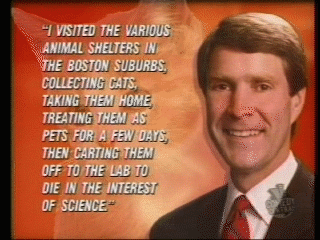
Bill Frist - Cat Killer (Hi-res 23 MB)
Bill Frist - Cat Killer (Med-res 18 MB)
Bill Frist - Cat Killer (Lo-res 12 MB)
Bill Frist - Cat Killer (MP3 - 3 MB)

It might not be up anymore by the time you read this, but it was located here as of shortly after midnight tonight (not sure how long it's been up):
A New Vision for the Recording Industry
Our member labels will halt all plans to sell copy-restricted CDs. Restricting the use of CDs devalues the product, reducing the incentive for consumers to buy them. Also we believe that as time goes on, the public will realize, as we have, that due to the viral natural of distribution through file-sharing networks copy-restriction will never be effective at preventing online piracy but rather is indented to force our customers to buy the same music on multiple media.We also vow to stop pursuing the companies behind file-sharing networks in court. In light of studies by reputable pollsters that have shown that most users of file-sharing networks reported that their music purchases increased in frequency, there seems to be little reason to continue spending millions in an attempt to shut down these services. Instead, we plan to propose to settle out of court in exchange for a royalty system based on a fraction of profit (only fair, given that these profits are derived in part from our products).
We will also stop lobbying politicians to impose draconian copyright laws on the American people. Last June, Rep. Rick Berman, who received more campaign donations from the entertainment industry than any other Congressperson, proposed legislation that would exempt rights-holders from anti-hacking law in order that they might exact vigilante-style justice on file-sharers. Initially we were thrilled at the display of the political might of our money, but later were sickened as we realized the implications for democracy in America. Morally, we cannot continue this manipulation of the political system.
Here's the full text in case the link goes bad:
http://www.riaa.com/PR_story.cfm?id=597
Press Releases
Contact: 202.775.0101
email
A New Vision for the Recording Industry
The past year has been one of the worst in the previous decade for the music industry. While factors beyond our control, such as the down-turn in the American economy, have no doubt contributed to this, the industry itself can certain not completely escape blame. In an attempt correct this, representatives from our member labels recently met to discuss ways of reforming the industry. The result of the meeting was a set of changes to current policies, outlined below, which, when implemented, we hope will pull the industry out of its current slump.
Our member labels will halt all plans to sell copy-restricted CDs. Restricting the use of CDs devalues the product, reducing the incentive for consumers to buy them. Also we believe that as time goes on, the public will realize, as we have, that due to the viral natural of distribution through file-sharing networks copy-restriction will never be effective at preventing online piracy but rather is indented to force our customers to buy the same music on multiple media.
We also vow to stop pursuing the companies behind file-sharing networks in court. In light of studies by reputable pollsters that have shown that most users of file-sharing networks reported that their music purchases increased in frequency, there seems to be little reason to continue spending millions in an attempt to shut down these services. Instead, we plan to propose to settle out of court in exchange for a royalty system based on a fraction of profit (only fair, given that these profits are derived in part from our products).
We will also stop lobbying politicians to impose draconian copyright laws on the American people. Last June, Rep. Rick Berman, who received more campaign donations from the entertainment industry than any other Congressperson, proposed legislation that would exempt rights-holders from anti-hacking law in order that they might exact vigilante-style justice on file-sharers. Initially we were thrilled at the display of the political might of our money, but later were sickened as we realized the implications for democracy in America. Morally, we cannot continue this manipulation of the political system.
In addition to the reasons just given, we also are doing both of the above, halting the lawsuits against the companies file-sharing services and stopping our coercive political contributions, in an attempt to restore consumer confidence in the music industry. Our customers will know longer will feel guilty after buying a CD, now knowing that the proceeds from their purchases will not be used to support causes that harm them and their peers.
To further convince consumers that the proceeds from their music purchases are well spent, we will be attempting to treat our talent more fairly. At the core of this effort will be the halting of collusion between labels on recording contracts. While overlooked by anti-trust law, the elimination of competition caused by collusion is just as harmful to the producers of content as it is to the consumers. No longer will artists be forced into signing contracts which reduce artist''s royalties for a multitude of arbitrary or antiquated reasons for if any label attempts such abuse, they''ll be certain to lose their talent to a competitor. We believe that this can be undertaken without damaging industry profitability. Firstly, the previously mentioned reduced legal and political expenditures will help to offset the cost. Secondly, we plan fix the sobering statistic that nine out of ten industry ventures end up failing recovering their costs. This figure would be unacceptable outside the entertainment industry and, while it was viable inside it due to the abuse of artists, there is no reason it should not be possible to vastly improve upon it.
Finally, we promise to stop trying to brainwash the world into thinking of music as property, something that an artist has an innate right to control, even after the media that embodies that music has changed hands. Rather, we will recognized only the original goal of copyright law in America, to benefit the average citizen by creating a incentive to produce creative works. We will also launch a publicity campaign to remind the public of this principle, unknown to many. We hope that upon learning that the true purpose of copyright law is to benefit them, average citizens will be more likely to respect it.
It is our hope that these policy changes will revitalize the industry and make it deserving of the unique place it holds within American culture.
Tom Ammiano - San Francisco District Supervisor

Here's Tom Ammiano - San Francisco Board of Supervisors
Tom Ammiano -San Francisco Board of Supervisors (Hi-res 30 MB)
Tom Ammiano - San Francisco Board of Supervisors (Med-res 20 MB)
Tom Ammiano - San Francisco Board of Supervisors (Lo-res 9 MB)
Tom Ammiano - San Francisco Board of Supervisors (MP3 - 3 MB)
Jeff Adachi - San Francisco Public Defender
Here's Jeff Adachi - San Francisco Public Defender
Jeff Adachi - San Francisco Public Defender (Hi-res 49 MB)
Jeff Adachi - San Francisco Public Defender (Med-res 35 MB)
Jeff Adachi - San Francisco Public Defender (Lo-res 19 MB)
Audio - Jeff Adachi - San Francisco Public Defender (MP3 - 4 MB)
Yesterday's rally was incredible! There must have been at least 500 people there. (Enough to fill up all four corners for 100 meters in every direction.
The cops brought out barriers and gave the crowd a lane of traffic on Washington Street too. The cops didn't seem to mind that me and fifty other camera people were (gasp) filming the building!
The "stage" was a big truck with a generator, microphones, speakers and a PA in back.
I'll be putting the footage from Friday's protest together on one page in a day or two. But I'll also be posting them here as they emerge from my machine.
I really wanted to start publishing what few clips I do have available as soon as possible in the the interest of being more of a dependable "news" source. In case people are trying to put shows together to air on Sunday, they can use clips from Tom Ammiano and Jeff Adachi's speeches (below).
Remember that you can always email me if you need a louder MP3 file or a different format or a DV tape of a scene or something else for a project your working on. My news footage is always Public Domain'd under a Creative Commons Public Domain Dedication so you or whatever (hopefully huge multimedia conglomorate) company that you work for can be assured of having the rights to rebroadcast the footage.
The whole point of me doing all this is to have this footage redistributed and rebroadcast and reanalyzed and discussed as far as wide and to as many people as possible.
Thanks in advance for making millions of copies of everything and giving them to your friends and for using my video footage in your own films, television programs, artistic and commercial endeavors.
Whatever clips/audio I'm able to upload this morning will be all until tomorrow am because I'm actually going to be offline with family for perhaps the rest of the day. (But more likely only till later tonight.)
Tomorrow will be the big day that I'm crunching video and uploading it for pretty much all day long. There's a lot of great stuff from Friday and I still have Tuesday and Thursday to edit and upload from last week once I've finished with Friday's protest and speakers (all 8 or so of them). (Why go back to finish Tuesday and Thursday? -- Because there were protesters every day last week and I want you guys to be able to see it all, dag nabbit!)
Holy cow! Michael Powell got a TIVO and he loves it!
Now he can understand the true joy the modern Consumer can achieve while exercising their fair use and first sale rights.
FCC's Powell declares TiVo 'God's machine'
By Jim Krane for the Las Vegas Associate Press.
The chairman of the Federal Communications Commission is a new convert -- to the personal digital video recorder faithful."My favorite product that I got for Christmas is TiVo," FCC chairman Michael Powell said during a question and answer session at the International Consumer Electronics Show. "TiVo is God's machine."
If Powell's enthusiasm for digital recordings of TV broadcasts are reflected in FCC rulings, the entertainment industry could find it difficult to push in Washington its agenda for technical restrictions on making and sharing such recordings.
Powell said he intended to use the TiVo machine to record TV shows to play on other television sets in his home, and even suggested that he might share recordings with his sister if she were to miss a favorite show.
"I'd like to move it to other TVs," he said of his digitally recorded programming. A number of products already allow that...
Powell said the FCC was examining the broadcast flag issue to determine whether the agency has a regulatory role. He suggested that Congress might "assign us a role so we have clear jurisdiction and resources to do it."
Powell said he understood the needs to balance consumers' fair use rights to make personal copies of television shows with Hollywood's fears that TiVo-like technology allows exact copies to be made and easily sent over the Internet.
Here's the full text of the article in case the link goes bad:
http://www.sfgate.com/cgi-bin/article.cgi?file=/news/archive/2003/01/10/financial1802EST0373.DTL
FCC's Powell declares TiVo 'God's machine'
JIM KRANE, AP Technology Writer Friday, January 10, 2003
(01-10) 15:02 PST LAS VEGAS (AP) --
The chairman of the Federal Communications Commission is a new convert -- to the personal digital video recorder faithful.
"My favorite product that I got for Christmas is TiVo," FCC chairman Michael Powell said during a question and answer session at the International Consumer Electronics Show. "TiVo is God's machine."
If Powell's enthusiasm for digital recordings of TV broadcasts are reflected in FCC rulings, the entertainment industry could find it difficult to push in Washington its agenda for technical restrictions on making and sharing such recordings.
Powell said he intended to use the TiVo machine to record TV shows to play on other television sets in his home, and even suggested that he might share recordings with his sister if she were to miss a favorite show.
"I'd like to move it to other TVs," he said of his digitally recorded programming. A number of products already allow that.
A TiVo competitor, SONICblue, has been sued by top motion picture studios and some television networks over a ReplayTV device that enables users to share digitally recorded shows over the Internet with a limited group of fellow ReplayTV owners.
Powell made the statements during a brief exchange with Gary Shapiro, who heads the Consumer Electronics Association, a lobbying group opposed to government-imposed restrictions on TiVo-like digital recording technology.
Shapiro was clearly delighted, calling Powell's statement "good news" and suggesting to Powell that his regulatory authority might allow him to rule in favor of sharing recorded TV broadcasts.
"That's up to you, actually," Shapiro said. "We're glad. We hope some of your colleagues in Congress buy a TiVo as well."
Many in Hollywood have railed against the machines, saying they could cut into TV advertising revenues if fewer people watch the commercials that underwrite broadcasters' business.
The entertainment industry has proposed "broadcast flag" technology that could thwart or limit copying or distribution of pirated broadcasts over the Internet, where, it fears, they could be sold.
Powell said the FCC was examining the broadcast flag issue to determine whether the agency has a regulatory role. He suggested that Congress might "assign us a role so we have clear jurisdiction and resources to do it."
Powell said he understood the needs to balance consumers' fair use rights to make personal copies of television shows with Hollywood's fears that TiVo-like technology allows exact copies to be made and easily sent over the Internet.
Already, one upcoming TV series intends to fight back against commercial skipping technology by blending advertising into its programming, offering a seamless hour of entertainment mixed with salesmanship.
The series will air for six weeks on the WB network with Michael Davies, best-known for ABC's "Who Wants to be a Millionaire," as its producer, according to a story in Friday's New York Times. Its working title is "Live from Tomorrow."
PVR technology has now found its way into DVD recorders and personal computers. Several new standalone and PC-based models were announced here at the CES trade show this week.
Speakers have been announced for today's rally!
Rally from 11-1pm in San Francisco to Protest the Special RegistrationsWhere:444 WASHINGTON (at the corner of Washington and Sansome), Downtown San
Francisco
Press conference at 1:30 pm featuring:
Yuri Kochiyama, Human Rights Activist
Cecil Williams, Glide Memorial Church
Renee Saucedo, La Raza Centro Legal
Tom Ammiano, San Francisco Board of Supervisors
Linda Sherif, American-Arab Anti-Discrimination Committee, SF
Chapter
Marc Van Der Hout, National Lawyers' Guild
Hatem Bazian from the Islamic Society of San Francisco
Khalil Khaid, SEIU 1877
Kawal Ulanday, Filipinos for Affirmative Action
Others, as confirmed
For more information please call the American-Arab Anti-Discrimination Committee, San Francisco Chapter at 415-861-7444 or Not in Our Name 510-444-NION
Okay guys, now's where I can use your help.
If you can't make the protests tomorrow, please FAX a letter to Nancy Pelosi or do whatever else you can to help.
I promised you a bunch of Shrub today, didn't I?
Here's the Shrub mentioning Ozzy Osbourne by name at a Celeb dinner -- as covered by The Osbournes TV show. Ozzy obviously got a kick out of the evening.
Ozzy at Shrub Celeb Dinner (Hi-res 16 MB)
Ozzy at Shrub Celeb Dinner (Med-res 12 MB)
Ozzy at Shrub Celeb Dinner (Lo-res 8 MB)
Damned if you do or don't -- With arrest likely either way, immigrants weigh INS deadline
By Anastasia Hendrix for the SF Chronicle
Members of the San Francisco chapter of the Arab-American Anti-Defamation Committee have been standing outside the INS office on Washington Street conducting an independent survey of those coming to participate in the special registration program.Heba Nimr, an attorney for La Raza Centro Legal's INS Watch who is also a member of the anti-defamation committee, said volunteers tallied 12 people who came to register Friday, 30 on Monday and 40 on Tuesday. Of those, three had been detained, and all were from Tunisia.
Not all registrants agree to check in with the group, Nimr quickly added, and the figures were not reflective of the 30-day registration period.
Friday's deadline affects males over age 16 from Afghanistan, Algeria, Bahrain, Eritrea, Lebanon, Morocco, North Korea, Oman, Qatar, Somalia, Tunisia,
United Arab Emirates and Yemen.The policy has attracted widespread criticism from several immigrant, Arab and civil rights groups, many of which have organized a protest rally to be held Friday morning outside the INS office on Washington Street. Demonstrators have been positioned at the intersection of Washington and Sansome streets since Monday.
Here is the full text of the article in case the link goes bad:
http://www.sfgate.com/cgi-bin/article.cgi?file=/chronicle/archive/2003/01/09/MN215594.DTL
Damned if you do or don't
With arrest likely either way, immigrants weigh INS deadline
Anastasia Hendrix, Chronicle Staff Writer Thursday, January 9, 2003
As a Tunisian in this country on a temporary visa, Chedli Fathi must register with the INS by Friday to comply with a new immigration policy or face deportation.
But he was not at the San Francisco Immigration and Naturalization Service office to register Wednesday morning. Instead, Fathi went to visit five friends who were detained Monday, he said, when they complied with the government's demand.
Fathi fears he may join them in the detention cells.
"I'm totally scared," said the 28-year-old, whose student visa expired in 2001. "Because after Jan. 10 there is no exception or excuse for not showing up. But if I go, I can get arrested, and if I don't go, I can get arrested. In both cases, it is bad for me."
Fathi's five friends also are from Tunisia, one of the 13 countries affected by the National Security Entry-Exit Registration System's Jan. 10 deadline for men age 16 or older who hold temporary visas to report to the INS to be fingerprinted, photographed and interviewed.
As of Friday, 400 people had been detained in California related to suspected immigration violations since November when the registration of visa- holders from countries considered high risks for terrorist activity began, said Jorge Martinez, a spokesman with the Department of Justice in Washington, D.C. He said all but 20 had been released after their names were run through criminal databases and international terrorist watch lists.
Martinez said he did not know how many of those detentions had occurred in Northern California, and officials at the San Francisco INS office did not return calls seeking comment.
INDEPENDENT SURVEY AT INS
Members of the San Francisco chapter of the Arab-American Anti-Defamation Committee have been standing outside the INS office on Washington Street conducting an independent survey of those coming to participate in the special registration program.
Heba Nimr, an attorney for La Raza Centro Legal's INS Watch who is also a member of the anti-defamation committee, said volunteers tallied 12 people who came to register Friday, 30 on Monday and 40 on Tuesday. Of those, three had been detained, and all were from Tunisia.
Not all registrants agree to check in with the group, Nimr quickly added, and the figures were not reflective of the 30-day registration period.
Friday's deadline affects males over age 16 from Afghanistan, Algeria, Bahrain, Eritrea, Lebanon, Morocco, North Korea, Oman, Qatar, Somalia, Tunisia,
United Arab Emirates and Yemen.
The policy has attracted widespread criticism from several immigrant, Arab and civil rights groups, many of which have organized a protest rally to be held Friday morning outside the INS office on Washington Street. Demonstrators have been positioned at the intersection of Washington and Sansome streets since Monday.
Suda Putnam sat on the sidewalk with a clothesline binding her wrists and a blindfold around her head. A sign around her neck read: "Japanese Americans, 1942. Muslims, Arabs, Iranians, South Asians, 2002-3. Who's Next?"
"It may seem like an extreme comparison, but everything starts somewhere before growing into great tragedy," she said.
'I'M NOT A TERRORIST'
Across the street, Ghazi Balti, also of Tunisia, waited in line to enter the INS building with his attorney. His tourist visa expired two years ago.
"I'm ready," he said, jutting his arms in front of him, wrists together, as if imaginary handcuffs were about to be clasped on them. "I'm here to tell them I'm not a terrorist, and I want to do it on time."
Nasser Gamiel, who was born in Yemen but lives in Oakland, also came to register Thursday. He was uncertain of what awaited him and his case, which is complicated by a previous jail term on immigration-related charges last year and an expired tourist visa.
"I have to take it like it is," he said, speaking in Arabic with a friend translating. He shrugged as he leaned against the building. "It doesn't matter if I get angry about the rules or not -- they are going to be there."
Lucas Guttentag, who heads the Immigrants' Rights Project for the American Civil Liberties Union, said that group was closely monitoring the registration process to ensure that "the debacle of December is not repeated." Last month's registration deadline resulted in mass detentions at the INS's Los Angeles office.
LACK OF OUTREACH BLAMED
Guttentag, like many critics of the program, said one of the most glaring problems was that the agency did not conduct enough outreach to explain to immigrants the intricacies of the policy.
A case in point was an Algerian woman who identified herself only as Fatimah. She was standing in line to check on her green card status and was surprised to see the media and activists milling about. She said she had not heard about the special registration requirements for men from Algeria, nor had several of her friends and relatives -- many of whom are temporary visa- holders.
"They will never believe this," she said.
Fathi knows his chances of being detained, possibly even deported, are high,
and so he said he was still uncertain whether he would go through with the registration.
"For the safety of the country, I think the INS is doing their best to keep it safe, but what troubles me is that they did not give us enough time to examine the law and make a decision about what to do," he said. "I am so conflicted. I really don't know what I am going to do."
E-mail Anastasia Hendrix at ahendrix@sfchronicle.com.
I don't know if he just forgets to take his meds sometimes or what.

Here's the Shrub from Monday's Daily Show
Shrub On Iraq and North Korea (Hi-res 22 MB)
Shrub On Iraq and North Korea (Med-res 17 MB)
Shrub On Iraq and North Korea (Lo-res 10 MB)
We didn't elect our "President."
We didn't elect our "President."
There, say it a few more times. Don't you feel better?
Ugh. I don't even know what to say. I knew Frist had to have a skeleton in his closet somewhere, but this is pretty ghastly.
I'm not a Republican. Nevertheless, with the Republicans in the majority, I am very concerned about who will be the leader of the Republican Party in the Senate.
A med student who had a nervous breakdown and started kidnapping and killing cats from the pound to finish his thesis is arguably less than stable enough to lead a political party. What else might he consider necessary for the greater good of something or other when he inevitably cracks under the pressure of office? Forget it.
Come on Shrub. Is this the best you can do? Is the Republican party so morally bankrupt that a cat killer with a god complex is the best leader you can find?
Keep looking.
Daschle, Beware: Young Dr. Frist Sliced Up Cats
by Ron Rosenbaum for the Observer.
Then he (Frist) adds this somewhat contradictory sentence: "Humane societies might object, and I would agree if the issue was the humane treatment of animals. But the issue was human lives." (Why isn't it both?)He tells us of the rewards: "It can even be beautiful and thrilling work, as I discovered that day in the lab when I first saw the wonderful workings of a dog's heart .... I spent days and nights on end in the lab, taking the hearts out of cats, dissecting each heart, suspending a strip of tiny muscle that attaches the mitral valve to the inner wall of the cat heart and recording the effects of various medicines I added to the bath surrounding the muscle."
At times, he gives evidence of borderline grandiosity: "I was, for the first time in my life, making original discoveries. No one else in the history of man had ever done exactly what I was doing"-although he concedes in the same paragraph (again, it's somewhat contradictory) that his project was "really very basic," not "some grand breakthrough."
Nonetheless, "[a]s I watched the little strip of muscle beat hour after hour through the night in the basement of the hospital, I felt quite pure, as if I were reaching out and touching some eternal truth of nature."
But the contemplation of eternal truth was threatened, alas, by something mundane: "I lost my supply of cats. I only had six weeks to complete my project before I resumed my clinical rotations. Desperate, obsessed with my work, I visited the various animal shelters in the Boston suburbs, collecting cats .... "
"Collecting cats"? What this euphemism elides over is that Mr. Frist apparently posed as someone who wanted to adopt kittens and strays. He asked the shelter people to trust him, he asked the poor shivering creatures in their cages to trust him, and then he "cart[ed] them off to the lab to die." (Sounds like the way the new majority leader is likely to treat the hapless Democratic minority in the Senate. Indeed, one of the most frequent quotes in my Google search compared the job of Senate Majority Leader to that of "herding cats.")
And here's the telling detail I hadn't seen quoted in any of the stories on the episode: He took them home, "treating them as pets for a few days," before taking them to the lab to cut them open.
Treated "them as pets for a few days" before "carting them off to the lab to die." Well, he does say it was "totally schizoid," but it's hard to imagine those few days: the way he briefly builds a relationship of trust with the trusting little creatures, gets to know them as pets. Lets them, at last, begin to feel safe and loved after a hard life on the mean streets. (Does he give them names before he kills them?) One tries to conjure up the scenes of domestic closeness between the young Dr. Jekyll and his little charges. And then the day arrives when the cat carrier comes out again, and the furry little creature begins to suspect what's in store. To those poor felines Frist was a lying "Joe Millionaire." (I'm told that, for good reason, most medical researchers who work with animals try to maintain a strict separation in their mind between pets they cuddle and lab animals they cut up.)
Yes there are specific laws against this kind of premeditated kidnapping, torture and murder of animals. Yes. If Frist had been found out at the time, he would have undoubtedly been prosecuted under whatever laws were available at the time.
I was only sensitized to the question when I came to know Liz Hecht, the animal-rights activist and former director of Citizens for Alternatives to Animal Labs Inc., which has had some success in getting local New York hospitals to adopt more humane procedures. Ms. Hecht was always justly outraged by reports of the widespread practice of lab-animal "suppliers" who used Frist-like methods to essentially kidnap animals from shelters and private yards and sell them to medical-research facilities.She referred me to the outreach director for the American Anti-Vivisection Society (www.aavs.org), Crystal Spiegel, who said that three states still have "pound seizure laws," which actually allow anyone with some sort of research-supply license to show up at a shelter and demand any number of rescued creatures to take to labs for dissection and experiment. A reading of the current Massachusetts animal-welfare law (which passed apparently after Mr. Frist's own "catnappings"), suggests that what the Senate Majority Leader did back then would be illegal now. And it's not just an isolated practice even now, alas. Ms. Hecht recommended a sobering book by Judith Reitman called Stolen for Profit: The True Story Behind the Disappearance of Millions of America's Beloved Pets, which documents the way unscrupulous suppliers of lab animals steal pets from yards and sell them for dissection.
More...
"In short, I was going a little crazy."I don't know if that implicit invocation of Dr. Jekyll and Mr. Hyde is just a "little crazy" or more deeply disturbing. I searched the Internet hoping to find more details about these cat kidnapping incidents, but most sources had picked up on the quote in the Globe because the Frist book was strangely not just out of print, but virtually nonexistent on major online Web sites like Amazon. (Mr. Frist has a new book out on bioterrorism, but there's no customary referral to this previous book). The Globe reporter told me that he consulted a used-book specialist who found him a copy, but now they're not available, even from those specialists. I put out calls to several sources to see if I could find the book, which is called Transplant: A Heart Surgeon's Account of the Life-and-Death Dramas of the New Medicine. I wanted at least to find the relevant pages on the cat-stealing and see if there were more telling details about this disturbing episode. Meanwhile, I found myself fascinated by several items that turned up on a Google search of "Bill Frist" and "cats."
One of them was the strange encounter between former cat-killer Frist and the cat-killing Capitol gunman. It happened on July 24, 1998, and was to become the signature moment in the creation of the Frist media legend as heroic surgeon-Senator.
Do you remember that story? Some nut job named "Rusty" Weston-who at one point claimed to be an illegitimate son of J.F.K. and the subject of death threats from Bill Clinton-tried to shoot his way into the Capitol building, fatally injuring two Capitol police officers while being shot badly himself. At the time of the shooting, Bill Frist was presiding over the Senate. He rushed to the scene, worked with the emergency ambulance crews to stabilize the shooting victims, and actually rode in the ambulance with the badly injured shooter. Although Mr. Frist didn't know at the time who was the shooter and who the victim, he did his best to stabilize Mr. Weston and keep him alive till he got to the hospital.
It would later turn out that before he made his fatal journey to the Capitol, Mr. Weston had methodically shot dead some 14 of his family's cats. One account of the shooting had the line: "We know a lot more now than we used to about angry boys who kill cats for sport." It was a reference to studies that seemed to show that many serial killers and other psychopaths showed their first signs of derangement by killing pets and small animals.
The irony was that scene in the ambulance: Although they'd taken different paths in life, one cat-killer was tended to by a person who had cat-killing in his past.
Which suggests the possibility that the cat-killing was a kind of transformative moment in Mr. Frist's life, a moment in which, Lord Jim-like, he saw something in himself that he wished to turn against, to transcend, and so began devoting his life to reparative deeds.
Here's the full text of the entire article in case the link goes bad:
http://www.observer.com/pages/frontpage3.asp
January 9, 2003|9:23 AM TheFrontPage 2003 THE NEW YORK OBSERVER, L.P.
Daschle, Beware: Young Dr. Frist Sliced Up Cats
by Ron Rosenbaum
Yes, he's a lifesaving heart surgeon and media star, Bill Frist, the Republicans' new Senate Majority Leader. And he's on the fast track to move up to Vice President in 2004 (depending on the health of the current heart-patient incumbent) and maybe President thereafter. All the more reason to spend a little time looking at a lesser-known, less heroic episode in his life, one Mr. Frist has apologized for as "heinous and dishonest," but which nonetheless shouldn't necessarily escape examination. Especially for what it can tell us about someone who is going places fast, someone who seems just too perfect to be true. I'm talking about the cat-killing. What perspective should we put this in?
Think of it this way: You have a sister, and she comes to you for advice. This guy named Bill has asked her to marry him. Great guy, this Bill, practically Mr. Perfect: a heart surgeon, ambitious, dedicated, everyone speaks well of him. There's just this one thing, something he felt the need to confess to her, something he did as a youth in medical school, something he now regrets, something he says he's ashamed of. It's long ago in the past, but it troubles your sister, and she's asking your advice about it because Bill-well, he lied and cheated essentially to kidnap and then dissect and kill cats.
Oh, he did it for a good cause: He had some advanced ideas about a medical breakthrough, and they'd run out of cats to dissect at the medical school, so he'd go to animal shelters, make goo-goo eyes at a cat at each shelter to get them to let him adopt the shivering strays, take them home, and then perform experimental surgery on them. For a good purpose, a higher humanitarian purpose, he says-but obviously he isn't trying to excuse the lying and cheating, or the implicit betrayal of the poor trusting animals, who thought they were going to be given a home off the mean streets at last. So there it is, the question you can sense your sister is asking you: Should she put her life, her trust, in this fellow? Was it just a youthful indiscretion, or was it a signal of something deeply twisted?
You know about this, don't you, Bill Frist and the cat-killing business-or the cat "research" business, if you prefer. You know how the new Republican majority leader admitted it in his now-hard-to-find 1989 autobiography-the one he wrote before he entered politics, when his claim to fame was as a heart-transplant pioneer and head of a big hospital and health-care corporation.
It came up in his first Senate campaign in 1994, when the opposing camp in the Republican primary called Frist a cat-killer. It came up again two months before the Trent Lott fiasco made him Senate Majority Leader, when a Boston Globe profile (by Michael Kranish) on Oct. 27, 2002, quoted from a couple of paragraphs in Mr. Frist's autobiography. Mr. Frist is talking about his "experiments" at Harvard Medical School, and how he'd run out of available lab animals at the Harvard lab and, racing to complete his thesis, he went around to animal shelters, adopted cats, took them home and then cut them up in a lab-all for the sake of medical science:
"It was, of course, a heinous and dishonest thing to do," he wrote. "And I was totally schizoid about the entire matter. By day, I was little Billy Frist, the boy who lived on Bowling Avenue in Nashville and had decided to become a doctor because of his gentle father and a dog named Scratchy. By night, I was Dr. William Harrison Frist, future cardiothoracic surgeon, who was not going to let a few sentiments about cute, furry little creatures stand in the way of his career.
"In short, I was going a little crazy."
I don't know if that implicit invocation of Dr. Jekyll and Mr. Hyde is just a "little crazy" or more deeply disturbing. I searched the Internet hoping to find more details about these cat kidnapping incidents, but most sources had picked up on the quote in the Globe because the Frist book was strangely not just out of print, but virtually nonexistent on major online Web sites like Amazon. (Mr. Frist has a new book out on bioterrorism, but there's no customary referral to this previous book). The Globe reporter told me that he consulted a used-book specialist who found him a copy, but now they're not available, even from those specialists. I put out calls to several sources to see if I could find the book, which is called Transplant: A Heart Surgeon's Account of the Life-and-Death Dramas of the New Medicine. I wanted at least to find the relevant pages on the cat-stealing and see if there were more telling details about this disturbing episode. Meanwhile, I found myself fascinated by several items that turned up on a Google search of "Bill Frist" and "cats."
One of them was the strange encounter between former cat-killer Frist and the cat-killing Capitol gunman. It happened on July 24, 1998, and was to become the signature moment in the creation of the Frist media legend as heroic surgeon-Senator.
Do you remember that story? Some nut job named "Rusty" Weston-who at one point claimed to be an illegitimate son of J.F.K. and the subject of death threats from Bill Clinton-tried to shoot his way into the Capitol building, fatally injuring two Capitol police officers while being shot badly himself. At the time of the shooting, Bill Frist was presiding over the Senate. He rushed to the scene, worked with the emergency ambulance crews to stabilize the shooting victims, and actually rode in the ambulance with the badly injured shooter. Although Mr. Frist didn't know at the time who was the shooter and who the victim, he did his best to stabilize Mr. Weston and keep him alive till he got to the hospital.
It would later turn out that before he made his fatal journey to the Capitol, Mr. Weston had methodically shot dead some 14 of his family's cats. One account of the shooting had the line: "We know a lot more now than we used to about angry boys who kill cats for sport." It was a reference to studies that seemed to show that many serial killers and other psychopaths showed their first signs of derangement by killing pets and small animals.
The irony was that scene in the ambulance: Although they'd taken different paths in life, one cat-killer was tended to by a person who had cat-killing in his past.
Which suggests the possibility that the cat-killing was a kind of transformative moment in Mr. Frist's life, a moment in which, Lord Jim-like, he saw something in himself that he wished to turn against, to transcend, and so began devoting his life to reparative deeds.
Or is something like that ineradicable? Even if the repentance were sincere, would you feel safe about your sister marrying a former illicit cat killer? Clearly, he felt guilt and shame about what he'd done-guilt and shame that may still show up in unexpected, perhaps not completely recognized ways.
Consider the controversy over a Frist remark which briefly consumed the "blogosphere" (as the network of interacting politically minded Web logs has come to be called). As soon as Mr. Frist was made majority leader, a remark he made in his 1994 Senate campaign provoked debate over whether it was racial or racially coded. It seems that he was about to make a campaign stop in some high-crime inner-city area. One of his campaign aides brought a bunch of campaign pencils to hand out and asked Frist if he wanted them sharpened. Frist was reported to have said "I want the unsharpened ones. I don't want to get stuck."
When the remark surfaced again this year, a debate broke out between two of the premier political bloggers, Joshua Micah Marshall (of talkingpointsmemo.com) and Mickey Kaus (of kausfiles.com, now incorporated into Slate). The former suggested at least the strong possibility of a racial element in the comment; the latter argued that Mr. Frist could reasonably (and non-racially) be concerned about being stabbed by sharp-pointed pencils in the hurly-burly of a campaign appearance.
I would suggest a third possibility: Could it not be repressed guilt over the illicit cat dissections surfacing? Why else the curious concern about strangers stabbing him with sharp-pointed objects-as he once did to those poor cats?
More pertinently, though, how does one fit such an episode into the context of a life otherwise full of so many good deeds? I felt that more details were still needed-and finally, through the kind efforts of the Boston Globe's Michael Kranish and Bruce Dobie, the editor of the well-regarded Nashville Scene magazine, I was able to get hold of the pages of Mr. Frist's autobiography that gave more of the context of the cat-killing confession-as much, anyway, as Mr. Frist was willing to give.
He places his illicit activities in the context of his noble aspirations. He talks about the "hardening" that was "necessary" for someone who "had always loved animals. My childhood was filled with dogs, hamsters, fish, ducks, cats, horses, even turkeys and alligators. But you could not practice modern medicine without participating in laboratory animal research. Without the sacrifice of rats and cats and dogs and sheep, most of the miraculous things we can do with the human brain and the heart would not be possible."
Then he adds this somewhat contradictory sentence: "Humane societies might object, and I would agree if the issue was the humane treatment of animals. But the issue was human lives." (Why isn't it both?)
He tells us of the rewards: "It can even be beautiful and thrilling work, as I discovered that day in the lab when I first saw the wonderful workings of a dog's heart .... I spent days and nights on end in the lab, taking the hearts out of cats, dissecting each heart, suspending a strip of tiny muscle that attaches the mitral valve to the inner wall of the cat heart and recording the effects of various medicines I added to the bath surrounding the muscle."
At times, he gives evidence of borderline grandiosity: "I was, for the first time in my life, making original discoveries. No one else in the history of man had ever done exactly what I was doing"-although he concedes in the same paragraph (again, it's somewhat contradictory) that his project was "really very basic," not "some grand breakthrough."
Nonetheless, "[a]s I watched the little strip of muscle beat hour after hour through the night in the basement of the hospital, I felt quite pure, as if I were reaching out and touching some eternal truth of nature."
But the contemplation of eternal truth was threatened, alas, by something mundane: "I lost my supply of cats. I only had six weeks to complete my project before I resumed my clinical rotations. Desperate, obsessed with my work, I visited the various animal shelters in the Boston suburbs, collecting cats .... "
"Collecting cats"? What this euphemism elides over is that Mr. Frist apparently posed as someone who wanted to adopt kittens and strays. He asked the shelter people to trust him, he asked the poor shivering creatures in their cages to trust him, and then he "cart[ed] them off to the lab to die." (Sounds like the way the new majority leader is likely to treat the hapless Democratic minority in the Senate. Indeed, one of the most frequent quotes in my Google search compared the job of Senate Majority Leader to that of "herding cats.")
And here's the telling detail I hadn't seen quoted in any of the stories on the episode: He took them home, "treating them as pets for a few days," before taking them to the lab to cut them open.
Treated "them as pets for a few days" before "carting them off to the lab to die." Well, he does say it was "totally schizoid," but it's hard to imagine those few days: the way he briefly builds a relationship of trust with the trusting little creatures, gets to know them as pets. Lets them, at last, begin to feel safe and loved after a hard life on the mean streets. (Does he give them names before he kills them?) One tries to conjure up the scenes of domestic closeness between the young Dr. Jekyll and his little charges. And then the day arrives when the cat carrier comes out again, and the furry little creature begins to suspect what's in store. To those poor felines Frist was a lying "Joe Millionaire." (I'm told that, for good reason, most medical researchers who work with animals try to maintain a strict separation in their mind between pets they cuddle and lab animals they cut up.)
So what would you advise your sister about being engaged to this guy? And speaking of the engagement question-it's hard to resist the connection-there is this other odd little matter that's brought up in most Frist profiles. After all the heroic-heart-surgeon accolades, usually about two thirds of the way down the Frist profile, the writer will mention that, "on the other hand," there's the cat-killing-and also the fact that Mr. Frist called off his planned wedding two days before the ceremony. This would be, you can imagine, a fairly devastating thing to have happen to you if you were Mr. Frist's unsuspecting, trusting fiancée. But again, there was a higher justification, sort of: Mr. Frist had met another woman whom he eventually married, so, in effect, for the sake of true true love it was into the cat carrier with the first fiancée, for the higher cause of the new Frist couple. Who knows, maybe he did the right thing for all concerned in the long run.
As I said, in Mr. Frist's defense, these episodes of building and breaking trust may well have been the Lord Jim moments when he turned his life around and devoted himself to good deeds and atonement.
But it raises interesting questions about how we put this into perspective in evaluating a man who may well be one strip of heart muscle away from the Vice Presidency, and someday seek to be President himself. We all want to extend forgiveness to those who have confessed their sins, as Mr. Frist has-so far as we know-forthrightly done. "We hope the drive behind that pattern of behavior has been purged," a spokesperson for the Humane Society said.
I was impressed by the reaction of PETA, which didn't denounce Mr. Frist outright but rather asked him to demonstrate the sincerity of his repentance by sponsoring animal-friendly legislation. (The PETA statement, I must admit, sounded like the State Department's delicate rhetoric when dealing with North Korean nuclear madman Kim Jong Il.) But if PETA is, at least theoretically, willing to forgive ....
Still, I don't know-there are a lot of heroic heart surgeons in America, and I can't imagine they all found it necessary to lie and cheat animal shelters, to build up and break a relationship of trust with a helpless animal before cutting it up to advance their careers.
Even those who don't oppose the use of animals for medical experimentation might have trouble with this kind of behavior-trouble that a confession would not completely obviate. I myself have difficulty drawing the line with any consistency on these issues. I was only sensitized to the question when I came to know Liz Hecht, the animal-rights activist and former director of Citizens for Alternatives to Animal Labs Inc., which has had some success in getting local New York hospitals to adopt more humane procedures. Ms. Hecht was always justly outraged by reports of the widespread practice of lab-animal "suppliers" who used Frist-like methods to essentially kidnap animals from shelters and private yards and sell them to medical-research facilities.
She referred me to the outreach director for the American Anti-Vivisection Society (www.aavs.org), Crystal Spiegel, who said that three states still have "pound seizure laws," which actually allow anyone with some sort of research-supply license to show up at a shelter and demand any number of rescued creatures to take to labs for dissection and experiment. A reading of the current Massachusetts animal-welfare law (which passed apparently after Mr. Frist's own "catnappings"), suggests that what the Senate Majority Leader did back then would be illegal now. And it's not just an isolated practice even now, alas. Ms. Hecht recommended a sobering book by Judith Reitman called Stolen for Profit: The True Story Behind the Disappearance of Millions of America's Beloved Pets, which documents the way unscrupulous suppliers of lab animals steal pets from yards and sell them for dissection.
Liz also sent me a thoughtful treatise on the whole lab controversy: In the Name of Science: Issues in Responsible Animal Experimentation by F. Barbara Orlans, a professor at Georgetown's Kennedy Institute of Ethics.
It was Ms. Hecht, of course, who did more than sensitize me to animal rights; she also found me the cat who changed my life-the late, lamented Stumpy, an orange stray found bleeding on the Brooklyn waterfront, one who could easily have been Fristed by animal-lab suppliers if it hadn't been for cat rescuers like Liz. Indeed, although Stumpy never confided the story of how he lost his tail (which, because it had been half-bitten or cut off, had to be amputated-hence the name) and although he liked to imply that it was "mob-related," I now suspect it was a heroic escape from a local Bill Frist about to cart him off to a lab. So, even though I have political differences with Mr. Frist (see my columns on the Patients' Bill of Rights debate, July 16 and 25, 2001; he tried to gut it on behalf of the insurance industry), I will concede that at least part of my reaction to the Frist cat-killing episode is personal.
It grows as well out of my personal contact with cat-rescue organizations like City Critters Inc. After Stumpy's death last year, I asked faithful readers who had been moved by my accounts of Stumpy's life and death to contribute to a special Stumpy Fund that City Critters set up to care for badly injured, rescued strays. If you go to the City Critters Web site (www.citycritters.org), you can see pictures of Stumpy and some of the cats who have been cared for by Observer-reader donations made in his name (donations in Stumpy's name can still be sent to City Critters Inc., P.O. Box 1345, Canal Street Station, New York, N.Y. 10013).
So maybe some good will come out of this meditation on Bill Frist's cat-killing past. Maybe some people will feel motivated to donate to help the selfless people in such groups who devote themselves to the plight of the strays who would otherwise be prey to the Frists of today.
I was immensely gratified by the response of readers to my plea to make a donation in Stumpy's name in that column about his death (July 30, 2001). I was even more gratified at the cards and letters I received when The Observer reprinted a brief excerpt from that column along with a picture of Stumpy in its recent anniversary issue. People respond to that picture: That little guy still has got it goin' on, even posthumously.
All of which prompts me to conclude with a disclosure that faithful readers and Stumpy's fans deserve to know. After long hesitation, I've finally adopted a successor to Stumpy. Not merely a successor: a spooky virtual look-alike orange stray also found in Brooklyn-who, I'm convinced, may be a descendant of the Stumpman himself. I call him Bruno, and I'll have more to say about him in a subsequent column.
But for now, for Bruno, for Stumpy and for all the other desperate stray animals out there, I would appeal to Bill Frist by saying: You were honest, yes, in confessing the "heinous and dishonest" thing you did-and it's in the past, and you've helped a lot of people. But you've still got a long way to go; there are still a lot of things you're now in a position to do-not just to protect animals in peril from the ambitious young Bill Frists of today, but for people in trouble (what about getting unemployment benefits extended, pronto, and passing a legitimate Patients' Bill of Rights?) before you can wipe the slate clean. Before you can wash the bloody memory of those strays off your surgical gloves.
back to top
This column ran on page 1 in the 1/13/2003 edition of The New York Observer.
A lot going on today. I'm already overwhelmed as usual :-)
Lots of great stuff going up here today. Shrub a plenty -- with a little Ozzy Osbourne thrown in for flavor.
And of course footage from Tuesday and from later today of the
INS Detainee Protests. (Tomorrow's the big day for nationwide protests at INS Buildings across the country.)
I'll be adding a letter soon to the site so you can FAX/email/call
Democratic Leader Nancy Pelosi.
I've decided that if Nancy Pelosi won't listen to thousands of letters from concerned citizens all across the country over this issue, perhaps no one will.
As the leader of the Democratic Party, it seems like a great issue for Nancy to step up to the plate on.
Also I'll be launching a new category that I hope will become one of my most popular yet (giggle).
Back soon.
Chris Michael at the INS Detainee Protest, January 6, 2003 - San Francisco - (Med-res 41 MB)
Chris Michael at the INS Detainee Protest, January 6, 2003 - San Francisco - (Lo-res 23 MB)
Audio - Chris Michael at the INS Detainee Protest, January 6, 2003 - San Francisco - (MP3 - 4 MB)
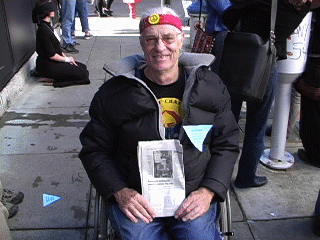
Montage - INS Detainee Protest, January 6, 2003 - San Francisco - (Hi-res 12 MB)
Montage - INS Detainee Protest, January 6, 2003 - San Francisco - (Med-res 9 MB)
Montage - INS Detainee Protest, January 6, 2003 - San Francisco - (Lo-res 5 MB)
Let your voice ring out in times of fear
By L.A. Chung for the SJ Mercury News
I'm reminded of Walt and Milly Woodward of Bainbridge Island in Washington
state. More than 60 years ago, the owners of the little Bainbridge Review
weekly newspaper opposed the internment of Japanese-Americans, who were a
vital part of the island community. It cost Walt good money in canceled ads
and goodwill. But he persisted. He hired four Japanese-Americans to send
reports on internment camp life, which he published in the Review. Births.
Deaths. Camp goings-on.Bainbridge Island Japanese-Americans would return to the island, he
reasoned, and this would be a way for their neighbors to continue to see
them as members of the community.To his fellow islanders, Walt Woodward wrote in the Review, ``These
Japanese-Americans of ours haven't bombed anybody.'' But Lt. Gen. John L.
DeWitt, in command of West Coast defenses, said, ``A Jap is a Jap.'' So
everyone was painted with the same broad brush...Now, as then, concerned -- and sensible, practical -- folk want the United
States to hold fast to one of the tenets of its greatness: due process.It took courage then. Much recognition for the Woodwards' stand came
posthumously. The Woodwards remind us that it's critical, even in this time
of fear, to insist that the United States hold true to its principles.
Do so in your churches, temples and mosques. In letters to the editor. In
calls and e-mails to your elected representatives. And in standing quietly
at a protest or getting arrested for the television cameras.``We are the ones who have to speak up,'' said Dawson. ``We have the luxury
of speaking up for our principles without fear of deportation or major
disruption of our families' lives.''
Here is the full text of the article in case the link goes bad:
http://www.bayarea.com/mld/bayarea/news/columnists/la_chung/4890268.htm
Posted on Tue, Jan. 07, 2003
Let your voice ring out in times of fear
By L.A. Chung
San Jose Mercury News Staff Columnist
Katy Dawson is upset that immigrants who did nothing wrong now fear
deportation.
Diane Sjogren is angry that foreign visitors were detained while complying
with a new registration requirement. And David Jenks believes the privacy
intrusions of some of the homeland security measures smack of Big Brother.
These are South Bay folks who haven't made a career out of protest marches
or getting arrested for the television cameras. None of them is from the
targeted countries. And all of them consider themselves to be sensible,
practical people. But they are concerned.
Another deadline looms Friday for the registration of men and boys in this
country on temporary visas, whether they are tourists, students or H-1B
workers. This time, in addition to Iran, Iraq, Syria, Libya and Sudan, the
registration includes those from 13 countries in North Africa, the Mideast,
Central Asia and East Asia.
Speaking out on principle
How can one register one's growing misgivings?
For now, the only protests planned are in front of the Immigration and
Naturalization Service (INS) building in San Francisco, not the one in San
Jose. Groups like the San Jose Peace Center and the Council on American
Islamic Relations are advertising or endorsing a rally on Friday in San
Francisco's Financial district that caps a week of activities. But a sizable
population of people who come from the countries next up on the special
registration deadline live in the South Bay.
Why San Francisco only? It's probably a combination of factors, the most
important being that our neighbors to the north have an established
infrastructure of advocacy groups that can quickly organize public events.
And in these days of identity politics and special interests, it's also easy
to wait for these groups to step forward.
But these are challenging times, and it's never wrong to speak out.
I'm reminded of Walt and Milly Woodward of Bainbridge Island in Washington
state. More than 60 years ago, the owners of the little Bainbridge Review
weekly newspaper opposed the internment of Japanese-Americans, who were a
vital part of the island community. It cost Walt good money in canceled ads
and goodwill. But he persisted. He hired four Japanese-Americans to send
reports on internment camp life, which he published in the Review. Births.
Deaths. Camp goings-on.
Bainbridge Island Japanese-Americans would return to the island, he
reasoned, and this would be a way for their neighbors to continue to see
them as members of the community.
To his fellow islanders, Walt Woodward wrote in the Review, ``These
Japanese-Americans of ours haven't bombed anybody.'' But Lt. Gen. John L.
DeWitt, in command of West Coast defenses, said, ``A Jap is a Jap.'' So
everyone was painted with the same broad brush.
Courage in uncertain times
The Woodwards weren't suggesting that someone who engaged in sabotage should
be left alone. Just the way this column has never suggested that those who
break INS rules should not face the consequences.
Now, as then, concerned -- and sensible, practical -- folk want the United
States to hold fast to one of the tenets of its greatness: due process.
It took courage then. Much recognition for the Woodwards' stand came
posthumously. The Woodwards remind us that it's critical, even in this time
of fear, to insist that the United States hold true to its principles.
Do so in your churches, temples and mosques. In letters to the editor. In
calls and e-mails to your elected representatives. And in standing quietly
at a protest or getting arrested for the television cameras.
``We are the ones who have to speak up,'' said Dawson. ``We have the luxury
of speaking up for our principles without fear of deportation or major
disruption of our families' lives.''
------------------------------------------------------------------------
Contact L.A. Chung at lchung@sjmercury.com or (408) 920-5280.
I had the oddest encounter with a police officer today at the INS Detainee Protest in San Francisco at 444 Washington Street. (Note: protests going on from 11am-1pm all week long.)
Unfortunately, my camera wasn't recording when he came over to start asking me questions (I really need to just start the thing rolling and leave it going) and I was paying to much attention trying to understand exactly what he was saying to me -- and trying to figure out what exactly his concerns were -- that it didn't even occur to me to press the record button or anything. (Turned out my camera had already timed out.)
After all this happened, I was pretty much intimidated and didn't feel much like filming too much more today.
I didn't want to forget the details of what had taken place, so I had someone film me right afterwards while I had a fresh recollection...

Lisa Rein at the INS Detainee Protest, January 8, 2003 - San Francisco - (Hi-res 20 MB)
Lisa Rein at the INS Detainee Protest, January 8, 2003 - San Francisco - (Med-res 15 MB)
Lisa Rein at the INS Detainee Protest, January 8, 2003 - San Francisco - (Lo-res 9 MB)
Audio - Lisa Rein at the INS Detainee Protest, January 8, 2003 - San Francisco - (MP3 - 3 MB)
I've made the Eldred Oral Argument Transcript available in my usual web-friendly formats.
I've just launched my INS Detainee Protest website. It's not too late to organize something for Friday in your town. Email me at lisarein@finetuning.com with any details and I'll post them to my site.
It's been a really interesting experience working with the ad-hoc group of concerned citizens over the last two weeks planning this protest. This is really the first protest that I've ever been involved in organizing. I'll be writing more about all that soon.
For today, I'll be fleshing out the FAQ and How You Can Help sections more over the course of day. (Sorry that those are still a bit rough -- they're like the most important pages, I know! There's a ton of questions to answer and the letters need polishing and I just had to get some zzzz last night :)
If you have a specific question - please email it to me so I can answer it in the FAQ.
I just wanted to get this up in time to get the word out -- If you're here in San Francisco - we're protesting out in front of the INS Building at 444 Washington everyday between 11am-1pm. Then the big protest is Friday from 11-1pm. There will also be a rally and a number of speakers on Friday.
Thanks for spreading the word and coming back to the site to check out the footage of the protest.
I've got footage from Monday and Tuesday going up this morning.
I've also posted a page of a lot more Footage from the December 23, 2002 INS Detainee protest in San Francisco. (And added the footage to my video index.)
Class action lawsuit filed against the US government
The American-Arab Anti-Discrimination Committee (ADC), the Alliance of Iranian Americans (AIA), the Council on American Islamic Relations (CAIR), and the National Council of Pakistani Americans (NCPA) filed a class action lawsuit in the United States District Court for the Central District of California against John Ashcroft; Attorney General of the United States, and the Immigration and Naturalization Service (INS).The essence of the lawsuit is that on Dec. 16-18, the INS unlawfully arrested large numbers of people, especially in Los Angeles, as they came forward to voluntarily comply with new "special registration" requirements. The groups are seeking an injunction before the next registration deadline to avoid a repetition of last week's mass arrests. Six individuals detained as a result of the new INS policy of special registrations are co-plaintiffs, and represent a broader group of victims in this class action suit.
Here is the full text of the link in case the link goes bad:
http://www.adc.org/index.php?id=1540
HOME
ABOUT ADC
CONTACT US
MEDIA DESK
Legal Services
EDUCATION
EVENTS
FEEDBACK
GOVT AFFAIRS
SEARCH
Become a Mentor!
Share your exper-iences Go >
Legal Intern
Learn about how to apply for internship at ADC's Legal Department
Learn more >>
Class action lawsuit filed against the US government
December 24, 2002
WASHINGTON, DC - The American-Arab Anti-Discrimination Committee (ADC), the Alliance of Iranian Americans (AIA), the Council on American Islamic Relations (CAIR), and the National Council of Pakistani Americans (NCPA) filed a class action lawsuit in the United States District Court for the Central District of California against John Ashcroft; Attorney General of the United States, and the Immigration and Naturalization Service (INS).
The essence of the lawsuit is that on Dec. 16-18, the INS unlawfully arrested large numbers of people, especially in Los Angeles, as they came forward to voluntarily comply with new "special registration" requirements. The groups are seeking an injunction before the next registration deadline to avoid a repetition of last week's mass arrests. Six individuals detained as a result of the new INS policy of special registrations are co-plaintiffs, and represent a broader group of victims in this class action suit.
The lawsuit takes issue with four aspects of the recent detentions:
1- The detentions were illegal because the government did not obtain the necessary arrest warrants;
2- It is unlawful and unjust to deport people who have been slated for adjustment of status and who have complied with the law at every stage;
3- Detainees are being held without bail or bond, and are subject to deportation without due process;
4- The fear of mass arrests created by these detentions will inhibit compliance by people facing similar registration deadlines in the near future.
The groups are seeking:
1- An injunction ordering the government not arrest any additional persons in the "special registration" process without appropriate warrants from federal judges;
2- An order preventing the deportation of detainees without due process.
Although the special registration policy has been presented as a national security measure designed to counter potential terrorist threats, the INS has been using the registration process to not only enforce immigration law but to arrest and deport people who have complied with the law at every stage and are on the road to becoming permanent residents. The effort to deport law-abiding people who could just as easily be allowed to continue the immigration process seriously undermines prospects for future compliance and constitutes as absurd waste of resources. The mass arrests have further eroded confidence in the fairness of the INS and immigration system among Arab and Muslim communities.
Dec. 16 was the first in a series of deadlines for special registration, which are set to culminate in 2004 with the registration of all foreign nationals in the United States. The mass arrests wich took place in Los Angeles last week, and the lawsuit filed today, have profound significance for the future of the registration process in many immigrant communities, and immigrants' rights in general.
The lawsuit was filed by attorneys Peter A. Schey and Carlos R. Holguin of the Center for Human Rights and Constitutional Law. Other co- counsel include several attorneys in the ADC Legal Department, Babak Sotoodeh of AIA, Khurrum Wahid of CAIR, Joannie Chang of the Asian Law Caucus, and several California law firms.
Right on schedule!
I got this press release today:
Digital Media Consumers' Rights Act Re-Introduced
The bill addresses two key provisions of the 1998 law which prohibit the circumvention of a technical protection measure guarding access to a copyrighted work even if the purpose of the circumvention is to exercise consumer Fair Use rights. The bill re-introduced this week would limit the scope of the prohibition to circumvention for the purpose of copyright infringement. Circumvention for the purpose of exercising Fair Use rights would be permitted under the legislation...The bill also amends the provisions of the 1998 law which prohibit the manufacture, distribution or sale of technology which enables circumvention of the protection measures. Under the current law, trafficking in those technologies is a crime if the technology was primarily designed to be used for copyright infringement. Claiming that this legal standard is too subjective to give manufacturers confidence to introduce new products, the legislation would instead focus on whether or not the technology had substantial non-infringing uses. If the technology is capable of substantial non-infringing use, the manufacture, distribution, and sale of the product would be lawful under the bill they have sponsored...
Supporters of the Digital Media Consumers Rights Act include Intel, Verizon, Philips Electronics North America Corporation, Sun Microsystems, Gateway, the Consumer Electronics Association, Computer and Communications Industry Association, the Association for Computing Machinery, the Computer Research Association and a variety of trade associations representing technology companies, the American Library Association, the American Association of Universities, the National Humanities Alliance, the Digital Future Coalition, the Consumers Union, the Home Recording Rights Coalition, the Electronic Frontier Foundation, Public Knowledge, the National Writers Union and other organizations representing the public interest and the consumers of digital media.
For Immediate Release: Contact: Alyssa Mastromonaco
January 7, 2003 202-225-3861
Lawmakers Urge Protection of Fair Use
Digital Media Consumers' Rights Act Re-Introduced
Initiating what is certain to be a contentious debate during the 108th Congress, U.S. Representatives Rick Boucher (D-VA), John Doolittle (R-CA), Spencer Bachus (R-AL) and Patrick Kennedy (D-RI) introduced on Tuesday the Digital Media Consumers' Rights Act with the announced goal of protecting the Fair Use rights of the users of copyrighted material and, thereby enabling the consumers of digital media to make use of it in ways that enhance their personal convenience. The legislation (H.R. 107) is identical to that which Boucher and Doolittle introduced during the Fall of 2002.
Maintaining that Fair Use rights are severely threatened with respect to the consumers of digital media, the legislators propose amending a 1998 law, the Digital Millennium Copyright Act, which was enacted at the behest of motion picture studios, the recording industry, and book publishers.
"The fair use doctrine is threatened today as never before. Historically, the nation’s copyright laws have reflected a carefully calibrated balanced between the rights of copyright owners and the rights of the users of copyrighted material. The Digital Millennium Copyright Act dramatically tilted the copyright balance toward complete copyright protection at the expense of the Fair Use rights of the users of copyrighted material," Boucher said. "The re-introduced legislation will assure that consumers who purchase digital media can enjoy a broad range of uses of the media for their own convenience in a way which does not infringe the copyright in the work," Boucher explained.
The bill addresses two key provisions of the 1998 law which prohibit the circumvention of a technical protection measure guarding access to a copyrighted work even if the purpose of the circumvention is to exercise consumer Fair Use rights. The bill re-introduced this week would limit the scope of the prohibition to circumvention for the purpose of copyright infringement. Circumvention for the purpose of exercising Fair Use rights would be permitted under the legislation.
"We believe it is entirely proper to outlaw circumvention for the purpose of copyright infringement; however, a person who is circumventing a technical measure solely for the purpose of using that material under classic Fair Use principles should be free to do so," Doolittle said.
The bill also amends the provisions of the 1998 law which prohibit the manufacture, distribution or sale of technology which enables circumvention of the protection measures. Under the current law, trafficking in those technologies is a crime if the technology was primarily designed to be used for copyright infringement. Claiming that this legal standard is too subjective to give manufacturers confidence to introduce new products, the legislation would instead focus on whether or not the technology had substantial non-infringing uses. If the technology is capable of substantial non-infringing use, the manufacture, distribution, and sale of the product would be lawful under the bill they have sponsored.
"Without a change in the law, individuals will be less willing to purchase digital media if their use of the media within the home is severely circumscribed and the manufacturers of equipment and software that enables circumvention for legitimate purposes will be reluctant to introduce the products into the market," Boucher added.
The lawmakers also would direct the Federal Trade Commission to promulgate a regulation requiring that "copy-protected CDs" be properly labeled.
"The few copy-protected CDs which have been introduced into the U.S. market to date are inadequately labeled and create broad consumer confusion," Boucher said.
"We are not proposing to outlaw the introduction of copy-protected CDs. We, however, want to ensure that if copy-protected CDs are introduced in larger volumes, consumers will know what they are buying," Doolittle added.
Supporters of the Digital Media Consumers Rights Act include Intel, Verizon, Philips Electronics North America Corporation, Sun Microsystems, Gateway, the Consumer Electronics Association, Computer and Communications Industry Association, the Association for Computing Machinery, the Computer Research Association and a variety of trade associations representing technology companies, the American Library Association, the American Association of Universities, the National Humanities Alliance, the Digital Future Coalition, the Consumers Union, the Home Recording Rights Coalition, the Electronic Frontier Foundation, Public Knowledge, the National Writers Union and other organizations representing the public interest and the consumers of digital media.
-30-
Alyssa Mastromonaco
Press Secretary
Congressman Rick Boucher
2187 Rayburn House Office Building
(202) 225-3861
Yeah! That's justice being served twice in a row!
(The ElcomSoft verdict being the first time!)
Norwegian Teen Acquitted of DVD Piracy
``I'm very satisfied,'' he said after Sogn read the ruling. ``We won support on all points. I had figured that we could win, but it can go either way.''The prosecution, which had called for a 90-day suspended jail sentence, confiscation of computer equipment and court costs, said it would decide in the next two weeks whether to appeal.
Johansen said he expects another round because this is the first such case in Norway.
``But clearly, winning the first round means a lot,'' Johansen said.
The ruling found that consumers have rights to legally obtained DVD films ``even if the films are played in a different way than the makers had foreseen.''
Johansen said that was key.
``As long as you have purchased a DVD legally, then you are allowed to decode it with any equipment and can't be forced to buy any specific equipment,'' he said.
Here is the full text of the article in case the link goes bad:
http://www.nytimes.com/aponline/international/AP-Norway-DVD-Kid.html
The New York Times A.P. Index
Norwegian Teen Acquitted of DVD Piracy
By THE ASSOCIATED PRESS
Filed at 1:37 p.m. ET
OSLO, Norway (AP) -- Dealing Hollywood a major setback, a Norwegian court acquitted a teenager Tuesday of violating computer break-in laws by creating a program to circumvent security codes on DVD movies.
The ruling was a key test of how far copyright holders can prevent people from using materials they legally obtained in the name of preventing others from engaging in piracy.
Jon Lech Johansen, who was 15 when he developed and posted the program on the Internet in late 1999, said he was only trying to play DVDs he already owned on his Linux-based computer, which did not already have DVD-viewing software.
Head judge Irene Sogn, in reading the verdict, said people cannot be convicted of breaking into their own property. Sogn said prosecutors failed to prove that Johansen or others had used the program to access illegal pirate copies of films.
``The court finds that someone who buys a DVD film that has been legally produced has legal access the film. Something else would apply if the film had been an illegal ... pirate copy,'' the ruling said.
The unanimous, 25-page ruling from the three-member Oslo City Court was the latest setback in the entertainment industry's drive to curtail illegal copying of its movies.
The Motion Picture Association of America had no comment, spokeswoman Phuong Yokitis said from Washington.
Johansen became a folk hero to hackers, especially in the United States, where a battle still rages over a 1998 copyright law that bans such software. He was elated by the verdict.
``I'm very satisfied,'' he said after Sogn read the ruling. ``We won support on all points. I had figured that we could win, but it can go either way.''
The prosecution, which had called for a 90-day suspended jail sentence, confiscation of computer equipment and court costs, said it would decide in the next two weeks whether to appeal.
Johansen said he expects another round because this is the first such case in Norway.
``But clearly, winning the first round means a lot,'' Johansen said.
The ruling found that consumers have rights to legally obtained DVD films ``even if the films are played in a different way than the makers had foreseen.''
Johansen said that was key.
``As long as you have purchased a DVD legally, then you are allowed to decode it with any equipment and can't be forced to buy any specific equipment,'' he said.
The film industry developed the Content Scrambling System to encrypt and prevent illegal copying of DVD films. However, the system, usually called CSS, also prevents DVD films from being played on unauthorized equipment.
Johansen's program, which pieces together security codes and other programs sent to him by fellow hackers, breaks the CSS barrier, allowing films to be played and copied on computers.
The short program Johansen wrote is just one of many readily available programs that can break DVD security codes. One is included in a software package, sold by at least one U.S. company, that even burns DVDs after cracking the copy protection.
Charges against Johansen were filed after Norwegian prosecutors received a complaint from the MPAA and the DVD Copy Control Association, the group that licenses CSS.
Prosecutors asserted that the program, in effect, left film studios' property unlocked and open for theft. The prosecution decided to charge Johansen with a data break-in, rather than handle the matter as a copyright case.
Prosecutors also accused Johansen of being an accessory to others making illegal copies of films by posting his program on the Internet.
Johansen had claimed he posted the program for others to test.
Here's a great Daily Show interview from last month with Katrina vanden Heuvel, Editor-in-chief of "The Nation".
I had saved this on my TIVO and sort of forgotten about it until I ran across Katrina's name again reading Michael Moore's latest book. (She's on his dream list of women presidents.)
In the interview, Katrina talks about democracy and freedom of speech and political debate and how there really isn't any anymore.
Jon Stewart is obviously concerned about the state of our country these days. It's so great for him to have important guests like this on television. I only hope that more people will watch.
I think you will find it interesting.
QuickTime video and MP3 audio files below:
Katrina vanden Heuvel on the Daily Show
Interview with Katrina vanden Heuvel - Low-res 28 MB
Interview with Katrina vanden Heuvel - Med-res 42 MB
Interview with Katrina vanden Heuvel - Hi-res 55 MB
Audio - Interview with Katrina vanden Heuvel - MP3 6MB
Did you send me email Sunday night? I probably never got it then. My email sys admin told me yesterday about a small mishap.
Note: In general, if I don't write you back within 48 hours, something's gone amiss (either with my mail or with my brain :-) -- so if it's important, I hope everyone knows to just send me another note reminding me about whatever it is...
I've been working on the web site for this week's INS Immigration Roundup Protests going on in various locations around the country all week. I've got more footage from the Dec 23 protest, footage from yesterday's protest, and footage from the SF protest everyday this week (This Friday, January 10, is the big day guys!)
Anyway, sorry for leaving my post here for a couple days. It's been *really* hard to wrap my head around this crazy stuff going on over at the agency-formerly-known-as-the-INS (now part of Homeland Security). It's hard to believe that poor planning and a series of administrative gaffs are the only excuses our government has for the incarceration and subsequent brutal treatment of thousands of people. But that's what's happening alright.
I've been assembling all of the information together and collecting it into a website that will hopefully help you to understand everything quickly -- so you can all do what you can to help. It's really important.
Okay -- Back in a flash! I've got an excellent Daily Show Interview with Katrina vanden Heuvel, Editor of "The Nation", I'll be uploading in a second to tide you over until I can get the other stuff up later this morning.
Thanks!
Have we finally found a Judge that doesn't feel for one reason or another that the Bush Administration is above the law?
Court Denies Office of Homeland Security Motion
U.S. District Judge Colleen Kollar-Kotelly last week ruled that the White House office must show it had no independent authority in a ruling denying a motion to dismiss a privacy group's lawsuit seeking material under the Freedom of Information Act. The ruling was made public on Thursday.The Washington-based Electronic Privacy Information Center last March requested Office of Homeland Security records on proposals for standardized U.S. driver's licenses, records associated with a "trusted-flier" program and other proposals concerning biometric technology for identifying individuals.
The Office of Homeland Security sought to have the case against the office and its director Tom Ridge dismissed, arguing that it could not be subjected to the Freedom of Information Act information requests because it was not an agency and that its sole function was to advise and assist the president.
President Bush established a U.S. Department of Homeland Security in November and nominated Ridge to head the new Cabinet-level agency.
Judge Kollar-Kotelly's ruling granted the Electronic Privacy Information Center's request to obtain information that would establish the status of the White House Office of Homeland Security.
Here is the full text of the article in case the link goes bad:
http://www.reuters.com/newsArticle.jhtml?type=politicsNews&storyID=1987282
Court Denies Office of Homeland Security Motion
Fri January 3, 2003 07:45 AM ET
WASHINGTON (Reuters) - The U.S. Office of Homeland Security lost a round in efforts to keep its activities private with a federal court ruling that it must answer questions about its operations and activities.
U.S. District Judge Colleen Kollar-Kotelly last week ruled that the White House office must show it had no independent authority in a ruling denying a motion to dismiss a privacy group's lawsuit seeking material under the Freedom of Information Act. The ruling was made public on Thursday.
The Washington-based Electronic Privacy Information Center last March requested Office of Homeland Security records on proposals for standardized U.S. driver's licenses, records associated with a "trusted-flier" program and other proposals concerning biometric technology for identifying individuals.
The Office of Homeland Security sought to have the case against the office and its director Tom Ridge dismissed, arguing that it could not be subjected to the Freedom of Information Act information requests because it was not an agency and that its sole function was to advise and assist the president.
President Bush established a U.S. Department of Homeland Security in November and nominated Ridge to head the new Cabinet-level agency.
Judge Kollar-Kotelly's ruling granted the Electronic Privacy Information Center's request to obtain information that would establish the status of the White House Office of Homeland Security.
A White House spokesman did not immediately return a call seeking comment.
Marc Rotenberg, executive director of the Electronic Privacy Information Center, called the ruling a critical step in a case about "openness" in government.
"There's been a lot of secrecy in the activities of this office ... We think that the activity of this office, like the activity of other federal offices should be open," Rotenberg told Reuters.
"So many of the original plans, program goals and objectives were set out in the office," he said. "If you want to get a sense of what this new agency will do, we think it's important to see what its precursor did."
Games Nations Play
By Paul Kruger for the New York Times.
So you might be tempted to conclude that the Bush administration is big on denouncing evildoers, but that it can be deterred from actually attacking countries it denounces if it expects them to put up a serious fight. What was it Teddy Roosevelt said? Talk trash but carry a small stick?Your own experience seems to confirm that conclusion. Last summer you were caught enriching uranium, which violates the spirit of your 1994 agreement with the Clinton administration. But the Bush administration, though ready to invade Iraq at the slightest hint of a nuclear weapons program, tried to play down the story, and its response — cutting off shipments of fuel oil — was no more than a rap on the knuckles. In fact, even now the Bush administration hasn't done what its predecessor did in 1994: send troops to the region and prepare for a military confrontation.
Here is the full text of the entire article in case the link goes bad:
http://www.nytimes.com/2003/01/03/opinion/03KRUG.html
The New York Times The New York Times Opinion January 3, 2003
By PAUL KRUGMAN
What game does the Bush administration think it's playing in Korea?
That's not a rhetorical question. During the cold war, the U.S. government employed experts in game theory to analyze strategies of nuclear deterrence. Men with Ph.D.'s in economics, like Daniel Ellsberg, wrote background papers with titles like "The Theory and Practice of Blackmail." The intellectual quality of these analyses was impressive, but their main conclusion was simple: Deterrence requires a credible commitment to punish bad behavior and reward good behavior.
I know, it sounds obvious. Yet the Bush administration's Korea policy has systematically violated that simple principle.
Let's be clear: North Korea's rulers are as nasty as they come. But unless we have a plan to overthrow those rulers, we should ask ourselves what incentives we're giving them.
So put yourself in Kim Jong Il's shoes. The Bush administration has denounced you. It broke off negotiations as soon as it came into office. Last year, though you were no nastier than you had been the year before, George W. Bush declared you part of the "axis of evil." A few months later Mr. Bush called you a "pygmy," saying: "I loathe Kim Jong Il — I've got a visceral reaction to this guy. . . . They tell me, well we may not need to move too fast, because the financial burdens on people will be so immense if this guy were to topple — I just don't buy that."
Moreover, there's every reason to take Mr. Bush's viscera seriously. Under his doctrine of pre-emption, the U.S. can attack countries it thinks might support terrorism, whether or not they have actually done so. And who decides whether we attack? Here's what Mr. Bush says: "You said we're headed to war in Iraq. I don't know why you say that. I'm the person who gets to decide, not you." L'état, c'est moi.
So Mr. Bush thinks you're a bad guy — and that makes you a potential target, no matter what you do.
On the other hand, Mr. Bush hasn't gone after you yet, though you are much closer to developing weapons of mass destruction than Iraq. (You probably already have a couple.) And you ask yourself, why is Saddam Hussein first in line? He's no more a supporter of terrorism than you are: the Bush administration hasn't produced any evidence of a Saddam-Al Qaeda connection. Maybe the administration covets Iraq's oil reserves; but it's also notable that of the three members of the axis of evil, Iraq has by far the weakest military.
So you might be tempted to conclude that the Bush administration is big on denouncing evildoers, but that it can be deterred from actually attacking countries it denounces if it expects them to put up a serious fight. What was it Teddy Roosevelt said? Talk trash but carry a small stick?
Your own experience seems to confirm that conclusion. Last summer you were caught enriching uranium, which violates the spirit of your 1994 agreement with the Clinton administration. But the Bush administration, though ready to invade Iraq at the slightest hint of a nuclear weapons program, tried to play down the story, and its response — cutting off shipments of fuel oil — was no more than a rap on the knuckles. In fact, even now the Bush administration hasn't done what its predecessor did in 1994: send troops to the region and prepare for a military confrontation.
So here's how it probably looks from Pyongyang:
The Bush administration says you're evil. It won't offer you aid, even if you cancel your nuclear program, because that would be rewarding evil. It won't even promise not to attack you, because it believes it has a mission to destroy evil regimes, whether or not they actually pose any threat to the U.S. But for all its belligerence, the Bush administration seems willing to confront only regimes that are militarily weak.
The incentives for North Korea are clear. There's no point in playing nice — it will bring neither aid nor security. It needn't worry about American efforts to isolate it economically — North Korea hardly has any trade except with China, and China isn't cooperating. The best self-preservation strategy for Mr. Kim is to be dangerous. So while America is busy with Iraq, the North Koreans should cook up some plutonium and build themselves some bombs.
Again: What game does the Bush administration think it's playing?
Columnist Biography: Paul Krugman
Forum: Discuss This Column
E-mail: krugman@nytimes.com
Detentions today remind of yesterday's
By L.A. Chung for the San Jose Mercury News
Critics have scoffed at protesters' comparisons of the detentions with the well-known internment camps that detained 120,000 Japanese and Japanese-Americans from 1942 to 1946.Successive restrictions
But ask someone who is intimately familiar with the events affecting the Japanese-American community after the bombing of Pearl Harbor. The initial calls not to blame a community. The gradual restrictions. Curfews. Registration. Finally, internment...
Lest we forget. It is time to turn up the volume. Next Friday, at the INS building in San Francisco.
More on the protest going on all next week in front of INS Buildings all around the country!
Posted on Fri, Jan. 03, 2003 story:PUB_DESC
Detentions today remind of yesterday's
By L.A. Chung
Mercury News Staff Columnist
It could be a page out of Kafka. Or Orwell.
. . . Or U.S. history.
While many of us were engrossed in pre-Christmas festivities with our families, others here and around the country were trying to figure out just where their husbands, brothers or sons had disappeared to and whether they would ever see them again.
John Tateishi read the accounts about Silicon Valley tech workers and Southern California men who vanished in the INS' clutches after showing up at the agency to register -- as required by our hastily passed USA Patriot Act. It smacked of America, circa 1942, the reactive, ugly side.
``I was appalled,'' said the executive director of the Japanese American Citizens League. ``I felt really bad for the families. Until you go through it, it's hard to understand.''
Critics have scoffed at protesters' comparisons of the detentions with the well-known internment camps that detained 120,000 Japanese and Japanese-Americans from 1942 to 1946.
Successive restrictions
But ask someone who is intimately familiar with the events affecting the Japanese-American community after the bombing of Pearl Harbor. The initial calls not to blame a community. The gradual restrictions. Curfews. Registration. Finally, internment.
Tateishi was 3 when his family in Los Angeles was shipped off to Manzanar, a barren California camp. As national director of the JACL's campaign for redress and reparations, he heard story after story of children who saw their fathers taken away, wives left with children to feed and no means of support. He wrote their oral histories in a 1984 book, ``And Justice For All,'' now published by the University of Washington Press.
The modern version of our government behaving badly erupted in full view when distraught families took to the streets in Los Angeles in December, where a large number of Iranians had been detained after reporting. Men and boys over 16 who were born in Iran, Iraq, Syria, Libya and Sudan were required to register with the INS and submit to fingerprinting and questioning by Dec. 16.
But hundreds were detained and flown from state to state in search of large enough detention facilities, some because of minor infractions like being two days late to register. Others were detained because their immigration files were ``out of status'' -- in some cases because of the INS' own backlog.
They were Muslims. And Christians. And Jews. Some had come here to escape persecution. They were not, as far as any officials have hinted, related to terrorists.
To be sure, such detentions can't match the scale of the mass internment of Japanese-Americans, and the lesser-known internment of some 10,000 Germans and 3,000 Italians for several years during World War II. Many of those detained this time were returned to their families around Christmas, but will have to report back for deportation hearings.
Harbinger or history?
But the detentions do recall the incarceration of some 31,000 ``enemy aliens'' -- mostly Japanese, but also Germans, Italians and other Europeans -- that preceded internment.
Some came into government offices when asked. Others were picked up by the FBI. Sound familiar?
``The Issei put on their Sunday suits with a tie, and reported to government buildings -- and then were never heard from for months and months,'' said Tateishi, referring to the first-generation Japanese, who were barred by law from citizenship.
So, who would blame the next group of men and boys from 13 other countries who must register next Friday for fearing what will happen? How can we insist on fair play?
``When you look at the World War II internment of Japanese-Americans, it didn't make Americans safer," said Tateishi. ``It didn't make one iota of difference. Yet it cost the country millions and millions of dollars, and they were misplaced resources.''
Lest we forget. It is time to turn up the volume. Next Friday, at the INS building in San Francisco.
Contact L.A. Chung at lchung@ sjmercury.com or (408) 920-5280.

Usually I'm using Daily Show Clips to help teach history lessons. This time it's a fun lesson in current events.

This one's only funny cuz it's true -- making it a little less funny perhaps after you think about it for a second...

I've made the video available in high, medium and low resolutions, along with an MP3 of the audio (5 MB).

So You're Living In A Police State - 46 MB
So You're Living In A Police State - 35 MB
So You're Living In A Police State - 22 MB
MP3 - So You're Living In A Police State - 5 MB
If there's nothing to hide, why not cough up the documents? Like every other administration.
It's called being accountable.
Government Openness at Issue as Bush Holds Onto Records
By Adam Clymer for the New York Times.
I'm beginning to wonder if the Shrub is covering up a lot more than Cheney's involvement in the Enron mess.
I wish that Enron videotape would resurface...whatever happened to that thing anyway?
The administration's most publicized fight over secrecy, and its biggest victory to date, has come over its efforts to keep the investigative arm of Congress from gaining access to records of the energy task force led by Vice President Cheney.This fight is only the showiest of many battles between the Bush administration and members of Congress over information. Such skirmishes happen in every administration. But not only are they especially frequent now, but also many of the loudest Congressional complaints come from the president's own party, from Republicans like Senator Grassley and Representative Dan Burton of Indiana.
The vice president framed the fight as being less about what the papers sought by the General Accounting Office might show than over power — what Congress could demand and how it could get it or what essential prerogatives the executive branch could maintain, especially its ability to get confidential advice. And he welcomed the battle. In an interview the day before the suit was filed, he said. "It ought to be resolved in a court, unless you're willing to compromise on a basic fundamental principle, which we're not." And on Dec. 9, Judge John D. Bates of Federal District Court ruled for the vice president.
Judge Bates ruled that David M. Walker, who as comptroller general heads the General Accounting Office, had not suffered any personal injury, nor had he been injured as an agent of Congress, and therefore the suit could not be considered. An appeal is all but certain to be filed, but for the time being, the administration clearly has a victory.
"Vice President Cheney's cover-up will apparently continue for the foreseeable future," said Representative John D. Dingell, the Michigan Democrat who pressed Mr. Walker to act, hoping to find evidence of special interest favoritism for Republican donors in the Cheney documents.
Here is the full text of the article in case the link goes bad:
http://www.nytimes.com/2003/01/03/politics/03SECR.html?ex=1042174800&en=a0e06b3e3c5acc46&ei=5062&partner=GOOGLE
The New York Times The New York Times Washington January 3, 2003
Government Openness at Issue as Bush Holds Onto Records
By ADAM CLYMER
WASHINGTON, Jan. 2 — The Bush administration has put a much tighter lid than recent presidents on government proceedings and the public release of information, exhibiting a penchant for secrecy that has been striking to historians, legal experts and lawmakers of both parties.
Some of the Bush policies, like closing previously public court proceedings, were prompted by the Sept. 11 terrorist attacks and are part of the administration's drive for greater domestic security. Others, like Vice President Dick Cheney's battle to keep records of his energy task force secret, reflect an administration that arrived in Washington determined to strengthen the authority of the executive branch, senior administration officials say.
Advertisement
Some of the changes have sparked a passionate public debate and excited political controversy. But other measures taken by the Bush administration to enforce greater government secrecy have received relatively little attention, masking the proportions of what dozens of experts described in recent interviews as a sea change in government openness.
A telling example came in late 2001 when Attorney General John Ashcroft announced the new policy on the Freedom of Information Act, a move that attracted relatively little public attention.
Although the new policy for dealing with the 1966 statute that has opened millions of pages of government records to scholars, reporters and the public was announced after Sept. 11, it had been planned well before the attacks.
The Ashcroft directive encouraged federal agencies to reject requests for documents if there was any legal basis to do so, promising that the Justice Department would defend them in court. It was a stark reversal of the policy set eight years earlier, when the Clinton administration told agencies to make records available whenever they could, even if the law provided a reason not to, so long as there was no "foreseeable harm" from the release.
Generally speaking, said Alan Brinkley, a Columbia University historian, while secrecy has been increasingly attractive to recent administrations, "this administration has taken it to a new level."
Its "instinct is to release nothing," Professor Brinkley said, adding that this was not necessarily because there were particular embarrassing secrets to hide, but "they are just worried about what's in there that they don't know about."
The Bush administration contends that it is not trying to make government less open. Ari Fleischer, the president's press secretary, said, "The bottom line remains the president is dedicated to an open government, a responsive government, while he fully exercises the authority of the executive branch."
Secrecy is almost impossible to quantify, but there are some revealing measures. In the year that ended on Sept. 30, 2001, most of which came during the Bush presidency, 260,978 documents were classified, up 18 percent from the previous year. And since Sept. 11, three new agencies were given the power to stamp documents as "Secret" — the Environmental Protection Agency, the Department of Agriculture and the Department of Health and Human Services.
In Congress, where objections to secrecy usually come from the party opposed to the president, the complaints are bipartisan. Senator Patrick J. Leahy, the Vermont Democrat first elected in 1974, said, "Since I've been here, I have never known an administration that is more difficult to get information from." Senator Charles E. Grassley, Republican of Iowa, said things were getting worse, and "it seems like in the last month or two I've been running into more and more stonewalls."
Mr. Cheney says the Bush policies have sought to restore the proper powers of the executive branch. Explaining the fight to control the task force records to ABC News last January, he said that over more than three decades: "I have repeatedly seen an erosion of the powers and the ability of the president of the United States to do his job. We saw it in the War Powers Act, we saw it in the Anti-Impoundment Act. We've seen it in cases like this before, where it's demanded that the presidents cough up and compromise on important principles. One of the things that I feel an obligation on, and I know the president does, too, because we talked about it, is to pass on our offices in better shape than we found them to our successors."
Continued
1 | 2 | 3 | 4 | 5 | Next>>
****
Government Openness at Issue as Bush Holds Onto Records
(Page 2 of 5)
Mr. Bush has made similar comments. But the more relevant history may have been in Texas, where Mr. Bush, as governor, was also reluctant to make government records public. Confronted with a deadline to curb air pollution, he convened a private task force to propose solutions and resisted efforts to make its deliberations public. When he left office, he sent his papers not to the Texas State Library in Austin, but to his father's presidential library at College Station. That library was unable to cope with demands for access, and the papers have since been sent to the state library.
Advertisement
Framing an Argument
One argument underlies many of the administration's steps: that presidents need confidential and frank advice and that they cannot get it if the advice becomes public, cited by Mr. Cheney in reference to the task force and by Alberto R. Gonzales, the White House counsel, in explaining the administration's decision to delay the release of President Ronald Reagan's papers.
Mr. Gonzales said "the pursuit of history" should not "deprive a president of candid advice while making crucial decisions."
Some administration arguments are more closely focused on security. Mr. Ashcroft has said that releasing the names of people held for immigration offenses could give Al Qaeda "a road map" showing which agents had been arrested.
Secretary of Defense Donald H. Rumsfeld, who has threatened action against Pentagon officials who discuss military operations with reporters, said before troops at the Army's Special Operation Command on Nov. 21, 2001, "I don't think the American people do want to know anything that's going to cause the death of any one of these enormously talented and dedicated and courageous people that are here today."
The critics argue more generally. Former Senator Daniel Patrick Moynihan, Democrat of New York, argues that secrecy does more harm than good. The Central Intelligence Agency's exaggerated estimates of Soviet economic strength, for example, would have stopped influencing United States policy, Mr. Moynihan said, if they had been published and any correspondent in Moscow could have laughed at them.
"Secrecy is a formula for inefficient decision-making," Mr. Moynihan said, and plays to the instincts of self-importance of the bureaucracy.
Mary Graham, a scholar at the Brookings Institution and the John F. Kennedy School of Government at Harvard, saw two major risks in this administration's level of secrecy.
"What are often being couched as temporary emergency orders are in fact what we are going to live with for 20 years, just as we lived with the cold war restrictions for years after it was over," Ms. Graham said. "We make policy by crisis, and we particularly make secrecy policy by crisis."
Moreover, she said, it ignores the value of openness, which "creates public pressure for improvement." When risk analyses of chemical plants were available on the Internet, she said, people could pressure companies to do better, or move away.
Mr. Fleischer contends that there is no secrecy problem. "I make the case that we are more accessible and open than many previous administrations — given how many times [Secretary of State Colin L.] Powell, Rumsfeld and Ashcroft have briefed," he said.
Asked if there was anyone in the administration who was a consistent advocate of openness, who argued that secrecy hurt as well as helped, Mr. Fleischer said President Bush was that person. He said that was exemplified by the fact that while "the president reserved the authority to try people under military tribunals, nobody has been tried under military tribunals."
In the cases of Zacarias Moussaoui and John Walker Lindh, he said, Mr. Bush has opted for the more open and traditional route of the criminal justice system.
Shielding Presidents
The Bush administration's first major policy move to enforce greater secrecy could affect how its own history is written.
On March 23, 2001, Mr. Gonzales, the White House counsel, ordered the National Archives not to release to the public 68,000 pages of records from Ronald Reagan's presidency that scholars had requested and archivists had determined posed no threat to national security or personal privacy. Under the Presidential Records Act of 1978, the documents were to become available after Jan. 20, 2001, twelve years after Mr. Reagan left office. Mr. Reagan's administration was the first covered by the 1978 law.
Continued
<
*****
The New York Times The New York Times Washington January 3, 2003
Government Openness at Issue as Bush Holds Onto Records
(Page 3 of 5)
The directive, which also covered the papers of Mr. Reagan's vice president and the president's father, George Bush, was to last 90 days. When Mr. Gonzales extended the sealing period for an additional 90 days, historians like Hugh Davis Graham of Vanderbilt University attacked the delays, saying they were designed to prevent embarrassment and would nullify the records law's presumption of public access to those documents.
Advertisement
On Nov. 1, 2001, President Bush issued an even more sweeping order under which former presidents and vice presidents like his father, or representatives designated by them or by their surviving families, could bar release of documents by claiming one of a variety of privileges: "military, diplomatic, or national security secrets, presidential communications, legal advice, legal work or the deliberative processes of the president and the president's advisers," according to the order.
Before the order, the Archivist of the United States could reject a former president's claim of privilege. Now he cannot.
The order was promptly attacked in court and on Capitol Hill. Scott L. Nelson of the Public Citizen Litigation Group sued on behalf of historians and reporters, maintaining that the new order allowed unlimited delays in releasing documents and created new privileges to bar release.
House Republicans were among the order's sharpest critics. Representative Steve Horn of California called a hearing within a few days, and Representative Doug Ose, another Californian, said the order "undercuts the public's right to be fully informed about how its government operated in the past." The order, Mr. Horn said, improperly "gives the former and incumbent presidents veto power over the release of the records."
On Dec. 20, the White House sought to silence the complaints by announcing that nearly all the 68,000 pages of the Reagan records were being released. Legislation introduced to undo the order never made it to the House floor, where leaders had no interest in embarrassing the president. And a lawsuit challenging the order languishes in Federal District Court before Judge Colleen Kollar-Kotelly.
Historians remain angry. Robert Dallek, a biographer of Lyndon B. Johnson and John F. Kennedy, said, "This order of Bush, we feel it's a disgrace — what it means is if this policy applies, they can hold presidential documents close to the vest in perpetuity, the way Lincoln's papers were held by the family until 1947."
Battling the Congress
The administration's most publicized fight over secrecy, and its biggest victory to date, has come over its efforts to keep the investigative arm of Congress from gaining access to records of the energy task force led by Vice President Cheney.
This fight is only the showiest of many battles between the Bush administration and members of Congress over information. Such skirmishes happen in every administration. But not only are they especially frequent now, but also many of the loudest Congressional complaints come from the president's own party, from Republicans like Senator Grassley and Representative Dan Burton of Indiana.
The vice president framed the fight as being less about what the papers sought by the General Accounting Office might show than over power — what Congress could demand and how it could get it or what essential prerogatives the executive branch could maintain, especially its ability to get confidential advice. And he welcomed the battle. In an interview the day before the suit was filed, he said. "It ought to be resolved in a court, unless you're willing to compromise on a basic fundamental principle, which we're not." And on Dec. 9, Judge John D. Bates of Federal District Court ruled for the vice president.
Judge Bates ruled that David M. Walker, who as comptroller general heads the General Accounting Office, had not suffered any personal injury, nor had he been injured as an agent of Congress, and therefore the suit could not be considered. An appeal is all but certain to be filed, but for the time being, the administration clearly has a victory.
Continued
<
********
The New York Times The New York Times Washington January 3, 2003
Government Openness at Issue as Bush Holds Onto Records
(Page 4 of 5)
"Vice President Cheney's cover-up will apparently continue for the foreseeable future," said Representative John D. Dingell, the Michigan Democrat who pressed Mr. Walker to act, hoping to find evidence of special interest favoritism for Republican donors in the Cheney documents.
There have been other bitter fights over disclosure between the White House and the Congress. While the Democrats controlled the Senate Environment and Public Works Committee, the chairman, James M. Jeffords, independent of Vermont, repeatedly threatened last year to subpoena the Environmental Protection Agency for documents explaining the scientific basis and potential impact of its proposed air pollution rule changes requiring aging power plants to install new pollution controls when their facilities are modernized. Mr. Jeffords, who never got around to issuing the subpoena, argued that the administration had broken its promises of cooperation.
Representative F. James Sensenbrenner, the Wisconsin Republican who is chairman of the House Judiciary Committee, was infuriated last August when the Justice Department said it would send answers to some of his questions about how it was using the USA Patriot Act to the more pliant Intelligence Committee, which was not interested. Mr. Sensenbrenner threatened to issue a subpoena or "blow a fuse."
Mr. Grassley, the incoming chairman of the Finance Committee, said administration obstruction required him to go and personally question government officials working on Medicare fraud cases, instead of sending his staff. But his new chairmanship and the Treasury confirmations before it may give him a lever. He said he told a White House aide of his problems and asked, "How can I get a presidential nominee through if I have to be spending my time doing things my investigators could be doing?"
Closing the Courtroom
Legal policy is where the administration's desire to maintain secrecy has excited the most controversy. Since the first few days after the Sept. 11 attacks, the federal government has insisted on a rare degree of secrecy about the individuals it has arrested and detained.
The immigration hearings held for hundreds of people caught in sweeps after the bombings have been closed to relatives, the news media and the public.
The names of those detained by the Immigration and Naturalization Service have been kept secret, along with details of their arrests, although on Dec. 12 the Justice Department told The Associated Press there had been 765 of them, of whom only 6 were still in custody.
A few dozen individuals have been held as material witnesses, after the Justice Department persuaded federal judges that they had information about terrorism and might flee if released. Neither their names nor the total number of them have been made public.
The administration has also kept a tight lid on the identities of the military detainees being held at Guantánamo, Cuba. But in considering how to deal with them, in military tribunals, the government has moved away from secrecy. When Mr. Bush directed the Defense Department in November 2001 to set up military tribunals to try noncitizens suspected of terrorism, one reason cited was the ability to hold those proceedings in secret, to protect intelligence and to reduce risks to judges and jurors. But when the rules were announced in March, they said "the accused shall be afforded a trial open to the public (except proceedings closed by the presiding officer)."
While the government's policy in the immigration cases has suffered some judicial setbacks, appeals and stays have allowed it to remain in effect.
Fundamentally, the government has argued against opening hearings by contending that they would make available to terrorists a mosaic of facts that a sophisticated enemy could use to build a road map of the investigation, to know what the government knew or did not know, and thus to escape or execute new attacks.
That argument was also made in the main case involving releasing the names of those detained, where the government also maintains that the Freedom of Information Act's right to privacy would be violated by a release of the names.
***
The New York Times The New York Times Washington January 3, 2003
Government Openness at Issue as Bush Holds On to Records
(Page 5 of 5)
Legal scholars have objected particularly to the decision to close all the immigration hearings, rather than parts of them. Stephen A. Schulhofer, a professor at New York University Law School, said there was already a legal provision for closing a hearing when a judge was shown the necessity.
The "road map" explanation seemed implausible, Mr. Schulhofer said, because the detainees had a right to make phone calls, in which "a real terrorist could alert cohorts who would not have known he was detained."
Advertisement
At a recent seminar at Georgetown University Law School, Assistant Attorney General Michael Chertoff said protecting privacy was the main reason for suppressing the names. Representative Barney Frank, Democrat of Massachusetts, dismissed that rationale, asking Mr. Chertoff, "How can you even say that with a straight face?"
So far, the government has won challenges to the detention of material witnesses.
On releasing the names, it lost in a Federal District Court here, but appeared to have impressed two of the three appeals court judges who heard the case in November.
On the question of a blanket closing of "special interest" immigration hearings, an appeals court in Cincinnati ruled against the government in August and one in Philadelphia ruled in its favor in October. The Supreme Court is likely to be faced with choosing between them.
Putting Sand in the Gears
Immediately after the Sept. 11 terrorist attacks, governments at all levels feared that information they made publicly available could be useful to terrorists, and began moves to curtail access, a trend the Bush administration encouraged.
The first of the strictures on information resulting from Sept. 11 were described by Ms. Graham, the Brookings and Kennedy School scholar, in her book, "Democracy by Disclosure" (Brookings Institution Press, 2002).
"Officials quickly dismantled user-friendly disclosure systems on government Web sites," she wrote. "They censored information designed to tell community residents about risks from nearby chemical factories; maps that identified the location of pipelines carrying oil, gas and hazardous substances; and reports about risks associated with nuclear power plants."
Many of those withdrawals mirrored efforts industry had been making for quite a few years, arguing that the public did not really need the information. Some information has been removed from public gaze entirely. James Neal, the Columbia University librarian, said that officials of libraries like his around the country that serve as depositories for federal information "have some concern about the requests to withdraw materials from those collections." Perhaps even more important, Mr. Neal said, was that "we also do not know what materials are not getting distributed."
Some material that has been removed from Web sites is still available, though obviously to fewer people, in government reading rooms. The chemical factory risk management plans cited by Ms. Graham are no longer available through the Internet, said Stephanie Bell, a spokeswoman for the Environmental Protection Agency. But individuals can look at up to 10 of them and take notes (but not photocopies) in 55 government reading rooms around the country, Ms. Bell said. There is at least one reading room in every state except Maine, Nebraska, North Carolina, South Dakota, Vermont and Wyoming.
Last March the Defense Department issued a draft regulation concerning possible limits on publication of unclassified research it finances and sharp restrictions on access by foreign citizens to such data and research facilities.
This prompted some concerted resistance from scientists. Bruce Alberts, a biochemist who heads the National Research Council and the National Academy of Sciences, told the academy's annual meeting on April 29:
"I am worried about a movement to restrict publication that has been proceeding quietly but quickly in Washington. Some of the plans being proposed could severely hamper the U.S. research enterprise and decrease national security. It is being suggested that every manuscript resulting from work supported by federal funds be cleared by a federal project officer before being published, with serious penalties for violations. Another rule could prevent any foreign national from working on a broad range of projects."
Even though the department withdrew its proposal and officials say there has been no decision on whether to try again, the scientists say they are still worried.
The new Ashcroft directive on Freedom of Information requests has also begun to be felt. A veteran Justice Department official said he believed that fewer discretionary disclosures were being made throughout the government because "as a matter of policy, we are not advocating the making of discretionary disclosures."
Delays are one clear reality. The General Accounting Office reported last fall that "while the number of requests received appears to be leveling off, backlogs of pending requests governmentwide are growing, indicating that agencies are falling behind in processing requests."
To Thomas Blanton, who helps run the National Security Archive, which collects and posts documents gained through Freedom of Information Act, that is a clear effect of the Ashcroft order.
"What these signals from on high do in a bureaucracy, they don't really change the standards," Mr. Blanton said, "but they put molasses or sand in the gears."
<
Here's another excerpt from the letter I just quoted from John Perry Barlow.
This really hit home, because I feel like I'm one of those people who got woken up last year.
I think more people are waking up every day.
Maybe we can even wake up some of the possums.
Actually, I have finally figured out what's going on with a great many of us. Shocked into a kind of political catatonia by the multitudinous Uh-Oh's of the Uh-Oh's, we are pretending to be asleep. This is the only explanation I can think of for our political passivity.If we were actually asleep, we would have been shocked into alertness by the wanton ruin of our economy in only two years, the overnight establishment of an oligarchy that makes Mexico's look enlightened, the detailed repudiation of the Constitution enacted by the USA PATRIOT Act, and the breezy willingness of our government to commit us to simultaneous wars in separate hemispheres.
If we had really been sleeping, these and many other shocks to the conscience would have us bolt upright by now. The real patriots would be well out of bed, rushing to defend America against the Junta, rather than ratifying it with their absence from the polls.
But there is an old Navajo proverb you've heard me quote before: "It's impossible to awaken someone who is pretending to be asleep." Never has that phrase seemed more bitterly and poignantly true than now. It is also impossible to teach someone who's pretending to be asleep. And, finally it is impossible to administer a pop quiz to possum players.
John Perry Barlow has come up with a great idea for what to call this decade: THE Uh-Oh's.
As in: Total loss of privacy. Uh-Oh. The death of copyright. Uh-Oh. Children more powerful than their parents. Uh-Oh. Bill Gates ruling the world. Uh-Oh. Ten million Americans in prison. Uh-Oh. Black market plutonium. Uh-Oh. Absolutely everyone packing a cell phone. Uh-Oh. And constantly talking to everyone else. Uh-Oh...I mean, I ask you, how many times in the last two years have you found yourself thrust into a ripe opportunity, whether public or personal, to say "Uh-Oh?" Or, at the very least, something that translated into "Uh-Oh?"
Like, first plane. Uh-Oh.
Second plane. Uh-Oh.
America turning into a mad, homicidal bully with 7000 nuclear weapons and a stated willingness, as well as a proven ability, to use them. Uh-Oh.
As I said back then, you get my drift. I sure as hell don't need to spell it out now. Nor need I detail, Dear Friends, all the pending Uh-Oh's visibly in the pipeline. And I refer merely to the ones we can predict without going as orthogonal as things like to get these days. Uh-Oh, indeed.
So, the next time you're looking to refer to this decade by a name, please consider my proffered suggestion. I think it's a meme that bears spreading, and not merely because I dreamed it up. We have to call them *something.* Might as well be a name that requires no adjective - as in Psychedelic Sixties or Roaring Twenties - to evoke their essential flavor.
Here is the full text of the email:
THE Uh-Oh'S
Exactly two years ago today, I peered into the thickening fog that was the decade we now uncomfortably inhabit and proposed a name for it. It didn't take. This weird period remains unnamed. So I'm going to take another run at it.
I suggest once more that we call them The Uh-Oh's.
As I wrote in the embers of the 90's:
I predict changes that will to cause so much consternation among the traditionalists and ambiguiphobes that such creatures as the Unibomber, Pat Buchanan, or the Ayatollah Khomeini may become common as laptops.
The weird will turn pro, in the words of Dr. Hunter S. Thompson, and the pros will turn weird.
I could go on, and at length, but you get my drift. For these and many other reasons, I therefore propose that we call the coming decade The Uh-ohs.
As in: Total loss of privacy. Uh-Oh. The death of copyright. Uh-Oh. Children more powerful than their parents. Uh-Oh. Bill Gates ruling the world. Uh-Oh. Ten million Americans in prison. Uh-Oh. Black market plutonium. Uh-Oh. Absolutely everyone packing a cell phone. Uh-Oh. And constantly talking to everyone else. Uh-Oh.
Hey. as it turns out, I didn't *even* know from Uh-Oh back then. I was kind of like The Grateful Dead thinking it had already been a long, strange trip in 1969.
I mean, I ask you, how many times in the last two years have you found yourself thrust into a ripe opportunity, whether public or personal, to say "Uh-Oh?" Or, at the very least, something that translated into "Uh-Oh?"
Like, first plane. Uh-Oh.
Second plane. Uh-Oh.
America turning into a mad, homicidal bully with 7000 nuclear weapons and a stated willingness, as well as a proven ability, to use them. Uh-Oh.
As I said back then, you get my drift. I sure as hell don't need to spell it out now. Nor need I detail, Dear Friends, all the pending Uh-Oh's visibly in the pipeline. And I refer merely to the ones we can predict without going as orthogonal as things like to get these days. Uh-Oh, indeed.
So, the next time you're looking to refer to this decade by a name, please consider my proffered suggestion. I think it's a meme that bears spreading, and not merely because I dreamed it up. We have to call them *something.* Might as well be a name that requires no adjective - as in Psychedelic Sixties or Roaring Twenties - to evoke their essential flavor.
And they certainly do have a flavor. They are, it seems to me, one huge pop quiz from God in the matters of Love and Faith.
Whether as a species or as individuals, we are all getting our faith tested at the moment. I don't know anyone who hasn't been sorely challenged in the last two years, and I know a lot of people well enough so that when I ask them how they're doing, they actually tell me. Good relationships have exploded. Serious illness, particularly cancer, has become incredibly fashionable. Death has not been taking a holiday .And just about everybody - save for the plutocrats we allowed to steal our country - is broke.
We are also getting plenty of opportunities to assess our actual capacity to love. In this, I refer to what Gandhi was getting at when he said, "It is easy enough to be friendly to one's friends. But to befriend the one who regards himself as your enemy is the quintessence of true religion. The other is mere business. "
Both George W. Bush and Osama bin Laden have taught us a lot about that kind of love in the last two years. (I also remember that the Dalai Lama, asked who had been his greatest teachers, replied, "The Chinese, of course.) Nor do we have to turn to televised bogeymen for such teaching. Most of us have lately found excellent faculty far closer to home.
Of course, not everyone is willing to make himself available for class. The American people, taken as a group, appear to be truant. We seem unhesitating in our willingness to hate whatever villain du jour the Administration and CNN designate, whether it be Osama bin Laden, Saddam Hussein, or the rising new star, Kim Il Jung.
Our faith seems faithless. Rather than actually trusting in the God we so loudly profess to worship, we trust military force alone to keep us safe, even if it means staging unprovoked assaults on countries that have in no way proven themselves capable of harming us, nor even expressed any interest in doing so.
Actually, I have finally figured out what's going on with a great many of us. Shocked into a kind of political catatonia by the multitudinous Uh-Oh's of the Uh-Oh's, we are pretending to be asleep. This is the only explanation I can think of for our political passivity.
If we were actually asleep, we would have been shocked into alertness by the wanton ruin of our economy in only two years, the overnight establishment of an oligarchy that makes Mexico's look enlightened, the detailed repudiation of the Constitution enacted by the USA PATRIOT Act, and the breezy willingness of our government to commit us to simultaneous wars in separate hemispheres.
If we had really been sleeping, these and many other shocks to the conscience would have us bolt upright by now. The real patriots would be well out of bed, rushing to defend America against the Junta, rather than ratifying it with their absence from the polls.
But there is an old Navajo proverb you've heard me quote before: "It's impossible to awaken someone who is pretending to be asleep." Never has that phrase seemed more bitterly and poignantly true than now. It is also impossible to teach someone who's pretending to be asleep. And, finally it is impossible to administer a pop quiz to possum players.
True as this may be of the American Collective, it doesn't seem at all true of the many of you I've encountered recently. Despite the slings and arrows you've each absorbed, despite the outrageousness of your current fortunes, despite the undeniable truth that the Uh-Oh's suck huge, I see growing in you the same groundless hope I've been attempting to nurture in myself, with spotty success, since Cynthia died years ago.
Back then I wrote that "groundless hope, like unconditional love, may be the only kind there is." I understand those words far better today than I did then. Now I can find very few rational supports for my optimism. Every curve I plot, macro or micro, plunges toward an abyss of war, pestilence, famine, and terror. But now I know in my heart what could only have moved there in times like these, that hope with a logical basis isn't hope at all. It's just planning. I've pretty much given up on planning. "Man plans, God laughs," goes the Yiddish expression, and It must be laughing a lot these days.
No, the hope I feel now, the hope I feel in many of you, is a blind and crazy hope that deserves the holy name of Faith.
There is also Love.
As I've written this little sermonette, I've been passing over Donner Summit in the Sierras with daughter Leah at the wheel. Also on board are the other two Barlowettes, Amelia and Anna, as well as a young man, Eli King, who's been a surrogate son since he was literally half his current height. We've been driving all day from Salt Lake City on our way to join up in San Francisco with our larger "family" in the String Cheese Incident for New Year's. The weather over the pass has been vile as is customary this time of year. We're all exhausted and wedged in this heavily laden little car like early astronauts.
But there is a lot of love in the manifest as well. Each of us has just endured one of the hardest years of our lives, but we have been mostly gentle with each other on this drive. We've laughed a lot, even if some of the humor was a little dark. We just found out that that the hotel reservations we thought we had in San Francisco never got made owing to a miscommunication on my part, so our immediate future is a little sketchy (though by the time I actually dispatch this, it will have sorted itself out). Love has seen us this far. Love will see us through.
May Love and Faith see you through tonight as well. And through 2003. And through the all the Uh-Oh's that sill await us.
Unconditional Hope,
Barlow
--
*************************************************************
John Perry Barlow, Cognitive Dissident
Co-Founder & Vice Chairman, Electronic Frontier Foundation
Berkman Fellow, Harvard Law School
Home(stead) Page: http://www.eff.org/~barlow
**************************************************************
When it is dark enough, you can see the stars.
-- Ralph Waldo Emerson, writer and philosopher (1803-1882)
I still have a lot of content to add to it, but all of the links should be good and there's a fair amount of stuff up there now.
Almost everything is available in both low resolution/small file sizes and high resolution/large file sizes.
Enjoy!

