Part 19 - Someone starts introducing Barbara Lee and I try to find a half-way decent spot where I can film her speech.
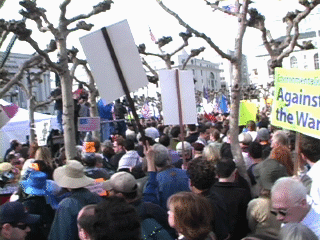
Feb 16, 2003 Part 19 of ? (Hi-res 45 MB)
Feb 16, 2003 Part 19 of ? (Lo-res 17 MB)
Feb 16, 2003 Part 19 - (1 of 2) of ? (Lo-res 9 MB)
Feb 16, 2003 Part 19 - (2 of 2) of ? (Lo-res 9 MB)
Part 18 - I try to get up towards the stage and score a press pass like last time, but it just wasn't going to happen (That is, unless I waited around by the side of the stage for a while, and I didn't want to risk missing Barbara Lee.)
So I decided to brave it in the main crowd 200 yards or so out from the stage.
At this point, Kevin took off -- he was tired and wasn't up for dealing with the crowd.
The crowd is really dense and hard to walk through, especially with my camera, so I give up and decide to just place my camera a top the tripod, and fold up the legs of my tripod so I can hold it squarely with both arms several feet above the crowd.
At this point I shoot the footage you see below. (That's Tom Ammiano telling bad jokes in the background.)

Feb 16, 2003 Part 18 of ? (Hi-res 35 MB)
Feb 16, 2003 Part 18 of ? (Lo-res 13 MB)
Feb 16, 2003 Part 18 - (1 of 2) of ? (Lo-res 7 MB)
Feb 16, 2003 Part 18 - (2 of 2) of ? (Lo-res 7 MB)




Here's a wav file of the last part of the birth.
A record 15 minutes out the door! (After many hours of preparation :-)
(It sounds like it would feel like a million trillion quadrillion minutes in Quinn-in-labor years.)
My friend Quinn is having a baby (like, as we speak) and blogging about it online, as it happens. (Yes, they're having the baby at home.)
It's just a webpage, so you have to manually reload it to see the updates, but they're steady...
9:37pm. We're looking after Quinn's backache (it's a posterior-facing baby for now, so backache is par for the course). "Birth would be fine if it wasn't for the contractions". [danny]9:51pm. Note to Heather: back births suck.
10:22pm. The hormones have her shivering, and freezing cold. Thank god for lots and lots of blankets. [ gilbert ]
10:35pm. can i have a shower?
10:41pm. six centimeters-plus dilation. this is a good thing.
Part 16 - One last shot of the march itself before leaving to go the back way around to Civic Center. This clip is a pretty excellent slice of what it felt like within the crowd.

Feb 16, 2003 Part 16 of ? (Hi-res 23 MB)
Feb 16, 2003 Part 16 of ? (Lo-res 9 MB)
Part 17 - We arrive at Civic Center around 2 pm (most people got there after 2pm), and pause for a moment before taking a deep breath and re-entering the crowd. We decide to re-enter from the Polk St. side, in an attempt to try to enter the press pit in front of the stage like we were able to before. (No such luck though.)

Feb 16, 2003 Part 17 of ? (Hi-res 14 MB)
Feb 16, 2003 Part 17 of ? (Lo-res 5 MB)
So I had my 2:55 EST time slot, and I called (almost) on schedule, but I couldn't get through. All ciruits were busy!
Good work guys!
MoveOn.org has organized a
Virtual March On Washington today, February 26, 2003.
The idea is to literally have all of the Senators and Representatives' phones ringing off of the hook all day long -- asking them not to rush into this War, please -- in your own words. (Perhaps "please" isn't a word that seems appropriate anymore...)
Estimated Time Investment: 1-2 minutes total.
It took me about 30 seconds to enter my information into a form, including two sentences that I want to say when I leave a message for my reps.
The website creates a page with the names and phone numbers of your representatives that you can print out and keep handy so it's easy to remember what you want to say when it's time to make the calls.
This is the kind of organized communication to our representatives that I hope to see a lot more of.
Give it a try, will you? I'm curious what people's experiences are.
I'll tell you about mine after I make my calls around noon.
Sen. Patrick Leahy (D-Vermont) - Judiciary Committee Ranking Member is on CSPAN right now talking about the Estrada nomination.
Not a whole lot has changed. Estrada won't answer any questions from the Senate Judiciary committee and they are plenty pissed about it.
I'll grab some of this and put it up.
I also have another installment of my February 16th adventure going up today.
Then I have to cool it for a day or two while I finish up my grad school application before I miss the deadline...
So we can give up all of our freedoms, and create hassles and holdups in every aspect of our daily lives, and there's still really no way to protect ourselves from becoming "soft targets" once the war has begun.
Sounds like another good reason to NOT START THE WAR IN THE FIRST PLACE.
Sounds like an even better reason to NOT GIVE UP ALL OF OUR FREEDOMS since it won't make us any safer anyway.
I have a real problem with articles like this. Parts of it regarding the use of Total Information Awareness are informative, but the rest of it just adds to the hysteria.
Are we drawing up roadmaps for the terrorists now?
Writers and officers are thinking up horrific potential disasters, and printing them up, with details about which places would be best to blow up in order to cause the largest amounts of casualties -- and for what purpose? To let us know how bad it could be if we don't let our freedoms be compromised? To add to the re-freakening of America, perhaps?
At the risk of adding to the hysteria. I bring this article to you.
Fortress America
By Matthew Brzezinski fo the NY Times
http://www.nytimes.com/2003/02/23/magazine/23FORTRESS.html
February 23, 2003
Fortress America
By MATTHEW BRZEZINSKI
In the last several weeks, as preparations for the war against Iraq
have heated up, it has begun to sink in that this will be a different
conflict from what we have
seen before -- that there may, in fact, be two fronts, one far away
on the ground in the Middle East, the other right here at home. For the
first time in history,
it seems plausible that an enemy might mount a sustained attack on
the United States, using weapons of terrorism. The term ''soft
targets,'' which refers to
everyday places like offices, shopping malls, restaurants and hotels, is
now casually dropped into conversation, the way military planners talk
about ''collateral
damage.''
Earlier this month, the federal government raised the official terrorism
alert level and advised Americans to prepare a ''disaster supply kit,''
including duct tape to
seal windows against airborne toxins. Members of Congress organized news
conferences to demand that passenger jets be outfitted with
missile-avoidance
systems. In major public areas of cities, the police presence has been
especially conspicuous, with weapons ostentatiously displayed. Whatever
the details, the
message was the same: war is on the way here.
The impossible questions begin with where, what and how, and end with
what to do about it. Sgt. George McClaskey, a Baltimore cop, spends his
days thinking
about the answers, and one cold day recently, he took me out in an old
police launch to survey Baltimore harbor. He showed me some of the new
security
measures, like the barriers at the approach to the harbor, which rose
out of the water like stakes in a moat. Cables were suspended between
these reinforced
pylons, designed to slice into approaching high-speed craft and
decapitate would-be suicide bombers before they reached their mark. It
looked fairly daunting.
Then McClaskey maneuvered the boat toward an unprotected stretch of
Baltimore's Inner Harbor. With the temperature dipping into the teens,
the place was
empty. But when the weather is warm, up to a quarter of a million people
congregate on these piers and brightly painted promenades every weekend.
''If I wanted to create a big bang,'' McClaskey said, adopting the
mind-set of a suicide bomber, ''I'd pack a small boat with explosives
and crash it right there.'' He
pointed to a promenade. ''It'd be a catastrophe,'' he declared. ''It
would take 48 hours just for the tide to flush out the bodies from under
the boardwalk.''
The port is lined with large oil terminals, storage tanks and
petrochemical facilities, incendiaries in need only of a lighted fuse.
Even the Domino sugar refinery,
with its sticky-sweet flammable dust, poses a threat. ''Most people
don't think about it,'' McClaskey said, ''but that's a giant bomb.''
The list of vulnerabilities is perilously long in Baltimore, as it is
just about everywhere in the United States. And every one of those
potential targets can set in
motion an ever-broadening ripple effect. Should terrorists manage to
blow up an oil terminal in Baltimore, for instance, the nearby
ventilation systems for the
I-95 tunnel would have to be shut. Shut down the tunnel, and the
Interstate highway must be closed. Close down a section of I-95, and
traffic along the entire
Eastern Seaboard snarls to a halt.
''So how would you defend against frogmen blowing up half the harbor?''
I asked McClaskey.
The sergeant shrugged uneasily. ''Honestly,'' he confessed, ''I don't
think it's possible.'' Like most law enforcement officers in this
country, McClaskey has been
trained to catch crooks, not to stop submerged suicide bombers.
Imagining doomsday possibilities is one thing; we've all become good at
it these past 18
months. Coming up with counterterror solutions is another story, often
beyond the scope of our imaginations. But while that expertise may not
yet exist in the
United States, it's out there, if you know where to look.
''Sonar,'' replied Rear Adm. Amiram Rafael, when I put the same question
to him 6,000 miles away in Israel, perhaps the one place in the world
where terrorism
is as much a part of daily life as commuter traffic. ''It can
distinguish between humans and large fish by mapping movement patterns
and speed.'' Rafael spent
28 years protecting Israel's coastline from terrorists and now consults
for foreign clients. ''If the alarm sounds, rapid response units in fast
boats are dispatched,''
he said. ''They're equipped with underwater concussion grenades.''
''To stun the divers?'' I asked.
''No,'' Rafael said, flashing a fatherly smile. ''To kill them.''
Until recently, the United States and countries like Israel occupied
opposite ends of the security spectrum: one a confident and carefree
superpower, seemingly
untouchable, the other a tiny garrison state, surrounded by
fortifications and barbed wire, fighting for its survival. But the
security gap between the U.S. and
places like Israel is narrowing. Subways, sewers, shopping centers, food
processing and water systems are all now seen as easy prey for
terrorists.
There is no clear consensus yet on how to go about protecting ourselves.
The federal government recently concluded a 16-month risk assessment,
and last
month, the new Department of Homeland Security was officially born, with
an annual budget of $36 billion. Big money has already been allocated to
shore up
certain perceived weaknesses, including the $5.8 billion spent hiring,
training and equipping federal airport screeners and the $3 billion
allocated for
''bioterrorism preparedness.'' All that has been well publicized. Other
measures, like sophisticated radiation sensors and surveillance systems,
have been installed
in some cities with less fanfare. Meanwhile, the F.B.I. is carrying out
labor-intensive tasks that would have seemed a ludicrous waste of time
18 months ago,
like assembling dossiers on people who take scuba-diving courses.
This marks only the very beginning. A national conversation is starting
about what kind of country we want to live in and what balance we will
tolerate between
public safety and private freedom. The decisions won't come all at once,
and we may be changing our minds a lot, depending on whether there are
more attacks
here, what our government tells us and what we believe. Two weeks ago,
Congress decided to sharply curtail the activities of the Total
Information Awareness
program, a Pentagon project led by Rear Adm. John Poindexter and
invested with power to electronically sift through the private affairs
of American citizens.
For the time being, it was felt that the threat of having the government
look over our credit-card statements and medical records was more
dangerous than its
promised benefits.
Congress didn't completely shut the door on the T.I.A., though. Agents
can still look into the lives of foreigners, and its functions could be
expanded at any
time. We could, for instance, reach the point where we demand the
installation of systems, like the one along the Israeli coastline, to
maim or kill intruders in
certain sensitive areas before they have a chance to explain who they
are or why they're there. We may come to think nothing of American
citizens who act
suspiciously being held without bail or denied legal representation for
indeterminate periods or tried in courts whose proceedings are under
seal. At shopping
malls and restaurants, we may prefer to encounter heavily armed guards
and be subjected to routine searches at the door. We may be willing to
give up the
freedom and ease of movement that has defined American life, if we come
to believe our safety depends upon it.
For the better part of a generation now, Americans have gone to great
lengths to protect their homes -- living in gated communities, wiring
their property with
sophisticated alarms, arming themselves with deadly weapons. Now imagine
this kind of intensity turned outward, into the public realm. As a
culture, our
tolerance for fear is low, and our capacity to do something about it is
unrivaled. We could have the highest degree of public safety the world
has ever seen. But
what would that country look like, and what will it be like to live in
it? Perhaps something like this.
Electronic Frisking Every Day on Your Commute
As a homebound commuter entering Washington's Foggy Bottom subway
station swipes his fare card through the turnstile reader, a computer in
the bowels of
the mass transit authority takes note. A suspicious pattern of movements
has triggered the computer's curiosity.
The giveaway is a microchip in the new digital fare cards, derived from
the electronic ID cards many of us already use to enter our workplaces.
It could be in
use throughout the U.S. within a couple of years. If embedded with the
user's driver's license or national ID number, it would allow
transportation authorities to
keep tabs on who rides the subway, and on when and where they get on and
off.
The commuter steps through the turnstile and is scanned by the radiation
portal. These would be a natural extension of the hand-held detectors
that the police
have started using in the New York subways. A cancer patient was
actually strip-searched in a New York subway station in 2002 after
residue from radiation
treatments tripped the meters. But this doesn't happen to our fictitious
commuter. The meters barely flicker, registering less than one on a
scale of one to nine,
the equivalent of a few microroentgens an hour, nowhere near the 3,800
readout that triggers evacuation sirens.
Imagine a battery of video cameras following the commuter's progress to
the platform, where he reads a newspaper, standing next to an old
utility room that
contains gas masks. Cops in New York already have them as part of their
standard-issue gear, and a fully secure subway system would need them
for
everybody, just as every ferryboat must have a life preserver for every
passenger. Sensors, which are already used in parts of the New York
subway system,
would test the air around him for the presence of chemical agents like
sarin and mustard gases.
The commuter finishes reading his newspaper, but there is no place to
throw it away because all trash cans have been removed, as they were in
London when the
I.R.A. used them to plant bombs. Cameras show the commuter boarding one
of the subway cars, which have been reconfigured to drop oxygen masks
from the
ceiling in the event of a chemical attack, much like jetliners during
decompression. The added security measures have probably pushed fares up
throughout the
country, maybe as much as 40 percent in some places.
The commuter -- now the surveillance subject -- gets off at the next
stop. As he rides the escalator up, a camera positioned overhead zooms
in for a close-up of
him. This image, which will be used to confirm his identity, travels
through fiber-optic cables to the Joint Operations Command Center at
police headquarters.
There, a computer scans his facial features, breaks them down into
three-dimensional plots and compares them with a databank of criminal
mug shots, people on
watch lists and anyone who has ever posed for a government-issue ID. The
facial-recognition program was originally developed at M.I.T. Used
before 9/11
mainly by casinos to ferret out known cardsharps, the system has been
tried by airport and law enforcement authorities and costs $75,000 to
$100,000 per
tower, as the camera stations are called.
''It can be used at A.T.M.'s, car-rental agencies, D.M.V. offices,
border crossings,'' says an executive of Viisage Technology, maker of
the Face-Finder
recognition system. ''These are the sorts of facilities the 19 hijackers
used.''
Almost instantly, the software verifies the subject's identity and
forwards the information to federal authorities. What they do with it
depends on the powers of
the Total Information Awareness program or whatever its successors will
be known as. But let's say that Congress has granted the government
authority to note
certain suspicious patterns, like when someone buys an airline ticket
with cash and leaves the return date open. And let's say the commuter
did just that -- his
credit cards were maxed out, so he had no choice. And he didn't fill in
a return date because he wasn't sure when his next consulting assignment
was going to
start, and he thought he might be able to extend his vacation a few
days.
On top of that, let's say he was also indiscreet in an e-mail message,
making a crude joke to a client about a recent airline crash. Software
programs that scan for
suspect words are not new. Corporations have long used them to
automatically block employee e-mail containing, for instance, multiple
references to sex. The
National Security Agency's global spy satellites and supercomputers have
for years taken the search capability to the next level, processing the
content of up to
two million calls and e-mail messages per hour around the world.
Turning the snooping technology on Americans would not be difficult, if
political circumstances made it seem necessary. Right now, there would
be fierce
resistance to this, but the debate could swing radically to the other
side if the government showed that intercepting e-mail could deter
terrorists from
communicating with one another. Already, says Barry Steinhardt, director
of the A.C.L.U. program on technology and liberty, authorities have been
demanding
records from Internet providers and public libraries about what books
people are taking out and what Web sites they're looking at.
Once the commuter is on the government's radar screen, it would be hard
for him to get off -- as anyone who has ever found themselves on a
mailing or
telemarketers' list can attest. It will be like when you refinance a
mortgage -- suddenly every financial institution in America sends you a
preapproved platinum
card. Once a computer detects a pattern, hidden or overt, your identity
in the digital world is fixed.
Technicians manning the Command Center probably wouldn't know why the
subject is on a surveillance list, or whether he should even be on it in
the first
place. That would be classified, as most aspects of the government's
counterterrorist calculations are.
Nonetheless, they begin to monitor his movements. Cameras on K Street
pick him up as he exits the subway station and hails a waiting taxi. The
cab's license
plate number, as a matter of routine procedure, is run through another
software program -- first used in Peru in the 1990's to detect vehicles
that have been
stolen or registered to terrorist sympathizers, and most recently
introduced in central London to nab motorists who have not paid
peak-hour traffic tariffs.
Technicians get another positive reading; the cabdriver is also on a
watch list. He is a Pakistani immigrant and has traveled back and forth
to Karachi twice in the
last six months, once when his father died, the other to attend his
brother's wedding. These trips seem harmless, but the trackers are
trained not to make these
sorts of distinctions.
So what they see is the possible beginning of a terrorist conspiracy --
one slightly suspicious character has just crossed paths with another
slightly suspicious
character, and that makes them seriously suspicious. At this moment, the
case is forwarded to the new National Counterintelligence Service, which
will pay very
close attention to whatever both men do next.
The N.C.S. does not exist yet, but its creation is advocated by the
likes of Lt. Gen. William Odom, a former head of the National Security
Agency. Whether
modeled after Britain's MI5, a domestic spy agency, or Israel's much
more proactive and unrestricted Shin Bet, the N.C.S. would most likely
require a budget
similar to the F.B.I.'s $4.2 billion and nearly as much personnel as the
bureau's 11,400-strong special agent force, mostly for surveillance
duties.
N.C.S. surveillance agents dispatched to tail the two subjects in the
taxi would have little difficulty following their quarry through
Georgetown, up Wisconsin
Avenue and into Woodley Park. One tool at their disposal could be a
nationwide vehicle tracking system, adapted from the technology used by
Singapore's
Land Transport Authority to regulate traffic and parking. The system
works on the same principle as the E-ZPass toll-road technology, in
which scanners at
tollbooths read signals from transponders installed on the windshields
of passing vehicles to pay tolls automatically. In a future application,
electronic readers
installed throughout major American metropolitan centers could pinpoint
the location of just about any vehicle equipped with mandatory
transponders.
(American motorists would most likely each have to pay an extra $90 fee,
similar to what Singapore charges.)
When the commuter arrives home, N.C.S. agents arrange to put his house
under 24-hour aerial surveillance. The same thing happens to the
cabdriver when he
arrives home. The technology, discreet and effective, is already
deployed in Washington. Modified UH-60A Blackhawk helicopters, the kind
U.S. Customs
uses to intercept drug runners, now patrol the skies over the capital to
enforce no-fly zones. The Pentagon deployed its ultrasophisticated RC-7
reconnaissance
planes during the sniper siege last fall. The surveillance craft, which
have proved their worth along the DMZ in North Korea and against cocaine
barons in
Colombia, come loaded with long-range night-vision and infrared sensors
that permit operators to detect move-ment and snap photos of virtually
anyone's
backyard from as far as 20 miles away.
A Government That Knows When You've Been Bad or Good
In the here and now, an aerial photo of my backyard is on file at the
Joint Operations Command Center in Washington, which, unlike the N.C.S.,
already exists.
The center looks like NASA, starting with the biometric palm-print
scanners on its reinforced doors.
The center has not singled me out for any special surveillance. My
neighbors' houses are all pictured, too, as are still shots and even
three-dimensional images
of just about every building, landmark and lot in central D.C.
The technology isn't revolutionary. How many times a day is the average
American already on camera? There's one in the corner deli where I get
my morning
coffee and bagel. Another one at the A.T.M. outside. Yet another one
films traffic on Connecticut Avenue when I drive my wife to work. The
lobby of her office
building has several. So that's at least four, and it's only 9 a.m.
There are few legal restraints governing video surveillance. It is
perfectly legal for the government to track anyone, anywhere, using
cameras except for inside
his own home, where a warrant is needed to use thermal imaging that can
see all the way into the basement. Backyards or rooftops, however, are
fair game.
There is a growing network of video cameras positioned throughout the
capital that feed into the Joint Operations Command Center, otherwise
known as the
JOCC, which has been operational since 9/11. The experimental facility
is shared by several government agencies, including the Metropolitan
Police
Department, the F.B.I., the Secret Service, the State Department and the
Defense Intelligence Agency. Agents from different law enforcement
bodies man the
JOCC's 36 computer terminals, which are arrayed in long rows beneath
wall-size projection screens, like the Houston space center. The wall
screens
simultaneously display live feeds, digital simulations, city maps with
the locations of recently released felons and gory crime scene footage.
''From here we can tap into schools, subways, landmarks and main
streets,'' says Chief Charles Ramsey of the D.C. Police, with evident
pride. Theoretically,
with a few clicks of the mouse the system could also link up with
thousands of closed-circuit cameras in shopping malls, department stores
and office buildings,
and is programmed to handle live feeds from up to six helicopters
simultaneously. Ramsey is careful to add that, for now, the majority of
the cameras are
off-line most of the time, and that the police aren't using them to look
into elevators or to spy on individuals.
But they could if they wanted to. I ask for a demonstration of the
system's capabilities. A technician punches in a few keystrokes. An
aerial photo of the city
shot earlier from a surveillance plane flashes on one of the big
screens. ''Can you zoom in on Dupont Circle?'' I ask. The screen
flickers, and the thoroughfare's
round fountain comes into view. ''Go up Connecticut Avenue.'' The
outline of the Hilton Hotel where President Reagan was shot
materializes. ''Up a few more
blocks, and toward Rock Creek Park,'' I instruct. ''There, can you get
any closer?'' The image blurs and focuses, and I can suddenly see the
air-conditioning unit
on my roof, my garden furniture and the cypress hedge I recently planted
in my yard.
The fact that government officials can, from a remote location, snoop
into the backyards of most Washingtonians opens up a whole new level of
information
they can find out about us almost effortlessly. They could keep track of
when you come and go from your house, discovering in the process that
you work a
second job or that you are carrying on an extramarital affair. Under
normal circumstances, there's not much they could do with this
information. And for the
time being, that is the way most Americans want it. But this is the kind
of issue that will come up over the next few years. How many extra tools
will we be
willing to grant to the police and federal authorities? How much will we
allow our notions of privacy to narrow?
Because if domestic intelligence agents were able to find out secret
details of people's lives, they could get the cooperation of crucial
witnesses who might
otherwise be inclined to keep quiet. There is more than a whiff of
McCarthyism to all this, but perhaps we will be afraid enough to endure
it.
The JOCC is also studying the effect of large-scale bombs in Washington.
A three-dimensional map of all downtown buildings allows technicians to
simulate
bomb blasts and debris projections. They can also tap into the weather
bureau for real-time data on wind speeds and directions to determine
which parts of the
city would have to be evacuated first in the event of a radiological or
biochemical plume. Programmers are now working on an underground map of
the capital
that would show water and gas distribution and power grids.
Efforts are under way to establish facilities similar to the JOCC in big
urban centers like Los Angeles, Chicago, Atlanta and New York. One
benefit of the
JOCC's is that they are relatively cheap to set up, particularly since
most major cities already have surveillance equipment positioned in
places like tunnels and
bridges. Each command center would likely cost around $7 million to
build, with an additional $15,000 charge for every camera installed.
There is also talk of connecting all the facilities together so that
officials in different parts of the country could coordinate response
efforts to terrorism. ''Attacks
will likely occur in different cities simultaneously,'' Chief Ramsey
says. And as for those civil libertarians uneasy with the notion of
blanket national
surveillance, Ramsey just shrugs. ''We can't pretend we live in the 19th
century. We have to take advantage of technology.''
The Mall Guard Who Carries a Machine Gun
Imagine a wintry scene: snowdrifts and dirty slush and a long line of
people muffled against the cold. This is a line to get into the mall,
and it is moving
frustratingly slowly. What's the holdup? There is no new blockbuster
movie opening that day, or any of those ''everything must go'' clearance
sales that might
justify standing outside freezing for 20 minutes. Customers are simply
waiting to clear security.
Shopping in an environment of total terrorist preparedness promises to
be a vastly different experience from anything ever imagined in America.
But for
millions of people who live in terror-prone places like Israel or the
Philippines, tight security at shopping malls has long been a fact of
life. ''I was shocked when
I first came to the States and could go into any shopping plaza without
going through security,'' says Aviv Tene, a 33-year-old Haifa attorney.
''It seemed so
strange, and risky.''
It took me just under eight minutes to clear the security checkpoint
outside the Dizengoff Center in downtown Tel Aviv. But that was on a
rainy weekday
morning before the food courts and multiplex theater had opened.
The future shopping experience will start at the parking-lot entrance.
Booths manned by guards will control access to and from lots to prevent
terrorists from
emulating the Washington sniper and using parking lots as shooting
galleries. Cars entering underground garages will have their trunks
searched for
explosives, as is the practice in Manila. It has also become common
outside New York City hotels. This will guard against car or truck bombs
of the type that
blew up beneath the World Trade Center in 1993.
No one will be able to drive closer than a hundred yards to mall
entrances. Concrete Jersey barriers will stop anyone from crashing a
vehicle into the buildings
-- a favored terrorist tactic for American targets overseas -- or into
the crowds of customers lining up. Screening will follow the Israeli
model: metal barricades
will funnel shoppers through checkpoints at all doors. They will be
frisked, and both they and their bags will be searched and run through
metal detectors.
Security would be tightest in winter, says a former senior F.B.I. agent,
because AK-47's and grenade belts are easily concealed beneath heavy
coats.
What won't be concealed, of course, are the weapons carried by the
police at the mall. Major shopping areas will not be patrolled by the
docile, paid-by-the-hour
guards to whom we're accustomed, but -- like airports and New York City
tourist attractions -- by uniformed cops and soldiers with rifles.
What will it be like to encounter such firearms on a regular basis? I
lived for years in Moscow, and after a short time, I rarely noticed the
guns. In fact, I tended
to feel more uncomfortable when armed guards were not around; Israelis
traveling in the United States occasionally say the same thing. But
despite the
powerful presence of guns in popular culture, few Americans have had
much contact with the kind of heavy weapons that are now becoming a
common sight on
city streets. Such prominent displays are meant to convey the notion
that the government is doing something to ward off terrorists, but they
can have the reverse
effect too, of constantly reminding us of imminent danger.
Even more mundane procedures might have the same effect -- for example,
being asked to produce a national identification card every time you go
into a store,
much the same way clubgoers have to prove they are of age. The idea of a
national identity card, once widely viewed as un-American, is gaining
ground in
Washington, where some are advocating standardizing driver's licenses
throughout the country as a first step in that direction. Though perhaps
reminiscent of
Big Brother, these cards are not uncommon in the rest of the world, even
in Western Europe. In Singapore, the police frequently ask people to
produce their
papers; it becomes so routine that people cease being bothered by it.
How long would it take Americans to become similarly inured?
The new ID's, which are advocated by computer industry leaders like
Larry Ellison of Oracle, could resemble the digital smart cards that
Chinese authorities
plan to introduce in Hong Kong by the end of the year. These contain
computer chips with room to store biographical, financial and medical
histories, and
tamper-proof algorithms of the cardholder's thumbprint that can be
verified by hand-held optical readers. Based on the $394 million Hong
Kong has budgeted
for smart cards for its 6.8 million residents, a similar program in the
U.S. could run as high as $16 billion.
Among other things, a national identity card program would make it much
harder for people without proper ID to move around and therefore much
easier for
police and domestic-intelligence agents to track them down. And once
found, such people might discover they don't quite have the rights they
thought they had.
Even now, for instance, U.S. citizens can be declared ''enemy
combatants'' and be detained without counsel. Within a few years,
America's counterterrorist
agencies could have the kind of sweeping powers of arrest and
interrogation that have developed in places like Israel, the Philippines
and even France, where the
constant threat of terrorism enabled governments to do virtually
whatever it takes to prevent terrorism. ''As long as you worry too much
about making false
arrests and don't start taking greater risks,'' says Offer Einav, a
15-year Shin Bet veteran who now runs a security consulting firm, ''you
are never going to beat
terrorism.''
In years past, the U.S. has had to rely on other governments to take
these risks. For example, the mastermind of the 1993 W.T.C. bombing,
Ramzi Yousef, was
caught only after Philippine investigators used what official
intelligence documents delicately refer to as ''tactical interrogation''
to elicit a confession from an
accomplice arrested in Manila. In U.S. court testimony, the accomplice,
Abdul Hakim Murad, later testified that he was beaten to within an inch
of his life.
In Israel, it is touted that 90 percent of suicide bombers are caught
before they get near their targets, a record achieved partly because the
Shin Bet can do almost
anything it deems necessary to save lives. ''They do things we would not
be comfortable with in this country,'' says former Assistant F.B.I.
Director Steve
Pomerantz, who, along with a growing number of U.S. officials, has
traveled to Israel recently for antiterror training seminars.
But the U.S. is moving in the Israeli direction. The U.S.A. Patriot Act,
rushed into law six weeks after 9/11, has given government agencies wide
latitude to
invoke the Foreign Intelligence Surveillance Act and get around judicial
restraints on search, seizure and surveillance of American citizens.
FISA, originally
intended to hunt international spies, permits the authorities to wiretap
virtually at will and break into people's homes to plant bugs or copy
documents. Last year,
surveillance requests by the federal government under FISA outnumbered
for the first time in U.S. history all of those under domestic law.
New legislative proposals by the Justice Department now seek to take the
Patriot Act's antiterror powers several steps further, including the
right to strip terror
suspects of their U.S. citizenship. Under the new bill -- titled the
Domestic Security Enhancement Act of 2003 -- the government would not be
required to
disclose the identity of anyone detained in connection with a terror
investigation, and the names of those arrested, be they Americans or
foreign nationals, would
be exempt from the Freedom of Information Act, according to the Center
for Public Integrity, a rights group in Washington, which has obtained a
draft of the
bill. An American citizen suspected of being part of a terrorist
conspiracy could be held by investigators without anyone being notified.
He could simply
disappear.
The Face-to-Face Interrogation on Your Vacation
Some aspects of life would, in superficial ways, seem easier, depending
on who you are and what sort of specialized ID you carry. Boarding an
international
flight, for example, might not require a passport for frequent fliers.
At Schiphol Airport in Amsterdam, ''trusted'' travelers -- those who
have submitted to
background checks -- are issued a smart card encoded with the pattern of
their iris. When they want to pass through security, a scanner checks
their eyes and
verifies their identities, and they are off. The whole process takes 20
seconds, according to Dutch officials. At Ben-Gurion in Israel, the same
basic function is
carried out by electronic palm readers.
''We start building dossiers the moment someone buys a ticket,'' says
Einav, the Shin Bet veteran who also once served as head of El Al
security. ''We have quite
a bit of information on our frequent fliers. So we know they are not a
security risk.''
The technology frees up security personnel to focus their efforts on
everybody else, who, on my recent trip to Jerusalem, included me. As a
holder of a
Canadian passport (a favorite of forgers) that has visa stamps from a
number of high-risk countries ending in ''stan,'' I was subjected to a
40-minute
interrogation. My clothes and belongings were swabbed for explosives
residue. Taken to a separate room, I was questioned about every detail
of my stay in
Israel, often twice to make certain my story stayed consistent. Whom did
you meet? Where did you meet? What was the address? Do you have the
business
cards of the people you met? Can we see them? What did you discuss? Can
we see your notes? Do you have any maps with you? Did you take any
photographs while you were in Israel? Are you sure? Did you rent a car?
Where did you drive to? Do you have a copy of your hotel bill? Why do
you have a
visa to Pakistan? Why do you live in Washington? Can we see your D.C.
driver's license? Where did you live before Washington? Why did you live
in
Moscow? Are you always this nervous?
A Russian speaker was produced to verify that I spoke the language. By
the time I was finally cleared, I almost missed my flight. ''Sorry for
the delay,''
apologized the young security officer. ''Don't take it personally.''
El Al is a tiny airline that has a fleet of just 30 planes and flies to
a small handful of destinations. It is also heavily subsidized by the
government. This is what
has made El Al and Ben-Gurion safe from terrorists for more than 30
years.
Getting the American airline system up to this level would require a
great deal more than reinforced cockpit doors and the armed air marshals
now aboard
domestic and international flights. It would require changing
everything, including the cost and frequency of flights. Nothing could
be simpler, right now, than
flying from New York to Pittsburgh -- every day, there are at least a
dozen direct flights available from the city's three airports and
countless more connecting
flights. Bought a week or two in advance, these tickets can be as cheap
as $150 round-trip.
Making U.S. airlines as security-conscious as El Al would put the U.S.
back where the rest of the world is -- maybe a flight or two a day from
New York to
Pittsburgh, at much higher costs, and no assurance whatsoever you can
get on the plane you want. Flights would take longer, and landings might
be a little more
interesting, because pilots would have to stay away from densely
populated areas, where a plane downed by a shoulder-launched Stinger
missile could do
terrible damage.
Kayaking in the Wrong Place Is a Federal Crime
In a state of full readiness, American cities would be a patchwork of
places you couldn't go near. At first, most people wouldn't even notice
when no-sail zones
were instituted around all 50 major industrial ports in the country.
Maybe they would find out when they went to a local marina where they
occasionally rent a
small outboard to go water-skiing and found that it had been closed and
relocated. Or maybe they went kayaking up near the Indian Point nuclear
plant on the
Hudson and spent an afternoon talking to the Coast Guard after they got
a little too close.
There may be a lot of places private boats will be unable to go, like
anywhere near a shipping channel used by oil and gas freighters.
Infrared and video optronic
systems that can detect small boats, and even inflatable rubber craft,
may be deployed to enforce the no-sail zones. ''We invented it after
terrorists rode a
freighter to within 10 miles of Tel Aviv,'' says Rafael, the former
Israeli rear admiral, ''and used inflatable boats to attack beachfront
hotels.''
Each optronic installation costs $2 million, and four or five of the
units would be needed to protect the approach to any major harbor,
Rafael says. The system
would thus cost around $500 million.
''I'm always amazed at how lightly defended your industry is compared to
most other countries,'' says Hezy Ribak, another Israeli intelligence
expert, who runs a
security consulting firm. ''In Israel, we treat security at our
industrial facilities the way we do borders. The stakes,'' he adds,
''are just as high, higher if you
consider the damage terrorists can do if they infiltrate a nuclear power
plant or blow up a gas reservoir.''
The P-Glilot natural gas reservoir near Tel Aviv is a good example of
what security experts like Ribak have in mind for the U.S. From a
distance, P-Glilot
doesn't seem all that different than similar installations in New
Jersey, Ohio or Texas. The massive storage tanks are even painted with
quaint butterflies and
birds. But just off the highway, watchtowers dot the landscape. If you
drive closer, the complex takes on the feel of a military garrison, with
high walls and
electric fences bristling with sensors and cameras, and notices posted
in Hebrew, English and Arabic warning: ''No Photography.'' Pull off the
road and park by
the perimeter fence for a mere 15 seconds, and a metallic voice sounds
from an unseen loudspeaker, calling out your license plate number and
telling you to
move on.
''Security,'' Einav says, ''is about layers, creating buffer zones.'' On
the ground, that means changing the way industrial sites are guarded.
Security precautions in
the U.S. are concentrated around the core of the targets -- be they
reactors, pumping stations or chemical plants -- rather than the
perimeter. ''Security at the
main buildings might stop environmental protesters or the lone crazy,
but it doesn't help in the case of a truck loaded with explosives,
because the terrorists have
already reached their objective,'' Ribak says. ''Why give yourself so
little room? There should be as big a buffer as possible between the
first line of defense --
the perimeter of the property -- and the target, to give yourself early
warning.''
Perimeters, Ribak says, will need to be equipped with vibration sensors;
thermal and infrared cameras; buried magnetic detection devices that can
distinguish
between humans, animals and vehicles; and several rows of old-fashioned
razor coil to delay intruders, giving guards time to respond to alarms.
In the U.S., where many industrial facilities are concentrated in dense
urban areas, such security measures would necessitate the rerouting of
highways and
possibly the relocation of neighborhoods that are just too close. In New
York City, power plants sit right in the middle of residential
neighborhoods, like the one
at 14th Street and Avenue D in the East Village. It is across the street
from Stuyvesant Town and a public housing project, home to tens of
thousands of people.
Israeli security officials shake their heads in astonishment at such
''crazy'' U.S. practices, but then again who ever thought that putting
an airport next to the
Pentagon was a security risk?
Securing dense, mixed-use urban neighborhoods could not only complicate
housing markets and commuting patterns, which are typically a disaster
in most
cities already, but could also come at tremendous expense. Consider the
Donald C. Cook nuclear power plant in Berrien County, Mich. It has two
Westinghouse reactors and sits on a relatively cramped 650-acre plot.
Just to provide a three-mile buffer around the plant would run $76
million, according to
U.S.D.A. statistics on the average price per acre of land in Michigan.
For the Indian Point plant in Westchester, the cost would be
exponentially higher. Add to
that the $3.5 billion to $7 billion estimated by a recent Princeton
University study to safeguard spent fuel pools from air attack, the
roughly $3.5 million price
tag of new perimeter sensors and the $160 million that Raytheon charges
for a Patriot missile battery capable of knocking out airborne threats,
and multiply the
total by the 103 nuclear power stations in the country.
Now factor in the 276,000 natural gas wells in the U.S., the 1.5 million
miles of unprotected pipelines, the 161 oil refineries, 2,000 oil
storage facilities and
10,400 hydro, coal and gas-fired power generating stations, and you get
a sense of the costs involved.
Every Day Is Super Bowl Sunday
But you probably won't be thinking about any of that when you go out to
dinner or to the movies or to a ball game. By then, it could all be
second nature. The
restaurant attendant will go through your purse and wave a
metal-detector wand over your jacket, as they do in Tel Aviv. The valet
parker will pop open your
trunk and look through it before dropping your car off at an underground
garage, just as in Manila.
If you take the family to a Dodgers game, you'll be able to tell your
kids how, back in the day, they used to have blimps and small planes
trailing ad banners
over stadiums. The flight restrictions, started at Super Bowl XXXVII in
2002, would not permit any planes within seven miles of any significant
sporting events.
Fans would have to park at least five miles from the stadium and board
shuttle buses to gates. Spectators would be funneled through
airport-style metal
detectors and watched over by a network of 50 cameras installed
throughout the stadium. Air quality would be monitored for pathogens by
the type of portable
detectors brought in by the Army at last year's Olympics.
Even people with no interest in sports who live in high-rises near
stadiums would know whenever game day came round. ''Tall buildings near
stadiums are also
a risk,'' says Col. Mena Bacharach, a former Israeli secret-service
agent who is one of the lead security consultants for the 2004 Summer
Olympics in Athens.
''They would have to be swept for snipers or R.P.G.'s.'' R.P.G.'s? Those
are rocket-propelled grenades, another term that could become an
American
colloquialism.
It's still too early to tell what all this would mean to ticket prices,
but, in a sign of the changing times, the security allocation alone for
last month's Super Bowl
was $9 million -- the equivalent of $134 for every one of the 67,000
fans in attendance.
Of course, public awareness programs could help to significantly cut
down counterterror costs. In Israel, televised public service
announcements similar to
antidrug commercials in the U.S. warn viewers to be on the lookout for
signs of suspicious activity. The messages are even taught to
schoolchildren, along with
other important survival tips, like how to assemble gas masks. ''I was
out with my 7-year-old granddaughter the other day,'' recalls Joel
Feldschuh, a former
Israeli brigadier general and president of El Al. ''And she sees a bag
on the street and starts shouting: 'Granddaddy, granddaddy, look.
Quickly call a policeman.
It could be left by terrorists.' ''
What Is Your Security Worth to You?
It is commonly held that a country as big and confident in its freedoms
as the United States could never fully protect itself against
terrorists. The means
available to them are too vast, the potentially deadly targets too
plentiful. And there is a strong conviction in many quarters that there
is a limit to which
Americans will let their daily patterns be disturbed for security
precautions. Discussing the possibility that we might all need to be
equipped with our own gas
masks, as Israelis are, Sergeant McClaskey of Baltimore assured me it
would never happen. ''If it ever reaches the point where we all need gas
masks,''
McClaskey said, shaking his head with disgust, ''then we have lost the
war on terror because we are living in fear.''
What does it really mean, however, to ''lose the war on terror''? It's
as ephemeral a concept as ''winning the war on terror.'' In what sense
will it ever be possible
to declare an end of any kind?
One thing that makes the decisions of how to protect ourselves so
difficult is that the terrorism we face is fundamentally different from
what other governments
have faced in the past. The Israelis live in tight quarters with an
enemy they know well and can readily lay their eyes on. Terror attacks
on European countries
have always come from colonies or nearby provinces that have generally
had specific grievances and demands. Americans don't know exactly who
our enemies
are or where they are coming from. Two of the recent thwarted
terrorists, Richard Reid and Zacarias Moussaoui, were in fact Europeans.
The United States also lacks the national identity that binds Israel and
most European countries and helps make the psychic wounds of terrorism
heal faster. In
Israel, hours after a bombing, the streets are crowded again -- people
are determined to keep going. Immediately after 9/11, that's how many
Americans felt, too,
but it's not at all clear how long this kind of spirit will endure.
Nor is it clear how we will absorb the cost. An adviser to President
Bush estimates that as much as $100 billion will have to be spent
annually on domestic
security over the next 10 years, if you factor in all the overtime
accrued by police departments every time there is a heightened alert.
There are many who believe,
as General Odom does, that the money is ''insignificant.'' ''At the
height of the cold war we used to spend 7.2 percent of G.D.P. on defense
and intelligence,'' he
says. ''We spend less than half that now.''
Outside of defense and some of the entitlement programs, however,
domestic security will dwarf every other kind of federal spending:
education, roads,
subsidized housing, environmental protection. More than that, the
decisions we make about how to protect ourselves -- the measures we
demand, the ones we
resist -- will take over our political discourse and define our ideas
about government in the years to come.
One significant argument against the creation of an American security
state, a United States that resembles Israel, is that even there, in a
society rigorously
organized around security, the safety of its citizens is far from
guaranteed. But what keeps Israelis going about their daily lives -- and
what might help
Americans do the same despite the fear of violence here -- is the
conspicuousness of the response and the minor sacrifices that have to be
made every day. The
more often we have to have our bags searched, the better we might feel.
Sitting in the kind of traffic jam that would have normally frayed our
nerves might seem
almost comforting if it's because all the cars in front of us are being
checked for bombs. We may demand more daily inconveniences, more routine
abrogations
of our rights. These decisions are not only going to change how we go
about our days; they're also going to change our notion of what it means
to be an
American. How far do we want to go?
''Security is a balancing act,'' says Einav, the former El Al security
chief. ''And there are always trade-offs. Give me the resources, and I
can guarantee your
safety. The question is, What are you willing to pay or put up with to
stay safe?''
Matthew Brzezinski, a contributing writer for the magazine, last wrote
about the detention of Hady Hassan Omar, a Muslim immigrant.
International Law Professor Francis A. Boyle of the University of Illinois, Urbana-Champaign thinks we ought to pre-emptively kick the Shrub's butt out of office for making pre-emptive strikes a part of our foreign policy. He thinks we should rid ourselves of Ashcroft while we're at it. (I think he's forgetting somebody...But two out of three ain't bad.)
Preemptive impeachment
Law professor stands ready to draft articles for any member of the House
By Kéllia Ramares, Online Journal Contributing Editor
While the United States will constantly strive to enlist the support of the international community, we will not hesitate to act alone, if necessary, to exercise our right of self defense by acting preemptively against such terrorists, to prevent them from doing harm against our people and our country . . .—The National Security Strategy of the United States of America
...Article II Sec. 4 of the Constitution states that: "The President, Vice President and all Civil Officers of the United States, shall be removed from Office on Impeachment for and Conviction of, Treason, Bribery, or other high Crimes and Misdemeanors." Boyle says that waging a war of aggression is a crime under the Nuremberg Charter, Judgment and Principles. "It's very clear," he adds, "if you read all the press reports, they are going to devastate Baghdad, a metropolitan area of 5 million people. The Nuremberg Charter clearly says the wanton devastation of a city is a Nuremberg war crime."
The United States is a party to the Nuremberg Charter, Judgment and Principles, and thus is constitutionally bound to obey them. "The Constitution, in Article 6, says that international treaties are the supreme law of the land here in the United States of America. So all we would be doing here, in this impeachment campaign," Boyle says, "is impeaching them for violating international treaties, as incorporated into the United States Constitution, as well as the Constitution itself."
Here is the full text of the article in case the link goes bad:
http://www.onlinejournal.com/Special_Reports/Ramares010403/ramares010403.html
Preemptive impeachment
Law professor stands ready to draft articles for any member of the House
By Kéllia Ramares
Online Journal Contributing Editor
While the United States will constantly strive to enlist the support of the international community, we will not hesitate to act alone, if necessary, to exercise our right of self defense by acting preemptively against such terrorists, to prevent them from doing harm against our people and our country . . .
—The National Security Strategy of the United States of America
January 4, 2002—"We sentenced Nazi leaders to death for waging a war of aggression," says International Law Professor Francis A. Boyle of the University of Illinois, Urbana-Champaign. By contrast, Prof. Boyle wants merely to impeach George W. Bush, Dick Cheney, Donald Rumsfeld and John Ashcroft for their plans to invade Iraq and create a police state in America.
Boyle is offering his services as counsel, free of charge, to any member of the House of Representatives willing to sponsor articles of impeachment. He is experienced in this work, having undertaken it in 1991 for the late Rep. Henry B. Gonzalez (D-TX), in an effort to stop the first Persian Gulf War. It takes only one member to introduce articles of impeachment. Of course, it will take many more than that to vote for impeachment, which will culminate in a trial in the Senate. Boyle is confident that, once the articles are introduced, others, including Republicans, will co-sponsor them. But we have to convince our Representatives that impeachment is necessary for the country and politically safe for them. This non-violent, constitutional process may be our best way of stopping World War III and saving our civil rights.
Grounds for Impeachment
Article II Sec. 4 of the Constitution states that: "The President, Vice President and all Civil Officers of the United States, shall be removed from Office on Impeachment for and Conviction of, Treason, Bribery, or other high Crimes and Misdemeanors." Boyle says that waging a war of aggression is a crime under the Nuremberg Charter, Judgment and Principles. "It's very clear," he adds, "if you read all the press reports, they are going to devastate Baghdad, a metropolitan area of 5 million people. The Nuremberg Charter clearly says the wanton devastation of a city is a Nuremberg war crime."
The United States is a party to the Nuremberg Charter, Judgment and Principles, and thus is constitutionally bound to obey them. "The Constitution, in Article 6, says that international treaties are the supreme law of the land here in the United States of America. So all we would be doing here, in this impeachment campaign," Boyle says, "is impeaching them for violating international treaties, as incorporated into the United States Constitution, as well as the Constitution itself."
Bush Cabal Repudiates Nuremberg Principles
We don't have to wait for the devastation of Baghdad to impeach the Bush cabal because they have already repudiated the Nuremberg Charter via the so-called Bush Doctrine of preventive war and pre-emptive attack. "This doctrine of pre-emptive warfare or pre-emptive attack was rejected soundly in the Nuremberg Judgment, " Boyle says. "The Nuremberg Judgment . . . rejected this Nazi doctrine of international law of alleged self-defense." The Bush Doctrine, embodied in the National Security Strategy document, published on the White House web site, is appalling, Boyle says. "It reads like a Nazi planning document prior to the Second World War."
The Fruit Doesn't Fall Far From the Tree
As Rep. Henry B. Gonzalez explained on the floor of the House in 1991, his articles charged the elder Bush with:
1) Violating the Equal Protection Clause by having minorities and poor whites, who were the majority of the soldiers in the Middle East, "fight a war for oil to preserve the lifestyles of the wealthy."
2) Violating "the Constitution, Federal law, and the UN Charter by bribing, intimidating, and threatening others, including the members of the UN Security Council, to support belligerent acts against Iraq."
3) Violating the Nuremberg principles by conspiring to engage in a massive war against Iraq that would cause tens of thousands of civilian deaths.
4) Committing "the United States to acts of war without congressional consent and contrary to the UN Charter and international law." (This refers to the lack of a formal declaration of war, as required by the Constitution).
5) Committing crimes against the peace by leading the United States into aggressive war against Iraq, in violation of Article 24 of the UN Charter, the Nuremberg Charter, other international instruments and treaties, and the Constitution of the United States.
Boyle believes that the articles he drafted for Gonzalez' effort to impeach George H. W. Bush, the father, could still serve as a basis for impeaching George W. Bush, the son.
Are the People Ready for Another Impeachment?
Impeachment has the advantage of bypassing the U.S. Supreme Court, which illegally installed Bush in the Oval Office. The same "Justices" would have the final word on legal challenges to constitutional abominations, such as the USA PATRIOT Act and the Homeland Security Act, both of which the White House rammed through a Congress frightened by the September 11th attacks and the as yet unsolved anthrax attacks on Capitol Hill.
But no matter how blatant the violations of constitutional, statutory and international law are, impeachment is still a political process. Republicans control the Congress and many Democrats, fearful of being labeled "soft on terrorism" might be unwilling to challenge the Bush cabal. It would take tremendous public pressure to get a reluctant Congress to impeach. Still, Boyle thinks he can garner public support by adding an article of impeachment against John Ashcroft.
"We know for a fact that there are Republicans and Democrats and Independents and Greens, even very conservative Republicans, such as Dick Armey and [Bob] Barr, who are very worried about a police state." Boyle says that an article against Ashcroft would make clear "that we don't want a police state in the name of an oil empire."
It's Up to Us
Unfortunately for the impeachment campaign, Armey has retired and Barr, who spoke out against some of the most draconian proposals for what eventually became the USA PATRIOT Act, was defeated in the Republican primary. Boyle is still waiting for the one member of Congress willing to introduce articles of impeachment when the 108th Congress convenes on January 7.
Since Bush has indicated that he is not likely to go to war before the end of January or early February, Boyle thinks we have a month to stop the war by impeaching the chain of command: Bush, Cheney and Rumsfeld, along with police state enforcer Ashcroft. Time and the Internet are advantages Rep. Gonzalez did not have in 1991, when the Persian Gulf War was launched the day after he introduced his articles.
Boyle is asking the public to push for impeachment in two ways. First, contact your own member of Congress to urge him or her to introduce articles of impeachment, and tell the member that he or she may contact Prof. Boyle for assistance in drafting the articles. Second, demand impeachment by engaging in non-violent direct action, in exercise of your First Amendment rights to free speech, peaceable assembly and petition for redress of grievances. Boyle was pleased that 100,000 people marched around the White House last October 26 to protest the impending war on Iraq. But he says one million people need to peaceably take to the streets with signs, banners and voices shouting, "Impeach Bush!"
"The bottom line: it's really up to you and to me to enforce the law and the Constitution against our own government," he says. "We are citizens of the United States of America. We have to act to preserve the republic that we have, to preserve our Constitution, to preserve a rule of law. This is our responsibility as citizens. We simply can't pass the buck and say 'Oh, some judge is going to do it somewhere.' It's up to us to keep this republic."
Copyright © 2003 Kéllia Ramares. For fair use only.
Listen to Kéllia Ramares' full interview of Prof. Francis Boyle at R.I.S.E. - Radio Internet Story Exchange. Also, shop the R.I.S.E. online store for impeachment paraphernalia.
Download a printable version.
For a free copy of Adobe Acrobat Reader, click here.
National march against war and racism
Saturday, Jan. 18
National march on Washington, DC, to say no to war on Iraq. The event will begin with a rally at 11a.m. Eastern time on the west side of the Capitol Building, followed by a march to the Washington, DC, Navy Yard, a huge military complex located in the heart of one of Washington's working class communities.
In a joint action in San Francisco, marchers will assemble at 11a.m. Pacific time at Market and Embarcadero Streets in the Financial District for a march to Civic Center.
Sunday, Jan. 19
There will be a Youth and Student Rally and March against War and Racism In Washington, DC. Marchers should gather at 11 a.m. at the Departmentt of In-Justice on Pennsylvania Ave., between 9th and 10th Streets NW. There will be a march to the Presidential Palace (a.k.a. the White House) for a Youth & Student Weapons Inspection.
The Youth and Student Rally and March is to protest the attacks against the Arab and Muslim communities—including the recent mass arrests in California. People are encouraged to bring banners and puppets, to dress as weapons inspectors, to find as many creative methods to dramatize your demands in opposition to a war of aggression and in support of a reorganization of society's priorities that would put people's needs ahead of the Pentagon and the war profiteers in Corporate America. For more information on these protests, please visit the website of International ANSWER—Act Now to Stop War and End Racism.
The views expressed herein are the writers' own and do not necessarily reflect those of Online Journal.
Email editor@onlinejournal.com
Online Journal
Home
Donate
Special Reports
Commentary
Letters
Editor's Desk
Under the Radar
Media
Foreign Press
Books & Reviews
Links
Hosting
Online Journal Store
Roundtable
Join Mailing List
Archive
1-hour documentary on the Terrorist flight school in Venice Fl. The must see video on the "terrorist" flight school in Venice, Fla.
War on Freedom: How and Why America was Attacked, September 11th 2001
War on Freedom: How and Why America was Attacked, September 11th 2001
Best Democracy Money Can Buy: An Investigative Reporter Exposes the Truth about Globalization, Corporate Cons, and High Finance Fraudsters
Best Democracy Money Can Buy: An Investigative Reporter Exposes the Truth about Globalization, Corporate Cons, and High Finance Fraudsters
Bacardi: The Hidden War
Bacardi: The Hidden War
The Bush Dyslexicon: Observations on a National Disorder
The Bush Dyslexicon: Observations on a National Disorder
The Conspirators: Secrets of an Iran-Contra Insider
The Conspirators: Secrets of an Iran-Contra Insider
Free Shipping
Preemptive impeachment
Law professor stands ready to draft articles for any member of the House
By Kéllia Ramares
Online Journal Contributing Editor
While the United States will constantly strive to enlist the support of the international community, we will not hesitate to act alone, if necessary, to exercise our right of self defense by acting preemptively against such terrorists, to prevent them from doing harm against our people and our country . . .
—The National Security Strategy of the United States of America
January 4, 2002—"We sentenced Nazi leaders to death for waging a war of aggression," says International Law Professor Francis A. Boyle of the University of Illinois, Urbana-Champaign. By contrast, Prof. Boyle wants merely to impeach George W. Bush, Dick Cheney, Donald Rumsfeld and John Ashcroft for their plans to invade Iraq and create a police state in America.
Boyle is offering his services as counsel, free of charge, to any member of the House of Representatives willing to sponsor articles of impeachment. He is experienced in this work, having undertaken it in 1991 for the late Rep. Henry B. Gonzalez (D-TX), in an effort to stop the first Persian Gulf War. It takes only one member to introduce articles of impeachment. Of course, it will take many more than that to vote for impeachment, which will culminate in a trial in the Senate. Boyle is confident that, once the articles are introduced, others, including Republicans, will co-sponsor them. But we have to convince our Representatives that impeachment is necessary for the country and politically safe for them. This non-violent, constitutional process may be our best way of stopping World War III and saving our civil rights.
Grounds for Impeachment
Article II Sec. 4 of the Constitution states that: "The President, Vice President and all Civil Officers of the United States, shall be removed from Office on Impeachment for and Conviction of, Treason, Bribery, or other high Crimes and Misdemeanors." Boyle says that waging a war of aggression is a crime under the Nuremberg Charter, Judgment and Principles. "It's very clear," he adds, "if you read all the press reports, they are going to devastate Baghdad, a metropolitan area of 5 million people. The Nuremberg Charter clearly says the wanton devastation of a city is a Nuremberg war crime."
The United States is a party to the Nuremberg Charter, Judgment and Principles, and thus is constitutionally bound to obey them. "The Constitution, in Article 6, says that international treaties are the supreme law of the land here in the United States of America. So all we would be doing here, in this impeachment campaign," Boyle says, "is impeaching them for violating international treaties, as incorporated into the United States Constitution, as well as the Constitution itself."
Bush Cabal Repudiates Nuremberg Principles
We don't have to wait for the devastation of Baghdad to impeach the Bush cabal because they have already repudiated the Nuremberg Charter via the so-called Bush Doctrine of preventive war and pre-emptive attack. "This doctrine of pre-emptive warfare or pre-emptive attack was rejected soundly in the Nuremberg Judgment, " Boyle says. "The Nuremberg Judgment . . . rejected this Nazi doctrine of international law of alleged self-defense." The Bush Doctrine, embodied in the National Security Strategy document, published on the White House web site, is appalling, Boyle says. "It reads like a Nazi planning document prior to the Second World War."
The Fruit Doesn't Fall Far From the Tree
As Rep. Henry B. Gonzalez explained on the floor of the House in 1991, his articles charged the elder Bush with:
1) Violating the Equal Protection Clause by having minorities and poor whites, who were the majority of the soldiers in the Middle East, "fight a war for oil to preserve the lifestyles of the wealthy."
2) Violating "the Constitution, Federal law, and the UN Charter by bribing, intimidating, and threatening others, including the members of the UN Security Council, to support belligerent acts against Iraq."
3) Violating the Nuremberg principles by conspiring to engage in a massive war against Iraq that would cause tens of thousands of civilian deaths.
4) Committing "the United States to acts of war without congressional consent and contrary to the UN Charter and international law." (This refers to the lack of a formal declaration of war, as required by the Constitution).
5) Committing crimes against the peace by leading the United States into aggressive war against Iraq, in violation of Article 24 of the UN Charter, the Nuremberg Charter, other international instruments and treaties, and the Constitution of the United States.
Boyle believes that the articles he drafted for Gonzalez' effort to impeach George H. W. Bush, the father, could still serve as a basis for impeaching George W. Bush, the son.
Are the People Ready for Another Impeachment?
Impeachment has the advantage of bypassing the U.S. Supreme Court, which illegally installed Bush in the Oval Office. The same "Justices" would have the final word on legal challenges to constitutional abominations, such as the USA PATRIOT Act and the Homeland Security Act, both of which the White House rammed through a Congress frightened by the September 11th attacks and the as yet unsolved anthrax attacks on Capitol Hill.
But no matter how blatant the violations of constitutional, statutory and international law are, impeachment is still a political process. Republicans control the Congress and many Democrats, fearful of being labeled "soft on terrorism" might be unwilling to challenge the Bush cabal. It would take tremendous public pressure to get a reluctant Congress to impeach. Still, Boyle thinks he can garner public support by adding an article of impeachment against John Ashcroft.
"We know for a fact that there are Republicans and Democrats and Independents and Greens, even very conservative Republicans, such as Dick Armey and [Bob] Barr, who are very worried about a police state." Boyle says that an article against Ashcroft would make clear "that we don't want a police state in the name of an oil empire."
It's Up to Us
Unfortunately for the impeachment campaign, Armey has retired and Barr, who spoke out against some of the most draconian proposals for what eventually became the USA PATRIOT Act, was defeated in the Republican primary. Boyle is still waiting for the one member of Congress willing to introduce articles of impeachment when the 108th Congress convenes on January 7.
Since Bush has indicated that he is not likely to go to war before the end of January or early February, Boyle thinks we have a month to stop the war by impeaching the chain of command: Bush, Cheney and Rumsfeld, along with police state enforcer Ashcroft. Time and the Internet are advantages Rep. Gonzalez did not have in 1991, when the Persian Gulf War was launched the day after he introduced his articles.
Boyle is asking the public to push for impeachment in two ways. First, contact your own member of Congress to urge him or her to introduce articles of impeachment, and tell the member that he or she may contact Prof. Boyle for assistance in drafting the articles. Second, demand impeachment by engaging in non-violent direct action, in exercise of your First Amendment rights to free speech, peaceable assembly and petition for redress of grievances. Boyle was pleased that 100,000 people marched around the White House last October 26 to protest the impending war on Iraq. But he says one million people need to peaceably take to the streets with signs, banners and voices shouting, "Impeach Bush!"
"The bottom line: it's really up to you and to me to enforce the law and the Constitution against our own government," he says. "We are citizens of the United States of America. We have to act to preserve the republic that we have, to preserve our Constitution, to preserve a rule of law. This is our responsibility as citizens. We simply can't pass the buck and say 'Oh, some judge is going to do it somewhere.' It's up to us to keep this republic."
Copyright © 2003 Kéllia Ramares. For fair use only.
Listen to Kéllia Ramares' full interview of Prof. Francis Boyle at R.I.S.E. - Radio Internet Story Exchange. Also, shop the R.I.S.E. online store for impeachment paraphernalia.

What Matt Haughey talks about the panel he'll be on and some of the things he's looking forward to at this year's South By Southwest conference.
Matt Haughey On SXSW (Hi-res 17 MB)
Matt Haughey On SXSW (Lo-res 5 MB)

What Dana Robinson is looking forward to at this year's South By Southwest conference.
Dana Robinson On SXSW (Hi-res 25 MB)
Dana Robinson On SXSW (Lo-res 7 MB)
Part 14 - Things get too crowded and Kevin Burton and I "cheat" on the march path (and take a side street to try to make any kind of progress in the march). We then decide to get lunch and observe the crowd a few more blocks along. (There was still plenty of time to get to Civic Center in time for the speakers.)

Feb 16, 2003 Part 14 of ? (Hi-res 32 MB)
Feb 16, 2003 Part 14 of ? (Lo-res 12 MB)

Part 15 - After lunch, we try to rejoin the main march, but it still isn't moving. I revel at the addition of porto-potties, which weren't at the last protest.
Feb 16, 2003 Part 15 of ? (Hi-res 17 MB)
Feb 16, 2003 Part 15 of ? (Lo-res 13 MB)

The Shrub was going on and on about the Miguel Estrada nomination during his radio address yesterday. (Which I will upload shortly once I'm convinced it's not already available online.)
We'll probably need to call our Democrat congress critters tomorrow to show them support for Filibustering the vote on this guy.
It just isn't right for him to refuse to answer questions by the Senate Judiciary Committee. I've got more video from CSPAN a week ago when they were debating this issue, but my guess is there will be a lot of new debate tomorrow over this.
Remember that Bill Frist agreed that no vote can be taken until 5:30 pm on Monday. That means it could be a late night indeed...
That still gives us all day tomorrow to remind congress how much we care about this issue.
It took me less than a minute to call my senator last week and leave a message thanking her for "doing whatever he/she can to oppose the Miguel Estrada nomination."
These calls are typically tallied. No more than a sentance or two stating how you feel is required. They're busy too. The people on the phone are always very nice and glad you called, whatever you have to say.
Let's get in the habit of letting them know how we feel!
I've gotten emails from a few interested parties...Thanks guys!
-- but, honestly, I don't have anywhere near enough people yet.
I could go look for somewhere else to get a group of people, but I would much rather conduct this research with my readers, if possible.
I really need to guys to help me out with this. It's going to be a fun thing, not a painful one, I promise.
I wish I could tell you more about it without poisoning my sample pool :-)
This is for a graduate "Seminar in Media and Society" class I'm taking at San Francisco State this semester.
Please email me at "lisarein@finetuning.com" if you're interested.
Put "Media Survey" in the subject line so I'll see your email quickly!
Thanks!
Daily Show February 20, 2003 Clips: The Re-Freakening of America

Refreak Part 1 of 2 (Lo-res 9 MB)
Refreak Part 2 of 2 (Lo-res 10 MB)
Refreak In 1 Piece (Hi-res 32 MB)
Refreak In 1 Piece (Lo-res 16 MB)


via The Smoking Gun --
Turns out the band's rider had no mention of pyrotechnics whatsoever.
I used to get worried about this stuff when I went to a lot of rock shows in the 80's and early 90's.
Often, I'd be taking pictures in the pit in front of the stage when things went off -- and there didn't seem to be anyone in charge, or nearly enough safety people. (Or *any* safety people, for that matter.)
I seemed to be the only one who was worried about it. I finally stopped going to a lot of these shows because I wasn't into the loud explosions anymore, which apparently came into fashion in the early-to-mid-90's.
I hope this will deter other bands from using pyrotechnics unsafely. (Or at all for that matter -- which is safest. I personally don't think they belong in enclosed areas whatsoever, but I'm a ninny.)
I do also hope that the public shows mercy to Mr. Russell. Apparently, he hasn't been arrested or anything, yet. Strangely enough. So maybe I'm worried for nothing...Maybe it's just a horrible accident and no one's responsible. But I have a feeling there are 95 sets of parents that aren't going to feel that way.
TSG today (2/21) obtained copies of the band's rider from two separate promoters who booked shows by the group during the past month. A copy of the Great White performance specs can be found below. A third promoter, Domenic Santana, told TSG that the band set off a pyrotechnic display without his permission during a show in Asbury Park, New Jersey last Friday (2/14), putting the "lives of a lot of people in danger." Santana, owner of the Stone Pony, said that he "had no idea" that pyrotechnics were part of the rock band's show and pointed to Great White's standard performance rider, which makes no reference to pyrotechnic displays...Owners of The Station, the Rhode Island club where scores perished, this afternoon released a statement claiming that they, too, were never told about Great White's pyrotechnic plans.
I've even seen Great White a couple times - during the "Sirens" and "Hall of the Mountain King" tours. Note: Yes, of course the "Sirens" show was better than the second one) -- but my point is that they used unsupervised pyrotechnics even back then. They've been doing it for twenty years! (Oops. I was confusing Savatage with Great White. Ouch. How the hell I did that I dunno. Both high school bands to me at the time, I suppose. Many apologies to Savatage -- please be assured I've kicked my own ass several times and I promise I'll never make the same mistake again.)
Here is the full text of the article at:
http://thesmokinggun.com/doc_o_day/greatwhite1.html
The band Great White's performance rider contains no mention whatsoever of pyrotechnics being used during the rock group's current tour of clubs and small theaters, The Smoking Gun has learned. TSG today (2/21) obtained copies of the band's rider from two separate promoters who booked shows by the group during the past month. A copy of the Great White performance specs can be found below. A third promoter, Domenic Santana, told TSG that the band set off a pyrotechnic display without his permission during a show in Asbury Park, New Jersey last Friday (2/14), putting the "lives of a lot of people in danger." Santana, owner of the Stone Pony, said that he "had no idea" that pyrotechnics were part of the rock band's show and pointed to Great White's standard performance rider, which makes no reference to pyrotechnic displays. Last night, at least 95 concertgoers were killed and 170 people were hurt at a West Warwick, Rhode Island show when the club erupted in flames following a pyrotechnic display during the group's opening song. Owners of The Station, the Rhode Island club where scores perished, this afternoon released a statement claiming that they, too, were never told about Great White's pyrotechnic plans. (9 pages)
This just in from the EFFector:
For this release:
http://www.eff.org/IP/DMCA/20030220_1201_pr.php
Copyright Office website, including posted comments:
http://www.copyright.gov/1201/
EFF comments to Librarian of Congress and U.S. Copyright
Office
EFF volunteers special thank-you page:
http://www.eff.org/IP/DMCA/20030220_1201_thanks.php
* Public Asks Copyright Office to Allow Common CD/DVD UsesElectronic Frontier Foundation Encourages Public
CommentsSan Francisco - The Electronic Frontier Foundation (EFF) today announced that it helped 245 consumers submit comments to the Librarian of Congress and the U.S. Copyright Office requesting protection for certain ordinary uses of CDs and DVDs.
The consumer comments supported the EFF's December 18 request that the
Librarian of Congress and the U.S. Copyright Office grant four exemptions to the Digital Millennium Copyright Act (DMCA) in order to permit bypassing of certain technological protection measures for copyrighted works.Currently, the DMCA prevents users from making the following four uses
of some digital media:(1) Listening to copy-protected music CDs on certain stereos and personal computers
(2) Viewing foreign movies on DVDs on US players due to region-coding restrictions
(3) Skipping through commercials on some movie DVDs
(4) Viewing and making fair uses of movies that are in the public domain and released on encrypted DVDs
The commenters described their difficulties with the DMCA's ban on bypassing technological locks on copy-protected music CDs and movies released on DVD:
* 55 comments described problems people had experienced with copy-protected CDs, ranging from inability to play music that they had purchased to complete computer operating system crashes requiring major computer repair.
* 130 comments focused on problems playing foreign movies on region-coded DVDs. One person originally from Denmark expressed sadness and frustration at not being able to play movies his mother gave him. Others discussed special interest works, such as anime, and foreign movies that are only available outside of the United States, but unplayable on U.S. DVD players.
* Many parents wrote comments describing their concerns about unskippable commercials and promotional material in a number of Disney movies released on DVD.
* Several people also expressed frustration about the limited use that could be made of particular public domain movies, such as Charlie Chaplin's Movie Marathon, which was released on a CSS-encrypted DVD.
"The large number of comments reflects consumers' growing concerns about the DMCA and the very real impact that the law has on their lives," said EFF Staff Attorney Gwen Hinze.
"These EFF-inspired comments alone count for more than the total number of comments the Copyright Office received during the previous rule making in 2000," added EFF Activist Ren Bucholz. "We're hopeful that the Copyright Office will listen to the growing public voice demanding reasonable uses of their own CDs and DVDs."
For this release:
http://www.eff.org/IP/DMCA/20030220_1201_pr.phpCopyright Office website, including posted comments:
http://www.copyright.gov/1201/EFF comments to Librarian of Congress and U.S. Copyright
Office:
http://www.eff.org/IP/DMCA/20021218_eff_dmca_reply_comments.htmlEFF volunteers special thank-you page:
http://www.eff.org/IP/DMCA/20030220_1201_thanks.php
excerpts from "collection of images of the world weeping with us"
(Thanks, David.)
I'm going to need as many people as I can get to participate in an online survey about how people interact with their TiVO's.
Should you decide to participate, you'd be answering a page or two of questions online and perhaps a few follow-up questions afterwards via email.
This is for a graduate "Seminar in Media and Society" class I'm taking at San Francisco State this semester.
Please email me at "lisarein@finetuning.com" if you're interested.
(Oh yeah -- please be interested :-)
Put "Media Survey" in the subject line so I'll see your email quickly!
Thanks!
Let's follow the trail:
-->Senator Hagel -->McCarthy Group -->ES & S Voting Machines
or perhaps
-->Senator Hagel's $$$ and influence
-->McCarthy Group
-->ES & S Voting Machines
(That were then used to elect Senator Hagle.)
There's a pretty clear cut conflict of interest here.
Does anyone care? What can we even do? (Dammit!)
Here is the full text of the article in case the link goes bad:
http://www.talion.com/election-machines.html#Nebraska
ES&S is owned by the McCarthy Group; Michael McCarthy runs the McCarthy Group; Michael McCarthy is the Campaign Treasurer for Republican Senator Chuck Hagel; The FEC designates Michael McCarthy as a Primary Campaign Committee for Candidate Chuck Hagel; and Chuck Hagel's financials list the McCarthy Group as an Asset, with his investment valued at $1-$5 million.
Four documents are shown below, with links so you can authenticate them yourself:
P. 1-2 Corporate registration papers for ES&S, as submitted to Arizona Secretary of State in 2001:
Full Size
Page 1
[Click to Authenticate]
(Scroll to "Scanned Annual Reports," click "2001")
Full Size
Page 2
[Click to Authenticate]
(Scroll to "Scanned Annual Reports," click "2001")
McCarthy is designated Primary Campaign Committee for a Candidate
Full Size
[Click to Authenticate]
Full Size
[Click to Authenticate]
* 5. The Nebraska Problem: Republican Senator Hagel was Chairman and CEO of American Information Systems (now called ES&S); And, Hagel was CEO and a partner in McCarthy & Company.(6)
According to his financial filings, Hagel's investments with the McCarthy Group are still between $1 million and $5 million. Hagel's largest single investment appears to be in the McCarthy Group, who owns a large chunk of ES&S, the firm responsible for counting Hagel's own votes.
Hagel investment in McCarthy Group
Full size
[Click to Authenticate]
(Enter Hagel in search box, view section IIIB on financials)
Hagel came to Omaha from Washington D.C., where he worked with the first George Bush Administration. In news articles by the Omaha World-Herald, Hagel said he was coming to Omaha to become president and partner in the McCarthy Group and Chairman of American Information Systems.
In his congressional bio he is said to have come to Omaha "to prepare for running for office." The first thing he did was run American Information Systems, a vote-counting company. Hagel was the first Republican in 24 years to win a Nebraska senatorial campaign. He continues to disclose an investment of $1—5 million in the McCarthy Group, but he does not identify the underlying assets (ES&S). His disclosure documents omit any mention of American Information Systems at all.
* 6. John Gottschalk has been reported as a director for both the World-Herald Company Inc. (concentrating on the non-newspaper subsidiaries) and ES&S. He was also involved with Senator Hagel in the World USO, has relationships with James Baker; he is listed as a USO pal of George W. Bush.
* 7. The World-Herald Company, Inc. has a newspaper and, among all their other operations, a nationwide communications network with databases containing personal information on almost everyone in the USA, large direct mailing firms, phone message broadcasting, fax blasting, mass e-mailing, publicity, advertising, Internet services, printing, as well as elections services — and voter registration services(7). The World Companies have operations in Texas, Illinois, Georgia, Nebraska, California, Iowa and Arizona — and almost all of the companies listed above have nothing to do with newspapers. The concern here relates to access to these operations, which are sometimes used for political marketing, in combination with ES&S, which does voter registration services. It would be a conflict of interest for a voter registration program to have access these database and marketing capabilities IF political vested interests were involved. Because we don't have full disclosure — we don't know what percentage of stock the major World-Herald stockholders have, or which ones they are, and because we don't know if these companies are wholly owned subsidiaries or partnerships, it is hard to judge conflict of interest on this.
U.S. vote fraud and some solutions
By Evan Ravitz, founder, Vote.org.
When I directed Boulder, Colorado's Voting by Phone ballot initiative campaign in 1993 I learned many unnerving things about existing voting procedures. The problems revealed in Florida are just the beginning:1. The Voter News Service (formerly News Election Service) -which supplies ALL election-eve numbers on national and Congressional races- is a private business of the TV networks, The New York Times, the Washington Post and the Associated Press. If you ask them how they count votes and predict outcomes they say that's proprietary information! They have no web site or other public profile.
2. Most votes in America are counted by computer programs which are also proprietary secrets. Not even election officials are allowed to inspect these programs (the "source code") to verify their accuracy. Election officials can test the programs (using "test decks") but any clever programmer can write a program which passes tests but falsifies the election.
3. In most jurisdictions, identification for voting is on the honor system. Signatures, if taken, are not compared to your signature on file in most places unless you are "challenged" by election judges or poll watchers, a rare event. When this system started hundreds of years ago, the election judges or poll watchers knew most everyone in their precincts. In modern America, this is rarely true.
4. Mail or absentee ballots are often delivered to old addresses, and the USPS is not supposed to forward them. Whoever gets one could fill it out in the rightful voter's name. This is discussed in the document "Florida Voter Fraud Issues" from the Florida Department Of Law Enforcement. In student and other high-turnover areas, this problem is rife.
5. In states with "early" voting, there is no system to prevent people from voting early at an elections office and then also voting at their precinct.
Here is the full text of the article in case the link goes bad:
http://www.vote.org/fraud.htm
U.S. vote fraud and some solutions
by Evan Ravitz, founder, Vote.org
Published 11/25/2000 in the Boulder Daily Camera
When I directed Boulder, Colorado's Voting by Phone ballot initiative campaign in 1993 I learned many unnerving things about existing voting procedures. The problems revealed in Florida are just the beginning:
1. The Voter News Service (formerly News Election Service) -which supplies ALL election-eve numbers on national and Congressional races- is a private business of the TV networks, The New York Times, the Washington Post and the Associated Press. If you ask them how they count votes and predict outcomes they say that's proprietary information! They have no web site or other public profile.
2. Most votes in America are counted by computer programs which are also proprietary secrets. Not even election officials are allowed to inspect these programs (the "source code") to verify their accuracy. Election officials can test the programs (using "test decks") but any clever programmer can write a program which passes tests but falsifies the election.
3. In most jurisdictions, identification for voting is on the honor system. Signatures, if taken, are not compared to your signature on file in most places unless you are "challenged" by election judges or poll watchers, a rare event. When this system started hundreds of years ago, the election judges or poll watchers knew most everyone in their precincts. In modern America, this is rarely true.
4. Mail or absentee ballots are often delivered to old addresses, and the USPS is not supposed to forward them. Whoever gets one could fill it out in the rightful voter's name. This is discussed in the document "Florida Voter Fraud Issues" from the Florida Department Of Law Enforcement. In student and other high-turnover areas, this problem is rife.
5. In states with "early" voting, there is no system to prevent people from voting early at an elections office and then also voting at their precinct.
You can verify all these points by calling your County elections office. These and other problems leave our voting system wide open to various frauds. The 1992 book Votescam: The Stealing of America, gives ample evidence of widespread voting fraud for decades. See Votescam.com.
Voting by Phone, used successfully in the National Science Foundation's 1974-5 Televote project, is a good solution to these problems, using PIN numbers which have protected our bank accounts for decades. This would also make voting much easier for single parents and those who work several jobs, and much cheaper and less wasteful of paper, gasoline, etc. Please see our paper on Security and Privacy. Now, web voting can be integrated with phone voting to make it easy for everyone on both sides of the "digital divide." The Arizona Democratic Party had great success with web voting last March. Turnout increased 622%!
Even better is what else this technology can be used for. Please see our web site at Vote.org. Vote.org is now an affiliate of Philadelphia II, a national organization led by former US Senator Mike Gravel. Our site is used in a Houghton-Mifflin college textbook and a Duke University course -see the site bottom.
.....................................
Back to Vote.org
Republicans Conspire to Steal More Elections in 2002
By
Jackson Thoreau
Here is the full text of the article in case the link goes bad:
http://www.americaheldhostile.com/ed110102.shtml
Dec. 12, 2000
Sept. 11, 2001
spacer image
AmericaHeldHostile.com logo image
Presidency held hostile:
699 Days left.
DAY
763
Congress held hostile:
685 Days left.
Friday February 21st 2003
Image announcing Sites Worth Seeing Link to MikeMalloy.com
image pointing to the AmericaHeldHostile.com Forums image pointing to a continuing record of hostilities image pointing to a list of Reflublican hypocrisy image pointing to our editorials page image pointing to the stolen election image pointing to a list of great sites contact: webmaster@americaheldhostile.com image Return to AmericaHeldHostile.com image spacer image
Editorials Archive
Republicans Conspire to Steal
More Elections in 2002
by Jackson Thoreau November 1, 2002
So much political treachery by Republicans, so little time to cover and expose it all.
This column is my attempt to cover just SOME of the many instances in which Republicans are conspiring to steal more elections come Nov. 5, 2002. Here goes:
Republicans conspire with Libertarians against Democratic Sen. Cleland in Georgia
In a recent letter that sounds like it was written by a Republican, Libertarian Party National Political Director Ron Crickenberger charged that "liberals tried to steal the 2000 presidential election with their 'Sore Loserman' campaign in Florida. They stole control of the U.S. Senate when GOP turncoat Sen. Jeffords jumped ship, leaving Tom Daschle in charge. Now they're fighting to keep that control... and they're doing it 'by any means necessary.' Well, it's time to fight back... using our own political tricks."
Crickenberger, who did not say how "liberals" are fighting to keep control "by any means necessary," bragged about the Libertarian Party helping to defeat Democratic incumbent Sen. Wyche Fowler in 1992, when Republican Paul Coverdell won in a runoff, after the Libertarians endorsed him. Crickenberger then outlined an "under the radar" scam this year to steal the votes of African-Americans who would normally vote for Democratic Sen. Max Cleland of Georgia.
"We're going to get a sizeable percentage of black Democrats - the ones most likely to vote - to vote AGAINST the Democrat incumbent, and FOR the Libertarian candidate," Crickenberger wrote. "These are voters who are passionate about one issue that Democrats are on the wrong side of: education choice, like vouchers and tuition tax credits….This is an 'under the radar' campaign - a 'sneak attack,' if you will….Cleland is the Libertarian Party's most targeted Democrat in this year's elections. We plan to attack him using other means as well, to pull black Democrats away from his vote total."
So did Republicans put the Libertarians up to conduct such a negative, targeted campaign against a Democrat? Some sources I talked to said it sure sounded like it. This letter has been circulated by Republican sites like Newsmax, so at the very least, Republicans are helping Libertarians raise money for this campaign.
I'm ashamed to admit that I voted for the Libertarian presidential candidate in 1980, when I was a confused college student who liked that party's message of individual liberties. It was a wasted vote, one that would have been better spent on Democrat Jimmy Carter. There are some aspects I like about the Libertarian Party, but right now, it's hard to think of any.
Republicans try to bribe Greens in New Mexico
In New Mexico, state Republican Party Chairman John Dendahl admitted that he promised "at least $100,000" to the state Green Party in exchange for the Greens fielding candidates in two of New Mexico's three congressional districts. His aim was to siphon votes from the Democrats, he said. Dendahl claimed he was acting as a "messenger" on behalf of an unnamed donor from the Washington, D.C., area.
The Greens, to their credit, refused Dendahl's offer, which the Greens said was as much as $250,000, and did not field candidates for the congressional seats. The New Mexico attorney general said the bribe attempt demonstrated "an attempt to manipulate the election process," but the offer was not illegal under state law. Idle question: Since when is bribery legal? For more information, go to: http://www.richardsonforgovernor.com/news/br_abqjournal_7112002.htm.
I have received other reports of Republicans contributing to Green campaigns and even voting for Greens to bolster their chances at spoiling Democrats' hopes. I have not been able to verify most of them. Green Party leaders say that, unlike the Libertarians, they have not had a national strategy to intentionally spoil elections, and they are not conspiring with Republicans.
Additional note: As a progressive, liberal Democrat who sometimes votes for Greens when there is not a Democrat in the race, I don't see the value of ostracizing Greens just because they support their parties' candidates. Sure, I argue sometimes with Greens that they helped get Bush in office. But then, so did the Socialists, who also amassed more votes in Florida than Bush's margin of "victory" there. For years, Republicans have complained how Libertarians have siphoned votes from them, even blaming them for losing the U.S. Senate seats in 1996 in Georgia held by Cleland and in 2000 in Washington state held by Democrat Maria Cantwell. If that does happen, it is balanced out by Libertarians helping to elect Republicans, such as the late Sen. Coverdell from Georgia in 1992, and Greens helping to elect Republicans in states like New Mexico.
I am slowly coming around to see that Democrats have to find ways to form alliances with Greens that will benefit both parties. One way is to support a concept Greens and others like the Center for Voting and Democracy are pushing called Instant Runoff Voting. Basically, voters rank two choices for an office. If one candidate fails to get 50 percent of the vote, the voters' second choices come into play. Under this system, Gore would have easily taken the presidency he won in 2000 without the hanging chads and despite the Republican fraud. And third parties like the Greens would have a better idea of their support - many progressive Democrats like me would give them my second-choice vote - and not be accused of spoiling elections.
The concept has been tested in other countries - Australia uses it for parliamentary elections, as does the Republic of Ireland for presidential contests. San Francisco recently adopted IRV for major offices beginning in November 2003. The New Mexico state senate passed the measure in 2001, but it died in the house. For more information, visit http://www.fairvote.org/irv/index.html.
I also support proportional representation, a more complicated system where parties obtain the proportion of positions according to the proportion of votes they receive. This system is at least partially used in 39 out of 41 major democratic countries, withthe U.S. and Canada the only exceptions. For instance, if the Democrats gained 49 percent of the national vote, they would receive 49 percent of the congressional seats. If Greens get 3 percent of the vote, they actually would gain some representation in Congress. More info on this can be viewed at http://www.fairvote.org/pr/index.html. Of the two, I think IRV is more likely to be supported by the major parties than proportional representation.
That said, I still hope Green voters at least consider voting for Democrats, especially in Congressional races [Greens are fielding 42 candidates for the House and six for the Senate]. We need to kick these Republicans out of office before they control every single segment of our government.
Republicans recruit phony candidates to run as Democrats in Michigan
Republicans in Michigan recruited "stealth" candidates to run as phony Democrats for nine state Senate seats, all Democratic-controlled districts. Local newspapers - see, there are some good journalists out there - exposed the scam after an 18-year-old was recruited to run, violating a law in which state Senate candidates must be at least 21.
Michigan Republican State Senator Ken Sikkema acknowledged Republican involvement in the scheme, attributing it to "overzealous staffers."
Republicans manipulate voting machines in Texas
In Dallas, Texas, a bastion of Republican strength where both Bush and Cheney have lived for several years, machines used for early voting are marking votes made for Democratic Sen. Candidate Ron Kirk in the column of Republican John Cornyn. Dallas County Democrats have sued to suspend early voting. Election officials blame mistakes on the calibration of the machines in the key Senate battle.
I have lived in Dallas County for decades, and it has a long history of such electoral manipulation. I don't trust election officials here at all.
Republicans intimidate African-American voters in Arkansas
In Arkansas, Republican Sen. Tim Hutchinson and Democratic attorney general Mark Pryor are locked in another tight, key Senate race. Democrats have charged that two Hutchinson campaign workers tried to harass African-Americans at a county courthouse by asking for identification - in addition to their voters registration cards - before they could vote.
A Democratic Party official said it was a "calculated effort to intimidate African-American voters." Judging by what went on in 2000, especially in southern states like Arkansas, it sounds like Republicans are continuing their racist tactics.
Missouri Republican election official accused of confusing issue
In Missouri, Democrats have filed a lawsuit to block rules issued by Republican Secretary of State Matt Blunt concerning a law allowing a voter whose eligibility is questioned to cast a provisional ballot counted only if eligibility is later verified. The law was passed after Republicans complained of alleged voter fraud in strong Democratic precincts in St. Louis in 2000. Democrats say Blunt's new rules confuse the issue.
South Dakota Republicans try to keep Native Americans from voting
Republicans are trying to keep absentee votes made by Native Americans in South Dakota from being counted in the hard-fought Senate race between Democratic Sen. Tim Johnson and Republican Rep. John Thune. Republicans have asked for federal election monitors on American Indian reservations, which some say will intimidate new voters.
Republicans' use of private planes from Enron and Air Force One
Bush, Cheney, and other Republicans have spent thousands of taxpayers' money to campaign for Republican senators using Air Force One in recent months. Clinton and other Democrats did this, but not to the extent that Bush & Co. are doing so this year.
Besides outspending Democrats by about five-to-one in the 2000 battle for Florida, Republicans used private planes from Enron Corp. and Halliburton Co., the firm headed by Dick Cheney that also practiced phony accounting fraud, to crisscross the state and block the counting of Florida votes.
White House influence on Ventura administration in Minnesota
Chief White House dirty trickster Karl Rove himself reportedly called Minnesota Gov. Jesse Ventura and the Secretary of State's office to get them to agree to throw out absentee votes for the late Sen. Paul Wellstone, but retain those for Rep. Senate candidate Norm Coleman. A ruling issued by that office read like one of Rove's memos, not like previous rulings by the office. The Minnesota state Democratic Party has taken the issue to court.
Bush himself called up Coleman to tell him to run for the Senate instead of governor, as Coleman originally planned to do.
More dirty tricks in Florida
The Sept. 10 primary in Florida was marred by widespread confusion, mostly in Florida's two biggest Democratic-strong counties, Miami-Dade and Broward. Numerous glitches were reported concerning the touch-screen voting machines, causing long lines and delayed results. Rep. Gov. Jeb Bush tried to blame Democratic election officials in those counties for the problems, despite the fact that the Republican-controlled elections department ultimately calls the shots. In the Democratic primary, Bill McBride barely won over Janet Reno, the former U.S. attorney general who was strongly opposed by Bush.
Also in Florida, misleading fliers are being circulated again, saying that some people should vote on a day after Nov. 5. Similar fliers were circulated in Florida before the 2000 election, which some say confused some voters there.
Republicans try to turn the tables by accusing Democrats of dirty tricks
The Republican National Committee has issued a hotline [1-866-NOT-TRUE] and Web site [http://democratattacks.com] to report supposed Democratic attacks and dirty tricks. It's a case of the thieves trying to point the finger at others so no one will finger them.
Here are some examples of "outrageous" Democratic "dirty tricks" reported to the RNC:
* "Lois Capps is doing her usual thing, speaking about how Republicans are hurting the elderly." [The nerve! Imagine that, a Democrat telling the truth about Republicans! What a dirty attack!]
* "There are television ads running in the greater Boise area attacking the president's plan." [Call the National Guard! A TV ad attacking the president's policies, oh no!]
* "In Allentown, there was reported repeatedly on the news a bus trip to Canada for drugs, saying in the report that the people on the bus won't be voting for our Republican candidate because of his stance, then interviewed the head of the trip who endorsed O'Brien, the democratic congressional candidate. I didn't know (if) it was out of the game book, it wasn't presented that way, it was a local news story." [More Democrats controlling the news media, telling a newscaster what to say, no doubt!]
I reported an attack to the RNC myself, though it was one done by Republicans. I haven't seen it listed on the RNC site yet. Should I hold my breath?
I'm sure you have heard of more dirty tricks by Republicans this year. It's amazing that we let them get away with it.
Finally, thanks to all who sent emails, information, and links to other stories raising questions about Sen. Wellstone's suspicious plane crash. I will continue to pursue those, believing that "accident" was the ultimate dirty trick played on that great American.
Vote Democratic on Nov. 5.
Jackson Thoreau is co-author of We Will Not Get Over It: Restoring a Legitimate White House. The 110,000-word electronic book can be downloaded at http://www.geocities.com/jacksonthor or at http://www.legitgov.org/we_will_not_get_over_it.html.
Thoreau can be emailed at jacksonthor@justice.com.
It was my understanding that radio stations were required by law to have someone at the station available at all times to help convert the station into an Emergency Broadcast Network, if required.
I remember being trained how to work this funny machine when I was a DJ at WIDR radio in Kalamazo, MI in 1986. Surely, these regulations have not been de-regulated!
The Trouble With Corporate Radio: The Day the Protest Music Died
By Brent Staples for the NY Times
Senator Byron Dorgan, Democrat of North Dakota, had a potential disaster in his district when a freight train carrying anhydrous ammonia derailed, releasing a deadly cloud over the city of Minot. When the emergency alert system failed, the police called the town radio stations, six of which are owned by the corporate giant Clear Channel. According to news accounts, no one answered the phone at the stations for more than an hour and a half. Three hundred people were hospitalized, some partially blinded by the ammonia. Pets and livestock were killed.
Here is the full text of the article in case the link goes bad:
http://www.nytimes.com/2003/02/20/opinion/20THU4.html
February 20, 2003
The Trouble With Corporate Radio: The Day the Protest Music Died
By BRENT STAPLES
Pop music played a crucial role in the national debate over the Vietnam War. By the late 1960's, radio stations across the country were crackling with blatantly political songs that became mainstream hits. After the National Guard killed four antiwar demonstrators at Kent State University in Ohio in the spring of 1970, Crosby, Stills, Nash and Young recorded a song, simply titled "Ohio," about the horror of the event, criticizing President Richard Nixon by name. The song was rushed onto the air while sentiment was still high, and became both an antiwar anthem and a huge moneymaker.
A comparable song about George W. Bush's rush to war in Iraq would have no chance at all today. There are plenty of angry people, many with prime music-buying demographics. But independent radio stations that once would have played edgy, political music have been gobbled up by corporations that control hundreds of stations and have no wish to rock the boat. Corporate ownership has changed what gets played — and who plays it. With a few exceptions, the disc jockeys who once existed to discover provocative new music have long since been put out to pasture. The new generation operates from play lists dictated by Corporate Central — lists that some D.J.'s describe as "wallpaper music."
Recording artists were seen as hysterics when they complained during the 1990's that radio was killing popular music by playing too little of it. But musicians have turned out to be the canaries in the coal mine — the first group to be affected by a 1996 federal law that allowed corporations to gobble up hundreds of stations, limiting expression over airwaves that are merely licensed to broadcasters but owned by the American public.
When a media giant swallows a station, it typically fires the staff and pipes in music along with something that resembles news via satellite. To make the local public think that things have remained the same, the voice track system sometimes includes references to local matters sprinkled into the broadcast.
What my rock 'n' roll colleague William Safire describes as the "ruination of independent radio" started with corporatizing in the 1980's but took off dramatically when the Telecommunications Act of 1996 increased the number of stations that one entity could own in a single market and permitted companies to buy up as many stations nationally as their deep pockets would allow.
The new rules were billed as an effort to increase radio diversity, but they appear to have had the opposite effect. Under the old rules, the top two owners had 115 stations between them. Today, the top two own more than 1,400 stations. In many major markets, a few corporations control 80 percent of the listenership or more.
Liberal Democrats are horrified by the legion of conservative talk show hosts who dominate the airwaves. But the problem stretches across party lines. National Journal reported last month that Representative Mark Foley, Republican of Florida, was finding it difficult to reach his constituents over the air since national radio companies moved into his district, reducing the number of local stations from five to one. Senator Byron Dorgan, Democrat of North Dakota, had a potential disaster in his district when a freight train carrying anhydrous ammonia derailed, releasing a deadly cloud over the city of Minot. When the emergency alert system failed, the police called the town radio stations, six of which are owned by the corporate giant Clear Channel. According to news accounts, no one answered the phone at the stations for more than an hour and a half. Three hundred people were hospitalized, some partially blinded by the ammonia. Pets and livestock were killed.
The perils of consolidation can be seen clearly in the music world. Different stations play formats labeled "adult contemporary," "active rock," "contemporary hit radio" and so on. But studies show that the formats are often different in name only — and that as many as 50 percent of the songs played in one format can be found in other formats as well. The point of these sterile play lists is to continually repeat songs that challenge nothing and no one, blending in large blocks of commercials.
Senator Russell Feingold of Wisconsin has introduced a bill that would require close scrutiny of mergers that could potentially put the majority of the country's radio stations in a single corporation's hands. Lawmakers who missed last month's Senate hearings on this issue should get hold of the testimony offered by the singer and songwriter Don Henley, best known as a member of the Eagles, the rock band.
Mr. Henley's Senate testimony recalled the Congressional payola hearings of 1959-60, which showed the public how disc jockeys were accepting bribes to spin records on the air. Now, Mr. Henley said, record companies must pay large sums to "independent promoters," who intercede with radio conglomerates to get songs on the air. Those fees, Mr. Henley said in a recent telephone interview, sometimes reach $400,000.
Which brings us back to the hypothetical pop song attacking George Bush. The odds against such a song reaching the air are steep from the outset, given a conservative corporate structure that controls thousands of stations. Record executives who know the lay of land take the path of least resistance when deciding where to spend their promotional money. This flight to sameness and superficiality is narrowing the range of what Americans hear on the radio — and killing popular music.
This was actually posted before the last election.
Why Your Vote Won't Matter
By John Kaminski for Rense.com.
Your vote does not matter. It might not even be counted, assuming you're allowed to vote to begin with. In fact, if you're black, and the first four letters of your last name match the first four letters on that famously fabricated list of Florida felons, you definitely won't be voting at all, because the state of Florida hasn't bothered to fix its mistakes from the last election " the same problems that allowed George W. Bush to slither into the White House like the rapine reptilian he is are still in force...Did you know that Republicans used private planes from Enron Corp. and Halliburton Co., the firm headed by Dick Cheney that also practiced phony accounting fraud, to crisscross the state and block the counting of Florida votes? This time around in the Florida primary, misleading fliers were circulated again, saying that some people should vote on a day after Nov. 5. Similar fliers were circulated in Florida before the 2000 election, which some say confused some voters there. I bet they'd like to hire Arthur Andersen to audit Florida's elections system...
Like the voting machines. Who provides them, and who operates them?
Most recently, a former Florida secretary of state profited by being a lobbyist for both the state's counties and the company that sold some of them touch-screen voting machines used in last month's botched primary election. Sandra Mortham, who served as the state's top elections official from 1995 to 1999, is a lobbyist for both Election Systems & Software and the Florida Association of Counties, which exclusively endorsed the company's touchscreen machines in return for a commission... Mortham received a commission from ES&S for every county that bought its touch-screen machines. The exact terms have not been disclosed... Mortham is of course a Republican who before a scandal brought her down was going to be Jeb Bush's running mate in Florida.
And of course, there is the current problem in Nebraska. Look at the documents, see the loop: ES&S, according to the Nebraska Elections Division, is the ONLY vote-counting company certified to sell machines in Nebraska. ES&S counts 80 percent of the votes; the remaining 20 percent are hand counts.
ES&S is owned by the McCarthy Group; Michael McCarthy runs the McCarthy Group; Michael McCarthy is the Campaign Treasurer for Republican Senator Chuck Hagel; The FEC designates Michael McCarthy as a Primary Campaign Committee for Candidate Chuck Hagel; and Chuck Hagel's financials list the McCarthy Group as an Asset, with his investment valued at $1-$5 million.
Hagel came to Omaha from Washington, where he worked with the first George Bush Administration. In news articles by the Omaha World-Herald, Hagel said he was coming to Omaha to become president and partner in the McCarthy Group and Chairman of American Information Systems.
In his congressional bio he is said to have come to Omaha "to prepare for running for office." The first thing he did was run American Information Systems, a vote-counting company. Hagel was the first Republican in 24 years to win a Nebraska senatorial campaign. He continues to disclose an investment of $1-5 million in the McCarthy Group, but he does not identify the underlying assets (ES&S). His disclosure documents omit any mention of American Information Systems at all. John Gottschalk has been reported as a director for both the World-Herald Company Inc. (concentrating on the non-newspaper subsidiaries) and ES&S. He was also involved with Senator Hagel in the World USO, has relationships with James Baker; he is listed as a USO pal of George W. Bush. Hmm, there's that certain odor again.
Here is the full text of the article in case the link goes bad:
http://www.rense.com/general31/vote.htm
Rense.com
Why Your Vote Won't Matter
By John Kaminski
skylax@comcast.net
11-3-2
So, you're going to cast your vote to prove that you live in a democracy, are you? Guess again, Chuck.
Your vote does not matter. It might not even be counted, assuming you're allowed to vote to begin with. In fact, if you're black, and the first four letters of your last name match the first four letters on that famously fabricated list of Florida felons, you definitely won't be voting at all, because the state of Florida hasn't bothered to fix its mistakes from the last election " the same problems that allowed George W. Bush to slither into the White House like the rapine reptilian he is are still in force.
Plus, the thoughtful Republicans in Florida, led by the president's porcine brother Jeb Bush, have added some new obstacles to counting the votes accurately, the best of which is the new touchscreen voting system, which eliminates the paper trail that would expose ballot manipulation and also would be used for legitimate recounts in the case of very close elections. No more recounts " isn't that efficient?
Angry columnist Jackson Thoreau recently penned a comprehensive roundup of Republican shenanigans going on around the country to reduce the Democratic vote. Read the whole story at http://www.americaheldhostile.com/ed110102.shtml or let me give you this brief synopsis.
You have to hand it to the Republicans for evil inventiveness. In New Mexico, the GOP tried to bribe the Green Party to run candidates in three Congressional races to siphon votes away from popular Democrats. Of course, the principled Greens refused. In Michigan, Republicans recruited nine "stealth" candidates to run as Democrats, thereby discouraging legitimate opposition. In early voting in Dallas, Texas, voting machines were recording Democratic votes as Republican; the GOP, when caught, blamed it on "miscalibration." In Arkansas, many African American voters were asked to produce their voter ID cards in a blatant effort at intimidation. Officials in South Dakota want new restrictions on Native American voters.
Did you know that Republicans used private planes from Enron Corp. and Halliburton Co., the firm headed by Dick Cheney that also practiced phony accounting fraud, to crisscross the state and block the counting of Florida votes? This time around in the Florida primary, misleading fliers were circulated again, saying that some people should vote on a day after Nov. 5. Similar fliers were circulated in Florida before the 2000 election, which some say confused some voters there. I bet they'd like to hire Arthur Andersen to audit Florida's elections system.
But these are trivial gestures - distracting parlor games, really - and not the real issue that proves your own vote will not matter.
President Bush supposedly signed new Election Reform Legislation into law earlier this month. Kay J. Maxwell, president of the League of Women Voters of the United States, stated: "Because of the hard work of many ? elected officials, advocacy groups, and grassroots organizations such as ours, America,s voters can look forward to real changes at their polling places over the next few years." Right, the next few years. But not this year. Nothing, especially in Florida, has really changed at all.
Where we begin to get a little closer to the truth is not in the debate about who can vote, although that certainly is important, but in the mechanics of the voting. Call it the hanging chad tangent, if you like.
Like the voting machines. Who provides them, and who operates them?
Most recently, a former Florida secretary of state profited by being a lobbyist for both the state's counties and the company that sold some of them touch-screen voting machines used in last month's botched primary election. Sandra Mortham, who served as the state's top elections official from 1995 to 1999, is a lobbyist for both Election Systems & Software and the Florida Association of Counties, which exclusively endorsed the company's touchscreen machines in return for a commission... Mortham received a commission from ES&S for every county that bought its touch-screen machines. The exact terms have not been disclosed... Mortham is of course a Republican who before a scandal brought her down was going to be Jeb Bush's running mate in Florida.
And of course, there is the current problem in Nebraska. Look at the documents, see the loop: ES&S, according to the Nebraska Elections Division, is the ONLY vote-counting company certified to sell machines in Nebraska. ES&S counts 80 percent of the votes; the remaining 20 percent are hand counts.
ES&S is owned by the McCarthy Group; Michael McCarthy runs the McCarthy Group; Michael McCarthy is the Campaign Treasurer for Republican Senator Chuck Hagel; The FEC designates Michael McCarthy as a Primary Campaign Committee for Candidate Chuck Hagel; and Chuck Hagel's financials list the McCarthy Group as an Asset, with his investment valued at $1-$5 million.
Hagel came to Omaha from Washington, where he worked with the first George Bush Administration. In news articles by the Omaha World-Herald, Hagel said he was coming to Omaha to become president and partner in the McCarthy Group and Chairman of American Information Systems.
In his congressional bio he is said to have come to Omaha "to prepare for running for office." The first thing he did was run American Information Systems, a vote-counting company. Hagel was the first Republican in 24 years to win a Nebraska senatorial campaign. He continues to disclose an investment of $1-5 million in the McCarthy Group, but he does not identify the underlying assets (ES&S). His disclosure documents omit any mention of American Information Systems at all. John Gottschalk has been reported as a director for both the World-Herald Company Inc. (concentrating on the non-newspaper subsidiaries) and ES&S. He was also involved with Senator Hagel in the World USO, has relationships with James Baker; he is listed as a USO pal of George W. Bush. Hmm, there's that certain odor again.
(The unabridged information on this can be accessed at http://www.talion.com/election-machines.html#Nebraska)
This is just the tip of the iceberg when it comes to voting machines, by the way, as you could read in the aforemented reference. Perhaps the greatest vote-fixing story of the computer age occurred in the1988 Republican primary in New Hampshire, where it is likely that a notoriously riggable collection of "Shouptronic" computers "preordained" voting results to give George Bush his "Hail Mary" victory in New Hampshire. Nobody save a small group of computer engineers, like John Sununu, the state's Republican governor, would be the wiser.
"People who mistrust the voting process cannot, in the traditional American way, accept the defeat of their candidates gracefully and work loyally with the winners. Instead, more and more American voters are feeling "had," "scammed," "hoodwinked" by the voting system. Trust has almost departed. There is the nagging, unproven, yet pervasive feeling that the "experts," the "spin doctors," the "covert operators" and the "private interests" have put their technicians and consultants in absolute control of the national vote count, and that in any selected situation these computer wizards can and will program the vote as their masters wish." So wrote James M. Collier in his 1992 classic, "Votescam: The Stealing of America."
This New Hampshire primary was perhaps the most polled primary election in American history, and in the end, the Republican voters in the state confounded the predictions of nearly every published survey of voter opinion, Collier wrote. Gallup's glaring error and the miscalls of other polling organizations once again raised questions about the accuracy of polls.What nobody seriously wrote about was that the polls were usually right and that the computers were eminently "fixable." Read the whole sorry tale at http://Votescam.com/chap1.html. When you do you'll realize that not just the second Bush was an illegitimately elected president.
What really determines elections is who counts the votes, and who counts the votes is somebody you probably didn't know, and if you did know them, you surely wouldn't trust them to count the votes. No government agency counts the votes. And the people who count the votes, who tell you who your next president is, have no government oversight, no audit, no official you have elected watching over them.
The people who really count the votes are the media, more specifically a politically influenced cabal of minions bought and paid for by corporate tycoons who own the nation's major media outlets. These are the same people who don't think peace demonstrations are worthy of coverage, and who in the year 2000 got together and reviewed the data from Florida and then really wouldn't tell us what they found out. They'd only say ... Bush won, just like the Supreme Court. The highest court of the United States wouldn't let Florida recount its ballots, and the highest media of the United States wouldn't tell us what they found when they did. In case you were wondering, there is no honest official vote total from the last election, only the one "certified" by Katherine Harris.
Evan Ravitz, founder of the website vote.org, has itemized the major problems with America's manipulable election system. (http://www.vote.org/fraud.htm)
"When I directed Boulder, Colorado's Voting by Phone ballot initiative campaign in 1993 I learned many unnerving things about existing voting procedures. The problems revealed in Florida are just the beginning," Ravitz wrote. Here's his list:
1. The Voter News Service (formerly News Election Service) " which supplies ALL election-eve numbers on national and Congressional races " is a private business of the TV networks, The New York Times, the Washington Post and the Associated Press. If you ask them how they count votes and predict outcomes they say that's proprietary information! They have no web site or other public profile. And they won't tell you a thing about how they do what they do.
2. Most votes in America are counted by computer programs which are also proprietary secrets. Not even election officials are allowed to inspect these programs (the "source code") to verify their accuracy. Election officials can test the programs (using "test decks") but any clever programmer can write a program which passes tests but falsifies the election.
3. In most jurisdictions, identification for voting is on the honor system. Signatures, if taken, are not compared to your signature on file in most places unless you are "challenged" by election judges or poll watchers, a rare event. When this system started hundreds of years ago, the election judges or poll watchers knew most everyone in their precincts. In modern America, this is rarely true.
4. Mail or absentee ballots are often delivered to old addresses, and the USPS is not supposed to forward them. Whoever gets one could fill it out in the rightful voter's name. This is discussed in the document "Florida Voter Fraud Issues" from the Florida Department Of Law Enforcement. In student and other high-turnover areas, this problem is rife.
5. In states with "early" voting, there is no system to prevent people from voting early at an elections office and then also voting at their precinct. This is going on right now as we speak. (See the Dallas anecdote above.)
So, here's the deal: the people who count the votes are the same people who both predict (via the use of polls) the winners and also report on the outcomes of these elections. Do you think they have any interest in promoting their credibility by seeing their predictions verified? After all, these are private businesses.
Also, the actual members of the Voter News Service are super-rich media barons, with intimate ties to the power structure of America, which chooses all of the major candidates for president in every election. Do you think they might be in agreement who will win before the election ever transpires?
As Collier wrote of the 1988 fiasco in New Hampshire, "there was no rechecking of the computerized voting machines, no inquiry into the path of the vote from the voting machines to the central tallying place, no public scrutiny of the mechanisms of the mighty peculiar vote that saved George Bush's career and leapfrogged the relatively obscure Sununu into the White House."
The media giants who reported on " and recounted " Florida's votes in the 2000 election failed to report one simple fact: that by law, ballots rejected by counting machines have to be hand-counted. This did not occur, and this was not widely reported.
If either had occurred, you know who would not be in the White House at this moment trying to make war on the entire world. If either had occurred, our Constitutional Bill of Rights would still be in force, which now, as a result of this convenient media oversight, it is not.
The same wealthy patricians who undercount the number of people who attend antiwar demonstrations, who pretend there are no political opinions in the United States except Republican and Democratic, who deride "liberals" and blithely report that Paul Wellstone's political assassination was just a mysterious accident " and that 9/11 was an attack by disenchanted Muslim terrorists ... these are the same people who are predicting and reporting on your elections, as well as the very ones who actually count the votes and give you the totals.
Which is why your vote in Tuesday's election will most definitely not really matter.
John Kaminski is a writer living on the coast of Florida who will not be voting for Katherine Harris (who should be indicted for 22,000 counts of civil rights violations) in Tuesday's election.
Email This Article
MainPage
http://www.rense.com
This Site Served by TheHostPros
More movies a little later today -- after I catch up on about a million backlogged stories for ya'll. (The comments will be sparse, if any -- I just feel bad enough dumping all of this reading on you guys on a Friday afternoon :-)
So let's see.... What do I have in the kitty for the next few days?
How about:
-more protest stuff (of course) -- my little adventure continued...
-Dana Robinson and Matt Haughey explaining
why they're looking forward to SXSW 2003
-Cory Doctorow reading from his new novel at
Borderlands Books last weekend
And that ain't all folks!
It's like a triple-layer conflict of interest layer cake. I don't know what's more exciting -- finding out how much Cheney knew about Enron and/or the California Energy scam or seeing just how far he and the Republican party will go so that he can remain above the law in order to cover it up.
If there's nothing to cover up: cough up the documents. No terrorist connection here buddy -- this is domestic policy at its core. (Remember that? Domestic policy?)
Too bad the GAO couldn't stick it out with its case. I knew it was too good to be true that it had kept the pressure on this long.
GOP threats halted GAO Cheney suit
By Peter Brand and Alexander Bolton for The Hill
Threats by Republicans to cut the General Accounting Office (GAO) budget influenced its decision to abandon a lawsuit against Vice President Dick Cheney, The Hill has learned.Sources familiar with high-level discussions at the GAO said Sen. Ted Stevens (R-Alaska), chairman of the Appropriations Committee, met with GAO Comptroller General David Walker earlier this year and “unambiguously” pressured him to drop the suit or face cuts in his $440 million budget.
Here is the full text of the article in case the link goes bad:
http://www.thehill.com/news/021903/cheney.aspx
IN THIS ISSUE Thursday February 20, 2003
FEBRUARY 19, 2003
GOP threats halted GAO Cheney suit
By Peter Brand and Alexander Bolton
Threats by Republicans to cut the General Accounting Office (GAO) budget influenced its decision to abandon a lawsuit against Vice President Dick Cheney, The Hill has learned.
Sources familiar with high-level discussions at the GAO said Sen. Ted Stevens (R-Alaska), chairman of the Appropriations Committee, met with GAO Comptroller General David Walker earlier this year and “unambiguously” pressured him to drop the suit or face cuts in his $440 million budget.
Walker yesterday acknowledged meeting Stevens, but denied the senator threatened to cut funding for the investigative agency. However, he confirmed that such threats were made, although he said they came from a lawmaker not “in a position to deliver” on them and did not occur recently.
PATRICK RYAN
Vice President Dick Cheney
The decision to drop the lawsuit has raised concerns that Congress’s all-purpose auditor has sacrificed its traditional role as an independent arm of Congress.
“ I met with Stevens in his capacity of president pro tempore,” the comptroller said: “In the conversation with Sen. Stevens there was no assertion or inference [of funding cuts]. He didn’t even raise the issue of appropriations.”
Walker did say, however, that several lawmakers have threatened in the past year to cut agency funding if it persisted with the controversial lawsuit. He also said the budget threat was among a number of factors that tipped his Feb. 7 decision to halt litigation.
A GAO staff member and several Stevens’s aides attended the meeting.
Stevens’s offices were closed at press time and neither the senator nor his spokeswoman could be reached for comment.
The controversy with Cheney came to a head in December after U.S. District Court Judge John Bates, citing separation of powers, ruled that Walker lacked sufficient grounds to compel Cheney to disclose the records of a White House energy task force that he had headed.
Walker had filed the suit against Cheney in February 2002 at the request of House Democrats. This was the first time in its 81-year history that the GAO, acting in its capacity as the investigative arm of Congress, sued the executive branch to obtain withheld information.
Walker said he initiated all the meetings on Capitol Hill and “I did what I thought was right.”
Before deciding not to appeal Bates’s decision, Walker said he met senior Republicans and Democrats in both chambers, and most lawmakers of them urged him not to pursue the matter. He said, “I considered all the facts and circumstances and am very comfortable with my decision.”
But several House Democratic leaders and key members of the Democratic Caucus have stringently criticized Walker’s decision.
“ I thought it was a bad decision,” said Rep. Henry Waxman (D-Calif.), the ranking Democrat on the Government Reform Committee, who along with Rep. John Dingell (D-Mich.), the senior Democrat on the Energy and Commerce Committee, pressed Walker to file the suit last year.
“ If you have a GOP Congress not interested in exercising the role of oversight, and GAO doesn’t act independently of the Congress, there is nobody providing the job of checks and balances called for in our Constitution,” said Waxman. “This jeopardizes GAO’s ability to act independently in the future.”
Bates, who was nominated to the bench by the current president, ruled against the GAO because “neither a house of Congress nor any congressional committee has issued a subpoena for the disputed information.”
By not appealing this ruling, House Democrats argue, GAO will not be able to pursue sensitive information in the future without permission from the majority party.
House Minority Whip Steny Hoyer (D-Md.) said Walker’s decision was a “very unfortunate undermining of GAO’s independence and effectiveness.”
Rep. Bob Matsui (D-Calif.), chair of the House Democrats’ campaign committee, said, “This not only undermines the independence of the GAO, but it also makes it difficult to get information.”
“ With the congressional committees controlled by the Republicans, I think it’s unlikely you’ll see GAO pursue something adversarial, and that’s a problem,” Matsui added. Matsui said he believed that Walker probably faced political pressure to drop the lawsuit.
On the floor of the House last Wednesday, Waxman condemned Walker’s decision.
“GAO will be able to continue [its] routine work. And if a Republican controlled committee ever urges GAO to pursue a controversial investigation of the Bush administration, GAO may be able to do this. But don’t hold your breath.”
Walker said that while Republican control of Congress and the White House makes GAO investigations more complicated, it wouldn’t affect his judgment. If the GAO is unable to obtain information from the executive branch, Walker said he would ask the appropriate committee of jurisdiction for a subpoena.
n response to allegations that the agency’s effectiveness would be diminished, Walker pointed to GAO’s annual report, which shows that the agency saved taxpayers $37.7 billion in return for its approximately $440 million budget.
Walker, a former aide to President Reagan who took office in November 1998, is serving a 15-year term.
Part 12 - Trying to march on the sidewalk of Market Street as things get progressively crowded.

Feb 16, 2003 Part 12 of ? (Hi-res 27 MB)
Feb 16, 2003 Part 12 of ? (Lo-res 13 MB)
Pary 13 - A really, really brave guy (who obviously feels very strongly about his beliefs) heckles marchers as they walk by, asking "could you live without oil?"
Feb 16, 2003 Part 13 of ? (Hi-res 24 MB)
Feb 16, 2003 Part 13 of ? (Lo-res 12 MB)

Part 7 - Crowded Market Street to the singing peace ladies.
Feb 16, 2003 Part 7 of ? (Hi-res 34 MB)
Feb 16, 2003 Part 7 of ? (Lo-res 16 MB)
Not much to show picture-wise for the clips below. You're either really going to be into the novelty of experiencing a walk/count across the crowd, or you should maybe go on to the next set of clips. (And you won't hurt my feelings, promise :-)
Part 8 - Me coming up with the idea of counting how many people are in a line across Market street - from side to side, including the sidewalk. And starting the count.
Feb 16, 2003 Part 8 of ? (Hi-res 37 MB)
Feb 16, 2003 Part 8 of ? (Lo-res 18 MB)
Part 9 - Finishing the count: 62 people across. (West to East.)
Feb 16, 2003 Part 9 of ? (Hi-res 19 MB)
Feb 16, 2003 Part 9 of ? (Lo-res 10 MB)
Part 10 - To enable the determination of even the slightest bit of an "average," I count as I walk back across the street. (East to West.)
Feb 16, 2003 Part 10 of ? (Hi-res 30 MB)
Feb 16, 2003 Part 10 of ? (Lo-res 14 MB)
Pary 11 - I finish the count: 72 back. So that's 62 across and 72 back. (I know I say "63" on Part 11, but we know from Part 9 that it was really only 62.)
Feb 16, 2003 Part 11 of ? (Hi-res 22 MB)
Feb 16, 2003 Part 11 of ? (Lo-res 12 MB)
Patriotism Perverted
By Dan Gillmor for the San Jose Mercury News.
The Bush administration's hostility to our fundamental liberties is unrelenting. Not content with ramming the contemptibly named ``USA Patriot Act'' through a sadly compliant Congress in the wake of the Sept. 11, 2001, attacks, the White House and its forces are lining up for another whack at the Bill of Rights.Draft legislation from Attorney General John Ashcroft's law-enforcement gnomes is making the rounds. It's apparently being called the ``Domestic Security Enhancement Act,'' but think of it as ``UnPatriot II.''
Read the draft on the Center for Public Integrity's Web site. Then read the FindLaw Web site's analysis by Anita Ramasastry, an assistant law professor at the University of Washington School of Law and associate director of the Shidler Center for Law, Commerce & Technology.
The legislation, Ramasastry warns, is ``a wholesale assault on privacy, free speech and freedom of information.'' She does not exaggerate.
Here is the full text of the article in case the link goes bad:
http://weblog.siliconvalley.com/column/dangillmor/archives/000808.shtml#000808
Patriotism Perverted
• posted by Dan Gillmor 01:43 PM
http://weblog.siliconvalley.com/column/dangillmor/archives/000808.shtml#000808
• permanent link to this item
The Bush administration's hostility to our fundamental liberties is unrelenting. Not content with ramming the contemptibly named ``USA Patriot Act'' through a sadly compliant Congress in the wake of the Sept. 11, 2001, attacks, the White House and its forces are lining up for another whack at the Bill of Rights.
Draft legislation from Attorney General John Ashcroft's law-enforcement gnomes is making the rounds. It's apparently being called the ``Domestic Security Enhancement Act,'' but think of it as ``UnPatriot II.''
Read the draft on the Center for Public Integrity's Web site. Then read the FindLaw Web site's analysis by Anita Ramasastry, an assistant law professor at the University of Washington School of Law and associate director of the Shidler Center for Law, Commerce & Technology.
The legislation, Ramasastry warns, is ``a wholesale assault on privacy, free speech and freedom of information.'' She does not exaggerate.
A week ago, members of a congressional conference committee agreed to stop, at least for now, the Pentagon's ``Total Information Awareness'' program, a privacy killer that aimed to scoop up and filter every bit of available information about everyone in the hopes of finding a potential terrorist.
UnPatriot II would push ahead with this kind of Big Brother scheme. The government would collect DNA from a widening circle of Americans. It would add to government surveillance authority -- not that there's all that much keeping the official snoops out of innocent people's lives at this point in any event.
And, reviving an anti-privacy notion that Ashcroft himself once denounced -- that is, before he got a taste of the overweening state power he professed to fear -- it would criminalize some uses of encryption, the scrambling of digital information.
Government snoops, who have never, ever failed to misuse this kind of authority, would know everything about you. This is a one-way mirror. The Bush administration's fanatical devotion for secrecy, preventing citizens from knowing what government is doing in their name and with their money, would get a boost.
The most astonishing suggestion in this anti-freedom smorgasbord is what Ramasastry calls a ``Citizenship Death Penalty.''
``Suppose you, as a citizen, attended a legal protest for which one of the hosts, unbeknownst to you, is an organization the government has listed as terrorist,'' she writes. Under this legislation, ``you may be deported and deemed no longer an American citizen.''
Even more amazing, she says, ``if you are simply suspected of terrorist activity, this can occur.''
We are not living under tyranny in the United States. A few more laws like UnPatriot II, and we could be.
UPDATE: This morning's email included the usual kind words from people who agree with what I said. But I also got several notes from folks who are obviously willing to turn the U.S. into a police state in order to achieve safety. (They'll only have the illusion of safety, but never mind that.)
One writer astonished me by saying, among other things: "As for being "marked" because you "accidentally" attend a protest organized by a terrorist organization, do you not see the absurdity of your statement? Don't you think protesters should know who they're supporting, and who they're providing with aid and comfort? Don't you think you just may be marching on the wrong side of the argument, if your rally is organized and sponsored by a terrorist organization? This only confirms my contention that most protesters don't even know what they're protesting, they just come out to "party".
I hardly know where to start in responding to such stuff. Of course, "aid and comfort" is a code for "traitorous" -- why not just come out and use the word? I was astonished by the notion that this writer imagines these demonstrations are organized and sponsored by terrorists, and amazed to learn that one can be a traitor by "marching on the wrong side of the argument." I guess some Americans would be happier under the kind of regime operated, say, by a murderous thug like Saddam Hussein; at least he keeps order.
By the way, I learned of the Findlaw article because I subscribe to Dave Farber's Interesting People mail list. In this emerging world of personal journalism, Dave has become one of the editors I rely on.

Just decide that it's not priceless to begin with. Then say it costs too much.
That's how Jeb Bush handled it when it was time to put a price on our country's history -- as stored in the Florida State Library.
I am mad as hell about this issue and am ready to do whatever I can about it.
Librarians unite!
If Jeb is allowed to do this, the result could be a domino effect across the country. There is so little of our past preserved as it is. It would be such a shame to lose it all over greed. Greed and disrespect for our country's heritage and history. Not all of it (or not much of it) is anything to be proud of, admittedly, but it still deserves to be preserved.
How can we ever learn how to not make the same mistakes in the future if there is no record of those mistakes for us to observe and learn from?
It seems ridiculous, but it looks like we're going to have to fight more than ever for our "right to know".
Bush winces at price tag on state history
By Diane Roberts for the St. Petersburg Times
There's a map from 1589, illustrating Sir Francis Drake's attack on St. Augustine, its colors still bright as summer. There are papers telling how in the early 1970s Disney transformed the groves of Central Florida into the concrete Kingdom of the Mouse. There's a telegram from civil rights leader Rev. C.K. Steele to Gov. LeRoy Collins, asking him to stop the persecution of black citizens during the Tallahassee bus boycott in 1956. There's the diary of Gen. Thomas Jesup, who captured Chief Osceola in the Seminole Wars of the 1830s.It took 150 years to build the collection in the State Library. Jeb Bush, the self-styled "Education Governor," may destroy it in a few weeks.
Housing and maintaining the library costs around $5-million a year. According to Bush, Florida just can't afford it. If the governor gets his way, the library will close. The library's archivists and curators will be fired. The 1-million books and documents that tell the story of Florida from the arrival of Juan Ponce de Leon in 1513 to the disputed presidential election of 2000, will be packed up and sent away.
Here is the full text of the article in case the link goes bad:
http://www.sptimes.com/2003/02/08/Opinion/Bush_winces_at_price_.shtml
Bush winces at price tag on state history
By DIANE ROBERTS
St. Petersburg Times
published February 8, 2003
TALLAHASSEE -- There's a map from 1589, illustrating Sir Francis Drake's attack on St. Augustine, its colors still bright as summer. There are papers telling how in the early 1970s Disney transformed the groves of Central Florida into the concrete Kingdom of the Mouse. There's a telegram from civil rights leader Rev. C.K. Steele to Gov. LeRoy Collins, asking him to stop the persecution of black citizens during the Tallahassee bus boycott in 1956. There's the diary of Gen. Thomas Jesup, who captured Chief Osceola in the Seminole Wars of the 1830s.
It took 150 years to build the collection in the State Library. Jeb Bush, the self-styled "Education Governor," may destroy it in a few weeks.
Housing and maintaining the library costs around $5-million a year. According to Bush, Florida just can't afford it. If the governor gets his way, the library will close. The library's archivists and curators will be fired. The 1-million books and documents that tell the story of Florida from the arrival of Juan Ponce de Leon in 1513 to the disputed presidential election of 2000, will be packed up and sent away.
Ken Detzner, interim secretary of state until Orlando Mayor Glenda Hood takes over later this month, is tripping all over himself trying to defend this proposed act of cultural vandalism. He allows as how there's "value" in having the library, "but in tough economic times, is that part of the state's core mission?"
In recent letters to Florida newspapers (many of which have editorialized against shutting the library), Detzner defends the governor. Bush wants to spend $19-million on his Just Read, Florida! program. Bush even proclaimed February 2003 "Library Appreciation Month." Detzner blames the passage of Amendment 9 for the state's poverty (those pesky voters). Then he claims that moving or dividing the collection would actually be better for the citizens: they could get materials via interlibrary loan. He doesn't explain how this would work: If somebody wanted to look at the 1589 Baptista Boazio map, would it get shoved into an envelope with a stamp stuck on it?
The attack on the library would be absurd if it weren't so crass. At first, Bush apparatchiks said the library would be transferred to Florida State University. Not that there would be any extra money, or staff, or a building. It sounded like they just figured to grab a bunch of boxes at the liquor store, gather up the books and papers, throw them in the back of the SUV and leave them on the steps of Robert Manning Strozier Library for FSU to care for.
FSU's new president, T.K. Wetherell, may be a certified Friend of Jeb, but his institution is due to be cut by $18-million this year, and he's not about to take on this fragile collection without the space, the cash and the professional archivists to go with it. You don't just park this stuff on a shelf somewhere. It requires temperature-controlled rooms, special lighting and conservators expert in handling old paper and delicate bindings.
Now no one seems to know what will become of the state's collection. Ken Detzner has said there are other possibilities. Evidently Nova Southeastern University in Broward County might take the library. Nova hasn't got much of an academic reputation, but it is private -- and the governor loves privatization.
Yes, Florida is dirt poor this year, suffering partly from the tubercular national economy (presided over by the governor's brother), and partly because of tax breaks amounting to at least $1.6-billion, mostly benefiting corporations and the rich. Jeb Bush and the Legislature have bled the state white over the past four years and things aren't improving: Bush's budget for this year includes a further $200-million in tax breaks largely for the already-affluent. The state library is the repository of Florida's cultural wealth, open to everyone. Yet Florida can't scrape up $5-million to keep it open?
Five-million bucks is chump change in a budget of $54-billion. You could probably find $10,000 just rooting around in House Speaker Johnnie Byrd's sofa cushions. Somehow the state can afford to let him have $500,000 to pay an army of public relations operatives. Somehow the state can afford $1.6-million to gussy up a capitol lounge used by lawmakers' families, buy Senate President Jim King a new carpet and build a private legislative bathroom (apparently public servants can't use public facilities).
Somehow the state can afford to give Jeb Bush's former campaign spokesman Todd Harris a $50,000 sweetheart contract to help the Department of Education craft a communications strategy "consistent with the governor's vision." Somehow we can afford the tens of thousands in legal fees the state will have to pay when the governor and the Legislature go to court to defend the unconstitutional laws they are so fond of passing. Somehow we can still afford to exempt sky boxes and tanning beds from sales tax.
When Florida officially joined the union in 1845, one of the first acts of the new Legislature was to create an institution for the artifacts of our past. Maybe those old-school Democrats and Whigs (there were no Republicans in those days) understood that Florida would always be a state of immigrants, deracinated people who would need reminding that even though Florida emphasizes the new, the place has a long, long history. The library is the memory of Florida. The library is the treasure house of our heritage. If we lose it, we will never get it back -- not at any price.
Diane Roberts, a former Times editorial writer, is a professor of English at the University of Alabama.
SAVE THE FLORIDA STATE LIBRARY and
STOP THE DISMANTLING OF THE FLORIDA STATE ARCHIVES AND MUSEUM
There is also a petition with almost 10,000 signatures on it so far.
The Florida State Genealogical Society, an umbrella organization of more than 80 societies in the state, strongly opposes Gov. Jeb Bush’s budget proposal to dismantle the State Library of Florida and the State Archives and move the contents to other state departments. We feel that other departments, such as the Department of Environmental Protection, are not qualified to oversee and preserve the historical and archival materials.For the genealogical community, the planned closing of the 150-year-old State Library of Florida and moving of its historical resources elsewhere would be essentially taking away our heritage. We are family researchers, and the library is part of our family! We have depended upon the renowned collections to help us document and preserve the legacies of our early settlers and other Floridians.
Here is the full text of the page in case the link goes bad:
http://www.rootsweb.com/~flsgs/statelib.html
SAVE THE FLORIDA STATE LIBRARY and
STOP THE DISMANTLING OF THE FLORIDA STATE ARCHIVES AND MUSEUM
STATEMENTS - CLICK HERE
Petition for electronic signatures: http://www.floridahistory.info/petition/
NOTE: Web Sites, Email Addresses, contacts and other important information can be found below.
Statement of the Florida State Genealogical Society, Inc. - 9 February 2003
Representing over 80 Florida genealogical and historical societies
Genealogical Community View
State Library Holds Our Heritage;
Closing It, Takes Part of Our Family Away
The Florida State Genealogical Society, an umbrella organization of more than 80 societies in the state, strongly opposes Gov. Jeb Bush’s budget proposal to dismantle the State Library of Florida and the State Archives and move the contents to other state departments. We feel that other departments, such as the Department of Environmental Protection, are not qualified to oversee and preserve the historical and archival materials.
For the genealogical community, the planned closing of the 150-year-old State Library of Florida and moving of its historical resources elsewhere would be essentially taking away our heritage. We are family researchers, and the library is part of our family! We have depended upon the renowned collections to help us document and preserve the legacies of our early settlers and other Floridians.
The Florida State Genealogical Society has honored more than 4,000 descendants who documented that their ancestors settled in the state before 3 March 1845 or settled in a Florida county (present boundaries) before the county was formed. The honorees depend on the State Library and Archives to do their research simply because no other facility has the scope of its materials.
Genealogical researchers in Florida and elsewhere increasingly fear that Gov. Bush's proposal would:
1. Dismantle a popular and priceless library collection and a staff that has faithfully, efficiently, and pleasantly served and enriched our lives. Genealogists rely particularly on the library’s Florida Collection, which dates to the territorial days. Its rare books, vintage photos, and maps dating to the 1590s can be found nowhere else in the world. Our State Library is one of the busiest in America. Its 1 million documents covering nearly 11 miles of shelves and storage space contains much of Florida’s history in books, pamphlets, manuscripts, newspapers, maps, clippings, pictures, videos, and films.
2. Breakup our one-stop genealogical research complex that contains the State Library, State Archives, and State Museum, all next to each other. Most family researchers need to use both the library and archives to trace their families. Other states also locate their state libraries, archives and museum in one area because it is cost efficient and convenient for users.
3. Increase the possibility that some of our priceless state treasures could be lost, discarded, mishandled, or shoved in a corner if they are moved by untrained or inexperienced staff.
4. Shut down the system we use to get valuable and out-of-print books for our research through Interlibrary Loan, the system that allows us to order and receive materials at our local libraries when we are unable to visit the State Library in Tallahassee.
5. Curtail the ability to receive e-mail answers to our questions through the State Library’s “Ask-a-Librarian” service. The staff diligently responds to more than 2,000 citizens a month.
6. Severely restrict the access we have enjoyed to the state materials if they are moved to another location or locations. Chances are they would be much harder for us to access them—if we can access them at all. The popular Saturday hours may be a thing of the past. In addition, the acquisition of new materials may be hampered. The fact is that other facilities are not funded, staffed, or equipped to provide the services we receive at the State Library.
7. Threaten the State Archives' Florida Memory Project that makes available online many of the state's historical and genealogical records, including more than 90,000 photographs, pension application files, Spanish land grants, and Call and Brevard Family Papers.
The present library staff has been innovative in making the materials widely available to everyone through indexing and digitization. It always keeps all materials completely open for the public to use. Many other libraries, such as those at universities, limit public access to important collections. What’s more, they often have limited parking.
Yet, the Florida genealogical community, like the state’s pioneers, is a hearty, determined group who has much hope in a bright future. We call upon the governor and the state legislature to abandon plans to close the state library. We cannot sit idly by and watch the state library’s devoted staff fired and our incredible resource of Florida history, culture, and heritage disappear from its home in the R.A. Gray Building.
As State Senator David Elmer Ward was quoted as saying in 1939 when he proposed a State Archive, “Civilizations are the highest, wealth the greatest, where the nations [or state] do not fear to expend a little money to promote those things that have intellect and cultural value.” Let us tell our state government that we need to keep the State Library of Florida open as is and remain as a cherished member of our family.
The Florida State Genealogical Society board unanimously approved joining a coalition on 25 January 2003 to oppose Governor Bush's proposed budget regarding the dismantling of the Florida State Library and Archives.
The coalition currently consists of the following organizations:
# Florida Historical Society
# Florida Archaeological Council
# Florida Anthropological Society
# Florida Trust for Historic Preservation
# Florida Association of Museums
# Society of Florida Archivists
We are asking for help of all genealogists, historians and researchers throughout the U.S. If this can happen in our state, it can happen in other states as well. Please write, email, or fax the Florida legislators and the Governor.
Act establishing State Library
STATEMENTS
Governor's Plan
Calendar
Contacts and web sites for Governor and Legislators
Division of Historical Resources
Senator Responses
House of Representatives Responses
Petition for Electronic Signatures
Candidates to replace Senator Futch
Letters of Support
Senators on the Senate Governmental Oversight and Productivity Committee
Barratt Wilkins Letter - Former State Librarian
Newspaper Articles
Abbreviations
I would rather be known as living and paying taxes in a state without a governor rather than one without a state library….Gary Foote, Olympia, WA in response to the closing of the Washington State Library, which is still in jeopardy.
The 1925 Laws of Florida Chap. 10278 (No. 256), page 511:
An ACT Establishing the State Library of the State of Florida: Creating the State Library Board, Defining Its Powers and Duties and Making An Appropriation Therefore, Be It Enacted by the Legislature of the State of Florida:
Section 1. There is hereby created and established the State Library of the State of Florida which shall be located at the State Capitol. Said State Library shall be administered and conducted by a board of three members to be known as the State
Library Board to be constituted and appointed as hereinafter provided.
STATEMENTS
UPDATE FROM BARRATT WILKINS, FORMER STATE LIBRARIAN - 2/10
STATEMENT ON THE DIVISION OF HISTORICAL RESOURCES - 2/11
MESSAGE FROM CURRENT STATE LIBRARIAN, JUDITH RING - 2/12
LETTER FROM CECIL BEACH, FORMER HEAD OF THE STATE LIBRARY - 2/12
STATEMENT OF THE FLORIDA ARCHAEOLOGICAL COUNCIL - 2/13
PRESS RELEASE - PLEASE SEND TO YOUR LOCAL NEWSPAPERS ASAP - 2/13
FLORIDA HISTORICAL COMMISSION SPECIAL SESSION - 2/13
LETTER TO THE EDITOR FROM THE PRESIDENT OF THE FLORIDA HISTORICAL SOCIETY - 2/13
STATEMENT OF FGS/NGS RECORDS PRESERVATION & ACCESS COMMITTEE - 2/14
LETTER TO GOVERNOR BUSH BY THE AMERICAN ASSOCIATION OF LAW LIBRARIES - 2/14
STATEMENT OF THE ASSOCIATION OF PROFESSIONAL GENEALOGISTS - 2/14
RESOLUTION OF THE SOCIETY OF FLORIDA ARCHIVES - 2/17
Governor's Plan as summarized by the Florida Library Association:
1. Division of Library and Information Services, currently part of the Florida Department of State, would be eliminated.
2. Parts of the Division would be retained and moved from the Department of State to other state agencies.
3. The Library Development arm, which administers the federal LSTA program and State Aid to Libraries, is slated to be incorporated into a newly-formed "Department of State and Community Partnerships."
4. The State Archives will be moved to the Department of Environmental Protection
5. The records management function will move to the Department of Management Services.
6. The library itself, which provides library services to state agencies, libraries throughout the state, and the general public and manages the State Documents Program, would be eliminated all together with its collections dispersed.
7. The Governor's budget and its attendant reorganizations must be approved by the Florida Legislature.
CALENDAR of important upcoming meetings
Return to this web site often for updated information.
If you are able to attend any of the meetings, we would appreciate a brief report that we can post to this web site.
Please email it to: pamcooper@bellsouth.net
13-14 Feb Legislature hearing testimony. Anyone who is interested in testifying can call the Appropriations Committee at 850-487-5140 to arrange a time.
17 Feb Florida Historical Commission Special Meeting: 9 to 5 in the R.A. Gray Building, Room 307. In the morning, several people including the governor's staff will speak on their proposal, legislative staff on the proposed bill, perhaps a key legislator or two, and selected representatives of the historic preservation groups (10-15 minute presentation and 5-10 minutes for Q&A)
19 Feb House Bill 49 Public Libraries may appear on the House Tourism agenda February 19, 8:00-10:00 am FLA Supports the bill.
19 Feb Statewide Summit - 2-5 PM Alma Clyde Field Library of Florida History, 435 Brevard Avenue, Cocoa, FL 32922.
Organizations or individuals who can come are urged to call Dr. Nick Wynne at (321) 690-1971 or e-mail him at wynne@flahistory.net as soon as possible. This will allow the Society and the Library to make the necessary space arrangements.
The Board of Directors of the Florida Historical Society is concerned about the planned elimination of the Florida State Library and the relocation/reorganization of the Florida State Museum, the Department of Archives, and the Bureau of Historic Preservation. Concerned citizens, historical and cultural organizations, scholars, authors, and others are invited to attend. Dr. Theodore VanItallie, president of the Florida Historical Society, will preside over the summit. The Former State Librarian Barratt Wilkins will be attending.
4 Mar Legislative Session Begins
5 May Legislative Session Ends
Governor's E-Budget - http://www.ebudget.state.fl.us/
Contact the Governor:
Governor Bush
PL 05 The Capitol
400 South Monroe Street
Tallahassee, FL 32399-0001
(850) 488-4441, FAX (850) 487-0801 EMAIL: Fl_governor@eog.state.fl.us or jeb.bush@myflorida.com
Official Internet Site of the Florida Legislature - http://www.leg.state.fl.us
Contact your Senator - http://www.flsenate.gov/Welcome/index.cfm
Contract your Representative - http://www.leg.state.fl.us/house/index.html
County Government Web Sites: http://www.fl-counties.com/msp/FLMap_beta.htm
Another easy and simple way to write your legislators - http://congress.org/congressorg/home/
If you have heard from a Senator or Representative who responded favorably, may we please post it here?
Email: pamcooper@bellsouth.net
Senator Responses - Please write a thank you to all who respond favorably.
Crist, Victor, Republican - District 12 crist.victor@leg.state.fl.us
Does not support closing the State Library.
Mike Fasano, Republican - District 11 fasano.mike.web@flsenate.gov
Thanks for your e-mail regarding the state's library. Please know I do not support the closing of this office.
God bless.
Alfred Lawson, Democrat - District 6 lawson.alfred.web@flsenate.gov
I share your concerns about the proposal and will fight hard to prevent its closing. I believe the State Library is a vital part of Florida’s History and should be an equally significant part of our state’s future.
Miller, Lesley, Democrat - District 18 MILLER.LESLEY.S18@flsenate.gov
Thank you for your e-mail. I am doing my best to maintain the State Library. Sen. Miller
Margolis, Gwen, Democrat - District 35 MARGOLIS.GWEN.WEB@flsenate.gov
I would like to thank you, on behalf of the Senator, for contacting our office with your concerns in regard to funding the State of Florida Library and Archives. I understand your distress over the potential cuts facing the Division of Historical Resources in relation to the Governor's proposed budget. Please be assured that Senator Margolis supports appropriate funding for the State of Florida Library and Archives, as they are very important to preserving our rich history and culture. She would not like to see the Library and Archives displaced. Sincerely, Marisa Bluestone for Senator Gwen Margolis
Posey, Bill, Republican - District 24 posey.bill.web@leg.state.fl.us
I have been the most outspoken proponent to keep the present set up.
Pruitt, Ken, Republican - District 28 PRUITT.KEN.S28@flsenate.gov
Pam: I totally agree and will everything in my power to maintain the state library. Thanks for your hard work and dedication. Your e-mail is important to me. Ken
Rod Smith, Democrat - District 14 smith.rod.web@flsenate.gov
Thanks for your email. I agree that it would be a grave mistake and will oppose closing the library.
House of Representatives:
Loranne Ausley, Democrat - District 9 Ausley.Loranne@myfloridahouse.com
Dr. Wynne: Thank you for your e-mail to Rep. Ausley…
Ausley wanted to let you know that she does not support the Governor's proposal. We are at this time collecting editorials from throughout the state, e-mails and any information we can to prepare to make an argument against his proposal and the resolution in your e-mail are most helpful…..Leisa S. Wiseman, Legislative Assistant to Rep. Loranne Ausley850/488-0965
Bean, Aaron, Republican - District 12 bean.aaron@leg.state.fl.us or BEAN.AARON@myfloridahouse.com
You and I are on the same team. I will do all I can to preserve the state library and archives. Thanks, Aaron
Baxley, Dennis, Republican - District 24 Baxley.Dennis@leg.state.fl.us
Thank you. It is on our radar. Sincerely, Dennis Baxley
Deter, Nancy, Republican - District 70 Detert.Nancy@leg.state.fl.us
I have taken a tour of the facilities, along with the tourism committee, and we all were impressed. We will do our part to protect Florida's history. Thank you, Rep. Nancy Detert
Don Brown, Republican, District 5 Brown.Donald@leg.state.fl.us
Thanks for your input on this very important issue. I must say that I am not as familiar with the scope of the Governor’s proposed cut for the library system as I hope to become.
Brutus, Phillip J., Democrat, District 108 BRUTUS.PHILLIP@myfloridahouse.com
Ms. Cooper, Thank you for your informative letter. I will keep a copy of it on file to refer to as this discussion heats up in Tallahassee. I will advocate in behalf of libraries! Sincerely, Phillip J. Brutus, State Representative 108th District
Carassas, John, Republican - District 54 Carassas.John@leg.state.fl.us
Does not support dismantling the State Library of Florida.
Farkas, Frank, Republican -District 5 Farkas.Frank@leg.state.fl.us
E-mailed back that he was not in favor of it.
Kilmer, Bev, Republican, District 7 Kilmer.bev@leg.state.fl.us
Ms. Cooper,I will do all I can to protect the State Library. Bev Kilmer
Seiler, Jack, Democrat, District 92 SEILER.JACK@myfloridahouse.com
I agree with you.
Robaina, Julio, Republican, District 117 ROBAINA.JULIO@myfloridahouse.com
I will fight hard to keep this from happening.
Sansom, Ray, Republican, District 4 sansom.ray@myfloridahouse.com
Thank you for your email. I support a strong Library system and will do my best to see this funded.
Doug Wiles, Democratic Leader - District 20 Wiles.Doug@leg.state.fl.us
I'm with you! - Thank you for letting me know of the web site, Dr. Wynne. As a life-long resident of St. Augustine, I clearly understand the implication of eliminating funding for historic resources, the state library and historical artifacts. You may rest assured of my opposition to any budget cut or outsourcing of these important services
Petition for electronic signatures: http://www.floridahistory.info/petition/
The Florida Historical Society has made available an online petition that will be sent to the governor and members of the State Legislature on February 28.
Possible candidates to replace Senator Futch who died on Jan 23, 2003
Mike Haridopolos of Melbourne Email: mike@mike2002.org
http://www.mike2002.org/
Ms. Mary Elizabeth Fitzgibbons
Litchford & Christopher
390 N. Orange Ave. Ste. 2200
Orlando, Florida 32801-1642
(407)422-6600
Donna Hart
Kissimmee, Florida
Letters of Support
ALA Resolution in Support of State Library of Florida
http://www.flalib.org/state_library/ala.html
Florida Library Association Response
http://www.flalib.org/state_library/response.html
FSGS, FGS and NGS “Florida’s Historical Treasure at Risk”
http://www.fgs.org/rpa/FLCurrent.htm
FHS Statewide Summit 29 Feb 2003
http://www.flalib.org/state_library/summit.html
The senators on the Senate Governmental Oversight and Productivity Committee are:
Sen. Wise, Chairman, Jacksonville, 850-487-5027;
Sen. Miller, Co-Chairman, Tampa, 850-487-5059;
Sen. Aronberg, Ft. Myers, 850-487-5356;
Sen. Atwater, Palm Beach Gardens, 850-487-5100;
Sen. Constantine, Altamonte Springs, 850-487-5050;
Sen. Cowin, Leesburg, 850-487-5014;
Sen. Fasano, New Port Richey, 850-487-5062;
Sen. Lawson, Tallahassee, 850-487-5004;
Sen.Posey, Rockledge, 850-487-5053.
This committee will hear the bill first in the Senate.
Here is a website dedicated to comments concerning the proposed elimination of the Florida State Library:
http://www.libraryplanet.com/edit/mt/mt-comments.cgi?entry_id=2041
Media Coverage - Please be aware that these links can be discontinued at any time. See more links at http://www.flalib.org/state_library/state_library.html
Miami Herald January 28, 2003 "Bush: Drop state library's funds from budget, a relocation to FSU proposed" by Joni James.
http://www.miami.com/mld/miamiherald/news/local/5045533.htm
St. Petersburg Times January 25, 2003 "Library is a character in Florida budget plot" by Steve Bousquet.
http://www.sptimes.com/2003/01/25/Columns/Library_is_a_characte.shtml
Gainesville Sun January 25, 2003 "Gov. Bush proposes closing state library to save money"
http://sunone.com/apps/pbcs.dll/artikkel?SearchID=73124236911031&Avis=GS&Dato=20030125&Kategori=NEWS01&Lopenr=201250318&Ref=AR
Gainesville Sun editorial January 29, 2003 "The interloper"
http://sunone.com/apps/pbcs.dll/artikkel?SearchID=73124236911031&Avis=GS&Dato=20030125&Kategori=NEWS01&Lopenr=201250318&Ref=AR
"Florida State Library Collection in Limbo," American Libraries, News Briefs for February 3, 2003. http://www.ala.org/alonline/news/2003/030203.html#florida
“Jeb Bush Proposes Eliminating the State Library of Florida,” American Libraries, News Briefs for January 27, 2003, http://www.ala.org/alonline/news/2003/030127.html#flabush.
Abbreviations:
ALA American Library Association
FGS Federation of Genealogical Societies
FHS Florida Historical Society
FLA Florida Library Association
FSGS Florida State Genealogical Society
NGS National Genealogical Society
Last updated on Monday, 17-Feb-2003 18:30:57 MST.
You are the 4274th visitor to this page.
Pam Cooper, FSGS President
BoingBoing's down today so the Radar was called upon to proxy some time-sensitive material. (via Xeni)
Xeni is breaking in her new account at the Internet Archive.
Archived audio stream for Saturday night's "Live at the Blogosphere" event is now available! Download via http or ftp (18.5 mg MP3).
And here are some links to blog coverage. Some of these were posted live during the event by participants, others are post-event musings: artlung (lots of links to other blogs, and news coverage) :: Michael :: filchyboy :: boing boing :: pictures from Co-producer and panelist Susannah "Reverse Cowgirl's Blog" Breslin :: panelist and BoingBoing founder Mark Frauenfelder's pictures :: panelist Evan Williams :: panelist doc searls :: panelist tony pierce :: funktrain (from Jonah of lablogs.com):: errant.org :: ming.tv :: digital tavern :: Jonathan :: kitty bukkake :: boogah (pictures) :: emmanuelle :: john3n :: :: paul's details :: on a clear day :: seliot :: slashdot :: lavoice.org :: turntablemonkey
I'm swamped today with life n' stuff but I've got a bunch more footage already captured so I can get the next round of Sunday's little adventure up later this evening.
I could really use some suggestions for software for making these video files smaller. I've been using 10 MB chunks, but am told that I should be able to get more minutes of footage for the MB sizes of the downloads that I have.
I'm already compressing them down to 10% in Premiere and I don't have the funds to blow $600 on Cleaner right now (the most obvious solution).
Anybody know of some cool open source tools for video compression on Mac OSX?
pick an email and let me know (some are easier to remember than others): lisarein@finetuning.com, lisa@creativecommons.org, lisa@xml.com, lisa@lisarein.com...
Back later today!
Pictures of Anti-War Protests from around the World
(Thanks, David!)
Here is the full text of the page in case the link goes bad:
http://www.ccmep.org/2002_articles/Iraq/102702_pictures_of_anti.htm
Pictures of Anti-War Protests from around the World
Over 200,000 protesters marched in San Francisco on Sunday February 16.
2003
New York City, 2/15/03.
Actor Danny Glover speaks to 500,000+ Anti-War Protestors in NYC,
2/15/03.
Anti-War Protestor in New York City's Grand Central Station, 2/15/03.
1 million+ march in London, UK, 2/15/03
1.5 million+ protest in Rome, Italy, 2/15/03.
NYC Police Attack Anti-War Protestors. 311 Arrested, Many Hospitalized,
2/15/03.
Feb. 14, 2003: At Least 150,000 Protest in Melbourne, Australia, Against
Possible War with Iraq (AP)
Students display a placard during a rally against a possible war in Iraq
at the Friedensplatz, or Peace Square, in the western German city of
Dortmund on Friday, Feb. 14, 2003. A hundred thousands are expected in
Berlin on Feb. 15 (AP Photo/Michael Sohn)
Children shout slogans during an anti-war march which ended at the
Foreign Office in Madrid, Spain Thursday Feb. 13, 2003. Sticker on
banner reads 'No to the imperialist Aggression in Iraq'. Tens of
thousands rallied in Madrid and Barcelona. (AP Photo/Paul White).
Anti-War Activists Block NYC Holland Tunnel, Form Human Chain During am
Rush Hour -- Feb. 11th action of the Shirts Off Coalition
750 nude women form a heart around the words 'No War' on a hillside near
the town of Byron bay, 700 kilometers (435 miles) north of Sydney,
Australia, Saturday, Feb. 8, 2003. The women said they wanted to send
Prime Minister John Howard a message to recall Australian troops from
the middle east. (AP Photo/Icon Images)
About 30 naked women lay down in the snow in Central Park forming the
words 'No Bush' in an event described as a 'nude political action photo
shoot' in New York on February 7, 2003. The protestors are opposed to
U.S. President George Bush's policies and possible U.S. led war against
Iraq. REUTERS/Peter Morgan
A Filipino woman clenches her fist while shouting anti-government
slogans during a rally in Manila February 7, 2003. The protesters
demanded that the United States resolve its dispute with Iraq through
diplomacy instead of resorting to military action. REUTERS/Romeo Ranoco
Irish Army Called in to Defend US War Planes from Protestors.
Another 5 go airside in Ploughshares action at Shannon Airport.
IndyMedia Ireland, February 3, 2003.
SPANISH ACTIVISTS TARGET GAS STATIONS
A group of peace activists tied together surround a British Petroleum
(BP) petrol station in Barcelona, Spain to protest against the possible
war and invasion of Iraq by the United States and Britain, February 4,
2003. 100 cities in the US participated in the action. REUTERS/Miquel
Perales
Greenpeace members inflate a balloon emblazoned with a peace message
outside Australia's Parliament House in Canberra February 4, 2003.
Hundreds of anti-war protesters gathered in Canberra as Prime Minister
John Howard began an emotional debate over the government's staunch
support for the tough U.S. stance on Iraq. With a fresh opinion poll
showing overwhelming opposition to Australian participation in a
U.S.-led war on Iraq, Howard canceled regular debate as parliament
returned from summer recess to explain his backing for Washington.
(Graham Tidy, Canberra Times/Reuters)
Fifteen members of the American organization Women for Peace demonstrate
in Baghdad against the war in Iraq, February 3, 2003 (Marwan Noamani,
AFP).
Greenpeace Activists in the Rainbow Warrior Block British Military Port
in Iraq Protest, January 27, 2003
Dozens of people block Fifth Avenue at Craig with a "Die-In," a human
representation of the potential casualties in a U.S.-Iraq war. The
Regional Convergence Against the War drew several thousand people to
Oakland [PITTSBURGH] in sub-freezing weather to protest against a
possible U.S.-Iraq conflict -- the largest anti-war crowd in Pittsburgh
since the Vietnam War. (Steve Mellon/Pittsburgh Post-Gazette
Ed Bortz, of Fineview, questions the influence of big oil on politics
while protesting the potential war against Iraq during the Parade for
Peace on the South Side of Pittsburgh yesterday (January 25, 2003). More
than a thousand anti-war protestors marched yesterday. (Photo Martha
Rial/Pittsburgh Post-Gazette)
A U.S. Park Police Officer secures a fence from Anti-war protesters in
Lafayette Park near the White House in Washington, January 19, 2003, as
part of a march against the U.S. going to war with Iraq. Sixteen
protesters were arrested for breaking through police lines.
REUTERS/Brendan McDermid
Anti-war protesters climb over a fence in Lafayette Park near the White
House in Washington, January 19, 2003, as part of a march against the
U.S. going to war with Iraq. Sixteen protesters were arrested for
breaking through police lines. REUTERS/Brendan McDermid
Demonstrators lie on the ground as police officers search and arrest
them during an antiwar protest, Sunday, Jan. 19, 2003, in Washington.
Several hundred demonstrators, mostly college students, rallied near the
Justice Department (news - web sites) on Sunday to protest the possible
war with Iraq and 'racist witch hunts' by U.S. authorities following the
terrorist attacks. (AP Photo/Evan Vucci)
A Muslim Turkish woman joins some 2,000 Turks protesting a possible U.S.
military operation against neighboring Iraq, in Ankara on Sunday, Jan.
19, 2003, hours before Gen. Richard Myers, Chairman of the U. S. Joint
Chief of Staff, arrives for a meeting Monday with the head of Turkey's
army, Gen. Hilmi Ozkok. The polls show that 80 percent of Turks are
against a war in Iraq. The banner reads: 'No to war for freedom.'.(AP
Photo/Burhan Ozbilici)
A woman carries a poster with a 'Bush wanted' slogan in an anti-war
demonstration in central Brussels, January 19, 2003. Thousands of people
around the world took part this week-end in protests to try to prevent a
possible U.S conflict against Iraq. REUTERS/Yves Herman
Irish anti-war protesters occupy the roof of a building during an
anti-war rally at Shannon Airport in southwest Ireland, January 18,
2003. Protesters opposed to a possibe war in Iraq took part in a
demonstration at the airport today against the use of the civilian
airport by U.S. military. REUTERS/Paul McErlane
Egyptian riot police and anti-war demonstrators face off Saturday, Jan.
18, 2003, in Cairo, Egypt. Protesters held banners reading, at top,
'Iraq .. Another war for oil and American supremacy,' and beneath it,
one calling for the lifting of unjust U.N. sanctions against Iraq. The
anti-war demonstration was one of many being held around the world
Saturday. (AP Photo/Hasan Jamali)
Pakistani peace activists hold a rally in Karachi, January 18, 2003. The
anti-war committee, a group of various NGO's, organized the rally to
protest against possible U.S. action against Iraq. REUTERS/Zahid Hussein
Tens of thousands of demonstrators filled San Francisco's Civic Center
Park Saturday, January 18, 2003 Chronicle photo by Michael Macor
Anti-war protester Bruce Baugher, of Waterloo, Iowa, listens to speakers
during the anti-war protest rally on the National Mall in Washington,
Saturday, Jan. 18, 2003. (AP Photo/Rick Bowmer)
Over 200 people from Colorado marched in Washington DC on January 18,
2003, under this banner from activists in Telluride, Colorado.
An estimated crowd of 500,000 marched in Washington DC on January 18,
2003 (ANSWER photo).
Crowds estimated at 80,000 fill the civic center of San Francisco,
California on in an anti-war protest, January 18, 2003. Thousands
marched on Washington and San Francisco and at smaller protests in
Chicago and Tampa, Florida, in what organizers said was the largest
showing of U.S. anti-war sentiment since President George W. Bush
started making his case for attacking Iraq last year. REUTERS/Susan
Ragan
Dutch civil inspectors search for nuclear weapons at US Base, January
18, 2003
Anti-war protesters march past the U.S. Capitol during the start of an
anti-war protest that will culminate by a march to the Washington Naval
Yard, Saturday Jan. 18, 2003 in Washington. Protesters rallied by the
thousands in the bitter cold of Washington on Saturday and in capitals
worldwide in a passionate show of dissent against war with Iraq. (AP
Photo/Pablo Martinez Monsivais)
Human Peace Sign from Antarctica, January 19, 2003.
Today people from McMurdo Station in Antarctica joined with the millions
of others around the world in calling for peace not war. With the
Antarctic Mt Range in the background we laid on the ice in a symbolic
call for peace. Seven continents united.
Left to right, Native American Floyd Red Crow Westerman, famed protest
singer Joan Baez, actor Martin Sheen and Reverend Cecil Williams of the
Glide Church join the anti-war protest in San Franciso on January 18,
2003. Hundreds of thousands of Americans opposed to waging war in Iraq
rallied on Saturday in several cities demanding the White House back
down and give U.N. weapons inspectors a chance. REUTERS/David Paul
Morris
Anti-war protest in Scotland, as a British Army ship leaves to the Gulf
sea (Reuters, Jan.13, 2003).
A protestor dressed in camouflage holds a sign reading 'Human Blood
$1.09 per gallon' as he joins others during a march against a possible
war with Iraq Saturday, Jan. 11, 2003, in Los Angeles. (Photo/Damian
Dovarganes)
Hundreds Are Detained After Visits to INS: Thousands protest arrests of
Mideast boys and men who complied with order to register. Kami Fallan
wears handcuffs during a demonstration that drew an estimated 3,000 to
the Federal Building in Westwood. December 19, 2002.
Cardboard coffins with children's pictures are displayed during an
anti-war demonstration in front of the Federal Building in Oakland,
California on December 10, 2002. Anti-Iraq attack demonstrators rallied
across the U.S. with protests ranging from a letter from Hollywood
celebrities to a pot-banging march to the White House. The protests were
some of the most widespread demonstrations against the ongoing U.S.
military buildup around Iraq, with organizers holding events in about
120 towns and cities Photo by Susan Ragan/Reuters
Several hundred college and high-school students walked out of classes
and met at Seattle Central Community College, then marched downtown to
demonstrate against a possible war with Iraq, December 6, 2002. ROD
MAR / THE SEATTLE TIMES
UK Peace Campaigners Stage 'Non-violent Die-in' Against Iraq War,
December 2, 2002
Some of the activists wore bandages and bloody clothes to depict the
consequences a war would have on Iraqi civilians.
Peace marchers walk through downtown Sydney on November 30. About 15,000
demonstrators marched through Australia's largest city to protest
possible pre-emptive military strikes against Iraq. REUTERS/Jason Reed
Tens of thousands of flag-waving, whistle-blowing protesters march
through the streets of Florence, November 9, 2002 to denounce a possible
U.S.-led war against Iraq. More than half a million anti-war protesters
from across Europe marched through this Italian Renaissance city in a
loud and colorful demonstration denouncing any possible U.S. attack on
Iraq. (Andrea Comas/Reuters)
An anti-globalization activist holds a banner reading 'Bush, Blair,
Berlusconi, murderers, stop this war' as she takes part in a massive
demonstration during the first European Social Forum, in Florence
November 9, 2002. Angered by U.N. moves against Iraq and fired with
anti-Americanism, some 150,000 protesters marched through Florence on
Saturday in what organizers called the first Europe-wide anti-war rally.
REUTERS/Stefano Rellandini
Anti-globalization activists shout slogans as they take part in a
massive demonstration during the first European Social Forum in
Florence, November 9, 2002. Tens of thousands of flag-waving,
whistle-blowing protesters march through the streets of Florence to
denounce a possible U.S.-led war against Iraq. Fired with
anti-Americanism and angered by a tough new United Nations resolution on
Iraq, well over 400,000 people from across Europe joined the
demonstration, holding aloft a sea of rainbow-colored, multi-lingual
banners. REUTERS/Stefano Rellandini
Pakistan: Pakistanis are protesting against possible U.S. attacks on
Iraq in Multan, Pakistan on Wednesday, Nov. 6, 2002. They chanted
anti-US slogans and asked United Nations to intervene.
(Photo/Khalid Tanveer)
Filipino Muslims pray outside the U.S. embassy in Manila, November 6,
2002 during a protest rally to denounce a possible U.S. strike on Iraq.
The protest marks the start of the Muslim fasting month of Ramadan in
the mainly Roman Catholic Philippines, the scene of recent bomb attacks
blamed on Islamic radicals, which killed 14 people. REUTERS/Erik de
Castro
Demonstrators carrying banners and posters march through central Madrid
in protest against a possible war against Iraq, October 27, 2002.
Thousands of anti-war protesters marched peacefully to express
opposition to a possible U.S.-led attack on Iraq, a day after massive
peace rallies in Washington, San Francisco, Berlin, and Amsterdam.
Posters read ' Peace, Aznar, servile. Go to your war' and 'Oil war.
Blood for oil.' REUTERS/Andrea Comas
Anti-war protester Sana Malik stands with a sign during a demonstration
in Washington D.C. against a possible U.S. attack on Iraq, October 26,
2002. Protesters hope as many as 100,000 people will converge on the
U.S. capital for the anti-war message. (Eliana Aponte/Reuters)
October 26, 2002, 5000 people demonstrate in Zaragoza, Spain.
An enthusiastic pair, followed by one of the day's many crowd swells (a gradual rising cheer).
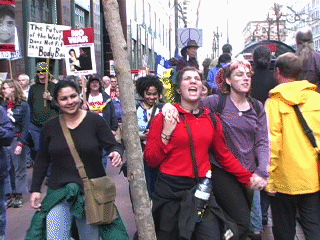
Feb 16, 2003 Part 4 of ? (Hi-res 32 MB)
Feb 16, 2003 Part 4 of ? (Lo-res 16 MB)
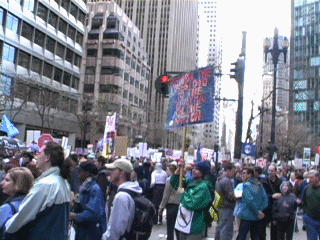
Marching down Market Street -- and another crowd swell.

Feb 16, 2003 Part 5 of ? (Hi-res 38 MB)
Feb 16, 2003 Part 5 of ? (Lo-res 18 MB)
The street is growing more and more crowded at a very rapid rate.

Feb 16, 2003 Part 6 of ? (Hi-res 33 MB)
Feb 16, 2003 Part 6 of ? (Lo-res 16 MB)
Me On The Way To The March

A neighbor nearby who was also on his way to the protest gave me a ride on his motorcycle.
(Note: First time I've been on a bike in over 10 years. Boy are they fun!)
Feb 16, 2003 Part 1 of ? (Hi-res 20 MB)
Feb 16, 2003 Part 1 of ? (Lo-res 10 MB)
Kevin Burton On The Pre-March
People are heading towards Embarcadero before the official march begins.
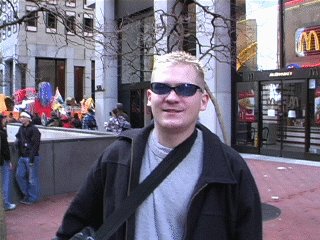
Feb 16, 2003 Part 2 of ? (Hi-res 33 MB)
Feb 16, 2003 Part 2 of ? (Lo-res 16 MB)

Market Street Around Noon
The street filled up very quickly all the way across from sidewalk to sidewalk.
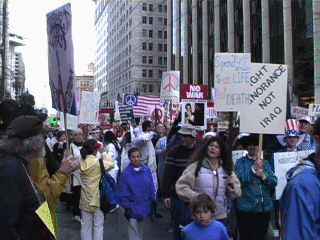
Feb 16, 2003 Part 3 of ? (Hi-res 38 MB)
Feb 16, 2003 Part 3 of ? (Lo-res 18 MB)
I'm uploading some movies now and I'll start linking to them in the morning.
There were even more people than last time. I couldn't get up to the stage like before, or score a press pass. (But I still shot a lot of great footage.)
I'm going to try something different this time and put up the footage in the order I shot it. So you can sort of see how the day progressed (for me, anyway).
Update 2/18/03: Here's the video up so far: Parts 1-3
Parts 4-6
See you in the am!
Here are some movies from Joi Ito of the Anti-war Parade In Shibuya:
I've posted a two movies clips I took at the anti-war parade in Shibuya. The first one is a 1.7MB QT movie of the Japanese drummers and the second one is a 780K QT movie of the big black flags of the anarchics waving in the air walking down Koendori in front of the Marui department store. I imagined that we were marching for the overthrow of the Japanese government for a moment. ;-)
I've got a ton of links to put up about the protests that have been going on all over the world the last two days, and then I'm going early to the protest around 10:30 so I won't miss anything. (Update at 10am: I'm running late and will have to post all of this stuff this afternoon after the protest -- in between video crunching.)
Downtown San Francisco isn't really equipped to hold more than it had to at the last protest (150,000+), so it will be quite interesting to see how everything pans out.
If you're into showing your support, but not into walking 15 blocks or so with a huge crowd, you should just show up at Civic Center around 2pm. If it's anything like last time, the entire area in a six block radius around the Civic Center will be alive with people, music, dance, theatre and song.
If you live within walking distance -- even a bit of a long walk -- that's definitely the best form of transportation.
See you there! I'll have footage up tonight!
hi-res pics of no war parade in Tokyo
From my friend Gohsuke Takama in Tokyo!
it was fullmoon night in Tokyo. variety of people gathered in Tokyo's most
fasionable Shibuya area, did war protest parade on Sat night. there were
really different people. univ students, union member types to artist types
such as actors. street drummers kept dancing. many foreigners included. my
estimate was about 10k people.
Here are some clips of Senator Max Baucus (D-Montana) from
yesterday's debate over the nomination of Miguel Estrada
to the second highest court in the land.
It was lengthly, but very interesting. I sure learn a lot watching
CSPAN. (Well, a lot compared to what I used to know before about this stuff anyway, which was nothing :)
Senator Max Baucus (D-Montana) explains a thing
or two about the Estrada situation
(Note: These clips are in no way complete -- he spoke for
two or three times as long as these clips):
Highlights with descriptions: Part 1: Baucus recalls how he
recalls Supreme Court Justice O'Connor starting the
practice of not answering certain questions when she
was being considered for the bench -- noting that she
had an extensive record from which she could be
assessed. Estrada, in contrast, has refused to answer
any questions whatsoever. (Not just one or two
questions that he doesn't feel comfortable about.)
Sen Max Baucus On CSPAN Part 1 of 4 (Lo-Res - 17 MB)
Audio - Sen Max Baucus On CSPAN Part 1 of 4 (Lo-Res - 2 MB)
Part 2 - Baucus talks about how important it is to
know what kind of a person that nominee is since
these are lifetime appointments.
Sen Max Baucus On CSPAN Part 2 of 4 (Lo-Res - 17 MB)
Audio - Sen Max Baucus On CSPAN Part 2 of 4 (Lo-Res - 2 MB)
Part 3 - Baucus elaborates about how he feels
responsible to do what is right by the people.
He also brings up the point that the Justice Dept.
probably interviewed Estrada before the Shrub
made his recommendation -- and asks "why wasn't
that information made available to the Senate?"
Sen Max Baucus On CSPAN Part 3 of 4 (Lo-Res - 25 MB)
Audio - Sen Max Baucus On CSPAN Part 3 of 4 (Lo-Res - 3 MB)
Part 4 - Baucus talks about when Roosevelt tried
to pack the Supreme Court when he didn't like
the decisions it had been making. (He tried to
add Justices to the court.) But the Senate stood
up to him. Now it is time, he said, for the Senate
to stand up against the blind approval of these kind
of mystery nominees.
Sen Max Baucus On CSPAN Part 4 of 4 (Lo-Res - 40 MB)
Audio - Sen Max Baucus On CSPAN Part 4 of 4 (Lo-Res - 4 MB)
Senator Max Baucus (D-Montana) Complete Audio:
Audio - Sen Max Baucus On CSPAN - Parts 1-4 (Hi-Res - 10 MB)
Audio - Sen Max Baucus On CSPAN - Parts 1-4 (Lo-Res - 5 MB)
But we all knew this already, right?
Terror Alert Partly Based on Fabricated Information
By Brian Ross, Len Tepper and Jill Rackmill for ABCNEWS.com
It was only after the threat level was elevated to orange — meaning high — last week, that the informant was subjected to a polygraph test by the FBI, officials told ABCNEWS."This person did not pass," said Cannistraro.
According to officials, the FBI and the CIA are pointing fingers at each other. An FBI spokesperson told ABCNEWS today he was "not familiar with the scenario," but did not think it was accurate.
Despite the fabricated report, there are no plans to change the threat level. Officials said other intelligence has been validated and that the high level of precautions is fully warranted.
Here is the full text of the article in case the link goes bad:
http://www.abcnews.go.com/sections/wnt/US/terror030213_falsealarm.html
False Alarm?
Terror Alert Partly Based on Fabricated Information
By Brian Ross, Len Tepper and Jill Rackmill
ABCNEWS.com
Feb. 13 — A key piece of the information leading to recent terror alerts was fabricated, according to two senior law enforcement officials in Washington and New York.
The officials said that a claim made by a captured al Qaeda member that Washington, New York or Florida would be hit by a "dirty bomb" sometime this week had proven to be a product of his imagination.
The informant described a detailed plan that an al Qaeda cell operating in either Virginia or Detroit had developed a way to slip past airport scanners with dirty bombs encased in shoes, suitcases, or laptops, sources told ABCNEWS. The informant reportedly cited specific targets of government buildings and Christian or clerical centers.
"This piece of that puzzle turns out to be fabricated and therefore the reason for a lot of the alarm, particularly in Washington this week, has been dissipated after they found out that this information was not true," said Vince Cannistraro, former CIA counter-terrorism chief and ABCNEWS consultant.
It was only after the threat level was elevated to orange — meaning high — last week, that the informant was subjected to a polygraph test by the FBI, officials told ABCNEWS.
"This person did not pass," said Cannistraro.
According to officials, the FBI and the CIA are pointing fingers at each other. An FBI spokesperson told ABCNEWS today he was "not familiar with the scenario," but did not think it was accurate.
Despite the fabricated report, there are no plans to change the threat level. Officials said other intelligence has been validated and that the high level of precautions is fully warranted.
New Yorkers Taking Police Presence in Stride
In New York, police are out in force in the subways, at train stations and airports and at the bridge and tunnel crossings into the city with radiation detectors and gas masks. In a press conference this afternoon, Mayor Michael Bloomberg said 16,000 law enforcement officials trained to combat terrorism were deployed in the city. Air patrols have also returned to New York.
"We are constantly changing what we're doing so no one can predict what instruments we'll be using and where we'll be going," Bloomberg said. The mayor stressed that while people should be vigilant, they should also be aware that New York City has been on code level orange for 17 months — since the Sept. 11, 2001 attacks that destroyed the World Trade Center.
New Yorkers, and people around the country, should not be frozen by fear and must carry on with their daily lives, the mayor said. New York Gov. George Pataki said it is important for people to be alert to anything suspicious around them, but that they should not spread rumors that could create panic.
‘Threat Is Still There’
"By no means do people believe the threat has evaporated," said Cannistraro. "The threat is still there, the question really is the timing and when this is going to happen."
It's not the first time a captured al Qaeda operative has made up a huge story and scared a lot of people.
The FBI concluded the information that led to a nationwide hunt for five men suspected of infiltrating the United States on Christmas Eve was fabricated by an informant, and the agency called off the alert sparked by the information.
Officials said this one got so far because it coincided with other intelligence, that officials still believe points to a coming attack, timed to hostilities with Iraq.
Tim O'Reilly Explains Why He's Excited About Bioinformatics:
Audio Tim O'Reilly On Bioinformatics (MP3 - Hi-Res - 4 MB)
Tim O'Reilly On Bioinformatics (Hi-Res - 73 MB)
Tim O'Reilly On Bioinformatics (Lo-Res - 31 MB)
Tim O'Reilly On Bioinformatics Part 1 of 2 (Lo-Res - 15 MB)
Tim O'Reilly On Bioinformatics Part 2 of 2 (Lo-Res - 16 MB)
All in a normal month for Jeb Bush:
First throw a big lavish party atop of Florida State University's Intramural fields -- damaging them beyond repair. Be vague about the details of replacing them.
Next, declare February "Florida Library Appreciation Month" - then lay off the entire staff of the state's main library and move the collection to FSU -- without providing any funds or resources to assist with actually storing the materials.
Bush wants to close book on library flap
Bush, who has said promotion of reading is a top priority of his second term, wants to shut down the state's main library and move almost 1 million books and historical items, including 16th-century maps, early documents on Walt Disney World and some of the oldest photos of Florida.The budget-cutting move has drawn fire, and even FSU said it doesn't have space or money to house the items.
Parts of FSU's own collection are in warehouses, and the university wouldn't get any more money or staff to deal with the new collections...
About 4,000 people paid $100 each to crowd into a lavish tent on top of the sports fields to dine, dance and drink on the eve of Bush's second inaugural.
The next morning, the turf was tapioca...
Meanwhile, Courtney Gallant, 22, an Orlando native and president of FSU's women's lacrosse club, has been rescheduling the team's practices.
She said she has learned a life lesson from the event.
"I didn't vote in the last election," Gallant said. "I didn't think it was going to affect me much. But the next thing you know, something that looked like an aircraft hangar was sitting on top of my intramural field."
Here's the full text of the article in case the link goes bad:
http://www.orlandosentinel.com/news/local/state/orl-locpulse02020203feb02,0,497943.story?coll=orl-news-headlines
Bush wants to close book on library flap
By John Kennedy | Sentinel Staff Writer
Posted February 2, 2003
Not long before it was revealed that Gov. Jeb Bush planned to close the Florida State Library, lay off the entire staff and move the collection to Florida State University, the governor issued a proclamation declaring February as Florida Library Appreciation Month.
Bush, who has said promotion of reading is a top priority of his second term, wants to shut down the state's main library and move almost 1 million books and historical items, including 16th-century maps, early documents on Walt Disney World and some of the oldest photos of Florida.
The budget-cutting move has drawn fire, and even FSU said it doesn't have space or money to house the items.
Parts of FSU's own collection are in warehouses, and the university wouldn't get any more money or staff to deal with the new collections.
Told last week that the flap doesn't seem to be going away, Bush answered, "So, stop writing about it."
The governor's proclamation praised the importance of libraries and said the month is "to encourage recognition of all of our Florida libraries that provide outstanding service to our communities."
Good thing he didn't proclaim "Florida Library Year."
The party's over
Bush's inaugural committee says it will make good on its promise to repair about $50,000 in damage to the Florida State University intramural fields, used as the site of last month's "Black Tie and Blue Jeans" governor's ball.
About 4,000 people paid $100 each to crowd into a lavish tent on top of the sports fields to dine, dance and drink on the eve of Bush's second inaugural.
The next morning, the turf was tapioca.
New sod, regrading and maybe some irrigation work is needed to restore the field, said Paul Dirks, FSU's campus recreation director.
The inaugural committee, whose festivities are to be paid out of more than $1 million expected from private contributions, still has cash to cover the expense, said Todd Harris, a committee spokesman.
Meanwhile, Courtney Gallant, 22, an Orlando native and president of FSU's women's lacrosse club, has been rescheduling the team's practices.
She said she has learned a life lesson from the event.
"I didn't vote in the last election," Gallant said. "I didn't think it was going to affect me much. But the next thing you know, something that looked like an aircraft hangar was sitting on top of my intramural field."
Rolodex updates
Former Bush spokeswoman Katie Muniz, who left the administration on inauguration day, has resurfaced as public affairs manager for the St. Joe Co., the land giant planning development across the Florida Panhandle.
Another mouthpiece, Nicole Harburger, spokeswoman for Democrat Janet Reno's campaign for governor, is the new communications director for the Democratic Governors' Association.
Former Attorney General Richard Doran, who stepped in briefly when Bob Butterworth quit to run for state Senate, has joined the Ausley & McMullen law firm in Tallahassee.
John Kennedy can be reached at jkennedy@orlandosentinel.com. Bob Mahlburg can be reached at bmahlburg@orlandosentinel.com. Both also can be reached at 850-222-5564.
Senator Tim Johnson Explaining how Miguel Estrada refused to answer any questions asked of him by the Senate Judiciary Committee:
Audio Sen. Tim Johnson On CSPAN (MP3 - Hi-Res - 4 MB)
Audio Sen. Tim Johnson On CSPAN (MP3 - Lo-Res - 2 MB)
Sen. Tim Johnson On CSPAN - ALL (Lo-Res - 49 MB)
Sen. Tim Johnson On CSPAN Part 1 of 2 (Lo-Res - 25 MB)
Sen. Tim Johnson On CSPAN Part 2 of 2 (Lo-Res - 24 MB)
Senator Tim Johnson Explaining the dangers of setting a precendent where Judicial nominees would not have to provide any information about their beliefs (effectively rubber stamping presidential nominees):
More Sen. Tim Johnson On CSPAN (Lo-Res - 14 MB)
Audio - More Sen. Tim Johnson On CSPAN (MP3 - Hi-Res - 2 MB)
So Bill Frist just said that, although debate over Estrada will resume tomorrow, no roll call votes will occur regarding him or anything else until after 5:30 pm on Monday, February 24.
Looks like a Filibuster turned out not to be necessary. The threat of one was enough, apparently.
I'll be putting stuff up all nite from today's Senate session.
Now, citizens all over the country stand up against U.S. tyranical warmonger. On Jan. 18, over a million people cried "No to Attack on IRAQ" in more than 40 countries. In Japan, about 7,000 citizens of various fields and generations participated WORLD PEACE NOW Jan. 18 at Hibiya park in Tokyo. There were also same kind of joint actions in about 30 cities in Japan. TV and news paper reported anti war joint actions in Japan and world scale.In spite of anti war actions spreading worldwide, U.S. attack on IRAQ is drawing to a crisis day by day. Therefore Stop the War Coalition in London called for world-wide day of demonstrations on 15 February against the prospect of war. We support this appeal and will hold acitons for peace to protest against U.S. war drive and its supporter; Koizumi government in Japan.
Okay so the deal with Estrada isn't that there's no way to determine how the guy feels about anything, because he's not providing any information about his record.
In fact, the root of the problem is that there's no way to determine much about him for sure, one way or the other. He has never served as a Judge anywhere else, so there's no way to judge him on past decisions. He's not a scholar so there are no academic writings from which his values can be derived.
He refused to provide the Senate with a single Supreme Court Decision he disagrees with, for instance. (Yes, in the entire history of the Supreme Court.)
There simply isn't enough information about the guy, and it appears that Estrada has been instructed by the Shrub Administration to not make any statements about anything -- even to the Senate attempting to evaluate him.
"He has refused to answer any basic questions. And he has no record...
The people deserve better," said Senator Tim Johnson (D- South Dakota)
"I hope that never again will we see this kind of stealth process."
Yeah, I'm recording it....Don't worry...And on VHS because my TiVOs so full these days. (How quaintly retro.)
Right now Senator Saxby Chambliss (R-Georgia) is really hamming it up about Estrada being Hispanic, and working his way up from nothing as an immigrant, etc. "We think you've come far from a lowly background...and he's taken advantage of the opportunities that have been given to you...."
Anyway, tune in for yourself if you're interested...
Democrats Prepare for Estrada Filibuster
AP story by Jesse J. Holland.
The White House on Wednesday refused to release internal Justice Department (news - web sites) memos written by one of President Bush (news - web sites)'s nominees to an important appeals court, setting up a partisan showdown over Miguel Estrada.Democrats say they will use a filibuster to keep Estrada from being confirmed for the U.S. Court of Appeals for the District of Columbia Circuit until the Washington lawyer answers more of their questions. They also want internal Justice memos Estrada wrote while working for the solicitor general's office. Democrats say those writings would reveal how Estrada would think as a judge...
Democrats said the refusal means the Estrada debate will drag on. "I regret that the White House remains recalcitrant and continues to stand in the way of a solution to this impasse," said Sen. Patrick Leahy (news, bio, voting record) of Vermont, the top Democrat on the Judiciary Committee (news - web sites).
Bush said the Democratic plan to block his nominee, who would be the first Hispanic judge on the appeals courts, was "shameful politics." Senate GOP leader Bill Frist warned Democrats that he might force them to stay in the Senate chamber at night and on weekends until he gets a final vote on Estrada.
"I think it is important for America to understand that your side of the aisle is — whether or not you use the word filibuster or not — is obstructing or stalling a process that is important to our judicial system," said Frist, R-Tenn.
Here is the full text of the article in case the link goes bad:
http://story.news.yahoo.com/news?tmpl=story2&u=/ap/20030213/ap_on_go_pr_wh/senate_estrada&e=2
White House - AP
Democrats Prepare for Estrada Filibuster
Wed Feb 12, 9:45 PM ET
Add White House - AP to My Yahoo!
By JESSE J. HOLLAND, Associated Press Writer
WASHINGTON - The White House on Wednesday refused to release internal Justice Department (news - web sites) memos written by one of President Bush (news - web sites)'s nominees to an important appeals court, setting up a partisan showdown over Miguel Estrada.
Democrats say they will use a filibuster to keep Estrada from being confirmed for the U.S. Court of Appeals for the District of Columbia Circuit until the Washington lawyer answers more of their questions. They also want internal Justice memos Estrada wrote while working for the solicitor general's office. Democrats say those writings would reveal how Estrada would think as a judge.
But White House counsel Alberto Gonzales, in a letter Wednesday, told senators that the administration would not release the documents and that Justice normally does not release such documents. All of the living former solicitors general, four Democrats and three Republicans, have agreed with the White House's position, he said. "That is a fundamental principle that has been followed irrespective of the party that controls the White House and the Senate," Gonzales said.
Democrats said the refusal means the Estrada debate will drag on. "I regret that the White House remains recalcitrant and continues to stand in the way of a solution to this impasse," said Sen. Patrick Leahy (news, bio, voting record) of Vermont, the top Democrat on the Judiciary Committee (news - web sites).
Bush said the Democratic plan to block his nominee, who would be the first Hispanic judge on the appeals courts, was "shameful politics." Senate GOP leader Bill Frist warned Democrats that he might force them to stay in the Senate chamber at night and on weekends until he gets a final vote on Estrada.
"I think it is important for America to understand that your side of the aisle is — whether or not you use the word filibuster or not — is obstructing or stalling a process that is important to our judicial system," said Frist, R-Tenn.
Democrats are looking for material they can use against Estrada, since he didn't provide them with anything controversial during his confirmation hearing last year, said Senate Judiciary Chairman Orrin Hatch, R-Utah. "They couldn't dig up any dirt on him," Hatch said. "So what are they doing now? Trying to see through a fishing expedition if they can find some documents where they can."
Democrats have not yet tried a traditional filibuster on Estrada, although they say they will if necessary. That means lawmakers take over the Senate floor and refuse to allow the Senate to go home or move to other business until they get their way.
That type of filibuster is rare today, Senate historian Don Ritchie said. "The old image of 'Mr. Smith Goes To Washington,' and one senator holding the Senate for hours and hours doesn't happen anymore," Ritchie said.
Democrats say they have enough votes to sustain that type of filibuster against Estrada, who they contend lacks judicial experience. Democrats also complained about his refusal to answer questions about specific cases, including abortion rights, and to provide copies of the memos.
"It's simply not right for anyone to be asked to make a decision in the dark," said Senate Democratic leader Tom Daschle of South Dakota.
Since Estrada's nomination in May 2001, Republicans have accused Democrats of treating him unfairly because he is a conservative Hispanic. The GOP has the 51 votes needed to confirm him but not the votes to stop a filibuster.
Democrats "can vote against him. That is their right. And if that is what they want to do, that is the proper exercise of their constitutional duty," Hatch said.
"But to simply deny the Senate a vote is unfair to the nominee, it's unfair to this body, it's unfair to the president, it's unfair to the majority of senators who want to vote for this man."
Daschle said if they do not force Estrada to answer their questions, other Bush nominees will stonewall them. "If we don't draw the line here, we will never be able to draw this line," Daschle said.
Senate parliamentary rules allow a filibuster to be maintained with just 41 votes. Democratic aides say Democrats have 44 of their 48 senators agreeing to keep a filibuster going, with Sens. John Breaux of Louisiana, Zell Miller of Georgia and Ben Nelson of Nebraska against a filibuster and Sen. Blanche Lincoln (news, bio, voting record) of Arkansas on the fence.
The longest traditional Senate filibuster in history belongs to recently retired Sen. Strom Thurmond (news, bio, voting record) of South Carolina, who spoke for 24 hours and 18 minutes in opposition to civil rights legislation in 1957. Thurmond failed, and the bill eventually passed the Senate.
If you haven't heard about this Estrada guy until know and it doesn't seem like it could be that important or you would have, please keep reading.
It's important...Promise :-)
This just in from Move On.
You can look up your reps to call and thank them (Congressmerge -- anyone know of a better lookup service?)
In any case: do it now guys! Thanks!
Responding to thousands of our calls, Democrats have just launched
a filibuster* to prevent the confirmation of Miguel Estrada to
America's second-highest court. This filibuster is the first sign
of real resistance to extremism in Congress and the White House...Please call your Senators now, at:
Senator Feinstein (D)
Local Phone: 310-914-7300
DC Phone: 202-224-3841Senator Boxer (D)
Local Phone: 415-403-0100
DC Phone: 202-224-3553If your Senator is a Democrat, say:
"Thank you for supporting the filibuster
to block the Estrada nomination.
Please speak out on the Senate floor."If your Senator is a Republican, say:
"Please support the filibuster to block
the Estrada nomination."A story on the filibuster in today's New York Times is at:
http://www.nytimes.com/2003/02/12/politics/12ESTR.htmlFor more information on Estrada, there's a good fact sheet at:
http://www.pfaw.org/pfaw/general/default.aspx?oid=7795* For more information on filibusters, see our recent bulletin at:
http://www.moveon.org/moveonbulletin/bulletin11.html
Responding to thousands of our calls, Democrats have just launched
a filibuster* to prevent the confirmation of Miguel Estrada to
America's second-highest court. This filibuster is the first sign
of real resistance to extremism in Congress and the White House.
Weíve got to support this filibuster.
Please call your Senators now, at:
Senator Feinstein (D)
Local Phone: 310-914-7300
DC Phone: 202-224-3841
Senator Boxer (D)
Local Phone: 415-403-0100
DC Phone: 202-224-3553
If your Senator is a Democrat, say:
"Thank you for supporting the filibuster to block the Estrada
nomination. Please speak out on the Senate floor."
If your Senator is a Republican, say:
"Please support the filibuster to block the Estrada nomination."
If you are asked why you support the filibuster, make some of the
following points in your own words:
- Estrada has hidden his views on the law from the public;
- Estrada has a reputation as a right-wing extremist;
- The Senate must be informed to advise and consent on nominations.
Please let us know you're making your calls, at:
http://www.moveon.org/callmade2.html
The filibuster is a bold move -- playing the Senate's ultimate ace --
and bold moves carry big risks. This filibuster is now the battle line
on which everything we care about depends. Republicans will make every
effort to peel Dems away from the filibuster.
If they succeed, we're screwed. It's that simple. If the Dems cave
in here, the right wing will steamroller us on every issue, gutting
environmental protections, giving enormous new tax breaks to the rich
while the economy tanks, and eviscerating our civil rights.
But if the filibuster succeeds, it will be a resounding victory, giving
us a real chance to protect the things that matter to us. It could
even embolden the Democrats to challenge the White House's war plans.
Six weeks ago, nobody thought we'd get this far. Yet more than
18,000 MoveOn members have called since last week in support of the
filibuster. Hundreds of us vistited Senate offices a month ago.
Senators are telling each other what a difference MoveOn is making.
Our work is paying off and we've got to keep it up.
Please make your calls today. Please call again, even if you've called
before.
Thank you.
Sincerely,
--The MoveOn Team
Carrie, Eli, Joan, Peter, Wes, Zack
February 12, 2003
P.S.:
A story on the filibuster in today's New York Times is at:
http://www.nytimes.com/2003/02/12/politics/12ESTR.html
For more information on Estrada, there's a good fact sheet at:
http://www.pfaw.org/pfaw/general/default.aspx?oid=7795
* For more information on filibusters, see our recent bulletin at:
http://www.moveon.org/moveonbulletin/bulletin11.html
Here's a list of organizations opposing the Estrada nomination:
ADA Watch/National Coalition for Disability Rights
AFL-CIO
Alliance for Justice
American Association of University Women
Americans for Democratic Action
Congressional Hispanic Caucus
Congressional Black Caucus
Earthjustice
Feminist Majority
Labor Council for Latin American Advancement
Leadership Conference on Civil Rights
Mexican American Legal Defense and Educational Fund
MoveOn.org
National Association for the Advancement of Colored People
NAACP Legal Defense and Educational Fund, Inc.
NARAL Pro-Choice America
National Council of Jewish Women
National Family Planning and Reproductive Health Association
National Fair Housing Alliance
National Organization for Women
National Partnership for Women and Families
National Women's Law Center
People For the American Way
Planned Parenthood Federation of America
Puerto Rican Legal Defense and Education Fund
Sierra Club
Southwest Voter Registration and Education Project
United Auto Workers
Working Assets
________________
"Long War" is doublespeak for "thousands of our soldiers will die and we'll keep sending more over."
What happened to killing Saddam within 48 hours and leaving it at that? The story keeps changing and changing...
Even Colin Powell is trying to warn us about this war. As best he can, considering he works for the crazies that are in favor of this war.
Colin Powell. If you're listening. I have a question for you:
Why don't you stop this war right now by speaking out against it?
You could stop all the madness right now, by just picking up the telephone, resigning, and telling the world why.
Why not tell the truth you must know better than anyone else? Why show up to the U.N. with smoke and mirrors and a vial of anthrax and a dog and pony show?
(Video of this on the way, of course, courtesy of The Daily Show...of course.)
Powell: Commitment in Iraq Would Be Long
Secretary of State Colin Powell (news - web sites),
on the eve of another faceoff at the United Nations
(news - web sites) over disarming Saddam Hussein
(news - web sites), said Thursday the American
people should be "prepared for a fairly long-term
commitment" in Iraq...Once those goals are achieved, Powell said, the
U.S. military leader in such a war would take
temporary charge of Iraq. But that person
would give way to a prominent American
or international figure, whose own term
would be limited with an eye toward turning
over the government to the Iraqis themselves,
the secretary of state said."We would try to build as much as we can
on the structure that is there," Powell said.
"The challenge would be to put in place a
representative leadership."...His confrontation with officials of those
two countries is set for Friday in New York.
That's when chief U.N. weapons inspectors
Hans Blix and Mohamed ElBaradei report
on searches that have not turned up what
the Bush administration has characterized
as hundreds of concealed and illicit
biological and chemical weapons...Meanwhile, a new audio recording by
Osama bin Laden (news - web sites) was
reported Wednesday — the second to
surface this week — in which the al-Qaida
leader purportedly predicts his own death
in an unspecified act of "martyrdom."Al-Ansaar, a British-based Islamic news
agency, said it believed the 53-minute tape,
allegedly recorded earlier this month and
acquired by the news agency from an
unidentified man via an Internet contact,
was a carefully worded last will and
testament from bin Laden.
Here is the full text of the article in case the link goes bad:
http://news.yahoo.com/news?tmpl=story2&cid=542&e=1&u=/ap/20030213/ap_on_go_ca_st_pe/us_iraq
By BARRY SCHWEID, AP Diplomatic Writer
WASHINGTON - Secretary of State Colin Powell (news - web sites), on the eve of another faceoff at the United Nations (news - web sites) over disarming Saddam Hussein (news - web sites), said Thursday the American people should be "prepared for a fairly long-term commitment" in Iraq.
Appearing before the House Budget Committee, Powell said he could furnish no estimate of the cost of any war with Iraq. But he did say he thought that Arab nation should be able to adjust quickly after a war — in contrast to the slow pace of recovery in Afghanistan (news - web sites).
Iraq has an effective bureaucracy, rich oil resources and a developed middle class, Powell said. "I would hope that it would be a short conflict and that it would be directed at the leadership, not the society," he said.
Once those goals are achieved, Powell said, the U.S. military leader in such a war would take temporary charge of Iraq. But that person would give way to a prominent American or international figure, whose own term would be limited with an eye toward turning over the government to the Iraqis themselves, the secretary of state said.
"We would try to build as much as we can on the structure that is there," Powell said. "The challenge would be to put in place a representative leadership."
At another hearing, Sen. John Warner (news, bio, voting record), chairman of the Armed Services Committee, asked whether U.S. forces were prepared for a possible war with Iraq while continuing the fight against terrorism.
"Absolutely," replied Gen. Richard Myers, chairman of the Joint Chiefs of Staff.
Defense Secretary Donald H. Rumsfeld also told senators he couldn't estimate the cost of a war, but added, "It would cost a heck of a lot less than 9-11 cost and 9-11 would cost a heck of a lot less than a chemical or biological 9-11," referring to administration concerns that Iraq could provide weapons of mass destruction to terrorists.
Asked by Sen. Evan Bayh (news, bio, voting record), D-Ind., about the future of NATO (news - web sites) following a dispute with allies over defending Turkey, Rumsfeld joked "I have a feeling you're trying to put me in a position of defending Germany or France."
Bayh replied: "It's hard to defend the indefensible."
Rumsfeld said that while he is disappointed by the dispute, he believes the alliance is important. He recalled that the alliance has survived past disputes. "It's never been perfect. it's always been bumpy," he said.
Powell said Wednesday he intends to ask France and Germany whether they are opposing war with Iraq in order to get Saddam "off the hook."
His confrontation with officials of those two countries is set for Friday in New York. That's when chief U.N. weapons inspectors Hans Blix and Mohamed ElBaradei report on searches that have not turned up what the Bush administration has characterized as hundreds of concealed and illicit biological and chemical weapons.
U.S. and Russian officials on Wednesday said international missile experts this week did find that an Iraqi missile exceeds the maximum 93-mile range allowed under U.N. resolutions. U.S. Ambassador John Negroponte said it was now up to Blix to recommend what to do about the violation.
In addition, Turkey's foreign minister, Yasar Yakis, was holding talks in Washington on basing American troops in Turkey for use against Iraq.
And Sen. Joseph Lieberman (news, bio, voting record), D-Conn., asked President Bush (news - web sites) to consider convening debtor and donor conferences to pay for a smooth, post-Saddam transition.
Powell told the House International Relations Committee on Wednesday that all 15 nations who voted unanimously in November to threaten Iraq with "serious consequences" if it did not disarm knew they were voting for force as an option.
"I hope in the days ahead we will be able to rally the United Nations around the original resolution and what other resolution might be necessary in order to satisfy the political needs of a number of the countries," Powell said.
But he said the United States would not be deterred by opposition to using force.
"France and Germany are resisting," he said. "They believe that more inspections, more time" should be allowed.
"The question I will put to them is: Why more inspections? And how much more time?" Powell said. "Or are you just delaying for the sake of delaying in order to get Saddam Hussein off the hook and no disarmament? That's a challenge I will put to them."
A U.S. official confirmed that Powell would be in New York, speaking to his counterparts Friday. The Security Council members will have a chance to discuss the report from Blix and ElBaradei first at the open meeting, and then in a closed session, said Germany's U.N. Ambassador Gunter Pleuger, the current council president.
The New York Times reported in Thursday's editions that Pentagon (news - web sites) officials say Iraqi forces have moved explosives into the southern part of the country in preparation for blowing up bridges, bursting dams and igniting oil fields in a strategy to slow an American attack.
Meanwhile, a new audio recording by Osama bin Laden (news - web sites) was reported Wednesday — the second to surface this week — in which the al-Qaida leader purportedly predicts his own death in an unspecified act of "martyrdom."
Al-Ansaar, a British-based Islamic news agency, said it believed the 53-minute tape, allegedly recorded earlier this month and acquired by the news agency from an unidentified man via an Internet contact, was a carefully worded last will and testament from bin Laden.
U.S. counterterrorism officials, speaking on condition of anonymity, said they were studying the new message.
Antiwar protesters rally to cause
By By Burhan Wazir for The Observer.
If half a million people pour on to the streets of
London next week to protest about the prospect
of war in Iraq, as many are now predicting, John
Rees will have reason to be pleased with himself.
He is among a tiny handful of people behind one
of the most rapidly growing and widely based protest
movements to emerge in Britain since the war...Over the past 18 months, the coalition, chaired
by Andrew Murray, a former journalist and trade
union official, has established itself at the forefront
of the anti-war movement in the UK. Each week the
organisation gathers people at small town hall
meetings, churches and mosques throughout Britain.
People have, for the most part, then organised
themselves. A snowball effect has resulted. Nearly
200 coaches have been booked to ferry supporters
into the capital.As well as emails, organisers have used text
messaging, professionally designed adverts and
computer banking techniques to raise cash. 'The
volume of emails - 1,000 a day - is particularly
difficult to keep up with,' said Rees.So too is the lack of experience of many of the
would-be marchers. 'Many people have never
attended a march before. They have no idea of
what to do. So they organise themselves slowly.
Whereas before five people were turning
up at these small meetings, these days it's closer
to 100.'
Here is the entire text of the article in case the link goes bad:
http://www.observer.co.uk/international/story/0,6903,891988,00.html
Observer February 9, 2003
Antiwar protesters rally to cause
By Burhan Wazir
If half a million people pour on to the streets of London next week to
protest about the prospect of war in Iraq, as many are now predicting, John
Rees will have reason to be pleased with himself. He is among a tiny handful
of people behind one of the most rapidly growing and widely based protest
movements to emerge in Britain since the war.
Rees is a key organiser behind the Stop The War Coalition. As he sits and
mass-emails the coalition's daily information updates at the organisation's
Brick Lane headquarters, he explains its workings. Email addresses are
passed on to like-minded groups and activists who have donated around £100
each to the organisation's advertisements and fliers. Mass mail-outs are
then sent out to attract support, disseminate information and rebuke what is
considered propaganda.
Over the past 18 months, the coalition, chaired by Andrew Murray, a former
journalist and trade union official, has established itself at the forefront
of the anti-war movement in the UK. Each week the organisation gathers
people at small town hall meetings, churches and mosques throughout Britain.
People have, for the most part, then organised themselves. A snowball effect
has resulted. Nearly 200 coaches have been booked to ferry supporters into
the capital.
As well as emails, organisers have used text messaging, professionally
designed adverts and computer banking techniques to raise cash. 'The volume
of emails - 1,000 a day - is particularly difficult to keep up with,' said
Rees.
So too is the lack of experience of many of the would-be marchers. 'Many
people have never attended a march before. They have no idea of what to do.
So they organise themselves slowly. Whereas before five people were turning
up at these small meetings, these days it's closer to 100.'
Many attending the rally are political debutantes who have been persuaded
after seeing the organisation's full-page adverts in newspapers. Ruth
Linnett, 27, an actress from Mitcham, has never attended a rally before.
'There are quite a few issues I have felt strongly about in the past,' she
said. 'A number of my friends are also going on the march. This is something
that could have implications for all of us for the rest of our lives.'
Aura Ghanieri, 19, studying in London, was born on Long Island, New York.
She has never attended a rally before. 'I want to help the cause,' she said.
'I hope I will be able to stop this war. This is unjust, immoral and
illegal. As for the fresh evidence last week: I didn't believe any of it. It
was all fuzzy pictures and bad videos.'
Those marching next Saturday span all ages and social backgrounds. Dan
Goldwater, 13, said he was persuaded to join the march by talking to his
schoolfriends. 'I'm strongly against the war, and I would like to
demonstrate that. My friends and I think that the inspectors need more time.
All countries should be disarmed, and that includes America and Britain.'
As with any anti-war collation, STW has attracted supporting groups from all
walks of British life. The Liverpool Dockers Shop Stewards Committee, the
Arab Organisation of Human Rights, the Black Racial Attack Independent
Network, the British Humanist Association, Globalise Resistance, the London
Council of Mosques, Roman Catholics and Church of England groups are all
represented. Despite differences in emphasis, the organisers are confident
that marchers will be united behind one main goal, to stop the war
As with any march of this nature, the police have made some extensive
preparations. Around 1,300 officers will be out in force on the day, backed
up by helicopters with cameras and CCTVs. 'The main concerns is for this
march to pass off safely and without any trouble. The organisers have been
very cooperative,' said Deputy Assistant Commissioner Andy Trotter.
Commentators believe the march has all the prospects of becoming a pivotal
moment in the run-up to any war on Iraq.
Eric Hobsbawm, the historian and writer, told The Observer: 'Next week's
march very much goes against the theory that people are not interested in
politics anymore. Of course, you cannot expect the march to achieve anything
such as a change of policy but with an obviously large turn-out expected,
most people will be very encouraged. It will show them that popular protest
is very much alive.'
Here's another story from my local station KTVU Channel 2 - (Lo-Res - 26 MB) about how local business are fearing that this War will mean the end for them (finish off what's left of their businesses after 911).
It is my belief that people feel that small business' across the country will be hurt straight across the board.
Let me know if you need this file in smaller chunks.
Although the Shrub has hopped up the war talk this week, the reality of the situation is that Saddam is complying with U.N. demands -- now more than ever.
Here's a story that got out Sunday night on my local station KTVU Channel 2 before the nation-wide war push got going:
Update On Iraq Situation (Lo-Res - 20 MB)

Too much going on over at the FCC for me to understand completely. But I do seem to get word of a lot of it, so I'd better start a category for those of you who are interested...
FCC Split Threatens Leader's Agenda
By Christopher Stern for the Washington Post.
Federal Communications Commission Chairman
Michael K. Powell's deregulatory agenda has run
into stiff opposition from his own colleagues that
may force him to postpone a long-awaited vote on
issues critical to the future of the telecommunications
industry.FCC staffers, under direction from Powell, crafted a
proposal last fall that would have effectively forced
AT&T Corp., WorldCom Inc. and other companies to
abandon their plans to enter the local telephone business
by leasing lines from companies such as Verizon
Communications Inc. and BellSouth Corp. In addition,
the staff proposal would have rolled back the ability
of fledgling competitors to provide high-speed Internet
service over the local phone network.But a rival proposal put forward by commissioner
Kevin J. Martin derailed the staff recommendation
after it attracted the support of the agency's two
Democratic commissioners, Michael J. Copps and
Jonathan S. Adelstein...Martin's compromise proposal would give state
regulators the power to write the rules governing
how much of the local telephone network must be
made available to competitors. It would also
require that local telephone companies provide
their rivals with the ability to deliver Internet service
to their customers at speeds equivalent to
1.5 megabits per second -- about 10 times as fast
as a dial-up modem.Powell's threat to delay the vote is another
indication of the growing influence of Martin,
a former FCC staffer who was appointed commissioner
by President Bush in 2001. Although both Martin
and Powell are Republicans, they are increasingly
viewed as rivals who each have their own vision
for leading the agency...During the 2000 presidential election, Martin
worked for the Bush legal team that successfully
argued before the Supreme Court in favor of
upholding the election results amid a controversial
vote count in Florida. Martin's wife, Catherine, is
the spokeswoman for Vice President Cheney.Powell also has ties to the White House through
his father, Secretary of State Colin L. Powell, but
is not viewed as politically savvy as Martin, who
spent the past several months quietly building
bridges with the agency's two Democrats. The
result is that Martin now controls a three-vote majority
at the FCC that usually belongs to the chairman.
Here is the full text of the article in case the link goes bad:
http://www.washingtonpost.com/wp-dyn/articles/A54167-2003Feb10.html
FCC Split Threatens Leader's Agenda
Local-Phone Vote May Be Postponed
By Christopher Stern
Washington Post Staff Writer
Tuesday, February 11, 2003; Page E01
Federal Communications Commission Chairman Michael K. Powell's
deregulatory agenda has run into stiff opposition from his own
colleagues that may
force him to postpone a long-awaited vote on issues critical to the
future of the telecommunications industry.
FCC staffers, under direction from Powell, crafted a proposal last fall
that would have effectively forced AT&T Corp., WorldCom Inc. and other
companies to abandon their plans to enter the local telephone business
by leasing lines from companies such as Verizon Communications Inc. and
BellSouth Corp. In addition, the staff proposal would have rolled back
the ability of fledgling competitors to provide high-speed Internet
service over the
local phone network.
But a rival proposal put forward by commissioner Kevin J. Martin
derailed the staff recommendation after it attracted the support of the
agency's two
Democratic commissioners, Michael J. Copps and Jonathan S. Adelstein.
In a last-minute attempt to derail Martin's proposal, Powell may decide
to postpone a final vote, originally scheduled for Thursday, to put more
pressure on
Martin or one of the Democratic commissioners to change their position.
Martin's compromise proposal would give state regulators the power to
write the rules governing how much of the local telephone network must
be made
available to competitors. It would also require that local telephone
companies provide their rivals with the ability to deliver Internet
service to their
customers at speeds equivalent to 1.5 megabits per second -- about 10
times as fast as a dial-up modem.
Powell's threat to delay the vote is another indication of the growing
influence of Martin, a former FCC staffer who was appointed commissioner
by
President Bush in 2001. Although both Martin and Powell are Republicans,
they are increasingly viewed as rivals who each have their own vision
for
leading the agency.
Their inability to work together has frustrated some members of
Congress, who would like the three Republicans on the five-member
commission to begin
taking advantage of their majority. "Powell and Mr. Martin have had
problems from Day One," said W.J. "Billy" Tauzin (R-La.), chairman of
the House
Energy and Commerce Committee. "I don't know if it's personal or what. I
don't care."
Martin declined to be interviewed yesterday, but he issued a statement
in response to a request from a reporter. "I look forward to working
with my
colleagues to provide regulatory relief for broadband and new
investment, preserve existing competition for local telephone service,
and protect states rights
in this area," the statement said. Martin's supportors said he has no
personal interest in opposing Powell and is merely standing up for his
own views.
Sources said Martin's support for state regulators reflects his close
ties to the White House. Bush, a former governor of Texas, has often
voiced his
antipathy for federal regulations that usurp the authority of local
officials.
During the 2000 presidential election, Martin worked for the Bush legal
team that successfully argued before the Supreme Court in favor of
upholding the
election results amid a controversial vote count in Florida. Martin's
wife, Catherine, is the spokeswoman for Vice President Cheney.
Powell also has ties to the White House through his father, Secretary of
State Colin L. Powell, but is not viewed as politically savvy as Martin,
who spent
the past several months quietly building bridges with the agency's two
Democrats. The result is that Martin now controls a three-vote majority
at the FCC
that usually belongs to the chairman.
Martin's ability is particularly frustrating to Tauzin, one of the local
phone companies' key allies in Congress. "If he continues to work with
the two
Democrats, he has created a new majority and that's pretty tragic if
that happens," Tauzin said.
In the meantime, Powell's lone supportor is Republican commissioner
Kathleen Q. Abernathy.
Tom Hazlett, a former chief economist for the FCC who supports Powell's
deregulatory efforts, said a decision to delay the vote would be a sign
that
Powell is struggling in his role as chairman. "This does say something
about Powell and his ability to overcome the natural political inertia
that
accompanies every big decision at the FCC," he said.
Powell has often cited Feb. 20 as the deadline for deciding the issue,
because a federal court found that flaws in the rules must be addressed
by that date.
But industry sources say the deadline could pass without significant
impact because many of the current network leasing agreements are
governed by
long-term contracts.
Staff writer Jonathan Krim contributed to this report.
This just in from the Copyright Office:
"THE COPYRIGHT OFFICE COMES TO CALIFORNIA" During the first week of March, top officials from the Copyright Office will participate in a program in Los Angeles and San Francisco where they will provide an update on the latest Copyright Office law and policy activities, including rulemakings, legislation, and international activities. The program will also include presentations on fair use in the twenty-first century and copyright registration issues for practitioners and copyright owners. Sponsored by the Intellectual Property Law Section of the State Bar of California and the Los Angeles Copyright Society, the program will take place March 3 in Santa Monica, Calif. and March 5 in San Francisco. Participants may earn MCLE credits. For further information, go to:California seminar on latest Copyright Office law and policy activities, including rulemakings, legislation, and international activities
The morning after the November 5, 2002 election, I wrote this post.
In many ways, I regret making that post before all of the facts were in -- even if I was correct in my assumptions. (It's just a bad practice in general for reasons I'm sure I don't need to explain here.)
However, now that the facts are in, it would appear that the situation is actually even worse than I feared.
We need to work together to not only get to the bottom of this stuff (purge lists, lack of exit polls or conflicting exit poll results, computer voting manipulation, conflict of interests/politicians owning stock in voting machine companies) -- but keep focusing on the big picture: a fair election in 2004.
That means it will be more important to make sure everybody knows who these people are -- and work with the good guy democrats and republicans to reform our system -- and fast -- and, in many ways, leave it at that.
If we're not careful, we'll get caught up in some "make the skapegoats pay" bullshit session while the real people responsible for what's is happening quietly steal another election.
Attention Geeks, Newbies, and Those of You Who May Not Have Ever Voted Before In An Election: Your country needs you. It's time for us all to get hands-on in a big way with our country's elections.
This post was actually inspired by Douglas Rushkoff's threatening to not write about politics anymore. On the countrary Doug. After this beautiful post, it is my hope that you will be writing about politics more than ever!
After Democracy
As is becoming increasingly clear, the system through which we are supposed to elect our government has been subverted. I'm not just talking about black people in Florida being taken off the voting rolls, or poor people in Maryland being handed flyers that tell them the wrong day to vote or that they'll have to pay traffic tickets before voting. True enough, machines at which black people were likely to register their votes were set differently than in white, Republican districts. (In white areas, ballots with errors were re-read; in black areas, they were destroyed.) But that's not the kind of subversion of democracy I'm concerned about right now.As is now being reported widely in the 'alternative' press, in the last midterm election, the computers responsible for exit polling - an unofficial but telling check on the official vote count - were suspended without adequate explanation. Shortly later, the exit polling company went out of business. Meanwhile, an increasing number of districts came under the control of a private vote-counting company owned and, sometimes, operated - surprise - by Republican Chuck Hagel. His polling machines may or may not be responsible for his and other recent Republican electoral victories that confounded pollsters and analysts in the United States and abroad. (Republicans won by landslides in largely black districts that had never voted Republican, before. And then there is the question of memos with the subject line "how we stole the election".) But they sure don't inspire confidence. (For more, see the links at SeetheForest)
The Democrats might best use their remaining time in elected positions to safeguard what is left of the electoral system, or begin supporting Republican candidates who might have the resolve and patriotism necessary to dismantle the corrupted aparatus and voluntarily submit themselves to fair elections.
Here is the full text of the article in case the link goes bad:
http://www.rushkoff.com/2003_02_01_archive.php#90295243
Monday, February 10, 2003
After Democracy
Okay, this will be my last "political" post for a while. (I can hear your applause.) In the near future, I'll be sticking closer to my own areas of expertise, and posting links to news and analysis by others that I think deserves attention. You'll still see some current events here, but mostly in the context of media, values, cultural mythology and reality hacking.
My farewell is also a sad farewell to democracy - at least in America. Why write about politics if I don't believe in it, anymore?
As is becoming increasingly clear, the system through which we are supposed to elect our government has been subverted. I'm not just talking about black people in Florida being taken off the voting rolls, or poor people in Maryland being handed flyers that tell them the wrong day to vote or that they'll have to pay traffic tickets before voting. True enough, machines at which black people were likely to register their votes were set differently than in white, Republican districts. (In white areas, ballots with errors were re-read; in black areas, they were destroyed.) But that's not the kind of subversion of democracy I'm concerned about right now.
As is now being reported widely in the 'alternative' press, in the last midterm election, the computers responsible for exit polling - an unofficial but telling check on the official vote count - were suspended without adequate explanation. Shortly later, the exit polling company went out of business. Meanwhile, an increasing number of districts came under the control of a private vote-counting company owned and, sometimes, operated - surprise - by Republican Chuck Hagel. His polling machines may or may not be responsible for his and other recent Republican electoral victories that confounded pollsters and analysts in the United States and abroad. (Republicans won by landslides in largely black districts that had never voted Republican, before. And then there is the question of memos with the subject line "how we stole the election".) But they sure don't inspire confidence. (For more, see the links at SeetheForest)
The Democrats might best use their remaining time in elected positions to safeguard what is left of the electoral system, or begin supporting Republican candidates who might have the resolve and patriotism necessary to dismantle the corrupted aparatus and voluntarily submit themselves to fair elections. ('TO BE SURE' DISCLOSURE: In this post, I'm not saying Republicans are bad people, or that the Republican party's positions are necessarily inferior to the Democrats' policies. Neither am I suggesting they are better, or that they are equal. I'm not even suggesting that certain Democrats, with access to the computers that register votes, would be more or less corrupted by this power.)
As I see it, the Gore victory was just too close a call for those who mean to preserve business as usual in Washington DC. (And those of you think Gore is just another candidate of the same pro-business sort, well, that just proves how truly conservative the tyrannical forces that mean to control government are.) And now, it may be a very long time indeed until we see democratic process revived.
Yes, I'll keep voting. But, like I said, I'm not going to talk about politics for a good long time. At least not until I have more faith that representative democracy is more than just another distraction.
6:00 PM | link | 5 comments
Video and MP3s Of Craig Newmark On CNBC, Friday, February 7, 2003.
Craig talks about trends in job placement etc., as observed on Craig's List.
Rumsfeld family tie is first victim of war
The American defence chief Donald Rumsfeld has been disowned by his anti-war relatives in north Germany, reports Tony Paterson
By Tony Paterson for The Telegraph.
The Rumsfelds of Weyhe-Sudweyhe, an unremarkable red-brick suburb of Bremen, were once proud of their long-lost cousin, America's secretary of state for defence - but no longer.Like many Germans, they are appalled by Donald Rumsfeld's hawkish attitude to military action against Saddam Hussein. About 18,000 anti-war demonstrators marched through Munich yesterday to protest at his presence at an international security conference - chanting slogans such as "No room for Rumsfeld!"
"We think it is dreadful that Donald Rumsfeld is out there pushing for a war against Iraq," Karin Cecere (nee Rumsfeld), 59, said from her two-up, two-down home last week. "We are embarrassed to be related to him," she told The Telegraph.
Margarete Rumsfeld, her 85-year-old mother, was equally dismissive: "We don't have much to do with him anymore. Nowadays he's just the American defence secretary to us, but for God's sake, he'd better not start a war," she added.
Here is the full text of the article in case the link goes bad:
http://www.opinion.telegraph.co.uk/news/main.jhtml?xml=/news/2003/02/09/wrums09.xml&sSheet=/news/2003/02/09/ixworld.html
Login or Register | Headlines | Emailed News
daily news, uk weather, business news - online newspaper - The Telegraph
Sunday 9 February 2003
Rumsfeld family tie is first victim of war
By Tony Paterson
(Filed: 09/02/2003)
The American defence chief Donald Rumsfeld has been disowned by his anti-war relatives in north Germany, reports Tony Paterson
The Rumsfelds of Weyhe-Sudweyhe, an unremarkable red-brick suburb of Bremen, were once proud of their long-lost cousin, America's secretary of state for defence - but no longer.
Like many Germans, they are appalled by Donald Rumsfeld's hawkish attitude to military action against Saddam Hussein. About 18,000 anti-war demonstrators marched through Munich yesterday to protest at his presence at an international security conference - chanting slogans such as "No room for Rumsfeld!"
"We think it is dreadful that Donald Rumsfeld is out there pushing for a war against Iraq," Karin Cecere (nee Rumsfeld), 59, said from her two-up, two-down home last week. "We are embarrassed to be related to him," she told The Telegraph.
Margarete Rumsfeld, her 85-year-old mother, was equally dismissive: "We don't have much to do with him anymore. Nowadays he's just the American defence secretary to us, but for God's sake, he'd better not start a war," she added.
They used to feel differently. Twenty-five years ago, the German Rumsfelds were thrilled to welcome Mr Rumsfeld - then the United States ambassador to Nato stationed in Brussels - into their extended family.
Like many Americans keen to trace their European antecedents, Mr Rumsfeld had made contact with the Weyhe-Sudweyhe Rumsfelds, a branch of the family with whom his near relations had lost touch since his great-great-grandfather, Heinrich, emigrated to America during the 19th century.
Mr Rumsfeld paid three visits to Dietrich Rumsfeld, a bricklayer, and his wife Margarete in their small artisan's cottage. On the last occasion, they greeted him with chicken soup and roast pork for lunch "It was a really pleasant family gathering, almost like a wedding," said Mrs Cecere last week. "Mr Rumsfeld seemed a genuinely nice man. It is such a shame about his war ambitions."
She had grown up, she said, during the Second World War and her instincts were to search for a solution to the deadlock with Saddam that did not involve military action. "I was born in the war and saw its aftermath, and my mother went through it," she said. "There must be a peaceful way of solving the Iraq problem."
This change of heart over their Rumsfeld cousin reflects the mood in Germany. More than 60 per cent of Germans oppose a war and the US defence secretary has become a hate figure for the country's peace movement.
His desire to topple Saddam by force is at odds with the Social Democrat-led government of Chancellor Gerhard Schröder, which is directly opposed to war in Iraq.
Even before his arrival in Germany yesterday, Mr Rumsfeld had faced fierce criticism from senior German government officials for describing France and Germany as "old Europe".
Last week he caused further outrage when he told the House Armed Services Committee in Washington that Germany, like "Libya and Cuba", had indicated that it "did not want to help in any way" the international efforts to tackle Iraq.
The German government attempted to play down the criticism. "Mr Rumsfeld is like he is. I can say no more," said Joschka Fischer, the foreign minister. Other senior politicians were more explicit. "Rumsfeld has flipped out - his behaviour is impossible," said Klaus Kinkel, a Free Democrat and former foreign minister.
Some Germans have misgivings, however, that their country's hard line against war with Iraq may backfire - especially if, as widely predicted, France drops its own objections at the last minute and joins in military action.
Angela Merkel, the leader of the Christian Democrats, yesterday became the first opposition figure to call for Germany to become involved. "If it is impossible to solve the situation peacefully then Germany has to take part in a military operation," she said, accusing Mr Schröder's government of "spreading ill-will and confusion" in Nato.
In Munich Mr Rumsfeld sought to dispel the furore over his own comments by claiming that he had intended the phrase "old Europe" as a term of affection, like that of "old friends".
He admitted that he was sometimes inclined to be blunt - but blamed it on his German roots. "My family originates from northern Germany. People there are well known for their direct and clear manner of speaking."
His explanation did not impress most Germans - least of all his cousins in Weyhe-Sudweyhe. Mrs Cecere said: "We're all in favour of plain-speaking but our relation goes just too far."
Mr. Death
For the Berkshire Eagle.
Attorney General John Ashcroft has a thing about killing people. He has ordered U.S. attorneys in New York, Connecticut and Vermont to seek the death penalty for defendants in 13 cases where they had not been inclined to pursue it. The 13 cases in the Northeast represent nearly half the 28 cases where the attorney general has exercised his authority to order a death penalty prosecution. A Justice Department spokeswoman says the attorney general wants to make sure the federal death penalty statute is applied "in a consistent and fair manner across the country," so that there is not "one standard in Georgia and another in Vermont."Mr. Ashcroft's monomaniacal focus on the death penalty also threatens to undermine the effectiveness of federal prosecutors. In one Brooklyn case, Mr. Ashcroft rejected a plea bargain for a man who offered to cooperate with prosecutors against his co-defendants in a murder and drug trafficking case in return for a recommendation that his life be spared. The plea deal is a prosecutor's most powerful tool for cracking a conspiracy -- it turns a co-conspirator into a witness. In this case, defense lawyers had a signed agreement with a federal prosecutor, approved by his immediate superior, which was rejected by Mr. Ashcroft. Now they must go to trial without their star witness.
Mr. Ashcroft, a devout conservative, says he is for states' rights but when it comes to the death penalty there is no more ardent federalist. "States do not have the option of opting out of federal death penalty law any more than they had the option of opting out of civil rights laws in the 1960s," an unidentified senior Justice Department official told the Washington Post. Funny he should mention civil rights. Of the 23 people now on federal death row, 17, or 74 percent, are non-whites, a figure that exactly mirrors the percentage of non-whites among defendants approved for a capital prosecution since the federal death penalty took effect. Racial bias is one of many reasons the death penalty has fallen into disrepute nationwide.
John Ashcroft, however, doesn't care about the bias and failings of the death penalty or what the people of New York or New England think. He doesn't mind casting conservatism aside when it suits him. This man who swore to a Senate that foolishly confirmed him in his post that he would not let his personal prejudices influence his judgments has been carried away by blood lust.
We worked out the trouble at the Internet Archive and I'm back up and running.
So here are the MP3's of last week's interview with Ed Rosenthal on KFOG 104.5 FM, San Francisco:
Ed Rosenthal On KFOG (Hi-Res - MP3 - 5 MB)
Ed Rosenthal On KFOG (Lo-Res - MP3 - 3 MB)
You know, he's got a point. If the Death Penalty is going to be used disproportionately and unfairly in some states, it's only fair (albeit in a sick, sadistic kind of way) that it be used improperly against defendants straight across the board.
Ask yourself this: how would you like to be given the Death Penalty for committing some terrorist act without being given a chance to have any sort of a real trial? That's where they're going with this.
Ashcroft Pushes Executions in More
Cases in New York By Benjamin Weiser and William Glaberson for the
NY Times.
Attorney General John Ashcroft has ordered United States attorneys in New York and Connecticut to seek the death penalty for a dozen defendants in cases in which prosecutors had recommended against or did not ask for capital punishment, according to lawyers who follow the issue. Those are nearly half of all the cases nationwide in which Mr. Ashcroft has rejected prosecutors' recommendations in a death penalty case.Mr. Ashcroft's decision to reject the confidential recommendations of
the federal prosecutors for 10 defendants in New York and 2 in
Connecticut is part of an aggressive effort to assure nationwide
consistency in decisions to seek the federal death penalty, federal
officials say.Under the law, the attorney general has final approval on whether to
seek the death penalty in federal cases...Mr. Ashcroft's decision in that case was disclosed to lawyers in New
York this week, just days after it was revealed that he had rejected the
recommendation of federal prosecutors in Brooklyn and ordered them to
seek the death penalty against a murder suspect on Long Island who had
already agreed to plead guilty in exchange for testimony against others
in a dangerous Colombian drug ring.The Justice Department would not comment on Mr. Ashcroft's decisions
involving the latest three defendants, which were related to The New
York Times by a defense lawyer who was told about the matter...Mr. Ashcroft's aggressive approach in the New York region was criticized
yesterday by lawyers who said the best way to eliminate geographic
disparities in capital punishment was not to increase its use but to
reduce it. No federal court jury in New York City has yet returned a
verdict for the death penalty since the revised federal capital
punishment laws were passed more than a decade ago."They want to set a consistent national standard for these cases," said
David A. Ruhnke, who represents a defendant in the new Manhattan case,
"but the standards they're using are the standards used by Texas
district attorneys running for re-election."
Here is the full text of the article in case the link goes bad:
http://www.nytimes.com/2003/02/06/nyregion/06DEAT.html?ex=1045505503&ei=
1&en=5dcf9c44c474a7a3
The New York Times The New York Times New York Region February 6, 2003
Ashcroft Pushes Executions in More Cases in New York By BENJAMIN WEISER
and WILLIAM GLABERSON
Attorney General John Ashcroft has ordered United States attorneys in
New York and Connecticut to seek the death penalty for a dozen
defendants in cases in which prosecutors had recommended against or did
not ask for capital punishment, according to lawyers who follow the
issue. Those are nearly half of all the cases nationwide in which Mr.
Ashcroft has rejected prosecutors' recommendations in a death penalty
case.
Mr. Ashcroft's decision to reject the confidential recommendations of
the federal prosecutors for 10 defendants in New York and 2 in
Connecticut is part of an aggressive effort to assure nationwide
consistency in decisions to seek the federal death penalty, federal
officials say.
Under the law, the attorney general has final approval on whether to
seek the death penalty in federal cases.
The cases include a new one in Manhattan against three defendants
accused in a narcotics trafficking case that involved a triple slaying,
lawyers say. Prosecutors had recommended against the death penalty for
all three men. There is no indication that those defendants wanted to
cooperate with the government or to plead guilty.
Mr. Ashcroft's decision in that case was disclosed to lawyers in New
York this week, just days after it was revealed that he had rejected the
recommendation of federal prosecutors in Brooklyn and ordered them to
seek the death penalty against a murder suspect on Long Island who had
already agreed to plead guilty in exchange for testimony against others
in a dangerous Colombian drug ring.
The Justice Department would not comment on Mr. Ashcroft's decisions
involving the latest three defendants, which were related to The New
York Times by a defense lawyer who was told about the matter.
Barbara Comstock, a Justice Department spokeswoman, said in Washington
that when the federal death penalty law was passed, Congress intended
that it be applied equally and "in a consistent and fair manner across
the country."
"What we are trying to avoid," she said, "is one standard in Georgia and
another in Vermont."
Ms. Comstock said the attorney general was "committed to the fair
implementation of justice," and she cited the "multiple levels of
review" conducted at Justice Department headquarters and the local
United States attorneys' offices "to provide consistency."
"The people involved in the death penalty review process at Main Justice
have the benefit of seeing the landscape of these cases nationwide,
thereby ensuring consistency in U.S. attorney districts across the
country," she said. "The department is confident that this process
works."
James B. Comey, the United States attorney in Manhattan, also refused to
address specific cases, but said, "I have been a federal prosecutor in
Virginia and New York, two states with very different death penalty
traditions, so I appreciate the need for someone to take a national view
to ensure consistency."
He said decisions on death penalties were "often very close calls, so
the fact that the attorney general and a U.S. attorney reach a different
conclusion does not mean that one of them is out to lunch."
Mr. Ashcroft's aggressive approach in the New York region was criticized
yesterday by lawyers who said the best way to eliminate geographic
disparities in capital punishment was not to increase its use but to
reduce it. No federal court jury in New York City has yet returned a
verdict for the death penalty since the revised federal capital
punishment laws were passed more than a decade ago.
"They want to set a consistent national standard for these cases," said
David A. Ruhnke, who represents a defendant in the new Manhattan case,
"but the standards they're using are the standards used by Texas
district attorneys running for re-election."
Mr. Ruhnke said he was speaking generally of Mr. Ashcroft's approach,
and he declined comment on how Mr. Ashcroft's decision might apply to
his client, Elijah Bobby Williams.
Mr. Williams and the two other defendants, who will now face the death
penalty in Federal District Court in Manhattan, are in the same family,
records show. In addition to Mr. Williams, the defendants are his
brother, Xavier, and son, Michael. All three men have pleaded not guilty
to charges of racketeering, which include narcotics trafficking and
three killings.
Continued 1 | 2 | Next>>
page two
(Page 2 of 2)
The national total of 28 defendants in cases where Mr. Ashcroft has
rejected recommendations against the death penalty or where the
prosecutors did not seek it has been calculated by Kevin McNally, a
lawyer based in Kentucky, who helps run the Federal Death Penalty
Resource Counsel Project. The nationwide project provides information to
lawyers defending in capital cases. Advertisement
"They are attempting to bring the federal death penalty to areas of the
country like the Northeast that are less hospitable to the death penalty
than the traditional death penalty states," Mr. McNally said. "This is
not an accident or a statistical fluke. This is a deliberate decision to
require not a few but many death penalty trials in the Northeast and in
New York in particular."
The Justice Department does not discuss individual cases, and Mr.
McNally compiled his data from defense lawyers and other sources. The
Times was able to confirm the details of the cases in the New York
metropolitan area independently. Two other defendants who now face a
death penalty prosecution in Manhattan as a result of the attorney
general's directive are Alan Quiñones and Diego Rodriguez. Both men are
accused of torturing and killing a man whom they correctly suspected of
being a government informant, court documents show. They have each
pleaded not guilty.
Avraham C. Moskowitz, a lawyer for Mr. Rodriguez, said he believed that
Mr. Ashcroft was pushing for more death penalty cases in New York City
and its suburbs because the government has not yet obtained one there.
"I think there's a commitment to getting it done, to showing it can be
done here," he said.
The Rodriguez and Quiñones cases received widespread publicity last year
after a federal judge, Jed S. Rakoff of United States District Court,
ruled in their case that the current federal death penalty law was
unconstitutional, citing the growing number of exonerations of death row
inmates through DNA and other evidence.
Judge Rakoff's ruling was overturned on appeal, and the death penalty
case against the two men is proceeding.
The other cases in the region in affected by Mr. Ashcroft's decisions
include one in Binghamton, N.Y. that involves three men who, according
to prosecutors, were cocaine dealers who killed a marijuana dealer.
Defense lawyers argue that one of the defendants is mentally retarded
and that executing him would violate federal death penalty standards.
In the Connecticut case, the Justice Department surprised lawyers for
two defendants in late January by notifying them that federal
prosecutors there would seek execution. They are charged along with
other defendants in the 1996 killing in Hartford of the leader of a gang
known as the Savage Nomads.
Mr. Ashcroft has also ordered the death penalty sought in a case in
Vermont, which is in the same federal appeals court district as New York
and Connecticut.
That case involved charges of a carjacking and kidnapping that ended
when the 53-year-old victim was beaten to death.
He just couldn't help himself, it sounded too good in the speech...
I'm going to have to start a new category soon just to sub-group the specific lies.
WH uncertain about previous Bush visit to space center
No record of visit by Bush as governor
For CNN.
Fleischer's boss, communications director Dan Bartlett, worked with Bush in Texas and said a review of governor's office records suggests he had not been to the center -- at least not as governor or president."I have no record of him going so I'm telling you in my judgment he didn't go as governor," Bartlett said.
On Monday, Fleischer dismissed suggestions that Bush had not been interested in the NASA program before the Columbia crash and rejected a report that Bush had never been to the Space Center. He told reporters the president visited the facility near Houston in 1995 or 1996.
The spokesman did not know the exact date, and promised to do more research.
Please, don't make something up on our account. Quit while you're ahead on this one...
Fleischer said Tuesday that after further review, Bush's staff could find no record of the visit. "Johnson Space Center says that he did not go there, and I'm not able to find the exact date. So that's why I say it's murky," Fleischer said."To the president's recollection, he thinks he has been there," his spokesman said, adding that Bush's staff from Texas also thought they recalled such a visit.
The spokesman said Bush has never seen a NASA launch or landing, in part because there are so many other beautiful things to see in the country that he has yet to explore.
Here is the full text of the article in case the link goes bad:
http://www.cnn.com/2003/ALLPOLITICS/02/04/sprj.colu.bush.spacecenter.ap/
SPACE CENTER, Houston (AP) -- President Bush is no longer so sure he's been here before.
A day after telling reporters that Bush had visited Johnson Space Center while serving as governor of Texas in the 1990s, White House spokesman Ari Fleischer backpedaled from that assertion.
"I think right now it's somewhat murky," the press secretary said aboard Air Force One Tuesday, en route to a memorial service for the seven Columbia astronauts who died in last weekend's tragedy.
It may not be so murky after all.
Fleischer's boss, communications director Dan Bartlett, worked with Bush in Texas and said a review of governor's office records suggests he had not been to the center -- at least not as governor or president.
"I have no record of him going so I'm telling you in my judgment he didn't go as governor," Bartlett said.
On Monday, Fleischer dismissed suggestions that Bush had not been interested in the NASA program before the Columbia crash and rejected a report that Bush had never been to the Space Center. He told reporters the president visited the facility near Houston in 1995 or 1996.
The spokesman did not know the exact date, and promised to do more research.
Fleischer said Tuesday that after further review, Bush's staff could find no record of the visit. "Johnson Space Center says that he did not go there, and I'm not able to find the exact date. So that's why I say it's murky," Fleischer said.
"To the president's recollection, he thinks he has been there," his spokesman said, adding that Bush's staff from Texas also thought they recalled such a visit.
The spokesman said Bush has never seen a NASA launch or landing, in part because there are so many other beautiful things to see in the country that he has yet to explore.
Peace is prosperous! This graphic proves it. (My mirror of big image originally published here.) (Thanks, Yahoo.)
Almost three-quarters of U.S. states, led by California, face the grim task of plugging budget gaps next year, even as the sour U.S. economy digs this year's fiscal ditches ever deeper, fresh data showed on February 4, 2003. The National Conference of State Legislatures said a survey of legislative fiscal directors showed at least 36 states would have to cover a collective shortfall of some $68.5 billion as they prepare their 2004 spending plans. (Reuters Graphic)
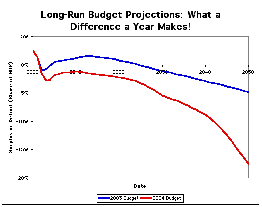
(My mirror of a large version of this graphic)
If you're up for walking through an intelligent mathematical proof of this concept, Brad DeLong was nice enought to prepare one just for you:
I Really Cannot Understand Why Anyone Would Do This.
Now--one year later--things are very different indeed! The numbers in the back of the 2004 Budget documents project that the budget year that began when Clinton was still President will be America's last surplus year, ever. The policies proposed in the 2004 Budget are projected to see the deficit widen steadily to 17.5 percent of GDP by 2050. By that date debt held by the public is projected to be 229.4 percent of GDP--a debt and deficit level that no economy could possibly sustain.
I've also got MP3s of this all ready to go, but my archive.org account is hosed for the moment, so I have to wait until it's late enough in the morning for me to give them a call. (Like 9:00 am maybe? :-) Then I'll have that stuff uploaded for you pronto. (Hopefully by noon.) Luckily, I transcribed the whole thing last night already:
All fixed! Here are the MP3s:
Ed Rosenthal On KFOG (Hi-Res - MP3 - 5 MB)
Ed Rosenthal On KFOG (Lo-Res - MP3 - 3 MB)
Here's a transcript:
Dave Mori: It's 7:52 on KFOG. We've got the guy himself, Ed
Rosenthal. Thanks for coming on this morning.
KFOG (Dave Mori and two or three others also asking questions):
Now, Ed, I guess the good news is that the New York Times
yesterday came out with an editorial in support of you, several
supporters came out yesterday to join you in the city. The bad
news is you face a long prison term right now.
Ed: That's right, I'm facing up to 20 years in prison.
KFOG: How do you...I mean...Do you feel you're going to end
up actually having to serve time?
Ed: I don't think I'll serve one day, because I think that I will
be found "not guilty" and that the Medical Marijuana laws will
be coming down. (Lisa's note: not sure if I
missed something in the second half of that last sentence...)
KFOG: What happens now? I mean, aren't you currently found
"guilty?"
Ed: I was found "guilty," but now we're appealing for a new
trial on both legal and factual issues.
KFOG: Let me ask you, going into this, we're you and your side
aware of the fact that the Feds were gonna pull this -- not
allowing the issue of Medical Marijuana to be addressed within
the trial?
Ed: We weren't aware of it, but it wasn't the Feds. It was the
Judge's decision not to allow us to have a defense and we feel
that that was anerror on the Judge's part. We think the Ninth
Circuit will overturn his decisions.
KFOG: Who is this Judge? What's his track record like?
Ed: He is an unusual Judge the way he handles the courtroom
and criminal procedures. Usually a Judge lets the two sides
fight it out, but this Judge intercedes a lot, asks his own
questions and tries to dominate the trial. That's Judge Breyer.
KFOG: As this appeal progresses, do you think you'll be hurt
by the fact that you're not only a medical marijuana grower,
but have, over the years, been an advocate for the legalization
of Marijuana just...big picture, on the whole.
Ed: Up to now, I think that's really helped me because I've
had some recognition and people realize that I didn't do it
out of a profiteering point of view but I was able to use
lend my expertise to help people who needed some help
in getting started providing their own medicine.
KFOG: Might your case become a poster child for states' rights
and that the Federal Government is gonna have to look closer
at what states vote into law?
Ed: I hope so.
KFOG: Can you see this thing going all the way to the Supreme
Court?
Ed: It might have that kind of legs. Although, there were so
many errors that the Judge and the Prosecutor made that this
case might just be dimissed.
KFOG: You're out on half a million dollars bail? Is that correct?
Ed: It's at half a million dollars bail with a $200,000 bond.
KFOG: How did you get that kind of money, if you don't
mind me asking...
Ed: I mortgaged my house.
KFOG: There's also that website, right?
Ed: Yes, it's
http://www.green-aid.com,
and that tells everything about the trial, what's going on, other
trials in California and elsewhere and it has all kinds of information
about what people can do.
KFOG: You've got a wife and kids. I mean, what do they
make of all of this?
Ed: They're very supportive. They agree with me that what
I did was right. We have no regrets about what they did
because we feel, as a family, we were helping people.
KFOG: Thank you very much. We appreciate your time.
That's for sure. Please keep in touch.
Ed: Great. Thank you very much.
KFOG: Take care.
DMCA Takedown Notice, Scientology, and PacBell
It turns out I was given a DMCA Takedown Notice from the Church of Scientology for the Xenu.net web archive (notice that this is now a 404) I setup in December 2002...When I originally contacted SBC I was told that they couldn't reconnect my service until the "policy block" is removed. I was then given a number for policy and told to leave a message and that I would be called back within 24 hours...
Calling the number yielded a cryptic computer generated voice (which I couldn't understand) and I was then dumped right into voicemail.
I later found out that this number had been disconnected. After talking to a number of supervisors I was able to have one admit that they were redirecting customers to a disconnected phone number! Other support department supervisors said they could not help me without approval from Policy and they were not willing to believe that the number was disconnected...
I finally received a call from a *memo* sent to the Policy department. It turns out I was given a DMCA Takedown Notice. This is about 80 hours after I first noticed my problem on Monday morning...
It turns out that Scientology (I assume using Google) found me through my blog where I linked to the wayback archive running on PeerFear .
Right now the content has been moved to a temp directory and is no longer hosted on the site. I am considering my options for restoring service including moving the content to a hosting provider in a country with less draconian Copyright laws.
Here is the full text of the article in case the link goes bad:
http://www.peerfear.org/rss/permalink/2003/02/04/1044497702-DMCA_Takedown_Notice_Scientology_and_PacBell.shtml
DMCA Takedown Notice, Scientology, and PacBell
Posted on 2003-02-04 15:22:05-08
Overview
Monday February 3rd I awoke to notice that my Internet connection from PacBell/SBC had been cut (pings to the default router would fail). For someone who essentially lives on the Internet this was *devastating*. (more on this later)
Of course these things happen from time to time so I assumed it was something to do with a cut fiber connection or technical interruption.
It turns out I was given a DMCA Takedown Notice from the Church of Scientology for the Xenu.net web archive (notice that this is now a 404) I setup in December 2002.
SBC provided me with 48 hours notice but only from an email account that wasn't used. They did not try to contact me by phone or by mail. One would think that written notification would be provided but it turns out that the DMCA doesn't require this. I should note here that I pay for a *business* account and I purchase their premimum DSL package ($180 a month) and I expect they would provide better service.
To make matters worse, SBC has no policy for resolving these types of issues and I have had to spend countless hours yelling at SBC technical support representatives to have my service restored. Guilty until proven innocent.
If anyone is interested I have a copy of the DMCA Takedown here .
Background
I originally became interested in setting up a distributed Xenu wayback mirror when the Internet Archive had to pull Xenu out of their Wayback Machine due to their Scientology takedown notice.
Here is my original post on the subject with a detailed link with my explanation of the situation.
It turns out that Scientology (I assume using Google) found me through my blog where I linked to the wayback archive running on PeerFear .
Right now the content has been moved to a temp directory and is no longer hosted on the site. I am considering my options for restoring service including moving the content to a hosting provider in a country with less draconian Copyright laws.
Dealing with SBC/PacBell
SBC has handled this in a completely unacceptable manner. No warning notice was provided. They did send an email to _REMOVED_@pacbell.net however this is an account that is not used (honestly how many people use their DSL provided email anyway). In fact I honestly had no idea that it existed until their Policy department informed of this. They have my cell phone, my land line, and my physical address in San Francisco yet they choose to use *none* of these to warn me prior to disconnecting my service.
Up until this point I have been a loyal SBC customer for greater than 2 years. I purchase their business grade account at $180 a month for 5 IPs, 384 up, and 6Mb down with an Acceptable Use Policy that allows for running servers (web, email, etc).
When I originally contacted SBC I was told that they couldn't reconnect my service until the "policy block" is removed. I was then given a number for policy and told to leave a message and that I would be called back within 24 hours.
Right here is where things started to go wrong! 24 hours! I am a business customer and I have no reason why I should have been disconnected (at this point I didn't know about the DMCA problem).
Calling the number yielded a cryptic computer generated voice (which I couldn't understand) and I was then dumped right into voicemail.
I later found out that this number had been disconnected. After talking to a number of supervisors I was able to have one admit that they were redirecting customers to a disconnected phone number! Other support department supervisors said they could not help me without approval from Policy and they were not willing to believe that the number was disconnected.
I was then told by Technical Service Representatives that they are not allowed to directly call the Policy department. This is after about 36 hours ... One would think that SBC would have some type of escalation procedure but there does not seem to be one in place.
Phone calls to countless supervisors and still no one could solve my problem.
I finally received a call from a *memo* sent to the Policy department. It turns out I was given a DMCA Takedown Notice. This is about 80 hours after I first noticed my problem on Monday morning.
I was then told by the Policy department supervisor that all my blocks had been removed. The only problem is I still have no Internet access. Another 6 hours on the phone with SBC and it turns out that they only removed 3/4th of my blocks. One more remained! The person in Policy decided she would go home for the evening instead of verifying I was restored service even *after* telling here I have been disconnected for 80 hours!
DMCA Takedown Notice
This entire mess was caused by a few images in a Xenu.net archive on my website. The CoS had no reason to come after me as all they would have to do is go after the upstream provider! Go after Xenu! They are the original infringers!
Of course Xenu.net is in another country which seems to explain why they came after me. I assume that they have tried this before but that there is no DMCA in the Netherlands to apply to Xenu.net.
Did SBC try to verify that these were copyrighted works? I still have to find out. I honestly highly doubt that they *are* copyrighted works. I imagine SBC just caved and didn't even try to defend the rights of their customer (me).
Fallout and Lessons Learned
This has been very hard for me to deal with. Three days off the Internet is probably the longest time I have been disconnected in years. Even when I go on vacation I make sure that I have 802.11b (even if the AP is just connected to a modem) and that I only have to go a few hours without jacking in.
This hits me at an especially sensitive time as I am busy working on NewsMonster and getting it ready for a big release. For a while there I was making *great* progress! I might have been able to release it by now (I am still just a few days away) but being off the Internet for this long has caused me to loose a lot of work.
One major lesson here is that the DMCA is a double edged sword. If your ISP doesn't know how to deal with it you are going to be seriously hurt (even if you are innocent or willing to accommodate). If I was running PeerFear on an enlightened provider they probably would have just called my cell and I would have deleted a few files. Life would have been fine and I would have released NewsMonster by now.
I am strongly considering moving away from SBC. Their handling of this matter has been terrible and I can't afford to have this happen again.
I don't know where I am going to go from here with regards to my Xenu wayback archive. It quickly becomes obvious that you can't screw with the CoS. I might try to resolve this by putting the wayback archive online and if the CoS has a problem with coyprighted material they can keep giving SBC DMCA takedown notices until every image in the archive is blocked out.
I guess this would be an acceptable compromise if only 10% of the content is removed. I am also going to require that they backup their copyright claims for these images. I am going to look their email and if the claims are false I might consider putting them back up or taking more drastic (and legal) measures.
Print Article
Next: PeerFear offline since monday
Copyright 2001-2004 Kevin A. Burton ( burton@openprivacy.org )
http://www.peerfear.org/download/scientology-takedown.html
This is the DMCA Takedown Notice I received on February 4, 2003. The URLs contained may 404 as I have since removed the archive and am trying to find a solution to my new hosting problems. - Kevin A. Burton
Subject: RE: Notice of Copyright Infringement
Dear Mr. Epstein:
Our office represents Church of Scientology International ("CSI") and Religious
Technology Center ("RTC"), non-profit religious corporations located in Los
Angeles, California, with respect to intellectual property matters. Our office
also represents the L. Ron Hubbard Library, the owner of the copyrights to
certain photographs and works of Mr. L. Ron Hubbard, the founder of the
Scientology religion, and we represent Bridge Publications, Inc. ("BPI"),
exclusive licensee of the copyrights to the published works of the Scientology
religion, which includes numerous books and tapes and tape transcripts. In
addition, we represent Church of Scientology Flag Service Organization ("FSO"),
which owns the rights in various magazines and photographs.
You are hereby on notice that one of your customers has placed literally
hundreds of pages of copyrighted works and trademarks that belong to our
clients, on your web site without our clients' authorization. Thus, this
subscriber's actions in this regard not only violate United States copyright
law, but SBC Internet Services' own Terms of Service expressly prohibit such
conduct. Accordingly, we request that these infringements be removed
immediately.
Because of the sheer volume of the infringements that are on your customer's web
page, we have broken them down into categories and numbered them as follows:
I. Identification And Location of Infringing Works (Photographs) Nos. 1 - 24
Description
URL
1. Untitled photograph of group by a helm
http://www.peerfear.org/wayback/2002/12/17/www.xenu.net/archive/photoalbum/propaganda/12.jpg
2. Untitled photograph of a large group by a helm
http://www.peerfear.org/wayback/2002/12/17/www.xenu.net/archive/photoalbum/propaganda/7a-1200.jpg
3. Photograph entitled "Captain David Miscavige"
http://www.peerfear.org/wayback/2002/12/17/www.xenu.net/archive/photoalbum/steering.jpg
4. Untitled photograph of a man in uniform
http://www.peerfear.org/wayback/2002/12/17/www.xenu.net/archive/photoalbum/6a.jpg
5. Untitled photograph of a woman in uniform
http://www.peerfear.org/wayback/2002/12/17/www.xenu.net/archive/photoalbum/6b.jpg
6. Untitled photograph of a man in uniform
http://www.peerfear.org/wayback/2002/12/17/www.xenu.net/archive/photoalbum/6c.jpg
7. Untitled photograph of a ring
http://www.peerfear.org/wayback/2002/12/17/www.xenu.net/archive/photoalbum/6d.jpg
8. Untitled photograph of a group of people by a table with one person leaning
forward
http://www.peerfear.org/wayback/2002/12/17/www.xenu.net/archive/photoalbum/3.jpg
9. Untitled photograph of a man
receiving a medal
http://www.peerfear.org/wayback/2002/12/17/www.xenu.net/archive/photoalbum/2b.jpg
10. Untitled photograph of a man with a medal
http://www.peerfear.org/wayback/2002/12/17/www.xenu.net/archive/photoalbum/2a.jpg
11. Person in uniform on a podium lecturing with his hand out
http://www.peerfear.org/wayback/2002/12/17/www.xenu.net/archive/photoalbum/propaganda/4.jpg
12. Untitled photograph displaying "International Headquarters"
http://www.peerfear.org/wayback/2002/12/17/www.xenu.net/archive/photoalbum/propaganda/2.jpg
13. Photograph of a crew with cameras
http://www.peerfear.org/wayback/2002/12/17/www.xenu.net/archive/hubbandcw/a2.gif
14. Photograph of a group of uniformed people
http://www.peerfear.org/wayback/2002/12/17/www.xenu.net/archive/photoalbum/b4.jpg
15. Photograph of a man's face entitled Alain Kartuzinsky
http://www.peerfear.org/wayback/2002/12/17/www.xenu.net/archive/photoalbum/b4-b.jpg
16. Photograph of a man in uniform
http://www.peerfear.org/wayback/2002/12/17/www.xenu.net/archive/photoalbum/b3.jpg
17. Photograph of a man's face entitled Richard Reiss
http://www.peerfear.org/wayback/2002/12/17/www.xenu.net/archive/photoalbum/b3-b.jpg
18. Photograph of a group ofuniformed people with three females in the front row
http://www.peerfear.org/wayback/2002/12/17/www.xenu.net/archive/photoalbum/b2.jpg
19. Small photograph of a group of uniformed people
http://www.peerfear.org/wayback/2002/12/17/www.xenu.net/archive/events/lisa_mcpherson/clan1.jpg
20. Photograph of a group of uniformed people
http://www.peerfear.org/wayback/2002/12/17/www.xenu.net/archive/photoalbum/b1.jpg
21. Photograph of a person at a podium under a seal
http://www.peerfear.org/wayback/2002/12/17/www.xenu.net/archive/photoalbum/propaganda/6.jpg
22. Photograph of a person in uniform
http://www.peerfear.org/wayback/2002/12/17/www.xenu.net/archive/photoalbum/propaganda/8.jpg
23. Photograph of three unformed people at a table
http://www.peerfear.org/wayback/2002/12/17/www.xenu.net/archive/photoalbum/propaganda/10.jpg
24. Untitled photograph of woman handing over an award to another woman
http://www.peerfear.org/wayback/2002/12/17/www.xenu.net/archive/photoalbum/5b.jpg
25. Photograph of a man in white with dark glasses, displaying "Hubbard &
Clearwater - the early years"
http://www.peerfear.org/wayback/2002/12/17/www.xenu.net/archive/hubbandcw/h_c.gif
II. Identification of Copyrights of The Photographs In 1 - 25 Above
The infringements set forth in Nos. 1 through 25 above are taken from various
publications, the copyrights of which belong to our clients. Below is a detailed
description of the publication in which each of the photographs is contained in
the same order as listed above.
Publication
Description Issue Date
Page
1.
Highwinds:
Magazine of the Sea Organization 19 199611
2.
Highwinds:
Magazine of the Sea Organization 19 199611
3.
Highwinds:
Magazine of the Sea Organization 19 199611
4.
Highwinds:
Magazine of the Sea Organization 19 199652
5.
Highwinds:
Magazine of the Sea Organization 19 199652
6.
Highwinds:
Magazine of the Sea Organization 19 199652
7.
Highwinds:
Magazine of the Sea Organization 19 199652
8.
Highwinds:
Magazine of the Sea Organization 19 199636
9. Impact: Magazine of the International
Association
of
Scientologists 39 1991 24
10. Impact: Magazine of the International
Association
of
Scientologists 39 1991 24
11. Impact: Magazine of the International
Association
of Scientologists 19 1988 42
12. KSW News
24 1988 2
13. L. Ron
Hubbard -
A Profile 1995 116
14.
Source: Magazine of the Flag Land Base 94 1994 18
15.
Source: Magazine of the Flag Land Base 94 1994 18
16.
Source: Magazine of the Flag Land Base 95 1995 16
17.
Source: Magazine of the Flag Land Base 95 1995 16
18.
Source: Magazine of the Flag Land Base 95 1995 2
19.
Source:
Magazine of the Flag Land Base 100 199641
20.
Source:
Magazine of the Flag Land Base 100 199641
21. Impact: Magazine of the International
Association
of
Scientologists 50 1993 33
22. KSW News
48 1996 2
23. KSW News
24 1988 3
24. Impact: Magazine of the International
Association
of
Scientologists 9 1986 32
25. L. Ron
Hubbard -
A Profile 1995 116
III. Identification of Infringing Works
(Documents)
Nos. 26 - 39
Description
URL
26. "Non-SO Members in SO Orgs"
http://www.peerfear.org/wayback/2002/12/17/www.xenu.net/archive/greece/seaorg3.gif
27. "Commordore's Messengers"
http://www.peerfear.org/wayback/2002/12/17/www.xenu.net/archive/greece/cmo.gif
28. "The Sea Organization"
http://www.peerfear.org/wayback/2002/12/17/www.xenu.net/archive/greece/seaorg1.gif &
http://www.peerfear.org/wayback/2002/12/17/www.xenu.net/archive/greece/seaorg2.gif
29. "Routine 3 Heaven"
http://www.peerfear.org/wayback/2002/12/17/www.xenu.net/archive/HCOB/FU-HCOB-630511.html
30. "Security Check Children"
http://www.peerfear.org/wayback/2002/12/17/www.xenu.net/archive/HCOB/FU-HCOB-610921.html
31. "HCO WW Security Forms"
http://www.peerfear.org/wayback/2002/12/17/www.xenu.net/archive/HCOB/FU-HCOB-610928.html
32. "Dead Agenting"
http://www.peerfear.org/wayback/2002/12/17/www.xenu.net/archive/enemy_names/dead_agenting.html
33. "Targets, Defense"
http://www.peerfear.org/wayback/2002/12/17/www.xenu.net/archive/enemy_names/targets.html
34. "Sec Check Whole Track"
http://www.peerfear.org/wayback/2002/12/17/www.xenu.net/archive/HCOB/FU-HCOB-610619.html
35. "The Scientology Emotional Tone Scale"
http://www.peerfear.org/wayback/2002/12/17/www.xenu.net/archive/tonelevel.html
36. "Routine 3N - Line Plots"
http://www.peerfear.org/wayback/2002/12/17/www.xenu.net/archive/HCOB/FU-HCOB-630714.html
37. "Computer Series 6 - INCOMM"
http://www.peerfear.org/wayback/2002/12/17/www.xenu.net/archive/greece/incomm1.gif
http://www.peerfear.org/wayback/2002/12/17/www.xenu.net/archive/greece/incomm2.gif
http://www.peerfear.org/wayback/2002/12/17/www.xenu.net/archive/greece/incomm3.gif
38. Materials Grade Chart
http://www.peerfear.org/wayback/2002/12/17/www.xenu.net/archive/grade_chart.html
39. "Enemy Names"
http://www.peerfear.org/wayback/2002/12/17/www.xenu.net/archive/disk/enemy/index.htm
IV. Identification of Copyrights of The Text Documents
Nos. 26 - 39
Description
Registration Nbr
26. Flag Order 2772 "Non-SO Members in
SO Orgs"
TXu 374-312
27. Flag Order 3729 "Commodore's
Messengers"
TXu 374-312
28. Flag Order 137 "The Sea Organization"
TXu 840-811
29. HCO Bulletin of May 11, 1963
"Routine 3 - Heaven"
A 640105
RE 561-335
30. HCO Bulletin of 21 September 1961
"Security Check Children"
TX 1-143-720
RE 438-055
31. HCO Bulletin of 28 September 1961
"HCO WW Security Forms"
A 785007
TX 2-478-862
32. HCO Policy Letter of 28 October 1968
"Press Releases"
HCO Policy Letter of 21 Nov. 1972
"How to Handle Black Propaganda"
HCO Policy Letter of 25 February 1966
"Attacks on Scientology"
TX 2-251-232; TX 2-478-866, A
592-037; TX 2-646-306
33. HCO Policy Letter of 16 February 1969
"Targets, Defense"
TXu 598-760
34. HCO Bulletin of 19 June 1961 "Sec
Check Whole Track"
TX 1-159-379
35. HCO Bulletin of 25 September
1971RB "Tone Scale in Full"
TX 2-617-669
36. HCO Bulletin of 14 July 1963
"Routine 3N - Line Plots"
TX 1-276-429
RE 561-211
37. HCO Policy Letter of 23 November
1985 "INCOMM"
TX 2-325-017
38. CSI is the owner of the copyright to the publication: "The
Bridge
of
Knowledge," published in 1993, which contains the work "The
Dianetics
and
Scientology Materials Grade Chart."
39. BPI is the owner of the copyright to the work HCO Policy
Letter of
16
February 1969 "Enemy Names."
V. Identification of Infringing Works (Documents)
Nos. 40 - 56
Description
URL
40. "21 May 78 Telex to CO FSO"
http://www.peerfear.org/wayback/2002/12/17/www.xenu.net/archive/hubbandcw/11.gif
41. "9 September 76"
http://www.peerfear.org/wayback/2002/12/17/www.xenu.net/archive/hubbandcw/6b.gif
42. "29 September 78 Telex to CO FSO"
http://www.peerfear.org/wayback/2002/12/17/www.xenu.net/archive/hubbandcw/11b.gif
43. "CO CMO, INFO, Confidential"
http://www.peerfear.org/wayback/2002/12/17/www.xenu.net/archive/hubbandcw/12.gif
44. "R Advices for Division 2"
http://www.peerfear.org/wayback/2002/12/17/www.xenu.net/archive/hubbandcw/2.gif
44. "1 January 76"
http://www.peerfear.org/wayback/2002/12/17/www.xenu.net/archive/hubbandcw/3.gif
45. "3 January 76"
http://www.peerfear.org/wayback/2002/12/17/www.xenu.net/archive/hubbandcw/3b.gif
46. "10 January 76"
http://www.peerfear.org/wayback/2002/12/17/www.xenu.net/archive/hubbandcw/4.gif
47. "30 January 76"
http://www.peerfear.org/wayback/2002/12/17/www.xenu.net/archive/hubbandcw/5.gif
48. "6 September 76"
http://www.peerfear.org/wayback/2002/12/17/www.xenu.net/archive/hubbandcw/6.gif
49. "5 January 77 Despatch to Treas Sec"
http://www.peerfear.org/wayback/2002/12/17/www.xenu.net/archive/hubbandcw/7.gif
50. "14 March 77 Telex to A/CO FSO"
http://www.peerfear.org/wayback/2002/12/17/www.xenu.net/archive/hubbandcw/7b.gif
51. "15 March 77 Telex to FCCI PO"
http://www.peerfear.org/wayback/2002/12/17/www.xenu.net/archive/hubbandcw/8.gif
52. "16 March 77 Telex to ASRs and
Letter Reges"
http://www.peerfear.org/wayback/2002/12/17/www.xenu.net/archive/hubbandcw/8a.gif
53. "21 March 77 Telex to ASRs and
Letter Reges"
http://www.peerfear.org/wayback/2002/12/17/www.xenu.net/archive/hubbandcw/8b.gif
54. "23 May 77 Telex to CO FSO"
http://www.peerfear.org/wayback/2002/12/17/www.xenu.net/archive/hubbandcw/8c.gif
55. "26 February 78 Telex to CO FSO"
http://www.peerfear.org/wayback/2002/12/17/www.xenu.net/archive/hubbandcw/10.gif
56. "17 March 78 Telex to CO FSO"
http://www.peerfear.org/wayback/2002/12/17/www.xenu.net/archive/hubbandcw/10b.gif
VI. Identification of Copyrights of The Text Documents
Nos. 40 - 56
Nos. 40 through 56 are unpublished copyrighted works telexes that were sent by
L. Ron Hubbard from 1976 through 1979 the copyrights of which belong to the
L. Ron Hubbard Library.
VII. Identification of Unpublished Confidential Works
RTC is also the owner of the confidential Advanced Technology of the Scientology
religion and the holder of exclusive rights under the copyrights applicable to
the Advanced Technology materials. The Advanced Technology materials are
confidential, unpublished, copyrighted works. RTC's works include, among others,
the individual works comprising a level known as "OT III" and another such level
known as "NOTs". These works are registered with the United States Copyright
Office under registration numbers: TXu 290-496 and TXu 257 326 and 257 527.
One of the OT III works has been placed on the web site
"www.peerfear.org/wayback/2002/12/17/www.xenu.net" in different formats and
languages on many separate locations, along with a substantial portion of one of
the NOTs works. These have been placed on SBC's web site without the
authorization of our client under the following URLs:
http://www.peerfear.org/wayback/2002/12/17/www.xenu.net/archive/OTIII-sc
hola
r/ot3-
data-1.gif
http://www.peerfear.org/wayback/2002/12/17/www.xenu.net/archive/bork.htm
l
http://www.peerfear.org/wayback/2002/12/17/www.xenu.net/archive/leaflet/
http://www.peerfear.org/wayback/2002/12/17/www.xenu.net/archive/leaflet/
xenu
leaf.htm
http://www.peerfear.org/wayback/2002/12/17/www.xenu.net/archive/leaflet/
xenu
-Letter.pdf
http://www.peerfear.org/wayback/2002/12/17/www.xenu.net/archive/leaflet/
xenu
-A4.pdf
http://www.peerfear.org/wayback/2002/12/17/www.xenu.net/archive/leaflet/
xenu
sw.htm
http://www.peerfear.org/wayback/2002/12/17/www.xenu.net/archive/leaflet/
xenu
sw.doc
http://www.peerfear.org/wayback/2002/12/17/www.xenu.net/archive/leaflet/
xenu
nl.htm
http://www.peerfear.org/wayback/2002/12/17/www.xenu.net/archive/leaflet/
xenu
nl.doc
http://www.peerfear.org/wayback/2002/12/17/www.xenu.net/archive/leaflet/
xenu
fr.htm
http://www.peerfear.org/wayback/2002/12/17/www.xenu.net/archive/leaflet/
xenu
fr.doc
http://www.peerfear.org/wayback/2002/12/17/www.xenu.net/archive/leaflet/
xenu
fi.htm
http://www.peerfear.org/wayback/2002/12/17/www.xenu.net/archive/leaflet/
xenu
fi.doc
http://www.peerfear.org/wayback/2002/12/17/www.xenu.net/archive/leaflet/
xenu
no.htm
http://www.peerfear.org/wayback/2002/12/17/www.xenu.net/archive/leaflet/
xenu
no.doc
http://www.peerfear.org/wayback/2002/12/17/www.xenu.net/archive/leaflet/
xenu
sp.htm
http://www.peerfear.org/wayback/2002/12/17/www.xenu.net/archive/leaflet/
xenu
sp.doc
http://www.peerfear.org/wayback/2002/12/17/www.xenu.net/archive/leaflet/
xenu
it.htm
http://www.peerfear.org/wayback/2002/12/17/www.xenu.net/archive/leaflet/
xenu
it.doc
http://www.peerfear.org/wayback/2002/12/17/www.xenu.net/archive/leaflet/
xenu
ge.htm
http://www.peerfear.org/wayback/2002/12/17/www.xenu.net/archive/leaflet/
xenu
ge.doc
http://www.peerfear.org/wayback/2002/12/17/www.xenu.net/archive/leaflet/
xenu
af.htm
http://www.peerfear.org/wayback/2002/12/17/www.xenu.net/archive/leaflet/
xenu
af.doc
http://www.peerfear.org/wayback/2002/12/17/www.xenu.net/archive/leaflet/
xenu
po.doc
http://www.peerfear.org/wayback/2002/12/17/www.xenu.net/archive/leaflet/
xenu
ru-w.htm
http://www.peerfear.org/wayback/2002/12/17/www.xenu.net/archive/leaflet/
xenu
ru-k.htm
http://www.peerfear.org/wayback/2002/12/17/www.xenu.net/archive/leaflet/
xenu
heb.htm
http://www.peerfear.org/wayback/2002/12/17/www.xenu.net/archive/leaflet/
xenu
heb.doc
http://www.peerfear.org/wayback/2002/12/17/www.xenu.net/archive/leaflet/
xenu
esp.htm
http://www.peerfear.org/wayback/2002/12/17/www.xenu.net/archive/leaflet/
xenu
gr.doc
http://www.peerfear.org/wayback/2002/12/17/www.xenu.net/archive/leaflet/
xenu
ro.htm
Our clients have obtained numerous permanent injunctions concerning
Internet
infringements of this and similar works. For instance, in RTC v.
Lerma,
Case No. Civil
Action No. 95-1107-A, the court ruled in favor of RTC, permanently
enjoining
the defendant
infringer from posting, on the Internet, the same OT III work that is
the
subject of this notice
here. In May 1998, a jury in the United States District Court in San
Jose,
California assessed
damages in the amount of $75,000 against a Mr. Henson for copyright
infringement, for
posting one of RTC's Advanced Technology works on the Internet. Mr.
Henson
was also
permanently enjoined by the court against further infringements.
VIII. Unauthorized Use Of Federally Registered Trademarks
RTC is also the owner of the trademarks and service marks of the
Scientology
religion. RTC's federally registered trademarks have also been placed
on
the
"www.peerfear.org/wayback/2002/12/17/www.xenu.net" web site, without
RTC's
authorization as follows:
1. L. Ron Hubbard Signature which is registered with the United States Patent
and Trademark Office under registration number 1,821,751
http://www.peerfear.org/wayback/2002/12/17/www.xenu.net/archive/ot/ot.gif
2. Scientology Cross which is registered with the United States Patent and
Trademark Office under registration numbers 1,012,452; 1,302,525 and 1,325,117.
http://www.peerfear.org/wayback/2002/12/17/www.xenu.net/archive/techniques/cross.jpg
3. Sea Org symbol which is registered with the United States Patent and
Trademark Office under registration numbers 1,334,758; 1,326,867; 0,877,948;
1,317,343; as well as the Sea Horse symbol which is a trademark owned by RTC.
http://www.peerfear.org/wayback/2002/12/17/www.xenu.net/archive/greece/Contract.gif
Your subscriber's unauthorized use of RTC's trademarks creates a likelihood of
confusion as to source or sponsorship of this web page in violation of United
States state and federal law, including the Lanham Act, 15 U.S.C. section 1015
et seq., in addition to violating international intellectual property laws.
These federally registered trademarks, are unique, distinctive and famous. Your
subscriber's use of these marks dilutes and tarnishes the distinctiveness of the
marks by improper negative associations inconsistent with the positive and
spiritual accomplishments and humanitarian efforts of the Scientology religion
in violation of the federal trademark antidilution statute, 15 U.S.C. 1125(c)
and California's antidilution statute. See, Archdiocese of St. Louis v. Internet
Entertainment Group, Inc., 34 F. Supp.2d 1145 (E.D. Mo. 1999); Mattel,
Inc. v. Internet Dimensions, Inc., 55 U.S.P.Q.2d 1620 (S.D.N.Y.2000); Deere &
Co. v. MTD Products, Inc., 41 F.3d 39, 43 (2nd Cir. 1994).
Additionally, these same infringements have been removed immediately upon notice
by a number of internet service providers, including UUNet, Alta Vista and Sage
Networks.
IX. Conclusion
Based upon the foregoing we request that these infringements be removed
immediately.
We appreciate your prompt attention to this matter.
I have a good faith belief, and in fact know for certain, that the posting of
these works by your subscriber on his web page was not authorized by my clients,
any agent of my clients, or the law.
I declare under penalty of perjury that this information is accurate and that I
am authorized to act on behalf of RTC, BPI, the L. Ron Hubbard Library, FSO and
CSI in this matter.
Sincerely,
Ava Paquette
Moxon & Kobrin
3055 Wilshire Boulevard
Suite 900
Los Angeles, California 90010
Tel: (213) 487-4468
Fax: (213) 487-5385
Jurors Who Convicted Marijuana Grower Seek New Trial
By Dean E. Murphy for the NY Times.
In an unusual show of solidarity with the man they convicted last week, five jurors in the trial of a medicinal marijuana advocate issued a public apology to him today and demanded that the judge grant him a new trial.The jurors said they had been unaware that the defendant, Ed Rosenthal, was growing marijuana for medicinal purposes, allowed since 1996 under California state law, when they convicted him on three federal counts of cultivation and conspiracy. He is to be sentenced in June and faces a minimum of five years in prison.
"I'm sorry doesn't begin to cover it," said one of the jurors, Marney Craig, a property manager in Novato. "It's the most horrible mistake I've ever made in my entire life. And I don't think that I personally will ever recover from this."
Here is the full text of the article in case the link goes bad:
http://www.nytimes.com/2003/02/05/national/05POT.html
The New York Times The New York Times National February 5, 2003
Jurors Who Convicted Marijuana Grower Seek New Trial
By DEAN E. MURPHY
SAN FRANCISCO, Feb. 4 — In an unusual show of solidarity with the man they convicted last week, five jurors in the trial of a medicinal marijuana advocate issued a public apology to him today and demanded that the judge grant him a new trial.
The jurors said they had been unaware that the defendant, Ed Rosenthal, was growing marijuana for medicinal purposes, allowed since 1996 under California state law, when they convicted him on three federal counts of cultivation and conspiracy. He is to be sentenced in June and faces a minimum of five years in prison.
"I'm sorry doesn't begin to cover it," said one of the jurors, Marney Craig, a property manager in Novato. "It's the most horrible mistake I've ever made in my entire life. And I don't think that I personally will ever recover from this."
The judge in the case, Judge Charles R. Breyer of Federal District Court, had barred Mr. Rosenthal's defense from mentioning the state law because he was indicted under federal law, which does not allow the growing of marijuana for any purpose.
When he was arrested last February, Mr. Rosenthal was cultivating starter plants in a warehouse that were to be distributed to seriously ill patients by medical marijuana clubs in the San Francisco Bay Area. Mr. Rosenthal, who lives in Oakland, was acting in his official capacity as "an officer of the city" under Oakland's medical marijuana ordinance, Oakland officials said.
In a statement read outside the federal courthouse here, the five jurors, joined by an alternate, said they would not have voted to convict Mr. Rosenthal if they had been allowed to consider the California law. The group said they represented the views of at least two others who had served on the 12-member panel.
"In good faith, we as jury members allowed ourselves to be blindfolded to weigh the evidence before us," the statement said. "But in this trial, the prosecution was allowed to put all of the evidence and testimony on one of the scales, while the defense was not allowed to put its evidence and testimony on the other scale. Therefore we were not allowed as a jury to properly weigh the case."
One by one, the jurors stepped up to a lectern and apologized to Mr. Rosenthal, his wife, Jane Klein, and their daughter, Justine, who stood nearby.
"We as a jury truly were kept in the dark," said Charles Sackett of Sebastopol, who was the jury foreman. "I never want to see this happen again."
In a striking demonstration of how deep the divide remains between federal and California laws on medicinal uses of marijuana, the jurors were joined by the San Francisco district attorney and two members of the San Francisco Board of Supervisors.
Eight other states allow the sick and dying to smoke or grow marijuana with a doctor's recommendation.
"This is really a travesty," Matt Gonzalez, the board's president, said of the court's decision to exclude the state law from Mr. Rosenthal's defense. The jurors "have been violated by this court," Mr. Gonzalez said.
Before holding the news conference, the jurors attended a hearing during which the United States attorney's office asked that Mr. Rosenthal's bail be revoked. Judge Breyer, ruled, however, that Mr. Rosenthal was not likely to flee and let him remain free on $200,000 bond pending his sentencing.
Though none of the jurors made their feelings known to the judge at the hearing, where the five of them and the alternate sat at the front of the courtroom, Mr. Sackett said he was certain their presence helped persuade the judge to allow Mr. Rosenthal to remain free.
"We did not say a word," Mr. Sackett said. "We were not disrespectful. We just wanted to make a statement."
Mr. Rosenthal's lawyers said they had filed a motion to have the indictment against Mr. Rosenthal dismissed. If that fails, they said, they will file a motion for a new trial. If that should also fail, the lawyers said, they will appeal the verdict to the United States Court of Appeals.
Shock troops for Bush
Partisans of the extreme right gathered outside of Washington this weekend to cheer on Cheney and Coulter -- and vent their rage at the liberals who rule America.
By Michelle Goldberg for Salon.
It was another year at CPAC, ground zero of the vast right-wing conspiracy, the place where in 1994 Paula Jones was first introduced to the world. This year marks CPAC's 30th anniversary, but not since the Reagan presidency has its agenda meshed so easily with that of the White House, which honored the event by sending both Cheney and Secretary of Labor Elaine Chao to speak. Republican National Committee chairman Marc Racicot, House Majority Whip Tom DeLay of Texas, Senate Whip Mitch McConnell of Kentucky and a bevy of other Republican congressmen were also there, cheered by hordes of college boys in blue blazers, soignée blondes in short skirts, and portly Southerners in T-shirts with slogans like "Fry Mumia" and, above a photo of the burning towers of the World Trade Center, "Clinton's Legacy."Held at Gateway Marriott in Crystal City, Va. from January 30 to February 1, CPAC drew a crowd of 4,000, 1,700 of them college students. Most of the action took place in a ballroom on the second floor, where speakers lambasted liberals from a stage draped in red, white and blue and backed by 18 American flags and two enormous video screens. It was like a right-wing version of a Workers World rally, with one crucial difference. Workers World is a fringe group with no political power. CPAC is explicitly endorsed by people running the country. Its attendees are Bush's shock troops, the ones who staged the white-collar riot during the Florida vote count and harassed Al Gore in the vice presidential mansion. Bush may not want to embrace them in public, but they are crucial to his political success and he has let them know, in hundreds of ways, that their mission is his.
Heralded by the power chords of Survivor's 1982 hit "Eye of the Tiger," Cheney got things off to a roaring start at about noon on Thursday. "CPAC has consistently championed those ideas that make America great," he said, before essentially repeating President Bush's State of the Union address. In the days that followed, one had to wonder exactly which ideas Cheney was talking about...
To attend CPAC is to crash through the looking glass into a world where passionate worship of the president is part of a brave rebellion against government, where Sweden is a hellish dystopia and Tom Daschle a die-hard Marxist. It's to realize that, despite the conservative hold on the White House, the Congress and the Supreme Court and the utter dejection among Democrats, right-wingers still fancy themselves an embattled minority facing an army of wily, ruthless leftists, who they hate with the righteous fury of the downtrodden.
Here is the full text of the article in case the link goes bad:
http://www.salon.com/news/feature/2003/02/04/cpac/
salon premiumfind out morelogin
Salon.com
Salon Premium
[ News & Politics ][ Opinion ][ Tech & Business ][ Arts & Entertainment ][ Books ][ Life ][ Sex ][ Comics ][ Audio ][ Dialogue ]
Article Finder
Salon News
Search
All of Salon.com
Only News
Directory
Hot Topics
Iraq
Death Penalty
Osama bin Laden
Joe Conason's Journal
Israel
Palestine
King Kaufman on Sports
Allen Barra on Sports
World Trade Center and Pentagon Attacks
Articles by date
# All of Salon.com
# By department
Partner services
Find a job
Search our Personals
Salon.com Sites
. News & Politics
Opinion
Tech & Business
Arts & Entertainment
-- Indie film
Books
Life
Sex
Comics
Audio
Dialogue
_______
Letters
Columnists
Corrections
Partner services
Salon Premium
Gift Subscriptions
Newsletter
Salon Communities
-- The Well
-- Table Talk
Salon Blogs
Salon Credit Card
Salon Publications
Salon Store
Reprint Information
_______
About Salon
Advertise in Salon
Investor Relations
Customer Service
Participate
Table Talk
[Spirited
Salon forums]
Can anything stop the carnage? Another bombing in Israel.
Meltdown Why isn't the economy getting any better?
# Posts of the week
The Well
[Pioneering members-only discussions]
The doctor is in... Author Cory Doctorow explores the extropian nexus in SF.
Sound Off
# E-mail Salon
# Send us a Letter to the Editor
# Recent Letters
Ways to get Salon
Downloads
# Get Salon.com on
your PDA
News
Vice President Dick Cheney addresses the Conservative Political Action Conference in Arlington, Va., Jan. 30. Below, a bumper sticker for sale at the conference.
Shock troops for Bush
Partisans of the extreme right gathered outside of Washington this weekend to cheer on Cheney and Coulter -- and vent their rage at the liberals who rule America.
- - - - - - - - - - - -
By Michelle Goldberg
printe-mail
Feb. 4, 2003 | Before Vice President Dick Cheney gave the opening address at the Conservative Political Action Conference, a three-day gathering of the right-wing faithful outside of Washington, D.C., organizers asked vendor Gene McDonald to put away his "No Muslims = No Terrorists" bumper stickers.
McDonald complied, and for the rest of the conference the jolly white-haired Floridian peddled his popular anti-Islam wares from under a table. As the leading lights of conservatism, including some of the most powerful figures in the Republican Party, gave speeches to a packed house, McDonald did a brisk trade, despite official condemnation by CPAC staff. He offered T-shirts with the words "Islam: Religion of Peace" surrounding a photo of a bomb with the word "Allah" on its timer. A towering linebacker of a man attending the conference with his elderly parents bought a mug saying "Islam" in red Nazi-style block lettering, with the "S" replaced by a black swastika. "They're going to love me at work," he chortled.
It was another year at CPAC, ground zero of the vast right-wing conspiracy, the place where in 1994 Paula Jones was first introduced to the world. This year marks CPAC's 30th anniversary, but not since the Reagan presidency has its agenda meshed so easily with that of the White House, which honored the event by sending both Cheney and Secretary of Labor Elaine Chao to speak. Republican National Committee chairman Marc Racicot, House Majority Whip Tom DeLay of Texas, Senate Whip Mitch McConnell of Kentucky and a bevy of other Republican congressmen were also there, cheered by hordes of college boys in blue blazers, soignée blondes in short skirts, and portly Southerners in T-shirts with slogans like "Fry Mumia" and, above a photo of the burning towers of the World Trade Center, "Clinton's Legacy."
Held at Gateway Marriott in Crystal City, Va. from January 30 to February 1, CPAC drew a crowd of 4,000, 1,700 of them college students. Most of the action took place in a ballroom on the second floor, where speakers lambasted liberals from a stage draped in red, white and blue and backed by 18 American flags and two enormous video screens. It was like a right-wing version of a Workers World rally, with one crucial difference. Workers World is a fringe group with no political power. CPAC is explicitly endorsed by people running the country. Its attendees are Bush's shock troops, the ones who staged the white-collar riot during the Florida vote count and harassed Al Gore in the vice presidential mansion. Bush may not want to embrace them in public, but they are crucial to his political success and he has let them know, in hundreds of ways, that their mission is his.
Heralded by the power chords of Survivor's 1982 hit "Eye of the Tiger," Cheney got things off to a roaring start at about noon on Thursday. "CPAC has consistently championed those ideas that make America great," he said, before essentially repeating President Bush's State of the Union address. In the days that followed, one had to wonder exactly which ideas Cheney was talking about.
Yes, CPAC explored some crucial questions. One panel asked, "Islam, Religion of Peace?" (Short answer: no.) There was a 40-minute talk on tort reform and 35 minutes on "Safeguarding Civil Liberties in a Time of War," which included a speech by veteran lefty civil libertarian Nat Hentoff, who was treated respectfully by an audience that largely fears big government and holds its privacy sacrosanct.
Yet Hentoff aside, one theme overwhelmed all others: a quaking, obsessive hatred of the liberals who are still believed to rule the world. CPACers exemplify what historian Richard Hofstadter called "the paranoid style in American politics" in the 1964 essay of the same name. "Since the enemy is thought of as being totally evil and totally unappeasable, he must be totally eliminated -- if not from the world, at least from the theatre of operations to which the paranoid directs his attention," Hofstadter wrote. "Even partial success leaves him with the same feeling of powerlessness with which he began, and this in turn only strengthens his awareness of the vast and terrifying quality of the enemy he opposes." And George W. Bush has harnessed their obsession and rage for his own political gain.
The conference was packed with events devoted to denouncing the perfidious left. There were panels titled "Modern Feminism: The Bilking of the Taxpayer," "Real Stories of Real Liberal Bias on Real College Campuses," "NAACP, the Congressional Black Caucus and other Professional Victims" and "Myths, Lies & Terror: The Growing Threat Of Radical Environmentalism." Dan Flynn, author of "Why the Left Hates America," was on hand to sign his book. Ann Coulter, there to push her own book, was greeted with a thunderous standing ovation, after which she ripped into the "treason lobby" -- the Democratic Party -- whose platform "consists in breaking every one of the 10 commandments."
. Next page | They have no doubt that Bush will do their bidding
1, 2, 3
page two
salon premiumfind out morelogin
Salon.com
Salon Premium
[ News & Politics ][ Opinion ][ Tech & Business ][ Arts & Entertainment ][ Books ][ Life ][ Sex ][ Comics ][ Audio ][ Dialogue ]
Article Finder
Salon News
Search
All of Salon.com
Only News
Directory
Hot Topics
Iraq
Death Penalty
Osama bin Laden
Joe Conason's Journal
Israel
Palestine
King Kaufman on Sports
Allen Barra on Sports
World Trade Center and Pentagon Attacks
Articles by date
# All of Salon.com
# By department
Partner services
Find a job
Search our Personals
Salon.com Sites
. News & Politics
Opinion
Tech & Business
Arts & Entertainment
-- Indie film
Books
Life
Sex
Comics
Audio
Dialogue
_______
Letters
Columnists
Corrections
Partner services
Salon Premium
Gift Subscriptions
Newsletter
Salon Communities
-- The Well
-- Table Talk
Salon Blogs
Salon Credit Card
Salon Publications
Salon Store
Reprint Information
_______
About Salon
Advertise in Salon
Investor Relations
Customer Service
Participate
Table Talk
[Spirited
Salon forums]
Can anything stop the carnage? Another bombing in Israel.
Meltdown Why isn't the economy getting any better?
# Posts of the week
The Well
[Pioneering members-only discussions]
The doctor is in... Author Cory Doctorow explores the extropian nexus in SF.
Sound Off
# E-mail Salon
# Send us a Letter to the Editor
# Recent Letters
Ways to get Salon
Downloads
# Get Salon.com on
your PDA
Shock troops for Bush | 1, 2, 3
To attend CPAC is to crash through the looking glass into a world where passionate worship of the president is part of a brave rebellion against government, where Sweden is a hellish dystopia and Tom Daschle a die-hard Marxist. It's to realize that, despite the conservative hold on the White House, the Congress and the Supreme Court and the utter dejection among Democrats, right-wingers still fancy themselves an embattled minority facing an army of wily, ruthless leftists, who they hate with the righteous fury of the downtrodden.
At the "What Are We Fighting For?" talk, Elaine Donnelly, a veteran of the Reagan and Bush I administrations, cautioned that the "destructive legacy of Bill Clinton" remains in the Pentagon and "could still make a comeback. We have to be vigilant." She made the horrifying consequences of such a resurgence clear. Hillary Clinton, she said, is now a member of the Senate Armed Services Committee, where "she will have more power than we may think." For example, she may tell the military, "If you want those Apache helicopters, you have to put women in combat ... think about 'Black Hawk Down,' the soldier being dragged through the streets. Do we want to see that on a gender-neutral basis?"
Of course, for decades the conservative movement has been defining itself in opposition to the specter of an amok liberalism that, among other depredations, leaves American women vulnerable to ravishment by savage black men. The right needs liberal power, no matter how illusory, as a foil.
That may be why there were so many college students in attendance, since university campuses are perhaps the only places left in America where conservatives might legitimately feel marginalized. Many students spoke of being radicalized by the hostility they face as Republicans at liberal schools, much as David Brock did in his book "Blinded by the Right: The Conscience of an Ex-Conservative." Given the p.c. hysteria that has choked the intellectual life of so many institutions, it's likely they really have been mistreated. Still, some of the examples they proffered suggested something rather less than an epidemic of college Stalinism. At the panel on campus liberal bias, for example, Roger Custer of Ithaca College's Young America's Foundation spoke of the oppression he suffered when his group advertised a speech by Pat Buchanan's sister Bay with signs saying, "Feminazis beware: Your Nuremberg has come."
"We received a barrage of criticism," Custer said indignantly. "Leftists said they felt physically threatened."
The issue of environmentalism shows much about CPAC-style politics. For CPACers, standing up to environmentalists isn't merely a matter of opposing regulations seen as onerous. Rather, they've framed it as a creationism-style holy war. Speakers at CPAC were livid even at businesses that adopted green models out of self-interest. Nick Nichols, CEO of the crisis management group Nichols-Dezenhall, railed against British Petroleum's attempts to cast itself as environmentally friendly, calling it a "new and improved Neville Chamberlain." David Riggs, who runs the anti-environmentalist GreenWatch project at the Capitol Research Center, took the stage to the sound of jungle roars and declared that environmentalism "has nothing to do with bunnies and bambies. It's about destroying free enterprise and eliminating private property." Floyd Brown of the Young America's Foundation announced, "A lot of people who used to claim their color was red now claim their color is green."
Of course, CPACers are ebullient about the Bush presidency, and they have no doubt that Bush will do their bidding. Their understanding of Bush is very similar to the conventional wisdom on the left: He's seen as a man whose language and image pander to moderates while his actions serve the far right. Tim Weigel, who was manning the Free Republic booth, described compassionate conservative initiatives like Bush's plan to address AIDS in Africa as, "throwaways, put out there to keep the left quiet while he takes care of Iraq." Behind him hung a picture of Hillary Clinton's head Photoshopped onto the body of a pig.
The lobby behind Bush's social agenda was on full display. Austin Ruse of the Catholic Families and Human Rights Institute told the audience about his success working with Population Research Institute, which opposes family planning in all forms, to pressure the White House to withdraw the United States' $34 million contribution to the United Nations Family Planning Fund. Population Research Institute did this largely by fabricating evidence that the Population Fund supports coerced abortion in China, a charge that the administration's own investigators found to be baseless. Ruse offered advice to the crowd about how the U.S. could fully extricate itself from all its international treaties. His was the moderate position; another man on his panel wanted to pull out of the U.N. altogether.
In the exhibitors' hall, Freedom Village USA, an upstate New York-based Christian drug-treatment center hoping to get federal money under Bush's faith-based initiative showed just what faith-based drug treatment really means. "Other programs teach you relief," said Robert A. Neu, assistant to Freedom Village president Fletcher A. Brothers. "Freedom Village offers a cure. It's a one-step program of getting on your knees and accepting Jesus Christ." Neu claims a 75 to 80 percent success rate, which he says measures the number of Freedom Villagers who have become born-again Christians. In addition to literature about drug abuse, the booth was selling videos titled "Harry Potter, Witchcraft Repackaged: Making Evil Look Innocent."
. Next page | Why does the right hate so many Americans?
1, 2, 3
Shock troops for Bush | 1, 2, 3
Bush is revered so intensely among CPACers that all successes seem to issue from him, while failures are the fault of others unworthy of the great man. Jason Crawford, a 23-year-old who works in business development in New York, formed his group Patriots for the Defense of America right after Sept. 11 to promote "moral clarity" in the war on terror. Now, convinced that moral clarity requires attacking North Korea and fomenting revolution in Iran, he's disappointed in the administration. Yet speaking along with Oliver North (who ranted against the "brie-eating, foie gras-sucking French") at the "What Are We Fighting For?" panel, he put the blame not on Bush, but on some amorphous "us" who failed to rise to Bush's challenge. "Today we can see from our actions that we lack moral clarity," he told the crowd. "We are betraying the principles of the Bush doctrine!"
Rev. Lou Sheldon, the founder of the Traditional Values Coalition and sworn enemy of homosexuality, put it best. Asked if Bush was in sync with his agenda, he replied, "George Bush is our agenda!"
But Sheldon, a plump, pink man with pale blue eyes, wasn't out celebrating the Bush presidency. Instead, the man who has pledged "open warfare" against all things gay, stood in the exhibitors hall before a makeshift carnival game called "Tip a Troll," in which players were invited to throw gray beanbags at toy trolls with the heads of Osama bin Laden, Saddam Hussein, Hillary Clinton and Tom Daschle, or trolls holding signs saying, "The Homosexual Agenda," "Roe V. Wade" and "The Liberal Media."
Sheldon, like the rest of the right, isn't letting success distract from a monomaniacal focus on its foes. Indeed, the overwhelming message at CPAC was that it's time to toughen up.
At a Thursday seminar titled "2002 and Beyond: Are Liberals an Endangered Species?" Paul Rodriguez, managing editor of the conservative magazine Insight, warned that the liberal beast wouldn't be vanquished until conservatives learn to be merciless. "One thing Democrats have long known how to do is play hardball," he intoned, urging Republicans to adopt more "bare-knuckle" tactics. The next day, Frank Gaffney, assistant secretary of defense under Ronald Reagan, told a rapt crowd about the "well-financed media campaign against the Bush White House."
The rise of Fox News and talk radio has done little to assuage right-wing resentment toward the supposedly liberal media. "It's amazing conservatives ever win any victories at all with the left's hegemonic domination of the media," Coulter told her listeners. She spent most of her talk mocking antiwar arguments ("Why not go to war just for oil? We need oil") and antiwar protesters. "Scott Ritter, that's a liberal for you," began one bit. "Cleans up, cuts his hair and it turns out that it's to get underage girls." Bada-BOOM.
For speakers like Coulter, who performs her act as a kind of stand-up routine, much of this stuff just seems like cynical hyperbole, but among the rank and file, liberal-phobia is real and deep. Virgil Beato, a 25-year-old graduate student at American University, spoke of the "mean-spiritedness" of the left, much of which he'd learned about from David Horowitz (the former Salon columnist). "David Horowitz knows how the left thinks," Beato proclaimed. "He's trying to send out the message that sometimes we need to play hardball. That's the message we're getting from here."
Throughout the three days of CPAC, Beato, a gangly, smooth-cheeked blond studying public administration, sat rapt in the audience, sprawling on the floor when all the seats were taken and murmuring, "yes, yes" as people like Coulter hurled imprecations against liberal treachery. An evangelical Christian who proudly announced his virginity to me moments after we met, he was polite and earnest and seemed genuinely worried by what the Democrats have in store. "The liberal ideal is a collectivist utopia," he said gravely. "In essence, it's the same as communism. Tom Daschle won't get up there and say he's a communist, but ultimately that's what the left envisions." He invoked, as many at CPAC did, the Scandinavian hellhole of Sweden. "Sure, some people there might be happy," he allowed, "but how do you define happiness?"
Beato really believes that Coulter isn't cruel, only brave and battle-worn. "Ann's passion is a reaction to a lot of what she receives from liberals," he said. "She's had tomatoes thrown at her. She's trying to communicate with a sense of humor about the mean-spiritedness of the left."
It's a telling twist, this idea of Coulter as a victim lashing back at her tormentors. Writing of the paranoid, Hofstadter said: "He does not see social conflict as something to be mediated and compromised, in the manner of the working politician. Since what is at stake is always a conflict between absolute good and absolute evil, what is necessary is not compromise but the will to fight things out to a finish." It's a will that Coulter has, and that the right has. Over three days, they struggled with various degrees of sincerity to puzzle out why the left, as they imagine it, hates America. A better question, and one they'll never ask, is why the right hates so very many Americans.
Here's some background on the case. (More)
The Jurors in the Ed Rosenthal Medical Marijuana Growing trail are plenty pissed that U.S. District Judge Charles Breyer manipulated the case in order to secure a conviction.
Jurors Denounce Their Own Verdict
By Ann Harrison for AlterNet.
After she and her fellow jurors found Ed Rosenthal guilty of federal marijuana cultivation and conspiracy charges in San Francisco last week, Marney Craig discovered that that she had made a terrible mistake.Instead of the "businessman" she thought she had convicted, Craig learned that Rosenthal, was, in fact, a widely published marijuana advocate who had been asked to grow medical cannabis for critically ill patients. The judge had kept this information from jurors, because Rosenthal was tried under federal drug laws that do not recognize the medicinal use of marijuana.
"What happened was a travesty and it's unbelievable, unbelievable that this man was convicted. I am just devastated," said Craig. "We made a terrible mistake and he should not be going to prison for this."
Craig is not alone in her remorse. Five other jurors, including the jury foreman, are expected to join Craig to denounce the verdict in a joint press conference this week. The event will take place immediately after a hearing to determine whether prosecutors will succeed in revoking Rosenthal's $200,000 cash bond and send him to jail until sentencing on June 4. Attorneys for Rosenthal, who is facing five to 20 years in prison, say they will ask an appeals court for a new trial.
"I was not allowed to tell my story," said Rosenthal. "If the jury had been allowed to hear the whole truth, and nothing but the truth, I would have been acquitted."
Juror Debra DeMartini said she was distressed to discover that Rosenthal had been deputized by the city of Oakland, California to grow marijuana for its medical cannabis program. Oakland city officials testified during pre-trail hearings that they had tried to reconcile the conflict between the federal Controlled Substances Act, which bans all marijuana cultivation, and California's Compassionate Use Act (Prop. 215) which permits patients to possess, consume and grow their own medical cannabis.
In an effort to provide medical cannabis to patients who could not grow their own, the city granted Rosenthal immunity from prosecution under a section of the Controlled Substances Act. But U.S. District Judge Charles Breyer halted every attempt by the defense team to directly tell jurors for whom Rosenthal's marijuana was being grown and blocked city officials from explaining Rosenthal's deputization during the trial...
Down at San Francisco City Hall, Matt Gonzalez, president of the city's Board of Supervisors, or city council, said jurors in cases like Rosenthal's should know that they can simply refuse to follow federal law. "The judge is not giving the jury any space, whatsoever, to engage in what has been an extremely long tradition in common law as it relates to jury nullification," said Gonzalez.Craig said she believed that if she had taken a stand during deliberations and said the federal law was wrong, she would have been removed from the jury. "I didn't know what would happen to us if we didn't follow the rules, how much trouble I would get into," said Craig. "I was totally intimidated into going along with the verdict because I didn't see any other way."
San Francisco public defender Jeff Adachi noted that there have been a number of decisions involving jury nullification in which judges have removed jurors who have refused to convict. But he said a jury instruction that permitted this was ruled to be unconstitutional in the last year. "Over the past 20 years, there has been a movement to limit the power of the jury by keeping the jury ignorant of the facts," said Adachi. "Jury nullification is a constitutional right that every individual person who is called for jury duty possesses, and unless we appreciate that right, we will lose it because the courts will take it from us."
In the meantime, Adachi warned that Rosenthal's conviction will encourage federal authorities to arrest more medical cannabis growers and distributors. "The kind of prosecution that we are seeing in the Rosenthal case could be multiplied 50 or 100 times over in the next year or two here," said Adachi.
Here is the full text of the article in case the link goes bad:
Jurors Denounce Their Own Verdict
By Ann Harrison, AlterNet
February 3, 2003
After she and her fellow jurors found Ed Rosenthal guilty of federal marijuana cultivation and conspiracy charges in San Francisco last week, Marney Craig discovered that that she had made a terrible mistake.
Instead of the "businessman" she thought she had convicted, Craig learned that Rosenthal, was, in fact, a widely published marijuana advocate who had been asked to grow medical cannabis for critically ill patients. The judge had kept this information from jurors, because Rosenthal was tried under federal drug laws that do not recognize the medicinal use of marijuana.
"What happened was a travesty and it's unbelievable, unbelievable that this man was convicted. I am just devastated," said Craig. "We made a terrible mistake and he should not be going to prison for this."
Craig is not alone in her remorse. Five other jurors, including the jury foreman, are expected to join Craig to denounce the verdict in a joint press conference this week. The event will take place immediately after a hearing to determine whether prosecutors will succeed in revoking Rosenthal's $200,000 cash bond and send him to jail until sentencing on June 4. Attorneys for Rosenthal, who is facing five to 20 years in prison, say they will ask an appeals court for a new trial.
"I was not allowed to tell my story," said Rosenthal. "If the jury had been allowed to hear the whole truth, and nothing but the truth, I would have been acquitted."
Juror Debra DeMartini said she was distressed to discover that Rosenthal had been deputized by the city of Oakland, California to grow marijuana for its medical cannabis program. Oakland city officials testified during pre-trail hearings that they had tried to reconcile the conflict between the federal Controlled Substances Act, which bans all marijuana cultivation, and California's Compassionate Use Act (Prop. 215) which permits patients to possess, consume and grow their own medical cannabis.
In an effort to provide medical cannabis to patients who could not grow their own, the city granted Rosenthal immunity from prosecution under a section of the Controlled Substances Act. But U.S. District Judge Charles Breyer halted every attempt by the defense team to directly tell jurors for whom Rosenthal's marijuana was being grown and blocked city officials from explaining Rosenthal's deputization during the trial.
"If I had known that he was told he could grow this by the city, that would have raised some questions for me in front of the judge," said DeMartini. "It's a waste of taxpayer money to bring these cases and prosecute people."
Craig sobbed as she recounted her growing concern during the trial that Judge Breyer was withholding critical information. Craig said she became alarmed when the judge took over questioning of the witnesses, when he repeatedly cut off the defense attorney, and when she saw protest signs in front of the courthouse suggesting that jurors were not fully informed.
"The more information we get, the more we realize how manipulated and controlled the whole situation was, and that we were pawns in this much larger game," says Craig. "As residents, we voted to legalize medical marijuana and now we are forced to sit here and not take any of this into consideration?
"In some sense it is a major setback, and in another it is a call to arms,"said Jeff Jones, executive director of the Oakland Cannabis Buyers' Cooperative, one of the medical marijuana clubs that Rosenthal was growing for.
Rosenthal's trail was attended by a number of medical marijuana patients, many of whom wept when the verdict was announced. Nicholas Feldman, a quadrapalegic cerebral palsy patient who says he smokes medical cannabis to ease the pain and spasticity in his limbs, was one of several people who arrived in court in a wheelchair. "How can they do this to us? People are in pain and it means a lot to us as citizens not to see a person suffer." said Feldman. "I stand here to day for people who could end up in jail for helping to ease my pain."
Despite the emotion surrounding the case, some jurors felt that they had no choice but to follow Judge Breyer's instructions, based on the evidence in front of them. DEA agents testified that they seized thousands of marijuana plants and cuttings at a San Francisco medical marijuana club, and at an Oakland warehouse owned by Rosenthal. But jurors said they distrusted the testimony and based their convictions on video tapes of the marijuana grow sites. They found that Rosenthal conspired with others at the club to to grow not more than 1,000 marijuana plants, as the prosecutor claimed, but more than 100 marijuana plants, a fact which will affect Rosenthal's sentencing. Jurors also found him guilty of growing more than 100 plants at the warehouse and maintaining a place to grow marijuana.
Shortly after the verdict was read, juror Bill Zemke walked solemnly from the courthouse past past two medical marijuana patients who sat weeping. "We considered the evidence in the case, the evidence that we could review, it was not an easy decision," said Zemke evenly. [Medical cannabis] was in the back of everyone's mind, a factor in the case, but it was not in the evidence in this case."
"We have state's rights," shouted the disconsolate patient, "you can't lock all of us up."
Jurors Have Power But Not The City
Jury foreman Charles Sackett agreed with Zemke that jurors came to the only conclusion that they could have, given the information they were provided. But he said he supports medical marijuana and hopes Rosenthal will win his appeal. "The medical issue was not introduced into the court proceedings, it was never an issue for us," said Sackett. "We weren't allowed to discuss it amongst ourselves, ever."
Sackett says he's now intrigued by the idea of jury nullification, which he says none of the jurors was aware of. Jury nullification is a legal principal which allows the jury to find a defendant innocent if the law itself is unjust or unjust in a particular application. Would jurors have taken the option of jury nullification in Rosenthal's case? "It would be speculation on my part, but it's very possible; dare I say, probable," says Sackett. "I think jury nullification is going to be part of the answer regarding states' rights in future cases."
Down at San Francisco City Hall, Matt Gonzalez, president of the city's Board of Supervisors, or city council, said jurors in cases like Rosenthal's should know that they can simply refuse to follow federal law. "The judge is not giving the jury any space, whatsoever, to engage in what has been an extremely long tradition in common law as it relates to jury nullification," said Gonzalez.
Craig said she believed that if she had taken a stand during deliberations and said the federal law was wrong, she would have been removed from the jury. "I didn't know what would happen to us if we didn't follow the rules, how much trouble I would get into," said Craig. "I was totally intimidated into going along with the verdict because I didn't see any other way."
San Francisco public defender Jeff Adachi noted that there have been a number of decisions involving jury nullification in which judges have removed jurors who have refused to convict. But he said a jury instruction that permitted this was ruled to be unconstitutional in the last year. "Over the past 20 years, there has been a movement to limit the power of the jury by keeping the jury ignorant of the facts," said Adachi. "Jury nullification is a constitutional right that every individual person who is called for jury duty possesses, and unless we appreciate that right, we will lose it because the courts will take it from us."
In the meantime, Adachi warned that Rosenthal's conviction will encourage federal authorities to arrest more medical cannabis growers and distributors. "The kind of prosecution that we are seeing in the Rosenthal case could be multiplied 50 or 100 times over in the next year or two here," said Adachi.
Despite the warning of coming prosecutions, Rosenthal's attorney Bill Simpich noted that city officials were absent during Rosenthal's trial. While Prop. 215 passed by 78 percent in San Francisco, he said officials have been slow to comply with a recent ballot initiative ordering them to investigate a city-run medical cannabis growing and distribution system.
"'The single biggest thing that hurt us is that we did not have the cities of San Francisco and Oakland by our side," said Simpich. "They were not there and if they had been there we would have won. They made a mistake and the time to correct it is now."
Simpich is calling for California cities and counties to continue immunizing medical cannabis caregivers because the judge's condemnation of this tactic applies only to those cases in front of him. "I'd love to get deputized," said Bob Martin, proprietor of the San Francisco's Compassion and Care Center medical marijuana club. "We are scared every day."
Gonzales says he is still meeting with officials and legal advisers to review the city's options. DEA spokesman Richard Meyer has made it clear that any San Francisco city authority involved growing or distributing medical marijuana will be subject to arrest and property forfeiture.
Craig said she upheld federal law and convicted Rosenthal because she felt she didn't have any choice. But she says that following instructions was no excuse for not acting on her conscience and refusing to convict a medical marijuana grower. "Anyone who said I was just following orders ... well yeah, we just wiped out this village in Viet Nam, we were just following orders, or the Europeans turning away when the Jews were taken away by the Nazis. We are no better than that if we can't take a stand for what we believe in," said Craig.
"I feel like if I had done something in this trial, even if I had been thrown off the jury, it would have made a difference because it would have been on the record that someone said 'No,' and that is something I have to live with."
« Home « DrugReporter
alties
Get a print-friendly version of this story.
Also in DrugReporter
Everybody's High
By Ron Bain
Feb 3, 2003
DRUG WAR BRIEFS: The Feds Railroad Ed Rosenthal
By Kevin Nelson
Feb 3, 2003
Drug Wars
By Richard S. Ehrlich
Jan 31, 2003
Drug Czar Super Bowl Ad Features Anti-Abortion Subtext
By Daniel Forbes
Jan 31, 2003
Rosenthal's Federal Drug Trial Turns Surreal
By Ann Harrison
Jan 27, 2003
Also by Ann Harrison
Rosenthal's Federal Drug Trial Turns Surreal
Jan 27, 2003
The Trial of Ed Rosenthal
Jan 17, 2003
Coming Out of the Cannabis Closet
May 7, 2002
California Cannabis Clubs Organize to Fight Feds
Apr 16, 2002
Medical Marijuana Ban Overturned in D.C.
Apr 1, 2002
Note: this is going on in Virginia. Not up in D.C.
Nevertheless -- heads up people!
Get ready for a full on attack on a woman's right to choose in the months to come.
5 Antiabortion Bills Advance in House
By Steven Ginsberg for the Washington Post.
Virginia's House of Delegates approved a bill today that would allow health care workers to invoke a "conscience clause" if they wish to avoid participating in abortion or birth control procedures.The measure was among five abortion limits that cleared various stages in the General Assembly, and activists on both sides of the issue said they were predicting a landmark year for abortion regulation in Virginia...
...The Senate narrowly upheld Warner's late-term veto last year, but abortion opponents said they believe they have the votes to override one this year.
Despite the possibility of several new restrictions, abortion rights activists were pleased with the defeat of the clinic regulation bill, because they said its tough regulations would have forced most abortion clinics to close.
"It was the most important vote in the General Assembly so far on whether abortion rights would still be available to the women of Virginia," said Bennet Greenberg, director of government relations at Planned Parenthood Advocates of Virginia, an abortion rights group.
Sen. Ken Cuccinelli (R-Fairfax), sponsor of the bill, said he would try to "come up with an alternate scheme that would improve the health and safety in those clinics. It can be done, and it can be done in this session."...
"There's been nothing like this, this wave of anti-choice legislation," Sen. Janet D. Howell (D-Fairfax) said...
Here is the full text of the article in case the link goes bad:
http://www.washingtonpost.com/wp-dyn/articles/A8403-2003Jan31.html
5 Antiabortion Bills Advance in House
Va. Delegates Also Pass Vietnam Flag Bill
"There's been nothing like this, this wave of anti-choice legislation," Sen. Janet D. Howell (D-Fairfax) said. (File Photo)
By Steven Ginsberg
Washington Post Staff Writer
Saturday, February 1, 2003; Page B01
RICHMOND, Jan. 31 -- Virginia's House of Delegates approved a bill today that would allow health care workers to invoke a "conscience clause" if they wish to avoid participating in abortion or birth control procedures.
The measure was among five abortion limits that cleared various stages in the General Assembly, and activists on both sides of the issue said they were predicting a landmark year for abortion regulation in Virginia.
Bills that would bar a practice defined as "partial-birth infanticide," a late-term procedure commonly called "partial-birth abortion" by opponents; require parental consent for abortions; and remove a woman's mental health as a condition for allowing a late-term abortion all advanced toward final votes on the House floor.
The Senate's Education and Health Committee approved a parental consent bill for the first time. The one setback today for abortion opponents came when the committee failed to pass a bill that would have toughened the regulation of abortion clinics.
"We are very optimistic," said Victoria Cobb, director of legislative affairs for the Family Foundation, who said today was a "historic day in Virginia. We believe the voice of Virginians has been heard."
Sen. Janet D. Howell (D-Fairfax), who voted against Thursday's late-term abortion bill and today's parental consent and clinic regulation bills, said "there's been nothing like this, this wave of anti-choice legislation." To become law, the bills must win approval in both chambers of the assembly and receive the signature of Gov. Mark R. Warner (D).
Meanwhile today, the House and Senate advanced many other bills as they approached the halfway point in their 46-day session. The House of Delegates passed a measure that would pay tribute to the flag of the defeated Republic of Vietnam.
Delegates also approved a bill that would require doctors to inform parents when minors seek treatment for such conditions as sexually transmitted diseases and depression.
The House Privileges and Elections Committee approved a measure that would permit Virginia's governor to run for successive terms, setting up a vote on the floor. Virginia is the only state that does not allow its governor to run for consecutive terms. If approved, the legislation would apply to governors elected after Warner.
The action on abortion issues in Virginia leads a nationwide push by abortion opponents to place new restrictions on the procedure, said Leah Oliver, a policy analyst for the National Conference of State Legislatures. There are nearly 200 bills in 38 states seeking to restrict abortions, but none has as many as Virginia or has acted as quickly, Oliver said.
Abortion opponents in Maryland say they hope to advance some restrictions under Gov. Robert L. Ehrlich Jr. (R). Ehrlich has said he would consider bills on the late-term procedure and parental consent, but he faces strong opposition in the General Assembly, which is controlled by Democrats.
Many of Virginia's abortion bills have been proposed before, and anti-abortion activists attributed their success this year to strong efforts by interest groups and lawmakers.
Those working to limit abortions also have been aided by last year's election of several antiabortion legislators and more supportive representation on the Health and Education Committee.
Lobbyists said legislators are mindful of those election successes as they look forward to this November, when all 140 assembly seats will be on the ballot. "They are more sensitive in an election year," Cobb said.
Supporters of the conscience clause said it would allow physicians, pharmacists and other health care professionals to opt out of providing birth control pills, morning-after pills or other medicine that they see as a form of murder.
The bill's opponents worried about what a rural resident would do if her pharmacist wouldn't fill a prescription for medication, particularly morning-after pills that could let her avoid a surgical abortion.
In brief but passionate debate on the floor of the House, supporters of a parental consent bill said it was one of "the most significant to ever come before the assembly," while others said a ban on the late-term procedure would help to stop the "killing" that occurs in Virginia.
Supporters of parental consent said it would ensure that parents have a greater say in the health and safety of their daughters. The Senate version includes a provision that allows minors to obtain consent from a judge if their parents refuse to allow an abortion.
Opponents said a consent law would lead to back-alley abortions for those afraid to tell their parents that they were pregnant.
Warner vetoed a late-term ban last year, and he has signaled his intent to do so again unless it allows exceptions for the health of a mother, which the assembly versions do not. He also said Thursday that he opposed the consent bill.
The Senate narrowly upheld Warner's late-term veto last year, but abortion opponents said they believe they have the votes to override one this year.
Despite the possibility of several new restrictions, abortion rights activists were pleased with the defeat of the clinic regulation bill, because they said its tough regulations would have forced most abortion clinics to close.
"It was the most important vote in the General Assembly so far on whether abortion rights would still be available to the women of Virginia," said Bennet Greenberg, director of government relations at Planned Parenthood Advocates of Virginia, an abortion rights group.
Sen. Ken Cuccinelli (R-Fairfax), sponsor of the bill, said he would try to "come up with an alternate scheme that would improve the health and safety in those clinics. It can be done, and it can be done in this session."
Foolish Courtney. 911 changed everything.
Now Flight Attendants rule the skies!
Now we have to keep them happy.
Singer Love warned after flight incident
From the BBC.
Rock star and actress Courtney Love has been released with a warning by police in London for "causing harassment, alarm and distress" on a transatlantic flight.The 38-year-old was arrested at Heathrow Airport on Tuesday morning after allegedly being verbally abusive to cabin crew...
She told waiting reporters the "brief verbal disagreement" had been "highly exaggerated".
She said: "I cussed at a lady - my daughter always said I had a potty mouth - I cussed at a lady named Mary, she wasn't letting my friend into first class and I said, why are you being such a bitch about it."
...And asked what the previous nine hours had been like inside the police station, the singer said: "It was fine. They were wonderful in there. It was like being on Prime Suspect."
Here is the full text of the article in case the link goes bad:
http://news.bbc.co.uk/2/hi/entertainment/2724499.stm
Tuesday, 4 February, 2003, 23:54 GMT
Singer Love warned after flight incident
Courntey Love leaving Heathrow police station
Love said the "disagreement" had been exaggerated
Rock star and actress Courtney Love has been released with a warning by police in London for "causing harassment, alarm and distress" on a transatlantic flight.
The 38-year-old was arrested at Heathrow Airport on Tuesday morning after allegedly being verbally abusive to cabin crew.
She told waiting reporters she had a
I cussed at a lady named Mary, she wasn't letting my friend into first class
Courtney Love
Love, widow of Nirvana star Kurt Cobain, was held on suspicion of disruptive behaviour and endangering the Virgin Atlantic flight from Los Angeles.
After spending the day at Heathrow police station Love was allowed to leave at 2220 GMT.
She told waiting reporters the "brief verbal disagreement" had been "highly exaggerated".
She said: "I cussed at a lady - my daughter always said I had a potty mouth - I cussed at a lady named Mary, she wasn't letting my friend into first class and I said, why are you being such a bitch about it."
Asked how she felt about her treatment at the hands of the airline she said: "I have been flying British Airways for a long time and I will continue to do so. This is my second time on Virgin and my first time wasn't so great either."
And asked what the previous nine hours had been like inside the police station, the singer said: "It was fine. They were wonderful in there. It was like being on Prime Suspect."
Police called
Love, former lead singer of rock band Hole, was accused of hurling abuse at flight staff during the flight.
The crew were said to have tried to calm her down but she refused to sit in her seat and put her seatbelt on.
She was verbally abusive towards our cabin crew and disruptive
Virgin Atlantic
The captain called the airport as Flight VS08 was on its approach to Heathrow.
Staff on the ground alerted police who were waiting for her as the plane touched down.
Police went on board and spoke to her for 20 minutes before she emerged from the Virgin Upper Class cabin.
Wearing bright red lipstick and sunglasses and waving and smiling to passengers, she was ushered into a police van.
Stars banned
Love is in London for a concert at the Old Vic Theatre on Wednesday night, hosted by Sir Elton John and actor Kevin Spacey.
This is not the first time rock stars have been at the centre of allegations about bad behaviour on board planes.
In October 1998, former Stone Roses singer Ian Brown was jailed for four months for using threatening behaviour towards an airline stewardess and captain on a flight from Paris.
In the same year Cathay Pacific banned Oasis from its flights after a rowdy episode of drunkenness involving singer Liam Gallagher.
In April last year, REM guitarist Peter Buck was cleared of attacking British Airways staff on a transatlantic flight to London.
Sorry it took me so long to get these prepared. I wanted to make them available in a few different sizes for people, and had to make sure the pieces were all complete, etc.
This radio broadcasts explains everything you ever wanted to know about crowd estimation and solves many of the myth's about it.
Hear, straight from the sources (the cops, computer crowd estimation experts, historians), how there is no such thing as an "official count" and how everyone is in basic agreement on the count of the January 18, 2003 protest in San Francisco (150,000-200,000), learn about the latest in computer-oriented crowd estimation techniques, and discover how the methods for determining their size and scope of peaceful demonstrations have evolved over the last century.
The situation surrounding the Million Man March is also discussed in detail. Really neat stuff!
Media cycle: Radio/Cassette Tape/Video Camera/Computer
Hope you enjoy it:
MP3s of KQED Forum's Crowd Estimation Progra
Host: Angie Coiro
Guests:
Dr. Farouk el Baz, Director of the Center for Remote Sensing at Boston University
David Brunelle, Public Affairs Officer for Capital Protection
Lucy Barber, Archivist at the California State Archives and author of "Marching on Washington: The Forging of an American Political Tradition"
Gregory Suhr, Deputy Chief of the San Francisco Police Department
FERC Gives Another Energy Company A Slap On the Wrist For Ripping Off California
Latest Smoking Gun Evidence Shows Reliant Energy Withheld Power From Consumers During Height of Energy Crisis
By Jason Leopold for Scoop.
A few weeks before the meeting between Bush and Davis, Vice President Dick Cheney, who chairs Bush's energy task force, was interviewed by PBS' Frontline for a special series on California's energy crisis. During the interview, Cheney flat-out denied that energy companies ripped off California."The problem you had in California was caused by a combination of things - an unwise regulatory scheme, because they didn't really deregulate," Cheney said in the May 17 Frontline interview. "Now they’re trapped from unwise regulatory schemes, plus not having addressed the supply side of the issue. They've obviously created major problems for themselves and bankrupted PG&E in the process."
When asked whether it was possible whether energy companies were behaving like a "cartel" and if some of the high power prices in California could be the result of manipulation, Cheney responded with a resounding "no."
It's highly unlikely that Bush, Cheney and members of the energy task force were kept in the dark about the Williams scam, especially since the findings of the investigation by FERC took place around the same time the policy was being drafted.
Here is the full text of the article in case the link goes bad:
http://www.scoop.co.nz/mason/stories/HL0302/S00007.htm
A Slap On the Wrist For Ripping Off California
Monday, 3 February 2003, 10:20 am
Article: Jason Leopold
FERC Gives Another Energy Company A Slap On the Wrist For Ripping Off California
Latest Smoking Gun Evidence Shows Reliant Energy Withheld Power From Consumers During Height of Energy Crisis
By Jason Leopold
One of the most damning pieces of evidence in the federal government’s investigation into California’s energy crisis emerged Friday, proving beyond a shadow of a doubt that energy firms took part in a year-long scheme to boost the price of electricity in the state by withholding much needed power from consumers.
This latest smoking gun puts to rest, once and for all, the debate about what caused California’s energy crisis. But, the Federal Energy Regulatory Commission has punished the wrongdoing with a mere slap on the wrist and consumers are still left paying record prices for electricity.
The nation’s energy markets are in dire need of a massive overhaul to ensure other states are not victimized like California. Already, Texas and Arizona have filed complaints with FERC that they too are beginning to see evidence of manipulation by energy companies. But the Republican dominated FERC, whose chairman was appointed by President Bush, is dragging its feet on the issue. Meanwhile, the price of natural gas and electricity has reached record highs, which adds further stress to the nation’s already troubled economy.
This latest smoking gun in the ongoing investigation into California’s energy crisis was released by the FERC Friday. It consists of transcript of a conversation between a trader and a power plant operator at Houston-based Reliant Energy in which the two discuss shutting down some of the company’s power plants in California between June 20 and 22, 2000 to create an artificial shortage so the price of power would skyrocket. The tactic worked. It caused power prices to reach “unjust and unreasonable” levels in California, which under the Federal Power Act is illegal.
“[We] started out Monday losing $3 million… So, then we decided as a group that we were going to make it back up, so we turned like about almost every power plant off. It worked. Prices went back up. Made back about $4 million, actually more than that, $5 million,” the Reliant trader says in a tape-recorded conversation on June 23, 2000.
Reliant cut a deal with FERC, agreeing to refund California $13.8 million to settle the issue and will not be penalized under federal laws.
State Senator Debra Bowen, D-Redondo Beach, said the settlement does not go far enough. Energy corporations such as Reliant, Duke, Williams and Enron have said publicly over the past two years that they have acted “properly” and have laid all of the blame on California’s crisis on the shoulders of state lawmakers. We now know these corporations have been lying.
There are likely dozens of other smoking guns to be found that show the same type of behavior during the peak of the energy crisis, said Robert McCullough, an energy consultant based in Portland who has been assisting California in its investigation.
“The one thing that isn't conceivably believable is that (Reliant) only withheld two days,” McCullough said.
Shutting down power plants in California to boost wholesale prices is not a new issue. Last year, CBS News reported that Williams Companies engaged in identical behavior around the same time as Reliant. The evidence, also a transcript of a recorded conversation between a Williams trader and a power plant operator in California, showed the two conspiring to shut down a power plant for two weeks to boost electricity prices and Williams’ profits. FERC kept the evidence under wraps for a year and cut a secret deal with Williams to refund California $8 million it obtained through the scam without admitting any guilt.
FERC released the transcripts last November after the Wall Street Journal sued the commission to obtain the full copy of its report.
How could FERC keep this smoking gun concealed for a year?
Had this evidence been released 21 months ago, pre-Enron, it would have helped California’s case. But it wouldn't have jibed with Bush's energy policy, which was made public instead in May 2001. Around the same time, President Bush was in California and met with Gov. Gray Davis about the state's energy crisis. Bush told Davis he would do nothing to help the state.
A few weeks before the meeting between Bush and Davis, Vice President Dick Cheney, who chairs Bush's energy task force, was interviewed by PBS' Frontline for a special series on California's energy crisis. During the interview, Cheney flat-out denied that energy companies ripped off California.
"The problem you had in California was caused by a combination of things - an unwise regulatory scheme, because they didn't really deregulate," Cheney said in the May 17 Frontline interview. "Now they’re trapped from unwise regulatory schemes, plus not having addressed the supply side of the issue. They've obviously created major problems for themselves and bankrupted PG&E in the process."
When asked whether it was possible whether energy companies were behaving like a "cartel" and if some of the high power prices in California could be the result of manipulation, Cheney responded with a resounding "no."
It's highly unlikely that Bush, Cheney and members of the energy task force were kept in the dark about the Williams scam, especially since the findings of the investigation by FERC took place around the same time the policy was being drafted.
According to evidence obtained by Congressman Henry Waxman, D-California, earlier this year, the energy task force, "considered and abandoned plans to address California's energy problems in its report."
California’s electricity crisis wreaked havoc on consumers in the state between 2000 and 2001, resulted in four days of rolling blackouts and forced the state’s largest utility, Pacific Gas & Electric, into bankruptcy. California was the first state in the nation to deregulate its power market in an effort to provide consumers with cheaper electricity and the opportunity to choose their own power provider. The results have since proved disastrous. The experiment has cost the state more than $30 billion.
For nearly three years, California officials have pleaded with FERC commissioners, President Bush and Vice President Dick Cheney, to provide the state with some relief from soaring wholesale power prices and investigate energy companies, including Enron, Williams Companies and Reliant, for allegedly manipulating the market.
Bush and Cheney responded personally to California Gov. Gray Davis’ cries for help in May of 2001 by saying the crisis was the result of California’s poorly designed power market, which left some regulatory restrictions in place. Although that is partially true, it’s now become apparent that energy companies bear most of the blame.
It wasn’t until Enron collapsed in October 2001 and evidence of the company’s manipulative trading tactics emerged that FERC began to take a look at the company’s role in California’s electricity crisis. Since then, memos written by former Enron traders were uncovered, with colorful names like “Fat Boy” and “Death Star,” that contained the blueprint for ripping off California.
Enron’s top trader on the West Coast, Timothy Belden, the mastermind behind the scheme, pleaded guilty in December to conspiracy to commit wire fraud and has agreed to cooperate with federal investigators who are still trying to get to the bottom of the crisis.
California is demanding that FERC order the energy company’s to refund the state $8.9 billion for overcharging the state for electricity during its yearlong energy crisis. FERC is expected to wrap up its investigation in March and decide whether the state is entitled to the refunds. But an administrative law judge for the agency released a preliminary decision in December that says California is due no more than $1.2 billion in refunds because the state still owes the energy companies $1.8 billion in unpaid power bills.
*******
- Jason Leopold is a freelance journalist based in California, he is currently finishing a book on the California energy crisis. He can be contacted at jasonleopold@hotmail.com.
Don't Sever a High-Tech Lifeline for Musicians
By Janis Ian for the LA Times
The entertainment industry has a long history of trying to shut down new technology. Most often, it has imagined that new products and services threatened industry sales. It's been proved wrong time and time again; it fought home video tooth and nail, but videotapes and rentals now bring in more money than movie releases. Music history is littered with record industry campaigns against reel-to-reel home tape recorders, cassettes, minidiscs, music videos and MTV.Verizon is appealing the decision, and it is vital that the judge's ruling be overturned.
The RIAA says it is doing all this to make more money for me and other artists like me, but don't be fooled. Many musicians would lose money, many fans would be denied a universe of new choices and the possibilities of Internet music would be cut off before the revolution even begins.
Here is the full text of the article in case the link goes bad:
http://www.latimes.com/news/printedition/opinion/la-oe-ian2feb02.story
Los Angeles Times - latimes.com
Home | Register | Home Delivery | Site Map | Archives | Print Edition | Advertise | Feedback | Help
Join now!
RegisterMember Services
Marketplace
• Careers
• Cars
• Homes
• Rentals Marketplace
• Newspaper Ads
• Personals
Art, Theater, Night Life
Movies, Music, TV, Dining
print edition
Front Page
Inside "A"
California
Business
Sports
Calendar
Editorials, Op-Ed
Weekly
Health
Food
Highway 1
Sunday
Books
Calendar
Magazine
Opinion
Real Estate
Travel
TV Times
The World
The Nation
California / Local
Business
Politics
Sports
Technology
Travel
Editorials, Op-Ed
Sections
Arts & Entertainment
Books
Chess
Columns
Education
Food
Health
Highway 1
Kids' Reading Room
Magazine
Obituaries
Real Estate
Religion
Science
Sunday Opinion
Times Poll
Week in Focus
For the Record
Editions
Print Edition
National (PDF)
Wireless
NewsDirect
Extras
College Connection
Sweepstakes
Crossword
Horoscope
Lottery
Traffic
Weather
Multimedia
Archives
Enter Keyword(s):
Detailed Search
SITE MAP
Subscription Services
(800) 252-9141 Home Delivery Subscriptions
NewsDirect
Gift Subscriptions
College Discount
Mail Subscriptions
Additional Subscription
Information & FAQs
Marketplace
• Careers
• Homes
• Cars
• Rentals
• Newspaper Ads
• Personals
• Times Guides
• Recycler.com
LA Times Initiatives
Times in Education
Reading by 9
LA Times Books
LA Times Family Fund
Times-Mirror Foundation
Community Events
Inside the Times
Partners
KTLA
La Opinion
February 2, 2003
E-mail story Print
COMMENTARY
Don't Sever a High-Tech Lifeline for Musicians
Times Headlines
Countdown to War
Countdown to War
American Education: Still Separate, Still Unequal
The Male-Heavy World of Science
U.S. Ignores Putin's Assault on Rights
more >
Subscribe
OPINION
By Janis Ian
The Recording Industry Assn. of America recently won a court ruling that effectively will cut off the recording artists it represents from new listeners.
In RIAA vs. Verizon, the U.S. District Court for the District of Columbia ruled that anyone suspected of downloading so-called "infringing" files on the Internet -- usually an MP3 of a song -- could be sued. No evidence is required. An accuser fills out a form for a court clerk and the machinery is set in motion.
The record companies say this decision will mean more money for musicians, but they have it backward. The downloaded music they're shutting off actually creates sales by exposing artists to new fans.
If this ruling stands, many smaller musicians will be hurt financially, and many will be pushed out of the music business altogether.
I've been a recording artist for nearly 40 years, with top-selling songs such as "Society's Child," "At Seventeen" and "Jesse." Six months ago, I began offering free downloads of my songs on my Web site. Thousands of people have downloaded my music since then -- and they're not trying to steal. They're just looking for music they can no longer find on the tight playlists of their local radio stations.
That's how many artists gain new listeners these days -- through the Internet.
After I first posted downloadable music, my merchandise sales went up 300%. They're still double what they were before the MP3s went online.
I'm not going to make a fortune selling these extra recordings, but it does add up to a few thousand dollars a year. That's a welcome bit of additional income for me and for the vast majority of artists who don't sell as many records as Nelly and Ja Rule.
The Internet means exposure, and these days, unless you're in the Top 40, you're not getting on the radio. The Internet is the only outlet for many artists to be heard by an audience bigger than whoever shows up at a local coffeehouse. The Internet allows people like me to gain new fans; if only 10% of those downloading my music buy my records or come to my shows, I've just gained enough fans to fill Carnegie Hall twice over.
With the court's decision, the RIAA didn't just defeat Verizon, the Internet service provider that the RIAA sued. It damaged the viability of recording artists who don't conform to the mainstream musical tastes of the moment.
Do you like '50s-style acoustic folk? Big band music? European synth? If the decision stands, you'll have to rely on word of mouth to find it -- not the Internet. Because if you get hold of an "infringing" file, you may find yourself on the receiving end of a record company lawsuit too expensive for any individual to fight.
The entertainment industry has a long history of trying to shut down new technology. Most often, it has imagined that new products and services threatened industry sales. It's been proved wrong time and time again; it fought home video tooth and nail, but videotapes and rentals now bring in more money than movie releases. Music history is littered with record industry campaigns against reel-to-reel home tape recorders, cassettes, minidiscs, music videos and MTV.
Verizon is appealing the decision, and it is vital that the judge's ruling be overturned.
The RIAA says it is doing all this to make more money for me and other artists like me, but don't be fooled. Many musicians would lose money, many fans would be denied a universe of new choices and the possibilities of Internet music would be cut off before the revolution even begins.
*
Janis Ian is a singer, songwriter and recording artist with nine Grammy nominations. Web site: www.JanisIan.com.
State Department Link Will Open Visa Database to Police Officers
By Jennifer Lee for the NY Times.
Law enforcement officials across the country will soon have access to a database of 50 million overseas applications for United States visas, including the photographs of 20 million applicants.The database, which will become one of the largest offering images to local law enforcement, is maintained by the State Department and typically provides personal information like the applicant's home address, date of birth and passport number, and the names of relatives...
For all the ambitious technological proposals being debated in the wake of the 2001 terror attacks, the new unified system was cobbled from existing networks and has required little new spending. "These are the networks that people are already using," said Roseanne Hynes, a member of the Defense Department's domestic security task force. "It doesn't change jobs or add overhead."
A primary feature of the system is the State Department's enormous visa database, whose seven terabytes give it a capacity equivalent to that of five million floppy disks. Until now, that database has been shared only with immigration officials.
"There is a potential source of information that isn't available elsewhere," said M. Miles Matthew, a senior Justice Department official who works with an interagency drug intelligence group. "It's not just useful for terrorism. It's drug trafficking, money laundering, a variety of frauds, not to mention domestic crimes."
Here's the full text of the article in case the link goes bad:
http://www.nytimes.com/2003/01/31/national/31COMP.html?ex=1044680400&en=902d8048ef3daabf&ei=5062&partner=GOOGLE
The New York Times The New York Times National January 31, 2003
State Department Link Will Open Visa Database to Police Officers
By JENNIFER 8. LEE
WASHINGTON, Jan. 30 — Law enforcement officials across the country will soon have access to a database of 50 million overseas applications for United States visas, including the photographs of 20 million applicants.
The database, which will become one of the largest offering images to local law enforcement, is maintained by the State Department and typically provides personal information like the applicant's home address, date of birth and passport number, and the names of relatives.
Advertisement
It is a central feature of a computer system linkup, scheduled within the next month, that will tie together the department, intelligence agencies, the F.B.I. and police departments.
The new system will provide 100,000 investigators one source for what the government designates "sensitive but unclassified" information. Officials see it as a breakthrough for law enforcement, saying it will help dismantle the investigative stumbling blocks that were roundly criticized after the Sept. 11 attacks.
At the same time, they acknowledge the legal and policy questions raised by information sharing between intelligence agencies and local law enforcement, and critics have cast a wary eye as well at the visa database.
One other effect of the new system is that for the first time, the Federal Bureau of Investigation and other agencies linked by it will be able to send one another encrypted e-mail. Previously, security concerns about the open Internet often caused sensitive information to be faxed, mailed or sent by courier.
The changes come as the F.B.I. continues working to upgrade its entire computer system, which is so antiquated and compartmentalized that it cannot perform full searches of investigative files. The bureau's director, Robert S. Mueller III, has said that while the technology easily allows for single-word searches, for example for "flight" or "school," it is very hard to search for a phrase, for example "flight school."
For all the ambitious technological proposals being debated in the wake of the 2001 terror attacks, the new unified system was cobbled from existing networks and has required little new spending. "These are the networks that people are already using," said Roseanne Hynes, a member of the Defense Department's domestic security task force. "It doesn't change jobs or add overhead."
A primary feature of the system is the State Department's enormous visa database, whose seven terabytes give it a capacity equivalent to that of five million floppy disks. Until now, that database has been shared only with immigration officials.
"There is a potential source of information that isn't available elsewhere," said M. Miles Matthew, a senior Justice Department official who works with an interagency drug intelligence group. "It's not just useful for terrorism. It's drug trafficking, money laundering, a variety of frauds, not to mention domestic crimes."
Local law enforcement agencies seeking photographs have typically had immediate access only to their own database of booking photos. But to get photos of people not previously charged or arrested, an investigator would make a request to a motor vehicle department or the State Department.
So officials emphasize that the State Department database is not making any information newly available to law enforcement, simply making such information easier to acquire. But that increasing ease of accessibility raises some concern from civil liberties groups.
"The availability of this information will change police conduct," said Marc Rotenberg, executive director of the Electronic Privacy Information Center, which has advocated more Congressional oversight of domestic security operations. "You are more likely to stop someone if you have the ability to query a database."
Or, as Mr. Rotenberg also put it: "The data chases applications."
Critics also point to what they call the unwelcome precedent of foreign-intelligence sharing with local law enforcement, even if the intelligence community's initial contribution to the new system may seem somewhat innocuous. That component is the Open Source Information System, a portal where 14 agencies pool unclassified information. Such material in the new system will includes text articles from foreign periodicals and broadcasts, technical reports and maps.
Two domestic law enforcement networks are also being tied in: Law Enforcement Online, a seven-year-old system established by the F.B.I., and the Regional Information Sharing Systems, six geographically defined computer networks that help local law enforcement agencies collaborate on regional crime issues like drug trafficking and gangs.
Becoming part of a collaborative computer network is unusual for the F.B.I., which has been criticized for its insular nature and technological sluggishness. As some agents joke, the bureau "likes to have yesterday's technology tomorrow." Many agents do not have direct access from their desks to the Internet, because of security concerns. Instead, some field offices have separate areas that agents refer to as "cybercafes," where they can log on to the Internet.
The bureau is now engaged in a multibillion-dollar effort to upgrade its computer system. A recent report by the Justice Department's inspector general cited mismanagement of the project, though Director Mueller gave reporters a sunny assessment today, saying among other things that parts of the upgrade would go online in March as scheduled.
As for the new interagency system, other large security and law enforcement computer networks are scheduled for integration with it within the next year.
These include an unclassified part of the Defense Department computer network, as well as the National Law Enforcement Telecommunication System, which is used to disseminate criminal justice information nationwide.
ON THE ROAD; Crime: Rising Threat in Many Areas (October 22, 2002)
Compressed Data; Getting Information From State Web Sites at a Price (September 16, 2002) $
A Simple Click Stirs a Lot of Outrage (September 13, 2002)
Fast Action On Passports, But for a Price (March 17, 2002)
Find more results for State Department and Computers and the Internet .
Doing research? Search the archive for more than 500,000 articles:
E-Mail This Article
Printer-Friendly Format
Most E-Mailed Articles
Reprints
It's easy to follow the top stories with home delivery of The New York Times newspaper.
Click Here for 50% off.
Home | Back to National | Search | Corrections | Help | Back to Top
Copyright 2003 The New York Times Company | Permissions | Privacy Policy
E-Mail This Article
Printer-Friendly Format
Most E-Mailed Articles
Reprints
Multimedia
Connecting Law Enforcement and Intelligence Networks
Chart: Connecting Law Enforcement and Intelligence Networks
Topics
Alerts
State Department
Computers and the Internet
Federal Bureau of Investigation
Privacy
Create Your Own | Manage Alerts
Take a Tour
Sign Up for Newsletters
Circuits: How Electronic Things Work
Price: $29.95. Learn More.
Spotlight on...
San Francisco
Pacific Heights, Cow Hollow, more...
Hamptons Homes
Montauk, Easthampton, more...
• Search Other Areas
On October, 10, 2002 Bev Harris, author of the upcoming "Black Box Voting: Ballot-Tampering" in the 21st Century, revealed that Republican Senator Chuck Hagel has ties to the largest voting machine company, Election Systems & Software (ES&S). She reported that he was an owner, Chairman and CEO of Election Systems & Software (called American Information Systems until name change filed in 1997). ES&S was the ONLY company whose machines counted Hagel's votes when he ran for election in 1996 and 2002. The Hill, a Washington D.C. newspaper that covers the U.S. national political scene, confirmed her findings today and uncovered more details.Hagel's campaign finance director, Michael McCarthy, now admits that Senator Hagel still owns a beneficial interest in the ES&S parent company, the McCarthy Group. ES&S counts approximately 60 percent of all votes cast in the United States. According to the Omaha World-Herald which is also a beneficial owner of ES&S, Hagel was CEO of American Information Systems, now called ES&S, from November 1993 through June 2, 1994. He was Chairman from July 1992 until March 15 1995. He was required to disclose these positions on his FEC Personal Disclosure statements, but he did not.
Hagel still owns up to $5 million in the ES&S parent company, McCarthy Group. But Hagel's office, when interviewed by Channel 8 News in Lincoln, Nebraska for the evening news on October 22, 2002, said he had sold his shares before he was elected. His office issued a fact sheet claiming that he had made full disclosure.
Last week, Hagel's campaign finance director, Michael McCarthy (currently an owner and a director of ES&S) admitted to Alexander Bolton of The Hill that Hagel is still an owner of ES&S parent company, the McCarthy Group, and said that Hagel also had owned shares in AIS Investors Inc., a group of investors in ES&S itself. Yet Hagel did not disclose owning or selling shares in AIS Investors Inc. on his FEC documents, a required disclosure, nor did he disclose that ES&S is an underlying asset of McCarthy Group, in which he lists an investment of up to $5 million in 1996, 1997, 1998, 1999, 2000, and 2001.
Here is the full text of the article in case the link goes bad:
http://www.whoseflorida.com/voting_machines.htm#U.S.%20CHUCK%20HAGEL%20NOW%20ADMITS%20OWNERSHIP
Voting Machines: Vote Tampering in the 21st Century
BREAKING NEWS:
U.S. Senator Chuck Hagel Now Admits Ownership In Voting Machine Company-- Senate Ethics Committee Director Resigns 1/30/03
On October, 10, 2002 Bev Harris, author of the upcoming "Black Box Voting: Ballot-Tampering" in the 21st Century, revealed that Republican Senator Chuck Hagel has ties to the largest voting machine company, Election Systems & Software (ES&S). She reported that he was an owner, Chairman and CEO of Election Systems & Software (called American Information Systems until name change filed in 1997). ES&S was the ONLY company whose machines counted Hagel's votes when he ran for election in 1996 and 2002. The Hill, a Washington D.C. newspaper that covers the U.S. national political scene, confirmed her findings today and uncovered more details. (more...)
Why do you allow machines with no paper trail? These machines can be rigged. They were in 2002 by Bush and his cronies.
E,S & S is owned by the far right McCarthy Group and is connected to far right Republican Senator Hagel.
Voting Machines - A High Tech Ambush
Scoop: US Election Vote Fixing Reports Hit The Mainstream
Voting machine companies: Ownership disclosure, "private" vote-counting codes,
A Repository for Voter Complaints
ELECTION FRAUD 2002
...kgl, 11/19/02
Who Makes the Voting Machines? 10/9/02
Ex-secretary of state profits from counties' touchscreen buys 10/8/02
News Clips updated 01/30/03
Pinellas Delays decision on voting machine 10/31/01
Election firm has ties to Pinellas
Reno's Election complaint 9/15/02
Touchscreens: Manipulating totals would be too easy 8/21/01
Ballot Printout 8/01
Carter-Ford Election Reform Plan 8/4/01
An Idea to bring back confidence to our Elections!
No more messy recounts 6/21/01
See also:
Electoral Reform 2001
Electoral Reform 2002
"Unprecedented" an award winning documentary on the 2000 election 9/29/0202
U.S. CHUCK HAGEL NOW ADMITS OWNERSHIP IN VOTING MACHINE COMPANY
SENATE ETHICS COMMITTEE DIRECTOR RESIGNS
CONTACTS:
Bev Harris, "Black Box Voting," 425-228-7131 http://www.blackboxvoting.com
Dan Spillane, Senior Test Engineer for voting machines: 206-860-2858
Chuck Hagel: 202-224-4224 -- Senate Ethics Committee: 202-224-2981
Charlie Matulka, ran for office against Chuck Hagel: 402-228-1009
Rebecca Mercuri, expert on computerized voting machines 215/327-7105
The Hill Article: http://www.thehill.com
U.S. CHUCK HAGEL NOW ADMITS OWNERSHIP IN VOTING MACHINE COMPANY
SENATE ETHICS COMMITTEE DIRECTOR RESIGNS
"Hagel's ethics filings pose disclosure issue" -- "The Hill" 1/29/2003
On October, 10, 2002 Bev Harris, author of the upcoming "Black Box Voting: Ballot-Tampering" in the 21st Century, revealed that Republican Senator Chuck Hagel has ties to the largest voting machine company, Election Systems & Software (ES&S). She reported that he was an owner, Chairman and CEO of Election Systems & Software (called American Information Systems until name change filed in 1997). ES&S was the ONLY company whose machines counted Hagel's votes when he ran for election in 1996 and 2002. The Hill, a Washington D.C. newspaper that covers the U.S. national political scene, confirmed her findings today and uncovered more details.
Hagel's campaign finance director, Michael McCarthy, now admits that Senator Hagel still owns a beneficial interest in the ES&S parent company, the McCarthy Group. ES&S counts approximately 60 percent of all votes cast in the United States. According to the Omaha World-Herald which is also a beneficial owner of ES&S, Hagel was CEO of American Information Systems, now called ES&S, from November 1993 through June 2, 1994. He was Chairman from July 1992 until March 15 1995. He was required to disclose these positions on his FEC Personal Disclosure statements, but he did not.
Hagel still owns up to $5 million in the ES&S parent company, McCarthy Group. But Hagel's office, when interviewed by Channel 8 News in Lincoln, Nebraska for the evening news on October 22, 2002, said he had sold his shares before he was elected. His office issued a fact sheet claiming that he had made full disclosure.
Last week, Hagel's campaign finance director, Michael McCarthy (currently an owner and a director of ES&S) admitted to Alexander Bolton of The Hill that Hagel is still an owner of ES&S parent company, the McCarthy Group, and said that Hagel also had owned shares in AIS Investors Inc., a group of investors in ES&S itself. Yet Hagel did not disclose owning or selling shares in AIS Investors Inc. on his FEC documents, a required disclosure, nor did he disclose that ES&S is an underlying asset of McCarthy Group, in which he lists an investment of up to $5 million in 1996, 1997, 1998, 1999, 2000, and 2001.
SENATE ETHICS COMMITTEE CHIEF COUNSEL / DIRECTOR RESIGNS
Harris spoke with Victor Baird of the Senate Ethics Committee office January 9, and asked him who is responsible for ensuring that FEC disclosures are complete. She asked whether anyone had followed up to see why Senator Hagel did not list his positions with the voting machine company, and she asked about his characterization of the McCarthy Group as an "excepted investment fund" and his failure to disclose that it owned ES&S. Baird was silent, and then said "If you want to look into this, you'll need to come in and get hold of the documents."
Unfortunately, according to Alexander Bolton, a reporter at The Hill, when he went to the Senate Public Documents Room to retrieve originals of Hagel's 1995 and 1996 documents he was told they were destroyed. "They said anything over five years old is destroyed by law, and they pulled out the law," says Bolton. However, when he spoke with Hagel's staff, they said had obtained the documents from Senate Ethics Committee files. Copies of the documents are available at www.OpenSecrets.org/pfds -- a repository for FEC disclosures.
In 1997, Baird asked Hagel to clarify the nature of his investment in McCarthy Group on his 1996 FEC statement. Hagel had written "none" next to "type of investment" for McCarthy Group. In response to Baird's letter, Hagel filed an amendment characterizing the McCarthy Group as an "Excepted Investment Fund," a designation for widely held, publicly available mutual funds. He never disclosed his indirect ownership of ES&S at all, but apparently no one questioned this omission, nor his curious characterization of the McCarthy Group, a privately held company that is not listed on any public brokerage.
Baird told Bolton that the McCarthy Group did not seem to qualify as an "excepted investment fund." He reportedly met with Hagel's staff on Friday, January 25 and Monday, January 27, 2002. Then, also on Monday, he stepped down. On Monday afternoon Baird's replacement, Robert Walker, provided a new, looser interpretation of "publicly available" (though experts disagree, saying that a privately held company like the McCarthy Group cannot be called "publicly available" in order to avoid disclosing underlying assets.)
Hagel's challenger in the Nebraska Senate race, Charlie Matulka, wrote to Baird in October 2002 to request an investigation into Hagel's ownership in and nondisclosure of ES&S. Baird replied, "Your complaint lacks merit and no further action is appropriate with respect to the matter, which is hereby dismissed," in a letter dated November 18, 2002.
SENATE CANDIDATE QUESTIONS HAGEL'S CONFLICT OF INTEREST
Charlie Matulka, the candidate who ran against Chuck Hagel in Nebraska's U.S. Senate race in November 2002, also wrote to the Nebraska Secretary of State and to state elections officials in October 2002. He pointed out that his opponent had ties to ES&S, and asked them to look into the conflict of interest, but received no answer.
Several Nebraska ES&S machines malfunctioned on Election Day, and Matulka filed a request for a hand count on December 10, 2002. It was denied, because Nebraska has a new law that prohibits election workers from looking at the paper ballots, even in a recount. The only machines permitted to count votes in Nebraska are ES&S.
CAN VOTING MACHINES BE TAMPERED WITH THROUGH ACCESS TO PROGRAMMERS?
The Washington Post characterized Hagel's election in 1996 as the biggest upset of the election season. At the time, voters did not know that he owned and had held key positions with the company that counted his votes. But is it improper for a candidate to have ties with voting machine companies?
Harris examines the issue of tampering security in the upcoming "Black Box Voting" book. One of her sources, Dan Spillane, a former Senior Test Engineer for a voting machine company, believes that the computerized voting machine industry is riddled with system integrity flaws.
"The problems are systemic," Spillane says, and he contends that the certification process itself cannot be trusted. Despite industry characterizations that the code is checked line by line, this does not appear to be the case. Spillane points to frequent, critical errors that occur in actual elections and identifies omissions in the testing procedures themselves. His own experience as a voting machine test engineer led him to address his concerns about integrity flaws with the owner of the voting machine company, who then suggested that he resign. He did not, but shortly before a General Accounting Office audit, Spillane was fired, and so was his supervisor, who had also expressed concerns about system integrity.
Election Technology Labs quit certifying voting machines in 1992. Its founder, Arnold B. Urken, says that the manufacturers, specifically ES&S (then AIS), refused to allow the detailed examination of code needed to ensure system integrity. Wyle Labs refused to test voting machine software after 1996; testing then went to Nichols Research, and then passed to PSINet, and then to Metamor, and most recently to Ciber.
But even if certification becomes adequate, nothing guarantees that machines used in actual elections use the same programming code that was certified. Machines with adjusted code can be loaded onto delivery trucks with inside involvement of only ONE person. To make matters worse, "program patches" and substitutions are made in vote-counting programs without examination of the new codes, and manufacturers often e-mail technicians uncertified program "updates" which they install on machines immediately before and on Election Day.
Both Sequoia touch screen machines and Diebold Accuvote machines appear to have "back door" mechanisms which may allow reprogramming after votes have been cast. Diebold's Accuvote machines were developed by a company founded by Bob Urosevich, a CEO of Diebold Election Systems and Global Election Systems, which Diebold acquired. Together with his brother Todd, he also founded ES&S, where Todd Urosevich still works. ES&S and Sequoia use identical software and hardware in their optical scan machines. All three companies' machines have miscounted recent elections, sometimes electing the wrong candidates in races that were not particularly close.
For more information, call 425-228-7131.
.....taliion, 1/30/03
top
Who Makes the Voting Machines?
Appearance of Impropriety — New Questions About the Integrity and Security of USA Elections
The story is not about allegations of fraud — it's about an appearance of impropriety that is stunning in its magnitude.
Unfettered by any disclosure regulations about ownership or political affiliations, just a few companies create and control almost all the voting machines in the U.S. Do the people who own them have conflicts of interest? We don't know, they won't tell us. Do they employ anyone with a criminal record? We don't know, they say it's private. Can we have someone check the vote-counting code to make sure no one tampered with it? Nope, they say its proprietary.
Election Systems & Software, the firm whose machines were involved in the 2002 flubbed Florida primary election — and the company that now makes the voting machines for most of America — is a private company that does not like to tell the public who owns it. But at least one major shareholder is Michael R. McCarthy, who runs the McCarthy Group. The McCarthy Group has been a primary owner of Election Systems & Software, including its predecessor, American Information Systems for more than a decade. Michael R. McCarthy is the current campaign Treasurer for Republican senator Chuck Hagel. [See Hagel and McCarthy Documents] Prior to his election, Republican Senator Hagel was president of McCarthy & Company. In fact, he decided to run for office while his own company was making the vote-counting machines!
Who cares? Poll workers count the votes, not election machines, right?
Wrong. The machines count the votes, and if you have any doubt about how critical it is for owners to disclose their information (as they must if they run lottery companies) read this: article by Ronnie Dugger, who will show you how easy it is for a single insider to fudge the vote-counting on these machines, in ways that can never be detected.
Why isn't tampering detectable?
Well, for one thing because the voting machine-makers fought in court to make their computerized vote-counting code "proprietary." Only their own programmers, it seems, are allowed to look at the innards of the code. Independent computer consultants almost unanimously cite the voting machine's impenetrable code as a security flaw. Difficult to detect tampering, yet relatively simple to implant an undetectable Trojan Horse to change counting algorithms.
And many of the new machines don't have paper trails
In Florida when votes were lost, election workers had to retrieve the hard drive as a back- up, because there were no paper ballots. But, if there was mischief in the computerized counting code, there would be absolutely no way to prove it. In California, thousands of votes just disappeared due to a computer glitch. What's up with this? Even the tax guys insist on a paper trail. (Just try telling an IRS auditor that your computer ate it.)
The other owner: Databases, personal information, mass communications, voter registration and vote-counting machines
The World-Herald Company, who owns the largest part of Election Systems & Software, likes to offer up a warm, fuzzy, "family and employee-owned" newspaper company as the owner. The company is actually something quite different. The newspaper is a small part of the overall business — the real business of The World Companies is controlling a vast nationwide communications network: elections services, including all forms of voting machines (punch card, optical scanning and touch-screen); databases containing personal information on almost everyone in the USA, huge direct mailing firms, phone message broadcasting, fax blasting, mass e-mailing, publicity, advertising, Internet services and printing, and affiliations with cellular communication systems. The World Companies have operations in Texas, Illinois, Georgia, Nebraska, California, Iowa and Arizona — and most have nothing to do with newspapers.
Wouldn't it be prudent to obtain names, political activities and corporate affiliations of major shareholders, directors and executives of the privately held companies who make our vote-counting machines? And could it be a bit reckless for Democracy to hand voter registration assignments over to a firm with active ties to political campaigns, which also has access to databases containing the race and political preferences of almost everyone in the USA?
Seventy percent of Election Systems & Software is owned by a partnership of the World Companies and the McCarthy Group. But who owns the McCarthy Group (besides Republican operative Michael R. McCarthy)? World Investments, a wholly- owned subsidiary of the Omaha World-Herald Co. (the conglomerate, not the newspaper), is a primary investor in the McCarthy Group. Round and round we go.
But speaking of newspapers, thank goodness a thoroughly objective organization like the Omaha World-Herald is involved with Election Systems & Software. "The delays [in the fall 2002 Florida primary voting] were the result of start-up errors by poll workers, not malfunctions by the company's election equipment," the Omaha World-Herald reports.
Who are these people, anyway?
We could go on for a week on this, and probably will. We've collected over 58 pages of information and there's more to come. Let's get started:
Election Systems & Software was formed by a merger of American Information Systems (AIS), a huge election company featuring several Republican owners, and Business Records Corp., part of Cronus Industries, in turn partially owned by a member of the Hunt oil family of Texas.
World Companies, Inc.: This is a wholly owned subsidiary of the Omaha World- Herald. It is a holding company with substantial ownership in Election Systems & Software, and it also controls World Marketing Inc., which operates gigantic databases and mammoth direct marketing companies. Election Systems & Software is also involved in voter registration services, and no one has questioned whether there is a conflict of interest with voter registration activity and access to the nation's largest databases containing race, political affiliations and other demographics.
Let me amend that: Investigative reporter Greg Palast can fill you in on exactly how to embezzle an election using tainted voter registration procedures. Jump to the bottom of this article for a list of "Six Ways to Fix Pesky Votes" uncovered by Palast. And by all means read Chapter 1 of his new book, The Best Democracy Money Can Buy, very carefully.
Questionable associations and relationships abound in the conglomerate that owns Election Systems & Software. One person with shares in the World Companies Inc. is Harold W. Andersen, who is on the board of directors for The Williams Companies — yes, that Williams Energy, recently exposed by CBS for creating a sham energy crisis in California. CBS cites tapes, now sealed by the government, that prove Williams Energy turned off the juice, faking an energy shortage.
M. Gene Aldridge, the president and CEO of Omaha World-Herald subsidiary World Marketing, Inc. (the one that runs all those databases — he knows if you've been black or white, he knows if you are poor...) is part of a conservative think tank, the New Mexico Independence Research Institute, and when he's not busy running the jumbo- sized database and direct marketing company, he is writing letters to Congress advocating that we take the huge future tax cuts and give them to the rich RIGHT NOW.
Here's more information on how Election Systems & Software came about, and who owns it:
From a 1996 article in The Omaha World-Herald:
"An Omaha company would become the nation's No. 1 ballot counter in a planned $59.3 million combination with a Dallas-based competitor...
"BRC is headed by a former Omahan, P.E. "Bill" Esping, who was a founder of First Data Resources.
"Under the agreement, American Information Systems would acquire the election division of Business Records. Both companies sell election counting and voter registration equipment and services based on optical scanners and paper ballots marked with pencils.
"Of the purchase price, $35 million would be in cash, $17.5 million in a note and the rest in stock of American Information, giving BRC about 20 percent ownership of the Omaha company. Stock owned by American Information employees would account for an additional 10 percent [OUR NOTE: This would include William L. Welsh II] with the remaining 70 percent owned by a partnership of the Omaha World-Herald Co. and the McCarthy Group, an Omaha investment banking company. American Information's share of the U.S. election automation market would increase to more than 50 percent..."
Let's have happy thoughts:
Before the 2002 Election, let's get disclosure from the handful of companies who make the voting machines that count our votes. These companies have nothing to hide (right?) so they should do this voluntarily. Then, Senator Hagel will lead the charge (won't he?) and he'll protect us from a situation that is, frankly, dangerous to Democracy, by getting some regulations in place:
(1) Require that any company who makes voting machines publicly disclose identities and political activities. And while we're at it, maybe criminal background checks are a nice idea, because if Republicans can control the big corporations that make the voting machines, just think what would happen if some crooks got into it. But I repeat myself.
(2) Require that all voting machines produce tamper-proof audit trails — and that means retaining a paper trail — using transparent computer code so that independent experts can investigate allegations of election tampering whenever needed.
More info:
Before Repiglicans start the squealing ("How DARE you bring this up so close the the
election, you know we have no time to rebut this") — well, you can verify the facts yourself, in most cases using their own documents, if you go to google and run the following search terms:
"Election Systems & Software"
"McCarthy Group"
"Michael R. McCarthy"
"Charles T. Hagel"
"World Marketing Inc."
"World Investments Inc."
— You'll find enough traceable leads to keep you busy for a week, if you run searches on the names and other related companies. * * * * *
Six Ways to Fix Pesky Votes
1. Scrub the lists too clean: if Andersen commits a felony, Anderson loses his vote.
2. Hire a firm to check voter eligibility, pay them 27 cents a name instead of the going rate (2.7 cents a name). When they contract to verify accuracy for people they remove, write them a friendly note: "DON'T NEED."
3. "Reform" the flawed voting system by purchasing millions of dollars in new, automated voting machines. Order them from a private company in Omaha that refuses to divulge who its owners are, or reveal their political connections.
4. Don't do any big stuff (switching 5,000 Dem votes to Republican). Do little things. Lots of them. Diversify.
5. Choose methods that will be boring or hard to understand.
6. Make sure people have to use math or statistics to see what you did. (Raise your hands: Who loves math?)
And if you want specifics of what happened in Florida, where over 50,000 votes disappeared in election 2000, start running google searches on Greg Palast's articles, aired on BBC and printed in the Guardian, and belatedly, picked up by major media outlets in the USA like the Washington Post.
To be continued. Next: How Election Systems & Software and the second biggest voting machine maker, Sequoia Pacific Systems, are actually related.
About the Author
The author of this report, Bev Harris, is the owner of Talion.com, a publicity company.
Here's how it came to be that a publicist wrote an investigative piece on election machines: While checking out an author as a potential guest for Talion's "Featured Guest" page, Harris did a media search and, by accident, realized that no one had disclosed who the owners are for the USA's main voting machine companies. The potential for conflicts of interest, and abuse disturbed her. Under her pen name, BJ Dudley, Bev had previously written a special report called "How to Unbezzle a Fortune" in which she details how to unravel and recover embezzled funds. Using some of the same techniques she used to unravel accounting frauds, she began to investigate voting machine ownership. All of the information in this article is readily available on the Internet, if you know where to search and what names to enter. This is a huge story, with thousands of leads to follow, and much of the information is findable.
...posted by KTR, 10/9/02
Top
Ex-secretary of state profits from counties' touchscreen buys-- MIAMI — A former Florida secretary of state profited by being a lobbyist for both the state's counties and the company that sold some of them touchscreen voting machines used in last month's botched primary election.-
Sandra Mortham, who served as the state's top elections official from 1995 to 1999, is a lobbyist for both Election Systems & Software and the Florida Association of Counties, which exclusively endorsed the company's touchscreen machines in return for a commission.-
Mortham received a commission from ES&S for every county that bought its touchscreen machines. The exact terms have not been disclosed. 10/8/02
Voting Machines' Maker Blamed
TALLAHASSEE - With Election Systems and Software's voting machines at the center of confusion in South Florida last week, critics are again scrutinizing the company's use of well- connected lobbyists and an unusual ``kickback'' deal to woo counties to buy its touch- ... Few lobbyists were as well- positioned to help ES&S as Sandra Mortham. A former Pinellas County legislator and Bush's original choice as running mate in 1998, Mortham also oversaw the Division of Elections as Florida secretary of state six years ago. ... Mortham was also a lobbyist for the Florida Association of Counties last year when an unusual ``rebate'' arrangement drew criticism from election officials. -
The deal gave the Florida Association of Counties a cut of ES&S sales. Critics said the plan gave county commissioners with little knowledge of voting machines a reason to choose ES&S without fully considering their quality. 9/17/02
Cheaper touch-screen equals system failure- It was common knowledge among Florida election officials that the million- dollar voting machines produced by elections giant Election Systems & Software were ill-suited for large, urban counties.--
That didn't stop price-conscious Miami-Dade and Broward counties from buying the ES&S system and putting it to its biggest public test yet in Tuesday's statewide primary.... 9/15/02
And...
Something sent to me from last year that may provide some insight on the current fiasco....Galloway, 9/17/02 :
Pinellas delays decision on new voting machines
St. Petersburg Times; St. Petersburg, Fla.; Oct 31, 2001; LISA GREENE; DEBORAH O'NEIL;
Pinellas delays decision on new voting machines Abstract: Stung by an 11th-hour revelation about its top bidder, the Pinellas County Commission on Tuesday delayed voting on a $15.5- million voting machine system and demanded further investigation of the two companies vying for the multimillion-dollar contract. For some contracts, that may change. Gay Lancaster, interim county administrator, said she isn't satisfied with the county's purchasing checks. "I think we'll be making changes in that area," she said. Last summer, the county decided that the companies' proposals would be publicly reviewed by a citizens committee. That decision followed the revelation that the husband of Pinellas Supervisor of Elections Deborah Clark had worked for ES&S. In Baltimore, Sequoia accepted blame and apologized for computer failures that delayed November 1999 election results. ES&S has had similar failures. In Hawaii, the state said faulty ES&S machines forced a vote recount in 1998. Last year, counties in Virginia and West Virginia said ES&S optical scan ballots were defective. Full Text: Copyright Times Publishing Co. Oct 31, 2001
Stung by an 11th-hour revelation about its top bidder, the Pinellas County Commission on Tuesday delayed voting on a $15.5- million voting machine system and demanded further investigation of the two companies vying for the multimillion-dollar contract. Chief among their concerns: Several county staffers with some knowledge ofthe problem failed to ask more questions or report what they knew to the commission. "I don't want any more surprises," Commissioner John Morroni said at Tuesday's meeting. The county learned from St. Petersburg Times reporters Monday that a key employee for Sequoia Voting Systems, the company likely to get the contract for a new Pinellas voting system, was indicted in January on conspiracy charges in a Louisiana election kickbacks scandal. That employee, Phil Foster, is awaiting trial and came to the Pinellas meeting Tuesday to proclaim his innocence.
"I decided to hold my head high and be there and available" for commissioners' questions, Foster said afterward. But commissioners didn't ask him anything. Commissioners seemed more concerned Tuesday with what else the county doesn't know about Sequoia and the other finalist, Election Systems & Software. They are worried about whether there is time to make the right choice and still try out the new voting machines in a city election in March. Staff members asked for a week to investigate, but Morroni said he's ready to wait longer, even if it means missing the March vote. elections. Pinellas staff members said Tuesday that they routinely do legal and financial checks against companies but haven't checked employees' criminal records. For some contracts, that may change. Gay Lancaster, interim county administrator, said she isn't satisfied with the county's purchasing checks. "I think we'll be making changes in that area," she said. Last summer, the county decided that the companies' proposals would be publicly reviewed by a citizens committee. That decision followed the revelation that the husband of Pinellas Supervisor of Elections Deborah Clark had worked for ES&S.
Also Tuesday, Clark said the Times incorrectly reported that she knew about Foster's legal problems. She said she knew about a voting scandal in Louisiana but didn't hear about the charges against Foster until he told her Monday. But she did not mention that when she talked about him Monday. Asked then why she didn't pass along what she knew, Clark said: "I didn't think it had anything to do with voting systems. "Other troubling information about both companies has been reported in newspapers. In Baltimore, Sequoia accepted blame and apologized for computer failures that delayed November 1999 election results. ES&S has had similar failures. In Hawaii, the state said faulty ES&S machines forced a vote recount in 1998. Last year, counties in Virginia and West Virginia said ES&S optical scan ballots were defective.- Times staff writer Thomas C. Tobin and researchers Caryn Baird, Kitty Bennett and Cathy Wos contributed to this report, which also includes information from the Baltimore Sun and Associated Press. Pinellas delays decision on new voting machines t. Petersburg Times; St. Petersburg, Fla.; Oct 31, 2001; LISA GREENE; DEBORAH O'NEIL;
Abstract:
Research Information Related to Sequoia and Phil Foster kickback allegations:
Factual basis, plea agreement in Fowler case
UNITED STATES DISTRICT COURT
MIDDLE DISTRICT OF LOUISIANA
UNITED STATES OF AMERICA versus JERRY M. FOWLER
FACTUAL BASIS
From about 1991 through 1999, JERRY M. FOWLER used his position as Commissioner of Elections for the Louisiana Department of Elections and Registration to obtain illegal kickbacks from vendors who wanted to do business with the Louisiana Department of Elections and Registration. FOWLER conspired with Pasquale "Pat" Ricci and others to cause the state of Louisiana to pay inflated prices for the purchase of AVM voting machines, AVM voting machine counters, and the installation of the AVM voting machine counters. The vendors used the receipts from the inflated invoices to pay kickbacks to FOWLER. The illegal kickbacks were paid through various means including direct cash payments to FOWLER and payments on FOWLER'S behalf. FOWLER knowingly and willfully filed materially false income tax returns for the years 1996, 1997, and 1998, by not reporting any of the kickbacks as income.
FOWLER'S 1996, 1997, 1998 U.S. Individual Income Tax Returns, Forms 1040, and 1997 Amended U.S. Individual Income Return, Form 1040X, and were signed and mailed from the Middle District of Louisiana.
FOWLER'S 1996, 1997, and 1998 U.S. Individual Income Tax Returns, Forms 1040, reflect adjusted gross income of $157,949.54; $185,938.00 and $165,272.00, respectively. FOWLER'S corrected adjusted gross income including kickback income is $482,053.54; $487,891.29; and $419,312.00 in 1996, 1997, and 1998, respectively.
AVM Voting Machines
The AVM voting machine is a mechanical voting machine used by the Louisiana Department of Elections and Registration. The machines were manufactured by Automatic Voting Machines, a corporation that ceased operations during the early 1980's. In 1998, Louisiana had approximately 4,200 AVMs in use.
FOWLER and Pasquale Ricci devised a plan by which FOWLER circumvented state bid laws in the purchase of voting machine products and services. FOWLER requested that Ricci find an exclusive agent that FOWLER could declare as the sole source for buying AVM voting machines. With only a sole AVM source, FOWLER was not required to request bids and he and his co-conspirators controlled and inflated the price paid by the state for voting machines. David Philpot, owner of Birmingham, Alabama, based Election Services, Inc., agreed to the scheme proposed by FOWLER and Ricci and was declared the exclusive agent for Sequoia Pacific Voting Equipment, Inc., for AVM machines in the state of Louisiana. FOWLER declared Philpot the sole source of AVM machines even though FOWLER was aware that there were other sources from which to buy AVM machines. From 1991 through 1999, all AVM purchases by Louisiana were from Philpot's Election Services, Inc., at inflated prices.
Machine Counters
One of FOWLER'S duties as Commissioner of Elections was the purchase of voting machine counters for voting machines. Ricci, through his New Jersey based company, Independent Voting Machine Services Company, Inc., was FOWLER'S source for many voting machine parts. FOWLER wanted to make some money on these deals. FOWLER and Ricci conspired to have the state buy a large amount of counters through Ricci at inflated prices so a kickback could be made to FOWLER even though they both knew the large number of counters were not needed by the state.
To facilitate the machine counter scheme, Ricci contacted Glen Boord and Ralph Escudero, the owners of Fort Lauderdale, Florida, based, Uni-Lect, Inc., and Harold Webb, the owner of Mount Holly, New Jersey, based Garden State Elections. Ricci conspired with them and got them to participate in the inflated price scheme by charging him an inflated price for the counters so he could sell them to the state of Louisiana at inflated prices. Phil Foster facilitated the same counter scheme through David Philpot and Election Services, Inc. At all times FOWLER, Ricci, Escudero, Boord, Webb, Foster, and Philpot knew that they were using their companies to inflate prices to facilitate the payment of illegal kickbacks to FOWLER.
Installation of Counters
One of FOWLER'S duties as Commissioner of Elections was the maintenance of voting machines including the installation of parts and counters when necessary. Both FOWLER and Ricci knew state employees were skilled in installing counters and did in fact install counters. However, during the years of 1993 through 1998, FOWLER and Ricci conspired to let Ricci's company install the counters. FOWLER and Ricci always changed all counters in machines. The machines varied in size from either a 40 counter machine to a 50 counter machine. The price paid by the state for the service was greatly inflated.
FOWLER and Ricci knew that there was no legitimate reason to always change all of the counters in a machine. The counters were replaced in machines that had never exhibited any counter problems. FOWLER described the practice as a preventative maintenance program even though the true reason for the counter replacement was to generate kickbacks for FOWLER.
FOWLER'S admissions about the amount of kickbacks he received were corroborated through several means.
1. All known bank accounts of FOWLER were subpoenaed and the cash deposits to those accounts were analyzed. The annual cash deposits to FOWLER'S accounts are consistent with the $400,000 in kickbacks that FOWLER estimated that he received each year.
2. Most of FOWLER'S co-conspirators have already pled guilty in state court to paying kickbacks to FOWLER. The co-conspirators' factual bases were evaluated and the amount of kickbacks they admitted paying to FOWLER are consistent with the amount of kickbacks that FOWLER admitted receiving. Additionally these amounts are consistent with the cash deposits to FOWLER'S bank accounts.
3. In addition to the cash deposits to FOWLER'S bank accounts, FOWLER worked out a deal with Ricci to receive substantial amounts of cash that were not always deposited to his bank accounts. FOWLER introduced Ricci to bankers in North Louisiana. FOWLER, Ricci, and two bankers, at two banks, worked out a plan for Ricci to borrow money from the banks and give the money to FOWLER. At each bank Ricci borrowed $25,000.00 for a six-month term. The $25,000.00 was given to Ricci in the form of five cashier's checks payable to Ricci in the amount of $5,000.00 each. Ricci gave the five cashier's checks to FOWLER who placed them in a safety deposit box controlled by him at a financial services business in the Middle District of Louisiana. The owners of the financial services business are personal friends of FOWLER. The financial services business is a finance company whose offices are located in a former bank building. When FOWLER needed cash, he would go to the financial services business and place one of the cashier's checks in another safety deposit box which was accessible by him and the owners of the business. The owners retrieved the cashier's check from the box, converted the cashier's check to cash, and placed the cash in the safety deposit box. After one or two days, FOWLER would return to the financial services business and retrieve his $5,000 in cash. FOWLER got the cashier's checks in $5,000 increments thinking that the money would last longer rather than getting $25,000.00 all at once. Ricci borrowed $25,000.00 from each of the two banks every six months for approximately a ten-year period. FOWLER received approximately $100,000.00 per year from this single source.
FOWLER willfully and intentionally did not report the illegal kickback income on his 1996, 1997, and 1998, U.S. Individual Income Tax Returns, Forms 1040. FOWLER willfully and intentionally did not disclose his kickback income to the preparers of his 1996, 1997, and 1998, U.S. Individual Income Tax Returns, Forms 1040, because he did not want to alert them to his criminal actions. Each of the above described tax returns which FOWLER signed contained a written declaration that it was being made under penalties of perjury.
FOWLER has admitted that he knew that the kickbacks he received while he was the Commissioner of Elections should have been reported as income on his personal federal income tax returns. FOWLER further admitted that he did not report the kickback income because he did not want to report his criminal activity to the Internal Revenue Service.
This investigation disclosed that FOWLER made and subscribed to his 1996, 1997, and 1998, U.S. Individual Income Tax Returns, Forms 1040, which he knew were false as to material matters. FOWLER did not report any of the illegal kickback income in the amounts of $324,104.00; $301,953.29; and $254,040.00, for 1996, 1997, and 1998, respectively.
UNITED STATES DISTRICT COURT
MIDDLE DISTRICT OF LOUISIANA
UNITED STATES OF AMERICA versus JERRY M. FOWLER
PLEA AGREEMENT
1.
The Office of the United States Attorney for the Middle District of Louisiana, through undersigned counsel, and the above-named defendant agree that the defendant will waive indictment and enter pleas of guilty to a Bill of Information, charging three (3) counts of willfully making and subscribing false tax returns, in violation of Title 26, United States Code, Section 7206 (1).
2.
The United States Attorney and the defendant agree that, if the Court accepts the guilty pleas, no additional criminal charges related to the violations contained therein will be brought against the defendant in this district.
3.
The defendant agrees to provide complete and truthful information to any law enforcement agent or attorney of the United States, and at any grand jury proceeding or trial. The defendant waives the Fifth Amendment privilege against self-incrimination. The defendant will also cooperate with the Internal Revenue Service in a good faith effort to resolve his tax liabilities. This Plea Agreement, however, is not conditioned upon any obligation of the United States to receive, or act upon, information which the defendant may now or in the future provide or stand ready to provide.
4.
The United States Attorney agrees to inform the Court of defendant's actions pursuant to this Plea Agreement. The United States, however, is not obliged, as a condition of this Plea Agreement, to file any motion with the Court either for a downward departure under Section 5K1.1 of the United States Sentencing Commission Sentencing Guidelines, or to reduce the defendant's sentence under Rule 35 of the Federal Rules of Criminal Procedure. If a motion is filed, the Court, in it's discretion, may or may not reduce the sentence below the guidelines' range otherwise applicable.
5.
Except for use in this case, and as otherwise provided herein, no truthful testimony or other information provided by the defendant, or any information derived therefrom will be used against the defendant in any criminal trial.
6.
If the defendant refuses to provide truthful information or testimony, or provides false or misleading information or testimony, he may, after a judicial finding of such, be prosecuted for any offense covered by this agreement, and all statements and information provided by the defendant may be used against him. The defendant's pleas of guilty may not be withdrawn.
7.
The defendant hereby expressly waives the right to appeal his sentence, including, but not limited to, any appeal right conferred by Title 18, United States Code, Section 3742. The defendant, however, reserves the right to appeal any punishment imposed in excess of the statutory maximum.
8.
The defendant agrees to fully and truthfully complete the Financial Statement provided to him by the Office of the United States Attorney and to return the financial statement to the undersigned Assistant United States Attorney within 10 days of this agreement being filed with the Court. Further, upon request, he agrees to provide the Office of the United States Attorney with any information or documentation in his possession regarding his financial affairs and agrees to submit to a debtor's examination when requested. The defendant agrees to provide this information whenever requested until such time any judgment or claim against him, including principal, interest, and penalties is discharged or satisfied in full. This information will be utilized to evaluate his capacity to pay the government's claim or judgment against him, whatever that claim or judgment may be. If the defendant refuses to comply with this paragraph or provides false or misleading information, he may, after a judicial finding of such, be prosecuted for any offense covered by the agreement, and all statements and information provided by the defendant may be used against him. The defendant's pleas of guilty may not be withdrawn.
9.
The defendant agrees to enter the pleas of guilty to the Bill of Information herein, and the United States Attorney agrees to these pleas pursuant to Rule 11 (e) (1) (C), Federal Rules of Criminal Procedure, with the provision that the Court will sentence the defendant to a term of thirty-six (36) months imprisonment on Count 1, a term of thirty-six (36) months imprisonment on Count 2, to run concurrent with Count 1, and a term of twenty-four (24) months imprisonment on Count 3, to run consecutive to the terms imposed on Counts 1 and 2. It is further agreed by the parties that the defendant will enter his pleas of guilty to the Bill of Information and the Court will sentence the defendant prior to December 19, 2000. In addition, the Court will not impose a fine nor the costs of prosecution in this case. The Court must impose a special assessment of $100, per count, which defendant agrees to pay at the time of sentencing. The Court may also order restitution in accordance with law. The defendant understands that he must receive a term of supervised released after imprisonment of not more than one (1) year.
10.
Pursuant to Rule 11 (e) (2), Federal Rules of Criminal Procedure, the Court may accept or reject this Plea Agreement. If the Court rejects the Plea Agreement, the Court, on the record, will so inform the defendant and advise the defendant that the Court is not bound by the Plea Agreement. The Court will advise the defendant that, if he chooses to continue in the guilty pleas, the disposition of the case may be less favorable to the defendant that contemplated by the Plea Agreement, and afford the defendant the opportunity to withdraw the pleas of guilty.
11.
The defendant acknowledges that the terms herein constitute the entire agreement and that no other promises or inducements have been made. The defendant acknowledges he has not been threatened, intimidated or coerced in any manner.
12.
The defendant acknowledges that this Plea Agreement has been entered into knowingly, voluntarily and with the advice of counsel and that he fully understands the agreement. The defendant has no objection to the legal representation he has received.
This Plea Agreement is entered into this ------ day of ------------, 2000, at Baton Rouge, Louisiana.
UNITED STATES OF AMERICA, by
---------------------- ----------------------
JERRY M. FOWLER L.J. HYMEL
DEFENDANT UNITED STATES ATTORNEY
---------------------- ----------------------
RICHARD CRANE BRIAN A. JACKSON
ATTORNEY FOR DEFENDANT FIRST ASSISTANT U.S.
2200 Hillsboro Road, Suite 310 ATTORNEY
Nashville, TN 37212
Telephone: (615) 298-3719
----------------------
JAMES STANLEY LEMELLE
ASSISTANT U.S. ATTORNEY
CHIEF, CRIMINAL DIVISION
777 Florida Street, Suite 208
Baton Rouge, LA 70801
Telephone: (225) 389-0443
----- Original Message ----- From: Chris Hood To: Fred@miamidade.gov Sent: Thursday, October 25, 2001 10:41 AM Subject: Question about Vendor presentations
To: Fred Simmons Procurenent Officer
From: Chris Hood Compliance Research Group Inc.
Fred Please advise as to the vendor who may have failed to meet your mlti-langue requirement. Also do you require a local office to (if awarded) service the contract. Is any one vendor favored at this point, based on the objective requirements of Miami Dade County.
Thank You, Christopher Hood President Complianse Research Group Technology Consultant to: Miriam Oliphant Broward County Supervisor of Elections
South Florida's voting machine trouble ... (Reno's complaint)
...According to the draft document, headlined ''Suspected Problems with Florida's Electronic Touch-Screen Voting Machines,'' the campaign has consulted with an expert who has studied the machines in use.Among the allegations: Touch-screen machines suffer from a buildup of smudges that create inaccuracies as more people vote; some voters saw the wrong candidate's name light up when they touched the screen; many machines may not have properly calculated votes; and some machines had more than the typical percentage of ballots without a vote in the gubernatorial primary.Election Systems and Software, the company that manufactures the iVotronic machines used in Miami-Dade and Broward counties, could not be reached late Saturday. Last week, ES&S said in a statement that its machines ``accurately captured 100 percent of the votes which were cast. No votes were lost or not counted.'' 9/15/02
Elections firm has ties to Pinellas
- The county elections supervisor's husband worked for and consults for ES&S, a maker of voting equipment that the county may buy.
While Deborah Clark worked as a top official in the Pinellas Supervisor of Elections Office, her husband's employer was awarded more than $400,000 in business with the office.
Now, Clark heads the office, and that company, Elections Systems & Software, is a leading contender to land a lucrative contract -- worth as much as $15-million -- to sell new voting machines to Pinellas County, records show.
Touchscreens: Manipulating totals would be too easy
How wonderful that "foolproof" touchscreen voting has been approved by Secretary of State Katherine Harris.
It is also verification proof, with no pesky ballots to recount if the election of Gov. Bush is disputed.
As a system programmer, I know all too well how easy it will be to alter, manipulate or replace the final electronic count of the election results. Even if you hold a receipt of how you voted, what is there to recount?
Republicans will not have to bother to even vote to win this election!
BRYAN MORRIS,Maitland,8/21/01 (letter in Tal Dem)
top
Ballot printout
Imagine if someone suggested that checking accounts or wills or court records or birth certificates or school records would no longer exist in a hard copy format, nor would it be possible to make one. They could only exist in cyberspace. Not a chance.
Yet, the cyberspace touch-screen voting system that is being proposed is precisely that.
A system that allows for two different ways to count an election (computer results vs. hard copy) will cause disputes in a close election. But eliminating the ability to dispute the election results is far worse.
Optical scanners that only accept a correct mark by the voter are cheaper, equally or more accurate and offer manual recount protection.
Supporters of touch screens are vouching for the absolute competence and integrity of cyberspace and the government. What planet are they from?
Who of us would take $10 from an ATM that refused a written receipt? Why would we want a voting system that would offer just as many doubts?
Samuel F., PLANTATION, letter to Sun Sentinel
(Top)
Carter-Ford Election Reform Plan -
The Carter-Ford election reform plan sets forth 13 important policy recommendations, including uniform registration, provisional ballots, holiday voting, restoring felons' voting rights, 2% error rate limits, voting machine standards, valid vote standards, and delays in TV network projections. We support all of these recommendations. Congress needs to get to work immediately to fix the system in time for the 2002 elections, which will soon be upon us. (demdailynews 8/4/01)
http://www.reformelection.org/data/reports/99_full_report.php
(Top)
An Idea to bring back confidence to our Elections!
Please Push this Suggestion! his will bring confidence back to our Voters!
IT SHOULD BE IMPERATIVE THAT A RECEIPT BE GIVEN TO EACH VOTER! This receipt should have a data base number on it so that the voter can check by computer his or her vote. This would reassure anyone who voted that they were counted!
If you believe this to be a good idea please push this on
to important people and into the media. I know this will
bring back some confidence to our elections.
... Cookie.Haviland@worldnet.att.net 7/12/01
(Top)
No more messy recounts
Florida is getting ready to purchase computer voting systems that have no paper trail. We won't have to worry about recounts ever again. We won't have to worry whether our vote has been counted or not - because we'll never be able to find out. Another grand idea from Bush Inc. -- I saw the following emails and had to send them in. Please post these on your Tampa Page.
...Brad R, Tampa 6/20/01
Please read below and contact Pam Iorio and tell her this is not acceptable. Then contact your Tampa friends and tell them to call her too. I have tested software for 15 years and what Bill is saying is absolutely correct:
LETTER TO THE EDITORS AND OTHERS:
I just got back from a demo of the systems Supervisor of Elections Pam Iorio of Hillsborough County is looking at to replace the Punch Card systems. Before I go into what I saw, I need to give a quick background on myself. I have been the computer software business for thirty years. In that time I have worked on embedded processors like the one used in the Touch Screen systems. I just got off contract with a company what has a scanner that scans luggage for explosives at airports. A couple years ago I worked on a two-story high satellite named Terra that went up in Dec. 1999. So I know the current technology in the embedded processors used today.
I have no problem with the optical scan systems with scanners at a Precinct level. They have a paper trail. Not only do they quickly report back the results and reject double votes, but they also have the original ballots that on a spot check basis can validate the reported votes versus the paper originals.
The problem I have is with the Touch Screen Systems Ms. Ioria is pushing. There is no paper trail with the THREE systems she demonstrated June 14, 2001. I talked for about five minutes to Ms. Ioria about the lack of a paper trail and voter fraud. The three systems she showed are the ones the State of Florida is about to certify.
The Touch Screen systems load the information for a vote and program updates from a central point. IT WOULD BE EASY to rig an election without a paper trail. I pointed out to Ms. Ioria that ALL acceptable accounting systems have checks and balances. It is funny that the Touch Screen Systems Florida is looking at do not have any checks and balances. If Ms. Ioria had a private business would she find acceptable that the Accounts Payable person could write checks with out any checks and balances at all?
I pointed out to Ms. Ioria the problem with the Felon purge in this last election. The party in power picked a company that was very supportive of the party in power and they worked together to purge as many voters of the other party as they could. Now that same party in power is picking the NEW equipment and companies for the next election.
The people programming and the local people feeding the parameters for the Touch Screen both have the ability to commit voter fraud. For example, a low level technician who believes in party A could set the parameters for half the Touch Screens in a heavy party B precinct so all votes for candidate B get recorded for candidate A or small candidate C. Consider Duval counties three precincts with over 10,000 double punch votes. All it would have taken is two people to destroy 10,000 valid punch cards in less than a hour.
In my talk with Ms. Ioria, she said nobody had shown her a Touch Screen system with a paper trail. In less than 10 minutes on the Net I found one, Gladstone & Smith Company out of New Mexico. Also I found from a Missouri newspaper a quote from their law. "Missouri law should allow for the use of electronic "touch-screen" voting systems in Missouri, if certified for use by the Missouri Secretary of State. Such system should provide for a paper trail for each ballot cast."
From an article from the San Francisco Chronicleon Monday, December 4, 2000 titled The Risks of Touch-Screen Balloting
"Much more serious objections came from Dr. Peter G. Neumann, and he's certainly not someone to argue with lightly: He's principal scientist at the Computer Science Lab at SRI International in Menlo Park, chairman of the Association for Computing Machinery (ACM) Committee on Computers and Public Policy and author of a book called "Computer-Related Risks," among many other distinctions. Among his areas of expertise is the problem of election security.
In essence, he argues that the challenge of ensuring the integrity of elections conducted on electronic equipment is much greater than my column suggested. In fact, he describes touch-screen systems as "disasters waiting to happen -- with enormous opportunities for fraud and accidents that are very difficult to detect and almost impossible to rectify."
Through Neumann I also heard from Rebecca Mercuri, a computer scientist who recently completed a Ph.D. dissertation on "Electronic Vote Tabulation Checks & Balances." In laying out a perspective similar to Neumann's, she focused in particular on the absence of an audit trail with electronic systems:
"It is essential to elections that there be an alternative method for independently verifying that the votes cast correspond to the totals reported. Since I (as well as many 12-year-olds) can write programs that accept one input value, record a different one and report yet another, computer systems can be no more trusted to provide their own verification than can a fox guarding the hen house.""
I found tons of articles on the net about Touch Screen systems that lack paper output and the security risk they present.
Contact Pam Iorio County Center - 16th Floor · 601 E. Kennedy Blvd. · Tampa, FL 33602 (813) 272-5850 · fax(813) 272-7043 · Email:info@votehillsborough.org
Thank you, William Sterner carsch44@excite.com
I hope all this doesn't just get swept under the carpet.
Hagel’s ethics filings pose disclosure issue
By Alexander Bolton for The Hill.
One underlying issue is whether Hagel properly disclosed his financial ties to Election Systems & Software (ES&S), a company that makes nearly half the voting machines used in the United States, including all those used in his native Nebraska.ES&S is a subsidiary of McCarthy Group Inc., which is jointly held by the holding firm and the Omaha World-Herald Co., which publishes the state’s largest newspaper. The voting machine company makes sophisticated optical scan and touch-screen vote-counting devices that many states have begun buying in recent years.
An official at Nebraska’s Election Administration estimated that ES&S machines tallied 85 percent of the votes cast in Hagel’s 2002 and 1996 election races.
In 1996, ES&S operated as American Information Systems Inc. (AIS). The company became ES&S after merging with Business Records Corp. in 1997.
In a disclosure form filed in 1996, covering the previous year, Hagel, then a Senate candidate, did not report that he was still chairman of AIS for the first 10 weeks of the year, as he was required to do.
Here is the full text of the article in case the link goes bad:
http://www.thehill.com/news/012903/hagel.aspx
JANUARY 29, 2003
Hagel’s ethics filings pose disclosure issue
By Alexander Bolton
On May 23, 1997, Victor Baird, who resigned Monday as director of the Senate Ethics Committee, sent a letter to Sen. Charles Hagel requesting “additional, clarifying information” for the personal financial disclosure report that all lawmakers are required to file annually.
Among other matters, Baird asked the Nebraska Republican to identify and estimate the value of the assets of the McCarthy Group Inc., a private merchant banking company based in Omaha, with which Hagel had a special relationship.
Hagel had reported a financial stake worth $1 million to $5 million in the privately held firm. But he did not report the company’s underlying assets, choosing instead to cite his holdings as an “excepted investment fund,” and therefore exempt from detailed disclosure rules.
THOMAS BUTLER
Sen. Charles Hagel (R-Neb.)
Questioned by The Hill, several disclosure law experts said financial institutions set up in the same fashion as the McCarthy Group Inc. do not appear to meet the definition of an “excepted investment fund,” — at least as the committee had defined the category until Monday.
Hagel has not been accused of any legal or ethical violation and his staff denies that there has been any wrongdoing.
William Canfield, a former Senate Ethics Committee staffer, said the committee originally intended an “excepted investment fund,” an exemption to cover mutual funds that buy or sell thousands of different holdings over the course of a year.
Hagel, who was reelected last November by a lopsided majority, declined to comment on the ethics filing matter.
The McCarthy Group Inc. owns fewer than 20 assets.
Hagel’s filing underscores the currently murky world of Senate disclosures rules in which definitions are subject to change and interpretations can be accepted without further question.
However, that definition has apparently changed under the panel’s new staff director, Robert Walker. who met with Hagel’s staff after The Hill began its inquiries.
Under either the old or new definition, Lou Ann Linehan, Hagel’s chief of staff, denied that Hagel had failed to meet the Senate Ethics Committee’s reporting requirements in his annual financial disclosure forms.
Linehan emphasized that Hagel’s financial forms had been reviewed and approved by the Ethics Committee.
“We did it according to what the Ethics Committee told us to do,” she said: “I have box loads of paper from all the times we went down there and had them sign off on it. We went down and talked to them. If there is a mistake, we haven’t made a mistake. The ethics people made a mistake.”
One underlying issue is whether Hagel properly disclosed his financial ties to Election Systems & Software (ES&S), a company that makes nearly half the voting machines used in the United States, including all those used in his native Nebraska.
ES&S is a subsidiary of McCarthy Group Inc., which is jointly held by the holding firm and the Omaha World-Herald Co., which publishes the state’s largest newspaper. The voting machine company makes sophisticated optical scan and touch-screen vote-counting devices that many states have begun buying in recent years.
An official at Nebraska’s Election Administration estimated that ES&S machines tallied 85 percent of the votes cast in Hagel’s 2002 and 1996 election races.
In 1996, ES&S operated as American Information Systems Inc. (AIS). The company became ES&S after merging with Business Records Corp. in 1997.
In a disclosure form filed in 1996, covering the previous year, Hagel, then a Senate candidate, did not report that he was still chairman of AIS for the first 10 weeks of the year, as he was required to do.
Under the ethics panel’s regulations, an “excepted investment fund” is one that is: “publicly traded (or available) or widely diversified.”
Hagel’s compliance with prior Senate regulations hinges on whether the holding company is indeed publicly available and therefore may be properly listed as an excepted investment fund.
As recently as last Thursday, the committee defined a “publicly available” stock or investment as one that can be bought on a public market or for which information is publicly available.
For a stock or investment to be regarded as publicly available — under the panel’s previous definition — the committee should be able to find publicly available information on the company’s activities.
That definition comported with one provided by Stanley Brand, a prominent ethics lawyer who has advised many lawmakers on how to fill out their personal financial disclosure reports.
Brand said an investment is publicly available: “If it is purchasable. If there is a market for it.”
“It could be a regional exchange. It could be a commodities market,” he said.
Brand said it would be hard to show an investment is excepted if “it’s so closely held that it doesn’t have a readily ascertainable value and there’s not a way to trade it on a market, even a regional market or in an electronic way.”
That kind of information would be found in such standard reference outlets as Moody’s Financial Services Information, Standard & Poor’s register, or Barron’s The Dow Jones and Financial Weekly.
A search’s of all three revealed no references to the McCarthy Group Inc.
Furthermore, a comprehensive report ordered by The Hill from Dun & Bradstreet, a leading financial information firm serving creditors and investors, indicated that McCarthy Group Inc.’s financial information is not publicly available.
The report, dated last March, states that McCarthy Group Inc. controller Barb Mcqueen declined to provide any information of the kind that an outside investor would normally need in weighing the company’s prospects.
To back up her argument that McCarthy Group Inc. need not be listed with a financial reference and yet still qualify as publicly available, Linehan noted the instructions that come with the Senate disclosure form.
They state: “If you are unable to ascertain through publicly available reference material or an investment advisor or broker whether an asset is publicly available, you may wish to report it, along with the additional information.”
The instructional language suggests that a lawmaker report the underlying assets of an investment if it is difficult to determine whether it is “publicly available.”
But Linehan claimed that she was sure at least one investment advisor and broker confirmed that McCarthy Group Inc. was publicly available. She was unable,however, to offer the name of any investment broker or advisor who consulted with Hagel or his staff on the matter.
Linehan was unable to provide any examples of outside trades in the firm’s securities.
Instead she cited a revised standard implemented by the committee only this week, after The Hill began its inquiry.
On Monday, the committee changed its definition of “excepted investment fund” after Walker met with Linehan. Baird served as the panel’s director for nearly 16 years.
The committee abandoned the more stringent definition of the term, which under the panel’s rules, Hagel apparently failed to meet.
Under Walker’s revised definition, the committee will decide, based on the specific facts of each case, whether an investment has been made in a publicly available firm, a circumstance that would allow it to be listed as an “excepted investment fund.” But the panel will neither discuss any individual case nor offer any concrete standard under which a case may be judged.
Both definitions, while arcane, are at the core of the matter because they determine whether the two-term senator is obliged to disclose his underlying investment in ES&S, rather than merely cite McCarthy Group Inc., the holding company.
The newly weakened definition makes it virtually impossible to determine whether Hagel — or any other lawmaker — must report investments in non-traded private companies.
Several securities law experts, including Michael Perino, a professor teaching at Columbia University Law School, said “publicly available” is a term coined by the ethics panel that only it can define.
The evolving standard, which the Ethics Committee has yet to put down on paper or codify, reveals the murkiness of some ethics rules and how difficult it can be to determine if a lawmaker transgressed, even though a violation may seem unquestionable at first look.
Michael R. McCarthy, chairman of the McCarthy Group Inc. and Hagel’s campaign treasurer, acknowledged that the holding company is not publicly traded or widely diversified (under the committee’s definition), but claimed that it is publicly available.
“Our company is a privately held company where the shares are available to the public,” said McCarthy. “Our shares trade each year. It’s not SEC registered but it’s available to the public by private exchange or private treaty.”
McCarthy said Hagel’s $1-5 million investment made him a “minor shareholder.”
Hagel’s ties to ES&S go beyond his financial stake. He served as its chairman when it was named AIS from the early ‘90s until March of 1995. He also was an investor in AIS Investors Inc. until the beginning of 1995, McCarthy said.
Hagel also served as president of McCarthy & Co, the financial advisory group, from July of 1992 until the beginning of 1996.
Campaign finance reports show that McCarthy has served as treasurer for Hagel for Nebraska and later Hagel for Senate from 1999 until as recently as December of 2002.
McCarthy’s son, Kevin, works in Hagel’s press shop.
Hagel’s unrecorded stake in the voting systems company poses an apparent conflict of interest on election reform issues.
Three companies, including ES&S, stand to make a large profits from election reform legislation enacted last year by Congress.
Many precincts around the country are expected to upgrade to optical scan and touch-screen voting machines as a result of recently enacted election reform.
“There’s the potential for a real gold rush for federal voting equipment manufacturers,” said Doug Chapin, director of Electionline.org, a clearinghouse of news on election reform sponsored by the Pew Charitable Trusts.
ES&S is one of three companies, along with Diebold Election Systems and Sequoia Voting Systems, that will benefit from the trend.
Linehan called absurd the notion that Hagel attempted to hide his involvement in ES&S.
“There’s no secret here,” said Linehan. “The other big investor in ES&S is the Omaha World-Herald. It’s not a secret. They are the owners in McCarthy Group and ES&S.”
Linehan also noted that the Omaha World-Herald had previously reported Hagel’s ties to ES&S and that McCarthy Group Inc. reveals on its website that ES&S is a subsidiary.
However, Linehan acknowledged that McCarthy Group Inc. has provided that information on the web only since 2000. By then, Hagel had already filed five personal financial disclosure reports listing McCarthy Group Inc. as an “excepted investment fund.”
"If You Want To Win An Election, Just Control The Voting Machines"
by Thom Hartmann for CommonDreams,
You'd think in an open democracy that the government - answerable to all its citizens rather than a handful of corporate officers and stockholders - would program, repair, and control the voting machines. You'd think the computers that handle our cherished ballots would be open and their software and programming available for public scrutiny. You'd think there would be a paper trail of the vote, which could be followed and audited if a there was evidence of voting fraud or if exit polls disagreed with computerized vote counts.You'd be wrong.
The respected Washington, DC publication The Hill (www.thehill.com/news/012903/hagel.aspx) has confirmed that former conservative radio talk-show host and now Republican U.S. Senator Chuck Hagel was the head of, and continues to own part interest in, the company that owns the company that installed, programmed, and largely ran the voting machines that were used by most of the citizens of Nebraska.
Here is the full text of the article in case the link goes bad:
http://www.commondreams.org/views03/0131-01.htm
Common Dreams NewsCenter
Support Common Dreams
Home | Newswire | About Us | Donate | Sign-Up | Archives
Sunday, February 02, 2003
Featured Views
Published on Friday, January 31, 2003 by CommonDreams.org
"If You Want To Win An Election, Just Control The Voting Machines"
by Thom Hartmann
Maybe Nebraska Republican Chuck Hagel honestly won two US Senate elections. Maybe it's true that the citizens of Georgia simply decided that incumbent Democratic Senator Max Cleland, a wildly popular war veteran who lost three limbs in Vietnam, was, as his successful Republican challenger suggested in his campaign ads, too unpatriotic to remain in the Senate. Maybe George W. Bush, Alabama's new Republican governor Bob Riley, and a small but congressionally decisive handful of other long-shot Republican candidates really did win those states where conventional wisdom and straw polls showed them losing in the last few election cycles.
Perhaps, after a half-century of fine-tuning exit polling to such a science that it's now sometimes used to verify how clean elections are in Third World countries, it really did suddenly become inaccurate in the United States in the past six years and just won't work here anymore. Perhaps it's just a coincidence that the sudden rise of inaccurate exit polls happened around the same time corporate-programmed, computer-controlled, modem-capable voting machines began recording and tabulating ballots.
But if any of this is true, there's not much of a paper trail from the voters' hand to prove it.
You'd think in an open democracy that the government - answerable to all its citizens rather than a handful of corporate officers and stockholders - would program, repair, and control the voting machines. You'd think the computers that handle our cherished ballots would be open and their software and programming available for public scrutiny. You'd think there would be a paper trail of the vote, which could be followed and audited if a there was evidence of voting fraud or if exit polls disagreed with computerized vote counts.
You'd be wrong.
The respected Washington, DC publication The Hill (www.thehill.com/news/012903/hagel.aspx) has confirmed that former conservative radio talk-show host and now Republican U.S. Senator Chuck Hagel was the head of, and continues to own part interest in, the company that owns the company that installed, programmed, and largely ran the voting machines that were used by most of the citizens of Nebraska.
Back when Hagel first ran there for the U.S. Senate in 1996, his company's computer-controlled voting machines showed he'd won stunning upsets in both the primaries and the general election. The Washington Post (1/13/1997) said Hagel's "Senate victory against an incumbent Democratic governor was the major Republican upset in the November election." According to Bev Harris of www.blackboxvoting.com, Hagel won virtually every demographic group, including many largely Black communities that had never before voted Republican. Hagel was the first Republican in 24 years to win a Senate seat in Nebraska.
Six years later Hagel ran again, this time against Democrat Charlie Matulka in 2002, and won in a landslide. As his hagel.senate.gov website says, Hagel "was re-elected to his second term in the United States Senate on November 5, 2002 with 83% of the vote. That represents the biggest political victory in the history of Nebraska."
What Hagel's website fails to disclose is that about 80 percent of those votes were counted by computer-controlled voting machines put in place by the company affiliated with Hagel. Built by that company. Programmed by that company.
"This is a big story, bigger than Watergate ever was," said Hagel's Democratic opponent in the 2002 Senate race, Charlie Matulka (www.lancastercountydemocrats.org/matulka.htm). "They say Hagel shocked the world, but he didn't shock me."
Is Matulka the sore loser the Hagel campaign paints him as, or is he democracy's proverbial canary in the mineshaft?
In Georgia, Democratic incumbent and war-hero Max Cleland was defeated by Saxby Chambliss, who'd avoided service in Vietnam with a "medical deferment" but ran his campaign on the theme that he was more patriotic than Cleland. While many in Georgia expected a big win by Cleland, the computerized voting machines said that Chambliss had won.
The BBC summed up Georgia voters' reaction in a 6 November 2002 headline: "GEORGIA UPSET STUNS DEMOCRATS." The BBC echoed the confusion of many Georgia voters when they wrote, "Mr. Cleland - an army veteran who lost three limbs in a grenade explosion during the Vietnam War - had long been considered 'untouchable' on questions of defense and national security."
Between them, Hagel and Chambliss' victories sealed Republican control of the Senate. Odds are both won fair and square, the American way, using huge piles of corporate money to carpet-bomb voters with television advertising. But either the appearance or the possibility of impropriety in an election casts a shadow over American democracy.
"The right of voting for representatives is the primary right by which all other rights are protected," wrote Thomas Paine over 200 years ago. "To take away this right is to reduce a man to slavery.."
That slavery, according to Hagel's last opponent Charlie Matulka, is at our doorstep.
"They can take over our country without firing a shot," Matulka said, "just by taking over our election systems."
Taking over our election systems? Is that really possible in the USA?
Bev Harris of www.talion.com and www.blackboxvoting.com has looked into the situation in depth and thinks Matulka may be on to something. The company tied to Hagel even threatened her with legal action when she went public about his company having built the machines that counted his landslide votes. (Her response was to put the law firm's threat letter on her website and send a press release to 4000 editors, inviting them to check it out. www.blackboxvoting.com/election-systems-software.html)
"I suspect they're getting ready to do this all across all the states," Matulka said in a January 30, 2003 interview. "God help us if Bush gets his touch screens all across the country," he added, "because they leave no paper trail. These corporations are taking over America, and they just about have control of our voting machines."
In the meantime, exit-polling organizations have quietly gone out of business, and the news arms of the huge multinational corporations that own our networks are suggesting the days of exit polls are over. Virtually none were reported in 2002, creating an odd and unsettling silence that caused unease for the many American voters who had come to view exit polls as proof of the integrity of their election systems.
As all this comes to light, many citizens and even a few politicians are wondering if it's a good idea for corporations to be so involved in the guts of our voting systems. The whole idea of a democratic republic was to create a common institution (the government itself) owned by its citizens, answerable to its citizens, and authorized to exist and continue existing solely "by the consent of the governed."
Prior to 1886 - when, law schools incorrectly tell law students, the U.S. Supreme Court ruled that corporations are "persons" with equal protection and other "human rights" - it was illegal in most states for corporations to involve themselves in politics at all, much less to service the core mechanism of politics. And during the era of Teddy Roosevelt, who said, "There can be no effective control of corporations while their political activity remains," numerous additional laws were passed to restrain corporations from involvement in politics.
Wisconsin, for example, had a law that explicitly stated:
"No corporation doing business in this state shall pay or contribute, or offer consent or agree to pay or contribute, directly or indirectly, any money, property, free service of its officers or employees or thing of value to any political party, organization, committee or individual for any political purpose whatsoever, or for the purpose of influencing legislation of any kind, or to promote or defeat the candidacy of any person for nomination, appointment or election to any political office."
The penalty for violating that law was dissolution of the corporation, and "any officer, employee, agent or attorney or other representative of any corporation, acting for and in behalf of such corporation" would be subject to "imprisonment in the state prison for a period of not less than one nor more than five years" and a substantial fine.
However, the recent political trend has moved us in the opposite direction, with governments answerable to "We, The People" turning over administration of our commons to corporations answerable only to CEOs, boards, and stockholders. The result is the enrichment of corporations and the appearance that democracy in America has started to resemble its parody in banana republics.
But if America still is a democratic republic, then We, The People still own our government. And the way our ownership and management of our common government (and its assets) is asserted is through the vote.
On most levels, privatization is only a "small sin" against democracy. Turning a nation's or community's water, septic, roadway, prisons, airwaves, or health care commons over to private corporations has so far demonstrably degraded the quality of life for average citizens and enriched a few of the most powerful campaign contributors. But it hasn't been the end of democracy (although some wonder about what the FCC is preparing to do - but that's a separate story).
Many citizens believe, however, that turning the programming and maintenance of voting over to private, for-profit corporations, answerable only to their owners, officers, and stockholders, puts democracy itself at peril.
And, argues Charlie Matulka, for a former officer of one of those corporations to then place himself into an election without disclosing such an apparent conflict of interest is to create a parody of democracy.
Perhaps Matulka's been reading too many conspiracy theory tracts. Or maybe he's on to something. We won't know until a truly independent government agency looks into the matter.
When Bev Harris and The Hill's Alexander Bolton pressed the Chief Counsel and Director of the Senate Ethics Committee, the man responsible for ensuring that FEC disclosures are complete, asking him why he'd not questioned Hagel's 1995, 1996, and 2001 failures to disclose the details of his ownership in the company that owned the voting machine company when he ran for the Senate, the Director reportedly met with Hagel's office on Friday, January 25, 2003 and Monday, January 27, 2003. After the second meeting, on the afternoon of January 27th, the Director of the Senate Ethics Committee resigned his job.
Meanwhile, back in Nebraska, Charlie Matulka had requested a hand count of the vote in the election he lost to Hagel. He just learned his request was denied because, he said, Nebraska has a just-passed law that prohibits government-employee election workers from looking at the ballots, even in a recount. The only machines permitted to count votes in Nebraska, he said, are those made and programmed by the corporation formerly run by Hagel.
Matulka shared his news with me, then sighed loud and long on the phone, as if he were watching his children's future evaporate.
"If you want to win the election," he finally said, "just control the machines."
Thom Hartmann is the author of "Unequal Protection: The Rise of Corporate Dominance and the Theft of Human Rights." www.unequalprotection.com This article is copyright by Thom Hartmann, but permission is granted for reprint in print, email, or web media so long as this credit is attached.
An Alternative to War
By Jimmy Carter -- Former U.S. President and Nobel Laureate
In Washington, there is no longer any mention of Osama bin Laden, and the concentration of public statements on his international terrorist network is mostly limited to still-unproven allegations about its connection with Iraq. The worldwide commitment and top priority of fighting terrorism that was generated after September 11th has been attenuated as Iraq has become the preeminent obsession of political leaders and the general public.In addition to the need to re-invigorate the global team effort against international terrorism, there are other major problems being held in abeyance as our nation's foreign policy is concentrated on proving its case for a planned attack on Iraq. We have just postponed again the promulgation of the long-awaited "road map" that the U.S. and other international leaders have drafted for resolving the Israeli-Palestinian conflict. This is a festering cancer and the root cause of much of the anti-American sentiment that has evolved throughout the world. At the same time, satellite observations of North Korea have indicated that nuclear fuel rods, frozen under international surveillance since 1994, are now being moved from the Yongbyon site to an undisclosed destination, possibly for reprocessing into explosives. It is imperative that this threat to Asian stability be met with aggressive diplomacy.
Since it is obvious that Saddam Hussein has the capability and desire to build an arsenal of prohibited weapons and probably has some of them hidden within his country, what can be done to prevent the development of a real Iraqi threat? The most obvious answer is a sustained and enlarged inspection team, deployed as a permanent entity until the United States and other members of the U.N. Security Council determine that its presence is no longer needed. For almost eight years following the Gulf War until it was withdrawn four years ago, UNSCOM proved to be very effective in locating and destroying Iraq's formidable arsenal, including more than 900 missiles and biological and chemical weapons left over from their previous war with Iran.
Even if Iraq should come into full compliance now, such follow-up monitoring will be necessary. The cost of an on-site inspection team would be minuscule compared to war, Saddam would have no choice except to comply, the results would be certain, military and civilian casualties would be avoided, there would be almost unanimous worldwide support, and the United States could regain its leadership in combating the real threat of international terrorism."
Here is the full text of the article in case the link goes bad:
http://truthout.org/docs_02/020303B.htm
t r u t h o u t | Statement
Jimmy Carter
Former U.S. President, Nobel Laureate
An Alternative to War
Friday 31 January 2003
ATLANTA, Jan. 31 -- "Despite marshalling powerful armed forces in the Persian Gulf region and a virtual declaration of war in the State of the Union message, our government has not made a case for a preemptive military strike against Iraq, either at home or in Europe.
Recent vituperative attacks on U.S. policy by famous and respected men like Nelson Mandela and John Le Carre, although excessive, are echoed in a Web site poll conducted by the European edition of TIME magazine. The question was "Which country poses the greatest danger to world peace in 2003?" With several hundred thousand votes cast, the responses were: North Korea, 7 percent; Iraq, 8 percent; the United States, 84 percent. This is a gross distortion of our nation's character, and America is not inclined to let foreign voices answer the preeminent question that President Bush is presenting to the world, but it is sobering to realize how much doubt and consternation has been raised about our motives for war in the absence of convincing proof of a genuine threat from Iraq.
The world will be awaiting Wednesday's presentation of specific evidence by Secretary of State Colin Powell concerning Iraq's possession of weapons of mass destruction. As an acknowledged voice of moderation, his message will carry enormous weight in shaping public opinion. But even if his effort is successful and lies and trickery by Saddam Hussein are exposed, this will not indicate any real or proximate threat by Iraq to the United States or to our allies.
With overwhelming military strength now deployed against him and with intense monitoring from space surveillance and the U.N. inspection team on the ground, any belligerent move by Saddam against a neighbor would be suicidal. An effort to produce or deploy chemical or biological weapons or to make the slightest move toward a nuclear explosive would be inconceivable. If Iraq does possess such concealed weapons, as is quite likely, Saddam would use them only in the most extreme circumstances, in the face of an invasion of Iraq, when all hope of avoiding the destruction of his regime is lost.
In Washington, there is no longer any mention of Osama bin Laden, and the concentration of public statements on his international terrorist network is mostly limited to still-unproven allegations about its connection with Iraq. The worldwide commitment and top priority of fighting terrorism that was generated after September 11th has been attenuated as Iraq has become the preeminent obsession of political leaders and the general public.
In addition to the need to re-invigorate the global team effort against international terrorism, there are other major problems being held in abeyance as our nation's foreign policy is concentrated on proving its case for a planned attack on Iraq. We have just postponed again the promulgation of the long-awaited "road map" that the U.S. and other international leaders have drafted for resolving the Israeli-Palestinian conflict. This is a festering cancer and the root cause of much of the anti-American sentiment that has evolved throughout the world. At the same time, satellite observations of North Korea have indicated that nuclear fuel rods, frozen under international surveillance since 1994, are now being moved from the Yongbyon site to an undisclosed destination, possibly for reprocessing into explosives. It is imperative that this threat to Asian stability be met with aggressive diplomacy.
Since it is obvious that Saddam Hussein has the capability and desire to build an arsenal of prohibited weapons and probably has some of them hidden within his country, what can be done to prevent the development of a real Iraqi threat? The most obvious answer is a sustained and enlarged inspection team, deployed as a permanent entity until the United States and other members of the U.N. Security Council determine that its presence is no longer needed. For almost eight years following the Gulf War until it was withdrawn four years ago, UNSCOM proved to be very effective in locating and destroying Iraq's formidable arsenal, including more than 900 missiles and biological and chemical weapons left over from their previous war with Iran.
Even if Iraq should come into full compliance now, such follow-up monitoring will be necessary. The cost of an on-site inspection team would be minuscule compared to war, Saddam would have no choice except to comply, the results would be certain, military and civilian casualties would be avoided, there would be almost unanimous worldwide support, and the United States could regain its leadership in combating the real threat of international terrorism."
--------
Former U.S. President Jimmy Carter is chair of The Carter Center in Atlanta, Ga., a not-for-profit, nongovernmental organization that advances peace and health worldwide.
For more information, contact The Carter Center Public Information, 404-420-5108.
Officials warn public away from shuttle debris.
The trouble is twofold: Liquid nitrogen could combine with oxygen in the atmosphere to form nitrous oxide, a gas that can be fatal if inhaled. The second possibility is that either liquid oxygen or liquid nitrogen can severely burn anything or anyone it touches, Perry said.Texas Department of Health spokesman Doug McBride said they were awaiting word from the Centers for Disease Control and Prevention and NASA as to what hazards the debris may contain.
"We don't know what kind of chemicals are on the spacecraft," he said.
Much of the debris scattered across Nacogdoches, where authorities ordered people to stay 100 yards away from the debris because of contamination fears. Those who had touched the wreckage were urged to get medical attention.
"What we fly in space is operated in many cases with toxic propellant and some of the debris may be contaminated, so we need to be careful," shuttle program manager Ron Dittemore said.
Shuttles have long used a chemical called hydrazine to run their auxiliary power units. Hydrazine, a colorless liquid with an ammonia-like odor, is a toxic chemical and can cause harm to anyone who contacts it.
A water plant was closed in the Louisiana town of Many because of fears that toxic debris fell into the Toledo Bend reservoir along the Texas-Louisiana line.
"To be safe rather than sorry we closed the water plant until further notice," Many Mayor Ken Freeman said.
Here's the text of the entire article in case the link goes bad:
http://www.cnn.com/2003/TECH/space/02/02/sprj.colu.shuttle.health.ap/index.html
Officials warn public away from shuttle debris
Sunday, February 2, 2003 Posted: 8:56 AM EST (1356 GMT)
Residents look at a piece of debris from the space shuttle Columbia on highway 84 near Maydell, Texas on Saturday.
Residents look at a piece of debris from the space shuttle Columbia on highway 84 near Maydell, Texas on Saturday.
Story Tools
Save a link to this article and return to it at www.savethis.comSave a link to this article and return to it at www.savethis.com Email a link to this articleEmail a link to this article
Printer-friendly version of this articlePrinter-friendly version of this article View a list of the most popular articles on our siteView a list of the most popular articles on our site
SPECIAL REPORT
• Debris scattered over 200 miles
• Gallery: The trail of debris
• NASA looks to fuel tank in investigation
• Audio Slide Show
• Gallery: Columbia crew
• Gallery: Columbia's final mission
• Video: Lives, dreams lost on Columbia
• Gallery: Remembering Columbia
• Timeline: Columbia's last moments
• Special Report
TO REPORT DEBRIS
NASA urges people not to go near debris from Columbia because it could contain toxic substances. People who find debris are asked to call (281) 483-3388. NASA has also set up a Web site to collect information that may be helpful in the investigation of the shuttle disaster.external link
DALLAS, Texas (AP) -- From corrosive fuels to ammonia-like liquids, insulation and plastics, space shuttle Columbia carried a witch's brew of toxic and caustic materials designed to work in the hostile environment of space. Authorities warned the public to stay away from shuttle debris because it could be harmful.
"There's nothing on the shuttle beneficial to humans. The fuel, the propellant, all can be very abrasive," said Gene Perry, an engineer who worked on early space station plans put together at the Marshall Space Flight Center in Huntsville, Alabama.
Perry said either liquid oxygen from the shuttle's fuel system or liquid nitrogen used to inflate the tires could be dangerous.
The trouble is twofold: Liquid nitrogen could combine with oxygen in the atmosphere to form nitrous oxide, a gas that can be fatal if inhaled. The second possibility is that either liquid oxygen or liquid nitrogen can severely burn anything or anyone it touches, Perry said.
Texas Department of Health spokesman Doug McBride said they were awaiting word from the Centers for Disease Control and Prevention and NASA as to what hazards the debris may contain.
"We don't know what kind of chemicals are on the spacecraft," he said.
Much of the debris scattered across Nacogdoches, where authorities ordered people to stay 100 yards away from the debris because of contamination fears. Those who had touched the wreckage were urged to get medical attention.
"What we fly in space is operated in many cases with toxic propellant and some of the debris may be contaminated, so we need to be careful," shuttle program manager Ron Dittemore said.
Shuttles have long used a chemical called hydrazine to run their auxiliary power units. Hydrazine, a colorless liquid with an ammonia-like odor, is a toxic chemical and can cause harm to anyone who contacts it.
A water plant was closed in the Louisiana town of Many because of fears that toxic debris fell into the Toledo Bend reservoir along the Texas-Louisiana line.
"To be safe rather than sorry we closed the water plant until further notice," Many Mayor Ken Freeman said.
Oh yeah and if you're unfortunate enough to be anywhere near the debris: Stay away from it! It will kill you. (I'm not exaggerating.)
Space Shuttle Apparently Breaks Apart
(Thanks, Xeni.)
At 9 a.m., Mission Control lost all contact with the crew. At the same time, residents in north Texas reported hearing "a big bang."Television footage showed a bright light over Texas followed by smoke plumes streaking diagonally through the sky. Debris appeared to break off into separate balls of light as it continued downward. NASA declared an emergency after losing contact with the crew and sent search teams to the Dallas-Fort Worth area...
On Jan. 16, shortly after Columbia lifted off, a piece of insulating foam on its external fuel tank came off and was believed to have hit the left wing of the shuttle. Leroy Cain, the lead flight director in Mission Control, assured reporters Friday that engineers had concluded that any damage to the wing was considered minor and posed no safety hazard.
The shuttle was at an altitude of about 203,000 feet over north-central Texas at 9 a.m., traveling at 12,500 mph, when Mission Control lost all contact and tracking data.
Here is the full text of the article in case the link goes bad (or is too busy right now to serve you a page):
http://news.yahoo.com/news?tmpl=story2&cid=624&e=1&u=/ap/20030201/ap_on_sc/space_shuttle
At 9 a.m., Mission Control lost all contact with the crew. At the same time, residents in north Texas reported hearing "a big bang."
Television footage showed a bright light over Texas followed by smoke plumes streaking diagonally through the sky. Debris appeared to break off into separate balls of light as it continued downward. NASA declared an emergency after losing contact with the crew and sent search teams to the Dallas-Fort Worth area.
Residents of Nacogdoches, Texas, said they found bits of metal strewn across the city.
"It's all over Nacogdoches," said barber shop owner James Milford. "There are several little pieces, some parts of machinery ... there's been a lot of pieces about 3 feet wide."
Two hours after the shuttle had been expected to land, a screen at the front of Mission Control showed a map of the Southwest United States showed what should have been Columbia's flight path. NASA Administrator Sean O'Keefe was meeting with the astronauts' families, who had been waiting for the landing in Florida, NASA spokeswoman Melissa Motichek said.
"A contingency for the space shuttle has been declared," Mission Control somberly repeated over and over as no word or any data came from Columbia.
It was the 113th flight in the shuttle program's 22 years and the 28th flight for Columbia, NASA oldest shuttle.
In 42 years of U.S. human space flight, there had never been an accident during the descent to Earth or landing. On Jan. 28, 1986, space shuttle Challenger exploded shortly after liftoff.
On Jan. 16, shortly after Columbia lifted off, a piece of insulating foam on its external fuel tank came off and was believed to have hit the left wing of the shuttle. Leroy Cain, the lead flight director in Mission Control, assured reporters Friday that engineers had concluded that any damage to the wing was considered minor and posed no safety hazard.
The shuttle was at an altitude of about 203,000 feet over north-central Texas at 9 a.m., traveling at 12,500 mph, when Mission Control lost all contact and tracking data.
Gary Hunziker in Plano, Texas, said he saw the shuttle flying overhead. "I could see two bright objects flying off each side of it," he told The Associated Press. "I just assumed they were chase jets."
"The barn started shaking and we ran out and started looking around," said Benjamin Laster of Kemp, Texas. "I saw a puff of vapor and smoke and saw big chunk of material fall."
Former astronaut John Glenn and his wife were watching on television at their home in Maryland.
"Anytime you lose contact like that, there's some big problem. Of course, once you went for several minutes without any contact, you knew something was terribly wrong," Glenn said.
Security had been extraordinarily tight for Columbia's 16-day scientific research mission because of the presence of Ilan Ramon, the first Israeli astronaut.
Ramon, 48, a colonel in Israel's air force and former fighter pilot, had survived two wars. He became the first man from his country to fly in space, and his presence resulted in an increase in security, not only for Columbia's launch, but also for its planned landing. Space agency officials feared his presence might make the shuttle more of a terrorist target.
"The government of Israel and the people of Israel are praying together with the entire world for the safety of the astronauts on the shuttle Columbia," Prime Minister Ariel Sharon (news - web sites)'s office said in a statement.
Columbia's crew had completed 80-plus scientific research experiments during their time in orbit.
Only three of the seven astronauts had flown in space before, the shuttle's commander, Rick Husband, Michael Anderson, and Kalpana Chawla. The other four were rookies: pilot William McCool, David Brown, Laurel Clark and Ramon.
Just in the past week, NASA observed the anniversary of its only two other space tragedies, the Challenger explosion, which killed all seven astronauts on board, and the Apollo spacecraft fire that killed three on Jan. 27, 1967.
___
On the Net:
http://spaceflight.nasa.gov


