Wow! It's been a long time since I've been over to CC Mixter!
They've been as busy as ever over there, creating a bunch of great new remixes using my Hepepe and Me acapella track.
MC Jackinthebox, one of my favorites, created a CC Chickster track using samples from many of the CC Mixter female vocal staples.
Then I find out that Hepepe created a new song using the acapella track that I originally added to his song (Hepepe and me), Byrd of Cool. He created a completely different track and called it:
Lisa and Me.
How cool is that?!
I've been fishing around in CC Mixter because I'm in the process of editing together a ton of Second Life videos, and I needed music for them.
As usual, ten minutes over at CC Mixter and I'm all set for soundtracks!
Oh yeah, this Dr. GoldKlang remix rocks too... (And it mixes me with death metal vocals, which I totally dig :-)
http://video.lisarein.com/sfsu/..I wanted to get this up quick so it would be easy to tell people at the ACM conference.
Looks like I never told you that I HTML'd my Copyright/Creative Commons Paper and Guide.
It's all indexed and such so it should be easier to get around in.
Don't forget the handy pro/con table for Creative Commons Licenses
thanks!
lisa
Due to an unexpected hosting emergency, my Songs From The Commons podcasts were down for a week or so.
They're back up now on the Mondoglobo site, and hopefully the blog part of it will be back soon too.
I've created my own archive that will always be available here as a backup too.
I have show 16 in the works. All this other stuff has kinda taken over lately, but I'll try to wrap it up this weekend.
This show features great stuff from indieish.com as well as some great stuff from CC Mixter's Copyright Criminals contest. (Note that I had previously linked to indyish.com by mistake - but it turns out they're another great resource for Indy artists, so you should still check them out.)
All the info, with direct links to all media, is available on the website:
Songs From the Commons - Show 15
The next show will be July 17th! Thanks for being so patient guys!
I think my equipment's ok now, so I'll be cutting together my next podcast over the weekend.
Send me your favorite tracks and I promise I'll play them on the show.
Just email me at lisa@lisarein.com.
Thanks!
These will start to be more regular now. Sorry for the hold up!
I've created a student licensing guide for using content in mixed media production and licensing your own production when you're done.
The final guide is available
Here. (.doc) file
A longer winded version of the same information contained in the Guide (with historical references)
is available here:
Word File
Text version.
My pros and cons table comparing Creative Commons 6 main licenses (and the Public Domain) is here:
Pros and Cons of Creative Commons Licenses
(As an idealist and a skeptic.)
Here is the full text of the long winded report:
A Review of the Current State of Copyright Law
By Lisa Rein, lisa@lisrein.com
April 12, 2006
Traditional Copyright
To understand the current state of Copyright Law, it is helpful to first understand the Founding Fathers original intentions and the guidelines that were originally set forth in the Constitution. Article 1, Section 8 states that Congress has the power "To promote the Progress of Science and useful Arts, by securing for limited Times to Authors and Inventors the exclusive Right to their respective Writings and Discoveries." (U.S. Constitution 1788) The Copyright Act of 1790 specifies the Copyright term at 14 years, with the option to renew once for another 14 years, for a total of 28 years of protection. (Copyright 1790) After that, the work goes into the public domain, so others can use it and benefit from it. (After a work goes into the public domain, publishers are free to print it up and sell it without compensating the original creator.)
The Constitution is quite clear about who Copyright was ultimately supposed to benefit: the public. The very first Copyright act, the Copyright Act of 1790, described itself in its very first sentence as "An act for the encouragement of learning..." The government recognized that creators needed compensation in order to create, however the ultimate goal of creating new, better works was to benefit the public, not only provide private gain. The whole purpose of Copyright was for creators to have the exclusive right to make certain uses of their work for a limited time however, after that limited time, all uses could be enjoyed and reused freely by any member of the public. Traditional Copyright intended that neither the creator nor the public should be able to appropriate all of the benefits of a work. Creators need to gain some benefit or they wouldn’t create. The Public needs creations to build upon and enjoy. The promotion of learning and the arts is another key consideration that the Founding Fathers had in mind when they devised this system.
The economic perspective behind Copyright is something called "The Copyright Bargain. (Litman 2001) This "bargain" is the deal entered into between Copyright holders and the general public. The Copyright system is designed to give some market-based financial compensation to the people who created works and the people who distributed them (publishers). However, the other side of this “bargain” is that the long-term rights for the use and reuse of those works be reserved for the public and other authors of the future. (Rein 2003)
The Copyright Term
One of the most controversial Copyright issues today has been determining the length of this Copyright Term. The Constitution specifies that Congress is "securing for limited times to Authors and Inventors the exclusive Right to their respective Writings and Discoveries." (U.S. Constitution 1788) For years, corporate Copyright owners, such as the Disney Corporation, have been successfully lobbying Congress to continuously extend the term on the basis that Congress has the power to determine what "limited" is. As a result, the Copyright term has been extended 11 times in the last 40 years. The current term is 70 years after the death of the creator, and 95 years after first public distribution of "works for hire," or 120 years after the creation date, whichever comes first. (Copyright 2003) A "work for hire" refers to a work where the creator signs off on their rights as part of the deal. Theoretically, the artist does this in exchange for a greater sum of money, since he won't see any further financial benefits from the work after the initial payment. From a company's stand point, “works for hire” are easier to deal with because the corporation would otherwise have to clear usage with the artist every time it wanted to reuse the media in some way. Whether this is good or bad depends on which side of the deal you're on. If you are an artist, you always want to retain or share the Copyright, so you can stay in the licensing (and compensation) loop if the work is reused later. If you are a producer or part of a production company, however, you won't want to worry about having to find the artist later to get their permission for every little reuse. So a producer wants the artist to agree to create work as a “work for hire” whenever possible. These latest extensions only apply to works created after they take effect. This means that the term varies, depending on when a work was created. This adds another layer of complexity to the already confusing prospect of correctly determining whether a historical work has fallen into the Public Domain.
The Copyright Term has now been extended to be longer than most humans' life span, so creators rarely live long enough to see their works go into the public domain. Copyright holders are able to profit from their works throughout their lifetime and often their offspring or whomever inherited their estate after their death also profits.
Too Complicated for the Public To Understand
What started out as a simple document that fit on half a newspaper page has bloated into a document of over 290 pages. As a result, students and teachers aren't really sure what the law is, and often err on the side of conservatism. This has led to what is called a "chilling effect," where art, education and research are not allowed to blossom to their full potential for fear of legal repercussions. With artists and creators unsure of their legal standing, many choose to create other works that might be "safer" considering the unknowns surrounding the use of Copyrighted works. The scientific community has also felt the repercussions of this chilling effect, because they are afraid to borrow from the research of others to advance new scientific solutions.
Copyright Infringement and the DMCA
"Infringement" is violating a Copyright-owner's exclusive rights. The law does not require that the infringer be aware they are doing so. Harm does not need to be proven. (Litman 2001) As an artist deciding whether or not to include pieces from the works of others, you want to make sure you're not infringing on any one else's rights, so you don't get sued.
What happens when you put something up on the Internet without permission and the Copyright holder finds out? The Copyright holder can accuse you of violating something called the Digital Millennium Copyright Act and send your Internet Service Provider (where your files are hosted) a "takedown notice." (DMCA 1998) By law, according to the DMCA, your ISP has seven days to respond. Theoretically, a week is plenty of time to contact you, find out what's going on and, if you are infringing, ask you to take it down. In reality however, a week is not very much time. What if the “takedown” letter is sent on a Friday and not read until Monday? Whether that's one day or three days is unclear. The Copyright holder can demand that it be taken down pending investigation and, often, this is done before you have an opportunity to defend yourself. According to the DMCA, a Copyright holder need only have a "good faith belief" that his rights are being infringed to issue and "cease and desist" letter (a "c and d" or "takedown notice").
The reality is that ISPs rarely take the time to investigate or send a letter back saying that they have checked with the violator in question, who claims they own the material and is disputing their claim. The larger ISPs have lawyers and know their rights, but the smaller ISPs don't always know their options and don't want to pay a lawyer to find out what they are. So the easiest thing for them to do, often, is take the site down pending further investigation. The Digital Millennium Copyright Act is not very straightforward and is difficult to understand. Its provisions are still being debated, but it's the current law in effect. Even after you take the material down, you can still be charged anywhere from $5000 to $50,000 per violation. Defending yourself costs money, so having any sort of conflict becomes immediately expensive.
Fair Use
“Fair use” is a defense, used after the acknowledgement of infringement (unauthorized use) has actually taken place. The Copyright Act of 1976 specified in writing a collection of provisions for Fair Uses that, up to that point, had only been understood via "Common Law" precedents set by judges ruling on a case-by-case basis over the years. (Schultz 2006) Section 107, Title 17 of the Copyright Act of 1976 explains "Fair Use" in a fairly straightforward manner defining a number of specific acts that don't count as Copyright infringement. (Copyright 1976) These “acts” include reproducing "part or all of a work for the purposes of: criticism, comment, news reporting, teaching, scholarship or research." (Copyright 1976) Parts of the definition are purposely left up to interpretation. For instance, what exactly constitutes criticism, comments, news reporting, teaching, scholarship or research? This act also sets forth what has come to be known as the Fair Use Four Factors Test, which is used to determine whether a use qualifies as “fair.” In a nutshell, it depends on whether such a use is commercial or non-commercial, the "nature" of the work (whether it is factual or fictional) how much of the work is used and if such use has some effect on the potential market value of that work. Although the text of Section 107, Title 17 of the Copyright Act of 1976 states very clearly that "multiple copies for classroom use" is included as “fair use”, recently adopted policies across academic campuses nationwide have required teachers to cut back on the amount of copied material actually used in class, forcing them to ask themselves if they "really need" excerpts from one book or another to make their point in class. Such is another example of the "chilling effect", this time on the educational process.
Copyright is "Automatic"
The Copyright Act of 1976 also designates that newly created works are Copyrighted "automatically." The Copyright is attributed to the work without having to register it in the Copyright Office, as was previously the case. A work is copyrighted as soon as it is "fixed in a tangible medium." (Copyright 2003) Examples include taking a photograph or writing down a story on paper or recording a song on to a tape. This automatic protection has both benefits to creators and potential pitfalls for creators who may not wish for their works to be "locked up" after their death.
The loss of the Public Domain
Arguably, one of the greatest casualties of a perpetual Copyright Term is the eventual loss of a Public Domain. There are many who would say that the public doesn't lose anything from not having a public domain anymore, and that it's OK for people to pay to use creative works in perpetuity. They might also argue that the Founding Fathers just hadn't thought in terms of our modern concepts of intellectual property when they were first devising the concept of Copyright in the early acts.
Eldred vs. Ashcroft (2003)
The last Copyright extension, the Sonny Bono Copyright term-extension act, added the last 20 years to the term, effectively pushing the pubic domain work's release date so far out that now no creative work is scheduled to go into the public domain for 16 years. Given the current sentiment, Copyright term is probably going to be extended again, and the concept and existence of “public domain” may be lost forever. The "Copyright maxima lists" feel that there's nothing wrong with the loss of a public domain. However, most would agree that this viewpoint ignores the other half of the Copyright Bargain, where the public eventually benefits from the work.
Eric Eldred, a public-domain publisher who had been making HTML'd versions of public domain works available on the Web, cried foul, and launched a case against the government calling the constitutionality of the last 20-year extension into question. At the same time, on a parallel track, Eldred, with the help of many legal academics from universities around the country, set out to attempt to create a voluntary public domain. (Lessig 2002)
It is because of this dwindling Public Domain that Creative Commons was created. Creative Commons is a non-profit entity created to offer alternative licensing to that of traditional Copyright. Creative Commons licenses allow certain uses "up front," without requiring the explicit permission from the Copyright holder, while still preserving all other protections of existing Copyright Law. Creative Commons was started in 2002 in direct response to the Sonny Bono Copyright Term Extension Act of 1998 (Sonny Bono 1998), when this legislation extended the Copyright term to a length that stopped many works from going into Public Domain. This legislation deprived Public Domain publishers from being able to publish these works. (Eldred)
In Eldred vs. Ashcroft, the Supreme Court ruled that these endless Copyright term extensions were constitutional, based on Congress' right to determine what constituted a "limited time." (Eldred vs. Ashcroft 2003)
Creative Commons Licenses
All Creative Commons licenses require attribution. After that, you have two options: allowing/disallowing commercial usage and allowing/disallowing derivative works. Furthermore, if you do allow your work to be remixed to create another "derivative work," you may optionally require that such works are released under the same license as yours. This way, remixes of your work are also available to remix, rather than being "locked up" under another license.
This "share-alike" provision embodies the true spirit of Creative Commons: creating a voluntary Public Domain in response to the ongoing loss of the "real" Public Domain due to the perpetual length of the copyright term. However, many people don't want to place any restrictions on reuse, fearing that such restrictions may serve as a deterrent to usage. (See my attached "Pros and Cons of CC licenses" table.)
Creative Commons’ licenses work backwards from existing copyright to enable you to make exceptions to the normal copyright rule, and allow the uses you want without losing any of the "automatic" protections of "traditional copyright." Every license allows the work to be copied and distributed in any format, displayed or performed publicly, or webcast (a "digital public performance"). Every license applies world-wide and is irrevocable. If that "irrevocable" part sounds scary, fear not. Another feature of Creative Commons’ licenses is that they are non-exclusive. So putting your work out under a CC license can never interfere with anything else you choose to do with that work in the future.
These licenses take on different perspectives depending on whether you are using work licensed by others for your work, or licensing your work for others. When choosing content, a producer needs to first consider whether it is okay to use the source material as he would like in his own production. His second consideration is to confirm that the license for that source material will also allow for whatever license chosen for his own works’ redistribution.
The most restrictive license, and perhaps the "safest" to use until you understand the different options, is the "Attribution, Non-commercial, No-derivs" license. Like all Creative Commons’ licenses, it requires attribution and a link back to your site if the work is made available for download on a website. This license is sometimes called the "free advertising" license because it enables others to do your duplication and re-distribution for you. People can download it and share it, but they are not allowed to modify it in any way. So, for example, you can use songs licensed under this license as a soundtrack in your film, but you are not allowed to run that song through a filter to make it sound different in any way. You are also not allowed to sell the song when you’re done, without contacting that Copyright holder and obtaining their explicit permission. This license allows only for usage in non-commercial environments (schools, non-profits, students, and, potentially, a person's personal website), and requires that the work be included in its entirety. This doesn't mean that you have to use the whole song, but that any part you do use is “verbatim,” and not altered or remixed to create another "derivative" work.
Now, in the "real world," if a commercial filmmaker, found a Creative Commons’ licensed work under one of these licenses, the chances would be pretty good that you could contact the Copyright holder and pay them some money and get their permission for use. As an enticement to the original artist, the license holder might specify the use was for a full length commercial film and likely to get a lot of exposure. Big Hollywood studios have entire departments of people who are set up to handle this kind of negotiation, but the average "independent" filmmaker does not have these resources. He would have to forfeit this option if an opportunity later arose to make money from his creation. For this reason, independent filmmakers are more likely to choose music that gives permission to sell their new creations up front, so as not to create more complications later.
There are two or more sides to almost every aspect of these licenses. Each of the perceived "restrictions" has the potential to be perceived as having positive or negative consequences. For instance, allowing derivative works represents both a loss of control over how your work may be used, but it also puts you on the receiving end of more "free advertising." This is true because when others use your work, they will be promoting your work along with their own derivative creations by providing attribution and a link back to your own website (as required by all licenses that allow derivative works.) Allowing commercial works lets others profit from works containing your work within them, but it also makes using your work an option to a whole different professional class of people. Requiring that others "share alike" ensures that all derivative works will themselves be made available for others to reuse, but it may be a deal breaker for a professional filmmaker whose other contractual obligations do not allow them any flexibility.
In the same vein, there are definitely two sides to the argument for placing one's works directly in to the Public Domain. On the positive side, you can be sure that your work will live on after you do. People will make copies of your work in different formats for you to preserve the work, and you can list your works among numerous historical works in many of the public domain archives available. Your work will most likely have derivative works created from it because artists will often create from existing work simply because they know they can. But really, these days, placing your work in the Public Domain is more of a political statement, should you wish to make that point that the information your work contains is so important that you release all claims in order to just "get it out there." Or, sometimes, this action represents that your work is built upon works already in the Public Domain, and therefore you do not wish to lock up your derivative work based on that Public Domain work under the restrictions of traditional Copyright. (Disney's Snow White is a good example of a derivative work based on a Public Domain work that is now locked up under Disney's traditional Copyright for its film.) One might also place their work under the Public Domain as an act of support and dedication towards rebuilding our Public Domain.
Since Creative Commons licenses are now available, it's less common for one to give their rights away to make their point. A person can make their work available for uses of their choosing, while still retaining complete control over other uses.
The attached table summarizes the pros and cons for each of the six main Creative Commons licenses (and the Public Domain).
References
Copyright Act of 1976 (1976)
Copyright Act of 1976, Section 107, Title 17 (1976)
Copyright Act of 1790 entry, Wikipedia (n.d.). Retrieved
April 6, 2006, from
http://en.wikipedia.org/wiki/Copyright_Act_of_1790
Copyright Law of the United States of America (June 2003), circ 92.
Creative Commons: A Spectrum of Rights (n.d.). Retrieved
April 6, 2006, from
http://www.creativecommons.org/about/licenses/comics2
Creative Commons: Baseline rights and restrictions in all
licenses (n.d.). Retrieved on April 1, 2006 from
http://creativecommons.org/about/licenses/fullrights
Creative Commons: Creative Commons Licenses (n.d.).
Retrieved on April 1, 2006 from
http://creativecommons.org/about/licenses/meet-the-licenses
Creative Commons: Choosing a License (n.d.).
Retrieved on April 1, 2006 from
http://creativecommons.org/about/think
Creative Commons: Public Domain Dedication (n.d.).
Retrieved on April 11, 2006 from
http://creativecommons.org/licenses/publicdomain/
Creative Commons: Things to think about before you apply a
Creative Commons license to your work (n.d.).
Retrieved on April 1, 2006 from
http://creativecommons.org/about/licenses/index_html
The Digital Millennium Copyright Act (DMCA) (1998)
Eldred vs. Ashcroft, 537 U.S. (2003)
Lessig, L. (2002) Speech at the Creative Commons Launch. Retrieved April 1, 2006 from:
http://www.onlisareinsradar.com/archives/000782.php
Litman, J. (2001). Digital Copyright, Prometheus Books.
The Sonny Bono Copyright Term Extension Act (1998)
Rein, L. (2005) Copyright Basics for Web Designers (n.d.).
Retrieved April 1 from:
http://www.lisarein.com/seybold/
Rein, L. (2005) Songs From the Commons #4 (podcast)
Retrieved April 1, 2006:
http://www.mondoglobo.net/thecommons/?p=9
Schultz, J. (2006) Personal e-mail communication with Legal
Expert, April 8, 2006.
U.S. Constitution (year), Article I, Section 8 (1788)
Update April 13, 2006 - The link below goes to the final version. As I mentioned earlier, I hope that this table will continue to be a work in progress. Please let me know about your pros and cons.
Okay -- I've got a draft up of my
Creative Commons Pros and Cons table.
As Both An Idealist and a Skeptic
I'm only covering the main 6 licenses. But I'd like to keep adding to it after this initial publication.
Please email me at lisa@lisarein.com with any comments/suggestions/criticisms.
I leave for school tomorrow to turn things in around 3pm PST, so please, if you can, send me your comments by noon, that would be great.
I very much appreciate whatever time you have to look this over.
Again, non-expert feedback is also very much appreciated! This is supposed to be a guide for students of broadcasting, not law :-) I'd like to think it could be useful for anyone.
thanks!
Update April 13, 2006: The final guide is available Here.
I'm in the process of completing my final project for SFSU's Broadcast Electronic Communications Arts department (BECA) -- My assignment is to write a student licensing guide to help students with licensing their school productions.
It's most of the way complete except for a Pros and Cons table that I won't have ready for a few more hours.
A word file with the tracking turned on is available here:
http://video.lisarein.com/sfsu/guide/guide-4-11DFC.doc
A text file:
http://video.lisarein.com/sfsu/guide/guide-4-11-draft.txt
I'm including a text file here and in the "more" section below.
Please make changes directly to the file, or send me an email with suggestions about specific sections - please quote the text so I know what you're referring to.
This isn't about proofreading! This thing's already in pretty good shape. I'm wondering if it makes sense to experts and non-experts alike.
You do not need to be a legal expert to be helpful to me. I'm wondering if this stuff makes sense to newbies too. That's the whole point of this guide.
Please email me a lisa@lisarein.com with your comments and/or edited word file.
thanks!
lisa
BECA Student Licensing Guide - April 2006
By Lisa Rein, lisa@lisarein.com -
This draft has been replaced by the final version located here:
http://video.lisarein.com/sfsu/guide/finalguide4-12.txt
BECA Student Licensing Guide - April 2006
By Lisa Rein, lisa@lisarein.com
Introduction - Some background on copyright basics
Step 1 - Protecting yourself from getting sued.
Step 2 - Choosing a Creative Commons License for your own work.
Summary
The purpose of this guide is two-fold. The first goal is to teach you how to display your own mixed-media BECA productions publicly without fear of legal ramifications. (This will be accomplished by clearing all your content, creating it yourself, or using Creative Commons’ licensed content). The second goal is to teach you how to choose a Creative Commons license for your own productions, so that you may encourage their reuse while still protecting yourself from unauthorized uses.
Introduction - Some background on copyright basics
We're going to be talking specifically about Copyright in this manual. (Patents and trademarks, two other kinds of "intellectual property", have different guidelines and legal precedents.) Copyright protects the creators of artistic works (music, books, video, photography, you name it) from unauthorized use. For students who use copyrighted material in their academic productions, and later decide they'd like to show the work in other forums, using copyrighted material can become a minefield. When a student is just creating “neat stuff” in the classroom, music and video sources are a clear-cut case of “fair use.” However, should one of your productions come out good enough that you'd like to show it, display it, or broadcast it, traditional copyright rules will prohibit you from doing so. This is because public airing of productions containing the copyrighted work of others at film festivals, on television, or even on the Internet requires the explicit permission to the copyright holder in order to avoid legal and financial pitfalls.
The rules seem stricter for broadcast media because anything but a public-access TV show will make you sign a document stating that you have permission from the Copyright holder of every clip used in your production. Without this document, the TV station won't broadcast the content. On the Internet, this barrier of immediate broadcast is removed, but the laws remain the same. "Putting stuff up on the web" is easy to do with little or no effort, however, all of the laws prohibiting the unauthorized use of a Copyright holder's work are still in effect. You are simply publishing and distributing via the Web. Just because the physical act of “distribution” can take place without anyone's permission doesn't mean you won't be held accountable for it afterwards.
Copyright does not apply to the ”ideas” used within a “work”, only to the “work” itself: the article, the book, the movie, etc. Factual elements are not covered. For instance, if I wrote a book on the history of the San Francisco Earthquake, the facts I reported within the book would be in the public domain. So an artist can copyright their version of a historical account, but not the facts contained within that historical account. Likewise, you can reference numerous facts sourcing the original published work without getting any kind of permission. Such is the nature of research.
In order to adequately discuss alternate licensing options effectively, we must first define what "traditional copyright" means. "Traditional Copyright" refers all of the protections and restrictions as set forth in Copyright Law, based on all the numerous Copyright Acts that have been voted in by Congress up to the present. The original length of the Copyright term, set forth in The Copyright Act of 1790 by the Founding Fathers, lasted 14 years and was renewable once for a maximum length of 28 years. After that, the work went into the public domain, so others could use it and benefit from it. This Act also described what has come to be known as "the copyright bargain," in which copyright holders are allowed the exclusive right to make money from their work for this "limited time" of 14 or 28 years, after which the work went into the Public Domain for everyone to benefit from.
Unfortunately, the language used in the Constitution has been interpreted by some as implying that Congress has the power to determine what "limited" means. As a result, during the last 50 years, “limited” has been interpreted -and upheld by the Supreme Court in Eldred vs. Ashcroft in 2003 - to mean that Congress has the power to extend the length of this term. As a result, the Copyright term has been extended by Congress 11 times in the past 40 years: now the term runs 70 years past the death of the work’s creator or 95 years past the date of publication for a “work for hire"(where the creator has relinquished their copyright as part of the deal.)
What kinds of uses are not permitted based on preserving the rights of the Copyright holder?
If your production contains material covered under copyright, and you have not received the explicit permission of the copyright holder, you are not allowed to redistribute your production in any way to the public. It really limits your options.
As far as "reuse" goes, here are some examples. An individual can't make a copy of someone else's book and sell it. An individual can't take a book and make a movie out of it without the explicit permission of the copyright holder. In that case, someone might want to license the film rights. (A more common practice these days is to purchase an option to license the film rights at a future date for another, much larger sum.) In the case of reusing a photo that a person found on someone else's website, the situation gets complicated quickly. Just because the photo was found on a website doesn't mean that the website had proper permission to use it. Contacting the webmaster of the site doesn't always help locate the source of the media or the proper Copyright holder.
What are the differences between making a production for school, in which you can use or show copyrighted material to a school audience, and putting it on the Internet?
Well, there are “fair-use” provisions that allow you to use what you want within an academic environment. You are, in fact, violating the copyright holders' rights by using it without permission, but since it's only for a finite group of people in your classroom and you are not using the work for financial gain, such uses generally fall under “fair-use.” However, if the “work” is put on the Internet, this constitutes “public distribution.” When you place something on the Web, you are in effect publishing it and redistributing it. To a publisher, it seems as if you had bought a book at B. Dalton, made a large number of copies and gave them away for free.
Fair Use is too complicated and “gray” an area to cover in great detail, but the educational provisions that are specified by law are pretty simple. If you are commenting on a “work” in a non-commercial fashion, “fair use” allows you to republish parts of another work in order to make a scholarly or editorial point. The educational provisions of Title 17, Section 107 of the Copyright Act of 1976 are pretty straight forward, allowing people to reproduce "part or all of a work for purposes, such as criticism, comment, news reporting, teaching (including multiple copies for classroom use), scholarship, or research..." This is why you can always use whatever source material you need to for your class assignments.
Copyright Infringement
"Infringement" is violating a copyright-owner's exclusive rights. The law does not require that the infringer be aware they are doing so. Harm does not need to be proven. As an artist deciding whether or not to include pieces from the works of others, you want to make sure you're not infringing on any one else's rights, so you don't get sued.
What happens when you put something up on the Internet without permission and the Copyright holder finds out?
They can sue you for a lot of money, and make you destroy any copies of your work that contains the clip. The Copyright holder can demand that it be taken down pending investigation and, often, this will be done before you can defend yourself. Defending your “use” will happen after the fact. According to the DMCA, a Copyright holder need only have a "good faith belief" that his rights are being infringed to issue and "cease and desist" letter (a "c and d" or "takedown notice"). Even after you take the material down, you can still be charged anywhere from $5000 to $50,000 per violation. Defending yourself costs money, so having any sort of Copyright conflict at all can be expensive.
Step 1 - Protecting yourself from getting sued
The hard routes: Generating all original content or only showing other’s content in the classroom.
The "safest", albeit impractical, path to take is to create all of the pieces used in your “work” yourself. For example, when creating a video production, you’ll need to allow much more time to complete your production if you're also going to create an original soundtrack for it. You also need to be musically inclined, own your own production equipment, or have a lot of time and money and rent it. This scenario becomes quickly unrealistic.
If you are absolutely sure the video project is just a class assignment, and that you have no desire to put it on the Internet, play it on a cable access show, or submit it to a film festival or contest then, by all means, use what you want from whatever source you like.
As an artist and a producer, you may need to examine your readiness to lock up your creation in a vault and forget about it after it's done. Artists often don’t know for sure what they’re going to do with works once they're completed. At the very least, they may want to store a copy of it on their web-based portfolio. (Soon, all producers of media will be expected to have one of these. Already, at the time of this writing, a producer is definitely taken less seriously if they do not have any sort of web presence.)
Clear All Copyrighted Content or Use Creative Commons’ Licensed Content
So the first harsh, but easy to remember, rule of Copyright is don't use anything you find on the Internet or anywhere else without the explicit permission of the Copyright holder. Now this is easier said than done. It's sometimes very hard to reach the Copyright holder (a person or a corporate entity like a publishing house) and get permission to use the piece of music, art, journalism, etc. which the artist wants for their project. It’s especially frustrating when the copyrighted material is precisely what the artist needs to create a particular point or convey a particular message.
This situation creates two extreme responses for an individual wanting to use copyrighted material. The first response is for the individual to ask all Copyright holders to use their work (which might take months or years). The second response is for the individual to use whatever Copyrighted material they need and hope no one will object. This behavior might get the individual anything from a nasty “cease and desist” letter to a full-fledged lawsuit.
There is now a type of user “license” which attempts to circumnavigate the negative options often involved with traditional Copyright. With Creative Commons licenses, artists can assert, prior to usage of their material that, while retaining their existing rights as a copyright holder, they are also making their media available for certain educational or non-commercial uses.
Finding Creative Commons Licensed Content To Use
Playing it safe used to mean having less content to choose from. But now there are libraries of Creative Commons content that provide lots of nice alternatives for everything from music to backgrounds to stock photos to collage photography. When you use works licensed using one of their six basic licenses, you aren't restricted about what you can do with it when you're done. For a Creative Commons search engine, links to Creative Commons search features on Google and Yahoo, and links to over 20 libraries of Creative Commons content, visit:
http://www.creativecommons.org/find/
Step 2 - Choosing a Creative Commons License for your own work
For the purposes of this guide, we are going to assume that you either created the “media” yourself, obtained explicit permission from any Copyright holders to use all the media involved, or created your presentation using Creative Commons Licensed material that is pre-authorized for reuse.
Traditional Copyright protects the artist from abuse to such an extent that other students and artists may we be "afraid" to use their work for their soundtrack. If an artist *wants* to be used in non-commercial productions, they would use a CC license that allows those kinds of works without obtaining additional written permission. Eliminating this step saves hours of labor in the new artist’s production process. The new artist doesn’t have to go hunting around to obtain permission for the CC licensed work used within their own “work”, and other artist’s need not contact them to use their work.
When you choose a Creative Commons license or decide to just keep your media under traditional Copyright, what you are in effect doing is specifying rules for reuse; for example using music in a soundtrack for another’s video work, or sampling it within another song, etc. Your work is still completely protected under all existing Copyright, you are only loosening the reins on the specific uses outlined within whatever license you choose.
Note: Performing "covers" of songs, which is regulated under a compulsory license, demands payment but cannot disallow use. Sampling a song, on the other hand, and creating another musical work from it becomes a derivative work, which requires explicit permission from the Copyright holder of the sample.
Creative Commons’ Licenses in a Nutshell: One Given and Three Options
Here are some questions you can ask yourself when choosing a license for your productions. When deciding on a license, you are basically answering the question: "After someone downloads my media from the Internet into their computer to play it, what else can they do with it?"
All Creative Commons Licenses can be summarized as basically one given (attribution) and three options, for which you must decide "yes" or "no" (commercial use, derivatives, share-alike).
Attribution is a minimum requirement of all Creative Commons Licenses. They have to give you Attribution for using the work. That means they have to include your name in the credits and, preferably, include a link back to the page about your work.
Three Options:
1) Commercial use. - Can they download your work and resell it?
2) Derivative works - Can they remix it, alter it, and republish it?
3) If they are allowed to make derivative works, must those derivative works be licensed under the same CC license as yours?
All Creative Commons licenses require attribution. After that, you have two options: allowing/disallowing commercial usage and allowing/disallowing derivative works. Furthermore, if you do allow your work to be remixed to create another "derivative work," you may optionally require that such works be released under the same license as yours. This way, remixes of your work are also available to remix, rather than being "locked up" under another license. This "share-alike" provision embodies the true spirit of Creative Commons: creating a voluntary Public Domain in response to the ongoing loss of the "real" Public Domain due to the perpetual length of the copyright term. However, many people don't want to place any restrictions on reuse, fearing that such restrictions may serve as a deterrent to usage. (See Pros and Cons of CC licenses table.)
Creative Commons’ licenses work backwards from existing copyright to enable you to make exceptions to the normal copyright rule, and allow the uses you want without losing any of the "automatic" protections of "traditional copyright." Every license allows the work to be copied and distributed in any format, displayed or performed publicly, or webcast (a "digital public performance"). Every license applies world-wide and is irrevocable. If that "irrevocable" part sounds scary, fear not. Another feature of Creative Commons’ licenses is that they are non-exclusive. So putting your work out under a CC license can never interfere with anything else you choose to do with that work in the future.
The most restrictive license, and perhaps the "safest" to use until you have more time to understand the different options, is the "Attribution, Non-commercial, No-derivs" license. This license requires attribution, as do all Creative Commons licenses, allows usage in only non-commercial environments (schools, non-profits, students, and, potentially, a person's personal website), and requires that the work be included in its entirety. This doesn't mean that you have to use the whole song, but that whatever part you use is used “verbatim”, and is not altered or remixed to create another "derivative" work.
You can also use a Creative Commons License to put your work straight into the Public Domain. In doing so, you relinquish your copyright, and no one is required to give you attribution or acknowledgement of any kind. Placing a work directly into the Public Domain is more of a “statement” than anything else. It makes people take notice and see that you are serious about trying to preserve culture, art, and history. I wouldn't recommend doing anything like that until you have a clear understanding of everything discussed in this guide. You are guaranteed that more people will use your work if you place it into the Public Domain. That much is certain. It will take more time to analyze the effects of going direct to Public Domain before we can expand on the pros and cons of doing so.
All Rights Reserved Traditional Copyright
Some Rights Reserved Creative Commons
No Rights Reserved Public Domain
See the attached pros and cons table for a quick breakdown of the six main Creative Commons licenses. A version of this table with a direct link to a page where you can grab the HTML code needed to implement each license is available here:
http://www.lisarein.com/sfsu/creativecommons/prosandcons.html
Feel free to email me with any questions you may have at lisa@lisarein.com.
Good luck!
Wow. I can't believe I never posted my
Songs From The Commons show (#12). (Let's just say I'm busier than I think I've ever been in my entire life, doubled. )
But still. How could I have forgotten to tell you about it, after all that work? It took me a long time and I remember feeling good about it when it was done, although right now I'm consumed by too many things to remember why...
Oh yeah, it has my remix of Mc Jack In The Box's remix of Brad Sucks in it, for one thing. I was also pleased with how well Cindy Sheehan and friends' protesting at the UN was adapted to a beat.
The subject is recent developments in Creative Commons search tools:
1. http://creativecommons.org/find/
The CC folks threw a user interface on top of the google and yahoo searches.
It's also a great place to see a lot of great CC repositories all in one place.2. Flickr's Creative Commons Page
http://www.flickr.com/creativecommons/
Browse by license on this popular photography site.
3. Google's Advanced search feature:
http://www.google.com/advanced_search?hl=enAcross from the heading "Usage Rights," you will wee a drop down selector.
Update: So I just pulled this track from the cc mixter website because I used samples from PBS NOW that I did not create myself. And although I believe that it is my fair use to use them, and for others to use them, it is an indisputably gray area, and therefore does not belong on CC Mixter, where everyone knows that reuse is free and clear. Fair enough :-)
Here's the new link:
Borrow and Take2 - Colin Powell WMD Hoax Remix
This adds a "vocal" track from Colin Powell, Lawrence Wilkerson and David Brancaccio (PBS-NOW) over the top of Ashwan's Borrow and Take2
The Colin Powell WMD Hoax Remix part comes from a PBS NOW show located here:
http://video.lisarein.com/pbs/now/feb2006/02-03-06/
The sound clips are from this episode of NOW on PBS: http://www.pbs.org/now/thisweek/index_020306.html
software/hardware: TIVO, Canon GL-2, dual G4 mac, itunes, protools
samples i used:
I believe it was my fair use to use the sound samples from the PBS Now program detailing Larry Wilkerson's recount of the day's events during Powell's speech to the United Nations Security Council.
The video clips and MP3s are here:
http://video.lisarein.com/pbs/now/feb2006/02-03-06/
I used my tivo to capture NOW and then my camera to capture the video from my tivo via the analog hole. Then I used itunes to generate an mp3 from the .mov file, and imported that into protools, along with ASHWAN's track, to create the first part of this track, which is my remix. (The rest of the track after Colin Powell stops talking is the same as the ASHWAN version.)
More:
The sound clips are from this episode of NOW on PBS.
This uses the clips from NOW with David Brancaccio that interviews Larry Wilkerson, Colin Powell's ex Chief of Staff, about how he and Colin played into the hands of the Shrub Administration when they unwittingly "participated in a hoax on the American People, the International Community, and the United Nations Security Council."
Finally finished my latest
Songs From The Commons #11.
This one includes a Colin Powell WMD Hoax remix of Ashwan's
Borrow and Take 2, courtesy of yours truly. It's not available yet as a single on CC Mixter, but it will be soon.
It also has a cool remix by MC Jack In The Box of the Brad Sucks source files for "Work Out Fine."
I'm really starting to dig doing these shows.
I'm also writing a lot of my own music lately, and can't wait to finish my Masters in April, so I can get on with recording it...
The Colin Powell WMD Hoax files are from a NOW show that aired 2/3/06 - Video files and MP3s are located here.
A proper blog post is forthcoming...
I've been so busy I forgot to let you know that I put up a new show last week:
Show 10
This one features a new track from cdk and a vocal remix I created of hepepe's "Byrd of Cool."
Hope you like it!
This went up Tuesday, Dec 13, 2005.
Songs From The Commons #8
Lots of great music from teru's website -- including a mix from teru himself of a mashup of two other remixes.
This One’s For Tookie WilliamsNo Business As Usual This Show - A Man Imprisoned by the State of California Has Been Put To Death By that same state, and I just want to take a moment to think about it.
It happened around 12:30 am this morning- Dec 13, 2006. I don’t like to be reminded that we’re living in a police state, but things like state-sanctioned executions make it all too crystal clear.
Will we find out months or years from now that Tookie was innocent? We’re learning that innocent people are convicted all the time. It could happen to you or me, but research has proven definitively that it’s much more likely to happen to you if your an african american male.
And what if he was guilty after all? Is he arguably rehabilitated? Or is rehabilitation just a lie?
However you slice it, it leaves me sad. And thinking.
Whether you’re for or against the death penalty, I think you will agree that it’s important that we all think long and hard about what happened today.
This show just went up today:
Why Grokster Shouldn't Be Any More Responsible For When It Is Misused Than Smith And Wesson
As always there is a vocal and music only version available...
Update 12/5/05 3:16pm - I had a link to my old show until now. so sorry about that!
Here's the w/vocals version and the music only version.
This show takes a shot at explaining the similarities between the landmark Universal vs. Sony (Betamax) case of 1984 and the current MGM vs. Grokster case that went in front of the Supreme Court last summer.
I only touch upon it briefly in my show. There's a more complete explanation on the website.
The point then, and now, is that, historically, in this country, we choose to criminalize the misuse of a technology, rather than criminalizing the technology itself. Guns, for example, are only made for killing. Killing and maybe target practice. It's what they do. Depending on the circumstances surrounding when the killing takes place, such killing is legal or not. But do we hold gun manufacturers responsible for when gun technology is misused? Of course not. The concept is comical. In fact, legislation was recently passed to protect gun manufacturers from such liability. According to White House Press Secretary Scott McClellan, even President Bush "believes that the manufacturer of a legal product should not be held liable for the criminal misuse of that product by others."Unfortunately, when the Supreme's had a chance to decide MGM vs. Grokster on these grounds, it chose to do something else - to avoid these issues entirely, and create a new kind of indirect infringement: active inducement. Active Inducement takes place if someone intends to make another person infringe and then takes active steps to encourage it.
The court basically said there were two types before (contributory and vicarious) and now there's a new, third kind, called "inducement." That's what the court sent back to the Central District of California Court (9th Circuit) to determine if the defendants were actively inducing infringement.
So there used to be just two kinds of "indirect" infringement, vicarious and contributory.
"Vicarious" is when you're supervising people and making money from it, like at the Flea Market, if the owners of the Flea Market knew that stolen goods were being sold there. (A CA court ruled that Napster did this.)"Contributory" infringement is where you're supplying the means with knowledge that it will be used illegally. Like if I rented a bunch of CD burners to a bootleger and knew what he was going to do with them. Now, after Grokster, there's a third, where I intend to make you infringe and take active steps to encourage it. That's the test laid out by the decision...
Note: Although there was a development last week in MGM vs. Grokster, where Grokster settled, agreed to shut down, and agreed to pay $59 million in damages, Grokster was not the only named defendant in the case. StreamCast, Sharman Networks (distributor of Kazaa), and the founders of Kazaa are still in litigation.
Here is the full text of the article in case the link goes bad:
http://www.mondoglobo.net/thecommons/?p=11
A Better Introduction to Grokster - A Modern Day Sony Betamax Case
In this week's installation of The Grokster Chronicles, I will explain how the Grokster case is really just a modern day revisiting of the principles of the historical Betamax case. The "Betamax" case refers to Universal vs. Sony, in which the Supreme Court decided that a company was not liable for creating a technology that some customers may use for copyright infringing purposes, so long as the technology is capable of substantial non-infringing uses. Said another way, the court decided that, when a technology has many uses, the public cannot be denied the lawful uses just because some (or many or most) may use the product to infringe copyrights.
{{{MP3}}}
{{{MP3}}}
The court weighed the substantially positive noninfringing fair use right of a family being able to timeshift a program and watch it together later against the potential misuse of a person making 300 copies of the television program and selling them (piracy). Keeping this definition in mind, it becomes easier to understand how such judgements clearly apply to the Grokster case. Within the millions of files traded over a Kazaa-based P2P network, some infringe, while others clearly do not.
The point then, and now, is that, historically, in this country, we choose to criminalize the misuse of a technology, rather than criminalizing the technology itself. Guns, for example, are only made for killing. Killing and maybe target practice. It's what they do. Depending on the circumstances surrounding when the killing takes place, such killing is legal or not. But do we hold gun manufacturers responsible for when gun technology is misused? Of course not. The concept is comical. In fact, legislation was recently passed to protect gun manufacturers from such liability. According to White House Press Secretary Scott McClellan, even President Bush "believes that the manufacturer of a legal product should not be held liable for the criminal misuse of that product by others."
Unfortunately, when the Supreme's had a chance to decide MGM vs. Grokster on these grounds, it chose to do something else - to avoid these issues entirely, and create a new kind of indirect infringement: active inducement. Active Inducement takes place if someone intends to make another person infringe and then takes active steps to encourage it.
The court basically said there were two types before (contributory and vicarious) and now there's a new, third kind, called "inducement." That's what the court sent back to the Central District of California Court (9th Circuit) to determine if the defendants were actively inducing infringement.
So there used to be just two kinds of "indirect" infringement, vicarious and contributory.
"Vicarious" is when you're supervising people and making money from it, like at the Flea Market, if the owners of the Flea Market knew that stolen goods were being sold there. (A CA court ruled that Napster did this.)
"Contributory" infringement is where you're supplying the means with knowledge that it will be used illegally. Like if I rented a bunch of CD burners to a bootleger and knew what he was going to do with them. Now, after Grokster, there's a third, where I intend to make you infringe and take active steps to encourage it. That's the test laid out by the decision.
The trouble with the supremes defining a new type of indirect infringement is that it leaves the questions of "vicarious" and "contributory" infringement wide open, as well as the test of "substantial non-infringing uses" given to us in the Betamax decision. (So no one knows what the rule would have been on those.)
The opinion also contained two "concurrences." What are concurrences? Well, in a formal ruling, there is a majority opinion which lays down the law. It includes what is called a "holding" -- what the court held the law to be. Then there are secondary opinions included in the ruling when judges want to add commentary. They are either "concurrences" (which agree with the holding but perhaps for different or additional reasons) or "dissents" (which disagree with the holding and reasoning of the majority).
Typically, with concurrences, they are sections that the majority didn't support. In Grokster, you had the majority 9-0 but each concurrence only had 3 votes. If either had gotten 5 votes, it would have been part of the majority. Although these two concurrences conflict with each other, the judges writing them agreed generally on the opinion (unanimously in fact).
So, for the two concurrences that received three votes each, one said that the Sony Betamax test of "substantial non-infringing uses" was more than satisfied. The other said that Sony should be revisited and overturned.
So you may say "well, it would certainly be hard to prove that, until you look at the decision a bit closer. In Grokster, the supreme court said that even using the name "-ster" as in Grokster showed intent to induce infringement, because it was similar to Napster.
The tech community knows that "ster" doesn't have this kind of meaning at all. It's more like a name for doing fun things -- Friendster, a social network and Feedster, and RSS syndication feed service, certainly have nothing to do with contributory copyright infringement. Google's Gmail even uses "ster" as their default name suggestion when someone tries to get an email address and their name on its own is taken, rather than applying a number to the end.
This kind of confusion about technology and computer culture means it will be easier to sue companies and imply that they are encouraging people. Then its costly to defend -- because you're going to have to go to trial every time, costing you millions. You may win eventually, but who cares by then, because you're out of business.
And what does this mean to the average consumer? It means that you're not going to get as much new cool technology, and when you do get it, it's going to cost you more because of the added legal risks now associated with software development in general.
Note: Although there was a development last week in MGM vs. Grokster, where Grokster settled, agreed to shut down, and agreed to pay $59 million in damages, Grokster was not the only named defendant in the case. StreamCast, Sharman Networks (distributor of Kazaa), and the founders of Kazaa are still in litigation.
Special Thanks to Jason Schultz at the EFF for double checking the technical accuracy of my legal analysis.
Songs
1.
Slipping Away v. 2.0 Studio
by Lisa Rein.
http://www.lisarein.com/slippingaway2.0.html
Available under an Attribution 1.0:
http://creativecommons.org/licenses/by/1.0/
2.
one moment (cdk play it cool mix)
by cdk
http://ccmixter.org/media/files/cdk/2884
Available under the: Attribution Non-commercial Share Alike v 2.5 license:
http://creativecommons.org/licenses/by-nc-sa/2.5/
uses samples from:
midnight bliss dub samples by cdk
Moment of Green by Antony Raijekov
Blues and misc by Burnshee Thornside
3.
"Wake Up" from The Time is Now
by Inna Crisis
http://www.jamendo.com/album/352/
Attribution Non-commercial Share Alike v. 2.0:
http://creativecommons.org/licenses/by-nc-sa/2.0/
4. Theme Song to this show - “Unison” by dissent - from the upcoming Primal Deconstruction CD/LP. The track and an in has been pre-released by Wide Hive Records under a Creative Commons Attribution-Non-commercial-No Derivs license. http://www.widehive.com/unison.html
5.
Patrick Fitzgerald Announcing the Scooter Libby Indictments
Scoop
http://www.scoop.co.nz/stories/HL0510/S00315.htm
Resources
1. EFF's page on the Grokster case:
http://www.eff.org/IP/P2P/MGM_v_Grokster/
2. EFF's page on the Betamax case:
http://www.eff.org/legal/cases/betamax/
3.
Shoot someone? Not Smith & Wesson's fault. Copy a movie? Grokster's fault.
by RadicalRuss for the Daily Kos.
http://www.dailykos.com/story/2005/7/26/2160/13925
I just uploaded my fifth SFTC podcast.
This show features tracks from Wired's Creative Commons CD DJ Dolores, Dan The Automator, The Beastie Beastie Boys, and Thievery Corporation. Everything is available under CC's Sampling Plus License.
More music, less talk, this show. And starting next week, all of these shows will be available in a "yapping free" format. I'm doing this because, it seems to me, that after you hear the spoken portion once or twice, you'd probably be done with it. While a music-only version can live on in your Ipod...FOREVER! (crescendo...echo...fade out...)
I just uploaded a new Songs From The Commons podcast.
Lots of great music and some basic information on Creative Commons Licenses.
Enjoy!
My cc mixter page is up now.
I've uploaded my first track, Maybe We Can All Do Something, which features Craig Newmark and Fourstones. It's from my last podcast for Mondoglobo.net.
I've been getting a lot of stuff for my show from cc mixter. It's just a great site!
Hey! My new
Songs From The Commons podcast is up.
Please check it out :-)
I'm pre-releasing my first mix single that I've created from CC-licensed stuff.
This clip mixes "My Name Is Geoff" by Fourstones with Craig Newmark's Creative Commons Launch Speech.
I'm calling it
"Maybe We Can All Do Something."
It will be released under an Attribution-Non-commercial-Sharealike license when it's released. (So consider this version under that license for now.)
Bear in mind that this isn't Craig's speech as it was originally delivered. I've edited it together into versus and a chorus so it sounds cool with the music, but I don't believe I changed the meaning of what he was saying in the slightest.
Hope you like it. Let me know how the mix plays back on your various devices. I might remix before release if it's necessary. It's mixed now for my next
Songs From The Commons podcast, which goes up in the am.
My Second show is up.
Direct link to MP3
My first
Songs From The Commons show is up. Check it out.
Everything in the show (music and spoken word) is licensed under a Creative Commons license.
I'm trying to cover just the most basics of Copyright Law in these first two shows...Then we'll start talking about cases...
Hope you like it.
I'm producing a new weekly podcast for RU Sirius' new venture, Mondo Globo. The focus will be a combination of Copyright developments and Creative Commons licensed works.
I've been fishing around all the directories for good stuff, and I've found a few gems, but it's slow moving listening to every track one by one.
Then I remembered that I should ask you to send me links to CC-licensed stuff you already know is good.
Hand it over! :-)
Okay thanks,
lisa
This is footage of Craig Newmark playing with Lawrence Lessig's son, Willem, while in the arms of Justin Hall. (As filmed by me.)
Hey these aren't prepared to stream over the Internet - you'll have to download them to your hard drive!
The "complete" version also has some shots of the party.
This footage was pretty dark so I had to lighten it in Premiere to make it watchable.
Highlights include Craig flapping his arms like a chicken (part 1)!!
Craig and Willem 1 of 2 (Small - 9 MB)
Craig and Willem 2 of 2 (Small - 9 MB)
Craig and Willem and Party - Complete Clip (Small - 32 MB)
Slightly higher res version of same clip (Small - 44 MB)
Here are links -- sorry no pictures!
Announcement from Adobe (Small - 4 MB)
Lessig 1 of 4 (Small - 16 MB)
Lessig 2 of 4 (Small - 11 MB)
Lessig 3 of 4 (Small - 12 MB)
Lessig 4 of 4 (Small - 13 MB)
Lessig - All (Small - 51 MB)
Neeru's Speech (Small - 7 MB)
Neeru's speech has a lot of great statistics in it explaining ' progress over the last year!
Here's a great interview with Jerry Goldman, Professor of Political Science at Northwestern on the Creative Commons site.
Jerry Goldman is determined to archive every recorded oral argument and bench statement in the Supreme Court since 1955, when the Court began to tape-record its public proceedings. Goldman, a professor of political science at Northwestern, founded the OYEZ Project in 1989 "to create and share a complete and authoritative archive of Supreme Court audio." This month the OYEZ mission takes a new step forward with the release of hundreds of hours of MP3 versions of their archived audio under a Creative Commons license.
Here is the full text of the interview in case the link goes bad:
http://creativecommons.org/learn/features/oyez
Jerry Goldman
Interview by Laura Lynch
Photo by Dennis Glenn
June 2003
Jerry Goldman is determined to archive every recorded oral argument and bench statement in the Supreme Court since 1955, when the Court began to tape-record its public proceedings. Goldman, a professor of political science at Northwestern, founded the OYEZ Project in 1989 "to create and share a complete and authoritative archive of Supreme Court audio." This month the OYEZ mission takes a new step forward with the release of hundreds of hours of MP3 versions of their archived audio under a Creative Commons license.
We spoke with Jerry recently about The OYEZ Project, their use of Creative Commons licenses, and the impact of their new MP3 release.
CC: What inspired you to create The OYEZ Project?
Jerry Goldman: In the late 1980s Professor Linda Kerber gave a talk at Northwestern University on her project dealing with gender discrimination in the law. Kerber played a few audio excerpts from the oral arguments in Hoyt v. Florida, a case that upheld the exemption of women from jury service. The audio was enlightening because it opened up a new way of thinking about the Court and grasping its work. It was my view that technology could enable a better use of these materials.
A later demonstration of such technology was equally inspiring. Two English professors visited Northwestern to discuss their Shakespeare project. Using an early Mac, a video-laser disc player, a color monitor, and some speakers, they demonstrated how one could highlight, say, Act II Scene 3 from Macbeth and then instantly play back the corresponding video. The ability to integrate text, audio, and video lay the groundwork for future OYEZ projects involving audio and annotation tools.
CC: After you became interested in the Court's audio recordings, how did The OYEZ Project begin?
JG: The earliest version of The OYEZ Project dates back to 1989. I came up with the idea of presenting our Supreme Court data and archives like a baseball card collection while sitting at a Chicago Cubs game at Wrigley Field. The idea materialized into a pre-web version consisting of complex HyperCard stacks. The stacks contained an elementary demonstration of video and audio linked to background information on the individual justices and the cases they decided. As a tribute to OYEZ's origin we created the "Law-Baseball Quiz," an idea from the creative mind of the late law professor, Robert Cover.
The transition to downloadable MP3s is a result of working with Chris Karr, a creative and forward-thinking computer scientist and web architect. Chris made me wake up to the need for wider sharing of our materials. I'm greatly indebted to him and quite pleased to acknowledge his contribution to the Creative Commons effort and to the entire re-conceptualization of The OYEZ Project.
CC: How did you obtain the Supreme Court audio materials? Why have you decided to release them?
JG: We purchased and collected the audio from the National Archives and Records Administration in College Park, Maryland. The audio materials — principally in the form of oral arguments — are the core of The OYEZ Project.
We released the public proceedings because they are some of the greatest intellectual and legal debates of our era. Transcripts — even with the justices identified — lack the emotive qualities of humor, irony and anger, which audio conveys. The first Roe v. Wade argument (the case was reargued) stands out in my mind. When Jay Floyd, representing the state of Texas, began his argument, he tried a bit of good-ole-boy humor, which was met by the Court's silence. (Remember that the bench was all men in the early 1970s.) His argument headed downhill from there. Sarah Weddington, representing Jane Roe, made a kitchen-sink argument, throwing every thing she could imagine at the Court. That struck me as pointless, though some of the justices were very gentle about it. Among the announcements of opinions, the Regents v. Bakke audio stands out. In a rare exercise, the justices spoke at length about their disagreements in the case, and the emotions are palpable.
CC: Government works are essentially uncopyrightable. How did you obtain the copyright for these works?
JG: The OYEZ audio is a derivative work because we've made technical and editorial judgments that depart from the original source. The raw audio we obtain from the National Archives often needs to be edited. Sometimes, the first part of an argument will exist on one reel and the remainder is on a second. We dub both reels and then match them up, removing any overlap. We have voice corrected many hours of audio because of timbre and pitch problems.
CC: How does this MP3 release add to what OYEZ is offering currently? What good might come of this for OYEZ in the future?
JG: It offers new independence to users by permitting downloads of OYEZ audio and promoting the sharing of those materials — subject to our Creative Commons license — on peer-to-peer networks. While we enjoy our popularity in academic and educational circles, we can reach more listeners by enabling downloadable versions. With the development of Creative Commons, we have, for the first time, a way to license our content that assures use consistent with our objectives.
The more I listen to the recordings the more I realize that the true value is not in the audio itself but in a community of dedicated listeners and scholars who could add to the audio. The original Court transcripts do not identify the justices, only the attorneys. Adding transcripts and voices to the audio would help create a searchable audio archive. For instance, you could search and listen to any audio where Scalia used the expression "strict scrutiny." Listeners could annotate audio by pinpointing selections that illustrate good and bad advocacy, or particularly interesting views on an issue, and then share their annotation findings with others in a shared community. Encouraging a community to select and identify audio clips will increase awareness of OYEZ audio as a primary source for scholarship and teaching.
CC: Why did you decide to use Creative Commons licenses? Why do you think this project is important?
JG: Creative Commons has a good solution to the nagging problem of commercialization and is based on a solid theory regarding the power of creativity. We want to contribute to that creative enterprise. It doesn't make sense to maintain the high transaction costs associated with acquiring these materials. Having made this investment — with the help of many institutions —it is our responsibility to freely share this treasure.
Peer-to-peer networking is getting a bad name as a result of the enormous amount of unlicensed music file-sharing. By making our collection available we are emphasizing a good use of P2P and hopefully inspiring other content creators to recognize that there is more to be gained by sharing than by withholding their work from the public.
We hope OYEZ audio will be used by law students, Supreme Court junkies, practicing attorneys, teachers, and the general public. To borrow from the immortal Yogi Berra: "You can hear a lot by listening." The experience is daunting and thrilling, and my hope is that by listening and learning, the quality of advocacy and communication will improve.
Creative Commons CTO Mike Linksvayer has announced that CC mp3 (and general "non-web") metadata guidelines are now linked to from the website and supported with additional material.
They've provided a cute little how-to to help you get started.
Welcome Joi!
Creative Commons Welcomes Joi Ito to Board of Directors
(Creative Commons Press Release)
Creative Commons, a nonprofit corporation dedicated to expanding the world of reusable content online, announced today that Joichi Ito has joined its Board of Directors. Ito is a venture capitalist, technologist, and internationally popular weblogger and commentator based in California and Japan."We are thrilled to have Joi Ito join the team," said Lawrence Lessig, chairman of Creative Commons and professor of law at Stanford University. "His unique breadth of experience in technology, business, and policy — and his well-earned reputation as an innovator on an international level — make him a perfect new colleague for our growing organization."
Here is the full text of the article in case the link goes bad:
http://creativecommons.org/press-releases/entry/3721
Creative Commons Welcomes Joi Ito to Board of Directors
Monday, June 16, 2003
San Francisco- and Tokyo-based venture capitalist, technologist, and policy expert joins leadership of the Silicon Valley nonprofit
Palo Alto, USA — Creative Commons, a nonprofit corporation dedicated to expanding the world of reusable content online, announced today that Joichi Ito has joined its Board of Directors. Ito is a venture capitalist, technologist, and internationally popular weblogger and commentator based in California and Japan.
"We are thrilled to have Joi Ito join the team," said Lawrence Lessig, chairman of Creative Commons and professor of law at Stanford University. "His unique breadth of experience in technology, business, and policy — and his well-earned reputation as an innovator on an international level — make him a perfect new colleague for our growing organization."
"Protecting the commons is essential for enabling emerging technologies and businesses in networked consumer electronics and the Internet," said Ito. "It is critical for Japan and the rest of the world to understand and embrace Creative Commons‚ principles and tools. I am honored to join this world-class organization to help make it happen."
Ito joins a Board of Directors that includes Lessig; fellow cyberlaw experts James Boyle, Michael Carroll, and Molly Shaffer Van Houweling; public domain web publisher Eric Eldred; filmmaker Davis Guggenheim; MIT computer science professor Hal Abelson; and lawyer-turned-documentary filmmaker-turned-cyberlawyer Eric Saltzman.
More about Joichi Ito
Joichi Ito is the founder and CEO of Neoteny, http://www.neoteny.com, a venture capital firm focused on personal communications and enabling technologies. He has created numerous Internet companies including PSINet Japan, Digital Garage and Infoseek Japan. In 1997 Time ranked him as a member of the CyberElite. In 2000 he was ranked among the "50 Stars of Asia" by Business Week and commended by the Japanese Ministry of Posts and Telecommunications for supporting the advancement of IT. In 2001 the World Economic Forum chose him as one of the 100 "Global Leaders of Tomorrow" for 2002.
More information at http://joi.ito.com.
More about Creative Commons
A nonprofit corporation, Creative Commons promotes the creative re-use of intellectual works — whether owned or public domain. It is sustained by the generous support of The Center for the Public Domain and the John D. and Catherine T. MacArthur Foundation. Creative Commons is based at Stanford Law School, where it shares staff, space, and inspiration with the school's Center for Internet and Society.
More information at http://creativecommons.org.
Contact
Glenn Otis Brown
Executive Director
Creative Commons
1.650.723.7572 (tel)
1.415.336.1433 (cell)
glenn -AT- creativecommons.org
Joichi Ito
jito -AT- neoteny.com
Neeru Paharia
Assistant Director
Creative Commons
1.650.724.3717 (tel)
1.510.823.1073 (cell)
neeru -AT- creativecommons.org
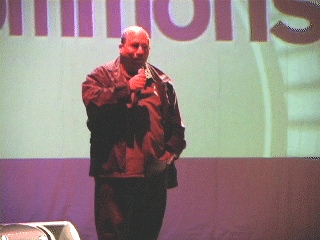
Craig Newmark at the Creative Commons Launch - 18 MB
Craig Newmark at the Creative Commons Launch - 10 MB
Audio - MP3 of Craig Newmark at the Creative Commons Launch - 3 MB
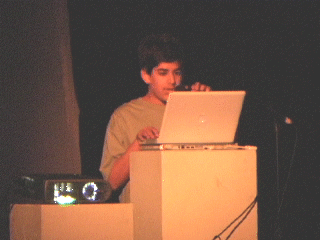
Aaron Swartz at the Creative Commons Launch - 27 MB
Aaron Swartz at the Creative Commons Launch - 16.5 MB
Audio - MP3 of Aaron Swartz at the Creative Commons Launch - 5.5 MB
Here's Glenn Otis Brown, the Executive Director of the Creative Commons, introducing the cool animation he (and a few other people from the CC staff) co-produced with Ryan Junell.
This clip provides Glenn's introduction and closing words from the Get Creative premiere at the December 16th launch.

Glenn Otis Brown at the Creative Commons Launch - 28 MB
Glenn Otis Brown at the Creative Commons Launch - 24 MB
Glenn Otis Brown at the Creative Commons Launch - 16 MB
MP3 of Glenn Otis Brown at the Creative Commons Launch (5 MB)
Sorry these took so long. Here are some medium and low resolution versions of Lawrence Lessig's December 16, 2002 presentation in San Francisco at the Creative Commons Launch.
Small files and MP3s of Lessig's CC Launch Speech (and others)
Complete with new and exciting reasonable file sizes!
Below are links to a high resolution and low resolution QuickTime movies and audio MP3 file. Let me know if you need another format.
Brewster Kahle and son, Caslon, at the Creative Commons Launch

Brewster Kahle at the Creative Commons Launch - 25 MB
Brewster Kahle at the Creative Commons Launch - 14 MB
MP3 of Brewster Kahle at Creative Commons Launch - 5 MB
I've made MP3 files of DJ Spooky's preview of his Birth of a Nation Remix (Edited exactly at the beginning and end of the music track that was played along side of his interactive visual presentation so it can be segued accordingly.)
and
The speaking portion of DJ Spooky's presentation (This is slightly incomplete in that I don't have him saying 'thank you' and making a few comments that he made at the end of the visual part of the presentation.)
Here's an old favorite of mine (originally published in 1994 and continuously updated ever since) that will make a great new addition to the commons!
Matisse Enzer has released his
Glossary of Internet Terms under a Creative Commons Share Alike License.
Here is DJ Spooky's presentation at the Creative Commons Launch last Monday night.
I know these are big files guys, but I'll be posting some lower-quality versions a little later today. (These are up now on my index at: http://www.lisarein.com/videoindex.html#spooky.)
(DV experts -- please email me directly at lisarein@finetuning.com with suggestions about how to compress these files smaller -- I'm committed to perfecting my technique for this stuff!)
I'll be releasing an MP3 of the music too (from the Birth of a Nation Remix). -- And yes, Paul Miller (DJ Spooky) gave me his permission to redistribute all of this stuff into the public domain, so no worries there!
So remember - don't try to play these in your browser -- right click (pd) or click and hold (mac) to download these files to your hard drive and play them from there.
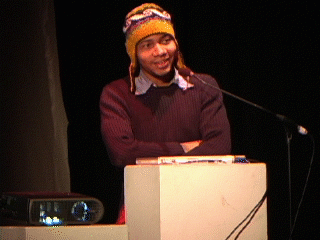
First part of DJ Spooky's Presentation
Second part of DJ Spooky's Presentation
Birth of a Nation Remix w/ DJ Spooky talk afterwards
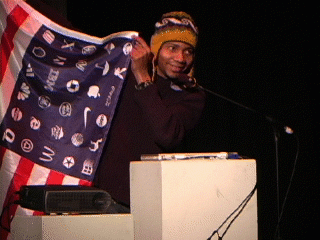
DJ Spooky Holding Up The "AdBusters" Flag
I'll be putting up a movie every day this week: Lawrence Lessig, John Perry Barlow and Jack Valenti today, DJ Spooky Tomorrow, Brewster Khale and (mini-brewster), Craig Newmark, Aaron Swartz and Vicki Bennett as the week goes on...
(Lower resolultion versions available now.)
First Part of Larry's speech (92.4 MB)
John Perry Barlow and Jack Valenti speeches (75.2 MB)
Second Part of Larry's speech (78.6 MB)
I'll be posting video of all the presentations from last Monday's launch, one a day, starting Monday... (Update 12/31/02 - This stuff is all availablel now on my video index.)
I'm going to start with QuickTimes and then am happy to convert other formats from there on request.
I'll be storing all of this at the Internet Archive, so I'm happy to generate as many formats as needed to make the footage viewable on all platforms and systems.
Write me with your suggestions/technical requirements at: lisarein@finetuning.com.
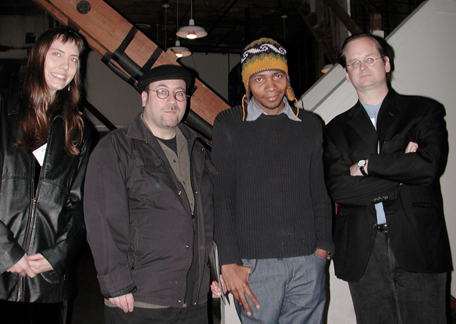 Photos by Gohsuke Takama
Me (Lisa Rein), Craig Newmark, DJ Spooky (Paul Miller) and Larry Lessig
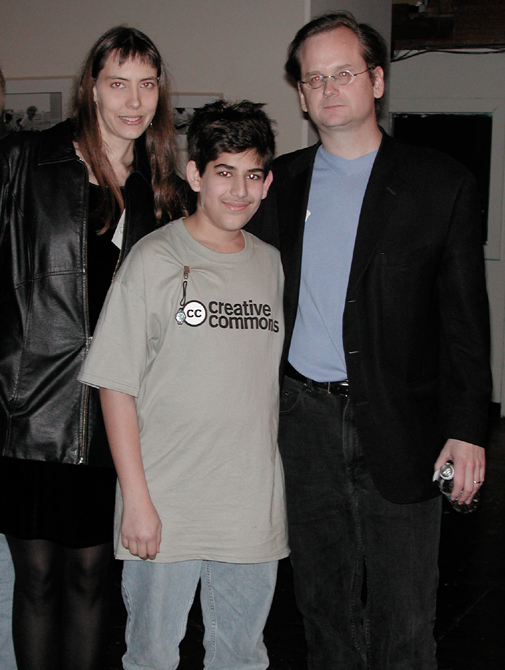
Me (Lisa Rein), Aaron Swartz, Larry Lessig
Hooray! We have just launched our new website, complete with licensing application and...drumroll please.....the licenses!
Here are a few articles by the Seattle Times, Wired News, MeFi and
Slashdot.
My new interview with Doc Searls has just been published on the Creative Commons website, along with information about the upcoming December 16th launch!
Doc Searls: Featured Commoner
I think we need to develop a new vernacular understanding of what licensing is. . . . I mean there have always been tacit agreements about what we can and can't do with stuff -- agreements we've understood intuitively. Now we need to be much more explicit, because the range of actions that can be taken with our public works is not only much larger, but often committed in digital form, which allows us to be much more specific about the agreements involved...... I believe there is a crying need for a public conversation about the licensing of artistic works, and for our vocabulary to have the richest and most specific possible bases. That's why the work Creative Commons does is so important and welcome by attempting to scaffold a new set of commons-native relationships between creators and customers.
Our first Creative Commons' interview is up on the website:
Rick Prelinger.
(Keeper of the Prelinger Archives, which have just been accepted into the Library of Congress.
Through our partnership with the Internet Archive, my images are just going out all over the world. They are achieving a level of spread and penetration I could never do on my own. And therefore, I think that giving things away ends up benefiting me. You know, these images don't get used up. They don't get yellow around the edges. They don't become less valuable from being shown and repeated. Ubiquity equals value. That's how I think you can make money by giving things away.
Here's the full text of the interview in case the link goes bad
(wow I really hope this particular link never goes bad):
http://www.creativecommons.org/features/rick
Rick Prelinger
Interview by: Lisa Rein
Photos by: Lisa Leigh
Dateline: 1980. New York-based typesetter Rick Prelinger was trying to "make it in the movies" and writing a reference book on two-way radio frequencies on an IBM Selectric typewriter. Two years later, he became the Research Director for "Heavy Petting," the Norman Lear-funded Atomic Café-like documentary about sexuality in the 20th Century. Armed with photocopies of old educational film reference books and Library of Congress copyright catalogs, he began a project of surveying, cataloging, archiving, and cross-referencing educational, industrial and advertising films produced in the United States between 1903 and the early 1980s.
Over the past twenty years, Rick has collected more than 48,000 complete films and roughly 30,000 cans of raw footage. The Internet Archive currently hosts 1,125 titles online, with plans to have 1,500 uploaded by the end of 2003.
The Library of Congress recently acquired the Prelinger Archives, which will be made publicly accessible after a 3- to 4-year processing period. In the meantime, the Internet Archive will be the primary way to access the films.
We caught up with Rick fresh back from New York City, where he had been cataloging and preparing to ship the actual film stock for delivery to the L.O.C. The process had left him covered in rust and dust from digging into the corners of his storage facility in search of any lost films that may have slipped through the cracks.
CC: Rick, what exactly is the Prelinger Archives?
RP: The Prelinger Archives is a large collection of what I call "ephemeral films." These are industrial, advertising, educational, amateur and government films -- films that were generally made not to show in movie theatres or on TV, but films that were made to teach, to educate, sometimes to miseducate, to train, to sell, pitch a product, or promote an idea. Films that embody the persuasions of the past. In addition to showing us the way things were, they also show how things were supposed to be. They are a wonderful set of visions of the way we were supposed to think, what we were supposed to buy. A vision of the sort of people we were supposed to become, and as such they record aspects of our history that are suppressed. They are not necessarily public aspects of our history.
CC: What do you mean "not necessarily public aspects of our history"?
RP: I'll give you an example. If we want to have a sense of what it was like to be a member of a family, a nuclear family in the American 50's or 60's, you really can't get that authentically from a TV sit com, or from a Hollywood movie, or from a news reel. But when you see these films, they are filled with footage of idealized families in action. We get a sense of how the family actually looked and behaved, what was the body language, what were the gender roles, how kids were supposed to behave differently than adults, and you also get a sense of that sort of all-encompassing ideology. So you could argue that all of these films, in a way, are sort of an ethnographic vision of a lost America.
CC: Do you feel that producing these films is a lost art?
RP: These kinds of films really aren't made today, but if you could imagine the World Wide Web -- where organizations and institutions, companies and individuals use the Web to build a site to make their voice heard --imagine that instead everybody was making movies…every company made movies to promote products and train its workers and reach the public. In the schools of the past, really from the turn of the century until recently, films were shown to teach everything. Whether it was "How To Brush Your Teeth," "How To Get Married," "Social Studies," "The Products of Guatemala"…this is the kind of material that I've collected for about twenty years.
CC: How long has the Prelinger Archives offered films on the Web?
RP: We first started putting movies up at the very, very beginning of 2001, and the site was kind of embryonic for a while. It's still a work in progress, but well over 1,250,000 movies have been downloaded -- some of those for people to just look at and enjoy from the privacy of their homes, their dorm rooms. Others have been made into other movies.
CC: The movies in the Prelinger Archives have been used to create a wide range of "derivative works." Could you give us some examples?
RP: In 2001, we had a contest on the theme of "The World At War"…the winners are actually on the Internet Archive Website. The film that took the first prize was "The ABC's of Happiness," where an animated character tells the audience that we really shouldn't worry about the past. We should be happy. We shouldn't look at disturbing images and let this knock us off of our complacent center -- and of course the images we're seeing in the background are all very disturbing. It's a very funny and a very sweet film, but with a real punch to it. An artist in England whose name is Vicki Bennett -- who performs under the name of "People Like Us" is a musician whose work is made of sampling other kinds of works and knitting together a new whole which is kind of utopian and imaginative. She made a ten-minute movie called, "We, Out of the Life," which is about the history of electronic music and the (perhaps) obsolescence of human beings in the future, and it's all made with material from my collection that was downloaded through the Internet Archive. It's a funny and very complex little movie.
People are working with our footage to make shows for Tech TV. There's a series called "Big Thinkers" that makes very, very heavy use of our material. And you know, when you're making a movie about "Big Thinkers," you have people talking, and how do you add ametaphoric dimension to what people are saying? How do you visualize their ideas? One of the ways that the producers decided to do that was to download an incredible amount of footage from the site, build a little library, and use a lot of these archival images to contextualize what people were saying.
A woman in San Francisco named Heather Rogers just made a great little film on recycling that actually questions whether recycling is beneficial. We all think that recycling is a good thing…she's not sure that it is, and she uses a lot of old imagery from the Archives depicting consumption and waste to illustrate her point. It's a strong movie. So, there are artists. There are documentaries. There are people doing conventional commercial TV, and there are people doing work that doesn't look like anything that has ever been made before. But all of it relies heavily on having access to a pool of old imagery.
CC: Could you explain more of the details about how making your footage available "for free" through the Internet Archive has actually increased revenues for your stock footage business?
RP: I run a small stock footage company. It grosses every year in the low-to mid-six figures. My competitors are big companies who spend at least as much and maybe more money than I gross every year just on magazine advertising. Probably, they spend that much money just to build their Websites. I couldn't afford to do that. But if the footage that's in my collection is "out there," and [if] it works its way back into the culture by being ubiquitous, I gain. Because ubiquity of images makes them more valuable.
CC: How about an example of what you mean when you talk about how an image's being used over and over again makes it more ubiquitous and therefore more valuable?
RP: The example that I always like to point to goes back to when I used to work at HBO. (I worked in the entertainment industry for six years.) One day, I was sitting with a colleague of mine who was head of the Time-Life picture collection -- a wonderful, wonderful collection of images, many of which are the most emblematic images of the last 70 or 80 years. I asked [my colleague], "What's your highest revenue-producing image?" She said, "Why I'm surprised you asked, Rick. Of course, you know what it is: It's the image of everybody sitting in a movie theater with their 3-D glasses on." You know this famous image. It's kind of emblematic of the fifties. [Time-Life] makes a great deal of money selling that image...it's also pirated. It's been shot over and over again by people. People have set up people in theaters and then shot it on film, so they have a movie version of it. Repetition and ubiquity haven't lessened the value of that image: they've increased it.
Through our partnership with the Internet Archive, my images are just going out all over the world. They are achieving a level of spread and penetration I could never do on my own. And therefore, I think that giving things away ends up benefiting me. You know, these images don't get used up. They don't get yellow around the edges. They don't become less valuable from being shown and repeated. Ubiquity equals value. That's how I think you can make money by giving things away.
In case you haven't heard, Creative Commons has released a metadata draft.
There's also a Mailing list if you're interested in following the discussion.
So far Ben Hammersley has implemented the schema in mod_cc, and Kevin Burton has implemented it in Mod_Reference and Mod_Subscription.
I think those words ring loudest in my head from last week's E-Tech conference -- probably because they were said by half of the speakers there.
Let's hope I can remember them as I build the Creative Commons' infrastructure :-)
My talk went great today at Etech. It's so incredible to talk to everyone and find out just how much of an incredible demand there is for easy-to-use non-commercial licenses!
The website is up now, so go check it out:
http://www.creativecommons.org.
Amy Harmon has written a little ditty about the Creative Commons for the NY Times!
A New Direction for Intellectual Property
Perceiving an overly zealous culture of copyright protection, a group of law and technology scholars are setting up Creative Commons, a nonprofit company that will develop ways for artists, writers and others to easily designate their work as freely shareable.
Creative Commons, which is to be officially announced this week at a technology conference in Santa Clara, Calif., has nearly a million dollars in start-up money. The firm's founders argue that the expansion of legal protection for intellectual property, like a 1998 law extending the term of copyright by 20 years, could inhibit creativity and innovation. But the main focus of Creative Commons will be on clearly identifying the material that is meant to be shared. The idea is that making it easier to place material in the public domain will in itself encourage more people to do so.
The firm's first project is to design a set of licenses stating the terms under which a given work can be copied and used by others. Musicians who want to build an audience, for instance, might permit people to copy songs for noncommercial use. Graphic designers might allow unlimited copying of certain work as long as it is credited.
The goal is to make such licenses machine-readable, so that anyone could go to an Internet search engine and seek images or a genre of music, for example, that could be copied without legal entanglements.
"It's a way to mark the spaces people are allowed to walk on," said Lawrence Lessig, a leading intellectual property expert who will take a partial leave from Stanford Law School for the next three years to serve as the chairman of Creative Commons.
Inspired in part by the free-software movement, which has attracted thousands of computer programmers to contribute their work to the public domain, Creative Commons ultimately plans to create a "conservancy" for donations of valuable intellectual property whose owners might opt for a tax break rather than selling it into private hands.
The firm's board of directors includes James Boyle, an intellectual property professor at Duke Law School; Hal Abelson, a computer science professor at the Massachusetts Institute of Technology; and Eric Saltzman, executive director of the Berkman Center for Internet and Society at Harvard Law School.
SF Gate's Hal Plotkin has written a column about Lawrence Lessig's Creative Commons project.
This seems as good a time as any to announce that I am the Technical Architect for the Creative Commons. Although I am not at liberty to discuss the details of what we are doing publicly at this time, Lawrence Lessig was kind enough to spill the beans about some of them in Hal's article.
I'll be providing the details of what we're building at my presentation at O'Reilly's Emerging Technology Conference in Santa Clara in May 2002.
Check out:
All Hail Creative Commons:
Stanford professor and author Lawrence Lessig plans a legal insurrection,
by Hal Plotkin for SF Gate.
In a boon to the arts and the software industry, Creative Commons will make available flexible, customizable intellectual-property licenses that artists, writers, programmers and others can obtain free of charge to legally define what constitutes acceptable uses of their work. The new forms of licenses will provide an alternative to traditional copyrights by establishing a useful middle ground between full copyright control and the unprotected public domain.
The first set of licensing options Creative Commons plans to make available are designed mostly for people looking for some protections as they move their wares into the public domain. Those protections might include requirements that the work not be altered, employed for commercial purposes or used without proper attribution.
Lessig adds that it's possible Creative Commons' licenses may eventually evolve to include options that permit or enable certain commercial transactions. An artist might, for example, agree to give away a work as long as no one is making money on it but include a provision requiring payments on a sliding scale if it's sold. As participation in the Commons project increases, a variety of specific intellectual-property license options will evolve in response to user needs, which in turn would create templates for others with similar requirements.
Within a few months, artists, writers and others will soon be able to go online, select the options that suit them best and receive a custom-made license they can append to their works without having to pay a dime to a lawyer, let alone the thousands of dollars it typically costs to purchase similar legal services.

