Free Peace, Love and Hip Hop/Rock and Roll/Dance/Country/Folk/Punk Rock Baby!
This collection of peace songs is growing larger every day.
Please spread the word by downloading these songs and sharing them with your friends.
Call your local radio stations and demand that they play these songs.
And when these artists come out with their next album for sale or come to play live in your town, show them your support!
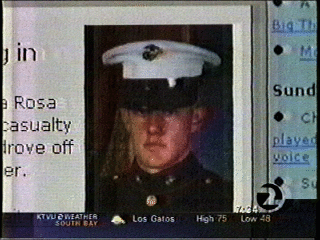
Another needless fatality of war: Santa Rosa's Patrick O'Day. He and his wife had just married last year and were expecting their first child.
Patrick is believed to have been killed when his tank went off a bridge.
This was recorded on KTVU Channel 2 news on the morning of March 31, 2003, in San Francisco, CA.
Santa Rosa's Patrick O'Day (Small - 2 MB)
Santa Rosa's Patrick O'Day (Hi-res - 20 MB)


For the record:
Filibuster Holds!
How Senators Voted on the Estrada Filibuster
Here is the full text of the article in case the link goes bad:
http://www.pfaw.org/pfaw/general/default.aspx?oid=8981
Filibuster Holds!
How Senators Voted on the Estrada Filibuster
Cloture* Votes on the Nomination of Miguel Estrada to the U.S. Court of Appeals for the District of Columbia Circuit.
See how your senators voted below. Click on a senator's name to phone, fax or e-mail your personal message about the votes to the senator. Thank those who voted NO (keep the filibuster going) and express your outrage to those who voted YES to the President's court-packing scheme.
First Cloture Vote - March 6, 2003
Vote Totals: 44 Nays - 55 Yeas - 1 Not Voting
Second Cloture Vote - March 13, 2003
Vote Totals: 42 Nays - 55 Yeas - 3 Not Voting
Third Cloture Vote - March 18, 2003
Vote Totals: 45 Nays - 55 Yeas
3/6/03 3/13/03 3/18/03
Alabama
Sen. Richard Shelby (R) Yes Yes Yes
Sen. Jeff Sessions (R) Yes Yes Yes
Alaska
Sen. Ted Stevens (R) Yes Yes Yes
Sen. Lisa Murkowski (R) Yes Yes Yes
Arizona
Sen. John McCain (R) Yes Yes Yes
Sen. Jon Kyl (R) Yes Yes Yes
Arkansas
Sen. Blanche Lincoln (D) No No No
Sen. Mark Pryor (D) No No No
California
Sen. Dianne Feinstein (D) No No No
Sen. Barbara Boxer (D) No No No
Colorado
Sen. Ben Nighthorse Campbell (R) Yes Yes Yes
Sen. Wayne Allard (R) Yes Yes Yes
Connecticut
Sen. Christopher Dodd (D) No No No
Sen. Joseph Lieberman (D) No No No
Delaware
Sen. Joseph Biden, Jr. (D) No Not Voting No
Sen. Thomas Carper (D) No No No
Florida
Sen. Bob Graham (D) Not Voting No No
Sen. Bill Nelson (D) Yes Yes Yes
Georgia
Sen. Zell Miller (D) Yes Yes Yes
Sen. Saxby Chambliss (R) Yes Yes Yes
Hawaii
Sen. Daniel Inouye (D) No No No
Sen. Daniel Akaka (D) No No No
Idaho
Sen. Larry Craig (R) Yes Yes Yes
Sen. Michael Crapo (R) Yes Yes Yes
Illinois
Sen. Richard Durbin (D) No No No
Sen. Peter Fitzgerald (R) Yes Yes Yes
Indiana
Sen. Richard Lugar (R) Yes Yes Yes
Sen. Evan Bayh (D) No No No
Iowa
Sen. Charles Grassley (R) Yes Yes Yes
Sen. Tom Harkin (D) No No No
Kansas
Sen. Sam Brownback (R) Yes Yes Yes
Sen. Pat Roberts (R) Yes Yes Yes
Kentucky
Sen. Mitch McConnell (R) Yes Yes Yes
Sen. Jim Bunning (R) Yes Yes Yes
Louisiana
Sen. John Breaux (D) Yes Yes Yes
Sen. Mary Landrieu (D) No No No
Maine
Sen. Olympia Snowe (R) Yes Yes Yes
Sen. Susan Collins (R) Yes Yes Yes
Maryland
Sen. Paul Sarbanes (D) No No No
Sen. Barbara Mikulski (D) No No No
Massachusetts
Sen. Edward Kennedy (D) No No No
Sen. John Kerry (D) No Not Voting No
Michigan
Sen. Carl Levin (D) No No No
Sen. Debbie Stabenow (D) No No No
Minnesota
Sen. Mark Dayton (D) No No No
Sen. Norm Coleman (R) Yes Yes Yes
Mississippi
Sen.Thad Cochran (R) Yes Yes Yes
Sen. Trent Lott (R) Yes Yes Yes
Missouri
Sen. Christopher Bond (R) Yes Yes Yes
Sen. Jim Talent (R) Yes Yes Yes
Montana
Sen. Max Baucus (D) No No No
Sen. Conrad Burns (R) Yes Yes Yes
Nebraska
Sen. Chuck Hagel (R) Yes Yes Yes
Sen. Ben Nelson (D) Yes Yes Yes
Nevada
Sen. Harry Reid (D) No No No
Sen. John Ensign (R) Yes Yes Yes
New Hampshire
Sen. Judd Gregg (R) Yes Yes Yes
Sen. John Sununu (R) Yes Yes Yes
New Jersey
Sen. Jon Corzine (D) No No No
Sen. Frank Lautenberg (D) No No No
New Mexico
Sen. Pete Domenici (R) Yes Yes Yes
Sen. Jeff Bingaman (D) No No No
New York
Sen. Charles Schumer (D) No No No
Sen. Hillary Clinton (D) No No No
North Carolina
Sen. John Edwards (D) No Not Voting No
Sen. Elizabeth Dole (R) Yes Yes Yes
North Dakota
Sen. Kent Conrad (D) No No No
Sen. Byron Dorgan (D) No No No
Ohio
Sen. Mike DeWine (R) Yes Yes Yes
Sen. George Voinovich (R) Yes Yes Yes
Oklahoma
Sen. Don Nickles (R) Yes Yes Yes
Sen. James Inhofe (R) Yes Yes Yes
Oregon
Sen. Ron Wyden (D) No No No
Sen. Gordon Smith (R) Yes Yes Yes
Pennsylvania
Sen. Arlen Specter (R) Yes Yes Yes
Sen. Rick Santorum (R) Yes Yes Yes
Rhode Island
Sen. Jack Reed (D) No No No
Sen. Lincoln Chafee (R) Yes Yes Yes
South Carolina
Sen. Ernest Hollings (D) No No No
Sen. Lindsey Graham (R) Yes Yes Yes
South Dakota
Sen. Thomas Daschle (D) No No No
Sen. Tim Johnson (D) No No No
Tennessee
Sen. Bill Frist (R) Yes Yes Yes
Sen. Lamar Alexander (R) Yes Yes Yes
Texas
Sen. Kay Bailey Hutchison (R) Yes Yes Yes
Sen. John Cornyn (R) Yes Yes Yes
Utah
Sen. Orrin Hatch (R) Yes Yes Yes
Sen. Robert Bennett (R) Yes Yes Yes
Vermont
Sen. Patrick Leahy (D) No No No
Sen. James Jeffords (I) No No No
Virginia
Sen. John Warner (R) Yes Yes Yes
Sen. George Allen (R) Yes Yes Yes
Washington
Sen. Patty Murray (D) No No No
Sen. Maria Cantwell (D) No No No
West Virginia
Sen. Robert Byrd (D) No No No
Sen. John Rockefeller IV (D) No No No
Wisconsin
Sen. Herbert Kohl (D) No No No
Sen. Russ Feingold (D) No No No
Wyoming
Sen. Craig Thomas (R) Yes Yes Yes
Sen. Michael Enzi (R) Yes Yes Yes
* In order to end a Senate filibuster on a bill or nomination, 60 senators must vote in favor of what's called cloture. Senators have the option of calling for multiple cloture votes, but the filibuster cannot be ended until one of these votes attracts the support of 60 senators.
This is a 'just a for the record' kind of posting:
People For the United Way -- Filibuster Holds!
Organizations Opposed to the Confirmation of Miguel Estrada
Here is the full text of the article in case the link goes bad:
http://www.pfaw.org/pfaw/general/default.aspx?oid=8981
Filibuster Holds!
Organizations Opposed to the Confirmation of Miguel Estrada
All words (AND)
Any word (OR)
Exact phrase
Filibuster Holds!
Organizations Opposed to the Confirmation of Miguel Estrada
Forty-nine national, regional and state organizations have declared their opposition to Miguel Estrada's confirmation to the Circuit Court of Appeals for the District of Columbia.
A number of individual Latino Labor leaders have also announced their opposition to Estrada's confirmation. Read their letter and names.
ADA Watch/National Coalition for Disability Rights
AFL-CIO
Alliance for Justice
American Association of University Women
Americans for Democratic Action
California branch of the League of United Latin American Citizens
Coalition of Immokalee Workers
Community Rights Counsel
Congressional Black Caucus
Congressional Hispanic Caucus
Earthjustice
Farm Labor Organizing Committee
Farmworker Association of Florida
Feminist Majority
Friends of the Earth
General Board of Church and Society, The United Methodist Church
Labor Council for Latin American Advancement
La Raza Lawyers Association of California
LaRed Latina
Leadership Conference on Civil Rights
Mexican American Legal Defense and Educational Fund
MoveOn.org
National Abortion Federation
National Association for the Advancement of Colored People
NAACP Legal Defense and Educational Fund, Inc.
NARAL Pro-Choice America
National Council of Jewish Women
National Employment Lawyers Association
National Fair Housing Alliance
National Family Planning and Reproductive Health Association
National Farm Worker Ministry
National Organization for Women
National Partnership for Women and Families
National Women's Law Center
Natural Resources Defense Council
People For the American Way
PCUN (Pineros y Campesinos Unidos del Noroeste/Northwest Treeplanters and Farmworkers United)
Planned Parenthood Federation of America
Religious Coalition for Reproductive Choice
Puerto Rican Legal Defense and Education Fund
Sierra Club
Society of American Law Teachers
Southwest Voter Registration and Education Project
United Auto Workers
United Church of Christ Justice and Witness Ministries
United Farm Workers of America
United States Hispanic Leadership Institute
William C. Velasquez Intitute
Working Assets
Carolyn Kuhl: Blocking the Path to Justice
Owen's Second Hearing Confirms Clear and Compelling Case Against Confirmation
Your email address
Update Your Profile
News From The Right
Right Wing Organizations
Right Wing Watch Online 2003
Protecting a Woman's Right to Privacy and Reproductive Choice
Opposing Carolyn Kuhl's Confirmation
2nd Hearing Confirms Case Against Priscilla Owen
Privacy Policy | Employment | Copyright & Disclaimer
People For the American Way • 2000 M Street, NW, Suite 400 • Washington, DC 20036
Telephone: 202-467-4999 or 800-326-7329 • pfaw@pfaw.org
As in the foreign policy that's biting us in our own ass.
Here are a few kind words that were sent to me by the
Compassionate Conservatives.
(Lyrics)
Please don't be fooled by our name... we bear no resemblance to the frauds currently inhabiting the White House. Our mission is to uncover the deception, hypocrisy, and arrogance of the court-appointed Bush Administration through our music and wit. We release all songs in MP3 format for free download... no strings attached. We are not in this for the money...1. Another War
Set to the tune of the Beatles' "Drive My Car", Bush and Cheney are overjoyed at the prospect of -- you guessed it -- another war. Featuring a special excerpt from Bush's March 19th speech introducing the Iraqi war.
Dubya wants another war
Dubya's just a corporate whore
Dubya wants another war
'cause Dubya's a NaziAsk Dick Cheney what's he going to do
He starts a-sneering, you know you're screwed
He's been known to keep a secret or two
And now he's keeping them all from youCheney wants another war
Halliburton's gonna score
Cheney wants another war
'cause Cheney's a NaziJawohl Mein Fuehrer Ja!
2. Midnight Confessions (of Emperor G.W. Bush)This is a remake of the Grass Roots song on the same name, circa 1968. Featured commentator is, of course, George W. Bush, who comes off sounding every bit the buffoon that he is.
3. In The Garden of Eden (war crimes/DC rally mix)
This is a remake of Iron Butterfly's "In-A-Gadda-Da-Vida", which we chose in light of Iraq's geographical location. We have added some commentary, including unintentional Bush irony from the State of the Union address, comments from Francis Boyle on how the Iraq war violates the Nuremberg Charter, and numerous commentators from the January 18th anti-war rally held in Washington DC.
Here's the Zinn/Fisk/Nader remix of the same "Garden of Eden" song.
At this point, the protest had pretty much deteriorated into a game of cat and mouse with imaginary rules that changed whenever the cops wanted them to. Let's face it, they had the clubs. And they could take us to jail. Those were the important rules, as far as I was concerned.
That said. I stuck around to see what would happen. I mean I really wanted to leave. So did Kevin. Neither of us wanted to get arrested. And we were getting bitchy with each other and arguing about what we should do, until we realized it and took a couple deep breaths and decided what to do.
I decided that I felt like, if we left, I'd be letting you guys down or something. Kevin felt the same way. So we decided to stick around for a little longer.
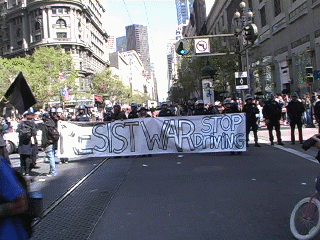
At first, it seemed that the only behavior that the police had a problem with was people blocking the intersections when cars were trying to drive by. However, soon it wasn't okay to stand on certain sidewalks either. The cops obviously wanted us to just go home, which, of course, didn't make any sense to us, since many of us had just gotten there.
But soon, the sidewalks weren't OK either. Then, depending on your timing, some sidewalks were OK, but only until they weren't, and the cops started systematically crowding us off of them.
(I'll include a complete instance of this later on video for those of you who are interested and link to it from here.)
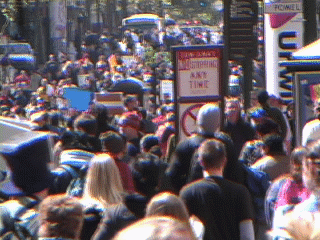
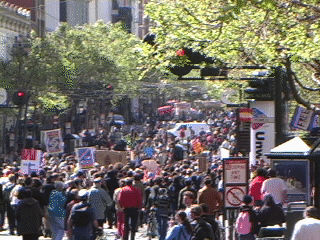
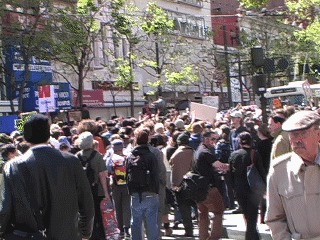
In the first shot, Kevin climbs up on the outside of the BART entrance and grabs a long shot and some close ups for me (I was afraid of falling). It was pretty incredible the number of people there at that time. Wow.
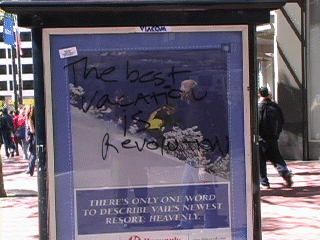
Next is a shot of some graffiti: "The Best Vacation Is Revolution." You can see me and Kevin in the reflection.
Followed by a clip of a tap dancer tapping for peace.
Then the cops start building up again. The crowd starts chanting "Whose streets? Our streets!" and acting a bit defiant.
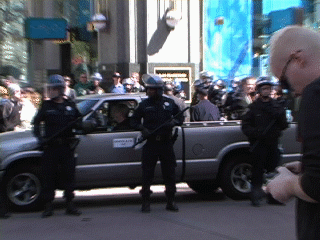
The cops form a line across a third or so of the intersection at 4th and Market, so that cars can go by. Which is fine by the crowd. And that goes on for a while.
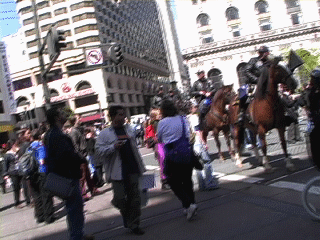
Then someone starts playing an awesome beat-driven soundtrack. And the horses arrive...
Day After/Day Of Adventure - Part 7 of ? (Small - 11 MB)
Day After/Day Of Adventure - Part 7 of ? (Hi-res - 94 MB)

Oh goody. I'm not the only technologist that has been thinking long and hard about the voting machine problem. In fact, it looks like I'm coming in pretty late in the game!
It's cutting it pretty close, but perhaps there could be enough time between now and November 2004 to enable a fair and verifiable election.
Here's some thoughtful background and analysis on electronic voting from Stanford Computer Science and Electrical Engineering Professor David Dill.
This statement is intended be a message from technologists to the rest of the public, the gist of which is: Do not be seduced by the apparent convenience of "touch-screen voting" machines, or the "gee whiz" factor that accompanies flashy new technology. Using these machines is tantamount to handing complete control of vote counting to a private company, with no independent checks or audits. These machines represent a serious threat to democracy. Much better alternatives are available for upgrading voting equipment...Compared with most technical issues, the basic problems with most "touch screen voting machines" are forehead-slappingly obvious to almost anyone who knows a little bit about computer security. There is strong agreement among those who have studied the problem in-depth, and I believe that almost anyone who looks into the problem a little (or a lot) will come to the same conclusions.
We realize that election equipment must satisfy many requirements, so we are neutral about the nature of the voter-verifiable audit trail, so long as it allows meaningful audits. Anything from fully manual paper ballots to optical scan ballots to touch screen machines that print paper ballots would do, so long as the voter can check the ballot and the (anonymous) ballot goes into a secure ballot box of some kind to be available for manual counting. In the future, there may be other kinds of physical ballots or even cryptographically based audit trails that satisfy the requirements.
Here is the full text of the article in case the link goes bad:
http://verify.stanford.edu/evote.html
Introduction
I (David Dill) am organizing opposition to paperless electronic voting machines by technologists, especially computer science researchers. I have written a resolution, for which I would like to recruit endorsements.
The Resolution on Electronic Voting
This statement is intended be a message from technologists to the rest of the public, the gist of which is: Do not be seduced by the apparent convenience of "touch-screen voting" machines, or the "gee whiz" factor that accompanies flashy new technology. Using these machines is tantamount to handing complete control of vote counting to a private company, with no independent checks or audits. These machines represent a serious threat to democracy. Much better alternatives are available for upgrading voting equipment.
I'm seeking endorsements for the statement by individuals and organizations. Of course, potential endorsers may feel that they don't know enough about the problem, so I have provided some links to further information below. Having devoted a modest amount of study to the problem, I have to concede that it's a little more complex that I thought at first. However, it's not that subtle. Compared with most technical issues, the basic problems with most "touch screen voting machines" are forehead-slappingly obvious to almost anyone who knows a little bit about computer security. There is strong agreement among those who have studied the problem in-depth, and I believe that almost anyone who looks into the problem a little (or a lot) will come to the same conclusions.
We realize that election equipment must satisfy many requirements, so we are neutral about the nature of the voter-verifiable audit trail, so long as it allows meaningful audits. Anything from fully manual paper ballots to optical scan ballots to touch screen machines that print paper ballots would do, so long as the voter can check the ballot and the (anonymous) ballot goes into a secure ballot box of some kind to be available for manual counting. In the future, there may be other kinds of physical ballots or even cryptographically based audit trails that satisfy the requirements.
What you can do to help.
Our biggest problem at this time is making people aware of this problem. Most people haven't a clue that there is even a controversy. They assume that election officials, manufacturers, politicians, or somebody must have made sure that the voting machines are secure. So you can help with this problem:
* Mention it to friends.
* Link to this web site
* Write letters to your local newspaper, talk to the reporters and columnists about the issue.
* Bring it up on mailing lists and web sites where readers may be interested (but please don't spam people!).
* Communicate (by email, phone, fax, or US Mail) with your elected officials at the local, state and federal level to let them know you are concerned about the issue.
* Find out what is going on in your community and/or state. Are they planning to buy new machines? To find out more, see our web pages about what's happening around the U.S.
Questions or comments can be addressed in email to "elections@chicory.stanford.edu"
Important Announcements
A letter from U.S. Rep. Rush Holt (pdf), expressing concern about the lack of a voter-verified audit trail in many electronic voting machines.
A letter to the Secretary of State of California from Prof. Doug Jones, a computer scientist and election machine examiner in Iowa.
Legislation pending in Washington State!
The state of Ohio has appointed a task force to set requirements for implementing HAVA. It would be great if they required a voter-verifiable audit trail. But there don't seem to be any computer technologists on the task force. I would like to hear from Ohio residents who would can help with this issue.
News about the debate in Santa Clara County.
#
She doesn't mince too many words, either.
I always thought a lot about Lisa Marie when I was a little girl growing up because she had (partly) the same name as me and was born the same year as me and I was told we looked a little alike (at the time).
(At least my relatives thought so :-)
I remember when Elvis died. I was like 5 or 6 years old, but I remember.
I remember that the first thing I thought of was Lisa Marie. I hoped she was going to be okay. Not just right at that moment, but in general.
I've pretty much been worried about her ever since. Some crazy emotional attachments you never outgrow, perhaps.
Anyway, I found this interview pretty interesting. Maybe you will too.
‘Love Makes Me Go Haywire’
Lisa Marie Presley talks frankly about music, marriage—and suspicious minds
By Lorraine Ali for Newsweek.
I was so astounded by the hundreds of thousands of people who were clearly in mourning. They were having these violent reactions in front of me. Thousands of people were coming through my house to look at his body. I remember watching them all and being so confused. I couldn’t really have my own grieving time. It wasn’t until a month later at camp—where my mom sent me to get away from it all—that I lost it...No, it wasn’t mutual. He (Michael Jackson) was in the hospital, and I couldn’t figure out what was wrong with him. I started asking questions, and it was always a different story. He said I was “causing trouble” and “stirring up problems.” He told me, “You’re making my heart rate go up,” and asked me to go home, and I said, “Good. I want out.” This person is one of the biggest entertainers out there. He is not stupid. He’s very charming when he wants to be, and when you go into his world you step into this whole other realm. I could tell you all about the craziness—all these things that were odd, different, evil or not cool—but it still took me two and a half years to get my head out of it.
Here is the full text of the article in case the link goes bad:
http://www.msnbc.com/news/891807.asp?cp1=1
IMG: Lisa Marie Presley
Four lives in one: Lisa Marie Presley
‘Love Makes Me Go Haywire’
Lisa Marie Presley talks frankly about music, marriage—and suspicious minds
By Lorraine Ali
NEWSWEEK
April 7 issue — Lisa Marie Presley has been a de facto celebrity since she was born to Elvis and Priscilla 35 years ago. But the L.A.-based mom—she had a son and daughter with her first husband, musician Danny Keough—has avoided the spotlight, marriages to Michael Jackson and Nicolas Cage notwithstanding.
NOW THE RELUCTANT pop heiress is set to release a debut CD of bluesy rock, “To Whom It May Concern.” The album is hard-hitting in spots, middle-of-the-road in others, but her lyrics are honest and revealing, and Presley has an appealingly deep, smoky voice. In one of her first solo interviews ever, she talked candidly about life with Michael and living in the shadow of the true king of pop—her father.
Your parents divorced when you were 4, and your father died when you were only 9.
I feel like I’ve lived four lives in one. I dealt with death early on. It wasn’t just my father, it was my grandma, my grandpa, my great-grandfather, my aunts—all in a two-year period. I didn’t have much of a runway into life. I was, like, a deep, dark kid who was always melancholy.
Regardless of what your dad meant to the world, he was still your dad.
I was so astounded by the hundreds of thousands of people who were clearly in mourning. They were having these violent reactions in front of me. Thousands of people were coming through my house to look at his body. I remember watching them all and being so confused. I couldn’t really have my own grieving time. It wasn’t until a month later at camp—where my mom sent me to get away from it all—that I lost it.
Were you there the night that your father died?
I was, but I won’t go into it. I just won’t go there.
You grew up singing at the kitchen table at Graceland. Why did you wait to make an album?
I always avoided singing in public. I just felt I would get crucified. I thought of acting—maybe playing some whacked-out psychopath to shock and scare people, but that lasted, like, two weeks. I got over that and started singing again. There are those who will say, “She’s actually got some of her own talent, or some credibility as an artist,” versus those who will say, “She’s not her father, she never will be—and who the hell does she think she is?” That’s why I named it “To Whom It May Concern.” It’s kind of a sarcastic thing.
It’s an awful lot of pressure for your first album.
It’s intimidating. I hate it. But there must be people who are interested in getting beyond the superficial tabloid bulls—t. Because of no direct communication from me, there is this funnel of b.s. that travels straight to the public. It has a life of its own. When I meet people, I know they’re trying to sift what they’ve heard. But if they listen [to my album], I hope they will hear somebody who’s being pretty damn honest and not throwing up smoke screens.
Your dad’s stardom wreaked such havoc on your family. How did your mom feel about you getting into music?
The one time we talked about it she said, “Those are some serious shoes you are going to have to fill.” I think she was afraid of what I was gonna run into, crucifixion-wise.
Lisa Marie Presley on:
• Jitters about performing live
• Why she chose to become a recording artist
• Her revealing lyrics
You’ve been in plenty of surreal situations by now, like being married to Michael Jackson. You must have known that it was going to be a circus.
I was naive on that front. I was in this constant struggle that went something like this: a man who’s with me who has nothing is gonna be stomped on and have no identity left by the time [the press] get done with him. He’ll be Mr. F—kin’ Presley. I thought, I need to be with someone bigger than I am—or at least comparable—so they don’t get trampled. Michael wanted to meet me earlier in my life, and I said, “No way.” I thought he was a freak, and I had no interest in meeting him. But when I finally did, he immediately dashed any preconceived idea I had about him. We had a perfectly normal conversation, and I completely forgot who he was within 20 minutes. I actually did fall in love with him, but I don’t know what was on his menu.
You married Michael at 26. You seemed miffed that people didn’t believe the marriage was real. Now can you understand why everyone thought it was weird?
Absolutely! But at the time I was like, “What the f—k is the problem? Why am I getting all this bad press? They think I married him because I want to be a singer or I want publicity? All I ever did prior to the marriage was stay the hell away from that!” It took me a while to realize that maybe he manipulated stories or did things for public reasons, and that I was getting dragged into it. I can see that now.
Do you think he was truly invested in the marriage? [Jackson married Presley only months after he was accused of child molestation.]
I can’t say what his intentions were with me, but I can say it was the most real thing I think he’s had. My mother was like, “Timing—hello! Wakey, wakey!” But I rebelled against my mom, of course, and tried really hard not to think like that, not to believe that.
Was it a mutual decision to break it off?
IMG: Weekend
No, it wasn’t mutual. He was in the hospital, and I couldn’t figure out what was wrong with him. I started asking questions, and it was always a different story. He said I was “causing trouble” and “stirring up problems.” He told me, “You’re making my heart rate go up,” and asked me to go home, and I said, “Good. I want out.” This person is one of the biggest entertainers out there. He is not stupid. He’s very charming when he wants to be, and when you go into his world you step into this whole other realm. I could tell you all about the craziness—all these things that were odd, different, evil or not cool—but it still took me two and a half years to get my head out of it.
You say you were naive, but you seem tough and savvy in person.
Well, when it comes to love I’m naive. I’m a noodle. I go haywire. I’m getting better at it, though. I’m getting faster at coming to the conclusion that something’s not right.
What went wrong with you and Nicolas Cage?
With people like me and Nic, it’s difficult because there’s the camps. You’ve got 15 people around. That’s something that contributed—same with Michael. They may be claiming to love you or seemingly happy you’re together, but any minute they can throw a wrench in, they do. They’re so dependent on that person that you may be raining on their parade.
You and Nicolas were only married two months.
We dated for two years before that, but Nic and I were just two pirates, and pirates can’t marry each other. They need to marry someone in another profession—a nice little quiet mermaid. Otherwise they sink the ship. Which is what we did.
Is it difficult doing interviews after avoiding the press so long?
I’ve been so candid, I hope I don’t end up getting grossly misquoted and decide I’m not gonna talk anymore. I don’t want to be one of those people that’s willing to be cool, then gets slammed and has to have the publicist in the room yelling, “No comment!”
This is going on in Minnesota right now, courtesy of Governer Tim Pawlenty (R).
Hey, I get it. This is great. If legislation like this becomes the norm, only rich people will be able to afford to assemble in public places and/or perform acts of civil disobedience.
Pawlenty wants antiwar protesters to pay arrest costs
By Patricia Lopez and Sarah T. Williams for the Star Tribune.
With protests against the war continuing and arrests of demonstrators mounting, Gov. Tim Pawlenty said Thursday that he wants those arrested to pay the law-enforcement costs they incur or face prosecution.Press secretary Leslie Kupchella said that "effective immediately," Pawlenty wants judges to begin ordering restitution for the costs of arrest. While he does not have the authority to require judges to do so, he is considering proposing legislation that would require such restitution.
Kupchella said Pawlenty recognizes that charges against protesters typically are dismissed. "He would like that dismissal contingent on restitution," she said. "And he would like to see it happen effective immediately."
Kupchella said the administration has not determined the extent to which protesters should be charged -- whether, for instance, fees would cover the officer's time and the cost of booking and possible prosecution. However, she said, Pawlenty would like to keep the costs "nominal," perhaps $200.
"He thinks that is perfectly reasonable," Kupchella said. "The governor recognizes the rights of people to protest lawfully and have their own opinions. But when they go beyond that and break the law, they should pay the cost."
Kupchella said Pawlenty has found the diversion of law enforcers to protests "very frustrating."
Some members of the legal community expressed skepticism about the proposal's constitutionality, and one recent protester called it an infringement on free speech.
Karen Redleaf, a St. Paul war protester who was arrested twice this week at antiwar demonstrations, called Pawlenty's proposal "really shocking and distressing."
Redleaf, 39, a former stock analyst, said such a move would limit constitutionally protected free speech to those who could afford the price of arrest and prosecution.
"We do this to get news coverage for our views," she said. "They're not charging rapists for the costs of arresting and prosecuting them. We're not hurting anyone. We're just trying to make statements that need to be made."
Retired Hennepin County District Judge J. Bruce Hartigan was dubious about the idea.
"Lots of luck," he said. "It's never going to stand the test of appeal. . . . You're talking about the delicate balance between the First Amendment and governmental power. Chances are [such a fine] would be looked at as an improper infringement on the right to free speech and the right to assemble."
Hartigan, who retired last year after 14 years on the bench and who said he has represented and sentenced dozens of protesters, said the plan also could backfire.
"Let's say I'm a protester. I get together with a bunch of protesters and we go out and get arrested. We get in front of a judge. The judge orders restitution. We say no. We don't pay it. We'll all just go to jail and spend more of the governor's money."
Charles Samuelson, executive director of the Minnesota Civil Liberties Union, also had constitutional concerns.
Here is the full text of the article in case the link goes bad:
http://www.startribune.com/stories/587/3787447.html
Pawlenty wants antiwar protesters to pay arrest costs
Patricia Lopez and Sarah T. Williams, Star Tribune
Published March 28, 2003
PAWL28
With protests against the war continuing and arrests of demonstrators mounting, Gov. Tim Pawlenty said Thursday that he wants those arrested to pay the law-enforcement costs they incur or face prosecution.
Press secretary Leslie Kupchella said that "effective immediately," Pawlenty wants judges to begin ordering restitution for the costs of arrest. While he does not have the authority to require judges to do so, he is considering proposing legislation that would require such restitution.
Kupchella said Pawlenty recognizes that charges against protesters typically are dismissed. "He would like that dismissal contingent on restitution," she said. "And he would like to see it happen effective immediately."
Kupchella said the administration has not determined the extent to which protesters should be charged -- whether, for instance, fees would cover the officer's time and the cost of booking and possible prosecution. However, she said, Pawlenty would like to keep the costs "nominal," perhaps $200.
"He thinks that is perfectly reasonable," Kupchella said. "The governor recognizes the rights of people to protest lawfully and have their own opinions. But when they go beyond that and break the law, they should pay the cost."
Kupchella said Pawlenty has found the diversion of law enforcers to protests "very frustrating."
Some members of the legal community expressed skepticism about the proposal's constitutionality, and one recent protester called it an infringement on free speech.
Karen Redleaf, a St. Paul war protester who was arrested twice this week at antiwar demonstrations, called Pawlenty's proposal "really shocking and distressing."
Redleaf, 39, a former stock analyst, said such a move would limit constitutionally protected free speech to those who could afford the price of arrest and prosecution.
"We do this to get news coverage for our views," she said. "They're not charging rapists for the costs of arresting and prosecuting them. We're not hurting anyone. We're just trying to make statements that need to be made."
Retired Hennepin County District Judge J. Bruce Hartigan was dubious about the idea.
"Lots of luck," he said. "It's never going to stand the test of appeal. . . . You're talking about the delicate balance between the First Amendment and governmental power. Chances are [such a fine] would be looked at as an improper infringement on the right to free speech and the right to assemble."
Hartigan, who retired last year after 14 years on the bench and who said he has represented and sentenced dozens of protesters, said the plan also could backfire.
"Let's say I'm a protester. I get together with a bunch of protesters and we go out and get arrested. We get in front of a judge. The judge orders restitution. We say no. We don't pay it. We'll all just go to jail and spend more of the governor's money."
Charles Samuelson, executive director of the Minnesota Civil Liberties Union, also had constitutional concerns.
"The U.S. Supreme Court has repeatedly ruled that law enforcement in regard to First Amendment activities must be content neutral," he said. "If he [Pawlenty] wants to arrest protesters and charge them, he must also be prepared to be equally aggressive with people marching in support of the government's actions -- whatever the cause."
Pawlenty Communications Director Dan Wolter said Pawlenty "absolutely" would want restitution applied to any protester, no matter what the cause.
The U.S.-led invasion of Iraq has sparked worldwide protests that occasionally have turned violent. Local protests have remained peaceful, although arrests are on the rise.
Twenty-eight protesters were arrested Monday for refusing to leave U.S. Sen. Norm Coleman's St. Paul office.
On Tuesday, 68 were arrested for blocking entrances to the U.S. Courthouse in downtown Minneapolis. About a third of those demonstrators resorted to standard civil disobedience tactics, going limp when approached by police. Police then had to drag the protesters from the courthouse entrances. The protesters were handcuffed, taken to the Hennepin County jail and charged with trespassing, a misdemeanor.
Redleaf was arrested both times and said she already faces fines of as much as several hundred dollars.
Other states also are turning up the heat. In Washington, Republican Sen. Bill Finkbeiner has proposed legislation that would boost fines from $1,000 to $5,000 for intentional "disruption of traffic by pedestrians." And in California, a district attorney announced that he would prosecute as many as possible of the nearly 2,300 protesters arrested in San Francisco in the past week.
When this thing is over, the state better owe ZERO dollars and charges better be filed against the companies involved.
We can not allow this kind of behavior to just become business as usual. We need to set an example for the rest of the country. If Energy companies want to play these kinds of games, fine. Arguably, we can't stop them.
We can, however, try to make sure that they will have to pay the consequences when they get caught. At the very least we shouldn't have to pay for energy that we didn't really need to buy in the first place.
Energy Market Manipulated, Regulators Say
By Jonathan Peterson and Ricardo Alonso-Zaldivar for the LA Times.
Taking a tough new stance, federal energy regulators said Wednesday that more than 30 private firms manipulated natural gas and electricity prices during the California energy crisis... the Federal Energy Regulatory Commission threatened to revoke the trading authority of eight subsidiaries of troubled Enron Corp. for allegedly gaming the natural gas market. The commission also said it's prepared to strip the trading authority of Reliant Energy Services Inc., now known as Reliant Resources Inc., and BP Energy Co. for allegedly engaging in "coordinated efforts" to manipulate electricity prices at Palo Verde, a key Arizona trading hub. Both companies denied the charges...The commission also stopped short of approving the state's request to renegotiate $20 billion in long-term energy contracts that were signed during the period of feverish prices in 2001.
"Show me the money," Gov. Gray Davis declared. "Where's the $9 billion that we've been asking for, for two years? That is when I'll finally feel vindicated, when we get the money back that these energy companies stole from this state."
Davis said the state is prepared to keep pressing its case in court if California's refund isn't boosted when the matter goes back to a federal administrative law judge, the next step in the process.
Here is the full text of the article in case the link goes bad:
http://www.latimes.com/la-fi-ferc27mar27,1,3575138.story?coll=la%2Dhome%2Dleftrail
Los Angeles Times - latimes.com Get The Times delivered to your door everyday. Just as you get latimes.com delivered to your PC throughout the day. A subcription is a great compliment to latimes.com. Stay connected!
KTLA
La Opinion
March 27, 2003
E-mail story Print
Energy Market Manipulated, Regulators Say
* FERC moves to increase California's refund to $3.3 billion, still far less than the state seeks.
By Jonathan Peterson and Ricardo Alonso-Zaldivar, Times Staff Writers
WASHINGTON -- Taking a tough new stance, federal energy regulators said Wednesday that more than 30 private firms manipulated natural gas and electricity prices during the California energy crisis, and moved to increase the state's refund to about $3.3 billion.
In addition, the Federal Energy Regulatory Commission threatened to revoke the trading authority of eight subsidiaries of troubled Enron Corp. for allegedly gaming the natural gas market. The commission also said it's prepared to strip the trading authority of Reliant Energy Services Inc., now known as Reliant Resources Inc., and BP Energy Co. for allegedly engaging in "coordinated efforts" to manipulate electricity prices at Palo Verde, a key Arizona trading hub. Both companies denied the charges.
California officials expressed some satisfaction with the FERC decision, but emphasized that the remedy fell far short of the $8.9 billion in refunds sought by a coalition of state agencies and its major utilities, including Pacific Gas & Electric and Southern California Edison.
The commission also stopped short of approving the state's request to renegotiate $20 billion in long-term energy contracts that were signed during the period of feverish prices in 2001.
"Show me the money," Gov. Gray Davis declared. "Where's the $9 billion that we've been asking for, for two years? That is when I'll finally feel vindicated, when we get the money back that these energy companies stole from this state."
Davis said the state is prepared to keep pressing its case in court if California's refund isn't boosted when the matter goes back to a federal administrative law judge, the next step in the process.
FERC officials, long criticized for an easygoing approach toward the corporations they regulate, insisted that their 13-month investigation into the causes of California's energy crisis proves the agency is taking its oversight role seriously.
"This is all part of our role as the cop on the beat," said FERC Chairman Pat Wood III. "We have said from the beginning that a belief in the free enterprise system goes hand in hand with a responsibility to see that the playing field is level and that everyone plays fair. If there was ever any doubt that this was part of our core philosophy, that doubt should now be dispelled."
As part of its action Wednesday, FERC asked more than 30 companies and utilities to justify actions that may have violated anti-gaming provisions. These companies and utilities included some of the out-of-state actors that were branded during the energy crisis as preying on California, including Reliant, a Williams Cos.-AES Corp. venture and Mirant Corp.
But FERC also singled out a number of in-state companies and utilities for possible wrongdoing. Among them: Southern California Edison; the Los Angeles Department of Water and Power; and Sempra Energy, the parent of San Diego Gas & Electric and Southern California Gas Co.
In fact, Southern California Edison is one of the major players in the state's quest for refunds, thrusting it in the awkward position of being both accuser and accused.
"We will certainly file a response," to the market manipulation allegation, said John Bryson, chief executive of the utility's parent, Rosemead-based Edison International. He added that the FERC allegation related to no more than about $7,000 of power charges.
"The most important thing today," Bryson said, "is that the staff report shows pervasive unlawful and unethical manipulation of the power market, causing California consumers billions of dollars of direct damages."
Edison officials believe their utility would qualify for up to 25% of the refund money, which they expect would ultimately be returned to customers through lower rates in the future.
Other companies and utilities reached for comment Wednesday roundly denied FERC's allegations. Brad Church, a spokesman for Tulsa, Okla.-based Williams said "a fact-based analysis" of its alleged role in gaming the state's electricity market would find no wrongdoing.
Steven Prince, chief executive of Sempra's wholesale-trading unit, said he is "confident the FERC will conclude that our activities in the California energy market were proper."
Los Angeles Mayor Jim Hahn on Wednesday ridiculed the FERC decision to include the city's DWP among the possible price gougers.
"In its shotgun approach, FERC is seeking to hold all energy producers liable when all evidence points to the fact that the LADWP was a major part of the solution," Hahn said.
Energy companies named prominently in the report -- many already battered on the stock market -- saw further declines Wednesday. Reliant shares fell 95 cents, or nearly 24%, to close at $3.05 on the New York Stock Exchange.
The flurry of developments came as FERC released its definitive findings on the turbulent episode of rolling blackouts and soaring prices that rattled the California economy in 2000 and 2001.
Some applauded the agency's announcements Wednesday. "FERC took an important step today in recognizing that the Western energy market was manipulated during the energy crisis," said Rep. Doug Ose (R-Sacramento), who chairs a House subcommittee on natural resources.
Still, despite a FERC staff conclusion that prices for long-term power were influenced by market manipulation, two of three board members said they would be reluctant to approve Gov. Davis' demand to renegotiate the long-term power contracts.
The contracts were based, in part, on short-term prices that FERC now concedes were the result of broken markets and abusive practices by sellers. In a report to the commissioners, Donald Gelinas, a senior FERC staffer, found that "market dysfunction" in California affected the long-term contracts.
But Commissioner Nora Mead Brownell said FERC should be extremely reluctant to void contracts that were willingly entered into by competent parties. "Investors will not participate in a market in which disgruntled buyers are allowed to break contracts," she said.
FERC commissioners did accept a staff recommendation that could lead to more money for California through another avenue. The staff called for scrutinizing the actions of dozens of companies to see if the firms had violated fair-market principles they had agreed to abide by as a condition of doing business in California's deregulated market.
If abusive behavior is shown to have taken place, FERC can order the firms to return ill-gotten profits for the period of Jan. 1, 2000, to June 21, 2001. Otherwise, the companies are now only liable for refunds for the period of Oct. 2, 2000, to June 21, 2001 -- a timetable set by a quirk in federal law.
In any case, a gulf would still remain between the $9 billion demanded by California officials and the amount being considered by FERC.
On Wednesday, FERC said it would change the method of calculating natural gas overcharges that led to higher electricity prices. Staffers said that would add an estimated $1.5 billion to the $1.8 billion previously set by an administrative law judge, for a new total of about $3.3 billion. But because of debts that the utilities owe their power suppliers, even the higher figure of $3.3 billion would leave a net refund of only $300 million.
"If we don't get $9 billion out of refunds, we will go to federal court," said Richard Katz, a senior advisor to Davis, deriding FERC decisions Wednesday as "better wrapping on the same old package."
During the crisis and its aftermath, FERC officials often focused on the imperfections in California's energy deregulation plan and other problems, while state officials focused on alleged wrongdoing by energy firms. That tension continued on Wednesday, even as federal regulators moved further than ever toward blaming companies for misconduct.
An "underlying supply-demand imbalance and flawed market design combined to make a fertile environment for market manipulation," FERC said in a statement.
For example, FERC said Wednesday that phone conversations and transcripts suggest Reliant and BP Energy Co. worked together to manipulate energy prices at Palo Verde, which sets prices for electricity trading throughout the Southwest.
Both Houston-based firms denied the charges and said they would cooperate with the continuing investigation. In response to accusations that Reliant and BP Energy worked together to boost energy prices, Reliant spokesman Richard Wheatley said a "small number" of suspect transactions with BP were made three years ago. The company discovered the transactions through its internal review and bought them to the attention of FERC, Wheatley said.
"The transactions were not authorized by Reliant, and they violated the company's own trading practices and procedures," Wheatley said. "However, there is no evidence that the trades impacted the market."
FERC also said that two Enron subsidiaries, Enron Power Marketing Inc. and Enron Energy Services Inc., could lose their authority to set market-based rates. In addition, FERC said it would explore whether Enron and a handful of firms and municipalities with which it traded -- including the cities of Glendale, Redding and the Modesto Irrigation District of Northern California -- engaged in gaming of energy markets and might be ordered to give up profits or face other sanctions.
A spokeswoman for Enron Corp., whose subsidiaries were accused of manipulating natural gas and electricity prices in California, said the company was reviewing the FERC orders.
According to FERC, the Los Angeles Department of Water and Power may have engaged in a market gaming strategy known as "ricochet" or "megawatt laundering," which involved buying energy from the now-defunct California Power Exchange, shipping it to another entity and then selling it back into California as imported power not subject to the state's price caps.
To carry out the strategy "Enron needed others to move power into and out of the [California] system," the report said. The DWP was among those that allegedly collaborated, according to the report. The FERC staff called the ricochet strategy an "exercise of market power" and a violation of California market rules.
It recommended that the DWP and eight other companies or partnerships be required to return any ill-gotten profits. In one week during December 2000, the nine may have made as much as $10 million from megawatt laundering. The DWP was fourth from the top in a list ranking the Enron trading partners in order of potential profits.
A DWP spokesman said it filed evidence last week with FERC disproving the allegations. The FERC report "indicates to me they didn't read our response," spokesman Randy Howard said.
Times staff writers Nancy Vogel, Nancy Rivera Brooks, James F. Peltz, Jerry Hirsch, Hanah Cho, Debora Vrana, Scott Reckard and Doug Smith contributed to this report.
It's very important to keep our eye on the prize guys: a new democratically-elected President in 2004.
That may mean the end of computer voting in some areas -- NOT its introduction into new jurisdictions.
Unless these machines are required to be open source, so that third parties could verify their numbers. I believe open source voting machines are the only way that computer voting can move forward towards producing any kind of reliable results. What do you guys think?
New Voting Systems Assailed -- Computer Experts Cite Fraud Potential
By Dan Keating for the Washington Post.
Critics of such systems say that they are vulnerable to tampering, to human error and to computer malfunctions -- and that they lack the most obvious protection, a separate, paper receipt that a voter can confirm after voting and that can be recounted if problems are suspected.Officials who have worked with touch-screen systems say these concerns are unfounded and, in certain cases, somewhat paranoid.
David Dill, the Stanford University professor of computer science who launched the petition drive, said, "What people have learned repeatedly, the hard way, is that the prudent practice -- if you want to escape with your data intact -- is what other people would perceive as paranoia."
Other computer scientists, including Rebecca Mercuri of Bryn Mawr College, say that problems are so likely that they are virtually guaranteed to occur -- and already have.
Mercuri, who has studied voting security for more than a decade, points to a November 2000 election in South Brunswick, N.J., in which touch-screen equipment manufactured by Sequoia Voting Systems was used.
In a race in which voters could pick two candidates from a pair of Republicans and a pair of Democrats, one machine recorded a vote pattern that was out of sync with the pattern recorded elsewhere -- no votes whatsoever for one Republican and one Democrat. Sequoia said at the time that no votes were lost -- they were just never registered. Local officials said it didn't matter whether the fault was the voters' or the machine's, the expected votes were gone.
In October, election officials in Raleigh, N.C., discovered that early voters had to try several times to record their votes on iVotronic touch screens from Election Systems and Software. Told of the problems, officials compared the number of voters to the number of votes counted and realized that 294 votes had apparently been lost.
When Georgia debuted 22,000 Diebold touch screens last fall, some people touched one candidate's name on the screen and saw another candidate's name appear as their choice. Voters who were paying attention had a chance to correct the error before finalizing their vote, but those who weren't did not.
Chris Rigall, spokesman for the secretary of state's office, said that the machines were quickly replaced, but that there was no way of knowing how many votes were incorrectly counted.
In September in Florida, Miami-Dade and Broward counties had a different kind of vote loss with ES&S touch-screen equipment: At the end of the day, precincts that reported hundreds of voters also listed virtually no votes counted. In that case, technicians were able to retrieve the votes from the machines.
"If the only way you know that it's working incorrectly is when there's four votes instead of 1,200 votes, then how do you know that if it's 1,100 votes instead of 1,200 votes? You'll never know," said Mercuri.
Because humans are imperfect and computers are complicated, said Ben Bederson, a professor of computer science at the University of Maryland, mistakes will always be made. With no backup to test, the scientists say, mistakes will go undetected.
"I'm not concerned about elections that are a mess," Dill said. "I'm concerned about elections that appear to go smoothly, and no one knows that it was all messed up inside the machine."
...if customers want receipts, he said, his company will supply them. And Williams said receipts may have a place in the system. "The advantage of a hard piece of paper -- one that a voter would hold in his hand and say, 'That is who I voted for' -- that is psychological, and there certainly is value to that. We need public confidence in our elections," he said.
Similarly, the official overseeing Maryland's program would accept paper if it were available.
"I've been doing voting systems for 15 years," Torre said. "I don't care if they give voters a piece of paper or not. If they come out with a receipt, that's fine. Maybe with the momentum out of California, we'll have receipts before too long."
Here is the full text of the article in case the link goes bad:
http://www.washingtonpost.com/wp-dyn/articles/A39241-2003Mar27.html
New Voting Systems Assailed
Computer Experts Cite Fraud Potential
As election officials rush to spend billions to update the country's voting machines with electronic systems, computer scientists are mounting a challenge to the new devices, saying they are less reliable and less secure from fraud than the equipment they are replacing.
Prompted by the demands of state and federal election reforms, officials in Maryland, Georgia, Florida and Texas installed the high-tech voting systems last fall. Officials in those states, and other proponents of electronic voting, said the computer scientists' concerns are far-fetched.
"These systems, because of the level of testing they go through, are the most reliable systems available," said Michael Barnes, who oversaw Georgia's statewide upgrade. "People were happy with how they operated."
In Maryland, "the system performed flawlessly in the two statewide elections last year," said Joseph Torre, the official overseeing the purchase of the state's new systems. "The public has a lot of confidence in it, and they love it."
But the scientists' campaign, which began in California's Silicon Valley in January, has gathered signatures from more than 300 experts, and the pressure has induced the industry to begin changing course.
Electronic terminals eliminate hanging chads, pencil erasure marks and the chance that a voter might accidentally select too many candidates. Under the new systems, voters touch the screen or turn a dial to make their choices and see a confirmation of those choices before casting their votes, which are tallied right in the terminal. Recounts are just a matter of retrieving the data from the computer again. The only record of the vote is what is stored there.
Critics of such systems say that they are vulnerable to tampering, to human error and to computer malfunctions -- and that they lack the most obvious protection, a separate, paper receipt that a voter can confirm after voting and that can be recounted if problems are suspected.
Officials who have worked with touch-screen systems say these concerns are unfounded and, in certain cases, somewhat paranoid.
David Dill, the Stanford University professor of computer science who launched the petition drive, said, "What people have learned repeatedly, the hard way, is that the prudent practice -- if you want to escape with your data intact -- is what other people would perceive as paranoia."
Other computer scientists, including Rebecca Mercuri of Bryn Mawr College, say that problems are so likely that they are virtually guaranteed to occur -- and already have.
Lost and Found
Mercuri, who has studied voting security for more than a decade, points to a November 2000 election in South Brunswick, N.J., in which touch-screen equipment manufactured by Sequoia Voting Systems was used.
In a race in which voters could pick two candidates from a pair of Republicans and a pair of Democrats, one machine recorded a vote pattern that was out of sync with the pattern recorded elsewhere -- no votes whatsoever for one Republican and one Democrat. Sequoia said at the time that no votes were lost -- they were just never registered. Local officials said it didn't matter whether the fault was the voters' or the machine's, the expected votes were gone.
In October, election officials in Raleigh, N.C., discovered that early voters had to try several times to record their votes on iVotronic touch screens from Election Systems and Software. Told of the problems, officials compared the number of voters to the number of votes counted and realized that 294 votes had apparently been lost.
When Georgia debuted 22,000 Diebold touch screens last fall, some people touched one candidate's name on the screen and saw another candidate's name appear as their choice. Voters who were paying attention had a chance to correct the error before finalizing their vote, but those who weren't did not.
Chris Rigall, spokesman for the secretary of state's office, said that the machines were quickly replaced, but that there was no way of knowing how many votes were incorrectly counted.
In September in Florida, Miami-Dade and Broward counties had a different kind of vote loss with ES&S touch-screen equipment: At the end of the day, precincts that reported hundreds of voters also listed virtually no votes counted. In that case, technicians were able to retrieve the votes from the machines.
"If the only way you know that it's working incorrectly is when there's four votes instead of 1,200 votes, then how do you know that if it's 1,100 votes instead of 1,200 votes? You'll never know," said Mercuri.
Because humans are imperfect and computers are complicated, said Ben Bederson, a professor of computer science at the University of Maryland, mistakes will always be made. With no backup to test, the scientists say, mistakes will go undetected.
"I'm not concerned about elections that are a mess," Dill said. "I'm concerned about elections that appear to go smoothly, and no one knows that it was all messed up inside the machine."
"We're not paranoid," said Mercuri. "They're avoiding computational realities. That's the computer science part of it. We can't avoid it any more than physical scientists can avoid gravity."
The Miami-Dade and Georgia terminals were reprogrammed right up until the eve of the fall elections. The last-minute patches don't go through sufficient review, Mercuri said, and any computer that can be reprogrammed simply by inserting an update cartridge cannot be considered secure or reliable.
Dill said hackers constantly defeat sophisticated protections for electronic transactions, bank records, credit reports and software. "Someone sufficiently unscrupulous, with an investment of $50,000, could put together a team of people who could very easily subvert all of the security mechanisms that we've heard about on these [voting] machines," he said.
People who have sold or administered electronic voting systems, however, say the scenarios of fraud or widespread, election-changing error were not of the real world.
'We'd Detect It'
Howard Cramer, vice president for sales at Sequoia, one of the nation's largest suppliers of electronic voting systems, noted that his company has been supplying the systems for a decade and a half. "Our existing approach is verifiably accurate, 100 percent," he said. "Some of the things they're saying are flat-out wrong. Some are conceivable, but outside the likelihood of possibility."
The designer of Georgia's security system, for example, said nobody could insert a secret program to steal an election when the machines are created, because no one even knows at that time who the candidates will be, and the only people with access to the machines at the last minute are local officials.
"They're talking about what they could do if they had access to the [computer program] code, if we had no procedures in place and no physical security in place," said Brit Williams, a computer scientist at Kennesaw State University. "I'm not arguing with that. But they're not going to get access to that code. Even if they did, we'd detect it."
He also said that Georgia's patch was checked before it was installed and did not affect the tallying of votes. And no one, he said, could reprogram Georgia's terminals by inserting a cartridge.
"On our machine, the port is in a locked compartment. The only person in the precinct who has a key to that locked compartment is the precinct manager. [Critics are] looking at it from a purely computer science point of view, saying the system is vulnerable, and it would be vulnerable if we let anyone walk up and stick a card into it, but that doesn't happen."
After Dill launched his campaign, officials in the Silicon Valley county of Santa Clara delayed a purchase of 5,000 touch-screen voting machines. Despite insisting that their systems are reliable and secure, the nation's leading vendors all immediately agreed to provide paper receipts, and the California secretary of state announced a task force to review the security concerns. A month ago, Santa Clara went ahead with its $20 million purchase, insisting that receipts be provided once the state approves the new equipment.
Georgia and Maryland officials said that providing paper receipts may create more problems than it solves -- that paper would have to be transported and monitored with security, and printers could jam. Cramer of Sequoia said paper is unnecessary, costly and may pose a problem for blind voters.
But if customers want receipts, he said, his company will supply them. And Williams said receipts may have a place in the system. "The advantage of a hard piece of paper -- one that a voter would hold in his hand and say, 'That is who I voted for' -- that is psychological, and there certainly is value to that. We need public confidence in our elections," he said.
Similarly, the official overseeing Maryland's program would accept paper if it were available.
"I've been doing voting systems for 15 years," Torre said. "I don't care if they give voters a piece of paper or not. If they come out with a receipt, that's fine. Maybe with the momentum out of California, we'll have receipts before too long."
Looks like the Shrub is trying to win this war on the cheap -- to the point where soldiers aren't even being rationed enough food to eat.
Luckily, the Iraqi citizens are taking pity on our troops, despite the fact that several hundred of them have already been accidently killed by them.
Iraqi civilians feed hungry US marines
Iraqi civilians fleeing heavy fighting have stunned and delighted hungry US marines in central Iraq (news - web sites) by giving them food, as guerrilla attacks continue to disrupt coalition supply lines to the rear.Sergeant Kenneth Wilson said Arabic-speaking US troops made contact with two busloads of Iraqis fleeing south along Route Seven towards Rafit, one of the first friendly meetings with local people for the marines around here.
"They had slaughtered lambs and chickens and boiled eggs and potatoes for their journey out of the frontlines," Wilson said.
..."They told me they wanted to go to America after the war. I said where. They said California. I said why? They said the song Hotel California and they left singing Hotel California."
Here is the full text of the article in case the link goes bad:
http://story.news.yahoo.com/news?tmpl=story2&cid=1503&e=5&u=/afp/20030329/ts_afp/iraq_war_civilians
Top Stories - AFP
Iraqi civilians feed hungry US marines
Sat Mar 29, 4:16 PM ET
CENTRAL IRAQ (AFP) - Iraqi civilians fleeing heavy fighting have stunned and delighted hungry US marines in central Iraq (news - web sites) by giving them food, as guerrilla attacks continue to disrupt coalition supply lines to the rear.
Sergeant Kenneth Wilson said Arabic-speaking US troops made contact with two busloads of Iraqis fleeing south along Route Seven towards Rafit, one of the first friendly meetings with local people for the marines around here.
"They had slaughtered lambs and chickens and boiled eggs and potatoes for their journey out of the frontlines," Wilson said.
At one camp, the buses stopped and women passed out food to the troops, who have had to ration their army-issue packets of ready-to-eat meals due to disruptions to supply lines by fierce fighting further south.
Civilians have remained largely out of sight since the invasion began 10 days ago. Towns and villages are virtually deserted, prompting speculation that most had shifted to safer ground before the fighting began.
Corpsman Tony Garcia said the food donation was an act of appreciation for the American effort to topple the brutal regime of Iraqi leader Saddam Hussein (news - web sites).
"They gave us eggs and potatoes to feed our marines and corpsmen. I feel the local population are grateful and they want to see an end to Saddam Hussein," he said.
"It was a lovely, beautiful gesture."
Khairi Ilrekibi, 35, a passenger on one of the buses, which broke down near the marine position, said he could speak for the 20 others on board.
In broken English he told a correspondent travelling with the marines: "We like Americans," adding that no one liked Saddam Hussein because "he was not kind."
He said Iraqi civilians living near him were opposed to Saddam Hussein and that most were hiding in their homes and were extremely tired.
Lance Corporal David Polikowsky stood guard over 70 POWS near the broken down bus, saying how grateful he was for food cooked and donated by locals, which included oranges.
Looking on warily at the POWS he was guarding, who included two Jordanians, as well as an Iraqi colonel, captain, major and second lieutenant from special forces and the regular army, he said he had been moved by comments from local civilians.
He said they told him: "We welcome you. What is your name? We will pray for you."
He said another group of POWS, largely conscripts, had been moved south.
"They told me they wanted to go to America after the war. I said where. They said California. I said why? They said the song Hotel California and they left singing Hotel California."
Soldiers with this marine division -- on the east of a two-pronged thrust toward Baghdad -- have seen some of the fiercest fighting of the war so far.
They battled their way through heavy fire at Nasiriyah, Sharat and Rafit before pausing to resupply within 250 kilometres (180 miles) of Baghdad on Thursday.
Prisoners have been taken and pockets of displaced people carrying white flags have been seen along the way. Some have waved, others have asked the marines for cigarettes and water.
But US troops have been keeping a wary distance from civilians, mindful of reports that some Iraqi forces were mingling with civilians in order to drift through American lines and launch surprise attacks.
Ambushes and harassing fire along the massive communications lines to Kuwait in the south have caused casualties and disrupted supplies of water, food and fuel to the frontline troops.
Garcia and Wilson are attached to a Shock Trauma Platoon with the Marine Expeditionary Force and have treated about 20 civilians for war-related wounds in the past five days.
As troops munched on their feast, one medic warned the food could have been deliberately contaminated.
He was quickly disregarded as the hungry marines forged ahead to make a fondue out of a donated tin of Australian processed cheese, but the potatoes were eaten before the cheese could melt.
"Man I never thought a boiled egg could taste so damn good," one burly marine observed.
First Stop, Iraq
How did the U.S. end up taking on Saddam? The inside story of how Iraq jumped to the top of Bush's agenda—and why the outcome there may foreshadow a different world order
By Michael Elliott and James Carney for Time.
With reporting by Timothy J. Burger, Massimo Calabresi, John F. Dickerson, Mark Thompson, Eric Roston and Douglas Waller/Washington, Mitch Frank/New York and James Graff/Paris
"Fuck Saddam. We're taking him out."Those were the words of President George W. Bush, who had poked his head into the office of National Security Adviser Condoleezza Rice. It was March 2002, and Rice was meeting with three U.S. Senators, discussing how to deal with Iraq through the United Nations, or perhaps in a coalition with America's Middle East allies. Bush wasn't interested. He waved his hand dismissively, recalls a participant, and neatly summed up his Iraq policy in that short phrase...
A year later, Bush's outburst has been translated into action, as cruise missiles and smart bombs slam into Baghdad. But the apparent simplicity of his message belies the gravity at hand. Sure, the outcome is certain: America will win the war, and Saddam will be taken out. But what is unfolding in Iraq is far bigger than regime change or even the elimination of dangerous weapons. The U.S. has launched a war unlike any it has fought in the past. This one is being waged not to defend against an enemy that has attacked the U.S. or its interests but to pre-empt the possibility that one day it might do so. The war has turned much of the world against America. Even in countries that have joined the "coalition of the willing," big majorities view it as the impetuous action of a superpower led by a bully. This divide threatens to emasculate a United Nations that failed to channel a diplomatic settlement or brand the war as legitimate. The endgame will see the U.S. front and center, attempting to remake not merely Iraq but the entire region. The hope is that the Middle East, a cockpit of instability for decades, will eventually settle into habits of democracy, prosperity and peace. The risks are that Washington's rupture with some of its closest allies will deepen and that the war will become a cause for which a new generation of terrorists can be recruited.
Here is the full text of the article in case the link goes bad:
http://www.time.com/time/covers/1101030331/wroad.html
(pages 1-6)
First Stop, Iraq
How did the U.S. end up taking on Saddam? The inside story of how Iraq jumped to the top of Bush's agenda—and why the outcome there may foreshadow a different world order
By Michael Elliott and James Carney
Posted Sunday, March 23, 2003; 2:31 p.m. EST
"F___ Saddam. We're taking him out." Those were the words of President George W. Bush, who had poked his head into the office of National Security Adviser Condoleezza Rice. It was March 2002, and Rice was meeting with three U.S. Senators, discussing how to deal with Iraq through the United Nations, or perhaps in a coalition with America's Middle East allies. Bush wasn't interested. He waved his hand dismissively, recalls a participant, and neatly summed up his Iraq policy in that short phrase. The Senators laughed uncomfortably; Rice flashed a knowing smile. The President left the room.
A year later, Bush's outburst has been translated into action, as cruise missiles and smart bombs slam into Baghdad. But the apparent simplicity of his message belies the gravity at hand. Sure, the outcome is certain: America will win the war, and Saddam will be taken out. But what is unfolding in Iraq is far bigger than regime change or even the elimination of dangerous weapons. The U.S. has launched a war unlike any it has fought in the past. This one is being waged not to defend against an enemy that has attacked the U.S. or its interests but to pre-empt the possibility that one day it might do so. The war has turned much of the world against America. Even in countries that have joined the "coalition of the willing," big majorities view it as the impetuous action of a superpower led by a bully. This divide threatens to emasculate a United Nations that failed to channel a diplomatic settlement or brand the war as legitimate. The endgame will see the U.S. front and center, attempting to remake not merely Iraq but the entire region. The hope is that the Middle East, a cockpit of instability for decades, will eventually settle into habits of democracy, prosperity and peace. The risks are that Washington's rupture with some of its closest allies will deepen and that the war will become a cause for which a new generation of terrorists can be recruited.
How did we get here? In one sense, this war is easy to explain. Saddam Hussein is a brutal dictator who hates America and has shown a wicked fondness for acquiring and using weapons of mass destruction (WMDs). Since Sept. 11, 2001, the U.S. has been acutely aware of what can happen when powerful weapons fall into the hands of those with no compunction about their use and no sympathy for those they kill. Put those facts together, and you can argue that Saddam's days were numbered from the moment the attacks on New York City and Washington happened. But that suggests a fatalistic inevitability to the story and ignores the dramatic shifts in opinion and influence among Washington's key players. In truth, this war is just as much about an idea—that Iraq is but the first step in an American-led effort to make the world a safer place. For some in the Administration, the principles that have shaped policy on Iraq are generally applicable; they could be used with other nations, like Iran or North Korea, that have or threaten to acquire terrible weapons. The least understood story of the Iraq crisis is how the idea behind it took root and eventually brought America to the edge of Baghdad.
In this battle march of an idea, there are four central players: President Bush, Vice President Dick Cheney, Secretary of State Colin Powell and—least known to the general public—Deputy Secretary of Defense Paul Wolfowitz. One by one, these men signed on to the imperative of taking on Iraq and its weapons, and sending a message to the world. This story does not start where one might suppose, on the day last year when Bush identified Iraq—with Iran and North Korea—as part of the "axis of evil." Nor does it start with the horrors of Sept. 11. The confrontation with Iraq can be traced to 1991 and the end of what some Administration officials have since last fall called "the first Gulf War"—the one waged and won by the President's father.
SOUNDING THE ALARM
When senior advisers of the first President Bush—including Powell, then Chairman of the Joint Chiefs of Staff, and Cheney, then Secretary of Defense—gathered in the Oval Office on Wednesday afternoon, Feb. 27, 1991, they agreed that their military and political objectives in the Persian Gulf had been met. Saddam's forces, which had invaded Kuwait seven months before, had been routed. General Norman Schwarzkopf, commander in chief of Operation Desert Storm, concurred in the judgment. Bush had a clear goal for the war: it was not to topple Saddam, much less to march on Baghdad, but to drive the Iraqi army out of Kuwait. The President had assembled a grand coalition, including armies from many Arab states, behind that aim, and he was not inclined to deviate from it. "Bush was a firm believer in sticking with his word," says a former senior aide. "It was his word and his promises that got that coalition together. There was never any doubt in his mind that the war had to end and we couldn't go to Baghdad."
page two below
None of the four men—Bush, Powell, Cheney and Schwarzkopf—most closely identified with the decision to cease hostilities at midnight, Feb. 27, has ever publicly disowned it. Indeed, of the broader top echelon of decision makers at the end of Gulf War I, only one has cast doubt on how it was concluded—and at the time, nobody asked his opinion. But his misgivings about the cease-fire 12 years ago have arguably had more of an effect on global politics than the certainties of those who are sure they were right. That man was Paul Wolfowitz, then Under Secretary for policy in the Pentagon, the third-ranking civilian under Cheney. He was 47 at the time and already a fixture in the Washington policy village, one of those men who spend their life flitting among government positions, foreign embassies and academia. Wolfowitz has served every President since Gerald Ford except Bill Clinton. A man of great personal charm, he has friends of all political persuasions. Of his many distinctions, the most unusual, perhaps, is this: he is the only Washington bureaucrat who has been fictionalized in a Saul Bellow novel.
That odd fact sheds light on Wolfowitz's membership in a much smaller subset of Washington officials. In Bellow's novel Ravelstein, the Wolfowitz character is a brilliant former student of the book's eponymous hero, who is based on Bellow's old friend and fellow professor at the University of Chicago, the culture critic Allan Bloom. It was at Chicago, the home of Bloom and the conservative political philosopher Leo Strauss, that Wolfowitz was first exposed to the set of ideas that is now often called "neoconservative." In their belief system, neoconservatives—or neo-Reaganites, as some prefer to be called—are at once pessimists and optimists. The world, they believe, is a dangerous, threatening place. Civilization and democracy hang by a thread; great beasts prowl the forest, ready to prey on those not tough enough to meet them in equal combat. At the same time—this is the optimistic bit—the U.S. is endowed by Providence with the power to make the world better if it will only take the risks of leadership to do so; if, in the current jargon, it is sufficiently "forward leaning." At crucial times, they argue, the U.S. has been just that—notably when Ronald Reagan used American technological prowess and cash to challenge the Soviet Union to a contest it could not win.
The U.S., neoconservatives believe, is unique in its power and its principles. It cannot allow its mission to be tied down by international agreements that diminish its freedom of action. At the same time, neoconservatives insist that theirs is a generous and internationalist vision; other nations, other peoples, will willingly support U.S. policies—which, by definition, are good for them as well as Americans—if only those policies are clearly articulated and implemented with determination.
These beliefs are not the work of thoughtless gunslingers. Wolfowitz, like many of his colleagues, couldn't be less of a cowboy. (Not many cattle in Chevy Chase, Md.) These are men whose shoes are more likely to be penny loafers than hand-tooled boots, who speak foreign languages (even French!) and are at home in rarefied academic environments. They know what they think. In a recent interview Wolfowitz told TIME, "I believe this country is what it stands for, more than anything else. If we're not true to our principles, we're not serving our national interest." He bridles at the way some lampoon him, as if he believes that, with U.S. intervention, Jeffersonian democracy will pop up in the Middle East like mushrooms after a storm. But he explicitly links the growth of democracy to America's interests. "The tendency toward successful representative self-government," he told TIME, "works for the benefit of the United States and the world."
If we're not true to our principles, we're not serving our national interest.
— PAUL WOLFOWITZ
When Wolfowitz heard that Gulf War I was over, he didn't share the inner circle's view of a job well done. Although he didn't suggest that Schwarzkopf should march on Baghdad—and has not done so since—he was disappointed that the war did not continue long enough to ensure Saddam's downfall. He was horrified when the U.S. stood by as Saddam's helicopter gunships mowed down the Shi'ites in southern Iraq whom the U.S. had encouraged to rise in rebellion. To Wolfowitz, Saddam's survival represented an opportunity missed. In a 1998 congressional hearing, he said, "Some might say—and I think I would sympathize with this view—that perhaps if we had delayed the cease-fire by a few more days, we might have got rid of him."
Regimes like Iraq's, dictatorial and willing to acquire and use terrifying weapons, have long been a preoccupation of the neoconservatives. Since the collapse of the Soviet Union, they argue, it is these states that most threaten the U.S. and other democracies. They are today's beasts in the forest, and they need to be tamed. Shortly after Gulf War I ended in 1991, Wolfowitz got a chance to show how. Cheney asked him to overhaul the Pentagon's basic strategic-planning document, known as the Defense Planning Guidance. In March 1992, a draft was first leaked to the New York Times. Forward leaning wasn't the half of it; the document suggested that the U.S. should discourage other nations "from challenging our leadership." The U.S., the draft went on to say, "may be faced with the question of whether to take military steps to prevent the development or use of weapons of mass destruction." Those steps, Wolfowitz argued, might include pre-emptive action—and the Guidance made clear that both Iraq and North Korea were among those at whom the new policy would be aimed.
At a time when the Bush Administration was trying to coax a defeated Russia and a newly unified Germany into becoming full and respected partners in the international system, the draft's bellicose terms were tactless. Cheney and Wolfowitz were told to tone them down. But from his perch at the Johns Hopkins School of Advanced International Studies, where he waited out the Clinton years, Wolfowitz continued to talk and write about Iraq. Like a traveler struggling to keep his campfire burning amid chilly winds, he took every chance to stoke the fire, reminding all who would listen that there was unfinished business on the Tigris, that Saddam remained in power and still had his weapons. In 1997, as Clinton's policy on Iraq lurched from crisis to crisis—with U.N. weapons inspectors consistently thwarted by Iraq and support for a more aggressive approach to Saddam ebbing away under French and Russian pressure at the Security Council—Wolfowitz co-authored a Weekly Standard article in which he pondered whether Clinton's most important foreign-policy legacy would be "letting this tyrant get stronger." In January 1998, Wolfowitz joined other neoconservatives in signing a letter to Clinton arguing that "containment" of Saddam had failed and asserting that "removing Saddam Hussein and his regime from power ... needs to become the aim of American foreign policy." In a prescient note, the letter said, "American policy cannot continue to be crippled by a misguided insistence on unanimity in the U.N. Security Council."
Of the 18 signatories, eight now hold senior positions in the Bush Administration. But high office in itself was not enough. If they were to rid the world of Saddam and his weapons, they would have to bring on board one influential conservative whose name wasn't on the letter—who at the time was in thought and deed far removed from the Washington policy village. That person was Dick Cheney, who had good reasons to contest the view that the end of Gulf War I had been mishandled—because he was one of those who ended it.
page three below
THE RELUCTANT IMPERIALIST
Of all those responsible for the cease-fire in February 1991, none seemed more comfortable with the decision than Cheney. In many interviews Cheney explained why he opposed marching to Baghdad. If U.S. forces got there, he argued, it would not be clear what they were meant to do. Nor was it evident how a new government would handle divisions among Iraq's Sunnis, Shi'ites and Kurds, how long the U.S. would have to stay in Iraq, or what would happen when it left.
Two considerations informed Cheney's view. The first, according to Dave Gribbin, Cheney's closest aide at the Pentagon, was practical. Just a few days after the invasion of Kuwait, Bush had assigned Cheney to win support from Saddam's Arab neighbors. "He was out there early telling the Arab world that the U.S. would come in and do just a couple of things," says Gribbin. "Get Saddam out of Kuwait and dismantle his ability to harm his neighbors. Since he promised that, he stuck with that. To occupy Iraq wasn't in the deal."
The second reason—the more interesting one—turned on Cheney's political philosophy. Cheney is from Wyoming, and in 1991 he was pretty much a straight-up-and-down Western conservative, the kind of man who is skeptical of big, expansive government projects—except irrigation for cattle ranges. He was prepared to go to war in the gulf because it was in America's national interest to do so, not for any starry-eyed vision (few men have ever had fewer stars in their eyes) that the U.S., as a kindly imperial power, would bring an era of peace, order and good government to the Middle East. "He's not much for waxing rhapsodic," says Gribbin of his old boss. In fact, when Cheney left government, he gave the impression that he wasn't thinking much about Iraq or Saddam. In 1995 he moved to Texas to serve as CEO of Halliburton, the giant oil-services company. A colleague of Cheney's in both Bush administrations recalled how he would drop by Cheney's office when he visited Texas. "His interest in policy almost disappeared," says the colleague. "He was enjoying being out of it and in the business world."
By the fall of 2000, however, Cheney was back in it—big time. As the vice-presidential running mate of the son of his old boss, he was beginning to focus on problems the Clinton Administration had been unable to solve. High among them was Iraq's continued defiance of U.N. resolutions requiring it to disarm. And when he broached the topic on the campaign trail, Cheney sounded ever more hawkish. He had been outraged by Saddam's attempt in 1993 to assassinate former President Bush in Kuwait, and he thought the short bombing campaign after Iraq kicked out the U.N. inspectors in 1998 was a joke. "We have swept that problem under the rug for too long," he told a campaign aide in 2000, speaking of Iraq. "We have a festering problem there."
When Cheney was tapped to create the second Bush Administration, he seeded it with men who had once worked for him. Wolfowitz became Deputy Secretary of Defense under Cheney's old friend and mentor Donald Rumsfeld (another signatory of the 1998 letter). But as is often the case, the new responsibilities of office meant that officials had to postpone trying to implement their most cherished to-do list. In the State Department, Powell was working on a plan for "smart sanctions" on Iraq—tightening the porous U.N. embargo while allowing more humanitarian support for innocent Iraqis. The neoconservatives weren't impressed, but in those initial months they were able to do little to develop their own strategies for ousting Saddam.
Then Cheney, probably the most influential Vice President in U.S. history, began to pay attention. His interest grew out of the Bush Administration's obsession with building a system to defend the U.S. against missile attacks. For the neoconservatives, missile defense and Iraq's possession of WMDs were both examples of a common concern, "asymmetric threats," or the idea that nations with far less conventional military strength than the U.S. would use nuclear, chemical or biological weapons to redress the balance. Cheney had been charged with developing a policy on homeland security in response to asymmetric threats, which meant that Iraq's continued possession of WMDs was a problem that landed on his desk. In morning intelligence briefings, says a former Administration official, the Vice President began to raise questions about Saddam's regime. Cheney and others, says the official, would say things like, "Tell me about Iraq, tell me about Iraq, tell me about Iraq. What's the status of their WMDs? What's their support of terrorism?" When senior members of the intelligence community answered that they had little new information on Iraq—no smoking guns on WMDs or terrorism—the message would come back: "Try harder. Need to know more."
We have swept [Iraq] under the rug for too long. We have a festering problem there.
— DICK CHENEY
In an interview with the New Yorker in May 2001, Cheney in two sentences linked North Korea, Iran and Iraq—the three countries that were later immortalized as the "axis of evil"—as threats to American security. Cheney still didn't buy into the whole neoconservative analysis. His concern was the national security of the U.S., not some grand design for remaking the Middle East. But after Sept. 11, 2001, it was harder to keep those two thoughts in separate boxes. The attacks on New York City and Washington gave the neoconservatives an opportunity. The logic seemed airtight: Saddam had WMDs; terrorists had attacked America; if al-Qaeda ever got hold of Saddam's weapons, the future didn't bear thinking about. The afternoon after the attacks, Wolfowitz, in conference calls with other officials, started voicing suspicions that Iraq might somehow have been involved. Within hours, he was lobbying Cheney on the topic, arguing—a central plank of the neoconservative analysis—that Iraq was also somehow behind the first attack on the World Trade Center in 1993. Within days, James Woolsey, once Clinton's head of the CIA but who had joined the neoconservatives on Iraq, was dispatched by the Pentagon to find proof that Iraq was linked to al-Qaeda.
Cheney was skeptical of the claim. (U.S. intelligence has never been able to substantiate a link between Iraq and the 1993 World Trade Center attack—or the assault of 2001.) But Wolfowitz stayed on the case. On the weekend after Sept. 11, Bush convened his national-security team at Camp David. Wolfowitz argued that if military action was to be taken against the Taliban regime in Afghanistan, which was harboring the leadership of al-Qaeda, it should also be taken against Iraq. Saddam's regime had WMDs, had shown that it was willing to use them, and harbored a continuing hostility to the U.S. Powell was opposed to anything so ambitious, however, and Cheney didn't back up his old Pentagon colleague. Rice says the Vice President was a "proponent of doing one thing at a time—Afghanistan first."
But Cheney wasn't entirely in Powell's camp. In fact, in his taciturn, deliberate way, Cheney was starting to go through a shift in his intellectual bearings. "Dick Cheney," says Wolfowitz, "is someone whose view of the need to get rid of Saddam Hussein was transformed by Sept. 11—by the recognition of the danger posed by the connection between terrorists and WMDs and by the growing evidence of links between Iraq and al-Qaeda." After Sept. 11, Cheney began running a self-education seminar on Islam and the Middle East, meeting with experts, a Cheney aide says, "to discuss how might a postwar Iraq take shape and what are the prospects for democracy in the region." Cheney, friends say, has gradually abandoned his former skepticism about the potential for democracy in the Middle East. Among those who have influenced him: Bernard Lewis, a Princeton historian, and Fouad Ajami, a former colleague of Wolfowitz's at Johns Hopkins. Both men passionately believe that the lack of democracy and pluralism are central to the chronic instability of the Middle East and that any serious policy there must aspire to do more than leave existing autocracies in power.
page four below
Republican Congressman Porter Goss recalls a telling moment a few months after Sept. 11, when he was among the guests at a "sort of off-night dinner" at the Vice President's residence. Lewis was there too, and Cheney, when he arrived, promptly asked the professor to conduct a seminar on Islam, the Koran and Muslim attitudes toward Americans. Cheney expressed his views most forcefully in a major speech to the Veterans of Foreign Wars convention in Nashville in August 2002. "Regime change in Iraq would bring about a number of benefits to the region," he said, including "the chance to promote the values that can bring lasting peace." He quoted Ajami's conviction that after liberation, the streets of Baghdad and Basra would "erupt in joy in the same way as the throngs in Kabul greeted the Americans." By last summer, to the surprise of many old critics, Cheney's intellectual journey was complete. William Kristol, editor of the Weekly Standard, the Koran of neoconservative thought, was critical when Bush chose Cheney as a running mate precisely because of his defense of the way the Gulf War ended. Now, says Kristol, neoconservatives happily "consider him a fellow-traveler." But a couple of others still had to be persuaded to come along on the journey.
THE EUREKA MOMENT
At the time of Gulf War I, George W. Bush was spending a lot more time worrying about the Texas Rangers of the American League than about the Rangers in Army fatigues. During his father's presidency, Bush was an occasional and important political fixer, but he was never involved—never wanted to be involved, and was never invited to be involved—in foreign policy. When he ran for the presidency in 2000, his team of advisers spent little time on Iraq. To be sure, whenever he was asked about Saddam, Bush had the tough talk down. In an interview with TIME during the campaign, he was asked what he would do if Saddam tested him. "That would be good," said Bush. "I've learned one thing; I'd jump on him."
But despite the aggressive language, there was no sign that he had accepted the logic of a pre-emptive strike against Saddam. After Sept. 11, he initially resisted making Iraq an early target of American might. Wolfowitz, says a Republican lawmaker, "was like a parrot bringing [Iraq] up all the time. It was getting on the President's nerves." At one point in the Camp David meeting after Sept. 11, Wolfowitz tried to persuade Bush to back a scheme to lop off the southern part of Iraq, including Basra, its third largest city, and some important oil fields. That went nowhere. And no matter how hard the intelligence agencies looked, they couldn't come up with a link between Saddam and Sept. 11 that might persuade Bush of the virtues of an early strike.
Yet in January 2002, Bush identified Iraq as a member of an "axis of evil, arming to threaten the peace of the world." The President told Congress that he "would not wait on events while dangers gather"—a clear sign that he was contemplating pre-emptive strikes against those with WMDs. By April 2002, on Bush's instruction, Cheney toured the Middle East trying to make the case for action against Saddam.
Iraq is part of an axis of evil, arming to threaten the peace of the world.
— GEORGE W. BUSH
What had changed? What had brought Bush into the get-Iraq-now camp? The most important factor was also the simplest. By the fall of 2001, Bush and other senior policymakers in Washington were scared out of their wits. On Oct. 4 came the first anthrax attacks on New York City and Washington. Again, no evidence was found linking Saddam to the attacks. But Saddam had once admitted developing anthrax weapons to U.N. inspectors, and now anthrax was being used to kill Americans. Even if a link to Baghdad could not be proved, this was enough to stiffen the spines of those who thought Saddam's WMDs had been left alone too long.
Then, in November 2001, as alliance soldiers combed through al-Qaeda safe houses in Afghanistan, documents and computer records revealed that Osama bin Laden's network had been trying to acquire WMDs. Administration officials didn't have to work hard to identify a possible supplier. "Iraq," says a White House official, "was the easiest place they could get them from." Says a former senior Administration official: "The eureka moment was that realization by the President that were a WMD to fall into [terrorists'] hands, their willingness to use it would be unquestioned. So we must act pre-emptively to ensure that those who have that capability aren't allowed to proliferate it." Those seeking to convince Bush that Saddam should be a target now had important allies. Throughout the 1990s, the uniformed military had been unenthusiastic about intervention in Iraq. After Sept. 11, that changed. "It became clear that these terrorists would kill as many Americans as they could," says an Army general. "If they could get their hands on chemical, biological or nuclear weapons—from Saddam or from someone else—they would use them against us."
There was more. By 2002, say advisers to the President, Bush had become increasingly horrified by stories of Saddam's brutal regime—by the ways in which Iraq's security services raped and tortured his opponents, gassed Kurds rebelling against rule from Baghdad in 1988 and summarily executed those Saddam mistrusted. This fascination with Saddam's cruelty, says a source close to the White House, was neither ghoulish nor an expression of Bush's propensity to identify evil in the world. The point, says this adviser, is that Bush thinks Saddam is insane. "If there is one thing standing between those who want WMDs and those who have them," says this source, "it is this madman. Depending on the sanity of Saddam is not an option."
By this point, Bush was on board for action against Iraq. But in what form? It was easy to say Iraq should be disarmed and Saddam unseated from power if he would not abandon his WMDs. But by the spring of 2002, the Administration had no idea how to achieve such a goal. Would the U.S. do it alone? What would Washington tell its allies in the Middle East and Europe? In March, as he did 12 years earlier, Cheney set out on a trip to the Middle East to rally support for an aggressive American policy against Iraq. The trip didn't go well. Cheney's hosts wanted to talk about the rising tide of violence in Israel and the occupied territories, not about Iraq. If there was going to be an international effort to disarm Saddam or remove him from power, it would have to be led by the man who, up to now, had steadfastly resisted the neoconservative case—Colin Powell.
page 5 below
NO LONGER A DOVE
When Powell took over at State in 2001, he had no illusions that Clinton's policy on Iraq was a success, because he had to cope with its failures. Every day news would arrive of another violation of the U.N. sanctions—civilian planes from Arab nations making direct flights to Baghdad, brazen exports of oil and imports of prohibited goods. Powell didn't want to ditch the sanctions, as he thought they had some value, but he wanted to make them more effective. "Though [the Iraqis] may be pursuing weapons of mass destruction of all kinds," he said in February 2001, "it is not clear how successful they have been. We ought to declare this a success. We have kept him contained, kept him in his box."
That analysis, of course, was precisely the one the neoconservatives had long rejected, and it was inevitably subject to revision after Sept. 11. At the Camp David meeting, Powell argued against targeting Iraq, but he too knew the game had changed. There would be no more talk, says a State official, of Saddam being kept "in his box." By the spring of 2002, the Administration had a new problem. Beyond that nifty phrase "the axis of evil," it didn't have a forward-leaning policy on Iraq. It didn't have anything. Cheney's trip to the Middle East, designed to start building a coalition for action to disarm Iraq, had fallen well short of his hopes. One of his aides admitted that the team had underestimated Arab anger at Israel's crackdown on the occupied territories. "We thought [the Arab governments] were exaggerating 'the street' for their own purposes," says the official. "They weren't."
After Cheney's return, the Administration's incoherence on Iraq began to spill out. Officials started free-lancing. Exiled Iraqi opposition leaders, convinced that war was imminent, began lobbying for favors. Campaigning for congressional Republicans, Cheney started to test the waters for a pre-emptive strike to "remove serious threats to our country before they materialize." (He never mentioned Iraq by name, but everyone knew what he meant.) Republican congressional leaders, facing an election, fretted that the disarray would hurt them politically. At one point that spring, a senior White House official said in exasperation, "The dirty little secret of Iraq is that there is no plan." Rice, responding to a request by Democratic Senator Joe Biden for Administration officials to appear before his Foreign Relations Committee, was refreshingly blunt. "We're not ready yet," she told Biden, who held the hearings anyway. They were covered widely as a preparation for war, to the consternation of Republican congressional leaders. Trent Lott, then Senate leader of the G.O.P., called Cheney to tell him the media were making the Administration's Iraq policy for it. "We've got to get this thing on track," Lott said.
This is a test that, in my judgment, the Security Council did not meet.
— COLIN POWELL
Powell was trying to do just that. On Aug. 5, he and Rice had dinner with Bush in the White House. Powell argued that if Saddam was to be disarmed, it was best to do so with the backing of the international community. The Security Council, Powell said, was ready to force Saddam to accept weapons inspectors for the first time since 1998. Bush was hearing the same argument from old colleagues of his father's, like Brent Scowcroft, Rice's predecessor and mentor, and from British Prime Minister Tony Blair, who was due to visit Camp David at the end of the month. On Aug. 26, in Crawford, Texas, Bush held a meeting of the National Security Council over a secure videoconference system. Powell argued that taking the Iraq issue to the U.N. would maintain international support and close off no options. Reluctantly, Cheney and Rumsfeld agreed. Bush would make the case at the U.N. in September, challenging the Security Council to enforce its resolutions on Iraqi disarmament. But Cheney pushed back. Without informing Powell, he decided that his speech to the V.F.W. convention in Nashville would set out the hard-line case against Saddam—including Cheney's judgment that the return of inspectors would be a "false comfort" and provide "no assurance whatsoever" of Iraq's compliance with U.N. resolutions. He spoke openly of what the U.S. would do after a regime change in Iraq—implying that it was prepared to go to war to get Saddam out.
Cheney wasn't free-lancing. He and Bush had settled on the fine print of the speech together. For the two men, the position that the Administration now held had a certain logic. Multilateral support for action against Saddam in the U.N., they thought, would come only if the Security Council was convinced that the U.S. would go it alone if it had to; inspections would work only if they were backed up by a credible threat of force if Saddam did not come clean on his weapons. After Bush's speech, Powell and his team set about drafting a text—Security Council Resolution 1441—that would promise Saddam "serious consequences," meaning war, if he passed up a last chance to disarm. The negotiations were tough. The French were determined that if Iraq was found to be in breach, the Security Council should meet again before going to war. On Nov. 2, as he was waiting to escort his daughter down the aisle at her wedding, Powell received a call from Dominique de Villepin, the French Foreign Minister, and the two men settled on the outlines of a compromise. Six days later, the Security Council voted unanimously in favor of Resolution 1441. The mood at State was ebullient; the Security Council, said a senior official, had "found Iraq guilty and offered it a probation." Powell, say State Department sources, was convinced that if it came to the crunch and Saddam violated 1441, France and every other significant nation would back the U.S. in a vote for war.
It didn't turn out that way, and perhaps it never could. Resolution 1441, like so many other diplomatic texts, turned out to have enough ambiguities in it to mean all things to all men. The French insist that they understood the resolution allowed some time for inspections to work. "Maybe six months, maybe 12, maybe 18," says a top aide to French President Jacques Chirac. By December, Paris was starting to panic. The Americans, says the aide to Chirac, were saying, "We're putting Saddam to a test that he's certain to fail. In a few weeks, we'll have a green light for a military attack." Every time Saddam did something—accept the weapons inspectors back, provide a report on his WMD—the French saw it as proof that inspections were working. The Americans, by contrast, saw it as continued Iraqi obstruction. "Each time there was progress," says a French official, "instead of demanding more, Bush portrayed it as deception and trickery." The real problem, says this official, is that Saddam was canny enough not to make "one big mistake"—a stiffing of the inspectors so egregious that even those most opposed to war would be forced to concede that the time for diplomacy was over.
page six below
As late as January, the Administration was convinced that France would come around. "This is what the French do," said a senior U.S. official. "They resist, and then when the time comes, they move to the head of the parade." The Administration missed what was happening in Europe. In the summer, to save his skin in federal elections, German Chancellor Gerhard Schröder came out against military action in Iraq under any circumstances. He and Chirac had long had chilly relations, but last fall the French and German governments began to work toward a set of common positions on a variety of issues. For the French, this was vital. With Germany set to take a seat on the Security Council in January, Paris would no longer be facing the Americans alone. On Jan. 14, at a meeting to prepare for the 40th anniversary of a treaty of friendship between the two nations, Chirac said France's position on the need to continue with inspections was "identical" to Germany's.
Six days later, on Martin Luther King Day, Powell—at de Villepin's request—attended a Security Council session that was to debate terrorism. The meeting was relatively uneventful, though Joschka Fischer, Germany's Foreign Minister, said a military strike against Iraq would make fighting terrorism more difficult. But at the press conference afterward, de Villepin dropped his bomb. France, he said, thought that "nothing justifies envisaging military action." It was the plainest signal possible that so long as the inspectors were getting cooperation from Saddam, Paris would not support a war.
Though it was not clear at the time, the attempt to build a unified international position on Iraq died that day. Everything that followed—the gnomic reports by Hans Blix, the U.N.'s chief biochemical-weapons inspector; Powell's presentation of new intelligence on Saddam's WMD capabilities; increasingly frantic British efforts to forge a new resolution that might win a majority of the Council—was no more than flowers on the coffin of Resolution 1441. Powell was furious at the Martin Luther King Day ambush. "He had won an internal debate within the Administration to go to the U.N.," says a Republican Senator. "But the French ratted out on him. That lowered his stock." The next weekend Powell flew to the World Economic Forum in Davos, Switzerland, and friends found him despondent. "He was frustrated by the disinterest of the allies," says a Congressman who spoke to him at Davos. "He had laid out the facts about Iraq's transgressions. He truly believed we'd done all we could on the diplomatic front. We'd exhausted it." Resolution 1441, Powell said grimly on the eve of war, set the Security Council a test that it "did not meet."
The next attack [on America] could involve far deadlier weapons.
— DICK CHENEY
Once Powell had shifted his allegiance to the group determined to take out Saddam, the Iraqi dictator's fate was sealed. The extraordinary power of the American armed forces would see to that. Historians will long debate whether the road to war in Iraq could have been handled a different way—and ask if the U.N. could have formed a united front against Saddam, as it did in Gulf War I, and avoided the bitter breaches between old friends that have characterized the past few months. To be sure, mistakes—as politicians say—were made; American diplomacy was curiously lacking in the weeks after adoption of Resolution 1441, when it might have been possible to maintain the unity that was demonstrated when the resolution passed the Security Council.
But perhaps unity was an impossible dream. For the intellectual roots of the war with Iraq and the personal sensibilities of the four Americans who paved the road to battle took shape in a specific time and place. Everyone sensible—French, American, Russian, German—has known for years that Saddam is a dangerous tyrant who brutalizes his people, is prepared to threaten others and bears abiding grudges. But only one nation—the U.S.—has suffered the thousands of deaths that a few people with a deep hatred could inflict. "I do think 9/11 is a historic watershed," Cheney told NBC News last week. The U.S., he said, was worried that the next attack on its territory "could involve far deadlier weapons than the world has ever seen. The rest of the world hasn't had to come to grips with that yet."
That is true. It is also true that Iraq is not the only nation that either has such deadly weapons or would like to get them. North Korea, Iran, possibly Libya and Syria would all love to have the power that Saddam coveted. The unanswered question of the Iraq story is whether the ideas behind it will one day be used in other places too.
—With reporting by Timothy J. Burger, Massimo Calabresi, John F. Dickerson, Mark Thompson, Eric Roston and Douglas Waller/Washington, Mitch Frank/New York and James Graff/Paris
Barlow on Brazil, our police state, and Delta Airlines CAPS plan in action.
Shortly after I wrote the words above - somewhere over Cuba - I dozed
off. When I awoke, I was in America. It feels like waking from a
beautiful dream into a nightmare. The people at Customs were all
straight out of Brazil, the movie, not the country. Automatic rifles
are everywhere...The process involved in my boarding this aircraft makes me seriously
question whether I will be able to remain in America.Maybe I just have to do some readjustment. But I've been flying all
over Brazil, a free country, for the last five weeks and have only
rarely had to produce an ID. My bags were never opened. What metal
detectors existed were set to go off in the presence of pistols and
not trace elements in the bloodstream, and everyone at the airport
was friendly.This is not how it was at Laguardia.
Despite the fact that I am a Delta million-miler, the counter girl
treated me as though I were armed and dangerous. Worse, as soon as I
hit security, I found that she had marked me for special treatment. I
spent the next 45 minutes watching three of God's less favored
children go through my bags with meticulous literal-mindedness. They
weren't very bright, but they certainly were hostile. And utterly
paranoid."What is this, Sir?"
"That's a pen. Here. Let me show you."
"And this?"
"That's a battery for my laptop. Look, it has Apple's logo on it."
"What do you mean?"
"Well, I, uhhhhh...."
"Sir, could you tell me why you have three cigarette lighters in your bag?"
"I didn't know I had any cigarette lighters at all." I didn't either.
And so on. I'm not kidding. Meanwhile, they went through nitrate
detection swabs like toilet paper in a cholera ward. They even
swabbed my boarding pass. I knew that neither levity nor irritation
would be my friend, so I struggled to maintain a perfectly blank
affect. I haven't felt such a combination of boredom and terror since
an occasion, 35 years ago, when I was held for an hour by
machine-pistol-toting East German police while their commandant
removed all the politically inappropriate features from my maps with
a lovely little pair of silver scissors.I'll probably acclimate, but right now I don't know that I can handle
contemporary American reality. Even overlooking frequent humiliations
by the TSA, I think it will be very hard to behold all these furtive
American faces, knowing that behind three of every four resides
support for our President's criminal adventure in Iraq. Then there is
the New Grimness. I've become so accustomed to smiles. But I detected
not a single one at Laguardia. I kept feeling that all this
seriousness accompanied a willingness to regard it a necessary evil
that we're using napalm - a weapon of mass destruction by my
standards - on groups the Iraqis. See
http://www.roadtosurfdom.com/surfdomarchives/000923.php.
EXILED TO AMERICA
Now I'm over the Amazon, headed north. After five weeks in the
accommodating bosom of Brazil - longer than I've been in *any*
country, my own included, in quite some time - I am returning to the
Belly of the Beast.
I can't tell you how apprehensive I am at the prospect of leaving the
most emotionally healthy culture on the planet and returning to the
most pathological. I can only imagine how much more pathological it's
become after being "embedded" in CNN and the war for 10 days. Or how
mean it will get as the war drags on and sets us all against one
another.
In Brazil, on the other hand, they are trying to get as little of
this stuff on them as possible. Indeed, the city council of Rio
yesterday declared George Bush persona non grata in their city. While
this has roughly the same practical effect as Mill Valley,
California's declaring itself a nuclear-free zone, I can certainly
see their point. It has been nice being in a George Bush-free zone.
But now I am about to re-enter a social condition in which
practically every aspect has been sickened by this man's afflictions,
whether personal, cultural, or political.
I am also leaving the company of someone who is, in his essence, the
Anti-George Bush: Gilberto Gil. I've spent a lot of the last five
weeks with Gil (as he is known to everyone in Brazil) and he has
only risen in my admiration and affection during that time. This is
saying something, since, as you will recall, I was pretty high on the
guy when we met.
I feel that Gil glows with the perfected version of my own soul and
is the embodiment of all the virtues I would seek to manifest in
myself. I've learned an enormous amount from him about how to be a
graceful human being. If only I can incorporate his examples into my
own way of stumbling through this material world...
He may have been born this way, but Gil knows how to *be* love,
giving it freely and sincerely to the crowds that continuously
surround him, and, more importantly, accepting it from them with
humility, as willing to believe that he deserves it from them as he
is to believe that they deserve it from him.
At a Carnival stop in a very poor neighborhood of Recife, the crowd
saw Gil and many in it began to weep with emotion. Later, I said,
"You have the most amazing emotional effect of people. A lot of those
people were crying at the sight of you."
"Well, I was crying too," Gil smiled, and I saw the glint of salt on
his cheeks.
The people of Brazil do love Gilberto Gil. Universally. They don't
love him mythologically, as fans loved Evis Presley, or Jerry Garcia,
or John Kennedy, Jr. or any number of other virtualized
mega-celebrities. They don't simply love him for his lyrical music,
though most Brazilians can sing the greater part of his repertoire
and do. They certainly don't love him because he's now the official
steward of their culture, though they love the fact that he is. The
Brazilians love Gil for the right reason. They know what and who he
is, and they love him for himself. I love him too. I feel better
about my species for knowing that we can occasionally produce a
Gilberto Gil.
But now I'm flying away from his enormously encouraging company into
a culture which is, I fear, incapable of nurturing a heart like his,
or worse, specifically inclined to punish such unarmed decency. But,
as I mean to follow his example, we'll see what it does to me now. I
fear that to be dedicatedly good in a country that's gone as bad as
ours may require more courage and faith than I can muster. But if I'm
to be exiled in America, I'll just do my best to be a Brazilian
missionary, spreading generosity, hope, and the soul of samba. Wish
me luck.
As to the tales of my travels, the textures and tastes of this long
adventure, I don't know where to start or stop. For once, I'm sorry I
don't keep a blog, since I would have been reporting these
experiences as they occurred and I wouldn't have such an
unreadably/unwriteably huge backlog of marvels to convey. Actually,
as I said in my last spam, I probably wouldn't have kept up with a
blog, since I was too enchanted by the moment I inhabited to return,
for raconteureal purposes, to some other moment already passed.
Even before I met up with Gil in Salvador, I was tossed into the deep
end of Brazilian culture. My first night in Rio, I was taken by my
friends Hermano Vianna and Cora Ronai to a party at the home of
singer/composer Caetano Veloso, about whom I knew little then.
(Mountain Girl had given me his autobiography as I was leaving for
Brazil, but at that point I hadn't read it yet.) As a consequence,
this experience was a little like how it would be if, upon arrival in
England, you went to a party at Mick Jagger's house, without ever
having heard of the Rolling Stones.
Just about everybody who was anybody in Rio was there, but since I
didn't know who any of them were, I was able to enjoy getting to know
them without blinded by their local hugeness. There were musicians,
actors, writers, soap opera stars, and miscellaneous gorgeous people,
most of whose immediate presence would seriously alter the behavior
of the average Brazilian. Brazil has its own pantheon, very well
known throughout that huge country but generally unknown outside of
it. In any case, my ignorance was a blessing, since whatever their
fame, most of these folks were very interesting and accessible. (I
would drops names, but these would be meaningless to all but the
Brazilians, who would likely find it a vulgar self-aggrandizement.)
I also got my first taste at the party of a personal deficiency that
would frustrate me throughout my stay. I don't speak Portuguese. This
is a problem. Being restricted to English in Brazil is like being a
stroke victim. One might as well be deaf and dumb. This country is as
mono-lingual as the United States. Indeed, I would go so far as to
speculate that the percentage of Americans who can communicate in
Portuguese is probably higher than the percentage of Brazilians who
can speak English.
Fortunately, Brazilian body language is eloquent. And they are
empathic almost to the point of telepathy. Just as I love the sound
of Brazilian Portuguese, I have enjoyed watching it being spoken.
They are constantly telling long, elaborate stories or delivering
themselves of little orations on the nature of life that are poetic,
philosophical, and spiritually complex. I know this despite
understanding only about one word in ten. If I am to spend a lot of
my remaining life in Brazil - and, at the moment, I intend to - I'm
going to have to learn the language. The fact that it is my favorite
sounding tongue should at least ease its acquisition a little.
From Rio, I went to Salvador de Bahia, the city which is, for most
Brazilians, the capital of Carnival. It is a much more African town
than Rio, with all that implies. It's a good place to learn about
patience. Nothing happens very fast. But they dance better in
Salvador and they're sexier, the hybrid vigor having kicked in big
time. Also, there are mysterious energies that can be felt erupting
there, probably in ways connected to Condomblé, the local religion
they've cobbled together out of spare parts from Catholicism and the
Yoruban Ifa religions of Nigeria. This is the same set of beliefs
that became Voodoo in Haiti. Condomblé is less scary than that, but
it still has a pretty comfortable relationship with The Shadow. You
wouldn't want to mess with its devotees. But you wouldn't want to
mess with them anyway. They're much too nice.
Every city and town in Rio has a different take on Carnival, as I was
to learn from the sampler that Gil had prepared for me, as well as
Jack and Monique Lang. (Jack was the French Minister of Culture for
about 15 years and is, in spite of that, a really lovely and amusing
guy.)
The Salvadoran version was my personal favorite since it's the most
participatory and energetic. Carnival in Salvador is almost certainly
the best and biggest party on this groovin' globe. A couple of
million people turn up from all over Brazil, putting in 10 hour dance
days for nearly a week, discarding their few sexual constraints, and
digging one another deeply. Cacaça, a mind-altering local sugar cane
distillate, flows like a flash flood. (But, interestingly, despite
the strength of this stuff and the fact that everyone but me seemed
to to be drinking it constantly, I never saw anyone falling down
drunk and I only witnessed two angry scuffles.)
The central feature of Salvadorian Carnival is the "trio electrico,"
a semi-trailer truck turned into a gigantic mobile stage, full of
generators driving eardrum-bruising speaker banks and light shows.
The band rides on top of the trailer and is generally crowded in
among a mob of distinguished guests, primarily featuring the
ubiquitous soap opera stars and other cultural notables. These creep
along about a five mile stretch of oceanfront boulevard, along which
about half a million people are dancing in a paradoxical combination
of abandon and unity.
(The name trio electrico is an artifact of their original appearance
back in the early sixties, when the Brazilian inventor of the
electric guitar rented a flatbed truck and cruised along the parade
route with a electric bass player, a drummer, and a crude PA. Every
band that rides one of these behemoths now is much larger. Gil's trio
band, which included 4 of his kids and an evolving array of guest
stars, probably numbered around 12 at any given moment, though I
never got a hard count.)
Some of these trios are sounded by a cordoned battalion of dancers,
each wearing an identifying t-shirt. These groups are called blocos,
and they are a kind of club organized to celebrate Carnival together.
In Recife or Olinda, a bloco would be led by a little brass and drum
corps and doing traditional dances like frevo. In Rio, they would be
an entire samba club of five or six thousand elaborately-costumed (or
nearly naked) celebrants with huge floats and an overall appearance
that combines Las Vegas, Carmen Miranda, Burning Man,
pharmaceutical-quality LSD, and a Terry Gilliam film.
Membership in these blocos can be pricey, up to 700 Reais. Given the
fact that minimum wage in Brazil is about 200 Reais a month, this
makes for a pretty expensive t-shirt. True to Gil's inclusive
principles, his trio had no bloco, which meant that anyone who wanted
to dance alongside it could do so. This made its immediate vicinity
about the most hyper-energized zone I've ever seen that didn't have
its own solar system. Spontaneous combustion seemed a distinct
possibility.
The lightning rod for all this energy was Gil, who has mastered the
art of gathering the juice, amplifying it with his own spiritual
lens, and spraying it back out into the field. He is 61 years old,
but he played at 11-on-a-scale-of-10 for five and a half hours a
night, never taking a set break or even refuge in the occasional
ballad. I was in his reactor core for all three nights his trio
rolled, sometimes down in the boiling samba on the street, sometimes
up on top (where there was a lot more oxygen). Despite its full-tilt
velocity, his band was tighter than God's wrist-watch. It was an
incredible delight to watch them digging him, one another, and the
holy gift of music.
At one point, he asked me, somewhat rhetorically, if I were having
fun. I considered it for a moment and realized that I was having as
much fun as I am capable of having. And I am something of a fun
veteran.
<<< A Pause for Re-Entry >>>
I'm not having fun now.
Shortly after I wrote the words above - somewhere over Cuba - I dozed
off. When I awoke, I was in America. It feels like waking from a
beautiful dream into a nightmare. The people at Customs were all
straight out of Brazil, the movie, not the country. Automatic rifles
are everywhere.
Eye contact is impossible here and I've just spent five weeks in a
condition were eye contact is so customary and naked that one could
probably live off it. (The only Brazilians who avoid eye contact are
the pickpockets - which is why they are pretty harmless to the
observant - and some, though not all, of the military police.)
I arrived in New York at 7:30 am and took an extra hour to get into
the city since the cops had, to no sensible purpose, narrowed access
to the Williamsburg Bridge down to one lane.
I spent a couple of hours regrouping in my apartment, and I took some
solace in a visit from from my sweet pal Simone Banos and her old
daughter Emma Victoria. I helped deliver Emma Victoria. She is my
surrogate infant and has been a luminous presence since her arrival
11 months. They were the only thing that has made this day tolerable.
At the present moment, I am flying *back* down the Eastern Seaboard
to Disney World, the anti-Brazil, where I will spend the next three
days trying to edify and inspire the American Society of Association
Executives. I guess life is fair, and I have a lot of good times to
pay for, but surely it doesn't have to be so starkly fair as this.
The process involved in my boarding this aircraft makes me seriously
question whether I will be able to remain in America.
Maybe I just have to do some readjustment. But I've been flying all
over Brazil, a free country, for the last five weeks and have only
rarely had to produce an ID. My bags were never opened. What metal
detectors existed were set to go off in the presence of pistols and
not trace elements in the bloodstream, and everyone at the airport
was friendly.
This is not how it was at Laguardia.
Despite the fact that I am a Delta million-miler, the counter girl
treated me as though I were armed and dangerous. Worse, as soon as I
hit security, I found that she had marked me for special treatment. I
spent the next 45 minutes watching three of God's less favored
children go through my bags with meticulous literal-mindedness. They
weren't very bright, but they certainly were hostile. And utterly
paranoid.
"What is this, Sir?"
"That's a pen. Here. Let me show you."
"And this?"
"That's a battery for my laptop. Look, it has Apple's logo on it."
"What do you mean?"
"Well, I, uhhhhh...."
"Sir, could you tell me why you have three cigarette lighters in your bag?"
"I didn't know I had any cigarette lighters at all." I didn't either.
And so on. I'm not kidding. Meanwhile, they went through nitrate
detection swabs like toilet paper in a cholera ward. They even
swabbed my boarding pass. I knew that neither levity nor irritation
would be my friend, so I struggled to maintain a perfectly blank
affect. I haven't felt such a combination of boredom and terror since
an occasion, 35 years ago, when I was held for an hour by
machine-pistol-toting East German police while their commandant
removed all the politically inappropriate features from my maps with
a lovely little pair of silver scissors.
I'll probably acclimate, but right now I don't know that I can handle
contemporary American reality. Even overlooking frequent humiliations
by the TSA, I think it will be very hard to behold all these furtive
American faces, knowing that behind three of every four resides
support for our President's criminal adventure in Iraq. Then there is
the New Grimness. I've become so accustomed to smiles. But I detected
not a single one at Laguardia. I kept feeling that all this
seriousness accompanied a willingness to regard it a necessary evil
that we're using napalm - a weapon of mass destruction by my
standards - on groups the Iraqis. See
http://www.roadtosurfdom.com/surfdomarchives/000923.php.
Do I have enough love to forgive my countrymen? Do I have wisdom
enough to hate only our sins and not those who commit them? Will the
presence of this horror simply defeat me?
I must be careful not to guru-ify Gil. He would hate it . Still, I
find myself wondering how he - who spent time in jail and exile as a
dissident - would relate to this tragedy. I think I know.
At one point, we were driving through a heart-rending zone of
poverty. "Gil," I said, "you seem to have an unusually dilated
empathy valve. How do you handle the suffering this must produce in
you.
"Oh," he said, "I let it be. I do everything I can to change it, but
beyond a certain point, I simply have to let it be."
I wonder if I can let it be. Particularly since it appears I have no choice.
Well, as you might imagine, I have a great deal more to say about
Brazil, but my plane is landing in the Green Hell. Tonight I have to
dine with the association executives, getting to bed early enough so
that I can address them at 8:00 am tomorrow. So. I must cut this off
for now..
I will re-engage this enterprise as soon as I get some time.
Meanwhile, I'm going to do my best to let it be.
Flickering hope,
Barlow
Nice piece Steven, except for the title. There's nothing delightful about our blogs becoming popular as a result of this senseless war.
Bloggers’ Delight Will the war become the breakthrough Webloggers have been waiting for?
Perhaps it was inevitable that this war would become the breakthrough for blogs. The bigmouths of the so-called Blogosphere have long contended that the form deserves to be seen as a significant component of 21st-century media. And in the months preceding the invasion, blogging about the impending conflict had been feisty and furious. But it wasn’t until the bombs hit Baghdad that Weblogs finally found their moment. The arrival of war, and the frustratingly variegated nature of this particular conflict, called for two things: an easy-to-parse overview for news junkies who wanted information from all sides, and a personal insight that bypassed the sanitizing Cuisinart of big-media news editing.
Here is the full text of the article in case the link goes bad:
http://www.msnbc.com/news/892398.asp?0cv=KB20
March 28 — When I tracked down Sean-Paul Kelley, he was taking on CNN, NBC, Fox and The New York Times with a Compaq laptop wirelessly connected to a cable modem in the single bedroom of the San Antonio, Texas, apartment he shares with his wife and a calico cat named Barsik.
“I’VE GOT 32 WINDOWS open on my browser, the TV is on, and I’ve got the BBC on my RealPlayer,” says the 32-year-old freelance financial consultant. “I woke up to 332 e-mails this morning.”
From this command post, Kelley single-handedly creates a Weblog called The Agonist, which tracks and comments on developments in the war with Iraq. (Weblogs, or blogs, in case you’re missing this grass-roots movement, are journal-like personal Web sites consisting of short items and links to other information on the Internet.) “I felt the media wasn’t doing a good enough job of covering the nuances of international relations,” he says. Apparently thousands of readers agree with him: The Agonist is among the most popular of a group of “warblogs” that have dug themselves deeply into the life-during-wartime media food chain.
Perhaps it was inevitable that this war would become the breakthrough for blogs. The bigmouths of the so-called Blogosphere have long contended that the form deserves to be seen as a significant component of 21st-century media. And in the months preceding the invasion, blogging about the impending conflict had been feisty and furious. But it wasn’t until the bombs hit Baghdad that Weblogs finally found their moment. The arrival of war, and the frustratingly variegated nature of this particular conflict, called for two things: an easy-to-parse overview for news junkies who wanted information from all sides, and a personal insight that bypassed the sanitizing Cuisinart of big-media news editing.
Blogs deliver on both counts. Kelley’s Agonist is only one of many warblogs that suck in reports from around the world and give a constantly updated log of the conflict’s arc. (Many are delivered with withering remarks on the stories, most often from a hawkish perspective, though sometimes from a lefty perspective. Kelley leans left, but since the war has started has vowed to stick to the center.)
FRONTLINES AND SIDELINES: SOME HOT WARBLOGS
• The Agonist
• The Command Post
• War Blogs: CC
• Where is Raed ?
• LIVE FROM KUWAIT.... A Civilian War Diary
• Lt. Smash - Live From the Sandbox.
• Back to Iraq 2.0
An even more comprehensive view can be obtained by going to “warblog collectives” that gather the information and links from multiple sites. If you go to a site like The Command Post, you can find updates every five or six minutes, each one a different story. Within a few minutes on Friday, there were reports from AP, Reuters, Iraqi News, the Greek newspaper Kathimerini, The Washington Post and the Samizdata and Outside the Beltway blogs. To some, it’s a lot easier than slogging through the dense newsprint of The New York Times’ special war section, and you get the news from a variety of viewpoints, along with some of the canny insight and reckless speculation that gives blogging its pungency—and its hit-and-run reliability.
The collectives “show the self-organizing, distributed nature of the Blogosphere,” says popular blogger Glenn Reynolds, whose own Instapundit uber-linking site has been pulling in 200,000 page views a day during the war.
Blogs, of course, are perfectly suited to deliver a direct first-person message, as if you were getting an e-mail from a friend. A blog called Where is Raed?, carrying the impressions of a gay Baghdad native who calls himself Salam Pax, is a perfect example. As the war loomed, news of his blog spread virally over the Net—if SARS spread as quickly as Internet word of mouth we’d all be dead by now—and in no time thousands of people were reading his chilling, matter-of-fact account. Today the Ba’ath party people started taking their places in the trenches and main squares and intersections, fully armed and freshly shaven. They looked too clean and well-groomed to defend anything. (At press time, Salam hadn’t posted for days, and no one was sure whether the silence was due to death or loss of Internet access.)
IMG: E-mail from the Homefront
Even some of the soldiers have been blogging. An American officer calling himself L.T. Smash presents sharp observations from his bivouac and some misty-eyed patriotism.
The role of professional reporters is another matter. One blogger, freelancer Chris Allbritton, used his site to solicit $10,000 from readers to fund a trip to blog from the northern front. (He’s just arrived in Turkey and will be in-country soon.) The BBC has a blog, and a Seattle Post-Intelligencer reporter has been using a blog to describe her stay on the USS Abraham Lincoln. But when CNN reporter Kevin Sites’s bosses found out he’d been blogging his experiences on an unaffiliated site, they told him to stop.
CNN’s response was seen in the Blogosphere as one more sign that the media dinosaurs are determined to stamp out this subversive new form of reporting. But judging from the television and print reports from journalists embedded in military units, there’s another way to look at things. Consider the reports from embedded journalists working for media institutions. They’re ad hoc, using quick-and-dirty high-tech tools to pinpoint the reality of a single moment. They are shaped by the personal experience of the creator rather than gathering news from after-the-fact interviewing and document collection. They are delivered in the first person, creating a connection with the viewer that sometimes bulldozes over the deeper realties of the events
In other words, they’re a hell of a lot like blogs. Not the heavily linked Weblogs like The Agonist or Instapundit but the personal accounts of Salam—or the thousands of bloggers who use the technology to keep a running diary of their activities for a small circle of friends—or anyone who cares to listen in.
Instead of documenting a trip to the video store and a random encounter with an old girlfriend, these “Embloggers” describe firefights at Umm Qasr and MRE cuisine.
So while the war in Iraq might only be beginning, the pundits of the Blogosphere can already register a victory. It’s a bloggers’ world. We only link to it.
Here's how one group of American mothers tries to cope with the reality that their boys may never come home from this conflict: they've started up a support group.
When they're not together, they spend a lot of time with the TV.
You might want to wait until you get home to watch this if you're somewhere you can't cry. (Unless you're not prone to such behavior and there's no risk of that happening.) It's a tear jerker.
This is from NBC Nightly News, March 26, 2003.
On The Homefront in Phoenix (Small - 6 MB)
On The Homefront in Phoenix (Hi-res - 66 MB)
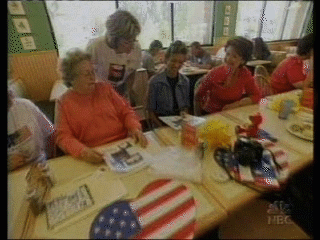
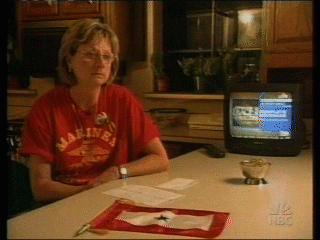

More on how our own troops are the ones placed in danger when depleted uranium is used in warfare. It isn't safe to handle, etc. We know this now. But the Shrub Administration is letting our boys use it anyway.
US Forces' Use of Depleted Uranium Weapons is 'Illegal'
By Neil Mackay for the Sunday Herald.
Rokke said: 'There is a moral point to be made here. This war was about Iraq possessing illegal weapons of mass destruction -- yet we are using weapons of mass destruction ourselves.' He added: 'Such double-standards are repellent.'The latest use of DU in the current conflict came on Friday when an American A10 tankbuster plane fired a DU shell, killing one British soldier and injuring three others in a 'friendly fire' incident.
According to a August 2002 report by the UN subcommission, laws which are breached by the use of DU shells include: the Universal Declaration of Human Rights; the Charter of the United Nations; the Genocide Convention; the Convention Against Torture; the four Geneva Conventions of 1949; the Conventional Weapons Convention of 1980; and the Hague Conventions of 1899 and 1907, which expressly forbid employing 'poison or poisoned weapons' and 'arms, projectiles or materials calculated to cause unnecessary suffering'. All of these laws are designed to spare civilians from unwarranted suffering in armed conflicts...
The use of DU has also led to birth defects in the children of Allied veterans...
Rokke said that coalition troops were currently fighting in the Gulf without adequate respiratory protection against DU contamination.
Here is the full text of the article in case the link goes bad:
http://www.commondreams.org/headlines03/0330-02.htm
Common Dreams NewsCenter
Support Common Dreams
Home | Newswire | About Us | Donate | Sign-Up | Archives
Sunday, March 30, 2003
Headlines
Published on Sunday, March 30, 2003 by The Sunday Herald (Scotland)
US Forces' Use of Depleted Uranium Weapons is 'Illegal'
by Neil Mackay
BRITISH and American coalition forces are using depleted uranium (DU) shells in the war against Iraq and deliberately flouting a United Nations resolution which classifies the munitions as illegal weapons of mass destruction.
Depleted Uranium Shell
Background on Depleted Uranium Ammunition
For much more check out:
Discounted Casualties - The Human Cost of Depleted Uranium provided by the Hiroshima, Japan newspaper - The Chugoku Shimbun.
Also the Federation of American Scientists has a Depleted Uranium Ammunition page. And the Military Toxics Project has a campaign against depleted uranium weapons.
(left) US Armor Piercing Incendiary [Depleted Uranium] 30mm Ammunition
Also See:
US Wins Defeat of Depleted Uranium Study
Reuters 11/30/2001
Iraqi Cancers, Birth Defects Blamed on U.S. Depleted Uranium
Seattle Post-Intelligencer 11/12/2002
Iraq Links Cancers to Uranium Weapons; U.S. Likely to Use Arms Again in War
San Francisco Chronicle 1/13/2003
DU contaminates land, causes ill-health and cancers among the soldiers using the weapons, the armies they target and civilians, leading to birth defects in children.
Professor Doug Rokke, ex-director of the Pentagon's depleted uranium project -- a former professor of environmental science at Jacksonville University and onetime US army colonel who was tasked by the US department of defense with the post-first Gulf war depleted uranium desert clean-up -- said use of DU was a 'war crime'.
Rokke said: 'There is a moral point to be made here. This war was about Iraq possessing illegal weapons of mass destruction -- yet we are using weapons of mass destruction ourselves.' He added: 'Such double-standards are repellent.'
The latest use of DU in the current conflict came on Friday when an American A10 tankbuster plane fired a DU shell, killing one British soldier and injuring three others in a 'friendly fire' incident.
According to a August 2002 report by the UN subcommission, laws which are breached by the use of DU shells include: the Universal Declaration of Human Rights; the Charter of the United Nations; the Genocide Convention; the Convention Against Torture; the four Geneva Conventions of 1949; the Conventional Weapons Convention of 1980; and the Hague Conventions of 1899 and 1907, which expressly forbid employing 'poison or poisoned weapons' and 'arms, projectiles or materials calculated to cause unnecessary suffering'. All of these laws are designed to spare civilians from unwarranted suffering in armed conflicts.
DU has been blamed for the effects of Gulf war syndrome -- typified by chronic muscle and joint pain, fatigue and memory loss -- among 200,000 US soldiers after the 1991 conflict.
It is also cited as the most likely cause of the 'increased number of birth deformities and cancer in Iraq' following the first Gulf war.
'Cancer appears to have increased between seven and 10 times and deformities between four and six times,' according to the UN subcommission.
The Pentagon has admitted that 320 metric tons of DU were left on the battlefield after the first Gulf war, although Russian military experts say 1000 metric tons is a more accurate figure.
In 1991, the Allies fired 944,000 DU rounds or some 2700 tons of DU tipped bombs. A UK Atomic Energy Authority report said that some 500,000 people would die before the end of this century, due to radioactive debris left in the desert.
The use of DU has also led to birth defects in the children of Allied veterans and is believed to be the cause of the 'worrying number of anophthalmos cases -- babies born without eyes' in Iraq. Only one in 50 million births should be anophthalmic, yet one Baghdad hospital had eight cases in just two years. Seven of the fathers had been exposed to American DU anti-tank rounds in 1991. There have also been cases of Iraqi babies born without the crowns of their skulls, a deformity also linked to DU shelling.
A study of Gulf war veterans showed that 67% had children with severe illnesses, missing eyes, blood infections, respiratory problems and fused fingers.
Rokke told the Sunday Herald: 'A nation's military personnel cannot wilfully contaminate any other nation, cause harm to persons and the environment and then ignore the consequences of their actions.
'To do so is a crime against humanity.
'We must do what is right for the citizens of the world -- ban DU.'
He called on the US and UK to 'recognize the immoral consequences of their actions and assume responsibility for medical care and thorough environmental remediation'.
He added: 'We can't just use munitions which leave a toxic wasteland behind them and kill indiscriminately.
'It is equivalent to a war crime.'
Rokke said that coalition troops were currently fighting in the Gulf without adequate respiratory protection against DU contamination.
The Sunday Herald has previously revealed how the Ministry of Defense had test-fired some 6350 DU rounds into the Solway Firth over more than a decade, from 1989 to 1999.
Is he real or just raed?
Paul Boutin takes a shot at finding out for sure.
Rather than guess, I emailed Salam and asked for proof of his location just before the first attack on Baghdad this morning. "how can i do that?" he emailed back. "you don't expect me to run out in the street and take a picture near something you'll recognize." Actually, I pointed out, a +964 phone number where I could reach him would do. Dialing into Iraq from here is tough right now, but not impossible, and rerouting a phone number would be much tougher than posting a blog from outside the country. Salam hasn't given me one, but that's understandable.Instead, I mixed what I learned as a Unix sysadmin in the 80s with what I learned as a daily reporter in the 90s. A barrage of late-night phone calls and emails to bloggers, Google, and network engineers produced the following evidence:
- Salam claims to connect to the Net via Uruklink, the state-run Iraqi ISP, using Web-based email from the British music magazine New Musical Express. Remember the Sex Pistols line, "I use the NME?" So does he.
IP addresses in his email headers aren't sufficient to pinpoint his location, but they're consistent with his story, being in the same range used by past Uruklink posters. I'm reluctant to publish his exact headers.
A whois and traceroute on Salam's most recent originating address got as far as Transtrum, a unit of the Lebanon-based ISP TerraNet. Requests for further routing info from Transtrum went unanswered, but senior network engineers who looked at the headers for me in the US think they're legitimately from Iraq.
Here is the full text of the article in case the link goes bad:
http://paulboutin.weblogger.com/2003/03/20
Paul Boutin Technology writer for Slate, Wired, The New York Times, Salon, etc
Home | Portfolio | TV and Radio appearances | Bio | Résumé
Today's Entry:
Q: Is the Baghdad Blogger for real?
Permanent link to archive for 3/20/03. Thursday, March 20, 2003
A: Probably.
Speculation continues that Dear Raed, the weblog of a young man in Baghdad who posts under the name Salam Pax, is a hoax, perhaps even a disinformation campaign by the CIA or Mossad. A month after Computerworld published a story quoting a "terrorist" who turned out to be one of their former writers pranking them, it would be foolish not to wonder.
Rather than guess, I emailed Salam and asked for proof of his location just before the first attack on Baghdad this morning. "how can i do that?" he emailed back. "you don't expect me to run out in the street and take a picture near something you'll recognize." Actually, I pointed out, a +964 phone number where I could reach him would do. Dialing into Iraq from here is tough right now, but not impossible, and rerouting a phone number would be much tougher than posting a blog from outside the country. Salam hasn't given me one, but that's understandable.
Instead, I mixed what I learned as a Unix sysadmin in the 80s with what I learned as a daily reporter in the 90s. A barrage of late-night phone calls and emails to bloggers, Google, and network engineers produced the following evidence:
- Salam claims to connect to the Net via Uruklink, the state-run Iraqi ISP, using Web-based email from the British music magazine New Musical Express. Remember the Sex Pistols line, "I use the NME?" So does he.
IP addresses in his email headers aren't sufficient to pinpoint his location, but they're consistent with his story, being in the same range used by past Uruklink posters. I'm reluctant to publish his exact headers.
A whois and traceroute on Salam's most recent originating address got as far as Transtrum, a unit of the Lebanon-based ISP TerraNet. Requests for further routing info from Transtrum went unanswered, but senior network engineers who looked at the headers for me in the US think they're legitimately from Iraq.
Details on Iraq's network can be found in this Salon story by Brian McWilliams, the same hacker/journalist who duped Computerworld and cracked the "send email to Saddam" mailbox on Uruklink.
- Salam's blog is hosted in Santa Clara, California, at a high speed co-location facility along with the rest of blogspot.com. This seems obvious to Net veterans, but an MSNBC article's wording misled some readers into believing the site is served from Iraq. Salam posts his blog remotely using Blogger's editing software on a PC. That means blogspot.com (aka Pyra, now a division of Google) has IP records of his previous posts in their log files. No luck getting them yet.
- Yes, blogspot.com was one of the domains blocked by Iraqi network administrators in January, possibly in response to Slammer. But Salam and other Iraqis know how to use Web proxies and other tricks to get around the blocks.
- Salam Pax is a pseudonym composed of the Arabic and Latin words for peace. But he has signed what may be his real name in personal correspondence to another blogger.
- At least one American has received a package from Salam, apparently mailed from Jordan where the titular Raed (a friend for whom Salam says he originally created his weblog) lives.
- Salam posted this morning to say BBC reports that state radio had been taken over were false. He was right about that.
In the end, it's still a matter of faith. Yes, I think he's really in Baghdad. And so far, he's still alive and well.
Opinions Begin to Shift as Public Weighs War Costs
By Adam Nagourney and Janet Elder
While 82 percent of whites said the United States should take military action to oust Mr. Hussein, just 44 percent of blacks said they supported that approach. In addition, 71 percent of whites said they were proud of what the United States was doing in Iraq, compared with 33 percent of blacks.The findings reflected directly on Mr. Bush's standing among African-Americans. Thirty-four percent of blacks said they approved of the job he is doing, compared with 75 percent of whites.
The finding comes as a number of black political leaders have been at the forefront of the antiwar movement, arguing that young black men and women would be disproportionately represented on the front lines, and that the war would drain federal money that should be spent on domestic programs.
"I have a sick feeling about all the young lives that are going to be destroyed," said Geraldine Hunter, 75, a black Democrat in Cleveland. "I don't know why Bush was in such a hurry to go to war."
Latifa Palmer, 29, of Chino, Calif., who is also black, said: "If you don't mess with them, they won't mess with us. Bush telling Saddam to leave his country would be like Saddam telling Bush to leave his country."
Here is the full text of the entire article in case the link goes bad:
http://www.nytimes.com/2003/03/26/international/worldspecial
The New York Times A Nation at War March 26, 2003
Opinions Begin to Shift as Public Weighs War Costs
By ADAM NAGOURNEY and JANET ELDER
Americans say the war in Iraq will last longer and cost more than they had initially expected, according to the latest New York Times/CBS News poll. The shift comes as the public absorbs the first reports of allied setbacks on the battlefield.
The percentage of Americans who said they expected a quick and successful effort against Iraq dropped to 43 percent on Monday night from 62 percent on Saturday. And respondents who said the war was going "very well" dropped 12 points, to 32 percent, from Sunday night to Monday night, an erosion that followed an increase in allied casualties and the capture of several Americans.
The poll also found an increase in the respondents who fear an imminent retaliatory terrorist attack on American soil, now that images of the allied assault on Baghdad have been televised around the world, though two-thirds of respondents said the nation was adequately prepared to deal with another terrorist strike.
At the same time, President Bush's campaign to remove Saddam Hussein from power is producing sharp fissures at home.
The poll found that black Americans are far more likely than whites to oppose Mr. Bush's policy in Iraq. They are also much more likely to say that the cost of ousting Mr. Hussein was too high, as measured by the loss of life.
Over all, with the war not even a week old, the nation's opinion about the conflict appears to be in flux, driven by an intensity of coverage that has allowed television viewers seemingly to follow every move from their living rooms, and in an environment where many Americans say they remain unsure of Mr. Bush's rationale for the conflict.
Indeed, the Times/CBS News Poll found that the number of Americans who expected the war to be won quickly dropped 9 points from Saturday to Sunday, and 10 more points from Sunday to Monday. Those shifts coincided with television coverage of prisoners of war and battlefield casualties that seems to have caught at least some Americans — accustomed to the relatively bloodless victory in Afghanistan last year — by surprise.
"I think I was living in a pipe dream thinking no one would get killed," Shirley Johnson, 79, a registered Republican from Davenport, Iowa, said in a follow-up interview. "But all of a sudden people were getting killed, and I was horrified."
Pam Wallman, 60, who lives in Fort Lauderdale, Fla., said, "I think the American public was duped into believing that our troops could just go in there, clean everything up and come home in 10 days."
Nonetheless, support for both the war and for the president, who has kept a low profile after announcing the invasion last week, remains high; Mr. Bush's job approval rating is now 60 percent. Still, Americans said Mr. Bush had failed to give them enough information about how long the war might last, how much it might cost and how many Americans might die in the effort. They also said Mr. Bush had failed to detail how the administration would manage a postwar Iraq.
The nationwide poll of 2,383 adults was taken from Thursday through Monday. It was designed to take into account of daily changes in opinion. The margin of sampling error for the entire sample was plus or minus two percentage points. The margin of error is larger when measuring smaller groups, like blacks, or when chronicling one- or two-night shifts in opinion.
A Times/CBS News poll last week found evidence of divisions between Democrats and Republicans over the war. This latest poll found even sharper differences on the issue between two other groups: blacks and whites. Blacks Americans are far more likely to oppose the war than both white Americans and white Democrats, and are correspondingly unhappy with Mr. Bush's job performance.
While 82 percent of whites said the United States should take military action to oust Mr. Hussein, just 44 percent of blacks said they supported that approach. In addition, 71 percent of whites said they were proud of what the United States was doing in Iraq, compared with 33 percent of blacks.
The findings reflected directly on Mr. Bush's standing among African-Americans. Thirty-four percent of blacks said they approved of the job he is doing, compared with 75 percent of whites.
The finding comes as a number of black political leaders have been at the forefront of the antiwar movement, arguing that young black men and women would be disproportionately represented on the front lines, and that the war would drain federal money that should be spent on domestic programs.
"I have a sick feeling about all the young lives that are going to be destroyed," said Geraldine Hunter, 75, a black Democrat in Cleveland. "I don't know why Bush was in such a hurry to go to war."
Latifa Palmer, 29, of Chino, Calif., who is also black, said: "If you don't mess with them, they won't mess with us. Bush telling Saddam to leave his country would be like Saddam telling Bush to leave his country."
Support for Mr. Bush and the war remains high. By 70 percent to 24 percent, Americans believe that the United States did not make a mistake getting involved in Iraq. But there has been a measurable decline in the national confidence that was on display last week. On Saturday, 53 percent of respondents said the war would be over within weeks; by Monday, only 34 percent of respondents said it would end that soon.
Michael Moore plans Bush-bin Laden film
"The senior Bush kept his ties with the bin Laden family up until two months after Sept. 11," said Moore.Moore told Variety the primary focus of the new project will be to examine what has happened to the United States since the Sept. 11 terrorist attack. He accused the Bush administration of using a tragic event to push its agenda.
"It (the new project) certainly does deal with the Bush and bin Laden ties," said Moore. "It asks a number of questions that I don't have the answers to yet, but which I intend to find out."
Moore said he expects the new movie to be in U.S. theaters in time for the 2004 presidential election...
"I expressed exactly what was in the film and instead of being blacklisted, I've not only gotten a deal to fund 'Fahrenheit 911' but offers on the film after," he said. "Presales on ('Bowling for Columbine's') video release ran ahead of 'Chicago' this week, and my book is returning to the top spot on the New York Times best-seller list."
Moore said the success of his documentary and book reflects majority public support for his political argument.
"It's because the majority of Americans agree with me, see the economy in the toilet and didn't vote for George W," he said. "People are now realizing you can question your government while still caring about the soldiers."
Here is the full text of the article in case the link goes bad:
http://www.upi.com/view.cfm?StoryID=20030328-032440-7289r
Michael Moore plans Bush-bin Laden film
From the Life & Mind Desk
Published 3/28/2003 4:00 PM
View printer-friendly version
LOS ANGELES, March 28 (UPI) -- Filmmaker Michael Moore's next project might be more controversial than his Oscar-winning documentary "Bowling for Columbine."
According to a report in Friday's Daily Variety, Moore is working on a documentary about the "the murky relationship" between former President George Bush and the family of al-Qaida leader Osama bin Laden. The paper said the movie, "Fahrenheit 911," will suggest that the bin Laden family profited greatly from the association.
Moore's anti-war, anti-Bush Oscar acceptance speech provoked a mixture of cheers and boos at the Academy Awards last Sunday.
In addition to the Best Documentary Oscar, "Bowling for Columbine" also had an extraordinarily robust bottom line. Made for about $3 million, it has grossed nearly $40 million worldwide -- making it one of the most commercially successful documentaries of all time.
Variety reported that Moore is working out a deal with Mel Gibson's production company, Icon Productions, to finance "Fahrenheit 911."
According to Moore, the former president had a business relationship with Osama bin Laden's father, Mohammed bin Laden, a Saudi construction magnate who left $300 million to Osama bin Laden. It has been widely reported that bin Laden used the inheritance to finance global terrorism.
Moore said the bin Laden family was heavily invested in the Carlyle Group, a private global investment firm that the filmmaker said frequently buys failing defense companies and then sells them at a profit. Former President Bush has reportedly served as a senior adviser with the firm.
"The senior Bush kept his ties with the bin Laden family up until two months after Sept. 11," said Moore.
Moore told Variety the primary focus of the new project will be to examine what has happened to the United States since the Sept. 11 terrorist attack. He accused the Bush administration of using a tragic event to push its agenda.
"It (the new project) certainly does deal with the Bush and bin Laden ties," said Moore. "It asks a number of questions that I don't have the answers to yet, but which I intend to find out."
Moore said he expects the new movie to be in U.S. theaters in time for the 2004 presidential election.
While some critics accused Moore of being anti-American for his Oscar speech, Moore told Variety business has been very good for his movie and his best-selling book "Stupid White Men: And Other Sorry Excuses for the State of the Nation."
"I expressed exactly what was in the film and instead of being blacklisted, I've not only gotten a deal to fund 'Fahrenheit 911' but offers on the film after," he said. "Presales on ('Bowling for Columbine's') video release ran ahead of 'Chicago' this week, and my book is returning to the top spot on the New York Times best-seller list."
Moore said the success of his documentary and book reflects majority public support for his political argument.
"It's because the majority of Americans agree with me, see the economy in the toilet and didn't vote for George W," he said. "People are now realizing you can question your government while still caring about the soldiers."
For many US vets, war is not the answer
Adding to veterans' anger and fuelling a growing sense of betrayal, last week the House of Representatives voted to approve a $25 billion cut in veterans' benefits - including disability benefits - over the next 10 years at the same time as Mr Bush seeks massive tax cuts for a wealthy few."The President's words about supporting the troops are quite empty, on two counts," Erik Gustafson, who fought in the 1991 Gulf War, said of Mr Bush's speech on Friday.
"One, there has been a series of miscalculations that put a lot of people in harm's way unnecessarily, and secondly supporting our troops doesn't mean turning our backs on our veterans, especially when we'll be having a whole new generation of Gulf War veterans," he said.
Mr Gustafson is executive director of the Education for Peace in Iraq Centre, which he set up in 1998 with an emphasis on improving living conditions for ordinary Iraqis.
Mr Pollack said the cuts to veterans' benefits are "an indication of the lengths to which this administration is willing to go to fund their priorities, which are obviously aggressive wars and tax cuts for the rich".
...Yet, these veterans say, the troops risk exposure to the depleted uranium used in anti-tank munitions, which the Pentagon insists has no adverse health effects but veterans' groups charge was part of the toxic cocktail that caused Gulf War syndrome.
To those who say Gulf War syndrome is all in the mind, as a new Australian study has concluded, they point to the fact that the Veterans Administration has classified 164,000 Gulf War veterans as disabled - more than one-quarter of the 585,000 eligible for benefits.
About 9,600 Gulf War veterans have died of a variety of causes since returning from the war, according to Veterans for Common Sense.
Here is the full text of the article in case the link goes bad:
http://www.abc.net.au/news/newsitems/s819514.htm
For many US vets, war is not the answer
US veterans were invited to the White House on Friday to applaud President George W Bush's Iraq campaign but others who fought for their country vehemently oppose the war.
"It looked to me like he was taking advantage of selected veterans who were predisposed to his position," said Seth Pollack of Veterans for Common Sense.
"I wouldn't expect anything better from Bush. It was shameful."
Mr Pollack's association sent a letter, signed by about 1,000 veterans including two retired vice-admirals and actor Kris Kristofferson, to the President on the eve of the war rejecting the case for the use of force against Iraq and seeking a meeting to discuss humanitarian concerns.
The appeal was ignored, fitting into a pattern of behaviour anti-war veterans say is typical of an administration run largely by people with no war experience - starting with Mr Bush himself, who served in the National Guard in Texas during the Vietnam War.
Veterans believe they "have a vital role to play," said Mr Pollack, "especially in an administration like this which is so under-represented (by veterans) and so willing to send other people's kids to die when they haven't served themselves".
"Frankly, it's a dangerous thing".
With the war into its second week and US casualties mounting, combined with televised images of fierce attacks on US supply lines and the surprised reaction of soldiers and officers alike to the heavy resistance they have encountered, anti-war veterans are not the only ones questioning military strategists.
Adding to veterans' anger and fuelling a growing sense of betrayal, last week the House of Representatives voted to approve a $25 billion cut in veterans' benefits - including disability benefits - over the next 10 years at the same time as Mr Bush seeks massive tax cuts for a wealthy few.
"The President's words about supporting the troops are quite empty, on two counts," Erik Gustafson, who fought in the 1991 Gulf War, said of Mr Bush's speech on Friday.
"One, there has been a series of miscalculations that put a lot of people in harm's way unnecessarily, and secondly supporting our troops doesn't mean turning our backs on our veterans, especially when we'll be having a whole new generation of Gulf War veterans," he said.
Mr Gustafson is executive director of the Education for Peace in Iraq Centre, which he set up in 1998 with an emphasis on improving living conditions for ordinary Iraqis.
Mr Pollack said the cuts to veterans' benefits are "an indication of the lengths to which this administration is willing to go to fund their priorities, which are obviously aggressive wars and tax cuts for the rich".
As the noose tightens around Baghdad, fears are mounting that Iraqi leader Saddam Hussein is saving his suspected arsenal of chemical weapons for a last desperate stand against inevitable victory by US forces.
Yet, these veterans say, the troops risk exposure to the depleted uranium used in anti-tank munitions, which the Pentagon insists has no adverse health effects but veterans' groups charge was part of the toxic cocktail that caused Gulf War syndrome.
To those who say Gulf War syndrome is all in the mind, as a new Australian study has concluded, they point to the fact that the Veterans Administration has classified 164,000 Gulf War veterans as disabled - more than one-quarter of the 585,000 eligible for benefits.
About 9,600 Gulf War veterans have died of a variety of causes since returning from the war, according to Veterans for Common Sense.
The soldiers are the ones who need our prayers -- not the man who single-handedly placed them all in danger. This is just plain weird.
US soldiers in Iraq asked to pray for Bush
US soldiers in Iraq asked to pray for BushThey may be the ones facing danger on the battlefield, but US soldiers in Iraq are being asked to pray for President George W Bush.
Thousands of marines have been given a pamphlet called "A Christian's Duty," a mini prayer book which includes a tear-out section to be mailed to the White House pledging the soldier who sends it in has been praying for Bush.
"I have committed to pray for you, your family, your staff and our troops during this time of uncertainty and tumult. May God's peace be your guide," says the pledge, according to a journalist embedded with coalition forces.
The pamphlet, produced by a group called In Touch Ministries, offers a daily prayer to be made for the US president, a born-again Christian who likes to invoke his God in speeches.
Sunday's is "Pray that the President and his advisers will seek God and his wisdom daily and not rely on their own understanding".
Monday's reads "Pray that the President and his advisers will be strong and courageous to do what is right regardless of critics".
Here is the full text of the article in case the link goes bad:
http://www.abc.net.au/news/newsitems/s819685.htm
US soldiers in Iraq asked to pray for Bush
They may be the ones facing danger on the battlefield, but US soldiers in Iraq are being asked to pray for President George W Bush.
Thousands of marines have been given a pamphlet called "A Christian's Duty," a mini prayer book which includes a tear-out section to be mailed to the White House pledging the soldier who sends it in has been praying for Bush.
"I have committed to pray for you, your family, your staff and our troops during this time of uncertainty and tumult. May God's peace be your guide," says the pledge, according to a journalist embedded with coalition forces.
The pamphlet, produced by a group called In Touch Ministries, offers a daily prayer to be made for the US president, a born-again Christian who likes to invoke his God in speeches.
Sunday's is "Pray that the President and his advisers will seek God and his wisdom daily and not rely on their own understanding".
Monday's reads "Pray that the President and his advisers will be strong and courageous to do what is right regardless of critics".
I'm in a hurry and I realized that my plan for this morning consisted of republishing the links that t r u t h o u t had prepared for me this morning.
So I'm going to just shamelessly republish them here.
You can subscribe for yourselves if you want to get the same information I do every morning. I highly recommend it:
Air Raids Pound Baghdad, 50+ Civilians DeadOutspoken Army General Upsets White House
A 'Turkey Shoot,' but With Marines as TargetsRobert Fisk | Raw, Devastating Realities About Basra
News From Iraq Causes Americans to Think AgainAnalyst: 'Mass Destruction Weapons Need to be Found'
Bush Frustrated with Media Coverage of War
Missteps with Turkey Prove Costly
Jesse Jackson Jr. | From Gunboat Diplomacy To Gunpoint Democracy
Hey, it's cool guys. It's not like innocent people are dying over this or anything...
U.N. Official: Fake Iraq Nuke Papers Were Crude
By Louis Charbonneau for Reuters.
A few hours and a simple internet search was all it took for U.N. inspectors to realize documents backing U.S. and British claims that Iraq had revived its nuclear program were crude fakes, a U.N. official said.Speaking to Reuters on condition of anonymity, a senior official from the U.N. nuclear agency who saw the documents offered as evidence that Iraq tried to buy 500 tons of uranium from Niger, described one as so badly forged his "jaw dropped."
"When (U.N. experts) started to look at them, after a few hours of going at it with a critical eye things started to pop out," the official said, adding a more thorough investigation used up "resources, time and energy we could have devoted elsewhere."
The United States first made the allegation that Iraq had revived its nuclear program last fall when the CIA warned that Baghdad "could make a nuclear weapon within a year" if it acquired uranium. President Bush found the proof credible enough to add it to his State of the Union speech in January.
Here is the full text of the article in case the link goes bad:
http://asia.reuters.com/newsArticle.jhtml?type=topNews&storyID=2444571
VIENNA (Reuters) - A few hours and a simple internet search was all it took for U.N. inspectors to realize documents backing U.S. and British claims that Iraq had revived its nuclear program were crude fakes, a U.N. official said.
Speaking to Reuters on condition of anonymity, a senior official from the U.N. nuclear agency who saw the documents offered as evidence that Iraq tried to buy 500 tons of uranium from Niger, described one as so badly forged his "jaw dropped."
"When (U.N. experts) started to look at them, after a few hours of going at it with a critical eye things started to pop out," the official said, adding a more thorough investigation used up "resources, time and energy we could have devoted elsewhere."
The United States first made the allegation that Iraq had revived its nuclear program last fall when the CIA warned that Baghdad "could make a nuclear weapon within a year" if it acquired uranium. President Bush found the proof credible enough to add it to his State of the Union speech in January.
The International Atomic Energy Agency (IAEA) official said the charge Iraq sought the uranium was to be the "stake in the heart" of Baghdad and "would have been as close to a smoking gun as you could get" because Iraq could only want it for weapons.
OBVIOUS FAKES
Once the IAEA got the documents -- which took months -- French nuclear scientist Jacques Bautes, head of the U.N. Iraq Nuclear Verification office, quickly saw they were fakes.
Two documents were particularly bad. The first was a letter from the president of Niger which referred to his authority under the 1965 constitution. That constitution has been defunct for nearly four years, the official said.
There were other problems with the letter, including an unsuccessful forgery of the president's signature.
"It doesn't even look close to the signature of the president. I'm not a (handwriting) expert but when I looked at it my jaw dropped," the official said.
Another letter about uranium dated October 2000 purportedly came from Niger's foreign minister and was signed by a Mr. Alle Elhadj Habibou, who has not been foreign minister since 1989.
To make matters worse, the letterhead was out of date and referred to Niger's "Supreme Military Council" from the pre-1999 era -- which would be like calling Russia the Soviet Union.
After determining the documents were fakes, the IAEA had a group of international forensics experts -- including people from the U.S and Britain -- verify their findings. The panel unanimously agreed with the IAEA.
"We don't know who did it," the official said, adding that it would be easy to come up with a long list of groups and states which would like to malign the present Iraqi regime.
The IAEA asked the U.S. and Britain if they had any other evidence backing the claim that Iraq tried to buy uranium. The answer was no.
IAEA chief Mohamed ElBaradei informed the U.N. Security Council in early March that the Niger proof was fake and that three months with 218 inspections at 141 sites had produced "no evidence or plausible indication" Iraq had a nuclear program.
But last week Vice President Dick Cheney repeated the U.S. position and said that ElBaradei was wrong about Iraq.
"We know (Iraqi President Saddam Hussein) has been absolutely devoted to trying to acquire nuclear weapons, and we believe he has in fact reconstituted nuclear weapons," he said.
A.K.A. Religiously-Ambiguous Bill Aims To Further Blur The Line Between Church And State
Since when is it the role of our government to determine when the public needs "fasting and prayer." Are they just trying to keep our protien levels low so we're easier to fool?
Which religious practices exactly are being advocated? Some new kind of All-American religion? The Church Of Shrub, perhaps?
Gee Mr. Shrub "President" Sir, I haven't sinned against humanity and I certainly don't need a government-sanctioned day of national fasting to redeem myself.
Will it be against the law (or looked down upon) to eat up during the national day of fasting?
What's next? Appetite suppressants to help us through our national day of fasting? (Perhaps government-issued appetite suppressants? Wait a minute...who'll get the contract?!)
(If this Administration would only put this much effort into feeding people...
Food sure has a crazy way of bringing people together too :-)
Whereas all of the various faiths of the people of the United States have recognized, in our religious traditions, the need for fasting and humble supplication before Providence;Whereas humility, fasting, and prayer in times of danger have long been rooted in our essential national convictions and have been a means of producing unity and solidarity among all the diverse people of this Nation as well as procuring the enduring grace and benevolence of God;
Whereas, through prayer, fasting, and self-reflection, we may better recognize our own faults and shortcomings and submit to the wisdom and love of God in order that we may have guidance and strength in those daily actions and decisions we must take; and
Whereas dangers and threats to our Nation persist and, in this time of peril, it is appropriate that the people of the United States, leaders and citizens alike, seek guidance, strength, and resolve through prayer and fasting: Now, therefore, be it
Resolved, That it is the sense of the House of Representatives that the President should issue a proclamation--
(1) designating a day for humility, prayer, and fasting for all people of the United States; and
(2) calling on all people of the United States--
(A) to observe the day as a time of prayer and fasting;
(B) to seek guidance from God to achieve a greater understanding of our own failings and to learn how we can do better in our everyday activities; and
(C) to gain resolve in meeting the challenges that confront our Nation.
Here is the full text of the document in case the link goes bad:
http://thomas.loc.gov/cgi-bin/query/D?c108:2:./temp/~c108e9fu5P::
Bill 2 of 2
There is 1 other version of this bill.
GPO's PDF version of this bill References to this bill in the Congressional Record Link to the Bill Summary & Status file. Printer Friendly Display - 4,229 bytes.[Help]
Recognizing the public need for fasting and prayer in order to secure the blessings and protection of Providence for the people of the United States and our Armed Forces during the... (Introduced in House)
HRES 153 IH
108th CONGRESS
1st Session
H. RES. 153
Recognizing the public need for fasting and prayer in order to secure the blessings and protection of Providence for the people of the United States and our Armed Forces during the conflict in Iraq and under the threat of terrorism at home.
IN THE HOUSE OF REPRESENTATIVES
March 20, 2003
Mr. AKIN (for himself, Mr. GOODE, Mr. BARTLETT of Maryland, Mr. JONES of North Carolina, Mr. KING of Iowa, Mr. HAYES, Mrs. JO ANN DAVIS of Virginia, Mr. BEAUPREZ, Ms. CORRINE BROWN of Florida, Mr. MANZULLO, Mr. ADERHOLT, Mr. TIAHRT, Mr. PITTS, Mr. RYUN of Kansas, Mrs. MYRICK, Mr. WELDON of Florida, Mr. BISHOP of Utah, Mr. BARRETT of South Carolina, Mr. MILLER of Florida, Ms. ROS-LEHTINEN, Mr. GINGREY, Mr. TERRY, and Mr. SOUDER) submitted the following resolution; which was referred to the Committee on Government Reform
RESOLUTION
Recognizing the public need for fasting and prayer in order to secure the blessings and protection of Providence for the people of the United States and our Armed Forces during the conflict in Iraq and under the threat of terrorism at home.
Whereas the United States is currently engaged in a war on terrorism in response to the attacks of September 11, 2001;
Whereas the Armed Forces of the United States are currently engaged in a campaign to disarm the regime of Saddam Hussein and liberate the people of Iraq;
Whereas, on June 1, 1774, the Virginia House of Burgesses called for a day of fasting and prayer as an expression of solidarity with the people of Boston who were under siege by the enemy;
Whereas, on March 16, 1776, the Continental Congress, recognizing that the `Liberties of America are imminently endangered' and the need `to acknowledge the overruling Providence of God', called for a day of `Humiliation, Fasting and Prayer';
Whereas, on June 28, 1787, during the debate of the Constitutional Convention, Benjamin Franklin, convinced of God's intimate involvement in human affairs, implored the Congress to seek the assistance of Heaven in all its dealings;
Whereas, on March 30, 1863, in the midst of the Civil War, Abraham Lincoln, at the bequest of the Senate, and himself recognizing the need of the Nation to humble itself before God in repentance for its national sins, proclaimed a day of fasting, prayer and humiliation;
Whereas all of the various faiths of the people of the United States have recognized, in our religious traditions, the need for fasting and humble supplication before Providence;
Whereas humility, fasting, and prayer in times of danger have long been rooted in our essential national convictions and have been a means of producing unity and solidarity among all the diverse people of this Nation as well as procuring the enduring grace and benevolence of God;
Whereas, through prayer, fasting, and self-reflection, we may better recognize our own faults and shortcomings and submit to the wisdom and love of God in order that we may have guidance and strength in those daily actions and decisions we must take; and
Whereas dangers and threats to our Nation persist and, in this time of peril, it is appropriate that the people of the United States, leaders and citizens alike, seek guidance, strength, and resolve through prayer and fasting: Now, therefore, be it
Resolved, That it is the sense of the House of Representatives that the President should issue a proclamation--
(1) designating a day for humility, prayer, and fasting for all people of the United States; and
(2) calling on all people of the United States--
(A) to observe the day as a time of prayer and fasting;
(B) to seek guidance from God to achieve a greater understanding of our own failings and to learn how we can do better in our everyday activities; and
(C) to gain resolve in meeting the challenges that confront our Nation.
THIS SEARCH THIS DOCUMENT GO TO
Next Hit Forward New Bills Search
Prev Hit Back HomePage
Hit List Best Sections Help
Contents Display
But Halliburton can still be a subcontractor, according to the Newsweek story below.
Note that a letter from Rep. Henry Waxman appears to have been instrumental in heating up the situation. (Along with this telling Daily Show Clip, perhaps?)
Halliburton Out of the Running
The construction firm once run by Dick Cheney won’t get a big Iraq contract
By Michael Hirsh for Newsweek.
Halliburton was one of five large U.S. companies that the Bush administration asked in mid-February to bid on the 21-month contract, which involves the reconstruction of Iraq’s critical infrastructure, including roads, bridges and hospitals, after the war. But the administration has come under increasingly strident criticism abroad and at the United Nations for offering postwar contracts only to U.S. companies. Many of the questions have been raised about Halliburton, which Cheney headed from 1995 until 2000. On Monday, the U.S. Army announced it had awarded a contract to extinguish oil fires and restore oil infrastructure in Iraq to Halliburton’s Kellogg, Brown & Root engineering and construction division. Rep. Henry Waxman, a California Democrat, later sent a letter to Lt. Gen. Robert Flowers, commander of the Army Corps of Engineers, questioning why other oil-service companies had not been allowed to bid....Allegations of a too-close-for-comfort relationship with corporate America have long dogged Cheney and other Bush administration officials, as well as insiders. On Thursday, leading hawk Richard Perle stepped down as chairman of the Defense Policy Board, a Pentagon panel of unpaid outside advisers, after congressional Democrats raised questions about his relationship with Global Crossing, a telecom firm that had sought his assistance in winning government approval for a deal with an Asian conglomerate. Cheney’s spokeswoman, Cathie Martin, said Friday she “hadn’t even heard” that Halliburton would not be awarded the reconstruction contract and added, “The vice president has nothing to do with these contracts.”
Here is the full text of the article in case the link goes bad:
http://www.msnbc.com/news/892259.asp?0cv=KB10&cp1=1
Vice President Dick Cheney arrives at the White House earlier this month
Halliburton Out of the Running
The construction firm once run by Dick Cheney won’t get a big Iraq contract
By Michael Hirsh
NEWSWEEK WEB EXCLUSIVE
March 28 — After taking some political heat, Halliburton is stepping out of the kitchen. The giant energy and construction firm once managed by Vice President Dick Cheney is no longer in the running for a $600 million rebuilding contract in postwar Iraq, NEWSWEEK has learned.
TIMOTHY BEANS, THE chief acquisition officer for the U.S. Agency for International Development, said in an interview that Halliburton is not one of the two finalists to be prime contractor for the reconstruction of Iraq, though the Houston-based firm could take part as a subcontractor. The contract is to be awarded next week.
Halliburton was one of five large U.S. companies that the Bush administration asked in mid-February to bid on the 21-month contract, which involves the reconstruction of Iraq’s critical infrastructure, including roads, bridges and hospitals, after the war. But the administration has come under increasingly strident criticism abroad and at the United Nations for offering postwar contracts only to U.S. companies. Many of the questions have been raised about Halliburton, which Cheney headed from 1995 until 2000. On Monday, the U.S. Army announced it had awarded a contract to extinguish oil fires and restore oil infrastructure in Iraq to Halliburton’s Kellogg, Brown & Root engineering and construction division. Rep. Henry Waxman, a California Democrat, later sent a letter to Lt. Gen. Robert Flowers, commander of the Army Corps of Engineers, questioning why other oil-service companies had not been allowed to bid.
Controversial Bush Aide Perle Resigns
Allegations of a too-close-for-comfort relationship with corporate America have long dogged Cheney and other Bush administration officials, as well as insiders. On Thursday, leading hawk Richard Perle stepped down as chairman of the Defense Policy Board, a Pentagon panel of unpaid outside advisers, after congressional Democrats raised questions about his relationship with Global Crossing, a telecom firm that had sought his assistance in winning government approval for a deal with an Asian conglomerate. Cheney’s spokeswoman, Cathie Martin, said Friday she “hadn’t even heard” that Halliburton would not be awarded the reconstruction contract and added, “The vice president has nothing to do with these contracts.”
What remains unclear is whether Halliburton took itself out of the running for the contract, was asked by the Bush administration to do so or whether its bid was simply not deemed competitive. USAID’s Beans would not elaborate on why Halliburton did not make it onto the finalists’ list, but he suggested that Halliburton chose to play a subcontracting role. And Beans said that Andrew Natsios, director of the aid agency—which is handing out most of the postwar contracts—is keen to counter any allegations of favoritism or political influence. “If I got a phone call from anybody putting any political pressure on me, I would report it immediately to Natsios, as I’ve been instructed to do,” said Beans. “He said if anybody calls you, if there’s any pressure whatsoever, you tell me immediately … No one has called me on this. This is going to be done completely openly, transparently and honestly.” USAID officials also emphasize that bidding is reviewed by two “independent” panels composed of engineers and career civil servants.
Wendy Hall, a Halliburton spokeswoman, referred all questions about the contract to USAID. But a U.N. official who follows the issue told NEWSWEEK that the Iraq reconstruction contract probably wasn’t worth the bad publicity for Halliburton, which depends on maintaining a favorable image both in Washington and the Arab world (where it gets much of its oil-related business, and where the war is increasingly unpopular). “This kind of political controversy was not in their corporate interests,” he said. Halliburton may prefer to quietly work as a subcontractor rather than be in the spotlight as prime contractor, the official suggested.
Beans said USAID had originally hoped to announce the reconstruction contract on Wednesday and has delayed the announcement until “realistically, early next week.” He said the contract, part of $2.4 billion allocated for relief and reconstruction in Bush’s supplemental budget request, has been delayed mainly because of last-minute complications raised by lawyers for the two final bidders, whom he would not identify. (Among the other U.S. companies asked to bid were Fluor Corp., Washington Group, Bechtel Group, Louis Berger Group and Parsons Corp.) The snag involves settling questions about liability issues if a contractor accidentally uncovers and releases—by digging or other means—poison gas or other weapons of mass destruction during reconstruction, he said.
IMG: E-mail from the Homefront
The controversy over the awarding of the first postwar contracts only to U.S. companies is part of a larger ongoing issue of whether Iraq’s transformation will be more U.S.-led or multilateral. On Thursday, Bush and his No. 1 ally, British Prime Minister Tony Blair, dickered at Camp David over how central a role the United Nations would play in postwar Iraq. Defense Secretary Donald Rumsfeld, who has taken the lead on postwar as well as wartime issues, is pushing a plan that relies on speed, efficiency and U.S. “unity of command” in contrast to United Nations-led nation-building efforts in places like Bosnia, Kosovo and East Timor. Blair, in part because he is under terrific political pressure at home to take a multilateral approach, has effectively become the spokesman for U.N. interests in Washington.
IMG: Psy-Ops Gallery
USAID officials say the practical demands of rebuilding Iraq quickly, and the legal obligation they are under to favor U.S. firms—Congress wrote such “aid-tying” preferences into the law—have drastically limited their choices. They point especially to the need for speed, which in turn requires security clearances; generally only U.S. companies have such clearances. Also, invoking a legal exception called “impairment of foreign assistance” allowed the administration to circumvent normal bidding procedures, which can take many months. “It’s where people cannot wait,” said Beans. “Remember, these were part of the front-end rush job to get support in. We couldn’t piddle around ... When we were still before the United Nations, we didn’t know how this was going to go. We were in contingency planning. A $600 million procurement is huge. Normally it would take us five to six months to get it done. They said you’ve got two months.” The stakes are bigger than that, actually: the prime contractor is likely to get a lot more than $600 million funneled its way in future extensions of the contract.
Even big British construction firms like Costain and Balfour Beatty have not been asked to bid as prime contractors, even though British troops are fighting alongside American soldiers and have secured the major port of Umm Qasr, which is to be part of the rebuilding project. Earlier this week, USAID awarded a nearly $5 million contract to a Seattle-based company, Stevedoring Services, to run Umm Qasr. British firms had expressed interest in the contract.
Natsios says that in an effort to broaden the participants he has invoked a special provision of the law opening up subcontracts to friendly countries. He and other aid officials note that up to about 50 percent of the work is going to be subcontracted, as is happening in Afghanistan. As of yet, however, no foreign firms have been awarded even a subcontracting role in Iraq, USAID officials said. Last week, British cabinet minister Clare Short traveled to Washington and complained to Natsios and other administration officials about the contracting process.
Beans said the war’s slower-than-expected progress has at least one silver lining for him. “I’ve been under incredible pressure to get these things done,” he said. “The fact that they’ve been slowed down a little bit has given me a little extra time.”
Too bad the Shrub doesn't like to "revisit decisions" (per Bob Woodward - see clip).
Leaders should be able to adjust their strategies to account for the realities of a situation once they become apparent.
Here are some quotes and clips (Small - 2 MB) of Shrub advisors and Dick Cheney from as recently as ten days ago. Could they have been any more wrong?
This is stuff I picked up from NBC on Wednesday night when I had my TiVO set to record the blogger piece (which got bumped to Thursday).
These clips aren't too grisly, but they get the point across: we're (accidently, inevitably) bombing innocent Iraqi civilians. Damn.
Keep in mind that this is an edited collection of clips made up from clips shown on the NBC Nightly News -- this is not an unaltered broadcast. All the clips are in order -- I haven't rearranged them or anything, but I have edited out a lot of yapping that came in-between what I felt were the interesting parts of the video footage.
NBC Nightly News - March 26, 2003 Excerpts (Small - 4 MB)
I think this song really captures the essence of blogging quite well, actually:
Ben and Mena
StevenF says "As far as I know, it's the first, and hopefully the last ever song about web logging." It may be the first, but I can guarantee that it won't be the last... (MP3 - 4 MB)
Blank page, nothin' to say
Just pictures of my cats today
Thought about the war a bunch
Now let me tell you what I had for lunchBoys all hate me, my girlfriend dumped me
They're bombing Iraq, my oatmeal's lumpy
Wi-Fi networks in Central Park
Funny Photoshops up on Fark(Chorus)
I wanna be Ben, I wanna be Mena
If only for a moment or two
I wanna be Cory, I'll even be Winer
If that's what I gotta doI wanna be Ben, I wanna be Mena
The master of my domain
So send me a ping, send me a trackback
I promise I won't complainReferers say no-one came today...
That perfect link I hope to find
Check MetaFilter for the 40th time
I left a comment, I hope you see
How this issue pertains to meSemantic web, RSS, and e-mail
Single white guy seeks athletic female
I'm busy building the digital commons
Cook me up another bowl of ramen
Here is the entire text of the link in case it goes bad:
http://stevenf.com/mt/archives/000238.php#000238
March 24, 2003
Caterwaul
Hey, speaking of not having anything to blog about, here is a song (3.8 MB) I put together a few weeks ago using Reason with some other bits of hardware and software. It relays the epic saga of a lonely everyblogger who dreams of finding the ultimate link that will catapult his puny blog into the limelight.
As far as I know, it's the first, and hopefully the last ever song about web logging. Headphones recommended, don't scare your co-workers. Listeners will be delighted to know that I don't plan to give up my programming career to become a recording artist.
For lyrics, click "More..." link.
(Hey does this count as "audblogging"? *shudder*)
Ben & Mena (S. Frank)
Blank page, nothin' to say
Just pictures of my cats today
Thought about the war a bunch
Now let me tell you what I had for lunch
Boys all hate me, my girlfriend dumped me
They're bombing Iraq, my oatmeal's lumpy
Wi-Fi networks in Central Park
Funny Photoshops up on Fark
(Chorus)
I wanna be Ben, I wanna be Mena
If only for a moment or two
I wanna be Cory, I'll even be Winer
If that's what I gotta do
I wanna be Ben, I wanna be Mena
The master of my domain
So send me a ping, send me a trackback
I promise I won't complain
Referers say no-one came today...
That perfect link I hope to find
Check MetaFilter for the 40th time
I left a comment, I hope you see
How this issue pertains to me
Semantic web, RSS, and e-mail
Single white guy seeks athletic female
I'm busy building the digital commons
Cook me up another bowl of ramen
(Alt. Chorus)
I wanna be Ben, I wanna be Mena
If only for a moment or two
I wanna be Haughey, I'll even be Stile
If that's what I gotta do
I wanna be Ben, I wanna be Mena
The master of my domain
So send me a ping, send me a trackback
I promise I won't complain
Referers say no-one came today...
(Repeat Chorus)
----
It is with great sadness that I've started a warblogging category of my own.
Appropriately or ironically, I will begin with a clip on Warbloggers themselves.
NBC Nightly News On Warbloggers - 3-27-03
The city is replacing two telephone poles on my block, so, this morning, without any notice, my main video station (TV, TiVO, VHS, video editing machine) is out of commission.
Luckily, I had already captured the blogging segment from NBC Nightly News w/Tom Brokaw last night from my TiVO into my video camera, so I'm over at a friend's out on my laptop crunching away. So stuff should be going up soon :-)
Paper Tiger TV - March 27, 2003
Great work guys!
March 22, 2003 NYC
(Note that you might be prompted to to download some extra QuickTime software to run this movie. You will not need to restart--on the Mac anyway.)
Thanks, David!
Dissent Is Patriotic
By Teofilo Reyes.
A jog down the road people made a B-line for Michigan Avenue – Chicago’s fabled Magnificent Mile. This is where the cops drew their line in the sand. By now a few hundred of those entrusted to serve and protect OPProperty had gathered, and they were well positioned in front of Chicago’s gucci shops and sweatshop retailers. They were deaf to the crowd’s chants of “Let us Shop,” but they did put away their gas masks to the chant of “No Chemical Weapons!” A few smiles must have cracked that wall.The crowd eventually marched back down Lake Shore before dispersing, but not before over 600 people were arrested when a march tributary tried to veer back towards Michigan and was corralled-off by police.
Dozens more were arrested the following day at die-ins sponsored by Iraqi Peace Pledge. That Friday evening thousands again gathered to march, but this time under a tight and strict police escort. The march was literally surrounded by a line of cops and quickly became a forced march for anyone who wanted to drop back. Once in the march there was no way out – all the beat cops from around the city made sure of that.
Here is the full text of the article in case the link goes bad:
http://sknkwrks.dyndns.org:1957/writewiki/wiki.pl?Dissent_Is_Patriotic
[Home]Dissent Is Patriotic
Ypsilanti Eyeball | RecentChanges | Preferences
by Teofilo Reyes for Vivos Voco
March 27, 2003
The war is in full swing now, but things don’t seem to be going as planned. Well prepared militias are putting up an unexpected fight, and US supply lines are stretching thin. Here in the US, thousands have been arrested protesting the war in Iraq. And the protests continue.
San Francisco was shut down for days, as well organized protesters engaged in massive civil disobedience that shut down over 30 city intersections to express their opposition.
Seemingly staid Albuquerque, New Mexico erupted in violence as riot police used tear gas to subdue a crowd of demonstrators.
Hundreds of thousands marched in New York, And daily blockades of intersections occur throughout that city.
In Chicago, massive crowds took to the streets in uncharacteristic defiance.
I had the pleasure of speaking out in Chicago, where thousands gathered Thursday to protest the first bombs raining on Baghdad. Protest organizers had finagled a permit for 3,000. The final count was closer to 15,000. The police were outnumbered and ill-prepared.
I was at the back of the rally when the back of the crowd surged out onto the street. There was a rumor that the police weren’t letting people march out the front of the rally. Before long there were thousands of people streaming behind us. A few blocks later and we were on Lake Shore Drive – one of the main thoroughfares out of downtown. A handful of police tried to stop the crowd, but it easily veered around them. Rush hour traffic rushed nowhere.
Police intermittently set out lines of cops to break the tide, but it was too large. Protesters had now taken over both directions of Lake Shore and were streaming through the idling cars. Amazingly, (miraculously?, expectedly?) a chorus of honks rose with the crowd. Many commuters were pissed, but many others put down their cell phones to honk incessantly, flash peace signs, high-five the peds, hold impromptu boogey sessions, and greet the inconvenience warmly.
A jog down the road people made a B-line for Michigan Avenue – Chicago’s fabled Magnificent Mile. This is where the cops drew their line in the sand. By now a few hundred of those entrusted to serve and protect OPProperty had gathered, and they were well positioned in front of Chicago’s gucci shops and sweatshop retailers. They were deaf to the crowd’s chants of “Let us Shop,” but they did put away their gas masks to the chant of “No Chemical Weapons!” A few smiles must have cracked that wall.
The crowd eventually marched back down Lake Shore before dispersing, but not before over 600 people were arrested when a march tributary tried to veer back towards Michigan and was corralled-off by police.
Dozens more were arrested the following day at die-ins sponsored by Iraqi Peace Pledge. That Friday evening thousands again gathered to march, but this time under a tight and strict police escort. The march was literally surrounded by a line of cops and quickly became a forced march for anyone who wanted to drop back. Once in the march there was no way out – all the beat cops from around the city made sure of that.
Along with all the anti-war protests, many cities held fairly large pro-war rallies brought to us by [Clear Channel Communications], a close ally and funder of the Bush administration and owner of over one thousand radio stations across the country. The company used its vast network of radio stations to organize support for the war, much as it uses it now to squeeze profits from the music industry and ensure a bland and tepid rock and roll (in a nut shell, we listen to what record execs are willing to pay Clear Channel to play.)
As expected, “Love It or Leave It” signs were abundant at the corporate sponsored rallies. At one rally, a stack of the Dixie Chicks’ latest CD was crushed by a bulldozer in retaliation for the group daring to cast aspersions on our Generalissimo Bush. There was all this talk about how radio stations had pulled Dixie Chicks off their play lists – not hard to do if one corporate office gets to call the shots. This is the same company that sent its affiliates a long list of verboten songs after September 11th. The real story is that the Chicks’ tune Travelin’ Soldier is continuing its climb up the charts.
The stakes for dissent are high: careers have been threatened; anti-war Iraqi Americans have been called in for FBI interviews; [lone dissidents have been summarily arrested]; authorities are trying to charge protest organizers for police overtime. Most established institutions want you to rally round the flag and marginalize dissent. The road to “Iraqi freedom” runs ram shod over ours.
At this point only visible and constant dissent will ensure a political cost for the administration’s neo-imperial adventures. The natural and patriotic groundswell of support for troops does not translate into a visceral belief in this war. The rationale for war is paper thin and getting thinner: Iraq has so far failed to use any chemical or biological weapons, and popular resistance to the US invasion force seems to grow on a daily basis. The more visible dissent, the more people will gird their loins and speak out.
The good news is that opposition in the US remains strong – students keep walking out of classes, protests have been held in over [60] big and small towns across the country, protesters are diversifying their tactics, the cathartic demos at deadline were well received by local media, even the threatened Hollywood black-list didn’t affect the anti-war tone on Oscar night.
Now more than ever dissent is the republican thing to do. We do not want a post-cold war empire. If you love this country defend it, dissent.
Drop Bush Not Bombs
Digital Cutup Lounge = Stephen and John von Seggern.
The duo has a great weblog too.
1. The anti-war movement supports our troops by urging that they be brought home immediately so they neither kill nor get killed in a unjust war. How has the Bush administration shown its support for our troops?a. The Republican-controlled House Budget Committee voted to cut $25 billion in veterans benefits over the next 10 years.
b. The Bush administration proposed cutting $172 million from impact aid programs which provide school funding for children of military personnel.
c. The administration ordered the Dept. of Veterans Affairs to stop publicizing health benefits available to veterans.
d. All of the above.
Update: 3/27/03, 12:43pm -- Damn, I thought this story had just happened when I posted it this morning -- which is why I was so shocked. Luckily, a reader tipped me off that the story was from a while ago. So, although I think it's relevant to what's going on now, the story itself is not going on now, so I thought I'd better clarify that. (I don't want anybody to make the same mistake I did -- and I want to be able to do this news thing right when I attempt to do it.)
The above is just a longwinded way of saying that this story is from November 13, 2001.
Now I have to take this story out of "Peace Watch" and create some other category for these kinds of stories. There's nothing peaceful about this story or some of the other stories I've been posting in Peace Watch and I guess I'm going to have to create another friggin' category for all of this violent and humanitarian/casualties of war type stuff. That really sucks, but it's the way it's got to be. Peace Watch is supposed to be about diplomacy-related happenings. There simply aren't any right now. So I shouldn't clutter my hopeful category with violent stories as if somehow the violence is going to lead to peace.
Al-Jazeera Kabul offices hit in US raid
This office has been known by everybody, the American airplanes know the location of the office, they know we are broadcasting from thereAl-Jazeera Managing Director Mohammed Jasim al-Ali
The Qatar-based satellite channel, which gained global fame for its exclusive access to Osama Bin Laden and the Taleban, announced that none of its staff had been wounded.But al-Jazeera's managing director Mohammed Jasim al-Ali, told BBC News Online that the channel's 12 employees in Kabul were out of contact.
Mr Jasim would not speculate as to whether the offices were deliberately targeted, but said the location of the bureau was widely known by everyone, including the Americans...
Al-Jazeera has a reputation for outspoken, independent reporting - in stark contrast to the Taleban's views of the media as a propaganda and religious tool.
But the channel has been viewed with suspicion by politicians in the West and envy by media organisations ever since the start of the US-led military action in Afghanistan...
The banner of al-Jazeera
The channel says its guiding principles are "diversity of viewpoints and real-time news coverage"
Here is the full text of the article in case the link goes bad:
http://news.bbc.co.uk/1/hi/world/south_asia/1653887.stm
Tuesday, 13 November, 2001, 13:48 GMT
Al-Jazeera Kabul offices hit in US raid
Afghan boy in the ruins of the al-Jazeera office
The channel says everybody knew where the office was, including the Americans
The Kabul offices of the Arab satellite al-Jazeera channel have been destroyed by a US missile.
This office has been known by everybody, the American airplanes know the location of the office, they know we are broadcasting from there
Al-Jazeera Managing Director Mohammed Jasim al-Ali
The Qatar-based satellite channel, which gained global fame for its exclusive access to Osama Bin Laden and the Taleban, announced that none of its staff had been wounded.
But al-Jazeera's managing director Mohammed Jasim al-Ali, told BBC News Online that the channel's 12 employees in Kabul were out of contact.
Mr Jasim would not speculate as to whether the offices were deliberately targeted, but said the location of the bureau was widely known by everyone, including the Americans.
He also expressed concern at reports that Northern Alliance fighters were singling out Arabs in the city since they took over early on Tuesday.
Critical situation
The station said in an earlier report the bureau had been hit by shells when the Afghan opposition forces entered the capital.
Al-Jazeera confirmed later that it was a US missile that destroyed the building and damaged the homes of some employees.
Al-Jazeera presenter
The station has been viewed with suspicion in the West for its access to the Taleban
"The situation is very critical," Mr Jasim told the BBC from the channel's offices in Doha.
"This office has been known by everybody, the American airplanes know the location of the office, they know we are broadcasting from there," he said.
He said there had been no contact with Kabul correspondent Taysir Alluni because all their equipment had been destroyed.
The Northern Alliance has reportedly ordered most reporters in Kabul to gather at the Inter-Continental Hotel.
"Now that the Northern Alliance has taken over, it is too dangerous," Mr Jasim said, adding that he had heard that some Arabs had been killed.
Taleban withdrawal
Earlier, al-Jazeera correspondent Yusuf al-Shuli quoted Taleban officials in their southern stronghold of Kandahar as saying they had withdrawn from the cities to spare the civilians air bombardment and acts of vengeance by the Northern Alliance.
Al-Jazeera footage of three boys reported to be Bin Laden's sons
Al-Jazeera said these three boys are Bin Laden's sons
"They told us that reoccupying these cities will not take long once the air cover that supports the Northern Alliance is over," he said.
He said there was a "mixture of anger, despair, and disappointment among most people" in Kandahar at the fall of Kabul, but the situation there was calm.
Al-Jazeera has a reputation for outspoken, independent reporting - in stark contrast to the Taleban's views of the media as a propaganda and religious tool.
But the channel has been viewed with suspicion by politicians in the West and envy by media organisations ever since the start of the US-led military action in Afghanistan.
Exclusive access
For a time it was the only media outlet with any access to Taleban-held territory and the Islamic militia itself.
It broadcast the only video pictures of Afghan demonstrators attacking and setting fire to the US embassy in Kabul on 26 September.
The banner of al-Jazeera
The channel says its guiding principles are "diversity of viewpoints and real-time news coverage"
Most controversially, it was the first channel to air video tapes of Osama Bin Laden urging Muslims to rise up against the West in a holy war.
Last week it showed footage of three young boys reported to be Bin Laden's sons.
Western governments at one stage warned that the channel was being used by the al-Qaeda network to pass on coded messages to supporters around the world.
This issue is too important to sort of mention in passing so I did a quick google search on "veterans depleted uranium," and I was overwhelmed with data from a host of reliable sources on the horrors of using shells laced with this stuff -- FOR EVERYONE INVOLVED (US AND THEM).
This is similar to the recent discussions surrounding the use of nuclear weapons, as if using them was some kind of option -- without any harm to the rest of the planet -- something we figured out thirty years ago!
Well, here's a useful report prepared for the 1999 Hague Peace Conference that will provide an overview of the depleted uranium situation. (I hate to just bring something up without providing some kind of background on it.)
Gulf War Veterans and Depleted Uranium
Prepared for the Hague Peace Conference, May 1999
By Dr. Rosalie Bertell, Ph.D., G.N.S.H.
The US has not yet conformed to the 1990 international recommendations which were used for this calculation, and it is still permitting the general public to receive five times the above general public amount, and the worker to receive 2.5 times the above occupational amount. The US may have used its domestic "nuclear worker" limits during the Gulf War, if it used any protective regulations at all. The military manual discusses the hazards of depleted uranium as less than other hazardous conditions on an active battle field!...Uranium metal is autopyrophoric and can burn spontaneously at room temperature in the presence of air, oxygen and water. At temperatures of 200-400 degrees Centigrade, uranium powder may self-ignite in atmospheres of carbon dioxide and nitrogen... Depleted uranium was used extensively in place of tungsten for ordnance by the US and UK in the Gulf War.
There is no dispute of the fact that at least 320 tons of depleted uranium (DU) was "lost" in the Gulf war, and that much of that was converted at high temperature into an aerosol, that is, minute insoluble particles of uranium oxide, UO2 or UO3 , in a mist or fog. It would have been impossible for ground troops to identify this exposure if or when it occurred in war, as this would require specialized detection equipment. However, veterans can identify situations in which they were likely to have been exposed to DU. Civilians working at military bases where live ammunition exercises are conducted may also have been exposed...
Here is the full text of the article in case the link goes bad:
http://ccnr.org/du_hague.html
Gulf War Veterans and Depleted Uranium
Prepared for the
Hague Peace Conference, May 1999
By Dr. Rosalie Bertell, Ph.D., G.N.S.H.
Source of Exposure:
Uranium metal is autopyrophoric and can burn spontaneously at room temperature in the presence of air, oxygen and water. At temperatures of 200-400 degrees Centigrade, uranium powder may self-ignite in atmospheres of carbon dioxide and nitrogen. Oxidation of uranium under certain conditions may generate sufficient energy to cause an explosion (Gindler 1973). Friction caused by bullet or missile entry into a tank or armored car, for example, can cause the uranium to ignite, forming a concentrated ceramic aerosol capable of killing most personnel in the vehicle. Depleted uranium was used extensively in place of tungsten for ordnance by the US and UK in the Gulf War.
There is no dispute of the fact that at least 320 tons of depleted uranium (DU) was "lost" in the Gulf war, and that much of that was converted at high temperature into an aerosol, that is, minute insoluble particles of uranium oxide, UO2 or UO3 , in a mist or fog. It would have been impossible for ground troops to identify this exposure if or when it occurred in war, as this would require specialized detection equipment. However, veterans can identify situations in which they were likely to have been exposed to DU. Civilians working at military bases where live ammunition exercises are conducted may also have been exposed.
Uranium oxide and its aerosol form are insoluble in water. The aerosol resists gravity, and is able to travel tens of kilometres in air. Once on the ground, it can be resuspended when the sand is disturbed by motion or wind. Once breathed in, the very small particles of uranium oxide, those which are 2.5 microns [ one micron = one millionth of a meter ] or less in diameter, could reside in the lungs for years, slowly passing through the lung tissue into the blood. Uranium oxide dust has a biological half life in the lungs of about a year. According to British NRPB [ National Radiation Protection Board ] experiments with rats, the ceramic or aerosol form of uranium oxide takes "twice as long" or about a two year biological half life in the lungs, before passing into the blood stream. [Stradling et al 1988]
Because of coughing and other involuntary mechanisms by which the body keeps large particles out of the lungs, the larger particles are excreted through the gastro-intestinal tract in feces. The uranium compounds which enter the body either through the wall of the gastro-intestinal tract or the lungs, can be broken down in the body fluids, and tetravalent uranium is likely to oxidize to the hexavalent form, followed by the formation of uranyl ions. Uranium generally forms complexes with citrate, bicarbonates or protein in plasma, and it can be stored in bone, lymph, liver, kidney or other tissues. Eventually this uranium which is taken internally is excreted through urine. Presence of depleted uranium in urine seven or eight years after exposure is sufficient evidence to substantiate long term internal contamination and tissue storage of this radioactive substance.
Uranium is both a chemical toxic and radioactive hazard: Soluble uranium is regulated because of its chemical toxicity, measured by damage to the kidney and tubules. Uranium is a heavy metal, known to cause uranium nephritis. Insoluble uranium, such as was released in the Gulf War, is regulated by its radiological properties, and not its chemical properties. Because of its slow absorption through the lungs and long retention in body tissues, its primary damage will be due to its radiological damage to internal organs rather than chemical damage to the renal system. Obviously, both types of damage occur simultaneously, therefore it is a matter of judgment which severe damage, radiological or chemical, occurs at the lowest dose level. However, with the lengthening of the time during which the contaminant resides in the body and the low overall dose, the risk of cancer death becomes greater than the risk of significant damage to the renal system.
Uranium decays into other radioactive chemicals with statistical regularity. Therefore, in its natural and undisturbed state, it always occurs together with a variety of other radioactive chemicals, some of the best known being thorium, radium, polonium and lead.
Natural uranium in soil is about 1 to 3 parts per million, whereas in uranium ore it is about 1,000 times more concentrated, reaching about 0.05 to 0.2 percent of the total weight. Depleted uranium concentrate is almost 100 percent uranium. More than 99 percent of both natural and depleted uranium consists of the isotope U-238. One gram of pure U-238 has a specific activity of 12.4 kBq, which means there are 12,400 atomic transformations every second, each of which releases an energetic alpha particle. Uranium 238 has a half life of 4.51 E+9 (or 4.51 times 10 to the 9thpower, equivalent to 4,510,000,000 years).
Each atomic transformation produces another radioactive chemical: first, uranium 238 produces thorium 234, (which has a half life of 24.1 days), then the thorium 234 decays to protactinium 234 (which has a half life of 6.75 hours), and then protactinium decays to uranium 234 (which has a half life of 2.47E+5 or 247,000 years). The first two decay radioisotopes together with the U 238 count for almost all of the radioactivity in the depleted uranium. Even after an industrial process which separates out the uranium 238 has taken place, it will continue to produce these other radionuclides. Within 3 to 6 months they will all be present in equilibrium balance. Therefore one must consider the array of radionuclides, not just uranium 238, when trying to understand what happened when veterans inhaled depleted uranium in the Gulf War.
It should be noted that uranium 235, the more fissionable fraction which was partially removed in enrichment, makes up only 0.2 to 0.3 percent of the depleted uranium, whereas it was 0.7 percent of natural uranium. It is this deficit which enables one to use analytical methods to identify the uranium found in veteran's urine as depleted and not natural uranium. The U 235 was extracted for use in nuclear weapons and nuclear reactor fuel. Depleted uranium is considered nuclear waste, a by-product of uranium enrichment.
The difference in radioactivity between natural and depleted uranium is that given equal quantities, depleted uranium has about half the radioactivity of the natural mixture of uranium isotopes. However, because of the concentration of the uranium in the depleted uranium waste, depleted uranium is much more radioactive than uranium in its natural state.
Uranium and all of its decay products, with the exception of radon which is a gas, are heavy metals. Unlike some other heavy metals which are needed in trace quantities by the human body, there is no known benefit to having uranium in the body. It is always a contaminant. Ingesting and inhaling some uranium, usually from food, is inescapable however, in the normal Earth environment, and we humans basically take in, on average, 5 Bq per year of uranium 238 in equilibrium with its decay products. This gives an effective radiation dose equivalent to the whole body of 0.005 mSv. Using a quantitative measure, we normally ingest about 0.000436 g a year.[UNSCEAR 1988, 58-59] This is a mixture of soluble and insoluble compounds, absorbed mostly through the gut.
Regulatory limits recommended by the International Commission on Radiological Protection [ICRP] assume that the maximum permissible dose for members of the public will be the one which gives the individual 1 mSv dose per year. This is in addition to the natural exposure dose from uranium in the food web. Assuming that this dose comes entirely from an insoluble inhaled uranium oxide, and using the ICRP dose conversion factor for uranium 238 in equilibrium with its decay products, one can obtain a factor of 0.84 mSv per mg, or a limit of intake of 1.2 mg (0.0012 g) per year for the general public. This would give an added radiation dose of 1.0 mSv from uranium, and an increase of almost 2.75 times the natural uranium intake level. Nuclear workers would be allowed by the ICRP maximum permissible level, to reach an annual dose of 20 mSv, comparable to an intake of 24 mg of uranium, 55 times the normal yearly intake.
The US has not yet conformed to the 1990 international recommendations which were used for this calculation, and it is still permitting the general public to receive five times the above general public amount, and the worker to receive 2.5 times the above occupational amount. The US may have used its domestic "nuclear worker" limits during the Gulf War, if it used any protective regulations at all. The military manual discusses the hazards of depleted uranium as less than other hazardous conditions on an active battle field!
The maximum dose per year from anthropogenic sources can be converted to the maximum concentration permissible in air using the fact that the adult male breathes in about 23 cubic metres of air in a day [ICRP 1977]. The maximum permissible concentration in air for the general public would be: 0.14 microgram per cu metre, and for workers: 2.9 micrograms per cu m assuming the Gulf War situation of continuous occupancy rather than a 40 hour work week, and an 8 hour day. It is common in the US and Canada to refer to 2000 pounds as a "ton", whereas the British "ton" is 2240 pounds. Both are roughly 1000 kg. Just in order to understand the scale of the ceramic uranium released in Desert Storm, at least 300 million grams were "lost", and breathing in only 0.023 g would be equivalent to the maximum permissible inhalation dose for a nuclear worker to receive in a year under the 1990 recommendations of ICRP.
Medical Testing for
Depleted Uranium Contamination:
Potential testing includes:
* chemical analysis of uranium in urine, feces, blood and hair;
* tests of damage to kidneys, including analysis for protein, glucose and non-protein nitrogen in urine;
* radioactivity counting; or
* more invasive tests such as surgical biopsy of lung or bone marrow.
Experience with Gulf War veterans indicates that a 24 hour urine collection analysis shows the most promise of detecting depleted uranium contamination seven or eight years after exposure. However, since this test only measures the amount of depleted uranium which has been circulating in the blood or kidneys within one or two weeks prior to the testing time, rather than testing the true body burden, it cannot be directly used to reconstruct the veteran's dose received during the Gulf War. However, this seems to be the best diagnostic tool at this time, eight years after the exposure.
Feces tests for uranium are used for rapid detection of intake in an emergency situation, and in order to be useful for dose reconstruction, must be undertaken within hours or days of the exposure. Blood and fecal analysis are not advised except immediately after a known large intake of uranium.
Whole body counting for uranium, using the sodium iodide or hyper pure germanium detectors, is designed to detect the isotope uranium 235, the isotope of uranium partially removed from depleted uranium. For lung counting, again it is the uranium 235 which is detected, and the minimum detection limit is about 7.4 Bq or 200 pCi. Since normally humans take in only 5 Bq per year, this is not a very sensitive measure. Seven or eight years after the Gulf War exposure, this method of detection is most likely useless for veterans.
Routine blood counts shortly after exposure, or during a chelating process for decontamination of the body are useful. This is not a search for uranium in blood, but rather a complete blood count with differential. This is done to discover potentially abnormal blood counts, since the stem cells which produce the circulating lymphocytes and erythrocytes are in the bone marrow, near to where uranium is normally stored in the body. The monocyte stem cells in bone marrow are known to be among the most radiosensitive cells. Their depletion can lead to both iron deficient anemia, since they recycle heme from discarded red blood cells, and to depressed cellular immune system, since monocytes activate the lymphocyte immune system after they detect foreign bodies.
Hair tests need to be done very carefully since they tend to reflect the hair products used: shampoos, conditioners, hair coloring or permanent waves. Pubic hair would likely be the best material for analysis. I am not aware of good standards against which to test the Uranium content of hair, or how the analysis would differentiate between the various uranium isotopes.
Testing of lymph nodes or bone on autopsy would be helpful. However, invasive biopsies on live patients carry no benefit for the patient and are usually not recommended because of ethical considerations about experimentation on humans. If a veteran is recommended for bronchoscopy for medical reasons, it would be advisable to also take tissue samples for analysis for depleted uranium.
When chelation processes have been initiated the rate of excretion of uranium in urine will be increased and there is a risk of damage to kidney tubules. Therefore careful urine analysis for protein, glucose and non-protein nitrogen in important. Some researchers have also reported specifically finding B-2-microglobulinuria and aminoaciduria in urine due to uranium damage.
Relating Depleted Uranium Contamination
with Observed Health Effects in Veterans:
There are two ways of documenting the radiological health effects of a veteran's exposure to depleted uranium. The first, and the one usually attempted in a compensation argument, would be to reconstruct the original dose and then appeal to regulatory limits or dose-response estimates available in the scientific literature. This methodology is not recommended for the Gulf War veterans, because the uranium excretion rate seven or eight years after exposure cannot be used to estimate the original lung and body burden of depleted uranium. Moreover, no dose-response estimates for the chronic health effects of such exposure are available from the literature, as will be seen later in this paper. Recognized dose-response estimates for radioactive materials are unique to fatal cancers (and even these are disputed). It is not clear whether regulatory limits for exposure to ionizing radiation apply in a war situation, or, if they do, whether the veteran should be considered to have been "general public" or a "nuclear worker". Beyond this, the question of whether international or US standards should be used for a multinational situation needs to be addressed.
The second methodology would require ranking veterans on an ordinal scale for their original exposure, based on their current excretion rate of depleted uranium. This involves the reasonable assumption that the original contamination, although not precisely measurable, was proportional to the current excretion rate. The analysis of a 24 hour urine sample, for example, could be rated on a specific research scale as having "high", "medium" or "low" quantities of the contaminate. By collecting detailed health and exposure data on each veteran, one can use biostatistical methods to determine firstly, whether any medical problems show an increase with the ordinal scale increase in exposure, determined through urine analysis; and secondly, whether there is a correlation between the descriptive accounts of potential depleted uranium exposure and the assigned ordinal scale determined on the basis of the urine analysis.
Using Non-Parametric Statistics one could determine the statistical significance of various medical problems being depleted uranium exposure related. This would undoubtedly eliminate some medical problems from consideration and highlight others. It could point to future research questions. It could also provide a fair method of dealing with the current suffering of the veterans using the best scientific methodology available at this time. Risk estimates based on radiation related cancer death are obviously unable to provide a reasonable response to current veteran medical problems.
Known Occupational Health Problems
Related to Uranium Exposure:
In Volume 2 of the Encyclopaedia of Occupational Health, under uranium alloys and compounds, page 2238, it reads:
"Uranium poisoning is characterized by generalized health impairment. The element and its compounds produce changes in the kidneys, liver, lungs and cardiovascular, nervous and haemopoietic systems, and cause disorders of protein and carbohydrate metabolism.......
Chronic poisoning results from prolonged exposure to low concentrations of insoluble compounds and presents a clinical picture different from that of acute poisoning. The outstanding signs and symptoms are pulmonary fibrosis, pneumoconiosis, and blood changes with a fall in red blood count; haemoglobin, erythrocyte and reticulocyte levels in the peripheral blood are reduced. Leucopenia may be observed with leucocyte disorders (cytolysis, pyknosis, and hypersegmentosis).
There may be damage to the nervous system. Morphological changes in the lungs, liver, spleen, intestines and other organs and tissues may be found, and it is reported that uranium exposure inhibits reproductive activity and affects uterine and extra-uterine development in experimental animals. Insoluble compounds tend to be retained in tissues and organs for long periods."
Human and Animal Studies on Uranium Exposure:
In a study of uranium toxicity by the US Agency for Toxic Substances and Disease Registry [ATSDR 1998], released for public review and comments by 17 February 1998, exposure times were divided into three categories: acute, less than 15 days; intermediate, 15 to 365 days; and chronic more than a year. Most of the Gulf War Veterans would have had chronic duration exposure from the point of view of the length of time the material remained in the body. However, this ATSDR division was based of the duration of the presence of the external source of contamination, not its residence time in the body, therefore it would, in most cases be considered intermediate duration exposure. There is very little human research available to clarify the effects of intermediate duration exposure to humans.
It should not be assumed that lack of research implies lack of effect on that particular system. It should also be noted that although one or more papers may exist for acute and chronic duration exposures, these do not necessarily cover the questions which one might like to raise. No comments on the quality or extent of the research is implied by this table.
Health Effects which have been
associated with inhalation of uranium:
The more soluble compounds of uranium, namely, uranium hexafluoride, uranyl fluoride, uranium tetrachloride, uranyl nitrate hexahydrate, are likely to be absorbed into the blood from the alveolar pockets in the lungs within days of exposure. Although inhalation products also are transported through coughing and mucocilliary action to the gastro-intestinal tract only about 2 percent of this fraction is actually absorbed into the body fluids through the intestinal wall. Therefore all of the research papers on acute effects of uranium refer to these soluble uranium compounds via inhalation. The main acute effect of inhalation of soluble uranium compounds is damage to the renal system, and the main long term storage place of these compounds in the body is bone.
These research findings do not apply easily to the insoluble uranium compounds to which the Gulf Veterans were exposed when the depleted uranium ordnance was used in battle.
The uranium compound used for ordnance was uranium 238 and limited amounts of its decay products. Particles of these compounds smaller than 2.5 microns are usually deposited deep in the lungs and pulmonary lymph nodes where they can remain for years. According to research done in the UK by the NRPB, ceramic uranium is formed when uranium ignites through friction, as happened in the Gulf War. In this form, it is twice as slow to move from the lungs to the blood than would be the non-ceramic uranium. Of the portion of inhaled uranium which passes through the gastro-intestinal tract, only 0.2 percent is normally absorbed through the intestinal wall. This may be an even smaller portion for ceramic uranium. This fraction of the inhaled compound can, of course, do damage to the GI tract as it passes through because it emits damaging alpha particles with statistical regularity. The residence time of the insoluble uranium compounds in the GI tract (the biological half life) is estimated in years. [ibid.]
The chemical action of all isotopic mixtures of uranium (depleted, natural and enriched) is identical. Current evidence from animal studies suggests that the chemical toxicity is largely due to its chemical damage to kidney tubular cells, leading to nephritis.
The differences in toxicity based on the solubility of the Uranium compound (regardless of which uranium isotope is incorporated in the compound) are more striking: water soluble salts are primarily renal and systemic chemical toxicants; insoluble chemical compounds are primarily lung chemical toxicants and systemic radiological hazards. Once uranium dioxide enters the blood, hexavalent uranium is formed, which is also a systemic chemical toxicant.
It is important to note that there is no scientific evidence which supports the US Veteran Administration claim that the insoluble uranium to which the Gulf War Veterans were exposed will be primarily a renal chemical toxicant. Yet this is the criteria which the VA proposes for attributing any health problems of the Veteran to depleted uranium. Intermediate and chronic exposure duration to insoluble uranium is regulated in the US by its radiological property. The slow excretion rate of the uranium oxide allows for some kidney and tubule repair and regeneration. Moreover, because of the long biological half life, much of the uranium is still being stored in the body and has not yet passed through the kidneys. The direct damage to lungs and kidneys by uranium compounds is thought to be the result of the combined radiation and chemical properties, and it is difficult to attribute a portion of the damage to these separate factors which cannot be separated in life.
There is human research indicating that inhalation of insoluble uranium dioxide is associated with general damage to pulmonary structure, usually non-cancerous damage to alveolar epithelium. With acute duration exposure this can lead to emphysema or pulmonary fibrosis (Cooper et al, 1982; Dungworth, 1989; Saccomanno et al, 1982; Stokinger 1981; Wedeen 1992). Animal studies demonstrate uranium compounds can cause adverse hematological disturbances (Cross et al. 1981 b; Dygert 1949; Spiegel 1949; Stokinger et al 1953).
Important information from a chart developed by ATSDR [referenced earlier] is reproduced here, the reader will find all of this information and the references in the original document.
Availability of Human or Animal Data
for the Presence of a Particular Health Effect
after Exposure via Inhalation to Insoluble Uranium
Effect on body system studied: Effects of acute duration exposure (less than 15 days) Effects of intermediate duration exposure (15 days to 1 year) Effects of chronic duration exposure (more than 1 year)
Respiratory Human Studies:
rales, slight degeneration in lung epithelium; hemorrhagic lungs [1]
Animal Studies:
severe nasal congestion, hemorrhage; gasping in 100 percent [2]
Animal Studies:
slight degenerative changes in lung;[3] pulmonary edema; hemorrhage; emphysema; inflamation of the brochi; bronchial pneumonia; alveoli and alveolar interstices; edematous alveoli; hyperemia and atelectasis.; lung lesions; minimal pulmonary hyaline fibrosis and pulmonary fibrosis. [2] Animal Studies:
minimal pulmonary fibrosis [3] Lung cancer in dog [3]
Hepatic
Animal Studies:
moderate fatty livers in 5 of 8 animals that died; focal necrosis of liver.[3] Animal Studies:
increased bromo-sulfalein retention [2]
Hematological Animal Studies:
increased macrophage activity; increased plasma prothrombin and fibrinogen.[3] A (increased percentage myeloblasts and lymphoid cells in bone marrow; decreased RBC; increased plasma prothrombin and fibrinogen; increased neutrophils ; decreased lymphocytes) Animal Studies:
lengthened blood clotting time, decreased blood fibinogen [2]
Gastro-intestinal Human Studies:
anorexia, abdominal pain, diarrhea, tenesmus or ineffective straining, and pus and blood in stool [1] Animal Studies:
anorexia; vomited blood; ulceration of caecum.[1],[6]
Renal Human Studies:
proteinuria, elevated levels of NPN, aminoacid nitrogen/creatinine, abnormal phenol-sulfonphthalein excretion. Increased urinary catalase; diuresis.[1]
Animal Studies:
Proteinuria, glucosuria and polyuria; severe degeneration of renal cortical tubules 5-8 days post exposure. [2]
Animal Studies:
diuresis, mild degeneration in glomerulus and tubules. [3] proteinuria, increased NPN.[3] minimal microscopic lesions in tubular epithelium [1] Animal Studies:
slight azotemia [4] slight degenerative changes [3] minimal microscopic lesions [1], [5],[6] tubular necrosis and regeneration [6]
Cardiovascular
Musculo-skeletal Animal Studies:
severe muscle weakness; lassitude [3 with F].
Endocrine
Metabolic
Dermal
Ocular Animal Studies:
conjunctivitis [2] Animal Studies:
eye irritation [2]
Body Weight Animal Studies:
26 percent decrease inMetabolicght; 14 percent decrease at 22 mg / cu m air; [1], [3] 12 percent decrease at 2.1 mg/cu m air.[2] 2.9 to 27.9 percent decreased body weight guinea pig [6]
Other Systemic Animal Studies:
weakness and unsteady gate, [1] minimal lymph node fibrosis.[3] rhinitis [1] Animal Studies:
minimal lymph node fibrosis [3] lung cancer (dog) [3]
Mortality Animal Studies:
20 percent for dogs at 2 mg per cu. m air [2] Animal Studies:
10 percent rat and guinea pig [4] 17 percent dog [4] 60 percent rabbits [3] 67 percent rabbits [4] Animal Studies:
4.5 percent mortality dog [3]
1. Uranium tetrafluoride, UF4 , insoluble in water.
2. Uranium hexafluoride, UF6 , soluble in water, highly chemically toxic.
3. Uranium dioxide, UO2 , insoluble in water, highly toxic and spontaneously flammable, used in ordnance in place of lead in the Gulf War. (Also called uranium oxide.)
4. Uranium trioxide, UO3 , insoluble in water, poisonous, decomposes when heated. (Also called uranium oxide.)
5. Uranyl Chloride, UO2Cl2 , uranium oxide salt.
6. Uranium Nitrate, UO2(NO3)2.2H2O , soluble in water, toxic and explosive.
With respect to ORAL exposure, there is no human data but a great deal of animal data. This was not as likely a pathway in the Gulf War as was inhalation, but possible contamination of food and water can not be totally ignored.
DERMAL exposure was researched in humans only in the acute duration of exposure case. Animal studies on dermal exposure include acute, intermediate and chronic duration of exposure, and immunologic/lymphoreticular and neurologic effects.
Mortality Within 30 Days of Exposure:
The lowest acute duration lethal dose observed, with exposure to the soluble uranium hexafluoride, was 637 mg per cu metre of air. No acute dose deaths were found using insoluble compounds. Since there were acute deaths in the Iraqi tanks in persons not directly hit, one can assume concentrations of uranium aerosol were greater than this amount. It should also be noted that it was the radiation protection units of the military which designated these contaminated tanks off bounds. They were acting because of radiological (not chemical) properties of the aerosol.
The intermediate duration exposure, 15 to 365 days, dose level for mortality with insoluble uranium oxide, was 15.8 mg per cu metre of air. With soluble uranium hexachloride it was much lower, 2 mg per cu metre air.
The dose resulting in lung cancer in the dog study, with chronic duration inhalation of the insoluble uranium oxide, was 5.1 mg per cu metre air, for 1 to 5 years, 5 day a week and 5.4 hours a day.
Systemic Damage:
Damage to body organs occurred with intermediate or chronic exposure at doses as low as 0.05 mg per cu metre air. A generally sensitive indicator of exposure seems to be loss of body weight. However this finding is somtimes attributed to the unpleasant taste of the uranium laced food given to animals. There is also damage to the entrance portals: respiratory and gastro-intestinal systems; and the exit portals: intestinal and renal systems. Uranium oxide was associated with fibrosis and other degenerative changes in the lung. It was also associated with proteinuria, and increased NPN (non-protein nitrogen) and slight degenerative changes in the tubules. The more severe renal damage was associated with the soluble compounds uranium tetrafluoride and uranium hexafluoride (not thought to have been used in the Gulf War ordnance).
Focal necrosis of the liver was only associated with uranium oxide. This may be a clue to one of its storage places in body tissue. Uranium oxide is also associated with hematological changes, lymph node fibrosis, severe muscle weakness and lassitude at intermediate or chronic dose rates in 0.2 to 16 mg per cu metre air. None of the uranium research dealt with the synergistic, additive or antagonistic effects potentially present in the Gulf War mixture of iatrogenic, pathological, toxic chemical and electromagnetic exposures.
Potential US Government administration of
radio-protective substances to combat military:
It is obvious that the US had some expectation of the health effects related to using depleted uranium ordnance in the Gulf War. This is evident based on military research and manuals. They would also have had access to information on chemical and biological agents which could protect against some of the harmful side effects. These agents might also "confuse" the toxicology of this exposure. Some potential radio-protective agents are thiols (also called mercaptans, these are organosulfur compounds that are derivatives of hydrogen sulfide), nitroxides (used as a food aerosol and an anesthetic), cytokines (non-antibody proteins released by one cell population, e.g T-lymphocytes, generating an immune response), eicosanoids (biologically active substances derived from arachidonic acid, including the prostaglandins and leukotrienes), antioxidants and modifiers of apoptosis (fragmentation of a cell into small membrane bound particle which are then eliminates by phagocytes).
Just in case this is the reality and not merely a suspicion, it would be good to examine the after effects of exposure to ceramic depleted uranium in Iraqi veterans and in the survivors of the El Al crash at Shipol Airport, Amsterdam. It is unlikely that these two populations were given any protective agents.
Proposal for assisting the Gulf War veterans:
In keeping with the above findings, it is proposed to undertake an analysis of both questionnaire and clinical data for a sample of each of the following populations: US, Canadian and British Gulf War veterans or civilian base workers exposed to DU; US, Canadian and British military personnel not exposed to DU; Iraqi Veterans exposed to DU; Iraqi Veterans not exposed to DU; and firemen and civilians exposed to the El Al crash.
Sampling strategy and sample size to be determined:
Each participant should complete a questionnaire [See draft questionnaire in Appendix A] covering general background variables, exposure profile and medical problems and symptoms. Each participant will agree to collect a 24 hour urine sample for analysis, and to take 500 mg blue-green algae (Spirulina) 48 hours before beginning the collection. This is a mild chelating agent. Each participant will agree to the analysis of this data for the benefit of all exposed persons, and to the release of the results of the analysis without identifying characteristics for individuals.
All questionnaire data will be entered into computer using Epi Info Software (WHO) and transferred on disc to the Biostatistical Support Unit of the University of Toronto for analysis.
Research Hypotheses to be tested:
(to be written as a null hypothesis)
There will be a high correlation between the questionnaire exposure estimates and the level of depleted uranium found in urine. Medical problems related to damage of the blood and/or hepatic systems will show an association with exposure data and urine sample analysis for depleted uranium.
Preliminary work to be accomplished:
* Identification of principal investigators for each identified study group.
* Development of a Grant Proposal, including the null hypotheses and protocols.
* Development of a budget for each population study group.
* Agreement of the Research team to undertake the study.
* Raising of funds or assignment of costs for the study.
* Identification and training of data entry processors for each group.
Benefits for Participants:
In addition to the general benefits to be obtained by clarifying the health effects of exposure to this toxic material, especially in the ceramic form experienced in the Gulf War, each participant testing positive for DU in a urine analysis will be assisted to enter a chelating process to remove as much as possible of the contaminant from the body.
References:
ATSDR 1998: "Toxicological Profile for Uranium" Draft for Public Comment, US Department of Health and Human Services, Public Health Service, Agency for Toxic Substances and Disease Ragistry, September 1997.
Cooper JR, Stradling GN, Smith H, et al 1982. "The behaviour of uranium 233 oxide and uranyl 233 nitrate in rats. International Journal of Radiation Biology and Related Studies in Physics, Chemistry and Medicine. Vol 41(4): 421-433.
Cross FT, Palmer RF, Busch RH et al, 1981. "Development of lesions in Syrian golden hamsters following exposure to radon daughters and uranium dust". Health Physics Vol 41:1135-153.
Dungworth DL. 1989 "Non-carcinogenic responses of the respiratory tract to inhaled toxicants." In: Concepts in Inhalation Toxicology. Editors: McClellan RO, and Henderson RF. Hemisphere Publ. Corp. New York NY.
Dygert HP 1949. Pharmacology and Toxicology of Uranium Compounds. Pages: 647-652, 666-672, and 673-675. McGraw Hill Books Inc.
Encyclopaedia of Occupational Health and Safety, Third (Revised) Edition. Technical Editor: Dr. Luigi Parmeggiani, published by the International Labour Organization in 1983 (ISBN: 92-2--103289-2) Geneva, Switzerland.
Gindler JE, 1973. "Physical and Chemical Properties of Uranium." In: Uranium, Plutonium and Transplutonic Elements" Editors: Hodge et al. New York NY: Springer Verlag; 69-164.
ICRP 1991: Recommendations of the International Commission on Radiological Protection. Publication, accepted in 1990 and reported in Publication 60. Pergamon Press, UK.
Saccamanno G, Thun MJ, Baker DB, et al 1982. "The contribution of uranium miners to lung cancer histogenesis renal toxicity in uranium mill workers". Cancer Research Vol. 82 43-52.
Spiegel CJ, 1949. Pharmacology and Toxicology of Uranium Compounds. McGraw Hill Book Co.Inc.
Stokinger HE, Baxter RC, Dygent HP, et al 1953. In: Toxicity Following Inhalation for 1 and 2 Years. Editors: Voegtlin C and Hodge HC.
Stokinger HE, 1981. Uranium. In: Industrial Hygiene and Toxicology. Vol 2A, 3rd Edition. Editors:Clayton CD and Clayton FE. John Wiley and Sons, New York NY, 1995-2013.
Stradling GN, Stather JW, Gray SA, et al. "The metabolism of Ceramic Uranium and Non-ceramic Uranium Dioxide after Deposition in the Rat Lung." Human Toxicology 1988 Mar 7; Vol 7 (2): 133-139.
UNSCEAR: United Nations Scientific Committee on the Effects of Atomic Radiation reports to the UN General Assembly.
Wedeen RP, 1992. "Renal diseases of Occupational Origin". Occupational Medicine Vol 7 (3):449.
I can't believe the U.S. is doing this again. We know now that are undisputed connections between some of the 'Gulf War Syndromes' of our own veterans and the United States' use of depleted uranium during the first Gulf War.
This puts our troops that are over there in danger too!
USWAR/US-led troops used depleted uranium in Basra: report
US and American troops on Sunday used
depleted uranium during their shelling of Basra in southern Iraq,
news resources inside Iraq told IRNA.They used the weapons to destroy Russian-made T-72 tanks, they
said, adding heavy clashes were going on among ground forces of the
warring sides at 14:00 Tehran time (9:30 GMT).The Qatari TV broadcaster Al-Jazeera has said that at least 50
civilians had been killed in the bombardment of suburbs of Basra.
Here is the full text of the article in case the link goes bad:
http://www.irna.com/en/head/030323171714.ehe.shtml
Shalamcheh, March 23, IRNA -- US and American troops on Sunday used
depleted uranium during their shelling of Basra in southern Iraq,
news resources inside Iraq told IRNA.
They used the weapons to destroy Russian-made T-72 tanks, they
said, adding heavy clashes were going on among ground forces of the
warring sides at 14:00 Tehran time (9:30 GMT).
The Qatari TV broadcaster Al-Jazeera has said that at least 50
civilians had been killed in the bombardment of suburbs of Basra.
The US-led forces were reportedly bypassing Basra in their march
on Baghdad after they said they were tightening the noose around
the metropolis, Iraq's second city, in the south. The strategic port
city is strongly defended by Iraq's 51st mechanized division.
Head of the Doha-based US Central Command, General Tommy Franks,
has been quoted as saying that "our intent is not to move through and
create a military confrontation in that city."
There are also reports that US and British forces were trying to
negotiate the "peaceful" fall of the city and surrender of Iraqi
troops.
US and British warplanes intensively bombarded Basra and its
suburbs through the Saturday night.
The Supreme Assembly of the Islamic Revolution in Iraq (SAIRI)
said that US-led troops had gained the control of the oil refinery
in Basra.
SAIRI also said the forces had launched missiles on the Marine
Science Academy in Basra, inflicting heavy damage. The Iraqi
opposition group further said some 18 Iraqi security agents, including
four officers, had been killed in a US-British air attack on the city
Saturday.
BH/AR
End
In case you were wondering, "yes" the Shrub's Administration has thrown diplomacy completely out the window.
U.S. Says Will Not Cede Control of Iraq to U.N.
"We didn't take on this huge burden with our coalition partners not to be able to have a significant dominating control over how it unfolds in the future," Powell told a House of Representatives subcommittee."We would not support ... essentially handing everything over to the U.N. for someone designated by the U.N. to suddenly become in charge of this whole operation," he added.
"We have picked on a greater obligation -- to make sure there is a functioning Iraqi government that is supported by the coalition, the center of gravity remaining with the coalition, military and civilian," he said.
Powell said the United Nations should, however, have a role in a post-Saddam Iraq, if only because it makes it easier for other countries to contribute to reconstruction costs...
The coalition is the Bush administration's term for the United States, Britain and the other minor contributors to the invasion of Iraq they launched last week.
The question of the U.N. role has come to the fore in the last few days because of debates in New York on the terms for releasing Iraqi oil money to pay for humanitarian relief.
Here is the full text of the article in case the link goes bad:
http://story.news.yahoo.com/news?tmpl=story2&cid=584&ncid=584&e=4&u=/nm/20030326/pl_nm/iraq_usa_un_dc
U.S. Says Will Not Cede Control of Iraq to U.N.
WASHINGTON (Reuters) - The United States will not cede control of Iraq (news - web sites) to the United Nations (news - web sites) if and when it overthrows President Saddam Hussein (news - web sites), Secretary of State Colin Powell (news - web sites) said on Wednesday.
"We didn't take on this huge burden with our coalition partners not to be able to have a significant dominating control over how it unfolds in the future," Powell told a House of Representatives subcommittee.
"We would not support ... essentially handing everything over to the U.N. for someone designated by the U.N. to suddenly become in charge of this whole operation," he added.
"We have picked on a greater obligation -- to make sure there is a functioning Iraqi government that is supported by the coalition, the center of gravity remaining with the coalition, military and civilian," he said.
Powell said the United Nations should, however, have a role in a post-Saddam Iraq, if only because it makes it easier for other countries to contribute to reconstruction costs.
"If we ask these nations to go get funds from their parliaments, it makes it a lot easier for them to get those funds and contribute those funds to the reconstruction effort ... if it has an international standing," he said.
The coalition is the Bush administration's term for the United States, Britain and the other minor contributors to the invasion of Iraq they launched last week.
The question of the U.N. role has come to the fore in the last few days because of debates in New York on the terms for releasing Iraqi oil money to pay for humanitarian relief.
The problem is expected to loom even larger if the United States takes control in Baghdad and then starts managing the Iraqi oil industry or seeking funds for reconstruction.
Washington will argue that as the victor it has the right to manage the transition to an Iraqi civilian government. Its opponents will say that the invasion was illegal and that the United Nations cannot endorse it retroactively.
Powell was speaking to the Commerce, Justice, State and Judiciary subcommittee of the House Appropriations Committee.
Hi guys.
I found myself stopping and taking a deep breath for a minute and being thankful to be safe at home reading this stuff on a computer...Everything's still okay...
Okay. It's not okay. Obviously. This stuff is getting crazier and crazier.
But we're still gonna work hard together and beat it! We'll take our country back and make the world safe again.
I know I must sound like the ultimate optimist right now. But I feel that we have to remain positive, yet determined, in the face of these horrors.
This is probably a long shot guys, but we're only talking about sending an email.
Estimated time commitment: 10 seconds.
Subject: URGENT: Potential stop-the-war vote in CongressFriends and Concerned Americans,
Against all odds, there were enough signatures, e-mails telegrams and
phone calls within the last 24 hours to Congressman Dennis J.Kucinich
of Ohio to persuade him to introduce before the House of
Representatives
in Washington, D.C. a little known resolution that deprives the
President of his authority to wage war.However, we must now persuade Speaker of the House Dennis Hastert
that there is a growing consensus if not a plurality to mandate the
resolution for a House ballot.Therefore, please take a moment to e-mail Speaker Hastert by simply
saying, "I am in favor of introducing HJ Resolution 20 for a vote."Speaker Hastert's e-mail:
Speaker@mail.house.govPlease do this NOW.
And please forward to every other concerned citizen you know
 | Anti-Flag has released it's own protest song and the band is encouraging others to perform it freely. |
They worked on this song with the guys from DONOT's.
This song and their great idea about giving songs to people to play at protests gave me the idea of learning a bunch of these songs and playing them for crowds during the next protest here in San Francisco (April 4, 2003).
Perhaps some of you could do the same in your cities across the world?
That ought to liven things up a bit!
A lot of these songs are pretty easy, I've been figuring out the chords for them and I'll be posting the info here on this topic.
Lyrics forthcoming. (Can't seem to find them on the site anymore...)
Part 5: More cops. Every so often they cops would bring an Ambulence into the crowd just to make them move of of the street, and, sometimes, the sidewalk too.
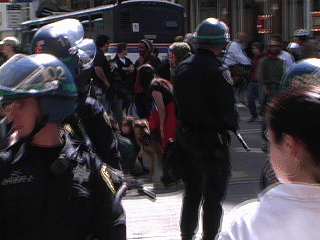
Day After/Day Of Adventure - Part 5 of ? (Small - 8 MB)
Day After/Day Of Adventure - Part 5 of ? (Hi-res - 79 MB)

Day After/Day Of Adventure - Part 6 of ? (Small - 8 MB)
Day After/Day Of Adventure - Part 6 of ? (Hi-res - 84 MB)
Part 6: I took some shots of a lovely artsy theatre group that were posing as dead bodies in a human sculpture of sorts on the sidewalk, and one of them tries to move and is stopped by photographers that hadn't gotten their shot yet.
These clips demonstrate how many people collected at 4th and Market around 1pm.
All and all the vibe was starting to pick up a bit. (But not for long...)
Hi resolution files will be uploading for a bit -- I have to leave but I wanted to get this stuff up so I could get the rest up tomorrow morning...
More Photos - Part 5 (below)
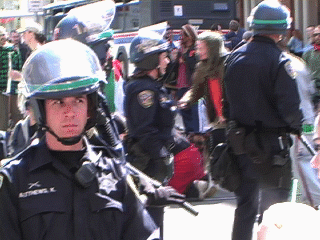
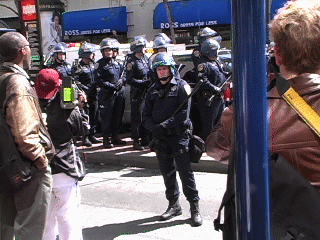

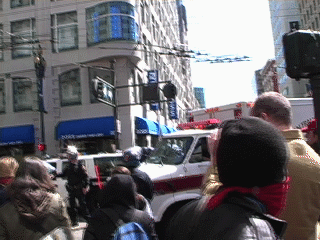
More Photos - Part 6 (below)






Congrats to Lenny Kravitz for finding a way to both express himself while reminding us of the single thing we can do together as a united community against the WAR that will have a direct effect on our country's future in the years ahead:
vote him out of office in 2004!
(And by voting as many of "his people" out in all the little elections at every step along the way. )
(Um. When's that next election again?:)
Here's what this is all about.
Rock the Vote and Lenny Kravitz today announced a new song by Kravitz called "We Want Peace," which is available exclusively at Rock the Vote's website, http://www.rockthevote.org.The song, which says, "There won't be peace if we don't try" is an urgent call from Kravitz for America to be a peaceful leader in the world. Kravitz wrote the song and performed it with Kazem Al Sahir, Iraq’s #1 pop music artist, who is better known as Iraq’s Diplomatic Ambassador to the world and hailed as a true legend of Arabic Music. In addition, the song features Palestinian musician Simon Shaheen on the 'oud and violins and Lebanese artist Jamey Haddad’s on djembe and tambourines.
Rock the Vote praised Kravitz for speaking his mind about the importance of peace and issued a call to action for young people to work for peace and defend free expression. Noting that artists, actors, activists, journalists and the world’s people have come under attack for their views on the war, Rock the Vote re-affirmed its commitment to supporting those who have the courage to speak out-- and to mobilizing young people to shape the future of our world. Rock the Vote's website, where the song will be released, also urges visitors to register to vote and to join the Rock the Vote Community Street Teams, which will be organizing "free expression" events and rallies in dozens of cities across the country in the coming weeks.
Here is the full text of the article in case the link goes bad:
(3-26-03)
http://www.rockthevote.org/statement.php
ROCK THE VOTE RELEASES NEW SONG BY LENNY KRAVITZ
" WE WANT PEACE "
With exclusive, free, web release of Kravitz' new song in response to the war on Iraq, Rock the Vote calls on young people to defend free expression
Los Angeles, March 25, 2003 - Rock the Vote and Lenny Kravitz today announced a new song by Kravitz called "We Want Peace," which is available exclusively at Rock the Vote's website, http://www.rockthevote.org.
The song, which says, "There won't be peace if we don't try" is an urgent call from Kravitz for America to be a peaceful leader in the world. Kravitz wrote the song and performed it with Kazem Al Sahir, Iraq’s #1 pop music artist, who is better known as Iraq’s Diplomatic Ambassador to the world and hailed as a true legend of Arabic Music. In addition, the song features Palestinian musician Simon Shaheen on the 'oud and violins and Lebanese artist Jamey Haddad’s on djembe and tambourines.
Rock the Vote praised Kravitz for speaking his mind about the importance of peace and issued a call to action for young people to work for peace and defend free expression. Noting that artists, actors, activists, journalists and the world’s people have come under attack for their views on the war, Rock the Vote re-affirmed its commitment to supporting those who have the courage to speak out-- and to mobilizing young people to shape the future of our world. Rock the Vote's website, where the song will be released, also urges visitors to register to vote and to join the Rock the Vote Community Street Teams, which will be organizing "free expression" events and rallies in dozens of cities across the country in the coming weeks.
"I came to Rock the Vote because of its strong stance with young people as defenders of free expression," said Lenny Kravitz. "This song for me is about more than Iraq: It is about our role as people in the world and that we all should cherish freedom and peace."
Jehmu Greene, Rock the Vote's executive director, said "Lenny Kravitz is a true patriot, and Rock the Vote is proud to support his artistic expression. We are here to rally young people to their sacred duty as patriotic Americans to speak out and participate in our democracy. To all the young people who might feel intimidated in the present political environment, pay attention to what Lenny Kravitz is doing. He is leading in this difficult time and so can you."
According to Ms. Greene, "Rock the Vote supports the young men and women in our military whose lives are now at risk. We hope the war will come to a swift conclusion with minimum loss of human life and that we can move on to build a better future for the Iraqi people. The millions of young people who hear this song should take Kravitz' message to heart and stand up for what they believe. As Lenny Kravitz says, 'we're at the crossroads,' and we need to defend democracy right now here at home."
ABOUT ROCK THE VOTE
Rock the Vote is a non-partisan, non-profit organization dedicated to protecting freedom of expression and empowering young people to change their world. Over the past decade, Rock the Vote has registered over three million new young voters and called on young people to recognize their role in creating significant political and social change.
CONTACTS:
Rock the Vote — Jamie Falkowski / Sarah Evans
310-444-7041 / 310-444-7039
Lenny Kravitz — Carleen Donovan
212-582-5400
CarleenD@ksapublicity.com
"Cost plus" basis huh?
Iraq rebuilding contracts awarded
Halliburton, Stevedoring Services of America get government contracts for early relief work.
By Mark Gongloff for CNN/Money.
The Army Corps of Engineers told CNN Tuesday that Halliburton would be paid on a "cost plus" basis, meaning it would be reimbursed for the costs of its work and would get a certain percentage of those costs as a fee.Since it's still unknown how much damage has been or will be done to Iraqi oil fields in the war, it's difficult to estimate the contract's eventual dollar value.
But its biggest value could be that it puts Halliburton in a prime position to handle the complete refurbishment of Iraq's long-neglected oil infrastructure, which will be a plum job.
Getting Iraq's oil fields to pre-1991 production levels will take at least 18 months and cost about $5 billion initially, with $3 billion more in annual operating expenses, according to a recent study by the James A. Baker III Institute for Public Policy at Rice University, named for the first President Bush's secretary of state during the first Gulf War.
"Certainly Halliburton would have the lead [in the competition for that job], even absent this contract, given the size and scope of their current operations," said Pierre Conner, an analyst with Hibernia Southcoast Capital. "But there's no question they'll start with some footprint there. It clearly puts them in the position where they will know more about the situation and have a bit of an operation there."
Though none of the potential administrators of such a contract -- including the Defense Department, the State Department's U.S. Agency for International Development (USAID) and the United Nations -- have claimed responsibility for handing out the job, Monday's award and Bush's request for funding seem to indicate the U.S. government will be in charge.
Here is the full text of the article in case the link goes bad:
http://money.cnn.com/2003/03/25/news/companies/war_contracts/index.htm
Save a link to this article and return to it at www.savethis.comSave a link to this article and return to it at www.savethis.com Email a link to this articleEmail a link to this article Printer-friendly version of this articlePrinter-friendly version of this article View a list of the most popular articles on our siteView a list of the most popular articles on our site
Iraq rebuilding contracts awarded
Halliburton, Stevedoring Services of America get government contracts for early relief work.
March 25, 2003: 4:33 PM EST
By Mark Gongloff, CNN/Money Staff Writer
NEW YORK (CNN/Money) - The first contracts for rebuilding post-war Iraq have been awarded, and Vice President Dick Cheney's old employer, Halliburton Co., is one of the early winners.
The Kellogg Brown & Root (KBR) unit of Halliburton (HAL: up $0.54 to $20.66, Research, Estimates), of which Cheney was CEO from 1995 to 2000, said late Monday that it was awarded a contract by the U.S. Army Corps of Engineers to put out oil fires and make emergency repairs to Iraq's oil infrastructure.
President Bush Tuesday asked Congress for $489.3 million to cover the cost of repairing damage to Iraq's oil facilities, much or all of which could go to Halliburton or its subcontractors under the terms of its contract with the Army.
Cheney divested himself of all interest in Halliburton, the largest U.S. oilfield services company, after the 2000 election.
Halliburton wouldn't speculate about the total monetary value or duration of its contract, under which it will put into action some of the firefighting and repair plans it outlined for the Army in a study it conducted in November.
"KBR's ... contract is limited to task orders under the contract for only those services which are necessary to support the mission in the near term," Halliburton spokeswoman Wendy Hall said.
The Army Corps of Engineers told CNN Tuesday that Halliburton would be paid on a "cost plus" basis, meaning it would be reimbursed for the costs of its work and would get a certain percentage of those costs as a fee.
Since it's still unknown how much damage has been or will be done to Iraqi oil fields in the war, it's difficult to estimate the contract's eventual dollar value.
But its biggest value could be that it puts Halliburton in a prime position to handle the complete refurbishment of Iraq's long-neglected oil infrastructure, which will be a plum job.
Getting Iraq's oil fields to pre-1991 production levels will take at least 18 months and cost about $5 billion initially, with $3 billion more in annual operating expenses, according to a recent study by the James A. Baker III Institute for Public Policy at Rice University, named for the first President Bush's secretary of state during the first Gulf War.
"Certainly Halliburton would have the lead [in the competition for that job], even absent this contract, given the size and scope of their current operations," said Pierre Conner, an analyst with Hibernia Southcoast Capital. "But there's no question they'll start with some footprint there. It clearly puts them in the position where they will know more about the situation and have a bit of an operation there."
Though none of the potential administrators of such a contract -- including the Defense Department, the State Department's U.S. Agency for International Development (USAID) and the United Nations -- have claimed responsibility for handing out the job, Monday's award and Bush's request for funding seem to indicate the U.S. government will be in charge.
Halliburton said it has subcontracted the firefighting portion of the Army contract to Houston-based companies Boots & Coots International Well Control Inc. (WEL: up $0.06 to $1.16, Research, Estimates) and Wild Well Control Inc., a private company.
Hall of Halliburton said all oil fires should be put out within 240 days. Very few oil wells have been set ablaze by Iraqis so far, in contrast to the first Gulf War in 1991, when Iraqi troops retreating from Kuwait set fire to more than 700 Kuwaiti oil wells. Halliburton's KBR unit was involved in putting out the 1991 fires.
Separately, USAID late Monday awarded a $4.8 million contract to Stevedoring Services of America (SSA), a private company based in Seattle, to manage the Umm Qasr ports in southern Iraq.
Umm Qasr's ports, where U.S. and British troops have struggled for full control, are seen as critical to efforts to bring humanitarian relief to Iraqis. SSA will handle several tasks, including assessing the need for dredging and repairs to the ports, and unloading and warehousing cargo.
USAID plans to issue seven other contracts, including one for $600 million for general construction work in post-war Iraq. Halliburton is among several companies reported to have put in bids for that contract.
The Daily Show is turning out to be a vital source of news and information during this war.
Jon and the gang are gracious as always as they connect the frightening, depressing dots. (Note: here's an update on some developments in this situation since this clip was originally posted.)
Daily Show On Halliburton Contract (Small 9 MB)
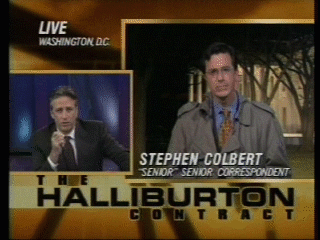
Little Halliburton Movie (Hi-res 8 MB)

AFTRA RALLY AGAINST CLEAR CHANNEL March 27 12:30 P.M. - 2 P.M.(Clear Channel is an organizer of pro war rallies;
sent a memo to their 1000+ stations suggesting they
NOT play John Lennon's "Imagine" and a multitude of
other songs right after 9/11; has links to Bush
Administration; and also are accused of unfair
practices by artists touring who, in order to get
airplay on their stations in certain markets, must use
Clear Channel promoters.)* * *
original call from AFTRA:
American Federation of Television and Radio Artists
March 2003AFTRA
New York
LocalAFTRA RALLY
at BRYANT PARK,
Thursday, MARCH 27th at 12:30 PMClear Channel Communications,
the owner of WKTU, WLTW, WAXQ, WWPR, and WHTZ,
wants the right to fire DJs and replace them with
cheaper, out-of-state announcers who pre-record shows
through a process called "voice-tracking."Clear Channel Communications wants to take the
hometown voices out of New York City radio.
COME TO THE RALLY TO
SUPPORT AND MEET
THE DJs YOU LISTEN TO EVERYDAY!
Bryant Park
42nd Street and 6th Avenue at the Fountain
Thursday, March 27th
12:30 pm - 2:00 pm
For more information contact:
Broadcast Department,
American Federation of Television and Radio Artists,
New York Localwww.keepnyradiolive.com
(212) 532-0800It is a fight we are in together.
What they're really saying when you read between the lines :-)
Funny CNN Parody
1. Government by a few, especially by a small faction of persons or families.
2. Those making up such a government.
2. A state governed by a few persons.
Channels of Influence
By Paul Krugman for the NY Times.
Or perhaps the quid pro quo is more narrowly focused. Experienced Bushologists let out a collective "Aha!" when Clear Channel was revealed to be behind the pro-war rallies, because the company's top management has a history with George W. Bush. The vice chairman of Clear Channel is Tom Hicks, whose name may be familiar to readers of this column. When Mr. Bush was governor of Texas, Mr. Hicks was chairman of the University of Texas Investment Management Company, called Utimco, and Clear Channel's chairman, Lowry Mays, was on its board. Under Mr. Hicks, Utimco placed much of the university's endowment under the management of companies with strong Republican Party or Bush family ties. In 1998 Mr. Hicks purchased the Texas Rangers in a deal that made Mr. Bush a multimillionaire.There's something happening here. What it is ain't exactly clear, but a good guess is that we're now seeing the next stage in the evolution of a new American oligarchy. As Jonathan Chait has written in The New Republic, in the Bush administration "government and business have melded into one big `us.' " On almost every aspect of domestic policy, business interests rule: "Scores of midlevel appointees . . . now oversee industries for which they once worked." We should have realized that this is a two-way street: if politicians are busy doing favors for businesses that support them, why shouldn't we expect businesses to reciprocate by doing favors for those politicians — by, for example, organizing "grass roots" rallies on their behalf?
Here is the entire text of the article in case the link goes bad:
http://www.nytimes.com/2003/03/25/opinion/25KRUG.html
The New York Times The New York Times Opinion March 25, 2003
OP-ED COLUMNIST
Channels of Influence
By PAUL KRUGMAN
By and large, recent pro-war rallies haven't drawn nearly as many people as antiwar rallies, but they have certainly been vehement. One of the most striking took place after Natalie Maines, lead singer for the Dixie Chicks, criticized President Bush: a crowd gathered in Louisiana to watch a 33,000-pound tractor smash a collection of Dixie Chicks CD's, tapes and other paraphernalia. To those familiar with 20th-century European history it seemed eerily reminiscent of. . . . But as Sinclair Lewis said, it can't happen here.
Who has been organizing those pro-war rallies? The answer, it turns out, is that they are being promoted by key players in the radio industry — with close links to the Bush administration.
The CD-smashing rally was organized by KRMD, part of Cumulus Media, a radio chain that has banned the Dixie Chicks from its playlists. Most of the pro-war demonstrations around the country have, however, been organized by stations owned by Clear Channel Communications, a behemoth based in San Antonio that controls more than 1,200 stations and increasingly dominates the airwaves.
The company claims that the demonstrations, which go under the name Rally for America, reflect the initiative of individual stations. But this is unlikely: according to Eric Boehlert, who has written revelatory articles about Clear Channel in Salon, the company is notorious — and widely hated — for its iron-fisted centralized control.
Until now, complaints about Clear Channel have focused on its business practices. Critics say it uses its power to squeeze recording companies and artists and contributes to the growing blandness of broadcast music. But now the company appears to be using its clout to help one side in a political dispute that deeply divides the nation.
Why would a media company insert itself into politics this way? It could, of course, simply be a matter of personal conviction on the part of management. But there are also good reasons for Clear Channel — which became a giant only in the last few years, after the Telecommunications Act of 1996 removed many restrictions on media ownership — to curry favor with the ruling party. On one side, Clear Channel is feeling some heat: it is being sued over allegations that it threatens to curtail the airplay of artists who don't tour with its concert division, and there are even some politicians who want to roll back the deregulation that made the company's growth possible. On the other side, the Federal Communications Commission is considering further deregulation that would allow Clear Channel to expand even further, particularly into television.
Or perhaps the quid pro quo is more narrowly focused. Experienced Bushologists let out a collective "Aha!" when Clear Channel was revealed to be behind the pro-war rallies, because the company's top management has a history with George W. Bush. The vice chairman of Clear Channel is Tom Hicks, whose name may be familiar to readers of this column. When Mr. Bush was governor of Texas, Mr. Hicks was chairman of the University of Texas Investment Management Company, called Utimco, and Clear Channel's chairman, Lowry Mays, was on its board. Under Mr. Hicks, Utimco placed much of the university's endowment under the management of companies with strong Republican Party or Bush family ties. In 1998 Mr. Hicks purchased the Texas Rangers in a deal that made Mr. Bush a multimillionaire.
There's something happening here. What it is ain't exactly clear, but a good guess is that we're now seeing the next stage in the evolution of a new American oligarchy. As Jonathan Chait has written in The New Republic, in the Bush administration "government and business have melded into one big `us.' " On almost every aspect of domestic policy, business interests rule: "Scores of midlevel appointees . . . now oversee industries for which they once worked." We should have realized that this is a two-way street: if politicians are busy doing favors for businesses that support them, why shouldn't we expect businesses to reciprocate by doing favors for those politicians — by, for example, organizing "grass roots" rallies on their behalf?
What makes it all possible, of course, is the absence of effective watchdogs. In the Clinton years the merest hint of impropriety quickly blew up into a huge scandal; these days, the scandalmongers are more likely to go after journalists who raise questions. Anyway, don't you know there's a war on?
Is this for real? Is South Carolina trying to force the Dixie Chicks to show up for a free concert so they can be booed and hissed by their former military fans.
I'm shocked I tell you. Shocked. Surely this is unconstitutional.
Don't do it girls! Start your tour from somewhere else, if need be. Sounds like they're crazy in South Carolina anyway.
You could probably sell out here in San Francisco for a week straight.
We'll stand behind you and your constitutional right to speak your mind!
(And you're pretty good at playing them instruments too.)
(S.C. State) House Resolution H 3818
A HOUSE RESOLUTIONTO REQUEST THAT THE DIXIE CHICKS APOLOGIZE TO THE MILITARY FAMILIES IN THE STATE OF SOUTH CAROLINA AND THE UNITED STATES FOR THE UNPATRIOTIC AND UNNECESSARY COMMENTS MADE BY THEIR LEAD SINGER BEFORE THEY BEGIN THEIR UNITED STATES TOUR ON MAY 1, 2003, IN GREENVILLE, SOUTH CAROLINA, AND TO REQUEST THAT THEY PERFORM A FREE CONCERT FOR TROOPS AND MILITARY FAMILIES IN SOUTH CAROLINA AS AN EXPRESSION OF THEIR SINCERITY.
Whereas, the Dixie Chicks are a popular and influential country music group from Texas; and
Whereas, before a recent London concert, Natalie Maines, the lead singer of the Dixie Chicks, said that she was ashamed that the President of the United States is from Texas; and
Whereas, members of the United States Armed Forces are outraged at the anti-American sentiment expressed by the Dixie Chicks; and
Whereas, there is a large military presence in the State of South Carolina, whom the Dixie Chicks have offended by their comments; and
Whereas, before the Dixie Chicks kick off their United States tour in Greenville on May 1, 2003, the House of Representatives and the people of South Carolina request that Natalie Maines apologize and that the group perform a free concert for the South Carolina servicemen and women and their families.
Here is the full text of the article in case the link goes bad:
http://www.lpitr.state.sc.us/sess115_2003-2004/bills/3818.htm
South Carolina General Assembly
115th Session, 2003-2004
Download This Bill in Microsoft Word97 format
Indicates Matter Stricken
Indicates New Matter
H. 3818
STATUS INFORMATION
House Resolution
Sponsors: Rep. Ceips
Document Path: l:\council\bills\bbm\9577sl03.doc
Introduced in the House on March 19, 2003
Adopted by the House on March 19, 2003
Summary: Not yet available
HISTORY OF LEGISLATIVE ACTIONS
Date Body Action Description with journal page number
-------------------------------------------------------------------------------
3/19/2003 House Introduced and adopted HJ-15
View the latest legislative information at the LPITS web site
VERSIONS OF THIS BILL
3/19/2003
(Text matches printed bills. Document has been reformatted to meet World Wide Web specifications.)
A HOUSE RESOLUTION
TO REQUEST THAT THE DIXIE CHICKS APOLOGIZE TO THE MILITARY FAMILIES IN THE STATE OF SOUTH CAROLINA AND THE UNITED STATES FOR THE UNPATRIOTIC AND UNNECESSARY COMMENTS MADE BY THEIR LEAD SINGER BEFORE THEY BEGIN THEIR UNITED STATES TOUR ON MAY 1, 2003, IN GREENVILLE, SOUTH CAROLINA, AND TO REQUEST THAT THEY PERFORM A FREE CONCERT FOR TROOPS AND MILITARY FAMILIES IN SOUTH CAROLINA AS AN EXPRESSION OF THEIR SINCERITY.
Whereas, the Dixie Chicks are a popular and influential country music group from Texas; and
Whereas, before a recent London concert, Natalie Maines, the lead singer of the Dixie Chicks, said that she was ashamed that the President of the United States is from Texas; and
Whereas, members of the United States Armed Forces are outraged at the anti-American sentiment expressed by the Dixie Chicks; and
Whereas, there is a large military presence in the State of South Carolina, whom the Dixie Chicks have offended by their comments; and
Whereas, before the Dixie Chicks kick off their United States tour in Greenville on May 1, 2003, the House of Representatives and the people of South Carolina request that Natalie Maines apologize and that the group perform a free concert for the South Carolina servicemen and women and their families. Now, therefore,
Be it resolved by the House of Representatives:
That the members of the House of Representatives of the State of South Carolina, by this resolution, request that the Dixie Chicks apologize to the military families in the State of South Carolina and the United States for the unpatriotic and unnecessary comments made by their lead singer before they begin their United States tour on May 1, 2003, in Greenville, South Carolina, and request that they perform a free concert for troops and military families in South Carolina as an expression of their sincerity.
Be it further resolved that a copy of this resolution be forwarded to the Dixie Chicks.
----XX----
This web page was last updated on March 20, 2003 at 9:33 AM
And gives it away for free.
The Final Straw (Streaming Tracks and Lyrics)
MP3 of Final Straw (MP3 - 5 MB) (In 2005, this link was requested to be removed. Thanks again guys for helping to spread the word when it really mattered!)
This is the strongest voice I could think of to send out there.
We had to send something out there now.
We are praying and hoping for the lives of all people involved,
the troops, the Iraqi civilians, refugees, pow's, families of troops, the innocents--
that they are safe and okay. Safe home, all. --Michael Stipe
Here is the full text of the article in case the link goes bad:
http://www.remhq.com/finalStraw/finalstraw.html
This is the strongest voice I could think of to send out there.
We had to send something out there now.
We are praying and hoping for the lives of all people involved,
the troops, the Iraqi civilians, refugees, pow's, families of troops, the innocents--
that they are safe and okay. Safe home, all. --Michael Stipe
[this is a rough mix from the studio]
CLICK BELOW TO LISTEN TO:
FINAL STRAW Windows Media Player
FINAL STRAW Quicktime
As I raise my head to broadcast my objection
As your latest triumph draws the final straw
Who died and lifted you up to perfection?
And what silenced me is written into law.
I can't believe where circumstance has thrown me
And I turn my head away
If I look I'm not sure that I could face you.
Not again. Not today. Not today.
If hatred makes a play on me tomorrow
And forgiveness takes a back seat to revenge
There's a hurt down deep that has not been corrected
There's a voice in me that says you will not win.
And if I ignore the voice inside,
Raise a half glass to my home.
But it's there that I am most afraid,
And forgetting doesn't hold.
It doesn't hold. Now I don't believe and I never did
That two wrongs make a right.
If the world were filled with the likes of you
Then I'm putting up a fight. Putting up a fight.
Putting up a fight. Make it right. Make it right.
Now love cannot be called into question.
Forgiveness is the only hope I hold.
And love-- love will be my strongest weapon.
I do believe that I am not alone.
For this fear will not destroy me.
And the tears that have been shed
It's knowing now where I am weakest
And the voice in my head. In my head.
Then I raise my voice up higher
And I look you in the eye
And I offer love with one condition.
With conviction, tell me why.
Tell me why.
Tell me why.
Look me in the eye.
Tell me why.
(p) 2003 R.E.M./Athens L.L.C.
Buck, Mills, Stipe ©2003 Temporary Music (BMI)
Administered in total by Warner- Tamerlane
And gives it away for free:
Green Day - Life During Wartime - messages from the band, etc. (Mike sez: "Fuck this war!")
MP3 of Life During Wartime (5 MB)
Or download it from my archive.
Sorry ahead of time for not being able to make out a few words of the lyrics... A reader has kindly helped me complete the lyrics :-)
Life During Wartime
Music and Lyrics by Green Day
yeah we say making changes starts
in the little things you do
revolution begins at home
but for most of us it ends there toowe're doing something
we're making changes
like changing the brand of crap we buy
we say it makes a difference
but that's just another lieit used to be us and them
and you and me
and now we can't reach our potential
without a common enemya real war to fight against
instead of our petty disagreements
how can i rationalize
my life during wartime liea call to action
and a reaction
taking our lives in our own hands
instead of sitting around and talking bout
the same old shitty bandsthe war's going on right now
and i'm not doing anything about it
without a crowd I'm not so loud
i can't do anything by myself
but that's just another lie
Our adventure continues: Kevin and I decide to leave the arrests (see parts 1-2 and part 3) and wait to see if the cops were going to launch another offensive. The cops were behaving so bizarrely at this point, sort of lining up in formation and running around for no reason in long lines, that I must admit, I was more curious than scared of anything at this point. (A good twenty minutes had gone by since I'd seen a cop whack anybody with one of their clubs, after all.)
Kevin had already filled up his camera and really wanted to download his pictures to his computer so that he could take more shots. He felt "defenseless" without his camera, but the cops had just started trying to divert people off onto a side street, and were actually communicating with people for the first time since I had been present at the protest, so I was intrigued by this sudden opening of a communications channel between the cops and protesters.
--so I told him I'd meet him over at the Starbucks.
I walked up to the cop with the mega phone and asked him if it was now OK to stand on the sidewalk. He replied that actually, no it wasn't -- that he wanted us to move completely off Market Street over to Hyde or Ellis or somewhere or other (didn't really matter to me, because I had promised Kevin I would meet him back at the Starbucks, which was in the opposite direction, so I decided I'd better hurry before people were cleared off of the block entirely, if that was what was happening...)
On the way to Starbucks, I saw what was the only single incident of vandalism I witnessed the entire time I was downtown that day: a broken window of a Wells Fargo. (Perhaps this act of vandalism was why things had gotten so negative with the cops on that block?)
In the Starbucks, however, everything was normal. Oddly normal. Like nobody else but us was even paying attention to what was going on outside. Kevin and I watched the protest through a window as if it were a lifesized TV. And in a way, it was. It was TV where, if you chose to walk through a door, you would be part of the program.
When Kevin had downloaded his photos, we emerged from the Starbucks, and, magically, it was OK to stand on the sidewalk again!
However, things seemed to have heated up, and the cops continued to form in rather threatening formations without telling us why, or what we were doing wrong, or how we might make it better.
Day After/Day Of Part 4 of ? (Small - 10 MB)
Day After/Day Of Part 4 of ? (Hi-Res - 91 MB)



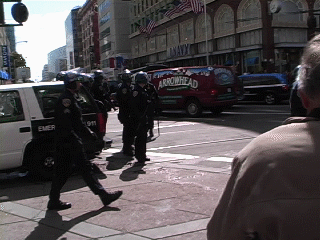
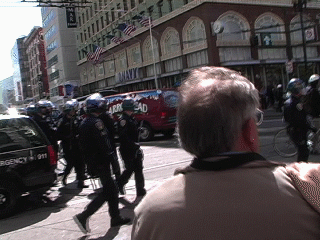
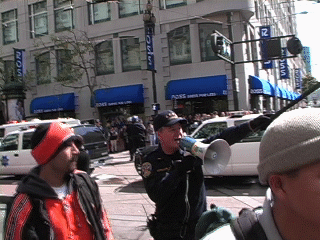
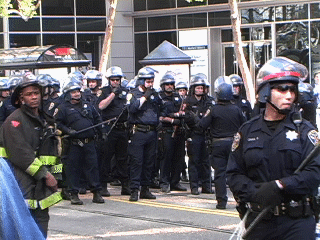
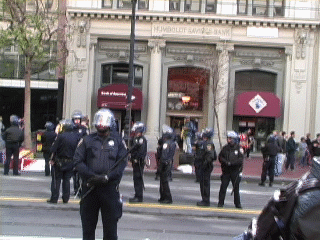
Ha! Another media disinformation campaign. A friend was telling me how he was hearing that "everyone was booing" when Moore took advantage of this rare opportunity to sneak some truth out to the nation.
You can listen and decide for yourself, but I hear as much clapping as booing as our fearless leader, right on schedule, says what needed to be said.
I don't even know if this is a complete clip yet, but I wanted to make it available for you asap: Michael Moore At The Oscars
There's a video stream of Q and A with Michael afterwards here too.
(Thanks to The Rattler and Kevin Burton for help finding this stuff.)
Zack de la Rocha and DJ Shadow have teamed up on a new peace song.
You should Check it out.
Lyrics and a free
Download are also available.
here it comes the sound of terror from above
he flex his Texas twisted tongue
the poor lined up to kill in desert slums
for oil that burn beneath the desert sun
Mary Ann Wright's Letter of Resignation to Colin Powell
I firmly believe the probability of Saddam using weapons of mass destruction is low, as he knows that using those weapons will trigger an immediate, strong and justified international response. There will be no question of action against Saddam in that case. I strongly disagree with the use of a “preemptive attack” against Iraq and believe that this preemptive attack policy will be used against us and provide justification for individuals and groups to “preemptively attack” America and American citizens...I disagree with the Administration’s policies on Unnecessary Curtailment of Rights in America
Further, I cannot support the Administration’s unnecessary curtailment of civil rights following September 11. The investigation of those suspected of ties with terrorist organizations is critical but the legal system of America for 200 years has been based on standards that provide protections for persons during the investigation period. Solitary confinement without access to legal counsel cuts the heart out of the legal foundation on which our country stands. Additionally, I believe the Administration’s secrecy in the judicial process has created an atmosphere of fear to speak out against the gutting of the protections on which America was built and the protections we encourage other countries to provide to their citizens...
I have served my country for almost thirty years in the some of the most isolated and dangerous parts of the world. I want to continue to serve America. However, I do not believe in the policies of this Administration and cannot defend or implement them. It is with heavy heart that I must end my service to America and therefore resign due to the Administration’s policies.
Here is the full text of the entire article in case the link goes bad:
http://www.govexec.com/dailyfed/0303/032103wright.htm
March 21, 2003
The following is a copy of Mary (Ann) Wright’s letter of resignation to Secretary of State Colin Powell. Wright was most recently the deputy chief of mission at the U.S. embassy in Ulaanbaatar, Mongolia. She helped open the U.S. embassy in Kabul, Afghanistan, in January 2002.
U.S. Embassy
Ulaanbaatar, Mongolia
March 19, 2003
Secretary of State Colin Powell
US Department of State
Washington, DC 20521
Dear Secretary Powell:
When I last saw you in Kabul in January, 2002 you arrived to officially open the US Embassy that I had helped reestablish in December, 2001 as the first political officer. At that time I could not have imagined that I would be writing a year later to resign from the Foreign Service because of US policies. All my adult life I have been in service to the United States. I have been a diplomat for fifteen years and the Deputy Chief of Mission in our Embassies in Sierra Leone, Micronesia, Afghanistan (briefly) and Mongolia. I have also had assignments in Somalia, Uzbekistan, Kyrgyzstan, Grenada and Nicaragua. I received the State Department’s Award for Heroism as Charge d’Affaires during the evacuation of Sierra Leone in 1997. I was 26 years in the US Army/Army Reserves and participated in civil reconstruction projects after military operations in Grenada, Panama and Somalia. I attained the rank of Colonel during my military service.
This is the only time in my many years serving America that I have felt I cannot represent the policies of an Administration of the United States. I disagree with the Administration’s policies on Iraq, the Israeli-Palestinian conflict, North Korea and curtailment of civil liberties in the U.S. itself. I believe the Administration’s policies are making the world a more dangerous, not a safer, place. I feel obligated morally and professionally to set out my very deep and firm concerns on these policies and to resign from government service as I cannot defend or implement them.
I hope you will bear with my explanation of why I must resign. After thirty years of service to my country, my decision to resign is a huge step and I want to be clear in my reasons why I must do so.
I disagree with the Administration’s policies on Iraq
I wrote this letter five weeks ago and held it hoping that the Administration would not go to war against Iraq at this time without United Nations Security Council agreement. I strongly believe that going to war now will make the world more dangerous, not safer.
There is no doubt that Saddam Hussein is a despicable dictator and has done incredible damage to the Iraqi people and others of the region. I totally support the international community’s demand that Saddam’s regime destroy weapons of mass destruction.
However, I believe we should not use US military force without UNSC agreement to ensure compliance. In our press for military action now, we have created deep chasms in the international community and in important international organizations. Our policies have alienated many of our allies and created ill will in much of the world.
Countries of the world supported America’s action in Afghanistan as a response to the September 11 Al Qaida attacks on America. Since then, America has lost the incredible sympathy of most of the world because of our policy toward Iraq. Much of the world considers our statements about Iraq as arrogant, untruthful and masking a hidden agenda. Leaders of moderate Moslem/Arab countries warn us about predicable outrage and anger of the youth of their countries if America enters an Arab country with the purpose of attacking Moslems/Arabs, not defending them. Attacking the Saddam regime in Iraq now is very different than expelling the same regime from Kuwait, as we did ten years ago.
I strongly believe the probable response of many Arabs of the region and Moslems of the world if the US enters Iraq without UNSC agreement will result in actions extraordinarily dangerous to America and Americans. Military action now without UNSC agreement is much more dangerous for America and the world than allowing the UN weapons inspections to proceed and subsequently taking UNSC authorized action if warranted.
I firmly believe the probability of Saddam using weapons of mass destruction is low, as he knows that using those weapons will trigger an immediate, strong and justified international response. There will be no question of action against Saddam in that case. I strongly disagree with the use of a “preemptive attack” against Iraq and believe that this preemptive attack policy will be used against us and provide justification for individuals and groups to “preemptively attack” America and American citizens.
The international military build-up is providing pressure on the regime that is resulting in a slow, but steady disclosure of Weapons of Mass Destruction (WMD). We should give the weapons inspectors time to do their job. We should not give extremist Moslems/ Arabs a further cause to hate America, or give moderate Moslems a reason to join the extremists. Additionally, we must reevaluate keeping our military forces in the Middle East, particularly in Saudi Arabia. Their presence on the Islamic “holy soil” of Saudi Arabia will be an anti-American rally cry for Moslems as long as the US military remains and a strong reason, in their opinion, for actions against the US government and American citizens.
Although I strongly believe the time in not yet right for military action in Iraq, as a soldier who has been in several military operations, I hope General Franks, US and coalition forces can accomplish the missions they will be ordered do without loss of civilian or military life and without destruction of the Iraqi peoples’ homes and livelihood.
I strongly urge the Department of State to attempt again to stop the policy that is leading us to military action in Iraq without UNSC agreement. Timing is everything and this is not yet the time for military action.
I disagree with the Administration’s lack of effort in resolving the Israeli-Palestinian conflict
Likewise, I cannot support the lack of effort by the Administration to use its influence to resurrect the Israeli-Palestinian peace process. As Palestinian suicide bombers kill Israelis and Israeli military operations kill Palestinians and destroy Palestinian towns and cities, the Administration has done little to end the violence. We must exert our considerable financial influence on the Israelis to stop destroying cities and on the Palestinians to curb its youth suicide bombers. I hope the Administration’s long-needed “Roadmap for Peace” will have the human resources and political capital needed to finally make some progress toward peace.
I disagree with the Administration’s lack of policy on North Korea
Additionally, I cannot support the Administration’s position on North Korea. With weapons, bombs and missiles, the risks that North Korea poses are too great to ignore. I strongly believe the Administration’s lack of substantive discussion, dialogue and engagement over the last two years has jeopardized security on the peninsula and the region. The situation with North Korea is dangerous for us to continue to neglect.
I disagree with the Administration’s policies on Unnecessary Curtailment of Rights in America
Further, I cannot support the Administration’s unnecessary curtailment of civil rights following September 11. The investigation of those suspected of ties with terrorist organizations is critical but the legal system of America for 200 years has been based on standards that provide protections for persons during the investigation period. Solitary confinement without access to legal counsel cuts the heart out of the legal foundation on which our country stands. Additionally, I believe the Administration’s secrecy in the judicial process has created an atmosphere of fear to speak out against the gutting of the protections on which America was built and the protections we encourage other countries to provide to their citizens.
Resignation
I have served my country for almost thirty years in the some of the most isolated and dangerous parts of the world. I want to continue to serve America. However, I do not believe in the policies of this Administration and cannot defend or implement them. It is with heavy heart that I must end my service to America and therefore resign due to the Administration’s policies.
Mr. Secretary, to end on a personal note, under your leadership, we have made great progress in improving the organization and administration of the Foreign Service and the Department of State. I want to thank you for your extraordinary efforts to that end. I hate to leave the Foreign Service, and I wish you and our colleagues well.
Very Respectfully,
Mary A. Wright, FO-01
Deputy Chief of Mission
US Embassy
Ulaanbaatar, Mongolia
CONTEMPLATING WAR IN THE LAND OF PEACE...This is a continuation of the same national system of denial that we
began to construct during Gulf War I. Ask a knowledgeable American
how many people died in that conflict and you will probably be told
that the death toll was somewhere around 150. (I seem to recall 138
American fatalities.)You will probably not hear about the roughly 400,000 Iraqis we killed
during that bully outing. You will almost certainly not hear about
the retreating column of almost 50,000 Iraqi soldiers that were
incinerated on the highway from Kuwait on the orders of war
criminal-turned-Drug Czar Barry McCaffrey. While I think that Gulf
War I may have been justified and even necessary, the fact that we
were able to conduct it with so little empathic memory does not bode
well for Gulf War II. We should still be in mourning for all the
unwilling conscripts who died at the point of our surgically sharp
sword rather than wielding it again with so much less moral
justification.But this is just one aspect of how we have blunted our national
conscience with media. Even more dangerous is our new willingness to
believe that America's agenda is more important than the preservation
of international law. The United Nations Charter explicitly prohibits
one nation from attacking another except in self-defense or with the
sanction of the UN Security Council. If our attack of Iraq is
self-defense, then I would be equally innocent if I returned to
Wyoming and killed everyone in Pinedale who is well-armed, doesn't
like me, and beats his wife. (This would require quite a killing
spree...)Even if this war is so sophisticated that very few "collateral
damages" are inflicted, even if the Ba'ath regime folds immediately
and our troops enter Baghdad festooned in the garlands of a grateful
and liberated populace, even in the extremely unlikely event that we
find a cache of Iraqi nuclear weapons, all packed up for delivery to
Al -Qa'ida , it will still be illegal and immoral. Victory will not
change that.It is also profoundly impractical, when one considers the larger consequences.
Even if victory is swift and painless , we will have wounded, perhaps
mortally, the peace-waging capacity of the United Nations.We will have sewn deep discord within the European Union and badly
damaged relations with two of our most important allies, France and
Germany.We will have destroyed remaining popular support for the governments
of Jordan, Egypt, and Saudi Arabia, our three most important allies
in the Middle East.We will have established - and not only for ourselves - the
legitimacy of preemptive attack.We will have radicalized half a billion young Muslims, transforming a
monster into a martyr in their eyes.We will have installed ourselves as the rulers of an energy colony
that will not be easy to govern, given the bitter - and, to us,
inscrutable - divisions that exist between its Shiites, its Sunni,
and its Kurds.We will have brought ourselves to the brink of active hostilities
with Turkey, formerly a strong ally.We will have bankrupted the teetering American economy.
We will have inserted long-term instability in world financial and
energy markets.We will have devalued the currency of American moral authority to the
vanishing point. We will have turned America, long the hope of the
world, into the most feared and hated of nations. We will have traded
our national capacity to inspire for a mere capacity to intimidate.And for what? To avenge 9/11 by punishing a regime that had no proven
role in it? Out of humane concern for the Iraqi people, whom we have
been, by our own policies, starving and impoverishing for the last
decade? In order to destroy possibly mythical "weapons of mass
destruction" in Iraq, even while we abide their proven existence in
such potentially irrational countries as Pakistan, Israel, India,
France, and, hardly least, the United States? The Administration
attacked before it ever provided a justification that would satisfy
any but the most TV-enchanted Christian soldier.
From: John Perry Barlow
Date: Sun Mar 23, 2003 9:04:55 PM US/Pacific
To: barlowfriendz@eff.org, John Perry Barlow
Subject: [BarlowFriendz] 9.2: War and Paz, the View from Brazil
Reply-To: barlow@eff.org
CONTEMPLATING WAR IN THE LAND OF PEACE
I was deep in the heart of Brazil when I got the news.
I was in a serene little jewel of a former diamond-mining town called
Lençois. It's located in a remote part of Brazil's Bahia state called
the Chapada Diamantina, improbably beautiful country that would look
like Monument Valley if the buttes and spires of Southern Utah rose
from a blanket of rain forest.
I had been completely out of touch with the rest of the world for
three days at the International Rainbow Gathering, held even deeper
in the Chapada, eight hours of astonishingly bad road away from
Lençois.
But even if I'd been in downtown São Paulo, the events in Baghdad
would have seemed distant. Brazil is a floating world, a parallel
universe of such size and cultural density that little enters or
escapes its gravitational field. It is well accustomed to shrugging
at Northern madnesses and continuing to pursue its own profoundly
complex affairs.
Brazil is the world's largest Inside Joke. It is, to those who get
it, sufficiently involving to render even such external
considerations as the possible outbreak of Armageddon slightly
irrelevant.
Besides, it seems to have an instinct for peace that runs the length
of its history and is wisely aware that even opposing the bellicose
behavior of less enlightened cultures adds energy to the cyclone of
war. Brazil doesn't study war no more. The only organized conflict
Brazil is likely to enter involves no weapon more lethal than a
soccer ball.
The cobble-stoned streets of Lençois were filling with the nightly
promenade of beautiful, chocolate-skinned young people when my cell
phone rang. "The war has started," said Lotte, my former Swedeheart,
in a voice as bleak as a Strindberg play.
Immediately, I lunged for a fat information feed, but there was
little to be had. The pousada where I was staying didn't have a
phone, so I couldn't jack my computer into the Internet. I found a
television, which is never hard to do in Brazil, but of course I
couldn't find one with any English programming. Why waste a channel
on CNN? Absolutely no one here speaks English and they certainly
don't need any more hallucinatory propaganda from The North.
What news I could find in Portuguese seemed to regard the outbreak of
American aggression against Iraq as just another news story. It was
nothing worth preempting the evening's soap operas over. I went to
bed even more in the dark than usual.
I had another 8 hour drive to Salvador the next day. I scanned the
radio constantly for news and heard little. I did hear President Lula
de Silva making a statement in the matter, which I later leaned
contained this perfectly reasonable statement: "All of us want for
Iraq not to have atomic weapons or weapons of mass destruction," he
said, "but that does not give the United States the right to decide
by itself what is good and what is bad for the world."
Now I'm Rio. I know everything that CNN and the New York Times web
site permit me to know, which seems to include things that might not
be true.
I know that, according to the Gallup poll, 76% of the American people
support the attack on Iraq. (Since I can only think of 5 people in my
considerable multitude of diverse acquaintance who share this
opinion, I have to wonder about this figure.)
I know that we can turn Baghdad - a town with 2 and a half million
children - into telegenic Disney Hell with several thousand tons of
high explosives and injure only Bad Guys. (Indeed, watching CNN, one
might wonder if anyone gets injured at all in this marvelously
surgical new form of war.)
I know that we have a lot of really cool toys in our arsenal. I know
that A-10 Warthog can fire over a thousand rounds a minute. (Though
no one in the media has mentioned that each of these bullets consists
of depleted uranium that will be radiating birth defects into the
Iraqi gene pool for many generations.)
I know that the only truly powerful country on the planet is
continuing to manufacture the perilous, conscience-stunting myth that
technology can make war relatively safe. Indeed, we are so delusional
on this subject that we believe that bombing the shit out of the
Iraqis is a humanitarian act.
This is a continuation of the same national system of denial that we
began to construct during Gulf War I. Ask a knowledgeable American
how many people died in that conflict and you will probably be told
that the death toll was somewhere around 150. (I seem to recall 138
American fatalities.)
You will probably not hear about the roughly 400,000 Iraqis we killed
during that bully outing. You will almost certainly not hear about
the retreating column of almost 50,000 Iraqi soldiers that were
incinerated on the highway from Kuwait on the orders of war
criminal-turned-Drug Czar Barry McCaffrey. While I think that Gulf
War I may have been justified and even necessary, the fact that we
were able to conduct it with so little empathic memory does not bode
well for Gulf War II. We should still be in mourning for all the
unwilling conscripts who died at the point of our surgically sharp
sword rather than wielding it again with so much less moral
justification.
But this is just one aspect of how we have blunted our national
conscience with media. Even more dangerous is our new willingness to
believe that America's agenda is more important than the preservation
of international law. The United Nations Charter explicitly prohibits
one nation from attacking another except in self-defense or with the
sanction of the UN Security Council. If our attack of Iraq is
self-defense, then I would be equally innocent if I returned to
Wyoming and killed everyone in Pinedale who is well-armed, doesn't
like me, and beats his wife. (This would require quite a killing
spree...)
Even if this war is so sophisticated that very few "collateral
damages" are inflicted, even if the Ba'ath regime folds immediately
and our troops enter Baghdad festooned in the garlands of a grateful
and liberated populace, even in the extremely unlikely event that we
find a cache of Iraqi nuclear weapons, all packed up for delivery to
Al -Qa'ida , it will still be illegal and immoral. Victory will not
change that.
It is also profoundly impractical, when one considers the larger consequences.
Even if victory is swift and painless , we will have wounded, perhaps
mortally, the peace-waging capacity of the United Nations.
We will have sewn deep discord within the European Union and badly
damaged relations with two of our most important allies, France and
Germany.
We will have destroyed remaining popular support for the governments
of Jordan, Egypt, and Saudi Arabia, our three most important allies
in the Middle East.
We will have established - and not only for ourselves - the
legitimacy of preemptive attack.
We will have radicalized half a billion young Muslims, transforming a
monster into a martyr in their eyes.
We will have installed ourselves as the rulers of an energy colony
that will not be easy to govern, given the bitter - and, to us,
inscrutable - divisions that exist between its Shiites, its Sunni,
and its Kurds.
We will have brought ourselves to the brink of active hostilities
with Turkey, formerly a strong ally.
We will have bankrupted the teetering American economy.
We will have inserted long-term instability in world financial and
energy markets.
We will have devalued the currency of American moral authority to the
vanishing point. We will have turned America, long the hope of the
world, into the most feared and hated of nations. We will have traded
our national capacity to inspire for a mere capacity to intimidate.
And for what? To avenge 9/11 by punishing a regime that had no proven
role in it? Out of humane concern for the Iraqi people, whom we have
been, by our own policies, starving and impoverishing for the last
decade? In order to destroy possibly mythical "weapons of mass
destruction" in Iraq, even while we abide their proven existence in
such potentially irrational countries as Pakistan, Israel, India,
France, and, hardly least, the United States? The Administration
attacked before it ever provided a justification that would satisfy
any but the most TV-enchanted Christian soldier.
As you BarlowFriendz know, I thought Cheney, Bush, and Rumsfeld were
bluffing. I still think they were. But they painted themselves into
a terrible corner by failing to recognize the irrationality and
intransigence of Saddam Hussein as well as the powerlessness of his
people. When all their terrorism failed to either frighten him into
exile or frighten the Iraqis into thinking it would be safer to
attempt his overthrow, they had no choice but to pursue bluster by
another means, to paraphrase Von Clauswitz. (In his press conference
today, Rumsfeld said, repeatedly, words that amounted to: "Ok, we're
getting really mad now. If you don't pack up and go, Saddam, we'll do
something truly shocking and awful." As if we hadn't already...
Now, of course, these events have acquired all the terrible machinery
of tragedy. They have become horrible juggernaut that will roll
across the world leaving horror and change, mostly for the worse, in
its tracks. I doubt that even Dick Cheney could stop it now.
Meanwhile, life goes gloriously on in Brazil. While the North erupted
on Saturday in war and angry protests against war, Brazil was mainly
concerned with the championship match between São Paulo and
Corinthes. Indeed, the only visible war protest I saw were some
banners in the audience at the soccer game. (Though Michael Moore got
a huge cheer from the Oscar party I attended tonight when he took
after George Bush...)
As you might expect, I have much more to report from down here, where
I've now spent an utterly transforming month. Until now, I've been
having too much fun having adventures to spend my energies on turning
them into information.
I have just taken what is almost certainly the best short course in
Brazilian culture that anyone ever received. Just experiencing
Carnival - in Salvador, Recife, Olinda, Rio, and São Paulo - in the
immediate and continuous company of Gilberto Gil would have been a
lot. In addition to being the Minister of Culture, Gil *is* Brazil in
a way. In his music, his open heart, his sweetly melancholy optimism,
his energy, he represents everything this place rightly loves about
itself.
If Gilberto Gil were a member of our cabinet - if we had the kind of
country that would make him a member of the cabinet - we would be
waging peace rather than war and the world would be a lot more like
Brazil. One can only hope that one day it will be.
Paz e Amor,
Barlow
--
John Perry Barlow, Cognitive Dissident
Co-Founder & Vice Chairman, Electronic Frontier Foundation
Berkman Fellow, Harvard Law School
Home(stead) Page: http://www.eff.org/~barlow
**************************************************************
O Lord our Father, our young patriots, idols of our hearts, go forth
to battle-be Thou near them! With them, in spirit, we also go forth
from the sweet peace of our beloved firesides to smite the foe. O
Lord our God, help us to tear their soldiers to bloody shreds with
our shells; help us to cover their smiling fields with the pale forms
of their patriot dead; help us to drown the thunder of the guns with
the shrieks of their wounded, writhing in pain; help us to lay waste
their humble homes with a hurricane of fire; help us to wring the
hearts of their unoffending widows with unavailing grief; help us to
turn them out roofless with their little children to wander
unfriended the wastes of their desolated land in rags and hunger and
thirst, sports of the sun flames of summer and the icy winds of
winter, broken in spirit, worn with travail, imploring Thee for the
refuge of the grave and denied it-for our sakes who adore Thee, Lord,
blast their hopes, blight their lives, protract their bitter
pilgrimage, make heavy their steps, water their way with their tears,
stain the white snow with the blood of their wounded feet! We ask it,
in the spirit of love, of Him Who is the Source of Love, and Who is
ever-faithful refuge and friend of all that are sore beset and seek
His aid with humble and contrite hearts. Amen.
-- Mark Twain
Is this all about Saddam switching to the Euro?
Mmmmnnahh--could be?!
"Not Oil, But Dollars vs. Euros"
America's Bush administration has been caught in outright lies, gross
exaggerations and incredible inaccuracies as it trotted out its litany of
paper thin excuses for making war on Iraq. Along with its two supporters,
Britain and Australia, it has shifted its ground and reversed its position
with a barefaced contempt for its audience. It has manipulated information,
deceived by commission and omission and frantically "bought" UN votes with
billion dollar bribes.Faced with the failure of gaining UN Security Council support for invading
Iraq, the USA has threatened to invade without authorisation. It would act
in breach of the UN's very constitution to allegedly enforced UN
resolutions.It is plain bizarre. Where does this desperation for war come from?
There are many things driving President Bush and his administration to
invade Iraq, unseat Saddam Hussein and take over the country. But the
biggest one is hidden and very, very simple. It is about the currency used
to trade oil and consequently, who will dominate the world economically, in
the foreseeable future -- the USA or the European Union.Iraq is a European Union beachhead in that confrontation. America had a
monopoly on the oil trade, with the US dollar being the fiat currency, but
Iraq broke ranks in 1999, started to trade oil in the EU's euros, and
profited. If America invades Iraq and takes over, it will hurl the EU and
its euro back into the sea and make America's position as the dominant
economic power in the world all but impregnable.It is the biggest grab for world power in modern times.
Here is the full text of the article in case the link goes bad:
http://slash.autonomedia.org/article.pl?sid=03/03/20/1330253&mode=nested
The Info Exchange provides original content and links to important or interesting stories on the net. This main page includes featured stories and links to content in the Events, News, Reviews, and Analysis & Polemic sections, and a special section, "At the Brink," dealing with the events of Sept. 11th. Not every article posted to the InfoExchange appears on the front page, some will only show up in their section.
Also provided are links to other independent media on the net. Those boxes are automatically updated with content chosen by the people running those sites.
By becoming a registered user you can customize this page to include other media outlets currently supporting the RSS/RDF XML syndication standard. Click here to see all of the currently available news feeds. (And if you know of any other interesting sites that we should add email us at info@interactivist.net)
Registered users get to submit articles and post comments using their nickname, while others can only post as Anonymous Comrade. As well, registered users are able to moderate (rate or rank) comments posted to the site.
Anyone can submit stories or links, or post comments to stories. Comments to posted stories go up automatically. Submitted stories are posted by the editorial collective; in this way, we can keep the editorial focus of this site consistent, while allowing for a free exchange of ideas.
This site is a cooperative effort of: Autonomedia, ABC No Rio, The Interactivist Network, and Nomad Media Lab.
Geoffrey Heard, "Not Oil, But Dollars vs. Euros"
posted by jim on Thursday March 20, @03:29AM
Printer-friendly layout | email this story
from the "money-money-money-money" dept.
News Aonymous Comrade writes:
"Not Oil, But Dollars vs. Euros"
Geoffrey Heard
Why is George Bush so hell bent on war with Iraq? Why does his
administration reject every positive Iraqi move? It all makes sense when you
consider the economic implications for the USA of not going to war with
Iraq. The war in Iraq is actually the US and Europe going head to head on
economic leadership of the world.
America's Bush administration has been caught in outright lies, gross
exaggerations and incredible inaccuracies as it trotted out its litany of
paper thin excuses for making war on Iraq. Along with its two supporters,
Britain and Australia, it has shifted its ground and reversed its position
with a barefaced contempt for its audience. It has manipulated information,
deceived by commission and omission and frantically "bought" UN votes with
billion dollar bribes.
Faced with the failure of gaining UN Security Council support for invading
Iraq, the USA has threatened to invade without authorisation. It would act
in breach of the UN's very constitution to allegedly enforced UN
resolutions.
It is plain bizarre. Where does this desperation for war come from?
There are many things driving President Bush and his administration to
invade Iraq, unseat Saddam Hussein and take over the country. But the
biggest one is hidden and very, very simple. It is about the currency used
to trade oil and consequently, who will dominate the world economically, in
the foreseeable future -- the USA or the European Union.
Iraq is a European Union beachhead in that confrontation. America had a
monopoly on the oil trade, with the US dollar being the fiat currency, but
Iraq broke ranks in 1999, started to trade oil in the EU's euros, and
profited. If America invades Iraq and takes over, it will hurl the EU and
its euro back into the sea and make America's position as the dominant
economic power in the world all but impregnable.
It is the biggest grab for world power in modern times.
America's allies in the invasion, Britain and Australia, are betting America
will win and that they will get some trickle-down benefits for jumping on to
the US bandwagon.
France and Germany are the spearhead of the European force -- Russia would
like to go European but possibly can still be bought off.
Presumably, China would like to see the Europeans build a share of
international trade currency ownership at this point while it continues to
grow its international trading presence to the point where it, too, can
share the leadership rewards.
DEBATE BUILDING ON THE INTERNET
Oddly, little or nothing is appearing in the general media about this issue,
although key people are becoming aware of it -- note the recent slide in the
value of the US dollar. Are traders afraid of war? They are more likely to
be afraid there will not be war.
But despite the silence in the general media, a major world discussion is
developing around this issue, particularly on the internet. Among the many
articles: Henry Liu, in the 'Asia Times' last June, it has been a hot topic
on the Feasta forum, an Irish-based group exploring sustainable economics,
and W. Clark's "The Real Reasons for the Upcoming War with Iraq: A
Macroeconomic and Geostrategic Analysis of the Unspoken Truth" has been
published by the 'Sierra Times', 'Indymedia.org', and 'ratical.org'.
This debate is not about whether America would suffer from losing the US
dollar monopoly on oil trading -- that is a given -- rather it is about
exactly how hard the USA would be hit. The smart money seems to be saying
the impact would be in the range from severe to catastrophic. The USA could
collapse economically.
OIL DOLLARS
The key to it all is the fiat currency for trading oil.
Under an OPEC agreement, all oil has been traded in US dollars since 1971
(after the dropping of the gold standard) which makes the US dollar the de
facto major international trading currency. If other nations have to hoard
dollars to buy oil, then they want to use that hoard for other trading too.
This fact gives America a huge trading advantage and helps make it the
dominant economy in the world.
As an economic bloc, the European Union is the only challenger to the USA's
economic position, and it created the euro to challenge the dollar in
international markets. However, the EU is not yet united behind the euro --
there is a lot of jingoistic national politics involved, not least in
Britain -- and in any case, so long as nations throughout the world must
hoard dollars to buy oil, the euro can make only very limited inroads into
the dollar's dominance.
In 1999, Iraq, with the world's second largest oil reserves, switched to
trading its oil in euros. American analysts fell about laughing; Iraq had
just made a mistake that was going to beggar the nation. But two years on,
alarm bells were sounding; the euro was rising against the dollar, Iraq had
given itself a huge economic free kick by switching.
Iran started thinking about switching too; Venezuela, the 4th largest oil
producer, began looking at it and has been cutting out the dollar by
bartering oil with several nations including America's bete noir, Cuba.
Russia is seeking to ramp up oil production with Europe (trading in euros)
an obvious market.
The greenback's grip on oil trading and consequently on world trade in
general, was under serious threat. If America did not stamp on this
immediately, this economic brushfire could rapidly be fanned into a wildfire
capable of consuming the US's economy and its dominance of world trade.
HOW DOES THE US GET ITS DOLLAR ADVANTAGE?
Imagine this: you are deep in debt but every day you write cheques for
millions of dollars you don't have -- another luxury car, a holiday home at
the beach, the world trip of a lifetime.
Your cheques should be worthless but they keep buying stuff because those
cheques you write never reach the bank! You have an agreement with the
owners of one thing everyone wants, call it petrol/gas, that they will
accept only your cheques as payment. This means everyone must hoard your
cheques so they can buy petrol/gas. Since they have to keep a stock of your
cheques, they use them to buy other stuff too. You write a cheque to buy a
TV, the TV shop owner swaps your cheque for petrol/gas, that seller buys
some vegetables at the fruit shop, the fruiterer passes it on to buy bread,
the baker buys some flour with it, and on it goes, round and round -- but
never back to the bank.
You have a debt on your books, but so long as your cheque never reaches the
bank, you don't have to pay. In effect, you have received your TV free.
This is the position the USA has enjoyed for 30 years -- it has been getting
a free world trade ride for all that time. It has been receiving a huge
subsidy from everyone else in the world. As it debt has been growing, it has
printed more money (written more cheques) to keep trading. No wonder it is
an economic powerhouse!
Then one day, one petrol seller says he is going to accept another person's
cheques, a couple of others think that might be a good idea. If this
spreads, people are going to stop hoarding your cheques and they will come
flying home to the bank. Since you don't have enough in the bank to cover
all the cheques, very nasty stuff is going to hit the fan!
But you are big, tough and very aggressive. You don't scare the other guy
who can write cheques, he's pretty big too, but given a 'legitimate' excuse,
you can beat the tripes out of the lone gas seller and scare him and his
mates into submission.
And that, in a nutshell, is what the USA is doing right now with Iraq.
AMERICA'S PRECARIOUS ECONOMIC POSITION
America is so eager to attack Iraq now because of the speed with which the
euro fire could spread. If Iran, Venezuela and Russia join Iraq and sell
large quantities of oil for euros, the euro would have the leverage it needs
to become a powerful force in general international trade. Other nations
would have to start swapping some of their dollars for euros.
The dollars the USA has printed, the 'cheques' it has written, would start
to fly home, stripping away the illusion of value behind them. The USA's
real economic condition is about as bad as it could be; it is the most
debt-ridden nation on earth, owing about US$12,000 for every single one of
it's 280 million men, women and children. It is worse than the position of
Indonesia when it imploded economically a few years ago, or more recently,
that of Argentina.
Even if OPEC did not switch to euros wholesale (and that would make a very
nice non-oil profit for the OPEC countries, including minimising the various
contrived debts America has forced on some of them), the US's difficulties
would build. Even if only a small part of the oil trade went euro, that
would do two things immediately:
* Increase the attractiveness to EU members of joining the 'eurozone', which
in turn would make the euro stronger and make it more attractive to oil
nations as a trading currency and to other nations as a general trading
currency.
* Start the US dollars flying home demanding value when there isn't enough
in the bank to cover them.
* The markets would over-react as usual and in no time, the US dollar's
value would be spiralling down.
THE US SOLUTION
America's response to the euro threat was predictable. It has come out
fighting.
It aims to achieve four primary things by going to war with Iraq:
* Safeguard the American economy by returning Iraq to trading oil in US
dollars, so the greenback is once again the exclusive oil currency.
* Send a very clear message to any other oil producers just what will happen
to them if they do not stay in the dollar circle. Iran has already received
one message -- remember how puzzled you were that in the midst of moderation
and secularization, Iran was named as a member of the axis of evil?
* Place the second largest reserves of oil in the world under direct
American control.
* Provide a secular, subject state where the US can maintain a huge force
(perhaps with nominal elements from allies such as Britain and Australia) to
dominate the Middle East and its vital oil. This would enable the US to
avoid using what it sees as the unreliable Turkey, the politically
impossible Israel and surely the next state in its sights, Saudi Arabia, the
birthplace of al Qaeda and a hotbed of anti-American sentiment.
* Severe setback the European Union and its euro, the only trading bloc and
currency strong enough to attack the USA's dominance of world trade through
the dollar.
* Provide cover for the US to run a covert operation to overturn the
democratically elected government of Venezuela and replace it with an
America-friendly military supported junta -- and put Venezuala's oil into
American hands.
Locking the world back into dollar oil trading would consolidate America's
current position and make it all but impregnable as the dominant world
power -- economically and militarily. A splintered Europe (the US is working
hard to split Europe; Britain was easy, but other Europeans have offered
support in terms of UN votes) and its euro would suffer a serious setback
and might take decades to recover.
It is the boldest grab for absolute power the world has seen in modern
times. America is hardly likely to allow the possible slaughter of a few
hundred thousand Iraqis stand between it and world domination.
President Bush did promise to protect the American way of life. This is what
he meant.
JUSTIFYING WAR
Obviously, the US could not simply invade Iraq, so it began casting around
for a 'legitimate' reason to attack. That search has been one of increasing
desperation as each rationalization has crumbled. First Iraq was a threat
because of alleged links to al Qaeda; then it was proposed Iraq might supply
al Qaeda with weapons; then Iraq's military threat to its neighbours was
raised; then the need to deliver Iraqis from Saddam Hussein's horrendously
inhumane rule; finally there is the question of compliance with UN weapons
inspection.
The USA's justifications for invading Iraq are looking less impressive by
the day. The US's statements that it would invade Iraq unilaterally without
UN support and in defiance of the UN make a total nonsense of any American
claim that it is concerned about the world body's strength and standing.
The UN weapons inspectors have come up with minimal infringements of the UN
weapons limitations -- the final one being low tech rockets which exceed the
range allowed by about 20 percent. But there is no sign of the so-called
weapons of mass destruction (WMD) the US has so confidently asserted are to
be found. Colin Powell named a certain north Iraqi village as a threat. It
was not. He later admitted it was the wrong village.
'Newsweek' (24/2) has reported that while Bush officials have been
trumpeting the fact that key Iraqi defector, Lt. Gen. Hussein Kamel, told
the US in 1995 that Iraq had manufactured tonnes of nerve gas and anthrax
(Colin Powell's 5 February presentation to the UN was just one example) they
neglected to mention that Kamel had also told the US that these weapons had
been destroyed.
Parts of the US and particularly the British secret 'evidence' have been
shown to come from a student's masters thesis.
America's expressed concern about the Iraqi people's human rights and the
country's lack of democracy are simply not supported by the USA's history of
intervention in other states nor by its current actions. Think Guatemala,
the Congo, Chile and Nicaragua as examples of a much larger pool of US
actions to tear down legitimate, democratically elected governments and
replace them with war, disruption, starvation, poverty, corruption,
dictatorships, torture, rape and murder for its own economic ends. The most
recent, Afghanistan, is not looking good; in fact that reinstalled a
murderous group of warlords which America had earlier installed, then
deposed, in favour of the now hated Taliban.
Saddam Hussein was just as repressive, corrupt and murderous 15 years ago
when he used chemical weapons, supplied by the US, against the Kurds. The
current US Secretary for Defence, Donald Rumsfeld, so vehement against Iraq
now, was on hand personally to turn aside condemnation of Iraq and blame
Iran. At that time, of course, the US thought Saddam Hussein was their
man -- they were using him against the perceived threat of Iran's Islamic
fundamentalism.
Right now, as 'The Independent' writer, Robert Fisk, has noted, the US's
efforts to buy Algeria's UN vote includes promises of re-arming the military
which has a decade long history of repression, torture, rape and murder
Saddam Hussein himself would envy. It is estimated 200,000 people have died,
and countless others been left maimed by the activities of these monsters.
What price the US's humanitarian concerns for Iraqis? (Of course, the French
are also wooing Algeria, their former north African territory, for all they
are worth, but at least they are not pretending to be driven by humanitarian
concerns.)
Indonesia is another nation with a vote and influence as the largest Muslim
nation in the world. Its repressive, murderous military is regaining
strength on the back of the US's so-called anti-terror campaign and is
receiving promises of open and covert support -- including intelligence
sharing.
AND VENEZUELA
While the world's attention is focused on Iraq, America is both openly and
covertly supporting the "coup of the rich" in Venezuela, which grabbed power
briefly in April last year before being intimidated by massive public
displays of support by the poor for democratically-elected President Chavez
Frias. The coup leaders continue to use their control of the private media,
much of industry and the ear of the American Government and its oily
intimates to cause disruption and disturbance.
Venezuela's state-owned oil resources would make rich pickings for American
oil companies and provide the US with an important oil source in its own
backyard.
Many writers have noted the contradiction between America's alleged desire
to establish democracy in Iraq while at the same time, actively undermining
the democratically-elected government in Venezuela. Above the line, America
rushed to recognise the coup last April; more recently, President Bush has
called for "early elections", ignoring the fact that President Chavez Frias
has won three elections and two referendums and, in any case, early
elections would be unconstitutional.
One element of the USA's covert action against Venezuela is the behaviour of
American transnational businesses, which have locked out employees in
support of "national strike" action. Imagine them doing that in the USA!
There is no question that a covert operation is in process to overturn the
legitimate Venezuelan government. Uruguayan congressman, Jose Nayardi, made
it public when he revealed that the Bush administration had asked for
Uruguay's support for Venezuelan white collar executives and trade union
activists "to break down levels of intransigence within the Chavez Frias
administration". The process, he noted, was a shocking reminder of the CIA's
1973 intervention in Chile which saw General Pinochet lead his military coup
to take over President Allende's democratically elected government in a
bloodbath.
President Chavez Frias is desperately clinging to government, but with the
might of the USA aligned with his opponents, how long can he last?
THE COST OF WAR
Some have claimed that an American invasion of Iraq would cost so many
billions of dollars that oil returns would never justify such an action.
But when the invasion is placed in the context of the protection of the
entire US economy for now and into the future, the balance of the argument
changes.
Further, there are three other vital factors:
First, America will be asking others to help pay for the war because it is
protecting their interests. Japan and Saudi Arabia made serious
contributions to the cost of the 1991 Gulf war.
Second -- in reality, war will cost the USA very little -- or at least, very
little over and above normal expenditure. This war is already paid for! All
the munitions and equipment have been bought and paid for. The USA would
have to spend hardly a cent on new hardware to prosecute this war -- the
expenditure will come later when munitions and equipment have to be replaced
after the war. But munitions, hardware andso on are being replaced all the
time -- contracts are out. Some contracts will simply be brought forward and
some others will be ramped up a bit, but spread over a few years, the cost
will not be great. And what is the real extra cost of an army at war
compared with maintaining the standing army around the world, running
exercises and so on? It is there, but it is a relatively small sum.
Third -- lots of the extra costs involved in the war are dollars spent
outside America, not least in the purchase of fuel. Guess how America will
pay for these? By printing dollars it is going to war to protect. The same
happens when production begins to replace hardware. components, minerals,
etc. are bought in with dollars that go overseas and exploit America's
trading advantage.
The cost of war is not nearly as big as it is made out to be. The cost of
not going to war would be horrendous for the USA -- unless there were
another way of protecting the greenback's world trade dominance.
AMERICA'S TWO ACTIVE ALLIES
Why are Australia and Britain supporting America in its transparent Iraqi
war ploy?
Australia, of course, has significant US dollar reserves and trades widely
in dollars and extensively with America. A fall in the US dollar would
reduce Australia's debt, perhaps, but would do nothing for the Australian
dollar's value against other currencies. John Howard, the Prime Minister,
has long cherished the dream of a free trade agreement with the USA in the
hope that Australia can jump on the back of the free ride America gets in
trade through the dollar's position as the major trading medium. That would
look much less attractive if the euro took over a significant part of the
oil trade.
Britain has yet to adopt the euro. If the US takes over Iraq and blocks the
euro's incursion into oil trading, Tony Blair will have given his French and
German counterparts a bloody nose, and gained more room to manouevre on the
issue -- perhaps years more room. Britain would be in a position to demand a
better deal from its EU partners for entering the "eurozone" if the new
currency could not make the huge value gains guaranteed by a significant
role in world oil trading. It might even be in a position to withdraw from
Europe and link with America against continental Europe.
On the other hand, if the US cannot maintain the oil trade dollar monopoly,
the euro will rapidly go from strength to strength, and Britain could be
left begging to be allowed into the club.
THE OPPOSITION
Some of the reasons for opposition to the American plan are obvious --
America is already the strongest nation on earth and dominates world trade
through its dollar. If it had control of the Iraqi oil and a base for its
forces in the Middle East, it would not add to, but would multiply its
power.
The oil-producing nations, particularly the Arab ones, can see the writing
on the wall and are quaking in their boots.
France and Germany are the EU leaders with the vision of a resurgent, united
Europe taking its rightful place in the world and using its euro currency as
a world trading reserve currency and thus gaining some of the free ride the
United States enjoys now. They are the ones who initiated the euro oil trade
with Iraq.
Russia is in deep economic trouble and knows it will get worse the day
America starts exploiting its take-over of Afghanistan by running a pipeline
southwards via Afghanistan from the giant southern Caspian oil fields.
Currently, that oil is piped northwards -- where Russia has control.
Russia is in the process of ramping up oil production with the possibility
of trading some of it for euros and selling some to the US itself. Russia
already has enough problems with the fact that oil is traded in US dollars;
if the US has control of Iraqi oil, it could distort the market to Russia's
enormous disadvantage. In addition, Russia has interests in Iraqi oil; an
American take over could see them lost. Already on its knees, Russia could
be beggared before a mile of the Afghanistan pipeline is laid.
ANOTHER SOLUTION?
The scenario clarifies the seriousness of America's position and explains
its frantic drive for war. It also suggests that solutions other than war
are possible.
Could America agree to share the trading goodies by allowing Europe to have
a negotiated part of it? Not very likely, but it is just possible Europe can
stare down the USA and force such an outcome. Time will tell. What about
Europe taking the statesmanlike, humanitarian and long view, and
withdrawing, leaving the oil to the US, with appropriate safeguards for
ordinary Iraqis and democracy in Venezuela?
Europe might then be forced to adopt a smarter approach -- perhaps
accelerating the development of alternative energy technologies which would
reduce the EU's reliance on oil for energy and produce goods it could trade
for euros -- shifting the world trade balance.
Now that would be a very positive outcome for everyone.
. . . .
Geoffrey Heard is a Melbourne, Australia, writer on the environment,
sustainability and human rights. . . . .
Geoffrey Heard (c) 2003. Anyone is free to circulate this document provided it
is complete and in its current form with attribution and no payment is
asked. It is prohibited to reproduce this document or any part of it for
commercial gain without the prior permission of the author. For such
permission, contact the author at gheard@surf.net.au.
SOME REFERENCES AND FURTHER INFORMATION:
http://www.ratical.org/ratville/CAH/RRiraqWar.html
'The Real Reasons for the Upcoming War With Iraq: A Macroeconomic and
Geostrategic Analysis of the Unspoken Truth' by W. Clark, January 2003
(revised 20 February), Independent Media Center, www.indymedia.org
http://www.indymedia.ie/cgi-bin/newswire.cgi?id=28 334
This war is about more than oil. OIL DOLLARS!!!! DOLLARS, THE EURO AND WAR
IN IRAQ. This story is based on material posted by Richard Douthwaite on the
FEASTA list in Ireland.
http://sf.indymedia.org/news/2002/12/1550023_comme nt.php#1551138
USA intelligence agencies revealed in plot to oust Venezuela's President
http://www.washingtonpost.com/ac2/wp-dyn?pagename= article&node=&contentId"
< Text of 'Shock and Awe' On-Line | Brian Holmes, "Practicing Anti-Capitalism" >
Interactivist Info Exchange Login
Nickname:
Password:
[ Create a new account ]
Related Links
# http://www.ratical.org/ratvill e/CAH/RRiraqWar.html
# http://www.indymedia.ie/cgi-bi n/newswire.cgi?id=28 334
# http://sf.indymedia.org/news/2 002/12/1550023_comme nt.php#1551138
# http://www.washingtonpost.com/ ac2/wp-dyn?pagename= article&node=&contentId

System Of A Down: Boom! Video and News Blog
Here's NY Congressman Gregory W. Meeks (D) sticking up for protesters' rights to express themselves -- while being overpowered -- literally, a la microphone levels and camera angles -- against one of the many nameless ranting talking heads on the FOX network.
(If anyone can identify this guy from Fox, I'll be happy to cite him accordingly. It's just that he didn't seem to care about telling us who he was, and Fox didn't seem to care about giving us his name during over 10 minutes of programming from the guy, so I figured, "why should I care? He's just making it up as he goes along, without any regard to accuracy or the thoughts and feelings of anyone else." Not much of a "news" man. Not sure what else I expected from Fox...)
Meeks also brings up that the protesters are largely rising up against a policy of pre-emption, and uses the situation in Northern Iraq with the Kurds and the Turks as an example of why this policy is not one we want other countries to start following. The talking head calls this scenario "fantasy-land" and accuses Meeks of going off of the subject.
Notice how Meeks is quickly replaced with Republican Congresswoman Ileana Ros-Lehtinen (R) as soon as touchy material like what a "democracy" means enters the conversation.
Audio - Gregory Meeks Sticking Up For Democracy On Fox (MP3 - 6 MB)
Gregory Meeks Sticking Up For Democracy On Fox (Small - 11 MB)
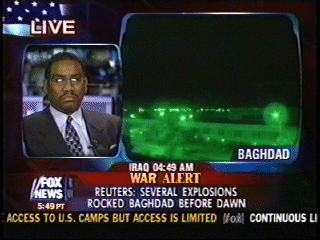
CNN and Maria Hinojosa really came through yesterday with a slice of truth from the NY Protests that went on all day yesterday.
CNN seems particularly sensitive to accusations of the "popular media" not covering the protests properly. As a result, CNN seems to be making an extra effort to get a little real news in between the talking heads that don't say anythiing being constantly rebroadcast on all of the other news channels.
Thanks CNN. Thank you, Maria Hinojosa! Keep up the good work!
Can this be the same CNN that put a stop to Kevin Sites' War Blog!
CNN's Maria Hinojosa Interviews Harriet -- Complete Clip (Small - 12 MB)
CNN's Maria Hinojosa Interviews Harriet -- Complete Clip (Hi-res - 78 MB)
Audio - CNN's Maria Hinojosa Interviews Harriet -- All (MP3 - 4 MB)
Interview with Harriet (Only) (Small - 8 MB)
Audio Of Harriet (Only) (MP3- 2 MB)
Maria Hinojosa: "Your 75 years old. Why are you taking to the streets even though the War is well under way."Harriet: "It's not a "War" that's under way. It's a "massacre" that's under way. An "invasion" that's under way...They've already given out contracts for the reconstruction to companies like Halliburton..."
Maria Hinojosa: "Do you think that the politicians in Washington will be moved by the tens of thousands of people that have come out into the streets here in New York and in other cities around the world?
Harriet: "King Bush. The resident of the White House, says he doesn't listen to anybody. And it's true. He may not. But we've got to keep coming out. And it may slow them down a little, but not much. That doesn't matter. We're going to get America back -- for the people."
Tens of Thousands of Antiwar Demonstrators March in Manhattan
Anti-War Rallies Ricochet Across World (look's like this link may have already gone bad. click here and go to the bottom half of the page) to see the article that was posted earlier on ABC. Looks like it's already been reprinted in Malaysia, for instance.)
In a third straight day of protest, hundreds of thousands massed in front of US embassies and in city centres, branding US President George W Bush and his allies, Australian Prime Minister John Howard and British Prime Minister Tony Blair, "terrorists" and "war criminals" for sending troops to fight the Baghdad regime.Europe at midday picked up speed in protests that reportedly drew several hundred thousand people in London; 30,000 in Berlin; 20,000 in Amsterdam; and thousands in Athens, Copenhagen, Paris, Stockholm and Vienna, including a record-breaking 20,000 in the Finnish capital Helsinki.
Asian rallies drew outraged outbursts from militants, chants for peace by Buddhist monks and several groups who burned a Bush effigy.
In the Middle East tens of thousands wished "Death to America and Great Britain" and denounced Arab leaders for not defending Iraqi leader Saddam Hussein from attack.
In Jakarta, the capital of the world's most populous Muslim nation, 3,000 protesters picketed in front of the US embassy before moving on to the nearby British embassy.
The crowd, which included many women, carried a coffin to symbolise the death of the United Nations.
Go to Original
Truthout Editor's Note (http://truthout.org/docs_03/032403C.shtml): This editor has been to several protests in the Boston area in the last week. Since the bombing began, however, the tone has changed dramatically. The protesters are vehement, and those who support the war have confronted the protesters with equal vigor. We are not so many steps short of violence right now; the nation stands upon the edge of a terrible precipice, one that can be avoided only with the cessation of bombing in Iraq. - wrp
Here is the full text of the articles in case the link goes bad:
http://www.nytimes.com/2003/03/22/international/worldspecial/22WIRES-RALLIES.html
Tens of Thousands of Antiwar Demonstrators March in Manhattan
The Associated Press
Saturday 22 March 2003
NEW YORK - Carol Laverne, with a pair of angel's wings on her back Saturday, marched down Broadway carrying a sign: "Thou shall not kill."
The non-denominational minister joined tens of thousands of fellow anti-war demonstrators -- many chanting "Peace now!" -- as they marched down Broadway on a warm spring day, voicing their opposition to the war in Iraq even as explosions were heard in Baghdad. Police and United for Peace and Justice, the organizers of the march, estimated the crowd at betweem 100,000 and 200,000.
"Which one of these words don't you understand?" Laverne asked, pointing at her poster as the protesters flooded past. "There's no fine print here. This is it."
The crowd snaked for 30 city blocks, with demonstrators still joining the march at Herald Square even as the first marchers arrived at Washington Square Park in Greenwich Village. The marchers filled Broadway from sidewalk to sidewalk.
No arrests were reported, but police scuffled with some protesters on a side street north of the park.
Among those marching were U.S. Rep Charles Rangel, D-N.Y., singer Patti Smith, and actors Roy Scheider, Ossie Davis and Ruby Dee. Rangel said the marchers were anything but unpatriotic.
"We support the troops, but we do not support the president," Rangel said.
In contrast with San Francisco antiwar protests earlier this week that produced 2,200 arrests in two days, the Manhattan march was peaceful, moving south in an orderly fashion.
Susan Sonz and her 9-year-old son, Ruben, came to the march from their home near ground zero. "Ground zero kids against the war" read a sign carried by the boy.
"We know there's no correlation between Sept. 11 and Saddam Hussein," the elder Sonz said. "We don't want to see more innocent people die."
About 2,000 police were assigned to the rally, including undercover officers with beeper-sized radiation detectors and other counter-terrorist measures. Police Commissioner Raymond Kelly surveyed the march from 35th Street.
"Things are peaceful and moving fairly quickly," he said.
The city granted antiwar protesters a permit sanctioning a march starting at West 35th Street and continuing down Broadway to Union Square before heading west to Washington Square Park.
No speeches were scheduled, and police with bullhorns urged the crowd to disperse once the march reached its destination. The marchers followed the orders, leaving without incident.
Granting the permit marked a switch for the city: In February, officials cited security risks in denying a permit to United for Peace and Justice for a march past the United Nations.
Here is the full text of the original article in case the link goes bad:
http://www.abc.net.au/news/justin/nat/newsnat-23mar2003-30.htm
Anti-War Rallies Ricochet Across World
ABC News
Sunday 23 March 2003
Major anti-war demonstrations have swept the globe, drawing Asians, Arabs and Europeans into the streets ahead of US rallies in protest against the third day of war on Iraq.
In a third straight day of protest, hundreds of thousands massed in front of US embassies and in city centres, branding US President George W Bush and his allies, Australian Prime Minister John Howard and British Prime Minister Tony Blair, "terrorists" and "war criminals" for sending troops to fight the Baghdad regime.
Europe at midday picked up speed in protests that reportedly drew several hundred thousand people in London; 30,000 in Berlin; 20,000 in Amsterdam; and thousands in Athens, Copenhagen, Paris, Stockholm and Vienna, including a record-breaking 20,000 in the Finnish capital Helsinki.
Asian rallies drew outraged outbursts from militants, chants for peace by Buddhist monks and several groups who burned a Bush effigy.
In the Middle East tens of thousands wished "Death to America and Great Britain" and denounced Arab leaders for not defending Iraqi leader Saddam Hussein from attack.
In Jakarta, the capital of the world's most populous Muslim nation, 3,000 protesters picketed in front of the US embassy before moving on to the nearby British embassy.
The crowd, which included many women, carried a coffin to symbolise the death of the United Nations.
Peace protesters staged rallies in two other Indonesian cities as well as in predominantly Muslim Bangladesh and Pakistan.
Buddhist monks in South Korea struck giant drums at a Seoul rally of 2,000 to console the spirits of victims of the war.
"Bush is the war criminal," human rights activist Park Won-Soon said to the crowd, which condemned Seoul's decision to send non-combatant troops to help US-led forces oust Iraqi President Saddam Hussein.
Australia, which has sent 2,000 combat troops to aid nearly 300,000 US and British soldiers in the Gulf, saw four anti-war protests, including one in Perth where an estimated 10,000 people marched.
Thousands more massed in New Zealand, Thailand and Vietnam in a further show of opposition to a war without UN backing.
In Japan, too, protesters in front of Osaka's US consulate decried Prime Minister Junichiro Koizumi's unwavering support for the US bid to oust Saddam.
Middle East
In the Middle East tens of thousands, mostly students, protested, burning US and British flags and waving copies of the Koran.
A day earlier fiery clashes with riot police broke out at rallies throughout the region and led to two deaths in Yemen.
"Bush may kill Saddam, but he cannot kill our Islam and destroy the ground of Islam," said Ahmed, one of 20,000 students who rallied on Cairo's Al Azhar campus.
Six thousand students and 8,000 others demonstrated in gatherings elsewhere in the Egyptian capital as well as in Alexandria on the Mediterranean and Suez on the Red Sea.
In the Gaza Strip nearly 10,000 people, mostly students, carried banners of the radical Islamic group Hamas and waved Iraqi flags.
Speaking to the crowd, a Hamas leader encouraged Iraqis to use suicide bombing operations "since that is the only language the Americans understand".
More anti-war protests took place in Syria and were planned in Lebanon, where a group of 10 lawyers began a hunger strike in support of the Iraqi people.
European rallies drew energetic crowds while thousands of riot police were on hand, a day after protests in Athens and Madrid turned violent, leading to dozens of arrests and injuries.
Britain
In London, Stop the War Coalition spoke of hundreds of thousands of participants thus far, although no official figures were available, while they did not expect the million-strong turnout of February 15.
One participant, 14-year-old Beatrice, said: "Tony Blair should listen to his people rather than to his best friend Bush."
In Gloucestershire, western England, several thousand protesters were expected outside the RAF Fairford base, where US air force B-52 bombers being used for attacks on Iraq are stationed.
In Greece 30,000 people - 7,000 by police count - banded together behind "Men above Profits" banners and anti-war placards in the capital after two straight days of demonstrations that each drew 150,000, then more than 200,000.
Italians launched more than 80 anti-war rallies, a day after a pro-peace farmers' rally in Rome drew an estimated 300,000. Other cities holding protests against the Italian government's pro-US stance and the war included Naples, Bologna, Florence, Genoa, Milan and Palermo.
Spaniards staged several protests against Prime Minister Jose Maria Aznar's part in the US coalition, with a group of actors chanting in Madrid "We'll always have Paris" - the mythic line from Casablanca
now used to back France's anti-war efforts.
Denmark saw up to 10,000 stage a protest in front of the US embassy, denouncing both Bush and their own Government, which on Friday became the third country to offer combat troops for the Iraq war.
France and Germany - leaders of a failed diplomatic bid to stop the US and British war drive - saw huge protests as well, including 15,000 Kurds out in Frankurt.
Protesters in Vienna pleaded for "More sex, less Bush", two ministers joined thousands of Swedes in their calls for the protection of civilian lives in Iraq. In Norway, protesters prayed with Archbishop Gunnar Staalsett against "a bloody and painful event".
In the US marchers were expected to converge on the White House in Washington, while protests also were planned in New York, San Francisco, Los Angeles and other cities.
This is wireless technologies (and, ideally community wireless networks) are so important. They help us to organize and communicate with each other.
This time it was to organize the protest. Next time it might be to discuss an important issue or to provide eye witness accounts of some other event that has just taken place. To let loved ones know that you're okay -- or to tell friends and neighbors where not to go when there's an emergency.
Wireless can help us get organized -- which is what it's all about right now.
Power To The People! :-)
Protesters relying on wireless, Web tools
By Jessie Seyfer for the Mercury News.
Sent from the thick of Thursday's massive demonstrations, these messages are an example of how protesters are using the latest technology to communicate and coordinate their activities.Over the past three days, activists created pirate radio broadcasts that streamed live on the Web and were rebroadcast at numerous sites across the world. They uploaded live video of marches to the Internet and sent hundreds of digital images of clashes with police to the Web. And they communicated on those cell phones to keep close track of one another's whereabouts.
Instant communications helped the protesters stay ahead of events and solidify their community...
"Every desktop is a publishing station now, and so is every telephone, every PDA, every laptop with a wireless connection,'' said Howard Rheingold, author of the book "Smart Mobs: The Next Social Revolution.''
Police officers have used walkie-talkies and wireless radio communications for decades. Now, the digital revolution has put mobile technology in just about everyone's hands, he said. Thursday, demonstrators used it to play a cat-and-mouse game with police. Once protesters were forced out of one intersection, they coordinated by cell phone and swarmed another intersection, Rheingold said.
Here is the full text of the entire article in case the link goes bad:
http://www.bayarea.com/mld/mercurynews/news/local/5462381.htm
Posted on Sun, Mar. 23, 2003 story:PUB_DESC
Protesters relying on wireless, Web tools
By Jessie Seyfer
Mercury News
The bulletins came rapid-fire, straight from a San Francisco protester's wireless handheld device to a Web page for all the world to see.
``6:47 p.m.: Fremont street on-ramp shut down by demonstrators.'' ``8:00 p.m.: 6,000 strong at Castro and Market.'' ``10:00 p.m.: 500 marching down Howard.''
Sent from the thick of Thursday's massive demonstrations, these messages are an example of how protesters are using the latest technology to communicate and coordinate their activities.
Over the past three days, activists created pirate radio broadcasts that streamed live on the Web and were rebroadcast at numerous sites across the world. They uploaded live video of marches to the Internet and sent hundreds of digital images of clashes with police to the Web. And they communicated on those cell phones to keep close track of one another's whereabouts.
Instant communications helped the protesters stay ahead of events and solidify their community. But whether they went beyond the ranks of committed activists to reach a public that, polls show, support the war by ever-widening margins, remains to be seen.
Within the movement, the technology that is bringing the 1960s adage ``Do your own thing'' back to life is spreading around the globe, to hundreds of Web sites and makeshift newsrooms from Idaho to Jerusalem.
Experts say the technology-enabled, do-it-yourself ``Independent Media Center'' concept was born during the 1999 World Trade Organization protests in Seattle. All this digital documentation represents the face of the movement that is opposing the war in Iraq.
``It's now possible for us to create our own media,'' said a 26-year-old ``Otto,'' who was shooting video at a march Saturday in San Francisco for the Web site Indybay.org. ``We don't have to rely on the mainstream media to tell us what's going on, or have someone else filter what is happening. We can do it ourselves.''
Thursday's bulletins from a protester's handheld, for example, were sent to sf.indymedia.org, a Web page where demonstrators are encouraged to self-publish in just about any possible way.
``Every desktop is a publishing station now, and so is every telephone, every PDA, every laptop with a wireless connection,'' said Howard Rheingold, author of the book ``Smart Mobs: The Next Social Revolution.''
Police officers have used walkie-talkies and wireless radio communications for decades. Now, the digital revolution has put mobile technology in just about everyone's hands, he said. Thursday, demonstrators used it to play a cat-and-mouse game with police. Once protesters were forced out of one intersection, they coordinated by cell phone and swarmed another intersection, Rheingold said.
Mercury News Staff Writer Dana Hull contributed to this report. Contact Jessie Seyfer at jseyfer@mercurynews.com or (650) 688-7531.
A Letter from Michael Moore to George W. Bush on the Eve of War
By Micheal Moore.
2. The majority of Americans -- the ones who never elected you -- are not fooled by your weapons of mass distraction. We know what the real issues are that affect our daily lives -- and none of them begin with I or end in Q. Here's what threatens us: two and a half million jobs lost since you took office, the stock market having become a cruel joke, no one knowing if their retirement funds are going to be there, gas now costs almost two dollars -- the list goes on and on. Bombing Iraq will not make any of this go away. Only you need to go away for things to improve.3. As Bill Maher said last week, how bad do you have to suck to lose a popularity contest with Saddam Hussein? The whole world is against you, Mr. Bush. Count your fellow Americans among them.
4. The Pope has said this war is wrong, that it is a SIN. The Pope! But even worse, the Dixie Chicks have now come out against you! How bad does it have to get before you realize that you are an army of one on this war? Of course, this is a war you personally won't have to fight. Just like when you went AWOL while the poor were shipped to Vietnam in your place.
5. Of the 535 members of Congress, only ONE (Sen. Johnson of South Dakota) has an enlisted son or daughter in the armed forces! If you really want to stand up for America, please send your twin daughters over to Kuwait right now and let them don their chemical warfare suits. And let's see every member of Congress with a child of military age also sacrifice their kids for this war effort. What's that you say? You don't THINK so? Well, hey, guess what -- we don't think so either!
...Well, cheer up -- there IS good news. If you do go through with this war, more than likely it will be over soon because I'm guessing there aren't a lot of Iraqis willing to lay down their lives to protect Saddam Hussein. After you "win" the war, you will enjoy a huge bump in the popularity polls as everyone loves a winner -- and who doesn't like to see a good ass-whoopin' every now and then (especially when it 's some third world ass!). So try your best to ride this victory all the way to next year's election. Of course, that's still a long ways away, so we'll all get to have a good hardy-har-har while we watch the economy sink even further down the toilet!
Here is the full text of the letter in case the link goes bad:
http://www.michaelmoore.com/words/message/index.php
Monday, March 17, 2003
A Letter from Michael Moore to George W. Bush on the Eve of War
George W. Bush
1600 Pennsylvania Ave.
Washington, DC
Dear Governor Bush:
So today is what you call "the moment of truth," the day that "France and the rest of world have to show their cards on the table." I'm glad to hear that this day has finally arrived. Because, I gotta tell ya, having survived 440 days of your lying and conniving, I wasn't sure if I could take much more. So I'm glad to hear that today is Truth Day, 'cause I got a few truths I would like to share with you:
1. There is virtually NO ONE in America (talk radio nutters and Fox News aside) who is gung-ho to go to war. Trust me on this one. Walk out of the White House and on to any street in America and try to find five people who are PASSIONATE about wanting to kill Iraqis. YOU WON'T FIND THEM! Why? 'Cause NO Iraqis have ever come here and killed any of us! No Iraqi has even threatened to do that. You see, this is how we average Americans think: If a certain so-and-so is not perceived as a threat to our lives, then, believe it or not, we don't want to kill him! Funny how that works!
2. The majority of Americans -- the ones who never elected you -- are not fooled by your weapons of mass distraction. We know what the real issues are that affect our daily lives -- and none of them begin with I or end in Q. Here's what threatens us: two and a half million jobs lost since you took office, the stock market having become a cruel joke, no one knowing if their retirement funds are going to be there, gas now costs almost two dollars -- the list goes on and on. Bombing Iraq will not make any of this go away. Only you need to go away for things to improve.
3. As Bill Maher said last week, how bad do you have to suck to lose a popularity contest with Saddam Hussein? The whole world is against you, Mr. Bush. Count your fellow Americans among them.
4. The Pope has said this war is wrong, that it is a SIN. The Pope! But even worse, the Dixie Chicks have now come out against you! How bad does it have to get before you realize that you are an army of one on this war? Of course, this is a war you personally won't have to fight. Just like when you went AWOL while the poor were shipped to Vietnam in your place.
5. Of the 535 members of Congress, only ONE (Sen. Johnson of South Dakota) has an enlisted son or daughter in the armed forces! If you really want to stand up for America, please send your twin daughters over to Kuwait right now and let them don their chemical warfare suits. And let's see every member of Congress with a child of military age also sacrifice their kids for this war effort. What's that you say? You don't THINK so? Well, hey, guess what -- we don't think so either!
6. Finally, we love France. Yes, they have pulled some royal screw-ups. Yes, some of them can be pretty damn annoying. But have you forgotten we wouldn't even have this country known as America if it weren't for the French? That it was their help in the Revolutionary War that won it for us? That our greatest thinkers and founding fathers -- Thomas Jefferson, Ben Franklin, etc. -- spent many years in Paris where they refined the concepts that lead to our Declaration of Independence and our Constitution? That it was France who gave us our Statue of Liberty, a Frenchman who built the Chevrolet, and a pair of French brothers who invented the movies? And now they are doing what only a good friend can do -- tell you the truth about yourself, straight, no b.s. Quit pissing on the French and thank them for getting it right for once. You know, you really should have traveled more (like once) before you took over. Your ignorance of the world has not only made you look stupid, it has painted you into a corner you can't get out of.
Well, cheer up -- there IS good news. If you do go through with this war, more than likely it will be over soon because I'm guessing there aren't a lot of Iraqis willing to lay down their lives to protect Saddam Hussein. After you "win" the war, you will enjoy a huge bump in the popularity polls as everyone loves a winner -- and who doesn't like to see a good ass-whoopin' every now and then (especially when it 's some third world ass!). So try your best to ride this victory all the way to next year's election. Of course, that's still a long ways away, so we'll all get to have a good hardy-har-har while we watch the economy sink even further down the toilet!
But, hey, who knows -- maybe you'll find Osama a few days before the election! See, start thinking like THAT! Keep hope alive! Kill Iraqis -- they got our oil!!
Yours,
Michael Moore
www.michaelmoore.com
GOP plan trims vets' benefits to fund tax cut
From Tusconcitizen.com
With hundreds of thousands of American troops poised for combat in Iraq, veterans groups are criticizing a budget plan expected on the House floor this week that would slash Veterans Affairs money by $15 billion in the next decade to help make room for President Bush's proposed tax cuts."Cutting already underfunded veterans' programs to offset the costs of tax cuts is indefensible and callous," said Edward R. Heath, national commander of the Disabled American Veterans. "It is unconscionable to cut benefits and services for disabled veterans at a time when we have thousands of our service members in harm's way."
The Republican plan, which the House Budget Committee adopted last week on a party-line vote, would chop $467 billion - 1 percent - from mandatory spending programs including the Veterans Affairs Department, Medicare and Medicaid in the next 10 years to offset $1.5 trillion in tax cuts the president proposes in the same period...
The VA cuts would take place in disability compensation, education benefits, pensions and health care, according to veterans advocacy groups...
Ray Sisk, commander in chief of Veterans of Foreign Wars, said cutting the VA budget even 1 percent would worsen many of the agency's problems such as a backlog of 200,000 veterans waiting more than six months to see a doctor.
"We cannot expect sick and disabled veterans to wait months for earned health care," he said. "Equally troubling is that further cuts in funding would cause VA to curb further enrollment or to remove certain veterans from the health-care system altogether."
Here is the full text of the article in case the link goes bad:
http://www.tucsoncitizen.com/national/3_18_03vets.html
March 18, 2003
WASHINGTON - With hundreds of thousands of American troops poised for combat in Iraq, veterans groups are criticizing a budget plan expected on the House floor this week that would slash Veterans Affairs money by $15 billion in the next decade to help make room for President Bush's proposed tax cuts.
"Cutting already underfunded veterans' programs to offset the costs of tax cuts is indefensible and callous," said Edward R. Heath, national commander of the Disabled American Veterans. "It is unconscionable to cut benefits and services for disabled veterans at a time when we have thousands of our service members in harm's way."
The Republican plan, which the House Budget Committee adopted last week on a party-line vote, would chop $467 billion - 1 percent - from mandatory spending programs including the Veterans Affairs Department, Medicare and Medicaid in the next 10 years to offset $1.5 trillion in tax cuts the president proposes in the same period. The proposal also contains major increases in spending for defense programs and homeland security while achieving a balanced federal budget by 2010.
The VA cuts would take place in disability compensation, education benefits, pensions and health care, according to veterans advocacy groups.
When the Budget Committee adopted the budget blueprint last week, committee Chairman Jim Nussle, R-Iowa, said priorities were focused on defense, homeland security and the president's economic growth plan.
"We are in a time of war, and the No. 1 task before us is protecting Americans," he said. "I am absolutely committed to providing our men and women in uniform with the resources they need to do their jobs effectively and safely as possible."
Ronald F. Conley, national commander of the American Legion, argued that veterans' pensions and disability compensation are part of the costs of using the U.S. military to carry out national policies. The House's proposed budget "defies common sense," he said.
"Our nation cannot, in good conscience, commit men and women to battle and reduce the meager, yet well-deserved, compensation for those who are wounded," Conley said.
A Senate budget plan, also adopted in committee last week, doesn't call for the cuts but produces a balanced budget in 2013 by using some unrealistic assumptions on spending levels.
Already in the House, leaders are scrambling to find votes for the budget plan after 11 moderate Republicans said they would not vote for it.
Ray Sisk, commander in chief of Veterans of Foreign Wars, said cutting the VA budget even 1 percent would worsen many of the agency's problems such as a backlog of 200,000 veterans waiting more than six months to see a doctor.
"We cannot expect sick and disabled veterans to wait months for earned health care," he said. "Equally troubling is that further cuts in funding would cause VA to curb further enrollment or to remove certain veterans from the health-care system altogether."
This is a great article on why Hydrogen cells can work, and what we need to get started doing technologically and regulatory/legislative-wise so we can get the show on the road. (Thanks Joi.)
How Hydrogen Can Save America
By Peter Schwartz and Doug Randall for Wired.
There's only one way to insulate the US from the corrosive power of oil, and that's to develop an alternative energy resource that's readily available domestically. Looking at the options - coal, natural gas, wind, water, solar, and nuclear - there's only one thing that can provide a wholesale substitute for foreign oil within a decade: hydrogen. Hydrogen stores energy more effectively than current batteries, burns twice as efficiently in a fuel cell as gasoline does in an internal combustion engine (more than making up for the energy required to produce it), and leaves only water behind. It's plentiful, clean, and - critically - capable of powering cars. Like manned space flight in 1961, hydrogen power is proven but primitive, a technology ripe for acceleration and then deployment. (For that, thank the Apollo program itself, which spurred the development of early fuel cells.)...How Hydrogen Can Save America:
1. Solve the hydrogen fuel-tank problem.
2. Encourage mass production of fuel cell vehicles.
3. Convert the nation's fueling infrastructure to hydrogen.
4. Ramp up hydrogen production.
5. Mount a public campaign to sell the hydrogen economy.
By pursuing all five at once, the government can create a self-sustaining cycle of supply and demand that gains momentum over the coming decade and supplants the existing energy market in the decades that follow. Rather than waiting to build a hydrogen infrastructure from scratch, the US can start building the new fuel economy immediately by piggybacking on existing petroleum-based industries. Once customers are demanding and producers are supplying, there will be time to create a cleaner, more efficient hydrogen-centric infrastructure that runs on market forces alone.
Here is the full text of the article in case the link goes bad:
http://www.wired.com/wired/archive/11.04/hydrogen.html
Wired Magazine
SEARCH:
Issue 11.04 - April 2003
Pg 1 of 5 >>
Print, email, or fax
this article for free.
How Hydrogen Can Save America
The cost of oil dependence has never been so clear. What had long been largely an environmental issue has suddenly become a deadly serious strategic concern. Oil is an indulgence we can no longer afford, not just because it will run out or turn the planet into a sauna, but because it inexorably leads to global conflict. Enough. What we need is a massive, Apollo-scale effort to unlock the potential of hydrogen, a virtually unlimited source of power. The technology is at a tipping point. Terrorism provides political urgency. Consumers are ready for an alternative. From Detroit to Dallas, even the oil establishment is primed for change. We put a man on the moon in a decade; we can achieve energy independence just as fast. Here's how.
By Peter Schwartz and Doug Randall
Four decades ago, the United States faced a creeping menace to national security. The Soviet Union had lobbed the first satellite into space in 1957. Then, on April 12, 1961, Russian cosmonaut Yuri Gagarin blasted off in Vostok 1 and became the first human in orbit.
President Kennedy understood that dominating space could mean the difference between a country able to defend itself and one at the mercy of its rivals. In a May 1961 address to Congress, he unveiled Apollo - a 10-year program of federal subsidies aimed at "landing a man on the moon and returning him safely to the Earth." The president announced the goal, Congress appropriated the funds, scientists and engineers put their noses to the launchpad, and - lo and behold - Neil Armstrong stepped on the lunar surface eight years later.
The country now faces a similarly dire threat: reliance on foreign oil. Just as President Kennedy responded to Soviet space superiority with a bold commitment, President Bush must respond to the clout of foreign oil by making energy independence a national priority. The president acknowledged as much by touting hydrogen fuel cells in January's State of the Union address. But the $1.2 billion he proposed is a pittance compared to what's needed. Only an Apollo-style effort to replace hydrocarbons with hydrogen can liberate the US to act as a world leader rather than a slave to its appetite for petroleum.
Tronic Studio
Tronic Studio
Money can do more than ease the pain of lost income. It can turn oil companies into the hydrogen economy's standard bearers.
Once upon a time, America's oil addiction was primarily an environmental issue. Hydrocarbons are dirty - befouling the air and water, possibly shifting the climate, and causing losses of biodiversity and precious coastal real estate. In those terms, the argument is largely political, one of environmental cleanliness against economic godliness. The horror of 9/11 changed that forever. Buried in the rubble of the World Trade Center was the myth that America can afford the dire costs of international oil politics. The price of the nation's reliance on crude has included '70s-style economic shocks, Desert Storm-like military adventures, strained relationships with less energy-hungry allies, and now terror on our shores.
George W. Bush arrived in Washington, DC, as a Texan with deep roots in the oil business. In the days following September 11, however, he transformed himself into the National Security President. Today, his ambition to protect the United States from emerging threats overshadows his industry ties. By throwing his power behind hydrogen, Bush would be gambling that, rather than harming Big Oil, he could revitalize the moribund industry. At the same time, he might win support among environmentalists, a group that has felt abandoned by this White House.
According to conventional wisdom, there are two ways for the US to reduce dependence on foreign oil: increase domestic production or decrease demand. Either way, though, the country would remain hostage to overseas producers. Consider the administration's ill-fated plan to drill in the Arctic National Wildlife Refuge. For all the political wrangling and backlash, that area's productivity isn't likely to offset declining output from larger US oil fields, let alone increase the total supply from domestic sources. As for reducing demand, the levers available are small and ineffectual. The average car on the road is nine years old, so even dramatic increases in fuel efficiency today won't head off dire consequences tomorrow. Moreover, the dynamism at the heart of the US economy depends on energy. Growth and consumption are inextricably intertwined.
There's only one way to insulate the US from the corrosive power of oil, and that's to develop an alternative energy resource that's readily available domestically. Looking at the options - coal, natural gas, wind, water, solar, and nuclear - there's only one thing that can provide a wholesale substitute for foreign oil within a decade: hydrogen. Hydrogen stores energy more effectively than current batteries, burns twice as efficiently in a fuel cell as gasoline does in an internal combustion engine (more than making up for the energy required to produce it), and leaves only water behind. It's plentiful, clean, and - critically - capable of powering cars. Like manned space flight in 1961, hydrogen power is proven but primitive, a technology ripe for acceleration and then deployment. (For that, thank the Apollo program itself, which spurred the development of early fuel cells.)
Many observers view as inevitable the transition from an economy powered by fossil fuels to one based on hydrogen. But that view presupposes market forces that are only beginning to stir. Today, power from a fuel cell car engine costs 100 times more than power from its internal combustion counterpart; it'll take a lot of R&D to reduce that ratio. More daunting, the notion of fuel cell cars raises a chicken-and-egg question: How will a nationwide fueling infrastructure materialize to serve a fleet of vehicles that doesn't yet exist and will take decades to reach critical mass? Even hydrogen's boosters look forward to widespread adoption no sooner than 30 to 50 years from now. That's three to five times too long.
Adopting Kennedy's 10-year time frame may sound absurdly optimistic, but it's exactly the kick in the pants needed to jolt the US out of its crippling complacency when it comes to energy. A decade is long enough to make a serious difference but short enough that most Americans will see results within their lifetimes. The good news is that the technical challenges are issues of engineering rather than science. That means money can solve them.
How much money? How about the amount spent to put a man on the moon: $100 billion in today's dollars. With that investment, the nation could shift the balance of power from foreign oil producers to US energy consumers within a decade. By 2013, a third of all new cars sold could be hydrogen-powered, 15 percent of the nation's gas stations could pump hydrogen, and the US could get more than half its energy from domestic sources, putting independence within reach. All that's missing is a national commitment to make it happen.
It'd be easy - too easy - to misspend $100 billion. So the White House needs a plan. The strategy must take advantage of existing infrastructure and strengthen forces propelling the nation toward hydrogen while simultaneously removing obstacles. There are five objectives:
Peter Schwartz (peter_schwartz@gbn.com) is a partner in the Monitor Group and chair of Global Business Network, a scenario-planning firm. Doug Randall (doug_randall@gbn.com) is senior practitioner at GBN. Schwartz, a former futurist for Shell Oil, is an investor in two companies developing hydrogen power technologies.
Page 2 >>
How Hydrogen Can Save America (continued)
1. Solve the hydrogen fuel-tank problem.
2. Encourage mass production of fuel cell vehicles.
3. Convert the nation's fueling infrastructure to hydrogen.
4. Ramp up hydrogen production.
5. Mount a public campaign to sell the hydrogen economy.
By pursuing all five at once, the government can create a self-sustaining cycle of supply and demand that gains momentum over the coming decade and supplants the existing energy market in the decades that follow. Rather than waiting to build a hydrogen infrastructure from scratch, the US can start building the new fuel economy immediately by piggybacking on existing petroleum-based industries. Once customers are demanding and producers are supplying, there will be time to create a cleaner, more efficient hydrogen-centric infrastructure that runs on market forces alone.
1. Solve the hydrogen fuel-tank problem
The fuel cell, essentially a battery with a replaceable energy storage medium, isn't new. The basic ideas were in place by the mid-1800s, and the first proton-exchange membrane fuel cell - the type most practical for use in automobiles - was built by General Electric in the early '60s. Unlike a combustion engine, in which exploding gas pushes pistons, a fuel cell engine strips electrons from hydrogen and uses the resulting electrical current to power a motor. Then it combines the remaining hydrogen ions (protons) with oxygen to form water, the only byproduct. (A hybrid electrical engine is something else: a gasoline engine that powers a battery.)
In 1993, Canadian fuel cell manufacturer Ballard Power Systems began using the technology in buses, which could accommodate huge first-generation hydrogen engines and fuel tanks. The engines have since become smaller, but carrying enough hydrogen for 400 miles of driving - the range consumers generally expect - remains a challenge.
The Bush administration should spend $15 billion to solve this problem. The main question is whether to carry the fuel in gas, liquid, or solid form, each of which offers its own advantages and disadvantages. Until the industry settles on a standard, the market won't support mass production or ubiquitous filling stations.
The simplest option is gaseous hydrogen. The problem: It takes up a lot of room, so the gas must be compressed, but this requires a tank capable of withstanding high pressure. To carry enough fuel for 400 miles of travel, the tank would need to withstand 10,000 pounds per square inch - 50 times the pressure in a combustion engine's cylinders - and to keep it from bursting in an impact, it would need to tolerate 20,000 pounds per square inch. More research is needed to find materials strong enough to do the job yet light enough to carry and cheap enough to mass-produce.
Liquid hydrogen also has pros and cons. It exerts far less pressure on the tank, but it must be cooled to -423 degrees Fahrenheit at the pump and kept that way in the vehicle. This refrigeration demands a significant amount of energy, and insulating the tank can multiply its size. What's more, even with the best insulation, as much as 4 percent of the liquid evaporates daily, creating pressure that can only be relieved by bleeding off the vapor. As a result, a car left at the airport for two weeks would lose half its fuel. Scientists need to find a way to eliminate or utilize this boil-off.
In the long run, the most promising approach is to fill the tank with a solid material that soaks up hydrogen like a sponge at fill-up and releases it during drive time. Currently, the options include lithium hydride, sodium borohydride, and an emerging class of ultraporous nanotech materials. Unlike gaseous hydrogen, these substances can pack a lot of power into a small space of arbitrary shape. And unlike liquid hydrogen, they can be kept at room temperature. On the other hand, energy is required to infuse the solid medium with hydrogen, and in some cases very high temperatures are required to get the fuel back out, exacting a huge toll in efficiency. Also, filling the tank can take far more time than pumping gasoline. Government money could bridge the gap between today's experiments and a viable solution.
2. Encourage mass production of fuel cell vehicles
Once the storage problem has been solved, carmakers should be encouraged to gear up for mass production of fuel cell vehicles.
Detroit is already moving in that direction. To date, DaimlerChrysler, Ford, and General Motors have spent roughly $2 billion developing fuel cell cars, buses, and trucks, with the first products due to hit the market this year. Ford chair William Clay Ford Jr. has proclaimed that fuel cells will "finally end the 100-year reign of the internal combustion engine."
To make sure the transition doesn't take another century, though, the Bush administration should allocate $10 billion to help automakers manufacture fuel cells efficiently and cheaply, either on their own (like GM) or through contracts with government-approved fuel cell developers. Funding should be contingent on the companies adhering to a strict schedule for bringing hydrogen-based vehicles to market (coordinated, of course, with the schedule for bringing fueling stations online).
A mandatory portion should be set aside for marketing. Detroit will face a tremendous hurdle of consumer acceptance, and it should take full advantage of Madison Avenue's skills to convince the public that fuel cell cars aren't just viable, but desirable. This isn't a fantasy. Toyota's Prius, the first mass-produced gasoline/electric hybrid car, has sold more than 100,000 units since its 1997 debut, proving that the public will embrace a radically different automobile.
3. Convert the fueling infrastructure to hydrogen
Of course, no one will drive a hydrogen-powered car off the lot unless they're confident they'll be able to get fuel when and where they need it. That's why the Bush administration must focus on infrastructure as well as vehicles.
Like the car companies, oil producers have already taken steps toward an oil-free future. Over the past 15 years, corporations like Shell and Exxon have ceded their leadership in oil production to a dozen state-owned enterprises in countries such as Venezuela, Brazil, and Norway. Instead they've focused on adding value farther down the supply chain by refining crude into gasoline and distributing and selling it through filling stations. They know they could play the same role in a hydrogen economy, which is why Shell and BP have invested hundreds of millions of dollars in hydrogen storage and production technology. Indeed, BP, formerly British Petroleum, has rebranded itself Beyond Petroleum.
Page 3 >>
Wired Magazine
SEARCH:
[Home][Archive][Subscribe][Advertise][Wired News][Animation]
Issue 11.04 - April 2003
|< << Pg 3 of 5 >>
Print, email, or fax
this article for free.
How Hydrogen Can Save America (continued)
The major oil companies are already extracting hydrogen from gasoline for industrial uses at nine refinery complexes throughout the United States. With a little push, these plants could serve as hubs for a nascent hydrogen-distribution network.
Converting filling stations is bound to cost billions of dollars over several decades. But it should cost relatively little to retrofit clusters of stations in proximity to both a hydrogen-producing refinery and a population center where fuel cell vehicles are sold. Oil companies could meet initial demand by trucking hydrogen from refineries to these stations. As the number of fuel cell vehicles on the road rises, stations that aren't served by refinery hubs could install processors, called reformers, that use electricity to extract hydrogen from gasoline or water. The White House should ask for $5 billion - roughly $30,000 for each of the nation's 176,000 filling stations - to get the ball rolling.
In the long run, a pipeline piggybacking on existing natural gas pipelines might deliver most of the fuel, either from high-volume plants or more widely distributed facilities. The administration should set aside $10 billion for incentives like interest-free loans to encourage oil companies to construct a national hydrogen pipeline. It might also grant five-to-ten-year monopoly rights to pipeline builders.
Hydrogen's fuel-efficiency offers immediate benefits to transportation companies that maintain their own vehicles and use them for limited, predictable distances. In fact, FedEx and UPS plan to phase in fuel-cell trucks over the next five years. The Bush administration should take advantage of this synergy between early adopters and the national interest by offering $10 billion in tax breaks to companies that invest in hydrogen-powered fleets. Also, in regions served by a refinery hub, $5 billion should be allocated for fuel cell police cars, ambulances, maintenance trucks, and other municipal vehicles. The military is another sensible target, since 60 percent of its logistics budget is devoted to transporting gasoline.
The critical need to build infrastructure along with vehicles brings to mind an earlier Apollo-like initiative: Eisenhower's National Defense Highway Act. As an officer during World War II, Ike struggled to move troops across the US and saw how Germany's highways conferred a military advantage. Once in the Oval Office, he called for $300 billion in today's dollars to build an interstate highway system. Funded by a gas tax, that program's dramatic success proved that national security can motivate federal infrastructure projects on a grand scale.
4. Ramp up hydrogen production
But where will the hydrogen come from? Ironically, while hydrogen is the most plentiful element in the universe, it rarely appears in its pure form. It must be extracted from substances that contain it, like fossil fuels and water. The problem is that the extraction itself requires power. Currently, the least expensive method is a process known as steam reforming, in which natural gas reacts chemically with steam to produce hydrogen and carbon dioxide, a greenhouse gas. Far preferable would be to use carbon-free resources like solar, wind, and hydropower to produce electricity for electrolysis, which splits water into hydrogen and oxygen. Hydrogen would make renewable energy practical, acting as a storage medium for the modest amounts of energy such resources produce. Wind power, especially, lends itself to this sort of use. This and other renewables should receive $10 billion as a seed for long-term development.
This suggests a role for a clean, efficient, and much neglected energy source: nuclear. Like the fuel cell, the nuclear generator is a technology ripe for exploitation. Unlike the solid-core reactors of the past, pebble-bed modular reactors such as the one at Koeberg, South Africa, don't get hot enough to risk melting down. Koeberg uses small graphite-covered uranium balls rather than plutonium rods, and the reactor's cooled by helium rather than water. This new design is so efficient, it might make nuclear competitive with coal and oil. In any event, the nuclear power industry is in dire need of research for everything, from generation to waste treatment. Thus, $10 billion should be allocated to developing and securing nuclear technology that can power the hydrogen revolution.
Nuclear power will serve as a stopgap, enabling the US to achieve energy independence while allowing wind, solar, and hydropower a chance to mature. Given the choice between powering the carbon-free hydrogen economy with fossil fuels or nuclear energy, even Greenpeace might embrace nuke plants as the lesser evil.
As all the various subsidies kindle a self-sustaining economy, they should be tapered and the money shunted to the other major power in the conversion from oil to hydrogen: electric utilities. Within a decade, outlays to power companies should be aimed at connecting hydrogen pipelines to the power stations.
5. Mount a Public Campaign To Sell the Hydrogen Economy
With a growing federal deficit and a stagnant economy, this might seem like a singularly bad time to unleash an immense tide of new subsidies. And let's be honest: Even framed as a national security issue, a $100 billion proposal won't go down easily on Capitol Hill or in Peoria. This is why the Bush administration's campaign to sell the hydrogen economy must be even more vigorous than its campaign to sell the war against Iraq.
Financially, the case is compelling. One hundred billion dollars is less than a quarter of what the federal government plans to spend annually on defense within five years. A 5 cent per gallon increase in the gasoline tax - less than the seasonal variation in gasoline prices - would pay for part of it. For the rest, the government could issue "H Bonds." Like Liberty Bonds during World Wars I and II, "securities for security" would give citizens a way to take part in the cause while providing an attractive investment. Like war bonds, they could be promoted by celebrities, sold by Boy and Girl Scouts, and paid for via payroll deduction plans.
Convincing Congress will take all the finesse the administration can muster, but some states are already pushing the hydrogen agenda with tax credits, research funding, and other policies to create jobs in fuel cell manufacture. "We want to collaborate with the federal government and industry to make California a leader in hydrogen," says Alan Lloyd, chair of California's Air Resources Board, an EPA suboffice in a state where SUVs sport SAVE THE EARTH bumper stickers. (The city of Los Angeles bought its first fuel-cell vehicle from Honda last December.) States that foster hydrogen technology companies will be rewarded with tax revenue from sales to Europe and Asia, which are also looking into it.
Page 4 >>
How Hydrogen Can Save America (continued)
Even before he sells the plan to Congress, the president will have to sell it to the oil and auto industries. After all, hydrogen power is a potent threat to their current business, and they own the fueling infrastructure and manufacturing capacity necessary to bring that power to market. The prospect of massive subsidies will help; these industries are squeezed between shrinking profits and rising costs. But the money can do more than relieve their pain. It can set them on a sustainable course for the future, turning the biggest obstacles to the hydrogen economy into its standard bearers.
Petroleum suppliers and auto manufacturers alike understand the need to disentangle their business models from crude. By most estimates, the worldwide oil supply has nearly stopped growing. Thanks to new discoveries, the total reserve increased by 56 percent between 1980 and 1990 but only 1.4 percent between 1990 and 2000. Pessimistic geologists argue that production will begin to decline as early as 2006, while optimists point at 2040. What's more, it's now clear that oil consumption is at least partly to blame for global warming, prompting ever-louder calls for alternatives. It shouldn't take much persuasion to convince the oil and car industries that the most profitable course is to adapt to hydrogen sooner with government money rather than later without.
The most important market over the next decade, of course, is the US consumer. The administration should allocate $25 billion to persuade Americans to buy fuel cell cars and invest in hydrogen technology. This budget would pay for a $2,000 tax rebate on vehicle purchases, and fund local incentives such as preferential parking, freeway lanes, and free registration for fuel cell cars. At least $1 billion a year - equal to Nike's 2001 advertising budget - should be devoted to public-service announcements, posters, lectures, contests, and other ways of sending the message that achieving energy independence through hydrogen is a patriotic duty.
There are good reasons to wonder whether any government initiative, even one that's critical to national security, can bring about such a radical change. Federal energy programs don't have much of a track record, and past efforts to promote hydrogen itself - after the oil crises of 1973, 1978, and 1980, for instance - have failed to take root.
These attempts foundered mainly because the US continued to have access to cheap oil. Energy independence briefly became top priority after OPEC raised prices from $3 to $12 per barrel between 1973 and 1975, but momentum dissipated as the crisis ended and prices fell. As a result, the political will to make tough energy decisions vanished. The threat to national security means that politics no longer stands in the way: Better to make hard choices today than send your children off to fight for oil tomorrow.
Earlier initiatives were also hampered by primitive technology. Today, however, fuel cells have reached the point where hydrogen is a credible substitute for oil. Outdoor-product maker Coleman recently released the first commercial fuel cell product, an emergency power generator for home use, and large fuel cells have been installed as backups in office buildings throughout the country. Hydrogen-powered buses are already operating in Toronto and Chicago, and soon will be in London, Madrid, and Hamburg. Iceland has embarked on an ambitious effort to convert its public transit and fishing fleets to hydrogen. The most encouraging sign is the investment by oil and car companies, not to mention venture capitalists.
If President Bush can implement this program, or something comparably aggressive, by 2013, all major car companies will sell fuel cell vehicles, and several new manufacturers will probably emerge to produce specialty hydrogen-powered items like sports cars and SUVs. Filling stations in the nation's six largest cities will carry hydrogen as well as gasoline; many will offer only the new fuel. Some refineries will be selling more hydrogen than gasoline, measured by both dollars and volume.
Imagine how the hydrogen economy will change geopolitics. OPEC will no longer be a factor in foreign policy. Relations with oil-producing nations will be based on common interests. The US will be free to promote democracy in countries like Nigeria, Saudi Arabia, and Iran. Bases in Saudi Arabia, Kuwait, and Qatar will be dismantled and naval forces in the Mediterranean and Persian Gulf sent home.
Even at that point, the transition will be far from complete. It will take decades to get every conventional car off the road, and even longer before hydrogen can be mass-produced using clean energy. In the long run, automobile fuel cells themselves might be tied to the grid, making it possible for vehicles to feed power into the system rather than simply consume energy. That is, electrical meters might run backward some of the time. Futurist Amory Lovins envisions a peer-to-peer energy network in which spot power is distributed to users from the nearest source, be it a utility station or a station wagon. Such a system would make the grid more efficient and power less expensive. This cheaper energy could be sold in bulk to businesses looking to cut costs, creating further momentum for the new fuel system.
In time, US fuel cell and hydrogen-extraction technology will provide enormous opportunities for developing nations like China and India, which will be the fastest-growing consumers of energy in coming decades. Because they don't have an adequate petroleum-based infrastructure today, these nations will be quick to take full advantage of hydrogen, leapfrogging developed countries. Cheaper than oil, the new fuel will empower poor countries, reducing their trade deficits and security threats.
Page 5
How Hydrogen Can Save America (continued)
The stakes are higher today than they were in Sputnik's wake. Unlike space travel, energy independence bears directly on US self-determination. The dangerous turmoil in the Middle East, the growing national security budget, the promise of technology that needs only a financial push - all these things make this the right moment to launch an Apollo-scale commitment to hydrogen power. The fate of the republic depends on it.
10 YEARS OF ENERGY INNOVATION
1995
General Motors rolls out an electric car, the Impact (later refined into the EV1), at the Greater LA Auto Show.
GE introduces the H System, a natural gas-burning turbine that uses gas, steam, and heat-recovery technologies.
1997
In Japan, Toyota unveils the Prius, the first mass-produced gas-electric hybrid.
1999
Chicago spends $8 million installing solar panels in old industrial sites to light municipal buildings and parks.
2000
The South African company Eskom begins construction on the first pebble-bed modular reactor, a safer kind of nuclear plant.
2001
Clean Energy Systems develops a power plant that runs on natural gas and releases steam and carbon dioxide.
2002
Honda leases the first of five fuel cell cars to Los Angeles. The 80-horsepower FCX's only emission: water.
Ireland approves the world's largest offshore wind park, 200 turbines on a sandbank 15 miles long and a mile wide.
  |
| March 22, 2003 in San Francisco |
Today was a wonderful, completely peaceful and non-violent protest.
I'll have a brief movie or two up soon so you can get a feel for it.
(But first...the rest of my footage from Thursday...)
I hear Monday is the next big gathering. Not sure if I'll be able to make that one or not yet.
It would appear that weekends are OK to protest, but the cops don't like it on weekdays.
(It would also appear that, when the cops don't start trouble, there isn't any :-)
Also, today's protest was sponsored by A.N.S.W.E.R. -- and, to date, those people have been really organized about their events -- so maybe that's another reason today went so well.
This tragic accident only emphasizes the dangerous situation our troops are up against over there.
It's too dangerous to even fly a helicopter safely during a sandstorm.
Here are more details from a KTVU News broadcast here in San Francisco.
If someone knows more information about the 8 British soldiers that were killed, please let me know so that I can post their information here.
These soldiers that are dying for oil aren't just numbers on a page. They are human beings with names and families. How many human beings must die for this war of "Iraqi Freedom"?
Entire Clip - About the 4 Americans Dead In Kuwait (9 MB)
Kendal Damon Waters-Bey's Father (2 MB)
Jay Thomas Aubin's Family (2 MB)
"President Bush, you took my only son away from me."
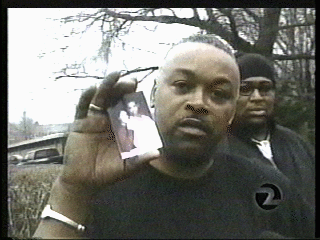
Entire Clip - About the 4 Americans Dead In Kuwait (9 MB)
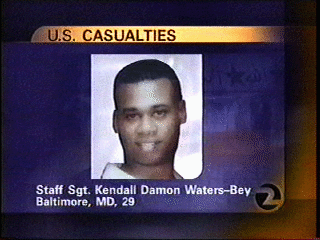
Kendal Damon Waters-Bey's Father (2 MB)
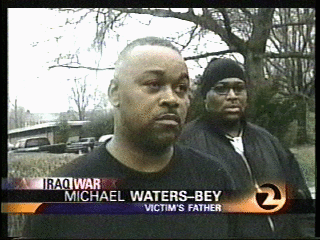

Jay Thomas Aubin's Family (2 MB)
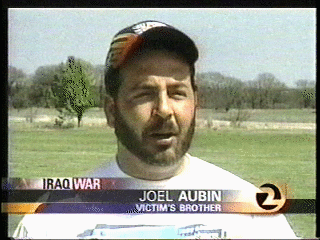
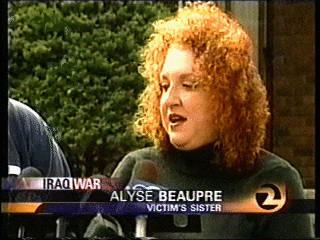
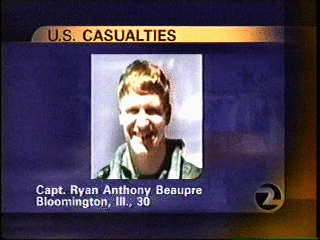
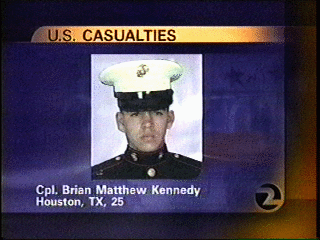
I hear there are 30,000 or so people in Civic Center so, you know, I hate to be a party pooper!
I'll have whatever I shoot today -- and the rest of footage from Thursday going up tonight and all day tomorrow. (I've got to catch up so I can get back to my SXSW and Spectrum Conference footage.)
More footage of people getting arrested and being intimidated by the cops:
Day After Part 3 of ? (Small - 8 MB) (Hi-Res 97 MB)
Yes, she's smiling below. So is the cop walking away from her. One of the happier moments of the day...


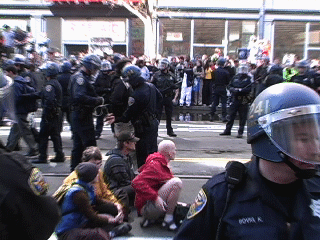
violence.mov from SF indy media
How can the Shrub Administration proudly send our boys and girls off to war, while quietly cutting their benefits by billions at the same time?
VETERANS PROGRAMS SLASHED BY HOUSE REPUBLICANS
Budget Committee Blueprint Cuts Veterans Health Care and Other Benefits
by Nearly $25 Billion
Congressman Lane Evans (D-IL), the Ranking Democratic Member of the House Veterans Affairs Committee, today said the budget adopted by the House Budget Committee would mean drastic reductions in funding for veterans’ benefits and services. Evans called the budget “shameful” and pledged to fight to defeat the Republic budget blueprint. Referring to the more than a trillion dollars worth of tax cuts approved by the Budget Committee, Evans asked, “Who deserves to receive the benefits of the national treasury—America’s disabled veterans or America’s millionaires?”The Republican majority of the House Budget Committee approved a federal budget reducing funding for veterans health care and benefit programs by nearly $25 billion. The proposed budget cut $844 million from the President’s request for veterans’ health care next year. Over a ten-year period the GOP is proposing a cut of $9.7 billion in veterans’ health care—an average of more than $900 million less than the President has proposed per year. For other veterans’ benefits, including cash payments to veterans disabled by military service, the Republican budget calls for a $463 million cut during the next year and a $15 billion cut in spending from current levels during the next ten years. The House Budget Committee is chaired by Congressman Jim Nussle (R-IA)...
As our Nation stands on the verge of war, certain to result in disability and death for young Americans, the Budget Committee’s proposal requires the House Committee on Veterans Affairs to make permanent cuts in the benefits paid to those disabled by virtue of their service to our Nation. These cuts must be made, so that our government can afford to provide a tax cut which will benefit only the wealthiest Americans, many of whom have never served in the military.
Here is the full text of the article in case the link goes bad:
http://www.veterans.house.gov/democratic/press/108th/3-13-03budget.htm
dem1.JPG (6015 bytes)
NEWS FROM….
CONGRESSMAN LANE EVANS
RANKING DEMOCRATIC MEMBER
COMMITTEE ON VETERANS AFFAIRS
U.S. HOUSE OF REPRESENTATIVES
Room 333 Cannon HOB For More Information Contact:
Washington, DC 20515 Susan Edgerton or
Mary Ellen Mc Carthy @ 202-225-9756
FOR RELEASE: March 13, 2003
VETERANS PROGRAMS SLASHED BY HOUSE REPUBLICANS
Budget Committee Blueprint Cuts Veterans Health Care and Other Benefits
by Nearly $25 Billion
Congressman Lane Evans (D-IL), the Ranking Democratic Member of the House Veterans Affairs Committee, today said the budget adopted by the House Budget Committee would mean drastic reductions in funding for veterans’ benefits and services. Evans called the budget “shameful” and pledged to fight to defeat the Republic budget blueprint. Referring to the more than a trillion dollars worth of tax cuts approved by the Budget Committee, Evans asked, “Who deserves to receive the benefits of the national treasury—America’s disabled veterans or America’s millionaires?”
The Republican majority of the House Budget Committee approved a federal budget reducing funding for veterans health care and benefit programs by nearly $25 billion. The proposed budget cut $844 million from the President’s request for veterans’ health care next year. Over a ten-year period the GOP is proposing a cut of $9.7 billion in veterans’ health care—an average of more than $900 million less than the President has proposed per year. For other veterans’ benefits, including cash payments to veterans disabled by military service, the Republican budget calls for a $463 million cut during the next year and a $15 billion cut in spending from current levels during the next ten years. The House Budget Committee is chaired by Congressman Jim Nussle (R-IA).
By a nearly party-line vote of 22-19, Republicans defeated an amendment offered by Democratic Representatives Darlene Hooley, Tammy Baldwin, Dennis Moore, Chet Edwards, Bobby Scott, Lois Capps, and Artur Davis that would have restored the proposed $844 million for veterans health care and added a billion dollars to the VA’s budget for discretionary programs. These cuts are made to a budget that already relies upon $1.1 billion in vaguely defined management efficiencies and $1.4 billion in mostly unpalatable legislative and policy proposals already included in the President’s budget. The amendment would also have restored the Budget Committee’s proposed $463 million in cuts to veterans’ benefits. Only Republican Ginny Brown-Waite, a member of the Committee on Veterans Affairs, crossed party lines to vote for increased funding for veterans.
In sharp contrast to Nussle’s proposal, a bipartisan recommendation from Chairman Christopher Smith (R-NJ) and Democratic Ranking Member Lane Evans (D-IL) on behalf of the Committee on Veterans Affairs, would have added $3 billion next year for veteran discretionary programs including medical care and research, construction and programs that fund the administrative costs of other important benefits such as compensation, pension and education programs.
What would $1.844 billion mean to veterans health care?
· Congress would have to seriously consider the new copayments and enrollment fees proposed by the Bush Administration in order to keep the system operating in the next fiscal year. This means:
o New priority 8 veterans would remain ineligible for VA services indefinitely
o Priority 7 and 8 veterans would have an annual enrollment fee in addition to increased copayments for pharmaceutical drugs and primary care
o Only veterans with highly rated service connected disabilities (greater than 70%) would be eligible for placement in VA nursing homes. This would eliminate the need for 5000 nursing home beds from the system.
· In year one VA may have to disenroll at least 168,000 veterans.
· There would be no additional funds available to implement the Homeless Veterans Comprehensive Assistance Act to work toward the goal of eliminating chronic homelessness in a decade.
· The current Capital Assets Realignment for Enhanced Services (CARES) exercise that VA is undertaking to assess the best use of its physical infrastructure will become a “de facto” closure commission with no ability to respond to veterans’ needs for primary care, long-term care, and mental health projected by its own models.
· $1.844 billion =
o about 9,000 doctors or 19,000 nurses
o about 6.6 million outpatient visits
o 870,000 hospital bed days of care
o 2 million psychiatric bed days of care
o 9 million nursing home bed days of care
o all of VA’s top-twenty priorities major construction projects (totaling about $600 million) which include desperately needed seismic and modernization projects and projects to ensure patient and employee safety
What would $463 million cuts in mandatory spending mean to veterans benefits?
· Congress would have to seriously cut the benefits paid to men and women who are disabled as a result of military service. Cash benefits paid to veterans who have disabilities incurred or aggravated during military service comprise the vast majority of VA’s budget for mandatory programs. Ninety percent of the mandatory spending the Budget Committee proposes to cut is from cash payments to service disabled veterans, low-income wartime veterans and their survivors.
· Other programs funded with mandatory spending are the Montgomery G.I. Bill education benefits, vocational rehabilitation and independent living programs for service-disabled veterans, subsidies for VA home loans and insurance for service-disabled veterans and funds to provide headstones, markers and flags for deceased veterans.
· Even if all burial benefits, including flags and markers were eliminated to meet the Budget Committee resolution, funding for benefits for living veterans would need to be dramatically cut.
· Last year the cost-of living increase paid to service-disabled veterans was only 1.4%. In order to meet the Budget Committee criteria the House Committee on Veterans Affairs could propose a cost-of living decrease of 1.4% and no increase for FY 2004.
As our Nation stands on the verge of war, certain to result in disability and death for young Americans, the Budget Committee’s proposal requires the House Committee on Veterans Affairs to make permanent cuts in the benefits paid to those disabled by virtue of their service to our Nation. These cuts must be made, so that our government can afford to provide a tax cut which will benefit only the wealthiest Americans, many of whom have never served in the military.
In contrast, Democrats proposed to restore the “Nussle” cut for benefits and health care and add $1 billion to the VA health care budget to eliminate the need for increased copayments, assist VA in eliminating waiting times, restore VA’s nursing home care mission and provide a small boost to address the queue of VA major construction projects that include seismic projects and other projects that will assure patient and employee safety.
-30-
Back to Press Releases
How sad.
McCarthyism lives!. It worked then and it works now.
Statement from Natalie Maines of the Dixie Chicks
March 14, 2003"As a concerned American citizen, I apologize to President Bush because my remark was disrespectful. I feel that whoever holds that office should be treated with the utmost respect. We are currently in Europe and witnessing a huge anti-American sentiment as a result of the perceived rush to war. While war may remain a viable option, as a mother, I just want to see every possible alternative exhausted before children and American soldiers' lives are lost. I love my country. I am a proud American."
Note: This set of video clips does not contain the ones from my earlier posts here and here.
Note that the hi-resolution clips might not have uploaded yet till about an hour after this post. (I'm having tech difficulties and it could be longer.)
This is footage of people getting arrested and the people around me yelling at the cops. Note: Just to clarify... I myself am not yelling at the cops.
In general, as a personal decision, I choose to not yell at the cops.
(Call me conservative :-)
It would also screw up my video footage if I yelled while I was filming.
Part 1 of ? - March 20, 2003 (Small - 8 MB)
Part 1 of ? - March 20, 2003 (Hi-Res 69 MB)


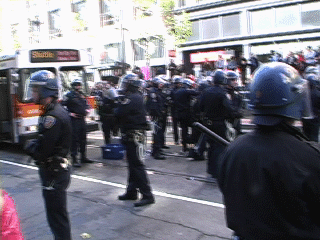
Part 2 of ? - March 20, 2003 (Small - 8 MB)
Part 2 of ? - March 20, 2003 (Hi-Res - 79 MB)


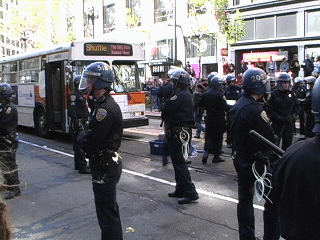
An Apology From Natalie Maines
But now, thanks to the thousands of angry people who want radio stations to boycott our music because criticizing the President is unpatriotic, I realize it's wrong to have a liberal opinion if you're a country music artist. I guess I should have thought about that before deciding to play music that attracts hypocritical red necks...And most important of all, I realize that it's wrong for a celebrity to voice a political opinion, unless they're Charlie Daniels, Clint Black, Merle Haggard, Barbara Mandrell, Loretta Lynn, Ricky Skaggs, Travis Tritt, Hank Williams Jr, Amy Grant, Larry Gatlin, Crystal Gayle, Reba McEntire, Lee Greenwood, Lorrie Morgan, Anita Bryant, Mike Oldfield, Ted Nugent, Wayne Newton, Dick Clark, Jay Leno, Drew Carey, Dixie Carter, Victoria Jackson, Charleton Heston, Fred Thompson, Ben Stein, Bruce Willis, Kevin Costner, Arnold Schwartzenegger, Bo Derek, Rick Schroeder, George Will, Pat Buchanan, Bill O'Reilly, Joe Rogan, Delta Burke, Robert Conrad or Jesse Ventura.
Here is the full text of the article in case the link goes bad:
http://www.thespeciousreport.com/2003_dixiechicks.html
Apology from Natalie Maines
As a concerned American citizen, I apologize to President Bush because my remark was disrespectful. I now realize that whoever holds that office should be treated with the utmost respect.
I hope everyone understands, I'm just a young girl who grew up in Texas. As far back as I can remember, I heard people say they were ashamed of President Clinton. I saw bumper stickers calling him everything from a pothead to a murderer. I heard people on the radio and tv like Rush Limbaugh, Pat Robertson, Newt Gingrich and Trent Lott bad mouthing the President and ridiculing his wife and daughter at every opportunity.
I heard LOTS of people disrespecting the President. So I guess I just assumed it was acceptable behavior.
But now, thanks to the thousands of angry people who want radio stations to boycott our music because criticizing the President is unpatriotic, I realize it's wrong to have a liberal opinion if you're a country music artist. I guess I should have thought about that before deciding to play music that attracts hypocritical red necks.
I also realize now that I'm supposed to just sing and look cute so our fans won't have anything to upset them while they're cheating on their wives or getting in drunken bar fights or driving around in their pickup trucks shooting highway signs and small animals.
And most important of all, I realize that it's wrong for a celebrity to voice a political opinion, unless they're Charlie Daniels, Clint Black, Merle Haggard, Barbara Mandrell, Loretta Lynn, Ricky Skaggs, Travis Tritt, Hank Williams Jr, Amy Grant, Larry Gatlin, Crystal Gayle, Reba McEntire, Lee Greenwood, Lorrie Morgan, Anita Bryant, Mike Oldfield, Ted Nugent, Wayne Newton, Dick Clark, Jay Leno, Drew Carey, Dixie Carter, Victoria Jackson, Charleton Heston, Fred Thompson, Ben Stein, Bruce Willis, Kevin Costner, Arnold Schwartzenegger, Bo Derek, Rick Schroeder, George Will, Pat Buchanan, Bill O'Reilly, Joe Rogan, Delta Burke, Robert Conrad or Jesse Ventura.
God Bless America,
Natalie
As usual, our first casualties of war are friendly fire and accidents. It's such a waste of lives.
(Note 3/22/03 - damn! I had my VCR on the wrong setting and it didn't record ollie or the messages from the boys mentioned below :-(
I'll have this up soon from some footage I sampled on television. Oliver North "Fox News Correspondent" in Kuwait actually witnessed the accident.
I've also got some footage of "our boys" sending messages home to their families. I do however, have footage from the families of those that were killed coming soon here.
Be safe guys!
This footage goes after the other stuff I posted earlier. I think it will speak for itself. It's just me and Kevin exchanging stories about what happened to us while keeping an eye on the cops in case they should attack us again. (They were all over the sidewalk at this point and it didn't seem there was anywhere that was safe.)
I know it sounds silly, perhaps. Or over-reactive. But after what we had just witnessed, it was exactly what we were thinking.
I'll be numbering the rest of my clips so it won't be too complicated to know if you have a complete set.
The afterfreak. (4 MB)
This may seem like strange timing, but I promised myself I would do this as soon as I got back from SXSW, and it's already been a week, so here goes: I'm looking to put a band together to play mainly around town (at first) and maybe also in Austin, L.A. and New York (eventually), where I have a few contacts.
Check out my stuff and let me know if you'd be interested. (lisarein@finetuning.com)
Ug. There's a bunch more footage from yesterday worth preserving.
I'm not sure if I'm going to go get more footage of the protests today. From what I can tell, it's still "goin' on" downtown. (In fact, I'm a bit worried because my friend Kevin went without me around 9am this morning and I haven't heard from him since... -- he's OK.)
The footage I saw on TV last night was downright confrontational (between the cops and the protesters as a faction of them tried to take over the Bay Bridge) -- and not necessarily anything I want to personally participate in (although it would be interesting to film it, I suppose).
Yes I recorded footage from it on my VCR at home -- but first things first...
Let's see if I get the rest of yesterday's footage up, and then I'll take it from there...
At the beginning of this footage, you can hear me talking to my friend Kevin Burton on the phone. (Here it is in two parts for those of you with slow connections: part 1, part 2.)
I had been in the same spot for almost a half hour. There was a line of cops in the street, but they had been there the whole time and there was no reason to believe that anything was "wrong" per se.
The last thing I remember (and indeed, the last thing that happens on-screen before all hell breaks loose) is watching my friend Kevin wave to me as he is walking across the street. I had just finished telling him that I decided to take a few steps back so I wouldn't be "in the street." The cops would talk to us to tell us what we could do to not be in trouble, although they could have easily done so using a megaphone or some other means available to them -- but I could figure out that blocking traffic were what they were so upset about so I (so foolishly) thought I would be OK if I stayed on the sidewalk.
There was little or no communication between the cops and the protesters before the line of cops rushed into the crowd and started hitting people with billy clubs and selecting members of the crowd at random to be arrested.
I wish I could say that I stood my ground and just kept filming, but as my footage will demonstrate. I backed up to the far end of the sidewalk to make sure I wasn't going to get hit before I could concentrate on filming again.
It was then that I noticed "gangs" of 2 or 3 cops picking on certain individuals -- usually male. I got some shots of this (http://www.lisarein.com/3-20-03-copgang.gif) and then turned to see a cops throw a girl into a newspaper machine. I turned the camera on her in time to see her try to stand up while a cop confronted her and she tried to back away from him while he hit her with his club (med res) (hi-res and small) and was about to do it again when she ran off screaming. (I interview her here.) (Hi-res version of interview.)
Again: the violence I witnessed seemed to be at random, unprovoked, and without warning. If they're trying to scare us out of exercising our free speech rights, they're sure doing a good job. I'm going to get my footage up today and see what the scene is before going back out there today.
Okay so back to describing this scene. After the cops rushed the crowd, and selecting certain individuals and having them put their hands behind their backs since they were going to be arrested, the crowd begins booing and screaming. "The whole worlds watching," it screams. ("Ha!" I thought to myself, "I wonder if the crowd or the cops know how true that is!" :-)
Kevin was shouting, "You don't have to do this!" Someone else shouted "Take some pride in your work". I kept having to run from the action periodically so the camera keeps getting shaky, but I decided to leave in all of that footage so you could see the whole conflict within its proper context from beginning to end.
I was seriously worried that I was going to get attacked by one of these cops -- even though I was just standing there, far away from the street, with my camera, peacefully. I've never personally witnessed cops just running into the street hitting people at random that haven't provoked them before, and have generally been very supportive of San Francisco cops' behavior during the protests for this reason. Now I'm scared, and very, very sad (perhaps more sad than anything else).
One good thing I saw the cops doing was about four of them stopped to help an old man that was about to pass out. They stood with him for several minutes while he came around. At first people thought they were going to arrest him or something, and then we realized what was going on and spread the world that they were actually helping him out. (I just felt compelled to pass the incident along, to their credit.)
Photos of cop beating up girl from incident mentioned above:
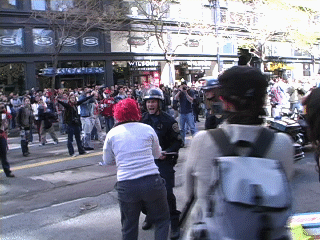
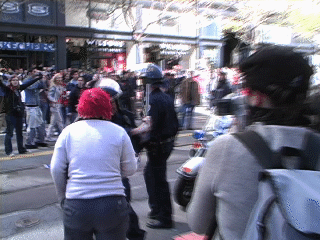





Here are some other grabs I took from my footage, with captions:
Kevin Burton running out of the street when the cops start attacking people.

********
A gang of cops attacking a protester.

********
A shot of the crowd during the incident.

********
Another shot of the crowd during the incident. (At this point, everyone was putting their hands above their heads in peace signs, hoping they would see that we werent fighting back so they would stop hitting us.)
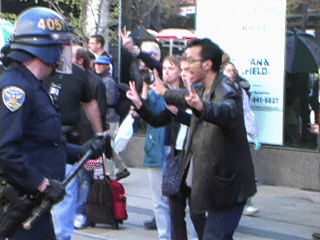
********
A cop brandishing the biggest baton I've ever seen in my life.
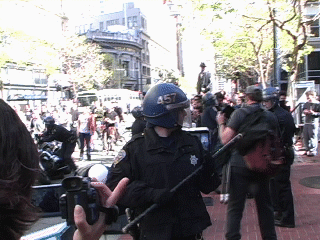
********
Cops restraining randomly chosen folks in the crowd.
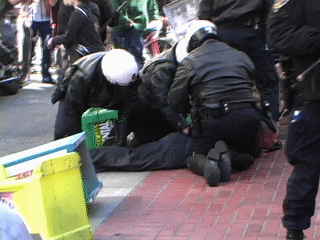
********
Another shot of the same group of cops as above restraining the same guy (a randomly chosen protester in the crowd).
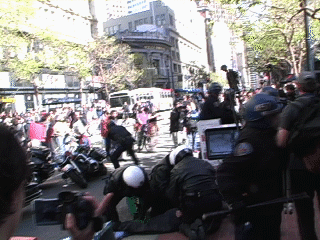
********
A very sad police officer who looks like he wishes he was somewhere else. (There were many sad cops just like this guy.)
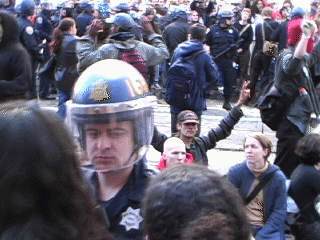
********
Shots of the scuffle.

********
Another shot of the scuffle.
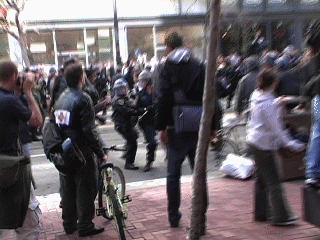
Thousands protest as conflict begins
An estimated 5,000 demonstrators, the majority of them schoolchildren, thronged the streets to voice their anger against today's US air strikes on Iraq.The protesters were responding to a call by the UK anti-war movement for workers and students to stage a mass walkout from offices, schools and colleges.
Describing the outbreak of hostilities as a "day of shame", the Stop the War Coalition said that it hoped to draw on the public feeling that saw more than 1 million people take to the streets of London last month.
Stop the War spokesman Andrew Burgin said: "We call upon the people of Britain to act today in support of peace by walking out from work, school or college to join protest meetings and peace demonstrations in their community against this unjust war."
...Flordete Iveson, 18, who attends Latimer School in Edmonton, north London, said: "We don't want our name associated with this war. Our government doesn't care what we think. I don't think I have a right to speak out against the war unless I'm here to protest."
In Cambridge, around 300 demonstrators stopped traffic during a sit-down protest and formed a "ring of peace" around market stalls.
Sara Payne, the co-chairman of Campeace, who was with her two-year-old granddaughter Dorothy, said: "We have consistently opposed what we see as this illegal attack on Iraq: it does not have the authority of the UN.
"The UN was set up to protect future generations from the scourge of war. Tony Blair is a war criminal."
Here is the full text of the article in case the link goes bad:
http://www.guardian.co.uk/Iraq/Story/0,2763,918039,00.html
Print This Story E-mail This Story
Go to Original
Thousands Protest as Conflict Begins
Guardian UK
Thursday 20 March 2003
Tensions rose as police tried to control the mass of anti-war protesters gathering in Parliament Square today.
An estimated 5,000 demonstrators, the majority of them schoolchildren, thronged the streets to voice their anger against today's US air strikes on Iraq.
The protesters were responding to a call by the UK anti-war movement for workers and students to stage a mass walkout from offices, schools and colleges.
Describing the outbreak of hostilities as a "day of shame", the Stop the War Coalition said that it hoped to draw on the public feeling that saw more than 1 million people take to the streets of London last month.
Stop the War spokesman Andrew Burgin said: "We call upon the people of Britain to act today in support of peace by walking out from work, school or college to join protest meetings and peace demonstrations in their community against this unjust war."
But what began as a peaceful demonstration grew more heated as 100 youngsters staged a sit-in in front of the Houses of Parliament, blocking traffic.
A further 60 lay down on the ground, refusing police pleas to disperse, and were forcibly moved, some with several officers dragging them away. Fellow protesters stood behind them chanting "Leave the kids alone!" and "Stop the war!"
As protesters tried to force their way through metal barriers surrounding the square, they were pushed back by cordons of police.
Some demonstrators hurled plastic bottles, stones and coins at police, and one officer was seen punching a protester in the face.
Flordete Iveson, 18, who attends Latimer School in Edmonton, north London, said: "We don't want our name associated with this war. Our government doesn't care what we think. I don't think I have a right to speak out against the war unless I'm here to protest."
In Cambridge, around 300 demonstrators stopped traffic during a sit-down protest and formed a "ring of peace" around market stalls.
Sara Payne, the co-chairman of Campeace, who was with her two-year-old granddaughter Dorothy, said: "We have consistently opposed what we see as this illegal attack on Iraq: it does not have the authority of the UN.
"The UN was set up to protect future generations from the scourge of war. Tony Blair is a war criminal."
The Campaign for Nuclear Disarmament also urged Britons to protest against the "illegal, immoral war". CND called on campaigners to gather outside Downing Street at 6pm with whistles and drums, and to make as much noise as possible. The group also encouraged British soldiers to disobey orders and refrain from entering combat.
CND chairman Carol Naughton said: "Crimes against humanity will be perpetrated in this bloody war.
"We will support any members of the military who refuse to carry out an order that would cause death or suffering to civilians. That is their individual right and I hope they will use it."
The Muslim Council of Britain, which fears that military action against Saddam Hussein will sour relations between Britain and Muslim countries, condemned the outbreak of war and said it was a "black day in our history".
A statement from five aid agencies in Britain called for coalition forces to take "all possible precautions" to avoid civilian casualties in Iraq, and demanded extra funding to rebuild the country after war.
Military voices of dissent
By Steve Schifferes for the BBC News Online.
Nancy Lessin, one of founders of Military Families Speak Out has a stepson, Joe, in the marines. He is deployed in Kuwait as an Arab language specialist.She is a union activist from Jamaica Plain near Boston, Massachusetts who was previously active in opposing the Vietnam War.
Her voice breaking, Ms Lessin told News Online she hoped her stepson would not face combat, nor would he have to take part in killing others.
She said that opposition to an unjust war was patriotic...
"This war isn't worth the life of one American soldier," said Charlie Sheehan-Miles, a former tank crewman in the Gulf who is one of the founders of VFCS.
"This week thousands of US soldiers are deploying to Kuwait to fight a war on our behalf. They go because it is their job, and their mission to protect us. It is now our mission to protect them."
Here is the full text of the article in case the link goes bad:
http://www.ccmep.org/2003_articles/Iraq/011703_military_voices.htm
Military voices of dissent
By Steve Schifferes
BBC News Online Washington correspondent
January 17, 2003
Opposition to a possible war in Iraq has come from an unlikely source - the US military itself.
As anti-war forces are gathering for a major demonstration on Saturday in Washington, a group of parents of the soldiers currently being deployed in the Gulf have decided to speak out against the drive for war.
They have been joined by organisations representing Gulf War veterans, who are particularly concerned about the problem of chemical and biological warfare casualties among servicemen.
The anti-war former soldiers hope to replicate the success of the Vietnam Veterans Against the War in the l960s, who were a crucial part of the anti-war coalition that helped end US involvement in that war.
The organisations are new and small. But they could bring a new element to the anti-Iraq war movement. If they influence US troops in the field, that could be a worry for the Pentagon.
Activists on Vietnam
Nancy Lessin, one of founders of Military Families Speak Out has a stepson, Joe, in the marines. He is deployed in Kuwait as an Arab language specialist.
This war isn't worth the life of one American soldier
Charles Sheehan-Miles, former tank crewman, 24th Infantry, Gulf War
She is a union activist from Jamaica Plain near Boston, Massachusetts who was previously active in opposing the Vietnam War.
Her voice breaking, Ms Lessin told News Online she hoped her stepson would not face combat, nor would he have to take part in killing others.
She said that opposition to an unjust war was patriotic.
And she said that if Iraq's main export was olive oil, we wouldn't be facing the possibility of war.
The horrors of war
Briggs Seakins from Maine served as a dismount mechanised infantryman with the 3rd Armoured Division in the 1991 Gulf War.
He told the BBC that it was the experience of the war - and his concern that he was taking part in the slaughter of innocents - that has led him to take his anti-war stance.
He says that at the time, supporting his fellow soldiers took priority. But having seen the refugees and the frightened conscript soldiers from Iraq, he would not take part in war again.
So far there are no members of these organisations who are also active members of the military. But the organisers believe that there is considerable hidden support for their views.
Jeff McKenzie, another member of Military Families Speak Out, is an anti-war activist from New York state. His son, Jeremy, is an Army captain who flies medical evacuation helicopters and is currently being deployed to the Gulf.
He said he encountered sympathy with his views among some of the soldiers when he visited his son in Fort Benning, Georgia, especially those who were nearing the end of their tours of duty.
His own anti-war views were forged after the events of 11 September, and he took part in anti-nuclear marches.
He says the war in Iraq is about settling old scores and controlling oil, and it would not be in America's interest.
Gulf War veterans
Many of the military activists, former Gulf War veterans, are warning that any conflict will be more costly, in terms of casualties and disabilities, than anyone is prepared for.
And as the coalition seeks to represent the views of some 44 million veterans, the Veterans for Common Sense (VFCS) have taken a moderate stance on the war, calling for a halt to the war until diplomacy has been given a chance rather than opposing it outright.
They have also called for more evidence and broader support from the Allies before launching a "vindictive" strike.
"This war isn't worth the life of one American soldier," said Charlie Sheehan-Miles, a former tank crewman in the Gulf who is one of the founders of VFCS.
"This week thousands of US soldiers are deploying to Kuwait to fight a war on our behalf. They go because it is their job, and their mission to protect us. It is now our mission to protect them."
I'm a big fan of t r u t h o u t.
These guys are a group of human agents that go out and scour the internet for important articles from reputable sources (like the NY Times, Washinton Post, and other "accepted" sources of the mainstream -- so the powers that be can't just say that we saw it in the lefty news).
When I wake up at 6am. My list of articles is waiting in my mailbox for me.
I doubt I could even put a price on the amount of time they save me every day.
But now they're in trouble, and need your help to stay afloat. They provide their service for free to everyone that needs it, and then they ask for those of us with a little money (read: very little these days) to pitch in even $5 or $10 dollars a month to keep them afloat.
The thought of this organization going away when we need it more than ever prompted me to write this pitch on their behalf: help out if you can.
Here's an ongoing online demonstration you can participate in, if you are so inclined:
Attack Iraq? NO! An Online Demonstration. You can even put a logo on your site to oppose the war. (I'm deep in video footage land right now but am planning on getting on of these up this weekend...
# The way to honor the victims of September 11th is through peace and healing. We must spare additional innocent families the suffering that thousands of American families already have experienced. By continuing to perpetuate the cycle of violence and retaliation, we are doing a grave disservice to the victims of September 11th and their loved ones. [more: 1, 2]# The best way to support our troops is to bring them home now. [more]
# The only weapon that can save the world is non-violence. [source]
# According to Pentagon figures, a preemptive strike could kill some 10,000 Iraqi civilians not to mention several young American men and women. [source; current body count]
Awesome photos from my protest buddy, Kevin Burton:
The Battle Of San Francisco
Here are photos of the Fire Department sawing protesters out of their steel
armlocks, etc:
Photos 1
Photos 2
Photos 3
Photos 4
I can't even believe the violence that was inflicted on peaceful protesters between 4th and 5th Street on Market today. Luckily, I got everything I saw on tape, so I'll be uploading it over the rest of the day.
There seemed to be no rhyme or reason to the cops' behavior. They would tell us we had to get out of the street, and most of us would, and then they would tell us we had to get off of the sidewalk and move to the another block. And when we got to the end of the block, there would be another line of cops telling us we had to go back (presumably into the other line of cops, or into the street where we also weren't supposed to go).
I've got footage of two different people that were attacked and then interviews with both of them afterwards. There was also number of peaceful, artistic demonstrations (in between our being intimidated and beat up by the cops).
Back in a flash!
Here's what I've got so far.
Note that there are "web size", "email" and "edited email" (small) versions available and also some gif files.
You'll want to upload the pictures on to your own site so they download quickly in a browser.
Here's the directory where I'll be uploading stuff all day:
Market Street Protest Footage - San Francisco - March 20, 2003
Story that goes with this footage:
So I walked from 16th and Valencia over to Market Street (about 8 blocks) and then one block over to where Market meets Haight. The entire intersection (all 5 parts of it) was blocked off and cars were forced to wait at a standstill. The cops appeared to be nowhere in sight. (But apparently they were close by and just monitoring the situation, rather than interfering with it.)
Over about 10 or 15 minutes, the protesters announced that their work at that intersection was done and that they were moving on to Van Ness and Mission.
The protesters moved out of the way and the cops rode in on their motorcycles (2 of them) and a few protesters worked with the cops to get the stuff out of the street and get traffic moving again.
Then a funny thing happened: all of the cars that had been forced to wait honked their horns in support of the protesters!
Okay I'm off to 4th and Market where I guess a different group of protesers have taken things over there.
I'll be back later this afternoon!
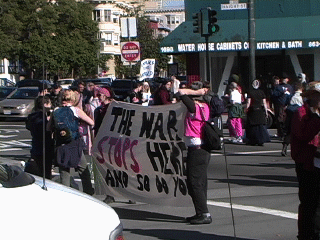

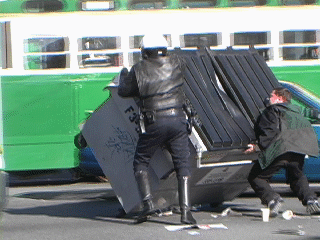
From a friend:
anti war protest in front of US Embassy in Tokyo (later on TV 5 reported
arrested )
people in Hiroshima doing sit in. (a few univ. student went on hunger strike. )
I'll try to get down there later today to get some footage, but let's just say that pretty much everything from Civic Center north on the Bart Station route will be "goin' on." (And worth avoiding if your trying to get to work or anywhere else you need to be. Go around that area.)
More soon....
I wasn't there but Kevin Burton took some pictures for us to see:
Powell and Market Protest - March 19, 2003.
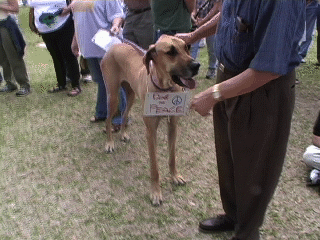
Early Crowd and Speakers - Part 1 of ?
(Not a whole lot of people there yet at this point.)
From the "move along, there's nothing to see here" department, my last posting reminded me that a friend pointed last week that my email isn't actually located anywhere on my radar site.
Um. Sorry about that -- I've added it (lisarein@finetuning.com) to my A-Z listing.
There. Now re-read my last post and pretend that my email was actually available on my blog site when I posted it... (DOH!)
This is a follow up to my earlier post regarding cellphone numbers being added to 411 lists, which I still think, as it stands, is a really bad idea.
There's more at stake here than the (I believe, still valid) concern of actually be charged money by your phone company every time you are contacted by a telemarketer, which would also be horrible and unfair to consumers, but isn't nearly as worrisome as establishing a practice of charging people extra if they don't want their personal information sold.
If discounts are offered to people that are willing to allow their number to be included in a directory, that's one thing. But again, it would need to be properly represented to the consumer that they were trading something valuable -- their personal information -- for a discount.
That said, it's not only about telemarketers. It's about privacy. If I want someone to have my cell phone number, I'll give it to them. Otherwise, they can email me and request it, and if I want to give it to them, I will.
In general, I would rather be emailed than called on the phone -- especially from people I'm not expecting.
The way it is now, I have a little control over who calls me on my already too busy telephone. I should not have to pay money to have my number remain unlisted. It is a right, not a privilege, in my opinion.
This is the wrong direction for these kinds of services to go -- making people opt-out of having their information made public. They should always have to explicitly opt-in to such services. This is dangerous if giving up one's personal information in order to participate in a basic communications service, such as cell phones, becomes the exception, and not the rule.
Hope this clarifies my broader privacy concerns surrounding these types of policies.
Natalie Merchant, No Strings Attached
By Jon Pareles for the NY Times.
When her Elektra contract expired in August 2002, she chose not to renew it or to seek a deal with another major label. "I would make a big-budget pop album, followed by a year of touring and promotion and then some downtime for recovery," she said. "I don't even know if I was writing music that was appropriate for that mold." Instead she will release her next album, a collection of traditional songs called "The House Carpenter's Daughter," on her own label, Myth America Records. It is to be released June 1 through Ms. Merchant's Web site, nataliemerchant .com, and July 1 in stores.Recorded on a modest budget, marketed primarily to existing fans and not relying on radio exposure, "The House Carpenter's Daughter" breaks free of the commercial pressures that have turned major-label releases into risky gambles that can cost a million dollars in promotion alone. In contrast, Ms. Merchant's transition suggests the model of a sustainable career for a musician who is no longer eager to chase hits.
Here is the full text of the article in case the link goes bad:
http://www.nytimes.com/2003/03/13/arts/music/13NATA.html
Natalie Merchant, No Strings Attached
By JON PARELES
Natalie Merchant has stepped off the pop treadmill. After 17 years with Elektra Records, first as the main songwriter and singer of 10,000 Maniacs and then with million-selling solo albums of her reflective folk-rock, Ms. Merchant decided to go it alone.
When her Elektra contract expired in August 2002, she chose not to renew it or to seek a deal with another major label. "I would make a big-budget pop album, followed by a year of touring and promotion and then some downtime for recovery," she said. "I don't even know if I was writing music that was appropriate for that mold." Instead she will release her next album, a collection of traditional songs called "The House Carpenter's Daughter," on her own label, Myth America Records. It is to be released June 1 through Ms. Merchant's Web site, nataliemerchant .com, and July 1 in stores.
Recorded on a modest budget, marketed primarily to existing fans and not relying on radio exposure, "The House Carpenter's Daughter" breaks free of the commercial pressures that have turned major-label releases into risky gambles that can cost a million dollars in promotion alone. In contrast, Ms. Merchant's transition suggests the model of a sustainable career for a musician who is no longer eager to chase hits.
"The business is going one way, and Natalie's going another," said her manager, Gary Smith, also the general manager of Myth America.
Ms. Merchant has little to lose. "I'm in a privileged position," she said by telephone from Hawaii, where she lives part of the year; she also has a home in upstate New York. "I'm beyond financially independent. I had a lot of success, and I gathered together a very large audience. And I was in a rare position, because my material was unorthodox as the pop-hit mold went, but I was able to sell multiplatinum albums and have relatively large hits."
When a musician is signed to a label, the company pays for recording and promotion, then recoups expenses from the musician's royalties while retaining ownership of the finished recordings. (Elektra still owns Ms. Merchant's catalog; Rhino Records, distributed by the AOL Time Warner conglomerate that includes Elektra, is releasing a 10,000 Maniacs retrospective this summer.) A label also uses its expertise and clout to market and distribute an album.
Ms. Merchant paid for recording and packaging "The House Carpenter's Daughter," including the $3.50 manufacturing cost of an elaborate box for the first 30,000 copies. (The CD will sell for $16.95.) The special package "was printed in America for three times the price in Hong Kong," Ms. Merchant said.
"It's just not in keeping with American business practice right now," she added.
Even so, "The House Carpenter's Daughter" needs to sell only 50,000 copies to break even, less than 15 percent of what "Motherland," her last album for Elektra, sold.
"We're not trying to recoup some enormous debt," Mr. Smith said. "The economics of making this record are very prudent. When we sell 200,000 copies, we'll be standing on our chairs, hollering. If we released this record with these kinds of goals on a major label, we would look like a failure. At Elektra, if you just sell 1.5 million, everyone goes around with their heads down."
Ms. Merchant is not the first well-known musician to become independent. Prince, after battling Warner Records over his desire to release more music in a year than the label thought it could market, started his own company, NPG, and has since released double- and triple-CD sets at whim. Todd Rundgren markets his music directly to subscribers to his Web site, patronet.com.
"For those already through the door, doing it on your own is incredibly viable," said Jay Rosenthal, a music-business lawyer who represents the Recording Artists' Coalition. "It's going to be very attractive, and it's going to be a viable alternative even for bands who are doing well. The only reason to go to the major labels is to get your songs on the radio, to go for the promo money. If you don't need to get on the radio, and you've got a name, go out there and go for yourself. If there's any moment that artists should do it, it's now, before things get worse."
He added that some musicians would have no choice, as he expected major labels to cut their rosters by 30 to 50 percent in the next year...
Benefit Concert at Cafe Du Nord on March 28 for the Hastings Race and Poverty Law Journal, featuring:On the Speakers (Ian Sefchick from Creeper Lagoon)
Black Cat Music (Lookout! Records)
Psychokinetics (Bay Area Hip Hop)March 28, 9:00 21+
$8 in advance/ $10 at the door
Cafe Du Nord
2170 Market St., SF
www.ticketweb.com
The Hastings Race and Poverty Law Journal is a national periodical
dedicated to issues and policies of Race and Poverty Law. State budget
reductions have dissolved the Journal's funding, leaving it to be
sustained solely by student contributions and fund raising. Proceeds
from this concert, co-presented by the Hastings Assoc. of Comm., Sports
and Entertainment Law, will go directly to publishing the Journal.On the Speakers - Since the demise of (the more well-known line-up of)
SF indie darlings Creeper Lagoon, singer/songwriter Ian Sefchick has
taken the high road to LA, collaborating with other San Francisco
natives to form On the Speakers. Spaceland owner Mitchell Frank
described their debut LA show as 'the best freakin' first show I've
ever seen!.' On the Speakers wowed a sold out Noise Pop crowd last
month at the DIW Magazine party, setting the stage for a return trip,
this time headlining the Cafe Du Nord. The man who MTV declared 'must
save guitar rock' is back with younger friends and a tie, ready to give
it another spin.Black Cat Music - For three years, Black Cat Music has kept Bay Area
audiences wanting more. Those lucky enough to catch a live performance
from this often-elusive band can count on an experience like no other.
With prior bands including the Criminals, the Receivers, Multi Facet,
and the Magnetic, all four members know their way around a stage. But
it's the sum of these four parts that creates such urgent rock and
roll. Black Cat Music speaks to the loss, regret, beauty, and passion
in all of us.Psychokinetics - Hailing from the astoundingly talented depths of the
Bay Area's independent music scene, Psychokinetics have been moving
crowds with their slumpin' beats, positive vibes, and distinct music
format since 1995. Delivering hip-hop in its most pure and creative
state, this harmonious recipe of two DJs (Denizen and ill Media) and
two Emcees (Celsius 7 and Spidey) provide consistent heat with all the
essential cuts and rhymes you need to satisfy your musical appetite.
Get Ready to Be Moved.For more information call Dave Kostiner at (415) 305-1695 or Cafe Du
Nord at (415) 861-5016.
Here is the full text of the listing in case the link goes bad:
http://www.craigslist.org/sfo/sfc/eve/9481001.html
craigslist.org > san francisco > events > 3/28: On the Speakers (Ian Sefchick from Creeper Lagoon) in Benefit Concert
last modified: Mon, 17 Mar 19:24
email this posting to a friend
3/28: On the Speakers (Ian Sefchick from Creeper Lagoon) in Benefit Concert
Reply to: anon-9481001@craigslist.org
Date: 2003-03-16, 11:16AM
Benefit Concert at Cafe Du Nord on March 28 for the Hastings Race and Poverty Law Journal, featuring:
On the Speakers (Ian Sefchick from Creeper Lagoon)
Black Cat Music (Lookout! Records)
Psychokinetics (Bay Area Hip Hop)
March 28, 9:00 21+
$8 in advance/ $10 at the door
Cafe Du Nord
2170 Market St., SF
www.ticketweb.com
The Hastings Race and Poverty Law Journal is a national periodical dedicated to issues and policies of Race and Poverty Law. Proceeds from this concert, co-presented by the Hastings Assoc. of Communications, Sports and Entertainment Law, will go directly to publishing the Journal.
On the Speakers - Since the demise of (the more well-known line-up of) SF indie darlings Creeper Lagoon, singer/songwriter Ian Sefchick has taken the high road to LA, collaborating with other San Francisco natives to form On the Speakers. Spaceland owner Mitchell Frank described their debut LA show as 'the best freakin' first show I've ever seen!.' On the Speakers wowed a sold out Noise Pop crowd last month at the DIW Magazine party, setting the stage for a return trip, this time headlining the Cafe Du Nord. The man who MTV declared 'must save guitar rock' is back with younger friends and a tie, ready to give it another spin.
Black Cat Music - For three years, Black Cat Music has kept Bay Area audiences wanting more. Those lucky enough to catch a live performance from this often-elusive band can count on an experience like no other. With prior bands including the Criminals, the Receivers, Multi Facet, and the Magnetic, all four members know their way around a stage. But it's the sum of these four parts that creates such urgent rock and roll. Black Cat Music speaks to the loss, regret, beauty, and passion in all of us.
Psychokinetics - Hailing from the astoundingly talented depths of the Bay Area's independent music scene, Psychokinetics have been moving crowds with their slumpin' beats, positive vibes, and distinct music format since 1995. Delivering hip-hop in its most pure and creative state, this harmonious recipe of two DJs (Denizen and ill Media) and two Emcees (Celsius 7 and Spidey) provide consistent heat with all the essential cuts and rhymes you need to satisfy your musical appetite. Get Ready to Be Moved.
For more information email Dave Kostiner at hastingsacsel@yahoo.com or Cafe Du Nord at (415) 861-5016.
I just finished making my daily calls to my local radio stations to request the latest and greatest anti-war songs.
Remember these guys:
Beastie Boys - In A World Gone Mad
John Cougar Mellencamp - To Washington
Dixie Chicks - Traveling Soldier
Commercial interests are gearing up to benefit from making our personal cell phone information to the public.
Soon 411 will be able to sell your cell phone number to make extra money from its service. You'll have to pay extra if you want to keep your number unlisted.
I think this is horrible news -- A directory service for cell phones only makes sense if you have to opt-in to it, not if the burden is on you to not only opt-out of it, but pay for the privilege.
Now we'll have to pay to be unlisted!
This seems more like a service you should have to pay to be included in, not the other way around.
Cell phone's are largely "private" lines. If someone wants their business line listed, they can take the time to list it. The average person shouldn't have to take up their time and valuable resources to make sure they've opted out.
Also, one mistake and the average person will have to foot the cost of getting a new phone number, so they can "try again" at protecting their privacy.
Please let me know if anyone knows how this can:
1) be stopped.
2) changed from an "opt-out" policy to an "opt-in" policy where the burden will be placed on the people who want to participate, not the people who want to protect their privacy.
3) be "opted out" of, at NO CHARGE, with confirmation IN WRITING, so a company can be taken to court if a mistake is made, and far enough (like a year) in advance of the roll out that we can no for sure that our privacy will be protected.
4) be made a built-in requirement for customers to be provided with a freely-available opt-out option at the same time they purchase a cell phone to make it as easy has possible to protect their privacy.
Privacy needs to be the default -- not the paid-for exception.
Please keep an eye out for developments on this front and let me know about them! Thanks!
Wireless numbers to be added to 411
Large cell phone carriers on board with plan, source says
The centralized database of wireless numbers would be off limits to telemarketers, and consumers would be able to choose whether to have their numbers listed or unlisted, according to people familiar with the process.Individual carriers would determine whether subscribers would have to pay to be unlisted.
Other privacy options are possible, too.
For example, wireless phone users might choose to be unlisted but willing to receive a short text message, sent through the directory service, from someone trying to contact them.
The nation’s largest carriers are on board with the plan, according to an industry source who spoke on condition of anonymity. Their support makes sense: If carriers charged a dollar or so for 411 requests for a wireless number that could be a huge revenue boost for an industry struggling with high debts and tough competition.
Here is the full text of the article in case the link goes bad:
http://www.msnbc.com/news/887175.asp?cp1=1
Wireless numbers to be added to 411
Large cell phone carriers on board with plan, source says
ASSOCIATED PRESS
NEW ORLEANS, March 18 — Looking for a friend but don’t have her phone number with you? For now, you can call directory assistance for her home number, but her wireless digits are off limits from 411. That’s about to change, however. After years of hesitation, cellular providers are getting close to making wireless numbers available to 411 callers.
The database of wireless numbers would be off limits to telemarketers, and consumers would be able to choose whether to have their numbers listed or unlisted.
ALTHOUGH THE INFORMATION service probably won’t be available until next year at the earliest, some details already are clear.
The centralized database of wireless numbers would be off limits to telemarketers, and consumers would be able to choose whether to have their numbers listed or unlisted, according to people familiar with the process.
Individual carriers would determine whether subscribers would have to pay to be unlisted.
Other privacy options are possible, too.
For example, wireless phone users might choose to be unlisted but willing to receive a short text message, sent through the directory service, from someone trying to contact them.
The nation’s largest carriers are on board with the plan, according to an industry source who spoke on condition of anonymity. Their support makes sense: If carriers charged a dollar or so for 411 requests for a wireless number that could be a huge revenue boost for an industry struggling with high debts and tough competition.
About 5 percent of U.S. households have gone totally wireless and eliminated traditional landlines, according to the Cellular Telecommunications and Internet Association, which is hosting a huge industry trade show in New Orleans this week.
WIFI ROAMING REMAINS DISTANT
While the industry quietly moves toward establishing wireless 411, that kind of consensus and cooperation has been absent at the CTIA show when it comes to the explosion of the wireless Internet access technology known as WiFi.
Because WiFi uses unlicensed airwave frequencies to inexpensively radiate Internet connectivity over short distances, every day brings news of aggressive plans to deploy WiFi “hot spots.”
AdvertisementClick Here!
Add local news and weather to the MSNBC home page.
IBM Corp. said this week it would work with two technology companies to infuse 1,000 truck stops with WiFi access. Toshiba and Accenture are touting a package of hot spot gear and network management software.
But analysts, WiFi providers and companies thinking about joining the fray say the technology will be hindered unless the industry lets users seamlessly roam from one WiFi network to another.
No one really wants to buy access in one airport, only to have to pull out the credit card again and sign up anew at a downtown cafe.
“We need universal roaming across hot spots more than we ever needed it with cellular,” said Sky Dayton, founder of Boingo Wireless, a company working to link WiFi hot spots with each other — and with the slower data networks that send information to wireless phones.
But while some companies say they can facilitate aspects of WiFi roaming, WiFi operators and would-be providers say big issues have yet to be worked out — including how to link billing systems and assure a consistent quality of service among hot spots.
Tools and Toys
• Satellite radio made easy
• Net-gambling ban wins key support
• Apple pulls plug on original iMac
David Chamberlain, an analyst with Probe Research, said wireless phone carriers might be in the best position to bring about WiFi roaming because they already have relationships with millions of customers and billing software for cellular roaming.
But that day doesn’t seem near.
Nextel Communications CEO Tim Donahue said Tuesday that WiFi is not “ready for prime time yet.” Sprint PCS chief Len Lauer said he’s discouraged to see free WiFi hot spots popping up in hotels and other public places because that might make it difficult for anyone to profit off it.
“The cellular operators,” said Lawrence Brilliant, chief of WiFi wholesaler Cometa Networks, “have got to decide whether they see it as friend or foe.”
Mr. Powell, there is such a thing as making a mistake. It would appear that, if you can admit to this one mistake, innocent people don't have to die. (The threat to the world is not what you thought, so we can give Iraq more time to disarm, etc.)
Is is really so hard to admit that someone else purposely misled you and the Shrub -- causing you to unknowingly mislead the American people?
We understand that you were acting accordingly, taking what you believed to be the truth into account. But the charade is over. Please let the madness stop.
Some Evidence on Iraq Called Fake
U.N. Nuclear Inspector Says Documents on Purchases Were Forged
By Joby Warrick for the Washington Post.
Documents that purportedly showed Iraqi officials shopping for uranium in Africa two years ago were deemed "not authentic" after careful scrutiny by U.N. and independent experts, Mohamed ElBaradei, director general of the International Atomic Energy Agency (IAEA), told the U.N. Security Council.ElBaradei also rejected a key Bush administration claim -- made twice by the president in major speeches and repeated by Secretary of State Colin L. Powell yesterday -- that Iraq had tried to purchase high-strength aluminum tubes to use in centrifuges for uranium enrichment. Also, ElBaradei reported finding no evidence of banned weapons or nuclear material in an extensive sweep of Iraq using advanced radiation detectors.
"There is no indication of resumed nuclear activities," ElBaradei said...
ElBaradei's report yesterday all but ruled out the use of the tubes in a nuclear program. The IAEA chief said investigators had unearthed extensive records that backed up Iraq's explanation. The documents, which included blueprints, invoices and notes from meetings, detailed a 14-year struggle by Iraq to make 81mm conventional rockets that would perform well and resist corrosion. Successive failures led Iraqi officials to revise their standards and request increasingly higher and more expensive metals, ElBaradei said.
Moreover, further work by the IAEA's team of centrifuge experts -- two Americans, two Britons and a French citizen -- has reinforced the IAEA's conclusion that the tubes were ill suited for centrifuges. "It was highly unlikely that Iraq could have achieved the considerable redesign needed to use them in a revived centrifuge program," ElBaradei said.
Here is the full text of the article in case the link goes bad:
http://www.washingtonpost.com/wp-dyn/articles/A59403-2003Mar7.html
By Joby Warrick
Washington Post Staff Writer
Saturday, March 8, 2003; Page A01
A key piece of evidence linking Iraq to a nuclear weapons program appears to have been fabricated, the United Nations' chief nuclear inspector said yesterday in a report that called into question U.S. and British claims about Iraq's secret nuclear ambitions.
Documents that purportedly showed Iraqi officials shopping for uranium in Africa two years ago were deemed "not authentic" after careful scrutiny by U.N. and independent experts, Mohamed ElBaradei, director general of the International Atomic Energy Agency (IAEA), told the U.N. Security Council.
ElBaradei also rejected a key Bush administration claim -- made twice by the president in major speeches and repeated by Secretary of State Colin L. Powell yesterday -- that Iraq had tried to purchase high-strength aluminum tubes to use in centrifuges for uranium enrichment. Also, ElBaradei reported finding no evidence of banned weapons or nuclear material in an extensive sweep of Iraq using advanced radiation detectors.
"There is no indication of resumed nuclear activities," ElBaradei said.
Knowledgeable sources familiar with the forgery investigation described the faked evidence as a series of letters between Iraqi agents and officials in the central African nation of Niger. The documents had been given to the U.N. inspectors by Britain and reviewed extensively by U.S. intelligence. The forgers had made relatively crude errors that eventually gave them away -- including names and titles that did not match up with the individuals who held office at the time the letters were purportedly written, the officials said.
"We fell for it," said one U.S. official who reviewed the documents.
A spokesman for the IAEA said the agency did not blame either Britain or the United States for the forgery. The documents "were shared with us in good faith," he said.
The discovery was a further setback to U.S. and British efforts to convince reluctant U.N. Security Council members of the urgency of the threat posed by Iraq's weapons of mass destruction. Powell, in his statement to the Security Council Friday, acknowledged ElBaradei's findings but also cited "new information" suggesting that Iraq continues to try to get nuclear weapons components.
"It is not time to close the book on these tubes," a senior State Department official said, adding that Iraq was prohibited from importing sensitive parts, such as tubes, regardless of their planned use.
Iraqi President Saddam Hussein pursued an ambitious nuclear agenda throughout the 1970s and 1980s and launched a crash program to build a bomb in 1990 following his invasion of neighboring Kuwait. But Iraq's nuclear infrastructure was heavily damaged by allied bombing in 1991, and the country's known stocks of nuclear fuel and equipment were removed or destroyed during the U.N. inspections after the war.
However, Iraq never surrendered the blueprints for nuclear weapons, and kept key teams of nuclear scientists intact after U.N. inspectors were forced to leave in 1998. Despite international sanctions intended to block Iraq from obtaining weapons components, Western intelligence agencies and former weapons inspectors were convinced the Iraqi president had resumed his quest for the bomb in the late 1990s, citing defectors' stories and satellite images that showed new construction at facilities that were once part of Iraq's nuclear machinery.
Last September, the United States and Britain issued reports accusing Iraq of renewing its quest for nuclear weapons. In Britain's assessment, Iraq reportedly had "sought significant amounts of uranium from Africa, despite having no active civil nuclear program that could require it."
Separately, President Bush, in his speech to the U.N. Security Council on Sept. 12, said Iraq had made "several attempts to buy-high-strength aluminum tubes used to enrich uranium for nuclear weapons."
Doubts about both claims began to emerge shortly after U.N. inspectors returned to Iraq last November. In early December, the IAEA began an intensive investigation of the aluminum tubes, which Iraq had tried for two years to purchase by the tens of thousands from China and at least one other country. Certain types of high-strength aluminum tubes can be used to build centrifuges, which enrich uranium for nuclear weapons and commercial power plants.
By early January, the IAEA had reached a preliminary conclusion: The 81mm tubes sought by Iraq were "not directly suitable" for centrifuges, but appeared intended for use as conventional artillery rockets, as Iraq had claimed. The Bush administration, meanwhile, stuck to its original position while acknowledging disagreement among U.S. officials who had reviewed the evidence.
In his State of the Union address on Jan. 28, Bush said Iraq had "attempted to purchase high-strength aluminum tubes suitable for nuclear weapons production."
Last month, Powell likewise dismissed the IAEA's conclusions, telling U.N. leaders that Iraq would not have ordered tubes at such high prices and with such exacting performance ratings if intended for use as ordinary rockets. Powell specifically noted that Iraq had sought tubes that had been "anodized," or coated with a thin outer film -- a procedure that Powell said was required if the tubes were to be used in centrifuges.
ElBaradei's report yesterday all but ruled out the use of the tubes in a nuclear program. The IAEA chief said investigators had unearthed extensive records that backed up Iraq's explanation. The documents, which included blueprints, invoices and notes from meetings, detailed a 14-year struggle by Iraq to make 81mm conventional rockets that would perform well and resist corrosion. Successive failures led Iraqi officials to revise their standards and request increasingly higher and more expensive metals, ElBaradei said.
Moreover, further work by the IAEA's team of centrifuge experts -- two Americans, two Britons and a French citizen -- has reinforced the IAEA's conclusion that the tubes were ill suited for centrifuges. "It was highly unlikely that Iraq could have achieved the considerable redesign needed to use them in a revived centrifuge program," ElBaradei said.
A number of independent experts on uranium enrichment have sided with IAEA's conclusion that the tubes were at best ill suited for centrifuges. Several have said that the "anodized" features mentioned by Powell are actually a strong argument for use in rockets, not centrifuges, contrary to the administration's statement.
The Institute for Science and International Security, a Washington-based research organization that specializes in nuclear issues, reported yesterday that Powell's staff had been briefed about the implications of the anodized coatings before Powell's address to the Security Council last month. "Despite being presented with the falseness of this claim, the administration persists in making misleading arguments about the significance of the tubes," the institute's president, David Albright, wrote in the report.
Powell's spokesman said the secretary of state had consulted numerous experts and stood by his U.N. statement.
Ashcroft Out of Control
Ominous Sequel to USA Patriot Act
By Nat Hentoff for the Village Voice.
Under the proposed Ashcroft bill reversing that court decision, for the first time in U.S. history, secret arrests will be specifically permitted. That section of bill is flatly titled: "Prohibition of Disclosure of Terrorism Investigation Detainee Information." In Argentina, those secretly taken away were known as "the disappeared."Moving on, under Section 501 of the blandly titled Domestic Security Enhancement Act of 2003, an American citizen can be stripped of citizenship if he or she "becomes a member of, or provides material support to, a group that the United States has designated as a 'terrorist organization,' if that group is engaged in hostilities against the United States."
Until now, in our law, an American could only lose his or her citizenship by declaring a clear intent to abandon it. But~Wand read this carefully from the new bill - "the intent to relinquish nationality need not be manifested in words, but can be inferred from conduct." (Emphasis added).
Who will do the "inferring"? A member of the Justice Department. Not to worry. As John Ashcroft's spokeswoman, Barbara Comstock, says of objections to this draft bill: "The [Justice] department's deliberations are always undertaken with the strongest commitment to our Constitution and civil liberties." (This is a faith- based administration.)
Here is the full text of the article in case the link goes bad:
http://villagevoice.com/issues/0310/hentoff.php
Ashcroft Out of Control
Ominous Sequel to USA Patriot Act
By Nat Hentoff
Village Voice
Friday 28 February 2003
Many of the new security measures proposed by our government in the name of fighting the "war on terror" are not temporary. They are permanent changes to our laws. Even the measures that, on the surface, appear to have been adopted only as long as the war on terror lasts, could be with us indefinitely. Because, as Homeland Security director Tom Ridge himself has warned, terrorism is a "permanent condition to which America must . . . adjust." - American Civil Liberties Union, January 29
Since September 11, 2001, a number of us at the Voice have been detailing the Bush administration's accelerating war on the Bill of Rights - and the rising resistance around the country. This battle to protect the Constitution, and us, has entered a new and more dangerous dimension.
On February 7, Charles Lewis, head of the Washington-based Center for Public Integrity, received a secret, but not classified, Justice Department draft of a bill that would expand the already unprecedented government powers to restrict civil liberties authorized by the USA Patriot Act. This new bill is called the Domestic Security Enhancement Act of 2003. Lewis, in an act of patriotism - since this still is a constitutional democracy - put the 86-page draft on the center's Web site, where it still remains (http://www.publicintegrity.org/).
On the evening of February 7, Charles Lewis discussed this new assault on our fundamental liberties on Bill Moyers's PBS program, Now.
Three days later, on the editorial page of the daily New York Sun, primarily a conservative newspaper, Errol Louis wrote: "[The] document is a catalog of authoritarianism that runs counter to the basic tenets of modern democracy."
I have the entire draft of the bill. Section 201 would overturn a federal court decision that ordered the Bush administration to reveal the identities of those it has detained (imprisoned) since 9-11. This sequel to the USA Patriot Act states that "the government need not disclose information about individuals detained in investigations of terrorism until . . . the initiation of criminal charges."
Many of the prisoners caught in the Justice Department's initial dragnet were held for months without charges or contact with their families, who didn't know where they were. And these prisoners were often abused and out of reach of their lawyers - if they'd been able to find a lawyer before being shifted among various prisons. When, after much pressure, the Justice Department released the numbers of the imprisoned, there were no names attached, until a lower court decided otherwise.
Under the proposed Ashcroft bill reversing that court decision, for the first time in U.S. history, secret arrests will be specifically permitted. That section of bill is flatly titled: "Prohibition of Disclosure of Terrorism Investigation Detainee Information." In Argentina, those secretly taken away were known as "the disappeared."
Moving on, under Section 501 of the blandly titled Domestic Security Enhancement Act of 2003, an American citizen can be stripped of citizenship if he or she "becomes a member of, or provides material support to, a group that the United States has designated as a 'terrorist organization,' if that group is engaged in hostilities against the United States."
Until now, in our law, an American could only lose his or her citizenship by declaring a clear intent to abandon it. But~Wand read this carefully from the new bill - "the intent to relinquish nationality need not be manifested in words, but can be inferred from conduct." (Emphasis added).
Who will do the "inferring"? A member of the Justice Department. Not to worry. As John Ashcroft's spokeswoman, Barbara Comstock, says of objections to this draft bill: "The [Justice] department's deliberations are always undertaken with the strongest commitment to our Constitution and civil liberties." (This is a faith- based administration.)
What this section of the bill actually means is that if you provide "material support" to an organization by sending a check for its legal activities~Wnot knowing that it has been designated a "terrorist" group for other things it does - you can be stripped of your citizenship and be detained indefinitely as an alien. While South Africa was ruled by an apartheid government, certain activities of the African National Congress were categorized as "terrorist," but many Americans provided support to the legal anti-apartheid work of that organization.
Under Section 302 of John Ashcroft's design for our future during the indefinite war on terrorism, there is another change in our legal system. Under current law, the FBI can collect DNA identification records of persons convicted of various crimes. But under the USA Patriot Act II, the "Attorney General or Secretary of Defense" will be able to "collect, analyze, and maintain DNA samples" of "suspected terrorists." And as Georgetown law professor David Cole notes - "mere association" will be enough to involve you with suspected terrorist groups. What does "association" mean? For one thing, "material support," under which you could lose your citizenship.
In reaction to the stealth with which the Justice Department has been crafting this invasion of the Bill of Rights, Democratic senator Patrick Leahy of Vermont, ranking minority member of the Senate Judiciary Committee, said on February 10: "The early signals from the administration about its intentions for this bill are ominous. . . .
"For months, and as recently as just last week, Justice Department officials have denied to members of the Judiciary Committee that they were drafting another anti-terrorism package. There still has not been any hint from them about their draft bill."
Leahy continued: "The contents of this proposal should be carefully reviewed, and the public must be allowed to freely engage in any debate about the merits of any new government powers the administration may seek."
But where is the debate in Congress or in the media? After a few initial press stories about the USA Patriot Act II, there has been little follow-up. To be continued here.
The Xanax Cowboy
By Maureen Dowd for The New York Times
As he rolls up to America's first pre-emptive invasion, bouncing from motive to motive, Mr. Bush is trying to sound rational, not rash. Determined not to be petulant, he seemed tranquilized.But the Xanax cowboy made it clear that Saddam is going to pay for 9/11. Even if the fiendish Iraqi dictator was not involved with Al Qaeda, he has supported "Al Qaeda-type organizations," as the president fudged, or "Al Qaeda types" or "a terrorist network like Al Qaeda."
We are scared of the world now, and the world is scared of us. (It's really scary to think we are even scaring Russia and China.)
Bush officials believe that making the world more scared of us is the best way to make us safer and less scared. So they want a spectacular show of American invincibility to make the wicked and the wayward think twice before crossing us.
Of course, our plan to sack Saddam has not cowed the North Koreans and Iranians, who are scrambling to get nukes to cow us.
It still confuses many Americans that, in a world full of vicious slimeballs, we're about to bomb one that didn't attack us on 9/11 (like Osama); that isn't intercepting our planes (like North Korea); that isn't financing Al Qaeda (like Saudi Arabia); that isn't home to Osama and his lieutenants (like Pakistan); that isn't a host body for terrorists (like Iran, Lebanon and Syria).
Here is the full text of the article in case the link goes bad:
http://www.nytimes.com/2003/03/09/opinion/09DOWD.html
The Xanax Cowboy
By Maureen Dowd
The New York Times
Sunday 9 March 2003
You might sum up the president's call to war Thursday night as "Message: I scare."
As he rolls up to America's first pre-emptive invasion, bouncing from motive to motive, Mr. Bush is trying to sound rational, not rash. Determined not to be petulant, he seemed tranquilized.
But the Xanax cowboy made it clear that Saddam is going to pay for 9/11. Even if the fiendish Iraqi dictator was not involved with Al Qaeda, he has supported "Al Qaeda-type organizations," as the president fudged, or "Al Qaeda types" or "a terrorist network like Al Qaeda."
We are scared of the world now, and the world is scared of us. (It's really scary to think we are even scaring Russia and China.)
Bush officials believe that making the world more scared of us is the best way to make us safer and less scared. So they want a spectacular show of American invincibility to make the wicked and the wayward think twice before crossing us.
Of course, our plan to sack Saddam has not cowed the North Koreans and Iranians, who are scrambling to get nukes to cow us.
It still confuses many Americans that, in a world full of vicious slimeballs, we're about to bomb one that didn't attack us on 9/11 (like Osama); that isn't intercepting our planes (like North Korea); that isn't financing Al Qaeda (like Saudi Arabia); that isn't home to Osama and his lieutenants (like Pakistan); that isn't a host body for terrorists (like Iran, Lebanon and Syria).
I think the president is genuinely obsessed with protecting Americans and believes that smoking Saddam will reduce the chances of Islamic terrorists' snatching catastrophic weapons. That is why no cost - shattering the U.N., NATO, the European alliance, Tony Blair's career and the U.S. budget - is too high.
Even straining for serenity, Mr. Bush sounded rattled at moments: "My job is to protect America, and that is exactly what I'm going to do. . . . I swore to protect and defend the Constitution; that's what I swore to do. I put my hand on the Bible and took that oath, and that's exactly what I am going to do."
But citing 9/11 eight times in his news conference was exploitative, given that the administration concedes there is no evidence tying Iraq to the 9/11 plot. By stressing that totem, Mr. Bush tried to alchemize American anger at Al Qaeda into support for smashing Saddam.
William Greider writes in The Nation, "As a bogus rallying cry, `Remember 9/11' ranks with `Remember the Maine' of 1898 for war with Spain or the Gulf of Tonkin resolution of 1964. . . ." A culture more besotted with inane "reality" TV than scary reality is easily misled. Mr. Greider pointed out that in a Times/CBS News survey, 42 percent believe Saddam was personally responsible for the attack on the World Trade Center and Pentagon, and in an ABC News poll, 55 percent believe he gives direct support to Al Qaeda.
The case for war has been incoherent due to overlapping reasons conservatives want to get Saddam.
The president wants to avenge his father, and please his base by changing the historical ellipsis on the Persian Gulf war to a period. Donald Rumsfeld wants to exorcise the post-Vietnam focus on American imperfections and limitations. Dick Cheney wants to establish America's primacy as the sole superpower. Richard Perle wants to liberate Iraq and remove a mortal threat to Israel. After Desert Storm, Paul Wolfowitz posited that containment is a relic, and that America must aggressively pre-empt nuclear threats.
And in 1997, Bill Kristol of The Weekly Standard and Fox News, and other conservatives, published a "statement of principles," signed by Jeb Bush and future Bush officials - Mr. Rumsfeld, Mr. Cheney, Mr. Wolfowitz, Scooter Libby and Elliott Abrams. Rejecting 41's realpolitik and shaping what would become 43's pre-emption strategy, they exhorted a "Reaganite policy of military strength and moral clarity," with America extending its domain by challenging "regimes hostile to our interests and values."
Saddam would be the squealing guinea pig proving America could impose its will on the world.
With W., conservatives got a Bush who wanted to be Reagan. With 9/11, they found a new tragedy to breathe life into their old dreams.
Bush Calls For Ban on Judicial Filibusters
from CNN and the AP.
President Bush, his appeals court nomination of Miguel Estrada mired in party politics, called Tuesday for a ban on judicial filibusters and a mandatory vote on all court nominations he and future presidents send to the Senate.In a letter read on the Senate floor by Majority Leader Bill Frist, R-Tennessee, Bush called for a permanent rule "to ensure timely up or down votes on judicial nominations both now and in the future, no matter who is president or which party controls the Senate. This is the only way to ensure our judiciary works and that good people remain willing to be nominated to the federal bench."
Senators in the past have called for similar changes but to no effect.
Republicans have so far failed in their efforts to end the Democratic filibuster of Estrada's nomination for the U.S. Court of Appeals for the District of Columbia...
Democrats have said Owen and Pickering would face serious opposition from them, including possible filibusters.
The Republicans lost a filibuster vote on Estrada on Thursday, with only four Democrats voting with the GOP majority to give him an immediate confirmation vote. Frist said he would soon try vote on ending the filibuster, and Hatch said he expects such a vote perhaps as early as next week.
Here is the full text of the article in case the link goes bad:
http://www.cnn.com/2003/ALLPOLITICS/03/11/senate.estrada.ap/index.html
notes at top from truthout:
http://truthout.org/docs_03/031303G.shtml
Editor's Note: Amid all the hue and cry regarding war in Iraq, Senate Democrats have been quietly but sternly wrestling Bush's judicial agenda to the mat with the ongoing filibuster of conservative judicial nominee Miguel Estrada. Republicans, frustrated by their inability to break the filibuster, have gone so far as to accuse the Democrats of anti-Hispanic bias on the matter. This ignores Estrada's ultra-conservative views, and further ignores the fact that the Senate was given no data with which to judge Estrada's nomination. Estrada refused to give up his papers, and has answered few questions before the Judiciary Committee. Thus, the filibuster.
Now, Mr. Bush and Senate Republicans have decided to try and overthrow a tried and true constitutional rule: the filibuster itself. Apparently, says Majority Leader Frist, the Democrats are failing the Founders by using the Constitution as it was meant to be used. Mr. Frist was apparently off practicing medicine when Republican Senators made rich use of the filibuster against Clinton's judicial nominees. And so it goes. - wrp
Bush Calls For Ban on Judicial Filibusters
CNN.com | Associated Press
Tuesday 11 March 2003
President Bush, his appeals court nomination of Miguel Estrada mired in party politics, called Tuesday for a ban on judicial filibusters and a mandatory vote on all court nominations he and future presidents send to the Senate.
In a letter read on the Senate floor by Majority Leader Bill Frist, R-Tennessee, Bush called for a permanent rule "to ensure timely up or down votes on judicial nominations both now and in the future, no matter who is president or which party controls the Senate. This is the only way to ensure our judiciary works and that good people remain willing to be nominated to the federal bench."
Senators in the past have called for similar changes but to no effect.
Republicans have so far failed in their efforts to end the Democratic filibuster of Estrada's nomination for the U.S. Court of Appeals for the District of Columbia.
Frist, with Vice President Dick Cheney presiding in the chamber, said Tuesday the Estrada filibuster goes against what the founding fathers wanted from the Senate on judicial nominations. Democrats have "brought us to the point to failing that charge," Frist said.
Democrats cite 'precedent'
But Democrats said GOP senators have blocked Democratic judicial nominees from getting confirmation votes in the Senate as well.
"Because that precedent stands in the way of their political ends, Republicans now seek to deny their own words and their own actions," said Senate Democratic Leader Tom Daschle of South Dakota. "They're here today to claim that the Constitution is threatened by the very same procedures that they themselves have employed. They're here today to claim the Constitution is going to be threatened by the very same powers that it grants."
But Bush called on the Senate to get beyond the past. "I ask senators of both parties to come together and end the escalating cycle of blame and bitterness and to restore fairness, predictability and dignity to the process," Bush said in the letter.
Republicans are moving aside Estrada's blocked appeals court nomination temporarily as they turn their attention to other Bush nominees, including Texas Supreme Court Judge Priscilla Owen, who was rejected last year when Democrats controlled the Senate.
Frist said Estrada's filibustered nomination won't be left behind. The delay is to move other controversial U.S. Appeals Court nominees such as Owen, Ohio appellate lawyer Jeff Sutton and Ohio Supreme Court Justice Deborah Cook.
Not giving up
"I'm not going to give up on the Estrada nomination," Frist said Monday. "We're going to pursue this nomination until we get an up or down vote."
Owen, a Texas Supreme Court Justice who wants a seat on the 5th U.S. Circuit Court of Appeals in New Orleans, was one of two White House judicial nominees voted down by Democrats in the Senate Judiciary Committee last year. Committee chairman Orrin Hatch, R-Utah, has planned a Thursday hearing, hoping to rehabilitate her nomination and move her on to the full Senate for confirmation with his GOP committee majority.
Democrats complained that Owen has been an anti-abortion and pro-business judicial activist whose opinions and rulings are overly influenced by her personal beliefs.
"The charge that she is a judicial activist was nothing more than a cynical trick of words from Washington special interest lobbyists," Hatch said Monday.
The other nominee who failed to clear the committee last year was U.S. District Judge Charles Pickering of Mississippi, who also wanted a seat on the 5th Circuit. Hatch has said Pickering also will get another hearing.
Democrats have said Owen and Pickering would face serious opposition from them, including possible filibusters.
The Republicans lost a filibuster vote on Estrada on Thursday, with only four Democrats voting with the GOP majority to give him an immediate confirmation vote. Frist said he would soon try vote on ending the filibuster, and Hatch said he expects such a vote perhaps as early as next week.
Arrest Me By William Rivers Pitt for truthout.
Crazy, right?Ask Andrew J. O'Conner of Santa Fe, New Mexico if it sounds crazy. Mr. O'Conner, a former public defender from Santa Fe, was arrested in a public library and interrogated by Secret Service agents for five hours on February 13th.
His crime?
He said "Bush is out of control" on an internet chat room, and was arrested for threatening the President.
Ask Bernadette Devlin McAliskey of Ireland if it sounds crazy. She was recently passing through Chicago from Dublin, where she passed security, when she heard her name called over a loudspeaker. When she went up to the ticket counter, three men and one woman surrounded her and grabbed her passport. McAliskey was informed that she had been reported to be a "potential or real threat to the United States."
Bernadette Devlin McAliskey has spent the better part of her life struggling for the Irish nationalist cause. She did not lob Molotov cocktails at police. Instead, she became a member of British Parliament at age 21, the youngest person ever elected to that post. In 1981 she and her husband were shot by a loyalist death squad in their home. She has traveled to America on a regular basis for the last thirty years, and has been given the keys to the cities of San Francisco and New York.
Upon her detention in Chicago last month, McAliskey was fingerprinted and photographed. One of the men holding her told her that he was going to throw her in prison. When she snapped back that she had rights, she was told not to make the boss angry, because he shoots people. "After 9/11," said one officer, "nobody has any rights."
Here is the full text of the article in case the link goes bad:
http://truthout.org/docs_03/030503A.shtml
Arrest Me
By William Rivers Pitt
t r u t h o u t | Perspective
Tuesday 4 March 2003
George W. Bush is out of control.
I'll say it again.
George W. Bush is out of control.
I'm waiting for the black government cars to come squealing up in front of my house, for the thump of leather on my stairs, for the sound of knuckles on my door, for the feel of steel braceleting my wrists, for the smell of urine in some dank Federal holding cell as I listen to questions from men who no longer feel the constricting boundaries of constitutional law abutting their duties.
Sounds paranoid, doesn't it? Straight out of the Turner Diaries, maybe. Sounds like I'm waiting for the ominous whop-whop-whop of the blades on a black helicopter churning the air over my home. Sounds like I'm waiting to find a laser dot on my chest above my heart before the glass breaks and the bullet pushes my guts out past my spine.
Crazy, right?
Ask Andrew J. O'Conner of Santa Fe, New Mexico if it sounds crazy. Mr. O'Conner, a former public defender from Santa Fe, was arrested in a public library and interrogated by Secret Service agents for five hours on February 13th.
His crime?
He said "Bush is out of control" on an internet chat room, and was arrested for threatening the President.
Ask Bernadette Devlin McAliskey of Ireland if it sounds crazy. She was recently passing through Chicago from Dublin, where she passed security, when she heard her name called over a loudspeaker. When she went up to the ticket counter, three men and one woman surrounded her and grabbed her passport. McAliskey was informed that she had been reported to be a "potential or real threat to the United States."
Bernadette Devlin McAliskey has spent the better part of her life struggling for the Irish nationalist cause. She did not lob Molotov cocktails at police. Instead, she became a member of British Parliament at age 21, the youngest person ever elected to that post. In 1981 she and her husband were shot by a loyalist death squad in their home. She has traveled to America on a regular basis for the last thirty years, and has been given the keys to the cities of San Francisco and New York.
Upon her detention in Chicago last month, McAliskey was fingerprinted and photographed. One of the men holding her told her that he was going to throw her in prison. When she snapped back that she had rights, she was told not to make the boss angry, because he shoots people. "After 9/11," said one officer, "nobody has any rights."
"You've evaded us before," said the officer before McAliskey was deported back to Ireland, "but you're not going to do it now." She never found out for sure how she was a threat to the United States, and is currently filing a formal complaint with the U.S. consulate in Dublin.
There are those who will brush these incidents off. Andrew O'Conner has been an activist for years, and has not hidden his disdain for this looming war in Iraq. Bernadette McAliskey is a world-famous fighter for her people. Some will say the opinions and freedoms of people like this do not matter in the grand scheme. Others will wave these incidents away as random examples of thoughtless action by petty dictators who were foolishly given badges and authority.
I don't.
It is ironic, in a grisly sort of way. Hard-right conservatives spent the entirety of the Clinton administration baying to anyone fearful enough to listen that the President was coming for their freedoms, that it was only a matter of time before the Bill of Rights was destroyed. The myth of the black helicopters, the apocalyptic views of the Turner Diaries, and a smoking crater in Oklahoma City all testified to the brittle paranoia these people promulgated in those years.
Now, those same people have representatives with parallel views on virtually every domestic and foreign policy idea in control of the House, the Senate, the White House, the Supreme Court, the intelligence services and the United States military. These are the people who brought us the Patriot Act, versions 1.0 and 2.0, the people who are responsible for the most incredible constitutional redactions in our history.
Ask Mr. O'Conner and Ms. McAliskey about it. They can tell you what happens to undesirables these days.
When you murder peaceful dissent in America, you murder America itself. When you harass innocent people for their past and present views, you spread fear within an already terrified nation. This is not about some fool of a Secret Service agent jumping the gun on an innocuous online comment, or an airline security officer with a penchant for bullyragging 55 year old women. This is a failure from the top down, an empowerment - by the man charged with defending our constitution - of lesser jackasses with large badges who do not understand nor care for the importance of their positions. This is about failed leadership, and the despoiling of everything that makes this place precious and unique and sacred.
In other words, Bush is out of control.
Bush is out of control.
Bush is out of control.
Come and get me.
William Rivers Pitt is a New York Times bestselling author of two books - "War On Iraq" (with Scott Ritter) available now from Context Books, and "The Greatest Sedition is Silence," available in May 2003 from Pluto Press. He teaches high school in Boston, MA.
This situation just goes to show that it was the Music Programming layer of the system, not the listener layer, that pulled the Dixie Chicks from station playlists over Natalie's statements.
That's the issue here: programmers took it upon themselves to censor the Chicks before listeners had a chance to say anything. That's where the McCarthyism parallel kicks in. The Chicks got blacklisted by a few key people within a Monopolized Media: not by infuriated listeners.
Many thanks to Dale Carter, programming director at KFKF/Kansas City for rethinking the situation and speaking out on this important issue!
Country Radio Still Weighing Chicks Controversy
One major market programmer removed the Chicks from his station's playlist but changed his mind after considering why Americans have fought previous wars. In a letter to listeners posted on the KFKF/Kansas City Web site, program director Dale Carter wrote, "Our soldiers, sailors, airmen and Marines are over there fighting for our rights -- and one of those is our Constitutional right to express an unpopular opinion. The longer this has gone on, the more I had visions of censorship and McCarthyism. Two wrongs don't make a right. I agree with the 80 percent of you who abhor what Natalie said in London. On the other hand, I believe in the Constitution."
Here is the full text of the article in case the link goes bad:
http://www.cmt.com/news/feat/dchicks.031403.jhtml
Dixie Chicks
Country Radio Still Weighing Chicks Controversy
Calvin Gilbert
03/14/2003
With heated debate continuing over Natalie Maines' comment about President George W. Bush, country radio listeners may be determining the Dixie Chicks' future -- at least for the short term.
Just like postings on Internet message boards, phone calls to radio stations have been hot and heavy in the aftermath of the Texas-based trio's Monday night (March 10) concert in London. During the concert, Maines told the crowd, "Just so you know, we're ashamed the president of the United States is from Texas." The band later posted an explanation on their official Web site outlining their views of a possible war with Iraq.
Some radio stations immediately dropped the Dixie Chicks from their playlist after news surfaced of Maines' remark. Rumors were circulating Friday afternoon (March 14) that one sizable chain of stations would be initiating a boycott of Chicks titles during the weekend. Most, however, appear to be taking a "wait and see" attitude as they seek input from their listeners. Several stations are running polls and asking for additional comments via their Web sites.
The Chicks' "Travelin' Soldier," is No. 1 on Billboard's latest country singles chart, but weekend boycotts at major market stations could easily prevent the track from remaining at the top when the next chart is compiled Monday (March 17).
"They're about where they were at this point last week, as far as spins," Billboard country charts editor Wade Jessen told CMT.com. "But with three more days left to go, depending on what happens, they could either stay at one or they'll get knocked out. At this point in the week, they're maintaining their airplay on 'Travelin' Soldier,' but we won't know until Monday morning what it looks like."
Noting that Americans were more unified in the early '90s during Operation Desert Storm, Jessen adds, "I think this is new territory, and it's very, very sensitive and very emotional. It's particularly sensitive in the country format because we're really where patriotism lives. Country is the format with the audience that expects patriotism. But at this time in the nation's history, there's a lot of confusion over just what patriotism is and what constitutes it."
In Bush's hometown of Midland, Texas, radio station KNFM's Web site offers a direct link to The Guardian, the London newspaper that first reported Maines' remark. The station has also stopped playing Dixie Chicks music as part of an on-air promotion billed as "Chicks Free -- Texas Pride Weekend." KNFM operations manager John Moesch said, "Natalie Maines certainly has the right to say whatever she wants, but it doesn't mean that the KNFM listener family here in George W. Bush's hometown have to listen."
Elsewhere in Texas, online polls are being conducted by KILT and KKBQ in Houston and at KSCS in Dallas. The KSCS poll has a bit of a disclaimer: "At 96.3 KSCS we disagree with her [Maines]. We're not only proud to be from Texas, but we're proud of President George W. Bush and the fact that he is from Texas."
One major market programmer removed the Chicks from his station's playlist but changed his mind after considering why Americans have fought previous wars. In a letter to listeners posted on the KFKF/Kansas City Web site, program director Dale Carter wrote, "Our soldiers, sailors, airmen and Marines are over there fighting for our rights -- and one of those is our Constitutional right to express an unpopular opinion. The longer this has gone on, the more I had visions of censorship and McCarthyism. Two wrongs don't make a right. I agree with the 80 percent of you who abhor what Natalie said in London. On the other hand, I believe in the Constitution."
Carter concluded, "In light of what our men and women are about to do, this whole controversy is very small. Let me close with the most important sentiments any of us can express: God bless our troops, pray for the people of Iraq and may God continue to bless the United States of America."
U.S. Missteps Led to Failed Diplomacy
By Glenn Kessler and Mike Allen for the Washington Post.
But these officials add that the problem was exacerbated by a series of missteps that occurred after the president decided in September to seek U.N. approval for his Iraqi policy, including what some acknowledge was a lackluster diplomatic effort by the president and some of his senior foreign policy advisers. The administration did not help itself, some Security Council members say, by signaling early on that it would not be deterred from what many governments viewed as a preset timetable for war."Could we have done the diplomacy better? Absolutely," an administration official said. "We were perceived as heavy-handed."
...By the time Bush addressed the U.N. General Assembly on Sept. 12, the administration had angered its allies by its dismissal of the global warming treaty, the international criminal court and the Anti-Ballistic Missile Treaty with Russia. Even so, diplomats said, the administration likely would have won a second U.N. Security Council resolution authorizing military action if it had shown a little more patience and more willingness to address the concerns of other member nations.
Here is the full text of the article in case the link goes bad:
http://www.washingtonpost.com/wp-dyn/articles/A30858-2003Mar15.html
U.S. Missteps Led to Failed Diplomacy
advertisement
Click here!
President Bush speaks with Spanish Prime Minister Jose Maria Aznar from the Oval Office earlier this month. Aznar will join Bush for a summit today. (Pablo Martinez Monsivais -- AP)
By Glenn Kessler and Mike Allen
Washington Post Staff Writers
Sunday, March 16, 2003; Page A15
Six months after President Bush first appeared before the United Nations and urged a confrontation with Iraq, the United States appears to have lost diplomatic ground, not gained it, leaving it in a precarious international position as it prepares to launch a war.
A resolution authorizing military action has been blocked at the United Nations not only by permanent members with veto power such as France and Russia but also by close U.S. neighbors such as Chile and Mexico. Some of the president's closest allies, British Prime Minister Tony Blair foremost among them, are in desperate political straits over their support of Bush's Iraq policy, a key reason why Bush will hold a summit today with Blair and Spanish Prime Minister Jose Maria Aznar.
The groundwork for the diplomatic impasse confronting the United States was laid from the moment Bush took office, according to diplomats, analysts and some administration officials. They point to Bush's conviction in the primacy of U.S. power and his administration's early skepticism of international organizations and commitments.
But these officials add that the problem was exacerbated by a series of missteps that occurred after the president decided in September to seek U.N. approval for his Iraqi policy, including what some acknowledge was a lackluster diplomatic effort by the president and some of his senior foreign policy advisers. The administration did not help itself, some Security Council members say, by signaling early on that it would not be deterred from what many governments viewed as a preset timetable for war.
"Could we have done the diplomacy better? Absolutely," an administration official said. "We were perceived as heavy-handed."
Indeed, Bush has been unrelenting in his rhetorical and military buildup for a possible war, but his diplomatic efforts have appeared half-hearted. Last weekend, while Blair was working the phones -- he spoke to 30 heads of state in six days -- and French Foreign Minister Dominique de Villepin was traveling to the capitals of uncommitted Security Council members, Bush made no visits or phone calls.
By the time Bush addressed the U.N. General Assembly on Sept. 12, the administration had angered its allies by its dismissal of the global warming treaty, the international criminal court and the Anti-Ballistic Missile Treaty with Russia. Even so, diplomats said, the administration likely would have won a second U.N. Security Council resolution authorizing military action if it had shown a little more patience and more willingness to address the concerns of other member nations.
"The bottom line is the U.S. will not move," a Security Council diplomat said. "Even the French might move if there was something to move to."
A senior official from the administration of Bush's father, who led allies against Iraq in 1991, said, "They've used unilateral tactics with a multilateral strategy. If your strategy is to go for U.N. support, you need to use U.N. tactics."
In fact, the current administration proceeded down a military track at virtually the same time it proceeded with diplomacy, creating an inevitable clash of interests and leaving many foreign diplomats believing the administration's appeal for U.N. backing was a fig leaf to cover a preordained decision to use military force against Iraq. In the view of other countries, the administration short-circuited the U.N. weapons inspections by arguing that the inspections could not be allowed to drag on because the U.S. military buildup in the Persian Gulf region had proceeded too far to turn back from war.
"Back in August, wittingly or unwittingly, the president accepted two totally incompatible strategies," said Sen. Joseph R. Biden Jr. (Del.), senior Democrat on the Senate Foreign Relations Committee.
The administration achieved a 15-to-0 vote in the U.N. Security Council in November for a resolution that restarted the weapons inspections in Iraq and gave Iraq a final chance to reveal whether it possessed weapons of mass destruction. But that resolution papered over strong differences within the council, laying the seeds for the current impasse.
U.S. officials had won support for the resolution by arguing that the best way to avoid war was to support it. French officials date their break with the administration to mid-January, when U.S. officials signaled they were prepared to end the inspections only weeks after they had started. "There was shock and surprise," a French official said. "It was a signal that for Washington the time of inspections had almost ended."
U.S. officials argue that it is clear that France -- which has led the U.N. opposition to U.S. policy -- always intended to block a war, and that no amount of diplomacy would have bridged the gap. A senior official said the administration could be faulted for not grabbing at opportunities and for not showing a greater commitment to the Israeli-Palestinian peace process in a bow to European public opinion. But he said it would not have made a difference.
"If we were diplomatically perfect, I'm not sure it would have fundamentally changed the outcome," he said. "The goal is not to reach consensus at any price." Foreign diplomats dismiss this as a self-fulfilling prophecy. The French official insisted that France would have supported the use of force and even participated in a military coalition if the United States had shown more patience with the inspection process. "What could have been claimed as victories were always denounced as deceptions," because the United States refused to budge from its timetable for war, the official said.
Bush's diplomatic efforts are particularly striking in contrast to those of his father, who assembled a worldwide coalition to attack Iraq 12 years ago. Bush's father had a much easier case to make, since Iraq had invaded Kuwait and was threatening Saudi Arabia, a key U.S. ally. By contrast, the current President Bush is trying to win support for a preventive war, arguing the Iraqi government is a potential danger to the world.
Yet, the first Bush administration appeared to work with greater skill and sophistication to ensure worldwide support for its policy, diplomats, analysts and former U.S. government officials say. Secretary of State James A. Baker III crisscrossed the globe, and President George H.W. Bush spent hours on the phones with foreign leaders in the months leading to the war. In the process, the administration won victories in the Security Council endorsing the confrontation with Iraq.
The president and senior officials in the current Bush administration spend less time on the phone or on the road, They appear more comfortable issuing demands than asking for help or bridging differences, diplomats and U.S. officials said. The summit will be Bush's first overseas trip in four months. He has not spoken to French President Jacques Chirac in more than five weeks.
Baker, in contrast to Secretary of State Colin L. Powell, was almost constantly on the road before the Gulf War, flying at one point from the Middle East to Colombia to make the U.S. case to a Security Council member. "It was a very different level of activity, much more face-to-face than long-distance," said Dennis Ross, who was director of policy planning for Baker. "It was a way of demonstrating to those publics and those leaders that we were interested in their concerns."
White House press secretary Ari Fleischer said the two Iraq buildups cannot be fairly compared. "It's easier to see an invasion of Kuwait. It's harder to see an attack coming," he said. "September 11th may not have changed much for France. It's changed everything for President Bush."
The decision by Turkey's parliament to reject a U.S. request to station troops in the country is another example in which the current administration has asked for more and expended less effort.
In 1990, Baker made three trips to Turkey in five months. Bush's father called the Turkish leader 55 to 60 times after Turkey agreed to shut down an oil pipeline to Iraq before the Persian Gulf War began, said Morton Abramowitz, then U.S. ambassador to Turkey. The Turkish parliament was asked to open its bases to the United States after the bombs began to fall.
This time, not only did the United States want to insert 62,000 troops in Turkey, but also it demanded a vote when the United States insisted it was trying to disarm Iraq peacefully; Turkish officials said administration officials demanded a vote as quickly as possible. Turkish officials made one trip to Washington, but Powell didn't visit Turkey once during this period. Bush had three calls or meetings with Turkish leaders, according to White House records.
War risk to Iraqi treasures
By Dr. David Whitehouse for the BBC.
The institute urges all governments to follow the terms of the 1954 Hague Convention that seeks to protect cultural artefacts in times of conflict, and to protect ancient sites, monuments, antiquities, and cultural institutions in the case of war.But the track record in the region is not encouraging.
In the aftermath of the Gulf War in 1991, many unique sites were plundered or damaged and researchers left Iraq to work abroad.
During the conflict, the mighty ziggurat at Ur, one of the first cities, was bombed and damaged. In addition, prized antiquities were looted and sold illegally. In some cases, thieves plundered Assyrian wall frescoes and sculptures.
Here is the full text of the article in case the link goes bad:
http://news.bbc.co.uk/1/hi/sci/tech/2822095.stm
War risk to Iraqi treasures
By Dr David Whitehouse
BBC News Online science editor
Archaeologists are warning that another Gulf War would be catastrophic. History-changing discoveries could be lost forever through bombing and looting, they say.
The temple at Hatra
At risk: The temple at Hatra
Iraq is a cradle of civilisation with thousands of archaeological sites spanning more than 10,000 years.
It is the birthplace of agriculture; the first great cities and empires were in Iraq, and the origins of writing have been traced to the region.
Babylon was built on the banks of the Euphrates, Baghdad University is one of the oldest seats of learning in the world and the city of Mosul, in northern Iraq, is considered by some to the oldest continuously inhabited place on Earth.
As part of its preparations for war, the Pentagon recently asked archaeologists to list sensitive locations in Iraq, but as one researcher put it: "the whole country is one big archaeological site".
Not a good mix
Because of the threat of war, archaeologists have recently ceased excavations along the Tigris and Euphrates rivers, as well as in Iraq's major cities.
In fact, researchers from all over the Middle East are stopping excavations.
ANCIENT ARTEFACTS
Baghdad battery
History-changing discoveries could be lost forever through bombing and looting, they say
Read about the Baghdad 'batteries'
In a statement, the Archaeological Institute of America said it was "concerned that in the aftermath of war, Iraqi cultural objects may be removed from museums and archaeological sites".
Professor McGuire Gibson, of the University of Chicago, summed it up succinctly. "War and archaeology do not mix," he said.
The institute points out that Iraq's museums - particularly the national museum in Baghdad and the regional museum in Mosul - house irreplaceable sculptures, inscribed tablets, reliefs, cylinder seals and other cultural objects.
"The removal of such objects would cause irreparable losses to some of the world's most significant archaeological sites," it adds.
Greater risk
The institute urges all governments to follow the terms of the 1954 Hague Convention that seeks to protect cultural artefacts in times of conflict, and to protect ancient sites, monuments, antiquities, and cultural institutions in the case of war.
But the track record in the region is not encouraging.
In the aftermath of the Gulf War in 1991, many unique sites were plundered or damaged and researchers left Iraq to work abroad.
During the conflict, the mighty ziggurat at Ur, one of the first cities, was bombed and damaged. In addition, prized antiquities were looted and sold illegally. In some cases, thieves plundered Assyrian wall frescoes and sculptures.
In January, archaeological curators, collectors and lawyers expressed their deep concern about the impact of another war, saying that sites "face a greater risk now than they did 10 years ago because of the greater American determination to topple Saddam Hussein".
Here's the scoop on what's happening in the San Francisco Bay Area:
Refuse & Resist! received the following new call to action from Not in Our Name Project. The Not In Our Name Pledge and Statement of Conscience have given people the world and been key to building the movement we need to build another world. As we said in the pledge: Another world is possible and we aim to make it real!Act Now As If The Future Depends On It! Because it Does!
Bush issued his ultimatum in an address to the nation Monday: Sadam Hussein and his sons must get out of Iraq by 8 p.m. Wednesday or bombs will start devastating the country. In the name of ridding the world of Sadam Hussein's weapons of mass destruction, 3,000 cruise missiles and the mother of all bombs will be dropped on the people of Baghdad in the first 48 hours. Pentagon officials have bragged "there will not be a safe place in Baghdad."
We say, Not in Our Name!
In response to Bush's ultimatum, Not in Our Name calls on everyone to begin MASSIVE opposition NOW to this war. We cannot go about our daily business as usual while bombs designed to flatten Baghdad and "shock and awe" the world into submission to U.S. might are loaded into planes. This war will be an outrageous crime against the people of Iraq and a blow to the very humanity of people the world over. We can't wait for the bombs to fall. We must act now to show the world that people in this country repudiate this war and are doing everything in our power to stop it.
As Bush and his allies have made murderously clear, this diplomacy was never
really about disarmament. It was about "regime change." In the name of liberating Iraq from brutal dictatorship, our own government and others plan to launch a full out invasion and occupation of another country. After the deaths of many thousands of civilians who will be heartlessly dismissed as collateral damage, Saddam Hussein will be deposed and a military dictatorship will be established in the name of bringing democracy to Iraq. But as the U.S. Government's own state department reports make clear,there is no plan for any kind of democratic government (even after indefinite military occupation and rule by US generals and UN troops) because "electoral democracy, were it to emerge, could well be subject to exploitation by anti-American elements."How dare this President call on us to support this unjust and illegitimate war! This President who has put the United States beyond any international treaties; Who has declared all votes that go against his imperial designs invalid; Whose administration is unprecedented in eroding the very freedoms he claims to be fighting for; Who has detained people without trial based on their nationality and religion; Who is torturing prisoners of war being held in Guantanamo; Who has manufactured fear to herd people into endless war and a big brother society that George Orwell only dreamed of; Who is ordering the spending of billions for weaponry that will secure oil and, through death and mass destruction, reorder strategic regions of the world to serve a U.S. imperial order while people the world over will have to go without.
How dare this President ask us to support this unjust and illegitimate war in ANY way.
At this time when they try to stifle dissent and intimidate opposition by the loud drums of war, it is important to understand that the powerful anti-war resistance around the world, including in the U.S., has had a huge impact. It has torn the legitimacy from this war and demonstrated that the U.S. government is acting against the will of many millions worldwide.In these crucial few days ahead, we need to intensify this resistance.
War begun by governments can be stopped by people and the last few months
have witnessed the moral and material power of people who have organized this historically unprecedented international movement. We in this country stand with people all over the world in saying WE DON'T WANT THIS WAR!As Bush demands that the world fall in line, as he threatens whole countries and people, our resistance must rise to new heights of breadth, daring, creativity and determination.
Another World is Possible and We Pledge to Make it Real
No War on Iraq! No War on the World!Wednesday, March 19th
Noon - Work Party at Not in Our Name Oakland office (1611 Telegraph Avenue, Suite 530, Oakland CA 94612)
5pm - San Francisco Protest at Powell and Market
. Act Now As If The Future Depends On It! Because it Does!
6:30pm - Not in Our Name General Meeting, Oakland office (1611 Telegraph Avenue, Suite 530, Oakland CA). . Help plan for "Day of" and "Day After" actionsThe "Day of" a US Attack on Iraq:
Noon - San Francisco Protest at Powell and Market
5pm - Oakland at City Hall/Frank Ogawa Plaza
5pm - Palo Alto City Hall, 250 Hamilton Avenue
5 pm - Peace Plaza, SF Japantown, Post & Buchanan
6 pm - United Nations Plaza, Vigil - with Amnesty International and various religious forcesThe "Day After":
All-day Not in Our Name anti-war convergence gathering at San Francisco Civic Center, beginning at 7am.
7am - Direct Action to Stop the War, Embarcadero BART
7am - Oakland Federal Building VigilFor more information call: Not in Our Name at: 510-444-6466
Update Member Info:
http://ezinemanager.com/subscriber/member_profile/?skid=14301955Cancel Subscription:
http://srv.ezinemanager.com/?fa=r&id=14301955&c=964632405Alternative Contact:
510-704-5293
Powered by Ezine Manager http://ezinemanager.comPosted by Lisa at 06:23 PM

The Daily Show's Stacey Grenrock-Woods On How Buffalo Are Hunted These Days (3 MB)

Daily Show Comedy Clip - On What Would Have Been Number 300

I'll be catching up on all the excellent Daily Show comedy clips from the last week, now that I'm back home.

March 17, 2003 Daily show Opening Bit - 1 Hour Azores Summit (3 MB)
Here's a small movie (3 MB) of the last part of Cook's speech I saw and the bumbling of CSPAN that took place afterwards.
I also have MP3s and high and low-res versions of it here.
("Part 3 of 3" is where the weirdness happens.)
A complete version of Cook's speech is also available.
How can it be impossible to be against the war and still in support of our troops when there are soldiers themselves who are against this war?
It's not. That's how.
We'll make sure that these soldiers never get treated like the Vietnam Vets did. That was horrible -- nobody wants that.
But what we also need to make sure is that our government doesn't treat these vets like it treated the Gulf War veterans. That would be a shame.
By Louise Kiernan and Evan Osnos for the Chicago Tribune.
Rob knew his mother was somewhere among those crowds. He saw it differently."I know my mom is protesting the war," he says as he sits in the tent in Kuwait. "It doesn't bother me. She's doing it for the right reasons. She's doing it because she's worried about me and the other guys out here. So how can I object to what she's doing?"
His views of the possible war he prefers to keep to himself, he says, but in an e-mail from the ship, he wrote: "A few of us do not agree with what is going on, and that there are bigger fish to fry (i.e. Al Qaeda). But ... we have been ordered into this situation and no one is arguing that."
Here is the full text of the article in case the link goes bad:
http://www.chicagotribune.com/news/local/chi-0303160258mar16,1,3319001.story?coll=chi%2Dnewslocal%2Dhed
Loving a Soldier, Hating a War
By Louise Kiernan and Evan Osnos
Chicago Tribune
Sunday 16 March 2003
A Chicago mother feels it is her duty to oppose military action in Iraq. Somewhere in Kuwait, her son understands but is set to fight.
They have established their rituals as they wait for war, the Marine in the tent that heaves in the desert wind and his mother in her elegant condominium near Belmont Harbor.
He cleans his rifle. She fills a manila folder with items she wants to show him when he comes home.
In the folder, there are printouts of some of the e-mails they have exchanged since Christmas, when she last saw him. There is the issue of the New Yorker magazine that makes her eyes fill with tears when she looks at its cover of a soldier opening a Valentine's Day card. There are the fliers and messages from anti-war demonstrations she has attended.
The folder is a scrapbook of sorts, but it is more than that. It is a charm, a talisman. Because if you gather these items for your son and you tuck them into a folder and you label this folder "Rob-2003-Iraq" as if it contained nothing more than paperwork, then surely your son will see it. Then, surely, he will make it home from war.
The rifle is the soldier's charm. He breaks it down and puts it back together. He scrubs its black steel. He performs the tasks he has performed thousands of times since he learned them eight years ago in boot camp. Because if you keep your M-16 clean and ready, then surely it will do what it is supposed to do. Then surely, it will keep you safe.
Fran Johns is the mother of Robert Sarra, who is a sergeant in the Marine Corps. In January, he was deployed to the Persian Gulf from Camp Pendleton, Calif., along with other members of the 1st Battalion, 4th Marine Regiment, in anticipation of a war against Iraq.
Like so many other mothers of soldiers, Fran Johns stanches her dread and worry with packages and cards, swearing to herself that not a day's mail call will go by without her son hearing from her. But, unlike most, she is also demonstrating against the government that sent her son away, marching in opposition to possible military action in Iraq, a petite, animated woman with a stylish black coat and professionally printed protest sign.
This is not a situation she expected to find herself in. She is an advertising executive, a woman whose children grew up in Lincoln Park and went to private schools. A self-avowed lakefront liberal. When her son was born in 1972, friends sent her a card referring to him as a future supporter of presidential candidate Eugene McCarthy.
That this son grew up to become a Marine puzzles and sometimes pains her. Now it places her in the almost unbearable position of loving a soldier whom, it seems, will fight a war she hates.
Images of her son conflict
In Fran's collection of mementos from her son's life, there is a photograph of Rob at age 8 or 9. He crouches on a sidewalk, wearing a striped shirt, shorts and his grandfather's military cap, arranging his toy soldiers as his younger sister, Gianna, watches.
Rob's earliest memories are of digging forts for his soldiers in the front yard. He watched old war movies, wore camouflage and drew endless pictures of tanks and fighter jets.
Then, there is the photograph of the boy his mother wanted him to be.
In this picture, he is standing in his freshman dormitory at the College of Wooster in Ohio, a grinning teenager in baggy shorts and a T-shirt. "A preppy college kid," she says, smiling as she examines the snapshot. "This is the boy I had in mind."
For much of his life, it seemed, Rob seesawed between those two images. He failed his first semester at a boarding school in Michigan. But after he transferred to St. John's Military Academy in Wisconsin, he found the structure and discipline he needed, he says.
He graduated with one of the school's highest honors, the President's Medal in Honor of Douglas MacArthur, given to the best soldier in the corps. His family was surprised to see Rob win. When his name was announced, they had already turned off the video camera.
Rob dropped out of two colleges. He worked as a bartender and volunteer firefighter and an armored truck guard. He had a daughter with a girlfriend and moved to Cincinnati for a time to be near her.
After almost five years in the Marine reserves, Rob finally did what he thought would make him happy. At 28, he enlisted for active duty, in the infantry.
By then his mother had decided to stop trying to tug her son away from the military.
"There is something in Rob," she says. "He wants to be a hero."
A mom's moral outrage
Fran Johns attended her first demonstration on Oct. 26, shortly after her 58th birthday.
She had opposed the Vietnam War by wearing a button on her coat, not carrying a sign in her hands. In Chicago, where she and her first husband moved from New York before their son was born, she was politically active but she was also managing a career and raising her children, and after she divorced, working full-time to support her family.
She did not object to the 1991 Persian Gulf war. Saddam Hussein stepped over the line, both literally and figuratively, she says, by invading Kuwait. But the rhetoric for a second war so angered her that she sometimes felt she was trapped inside a Kafka novel.
"I just developed all this moral outrage," she says.
Like many people who oppose military action against Iraq, her reasons are simple and complicated. She can talk passionately and at length about UN Resolution 1441 and genocide in Rwanda and the speech Democratic Sen. Robert Byrd made on the Senate floor, but it basically comes down to this:
"I think war should not be entered into lightly," she says. "I have a certain image of the United States as being the good guys, of us helping people who are attacked and defending ourselves when we are attacked. And none of that is true in this case. We can't go all over the world fighting the bad guys who might do something."
The Saturday afternoon that she left her office downtown at DDB Chicago for her first protest, she thought her son was safe. Rob had been selected to train as a Marine Corps recruiter and was going to be posted in Chicago for three years.
By the time she went to her second march, on Jan. 11, Rob's orders had been changed. He was going to the Persian Gulf.
As a newcomer, she was inspired and frustrated by what she saw at the demonstrations. There was the sense of camaraderie, the energy, but also the motley assortment of fringe groups calling for everything from Puerto Rican independence to "U.S. out of Colombia."
As someone who plans advertising strategy, she knows about delivering a message. "You have to speak clearly with one voice," she says, "and pound it home."
For her second demonstration, she came up with her own campaign. She carried a sign reading "Marine Mom Against The War."
The weekend after Valentine's Day, when Rob turned 31, his mother and sister protested on opposite coasts. Gianna, who is 25 and lives in Boston, traveled to the United Nations in New York. Fran marched in San Francisco, where she had gone to visit family before a business trip to Los Angeles.
Before the demonstration, she went to a Kinko's in downtown San Francisco to get a sign made. The assistant manager who helped her has one brother who fought as a Marine in Vietnam and another who marched in protest of the war.
She did the work for free. When Fran left the copy store, the assistant manager called out to her:
"I hope your son comes home safe."
`This weapon is my life'
Hunched on an empty cardboard box that once contained the much-derided military MREs, or meals-ready-to-eat, Sgt. Rob Sarra begins to break down his M-16 service rifle.
He sits in the tent he shares with 41 other soldiers at a base camp northwest of Kuwait City, some 30 miles south of the Iraqi border. After two weeks in the desert, his lips are chapped and his green eyes bloodshot.
He cleans his rifle every morning and every night and buffs it whenever he has a spare moment.
It's a habit he developed in boot camp, when he learned how to take the rifle apart and put it back together blindfolded. Now, it's second nature, a reassuring ritual in the face of uncertainty. Ammo out. Bolt out. Break the weapon down. Upper receiver off the lower receiver. Break down the bolt.
Most of his platoon is off on a training exercise, learning how to cross the sand berms and ditches that form the border with Iraq. Rob stayed behind to hunt for gear. As platoon guide, it is his job to make sure the men have everything they need, from AA batteries to straps for their night-vision goggles.
Chores done, he cleans. He replaces the bolt in the weapon.
"For the first time in my Marine Corps career, this weapon is my life," he says. "So I want to make sure it's working."
Rob places faith in routine. Follow orders. Keep a daily journal. Clean the rifle. Do these things and do them right and, he thinks, he will make it through.
What he knows about war, he has learned mostly from the stories of a friend who served in Operation Desert Storm and from "Black Hawk Down," an account of a U.S. military raid in Somalia that went awry, which he has read seven times.
Even that, though, is enough to make him shake his head at the way the younger Marines envision the possible war, as if it were a movie full of heroes and firefights and ticker-tape parades. Rob is the oldest person in his 42-member platoon and he has read enough military history--enough Patton and Sun Tzu, even Schwarzkopf--to suspect otherwise.
"I felt I didn't want to miss the chance to go, and put to use what I have been trained for," he wrote in an e-mail for this article. "At the same time, I hoped I might miss out. Marines get killed and war is never a good thing."
When he was sailing toward the Persian Gulf aboard the USS Dubuque, Rob saw news coverage of the anti-war demonstrations. The soldiers around him hooted and yelled at the screen, swearing revenge on any "commie" who spat on them when they came home.
Rob knew his mother was somewhere among those crowds. He saw it differently.
"I know my mom is protesting the war," he says as he sits in the tent in Kuwait. "It doesn't bother me. She's doing it for the right reasons. She's doing it because she's worried about me and the other guys out here. So how can I object to what she's doing?"
His views of the possible war he prefers to keep to himself, he says, but in an e-mail from the ship, he wrote: "A few of us do not agree with what is going on, and that there are bigger fish to fry (i.e. Al Qaeda). But ... we have been ordered into this situation and no one is arguing that."
He is the one who can see the horizon that marks the boundary with Iraq, but he worries about her, waiting back in Chicago.
"Every letter I send her, I say, `Everything's good. Better than I thought.' That kind of stuff," he says. "I think my mom will go a little nuts once this thing starts. I know she'll be looking at every headline that says, `4 Marines injured' and wondering if it's me."
Around him, the tent fills with soldiers, loud with adrenaline and bravado. They toss their dusty gear onto the ground and peel off sweaty hats, shirts and harnesses. Someone starts reciting a rap song.
Rob sits in the middle of the chaos, head bent over his weapon.
What if he has to kill?
Fran Johns fears that there are worse fates than being killed in combat.
Her son could be captured. He could be gassed. He could be tortured.
It's not only what may be done to him, she thinks, it's what he may have to do to others. What if he has to kill someone? What if he sees his friends killed? What if he sees dead children?
The questions overwhelm her and she is powerless to answer them. She tries not to picture where her son is and what he is doing. She is frightened that the very qualities she loves in him may put him in danger.
"In trying to instill in him a sense of humanity, I wonder if I put him at risk in a war situation," she says. "In war, you have to dehumanize the enemy and I wonder if a humanist in uniform is kind of a dead man walking."
Before Rob left, they set up a series of code words that would allow him to tell his mother how he was doing. There was only one code word she cared about. When you are safe, she told him, use the word "Pentwater."
Pentwater is the name of the town in Michigan where she has a summer home. It is the place she considers the family's refuge.
From the USS Dubuque, Rob and his mother talked by e-mail and telephone whenever they could. The trip was basically a taxi ride, as Rob put it, but the days were long, beginning at 5:30 a.m. with physical training, and the conditions cramped and uncomfortable. Eight men slept across from each other on bunks stacked four high. Rob checked his e-mail three times a day.
When he wrote to his mother, he signed his messages, "Your son and Marine." She responded in kind, closing hers with "Marine Mom Against the War."
In the beginning, their messages were mostly practical or light-hearted. He teased his mother that he was going to get the "high and tight" haircut she hated. They talked about his daughter Parker's 5th birthday. He asked for diaper wipes, so he could clean his face in the heat, and a razor and sunscreen.
He told her he was concerned for the young men in his unit, most just a few months out of boot camp.
"I am pretty worried about my guys," he wrote his mother. "They are all great kids, but jeez ... so young."
"Hang in there, Rob," she answered. "Lots of people are still trying to keep this thing from happening. ... I think about you every day."
She sent him the transcript of U.S. Secretary of State Colin Powell's speech to the United Nations. For his Valentine's Day birthday, she mailed him a heart-shaped box of chocolates.
"Mom ... I received the package!!" he answered. "Thanks! ... Everything in it was useful, and the chocolate was melted, but it went fast ... (30 guys, 10 pieces ... haha) Anyway, hope all is well, I am doing fine and am safe right now. ...
"Love, your son and Marine ... Rob."
She missed Rob's last telephone call, before he landed ashore, because she was at a meeting. But when she went into her office two days later, an e-mail was waiting for her.
"We are leaving tomorrow morning," Rob wrote, in the message his mother received Feb. 23.
"I'll be safe and watch out for myself. ... Expect some mail and try not to worry too much, we are in good hands. ... Thanks for everything mom. ... I love you. ...
"Love, (your nervous son and Marine)
I don't have time to create individual links so here's a link to the whole directory (including MP3s of Audio and low res video clips):
David Frum On The Shrub's Upcoming Speech
Hey, who needs the Shrub when you can talk to his speech writer and get the lowdown from him ahead of time?
Also of interest is the hosts apparent indifference to the sensitivity of the situation...
I don't believe what I just saw on CSPAN. Britian's Robin Cook was giving a speech against the war when the feed was cut and replaced with a wide shot of the Capital Building and then a rebroadcast of Colin Powell's speech from this morning.
I recorded it, but I've got to go to my Creative Commons seminar this afternoon so I'll have to get this up when I get back.
Massive Human Slaughter
By Marc Ash for truthout.
What George W. Bush and Tony Blair are planning is the greatest act of human slaughter since Pol Pot and the Khmer Rouge orchestrated the Cambodian genocide in the mid 1970s. That act killing some 1.5 to 2 million largely defenseless and quite peaceful Cambodians.Civilian Iraq is utterly defenseless and totally unprepared for the carnage that is about to be visited upon them. It is murder plain and simple, murder on an unimaginable scale.
There is no "war" looming, no "conflict" with Iraq, and no "standoff." What exists is a vast military force poised to inflict death and destruction on a major population center. Those who live there will attempt to defend themselves, but they will fail, and the dead will cover the ground like a fallen forest.
Here is the full text of the article in case the link goes bad:
http://truthout.org/docs_03/031703A.shtml
Massive Human Slaughter
By Marc Ash
t r u t h o u t | Opinion
Sunday 16 March 2003
What George W. Bush and Tony Blair are planning is the greatest act of human slaughter since Pol Pot and the Khmer Rouge orchestrated the Cambodian genocide in the mid 1970s. That act killing some 1.5 to 2 million largely defenseless and quite peaceful Cambodians.
Civilian Iraq is utterly defenseless and totally unprepared for the carnage that is about to be visited upon them. It is murder plain and simple, murder on an unimaginable scale.
There is no "war" looming, no "conflict" with Iraq, and no "standoff." What exists is a vast military force poised to inflict death and destruction on a major population center. Those who live there will attempt to defend themselves, but they will fail, and the dead will cover the ground like a fallen forest.
Should this act of insanity proceed, it will stand as one of the greatest crimes against humanity ever recorded.
Know now, it can be stopped.
This deadly drama now playing out on the United Nations stage is not for diplomacy or disarmament or for some vague resolution. They joust for one thing: the hearts of common men. All that stands between Baghdad and unprecedented destruction is our favor, and nothing more.
The world does not oppose America; it opposes unbridled aggression. While their leaders disagree on what course to take, the people of France, England, Spain and the United States do not. It is not the collective will of these nations that Baghdad be destroyed and it's sons and daughters slain. We are tolerant and reasonable; we will allow the process of inspections to proceed. Men like Bush and Blair, small in numbers and spirit, beat the drum for invasion in the hopes that many will follow. If those many stand firm, their call will go unanswered.
The blood of innocents once shed cannot be unshed. Should the US military set about killing these people, the deed remains our doing for all time. We are given now a precious moment for reflection. Let us use it wisely. The voices of true American friends all over the world are clearly calling to us: Be patient... work as a group... you are not alone. Let us not taint the American experience for all time by answering, instead, a drumbeat to madness.
We hear day after day that "Time is running out." Running out on what, on who? On Saddam Hussein? On a five thousand year old city? On 24 million men, women and children? Or is time running out on the spirit of America? On the soul of our people? Why is it that the world no longer cherishes American values? Could it be because we no longer cherish them ourselves?
The right way is the American way. America's great gift to the world is fair play and due process. Democracy is not a sales slogan. It is a commitment to tolerating dissent and yielding to consensus. Genocide, on the other hand, is true anarchy.
You can send comments to t r u t h o u t Editor Marc Ash at: ma@truthout.com
Dixie Chick Explains Bush Bash
"I feel the President is ignoring the opinions of many in the US and alienating the rest of the world."My comments were made in frustration and one of the privileges of being an American is you are free to voice your own point of view."
Here is the full text of the article in case the link goes bad:
http://kvet.com/script/headline_newsmanager.php?id=128626&pagecontent=musicnewscountry
Dixie Chick Explains Bush Bash
A member of country group The Dixie Chicks is clarifying slating remarks she made about President George W. Bush.
Singer Natalie Maines reportedly told the crowd at a London concert "Just so you know, we're ashamed the President of the United States is from Texas."
Her comments - which reportedly had the audience cheering - were reproduced in a review by British newspaper 'The Guardian.'
On the "There's Your Trouble" Texan band's website, Maines says, "We've been overseas for several weeks and have been reading and following the news accounts of our government's position. The anti-American sentiment that has unfolded here is astounding."
"I feel the President is ignoring the opinions of many in the US and alienating the rest of the world.
"My comments were made in frustration and one of the privileges of being an American is you are free to voice your own point of view."
But Maines is much more supportive of the United States troops.
She adds, "While we support our troops, there is nothing more frightening than the notion of going to war with Iraq and the prospect of all the innocent lives that will be lost."
The Dixie Chicks have been blacklisted out of major radio rotation for expressing their views about the Shrub.
So when you're calling the radio stations to request the new Beastie Boys and John Cougar Mellencamp Anti-war songs, you can also let them know that you'd appreciate hearing some Dixie Chicks!
Dixie Chicks pulled from air after bashing Bush
Country stations across the United States have pulled the Chicks from playlists following reports that lead singer Natalie Maines said in a concert in London earlier this week that she was "ashamed the president of the United States is from Texas."Station managers said their decisions were prompted by calls from irate listeners who thought criticism of the president was unpatriotic...
One station in Kansas City, Missouri held a Dixie "chicken toss" party Friday morning, where Chick critics were encouraged to dump the group's tapes, CDs and concert tickets into trash cans.
Houston country station KILT pulled the band's records from its playlist -- at least temporarily -- after 77 percent of people polled on its Web site said they supported the move.
"We've got them off the air for right now," said Jeff Garrison, program director at KILT, which is owned by Viacom's Infinity Broadcasting Corp.
"People are shocked. They cannot believe Texas' own have attacked the state and the president," Garrison said.
Lead singer Maines said in a statement she felt the president was ignoring the opinions of many in the United States and alienating the rest of the world by pushing for war with Iraq.
"We've been overseas for several weeks and have been reading and following the news accounts of our government's position. The anti-American sentiment that has unfolded here is astounding," Maines said...
The Chicks have the number one country album in the United States on the Billboard charts called "Home" and the No. 1 single with "Travelin' Soldier", which is about a U.S. soldier who fought in Vietnam.
Here is the full text of the article in case the link goes bad:
http://www.cnn.com/2003/SHOWBIZ/Music/03/14/dixie.chicks.reut/
Dixie Chicks pulled from air after bashing Bush
Friday, March 14, 2003 Posted: 7:45 PM EST (0045 GMT)
The Dixie Chicks: Emily Robison, left, Natalie Maines, center, and Martie Maguire
The Dixie Chicks: Emily Robison, left, Natalie Maines, center, and Martie Maguire
Story Tools
Save a link to this article and return to it at www.savethis.comSave a link to this article and return to it at www.savethis.com Email a link to this articleEmail a link to this article Printer-friendly version of this articlePrinter-friendly version of this article View a list of the most popular articles on our siteView a list of the most popular articles on our site
DALLAS, Texas (Reuters) -- There are a lot worse things in country music than your wife leaving you or your dog dying. There's stations not playing your music because you done gone and said some things against the president.
Music superstars the Dixie Chicks are finding out that criticizing President Bush's plans for war in Iraq can cost you air play, big time.
Country stations across the United States have pulled the Chicks from playlists following reports that lead singer Natalie Maines said in a concert in London earlier this week that she was "ashamed the president of the United States is from Texas."
Station managers said their decisions were prompted by calls from irate listeners who thought criticism of the president was unpatriotic.
The group, which got its start in Texas, was one of the darlings of this year's Grammy Awards. The three-woman band that blends blue grass and pop hooks has spawned legions of fans who embrace the ideals of strong women celebrated in some of the trio's songs.
One station in Kansas City, Missouri held a Dixie "chicken toss" party Friday morning, where Chick critics were encouraged to dump the group's tapes, CDs and concert tickets into trash cans.
Houston country station KILT pulled the band's records from its playlist -- at least temporarily -- after 77 percent of people polled on its Web site said they supported the move.
"We've got them off the air for right now," said Jeff Garrison, program director at KILT, which is owned by Viacom's Infinity Broadcasting Corp.
"People are shocked. They cannot believe Texas' own have attacked the state and the president," Garrison said.
Lead singer Maines said in a statement she felt the president was ignoring the opinions of many in the United States and alienating the rest of the world by pushing for war with Iraq.
"We've been overseas for several weeks and have been reading and following the news accounts of our government's position. The anti-American sentiment that has unfolded here is astounding," Maines said.
One of the country stations in Dallas that helped champion the Chicks when they were scraping by in that city playing gigs on street corners for tips, "99.5 The Wolf," said they are listening to the listener's views but do not think it is right to immediately jump on the bandwagon and stop playing the Chicks, said program director Paul Williams.
Williams said it is too early to tell how strong a backlash may develop against the Chicks. He said the comments touched a deep nerve in Texas because they came from one of the biggest country groups to come out of the state and were directed at a president who calls Texas home.
"The listener outlash is probably bigger here than anywhere else," William said.
The Chicks have the number one country album in the United States on the Billboard charts called "Home" and the No. 1 single with "Travelin' Soldier", which is about a U.S. soldier who fought in Vietnam.
Okay, so, the Shrub's Administration made a big mistake. It's managed to piss away a ton of money over this, but the good news is that thousands of innocents haven't died yet.
So the competent arms of the FBI and CIA have managed to uncover the doings of some of the uncompetent branches. Good work guys. Those of you that are trying to serve your country must be really frustrated by the other members of your organization that seem to be working against you half the time.
Thanks for turning this stuff up before it was too late!
So, can our boys come home now? Please?
Fake Iraq documents 'embarrassing' for U.S.
By David Ensor for CNN.
Intelligence documents that U.S. and British governments said were strong evidence that Iraq was developing nuclear weapons have been dismissed as forgeries by U.N. weapons inspectors.The documents, given to International Atomic Energy Agency Director General Mohamed ElBaradei, indicated that Iraq might have tried to buy 500 tons of uranium from Niger, but the agency said they were "obvious" fakes.
U.S. Secretary of State Colin Powell referred to the documents directly in his presentation to the U.N. Security Council outlining the Bush administration's case against Iraq.
"I'm sure the FBI and CIA must be mortified by this because it is extremely embarrassing to them," former CIA official Ray Close said.
Responding to questions about the documents from lawmakers, Powell said, "It was provided in good faith to the inspectors and our agency received it in good faith, not participating ... in any way in any falsification activities."
Here is the full text of the article in case the link goes bad:
http://www.cnn.com/2003/US/03/14/sprj.irq.documents/index.html
Fake Iraq documents 'embarrassing' for U.S.
From David Ensor
CNN Washington Bureau
Friday, March 14, 2003 Posted: 10:43 PM EST (0343 GMT)
image
U.S. Secretary of State Colin Powell spoke to the U.N. Security Council on Wednesday, February 5.
The finding that documents on an Iraqi uranium deal were most likely faked is proving to be an embarrassment to the United States. CNN's David Ensor reports.
WASHINGTON (CNN) -- Intelligence documents that U.S. and British governments said were strong evidence that Iraq was developing nuclear weapons have been dismissed as forgeries by U.N. weapons inspectors.
The documents, given to International Atomic Energy Agency Director General Mohamed ElBaradei, indicated that Iraq might have tried to buy 500 tons of uranium from Niger, but the agency said they were "obvious" fakes.
U.S. Secretary of State Colin Powell referred to the documents directly in his presentation to the U.N. Security Council outlining the Bush administration's case against Iraq.
"I'm sure the FBI and CIA must be mortified by this because it is extremely embarrassing to them," former CIA official Ray Close said.
Responding to questions about the documents from lawmakers, Powell said, "It was provided in good faith to the inspectors and our agency received it in good faith, not participating ... in any way in any falsification activities."
"It was the information that we had. We provided it. If that information is inaccurate, fine," Powell said on NBC's "Meet the Press" last Sunday.
"We don't believe that all the issues surrounding nuclear weapons have been resolved [in Iraq]," he said.
How were forgeries missed?
But the discovery raises questions such as why the apparent forgeries were given to inspectors and why U.S. and British intelligence agents did not recognize that they were not authentic.
Sources said that one of the documents was a letter discussing the uranium deal supposedly signed by Niger President Tandja Mamadou. The sources described the signature as "childlike" and said that it clearly was not Mamadou's.
Another, written on paper from a 1980s military government in Niger, bears the date of October 2000 and the signature of a man who by then had not been foreign minister of Niger in 14 years, sources said.
"The IAEA has concluded, with the concurrence of outside experts that these documents -- which formed the basis for the reports of recent uranium transactions between Iraq and Niger -- are not in fact authentic," ElBaradei said in his March 7 presentation to the U.N. Security Council.
Close said the CIA should have known better.
"They have tremendously sophisticated and experienced people in their technical services division, who wouldn't allow a forgery like this to get by," Close said. "I mean it's just mystifying to me. I can't understand it."
A U.S. intelligence official said that the documents were passed on to the International Atomic Energy Agency within days of being received with the comment, " 'We don't know the provenance of this information, but here it is.' "
If a mistake was made, a U.S. official suggested, it was more likely due to incompetence not malice.
"That's a convenient explanation, but it doesn't satisfy me," Close said. "Incompetence I have not seen in those agencies. I've seen plenty of malice, but I've never seen incompetence."
Who made the forgeries?
But the question remains -- who is responsible for the apparent forgeries?
Experts said the suspects include the intelligence services of Iraq's neighbors, other pro-war nations, Iraqi opposition groups or simply con men.
Most rule out the United States, Great Britain or Israel because they said those countries' intelligence services would have been able to make much more convincing forgeries if they had chosen to do so.
President Bush even highlighted the documents in his State of the Union address on January 28.
"The British government has learned that Saddam Hussein recently sought significant quantities of uranium from Africa," Bush said.
U.S. officials said that the assertion by the president and British government was also based on additional evidence of Iraqi efforts to obtain uranium from another African country. But officials would not say which nation and a knowledgable U.S. official said that there was not much to that evidence either.
Suitcase surprise: Rebuke written on inspection notice
By Susan Gilmore for the Seattle Times.
Seth Goldberg says that when he opened his suitcase in San Diego after a flight from Seattle this month, the two "No Iraq War" signs he'd picked up at the Pike Place Market were still nestled among his clothes.But there was a third sign, he said, that shocked him. Tucked in his luggage was a card from the Transportation Security Administration notifying him that his bags had been opened and inspected at Seattle-Tacoma International Airport. Handwritten on the side of the card was a note, "Don't appreciate your anti-American attitude!"
"I found it chilling and a little Orwellian to have received this message," said Goldberg, 41, a New Jersey resident who was in Seattle visiting longtime friend Davis Oldham, a University of Washington instructor.
Goldberg says that when he took his suitcase off the airplane in San Diego, the zipper pulls were sealed with nylon straps, which indicated TSA had inspected the luggage. It would be hard, he said, for anyone else to have gotten inside his bags.
TSA officials say they are looking into the incident. "We do not condone our employees making any kind of political comments or personal comments to any travelers," TSA spokeswoman Heather Rosenker told Reuters. "That is not acceptable."
Here is the full text of the article in case the link goes bad:
http://seattletimes.nwsource.com/html/localnews/134653764_tsasign15m.html
Saturday, March 15, 2003 - 12:00 a.m. Pacific
Suitcase surprise: Rebuke written on inspection notice
By Susan Gilmore
Seattle Times staff reporter
Seth Goldberg says he found this notice — and note — in his luggage after it was inspected earlier this month at Sea-Tac Airport.
Seth Goldberg says that when he opened his suitcase in San Diego after a flight from Seattle this month, the two "No Iraq War" signs he'd picked up at the Pike Place Market were still nestled among his clothes.
But there was a third sign, he said, that shocked him. Tucked in his luggage was a card from the Transportation Security Administration notifying him that his bags had been opened and inspected at Seattle-Tacoma International Airport. Handwritten on the side of the card was a note, "Don't appreciate your anti-American attitude!"
"I found it chilling and a little Orwellian to have received this message," said Goldberg, 41, a New Jersey resident who was in Seattle visiting longtime friend Davis Oldham, a University of Washington instructor.
Goldberg says that when he took his suitcase off the airplane in San Diego, the zipper pulls were sealed with nylon straps, which indicated TSA had inspected the luggage. It would be hard, he said, for anyone else to have gotten inside his bags.
TSA officials say they are looking into the incident. "We do not condone our employees making any kind of political comments or personal comments to any travelers," TSA spokeswoman Heather Rosenker told Reuters. "That is not acceptable."
Goldberg, who is restoring a historic home in New Jersey, said he picked up the "No Iraq War" signs because he hadn't seen them in New Jersey and wanted to put them up at his house.
"In New Jersey there's very little in the way of protest and when I got to Seattle I was amazed how many anti-war signs were up in front of houses," he said. "I'm not a political activist but was distressed by the way the country was rolling off to war."
Goldberg said he checked two bags at Sea-Tac on March 2 and traveled to San Diego on Alaska Airlines. The TSA station was adjacent to the Alaska check-in counter.
Nico Melendez, western regional spokesman for the TSA, said the note in Goldberg's luggage will be investigated, but he said there's no proof that a TSA employee wrote it. "It's a leap to say it was a TSA screener," Melendez said.
But Goldberg said, "It seems a little far-fetched to think people are running around the airport writing messages on TSA literature and slipping them into people's bags."
He says TSA should take responsibility and refocus its training "so TSA employees around the country are not trampling people's civil rights, not intimidating or harassing travelers. That's an important issue."
Oldham, the UW instructor, said he was so upset by the incident he wrote members of Congress. U.S. Sen. Maria Cantwell, D-Wash., has asked TSA for a response.
"The Senator certainly agrees with you that it is completely inappropriate for a public employee to write their opinion of your or your friend's political opinion," said Jay Pearson, aide to Cantwell, in a letter to Oldham. He said he expects it may take a month or more to hear back from the TSA.
"I just thought it was outrageous," Oldham said. "It's one of many things happening recently where the government is outstepping its bounds in the midst of paranoia."
Susan Gilmore: 206-464-2054 or sgilmore@seattletimes.com
Corrupt Cops Cuff Anti-War Kids
Today, the police force of San Francisco spent their day throwing kids in jail. The citizens of this fair city feel safer already, I'm sure.I took these pics while the kids were chanting
"Can't take the power from the power of the youth 'cause the power of the youth don't stop!"
Are all San Francisco cops corrupt? Oh no! It's only Chief Sanders and Alex Fagan Sr., and Fagan Jr., and...!
The kids were waving flags and protesting in Market St. which is something that cannot be done unless you have a permit, especially during rush hour. So they got thrown in the paddy wagon.
This is the one that counts guys!
I'll be there with my camera -- my first protest outside of California. Should be interesting.
See you there!
I wasn't actually present at these protests today (Friday, March 14, 2003), because I'm still in Austin, Texas, but I was able to find a link to some video footage, a legal report (which cops did what to whom),
pictures, and a summary of the details on the Indymedia website.
Protesters Shut Down Stock Exchange, Blockade Bush & Market
3/14: Some 80 protesters were arrested this morning in downtown San Francisco taking part in an emergency direct action to prevent war in Iraq. Direct Action to Stop the War has been organizing "day-after" actions for the business day after war starts, but many felt the need for a "preemptive strike" to stop war before it starts.Over 200 demonstrators gathered at dawn at the old Pacific Stock Exchange building at Pine and Sansome. Several speakers rallied the crowd, including student, queer, labor, faith, and people of color activists. Some protesters formed a blockade outside the financial trading floor, while others blocked the intersection of Bush and Montgomery. About 30 sat down in the street, chanting "We are blocking Bush!", and were arrested around 8:30am after police gave a dispersal order. Protesters continued down Bush Street to Market, where two separate groups blockaded the street and were also arrested and loaded into sheriff's buses.
Today I saw this article on BoingBoing and my friend Cam and I were discussing it while riding in a Taxicab to downtown Austin. (I'm still here for SXSW 2003.)
I mentioned that cab companies around the country already keep information on every pick-up and drop off that takes place, and that the information is already available to the cops without a subpoena or anything. The cops often need a witness or something when a crime has been committed, and can then ask whatever cabby might have been in the area at that time (like in Law and Order). (I gleaned these facts some time ago from my cabbies back home in San Francisco.)
Our Austin cab driver told us that they've had black boxes in Austin for years. That the cops know exactly where every driver is at all times within 10 feet (theoretically), and that they can tell everytime the meter is started or paused, idling, etc., and when the engine turns off and on, etc.
The only way to drive anonymously is to turn everything off inside the car: the meter, blackbloxes, gps, etc. None of the other devices will work without the black box on. (Note: the car itself will operate without the monitoring equipment on.)
Of course, if you turn everything else off, then that in itself looks suspicious (we all mused).
It would appear that the devices currently installed within all of the cabs in Austin, TX already go far above and beyond those described in this WSJ article.
Here's the WSJ article on the subject written by William M. Bulkeley:
Taxis Soon May Acquire Their Own 'Black Boxes'
The devices, somewhat like the "black boxes" in commercial airliners, will sense a crash and automatically report data on speed, location, brake pressure and number of passengers to a crash-records depository run by International Business Machines Corp., Armonk, N.Y.Ralph Bisceglia, director of American Transit, said it expects to get "important feedback on auto-safety features," and to combat fraud. For example, if a cab driver claims he "was under the speed limit and the passenger claims he was speeding, the box will tell you," he said.
The program illustrates the growing interest of insurers and fleet owners in using "telematics" in vehicles to remotely monitor what drivers do, where they go and how the vehicle is performing.
Here is the full text of the article in case the link goes bad:
http://online.wsj.com/article/0,,SB104752623581462300,00.html?mod=telecommunications%5Fprimary%5Fhs
Taxis Soon May Acquire
Their Own 'Black Boxes'
By WILLIAM M. BULKELEY
Staff Reporter of THE WALL STREET JOURNAL
Crash-prone New York taxi drivers could soon confront a new witness when explaining accidents to insurers: a black box connected to their car's controls that senses precrash speed and other factors.
Closely held American Transit Insurance Co., New York, which insures 80% of the taxis and limousines in the Big Apple, said the devices will be installed late this summer. The company plans to offer $300 insurance discounts to induce owners of as many as 1,500 cabs to take part.
The devices, somewhat like the "black boxes" in commercial airliners, will sense a crash and automatically report data on speed, location, brake pressure and number of passengers to a crash-records depository run by International Business Machines Corp., Armonk, N.Y.
Ralph Bisceglia, director of American Transit, said it expects to get "important feedback on auto-safety features," and to combat fraud. For example, if a cab driver claims he "was under the speed limit and the passenger claims he was speeding, the box will tell you," he said.
The program illustrates the growing interest of insurers and fleet owners in using "telematics" in vehicles to remotely monitor what drivers do, where they go and how the vehicle is performing.
Wednesday, IBM and Norwich Union, a car-insurance unit of Britain's Aviva PLC, announced plans to put black boxes in 5,000 volunteers' cars. The aim is to see whether people who drive less should get lower insurance rates. That program could raise invasion-of-privacy issues, because it keep tabs on when, where and how much the cars are driven.
Jim Ruthven, IBM's program director for telematics, said the taxi program shouldn't raise similar concerns, because data would be sent to computer systems only when a crash occurred. IBM, which is developing what it expects will be a large business in telematics for monitoring and communicating with automobiles, is helping design the system and will run it.
The in-car devices take advantage of the multitude of sensors auto makers have deployed in cars, often under government mandates, to monitor emissions and detect passenger presence for air-bag and seat-belt systems. Normally the information stays in the car, but in the taxi system, IBM plans to connect the sensors to a black box the size of a cigarette pack that would send five seconds worth of data about the car as a text message over the cellphone network, every time an air bag exploded.
The black boxes for taxis will be custom-designed, but ultimately will cost a few hundred dollars a vehicle, IBM predicts.
The program also involves Safety Intelligence Systems Corp., a Atlanta, Ga., company established by Ricardo Martinez, former head of the National Highway Traffic Safety Administration. Safety Intelligence is developing a central data repository for real-time crash information that it hopes to sell to insurers, auto makers and governments.
Dr. Martinez, a former emergency-room physician, said that most car crashes are studied only after they occur. "There's very little data, and most of that is from laboratories -- not the real world."
Write to William M. Bulkeley at bill.bulkeley@wsj.com
I finally heard back from Wes Brain about his arrest last week. Turns out, there was a scuffle of sorts during the protest that was the basis for his arrest.
Again, officially, he was not arrested for videoing the conference per se. (Whew!)
That said, it would still appear that he was arrested for approaching a woman in her car and asking her to be more careful after she almost hit several student protesters. If speaking to people who almost hit you with their cars is now a crime, I suppose we'll all be brought in sooner or later.
The Lt. Police Chief quoted in the article stated that he feels that the rights of people in cars driving by protesters are more important than the rights of the protesters to not be hit by them. This better not be upheld in the courts or it will be open season on protesters.
The cop also admits that Brain was singled out because the cops were familiar with him and recognized who he was -- while they had no way of going after the rest of the crowd because they didn't know their identities. Freaky.
According to witnesses (see clip below), Brain also took the liberty of chastising police officers about traumatizing children. (Perhaps not the best idea -- yet, arguably not illegal activity.)
Here's what Wes wrote back to me:
Below is a quick update, mainly in the form of the story reported in the Ashland Daily Tidings, our local newspaper. I have received much support and the room packed full of community supporters at Monday morning's arrainment was absolutely fantastic! Words could never explain how that felt. Here is the story. If you click on the link you'll see a photo.Most Grateful for the solidarity,
Wes-
Here's an article with all of the details from the
Videographer pleads 'not guilty'
By Sean Wolfe and Myles Murphy for the Ashland Daily Tidings.
Brain, who works for Southern Oregon University as an environmental health and safety technologist, was arrested by Ashland Police at his workplace, two days after the protest...He was charged with two counts of disorderly conduct, and one count of impeding police. He was then jailed and released on $10,000 bail.
At his arraignment today in Ashland, Brain was backed by a packed house of
supporters and fellow demonstrators. Brain pleaded not guilty to the charges, and asked for copies of the police reports.A trial date is expected to be set after April 1...
Even though at least 6OO people were breaking laws in the un-permitted march
- mainly obstructing traffic - only one man was arrested at the time. That arrest was an act of conscious civil disobedience on the part of Southern Oregon University freshman Cameron Brooks. Brooks, a criminology major, was
arrested after ignoring Ashland Police Department demands to remove himself
from the street.Since then, two others have been charged for alleged criminal action during
the march.A 20-year-old transient Jeremy Dahl was cited for obstructing traffic and
causing a public alarm, and Brain's arrest.According to Ashland Police Lt. Rich Walsh - who was the incident commander
during the march - police were more than justified to single out Brain and Dahl because they "terrorized" a woman attempting to drive through the Plaza area between Oak and Pioneer at the time of the march. The woman - who police declined to identify - was frightened when Brain and Dahl repeatedly jumped in front of her car, and Brain allegedly yelled at her. With a child in the car, and herself pregnant, the woman was very alarmed, Walsh said."She was really upset," Walsh said. "Wes Brain was yelling at her and she
appeared scared to death."We have someone terrified in a car because of these two individuals," Walsh
added. "That incensed me. That woman had more rights at that point in time
than they did."Brain said he had approached a vehicle after it had nearly run down two
protesters."I said to her, lady, slow down, these are our kids. But I didn't yell at her," Brain said.
The police report confirms Dahl's arrest as stemming from actions at that time and place, about 1:30 p.m. at East Main and Pioneer streets. However, the police report on Brain's arrest places his alleged criminal activity at 2:24 p.m. between Mountain Avenue and Southern Oregon University, not at Oak and Main, where he allegedly frightened the unidentified pregnant woman with a child in her car.
"People need to understand what civil disobedience is." Walsh said. "When you get out in the road and block traffic, you're committing a crime."
According to Walsh, another point which led to Brain's late arrest was the fact that police officers knew him and could identify him later, while the majority of the crowd was relatively anonymous...
According to Walsh, police attempted to clear a lane for vehicle traffic. One man refused to get out of the lane. This led to police placing a woman under arrest. When another man attempted to intervene, he was also arrested. Then police lost control of the crowd.
"About 20 protesters jumped in and pulled the officers off the second person and helped him escape," Walsh said. "It happened pretty quickly. Those officers showed incredible restraint at that point - they backed off."
John Fricker, a sound engineer living in Ashland, said the scuffle began as the result of three officers attempting to clear a lane after protesters had passed through the Pioneer Street intersection.
Fricker, who said he attended the demonstration as "a peacekeeper," said he
saw officers Teresa Selby, Phil Gray, and School Resource Officer Mike Vanderlip approach the demonstrators from behind, asking them to move out of the left lane."My immediate response was to follow them as the mass of people was very
large and my initial thought was that their task was impossible," Fricker said.The scuffle began, according to Fricker, when officers approached a couple and spoke to them.
"At first the couple did not respond and then it appeared one officer placed their hand on the shoulder of one of the pair. One protester turned, and the other appeared to trip and fall. It appeared that the couple and one officer then fell to the ground," Fricker said.
At that point according to multiple eyewitnesses, a female demonstrator was
thrown to the ground. Another protester was then thrown against a parked car
by Gray.At that point a group of protesters - roughly 20 - surrounded the officers and called for calm.
"The officers were together at all times, and I did not see any protester grab, block, or attack an officer," Fricker said.
Brain said he was about 80 feet away from the incident, and filmed the latter part of the events. He has not yet released a copy of his video to The Tidings, pending advice from his attorney.
A family of demonstrators who arrived at the courthouse today to support
Brain said they also witnessed the fracas.Edgar Morton, 33, said he saw two officers wrestling two individuals to the ground, and that they were approached by a third person, who was "sent
headfirst into a parked car by Officer Vanderlip."At that point Morton, his wife and roughly 18 other demonstrators surrounded
the three officers. Morton's two children, aged 4 and 10, also witnessed the
scene."At this point the officers were no longer physically dominating the kids because they were aware of their surroundings," Morton said.
Morton said he saw Brain approach the officers with his video camera.
"He told the policemen they should be ashamed of themselves for traumatizing
little children," Morton said.Margaret Morton, Edgar's wife, said she found the whole scene intimidating.
"All the kids were screaming and crying," she said.
Paul Morton,10, concurred with his mother's view.
"When I saw the cops start throwing people down, it made me angry, and then
I got scared," he said.
Here is the full text of the article in case the link goes bad:
http://www.dailytidings.com/2003/news0311/031103n1.shtml
Videographer pleads 'not guilty'
By Sean Wolfe and Myles Murphy
Ashland Daily Tidings
The recent arrest of videographer Wes Brain is just one of the many
controversies now bubbling up from the March 5 protest event in Ashland.
Brain, who works for Southern Oregon University as an environmental health
and safety technologist, was arrested by Ashland Police at his workplace,
two days after the protest.
"My presence with the video camera was very much there, and my gut reaction
is that the police didn't like that," Brain said.
Wes Brain (with cap) awaits the start of his arraignment proceedings with a
full crowd of supporters this morning in Ashland's Municipal Court. Photo by
Denise Baratta
------------------------------------------------------------------------
Brain, who is also a union shop steward, said he attended the rally to shoot
footage for Rogue Valley Community Television. He was charged with two
counts of disorderly conduct, and one count of impeding police. He was then
jailed and released on $10,000 bail.
At his arraignment today in Ashland, Brain was backed by a packed house of
supporters and fellow demonstrators. Brain pleaded not guilty to the
charges, and asked for copies of the police reports.
A trial date is expected to be set after April 1.
Following his arraignment, Brain said he looked forward to "justice being
done."
"This will be a big trial. It's not just about me, or about Cameron
(Brooks), but a lot of people being booked up across the U.S. right now,"
Brain said.
Even though at least 6OO people were breaking laws in the un-permitted march
- mainly obstructing traffic - only one man was arrested at the time. That
arrest was an act of conscious civil disobedience on the part of Southern
Oregon University freshman Cameron Brooks. Brooks, a criminology major, was
arrested after ignoring Ashland Police Department demands to remove himself
from the street.
Since then, two others have been charged for alleged criminal action during
the march.
A 20-year-old transient Jeremy Dahl was cited for obstructing traffic and
causing a public alarm, and Brain's arrest.
According to Ashland Police Lt. Rich Walsh - who was the incident commander
during the march - police were more than justified to single out Brain and
Dahl because they "terrorized" a woman attempting to drive through the Plaza
area between Oak and Pioneer at the time of the march. The woman - who
police declined to identify - was frightened when Brain and Dahl repeatedly
jumped in front of her car, and Brain allegedly yelled at her. With a child
in the car, and herself pregnant, the woman was very alarmed, Walsh said.
"She was really upset," Walsh said. "Wes Brain was yelling at her and she
appeared scared to death.
"We have someone terrified in a car because of these two individuals," Walsh
added. "That incensed me. That woman had more rights at that point in time
than they did."
Brain said he had approached a vehicle after it had nearly run down two
protesters.
"I said to her, lady, slow down, these are our kids. But I didn't yell at
her," Brain said.
The police report confirms Dahl's arrest as stemming from actions at that
time and place, about 1:30 p.m. at East Main and Pioneer streets. However,
the police report on Brain's arrest places his alleged criminal activity at
2:24 p.m. between Mountain Avenue and Southern Oregon University, not at Oak
and Main, where he allegedly frightened the unidentified pregnant woman with
a child in her car.
"People need to understand what civil disobedience is." Walsh said. "When
you get out in the road and block traffic, you're committing a crime."
According to Walsh, another point which led to Brain's late arrest was the
fact that police officers knew him and could identify him later, while the
majority of the crowd was relatively anonymous.
Even before the march, APD officials were concerned about what might happen
when children and young adults from Ashland Middle School, Ashland High
School, and Southern Oregon University gathered for the march.
"Based on the information I had, i didn't know what to expect," Walsh said.
"I hoped for the best but prepared for the worst."
In a written statement, Brain detailed what he did the day of the protest.
"That day I shot one hour and 41 minutes of raw footage which shows the
colorful march and rally with 500 or 600 (some say more) students
demonstrating that money for war should instead be spent on education (books
not bombs)," Brain wrote.
"This footage shows some of the things not reported by the local mainstream
media like the SWAT team that was called in from a neighboring county to
square off against our peacefully protesting students. This footage looks
like it is taken from another planet, I mean can you imagine riot cops
squaring off against young kids?… My footage also shows the tail-end of a
scuffle in the street which shows the Ashland police throwing people to the
ground. I did not capture the beginning of this incident but do have an
interview of someone who says she saw it from the start and that the police
instigated the scuffle."
The SWAT team in question was actually a mobile response team and an arrest
team - 26 in all - contributed by the Jackson County Sheriff's Department,
according to county sheriff Mike Winters.
With respect to the scuffle, police and demonstrators have come forward with
different accounts.
According to Walsh, police attempted to clear a lane for vehicle traffic.
One man refused to get out of the lane. This led to police placing a woman
under arrest. When another man attempted to intervene, he was also arrested.
Then police lost control of the crowd.
"About 20 protesters jumped in and pulled the officers off the second person
and helped him escape," Walsh said. "It happened pretty quickly. Those
officers showed incredible restraint at that point - they backed off."
John Fricker, a sound engineer living in Ashland, said the scuffle began as
the result of three officers attempting to clear a lane after protesters had
passed through the Pioneer Street intersection.
Fricker, who said he attended the demonstration as "a peacekeeper," said he
saw officers Teresa Selby, Phil Gray, and School Resource Officer Mike
Vanderlip approach the demonstrators from behind, asking them to move out of
the left lane.
"My immediate response was to follow them as the mass of people was very
large and my initial thought was that their task was impossible," Fricker
said.
The scuffle began, according to Fricker, when officers approached a couple
and spoke to them.
"At first the couple did not respond and then it appeared one officer placed
their hand on the shoulder of one of the pair. One protester turned, and the
other appeared to trip and fall. It appeared that the couple and one officer
then fell to the ground," Fricker said.
At that point according to multiple eyewitnesses, a female demonstrator was
thrown to the ground. Another protester was then thrown against a parked car
by Gray.
At that point a group of protesters - roughly 20 - surrounded the officers
and called for calm.
"The officers were together at all times, and I did not see any protester
grab, block, or attack an officer," Fricker said.
Brain said he was about 80 feet away from the incident, and filmed the
latter part of the events. He has not yet released a copy of his video to
The Tidings, pending advice from his attorney.
A family of demonstrators who arrived at the courthouse today to support
Brain said they also witnessed the fracas.
Edgar Morton, 33, said he saw two officers wrestling two individuals to the
ground, and that they were approached by a third person, who was "sent
headfirst into a parked car by Officer Vanderlip."
At that point Morton, his wife and roughly 18 other demonstrators surrounded
the three officers. Morton's two children, aged 4 and 10, also witnessed the
scene.
"At this point the officers were no longer physically dominating the kids
because they were aware of their surroundings," Morton said.
Morton said he saw Brain approach the officers with his video camera.
"He told the policemen they should be ashamed of themselves for traumatizing
little children," Morton said.
Margaret Morton, Edgar's wife, said she found the whole scene intimidating.
"All the kids were screaming and crying," she said.
Paul Morton,10, concurred with his mother's view.
"When I saw the cops start throwing people down, it made me angry, and then
I got scared," he said.
Sorry for the large file sizes. I can't crunch media well at all on this stupid laptop while I'm away from home. I'll have properly compressed versions up next week...
Here is a complete MP3 and a partial video file of Tuesday, March 11, 2003 panel:
Audio - Sterling and Woodgate at SXSW 2003 ( MP3- 76 MB)
Video - Sterling and Woodgate at SXSW 2003 (47 MB)
Wow. Every now and then those "checks and balances" actually manifest themselves. How cool.
Yes, I am against the death penalty. Those of you who already think of me as a bleeding heart liberal probably already assumed that I'm against it for hippy-dippy reasons, but there's really more to it than that.
I feel that the risk of putting even a single innocent person to death is far too great -- that it's better to pay for housing all of the criminals than to attempt to save money by putting the "bad ones" to death.
With all the talk lately about the elimination of due process for those suspected of "terrorist" acts, and the kind of non-criminal behavior that is routinely being misinterpreted as "suspicious" activity (like reading certain books at the library, etc.), the prospect of putting suspects to death without due process makes this scenario even more frightening. Without due process, errors can easily be entered into the system. Even with due process, errors can easily be entered into the system. Humans make errors. Plain and simple. Witnesses are mistaken, etc.
Guilty "criminals" are proven "not guilty" after new evidence and the re-opening of investigations all the time.
The situation below is just a perfect example of human error in action. These errors can take years to surface. You can never give these people (or their families) their lives back after the fact.
Supreme Court stops 300th Texas execution
The Supreme Court on Wednesday stopped Texas from executing its 300th inmate since capital punishment resumed in the United States in 1977, granting a dramatic last-minute stay to condemned killer Delma Banks.Banks' claims that he was wrongly convicted of a murder 23 years ago were backed by three former federal judges.
His lawyers told justices that he was poorly represented at trial, that prosecutors improperly kept blacks off the jury, and that testimony from two prosecution witnesses was shaky. Banks is black, his victim was white and the jury was all-white.
The court issued the stay, without comment, about 10 minutes before the 44-year-old was to be put to death for the 1980 murder of 16-year-old Richard Wayne Whitehead, a co-worker at a restaurant. Banks shot Whitehead ‘‘for the hell of it" after a night of drinking, according to testimony Banks gave at his trial.
Here is the full text of the entire article in case the link goes bad:
http://www.salon.com/news/wire/2003/03/12/supreme/index.html
March 12, 2003 | WASHINGTON (AP) --
The Supreme Court on Wednesday stopped Texas from executing its 300th inmate since capital punishment resumed in the United States in 1977, granting a dramatic last-minute stay to condemned killer Delma Banks.
Banks' claims that he was wrongly convicted of a murder 23 years ago were backed by three former federal judges.
His lawyers told justices that he was poorly represented at trial, that prosecutors improperly kept blacks off the jury, and that testimony from two prosecution witnesses was shaky. Banks is black, his victim was white and the jury was all-white.
The court issued the stay, without comment, about 10 minutes before the 44-year-old was to be put to death for the 1980 murder of 16-year-old Richard Wayne Whitehead, a co-worker at a restaurant. Banks shot Whitehead ‘‘for the hell of it" after a night of drinking, according to testimony Banks gave at his trial.
Banks has been on death row 22 years, longer than Whitehead was alive.
One of the three former federal judges supporting the Supreme Court intervention was former FBI Director William Sessions, who submitted a brief to the high court in which he cited ‘‘uncured constitutional errors" in Banks' case.
The Texas Court of Criminal Appeals this week refused to block Banks' execution, and the Texas Board of Pardons and Paroles would not hear his plea because it was filed too late.
Tempting....but perhaps ultimately distracting more than anything else...
Meeting Assembled By Conyers Mulls Seeking Bush's Impeachment Over Iraq
Here is the full text of the article in case the link goes bad:
http://www.drudgereport.com/flash.htm
Meeting Assembled By Conyers Mulls Seeking Bush's Impeachment Over Iraq
Thu Mar 13 2003 10:30:03 ET
House Judiciary ranking member John Conyers (D-Mich.) assembled more than two-dozen prominent liberal attorneys and legal scholars on Tuesday to mull over articles of impeachment drafted against President Bush by activists seeking to block military action against Saddam Hussein. ROLL CALL is reporting on Thursday.
MORE
The two-hour session, which featured former attorney general-turned-activist Ramsey Clark, took place in the downtown office of a prominent Washington tort lawyer. Participants said Conyers, who hosted the meeting, was the only Member of Congress to attend. 'We had a pretty frank discussion about putting in a bill of impeachment against President Bush,' said Francis Boyle, an Illinois law professor who has been working on the impeachment language with Clark.
Developing...
Perhaps this will give the administration the out it needs to pull out of Iraq and still save face.
FBI Probes Fake Evidence of Iraqi Nuclear Plans
By Dana Priest and Susan Schmidt
The forgery came to light last week during a highly publicized and contentious United Nations meeting. Mohamed ElBaradei, director general of the International Atomic Energy Agency (IAEA), told the Security Council on March 7 that U.N. and independent experts had decided that the documents were "not authentic."ElBaradei's disclosure, and his rejection of three other key claims that U.S. intelligence officials have cited to support allegations about Iraq's nuclear ambitions, struck a powerful blow to the Bush administration's argument on the matter.
To the contrary, ElBaradei told the council, "we have to date found no evidence or plausible indications of the revival of a nuclear program in Iraq."
The CIA, which had also obtained the documents, had questions about "whether they were accurate," said one intelligence official, and it decided not to include them in its file on Iraq's program to procure weapons of mass destruction.
Here is the full text of the article in case the link goes bad:
The FBI is looking into the forgery of a key piece of evidence linking Iraq to a nuclear weapons program, including the possibility that a foreign government is using a deception campaign to foster support for military action against Iraq.
"It's something we're just beginning to look at," a senior law enforcement official said yesterday. Officials are trying to determine whether the documents were forged to try to influence U.S. policy, or whether they may have been created as part of a disinformation campaign directed by a foreign intelligence service.
"We're looking at it from a preliminary stage as to what it's all about," he said.
The FBI has not yet opened a formal investigation because it is unclear whether the bureau has jurisdiction over the matter.
The phony documents -- a series of letters between Iraqi and Niger officials showing Iraq's interest in equipment that could be used to make nuclear weapons -- came to British and U.S. intelligence officials from a third country. The identity of the third country could not be learned yesterday.
The forgery came to light last week during a highly publicized and contentious United Nations meeting. Mohamed ElBaradei, director general of the International Atomic Energy Agency (IAEA), told the Security Council on March 7 that U.N. and independent experts had decided that the documents were "not authentic."
ElBaradei's disclosure, and his rejection of three other key claims that U.S. intelligence officials have cited to support allegations about Iraq's nuclear ambitions, struck a powerful blow to the Bush administration's argument on the matter.
To the contrary, ElBaradei told the council, "we have to date found no evidence or plausible indications of the revival of a nuclear program in Iraq."
The CIA, which had also obtained the documents, had questions about "whether they were accurate," said one intelligence official, and it decided not to include them in its file on Iraq's program to procure weapons of mass destruction.
The FBI has jurisdiction over counterintelligence operations by foreign governments against the United States. Because the documents were delivered to the United States, the bureau would most likely try to determine whether the foreign government knew the documents were forged or whether it, too, was deceived.
Iraq pursued an aggressive nuclear weapons program during the 1970s and 1980s. It launched a crash program to build a nuclear bomb in 1990 after it invaded Kuwait. Allied bombing during the Persian Gulf War in 1991 damaged Iraq's nuclear infrastructure. The country's known stocks of nuclear fuel and equipment were removed or destroyed during the U.N. inspections after the war.
But Iraq never surrendered the blueprints for its nuclear program, and it kept teams of scientists employed after U.N. inspectors were forced to leave in 1998.
And he's giving it away for free! (just like the beasties)
Updated June 15, 2003 - The Video has been released
To Washington
By John Cougar Mellencamp
TO WASHINGTON
Eight years of peace and prosperity
Scandal in the White House
An election is what we need
From coast-to-coast to Washington
So America voted on a president
No one kept count
On how the election went
From Florida to Washington
Goddamn, said one side
And the other said the same
Both looked pretty guilty
But no one took the blame
From coast-to-coast to Washington
So a new man in the White House
With a familiar name
Said he had some fresh ideas
But it's worse now since he came
From Texas to Washington
And he wants to fight with many
And he says it's not for oil
He sent out the National Guard
To police the world
From Baghdad to Washington
What is the thought process
To take a humans life
What would be the reason
To think that this is right
From heaven to Washington
From Jesus Christ to Washington
A friend of mine sent me these links regarding Iraq and North Korea's recent switches to the Euro.
I'm just learning about all of this stuff myself, so I won't pretend to understand any of it yet.
It all seemed quite relevant and I felt compelled to pass the information on to you...
http://www.praesentia.us/archives/000117.html
December 06, 2002
Euro Vs. Dollar - The real reason behind Gulf War II?
This could be also titled, "The real reason behind Bush's Axis of
Evil statement"
What would happen if the Dollar stopped being the currency that most
of the world traded in/with? Some smart fellows at the Democratic
Underground have some ideas about this event.
Many thanks to GoreN4 and Reality Bytes for this wonderful information.
----------------------------------------------------------------------------
--------------
THE REAL REASONS FOR THE UPCOMING WAR AGAINST IRAQ
...(Hint: It has nothing to do with any threat from Iraq's Weapons of
Mass Destruction, but it does have something to do with the mid-term
elections, not much about Isreal, but mostly it has to do with how
the ruling class at Langley and the Bush oligarchy view Iraq, Iran
and Saudi's hydrocarbons at the macroeconomic and geo-strategic
level.)
Short Answer about Iraq = Oil profits, geo-strategic control of the
2nd largest unclaimed hydrocarbon deposits, controlling OPEC, and the
threat to the U.S reserve currency from the Euro.
Long Answer about Iraq = OPEC, U.S. Dollar vs. Euro oil transaction
standards, and the Real Reason for a War with Iraq: "The Federal
Reserve's greatest nightmare is that OPEC will switch its
international transactions from a dollar standard to a euro standard.
Iraq actually made this switch last year (when the euro was worth
around 80 cents), and has actually made off like a bandit considering
the dollar's steady depreciation against the euro.
The real reason the Bush administration wants a puppet government in
Iraq - or more importantly, the reason why the
corporate-military-industrial network conglomerate wants a puppet
government in Iraq - is so that it will revert back to a dollar
standard and stay that way" (while also helping veto any wider OPEC
momentum for the switch from Iran - which is seriously considering
switching to euros as their oil transaction currency as of Sept 2002
- or other members such as Saudi Arabia whose regime appears
increasingly threatened/weak from an internal coup). The
administration is acutely aware of this and in preparation for
invading Iraq we will create a huge and permanent military presence
in the Persian Gulf region, just in case we need to grab Saudi's oil
fields as well as Iraq's oil fields
"Saddam sealed his fate when he decided to switch to the euro in late
2000 and converted his $10 billion reserve fund at the U.N. to euros
- at that point, another manufactured Gulf War become inevitable
under Bush II. Only the most extreme circumstances could possibly
stop that now and I strongly doubt anything can - short of Saddam
getting replaced with a pliant regime."
Big Picture Perspective: Everything else aside from the reserve
currency and the Saudi/Iran oil issues (i.e. domestic political
issues andl international criticism) is peripheral and of marginal
consequence to this administration. Further, the dollar-euro threat
is powerful enough that they'll rather risk much of the economic
backlash in the short-term to stave off the long-term dollar crash of
an OPEC transaction standard change from dollars to euros. All of
this fits into the broader Great Game that encompasses Russia, India,
China."
This info about oil currency is completely censored in the
corporate-controlled U.S. media - as the truth would curtail consumer
confidence, reduce spending\ borrowing and it would create immense
political pressure on the Bush junta to form a new energy policy that
slowly weans us off middle-eastern oil. This article from Radio Free
Europe confirms Iraq switched from dollars to euros on Nov. 6, 2000
'Iraq: Baghdad Moves to Euro'
http://www.rferl.org/nca/features/2000/11/01112000160846.asp
Keep in mind that - contrary to one of the main points in this
November 2000 article - the steady depreciation of the dollar versus
the euro since Sept 2001 means that Iraq has profited handsomely from
the switch in their reserve & transaction currencies. The euro has
gained roughly 15% against the dollar in that time, which means any
reserve funds that Iraq would've previously held in dollars have
gained that same percent value since the euro transition.
Otherwise, the effect of an OPEC switch to the euro would be that
oil-consuming nations would have to flush dollars out of their
reserve funds and replace these with euros. The dollar would crash
anywhere from 20-40% in value and the consequences would be those one
could expect from any currency collapse and massive inflation (think
Argentina currency crisis, for example). You'd have foreign funds
stream out of the U.S. stock markets and dollar denominated assets,
there'd surely be a run on the banks much like the 1930s, the current
account deficit would become unserviceable, the budget deficit would
go into default, and so on. Your basic 3rd world economic crisis
scenario.
The United States economy is intimately tied to the dollar's role as
reserve currency. This doesn't mean that the U.S. couldn't function
otherwise, but that the transition would have to be gradual to avoid
such dislocations (and the ultimate result of this would probably be
the U.S. and the E.U. switching roles in the global economy)."
The following two articles from the summer of 2002 discuss Iran's
vacillating position about switching to the euro as their standard
currency payment for oil exports, and this may help explain Bush's
sudden urgency to topple Saddam. In the build-up for Iraq it is clear
the Bush junta plan to keep a large and permanent U.S. military force
in the Persian gulf to "maintain order" in a post-Saddam Iraq (aka.
to protect their newly installed puppet regime). Iran would become
essentially surrounded by the U.S. military in that scenario
'Economics Drive Iran Euro Oil Plan, Politics Also Key' (August 2002)
http://www.iranexpert.com/2002/economicsdriveiraneurooil23august.htm
'Iran may switch to the euro for crude sale payments' (Sept 2002)
http://www.gasandoil.com/goc/news/ntm23638.htm
This administration is deceiving and manipulating the American people
on an unprecedented scale about the underlying weakness of our
economy due to massive debt manipulation and unsustainable personal
indebtedness, our utter dependence on middle-eastern oil, their
apparent complicity in allowing the September 11th attacks for occur
for geo-strategic and political purposes, as well the very real but
unspoken macroeconomic reasons for this upcoming war with Iraq. We no
longer have a free media, as the ugly truth is out there for those
who dare to seek it, and can face their own cognitive dissonance. For
those who wish can handle the truth about 9/11, this essay by the
famous American writer Gore Vidal is a good intro:
http://news.bbc.co.uk/1/hi/world/asia-pacific/2531833.stm
North Korea embraces the euro
Communist North Korea has said it will stop using American dollars
from Sunday and start using euros instead.
The decision was made soon after a US-led international consortium
announced that it was halting fuel aid to the state because of its
covert nuclear weapons programme.
But the move is seen by many analysts as an attempt by the
authorities to exercise control over the foreign currency hoarded by
its citizens.
The US currency has been used widely in the black markets
Foreign residents in Pyongyang are none too happy with the enforced
currency swap and many have complained about the low exchange rates
set by the North Korean authorities.
Libraries post Patriot Act warnings
Santa Cruz branches tell patrons that FBI may spy on them
The signs, posted in the 10 county branches last week and on the library's Web site, also inform the reader that the USA Patriot Act "prohibits library workers from informing you if federal agents have obtained records about you.""Questions about this policy," patrons are told, "should be directed to Attorney General John Ashcroft, Department of Justice, Washington, D.C. 20530."
...Section 215 of the act allows FBI agents to obtain a warrant from a secret federal court for library or bookstore records of anyone connected to an investigation of international terrorism or spying.
Unlike conventional search warrants, there is no need for agents to show that the target is suspected of a crime or possesses evidence of a crime. As the Santa Cruz signs indicate, the law prohibits libraries and bookstores from telling their patrons, or anyone else, that the FBI has sought the records.
Here is the full text of the article in case the link goes bad:
http://www.sfgate.com/cgi-bin/article.cgi?f=/c/a/2003/03/10/MN14634.DTL
Libraries post Patriot Act warnings
Santa Cruz branches tell patrons that FBI may spy on them
Bob Egelko, Maria Alicia Gaura, Chronicle Staff Writers Monday, March 10, 2003
Click to View Click to View
Along with the usual reminders to hold the noise down and pay overdue fines, library patrons in Santa Cruz are seeing a new type of sign these days: a warning that records of the books they borrow may wind up in the hands of federal agents.
The signs, posted in the 10 county branches last week and on the library's Web site, also inform the reader that the USA Patriot Act "prohibits library workers from informing you if federal agents have obtained records about you."
"Questions about this policy," patrons are told, "should be directed to Attorney General John Ashcroft, Department of Justice, Washington, D.C. 20530."
Library goers were swift to denounce the act's provisions.
"It's none of their business what anybody's reading," said Cathy Simmons of Boulder Creek. "It's counterproductive to what libraries are all about."
"I'm not reading anything they'd be particularly interested in, but that's not the point," said Ari Avraham of Santa Cruz. "This makes me think of Big Brother."
The Justice Department says libraries have become a logical target of surveillance in light of evidence that some Sept. 11 hijackers used library computers to communicate with each other.
But the signs ordered by the Santa Cruz library board -- a more elaborate version of warnings posted in several libraries around the nation -- are adding to the heat now being generated by a once-obscure provision of the Patriot Act.
Section 215 of the act allows FBI agents to obtain a warrant from a secret federal court for library or bookstore records of anyone connected to an investigation of international terrorism or spying.
Unlike conventional search warrants, there is no need for agents to show that the target is suspected of a crime or possesses evidence of a crime. As the Santa Cruz signs indicate, the law prohibits libraries and bookstores from telling their patrons, or anyone else, that the FBI has sought the records.
The provision was virtually unnoticed when the Patriot Act, a major expansion of government search and surveillance authority, was passed by Congress six weeks after the Sept. 11, 2001, attacks. But in the last year, Section 215 has roused organizations of librarians and booksellers into a burst of political activity, and is being cited increasingly by critics as an example of the new law's intrusiveness.
SANDERS' REPEAL BILL
Even as a leaked copy of a Bush administration proposal to expand the Patriot Act was circulating, Rep. Bernie Sanders, Ind-Vt., introduced a bill last week to repeal the library and bookstore provisions -- the first bill in the House, and the second in Congress, seeking to roll back any part of the Patriot Act.
Sanders, who voted against the Patriot Act, said he decided to target a "particularly onerous" provision that affects large numbers of people. His Freedom to Read Protection Act would allow library and bookstore searches only if federal agents first showed they were likely to find evidence of a crime.
The bill's 23 co-sponsors include four Bay Area Democrats -- Reps. Barbara Lee of Oakland, Lynn Woolsey of Petaluma, Sam Farr of Carmel and Pete Stark of Fremont.
The Bush administration has refused to say how it has used Section 215 -- prompting a Freedom of Information Act lawsuit by library and bookseller organizations -- and has made few public comments on the issue. One statement by a high-ranking Justice Department official, however, may have inadvertently helped to fuel the rollback efforts.
In a letter to an inquiring senator, Assistant Attorney General Daniel Bryant said Americans who borrow or buy books surrender their right of privacy.
A patron who turns over information to the library or bookstore "assumes the risk that the entity may disclose it to another," Bryant, the Justice Department's chief of legislative affairs, said in a letter to Sen. Patrick Leahy, D-Vt.
'INHERENTLY LIMITED' RIGHT
He said an individual's right of privacy in such records is "inherently limited" and is outweighed by the government's need for the information, if the FBI can show it is relevant to an "investigation to protect against international terrorism or clandestine intelligence activities."
Bryant's letter, dated Dec. 23, was slow to surface publicly but is now being held up by library and bookstore associations as evidence of the menace of government surveillance.
"Bookstore customers buy books with the expectation that their privacy will be protected," said the American Booksellers Foundation for Free Expression, which represents independent bookstores. "If (Bryant) is in any doubt about this, he can ask Kenneth Starr, who outraged the nation by trying to subpoena Monica Lewinsky's book purchases."
"I find it profoundly disturbing that an assistant attorney general asserts that we have lost the right to privacy in that kind of information," said Deborah Stone, deputy director of the American Library Association's Office for Intellectual Freedom. "The republic was founded on the premise that you don't have to share your thoughts."
Justice Department spokesman Mark Corallo said Bryant was merely pointing out that patrons voluntarily turn over information to libraries and bookstores and shouldn't be surprised if others learn about it. Corallo also said the provisions pose no threat to ordinary Americans, only to would-be terrorists.
Before demanding records from a library or bookstore under the Patriot Act, he said, "one has to convince a judge that the person for whom you're seeking a warrant is a spy or a member of a terrorist organization. The idea that any American citizen can have their records checked by the FBI, that's not true."
U.S. DECIDES WHO IS TERRORIST
Once the government decides someone is a terrorist, Corallo said, "We would want to know what they're reading. They may be trying to get information on infrastructure. They may be looking in the public library for information that would allow them to plan operations."
Responding to such positions, the leaders of the 64,000-member American Library Association passed a resolution in January calling the Patriot Act provisions "a present danger to the constitutional rights and privacy rights of library users" and urging Congress to change the law.
And while the views of individual librarians are apparently more varied than those of their association, a recent nationwide survey found that most felt the Patriot Act went too far.
Nearly 60 percent of the 906 librarians who replied to a University of Illinois questionnaire between October and January believed that the law's so- called gag order -- which prohibits libraries from disclosing that the FBI has requested their records -- was unconstitutional.
Asked if they would defy an agent's nondisclosure order, 5.5 percent said they definitely would, and another 16.1 percent said they probably would -- even though the law makes such defiance a crime.
In Santa Cruz, where library officials are trying to stir up patrons about the Patriot Act, chief librarian Anne Turner has found a more subtle way to sidestep the gag order, if she ever faces one.
"At each board meeting I tell them we have not been served by any (search warrants)," she said. "In any months that I don't tell them that, they'll know. "
Hey guys, how's it going?
Sorry I haven't been blogging much the last few days. You probably already know that there's just a ton of stuff going on this week -- and many of you have been sending me great stories and I'll be catching up on blogging them today.
I've spent the last two days going to films here at the SXSW Film Festival and attempting to crunch the video from the SXSW Interactive conference.
I'll be here in Austin for the protest Saturday, and will, of course, be filming it.
More soon...
I was wondering who was going to be the first popular musical act to write a song taking a stand against the war. Turns out it's one of my favorites!
Thanks guys! I love you for this.
Now we all have to start calling radio stations to demand
request that they play this song!
Check out the lyrics!
Mirrors, smokescreens and lies
It’s not the politicians but their actions I despise
You and Saddam should kick it like back in the day
With the cocaine and Courvoisier
But you build more bombs as you get more bold
As your mid-life crisis war unfolds
All you want to do is take control
Now put that axis of evil bullshit on hold
Citizen rule number 2080
Politicians are shady
So people watch your back 'cause I think they smoke crack
I don’t doubt it look at how they act...It’s time to lead the way and de-escalate
Lose the weapons of mass destruction and the hate
Say ooh ah what’s the White House doin’?
Oh no! Say, what in tarnation have they got brewing??!!!!???!!
Well I’m not pro Bush and I’m not pro Saddam
We need these fools to remain calm
George Bush you’re looking like Zoolander
Trying to play tough for the camera
What am I on crazy pills? We’ve got to stop it
Get your hand out my grandma’s pocket
We need health care more than going to war
You think it’s democracy they’re fighting for?
Here is the full text of the lyrics at:
http://beastieboys.com/song_lyrics.html
In a World Gone Mad
In a world gone mad it’s hard to think right
So much violence hate and spite
Murder going on all day and night
Due time we fight the non-violent fight
Mirrors, smokescreens and lies
It’s not the politicians but their actions I despise
You and Saddam should kick it like back in the day
With the cocaine and Courvoisier
But you build more bombs as you get more bold
As your mid-life crisis war unfolds
All you want to do is take control
Now put that axis of evil bullshit on hold
Citizen rule number 2080
Politicians are shady
So people watch your back 'cause I think they smoke crack
I don’t doubt it look at how they act
In a world gone mad it’s hard to think right
So much violence hate and spite
Murder going on all day and night
Due time we fight the non-violent fight
First the ‘War On Terror’ now war on Iraq
We’re reaching a point where we can’t turn back
Let’s lose the guns and let’s lose the bombs
And stop the corporate contributions that their built upon
Well I’ll be sleeping on your speeches ‘til I start to snore
‘Cause I won’t carry guns for an oil war
As-Salamu alaikum, wa alaikum assalam
Peace to the Middle East peace to Islam
Now don’t get us wrong ‘cause we love America
But that’s no reason to get hysterica
They’re layin’ on the syrup thick
We ain’t waffles we ain’t havin’ it
In a world gone mad it’s hard to think right
So much violence hate and spite
Murder going on all day and night
Due time we fight the non-violent fight
Now how many people must get killed?
For oil families pockets to get filled?
How many oil families get killed?
Not a damn one so what’s the deal?
It’s time to lead the way and de-escalate
Lose the weapons of mass destruction and the hate
Say ooh ah what’s the White House doin’?
Oh no! Say, what in tarnation have they got brewing??!!!!???!!
Well I’m not pro Bush and I’m not pro Saddam
We need these fools to remain calm
George Bush you’re looking like Zoolander
Trying to play tough for the camera
What am I on crazy pills? We’ve got to stop it
Get your hand out my grandma’s pocket
We need health care more than going to war
You think it’s democracy they’re fighting for?
In a world gone mad it’s hard to think right
So much violence hate and spite
Murder going on all day and night
Due time we fight the non-violent fight
We're broadcasting Bruce Sterling and Derek Woodgate's presentation right now!
Launch QuickTime player and load the url in from there...
There's an IRC channel at #sxsw if you have suggestions/questions during the show.
Perhaps you heard about last week's story where a citizen was arrested for wearing a "Give Peace A Chance" T-Shirt in an upstate NY shopping mall.
If not -- here's the poop, Daily Show Style.
Daily Show On Peace T-shirt Mall Arrest Part 1 of 2 (Lo-res 9 MB)
Daily Show On Peace T-shirt Mall Arrest Part 2 of 2 (Lo-res 9 MB)
Daily Show On Peace T-shirt Mall Arrest - Parts 1 and 2 (Lo-res 17 MB)
Here's comedian David Cross explaining how he was able to sponsor a bomb for Iraq. He explains that it's sort of like sponsoring a star -- you don't know which one you're going to get or where it will hit.
(He's hoping for a schoolyard :-)
Audio - David Cross On Daily Show (MP3 - 2 MB)
David Cross On Daily Show (Lo-res 10 MB)
David Cross On Daily Show (Hi-res 28 MB)
If this clip isn't enough for you, looks like the entire interview is up on the Daily Show site right now too...
Let me know how these files work out for you. I'm experimenting with the "email" format setting in IMovie.
Lawrence Lessig at SXSW 2003 - Part 1 of 2 (Lo-res 11 MB)
Lawrence Lessig at SXSW 2003 - Part 2 of 2 (Lo-res 14 MB)
Wes Felter has set up a live QuickTime feed with my camera!
We're broadcasting Cory Doctorow's "Hollywood Agenda" presentation right now!
Launch QuickTime player and load the url in from there...
There's an IRC channel at #sxsw if you have suggestions/questions during the show.
Here's Senator John Warner (R-VA) answering Senator Edward Kennedy (D-MA) re: would we support Kurdish independence? (The answer is "no" we will try to quash all such rebellions to keep the larger Iraq in tact.)
Audio - Sen. John Warner On Iraq (MP3 - 1 MB)
Sen. John Warner On Iraq (Lo-res 11 MB)
Here's Senator Edward Kennedy (D-MA) on CSPAN last Friday, March 7, 2003 talking about the serious ethical and financial costs of marching in and taking over Iraq. Of particular interest is a reference to the Kurds and the question to the Repubs regarding whether or not we would support independence of the Kurds or other factions that might try to break free from the larger Iraq during this sequence of events.
Senator John Warner (R-VA) answers him in the next set of clips. (And the answer is "no" we will try to quash all such rebellions to keep the larger Iraq in tact.)
Audio - Sen. Edward Kennedy On Iraq - All (MP3 - 3 MB)
Sen. Edward Kennedy On Iraq - Part 1 of 2 (Lo-res 15 MB)
Sen. Edward Kennedy On Iraq - Part 2 of 2 (Lo-res 18 MB)
I'm told that the audio got screwed up on these video clips. I'm away from home and can't fix it. Apologies.--lisa
Sadly, I had to create a "March 5, 2003 Student Protest Aftermath" category today. The article below, combined with other accounts I heard reported last week, have led me to believe it to be necessary, unfortunately.
Wes Brain is the producer of the Labor TV show OPEU D4 Productions and is on the Executive Board of SEIU503...At approximately 2:45 p.m. on 3/7/03 while at work for the Safety Department at Southern Oregon University I was sitting at my desk when an Ashland Police Department Officer stuck her head around the doorway and asked if I could talk to her for a few minutes. Since the Safety Dept. (occupational health and safety services for university employees) shares the same building with the SOU Security Dept. it was not strange at all seeing Ashland Police in our building. In fact I know many of the officers and although there are a few bad cops on the local force most of them do a good job, I have always thought.
I walked out back to the small porch attached to our building and noticed there were three officers in attendance. Since no one said anything I started the conversation, "What's Up?" The reply was most surprising: "Mr. Brain, put your hands behind your back. You are under arrest for disorderly conduct." They failed to reveal it, but later I found out that the charges for diorderly conduct are twofold with an additional impeding a police officer charge. Two days later as I write this I am still in utter shock and disbelief...
Since anything I say can be used against me, and since I have not talked to my lawyer yet, and since I am paranoid that the FBI monitors my electronic messages, and since I believe our system of justice is fundamentaly corrupt... I will only give you the short and sweet version right now...
On 3/5/03 in Ashland Oregon there was a very successful and well attended peace march and rally called "Books Not Bombs", and ours was part of a national day of action against the impending Iraq war by students all across the U.S.. Our new Rogue Valley Independent Media Center had the best local media coverage of this event:
http://www.rogueimc.org/2003/03/143.shtml
So on the day in question I took 4.5 hours of vacation time to be a journalist and video tape this event (activists never take real vacations, they use such time for peace and justice). Here in Southern Oregon we broadcast regular programming on Rogue Valley Community Television (RVTV), that's our access televison station and the show highlights progressive issues about Labor, Human Rights, and the Environment (M & W, 6PM, Ch.#31)...
That day I shot one hour and 41 minutes of raw footage which shows the colorful march and rally with 500 or 600 (some say more) students demonstrating that money for war should instead be spent on education (books not bombs). This footage shows some of the things not reported by the local mainstream media like the SWAT team that was called in from a neighboring county to square off against our peacefully protesting students. This footage looks like it is taken from another planet, I mean can you imagine riot cops squaring off against young kids? Blanked from coverage in the local press, it happened. My footage also shows the tail-end of a scuffle in the street which shows the Ashland Police throwing people to the ground. I did not capture the beginning of this incident but do have an interview of someone who says she saw it from the start and that the police instigated the scuffle.
Well, two days later on March 7th they came and arrested me, I told you that part... I have no idea why. But am fearful that the war on terrorism is more a war against anybody who speaks out against the war mongering and foolish, corporate bought & paid for leadership of this country. Period.
Stay tuned. Arrainment is 9 a.m. Tuesday, March 11 in Municipal Court here in Ashland. More vacation time required, damn it, so that I can prove myself innocent and stand proud for protecting our First Ammendment Rights here in little ol' Ashland, Oregon. It is an important fight and I am ready for the cause. Please come to the court arrainment. Attendance of supporters is encouraged and appreciated.
Wes Brain
Brain@mind.net
Wes Felter has set up a live QuickTime feed with my camera!
Launch QuickTime player and load the url in from there...
This is a clip from Friday's U.N. session (March 7, 2003) - Immediately following Colin Powell's speech. Note that Ivanov's testimony directly contradicts Powell's in that he feels the demands of previous U.N. Resolutions have been satisfied.
Igor Ivanov At the U.N. Audio - (MP3 - 1 MB)
Igor Ivanov At the U.N. (Hi-res 23 MB)
Igor Ivanov At the U.N. (Lo-res 9 MB)
Here is Colin Powell speaking to the U.N. last Friday, March 7, 2003.
More interesting than what Colin Powell is actually saying, which is the same thing he's been saying -- that almost everyone else in the U.N. disputes -- that Saddam has nuclear capabilities and hasn't lived up to the previous U.N. Resolutions, are the reactions of the diplomats surrounding him during his speech. They are frantically writing notes back and forth to each other and making faces in reaction to his words.
I'm working on putting up lower-resolutions of this stuff with iMovie...sorry for the large file sizes.
(Next comes a clip of Russian Foreign Minister, Igor Ivanov -- disputing
Colin Powell's latest allegations about the demands of the last U.N. resolution not being met.)

Audio - Colin Powell at the U.N. (MP3 - 4 MB)
Colin Powell at the U.N. (Hi-res 137 MB)
Colin Powell at the U.N. (Lo-res 21 MB)
Colin Powell at the U.N. (Lo-res 19 MB)
Colin Powell at the U.N. (Lo-res 13 MB)
Having a blast here in Austin at SXSW.
I'll be uploading footage of Lawrence Lessig's talk, a blogger panel, a Creative Commons panel and more...
But first I need to link to a bunch of stuff I uploaded before I flew out Saturday of Colin Powell, the Daily Show, etc. from last week.
Back in a flash...
The popular belief is that Iraq started those fires. However, there have now been reports from Gulf War Veterans that American soldiers, not Iraq soldiers, started those Gulf War fires in 1991.
That means our government is hiring Halliburton to fight fires it's planning on starting itself...
Halliburton wins contract on Iraq oil firefighting
By Reuters as published in Forbes.
A Halliburton Co. (nyse: HAL - news - people) subsidiary Kellogg, Brown & Root (KBR) has won the contract to oversee any firefighting operations at Iraqi oilfields after any U.S.-led invasion, a Defense Department source said on Thursday.KBR was widely viewed by many in the oilfield services industry as the likely candidate to oversee firefighting in Iraq's oilfields. Halliburton does extensive logistic support work for the U.S. military.
Here is the full text of the article in case the link goes bad:
http://www.forbes.com/home_europe/newswire/2003/03/06/rtr900049.html
Jump Search | Advanced Search
U.S. | EUROPE | ASIA HOME PAGE FOR THE WORLD'S BUSINESS LEADERS
Home > Breaking News
Related quotes
HAL 20.41 + 0.41
3/6/03 4:00:00 PM ET
REUTERS
Halliburton wins contract on Iraq oil firefighting
Reuters, 03.06.03, 8:31 PM ET
HOUSTON, March 6 (Reuters) - A Halliburton Co. (nyse: HAL - news - people) subsidiary Kellogg, Brown & Root (KBR) has won the contract to oversee any firefighting operations at Iraqi oilfields after any U.S.-led invasion, a Defense Department source said on Thursday.
KBR was widely viewed by many in the oilfield services industry as the likely candidate to oversee firefighting in Iraq's oilfields. Halliburton does extensive logistic support work for the U.S. military.
Vice President Dick Cheney served as Halliburton's chief executive officer from 1995 to 2000,
A possible beneficiary of Thursday's deal is oilwell firefighting company Boots & Coots International Well Control Inc., with which Halliburton has had an alliance since 1995.
A Halliburton spokeswoman declined comment and referred all questions to the Defense Department.
This just in from
Elizabeth Barker Brandt,
Professor, University of Idaho College of Law:
Subject: 120 armed FBI agents stage pre-dawn visa raid at Univ. of Idaho
Date: Fri, 07 Mar 2003 13:15:20 -1000
The following letter was forwarded to SEVIS, and is chilling testimony to the campaign of fear and intimidation on university campuses.
Information shared by universities through the SEVIS tracking system enable the INS, FBI and CIA to carry out such crimes. Send copies of this letter to
your International Student Services, and your administration! Put it in your campus newspaper! This raid conveniently happened in a small town
where it is difficult to build a strong movement in support of immigrants and international students. We'll keep you posted.
From: Prof. Elizabeth Brandt from Univ. of Idaho:
Well, yesterday was an exciting day in my small town. The FBI flew in 120 agents, fully armed in riot gear, on two C-17 military aircraft (I
think -- they were BIG planes) to Moscow Idaho (population 17,000 +/-) to arrest one Saudi graduate student for visa fraud. The raid went
down in University of Idaho student housing at 4:30 a.m. in the morning, terrorizing not only the suspect's family (he lived in student
housing with his wife and three elementary school age children) but also the families of neighboring students who were awakened by the
shouting and lights and were required to remain in their homes until after 8:30 a.m. At least 20 other students who had the misfortune to either know the
suspect or to have some minor immigration irregularities were also subjected to substantial, surprise interrogations (4+ hours) although
none were detained or arrested yesterday. Now, however, a witch hunt for additional unamed suspects who supposedly helped the guy who was
arrested is on.
The INS and FBI are working together using gestapo tactics to question the students -- threatening their immigration status (and
hence their education) if they don't answer questions which are really aimed at the criminal investigation. They have also threatened their partners
and spouses with perjury charges if they don't talk.
I spent yesterday working with our immigration clinic director and local criminal defense attorneys to organize legal representation for
the students who are being swept into the hunt for co-conspiritors. We have reached out to our entire area (40 -mile radius) to find enough
attorneys. Now I'm working on getting resources and support to them.
The Saudi government is providing financial support.
Reading about this stuff is one thing. Having it in your backyard is another. The international students at the University of Idaho are
terrorized and scared.
Liz Brandt
Elizabeth Barker Brandt
Professor
University of Idaho College of Law
And they're already off to a great start with petty offenses that violate International Law. Bummer.
Marines May Have Broken International Law
U.N. peacekeepers recently spotted armed U.S. Marines cutting a fence between Kuwait and Iraq, an act which was reported to the Security Council on Thursday as a possible violation of international law.U.N. spokesman Fred Eckhard said peacekeepers who monitor a demilitarized zone set up after the 1991 Persian Gulf War between Iraq and Kuwait reported ``numerous violations,'' since March 4 ``by personnel in civilian clothes in 4 x 4 vehicles, at least some of whom were armed and identified themselves as U.S. Marines.''
...According to Eckhard, peacekeepers observed three breaches that had been cut in an electric fence which Kuwait erected after a U.S.-led coalition forced Iraqi troops out of the country in 1991.
Eckhard went on to say that the U.N. team raised the recent violations with the Kuwaiti government. The information was then sent to the Security Council in the form of a letter from the U.N. peacekeeping department. Eckhard said the breach may violate the Security Council resolution that set up the zone but that it was up for the council to make that determination.
The United States has amassed more than 300,000 troops in the region in preparation for another possible war with Iraq. In the meantime, it is pushing council members to adopt a new resolution that would authorize military force, as it did in 1991.
Here is the full text of the article in case the link goes bad:
http://www.guardian.co.uk/worldlatest/story/0,1280,-2460378,00.html
UP
Marines May Have Broken International Law
Thursday March 6, 2003 11:30 PM
UNITED NATIONS (AP) - U.N. peacekeepers recently spotted armed U.S. Marines cutting a fence between Kuwait and Iraq, an act which was reported to the Security Council on Thursday as a possible violation of international law.
U.N. spokesman Fred Eckhard said peacekeepers who monitor a demilitarized zone set up after the 1991 Persian Gulf War between Iraq and Kuwait reported ``numerous violations,'' since March 4 ``by personnel in civilian clothes in 4 x 4 vehicles, at least some of whom were armed and identified themselves as U.S. Marines.''
U.S. diplomats had no immediate comment on the matter.
According to Eckhard, peacekeepers observed three breaches that had been cut in an electric fence which Kuwait erected after a U.S.-led coalition forced Iraqi troops out of the country in 1991.
Eckhard went on to say that the U.N. team raised the recent violations with the Kuwaiti government. The information was then sent to the Security Council in the form of a letter from the U.N. peacekeeping department. Eckhard said the breach may violate the Security Council resolution that set up the zone but that it was up for the council to make that determination.
The United States has amassed more than 300,000 troops in the region in preparation for another possible war with Iraq. In the meantime, it is pushing council members to adopt a new resolution that would authorize military force, as it did in 1991.
Here's Cory answering a question from the audience about file formats and longevity:
"I think that, in general, promiscuity is a better longevity strategy than longevity itself. I think having one copy that's armor-plated is a less effective strategy for having your work last than having a bizillion copies." -- Cory Doctorow.

Audio - Cory Q and A (Lo-res 3 MB)
Cory Q and A - ALL (Hi-res 74 MB)
Cory Q and A - ALL (Lo-res 32 MB)
Cory Q and A - Part 1 of 2 (Lo-res 18 MB)
Cory Q and A - Part 2 of 2 (Lo-res 14 MB)
Here's footage from Cory Doctorow's reading at the Booksmith Wednesday night.
Here he is reading part of the fourth chapter from his new novel, Eastern Standard Tribe.

Audio - Cory Reading EST Ch 4 - All (MP3 - 8 MB)
Audio - Cory Reading EST Ch 4 - Part 1 of 2 (MP3 - 9 MB)
Audio - Cory Reading EST Ch 4 - Part 2 of 2 (MP3 - 9 MB)
The Daily Show has put together a beautiful little couple of sequences about the Shrub's latest attack on the Constitution (and the very important separation of church and state).
Part 1 includes the Shrub at a recent conference for religious broadcasters in which he takes a whack at preaching on the pulpit himself.
You have to see this to believe it. Unbelievable.
Part 2 takes a stab at the Shrub's prison faith programs (when he's not killing 'em, he's saving 'em).
Part 3 is Stephen Colbert's new "Constitution Shmonstitution" series in which he lets the author of the Faith-based initiative explain how vague the requirements are to qualify for funding.

Daily Show Faith Part 1 (All) (Lo-res 13 MB)
Daily Show Faith Part 1 (1 of 2) (Lo-res 8 MB)
Daily Show Faith Part 1 (2 of 2) (Lo-res 6 MB)
Daily Show Faith Part 2 (Lo-res 6 MB)
Daily Show Faith Part 3 (All) (Lo-res 12 MB)
Daily Show Faith Part 3 (1 of 2) (Lo-res 4 MB)
Daily Show Faith Part 3 (2 of 2) (Lo-res MB)


Ride the Faith-Based Gravy Train! Woo! Woo!
From the "how 'bout telling me something I don't know
U.S. Expands Clandestine Surveillance Operations
The number of secret searches approved by Ashcroft since the 9/11 attacks is triple those authorized in the previous 20 years.
By Richard B. Schmitt for the LA Times.
The Justice Department has stepped up use of a secretive process that enables the attorney general to personally authorize electronic surveillance and physical searches of suspected terrorists, spies and other national-security threats without immediate court oversight.
Atty. Gen. John Ashcroft told the Senate Judiciary Committee on Tuesday he has authorized more than 170 such emergency searches since the Sept. 11 attacks -- more than triple the 47 emergency searches that have been authorized by other attorneys general in the last 20 years.
A 1978 law, the Foreign Intelligence Surveillance Act, enables the FBI and other investigators to conduct intelligence operations under the supervision of a secret federal tribunal known as the Foreign Intelligence Surveillance Court. Over the years, the number of such FISA applications has grown -- and civil liberties' groups and defense lawyers have complained that the law has become a tool to dilute suspects' constitutional rights.
Now, Justice Department officials are pushing the law's limits even further. Since the Sept. 11 attacks, officials have seized on a provision that allows them to launch emergency searches signed only by the attorney general. The department must still persuade the secret court that the search is justified -- but officials have 72 hours from the time the search is launched, and such requests are almost always granted.
Ashcroft's tally was more fuel for critics of the law who contend that it already operates in the shadows.
"That is a startling increase," said Timothy Edgar, a legislative counsel for the ACLU.
Here is the full text of the article in case the link goes bad:
http://www.latimes.com/la-na-terror5mar05,0,5150443.story
Los Angeles Times - latimes.com
By Richard B. Schmitt, Times Staff Writer
WASHINGTON -- The Justice Department has stepped up use of a secretive process that enables the attorney general to personally authorize electronic surveillance and physical searches of suspected terrorists, spies and other national-security threats without immediate court oversight.
Atty. Gen. John Ashcroft told the Senate Judiciary Committee on Tuesday he has authorized more than 170 such emergency searches since the Sept. 11 attacks -- more than triple the 47 emergency searches that have been authorized by other attorneys general in the last 20 years.
A 1978 law, the Foreign Intelligence Surveillance Act, enables the FBI and other investigators to conduct intelligence operations under the supervision of a secret federal tribunal known as the Foreign Intelligence Surveillance Court. Over the years, the number of such FISA applications has grown -- and civil liberties' groups and defense lawyers have complained that the law has become a tool to dilute suspects' constitutional rights.
Now, Justice Department officials are pushing the law's limits even further. Since the Sept. 11 attacks, officials have seized on a provision that allows them to launch emergency searches signed only by the attorney general. The department must still persuade the secret court that the search is justified -- but officials have 72 hours from the time the search is launched, and such requests are almost always granted.
Ashcroft's tally was more fuel for critics of the law who contend that it already operates in the shadows.
"That is a startling increase," said Timothy Edgar, a legislative counsel for the ACLU.
Edgar and others are concerned that law-enforcement officials are pursuing run-of-the-mill criminal cases under the guise of national security. The trouble, they say, is that defendants' customary 4th Amendment rights against unreasonable searches don't apply in FISA cases. Others point to the fact that the number of search warrants obtained by federal investigators in intelligence cases in recent years has started to outstrip the number in criminal cases.
The process "is getting attenuated from any kind of effective judicial oversight," said Joshua Dratel, a New York lawyer who helped represent the National Assn. of Criminal Defense Lawyers in a challenge to FISA last year. "The question now becomes, 'How much can a court tolerate before it reins this in?' "
Currently, the Justice Department is only required to report publicly how many FISA search applications it pursues annually and how many are approved. Several members of Congress have introduced legislation that would expand the reporting requirements -- to detail the number of searches of U.S. citizens, for instance.
"The bare numbers cry out for further scrutiny," said James X. Dempsey, executive director of the Center for Democracy and Technology, a Washington civil-liberties group.
Separately, Ashcroft announced the unsealing of charges in Brooklyn, N.Y., federal court against two Yemeni citizens, Mohammed Al Hasan Al-Moayad and Mohammed Mohsen Yahya Zayed. Ashcroft said the men stand accused of conspiring to provide material support to the Al Qaeda and Hamas terrorist groups through a worldwide fund-raising operation that netted Osama bin Laden $20 million.
According to Ashcroft, a portion of the funds came from the Al Farouq mosque in Brooklyn, a onetime gathering place for Egyptian cleric Sheik Omar Abdel Rahman, known as the blind sheik, and other men, all of whom were convicted in the 1993 World Trade Center bombing.
The men were arrested Jan. 10 in Frankfurt, Germany; the U.S. is seeking their extradition. A Justice Department spokesman said announcement of the arrests was delayed for "operational reasons."
In a related development, U.S. counter-terrorism officials confirmed Tuesday that the second man arrested Saturday in a predawn raid in Rawalpindi, Pakistan, is Mustafa Ahmed Al-Hawsawi, one of Al Qaeda's top paymasters. Hawsawi was captured with Khalid Shaikh Mohammed, an Al Qaeda leader believed to be plotting additional attacks on the United States and elsewhere.
The Justice Department has accused Hawsawi of funding the Sept. 11 attacks by wiring more than $100,000 to the hijackers for their living expenses, flight lessons and airline tickets after they arrived in the United States. Just before they embarked on their deadly journeys, several of the hijackers wired the money they had not spent back to Hawsawi in the United Arab Emirates.
Federal law enforcement officials described the arrest as "extremely significant."
"This is a huge catch," one official said Tuesday. "Not as huge as Mohammed, obviously, but one of the more significant arrests we've made since the Sept. 11 attacks."
After he was captured, Hawsawi, a native of Saudi Arabia, initially gave authorities a false name and nationality, claiming he was Somali.
Several senior counter-terrorism officials have described Hawsawi as far more than just a conduit, portraying him as a senior financial operative for Bin Laden and the entire Al Qaeda network.
"Every time we can have any success in cracking the financial network of Al Qaeda brings us much closer to breaking the back of the network itself," one official said.
*
Times staff writer Josh Meyer contributed to this report.
Pseudo spins hip-hop TV show on Kazaa
By Stefanie Olsen for CNET.
Digital broadcaster Pseudo.com plans to release a weekly TV show hosted by rap star Ice-T on the Internet file-sharing network Kazaa, in attempts to start a new model of advertising-supported television.Pseudo President Edward Salzano said Thursday that the show--a feature on hip-hop culture called "One Nation"--will be available exclusively to Kazaa's roughly 60 million registered users beginning in the next two weeks. People using Kazaa to trade video, audio and text files will be able to download a new episode of the hour-long show weekly and watch it anytime.
Free to Kazaa users, the show will be supported through advertising in the form of commercials and product placements, Salzano said. Pseudo.com, which is owned by New York-based INTV, has already signed on soft-drink maker Red Bull as a sponsor.
"We believe there's a lot of money that is going to people it shouldn't be going to such as studios, producers and advertising agencies," Salzano said. "But that money should be going directly from the fans to the artist, so we're trying to come up with ways to make it legitimate and affordable to do that."
Here is the full text of the entire article in case the link goes bad:
http://news.com.com/2100-1027-991396.html?tag=fd_top
CNET tech sites: Price comparisons | Product reviews | Tech news | Downloads | Site map
Front PageEnterpriseE-BusinessCommunicationsMediaPersonal TechnologyInvestor
Click Here.
Pseudo spins hip-hop TV show on Kazaa
By Stefanie Olsen
Staff Writer, CNET News.com
March 6, 2003, 11:00 AM PT
Digital broadcaster Pseudo.com plans to release a weekly TV show hosted by rap star Ice-T on the Internet file-sharing network Kazaa, in attempts to start a new model of advertising-supported television.
Pseudo President Edward Salzano said Thursday that the show--a feature on hip-hop culture called "One Nation"--will be available exclusively to Kazaa's roughly 60 million registered users beginning in the next two weeks. People using Kazaa to trade video, audio and text files will be able to download a new episode of the hour-long show weekly and watch it anytime.
Free to Kazaa users, the show will be supported through advertising in the form of commercials and product placements, Salzano said. Pseudo.com, which is owned by New York-based INTV, has already signed on soft-drink maker Red Bull as a sponsor.
"We believe there's a lot of money that is going to people it shouldn't be going to such as studios, producers and advertising agencies," Salzano said. "But that money should be going directly from the fans to the artist, so we're trying to come up with ways to make it legitimate and affordable to do that."
The move flies in the face of the entertainment industry's long history of fighting file-sharing networks such as Kazaa and former highflier Napster, which are thought of by Hollywood as black markets for Web surfers to trade pirated music and film files. As a result, many major film studios and music labels have filed lawsuits against the networks, which resulted in successfully shutting down Napster.
Still, others are trying to find a way to use peer-to-peer communities for legitimate business and marketing because of the wide reach among media-obsessed audiences. For example, Microsoft partnered last year with film studio Lions Gate to release a trailer for the movie "Rules of Attraction" through Kazaa. Brilliant Digital Entertainment-owned Altnet also has developed a way to package content on Kazaa so that rights holders can receive revenue through the sale of products featured in the content, among other sales opportunities.
"There's a legitimate content market developing on peer-to-peer networks," said Ben Reneker, associate analyst with Kagan World Media, a research firm based in Carmel, Calif.
"Pseudo's idea is a powerful concept because peer-to-peer networks have such lucrative demographics in terms of media consumption," he said. "The question and reason that this may not take off is because the content owners are the most opposed to these networks because they see them as major hemorrhage for revenues."
Still, Pseudo's Salvano said, it's time for the entertainment industry to embrace new forms of distribution.
"The entertainment industry has to get it together and use the technology to their advantage," he said.
"One Nation" will feature the artists, culture and history of hip-hop, with Ice-T as its regular host. Salvano said that it's being filmed with digital cameras and encoded with MPEG-2 technology.
Pseudo.com was launched nearly nine years ago as an Internet chat company and began broadcasting original Web video programming in 1997. In 2001, it went bankrupt after failing to secure new funding. In January 2001, INTV bought the assets of Pseudo Programs for $2 million, including its patented interactive operating system, called Daisy. The system gives multiple producers the ability to publish Web video, chat rooms, polls, e-commerce and advertising on a Web site.
Audio - Nancy Pelosi Regarding Her Position On The War (MP3 - 1 MB)
Nancy Pelosi Regarding Her Position On The War (Hi-res 15 MB)
Nancy Pelosi Regarding Her Position On The War (Lo-res 6 MB)
I'm not sure who the DJ's were, but they totally rocked. The music fades in over the sound of the speaker on stage and then takes over...
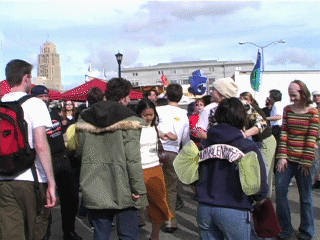
Audio - DJ Mix On Polk/Grove (MP3 - 5 MB)
DJ Mix On Polk/Grove (Hi-res 66 MB)
DJ Mix On Polk/Grove - All (Lo-res 27 MB)
DJ Mix On Polk/Grove - Part 1 of 2 (Lo-res 12 MB)
DJ Mix On Polk/Grove - Part 2 of 2 (Lo-res 15 MB)
3 minority caucuses want Coble renounced
House leaders asked to repudiate remarks by N.C. congressman
Three minority congressional caucuses asked House leaders Wednesday to denounce remarks by Rep. Howard Coble, R-N.C., defending the internment of Japanese-Americans during World War II.The Congressional Asian Pacific American Caucus, the Congressional Black Caucus and the Congressional Hispanic Caucus called on leaders to repudiate the remarks.
"As our country is engaged in a war against terrorism, and is on the brink of a war against Iraq, respect for civil liberties is crucial to ensure that we do not repeat the mistakes of the past," the groups said in a letter to House Speaker Dennis Hastert, R-Ill., and Judiciary Committee chairman James Sensenbrenner, R-Wis.
"To demonstrate that you have learned from the Trent Lott experience and the importance of getting history right, we ask you to repudiate Congressman Coble's statements as an inaccurate, misleading and potentially damaging view of history," the letter said.
The caucuses also asked House leaders to pass a resolution that calls for a "Day of Remembrance" for the internment of Japanese-Americans during World War II.
Neither Hastert's nor Sensenbrenner's offices returned telephone messages Wednesday seeking comment.
Coble chief of staff Missy Branson referred only to Coble's written statement of Feb. 10 in which he said, "I regret that many Japanese and Arab Americans found my choice of words offensive because that was certainly not my intent."
In a radio show appearance Feb. 4, Coble disagreed with a caller who said Arab-Americans should be confined, but appeared to defend the internment of Japanese-Americans during World War II.
"We were at war. They were an endangered species," Coble said. "For many of these Japanese-Americans, it wasn't safe for them to be on the street."
Coble said most Japanese-Americans during World War II, like most Arab-Americans today, were not America's enemies, but President Roosevelt had to consider the nation's security.
"Some probably were intent on doing harm to us," he said, "just as some of these Arab-Americans are probably intent on doing harm to us."
The remarks sparked protests from several minority groups and from three Asian-American congressmen: Reps. Mike Honda, D-Calif., Robert Matsui, D-Calif., and David Wu, D-Ore.
The Democratic National Committee has asked Coble to resign as chairman of the House Crime, Terrorism and Homeland Security subcommittee.
Here is the full text of the article in case the link goes bad:
http://www.charlotte.com/mld/observer/news/local/5326983.htm
Posted on Thu, Mar. 06, 2003 story:PUB_DESC
3 minority caucuses want Coble renounced
House leaders asked to repudiate remarks by N.C. congressman
Associated Press
WASHINGTON - Three minority congressional caucuses asked House leaders Wednesday to denounce remarks by Rep. Howard Coble, R-N.C., defending the internment of Japanese-Americans during World War II.
The Congressional Asian Pacific American Caucus, the Congressional Black Caucus and the Congressional Hispanic Caucus called on leaders to repudiate the remarks.
"As our country is engaged in a war against terrorism, and is on the brink of a war against Iraq, respect for civil liberties is crucial to ensure that we do not repeat the mistakes of the past," the groups said in a letter to House Speaker Dennis Hastert, R-Ill., and Judiciary Committee chairman James Sensenbrenner, R-Wis.
"To demonstrate that you have learned from the Trent Lott experience and the importance of getting history right, we ask you to repudiate Congressman Coble's statements as an inaccurate, misleading and potentially damaging view of history," the letter said.
The caucuses also asked House leaders to pass a resolution that calls for a "Day of Remembrance" for the internment of Japanese-Americans during World War II.
Neither Hastert's nor Sensenbrenner's offices returned telephone messages Wednesday seeking comment.
Coble chief of staff Missy Branson referred only to Coble's written statement of Feb. 10 in which he said, "I regret that many Japanese and Arab Americans found my choice of words offensive because that was certainly not my intent."
In a radio show appearance Feb. 4, Coble disagreed with a caller who said Arab-Americans should be confined, but appeared to defend the internment of Japanese-Americans during World War II.
"We were at war. They were an endangered species," Coble said. "For many of these Japanese-Americans, it wasn't safe for them to be on the street."
Coble said most Japanese-Americans during World War II, like most Arab-Americans today, were not America's enemies, but President Roosevelt had to consider the nation's security.
"Some probably were intent on doing harm to us," he said, "just as some of these Arab-Americans are probably intent on doing harm to us."
The remarks sparked protests from several minority groups and from three Asian-American congressmen: Reps. Mike Honda, D-Calif., Robert Matsui, D-Calif., and David Wu, D-Ore.
The Democratic National Committee has asked Coble to resign as chairman of the House Crime, Terrorism and Homeland Security subcommittee.
So I was planning on being on a plane all day today, but I decided to wait a day and rest up a bit before this week's SXSW Conference in Austin, TX.
I didn't get into the Music Showcase as I had hoped, but I'll still be there all week and I'm going to bring my guitar just in case any of you with gigs feel like letting a girl with a guitar sing a quick 3 minute song or two before your set. (Or perhaps in the middle of your party -- I only have two songs so I can't take it over -- and I need zero preparation or set-up -- just let me sit down somewhere with the guitar.)
Shoot me an email if you're interested: lisarein@finetuning.com.
Attention: Speakers and bands. I've got my camera and a relatively flexible roaming schedule. There's no reason why I couldn't roam over you're way if you'd appreciate some footage of your work. Just drop me a line.
Okay so what's in the kitty for today: Raving at the Feb 16 march, The Daily Show takes a look at the Shrub's "Faith-based Aid", Pelosi finally speaks up (a little), and Colin Powell continues to say close to nothing at all...
Plus some clips of the Senate arguing about the war and addressing the issue of the potential future (or lack thereof) of a Kurdish nation under American rule.
Dick and his wife don't like a cartoon of the misses.
Trouble is, parody is supposed to be legal in our "free" country that supposedly comes complete with "free speech" (courtesty of the First Amendment).
White House insists satirist remove image lampooning Lynne Cheney from Web site
By Larry Neumeister for the AP.
An Internet lampoon of Vice President Dick Cheney's wife is no laughing matter at the White House, which has asked a satirist to remove pictures of her -- complete with red clown noses -- from his Web site.But the New York Civil Liberties Union struck back Wednesday on behalf of John A. Wooden, 31, threatening a lawsuit to protect his First Amendment rights to parody the White House and Bush officials on his site, whitehouse.org.
The official White House site is whitehouse.gov.
Cheney counsel David S. Addington warned Wooden's Chickenhead Productions Inc. that Lynne V. Cheney's name and pictures -- altered to show her with a red clown's nose and a missing tooth -- could not be used to make money without her consent, and asked Wooden to delete the photos and "fictitious biographical statement about her."
Instead, Wooden cautioned Web site visitors that the vice president "wishes you to be aware ... that some/all of the biographic information contained on this PARODY page about Mrs. Cheney may not actually be true."
And, it added, the editors of the Web site were "confident that any rumors about Mrs. Cheney formerly being a crystal meth pusher are 100 percent likely to be absolutely untrue. Similarly, any stories about her penchant for licking brandy Alexanders off the hirsute belly of her spouse are all lies, lies, lies!"
Here is the full text of the article in case the link goes bad:
http://www.sfgate.com/cgi-bin/article.cgi?file=/news/archive/2003/03/06/national0711EST0502.DTL
White House insists satirist remove image lampooning Lynne Cheney from Web site
LARRY NEUMEISTER, Associated Press Writer Thursday, March 6, 2003
(03-06) 04:11 PST NEW YORK (AP) --
An Internet lampoon of Vice President Dick Cheney's wife is no laughing matter at the White House, which has asked a satirist to remove pictures of her -- complete with red clown noses -- from his Web site.
But the New York Civil Liberties Union struck back Wednesday on behalf of John A. Wooden, 31, threatening a lawsuit to protect his First Amendment rights to parody the White House and Bush officials on his site, whitehouse.org.
The official White House site is whitehouse.gov.
Cheney counsel David S. Addington warned Wooden's Chickenhead Productions Inc. that Lynne V. Cheney's name and pictures -- altered to show her with a red clown's nose and a missing tooth -- could not be used to make money without her consent, and asked Wooden to delete the photos and "fictitious biographical statement about her."
Instead, Wooden cautioned Web site visitors that the vice president "wishes you to be aware ... that some/all of the biographic information contained on this PARODY page about Mrs. Cheney may not actually be true."
And, it added, the editors of the Web site were "confident that any rumors about Mrs. Cheney formerly being a crystal meth pusher are 100 percent likely to be absolutely untrue. Similarly, any stories about her penchant for licking brandy Alexanders off the hirsute belly of her spouse are all lies, lies, lies!"
NYCLU lawyer Chris Dunn wrote the office of the vice president that the material was "fully protected by the First Amendment."
"With everything happening in the world, you'd think the office of the vice president would have something more important to do than sending letters to political satirists," Wooden said.
A spokeswoman for Cheney's office, Jennifer Millerwise, confirmed the letter from Addington was authentic but said she otherwise had no comment.
For those of you in the SF Bay Area, you might want to check out Down and Out In the Magic Kingdom author Cory Doctorow tonight at The Booksmith on Haight and Cole in San Francisco at 7pm.
I'll be recording it, but I'm sure I won't get it up anytime soon...I'm just swamped!
See you there!
Tomorrow's the day you'll need to contact your representatives to tell them to vote against Estrada.
Make sure the staffers know you're a constituent. Then urge your
Senators to:"Please SUPPORT the filibuster to stop Miguel Estrada.
Please vote AGAINST cloture."Please let us know you're making these important calls, at:
http://www.moveon.org/callmade2.html
.....
A recent New York Times story on the filibuster is at:
http://www.nytimes.com/2003/02/12/politics/12ESTR.htmlFor more information on Estrada, there's a good fact sheet at:
http://www.pfaw.org/pfaw/general/default.aspx?oid=7795* For more information on filibusters, see our bulletin at:
http://www.moveon.org/moveonbulletin/bulletin11.html
Dear MoveOn member,
As we continue our Iraq campaign, we're also working to track the
most pressing domestic challenges from the Bush administration. While
Iraq is taking all the media focus, the right wing is using this
diversion to cover attacks on almost every front.
Tomorrow -- Thursday, March 6th -- our ability to withstand this
onslaught may come down to one crucial Senate vote. This vote
-- on the Miguel Estrada judicial nomination -- is widely seen as
a key moment defining whether the Democratic opposition can turn
back the worst of the right-wing initiatives.
The Senate will be voting on the filibuster* on the nomination of
Miguel Estrada to the D.C. appeals court. We need to support this
filibuster and the courageous Senators who are stepping forward
at this key moment. Please call your Senators *immediately* to make
your voice heard.
We've arranged a TOLL-FREE number for you to use. Please call it
twice to speak with both your Senators:
1-888-508-2974
If that number is busy, please call your Senators directly, at:
Senator Feinstein
DC Phone: 202-224-3841
Senator Boxer
DC Phone: 202-224-3553
Make sure the staffers know you're a constituent. Then urge your
Senators to:
"Please SUPPORT the filibuster to stop Miguel Estrada.
Please vote AGAINST cloture."
Please let us know you're making these important calls, at:
http://www.moveon.org/callmade2.html
Miguel Estrada is a stealth right-wing extremist who has never served
as a judge before, yet has been nominated by the White House to a seat
on America's second-highest court. He stonewalled the Senate during
his confirmation hearings last year, refusing to answer basic questions
about his legal & judicial philosophy. Estrada is widely thought to be
President Bush's top choice for a seat on the U.S. Supreme Court. His
silence on his views on the law is a direct challenge to all of us.
Calling Estrada's behavior "a new height of arrogance," Senators Tom
Daschle (D-SD) and Harry Reid (D-NV) have finally gotten their fellow
Democrats to take a unified stand on principle, and are rightly
refusing to allow Estrada's confirmation.
They have launched a filibuster -- a tactic of last resort that is a
minority party's only recourse to ensure that a narrow majority party
does not gain absolute power. It's a bold move. If the filibuster
holds, as it has for 3 weeks now, it will send a clear signal that the
right wing can not ram its radically unfair agenda through Congress.
If it fails, that will send the opposite, frightening message.
In effect, the Estrada filibuster is now our main line of defense
safeguarding the democracy we believe in and the society we want our
children to inherit. Republicans have just called for a "cloture" vote
-- an attempt to break the filibuster -- to take place this Thursday.
MoveOn members have played a huge part in making this filibuster
possible. For weeks, key Senators have been citing our thousands of
phone calls as a major force keeping the Democrats together. Even
today, they're talking about what a difference we're making.
Unity among Senators to maintain this filibuster is crucial. Please
call your Senators right now.
Thank you.
Sincerely,
--The MoveOn Team
Carrie, Eli, Joan, Peter, Wes, and Zack
March 5, 2003
P.S.:
A recent New York Times story on the filibuster is at:
http://www.nytimes.com/2003/02/12/politics/12ESTR.html
For more information on Estrada, there's a good fact sheet at:
http://www.pfaw.org/pfaw/general/default.aspx?oid=7795
* For more information on filibusters, see our bulletin at:
http://www.moveon.org/moveonbulletin/bulletin11.html
________________
This is a message from MoveOn.org. To unsubscribe from this list,
please visit our subscription management page at:
http://moveon.org/s?i=1128-1744928-IYWozvL5Seetc_vBqmS4nw
Advisors warn Bush he faces "humiliating" defeat on UN resolution
By the staff at Capital Hill Blue.
"You will lose, Mr. President," Powell told Bush. "You will lose badly and the United States will be humiliated on the world stage."
Here is the full text of the article in case the link goes bad:
http://www.capitolhillblue.com/artman/publish/article_1870.shtml
Last Updated: Mar 4th, 2003 - 23:00:40
1600 Pennsylvania
Advisors warn Bush he faces "humiliating" defeat on UN resolution
By CHB Staff
Mar 4, 2003, 06:22
Email this article
Printer friendly page
Senior aides to President George W. Bush say he faces a humiliating defeat before the United Nations Security Council next week.
And signs emerged today that the U.S. may withdraw the resolution from security council consideration.
Secretary of State Colin Powell, fresh from his latest round of meetings with representatives of countries on the Security Council, delivered the bad news to Bush on Monday.
"You will lose, Mr. President," Powell told Bush. "You will lose badly and the United States will be humiliated on the world stage."
President Bush
Powell told Bush he has only four of the nine votes needed for approval of a second resolution. As a result, some White House advisors are now urging the President to back off his tough stance on war with Iraq and give UN weapons inspectors more time.
"We have no other choice," admits one Bush advisor. "We don't have the votes. We don't have the support."
Presidential spokesman Ari Fleisher, in today's press briefing, appeared to signal a U.S. retreat from demanding a vote next week, saying "the president has said he believes that a vote is desirable. It is not mandatory."
John Negroponte, U.S. ambassador to the United Nations, said that while it is too early for the United States to withdraw the resolution, "we haven't crossed that bridge," Negroponte said.
Powell told Bush on Monday that Turkey's refusal to allow U.S. troops to stage at the country's border with Iraq doomed any chance of consensus at the UN.
"Many were watching Turkey," Powell told Bush. "Had they agreed, it might have helped us sway critical votes."
Powell met privately today with Mexico Foreign Minister Luis Ernesto Derbez to try and "parse" new language for the second resolution to satisfy a Mexican request to modify the text and extend the deadline for weapons inspections.
"It (the meeting) did not produce results," a Powell spokesman said afterwards.
Publicly, Powell is leaving the door open for the U.S. to withdraw the resolution, telling a German television interviewer: "At the start of next week we'll decide when, depending on what we have heard, we will vote on a resolution. It will be a difficult vote for the U.N. Security Council."
Some Bush aides now admit privately that the President, for all his tough talk, may have to back down and postpone his plans to invade Iraq in the near future, delaying any invasion until April or May at the earliest.
"The vote in Turkey fucked things up big time," grumbles one White House aide. "It pushes our timetable back. On the other hand, it might give us a chance to save face."
"Saving face" could mean backing away from a showdown with the UN Security Council next week and agreeing to let the weapons inspection process run its course.
"The arrest of Khalid Shaikh Mohammed gives us some breathing room," says a Bush strategist. "We can concentrate on the favorable publicity generated by the arrest and the valuable intelligence we have gained from that event."
Mohammed, arrested in Pakistan, masterminded the 9-11 terrorist attacks. CIA agents found computer files, memos and other materials which pointed to plans for new attacks against the U.S.
"The prudent thing to do would be to let Iraq cool off on a back burner and concentrate on Mohammed," says Republican strategist Arnold Beckins. "Saddam isn't going anywhere. There's too much heat on him right now for him to pull something."
But a delay would not mean a war with Iraq is off. Most Bush strategists and Pentagon military planners agree that the U.S. will probably have to take military action sooner or later.
Right now, only the U.S., Britain and Spain favor immediate military action against Iraq. With most of the other allies lining up against the U.S., Bush faces both a diplomatic and public relations nightmare if he proceeds against Hussein without setting a proper public stage.
"We've always needed an exit strategy," admits a White House aide. "Circumstances have given us one. Perhaps we shouldn't ignore it."
Chicago, February 27, 2002: Today, the Board of Directors of the Bulletin of the Atomic Scientists moves the minute hand of the “Doomsday Clock,” the symbol of nuclear danger, from nine to seven minutes to midnight, the same setting at which the clock debuted 55 years ago. Since the end of the Cold War in 1991, this is the third time the hand has moved forward.We move the hands taking into account both negative and positive developments. The negative developments include too little progress on global nuclear disarmament; growing concerns about the security of nuclear weapons materials worldwide; the continuing U.S. preference for unilateral action rather than cooperative international diplomacy; U.S. abandonment of the Anti-Ballistic Missile (ABM) Treaty and U.S. efforts to thwart the enactment of international agreements designed to constrain proliferation of nuclear, chemical, and biological weapons; the crisis between India and Pakistan; terrorist efforts to acquire and use nuclear and biological weapons; and the growing inequality between rich and poor around the world that increases the potential for violence and war. If it were not for the positive changes highlighted later in this statement, the hands of the clock might have moved closer still.
The Bulletin of the Atomic Scientists, founded by a group of World War II-era Manhattan Project scientists, has warned the world of nuclear dangers since 1945. The September 11 attacks, and the subsequent and probably unrelated use of the mail to deliver deadly anthrax spores, breached previous boundaries for terrorist acts and should have been a global wake-up call. Moving the clock’s hands at this time reflects our growing concern that the international community has hit the “snooze” button rather than respond to the alarm.
Here is the full text of the article in case the link goes bad:
http://www.thebulletin.org/media/current.html
Chicago, February 27, 2002: Today, the Board of Directors of the Bulletin of the Atomic Scientists moves the minute hand of the “Doomsday Clock,” the symbol of nuclear danger, from nine to seven minutes to midnight, the same setting at which the clock debuted 55 years ago. Since the end of the Cold War in 1991, this is the third time the hand has moved forward.
We move the hands taking into account both negative and positive developments. The negative developments include too little progress on global nuclear disarmament; growing concerns about the security of nuclear weapons materials worldwide; the continuing U.S. preference for unilateral action rather than cooperative international diplomacy; U.S. abandonment of the Anti-Ballistic Missile (ABM) Treaty and U.S. efforts to thwart the enactment of international agreements designed to constrain proliferation of nuclear, chemical, and biological weapons; the crisis between India and Pakistan; terrorist efforts to acquire and use nuclear and biological weapons; and the growing inequality between rich and poor around the world that increases the potential for violence and war. If it were not for the positive changes highlighted later in this statement, the hands of the clock might have moved closer still.
The Bulletin of the Atomic Scientists, founded by a group of World War II-era Manhattan Project scientists, has warned the world of nuclear dangers since 1945. The September 11 attacks, and the subsequent and probably unrelated use of the mail to deliver deadly anthrax spores, breached previous boundaries for terrorist acts and should have been a global wake-up call. Moving the clock’s hands at this time reflects our growing concern that the international community has hit the “snooze” button rather than respond to the alarm.
Troubling trends and missed opportunities
More than 31,000 nuclear weapons are still maintained by the eight known nuclear powers, a decrease of only 3,000 since 1998. Ninety-five percent of these weapons are in the United States and Russia, and more than 16,000 are operationally deployed. Even if the United States and Russia complete their recently announced arms reductions over the next 10 years, they will continue to target thousands of nuclear weapons against each other.
Furthermore, many if not most of the U.S. warheads removed from the active stockpile will be placed in storage (along with some 5,000 warheads already held in reserve) rather than dismantled, for the express purpose of re-deploying them in some future contingency. As a result, the total U.S. stockpile will remain at more than 10,000 warheads for the foreseeable future. Russia, on the other hand, seeks a verifiable, binding agreement that would ensure retired U.S. and Russian weapons are actually destroyed, a position we support.
Despite a campaign promise to re-think nuclear policy, the Bush administration has taken no steps to significantly alter nuclear targeting doctrine or reduce the day-to-day alert status of U.S. nuclear forces. If Russia is no longer an adversary, what is the rationale for retaining the ability to incinerate more than 2,000 Russian targets in as little as 30 minutes (or at all)?
Meanwhile, the U.S. national weapons laboratories, with the support of some in Congress, are hard at work refining existing warheads and designing entirely new weapons, with a special emphasis on those able to attack and destroy hardened and deeply buried targets. And to ensure that such new designs can be tested, the U.S. administration seeks to shorten the time required to resume testing to as little as twelve months—a move that can only encourage other countries, including India, Pakistan, and China, to consider resuming testing. Although the United States has not conducted a full-scale test since 1992—and the administration says it has no plans to resume testing at this time—it refuses to recognize the overwhelming international support for the Comprehensive Test Ban Treaty (CTBT) and refuses to participate in international meetings to discuss implementing the treaty. Should the required signatories, including India and Pakistan, fail to ratify the CTBT, thus jeopardizing its entry into force, the world will lose an essential tool in halting the further development and spread of nuclear weapons.
Russia and the United States continue to maintain enormous stockpiles of fissile material. Russia has more than 1,000 metric tons of weapon-grade uranium and about 140 metric tons of weapon-grade plutonium, and the United States has nearly 750 metric tons of weapon-grade uranium and 85 metric tons of weapon-grade plutonium. (Just 55 pounds—25 kilograms—of weapon-grade uranium, or 17.6 pounds of plutonium—8 kilograms—are needed to construct a rudimentary nuclear weapon.)
Fortunately, of the hundreds of attempted smuggling transactions involving radioactive materials that have been thwarted since 1991, the vast majority involved materials that were not weapons usable or were of insufficient quantity to construct a nuclear weapon. Only 18 of these cases involved the theft of weapon-grade uranium or plutonium from facilities in the former Soviet Union. At the same time, Al Qaeda operatives were actively seeking to acquire radioactive materials to fashion either a crude nuclear weapon or a radiological dispersion device, commonly known as a “dirty bomb.”
The increase in the number of smuggling attempts in recent years serves as a clear warning that surplus nuclear weapons and weapons materials may not be entirely secure. Yet since 1991, successive U.S. and Russian administrations have failed to push for either a full inventory of weapons and materials, or for measures to confirm their destruction. As a result, it is now essentially impossible to verify whether all materials in the United States and Russia are accounted for or whether all weapons are secure. This squandered opportunity has enormous security ramifications.
The U.S. administration’s decision to withdraw from the ABM Treaty is a matter of great concern. The administration’s rationale—that the treaty is a relic that endangers U.S. security interests—is disingenuous. Regrettably, the United States was unwilling to consider any compromise that would have preserved the basic framework of the treaty, and therefore blocked pursuit of a compromise that would have allowed additional testing but maintained some limits on defenses. Abandoning the treaty will have serious repercussions for years to come.
The crisis between India and Pakistan, touched off by a December 13 terrorist attack on the Indian parliament, marks the closest two states have come to nuclear war since the Cuban Missile Crisis. When the hands of the clock were moved forward in 1998, to nine minutes to midnight, it was in part in anticipation of just this sort of scenario.
Nuclear proliferation continues to pose dangers, both regionally and internationally. Of the countries most often described as seeking nuclear weapons and/or ballistic missiles— Iraq, Iran, and North Korea—North Korea has repeatedly signaled its willingness to turn back, including a decision last year to extend its unilateral moratorium on missile flight tests through 2003. Yet the U.S. administration has abandoned negotiations with that country, and in his State of the Union message, President George W. Bush lumped all three countries together as an “axis of evil,” warning that, “The United States of America will not permit the world’s most dangerous regimes to threaten us with the world’s most destructive weapons.” The preference implicit in this statement for preemptive force over diplomacy, and for unilateral action rather than international cooperation, is likely to complicate efforts to defeat terrorism and strengthen global security.
The confluence of the rise of extremists who sacrifice their lives for their cause combined with weapons of mass destruction is an especially worrisome development. So too is the increased awareness since September 11 that terrorists need not manufacture or purchase fissile materials to fashion a crude nuclear weapon or release dangerous amounts of radiation. They need only attack poorly guarded nuclear power plants and nuclear weapons facilities, which contain sizable quantities of these materials. Significantly, President Bush acknowledged on January 29, 2002, that diagrams of U.S. nuclear power plants were found among Al Qaeda materials in Afghanistan.
When resetting the clock we have often noted that the growing disparities between rich and poor increase the potential for violence and war. Poverty and repression breed anger and desperation. Charismatic leaders with easy answers prey on the dispossessed and disaffected, channeling their anger into dangerous and destructive activities. The global community must recognize these facts and do much more to address them. The success of the war on terrorism depends not only on disrupting and destroying terrorist organizations, but also on eradicating the conditions that give rise to terror.
We therefore fully support the statement circulated by Bulletin sponsor John Polanyi and signed by 110 Nobel laureates last December, which reads in part, “The only hope for the future lies in cooperative international action, legitimized by democracy. . . . To survive in the world we have transformed, we must learn to think in a new way.”
Some welcome developments
At the same time, we want to recognize some welcome trends. Since we last set the clock in 1998, the 187 governments party to the Nuclear Non-Proliferation Treaty, including the major nuclear powers, agreed to a comprehensive set of commitments and measures to enhance nonproliferation and fulfill long-standing nuclear disarmament pledges. These agreements were rightly heralded as a political breakthrough, but the real test will be in how seriously the nuclear powers take their obligations to implement the practical steps to which they have agreed. In this regard, we welcome France’s dismantling of its Pacific nuclear test site and military reprocessing facilities and commend Britain’s research program on verifying multilateral reductions in nuclear weapons as early steps in the right direction.
U.S. funding and technical assistance continues to make significant and cost-effective contributions to international security by working to ensure that Russian nuclear weapons are dismantled, and that nuclear materials and nuclear expertise do not leave Russia. Much remains to be done, however. After initially questioning the value of these cooperative programs, the Bush administration now seeks to increase their funding.
Since 2000, Russia has urged the United States to agree to reductions in the two countries’ arsenals to 1,500 warheads each. President Bush’s announcement in November 2001 that U.S. “operationally deployed strategic warheads” would be reduced to between 1,700 to 2,200 by 2012—an intention reaffirmed in the administration’s Nuclear Posture Review in January—is positive news. It is also the first major commitment to reducing nuclear weapons made by either the United States or Russia since 1997. Although there are serious questions about how permanent these reductions will be, and how long they will take to enact, they are nevertheless an important step away from the grotesque levels of the Cold War.
What it would take to turn back the clock
As a first step in moving toward a safer world, we urge the United States and Russia to commit to reduce their nuclear arsenals to no more than 1,000 warheads each by the end of the decade. Each side should be free to choose its own means for achieving this goal, but both should commit, in writing, to transparency and verification provisions to ensure that the cuts are carried out and the delivery systems and warheads dismantled. Both countries should commit to storing and disposing of the resulting fissile material in a manner that makes the reductions irreversible. In addition, each side should commit to destroying at least half of the inactive weapons it currently stores within five years, and commit to destroying them all within 10 years.
These reductions must include tactical nuclear weapons as well. Significantly, the Bush administration’s Nuclear Posture Review calls for studying whether the navy should be permitted to retire its nuclear-armed cruise missiles. If these weapons were retired, only about 150 air force bombs stored in seven European countries would remain in the U.S. operational tactical stockpile. We urge the swift retirement and destruction of all tactical nuclear weapons in Europe, and strongly encourage all states with nuclear weapons to begin negotiations to eliminate these weapons worldwide.
We also urge the United States and Russia to finally recognize the end of the Cold War by abandoning the practice of maintaining thousands of nuclear weapons on high alert, ready to be fired within minutes. This practice, born of fear and uncertainty during the Cold War, is a dangerous anachronism.
Significantly greater funding must be provided to secure and safeguard nuclear weapons and weapons materials in Russia, the United States, and elsewhere. For example, the current level of U.S. funding to assist Russia with such efforts is less than a third of the $3 billion annual expenditure recommended by an Energy Department task force last year. If weapons materials and expertise are not more tightly controlled, no city in the world will be safe from nuclear attack.
A Fissile Material Cut-off Treaty must be placed back on the international arms control agenda. Every year that passes without a verifiable means of stopping the production worldwide of nuclear weapons materials makes the task of constraining nuclear proliferation more difficult. In addition, as part of such an agreement, all states with fissile material inventories should declare their current holdings and submit to an international verification and transparency regime that would continuously monitor surplus inventories and develop safe, effective, and permanent disposal options.
The United States should reconsider its plans to walk away from the ABM Treaty in June. As the U.S. intelligence community recently concluded, ballistic missiles are neither the most likely nor the most destructive threat facing the United States.
Other measures that would increase global stability include a ban on the deployment of space-based weapons, whether designed to damage or disrupt satellites or to attack targets on the ground or in the air; full adherence by all parties to the Chemical Weapons Convention; and the resumption of negotiations on a verification protocol for the Biological Weapons Convention. Stronger international support for the global movement to limit the spread of small arms and to ban land mines, which each year maim or kill tens of thousands of people, most of them innocent civilians, would also be a welcome and necessary development.
The clock is ticking.
Bill Moyers on Patriotism and the American Flag
I wore my flag tonight. First time. Until now I haven't thought it necessary to display a little metallic icon of patriotism for everyone to see. It was enough to vote, pay my taxes, perform my civic duties, speak my mind, and do my best to raise our kids to be good Americans...It no more occurred to me to flaunt the flag on my chest than it did to pin my mother's picture on my lapel to prove her son's love. Mother knew where I stood; so does my country. I even tuck a valentine in my tax returns on April 15.
So what's this doing here? Well, I put it on to take it back. The flag's been hijacked and turned into a logo — the trademark of a monopoly on patriotism. On those Sunday morning talk shows, official chests appear adorned with the flag as if it is the good housekeeping seal of approval. During the State of the Union, did you notice Bush and Cheney wearing the flag? How come? No administration's patriotism is ever in doubt, only its policies. And the flag bestows no immunity from error. When I see flags sprouting on official lapels, I think of the time in China when I saw Mao's little red book on every official's desk, omnipresent and unread.
But more galling than anything are all those moralistic ideologues in Washington sporting the flag in their lapels while writing books and running Web sites and publishing magazines attacking dissenters as un-American. They are people whose ardor for war grows disproportionately to their distance from the fighting. They're in the same league as those swarms of corporate lobbyists wearing flags and prowling Capitol Hill for tax breaks even as they call for more spending on war.
Here is the full text of the article in case the link goes bad:
http://www.pbs.org/now/commentary/moyers19.html
Bill Moyers on Patriotism and the American Flag
I wore my flag tonight. First time. Until now I haven't thought it necessary to display a little metallic icon of patriotism for everyone to see. It was enough to vote, pay my taxes, perform my civic duties, speak my mind, and do my best to raise our kids to be good Americans.
Sometimes I would offer a small prayer of gratitude that I had been born in a country whose institutions sustained me, whose armed forces protected me, and whose ideals inspired me; I offered my heart's affections in return. It no more occurred to me to flaunt the flag on my chest than it did to pin my mother's picture on my lapel to prove her son's love. Mother knew where I stood; so does my country. I even tuck a valentine in my tax returns on April 15.
So what's this doing here? Well, I put it on to take it back. The flag's been hijacked and turned into a logo — the trademark of a monopoly on patriotism. On those Sunday morning talk shows, official chests appear adorned with the flag as if it is the good housekeeping seal of approval. During the State of the Union, did you notice Bush and Cheney wearing the flag? How come? No administration's patriotism is ever in doubt, only its policies. And the flag bestows no immunity from error. When I see flags sprouting on official lapels, I think of the time in China when I saw Mao's little red book on every official's desk, omnipresent and unread.
But more galling than anything are all those moralistic ideologues in Washington sporting the flag in their lapels while writing books and running Web sites and publishing magazines attacking dissenters as un-American. They are people whose ardor for war grows disproportionately to their distance from the fighting. They're in the same league as those swarms of corporate lobbyists wearing flags and prowling Capitol Hill for tax breaks even as they call for more spending on war.
So I put this on as a modest riposte to men with flags in their lapels who shoot missiles from the safety of Washington think tanks, or argue that sacrifice is good as long as they don't have to make it, or approve of bribing governments to join the coalition of the willing (after they first stash the cash.) I put it on to remind myself that not every patriot thinks we should do to the people of Baghdad what Bin Laden did to us. The flag belongs to the country, not to the government. And it reminds me that it's not un-American to think that war — except in self-defense — is a failure of moral imagination, political nerve, and diplomacy. Come to think of it, standing up to your government can mean standing up for your country.
Senators fight over other nominees as Estrada debate drags on
By Jesse Holland for the SF Chronicle.
Senate Republicans forced committee approval of three of President Bush's judicial nominees Thursday, despite Democrats' efforts to delay action as they have delayed the high-profile nomination of Miguel Estrada to the federal appellate bench.Democrats said Senate Judiciary Chairman Orrin Hatch, R-Utah, overrode committee rules to send U.S. Appeals Court nominees Deborah Cook and John Roberts to the Republican-controlled Senate, despite objections that they had the right to continue holding the nominees in committee.
Hatch said he was within his rights under committee rules to force a final vote.
"We're not going to have filibusters in committee," said an angry Hatch at the end of a three-hour hearing in which sharp words were exchanged between himself and Sen. Edward Kennedy, D-Mass.
The hearing was heated at times, with Democrats at one point walking out to prevent Hatch from having enough committee members present to vote. "You may bully some but you're not going to bully me," Kennedy told Hatch.
Here is the full text of the article in case the link goes bad:
http://truthout.org/docs_03/030103G.shtml
Thursday 27 February 2003
Senate Republicans forced committee approval of three of President Bush's judicial nominees Thursday, despite Democrats' efforts to delay action as they have delayed the high-profile nomination of Miguel Estrada to the federal appellate bench.
Democrats said Senate Judiciary Chairman Orrin Hatch, R-Utah, overrode committee rules to send U.S. Appeals Court nominees Deborah Cook and John Roberts to the Republican-controlled Senate, despite objections that they had the right to continue holding the nominees in committee.
Hatch said he was within his rights under committee rules to force a final vote.
"We're not going to have filibusters in committee," said an angry Hatch at the end of a three-hour hearing in which sharp words were exchanged between himself and Sen. Edward Kennedy, D-Mass.
The hearing was heated at times, with Democrats at one point walking out to prevent Hatch from having enough committee members present to vote. "You may bully some but you're not going to bully me," Kennedy told Hatch.
"You're not going to bully me either," Hatch replied later.
For three weeks, Democrats have held up a confirmation vote on Estrada's nomination by threatening a full-blown filibuster.
Now Democrats are likely at least to ask for an extended Senate floor debate on Roberts and Cook to protest Hatch's action, even though both got votes from Judiciary Democrats.
Sen. Patrick Leahy of Vermont, the lead Judiciary Democrat, said Hatch is ignoring committee rules that require a Democrat to agree to end a committee filibuster. Hatch said Senate parliamentarians informed him that as chairman he could force a vote on the president's nominees.
Cook, an Ohio Supreme Court justice, was approved by the committee by a 12-2 vote, with the rest of the Democrats passing or voting "present" to reserve their right to bring the issue up on the Senate floor. Roberts, a Washington appellate lawyer, was approved by the 19-member committee by a 14-3 vote with the rest of the Democrats passing or voting present.
The committee also sent the appellate court nomination of Justice Department lawyer Jay Bybee of Nevada to the Senate for confirmation by a 12-6 vote, with Leahy again voting present. Democrats had agreed earlier to allow his nomination through regardless of what happened with Cook and Roberts.
Democrats say they didn't have enough time to question Cook and Roberts during their original confirmation hearing because Hatch had three federal appellate candidates at the same hearing, instead of considering them one at a time. Liberals have accused Cook of ruling with business interests too much as a judge, and Roberts of opposing abortion rights, affirmative action and environmental protection laws.
Democrats blocked a committee vote on Roberts and Cook last week in hopes of asking additional questions, but White House counsel Alberto Gonzales said Wednesday the White House would resist additional hearings on the two, who were first nominated in May 2001.
Democrats are now likely to at least force a debate on Hatch's decision on the Senate floor, and could even filibuster the nominations of Cook and Roberts. "I don't expect it but I wouldn't put it past them," Hatch said.
Senate Democratic Leader Tom Daschle of South Dakota immediately took to the Senate floor to criticize Hatch, saying the maneuver "would not be tolerated."
"It cannot be the case that the rules of a committee will apply until the chairman of a committee deems them inconvenient," Daschle said.
Kennedy said it was a way to "steamroll the nominees through the Judiciary Committee and the Senate."
"It's the ultimate court-packing plan, and Democrats are right to reject it," Kennedy said.
Bush has called it a "travesty" that Democratic senators have refuse to allow a full Senate vote on Estrada's nomination.
"They're blocking the vote on this good man for purely political reasons," Bush said.
Democrats have refused to let Estrada's nomination for the U.S. Court of Appeals for the District of Columbia come up for a final Senate vote for three weeks because they say the Washington lawyer was not forthcoming about his legal opinions during his confirmation hearing last year.
Republicans lack the 60 votes in the 100-member Senate to force Democrats to allow a vote on Estrada.
(In accordance with Title 17 U.S.C. Section 107, this material is distributed without profit to those who have expressed a prior interest in receiving the included information for research and educational purposes.)

Naked demonstrations are becoming a regular event for Australian women.Some 450 Australian women were recently in the news over plans to hold a naked rain dance and more recently, another group of 300 Australian women have staged a war protest in the buff on a Sydney sports field, where they spelled out "No War" with their bodies.
Anti-war nudity may be catching on: some 300 men and women also got naked for peace in Santiago, Chile, where they stripped in a public park over the weekend, and several hundred Australian men spelt out "Peace, man" with their bodies last week in NSW.
Several of the weekend's Chilean protesters, presumably clothed, were later arrested following a march from the park to the presidential palace.
Here is the full text of the article in case the link goes bad:
http://www.nbr.co.nz/home/column_article.asp?id=5294&cid=2&cname=Australia
Home » Australia » More naked Australian women
More naked Australian women
Naked demonstrations are becoming a regular event for Australian women.
Some 450 Australian women were recently in the news over plans to hold a naked rain dance and more recently, another group of 300 Australian women have staged a war protest in the buff on a Sydney sports field, where they spelled out "No War" with their bodies.
Anti-war nudity may be catching on: some 300 men and women also got naked for peace in Santiago, Chile, where they stripped in a public park over the weekend, and several hundred Australian men spelt out "Peace, man" with their bodies last week in NSW.
Several of the weekend's Chilean protesters, presumably clothed, were later arrested following a march from the park to the presidential palace.
In Vancouver, Canada, a group calling itself Artists Against War has been staging smaller rallies in the buff at odd intervals, according to the Vancouver Sun
In Sydney, however, the demonstrations -- to propitiate the rain gods and antagonise the Howard government -- were peaceful and police-protected.
According to AP stories, several hundred protesters later gathered outside Prime Minister Howard's official residence.
The story of Australia's naked activists is gathering momentum and scale as it filters out through the media. South Africa's Sabre News is running a Reuters story that says a thousand women joined to spell out the No War slogan on the Sydney sports field.
It's not the first time Australian women have stripped for peace, actually. AP reports about 750 NSW women stripped and assembled an anti-war slogan with their bodies at the beginning of February.
03-Mar-2003
If you're looking for footage from the February 15, 2003 Protest In San Francisco -- you'll want to take note that I've moved all of the "My Little Adventure In Hacktivism" footage from that day into its own category.

I am writing you to submit my resignation from the Foreign Service of the United States and from my position as Political Counselor in U.S. Embassy Athens, effective March 7. I do so with a heavy heart. The baggage of my upbringing included a felt obligation to give something back to my country......until this Administration it had been possible to believe that by upholding the policies of my president I was also upholding the interests of the American people and the world. I believe it no longer.
The policies we are now asked to advance are incompatible not only with American values but also with American interests. Our fervent pursuit of war with Iraq is driving us to squander the international legitimacy that has been America’s most potent weapon of both offense and defense since the days of Woodrow Wilson. We have begun to dismantle the largest and most effective web of international relationships the world has ever known. Our current course will bring instability and danger, not security...
...this Administration has chosen to make terrorism a domestic political tool, enlisting a scattered and largely defeated Al Qaeda as its bureaucratic ally. We spread disproportionate terror and confusion in the public mind, arbitrarily linking the unrelated problems of terrorism and Iraq. The result, and perhaps the motive, is to justify a vast misallocation of shrinking public wealth to the military and to weaken the safeguards that protect American citizens from the heavy hand of government. September 11 did not do as much damage to the fabric of American society as we seem determined to so to ourselves. Is the Russia of the late Romanovs really our model, a selfish, superstitious empire thrashing toward self-destruction in the name of a doomed status quo?
...Mr. Secretary, I have enormous respect for your character and ability. You have preserved more international credibility for us than our policy deserves, and salvaged something positive from the excesses of an ideological and self-serving Administration. But your loyalty to the President goes too far. We are straining beyond its limits an international system we built with such toil and treasure, a web of laws, treaties, organizations, and shared values that sets limits on our foes far more effectively than it ever constrained America’s ability to defend its interests.
I am resigning because I have tried and failed to reconcile my conscience with my ability to represent the current U.S. Administration. I have confidence that our democratic process is ultimately self-correcting, and hope that in a small way I can contribute from outside to shaping policies that better serve the security and prosperity of the American people and the world we share.
John Brady Kiesling
Here is the full text of the letter and article in case the link goes bad:
http://truthout.org/docs_03/030103A.shtml
Print This Story E-mail This Story
EDITOR'S NOTE: What follows is a letter of resignation written by John Brady Kiesling, a member of Bush's Foreign Service Corps and Political Counselor to the American embassy in Greece. Kiesling has been a diplomat for twenty years, a civil servant to four Presidents. The letter below, delivered to Secretary of State Colin Powell, is quite possibly the most eloquent statement of dissent thus far put forth regarding the issue of Iraq. The New York Times story which reports on this remarkable event can be found after Kiesling's letter. - wrp
Go to Original
t r u t h o u t | Letter
U.S. Diplomat John Brady Kiesling
Letter of Resignation, to:
Secretary of State Colin L. Powell
ATHENS | Thursday 27 February 2003
Dear Mr. Secretary:
I am writing you to submit my resignation from the Foreign Service of the United States and from my position as Political Counselor in U.S. Embassy Athens, effective March 7. I do so with a heavy heart. The baggage of my upbringing included a felt obligation to give something back to my country. Service as a U.S. diplomat was a dream job. I was paid to understand foreign languages and cultures, to seek out diplomats, politicians, scholars and journalists, and to persuade them that U.S. interests and theirs fundamentally coincided. My faith in my country and its values was the most powerful weapon in my diplomatic arsenal.
It is inevitable that during twenty years with the State Department I would become more sophisticated and cynical about the narrow and selfish bureaucratic motives that sometimes shaped our policies. Human nature is what it is, and I was rewarded and promoted for understanding human nature. But until this Administration it had been possible to believe that by upholding the policies of my president I was also upholding the interests of the American people and the world. I believe it no longer.
The policies we are now asked to advance are incompatible not only with American values but also with American interests. Our fervent pursuit of war with Iraq is driving us to squander the international legitimacy that has been America’s most potent weapon of both offense and defense since the days of Woodrow Wilson. We have begun to dismantle the largest and most effective web of international relationships the world has ever known. Our current course will bring instability and danger, not security.
The sacrifice of global interests to domestic politics and to bureaucratic self-interest is nothing new, and it is certainly not a uniquely American problem. Still, we have not seen such systematic distortion of intelligence, such systematic manipulation of American opinion, since the war in Vietnam. The September 11 tragedy left us stronger than before, rallying around us a vast international coalition to cooperate for the first time in a systematic way against the threat of terrorism. But rather than take credit for those successes and build on them, this Administration has chosen to make terrorism a domestic political tool, enlisting a scattered and largely defeated Al Qaeda as its bureaucratic ally. We spread disproportionate terror and confusion in the public mind, arbitrarily linking the unrelated problems of terrorism and Iraq. The result, and perhaps the motive, is to justify a vast misallocation of shrinking public wealth to the military and to weaken the safeguards that protect American citizens from the heavy hand of government. September 11 did not do as much damage to the fabric of American society as we seem determined to so to ourselves. Is the Russia of the late Romanovs really our model, a selfish, superstitious empire thrashing toward self-destruction in the name of a doomed status quo?
We should ask ourselves why we have failed to persuade more of the world that a war with Iraq is necessary. We have over the past two years done too much to assert to our world partners that narrow and mercenary U.S. interests override the cherished values of our partners. Even where our aims were not in question, our consistency is at issue. The model of Afghanistan is little comfort to allies wondering on what basis we plan to rebuild the Middle East, and in whose image and interests. Have we indeed become blind, as Russia is blind in Chechnya, as Israel is blind in the Occupied Territories, to our own advice, that overwhelming military power is not the answer to terrorism? After the shambles of post-war Iraq joins the shambles in Grozny and Ramallah, it will be a brave foreigner who forms ranks with Micronesia to follow where we lead.
We have a coalition still, a good one. The loyalty of many of our friends is impressive, a tribute to American moral capital built up over a century. But our closest allies are persuaded less that war is justified than that it would be perilous to allow the U.S. to drift into complete solipsism. Loyalty should be reciprocal. Why does our President condone the swaggering and contemptuous approach to our friends and allies this Administration is fostering, including among its most senior officials. Has “oderint dum metuant” really become our motto?
I urge you to listen to America’s friends around the world. Even here in Greece, purported hotbed of European anti-Americanism, we have more and closer friends than the American newspaper reader can possibly imagine. Even when they complain about American arrogance, Greeks know that the world is a difficult and dangerous place, and they want a strong international system, with the U.S. and EU in close partnership. When our friends are afraid of us rather than for us, it is time to worry. And now they are afraid. Who will tell them convincingly that the United States is as it was, a beacon of liberty, security, and justice for the planet?
Mr. Secretary, I have enormous respect for your character and ability. You have preserved more international credibility for us than our policy deserves, and salvaged something positive from the excesses of an ideological and self-serving Administration. But your loyalty to the President goes too far. We are straining beyond its limits an international system we built with such toil and treasure, a web of laws, treaties, organizations, and shared values that sets limits on our foes far more effectively than it ever constrained America’s ability to defend its interests.
I am resigning because I have tried and failed to reconcile my conscience with my ability to represent the current U.S. Administration. I have confidence that our democratic process is ultimately self-correcting, and hope that in a small way I can contribute from outside to shaping policies that better serve the security and prosperity of the American people and the world we share.
John Brady Kiesling
Go to Original
U.S. Diplomat Resigns, Protesting 'Our Fervent Pursuit of War'
By Felicity Barringer
New York Times
Thursday 27 February 2003
UNITED NATIONS — A career diplomat who has served in United States embassies from Tel Aviv to Casablanca to Yerevan resigned this week in protest against the country's policies on Iraq.
The diplomat, John Brady Kiesling, the political counselor at the United States Embassy in Athens, said in his resignation letter, "Our fervent pursuit of war with Iraq is driving us to squander the international legitimacy that has been America's most potent weapon of both offense and defense since the days of Woodrow Wilson."
Mr. Kiesling, 45, who has been a diplomat for about 20 years, said in a telephone interview tonight that he faxed the letter to Secretary of State Colin L, Powell on Monday after informing Thomas Miller, the ambassador in Athens, of his decision.
He said he had acted alone, but "I've been comforted by the expressions of support I've gotten afterward" from colleagues.
"No one has any illusions that the policy will be changed," he said. "Too much has been invested in the war."
Louis Fintor, a State Department spokesman, said he had no information on Mr. Kiesling's decision and it was department policy not to comment on personnel matters.
In his letter, a copy of which was provided to The New York Times by a friend of Mr. Kiesling's, the diplomat wrote Mr. Powell: "We should ask ourselves why we have failed to persuade more of the world that a war with Iraq is necessary. We have over the past two years done too much to assert to our world partners that narrow and mercenary U.S. interests override the cherished values of our partners."
His letter continued: "Even where our aims were not in question, our consistency is at issue. The model of Afghanistan is little comfort to allies wondering on what basis we plan to rebuild the Middle East, and in whose image and interests."
It is rare but not unheard-of for a diplomat, immersed in the State Department's culture of public support for policy, regardless of private feelings, to resign with this kind of public blast. From 1992 to 1994, five State Department officials quit out of frustration with the Clinton administration's Balkans policy.
Asked if his views were widely shared among his diplomatic colleagues, Mr. Kiesling said: "No one of my colleagues is comfortable with our policy. Everyone is moving ahead with it as good and loyal. The State Department is loaded with people who want to play the team game — we have a very strong premium on loyalty."
(In accordance with Title 17 U.S.C. Section 107, this material is distributed without profit to those who have expressed a prior interest in receiving the included information for research and educational purposes.)
Print This Story E-mail This Story
So these as-yet-unnamed energy companies conspired to create the appearance of network congestion so that the state would have to purchase energy from "alternative" suppliers at exorbitant prices.
One more time: Allegedly, (no one's been convicted in a court of law, yet), most or all of the power companies involved in the California power grid misrepresented to the people, businesses and goverment of California that higher-priced energy was needed, due to demand, when it, in fact, was not.
(They lied to make a bunch of money.)
Energy report claims vast cheating of state
Evidence to feds cites $7.5 billion in overcharges
By Mark Martin and Christian Berthelsen for SF Gate.
Among the discoveries:-- Internal memos from several companies show power traders developed complicated trading strategies that resemble some of the schemes Enron used in California. In separate proceedings, two Enron traders have pleaded guilty in federal court to wire fraud over the company's colorfully named market games like "Death Star" and "Get Shorty." Several strategies involved zapping megawatts around the West Coast to create transmission congestion -- or the appearance of congestion -- and volatility in the marketplace, driving up prices.
Some companies partnered with municipal utilities within California on the gaming strategies, the report shows.
-- Electricity generators purposely shut down power plants in California to take advantage of shortages and earn more money selling alternative megawatts. Two companies -- Reliant Resources and Williams Cos. -- have been forced to turn over money after tape recordings revealed power plant operators and traders discussing turning off plants to boost profits, and a source said the state had uncovered other examples similar to cases brought against Reliant and Williams.
-- Energy market manipulation between May 2000 and June 2001 allowed power companies to earn more than $7.5 billion in profits they wouldn't have seen under fair market conditions.
And what kind of garbage is this below? Why should these people be able to remain nameless and faceless after they ripped us off? So they can go and do it all again?:
The report, due to FERC on Monday, will not be made public unless the commission decides to reverse a protective order. Sources familiar with the report refused to name which companies are accused of wrongdoing.
Here is the full text of the article in case the link goes bad:
http://sfgate.com/cgi-bin/article.cgi?file=/c/a/2003/03/01/MN215702.DTL
Energy report claims vast cheating of state
Evidence to feds cites $7.5 billion in overcharges
Mark Martin, Christian Berthelsen, Chronicle Staff Writers Saturday, March 1, 2003
A report to be delivered to federal energy regulators Monday will provide new and extensive evidence backing up claims that a wide range of power companies manipulated California's energy markets and reaped at least $7. 5 billion in unfair profits, sources told The Chronicle.
Compiled by a team of California lawyers who have had unprecedented access to internal company records for the last three months, the report will show that power traders used Enron-style manipulation strategies to gouge the state during the energy crisis. Costs to the state's consumers also soared because power plants were deliberately idled to drive up prices, according to the report, which will be filed with the Federal Energy Regulatory Commission.
Sources said the evidence backs up many claims California officials have made since the beginning of the energy crisis, which caused blackouts throughout the state in 2000 and 2001 and led to record-high rate increases that Californians are still paying.
It may provide a strong rebuttal to a FERC judge's ruling in December that the state actually owed money to generators over unpaid bills stemming from the crisis.
The federal commission will consider the judge's ruling, the state's report and rebuttals from power companies when it makes a final ruling on California's claim that it is owed billions in refunds. That decision could come as early as this month.
BENDING, BREAKING RULES
New evidence will show that companies took advantage of tight energy supplies and a disastrously designed market to bend and break rules to bolster profits, a source who is familiar with the state's report said.
"The market misconduct was widespread. It involved most participants in the California energy market," the source said.
The new evidence has been amassed during a special discovery period granted by FERC that has allowed lawyers from three state agencies and two utilities to depose power company officials, listen to tape-recorded conversations among energy traders and pore over thousands of pages of company documents. The team,
among other things, has questioned employees of big power companies like Reliant Resources and Mirant Corp., subpoenaed information from a Montana utility and interviewed officials with the Los Angeles Department of Water and Power.
All of that will be submitted Monday in what may be California's last chance to convince FERC that a primary cause of the state's power woes was unscrupulous corporate behavior.
Among the discoveries:
-- Internal memos from several companies show power traders developed complicated trading strategies that resemble some of the schemes Enron used in California. In separate proceedings, two Enron traders have pleaded guilty in federal court to wire fraud over the company's colorfully named market games like "Death Star" and "Get Shorty." Several strategies involved zapping megawatts around the West Coast to create transmission congestion -- or the appearance of congestion -- and volatility in the marketplace, driving up prices.
Some companies partnered with municipal utilities within California on the gaming strategies, the report shows.
-- Electricity generators purposely shut down power plants in California to take advantage of shortages and earn more money selling alternative megawatts. Two companies -- Reliant Resources and Williams Cos. -- have been forced to turn over money after tape recordings revealed power plant operators and traders discussing turning off plants to boost profits, and a source said the state had uncovered other examples similar to cases brought against Reliant and Williams.
-- Energy market manipulation between May 2000 and June 2001 allowed power companies to earn more than $7.5 billion in profits they wouldn't have seen under fair market conditions.
-- For at least part of the crisis, market manipulation led to energy prices that were double what they should have been, according to one source. From May to October 2000, the average price California paid for power was $100 per megawatt hour, when fair market conditions should have had power going for $50.
COMPANIES UNIDENTIFIED
The report, due to FERC on Monday, will not be made public unless the commission decides to reverse a protective order. Sources familiar with the report refused to name which companies are accused of wrongdoing.
Some of the biggest energy providers in California continued to insist Friday that they had behaved properly during the crisis.
"We look forward to seeing what they file," said Duke Energy's Pat Mullen. "We have and always will operate within the market rules."
Most companies, including Duke, have told FERC they did not utilize the same schemes Enron employed in California. And several past attempts by the state to show a widespread effort to shut down power plants for profit have not provided definitive proof.
How FERC will handle the new report remains to be seen.
Generators will have until March 20 to submit rebuttals to the state's case.
The commission's first meeting after that date is March 26, and a FERC spokesman said there could be some decision on the refund issue then or at meetings in April.
In a preliminary decision in December, a FERC judge concluded that California had been overcharged by $1.8 billion between October 2000 and June 2001. But the judge also ruled the state owed energy companies $3 billion.
The ruling was a stunning blow to Gov. Gray Davis, who has said the state is owed about $8.9 billion for unjust prices between January 2000 and June 2001.
The judge's decision did not take into account market manipulation, however,
and dealt with a narrower time frame.
E-mail the writers at markmartin@sfchronicle.com and cberthelsen@sfchronicle.com.
Lots of incredible developments over the weekend on the Peace front.
Turkey said no to 6 billion dollars and a Major U.S. Diplomat sent his resignation letter to Colin Powell.
We also found out here in California that several energy companies conspired together to fake power congestion so they could sell us power from other sources at higher prices.
Meanwhile, I've got highlights from last weekend's Spectrum Policy conference at Stanford, last week's DRM conference at UC Berkeley, more footage from the Feb 15 protest (really cool footage and MP3s of the mix from the rave that went down on the corner of Polk/Grove all afternoon).
I've got eight hours of footage from yesterday's Spectrum Policy: Property or Commons conference.
There are a few more speakers today.
I don't know when I'm going to find time to get all of this up before I leave for Austin Friday, but I'll do my best. More likely, I will create a few "highlight reels." (Even that will take a while. There were many highlights.)
It was really an incredible group of people that Larry assembled in one room -- and it seems like we're really starting to get somewhere towards where this needs to go...

