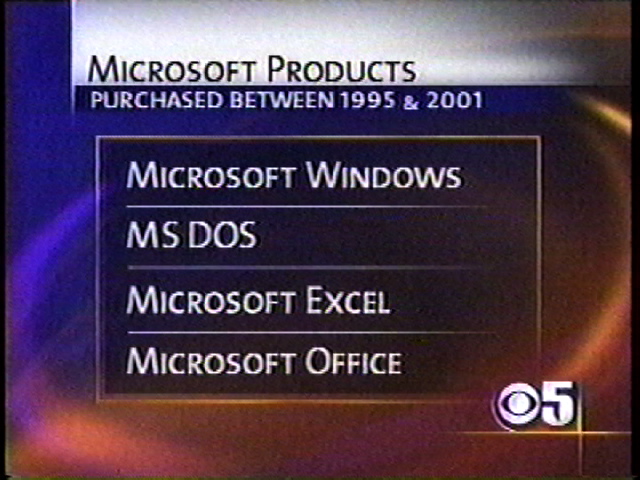
Here's a clip from KPIX that explains how to claim whatever you might have coming to you as a result of Microsoft's anti-trust practices. Of course it's too little, too late. (What a silly question :-)
Nevertheless, if you are a business that has invested in Microsoft software over the last 7+ years, you could be eligible for some real cash. The vouchers can be used to purchase equipment and software from any manufacturer, not just Microsoft.
Here are more of the details of the $1.1 Billion Microsoft Settlement.
Click here for a settlement form.
KPIX On Microsoft's Voucher Program (Small - 8 MB)

I'm assisting with the Senior Projects for USF's Computer Science Department this semester as sort of a warm up before I teach my own XML class next semester. (Yippie!)
We're creating a little application that creates a little "personal web space" from the bookmarks and documents on your hard drive, and we could sure use some help testing out our client application.
It's Windows-only right now, and only works with Internet Explorer 6. (I know it's lame that it only works on IE6 on Windows, but this is only the first rev. So bear with me.)
Email me directly at lisarein@finetuning.com if you'd like to participate in our beta program. We'll be needing testers from now until the end of the semester.
Thanks!
Activity on Song - Swapping Networks Steady
By Reuters.
Activity on file-sharing networks has not missed a beat this week despite the record industry's high-profile lawsuits against individual song-swappers, industry trackers and executives said on Thursday."There's no mass exodus, that's safe to say. Ironically, usage this week and this month is up," said Eric Garland, a spokesman for BigChampagne, a research firm that tracks peer-to-peer networks that enable file-swapping between different computers.
"We've been looking at dramatic increases on the FastTrack Network. The number of people using these file sharing services in the first 10 days of September is up more than 20 percent from the August average," he said...
Greg Bildson, chief technology officer for LimeWire, said traffic on the Gnutella network, the underlying network that LimeWire, BearShare, Morpheus tap into, has not been affected.
Peer-to-peer officials said people would likely improve ways to conceal their identities to avoid lawsuits.
"If you're smart, and most file-sharers are, you can insulate yourself," said Wayne Rosso, president of Grokster, which is involved in a suit of its own against the industry.
Rosso said the lawsuits only wasted money, alienated music fans and will have less of a shock value in the future.
"The next time, the suits won't get this kind of media coverage. They're a desperate and dying industry," he said.
http://www.nytimes.com/reuters/arts/entertainment-media-riaa.html?pagewanted=print&position=
September 11, 2003
Filed at 8:34 p.m. ET
Activity on Song - Swapping Networks Steady
By REUTERS
LOS ANGELES (Reuters) - Activity on file-sharing networks has not missed a beat this week despite the record industry's high-profile lawsuits against individual song-swappers, industry trackers and executives said on Thursday.
``There's no mass exodus, that's safe to say. Ironically, usage this week and this month is up,'' said Eric Garland, a spokesman for BigChampagne, a research firm that tracks peer-to-peer networks that enable file-swapping between different computers.
``We've been looking at dramatic increases on the FastTrack Network. The number of people using these file sharing services in the first 10 days of September is up more than 20 percent from the August average,'' he said.
FastTrack is the network used by the popular Kazaa and Grokster peer-to-peer networks. The average amount of simultaneous users on more popular services topped 4 million this week, versus 3.3 million in August, he said.
The Recording Industry Association of America filed suit against 261 people on Monday for allegedly pirating songs online and plans to file many more to curb activity on the networks, which it blames for a drop in CD sales.
``On the face of it, this is the opposite of what the RIAA intended,'' Garland said.
The RIAA shrugged aside the data. ``We don't put much stock into many of these estimates. Clearly our enforcement efforts have stimulated conversation among parents, children and many others about the illegality of distributing copyrighted music online and its consequences,'' said an RIAA spokesman.
``The objective here is to create an environment where legitimate online services can grow and thrive,'' he said.
Garland said he expects some people will be scared by potential exposure and increased parental pressure.
``But what we're hearing from users is they enjoy safety in numbers,'' he said, adding, ``there's a perception that suing even a few thousand means the odds of getting sued are like the odds of getting struck by lightning,'' he said.
``If it starts to taper off in October and November, then you can clearly say something is deterring activity. But at the moment, these services are very popular with the back-to-school rush,'' he said.
Greg Bildson, chief technology officer for LimeWire, said traffic on the Gnutella network, the underlying network that LimeWire, BearShare, Morpheus tap into, has not been affected.
Peer-to-peer officials said people would likely improve ways to conceal their identities to avoid lawsuits.
``If you're smart, and most file-sharers are, you can insulate yourself,'' said Wayne Rosso, president of Grokster, which is involved in a suit of its own against the industry.
Rosso said the lawsuits only wasted money, alienated music fans and will have less of a shock value in the future.
``The next time, the suits won't get this kind of media coverage. They're a desperate and dying industry,'' he said.
The RIAA released a survey this week showing a slim majority supported its move to target individuals. The survey of just over 800 people was completed on Sept. 6, two days before the suits were filed but after the industry announced its intentions in June.
Some industry watchers argue music companies would get better results by spending money on more heavily promoting legal alternatives such as Apple Computer Inc's Itunes and RealNetworks Inc's Rhapsody service and others.
``The suits are a step in the right direction, but there's still a lot of problems like the fact that more and more people are burning and sharing CDs with friends,'' said Lee Black, analyst with Jupiter Research.
The RIAA is suing "liquidlevel," one of Moby.com's board members!
Moby "can't see any good in coming from punishing people for being music fans and making the effort to hear new music." Right on dude!
He says he's tempted to use Kazaa to download some of his own music, just to see if he got sued.
Of course, they probably wouldn't, once they knew it was him. Because presumably, Moby is the copyright owner of his own music.
But this raises other questions about a musician's right to use the internet to promote themselves -- even if the record company says "no." Why would a record label punish an artist for trying to promote themselves (to sell more records or concert tickets)? It just doesn't make sense.
This all has a lot to do with the revolution that I have predicted (or instigated, depending on how you look at it :-)
Moby Tour Diary Update - RIAA 9/29/2003 - New York City
so apparently the riaa are sueing one of our very own moby.com board members, liquidlevel, for file-sharing.
personally i just can't see any good in coming from punishing people for being music fans and making the effort to hear new music.
i'm almost tempted to go onto kazaa and download some of my own music, just to see if the riaa would sue me for having mp3's of my own songs on my hard-drive.
-moby
So either you guys don't have anything to comment on anymore (even though my readership has doubled over the past couple months) or my comments are broken.
Please send comments today and let me know what your experience is.
I really want to get to the bottom of this.
Thanks!
lisa
Librarians to P2P critics: Shhh!
By Declan McCullagh for CNET.
In a hotly contested lawsuit before a federal appeals court, two peer-to-peer companies are about to gain a vast army of allies: America's librarians.The five major U.S. library associations are planning to file a legal brief Friday siding with Streamcast Networks and Grokster in the California suit, brought by the major record labels and Hollywood studios. The development could complicate the Recording Industry Association of America's efforts to portray file-swapping services as rife with spam and illegal pornography.
According to an attorney who has seen the document, the brief argues that Streamcast--distributor of the Morpheus software--and Grokster should not be shut down. It asks the 9th Circuit Court of Appeals to uphold the April decision by a Los Angeles judge that dismissed much of the entertainment industry's suit against the two peer-to-peer companies.
Among the groups signing the brief are the American Library Association (ALA), the Association of Research Libraries, the American Association of Law Libraries, the Medical Library Association and the Special Libraries Association. The American Civil Liberties Union, in one of the group's first forays into copyright law, has drafted the brief opposing the Motion Picture Association of America (MPAA) and the Recording Industry Association of America (RIAA).
A central argument of the brief is that the district court got it right when applying a 1984 Supreme Court decision to the Internet. That decision, Sony v. Universal City, said Sony could continue to manufacture its Betamax VCR because a company "cannot be a contributory (copyright) infringer if, as is true in this case, it has had no direct involvement with any infringing activity."
"The amicus brief will make the point that we are not supporting the wrongful sharing of copyrighted materials," ALA Executive Director Keith Michael Fiels wrote in an internal e-mail seen by CNET News.com. An amicus brief is one filed by a third, uninvolved party that comments on a particular matter of law. "Instead, we believe the Supreme Court ruled correctly in the Sony/Betamax case. The court in that case created fair and practical rules which, if overturned, would as a practical matter give the entertainment industry a veto power over the development of innovative products and services."...
The ACLU said Thursday that the brief argues that peer-to-peer networks are speech-promoting technologies that have many noninfringing uses. If the MPAA and the RIAA succeed in shutting down peer-to-peer networks or making them more centralized, the precedent could create undesirable choke points that could be used to monitor Internet users, the ACLU said.
Here is the full text of the entire article in case the link goes bad:
http://news.com.com/2102-1032_3-5082684.html?tag=ni_print
Last modified: September 25, 2003, 5:40 PM PDT
Librarians to P2P critics: Shhh!
By Declan McCullagh
Staff Writer, CNET News.com
In a hotly contested lawsuit before a federal appeals court, two peer-to-peer companies are about to gain a vast army of allies: America's librarians.
The five major U.S. library associations are planning to file a legal brief Friday siding with Streamcast Networks and Grokster in the California suit, brought by the major record labels and Hollywood studios. The development could complicate the Recording Industry Association of America's efforts to portray file-swapping services as rife with spam and illegal pornography.
According to an attorney who has seen the document, the brief argues that Streamcast--distributor of the Morpheus software--and Grokster should not be shut down. It asks the 9th Circuit Court of Appeals to uphold the April decision by a Los Angeles judge that dismissed much of the entertainment industry's suit against the two peer-to-peer companies.
Among the groups signing the brief are the American Library Association (ALA), the Association of Research Libraries, the American Association of Law Libraries, the Medical Library Association and the Special Libraries Association. The American Civil Liberties Union, in one of the group's first forays into copyright law, has drafted the brief opposing the Motion Picture Association of America (MPAA) and the Recording Industry Association of America (RIAA).
A central argument of the brief is that the district court got it right when applying a 1984 Supreme Court decision to the Internet. That decision, Sony v. Universal City, said Sony could continue to manufacture its Betamax VCR because a company "cannot be a contributory (copyright) infringer if, as is true in this case, it has had no direct involvement with any infringing activity."
"The amicus brief will make the point that we are not supporting the wrongful sharing of copyrighted materials," ALA Executive Director Keith Michael Fiels wrote in an internal e-mail seen by CNET News.com. An amicus brief is one filed by a third, uninvolved party that comments on a particular matter of law. "Instead, we believe the Supreme Court ruled correctly in the Sony/Betamax case. The court in that case created fair and practical rules which, if overturned, would as a practical matter give the entertainment industry a veto power over the development of innovative products and services."
The librarians' entry into the political fray over whether file-swapping networks should be shut down or not may complicate the RIAA's public relations strategy. The music industry group has been taking increasingly aggressive legal action against alleged infringers and has told Congress that "a significant percentage of the files available to these 13 million new users per month are pornography, including child pornography." The RIAA could not immediately be reached for comment Thursday.
The ACLU said Thursday that the brief argues that peer-to-peer networks are speech-promoting technologies that have many noninfringing uses. If the MPAA and the RIAA succeed in shutting down peer-to-peer networks or making them more centralized, the precedent could create undesirable choke points that could be used to monitor Internet users, the ACLU said.
The RIAA and MPAA jointly filed the lawsuit in October 2001, launching what has become the most widely watched Internet copyright case since Napster. Their original complaint accuses Streamcast and Grokster of earning "advertising revenue by attracting millions of users to their systems by offering them a treasure trove of pirated music, movies and other copyrighted media."
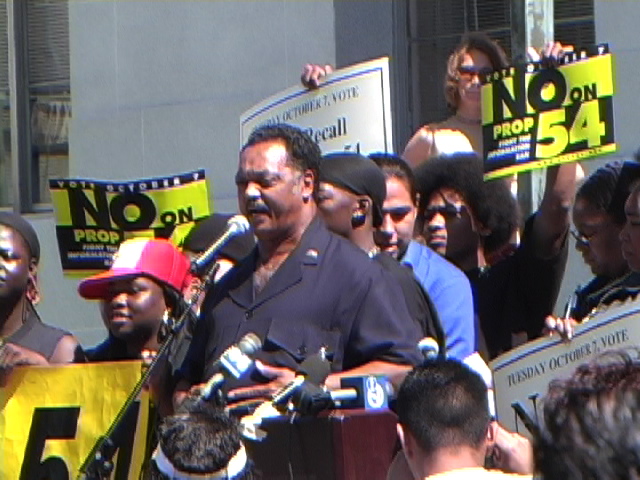
I had an interesting time at the Rally at Sproul Plaza in Berkeley on September 16, 2003.
I won't say it was "fun" or anything, because it wasn't, really. More on this below. My first problem was that I had left late from school and I missed the first part of the speech. The second problem was that I had been up till 2:00 am the night before posting Cheney on Meet The Press clips. So I only got the last third of the speech (see below).
I was quite excited when I got to interview Jesse Jackson for a minute, but otherwise, it was kind of a mean crowd. Or, should I say "immature" crowd, at best. They had no respect for my camera, for instance. And one jerk even thought it was funny to push it over on purpose, once he realized I was trying to protect it.
I guess I've been spoiled for the most part at these kinds of events in the past, where everyone has been really nice and ducked when they walked in front of the camera and helped me to reach better views and the like. This crowd just wanted to get autographs after Jesse's speech and they were pushing and shoving really badly.
I decided to go stand on the stairs of Sproul Hall and try to get a better shot from up above. (I had given up on actually talking to Jesse). I guess the crowd's attitude toward me could have been partly my own fault from trying to maneuver in the crowd with a tripod, so I ditched the tripod and was trying to figure out how to get close again when...the usual miracle happened (Yes, I do have incredible luck at these events!) and Jesse started walked over towards me on the stairs.
His security people were holding back the crowd a bit, so I waited until he was close enough for him to hear me and took a chance on asking him a question. He didn't hear me the first time, so I asked him again. I saw a light go off when he heard the question, and he stopped signing for a minute and looked up and said "Huh?"
"Do you think the 9th Circuit Court of Appeals Decision about the recall will hold?" I asked again.
Then he paused and thought for a minute, and gave his answer.
Here's an edited version of the speech. (Small - 5 MB)
Here's a longer, edited version of the speech. (Small - 18 MB)
Here's a near complete version of the speech. (Small - 31 MB)

A.C.L.U. Challenges Music Industry in Court
By John Schwartz for the NY Times.
(Thanks, Jason.)
The civil liberties group argues that the constitutional rights of its client, referred to as Jane Doe, would be violated if her college, which is also her Internet service provider, were forced to reveal her name. The industry subpoena "seeks to strip Jane Doe of her fundamental right to anonymity," according to the group's court filings.The industry subpoena is one of many recently filed under the Digital Millennium Copyright Act, a law that gives copyright holders broad powers to get the names of suspected infringers from Internet service providers.
But the civil liberties suit claims that the subpoenas, which can be issued with little judicial oversight or involvement, go beyond even what the law allows. The group also claims that the law itself is unconstitutional, because it does not provide for the judicial review of requests or notification of the target of the investigation.
"We're not saying that they can't ever get her identity," said Christopher A. Hansen, a lawyer with the American Civil Liberties Union. "We're only saying if the industry wants her identity, then they have to do it in a fair way."...
Also today, a group that opposes the suits, Downhill Battle, is expected to announce the creation of a legal defense fund for those caught up in the file-trading suits. "If we make noise for all those who've been sued and give the people who want to fight in court the resources to do so, we can make these lawsuits fail," the group said on its Web site, downhillbattle.org.
A.C.L.U. Challenges Music Industry in Court
By JOHN SCHWARTZ
Published: September 29, 2003
Stepping up its involvement in the legal conflict over file sharing, the American Civil Liberties Union has filed a motion to stop attempts by the music industry to get the name of a Boston College student who is accused of being a large-scale file trader.
In court papers that were filed on Friday and will be announced today, the group said that Boston College should not be forced to reveal the identity of the student.
Advertisement
The civil liberties group argues that the constitutional rights of its client, referred to as Jane Doe, would be violated if her college, which is also her Internet service provider, were forced to reveal her name. The industry subpoena "seeks to strip Jane Doe of her fundamental right to anonymity," according to the group's court filings.
The industry subpoena is one of many recently filed under the Digital Millennium Copyright Act, a law that gives copyright holders broad powers to get the names of suspected infringers from Internet service providers.
But the civil liberties suit claims that the subpoenas, which can be issued with little judicial oversight or involvement, go beyond even what the law allows. The group also claims that the law itself is unconstitutional, because it does not provide for the judicial review of requests or notification of the target of the investigation.
"We're not saying that they can't ever get her identity," said Christopher A. Hansen, a lawyer with the American Civil Liberties Union. "We're only saying if the industry wants her identity, then they have to do it in a fair way."
The issues are similar to those in a case between the industry and Verizon that began in the United States District Court for the District of Columbia. In that case, the company, as an Internet service provider, is fighting attempts to compel it to reveal the identities of customers who are accused of being major file traders. The A.C.L.U. filed a brief in that case.
Those challenges to the law have already been rejected, and the issues have been appealed to the United States Court of Appeals for the District of Columbia Circuit.
That is why Amy Weiss, a spokeswoman for the Recording Industry Association of America, said, "I feel like Bill Murray in 'Groundhog Day,' '' referring to a film about a man who has to live the same day over and over again. "They are relitigating the same issues that Verizon argued unsuccessfully."
Meanwhile, opposition to the recording industry's lawsuits has coalesced into a number of new initiatives. A fledgling trade association for companies offering file-trading software and services was preparing to announce a code of conduct for its industry in Washington today. Representatives of Morpheus, Grokster, Lime Wire, StreamCast and others are expected to discuss the legal tactics of the entertainment industry and to call on Congress to "stop record industry abuses" under the new rubric "P2P United," named for the abbreviated term for file sharing technology known as peer-to-peer.
Also today, a group that opposes the suits, Downhill Battle, is expected to announce the creation of a legal defense fund for those caught up in the file-trading suits. "If we make noise for all those who've been sued and give the people who want to fight in court the resources to do so, we can make these lawsuits fail," the group said on its Web site, downhillbattle.org.
Pride and Prejudices
By Christopher Dickey for Newsweek.
But the real problem with such “real” explanations is that they were not the ones cited by President George W. Bush and British Prime Minister Tony Blair as the compelling reasons to rush to war last March. Then, they talked about weapons of mass destruction, and the fight against terrorists.Which brings us to the grandest illusion of all: the link between Saddam Hussein and September 11. A Washington Post poll published earlier this month concluded that 69 percent of Americans thought it “at least likely” that the former Iraqi leader was personally involved in the attacks on the World Trade Center and the Pentagon. There’s nothing to back this up. So puzzled political scientist and pollsters, with evident disdain for the public, suggested the connection is just the result of fuzzy thinking: Al Qaeda is evil, Saddam is evil, the attacks on 9/11 were evil and folks just draw dumb conclusions. Other analysts pointed the finger at the administration, which spins harder and faster than Hurricane Isabel to convince us the war in Iraq is part of the war on terror begun on September 11, without quite explaining where it fits in.
Yet just this week President Bush himself (and Donald Rumsfeld, too!) admitted that information to substantiate this popular fantasy just doesn’t exist. “We’ve had no evidence that Saddam Hussein was involved with September 11,” Bush said flatly, almost matter-of-factly, on Wednesday.
http://www.msnbc.com/news/969219.asp
Pride and Prejudices
Newsweek
Saturday 20 September 2003
How Americans have fooled themselves about the war in Iraq, and why they’ve had to
Sept. 19 — A sturdy-looking American matron in the audience at the American University of Paris grew redder by the second. She was listening to a panel talking about the Iraq war and its effect on U.S.-French relations, and she kept nodding her head like a pump building emotional pressure.
FINALLY SHE exploded: “Surely these can’t be the only reasons we invaded Iraq!” the woman thundered, half scolding, but also half pleading. “Surely not!”
What first upset her was my suggestion that, looking back, the French were right. They tried to stop the United States and Britain from rushing headlong into this mess. Don’t we wish they’d succeeded? (Readers, please address hate mail to shadowland@newsweek.com)
Then she listened as another panelist and I went through the now-familiar recitation of Washington’s claims before the war, and the too-familiar realities since: the failure to find weapons of mass destruction and the inevitable conclusion that Saddam Hussein was not the threat he was cracked up to be, the fantasy that this war could be waged on the cheap rather than the $1 billion per week American taxpayers are now spending, the claim that occupation—called “liberation”—would be short and sweet, when in fact American men and women continue to be shot and blown up every day with no end in sight.
As we went down the list, I could see the Nodding Woman’s problem was not that she didn’t believe us, it was that she did. She just desperately wanted other reasons, better reasons, some she could consider valid reasons for the price that Americans are paying in blood and treasure.
It’s not the first time I’ve come across this reaction. I just spent a month in the States and met a lot of angry people. A few claim the press is not reporting “the good things in Iraq,” although it’s very hard to see what’s good for Americans there. Many more say, “Why didn’t the press warn us?”
We did, of course. Many of us who cover the region—along with the CIA and the State Department and the uniformed military—have been warning for at least a year that occupying Iraq would be a dirty, costly, long and dangerous job.
The problem is not really that the public was misinformed by the press before the war, or somehow denied the truth afterward. The problem is that Americans just can’t believe their eyes. They cannot fathom the combination of cynicism, naiveté, arrogance and ignorance that dragged us into this quagmire, and they’re in a deep state of denial about it.
Again and again, you hear people offering their own “real” reasons for invading Iraq—conspiracy theories spun not to condemn, but to condone the administration’s actions. Thus the “real” reason for taking out Saddam Hussein, some say, was to eliminate this man who rewarded the families of suicide bombers and posed as an implacable enemy of Israel. (Yet the bombings go on there, and surely the chaos in Iraq does nothing for the long-term security of the Jewish state.) Or the “real” reason for invading Iraq was to intimidate Syria and Iran. Yet Tehran, if anything, has grown more aggressive, and may actually have stepped up its nuclear weapons program to deter the United States. (After all, that strategy worked for North Korea.) Or the “real” reason was to secure America’s long-term supply of oil, but the destabilization of the region, again, may make that more tenuous, not less.
But the real problem with such “real” explanations is that they were not the ones cited by President George W. Bush and British Prime Minister Tony Blair as the compelling reasons to rush to war last March. Then, they talked about weapons of mass destruction, and the fight against terrorists.
Which brings us to the grandest illusion of all: the link between Saddam Hussein and September 11. A Washington Post poll published earlier this month concluded that 69 percent of Americans thought it “at least likely” that the former Iraqi leader was personally involved in the attacks on the World Trade Center and the Pentagon. There’s nothing to back this up. So puzzled political scientist and pollsters, with evident disdain for the public, suggested the connection is just the result of fuzzy thinking: Al Qaeda is evil, Saddam is evil, the attacks on 9/11 were evil and folks just draw dumb conclusions. Other analysts pointed the finger at the administration, which spins harder and faster than Hurricane Isabel to convince us the war in Iraq is part of the war on terror begun on September 11, without quite explaining where it fits in.
Yet just this week President Bush himself (and Donald Rumsfeld, too!) admitted that information to substantiate this popular fantasy just doesn’t exist. “We’ve had no evidence that Saddam Hussein was involved with September 11,” Bush said flatly, almost matter-of-factly, on Wednesday.
Is the president taking a chance here? Will the public recoil in horror, claiming he’s somehow lied to them? I don’t think so.
Bush knows what a lot of his critics have forgotten: the Iraq war is not just about blood and treasure, or even about democracy or WMD or terror. It’s about American pride. And people—perfectly intelligent people—have always been willing to sacrifice sweet reason in order to save face, to protect pride. As George Orwell pointed out, they will refuse to see what’s right in front of their noses. He called this condition a kind of political schizophrenia, and society can live quite comfortably with it, he said, until “a false belief bumps up against solid reality, usually on a battlefield.”
Well, that’s what’s happening right now. It’s not only American money and lives that are being lost, it’s pride. But people in the United States will try to deny that for as long as they possibly can.
Unfortunately for those of us who live abroad, that’s much harder to do—and that’s why the woman at the American University in Paris the other evening was really so angry. When I stopped her in the hall afterward she said she was terribly upset because even though she’s lived in France for years, and is married to a Frenchman, the behavior of people here in the last few months has made her bitter.
I know just how she feels. The media talk about anti-Americanism, but what’s really noxious right now is an insufferable smugness, a pervasive air of schadenfreude, and I fear it’s a symptom of still worse to come from this Iraq adventure. Because the bitterest contradiction of all may be that this war was waged—first and foremost—to save face after the humiliation and suffering of September 11. It was meant to inspire awe in the Arab and Muslim world, as former CIA operative Marc Reuel Gerecht and others insisted it should be. And in that it truly has failed. Every day we look weaker. And the worst news of all it that it’s not because of what was done to us by our enemies but because of what we’ve done to ourselves.
Diebold Audit Released, BlackBoxVoting.Org Shut Down
"The State of Maryland requested an audit of the Diebold electronic voting system by SAIC, after a report released by Johns Hopkins University and Rice Researchers (disclaimer: I'm one of Dr Rubin's students) noted several security issues . A condensed, from 200 to 40 pages, and censored version of the report has been released online (PDF link). The report notes that 'SAIC has identified several high-risk vulnerabilities that, if exploited, could have significant impact upon the AccuVote-TS voting system operation.'" However, Diebold says Maryland are moving forward with installation with "new security features" included, and elsewhere, Badgerman points out "Diebold has shut down blackboxvoting.org , apparently with copyright claims made to their ISP. But you can still go to the blackboxvoting.com site..."
From Tristero: On Democracy Now Bev Harris of BlackBoxVoting fame, disclosed (near the end of the transcript) that in the compromised 1.8Gigs off Diebold's FTP site they uncovered "an actual election file containing actual votes on election day from San Luis Obispo County, California". Problem is, the date stamp was 3:31pm - during voting hours! The Diebold system uses a wireless network card. Worse: "So that means if they can pull the information in, they can also send information back into those machines.
(Thanks, Tristero.)
Lawrence Lessig, Hal Abelson and Joi Ito from the Creative Commons, as well as hotshots David Reed and David Weinberger are participating:
Here is the full text in case the link goes bad:
http://www.deanforamerica.com/site/PageServer?pagename=technology_profile
Initial Members of the NAN Broadband Access Working Group
Hal Abelson, Laura Breeden, Lawrence Lessig, Bob Lucky, Dewayne Hendricks, Joi Ito, David Reed, Richard Rowe, David Weinberger
Hal Abelson
Harold (Hal) Abelson is Class of 1922 Professor of Electrical Engineering and Computer Science at MIT and a Fellow of the IEEE. He holds an A.B. degree from Princeton University and a Ph.D. degree in mathematics from MIT. He joined the MIT faculty in 1973.
In 1992, Abelson was designated as one of MIT's six inaugural MacVicar Faculty Fellows, in recognition of his significant and sustained contributions to teaching and undergraduate education. Abelson was recipient in 1992 of the Bose Award (MIT's School of Engineering teaching award).
Abelson is also the winner of the 1995 Taylor L. Booth Education Award given by IEEE Computer Society, cited for his continued contributions to the pedagogy and teaching of introductory computer science. He was also a founding director of the Free Software Foundation, and he serves as consultant to Hewlett-Packard Laboratories.
He is co-director of the MIT-Microsoft Research Alliance in educational technology, and co-head of the MIT Council on Educational Technology.
Laura Breeden
Laura Breeden has been working to expand public sector applications of new technology for nearly 20 years.
Currently, she directs the America Connects Consortium (ACC), based at Education Development Center in Newton, MA. ACC was established by the U.S. Department of Education in 2000 to strengthen community technology centers by providing training, information, tools, and other resources.
Ms. Breeden has worked in network services for a high-tech company in Cambridge, Mass., served as director of a federal grant program, and spent four years consulting in the areas of internet strategies and organizational development.
As a volunteer, she has served on the program committees for numerous conferences and is currently a member of the board of the Association for Community Networking.
Raised in Kentucky, Ms. Breeden has a B.A. in Urban Education from Oberlin College in Oberlin, Ohio.
Dewayne Hendricks
Dewayne Hendricks is an expert on wired, wireless, and high speed communications. He is CEO of Dandin Group, Inc., a Fremont, CA-based company which does research and product development in the area of broadband wired and wireless data devices and services, and serves as a member of the Federal Communications Commission (FCC) Technological Advisory Council (TAC).
Dewayne previously worked as General Manager of the Wireless Business Unit for Com21, Inc., and as Co-Principal Investigator on the National Science Foundation Wireless Field Tests for Education project. Dewayne was formerly co-founder and CEO of Tetherless Access Ltd., one of the first companies to develop and deploy Part 15 unlicensed wireless metropolitan area data networks using TCP/IP protocols.
He has participated in the installation of such networks throughout the world, including Kenya, Tonga, Mexico, Canada and Mongolia. For his work in deploying wireless systems in remote parts of the world, he's been dubbed by Wired magazine as the Ultrawideband Cowboy.
Joi Ito
Joichi Ito is the founder and CEO of Neoteny, venture capital firm focused on personal communications and enabling technologies. He has created numerous Internet companies including PSINet Japan, Digital Garage and Infoseek Japan.
In 1997 Time Magazine ranked him as a member of the CyberElite. In 2000 he was ranked among the "50 Stars of Asia" by Business Week and commended by the Japanese Ministry of Posts and Telecommunications for supporting the advancement of IT.
In 2001 the World Economic Forum chose him as one of the 100 "Global Leaders of Tomorrow" for 2002. Mr. Ito moved to the U.S. with his parents in 1970, attended junior high and high school in Japan, and returned to the U.S. in the mid 1980’s to study at Tufts University and the University of Chicago.
Lawrence Lessig
Lawrence Lessig is a Professor of Law at Stanford Law School and founder of the school's Center for Internet and Society. He is also chairman of the CREATIVE COMMONS. He teaches and writes in the areas of constitutional law, contracts, comparative constitutional law, and the law of cyberspace.
Prior to joining the Stanford faculty, he was the Berkman Professor of Law at Harvard Law School, and a Professor at the University of Chicago Law School. He clerked for Judge Richard Posner on the 7th Circuit Court of Appeals and Justice Antonin Scalia on the United States Supreme Court. More recently, Professor Lessig represented web site operator Eric Eldred in the ground-breaking case Eldred v. Ashcroft, a challenge to the 1998 Sonny Bono Copyright Term Extension Act.
Lessig was named one of Scientific American's Top 50 Visionaries, for arguing "against interpretations of copyright that could stifle innovation and discourse online." He is the author of The Future of Ideas and Code and Other Laws of Cyberspace.
Professor Lessig is a board member of the Electronic Frontier Foundation, a Board Member of the PublicKnowledge, and was a Commission Member of the Penn National Commission on Society, Culture and Community at the University of Pennsylvania. Professor Lessig earned a BA in economics and a BS in management from the University of Pennsylvania, an MA in philosophy from Cambridge, and a JD from Yale.
Bob Lucky
Robert Lucky is an engineer known worldwide for his writing and speaking about technology and society. He has led premier research laboratories in telecommunications over the last several decades, first at Bell Labs and then at Telcordia Technologies, where he was corporate vice president, applied research.
In October, 2002 he retired from this position. Now he devotes much of his time to professional activities, including advisory boards, studies, and consulting. He is the author of many technical papers and of several books, including Silicon Dreams and Lucky Strikes Again, and has also edited a number of technical journals and books on communications.
He also writes monthly columns for Spectrum Magazine. He received his doctorate in electrical engineering from Purdue University in 1961, and has been active throughout his career in professional, academic, and government roles. Dr. Lucky lives in Fair Haven, New Jersey, with his wife, Joan. They have two children and a dog, and live in an old house on a pretty river.
David Reed
Dr. David P. Reed enjoys architecting the information space in which people, groups and organizations interact. He is well known as a pioneer in the design and construction of the TCP/IP Internet protocols, distributed data storage, and PC software systems and applications. He is co-inventor of the end-to-end argument, often called the fundamental architectural principle of the Internet.
He discovered Reed's Law, a scaling law for group-forming network architectures. Along with Metcalfe's Law, Reed's Law has significant implications for large-scale network business models. His current areas of personal research are focused on densely scalable, mobile, and robust RF network architectures and highly decentralized systems architectures.
Dr. Reed currently splits his work time between the MIT Media Laboratory and Hewlett-Packard Laboratories. At MIT, he is Adjunct Professor of Media Arts and Sciences, and at HP Labs he is an HP Fellow. He also serves on a number of business and government advisory boards, including the FCC Technological Advisory Council, the DARPA Information Science and Technology study group. After earning his Ph.D.at MIT and serving as an assistant professor of computer science and engineering there, he spent 10 years in industry as vice president of research and development and chief scientist at both Software Arts and Lotus Development Corporation. For the last decade he has focused on disruptive technologies in network and computing systems, first at Interval Research Corporation and more recently as an independent researcher and advisor.
Richard Rowe
Richard Rowe is CEO of Rowe Communications, Inc. He received his Ph.D. from Columbia University in clinical psychology and was Associate Dean and Director of the Doctoral Program in Clinical Psychology and Public Practice at Harvard University. He has conducted research concerning, and has been an advocate for, early childhood education, has served as a member of the Massachusetts Board of Education and is currently chair of the Massachusetts Business Alliance for Education.
He served as Director of the Test Development and Research Office of the West African Examinations Council in Lagos, Nigeria for three years. He later became CEO of The Faxon Company, a $500m company serving publishers and libraries throughout the world and then founded an internet version of that service which he took public and then sold. Dr. Rowe has served on the MIT Press Management Board and the Board of Advisors of the University of Pittsburgh School of Information.
He currently serves on the Boards of N2H2, Inc. an internet filtering company, and Instatrac, Inc. an online publisher and a bill tracking and documentation service for the Massachusetts legislature. He is the author of numerous articles and frequent speaker on the impact of digitization and the internet upon society with a particular focus on access to and preservation of academic, scientific, technical and medical knowledge. Dr. Rowe is the Director of the Internet and Information Services Department of the Dean for America Campaign.
David Weinberger
Dr. David Weinberger writes and speaks about the effect of technology on culture and ideas. His work as appeared in Wired, Harvard Business Review, USAToday, Salon, The New York Times, and many others. He is a co-author of the national best-seller The Cluetrain Manifesto and the author of Small Pieces Loosely Joined. He is a columnist for Darwin Online and KMWorld and is a frequent commentator on NPR's "All Things Considered" and "Here and Now."
Dr. Weinberger has a B.A. from Bucknell University and a Ph.D in philosophy from the University of Toronto. He taught philosophy for six years before entering high tech, where he has been VP of Strategic Marketing and a strategic marketing consultant at innovative companies. He is currently a Senior Internet Advisor to the Dean campaign. He lives in Brookline, MA with his family.
This just in from the Dean Campaign:
Tonight -- Monday night -- more than 14,000 supporters of Howard Dean in
all 50 states will gather for house parties. Together they will set a
world record for the largest conference call in history when Governor
Dean makes his "National House Call" at 8 pm ET.But tonight's House Call is about more than setting a record -- it's
about sending Howard Dean into the final quarter of the year with the
financial strength he needs to win the nomination and defeat George W.
Bush in 2004.During the House Call, from 8 to 9 pm Eastern, I ask you to support the
efforts of more than 14,000 other Dean supporters by contributing to
Dean for America. Join tens of thousands of Americans who are making this
the September to Remember by contributing what you can tonight:
http://www.deanforamerica.com/contributetodayYou can also 'virtually' attend the house party -- and listen to
Governor's Dean's conference call -- by checking the campaign weblog
this evening at 9 pm Eastern:
http://www.blogforamerica.comYour contribution tonight will make a tremendous difference in our
efforts to raise the final $2 million of our goal before midnight
tomorrow.
This was just sent to me from MoveOn:
Dear fellow Californian,California is at a crossroads. Our finances, schools and society are all in crisis. And at this, our state's most vulnerable moment, a handful of self-interested political players are attempting an unprecedented power grab.
Arnold Schwarzenegger and his backers are seizing the recall as a once-in-a-lifetime chance for him to buy the governorship. The abbreviated race has allowed him to duck tough questions and avoid unscripted debate. He has promised voters a balanced budget without new taxes or spending cuts -- an impossibility except perhaps in a Hollywood movie. He has no plan for helping California and absolutely no experience that might help him come up with one.
The recall and Schwarzenegger's self-funded, media-driven campaign are sucker punches to our democratic system and values. We have seven full days left to fight back and a team of 250,000 people for this final push.
If you have not joined the team by signing our "No Recall" pledge, then please join us now by clicking here:
http://moveon.org/pac/recall/
If you've already signed, then forward this message to all your like-minded friends, coworkers and family and ask them to join us for this final one-week blitz to defeat the recall, stop Schwarzenegger and defend democracy. Let's grow our team to 300,000 people.
Don't be discouraged by the weekend's far-out poll: this race is so unusual that polls are even more meaningless than they usually are. We believe this is still an incredibly close race. And it's a fact that there are enough of us working on this to make the difference ourselves. But we've got to work hard: pick up the phone and call that friend you know might forget to vote, put up a sign in your window, sign up for phone banking -- do whatever it takes.
Over the next seven days we'll be highlighting several different things you can do to make a real, tangible difference in the recall election. With 300,000 people working together, we'll each just need to influence one other person to vote against the recall who might not have without us. If we can do that, then we'll defeat the recall by a wide margin and democracy will have a decisive victory on October 7.
Sincerely,
-- Carrie, James, Joan, Peter and Wes
(The Californians of) MoveOn.org PAC
September 29th, 2003PS: For more on how Schwarzenegger leads the pack in fundraising thanks to his own personal contributions, check out this article.
I'm too tired to blog this proper till the AM. But for those of you who might need this information NOW, I thought I'd let you know that it's available and uploaded here:
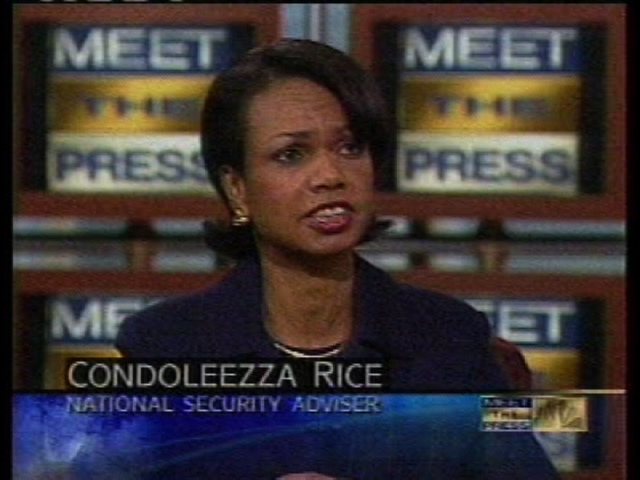
Condoleeza Rice On Meet The Press
It's available as one big 55 MB download or three smaller 18 MB downloads.
I'll have smaller clips of highlights up in the AM.
Here's a link to the usual, largely incomplete transcript. (Full text of this below.)


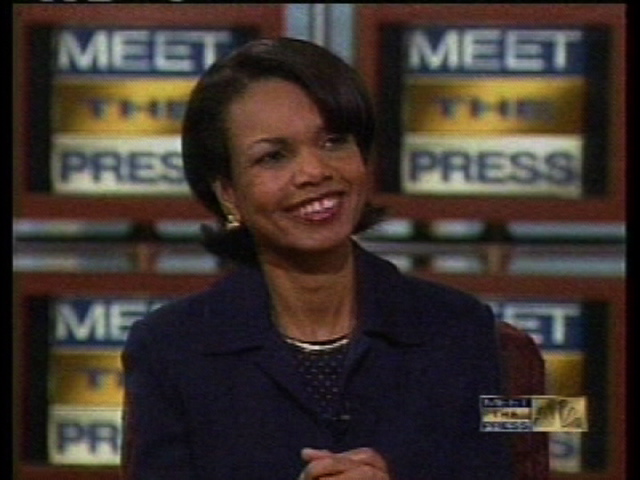
Here's the text of the incomplete transcript in case the link goes bad:
http://www.msnbc.com/news/973028.asp
Transcript for Sept. 28
GUESTS: Dr. Condoleezza Rice, national security adviser
Rep. Dick Gephardt, (D-Mo.), Democratic presidential candidate
Tim Russert, moderator
This is a rush transcript provided for the information and convenience of the press. Accuracy is not guaranteed.
MR. TIM RUSSERT: Our issues this Sunday, Iraq: Still no weapons of mass destruction; little likelihood of more international troops, meaning more Reserve units being called up; and growing concern on Capitol Hill.
(Videotape):
REP. DAVID OBEY: If you don’t, you don’t have a plan, you don’t have a clue. If you can’t give us an answer, you’re stiffing us.
MR. DAVID BREMER: Well, Congressman, I resent that.
(End videotape)
MR. RUSSERT: Where do we go from here? With us, President Bush’s national security adviser, Dr. Condoleezza Rice. Then the 10 Democratic candidates debate and this man goes after Democratic presidential front-runner Howard Dean.
(Videotape):
REP. RICHARD GEPHARDT: Howard, you are agreeing with the very plan that Newt Gingrich wanted to pass, which was a $270 billion cut in Medicare.
DR. HOWARD DEAN: I’ve done more for health insurance, in this country, Dick Gephardt, frankly, than you ever have.
(End videotape)
MR. RUSSERT: And what does the entry of General Wesley Clark mean for the race? With us, Democratic candidate for president, Congressman Dick Gephardt.
But first, the president’s national security adviser Dr. Condoleezza Rice. Welcome.
DR. CONDOLEEZZA RICE: Morning. Thank you.
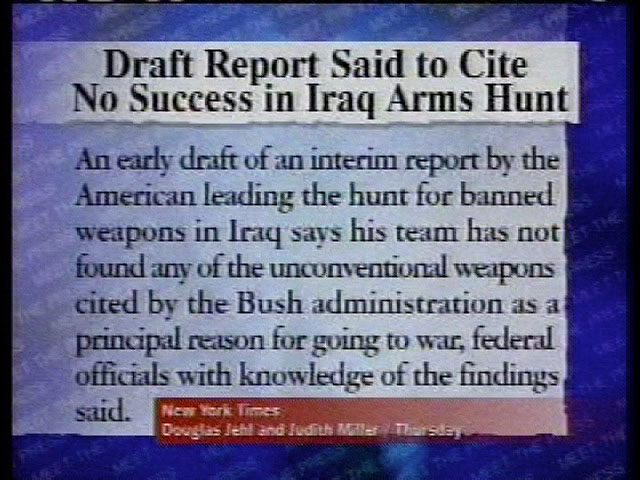
MR. RUSSERT: These are the headlines that greeted Americans this week: “Draft Reports Said To Cite No Success In Iraq Arms Hunt. An early draft of an interim report by the American leading the hunt for banned weapons in Iraq says his team has not found any of the unconventional weapons cited by the Bush administration as a principal reason for going to war, federal officials with knowledge of the findings said.” The rationale for the war, the risk, the threat of biological, chemical, perhaps even nuclear weapons, they have not been found, why?
DR. RICE: There was no doubt going into the was that successive administrations, the United Nations, intelligence services around the world, knew that Saddam Hussein had used weapons of mass destruction, that he had them, that he continued to pursue them. David Kay is now in a very careful process of determining the status of those weapons and precisely what became of them. But I would warn off jumping in to any conclusions about what David Kay’s report says. For instance, I’ve not seen David Kay’s report, and it is a progress report on the very careful work that he is doing. He’s interviewing hundreds of people. He is going through miles and miles of documentation. He’s collecting physical evidence and he will put together a coherent story and then we’ll know the truth, but it’s far too early to talk about the conclusions of David Kay’s report.
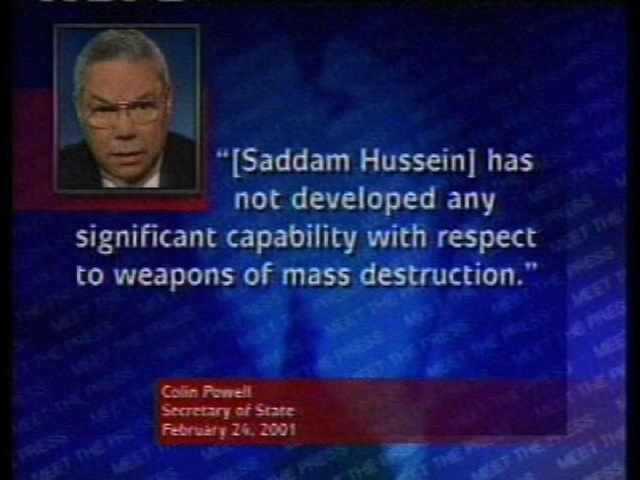
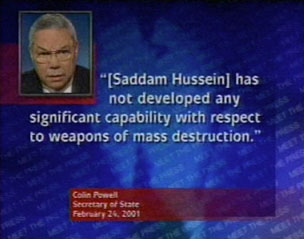
MR. RUSSERT: If we go back and examine what administration officials had said prior to the war, Colin Powell said this back in February of 2001: ”[Saddam Hussein] has not developed any significant capability with respect to weapons of mass destruction.”
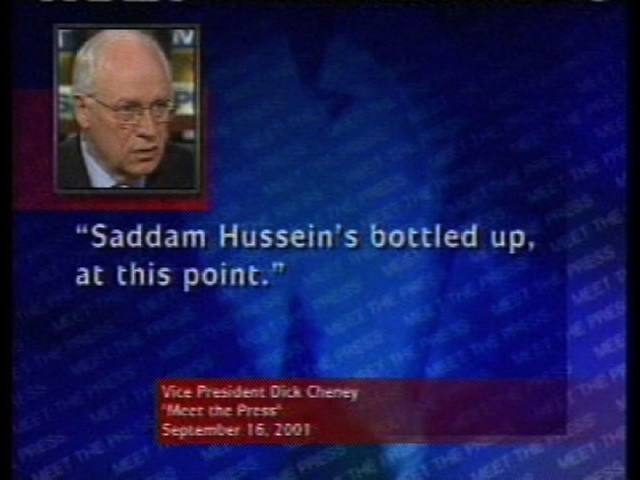
And five days after September 11th, the vice president saying: “Saddam Hussein’s bottled up at this point.”
And now, front page of The Washington Post, “House Probers Conclude Iraq War Data Was Weak.”
This is Porter Goss, former CIA agent, chairman of the House Intelligence Committee, a Republican, suggesting that perhaps because the CIA couldn’t determine that the weapons of mass destruction had been destroyed, that they therefore existed. Was the premise of the war based on faulty or hyped intelligence?
DR. RICE: The premise of the war was that Saddam Hussein was a threat, that he had used weapons of mass destruction, that he was continuing to try to get them and that was everyone’s premise, the United Nations intelligence services, other governments, that was the logic that led the Clinton administration to air strikes in 1998. And one would have had to believe that somehow, after Saddam Hussein made it impossible for the inspectors to do their work in 1998, that things got better, that he suddenly destroyed the weapons of mass destruction and then carried on this elaborate deception to keep the world from knowing that he destroyed the weapons of mass destruction. It’s just not logical.
You have to put into context the period between 1998 and 2003 when indeed the information was being enriched from new information that was coming in, but it was not that alone. It had to be in the context of 12 years of deception, 12 years of finding out unpleasant surprises about his biological weapons program in 1994 and 1995, reports from the United Nations in 1999 that he had not accounted for large stockpiles of weapons. No, this was the threat that the president of the United States could no longer allow to remain there. We tried containment. We learned that he had increased his capacity to spend resources on weapons of mass destruction from $500 million in illegal oil revenues to $3 billion. No, all of the dots added up to a program and to weapons and a weapons program that was dangerous and getting more so.
MR. RUSSERT: What if the intelligence was just plain wrong? The CIA had said way back when that the Soviet Union was going to have a robust economy, surpass the United States. That proved to be wrong. What if the intelligence committees were just wrong here, and we went to war when there really wasn’t a threat of weapons of mass destruction?
DR. RICE: Well, clearly, this is somebody who had used weapons of mass destruction. So had he have been allowed to be unchecked, he might have used them again. Clearly, this is someone who, in 1991, the inspectors found was much closer to a nuclear weapon that had been believed. So I think it’s unlikely that the essence of a case that this was somebody who had weapons of mass destruction and was still pursuing them was wrong. But let’s remember, Saddam Hussein is now gone and it is a great achievement of the United States and the coalition. Nobody wants to say that we would be better off had we left him in power.
We now have opportunities before us to have a democratic and prosperous Iraq that can be linchpin of a different kind of Middle East, a region that is volatile in the extreme, and is the region from which the September 11 threat came. And so, after September 11, and I note that some quotes by Colin Powell, for instance, before September 11—after September 11, you do look at threats differently. You do look at dealing with threats before they fully materialize. That was the case the president made to the American people. With Saddam Hussein gone, the world is safer and Iraq will be stable and prosperous, and it will be a historic change in the circumstances of the Middle East.
MR. RUSSERT: The administration’s credibility is on the line, here in the country and around the world. And we still specifically cite the president’s State of the Union message in January. Now, let me go back and play that and then talk about your role.
(Videotape, January 28, 2003):
PRES. GEORGE W. BUSH: The British government has learned that Saddam Hussein recently sought significant quantities of uranium from Africa.
(End videotape)
MR. RUSSERT: That was in January. And in June—June 8—you were on MEET THE PRESS; I asked you about that, and this was your response.
(Videotape, June 8, 2003):
DR. RICE: The president quoted a British paper. We did not know at the time, no one knew at the time in our circles—maybe someone knew down in the bowels of the agency, but no one in our circles knew—that there were doubts and suspicions that this might be a forgery. Of course, it was information that was mistaken.
(End videotape)
MR. RUSSERT: “No one in our circles.” That has proven to be wrong.
DR. RICE: No, Tim, that has not proven to be wrong. No one did know that they were forgeries. The notion of the forgeries came in February or in March when this was—when this came to the CIA. It is true that we learned, subsequent to my comments to you, that Director Tenet did not want to stand by that statement. And I would never want to see anything in a presidential statement—speech—that the director of Central Intelligence did not want to have there.
And I’m the national security adviser. When something like this happens, I feel personally responsible for it happening because it obscured the fact that the president of the United States did not go to war over whether Saddam Hussein tried to acquire yellow cake in Africa. He went to war over a threat from a bloody tyrant in the most volatile region of the world who had used weapons of mass destruction before, and was continuing to try to acquire them. And so, of course, this should not have happened.
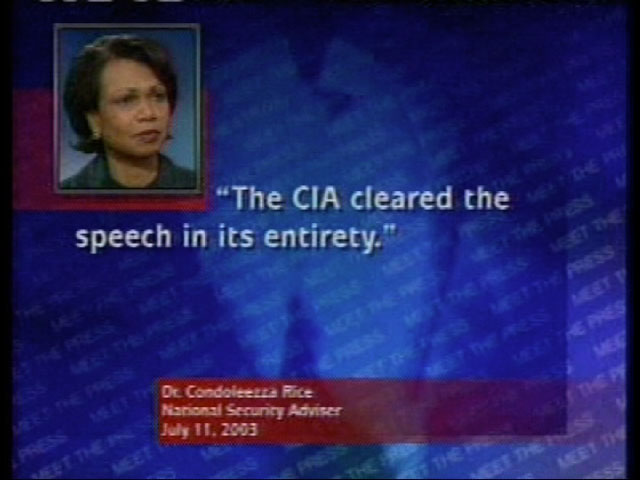
MR. RUSSERT: But when you say that no one in our circles, and it was maybe down in the bowels of the Intelligence Agency, a month after that appearance, you said this, “The CIA cleared the speech in its entirety.”
And then your top deputy, Stephen Hadley, on July 23, said this.
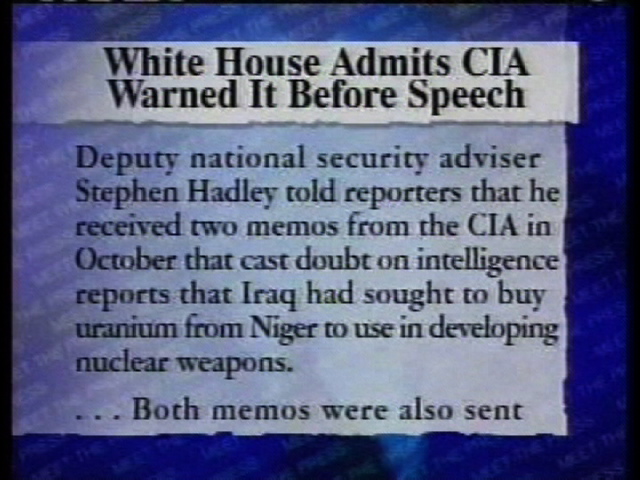
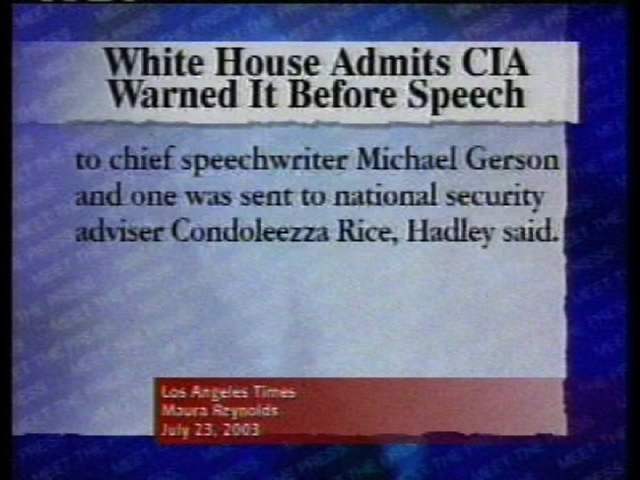
“Deputy National Security Adviser Stephen Hadley told reporters that he received two memos from the CIA in October that cast doubt on intelligence reports that Iraq had sough to buy uranium from Niger to use in developing nuclear weapons. Both memos were also sent to chief speechwriter Michael Gerson and one was sent to national security adviser, Dr. Condoleezza Rice, Hadley said.”
And George Tenet called Mr. Hadley directly and put—issued a warning on that information. Were you aware of any concerns by the CIA about this incident?
DR. RICE: First of all, the CIA did clear the speech in its entirety and George Tenet has said that. He’s also said that he believes that it should not have been cleared. And we apparently, with the—in October for the Cincinnati speech, not for the State of the Union, but the Cincinnati speech, George Tenet asked that this be taken out of the Cincinnati speech, the reference to yellow cake. It was taken out of the Cincinnati speech because whenever the director of Central Intelligence wants something out, it’s gone.
MR. RUSSERT: How’d it get back in?
DR. RICE: It’s not a matter of getting back in. It’s a matter, Tim, that three-plus months later, people didn’t remember that George Tenet had asked that it be taken out of the Cincinnati speech and then it was cleared by the agency. I didn’t remember. Steve Hadley didn’t remember. We are trying to put now in place methods so you don’t have to be dependent on people’s memories for something like that.
MR. RUSSERT: Did you ever read the memo that I referenced?
DR. RICE: I don’t remember the memo. It came after it had been taken out of the speech, and so it’s quite possible that I didn’t. But let me be very clear: This shouldn’t happen to the president of the United States, and we will do everything that we can to make sure that it doesn’t happen again.
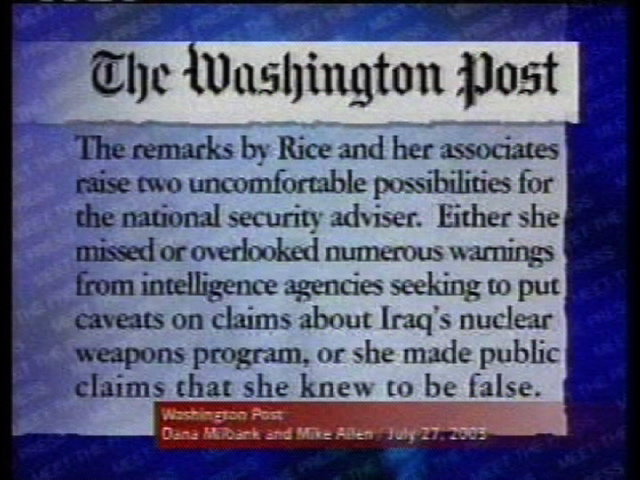
MR. RUSSERT: The Washington Post framed the issue this way: “The remarks by Rice and her associates raise two uncomfortable possibilities for the national security adviser. Either she missed or overlooked numerous warnings from intelligence agencies seeking to put caveats on claims about Iraq’s nuclear weapons program, or she made public claims that she knew to be false.”
DR. RICE: Well, neither happens to be true. First of all, we had a national intelligence estimate on which we relied to talk about Iraq’s pursuit of nuclear weapons. I would never make claims that I know not to be true. Why would I do that to the president of the United States? The president of the United States has to be credible with the American people. I have to be credible with the American people. This was a mistake. The memories of people three months before did not trigger when they saw the language in the State of the Union. When I read the line in the State of the Union, I thought it was perfectly fine. And I can assure you nobody was trying to somehow slip something into the State of the Union that the director of Central Intelligence didn’t have confidence in. The State of the Union address was about the broad threat that Saddam Hussein posed. That remained the case when we went to war. That remains the case today. And it was a strong case for removing him from power.
MR. RUSSERT: A hundred and eighty members of Congress cited the potential nuclear threat when they voted for the war. If that threat did not exist, if Saddam was not as far along as had been expected or had been reported by intelligence agencies, do you believe Congress would have voted to go to go war with Saddam absent the notion that he had weapons of mass destruction?
DR. RICE: Well, weapons of mass destruction, of course, come in two other types, chemical and biological. And on chemical and biological, the national intelligence estimate was unequivocal, that he had biological and chemical weapons. He’s, of course, used chemical weapons. His biological weapons program was, of course, discovered in ’94, ’95.
MR. RUSSERT: What happened to them? Where are they?
DR. RICE: Well, David Kay will determine what happened to these programs. But on the nuclear side, this was always a matter of uncertainty, about his nuclear weapons program. In ’91, he was closer than the International Atomic Energy Agency had thought. They were about to give him a clean bill of health, only to find that he had the designs, he had the scie ntists, he had all of the means. He was only lacking the fissile material. And the estimate, the national intelligence estimate gave the following judgment: That left unchecked, Saddam Hussein would have a nuclear weapon by the end of the decade. That’s something to which the president had to react, but by no means was this case made on a nuclear case alone. It was made on the weapons of mass destruction as a whole, his ability to deliver them in the past and the dangers of having those weapons, particularly biological and chemical weapons, which he was known to have had, in the hands of this bloody tyrant.
MR. RUSSERT: There was dissent of that analysis, however, but the administration emphasized the threat?
DR. RICE: Well, the dissent—not on biological and chemical weapons. There was widespread agreement that the biological—but...
MR. RUSSERT: On nuclear. On nuclear there was the dissent.
DR. RICE: On nuclear there was dissent on the extent of the program and how far along the program might be. How much had he gone to reconstitute? But the judgment of the intelligence community was that he had kept in place his infrastructure, that he was trying to procure items. For instance, there’s been a lot of talk about the aluminum tubes but they were prohibited on the list of the nuclear suppliers group for a reason. So the case was very strong, that this was somebody who had weapons of mass destruction, had used them in the past. The Clinton administration had launched air strikes for that reason in 1998, citing the fact that if he were allowed to keep his weapons of mass destruction, he would be a grave threat, and there was no reason to believe that this got better after 1998, after he made it impossible for inspectors to work there.
MR. RUSSERT: Ambassador Joe Wilson was sent over to Niger by the CIA to look into this whole matter of selling uranium to Iraq. He came back with a report which was given to the administration. Then there was an article by columnist Robert Novak which cited two administration sources and identified Ambassador Wilson’s wife by name. She was an undercover agent at the CIA. There is now an investigation. The CIA has requested the Justice Department to look into this. It’s a crime to identify an undercover agent. And in this article in today’s Washington Post, a senior administration official said that White House officials called six reporters to identify, to out, if you will, Joe Wilson’s wife. What can you tell us about that?
DR. RICE: Tim, I know nothing about any such calls, and I do know that the president of the United States would not expect his White House to behave in that way. It’s my understanding that when a question like this is raised before the agency, that they refer it as a matter of course, a matter of routine to the Justice Department. The Justice Department will now take appropriate action, whatever that is, and that will be up to the Justice Department to determine what that action is.
MR. RUSSERT: What will the president do? Will he bring people in and ask them what they did?
DR. RICE: I think it’s best since it’s in the hands of the Justice Department to let it remain there.
MR. RUSSERT: Will the president go to the CIA and other intelligence agencies and say, “What happened? Why did you give me these analysis, these estimates and it hasn’t yet borne out?”
DR. RICE: The president is waiting to see what the story really is on the ground. David Kay is a very well-respected former weapons inspector. He now has a lot of people, teams of people, working on the considerable documentation that we’ve been able to find. For instance, we now have access to the archives of the Iraqi Intelligence Service. That’s an important source, as any of us know who’ve studied authoritarian systems. Programs like this were likely to be under the Iraqi Intelligence Service. And so now we have access to that documentation. Wouldn’t have had it before the war.
We are now able to interview people, although there are a lot of people who are still frightened by threats of retribution, and it’s one important reason that we have to protect the people who help us. He is gathering physical evidence, and he will put together a complete picture of the status of Saddam Hussein’s weapons programs, of how he intended to use them. He will put together a picture of what became of the substantial unaccounted-for weapons stockpiles and media. He’ll do all of that. And then we can see what we found on the ground after the war and how that compares to what we knew going in. But going in, this president relied on the same basis of intelligence that three administrations relied on, that was gathered from intelligence services around the world and that the U.N. itself relied on in keeping Saddam
Hussein under sanctions for 12 years.
MR. RUSSERT: But what if it was wrong? If the president determines that the intelligence he was given was faulty or that members of his staff or administration outed a CIA agent, will heads roll?
DR. RICE: Tim, let’s wait and see what the facts are. I think in the case of the weapons of mass destruction, David Kaye is going to make a progress report but it is only a progress report. Saddam Hussein spent 12 years trying to deceive the international community. It’s not surprising that it’s going to take a little time to unravel this program.
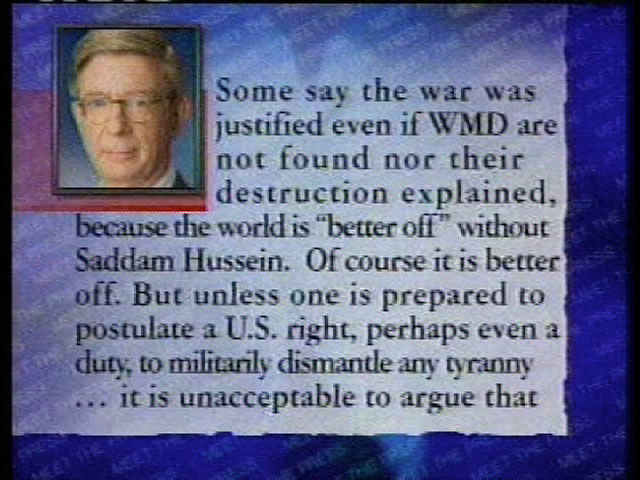
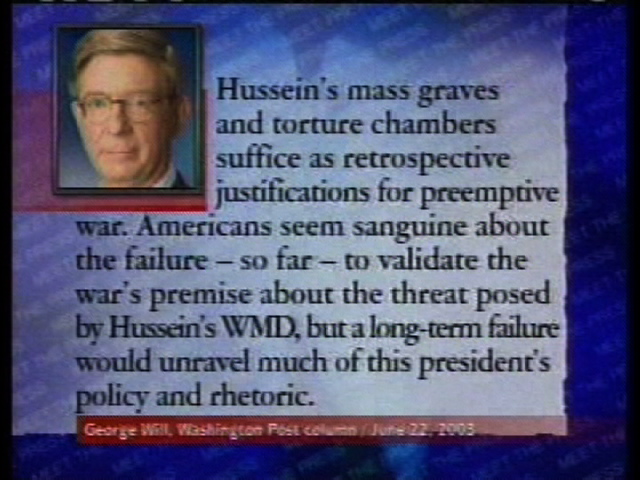
MR. RUSSERT: George Will, the conservative columnist, wrote this. “Some say the war justified even if WMD”—weapons of mass destruction—”are not found nor their destruction explained, because the world is ‘better off’”—with Saddam Hussein. Of course is better off. “But unless one is prepared to postulate a U.S. right, perhaps even a duty, to militarily dismantle any tyranny ... it is unacceptable to argue that Hussein’s mass graves and torture chambers suffice as retrospective justifications for preemptive war.
Americans seem sanguine about the failure—so far—to validate the war’s premise about the threat posed by Hussein’s”—weapons of mass destruction—”but a long-term failure would unravel much of this president’s policy and rhetoric.”
DR. RICE: Torture chambers and mass graves are definitely very good things to have gotten rid of, so is to have gained the opportunity of having a stable and democratizing Iraq in the Middle East...
MR. RUSSERT: But that’s not a basis for a pre-emptive war.
DR. RICE: ...but let’s remember that the intelligence going into the war—it’s quite separable from what David Kaye now finds, but the intelligence going into the war was intelligence that led the United States to strike in 1998 against Saddam Hussein’s weapons of mass destruction, that led the Congress to support that action and to actually pass a law called the Iraqi Liberation Act, because Saddam Hussein was thought to be a threat to this country, that the United Nations itself had kept Saddam Hussein under sanctions for 12 years because of his weapons of mass destruction program. So the premise on which the president launched this war was one that was shared by a number of people, including former administrations.
MR. RUSSERT: But Mr. Will’s point is if the president came to the United States today and said, “We have a problem with Iran. They have an advanced nuclear capability, we have to launch a pre-emptive strike,” or “We have to launch a pre-emptive strike against North Korea,” would the country, would the world, say, “By all means, Mr. President, we know your intelligence is sound, go forward”?
DR. RICE: The important thing is that the president has always said that the use of military force is, of course, an option that has to remain, but that’s a rare option. The president in Iran and in North Korea is pursuing other courses, and Iraq was in many ways a very special case. This was an international outlaw for 12 years. We forget that he fought a war in 1991, lost the war, signed on to a series of obligations that were supposed to keep him boxed up, because people knew he was dangerous in 1991. But when the decision was made not to overthrow him and indeed to stop the war, he signed on to an entire group of resolutions, of obligations that were supposed to keep him contained. He then systematically, over 12 years, started to wiggle out of them, ignored them, defied them. He was an international outlaw.
I think you have to look hard to see whether even this was a war of pre-emption. We were in a state of low-level conflict with Saddam Hussein from 1991 until 2003. He was shooting at our airplanes with regularity. We were trying to patrol his forces through no-fly zones in the north and the south. This was a unique case.
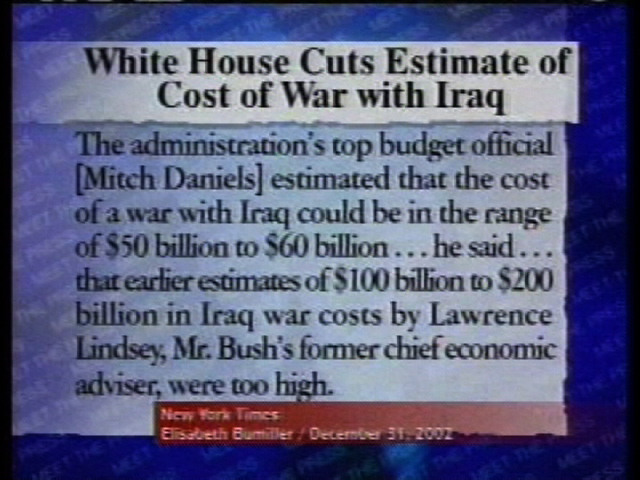
MR. RUSSERT: The costs of the war, administration’s top budget official, Mitch Daniels, the former director of the OMB, estimated that the “cost of a war” would be “$50 billion to $60 billion...he said...estimates of $100 billion to $200 billion” by Lawrence Lindsey, the president’s former chief economic adviser, “were too high.”
We’ve already spent, when the additional $87 billion is allocated by Congress, some $150 billion to $160 billion. Why did the administration so dramatically underestimate the cost of this war?
DR. RICE: We did not have perfect foresight into what we were going to find in Iraq. The fact of the matter is that this deteriorated infrastructure, one that was completely covered and covered over by the gleaming pictures of Baghdad that made it look like a first-world city, what we’re learning now is that, for instance, the entire country had maybe 55 percent of the electrical generating power that it needed, but what Saddam Hussein did was force all of that generating power into the Sunni areas and to simply starve the rest of the country. The country was probably 80 percent low on the ability to provide sanitation to the country.
Now, I’m reminded that East Germany, which was, of course, sitting right next door to West Germany and well known to the West Germans, when they unified East and West Germany, West Germans were appalled and shocked by what they found as the deteriorated state of the East German infrastructure. So it’s not surprising that one might underestimate that.
But the key here is you cannot put a price tag on security. Iraq was a threat. Saddam Hussein was a threat to the region, he was a threat to America, to American interests, he was a haven and a supporter of terrorism around the world and he had launched wars, used weapons of mass destruction. He was a threat. He is now gone. The goal now is to put in his place, in the place of that horrible regime, a stable, prosperous, and democratizing Iraq. That will pay off many, many, many times over in security for the American people. What happened to us on September 11th should remind us that we have to fight the war on terror on the offense. We can’t fight from preventive defense. It’s fine to try and defend the country, but the president believes that we have to fight this war on the offense and Iraq is part of fighting that war.
MR. RUSSERT: But Iraq was not part of September 11th.
DR. RICE: No. Saddam Hussein—no one has said that there is evidence that Saddam Hussein directed or controlled 9/11, but let’s be very clear, he had ties to al-Qaeda, he had al-Qaeda operatives who had operated out of Baghdad. The key, though, is that this is—our security is indivisible, and having a change in this region, in the center of the Middle East, is going to make a tremendous difference to our long-term security.
MR. RUSSERT: Congress will approve the $87 billion?
DR. RICE: I am certainly hopeful that they will because the American forces deserve the support, and everything in the supplemental that is there for reconstruction is for one of three purposes. It is to provide, so that the Iraqis can provide security to themselves, police forces, the army, and acceleration of bringing Iraqis into their own security. It is to provide infrastructure so that—and basic living services so that it doesn’t become a breeding ground for terrorism, the kind of poverty that is there. And third, it is to put in place infrastructure for foreign investments, so that Iraq can emerge as a functioning member of the international economy.
MR. RUSSERT: Here’s the cover of Time magazine coming out tomorrow: “Mission Not Accomplished: How Bush Misjudged the Task of Fixing Iraq.” We all remember on May 1, the president landed on the USS Lincoln, where he was greeted by a banner “Mission Accomplished.” The image, the message that sent to the country was, “Iraq, mission accomplished.” Was that premature?
DR. RICE: Well, the mission of those forces that he went to greet had been accomplished. They were involved in the major military operations. I can remember getting briefings on the carriers of the bombing missions that they flew in those horrible sandstorms. So their mission had been accomplished. And the president wanted to congratulate them on that. But he said in that same speech, the dangerous times were still ahead, and that we still had work to do in Iraq. And we are, indeed, still doing that work in Iraq.
The advantage is that we have forces there that are now being reconfigured to deal with the tasks that are not major combat tasks, and we’re making good progress. It’s a hard job. And reconstructing or participating in the reconstructing of a country like Iraq is a hard job. But it’s very much worth it. Much as the reconstruction of Europe was worth it to our long-term security. The reconstruction of Iraq is worth it to our long-term security. And we’re going to stay the course.
MR. RUSSERT: And it is nation-building?
DR. RICE: It is helping the Iraqis to build their nation. And they are more and more involved every day. I’ve met, just in this past week, with ministers, minister of electricity, minister of public works, I’ve met with members of the Governing Council. They are now very involved in their future. And Iraq is going to emerge better for it. The Middle East is going to emerge better for it and, therefore, American security is going to emerge better for it.
MR. RUSSERT: How long is that going to take?
DR. RICE: I don’t want to put a time frame on it.
MR. RUSSERT: Years?
DR. RICE: The work of the Iraqis in building their own future certainly is going to take years, and we’ll try to help them and assist them. But we expect that by accelerating in this next period of time, over this—the next frame of time, which is why the supplemental is so important, in accelerating the most important task toward reconstruction, that we will hasten the day when Iraqis are able to control their own future and when American forces can come home.
MR. RUSSERT: Dr. Condoleezza Rice, we thank you for your views.
DR. RICE: Thank you very much, Tim.
MR. RUSSERT: Coming next, can Dick Gephardt stop the insurgent challenges of Governor Howard Dean and General Wesley Clark? Dick Gephardt, Democratic candidate for president. He’s next on MEET THE PRESS.
(Announcements)
MR. RUSSERT: Our interview with Democratic presidential candidate Dick Gephardt after this brief station break.
(Announcements)
MR. RUSSERT: And we are back. Congressman Gephardt, welcome back to MEET THE PRESS.
REP. DICK GEPHARDT, (D-MO): Good to be here.
MR. RUSSERT: Let’s go back to October 2, 2002. You were the leader of the Democrats in the House. You supported the president on the war, voted for a resolution to give him the authority, appeared with him in the Rose Garden and said this to the American people. Let’s watch:
(Videotape, October 2, 2002):
REP. GEPHARDT: In our view, Iraq’s use and continuing development of weapons of mass destruction, combined with efforts of terrorists to acquire such weapons pose a unique and dangerous threat to our national security.
(End videotape)
MR. RUSSERT: “A unique and dangerous threat.” We have not found any such weapons. Were you wrong or misled?
REP. GEPHARDT: Tim, I didn’t just take the president’s word for this. I went out to the CIA three times. I talked to George Tenet personally. I talked to his top people. I talked to people that had been in the Clinton administration in their security effort. And I became convinced, from that, all of that, that he either had weapons of mass destruction or he had components of weapons or he had the ability to quickly make a lot of them and pass them to terrorists.
Look, after 9/11, we’re in a world, in my view, that we have to protect the American people from further acts of terrorism. That’s my highest responsibility, that’s the Congress’ highest responsibility, and the president. And I did what I thought was the right thing to do to protect our people from further acts of terrorism. We cannot have that happen in the United States, and I will always do that.
MR. RUSSERT: But what happened to the weapons of mass destruction? What should be done now to find out why the intelligence was misleading or just plain wrong?
REP. GEPHARDT: Obviously, Tim, we need a blue-ribbon commission. If there hasn’t been one before I’m president, when I’m president, we will have one. The American people have to understand and believe that the information they’re getting from their government is credible, is true. And if there was a failure of intelligence, we’ve got to have more than just the intelligence committees look at it. We’ve got to have a blue-ribbon commission. We’ve got to get to the bottom of it.
MR. RUSSERT: The Washington Post reports today that a senior administration official said that White House officials called six reporters to identify the wife of Ambassador Joe Wilson, who is doing a report for the CIA on this matter, that she was an undercover agent and therefore was outed, which breaks the law. What should the president do?
REP. GEPHARDT: Well, the president ought to investigate what happened. The Congress probably ought to look at it as well. If the law was broken, if something was done that was improper and wrong legally, you know, the law ought to be enforced and people ought to be punished for doing this.
MR. RUSSERT: The Congress will have an opportunity to vote for $87 billion more for the operation in Iraq. Will you vote for that?
REP. GEPHARDT: I’m going to support our troops in the field. We have to do that. They’re performing a very, very dangerous mission and I’m in admiration of what they’re doing. We’ve got to support them with the money they need. On the $20 billion or so of this $87 billion that is for the reconstruction of Iraq, there are a lot of tough questions that the Congress needs to ask and will ask, both Republicans and Democrats.
One of the things we’ve got to look at is: What are we going to get from other countries? What are other countries going to bring to the table? What is the president doing to get other countries to help our taxpayers? And finally, what loans are out there that could be relieved or forgiven by other countries to Iraq so that this money for reconstruction could, in effect, be a new loan so that we don’t have to just ask the American taxpayers to do this.
Finally, I want some moneys for America, if we’re going to be using money for the further work in Iraq.
All of our states pretty much are bankrupt. They need help. They’re cutting health care, they’re cutting veterans, they’re cutting all kinds of important programs. We’ve got to make sure that the American people are taken care of here as well.
MR. RUSSERT: We’ll get to the domestic issues in a second, but in terms of Iraq, you just heard Dr. Rice say we’re going to stay the course. If you were the president right now, and other countries in the world said, “Mr. President, we don’t have any troops to give you. Maybe another 20,000, but this is an American operation,” what would you do?
REP. GEPHARDT: Tim, I have been terribly frustrated by this president’s inability or unwillingness to get the help that we need. I told him a year and a half ago that if he wanted to deal with Iraq or Afghanistan or any of these situations that he had to get us help. I encouraged him in February or March of last year to go to the U.N., to start the inspections so that it can bring our allies with us.
The U.N. had inspectors there for eight years, they were out for five years. The only way you could get the U.N. with you was start up the inspections and get it done. He finally went to the U.N. In truth, he went too late. He jammed them. He didn’t get the agreement he needed. But put that all aside, here weare four or five months after the conflict has ended, and he still has not gotten us the help that we need. He went to the U.N. last week.
Look, we ought to turn this over to the Iraqis as soon as we can. Secondly, we ought to have U.N. civil authority. The U.N. ought to take over the civil issues that are involved in Iraq. And we ought to get NATO and other allies helping us on the security front. If this president was doing his job right, he would be getting us the help that we need. This is costing a billion dollars a week. We’re losing people every day. People are being injured. This is unacceptable and he needs to get us the help that we should have gotten a long time ago.
MR. RUSSERT: But if the Iraqis are not prepared to take on the security themselves and other countries don’t have the troops to give us, to turn it over to the Iraqis now, you could create an extremist, fundamentalist, Islamic regime.
REP. GEPHARDT: Oh, no. I’m not saying turn it over to the Iraqis now. I’m saying get it turned over to the Iraqis as quickly as you can. In a practical way, do that. But in the meantime, we need help. We need money. We need troops. It is unacceptable that he has not gotten us the help that we need and it can’t go on.
MR. RUSSERT: In July, this is about nine months after supporting the president on the war, you said this, “...I believe George Bush has left us less safe and less secure than we were four years ago.” What do you base that on?
REP. GEPHARDT: A number of things. First of all, the homeland security effort is not what it ought to be. We have not looked in one container coming into this country. What are we worried about? We’re worried about an A-bomb in a Ryder truck in New York or Washington or Los Angeles. It cannot happen. We cannot allow it to happen. We have not looked in one container. That’s the most likely way it would come in. We’re not doing what we need with the local police and fire departments. The money that they need—they’re the new front-line troops in the war against terrorism. They have not gotten the training or the equipment that they need to do their job right.
Finally, he is not doing the job with regard to the loose nukes that are out in the work, in Russia, India, Pakistan. We should be very aggressively trying to stop this fissile material from getting into the hands of terrorists. I’ll say it again: 9/11 was the ultimate wake-up call. If we don’t understand that, I don’t know what we understand. And our government has a solemn responsibility to do everything in its power to keep these materials out of the hands of terrorists. When I am president, I will make it my highest priority to see that it’s done every day.
MR. RUSSERT: There’s a sense from some critics, Congressman, that you’ve watched Howard Dean rise to the status of front-runner of the Democratic primaries because he opposed George Bush on the war and opposed George Bush on the tax cut, and that you now are trying to make up for lost ground by imitating some of Howard Dean’s positions by saying the president’s a miserable failure or this: “This phony macho business is not getting us where we need to” go. Is that appropriate, to accuse the president of being a phony macho?
REP. GEPHARDT: Tim, I try to say what’s in my heart and what’s right, and I don’t mince my words, I don’t, you know, try to find the political high ground. I try to do my job, and I’m going to say what I think is right and what’s in my heart. I believe the president was right to try to deal with Saddam Hussein and weapons of mass destruction, not because of what he said, as I said, but because of everything that I learned and understood. I’ve never wavered from that position and never will. Because I did what I thought was right.
MR. RUSSERT: What’s the phony macho?
REP. GEPHARDT: Well, saying “Bring them on,” and you know, saying to our allies, “We’re going to do this with or without you,” and just—arrogance doesn’t get you anywhere, as a country, as a leader. And I think in some cases this president demonstrates arrogance. Look, I was in Germany a few years ago, the foreign minister said to me, “The reason we so respect America is that there’s never been a country in the history of the world that’s had this much military power and always used it so responsibly.” That’s what we’re in danger of losing with the way this president is leading. So if he’s right, I’m going to say it, and if he’s wrong, I’m going to say it, and that’s what I try to do. I try to say what’s in my heart.
MR. RUSSERT: Let me turn to your race for the presidency. This is your Web site, which is on the Internet: “It’s Time to Show Howard Dean who’s the Real Democrat, A Message from Steve Murphy, Campaign Manager”—that’s your campaign manager—”...I’ve had enough. Howard Dean still insists that he’s the candidate from ‘the Democratic wing of the Democratic Party.’ Well, where was Howard Dean when we needed him?” Do you think Howard Dean’s a real Democrat?
REP. GEPHARDT: He is a Democrat, but we have some legitimate differences of belief, on trade, on health care, on Medicare, on Social Security, and that’s what elections are about. That’s why we have campaigns, and I’m going to talk about the differences, not only with Howard but with other candidates, as well.
MR. RUSSERT: Another Web site, and I’ll show you this one, called DeanFacts.com: “Howard Dean on Social Security: ‘I absolutely agree we need to...increase retirement age.’”
Dean on Social Security, Dean on Medicare, and who’s paying for this Web site? Gephardt for President. You’re devoting an entire Web site to Howard Dean.
REP. GEPHARDT: Well, these Web sites are inexpensive. Look, some of the statements that Howard has made about Medicare demonstrate, and are hard to believe, frankly, but demonstrate the deep difference that we have on this issue. Let me just tell you two of the statements. He said Medicare is the worst federal program ever. He said Medicare is the worst thing that ever happened. Now, I just couldn’t disagree more. I think Medicare is one of the best things this country’s ever done. A third to a half of the elderly in this country were in poverty before Medicare. Now, every senior citizen has the benefit of Medicare.
And in our darkest hour, the day before we took up the Gingrich budget in 1995, Howard was the head of the National Governors’ Association. He made a speech in which he endorsed, basically, the Republican position on the $270 billion cut in Medicare, that Bill Clinton called the biggest cut in Medicare’s history. It would have decimated the program. And so later in the year, they even shut the government down over this. They were trying to do big Medicare cuts to give tax cuts to the wealthiest Americans.
Now, we just couldn’t disagree more on this. He’s had a number of other statements in which he’s severely critical of Medicare as a horribly run, terrible program. I just—we disagree on this. I think it’s an important issue. Look, the Republicans have always been after this program. From the beginning they haven’t liked this program. We need a candidate to go up against George Bush and articulate this issue, defend our proudest achievement, which is Medicare and Social Security, and re-explain to the American people why we cannot allow the Republicans to privatize and ruin these programs.
MR. RUSSERT: But if you say that Howard Dean stood with Newt Gingrich, why couldn’t Howard Dean say, “Dick Gephardt, you voted for the 1981 Ronald Reagan tax cut. Back then you voted against increasing minimum wage. You stood with Ronald Reagan.”
REP. GEPHARDT: Look, there are always times that we make judgments that in retrospect we think weren’t the right judgment. There have been things in my past that, you know, I later on decided that wasn’t the right thing to do. Howard’s not backing off this. He said just a week ago, or two weeks ago, that he still thinks we ought to slow down the growth of Medicare by 7 to 10 percent. That was the $270 billion cut. And he continues to say it’s a horribly run program, and that it’s not a good program.
MR. RUSSERT: But the number of people on Medicare is going to double, we’ve gone from 35 workers per retiree to two workers per retiree. We’re going to have to do something with Medicare and Social Security or those programs will go bust or we’re going to have to double the payroll tax.
REP. GEPHARDT: Tim, I have always been for doing what it takes to save Social Security and Medicare. I led the fight in 1983 to fix the Social Security program so it would have much longer time to run without having to dip into general revenue. I’ve always been for improving Medicare but I’ve never said Medicare is the worst thing that ever happened. I mean, this is a great program. We need to improve it but we sure don’t need to adopt the Republican rhetoric on this, that it’s a horrible program. It’s not. It’s a great program.
MR. RUSSERT: The centerpiece of your campaign thus far has been your proposal on health care, to subsidize businesses so they will provide health care to their employees. You would pay for it by repealing the Bush tax cut. This is how one commentator reported on that. “Gephardt’s Tax Hike. To finance government funding for business-provided health care, [Gephardt] would roll back Bush tax cuts...”
“This is heavy going for that $40,000-a-year family of four. ... The extra taxes paid over six years, starting with President Gephardt’s first year, total $6,800. If this family’s breadwinners work for a company that now provides health care, they”—only get—”pain”—for—”Gephardt.”
How do you say to the American people, “I’m going to raise your taxes anywhere from $1,500 to $2,000 a year, because I’m subsidizing businesses that give you health care.” But they already have health care?
REP. GEPHARDT: Well, what’s missing in this analysis is that companies that already give health care are cutting back benefits. People have anxiety that they’re going to lose their benefits altogether or that they’re not going to be able to afford the family plan or that they can’t ever get a wage increase. It’s the only thing that’s talked about between employers and employees today. I intend to solve that problem. My plan does more for the average family than the Bush tax cuts. And if you want to calculate it, I’ve got another Web site, mattsplan.com, named after my son, or gephardt2004.com. And you can calculate, on the Web site, what you get from my plan as opposed to the Bush tax cuts. I think if you go on and look at it, you’ll find that my plan is pretty good.
MR. RUSSERT: I’ve seen it. But people will pay more taxes. You have to be straight up and honest about that.
REP. GEPHARDT: But, Tim, it’s a tradeoff, between the tax cut you get and the economic benefit you get from my plan. And what I’m arguing is even if you have insurance now, you’ll get a huge economic benefit from my plan. And my plan is the only plan that helps everybody, not just one kind of employee.
MR. RUSSERT: But if you’re repealing the Bush tax cut to pay for your health-care plan, earlier in the program you said we have to have more money for Homeland Security, we have to have more money to rebuild the infrastructure, we need more money to take care of medical and Social Security because those programs are going to explode with the baby boom generation, we already have a $500 billion deficit, probably $600 billion. How can you possibly balance the budget or reduce the deficit when all you want to do is spend?
REP. GEPHARDT: Let me tell you what I learned in 1993. I led the fight for the Clinton economic program. It’s the proudest day that I was in the Congress. Because we got Democrats. We Democrats voted for a plan to raise taxes on the wealthiest Americans, cut taxes on middle class. Raise spending in some areas, cut spending in other areas that were necessary. And we got the platform created on which the American people created the best economy in 50 years. Twenty-two million new jobs created in a seven-year period. You cannot balance budgets just by raising taxes and cutting spending. You have to have a set of ideas that work together, that get the American people to create economic growth and then you get your budget balanced. We took a $5 trillion deficit and got a $5 trillion surplus until this president came along and turned everything in a wrong direction.
MR. RUSSERT: Can you tell the American people we have to raise taxes?
REP. GEPHARDT: I will tell the American people that we need an economic plan, a lot like we had in the early ’90s. It’ll be different because we had different circumstances. But an economic plan that does all the right things to get us to the right economy. There was an article yesterday in The New York Times, Roger Gibboni of Mexico, Missouri, lost his job. He was making $19 an hour with benefits; now he’s making $8, $9 an hour without benefits. And he said in the article, “The tax cut isn’t helping me. I need a job that has good benefits.” That’s what we need to produce and I will as president. That’s what I want to do.
MR. RUSSERT: Even if it means raising taxes as part of that puzzle?
REP. GEPHARDT: I’m gonna have an economic plan that is gonna be fair, that is gonna move us in the right direction. I’ve done it. This is no mystery anymore. We know how to do this. The Republicans mess it up every time they get a chance. We know how to do this and I will do it.
MR. RUSSERT: John Kerry and Howard Dean, two of your competitors for the Democratic nomination, have called for the resignations of Donald Rumsfeld and Paul Wolfowitz for their handling of the Iraq war. Do you join in their call?
REP. GEPHARDT: I’m out here trying to replace George Bush. That’s the person that needs to be replaced. This is his administration. He decides who’s in the administration. The buck stops on the president’s desk and the president has to stand the responsibility for the failure or the success of whatever is done. So I’m not interested in trying to give him advice on who his Cabinet ought to be. I’m gonna replace him and I’m gonna bring you a Cabinet that won’t have the policies of this administration.
MR. RUSSERT: Congressman Gephardt, this is your 40th appearance on MEET THE PRESS, which puts you in second place behind Bob Dole in terms of history of most appearances. This is what you looked like back in 1983, your first appearance. And here you are today. Twenty years.
REP. GEPHARDT: It’s starting to show.
MR. RUSSERT: Be safe on the campaign trail.
REP. GEPHARDT: Thanks so much.
MR. RUSSERT: And we’ll be right back.
(Announcements)
MR. RUSSERT: Start your day tomorrow on “Today” with Katie and Matt, then the “NBC Nightly News” with Tom Brokaw. That’s all for today. We will be back next week. If it’s Sunday, it’s MEET THE PRESS.
Bills, bounce back. Get those Eagles.
 | This is beautiful. |
Here's another track with "studio" and "unplugged" versions.
It's Alright
By Lisa Rein and Ron Taylor
This songs too personal to really go into details. It's a song I wrote to my boyfriend in 1995. So I guess this one is for you, James.People always wonder if I mean "it's all right" or it's (only) "alright." But the lyrics below are intentional. For the most part, at that time in my life, for lots of different reasons, it was only "alright."
Lyrics
It's Alright
It's Alright
It's in my eyes
You say something's got to give
I say something's gotta take
And it ain't no way to live
But it's too late
And I hope I can cope with the way that things are
And I hope I don't take it too far
You should know
I keep telling you
I'm gonna live forever
So smile wide now and smoke your cigar
And we'll go far
You say something's got to give
I say something's gotta take
And it ain't no way to live
But it's too late
And I hope you don't think that I'm living in sin
And I hope you can't tell that I'm lying again
And I hope I can cope with this mess that I've made
And I hope I can stand in the shade
You should know
I keep telling you
I'm gonna live forever
At least maybe I'll live through today
Hey it's alright
It's all right
It's in my eyes
My eyes
Something's got to give
And something's got to take
And I try to catch up
But I'm falling behind
And I don't even know
What I'm trying to find
And I hope you can cope
With this mess that I am
And I hope that you don't give a damn
You just think like I'm telling you
I'm gonna live forever
And let things so according to plan
And be my man
I just put up a new song today. And there's more where that came from.
This time I'm trying something new, and posting both a studio track and an "unplugged" version from our practice a few weeks ago.
Hiding
By Lisa Rein and Ron Taylor
There isn't really a story that goes with this song. It's about reaching one's full potential.I used to not be able to sing it without tearing up a little. (I actually have a lot of songs like that -- like James and Marybeth...)
It's another oldie but goodie. There will be newer stuff going up soon -- and I've really been focusing on the new material lately. But I realize that all of these are new to you guys and so, when a friend mentioned how much he liked "Hiding" -- and that I shouldn't be -- it reminded me to make this available to you.
Lyrics
Do you remember how it used to be?
You sewed the seeds
You kissed the lightning
The sun it shined
But now you're searching for the seeds of summer
While you're digging yourself under
Won't you come out from undercover?
Into the blinding light of darkness
Into the blinding light of darkness
Somehow you went astray
You lost your will to seize the day
Your sun is shining right beside you
Come out from undercover
Into the arms of your eternal lover
Into the blinding light of darkness
Into the blinding light of darkness
Into the past you fall
But you have the power to take it all
Your sun is shining right beside you
No more hiding
Hiding
Come out from undercover
Into the arms of your eternal lover
Into the blinding light of darkness
Into the blinding light of darkness
There's a revolution going on guys, and it starts today!
Musicians are going to stand up for their right to use the Internet to promote their music.
Listeners are going to stand up for their right to not be spied on and treated as criminals for sharing that music.
Ready, set....GO!
Here's an awesome MP3 that will serve nicely as its theme song (courtesy of Zug):
RIAA Phone Call
Here's more information about it.
(Thanks, Jason.)
Lyrics:
well i recollect the days when music was free
you could tape from the radio, burn a CD
now the RIAA wants to know about me
my address, my number, my ISP
yo, bitches, ain't we still got privacy?
why the president be lettin' you spy on me
how many tricks they gonna be lettin you try on me?
trying to be spying on my MP3s
But you protect YOUR corporate privacy
Keep your phone number hidden from the bourgeoisie
Your customers have to play hide and seek
So here's the number to call if you disagree
775-0101
775-0101
202-775-0101
why's the RIAA starting litigations
the cops should be looking for the real perpetrations
the killers, the racists, the rapists
'stead of fucking with us for saving to our hard disk
raise your middle finger if you feel me loc
these fucking subpoenas are a fucking joke
leave us alone, throw us a bone
like i did with your mom that time at your home
There's NO SUCH THING as bad publicity
Even if you giving it out for free
So join us in the twenty-first century
Where we find our new songs on MP3s
Embrace the new technologies
Grokster, Kazaa, and P2P
So call this number now, and help them see
And if you call from work, your call is free!
775-0101
775-0101
202-775-0101
202 is the area code and we're dialin'
775 and then we be smilin'
0101-1-cary sherman
well isn't this fun it's ZUG.com
you know, they've never been fair to the bands.
now the riaa takes a stand?
can't believe we're getting preached to by the man
so what's the plan, stan? I've got a short attention span.
they've gotta change up the music industry
make it all available on MP3
listen to people like you and me
and make us wanna pay a monthly fee
this song is now my lyrical catastrophe
go ahead and grab it, it's completely free
aint gotta pay a dime to listen to me
So share this song and fuck the industry
This is from the September 17, 2003 program.
Why do so many bad people live so damn long? Lewis Black ponders the question for us with his usual candor and style.
This clip from Lewis Black also features
Nazi's On Trampolines (Small - 1 MB) at the end.
Are You There God? It's Me, Lewis (Small - 8 MB)


The Daily Show (The best news on television.)
At the time of this writing, the Recall is already back on.
It wasn't at the time this aired, though.
This is from the September 16, 2003 program.
Stephen Colbert On Recalling the Recall (Small - 10 MB)
The Daily Show (The best news on television.)
Well, at least he's sticking to something he knows about: his Terminator movies.
This is just a little silly clip at the end of the September 17, 2003 program.
I thought it was pretty funny. I don't know why, really.
Arnie Over Explaining Himself (Small - 2 MB)
The Daily Show (The best news on television.)
This is from the September 16, 2003 program.
This is pretty interesting. Madeline talks about facilitating Middle East Peace talks and how they won't even talk to each other during meetings. Over the years, I have always had mixed feelings about Madeline and her policies (although I must admit, she's been quite on-target lately), but she's always damn fascinating.
Madeline Albright On The Daily Show - Part 1 of 2 (Small - 9 MB)
Madeline Albright On The Daily Show - Part 2 of 2 (Small - 4 MB)
Madeline Albright On The Daily Show - Complete (Small - 14 MB)
The Daily Show (The best news on television.)
There's more to it than that. But that's the funny part.
This is from the September 16, 2003.
Yassir Arafat's Media Circus (Small - 9 MB)
The Daily Show (The best news on television.)
This is from the September 15, 2003 program.
Stephen Colbert On Edwards' Announcement (Small - 10 MB)
The Daily Show (The best news on television.)
This is from the September 15, 2003 program.
Sorry for all the crap at the beginning of the clip -- I'm sure Comedy Central won't mind the plug. It was late, and sometimes I get sloppy, I guess...
Daily Show - Live Humans In Airline Shipping Containers, Fake IDs, and Barbie's Jewish Roots
(Small - 10 MB)

The Daily Show (The best news on television.)
This is from the September 15, 2003.
Edwards Announces His Presidential Bid (Small - 11 MB)
The Daily Show (The best news on television.)
This is from the September 24, 2003 program.
So I really do have another 8 clips in the kitty that will be going up today, but then this happened last night and I really felt that it demanded priority over the others.
Great real news coverage of the implications of this week's decision by the courts by Jon before the comedy kicks in with a vengeance.
I didn't know whether to laugh or cry when I saw this one. I think I laughed until I cried (for a lot of different reasons).
Why is the Daily Show the only "news" program to cover the real issues surrounding the decision by the 9th District Court of Appeals to knowingly disenfranchise millions of California voters?
I can't answer that question. But I did stay up late last night to bring this to you today.
CA Recall Update - Bush v. Gore Take 2 (Small - 10 MB)
The Daily Show (The best news on television.)
I've converted the PDF files into HTML versions so we can view and link within them easily.
If you have a particular page where you'd like an embedded link to somewhere within the text for some reason. Just let me know.
The original, most excellent decision by the 3 Judge Panel, is on top, dated September 15, 2003.
The bogus, disappointing overturning of that decision, dated September 23, 2003, is below it.
CA Recall Decision Documents: Southwest Voter Registration Education Project v. Shelley

She Says She's No Music Pirate. No Snoop Fan, Either.
By John Schwartz for the NY Times.
Mrs. Ward, a 66-year-old sculptor and retired schoolteacher, received notice on Sept. 11 from the Recording Industry Association of America that she was being accused of engaging in millions of dollars worth of copyright infringement, downloading thousands of songs and sharing them with the world through a popular file-sharing program called KaZaA.Mrs. Ward was deeply confused by the accusations, which have disrupted her gentle life in the suburbs of Boston. She does not trade music, she says, does not have any younger music-loving relatives living with her, and does not use her computer for much more than sending e-mail and checking the tides. Even then, her husband does the typing...
On Friday, the industry group dropped its suit against Mrs. Ward, but reserved the right to sue again. An industry spokeswoman denied that any mistake had been made...
But those opposed to the recording industry's legal tactics say that the case suggests that the methods used to track down music pirates are flawed. They argue that Mrs. Ward is probably not the only mistaken case in the recording industry dragnet.
Cindy Cohn, the legal director of the Electronic Frontier Foundation, an advocacy group concerned with civil liberties in the digital age, said that her organization was talking with dozens of people who say they have been sued but do not trade files.
In a number of the 261 lawsuits the industry has filed so far, members of the household other than the named defendant might have had access to the machines, she said. But some of those being sued, she added, are contending that their cases are purely ones of mistaken identity.
That is exactly what Mrs. Ward says happened to her. Not only does nobody else use her computer in more than a passing way, the computer, an Apple Macintosh, is not even capable of running the KaZaA file-swapping program. And though the lawsuit against her said that she was heavily into the works of hip-hop artists like Snoop Dogg, Ms. Ward says her musical tastes run to Celtic and folk.
Here is the full text of the entire article in case the links go bad:
http://www.nytimes.com/2003/09/25/business/media/25TUNE.html
She Says She's No Music Pirate. No Snoop Fan, Either.
By JOHN SCHWARTZ
Published: September 25, 2003
Sarah Ward was stunned when the record industry sued her for being a music pirate.
Mrs. Ward, a 66-year-old sculptor and retired schoolteacher, received notice on Sept. 11 from the Recording Industry Association of America that she was being accused of engaging in millions of dollars worth of copyright infringement, downloading thousands of songs and sharing them with the world through a popular file-sharing program called KaZaA.
Mrs. Ward was deeply confused by the accusations, which have disrupted her gentle life in the suburbs of Boston. She does not trade music, she says, does not have any younger music-loving relatives living with her, and does not use her computer for much more than sending e-mail and checking the tides. Even then, her husband does the typing.
"I'm a very much dyslexic person who has not actually engaged using the computer as a tool yet," she explained in her first interview about the case.
On Friday, the industry group dropped its suit against Mrs. Ward, but reserved the right to sue again. An industry spokeswoman denied that any mistake had been made.
"We have chosen to give her the benefit of the doubt and are continuing to look into the facts," said Amy Weiss, a spokeswoman for the music industry association. She also denied that there were serious disputes about the facts of any other suits. "This is the only case of its kind," Ms. Weiss said.
But those opposed to the recording industry's legal tactics say that the case suggests that the methods used to track down music pirates are flawed. They argue that Mrs. Ward is probably not the only mistaken case in the recording industry dragnet.
Cindy Cohn, the legal director of the Electronic Frontier Foundation, an advocacy group concerned with civil liberties in the digital age, said that her organization was talking with dozens of people who say they have been sued but do not trade files.
In a number of the 261 lawsuits the industry has filed so far, members of the household other than the named defendant might have had access to the machines, she said. But some of those being sued, she added, are contending that their cases are purely ones of mistaken identity.
That is exactly what Mrs. Ward says happened to her. Not only does nobody else use her computer in more than a passing way, the computer, an Apple Macintosh, is not even capable of running the KaZaA file-swapping program. And though the lawsuit against her said that she was heavily into the works of hip-hop artists like Snoop Dogg, Ms. Ward says her musical tastes run to Celtic and folk.
Ms. Ward said that she was fortunate to have several lawyers in her family, and a son-in-law, Dan Levy, who is knowledgeable about the Internet and the file-trading wars. He put her in touch with the Electronic Frontier Foundation, which is based in San Francisco.
"They picked the wrong little old lady to sue," Mr. Levy said. "This case alone should put the record companies on notice that their method of associating KaZaA user names with addresses is flawed."
An official of Mrs. Ward's Internet service provider, Comcast, said that the company had investigated the case and that it gave the right name associated with the Internet identifier, known as an I.P. number, that the industry lawyers demanded. But like many service providers, Comcast issues its I.P. numbers "dynamically," with the numbers shifting each time a user goes online. Both Comcast and the recording industry group say they can accurately trace the I.P. number back to a single user; nonetheless, identifying a particular user can be tricky.
Although Ms. Ward's identity may have been mistaken, the strategy of suing people of all ages and musical tastes is intentional, said Mike Godwin, a lawyer with Public Knowledge, a policy group seeking a middle ground in the piracy fight.
The idea, he said, is to make average people understand that they, too, could be hit with a suit for sharing songs. "If they target `Tattoo Guy,' who's out of a job but has access to an M.I.T. online account and is downloading songs and selling bootleg CD's out of the trunk of his car, nobody identifies with him," he said.
Ms. Weiss of the recording industry association said that the strategy was, in fact, working as planned. "This is a campaign of deterrence," she said, "and we want to send a strong message that this activity is illegal and there are consequences." Therefore, she said, "we are casting a wide net."
Groups like Public Knowledge and another Washington policy group, the Center for Democracy and Technology, agree with the industry claim that it has a right to pursue copyright infringers and say that suing individuals is a valid strategy so long as the most egregious violators are made the target. But these groups say that the industry must use its newly granted subpoena powers with care, and they suggest that both more judicial oversight and better warnings for those being investigated are needed.
Ms. Ward says she has been shaken by the accusation and threat of heavy penalties, which left her unable to sleep. She says she worries about people less equipped to fight. "We had emotional support and very skilled resources to turn to," she said. "What happens to people who don't have that in their life to clear their names or defend themselves?"
To Ms. Cohn, the case shows that the industry does not recognize the effect that its tactics are having on average people. To corporations, "litigation is just the cost of doing business," she said. "But it isn't just the cost of doing business with the people who they've targeted here."
Though the possibility of a revived lawsuit worries her, Ms. Ward said that the most troubling issue that remains for her is the absence of an apology from the industry group.
"When we can't make human amends to things," she said, "then we don't have a way forward."
Drat!
I couldn't get anything up this morning before I had to go teach my class.
But I wanted to let you know that I've got 8+ Daily Show clips going up today tomorrow.
Back soon!
lisa
Recording industry withdraws suit
Mistaken identity raises questions on legal strategy
By Chris Gaither for the Boston Globe. (Hiawatha Bray also contributed to this report.)
(Thanks, Mary.)
The recording industry has withdrawn a lawsuit against a Newbury woman because it falsely accused her of illegally sharing music -- possibly the first case of mistaken identity in the battle against Internet file-traders.Privacy advocates said the suit against Sarah Seabury Ward, a sculptor who said she has never downloaded or digitally shared a song, revealed flaws in the Recording Industry Association of America's legal strategy. Ward was caught up in a flood of 261 lawsuits filed two weeks ago that targeted people who, through software programs like Kazaa, make copyrighted songs available for others to download over the Internet.
''When the RIAA announced they were going on this litigation crusade, we knew there was going to be someone like Sarah Ward,'' said Cindy Cohn, legal director for the Electronic Frontier Foundation, an Internet privacy group in San Francisco that has advised Ward and others sued by the music industry. ''And we think were will be more.''
The lawsuit claimed that Ward had illegally shared more than 2,000 songs through Kazaa and threatened to hold her liable for up to $150,000 for each song. The plaintiffs were Sony Music, BMG, Virgin, Interscope, Atlantic, Warner Brothers, and Arista.
Among the songs she was accused of sharing: ''I'm a Thug,'' by the rapper Trick Daddy.
But Ward, 66, is a ''computer neophyte'' who never installed file-sharing software, let alone downloaded hard-core rap about baggy jeans and gold teeth, according to letters sent to the recording industry's agents by her lawyer, Jeffrey Beeler.
Other defendants have blamed their children for using file-sharing software, but Ward has no children living with her, Beeler said.
Moreover, Ward uses a Macintosh computer at home. Kazaa runs only on Windows-based personal computers.
Beeler complained to the RIAA, demanding an apology and ''dismissal with prejudice'' of the lawsuit, which would prohibit future lawsuits against her. Foley Hoag, the Boston firm representing the record labels, on Friday dropped the case, but without prejudice...
Evan Cox, a partner with Covington & Burling in San Francisco who is not involved with the case, said the error most likely happened in one of two ways: Either Comcast matched the wrong customer with the IP address, or the recording industry requested information about the wrong IP address, which is usually more than nine digits.
''If any of those [IP address] numbers are wrong or transposed, you're going to get the wrong person,'' Cohn said.
Whatever the source of the apparent error, it illustrates how difficult it can be to definitively match a person to an online screen name.
A Comcast spokeswoman, Sarah Eder, would not comment, citing customer privacy concerns. Comcast always notifies its customers after a subpoena compels the company to release information about them, she said.
Mistakes are likely, given the number of cases the recording industry has filed, Cox said. The industry's reputation could hang on how many mistakes surface.
''If there turns out to be a lot of them, it will cast some doubt on [the industry's] evidence-gathering,'' he said. ''They'll have to either strengthen their efforts or back off.''
The Electronic Frontier Foundation has counseled about 30 of the 261 people sued, Cohn said, adding that some have settled for fear of spending too much money fighting powerful corporations.
Jonathan Zittrain, an associate professor of Internet law at Harvard Law School, said the dismissal shows that the record companies may find it tough to prevail if their lawsuits go to court. Their legal strategy assumes that most defendants will settle rather than fight, and the lawsuits are so damaging to their public image that they cannot afford protracted legal battles with alleged file-swappers, he added.
''This is a very high-stakes strategy for the record companies,'' he said. ''It's either going to work in the short term, or they're going to have to pull the plug on it.''
Here is the full text of the article in case the link goes bad:
http://www.boston.com/dailyglobe2/267/business/Recording_industry_withdraws_suit+.shtml
Recording industry withdraws suit
Mistaken identity raises questions on legal strategy
By Chris Gaither, Globe Staff, 9/24/2003
The recording industry has withdrawn a lawsuit against a Newbury woman because it falsely accused her of illegally sharing music -- possibly the first case of mistaken identity in the battle against Internet file-traders.
Privacy advocates said the suit against Sarah Seabury Ward, a sculptor who said she has never downloaded or digitally shared a song, revealed flaws in the Recording Industry Association of America's legal strategy. Ward was caught up in a flood of 261 lawsuits filed two weeks ago that targeted people who, through software programs like Kazaa, make copyrighted songs available for others to download over the Internet.
''When the RIAA announced they were going on this litigation crusade, we knew there was going to be someone like Sarah Ward,'' said Cindy Cohn, legal director for the Electronic Frontier Foundation, an Internet privacy group in San Francisco that has advised Ward and others sued by the music industry. ''And we think were will be more.''
The lawsuit claimed that Ward had illegally shared more than 2,000 songs through Kazaa and threatened to hold her liable for up to $150,000 for each song. The plaintiffs were Sony Music, BMG, Virgin, Interscope, Atlantic, Warner Brothers, and Arista.
Among the songs she was accused of sharing: ''I'm a Thug,'' by the rapper Trick Daddy.
But Ward, 66, is a ''computer neophyte'' who never installed file-sharing software, let alone downloaded hard-core rap about baggy jeans and gold teeth, according to letters sent to the recording industry's agents by her lawyer, Jeffrey Beeler.
Other defendants have blamed their children for using file-sharing software, but Ward has no children living with her, Beeler said.
Moreover, Ward uses a Macintosh computer at home. Kazaa runs only on Windows-based personal computers.
Beeler complained to the RIAA, demanding an apology and ''dismissal with prejudice'' of the lawsuit, which would prohibit future lawsuits against her. Foley Hoag, the Boston firm representing the record labels, on Friday dropped the case, but without prejudice.
''Please note, however, that we will continue our review of the issues you raised and we reserve the right to refile the complaint against Mrs. Ward if and when circumstances warrant,'' Colin J. Zick, the Foley Hoag lawyer, wrote to Beeler.
The trade group released Zick's letter late yesterday and said it would have no other comment.
It is unclear where the apparent mistake originated.
According to the lawsuit, recording industry investigators tracked the file-sharing activities of a Kazaa user with the moniker Heath7 and found the unique numeric identifier, known as an Internet Protocol (IP) address, that was assigned to the user by the Internet service provider at the time.
The recording industry then issued a subpoena to Comcast, the user's Internet service provider, demanding the name, address, and e-mail address of the person behind the IP address.
Evan Cox, a partner with Covington & Burling in San Francisco who is not involved with the case, said the error most likely happened in one of two ways: Either Comcast matched the wrong customer with the IP address, or the recording industry requested information about the wrong IP address, which is usually more than nine digits.
''If any of those [IP address] numbers are wrong or transposed, you're going to get the wrong person,'' Cohn said.
Whatever the source of the apparent error, it illustrates how difficult it can be to definitively match a person to an online screen name.
A Comcast spokeswoman, Sarah Eder, would not comment, citing customer privacy concerns. Comcast always notifies its customers after a subpoena compels the company to release information about them, she said.
Mistakes are likely, given the number of cases the recording industry has filed, Cox said. The industry's reputation could hang on how many mistakes surface.
''If there turns out to be a lot of them, it will cast some doubt on [the industry's] evidence-gathering,'' he said. ''They'll have to either strengthen their efforts or back off.''
The Electronic Frontier Foundation has counseled about 30 of the 261 people sued, Cohn said, adding that some have settled for fear of spending too much money fighting powerful corporations.
Jonathan Zittrain, an associate professor of Internet law at Harvard Law School, said the dismissal shows that the record companies may find it tough to prevail if their lawsuits go to court. Their legal strategy assumes that most defendants will settle rather than fight, and the lawsuits are so damaging to their public image that they cannot afford protracted legal battles with alleged file-swappers, he added.
''This is a very high-stakes strategy for the record companies,'' he said. ''It's either going to work in the short term, or they're going to have to pull the plug on it.''
Chris Gaither can be reached at gaither@globe.com. Hiawatha Bray of the Globe staff contributed to this report.
Bush Accused by Lords of the Bar
By Nat Hentoff for the Village Voice.
The [president's] constitutional argument [in the case of Jose Padilla] would give every President the unchecked power to detain, without charge and forever, all citizens it chooses to label as "enemy combatants." —friend-of-the-court brief, Padilla v. Rumsfeld, by the Cato Institute, the Center for National Security Studies, the Constitution Project, the Lawyers Committee for Human Rights, People for the American Way, and the Rutherford Institute.Ignored by most media, an array of prominent federal judges, government officials, and other members of the legal establishment has joined in a historic rebellion against George W. Bush's unprecedented and unconstitutional arrogance of power that threatens the fundamental right of American citizens to have access to their lawyers before disappearing indefinitely into military custody without charges, without seeing an attorney or anyone except their guards.
The case, Padilla v. Rumsfeld, is now before the Second Circuit Court of Appeals. In a compelling friend-of-the-court brief on Padilla's behalf by an extraordinary gathering of the aforementioned former federal court judges, district court judges, and other legal luminaries of the establishment bar, they charge:
"This case involves an unprecedented detention by the United States of an American citizen, seized on American soil, and held incommunicado for more than a year without any charge being filed against him, without any access to counsel, and without any right to challenge the basis of his detention before a United States judge or magistrate . . .
"[We] believe the Executive's position in this case threatens the basic 'rule of law' on which our country is founded, the role of the federal judiciary and the separations in our national government, and fundamental individual liberties enshrined in our Constitution."...
Padilla was not charged with a crime, or with planning a crime. He was held as a material witness in a high-security prison in Manhattan. But suddenly, without Padilla's lawyer being informed, Padilla was hauled away by the Defense Department to a military brig in North Carolina where, in solitary confinement, he remains.
As Donna Newman says, "While the world knows about his case, he does not. They put somebody in a legal black hole."
Padilla has been stripped of his rights—until now guaranteed by the Constitution—by the sole order and authority of George W. Bush, who has designated him an "enemy combatant."
As the friend-of-the-court brief by the former federal judges and other prominent lawyers states:
"There is at present no constitutionally-approved definition of who is an 'enemy combatant'; there are no constitutionally-approved procedures governing when and how persons seized in the United States may be imprisoned as 'enemy combatants' or for how long . . .
"In the absence of such standards . . . the judiciary—and the historical 'great writ' of habeas corpus—serves as the sole safeguard against what otherwise would be an unbridled power of the Executive to imprison a citizen based solely on the Executive's hearsay assertions that he or she has become an 'enemy' of the state."
Habeas corpus, embedded in the body of the Constitution, even before the Bill of Rights was added, provides a citizen held by the government with the right to go to a court and make the government prove he or she is being imprisoned legally.
As Donna Newman, impeded from her right to represent her client meaningfully, says: "To have the government say to us, 'You have a right to bring a petition [for habeas corpus], [but] you just can't speak to your client.' [That] is absolutely absurd."
And that is absolutely unconstitutional.
Here is the full text of the article in case the link goes bad:
http://www.villagevoice.com/issues/0339/hentoff.php
Nat Hentoff
Bush Accused by Lords of the Bar
They Put Him in a Legal Black Hole
September 19th, 2003 5:00 PM
o citizen shall be . . . detained by the United States except pursuant to an Act of Congress. —18 U.S.C. 4001 (a) a law passed by Congress in 1971
The [president's] constitutional argument [in the case of Jose Padilla] would give every President the unchecked power to detain, without charge and forever, all citizens it chooses to label as "enemy combatants." —friend-of-the-court brief, Padilla v. Rumsfeld, by the Cato Institute, the Center for National Security Studies, the Constitution Project, the Lawyers Committee for Human Rights, People for the American Way, and the Rutherford Institute.
Ignored by most media, an array of prominent federal judges, government officials, and other members of the legal establishment has joined in a historic rebellion against George W. Bush's unprecedented and unconstitutional arrogance of power that threatens the fundamental right of American citizens to have access to their lawyers before disappearing indefinitely into military custody without charges, without seeing an attorney or anyone except their guards.
The case, Padilla v. Rumsfeld, is now before the Second Circuit Court of Appeals. In a compelling friend-of-the-court brief on Padilla's behalf by an extraordinary gathering of the aforementioned former federal court judges, district court judges, and other legal luminaries of the establishment bar, they charge:
"This case involves an unprecedented detention by the United States of an American citizen, seized on American soil, and held incommunicado for more than a year without any charge being filed against him, without any access to counsel, and without any right to challenge the basis of his detention before a United States judge or magistrate . . .
"[We] believe the Executive's position in this case threatens the basic 'rule of law' on which our country is founded, the role of the federal judiciary and the separations in our national government, and fundamental individual liberties enshrined in our Constitution."
On May 8, 2002, Jose Padilla, unarmed and showing valid identification, was arrested at Chicago's O'Hare Airport by the FBI while getting off a plane. As his court-appointed lawyer, Donna Newman—who has shown herself to be truly a credit to the bar—told Judge Andrew Napolitano on the Fox News Channel:
"What they allege is that he had some 'loose talk.' That's their words, not mine, that he was planning, not a plan exactly, just loose talk about detonating a dirty bomb. Not him personally because, of course, he had . . . not even a pamphlet about bomb making when he was seized in the United States."
Padilla was not charged with a crime, or with planning a crime. He was held as a material witness in a high-security prison in Manhattan. But suddenly, without Padilla's lawyer being informed, Padilla was hauled away by the Defense Department to a military brig in North Carolina where, in solitary confinement, he remains.
As Donna Newman says, "While the world knows about his case, he does not. They put somebody in a legal black hole."
Padilla has been stripped of his rights—until now guaranteed by the Constitution—by the sole order and authority of George W. Bush, who has designated him an "enemy combatant."
As the friend-of-the-court brief by the former federal judges and other prominent lawyers states:
"There is at present no constitutionally-approved definition of who is an 'enemy combatant'; there are no constitutionally-approved procedures governing when and how persons seized in the United States may be imprisoned as 'enemy combatants' or for how long . . .
"In the absence of such standards . . . the judiciary—and the historical 'great writ' of habeas corpus—serves as the sole safeguard against what otherwise would be an unbridled power of the Executive to imprison a citizen based solely on the Executive's hearsay assertions that he or she has become an 'enemy' of the state."
Habeas corpus, embedded in the body of the Constitution, even before the Bill of Rights was added, provides a citizen held by the government with the right to go to a court and make the government prove he or she is being imprisoned legally.
As Donna Newman, impeded from her right to represent her client meaningfully, says: "To have the government say to us, 'You have a right to bring a petition [for habeas corpus], [but] you just can't speak to your client.' [That] is absolutely absurd."
And that is absolutely unconstitutional.
In a number of previous Voice columns and in my newly available book, The War on the Bill of Rights and the Gathering Resistance (Seven Stories Press), I have reported both on the series of radical abuses of the rule of law by Bush, Ashcroft, and Rumsfeld that have now reached a climax in this case, and on the case of another American citizen, Yaser Esam Hamdi, also being held without charges and without access to a lawyer in a military brig.
While the rest of the media failed to vigorously ring the liberty bell on Padilla v. Rumsfeld, The New York Observer came through with Greg Sargent's front-page August 11 story, "Bush's Tactics in Terror Case Called Illegal." It focused on the brief by the former judges, government officials, and renowned lawyers alarmed by the president's bypassing of the Constitution. Quoted was Harold Tyler, a former federal judge, and deputy attorney general under President Gerald Ford, who brought him in to cleanse the Justice Department after Watergate:
"They should charge this man if they've got something against him. And they should give him the right to counsel. These are all constitutional rights. . . . I have been a longtime Republican, but I'm a disenchanted Republican in this case."
The amicus brief he and the other members of the establishment bar signed declares: "Throughout history totalitarian regimes have attempted to justify their acts by designating individuals as 'enemies of the state' who were unworthy of any legal rights or protections. These tactics are no less despicable, and perhaps even more so, when they occur in a country that purports to be governed by the rule of law." And George W. Bush regularly intones his allegiance to "the rule of law."
Hey, "United we stand. Divided we fall" people.
Dean, Driven by the Grass Roots
Bottom-Up Strategy May Turn Politics Upside Down
By Lois Romano for the Washington Post.
"Did he simply unite the Bush haters or did he expand the base of the Democratic Party to something new and potentially potent? The jury is still out on that," said Richard Bond, a former chairman of the Republican National Committee. "If these are independent swing voters, soccer moms, who ebb between the two parties and decide elections, then that's a threatening development for Republicans."Dean campaign manager Joe Trippi said that anecdotal evidence suggests Dean's supporters are a mixed bag of the party's liberal base, reinvigorated Democrats who had either dropped out of the process or were never engaged and political independents who supported Ross Perot in 1992 and favored Sen. John McCain (R-Ariz.) in 2000. Trippi said he believes they will go to the polls for Dean.
Nine months ago, there were 427 supporters signed up for Dean online. Now about 413,000 people have signed up to join the Dean campaign -- and 150,000 of them have contributed money. This month, there are more than 1,200 local Dean events posted on the campaign Web site, generated almost exclusively by volunteers on their own steam and their own dime.
Here is the full text of the article in case the link goes bad:
http://www.washingtonpost.com/wp-dyn/articles/A44798-2003Sep21.html
Dean, Driven by the Grass Roots
Bottom-Up Strategy May Turn Politics Upside Down
Eighty Howard Dean volunteers in Philadelphia organized themselves and attended a Phillies game together in their Dean T-shirts. They were featured on the scoreboard. (Jennifer Powers)
By Lois Romano
Washington Post Staff Writer
Monday, September 22, 2003; Page A01
By day, Jennifer Powers is a grant-writer for a school for the deaf, a Gen X'er who in past elections was like millions of others who vote but don't pay much attention to politics -- and certainly don't lift a finger to help any particular candidate.
That changed for Powers a few months ago, when the 32-year-old Philadelphian, driven by a newfound passion, switched her voter registration from independent to Democrat and became an unpaid operative for Howard Dean's presidential campaign in Pennsylvania. Today, Powers sits on a Philly4Dean (philly4dean.com) steering committee she helped set up, overseeing grass-roots volunteers she helped recruit, and communicates online with a database of 2,000 prospective Dean supporters that she helped build.
She said she does this 30 to 40 hours a week after her day job and with only online direction from the Dean campaign -- and she is not alone.
Thousands of Dean supporters -- many of whom profess never to have been active before -- have taken to the streets on their own initiative to pass out Dean fliers at urban fairs and farmers markets, donate blood and clean up beaches in his name, and raise millions of dollars for the former Vermont governor at house parties.
Although few of these volunteers have ever spoken to anyone from the national headquarters, Dean, once among the least known of the Democratic presidential field, now appears to many to be among the best organized as he leads the pack in fundraising and surges ahead in polls.
Political strategists say that what began in January as a quirky, long-shot Internet strategy to attract online supporters to the dark-horse candidate could revolutionize presidential politics by minimizing the importance of television media and empowering grass-roots organizers. Advisers to Wesley K. Clark, the latest addition to the Democratic field, have indicated that the retired general will use a similar model and try to translate the success of the online Draft Clark movement into a national grass-roots organization.
"It's just extraordinary," said Dick Morris, a political consultant who advised Bill Clinton. "It's part of a new era -- back to basics. Howard Dean is using the Internet in an entirely guerrilla marketing approach. By this process, he's developed a massive grass-roots list. It's active and participatory, and people feel engaged. . . . You're brought in by friends and family. It's bottom-up, and people love that; they feel empowered."
Dean's field operation has taken on such a life of its own that campaign officials have been frenetically working to stay out ahead of it by continually developing Dean's already intricate Web site to better communicate with supporters and by starting to tap the largely unknown volunteers for specific projects. On Saturday, the campaign will dispatch to Iowa and New Hampshire 500 "Texas Rangers," Dean volunteers from President Bush's home state, to push for Bush's defeat next year.
Campaign officials have posted on the Dean Web site, www.deanforamerica.com, Federal Election Commission regulations that govern contributions of time and money to ensure the largely undirected, novice volunteers stay in compliance.
Tom Rath, a GOP New Hampshire national committeeman, said that what has impressed him about the Dean organization is its ability to turn out enormous crowds at events. "That tells me they are touching people that haven't been touched before. They have generated a system that no longer relies on the best signs or best precinct captains."
But Rath and other veteran political observers also emphasize that it is too early in the process to conclude that Dean's unprecedented cyber support is any more than just an extension of Internet chat rooms, which may or may not translate into votes. "The downside, I believe, is not knowing whether they will stick with him. Can you sustain this support through balloting?" Rath said. "Suppose they get some bad information on Dean, something contrary to his image. We have no idea how committed they are."
Indeed, what remains unknown and unsettling for Dean's primary opponents, as well as for Republicans, is who exactly these activists are -- and whether they will have a long-term impact on the process and stay with the Democrats should Dean not win the nomination.
"Did he simply unite the Bush haters or did he expand the base of the Democratic Party to something new and potentially potent? The jury is still out on that," said Richard Bond, a former chairman of the Republican National Committee. "If these are independent swing voters, soccer moms, who ebb between the two parties and decide elections, then that's a threatening development for Republicans."
Dean campaign manager Joe Trippi said that anecdotal evidence suggests Dean's supporters are a mixed bag of the party's liberal base, reinvigorated Democrats who had either dropped out of the process or were never engaged and political independents who supported Ross Perot in 1992 and favored Sen. John McCain (R-Ariz.) in 2000. Trippi said he believes they will go to the polls for Dean.
Nine months ago, there were 427 supporters signed up for Dean online. Now about 413,000 people have signed up to join the Dean campaign -- and 150,000 of them have contributed money. This month, there are more than 1,200 local Dean events posted on the campaign Web site, generated almost exclusively by volunteers on their own steam and their own dime.
"The great myth of American politics is that Joe Trippi is running the Dean campaign," said the campaign manager. "I've done six of these already in my life, and it's always been command and control from the top down. The challenge here for us has been to let people create their own energy."
Dean campaign officials, as well as volunteers throughout the country, insist that -- with the exception of Iowa and New Hampshire, where Dean had always planned to front-load resources -- the campaign has done little to direct this grass-roots effort. It's only recently, say campaign officials, as momentum has built for Dean, that the campaign has enhanced its Web site, offering more tools to enable supporters to communicate with the campaign and -- just as important -- with one another. "Deanlink," the newest tool, has attracted 10,000 people in two weeks.
Dean supporters first began self-organizing through Meetup.com, an independent and free Web site that enables people of like interests to meet in different cities. Initially, the campaign suggested only loose goals to tackle at the meetings. But at the July and August monthly meetings, in an attempt to use the tens of thousands signed up (113,900 as of now), the campaign asked each person in attendance to write a letter to the 50,000 undecided voters in Iowa and New Hampshire. The campaign provided stationery, stamps and the sentiment to be conveyed -- and generated about 60,000 letters to potential voters, some of whom received two handwritten notes.
In states with early primaries, Dean has recently hired paid staff to try to coordinate volunteer efforts. In Washington state, the campaign hired a coordinator to make sure the activists understand the caucus system of voting there and bring people to the polls on Feb. 7.
Trippi said that as balloting draws nearer, the campaign will dispatch "SWAT teams" into some states to organize volunteers. The campaign now lays out more specific goals and objectives on the Web site -- but largely leaves it up to the volunteers on how to achieve them. "In the next ten days of September, we're asking every Dean supporter to do at least one thing to increase the visibility of the grassroots in your community," the site advises, as part of its "September to Remember" promotion.
Similar stories of independent activism emerge in interviews with a number of volunteers who said they were drawn to the Web site after becoming impressed with Dean's blunt way of talking on a news show or by his antiwar stand.
Powers's Philadelphia group this month gathered 80 volunteers in Dean T-shirts to sit together at a Phillies baseball game -- and they were featured on the scoreboard. In Berkeley, Calif., Montessori teacher Laura Deal, 39, on her own, has distributed Dean literature at the local farmers market almost every Saturday since May, signing up hundreds of Dean volunteers.
Erica Derr, 34, a single mother from Greensboro, N.C., became curious about Dean when she saw a flier at her local library asking, "Do you want your country back?" Derr began working about eight hours a week for Dean. In July, when she received a $400 child tax credit check, she sent a letter to Bush informing him that she was mailing the check to Dean because she disapproved of the government rebate. On her own, she crafted a news release and faxed it to the Associated Press and the local paper, which published her letter.
Judy Weinstein, 44, an executive at a California entertainment company, is the self-appointed director of Dean's voter outreach for the San Fernando Valley and sits on a steering committee for the Los Angeles area. In June, with no direction from the campaign, she organized 14 volunteers over two days to man a Dean table at the Van Nuys Aviation Expo. It was the only table for a presidential candidate at an event that attracted 100,000 visitors a day.
Tim Cairl, an Atlanta health care consultant, said he became impressed with Dean when as governor Dean signed a civil unions bill in 2000 allowing all couples the same rights regardless of sexual orientation. Today, Cairl is the self-selected director of volunteers for Dean in Georgia and part of a self-organized steering committee overseeing Georgia for Dean (georgiafordean.com). He said he spends 30 to 40 hours a week setting up events, organizing house parties and guiding a growing stable of volunteers. "We take our cues from the national campaign and urge the volunteers to do it themselves," he said.
As for Powers -- she is having the time of her life, and for now Dean is her life. She has met any number of "very cool people" who work and play together and have taught themselves about grass-roots politics. But will she stay with the Democrats if Dean is not the nominee?
"This is a question that I have asked myself. I would certainly campaign against George Bush, but it would be difficult to work as intensely as I am working for Howard Dean. He feels less like politics as usual -- which is not what I am interested in."
Number portability is supposed to kick in for consumers in November, but there's a chance that cell phone service providers might find a way to get out of it if we don't remind Congress how important number portability is to us. You can let your representatives know how you feel -- and it takes less than one minute to do so -- by going here.
(Thanks, Cory)
I'm speaking purely from experience, since I've been using Tai Chi to treat various health problems I've been having. (I've had the health problems for about the last year, but the most effective cure so far has been Tai Chi! And it really makes a difference on the days I don't do it. It's incredible. I've only been doing it for about the last two months -- but the improvement to my overall health is absolutely incredible.)
I just saw this article that actually studied this phenomenon among patients with a lot bigger problems than I have, and the results are pretty interesting.
Tai Chi Chih Boosts Shingles Immunity In Older Adults
From the Center For The Advancement Of Health
(via BoingBoing)
The report in the September issue of Psychosomatic Medicine is the first study to show that a behavioral intervention can influence the virus-specific immune response, say Michael R. Irwin, M.D., of the Cousins Center for Psychoneuroimmunology at the University of Los Angeles, California and colleagues.On average, the 18 adults who participated in the tai chi chih program had an increase of nearly 50 percent in immune cell levels one week after completing the program, although individual responses to the exercises varied substantially in this group.
Tai chi chih participants were significantly more likely to increase their immunity than those who did not participate in the program, however.
Tai chi chih practice was also associated with improvements in physical functioning, especially among those who had the most problems with everyday tasks like walking and climbing stairs at the beginning of the study..
Here is the full text of the article in case the link goes bad:
http://www.sciencedaily.com/releases/2003/09/030922064321.htm
Tai Chi Chih Boosts Shingles Immunity In Older Adults
Fifteen weeks of tai chi chih practice may have helped a small group of older adults increase the levels of immune cells that help protect their body against the shingles virus, according to a new study.
The report in the September issue of Psychosomatic Medicine is the first study to show that a behavioral intervention can influence the virus-specific immune response, say Michael R. Irwin, M.D., of the Cousins Center for Psychoneuroimmunology at the University of Los Angeles, California and colleagues.
On average, the 18 adults who participated in the tai chi chih program had an increase of nearly 50 percent in immune cell levels one week after completing the program, although individual responses to the exercises varied substantially in this group.
Tai chi chih participants were significantly more likely to increase their immunity than those who did not participate in the program, however.
Tai chi chih practice was also associated with improvements in physical functioning, especially among those who had the most problems with everyday tasks like walking and climbing stairs at the beginning of the study..
Among those participants, tai chi chih's benefits were "comparable or exceeded that reported for hip replacement surgery or for heart valve replacement in older adults," say the researchers.
"However, in light of the small sample, these findings should be cautiously interpreted and viewed as preliminary in nature," Irwin says.
Thirty-six adults, ages 60 and older and living in La Jolla or San Diego, participated in the study. All had either a history of chickenpox or had lived in the United States long enough to assume that they had been exposed to the chickenpox virus, which is similar to the shingles virus.
Exposure spurs the function of immune cells that "remember" the virus and rally the body against reinfection. However, this specific immunity weakens as people age, which may be why older people have higher rates and more severe cases of shingles, Irwin says.
The researchers randomly assigned the adults to tai chi chih instruction or to a waiting list. Those who received the tai chi chih training learned the standard series of 20 "meditation through movement" exercises from an instructor with 20 years' experience. Irwin and colleagues monitored immune levels by through a series of blood tests.
The researchers say that further work is needed to discover whether the effects of tai chi chih on specific immunity are long-lasting, and whether tai chi chih might be useful in boosting the immune response to other infectious diseases.
The study was supported by the National Institutes of Health.
This story has been adapted from a news release issued by Center For The Advancement Of Health.
Bush Lauds Mich. Power Plant As Model of Clean Air Policy
But Opponents Say It's a Polluter Excused by 'Clear Skies' Plan
By Dana Milbank for the Washington Post. (Eric Pianin also contributed to this report.)
Bush came to demonstrate how, under his policies, power plants could be expanded and upgraded without any increase in air pollution. He said Monroe is a "living example" of why the administration this summer eased clean-air rules for the nation's oldest, coal-fired power plants -- allowing the plant to modernize and "continue doing a good job of protecting the quality of the air.""You're good stewards of the quality of the air," the president told the Detroit Edison workers and executives.
Environmentalists and a number of Democratic lawmakers see Bush's visit here as a symbol of something entirely different. They say the Monroe plant is one of the nation's dirtiest polluters and, under Bush's plan, would not have to reduce pollution for the next 17 years. According to projections by Bush's Environmental Protection Agency, the plant is predicted to continue pouring its current annual level of 102,700 tons of sulfur dioxide into the air each year through 2020.
"It should come as no surprise to anyone that the Bush administration would hold an event to tout an initiative called 'Clear Skies' at a facility that will actually maintain its current levels of pollution over the next two decades," said Sen. John F. Kerry (D-Mass.), who is vying to challenge Bush in next year's election.
At issue are two major Bush policies regarding energy production and the environment. One is Bush's "Clear Skies" initiative now awaiting congressional action. The plan aims to cut power plant emissions by 70 percent beginning in the year 2018, reducing the largest pollutant, sulfur dioxide, to 3 million tons that year from 11 million now. Heavy polluters could purchase pollution rights from clean plants. The second policy, Bush's decision this summer to roll back "new source review" rules, means old power plants can make improvements and boost production without automatically adding expensive pollution-control equipment...
Environmental groups said Monroe is an example, but not a good one. They cited a 2000 study by Abt Associates, a group the EPA has used to gauge health effects of pollution, showing that the amount of pollution from the plant is responsible for 293 premature deaths, 5,740 asthma attacks and 50,298 lost workdays each year. They also cited an EPA model of Bush's initiative that showed the plant was not forecast to cut its sulfur dioxide.
The plant also produces 45,900 tons of nitrogen oxide and 810 pounds of mercury, the other two pollutants covered under Bush's initiative, and 17.6 million tons of carbon dioxide, which is not capped under Bush's plan.
"I'm amazed that the president would choose this plant to highlight, given how dirty it is, and how much dirtier it could become because of the administration's rollbacks of clean-air rules," said Becky Stanfield, a lawyer with U.S. Public Interest Research Group...
Bush's plan faces a difficult course in Congress. Sen. James M. Jeffords (I-Vt.), ranking minority member of the Senate Environment and Public Works Committee, said in a statement today that Bush "has chosen to push a divisive agenda that puts politics before public health."
Here is the full text of the article in case the link goes bad:
http://www.washingtonpost.com/wp-dyn/articles/A15720-2003Sep15.html
Bush Lauds Mich. Power Plant As Model of Clean Air Policy
But Opponents Say It's a Polluter Excused by 'Clear Skies' Plan
President Bush greets Mark Gayer, left with beard, and other workers at Detroit Edison plant in Monroe, Mich., which Bush called "living example" of why the administration eased anti-pollution rules for coal-fired power plants. (Photos Carlos Osorio -- AP)
By Dana Milbank
Washington Post Staff Writer
Tuesday, September 16, 2003; Page A03
MONROE, Mich., Sept. 15 -- Everyone agrees the Detroit Edison power plant here, which President Bush visited today, is a model -- but of what?
Bush came to demonstrate how, under his policies, power plants could be expanded and upgraded without any increase in air pollution. He said Monroe is a "living example" of why the administration this summer eased clean-air rules for the nation's oldest, coal-fired power plants -- allowing the plant to modernize and "continue doing a good job of protecting the quality of the air."
"You're good stewards of the quality of the air," the president told the Detroit Edison workers and executives.
Environmentalists and a number of Democratic lawmakers see Bush's visit here as a symbol of something entirely different. They say the Monroe plant is one of the nation's dirtiest polluters and, under Bush's plan, would not have to reduce pollution for the next 17 years. According to projections by Bush's Environmental Protection Agency, the plant is predicted to continue pouring its current annual level of 102,700 tons of sulfur dioxide into the air each year through 2020.
"It should come as no surprise to anyone that the Bush administration would hold an event to tout an initiative called 'Clear Skies' at a facility that will actually maintain its current levels of pollution over the next two decades," said Sen. John F. Kerry (D-Mass.), who is vying to challenge Bush in next year's election.
At issue are two major Bush policies regarding energy production and the environment. One is Bush's "Clear Skies" initiative now awaiting congressional action. The plan aims to cut power plant emissions by 70 percent beginning in the year 2018, reducing the largest pollutant, sulfur dioxide, to 3 million tons that year from 11 million now. Heavy polluters could purchase pollution rights from clean plants. The second policy, Bush's decision this summer to roll back "new source review" rules, means old power plants can make improvements and boost production without automatically adding expensive pollution-control equipment.
Bush, in his remarks at the plant after a tour of the facilities, invoked last month's Northeast blackout in his pitch for his environmental policies. "Lights went out last month -- you know that," Bush said to laughter. "It recognizes that we've got an issue with our electricity grid, and we need to modernize it." He added: "The quicker we put modern equipment into our power plants, the quicker people are going to get more reliable electricity."
A senior Bush aide said later that Bush was not asserting that the old clean-air rules led to the blackouts. "We are unable to draw any connection" without further study, he said.
The president, citing an EPA finding, released yesterday, that emissions of six major pollutants are down 48 percent over three decades as the economy grew 164 percent, said Monroe is a "good example" because its emissions have dropped 81 percent as its production increased 22 percent. "You work hard in this company to put energy on the grid, and at the same time you're protecting the environment," he said.
The Monroe plant, Bush said, delayed modernizations for five years because of previous clean-air rules and the threat of lawsuits and bureaucratic delays. "That's inefficient -- that doesn't make sense," Bush said as a company executive behind him smiled in agreement.
Environmental groups said Monroe is an example, but not a good one. They cited a 2000 study by Abt Associates, a group the EPA has used to gauge health effects of pollution, showing that the amount of pollution from the plant is responsible for 293 premature deaths, 5,740 asthma attacks and 50,298 lost workdays each year. They also cited an EPA model of Bush's initiative that showed the plant was not forecast to cut its sulfur dioxide.
The plant also produces 45,900 tons of nitrogen oxide and 810 pounds of mercury, the other two pollutants covered under Bush's initiative, and 17.6 million tons of carbon dioxide, which is not capped under Bush's plan.
"I'm amazed that the president would choose this plant to highlight, given how dirty it is, and how much dirtier it could become because of the administration's rollbacks of clean-air rules," said Becky Stanfield, a lawyer with U.S. Public Interest Research Group.
Brian McLean, director of EPA's atmospherics programs, acknowledged that the Monroe plant would not be required under Bush's plan to make further cuts in sulfur dioxide emissions by 2020, but noted that the plant has reduced such emissions by half since the 1980s by investing in new technology and switching to a higher grade of coal.
Gerard Anderson, Detroit Edison's president, said the company plans voluntarily to add sulfur dioxide "scrubbers" to all four of the plant's turbines by 2020, which would reduce emissions by 90 percent.
Bush's plan faces a difficult course in Congress. Sen. James M. Jeffords (I-Vt.), ranking minority member of the Senate Environment and Public Works Committee, said in a statement today that Bush "has chosen to push a divisive agenda that puts politics before public health."
Bush will continue his push for the "Clear Skies" proposal at the White House on Tuesday by hosting a roundtable discussion of the topic. And officials said Bush's "new source review" rule, though not subject to congressional approval, needs defending.
"I think it's important to literally clear the air on this rule," acting EPA administrator Marianne Horinko said in a briefing on Air Force One this morning. "It's been much misreported that this rule is going to somehow cause increased hospitalization and increases in emissions, and in fact, it will increase reliability without affecting emissions."
After his speech in Michigan, Bush flew to Philadelphia for a fundraiser that brought in $1.4 million for his reelection effort.
Staff writer Eric Pianin in Washington contributed to this report.
Crap. The recall's back on -- disenfranchised voters be damned.
Let's hope the Supreme Court steps in to save the day.
(No I'm not holding my breath, but it would be nice, and I can dream, can't I?)
Here's a story on CNN about it.
I'll be making the docs available in HTML soon...
Here's the full text of the article in case the link goes bad:
http://www.cnn.com/2003/ALLPOLITICS/09/23/recall.ruling/index.html
A second member of the U.S. military has been detained after being found with classified information on Guantanamo Bay detainees, CNN has learned. Details soon.
Appeals court reinstates California recall vote
Gubernatorial election gets green light for October 7
Tuesday, September 23, 2003 Posted: 1:19 PM EDT (1719 GMT)
Unless the U.S. Supreme Court steps in, California Gov. Gray Davis will face a recall vote on October 7.
SAN FRANCISCO, California (CNN) -- California's gubernatorial recall election should proceed as scheduled for October 7, a federal appeals courts ruled Tuesday, overturning last week's decision that delayed the proceeding.
The unanimous ruling from an 11-judge panel with the 9th U.S. Circuit Court of Appeals came less than 24 hours after a hearing at which the American Civil Liberties Union argued that the recall election should be delayed until March because some counties would be using outdated and unreliable voting equipment.
But the judges rejected that claim, concluding that more harm would come from postponing the election than allowing it to move forward. The ruling overturned a decision from a three-judge panel from the same court to postpone the election.
"There is no doubt that the right to vote is fundamental, but a federal court cannot lightly interfere with or enjoin a state election," the 11 judges ruled. The judges cited that "hundreds of thousands" of absentee voters already have cast their ballot and that the candidates have crafted their campaigns to coincide with the October 7 election.
"These investments of time, money and the exercise of citizenship rights cannot be returned," the ruling said.
The judges said the ACLU had raised some valid points, particularly as they relate to the claim that the use of punch-card ballots would disproportionately affect minority voters. That machinery is used in six counties with a high minority population.
But the judges said such a claim of voting mishaps was only a "possibility," not "a strong likelihood."
Unless the ACLU goes to the U.S. Supreme Court and that court halts the proceedings, California voters will head to the polls in two weeks and decide whether Democratic Gov. Gray Davis should be ousted. They also will pick a replacement -- choosing from 135 names on the ballot -- in case Davis is recalled.
Voters also will consider two statewide initiatives: Proposition 53, a proposed constitutional amendment requiring that a portion of the state budget be set aside for infrastructure spending, and Proposition 54, a measure that would restrict the ability of government agencies to collect racial data.
A spokesman for Arnold Schwarzenegger, the leading Republican candidate, hailed the ruling as "good news."
"The election has been ongoing with absentee ballots, hundreds of thousands of votes have already been cast, and now is time to move on to Election Day on October 7," said spokesman Sean Walsh.
A spokesman for an anti-recall group suggested his organization would not pursue further legal appeals but called on officials to make sure the election would be fair.
"It is time to move forward, but it is now doubly important that counties do everything in their power to make sure every single vote is counted," said Peter Ragone, communications director for Californians Against the Costly Recall.
Meanwhile, Davis was scheduled to appear Tuesday with another high-profile Democrat, part of a bid to cast the recall as some sort of national referendum.
Democrats are trying to depict the recall election as an effort by Republicans to overturn an election they could not win in November, when Davis was re-elected to a second term.
Davis is scheduled to discuss homeland security with Democratic presidential candidate Sen. Joe Lieberman in Santa Ana, while Schwarzenegger has a town hall meeting scheduled in Sacramento.
Even Schwarzenegger's wife, television journalist Maria Shriver, is in on the act, speaking to the Commonwealth Club in San Francisco on "Ten Things You Should Know About Arnold."
On Wednesday, the leading recall candidates -- including Schwarzenegger who has skipped earlier forums -- will gather for a debate.
If you're as much of a courtroom junkie as I am, you'll dig these clips from yesterday of Judge Alex Kozinski and Andrew J. Kleinfeld.
(A friend filled me in on who Kleinfeld was. I only recognized Alex Kozinski because he was at the moot court at the Spectrum Policy Conference last March.)
Clip #1 is from CNN's "Inside Politics" and contains Kozinski as he questions one of the lawyers.
Clip #2 is also from CNN's "Inside Politics" and contains analysis from a couple of the show's stock pundits.
Clip #3 is from CNN's "Crossfire" and includes footage of Kozinski and Andrew J. Kleinfeld as they question the lawyers.
These are all from September 23, 2003.
Clip #1: Justice Alex Kozinski on CNN's Inside Politics.
Justice Kozinski On CNN (Small - 10 MB)
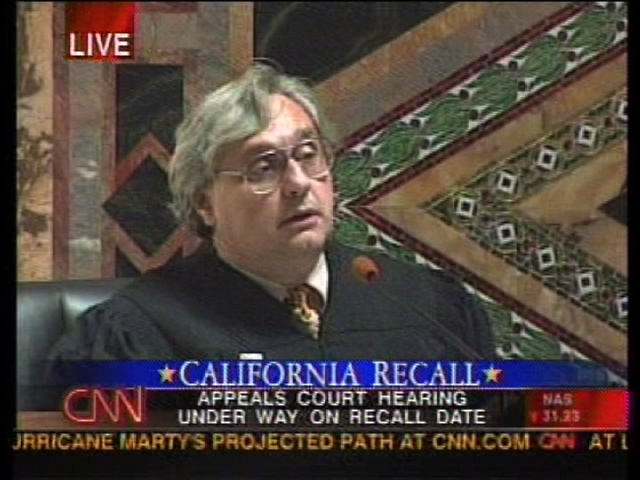
Clip #2: Pundit analysis of the CA Recall from CNN's Inside Politcs.
Inside Politics On The CA Recall (Small - 14 MB)
Clip #3: Justices Kozinski and Kleinfeld questioning the lawyers.
9th Circuit Court Of Appeals On The CA Recall (Small - 8 MB)
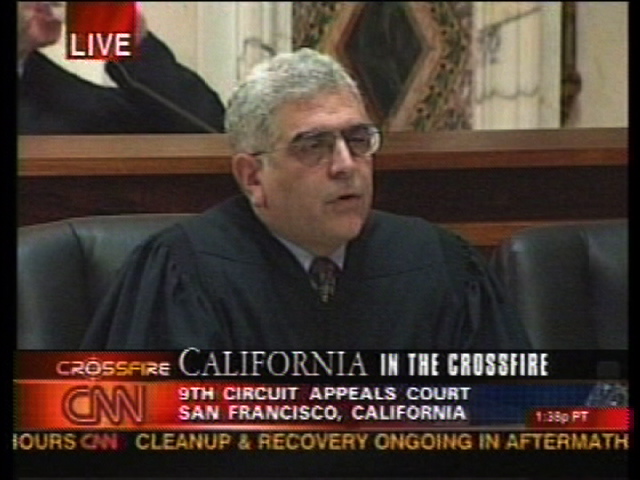
This report has great coverage of the situation surrounding Briana LaHara, the 12-year-old girl who was the first to settle one of the RIAA's 261 copyright infringement lawsuits for $2,000. (However, Jon neglected to mention that filesharers around the world have since come to Briana's rescue.)
Daily Show On The RIAA's First Settlement Victim (Small - 8 MB)


The Daily Show (The best news on television.)
Anniston, Alabama, is a small town where many WMD are currently being destroyed via a giant incinerator in the middle of town. Many of the town's citizens are not at all happy about the situation and potential health risks involved.
Ed Helms takes a humorous look at what appears to be a seriou health risk for Anniston's citizens.
This segment was produced by Kathy Egan and Edited by Daric Schlesselman.
Alablama (Small - 9 MB)


The Daily Show (The best news on television.)
Ashcroft slams critics as Patriot Act backlash grows
By Tom Regan for the Christian Science Monitor.
The attorney general continues to insist that the Act "respects rights and increases security." USA Today looks at how the Act is at the heart of Ashcroft's powers as attorney general.There are also some people who don't think Ashcroft and the Patriot Act have gone far enough. They would like to see a halt to all immigration of any kind, for instance, as a better way to prevent terrorism.
Delaware Online reports that Patriot Act "abuses," however, are starting to surface. People with no connection to any form of criminal activity say that they are being deprived of the right to open bank accounts, get credit cards, etc. because of the Patriot Act.
Shortly after he graduated from college in May, French Clements of San Jose, Calif., tried to open an online brokerage account with Harrisdirect, where his stepfather has an account. A day after he completed the online application, however, he got a brief e-mail from Harrisdirect saying, "We regret to inform you that we are unable to approve your application at this time: The customer's identity not properly authenticated per the USA Patriot Act." Clements was stunned, and so was his mother, Alayne Yellum. "Maybe they don't like people named French," she says...
Critics of the Patriot Act also point out that it is now being used in other areas of law enforcement.
"Within six months of passing the Patriot Act, the Justice Department was conducting seminars on how to stretch the new wiretapping provisions to extend them beyond terror cases," said Dan Dodson, a spokesman for the National Association of Criminal Defense Attorneys. "They say they want the Patriot Act to fight terrorism, then, within six months, they are teaching their people how to use it on ordinary citizens."...
An analysis of the act, as it is being implemented by the federal government and subtly revised by the courts, indicates that so far it has not threatened the civil liberties of millions as some claim but neither has its use avoided unintended consequences and damage to innocent lives. The problem is that because of government secrecy – the fate of some Muslim-Americans rounded up since 9/11 is still unknown – it is difficult to know exactly how the law is being enforced.
Finally, it seems that Ashcroft is having some legal problems of his own. On Friday his department filed a brief saying that he shouldn't be required to appear in a Michigan federal court to explain why he violated a judge's gag order in place during a terrorism trial. Ashcroft is accused of violating a court order when he praised government informant Youssef Hmimssa during an April 17 news conference. At the news conference, Ashcroft called Youssef Hmimssa's cooperation "a critical tool" in efforts to combat terrorism.
Here is the full text of the article in case the link goes bad:
http://search.csmonitor.com/search_content/0916/dailyUpdate.html
Daily Update
By Tom Regan | csmonitor.com
Sign up to be notified daily:
updated 1:00 p.m. ET September 16, 2003
Ashcroft slams critics as Patriot Act backlash grows
The war of words over the USA Patriot Act heated up considerably over the past few days, thanks in part to a recently completed "Patriot Act Tour" conducted by US Attorney General John Ashcroft. The tour, conducted in front of small, law enforcement friendly audiences, excluded participation from the general public. (At Faneuil Hall in Boston, Ashcroft addressed a crowd of 150, while outside the hall a crowd of 1200 chanted "This is what democracy looks like.") The tour was designed to create support for the act, but in some ways may have done just the opposite.
One of the main charges critics of the Patriot Act aim against Ashcroft is that rules designed to catch terrorists will be used against ordinary citizens. They also say police and prosecutors will use the laws created by the Patriot Act in other areas of law enforcement. These critics include people from both the left and the right of the American political spectrum.
Ashcroft blasted some of these critics on Monday, taking aim in particular at librarians. The Associated Press reports that Ashcroft said people are being wrongly led to believe that libraries have been "surrounded by the FBI," with agents "dressed in raincoats, dark suits and sunglasses. They stop everyone and interrogate everyone like Joe Friday."
The attorney general continues to insist that the Act "respects rights and increases security." USA Today looks at how the Act is at the heart of Ashcroft's powers as attorney general.
There are also some people who don't think Ashcroft and the Patriot Act have gone far enough. They would like to see a halt to all immigration of any kind, for instance, as a better way to prevent terrorism.
Delaware Online reports that Patriot Act "abuses," however, are starting to surface. People with no connection to any form of criminal activity say that they are being deprived of the right to open bank accounts, get credit cards, etc. because of the Patriot Act.
Shortly after he graduated from college in May, French Clements of San Jose, Calif., tried to open an online brokerage account with Harrisdirect, where his stepfather has an account. A day after he completed the online application, however, he got a brief e-mail from Harrisdirect saying, "We regret to inform you that we are unable to approve your application at this time: The customer's identity not properly authenticated per the USA Patriot Act." Clements was stunned, and so was his mother, Alayne Yellum. "Maybe they don't like people named French," she says.
As evidence of the Act's effectiveness, the Justice Department often points out that 260 individuals have been charged, and that 515 "linked" to the 9/11 investigation have been deported. But the Christian Science Monitor reports that what the government doesn't reveal is that the vast majority of the 260 charged and 515 deported were involved in relatively minor crimes or immigration infraction, and had nothing to do with Al Qaeda or terrorism.
Critics of the Patriot Act also point out that it is now being used in other areas of law enforcement.
"Within six months of passing the Patriot Act, the Justice Department was conducting seminars on how to stretch the new wiretapping provisions to extend them beyond terror cases," said Dan Dodson, a spokesman for the National Association of Criminal Defense Attorneys. "They say they want the Patriot Act to fight terrorism, then, within six months, they are teaching their people how to use it on ordinary citizens."
In one case, a North Carolina county prosecutor charged a man accused of running a methamphetamine lab with breaking a new state law barring the manufacture of chemical weapons. If convicted, Martin Dwayne Miller could get 12 years to life in prison for a crime that usually brings about six months. AP reports that prosecutors are making no apologies for these tactics, saying that while the Patriot Act's primary focus is on terrorism, lawmakers are aware it contains provisions that have been on prosecutors' wish lists for years, and could be used in a wide variety of cases.
It is this idea of law enforcement officials jamming every conceivable thing on their wish lists into the Patriot Act (because they knew a Congress staggered by the 9/11 attacks would pass it), that enrages so many people. The Chicago Sun-Times reports on a recent debate where retired judge, and former Clinton White House Counsel, Abner Mikva said the act is "making us into the Police State of America."
"It's a 342-page bill that changes our immigration laws, privacy laws, security, detention, the entire way the federal government treats its people," Mikva said ... Mikva described it as a grab bag of civil liberties-defying requests from federal prosecutors that he had rejected during the Clinton years. "I was at the White House in 1995, and we were able to get some of the worst provisions excluded from the 1995 act, and they were just dumped wholesale into the Patriot Act," Mikva said.
The growing backlash against the act may make it more difficult for the Bush asministration to get new provisions added to it. The Washington Post reports that President Bush used the second anniversary of the Sept. 11 attacks to call for empowering authorities in terrorist investigations to issue subpoenas without going to grand juries, to hold suspects without bail and to pursue the death penalty in more cases. But The Toledo Blade reports that Bush didn't go as far as Ashcroft wanted, because senior Republican lawmakers had told him many of these new provisions would be "dead on arrival."
As the Blade also points out, knowing whether Ashcroft or his critics views are justified is made more complicated by the Justice Department's refusal to release information about Patriot Act prosecutions.
An analysis of the act, as it is being implemented by the federal government and subtly revised by the courts, indicates that so far it has not threatened the civil liberties of millions as some claim but neither has its use avoided unintended consequences and damage to innocent lives. The problem is that because of government secrecy – the fate of some Muslim-Americans rounded up since 9/11 is still unknown – it is difficult to know exactly how the law is being enforced.
Finally, it seems that Ashcroft is having some legal problems of his own. On Friday his department filed a brief saying that he shouldn't be required to appear in a Michigan federal court to explain why he violated a judge's gag order in place during a terrorism trial. Ashcroft is accused of violating a court order when he praised government informant Youssef Hmimssa during an April 17 news conference. At the news conference, Ashcroft called Youssef Hmimssa's cooperation "a critical tool" in efforts to combat terrorism.
ABC News upset more than a few apple carts last week when it announced it was able to sneak in some depleted uranium from Jakarta to see if it could fool customs. There actually hasn't been as much as you would think about this in the news. Luckily, the Daily Show stepped in to tell us more about the details.
Daily Show On ABC News' Depleted Uranium-Airport Security Experiment (Small - 8 MB)


The Daily Show (The best news on television.)
I just put up another old song. Well, it's new to you guys!
I wrote this one myself a while ago and finally recorded it a few years back.
There's more where this came from, so stay tuned!
This is one of the first songs I ever wrote. I wrote it around 1994.My friend Simon Grant recently mentioned to me that this one was still his favorite. It reminded me of a peak experience I was lucky to have of performing it live with him and two other guys from Scream Radio -- Jeff Eason and Blake Harkins -- at one of their gigs in Seattle in 2001. (These are the same guys that played with me on Poltergeist, Wander, and Spunky Funk.)
So I went and dug up the studio version I still had of this that I recorded at my friend Joe's studio in Seattle in 1999-2000 or so. My other friend Scotty produced it. (Damn, I wish I could remember their last names.)
I sing and play guitar and bass on this one. My friend Scotty did the drum track.
This is from the September 11, 2003 program.
Daily Show Gaywatch Update (Small - 9 MB)

The Daily Show (The best news on television.)
This is from the September 11, 2003 program.
This clip follows this one. (Watch it first. It will make the clip below a lot funnier.)
Stephen Colbert took the liberty of editing together numerous Shrub speeches in order to create a clip of him actually speaking the words that Rummy and Colin claim he's been saying all along.
Stephen Colbert On The Shrub's Consistent Iraq War-U.N. Policy (Small - 8 MB)
The Daily Show (The best news on television.)
Looks like I'll have to burn her a CD and send it to her. At this point, I don't think she's listening anyway. (James and Marybeth)
Her complete testimony follows this clip from Billboard Magazine...
Courts: A Powerful Boost
By BILL HOLLAND
Billboard Magazine
September 20, 2003
WASHINGTON. D.C.- The nation's top copyright cop has strongly endorsed the record industry's right to file subpoenas and sue those who illegally download songs over the Internet.
During testimony Sept. 8 before the Senate Judiciary Committee. U.S. Register of Copyrights Marybeth Peters provided the clearest federal statement vet in support of industry efforts to combat piracy.
In addition to endorsing those efforts, spearheaded by the Recording Industry Assn. of America (RIAA), she said that if pending court cases go against the industry, Congress would have to remedy the situation.
"Mr. Chairman, make no mistake. The law is unambiguous," she said. "Using peer-to-peer networks to copy or distribute copyrighted works without permission is infringement, and copyright owners have every right to invoke the power of the courts to combat such activity."
As head of the U.S. Copyright Office, Peters is the official interpreter of U.S. intellectual property law.
She told lawmakers that a review would be necessary even if it means revisiting the underlying legal principle regarding copyrighted material put forth in the landmark 1985 Supreme Court case Sony v. Betamax. That decision gave the makers of video recording machines limited liability for any illegal copying on their devices.
Her testimony comes as the U.S. Court of Appeals is about to take up two important court challenges.
In a case being heard in Washington, D.C., Verizon argues that the record industry's use of the information subpoena process authorized in the Digital Millennium Copyright Act (DMCA) is illegal.
The other case before a federal court in Central California involves the RIAA's appeal of a lower court's ruling absolving Grokster, Kazaa and other file services from liability for content traded over their networks.
Peters made clear that in her view, the RIAA, representing copyright owners, is on solid legal ground in both cases.
"The Digital Millennium Copyright Act represents a carefully crafted and balanced bargain, which utilizes the incentives created by pre-existing doctrines to encourage all stakeholders to work cooperatively to realize the potential of the Internet while respecting legal rights," she testified.
"Taken together, the positions of Kazaa and Grokster, along with the arguments now made by Verizon, if they prevail, will leave copyright owners with little or no remedy against the most widespread phenomena of [copyright] infringement in the history of this country" she continued.
"Thus, she said, "it is incumbent upon this committee and this Congress to see that if the judiciary fails to enforce the DMCA and therefore fails to provide the protection to which copyrighted works are entitled, the legislature does."
Peters told Judiciary Committee chairman Sen. Orrin Hatch, R-Utah, that every court that has addressed the issue has agreed that such activity is infringement.
"It can also be a crime, and the perpetrators of such a crime are subject to fines and jail time," she said.
She added that efforts to "rationalize or justify" illegal behavior with allegations of inflated profits or unfair dealings with recording artists are "diversionary tactics" that do not alter the fundamental fact that they are trying to defend illegal activity.
"There are some," she said, "who argue that copyright infringement on peer-to-peer systems is not truly harmful to copyright owners and may even help them generate new interest in their products.
The law leaves that judgment to the copyright owner, and it ought not to be usurped by self-interested third parties who desire to use the copyright owner's work," she said.
Peters characterized Grokster and Kazaa, which the Central District of California ruled are not liable as secondary copyright infringers, as businesses that are "dependent upon massive copyright infringement."
"Any application of the law that allows them to escape liability for lack of knowledge of those same infringements is inherently flawed," she said. Peters added that hanging over all these cases is the Supreme Court's decision on Sony.
"It is perhaps a commentary on that opinion that almost 20 years later, we still have such uncertainty that three courts seem to interpret and apply it in three different ways," she said.
"If the case law evolves as to compel the opposite result of findings of liability for the owners of Kazaa and Grokster, I believe Sony should be revisited either by the Supreme Court or by Congress."
Statement of Marybeth Peters
The Register of Copyrights
before the
Committee on the Judiciary
United States Senate
108th Congress, 1st Session
September 9, 2003
Pornography, Technology, and Process: Problems and Solutions on Peer-to-Peer Networks
Mr. Chairman, Senator Leahy, Members of the Committee, good afternoon. It is always a pleasure to appear before this Committee and I thank you for inviting me to present the views of the Copyright Office today at this very timely hearing. As you were among the leaders in drafting and enacting the Digital Millennium Copyright Act (“DMCA”), I know that these issues are important to you, as they are to me.
I. Background
In 1999, a young man named Shawn Fanning developed a use of the Internet that allowed people to identify and copy music files from other people's computers. As you know, this model popularized peer-to-peer technology and a company called Napster tried to turn it into a profit-making business. Napster became phenomenally popular in a remarkably short period of time, boasting millions of registered users the very next year. But it quickly became clear that Napster was being used extensively (by millions of users) for the purpose of copying and distributing an unprecedented number of copyrighted works, primarily sound recordings of musical works.
That was the scene when you held a hearing on July 11, 2000, Mr. Chairman, entitled “Music on the Internet: Is There an Upside to Downloading?” At that hearing, Mr. Hank Barry, then the CEO of Napster, stated “It is my firm belief that the consumers who use Napster are not committing copyright violations.” (1) We did not agree with that assessment, (2) and we were heartened when the Ninth Circuit found that “Napster users infringe at least two of the copyright holders' exclusive rights: the rights of reproduction...and distribution.” (3) Napster was unable to find a way to continue operations and faded away.
The void left by Napster's departure was filled by other businesses utilizing peer-to-peer technology, such as Aimster, Grokster, and Kazaa. While some of these applications can be differentiated from Napster in terms of their internal technical operation, they still follow the same basic peer-to-peer model as Napster and it is apparent that an overwhelming number of their customers are using it for the same purpose as they and others had used Napster - copying and distributing copyrighted works. By now it is well-settled that those users are infringing copyright. Notwithstanding that, there are still some who contend that such uses are not infringing. (4)
Mr. Chairman, make no mistake. The law is unambiguous. Using peer-to-peer networks to copy or distribute copyrighted works without permission is infringement and copyright owners have every right to invoke the power of the courts to combat such activity. Every court that has addressed the issue has agreed that this activity is infringement. (5) It can also be a crime and the perpetrators of such a crime are subject to fines and jail time.
Some have tried to rationalize or justify their illegal behavior by attacking the victim with allegations of inflated profits or unfair dealings with recording artists on the part of the recording industry. These diversionary tactics do not alter the fundamental fact that they are trying to defend illegal activity that takes place on peer-to-peer networks. For those who do not have sympathy for the recording industry, there are other victims as well. Since Napster, subsequent versions of peer-to-peer networks permit infringement of the works of other copyright owners, large and small, from motion picture studios to independent photographers and needlepoint designers. With broadband connections becoming more and more widespread, it is increasingly more common that the larger files containing full-length motion pictures are copied back and forth. (6) This problem is not shrinking; it is not static; it is growing.
There are some who argue that copyright infringement on peer-to-peer systems is not truly harmful to copyright owners and may even help them generate new interest in their products. The law leaves that judgment to the copyright owner and it ought not be usurped by self-interested third parties who desire to use the copyright owner's work.
II. Copyright Liability of Peer-to-Peer Proprietors
Copyright law has long recognized that those who aid and abet copyright infringement are no less culpable than the direct infringers themselves. (7) There are two types of this secondary liability. Contributory infringement occurs when “[o]ne who, with knowledge of the infringing activity, induces, causes, or materially contributes to the infringing conduct of another.” (8) For purposes of this test, knowledge can be either actual or constructive - that is, having reason to know. (9) Vicarious liability occurs when one “has the right and ability to supervise the infringing activity and also has a direct financial interest in such activities.” (10)
Both of these concepts were brought to bear in the case against Napster. The Ninth Circuit agreed with the District Court that Napster had actual knowledge of the infringements it was facilitating from, for example, notices from aggrieved copyright owners. (11) There was little question but that Napster provided a material contribution in the form of “the site and facilities” for infringement. (12) Thus, Napster was determined to be a contributory infringer.
The Ninth Circuit also considered whether Napster was vicariously liable. It had no difficulty agreeing with the District Court that the infringing material on its network was a “draw” for customers, thus providing a direct financial benefit from the infringing activity. (13) The Ninth Circuit also agreed with the District Court that Napster had the ability to police its system, and thus that it had the right and ability to supervise its users' conduct. (14) Accordingly, Napster was found to be vicariously liable as well.
Thus it was that many felt reassured that the Ninth Circuit had confirmed that copyright law provides an effective and efficient way in which to address the massive infringements that can and do occur on peer-to-peer networks. Unfortunately, the Napster decision was not the final word on the matter.
Earlier this year, the Central District of California surprised many when it held that Grokster and Kazaa are not liable as secondary copyright infringers. (15) This decision departed from long-established precedent. For example, the court held that in order to establish contributory liability, it must be shown that “a defendant has actual - not merely constructive - knowledge of the infringement at a time during which the defendant materially contributes to that infringement.” (16) Were such a standard to be adopted it would eviscerate the doctrine of contributory infringement as it would be almost impossible to meet. It would encourage the kind of sophistry we have seen from the proprietors of some peer-to-peer applications: a denial of knowledge of infringements by their customers in the face of clear and uncontested evidence that such infringement is occurring on a mind-boggling scale. Mr. Chairman, these are people whose business plan is dependent upon massive copyright infringement and any application of the law that allows them to escape liability for lack of knowledge of those same infringements is inherently flawed.
Not only was the Kazaa decision wrong on the law, it has serious policy consequences as well. The historical doctrines of secondary liability have served copyright owners, courts, and the public well - they provide copyright owners with the ability to obtain relief against the root cause of a series of infringements without costly, inefficient, and burdensome suits against numerous individuals. (17) Without a viable doctrine of contributory liability, this option is severely curtailed and may present the copyright owner with the unenviable choice of either accepting unremedied infringements or filing numerous suits against the individual direct infringers.
If today's hearing leaves the Committee with the impression that the law is in flux with regard to the liability of proprietors of peer-to-peer technology, that is because it is. On one side is the Napster decision of the Ninth Circuit and the Aimster decision of the Seventh Circuit, both finding liability, albeit through different paths of analysis. On the other side is the Kazaa decision of the Central District of California, finding no liability for Kazaa and Grokster. Hanging over all of these cases is the Supreme Court's decision in Sony. It is perhaps a commentary on that opinion that almost twenty years later, we still have such uncertainty that three courts seem to interpret and apply it in three different ways. I believe that the correct application of the doctrines of secondary liability and the Sony case should produce findings of liability for the proprietors of Kazaa and Grokster as well as Napster and Aimster. If the case law evolves so as to compel the opposite result, I believe that Sony should be revisited either by the Supreme Court or by Congress.
III. Suits Against Individuals
Unless and until the Kazaa decision is overruled, copyright owners are faced with the unenviable choice to which I referred earlier. They can either resign themselves to unremedied infringements on a previously unimaginable scale, or they can file infringement actions against individual peer-to-peer users. The recording industry has chosen the latter route.
While copyright owners have expressed regret that they have felt compelled to take this step, they need offer no apologies. As I have already said, people who use peer-to-peer technology for the unauthorized reproduction or distribution of copyrighted works are breaking the law. Surprisingly, many people do not appear to realize this. I have long advocated more public education about copyright. In a perfect world, this could be done in classrooms and with billboards. But ours is not a perfect world, and public education can also be accomplished through enforcement of copyright.
The threats of litigation and even the publicity about the subpoenas obtained by the RIAA have made clear to everyone that the so-called “file-sharing” of copyrighted works is not an innocent activity without legal consequences. As a result, it is becoming more and more difficult for people engaged in such activity to claim that they did not know what they were doing is against the law. Of course, for some users of peer-to-peer technology, even knowledge that what they are doing is illegal will not be a sufficient disincentive to engage in such conduct. But whether or not these infringers know or care that it is against the law, the knowledge that such conduct may lead to expensive and burdensome litigation and a potentially large judgment should have a healthy deterrent effect. While we would like to think that everyone obeys the law simply because it is the law and out of a sense of obligation, we also know that laws without penalties may be widely ignored. For many people, the best form of education about copyright in the internet world is the threat of litigation. In short, if you break the law, you should be prepared to accept the consequences. Copyright owners have every right to enforce their rights in court, whether they are taking action against providers of peer-to-peer services designed to profit from copyright infringement or against the persons engaging in individual acts of infringement using such services.
IV. Statutory History and Interpretation of Subsection 512(h)
It is common sense that in order to be able to take action against the users of peer-to-peer networks, the copyright owner must know who those users are. (18) Congress foresaw this need and addressed it by including in the DMCA a process by which copyright owners can learn basic identifying information about alleged infringers from their internet service providers (”ISPs”). (19)
The DMCA began as an effort to implement the 1996 WIPO Internet treaties. (20) Neither those treaties nor any other international instrument directly address the potential secondary liability of ISPs. However, as the treaty implementing legislation moved forward in Congress, representatives of ISPs demanded that the legislation also limit their liability under such circumstances. (21) Congress heeded this call and provided the ISPs with a huge benefit - virtually no liability for qualifying ISPs. This was balanced by a carefully developed set of obligations in the DMCA. Among those balancing obligations was the requirement that ISPs “expeditiously” respond to subpoenas to provide identifying information about subscribers accused of copyright infringement so that the controversy could be settled in court.
At the time the DMCA was drafted, at least one representative of ISPs assured this Committee that ISPs desired a solution whereby “service providers and content owners...work as a partnership....” (22) It was asserted by that same representative that “[l]iability for copyright infringement should fall where it belongs, on the Web site operators, on those who create an infringing work or on those who reproduce it or perform it with actual knowledge of the infringement....” (23) The ability of copyright owners to utilize subsection 512(h) is a critical part of that partnership as is copyright owners' ability to impose liability against those who infringe copyright. It is regrettable that at least one major ISP now rejects the compromise and the balance of the DMCA.
Some now claim that the subpoena power of subsection 512(h) is inapplicable to the activity described in subsection 512(a). As the United States District Court for the District of Columbia recently held, the plain language of subsection 512(h) demonstrates that this interpretation is not correct. (24) I agree with the court's analysis.
Subsection 512(h) instructs service providers to expeditiously respond to a subpoena. The definition of “service provider” in section 512(k) always includes service providers which qualify for the safe harbor in section 512(a). The court reasoned that this demonstrates Congress' intent to apply the subpoena power to “all service providers, regardless of the functions a service provider may perform under the four categories set out in subsections (a) through (d).” (25)
It has also been argued that the subpoena power applies only to subsection 512(c) because subsection 512(h)(2)(A) requires a copyright owner to supply “a copy of a notification described in subsection (c)(3)(A)”. However, as the District Court pointed out, subsection 512(h) “is written without limitation or restriction as to its application.” (26) It does not require that a notice be delivered. Had Congress wished to limit the application of the subpoena power, it would have simply said so in the law. It did not. (27)
The statutory text confirms the policy of compromise behind subsection 512 -- that copyright owners and ISPs work together to remedy infringement. Limiting the subsection 512(h) subpoena provisions as some have proposed would remove an important tool that parties need to remedy infringement efficiently in the peer-to-peer context.
When it enacted the DMCA, Congress did not carve out an exception from subsection 512(h) for transitory digital network communications, the activity covered by subsection 512(a). Service providers which engage in that activity received the benefits and burdens of the same bargain that service providers engaged in the other activity covered by section 512 received. In exchange for a powerful limitation on liability, they undertook some obligations, including the obligation to identify alleged infringers when served with a subsection 512(h) subpoena. When you enacted section 512, you made the right choice. There is no reason for the courts or Congress to have second thoughts about that decision.
I understand that the majority if not all of the 512(h) subpoenas that have been sought, have been sought in the United States District Court for the District of Columbia. Apparently this has necessitated the clerk of that court assigning additional staff to handle the workload. I do not take a position as to whether it is appropriate for a copyright owner to go to a single district court for subpoenas to service providers located outside that district. However, I am sympathetic to concerns about efficiency of the courts and fairness to ISPs located elsewhere in the country. There would certainly be advantages to the filing of these subpoena requests in the districts in which the ISPs are located.
V. Constitutional Challenges to Subsection 512(h)
The United States has intervened in the Verizon-RIAA litigation to defend the constitutionality of the DMCA. The Copyright Office has assisted the Justice Department in this effort and we firmly believe that subsection 512(h) is appropriate and constitutional. Although I am not an expert on constitutional law and I am not here to represent the Department of Justice, I will briefly summarize the arguments the United States made in its brief to the District Court.
The claim that subsection 512(h) violates the case and controversy requirement of the Constitution is belied by a review of other federal laws providing similar procedures, at least one of which has a 150 year pedigree. (28) The 512(h) procedure is also similar to discovery in advance of federal litigation pursuant to Federal Rule of Procedure 27, which finds its origins in the Judiciary Act of 1789. (29) Further, the subpoena power provided in subsection 512(h) does relate to cognizable Article III controversies, namely potential copyright infringement action as well as a dispute between the copyright owner and the ISP over access to the subscriber information. (30)
The claim that subsection 512(h) violates the First Amendment does not withstand scrutiny. Subsection 512(h) does not proscribe spoken words or expressive or communicative conduct, (31) nor is there a realistic danger that it will significantly compromise a recognized First Amendment protection. (32) Section 512(h) merely requires a service provider to identify a person who appears to be engaging in copyright infringement, a necessary step before the copyright owner can initiate legal action. That action may range from an email or letter demanding that the alleged infringer cease and desist from the unlawful conduct to the filing of a lawsuit for copyright infringement. Section 512(h) does not offend the First Amendment any more than the filing of a lawsuit for copyright infringement. In fact, it is an essential tool for a copyright owner who intends to file such a lawsuit. Moreover, indeed, section 512 imposes sanctions on those who misuse the subpoena power, which serve to provide a safeguard. (33)
Although not addressed in the Government's briefs in intervention, I think it is important to put into context the privacy claims that some now put forward. Users of peer-to-peer networks are, by definition, opening their computers up to the world. There may be an illusion of anonymity to that activity, but we have come to learn that such connections can also make available the user's social security number, credit card numbers, and other vital information. By contrast, the 512(h) subpoena process typically involves disclosure to the copyright owner of no more than the subscriber's name, email address, phone number, and perhaps street address. This hardly seems like an invasion of privacy.
VI. Conclusion
The DMCA represents a carefully crafted and balanced bargain which utilizes the incentives created by pre-existing doctrines such as secondary liability as well as enlightened self-interest to encourage all stakeholders to work cooperatively to realize the potential of the Internet while respecting legal rights. Some are now selectively challenging key components of that bargain, particularly in the context of peer-to-peer technology. Taken together, the positions of Kazaa and Grokster, along with the arguments now made by Verizon, if they prevail, will leave copyright owners with little or no remedy against the most widespread phenomena of infringement in the history of this country. We know from past experience with Napster and current experience with Kazaa and Grokster that without a judicial remedy, this infringement will not stop, regardless of the availability of lawful alternatives. It is thus incumbent upon this Committee and this Congress to see to it that if the judiciary fails to enforce the DMCA and therefore fails to provide the protection to which copyrighted works are entitled, the legislature does.
1. Submitted Testimony, Hank Barry, p. 7 (emphasis in original).
2. See Brief for the United States as Amicus Curiae at 11, n.1, 18, A&M Records, Inc. v. Napster, 293 F.3d 1004 (9th Cir. 2001)(Nos. 00-16401 & 00-16403).
3. A&M Records v. Napster, 293 F.3d 1004, 1014 (9th Cir. 2001) (hereinafter “Napster”).
4. Los Angeles Times, “Tone Deaf to a Moral Dilemma?” (Sept. 2, 2003).
5. See Napster at 1014; In re: Aimster Copyright Litigation, 334 F.3d 643, 645 (7th Cir. 2003)(hereinafter “Aimster”); Metro-Goldwyn-Mayer Studios, Inc. v. Grokster, Ltd., 259 F.Supp. 2d 1029, 1034-35 (C.D. Cal. 2003) (hereinafter “Kazaa”).
6. See Gary Gentile, “Online Movie Service Quickens Downloads,” Associated Press, September 3, 2003.
7. See Kalem Co. v. Harper Bros., 222 U.S. 55, 63 (1911).
8. Gershwin Publishing Corp. v. Columbia Artists Management, Inc., 443 F.2d 1159, 1162 (2d Cir. 1971).
9. Id.
10. Id.
11. Napster at 1020-21.
12. Id. at 1022 (quoting Fonovisa, Inc. v. Cherry Auction, Inc., 76 F.3d 259, 264 (9th Cir. 1996) (hereinafter “Fonovisa”)).
13. Id. at 1023 (quoting Fonovisa at 263-64).
14. Id. at 1023-24.
15. Kazaa, 259 F.Supp. 2d 1029.
16. Id. at 1036.
17. See Sony Corp. v. Universal City Studios, Inc., 464 U.S. 417, 437, n. 18 (hereinafter “Sony”) (citing the “dance hall cases”); Fonovisa, 76 F.3d 259 (suit against the operator of a swap meet for infringing activity of third-party vendors).
18. The existence of section 512(h) is plain evidence that Congress did not view any existing procedures by which a suit could be filed against an unknown defendant as acceptable alternatives for copyright owners.
19. See 17 U.S.C. §512(h).
20. See Hearings on S. 1121 Before the Senate Judiciary Committee, 105th Cong. 25 (statement of George Vradenburg, III) (representing “over 1,400 Internet service providers, content creators, telephone companies, among others...).
21. Id.
22. Id.
23. Id.
24. In re: Verizon Internet Services, Inc., Subpoena Enforcement Matter, 240 F.Supp. 2d 24, 30 (D.D.C. 2003).
25. Id. at 31.
26. Id. at 33.
27. Id.
28. Brief for Intervenor United States of America, p. 6, In re: Verizon Internet Services, Inc., Subpoena Enforcement Matter, 257 F.Supp. 2d 244 (D.D.C. 2003) (No. 03-MS-0040 (JDB)).
29. Id. at 10-11.
30. Id. at 9, 13.
31. Id. at 15-16.
32. Id. at 16-18.
33. Id. at 17-18.
This is from the September 11, 2003 program.
These should have been edited into two different clips, but I blew it, so there it is.
The first part is a nice introspective piece from Stewart about 9-11.
Next, a great Shrub War update follows. Highlights include Rummy's new calm and sedated demeanor -- compared to his wartime royal smugness (a.k.a. "Rummy Then and Now"), Colin Powell trying to make peace in the U.N., and both Rummy and Colin saying that the Shrub has always sought U.N. involvement.
If you think this is revisionist history. Just wait till you see the Stephen Colbert clip that follows!
Partial Transcript:
Jon Stewart:
Now while the President's decision to seek a resolution giving the U.N. a greater role in Iraq seems like...uh...I don't know... a 180? Administration Officials say this has been the plan all along.Donald Rumsfield put it this way: "This isn't anything new. There's no big news story here."
Colin Powell says: "The President has said this from the very beginning."
They've been saying these things the whole time? I can't believe I didn't realize that. I must be reading the wrong papers. Watching the wrong tv new shows. Listening to the wrong radio stations. Living on the wrong planet.
9-11 Intro and The Shrub's 180 Degree Turnaround On U.N. Involvement In Iraq (Small - 11 MB)
The Daily Show (The best news on television.)
Today was "talk like a pirate day." The Internet Archive obliged, and dressed like pirates too.
From left to right: me, Molly, Astrid



This is from the September 10, 2003 program.
Rob Courddry On The CA Recall 9/10/03 (Small - 10 MB)
The Daily Show (The best news on television.)
Senate Defies Bush, Overturns FCC Ruling
In Reuters.
The Republican-led U.S. Senate on Tuesday defied Bush administration opposition and voted to rescind new regulations allowing large media companies to grow even bigger.The Senate approved, 55-40, a resolution that would roll back the Federal Communications Commission rules allowing television networks to own more local stations and permitting conglomerates to own a newspaper, television stations and radio outlets in a single market.
The measure faces a tougher battle in the U.S. House of Representatives and a threat of a veto by President Bush if it reaches his desk.
The Republican-led FCC narrowly adopted the new rules in June, which would allow television networks to own local stations that collectively reach 45 percent of the national audience, up from 35 percent.
The new rules permit one company to own a newspaper, a television station and several radio stations in a single market, lifting a decades-old ban on cross-ownership. A company would also be permitted to own two local television stations in more local markets.
Here is the full text of the article in case the link goes bad:
http://abcnews.go.com/wire/US/reuters20030916_233.html
September 18, 2003
Senate Defies Bush, Overturns FCC Ruling
Sept. 16
— WASHINGTON (Reuters) - The Republican-led U.S. Senate on Tuesday defied Bush administration opposition and voted to rescind new regulations allowing large media companies to grow even bigger.
The Senate approved, 55-40, a resolution that would roll back the Federal Communications Commission rules allowing television networks to own more local stations and permitting conglomerates to own a newspaper, television stations and radio outlets in a single market.
The measure faces a tougher battle in the U.S. House of Representatives and a threat of a veto by President Bush if it reaches his desk.
The Republican-led FCC narrowly adopted the new rules in June, which would allow television networks to own local stations that collectively reach 45 percent of the national audience, up from 35 percent.
The new rules permit one company to own a newspaper, a television station and several radio stations in a single market, lifting a decades-old ban on cross-ownership. A company would also be permitted to own two local television stations in more local markets.
The regulations were drawn up under the leadership of FCC Chairman Michael Powell, who argued the relaxed limits were necessary to reflect the proliferation of cable, satellite television and the Internet offerings as well as preserve over-the-air broadcast television.
Television networks like Viacom Inc.'s
Critics, ranging from the National Rifle Association to Consumers Union as well as Democrats and Republicans in Congress, charged that the rules would narrow the choices of viewpoints and cut local news coverage.
photo credit and caption:
The Republican-led U.S. Senate on September 16, 2003 defied Bush administration opposition and voted to rescind new regulations allowing large media companies to grow even bigger. The Senate approved, 55-40, a resolution that would roll back the Federal Communications Commission rules allowing television networks to own more local stations and permitting conglomerates to own a newspaper, television stations and radio outlets in a single market. FCC Chairman Michael Powell (R) and FTC Chairman Timothy Muris join President Bush at a June 27 White House news conference.
This is from the September 16, 2003 program.
Daily Show's Recall On The Recall (Small - 9 MB)
The Daily Show (The best news on television.)
Hey I've got some kind of weird bug going on when users get an error message before the comments sends anyway. Has anyone else seen this problem? Wanna shoot me an email and help me fix it? (Please :-)
Okay I missed that the Daily Show had an incredible set of recall clips tuesday night -- so i'll be getting those up now.
Then there's the rest of the week of the Daily Show, the rest of the Dick Cheney clips (yes! there's more!) -- Jesse Jackson's speech from the protest Tuesday -- and whatever else I've still got in the kitty from last week...
Federal Budget Disaster Seen, but Won't Be Heard
By Janet Hook for the LA Times.
Even though the government is on track to run a record deficit in excess of $500 billion next year, neither President Bush nor congressional leaders have proposed doing anything to balance the budget anytime soon. Their strategy: to wait for a vigorous economy to do the job for them.
That makes David M. Walker, head of the General Accounting Office, Congress' investigative arm, a rare Cassandra. He is giving a speech today warning that the nation's long-term fiscal outlook is seriously out of whack. And he challenges the assumption that economic recovery will solve the problem painlessly."We need a wake-up call," Walker said in an interview. "We need to come to terms with reality: The gap is too great to grow our way out of the problem. Tough choices will be required."
His is a lonely voice on Capitol Hill, where deficit-expanding initiatives are growing like crabgrass, unchecked amid new budget demands for the war on terrorism and the reconstruction of Iraq.
Bush and lawmakers from both parties continue to press for a $400-billion, 10-year expansion of Medicare to provide prescription drug benefits. House Republicans are pushing yet another round of tax cuts — this time for big business, at a cost of more than $100 billion over 10 years. And even as Bush asks for $87 billion more for military and reconstruction efforts in Iraq and Afghanistan, there seems to be little appetite in Congress for offsetting cuts in domestic spending.
"This is truly a Lyndon Johnson guns-and-butter fiscal policy," said Daniel J. Mitchell, a senior fellow at the Heritage Foundation, a conservative think tank.
Here is the full text of the entire article in case the link goes bad:
http://www.latimes.com/news/nationworld/nation/la-na-budget17sep17002429,1,2719244.story
September 17, 2003
Federal Budget Disaster Seen, but Won't Be Heard
By Janet Hook, Times Staff Writer
WASHINGTON — Something remarkable will happen here today. A senior congressional figure will declare the federal budget, in effect, a disaster area — and official Washington will probably react with a shrug.
Even though the government is on track to run a record deficit in excess of $500 billion next year, neither President Bush nor congressional leaders have proposed doing anything to balance the budget anytime soon. Their strategy: to wait for a vigorous economy to do the job for them.
That makes David M. Walker, head of the General Accounting Office, Congress' investigative arm, a rare Cassandra. He is giving a speech today warning that the nation's long-term fiscal outlook is seriously out of whack. And he challenges the assumption that economic recovery will solve the problem painlessly.
"We need a wake-up call," Walker said in an interview. "We need to come to terms with reality: The gap is too great to grow our way out of the problem. Tough choices will be required."
His is a lonely voice on Capitol Hill, where deficit-expanding initiatives are growing like crabgrass, unchecked amid new budget demands for the war on terrorism and the reconstruction of Iraq.
Bush and lawmakers from both parties continue to press for a $400-billion, 10-year expansion of Medicare to provide prescription drug benefits. House Republicans are pushing yet another round of tax cuts — this time for big business, at a cost of more than $100 billion over 10 years. And even as Bush asks for $87 billion more for military and reconstruction efforts in Iraq and Afghanistan, there seems to be little appetite in Congress for offsetting cuts in domestic spending.
"This is truly a Lyndon Johnson guns-and-butter fiscal policy," said Daniel J. Mitchell, a senior fellow at the Heritage Foundation, a conservative think tank.
Democrats — both in Congress and on the presidential campaign trail — have tried to spotlight the deficit as an emblem of the failure of Bush's fiscal policy. It has given new impetus to Democratic proposals to repeal all or part of the 2001 tax cut. Some congressional Democrats are considering a proposal to help cover Iraq costs by raising taxes on the wealthiest taxpayers.
"The deficit is an easy-to-understand symbol that things are being mismanaged," said David Sirota, spokesman for the Center for American Progress, a liberal research group. "It should reopen the entire debate on whether we should continue cutting taxes for the wealthy."
But the Democratic Party is deeply divided over whether or how far to raise taxes. And with their own big spending plans for Medicare, education and other domestic priorities, Democrats also lack a clear program for getting the budget back into balance. Missing from the presidential field is an H. Ross Perot, whose 1992 maverick campaign made budget balancing the cornerstone of his challenge to the Washington establishment.
"Nobody is prepared to make any trade-offs," said Robert Bixby, executive director of the Concord Coalition, a budget watchdog group. "No one is prepared to give up anything important to them to bring the budget under control."
The deficit has cast an increasingly long shadow over Congress with each upward revision. In August, the Congressional Budget Office said the deficit in 2004 would reach $480 billion — and that did not include the cost of the conflict in Iraq or pending legislation to expand Medicare. Now, in light of its Iraq budget request, the administration projects that next year's deficit will reach at least $525 billion.
It seems certain that Congress will approve at least the $87 billion Bush has requested. The bigger question is whether that will boost the deficit so high that lawmakers will reassess other parts of the budget or change their legislative ways.
Sen. Olympia J. Snowe (R-Maine), who voted against Bush's tax cut last spring because she was concerned about the deficit, said she thought the budget was putting new pressure on lawmakers to propose offsetting spending cuts when they propose increases — as she plans to when she pushes for more child-care funding in a welfare bill soon to come before the Senate.
"The deficit is now back on everyone's radar screen," Snowe said. "On the spending side, we have to make some choices."
But Snowe herself demonstrates why it will be so hard to reverse the current trend. Even though she says she is an adamant foe of deficits, Snowe still wants to go ahead with the $400-billion Medicare drug benefit. "Medicare is an exception and it should be," she said.
Bush and other politicians argue that running a deficit is justified at a time of military conflict abroad and economic downturn at home. His administration's stated goal has been to cut the deficit in half in five years. Rather than propose tax increases or big spending cuts, he is counting on economic growth to increase government revenue and reduce the red ink.
Bush and his Republican allies argue that tax cuts will help reduce the deficit, not increase it, because they spur the economic growth that will generate new revenue. That is why House Republicans are still plowing ahead with plans this week to pass another $12.5-billion tax cut to encourage charitable giving. A bigger test will come this fall when Congress debates a big-business tax break later this fall. A version drafted by House Ways and Means Chairman Bill Thomas (R-Bakersfield) would cost $127 billion over 10 years.
"When you give people their money back, they grow the economy much better than the government does," said House Majority Whip Roy Blunt (R-Mo.). "The way to move out of deficit is to grow the economy."
Walker and other analysts argue, however, that economic growth alone will not bring the budget back into the black. They say that will require aggressive anti-deficit initiatives on a par with those launched in the 1980s and 1990s.
A 1985 law, for example, set up a mechanism to make automatic spending cuts if Congress missed specified annual deficit targets. In 1990, a tax hike was passed with the support of President George H. W. Bush, the current president's father.
In 1993, President Clinton and Congress passed a package of tax increases and spending cuts. In 1997, Congress passed a budget-balancing plan that included politically painful reductions in the growth of Medicare spending.
Now, however, any tax hike is anathema to a Republican Party that has turned into a bastion of tax cut enthusiasts in the decade since the elder Bush left office.
On the other hand, according to a study by the libertarian Cato Institute, the current president's first three annual budgets increased outlays by 15.6% — compared with 6.8% in President Reagan's first three budgets.
One More Round For Bush v. Gore
By Charles Lane for the Washington Post.
Bush v. Gore held for the first time that the Constitution's equal protection clause, which protects citizens from arbitrarily disparate treatment at the hands of state authorities, can be applied to the methods states use to tally votes. Previously, election methods had been thought to be mostly the province of state officials.The court ruled that a statewide manual recount ordered by the Florida Supreme Court to account for uncounted punch-card ballots, many of which were marred by "hanging chads" and the like, would be conducted according to wildly varying rules, making it impossible for the state to treat everyone equally within the short time available.
For the liberal interest groups and lawyers who have been fighting California's recall, Bush v. Gore has mutated from reviled electoral coup to legitimate legal weapon.
If the case means anything, they argue, it means that the Constitution forbids states from arbitrarily counting different voters' ballots differently. That includes setting up an election in which one technology, the punch-card machines, would subject a sizeable percentage of voters -- among whom are a disproportionate number of minorities -- to a greater risk of having their ballots discounted than other voters.
Indeed, yesterday's ruling flowed from earlier litigation, since settled, in which groups used Bush v. Gore to win a promise from the state that all its punch-card machines would be replaced by March 2004, when the state will hold Republican and Democratic primaries.
The 9th Circuit noted that, according to experts, about 40,000 out of the several million expected to vote in the recall election would lose out because of the normal 2.23 percent error rate in the punch-card technology. Those voters would tend to come from six heavily minority counties containing 44 percent of the state's voters, whereas 56 percent of the state's voting population would get the benefit of machines with an error rate of no more than 0.89 percent.
Such discrepancies would probably not have risen to the level of a federal issue in the past, but 2000 changed all that, the 9th Circuit ruled.
"If we had brought the punch-card case to court before Bush v. Gore, you'd likely see the courts say, 'No, states have to have some leeway,' " said Rick Hasen, a professor at Loyola Law School in Los Angeles who aided the American Civil Liberties Union in the case. "But if it doesn't apply here, it doesn't apply anywhere."
Here is the full text of the article in case the link goes bad:
http://www.washingtonpost.com/wp-dyn/articles/A16011-2003Sep15.html
Analysis: The Law
One More Round For Bush v. Gore
By Charles Lane
Washington Post Staff Writer
Tuesday, September 16, 2003; Page A01
Just last February, Supreme Court Justice Ruth Bader Ginsburg, a dissenter in the historic 2000 election case that handed victory to President Bush, told a law school audience in San Diego that Bush v. Gore was a "one of a kind case," adding: "I doubt it will ever be cited as precedent by the court on anything."
But yesterday, a three-judge panel of the San Francisco-based U.S. Court of Appeals for the 9th Circuit essentially declared that the legal fallout of the 2000 case is not so easily contained.
In a 66-page unsigned opinion, the panel, made up of Judges Harry Pregerson, Sidney Thomas and Richard Paez, cited Bush v. Gore repeatedly to support the view that California's Oct. 7 gubernatorial recall election would be unconstitutional if the state, as planned, used outmoded punch-card ballot machines like those that contributed to the deadlock in Florida in 2000. The punch-card technology would deny millions of Californians their constitutional right to have their ballots counted fairly, the court ruled.
"In this case, Plaintiffs' Equal Protection Clause claim mirrors the one recently analyzed by the Supreme Court in Bush v. Gore," the 9th Circuit observed.
If the panel ruling is not reversed by a larger 9th Circuit body, the Supreme Court justices, for whom the stress and strain -- both personal and institutional -- of 2000 are still a fresh memory, will face a choice. They can stay out of the California case and risk permitting what they may view as a debatable interpretation of Bush v. Gore to stand, or they can plunge in and assume the risk that they will once again be criticized for partisanship no matter what they decide.
Bush v. Gore held for the first time that the Constitution's equal protection clause, which protects citizens from arbitrarily disparate treatment at the hands of state authorities, can be applied to the methods states use to tally votes. Previously, election methods had been thought to be mostly the province of state officials.
The court ruled that a statewide manual recount ordered by the Florida Supreme Court to account for uncounted punch-card ballots, many of which were marred by "hanging chads" and the like, would be conducted according to wildly varying rules, making it impossible for the state to treat everyone equally within the short time available.
For the liberal interest groups and lawyers who have been fighting California's recall, Bush v. Gore has mutated from reviled electoral coup to legitimate legal weapon.
If the case means anything, they argue, it means that the Constitution forbids states from arbitrarily counting different voters' ballots differently. That includes setting up an election in which one technology, the punch-card machines, would subject a sizeable percentage of voters -- among whom are a disproportionate number of minorities -- to a greater risk of having their ballots discounted than other voters.
Indeed, yesterday's ruling flowed from earlier litigation, since settled, in which groups used Bush v. Gore to win a promise from the state that all its punch-card machines would be replaced by March 2004, when the state will hold Republican and Democratic primaries.
The 9th Circuit noted that, according to experts, about 40,000 out of the several million expected to vote in the recall election would lose out because of the normal 2.23 percent error rate in the punch-card technology. Those voters would tend to come from six heavily minority counties containing 44 percent of the state's voters, whereas 56 percent of the state's voting population would get the benefit of machines with an error rate of no more than 0.89 percent.
Such discrepancies would probably not have risen to the level of a federal issue in the past, but 2000 changed all that, the 9th Circuit ruled.
"If we had brought the punch-card case to court before Bush v. Gore, you'd likely see the courts say, 'No, states have to have some leeway,' " said Rick Hasen, a professor at Loyola Law School in Los Angeles who aided the American Civil Liberties Union in the case. "But if it doesn't apply here, it doesn't apply anywhere."
But others say both the recall's opponents and the 9th Circuit panel -- made up of three of that left-leaning court's most liberal members -- have misinterpreted Bush v. Gore.
For all its conclusive impact on the Florida recount, the Supreme Court's majority opinion ended on a note of ambivalence.
Protesting that their involvement was an "unsought responsibility," the majority -- made up of Chief Justice William H. Rehnquist and Justices Sandra Day O'Connor, Antonin Scalia, Anthony M. Kennedy and Clarence Thomas -- said the decision was "limited to the present circumstances."
The 9th Circuit panel just blew by that admonition, some legal analysts say.
"It over-read Bush v. Gore a little bit," said Vikram Amar, a professor of law at the University of California Hastings College of Law in San Francisco. "You can't say it's quite identical, because Bush v. Gore involved manual recounts, not machine mistakes. In 2000, the Supreme Court was worried that standardless criteria allowed individuals to manipulate results, and that may be worse constitutionally than machine errors skewing the result."
Cheney link of Iraq, 9/11 challenged
By Anne E. Kornblut and Bryan Bender for the Boston Globe.
Vice President Dick Cheney, anxious to defend the White House foreign policy amid ongoing violence in Iraq, stunned intelligence analysts and even members of his own administration this week by failing to dismiss a widely discredited claim: that Saddam Hussein might have played a role in the Sept. 11 attacks.Evidence of a connection, if any exists, has never been made public. Details that Cheney cited to make the case that the Iraqi dictator had ties to Al Qaeda have been dismissed by the CIA as having no basis, according to analysts and officials. Even before the war in Iraq, most Bush officials did not explicitly state that Iraq had a part in the attack on the United States two years ago.
But Cheney left that possibility wide open in a nationally televised interview two days ago, claiming that the administration is learning "more and more" about connections between Al Qaeda and Iraq before the Sept. 11 attacks. The statement surprised some analysts and officials who have reviewed intelligence reports from Iraq...
Vincent Cannistraro, a former CIA counterterrorism specialist, said that Cheney's "willingness to use speculation and conjecture as facts in public presentations is appalling. It's astounding."
In particular, current intelligence officials reiterated yesterday that a reported Prague visit in April 2001 between Sept. 11 hijacker Mohamed Atta and an Iraqi agent had been discounted by the CIA, which sent former agency Director James R. Woolsey to investigate the claim. Woolsey did not find any evidence to confirm the report, officials said, and President Bush did not include it in the case for war in his State of the Union address last January.
But Cheney, on NBC's "Meet the Press," cited the report of the meeting as possible evidence of an Iraq-Al Qaeda link and said it was neither confirmed nor discredited, saying: "We've never been able to develop any more of that yet, either in terms of confirming it or discrediting it. We just don't know."...
But there is no evidence proving the Iraqi regime knew about or took part in the Sept. 11 attacks, the Bush officials said.
Former senator Max Cleland, who is a member of the national commission investigating the attacks, said yesterday that classified documents he has reviewed on the subject weaken, rather than strengthen, administration assertions that Hussein's regime may have been allied with Al Qaeda.
"The vice president trying to justify some connection is ludicrous," he said.
Nonetheless, Cheney, in the "Meet the Press" interview Sunday, insisted that the United States is learning more about the links between Al Qaeda and Hussein.
"We learn more and more that there was a relationship between Iraq and Al Qaeda that stretched back through most of the decade of the '90s," Cheney said, "that it involved training, for example, on [biological and chemical weapons], that Al Qaeda sent personnel to Baghdad to get trained on the systems."...
But intelligence specialists told the Globe last August that they have never confirmed that the training took place, or identified where it could have taken place. "The general public just doesn't have any independent way of weighing what is said," Cannistraro, the former CIA counterterrorism specialist, said. "If you repeat it enough times . . . then people become convinced it's the truth."
Here is the full text of the article in case the link goes bad:
http://www.boston.com/news/nation/articles/2003/09/16/cheney_link_of_iraq_911_challenged/
Cheney link of Iraq, 9/11 challenged
By Anne E. Kornblut and Bryan Bender, Globe Staff and Globe Correspondent, 9/16/2003
WASHINGTON -- Vice President Dick Cheney, anxious to defend the White House foreign policy amid ongoing violence in Iraq, stunned intelligence analysts and even members of his own administration this week by failing to dismiss a widely discredited claim: that Saddam Hussein might have played a role in the Sept. 11 attacks.
Evidence of a connection, if any exists, has never been made public. Details that Cheney cited to make the case that the Iraqi dictator had ties to Al Qaeda have been dismissed by the CIA as having no basis, according to analysts and officials. Even before the war in Iraq, most Bush officials did not explicitly state that Iraq had a part in the attack on the United States two years ago.
But Cheney left that possibility wide open in a nationally televised interview two days ago, claiming that the administration is learning "more and more" about connections between Al Qaeda and Iraq before the Sept. 11 attacks. The statement surprised some analysts and officials who have reviewed intelligence reports from Iraq.
Democrats sharply attacked him for exaggerating the threat Iraq posed before the war.
"There is no credible evidence that Saddam Hussein had anything to do with 9/11," Senator Bob Graham, a Democrat running for president, said in an interview last night. "There was no such relationship."
A senior foreign policy adviser to Howard Dean, the Democratic front-runner, said it is "totally inappropriate for the vice president to continue making these allegations without bringing forward" any proof.
Cheney and his representatives declined to comment on the vice president's statements. But the comments also surprised some in the intelligence community who are already simmering over the way the administration utilized intelligence reports to strengthen the case for the war last winter.
Vincent Cannistraro, a former CIA counterterrorism specialist, said that Cheney's "willingness to use speculation and conjecture as facts in public presentations is appalling. It's astounding."
In particular, current intelligence officials reiterated yesterday that a reported Prague visit in April 2001 between Sept. 11 hijacker Mohamed Atta and an Iraqi agent had been discounted by the CIA, which sent former agency Director James R. Woolsey to investigate the claim. Woolsey did not find any evidence to confirm the report, officials said, and President Bush did not include it in the case for war in his State of the Union address last January.
But Cheney, on NBC's "Meet the Press," cited the report of the meeting as possible evidence of an Iraq-Al Qaeda link and said it was neither confirmed nor discredited, saying: "We've never been able to develop any more of that yet, either in terms of confirming it or discrediting it. We just don't know."
Multiple intelligence officials said that the Prague meeting, purported to be between Atta and senior Iraqi intelligence officer Ahmed Khalil Ibrahim Samir al-Ani, was dismissed almost immediately after it was reported by Czech officials in the aftermath of Sept. 11 and has since been discredited further.
The CIA reported to Congress last year that it could not substantiate the claim, while American records indicate Atta was in Virginia Beach, Va., at the time, the officials said yesterday. Indeed, two intelligence officials said yesterday that Ani himself, now in US custody, has also refuted the report. The Czech government has also distanced itself from its original claim.
A senior defense official with access to high-level intelligence reports expressed confusion yesterday over the vice president's decision to reair charges that have been dropped by almost everyone else. "There isn't any new intelligence that would precipitate anything like this," the official said, speaking on condition he not be named.
Nonetheless, 69 percent of Americans believe that Hussein probably had a part in attacking the United States, according to a recent Washington Post poll. And Democratic senators have charged that the White House is fanning the misperception by mentioning Hussein and the Sept. 11 attacks in ways that suggest a link.
Bush administration officials insisted yesterday that they are learning more about various Iraqi connections with Al Qaeda. They said there is evidence suggesting a meeting took place between the head of Iraqi intelligence and Osama bin Laden in Sudan in the mid-1990s; another purported meeting was said to take place in Afghanistan, and during it Iraqi officials offered to provide chemical and biological weapons training, according to officials who have read transcripts of interrogations with Al Qaeda detainees.
But there is no evidence proving the Iraqi regime knew about or took part in the Sept. 11 attacks, the Bush officials said.
Former senator Max Cleland, who is a member of the national commission investigating the attacks, said yesterday that classified documents he has reviewed on the subject weaken, rather than strengthen, administration assertions that Hussein's regime may have been allied with Al Qaeda.
"The vice president trying to justify some connection is ludicrous," he said.
Nonetheless, Cheney, in the "Meet the Press" interview Sunday, insisted that the United States is learning more about the links between Al Qaeda and Hussein.
"We learn more and more that there was a relationship between Iraq and Al Qaeda that stretched back through most of the decade of the '90s," Cheney said, "that it involved training, for example, on [biological and chemical weapons], that Al Qaeda sent personnel to Baghdad to get trained on the systems."
The claims are based on a prewar allegation by a "senior terrorist operative," who said he overheard an Al Qaeda agent speak of a mission to seek biological or chemical weapons training in Iraq, according to Secretary of State Colin Powell's statement to the United Nations in February.
But intelligence specialists told the Globe last August that they have never confirmed that the training took place, or identified where it could have taken place. "The general public just doesn't have any independent way of weighing what is said," Cannistraro, the former CIA counterterrorism specialist, said. "If you repeat it enough times . . . then people become convinced it's the truth."
So I am in graduate school, and I finally had to do some reading and homework this week.
I've also upgraded my Movable Type so my RSS feeds should be in better shape.
Try to send a few comments, if you don't mind, so I can check out the new install.
Check back tonight when things should be back to normal...
Thanks!
Monday night, I posted a clip from Meet the Press where Dick Cheney stated that he no longer has any financial ties to Halliburton. Guess I wasn't the only one who noticed that wasn't exactly true.
Now Senators Daschle and Lautenberg are demanding hearings investigating the no-bid contracts. They also did me the favor of producing the exact numbers I asked for.
Oil services firm paid Cheney as VP
In Reuters.
"The vice president needs to explain how he reconciles the claim that he has 'no financial interest in Halliburton of any kind' with the hundreds of thousands of dollars in deferred salary payments he receives from Halliburton," Daschle said in a statement.On NBC's "Meet the Press" Sunday, Cheney, who was Halliburton's CEO from 1995 to 2000, said he had severed all ties with the Houston-based company.
"I have no financial interest in Halliburton of any kind and haven't had now for over three years," he said.
Cathie Martin, a Cheney spokeswoman, confirmed that the vice president has been receiving the deferred compensation payments from Halliburton, but she disputed that his statements on "Meet the Press" had been misleading.
Cheney had already earned the salary that was now being paid, Martin said, adding that once he became a nominee for vice president, he purchased an insurance policy to guarantee that the deferred salary would be paid to him whether or not Halliburton survived as a company.
"So he has no financial interest in the company," she said.
But Lautenberg said Cheney's financial disclosure filings with the Office of Government Ethics listed $205,298 in deferred salary payments made to him by Halliburton in 2001, and another $162,393 in 2002. The filings indicated that he was scheduled to receive more payments this year and in 2004 and 2005.
"In 2001 and 2002, Vice President Cheney was paid almost as much in salary from Halliburton as he made as vice president," Lautenberg said.
The vice president's salary is $198,600 annually.
Here is the full text of the article in case the link goes bad:
http://www.azstarnet.com/star/wed/30917Ncheney.html
Oil services firm paid Cheney as VP
REUTERS
Dick Cheney
WASHINGTON - Vice President Dick
Cheney, a former CEO of Halliburton Co., has received hundreds of thousands of dollars from the company since taking office while asserting he has no financial interest in the company, Senate Democrats said Tuesday.
The Democrats demanded to know why Cheney claimed to have cut ties with the oil services company, involved in a large no-bid contract for oil reconstruction work in Iraq, when he was still receiving large deferred salary payments.
Senate Democratic Leader Tom Daschle of South Dakota and Sen. Frank Lautenberg, D-N.J., said the revelations reinforced the need for hearings about the no-bid contracts Halliburton received from the Bush administration.
"The vice president needs to explain how he reconciles the claim that he has 'no financial interest in Halliburton of any kind' with the hundreds of thousands of dollars in deferred salary payments he receives from Halliburton," Daschle said in a statement.
On NBC's "Meet the Press" Sunday, Cheney, who was Halliburton's CEO from 1995 to 2000, said he had severed all ties with the Houston-based company.
"I have no financial interest in Halliburton of any kind and haven't had now for over three years," he said.
Cathie Martin, a Cheney spokeswoman, confirmed that the vice president has been receiving the deferred compensation payments from Halliburton, but she disputed that his statements on "Meet the Press" had been misleading.
Cheney had already earned the salary that was now being paid, Martin said, adding that once he became a nominee for vice president, he purchased an insurance policy to guarantee that the deferred salary would be paid to him whether or not Halliburton survived as a company.
"So he has no financial interest in the company," she said.
But Lautenberg said Cheney's financial disclosure filings with the Office of Government Ethics listed $205,298 in deferred salary payments made to him by Halliburton in 2001, and another $162,393 in 2002. The filings indicated that he was scheduled to receive more payments this year and in 2004 and 2005.
"In 2001 and 2002, Vice President Cheney was paid almost as much in salary from Halliburton as he made as vice president," Lautenberg said.
The vice president's salary is $198,600 annually.
I had a chance to speak briefly with Jesse Jackson after his speech today.
This took place in Sproul Plaza on Tuesday, September 16, 2003.
Jesse Jackson On Whether Or Not The 9th Circuit Decision On The Recall Will Hold (Small - 3 MB)
Jesse Jackson On Whether Or Not The 9th Circuit Decision On The Recall Will Hold (Hi-res - 35 MB)
Lisa Rein: "Do you think the 9th Circuit Court of Appeals Decision about the Recall election is gonna hold?"
Jesse Jackson: "It's difficult to say, only because this Supreme Court did an extrodinary thing in 2000. They stopped the vote determining the outcome of the presidency. So if they would do it for a President, they might do it for a Governor. You just don't know. So we must be prepared."
"I feel that momentum is building. People are finally beginning to see the danger of this act of disenfranchisement and destabilization. Whether it's Prop 54 or the Recall. Both are of the same ideology. They seek to disenfranchise and to destablize and people must fight back. If we fight back, we'll win."
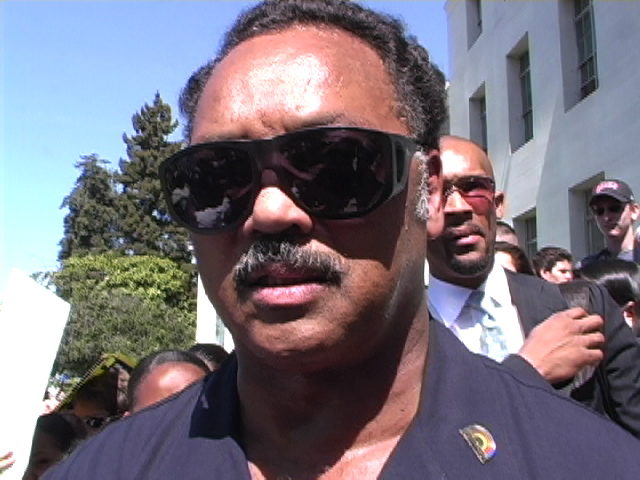
Hope to see you today at the protest.
(Maps and instructions provided.)
It's very important for the Supreme Court to know that we respect and support yesterday's decision by the 9th Circuit Court Of Appeals to halt the recall election.
It really is like Florida all over again. Let's hope the Supreme Court does the right thing this time. I have a good feeling that it will. The facts are a lot more clear cut this time around.
This clip is a Dick Cheney classic.
According to Cheney, he doesn't know anything about anything. He doesn't know who Ambassador Joseph Wilson is. He doesn't know who the CIA is. He must not know what a newspaper is either.
This is from the September 14, 2003 program of
Meet The Press, hosted by Tim Russert.
(Link goes to a complete very incomplete transcript.)
Russert: "Were you briefed on his (Joseph Wilson's) findings of February-March of 2002?"
Cheney: "No. I don't know Joe Wilson. I've never met Joe Wilson...Joe Wilson? I don't know who sent Joe Wilson. He never submitted a report that I ever saw when he came back...I don't know Mr. Wilson. I probably shouldn't judge him...I have no idea who hired him."
Tim Russert: "The CIA did."
Cheney: "Yeah but who are 'the CIA?' I don't know."
Cheney On The Forged Nigerian WMD Evidence (Small - 8 MB)

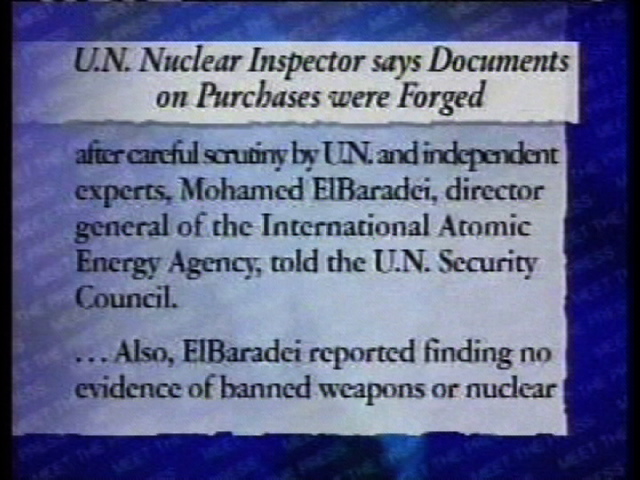


This is from the September 14, 2003 program of
Meet The Press, hosted by Tim Russert.
(Link goes to a complete very incomplete transcript.)
Cheney On The Missing WMD (Small - 10 MB)


This is from the September 14, 2003 program of
Meet The Press, hosted by Tim Russert.
(Link goes to a complete very incomplete transcript.)
Cheney: "I don't know any of the details of the contract because I deliberately stay away from any of that information."
Cheney also said that he has "no idea" why there was no bidding process, and to "go ask the Core of Engineers." He also said that he "has no financial interest of any kind" with the company and hasn't "for over three years."
(Can someone please find me a link to the fact that he still receives deferred income from Halliburton every year? I know I've seen that several times in different publications. It's bound to be somewhere else besides in a Daily Show clip. -- Thanks! UPDATE! 9/16/03 -- Well, that didn't take long (see snippet below from Chris Floyd in Counterpunch.)
Update: 9/17/03 - New story in Reuters with all the details.
Cheney On The Halliburton Contracts (Small - 6 MB)
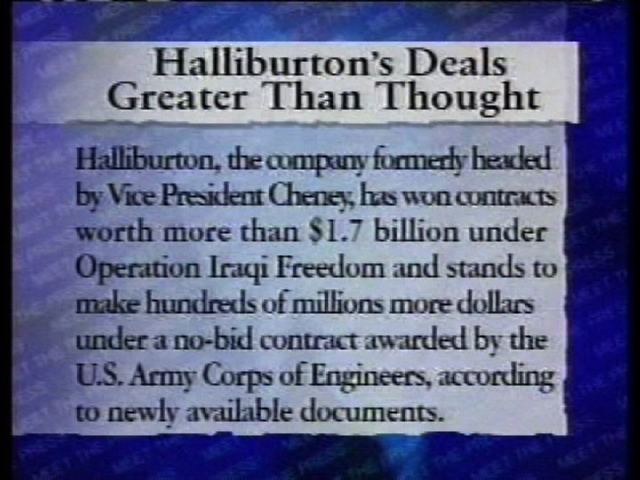

From Counterpunch, March 2003:
Old news, you say? Irrelevant to the current crisis? Surely, now that Cheney has been translated to glory as the nation's second-highest public servant, he is beyond any taint of grubby material concerns? Au contraire, as those ever-dastardly French like to say. At this very moment, while the smoke is still rising from the rubble of Baghdad, while the bodies of the unburied dead are still rotting in the desert wastes, Dick Cheney is receiving one million dollars a year in so-called "deferred compensation" from Halliburton. That's a million smackers from a private company that profits directly from the mass slaughter in Iraq, going into the pockets of the "public servant" who is, as the sycophantic media never tires of telling us, the power behind George W.'s throne - and a prime architect of the war.
(Thanks, Jim.)
Here is the full text of the Counterpunch article that seems to complement this video clip so nicely. (In case the link goes bad.):
http://www.counterpunch.org/floyd03292003.html
March 29, 2003
Bushist Party Feeds on Fear and War
Blood on the Tracks
By CHRIS FLOYD
Before the first cruise missile crushed the first skull of the first child killed in the first installment of George W. Bush's crusade for world dominion, the unelected plutocrats occupying the White House were already plying their corporate cronies with fat contracts to "repair" the murderous devastation they were about to unleash on Iraq. There was, of course, no open bidding allowed in the process; just a few "selected" companies--selected for their preponderance of campaign bribes to the Bushist Party, that is - "invited" to submit their wish lists to the War Profiteer-in-Chief.
It should come as no surprise that one of the leading beneficiaries of this hugger-mugger largess is our old friend, Halliburton Corporation, the military-energy servicing conglomerate. Halliburton, headed by Vice Profiteer Dick Cheney until the Bushist coup d'etat in 2000, is already reaping billions from the Bush wars--which Cheney himself tells us "might not end in our lifetime."
Cheney is an old hand at this kind of death merchanting, of course. In the first Bush-Iraq War, Cheney, playing the role now filled by Don Rumsfeld--a squinting, smirking, lying Secretary of Defense - directed the massacre of some 100,00 Iraqis, many of whom were buried alive, or machine-gunned while retreating along the "Highway of Death," or annihilated in sneak attacks launched after a ceasefire had been called. When George I and his triumphant conquerors were unceremoniously booted out of office less than two years later by that radical fringe group so hated by the Bushists--the American people--Cheney made a soft landing at Halliburton.
There he grew rich on government contracts and taxpayer-supported credits doled out by his old pals in the military-industrial complex. He also hooked up with attractive foreign partners - like Saddam Hussein, the "worse-than-Hitler" dictator who paid Cheney $73 million to rebuild the oil fields that had been destroyed by, er, Dick Cheney. And while the Halliburton honcho became a multimillionaire many times over, some of his employees were not so lucky - Cheney ashcanned more than 10,000 workers during his boardroom reign. (At least he didn't bury them alive.)
Old news, you say? Irrelevant to the current crisis? Surely, now that Cheney has been translated to glory as the nation's second-highest public servant, he is beyond any taint of grubby material concerns? Au contraire, as those ever-dastardly French like to say. At this very moment, while the smoke is still rising from the rubble of Baghdad, while the bodies of the unburied dead are still rotting in the desert wastes, Dick Cheney is receiving one million dollars a year in so-called "deferred compensation" from Halliburton. That's a million smackers from a private company that profits directly from the mass slaughter in Iraq, going into the pockets of the "public servant" who is, as the sycophantic media never tires of telling us, the power behind George W.'s throne - and a prime architect of the war.
This is money that Cheney wouldn't get if Halliburton went down the tubes--a prospect it faced in the early days of the Regime, due to a boneheaded merger engineered by its former CEO, a guy named, er, Dick Cheney. In a deal apparently sealed during a golf game with an old crony, Cheney acquired a subsidiary, Dresser Industries--a firm associated with the Bush family for more than 70 years--which was facing billions of dollars in liability claims for its unsafe use of asbestos. Dresser's bigwigs doubtless made out like bandits from the deal, and Cheney left the mess behind when the grateful Bushes put him on the presidential ticket, but there was serious concern that Halliburton itself would be forced into bankruptcy - unless it found massive new sources of secure funding to offset the financial "shock and awe" of the asbestos lawsuits.
Then lo and behold, after September 11, Halliburton received a multibillion-dollar, open-ended, no-bid contract to build and service U.S. military bases and operations all over the world. It also won several shorter-term contracts, such as expanding the concentration camp in Guantanamo Bay, where the Regime is holding unnamed, uncharged suspected terrorists in violation of the Geneva Convention. With this fountain of federal money pouring into its coffers - and Bushist operatives in Congress pushing legislation to restrict asbestos lawsuits--Halliburton was able to hammer out a surprisingly favorable settlement deal with the asbestos victims. The company--and Cheney's million-dollar paychecks--were saved. Praise Allah!
Halliburton is just the tip of the slagheap, of course. Daddy Bush's popsicle stand, the Carlyle Group - which controls a vast network of defense firms and "security" operations around the world - is also panning gold from the streams of blood pouring down the ancient tracks of Babylon. Junior Bush - who like a kept woman made his own influence-peddling fortune through services rendered to a series of sugar daddies--has conveniently gutted the national inheritance tax, swelling his own eventual bottom line when his father joins the legions of Panamanian, Iranian, Afghan, Iraqi--and American--dead he and his son have sent down to Sheol.
Never in American history has a group of government leaders profited so directly from war--never. Like their brothers-in-arms, Saddam's Baathists, the Bushists treat their own country like a sacked town, looting the treasury for their family retainers and turning public policy to private gain. Like Saddam, they feed on fear and glorify aggression. Like Saddam, they have dishonored their nation and betrayed its people.
But the money sure is good, eh, Dick?
Chris Floyd is a columnist for the Moscow Times and is a regular contributor to CounterPunch.
This is from the September 14, 2003 program of
Meet The Press, hosted by Tim Russert.
(Link goes to a complete very incomplete transcript.)
Cheney On The Misleading, Inaccurate Estimates For How Much The War Will Cost (Small - 8 MB)



This is from the September 14, 2003 program of
Meet The Press, hosted by Tim Russert.
(Link goes to a complete very incomplete transcript.)
Cheney On The Congressional Budget Office's Claims That Our Forces Are Already Overextended (Small - 7 MB)

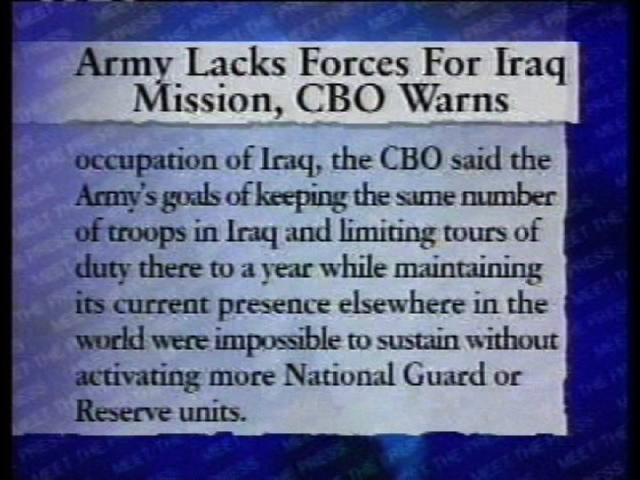
This is from the September 14, 2003 program of
Meet The Press, hosted by Tim Russert.
(Link goes to a complete very incomplete transcript.)
Cheney On Misjudgements By The Shrub Administration and Its Primary Concern Over In Iraq (Oil) (Small - 5 MB)
This is from the September 14, 2003 program of
Meet The Press, hosted by Tim Russert.
(Link goes to a complete very incomplete transcript.)
Cheney On The Plan For Iraq (Or Lack Of One) (Small - 7 MB)
Tim Russert: "What is our plan for Iraq? How long with the 140,000 American Soldiers be there? How many international troops will join them? And how much is this gonna cost?"
Cheney: "Well, some of those questions are unknowable at present. They will depend on developments -- depend on how fast it takes us to achieve our objectives."

This is from the September 14, 2003 program of
Meet The Press, hosted by Tim Russert.
(Link goes to a complete very incomplete transcript.)
Cheney On The War That Was Supposedly Over May 1, 2003 -- And The Soldiers Who Are Still Dying (Small - 5 MB)
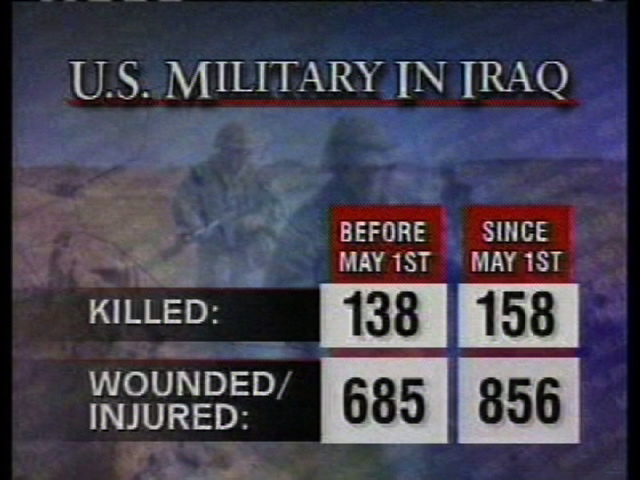
This is from the September 14, 2003 program of
Meet The Press, hosted by Tim Russert.
(Link goes to a complete very incomplete transcript.)
Cheney On The 140+ Saudis Who Were Flown Out Of The Country Right After 911 (Small - 3 MB)
This is from the September 14, 2003 program of
Meet The Press, hosted by Tim Russert.
(Link goes to a complete very incomplete transcript.)
Subject: The Confused American Public That Thinks Iraq Was Responsible For 9-11, Saudi Involvement In 9-11, And the "Classified" Pages of the 9-11 Commission Report
Note: There is no mention whatsoever of this segment in the transcript. (Except for the part in the end about Cheney thinking another attack is imminent.)
Cheney On Iraq and 9-11 (Small - 7 MB)
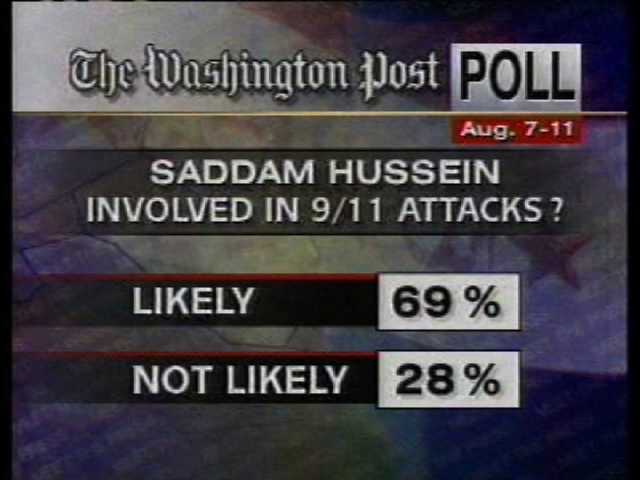
This is from the September 14, 2003 program of
Meet The Press, hosted by Tim Russert.
(Link goes to a complete very incomplete transcript.)
I also have this footage edited into smaller clips, organized by subject, that I'm in the process of uploading right now.
Cheney On Meet The Press - 1 of 2 (Small - 55 MB)
Cheney On Meet The Press - 2 of 2 (Small - 49 MB)


Here is the full text of the article in case the link goes bad:
http://www.msnbc.com/news/966470.asp
Transcript for Sept. 14
Sunday, September 14, 2003
GUEST: Dick Cheney, vice president
Tim Russert, moderator
This is a rush transcript provided for the information and convenience of the press. Accuracy is not guaranteed.
(Note from Lisa -- boy, that's the understatement of the year! This transcript is very abridged.)
MR. TIM RUSSERT: Our issues this Sunday: America remembers September 11, 2001. In Iraq, six months ago, the war began with shock and awe. Vice President Dick Cheney appeared on MEET THE PRESS:
(Videotape, March 16):
VICE PRES. DICK CHENEY: My belief is we will, in fact, be greeted as liberators.
(End videotape)
MR. RUSSERT: Did the Bush administration misjudge the level of organized resistance, the number of American troops needed, the cost of securing Iraq, and the existence of weapons of mass destruction? Those questions and more for the vice president of the United States, Dick Cheney. Our exclusive guest for the full hour.
Mr. Vice President, welcome back to MEET THE PRESS.
VICE PRES. CHENEY: Good morning, Tim. It’s good to be back.
MR. RUSSERT: Two years ago, September 11, 2001, you went to New York City, just the other day, attacks on the World Trade Center, the Pentagon, the crash in Shanksville, Pennsylvania. Has this nation recovered from September 11, 2001?
VICE PRES. CHENEY: Well, I think in many respects, recovered, yes. On the other hand, there are some things that’ll never be the same. I look back on that, and I think about what we’ve been engaged in since.
And in a sense, sort of the theme that comes through repeatedly for me is that 9/11 changed everything. It changed the way we think about threats to the United States. It changed about our recognition of our vulnerabilities. It changed in terms of the kind of national security strategy we need to pursue, in terms of guaranteeing the safety and security of the American people.
And I’m not sure everybody has made that transition yet. I think there are a number of people out there who hope we can go back to pre-9/11 days and that somehow 9/11 was an aberration. It happened one time; it’ll never happen again. But the president and I don’t have that luxury. You know, we begin every day reading the intelligence reports from the CIA and the FBI on the nature of the threat that’s out there, on the plotting by al-Qaeda members and related groups to launch attacks against the United States and contemplating the possibility of an attack against the U.S. with far deadlier weapons than anything we’ve seen to date. So on the one hand, I’m sure everybody wants to get back to normal, and we have in many respects. But on the other hand, we all have to recognize as a nation that 9/11 changed a great deal in our lives.
MR. RUSSERT: You fully expect that there will be another attack on the United States.
VICE PRES. CHENEY: I have to assume that. The president has to assume that. It would be nice to be able to say that that can’t happen. But if we’ve learned anything, if we look back now, it seems to me that we’ve learned that there was a campaign of terror mounted against us. Before 9/11, we tended to think in terms of a terrorist act as a criminal enterprise. And the appropriate response was a law enforcement response.
You go find the bad guy, put him in jail, case closed. What we’ve learned since is that that’s not the case at all; but, in fact, a lot of the terrorist attacks we’ve suffered in the 1990s were al-Qaeda directed. That’s certainly true in the World Trade Center in ’93, in the East Africa Embassy bombings in ’98, and the USS Cole in 2000 and obviously on 9/11.
It’s very important we make that transition in understanding that we’re at war, that the war continues, that this is a global enemy that struck in not only New York and Washington but in Bali and in Djakarta, in Mombasa, in Casablanca, Riyadh since 9/11, that this is an enterprise that is global in scope and one we’ve had major success against it. And the fact of the matter is there were thousands of people that went through those training camps in Afghanistan. We know they are seeking deadlier weapons—chemical, biological and nuclear weapons if they can get it. And if anything, those basic notions that developed in the early days after 9/11 have been reinforced by what we’ve learned since.
MR. RUSSERT: There’s grave concern about surface-to-air missiles shooting down American commercial aircraft. Should we not outfit all U.S. commercial airliners with equipment to detect and avoid that?
VICE PRES. CHENEY: Well, there are technologies available. They are extremely expensive if you’re going to put them on every airliner. You’ve got to make choices here about, you know, when you’re dealing with a risk, there may be certain aircraft flying into certain locales that are especially vulnerable that you may want to deal with. But I wouldn’t automatically go to the assumption that we need to put the most sophisticated system on every single airplane.
MR. RUSSERT: The Washington Post asked the American people about Saddam Hussein, and this is what they said: 69 percent said he was involved in the September 11 attacks. Are you surprised by that?
VICE PRES. CHENEY: No. I think it’s not surprising that people make that connection.
MR. RUSSERT: But is there a connection?
VICE PRES. CHENEY: We don’t know. You and I talked about this two years ago. I can remember you asking me this question just a few days after the original attack. At the time I said no, we didn’t have any evidence of that. Subsequent to that, we’ve learned a couple of things. We learned more and more that there was a relationship between Iraq and al-Qaeda that stretched back through most of the decade of the ’90s, that it involved training, for example, on BW and CW, that al-Qaeda sent personnel to Baghdad to get trained on the systems that are involved. The Iraqis providing bomb-making expertise and advice to the al-Qaeda organization.
We know, for example, in connection with the original World Trade Center bombing in ’93 that one of the bombers was Iraqi, returned to Iraq after the attack of ’93. And we’ve learned subsequent to that, since we went into Baghdad and got into the intelligence files, that this individual probably also received financing from the Iraqi government as well as safe haven.
Now, is there a connection between the Iraqi government and the original World Trade Center bombing in ’93? We know, as I say, that one of the perpetrators of that act did, in fact, receive support from the Iraqi government after the fact. With respect to 9/11, of course, we’ve had the story that’s been public out there. The Czechs alleged that Mohamed Atta, the lead attacker, met in Prague with a senior Iraqi intelligence official five months before the attack, but we’ve never been able to develop anymore of that yet either in terms of confirming it or discrediting it. We just don’t know.
MR. RUSSERT: We could establish a direct link between the hijackers of September 11 and Saudi Arabia.
VICE PRES. CHENEY: We know that many of the attackers were Saudi. There was also an Egyptian in the bunch. It doesn’t mean those governments had anything to do with that attack. That’s a different proposition than saying the Iraqi government and the Iraqi intelligent service has a relationship with al-Qaeda that developed throughout the decade of the ’90s. That was clearly official policy.
MR. RUSSERT: There are reports that the investigation Congress did does show a link between the Saudi government and the hijackers but that it will not be released to the public.
VICE PRES. CHENEY: I don’t know want to speculate on that, Tim, partly because I was involved in reviewing those pages. It was the judgment of our senior intelligence officials, both CIA and FBI that that material needed to remain classified. At some point, we may be able to declassify it, but there are ongoing investigations that might be affected by that release, and for that reason, we kept it classified. The committee knows what’s in there. They helped to prepare it. So it hasn’t been kept secret from the Congress, but from the standpoint of our ongoing investigations, we needed to do that.
One of the things this points out that’s important for us to understand—so there’s this great temptation to look at these events as discreet events. We got hit on 9/11. So we can go and investigate it. It’s over with now.
It’s done. It’s history and put it behind us.
From our perspective, trying to deal with this continuing campaign of terror, if you will, the war on terror that we’re engaged in, this is a continuing enterprise. The people that were involved in some of those activities before 9/11 are still out there. We learn more and more as we capture people, detain people, get access to records and so forth that this is a continuing enterprise and, therefore, we do need to be careful when we look at things like 9/11, the commission report from 9/11, not to jeopardize our capacity to deal with this threat going forward in the interest of putting that information that’s interesting that relates to the period of time before that. These are continuing requirements on our part, and we have to be sensitive to that.
MR. RUSSERT: Vanity Fair magazine reports that about 140 Saudis were allowed to leave the United States the day after the 11th, allowed to leave our airspace and were never investigated by the FBI and that departure was approved by high-level administration figures. Do you know anything about that?
VICE PRES. CHENEY: I don’t, but a lot of folks from that part of the world left in the aftermath of 9/11 because they were worried about public reaction here in the United States or that somehow they might be discriminated against. So we have had, especially since the attacks of Riyadh in May of this year from the Saudi government, great support and cooperation in going after terrorists, especially al-Qaeda. I think the Saudis came to realize as a result of the attacks of last May that they were as much of a target as we are, that al-Qaeda did have a foothold inside Saudi Arabia—a number of the members of the organization are from there—that there have been private individuals in Saudi Arabia who provided significant financial support and assistant, that there are facilitators and operators working inside Saudi Arabia to support the al-Qaeda network. And the Saudis have been, as I say in the last several months, very good partners in helping us go after the people in the al-Qaeda organization.
MR. RUSSERT: Let me turn to the situation in Iraq. We all remember this picture from May 1. The president on the USS Lincoln on May 1; mission accomplished. Since that time, these are the rather haunting figures coming out of Iraq. We had lost 138 soldiers before May 1, and 685 wounded, injured. Since that time, since the president came on the carrier and said major combat was over, we’ve lost 158, and 856 wounded and injured. Those numbers are pretty troubling.
VICE PRES. CHENEY: Well, it’s significant, Tim. Any loss of life or injuries suffered by American military personnel is significant. Everyone wishes that that weren’t necessary. But from the standpoint of the activity we’re engaged in over there and what we’ve been able to accomplish over the last two years, I think it’s important to keep all of this in perspective. I looked at some numbers yesterday. I had them run the numbers, for example, in terms of our casualties since we launched into Afghanistan, began the war on terror a little over two years ago now. And the number killed in combat, both in Afghanistan and Iraq, as of yesterday, was about 213. When you add in those from non-hostile causes—the plane crashes, helicopter goes down without hostile fire—we’ve got a total of 372 fatalities since we started the war.
Remember, we lost 3,000 people here on 9/11. And what we’ve been able to accomplish—although I must say we regret any casualties. You’d like to be able do everything casualty-free. When you think about what we’ve accomplished in terms of taking Afghanistan—we had a total of 30 killed in action in Afghanistan—taking down the Taliban and destroying the capacity of al-Qaeda to use Afghanistan as a base to attack the United States, launching an attack into Iraq, destroying the Iraqi armed forces, taking down the government of Iraq, getting rid of Saddam Hussein, capturing 42 out of the 55 top leaders, and beginning what I think has been
fairly significant success in terms of putting Iraq back together again, the price that we’ve had to pay is not out of line, and certainly wouldn’t lead me to suggest or think that the strategy is flawed or needs to be changed.
MR. RUSSERT: Do you believe that Saddam Hussein had a deliberate strategy, a deliberate calculated plan, not to have the big battle of Baghdad but rather to dissolve away into the mainstream population and then mount this guerrilla war?
VICE PRES. CHENEY: I don’t. I think that, in effect, he lost control at the outset. If you look at what transpired during the course of the campaign, the campaign that Tommy Franks mounted, the speed with which they moved, the element of surprise that was involved here, the fact that we were basically able to sever communications between the head, Saddam Hussein, and his forces, now, I don’t think he had any choice ultimately but to flee Baghdad as he did. The level of resistance continues out there, obviously, but I think we’re making major progress against it, and I think it’s important not to let anecdotal reporting on individual resistance conflicts somehow color or lead us to make misjudgments about the total scope of the effort.
The fact is that most of Iraq today is relatively stable and quiet. There are still ongoing incidents, attacks on coalition forces or on others, on the Jordanian Embassy, on the U.N. delegation, on the Shia clerics in Najaf, from ones of—two sources, I believe: either from the remnants of the old regime, the Ba’athists, the Fedayeen Saddam, or terrorists, al-Qaeda types, many of whom were in Iraq before the war, some of whom have arrived since the war. Those are the main two sources that we’ve got to deal with. We are dealing with them. The actual number of incidents, according to General Abizaid, this month is significantly below what it was last month on a daily basis. So we just have to keep working the problem, and we’re doing that.
MR. RUSSERT: Joe Lieberman, the senator from Connecticut, running for president, had this to say: “...what President Bush gave the American people on Sunday night was a price tag”—$87 billion—”not a plan. And we in Congress must demand a plan.”
What is our plan for Iraq? How long will the 140,000 American soldiers be there? How many international troops will join them? And how much is this going to cost?
VICE PRES. CHENEY: Well, some of those questions are unknowable at present, Tim. It’ll depend on developments. It’ll depend on how fast it takes us to achieve our objectives. Remember when we went there, that we went there specifically to take down the Saddam Hussein regime, to wrap up all WMD capability he had possessed or developed, to deal with the threat that his regime represented to the region, and the United States. Very significant challenge. But we have, in fact, I think, been very successful at achieving that.
In terms of where we’re going now, we’re moving aggressively to deal with the security situation. We’re continuing those efforts. We’ve got some first-rate troops undertaking those efforts, and, needless to say, we’ve had major success, major progress when you think about the number of Iraqi bad guys that we’ve eliminated or captured. We’ve—working very aggressively, Bremer is, to stand up a new government. We’ve now got a 25-man governing council in place made up of Iraqis, a broad representative group of Iraqi officials.
We’ve got Iraqis now in charge of each ministry in the government. We’ve got 90 percent—over 90 percent of the cities and towns and villages of Iraq are now governed by democratically elected or appointed local councils. We’ve got all the schools open; we’ve got all the hospitals up and functioning. We’re making major progress in restoring the electricity to pre-war levels. We’re rebuilding the oil system and infrastructure in the country. So all of that’s happening. And it’s a very important part of our total strategy. We’re also working to stand up an Iraqi security force. And in four months we’ve put together a force now of some 55,000 Iraqis serving in the police force, serving in the border security force and so forth at the local level. But that will continue to grow. The second largest security contingent in Iraq today behind the U.S. is Iraqi. We’ve been successful to some extent in getting international support. We’ve got a Polish division. We stood up a Polish-led division a few weeks ago that has troops in it from 17 countries.
With respect to the financing, the $87 billion we’ve asked for is—about 3/4 of that is to support our military and security operations. About 1/4 of it will go specifically to helping make the investments Bremer believes we need to make in order to get the Iraqis back and functioning on their own capability.
So how long will it take? I don’t know. I can’t say. I don’t think anybody can say with absolute certainty at this point. We’ve achieved already, when you consider that we’ve only been there about four months, a great deal, and we are well on our way, I think, to achieving our objective. But the key here for us is to stay committed to get the job done, to get the guys on the ground the resources they need, both from a military as well as a civilian standpoint, and that’s exactly what the president is doing.
MR. RUSSERT: Let’s go through some of those things because there have been suggestions of misjudgments by the administration. When you were on the program in March, I asked you about troop levels. Let’s watch:
(Videotape, March 16, 2003):
MR. RUSSERT: The army’s top general said that we would have to have several hundred thousand troops there for several years in order to maintain stability.
VICE PRES. CHENEY: I disagree. To suggest that we need several hundred thousand troops there after military operations cease, after the
conflict ends, I don’t think is accurate. I think that’s an overstatement.
(End videotape)
MR. RUSSERT: We, in fact, have about 140,000 troops, 20,000 international troops, as well. Did you misjudge the number of troops necessary to secure Iraq after major combat operations?
VICE PRES. CHENEY: Well, you’re going to get into a debate here about—talking about several years, several hundred thousand troops for several years. I think that’s a non-starter. I don’t think we have any plan to do that, Tim. I don’t think it’s necessary to do that. There’s no question but what we’ve encountered resistance. But I don’t think anybody expected the time we were there to be absolutely trouble-free. We knew there were holdover elements from the regime that would fight us and struggle. And we also knew al-Qaeda was there, and Ansar al-Islam, up in northeastern Iraq, which we’ll come back to, talk about in a minute.
So I don’t think there was a serious misjudgment here. We couldn’t know precisely what would happen. There were a lot of contingencies we got ready for that never did happen. You know, for example, one of the things we spent time worried about was that Saddam would destroy his own oil industry, that he’d do in Iraq what he did in Kuwait 12 years ago. The consequence of that, if he’d gone in and blown up those wells, as they contemplated doing, in fact wired some of them for destruction, would have been that the oil industry would have been shut down to zero production, probably for several years, while we tried to restore it. We were able to defeat that. That didn’t occur. We had plans for it that we didn’t have to execute or implement. So it’s like any other process. A plan is only as good until you start to execute, then you have got to make adjustments and so forth. But I don’t think there has been a major shift in terms of U.S. troop levels. And I still remain convinced that the judgment that we’ll need “several hundred thousand for several years” is not valid.
MR. RUSSERT: The Congressional Budget Office said that: “That the Army lacks sufficient active-duty forces to maintain its current level of nearly 150,000 troops in Iraq beyond next spring. In a report that underscores the stress being place on the military by the occupation of Iraq, the CBO said the Army’s goals of keeping the same number of troops in Iraq and limiting tours of duty there to a year while maintaining its current presence elsewhere in the world were impossible to sustain without activating more National Guard or Reserve units.”
Can we keep 150,000 troops beyond next spring without, in effect, breaking the Army?
VICE PRES. CHENEY: Tim, we can do what we have to do to prevail in this conflict. Failure’s not an option. And go back again and think about what’s involved here. This is not just about Iraq or just about the difficulties we might encounter in any one part of the country in terms of restoring security and stability. This is about a continuing operation on the war on terror. And it’s very, very important we get it right. If we’re successful in Iraq, if we can stand up a good representative government in Iraq, that secures the region so that it never again becomes a threat to its neighbors or to the United States, so it’s not pursuing weapons of mass destruction, so that it’s not a safe haven for terrorists, now we will have struck a major blow right at the heart of the base, if you will, the geographic base of the terrorists who have had us under assault now for many years, but most especially on 9/11. They understand what’s at stake here. That’s one of the reasons they’re putting up as much of a struggle as they have, is because they know if we succeed here, that that’s going to strike a major blow at their capabilities.
MR. RUSSERT: So the resistance in Iraq is coming from those who were responsible for 9/11?
VICE PRES. CHENEY: No, I was careful not to say that. With respect to 9/11, 9/11, as I said at the beginning of the show, changed everything. And one of the things it changed is we recognized that time was not on our side, that in this part of the world, in particular, given the problems we’ve encountered in Afghanistan, which forced us to go in and take action there, as well as in Iraq, that we, in fact, had to move on it. The relevance for 9/11 is that what 9/11 marked was the beginning of a struggle in which the terrorists come at us and strike us here on our home territory. And it’s a global operation. It doesn’t know national boundaries or national borders. And the commitment of the United States going into Afghanistan and take down the Taliban and stand up a new government, to go into Iraq and take down the Saddam Hussein regime and stand up a new government is a vital part of our long-term strategy to win the war on terror. America’s going to be safer and more secure in the years ahead when we complete the task in Iraq successfully, and we will complete it successfully. And whatever the cost is, in terms of casualties or financial resources, it’s a whale of a lot less than trying to recover from the next attack in the United States. So what we do on the ground in Iraq, our capabilities here are being tested in no small measure, but this is the place where we want to take on the terrorists. This is the place where we want to take on those elements that have come against the United States, and it’s far more appropriate for us to do it there and far better for us to do it there than it is here at home.
We talk about $87 billion. Yeah, that’s a significant expense. No question about it. But it’s going to be much more expensive down the road if we wait. And it’ll be uch more expensive—it’s less money, frankly, than the events of 9/11 imposed on us here in the United States.
MR. RUSSERT: In terms of costs, Mr. Vice President, there are suggestions again—it was a misjudgment by the administration or even misleading. “Lawrence Lindsey, head of the White House’s National Economic Council, projected the ‘upper bound’ of war costs at $100 billion to $200 billion.”
We’ve already spent $160 billion after this $87 billion is spent. The Pentagon predicted $50 billion: “The administration’s top budget official [Mitch Daniels] estimated that the cost of a war with Iraq could be in the range of $50 billion to $60 billion...he said...that earlier estimates of $100 billion to $200 billion in Iraq war costs by Lawrence Lindsey, Mr. Bush’s former chief economic adviser, were too high.”
And Paul Wolfowitz, the deputy secretary of Defense, went before Congress and said this: “We’re dealing with a country that can really finance its own econstruction, and relatively soon. The oil revenues of that country could bring between $50 and $100 billion over the course of the next two or three years.” It looked like the administrations truly misjudged the cost of this operation.
VICE PRES. CHENEY: No, I didn’t see a one-point estimate there that you could say that this is the administration’s estimate. We didn’t know. And if you ask Secretary Rumsfeld, for example—I can remember from his briefings, he said repeatedly he didn’t know. And when you and I talked about it, I couldn’t put a dollar figure on it.
MR. RUSSERT: But Daniels did say $50 billion.
VICE PRES. CHENEY: Well, that might have been, but I don’t know what is basis was for making that judgment. We do know that we are prepared and need to be prepared to do whatever it takes to make it work. But this is not a situation where, you know, it’s only a matter of us writing a check to solve the problem. Iraq sits on top of 10 percent of the world’s oil reserves, very significant reserves, second only to Saudi Arabia.
The fact is there are significant resources here to work with, and the notion that we’re going to bear the burden all by ourselves from a financial standpoint I don’t think is valid. We’ve got a donor’s conference scheduled coming up next month, where the international community will come together and pledge funds to cooperate and supported with the Iraqi operation. The U.N. resolution now that Colin Powell’s been working on this weekend involves, as well, authorization for the international financial institutions to come support that. There’s money at the U.N. left over in the oil-for-food program that’s going to be available.
There are funds frozen, Iraqi assets in various places in...
MR. RUSSERT: How much is all that?
VICE PRES. CHENEY: I don’t have a final dollar figure. We don’t know who will...
MR. RUSSERT: Is the ei...
VICE PRES. CHENEY: ...pony up for that. The $87 billion, again, remember, about 3/4 of that is to support the U.S. military operations or about 1/4 of it actually goes to Iraq operations, and a portion clearly will be used in Afghanistan and for the war on terror.
MR. RUSSERT: Is the $87 billion the end of it? Will the American people be asked for any more money?
VICE PRES. CHENEY: I can’t say that. It’s all that we think we’ll need for the foreseeable future for this year. I guess people shouldn’t be surprised that the request is coming now either. What we’ve done consistently since we started this enterprise, working with the Congress, is we did not want to incorporate the Iraq cost within the baseline DOD budget. So we’ve always dealt with it on the side as a separate appropriation. That’s what we’re doing here. The reason we’re going now is because we’ve had the work done in Iraq. Bremer’s been there long enough to put together a good budget looking over the next year. He’s got a pretty good idea of what it’s going to cost him. We’ve got more information now than we’ve had before about what our continuing needs and requirements are going to be. So now we’re making the request.
We have not tried to hide it under a bush. The president has been very direct. We’re working closely with the Congress in putting a request together, but I come back again to the proposition of what’s the cost if we don’t act, what’s the cost if we do nothing, what’s the cost if we don’t succeed with respect to our current interest operation in Iraq? And I think that’s far higher than getting the job done right here.
MR. RUSSERT: Democrats have written you letters and are suggesting profiteering by your former company Halliburton and this is how it was reported: “Halliburton, the company formerly headed by Vice President Cheney, has won contrast worth more than $1.7 billion under Operation Iraqi Freedom and stands to make hundreds of millions more dollars under a no-bid contract awarded by the U.S. Army Corps of Engineers, according to newly available documents. The size and scope of the government contracts awarded to Halliburton in connection with the war in Iraq are significantly greater than was previously disclosed and demonstrate the U.S. military’s increasing reliance on for-profit corporations to run its logistical operations.” Were you involved in any way in the awarding of those contracts?
VICE PRES. CHENEY: Of course not, Tim. Tim, when I was secretary of Defense, I was not involved in awarding contracts. That’s done at a far lower level. Secondly, when I ran Halliburton for five years and they were doing work for the Defense Department, which frankly they’ve been doing for 60 or 70 years, I never went near the Defense Department. I never lobbied the Defense Department on behalf of Halliburton. The only time I went back to the department during those eight years was to have my portrait hung which is a traditional service rendered for former secretaries of Defense. And since I left Halliburton to become George Bush’s vice president, I’ve severed all my ties with the company, gotten rid of all my financial interests. I have no financial interest in Halliburton of any kind and haven’t had now for over three years. And as vice president, I have absolutely no influence of, involvement of, knowledge of in any way, shape or form of contracts led by the Corps of Engineers or anybody else in the federal government, so...
MR. RUSSERT: Why is there no bidding?
VICE PRES. CHENEY: I have no idea. Go ask the Corps of Engineers. One of the things to keep in mind is that Halliburton is a unique kind of company. There are very few companies out there that have the combination of the very large engineering construction capability and significant oil field services, the first- or second-largest oil field service company in the world, and they’ve traditionally done a lot of work for the U.S. government and the U.S. military. That expertise has stood the military in good stead over the years, but it’s a great company. There are fine people working for it.
I also have a lot of confidence in the people in the Department of Defense. Nobody has produced one single shred of evidence that there’s anything wrong or inappropriate here, nothing but innuendo, and—basically they’re political cheap shots is the way I would describe it. I don’t know any of the details of the contract because I deliberately stayed away from any information on that, but Halliburton is a fine company. And as I say—and I have no reason to believe that anybody’s done anything wrong or inappropriate here.
MR. RUSSERT: Let me turn to one of the most quoted passages from MEET THE PRESS when you were on in March, and that was trying to anticipate the reaction we would receive from the Iraqi people. Let’s watch:
(Videotape, March 16, 2003):
VICE PRES. CHENEY: I think things have gotten so bad inside Iraq from the standpoint of the Iraqi people, my belief is we will, in fact, be greeted as liberators.
MR. RUSSERT: If your analysis is not correct and we’re not treated as liberators but as conquerors and the Iraqis begin to resist particularly in Baghdad, do you think the American people are prepared for a long, costly and bloody battle with significant American casualties?
VICE PRES. CHENEY: Well, I don’t think it’s unlikely to unfold that way, Tim, because I really do believe we will be greeted as liberators. I’ve talked with a lot of Iraqis in the last several months myself, had them to the White House. The president and I have met with various groups and individuals, people who’ve devoted their lives from the outside to try and change things inside of Iraq.
The read we get on the people of Iraq is there’s no question but what they want to get rid of Saddam Hussein and they will welcome as liberators the United States when we come to do that.
(End videotape)
MR. RUSSERT: We have not been greeted as liberated.
VICE PRES. CHENEY: Well, I think we have by most Iraqis. I think the majority of Iraqis are thankful for the fact that the United States is there, that we came and we took down the Saddam Hussein government. And I think if you go in vast areas of the country, the Shia in the south, which are about 60 percent of the population, 20-plus percent in the north, in the Kurdish areas, and in some of the Sunni areas, you’ll find that, for the most part, a majority of Iraqis support what we did.
MR. RUSSERT: People like Ahmed Chalabi, former Iraqis who came in and briefed—you talked about—did they sell us a bill of goods? Did they tell us this would be easier, that we’d be welcomed with flowers, and not the kind of armed resistance we’re being met with?
VICE PRES. CHENEY: No. I think they felt—certainly, they were advocates of the U.S. action because they wanted to liberate Iraq from, you know, what has been one of the worst dictatorships of the 20th century, the Saddam Hussein regime. And I see and receive evidence on a fairly regular basis. I mean, if you go out and
look at what’s happening on the ground, you’ll find that there is widespread support.
There was a poll done, just random in the last week, first one I’ve seen carefully done; admittedly, it’s a difficult area to poll in. Zogby International did it with American Enterprise magazine. But that’s got very positive news in it in terms of the numbers it shows with respect to the attitudes to what Americans have done.
One of the questions it asked is: “If you could have any model for the kind of government you’d like to have”—and they were given five choices—”which would it be?” The U.S. wins hands down. If you want to ask them do they want an Islamic government established, by 2:1 margins they say no, including the Shia population. If you ask how long they want Americans to stay, over 60 percent of the people polled said they want the U.S. to stay for at least another year. So admittedly there are problems, especially in that area where Saddam Hussein was from, where people have benefited most from his regime and who’ve got the most to lose if we’re successful in our enterprise, and continuing attacks from terror. But to suggest somehow that that’s representative of the country at large or the Iraqi people are opposed to what we’ve done in Iraq or are actively and aggressively trying to undermine it, I just think that’s not true.
MR. RUSSERT: You also told me, Mr. Vice President, in March that you thought Saddam would be captured or killed, turned in by his own people. Why hasn’t that happened if they view us as liberators?
VICE PRES. CHENEY: Well, we’re working on it, and we’ll continue to work on it. His sons were turned in by the Iraqi people. A great many of the folks that we’ve captured of those top 55, the 42 we’ve got, a great many of them were turned in as a result of tips from the Iraqis. And as we’re there longer and get an Iraqi government stood up, get more and more Iraqis involved in the security service and the security force, the intelligence, I think, will improve and people will be willing to come forward and offer even more information than they have in the past that’ll help us wrap up these bad guys, and that includes get Saddam Hussein.
MR. RUSSERT: You have no doubt you’ll find him.
VICE PRES. CHENEY: No doubt.
MR. RUSSERT: Let me turn to weapons of mass destruction. I asked you back in March what you thought was the most important rationale for going to war with Iraq. There’s the question, and here is your answer:
“...the combination of [Saddam’s] development and use of chemical weapons, his development of biological weapons, his pursuit of nuclear weapons.”
VICE PRES. CHENEY: And the tie to terror.
MR. RUSSERT: Where are they?
VICE PRES. CHENEY: Well, I think that the jury is still out in terms of trying to get everything pulled together with respect to what we know. But we’ve got a very good man now in charge of the operation, David Kay. He used to run UNSCOM, a highly qualified, technically qualified and able individual. He’s in charge of the operation now. And I also think, Tim, that if you go back and look at what we found to date, that we—there’s no doubt in my mind but what Saddam Hussein had these capabilities. This wasn’t an idea cooked up overnight by a handful of people, either in the administration or out of the CIA. The reporting that led to the National Intelligence Estimate, upon which I based my statements to you, that was produced a year ago now, the essence of which has since been declassified, that was the product of hundreds of people working over probably 20 years, back at least to the Osirak reactor in 1981. The conclusions in that NIE, I think, are very valid. And I think we will find that in fact they are valid. What we’re dealing with here is a regime that had to learn after we hit them in ’91 that anything above ground was likely to be destroyed in an air campaign. They’d gone through many years of inspections. They knew they had to hide and bury their capabilities in this region inside their civilian structure. And I think that’s what they did. And if you look—we’ll talk about the nuclear program. The judgment in the NIE was that if Saddam could acquire fissile material, weapons-grade material, that he would have a nuclear weapon within a few months to a year. That was the judgment of the intelligence community of the United States, and they had a high degree of confidence in it.
What do we know ahead? Well, we know he had worked on the program for 20 years. We know he had technicians who knew how do this stuff because they had been working on it over that period of time. We believed, the community believed, that he had a workable design for a bomb. And we know he had 500 tons of uranium. It is there today at Tuwaitha, under seal of the International Atomic Energy Agency. All those are facts that are basically not in dispute. And since we got in there, we found—we had a gentleman come forward, for example, with full designs for a process centrifuge system to enrich uranium and the key parts that you’d need to build such a system. And we know Saddam had worked on that kind of system before. That’s physical evidence that we’ve got in hand today.
So to suggest that there is no evidence there that he had aspirations to acquire nuclear weapon, I don’t think is valid, and I think David Kay will find more evidence as he goes forward, interviews people, as we get to folks willing to come forward now as they become more and more convinced that it’s safe to do so, that, in fact, he had a robust plan, had previously worked on it and would work on it again.
Same on biological weapons—we believe he’d developed the capacity to go mobile with his BW production capability because, again, in reaction to what we had done to him in ’91. We had intelligence reporting before the war that there were at least seven of these mobile labs that he had gone out and acquired. We’ve, since the war, found two of them. They’re in our possession today, mobile biological facilities that can be used to produce anthrax or smallpox or whatever else you wanted to use during the course of developing the capacity for an attack.
So on CW and chemical weapons, my guess is it’s buried inside his civilian infrastructure. That’s not an unusual place to put it. And, again, David Kay’s task is to look for the people that were involved in the program, to find documentary evidence to back it up, to find physical evidence when he can find that. It’s a hard task, but I have got great confidence that he can do this. And again, the whole notion that somehow there’s nothing to the notion that Saddam Hussein had WMD or had developed WMD, it just strikes me as fallacious. It’s not valid now. Nobody drove into Baghdad and had somebody say, “Hey, there’s the building over there where all of our WMDs stored.” But that’s not the way the system worked.
MR. RUSSERT: There’s real debate about those labs. But I want to talk about something very specific. And that was the president’s State of the Union message when he said that the British had learned that Saddam was acquiring uranium from Africa. That was in January. In March the head of the International Energy Atomic Agency, ElBaradei, issued this statement: “A key piece of evidence linking Iraq to a nuclear weapons program appears to have been fabricated, the United Nations’ chief nuclear inspector said in a report...Documents that purportedly showed Iraqi officials shopping for uranium in Africa two years ago were deemed ‘not authentic’ after carefully scrutiny by U.N. and independent experts, Mohamed ElBaradei, director general of the International Atomic Energy Agency, told the U.N. Security Council. Also, ElBaradei reported finding no evidence of banned weapons or nuclear material in an extensive sweep of Iraq using advanced radiation detectors. ‘There is no indication of resumed nuclear activities,’ ElBaradei said.”
Eight days after that, you were on MEET THE PRESS, and we...
VICE PRES. CHENEY: Right.
MR. RUSSERT: ...talked about that specifically. Let’s watch:
(Videotape, March 16, 2003):
MR. RUSSERT: And even though the International Atomic Energy Agency said he does not have a nuclear program, we disagree.
VICE PRES. CHENEY: I disagree, yes. And you’ll find the CIA, for example, and other key parts of our intelligence community, disagree.
And we believe he has, in fact, reconstituted nuclear weapons. I think Mr. ElBaradei, frankly, is wrong. And I think if you look at the track record of the International Atomic Energy Agency and this kind of issue, especially where Iraq is concerned, they have consistently underestimated or missed what it was Saddam Hussein was doing. I don’t have any reason to believe they’re any more valid this time than they’ve been in the past.
(End videotape)
MR. RUSSERT: Reconstituted nuclear weapons. You misspoke.
VICE PRES. CHENEY: Yeah. I did misspeak. I said repeatedly during the show weapons capability. We never had any evidence that he had acquired a nuclear weapon.
MR. RUSSERT: Now, Ambassador Joe Wilson, a year before that, was sent over by the CIA because you raised the question about uranium from Africa. He says he came back from Niger and said that, in fact, he could not find any documentation that, in fact, Niger had sent uranium to Iraq or engaged in that activity and reported it back to the proper channels. Were you briefed on his findings in February, March of 2002?
VICE PRES. CHENEY: No. I don’t know Joe Wilson. I’ve never met Joe Wilson. A question had arisen. I’d heard a report that the Iraqis had been trying to acquire uranium in Africa, Niger in particular. I get a daily brief on my own each day before I meet with the president to go through the intel. And I ask lots of question. One of the questions I asked at that particular time about this, I said, “What do we know about this?” They take the question. He came back within a day or two and said, “This is all we know. There’s a lot we don’t know,” end of statement. And Joe Wilson—I don’t who sent Joe Wilson. He never submitted a report that I ever saw when he came back.
I guess the intriguing thing, Tim, on the whole thing, this question of whether or not the Iraqis were trying to acquire uranium in Africa. In the British report, this week, the Committee of the British Parliament, which just spent 90 days investigating all of this, revalidated their British claim that Saddam was, in fact, trying to acquire uranium in Africa. What was in the State of the Union speech and what was in the original British White papers. So there may be difference of opinion there. I don’t know what the truth is on the ground with respect to that, but I guess—like I say, I don’t know Mr. Wilson. I probably shouldn’t judge him. I have no idea who hired him and it never came...
MR. RUSSERT: The CIA did.
VICE PRES. CHENEY: Who in the CIA, I don’t know.
MR. RUSSERT: This is what concerns people, that the administration hyped the intelligence, misled the American people. This article from The Washington Post about pressuring from Cheney visits: “Vice President Cheney and his most senior aide made multiple trips to the CIA over the past year to question analysts studying Iraq’s weapons programs and alleged links to al Qaeda, creating an environment in which some analyst felt they were being pressured to make their assessments fit wth the Bush administration’s policy objectives, according to senior intelligence officials. With Cheney taking the lead in the administration last August in advocating military action against Iraq by claiming it had weapons of mass destruction, the visits by the vice president and his chief of staff ‘sent signals, intended or otherwise, that a certain output was desired from here,’ one senior agency official said.”
VICE PRES. CHENEY: In terms of asking questions, I plead guilty. I ask a hell of a lot of questions. That’s my job. I’ve had an interest in the intelligence area since I worked for Gerry Ford 30 years ago, served on the Intel Committee in the House for years in the ’80s, ran a big part of the intelligence community when I was secretary of Defense in the early ’90s. This is a very important area. It’s one the president’s asked me to work on, and I ask questions all the time. I think if you’re going to provide the intelligence and advice to the president of the United States to make life and death decisions, you need to be able to defend your conclusions, go into an arena where you can make the arguments about why you believe what you do based on the intelligence we’re got.
MR. RUSSERT: No pressure?
VICE PRES. CHENEY: Shouldn’t be any pressure. I can’t think of a single instance. Maybe somebody can produce one. I’m unaware of any where the community changed a judgment that they made because I asked questions.
MR. RUSSERT: If they were wrong, Mr. Vice President, shouldn’t we have a wholesale investigation into the intelligence failure that they predicted...
VICE PRES. CHENEY: What failure?
MR. RUSSERT: That Saddam had biological, chemical and is developing a nuclear program.
VICE PRES. CHENEY: My guess is in the end, they’ll be proven right, Tim. On the intelligence business, first of all, it’s intelligence. There are judgments involved in all of this. But we’ve got, I think, some very able people in the intelligence business that review the material here. This was a crucial subject. It was extensively covered for years. We’re very good at it. As I say, the British just revalidated their claim. So I’m not sure what the argument is about here. I think in the final analysis, we will find that the Iraqis did have a robust program.
How do you explain why Saddam Hussein, if he had no program, wouldn’t come clean and say, “I haven’t got a program. Come look”? Then he would have sanctions lifted. He’d earned $100 billion more in oil revenue over the last several years. He’d still be in power. The reason he didn’t was because obviously he couldn’t comply and wouldn’t comply with the U.N. resolutions demanding that he give up his WMD. The Security Council by a 15-to-nothing vote a year ago found him still in violation of those U.N. Security Council resolutions. A lot of the reporting isn’t U.S. reporting. It’s U.N. reporting on the supplies and stocks of VX and nerve agent and anthrax and so forth that he’s never accounted for.
So I say I’m not willing at all at this point to buy the proposition that somehow Saddam Hussein was innocent and he had no WMD and some guy out at the CIA, because I called him, cooked up a report saying he did.
That’s crazy. That makes no sense. It bears no resemblance to reality whatsoever. And in terms of asking questions, you bet I do. I’ve seen in times past when there’s been faulty intelligence, because they don’t always get it right; I think, for example, of having missed the downfall of the Soviet Union. And so I ask a lot of questions based on my years of experience in this business, but that’s what I get paid to do.
MR. RUSSERT: We have to take a quick break, be right back with more of our conversation with Vice President Dick Cheney and talk about the economy right after this.
(Announcements)
MR. RUSSERT: More with the vice president after this quick station break.
(Announcements)
MR. RUSSERT: And we are back.
Mr. Vice President, the economy and the Bush-Cheney record. The day you took office, Inauguration Day, as compared to now. Dow Jones is down 11 percent. Unemployment rate is up 49 percent. A $281 billion surplus is now a $500 billion plus deficit. Jobs, net loss of 2.6 million. The debt is up 20 percent and still growing. How can you run for re-election on that record?
VICE PRES. CHENEY: Well, Tim, right there we were starting into a recession and we certainly didn’t bear responsibility for creating the circumstances that led to the recession. The combination of the recession, the economic slowdown, the terrorist attacks of 9/11, the war on terror have obviously created economic problems for the country, but we’re making significant progress. The president’s policies in terms of—especially the tax-cut package that we’ve passed now three times does offer very bright prospects for the future. The forecast by nearly everybody I’ve talked with for the last half of this year is we’re looking at 4 percent to 5 percent real growth, a significant boost over where we’ve been. Going into next year, we anticipate most forecasters’ growth on the order of 4 percent or better in GDP. So I think we’ve turned the corner and we’re making significant progress. And that’s part of the normal business cycle as well as the added unusual factors of a national emergency.
MR. RUSSERT: If you froze the tax cut for the top 1 percent of Americans, it would generate enough money to pay for the $87 billion for the war, if you did it for just one year. Would you consider that?
VICE PRES. CHENEY: I think it’d be a mistake, because you can’t look at that without considering what its impact would be on the economy. An awful lot of the returns in that top bracket are small businesses, and they provide an awful lot of the job growth in this economy. If you’re going to go increase taxes on small businesses, you’re going to slow down the extent to which we’re able to reduce unemployment. So I think it’s a serious mistake; the wrong time to raise taxes.
MR. RUSSERT: The president said in 2002 the tax cut would generate 800,000 jobs; in 2003, he said—be another million jobs. None of that has happened. What has happened is the deficit is skyrocketing, over $500 billion. You used to be a real deficit hawk. We went back when you were a leader in Congress. This is what you said about Ronald Reagan’s deficit. You said that “‘The continued failure of the administration to deal with the deficit puts at risk everything Ronald Reagan believes in,’ said Rep. Richard Cheney of Wyoming. ‘...The deficit “potentially” is Mr. Reagan’s Vietnam,’ he told reporters.”
And then this: “‘Some of us frustrated by the failure of the administration to do anything about deficits,’ said House Republican Policy Committee Chairman Dick Cheney. Asked how the president looked after his cancer surgery, Cheney said, ‘He looks good; he’s just a little soft on deficits.’”
That’s when the deficit was below $200 billion. What happened to Dick Cheney, deficit hawk.
VICE PRES. CHENEY: I was just looking at the picture you got there, Tim. I hadn’t seen it in a long time. I am a deficit hawk. So is the president. The fact of the matter is, we’ve always made exceptions for recession, national emergency, time of war. The deficit that we’re running today, after we get the approval of the $87 billion, will still be less as a percentage of our total capacity to pay for it, our total economic activity in this country, than it was back in the ’80s or the deficits we ran in the ’90s. We’re still about 4.7 percent of our total GDP. So the notion that the United States can’t afford this or that we shouldn’t do it is, I think, seriously flawed. One of the reasons the deficit got as big as it did, frankly, was because of the economic slowdown, the fall-off in deficits, the terrorist attacks. A significant chunk was taken out of the economy by what happened after the attacks of 9/11.
MR. RUSSERT: And tax cuts.
VICE PRES. CHENEY: Tax cuts accounted for only about 25 percent of the deficit.
MR. RUSSERT: But we see deficits for the next 10 years, big ones. How do you deal with that, when you have Social Security, Medicare, coming up?
VICE PRES. CHENEY: We anticipate even with the added spending that we’ve asked for now we’ll cut the deficit roughly in half from where it’ll be next year over the next five years. So we’ll be moving in the right direction. We’ve got to have—without question, we’ve got to make choices, we’ve got to have fiscal discipline on the rest of the budget. But the idea that we can’t defend America or that we can’t go do what needs to be done in the Middle East with respect to Iraq and Afghanistan, support the troops, rebuild those countries so they never again become safe havens for terrorists to threaten our safety and our security, is silly. The cost of one attack on 9/11 was far greater than what we’re spending in Iraq.
MR. RUSSERT: What do you think of the Democratic field?
VICE PRES. CHENEY: Haven’t really, frankly, paid a hell of a lot of attention to it, Tim. I’m awful busy with my normal day job. And I just haven’t—really haven’t looked at it. I know some of them; Joe Lieberman, Dick Gephardt are people I’ve known for some time. Others, like Howard Dean, I frankly don’t have any relationship with. And I’ll watch with interest. Whoever they nominate, we’re ready to take them on.
MR. RUSSERT: Do you think the president is betting his presidency on the war in Iraq?
VICE PRES. CHENEY: This president is betting his presidency on the importance of fighting the war on terror, of recognizing that 9/11 changed everything, of adopting a strategy that’s going to make this nation safer and more secure for our kids and grandkids. And it takes a president willing to take a risk, willing to use the power of the United States, to make that happen. And this president’s done it.
MR. RUSSERT: Mr. Vice President, we thank you for joining us and sharing your views.
VICE PRES. CHENEY: Thank you, sir.
MR. RUSSERT: And we’ll be right back.
(Announcements)
MR. RUSSERT: If it’s Sunday, it’s MEET THE PRESS.
Thanks again, Bobby, for being so on top of things!
AN OPPORTUNITY FOR EVERYONE IN THE BAY AREA TO SAY NO TO THE RECALLI know it sounds like the Courts are going to push the recall back a few months, but there is still a week before the Supreme Court will finally decide and it is important to keep the anti-recall momentum going forward.
SO.........Why don't YOU show up at Sproul Plaza (Bancroft/Telegraph in Berkeley on the UC Campus) at noon or stop by the Third Baptist Church in SF at 2pm. (The church is at 1399 McAllister Street, at Pierce, in the Western Edition in San Francisco.)If you want more info, the message MoveOn sent me is below.
But first, a note from Lisa (even though this is "Bobby's Turn" :-)
Just wanted to let you guys know that I will be going to this protest in Berkeley tomorrow.
I have just enough time between my morning and afternoon class at SFSU to take BART out to Berkeley and record the speeches and head back. So you'll get to see the event either way. But it's really important for there to be a huge turnout at these events, so that the Supreme Court will know how we feel and take that into account while it's making its decision.
Jesse Jackson will be there. It ought to be really cool.
Footage will go up promptly tomorrow night. (After I get home from class at 5 and have a chance to upload it.)
Hope to see you there!
Here's the message that MoveOn sent Bobby:
Dear MoveOn member,
This Tuesday, Sept. 16, Rev. Jesse Jackson will be speaking in two locations,
urging voters to vote No on the Recall and No on Prop. 54. In SF, he will be
joined by Governor Davis.
Please join him and show your support for the message.
Wes Boyd, President
MoveOn.org
---------
Rev. Jackson with Governor Davis in San Francisco
KEEP HOPE ALIVE - STOP THE RECALL TOUR
WHERE: Third Baptist Church - 1399 McAllister St. @ Pierce Street
WHEN: 2pm
Contact: Third Baptist Church at 415-346-4426
Hosted by Rainbow/PUSH Coalition, Rev. Amos Brown, Third Baptist Church
http://www.rainbowpush.org
* or *
Rev. Jackson at UC Berkeley:
KEEP HOPE ALIVE - CAMPUS TOUR 2003
WHERE: Sproul Plaza (off Bancroft and Telegraph)
WHEN: Tuesday, September 16, noon - 1pm
Contact for more info: Peter Gee 510-207-9058
Hosted by: Associated Students, California Faculty Association, Stay in
School Program, Coalition for an African American Community Agenda,
Rainbow/Push Coalition, PowerPAC, Justice Matters Institute, Stop
Prop 54 Coalition, Campus Coalition Against 54, & more.
Jesse Jackson will be visiting four college campuses throughout
California this week, and will be kicking it off in the Bay Area
with a visit to UC Berkeley on Tuesday, September 16th, from 12-1pm.
The rally hosted by the UC Berkeley student government will be in
the midst of one of the largest voter registration drives in school
history to register students for the Recall Election. Jesse Jackson
will be speaking to the importance of the upcoming election and the
power that youth have to mobilize and shift the direction of the
election. He will also be speaking to the disastrous impacts
proposition 54 will have on our state, public health, education
and civil rights.
Students from the NO on Proposition 54 coalition have been working
on the campaign for over 10 months and are enthusiastic to have the
Reverend come to campus in the midst of the campaign to speak out
against the proposition.
The Free Expression Policy Project has just published a fully revised and updated edition of "The Progress of Science and Useful Arts" Why Copyright Today Threatens Intellectual Freedom - a summary of the major controversies over file-sharing, fair use, the ever-receding public domain, the "Digital Millennium Copyright Act," and more.
It's available at:
The Progress of Science and Useful Arts
Why Copyright Today Threatens Intellectual Freedom
In all, fourteen amicus briefs on Eldred's side were submitted, with a total of 141 signers. They included groups ranging from the National Writers Union and the College Art Association to the Association of American Physicians & Surgeons and Computer Professionals for Social Responsibility. Their aim was to bring home to the Supreme Court justices the real cultural costs of ever-longer copyright terms, and consequent freezing of the public domain.The brief from online archiving projects, for example, described how Internet public-domain publishing has revived countless forgotten or hard-to-find works. Archiving projects now "digitize and distribute millions of out-of-copyright books, movies, and music ... materials that commercial publishers, distributors, and rights-holders have effectively abandoned." While media companies that own the copyrights "often let these films decay and books disappear, this material is invaluable to scholars researching our history, artists developing new art forms, and anyone seeking to explore our culture."
To reclaim these works, they must be in the public domain. Finding and paying copyright owners is untenable, given the millions of documents involved. And in any case, the vast majority of works affected by the Sonny Bono law – published more than 70 years ago – "are not available from copyright owners at any price" because the owners cannot be found.
Bravo! Bravo! I must say, I am pleasantly surprised by this thoughtful ruling by the 9th District Court of Appeals.
(Too bad the Supreme Court wasn't as thoughtful in the 2000 presidential election.)
Appeals court blocks California recall
By Bob Franken and Kelly Wallace for CNN.
The ruling follows a hearing last week at which the American Civil Liberties Union argued that election officials should have more time to replace antiquated voting machines in several California counties.The ACLU said the punch-card system could disenfranchise voters in six counties, including Los Angeles, the state's largest. Those six counties include 44 percent of state voters and have heavy concentrations of minority voters.
A lower court last month had rejected the request, but the appeals court disagreed.
"In sum, in assessing the public interest, the balance falls heavily in favor of postponing the election for a few months," the court concluded, citing the U.S. Supreme Court's Bush v. Gore decision that settled the 2000 presidential election.
"The choice between holding a hurried, constitutionally infirm election and one held a short time later that assures voters that the 'rudimentary requirements of equal treatment and fundamental fairness are satisfied' is clear."
Mark Rosenbaum, a lawyer for the ACLU, called the decision "a masterpiece."
Here is the full text of the article in case the link goes bad:
http://www.cnn.com/2003/ALLPOLITICS/09/15/recall.delay/index.html
Appeals court blocks California recall
Voting equipment 'defects' cited
Monday, September 15, 2003 Posted: 5:45 PM EDT (2145 GMT)
California Gov. Gray Davis talks to reporters Monday, following a court decision postponing the recall election.
Story Tools
RELATED
Federal appeals panel hears arguments for halting recall
Federal judges refuse to postpone California recall
• Read the court's order (from FindLaw PDF)
VIDEO
CNN's Candy Crowley says the delay is good news for Gray Davis.
PLAY VIDEO
GOP gubernatorial candidate Tom McClintock says he is confident the court order to delay the California recall election will be overturned.
PLAY VIDEO
ACLU attorney Mark Rosenbaum says the U.S. 9th Circuit ruling postponing the recall election is a 'masterpiece'
PLAY VIDEO
SPECIAL REPORT
• Gallery: Who's running
• Map: Petition signatures
• Davis faces recall vote
• Special Report
YOUR E-MAIL ALERTS
California Recall
or Create your own
Manage alerts | What is this?
SAN FRANCISCO, California (CNN) -- A federal appeals court Monday ordered California officials to halt preparations for the October 7 gubernatorial recall election, citing concerns about a "hurried, constitutionally infirm" process.
Specifically, a three-judge panel on the 9th Circuit Court of Appeals said the state needed to upgrade its voting equipment first.
"The inherent defects in the system are such that approximately 40,000 voters who travel to the polls and cast their ballot will not have their vote counted at all," the court ruled, citing voting machines that the secretary of state's office has declared unfit.
Voters had been scheduled to go to the polls October 7 to decide whether to remove California Gov. Gray Davis, a Democrat.
But the ruling leaves the election in doubt -- at least for now. The court stayed its order for seven days to allow appeals. If Monday's ruling stands, the recall vote could be moved to March 2004, when it would share space on the ballot with California's presidential primary.
Davis, who Monday spent a second day campaigning with former President Clinton, said he was "prepared to conduct this election whenever the courts tell me the election is going to occur."
Davis had pushed for the recall vote to take place in March, when the state's presidential primary was expected to draw a higher Democratic turnout.
"It seems to me that the more people think about the recall, the more that decide to oppose it," he said.
ACLU objections
The ruling follows a hearing last week at which the American Civil Liberties Union argued that election officials should have more time to replace antiquated voting machines in several California counties.
The ACLU said the punch-card system could disenfranchise voters in six counties, including Los Angeles, the state's largest. Those six counties include 44 percent of state voters and have heavy concentrations of minority voters.
A lower court last month had rejected the request, but the appeals court disagreed.
"In sum, in assessing the public interest, the balance falls heavily in favor of postponing the election for a few months," the court concluded, citing the U.S. Supreme Court's Bush v. Gore decision that settled the 2000 presidential election.
"The choice between holding a hurried, constitutionally infirm election and one held a short time later that assures voters that the 'rudimentary requirements of equal treatment and fundamental fairness are satisfied' is clear."
Mark Rosenbaum, a lawyer for the ACLU, called the decision "a masterpiece."
"To those who say this will upset things, I suppose one answer is in fact this is going to give the voters of California more time to consider the issues and the character and the substance of the candidates," Rosenbaum said.
The 9th Circuit has a reputation as being one of the most liberal appellate courts in the federal judiciary, and its decisions are often reversed by the Supreme Court.
Appeal urged
Actor Arnold Schwarzenegger -- the leading Republican candidate to replace Davis should the recall succeed -- said he would continue his campaign for governor and called on Secretary of State Kevin Shelley to appeal the decision immediately.
"Historically, the courts have upheld the rights of voters, and I expect that the court will do so again in this case," he said.
Lt. Gov. Cruz Bustamante, the leading Democrat among the 135 replacement candidates on the ballot, said he was confident the court would reach "a carefully thought out and considered decision.
"We will continue our campaign until there is finality in the courts," he said in a written statement after the decision.
But state Sen. Tom McClintock, one of the Republican candidates hoping to replace Davis should the recall succeed, said the ruling is "simply a distraction and will have no bearing on this election."
McClintock said the 9th Circuit "has become a national laughing stock" for previous rulings, such as one that found the words "under God" in the Pledge of Allegiance amounted to an unconstitutional establishment of religion.
"I have every confidence that, in a short time, the U.S. Supreme Court will allow this election to go forward," he said.
McClintock trails both Bustamante and Schwarzenegger in recent polls.
In Washington, officials at the Justice Department and the White House declined comment.
-- CNN Correspondents Bob Franken and Kelly Wallace contributed to this report.
This is from the September 10, 2003 program.
Daily Show On The CA Recall 9/10/03 (Small - 10 MB)
The Daily Show (The best news on television.)
Okay so I'm not going to be doing much more with the Presidential Debate stuff unless somebody emails me this morning and wants something specific before I erase it from my hard drive. There's too much else to do. (Oh, alright, I'll get the Dean clips separated out and uploaded first -- I'm not heartless...but otherwise I gotta MOVE ON, so to speak.)
I say this because Dick Cheney was on Meet the Press yesterday morning in rare form, dodging questions with answers that don't make any sense, as per usual, about the war mostly -- and I think putting those clips up has to take priority right now.
So that's how I'll be spending my day after I catch up with an old friend over lunch.
But first, the rest of last week's
Daily Show clips. My friend Jeff Suttor is going to loan me his camera next week while I'm sending mine away to be serviced, so I won't miss a beat.
So you can all say: "Thanks, Jeff!"
Back in a flash!
Good Morning Folks,
So I'll be blogging this in more detail later (note: I've since backed out of this task), but I really wanted to get it up for you this weekend so you could check it out before the work week starts. (Yes, I realize that many of you will have to wait 'till the work week starts so you can get your hands on a high speed connection...so this way the files will be ready for you too on Monday am.)
Here is the Democratic Candidate Presidential Debate that aired on PBS on September 4, 2003.
I've made the files available in two or three parts.
These files are all huge. The "2s" are about 100 MB each, and the "3s" are about 60 MB each. I'll have them split up by candidate eventually, but, like I said, I thought I'd give you a chance to spend the day with them if you are so inclined.
I'll be gone for the first part of today and then back this afternoon to finish my weekend rampage. (I'm actually getting caught up on my blogging todo list!)
Enjoy!
Here's Howard Dean on the Sept 8, 2003 program of ABC's Good Morning America. (No website available.)
Howard took the opportunity to clarify several inaccuracies in the Shrub's September 7, 2003 speech regarding Iraq, where he states that Iraq has always had links to Al Qaeda. We know that, in fact, links between Iraq and Al Qaeda before the war have never been substantiated.
(In fact, there is evidence to the contrary.)
Howard Dean On Good Morning America (Small - 9 MB)
I've just uploaded a new song I wrote with my guitar player, Ron Taylor.
We've just reunited after a 4 year hiatus, and it feels so good!
We'll be playing around in San Francisco soon under our "band" name: Park and Ride.
(He's "Park" I'm "Ride" :-)
Hope you'll come check us out.
Like all of my music, it's released under a Creative Commons Attribution License.
That means, in a nutshell: "Take it and run (baby) BUT give us credit."
(Spelled out: Distribute, Display, and Perform at will -- Derivative Works and Commercial Uses OK)
And now, I bring you
Something Better.
Ron and I wrote this song many years ago right after I'd talked him out of joining the Navy. He was joining the Navy because he felt he had nothing better to do with his life. I convinced him that even flipping burgers would be better than potentially dying in some stupid war.Now he's happily married with two beautiful children and he still thanks me for helping him out on that fateful day. (Although, I must admit, at the time I was being purely selfish: I didn't want to lose my guitar player!)
Ron and I have recently reunited (August 2003) and we just recorded this track last weekend by playing into the microphone on my video camera. I played it for some friends, and they all liked it a lot. So I'm taking their advice.
It's rough, but I think they're right. It's good enough for rock n' roll!
Hope you like it!
http://www.lisarein.com/somethingbetter.html
Lyrics to "Something Better"
Words by Lisa Rein
Music by Lisa Rein and Ron Taylor.
Lyrics
Flipping burger's ain't so bad
If you got nuthin' else to do
Not too happy, not too sad
Just seems to me there must be
There's something better I can feel it in the air
There's something better I can see it everywhere
Sometimes, I like to take a drive and close my eyes
Sometimes, it makes me feel alive to watch the world go by when
There's something better telling me to say goodbye
I see it smiling in the corner of my eye
There's something coming and it knows just where to find me
It's sweeping me away
I'm gonna leave this all behind me
I'm not blind
People tell me not to dream
Say I'll be letting myself down
But things aren't always what they seem
Maybe I'll win this time around
Something better than the same old compromise
I'll see it clearly when I open up my eyes
There's something coming and it knows just where to find me
It's sweeping me away
I'm gonna leave this all behind me
For something
Something
Something good for me
Something
The Shrub took time out from his busy schedule to give a speech launching the new football season.
Jimmy Kimmel took time out to chide him a bit for it. Thanks, Jimmy.
This is from the September 4, 2003 program. (I was just lucky to catch it because I came on after the Patriot Act Nightline with Ted Koppel.)
The Shrub's Football Speech (Small - 2 MB)

Jimmy Kimmel Live Official Web site
Dalai Lama visit provides a subject for scientists
By Gareth Cook for the Boston Globe.
(Thanks, Jon!)
For more than 15 years, the Dalai Lama has been inviting small groups of top Western scientists to his Himalayan home for private discussions about science and its potential links to Buddhist thought. At an MIT auditorium tomorrow, the Tibetan leader will begin presiding over two days of intense discussions -- the first ones open to the public -- aimed at understanding what happens inside the meditating brain, and what it can reveal about the broader workings of the human mind...Prominent Western scientists have already begun to find that meditation can have a profound effect on the brain and the body. This month, University of Wisconsin professor Richard J. Davidson published a paper showing that people who meditated were able to mount a stronger fight against the flu -- suggesting that teaching the technique could help boost their immune systems.
Meditation, his study showed, appeared to moderate the activity of a part of the brain, the right prefrontal cortex, associated with negative emotions like anger and fear. The meditators who experienced the greatest reduction of activity in this area, the study showed, created the most antibodies to fight the flu...
Such a project could hold the potential to expand the field of neuroscience, suggesting whole new areas of study. Davidson, for example, has embarked on a research program to study compassion, an emotion that is a central concept in Buddhist psychology, but which Western science has largely ignored. If the Buddhists are correct, then Western researchers have missed an important part of the brain's emotional machinery, one whose cultivation could have profound effects on society.
"We want to place compassion center stage as a focus of legitimate scientific inquiry," said Davidson. "These guys can turn it on at will."
Here is the full text of the article in case the link goes bad:
http://www.boston.com/news/nation/articles/2003/09/12/dalai_lama_visit_provides_a_subject_for_scientists/
Dalai Lama visit provides a subject for scientists
By Gareth Cook, Globe Staff, 9/12/2003
The Dalai Lama, spiritual leader of an ancient religion, arrives in Boston today with a surprising goal: changing the field of neuroscience.
ADVERTISEMENT
For more than 15 years, the Dalai Lama has been inviting small groups of top Western scientists to his Himalayan home for private discussions about science and its potential links to Buddhist thought. At an MIT auditorium tomorrow, the Tibetan leader will begin presiding over two days of intense discussions -- the first ones open to the public -- aimed at understanding what happens inside the meditating brain, and what it can reveal about the broader workings of the human mind.
Though many Western researchers are skeptical about working with a man who believes in reincarnation and was chosen for his position based on a vision in a lake, the MIT conference quickly sold out to an audience of about 1,200 people, mainly scientists, and racked up a waiting list of 1,600.
The conference is designed to bring scientists and Buddhists together to devise experiments that explore the unusual abilities of Buddhist monks and others trained in meditation, with the goal of better understanding what the brain can accomplish when carefully focused.
Top scientists say they have come to view meditation as an increasingly important area of research and are thrilled at the Dalai Lama's promise to send substantial numbers of Buddhist monks to Western laboratories, where their brains can be studied with the latest scanning equipment.
"This is opening a secret body of rich knowledge that we have not had access to," said Marlene Behrmann, who is speaking at the conference and is a professor of psychology at Carnegie Mellon University. "It is a watershed."
Scientists who have met the Dalai Lama say they have been struck at his openness to science. He has said he has been interested in science since he was a boy, when he took wristwatches apart and put them back together.
His presence at the conference, said scientists who have met him, seems a genuine effort to bring together science and the 2,500-year Buddhist tradition in a productive new way -- while also making a political point about his religion.
"It is too easy for people to imagine that Tibetan Buddhism is some far-off ancient religion," said Eric Lander, the noted MIT genomics researcher, who traveled to the Dalai Lama's home in exile in Dharamsala, India, for a meeting last year. "It sends a very important message to say that Tibetan Buddhists are not in the least reluctant to talk to scientists, even scientists who do not agree with them."
Prominent Western scientists have already begun to find that meditation can have a profound effect on the brain and the body. This month, University of Wisconsin professor Richard J. Davidson published a paper showing that people who meditated were able to mount a stronger fight against the flu -- suggesting that teaching the technique could help boost their immune systems.
Meditation, his study showed, appeared to moderate the activity of a part of the brain, the right prefrontal cortex, associated with negative emotions like anger and fear. The meditators who experienced the greatest reduction of activity in this area, the study showed, created the most antibodies to fight the flu.
This weekend's conference, called "Investigating the Mind," is not primarily focused on the health effects of meditation. It is organized around three broad topics -- attention, emotion, and mental imagery -- that are active areas of research in brain science and which might benefit from the participation of highly trained Buddhists.
Mental imagery is a vital question to scientists for its close links to thinking and memory. One cannot remember the location of a parked car, for instance, without such imagery.
Buddhists claim to be able to do things that directly contradict the findings of Western scientists, said Stephen Kosslyn, a leading expert on mental imagery who is a professor of psychology at Harvard University. In studies of Western subjects, Kosslyn has found people can't hold onto a detailed mental image, and take time to put the pieces of such an image together. Buddhists, however, say they are able to hold a rich image in mind for minutes at a time, and to conjure up a complex image practically instantly, a process, he said, they describe as "like a fish leaping from water."
Kosslyn, who is participating in the conference, said that he is skeptical of those claims, but that a collaboration with Buddhist monks would yield useful information about the brain.
"From my perspective, these are like the virtuosos of mental imagery," he said. "They show what mental training can achieve."
At the heart of the conference, which is cosponsored by the McGovern Institute for Brain Research at MIT, will be three sessions where the Dalai Lama, joined by a panel of prominent scientists and Buddhist scholars, will discuss ways to collaborate on future research. The goal, say conference organizers, is to devise a specific research program, including experiments. The Mind and Life Institute will help find funding for experiments from individual donors and foundations, with the hope that the National Institutes of Health will begin to fund projects as well if the research goes well.
The Dalai Lama has not made any specific promises about how many people might participate in experiments, according to Adam Engle, the chairman and co-founder of the Mind and Life Institute, which has been fostering scientific exchanges with the Dalai Lama since 1987 and is cosponsoring the conference.
Such a project could hold the potential to expand the field of neuroscience, suggesting whole new areas of study. Davidson, for example, has embarked on a research program to study compassion, an emotion that is a central concept in Buddhist psychology, but which Western science has largely ignored. If the Buddhists are correct, then Western researchers have missed an important part of the brain's emotional machinery, one whose cultivation could have profound effects on society.
"We want to place compassion center stage as a focus of legitimate scientific inquiry," said Davidson. "These guys can turn it on at will."
For the Buddhists involved in the conference, the work is partly motivated by curiosity. Understanding the true nature of the universe is a fundamental tenet of Buddhism.
"Religions as a whole are prone to ossification and dogmatism," said B. Alan Wallace, a scholar at the Mind and Life Institute and president of the Santa Barbara Institute. A lively interaction with modern science, he said, "may really help rescue Buddhism from this tendency."
The Dalai Lama has also told the scientists involved in the conference that he hopes the research will yield techniques that everyone, Buddhist or otherwise, can use to lead lives where positive emotions outweigh negative ones. Buddhists believe that humans are prone to suffering because their minds are overly focused on negative emotions.
By joining with the Buddhists, brain scientists could transform the inner world the way science and technology has already transformed the outer world, according to Tendzin Choegyal, the Dalai Lama's younger brother.
"I think this [conference] is very significant in mankind's pursuit of happiness," Choegyal said.
Gareth Cook can be reached at cook@globe.com.
We won this one guys! Estrada has removed himself from his bid for the judiciary.
Let this be a lesson to the Shrub Administration that you can't just instruct people to refuse to cooperate with Congress if you want to be an appellate judge.
This is from the September 4, 2003 program.
Here's an interview with Adam Schiff (D-CA) of the House Judiciary Committee on Fox News.
Note: As with any effective Dictatorship, this time around, the public will not be informed as to which airlines will be implementing the CAPPS II program. Such information will be kept secret from American citizens.
Soon passengers will be receiving one of three "color codings" based on things like who you're traveling with and where you're going. (What's that got to do with your risk? Your guess is as good as mine.)
I wonder if wearing one of John Gilmore's "Suspected Terrorist" buttons bumps up your rating a notch? :-)
Here's the Washington Post story on it, and a video clip from KRON news in San Francisco.
In the most aggressive -- and, some say, invasive -- step yet to protect air travelers, the federal government and the airlines will phase in a computer system next year to measure the risk posed by every passenger on every flight in the United States.The new Transportation Security Administration system seeks to probe deeper into each passenger's identity than is currently possible, comparing personal information against criminal records and intelligence information. Passengers will be assigned a color code -- green, yellow or red -- based in part on their city of departure, destination, traveling companions and date of ticket purchase.
Most people will be coded green and sail through. But up to 8 percent of passengers who board the nation's 26,000 daily flights will be coded "yellow" and will undergo additional screening at the checkpoint, according to people familiar with the program. An estimated 1 to 2 percent will be labeled "red" and will be prohibited from boarding. These passengers also will face police questioning and may be arrested...
The new system, called Computer Assisted Passenger Pre-screening System II (CAPPS II), has sparked so much controversy among both liberal and conservative groups that the TSA has struggled to get it going. Delta Air Lines backed out of a testing program with the agency earlier this year, and now the TSA will not reveal which airlines will participate when it tests a prototype early next year. If all goes as planned, the TSA will begin the new computer screening of some passengers as early as next summer and eventually it will be used for all domestic travelers.
"This system is going to be replete with errors," said Barry Steinhardt, director of the American Civil Liberties Union's technology and liberty program. "You could be falsely arrested. You could be delayed. You could lose your ability to travel."
Here is the full text of the article in case the link goes bad:
http://www.washingtonpost.com/wp-dyn/articles/A45434-2003Sep8.html
washingtonpost.com
Fliers to Be Rated for Risk Level
New System Will Scrutinize Each Passenger, Assign Color Code
By Sara Kehaulani Goo
Washington Post Staff Writer
Tuesday, September 9, 2003; Page A01
In the most aggressive -- and, some say, invasive -- step yet to protect air travelers, the federal government and the airlines will phase in a computer system next year to measure the risk posed by every passenger on every flight in the United States.
The new Transportation Security Administration system seeks to probe deeper into each passenger's identity than is currently possible, comparing personal information against criminal records and intelligence information. Passengers will be assigned a color code -- green, yellow or red -- based in part on their city of departure, destination, traveling companions and date of ticket purchase.
Most people will be coded green and sail through. But up to 8 percent of passengers who board the nation's 26,000 daily flights will be coded "yellow" and will undergo additional screening at the checkpoint, according to people familiar with the program. An estimated 1 to 2 percent will be labeled "red" and will be prohibited from boarding. These passengers also will face police questioning and may be arrested.
The system "will provide protections for the flying public," said TSA spokesman Brian Turmail. "Not only should we keep passengers from sitting next to a terrorist, we should keep them from sitting next to wanted ax murderers."
The new system, called Computer Assisted Passenger Pre-screening System II (CAPPS II), has sparked so much controversy among both liberal and conservative groups that the TSA has struggled to get it going. Delta Air Lines backed out of a testing program with the agency earlier this year, and now the TSA will not reveal which airlines will participate when it tests a prototype early next year. If all goes as planned, the TSA will begin the new computer screening of some passengers as early as next summer and eventually it will be used for all domestic travelers.
"This system is going to be replete with errors," said Barry Steinhardt, director of the American Civil Liberties Union's technology and liberty program. "You could be falsely arrested. You could be delayed. You could lose your ability to travel."
In the two years since the Sept. 11, 2001, terrorist hijackings, air security has taken a high priority, and the government has spent $9 billion on improvements. Thousands of explosives-detection machines now scan checked luggage at airports across the nation. A new force of federal airport screeners staffs checkpoints, though next year some airports may revert to private screeners. Cockpit doors have been reinforced, and hundreds of airline pilots now carry guns. In addition, the force of undercover air marshals has been expanded, and as many as 5,000 federal immigration and customs agents will be trained to bolster the force on a temporary basis when the government perceives a heightened threat.
Still, many holes in security persist. Airports and aircraft still appear easy to penetrate, illustrated last month by an accidental landing of several boaters on the airfield at John F. Kennedy International Airport. Air cargo remains vulnerable, as virtually none of the items stowed alongside luggage in the aircraft hold are screened for explosives. Government officials continue to assess how best to respond to the possibility of a shoulder-fired missile attack at a commercial airliner, which they maintain is a serious threat.
In the coming months, major airports in Los Angeles, Seattle, Denver and Dallas will embark on extensive construction projects to build explosives-detection machines into conveyor-belt systems that sort checked luggage being loaded onto planes. (Other airports, including Washington's, are waiting in line for hundreds of millions of dollars in government funding.)
Clearly, the TSA says, the job of protecting the nation's skies is not done.
"Given the dynamic nature of the threat we deal with, it would be impossible to predict when the work would be finished" on air security, said TSA spokesman Robert Johnson. "We don't think it will ever end."
The government says the most significant change in security is still to come in the form of CAPPS II. The current computer screener program was developed by U.S. airlines in the mid-1990s in response to government and public pressure to improve air security after terrorists blew up Pan Am Flight 103 over Lockerbie, Scotland.
The existing system identifies certain passengers as risky based on a set of assumptions about how terrorists travel. For instance, passengers are flagged for additional screening if they bought a one-way airline ticket, or if they paid with cash instead of a credit card. Passengers who present a threat under these and other criteria are issued boarding passes that bear a coding of "SSS" or "***."
But the TSA, recognizing that the system is outdated and easy to fool, wants to replace it and put the government in the role now played by the airlines in making security assessments.
Under the new program, the airline will send information about everyone who books a flight to the TSA, including full name, home address, home telephone number, date of birth and travel itinerary. If the computer system identifies a threat, the TSA will notify federal or local law enforcement authorities. The agency has not indicated the number or type of personnel needed to oversee the program.
The TSA will check each passenger in two steps. The first will match the passenger's name and information against databases of private companies that collect information on people for commercial reasons, such as their shopping habits. This process will generate a numerical score that will indicate the likelihood that the passenger is who he says he is. Passengers will not be informed of their color code or their numerical score. The second step matches passenger information against government intelligence combined with local and state outstanding warrants for violent felonies.
Airlines like the system because they think it will reduce time passengers spend at security checkpoints and lower the likelihood that they will be delayed for their flights. The TSA said the program is expected to flag fewer people than the current computer screening system. The agency intends to test the program in several phases to ensure that it works as promised.
"If it delivers the way it's envisioned, it's going to be a significant, positive change," the TSA's Johnson said. "It's going to be a lot fewer people [flagged], but we think it will be the right people."
David A. Keene, chairman of the American Conservative Union, worries that the computer screening program will go beyond its original goals. "This system is not designed just to get potential terrorists," Keene said. "It's a law enforcement tool. The wider the net you cast, the more people you bring in."
As the government takes a new, large role in one aspect of screening, it is rolling back its presence in another. By late 2004, some airports are expected to replace the federal screening force with private screeners. A security law passed after the terrorist attacks allows airports to "opt out" of the government's federal screening workforce in November 2004. Many airports, frustrated with the staffing cuts and the inability to control the number of screeners at each station, believe they might have more control over the operations if a private company were in charge.
"I've been in various meetings with many airport managers who are saying, 'We don't want as much government control around,' " said James McNeil, chief executive of McNeil Technologies Inc., which provides security screeners at the airport in Rochester, N.Y., one of five test airports that employ private screeners. McNeil said he has talked to 20 to 30 airports that are interested in his services. A large association of the nation's airports estimates that many small airports will opt out of government screeners next year because their limited flight schedules require that screeners work flexible hours. The government will still have a role in security because the private screening companies will operate under contracts managed by the TSA.
If many airports, particularly large hubs that handle a major portion of the nation's 30,000 daily flights, choose to revert to the private screening force, some aviation industry leaders have wondered what that will mean for the TSA.
The agency, created just months after the terrorist attacks, has already seen some of its authority stripped. The Federal Air Marshal Service has moved to a law enforcement division within the Department of Homeland Security, as has the agency's explosives unit. Some of its security directors claim they are still out of the loop on some of the agency's latest intelligence on air security.
Johnson, the TSA spokesman, hinted that the agency's future is unclear.
"We've got a department-level organization now created for that sole purpose [of fighting terrorism] and it only makes sense, where necessary, to economize and coordinate," Johnson said. "There will always be a need to provide the best aviation security possible at airports. Whether it's under one flag or another, it really makes no difference."
These two go together. Watch them in order:
(1) a clip from KTVU Channel 2 News on Universal's announcement of dropping CD sales
and
(2) a clip from Jimmy Kimmel's new show making a comment about that announcement.
KTVU's Official Web site
Jimmy Kimmel Live Official Web site
 | Ron Turner of Last Gasp Comix just sent me an invite to this cool book signing going on today in San Francisco. You should come by and check it out if you are so inclined. See you there! |
LOWLIFE PARADISE & EYESORE Glenn Barr and Firehouse Kustom Rockart Company This Saturday, September 13, 4-6pm @ VARNISH FINE ART 77 Natoma St. (between 1st & 2nd St. and Mission & Howard) SF CA 94105And now, a bit about the artists...
Glenn Barr's robots, creatures and vixens live in a seedy yet swinging 1960s universe, drenched in the haze of a post-industrial hangover. Working out of the burgeoning lowbrow movement in Detroit, Barr uses elements of pop culture to infuse familiarity to an otherwise parallel reality, where angels and devils alike share the same urban playground. With a nod to pulp art and cartooning, Barr's paintings are mesmerizing in both their simplicity and depth."Lowlife Paradise," co-published with La Luz de Jesus Press, is the first ever collection of Glenn Barr's work. A special edition of the book will be for sale at the signing.
Lowlife Paradise: http://www.lastgasp.com/cgi-bin/results.cfm?author=Glenn%20Barr
The artists of the Firehouse Kustom Rockart Company, aka Chuck Sperry and Ron Donovan, have created posters for numerous major rock bands (Pavement, Pearl Jam, the Beastie Boys, Hole, and the Rolling Stones). But they've maintained their street credibility by furnishing posters for such events as Incredibly Strange Wrestling, which mixes punk bands and Mexican wrestlers.A 100-page full-color book, Eyesore contains a rich sampling of their signature silkscreen technique that blends splendid artistry with impeccable craftsmanship -- an eye-popping collection of the rock and roll posters and ephemera that made this studio famous.
Eyesore: http://www.lastgasp.com/cgi-bin/details.cfm?bookid=19645The venue: Varnish Fine Art is located in the heart of downtown San Francisco at 77 Natoma Street, between 1st and 2nd St. and Mission and Howard. The gallery has a fine wine, beer and sake bar.
www.varnishfineart.com
www.lastgasp.com
I'm sure his blog will be as great as he is!
Damian Griffin wrote me last week to let me know about his own sketch comedy routine that was crafted in the classic The Daily Show fashion. It's pretty funny! I'm jealous, because one of my secret fantasies is to have a sketch comedy show of my own someday.
Damian is also an animator. His animated short film has been in about 17 festivals across the country.
Here's the clip (and a bunch of information about it below):
Big Toe Productions - Up To The Minute News
Here's a description from Damian in his own words:
Like most of you I love the Daily Show and think its the best social satire we have going right now. Jon Stewart is the greatest!A few months ago I had the opportunity to attempt a Daily Show-esque newscast during a sketch comedy show in Denver. I recently digitized the last newscast I did and decided to post a clip of it to be humiliated by the message board.
But first, a few disclosures about the clip and show.
The Quicktime clip is about 7minutes long and about 18mb. It was done on May 31st, 2003.
This clip has stage lighting, interesting camera work, and is sometimes a little hard to hear.
I am not Jon Stewart and don't claim to be anywhere in his ballpark. This was just an unpaid gig and was just for fun.
I pretty much wrote the news segment and created the graphics over the course of a few hours on Friday afternoons shortly before the show, with little to no time for rehersal. I found it to be sometimes daunting for one person, but overall extremely rewarding and enjoyable.
There were 28 newscasts in all.
In one of the first major wins against the DMCA since the Elcomsoft Decision, a US Federal Judge has rejected a claim under the DMCA to outlaw a competing garage door opener. Judge Pallmeyer ruled against Chamberlain Group's argument that Skylink's universal garage door opener was an illegal circumvention device, stating that a homeowner has a legitimate expectation that she will be able to open the garage door if her Chamberlain transmitter is missing or malfunctions.
IP Justice has just released an information page regarding the landmark decision (Chamberlain v. Skylink). In the decision, the court denied Chamberlain's motion for summary judgment claiming that the Skylink garage door opener violated the DMCA.
The Court noted amici briefs filed by CCIA and Consumers Union, which pointed out the stifling effect the DMCA has on innovation and competition under Chamberlain's theory. The Court's Order, which denied part of Chamberlain Group's motion for Summary Judgment, is available here. Further case documents are available here.
 | It's out -- finally! If you've read his novel, then you know that Cory Doctorow really knows how to tell a story. His new short story collection is finally available for purchase, and I promise it won't let you down. |
This is from the September 8, 2003 program.
Good Morning America On The Shrub's Sept 7, 2003 Speech
(Small - 5 MB)
This is from CBS News on September 8, 2003.
Gay High School Opens In NYC (Small - 3 MB)
This is from September 8, 2003.
This has footage of Cheney, the Shrub and other Shrubians.
CBS Shrub War Update (Small - 5 MB)
This is from KGO Channel 7 News in San Francisco on September 8, 2003.
ABC News On Using Naturally Occurring Vaginal Bacteria To Protect Women From HIV Transmission (Small - 6 MB)
This is from KGO Channel 7 News in San Francisco on September 8, 2003.
Turns out you can vote early -- like NOW -- in the recall election, if you want to.
Here's more:
ABC Channel 7 News On Voting Early In the Recall (Small - 8 MB)
Update 2:38pm -- it has been brought to my attention that Ricaurte's screw up was a "mistake," rather than an intentional, precalculated deception. As you may well know by now, intent matters to me, so incompetence is sort of a defense in this case, I suppose, but it still sounds pretty shaky at best.
Here's a great synopsis about it by Derek Lowe. (Note that Derek also agrees with me -- that the original results should not have been published at all without first being repeated!)
It's still irresponsible to publish information that could have such a profound impact on the population without qualifying it first at least twice in one's own lab. Sloppy research at best. But the stuff I say below was said when I thought there was a deliberate misconception going on. Here's the original retraction article. Nuff said. There's more important stuff going on.
So the bozo that scared the world into thinking that one Ecstasy trip could scar your brain for life has admitted that he lied about his test results. (He has officially "retracted" them -- and admitted to using other substances on the subjects involved than the substances that were supposed to be the focus of the study. That's lying!)
Yeah I'll say it's "a major flaw in his research" that the research was absent of the the drug he's supposedly testing.
This guy shouldn't even be allowed to do research anymore. We don't need big fat liars like you in Academia buddy. Away with you!
Leave your beaker at the door!
Here's ABC World News on the subject.
Here's the report containing some of the lies.
I hope it goes without saying that anything else this guy's done should be considered suspect as well.
Here's a clip from the summary I quote above:
But all that said, I have to then turn around and wonder why the original paper was published at all. I was surprised to learn that their results hadn't been repeated beforehand. You'd think that this would be necessary, given the public health implications of the work and its variance with the results of others in the field. I can't help but think that the researchers got their original data, thought they had a hot result that would make everyone sit up straight, and got it into publication as fast as they could.I'm really taken aback to learn that they hadn't looked at the original monkeys for MDMA levels before. Getting blood samples from monkeys is no easy task, but why wait until there's a problem to do the post-mortem brain levels? Those numbers really would have helped to shore up the original results - and would have immediately shown that there was a problem, long before the paper was even published. I don't like to sound this way, but it's true: in the drug industry, we consider pharmacokinetic data like this to be essential when interpreting an animal study.
http://www.corante.com/pipeline/20030901.shtml#51811
Backing Down, in Public
There's been a very public retraction of a controversial paper from last year, one which linked MDMA (Ecstasy) to dopamine-linked neuronal damage (and thus possible Parkinson's disease.) The researchers (at Johns Hopkins) injected monkeys with what they thought was a sample of MDMA and saw clear signs of neurotoxicity.
But the next study, this time via oral dosing with another sample of MDMA, failed to show the effect. So they went back and tried the injection route again, and this time it showed no dopamine-neuron toxicity, either. The discrepancy in the oral versus i.v. dosing would be unexpected, but you could find ways to explain it, if it were a real and reproducible effect. But when the i.v. experiment failed that second time, the authors must have known that they had a real problem.
The vial that the MDMA came from in the first experiment had long since been discarded, but they had a sample of methamphetamine that had been received from the same source at the same time - and it proved, on examination, to contain MDMA instead. That led to suspicions of a label-swapping mistake, and sure enough, examination of the brain samples from the original monkey experiment showed the presence of methamphetamine, but not MDMA. It all fits, and it's all wrong.
Doubts were expressed, very loud doubts, about the results of the study when it first came out. Other research groups in the field were sceptical, pointing out that there should be a lot more cases of Parkinson's showing up in the ecstasy-using population, especially considering the doses that some of these folks were exposing themselves to. Those sceptics have been vindicated more thoroughly than they ever could have hoped.
I have several comments on all this. The first thing I need to do is commend the Johns Hopkins people for doing the right thing and retracting their paper. It must have been mighty quiet around the lab for a while after they got the results from that repeat i.v. study. The thought of something like this happening can really keep you up at night.
I'm sure that some people are going to point the finger at this group for not checking the samples of MDMA and methamphetamine. But I can't fault them so much on that point. In vivo pharmacologists are not chemists, and aren't expected to assay the samples that they're dosing. In every drug research project I've been on, the animal folks make it clear that they depend on compounds being what the label says they are. They have no way to confirm it themselves. (In this case, Research Triangle Institute, the source of the samples, says that things were fine on their end, as you'd figure they would. Depends on where the label came from on that remaining methamphetamine sample, doesn't it?)
But all that said, I have to then turn around and wonder why the original paper was published at all. I was surprised to learn that their results hadn't been repeated beforehand. You'd think that this would be necessary, given the public health implications of the work and its variance with the results of others in the field. I can't help but think that the researchers got their original data, thought they had a hot result that would make everyone sit up straight, and got it into publication as fast as they could.
I'm really taken aback to learn that they hadn't looked at the original monkeys for MDMA levels before. Getting blood samples from monkeys is no easy task, but why wait until there's a problem to do the post-mortem brain levels? Those numbers really would have helped to shore up the original results - and would have immediately shown that there was a problem, long before the paper was even published. I don't like to sound this way, but it's true: in the drug industry, we consider pharmacokinetic data like this to be essential when interpreting an animal study.
It's even more vital when you're trying to figure out brain effects, since the levels of compounds in the CNS can only be determined by specifically checking there. So, you see brain damage? The next question is "How much compound was there in the brain?" And you don't go on until you've answered it. Perhaps the authors decided to rely on known brain exposures when they ran the study. But those known exposures would have been from studies that didn't show the neuronal damage. I just can't find a good excuse here.
The further experiments that disproved the original results are the sort of thing that should have been done before the first paper was published, frankly. Like anyone else in the drug industry, I understand that monkey studies are slow, costly, and hard to get started. But this was an extraordinary claim, and should have been held to a higher standard of evidence. If you live by making a big splash in Science, you may die by the same route.
posted at 9:17 pm
http://www.erowid.org/chemicals/mdma/references/journal/2002_ricaurte_science_1/2002_ricaurte_science_1_retraction1.shtml
Erowid operates on visitor contributions. Please donate to help support our work.
Retraction of Research Findings
Severe Dopaminergic Neurotoxicity in Primates After a Common Recreational Dose Regimen of MDMA (“Ecstasy”)
by Ricuarte G, Yuan J, Hatzidiitriou G, Cord BJ, McCann UD
September 5, 2003
Review of Article
Article Index Page
We write to retract our report "Severe dopaminergic neurotoxicity in primates after a common recreational dose regimen of methylenedioxymethamphetamine (MDMA)" (1) following our recent discovery that the drug used to treat all but one animal in that report came from a bottle that contained d-methamphetamine instead of the intended drug, racemic MDMA. Notably, d-methamphetamine would be expected to produce the same pattern of combined dopaminergic/serotonergic neurotoxicity (2) as that seen in the animals reported in our paper (1).
The originally published report (1) presented results from multiple studies performed in our laboratory over a span of approximately two years demonstrating that a novel systemic dose regimen of what we believed was MDMA produced severe dopamine neurotoxicity in two species of nonhuman primates, in addition to the previously reported serotonin neurotoxicity (3-6). Subsequent to the publication of those findings, we were unable to extend the dopamine neurotoxicity to orally administered doses. Multiple subsequent attempts to reproduce the original findings with systemically administered doses of MDMA identical to those used in the original study were also unsuccessful, under a variety of laboratory conditions.
We then noted that our studies aimed at extending and replicating the finding of MDMA-induced dopamine neurotoxicity were performed using a new batch of MDMA. This new batch of MDMA was determined to be authentic by several methods, including gas chromatography/mass spectrometry (GC/MS). Upon investigation of our laboratory records, we determined that the studies detailed in our paper (1) utilized a batch of MDMA that had been requested on the same date as a batch of d-methamphetamine, and that both drug requests were for the same amount (10 g), and were processed by the supplier on the same day. Both drugs were delivered to our laboratory on the same day, in the same package. At delivery, the two bottles had different affixed labels, the same delivery reference number, but different batch numbers, as specified in their respective chemical data sheets. Following receipt, both drugs were stored in our laboratory in their original containers, in a locked safe.
When we began to suspect that the two bottles of drug might have borne incorrect labels (i.e., that the putative MDMA was actually d-methamphetamine, and vice versa), we requested that a sample of the drug in the bottle bearing the original and intact label of "d-methamphetamine" be analyzed by various analytical techniques, including GC/MS. Three independent laboratories found the sample to consist of MDMA, with no evidence of even trace amounts of methamphetamine.
Although the drug sample used in our original studies (1) was depleted and the empty bottle labeled MDMA had been discarded, we did have frozen brains from two animals that died shortly after drug treatment during the course ofthe original experiments (1). When these brains were analyzed by GC/MS by three independent laboratories, they were found to contain methamphetamine and its metabolite, amphetamine, neither of which is a metabolite of MDMA(7). Not even trace amounts of MDMA nor its metabolite, MDA, were found inthese brains. Detailed review of our laboratory records revealed that allbut one animal in our study (1) had been treated with the drug in the bottle labeled "(±)methylenedioxymethamphetamine" (MDMA) processed at the same time as the bottle labeled "d-methamphetamine".
This labeling error does not call into question the results of multiple previous studies demonstrating the serotonin neurotoxic potential of MDMA invarious animal species, including several nonhuman primate species (3-6,8). Regarding the dopamine neurotoxic potential of MDMA in nonhumanprimates, it remains possible that dose regimens in the range of those used by some humans, but different from those thus far tested, produce dopamine neurotoxicity in primates, as they do in rodents (9, 10). Moreover, lasting effects of MDMA on dopaminergic function in humans have recently been reported (11), and some humans with a history of MDMA abuse have developed Parkinsonism (12-14). However, until the dopamine neurotoxic potential ofMDMA in primates can be examined more fully, this possibility remains uncertain.
George A. Ricaurte1, Jie Yuan1, George Hatzidimitriou1, Branden J. Cord2, Una D. McCann3
Department of Neurology, 2 - Department of Neurosciences, 3 - Department of Psychiatry
Johns Hopkins Bayview Medical Center
Johns Hopkins University
School of Medicine, Baltimore, MD 21224, USA.
References
1. G. Ricaurte, J. Yuan, G. Hatzidimitriou, B. Cord, U. McCann, Science 297, 2260 (2002).
2. V. Villemagne et al., J Neurosci 18, 419 (1998).
3. G. A. Ricaurte, L. E. Delanney, I. Irwin, J. W. Langston, Brain Res. 446, 165 (1988).
4. T. R. Insel, G. Battaglia, J. N. Johannessen, S. Marra, E. B. DeSouza, J. Pharmacol. Exp. Ther. 249, 713 (1989).
5. M. S. Kleven, W. L. Woolverton, L. S. Seiden, Brain Res. 488, 121 (1989).
6. D. L. Frederick et al., Neurotoxicol. Teratol. 17, 531 (1995).
7. A. Cho, Y. Kumagai, in Amphetamine and its Analogs: Neuropsychopharmacology, Toxicology and Abuse, A. Cho, D. Segal, Eds. (Academic Press, New York, 1994), pp. 43-77.
8. W. Slikker Jr. et al., Toxicol. Appl. Pharmacol. 94, 448 (1988).
9. D.L. Commins et al., J. Pharmacol. Exp. Ther. 241, 338(1987).
10. E. O'Shea, B. Esteban, J. Camarero, A. R. Green, M. I. Colado, Neuropharmacology. 40, 65 (2001).
11. G. Gerra et al. Behav. Brain Res. 134, 403 (2002).
12.
13. S. Mintzer, S. Hickenbottom, S. Gilman, N. Engl. J. Med. 340, 1443 (1999).
14. S.M. Kuniyoshi and J. Jankovic N Engl J Med. 349, 96 (2003).
15. G. Ricaurte, unpublished data.
16. We gratefully acknowledge helpful discussions with Dr. Jonathan Katz of the NIDA Intramural Research Program, Baltimore, MD, Dr. W. Lee Hearn, Laboratory Director of the Miami-Dade County Medical Examiner Department, Miami, FL and Dr. Nancy Ator, Johns Hopkins University School of Medicine, Baltimore, MD. We are also grateful for the expert chemical analytical assistance of Ms. Rebecca Fernandez, Toxicologist I, Miami-Dade County Medical Examiner Department, Miami, FL, Terry L. DalCason of the DEA North Central Laboratory, Chicago, IL., Dr. Max Courtney, Forensic Consultant Services, Fort Worth, TX., Dr. Michael Daggett, Quest Diagnostics-Nichols Institute, Chantilly, VA, Dr. Ivy Carroll and associates at RTI International, Research Triangle Park, NC, and Dr. Roger Foltz at the University of Utah, Salt Lake City, UT.
Last Modified - Tue, Sep 9, 2003 By Erowid
http://www.pcdpap.org/files/ecstacy.htm
Ecstacy
"ECSTASY" DAMAGES THE BRAIN AND IMPAIRS MEMORY IN HUMANS
By Robert Mathias
NIDA NOTES Staff Writer
ANIDA-supported study has provided the first direct evidence
that chronic use of MDMA, popularly known as "ecstasy,"
causes brain damage in people. Using advanced brain
imaging techniques, the study found that MDMA harms
neurons that release serotonin, a brain chemical thought to
play an important role in regulating memory and other
functions. In a related study, researchers found that heavy
MDMA users have memory problems that persist for at least
two weeks after they have stopped using the drug. Both
studies suggest that the extent of damage is directly
correlated with the amount of MDMA use.
"The message from these studies is that MDMA does change
the brain and it looks like there are functional consequences
to these changes," says Dr. Joseph Frascella of NIDA's
Division of Treatment Research and Development. That
message is particularly significant for young people who
participate in large, all-night dance parties known as "raves,"
which are popular in many cities around the Nation. NIDA's
epidemiologic studies indicate that MDMA
(3,4-methylenedioxymethamphetamine) use has escalated in
recent years among college students and young adults who
attend these social gatherings.
In the brain imaging study, researchers used positron
emission tomography (PET) to take brain scans of 14 MDMA
users who had not used any psychoactive drug, including
MDMA, for at least three weeks. Brain images also were
taken of 15 people who had never used MDMA. Both groups
were similar in age and level of education and had
comparable numbers of men and women.
In people who had used MDMA, the PET images showed
significant reductions in the number of serotonin
transporters, the sites on neuron surfaces that reabsorb
serotonin from the space between cells after it has
completed its work. The lasting reduction of serotonin
transporters occurred throughout the brain, and people who
had used MDMA more often lost more serotonin transporters
than those who had used the drug less.
Previous PET studies with baboons also produced images
indicating MDMA had induced long-term reductions in the
number of serotonin transporters. Examinations of brain
tissue from the animals provided further confirmation that the
decrease in serotonin transporters seen in the PET images
corresponded to actual loss of serotonin nerve endings
containing transporters in the baboons' brains. "Based on
what we found with our animal studies, we maintain that the
changes revealed by PET imaging are probably related to
damage of serotonin nerve endings in humans who had
used MDMA," says Dr. George Ricaurte of The Johns
Hopkins Medical Institutions in Baltimore. Dr. Ricaurte is the
principal investigator for both studies, which are part of a
clinical research project that is assessing the long-term
effects of MDMA.
"The real question in all imaging studies is what these
changes mean when it comes to functional consequences,"
says NIDA's Dr. Frascella. To help answer that question, a
team of researchers, which included scientists from Johns
Hopkins and the National Institute of Mental Health who had
worked on the imaging study, attempted to assess the
effects of chronic MDMA use on memory. In this study,
researchers administered several standardized memory tests
to 24 MDMA users who had not used the drug for at least
two weeks and 24 people who had never used the drug.
Both groups were matched for age, gender, education, and
vocabulary scores.
The study found that, compared to the nonusers, heavy
MDMA users had significant impairments in visual and verbal
memory. As had been found in the brain imaging study,
MDMA's harmful effects were dose related, the more MDMA
people used, the greater difficulty they had in recalling what
they had seen and heard during testing.
The memory impairments found in MDMA users are among
the first functional consequences of MDMA-induced damage
of serotonin neurons to emerge. Recent studies conducted
in the United Kingdom also have reported memory problems
in MDMA users assessed within a few days of their last drug
use. "Our study extends the MDMA-induced memory
impairment to at least two weeks since last drug use and
thus shows that MDMA's effects on memory cannot be
attributed to withdrawal or residual drug effects," says Dr.
Karen Bolla of Johns Hopkins, who helped conduct the
study.
The Johns Hopkins/NIMH researchers also were able to link
poorer memory performance by MDMA users to loss of brain
serotonin function by measuring the levels of a serotonin
metabolite in study participants' spinal fluid. These
measurements showed that MDMA users had lower levels of
the metabolite than people who had not used the drug; that
the more MDMA they reported using, the lower the level of
the metabolite; and, that the people with the lowest levels of
the metabolite had the poorest memory performance. Taken
together, these findings support the conclusion that MDMA
induced brain serotonin neurotoxicity may account for the
persistent memory impairment found in MDMA users,
according to Dr Bolla.
Research on the functional consequences of MDMA-induced
damage of serotonin-producing neurons in humans is at an
early stage, and the scientists who conducted the studies
cannot say definitively that the harm to brain serotonin
neurons shown in the imaging study accounts for the
memory impairments found among chronic users of the
drug. However, "that's the concern, and it's certainly the
most obvious basis for the memory problems that some
MDMA users have developed," Dr. Ricaurte says.
Findings from another Johns Hopkins/NIMH study now
suggest that MDMA use may lead to impairments in other
cognitive functions besides memory, such as the ability to
reason verbally or sustain attention. Researchers are
continuing to examine the effects of chronic MDMA use on
memory and other functions in which serotonin has been
implicated, such as mood, impulse control, and sleep cycles.
How long MDMA-induced brain damage persists and the
long-term consequences of that damage are other questions
researchers are trying to answer. Animal studies, which first
documented the neurotoxic effects of the drug, suggest that
the loss of serotonin neurons in humans may last for many
years and possibly be permanent. "We now know that brain
damage is still present in monkeys seven years after
discontinuing the drug," Dr. Ricaurte says. "We don't know
just yet if we're dealing with such a long-lasting effect in
people."
Sources Bolla, KI; McCann, U.D.; and Ricaurte, G.A.
Memory impairment in abstinent MDMA ("ecstasy") users.
Neurology 51:1532-1537,1998. Hatzidimitriou, G.; McCann,
U.D.; and Ricuarte, G.A. Altered serotonin innervation
patterns in the forebrain of monkeys treated with MDMA
seven years previously: Factors influencing abnormal
recovery journal of Neuroscience 191(12):5096-5107,1999.
McCann, U.D.; Mertl, M.; Eligulashvili, V; and Ricaurte, G.A.
Cognitive performance in W
3,4-methylenedioxymethainphetamine (MDMA, "ecstasy")
users: a controlled study. Psychopharmacology
143:417-425,1999. McCann, U.D.; Szabo, Z.; Scheffel, U.;
Dannals, R.F; and Ricaurte, G.A. Positron emission
tomographic evidence of toxic effect of MDMA ("ecstasy") on
brain serotonin neurons in human beings. Lancet 352
(9138):1433-37,1998.
 | I've written my first article in almost two years! I've got the bug again and there will be plenty more where that came from, promise.
This ones about -- you guessed it, the RIAA's latest bait and switch mechanism for fighting file sharing. Hope you like it. |
Commentary: What's Real and Make-Believe with the RIAA Subpoenas?
By Lisa Rein for OpenP2P.com.
A key issue remains that the RIAA does not even have the right to grant full amnesty in the first place. The songwriters and music publishers that aren't represented by the RIAA (such as Metallica) could opt to sue infringers on their own. "The RIAA doesn't have the right to give full amnesty for file sharing. True, they represent 90% of all sound recording copyright owners. But there are still 10 percent out there who could sue you even if you take amnesty program," said Jason Schultz, a staff attorney at the Electronic Frontier Foundation. "It's still unclear if amnesty saves you from being sued by the songwriters/music publishers."Clean Slate's Privacy Policy raises other questions. It states that "information provided on the Clean Slate Program Affidavit will be used solely in connection with conducting and enforcing the Clean Slate Program" and not used for "marketing, promotional, or public relations purposes" and will "not be made public or given to third parties, including individual copyright owners," but then there's a big exception: "except if necessary to enforce a participant's violation of the pledges set forth in the Affidavit or otherwise required by law." This language, translated, means that the affidavit records would in fact be made available to other infringement lawsuits.
"We're calling it a 'Shamnesty.' It's more like a Trojan Horse than a 'clean slate.' It fools you into thinking you're safe, when the reality is that, if anything, you're more at risk for participating," explains Jason Schultz, Staff Attorney for the EFF. "It's not 'Full Amnesty' at all. The agreement doesn't give file sharers any real peace of mind, because it only covers being sued by the RIAA itself -- not any of its member companies. This means that, under the Clean Slate agreement, recording companies, copyright owners, and music publishers can all still sue you. It only means that the RIAA won't 'assist' them in the lawsuit. They are basically getting you to admit to the conduct so your own statement can be used against you later."
Here is the full text of the article in case the link goes bad:
http://www.openp2p.com/pub/a/p2p/2003/09/11/riaa_supoenas.html
Commentary: What's Real and Make-Believe with the RIAA Subpoenas?
by Lisa Rein
09/11/2003
What's real and what's make-believe about the RIAA's recent subpoena campaign and it's newly announced "Amnesty" program?
A recent decision by the 9th Circuit Court of Appeals finds that a party using "patently unlawful" subpoenas to obtain access to another party's stored electronic communications could be liable for violations of electronic privacy and computer fraud statutes. This could have serious implications for the RIAA's mass subpoena campaign in that, if such subpoenas were also determined to be "patently unlawful," for whatever reason, the organization could be held liable under electronic privacy and computer fraud statutes for accessing user data under false pretenses. (Read a summary of the decision.)
Does this mean, if the RIAA's subpoenas are determined "invalid," that they are illegally snooping? It's extremely possible. However, the DMCA subpoena law is new and there aren't many decisions on it, so the RIAA could try to hide behind the "newness" of the law to avoid liability for misusing it.
If the RIAA's subpoenas were determined to be "patently unlawful," file sharers could potentially retaliate with lawsuits for alleged electronic privacy and computer fraud violations if the RIAA's counsel knowingly misuses the subpoena process in order to gain access to file sharers' private information.
Any lawyer has the authority as an Officer of the Court to serve anyone they wish with a subpoena, but such authority must not be abused. According to the decision, the subpoena was a clear violation of the Federal Rules. Although Kozinski implies that NetGate should have known that, he also says that even if they didn't, the lawyers who issued the subpoena should have and therefore knew or should have known they were deceiving NetGate:
"The subpoena power is a substantial delegation of authority to private parties, and those who invoke it have a grave responsibility to ensure it is not abused. Informing the person served of his right to object is a good start, see Fed.R.Civ.P. 45(a)(1)(D), but it is no substitute for the exercise of independent judgement about the subpoena's reasonableness."
Most larger ISPs have legal departments, but smaller ones often can't afford to hire a lawyer, especially for every subpoena they get. In the decision, Kozinski points out that recipients are often being cowed into compliance:
"Fighting a subpoena in court is not cheap, and many may be cowed into compliance with even over broad subpoenas, especially if they are not represented by counsel or have no personal stake."
Since June 2003, the RIAA's mass subpoena campaign has been serving ISPs in an attempt to find out the identities of file sharers. So far, 1300 subpoenas are in the EFF database system, and more are being added all the time. "ISPs" ranging from large-scale service providers (such as Comcast, SBC, Time Warner, Verizon, Earthlink, and America Online) to educational institutions (such as New York University, Boston College, MIT, and Columbia) have been served. (View the complete list as compiled by the EFF database.)
Difficult for ISPs, Especially Smaller Ones
The reactions from the ISPs have been varied, depending on the size and caliber of the institution. MIT and Boston College were able to have their subpoenas quashed after it was discovered that they had been incorrectly filed out of jurisdiction. (The RIAA was trying to cut costs by filing all of their subpoenas from a single court in Washington, D.C., when in fact such filings must be done within 100 miles of the offending party.) Some of the larger ISPs, such as Pac Bell and Verizon, have challenged the validity of the subpoenas in any court, asserting that they violate constitutional Due Process and various federal rules and statutes.
Theoretically, subpoenas are filed with discretion, often during "discovery" after a lawsuit has already been filed. However, the DMCA specifically departs from this common practice by allowing the RIAA to issue subpoenas before having to file even a single lawsuit; in fact, all that the RIAA needs to subpoena someone's personal data is a "good faith belief" that the person is infringing their copyrights, which, when it comes to file sharing, is pretty much every one of the 60 million users, in the eyes of the RIAA. This "pre-emptive" subpoena power is exactly what privacy advocates and defenders of Due Process feel is unconstitutional and inappropriate about the DMCA subpoena provision. This gives the RIAA the right to spy on 60 million Americans, even if it never ends up suing a single one of them.
Because subpoenas are ordinarily filed after a lawsuit has begun, valid subpoenas typically are limited to requesting information related to the subject matter of the lawsuit and the parties to the lawsuit. (This was part of the basis for Judge Brazil's finding in the Kozinski case -- that the subpoenas requested information beyond the scope of the lawsuit.) Parties to the lawsuit are also required to give copies of any subpoena they issue to the other parties. Because of the relevance limitation and the requirement to send copies to others, all affected parties in a litigation get notice if their information is being requested from a third party; this allows them to move to quash any subpoena that might invade their privacy. (As was the case in the Kozinski case.)
However, when it comes to the DMCA's pre-emptive subpoenas, there is no lawsuit; therefore, there are no opposing parties that the RIAA is required to send copies of the subpoena to. Thus, the users never find out that their information is being sought and never have a chance to oppose, unless the ISP voluntarily notifies them.
Under current law, it's up to the ISP to notify the customer if they want to. When an ISP is served with one of these RIAA subpoenas, the larger ISPs who have legal counsel, such as Verizon and Pac Bell, would know if the subpoena itself is lawful or not. However, for smaller, "mom and pop" types of ISPs, the subpoenas are often handled by administrative personnel. Often, such ISP won't even consult legal counsel, for doing so every time could result in large legal bills.
With the RIAA issuing DMCA subpoenas at it's current rapid rate (over 1500 in the last two months), and taking into account that such subpoenas require a response within seven days, even a well-staffed legal department could not adequately respond to such a barrage of subpoenas. This is another reason that many feel the RIAA should be forced to file lawsuits that would cost them several hundred dollars a person, rather than be allowed to send out mass subpoena mailings that only cost them less than $50 a piece.
How would a file sharer know that their privacy had been violated in this way? The first thing one would have to do is look up their user name or IP address using The EFF's Subpoena Database Query Tool to see if it shows up in the EFF's subpoena database. Even if it doesn't come up in the database, you could ask your ISP directly if they have been served and whether or not they have complied with it. You could ask them what information they've made available. The ISP is not under any obligation to tell the user if and what they did, but it's a good business practice to do so. It could depend on the ISP's user agreement as well.
Ironically, the DMCA allows the RIAA to subpoena user info pre-suit, but if an ISP refused to tell a user whether or not it had given up their info to the RIAA, the user would have to sue his ISP in order to get that information via discovery.
Computer users are at a significant disadvantage under the DMCA subpoena provision process. If they don't know they've been served, and the ISP just hands over the info and doesn't tell the user, the user can't complain about the subpoena being invalid in time to stop the information transfer, and the damage has been done. And if the ISP doesn't even consult its attorney, it's not going to complain or challenge the validity of the subpoena.
Legislation has been proposed to require ISPs to notify their customers when a third party has subpoenaed their information. The legislation is mostly meant for state defamation suits where someone has anonymously posted something on a message board or in a chat room. Companies will often subpoena the hosting service to discover the identity of the person. The hosting service is not currently under any obligation to notify the person that their identity is being subpoenaed.
The new law proposed by the Electronic Frontier Foundation (with assistance from the Samuelson Clinic for Law, Technology, and Public Policy at Boalt Hall), would force ISPs to notify their customers and give 30 days to challenge the requests in court. However, such legislation would not have any affect on the DMCA subpoenas, which take place at the Federal level. However, if the law passes, many would like to see this same requirement in the DMCA subpoena provision. Arguably, something of this nature is constitutionally required on Due Process grounds.
Senator Norm Coleman (R-MN) is investigating the techniques and methods used to issue subpoenas and collect information from ISPs, noting that numerous clerks in the U.S. District Court in the District of Columbia have already had to be reassigned just to deal with the paperwork. He requested copies of all of the subpoenas filed by the RIAA and "a description of the methodology the RIAA is using to secure evidence of potentially illegal file sharing by computer users." According to an interview with Senator Coleman in Future Tense Now Magazine, Coleman's worried about the disproportionate penalties being proposed by the RIAA (at $100,000 per song) for the kinds of copyright infringement that file sharing sometimes involves. "My concern is to make sure that the penalty fits the crime," Coleman said, "And that in the end, we're not wiping out some families' savings because some kid downloaded, for his own use, some songs over the Internet."
The "Clean Slate" Amnesty Program
On Monday, September 8, 2003, the RIAA announced that it has filed lawsuits against 261 people. It also announced its "Clean Slate" Amnesty program on MusicUnited.org.
To participate, sharers would fill out the Clean Slate Affidavit stating that all infringing files have been deleted from their computer and all CDs burned from those files have been destroyed. In addition, confessors would pledge to never do it again with the understanding that the penalties would be even more severe if they were caught, because they could then be charged with "willful infringement."
The affidavits must be notarized, and there must be a separate affidavit for everyone in your household. Sharers under 18 must have the affidavit signed by their parent or guardian. Applicants are also expected to "not allow others to illegally download copyrighted sound recordings to your computer(s)." Only individuals are eligible for the Clean Slate program; businesses, groups, organizations or "entities," or individuals who traded for payment or commercial purposes may not participate.
In the program description, in exchange for filling out and sending in an affidavit, the RIAA will agree "not to support or assist in copyright infringement suits based on past conduct" for users who meet certain conditions. One of these conditions is the RIAA "has not begun to investigate you by requesting from an Internet Service Provider (ISP), by subpoena or otherwise, identifying information about you." If users whose information has already been subpoenaed are not eligible for amnesty, this presents a problem for any users wishing to receive amnesty. Under the DMCA, neither the RIAA or the ISP who has been subpoenaed is required to notify the user upon being served, they could unknowingly admit to conduct the RIAA might already be in the process of suing them for.
A key issue remains that the RIAA does not even have the right to grant full amnesty in the first place. The songwriters and music publishers that aren't represented by the RIAA (such as Metallica) could opt to sue infringers on their own. "The RIAA doesn't have the right to give full amnesty for file sharing. True, they represent 90% of all sound recording copyright owners. But there are still 10 percent out there who could sue you even if you take amnesty program," said Jason Schultz, a staff attorney at the Electronic Frontier Foundation. "It's still unclear if amnesty saves you from being sued by the songwriters/music publishers."
Clean Slate's Privacy Policy raises other questions. It states that "information provided on the Clean Slate Program Affidavit will be used solely in connection with conducting and enforcing the Clean Slate Program" and not used for "marketing, promotional, or public relations purposes" and will "not be made public or given to third parties, including individual copyright owners," but then there's a big exception: "except if necessary to enforce a participant's violation of the pledges set forth in the Affidavit or otherwise required by law." This language, translated, means that the affidavit records would in fact be made available to other infringement lawsuits.
"We're calling it a 'Shamnesty.' It's more like a Trojan Horse than a 'clean slate.' It fools you into thinking you're safe, when the reality is that, if anything, you're more at risk for participating," explains Jason Schultz, Staff Attorney for the EFF. "It's not 'Full Amnesty' at all. The agreement doesn't give file sharers any real peace of mind, because it only covers being sued by the RIAA itself -- not any of its member companies. This means that, under the Clean Slate agreement, recording companies, copyright owners, and music publishers can all still sue you. It only means that the RIAA won't 'assist' them in the lawsuit. They are basically getting you to admit to the conduct so your own statement can be used against you later."
This is a news story with a little clip of Jason in the middle.
This is from the September 8, 2003 program.
Jason Schultz On CBS (Small - 7 MB)
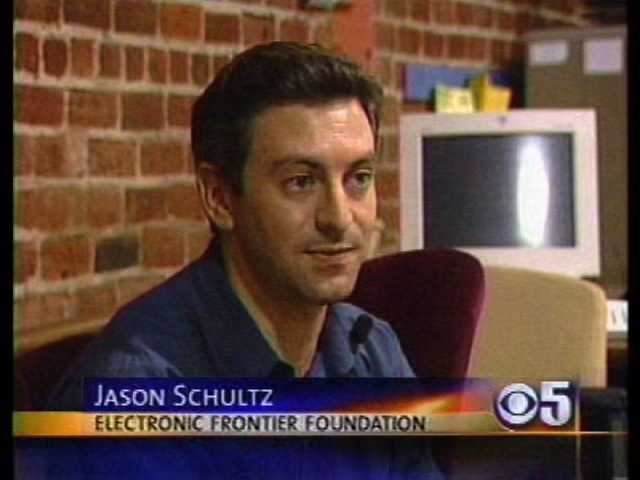
This is from the September 9, 2003 program.
This entry goes with this post.
This is from the
Rob Corddry On The Dem Debate (Small - 6 MB)
The Daily Show (The best news on television.)
So this is your warning ahead of time that today's going to be one of those "slinging hash" kind of days. Grad school is kicking in and if I don't catch up today, I'm not going to.
It also seems kind of stupid for me to go through all the trouble of capturing video and making movies out of it and uploading it and then forgetting to link to it on my archive, which is what I've been doing a lot of lately. So I need to link to that stuff and move on...
ALSO, I need your help. I've been working on my video index and it's actually starting to look like something useful. However, it's been really hard just sitting around and thinking about all the stuff that needs to be linked to from it, so I ask you: is your favorite video from my site on this list? If not, shoot me an email and remind me to put it in there. I'm adding links at the rate of about 10 a day. There are, of course, hundreds to go, because it's been a year now that I've been doing this. But that means that in a couple months, I might actually be up to date and to the point where you can see something on my blog and know that you can always just go to the index to look it up. (Like a real library!)
My email's lisarein@finetuning.com. (And I'm not afraid to put that on my site because I've got an awesome spam filter.) I like hearing from you anyway, and I've been getting a lot of great suggestions from you folks that will also be going up today.
Sorry for the hold up folks! Thanks for making this so much fun. You're the reason I do it, and it's been very gratifying lately.
Peace,
lisa
A very sad morning indeed. I went from tearing up over the beginning of last night's Nightline (sept 11 remembered), to crying over the afghan locals working for a Danish peace organization that were shot it the head in Afghanistan on Monday (more nightline), to momentarily freaking out about Ben being in Afghanistan (yes -- he's fine -- entry included below), to outright bawling at the news of Johnny Cash's death.
Anything else? Come on! Let it at me.
I'll pull it together because I have a lot of good stuff to bring you today...
from http://www.benhammersley.com, September 5, 2003
Ok, one final Afghanistan anecdote, which may only make sense to a Brit. One morning late in the week I had to get up really early in the morning, so I set the alarm on my shortwave radio to wake me with the BBC World Service. Come 430am, the radio kicks in. I lie there listening to news of Alastair Campbell’s resignation, and watching the sun rise through the crack in the dirt covering the windows, when suddenly the radio drops to static in mid-sentence. The World Service has dropped off the air.
Now, it’s early, I’m very tired, and not a little paranoid given where I am. Ah, shit, I think, London has gone. Al-Qaeda. It has to be. A day after my wife was due to arrive to see our bank, the city has gone - there can be no other explanation.
No, no, come on, I think. Tune around a bit - maybe the local transmitter has lost power. So I do: Voice of America is still there. The local music stations are still there. But no BBC. shit shit shit.
Nothing to do, I go to the bathroom and clean my teeth, run water through my hair and come back in and get dressed. Let’s try it again. Up and down the dial: everyone is there, no one is panicking. Right: to the BBC frequency.
Squeeeeeeeee Squeeeeee The radio goes mental - it’s like rubbing sheep with cheesegraters. Like a thousand nails on a blackboard. London is screaming.
What the hell is that? Sabotage? The effects of an EMP pulse? Major power spiking at Bush House? They’re all dead! What’s going on? Then….a voice…
“…I’ve always been partial to a bit of German techno…”
John Peel. That Bastard.
This just in from
Bobby Lilly:
A friend of mine sent this message to me today 9/11/03. It a poignant reminder of a history too many of us would rather forget or at least refuse to accept the lessons that it should teach us. His message is something we NEED to think about and hopefully remember the in years to come. I asked him if it was ok to post it for everyone on Lisa's Blog and if he wanted it attributed to himHe wrote back saying, "you have my full permission to make whatever use you deem appropriate. the e-mail address should work well then people would not only know who to blame but how to respond." -- Neil.
So, here's how to reach him, if you want: choiceno2@aol.com
Remembering September 11
One minute a beautiful building was there and the next it was destroyed by terrorists. The building was the symbol of an entire nation and the act of terrorism led to the death of more than 3,000 people. It all started on September 11th.
I'm talking, of course, about the bombing of Chile's White House (La Moneda) on 9/11/73 which marked the start of a bloody coup led by General Pinochet and backed by Nixon's CIA. Eager to get rid of a popularly elected socialist (Allende) our government assisted in the planning of the coup and looked the other way while a military dictatorship killed many of its own people.
While we bask in the righteous indignation that allows us to invade and conquer other countries based on suspicion that they might have helped terrorists strike at us let's not forget our own place in the history of this date.
And each time some politician repeats the words 'may we never forget' with reference to this date let's hope that there are a few people who manage to remember 9/11/73 as well.
neil (choiceno2@aol.com)
I do have this debate in the kitty, by the way. It's all captured and everything, I just have to generate the quicktime movies from it.
This is from the September 9, 2003 program.
Jon shows no mercy, but, of course, Howard Dean comes out ahead of the pack.
Daily Show On The Democrat Debate (Small - 13 MB)
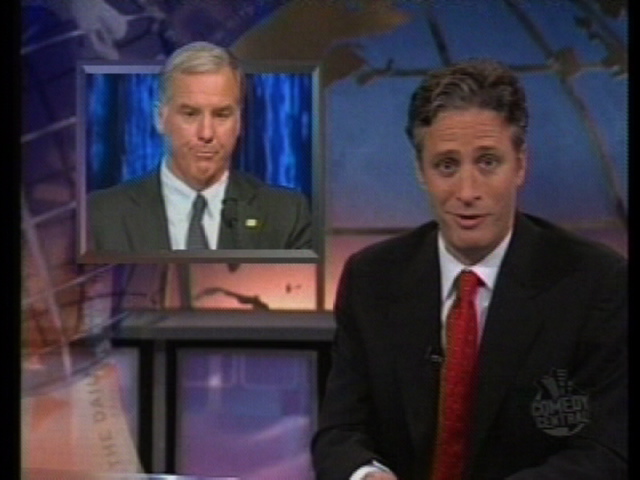
The Daily Show (The best news on television.)
By Stefanie Olsen (with contributions from John Borland) for CNET.
Under the RIAA's "Clean Slate" program, file swappers must destroy any copies of copyrighted works they have downloaded from services such as Kazaa and sign a notarized affidavit pledging never to trade copyrighted works online again.But Ira Rothken, legal counsel for Parke, said after reviewing the RIAA's legal documents that the trade group provides no real amnesty for such file swappers. With the legalese, the trade group does not agree to destroy data or promise to protect users from further suits, Rothken said.
"The legal documents only give one thing to people in return: that the RIAA won't cooperate," Rothken said. "The RIAA's legal document does not even prevent RIAA members from suing."
The suit asks the court to enjoin the RIAA from falsely advertising its program.
Here is the full text of the article in case the link goes bad:
http://rss.com.com/2100-1027_3-5073972.html?part=rss&tag=feed&subj=news
RIAA sued for amnesty offer
By Stefanie Olsen
Staff Writer, CNET News.com
September 10, 2003, 9:04 AM PT
update A day after the Recording Industry Association of America filed a slew of lawsuits against alleged illegal song swappers, it became the target of legal action over its own "amnesty" program.
California resident Eric Parke, on behalf of the general public of the state, filed a suit Tuesday against the trade association because of its amnesty, or "Clean Slate," program, a provisional shield it introduced Monday that allows people to avoid legal action by stepping forward and forfeiting any illegally traded songs. The suit, filed in the Marin Superior Court of California, charges that the RIAA's program is a deceptive and fraudulent business practice.
It is "designed to induce members of the general public...to incriminate themselves and provide the RIAA and others with actionable admissions of wrongdoing under penalty of perjury while (receiving)...no legally binding release of claims...in return," according to the complaint.
"This lawsuit seeks a remedy to stop the RIAA from engaging in unlawful, misleading and fraudulent business practices," the suit reads.
The RIAA responded to the suit with a maxim: "No good deed goes unpunished, apparently."
"It's also unfortunate that a lawyer would try to prevent others from getting the assurances they want that they will not be sued," an RIAA representative wrote in an e-mail.
The complaint is the first legal retaliation to the RIAA's lawsuit campaign against individual file swappers. The trade group filed 261 lawsuits against computer users it said were exclusively "egregious" file swappers, marking the first time copyright laws have been used on a mass scale against individual Net users. The barrage of lawsuits signaled a turning point in the industry's three-year fight against online song-trading services such as Kazaa and the now-defunct Napster and one of the most controversial moments in the recording industry's digital history.
On Tuesday, the RIAA settled its first case with Brianna Lahara, a 12-year-old New York resident. The recording industry agreed to drop its case against the preteen in exchange for $2,000, a sum considerably lower than previous settlement arrangements. Legal actions by the RIAA had been taken on a sporadic basis against operators of pirate servers or sites, but ordinary computer users have never before been at serious risk of liability for widespread behavior.
After long years of avoiding direct conflict with file swappers who might also be music buyers, industry executives said they have lost patience. Monday's lawsuits are just the first wave of what the group said ultimately could be "thousands more" lawsuits filed over the next few months.
Under the RIAA's "Clean Slate" program, file swappers must destroy any copies of copyrighted works they have downloaded from services such as Kazaa and sign a notarized affidavit pledging never to trade copyrighted works online again.
But Ira Rothken, legal counsel for Parke, said after reviewing the RIAA's legal documents that the trade group provides no real amnesty for such file swappers. With the legalese, the trade group does not agree to destroy data or promise to protect users from further suits, Rothken said.
"The legal documents only give one thing to people in return: that the RIAA won't cooperate," Rothken said. "The RIAA's legal document does not even prevent RIAA members from suing."
The suit asks the court to enjoin the RIAA from falsely advertising its program.
CNET News.com's John Borland contributed to this report.
Here's Howard's speech from last weekend's SEIU 250 Leadership Conference in San Francisco on Saturday, September 6, 2003.
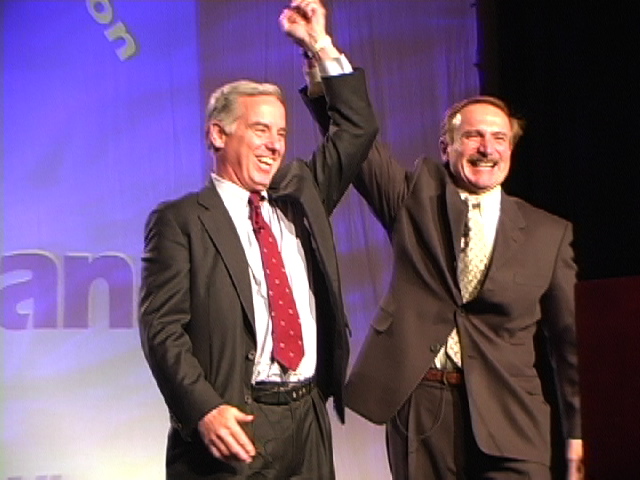
It was really an incredible event. The crowd was really into it and Howard gave a great informal speech.
I was lucky enough to run into him as I was coming down the escalators while he and his posse were on their way into the holding room. I called his name and waved -- I wasn't really expecting him to stop -- but he did stop and wait for me to come the rest of the way down so I could shake hands and say hi! What a sweetie!
(I resisted my hippy urge to give him a big old hug, although it is getting harder and harder to do that, because I really do feel like giving him a big old hug these days.)
Anyway, here's the speech. I've made it available in one large video file, two smaller video files, and in a single, and two smaller MP3s for those of you who might want to play the audio or use it on your radio show.
I'm also uploading the AIFF files of the audio for you DJs and professional folks to do with as you wish. (As of 11:15 am PST - these have about two hours to go until they are uploaded.)
Enjoy!
Video:
Howard Dean At the SEIU 250 Conference - All (Small - 53 MB)
Howard Dean At the SEIU 250 Conference - Part 1 of 2 (Small - 21 MB)
Howard Dean At the SEIU 250 Conference - Part 2 of 2 (Small - 32 MB)
Audio:
Audio - Howard Dean At the SEIU 250 Conference - All (MP3 - 30 MB)
Audio - Howard Dean At the SEIU 250 Conference - Part 1 of 2 (MP3 - 14 MB)
Audio - Howard Dean At the SEIU 250 Conference - Part 2 of 2 (MP3 - 16 MB)
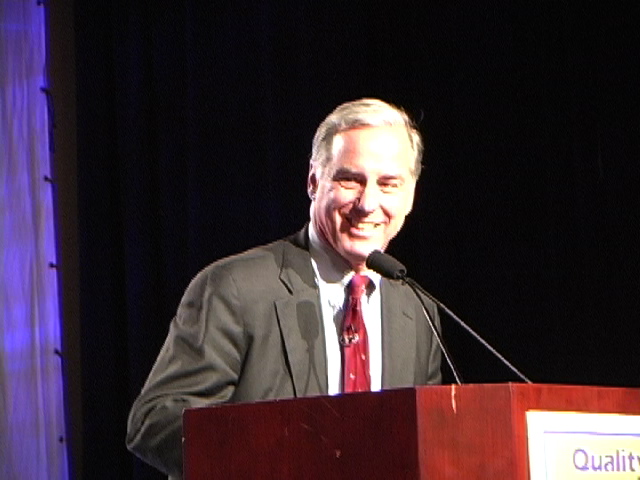
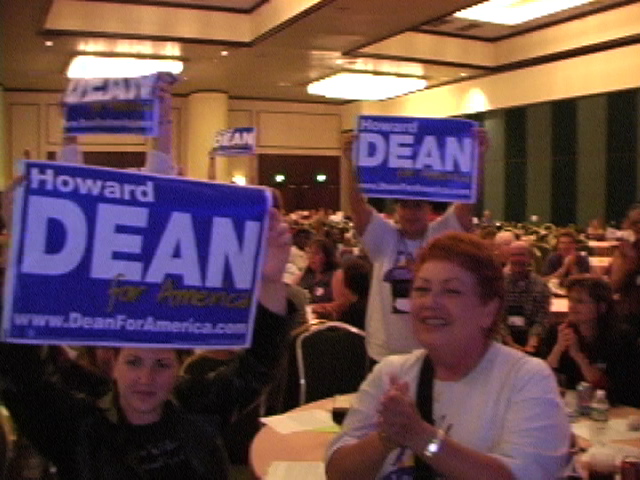
Dear Reader,I was pleased to hear from Moveon.org that there were a lot of people who read Lisa's blog who oppose the recall the way I do. Thanks to all of you who took the time to sign their petition against it.
If you haven't already done so, why not take one minute to go to the following link and sign up NOW.
http://Moveon.org is also involved in some very creative organizing around this issue as well as others.
Click on the link below to go to their website and print out a request for an absentee ballot form for YOUR county. Fill it out and send it in to your county registrar - they will provide the address to send it to right on the form.
http://moveon.org/pac/recall/register/They had the brilliant idea of using the idea of Flash Mobs for organizing activities like handing out these registrations. If you want to spend a couple of hours this Saturday working on this issue, check out the link below.
Well, that's all I have time for today but, I promise I'll be back with things YOU can do to make change happen.
Regards,
Bobby Lilly
In case you want to read the message they sent me today, here it is:
Dear MoveOn member, The outcome of the California recall will come down to this: the side that gets more people out to vote wins. Those behind the recall are counting on poor turnout. That's why we need to make sure that every friend, family member and colleague votes.
There is one fantastically simple way to do that: give them mail ballot request forms and make sure they complete and send them in. If everyone receiving this email did that with 10 like-minded friends, family members and colleagues, we could increase voter turnout against the recall by one million votes. Click below to print out your mail ballot request forms:
http://moveon.org/pac/recall/register/
Mail voting is critical to beating the recall. More than half of normal polling places will be closed in this election due to time constraints, making many voters much less likely to get to a voting booth on October 7. Voting by mail is the answer.
This Saturday we're kicking off our vote by mail campaign with something fun. We're going to gather in groups of 30 to 50 volunteers across the state to hand out ballot request forms and information in our communities. In one day we will help tens of thousands to vote. We could change the outcome of the recall election on Saturday. Click here to learn more and to pick a place for a gathering in your area:
http://action.moveon.org/
Some of you have asked for help in those important conversations with your friends and family about the recall. Unfortunately, some of the most sensible and powerful arguments against the recall have been lost in the media circus. That's exactly why it is so important to talk about the recall with those who respect your opinion. Below are some points to help.
10 Reasons Why the Recall is Wrong:
A single congressman brought us the recall with $1.7 million of his own money -- while simultaneously putting himself forward as the man to replace the governor.
The recall threatens to give California a governor elected by a tiny percentage of the electorate -- and gives wealthy individuals an unprecedented opportunity to attempt to buy the governorship.
It threatens to invalidate a fair election just months after it took place.
It sets a dangerous precedent -- if it succeeds why wouldn't opponents attempt to recall every future governor?
It's expensive: The recall election itself will cost over $60 million.
It prevents our elected leaders from working to solve the state budget crisis and other important issues by forcing them to campaign to defend the results of a fair election.
The cost to the economy is too great: a successful recall would cause enormous economic instability and loss of confidence.
This won't stop in California: 18 states have recall provisions. Unless the California recall is decisively rejected, sore losers in others states will continue to use this tactic.
The recall threatens California’s environment. Governor Davis has made important improvements to environmental law. Polluters see the recall as a chance for roll-back.
Gray Davis has made important gains in education, health care, the environment and public safety. The recall is an attempt to reverse those advances.
Please help your friends and family to vote by printing out a mail ballot request form here:
http://moveon.org/pac/recall/register/
And please join us this Saturday at events across the state to help us distribute tens of thousands of mail ballot request forms:
http://action.moveon.org/
Thank you,
--Carrie, Eli, Joan, Noah, Peter, Wes, and Zack
The MoveOn Team
September 10th, 2003
PS: Nearly 100,000 Californian MoveOn members have taken our pledge to talk to friends and family about the recall. If you haven't signed the pledge, please help us reach our goal of 100,000 signers by Friday by clicking here:
http://moveon.org/pac/recall/
Also: Thanks to the participation of MoveOn members in our Defend Democracy campaign, the mainstream media is beginning to connect the dots between impeachment, Florida, Texas and the California recall. This New York Times editorial is just one example:
http://www.nytimes.com/2003/09/09/opinion/09TUE4.html
"The more the G.O.P. persists in this, the more it hands the Democrats traction for their charge that Republicans are mischievously specializing -- as in the California recall -- in undoing normal elective processes."
Yesterday, a 12 year-old girl became the first to settle with the RIAA in one of its witch hunt lawsuits. She lives with her mother in public housing, and they were going to end up on the street as a result of settling the suit. This was apparently OK with the RIAA.
File sharers to the rescue! P2P United has now stepped in to pay the fine. How nice. Way to stick together!
File sharers pay 12-year-old's music piracy fine
From AFP.
But "P2P United" has stepped in, offering to pay Brianna's fine."We don't condone copyright infringement but it's time for the RIAA's winged monkeys to fly back to the castle and leave the Munchkins alone," the group's executive director, Adam Eisgrau, said.
He says "they're using 150,000 dollar-per-song lawsuits and a squad of high-paid lawyers to strong-arm $2,000 from single mothers in public housing".
Mr Eisgrau says others charged include a 71-year-old grandfather and a Columbia University senior, whose father recently died of cancer.
His group, formed in July to protect the rights of people who file share and the industry, represents Streamcast Networks, Grokster, LimeWire, BearShare, Blubster and EDonkey.
Here is the full text of the article in case the link goes bad:
http://www.abc.net.au/news/justin/weekly/newsnat-11sep2003-35.htm
File sharers pay 12-year-old's music piracy fine
A trade group representing six of the biggest file sharing web sites have pledged to pay a $US2,000 fine on behalf of a 12-year-old girl, who illegally downloaded music from the Internet.
Brianna Lahara of New York, or more precisely her mother, was fined as a settlement to a lawsuit by the music industry for illegally copying and offering pirated music on the Internet.
The Recording Industry Association of America (RIAA) says the case is the first of 261 lawsuits filed in an effort to clamp down on illegal music-swapping on the Internet.
"We understand now that file-sharing the music was illegal," the girl's mother, Sylvia Torres, said in a statement issued by the RIAA.
"You can be sure Brianna won't be doing it any more."
For her part, Brianna said: "I am sorry for what I have done, I love music and don't want to hurt the artists I love."
But "P2P United" has stepped in, offering to pay Brianna's fine.
"We don't condone copyright infringement but it's time for the RIAA's winged monkeys to fly back to the castle and leave the Munchkins alone," the group's executive director, Adam Eisgrau, said.
He says "they're using 150,000 dollar-per-song lawsuits and a squad of high-paid lawyers to strong-arm $2,000 from single mothers in public housing".
Mr Eisgrau says others charged include a 71-year-old grandfather and a Columbia University senior, whose father recently died of cancer.
His group, formed in July to protect the rights of people who file share and the industry, represents Streamcast Networks, Grokster, LimeWire, BearShare, Blubster and EDonkey.
The RIAA says the lawsuits, filed on Monday local time, are the first in what could be thousands of suits in a bid to stem rampant online piracy of copyrighted songs.
But the tactic has been criticised by some as a heavy-handed invasion of privacy that could alienate music fans.
It had charged that the computer used by the girl offered more than 1,000 copyrighted song tracks via the KaZaa file-sharing service.
"We're trying to send a strong message that you are not anonymous when you participate in peer-to-peer file sharing and that the illegal distribution of copyrighted music has consequences, "RIAA chairman and chief executive Mitch Bainwol said.
"As this case illustrates, parents need to be aware of what their children are doing on their computers."
-- AFP
This is from the September 9, 2003 program.
Daily Show On The Shrub's Latest Iraq Ploy (Small - 11 MB)

The Daily Show (The best news on television.)
This is a general story about the RIAA's lawsuits and it's recently announced shamnesty program -- there's a little clip of Fred in there.
This program aired on September 8, 2003 on ABC World News Tonight.
Fred von Lohmann On The RIAA's Lawsuits and Shamnesty Program (Small - 5 MB)

This is a general story about the RIAA's lawsuits and it's recently announced shamnesty program -- there's a little clip of Wendy in there.
This program aired on September 8, 2003 on San Francisco's local ABC station.
Wendy Seltzer On The RIAA's Shamnesty Program (Small - 6 MB)
Dear People,For a long time, I've wanted to find some way to spread the word about issues I care about and let people know that there are simple ways to get involved and make a difference. So, as long as Lisa is willing to let me be a guest blogger, I see my mission as, not only to alert you to issues I care about but to provided ways you can DO SOMETHING ABOUT IT.
So here's todays concern:
I'm on the Moveon.org mailing list http://Moveon.org. They just sent a letter letting me know that their campaign to roll back the FCC's recent rules changes needs everyone's help and I thought I'd pass on their concerns to those of you not already on their mailing list. They need to put more pressure on the Senate in the next few days to get them to vote to roll back the recent FCC's changes that would allow a few big companies to control our country's airways.
So far their campaign efforts have been able to make our legislators rethink an issue big media thought they had in their pocket. Even if you've signed something before, now is a critical time to stand up and oppose their attempts to grab the public airways for their own. So, if you care about the issue too, please join me and other Moveon members in letting Congress know now by signing their petition at:
http://www.moveon.org/stopthefcc/
The letter they asked me to send to all my friends reads as follows (with slight modification by me ;-):
Later this week or early next week, the Senate will likely take up its last major vote on media reform, and it'll be very close. After a grassroots groundswell tipped the balance toward rolling back the FCC rule change that would allow greater media concentration, lobbyists from big media conglomerates have been working around the clock to tip it back.
On Wednesday, MoveOn.org will be holding a crucial press conference with Senator Dorgan (D-ND) and Senator Snowe (R-ME) and groups across the political spectrum to highlight the broad opposition to the FCC rule change. MoveOn needs to show that over 100,000 people have voiced their demand that the Senate vote to roll back the rule change. Please help us reach 100,000 signers by this Wednesday -- you can join us in signing at:
http://www.moveon.org/stopthefcc/
Together, we can make sure that America's media is diverse, competitive, and balanced.
The final steps: Volunteer: We need your help. If you have some time to give, press here.
Donate: If you can't give time, can you make a financial contribution to support this campaign?
Thanks for the support,
Bobby Lilly
The Prince of Fair and Balanced was on the
The Daily Show last night.
Al took the liberty of pointing out the hypocrisy of the Shrub wearing a flight suit and performing in his little aircraft carrier escapade when, in reality, he not only let his daddy pull strings for him to get into the National Guard so he wouldn't have to go to Vietnam, but then, he didn't even show up for duty, and went AWOL for a year!
I might have to break this up into highlights. But here's the whole thing for now.
Be sure to buy Al's Book too. I'm just starting it, and I already love it. Everybody I've talked to couldn't put the thing down till they were done.
Enjoy!
Al Franken On The Daily Show - Complete (Small - 13 MB)
Al Franken On The Daily Show - Part 1 of 2 (Small - 8 MB)
Al Franken On The Daily Show - Part 2 of 2 (Small - 6 MB)

The Daily Show (The best news on television.)
Wow I've got so much stuff in the kitty I'm a bit overwhelmed. I'm trying to get some of it up before I have to leave to teach class today at USF...
Last night's Daily Show was a keeper from beginning to end. I've already prepped everything -- Al Franken was the guest!
Then, for you Deannies, we've got Howard in SF last weekend and Howard raging on the Shrub's sunday night begging session for more cash for Iraq.
Next, I've got the EFF talking about the RIAA's Shamnesty program on three different channels.
Lemme try to at least get the Franken stuff up...(Yeah, like, quit yapping and start linking already....I know...I know....)
thanks!
We don't need your stinkin' amnesty!
File sharers scoff at the recording industry's offer of forgiveness for repentant downloaders.
By Farhad Manjoo For Salon.
Lisa Rein, a blogger at On Lisa Rein's RadarI would not participate in this program under any circumstances.
I don't feel comfortable with the privacy policy -- which has a pretty big exception, that the information would not be divulged, "except if necessary to enforce a participant's violation of the pledges set forth in the Affidavit or otherwise required by law."(Meaning if the RIAA receives a subpoena from another party.)
The RIAA doesn't have the right to give full amnesty anyway -- you could still be sued by the individual copyright owners/song publishers (like Metallica).
So they are collecting a big database of individuals that can be turned over to other individuals who will then sue the file-sharers anyway. And the file-sharers will have admitted to it, thinking they were getting amnesty. Forget it!
Here is the full text of the article in case the link goes bad:
http://www.salon.com/tech/feature/2003/09/09/filesharing_amnesty/print.html
We don't need your stinkin' amnesty!
File sharers scoff at the recording industry's offer of forgiveness for repentant downloaders.
- - - - - - - - - - - -
By Farhad Manjoo
Sept. 9, 2003 | On Monday morning, the Recording Industry Association of America, (RIAA) the music industry's main trade group, announced that it had filed lawsuits against 261 people in the United States for allegedly violating copyright laws by using online file-sharing programs such as Kazaa.
The move did not come as a surprise; for months, the industry had been warning that it would go after individuals it suspects of trading songs online. But because the people being sued could theoretically face fines of millions or even hundreds of millions of dollars, these lawsuits can't be good for the RIAA's already tarnished image. (Under U.S. copyright law, the RIAA can ask as for as much as $150,000 for each copyright violation.)
Perhaps to show that it wasn't the big bully file-sharers claim it is, the RIAA also introduced an "amnesty" program for people who have not yet been sued. Under the program, called "Clean Slate," file-traders can send the RIAA a notarized declaration that they will delete all stolen files from their hard drives, and that they will never again trade MP3s. If you agree to live a life free of Kazaa, the RIAA will not sue you; but if you happen to fall off the wagon, you better watch out.
After the RIAA's announcement, Salon surveyed the Web for reactions to Clean Slate. We e-mailed bloggers, Usenet users, people on P2P discussion sites and others who've been known to get a song for free every once in a while. Not a single person was willing to sign on the RIAA's amnesty program. Here are their reasons:
Eric Olsen, a blogger who runs Blogcritics.org
I would not sign it for several reasons: the behavior in question has not been clearly identified as legal or illegal. Of the four factors the Copyright Act lists that must be weighed in determining fair use -- 1) the purpose of the copying, including whether it is commercial or educational; 2) the nature of the work; 3) the amount of the work that is copied; 4) the effect of the copying on the market for the work -- 1 and 4 are very much up in the air regarding music file sharing.
I object to the RIAA scorched-earth legal campaign on virtually every level, and would see seeking amnesty as moral and legal capitulation and tacit acceptance of its legitimacy. File sharers aren't "pirates" or "thieves": pirates make illegal copies of copyrighted works and sell them on the black market. File sharers make no profit. Nor is it "stealing" in the sense that any property has been taken: it is still a very open question whether in fact file sharing may actually increase legitimate sales via exposure and experimentation.
It would be foolish to put myself on record as having committed a perceived offense with the very organization that most wants to maximize that action as an offense, and to commit myself to never again committing an act that may or may not end up being at least partially legal, or legal in a mutated form.
Lastly, without questioning the integrity and good intentions of the RIAA, the track record of database security is such that I wouldn't trust that kind of sensitive information about myself with any organization.
A 26-year-old tech professional in San Francisco who uses Kazaa, speaking to Salon by phone
It's 261 lawsuits out of several million file-traders in this country. To be honest I don't think that the RIAA is going to spend the time and money that it takes to crack down on these cases, and considering the frequency with which I use these services, the chances of any prosecution coming against me are pretty slim. And I think that signing an affidavit is only going to alert the authorities that I might be trying to evade to my intentions and my identity. ... I think it's [being sued] is real threat, just as being hit by a car is a real threat -- but I don't think it's very likely that they will sue me. If anything, the threat of a lawsuit would drive me to severely limit my use if these file-sharing services. But I would never throw away the little bit of anonymity I enjoy on the Internet [by signing an amnesty program].
Moonman, a member of Zeropaid.com, a P2P discussion site
Would I ever sign this? Never. Think about it for a moment, would it be good to have a written document saying that you have done illegal things in the past in their hands as well as a photo? I don't think so. These are just scare tactics. They are hoping people like college kids will use this as a sort of "get out of jail free card," when in reality they are only admitting they have done wrong.
A file-trader who talks about music on Usenet
Personally, I would not sign this amnesty letter. The RIAA is not a government entity; therefore, they are not authorized to give amnesty to anybody who has a case with the potential of criminal liability. This amnesty letter is more of a P.R. move than anything else. They look bad for suing some people; this makes them look like they actually care. Don't call it amnesty, it should be called a signed admission of guilt. This amnesty contract does not get you off the hook if you share, and people that have already been subpoenaed do not qualify. So tell me, what is the point?
Aqlo, another Zeropaid user
Reasons not to consider the Amnesty offer:
a) It makes your identity known where it might otherwise not have been, or might have been insignificant until you spoke up.
b) Having done so it fails to protect you from any criminal action (RIAA actions are civil, they have no control over real prosecutors).
c) It also fails to protect you from civil actions by any other body (such as the MPAA).
d) It greatly hurts the cases of any current defendants. If a multitude of people sign this document they each serve as witnesses for the idea that sharing is a crime, something that has not yet been adjudicated.
e) It encourages further harassment along these lines at a time when many questions are up in the air.
f) It does not apply to anyone who has already been subpoenaed.
g) It constitutes a waiver of many rights to which you might otherwise be entitled.
Under no circumstances whatsoever would I sign such an onerous document, there is no advantage in doing so which can outweigh the overwhelming disadvantages.
Lisa Rein, a blogger at On Lisa Rein's Radar
I would not participate in this program under any circumstances.
I don't feel comfortable with the privacy policy -- which has a pretty big exception, that the information would not be divulged, "except if necessary to enforce a participant's violation of the pledges set forth in the Affidavit or otherwise required by law."(Meaning if the RIAA receives a subpoena from another party.)
The RIAA doesn't have the right to give full amnesty anyway -- you could still be sued by the individual copyright owners/song publishers (like Metallica).
So they are collecting a big database of individuals that can be turned over to other individuals who will then sue the file-sharers anyway. And the file-sharers will have admitted to it, thinking they were getting amnesty. Forget it!
Mary Hodder, one of the bloggers at the Berkeley Intellectual Property Weblog, or bIPlog
I would not sign the amnesty, because I do not file-share (up or downloading copyright protected materials -- (I) used to pre-Napster decision, but not now), and because the RIAA does not represent all the parties potentially involved, and therefore admitting to the RIAA that you file-share is asking for more trouble. They say you can "wipe the slate clean" in their press release today, but that would only be their slate, nobody else's.
I would not sign because who knows what they would do with the photos and personal information they will collect. They are not a law enforcement agency, and as such, are not subject to public oversight. They are a private trade group, and have way too much power under the DMCA to subvert people's rights, without judicial oversight, as it is (the subpoenas are generated by bots and sent out without a judge or clerk checking them out, and they've been wrong in some cases, and may be or have already been wrong in more...)
I do think this program will push more people to DarkNet solutions, and will cause the two extremes (RIAA vs. people who hate them and don't care about copyright) to grow further apart, making it harder to get to reasonable solutions, that don't criminalize millions, like compulsory licensing or good, well made Web downloading services with reasonable prices and a great catalog.
Not to mention that subtle, nuanced concepts like fair use and the public domain get totally shot. As well as any perspective on the DMCA and why some things in there aren't quite right. The RIAA is just shouting loudest right now. It's kind of a guerilla war they will never win. Like Vietnam.
Joseph Lorenzo Hall, a graduate student at the School of Information Management and Systems at UC Berkeley
It reminds me a lot of what SCO is doing right now in their case against IBM and their quest to destroy Linux. That is, they are attempting to force upon people the belief that what they're doing is wrong through legal maneuvers and indemnity ploys. In the RIAA's case, file-trading of MP3s and in SCO's case, running the Linux kernel. I would not sign it as that would mean that I'm admitting that sharing music with the world is illegal... I happen to believe that sharing music with my friends (or even potential friends) is well within the bounds of fair use. This is all very similar to software "piracy"... that is people are "trying to protect their intellectual property" when they should be thinking about value-added services or non-digital materials that people would flock to purchase....
I just wonder what all the resources that the RIAA is throwing at this from a legal perspective could do if they were funneled to discovery of new talent or new distribution channels. They don't seem to understand that trading of their files "is a GOOD thing (R)". Exposure is half the battle... especially for the majority of little bands out there... Sure, the big manufactured talent gigs will suffer. But that's flawed design...
This program was broadcast on September 4, 2003 at 11:30 pm.
Ted Koppel put together an amazing Nightline where he interviewed folks from the ACLU and the Justice Department, among others -- and was able to paint a frighteningly accurate picture of the Patriot Act and its new bastard brother, the Victory Act.
If you've only got a minute, at least watch his closing thoughts on the matter. (Small - 3 MB) (Links to the complete program are located below.)
The men who drafted our constitution, who framed our civil rights and protected our various freedoms under the law would, I suspect, retch at some of the bone headed, self-serving, misinterpretations of their intentions that they so often use these days to undermine the very freedoms they pretend to safeguard. The miracle of American Law is not that it protects popular speech, or the privacy of the powerful, or the homes of the priviledged, but rather, that the least among us, those with the fewest defenses thoses suspected of the worst crimes -- the most despised in our midst, are presumed innocent until proven guilty.That remains as revolutionary a concept now as it was in the 1780s. It makes protecting the country against terrorism excruciatingly difficult, but we cannot arbitrarily suspend the rights of one catagory of suspects without endangering all the others.
Also of particular interest was the interview with Barbara Comstock, Director of Public Affairs for the Justice Department. Ted Koppel wanted to know why everything had to be kept secret. Why your medical records could be obtained without your being notified, etc. She kept bringing up the "al qaeda safe house," which Ted finally told her "your floggin that Al Queda safe house to death Ms. Comstock."
Ted also had to keep correcting Comstock by inserting the word "suspected" when she was talking about who the Patriot Act was being routinely used against. ("Suspected" terrorists and "suspected" enemy combatants.) She just couldn't stop forgetting that these people were only suspects. That whole innocent until proven guilty thing kept slipping her mind.
Here's a partial transcript from the end of the interview. I've created a small clip of this. (Complete versions located below.):
"What I'm asking is, since we are in agreement is that what we are talking about is that these people are people who are "suspects." None of these people is a confirmed terrorist here. If you have a confirmed terrorist, I guarantee you, everyone who is watching tonight is going to applaud you and say "way to go." But we are still dealing with people here who are suspected of something..." Koppel said."Sure." she said.
"..and who therefore presumably have the same rights as any other American citizen, if they are citizens." Koppel said.
Then later...
"How do we define who falls under the provisions of this act as distinct from the normal protections that exist for American citizens? Is it just that you define it? You define someone as being a suspect associated with terrorism? And if you can make a case to a court than you can lift some of the restrictions that would otherwise apply?" Koppel asked.
"Well the restrictions that would otherwise apply are still there. What it is is that we are operating under the same type of legal structures that we have always operated under, but now we're able to..." Comstock said.
"Well not quite. I mean there are some people, obviously, who have been put in jail and who aren't even permitted to have attorneys or who are not permitted to talk with their families. Now we are talking about people who. (stops) Right?" Koppel said.
"That's has nothing to do with the Patriot Act. That's actually "enemy combatants" that are outside the Justice Department per view. And that is the President's authority at war powers." Comstock said.
"Suspected, enemy combatants." Koppel said.
"But those are...actually they've been designated as enemy combatants." Comstock said.
"Well, designated without a trial." Koppel said.
"Yes." She replied.
Here's the whole show in "complete" and "parts 1 and 2" versions:
Nightline - The Patriot Act - Part 1 of 2 (Small - 26 MB)
Nightline - The Patriot Act - Part 1 of 2 (Small - 26 MB)
Nightline - The Patriot Act - Complete (Small - 52 MB)
I've also provided a clip of the cool ACLU commercial that was aired during the broadcast. (Small - 2 MB)
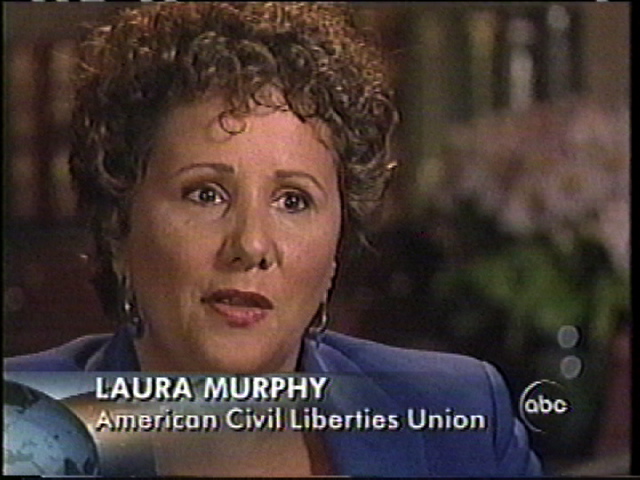
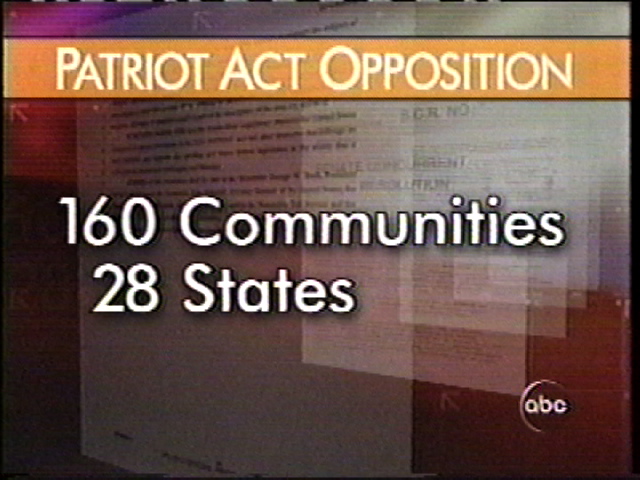
So I know nobody really cares right now, with the recall going on and all, but San Francisco's about to vote in a new Mayor this November, and I think it's a pretty important election worth paying attention to.
I'm voting for Tom Ammiano. He's my local rep, and a damn good one at that.
He also doesn't hate poor people, like Gavin Newsome apparently does (arguably, the front runner in the race). As demonstrated by his actions in last year's "Care Not Cash" campaign, Gavin likes to blame the poor for being poor and to take their benefits away without explicitly defining what "services" they are going to get in return...but that's another story. (One with a happy ending actually, because a judge threw out the whole "Care Not Cash" fiasco some months ago!)
Anyway, for this article, that's all beside the point. This puppy's just plain funny.
Update: I just confirmed w/the Ammanio folks that these are real interviews! They are not made up.
(Funny, I guess Ammiano was the only one that got the Bladerunner reference :-)
More Human than Human
A field guide for testing if the San Francisco mayoral candidates are human or not.
By John Holden for The Wave.
Here is the full text of the article in case the link goes bad:
http://www.thewavemag.com/pagegen.php?pagename=article&articleid=24031
More Human than Human
A field guide for testing if the San Francisco mayoral candidates are human or not.
John Holden
Send this Article to a friend! Printer Friendly replicant (rep’-li-kant) n.
1. A genetically engineered creature composed entirely of organic substance designed to look and act human.
2. An android.
With Willie Brown finally leaving his gold (plated), diamond-encrusted throne, there has been no shortage of hats thrown into the mayoral ring. San Francisco politics are now a microcosm of California’s own, greater gubernatorial “challenges.” Rather than confuse you with endorsements, position papers and other outmoded means of political influence, we’ve decided to get to the bottom of the only question that matters: Is a particular candidate human or an insidious replicant, possessed of physical strength and computational abilities far exceeding our own, but lacking empathy and possibly even bent on our destruction as a species?
The only reliable method that we know of for sniffing out replicants is the Voight-Kampff Test, created by Phillip K. Dick in his book, Do Androids Dream of Electric Sheep and later used by Harrison Ford’s character, Deckard, in the film Blade Runner. The test uses a series of questions to evoke an emotional response which androids are incapable of having. By the candidates’ responses to this line of questioning, we feel we can say with some certainty whether or not they’re replicants. However, we’re stopping short of recommending that you vote for them or not. After all, though a replicant mayor may be more likely to gouge a supervisor’s eyes out with their thumbs, they have another quality that could be great in an elected official: a four year life span.
SUBJECT 1: ANGELA ALIOTO
The Wave: Reaction time is a factor in this, so please pay attention. Now, answer as quickly as you can.
It’s your birthday. Someone gives you a calfskin wallet. How do you react?
Angela Alioto: I’d accept it.
TW: You’ve got a little boy. He shows you his butterfly collection plus the killing jar. What do you do?
AA: I’d look at it. What do you mean what would I do? As opposed to saying “how horrible?” I would tell him how beautiful it is.
TW: You’re watching television. Suddenly you realize there’s a wasp crawling on your arm.
AA: I’d knock it off. It’s something I’m used to doing in politics [Laughs].
TW: You’re in a desert walking along in the sand when all of the sudden you look down, and you see a tortoise, Angela, it’s crawling toward you. You reach down, you flip the tortoise over on its back, Angela. The tortoise lays on its back, its belly baking in the hot sun, beating its legs trying to turn itself over, but it can’t, not without your help. But you’re not helping. Why is that, Angela?
AA: That would never happen. I wouldn’t turn it over in the first place, and the thing with it being in pain is out of the question. Let me ask you, John, how does this fit in to the bigger picture when you ask me about the dying tortoise and the dead butterflies?
TW: They’re just questions, Angela. In answer to your query, they’re written down for me. It’s a test, designed to provoke an emotional response. Shall we continue? Describe in single words, only the good things that come into your mind. About your mother.
AA: My mother? She’s beautiful. She’s an artist. She’s a renaissance artist.
CONCLUSION: Her defensiveness over her lack of empathy for the butterfly is telling, as is the comparison of a political rival to a wasp that should be knocked off. I think we can safely say that Angela Alioto is indeed a replicant, albeit one that “loves” the implanted memory of her mother. Keep an eye on her.
SUBJECT 2: SUSAN LEAL
The Wave: It’s your birthday. Someone gives you a calfskin wallet. How do you react?
Susan Leal: Disappointed.
TW: You’ve got a little boy. He shows you his butterfly collection plus the killing jar. What do you do?
SL: I’d be fascinated.
TW: You’re watching television. Suddenly you realize there’s a wasp crawling on your arm.
SL: I’d kill it.
TW: You’re in a desert walking along in the sand when all of the sudden you look down, and you see a tortoise, Susan, it’s crawling toward you. You reach down, you flip the tortoise over on its back, Susan. The tortoise lays on its back, its belly baking in the hot sun, beating its legs trying to turn itself over, but it can’t, not without your help. But you’re not helping. Why is that, Susan?
SL: I don’t know, I must’ve lost my mind.
TW: Describe in single words, only the good things that come into your mind. About your mother.
SL: Honest. Supportive. Liberal. Interesting.
CONCLUSION: The dissociation Susan expressed in response to the tortoise question confirms what we already knew: Susan Leal is a replicant. However, by evaluating her response to the wasp question (word for word as Rachel – totally a replicant – answered it in Blade Runner), we can tell that she’s at least a Nexus 7. If you vote for Susan, you will be electing a replicant, but one of the most highly advanced models available.
SUBJECT 3: MATT GONZALEZ
The Wave: Reaction time is a factor in this, so please pay attention. Now, answer as quickly as you can.
It’s your birthday. Someone gives you a calfskin wallet. How do you react?
Matt Gonzalez: I’m sorry, what kind of wallet?
TW: Calfskin.
MG: Calfskin, I don’t even know what that is.
TW: Do you know what a cow is, Matt?
MG: Yeah.
TW: Baby cow.
MG: Um, I have no idea how I would react.
TW: You’ve got a little boy. He shows you his butterfly collection plus the killing jar. What do you do?
MG: These are great questions. I’m not sure if they’re ideal for 9:00. We were up pretty late at the office. I can only associate to things that I’ve seen or done in my own life….
TW: You’re watching television. Suddenly you realize there’s a wasp crawling on your arm.
MG: I guess I would probably just knock it off.
TW: You’re in a desert walking along in the sand when all of the sudden you look down, and you see a tortoise, Matt, it’s crawling toward you. You reach down, you flip the tortoise over on its back, Matt. The tortoise lays on its back, its belly baking in the hot sun, beating its legs trying to turn itself over, but it can’t, not without your help. But you’re not helping. Why is that, Matt?
MG: Well I don’t think I would have knocked it over in the first place and I don’t get any amusement out of making tortoises suffer, so I don’t think that would be me. You must have confused me for one of my opponents.
TW: Shall we continue? Describe in single words, only the good things that come into your mind. About your mother.
MG: Just a positive person, no negative energy at all. Next time could we do this later in the day?
CONCLUSION: Androids do not dream of electric sheep because they don’t sleep, unlike Matt Gonzalez who was up late “working” at the office. His obvious grogginess leads us to the conclusion that he is indeed a human, but one with an ill-formed sleep schedule. Were he a replicant he would have already gouged out six eyeballs, broken in to the genetic design lab and made a trip to the juice bar by this time of the day.
SUBJECT 4: TOM AMMIANO
The Wave: Reaction time is a factor in this, so please pay attention. Now, answer as quickly as you can.
It’s your birthday. Someone gives you a calfskin wallet. How do you react?
Tom Ammiano: I’d look for money.
TW: You’ve got a little boy. He shows you his butterfly collection plus the killing jar. What do you do?
TA: I’d think this was Blade Runner. That’s my reaction.
TW: You’re watching television. Suddenly you realize there’s a wasp crawling on your arm.
TA: Call 911.
TW: You’re in a desert walking along in the sand when all of the sudden you look down, and you see a tortoise, Tom, it’s crawling toward you. You reach down, you flip the tortoise over on its back, Tom. The tortoise lays on its back, its belly baking in the hot sun, beating its legs trying to turn itself over, but it can’t, not without your help. But you’re not helping. Why is that, Tom?
TA: That’s interesting. I don’t know. I’m a republican?
TW: Describe in single words, only the good things that come into your mind. About your mother.
TA: Tenderness. Yelling.
CONCLUSION: The self-awareness required to recognize that you’re being administered a Voight-Kampff Test automatically eliminates the possibility of you being a replicant. Good work, Tom! You’re human! Now watch your back.
SUBJECT 5: TONY RIBERA
The Wave: Reaction time is a factor in this, so please pay attention. Now, answer as quickly as you can.
It’s your birthday. Someone gives you a calfskin wallet. How do you react?
Tony Ribera: Good. I’d be happy.
TW: You’ve got a little boy. He shows you his butterfly collection plus the killing jar. What do you do?
TR: I’d ask him to explain it to me.
TW: You’re watching television. Suddenly you realize there’s a wasp crawling on your arm.
TR: Slap it.
TW: You’re in a desert walking along in the sand when all of the sudden you look down, and you see a tortoise, Tony, it’s crawling toward you. You reach down, you flip the tortoise over on its back, Tony. The tortoise lays on its back, its belly baking in the hot sun, beating its legs trying to turn itself over, but it can’t, not without your help. But you’re not helping. Why is that, Tony?
TR: Well, I think I would help. I like tortoises. As a former athlete I’ve always been very slow, and I feel I can relate to them.
TW: Describe in single words, only the good things that come into your mind. About your mother.
TR: Happy. Cheerful. Optimistic. Pretty. Fun.
CONCLUSIONS: Inconclusive. While generally empathetic, there is a homey quality to Tony’s answers that are almost too good to be true. As if they were… programmed. Fifty-fifty he’s a skin job.
SUBJECT 6: GAVIN NEWSOM
The Wave: Reaction time is a factor in this, so please pay attention. Now, answer as quickly as you can.
It’s your birthday. Someone gives you a calfskin wallet. How do you react?
Gavin Newsom: I don’t have anything to put in it. I would thank them and move on.
TW: You’ve got a little boy. He shows you his butterfly collection plus the killing jar. What do you do?
GN: I would tell him to… You know what? I wouldn’t know how to respond. How’s that for an answer? Is this a psychological test? I’m worried…
TW: They’re just questions, Gavin. In answer to your query, they’re written down for me. It’s a test, designed to provoke an emotional response.
GN: Oh, I got you.
TW: Shall we continue?
GN: Sure.
TW: You’re watching television. Suddenly you realize there’s a wasp crawling on your arm. How would you react?
GN: I would quietly sit and wait for the wasp to move to the next victim.
TW: You’re in a desert walking along in the sand when all of the sudden you look down, and you see a tortoise, Gavin, it’s crawling toward you. You reach down, you flip the tortoise over on its back, Gavin. The tortoise lays on its back, its belly baking in the hot sun, beating its legs trying to turn itself over, but it can’t, not without your help. But you’re not helping. Why is that, Gavin?
GN: [Immediately] Not a chance. I would never flip the tortoise over in the first place.
TW: Describe in single words, only the good things that come into your mind. About your mother.
GN: Ethics. Commitment. Sacrifice.
CONCLUSION: Almost too close to call. Almost. Newsom displays a defensiveness when his empathy is questioned. He’s aware that he’s being probed for emotional responses, and even expresses concern about this. However, this concern is alleviated a little too easily by our crafty V-K interviewer. Newsom is definitely a replicant. Probably a Nexus 5.
Here's a great informal interview with Howard Dean by Carlos Watson for CNBC's The Edge.
Howard talks about his policy, his son, you name it, and even plays some harmonica at the end.
This interview took place on an airplane in between campaign stops.
This program was aired on September 1, 2003.
Howard Dean On CNBC's The Edge - Complete (Small - 23 MB)
Howard Dean On CNBC's The Edge - Part 1 of 2 (Small - 11 MB)
Howard Dean On CNBC's The Edge - Part 2 of 2 (Small - 13 MB)




This just in from my pal
Bobby Lilly.
Dear Lisa,I got a notice from http://MoveOn.org asking me to sign a petition opposing the California Recall. You and I both know it's a power grab by the Republicans blaming a relatively unpopular governor for stuff HE didn't do and inflaming the political process just because some of them couldn't stand to LOSE the last election.
I signed to show my opposition to this misuse of the Recall process which I believe should be used against serious malfeasance by an elected official not just because someone had the money it took and thought they could get away with it.
I hope there are a lot more people out there besides the two of us willing to take the time to oppose this Recall which has become a media circus and just another reason for the rest of the country to dismiss Californians as kooks. People need to be educating themselves about the unreality of the charges against Davis and realize that changing leadership at this point is NOT going to make the economic woes of this state (which are very similar to the problems states all across the country are facing) any better and all of us who believe it is WRONG need to be sure we are registered and get to the polls and VOTE it down.
In the meantime, I'm writing to ask you to join me in signing a "Recall No! Democracy Yes!" pledge to defeat the California recall AND pass it on. Click here to sign:
http://moveon.org/pac/recall?id=-1744928-coYdH6bxsqDEmbLGkTJDogThis is the message Moveon sent to me:
If the recall succeeds, it will set a dangerous precedent for the whole country. A far-right businessman spent 1.7 million dollars to bring us the recall campaign, and has thrown California into chaos. GOP leaders who should have condemned the recall instead cheered it on, hoping they could gain from the unraveling of our democracy. We can't stand by and let this happen. These attacks on democracy are not a California issue or a Texas issue or a Florida issue -- we all must step forward together and make it clear that elections will be honored in this country. This pledge is a national effort to mobilize one million California voters in the recall election. Please sign the pledge no matter where you live and please ask friends and family in California to sign the pledge and to remember to vote October 7.
http://moveon.org/pac/recall?id=-1744928-coYdH6bxsqDEmbLGkTJDogThank you.
Lisa's voting against the recall and for Cruz Bustamante.
Here's an interview by Carlos Watson with MoveOn.org co-founder Joan Blades.
This is from the September 1, 2003 program.
(I tried to find a website for CNBC's The Edge, but I couldn't find one.)
Interview With Joan Blades On CNBC's The Edge - Complete
(Small - 13 MB)
Note: This is a short story, not a book, but I'm putting it in here anyway. It's the sequel to the book. And if you haven't read the book yet, you can read it for free, and then read the short story.
Cory Doctorow has written a lovely short story sequel to Down and Out In the Magic Kingdom.
Salon published it a few weeks ago. In case you need to print it out to read it (like I do), I've provided a complete version of the text.
God. God. The person was so old, saurian and slow, nearly 300, an original revolutionary from the dawn of the Bitchun Society. Just a kid, then, rushing the barricades, destroying the churches, putting on a homemade police uniform and forming the first ad-hoc police force. Boldly walking out of a shop with an armload of groceries, not paying a cent, shouting jauntily over his shoulder to "Charge it up to the ol' Whuffie, all right?"What a time! Society in hybrid, halfway Bitchun. The religious ones eschewing backup, dying without any hope of recovery, entrusting their souls to Heaven instead of a force-grown clone that would accept an upload of their backup when the time came. People actually dying, dying in such number that there were whole industries built around them: gravediggers and funeral directors in quiet suits! People refusing free energy, limitless food, immortality.
And the Bitchun Society outwaited them. They died one at a time, and the revolutionaries were glad to see them go, each one was one less dissenter, until all that remained was the reputation economy, the almighty Whuffie Point, and a surfeit of everything except space.
Adrian's grin was rictus, the hard mirth of the revolutionaries when the last resister was planted in the ground, their corpses embalmed rather than recycled. Years and decades and centuries ticked past, lessons learned, forgotten, relearned. Lovers, strange worlds, inventions and symphonies and magnificent works of art, and ahead, oh ahead, the centuries unrolling, an eternity of rebirth and relearning, the consciousness living on forever.
And then it was over, and Adrian was sweating and still grinning, the triumphant hurrah of the revolutionary echoing in his mind, the world his oyster.
Truncat
By Cory Doctorow
"Adrian, you have a million friends," his mother said. "That's an audited stat. I'm sorry if you feel isolated, but none of us are moving to Bangalore just so you can chum it up with this fellow."
Adrian fought to control his irritation. His mother was always cranky before breakfast, and a full-blown fight could extend that mood through the whole day. No one needed that. "Mom," he said, twisting his body in the narrow, three-person coffin he shared with his folks so that he could look her in the eye, "I'm not asking you to move to India. All I'm doing is explaining my paper."
His mother snorted. "_The Last Generation on Earth_, really! Adrian, if I were your instructor, I sure wouldn't graduate you on the strength of something like that. I don't really care if that boy in India has convinced the ITT people that his trendy little thesis holds water. The University of Toronto has higher standards than that."
It had been a mistake to even discuss it with his mother. At 180, she was hardly equipped to understand the pressures he and his miniscule generation faced. He should've just written it and stuck it in his advisor's public directory. Only just that he'd had the coolest idea in the night and he'd reflexively bounced it off of her: once his generation reached maturity, the whole planet would be post-human, and a new, new era would start. The Bitchun Society, Phase II.
"OK, Mom, OK. I'm going to get breakfast -- you want to come?"
"No," she said, rolling back over. "I'm going to wait for your father."
Past her, he saw the snoring bulk of his father, still zonked out even through their heated exchange. Adrian grasped the ceiling rails and inched himself out of the coffin and into the public corridor.
His gut was rumbling, but the queue for the canteen was still lengthy, packed with breakfasters from the warren where he made his home. Reluctantly, he decided to skip breakfast and go to his private spot. It was almost backup time, and he needed to do some purging.
Truth be told, Adrian's private spot was not all that private, and it was a humungous bitch to reach. His netpals liked to compare notes on their hidey-holes, and Adrian was certain that he had the shittiest, least practical of the lot.
First, Adrian got on the subway, opting to go deadhead for a faster load-time. He stepped into the sparkling cryochamber at the Downsview station, conjured a HUD against his field of vision, and granted permission to be frozen. The next thing he knew, he was thawing out on the Union station platform, pressed belly-to-butt with a couple thousand other commuters who'd opted for the same treatment. In India, where this kind of convenience-freezing was even more prevalent, Mohan had observed that the reason their generation was small for their age was that they spent so much of it in cold-sleep, conserving space in transit. Adrian might've been 18, but he figured that he'd spent at least one cumulative year frozen.
Adrian shuffled through the crowd and up the stairs to the steady-temp surface, peeling off the routing sticker that the cryo had stuck to his shoulder. His tummy was still rumbling, so he popped the sticker in his mouth and chewed until it had dissolved, savoring the steaky flavor and the burst of calories. The guy who'd figured out edible routing tags had Whuffie to spare: Adrian's mom knew someone who knew someone who knew him, and she said that he had an entire subaquatic palace to rattle around in.
A clamor of swallowing noises filled his ears, as the crowd subvocalized, carrying on conversations with distant friends. Adrian basked in the warm, simulated sunlight emanating from the dome overhead. He was going outside of the dome in a matter of minutes, and he had a sneaking suspicion that he was going to be plenty cold soon enough. He patted his little rucksack and made sure he had his cowl with him.
He inched his way through the crowd down Bay Street to the ferrydocks, absently paging through his public directory, looking at the stuff he'd accumulated in the night. It would all have to go, of course, but he wanted a chance to run some of it before then. Most of it was crap, of course. The average backup of the average citizen of the Bitchun Society was hardly interesting enough to warrant flash-baking, but there were gems, oh yes.
His private spot hung tantalizingly before him, just outside of the dome. The press of bodies parted and he lengthened his step to the docks, boarded the ferry with a nod to the operator in his booth, and hustled into one of the few seats on the prow, pulling on his cowl as the ferry pushed away and headed off toward the airlock at Toronto Island.
It was even colder than the last time. The telltale on his cowl showed -48 degrees C with the wind-chill. His nose and toes went instantly numb, and he tucked them under the cowl's warmth.
His private place was just a short slosh from the westernmost beach at Hanlon's Point on Toronto Island, a forgotten smartbuoy, bristling with self-repairing electronics, like a fractal porcupine. It had been a couple weeks since his last foray there, and in the interim, the buoy had grown more instrumentation, closing over the narrow entryway into its console-pod. Cursing under his breath, Adrian wrapped his cowl around his hands and broke off the antennae, tossing them into the choppy Lake Ontario froth. Then he climbed inside and held his breath.
Breakers crashing on Hanlon's Point. Distant hum of the airlock. A plane buzzing overhead. Silence, of a sort. A half-eaten sandwich mouldered near his right ham. Disgustedly, he pitched it out, silently cursing the maintenance crews that periodically made their way out to his buoy and tried to puzzle out the inexplicable damage he'd wrought on it.
But the silence, ah. His mother never understood the need for silence. She was comforted by the farting, breathing, shuffling swarm of humanity that bracketed her at all times. She'd spent a couple decades jaunting, tin-plated and iron-lunged in the vast emptiness of space, and she'd had her fill of quiet and then some. Adrian, though, with 18 (or 17) years of the teeming hordes of the post-want Bitchun Society, couldn't get enough of it.
His public directory was bursting with backups, the latest batch that his contemporaries around the world had passed to him. Highly illegal, the backups were out-of-date consciousness-memoirs created by various citizens of the Bitchun Society, a weekly hedge against irreparable physical harm.
Theoretically, when you made a new backup, the old one was discarded, the file copied to a nonexistent node on the distributed network formed by the combined processing power of the implanted computers carried by every member of the Bitchun Society. Theoretically.
Adrian paged through the directory. Carrying one of the bootlegs into a backup terminal would mean instant detection. Even xmitting it to someone else was risky, and prone to being sniffed. But Mohan, his netpal in Bangalore, had authored a sweet little tool that allowed for xmission over the handshaking and routing channel, a narrowband circuit that carried unreliable -- and hence untraceable -- information that would have been overheard in the main data-channels. The Million had quickly adopted the tool, and they used it to pass their contraband to each other, copying the bootlegs prior to erasing them when their own weekly backup sched rolled around.
Adrian had good Whuffie with the Million. Nothing like Mohan, of course, but still good -- he reliably stored bootlegs for the Million, even if it meant putting off his own backup until he could find safe storage for all those materials entrusted to him. He didn't mind: being a high-Whuffie storage repository meant that he got everyone's most precious bootlegs for safekeeping.
Like this one, the backup of a third-gen Bitchun, born at the end of the XXIst Century, female (though that hadn't lasted long). Seventy years later, her/his backup was a rich tapestry of memories, spectacular space battles, incredible sexual adventures, side-splitting jokes, exotic flavors and esoteric knowledge absorbed from brilliant teachers all over the planet. He'd held onto it for two weeks now, and flash-baked it nearly every day.
Time to do it again. Quickly, he executed the command, and shuddered as that consciousness was rolled up into a bullet of memories and insights and fired directly into his mind, unfolding overtop of his own thoughts and dreams so that for a moment, he _was_ that person, her/his self enveloping Adrian with an infinitude of bombarding sense impressions.
It ebbed away, the rush fading in a synaptic crackle, leaving him trembling and wrung-out. He slumped against the buoy's spiny interior and brought up a HUD and started an agent searching for another member of the Million with storage to spare for a copy of it.
#
Backup days were flash-baking days. In the buoy, Adrian flash-baked a dozen times, alternating between timeworn favorites and the tastiest morsels deposited by the rest of the Million. He gorged himself on the antique consciousnesses of the immortals of the Bitchun Society, past satiety and full to bursting, his head throbbing dangerously.
Each time, he carefully passed the file to the network, waiting while the churning, clunking handshaking channel completed the transfer. He didn't mind the wait: it gave him a moment for the synesthetic rushes to pass. Time grew short, and his gut growled protests, sending up keotic belches that filled the closed space with the smell of esters.
One more, one more, deposited for safekeeping by Mohan himself in the night. Mohan sat at the river's headwaters, the source of all the bootlegs. He was the theoretically nonexistent node to which the backup network flushed its expired files. When he identified a keeper, it had to be good. Adrian had saved it for last, and now he rolled it and jammed it into his brain.
God. God. The person was so _old_, saurian and slow, nearly 300, an original revolutionary from the dawn of the Bitchun Society. Just a kid, then, rushing the barricades, destroying the churches, putting on a homemade police uniform and forming the first ad-hoc police force. Boldly walking out of a shop with an armload of groceries, not paying a cent, shouting jauntily over his shoulder to "Charge it up to the ol' Whuffie, all right?"
What a time! Society in hybrid, halfway Bitchun. The religious ones eschewing backup, dying without any hope of recovery, entrusting their souls to Heaven instead of a force-grown clone that would accept an upload of their backup when the time came. People actually _dying_, dying in such number that there were whole industries built around them: gravediggers and funeral directors in quiet suits! People refusing free energy, limitless food, immortality.
And the Bitchun Society outwaited them. They died one at a time, and the revolutionaries were glad to see them go, each one was one less dissenter, until all that remained was the reputation economy, the almighty Whuffie Point, and a surfeit of everything except space.
Adrian's grin was rictus, the hard mirth of the revolutionaries when the last resister was planted in the ground, their corpses embalmed rather than recycled. Years and decades and centuries ticked past, lessons learned, forgotten, relearned. Lovers, strange worlds, inventions and symphonies and magnificent works of art, and ahead, oh ahead, the centuries unrolling, an eternity of rebirth and relearning, the consciousness living on forever.
And then it was over, and Adrian was sweating and still grinning, the triumphant hurrah of the revolutionary echoing in his mind, the world his oyster.
"Oh, Mohan," he breathed to himself. "Oh, that was terrific." He scouted the network on his HUD, looking for a reliable member of the Million, someone he could offload this to so that he could get it back after his own backup was done. There -- a girl in France, directory wide open. He started the transfer, then settled back to bask in the remembered exultation of his last flash-bake.
His cochlea chimed. The HUD said it was his mother. Damn.
"Hi, Mom," he said.
"Adrian!" she said. "Where are you?" She wasn't in a good mood, that much was clear.
"Uh," he said. "On the subway," he extemporized. "I'm gonna see if Mr. Bosco can see me." Bosco was the admissions advisor at the University of Toronto that he'd been sucking up to lately, trying to charm the old ad-hocrat into letting him into school for the fall semester. It wasn't easy: the undergrad program at the University was winding down in favor of exclusive, high-Whuffie one-on-one grad programs. Teaching the sparse undergrads of the Million was anything but a glamor gig.
"Bosco?" his mother said, mollified. "Well, that's. . .good. Listen, I don't want you talking about this admissions paper idea of yours -- nobody wants to hear about how you and your friends are the last generation of humans. Every generation thinks they're special -- it's just not so."
"Fine," he said. He wouldn't talk to Bosco anytime soon if he could help it, anyway.
"Your father worked with you on that good N-P Complete proof. Present that instead."
"Sure," he said. The revolutionary still echoed in his mind, like distant gunfire.
His mother talked on, and he kept his answers down to one syllable until she let him go. Back in the quiet of the buoy, he quickly purged all the bootlegs from his public directory, pulled his cowl tight and reluctantly climbed outside and back to the Island, there to await the ferry.
#
Adrian's backup was uneventful, a moment before a secure broadband terminal while his life flashed before his eyes, extracted and spread out to a redundant assortment of nodes on the fifteen billion person network that carpeted the earth.
This obeisance to the Bitchun Society completed, he took to the downtown streets, waiting for the files he'd farmed out and deleted to trickle back in. Waiting for the revolutionary's backup, for another taste of exultation and grandiose triumph. He walked all the way from Union Station to Bloor, a good hour in the glottal press of the lunchtime crowd, and still the revolutionary failed to reappear. Clucking his tongue in annoyance, he ducked into a doorway and checked for the French girl.
Her directory was purged! In the space of mere hours, she'd discarded all the third-party files deposited in her personal directory!
It was really inexcusable. The only possible mitigation would be if she'd passed the file on to someone else before deleting it. He spawned an agent and set it hunting for the file through the network of the Million, branching out in binary search from the nodes that were most commonly employed by the French girl.
His mother rang his cochlea again, and he passed her to voicemail, but the ringing stung him into worry. He had a week before the admissions committee deadline at the U of T, and he'd never hear the end of it if he didn't get in. He thought back to the revolutionary, to his participation in the grad-student takeover of the Soc Department in the mid-XXIst, the replacement of tenure with Whuffie.
Those were the days! Real battles, real principles, and the blissful, blessed elbow-room. That's what he needed. Or, failing that, another crack at flash-baking the bootleg. Damn that French bimbo, anyway.
His cochlea rang again, his mother. Resigned, he answered.
"Adrian, where are you?" She sounded like she was in a better mood, anyway.
"I'm at Yonge and Bloor, Mom. Having a walk, looking for somewhere to get some lunch."
"What did Mr. Bosco say?"
Damn, damn, damn. "He said he'd think about it -- he'll get back to me with comments tomorrow."
"Really?" his mother said, sounding genuinely interested. Bosco had never really given him the time of day.
"Yeah," he said. "I think he liked it, the N-P Complete thing, I mean. I didn't mention the other thing."
"Funny," she said, and her voice was all ice now. "He didn't mention your visit at all when I spoke to him just now."
The blood drained from Adrian's face. He wouldn't hear the end of this for some time. "Uh," he said.
"Just listen to me, kid, don't say anything else. You're in enough trouble as it is. I've got your father conferenced in, and I can tell you he isn't looking like he's very happy.
"Now, here's how it's going to be. I've set up an appointment with Bosco in one hour. I had to call in a lot of favors to do it, and you will be on time. Your father will be there, and you'll tell Bosco how excited you are by this opportunity. You won't mention this stupidity you've been chasing. You will show him how diligent you are in your studies, show him how much you can benefit the University, and you will be cheerful and smart. Do you understand?"
"Yes," Adrian said. Jesus, she was furious.
"One hour," she said, and rang off.
#
Adrian's agent found the bootleg again just as he reached the waiting room at Innis College. The French one _had_ passed it on before deleting it, to another girl in Kansas. Sighing with relief, he queued the download just as his father arrived.
Adrian's father was apparent 22, hardly older-seeming than Adrian himself, though his real age was closer to 122. All Adrian's life, his father had kept himself at an apparent age that was just a few years older than Adrian's own, following a bit of child-rearing wisdom that had been trendy fifty years before, just as the Bitchun Society started to mete out Whuffie-punishments for those people selfish enough to contribute to the overcrowding by reproducing. The logic ran that having a father of playmate-size would reduce the loneliness of the children of the diminished generation of the day.
At 22, Adrian's father was heavyset and acne-pocked, his meaty pelt bulging whenever it came into contact with the light cotton djellaba he wore around town.
He gave Adrian a curt nod when he arrived, his eyes fixed on a space in the middle-distance where his omnipresent HUD shone for him alone. He took a seat next to Adrian and rang his cochlea.
Adrian rolled his eyes and answered subvocally. Why his father couldn't have an unmediated conversation was beyond him. "Hi, Dad," he said.
"Hi there. Had a good morning?"
"Good enough," Adrian answered. "How's Mom?"
His father subvocalized a chuckle, the sound in Adrian's cochlea blending weirdly with the swallowing sounds from his father's throat. "She's pretty angry. Don't worry about it -- we'll do a dog-n-pony for Bosco and she'll forget all about it."
Bosco opened the office-door and greeted them. Adrian's father answered audibly, his voice rusty from disuse.
In Bosco's leatherbound academic cave of an office, the two adults chattered boringly and lengthily. Adrian knew the drill, knew that it could be a long time before anyone could have anything to say to him.
Sneaking a glance at his father and Bosco, he rolled up the revolutionary's backup and flash-baked it.
The life unrolled over his mind, the early days of the Bitchun Society, the physical battles and the ego-clashes; first adulthood lived as a nomad, trekking around the globe; a second and third adulthood, a fourth, moving towards that moment at which the backup was taken, when eternity unrolled, and
_snip_
it cut off.
Adrian's eyes popped open. _Damn_. Truncat! The file had been chopped short during transmission between the nodes. Half the revolutionary's life, vanished into a random scattering of bits and aether.
Bosco was looking expectantly at him, heavy-lidded, wavy hair and thick eyebrows and crinkles at the corners of his eyes from long hours of thinking. He had said something. Hurriedly, Adrian zipped through his short-term AV capture on a HUD, played back to Bosco saying, "Well, Adrian, this is a very well-prepared entrance paper. Can you tell me what it is about mathematics that interests you?"
Now Bosco and Adrian's father were both staring, and Adrian mimed concentration, as though he were genuinely considering his answer. In truth, he was paging through his files for the canned response his mother had provided him with, but there was no sense in admitting it.
"I've always loved math," he recited, struggling to remember the phrasing. "I just can't help seeing the mathematical relationships in everyday life. It just makes sense to me."
Bosco nodded, the ritual response satisfying him. Adrian's father gave him an appraising look and went back to wrangling with Bosco. It all came down to Whuffie, anyway -- did Adrian's parents have enough reputation capital that their gratitude to Bosco outweighed the upset the teaching staff would feel when they were saddled with a lowly undergrad?
#
The meeting was hardly over before his mother was conferencing Adrian and his father in. As it turned out, Adrian's father had been dumping a realtime video-stream to her all through the meeting, she'd seen it all. "Adrian," she said, sharply, "What's the matter with you? You were completely out of it during that whole thing."
"I was just thinking, Mom. I got distracted. I think it went well, anyway, right, Dad?"
"Sure, sure," his father subvocalized, patting him on the shoulder. "I think you're all set for next term."
But Adrian's mother was not to be mollified. "Adrian, I'm sick of all this flakiness. I know exactly what you were _thinking_ about --" Adrian's heart sank: how could she know about the bootleg? "All that adolescent hand-wringing about your generation is distracting you from your real priorities, and it's time you smartened up. Grant me private access, I want a look at what you've been up to."
Oh, shit. Hurriedly, Adrian flushed the bootlegs. His mother hadn't gone picking though his files in years, so it took him a moment to remember the mnemonic that erased the bootlegs and all records of their existence from his personal storage. In his cochlea, his mother made impatient noises, and that sure didn't help.
Once the data was flushed, he granted her access. He watched dismally as his system log scrolled by, every file in his storage piping through his mother's keyword filter.
"'The parents of the Million are understandably resentful of their offspring,'" she read, in a dangerous voice. It was the paper he and Mohan had been collaborating on, and he knew she wasn't going to like it. "'For whatever reason, they chose to bring a generation into being at a time when the world wanted nothing but. The sacrifices they've endured since are immense, Whuffie penalties that mount daily as their peers make their disapproval felt. Our parents are stuck in the closest thing the Bitchun Society has to poverty, and it's our fault.'"
She paused and drew breath. "All right, Mom, all right, that's enough," Adrian said. "I'll get rid of it."
She snorted. "You're damned right, you will. Just adolescent nonsense --"
"I know," Adrian said. "I'm sorry." Mohan had a copy, anyway -- he could recover it later.
"Don't switch off my access, either," she said, to Adrian's dismay. "I'll be checking in regularly from now on -- you've got to concentrate on your studies, not this, this --"
Words failed her.
#
Adrian thought his mother would be mollified when Bosco called her later that day to say that he was to be admitted for the summer term in the Department of Applied Mathematics at the University of Toronto. But she couldn't let go of her suspicion that he was up to no good.
Mohan's theory was that she was worked up over the possibility that she was nearly shut of the stigma of mothering one of the Million, and that she feared that he would do something that would rain down fresh shame on her.
So, the random audits of his files continued, daily at different times. Adrian hardly flash-baked at all in the next week, and he fell into a grimy, hyperreal mood, bereft of access to others' consciousnesses. It wasn't that the Bitchun Society had anything to complain about: food, shelter, entertainment, travel, communications -- all of it freely available. No disease that couldn't be cured with rejuve, or, failing that, refreshing from backup into a clone. But three months remained until his term started, three long months of not being able to swap polemics with Mohan, of not being able to roll up the lovely consciousnesses that he scored through Mohan and jam them into his brain.
After a week of it, he was positively buggy, ready to have himself frozen until classes started. During the scarce hours when he and Mohan were awake and online at the same moment, he was able to work remotely off of Mohan's systems, but the lag through the kludged-up channel made it so painful he could hardly bear it.
His salvation came ten days after the acceptance.
He was en route to his private spot when it happened. Thawing out on the kerb outside of Union Station, chewing thoughtfully at his routing tag, he was approached by a stranger. The woman was apparent 17, and a quick back-check of her public ID verified that she was actually 17, another member of the Million, a needle in the demographic haystack. She snuck up on him while he was ruefully paging through the public directories where he'd put his bootlegs the last time his mother had gone tiptoeing through his consciousness, salvaging what he could from the tatters of his beloved collection. She was wearing a cowl like his, and had odd, vaguely Asian features, round-faced and flat-nosed, but with a fair cast to her skin that was almost paper-white. She tapped his shoulder and spoke aloud, a clear, young voice ringing out in the mumbling white-noise of the subvocalizing crowd.
"Hi there!" she said. A few people turned to stare, their eyes flicking up to HUDs where they examined the pair's Whuffie and designation.
"Hello," Adrian said.
"My name's Tina," she said. Her speech had long, spacey vowels in it, the speech of a jaunter somewhere in the dark nothings of interstellar space, crackling through adventure dramas on the net.
"Adrian," he said, and put his hand out.
She chuckled. "Wow, you really do that, huh?"
"What?"
"Shake hands! I've seen it in historicals, but never in real life." She shook his hand, harder than was necessary. "I'm pleased to meet you, Adrian. What do you do?"
"What?" he said again.
"You know, what's your role? I used to help out with the hydroponics, before we came here. Now my folks say I've got to find something new to do. What do you do?"
"Uh," Adrian said. She was a jaunter, freshly back from space, probably landed at Aristide Interplanetary just north of the city. He didn't know much about jaunters, but he did know that their version of the Bitchun Society was a little nonstandard. "I'm a student," he said.
"Wow!" she said. "Full time? What do you study?"
"I'm doing applied maths at U of T. Will be, anyway," he corrected himself. "This summer."
Her face clouded for a moment as she chewed this over. "How long are you going to be doing that for?"
"It's a four-year degree."
"Four years?" she said, shocked.
"Yes."
"That's a long time! Who's going to take your job when you go?"
"What job?" Adrian asked. He wasn't sure how he'd been drawn into this conversation, but he was enjoying it, in a disorienting way.
"The job you do now," she said, as though explaining something to an idiot.
He fished for words, then watched as comprehension dawned on her. "You don't do anything now, do you?"
He grinned. "Not really, no."
She clapped her hands. "You people are really freaky, you know that? What do you _do_ all day, if you're not working?"
Adrian opened his mouth and she looked at him with such guilelessness that he made a rash and wonderful decision.
"I'll show you," he said, and struck off to the ferry-docks.
#
It was tough squeezing two people into the buoy, but they managed to clamber in, with much blushing and inadvertent placement of hands and elbows. Adrian's sexual experiences to date had been entirely teledildonic, and the reality of his close proximity to someone of the opposite sex had his ears glowing pink.
Tina took it all in stride, remarking that she'd been in much closer quarters aboard the ship she'd grown up on, bending time and space on a long voyage out to what turned out to be a hunk of dead, airless rock. "It's pretty cool for Earth, though," she allowed.
Adrian covered his embarrassment by furiously combing the network for some decent bootlegs. Though not officially one of the Million, Tina was a generational comrade, and entitled to try out flash-baking under the terms of the agreement that Mohan had insisted the Million subscribe to if they wanted access to his booty. Adrian's researches located a real plum, the revolutionary's backup, trunced to a mere nubbin of its former glory, but still a good choice for Tina's first experience. He downloaded it from a boy in Vancouver and pushed it into Tina's public directory. She cast her eyes up and they tracked over her HUD.
"What's this?" she asked.
"It's what I do," Adrian said, and sent her the flash-baking app. "We'll run it together."
Together, they executed the app, rolling the bootleg and baking it. Adrian suppressed a groan of disappointment. The file was so foreshortened that it barely registered for him, just a distant hurrah of triumph and then it was gone.
Tina, though, was taken completely aback, her breathing heavy, her jaw hanging limp. Slowly, her almond eyes fluttered open, and she rolled her head from side to side langorously.
"That was really fine," she said. "Really. How do you know Nestor?"
"Who?"
"The guy in the backup -- Nestor. He was on the ship with us."
Adrian's heart slammed in his chest. "You _know him_?"
"Yeah!" she said. "Of course! I grew up with him."
Adrian reeled. She knew the revolutionary! He could meet him, get another copy of the bootleg --
"Wait, you _don't_ know Nestor?" she said.
He shook his head, his mind racing. He would meet him, go with him to see Mohan, tell him their theories about the Million --
"How did you get this if you don't know Nestor?" she asked.
His thoughts screeched to a halt. "It's a bootleg," he said. "An illicit copy."
She gave him a hard look and he realized what was weird about her eyes, her skin. She'd been tin-plated, iron-lunged and steely-eyed all her life, until she made Earth. She'd only had naked eyes for a few days. Now, they looked steely, distant and considering.
"You're saying that you got this without Nestor's permission?" she asked.
So he explained about the bootlegs, about Mohan's discovery of a backdoor that let him designate his personal storage with the generic ID used for the system's discard bin, how Mohan had distributed the backups over the handshaking channel. He was warming up to a discussion of generational politics when she interrupted him.
"That's awful!" she said. "These are _private_ -- how can you just trade them around?"
He hadn't actually given it any thought in years. "It's not like we're spying on our friends," he said, hastily. "These people are strangers. We'll never know who they are -- but it's the only way we can learn about --"
"Nestor's not a stranger," she said, flatly. "He ran the engine-room on my ship. He won't like this very much, either."
"Wait!" Adrian said, alarmed. "You're not going to _tell_ him, are you? We could get into a lot of trouble."
"You mean _you_ could get into a lot of trouble," she said.
"Fine," he said, hotly. "Go ahead. That's what I get for making friends with a stranger."
That stopped her. "We're friends?" she said.
"Sure," he said. "You're the only person I've ever brought here. That's friendship, isn't it?"
"But you just met me!" she said. "How can you be my friend?" She seemed genuinely distressed.
"Well, I just liked you is all," he said. "You asked me good questions. I thought I could ask you some. I showed you this place, let you flash-bake one of my bootlegs --"
"And that makes us friends?" She shook her head. "On the ship, we treated everyone like that. Friends were really. . ." she dug for the word. "It wasn't so _casual_. Friends were a big deal."
"You see?" Adrian said, glad to be off the subject of the bootlegs. "That's just the kind of thing that makes us great friends -- you don't know your way around Earth and I don't know much about space, so we've got lots to talk about. What were friends like on the ship?"
And off they went, and at first, Adrian was just relieved, but she had wonderful stories, stories of bravery and devotion, of friends scattered to the stars, seas and Earth when the ship returned to Earth, of the hollow longing she felt for them now. Before he knew it, it was nightfall, and he'd located another bootleg, fresh from Mohan, and they flash-baked it and agreed that having the whole file was better than just some little stub of a truncat, but that being said, her friend Nestor had a much more interesting life than the 80 year old painter they'd just run.
When they parted for the night, Adrian took her hand and told her what a wonderful time he'd had with her. "Could you do me a favor, do you think?"
"Sure!" she said, brightly.
"Could you hold onto some files for me?"
If she'd hesitated, even for an instant, he would have taken it back, told her not to bother. He wasn't a _bastard_ -- she was really cool, the first person his age he'd been in company with in years, just wonderful to hang with. She didn't hesitate, not even for an instant.
"Sure," she said, and he moved all the bootlegs he'd picked up that afternoon to her storage.
#
Adrian wasn't really sure what physically proximate friends did for fun, but Tina had all sorts of ideas. They met up for breakfast the next morning at a public maker near Adrian's place, and the queue had never seemed shorter, as they gabbled in the near-silence of the thronged corridor.
They walked while they shovelled post-scarcity waffles and sausage into their mouths, Tina remarking constantly on the crowds, the sheer thronging humanity of it all. The parks were all too dense for fun, but they found ample elbow-room way out in the east end, where untalented sculptors operated public studios in the unpopular former scraplands.
The fight was Adrian's fault. "I want to meet him," Adrian said, as they watched a man with hammer and chisel crawl over a hideous marble lion.
"Him?" Tina said. "Why? He stinks."
Adrian smiled and shushed her. "Not so loud -- anyways, he's not as bad as some of the people around here. No, not him -- Nestor, the ship's engineer. You know --"
Her expression slammed shut. "No. God! No! Adrian, why --" She choked on whatever she was going to say next.
Adrian, taken aback, said carefully, "Why not? I really, you know, _admire_ him."
"But you've been inside his head!" she said, scandalized. "How could you look him in the eye after --" Again, words failed her.
"But that's _why_ I want to meet him! What I saw, what he knows, it just makes so much sense. I feel like he could really tell me what it's all about."
Her eyes took on the aspect of steel again, the million lightyear stare. "If you talk to Nestor, I'll never speak to you again. I'll -- I'll turn you in! I'll report you and all of your pals!"
"Jesus, Tina, what's _wrong_ with you? You're supposed to be my friend and now you're going to _turn me in_?" He was so angry, he could hardly speak. He wished he was talking to her over the network, so that he could just hang up and walk away. He did the next best thing, turning on his heel and walking away.
"Hey," Tina shouted, angry too.
He kept on walking.
#
She found him in his private place, holding a one-sided argument with his mother. "Mom, I'm old enough to get a place of my own, and you can't stop me," he shouted into the buoy's guts. In her cochlea, he heard his mother's grunt of anger, and his HUD was filled with the scrolling system log as she angrily deleted his files, being on a particularly nasty tear that day.
"Mom!" he shouted again. "Talk to me or I'll -- I'll lock you out!"
Tina watched this, half in, half out of the buoy, her bottom exposed to the frigid stinging rain, her face flushed with the captured body-heat in the buoy. Adrian had yet to notice her, too absorbed in his conversation.
"That's it," he said. "I'm locking you out now."
He opened his eyes and sighed back against the buoy's bulkhead. He saw Tina and let out a surprised "Yah!"
He recovered quickly, gave her a nasty look and said, "Get out! Jesus, just leave me alone!"
She'd been calling him, leaving messages on his voicemail for a week, but he had her blocked and the messages just kept getting returned, unheard. Defiantly, she crawled the rest of the way in and huddled as far from him as she could, which still meant that she was halfway in his lap.
"God, they must be stupid in space," Adrian ranted. "Can't you understand I don't want to talk to you? Go away!"
Tina gave him an appraising look. "One thing we learn in space," she said, "is how to out-wait a bad mood. I'm not leaving until we have a chance to talk, and if you don't like it, that's too bad. You're not getting rid of me unless you throw me into the lake."
Adrian fumed and closed his eyes. He searched fruitlessly for a decent bootleg, but his connections had dried up and dropped off in the two weeks since his mother's spotchecks had curtailed his trading. It could take days to build them up again.
"Fine," he said at length. "Say your piece and go, all right?"
"Turn on public access," Tina said. Adrian started to protest, but she fixed him with her stare. "Do it," she said, firmly.
Adrian sighed dramatically and closed his eyes, then watched as all the bootlegs he'd stored with her were passed back to his storage. Everything! "Thanks," he said, cautiously. "What's going on? Are you planting evidence before turning me in?"
She shook her head. "I deserve that, I suppose. There's one more," she said. And a filename appeared in his HUD.
"What is it?" he said.
"Just try it," she said.
He rolled it up and baked it, then grunted in shock. It was Nestor's backup, complete and whole, centuries of life, stretching up to the current day. There was Tina in the memories, her birth on ship, her growing up. There was the voyage, the long trip taken in vain and the long return home. The new memories were mirrorbright and cold as space, all the vigor and passion drained with nothing but a hard waiting in their place.
He opened his eye. "Where --" he began, but couldn't finish. He waved his hands at her.
Tina grinned wryly. "I took it from the ship," she said. "I still have access to its utility files. It's just past Pluto now, spacing out for another mission. That made it a little tricky to transfer, but I got it."
"Thanks," he said.
She tilted her head. "Don't thank me," she said.
It was sinking in now, that hardness, that waiting, the centuries ahead dull and indistinguishable from the ones behind, and no hope of it ever ending. The miserable, fatal knowledge that there was only more of this, more and more, forever, and no break in the monotony. It settled over him like lead weight, sapping everything, even the anger at his mother. Endless days of plenty. . .
"How did he get so, so --"
"We used to say he was 'arid,'" Tina said. "None of the parents on the ship would let the kids go near him, so of course we snuck over to see him whenever we could. He hasn't had a rejuve in, oh, forever, and he looks like a silver skeleton. We'd pester him with questions, and he'd just stare and stare, then finally say something so amazingly depressing."
"But how? He was so, so -- _passionate_. He made me feel like there was a chance, like I could make a difference." Adrian said. That first bootleg, it must have dated back to before the ship left, a relative century before, and it was flushed into Mohan's honey-pot when the ship returned and Nestor made a fresh backup.
Tina shrugged. "Space changes people," she said, simply. "Time, too. He's nearly 400 now, you know. My parents called him a post-person. You know, what comes after people. That's why we didn't ship out again -- they don't want that to happen to them. Nestor wasn't the only one."
Adrian shuddered. A ship full of people like that, years cooped up in quarters tighter than any he'd known on Earth. . .
"You see why I didn't want you to meet him," she said.
"Oh, I can take care of myself," he said. "You didn't have to worry about me."
She gave him another quizzical look. Her glance was more natural now, less spacey. Her skin, too, had taken on a tone that was more human. "I wasn't worried about _you_," she said. "I was worried about Nestor! He's okay most of the time, but when you get him talking about the old days, he just breaks down. You've never seen anyone so miserable. Poor old Nestor," she said, with feeling.
"Say, I've got one more for you, if you're interested," she said. "Brand new," she added.
"Sure," Adrian said and opened his directory. He took the file he found there, rolled it, baked it.
It was Tina, the short life of Tina, the claustrophobia and unimaginable distances of space, the tight and deep friendships in the tiny shipboard community, the loneliness in the crowds of Earth. Her spying him on the streets of this strange and overwhelming city, her relief when he didn't rebuff her. And him -- him, through her eyes, smart and savvy and frightening. Frightening? Yes, his anger and his rejection, his unfathomable values and ideas. It was short, her backup, a mere 17 years' worth of consciousness, and it took him a bare moment to bake it.
Tina was looking down at her feet.
"Hey," Adrian said. "Tina?"
Tina looked up. She was scared, those eyes wide and guileless.
"Yes?" she said.
"Switch on guest access, OK?" Adrian said. Then he pushed her a copy of his last backup.
#
He spent as long as he could bumming around downtown before catching a subway home. His mother hadn't called him since he'd locked her out of his personal storage and sent her a copy of his backup and the flash-baking app, and the thought of seeing her face-to-face made his stomach knot.
Leadenly, he took the stairs down to the subterranean level where his family slept, and hit the door code. It slid open, revealing his father, alone, staring up at the ceiling.
"Dad?" Adrian said. His cochlea rang. He answered.
"Hi, Adrian," his father said, in his ear. He sounded tired.
"Where's Mom?" Adrian asked, with a growing sense of foreboding.
"Oh, she went out," Adrian's father said, vaguely.
"Is she angry?"
Adrian expected a chuckle, but none came. "No," his father said, flatly. "Not angry."
"Are _you_ angry?"
His father shifted his bulk and drew Adrian into a long hug. "No, son, I'm not angry either," he whispered aloud in Adrian's ear.
It took Adrian a moment to register that his father had spoken aloud, and when he did, it hardly eased his nervousness.
"What's going on, Dad?" he asked, finally.
His father sat up, ducking his head for the low ceiling. "I owe you an apology," he said.
"For what?"
His father switched back to subvocal. "All this business with the University. You deserve to choose what you want to do. We had a long talk about it this afternoon, and we decided that it's not our place to tell you what to study. I'll take you to see Bosco in the morning, and we can show him the essay you worked up with your friend in India."
Adrian didn't know what to make of that, except that he felt vaguely guilty. "Why? What changed your mind?"
His father flopped onto his back and stared at the ceiling. "I read the paper," he said. "It's good. Interesting thesis, good execution. Thought-provoking. It's a good paper. You could really start something with it."
"Yeah?" Adrian said, blushing. His HUD flashed an alert. His father was pushing a file into his storage. Adrian examined it: a backup, his father's backup. Adrian understood, now. He knew that if he looked in his father's storage that he'd see a copy of his own backup there.
"Yes. You and your friends, you could have a real destiny. Post-people, the last generation on Earth -- that's smart stuff."
Adrian startled. _Post-person_. He thought of Nestor, saurian, purposeless, cold and hard. Of Tina, looking for a job, a thing to do every day.
A thought occurred to him. "What are you going to do when I start school, Dad?"
"Oh, I don't know. Maybe deadhead for a while, see what things are like in another century. I know that's what your mother wants to do."
They'd talked about deadheading before, but Adrian had never really believed they'd do it. Gone for a century -- frozen in cold sleep like millions of others, waiting to see what the future held.
"I'll miss you," he said.
"Oh, you'll get used to it," Adrian's father said. "I can't tell you how many people I know who're deadheading now. Almost everyone I ever knew, really. We'll see each other again before you know it."
When he woke in the morning, his mother was back, asleep between him and his father. Automatically, he checked his in-box. His mother had sent a copy of her backup, too. He got up quietly, careful not to disturb her, and snuck away.
#
Tina answered on the second ring, sounding groggy.
"'lo?"
"Tina?"
"Hi," she mumbled.
"Listen, do you want a job?" he said.
"Huh?" She was waking up now.
"A job -- do you still want a job?"
"Sure," she said.
"You're hired," he said.
"For what?"
Adrian rolled up and flashed Nestor's backup, feeling the hopeless, helpless weight of eternity. He flashed his mother's backup, his father's. He grinned. "Here, let me dump you the job-requirements," he said, and dumped the files on her.
"Start with these. Send them around, everyone you know. Don't ask for anything in return, but if they send you anything back, pass it around too." He swallowed, prepared a set to send to Mohan. "We're gonna be post-people, but we're gonna do it _right_," he said.
This is a follow up to this clip from Bill Moyers now where William Lowery is interviewed.
William Lowery was nice enough to provide me with some more information about the details of the case. Please spread the word about this. People need to know that their public access facilities and programming are at stake. However this case turns out will provide a model for the rest of the cable companies for what they can get away with (not living up to their community obligations).
Ok, Lisa -- I'll try to explain it with as little legaleese as possible.Essentially, under the Communications Act, cable televisions are regulated at both the federal and local level. Local governments issue franchises to cable companies which allow the operators to construct and operate their systems in the public rights-of-way within the jurisdiction. The franchises are for a given number of years -- usually for 10 -15 years. When those franchise expire, they must be renewed. The Cable Act provides two mechanisms for franchise renewal: informal negotiations, and a formal, administrative process.
In the formal process, a city, after conducting an assesment of its future cable-related needs and interests, may issue a Request for Renewal Proposals (RFRP) which sets forth those needs and interests and minimum requirements for a proposal that meet those needs and interests. The Cable Act authorizes a city to require, among other things, channels, facilities, and equipment for public, educational, and govermental (PEG) use. In addition, the Act permits a City to require capacity on an "institutional network" which the City can use for governmental and educational communications.
Once a city issues an RFRP, the operator must then submit a formal renewal proposal. The city the, after assessing the proposal, must either grant renewal or issue a "preliminary assessment of denial" and commence an administrative hearing to determine whether, among other things, the proposal is reasonable in light of the identified needs and interests, taking into account the costs of meeting those needs.
In San Jose, the cable franchisee was owned by TCI when the initial renewal period began. TCI was subsequently acquired by AT&T, and then AT&T was acquired by Comcast. The City spent almost 4 years trying to reach agreement on renewal terms through informal negotiations, but the negotiation were ultimately unsuccessful. The City then issued an RFRP, which AT&T responded to by submitting a formal proposal. Subsequently, Comcast took over. The City ultimately issued a preliminary assessment of denial, and commenced the formal administrative hearing. Comcast then brought suit, claiming that the many of the requirements of the City's RFRP violate the Cable Act, and therefore Comcast's First Amendment rights, because they exceed the City's authority under the Act. Specifically, Comcast complains that the "institutional network" the City describes in the RFRP is beyond the scope of what the Act authorizes, and the PEG requirements exceed what is contemplated by the Act. Comcast also claims that the City's administrative proceedure violates its due process rights. Comcast brought a motion for preliminary injunction seeking to halt the City's process.
Hey I've still got ya covered on Daily Show clips. They've just been taking a long vacation.
Some of you expressed worry about missing out so I just want to let you know: no worries.
I do have to send my camera out for servicing, so I might get a week behind -- but I'll be recording it all and will catch up soon.
Court Delays FCC Media Ownership Rules
Federal Appeals Court Delays Implementation of New FCC Media Ownership Rules
By the Associated Press.
A federal appeals court issued an emergency stay Wednesday delaying new Federal Communications Commission media ownership rules that would allow a single company to own newspapers and broadcast outlets in the same city.The 3rd U.S. Circuit Court of Appeals said a coalition of media access groups called the Prometheus Radio Project would suffer irreparable harm if the new rules were allowed to go into effect as scheduled Thursday.
Here is the full text of the article in case the link goes bad:
Court Delays FCC Media Ownership Rules
Federal Appeals Court Delays Implementation of New FCC Media Ownership Rules
The Associated Press
PHILADELPHIA Sept. 3 —
A federal appeals court issued an emergency stay Wednesday delaying new Federal Communications Commission media ownership rules that would allow a single company to own newspapers and broadcast outlets in the same city.
The 3rd U.S. Circuit Court of Appeals said a coalition of media access groups called the Prometheus Radio Project would suffer irreparable harm if the new rules were allowed to go into effect as scheduled Thursday.
The Best of ABC News
The new ownership rules, which the FCC approved in June on a party-line, 3-2 vote, would also allow a single company to own TV stations reaching 45 percent of the nation's viewers.
Smaller broadcasters and network affiliates are concerned the new limit will allow the networks to gobble up more stations and limit local control of programming.
An attorney for the Prometheus Project, Samuel L. Spear, praised the decision. He said his clients, who are mostly advocates of low-power community radio stations, believe their ability to broadcast will be hurt by the growth of media conglomerates.
"It just allows the big media companies to grow bigger and to monopolize the industry more," Spear said.
The ruling followed a two-hour hearing in which the attorneys for the FCC argued that the rules could go into effect as scheduled Thursday without any long-term damage to the groups fighting them.
An FCC spokesman said the agency was disappointed by the decision and would continue to defend the new rules in court.
In its brief opinion on the stay, a three-judge panel did not comment on the merits of the complaint.
"While it is difficult to predict the likelihood of success on the merits at this stage of the proceedings, these harms could outweigh the effect of a stay," the judges wrote. "Given the magnitude of this matter and the public's interest in reaching the proper resolution, a stay is warranted pending thorough and efficient judicial review."
The ownership rules face other challenges.
The National Association of Broadcasters said the changes don't go far enough. The influential industry group filed an appeal last month to block changes to how radio markets are defined and overturn rules that still prevent TV station mergers in some smaller markets.
The House, over the objections of the Bush administration, voted overwhelmingly in July to block the FCC. The Senate was to take up the issue in September.
Critics had asked the FCC to suspend the rules while it studied their impact on communities. FCC Chairman Michael Powell, one of the three Republicans who backed the new rules, had said that although the commission is examining ways to promote local programming, that issue should be addressed separately from the ownership rules.
This is from the August 22, 2003 program of
NOW With Bill Moyers.
Some time ago, Comcast bought out AT&Ts cable franchise. In San Jose, the Comcast buyout of AT&T Broadband meant that the Community Production Facilities budget would be cut from 39 million to 13 million (if that). The City of San Jose is suing** Comcast is suing the City of San Jose, and future of community broadcasting for the entire country could be at stake. Whatever Comcast can get away with in San Jose (or not) is likely to ripple across the country.
One of my fellow graduate students at SFSU, William Lowry, an attorney for the firm that is representing the City of San Jose, is interviewed in the piece.
**Update: Bill informed me today that it is actually Comcast suing the City of San Jose. I'm going to get some more details from him soon to explain more of the details about this case, which are quite complicated (but nevertheless, absolutely critical to the future of public broadcasting as we know it in this country).
Bill Moyers NOW On City of Comcast v. San Jose- Complete (Small - 31 MB)
Bill Moyers NOW On City of Comcast v. San Jose - Part 1 of 2 (Small - 15 MB)
Bill Moyers NOW On City of Comcast v. San Jose - Part 2 of 2 (Small - 17 MB)
William Lowry (below)
Protecting privacy from the 'new spam'
By Peter Swire for the Boston Globe.
Overlooked in the heated rhetoric has been a victim of the RIAA's campaign - the privacy of all those who surf the Internet or send e-mail. On the RIAA view, your sensitive personal information on the Web would be available to anyone who can fill out a one-page form. Congress can and should step in to fix this problem immediately.The problem began in late 2002, when the RIAA demanded that Verizon Online, an Internet service provider, identify one of its customers based on an accusation that the person may have violated copyright laws by swapping files.
Verizon declined, citing the threats to customer privacy, due process, and the First Amendment. Was Verizon overreacting? No.
The new process starts when any website operator, recipient of an e-mail, or participant in a P2P network learns the Internet Protocol address of the home user. These IP addresses are automatically communicated by the nature of the Net, but until now only the ISP could usually match an IP address with a user's identity.
When a copyright holder fills out a one-page form, however, a federal court clerk must now immediately issue a subpoena. That subpoena orders the ISP to turn over the name, home address, and phone number that matches the IP address.
This procedure violates due process. There is no judicial oversight and only the flimsiest showing of cause. Furthermore, Internet service providers risk large penalties if they even question the validity of a subpoena.
Privacy is destroyed because it becomes so easy to reveal the identity of Internet users. The First Amendment is undermined because of the chilling effect if every e-mail and every post to a Web page can be quickly tracked back to a home address and phone number.
The early use of these subpoenas has shown startling mistakes by copyright holders. One recording industry subpoena this spring - based on a patently incorrect allegation - nearly closed down a college astronomy department's Web server in the middle of exam week. A major studio has sought a subpoena based on the careless assertion that a tiny computer file was a copy of a Harry Potter movie. (It was a child's book report instead.)An even greater risk is putting this subpoena power in the hands of anyone willing to pretend to have a copyright claim. These fraudulent requests will be impossible to distinguish from legitimate ones.
This flood of legally sanctioned harassment will quickly become the ''new spam,'' with the kinds of abuses as limitless as the Internet itself:
The most common use may be that of website operators who want to identify their visitors for marketing purposes or for more nefarious reasons, including identity theft, fraud, or stalking.
Here is the full text of the article in case the link goes bad:
http://www.boston.com/dailyglobe2/208/oped/Protecting_privacy_from_the_new_spam_+.shtml
Protecting privacy from the 'new spam'
By Peter Swire, 7/27/2003
THE BATTLE is heating up between the recording industry and those who download copies of their favorite music. the Recording Industry Association of America is bringing hundreds of lawsuits nationwide against home users of peer-to-peer (P2P) software, including students at Boston College and Massachusetts Institute of Technology.
Republican Senator Orrin Hatch of Utah recently used a Senate hearing to suggest that copyright owners should be able to warn home users once or twice, and then actually destroy the computers if the apparently infringing songs were not removed.
Overlooked in the heated rhetoric has been a victim of the RIAA's campaign - the privacy of all those who surf the Internet or send e-mail. On the RIAA view, your sensitive personal information on the Web would be available to anyone who can fill out a one-page form. Congress can and should step in to fix this problem immediately.
The problem began in late 2002, when the RIAA demanded that Verizon Online, an Internet service provider, identify one of its customers based on an accusation that the person may have violated copyright laws by swapping files.
Verizon declined, citing the threats to customer privacy, due process, and the First Amendment. Was Verizon overreacting? No.
The new process starts when any website operator, recipient of an e-mail, or participant in a P2P network learns the Internet Protocol address of the home user. These IP addresses are automatically communicated by the nature of the Net, but until now only the ISP could usually match an IP address with a user's identity.
When a copyright holder fills out a one-page form, however, a federal court clerk must now immediately issue a subpoena. That subpoena orders the ISP to turn over the name, home address, and phone number that matches the IP address.
This procedure violates due process. There is no judicial oversight and only the flimsiest showing of cause. Furthermore, Internet service providers risk large penalties if they even question the validity of a subpoena.
Privacy is destroyed because it becomes so easy to reveal the identity of Internet users. The First Amendment is undermined because of the chilling effect if every e-mail and every post to a Web page can be quickly tracked back to a home address and phone number.
The early use of these subpoenas has shown startling mistakes by copyright holders. One recording industry subpoena this spring - based on a patently incorrect allegation - nearly closed down a college astronomy department's Web server in the middle of exam week. A major studio has sought a subpoena based on the careless assertion that a tiny computer file was a copy of a Harry Potter movie. (It was a child's book report instead.)
An even greater risk is putting this subpoena power in the hands of anyone willing to pretend to have a copyright claim. These fraudulent requests will be impossible to distinguish from legitimate ones.
This flood of legally sanctioned harassment will quickly become the ''new spam,'' with the kinds of abuses as limitless as the Internet itself:
The most common use may be that of website operators who want to identify their visitors for marketing purposes or for more nefarious reasons, including identity theft, fraud, or stalking.
Porn sites and gambling sites could track down visitors and demand payment not to reveal the user's identity, all under the pretext of enforcing the site's ''copyright.''
Private investigators will gain an unstoppable way to turn an e-mail address into a person's name and physical address.
Fortunately, a better alternative is clear. Courts have already used ''John Doe'' procedures where one party tries to learn the name of an anonymous Internet user. In these cases, users can object (anonymously) to having their identity revealed. The judge looks at the facts. If the person is engaged in illegal piracy, then the judge reveals the name and orders effective sanctions. If the copyright holder or scam artist does not have a winning case, then the user names remain private.
John Doe legislation of this sort is being considered now in California and should become a priority in Congress as well. The RIAA lawsuits against users are beginning now, long before the appeal of the Verizon proceeding will be decided.
Before the ''new spam'' proliferates, we should have fair procedures in place that will protect intellectual property while protecting privacy, free speech, and due process as well.
Peter Swire is professor at the Moritz College of Law of the Ohio State University, and was the Clinton Administration's chief privacy counselor.
This story ran on page E11 of the Boston Globe on 7/27/2003
That's funny, I thought scalping was immoral and illegal, and that there were laws against it and stuff. It sure seems like it when the cops arrest people in front of venues for doing so.
I guess it's OK when a corporation stands to make the profit from such practices.
What I want to know is: how are the increased ticket revenues going to make their way back to the artists? My guess is that they're not. Consumers will be hit with exorbitant ticket prices (when ticket prices are already too high for many to even go to concerts anymore). So fewer people will go to shows, and that means smaller crowds for artists. Only Ticketmaster stands to benefit from this system. It will keep track of the auction prices. It will redistribute the profits as it sees fit.
The article says that "venue operators, promoters and performers will decide whether to participate," but I wonder how many artists have enough weight to have any say in the matter. I wish that artists really did have the power to refuse to play concerts using this auction system. Some of the larger acts might be able to do this. It will really depend on which acts care about all of their fans, and which acts only care about their rich fans. Only time will tell.
Ticketmaster Auction Will Let Highest Bidder Set Concert Prices
By Chris Nelson for the NY Times.
With no official price ceiling on such tickets, Ticketmaster will be able to compete with brokers and scalpers for the highest price a market will bear."The tickets are worth what they're worth," said John Pleasants, Ticketmaster's president and chief executive. "If somebody wants to charge $50 for a ticket, but it's actually worth $1,000 on eBay, the ticket's worth $1,000. I think more and more, our clients - the promoters, the clients in the buildings and the bands themselves - are saying to themselves, `Maybe that money should be coming to me instead of Bob the Broker.' "
EBay has long been a busy marketplace for tickets auctioned by brokers and others. Late last week, for example, it had more than 22,000 listings for ticket sales.
Venue operators, promoters and performers will decide whether to participate in the Ticketmaster auctions, Mr. Pleasants said. In June, the company tested the system for the Lennox Lewis-Vitali Klitschko boxing match at the Staples Center in Los Angeles. The minimum bid for the package - two ringside seats, a boxing glove autographed by Mr. Lewis and access to workouts, among other features - was $3,000, and the top payer spent about $7,000, a Staples Center spokesman, Michael Roth, said.
Once the auction service goes live, Ticketmaster will receive flat fees or a percentage of the winning bids, to be decided with the operators of each event, said Sean Moriarty, Ticketmaster's executive vice president for products, technology and operations.
Here is the full text of the article in case the link goes bad:
http://www.nytimes.com/2003/09/01/technology/01TICK.html?ex=1063435225&ei=1&en=a951a7fd146551eb
Ticketmaster Auction Will Let Highest Bidder Set Concert Prices
September 1, 2003
By CHRIS NELSON
Three years after Ticketmaster introduced ticketFast, its online print-at-home ticketing service, consumers have so embraced it that the company now sells a half-million home-printed tickets for sporting and entertainment events each month in North America. Where ticketFast is available, 30 percent of tickets sold are now printed at home, said the company, which is by far the nation's largest ticket agency.
But consumers - many of whom have complained for years about climbing ticket prices and Ticketmaster service charges - may be less eager for the next phase of Ticketmaster's Internet evolution.
Late this year the company plans to begin auctioning the best seats to concerts through ticketmaster.com.
With no official price ceiling on such tickets, Ticketmaster will be able to compete with brokers and scalpers for the highest price a market will bear.
"The tickets are worth what they're worth," said John Pleasants, Ticketmaster's president and chief executive. "If somebody wants to charge $50 for a ticket, but it's actually worth $1,000 on eBay, the ticket's worth $1,000. I think more and more, our clients - the promoters, the clients in the buildings and the bands themselves - are saying to themselves, `Maybe that money should be coming to me instead of Bob the Broker.' "
EBay has long been a busy marketplace for tickets auctioned by brokers and others. Late last week, for example, it had more than 22,000 listings for ticket sales.
Venue operators, promoters and performers will decide whether to participate in the Ticketmaster auctions, Mr. Pleasants said. In June, the company tested the system for the Lennox Lewis-Vitali Klitschko boxing match at the Staples Center in Los Angeles. The minimum bid for the package - two ringside seats, a boxing glove autographed by Mr. Lewis and access to workouts, among other features - was $3,000, and the top payer spent about $7,000, a Staples Center spokesman, Michael Roth, said.
Once the auction service goes live, Ticketmaster will receive flat fees or a percentage of the winning bids, to be decided with the operators of each event, said Sean Moriarty, Ticketmaster's executive vice president for products, technology and operations.
Along with home printing, auctions are central to "a new age of the ticket," Mr. Pleasants said. In the second quarter of this year, tickets sold online, with or without home printing, represented 51 percent of Ticketmaster's ticket sales. The rest were sold by phone or at walk-up locations.
Ticket Forwarding allows season ticket holders for several sports teams (including the New York Knicks, Rangers and Giants) to e-mail extra tickets to other users, with Ticketmaster charging the sender $1.95 per transaction.
TicketExchange provides a forum for season ticket holders to auction tickets online. The seller and buyer pay Ticketmaster 5 percent to 10 percent of the resale price, a fee the company splits with the team.
In the case of the ticketFast home-printing service, buyers pay an additional $1.75 to $2.50 per order, with the fee set by the event operator. Home printing has won converts among people who want tickets immediately, instead of receiving them by mail or a delivery service or having to stand in line at a will-call window.
One satisfied customer is Brian Resnik, 29, of Tampa, Fla., who says the home-printing fee is a bargain compared with the $19.50 that Ticketmaster charges for two-day shipping through United Parcel Service.
But some other users, who praised the convenience of home printing, objected to being charged an extra fee.
"It's kind of mind-boggling to me," said Joe Guckin, 41, of Philadelphia, who used ticketFast to buy tickets for a Baltimore Orioles home game last season. "You're printing up the ticket, on your printer at home, your paper, your ink, etc. - and you have to pay for that?"
The company replies that home-printing consumers are helping to pay for the technology that makes the service possible.
Ticketmaster has spent $15 million to $20 million to outfit almost 700 stadiums, arenas, theaters and concert halls in this country and Canada with bar-code scanners that read and authenticate the tickets and computers that capture information such as which seats are filled and which doors have the most traffic, Mr. Moriarty said. In 2003, the company has sold 400,000 to 600,000 ticketFast tickets each month.
Some ticketFast customers, like Diane DeRooy, 52, of Seattle, complain that Ticketmaster assesses a lot of fees even before levying the print-at-home charge. A ticket to see Crosby, Stills & Nash on Friday at the PNC Bank Arts Center in Holmdel, N.J., for example, carries $13.80 in venue, processing and convenience fees, plus a $2.50 charge for the home-printing option. Without the fees, a ticket costs $30.25 to $70.25.
Many of those customers are skeptical about Ticketmaster's plans to auction the best seats to concerts.
"The band's biggest fans ought to have the best seats, not the band's richest fans," said Tim Todd, 47, of Kansas City, Mo., who used ticketFast recently to buy tickets for a concert by the rock group Phish. Ticketmaster would be, in essence, official scalpers, Mr. Guckin said, voicing a sentiment expressed by some other customers.
Industry watchers agree that auctions will affect all concertgoers. Prime seats are undervalued in the marketplace, said Alan B. Krueger, a professor at Princeton University's Woodrow Wilson School of Public and International Affairs, who has studied ticket prices. He predicts that once auctions begin revealing a ticket's market value, prices as a whole will climb faster.
Gary Bongiovanni, editor of the concert industry trade magazine, Pollstar, predicted that all ticket prices would become more fluid. After a promoter assesses initial sales from an auction, remaining ticket prices could be raised or lowered to meet goals.
The notion of ticket auctions is annoying, Mr. Resnik said, but he is resigned to them.
"I guess the capitalist inside me would say, `Hey, if that's what they can get for tickets, I guess that's just something I can't afford, like a yacht and a Learjet.' "
Small Webcasters sue giant record labels
In the Silicon Valley Business Journal.
(Thanks, Paul.)
The suit, filed by San Jose attorney Perry Narancic on behalf of the nonprofit alliance, also names RIAA members Universal Music Group Inc., Warner Music Group Inc., Bertelsmann Music Group Inc., Sony Music Entertainment Inc. and Capitol-EMI Music Inc., which together sell eight out of 10 recordings in the United States.Webcaster Alliance's allegations stem from a 2002 agreement between RIAA and Santa Clara-based Internet portal Yahoo over royalty payments for music transmitted over the Internet. The alliance says the agreement could harm distribution of independent music that competes with RIAA material.
"The RIAA agenda is patently clear," says Ann Gabriel, president of Webcaster Alliance. "We have watched the RIAA's actions which have the effect of wiping out an entire industry of independent Webcasters who represent freedom of choice and diversity for Internet radio listeners. It is time for the RIAA to be held accountable for years of manipulating an entire industry in order to stifle the growth of independent music and control Internet content and distribution channels."
Here is the full text of the article in case the link goes bad:
http://www.bizjournals.com/sanjose/stories/2003/08/25/daily52.html
Small Webcasters sue giant record labels
Webcaster Alliance Inc., which says it represents a number of very small Webcasters, has filed an antitrust lawsuit against the Recording Industry Association of America Inc., saying the trade group's actions could drive small Internet audio streams out of business.
The suit, filed by San Jose attorney Perry Narancic on behalf of the nonprofit alliance, also names RIAA members Universal Music Group Inc., Warner Music Group Inc., Bertelsmann Music Group Inc., Sony Music Entertainment Inc. and Capitol-EMI Music Inc., which together sell eight out of 10 recordings in the United States.
Webcaster Alliance's allegations stem from a 2002 agreement between RIAA and Santa Clara-based Internet portal Yahoo over royalty payments for music transmitted over the Internet. The alliance says the agreement could harm distribution of independent music that competes with RIAA material.
"The RIAA agenda is patently clear," says Ann Gabriel, president of Webcaster Alliance. "We have watched the RIAA's actions which have the effect of wiping out an entire industry of independent Webcasters who represent freedom of choice and diversity for Internet radio listeners. It is time for the RIAA to be held accountable for years of manipulating an entire industry in order to stifle the growth of independent music and control Internet content and distribution channels."
The RIAA says the federal suit is groundless.
Here's an excellent story by Bill Moyers about the Tulia, Texas travesty from the August 22, 2003 NOW With Bill Moyers program. He interviews NY Times columnist Bob Herbert about how he came across the case and eventually helped prove the innocence of over 35 people that had been framed by undercover cop Tom Coleman.
Bill Moyers NOW On The Tulia, Texas Travesty - Complete (Small - 29 MB)
Bill Moyers NOW On The Tulia, Texas Travesty - Part 1 of 2 (Small - 14 MB)
Bill Moyers NOW On The Tulia, Texas Travesty - Part 2 of 2 (Small - 16 MB)
Voting machine controversy
By Julie Carr Smyth for the Plain Dealer Bureau.
The head of a company vying to sell voting machines in Ohio told Republicans in a recent fund-raising letter that he is "committed to helping Ohio deliver its electoral votes to the president next year."The Aug. 14 letter from Walden O'Dell, chief executive of Diebold Inc. - who has become active in the re-election effort of President Bush - prompted Democrats this week to question the propriety of allowing O'Dell's company to calculate votes in the 2004 presidential election.
O'Dell attended a strategy pow-wow with wealthy Bush benefactors - known as Rangers and Pioneers - at the president's Crawford, Texas, ranch earlier this month. The next week, he penned invitations to a $1,000-a-plate fund-raiser to benefit the Ohio Republican Party's federal campaign fund - partially benefiting Bush - at his mansion in the Columbus suburb of Upper Arlington.
The letter went out the day before Ohio Secretary of State Ken Blackwell, also a Republican, was set to qualify Diebold as one of three firms eligible to sell upgraded electronic voting machines to Ohio counties in time for the 2004 election.
Blackwell's announcement is still in limbo because of a court challenge over the fairness of the selection process by a disqualified bidder, Sequoia Voting Systems.
Here is the full text of the article in case the link goes bad:
http://www.cleveland.com/printer/printer.ssf?/base/news/106207171078040.xml
Voting machine controversy
08/28/03
Julie Carr Smyth
Plain Dealer Bureau
Columbus - The head of a company vying to sell voting machines in Ohio told Republicans in a recent fund-raising letter that he is "committed to helping Ohio deliver its electoral votes to the president next year."
The Aug. 14 letter from Walden O'Dell, chief executive of Diebold Inc. - who has become active in the re-election effort of President Bush - prompted Democrats this week to question the propriety of allowing O'Dell's company to calculate votes in the 2004 presidential election.
O'Dell attended a strategy pow-wow with wealthy Bush benefactors - known as Rangers and Pioneers - at the president's Crawford, Texas, ranch earlier this month. The next week, he penned invitations to a $1,000-a-plate fund-raiser to benefit the Ohio Republican Party's federal campaign fund - partially benefiting Bush - at his mansion in the Columbus suburb of Upper Arlington.
The letter went out the day before Ohio Secretary of State Ken Blackwell, also a Republican, was set to qualify Diebold as one of three firms eligible to sell upgraded electronic voting machines to Ohio counties in time for the 2004 election.
Blackwell's announcement is still in limbo because of a court challenge over the fairness of the selection process by a disqualified bidder, Sequoia Voting Systems.
In his invitation letter, O'Dell asked guests to consider donating or raising up to $10,000 each for the federal account that the state GOP will use to help Bush and other federal candidates - money that legislative Democratic leaders charged could come back to benefit Blackwell.
They urged Blackwell to remove Diebold from the field of voting-machine companies eligible to sell to Ohio counties.
This is the second such request in as many months. State Sen. Jeff Jacobson, a Dayton-area Republican, asked Blackwell in July to disqualify Diebold after security concerns arose over its equipment.
"Ordinary Ohioans may infer that Blackwell's office is looking past Diebold's security issues because its CEO is seeking $10,000 donations for Blackwell's party - donations that could be made with statewide elected officials right there in the same room," said Senate Democratic Leader Greg DiDonato.
Diebold spokeswoman Michelle Griggy said O'Dell - who was unavailable to comment personally - has held fund-raisers in his home for many causes, including the Columbus Zoo, Op era Columbus, Catholic Social Services and Ohio State University.
Ohio GOP spokesman Jason Mauk said the party approached O'Dell about hosting the event at his home, the historic Cotswold Manor, and not the other way around. Mauk said that under federal campaign finance rules, the party cannot use any money from its federal account for state- level candidates.
"To think that Diebold is somehow tainted because they have a couple folks on their board who support the president is just unfair," Mauk said.
Griggy said in an e-mail statement that Diebold could not comment on the political contributions of individual company employees.
Blackwell said Diebold is not the only company with political connections - noting that lobbyists for voting-machine makers read like a who's who of Columbus' powerful and politically connected.
"Let me put it to you this way: If there was one person uniquely involved in the political process, that might be troubling," he said. "But there's no one that hasn't used every legitimate avenue and bit of leverage that they could legally use to get their product looked at. Believe me, if there is a political lever to be pulled, all of them have pulled it."
Blackwell said he stands by the process used for selecting voting machine vendors as fair, thorough and impartial.
As of yesterday, however, that determination lay with Ohio Court of Claims Judge Fred Shoemaker.
He heard closing arguments yesterday over whether Sequoia was unfairly eliminated by Blackwell midway through the final phase of negotiations.
Shoemaker extended a temporary restraining order in the case for 14 days, but said he hopes to issue his opinion sooner than that.
To reach this Plain Dealer reporter:
jsmyth@plaind.com, 1-800-228-8272
Here's an interview from the August 22, 2003 program
NOW With Bill Moyers with Georgetown University Professor David Cole about the subject of his new book Enemy Aliens. Cole discusses Ashcroft and what's wrong with the Patriot Act and imposing restrictions on immigrants as a result of 911. Host Ju Ju Chang goes out of her way to play Devil's advocate, if you ask me. (Not that anyone did :-)
David Cole On Bill Moyers NOW - Complete (Small - 27 MB)
David Cole On Bill Moyers NOW - Part 1 of 2 (Small - 14 MB)
David Cole On Bill Moyers NOW - Part 2 of 2 (Small - 13 MB)