This interview ran in the May 2003 issue of Japan's
Internet Magazine. (The translation is a little choppy...)
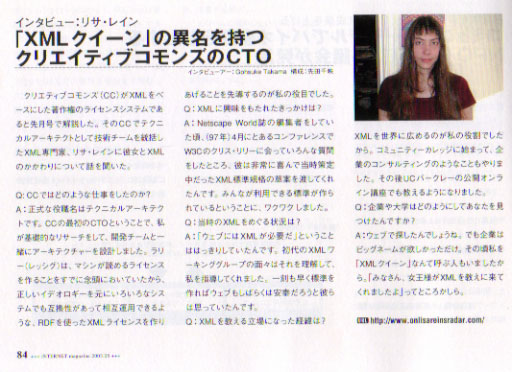 |
Title: XML Specialist Lisa Rein CTO of Creative Commons who has another name as XML Queen - an interview with Lisa Rein By Gohsuke Takama. XML Specialist Lisa Rein is leading technical architect for Creative Commons, which Lawrence Lessig has introduced. We asked her about how she, a journalist/ musician/editor, became recognized by some as the 'XML Queen.' |
Q: What kind of work was that you did in the CreativeCommons project?
LR: My official title was 'Techinical Architect.' Basically I was the first CTO of CreativeCommons. I did basic reserach and designed architecture with development team. Larry (Lessig) already had an idea of building machine readable licenses, so my role there was to lead to accomplish (the project of) buiding XML licenses using RDF, that is based on right ideologies and is compatible and interoperable with many different systems.
Q: How did you get inerested in XML?
LR: It was in 1997. I was an editor of Netscape World magazine at that time. At a conference in April I met Chris Lilly of the W3C and asked him many questions. He happily answered me, and gave me the draft of XML standard, which was still under development. I had no idea what it was at the time, but got excited about the fact that a standard that everyone could use was getting realized.
Q: What was the situation surrounding XML?
LR: "The Web needs XML" was understood by everyone of the first XML WG, and they guided me. Tim Bray and the older generation who made HTML were very worried about the future of the web. But they also thought that if we can build a legitimate standard as quickly as possible, the web would keep going for a while.
Q: So are you self-taught in XML?
LR: No, not by myself. The whole world was a teacher to me. When I sent out questions in emails to experts all around the world for different themes, most of them replied to me with wonderful answers! I thougt that they felt happy to be asked by a person who really wants to learn that had a serious interest in the subject. Then, as I learned more about the subject more, I became more interested in getting actively involved.
Q: How did you start teaching XML?
LR: Since I was involved deeply, to spread XML to the world became my role. My teaching started in my local community college in Bellevue, WA, and then I also did consulting for corporations. But it wasn't fun to teach students who were told to study by their bosses. Or, I should say, it sucked, and could not wait to go home every day. After that, I started teaching at UC Berkeley extension's online seminars. In 2001, I had more teaching gigs as XML get into main stream, but several gigs were canceled in the middle of the course affected by ecconomic down turn.
Q: How did corporations and universities find you?
LR: UC Berkeley, via Craig's List. Corporations, well, probably they searched on the web. They only wanted some big names. and around that time there were some people calling me the "XML Queen". It was kind of like "hey everyone, here comes the queen to teach you XML" kind of thing...
Foo Camp Movies: Celebrity Death Aikido Match
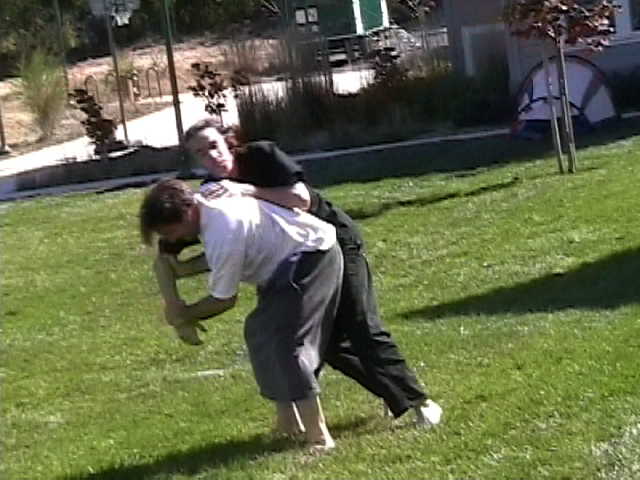
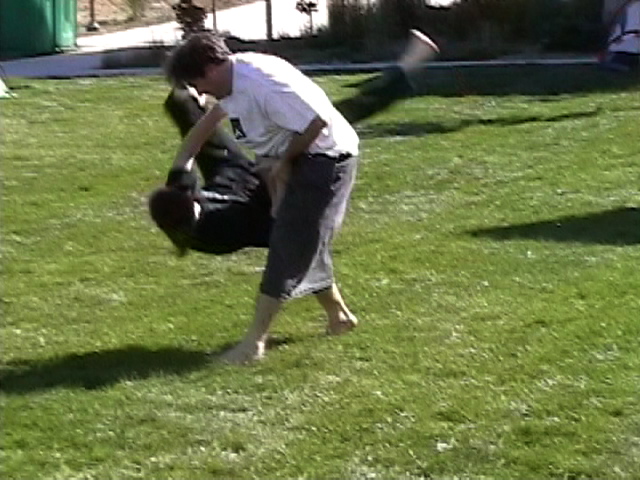
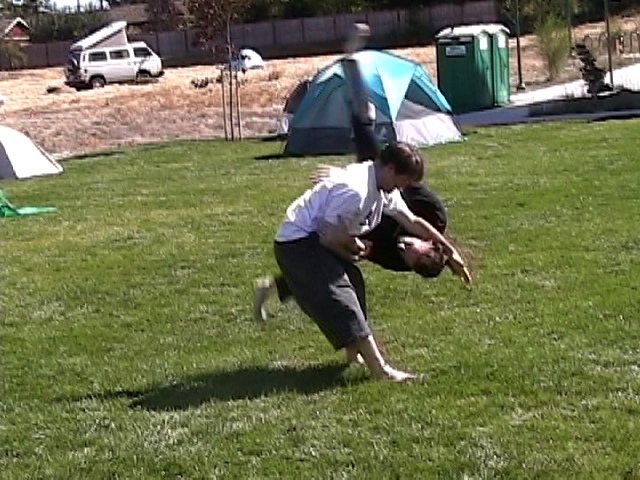
Here's a celebrity death aikido match between Paul "Schmoo" Holman and Jeremy Borenstein.
This was shot on October 12, 2003.
Jeremy was nice enough to provide me with a little explanation:
"Pablos and I originally met because we were both training in the same
aikido dojo. This movie shows us, out of shape and out of practice
but still having fun trying to maul each other. There's a variety of
aikido techniques more-or-less demonstrated there. Pablos takes some
nice high falls (when he leaves the ground completely for a time) and
doesn't get hurt, which is a testament to his skill."
Foo A-Z
Foo Aikido Match (Small - 6 MB)
After the Match (Small - 1 MB)
Foo Aikido Match - All (Small - 7 MB)






This is from the Monday, October 27, 2003 program and details the bombings on Paul Wolfowitz' hotel, and, oh, the irony of it all.
Mess-o-potamia Update - October 27, 2003 (Small - 8 MB)

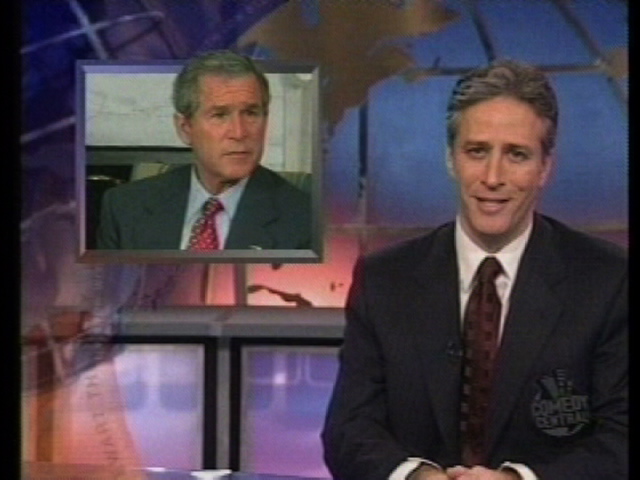
The Daily Show (The best news on television.)
This clip was shown after this clip on October 29, 2003.

In this clip, Rob Courddry probes further into the familiar pattern of the Shrub's blaming his mistakes on other agencies he, theoretically, has complete control over as Commander In Chief.
For example, it was the CIA's fault about the faulty WMD intelligence that was included in his State Of The Union Address. Now it's the Navy's fault for following orders and hanging up the "Mission Accomplished" sign at his May 1 press conference.
Rob Courddry On "The Sign" (Small - 6 MB)

(Below: What the sign said.)

(Below: What they meant for the sign to say.)

The Daily Show (The best news on television.)
This clip from the October 29, 2003 show has the Shrub answering questions at his latest press conference (Oct 28-29, 2003 or so), where he talks rather vaguely about "terrorists" who are responsible for the latest round of suicide bombings in Iraq.
(This clip goes with this clip.)
What the Shrub says, and what his press secretary clarifies later, is that it's the Navy's fault for misrepresenting that the war was over with the "Mission Accomplished" sign. (Despite the fact that all the Navy did was put up the sign that the White House printed up and brought to the event.)
Jon Stewart:
"The White House is basically saying they can't be held responsible for what the Navy does with a sign that they made and brought to the ship."
Here's the little clip about "the sign":
The Shrub Blaming the Navy for "The Sign" (Small - 4 MB)
Here's the complete clip of this bit:
Jon Stewart On The President's Latest Press Conference (Small - 11 MB)


The Daily Show (The best news on television.)
I'm going to be in a hip hop video being shot next week by Ryan Junell. The song is called Under Surveillence by the group Variable Unit.
By a strange coincidence, that very same day I was recruited for the video, Billy Jam sent me this story, which details a situation where Dave Paul, owner of San Francisco's tiny Independent BOMB Hip Hop record label, was questioned by two Secret Service Agents who were responding to a tip from Cheaptickets.com, who claimed Paul had made threatening statements about the Shrub while purchasing tickets over the phone.
Check it out:
 |
Hip Hop Record Label Owner Dave Paul Interrogated By Secret Service Under Suspicion Of Being Threat To President George W. Bush by Billy Jam for HipHopSlam.com |
"The Secret Service showed up at my door. I was not here. They had told my mom that I had said some stuff on the phone and that I needed to answer to it. So I called the agent on his phone and he claimed that cheaptickets.com had reported to them that I had said some things about George W. Bush when I was on the phone working on my flight. I assured them that I said absolutely nothing and they wanted to come over and interview me in person, which they did with two agents. And they even wanted to come in and take a look around my room to make sure that there were no photos of "so-called person" with a target drawn on it or something to that effect. I don't know if it's someone at cheaptickets lying or maybe the Secret Service just used that as an excuse to investigate since the name of the record company.... I even gave them a flyer for tonight's show but they didn't look like they were too interested. I invited them down. They were pretty nice about it. I think just because when you're making flight reservations and the company name is what it is and that's what on your credit card and it shows four people going to Oklahoma City that I'm sure someone at cheaptickets pulled a red flag on it."Here is the full text of the article in case the link goes bad: http://www.hiphopslam.com/news/hhs_news_service_020a.html • SPECIAL REPORT! — Bomb Hip Hop owner Dave Paul Interrogated by The Secret Service HIP HOP RECORD LABEL OWNER DAVE PAUL INTERROGATED BY SECRET SERVICE UNDER SUSPICION OF BEING THREAT TO PRESIDENT GEORGE W. BUSH by Billy Jam exclusive to HipHopSlam.com On October 22nd, in what has to be one of the weirdest turn of events in post September 11th America, Dave Paul, the owner of San Francisco's tiny independent BOMB Hip Hop record label was paid an unexpected visit by two US Secret Service agents. The two government agents were reportedly following up on a tip from a source that claimed Paul had made a threatening statement about US President Bush while buying airline tickets to Oklahoma City for himself and three other DJs (Pone, Quest, T-Rock) who were all flying out very late that night on tour to celebrate the recently released "Return of the DJ Vol. 5". Immediately after the federal investigators left the Noe Valley home that Paul shares with his mother, he talked with HipHopSlam.Com NEWS from his home office phone. During that phone conversation he appeared unusually guarded and self edited. Later that evening at club MILK, scene of the hometown concert for the new DJ album, the still shaken DJ/label owner explained that he didn't want to use particular words over the phone because he believed it may be bugged: noting that he had been noticing unusual "clicking sounds" for several days but - up until then - had made nothing of it. During that phone conversation we asked him to explain exactly what had transpired? His response: "The Secret Service showed up at my door. I was not here. They had told my mom that I had said some stuff on the phone and that I needed to answer to it. So I called the agent on his phone and he claimed that cheaptickets.com had reported to them that I had said some things about George W. Bush when I was on the phone working on my flight. I assured them that I said absolutely nothing and they wanted to come over and interview me in person, which they did with two agents. And they even wanted to come in and take a look around my room to make sure that there were no photos of "so-called person" with a target drawn on it or something to that effect. I don't know if it's someone at cheaptickets lying or maybe the Secret Service just used that as an excuse to investigate since the name of the record company.... I even gave them a flyer for tonight's show but they didn't look like they were too interested. I invited them down. They were pretty nice about it. I think just because when you're making flight reservations and the company name is what it is and that's what on your credit card and it shows four people going to Oklahoma City that I'm sure someone at cheaptickets pulled a red flag on it." One of the words avoided by Paul was that of Bush's and also his label's name, BOMB, which as we know is a no-no to utter in any airport. And apparently now just to say it over the phone while buying tickets is also a no-no. Later that evening Paul said that he figured that the whole incident was just some random check and that there would most likely be nothing more to it. However after doing some research and investigations of our own at HipHopSlam we uncovered something interesting: the fact that on the 1995 BOMB album, Return of the DJ at the very end of the *Invisible Scratch Pickles' track that there was sample of a news reporter saying "After the bombing, police in Oklahoma City issued an all points bulletin for three men - at least two of them described as being of middle eastern origin. This in response to an eyewitness who claims to have seen them at the scene. Federal officials say they have leads but no suspects." Coincidence or implication that the Feds have been studying old BOMB compilations in their "homeland security" efforts? On October 26th we caught up with Dave Paul, who was in Texas en route to the Houston show that evening, and asked him if he thought the Secret Service had been researching this deeply and uncovered this news bite (sampled incidentally by QBert)? He said he doubted it but that it was an uncanny coincidence. Again he reiterated that he figured the Secret Service were probably just doing a routine check and that most likely he wouldn't hear from them again. So would he consider changing the name of his record label from BOMB to something else for fear of future repeat scenarios? "No!" - he said. The BOMB Hip Hop DJs Dave Paul, Quest, T-Rock, and Pone will play Dallas on Monday, October 27th and be back in California by October 29th. For more info on the tour or music visit: www.bombhiphop.com *NOTE: Early spelling of the Piklz name when the crew was a trio feat. Qbert, Shortkut, and Disk. This same track also appeared with the sample intact on Bill Laswell's "Altered Beats" compilation when the crew was billed a quartet with Mixmaster Mike added
As if the "Mission Accomplished" banner was the only thing that implied "Mission Accomplished," during the Shrub's memorable flight suit May 1 extravaganza.
Oh you thought I meant the mission was accomplished. I just meant a mission was accomplished: The mission of the USS Abraham Lincoln, of course... Sorry to give the wrong impression.
Gee, you don't think anyone got that wrong impression because the White House sent out a press release that said President Bush Announces Combat Operations in Iraq Have Ended or anything, do you?
Bush Disavows 'Mission Accomplished' Link
In The Guardian UK.
When it was brought up again Tuesday at a news conference, Bush said, "The 'Mission Accomplished' sign, of course, was put up by the members of the USS Abraham Lincoln, saying that their mission was accomplished.""I know it was attributed somehow to some ingenious advance man from my staff - they weren't that ingenious, by the way."
That explanation hadn't surfaced during months of questions to White House officials about proclaiming the mission in Iraq successful while violence continued.
After the news conference, a White House spokeswoman said the Lincoln's crew asked the White House to have the sign made. The White House asked a private vendor to produce the sign, and the crew put it up, said the spokeswoman. She said she did not know who paid for the sign.
Later, a Pentagon spokesman called The Associated Press to reiterate that the banner was the crew's idea.
Full text of press release below.
Here is the full text of the article in case the link goes bad:
http://www.guardian.co.uk/uslatest/story/0,1282,-3321684,00.html
Bush Disavows 'Mission Accomplished' Link
The Guardian UK
Wednesday 29 October 2003
WASHINGTON (AP) - Six months after he spoke on an aircraft carrier deck under a banner proclaiming "Mission Accomplished," President Bush disavowed any connection with the war message. Later, the White House changed its story and said there was a link.
The "Mission Accomplished" boast has been mocked many times since Bush's carrier speech as criticism has mounted over the failed search for weapons of mass destruction and the continuing violence in Iraq.
When it was brought up again Tuesday at a news conference, Bush said, "The 'Mission Accomplished' sign, of course, was put up by the members of the USS Abraham Lincoln, saying that their mission was accomplished."
"I know it was attributed somehow to some ingenious advance man from my staff - they weren't that ingenious, by the way."
That explanation hadn't surfaced during months of questions to White House officials about proclaiming the mission in Iraq successful while violence continued.
After the news conference, a White House spokeswoman said the Lincoln's crew asked the White House to have the sign made. The White House asked a private vendor to produce the sign, and the crew put it up, said the spokeswoman. She said she did not know who paid for the sign.
Later, a Pentagon spokesman called The Associated Press to reiterate that the banner was the crew's idea.
"It truly did signify a mission accomplished for the crew," Navy Cmdr. Conrad Chun said, adding the president's visit marked the end of the ship's 10-month international deployment.
The president's appearance on the Abraham Lincoln, which was returning home after service in the Persian Gulf, included his dramatic and much-publicized landing on the ship's deck.
Bush's disavowal Tuesday brought new criticism from at least three of the Democrats seeking their party's nomination to run against the president - John Kerry, Wesley Clark and Joe Lieberman.
"Today was another banner day in George Bushs quest to bring honor and integrity to the White House," Lieberman said. "If he wanted to prove he has trouble leveling with the American people, mission accomplished."
Here is the full text of the press release in case the link goes bad:
http://www.whitehouse.gov/news/releases/2003/05/20030501-6.html
For Immediate Release
Office of the Press Secretary
May 1, 2003
President Bush Announces Combat Operations in Iraq Have Ended
Event Backgrounder
The President Visits the USS Abraham Lincoln
BACKGROUND
USS Abraham Lincoln set the record for the longest naval deployment by a nuclear powered aircraft carrier in history, deploying for almost 10 months, and steaming over 100,000 miles. For a Carrier Strike Group, this is the longest deployment in the last 30 years. The USS Lincoln Strike Group was involved in combat in support of three major operations: Operation Southern Watch, Operation Enduring Freedom, and Operation Iraqi Freedom.
Click here for a USS Abraham Lincoln photo essay.
The Air Wing will depart the USS Lincoln while off the coast of San Diego on May 1. The ship will then pull into Naval Air Station North Island (San Diego) on May 2 to off load the rest of the Air Wing equipment. The Lincoln will return to her homeport of Everett, Washington on May 6.
The Lincoln supported one of the largest media embed operations on any ship in naval history by embarking 31 media organizations that included CNN, MSNBC, the BBC, Los Angeles Times, and the New York Times.
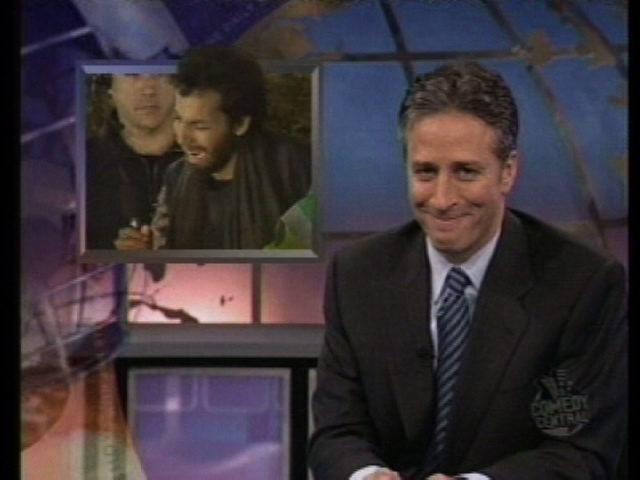
David Blane's latest "magic" trick was hanging in a box above London and starving himself for 45 days. I'm not kidding. That's the whole trick.
As Jon says: (paraphrase) It's incredible! How did he do it? How do millions of people in third world countries all over the world do it every day! What a feat!
Jon took it upon himself to comment on David Blane's starvation routine twice last week. Once on October 20, 2003 and again on October 21, 2003. Additionally, Ed Helms provided an insightful commentary on the subject on October 21, 2003.
Jon On David Blane - October 20 (Small - 2 MB)
Jon On David Blane - October 21, 2003 (Small - 6 MB)
Commentary On David Blane By Ed Helms (Small - 4 MB)




The Daily Show (The best news on television.)
States Rebel Against Bush over Pollution Measures
By David Usborne for the Independent UK.
A group of 12 American states has rebelled against President George Bush and his environmental policies by suing to block changes in the Clean Air Act that will make it easier for industrial plants to upgrade their equipment without paying for anti-pollution devices.The coalition of states, most in the east of the country, downwind of generating plants and refineries in the Midwest, filed the lawsuit in a Washington DC court this week. They were joined by several large cities, including New York, Washington DC and San Francisco. A separate suit was filed by the state of Illinois, and a collection of environmental pressure groups, including the Sierra Club, was expected to file its own legal challenge yesterday.
At issue is a relaxation in regulations put forward by the Environmental Protection Agency (EPA) in December and published on Monday. The plaintiffs claim that the amendments will lead to an increase in harmful emissions. "It amounts to a get-out-of-jail-free card for some of the nation's biggest polluters," said Frank O'Donnell of the Clean Air Trust.
Critics insist that the changes are the most significant made to the 33-year-old Clean Air Act since it was strengthened by Congress in 1990. At the core of the Act were emission ceilings for all big industrial plants. But a "grandfather" clause gave exemptions to facilities built before the Act was introduced. However, even those older plants were to be fitted with scrubbers and other controls if they were modernised or expanded.
It is this stipulation that the EPA wants to relax. During the 1990s, under President Bill Clinton, the EPA strictly enforced the rules. But there was a change of thinking with the arrival of President Bush in Washington. Vice-President Dick Cheney pressed for an easing of the rules to save costs for the energy industry, with which he is closely linked.
The move by Mr Cheney was resisted by the former environment secretary, Christie Whitman. In a memo, which has recently been circulated by environmental lobby groups, she warned that the administration would "pay a terrible political price" if it undercut the rules.
There are more than 500 plants across the US that benefited from the pre-1970 exemptions. Most are power plants, generating about 51 per cent of national electricity.
"We are not going to sit by quietly and allow the energy interests in this country to receive special treatment while so many of our children and elderly are needlessly suffering from respiratory problems," said Tom Reilly, the Massa-chusetts attorney general.
Here is the full text of the article in case the link goes bad:
http://news.independent.co.uk/world/americas/story.jsp?story=458271
States Rebel Against Bush over Pollution Measures
By David Usborne
Independent UK
Wednesday 29 October 2003
A group of 12 American states has rebelled against President George Bush and his environmental policies by suing to block changes in the Clean Air Act that will make it easier for industrial plants to upgrade their equipment without paying for anti-pollution devices.
The coalition of states, most in the east of the country, downwind of generating plants and refineries in the Midwest, filed the lawsuit in a Washington DC court this week. They were joined by several large cities, including New York, Washington DC and San Francisco. A separate suit was filed by the state of Illinois, and a collection of environmental pressure groups, including the Sierra Club, was expected to file its own legal challenge yesterday.
At issue is a relaxation in regulations put forward by the Environmental Protection Agency (EPA) in December and published on Monday. The plaintiffs claim that the amendments will lead to an increase in harmful emissions. "It amounts to a get-out-of-jail-free card for some of the nation's biggest polluters," said Frank O'Donnell of the Clean Air Trust.
Critics insist that the changes are the most significant made to the 33-year-old Clean Air Act since it was strengthened by Congress in 1990. At the core of the Act were emission ceilings for all big industrial plants. But a "grandfather" clause gave exemptions to facilities built before the Act was introduced. However, even those older plants were to be fitted with scrubbers and other controls if they were modernised or expanded.
It is this stipulation that the EPA wants to relax. During the 1990s, under President Bill Clinton, the EPA strictly enforced the rules. But there was a change of thinking with the arrival of President Bush in Washington. Vice-President Dick Cheney pressed for an easing of the rules to save costs for the energy industry, with which he is closely linked.
The move by Mr Cheney was resisted by the former environment secretary, Christie Whitman. In a memo, which has recently been circulated by environmental lobby groups, she warned that the administration would "pay a terrible political price" if it undercut the rules.
There are more than 500 plants across the US that benefited from the pre-1970 exemptions. Most are power plants, generating about 51 per cent of national electricity.
"We are not going to sit by quietly and allow the energy interests in this country to receive special treatment while so many of our children and elderly are needlessly suffering from respiratory problems," said Tom Reilly, the Massa-chusetts attorney general.
The industry has welcomed the new exemptions. Scott Segal, a spokesman for the Electric Reliability Coordinating Council, an industry group, said the amendments would make it more cost-efficient for owners to modernise plants to make them more efficient and reduce emissions.
The 12 states involved in the suitare Pennsylvania, New York, Connecticut, Maine, Maryland, Massachusetts, New Hampshire, New Jersey, New Mexico, Rhode Island, Vermont and Wisconsin.
Hey guys, I wasn't able to get as much up as I wanted to this morning, and now I've got to go to school. But I'll be catching up on everything I promised tonight.
Have a great day!
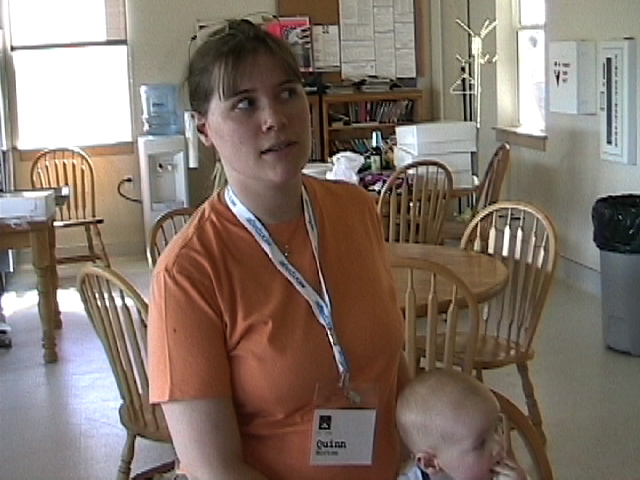
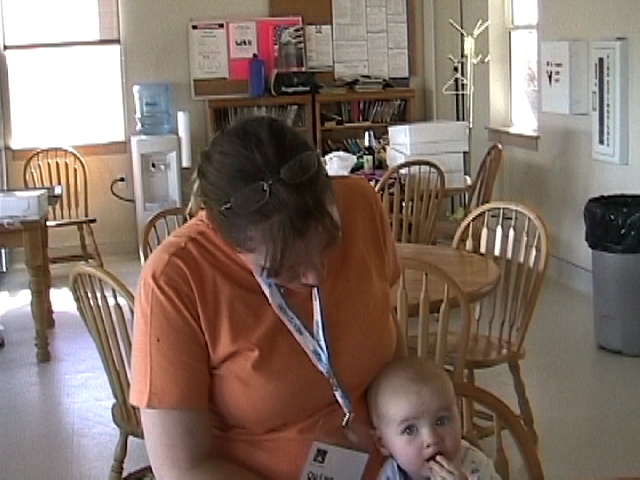
This interview with Quinn Norton is from October 12, 2003.
Quinn Norton and Ada Norton (Small - 9 MB)

This just in from Brad Templeton.
Rick Prelinger took these pictures of me and Howard Dean at yesterday's rally in San Francisco.
I'll have footage from the rally up tomorrow.
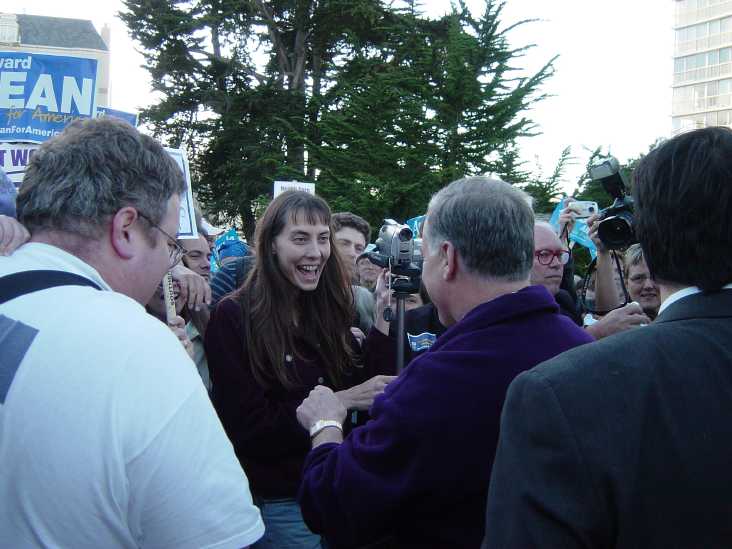
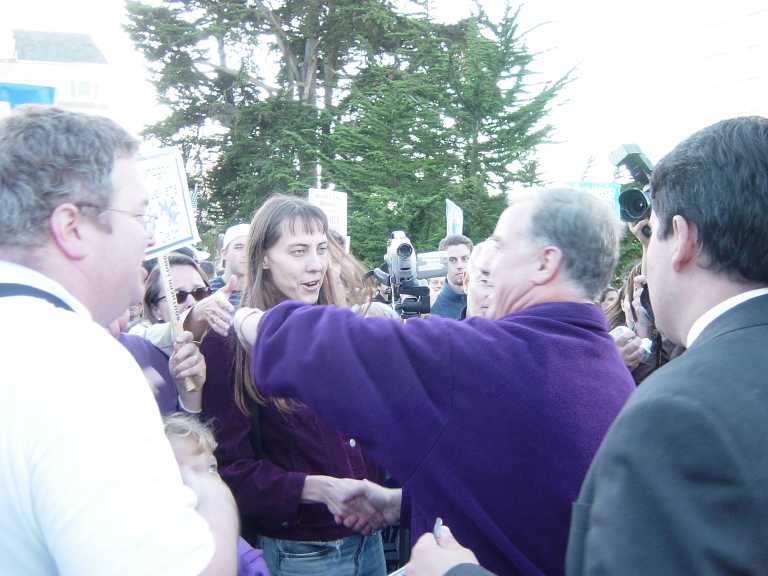
A friend of mine sent me this article yesterday in an attempt to inform me that Howard Dean was really a racist. I had to just laugh when I read the article, at first, because Dean's platform is so pro-civil rights and pro-racial equality that it was more than a little funny to me that anyone would be asinine enough to launch those allegations.
But when I read the article, I was more than a little angry at Al Sharpton. He had distorted the truth just enough to make Dean's intent sound questionable. I decided not to blog the article so as not to perpetuate the negative, inaccurate propoganda. And hoped it would just go away, I guess.
This morning, I awoke to a very pleasant rebuttle by Jesse Jackson, strongly criticizing Al Sharpton for his inaccurate remarks and reaffirming what I already knew about Howard Dean: that he is pro-civil rights and pro-affirmative action.
Thanks, Jesse!
Jackson Urges Democrats to Accentuate the Positive
Calls On All Democrats To Reject Racial Rhetoric
By Jesse Jackson, for t r u t h o u t.
Clearly, Gov. Dean is not anti-black and it is ridiculous for Rev. Sharpton to compare him to President George Bush in that regard. When it comes to addressing issues that directly affect African Americans, and indirectly affects all Americans, Gov. Dean clearly has good record. Up until this point - until I indicated my intention to endorse Gov. Dean - the Democratic campaign has been free of such racial rhetoric. I would recommend that it remain so. Such rhetoric will not contribute to defeating George W. Bush in 2004. Indeed, it will insure his re-election.
Here is the text of both articles in case the link goes bad. (The Al Sharpton article in the Washington Post is below the Jesse Jackson statement.)
http://www.truthout.org/docs_03/103003E.shtml
Jackson Urges Democrats to Accentuate the Positive
Calls On All Democrats To Reject Racial Rhetoric
Congressman Jesse L. Jackson
t r u t h o u t | Statement
Tuesday 28 October 2003
Congressman Jesse L. Jackson today said, "Al Sharpton is making a great contribution to the Democratic Party with his performances in the debates, his inspirational speeches on the campaign trail, his raising of the political consciousness of voters on issues that many of the other candidates will not touch, and by bringing new voters into the process.
"But no contribution of the Rev. Al Sharpton has been greater than the role he has played of statesman in the debates - of urging fellow competitors to `first do not harm' to one another. It was Al Sharpton who said in the first debate in South Carolina, televised by ABC, that the 'Democrats should not have a debate and George Bush turn out to be the winner.' He has constantly reminded his fellow Democratic presidential candidates that the goal is to defeat President Bush in November, 2004. He has also said that while he understands there will be competition between each of them, none of them should do any harm to the other candidates that would prevent them from defeating George Bush.
"Unfortunately, Rev. Sharpton has rejected his own advice. The spirit of Rev. Sharpton's release in that regard is over-the-top and mostly inaccurate. Rev. Sharpton is inaccurate when he says that Howard Dean is `opposed to affirmative action.' Even the 1995 quote he attributes to Gov. Dean is not a statement 'opposed' to affirmative action, but an argument for a broader criteria. More importantly, during this campaign Governor Dean has clearly stated for the record that he supports affirmative action based on race, gender and class - which is what the law requires.
"Whoever the ultimate nominee of the Democratic Party is I intend to support - and I will not agree with them on every issue. Gov. Dean and I may just have to agree to disagree on the death penalty. However, I would remind Rev. Sharpton that both he and I supported Bill Clinton in 1992 and 1996 even though he supported the death penalty and ending welfare as we know it - both of which we disagreed with.
"With respect to gun control, Gov. Dean supports all of the common sense FEDERAL laws and proposed laws with respect to renewal of the assault weapons ban, holding gun manufacturers responsible, adequately checking purchasers at gun shows. But beyond that he argues that different states have different needs, and I agree. Not every state values hunters and hunting equally and I respect and agree with Gov. Dean in that regard.
"I don't understand why I am being singled out. Rep. Major Owens, from New York, endorsed Gov. Dean some time ago, but none of these issues were raised. No member of the Congressional Black Caucus (CBC) has endorsed Rev. Sharpton, and there were other members of the CBC in the New York Times article who indicated that they too may be on the verge of endorsing Gov. Dean.
"I also don't understand Rev. Sharpton's attempt to introduce 'race' into the campaign by using such rhetoric as `anti-black' with respect to Gov. Dean. I challenge all of the other candidates to urge Rev. Sharpton to resist using such inflammatory rhetoric.
"Clearly, Gov. Dean is not anti-black and it is ridiculous for Rev. Sharpton to compare him to President George Bush in that regard. When it comes to addressing issues that directly affect African Americans, and indirectly affects all Americans, Gov. Dean clearly has good record. Up until this point - until I indicated my intention to endorse Gov. Dean - the Democratic campaign has been free of such racial rhetoric. I would recommend that it remain so. Such rhetoric will not contribute to defeating George W. Bush in 2004. Indeed, it will insure his re-election.
*****
http://www.washingtonpost.com/ac2/wp-dyn/A31895-2003Oct28?language=printer
Sharpton Calls Dean's Agenda 'Anti-Black'
By Brian Faler
Special to The Washington Post
Wednesday, October 29, 2003; Page A08
Democratic presidential candidate Al Sharpton launched a blistering attack on Howard Dean yesterday, accusing his rival of promoting an "anti-black agenda."
"Howard Dean's opposition to affirmative action, his current support for the death penalty and historic support of the NRA's [National Rifle Association's] agenda amounts to an anti-black agenda that will not sell in communities of color in this country," Sharpton said in a statement.
He said his comments were in response to a news report yesterday that Rep. Jesse L. Jackson Jr. (D-Ill.) plans to endorse Dean, the former Vermont governor and presumed front-runner for the 2004 Democratic nomination. Sharpton has had a long-standing rivalry with the congressman's father, Jesse L. Jackson, who twice ran for president.
"Any so-called African American leader that would endorse Dean despite his anti-black record is mortgaging the future of our struggle for civil rights and social justice," Sharpton said.
His statement cited a 1995 interview in which Dean appeared to question the need for affirmative action programs based solely on race. "I think we ought to look at affirmative action programs based not on race but on class," Dean said on CNN's "Late Edition."
Responding to Sharpton's comments, Dean's deputy campaign manager, Andi Pringle, said: "Governor Dean has always been a strong supporter of affirmative action, and he believes there is still a great need for affirmative action in America."
Until now, the Dean campaign's brushes with racial issues have been less vitriolic. Earlier this year, some critics, noting that Dean comes from a heavily white state and campaigns extensively via the Internet, questioned his ability to reach low-income and minority voters.
In a Sept. 9 candidates forum in Baltimore, Dean said he was "the only white politician that ever talks about race in front of white audiences." Several rivals pointed to speeches that disproved Dean's assertion, which Sen. John Edwards (D-N.C.) called divisive.
Donna Brazile, who managed Al Gore's 2000 presidential campaign, yesterday dismissed Sharpton's attacks as a ploy to boost his standing in the polls.
"I think Dean's record on civil rights issues, on affirmative action -- his willingness to talk about race in a very inclusive way -- has been refreshing," said Brazile, who is African American. "These long-shot candidates, all they're doing is taking aim at the top tier because they're frustrated. I think Reverend Sharpton should keep his focus on ideas."
Just to clarify again -- These stories are not about our soldiers not getting proper medical treatment on the front lines. They are about Shrub War Veterans not getting propers medical treatment upon returning home.
But wait! It's worse than that. Upon re-reading the article, I see that many of these soldiers had existing health problems that should have prevented them from being deployed in the first place. I also see that many of them were forced to reside in substandard housing, and received injuries from incidents like the roof falling in on their own barracks, rather than in active combat.
I hope the citizens of our armed forces can remember this experience long enough to vote the Shrub out next year.
"I joined to serve my country," said Cpl. Waymond Boyd, 34. He served in Iraq with the National Guard's 1175 Transportation Company. He has been in medical hold since the end of July."It doesn't make any sense to go over there and risk your life and come back to this," Boyd said. "It ain't fair and it ain't right. I used to be patriotic." He has served the military for 15 years.
Boyd's knee and wrist injuries were severe enough that he was evacuated to Germany at the end of July and then sent to Fort Knox. His medical records show doctor appointments around four weeks apart. He said it took him almost two months to get a cast for his wrist, which is so weak he can't lift 5 pounds or play with his two children. He is taking painkilling drugs and walks with a cane with some difficulty.
Many soldiers at Fort Knox said their injuries and illnesses occurred in Iraq. Some said the rigors of war exacerbated health problems that probably should have prevented them from going in the first place.
Boyd's X-rays appear to show the damage to his wrist but also bone spurs in his feet that are noted in his medical record before being deployed, but the records say "no health problems noted" before he left...
Sgt. Buena Montgomery has breathing problems since serving in Operation Iraqi Freedom. She said she has been able to get to doctors but worries about many others who have not.
"The Army did not prepare for the proper medical care for the soldiers that they knew were going to come back from this war," Montgomery said. "Now the Army needs to step up to the plate and fix this problem."
In nearly two dozen interviews conducted over three days, soldiers also described substandard living conditions -- though they said conditions had improved recently.
A UPI photographer working on this story without first having cleared his presence with base public affairs officials was detained for several hours for questioning Tuesday and then released. He was told he would need an Army escort for any further visits to the base. He returned to the base accompanied by an Army escort on Wednesday.
This reporter also was admonished that he had to be accompanied by an Army public affairs escort when on base. The interviews had been conducted without the presence of an escort.
After returning from Iraq, some soldiers spent about eight weeks in Spartan, dilapidated World War II-era barracks with leaking roofs, animal infestations and no air conditioning in the Kentucky heat.
"I arrived here and was placed in the World War II barracks," one soldier wrote in an internal Fort Knox survey of the conditions. "On the 28th of August we moved out. On 30 Aug. the roof collapsed. Had we not moved, someone would be dead," that soldier wrote...
"They are treating us like second-class citizens," said Spc. Brian Smith, who served in Operation Iraqi Freedom until Aug. 16 and said he is having trouble seeing doctors at Fort Knox. The Army evacuated him through Germany for stomach problems, among other things. "My brother wants to get in (the military). I am now discouraging him from doing it," Smith said.
"I have never been so disrespected in my military career," said Lt. Jullian Goodrum, who has been in the Army Reserve for 16 years. His health problems do not appear to be severe -- injured wrists -- but he said the medical situation at Fort Knox is bad. He said he waited a month for therapy. "I have never been so treated like dirt."
Sick soldiers wait for treatment
By Mark Benjamin
UPI Investigations Editor
Published 10/29/2003 3:58 PM
View printer-friendly version
FORT KNOX, Ky., Oct. 29 (UPI) -- More than 400 sick and injured soldiers, including some who served in Operation Iraqi Freedom, are stuck at Fort Knox, waiting weeks and sometimes months for medical treatment, a score of soldiers said in interviews.
The delays appear to have demolished morale -- many said they had lost faith in the Army and would not serve again -- and could jeopardize some soldiers' health, the soldiers said.
The Army Reserve and National Guard soldiers are in what the Army calls "medical hold," like roughly 600 soldiers under similar circumstances waiting for doctors at Fort Stewart, Ga.
The apparent lack of care at both locations raises the specter that Reserve and Guard soldiers, including many who returned from Iraq, could be languishing at locations across the country, according to Senate investigators.
Representatives from the office of Sen. Kit Bond, R-Mo., were at Fort Knox Wednesday looking into conditions at the post.
Following reports from Fort Stewart, Senate investigators said that the medical system at that post was overwhelmed and they were looking into whether the situation was Army-wide.
Army officials at the Pentagon said they are investigating that possibility. "We are absolutely taking a look at this across the Army and not just at Fort Stewart," Army spokesman Joe Burlas said Wednesday.
"I joined to serve my country," said Cpl. Waymond Boyd, 34. He served in Iraq with the National Guard's 1175 Transportation Company. He has been in medical hold since the end of July.
"It doesn't make any sense to go over there and risk your life and come back to this," Boyd said. "It ain't fair and it ain't right. I used to be patriotic." He has served the military for 15 years.
Boyd's knee and wrist injuries were severe enough that he was evacuated to Germany at the end of July and then sent to Fort Knox. His medical records show doctor appointments around four weeks apart. He said it took him almost two months to get a cast for his wrist, which is so weak he can't lift 5 pounds or play with his two children. He is taking painkilling drugs and walks with a cane with some difficulty.
Many soldiers at Fort Knox said their injuries and illnesses occurred in Iraq. Some said the rigors of war exacerbated health problems that probably should have prevented them from going in the first place.
Boyd's X-rays appear to show the damage to his wrist but also bone spurs in his feet that are noted in his medical record before being deployed, but the records say "no health problems noted" before he left.
"I don't think I was medically fit to go. But they said 'go.' That is my job," Boyd said.
Fort Knox Public Affairs Officer Connie Shaffery said, "Taking care of patients is our priority." Soldiers see specialists within 28 days, Shaffery said and Fort Knox officials hope to cut that time lag.
"I think that we would like for all the soldiers to get care as soon as possible," Shaffery said.
Shaffery said of the 422 soldiers on medical hold at Fort Knox, 369 did not deploy to Operation Iraqi Freedom because of their illnesses. Around two-thirds of the soldiers at Fort Stewart did serve in Operation Iraqi Freedom.
Soldiers at Fort Knox describe strange clusters of heart problems and breathing problems, as did soldiers at Fort Stewart and other locations.
Command Sgt. Major Glen Talley, 57, is in the hospital at Fort Knox for heart problems, clotting blood and Graves' disease, a thyroid disorder. All of the problems became apparent after he went to war in April, he says. He is a reservist.
Talley said he was moved to Fort Knox on Oct. 16 and had not seen a doctor yet, only a physician's assistant. His next appointment with an endocrinologist was scheduled for Dec. 30.
"I don't mind serving my country," Talley said. "I just hate what they are doing to me now." Talley has served for 30 years. He was awarded two Purple Hearts in Vietnam.
Sgt. Buena Montgomery has breathing problems since serving in Operation Iraqi Freedom. She said she has been able to get to doctors but worries about many others who have not.
"The Army did not prepare for the proper medical care for the soldiers that they knew were going to come back from this war," Montgomery said. "Now the Army needs to step up to the plate and fix this problem."
In nearly two dozen interviews conducted over three days, soldiers also described substandard living conditions -- though they said conditions had improved recently.
A UPI photographer working on this story without first having cleared his presence with base public affairs officials was detained for several hours for questioning Tuesday and then released. He was told he would need an Army escort for any further visits to the base. He returned to the base accompanied by an Army escort on Wednesday.
This reporter also was admonished that he had to be accompanied by an Army public affairs escort when on base. The interviews had been conducted without the presence of an escort.
After returning from Iraq, some soldiers spent about eight weeks in Spartan, dilapidated World War II-era barracks with leaking roofs, animal infestations and no air conditioning in the Kentucky heat.
"I arrived here and was placed in the World War II barracks," one soldier wrote in an internal Fort Knox survey of the conditions. "On the 28th of August we moved out. On 30 Aug. the roof collapsed. Had we not moved, someone would be dead," that soldier wrote.
Shaffery said all of the soldiers have moved out of those barracks. "As soon as we were able to, we moved them out," Shaffery said. The barracks now stand empty and have been condemned.
Also like Fort Stewart, soldiers at Fort Knox claimed they are getting substandard treatment because they are in the National Guard or Army Reserve as opposed to regular Army. The Army has denied any discrepancies in treatment or housing.
"We have provided, are providing, and will continue to provide our soldiers -- active and Reserve component -- the best health care available," Army spokesman Maj. Steve Stover said Oct. 20. He said Army policy provides health care priority based on a "most critically ill" basis, without differentiation between active and our Reserve soldiers.
"Medical hold issues are not new and the Army has been working diligently to address them across the Army," Stover said.
"They are treating us like second-class citizens," said Spc. Brian Smith, who served in Operation Iraqi Freedom until Aug. 16 and said he is having trouble seeing doctors at Fort Knox. The Army evacuated him through Germany for stomach problems, among other things. "My brother wants to get in (the military). I am now discouraging him from doing it," Smith said.
"I have never been so disrespected in my military career," said Lt. Jullian Goodrum, who has been in the Army Reserve for 16 years. His health problems do not appear to be severe -- injured wrists -- but he said the medical situation at Fort Knox is bad. He said he waited a month for therapy. "I have never been so treated like dirt."
I'm BEAT with a capital everything tonight guys. I managed to get out and record the Dean rally, but last night was one of those late one's that I mentioned are known to happen on occasion, so I'm going to go to bed early-like, and I'll put up a bunch more foo clips, and Daily Show clips, and Howard Dean on 60 minutes, and other goodies in the AM.
Hi guys!
Okay the rally has been changed to 4pm at Lafayette Park on the corner of Laguna and Clay.
Show up early to help out and get a free T-shirt!
Here's the message I just received:
Lafayette Park and volunteer meeting point will be Clay & Laguna Streets...IMPORTANT CHANGE OF VENUE-
Sorry this is all so last minute folks.
The Rally tomorrow at 4:00 pm will be at LAFAYETE PARK at the corner of Laguna and Clay.
Any volunteers who can help I would appreciate it so much.Sorry for all of the confusion, just problem with permits, satellite trucks, and so on.
This location will not change.
Any further help with promoting the rally would also be helpful, but we really need 20 or so folks to come and help with our advance team. Any one who can come early and volunteer will of course get a free T-shirt (like you all don't have one already!!)
So I just set up an in-person interview with Tom Ammiano for Friday afternoon. I'll be videotaping the interview and making it available here.
Since the purpose of this interview is to give you a chance to know Tom better, so you'll vote for him next Tuesday, I thought I'd give you a chance to send me questions ahead of time. Please email me at lisarein@finetuning.com with your questions and I'll work them into the interview on Friday.
Thanks!
I'm not saying it has anything specific to hide, other than the intelligence incompetence that has already been exposed. But what else is the public supposed to think when it hears about this Administration witholding information?
Administration Faces Subpoenas From 9/11 Panel
By Philip Shenon for the New York Times.
The chairman of the federal commission investigating the Sept. 11, 2001, terror attacks said that the White House was continuing to withhold several highly classified intelligence documents from the panel and that he was prepared to subpoena the documents if they were not turned over within weeks.The chairman, Thomas H. Kean, the former Republican governor of New Jersey, also said in an interview that he believed the bipartisan 10-member commission would soon be forced to issue subpoenas to other executive branch agencies because of continuing delays by the Bush administration in providing documents and other evidence needed by the panel.
"Any document that has to do with this investigation cannot be beyond our reach," Mr. Kean said on Friday in his first explicit public warning to the White House that it risked a subpoena and a politically damaging courtroom showdown with the commission over access to the documents, including Oval Office intelligence reports that reached President Bush's desk in the weeks before the Sept. 11 attacks.
"I will not stand for it," Mr. Kean said in the interview in his offices here at Drew University, where he has been president since 1990.
"That means that we will use every tool at our command to get hold of every document."...
Last year, the White House confirmed news reports that President Bush received a written intelligence report in August 2001, the month before the attacks, that Al Qaeda might try to hijack American passenger planes.
Ms. Snee, the White House spokeswoman, said, "The president has stated a clear policy of support for the commission's work and, at the direction of the president, the executive branch has dedicated tremendous resources to support the commission, including providing over two million pages of documents."
After months of stating that it believed subpoenas to the executive branch would not be necessary, the commission voted unanimously this month to issue its first subpoena to the Federal Aviation Administration after determining that the F.A.A. had withheld dozens of boxes of documents involving the Sept. 11 attacks.
The subpoena appeared to be a turning point for the commission and for Mr. Kean, a moderate Republican known for his independence. In a statement on Oct. 15, the commission said it was re-examining "its general policy of relying on document requests rather than subpoenas" as a result of the issues with the F.A.A...
Mr. Kean's comments on Friday came as another member of the commission, Max Cleland, the former Democratic senator from Georgia, became the first panel member to say publicly that the commission could not complete its work by its May 2004 deadline and the first to accuse the White House of withholding classified information from the panel for purely political reasons.
"It's obvious that the White House wants to run out the clock here," he said in an interview in Washington. "It's Halloween, and we're still in negotiations with some assistant White House counsel about getting these documents — it's disgusting."
He said that the White House and President Bush's re-election campaign had reason to fear what the commission was uncovering in its investigation of intelligence and law enforcement failures before Sept. 11. "As each day goes by, we learn that this government knew a whole lot more about these terrorists before Sept. 11 than it has ever admitted."...
Here is the full text of the article in case the link goes bad:
http://www.nytimes.com/2003/10/26/national/26KEAN.html?hp
Administration Faces Subpoenas From 9/11 Panel
By Philip Shenon, New York Times
Saturday 25 October 2003
MADISON, N.J., Oct. 25 — The chairman of the federal commission investigating the Sept. 11, 2001, terror attacks said that the White House was continuing to withhold several highly classified intelligence documents from the panel and that he was prepared to subpoena the documents if they were not turned over within weeks.
The chairman, Thomas H. Kean, the former Republican governor of New Jersey, also said in an interview that he believed the bipartisan 10-member commission would soon be forced to issue subpoenas to other executive branch agencies because of continuing delays by the Bush administration in providing documents and other evidence needed by the panel.
"Any document that has to do with this investigation cannot be beyond our reach," Mr. Kean said on Friday in his first explicit public warning to the White House that it risked a subpoena and a politically damaging courtroom showdown with the commission over access to the documents, including Oval Office intelligence reports that reached President Bush's desk in the weeks before the Sept. 11 attacks.
"I will not stand for it," Mr. Kean said in the interview in his offices here at Drew University, where he has been president since 1990.
"That means that we will use every tool at our command to get hold of every document."
He said that while he had not directly threatened a subpoena in his recent conversations with the White House legal counsel, Alberto R. Gonzales, "it's always on the table, because they know that Congress in their wisdom gave us the power to subpoena, to use it if necessary."
A White House spokeswoman, Ashley Snee, said that the White House believed it was being fully cooperative with the commission, which is known formally as the National Commission on Terrorist Attacks Upon the United States. She said that it hoped to meet all of the panel's demands for documents.
Mr. Kean suggested that he understood the concerns of the White House about the sensitivity of the documents at issue, saying that they were the sort of Oval Office intelligence reports that were so sensitive and highly classified that they had never been provided to Congress or to other outside investigators.
"These are documents that only two or three people would normally have access to," he said. "To make those available to an outside group is something that no other president has done in our history.
"But I've argued very strongly with the White House that we are unique, that we are not the Congress, that these arguments about presidential privilege do not apply in the case of our commission," he said.
"Anything that has to do with 9/11, we have to see it — anything. There are a lot of theories about 9/11, and as long as there is any document out there that bears on any of those theories, we're going to leave questions unanswered. And we cannot leave questions unanswered."
While Mr. Kean said he was barred by an agreement with the White House from describing the Oval Office documents at issue in any detail — he said the White House was "quite nervous" about any public hint at their contents — other commission officials said they included the detailed daily intelligence reports that were provided to Mr. Bush in the weeks leading up to Sept. 11. The reports are known within the White House as the Presidential Daily Briefing.
Despite the threat of a subpoena and his warning of the possibility of a court battle over the documents, Mr. Kean said he maintained a good relationship with Mr. Gonzales and others at the White House, and that he was still hopeful that the White House would produce all of the classified material demanded by the panel without a subpoena.
"We've been very successful in getting a lot of materials that I don't think anybody has ever seen before," he said of his earlier dealings with the White House. "Within the legal constraints that they seem to have, they've been fully cooperative. But we're not going to be satisfied until we get every document that we need."
Last year, the White House confirmed news reports that President Bush received a written intelligence report in August 2001, the month before the attacks, that Al Qaeda might try to hijack American passenger planes.
Ms. Snee, the White House spokeswoman, said, "The president has stated a clear policy of support for the commission's work and, at the direction of the president, the executive branch has dedicated tremendous resources to support the commission, including providing over two million pages of documents."
After months of stating that it believed subpoenas to the executive branch would not be necessary, the commission voted unanimously this month to issue its first subpoena to the Federal Aviation Administration after determining that the F.A.A. had withheld dozens of boxes of documents involving the Sept. 11 attacks.
The subpoena appeared to be a turning point for the commission and for Mr. Kean, a moderate Republican known for his independence. In a statement on Oct. 15, the commission said it was re-examining "its general policy of relying on document requests rather than subpoenas" as a result of the issues with the F.A.A.
The commission, which has a membership that is equally divided among Republicans and Democrats, was created by Congress last year over the initial opposition of the White House. The law creating the panel requires that it complete its work by next May, a deadline that commission members say may be impossible to meet because of the Bush administration's delays in turning over many documents.
Mr. Kean's comments on Friday came as another member of the commission, Max Cleland, the former Democratic senator from Georgia, became the first panel member to say publicly that the commission could not complete its work by its May 2004 deadline and the first to accuse the White House of withholding classified information from the panel for purely political reasons.
"It's obvious that the White House wants to run out the clock here," he said in an interview in Washington. "It's Halloween, and we're still in negotiations with some assistant White House counsel about getting these documents — it's disgusting."
He said that the White House and President Bush's re-election campaign had reason to fear what the commission was uncovering in its investigation of intelligence and law enforcement failures before Sept. 11. "As each day goes by, we learn that this government knew a whole lot more about these terrorists before Sept. 11 than it has ever admitted."
Interviews with several other members of the commission show that Mr. Kean's concerns are widely shared on the panel, and that the concern is bipartisan.
Slade Gorton, a Republican member of the panel who served in the Senate from Washington from 1982 to 2000, said that he was startled by the "indifference" of some executive branch agencies in making material available to the commission. "This lack of cooperation, if it extends anywhere else, is going to make it very difficult" for the commission to finish its work by next May, he said.
Timothy J. Roemer, president of the Center for National Policy in Washington and a former Democratic member of the House from Indiana, said that "our May deadline may, in fact, be jeopardized — many of us are frustrated that we're still dealing with questions about document access when we should be sinking our teeth into hearings and to making recommendations for the future."
Congress would need to approve an extension if the panel requested one, a potentially difficult proposition given the reluctance of the White House and many senior Republican lawmakers to see the commission created in the first place.
"If the families of the victims weighed in — and heavily, as they did before — then we'd have a chance of succeeding," said Senator John McCain, the Arizona Republican who was an important sponsor of the legislation creating the commission. He said that, given the "obfuscation" of the administration in meeting document requests, he was ready to pursue an extension "if the commission feels it can't get its work done."
CIA May Have Been Out of Iraq Loop
Top Democrat on the Senate intelligence panel says some officials in the administration appear to have bypassed agency in gathering Iraq data.
By Greg Miller for The Los Angeles Times.
Officials in the Bush administration appear to have bypassed the CIA and other agencies to collect their own intelligence overseas on Iraq, the ranking Democrat on the Senate Intelligence Committee said Friday...Making the case for an expanded inquiry, Rockefeller, of West Virginia, the committee's vice chairman, said some in the administration appeared to have been collecting intelligence "without the knowledge of the Central Intelligence Agency, the State Department or anybody else" in the intelligence community.
Such operations, if verified, would be highly unusual and would bolster critics' claims that the administration has short-circuited the normal flow of intelligence to search for facts that support its assumptions.
Rockefeller's comments appeared designed to pressure Republicans to expand the probe's scope at a time when both parties are struggling to control the course of the investigation as next year's presidential election looms.
His remarks culminated a week of uncharacteristic outbursts from a committee that has traditionally sought to steer clear of the partisan rancor that often characterizes other legislative panels...
Its activities have been harshly criticized by some in the intelligence community. The office has come under closer scrutiny on Capitol Hill since defense officials acknowledged this year that representatives from Special Plans met with Manucher Ghorbanifar, an Iranian exile and discredited figure involved in the Iran-Contra scandal of the 1980s, shortly after the Sept. 11 attacks.
At the time, officials said Ghorbanifar was part of a group claiming to have information that might be helpful to the U.S. in the war on terrorism, and that Pentagon officials agreed to the meeting merely to assess that information. Asked to explain the matter during an August news conference, Defense Secretary Donald H. Rumsfeld said that "people come in offering suggestions or information or possible contacts, and sometimes they're pursued."
But the contacts aroused suspicion on Capitol Hill. According to congressional testimony from the 1980s, Ghorbanifar was among those proposing that money from the Reagan administration's arms-for-hostages deal with Iran be diverted to aid the Contra rebels in Nicaragua.
Even before that scandal, Ghorbanifar was a notorious figure in the intelligence community. The CIA had issued a "burn notice" to other agencies advising them to have nothing to do with him.
Here is the full text of the article in case the link goes bad:
http://www.latimes.com/news/nationworld/iraq/la-fg-intell25oct25,1,2290607.story?coll=la-home-headlines
CIA May Have Been Out of Iraq Loop
By Greg Miller The Los Angeles Times
Saturday 25 October 2003
Top Democrat on the Senate intelligence panel says some officials in the administration appear to have bypassed agency in gathering Iraq data.
WASHINGTON -- Officials in the Bush administration appear to have bypassed the CIA and other agencies to collect their own intelligence overseas on Iraq, the ranking Democrat on the Senate Intelligence Committee said Friday.
Sen. John D. "Jay" Rockefeller IV's comments came as bipartisan cooperation on the committee's inquiry into prewar intelligence appeared to be unraveling. Democrats complained that Republicans are out to pin blame on the CIA and shield the White House from criticism that intelligence used to make the case to invade Iraq was exaggerated.
After reviewing tens of thousands of pages of intelligence documents, the committee staff has begun drafting a report that sources said would harshly criticize the CIA for prewar judgments that congressional investigators believe were unfounded, thinly sourced or lacked adequate caveats.
Democrats, who have been rebuffed by Republicans in their efforts to widen the probe's scope, threatened Friday to launch a separate investigation. Several committee Democrats said it is now all but inevitable that they will produce a separate report.
Making the case for an expanded inquiry, Rockefeller, of West Virginia, the committee's vice chairman, said some in the administration appeared to have been collecting intelligence "without the knowledge of the Central Intelligence Agency, the State Department or anybody else" in the intelligence community.
Such operations, if verified, would be highly unusual and would bolster critics' claims that the administration has short-circuited the normal flow of intelligence to search for facts that support its assumptions.
Rockefeller's comments appeared designed to pressure Republicans to expand the probe's scope at a time when both parties are struggling to control the course of the investigation as next year's presidential election looms.
His remarks culminated a week of uncharacteristic outbursts from a committee that has traditionally sought to steer clear of the partisan rancor that often characterizes other legislative panels.
Rockefeller declined to elaborate on his comments to reporters on Capitol Hill. But congressional sources said the senator was referring to questions about the activities of a controversial Pentagon unit known as the Office of Special Plans. That office was in charge of drafting Pentagon policies and plans in connection with the war in Iraq.
Its activities have been harshly criticized by some in the intelligence community. The office has come under closer scrutiny on Capitol Hill since defense officials acknowledged this year that representatives from Special Plans met with Manucher Ghorbanifar, an Iranian exile and discredited figure involved in the Iran-Contra scandal of the 1980s, shortly after the Sept. 11 attacks.
At the time, officials said Ghorbanifar was part of a group claiming to have information that might be helpful to the U.S. in the war on terrorism, and that Pentagon officials agreed to the meeting merely to assess that information. Asked to explain the matter during an August news conference, Defense Secretary Donald H. Rumsfeld said that "people come in offering suggestions or information or possible contacts, and sometimes they're pursued."
But the contacts aroused suspicion on Capitol Hill. According to congressional testimony from the 1980s, Ghorbanifar was among those proposing that money from the Reagan administration's arms-for-hostages deal with Iran be diverted to aid the Contra rebels in Nicaragua.
Even before that scandal, Ghorbanifar was a notorious figure in the intelligence community. The CIA had issued a "burn notice" to other agencies advising them to have nothing to do with him.
An intelligence committee source said the Pentagon's contacts with Ghorbanifar point to the possibility of rogue intelligence operations.
"That's already one validated case in point that [the administration] doesn't deny," said a committee source. "How much more of that stuff is there? How do you know until you turn over the rock?"
Sources said some members of the committee also are increasingly questioning the activities of senior State Department official John R. Bolton, who recently acknowledged that his office routinely went outside normal department channels to request raw intelligence from the CIA and other agencies.
Bolton, undersecretary for arms control and international security, has denied any wrongdoing, as has Douglas J. Feith, the undersecretary of defense for policy and head of the Office of Special Plans. The administration has strongly defended prewar intelligence and insists that its claims about Iraq's weapons of mass destruction will eventually be vindicated.
The Intelligence Committee's Democrats were angered by comments made this week by Sen. Pat Roberts (R-Kan.), chairman of the committee, to USA Today and the Washington Post. Roberts said that the inquiry was 90% to 95% complete and suggested that the panel had already reached certain conclusions.
USA Today quoted Roberts as saying that the committee had found no evidence that analysts in the intelligence community were pressured to tailor their work to conform to administration views on Iraq. The issue has been fueled by a series of news stories citing unnamed intelligence officials complaining that the administration pressured them to alter views about the threat posed by Iraq. It goes to the heart of whether the administration abused the intelligence process.
Democrats acknowledge that no one from the intelligence community has come to the committee complaining of being pressured. But many argue that given Roberts' perceived ties to the Bush administration, and the fact that most of the interviews with intelligence community officials have been conducted in the presence of minders from the various agencies, such complaints would be unlikely.
"There is no justification for that conclusion at this time," said Sen. Dianne Feinstein of California, a Democrat on the committee. "We still don't know" whether there was pressure, she said.
Seeking to defuse the matter, Roberts issued a statement Friday saying the committee "has not finished its review of the intelligence and has not reached any final conclusions or finished a report." Roberts has given some ground to Democrats in recent days, allowing the committee to submit questions to Feith and possibly seek testimony from him at a future hearing.
But Roberts has also clung to his position that it would be improper to expand the inquiry to examine the role of the White House and other executive entities. An aide to Roberts said moving the probe in that direction would be "laced with partisanship."
"We'd never reach consensus" on questions of whether the White House abused the intelligence process, he said. "The best you could get is a partisan divide. The chairman doesn't think that's useful."
As chairman, Roberts controls most of the committee's resources and directs all but a handful of the members of its staff. But Democrats have limited means of working around Roberts' objections. Rockefeller said Friday that he has enough votes from Democratic members to take the unusual step of launching a separate investigation. He could enlist Democratic staffers on the committee and, as vice chairman, he could request documents and testimony from agencies without Roberts' signature.
"What the chairman is really doing is saying the blame is with the intelligence community and there will be no questions about the White House," Rockefeller said. The senator vowed that Democrats will examine the administration's handling of intelligence "one way or another, I guarantee you."
So far, the committee has pored over 19 volumes of intelligence documents on Iraq turned over by the CIA. It has also interviewed more than 100 witnesses. Committee sources from both parties say investigators have been dismayed at the shoddiness of much of the intelligence community's work on Iraq.
"We're having difficulties in substantiating things that showed up in their assessments," one committee source said, adding that the CIA often seemed quick to draw damaging conclusions that other intelligence agencies resisted. "It's just bad work," the source said.
Another source said "there were clearly failures in our ability to penetrate the regime and get ground truth [accurate data] on what was happening." That problem, the source added, "was amplified by an inability to correctly interpret the information that we did have, as scattered and indirect as it often was."
The committee is particularly focused on claims that highlighted last fall's National Intelligence Estimate on Iraq. Such a report is supposed to represent the comprehensive view of the intelligence community.
But committee sources said many of the claims in the report simply don't add up, including an assertion at the top of the document that "Baghdad has chemical and biological weapons as well as missiles with ranges in excess of U.N. restrictions." Though the chief U.S. weapons inspector in Iraq recently reported finding no chemical weapons, and scant evidence of existing biological stocks, the CIA says it stands behind its judgments.
"There may be places where if we had more time to vet the language we would have put another caveat or two in there," a U.S. official said. "But the overarching theme of it is something we continue to stand behind."
Naming of Agent 'Was Aimed at Discrediting CIA'
By Edward Alden for The Financial Times.
The Bush administration's exposure of a clandestine Central Intelligence Agency operative was part of a campaign aimed at discrediting US intelligence agencies for not supporting White House claims that Saddam Hussein was reconstituting Iraq's nuclear weapons programme, former agency officials said yesterday.In a rare hearing called by Senate Democratic leaders, the officials said the White House engaged in pressure and intimidation aimed at generating intelligence evidence to support the decision to make war on Iraq...
Vince Cannistraro, former CIA operations chief, charged yesterday: "She was outed as a vindictive act because the agency was not providing support for policy statements that Saddam Hussein was reviving his nuclear programme."
The leak was a way to "demonstrate an underlying contempt for the intelligence community, the CIA in particular".
He said that in the run-up to the Iraq war, the White House had exerted unprecedented pressure on the CIA and other intelligence agencies to find evidence that Iraq had links to Osama bin Laden and al-Qaeda and that Baghdad was trying to build a nuclear bomb.
While the intelligence agencies believe their mission is to provide accurate analysis to the president to aid policy decisions, in the case of Iraq "we had policies that were already adopted and they were looking for those selective pieces of intelligence that would support the policy", Mr Cannistraro said.
In written testimony, he said that Vice-President Dick Cheney and his top aide Lewis Libby went to CIA headquarters to press mid-level analysts to provide support for the claim. Mr Cheney, he said, "insisted that desk analysts were not looking hard enough for the evidence". Mr Cannistraro said his information came from current agency analysts...
The administration has refused to appoint an independent special counsel on the leak investigation, and Federal Bureau of Investigation officials said this week that John Ashcroft, attorney-general and close political ally of President George W. Bush, was involved in the investigation.
Larry Johnson, a former CIA analyst who said he voted for Mr Bush and contributed to his campaign, said the White House needed to authorise a more independent investigation. "Unless they come up with a guilty party, it will leave the impression that the administration is playing politics."
Here is the full text of the entire article in case the link goes bad:
http://news.ft.com/servlet/ContentServer?pagename=FT.com/StoryFT/FullStory&c=StoryFT&cid=1066565362612
Naming of Agent 'Was Aimed at Discrediting CIA'
By Edward Alden, The Financial Times
Saturday 25 October 2003
The Bush administration's exposure of a clandestine Central Intelligence Agency operative was part of a campaign aimed at discrediting US intelligence agencies for not supporting White House claims that Saddam Hussein was reconstituting Iraq's nuclear weapons programme, former agency officials said yesterday.
In a rare hearing called by Senate Democratic leaders, the officials said the White House engaged in pressure and intimidation aimed at generating intelligence evidence to support the decision to make war on Iraq.
Senior administration officials in July revealed the name of Valerie Plame, a former clandestine CIA officer and the wife of Joseph Wilson, who was sent by the CIA in 2002 to assess claims that Iraq was trying to buy enriched uranium from Niger.
Mr Wilson had angered the White House by concluding that there was no evidence to support the claim, and then going public with that information after the war.
The Justice Department has launched a criminal investigation to determine the source of the leak, which in effect ended Ms Plame's career as a CIA operative and may have endangered agency sources who came in contact with her.
Vince Cannistraro, former CIA operations chief, charged yesterday: "She was outed as a vindictive act because the agency was not providing support for policy statements that Saddam Hussein was reviving his nuclear programme."
The leak was a way to "demonstrate an underlying contempt for the intelligence community, the CIA in particular".
He said that in the run-up to the Iraq war, the White House had exerted unprecedented pressure on the CIA and other intelligence agencies to find evidence that Iraq had links to Osama bin Laden and al-Qaeda and that Baghdad was trying to build a nuclear bomb.
While the intelligence agencies believe their mission is to provide accurate analysis to the president to aid policy decisions, in the case of Iraq "we had policies that were already adopted and they were looking for those selective pieces of intelligence that would support the policy", Mr Cannistraro said.
In written testimony, he said that Vice-President Dick Cheney and his top aide Lewis Libby went to CIA headquarters to press mid-level analysts to provide support for the claim. Mr Cheney, he said, "insisted that desk analysts were not looking hard enough for the evidence". Mr Cannistraro said his information came from current agency analysts.
Other agency officials, who said they had been colleagues of Ms Plame when she was trained as a CIA agent, said the leak could do severe damage to the morale of the intelligence agencies. "The US government has never before released the name of a clandestine officer," said Jim Marcinkowski, a former CIA case officer. "My classmates and I have been betrayed."
Senate Democrats are pressing for an independent investigation of the intelligence leading up to the war, and are calling for a special counsel to investigate the leak.
The Republican-controlled Senate intelligence committee is preparing a highly critical report of the pre-war intelligence, the Washington Post reported yesterday, which will conclude that the CIA overstated any evidence about Iraq's weapons programmes and ties to terrorism.
But the report will not look at the issue of whether the White House put pressure on the CIA to reach such conclusions.
The administration has refused to appoint an independent special counsel on the leak investigation, and Federal Bureau of Investigation officials said this week that John Ashcroft, attorney-general and close political ally of President George W. Bush, was involved in the investigation.
Larry Johnson, a former CIA analyst who said he voted for Mr Bush and contributed to his campaign, said the White House needed to authorise a more independent investigation. "Unless they come up with a guilty party, it will leave the impression that the administration is playing politics."
A fellow student asked me a question this morning that I get a lot (at least twice a week, lately): Do I ever sleep?
Yes I sleep at least 7-8 hours a night, or my whole world falls apart. Thanks for asking.
Oh, okay. Sometimes I have to work late, or I'll start writing a song and get kind of obsessive about not going to bed until I finish the lyrics, or I'll go to a concert or an event get home at dawn, or whatever. I'm not a saint.
At Foo Camp, for example, I was just too excited most of the time to get to bed before 2 or 3 in the morning, even though I knew I had to be up early in the morning to work on my movies.
But for the most part, during the week. Sleep is a fundamental requirement that I very rarely compromise.
To those of you operating on less than 8 hours a night, I highly recommend either going to bed earlier or waking up later, depending on your other obligations. It may seem like you're getting less done at first, due to time constraints, but I predict that your productivity will increase by as much as 25% in the short term and as much as 50% in the long term (how it worked out for me).
Iraq Rebuilding Cash 'Goes Missing'
By Bill Jacobs for The Scotsman.
A new Iraq scandal erupted today as a report claimed billions of dollars earmarked for rebuilding the country have vanished after being handed to the United States-controlled governing body in Baghdad.At least $5 billion (£3bn) has been passed to the ruling Coalition Provisional Authority (CPA), a leading UK aid agency has calculated.
But only a fifth of those development funds have been accounted for, figures unearthed by Christian Aid show.
And that missing four billion dollar "black hole" will double by the end of the year unless the CPA’s accounts are made public.
The allegations emerged as British aid agencies claimed millions of pounds of government aid cash will have to be diverted from poor countries in South America, Eastern and Central Asia to rebuilding Iraq...
Prime Minister Tony Blair was today challenged by the charities to account for the missing $5bn, mainly from oil revenue, as donors conference involving 60 countries got under way in Madrid.
A spokesman for the CPA denied that the money had been lost or misused and promised that all the cash would be fully accounted for.
The Mr Blair and US President George Bush last week won a new UN resolution calling for international contributions of money and troops.The donations will go into a new fund overseen by the UN and the World Bank.
But failure to show where the existing cash has gone will fuel suspicion among Iraqis that large amounts are being creamed off by US firms given contracts to rebuild the country, Christian Aid said.
One senior European diplomat told the charity: "We have absolutely no idea how the money has been spent.
"I wish I knew, but we just don’t know. We have absolutely no idea."
Roger Riddell, Christian Aid’s international director, called the situation "little short of scandalous". He said: "The British Government must use its position of second in command of the CPA to demand full disclosure of this money and its proper allocation in the future.
"This is Iraqi money. The people of Iraq must know where it is going and it should be used for the benefit of all the country’s people - particularly the poorest."
The UN transferred $1 billion from its old Oil for Food Programme to the new Development Fund For Iraq earlier this year.
Here is the full text of the article in case the link goes bad:
http://www.news.scotsman.com/international.cfm?id=1169292003
Iraq Rebuilding Cash 'Goes Missing'
By Bill Jacobs for The Scotsman
Thursday 23 October 2003
A new Iraq scandal erupted today as a report claimed billions of dollars earmarked for rebuilding the country have vanished after being handed to the United States-controlled governing body in Baghdad.
At least $5 billion (£3bn) has been passed to the ruling Coalition Provisional Authority (CPA), a leading UK aid agency has calculated.
But only a fifth of those development funds have been accounted for, figures unearthed by Christian Aid show.
And that missing four billion dollar "black hole" will double by the end of the year unless the CPA’s accounts are made public.
The allegations emerged as British aid agencies claimed millions of pounds of government aid cash will have to be diverted from poor countries in South America, Eastern and Central Asia to rebuilding Iraq.
And they threaten to undermine a conference in Spain, where the United Nations and World Bank hopes to raise £20 billion to pay for the reconstruction of the country following the toppling of Saddam Hussein.
Prime Minister Tony Blair was today challenged by the charities to account for the missing $5bn, mainly from oil revenue, as donors conference involving 60 countries got under way in Madrid.
A spokesman for the CPA denied that the money had been lost or misused and promised that all the cash would be fully accounted for.
The Mr Blair and US President George Bush last week won a new UN resolution calling for international contributions of money and troops.The donations will go into a new fund overseen by the UN and the World Bank.
But failure to show where the existing cash has gone will fuel suspicion among Iraqis that large amounts are being creamed off by US firms given contracts to rebuild the country, Christian Aid said.
One senior European diplomat told the charity: "We have absolutely no idea how the money has been spent.
"I wish I knew, but we just don’t know. We have absolutely no idea."
Roger Riddell, Christian Aid’s international director, called the situation "little short of scandalous". He said: "The British Government must use its position of second in command of the CPA to demand full disclosure of this money and its proper allocation in the future.
"This is Iraqi money. The people of Iraq must know where it is going and it should be used for the benefit of all the country’s people - particularly the poorest."
The UN transferred $1 billion from its old Oil for Food Programme to the new Development Fund For Iraq earlier this year.
The same UN resolution was supposed to set up an International Advisory and Monitoring Board to oversee the accounts.
It has not materialised and the only funds accounted for so far are one billion dollars spent by the Programme Review Board.
However, the CPA has received $2.5bn in assets seized from Saddam Hussein’s regime in Iraq and abroad, Christian Aid reveals.
And it calculates oil revenue has contributed at least another $1.5bn since the war.
Officials in Madrid admit that the latest allegations will make it even more difficult to raise the £20bn needed to rebuild Iraq and fuel potential donor countries’ suspicions that the main beneficiaries of the reconstruction programme are big US firms.
They expect little more that £3 billion to be raised.
And further concerns have been voiced over the news that the UK is reducing overseas aid to South American, Eastern European and central Asian countries because of the cost of rebuilding Iraq.
A group of UK overseas aid charities said at least £100 million would have to be diverted to help pay for Britain’s commitment to provide £267 million over the next two years to deal with the aftermath of the Gulf War.
International Development Secretary Hillary Benn admitted the shift in resources today but said that Iraq now qualified as a low income country.
Highlights include: the Shrub in traditional Thailand attire, the First Lady waiting to hear her Manchurian Candidate trigger word, and Colin Powell informing us all that plutonium is not edible. (Damn. The Manchurian Candidate thing is in a later clip.)
This is from the October 21, 2003 program.
The Shrub's Trip To Asia (Small - 8 MB)




The Daily Show (The best news on television.)
Man does John Perry have a way with words.
If someone like Karl Rove had wanted to neutralize the most creative, intelligent, and passionate members of his opposition, he'd have a hard time coming up with a better tool than Burning Man. Exile them to the wilderness, give them a culture in which alpha status requires months of focus and resource-consumptive preparation, provide them with metric tons of psychotropic confusicants, and then... ignore them. It's a pretty safe bet that they won't be out registering voters, or doing anything that might actually threaten electoral change, when they have an art car to build...Hey, maybe he'll turn out to be a terrific Governor. Weirder things have happened, and lately in abundance. Maybe he will demonstrate such administrative genius that he will surgically remove 9 billion dollars of fatty deposits from California's budget without devastating public services. Maybe he will get the state back on track without either raising taxes or holding Enron accountable for the billions they swindled from his state.
But I kind of doubt it. This is a man who wanted to be adored just like Hitler, as he himself put it. This is a man whose record of boorish sexual impositions would bar him from employment in any Fortune 500 company. Not only is he macho, he *is* macho. He is arrogant, distorted, and possibly the most narcissistic person in Hollywood. (Which would make him, I guess, just about the most narcissistic person in the Milky Way galaxy.) His primary assets are good bones, great teeth, killer name recognition, and a wife whose loyalty exceeds even Hillary Clinton's. Yet the people of California turned out in record numbers a couple of Tuesdays ago and gave him everything but a blowjob.
Here is the full text of the email:
---------> B a R L o W F R i e N D Z ----->
I do try to keep this list to actual friends - by that I mean folks who might bail me out of jail. Some of what I report here is too personal to be of general interest. Nevertheless, please feel free to post or forward anything you think merits wider distribution. Finally, if this broadcast feels impersonal, I hope you will remember that individual responses generally elicit personal replies. And even if I'm sometimes too swamped to write back, I delight in hearing from you.> SURREALITY TV: FROM BURNING MAN TO RUNNING MAN I repeat. Governor Schwartzenegger. That's right. Say it aloud several times. Who needs drugs to feel like they're hallucinating? But I get ahead of myself. Let me back up to my last communiqué, dispatched as I was heading off to Burning Man, muttering darkly about taking Serious Measures to Reorganize my Strategy, implying that I would return from Black Rock City with a clarified sense of direction and purpose. Well, I did. Sort of. It is true that Burning Man provided me some chewy food for thought. I found myself fundamentally questioning the Bohemianism to which I have been firmly committed since I reacted to turning 14 in a hick Wyoming town by buying a motorcycle, leading my Mormon Boy Scout troop into depravity, reading "On the Road," and learning how to smirk like James Dean. Since then, I've been, without apology, a biker, a beatnik, a hippie, a cyberpunk, a burner, and a 40 year thorn in the side of Authority. That I was also a Republican during much of that time owed more to a desire to be a politically effective libertarian and environmentalist in a one-party state than any personal resonance with the God-as-Abusive-Father side of the American cultural canyon. I've marched against 4 wars (three hot, one cold), defended wild nature in both ecology and human affairs, and ingested practically every known substance even suspected to induce mysticism. In the service of liberty, I've worn fashions that would embarrass Elton John. I've championed the strangest in their right to be odd and endeavored to make of myself a general zone of amnesty. I have been (and remain) pro-choice in all regards. For many years, my car wore a bumper sticker that proclaimed, "It's Still Not Weird Enough For Me." I meant it. But lately, as I've said, it's been plenty weird enough for me and Burning Man weirded me further out. While this year's burn was as fecund as ever in random acts of genius, terrifying beauties, and carelessly open hearts, I found myself shaking my head almost as often as I would at a White House prayer breakfast. I felt as if I were watching the best minds of the next several generations blowing themselves into starry oblivions as deep as the desert night, pushing the envelope of strangeness into near-psychosis at a time when the world beyond The Playa seems to have gone quite mad enough already. If someone like Karl Rove had wanted to neutralize the most creative, intelligent, and passionate members of his opposition, he'd have a hard time coming up with a better tool than Burning Man. Exile them to the wilderness, give them a culture in which alpha status requires months of focus and resource-consumptive preparation, provide them with metric tons of psychotropic confusicants, and then... ignore them. It's a pretty safe bet that they won't be out registering voters, or doing anything that might actually threaten electoral change, when they have an art car to build. Indeed, Burning Man strikes me as only one of many reality distortion fields within which the counter-culture, myself totally included, has sought self-ghettoizing refuge. On reflection, I realized that I felt much the same about the massive protest marches that failed to impede in any way the Administration's unprovoked assault on Iraq. We all had a grand time gathering ourselves by the millions, but we were up against opponents far more practical and smart than Dick Nixon or Spiro Agnew. The current Dick knows that the best way to deal with dissent is give it a spectacle to exhaust its energies on. He knows that we're suckers for a good show, especially one where we get a starring role, so he gives us unmolested stages upon which to mount our extravaganzas and goes on about his corporate affairs. Also, as I watched the enormously inventive and sweet-hearted burners duct-taping together their creations, I felt a sinking sense of ineffectiveness. We're up against an opposition that can get their machines to fly twice the speed of sound and do so reliably. Granted they do stupid and terrible things with those machines, but at least they get them to work. And yes, ours would probably work too with that kind of funding, but with our disdain for both wealth and the tedious processes of democracy, we have conceded those resources to the thin-lipped monotheists. Of course, my pal and Mondo 2000 editor R.U. Sirius made a solid point when he said, "It stands to reason that self-righteous, inflexible, single-minded, authoritarian true believers are politically organized. Open-minded, flexible, complex, ambiguous, anti-authoritarian people would just as soon be left to mind their own fucking business." You bet we would, but can we afford to any longer? And, if not, how can we shake off the confusion, poverty, disarray, willed hallucination, paralysis, denial, and cultural isolation we've created over the last half century and run these overgrown hall monitors and out of office? While I was having these meditations at Burning Man, I was still thinking that the answer was simply getting a genuinely representative sample of the populace to vote. I retained enough faith in The Wisdom of The People that I assumed that if the real electorate turned out - and not just the 29% who bothered with the last national elections - we would see a government with real American values: one that valued individual liberty, fiscal restraint, and a profound wariness of foreign military adventures. (Actually, I remember a time when it was thought these were Republican values as well, but maybe I was kidding myself, as we old hippies often do.) In any event, my childlike faith in democracy was seriously challenged when California voters turned out in record numbers and elected an action figure as their new leader. What were they thinking? I mean, I've met Governor Schwartzenegger - that's right, Governor Schwartzenegger - and, while he's smarter and funnier than he seems on television, there is absolutely nothing in his experience or temperament that would qualify him to manage the world's sixth largest economy. Ronald Reagan and Jesse Ventura, to whom he's compared, both had plenty of political and managerial experience when they entered office. They arrived with detailed programs for what they wanted to accomplish and they were paragons of balance and humility compared with the Governorator. I mean, seriously folks, this is a man who owns 9 Humvees and thinks he's an environmentalist. Hey, maybe he'll turn out to be a terrific Governor. Weirder things have happened, and lately in abundance. Maybe he will demonstrate such administrative genius that he will surgically remove 9 billion dollars of fatty deposits from California's budget without devastating public services. Maybe he will get the state back on track without either raising taxes or holding Enron accountable for the billions they swindled from his state. But I kind of doubt it. This is a man who wanted to be adored just like Hitler, as he himself put it. This is a man whose record of boorish sexual impositions would bar him from employment in any Fortune 500 company. Not only is he macho, he *is* macho. He is arrogant, distorted, and possibly the most narcissistic person in Hollywood. (Which would make him, I guess, just about the most narcissistic person in the Milky Way galaxy.) His primary assets are good bones, great teeth, killer name recognition, and a wife whose loyalty exceeds even Hillary Clinton's. Yet the people of California turned out in record numbers a couple of Tuesdays ago and gave him everything but a blowjob. Why? I don't know. I suspect they landslid him into Sacramento for the sheer hell of it, for the spectacle, for sport, and because they fancy he will be a lot more entertaining on the evening news than Gray Davis ever was. It's all just television, anyway. It's Joe Millionaire, but with flags. And Kennedys. Choosing a governor this way makes as much sense as looking for your next girlfriend on men's room walls. "For a good time, vote for Arnold..." This event demonstrates that it's going to take more than just getting out the vote to restore common sense to the American political process. When the voters start hallucinating, democracy fails. You end up with junk politics, as the current issue of Harper's puts it. Twinkie democracy. It now seems incumbent on those of us who have been hallucinating intentionally to throttle it back a bit and get our shit together. It's time for the experientialists - those of us who don't get our reality from television, who actually read about what what we can't experience directly - to emerge from our psychic sanctuaries and become seriously involved in the ugly business of politics. If we don't, it's only a matter of time before the dominant culture quits ignoring us and starts actively locking us up in even greater numbers. Indeed, the means to accomplish this are already in place, as I can personally assure you. (More of this as soon as I'm legally free to discuss it...) Lest there be any misunderstanding, I have not become anti-Burning Man. It will probably remain on my liturgical calendar next year, as will a few other counter-cultural hoedowns. As I've said before, I'm with Emma Goldman who said, "If I can't dance, I want no part of your revolution." But while I believe that dancing is a revolutionary act, it is clear to me that we can't simply dance this darkness out of office. Nor have I decided to turn straight. I've turned straighter, but I expect I'm as wedded to my cultural principles and practices as Pat Robertson is to his. Still, this is a critical moment in history. If we beleaguered bohemians really care about the moments to come that our children will inhabit, we'd better show up for it. This means that, painful as it sounds, we're probably going to have to act like grown-ups some of the time until things quit being so weird. If the world isn't going to make sense, we'd better. Or at least that's what I've been telling myself lately. I have more to say about the personal dimensions all these considerations. And will. But this much has been moldering on my hard disk since the California election, so out it goes. Love and fishes, Barlow P.S. Please note my current .sig quote from George I's memoirs. If only children would listen to their parents, the world would be a better place. Home(stead) Page: http://www.eff.org/~barlow Call me anywhere, anytime: 800/654-4322 Fax me anywhere, anytime: 603/215-1529 Current Cell Phone: 917/963-2037 (AT&T) Alternative Cell Phone: 646/286-8176 (GSM) ************************************************************** Barlow in Meatspace Now: Naples, Florida (Until 10/21) (Projected) Trajectory from here: Salt Lake City, Utah (10/22-25) -> Steamboat Springs, Colorado ((10/24-26) -> Loveland, Colorado (10/26-29) -> Salt Lake City (10/29-30) -> Las Vegas (10/30-11/1) -> Chicago (11/1-11/4) -> Salt Lake City... ************************************************************** Trying to eliminate Saddam...would have incurred incalculable human and political costs. Apprehending him was probably impossible.... We would have been forced to occupy Baghdad and, in effect, rule Iraq.... there was no viable "exit strategy" we could see, violating another of our principles. Furthermore, we had been self-consciously trying to set a pattern for handling aggression in the post-Cold War world. Going in and occupying Iraq, thus unilaterally exceeding the United Nations' mandate, would have destroyed the precedent of international response to aggression that we hoped to establish. Had we gone the invasion route, the United States could conceivably still be an occupying power in a bitterly hostile land. -- George Herbert Walker Bush, from his memoir, "A World Transformed" (1998) _______________________________________________
------------------------------> -------------------> -------->
Governor Schwartzenegger.
--
John Perry Barlow, Cognitive Dissident
Co-Founder & Vice Chairman, Electronic Frontier Foundation
Berkman Fellow, Harvard Law School
BarlowFriendz mailing list
BarlowFriendz@eff.org
https://owl.eff.org/mailman/listinfo/barlowfriendz
This disorganized operation continues to needlessly rip apart the lives of many a dedicated individual. This story really drives the point home.
The kicker for me was to learn that the troops themselves are expected to buy the supplies for the goose chase!
Mommy's Back From Iraq
By John E. Bugay Jr. for the Post Gazette.
My wife, Sgt. Bethany Airel, was a Reserve medic in the 203rd Military Intelligence Battalion, the Army's contribution to the Iraqi Survey Group, the lead entity in the ongoing search for weapons of mass destruction. For what it accomplished, the 203rd probably ought never to have gone. The Pentagon admitted as much in a "secret report" that, thankfully, was reported on by Rowan Scarborough of The Washington Times on Sept. 3: "Weapons of mass destruction elimination and exploitation planning efforts did not occur early enough in the process to allow Centcom to effectively execute the mission. . . . Insufficient U.S. government assets existed to accomplish the mission."We didn't know this in February, when she was activated, when President Bush and his administration were telling us that war with Iraq was imperative to stop Saddam Hussein from distributing his WMDs to terrorist groups that would bring them to America.
Based on reports of a potential "scorched earth" policy by Saddam, Beth spent the next several months training to don her MOPP (Mission Oriented Protective Posture) gear quickly. I never managed to get beyond a debilitating sense of despondency. Nevertheless, I got into a daily schedule of waking the kids for school, packing lunches, seeing them off and then sitting with my 4-year-old daughter while she cried, "I miss Mommy."
February was a "lockdown" month, but as the start of the war was delayed, the lockdowns gave way to something like weekends off for the soldiers, and so each weekend for several weeks the kids and I packed up the van to travel the 280 miles to Aberdeen, Md., where the 203rd was stationed. Each trip was potentially "the last time we might see Mommy for a while," and we treated those weekends with all due reverence. We also spent hundreds of dollars in hotel and travel costs over five such weekends.
Recently there have been reports that soldiers have had to purchase equipment and supplies with their own money, and our family has been no different. We "supported the troops" with the purchase of medical supplies she would need to do her job as a medic, and more mundane items she would need in Iraq, such as a foot locker, a laundry tub, mosquito netting and batteries for flashlights, which the Army didn't provide.
Finally, in mid-April, we did spend our last tearful weekend, and then Beth left for Kuwait and Iraq. The most striking thing about the next few months was the fact that virtually the whole battalion spent all of May and early June in Tallil, near Nasiriyah, "without vehicles, gear, tents, or computers and equipment," as she wrote to me. The people had been sent by plane, the equipment by boat. "I can't understand why we'd have everyone move to Iraq and not be able to do any work."
Beth and I each fell into a deep depression. I went into therapy; she tried to immerse herself in her work. It is often said that soldiers complain about everything and that you shouldn't make much of it. In a letter dated July 7, she wrote, "the country [Iraq] has a way of making you feel raped and lost." As a woman, she doesn't use the word "rape" lightly. The letter was so bad she didn't send it at the time, because she didn't want to worry me. I never received another letter from her, even though she had written once a week or so before that...
It is said that the mood of the soldier depends on the mood of the family at home, but the reverse is true as well. The thought of my wife in a country like Iraq was incredibly hard when I thought it was necessary to defend the country from mushroom clouds over New York.
But in the intervening months, I rarely heard from her, though I knew of her depression. It began to look as if the war was more of a bodybuilding flex designed to satisfy the imperial foreign policy cravings of the hawks in the administration, and, well, that gave the whole thing a different sensation.
Here is the full text of the article in case the link goes bad:
http://www.post-gazette.com/pg/03278/228302.stm
Mommy's Back From Iraq By John E. Bugay Jr Pittsburgh Post-Gazette
Sunday 05 October 2003
One family's story: John E. Bugay Jr. details the experience of staying home with five children while his wife helped in the search for weapons of mass destruction.
Just over two weeks ago, my wife returned to the United States after a six-month tour in Iraq. It wasn't the ecstatic, clamorous kind of homecoming that you may have seen in the news.
Only 15 soldiers returned to the unit that day, and fewer family members showed up, although I was there with our five kids. There was more bumbling around than anything, especially among the military, and it was typical of what I've grown accustomed to in my unhappy association with the U.S. Army. The Army does a lot of things well, but sometimes it does things badly. That can frighten you.
My wife, Sgt. Bethany Airel, was a Reserve medic in the 203rd Military Intelligence Battalion, the Army's contribution to the Iraqi Survey Group, the lead entity in the ongoing search for weapons of mass destruction. For what it accomplished, the 203rd probably ought never to have gone. The Pentagon admitted as much in a "secret report" that, thankfully, was reported on by Rowan Scarborough of The Washington Times on Sept. 3: "Weapons of mass destruction elimination and exploitation planning efforts did not occur early enough in the process to allow Centcom to effectively execute the mission. . . . Insufficient U.S. government assets existed to accomplish the mission."
We didn't know this in February, when she was activated, when President Bush and his administration were telling us that war with Iraq was imperative to stop Saddam Hussein from distributing his WMDs to terrorist groups that would bring them to America.
Based on reports of a potential "scorched earth" policy by Saddam, Beth spent the next several months training to don her MOPP (Mission Oriented Protective Posture) gear quickly. I never managed to get beyond a debilitating sense of despondency. Nevertheless, I got into a daily schedule of waking the kids for school, packing lunches, seeing them off and then sitting with my 4-year-old daughter while she cried, "I miss Mommy."
February was a "lockdown" month, but as the start of the war was delayed, the lockdowns gave way to something like weekends off for the soldiers, and so each weekend for several weeks the kids and I packed up the van to travel the 280 miles to Aberdeen, Md., where the 203rd was stationed. Each trip was potentially "the last time we might see Mommy for a while," and we treated those weekends with all due reverence. We also spent hundreds of dollars in hotel and travel costs over five such weekends.
Recently there have been reports that soldiers have had to purchase equipment and supplies with their own money, and our family has been no different. We "supported the troops" with the purchase of medical supplies she would need to do her job as a medic, and more mundane items she would need in Iraq, such as a foot locker, a laundry tub, mosquito netting and batteries for flashlights, which the Army didn't provide.
Finally, in mid-April, we did spend our last tearful weekend, and then Beth left for Kuwait and Iraq. The most striking thing about the next few months was the fact that virtually the whole battalion spent all of May and early June in Tallil, near Nasiriyah, "without vehicles, gear, tents, or computers and equipment," as she wrote to me. The people had been sent by plane, the equipment by boat. "I can't understand why we'd have everyone move to Iraq and not be able to do any work."
Beth and I each fell into a deep depression. I went into therapy; she tried to immerse herself in her work. It is often said that soldiers complain about everything and that you shouldn't make much of it. In a letter dated July 7, she wrote, "the country [Iraq] has a way of making you feel raped and lost." As a woman, she doesn't use the word "rape" lightly. The letter was so bad she didn't send it at the time, because she didn't want to worry me. I never received another letter from her, even though she had written once a week or so before that.
Chaplains and others I have talked with in the military frequently have said that the families have a more difficult time with deployments than do the soldiers in the field. I don't know if that's the case -- nobody took a shot at me in the whole six months she was over there -- though I did wonder who would cry harder during this deployment, my daughter, who often asked, "Is my Mommy dead?" or my younger sons, who cried when I read Mom's letters to them, or me.
We learned in August that the 203rd had done all it was going to do, after only a month and a half of going full bore, and they received orders to come home, just hours before a general order was given extending all tours to a year.
The next weeks were filled with anticipation and disappointment. Dates were bandied about among family members. August? September? October? Finally I spoke to a sergeant from the unit who told me that she would arrive Saturday, Sept. 20. So I packed the kids and made the trek from Pittsburgh to Aberdeen again. Sure enough, she landed that day, in South Carolina. She arrived in Aberdeen two days later, on Monday, making Saturday and Sunday two of the most maddening days of the whole deployment.
She was given two days off, and so we hurried to the hotel, with Beth still wearing her desert uniform. She had several bags to carry, and my 7-year-old son John, a showman and a gentleman, ran ahead to open the door for her. "Ladies first," he said with a smile.
"I'm not a lady, I'm a soldier," she said. I wondered how long it would be until she became a lady again and not a soldier, but only a few hours later, the kids and I were in a rugby-style scrum with her in the pool. All seven of us in a pack.
It is said that the mood of the soldier depends on the mood of the family at home, but the reverse is true as well. The thought of my wife in a country like Iraq was incredibly hard when I thought it was necessary to defend the country from mushroom clouds over New York.
But in the intervening months, I rarely heard from her, though I knew of her depression. It began to look as if the war was more of a bodybuilding flex designed to satisfy the imperial foreign policy cravings of the hawks in the administration, and, well, that gave the whole thing a different sensation.
Sen. Edward Kennedy has, I think, spoken correctly when he said of this effort in Iraq, "The tragedy is that our troops are paying with their lives because their commander in chief let them down." Someone has let them down, and the buck has got to stop somewhere.
In response, Republican House Majority Leader Tom DeLay suggested that Sen. Kennedy has accused the president of treason. Yet I wonder how Rep. DeLay would feel if his wife had been sent on a mission like this one.
I thank God that my wife made it home safely. But not everyone from that unit returned. A member of the security detachment was killed in a Humvee accident. I don't know how that man's wife feels. I can only imagine how I would feel if my wife had died on a mission that, from the start, was given "insufficient U.S. government assets."
After the outprocessing in Aberdeen, Bethany finally set foot in our home in West Mifflin on Thursday evening, a tired, proud and decorated war veteran, having received an Army Commendation Medal for the work she did in spite of all the adversity. She was ecstatic to arrive, amid the bumbling of the kids, back in the home she thought she was defending. It was a long journey.
See you there!
Here's the announcement I received via email:
RALLY WITH HOWARD DEAN AND HEALTH CARE WORKERS IN SAN FRANCISCOWhen: Wednesday, Oct. 29, 4-5 PM Where: Lafayette Park and volunteer meeting point will be Clay & Laguna Streets...
California Pacific Medical Center's Pacific Campus, Buchanan at Clay, San FranciscoBefore Howard Dean attends a fundraiser in downtown Oakland on October 29, you can catch him at a FREE OUTDOOR RALLY in San Francisco, in support of health care workers. I understand that the street will be blocked off, and Governor Dean will address at least 1,000 health care workers from the flatbed of a pickup truck. THIS IS AN OPEN RALLY, so it would be great if instead of 1,000 people, we doubled or tripled or even quadrupled the crowd!! This is your opportunity to show how strong our support is for Howard Dean. So tell your boss that you had bad sushi at lunch, and BART into the city to join us all at the intersection of Buchanan and Clay, in Pacific Heights. Don't forget to wear your Dean t-shirts, caps and buttons, and carry your Dean for America signs!!
The dedicated health care workers at California Pacific Medical Center (CPMC) have been asking management for over four months to hold a fast and fair union election. Workers want a voice so they can improve their jobs and the quality of care for their patients. Instead of listening to the wishes of their employees, CPMC management has delayed and denied employees' right to organize. CPMC is owned by Sutter Health, the only major hospital corporation in California that has not agreed to refrain from employer interference when workers want to unionize.
For more information, go to www.seiu250.org or call Kevin Robbins at (415) 503-5729.
These are just a few little clips from Foo Camp.
The first is aptly titled Goofing Off At Foo (Small - 9MB). It's mainly Paul "Schmoo" Holman shooting me really quick and then, after I grab the camera back, asking me not to film him and my filming him anyway, because it was just too funny. (Yes, I did ask him later if it was okay for me to put this up, because I simply do not post footage that people don't want me to post.)
The second movie is just of the Tent City (Small - 3 MB) that people had going on in O'Reilly's backyard.
This footage was shot on October 12, 2003.

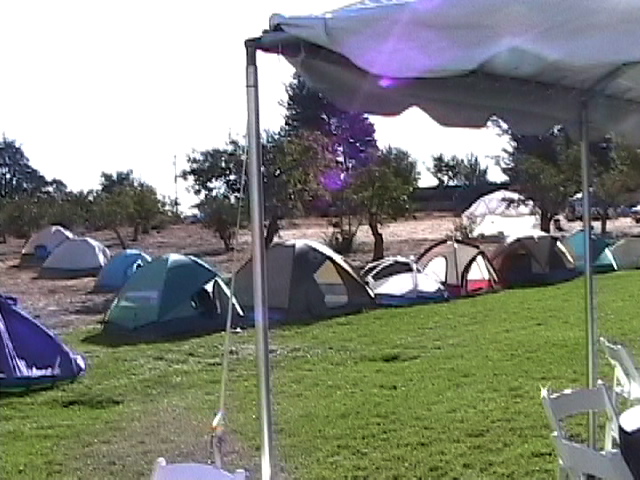
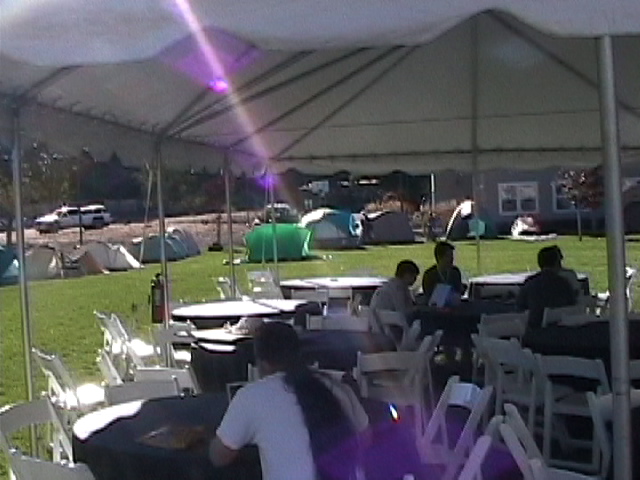
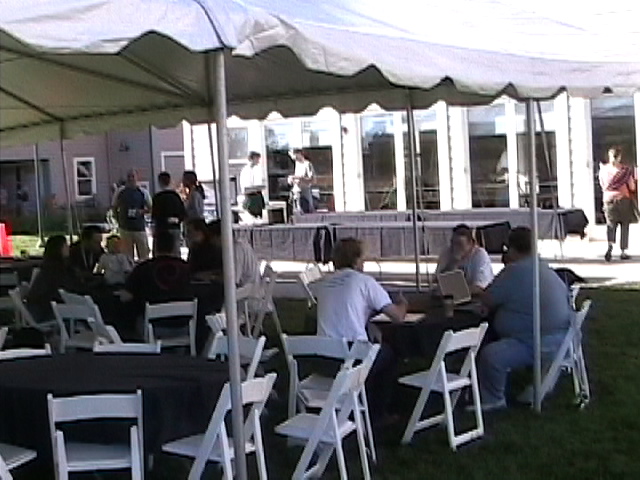
Security God Bruce Schneier explains why computer profiling as a preventative measure for detecting potential terrorists just doesn't work. At all.
Terror Profiles By Computers Are Ineffective
By Bruce Schneier for Newsday.
Even those who say that terrorists are likely to be Arab males have it wrong. Richard Reid, the shoe bomber, was British. Jose Padilla, arrested in Chicago in 2002 as a "dirty bomb" suspect, was a Hispanic- American. The Unabomber had once taught mathematics at Berkeley. Terrorists can be male or female, European, Asian, African or Middle Eastern. Even grandmothers can be tricked into carrying bombs on board. One problem with profiling is that, by singling out one group, it ignores the other groups. Terrorists are a surprisingly diverse group of people.There's also the other side of the trade-off: These kinds of "data mining" and profiling systems are expensive. They are expensive financially, and they're expensive in terms of privacy and liberty. The United States is a great country because people have the freedom to live their lives free from the gaze of government, because people are not deemed suspects for possible future crimes based on extensive surveillance sweeps. We as a people believe profiling is discriminatory and wrong.
I have an idea. Timothy McVeigh and John Allen Muhammad - one of the accused D.C. snipers - both served in the military. I think we need to put all U.S. ex-servicemen on a special watch list, because they obviously could be terrorists. I think we should flag them for "special screening" when they fly and think twice before allowing them to take scuba-diving lessons.
What do you think of my idea? I hope you're appalled, incensed and angry that I question the honesty and integrity of our military personnel based on the actions of just two people. That's exactly the right reaction. It's no different whether I suspect people based on military service, race, ethnicity, reading choices, scuba-diving ability or whether they're flying one way or round trip. It's profiling. It doesn't catch the few bad guys, and it causes undue hardship on the many good guys who are erroneously and repeatedly singled out. Security is always a trade-off, and in this case of "data mining" the trade-off is a lousy one.
Here is the full text of the article in case the link goes bad:
http://www.newsday.com/news/opinion/ny-vpsch213503428oct21,0,3927478.story
Terror Profiles By Computers Are Ineffective
Email this story
Printer friendly format
By Bruce Schneier
Bruce Schneier is chief technical officer of Counterpane Internet Security Inc. in Sunnyvale, Calif., and author of "Beyond Fear: Thinking Sensibly About Security in an Uncertain World."
October 21, 2003
In September 2002, JetBlue Airways secretly turned over data about 1.5 million of its passengers to a company called Torch Concepts, under contract with the Department of Defense.
Torch Concepts merged this data with Social Security numbers, home addresses, income levels and automobile records that it purchased from another company, Acxiom Corp. All this was to test an automatic profiling system to automatically give each person a terrorist threat ranking.
Many JetBlue customers feel angry and betrayed that their data was shared without their consent. JetBlue's privacy policy clearly states that "the financial and personal information collected on this site is not shared with any third parties." Several lawsuits against JetBlue are pending. CAPPS II is the new system designed to profile air passengers - a system that would eventually single out certain passengers for extra screening and other passengers who would not be permitted to fly. After this incident, Congress has delayed the entire CAPPS II air passenger profiling system pending further review.
There's a common belief - generally mistaken - that if we only had enough data we could pick terrorists out of crowds, and CAPPS II is just one example. In the months after 9/11, the FBI tried to collect information on people who took scuba-diving lessons. The Patriot Act gives the FBI the ability to collect information on what books people borrow from libraries.
The Total Information Awareness program was intended to be the mother of all "data-mining" programs. Renamed "Terrorism Information Awareness" after the American public learned that their personal data would be sucked into a giant computer system and searched for "patterns of terrorism," this program's funding was killed by Congress last month.
Security is always a trade-off: How much security am I getting, and what am I giving up to get it? These "data-mining" programs are not very effective. Identifiable future terrorists are rare, and innocents are common. No matter what patterns you're looking for, far more innocents will match the patterns than terrorists because innocents vastly outnumber terrorists. So many that you might as well not bother. And that assumes that you even can predict terrorist patterns. Sure, it's easy to create a pattern after the fact; if something identical to the 9/11 plot ever happens again, you can be sure we're ready. But tomorrow's attacks? That's much harder.
Even those who say that terrorists are likely to be Arab males have it wrong. Richard Reid, the shoe bomber, was British. Jose Padilla, arrested in Chicago in 2002 as a "dirty bomb" suspect, was a Hispanic- American. The Unabomber had once taught mathematics at Berkeley. Terrorists can be male or female, European, Asian, African or Middle Eastern. Even grandmothers can be tricked into carrying bombs on board. One problem with profiling is that, by singling out one group, it ignores the other groups. Terrorists are a surprisingly diverse group of people.
There's also the other side of the trade-off: These kinds of "data mining" and profiling systems are expensive. They are expensive financially, and they're expensive in terms of privacy and liberty. The United States is a great country because people have the freedom to live their lives free from the gaze of government, because people are not deemed suspects for possible future crimes based on extensive surveillance sweeps. We as a people believe profiling is discriminatory and wrong.
I have an idea. Timothy McVeigh and John Allen Muhammad - one of the accused D.C. snipers - both served in the military. I think we need to put all U.S. ex-servicemen on a special watch list, because they obviously could be terrorists. I think we should flag them for "special screening" when they fly and think twice before allowing them to take scuba-diving lessons.
What do you think of my idea? I hope you're appalled, incensed and angry that I question the honesty and integrity of our military personnel based on the actions of just two people. That's exactly the right reaction. It's no different whether I suspect people based on military service, race, ethnicity, reading choices, scuba-diving ability or whether they're flying one way or round trip. It's profiling. It doesn't catch the few bad guys, and it causes undue hardship on the many good guys who are erroneously and repeatedly singled out. Security is always a trade-off, and in this case of "data mining" the trade-off is a lousy one.
I think Tom Ammiano is the best choice for the next mayor of San Francisco.
I'm providing some clips of him from the debate to give you a better idea about who he is and where he stands on the issues.
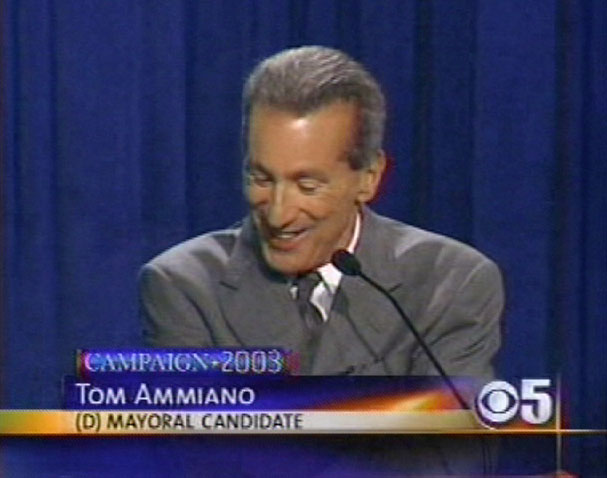
This clip is from the Mayoral Debate that aired on KPIX Channel 5 on Tuesday, October 14, 2003.
Tom Ammiano On Allocating Funds To Defend Tenants From Unfair Evictions (Small - 4 MB)
Question from Hank Plante:
Plante: "Supervisor Ammiano. You and I have talked about the fact that you support using public funds for lawyers to defend tenants in some wrongful eviction cases. There was a letter to the editor in the Chronicle this week that says "well, does Ammiano also have a plan to provide lawyers to the landlords who are abused by publicly-funded lawyers?"
Ammiano: "Who wrote that letter? Was that you Hank? You know, Supervisor Yee, some years ago, did introduce legislation that would provide eviction assistance to landlords who felt that they were victimized by tenants and that passed. We all voted for that. The issue of supplying community groups for defense of unjust evictions has precedence in New York, has precedence actually here in San Francisco. So, you know, as long as there's balance, I don't see anything wrong with that. And I also think, when we do contract with community groups or non-profits, we do ask them to provide services that ordinarily the city cannot provide. I don't see a balanced approach being a wrong approach in this case. I do think there are people, landlords, small landlords particularly, you have to distinguish between small landlords and ones like Leona Helmsley, and tenants who do not have the wherewithall to take legal action when they're facing an unjust eviction. So, I don't have a problem with that, and I also don't think that means an either or situation, as the letter writer was advocating.
I think Tom Ammiano is the best choice for the next mayor of San Francisco.
I'm providing some clips of him from the debate to give you a better idea about who he is and where he stands on the issues. (Complete transcript available below.)
Below: Tom holding up his Muni Fast Pass

This clip is from the Mayoral Debate that aired on KPIX Channel 5 on Tuesday, October 14, 2003.
Tom Ammiano On Parking vs. Public Transit (Small - 6 MB)
Question from Rachel Gordon:
Gordon: "Supervisor Ammiano. You've been a solid supporter of the city's "Transit First" policy, but there are a lot of people who live in San Francisco, who visit the city, who have stores in the city, that say "There's just not enough parking." It's really a maddening situation for a lot of folks. Number one: Do you think that there's a parking problem in San Francisco? And if you do, how should that problem be addressed?"
Ammiano: (Holds up his Muni Fast Pass high, and then puts it back in his pocket.)
"I think there is a parking problem in San Francisco, and I think we need to revisit some of the issues. You know, depending on what part of the city you live in, the parking takes on a different complexion. If you're in a part of the city that is not served by public transit as often as the Downtown area, then you're gonna rely on parking more. And we need to look at that and try to change that. If you're in a part of the city that has a lot of public transit, but somehow it's not reliable enough, or perceived to be not safe enough, then you need to put monies into that. I think it's also a regional issue among the metropolitan transportation commission, and I really lobbied hard for more money for Muni. Muni has a 730-750,000 ridership. I think it deserves more money from regional bodies. At the same time, we need to look at what might convince people to leave their cars. And that would be alternative transportation, such as high speed rail, which is going to be coming to San Francisco we hope next year. Looking at what we can do in terms of bicycle lanes, alternative ways of getting people to and from, and also, I think the dedicated funding to Muni is starting to show improvements, but I think that more improvement is needed. And when that happens, we may in fact be able to reduce that reliance on whether or not there's a parking space or not.
Gordon: "Can I ask just a quick follow-up question? Would you support the construction of parking garages or parking lots in neighborhood commercial corridors, if that's what the residents and the merchants demanded? Like the inner Sunset, or Northbeach, or the Richmond District?"
Ammiano: "It's not my druthers. But believe me, and you know, if you looked at the whole equation and there wasn't that kind of reliable public transit. If they wanted some combination of retail, car share in-fill on top of the parking lot with affordable housing or senior housing, it might take the sting out of it for me. But I would rather work primarily on providing alternatives to that. But, obviously, that should be on the table, because I know it is important to people."
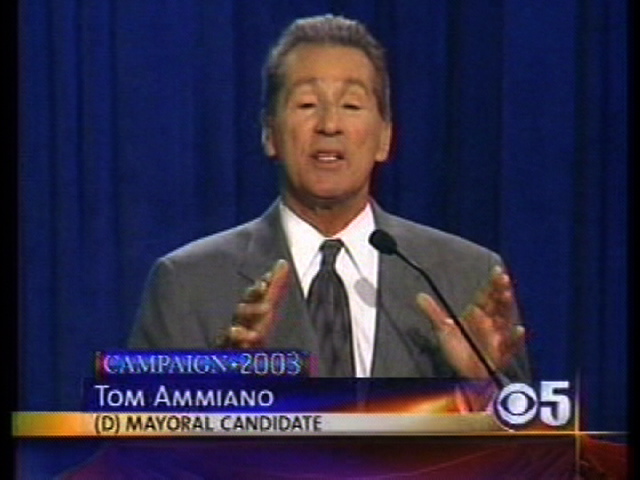
I think Tom Ammiano is the best choice for the next mayor of San Francisco.
I'm providing some clips of him from the debate to give you a better idea about who he is and where he stands on the issues. (Complete transcript available below.)

This clip is from the Mayoral Debate that aired on KPIX Channel 5 on Tuesday, October 14, 2003.
Tom Ammiano On "Care Not Cash" (Small - 6 MB)
Question from Barbara Taylor:
Taylor: "Supervisor Ammiano. Voters, as you well know, passed "Care Not Cash" by a fairly substantial margin. But you opposed its implementation at the Board. As Mayor, would you continue to ignore the wishes of the voters if you don't agree with them?"
Ammiano: "I think that we did honor the wishes of the voter by voting on the "Real Care, Real Services" proposition, or I guess I should say "resolution," passed by the Board at the behest of Supervisor Daly and Ma. We did change the fact that we were saying, not "shelter," but real "housing." And the Mayor signed off on it. So, in my mind, we did honor the will of the voter. And then I think there's a bigger question here too: what was the will of the voter, aside from the very specifics of "Care Not Cash," and that was to provide solutions, which are housing and services. I have worked through the Department of Public Health to get a grant for six million dollars from HUD, working with the Mayor's office, about providing that supportive housing, and that's going to start immediately. And I think that does also honor the will of the voters.
So, while I did oppose "Care Not Cash" in its conception on the ballot, and then the judicial system thought we shouldn't do it, and then our Budget Analyst thought we shouldn't do it -- we still went ahead and did endorse the will of the voters. And we had to make some compromises about that and that's what this situation's all about."
Taylor: "Some might call that just political spin. The real question is: What's your view of when voters pass something? Do you feel that you have an ob(?) that's just advisory in nature? Or that you can put whatever your interpretation might be on the situation and act accordingly?"
Ammiano: "It's not so much my interpretation, but I do think that certainly, primary to me, is honoring what the voters want. And that doesn't just happen out of context. They might want something that's illegal, which is what the judiciary decided. They might want something that really can't happen because they weren't given the full information, as the Budget Analyst has said. So, you know, in honoring the will of the voters, you want to be there for them, and then you also want to take those other things into consideration. Spin or not spin, it's all about solutions. And "Care Not Cash" did have some deficiencies that I think we've taken care of."
Wealthy Donors Asked to Dig Deep for Iraq Rebuild
By Alexander Smith for Reuters.
Hours earlier, a leading British aid agency accused Iraq's U.S. and British administrators of failing to account for at least $4 billion meant to go toward rebuilding the country...AID GROUP SAYS $4 BILLION MISSING
Britain's Christian Aid said the U.S.-led Coalition Provisional Authority (CPA) had not publicly detailed cash flows since ousting Saddam Hussein in April.
All but $1 billion of more than $5 billion of Iraqi funds had disappeared into a "financial black hole." It said the figures were a conservative estimate of oil revenues collected by the CPA since the war, prewar oil revenues from the U.N. "oil-for-food" account and seized assets of Saddam's government.
The U.S.-led CPA has denied it has failed to account for the money.
Christian Aid said failure to account for the money would fuel suspicion that funds were going to U.S. firms given contracts to rebuild the country.
Here is the full text of the article in case the link goes bad:
http://story.news.yahoo.com/news?tmpl=story&u=/nm/20031023/ts_nm/iraq_donors_dc_9
Wealthy Donors Asked to Dig Deep for Iraq Rebuild
By Alexander Smith
Reuters
Thursday 23 October 2003
MADRID - The United Nations and Iraq's governing council appealed to wealthy nations on Thursday to dig deeper in their pockets to raise the $55 billion needed to rebuild a country torn by years of war, sanctions and neglect.
U.N. Secretary-General Kofi Annan opened a two-day donors' meeting with a call for more cash and a warning that wrangling between the United States and its critics over a timetable for handing sovereignty back to Iraqis could lead to more suffering.
Hours earlier, a leading British aid agency accused Iraq's U.S. and British administrators of failing to account for at least $4 billion meant to go toward rebuilding the country.
"I appeal to donors to give and to give generously and for those contributions to be provided in addition to existing commitments," Annan told the Madrid meeting.
"We all look forward to the earliest possible establishment of a sovereign Iraqi government but a start on reconstruction cannot be deferred until that day," he added.
Conference sponsors have been careful not to set a target, but behind the scenes delegates spoke of arm-twisting of countries reluctant to stump up the billions Iraq needs.
So far $2-3 billion has been pledged in addition to the $20 billion the United States plans to contribute over 18 months.
Some countries that opposed the U.S.-led invasion of Iraq are reluctant to pay with France, Germany and Russia promising no money beyond what they already have pledged.
"There have been last-minute attempts to ramp up the money and all the pressure has been on the European Union," said a senior official accompanying the Iraqi delegation.
British Prime Minister Tony Blair, one of the main backers of the Iraq war, added his voice to the calls for funds.
But a German official at the meeting said more money would not be forthcoming until Berlin could be sure its aid would be properly accounted for.
AID GROUP SAYS $4 BILLION MISSING
Britain's Christian Aid said the U.S.-led Coalition Provisional Authority (CPA) had not publicly detailed cash flows since ousting Saddam Hussein in April.
All but $1 billion of more than $5 billion of Iraqi funds had disappeared into a "financial black hole." It said the figures were a conservative estimate of oil revenues collected by the CPA since the war, prewar oil revenues from the U.N. "oil-for-food" account and seized assets of Saddam's government.
The U.S.-led CPA has denied it has failed to account for the money.
Christian Aid said failure to account for the money would fuel suspicion that funds were going to U.S. firms given contracts to rebuild the country.
Iraqis did their best to persuade more than 300 companies and business groups gathered alongside the politicians that Iraq could be prosperous once again, if given help.
"I don't want to depict a gloomy picture. But we need a kickstart, we need to be given a helping hand," said Mowaffak al-Rubaie, a representative of the Iraqi Governing Council.
Thousands of Iraq's 26 million people lack everything from access to clean water to basic security, he said.
Help would allow a country with the world's second largest oil reserves to restructure into a lucrative market for entrepreneurs, Iraqi Trade Minister Ali Allawi said, adding Iraq could be self-sustaining in five to eight years.
The World Bank and United Nations studied 14 sectors of Iraq's economy and estimated they need $36 billion over four years. A report by the CPA found an additional $19.4 billion is needed to rebuild sectors not covered in the World Bank report.
For the EU External Relations Commissioner, the conference was an opportunity to bring Iraq back into the developed world.
"In the early 80s Iraq had a GDP per head the same as Australia's. Two decades of Saddam Hussein then reduced it to the same sort of figure as the Congo. So it just indicates the potential resources of Iraq...," Chris Patten said.
-------
Additional reporting by John Chalmers, Daniel Trotta, Mona Megalli, Emma Ross-Thomas and David Chance in Madrid.
I think Tom Ammiano is the best choice for the next mayor of San Francisco.
I'm providing some clips of him from the debate to give you a better idea about who he is and where he stands on the issues. (Complete transcript available below.)
This clip is from the Mayoral Debate that aired on KPIX Channel 5 on Tuesday, October 14, 2003.
Tom Ammiano On Whether He's Become A "Moderate" (Small - 4 MB)
Question from Hank Plante, CBS Channel 5 Political Editor:
Plante: "Supervisor, Good Evening."
Ammiano: "Good Evening."
Plante: "You've lost the earring. You're wearing better suits. We no longer hear you talking about taxing the rich or every stock transaction in the City, as you once did. My question might be obvious to you. Have you moved to the center for political expediency?"
Ammiano: "I think that you can redefine what "the center" is. I remember Diane Feinstein in the early days of her administration, had some very social justice positive positions -- still defined as a "moderate." If she was in Nebraska, she would have been a "Trotsky-ite." So I think there's a perception of relativity there about that. I'm still the same guy I've always been. Certainly I've been in office a long enough time to understand that bringing people together can stop some of the dysfunctions that happen here in San Francisco. Whether it's landlords or tenants, or whether it's the environmentalists vs. Muni, or whether it's AIDS activists vs. Kaiser. I don't know if that's "the center" or not, but I see a wisdom in that, that a mayor needs to have. So, I can't give you a definitive "yes" or "no." I think that "centerness" depends on the eye of the beholder. I think I'm a more "centered" person. Whether I'm in the center of the political spectrum or not, I can't tell you. But I will tell you, I'm still as honest as I've always been and as hard working as I've always been, and that will never change.


| I taught my first class in blogging at San Francisco State last week. I'm HTML-ing the tutorial and will have it up in a bit. |
One of the things that was so cool is that many of the students are going to keep their blogs going. (They originally were only creating them because I had given it to them as an assignment.)
This is from October 12, 2003.
Mark Hedlund (Small - 15 MB)


Sara Winge is the one responsible for a lot of the organizing of the Foo Camp Conference/Party. Tim gave her all of the credit in his interview (not posted yet -- will be linked to from here when I post it).
So you can blame the whole wonderful event on her! Thanks Sara!
This is from October 12, 2003.
Foo A-Z
Sara Winge (Small - 9 MB)
Here it is -- straight from the soldiers. What's going on "over there."
I haven't even read it all yet, but it looks worthy of passing on.
I may write about this in more detail if I have time. But, for now, with everything else going on right now, I just didn't want to space on making this available to you in a timely fashion.
Scoop has released a five part interview (Part 1 - with an enlisted man that has over 20 years in the service, Part 2 with a sergeant first class, Part 3 with a very recently disillusioned sergeant, Part 4, Part 5 - no link for 5 yet) with soldiers over in Iraq.
Here's a quote from part one:
“That is one thing the American people still have not really caught on to is the fact that while they were screaming out ‘Support Our Troops’ the current regime makers were fu..ing the military and veterans out of almost every social program and non essential service that would make life easier.”“Bush really fu..ked us while we were gone. We found out about after being in the middle of heavy fighting for several weeks. It was one of the first things I read in Stars and Stripes, and I thought it was a joke because it was just to hard to believe Congress and our leaders would screw us that bad while we were fighting and dying.”
CFTM-- -“Glad you brought that up about counseling because I wasn’t even aware of it. Are you alright to talk about some of the civilian casualties you witnessed and some of the horrifying images you told me about when we first started talking?”
USA-- -“I want to talk about some of the children I saw killed for no reason, maybe it will wake someone up who doesn’t believe it was happening, or that it was very bad. I can tell you I will never forget the screams of the wounded or orphaned kids, or the wailing of the parents who lost their kids. The Iraqis and most Muslims have a very vocal way of mourning the dead by lamenting and wailing for the dead. There is no mistaking a mother or father crying out in pain for the loss of a child. They don’t cry like that unless there has been a death. Sometimes after a bombing raid or an artillery attack you could here hundreds of people wiling and weeping.”
“I have several grown children with grand kids about the age of most of the dead children I saw in Iraq. I also have several kids who are about half grown and I saw a lot of Iraqi children that age wandering around in charge of three or four little ones because their parents were dead.”
“Let me tell you about the cluster bomb raid we saw wipe out a whole bunch of little kids. It looked like they had already lost their parents and were trying to salvage food from a destroyed Iraqi convoy by the side of the road we were on. The kids were way off to the side about half a mile away by then when we got the word that the Iraqi column was going to be hit with cluster bombs and we had to clear the area. We got on the radio and tried to get the air strike stopped but we were told it was too late to get it stopped.”
“We could see the body parts flying up into the air after the bombs hit. It was terrible and we could not do a damn thing but watch it happen and scream into the radio at the dumb sh.t pilot that was dropping the bombs. After the strike was over we went to see if there were any survivors and all we found was bits and pieces of little kids and here and there an arm or leg you could still identify.”
CFTM-- -“Pretty rough stuff to have to see. Did that kind of thing happen a lot?”
USA-- -“More than you can imagine until you’ve seen it over and over again. Man I don’t want to talk about this sh.t anymore. It doesn’t help to talk about it because it just makes me think about it again. I can’t even get any counseling without having to pay for it.”
“Let all those people who support our troops in on that nice surprise that Bush gave us. That’s how much we really mean to Bush, the Department of Defense and all those other stupid assholes who keep saying how good we’re doing over there. Let those patriotic morons go and fight and die for our country. Let them leave their families behind for months and maybe come back home in a box. I’ll be the first one to salute them or honor them when they die.”
“It’s just like Nam was in the beginning. I was twelve when my dad got back and I’ll never forget the pain and agony he lived with the rest of his life. Its kind of what I feel now, I suppose. I never thought I would ever serve in some stuff that’s so much like Nam it isn’t funny. Now I really see what my pop went through, and if I could I would go back in the past a few months, I would go AWOL or turn conscientious objector on them, but it’s too late for that now.”
http://www.scoop.co.nz/mason/stories/HL0310/S00105.htm
Text of part 1
The following interview was with an enlisted man, but someone very high up in the enlisted ranks, with over 20 years of military service. I have promised not to reveal his identity for reasons that he has a family and has been told not to speak to journalists. He told me the Army had put a gag order on him while he was home, and told him they would give him twenty years in prison if he spoke out in any manner against the US or the government.
I took several weeks to finish this interview because of not being able to safely be seen with this individual out of his fears of being caught speaking out.
He asked me to call him USA in all the transcripts of these interviews. I have followed his wishes and tried to write what he said in the manner it was said so as not to lose any impact. At times the interview was very rough and the grammar is not perfect, but I tried to write this in his voice so that he can tell the world how bad it is in Iraq. I truly want you to feel what he has experienced in some way if possible.
CFTM-- “How are you today? Resting I hope?”
USA-- “Can’t sleep for sh..t and I have horrible nightmares when I do sleep. I might be lucky to catch an hour at a time before the nightmares wake me up. I slept easier in the combat then now that I’m away from there. Most awful place I’ve ever been or served duty and I didn’t want to leave my guys. That was the hardest part was leaving the guys I had been leading around and trying to keep out of trouble and alive.”
CFTM-- “Did you see a lot of your buddies get killed? How did it affect you?”
USA-- “How the hell do you think it affected me? I saw over 30 of the men I had to keep safe die, and over 100 get wounded and not come back. I still don’t know if some of the wounded men made it or not. I was never told before I came back home.”
CFTM-- “So it really was awful and as bad as some returning troops have claimed?”
USA-- “It was like a long trip to hell that you knew you might return from. Of course it is as bad as the soldiers say it is. Hell it’s even worse if the truth has to come out. It’s a constant fu..ing nightmare trying to figure out where the guerillas are going to hit, how to keep the civilians calm, and also getting enough water and food to eat. That is one thing the media never really told the Americans about, how bad it was when our convoys weren’t getting through. We had to go to some Iraqi people and trade socks and underwear for some food and a little water.”
CFTM-- “You really did get that desperate because I saw it in the foreign media that the Iraqi civilians had stepped in and fed a whole bunch of troops that had been days without food.”
USA-- -“Yeah, that ain’t no joke about getting help from the civilians right after the invasion. We had a pretty good laugh about that and how the army owed them some money for reimbursement. We would not have starved probably, but when we got the food from the people it made sure we could still operate as a functioning unit. It was a near thing that several guys almost died of dehydration because we ran out of clean water for a few days.”
CFTM-- “Just keep going, I want to hear more about the hardships the military and Bush made you go through. I want the American people to know what a nightmare this war has become and what it’s doing to our service men over there.”
USA-- “Okay, well I can bitch about the problems like food being short and water going bad, but I want to tell people about how bad the attacks on US and coalition forces have gotten in the last month. In the last two weeks I was there we were attacked at least 20 times a day if you count all the shots we heard from random sniper or opportunity attacks. We were losing at least five men a day to injuries and there was at least one of our unit killed every twenty four hours.”
CFTM-- -“So you were getting one a day killed and at least five injured? Did you know many of the guys killed?”
USA-- -“That’s a real dumb fu..ing question to ask me. You know what my rank is, of course I knew them, I was the head NCO for years in our unit. I knew most of the guys who died and I held a lot of hands as they were dying. You tell me that’s not gonna to give you nightmares!”
“I had one guy tell me all he wanted was to see his little daughter; she was born three days after the war started. He died in the sand holding my hand and crying because his daughter would never know him. Tell me that’s fu..ing right. Where was George Bush when this kid was gasping for air and spitting his blood on foreign soil?”
CFTM-- -“I talked to you about this the other day. Do you think George Bush is the wrong man to order troops into battle when he ducked it himself?”
USA-- -“That asshole went AWOL and never showed up for duty and then he has the nerve to take us into two different wars that will be going on for years. I do not believe he should be president of this country, he’s a complete idiot and he’s controlled by madmen with a drive for only profits and getting oil.”
CFTM-- -“I just have to get this straight for the public, you are well educated are you not? I mean you have had years of leadership training and schools right? You sound very well informed and aware of the current lies and manipulations, which I have not found in some other soldiers.”
USA-- -“I have a four year degree in the economics field and I am not a soldier all the time. I am Reservist who just keeps getting caught on long duty assignments. Believe it or not I read authors like Noam Chomsky, Gore Vidal, and Jim Hightower, and went through three copies of ‘Stupid White Men’ by Michael Moore while I was over there. I let people read parts of Mike’s book and they were irate that Bush had screwed us so hard. I had parts of ‘Best Democracy Money Can Buy’ mailed to me because I knew if I had the whole book it would get stolen in a heartbeat.”
CFTM-- -“So you might be quite a bit more aware and well informed about the real reasons for the war that others did not know. I don’t know of many line soldiers reading Greg Palast or Noam Chomsky.”
USA-- -“I guess you’re right and that might be why I am trying to speak out and let the Americans know that they are sending us to be slaughtered. If you don’t mind I am going to cut through all the niceties and get down to why I am going against every oath I took and giving you this interview. I am doing it for the guys still over there and for the ones who are going. If I’m not careful I’ll end up back there for another six months.”
CFTM-- -“Alright tell me what it was really like and don’t skip the gory details. I want people to be shocked and offended enough to realize why you spoke out and what it is doing to our military by sending them over there with blind flag waving and cheers of false victory”
USA-- -“Well the first thing I would like to thank Bush, Cheney, Rumsfeld, and Congress for is that nice huge cut they made to Veterans Benefits as soon as the war started. I am in the Reserves after years of active duty and now I cannot get PTSD counseling or many medical benefits I used to take for granted. I knew I would have the benefits because I was laying my life down for my country. Now my benefits are cut by around 2/3 and I have to go to either group therapy or pay for a private counselor out of my own pocket. What happens when someone like me has been through enormous battle stress and combat fatigue and then comes home to no counseling?”
“I’ll tell you what is going to happen, he will either kill himself or take a bunch of people with him. Some of the guys coming back are going to have gone through the worst time of their lives with their buddies dying and getting hurt, and then they’ll find out they got screwed out of any counseling. It is the greatest disservice America is committing against soldiers who fought for this country and may come back wounded or horribly scarred. Medical services, school aid to dependents, school aid for the vets, all slashed to the bare bones; mental health and drug and alcohol counseling are being eliminated or the waiting lists will be years long for whatever services manage to survive.”
“That is one thing the American people still have not really caught on to is the fact that while they were screaming out ‘Support Our Troops’ the current regime makers were fu..ing the military and veterans out of almost every social program and non essential service that would make life easier.”
“Bush really fu..ked us while we were gone. We found out about after being in the middle of heavy fighting for several weeks. It was one of the first things I read in Stars and Stripes, and I thought it was a joke because it was just to hard to believe Congress and our leaders would screw us that bad while we were fighting and dying.”
CFTM-- -“Glad you brought that up about counseling because I wasn’t even aware of it. Are you alright to talk about some of the civilian casualties you witnessed and some of the horrifying images you told me about when we first started talking?”
USA-- -“I want to talk about some of the children I saw killed for no reason, maybe it will wake someone up who doesn’t believe it was happening, or that it was very bad. I can tell you I will never forget the screams of the wounded or orphaned kids, or the wailing of the parents who lost their kids. The Iraqis and most Muslims have a very vocal way of mourning the dead by lamenting and wailing for the dead. There is no mistaking a mother or father crying out in pain for the loss of a child. They don’t cry like that unless there has been a death. Sometimes after a bombing raid or an artillery attack you could here hundreds of people wiling and weeping.”
“I have several grown children with grand kids about the age of most of the dead children I saw in Iraq. I also have several kids who are about half grown and I saw a lot of Iraqi children that age wandering around in charge of three or four little ones because their parents were dead.”
“Let me tell you about the cluster bomb raid we saw wipe out a whole bunch of little kids. It looked like they had already lost their parents and were trying to salvage food from a destroyed Iraqi convoy by the side of the road we were on. The kids were way off to the side about half a mile away by then when we got the word that the Iraqi column was going to be hit with cluster bombs and we had to clear the area. We got on the radio and tried to get the air strike stopped but we were told it was too late to get it stopped.”
“We could see the body parts flying up into the air after the bombs hit. It was terrible and we could not do a damn thing but watch it happen and scream into the radio at the dumb sh.t pilot that was dropping the bombs. After the strike was over we went to see if there were any survivors and all we found was bits and pieces of little kids and here and there an arm or leg you could still identify.”
CFTM-- -“Pretty rough stuff to have to see. Did that kind of thing happen a lot?”
USA-- -“More than you can imagine until you’ve seen it over and over again. Man I don’t want to talk about this sh.t anymore. It doesn’t help to talk about it because it just makes me think about it again. I can’t even get any counseling without having to pay for it.”
“Let all those people who support our troops in on that nice surprise that Bush gave us. That’s how much we really mean to Bush, the Department of Defense and all those other stupid assholes who keep saying how good we’re doing over there. Let those patriotic morons go and fight and die for our country. Let them leave their families behind for months and maybe come back home in a box. I’ll be the first one to salute them or honor them when they die.”
“It’s just like Nam was in the beginning. I was twelve when my dad got back and I’ll never forget the pain and agony he lived with the rest of his life. Its kind of what I feel now, I suppose. I never thought I would ever serve in some stuff that’s so much like Nam it isn’t funny. Now I really see what my pop went through, and if I could I would go back in the past a few months, I would go AWOL or turn conscientious objector on them, but it’s too late for that now.”
“I damn sure will not go back over there even if they throw me in Leavenworth. I never could understand how a guy could be a conscientious objector until what I just went through. I wish more guys would stand up and tell Bush and the Pentagon they will not fight their war for oil. We should not have to die for these rich bastards profits and enrichment.”
CFTM-- -“Thank you for taking the risk and talking to me. I know there will be other soldiers who can’t speak out who will thank you for having the courage.”
USA-- -“It isn’t about courage it’s a matter of what’s right. This war is killing the poor or middle class American men and women who went in the armed forces to have college or some kind of better future. You don’t see the rich kids joining up or any Senator’s kid dying in Iraq. It’s us little guys who are dying over there or getting disabled for life. Where are the leaders that are supposed to be looking out for the little man? They are elected to look after out interests not the interests of Cheney and Halliburton, or any of the rest of the fat cats piling up the profits while the blood of our soldiers flows over their hands.”
CFTM-- -“Anything else you want to say to America? Any final thoughts or words?”
USA-- -“Yeah! Wake up America! Your sons and daughters are dying for nothing! This war is not about freedom or stopping terrorism. Bring us home now! We are dying for oil and corporate greed!”
*********
- Jay Shaft: Editor, Coalition For Free Thought In Media. EMAIL: freethoughtinmedia2@yahoo.com WEB: http://groups.yahoo.com/group/coalitionforfreethoughtinmedia/
http://www.scoop.co.nz/mason/stories/HL0310/S00116.htm
text of part 2:
The following interview was with a Sergeant First Class in the United States Army. He has been deployed both in Afghanistan and most recently in Iraq in Falujah and in Kirkuk, which have been the heart of Iraqi resistance and attacks on US forces.
He tells an especially heartrending story of being ordered to fire on Iraqis who were demonstrating against US occupation and were throwing rocks out of anger and frustration. He also tells a story of watching his best fiend die under hostile fire and not being able to do anything about it.
This interview is written in his own words and I have tried to leave it as intact as possible so that his pain and anger can come through to you the reader. I will warn you that the language is very rough and the grammar is not always correct.
He has asked to be called Trooper 1 in all transcripts of these interviews. I have taken as much caution as possible to preserve his identity so that he is not punished, and so that his family will not feel any reprisals from the US government. His biggest fear is that his family and friends will consider him unpatriotic and not supportive of the US as a country.
I have changed some minor details in his story to futher ensure that the military does not try to find him.
He still believes in the dream this country used to stand for and is torn about saying anything bad about it and it’s leaders out of a beaten in loyalty to the military and a repeatedly reinforced sense of duty to this nation above all else.
CFTM-- “Hey how’s it going today? You feeling any better since I talked to you the last time?” (CFTM Editors note: The first time I tried to get this interview he broke down in tears and could not compose himself enough to talk about what he had gone through. It is a very humbling experience to have a grown man put his head on your shoulder and cry like a small child. I have had this happen almost every time I have started to have these soldiers talk about the horrors of Iraq and relieve some of the built up pain, hostility, and sense of loss. This fact alone should convince anyone with doubts about how bad the troops have it over there.)
Trooper 1-- “I think I can make it through this time. I really had it finally hit me the other day about how many of my friends I saw die, and all the other terrible sh*t I saw. I am starting to cry right now thinking about it all over again. You must think I’m a big fu**ing baby breaking down like this.”
CFTM-- “Man there is no shame in feeling pain and hurt. I don’t think any less of you for it. In fact you might need to cry it out and get rid of some of the hurt. No matter what you say or how much you cry, I will not think any less of you. This is what I want people to read about, the fact that a battle hardened soldier is so devastated by what he has gone through.”
Trooper 1-- “Thanks man, you don’t know how much it means that you don’t laugh at me or think I’m a pu..y. I had a fu..ing combat support REMF (rear echelon mother fu..er ) laugh at me when I was coming home. I was on a MAC (Military Airlift Command) flight and this asshole that had been in Doha, Qatar and not even seen any combat was making fun of me. I almost killed him, if it hadn’t been for the loadmaster I probably would have strangled him with my bare hands or stuck him with my knife. I was not in any mood to take some non-combat, skate duty piece of shits harassment or laughing. I put my life on the line and this fu..er was gaming on me.”
CFTM-- “So he actually had the nerve to make fun of you when you cried over all the buddies you lost? Wow that took a lot of guts on his part. Did that happen to you more than once?”
Trooper 1-- “No that was the only time, but it really pissed me off and I still am kinda ma at that jerk. But everyone else was real supportive and I was flying with a bunch of guys who had been in some serious firefights and been ambushed and attacked a whole bunch of times. That one guy almost got his ass kicked by about 30 hard ass, salty dogs. Hey let’s change the subject. You want me to talk about how bad it was there and I got to get it off my chest.”
CFTM-- “My first question is whether you are going to be able to get any counseling if you need it? I have been told by several guys that it has been cut off for all reservists. Have you been offered any therapy services or PTSD counseling?”
Trooper 1-- “Well I am in a real weird situation because I am still considered active duty even though I am home right now. I am only going to be here for a month or so and I think I will either be training guys about to go over, or else return to Iraq or Afghanistan myself. I have tons of combat experience and training and there is a shortage of cadre that can train the reservists that have just been reactivated. Some of those units haven’t been fully activated since Desert Storm.”
“I think I can be of better use to those guys than going back over to fight again. I had my share of that and I don’t know if I can handle it again. I lost it a couple times and if it hadn’t been for my bro who gave me some good tranquilizers I might have lost it completely. I want to make sure the new reserves are ready for the fight and know exactly what they are in for.”
CFTM-- “Not to put to much stress on it, but do you think you will need counseling or therapy? I think it is important for Americans to know just how bad it is mentally for the troops.”
Trooper 1-- “Yeah I think I will need some kind of PTSD support or seasons. I am having terrible nightmares and I have flashbacks when I hear loud noises, and if a car back fires or I hear a firecracker, I am down on the ground in combat cover ready to shoot a rifle I still think I am carrying. I was in combat situations for over two years without any break except for a two week R and R at Christmas. I am not ready to be back stateside, but here I am.”
“There are going to be a lot of guys coming back home who are used to being on high alert 24-7. It is hard to stand down after being shot at everyday for months on end. There really is no moment in Iraq where there is a relaxation time. It is impossible to get even an hours time to be stress free. You always have to be on alert or guard mount because the Iraqis will attack you when you least expect it.”
“Hell they caught us with our pants down a few times at first, but we got wise to that and never let our guard down after the first few ambushes and rocket attacks. Even on full alert they still killed a bunch of us and wounded a god awful number of our soldiers.”
CFTM-- “How many guys did you lose in Iraq and how many did you have wounded and evacuated? Also did you ever here about the wounded dying after they were airlifted to Germany or a hospital ship? The reason I ask is that an officer with a MASH unit said if the soldier died outside of Iraq they weren’t counting it as a combat death. I heard that is one way they are keeping the combat death count down and hiding some battle deaths after they are airlifted.”
Trooper 1-- “God man you really ask the painful questions don’t you. If I didn’t know you were doing this to expose the real truth and try to bring us home, I would have to kick your ass for making me feel the hurt all over again.”
“Man we lost so many I started losing track. I didn’t want to think about it after a while and I pushed it out of my mind when I didn’t have to make out reports or change our strength maintenance figures. We lost over 300 guys to death or severe injury when I was there, and that is only the ones I know about. There were times when I was out on some scout missions and we lost guys from the main battle group and the reports would be done by the time I got back to the unit.”
“I was there when my best friend got it though. I almost wish I had been out on a patrol or scout mission because I wouldn’t have had to hold his head up while he coughed up his own guts. He took three 7.62s(AK-47 rounds) to the abdomen and it took him a long time to die. It felt like hours, but it was probably only ten or fifteen minutes at the most. It just felt like an eternity while he fought for his life. We couldn’t get a dust off (evac chopper) vectored in in enough time, he died about a minute before the chopper landed. That almost blew my mind right out. It took me a week before I could stop shaking and freezing up.”
“I had been in the same unit as him from the beginning of my first permanent party assignment. I had served in different units for a while, but we ended up in the same brigade in Afghanistan. He was in another company as a platoon sergeant and we fought side by side across Afghanistan and Iraq. I can’t believe he caught it like that. I mean this war is really meaningless and all about oil. So my best friend bought it for some rich guy like Dick Cheney or George Shultz!”
(George Shultz is the former President of Bechtel Corp,. and still a serving board member, and former U.S. Secretary of State under Ronald Reagan. For some real dirt on Bechtel’s connections to the Pentagon and State Department check this out-- Bechtel's Friends in High Places http://www.corpwatch.org/issues/PID.jsp?articleid=6548 )
“I know it is supposed to be our duty to fight for this country and die if necessary, but this Iraq war is total bullshit. A bunch of Bush’s buddies, and even Bush himself are getting rich as hell off of us dying and getting hurt. I could see the reasons we are in Afghanistan and I did my duty there, but this is completely different. Iraq is not safer or any freer under our rule. The people hate us and want us to get the fu.k out of their country and leave them alone.”
“For every one of us that dies for no reason the whole country ought to get out and protest and riot. That is one thing I’ve seen the Iraqis do very well. When we kill some of their people they come out by the thousands and make it known that they are pissed and won’t tolerate it any more.”
“That is what all the American people need to do. Every time the Pentagon gets one of us killed they need to riot and protest in the streets. If they did that maybe Rumsfeld and those assholes like Wolfowitz and Perle would think twice about letting another one of our troops die in combat. Maybe they would bring us home. Until the American people stand up and say ‘NO MORE DEAD SOLDIERS!’ they will keep butchering us like sheep!”
CFTM-- “Okay, well I guess that answers any questions I was going to ask about how you feel about the current regime lining their pockets at the expense of our troops lives. One thing I was going to ask is how you feel about the fact that there is only one US Senator or Congressman that has a son or daughter serving in Iraq or Afghanistan?”
Trooper 1-- “I think every godda.. senator’s son or daughter that is serving military age ought to be forced to go over to Iraq and serve in a front-line unit. If the leaders of America are going to send us over to die for oil and a bunch of fat cats to profit from our deaths, then they should send their own fu..in sons and daughters. No one should be able to get their kid an exemption or enable their child to get out of doing what they say is our duty.”
“If it’s our duty to die in Iraq ,Afghanistan, or any where there is a battle against US forces, then their children have a duty to serve and die too. I don’t think it’s fair that none of the sliver spoon in mouth fu..in little spoiled brats are dying for this country. Everyone of the guys I was with came form either a poor or middle class working background. None of them had the colleges and trust funds given to them. I don’t think a lot of our guys would be serving right now except for the lack of any other future that looked brighter.”
“Most of them got sucked in when they were in high school and knew they couldn’t afford to pay for college or just didn’t want to go. Some guys knew they weren’t smart enough to go to college, but the Army can always find a place for you.”
CFTM-- “You had told me about an incident where you were told to fire on Iraqi protesters who were throwing rocks at your unit during a hug demonstration. Can you give me some details about that and who ordered you to fire into the crowd?”
Trooper 1-- “ I will talk about this a little bit, but I don’t really want to. There was more than one time we were told to fire into a crowd of protesters or during demonstrations. I will tell you about the one time I talked about already and you can make it out any way you want. I just watched a show about something like we went through, I think it was Frontline(it was Frontline) and really got the picture of how bad it must have been for the Iraqis that have been fired on during protests.”
“I don’t want to go into to much detail about this because it is still being investigated by the Army. The situation briefly was that there was a large crowd of demonstrators gathered to protest an incident from the day before when another unit had shot into a crowd of protesters. There had been about 20 killed the day before, but we never heard a total body count just some reasonably accurate sounding numbers.”
“We were on the ground on one side of a large square where the main body of the protesters had gathered. They were yelling and screaming at one of the appointed Iraqi council members and getting very out of control. They were mad at the fact the council had not denounced the Americans and told them to leave Iraq. It was getting very ugly and I was spit on and struck in the helmet and about the head and shoulders by a small group of women. Let me emphasize that again, we were being attacked by a group of women and maybe three or four men.”
“As far as I could see they had no firearms or bombs. They did have rocks and pieces of paving stones and asphalt. As the crowd got more and more outraged, more US troops started arriving , which seemed to anger the civilians even more. We were a real living symbol of all their hurts and injuries that had been inflicted on them by our bombs ,missiles, tanks, artillery, and guns. For the first time since the war started they had a target for all their hate and anger right there in front of them. I don’t know who started the rock throwing but after the first one was thrown the whole crowd started throwing their rocks and whatever scraps and trash they could find in the vicinity.”
“I got hit by several rocks in the face and head and then the rest of my body was hit a bunch of times. As far as I could tell the first gunshot was from an American M-16. I know the sound of our rifles very well and I can tell the sound even in a full scale firefight so the sound of one shot was very clear to me. I know it was not an AK-47 or 74. There is no way it could have been a 7.62mm round. They have a much lower sound and the Kalashnikov rifles make a distinctive clack as they are fired.”
“I have heard those rifles fired so many times I know the sound in my sleep. It was one of our guys that got nervous and cranked off a round. After the first shot we heard someone screaming on the radio to open fire. A few of our guys started firing and then most of the rest of us started shooting. At some point in the confusion I heard an AK open up and then another one. It didn’t sound close, but we couldn’t really tell.”
“That is all the details I really feel right giving you. I know one thing though. The commanders later claimed we were fired on from the crowd. That’s bullshit and a bunch of us know it. It started with a bunch of angry women and some men throwing rocks, and it ended with at least 15 dead and over 30 wounded. I saw a small girl laying on the ground with a hole in her head and some more wounds in her back and side. She did not have anything to do with the crowd, she was down the street trying to find food or something.”
“That’s all I’ll give you on that. I don’t want to get in any trouble or have anyone think I helped kill innocent people.”
CFTM-- “Well I think I got enough for this interview. I really want to thank you for doing this, I know how much they have tried to stop you from speaking out. I know about the threats and intimidations they have used to keep you guys quiet.”
“ Anything else you want to say as a final statement to America?”
Trooper 1-- “Yeah I really want to make sure they don’t think I am unpatriotic or a traitor. I did this because of how bad it is over there. We are getting slaughtered and wasted for nothing. If there was a real reason to be over there anymore I would go right back. There is no reason right now, they say we are rebuilding Iraq, but I didn’t see it.”
“Every time I hear Bush or Rumsfeld or anyone else like Paul Bremer talk about all the progress we have made I picture all the Iraqi kids going hungry. They would mob our convoys trying to get our M.R.E.s or the emergency relief food packs we carry for them. Iraq is going to hell and all the little kids are starving and dying from their injuries they got during the war.”
“There is not enough medicine or antibiotics to keep them form getting gangrene or stop the diarrhea they get from bad water. Most of the people are drinking sewage or water contaminated with shit or oil. Months later and they still haven’t fixed the water supply or helped them get parts to fix the pumps. I saw kids dying everyday because they had the shits so bad they wasted away to nothing.”
“My best friend is dead and so are a whole bunch of my friends and fellow soldiers. I just want to say one more thing to America.”
“Get us the fu.. out of Iraq! Don’t let another one of us die or get injured. How many disabled vets and dead fathers and mothers do you want on your conscience? How much more blood can you get on your hands George Bush??? How many more Iraqis do we have to kill and then live with their blood on our hands?”
“Bring us home now!!! Tell your Senators to stop giving Bush money for this carnage. If you demand that we come home they will have to listen. At least I hope they would, they are supposed to have our best interest at heart!”
“Fuck you George Bush, Dick Cheney, Donald Rumsfeld, Colin Powell, Paul Wolfowitz, Paul Bremer, and all then rest of you sorry assholes! Why don’t you come fight this war if you think it’s right?”
*********
- Jay Shaft: Editor—Coalition For Free Thought In Media. EMAIL: freethoughtinmedia2@yahoo.com WEB: http://groups.yahoo.com/group/coalitionforfreethoughtinmedia/
******
http://www.scoop.co.nz/mason/stories/HL0310/S00142.htm
text of part 3:
The following interview is with a sergeant in the U.S. Army who until recently has been completely dedicated to the cause of the US and 100% patriotic by his own definition. He said he has never had the reason or want to question the government or the validity of his mission in the Army.
This interview is written in his own words and I have tried to leave it as intact as possible so that his pain and anger can come through to you the reader. I will warn you that the language is very rough and the grammar is not always correct.
This interview is somewhat different than the last two, as he was very hostile towards me and not very cooperative in many respects. The last two interviews were with soldiers who had been completely disillusioned, but this sergeant has not given up hope that Iraq can be turned around, although he was not able to really say how.
He has asked to be simply called Sarge in all the transcripts of these interviews. He had one wish, and that was that no one would think that he had sold out to the left wing. He says he remains strongly Republican and as he said “A red blooded American soldier!”
**********
CFTM -- “I know you do not really want to do this and I will make it as quick as possible. I think that this interview can help convince those soldiers trying to maintain a sense of duty and loyalty to speak out without compromising their beliefs.”
Sarge -- “ Whatever man. I really don’t want to do this but I talked to my friend and he said you did him right when you showed him the written copy. I am telling you if you misquote me or add anything to this I will find you and kill you. I’m not kidding, I will put you in the ground if you lie about what I said.”
CFTM -- “I am doing this to bring out the truth about how bad it is in Iraq and what you guys are going through. I just want to give you guys a voice and outlet for all your pain and suffering. I am doing this to try to get America to ask Bush to bring you all home.”
Sarge -- “Whatever man. It better not come out wrong or I know a whole bunch of guys that will line up around the block to kick your ass to sleep. I am not going to threaten you anymore, just remember that when you write this down. You better not change one fu..ing word.”
“Now what do you want to ask me. You better not try to make me go against my oath of duty or give you stuff that is classified, or shit that’s not right to talk about.”
CFTM -- “Okay let’s get to it. I know that you were in some serious combat and I want to get an idea of how many times a day you were attacked or fired upon. You already refused to give the area you were in so we’ll keep this vague like you wanted.”
Sarge -- “Damn right we’re gonna keep it vague, I don’t want anyone in my unit or my parents knowing I talked to you. I am only doing this because I know there is a bunch of shit wrong with the way we are running Iraq and how we are being ordered to fight. I love my country and I am proud to be an American soldier. Don’t you even think about making it look like I am ashamed of what I did or what I am going back to do.”
“I always wanted to be in the military since I was a little kid. I would always dress up like a soldier and play war and at Halloween I was always a soldier. My dad was in the service for over 20 years and I grew up on bases around the world. My dad would drop dead right now if he knew I was talking to you.”
CFTM -- “Are you sure you want to do this? I can always get someone else to talk to me.”
Sarge -- “Don’t be an idiot, you stupid asshole! If you waste my time I will beat you down! I went out of my way to meet with you and talk about this, don’t you dare disrespect me now. All you are is a fu..ing peace loving hippie shithead, but my buddy says you are ok, so I am trusting him, not you.”
“I’ll talk to you up to a certain point and then when I want to stop this it’s over. You better ask some good questions and get it done with. I need to get this done and over, so I stop feeling guilty for speaking out.”
CFTM -- “The first thing I want to find out about is this gag order I have heard about. Did they really tell you not to speak to the press on penalty of up to twenty years in Leavenworth? I have had several guys tell me about being told not to say anything against the government or anything negative about Iraq. Is this really true or did someone just play with me?”
Sarge -- “I have not been directly ordered not to talk but it was sometimes a part of our general weekly briefing that we got. I know that the Army has been going after the guys that got on the computer and made big statements about dying for oil. I thought they were stupid assholes at first but I am slowly changing my mind after seeing all the guys die and hearing all the W.I.A(wounded in action) reports.”
“You know that for every one of us killed there are about eight or nine wounded? It’s not the combat casualties that are really sapping our strength, it’s losing all those men to injuries and illness. I think my unit had a very high death toll, but I don’t know how high. I know we lost at least fifteen since the start of the ground war.”
“So I can see why those guys are getting on the Internet and bitching about what is happening. I know a lot of guys were pissed that we didn’t have enough Kevlar body armor and we were really short on some stuff like chemical suits, water and food sometimes.
CFTM -- “Did you guys ever run out of food or water? How bad was it really?”
Sarge -- “Man we ran out of water a bunch of times and it’s hot as fu.k over there. It is like 130 in the direct sun with the sand reflecting the sunlight. It was getting so hot in our vehicles during the day that some guys had to be evaced for heatstroke and dehydration. It is like a furnace inside a Bradley or an Abrams tank. Fu.k, it got so hot sometimes inside them that water would almost boil. If you left the top off your canteen it would be empty in less than an hour from evaporation.”
“Food got real short a couple times and we did run out of food twice. If you live on M.R.E.s (meals ready to eat, the staple of the Army on the go) for months at a time, real food almost makes you sick, it’s so rich compared to that dried out shit in a plastic pouch. Those new meals are supposed to be so great, but they fu..ing suck after the first week or so. ”
“I had a big juicy steak for my first stateside meal and it made me sick. I still ate another one right away because it tasted so fu..ing good. I had some beer that night and got shit faced drunk and I forgot all about the war for a few hours. I have been drinking almost non-stop and I hope I don’t become a drunk.”
CFTM -- “Let’s get into the way Bush seems to want to get you guys killed. I know you heard the whole “Bring It On!” speech and the controversy surrounding it. Did you see any increased fighting after he made that speech?”
Sarge -- “Fu..ing Bush may as well have just come right out and said ‘Please kill our soldiers, we want you to attack them and send them home wounded or in a body bag’. When I heard that shit I started to lose my faith in him as my leader. It is hard for me to think that way, but that’s how I am thinking now. What the f...k was he thinking when he went and did that? he had to know that it would just piss off all the Iraqis and make them want to attack us even more.”
“Bring it on? Why the hell would any commander in chief ever say some shit like that??? Is he that stupid or is his staff the ones who are stupid? Right after he said that bullshit we started getting hit almost every time we were in a convoy. It was like he waved a red flag and they started really trying to kill us twice as much then. We were getting shot at and ambushed at least ten times a day if not more. I saw a few guys get hit and it fu..ed me up pretty bad, I knew a few and it sucked that they had no chance to fight back.”
“I really started thinking this war might not be completely right for the first time after a couple weeks of getting hit everyday and watching guys get hurt really bad. My biggest fear is that I will get shot or have a bomb blow us up, and I end up in a wheel chair or missing an arm or leg.”
(Here is a list of wounded on each day as reported by CentCom and it is not a complete list by any means. http://lunaville.org/warcasualties/WndByDate.aspx
Here is an index of dead and wounded also provided by CentCom which also is not complete by any means http://lunaville.org/warcasualties/Summary.aspx
and also this is a daily listing of deaths of both combat and non-combat deaths http://lunaville.org/warcasualties/Details.aspx )
“We’re going to have a whole new crop of disabled vets and families without fathers and mothers now. That is one of the reasons I am even talking to you.”
CFTM -- “So conditions were getting really bad before you left?”
Sarge -- “ Man conditions suck some major ass right now. Morale sucks, people are committing suicide, the Iraqis hate us and want us all dead, it’s hot as hell and the food sucks, it just is not fun or even near being nice. I have to go back and I am going to do it because it’s my duty and I wouldn’t want to do anything else. I want to be in the military and I am proud to be in Iraq. I just want it to really mean something more than what it does know.”
“I have not seen any rebuilding or anything like the US and Bush promised all the Iraqi people. That is one of the reason they are so pissed off and hate us like they do. We haven’t started to do shit to really help them, not like we the mission we were supposed to be there to do.”
“I am a Republican and proud of that to. I voted for Bush and I want him to lead this country against our enemies like he promised. I never thought a few months ago that I would be saying this to anyone. I wanted to go to Iraq and do what had to be done. I would have volunteered if I hadn’t had my unit ordered over. Now I wonder why I was so quick to get on the big bandwagon.”
“I am a red blooded American soldier and I am proud of my country. I just think Bush needs to change the way we are fighting this war. Give us more men to do the job or figure out how to keep the peace over here. I didn’t sign up to be a fu..ing cop or a peace keeper, I joined up to fight and to protect and defend my country. I never thought I would be acting like a cop in Iraq and not being able to figure out who was my enemy.”
CFTM -- “So you’re not mad at Bush or the rest of his cabinet, or anyone at the Pentagon? Some guys I talked to hate the whole regime and want to get a new commander in chief.”
Sarge -- “Hell no, I don’t hate them and I’m a little angry with them but it is over all the guys that have died in this war that we might have been able to keep alive. I have to live with whoever our leaders are, that is my duty as a soldier. I will say it again, I love America and think it’s the best country in the world. Anyone who says something else is gonna have to fight me.”
“You know I think you hate being an American, and you make me sick! You damn protester and commie scum. I’m done wasting my time talking to you, you are the most unpatriotic asshole I have ever met. Fu.k off and die!”
CFTM -- “Thanks for your time and courage in giving me this interview. I just want to see all you guys come home safe.”
Sarge -- “Well at least you have some kind of sense and maybe you aren’t all bad, I just think you should support the US. I am going home now, remember what I said about changing a single word I said to you. Not one mistake or I will find you! God Bless America, love it or leave it asshole!”
***********
- Jay Shaft: Editor—Coalition For Free Thought In Media. EMAIL: freethoughtinmedia2@yahoo.com WEB: http://groups.yahoo.com/group/coalitionforfreethoughtinmedia/
Part 4:
http://www.scoop.co.nz/mason/stories/HL0310/S00194.htm
Text of part 4:
The following interview is with another Sergeant who is not really happy about the fact that he feels it is necessary to have to question his commander in chief and chain of command. One of the only reasons he is speaking out is that he feels helpless when faced with the enormous task of trying to get the American public to see the plight of the average soldier serving in Iraq or other combat zones. He feels that there is no possible way to do this while complying with military protocols or by remaining within the chain of command structure.
He said his biggest fear is that some die hard patriotic American will find out who he is and harass his family while he is far away from home.
This interview is written in his own words and I have tried to leave it as intact as possible so that his pain and anger can come through to you the reader. I will warn you that the language is very rough and the grammar is not always correct. I have changed nothing that he said, and if any editing had to be done, it was with his knowledge and permission.
I will say that I have taken the liberty of changing some minor personal details and facts so as to better protect is identity and safeguard his family as well. He has gone through enough at the hands of the government to get harassed by anyone who does not like his words or statements.
He has asked to be called GI in the transcripts and copies of this interview.
One important thing to know about this hero, who is used to serving without question, is that his wife went to Bring Them Home rallies and peace demos by anti-war groups and military family support groups. During the first weeks of the war his wife was out on the front lines at many protests. She had a really horrifying experience with some supposedly "patriotic" Americans who spit on her and verbally and physically attacked both her and her young son.
All the while this soldier was putting his life on the line in Iraq, his wife was very vocal about the unjust nature of this war and fighting to get him and all the other troops returned home safely and without any death. Sadly many soldiers and innocent Iraqis have died despite the outcry of almost 100 million peace minded and anti-war activists.
To be able to talk to a man whose wife was a protester was a great opportunity to see how a military career man would respond to the fact that his family had sided with what the right wing was calling the enemy of all soldiers, and the anti-patriotic lunatic fringe. All of us who demonstrated our support for the soldiers in our own way, by wanting them to come back home uninjured and intact in mind and body, were presented to the troops as their most hated enemy and the scourge of America.
I saw the mental struggle he was going though and the battles he was fighting in his mind over what was really his duty, and how to express his confusions and fears for his life and those of all the other troops. The quandary he felt between what had been beaten into him by countless training and regimen was being washed away by the blood and chaos of a war that in his mind was the new Vietnam. To have the blood of innocents, especially children was eating him up inside, and the chain of command is offering no help to all the soldiers experiencing the internal struggle.
There has been many soldiers who have fought this battle and come out of it with the dedication to tell the truth and let the world know of the endless slaughters and senseless wasting of troops lives. They are like so many sacrificial lambs to the slaughter for the enrichment of private robber barons like the conglomerate owners who are reaping the no bid contract from the no-con regime of Bush.
Haliburton, Bechtel, SY Coleman Missile Technologies (the first interim transitional Iraqi leader Jay Garner was the company president before his selection to lead the redevelopment process in Iraq), General Electric (makers of bomb components, missile guidance technology, and the medical machines that were used to x-ray and scan the victims broken bodies after GE technology targets and drops bombs on them), Raytheon, Vinnell Corp, Kellogg Brown and Root, General Dynamics, Boeing, and all the rest of the corporate giants who are raking in the cash at the expense of our troops lives and those of the innocent civilians
The voices of those being most affected, our own demoralized troops, are finally being heard in many media outlets. I had to go with this series and publish it after seeing the fake form letters that were sent out to the newspapers. This is my effort to give the man in the crosshairs of Bush’s military industrialization expansion a voice that will echo around the world and tell the true story.
Here now is more truth and reality from the mouth of a man who has been there and is still fighting his own moral battles about his rethinking all his ideals and basic principles. It is painful and hard hitting as nothing I have ever had the experience of writing. I have detailed some hard and grim issues in my writing career, but this is my grimmest and most saddening issue I have done so far.
America these are your fighting soldiers, give them the respect of listening to how it really is. They are speaking out, are you listening??????
CFTM -- "How are you doing? Are you enjoying your break from the war?"
GI -- "Well I can’t complain about being home for a while. I am trying to enjoy the short time I have with my family and eating ice cream all the time with my little boy. You don’t realize how much the simple things mean till you go without them for a while. I have been dreaming about ice cream for months and in all that heat and sand, and it kept me going to think about eating a big bowl with my son. The first thing I did was go to the store and buy about ten gallons of it in every flavor I’ve been wishing for."
"It’s fu..ing weird how something so simple as ice cream can make you cry. I sat there with my son the first night and just cried and ate ice cream. He didn’t understand why his daddy was crying and laughing and hugging him. I never thought I would see him again, and my wife thought I was coming back in a bag. I have a little girl and she started walking and talking while I was gone."
"Fu..ing war made me miss the first words and her first steps, and everything I should have seen. I have a tape of it but that ain’t the fu..in same as being there. Nothing will ever be able to give me that back. You can’t ever get that fu..ing back. I want to be there for all the things she has been doing,, but I will be in Iraq for a long time from the way this sh.ts going."
"If I go back over and die who’s gonna raise my daughter. She needs a daddy now and it’s not fair to my wife that she has to do it all by herself. I almost hate her for being able to be there for all them special moments that I’m gonna miss. That another scary thin since I got here. I don’t know how to talk to my wife anymore, and my daughter don’t even know me. She calls my brother daddy and that almost started a fight with him the first night back. I wanted to kick his ass so bad because my little girl is calling him daddy. She don’t know any better and I’m afraid she’ll never get used to me."
"Man I don’t want to die over in that worthless sh..hole and leave my daughter and son behind. My daughter will never remember me if I die! Man, Fuck That! My son needs his daddy, not some fu..er who my wife finds to replace me! That’s why we are so afraid to talk to each other, we don’t want to think about how she is gonna raise the kids if I die."
CFTM -- "Wow man, I don’t know what to say about that. I had all these questions ready and now it kind of seems pointless. How about you just talk to me about some of the things that you’re doing on your leave and I’ll throw in some questions as they come up? That sound okay to you? I really don’t have a set way of doing this, I just try to get your voice down."
GI -- "Man no one wants to hear about how I’m spending my leave. I take long relaxed sh. ts if you really want to know. I haven’t had time to relax when I took a shit for weeks. I go in the shi..er with a magazine and take a long healthy sh.t. I did it with my wife a few times but it sucked, because she’s picturing me dead the whole time. Fu.k, I mean come on man you don’t want to hear sh.t like this. Ask me something important, I got bad vibes even talking to you and you want to ask me how often I shit or something. I got to talk even though it goes against everything I was ever told or taught about the military. I swore a goddamn oath to never question orders from a superior and always do my duty no matter what I felt about it."
"People are going to think I’m a whiny bitch, or that I’m scared to do my duty. I got to tell em what it’s really fu..in like in Iraq right now. Some guys got some major balls going on record but I ain’t gonna have some crazy fu..er who’s all patriotic about the war going after my family. My wife went to a few protests after the war started and she got spit on by some fu..head piece of shit. She had a sign saying that I was in Iraq but this fuck still spit on her and snatched the sign out of her hand. My son was holding a sign that said ‘Bring My Daddy Home Safe’ and one stupid bitch said she hoped I died in Iraq. What the fuck is wrong with these dumb morons now? Two other fu..s said his daddy was a chicken shit and snatched the sign out of his hand and ripped it up. That’s a little kid man, he didn’t understand what was going on. All he heard was some fat lazy fucks calling his daddy a chicken and a coward."
"He knows I’m fighting for the US and he knows I’m a hero because the TV says so. That’s how he knows that daddy might die because his mom lets him watch CNN all the time. He is too young to have to live with the idea of me fucking getting blown away whenever he sees Iraq on TV. Thank good they don’t tell how bad it really is over there. He knows too much about it right now without them even really telling Americans the truth. I’m almost glad they don’t tell the real story for all the kids who have parents in that cluster fu.k. I didn’t want my kid to ever have to see our country fall apart like this. He should never have to see his daddy be put in jeopardy because our asshole president is picking us apart like a piece of meat, with all the fucking vultures fighting for their piece of our asses."
" Man don’t get me started on that shit. I am just a normal average guy who is basically a hard working red-blooded American. I am working class all the way, my dad was a steel worker and a labor rep with a big union. I was raised not to question my government and my leaders. I was always told that the US was the greatest country in the world. And that was without a doubt the lessons all through my childhood, you worked and paid your dues and voted for the one who promised to help the working man."
"I never had a reason to get into any fucking politics or arguments about the country being wrong or at fault for anything. Now my mind won’t fu..ing stop working and thinking maybe I was wrong or else they have really switched sides on us. I don’t know how to really explain what is happening to my beliefs. Anything I ever thought was right and good about this fucked up country is on the line. I am not that smart like with school but I can damn sure read the fu..ing writing on the all this time. I have life experience and this is all feeling so fucking wrong and pointless."
CFTM -- "Let me break in here and say something that might help. I know you were told that your leaders were always right and to follow orders no matter how much you had doubts about them. When did you start to question the thing you were doing and the events you were involved in? What made you change your beliefs and start thinking some things were rotten? What I mean is did it take a while or was it real sudden?"
GI -- "Man you are asking me to really fucking think about that. It ain’t real easy to figure that one out and I really can’t say when it started. I came in the Army when Reagan was the big chief and then after a couple years it was Big Bush. I had no real thoughts back then because I was young and proud to be a soldier. I was really into the whole shoot the fuck out of em and Kill! Kill! Kill! It was natural for me to want to be the best soldier I could be. That’s a real sick fucking joke, Be All That You Can Be, Shit that sounds so dumb. What be the best killing machine you be and wipe everybody out? Right now it’s an excuse to kill everyone that pisses us off. "
"Man I done told you I can’t really have a debate like this with someone that is really aware and educated. You know all this shit about our leaders and we are fighting blind like a fuckin bunch of fucking stupid puppets. I just had it all wear me down to where I am at now, and I am confused as shit. I just wanted to serve my country and fu..ing keep it safe. I didn’t want to be in some shit like we got our dicks stuck in now. I will die for my country if they attack us, but I have seen the real life bloody deaths that just were really not necessary. I have seen the bodies of hundreds of dead Iraqis and a whole sh.t load were little kids. Man I got kids and it would kill me if someone dropped a bomb on them."
"I don’t know how the death of all those kids didn’t get any fu..ing people mad as hell. What the fuck is America thinking right now? If that had happened on our soil there would have been a fucking call to arms and we would have bombed the sh.t out of them fu..ers. Jesus there is some fucked up shit goin down and no one says sh.t about it. I know we lost our own guys and it hurt real bad, but I’ve seen the dead bodies of kids being removed form blown up building. I’ve seen kids with their faces and their arms or legs blown off."
"That was what got me to think really hard about stuff. I just ain’t smart enough to really think all of this through. I mean I have a little tech school and I’m great with my hands, but I feel it better than I can say it. I probably sound like some redneck hick the way I talk, but that’s me, take it or f..k off."
CFTM -- "Okay I really want to get to how you feel about you wife and family being out protesting against the war. I know there are a large amount of troops with their family members protesting the war and joining Bring Them Home, ANSWER- Vote No To War, Not In Our Name, Move On, Military Families Speak Out, Vets For Peace, and many other groups that are trying to get you guys out of there alive and well. Please if you would tell me how you feel about it."
GI -- "Damn man, you are really putting me out there on the spot. I could not believe my wife went out to those protests and joined all those radical people. Man I thought it would get me in deep sh.t with my commanders. I was so afraid the guys in my company would find out about it and kick my ass. She sent me a letter about it and sent some papers about why she was doing it. I about shit my pants when realized she had sent me a fu..ing assload of anti-war flyers. She sent me some stuff, I don’t remember from where on how they were all these military families and veterans protesting against the war. I burned all that sh.t in a quick minute and hoped the Army wasn’t going to come for me. I was afraid they would lock me up for fu..ing good.
"You gotta understand that the ground war was less than two weeks old and my wife is sending me some shit that I thought was just fu..ed up. I saw the peace fags on TV and was pissed of and wanted to see a bomb go off at one of your fu..ing rallies. I didn’t even have to think about that one, it was my own thought, but the military had rammed it in my skull too. We were all hatin’ y’all from the get go, no fu..in question you would have got fragged over here. Not a doubt in anyone’s mind bout that one. Y’all would a lasted about thirty seconds around on of us at the start of the war."
"There were some guys who had families that were on TV doing that shit. They got hell for it and some got smacked up pretty bad for few months. Then we started seeing more and more vets in the protests that we were sent pictures of. One of our Major’s sons was on TV talking about bringing his dad home and why the families were doing it. We got some letters from vets and the protestors telling us they loved us and wanted us home. Tell ya what, it made for good shit paper when we ran out. Guys would fight to see who could wipe their ass on the most letters. Not a lot of love for y’all and for the diehard, macho fucks there still ain’t no love for ya."
"Now it has really fu..in changed over for ya. More and more guys have families that have been protesting, and now it is being at least accepted, maybe not loved, but ya know they are dealing with it. A lot of guys hate being here but still don’t want their families protesting or doing sh.t like that. There is gonna be some serious fights and screamin matches when some guys go home."
" I am not really talking to my old lady because of how bad I treated her for a few months. Hell we almost got a divorce over it, and we are not getting along right now at all. F..k man she supports Palestine and the fu..ing terrorists that blow busses up. How the fuck can anyone support those fu..ers? I can see going out and wanting to protest to bring us home, but protesting for terrorists to be able to kill people? I don’t get it and she tried to explain it to me, but I don’t wanna hear it. F..k that shit man. I don’t care how much you try to explain it to me, it ain’t right to do that. Man I fight for the US and suppose we gotta go back up Israel, will she protest for the fuckers killing us when that happens?"
"That’s another thing that pisses me off about her, man. She just does this shit without even asking me or thinking about me being a soldier and having to deal with my chain of command and the guys in my unit. I see the point and now that I am thinking a little different I can kinda see it. Her protesting for me is all right and I know some guys in my unit who are behind their families doing it. I just have a hard time changing my thinking after so many years and I don’t think I’ll ever get some of this sh.t."
"I love my wife but this shi.t is tearing us apart like hell. Damn she changed while I was gone. Fuckin being around some of them fu..s made her think like she does now. I don’t know if my wife will stay with me and that fu..in sucks ass. It’s fu..ed up that this bullshit is going to cost me my wife, but she just ain’t the same and she treats me so fu..ing different. Man I hate this whole fu..ing war and Bush and all those co..suckers in Washington. I just want to go back to what is was before, no problems with my duty and I never questioned orders."
CFTM -- "To get on to something different, have you seen many guys get killed and wounded? How many were getting hurt and killed.?"
GI -- "Jesus man, they were really fu..ing our sh.t up over there. Everyday we get attacked a whole bunch of times. Every time we go out on patrol, or in convoy, those fu..ers shoot the shit out of us. It is way more than the damn TV is saying, f..in sure thing about that. They are completely full of sh.t on TV. I saw the news tonight an it mad me sick, what fu..ing bulls..t!"
"I only said some of this sh.t so you people would know what the f..k is really goin on, and it ain’t getting better any time soon. I have to go back to that fu.in mess and I am afraid I’m gonna die. I want to come home dammit, I don’t want to have to think shit like that. I know what my orders are and I am supposed to follow them."
"This is some hard sh.t for a lot of us over there to have to say anything. F..k man, we believe in the military and being American and then they get us killed or hurt, why man? What the f..k is is all about? I can’t work it out but our guys our getting f..ked up bad and this war is not gonna end soon. Put me on the line, but make it for sometin I can feel proud of, not a nightmare."
"Oh Christ, I can’t do this anymore. I had enough man, you got me to talk, that’s it for me, done, it’s over."
CFTM -- "It’s okay man, you don’t have to talk anymore. I just want to thank you for telling me what you did. You had a lot of courage to talk about it, and there are a lot of guys who will thank you for doing this."
( CFTM EDITORS NOTE: At this point he started crying and could not stop. I cried a little myself because I could feel his pain, and this whole interview was very painful and emotional. This man was not able to really express all his thoughts in flowing statements, but his emotions and feelings were so evident it hurt me to see it. These are the types of dedicated men and women that will come back from Iraq devastated emotionally destroyed and not knowing exactly why. If this is what we as a nation are willing to do to our troops then what have we become?)
GI -- "Man go away and leave me alone, I don’t want you to see me cry. I never cried since I was a little kid. Cryins for pu..ies and fags, real men don’t cry!"
CFTM -- "Hey it’s okay, hearing you talk about it is bringing tears o my
T r u t h o u t had
a couple good stories about the revivied anti-war effort here in the states and abroad.
Here is the full text in case the link goes bad:
http://www.truthout.org/docs_03/102503I.shtml
Protesters Try to Revive Antiwar Effort
By Manny Fernandez
Washington Post
Friday 24 October 2003
Deep in a cluttered basement in Southeast Washington, the message comes to life. A 51-year-old courier from San Diego and a 24-year-old law student from New Jersey's Rutgers University crouched over a yellow banner yesterday, dipping brushes in black paint to complete the slogan that brought them both to Washington: "End the occupation of Iraq."
"I think we're not going to solve this problem just at the voting booth," said David Tworkowski, who flew in from San Diego on Wednesday night to help with logistics and banners at an organizer's office in preparation for tomorrow's antiwar march. "We have to put people in the streets."
Tworkowski was part of a small first wave of protesters that began arriving Wednesday. Tens of thousands more are expected to call for an end to the occupation of Iraq at tomorrow's demonstration, organizers said, as protesters from across the United States and Canada try to give renewed energy to the antiwar movement.
Buses are picking up participants at 13 locations in and around New York City. The Boston area is sending nine buses, and Philadelphia is sending eight, organizers said. Cleveland and Buffalo will fill four buses each, and one veteran opposed to the occupation started driving in his RV last week from Washington state.
"I have two granddaughters," said Nancy Jakubiak, 54, a legal assistant preparing for a 12-hour trip to the District on a charter bus leaving Louisville tonight. "They're 3 and 1, and I do this for them. I tremble when I think of the world they're going to grow up in."
With two of the biggest antiwar coalitions sponsoring the demonstration, International ANSWER and United for Peace and Justice, a broad range of protesters is planning to take part. Student activists from Columbia University, Ohio State University and several Washington area colleges will join the march. Muslim and Arab American activists are expected in large numbers, as well as family members of U.S. soldiers in Iraq, organizers said.
U.S. Park Police and D.C. police officials said yesterday that street closures would follow the marches, both with and without permits. Cmdr. Cathy Lanier, head of the D.C. police special operations division, said that based on permits for the event, police were expecting "well over 30,000 people." She said no disturbances were expected. D.C. police announced they will activate their network of 14 closed-circuit cameras in the downtown area and set up five more cameras along and near the march route to "assist with crowd management and public safety."
At 9 tonight, veterans and military family members have a vigil scheduled at the Vietnam Veterans Memorial to demand that the troops come home. Among them will be Stephen Cleghorn, 54, an executive at a D.C. nonprofit group whose stepson is in the U.S. Army in Iraq. "I believe he's a conscientious young man who went into the service to defend his country," Cleghorn said in an interview. "I just think he's been put on the wrong mission."
Protest leaders estimated tomorrow's crowd, in discussions with the National Park Service, at 30,000, but some organizers expect to exceed that. ANSWER organizer Brian Becker said the gathering would not be as large as ANSWER's Jan. 18 march, which police said drew 100,000 but organizers said attracted 500,000. Activists have said one of the movement's challenges has been to mobilize large numbers in the face of an occupation as opposed to the imminent threat of war that sparked previous demonstrations.
In the days leading up to the January march, protesters in about 250 cities across the country were coordinating transportation to Washington. This time, activists in about half that number of cities are organizing bus and car trips. "The bar was set very high last winter," said Leslie Cagan, national coordinator of the United coalition, which organized a protest in February in New York. "It's really not a numbers game. It's about keeping alive the notion that there is a place for public dissent."
The purpose of tomorrow's march, organizers said, is to demand the withdrawal of U.S. troops from Iraq and to protest the Patriot Act, the legislation enacted two years ago that expanded the government's powers of surveillance and detention.
The last major peace rally in Washington was an ANSWER protest in April that police said as many as 30,000 attended. The weeks and months since then without major street protests were not a sign of defeat, organizers said, but instead a period of reflection and education. Some said they and others felt a kind of demoralization when their efforts failed to stop the war. One New Jersey organizer even had a name for it: "discouraged peace activists syndrome."
ANSWER announced plans for tomorrow's march at the end of June, with the date selected to coincide with the Patriot Act's anniversary and to give organizers time to mobilize college and high school students. Activists said ANSWER's timing for a display of dissent could not have been better, as attacks continue against U.S. forces in Iraq, as the House and Senate discuss different versions of an $87 billion spending package for Iraq and Afghanistan and as support for President Bush's Iraq policy slips in the polls. "It's called a movement for a reason," Cagan said after a news conference Tuesday in Washington. "It has its ebb and flow."
The permitted protest begins with an 11 a.m. rally at the Washington Monument. A march at 1:30 p.m. will pass the White House and the Justice Department. Black Voices for Peace and the Muslim American Society Freedom Foundation are planning separate feeder marches.
Anti-capitalist activists in the Washington area said they will protest an expo to attract residents to the District at the Washington Convention Center before joining the main march. Protesters say they will meet at Seventh and P streets NW at 11:30 a.m. Michael Loadenthal, 20, an American University student and an organizer with the unnamed group sponsoring the event, said the purpose of protesting the city-living expo is "to send a very loud message to the mayor and real estate prospectors that there are people in this city who say no to gentrification."
Kristinn Taylor said he is helping to organize a counter-demonstration to let protesters know that "their anti-American message is not going to go unanswered, like it was during Vietnam." Taylor, 41, co-leader of the D.C. chapter of Free Republic, said 1,000 people are expected for a rally at 11 a.m. at the West Front of the Capitol to show support for U.S. troops and protest tyrannical regimes. At 2 p.m., they plan on being at Pershing Park on Pennsylvania Avenue NW to greet marchers, though they are not looking to start trouble, he said.
Go to Original
Protesters to Bush: How dare you?
By Claire O'Rourke
The Sydney Morning Herald
Thursday 23 October 2003
Buses carrying hundreds of protesters were expected to leave Sydney for Canberra this morning, to coincide with the visit by the United States President, George Bush.
Rallies and marches in Sydney, Brisbane and Melbourne yesterday evening kicked off a series of actions to oppose the presidential visit and that of the Chinese leader, Hu Jintao.
In Sydney yesterday, the crowd, estimated by protest organisers to be 5000 people and by police at between 3000 and 4000, filled Town Hall square during peak hour.
Senator Bob Brown of the Greens was greeted with wild cheers and applause before he called on Mr Bush to release two Australians held in the US military jail in Cuba.
"How dare you lock up Australian citizens in Guantanamo Bay?" Senator Brown said.
He demanded that Mr Bush repatriate Mamdouh Habib, of Sydney, and David Hicks, of Adelaide, to Australia "the same as you repatriated the Americans to America".
A federal Labor MP, Harry Quick, repeated his wish to turn his back when Mr Bush addresses Parliament today, despite strict instructions from his party leader, Simon Crean.
"They told me I have to be respectful, respectful of the US President," he told the rally.
"But I will tell you, why should we respect this duplicitous conniving and lying President of the United States?"
Wearing a white band on his right arm, he said he hoped to be joined by a number of fellow MPs including Jennie George, Tanya Plibersek and the Greens senators Bob Brown and Kerry Nettle.
Protesters marched peacefully, albeit noisily, along George Street and up King Street, slowing as they passed the US consulate at Martin Place, which was guarded by police. They chanted "No racism, no war, this is what we are fighting for", and "Troops out now, Iraq for Iraqis" as they walked.
Donna Mulhearn, who acted as a human shield in Iraq and plans to go back there next month to establish houses for children left homeless in the conflict, said yesterday's protest meant the Australian public have not disengaged from the issue.
"The concerns and the fears that they had when the war was brewing in February-March is still deep within the Australian people," she said.
"I would like to see this translated into action and support for Iraqis and I think that it will."
A Democrat member of State Parliament, Arthur Chesterfield-Evans, told the rally in Martin Place that Australia should be a non-racist neighbour.
"John Howard does not speak for us - we oppose the war on Iraq, we oppose the use of pre-emptive strikes," he said.
Five buses filled with a total of 250 protesters were expected to leave from Central railway station early this morning to join protest actions in Canberra near Old Parliament House scheduled to begin at 9am. Additional buses were expected to leave from the eastern and western suburbs of Sydney, while protesters from Brisbane and Melbourne travelled to Canberra last night.
One of the protest convenors, Nick Everett, of the Stop the War Coalition, predicted that there would be even larger protests in Canberra today.
"I think the protests revive a sense of confidence and determination . . . that we can make headway and push back Bush and Howard's agenda," he said.
Simon Smart, a high school history teacher who had a "peace monitor" sticker stuck to his back over his blue business shirt, said he was drawn to yesterday's protest to "express some sort of voice against George Bush and Australia jumping on the bandwagon".
"The Australian population seems to have been clearly misled in [Howard and Bush's] justification for war," he said.
Decoding Rumsfeld's Memo
In the NY Times.
Defense Secretary Donald Rumsfeld is a master of relentlessly upbeat progress reports on the Pentagon's military gains against terrorism. So it was startling to see his real assessment in a memo circulated last week to top military officials, and then publicly released this week. Mr. Rumsfeld questioned whether America was "winning or losing the global war on terror" and asked whether an institution as big as the Pentagon was capable of changing itself fast enough to win. The results so far in shutting down Al Qaeda, he concluded, have only been "mixed." Progress in hunting down top Taliban leaders, he noted, has also been relatively slow...Mr. Rumsfeld's big problem is that he seems to want to run almost every aspect of the war on terror but prefers to share the blame when things do not work out. Now he muses about forming a new institution that "seamlessly focuses the capabilities of several departments and agencies" on the problem of terrorism. He helpfully suggested that this new institution might be located within the Defense Department — or maybe elsewhere...
America spends nearly $400 billion a year on defense, as much in real terms as when the main threat came from the Soviet military. Mr. Rumsfeld has rightly sought funds for 21st-century weapons systems adapted to fighting terrorism. But he has failed to make corresponding cuts in weapons systems that are no longer justified. And while he deserves credit for pushing toward leaner, more mobile military strategies, he has damaged other vital elements of the war on terrorism by gratuitously insulting important allies and pressuring intelligence agencies to come up with conclusions that support his views.
President Bush should ponder his defense secretary's latest musings about the war on terrorism, but firmly resist any further expansion of Mr. Rumsfeld's budget or bureaucratic empire.
Here is the full text of the article in case the link goes bad:
http://www.nytimes.com/2003/10/24/opinion/24FRI1.html
Decoding Rumsfeld's Memo
New York Times
Friday 24 October 2003
Defense Secretary Donald Rumsfeld is a master of relentlessly upbeat progress reports on the Pentagon's military gains against terrorism. So it was startling to see his real assessment in a memo circulated last week to top military officials, and then publicly released this week. Mr. Rumsfeld questioned whether America was "winning or losing the global war on terror" and asked whether an institution as big as the Pentagon was capable of changing itself fast enough to win. The results so far in shutting down Al Qaeda, he concluded, have only been "mixed." Progress in hunting down top Taliban leaders, he noted, has also been relatively slow.
This page has long argued that the war on terrorism must consist of more than a series of triumphal military offensives, especially when some of these, like the war in Iraq, bear no clear relation to the terrorist threat. We have also challenged the wisdom of giving the Pentagon a leading role in matters it knows little about, like nation-building and setting foreign policy. It was Mr. Rumsfeld who aggressively seized much of that turf and who brushed aside doubts about rushing into a war of choice with Iraq when so much remained to be done on Al Qaeda and the Taliban. Now he appears to be acknowledging some of the same concerns. Better late than never.
Mr. Rumsfeld is a canny player who knows exactly what he is doing when he drafts internal memos and makes them public. Recently, he has been getting much of the public blame for things that have gone wrong in Iraq, from prewar intelligence to postwar administration. He came out on the losing end of a turf battle with the White House national security adviser, Condoleezza Rice. For months he has waged a low-intensity war with the director of central intelligence, George Tenet. So it is not surprising to see him trying to reshape the larger debate.
Mr. Rumsfeld's big problem is that he seems to want to run almost every aspect of the war on terror but prefers to share the blame when things do not work out. Now he muses about forming a new institution that "seamlessly focuses the capabilities of several departments and agencies" on the problem of terrorism. He helpfully suggested that this new institution might be located within the Defense Department — or maybe elsewhere.
Talking about such a change seems logical. But Mr. Rumsfeld is astute enough to realize that an administration that has just created the Department of Homeland Security is not likely to start all over again any time soon. Perhaps he is really making a case for another huge increase in the Pentagon's already swollen budget.
America spends nearly $400 billion a year on defense, as much in real terms as when the main threat came from the Soviet military. Mr. Rumsfeld has rightly sought funds for 21st-century weapons systems adapted to fighting terrorism. But he has failed to make corresponding cuts in weapons systems that are no longer justified. And while he deserves credit for pushing toward leaner, more mobile military strategies, he has damaged other vital elements of the war on terrorism by gratuitously insulting important allies and pressuring intelligence agencies to come up with conclusions that support his views.
President Bush should ponder his defense secretary's latest musings about the war on terrorism, but firmly resist any further expansion of Mr. Rumsfeld's budget or bureaucratic empire.
AWOL State of Mind: Calls From Soldiers Desperate To Leave Iraq Flood Hotline
By Leonard Greene for the NY Post.
Morale among some war-weary GIs in Iraq is so low that a growing number of soldiers - including some now home on R&R - are researching the consequences of going AWOL, according to a leading support group.The GI Rights Hotline, a national soldiers' support service, has logged a 75 percent increase in calls in the last 12 weeks, with more than 100 of those calls from soldiers, or people on their behalf, asking about the penalties associated with going AWOL - "absent without leave" - according to volunteers and staffers who man the service.
Many of the calls have come from soldiers who are among those now on the first wave of 15-day authorized leaves that began almost two weeks ago. Some hotline callers have indicated they may not return, staffers said.
"What would happen if I just don't go back" to Iraq, one soldier asked a worker at a GI support-line center...
So worried is military brass about the prospect of desertion that many soldiers say they have been encouraged to take their leaves in Germany - a stopover - to avoid temptation stateside.
"The military is aware of how low troop morale is," said Teresa Panepinto, program coordinator of The GI Rights Hotline, a service that dates back to the Korean War. "They're concerned these people are going to come home and not go back."...
Panepinto said monthly calls to the hotline have risen from 2,000 to 3,500 in the last three months.
She said many soldiers complained about the length of the Iraq campaign, the rough desert conditions and a U.S. death toll that has risen well above 300, including nearly 180 soldiers killed after President Bush's May 1 declaration that major combat operations in Iraq had ended.
Here is the full text of the article in case the link goes bad:
http://www.nypost.com/news/nationalnews/7316.htm
AWOL STATE OF MIND: CALLS FROM SOLDIERS DESPERATE TO LEAVE IRAQ FLOOD HOTLINE
By LEONARD GREENE
Aaron Garfield with mom Julie.
Email Archives
Print Reprint
October 5, 2003 -- EXCLUSIVE
Morale among some war-weary GIs in Iraq is so low that a growing number of soldiers - including some now home on R&R - are researching the consequences of going AWOL, according to a leading support group.
The GI Rights Hotline, a national soldiers' support service, has logged a 75 percent increase in calls in the last 12 weeks, with more than 100 of those calls from soldiers, or people on their behalf, asking about the penalties associated with going AWOL - "absent without leave" - according to volunteers and staffers who man the service.
Many of the calls have come from soldiers who are among those now on the first wave of 15-day authorized leaves that began almost two weeks ago. Some hotline callers have indicated they may not return, staffers said.
"What would happen if I just don't go back" to Iraq, one soldier asked a worker at a GI support-line center.
"I'm going to shoot myself in the foot," said another, referring to his solution for getting home.
Some soldiers are so desperate that they have called directly from the war zone, contacting the hotline when they can get satellite-phone access or after waiting in line for hours in the desert for a military phone.
So worried is military brass about the prospect of desertion that many soldiers say they have been encouraged to take their leaves in Germany - a stopover - to avoid temptation stateside.
"The military is aware of how low troop morale is," said Teresa Panepinto, program coordinator of The GI Rights Hotline, a service that dates back to the Korean War. "They're concerned these people are going to come home and not go back."
Volunteers throughout the country take live calls and respond to messages left by soldiers who want to know their rights. One call base is in a small office in a building on Lafayette Street in the East Village.
Panepinto said monthly calls to the hotline have risen from 2,000 to 3,500 in the last three months.
She said many soldiers complained about the length of the Iraq campaign, the rough desert conditions and a U.S. death toll that has risen well above 300, including nearly 180 soldiers killed after President Bush's May 1 declaration that major combat operations in Iraq had ended.
Pentagon officials said they had no up-to-date numbers on soldiers who have gone AWOL since the Iraq campaign, but an affidavit that surfaced at a recent court martial for a soldier charged with desertion put the number at more than 50.
Most of those charged were reservists who were activated and did not report, said Steve Collier, a lawyer representing a soldier charged with desertion.
Penalties for going AWOL range from a bad-conduct discharge to a court martial and jail time.
Military officials maintain that morale remains high among soldiers, who are paid more in combat zones, and that authorized leaves are being granted as "an investment in readiness."
Maj. Pete Mitchell, a U.S. Central Command spokesman, said the military code of justice is a significant deterrent to unauthorized absences.
"There is a possibility that somebody would make that decision," Mitchell said. "We're going to extend good faith that people are going to make the right decisions here."
Like the GI Rights Hotline staffers, Manhattan resident Julie Garfield said she would never encourage her nephew, Aaron Garfield, to desert his posting as a reservist in Iraq.
But if he did, she would probably cry tears of joy, she said. Aaron, who has never indicated that going AWOL is an option for him, has been in Baghdad six months.
"If he went AWOL I wouldn't blame him," said his aunt, who has been the significant adult in his life.
"They ripped him away from his life and education. He spent nine months in Bosnia. It's enough already."
In recent e-mails, Aaron says soldier morale is low because reservists are forced to stay while active-duty troops are being allowed to leave, if only for two weeks.
"There is no morale here," he wrote his aunt. "The leadership just doesn't care about us. I don't want anything to do with this mess anymore."
Lt. Gen. James Helmly, chief of the 205,000-mem- ber Army Reserve, warned recently that there could be an exodus of active and reserve forces if the United States fails to get other countries to join the Iraq campaign.
José Alvarez, an Army corporal now on duty in Iraq, has told his wife he will not re-enlist when his obligation ends next year.
He's angry that when his wife, Wendy, suffered a miscarriage recently, his unit refused to grant him an emergency leave.
"I'm definitely getting out," he wrote his wife. "To heck with the Army."
"He hates it and he's not re-enlisting," said Wendy from her home on a military base at Fort Hood, Texas. "He basically has given up."
This was one of the saddest stories I've had the displeasure to read in a long time.
Sick, wounded U.S. troops held in squalor
By Mark Benjamin for UPI
Hundreds of sick and wounded U.S. soldiers including many who served in the Iraq war are languishing in hot cement barracks here while they wait -- sometimes for months -- to see doctors.The National Guard and Army Reserve soldiers' living conditions are so substandard, and the medical care so poor, that many of them believe the Army is trying push them out with reduced benefits for their ailments. One document shown to UPI states that no more doctor appointments are available from Oct. 14 through Nov. 11 -- Veterans Day.
"I have loved the Army. I have served the Army faithfully and I have done everything the Army has asked me to do," said Sgt. 1st Class Willie Buckels, a truck master with the 296th Transportation Company. Buckels served in the Army Reserves for 27 years, including Operation Iraqi Freedom and the first Gulf War. "Now my whole idea about the U.S. Army has changed. I am treated like a third-class citizen."
Since getting back from Iraq in May, Buckels, 52, has been trying to get doctors to find out why he has intense pain in the side of his abdomen since doubling over in pain there.
After waiting since May for a diagnosis, Buckels has accepted 20 percent of his benefits for bad knees and is going home to his family in Mississippi. "They have not found out what my side is doing yet, but they are still trying," Buckels said.
One month after President Bush greeted soldiers at Fort Stewart -- home of the famed Third Infantry Division -- as heroes on their return from Iraq, approximately 600 sick or injured members of the Army Reserves and National Guard are warehoused in rows of spare, steamy and dark cement barracks in a sandy field, waiting for doctors to treat their wounds or illnesses.
The Reserve and National Guard soldiers are on what the Army calls "medical hold," while the Army decides how sick or disabled they are and what benefits -- if any -- they should get as a result.
Some of the soldiers said they have waited six hours a day for an appointment without seeing a doctor. Others described waiting weeks or months without getting a diagnosis or proper treatment...
Soldiers here estimate that nearly 40 percent of the personnel now in medical hold were deployed to Iraq. Of those who went, many described clusters of strange ailments, like heart and lung problems, among previously healthy troops. They said the Army has tried to refuse them benefits, claiming the injuries and illnesses were due to a "pre-existing condition," prior to military service.
Most soldiers in medical hold at Fort Stewart stay in rows of rectangular, gray, single-story cinder block barracks without bathrooms or air conditioning. They are dark and sweltering in the southern Georgia heat and humidity. Around 60 soldiers cram in the bunk beds in each barrack.
Soldiers make their way by walking or using crutches through the sandy dirt to a communal bathroom, where they have propped office partitions between otherwise open toilets for privacy. A row of leaky sinks sits on an opposite wall. The latrine smells of urine and is full of bugs, because many windows have no screens. Showering is in a communal, cinder block room. Soldiers say they have to buy their own toilet paper...
That soldier said that after being deployed in March he suffered a sudden onset of neurological symptoms in Baghdad that has gotten steadily worse. He shakes uncontrollably.
He said the Army has told him he has Parkinson's Disease and it was a pre-existing condition, but he thinks it was something in the anthrax shots the Army gave him.
"They say I have Parkinson's, but it is developing too rapidly," he said. "I did not have a problem until I got those shots."
First Sgt. Gerry Mosley crossed into Iraq from Kuwait on March 19 with the 296th Transportation Company, hauling fuel while under fire from the Iraqis as they traveled north alongside combat vehicles. Mosley said he was healthy before the war; he could run two miles in 17 minutes at 48 years old.
But he developed a series of symptoms: lung problems and shortness of breath; vertigo; migraines; and tinnitus. He also thinks the anthrax vaccine may have hurt him. Mosley also has a torn shoulder from an injury there.
Mosley says he has never been depressed before, but found himself looking at shotguns recently and thought about suicide.
Mosley is paying $300 a month to get better housing than the cinder block barracks. He has a notice from the base that appears to show that no more doctor appointments are available for reservists from Oct. 14 until Nov. 11. He said he has never been treated like this in his 30 years in the Army Reserves...
Another Army Reservist with the 149th Infantry Battalion said he has had real trouble seeing doctors about his crushed foot he suffered in Iraq. "There are not enough doctors. They are overcrowded and they can't perform the surgeries that have to be done," that soldier said. "Look at these mattresses. It hurts just to sit on them," he said, gesturing to the bunks. "There are people here who got back in April but did not get their surgeries until July. It is putting a lot on these families."
Here is the full text of the article in case the link goes bad:
http://www.upi.com/view.cfm?StoryID=20031017-024617-1418r
By Mark Benjamin
UPI Investigations Editor
Published 10/17/2003 3:36 PM
View printer-friendly version
FORT STEWART, Ga., Oct. 17 (UPI) -- Hundreds of sick and wounded U.S. soldiers including many who served in the Iraq war are languishing in hot cement barracks here while they wait -- sometimes for months -- to see doctors.
The National Guard and Army Reserve soldiers' living conditions are so substandard, and the medical care so poor, that many of them believe the Army is trying push them out with reduced benefits for their ailments. One document shown to UPI states that no more doctor appointments are available from Oct. 14 through Nov. 11 -- Veterans Day.
"I have loved the Army. I have served the Army faithfully and I have done everything the Army has asked me to do," said Sgt. 1st Class Willie Buckels, a truck master with the 296th Transportation Company. Buckels served in the Army Reserves for 27 years, including Operation Iraqi Freedom and the first Gulf War. "Now my whole idea about the U.S. Army has changed. I am treated like a third-class citizen."
Since getting back from Iraq in May, Buckels, 52, has been trying to get doctors to find out why he has intense pain in the side of his abdomen since doubling over in pain there.
After waiting since May for a diagnosis, Buckels has accepted 20 percent of his benefits for bad knees and is going home to his family in Mississippi. "They have not found out what my side is doing yet, but they are still trying," Buckels said.
One month after President Bush greeted soldiers at Fort Stewart -- home of the famed Third Infantry Division -- as heroes on their return from Iraq, approximately 600 sick or injured members of the Army Reserves and National Guard are warehoused in rows of spare, steamy and dark cement barracks in a sandy field, waiting for doctors to treat their wounds or illnesses.
The Reserve and National Guard soldiers are on what the Army calls "medical hold," while the Army decides how sick or disabled they are and what benefits -- if any -- they should get as a result.
Some of the soldiers said they have waited six hours a day for an appointment without seeing a doctor. Others described waiting weeks or months without getting a diagnosis or proper treatment.
The soldiers said professional active duty personnel are getting better treatment while troops who serve in the National Guard or Army Reserve are left to wallow in medical hold.
"It is not an Army of One. It is the Army of two -- Army and Reserves," said one soldier who served in Operation Iraqi Freedom, during which she developed a serious heart condition and strange skin ailment.
A half-dozen calls by UPI seeking comment from Fort Stewart public affairs officials and U.S. Forces Command in Atlanta were not returned.
Soldiers here estimate that nearly 40 percent of the personnel now in medical hold were deployed to Iraq. Of those who went, many described clusters of strange ailments, like heart and lung problems, among previously healthy troops. They said the Army has tried to refuse them benefits, claiming the injuries and illnesses were due to a "pre-existing condition," prior to military service.
Most soldiers in medical hold at Fort Stewart stay in rows of rectangular, gray, single-story cinder block barracks without bathrooms or air conditioning. They are dark and sweltering in the southern Georgia heat and humidity. Around 60 soldiers cram in the bunk beds in each barrack.
Soldiers make their way by walking or using crutches through the sandy dirt to a communal bathroom, where they have propped office partitions between otherwise open toilets for privacy. A row of leaky sinks sits on an opposite wall. The latrine smells of urine and is full of bugs, because many windows have no screens. Showering is in a communal, cinder block room. Soldiers say they have to buy their own toilet paper.
They said the conditions are fine for training, but not for sick people.
"I think it is disgusting," said one Army Reserve member who went to Iraq and asked that his name not be used.
That soldier said that after being deployed in March he suffered a sudden onset of neurological symptoms in Baghdad that has gotten steadily worse. He shakes uncontrollably.
He said the Army has told him he has Parkinson's Disease and it was a pre-existing condition, but he thinks it was something in the anthrax shots the Army gave him.
"They say I have Parkinson's, but it is developing too rapidly," he said. "I did not have a problem until I got those shots."
First Sgt. Gerry Mosley crossed into Iraq from Kuwait on March 19 with the 296th Transportation Company, hauling fuel while under fire from the Iraqis as they traveled north alongside combat vehicles. Mosley said he was healthy before the war; he could run two miles in 17 minutes at 48 years old.
But he developed a series of symptoms: lung problems and shortness of breath; vertigo; migraines; and tinnitus. He also thinks the anthrax vaccine may have hurt him. Mosley also has a torn shoulder from an injury there.
Mosley says he has never been depressed before, but found himself looking at shotguns recently and thought about suicide.
Mosley is paying $300 a month to get better housing than the cinder block barracks. He has a notice from the base that appears to show that no more doctor appointments are available for reservists from Oct. 14 until Nov. 11. He said he has never been treated like this in his 30 years in the Army Reserves.
"Now, I would not go back to war for the Army," Mosley said.
Many soldiers in the hot barracks said regular Army soldiers get to see doctors, while National Guard and Army Reserve troops wait.
"The active duty guys that are coming in, they get treated first and they put us on hold," said another soldier who returned from Iraq six weeks ago with a serious back injury. He has gotten to see a doctor only two times since he got back, he said.
Another Army Reservist with the 149th Infantry Battalion said he has had real trouble seeing doctors about his crushed foot he suffered in Iraq. "There are not enough doctors. They are overcrowded and they can't perform the surgeries that have to be done," that soldier said. "Look at these mattresses. It hurts just to sit on them," he said, gesturing to the bunks. "There are people here who got back in April but did not get their surgeries until July. It is putting a lot on these families."
The Pentagon is reportedly drawing up plans to call up more reserves.
In an Oct. 9 speech to National Guard and reserve troops in Portsmouth, New Hampshire, Bush said the soldiers had become part of the backbone of the military.
"Citizen-soldiers are serving in every front on the war on terror," Bush said. "And you're making your state and your country proud."
-0-
Mark Benjamin can be contacted at mbenjamin@upi.com
I'm about to post a bunch of interviews and articles about our mistreated soldiers -- both here at home (as Iraq war veterans start to come home) and our troops that are still over in Iraq.
I hope that you guys understand that I'm just trying to raise awareness about how badly are boys and girls are being mistreated by our own government. Some of this stuff is really shocking and painful to read, so don't read it if you've got to go be upbeat somewhere anytime soon, ok?
No seriously. Read it when you can be alone for a minute, because you're not going to be in a very good mood afterwards. And for a minute, life seems kinda pointless and stuff.
I'm not expressing myself very well right now, most likely, but I did want to preface this next round of articles with a few words:
I'm torn about what to do at this point about Iraq. I realize that "now we're committed" and all that and that "now we just can't pull out and leave the Iraqis hanging" and all that, but if these stories from the troops -- from our own side are true, I wonder if it wouldn't be better to just pull out than to let any more of our troops die for nothing. Or rather, than to let more of them die so that the few entities that are profiting from this war can continue to do so.
I just don't know guys, so I won't pretend to have any answers. But I did think it was important to bring you this next round of information -- for your own edification. You can draw your own conclusions. Maybe you can help me figure it out.
thanks!
Cameron Marlow is "the Blogdex guy."
This is from October 12, 2003.
Cameron Marlow - Complete (Small - 20 MB)
Cameron Marlow - Part 1 of 2 (Small - 11 MB)
Cameron Marlow - Part 2 of 2 (Small - 9 MB)


Just FYI, my
Comprehensive Video and Photo Index is finally starting to take shape...
Hey if you've got a few minutes this afternoon, why not stop by the protest going on at Civic Center in San Francisco? :-)
I don't have an official link for it, but it starts around 11 am and probably goes most of the afternoon.
I'll be meeting up with my old protest buddy Kevin Burton, and some other folks to take pictures and video and have lunch around noon.
(My usual protesting activities :-)
If you want to meet up with us, email me your cell phone number (lisarein@finetuning.com) by 11 am or so -- so I can call you around noon when we meet up at Civic Center.
Peace!
lisa
This interview with Brian Behlendorf is from October 12, 2003.
Foo A-Z
Brian Behlendorf (Small - 14 MB)


I just uploaded three versions of a new song (Studio, Studio-Guitar Mix, and Unplugged):
Should I Let You In.
I've started a mailing list where you can sign up to be notified when new tracks are published and about upcoming live shows.
This is incredible. The Shrub didn't tell Arnie anything important because, heck, Arnie didn't ask :-)
Only in Californi-ay. Only in the U.S. of A.
This is from the October 20, 2003 program.
Arnie and The Shrub: Twins (Small - 8 MB)
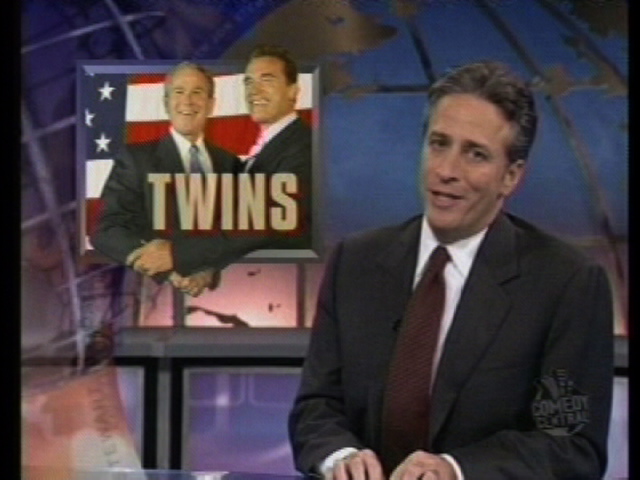

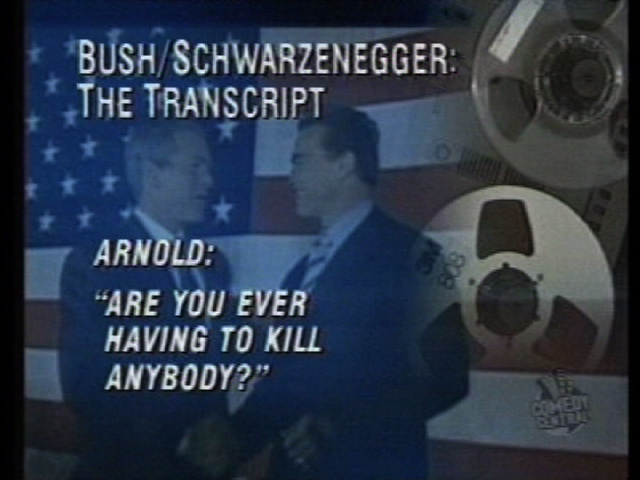
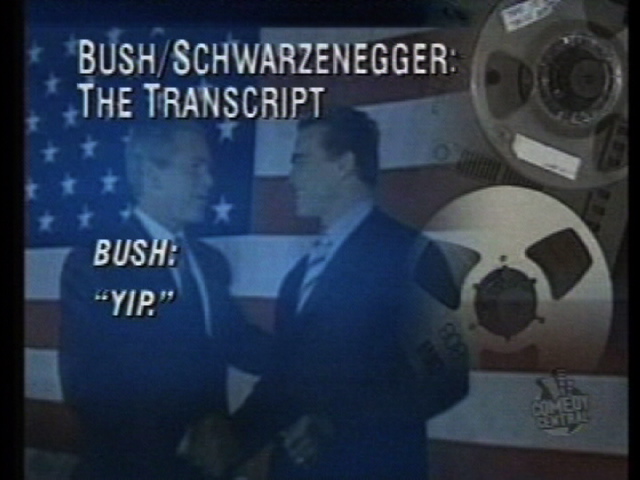
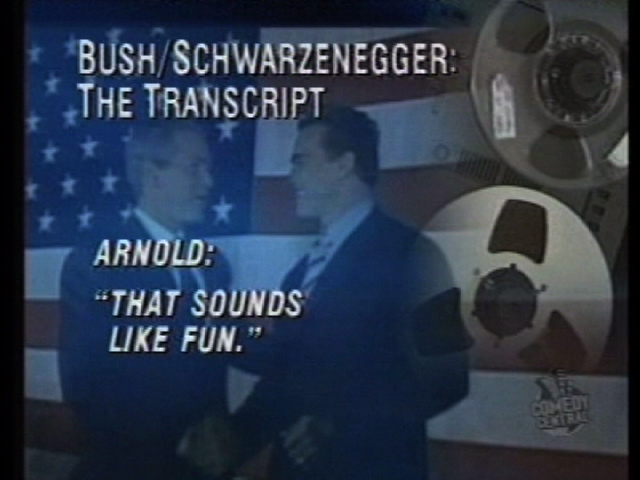
The Daily Show (The best news on television.)
Here's a little Daily Show Clip from October 20th or 21st.
(No I can't remember which - the file is named "20" but my notes say it was the 21st. So shoot me. These things happen and I'm moving to fast to go back and look.)
The Daily Show (The best news on television.)
Henry Kissinger was a guest on
The Daily Show Monday night.
Pretty good interview. Henry was actually a funny guy. Jon had fun with him.
Hard to believe this is the same guy who ordered the assasination of a democratically-elected President in Chile in 1973 and secretly bombed Cambodia that same year (and got a Nobel Peace Prize for it).
But hey, life is strange.
Here's another Daily Show clip on Kissenger from last December.
This is from the October 20, 2003 program.
Note that these videos aren't using my new format strategy yet as I'm still learning the ropes of it and I have a ton of footage to put up that I generated before learning about it.
Kissinger On Daily Show - Part 1 of 2 (Small - 11 MB)
Kissinger On Daily Show - Part 2 of 2 (Small - 7 MB)
Kissinger On Daily Show - All (Small - 18 MB)


The Daily Show. (The best news on television.)
Simon Woodside is my hero this week.
He's been very patiently educating my stupid ass all week long about how to make my video's smaller, look better, and play well in all browsers.
Now, in all fairness Kevin Marks has been trying to help me do this for weeks (months?), but for some reason the instructions just weren't clicking in my brain. Sorry Kevin!
The first result of Simon's tutoring to come to fruition this week is a revamped version of the old Daily Show clip of Henry Kissinger heading up the "Independent" 911 investigation committee. (Yes he was subsequently taken off that committee.)
Update: lots of folks wanted a direct link to the movie file -- so there it is!
The Daily Show rendition of the event is priceless. (I re-edited it a bit.)
This all came up recently when Henry Kissinger appeared on the Daily Show this last Monday night (October 20, 2003).
So please let me know - lisarein@finetuning.com -- how these new movies play in your browser and if you like them better. This one's just a file generated from the quicktime I generated earlier, so the quality issues can't be addressed. But, once I figure out what Simon is trying to teach me, I believe I will be delivering all of my movies in this manner. (Unless you write me to tell me it sucks and to stick with the imovie-defaulted "email" movies I've been using.)
Thanks again Simon!!!
lisa
The evidence is starting to pour in to suggest that David Kelly (the microbiologist that became the center of the controversy surrounding Britain's bogus WMD evidence that the Shrub Administration used as justification for the war on Iraq) did not commit suicide at all.
MEDIUM RARE
By Jim Rarey for From The Wilderness.
(This first part lays out the case from the evidence presented in the Hutton inquiry why the death of Dr. David Kelly was not by suicide. Part two will show the reasons, in this writer's opinion, Dr. Kelly was killed.)...While the Hutton inquiry appears set to declare Kelly's death a suicide and the national media are already treating it as a given, there are numerous red flags raised in the testimony and evidence at the inquiry itself.
Kelly's body was likely moved from where he died to the site where two search volunteers with a search dog found it. The body was propped up against a tree according to the testimony of both volunteers. The volunteers reported the find to police headquarters, Thames Valley Police (TVP) and then left the scene. On their way back to their car, they met three "police" officers, one of them named Detective Constable Graham Peter Coe.
Coe and his men were alone at the site for 25-30 minutes before the first police actually assigned to search the area arrived (Police Constables Sawyer and Franklin) and took charge of the scene from Coe. They found the body flat on its back a short distance from the tree, as did all subsequent witnesses.
A logical explanation is that Dr. Kelly died at a different site and the body was transported to the place it was found. This is buttressed by the medical findings of livor mortis (post mortem lividity), which indicates that Kelly died on his back, or at least was moved to that position shortly after his death. Propping the body against the tree was a mistake that had to be rectified.
The search dog and its handler must have interrupted whoever was assigned to go back and move the body to its back before it was done. After the volunteers left the scene the body was moved to its back while DC Coe was at the scene.
Five witnesses said in their testimony that two men accompanied Coe. Yet, in his testimony, Coe maintained there was only one other beside himself. He was not questioned about the discrepancy.
Researchers, including this writer, assume the presence of the "third man" could not be satisfactorily explained and so was being denied.
Additionally, Coe's explanation of why he was in the area is unsubstantiated. To the contrary, when PC Franklin was asked if Coe was part of the search team he responded, "No. He was at the scene. I had no idea what he was doing there or why he was there. He was just at the scene when PC Sawyer and I arrived."
Franklin was responsible for coordinating the search with the chief investigating officer and then turning it over to Sawyer to assemble the search team and take them to the assigned area. They were just starting to leave the station (about 9am on the 18th) to be the first search team on the ground (excepting the volunteers with the search dog) when they got word the body had been found.A second red flag is the nature of the wounds on Kelly's wrist. Dr. Nicholas Hunt, who performed the autopsy, testified there were several superficial "scratches" or cuts on the wrist and one deep wound that severed the ulnar artery but not the radial artery.
The fact that the ulnar artery was severed, but not the radial artery, strongly suggests that the knife wound was inflicted drawing the blade from the inside of the wrist (the little finger side closest to the body) to the outside where the radial artery is located much closer to the surface of the skin than is the ulnar artery. For those familiar with first aid, the radial artery is the one used to determine the pulse rate.
Just hold your left arm out with the palm up and see how difficult it would be to slash across the wrist avoiding the radial artery while severing the ulnar artery. However, a second person situated to the left of Kelly who held or picked up the arm and slashed across the wrist would start on the inside of the wrist severing the ulnar artery first.
A reasonably competent medical examiner or forensic pathologist would certainly be able to determine in which direction the knife was drawn across the wrist. That question was never asked nor the answer volunteered. In fact, a complete autopsy report would state in which direction the wounds were inflicted. The coroner's inquest was never completed as it was preempted by the Hutton inquiry and the autopsy report will not be made public. Neither will the toxicology report.
Here is the full text of the article in case the link goes bad:
http://www.fromthewilderness.com/free/ww3/101403_kelly_1.html
October 14, 2003
THE MURDER OF DAVID KELLY
Part one of two
(This first part lays out the case from the evidence presented in the Hutton inquiry why the death of Dr. David Kelly was not by suicide. Part two will show the reasons, in this writer's opinion, Dr. Kelly was killed.)
On Thursday, July 17th sometime between 3 and 3:30pm, Dr. David Kelly started out on his usual afternoon walk. About 18 hours later, searchers found his body, left wrist slit, in a secluded lane on Harrowdown Hill. Kelly, the U.K.'s premier microbiologist, was in the center of a political maelstrom having been identified as the "leak" in information about the "dossier" Prime Minister Tony Blair had used to justify the war against Iraq.
While the Hutton inquiry appears set to declare Kelly's death a suicide and the national media are already treating it as a given, there are numerous red flags raised in the testimony and evidence at the inquiry itself.
Kelly's body was likely moved from where he died to the site where two search volunteers with a search dog found it. The body was propped up against a tree according to the testimony of both volunteers. The volunteers reported the find to police headquarters, Thames Valley Police (TVP) and then left the scene. On their way back to their car, they met three "police" officers, one of them named Detective Constable Graham Peter Coe.
Coe and his men were alone at the site for 25-30 minutes before the first police actually assigned to search the area arrived (Police Constables Sawyer and Franklin) and took charge of the scene from Coe. They found the body flat on its back a short distance from the tree, as did all subsequent witnesses.
A logical explanation is that Dr. Kelly died at a different site and the body was transported to the place it was found. This is buttressed by the medical findings of livor mortis (post mortem lividity), which indicates that Kelly died on his back, or at least was moved to that position shortly after his death. Propping the body against the tree was a mistake that had to be rectified.
The search dog and its handler must have interrupted whoever was assigned to go back and move the body to its back before it was done. After the volunteers left the scene the body was moved to its back while DC Coe was at the scene.
Five witnesses said in their testimony that two men accompanied Coe. Yet, in his testimony, Coe maintained there was only one other beside himself. He was not questioned about the discrepancy.
Researchers, including this writer, assume the presence of the "third man" could not be satisfactorily explained and so was being denied.
Additionally, Coe's explanation of why he was in the area is unsubstantiated. To the contrary, when PC Franklin was asked if Coe was part of the search team he responded, "No. He was at the scene. I had no idea what he was doing there or why he was there. He was just at the scene when PC Sawyer and I arrived."
Franklin was responsible for coordinating the search with the chief investigating officer and then turning it over to Sawyer to assemble the search team and take them to the assigned area. They were just starting to leave the station (about 9am on the 18th) to be the first search team on the ground (excepting the volunteers with the search dog) when they got word the body had been found.
A second red flag is the nature of the wounds on Kelly's wrist. Dr. Nicholas Hunt, who performed the autopsy, testified there were several superficial "scratches" or cuts on the wrist and one deep wound that severed the ulnar artery but not the radial artery.
The fact that the ulnar artery was severed, but not the radial artery, strongly suggests that the knife wound was inflicted drawing the blade from the inside of the wrist (the little finger side closest to the body) to the outside where the radial artery is located much closer to the surface of the skin than is the ulnar artery. For those familiar with first aid, the radial artery is the one used to determine the pulse rate.
Just hold your left arm out with the palm up and see how difficult it would be to slash across the wrist avoiding the radial artery while severing the ulnar artery. However, a second person situated to the left of Kelly who held or picked up the arm and slashed across the wrist would start on the inside of the wrist severing the ulnar artery first.
A reasonably competent medical examiner or forensic pathologist would certainly be able to determine in which direction the knife was drawn across the wrist. That question was never asked nor the answer volunteered. In fact, a complete autopsy report would state in which direction the wounds were inflicted. The coroner's inquest was never completed as it was preempted by the Hutton inquiry and the autopsy report will not be made public. Neither will the toxicology report.
Two paramedics who arrived by ambulance at the same time as Franklin and Sawyer (some time after 9am) and accompanied them to where the body was located. After checking the eyes and signs of a pulse or breathing, they attached four electro-cardiogram pads to Kelly's chest and hooked them up to a portable electro-cardiograph. When no signs of heart activity were found they unofficially confirmed death. One paramedic (Vanessa Hunt) said the Police asked them to leave the pads on the body. The other paramedic (David Bartlett) said they always left the pads on the body.
Both paramedics testified that DC Coe had two men with him. Curiously, both also volunteered that there was a surprisingly small amount of blood at the scene for an artery having been severed.
When the forensic pathologist (Dr. Nicholas Hunt) who performed the autopsy testified, he described copious amounts of blood at the scene. He also described scratches and bruises that Kelly "stumbling around" in the heavy underbrush may have caused. He said there was no indication of a struggle or Kelly having been forcibly restrained.
However, the police made an extensive search of the area and found no indication of anyone, including Kelly, having been in the heavy underbrush.
Strangely, none of the witnesses mentioned anything about rigor mortis (stiffening of the body) which is useful in setting the approximate time of death. Even Dr. Hunt, when was asked directly what changes on the body he observed that would have happened after death, failed to mention rigor mortis. He only named livor mortis. Hunt set the time of death within a range of 4:15pm on the 17th to 1:15am the next morning. He based the estimate on body temperature which he did not take until 7:15pm on the 18th, some seven hours after he arrived on the scene.
A forensic biologist (Roy James Green) had been asked to examine the scene. He said the amount of blood he saw was consistent with a severed artery. Green works for the same private company (Forensic Alliance) as Dr. Hunt. A majority of the company's work is done for police organizations.
The afternoon of the 18th DC Coe turned up at the Kelly residence accompanied by a man identified only as "an attachment," who acted as an "exhibits officer" presumably collecting documents in behalf of some other government agency.
Detective Constable Coe and those accompanying him are somewhat of a mystery. There are no corroborating witnesses to any of his actions to which he testified (other than "just being there" at the scene where the body was found).
However, on a listing of evidence provided to the Hutton inquiry by Thames Valley Police is a reference to a document described thusly, "TVP Tactical Support Major Incident Policy Book…Between 1430 17.07.03 and 930 18.07.03. DCI Alan Young. It is labeled "not for release – Police operational information." Many of the exhibits are labeled that way or are not to be released as personal information.
The police took over 300 statements from witnesses but less than 70 were forwarded to the Hutton inquiry. Witness statements were not to be released (even to the inquiry) unless the witness signed an authorization permitting it. TVP also withheld witness interviews they did not consider "relevant" to the inquiry. Witnesses were not put under oath so it is impossible for the public to know if their public statements are at variance with what they told police. The ‘tactical support" document must have been considered relevant to the inquiry on Kelly's death or it wouldn't have been forwarded.
So this "tactical support" began at 2:30pm on the 17th, about one hour before Dr. Kelly left the house on his final walk. It ended at 9:30am the following morning about the time DC Coe and his men left the death scene. The obvious question is, to what was TVP giving tactical support? The name given the effort was "Operation Mason."
(In part two of this report, we will lay out some of the reasons (that you won't see in the national media) Dr. Kelly could not be allowed to live.)
(In accordance with Title 17 U.S.C. Section 107, this material is distributed without profit to those who have expressed a prior interest in receiving the included information for research and educational purposes.)
Permission is granted to reproduce this article in its entirety .
The author is a freelance writer based in Romulus, Michigan. He is a former newspaper editor and investigative reporter, a retired customs administrator and accountant, and a student of history and the U.S. Constitution.
If you would like to receive Medium Rare articles directly, please contact the author at jimrarey@comcast.net
The EFF released the following advisory a while ago. The concerns still stand.
Check it out.
EFF Reports on Trusted ComputingSan Francisco - The Electronic Frontier Foundation (EFF) on Thursday published a landmark report on trusted computing, a technology designed to improve security through hardware changes to the personal computer.
The report, entitled "Trusted Computing: Promise and Risk," maintains that computer owners themselves, rather than the companies that provide software and data for use on the computer, should retain control over the security measures installed on their computers. Any other approach, says the report's author Seth Schoen, carries the risk of anti-competitive behavior by which software providers may enforce "security measures" that prevent interoperability when using a competitor's software.
"Helping computer owners defend their computers against attacks is progress in computer security, but treating computer owners themselves as the bad guys is not," said Schoen. "Security architectures must be designed to put the computer owner's interests first, not to lock the owner into the plans of others."
Links:
For the full press release
EFF report: "Trusted Computing: Promise and Risk"
EFF companion commentary: "Meditations on Trusted Computing"
This book is awesome! I'm only about half way through it right now. It does a great job of nailing the right on their incessant distortion of the truth -- and backs it all up with footnoted facts!
You should just but it now!
Anyway, this was emailed to me sometime ago. Not sure where it came from, but I know it's been circulated pretty heavily through numerous channels at this point. I know that Salon has it in it's quagmire of a website somewhere, but they won't even let you read the front page anymore without suffering through an lengthy ad, so I didn't have time to try to find the link.
"Lies and the Lying Liars Who Tell Them"
An excerpt from Al Franken's new book.
- - - - - - - - - - - -
By Al Franken
Aug. 27, 2003 | God chose me to write this book.
God began our conversation by clearing something up. Some of George W. Bush's friends say that Bush believes God called him to be president during these times of trial. But God told me that He/She/It had actually chosen Al Gore by making sure that Gore won the popular vote and, God thought, the Electoral College. "THAT WORKED FOR EVERYONE ELSE," God said."What about Tilden?" I asked, referring to the 1876 debacle.
"QUIET!" God snapped. God was angry.
God said that after 9/11, George W. Bush squandered a unique moment of national unity. That instead of rallying the country around a program of mutual purpose and sacrifice, Bush cynically used the tragedy to solidify his political power and pursue an agenda that panders to his base and serves the interests of his corporate backers.
God told me that Bush squandered a $4.6 trillion surplus and is plunging us into deficits as far as God can see. And that Bush squandered another surplus. The surplus of goodwill from the rest of the world that he had inherited from Bill Clinton.
And this was pissing God off.
"Lies and the Lying Liars Who Tell Them"
An excerpt from Al Franken's new book.
- - - - - - - - - - - -
By Al Franken
Aug. 27, 2003 | God chose me to write this book.
Just the fact that you are reading this is proof not just of God's existence, but also of His/Her/Its beneficence. That's right. I am not certain of God's precise gender. But I am certain that He/She/It chose me to write this book.
This isn't hubris. I'm not saying this in an egotistical way. God didn't choose me because I'm the greatest writer who ever lived. That was William Shakespeare, whose work I have a passing familiarity with. No. I just happened to be the right vessel at the right time. If something in this book makes you laugh, it was God's joke. If something makes you think, it's because God had a good point to make.
The reason I know God chose me is because God spoke to me personally.
God began our conversation by clearing something up. Some of George W. Bush's friends say that Bush believes God called him to be president during these times of trial. But God told me that He/She/It had actually chosen Al Gore by making sure that Gore won the popular vote and, God thought, the Electoral College. "THAT WORKED FOR EVERYONE ELSE," God said.
"What about Tilden?" I asked, referring to the 1876 debacle.
"QUIET!" God snapped. God was angry.
God said that after 9/11, George W. Bush squandered a unique moment of national unity. That instead of rallying the country around a program of mutual purpose and sacrifice, Bush cynically used the tragedy to solidify his political power and pursue an agenda that panders to his base and serves the interests of his corporate backers.
God told me that Bush squandered a $4.6 trillion surplus and is plunging us into deficits as far as God can see. And that Bush squandered another surplus. The surplus of goodwill from the rest of the world that he had inherited from Bill Clinton.
And this was pissing God off.
He/She/It was right. But it sounded like a lot of work.
"Look, God, I'm flattered, but I think you got the wrong guy. The kind of book you're talking about would require months of research."
And God said, "LET THERE BE GOOGLE. AND LET THERE BE LEXISNEXIS."
"Very funny, God. I use Google all the time."
"YES, I KNOW," God said. "FOR HOT ASIAN TEENS."
"You must be thinking of my son, Joe."
"AL? I'M OMNISCIENT."
"Okay, okay." I changed the subject. "It's just that I can't do this book myself."
"LEAVE THAT TO ME," God boomed.
And that's when Harvard called.
- - - - - - - - - - - -
Harvard's Kennedy School of Government asked me to serve as a fellow at its Shorenstein Center on the Press, Politics, and Public Policy. After my varied and celebrated career in television, movies, publishing, and the lucrative world of corporate speaking, being a fellow at Harvard seemed, frankly, like a step down.
I couldn't think of anything less appealing than molding the minds of tomorrow's leaders, unless it was spending fireside evenings sipping sherry with great minds at the Faculty Club. Yawn.
To my surprise and delight, though, all Harvard wanted me to do was show up every once in a while and write something about something. That gave me an idea.
"Would it be okay if I wrote a scathingly partisan attack on the right-wing media and the Bush administration?"
"No problem," Harvard said absentmindedly.
"Count me in," I replied. "From now on call me 'Professor Franken.'"
"No," Harvard said, "you're not a professor. But you can run a study group on the topic of your choosing."
"Great," I said. "I've got the perfect topic: Write My Son's Harvard College Application Essay."
"No," they said. "Harvard students already know how to write successful Harvard applications, Al. We want you to teach them something new."
Harvard was right where I wanted it. "How about if the topic is: How to Research My Book?"
"Sure," Harvard said. "Most of our professors teach that course. Why, in the Biochemistry department, most of the graduate-level courses are--"
Harvard was boring me. "I gotta run, Harvard. Thanks."
- - - - - - - - - - - -
I had my Nexis, I had my Google, I had my Harvard fellowship, and I had my fourteen research assistants. I sat down to write. Nothing.
So I got on my knees and prayed for guidance. "How, God, can I best do Your work through this book? Who, dear Lord, is the audience for a book like this? And what's a good title?"
God answered, "YOU KNOW THOSE SHITTY BOOKS BY ANN COULTER AND BERNIE GOLDBERG?"
"The bestsellers that claim there's a liberal bias in the media?" I asked.
"TOTAL BULLSHIT," God said. "START BY ATTACKING THEM. HE'S CLEARLY A DISGRUNTLED FORMER EMPLOYEE, AND SHE JUST LIES. BY THE WAY, THERE'S SOMETHING SERIOUSLY WRONG WITH HER."
"That's pretty obvious."
"SO GO AFTER THEM, THE WHOLE LIBERAL BIAS MYTH, AND THEN GO AFTER THE RIGHT-WING MEDIA. ESPECIALLY FOX."
"Okay, God, I'm writing this down."
"THEN USE THEM AS A JUMPING-OFF POINT TO GO AFTER BUSH. YOU KNOW, BIG TAX CUTS FOR THE RICH, SURGING UNEMPLOYMENT, IGNORING EVERYONE BUT HIS CORPORATE BUDDIES, SCREWING THE ENVIRONMENT, PISSING OFF THE REST OF THE WORLD. THAT STUFF. AND THAT'S YOUR BOOK."
"Got it. One last thing. Title."
"HOW ABOUT BEARERS OF FALSE WITNESS AND THE FALSE WITNESS THAT THEY BEAR?"
"Hmm. I, uh, I'll work with that."
So I've been immediately sidetracked by the announcement of Amazon's Search Inside The Book Feature. I'd reprint the announcement, but it's a stupid image file so you'll have to go look for yourself. It does look neat though.
I just have to catch up on my article blogging today or I'm going to drive myself crazy. The other night, during a conversation with a friend, I kept referring to articles I thought I had blogged that I, in fact, had not blogged yet -- although I've had them all prepped and ready to go for, in some cases, weeks on end.
So bear with me if some of this morning's posts are kind of rough -- I have to clean house for my own sanity at this point. (Yes, I do realize that's already a lost cause :-)
A fellow student of mine went to Michael Moore's presentation here at San Francisco State Monday night, and she filled me in a bit on some of the events that took place.
There were about 4,000 people in the gym and at least another 1,000 outside that couldn't get in. Michael was late starting the show inside because he took some time to talk to the folks outside first.
Michael put on a little quiz show routine where he invited a Canadian (supposedly with a low GPA) and several Americans (supposedly with high GPAs) down from the audience to participate. He asked the Canadian questions about the United States (who's the President and some basic geography questions, etc.) and then some geography questions about other parts of the world like Iraq and Afghanistan. The Canadian got everything right. He then asked the high gpa American students about Canada and the same geography questions about Iraq and Afghanistan -- none of which they could answer correctly.
He went on to cite a few studies of Americans from 18-24 years of age where the subjects didn't seem to know where many other countries in the world were physically located. He made the point that if we were going to be at war with countries such as Afghanistan and Iraq, we should probably know where they are on the map.
At one point, he asked the audience to get together and decide who they'd like him to call up on the telephone while he was there. The audience wanted him to call the President of SFSU, but nobody knew his phone number. So their next choice was mayoral candidate Gavin Newsome. Luckily Mayoral candidate Matt Gonzales was in the audience, and he had Newsome's personal cell phone number handy.
The audience didn't like Newsome, and Michael asked them why. The audience filled Michael in on the "Care Not Cash" situation, which takes General Assistance payments away in exchange for "services," many of which have yet to be completely specified (although the payments would cease immediately).
(A Judge has already thrown this legislation out, by the way, on the grounds that it's illegal to take this money away from people, even if the voters voted it in.)
Michael then called up Newsome and said something along the lines of "I've heard about this 'Care Not Cash' thing and it seems like you don't really care at all." He mentioned the Getty family and said something like "we all know that you're a Republican in Democrat clothing...I'm in front of an audience of thousands of people right now (he then held up the phone so audience could make noise)...hear that? That's a whole lot of votes that are not going to be voting for you, Gavin."
Then he switched his tone of voice to a cheerful one and said "Ok thanks! Have a nice day!"
Okay, theoretically I should be offline doing homework today, before I teach in the afternoon, but by day's end I reckon I'll finally get to uploading the rest of those Foo clips and last night's Daily Show with....(drumroll please) Henry Kissinger!
I was just telling a friend of mine last night how it was the Daily Show's clip of Henry Kissinger fronting the 911 investigation that started it all. (Meaning what made me want to start my Daily Show archive.
I think it's absolutely in-credible that Kissinger was on the Daily Show last night.
He's got a book out he's promoting, and I guess he figured if the Daily Show was good enough for Madeline Albright's book tour, it was good enough for him!
The Daily Show is really growing up :-) (and I can remember when it was just a young tike...)
Kevin Norton donated a truckload of Michael Moore movie clips to my Michael Moore archive.
I haven't even had a chance to look at these yet, but I thought I'd let you know they were up there.
He's also included a ton of
MP3 clips too! These are named very nicely and include: 1996_radiofreela, 60minutes, after the oscars, bill maher, boulder-CO, an interview in belfast, ralph nader rally, university of toronto, and webzine.
Enjoy!
This movie documents several Foo Folks demonstrating and observing Dan Egnor's GPS Tron game. This is a game that uses wireless technology and GPS devices to play a meat space two-player running game on a field of grass. I played it. It was totally cool. (The kind of thing I could have easily played all morning if I didn't have important videoing to do :-)
Part 1 explains the interface and shows some players in action (one player is the game's creator, Dan Egnor, the other is Anselm Hook).
In Part 2, Brandon Wiley and Anselm Hook give us some first hand accounts of how the game is played.
Also included in the "All" movie is a partial interview with Dan Egnor about how he built the game, its current bugs, and how he plans on addressing them.
This is from October 12, 2003.
GPS Tron - All (Small - 13 MB)
GPS Tron - Part 1 of 2 (Small - 5 MB)
GPS Tron - Part 2 of 2 (Small - 4 MB)

When Dan isn't working by day on Google's "Search By Location" service, he's creating gizmos like "GPS Tron." This interview starts off explaining how GPS Tron works, and then Dan goes on to talk a little about his impressions of Foo Camp.
This is from October 12, 2003.
Foo A-Z
Dan Egnor (Small - 6 MB)


Jennifer Granick, Director of the Stanford Center for Internet & Society was on The Jim Lehrer News Hour last week talking about wifi.
I've created clips for the whole segment, the whole segment in two parts, and Jennifer's quotes (edited together). There's also a little clip of firemen from the South San Mateo County Fire Department talking about how much wifi has helped them.
This is from the October 16, 2003 program.
Jennifer Granick On Jim Lehrer's Wireless Segment (Small - 3 MB)
Jim Lehrer News Hour On Wireless - All (Small - 22 MB)
Jim Lehrer News Hour On Wireless - Part 1 of 2 (Small - 10 MB)
Jim Lehrer News Hour On Wireless - Part 2 of 2 (Small - 12 MB)
So. San Mateo Country Firemen talking about wireless helping them (Small - 2 MB)

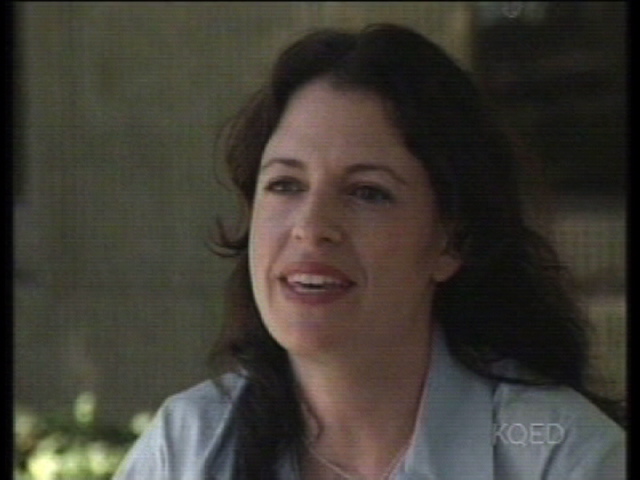
Remember that there's also a Foo Camp A-Z page where the interviews go up before I have a chance to blog them...
Bob Fleck is working on BlueTooth security.
This is from October 12, 2003.
Foo A-Z
Bob Fleck (Small - 7 MB)
Brandon is creating a P2P gaming engine for serverless mass multiplayer online role playing games called "Gnosis." He's also creating a streaming webcast server called Alluvium that he'll be releasing at CodeCon next year. (Hey kids, it's time for the
CodeCon Call For Papers!)
He's also quite busy working at the Foundation for Decentralization Research.
Foo A-Z
Brandon Wiley (Small - 6 MB)
Nat Torkington turned the tables on me (or the cameras on me, as the case may be) and simply would not leave alone for several minutes. I've edited out some of the boring part in the middle (hope it's not all boring :-)
Thanks for doing this Nat. Most of the time, when I'm in historical archivist mode, I forget to capture myself for the time capsule reel.
Towards the lend of the interview, I was viciously attacked by Paul "Shmoo" Holman (Jack of All, Wireless, and Often Other Top Secret Trades). Glad I have the photographic evidence so I can make my case during the trial :-) Photos below of me getting roughed up below.
In all seriousness, this "shmoo" fella is one violent guy. I've got video of him beating up Jeremy Borenstein. And he even brags that he's planning to do it in another clip. (Making it a premeditated attack!)
Anyway, this is from October 12, 2003.
Foo A-Z
Lisa Rein - Complete (Small - 27 MB)
Lisa Rein - Part 1 of 2 (15 MB)
Lisa Rein - Part 2 of 2 (13 MB)



Okay I've got another 10+ foo movies and interviews, 2+ new music tunes, and a few more news clips and things all ready to go, but I just gotta finish my homework first!
Tomorrow I've got school all day and plans for the evening, so I'll make sure to stay up late if I have to and get it all up tonight.
Back soon!
lisa
Michael Moore is at San Francisco State in the Gym tonight at 7pm.
I'm going to try to make it, but I might not. I've got a ton of blogging and homework to do and my good camera is busted anyway, so it wouldn't come out that good if I filmed it. And it's kind of frustrating for me these days to go to events I can't film. So I'll probably skip it.
I have a feeling I'll get to meet Mike in person someday anyway, if I'm patient (and do my homework, and eat my vegetables :-)
Just wanted to make sure you knew about it.
Better yet, skip Ticketmaster altogether, if you actually have a choice. But usually you don't. Here's the problem with printing your own tickets:
Ticketmaster gives you an option to print your own tickets on your home printer. It sounds good at first, but let me assure you, it's just another bait and switch from the "masters."
Not only does Ticketmaster charge you the same $8.00 service fee (despite the fact that it's managed to pass on the printing costs on to you and has managed to save itself all postage costs for the transaction), but it also sells large, full color ads on the full page "tickets" that you are required to print out completely (because the "ticket" itself is on the top part of the page, and its corresponding bar code is on the bottom part of the page). So your color ink cartridge takes big hit too.
Entrepreneurs of the world: please oh please overthrow the Ticketmaster regime. It truly sucks.
Right On Coleen! Thanks for having the guts to publish this article. It means a lot coming from you.
There are a lot of good people working for the government right now that are working for change, but it's really hard because their hands are tied. Most of them are in Damage Control mode and just trying to make it through their day-to-day activities without having to participate in anything too horrible until this administration can be replaced.
Coleen Rowley: The wrong side of 'us vs. them'
By Coleen Rowley for the Star Tribune.
I didn't attend Attorney General John Ashcroft's speech last month in Minneapolis, but newspapers have quoted him as saying that Americans are "freer today than at any time in the history of human freedom."Well, this American disagrees! And I would venture to say that many others feel the same way -- those who have been put on the "them" side of the "us vs. them" equation in the context of the administration's "you're either with us or against us" mentality.
It didn't matter whether you were a career FBI agent, a decorated war veteran, a duly elected congressman or senator, a military general or even a former president, you were labeled a traitor for voicing any criticism of administration policies. You were accused of giving aid and comfort to the enemy, called a friend of Osama bin Laden and thrown to the wolves (or more accurately, the FOXes).
The intimidation in this country that's been whipped up by this official fear and warmongering has been far more effective than any Patriot Act in whittling away our civil liberties...
It's also no secret that this administration has used its considerable power to fight giving any real legal protection to government whistle-blowers and even attempted to water down the Sarbanes-Oxley Act's protections recently enacted for corporate whistle-blowers.
Of course, no "whistle-blower protection" exists for public disclosures or articles such as this one. But even without it, the First Amendment should suffice and is what I rely on. However, the official warnings along these lines that I've repeatedly received in the course of my attempts to speak on issues of public importance seem little more than veiled threats; or are they perhaps a warning that the First Amendment is not as robust as it used to be?
There's another large segment of our citizenry who have found themselves cast as "thems" by this "war" mentality. Complaints of discrimination against Muslim workers and reports of hate crimes against people believed to be of Middle Eastern descent have at least doubled...
Although it must be recognized that the origin of this problem was in the horror of the violent attacks themselves and that certain government leaders, such as FBI Director Robert Mueller, have undertaken efforts to reach out to affected Arab groups, the social scientists point to other government actions following 9/11 (including the government's roundup and detention of illegal immigrants, the special registration requirements that single out students and visitors from Muslim nations, and the wars in Afghanistan and Iraq) as sending "social signals" that are worsening these biases.
A specialist in the issues of prejudice and stereotyping has noted that people who perceive themselves under threat naturally tend to think of "who's with me" and "who's against me." In any event, I doubt that many in the Arab-American segment of the populace feel "freer today," as Ashcroft's generality suggests.
Here is the text of the entire article in case the link goes bad:
http://www.startribune.com/stories/562/4147904.html
Coleen Rowley: The wrong side of 'us vs. them'
Coleen Rowley
Published October 12, 2003
ROWLEY1012
I didn't attend Attorney General John Ashcroft's speech last month in Minneapolis, but newspapers have quoted him as saying that Americans are "freer today than at any time in the history of human freedom."
Well, this American disagrees! And I would venture to say that many others feel the same way -- those who have been put on the "them" side of the "us vs. them" equation in the context of the administration's "you're either with us or against us" mentality.
It didn't matter whether you were a career FBI agent, a decorated war veteran, a duly elected congressman or senator, a military general or even a former president, you were labeled a traitor for voicing any criticism of administration policies. You were accused of giving aid and comfort to the enemy, called a friend of Osama bin Laden and thrown to the wolves (or more accurately, the FOXes).
The intimidation in this country that's been whipped up by this official fear and warmongering has been far more effective than any Patriot Act in whittling away our civil liberties.
Interestingly enough, Ashcroft himself is not above using this technique to lump those who disagree with him in with the terrorists to thereby discourage debate. Recall his statement, three months after Sept. 11: "To those who scare peace-loving people with phantoms of lost liberty, my message is this: Your tactics only aid terrorists -- for they erode our national unity and diminish our resolve. They give ammunition to America's enemies."
It's also no secret that this administration has used its considerable power to fight giving any real legal protection to government whistle-blowers and even attempted to water down the Sarbanes-Oxley Act's protections recently enacted for corporate whistle-blowers.
Of course, no "whistle-blower protection" exists for public disclosures or articles such as this one. But even without it, the First Amendment should suffice and is what I rely on. However, the official warnings along these lines that I've repeatedly received in the course of my attempts to speak on issues of public importance seem little more than veiled threats; or are they perhaps a warning that the First Amendment is not as robust as it used to be?
There's another large segment of our citizenry who have found themselves cast as "thems" by this "war" mentality. Complaints of discrimination against Muslim workers and reports of hate crimes against people believed to be of Middle Eastern descent have at least doubled.
Social psychologists say that the attacks of Sept. 11 and their aftermath have created a real-world experiment which unfortunately indicates that the more positively one feels about the United States, the more likely one is to be anti-Arab.
Although it must be recognized that the origin of this problem was in the horror of the violent attacks themselves and that certain government leaders, such as FBI Director Robert Mueller, have undertaken efforts to reach out to affected Arab groups, the social scientists point to other government actions following 9/11 (including the government's roundup and detention of illegal immigrants, the special registration requirements that single out students and visitors from Muslim nations, and the wars in Afghanistan and Iraq) as sending "social signals" that are worsening these biases.
A specialist in the issues of prejudice and stereotyping has noted that people who perceive themselves under threat naturally tend to think of "who's with me" and "who's against me." In any event, I doubt that many in the Arab-American segment of the populace feel "freer today," as Ashcroft's generality suggests.
I could go on in a more general, abstract way about how "free" any of us truly is living with the ongoing terrorist threat to our safety that will be with us for a long time. For, distilled to their essences, security and liberty are very intertwined, if not the same thing. In that sense, how many people in yellow/orange-alert America feel "freer" today than they did prior to 9/11?
Ashcroft may be correct on other matters, including that the letter of the law contained in the Patriot Act is, for the most part, not the problem, but he is certainly either in denial, out of touch or painting far too rosy a picture by saying that Americans are "freer today than at any time in the history of human freedom." For our civil liberties can be and are in jeopardy in other ways.
For starters, we must do more to break down the "us vs. them" mind-set and the accompanying intimidation that ultimately threaten us all. We must recognize that we are all in this together.
Coleen Rowley works for the Federal Bureau of Investigation as a special agent with the Minneapolis office. (The views expressed are her own and are not to be construed as the official views of the FBI.)
This is from October 12, 2003.
Foo A-Z
Ben and Mena Trott (Small - 11 MB)



The scariest part (aside from the torture allegations, of course) is in the last paragraph:
"The U.S. government says they could be held until it declares an end to its "war on terrorism."
We know that the "War On Terrorism" is poorly defined with a definition that keeps changing to suit the current objectives of the Shrub Administration. These people need to be charged or released, as we would expect Americans to be treated under the Geneva Convention.
Oh yeah. That means torture's out too :-)
Lawyer Says Guantanamo Detainees Tortured
By the Associated Press in the NY Times.
Here's the whole article. It's just a little thing.
The U.S. military has tortured terrorist suspects held without charge at the Guantanamo Bay military prison, an Australian lawyer representing some of the suspects claimed Wednesday.U.S.-based Richard Bourke, who has been working for almost two years on behalf of dozens of detainees at Guantanamo Bay, said American military officials were using old-fashioned torture techniques to force confessions out of prisoners.
The methods "clearly" fell under the definition of torture under international conventions, he told Australian Broadcasting Corp. radio in an interview from the United States.
"They are engaging in good old-fashioned torture, as people would have understood it in the Dark Ages," he said.
About 660 prisoners captured in Afghanistan and elsewhere are being held at Guantanamo without charges or access to lawyers -- some since January 2002. The U.S. government rarely comments on activities at the prison which has been dubbed Camp X-ray because of the strict security.
Earlier this year, U.S. officials denied using torture and said detainees are interrogated humanely, allowed to practice their religion and given good medical care.
Families are denied access and can only communicate with detainees through heavily censored mail. Human rights groups and the media have been given only limited and strictly controlled access.
Bourke told ABC radio that his claims are based on reports leaked by U.S. military personnel and from descriptions by some detainees that have been released.
"One of the detainees had described being taken out and tied to a post and having rubber bullets fired at them. They were being made to kneel cruciform in the sun until they collapsed," he said.
Media reports that many detainees have attempted suicide and are suffering mental health problems backed up claims of harsh treatment, he said.
Bourke said governments around the world must stand up to the U.S. government and demand that the United Nations investigate the reports of torture.
Almost all the detainees, from more than 40 countries, are said to be members of al-Qaida terrorist network or the ousted Afghan Taliban regime. They are to be tried by secret military tribunals. The U.S. government says they could be held until it declares an end to its "war on terrorism."
Here is the full text of the article in case the link goes bad:
http://www.nytimes.com/aponline/international/AP-Australia-Guantanamo-Bay.html
Lawyer Says Guantanamo Detainees Tortured
By The Associated Press
New York Times
Wednesday 08 October 2003
The U.S. military has tortured terrorist suspects held without charge at the Guantanamo Bay military prison, an Australian lawyer representing some of the suspects claimed Wednesday.
U.S.-based Richard Bourke, who has been working for almost two years on behalf of dozens of detainees at Guantanamo Bay, said American military officials were using old-fashioned torture techniques to force confessions out of prisoners.
The methods "clearly" fell under the definition of torture under international conventions, he told Australian Broadcasting Corp. radio in an interview from the United States.
"They are engaging in good old-fashioned torture, as people would have understood it in the Dark Ages," he said.
About 660 prisoners captured in Afghanistan and elsewhere are being held at Guantanamo without charges or access to lawyers -- some since January 2002. The U.S. government rarely comments on activities at the prison which has been dubbed Camp X-ray because of the strict security.
Earlier this year, U.S. officials denied using torture and said detainees are interrogated humanely, allowed to practice their religion and given good medical care.
Families are denied access and can only communicate with detainees through heavily censored mail. Human rights groups and the media have been given only limited and strictly controlled access.
Bourke told ABC radio that his claims are based on reports leaked by U.S. military personnel and from descriptions by some detainees that have been released.
"One of the detainees had described being taken out and tied to a post and having rubber bullets fired at them. They were being made to kneel cruciform in the sun until they collapsed," he said.
Media reports that many detainees have attempted suicide and are suffering mental health problems backed up claims of harsh treatment, he said.
Bourke said governments around the world must stand up to the U.S. government and demand that the United Nations investigate the reports of torture.
Almost all the detainees, from more than 40 countries, are said to be members of al-Qaida terrorist network or the ousted Afghan Taliban regime. They are to be tried by secret military tribunals. The U.S. government says they could be held until it declares an end to its "war on terrorism."
Anselm is working on "a mobile, location aware, many player game" called "Mites."
This is from October 12, 2003.
Foo A-Z
Anselm Hook (Small - 4 MB)
Dav is translating his Globe Applet, which allows you to put pinpoints on a globe, to J2ME, so he can put it on cellphones.
This is from October 12, 2003.
Foo A-Z
Dav Coleman (Small - 6 MB)
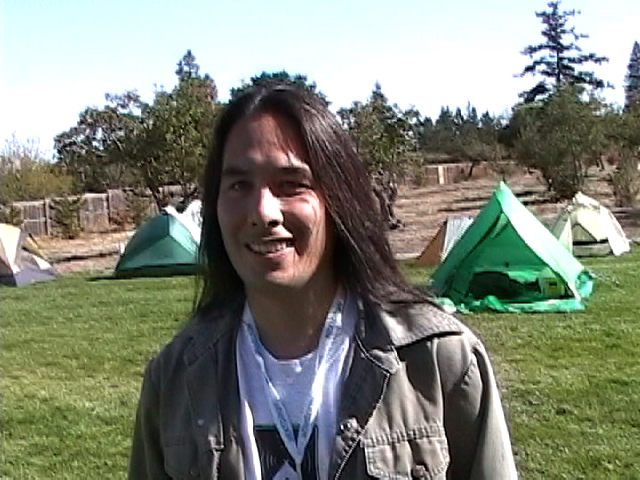
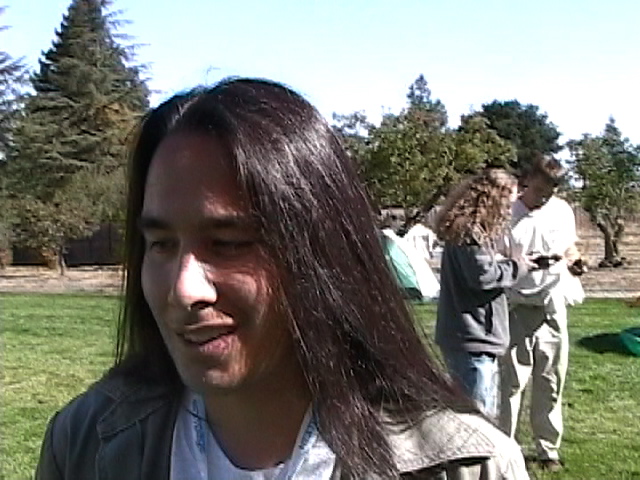
I just released a studio version of Slipping Away today. (Slipping Away v. 2.0.
Here's the scoop:
10/17/03 -- I just rediscoverd this track when I was in Seattle a few weeks ago doing the RetarDEAD themesong.I'd forgotten how good this came out, and just kinda never got around to doing anything with it. Now that I've played it for people, I'm told it may be my best track ever. (Which reminded me to make it available to you.)
I'll be going back to Vagrant Records soon to cut some more tracks. This time with Ron by my side in the studio. I can't wait. (Even if Evan Foster did play the hell out of this song! Thanks, Evan!)
One of the great things about recording with Evan was that he could really pull these songs out of my head. I would say something like "Randy Rhoads tone" (not for this song, but for say Poltergeist, and he would just know what I meant, and play it perfectly. I was really great working with him, and I'm told it will never happen again, because he's about to be a rock star :-) So I feel especially lucky to have worked with him "when."
Anyway, hope you like it. Check it out.
This is from October 12, 2003.
Foo A-Z
Rob Flickenger (Small - 8 MB)


This is from October 12, 2003.
Foo A-Z
Doc Searls (Small - 9 MB)
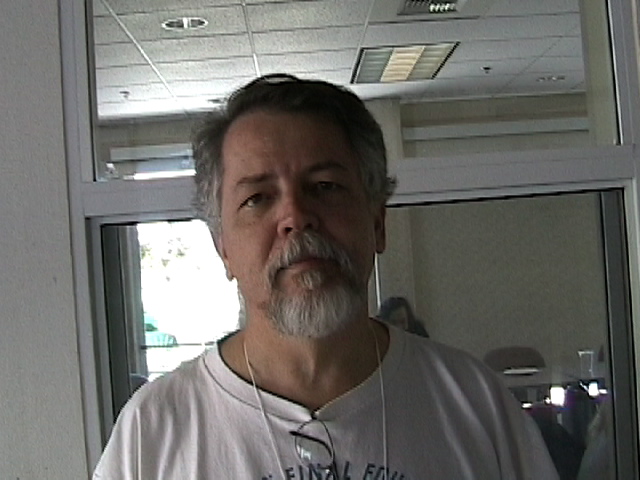
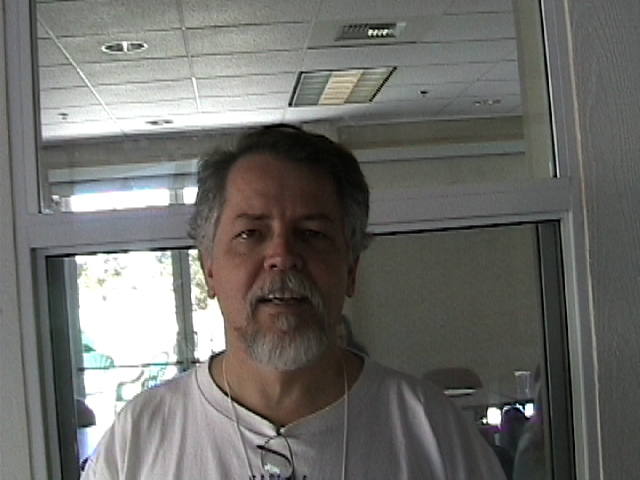
This is from October 12, 2003.
Foo A-Z
Mike Liebhold (Small - 9 MB)
Okay so Danny did most of the talking :-)
This is from October 12, 2003.
(Here's a blog entry Danny wrote about Foo Camp.)
Foo A-Z
Danny O'Brien and Ada Norton (Small - 9 MB)
This is from Foo Camp on Sunday, October 12, 2003.
Foo A-Z
Dave Mathews (Small - 5 MB)

This is from Foo Camp on Sunday, October 12, 2003.
Foo A-Z
Dave Levitt (Small - 8 MB)
This is from Foo Camp on Sunday, October 12, 2003.
Eric Hatcher (Small - 4 MB)


This is from Foo Camp on Sunday, October 12, 2003.
The "Geolocation" connection is the Blogmapper app mentioned in the interview.
Here's Jason's Blog.
Foo A-Z
Jason Harlan (Small - 8 MB)


This is from Foo Camp on Sunday, October 12, 2003.
Foo A-Z
Esther Dyson (Small - 9 MB)
This is from Foo Camp on Sunday, October 12, 2003.
Foo A-Z
Bram Cohen (Small - 17 MB)



This movie is titled "Concentrated Foo" because it really seems to encapsulate the spirit of the conference. The film is unedited and shot entirely in sequence! It just worked out perfectly on its own. (As those of you who shoot video probably know, this almost never happens, so it's quite exciting.)
The interviews within Concentrated Foo and all of the other movies are also available separately.
But first, a bit of explanation. The "session" in this case was taking apart a rental hybrid vehicle in order to see what makes it tick. I forget whether it was a Honda or a Toyota, but I'm sure someone will refresh my memory at some point.
There were self-imposed "rules," however. For instance, no one was allowed to take anything apart that they weren't reasonably sure they could put back together. The group was quite conservative in this respect. The team was meticulous about keeping the parts in order and even replacing each screw in its exact previous location, etc.
Other than that, it was a free-for-all :-)
At that said, it was pretty amazing how far we took things apart -- and how elegantly everything went right back together.
I was interviewing folks in-between documenting the car exploration.
There's a lot more where this came from, but this ought to wet your whistle for a bit.
Foo A-Z
Concentrated Foo - All (Small - 64 MB)
Concentrated Foo - Part 1 of 3 (Small - 20 MB)
Concentrated Foo - Part 2 of 3 (Small - 21 MB)
Concentrated Foo - Part 3 of 3 (Small - 24 MB)


So I just got back from O'Reilly's Foo Camp yesterday and will be posting a bunch o' stuff early in the AM.
The first movie is titled "
Concentrated Foo" -- and encapsulates the spirit of the conference in many ways. The film is unedited and shot entirely in sequence.
Foo Attendees: This film must not be confused with the footage of the "Wandercam" -- a handheld that was roaming around the conference on its own from 9am on Saturday morning on. I myself have not looked at this footage yet, though I have digitized it.
That's tomorrow's little task :-)
More on the Wandercam soon...
I've also created an
A-Z page for both my little foo movies and the interviews themselves within the movies, so we can keep track of them all. I'd hate for any of it to be "lost" because I had forgotten to link to it. So I'm linking to it from there first, and then if I have time I'll link to stuff from here too.
Yeah all the above stuff I mention will be linked to in the am. Plus three movies from the "making of the RetarDEAD theme" video I shot in Seattle last weekend.
But now I gotta catch some zzzz. Lotsa great stuff I tell ya. I just can't believe how great some of it came out.
But I'm a sentimental fool...
Back soon,
lisa
Here I am, almost ready to post the first batch of Foo Movies, and now I've gone and gotten sidetracked on Blogmapper, a tool for generating code to specify the latitude and longitude of a geographical location so you can include your coordinates within blog entries. I don't know if I'm doing this right. But I suspect I'll find out soon.
(Update 10/14/03: Aha! I forgot to include the necessary JavaScript. Testing again now...)
I've embedded this code in this entry:
<span style="display:none" xmlns:geo="http://www.w3.org/2003/01/geo/wgs84_pos#">
<geo:lat>38.07306</geo:lat>
<geo:long>-122.693</geo:long>
</span>
Just added this link for a test:
Emotional appeal from detainee's father
In the BBC.
The father of one of the British detainees in Guantanamo Bay has made an emotional appeal for the release of his son...He said his son should be punished if found guilty, but said he could not understand "under what law, under what human rights he has been kept there".
He said: "I just want my son back. I do not say set him free, what I say is let him come back to this country he belongs to, where he was born, where he was brought up...
"If he isn't found guilty he shouldn't be there for a second. Why is this not happening what is wrong with our laws?"
Moazzam Begg, from Sparkbrook in Birmingham, was held by US forces in Pakistan in February 2002. He was transferred to Guantanamo Bay a year later.
The conference backed a call to the government to deliver "due process and justice" for those held at Guantanamo Bay.
Here is the full text of the article in case the link goes bad:
http://news.bbc.co.uk/2/hi/uk_news/politics/3135708.stm
Emotional appeal from detainee's father
Azmat Begg's son has been in detention for more than 18 months
The father of one of the British detainees in Guantanamo Bay has made an emotional appeal for the release of his son.
Azmat Begg broke down in tears as he addressed the Liberal Democrat conference in Brighton.
Mr Begg urged the US to release his son from the Camp Delta base in Cuba to face justice in the UK.
Moazzam Begg is one of nine Britons being held at Camp Delta.
I just want my son back. I do not say set him free, what I say is let him come back to this country he belongs to, where he was born, where he was brought up
Azmat Begg
His father, a Liberal Democrat, was addressing the conference during debates on foreign affairs.
He said his son should be punished if found guilty, but said he could not understand "under what law, under what human rights he has been kept there".
He said: "I just want my son back. I do not say set him free, what I say is let him come back to this country he belongs to, where he was born, where he was brought up.
"Keep him there behind bars, let him feel that he is back...
"If he is fit then justice should be done to him, if he's found guilty he should be punished.
"If he isn't found guilty he shouldn't be there for a second. Why is this not happening what is wrong with our laws?"
Call backed
Moazzam Begg, from Sparkbrook in Birmingham, was held by US forces in Pakistan in February 2002. He was transferred to Guantanamo Bay a year later.
The conference backed a call to the government to deliver "due process and justice" for those held at Guantanamo Bay.
Home affairs spokesman Simon Hughes said: "Fair trials are the cornerstone of any true justice system and an essential guarantee of liberty. America has long been the beacon of liberty.
"But the US cannot hope to win hearts and minds in Iraq, Afghanistan and anywhere else if it continues to deny fundamental rights to the prisoners at Guantanamo Bay.
"Who will stand up for American values if Americans do not?
Guantanamo detentions blasted
In the BBC.
A senior Red Cross official has launched a rare attack on the US detention of al-Qaeda and Taleban suspects at Guantanamo Bay.Christophe Girod told the New York Times it was unacceptable that the 600 detainees should be held for open-ended terms without proper legal process.
His criticism came as a group of American former judges, diplomats and military officers called on the US Supreme Court to examine the legality of holding the foreign nationals for almost two years, without trial, charge or access to lawyers.
Mr Girod said the International Committee of the Red Cross was making the unusually blunt public statement because of a lack of action after previous private contacts with American officials.
"One cannot keep these detainees in this pattern, this situation, indefinitely," he said during a visit to the US naval base where the Taleban and al-Qaeda suspects are being held...
Mr Girod is leading a team from the International Committee of the Red Cross, which has just completed an inspection tour of the detention camp in Cuba.
Although he did not criticise any physical conditions at the camp, he said that it was intolerable that the complex was used as "an investigation centre, not a detention centre".
"The open-endedness of the situation and its impact on the mental health of the population has become a major problem," he told the New York Times.
Christine Huskey, an American lawyer representing 28 Kuwaiti inmates, told the BBC she had had "absolutely" no access to them.
"I represent a ghost," she told the World Today programme.
In the past 18 months, 21 detainees have made 32 suicide attempts, and many more are being treated for depression, the New York Times says...
On Sunday a group including former American judges and military officials filed legal papers urging the US Supreme Court to intervene.
Don Guter, the US navy's judge advocate general until last year, said it was not acceptable simply to hold suspected al-Qaeda or Taleban members until the US war on terror was over.
The argument filed to the Supreme Court by Mr Guter and others said: "The lives of American military forces may well be endangered by the United States' failure to grant foreign prisoners in its custody the same rights that the United States insists be accorded to American prisoners held by foreigners."
That view was backed by ex-prisoners-of-war, some of whom told the Supreme Court they owed their lives to the fact that their captors abided by the Geneva conventions.
On Wednesday an Australian lawyer representing some of the suspects said they were being submitted to torture.
US officials have denied torturing detainees, saying they are allowed to practise their religion and given good medical care.
http://news.bbc.co.uk/2/hi/americas/3179858.stm
Guantanamo detentions blasted
Guantanamo security is especially tight after recent spy fears
A senior Red Cross official has launched a rare attack on the US detention of al-Qaeda and Taleban suspects at Guantanamo Bay.
Christophe Girod told the New York Times it was unacceptable that the 600 detainees should be held for open-ended terms without proper legal process.
His criticism came as a group of American former judges, diplomats and military officers called on the US Supreme Court to examine the legality of holding the foreign nationals for almost two years, without trial, charge or access to lawyers.
Mr Girod said the International Committee of the Red Cross was making the unusually blunt public statement because of a lack of action after previous private contacts with American officials.
"One cannot keep these detainees in this pattern, this situation, indefinitely," he said during a visit to the US naval base where the Taleban and al-Qaeda suspects are being held.
'Ghosts'
US officials insist there are reasons for holding the alleged fighters and say they will get a fair legal hearing in due course.
The open-endedness of the situation and its impact on the mental health of the population has become a major problem
Christophe Girod, ICRC
Mr Girod is leading a team from the International Committee of the Red Cross, which has just completed an inspection tour of the detention camp in Cuba.
Although he did not criticise any physical conditions at the camp, he said that it was intolerable that the complex was used as "an investigation centre, not a detention centre".
"The open-endedness of the situation and its impact on the mental health of the population has become a major problem," he told the New York Times.
Christine Huskey, an American lawyer representing 28 Kuwaiti inmates, told the BBC she had had "absolutely" no access to them.
"I represent a ghost," she told the World Today programme.
Deaf ear?
In the past 18 months, 21 detainees have made 32 suicide attempts, and many more are being treated for depression, the New York Times says.
Mr Girod says prisoners who spoke to his team regularly asked about what was going to happen to them.
GUANTANAMO BAY
United States Navy base in south-eastern Cuba
Leased by Washington since 1903, but not regarded as US territory
Houses more than 600 al-Qaeda and Taleban suspects
Inmates not covered by US constitutional guarantees
Detainees' status
"It's always the number one question," he said. "They don't know about the future."
Camp officials have said most of the detainees' mental health problems existed before they arrived.
The Geneva-based ICRC is the only group outside the US Government allowed to visit the detention camp.
In exchange for access, the committee has agreed to take any initial complaints directly to Washington. It publicises its views only when it feels they are not being heeded.
In this instance, the ICRC says it has been urging the White House for months to make significant changes in Guantanamo.
The administration, Mr Girod said, should consider establishing a policy of giving detainees some idea of when they can learn whether they will be charged or released.
'Repugnant'
On Sunday a group including former American judges and military officials filed legal papers urging the US Supreme Court to intervene.
US legal experts have begun to press for change
Don Guter, the US navy's judge advocate general until last year, said it was not acceptable simply to hold suspected al-Qaeda or Taleban members until the US war on terror was over.
The argument filed to the Supreme Court by Mr Guter and others said: "The lives of American military forces may well be endangered by the United States' failure to grant foreign prisoners in its custody the same rights that the United States insists be accorded to American prisoners held by foreigners."
That view was backed by ex-prisoners-of-war, some of whom told the Supreme Court they owed their lives to the fact that their captors abided by the Geneva conventions.
On Wednesday an Australian lawyer representing some of the suspects said they were being submitted to torture.
US officials have denied torturing detainees, saying they are allowed to practise their religion and given good medical care.
Things are finally heating up around the Guantanamo Bay Prison/Death Camp Situation and the lack of Due Process for its terrorist suspects. This article is the first of several I'll be putting up today.
'Justice denied' at Guantanamo
By Rachel Clarke for BBC News.
A diverse group of ex-judges, diplomats and former military lawyers is urging the US Supreme Court to intervene on behalf of hundreds of men being held without trial by the government...They hope the top court will agree to review the detention of suspected al-Qaeda and Taleban members in the US military camp at Guantanamo Bay in Cuba.
US officials insist there are reasons for holding the alleged fighters and say they will get a fair legal hearing in due course.
But opponents say it is already nearly two years since most of the detainees were captured and they should be afforded more rights now.
John Gibbons, a former appeals court judge, said justice was being "totally denied" to the detainees in Guantanamo.
"They don't have access to lawyers; they have had no hearings; they are just in limbo. That's as clear an example of justice denied as you can find," he said.
A key issue is that the detainees are foreign citizens being held on foreign soil and as such may not come under the jurisdiction of the civil courts.
Mr Gibbons said he found it "repugnant" that the administration could order the imprisonment of people possibly beyond the reach of law, especially as he said the US clearly ruled over Guantanamo Bay, even if it was technically part of Cuba.
Here is the full text of the article in case the link goes bad:
http://news.bbc.co.uk/2/hi/americas/3179014.stm
'Justice denied' at Guantanamo
By Rachel Clarke
BBC News Online in Washington
A diverse group of ex-judges, diplomats and former military lawyers is urging the US Supreme Court to intervene on behalf of hundreds of men being held without trial by the government.
Detainees have been given no access to lawyers
They hope the top court will agree to review the detention of suspected al-Qaeda and Taleban members in the US military camp at Guantanamo Bay in Cuba.
US officials insist there are reasons for holding the alleged fighters and say they will get a fair legal hearing in due course.
But opponents say it is already nearly two years since most of the detainees were captured and they should be afforded more rights now.
John Gibbons, a former appeals court judge, said justice was being "totally denied" to the detainees in Guantanamo.
"They don't have access to lawyers; they have had no hearings; they are just in limbo. That's as clear an example of justice denied as you can find," he said.
A key issue is that the detainees are foreign citizens being held on foreign soil and as such may not come under the jurisdiction of the civil courts.
Mr Gibbons said he found it "repugnant" that the administration could order the imprisonment of people possibly beyond the reach of law, especially as he said the US clearly ruled over Guantanamo Bay, even if it was technically part of Cuba.
Shafiq Rasul is among the Britons held at the military camp
He said he hoped the Supreme Court would be persuaded to "restore the rule of law" with the filing of the legal papers by the seven groups supporting two cases brought concerning 16 detainees, including two Britons - Shafiq Rasul and Asif Iqbal.
There is no compulsion for the US Supreme Court to review the cases, but Mr Gibbons said he was optimistic that the support needed from four of the nine justices would be forthcoming.
Retribution feared
Don Guter, the US navy's judge advocate general until last year, said extreme measures were necessary after the 11 September 2001 attacks on the United States.
But Mr Guter, who was inside the Pentagon when it was deliberately hit by a hijacked plane that day, said it was not acceptable simply to hold suspected al-Qaeda or Taleban members until the US' war on terror was over.
Such a victory might never come he said, and even if there was no public outcry about the treatment of Guantanamo detainees the US should permit them various rights, not least to stop possible retributions.
The US has the might, but not the right, the advocates say
The argument filed to the Supreme Court by Mr Guter and other former military lawyers said: "The lives of American military forces may well be endangered by the United States' failure to grant foreign prisoners in its custody the same rights that the United States insists be accorded to American prisoners held by foreigners."
That view was backed by ex-prisoners-of-war, some of whom told the Supreme Court they believed they owed their lives to the fact that their captors abided by the Geneva Conventions designed to protect captured soldiers.
William Rogers, a former undersecretary of state, said there was concern that the situation in Guantanamo would take the US from the moral high ground where it could be a role model to other nations to a much lower position.
He and 18 former US diplomats, including 11 ambassadors, filed their own papers which said: "The perception of this case abroad - that the power of the United States can be exercised outside the law and even, it is presumed , in conflict with the law - will diminish our stature in the wider world."
This is a great clip. And not just cause I'm a Deanie. This is just plain funny.
Steve follows Howard around at one of his speaking engagements, and then turns the tables and makes Dean get behind the camera to film the event.
Right on to Steve Carell for putting this together.
This piece was produced by Jim Margolis and edited by Einar Westerlund.
This is from the October 9, 2003 program.
Trail and Tribulations (Small - 12 MB)
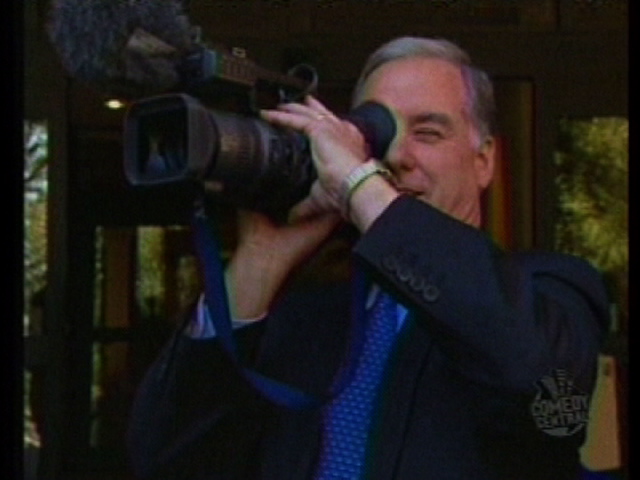
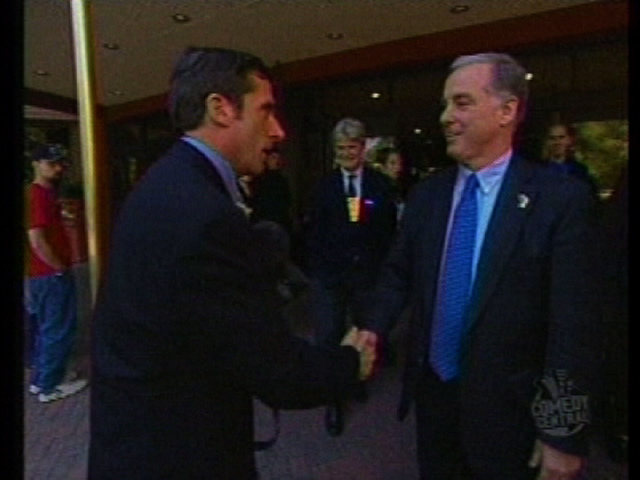
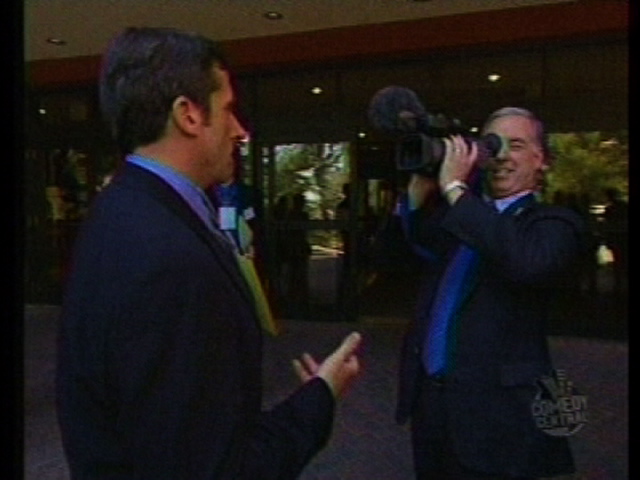

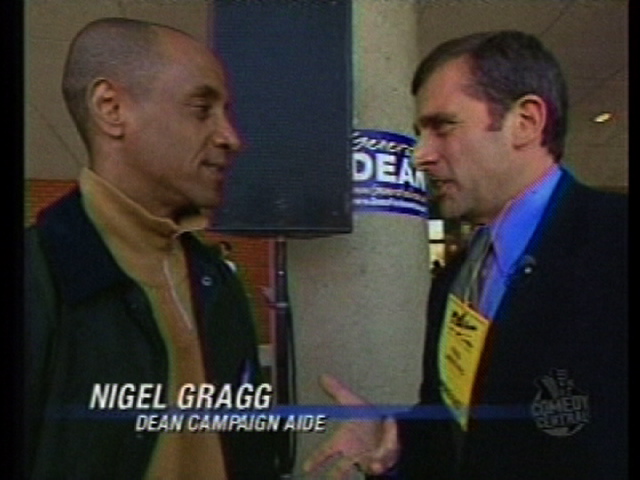
The Daily Show (The best news on television.)
Ambassador Joseph Wilson was on
Meet The Press (hosted by Tim Russert) last Sunday to discuss the leak from an unnamed top official of the Shrub Administration that ended up blowing the cover of his CIA-employed wife.
The interview with Robert Novak from the same show is also available.
Wilson clarifies some of his own comments over the last week, while Tim Russert takes advantage of the opportunity to clarify some of the facts of the situation in more detail. (Tim is the man!)
I've made the clip available in its entirety, in two pieces, and in four smaller pieces to make it easier to download and circulate the parts of interest to you. This is good stuff.
This is from the October 5, 2003 program.
Complete:
Joseph Wilson On Meet The Press - Complete (Small - 39 MB)
In Two Parts:
Joseph Wilson On Meet The Press - Part 1 of 2 (Small - 18 MB)
Joseph Wilson On Meet The Press - Part 2 of 2 (Small - 21 MB)
In Four Parts:
Joseph Wilson On Meet The Press - Part 1 of 4 (Small - 10 MB)
Joseph Wilson On Meet The Press - Part 2 of 4 (Small - 9 MB)
Joseph Wilson On Meet The Press - Part 3 of 4 (Small - 9 MB)
Joseph Wilson On Meet The Press - Part 4 of 4 (Small - 11 MB)
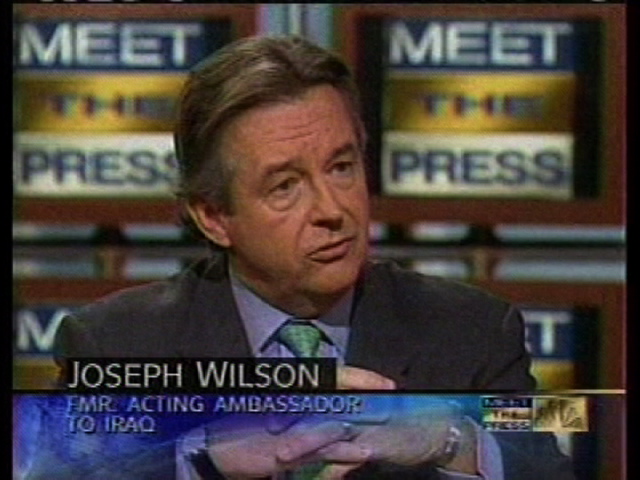
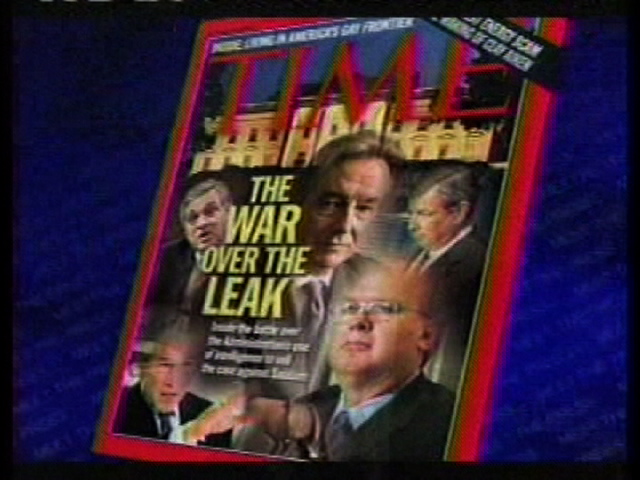
Well I certainly understand why he can't reveal the source. There's no reason to throw journalistic ethics out the window completely.
This entire situation provides a perfect demonstration of how backstabbing this Administration can be. Novak is one of the few journalists that has stood by the Shrub and his cronies and consistently defended them through all of their folly. Now he has been chosen as the sacrifical lamb to "leak" a story that could potentially land him in jail. This Administration even screws over their "friends."
It sure seems like the "senior official" interviewed by Novack knew exactly what he was doing. He gave Novak classified information and then sort of half-heartedly asked him not to print it. This is a classic example of a premeditated "leak." Novak says that he tried to downplay the information by burying it in the sixth paragraph of the article. He also claims that he uses (or "misuses," by his own admission) the word "operative" all the time, and that "oops" this time he was referring to a "real" CIA operative. (Not sure what he "really" means when he uses the word "operative" incorrectly.)
You can check it out for yourself. Sorry I couldn't bring you the entire thing. My camera would not cooperate. (I really have to send it in for servicing!) I kept letting it cool down before I tried again, and did this enough times so I could get the important part at the beginning.)
This is from the October 5, 2003 program of
Meet The Press (hosted by Tim Russert).
I've made it available in its entirety and as two smaller clips.
Note: the interview with Joseph Wilson from the same program is also available.
Complete:
Robert Novack On Meet The Press - Complete (Small - 28 MB)
In Two Parts:
Robert Novack On Meet The Press - Part 1 of 2 (Small - 14 MB)
Robert Novack On Meet The Press - Part 2 of 2 (Small - 14 MB)
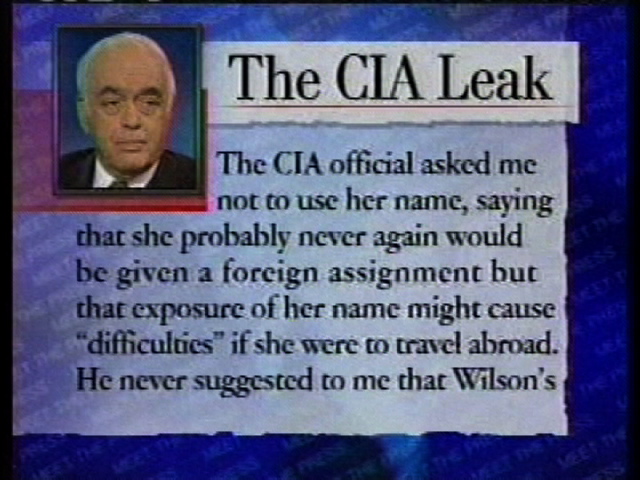
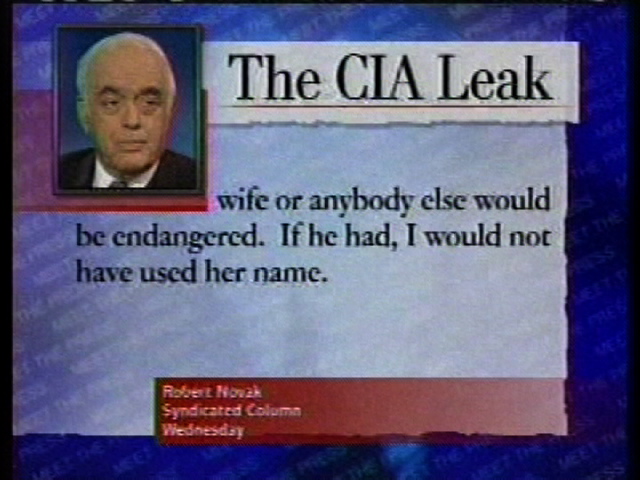
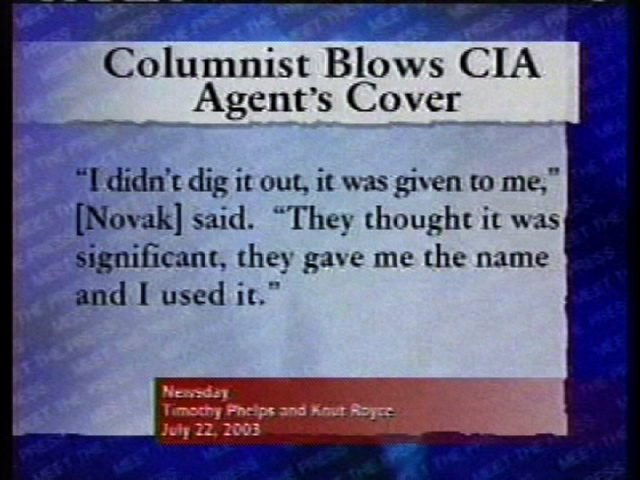
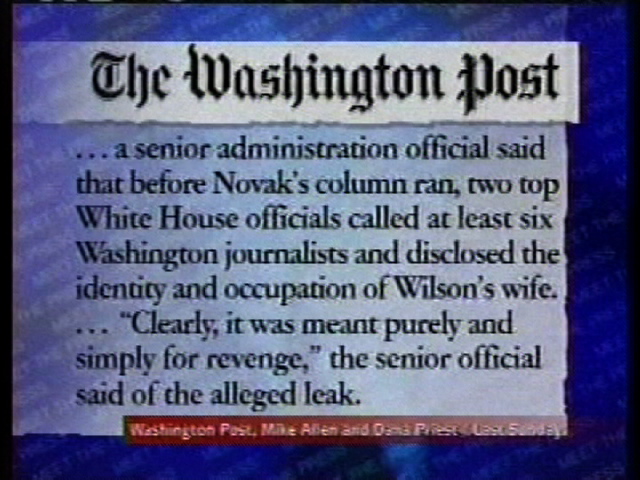
Artist Groups Deliver "Joint Statement On Current Issues In Radio"
The press release is available online here.
John Connolly, National President, AFTRA:
The escalating vertical and horizontal consolidation of radio station ownership has harmed recording artists, from the freshest innovators to the most accomplished veteran stars - AFTRA members all. As a result of the homogeneous and limited playlists that have emerged with concentrated radio station ownership, fewer artists are able to receive airplay and reach an audience. Because these same media conglomerates also own concert venues and concert promotion companies, it can't help but create a modern version of payola -- radio station owners forcing artists to be represented by their promoters and perform in their venues or run the risk of being shut out of certain key markets entirely or negatively impact the artist's airtime across the country. This monopolistic structure severely impacts the ability of artists to succeed and also harms the public - we have access to less music with less diversity, and the music we hear is selected based on crass commercial promotional considerations rather than quality or performer artistry.
Thomas F. Lee, International President, AFM:
It's bad for musicians and bad for the public when a few large radio owners can pressure performers to use promoters and venues that they control, force artists to pay independent promotion fees in order to get airplay, and homogenize radio playlists around the country. The AFM and the music community continue to insist that the radio waves belong to the public, and to demand that Congress and the FCC ensure that radio serves the public interest.
Here is the full text of the press release in case the link goes bad (full text of the statement is below it):
http://www.futureofmusic.org/news/radioissuesstatement03.cfm
ARTIST GROUPS DELIVER "JOINT STATEMENT ON CURRENT ISSUES IN RADIO" TO FCC AND CONGRESS
WASHINGTON - Today a "Joint Statement on Current Issues in Radio" was delivered to the Federal Communications Commission and congressional leaders by four organizations: the American Federation of Television and Radio Artists (AFTRA); American Federation of Musicians (AFM); the Future of Music Coalition (FMC); and the Recording Artists' Coalition (RAC).
The "Joint Statement on Current Issues in Radio" was also signed by six other groups: Artist Empowerment Coalition (AEC); Association for Independent Music (AFIM); Just Plain Folks; Nashville Songwriters Association International (NSAI); National Association of Recording Merchandisers (NARM); and the Music Managers Forum (MMF).
In the statement, the organizations expressed gratitude that some of the issues of media ownership, payola and vertical integration first highlighted in a May 2002 letter have received more attention from Congress, the FCC and by the radio industry itself.
However, the organizations also expressed their continued concern about the problems that are caused or exacerbated by radio ownership consolidation and vertical integration in the radio industry. The organizations reiterated their call on the FCC and Congress to investigate such issues as vertical integration of radio ownership, payola, radio ownership consolidation and low power radio, to ensure that radio serves the public interest.
Representatives from AFTRA, AFM, and FMC further clarified why this statement is an important development:
John Connolly, National President, AFTRA:
The escalating vertical and horizontal consolidation of radio station ownership has harmed recording artists, from the freshest innovators to the most accomplished veteran stars - AFTRA members all. As a result of the homogeneous and limited playlists that have emerged with concentrated radio station ownership, fewer artists are able to receive airplay and reach an audience. Because these same media conglomerates also own concert venues and concert promotion companies, it can't help but create a modern version of payola -- radio station owners forcing artists to be represented by their promoters and perform in their venues or run the risk of being shut out of certain key markets entirely or negatively impact the artist's airtime across the country. This monopolistic structure severely impacts the ability of artists to succeed and also harms the public - we have access to less music with less diversity, and the music we hear is selected based on crass commercial promotional considerations rather than quality or performer artistry.
Thomas F. Lee, International President, AFM:
It's bad for musicians and bad for the public when a few large radio owners can pressure performers to use promoters and venues that they control, force artists to pay independent promotion fees in order to get airplay, and homogenize radio playlists around the country. The AFM and the music community continue to insist that the radio waves belong to the public, and to demand that Congress and the FCC ensure that radio serves the public interest.
Michael Bracy, Director, Government Relations, FMC:
Congressional leaders and many at the FCC now recognize that radio consolidation has led to homogenous playlists, fewer local voices and, in extreme cases, payola and blatant censorship. Now that policymakers and the public understand the dangers of concentration, the music community will continue to push for reform of commercial radio as it exists today, while expanding non-commercial opportunities across the country. We also must be vigilant in applying the lessons of radio consolidation to broader debates about media ownership and emerging new technologies.
# # #
CONTACTS:
AFTRA: Jayne Wallace, (212) 532-0800
AFM: Patricia Polach, (202) 842-2600
FMC: Michael Bracy, (202) 331-2958
Statement is available online at:
http://www.futureofmusic.org/news/radioissuesstatement03.cfm
This press release is available online at:
http://www.futureofmusic.org/news/Prradioissues03.cfm
Here is the full text of the statement in case the link goes bad:
http://www.futureofmusic.org/news/radioissuesstatement03.cfm
Broad Artist Coalition sends Statement to FCC and Congress on Current Issues in Radio
read press release
download document as a PDF
American Federation of Musicians (AFM)
American Federation of Television
and Radio Artists (AFTRA)
Artist Empowerment Coalition (AEC)
Association for Independent Music (AFIM)
Future of Music Coalition (FMC)
Just Plain Folks Music Organization (JPF)
Music Managers Forum (MMF)
Nashville Songwriters Association
International (NSAI)
National Association of
Recording Merchandisers (NARM)
Recording Artists' Coalition (RAC)
JOINT STATEMENT ON CURRENT ISSUES IN RADIO
October 8, 2003
Update to May 2002 Statement on Issues in Radio
In May 2002, a broad coalition of music industry and advocacy groups released a Statement on Current Issues in Radio. This update to that statement is signed by key organizations that represent musicians, singers, retailers and performing artists.
Although we are pleased that the issue of media consolidation is receiving national attention, we are concerned that many of the problems caused or exacerbated by radio consolidation have yet to be resolved. We therefore collectively reiterate our call on the Federal Communications Commission and Congress to ensure that radio serves the public interest. In this document we revisit our positions on vertical integration of radio ownership, payola, radio ownership consolidation and low power radio.
Vertical Integration of Radio Ownership with other
Entertainment and Media Enterprises
The leverage and control exerted by radio group owners that are also vertically integrated companies has continued to increase. Pollstar’s Online 2003 Mid-Year Top 50 Promoters chart shows that Clear Channel Entertainment has sold more total tickets than promoters numbered 2 through 30 combined[2]. Clear Channel continues to have a direct economic interest in promoting its own concerts and tours on its numerous radio stations. It also has an interest in limiting the promotional support of bands and artists who are performing for non-Clear Channel companies, at non-Clear Channel venues or under the sponsorship of non-Clear Channel stations.
Once again, we call on the FCC to investigate whether an artist's choice to play or not to play certain venues or to use or not to use a certain promotion company impacts that artist's position on or removal from radio station group play lists. We also call on the FCC and Congress to protect artists from being required or pressured to do free concerts or concerts at less than market rates at any venues owned by a radio station licensee in order to protect or enhance their ability to receive airplay of their music. We also request that the FCC and Congress protect an artist's right to negotiate fairly with companies like Ticketmaster that dominate the market and have exclusive contracts with the majority of performance venues.
Payola
Our May 2002 Statement called attention to de facto systems of payola under which programming decisions are influenced by varied forms of paid consideration and business relationships, rather than the merits of recordings. In our view, payola of this type has not abated. We reiterate our view that payments made or consideration provided to radio stations to influence playlists -- other than legitimate and reasonable promotional expenses -- must be prohibited, unless such payments are announced over the air. This includes payments made through independent radio promoters and considerations like free concerts or other services provided to radio stations.[3]
Our May 2002 statement focused on independent radio promotion as a disguised form of payola. We are gratified that, since the release of that statement, radio station owners Clear Channel and Cox Communications have announced that they will sever ties with independent radio promoters. However, Clear Channel's decision to abandon the increasingly controversial practice of independent radio promotion does little to protect artists and the public from future forms of payola. To the contrary, a recent press release by the company suggested that rather than using independent promoters, Clear Channel will now partner directly with labels to create in house promotional activities like "group-wide" contests involving artists.[4] This new promotional strategy does nothing to address our payola concerns and strikes yet another blow to localism. Since Clear Channel is a national radio group, their description of "group-wide" contests implies that they and other consolidated radio chains will very likely program from a centralized location and focus on artists with group-wide, i.e., national, appeal at the expense of artists with local appeal. This practice ignores the FCC principle that individual radio stations in radio groups are licensed to serve local communities. Furthermore, this practice, if implemented, will continue to harm local artists, making it nearly impossible for them to use their local popularity to garner local airtime and denying even the most successful local artists legitimate access to a local audience.
We are also worried that other in-kind exchanges may replace independent promotion and that radio stations will continue to select recordings for play lists based not on the merits of the recordings but on what the station “receives” in exchange for playing the song. These in-kind exchanges are more difficult to track but include a range of possibilities including artists playing for free or for a reduced rate at concerts promoted by the radio stations, or playing only at venues owned by the radio station’s parent company in order to receive a coveted spot on the playlist. These new partnerships may obscure pay-for-play exchanges and temporarily protect the radio companies from payola allegations, but they do nothing to protect the public or insure artists’ access to the public airwaves.
Widespread Radio Ownership Consolidation
A November 2002 study conducted by the Future of Music Coalition confirmed that radio consolidation has resulted in a loss of localism, less competition, fewer viewpoints and less diversity in radio programming in media markets across the country.[5]
We therefore reiterate our request that the FCC investigate the consolidation of radio ownership in light of the public interests that radio stations are charged to serve. The FCC must examine how consolidation affects the choice of music played on the radio, investigate the existence of national playlists, and clarify the role that consolidation has had on the skyrocketing costs of radio promotion.
Low Power Radio
Low Power FM stations are community-based, non-commercial radio stations that operate at 100 watts or less. Adopted by the Federal Communications Commission in January 2000, the Low Power FM service is designed to provide broadcasting outlets for local organizations – churches, schools, community groups, and unions – as an alternative to the many current centrally-programmed commercial stations that exist across the country.
Low Power FM stations can provide programming to meet the needs of specific and underrepresented groups including minorities, religious and linguistic communities, and can provide a much needed forum for debate about important local issues. LPFM stations strengthen community identity in urban neighborhoods, rural towns and other communities that are currently too small to win much attention from "mainstream," ratings-driven media.
Recording and performing artists, in particular, can benefit greatly by the creation and expansion of Low Power FM stations, giving them more outlets for airplay, especially on a local or regional level, or in genres that are currently under-represented on commercial radio.
In 2000, Congress directed the FCC to hire an outside entity -- the MITRE Corporation -- to conduct field tests to resolve the issue of Low Power FM's potential for interference with existing radio stations. In July 2003, the MITRE Study was released and the results concluded that the interference feared by incumbent broadcasters was not an issue. It will take congressional action to put Low Power radio back on track for serving a greater portion of America's cities. As artist advocates, we support the expansion of Low Power FM stations, and see this service as one of the antidotes to the effects of media concentration.
Conclusion
As advocates for artists and creators, we remain concerned about the problems that are caused or exacerbated by radio ownership consolidation and vertical integration in the radio industry. Some radio group owners may have severed ties with independent promoters, but other forms of payments and consideration are likely to develop if they are not checked by appropriate oversight and rules. Clear penalties must be established for radio station licensees who attempt to use their leverage to force artists to perform for free, to perform at less than market rates, or to perform in specific venues that are more beneficial for the licensees. Furthermore, we call on Congress to examine whether radio stations are serving the public interest by contributing to localism and independence in broadcasting – an issue that the FCC failed to address in its recent media review – and to ensure that the FCC has regulations in place that will uphold the public interest. Finally, we urge Congress to vote to reauthorize the FCC to relax their overly stringent interference protections and allow Low Power radio stations to be licensed in more densely populated areas.
Respectfully submitted by the following organizations:
American Federation of Musicians (AFM)
American Federation of Television and Radio Artists (AFTRA)
Artist Empowerment Coalition (AEC)
Association for Independent Music (AFIM)
Future of Music Coalition (FMC)
Just Plain Folks Music Organization (JPF)
Music Managers Forum (MMF)
Nashville Songwriters Association International (NSAI)
National Association of Recording Merchandisers (NARM)
Recording Artists' Coalition (RAC)
Footnotes:
1. Joint Statement on Current Issues in Radio, May 24, 2002. http://www.futureofmusic.org/news/radioissuesstatement.cfm
2. Pollstar’s 2003 Mid-Year Business Analysis, July 2003 http://www.pollstaronline.com/my2003biz.asp
The charts displaying the top 50 promoters are available to Pollstar subscribers only. http://www.pollstaronline.com/PSOHome.asp
3. Eric Boehlert, “Pay for Play”, Salon.com, March 14, 2001. http://dir.salon.com/ent/feature/2001/03/14/payola/index.html
Eric Boehlert, “Will Congress Tackle Pay for Play?” Salon.com, June 25, 2002.
http://archive.salon.com/ent/feature/2002/06/25/pfp_congress/
Eric Boehlert, “Radio’s Big Bully”, Salon.com series on Clear Channel, radio, and pay for play. Salon.com, 2000-2002. http://archive.salon.com/ent/feature/2002/06/25/pfp_congress/
4. “Clear Channel Cuts Ties with Independent Promoters”, April 9, 2003. http://www.clearchannel.com/documents/press_releases/20030409_Corp_Indies.pdf
Greg Kot, “We haven't seen the last of pay-for-play”, Chicago Tribune, April 13, 2003. http://www.chicagotribune.com/features/arts/chi0304130407apr13,1,668938.story
“Clear Channel Appoints In-House ‘Format Liaisons’: 12 Programmers Will Work Directly With Labels, Artists On Group-Wide Promotions”, Friday Morning Quarterback, April 15, 2003.
5. Future of Music Coalition, “Radio Deregulation: Has It Served Citizens and Musicians?” November 18, 2002. http://www.futureofmusic.org/research/radiostudy.cfm
Why is Arnie so sad about it? The salary he'll be making, and that he has to move to Sacramento :-)
This is from the October 8, 2003 program.
Steve Carell On Arnie's Sad Win (Small - 7 MB)

The Daily Show. (The best news on television.)
This is from the October 8, 2003 program.
More From The Daily Show On Arnie's Governorship Celebration Party (Small - 4 MB)
The Daily Show. (The best news on television.)
Hillary was great last night. She isn't optimistic about our future with Arnie though.
She wishes us well because we "have a lot of problems." (No shit. And we just elected a big fat new problem.)
She skillfully dodges Stewart's question about whether or not she'll run for president at the last minute. How about Vice President, Hillary? A Dean/Clinton ticket would sure be a beautiful thing indeed.
This is from the October 8, 2003 program.
Hillary On The Daily Show - Complete (Small - 20 MB)
Hillary On The Daily Show - Part 1 of 2 (Small - 12 MB)
Hillary On The Daily Show - Part 2 of 2 (Small - 8 MB)

The Daily Show. (The best news on television.)
This is from the September 24, 2003 program.
Alabama is facing its worst budget crisis since the great depression. When faced with a modest tax hike or the utter decimation of its state government, Alabama voters voted for the utter decimation of the government. This will result in the closing of 52 driver's examination sites, 2 Field offices, the creation of a 4 day work week for State Troopers, hundreds of employees and prosecutor's offices being laid off, and 5,000 - 6,000 inmates being released early (among other things).
As usual, I received all of this detailed information from
The Daily Show.
Alabama Tax Crisis (Small - 7 MB)

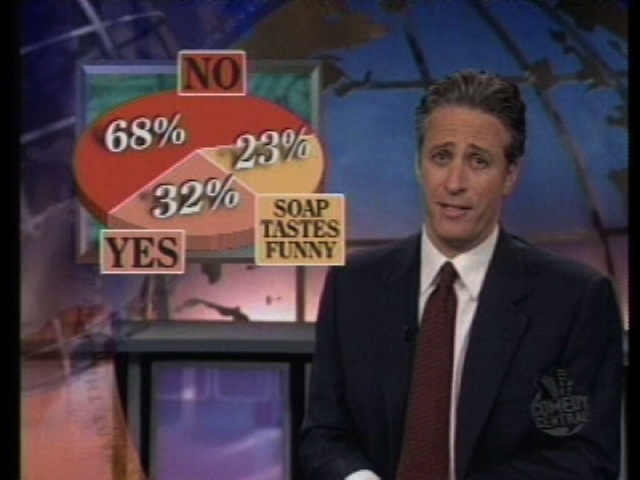
The Daily Show. (The best news on television.)
This is from the September 24, 2003 program.
A court in Alabama has been forced to remove its monument of the Ten Commandments from its Federal Court Building. Stephen Colbert was there to cover the situation.
This film was produced by Jim Margolis and Edited by Einar Westerlund.
Take Two Tablets... (Small - 12 MB)
The Daily Show. (The best news on television.)
Audio Of My First ever protools file...
So I wasnt' sure if this was a funny as it seemed to me, but when my protools teacher literally fell over in his chair laughing after hearing it, I figured it was ready for prime time.
This is little old me doing my first recording ever in my new home studio set up. I've got my little heartfelt song going, when suddenly I am attacked by some kind of interference at the end.
WARNING -- gets loud and horrible at the end and I think I say a naughty word. (The pain made me do it!)
Perhaps someone recognizes this type of noise and can tell me how to get rid of it? If not, at least you might find it entertaining.
My First Bunk Protools Experience (MP3 - 2 MB)
(Update 9:18pm: Hey this links been bad all day -- just fixed it!)
Well guys, we tried hard, but we were outnumbered by the sheep.
However, it's not over. If I understand correctly from the little birdies I know, the next step is Recalling Arnold. People will start collecting signatures soon so keep an eye out.
This isn't over yet. We won't just hand our state's future over without a fight.
It may seem a little silly to go around and around like this, but they started it.
In the mean time, try to keep your spirits up. At least Prop 54 didn't pass!
I've got to go to a meeting this morning at my local elementary school, where I'll be starting soon as an SF School Volunteer (more on this later). Then I'll be back to upload some more new music to help get our minds off of this negative stuff.
Peace,
lisa
Cronkite: The new Inquisition
By Walter Cronkite for the Denver Post.
In his 2 1/2 years in office, Attorney General John Ashcroft has earned himself a remarkable distinction as the Torquemada of American law. Tomas de Torquemada was the 15th century Dominican friar who became the grand inquisitor of the Spanish Inquisition. He was largely responsible for its methods, including torture and the burning of heretics - Muslims in particular.Now, of course, I am not accusing the attorney general of pulling out anyone's fingernails or burning people at the stake (at least I don't know of any such cases). But one does get the sense these days that the old Spaniard's spirit is comfortably at home in Ashcroft's Department of Justice.
The Patriot Act is much in the news, as Ashcroft and his minions seek both to justify its excesses and strengthen them, thus intensifying its dangerous infringements on the Bill of Rights.
There was something almost medieval in the treatment of Muslim suspects in the aftermath of Sept. 11. Many were held incommunicado, without effective counsel and without ever being charged, not for days or weeks, but for months or longer, some under harsh conditions designed for the most dangerous criminals.
It was in the spirit of the Inquisition that the Justice Department announced recently that it would begin gathering data on judges who give sentences lighter than called for by legislative guidelines.
Nothing so clearly evokes Torquemada's spirit as Ashcroft's penchant for overruling U.S. attorneys who have sought lesser penalties in capital cases. The attorney general has done this at least 30 times since he took office, according to the Federal Death Penalty Resource Counsel. In several cases, Ashcroft actually has overturned plea bargains negotiated by those government prosecutors.
The New York Times editorialized that the attorney general seems to want the death penalty used more often.
Ashcroft is not alone in this. His boss, while governor of Texas, seemed never to have met a death sentence he didn't like. The two of them represent a subdivision of the Republican Party known as the "social conservatives," who often have favored the use of government power to police moral issues they view as modern heresies, such as abortion, homosexuality and obscenity. They contrast with those Republicans who tend to resist such uses of federal power and can generally be counted on to defend individual rights.
What makes this administration's legal bloodthirstiness particularly alarming is the almost religious zeal that seems to drive it. So, what we are seeing now is a confluence of two streams of American thought. One of those streams represents those who believe security must have priority over civil rights. The other stream represents those who believe that civil rights must be preserved even as we prosecute to the hilt the war on terrorism.
Our liberty could drown in the resultant turbulence of these colliding currents.
Here is the full text of the article in case the link goes bad:
http://www.denverpost.com/Stories/0,1413,36~29003~1640999,00.html
walter cronkite
Cronkite: The new Inquisition
By Walter Cronkite
President Bush's televised answer to the growing concerns of many - including some Republicans - about the powers granted to him in the USA Patriot Act was to ask for even stronger measures, particularly the expanded use of "nonjudicial subpoenas." That means a federal agency such as the FBI can write its own subpoenas to conduct a search - no judges needed.
Unfortunately, security and liberty form a zero-sum equation. The inevitable trade-off: To increase security is to decrease liberty and vice versa. In the past, such trade-offs have been temporary - for the duration of the crisis of the moment. But today, we cannot see an end to the War on Terrorism, and that forces us to decide how secure we have to be and how free we want to be.
By delivering the speech last week himself, Bush added presidential heft to the issue and took some of the heat off of his attorney general, who is seen by many as the heedless champion of security at any price.
In his 2 1/2 years in office, Attorney General John Ashcroft has earned himself a remarkable distinction as the Torquemada of American law. Tomas de Torquemada was the 15th century Dominican friar who became the grand inquisitor of the Spanish Inquisition. He was largely responsible for its methods, including torture and the burning of heretics - Muslims in particular.
Now, of course, I am not accusing the attorney general of pulling out anyone's fingernails or burning people at the stake (at least I don't know of any such cases). But one does get the sense these days that the old Spaniard's spirit is comfortably at home in Ashcroft's Department of Justice.
The Patriot Act is much in the news, as Ashcroft and his minions seek both to justify its excesses and strengthen them, thus intensifying its dangerous infringements on the Bill of Rights.
There was something almost medieval in the treatment of Muslim suspects in the aftermath of Sept. 11. Many were held incommunicado, without effective counsel and without ever being charged, not for days or weeks, but for months or longer, some under harsh conditions designed for the most dangerous criminals.
It was in the spirit of the Inquisition that the Justice Department announced recently that it would begin gathering data on judges who give sentences lighter than called for by legislative guidelines.
Nothing so clearly evokes Torquemada's spirit as Ashcroft's penchant for overruling U.S. attorneys who have sought lesser penalties in capital cases. The attorney general has done this at least 30 times since he took office, according to the Federal Death Penalty Resource Counsel. In several cases, Ashcroft actually has overturned plea bargains negotiated by those government prosecutors.
The New York Times editorialized that the attorney general seems to want the death penalty used more often.
Ashcroft is not alone in this. His boss, while governor of Texas, seemed never to have met a death sentence he didn't like. The two of them represent a subdivision of the Republican Party known as the "social conservatives," who often have favored the use of government power to police moral issues they view as modern heresies, such as abortion, homosexuality and obscenity. They contrast with those Republicans who tend to resist such uses of federal power and can generally be counted on to defend individual rights.
What makes this administration's legal bloodthirstiness particularly alarming is the almost religious zeal that seems to drive it. So, what we are seeing now is a confluence of two streams of American thought. One of those streams represents those who believe security must have priority over civil rights. The other stream represents those who believe that civil rights must be preserved even as we prosecute to the hilt the war on terrorism.
Our liberty could drown in the resultant turbulence of these colliding currents.
Walter Cronkite has been a journalist for more than 60 years, including 19 as anchor of the CBS Evening News.
Wish I'd had a chance to put this up over the weekend, but I just got back into town late tonight.
A friend of mine and I were discussing the idea of creating a "groping index" of sorts that might be useful to help keep track of the 16 sexual harassment complaints about Arnie that have come in so far -- and the rest that are likely to start pouring in over the next few weeks.
Little did we know that Jon Stewart had already begun just such an index last Thursday night!
This is from the October 2, 2003 program.
Jon will be providing live results from the election tonight! Don't Miss it!
Arnie's Groping Confession and Helpful Score Card (Including Bizarre Vagina Requests) (Small - 4 MB)

The Daily Show (The best news on television.)
Doug McGuire is a consultant, entrepreneur, and self-proclaimed "writer wannabe" who has taken the time to put the following essay together about Arnold Schwarzenegger, which he has entitled "The Groping Narcissist."
McGuire's done a fair amount of research on this article, and I felt it was worthy of bringing it to your attention before the vote tomorrow.
The transcripts included were borrowed from www.burrelles.com.
The full text is available below. It's not available online - he just sent me a DOC file in an Email. Doug can be reached at Damac57@cs.com.
But does Arnold have the politically savvy to win in California? Oprah’s interview with Arnold was revealing in another way. Demonstrating an innate knack for politics, Arnold was insistent that it was OK to lie to the public, in order to sway their opinion. Like a drum beat he said this over and over.Oprah: Something you did in 1977, 26 years ago, comes out about Oui
magazine where you were talking about having smoked pot and inhaling and described wild sexual experiences in detail 26 years ago. Now did you remember that interview?Arnold: We…said the most outrageous things that you can say in order to make
headlines and to be out there… [makes his point once…smiling]Oprah: Were you making some of that stuff up?
Arnold: …the idea was to say things…over the top so you get headlines [makes
it again…laughing]Oprah: Yeah
Arnold: [he’s on a roll now…he’s grinning…really full of himself] …we were
really out there doing, you know, Andy Warhol, and this whole thing—and so we were trying to get attention. So this were intent—attention—grabbers, those—those kind of lines.Finally, just to make sure Oprah understood his point that it is OK to lie to the public, as if he was emphasizing how important such a skill would be in politics, he said it again, seriously:
Arnold: But I mean, this was all outrageous statements in order for people to
say, ‘Oh my God, I got to try that’Say things that are “over the top.” “Make headlines.” “Be out there.” Use “attention grabbers.” I get it. This is how you would develop campaign sound bites. One-liners. Slogans. Outrageous comments are fair game. Let’s see what outrageous, over the top, attention-grabbing, lies he is telling today in order to get headlines:
“I want to prove to the women that I will be a champion for the women. A champion for the women.” “I’m very pro-women. I’m very much into equality.”
“Hasta la vista, car tax.” "I can kill the tax with my signature alone, and I will do exactly that."
“Game over” “I’ll be back”
The Groping Narcissist
Remember Narcissus from Greek mythology? He was the handsome fellow who fell in love with himself after discovering his own reflection in a pool of water. Narcissus died when he couldn’t fulfill the love. Michael Maccoby, an anthropologist and psychoanalyst reminded us in his January-February 2000 Harvard Business Review article that it was Freud who dubbed a certain personality type as Narcissistic, borrowing from the ancient myth.
Maccoby segues from the “pathological preoccupation” with his own body that doomed Narcissus, and uses Freud’s personality type to analyze modern leaders. He says that narcissism can be both productive and non-productive. The non-productive is interesting in today’s context. Maccoby goes beyond the simple self-love and admiration of Narcissus, and describes today’s non-productive narcissist in Freudian thought: “relentless and ruthless in their pursuit of victory” “not restrained by conscience” “achievements can feed feelings of grandiosity” “a tendency toward grandiosity” “they nurture grand schemes” “lacking self-knowledge and restraining anchors, narcissists become unrealistic dreamers.”
What career path would a non-productive narcissist follow, you might wonder? How does a genuine narcissist derive the most fulfillment? A body-builder, perhaps. In that pursuit, like Narcissus, one could spend all hours of the day gazing at floor-to-ceiling mirrors, admiring his own reflection. Approving followers could enjoy his handsome physique, too. The non-productive narcissist, “relentless and ruthless in pursuit of victory,” might even win seven Mr. Universe titles.
Conquering that world, or should I say ‘Universe”, and “with a tendency toward grandiosity,” perhaps he would become an actor, a leading man, so he could always be on stage. Here again the narcissist gains the unambiguous indulgence and adoration of admiring fans. People would cheer him in the streets.
But that would run its course too, because acting is really a fantasy and not so much a “grand scheme”. To feed his feelings of grandiosity, the non-productive narcissist would need more than just devoted followers. He needs everyone to depend on him. He will save everyone, thus earning their love and devotion, their adulation. He needs to run California. Yeah, that should do it.
The following dialogue is clipped from Burrelle’s transcripts at www.burrelles.com. It is part of the text of the recent Oprah Winfrey Show when Oprah interviewed Arnold Schwarzenegger. In the interview, Schwarzenegger described his career path to Oprah. They discussed how much Arnold enjoyed the recall campaign and why he decided to go for it. Bear in mind that Arnold couldn’t very well say that his past “achievements” were beginning to “feed feelings of grandiosity” and that he had begun to “nurture grand schemes” and that “lacking self-knowledge and restraining anchors” he had become an “unrealistic dreamer.” So he just said he wanted to try something new.
Oprah: Are you liking it, Arnold, though? You’re liking it?
Arnold: I love it.
Oprah: You love it.
Arnold: I-I absolutely love it.
Oprah: Because you love a challenge. Yeah.
Arnold: You have to understand—no, but, you know, remember when— when—when we met I was just getting out of body-building and…
Oprah: Yeah.
Arnold: …and I was just getting—this was the late 70s…
Oprah: Yeah
Arnold: …and you asking me the same question, you said to me, when we were
driving around in Baltimore, you said, you know, ‘How is it now, getting into the acting?’ And I—I said to you, ‘I’m excited about doing something new. I’ve done the body building now, the competition, the training every day, five hours. I want to learn something new. I want to get into show business and work my way up in show business, and be a leading man and all this.’ And you said, ‘Wow, yeah, if this will happen.’
Oprah: See, I didn’t believe you then, but I believe you now. I believe you
now.
Arnold: But the same is—but the same is now Oprah. It’s the same thing, It’s
a new thing.
So, a possible career path for the non-productive narcissist is from body-builder, where awards are given with grandiose sounding titles like Mr. Universe, to ‘leading man’ where he can appear on a larger stage, where superficial imagery reaches even more people. Finally, by moving into politics, the non-productive narcissist might even become a real-life hero, proving that his past achievements were no fantasies at all. Mr. Universe, Terminator, Governor Schwarzenegger. Ah.
But does Arnold have the politically savvy to win in California? Oprah’s interview with Arnold was revealing in another way. Demonstrating an innate knack for politics, Arnold was insistent that it was OK to lie to the public, in order to sway their opinion. Like a drum beat he said this over and over.
Oprah: Something you did in 1977, 26 years ago, comes out about Oui
magazine where you were talking about having smoked pot and inhaling and described wild sexual experiences in detail 26 years ago. Now did you remember that interview?
Arnold: We…said the most outrageous things that you can say in order to make
headlines and to be out there… [makes his point once…smiling]
Oprah: Were you making some of that stuff up?
Arnold: …the idea was to say things…over the top so you get headlines [makes
it again…laughing]
Oprah: Yeah
Arnold: [he’s on a roll now…he’s grinning…really full of himself] …we were
really out there doing, you know, Andy Warhol, and this whole thing—and so we were trying to get attention. So this were intent—attention—grabbers, those—those kind of lines.
Finally, just to make sure Oprah understood his point that it is OK to lie to the public, as if he was emphasizing how important such a skill would be in politics, he said it again, seriously:
Arnold: But I mean, this was all outrageous statements in order for people to
say, ‘Oh my God, I got to try that’
Say things that are “over the top.” “Make headlines.” “Be out there.” Use “attention grabbers.” I get it. This is how you would develop campaign sound bites. One-liners. Slogans. Outrageous comments are fair game. Let’s see what outrageous, over the top, attention-grabbing, lies he is telling today in order to get headlines:
“I want to prove to the women that I will be a champion for the women. A champion for the women.” “I’m very pro-women. I’m very much into equality.”
“Hasta la vista, car tax.” "I can kill the tax with my signature alone, and I will do exactly that."
“Game over” “I’ll be back”
Never mind that killing the car tax will increase the California budget deficit by more than four billion dollars.
I see it now -- go into politics – get the public’s attention -- lie to them -- sway their opinion -- and so on. Makes sense. But how do you explain it if someone catches you on the lies? Here again we see Arnold’s simple brilliance:
Oprah: When you decided to run for governor, you must have known
everything you’ve ever done is now going to come to the forefront.
Arnold: See, so, but it—and the—and at the time, I did not—I did not think that
I’m going to run for governor either.
Oprah: Yeah.
Arnold: So, of course, you know, I was saying those things and I was over the
top in order to….
Oprah: Because you would have cleaned it up.
Arnold: Hey, believe me.
Oprah: Yeah.
Another part of Arnold’s interview was a shocker. Remember, this is the Oprah Winfrey Show. A hundred times during each show, the camera flashes to the smiling faces of the soccer moms in the audience, the suburban Chicago women, and the progressive gals who visit the Oprah show for its positive message. More importantly, sitting next to Arnold is his wife, Maria. The reaction by Maria and Oprah indicates they were stunned by Arnold’s crude and unnecessary remark. It shouldn’t be a surprise, however, because narcissists also tend to be insensitive oafs:
Oprah: Do you remember the parties, Arnold?
Arnold: I really don’t. No, but, I mean, you know, these were the times where I
was saying things, like, you know, ‘a pump is better than cumming,’ and all those kinds of things. Yeah.
There was both embarrassed laughter and sounds of stunned disbelief. Maria’s and Oprah’s eyes were wide open and their jaws dropped. They were laughing, but it was nervous, embarrassed laughter. Especially for Maria. Arnold continued talking over the din of the audience, and the interruptions by Maria. Maria even covered Arnold’s mouth with her hand. Yes, she reached up on national television and put her hand over his mouth, so stunned was she by his insensitivity. But Arnold just pulled away from her hand and kept on talking:
Arnold: No, no, but, I mean—but, like, you know, today…
Maria: Wait a minute. Why did you do that? I said my mother
is watching this show. My mother is watching this show.
Arnold: I know. I un—I understand. I understand. I understand. OK.
Maria: I mean, my God. Now…
Arnold: Wherever—wherever Eunice is, don’t pay any attention. OK. But
I mean, but the point…
I think Maria next tried to help Arnold, to lead him out of the dog pile, but he really didn’t listen to her. That’s another trait of the narcissist. They don’t listen to others.
Maria: Right. That’s the stuff you used to say.
Arnold: No, no. That’s what I’m saying. But the point of it…the—the—the--is
Maria: OK.
Oprah: Let him say…
Arnold: Thank you.
Maria: But I don’t want to let him say anything. Oh.
Arnold: You see, now…
Oprah: Go ahead, Arnold. Finish.
Arnold: No, no. But now…
Oprah: Now?
Arnold: ….now you know what I go through at home, OK? So gives you a
little taste.
Oprah: Yeah
Now, when Arnold made the wisecrack about his life at home with Maria, it was a joke, right? Or, was Arnold really “kidding on the square”? Either way, it’s obvious now how much Arnold respects women. They aren’t just for groping whenever you have the urge. They’re are worth putting up with, even if it gets a little tough at home.
But wait. Is that really it? When Arnold says he’s a champion of the women, and that he believes in equality for women, is he really just saying outrageous, attention-grabber headlines, to sway public opinion? To get people to say “Oh, my God. I’ve got to vote for this guy?”
In August, a study surfaced by James Houran, a psychology professor at the Southern Illinois University School of Medicine, about Celebrity Worship Syndrome, an affliction that affects as much as one third of the population. People with CWS are overly susceptible to real-life influence by their fantasy idol. At one extreme, those with CWS will go so far as to commit a crime if asked by an idol to do so; Hitler’s followers, for example. At the milder end of the scale, a CWS sufferer will do less harmful things, like believe every word their idol says. Or, if their idol is a murderer, even though most CWS sufferers would never kill anyone, they might cheer while a white Bronco carries their idol-murderer down the highway. Or, if their idol is a pro-athlete accused of rape, they might stand and cheer him on when he enters a courtroom. Will CWS sufferers vote for their idol, the happy narcissist? That’s a slam-dunk.
Idolatry. Hero worship. Isn’t this what Arnold is all about? He keeps weaving his old movie lines into his campaign slogans as if he is aware that he needs the CWS vote. During a recent political debate, he even told Arriana he had a role for her in Terminator 4. He doesn’t seem to want to leave his movie star roots behind. He needs votes from his CWS-suffering followers, the one third who will vote for him because he is a movie star -- part of their fantasy – who don’t really care if he is a rake, much less if he has the political skills to run the state with the sixth largest economy in the world. Arnold needs the CWS vote because he doesn’t have a political base. But even more than politics, he really needs the CWS vote to fulfill his more than ample self-love and admiration, to feed his grandiose and narcissistic schemes, and to convert his fantasy-world heroism to real-life heroism.
On the subject of groping and being “not restrained by conscience,” Arnold’s recent admissions that he fondled women on “rowdy movie sets” and other places, accusations that span from the 1970s to the year 2000, and for which he has summarily apologized, perhaps should be overlooked. Maybe we shouldn’t hold him accountable for that “bad behavior,” because, well, as he put it:
“See, so, but it—and the—and at the time, I did not—I did not think that I’m going to run for governor either.”
Yeah.
Here's a message from MoveOn about why it's sooooo important for you to vote tomorrow in the California Recall Election.
I've rearranged them a bit because I still believe that Arnold's connection to the energy crooks (here's Greg Palast's Info on this issue) is the most important reason to not trust this guy as governor.
Dear Friend,
Please forward this email to anyone you think should read it -- this is once again a very close race and tomorrow every single vote will count. Also keep in mind that many usual polling places will be closed this election. You can click here to look up your polling place. And forward this to your friends so they can look up their polling places as well.
Seven Reasons Why You Absolutely, Positively MUST Vote on Oct. 7:Ed note: I'm putting #7 first because I still feel it's most important:
7. Because Schwarzenegger STILL hasn't explained why he met with Enron's Kenneth Lay at the height of the energy crisis. Schwarzenegger attended a meeting of top business leaders and Republican politicians on May 17, 2001 that was apparently held to thwart a Davis-Bustamante plan to recover $9 billion from energy companies. He still hasn't explained why he was there or whether his candidacy for Governor was discussed at that meeting. And he's refusing to talk to reporters in these last days of the campaign. (San Mateo Times, FTCR)
1. Your vote matters. If you don't vote, Schwarzenegger becomes your governor. It's that simple. A poll conducted Wednesday through Saturday showed support for the recall and Schwarzenegger dropping fast. This election could be decided by a very small number of votes. We can win this, but your vote is absolutely necessary. (
The Mercury News)2. Arnold Schwarzenegger is a Pete Wilson sequel. Governor Pete Wilson grew state spending much faster than Gray Davis ever has. Worse, he championed energy deregulation and in 1996 signed the bill that deregulated energy in California. Wilson opened the gates to let his energy pals rob the state blind. And now he and his former team are running Schwarzenegger's campaign and choosing his policies. Even more troubling: Schwarzenegger seems to be in bed with the same energy interests as Wilson (See #7). We want to see Terminator 4, not Wilson 2. (Horowitz, Conason)
3. We have no idea what Schwarzenegger is going to do with California, and neither does he. He doesn't have a plan to balance the budget. He hasn't said what cuts he'll make or what taxes he'll raise. California needs a real leader, not someone who plays one in the movies. You may be frustrated with the way things are now -- but if Schwarzenegger had a plan to make them better, don't you think he would have told us about it?
4. He lied about taking money from special interests. The night he announced his candidacy on the Jay Leno show he told us, "As you know, I don't need to take money from anyone. I have plenty of money myself." He then turned right around and accepted over $10 million not from "special" interests, but rather, as he explained it, "business and individuals, absolutely. They're powerful interests who control things." (Saramento Bee,
CNN)5. Arnold Schwarzenegger might belong on the sex offender registry, but not in the governor's mansion. So far 15 credible women have come forward with stories of being physically assaulted by this man -- some only a few years ago. He has not denied some of the stories (in fact, he said "where there's smoke, there's fire"). He has tried to chalk his mistakes up to "rowdiness." But these incidents constitute a string of crimes that would land anyone except a multi-millionaire actor in jail and on the sex offender registry. (Los Angeles Times, Newsday)
6. The Nazi stuff is serious. Who care's how long ago it was that Arnold Schwarzenegger said that he wanted to have an experience, "like Hitler in the Nuremberg stadium, and have all those people scream at you and just being in total agreement with whatever you say." That's scary! And now nuns are being roughed up at Schwarzenegger rallies. A film maker who worked closely with Schwarzenegger in the 70's says he saw him playing, "Nazi marching songs from long-playing records in his collection at home." At his 1988 wedding Schwarzenegger toasted a confirmed Nazi war criminal, Kurt Waldheim, saying "My friends don't want me to mention Kurt's name, because of all the recent Nazi stuff and the U.N. controversy, but I love him and Maria does too, and so thank you, Kurt." Where there's smoke, there's fire! (New York Times, Slate, Sacramento Bee, Los Angeles Times)
Thank you,-- Carrie, Eli, James, Joan, Noah, Peter, Wes, and Zack
The MoveOn PAC Team
October 6th, 2003
Reminder: NO on the Recall. Yes on Cruz Bustamante. (No on Prop 54.)
As I suspected, this Recall is more about trying to quash a lawsuit against the crooks that took the people of California for 9 Billion dollars than anything else.
Greg Palast has done his homework again. Read on.
Arnold Unplugged - It's hasta la vista to $9 billion if the Governator is selected
By Greg Palast.
It's not what Arnold Schwarzenegger did to the girls a decade back that should raise an eyebrow. According to a series of memoranda our office obtained today, it's his dalliance with the boys in a hotel room just two years ago that's the real scandal...It turns out that Schwarzenegger knowingly joined the hush-hush encounter as part of a campaign to sabotage a Davis-Bustamante plan to make Enron and other power pirates then ravaging California pay back the $9 billion in illicit profits they carried off.
Here's the story Arnold doesn't want you to hear. The biggest single threat to Ken Lay and the electricity lords is a private lawsuit filed last year under California's unique Civil Code provision 17200, the "Unfair Business Practices Act." This litigation, heading to trial now in Los Angeles, would make the power companies return the $9 billion they filched from California electricity and gas customers.
It takes real cojones to bring such a suit. Who's the plaintiff taking on the bad guys? Cruz Bustamante, Lieutenant Governor and reluctant leading candidate against Schwarzenegger...
But Bush's boys on the commission have a problem. The evidence against the electricity barons is rock solid: fraudulent reporting of sales transactions, megawatt "laundering," fake power delivery scheduling and straight out conspiracy (including meetings in hotel rooms).
So the Bush commissioners cook up a terrific scheme: charge the companies with conspiracy but offer them, behind closed doors, deals in which they have to pay only two cents on each dollar they filched.
Here is the full text of the article in case the link goes bad:
http://www.gregpalast.com/printerfriendly.cfm?artid=283
Arnold Unplugged - It's hasta la vista to $9 billion if the Governator is selected
Friday, October 3, 2003
It's not what Arnold Schwarzenegger did to the girls a decade back that should raise an eyebrow. According to a series of memoranda our office obtained today, it's his dalliance with the boys in a hotel room just two years ago that's the real scandal.
The wannabe governor has yet to deny that on May 17, 2001, at the Peninsula Hotel in Los Angeles, he had consensual political intercourse with Enron chieftain Kenneth Lay. Also frolicking with Arnold and Ken was convicted stock swindler Mike Milken.
Now, thirty-four pages of internal Enron memoranda have just come through this reporter's fax machine tell all about the tryst between Maria's husband and the corporate con men. It turns out that Schwarzenegger knowingly joined the hush-hush encounter as part of a campaign to sabotage a Davis-Bustamante plan to make Enron and other power pirates then ravaging California pay back the $9 billion in illicit profits they carried off.
Here's the story Arnold doesn't want you to hear. The biggest single threat to Ken Lay and the electricity lords is a private lawsuit filed last year under California's unique Civil Code provision 17200, the "Unfair Business Practices Act." This litigation, heading to trial now in Los Angeles, would make the power companies return the $9 billion they filched from California electricity and gas customers.
It takes real cojones to bring such a suit. Who's the plaintiff taking on the bad guys? Cruz Bustamante, Lieutenant Governor and reluctant leading candidate against Schwarzenegger.
Now follow the action. One month after Cruz brings suit, Enron's Lay calls an emergency secret meeting in L.A. of his political buck-buddies, including Arnold. Their plan, to undercut Davis (according to Enron memos) and "solve" the energy crisis -- that is, make the Bustamante legal threat go away.
How can that be done? Follow the trail with me.
While Bustamante's kicking Enron butt in court, the Davis Administration is simultaneously demanding that George Bush's energy regulators order the $9 billion refund. Don't hold your breath: Bush's Federal Energy Regulatory Commission is headed by a guy proposed by … Ken Lay.
But Bush's boys on the commission have a problem. The evidence against the electricity barons is rock solid: fraudulent reporting of sales transactions, megawatt "laundering," fake power delivery scheduling and straight out conspiracy (including meetings in hotel rooms).
So the Bush commissioners cook up a terrific scheme: charge the companies with conspiracy but offer them, behind closed doors, deals in which they have to pay only two cents on each dollar they filched.
Problem: the slap-on-the-wrist refunds won't sail if the Governor of California won't play along. Solution: Re-call the Governor.
New Problem: the guy most likely to replace Davis is not Mr. Musclehead, but Cruz Bustamante, even a bigger threat to the power companies than Davis. Solution: smear Cruz because -- heaven forbid! -- he took donations from Injuns (instead of Ken Lay).
The pay-off? Once Arnold is Governor, he blesses the sweetheart settlements with the power companies. When that happens, Bustamante's court cases are probably lost. There aren't many judges who will let a case go to trial to protect a state if that a governor has already allowed the matter to be "settled" by a regulatory agency.
So think about this. The state of California is in the hole by $8 billion for the coming year. That's chump change next to the $8 TRILLION in deficits and surplus losses planned and incurred by George Bush. Nevertheless, the $8 billion deficit is the hanging rope California's right wing is using to lynch Governor Davis.
Yet only Davis and Bustamante are taking direct against to get back the $9 billion that was vacuumed out of the state by Enron, Reliant, Dynegy, Williams Company and the other Texas bandits who squeezed the state by the bulbs.
But if Arnold is selected, it's 'hasta la vista' to the $9 billion. When the electricity emperors whistle, Arnold comes -- to the Peninsula Hotel or the Governor's mansion. The he-man turns pussycat and curls up in their lap.
I asked Mr. Muscle's PR people to comment on the new Enron memos -- and his strange silence on Bustamante's suit or Davis' petition. But Arnold was too busy shaving off his Hitlerian mustache to respond.
The Enron memos were discovered by the Foundation for Taxpayer and Consumer Rights, Los Angeles,
www.ConsumerWatchdog.org
This is from the September 23, 2003 program.
This is more information than I saw on the "traditional" news channels last week about the Shrub's plea to the U.N. for more money for his Shrub War.
Jon Stewart sums it up nicely: "We were right. You were wrong. Give us Money."
I mean it's only fair, right? Why should only Americans die in this senseless occupation?
There are also some bizarre references to "sex tourism" that I don't fully understand, and some interesting information about the Iraqi police force that isn't forming as quickly as hoped. They're trying to build a police force of 40,000, and so far they've got 800!
Daily Show On Shrub Plea To U.N. For Soldiers and Money (Small - 10 MB)
The Daily Show. (The best news on television.)
This is from the September 23, 2003 program.
Daily Show On The New Fish Car (Small - 5 MB)
The Daily Show. (The best news on television.)
This is from the September 23, 2003 program.
Daily Show On Winning Its Emmy Awards (Small - 10 MB)

The Daily Show. (The best news on television.)
Hi guys. I'm off to Seattle for a few days to record the theme song for the sequel to Monsturd, The "RetarDEAD." So I probably won't be posting as much 'till I get back on Monday night.
FYI, I have already loaded up a bunch of new Daily Show clips that I'll try to get around to posting individually on the blog should I get a hold of a good connection up there. (The "new" clips are dated from 9-17-03 on.)
You can always peruse my archive for yourself to see what I've got going in there. Often, I upload stuff that I don't get around to blogging for days, so feel free to poke around and link to whatever you like.
Anyway, have a great weekend!
I'd take the time to blog these proper if I could, but I'm on my way out the door.
Here they are, courtesy of t r u t h o u t:
70% of Americans Call For a Special Prosecuter
Words Matter -- Asking Again Why the U.S. Invaded Iraq
By Ted Koppel.
This is a short one. Here's the whole thing:
W A S H I N G T O N, August 26— Words matter. Words uttered in an official capacity by the president of the United States matter more than most.Was the president in fact led to believe, in March of this year, that Iraq possessed and had concealed some of the most lethal weapons ever devised?
If so, each passing month without evidence of those weapons suggests the possibility of a monumental intelligence failure.If not, it was a dangerous deception.
Either way, with U.S. servicemen being killed in Iraq almost daily, and with terrorism at least as much a part of a global problem as it has ever been, it seems fair to ask again: Why was it so urgent that the United States invade Iraq when it did?
Someone sent me this interesting thread about the Department of Defense's SERVE program. I'm still digesting this myself, but it seemed worthy of passing on to you.
When you recall that military absentee ballots were a critical factor in the Florida election of 2000, the scrutiny the SERVE project should attract a great deal of attention. But it has been running well below the radar since it was announced on June 2nd and and, as Slashdot pointed out, it will be a Microsoft Windows-only election.In addition to military stationed overseas, citizens of Arkansas, Florida, Hawaii, Minnesota, North Carolina, Ohio, Pennsylvania, South Carolina, Utah and Washington will be able to vote using SERVE. All the voters need to do is submit a form and they'll be registered.
The troubling aspect of the SERVE program is that it appears to have no security features that will allow voters to check their votes were correctly recorded. The privacy statement on the SERVE site suggests that changing information is illegal and that connections will be monitored, but the ability for citizens to have oversight on the process is entirely absent. Say what you will, but hanging chads were important because they constituted a physical record. A vote intercepted and changed on the Internet or changed later by corrupt officials, which the 2000 election demonstrated is a potential factor in presidential elections.
Here is the full text of the post I am referring to:
http://www.correspondences.org/archives/000174.html
Voting By Wire in 2004
The Secure Electronic Registration and Voting Experiment (SERVE), an online voting project of the Federal Voting Assitance Program, is coming to the 2004 election. It will be available for voters in a number of states, but here's the rub: It's a project of the Department of Defense.
When you recall that military absentee ballots were a critical factor in the Florida election of 2000, the scrutiny the SERVE project should attract a great deal of attention. But it has been running well below the radar since it was announced on June 2nd and and, as Slashdot pointed out, it will be a Microsoft Windows-only election.
In addition to military stationed overseas, citizens of Arkansas, Florida, Hawaii, Minnesota, North Carolina, Ohio, Pennsylvania, South Carolina, Utah and Washington will be able to vote using SERVE. All the voters need to do is submit a form and they'll be registered.
The troubling aspect of the SERVE program is that it appears to have no security features that will allow voters to check their votes were correctly recorded. The privacy statement on the SERVE site suggests that changing information is illegal and that connections will be monitored, but the ability for citizens to have oversight on the process is entirely absent. Say what you will, but hanging chads were important because they constituted a physical record. A vote intercepted and changed on the Internet or changed later by corrupt officials, which the 2000 election demonstrated is a potential factor in presidential elections.
Britt Blaser has written about the idea of "See My Vote", the time for which has come. In an environment where data can be recorded surreptiously, people need to be able to check their votes for accuracy and that they are preserved intact rather than changed to ensure a candidate's victory. Additionally, any online system should be able to provide real-time tabulations based on time-stamping of votes to see that the number of votes aren't changing due to manipulation. In other words, we may not want to vote in secret anymore. But using pseudonymous identities (just one per voter), confidentiality on the ballot may be maintained.
Many questions need to be answered before online voting is put in place. New technology always creates opportunities for abuse and the fact that the Department of Defense, the most politicized department in the executive branch under George W. Bush, should raise the volume of the questions. Will we be able to check our votes? Why is the system not built on open source software that anyone could check for backdoors and bugs that might corrupt the election? Nothing against Microsoft, in particular, but Windows hasn't got a great track record on the security front.
Before SERVE is put to use many questions need to be asked. Enthusiastic acceptance of this system just because it is Net-based or niftier than paper ballots would be a grave mistake.
C-notes for Brianna
Outpouring of donations in download suit
By Helen Kennedy for the NY Daily News.
Furious music lovers nationwide flooded 12-year-old Brianna LaHara of Manhattan with donations yesterday to help pay off her debt to the recording business.From $3 pledges for the Help Brianna fund to $1,000 offers, hundreds of people wanted to help pay the $2,000 settlement between Brianna and the Recording Industry Association of America.
"The whole deal with going after the actual consumer - and the fact that it's a 12-year-old girl with a single mother who lives in the projects - well, these people have no decency," said Taylor Finley, a California film student who started the Help Brianna fund.
Here is the full text of the article in case the link goes bad:
http://www.nydailynews.com/09-08-2003/city_life/tech/story/116741p-105168c.html
Originally published on September 11, 2003
C-notes for Brianna
Outpouring of donations in download suit
By HELEN KENNEDY
DAILY NEWS WASHINGTON BUREAU
Furious music lovers nationwide flooded 12-year-old Brianna LaHara of Manhattan with donations yesterday to help pay off her debt to the recording business.
From $3 pledges for the Help Brianna fund to $1,000 offers, hundreds of people wanted to help pay the $2,000 settlement between Brianna and the Recording Industry Association of America.
"The whole deal with going after the actual consumer - and the fact that it's a 12-year-old girl with a single mother who lives in the projects - well, these people have no decency," said Taylor Finley, a California film student who started the Help Brianna fund.
An upper West Side honors student, Brianna was among 261 users of the KaZaA Internet file-sharing service hit by RIAA copyright violation lawsuits demanding as much as $150 million.
The girl said she thought downloading songs by Christina Aguilera and hundreds of other artists without paying a dime and offering to share the songs online was fine because she had bought a $29 premium version of KaZaA. Faced with unimaginable fines, Brianna's mom, Sylvia Torres, quickly agreed to a settlement offered by the RIAA.
Brianna's plight crystallized the outrage many feel about the RIAA's new get-tough policies after years of complaining about illegal Web downloaders and millions in lost sales but not taking legal action.
"I'm not spending another dime on CDs until they drop these lawsuits and apologize," said Charles Scott of Louisiana, who sent Brianna a $50 check.
Sympathetic face
Brianna - and 71-year-old Durwood Pickle of Texas, whose visiting grandkids illegally downloaded songs on his computer - put a sympathetic face on what the RIAA calls music pirates.
"The real hope here is that people will return to the record store," said Eric Garland, CEO of BigCampagne, which tracks peer-to-peer Internet trends. "The biggest question is whether singling out a handful of copyright infringers will invigorate business or drive file-sharing further underground, further out of reach."
But should "12-year-olds and grandmothers and grandfathers be subjected to the kind of terror campaign that this industry is waging?" asked Adam Eisgrau, executive director of P2P United, a trade group representing six other file-sharing companies.
Acknowledging the fury, RIAA Vice President Matt Oppenheim said he was not surprised to see young and old alike caught in the snare.
"We know that there are a lot of young people who are using these services and we totally expected that we would end up targeting them," Oppenheim said. "As we have said from the beginning ... there is no free pass to engage in music piracy just because you haven't come of age."
With Derek Rose
State to Challenge Bush Pollution Rules
By the Associated Press.
Here's the whole article. It's a little one.
State to Challenge Bush Pollution RulesSep 22, 2003 1:38 pm US/Central
SPRINGFIELD (AP) Illinois officials are planning a legal challenge to President Bush's change in anti-pollution rules.The Illinois Environmental Protection Agency and the state attorney general said today they will file a petition to block the rule change.
State EPA Director Renee Cipriano says the new rules would threaten air quality.
A spokeswoman for Attorney General Lisa Madigan calls the rules "an all-out assault on public health."
The Bush administration last month announced it was making it easier for power plants and factories to make large upgrades without having to install anti-pollution technology.
The new rules would allow improvements worth up to 20-percent of a plant's total value before pollution-fighting devices are required.
How to Deal with the Lies and the Lying Liars When They Lie about "Bowling for Columbine"
One thing you get used to when you're in what's called "the public eye" is reading the humorous fiction that others like to write about you. For instance, I have read in quite respectable and trustworthy publications that a) I'm a college graduate (I'm not), b) I was a factory worker (I quit the first day), and c) I have two brothers (I have none). Newsweek wrote that I live in a penthouse on Central Park West (I live above a Baby Gap store, and not on any park), and the Internet Movie Database once listed me as the director of the Elvis movie, "Blue Hawaii" ( I was 6 at the time the film was made, but I was quite skilled in directing my sisters in building me a snowman). Lately, my favorite mistake is the one many reviewers made crediting the cartoon in "Bowling for Columbine" as being the work of the "South Park" creators. It isn't. I wrote it and my buddy Harold Moss's animation studio drew it.I've enjoyed reading these inventions/mistakes about this "Michael Moore." I mean, who wouldn't want to fantasize about living in penthouses roughhousing with brothers you never had. But lately I've begun to see so many things about me or my work that aren't true. It's become so easy to spread these fictions through the internet (thanks mostly to lazy reporters or web junkies who do all their research by typing in "key words" and then just repeat the same mistakes). And so I wonder that if I don't correct the record, then all of the people who don't know better may just end up being filled with a bunch of stuff that isn't true.
Of course, it would take a lot of my time to contact all these sites and media outlets to correct their errors and I think it's more important I spend my time on my next book or movie so I just let it ride. But is that fair to you, the reader, who has now been told something that isn't true?
With the unexpected and overwhelming success of "Bowling for Columbine" and "Stupid White Men," the fiction that has been written or spoken about me and my work has reached a whole new level of storytelling. It's no longer about making some simple errors or calling me "Roger" Moore. It is now about organized groups going full blast trying to discredit me by knowingly making up lies and repeating them over and over in the hopes that people will believe them – and, then, stop listening to me.
Oh, that it would be so easy!
Here is the full text of the entire article in case the link goes bad:
http://www.michaelmoore.com/words/wackoattacko/
How to Deal with the Lies and the Lying Liars When They Lie about "Bowling for Columbine"
by Michael Moore
One thing you get used to when you're in what's called "the public eye" is reading the humorous fiction that others like to write about you. For instance, I have read in quite respectable and trustworthy publications that a) I'm a college graduate (I'm not), b) I was a factory worker (I quit the first day), and c) I have two brothers (I have none). Newsweek wrote that I live in a penthouse on Central Park West (I live above a Baby Gap store, and not on any park), and the Internet Movie Database once listed me as the director of the Elvis movie, "Blue Hawaii" ( I was 6 at the time the film was made, but I was quite skilled in directing my sisters in building me a snowman). Lately, my favorite mistake is the one many reviewers made crediting the cartoon in "Bowling for Columbine" as being the work of the "South Park" creators. It isn't. I wrote it and my buddy Harold Moss's animation studio drew it.
I've enjoyed reading these inventions/mistakes about this "Michael Moore." I mean, who wouldn't want to fantasize about living in penthouses roughhousing with brothers you never had. But lately I've begun to see so many things about me or my work that aren't true. It's become so easy to spread these fictions through the internet (thanks mostly to lazy reporters or web junkies who do all their research by typing in "key words" and then just repeat the same mistakes). And so I wonder that if I don't correct the record, then all of the people who don't know better may just end up being filled with a bunch of stuff that isn't true.
Of course, it would take a lot of my time to contact all these sites and media outlets to correct their errors and I think it's more important I spend my time on my next book or movie so I just let it ride. But is that fair to you, the reader, who has now been told something that isn't true?
With the unexpected and overwhelming success of "Bowling for Columbine" and "Stupid White Men," the fiction that has been written or spoken about me and my work has reached a whole new level of storytelling. It's no longer about making some simple errors or calling me "Roger" Moore. It is now about organized groups going full blast trying to discredit me by knowingly making up lies and repeating them over and over in the hopes that people will believe them – and, then, stop listening to me.
Oh, that it would be so easy!
Fortunately, they are so wound up in their anger and hatred that they have ended up discrediting themselves.
Look, I accept the fact that, if I go after the Thief-in-Chief – and more people buy my book than any other nonfiction book last year – then that is naturally going to send a few of his henchmen after me. Fine. That's okay. I knew that before I got into this and I ain't whining about it now.
I also realize that you just don't go after the NRA and its supporters and then not expect them to come back at you with both barrels (so to speak). These are not nice people and they don't play nice – that's how they got to be so powerful.
So, a whole host of gun lobby groups and individual gun nuts have put up websites where the smears on me range from the pre-adolescent (I'm a "crapweasel," and a "fat fucking piece of shit") to Orwellian-style venom ("Michael Moore hates America!").
I have mostly ignored this silliness. But a few weeks ago, this lunatic crap hit the mainstream fan. CNN actually put some guy on a show saying that my film contains "so many falsehoods, one after the other, after the other, after the other." They introduced him as a "critic" and "research director" of the "Independence Institute." He seemed mighty impressive.
Except they failed to tell their viewers who he really was: a contributing editor of Gun Week Magazine.
CNN saw no need to inform the viewers that their "expert"-- who has made a career out of opposing any form of gun control–has a vested interest in convincing the public that "Bowling for Columbine" is a horribly rotten movie.
So, what do you do when the nutcases succeed in getting on CNN? Do you just keep ignoring them? How do you handle people who say the Holocaust never happened or that monkeys fly? Ignore them and they'll go away? If you give them any attention, all the nuts will come out of the woodwork.
And that's what happened. I saw another one of these lunatics, this time on MSNBC. A guy named John Lofton. He went on and on about how my movie is all made up. The anchor on MSNBC never challenged him on his lies and never told the viewers who he really was – a right wing crazy who believes Bush is too liberal. He was once an advisor to Pat Buchanan's Presidential campaign, and was a direct-mail writer for Jesse Helms. Writing in opposition to Hate Crime bills in the conservative Washington Times (where he was a columnist from '83 to '89), Lofton explained:
Take, for example, this business of so-called "anti-gay violence." This bill will be used to go after only those who commit crimes against people because they are homosexuals. But this is not the most pernicious form of "anti-gay violence." Not by a long shot.
The most violent - indeed fatal 100 percent of the time - form of "anti-gay violence" has been committed not by so-called "homophobes" who bash homosexuals - but by male homosexuals and bisexuals against other male bisexuals and homosexuals.
To date, tens of thousands of male bisexual and homosexual men are dead in our country because of AIDS, because they engaged in high-risk homosexual sex.
Is this not "anti-gay violence" which numbers its victims far beyond anything any "homophobes" have done?
Well, I figured I better deal with this because the nutters were now being turned into "respectable critics" by a media that either had an agenda or were just plain lazy.
So, how crazy are the things they've said about "Bowling for Columbine?" Here are my favorites:
"That scene where you got the gun in the bank was staged!"
Well of course it was staged! It's a movie! We built the "bank" as a set and then I hired actors to play the bank tellers and the manager and we got a toy gun from the prop department and then I wrote some really cool dialogue for me and them to say! Pretty neat, huh?
Or...
The Truth: In the spring of 2001, I saw a real ad in a real newspaper in Michigan announcing a real promotion that this real bank had where they would give you a gun (as your up-front interest) for opening up a Certificate of Deposit account. They promoted this in publications all over the country – "More Bang for Your Buck!"
There was news coverage of this bank giving away guns, long before I even shot the scene there. The Chicago Sun Times wrote about how the bank would "hand you a gun" with the purchase of a CD. Those are the precise words used by a bank employee in the film.
When you see me going in to the bank and walking out with my new gun in "Bowling for Columbine" – that is exactly as it happened. Nothing was done out of the ordinary other than to phone ahead and ask permission to let me bring a camera in to film me opening up my account. I walked into that bank in northern Michigan for the first time ever on that day in June 2001, and, with cameras rolling, gave the bank teller $1,000 – and opened up a 20-year CD account. After you see me filling out the required federal forms ("How do you spell Caucasian?") – which I am filling out here for the first time – the bank manager faxed it to the bank's main office for them to do the background check. The bank is a licensed federal arms dealer and thus can have guns on the premises and do the instant background checks (the ATF's Federal Firearms database—which includes all federally approved gun dealers—lists North Country Bank with Federal Firearms License #4-38-153-01-5C-39922).
Within 10 minutes, the "OK" came through from the firearms background check agency and, 5 minutes later, just as you see it in the film, they handed me a Weatherby Mark V Magnum rifle (If you'd like to see the outtakes, click here).
And it is that very gun that I still own to this day. I have decided the best thing to do with this gun is to melt it down into a bust of John Ashcroft and auction it off on E-Bay (more details on that later). All the proceeds will go to The Brady Campaign To Prevent Gun Violence to fight all these lying gun nuts who have attacked my film and make it possible on a daily basis for America's gun epidemic to rage on.
Here's another whopper I've had to listen to from the pro-gun groups:
"The Lockheed factory in Littleton, Colorado, has nothing to do with weapons of mass destruction!"
That's right! That big honkin' rocket sitting behind the Lockheed spokesman in "Bowling for Columbine"-- the one with "US AIRFORCE" written on it in BIG ASS letters – well, I admit it, I snuck in and painted that on that Titan IV rocket when Lockheed wasn't looking! After all, those rockets were only being used for the Weather Channel! Ha Ha Ha! I sure fooled everyone!!
Or....
The Truth: Lockheed Martin is the largest weapons-maker in the world. The Littleton facility has been manufacturing missiles, missile components, and other weapons systems for almost half a century. In the 50s, workers at the Littleton facility constructed the first Titan intercontinental ballistic missile, designed to unleash a nuclear warhead on the Soviet Union; in the mid-80s, they were partially assembling MX missiles, instruments for the minuteman ICBM, a space laser weapon called Zenith Star, and a Star Wars program known as Brilliant Pebbles.
In the full, unedited interview I did with the Lockheed spokesman, he told me that Lockheed started building nuclear missiles in Littleton and "played a role in the development of Peacekeeper MX Missiles."
As for what's currently manufactured in Littleton, McCollum told me, "They (the rockets sitting behind him) carry mainly very large national security satellites, some we can't talk about." (see him say it here)
Since that interview, the Titan IV rockets manufactured in Littleton have been critical to the war effort in both Afghanistan and Iraq. These rockets launched advanced satellites that were "instrumental in providing command-and-control operations over Iraq...for the rapid targeting of Navy Tomahawk cruise missiles involved in Iraqi strikes and clandestine communications with Special Operations Forces." (view source here).
That Lockheed lets the occasional weather or TV satellite hitch a ride on one of its rockets should not distract anyone from Lockheed's main mission and moneymaker in Littleton: to make instruments that help kill people. That two of Littleton's children decided to engineer their own mass killing is what these guys and the Internet crazies don't want to discuss.
The oddest of all the smears thrown at "Bowling for Columbine" is this one:
"The film depicts NRA president Charlton Heston giving a speech near Columbine; he actually gave it a year later and 900 miles away. The speech he did give is edited to make conciliatory statements sound like rudeness."
Um, yeah, that's right! I made it up! Heston never went there! He never said those things!
Or....
The Truth: Heston took his NRA show to Denver and did and said exactly what we recounted. From the end of my narration setting up Heston's speech in Denver, with my words, "a big pro-gun rally," every word out of Charlton Heston's mouth was uttered right there in Denver, just 10 days after the Columbine tragedy. But don't take my word – read the transcript of his whole speech. Heston devotes the entire speech to challenging the Denver mayor and mocking the mayor's pleas that the NRA "don't come here." Far from deliberately editing the film to make Heston look worse, I chose to leave most of this out and not make Heston look as evil as he actually was.
Why are these gun nuts upset that their brave NRA leader's words are in my film? You'd think they would be proud of the things he said. Except, when intercut with the words of a grieving father (whose son died at Columbine and happened to be speaking in a protest that same weekend Heston was at the convention center), suddenly Charlton Heston doesn't look so good does he? Especially to the people of Denver (and, the following year, to the people of Flint) who were still in shock over the tragedies when Heston showed up.
As for the clip preceding the Denver speech, when Heston proclaims "from my cold dead hands," this appears as Heston is being introduced in narration. It is Heston's most well-recognized NRA image – hoisting the rifle overhead as he makes his proclamation, as he has done at virtually every political appearance on behalf of the NRA (before and since Columbine). I have merely re-broadcast an image supplied to us by a Denver TV station, an image which the NRA has itself crafted for the media, or, as one article put it, "the mantra of dedicated gun owners" which they "wear on T-shirts, stamp it on the outside of envelopes, e-mail it on the Internet and sometimes shout it over the phone.". Are they now embarrassed by this sick, repulsive image and the words that accompany it?
I've also been accused of making up the gun homicide counts in the United States and various countries around the world. That is, like all the rest of this stuff, a bald-face lie. Every statistic in the film is true. They all come directly from the government. Here are the facts, right from the sources:
The U.S. figure of 11,127 gun deaths comes from a report from the Center for Disease Control. Japan's gun deaths of 39 was provided by the National Police Agency of Japan; Germany: 381 gun deaths from Bundeskriminalamt (German FBI); Canada: 165 gun deaths from Statistics Canada, the governmental statistics agency; United Kingdom: 68 gun deaths, from the Centre for Crime and Justice studies in Britain; Australia: 65 gun deaths from the Australian Institute of Criminology; France: 255 gun deaths, from the International Journal of Epidemiology.
Finally, I've even been asked about whether the two killers were at bowling class on the morning of the shootings. Well, that's what their teacher told the investigators, and that's what was corroborated by several eyewitness reports of students to the police, the FBI, and the District Attorney's office. I'll tell you who wasn't there -- me! That's why in the film I pose it as a question:
"So did Dylan and Eric show up that morning and bowl two games before moving on to shoot up the school? And did they just chuck the balls down the lane? Did this mean something?"
Of course, it's a silly discussion, and it misses the whole, larger point: that blaming bowling for their killing spree would be as dumb as blaming Marilyn Manson.
But the gun nuts don't want to discuss either specific points or larger issues because when that debate is held, they lose. Most Americans want stronger gun laws (among others, see the 2001 National Gun Policy Survey from the University of Chicago's National Opinion Research Center) – and the gun lobbies know it. That is why it's critical to distract and alter the debate – and go after anyone who questions why we have so many gun deaths in America (especially if he does it in best selling books and popular films).
I can guarantee to you, without equivocation, that every fact in my movie is true. Three teams of fact-checkers and two groups of lawyers went through it with a fine tooth comb to make sure that every statement of fact is indeed an indisputable fact. Trust me, no film company would ever release a film like this without putting it through the most vigorous vetting process possible. The sheer power and threat of the NRA is reason enough to strike fear in any movie studio or theater chain. The NRA will go after you without mercy if they think there's half a chance of destroying you. That's why we don't have better gun laws in this country – every member of Congress is scared to death of them.
Well, guess what. Total number of lawsuits to date against me or my film by the NRA? NONE. That's right, zero. And don't forget for a second that if they could have shut this film down on a technicality they would have. But they didn't and they can't – because the film is factually solid and above reproach. In fact, we have not been sued by any individual or group over the statements made in "Bowling for Columbine?" Why is that? Because everything we say is true – and the things that are our opinion, we say so and leave it up to the viewer to decide if our point of view is correct or not for each of them.
So, faced with a thoroughly truthful and honest film, those who object to the film's political points are left with the choice of debating us on the issues in the film – or resorting to character assassination. They have chosen the latter. What a sad place to be.
Actually, I have found one typo in the theatrical release of the film. It was a caption that read, "Willie Horton released by Dukakis and kills again." In fact, Willie Horton was a convicted murderer who, after escaping from furlough, raped a woman and stabbed her fiancé, but didn't kill him. The caption has been permanently corrected on the DVD and home video version of the film and replaced with, "Willie Horton released. Then rapes a woman." My apologies to Willie Horton and the Horton family for implying he is a double-murderer when he is only a single-murderer/rapist. And my apologies to the late Lee Atwater who, on his deathbed, apologized for having engineered the smear campaign against Dukakis (but correctly identified Mr. Horton as a single-murderer!).
Well, there you have it. I suppose the people who tell their make-believe stories about me and my work will continue to do so. Maybe they should be sued for knowingly libeling me. Or maybe I'll just keep laughing – laughing all the way to the end of the Bush Administration -- scheduled, I believe, for sometime in November of next year.
Yours,
Michael Moore
Director, "Bowling for Columbine"
PS. From now on, I will deal with all wacko attackos on this page. If you hear something about me that doesn't sound quite right, check in here.
I've always been against the Recall -- I'm shocked and dismayed that we're wasting so much of our valuable time and resources when we have so little of either. It's really important for you to get out and vote this Tuesday!
I've been toying with the idea of trying to organize some kind of exit polls the night of the election. I know a lot of us have to work that day (those of us lucky enough to have jobs), but what if we all spent even just that last hour between 7 and 8 pm asking people how they voted on the way out of the polling place? I'd be happy to coordinate the results by hand if necessary.
Would anyone be willing to work on this with me? Email me at lisarein@finetuning.com if you would.
Thanks!
This came in yesterday from MoveOn.org:
***In front of a national audience last night, Arianna Huffington outlined the dramatically simple reality facing Californians: if you don't vote against the recall, Arnold Schwarzenegger will become governor. Today we're passing along a letter from her explaining why she dropped out of the race and is working to defeat the recall. Please get the word out that a vote for the recall is a vote for Arnold Schwarzenegger: FORWARD THIS EMAIL to friends, coworkers and family.Dear Friend,
Last night I withdrew my candidacy from the recall race and today I am writing to sound an alarm about what is at stake in this election. I am devoting all my time and energy in these remaining six days to defeating the recall -- and to defeating the Arnold Schwarzenegger-Pete Wilson forces that are trying to use the recall to hijack our state. Please help me do that by forwarding this message.
I have signed MoveOn's "Recall No, Democracy Yes" pledge and I urge you to do the same. More than 260,000 people have pledged to do something -- such as forwarding this email! -- in these last days to defeat the recall and stop Arnold Schwarzenegger. Click here to sign the pledge:
From the beginning of my campaign I have said that I opposed the recall on principle. It was backed by a bunch of Republican sore losers looking for a backdoor way to overturn an election they lost. Nevertheless, once the recall was set, I felt that the opportunity it offered to elect a truly independent and progressive governor was too important to let pass. And so I entered the race.
Here's the rest of the email message:
Now that it's clear that's not going to happen, my highest priority is to issue a wake up call and bring a sense of urgency to what is at stake. The people of California simply cannot afford to have Arnold Schwarzenegger as their governor.
In 2000, we were taken in by a charming, affable man who promised us compassion but gave us war in Iraq, a soaring deficit, millions of lost jobs, two million more people living in poverty, and the rollback of vital environmental protections. I look at Arnold Schwarzenegger, and see more of the same. We don't need another figurehead for all the usual Republican special interests. Let's not be fooled again.
When this race started, Arnold Schwarzenegger was an unknown quantity. And a week before the election there is still far too much we don't know about him.
If, as he says, he is going to balance the budget but raise no taxes, shouldn't he have to tell us -- before the election, not after -- precisely what vital programs and services he proposes to cut to make that happen -- and precisely who is going to feel the pain of those cuts?
Arnold Schwarzenegger has spent millions of dollars crafting and selling a political persona that is completely contradicted by reality:
• He promised to take no special interest money, but then turned around and raised millions from special interests for his campaign.
• He painted himself as an outsider, but then surrounded himself with Pete Wilson operatives and a Who's Who of GOP insiders.
• He went on Oprah to appeal to women, but didn't include a single woman on his team of economic advisors. In a state where there are tens of thousands of women in positions of power, including both U.S. Senators, there was not even one woman who he thought worthy of adding to the mix?
• A vote for the recall is a vote for Arnold Schwarzenegger. We must not vote for a fantasy leader and end up with a nightmare: a Bush Republican who thinks the answer to all of California's problems can be found in making life even easier for businesses and giant corporations.
We can defeat the recall. But what will it take? It will take forwarding this email to all your friends, and picking up the phone and talking to those friends who might need your encouragement to vote, or who might need to hear more about what's at stake from you before they make up their mind. There are already 260,000 of us working against the recall in these simple ways. Sign the "Recall No, Democracy Yes" pledge to join us:
Sincerely,
-- Arianna Huffington
October 1st, 2003
If you forward this email to others, please be sensitive that you are sending to friends or colleagues who want to hear from you on this. Spam hurts our campaign.
This is from the October 1, 2003 program.
Lewis Black On The Do Not Call Registry Controversy (Small - 8 MB)
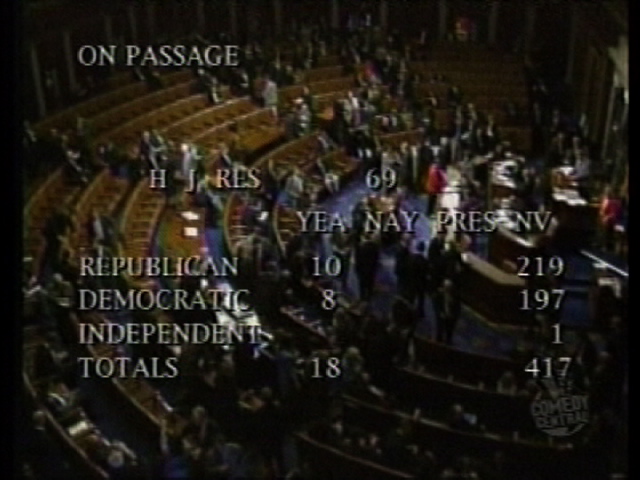
The Daily Show (The best news on television.)
This just in from MoveOn:
Dear MoveOn member,According to the Washington Post, "two top White House officials" committed a high crime in the first weeks of July. They handed over the identity of an American secret agent to journalists. They blew her cover, risking the lives of colleagues and contacts and possibly erasing years of intelligence work. Why? "Purely and simply for revenge," an administration official told the Post. The spy's husband was a vocal critic of the Iraq war. (Sources below.)
The White House and the Justice Department have known about this crime for months -- after all, the agent's identity was published in scores of newspapers in early July. But until a few days ago, they did nothing about it. And even now, President Bush has said he has no plans to ask his staff whether they were connected to it.
Republicans contend that an investigation by the Justice Department will reveal any wrongdoing. But Justice Department chief John Ashcroft -- who was appointed by President Bush and who employed key Bush advisor Karl Rove -- is hardly neutral. Already, there are signs that the investigation will give the White House room to cover the crime up.
The simple fact is that the truth will only come out under pressure. If we don't speak up now, the investigation could be left in John Ashcroft's hands, and the perpetrators and the crime could be swept under the rug. Please tell John Ashcroft and Congress that you want a special prosecutor -- someone who isn't tied to the Bush Administration -- to investigate this illegal and vindictive act.
Join us now at:
MoveOn.org - Intimigate
Here is the full text of the MoveOn Email:
Dear MoveOn member,
According to the Washington Post, "two top White House officials" committed a high crime in the first weeks of July. They handed over the identity of an American secret agent to journalists. They blew her cover, risking the lives of colleagues and contacts and possibly erasing years of intelligence work. Why? "Purely and simply for revenge," an administration official told the Post. The spy's husband was a vocal critic of the Iraq war. (Sources below.)
The White House and the Justice Department have known about this crime for months -- after all, the agent's identity was published in scores of newspapers in early July. But until a few days ago, they did nothing about it. And even now, President Bush has said he has no plans to ask his staff whether they were connected to it.
Republicans contend that an investigation by the Justice Department will reveal any wrongdoing. But Justice Department chief John Ashcroft -- who was appointed by President Bush and who employed key Bush advisor Karl Rove -- is hardly neutral. Already, there are signs that the investigation will give the White House room to cover the crime up.
The simple fact is that the truth will only come out under pressure. If we don't speak up now, the investigation could be left in John Ashcroft's hands, and the perpetrators and the crime could be swept under the rug. Please tell John Ashcroft and Congress that you want a special prosecutor -- someone who isn't tied to the Bush Administration -- to investigate this illegal and vindictive act.
Join us now at:
MoveOn.org - Intimigate
Although almost 7 in 10 Americans believe that Ashcroft should appoint a special prosecutor to handle the investigation, he currently refuses to do so. But he had a point back in 1997, when he said that "A single allegation can be most worthy of a special prosecutor. If you're abusing government property, if you're abusing your status in office, it can be a single fact that makes the difference on that."
It certainly appears that people in the Bush White House abused their status in office.
On July 6th of 2003, Valerie Plame's husband Joe Wilson wrote an editorial in the New York Times. Joe Wilson was a former Ambassador to Iraq, appointed originally by President George H. W. Bush, who had been sent in 2002 to investigate claims that Iraq was trying to buy uranium from Niger. He concluded that "based on my experience with the administration in the months leading up to the war, I have little choice but to conclude that some of the intelligence related to Iraq's nuclear weapons program was twisted to exaggerate the Iraqi threat."
On July 14th, conservative columnist Robert Novak revealed that according to "senior administration officials," Wilson's wife was "an Agency operative on weapons of mass destruction." Up to this point, Valerie Plame's identity was a carefully kept secret, but Novak blew her cover.
Then, last Sunday, the Washington Post printed an article titled "Bush Administration is Focus of Inquiry." The article contained a revelation: "Yesterday, a senior administration official said that before Novak's column ran, two top White House officials called at least six Washington journalists and disclosed the identity and occupation of Wilson's wife. . . . 'Clearly, it was meant purely and simply for revenge,' the senior official said of the alleged leak."
In 1999, President George H. W. Bush said that "I have nothing but contempt and anger for those who betray the trust by exposing the names of our sources. They are, in my view, the most insidious of traitors." Right now, it looks like possible traitors in the White House are being given a free pass. Please call on Attorney General Ashcroft and Congress to appoint a special prosecutor today. We need to get to the bottom of this.
Sign now at:
http://moveon.org/intimigate/?id=1744-1870203-OKDDz8hEhhTQn55DDBLyFw
Sincerely,
--Carrie, Eli, Joan, Noah, Peter, Wes, and Zack
The MoveOn Team
October 2nd, 2003
Sources:
1. "two top White House officials" and "Purely and simply for revenge":
BUSH ADMINISTRATION IS FOCUS OF INQUIRY
By Mike Allen and Dana Priest, Washington Post, 9/28/03
http://www.washingtonpost.com/wp-dyn/articles/A11208-2003Sep27.html
2. Leak was published in scores of newspapers in early July:
MISSION TO NIGER
By Robert Novak, multiple papers, 9/14/03
http://www.washingtonpost.com/wp-dyn/articles/A30055-2003Oct1.html
3. Bush has no plans to ask his staff:
BUSH AIDES SAY THEY'LL COOPERATE WITH PROBE INTO INTELLIGENCE LEAK
By Mike Allen, Washington Post, 9/29/03
http://www.washingtonpost.com/wp-dyn/articles/A14909-2003Sep28.html
4. Ashcroft employed Karl Rove; signs of room for a cover-up:
ATTORNEY GENERAL IS CLOSELY LINKED TO INQUIRY FIGURES
By Elisabeth Bumiller and Eric Lichtblau, New York Times, 10/2/03
http://www.nytimes.com/2003/10/02/politics/02ASHC.html?hp
5. 7 in 10 Americans want a special prosecutor:
OUTSIDE PROBE OF LEAKS IS FAVORED
By Dana Milbank and Mike Allen, Washington Post, 10/2/03
http://www.washingtonpost.com/wp-dyn/articles/A29560-2003Oct1.html
6. "A single allegation can be most worthy of a special prosecutor":
CNN’s Evans and Novak, 10/4/97
7. Joe Wilson's New York Times editorial:
WHAT I DIDN'T FIND IN AFRICA
By Joseph C. Wilson 4th, New York Times, 7/6/03
http://www.commondreams.org/views03/0706-02.htm
8. "I have nothing but contempt and anger":
REMARKS BY GEORGE BUSH AT THE DEDICATION CEREMONY FOR THE GEORGE BUSH CENTER FOR INTELLIGENCE
26 April 1999
http://www.cia.gov/cia/public_affairs/speeches/1999/bush_speech_042699.html
I just found out that I'll be playing at Noe Valley Ministry on December 13, 2003 -- Saturday night!
Since we get to take over the whole church for the show - upstairs and downstairs - I'm going to take the opportunity to throw a little party while I'm at it.
So we'll be performing three or four little sets over the course of the evening to showcase our stuff in-between the food and get togethering. That way, if you have other plans, you can still come by for a few songs and a drink or two whenever it's convenient for you.
The festivities will be going on from 6:30-9:30 pm. Donations will be appreciated, but no one will be turned away for lack of funds.
Check out our first video for a taste of our acoustic set.
Hope to see you there!
This is from the October 1, 2003 program.
The Daily Show was on the ball, right on schedule, again last night, so figured it was the least I could do to say up late again to bring this to you in a timely fashion.
Daily Show On Karl Rove Outing A CIA Agent (Small - 7 MB)
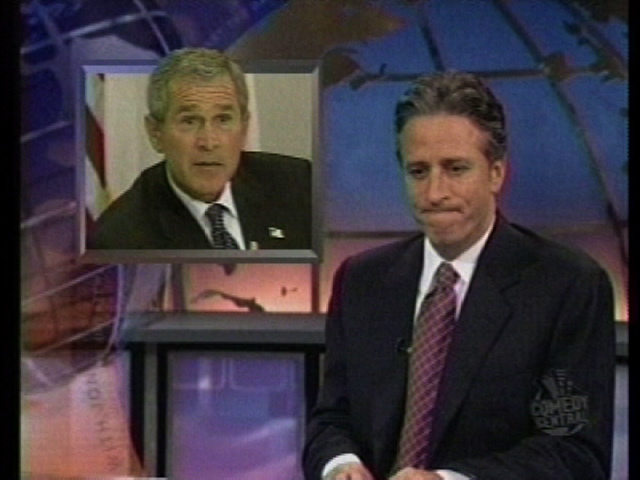
The Daily Show (The best news on television.)
This is from the September 30, 2003 program.
This was a classic appearance on The Tonight Show with Jay Leno. Looks like we've got Hollywood on our side!
Jay put together some hilarious clips (3 MB) of Dean as a street musician and Dean as Pete Townsend that are quite historical. One of them features Rob Reiner as a passer by.
Jay sure did his homework for this interview. We get to learn about how Howard decided to become a Doctor and how he managed to balance being a Doctor with his duties as Lt. Governor before the Governor died and he became the "big guy." We also learn about his favorite $125 JC Penny suit that he still owns to this day.
Howard Dean On Jay Leno - Part 1 of 2 (Small - 11 MB)
Howard Dean On Jay Leno - Part 2 of 2 (Small - 12 MB)
Howard Dean On Jay Leno - Complete (Small - 23 MB)
Howard Dean On Jay Leno - Funny Clip (Small - 3 MB)
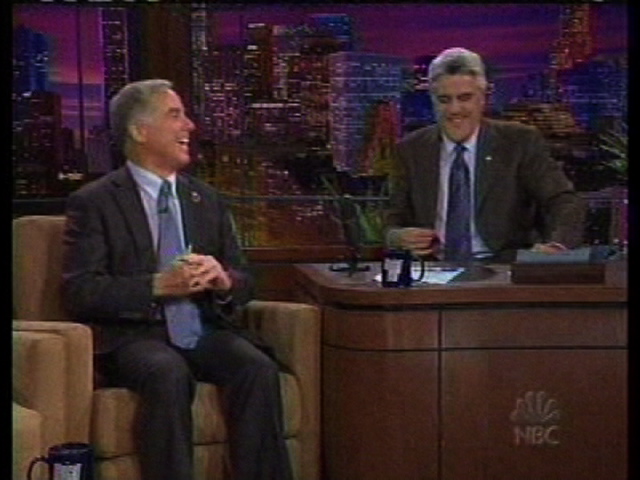
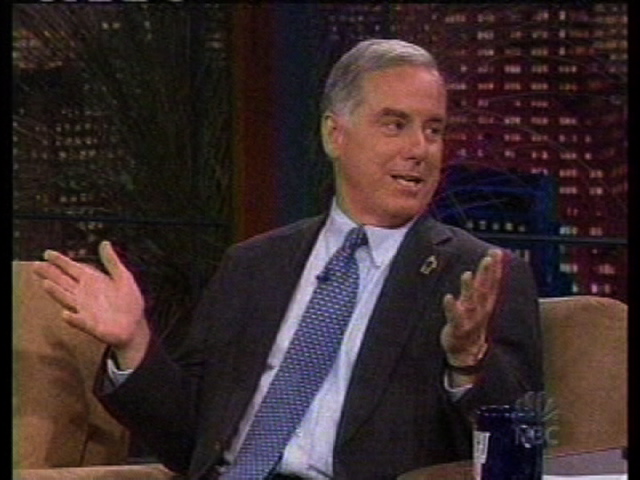
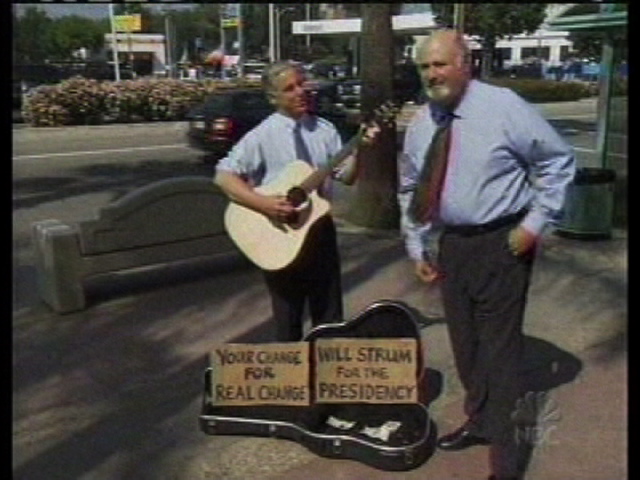

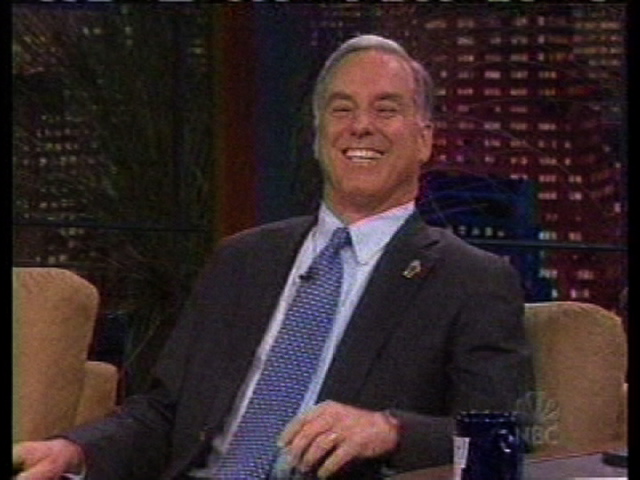
"Leak" isn't really the right word for it. "Firehose" might be more appropriate. Evidence suggests that the White House basically cold called at least six different reporters to get the word out about the identity of Joseph Wilson's wife as a CIA agent. Doing so constitutes a Federal Offense.
In case the name doesn't ring a bell, Ambassador Joseph Wilson was the man the CIA sent to Nigeria, at Dick Cheney's request, to investigate allegations that Iraq had tried to purchase "yellowcake" uranium in an attempt to make a nuclear bomb. Wilson came back from Nigeria and said he found no evidence of such things. Allegedly, in retaliation, the White House decided to out his wife. (That ought to teach him not to tell the truth.)
Dick Cheney, you might remember, states that he doesn't even know who Joseph Wilson is. Once again, we are left with a conundrum, much like the situation with Condoleeza Rice's not knowing about the Nigerian uranium evidence being innaccurate. Either Cheney does know who Wilson is, and is simply lying about it, or he actually doesn't know who Wilson is, and is simply an idiot. Either way, it sucks that such a person is our Vice President.
Here's a clip from the CBS evening news explaining the details of the situation that provides a nice primer before viewing the clip of Tim Russert questioning Condoleeza Rice on the subject on Sunday's Meet The Press.
Here's a link to the usual, largely incomplete transcript.
More articles on this to follow. All the clips in this entry are from September 28, 2003.
CBS Evening News On The White House Leaking Classified Info (Small - 6 MB)
Condoleeza Rice On Meet The Press Denying She Knew Anything About It (Small - 7 MB)
Here's the text of the incomplete transcript in case the link goes bad:
http://www.msnbc.com/news/973028.asp
Transcript for Sept. 28
GUESTS: Dr. Condoleezza Rice, national security adviser
Rep. Dick Gephardt, (D-Mo.), Democratic presidential candidate
Tim Russert, moderator
This is a rush transcript provided for the information and convenience of the press. Accuracy is not guaranteed.
MR. TIM RUSSERT: Our issues this Sunday, Iraq: Still no weapons of mass destruction; little likelihood of more international troops, meaning more Reserve units being called up; and growing concern on Capitol Hill.
(Videotape):
REP. DAVID OBEY: If you don’t, you don’t have a plan, you don’t have a clue. If you can’t give us an answer, you’re stiffing us.
MR. DAVID BREMER: Well, Congressman, I resent that.
(End videotape)
MR. RUSSERT: Where do we go from here? With us, President Bush’s national security adviser, Dr. Condoleezza Rice. Then the 10 Democratic candidates debate and this man goes after Democratic presidential front-runner Howard Dean.
(Videotape):
REP. RICHARD GEPHARDT: Howard, you are agreeing with the very plan that Newt Gingrich wanted to pass, which was a $270 billion cut in Medicare.
DR. HOWARD DEAN: I’ve done more for health insurance, in this country, Dick Gephardt, frankly, than you ever have.
(End videotape)
MR. RUSSERT: And what does the entry of General Wesley Clark mean for the race? With us, Democratic candidate for president, Congressman Dick Gephardt.
But first, the president’s national security adviser Dr. Condoleezza Rice. Welcome.
DR. CONDOLEEZZA RICE: Morning. Thank you.
MR. RUSSERT: These are the headlines that greeted Americans this week: “Draft Reports Said To Cite No Success In Iraq Arms Hunt. An early draft of an interim report by the American leading the hunt for banned weapons in Iraq says his team has not found any of the unconventional weapons cited by the Bush administration as a principal reason for going to war, federal officials with knowledge of the findings said.” The rationale for the war, the risk, the threat of biological, chemical, perhaps even nuclear weapons, they have not been found, why?
DR. RICE: There was no doubt going into the was that successive administrations, the United Nations, intelligence services around the world, knew that Saddam Hussein had used weapons of mass destruction, that he had them, that he continued to pursue them. David Kay is now in a very careful process of determining the status of those weapons and precisely what became of them. But I would warn off jumping in to any conclusions about what David Kay’s report says. For instance, I’ve not seen David Kay’s report, and it is a progress report on the very careful work that he is doing. He’s interviewing hundreds of people. He is going through miles and miles of documentation. He’s collecting physical evidence and he will put together a coherent story and then we’ll know the truth, but it’s far too early to talk about the conclusions of David Kay’s report.
MR. RUSSERT: If we go back and examine what administration officials had said prior to the war, Colin Powell said this back in February of 2001: ”[Saddam Hussein] has not developed any significant capability with respect to weapons of mass destruction.”
And five days after September 11th, the vice president saying: “Saddam Hussein’s bottled up at this point.”
And now, front page of The Washington Post, “House Probers Conclude Iraq War Data Was Weak.”
This is Porter Goss, former CIA agent, chairman of the House Intelligence Committee, a Republican, suggesting that perhaps because the CIA couldn’t determine that the weapons of mass destruction had been destroyed, that they therefore existed. Was the premise of the war based on faulty or hyped intelligence?
DR. RICE: The premise of the war was that Saddam Hussein was a threat, that he had used weapons of mass destruction, that he was continuing to try to get them and that was everyone’s premise, the United Nations intelligence services, other governments, that was the logic that led the Clinton administration to air strikes in 1998. And one would have had to believe that somehow, after Saddam Hussein made it impossible for the inspectors to do their work in 1998, that things got better, that he suddenly destroyed the weapons of mass destruction and then carried on this elaborate deception to keep the world from knowing that he destroyed the weapons of mass destruction. It’s just not logical.
You have to put into context the period between 1998 and 2003 when indeed the information was being enriched from new information that was coming in, but it was not that alone. It had to be in the context of 12 years of deception, 12 years of finding out unpleasant surprises about his biological weapons program in 1994 and 1995, reports from the United Nations in 1999 that he had not accounted for large stockpiles of weapons. No, this was the threat that the president of the United States could no longer allow to remain there. We tried containment. We learned that he had increased his capacity to spend resources on weapons of mass destruction from $500 million in illegal oil revenues to $3 billion. No, all of the dots added up to a program and to weapons and a weapons program that was dangerous and getting more so.
MR. RUSSERT: What if the intelligence was just plain wrong? The CIA had said way back when that the Soviet Union was going to have a robust economy, surpass the United States. That proved to be wrong. What if the intelligence committees were just wrong here, and we went to war when there really wasn’t a threat of weapons of mass destruction?
DR. RICE: Well, clearly, this is somebody who had used weapons of mass destruction. So had he have been allowed to be unchecked, he might have used them again. Clearly, this is someone who, in 1991, the inspectors found was much closer to a nuclear weapon that had been believed. So I think it’s unlikely that the essence of a case that this was somebody who had weapons of mass destruction and was still pursuing them was wrong. But let’s remember, Saddam Hussein is now gone and it is a great achievement of the United States and the coalition. Nobody wants to say that we would be better off had we left him in power.
We now have opportunities before us to have a democratic and prosperous Iraq that can be linchpin of a different kind of Middle East, a region that is volatile in the extreme, and is the region from which the September 11 threat came. And so, after September 11, and I note that some quotes by Colin Powell, for instance, before September 11—after September 11, you do look at threats differently. You do look at dealing with threats before they fully materialize. That was the case the president made to the American people. With Saddam Hussein gone, the world is safer and Iraq will be stable and prosperous, and it will be a historic change in the circumstances of the Middle East.
MR. RUSSERT: The administration’s credibility is on the line, here in the country and around the world. And we still specifically cite the president’s State of the Union message in January. Now, let me go back and play that and then talk about your role.
(Videotape, January 28, 2003):
PRES. GEORGE W. BUSH: The British government has learned that Saddam Hussein recently sought significant quantities of uranium from Africa.
(End videotape)
MR. RUSSERT: That was in January. And in June—June 8—you were on MEET THE PRESS; I asked you about that, and this was your response.
(Videotape, June 8, 2003):
DR. RICE: The president quoted a British paper. We did not know at the time, no one knew at the time in our circles—maybe someone knew down in the bowels of the agency, but no one in our circles knew—that there were doubts and suspicions that this might be a forgery. Of course, it was information that was mistaken.
(End videotape)
MR. RUSSERT: “No one in our circles.” That has proven to be wrong.
DR. RICE: No, Tim, that has not proven to be wrong. No one did know that they were forgeries. The notion of the forgeries came in February or in March when this was—when this came to the CIA. It is true that we learned, subsequent to my comments to you, that Director Tenet did not want to stand by that statement. And I would never want to see anything in a presidential statement—speech—that the director of Central Intelligence did not want to have there.
And I’m the national security adviser. When something like this happens, I feel personally responsible for it happening because it obscured the fact that the president of the United States did not go to war over whether Saddam Hussein tried to acquire yellow cake in Africa. He went to war over a threat from a bloody tyrant in the most volatile region of the world who had used weapons of mass destruction before, and was continuing to try to acquire them. And so, of course, this should not have happened.
MR. RUSSERT: But when you say that no one in our circles, and it was maybe down in the bowels of the Intelligence Agency, a month after that appearance, you said this, “The CIA cleared the speech in its entirety.”
And then your top deputy, Stephen Hadley, on July 23, said this.
“Deputy National Security Adviser Stephen Hadley told reporters that he received two memos from the CIA in October that cast doubt on intelligence reports that Iraq had sough to buy uranium from Niger to use in developing nuclear weapons. Both memos were also sent to chief speechwriter Michael Gerson and one was sent to national security adviser, Dr. Condoleezza Rice, Hadley said.”
And George Tenet called Mr. Hadley directly and put—issued a warning on that information. Were you aware of any concerns by the CIA about this incident?
DR. RICE: First of all, the CIA did clear the speech in its entirety and George Tenet has said that. He’s also said that he believes that it should not have been cleared. And we apparently, with the—in October for the Cincinnati speech, not for the State of the Union, but the Cincinnati speech, George Tenet asked that this be taken out of the Cincinnati speech, the reference to yellow cake. It was taken out of the Cincinnati speech because whenever the director of Central Intelligence wants something out, it’s gone.
MR. RUSSERT: How’d it get back in?
DR. RICE: It’s not a matter of getting back in. It’s a matter, Tim, that three-plus months later, people didn’t remember that George Tenet had asked that it be taken out of the Cincinnati speech and then it was cleared by the agency. I didn’t remember. Steve Hadley didn’t remember. We are trying to put now in place methods so you don’t have to be dependent on people’s memories for something like that.
MR. RUSSERT: Did you ever read the memo that I referenced?
DR. RICE: I don’t remember the memo. It came after it had been taken out of the speech, and so it’s quite possible that I didn’t. But let me be very clear: This shouldn’t happen to the president of the United States, and we will do everything that we can to make sure that it doesn’t happen again.
MR. RUSSERT: The Washington Post framed the issue this way: “The remarks by Rice and her associates raise two uncomfortable possibilities for the national security adviser. Either she missed or overlooked numerous warnings from intelligence agencies seeking to put caveats on claims about Iraq’s nuclear weapons program, or she made public claims that she knew to be false.”
DR. RICE: Well, neither happens to be true. First of all, we had a national intelligence estimate on which we relied to talk about Iraq’s pursuit of nuclear weapons. I would never make claims that I know not to be true. Why would I do that to the president of the United States? The president of the United States has to be credible with the American people. I have to be credible with the American people. This was a mistake. The memories of people three months before did not trigger when they saw the language in the State of the Union. When I read the line in the State of the Union, I thought it was perfectly fine. And I can assure you nobody was trying to somehow slip something into the State of the Union that the director of Central Intelligence didn’t have confidence in. The State of the Union address was about the broad threat that Saddam Hussein posed. That remained the case when we went to war. That remains the case today. And it was a strong case for removing him from power.
MR. RUSSERT: A hundred and eighty members of Congress cited the potential nuclear threat when they voted for the war. If that threat did not exist, if Saddam was not as far along as had been expected or had been reported by intelligence agencies, do you believe Congress would have voted to go to go war with Saddam absent the notion that he had weapons of mass destruction?
DR. RICE: Well, weapons of mass destruction, of course, come in two other types, chemical and biological. And on chemical and biological, the national intelligence estimate was unequivocal, that he had biological and chemical weapons. He’s, of course, used chemical weapons. His biological weapons program was, of course, discovered in ’94, ’95.
MR. RUSSERT: What happened to them? Where are they?
DR. RICE: Well, David Kay will determine what happened to these programs. But on the nuclear side, this was always a matter of uncertainty, about his nuclear weapons program. In ’91, he was closer than the International Atomic Energy Agency had thought. They were about to give him a clean bill of health, only to find that he had the designs, he had the scie ntists, he had all of the means. He was only lacking the fissile material. And the estimate, the national intelligence estimate gave the following judgment: That left unchecked, Saddam Hussein would have a nuclear weapon by the end of the decade. That’s something to which the president had to react, but by no means was this case made on a nuclear case alone. It was made on the weapons of mass destruction as a whole, his ability to deliver them in the past and the dangers of having those weapons, particularly biological and chemical weapons, which he was known to have had, in the hands of this bloody tyrant.
MR. RUSSERT: There was dissent of that analysis, however, but the administration emphasized the threat?
DR. RICE: Well, the dissent—not on biological and chemical weapons. There was widespread agreement that the biological—but...
MR. RUSSERT: On nuclear. On nuclear there was the dissent.
DR. RICE: On nuclear there was dissent on the extent of the program and how far along the program might be. How much had he gone to reconstitute? But the judgment of the intelligence community was that he had kept in place his infrastructure, that he was trying to procure items. For instance, there’s been a lot of talk about the aluminum tubes but they were prohibited on the list of the nuclear suppliers group for a reason. So the case was very strong, that this was somebody who had weapons of mass destruction, had used them in the past. The Clinton administration had launched air strikes for that reason in 1998, citing the fact that if he were allowed to keep his weapons of mass destruction, he would be a grave threat, and there was no reason to believe that this got better after 1998, after he made it impossible for inspectors to work there.
MR. RUSSERT: Ambassador Joe Wilson was sent over to Niger by the CIA to look into this whole matter of selling uranium to Iraq. He came back with a report which was given to the administration. Then there was an article by columnist Robert Novak which cited two administration sources and identified Ambassador Wilson’s wife by name. She was an undercover agent at the CIA. There is now an investigation. The CIA has requested the Justice Department to look into this. It’s a crime to identify an undercover agent. And in this article in today’s Washington Post, a senior administration official said that White House officials called six reporters to identify, to out, if you will, Joe Wilson’s wife. What can you tell us about that?
DR. RICE: Tim, I know nothing about any such calls, and I do know that the president of the United States would not expect his White House to behave in that way. It’s my understanding that when a question like this is raised before the agency, that they refer it as a matter of course, a matter of routine to the Justice Department. The Justice Department will now take appropriate action, whatever that is, and that will be up to the Justice Department to determine what that action is.
MR. RUSSERT: What will the president do? Will he bring people in and ask them what they did?
DR. RICE: I think it’s best since it’s in the hands of the Justice Department to let it remain there.
MR. RUSSERT: Will the president go to the CIA and other intelligence agencies and say, “What happened? Why did you give me these analysis, these estimates and it hasn’t yet borne out?”
DR. RICE: The president is waiting to see what the story really is on the ground. David Kay is a very well-respected former weapons inspector. He now has a lot of people, teams of people, working on the considerable documentation that we’ve been able to find. For instance, we now have access to the archives of the Iraqi Intelligence Service. That’s an important source, as any of us know who’ve studied authoritarian systems. Programs like this were likely to be under the Iraqi Intelligence Service. And so now we have access to that documentation. Wouldn’t have had it before the war.
We are now able to interview people, although there are a lot of people who are still frightened by threats of retribution, and it’s one important reason that we have to protect the people who help us. He is gathering physical evidence, and he will put together a complete picture of the status of Saddam Hussein’s weapons programs, of how he intended to use them. He will put together a picture of what became of the substantial unaccounted-for weapons stockpiles and media. He’ll do all of that. And then we can see what we found on the ground after the war and how that compares to what we knew going in. But going in, this president relied on the same basis of intelligence that three administrations relied on, that was gathered from intelligence services around the world and that the U.N. itself relied on in keeping Saddam
Hussein under sanctions for 12 years.
MR. RUSSERT: But what if it was wrong? If the president determines that the intelligence he was given was faulty or that members of his staff or administration outed a CIA agent, will heads roll?
DR. RICE: Tim, let’s wait and see what the facts are. I think in the case of the weapons of mass destruction, David Kaye is going to make a progress report but it is only a progress report. Saddam Hussein spent 12 years trying to deceive the international community. It’s not surprising that it’s going to take a little time to unravel this program.
MR. RUSSERT: George Will, the conservative columnist, wrote this. “Some say the war justified even if WMD”—weapons of mass destruction—”are not found nor their destruction explained, because the world is ‘better off’”—with Saddam Hussein. Of course is better off. “But unless one is prepared to postulate a U.S. right, perhaps even a duty, to militarily dismantle any tyranny ... it is unacceptable to argue that Hussein’s mass graves and torture chambers suffice as retrospective justifications for preemptive war.
Americans seem sanguine about the failure—so far—to validate the war’s premise about the threat posed by Hussein’s”—weapons of mass destruction—”but a long-term failure would unravel much of this president’s policy and rhetoric.”
DR. RICE: Torture chambers and mass graves are definitely very good things to have gotten rid of, so is to have gained the opportunity of having a stable and democratizing Iraq in the Middle East...
MR. RUSSERT: But that’s not a basis for a pre-emptive war.
DR. RICE: ...but let’s remember that the intelligence going into the war—it’s quite separable from what David Kaye now finds, but the intelligence going into the war was intelligence that led the United States to strike in 1998 against Saddam Hussein’s weapons of mass destruction, that led the Congress to support that action and to actually pass a law called the Iraqi Liberation Act, because Saddam Hussein was thought to be a threat to this country, that the United Nations itself had kept Saddam Hussein under sanctions for 12 years because of his weapons of mass destruction program. So the premise on which the president launched this war was one that was shared by a number of people, including former administrations.
MR. RUSSERT: But Mr. Will’s point is if the president came to the United States today and said, “We have a problem with Iran. They have an advanced nuclear capability, we have to launch a pre-emptive strike,” or “We have to launch a pre-emptive strike against North Korea,” would the country, would the world, say, “By all means, Mr. President, we know your intelligence is sound, go forward”?
DR. RICE: The important thing is that the president has always said that the use of military force is, of course, an option that has to remain, but that’s a rare option. The president in Iran and in North Korea is pursuing other courses, and Iraq was in many ways a very special case. This was an international outlaw for 12 years. We forget that he fought a war in 1991, lost the war, signed on to a series of obligations that were supposed to keep him boxed up, because people knew he was dangerous in 1991. But when the decision was made not to overthrow him and indeed to stop the war, he signed on to an entire group of resolutions, of obligations that were supposed to keep him contained. He then systematically, over 12 years, started to wiggle out of them, ignored them, defied them. He was an international outlaw.
I think you have to look hard to see whether even this was a war of pre-emption. We were in a state of low-level conflict with Saddam Hussein from 1991 until 2003. He was shooting at our airplanes with regularity. We were trying to patrol his forces through no-fly zones in the north and the south. This was a unique case.
MR. RUSSERT: The costs of the war, administration’s top budget official, Mitch Daniels, the former director of the OMB, estimated that the “cost of a war” would be “$50 billion to $60 billion...he said...estimates of $100 billion to $200 billion” by Lawrence Lindsey, the president’s former chief economic adviser, “were too high.”
We’ve already spent, when the additional $87 billion is allocated by Congress, some $150 billion to $160 billion. Why did the administration so dramatically underestimate the cost of this war?
DR. RICE: We did not have perfect foresight into what we were going to find in Iraq. The fact of the matter is that this deteriorated infrastructure, one that was completely covered and covered over by the gleaming pictures of Baghdad that made it look like a first-world city, what we’re learning now is that, for instance, the entire country had maybe 55 percent of the electrical generating power that it needed, but what Saddam Hussein did was force all of that generating power into the Sunni areas and to simply starve the rest of the country. The country was probably 80 percent low on the ability to provide sanitation to the country.
Now, I’m reminded that East Germany, which was, of course, sitting right next door to West Germany and well known to the West Germans, when they unified East and West Germany, West Germans were appalled and shocked by what they found as the deteriorated state of the East German infrastructure. So it’s not surprising that one might underestimate that.
But the key here is you cannot put a price tag on security. Iraq was a threat. Saddam Hussein was a threat to the region, he was a threat to America, to American interests, he was a haven and a supporter of terrorism around the world and he had launched wars, used weapons of mass destruction. He was a threat. He is now gone. The goal now is to put in his place, in the place of that horrible regime, a stable, prosperous, and democratizing Iraq. That will pay off many, many, many times over in security for the American people. What happened to us on September 11th should remind us that we have to fight the war on terror on the offense. We can’t fight from preventive defense. It’s fine to try and defend the country, but the president believes that we have to fight this war on the offense and Iraq is part of fighting that war.
MR. RUSSERT: But Iraq was not part of September 11th.
DR. RICE: No. Saddam Hussein—no one has said that there is evidence that Saddam Hussein directed or controlled 9/11, but let’s be very clear, he had ties to al-Qaeda, he had al-Qaeda operatives who had operated out of Baghdad. The key, though, is that this is—our security is indivisible, and having a change in this region, in the center of the Middle East, is going to make a tremendous difference to our long-term security.
MR. RUSSERT: Congress will approve the $87 billion?
DR. RICE: I am certainly hopeful that they will because the American forces deserve the support, and everything in the supplemental that is there for reconstruction is for one of three purposes. It is to provide, so that the Iraqis can provide security to themselves, police forces, the army, and acceleration of bringing Iraqis into their own security. It is to provide infrastructure so that—and basic living services so that it doesn’t become a breeding ground for terrorism, the kind of poverty that is there. And third, it is to put in place infrastructure for foreign investments, so that Iraq can emerge as a functioning member of the international economy.
MR. RUSSERT: Here’s the cover of Time magazine coming out tomorrow: “Mission Not Accomplished: How Bush Misjudged the Task of Fixing Iraq.” We all remember on May 1, the president landed on the USS Lincoln, where he was greeted by a banner “Mission Accomplished.” The image, the message that sent to the country was, “Iraq, mission accomplished.” Was that premature?
DR. RICE: Well, the mission of those forces that he went to greet had been accomplished. They were involved in the major military operations. I can remember getting briefings on the carriers of the bombing missions that they flew in those horrible sandstorms. So their mission had been accomplished. And the president wanted to congratulate them on that. But he said in that same speech, the dangerous times were still ahead, and that we still had work to do in Iraq. And we are, indeed, still doing that work in Iraq.
The advantage is that we have forces there that are now being reconfigured to deal with the tasks that are not major combat tasks, and we’re making good progress. It’s a hard job. And reconstructing or participating in the reconstructing of a country like Iraq is a hard job. But it’s very much worth it. Much as the reconstruction of Europe was worth it to our long-term security. The reconstruction of Iraq is worth it to our long-term security. And we’re going to stay the course.
MR. RUSSERT: And it is nation-building?
DR. RICE: It is helping the Iraqis to build their nation. And they are more and more involved every day. I’ve met, just in this past week, with ministers, minister of electricity, minister of public works, I’ve met with members of the Governing Council. They are now very involved in their future. And Iraq is going to emerge better for it. The Middle East is going to emerge better for it and, therefore, American security is going to emerge better for it.
MR. RUSSERT: How long is that going to take?
DR. RICE: I don’t want to put a time frame on it.
MR. RUSSERT: Years?
DR. RICE: The work of the Iraqis in building their own future certainly is going to take years, and we’ll try to help them and assist them. But we expect that by accelerating in this next period of time, over this—the next frame of time, which is why the supplemental is so important, in accelerating the most important task toward reconstruction, that we will hasten the day when Iraqis are able to control their own future and when American forces can come home.
MR. RUSSERT: Dr. Condoleezza Rice, we thank you for your views.
DR. RICE: Thank you very much, Tim.
MR. RUSSERT: Coming next, can Dick Gephardt stop the insurgent challenges of Governor Howard Dean and General Wesley Clark? Dick Gephardt, Democratic candidate for president. He’s next on MEET THE PRESS.
(Announcements)
MR. RUSSERT: Our interview with Democratic presidential candidate Dick Gephardt after this brief station break.
(Announcements)
MR. RUSSERT: And we are back. Congressman Gephardt, welcome back to MEET THE PRESS.
REP. DICK GEPHARDT, (D-MO): Good to be here.
MR. RUSSERT: Let’s go back to October 2, 2002. You were the leader of the Democrats in the House. You supported the president on the war, voted for a resolution to give him the authority, appeared with him in the Rose Garden and said this to the American people. Let’s watch:
(Videotape, October 2, 2002):
REP. GEPHARDT: In our view, Iraq’s use and continuing development of weapons of mass destruction, combined with efforts of terrorists to acquire such weapons pose a unique and dangerous threat to our national security.
(End videotape)
MR. RUSSERT: “A unique and dangerous threat.” We have not found any such weapons. Were you wrong or misled?
REP. GEPHARDT: Tim, I didn’t just take the president’s word for this. I went out to the CIA three times. I talked to George Tenet personally. I talked to his top people. I talked to people that had been in the Clinton administration in their security effort. And I became convinced, from that, all of that, that he either had weapons of mass destruction or he had components of weapons or he had the ability to quickly make a lot of them and pass them to terrorists.
Look, after 9/11, we’re in a world, in my view, that we have to protect the American people from further acts of terrorism. That’s my highest responsibility, that’s the Congress’ highest responsibility, and the president. And I did what I thought was the right thing to do to protect our people from further acts of terrorism. We cannot have that happen in the United States, and I will always do that.
MR. RUSSERT: But what happened to the weapons of mass destruction? What should be done now to find out why the intelligence was misleading or just plain wrong?
REP. GEPHARDT: Obviously, Tim, we need a blue-ribbon commission. If there hasn’t been one before I’m president, when I’m president, we will have one. The American people have to understand and believe that the information they’re getting from their government is credible, is true. And if there was a failure of intelligence, we’ve got to have more than just the intelligence committees look at it. We’ve got to have a blue-ribbon commission. We’ve got to get to the bottom of it.
MR. RUSSERT: The Washington Post reports today that a senior administration official said that White House officials called six reporters to identify the wife of Ambassador Joe Wilson, who is doing a report for the CIA on this matter, that she was an undercover agent and therefore was outed, which breaks the law. What should the president do?
REP. GEPHARDT: Well, the president ought to investigate what happened. The Congress probably ought to look at it as well. If the law was broken, if something was done that was improper and wrong legally, you know, the law ought to be enforced and people ought to be punished for doing this.
MR. RUSSERT: The Congress will have an opportunity to vote for $87 billion more for the operation in Iraq. Will you vote for that?
REP. GEPHARDT: I’m going to support our troops in the field. We have to do that. They’re performing a very, very dangerous mission and I’m in admiration of what they’re doing. We’ve got to support them with the money they need. On the $20 billion or so of this $87 billion that is for the reconstruction of Iraq, there are a lot of tough questions that the Congress needs to ask and will ask, both Republicans and Democrats.
One of the things we’ve got to look at is: What are we going to get from other countries? What are other countries going to bring to the table? What is the president doing to get other countries to help our taxpayers? And finally, what loans are out there that could be relieved or forgiven by other countries to Iraq so that this money for reconstruction could, in effect, be a new loan so that we don’t have to just ask the American taxpayers to do this.
Finally, I want some moneys for America, if we’re going to be using money for the further work in Iraq.
All of our states pretty much are bankrupt. They need help. They’re cutting health care, they’re cutting veterans, they’re cutting all kinds of important programs. We’ve got to make sure that the American people are taken care of here as well.
MR. RUSSERT: We’ll get to the domestic issues in a second, but in terms of Iraq, you just heard Dr. Rice say we’re going to stay the course. If you were the president right now, and other countries in the world said, “Mr. President, we don’t have any troops to give you. Maybe another 20,000, but this is an American operation,” what would you do?
REP. GEPHARDT: Tim, I have been terribly frustrated by this president’s inability or unwillingness to get the help that we need. I told him a year and a half ago that if he wanted to deal with Iraq or Afghanistan or any of these situations that he had to get us help. I encouraged him in February or March of last year to go to the U.N., to start the inspections so that it can bring our allies with us.
The U.N. had inspectors there for eight years, they were out for five years. The only way you could get the U.N. with you was start up the inspections and get it done. He finally went to the U.N. In truth, he went too late. He jammed them. He didn’t get the agreement he needed. But put that all aside, here weare four or five months after the conflict has ended, and he still has not gotten us the help that we need. He went to the U.N. last week.
Look, we ought to turn this over to the Iraqis as soon as we can. Secondly, we ought to have U.N. civil authority. The U.N. ought to take over the civil issues that are involved in Iraq. And we ought to get NATO and other allies helping us on the security front. If this president was doing his job right, he would be getting us the help that we need. This is costing a billion dollars a week. We’re losing people every day. People are being injured. This is unacceptable and he needs to get us the help that we should have gotten a long time ago.
MR. RUSSERT: But if the Iraqis are not prepared to take on the security themselves and other countries don’t have the troops to give us, to turn it over to the Iraqis now, you could create an extremist, fundamentalist, Islamic regime.
REP. GEPHARDT: Oh, no. I’m not saying turn it over to the Iraqis now. I’m saying get it turned over to the Iraqis as quickly as you can. In a practical way, do that. But in the meantime, we need help. We need money. We need troops. It is unacceptable that he has not gotten us the help that we need and it can’t go on.
MR. RUSSERT: In July, this is about nine months after supporting the president on the war, you said this, “...I believe George Bush has left us less safe and less secure than we were four years ago.” What do you base that on?
REP. GEPHARDT: A number of things. First of all, the homeland security effort is not what it ought to be. We have not looked in one container coming into this country. What are we worried about? We’re worried about an A-bomb in a Ryder truck in New York or Washington or Los Angeles. It cannot happen. We cannot allow it to happen. We have not looked in one container. That’s the most likely way it would come in. We’re not doing what we need with the local police and fire departments. The money that they need—they’re the new front-line troops in the war against terrorism. They have not gotten the training or the equipment that they need to do their job right.
Finally, he is not doing the job with regard to the loose nukes that are out in the work, in Russia, India, Pakistan. We should be very aggressively trying to stop this fissile material from getting into the hands of terrorists. I’ll say it again: 9/11 was the ultimate wake-up call. If we don’t understand that, I don’t know what we understand. And our government has a solemn responsibility to do everything in its power to keep these materials out of the hands of terrorists. When I am president, I will make it my highest priority to see that it’s done every day.
MR. RUSSERT: There’s a sense from some critics, Congressman, that you’ve watched Howard Dean rise to the status of front-runner of the Democratic primaries because he opposed George Bush on the war and opposed George Bush on the tax cut, and that you now are trying to make up for lost ground by imitating some of Howard Dean’s positions by saying the president’s a miserable failure or this: “This phony macho business is not getting us where we need to” go. Is that appropriate, to accuse the president of being a phony macho?
REP. GEPHARDT: Tim, I try to say what’s in my heart and what’s right, and I don’t mince my words, I don’t, you know, try to find the political high ground. I try to do my job, and I’m going to say what I think is right and what’s in my heart. I believe the president was right to try to deal with Saddam Hussein and weapons of mass destruction, not because of what he said, as I said, but because of everything that I learned and understood. I’ve never wavered from that position and never will. Because I did what I thought was right.
MR. RUSSERT: What’s the phony macho?
REP. GEPHARDT: Well, saying “Bring them on,” and you know, saying to our allies, “We’re going to do this with or without you,” and just—arrogance doesn’t get you anywhere, as a country, as a leader. And I think in some cases this president demonstrates arrogance. Look, I was in Germany a few years ago, the foreign minister said to me, “The reason we so respect America is that there’s never been a country in the history of the world that’s had this much military power and always used it so responsibly.” That’s what we’re in danger of losing with the way this president is leading. So if he’s right, I’m going to say it, and if he’s wrong, I’m going to say it, and that’s what I try to do. I try to say what’s in my heart.
MR. RUSSERT: Let me turn to your race for the presidency. This is your Web site, which is on the Internet: “It’s Time to Show Howard Dean who’s the Real Democrat, A Message from Steve Murphy, Campaign Manager”—that’s your campaign manager—”...I’ve had enough. Howard Dean still insists that he’s the candidate from ‘the Democratic wing of the Democratic Party.’ Well, where was Howard Dean when we needed him?” Do you think Howard Dean’s a real Democrat?
REP. GEPHARDT: He is a Democrat, but we have some legitimate differences of belief, on trade, on health care, on Medicare, on Social Security, and that’s what elections are about. That’s why we have campaigns, and I’m going to talk about the differences, not only with Howard but with other candidates, as well.
MR. RUSSERT: Another Web site, and I’ll show you this one, called DeanFacts.com: “Howard Dean on Social Security: ‘I absolutely agree we need to...increase retirement age.’”
Dean on Social Security, Dean on Medicare, and who’s paying for this Web site? Gephardt for President. You’re devoting an entire Web site to Howard Dean.
REP. GEPHARDT: Well, these Web sites are inexpensive. Look, some of the statements that Howard has made about Medicare demonstrate, and are hard to believe, frankly, but demonstrate the deep difference that we have on this issue. Let me just tell you two of the statements. He said Medicare is the worst federal program ever. He said Medicare is the worst thing that ever happened. Now, I just couldn’t disagree more. I think Medicare is one of the best things this country’s ever done. A third to a half of the elderly in this country were in poverty before Medicare. Now, every senior citizen has the benefit of Medicare.
And in our darkest hour, the day before we took up the Gingrich budget in 1995, Howard was the head of the National Governors’ Association. He made a speech in which he endorsed, basically, the Republican position on the $270 billion cut in Medicare, that Bill Clinton called the biggest cut in Medicare’s history. It would have decimated the program. And so later in the year, they even shut the government down over this. They were trying to do big Medicare cuts to give tax cuts to the wealthiest Americans.
Now, we just couldn’t disagree more on this. He’s had a number of other statements in which he’s severely critical of Medicare as a horribly run, terrible program. I just—we disagree on this. I think it’s an important issue. Look, the Republicans have always been after this program. From the beginning they haven’t liked this program. We need a candidate to go up against George Bush and articulate this issue, defend our proudest achievement, which is Medicare and Social Security, and re-explain to the American people why we cannot allow the Republicans to privatize and ruin these programs.
MR. RUSSERT: But if you say that Howard Dean stood with Newt Gingrich, why couldn’t Howard Dean say, “Dick Gephardt, you voted for the 1981 Ronald Reagan tax cut. Back then you voted against increasing minimum wage. You stood with Ronald Reagan.”
REP. GEPHARDT: Look, there are always times that we make judgments that in retrospect we think weren’t the right judgment. There have been things in my past that, you know, I later on decided that wasn’t the right thing to do. Howard’s not backing off this. He said just a week ago, or two weeks ago, that he still thinks we ought to slow down the growth of Medicare by 7 to 10 percent. That was the $270 billion cut. And he continues to say it’s a horribly run program, and that it’s not a good program.
MR. RUSSERT: But the number of people on Medicare is going to double, we’ve gone from 35 workers per retiree to two workers per retiree. We’re going to have to do something with Medicare and Social Security or those programs will go bust or we’re going to have to double the payroll tax.
REP. GEPHARDT: Tim, I have always been for doing what it takes to save Social Security and Medicare. I led the fight in 1983 to fix the Social Security program so it would have much longer time to run without having to dip into general revenue. I’ve always been for improving Medicare but I’ve never said Medicare is the worst thing that ever happened. I mean, this is a great program. We need to improve it but we sure don’t need to adopt the Republican rhetoric on this, that it’s a horrible program. It’s not. It’s a great program.
MR. RUSSERT: The centerpiece of your campaign thus far has been your proposal on health care, to subsidize businesses so they will provide health care to their employees. You would pay for it by repealing the Bush tax cut. This is how one commentator reported on that. “Gephardt’s Tax Hike. To finance government funding for business-provided health care, [Gephardt] would roll back Bush tax cuts...”
“This is heavy going for that $40,000-a-year family of four. ... The extra taxes paid over six years, starting with President Gephardt’s first year, total $6,800. If this family’s breadwinners work for a company that now provides health care, they”—only get—”pain”—for—”Gephardt.”
How do you say to the American people, “I’m going to raise your taxes anywhere from $1,500 to $2,000 a year, because I’m subsidizing businesses that give you health care.” But they already have health care?
REP. GEPHARDT: Well, what’s missing in this analysis is that companies that already give health care are cutting back benefits. People have anxiety that they’re going to lose their benefits altogether or that they’re not going to be able to afford the family plan or that they can’t ever get a wage increase. It’s the only thing that’s talked about between employers and employees today. I intend to solve that problem. My plan does more for the average family than the Bush tax cuts. And if you want to calculate it, I’ve got another Web site, mattsplan.com, named after my son, or gephardt2004.com. And you can calculate, on the Web site, what you get from my plan as opposed to the Bush tax cuts. I think if you go on and look at it, you’ll find that my plan is pretty good.
MR. RUSSERT: I’ve seen it. But people will pay more taxes. You have to be straight up and honest about that.
REP. GEPHARDT: But, Tim, it’s a tradeoff, between the tax cut you get and the economic benefit you get from my plan. And what I’m arguing is even if you have insurance now, you’ll get a huge economic benefit from my plan. And my plan is the only plan that helps everybody, not just one kind of employee.
MR. RUSSERT: But if you’re repealing the Bush tax cut to pay for your health-care plan, earlier in the program you said we have to have more money for Homeland Security, we have to have more money to rebuild the infrastructure, we need more money to take care of medical and Social Security because those programs are going to explode with the baby boom generation, we already have a $500 billion deficit, probably $600 billion. How can you possibly balance the budget or reduce the deficit when all you want to do is spend?
REP. GEPHARDT: Let me tell you what I learned in 1993. I led the fight for the Clinton economic program. It’s the proudest day that I was in the Congress. Because we got Democrats. We Democrats voted for a plan to raise taxes on the wealthiest Americans, cut taxes on middle class. Raise spending in some areas, cut spending in other areas that were necessary. And we got the platform created on which the American people created the best economy in 50 years. Twenty-two million new jobs created in a seven-year period. You cannot balance budgets just by raising taxes and cutting spending. You have to have a set of ideas that work together, that get the American people to create economic growth and then you get your budget balanced. We took a $5 trillion deficit and got a $5 trillion surplus until this president came along and turned everything in a wrong direction.
MR. RUSSERT: Can you tell the American people we have to raise taxes?
REP. GEPHARDT: I will tell the American people that we need an economic plan, a lot like we had in the early ’90s. It’ll be different because we had different circumstances. But an economic plan that does all the right things to get us to the right economy. There was an article yesterday in The New York Times, Roger Gibboni of Mexico, Missouri, lost his job. He was making $19 an hour with benefits; now he’s making $8, $9 an hour without benefits. And he said in the article, “The tax cut isn’t helping me. I need a job that has good benefits.” That’s what we need to produce and I will as president. That’s what I want to do.
MR. RUSSERT: Even if it means raising taxes as part of that puzzle?
REP. GEPHARDT: I’m gonna have an economic plan that is gonna be fair, that is gonna move us in the right direction. I’ve done it. This is no mystery anymore. We know how to do this. The Republicans mess it up every time they get a chance. We know how to do this and I will do it.
MR. RUSSERT: John Kerry and Howard Dean, two of your competitors for the Democratic nomination, have called for the resignations of Donald Rumsfeld and Paul Wolfowitz for their handling of the Iraq war. Do you join in their call?
REP. GEPHARDT: I’m out here trying to replace George Bush. That’s the person that needs to be replaced. This is his administration. He decides who’s in the administration. The buck stops on the president’s desk and the president has to stand the responsibility for the failure or the success of whatever is done. So I’m not interested in trying to give him advice on who his Cabinet ought to be. I’m gonna replace him and I’m gonna bring you a Cabinet that won’t have the policies of this administration.
MR. RUSSERT: Congressman Gephardt, this is your 40th appearance on MEET THE PRESS, which puts you in second place behind Bob Dole in terms of history of most appearances. This is what you looked like back in 1983, your first appearance. And here you are today. Twenty years.
REP. GEPHARDT: It’s starting to show.
MR. RUSSERT: Be safe on the campaign trail.
REP. GEPHARDT: Thanks so much.
MR. RUSSERT: And we’ll be right back.
(Announcements)
MR. RUSSERT: Start your day tomorrow on “Today” with Katie and Matt, then the “NBC Nightly News” with Tom Brokaw. That’s all for today. We will be back next week. If it’s Sunday, it’s MEET THE PRESS.
Bills, bounce back. Get those Eagles.
I just plum forgot about the September 28, 2003 protest this last weekend against the Shrub's Occupation of Iraq. Luckily, KPIX was there with a camera crew. My man Tom Ammiano was there, too. (Hopefully the next Mayor of San Francisco!)
KPIX On Sunday's Protest Against The Shrub's Occupation Of Iraq (Small - 8 MB)

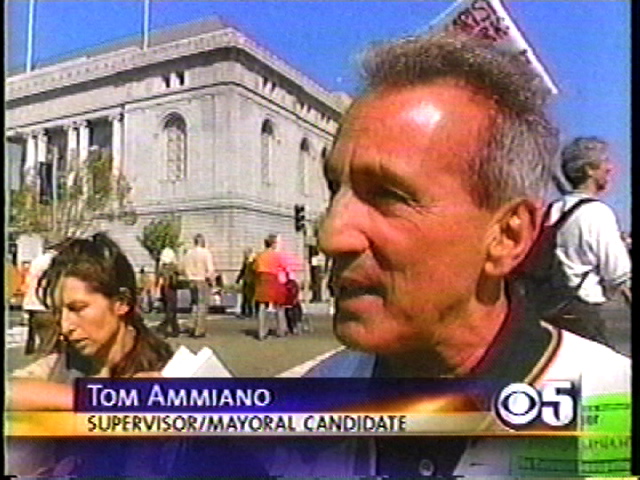

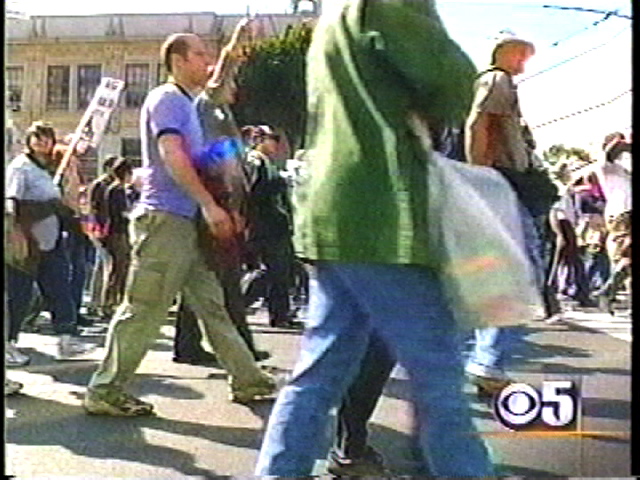
I just posted my first music video!
I just started the camera rolling and performed a song with the other half of Park and Ride: Ron Taylor. There's more where this came from.
I just found out that I'll be playing at Noe Valley Ministry on December 13, 2003 -- Saturday night! Here's more information about the event.
Hope to see you there!
Slipping Away

I thought it was time for a little music video to introduce you guys to Ron, and give you a little taste of us live -- so you might come see us play at Noe Valley Ministry in San Francisco when we play December 16, 2003.This song was the last song we wrote together when we were in Seattle in 1999. It's one of my favorites.
Ron had just re-learned the song when we taped this, so I had to cue him for the chord changes. That's why I keep pointing at him -- that's "the signal" for the chord change.
Hope you like it!
Lyrics - Slipping Away
Words by Lisa Rein, Music By Lisa Rein and Ron Taylor
Lately, I can't seem to unwind
I'd put my feet in the air
But there's too much on my mind
And I'm just
Traveling with my face in a jar
I got one foot in the door
And things are fine how they are
But sometimes I think
I got it made in the shade
And then, starts a feeling like it's slipping away
In my mind
But everything seems ok
Everything seems ok
Dying
I'm dying to win
And I'll be killing myself
To be born over again
Are you lying?
I ain't too sure who you are
You're just a traveling salesman with your face in a jar
It's always when I think that something's coming my way
Then I get that funny feeling like it's slipping away
For the last time
But everything seems ok
Everything seems ok
Yeah
It's always when I think that something's coming my way
That's when I get the feeling it's all slipping away
In my mind
But everything seems ok
Everything seems ok
Yeah everything seems ok
Everything seems ok
Yeah everything seems ok
Everything seems ok
Yeah everything seems ok
Everything seems ok
Yeah everything

